Tag Archives: j f c fuller

The Character, Nature and Context of The Civil War and Why it Still Matters Part. 1

IMG_0426

Friends of Padre Steve’s World,

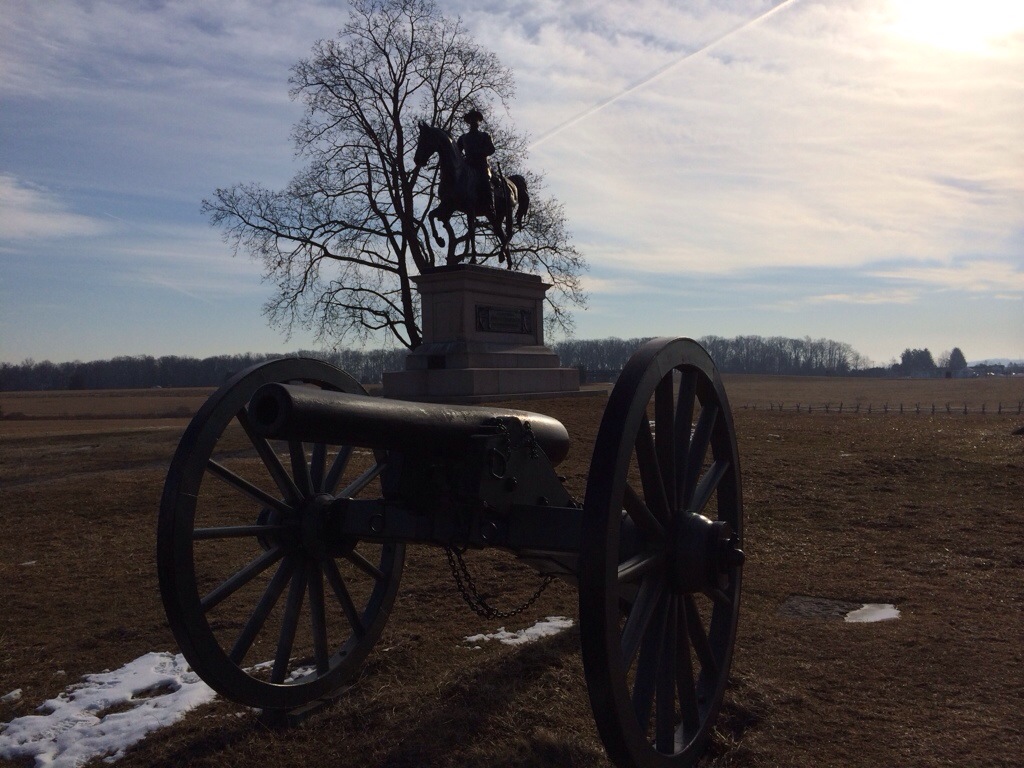
Since I am now working my way back to Gettysburg his is a significant revision of an article that I published here earlier in the year and that is a part of my Gettysburg Staff Ride text. The actual full title of the chapter is The Foundations of the First Modern War: The Character, Nature and Context of the Civil War and its Importance to Us Today but that is rather long to put as the title here. This is pretty detailed and specialized so many may not want to read it, however, for those with in interest in how United States policy in regard to how we use our military today and the myriad of tensions that we wrestle with that have been with us for about 150 years it should prove enlightening.

Since it is pretty long I am dividing it up between two posts. Have a great day!

Peace

Padre Steve+
20140308-231743.jpg

The First Modern War

The American Civil War was the first modern war. It was a watershed time which introduced changes in tactics, logistics, and communications, while showed the world exactly what the concept of total war entailed. Though it did not change the essential nature of war, which Clausewitz says is “is an act of violence to compel our opponent to fulfil our will” [1] it expanded the parameters of it and re-introduced the concept of “total war” to the world and “because its aim was all embracing, the war was to be absolute in character.”[2] In a sense it was a true revolution in military affairs.

Thus it is important to study the Gettysburg campaign in the context of the Civil War, as well as in relationship to the broader understanding of the nature and character of war. To do this one must examine the connection between them and policies made by political leaders; to include the relationship of political to military leaders, diplomats, the leaders of business and industry and not to be forgotten the press and the people. Likewise we must understand the various contexts of war, how they impacted Civil War leaders and why they must be understood by civilian policy makers and military leaders today.

While the essential nature of war remains constant, wars and the manner in which they are fought have changed in their character throughout history, and this distinction matters not only for military professionals, but also policy makers. The changing character of war was something that military leaders as well as policy makers struggled with during the American Civil War much as today’s military leaders and policy makers seek to understand the character of warfare today. British military theorist Colin Gray writes “Since the character of every war is unique in the details of its contexts (political, social-cultural, economic, technological, military strategic, geographical, and historical), the policymaker most probably will struggle of the warfare that is unleashed.” [3] That was not just an issue for Abraham Lincoln and Jefferson Davis, both of whom struggled with the nature of the war which had been unleashed, but it is one for our present political leaders, who as civilian politicians are “likely to be challenged by a deficient grasp of both the nature of war as well as its contemporary context-specific character.” [4]

In addition to being the first modern war, or maybe I should say, the first war of the Industrial Age, the Civil War became a “total war.” It was the product of both the massive number of technological advances which both preceded and occurred during it, in which the philosophical nature of the Industrial Revolution came to the fore. Likewise, the enmity of the two sides for one another which had been fostered by a half century of relentless and violent propaganda which ushered from the mouths of politicians, the press and even from the pulpit, even to the point of outright armed conflict and murder in “Bleeding Kansas” during the 1850s.

As a total war it became a war that was as close to Clausewitz’s understanding of absolute war in its in character waged on the American continent, and it prefigured the great ideological wars of the twentieth century, as J.F.C. Fuller noted “for the first time in modern history the aim of war became not only the destruction of the enemy’s armed forces, but also of their foundations- his entire political, social and economic order.” [5] It was the first war where at least some of the commanders, especially Ulysses S. Grant and William Tecumseh Sherman were men of the Industrial Age, in their thought and in the way that they waged war, in strategy, tactics even more importantly, psychologically. Fuller wrote:

“Spiritually and morally they belonged to the age of the Industrial Revolution. Their guiding principle was that of the machine which was fashioning them, namely, efficiency. And as efficiency is governed by a single end- that every means is justified- no moral or spiritual conceptions of traditional behavior must stand in its way.” [6]

Both men realized in early 1864 that “the South was indeed a nation in arms and that the common European practice of having standing armies engaged each other in set-piece battles to determine the outcome of a war was not enough to win this struggle.” [7] Though neither man was a student of Clausewitz, their method of waging war was in agreement with the Prussian who wrote that “the fighting forces must be destroyed; that is, they must be put in such a position that they can no longer carry on the fight” but also that “the animosity and the reciprocal effects of hostile elements, cannot be considered to have ended so long as the enemy’s will has not been broken.” [8] Sherman told the mayor of Atlanta after ordering the civilian population expelled that “we are not only fighting hostile armies, but a hostile people, and must make the old and young, the rich and poor, feel the hard hand of war.” [9] Sherman not only “carried on war against the enemy’s resources more extensively and systematically than anyone else had done, but he developed also a deliberate strategy of terror directed against the enemy’s minds.” [10]

Abraham Lincoln came to embrace eternal nature of war as well as the change in the character of the war over time. Lincoln had gone to war for the preservation of the Union, something that for him was almost spiritual in nature, as is evidenced by the language he used in both of his inaugural addresses and the Gettysburg Address. Instead of a war to re-unite the Union with the Emancipation Proclamation the war became a war for the liberation of enslaved African Americans, After January 1st 1863 when the Emancipation Proclamation went into effect, Lincoln “told an official of the Interior Department, “the character of the war will be changed. It will be one of subjugation…The [old] South is to be destroyed and replaced by new propositions and ideas.” [11]

Of course, the revolution in military affairs took time and it was the political and military leaders of the North who better adapted themselves and their nation to the kind of war that was being fought. “Lincoln’s remarkable abilities gave him a wide edge over Davis as a war leader, while in Grant and Sherman the North acquired commanders with a concept of total war and the determination to make it succeed.” [12]

At the beginning of the war the leaders and populace of both sides still held a romantic idea of war. The belief that the war would be over in a few months and that would be settled by a few decisive battles was held by most, including many military officers on both sides, there were some naysayers like the venerable General Winfield Scott, but they were mocked by both politicians and the press.

The Civil War became an archetype of the wars of the twentieth century, and the twenty-first century. It became a war where a clash between peoples and ideologies which extended beyond the province of purely military action as “it was preceded by years of violent propaganda, which long before the war had obliterated all sense of moderation, and awakened in the contending parties the primitive spirit of tribal fanaticism.” [13]

The conduct of the American Civil War added new dimensions to war, increased its lethality and for the first time since the 30 Years’ War saw opponents intentionally target the property, homes and businesses of civilian populations as part of their military campaign. The Civil War was a precursor to the wars that followed, especially the First World War which it prefigured in so many ways. [14]

However, like all wars many of its lessons were forgotten by military professionals in the United States as well as in Europe. Thus 50 years later during World War One, British, French, German, Austrian and Russian wasted vast amounts of manpower and destroyed the flower of a generation because they did not heed the lessons of the Civil War. Fuller noted:

“Had the nations of Europe studied the lessons of the Civil War and taken them to heart they could not in 1914-1918 have perpetuated the enormous tactical blunders of which that war bears record.” [15]

The lessons of the war are still relevant today. Despite vast advances in weaponry, technology and the distances with which force can be applied by opponents, war remains an act of violence to compel an enemy to fulfill our will. War according to Clausewitz is “more than a chameleon that slightly adapts its characteristics to the given case.” [16] but it is always characterized by the violence of its elements, the province of chance and its subordination to the political objective and as such forces political and military leaders as well as policy makers to wrestle with “the practical challenge of somehow mastering the challenge of strategy in an actual historical context.” [17]

Colin Gray makes a case for seven essential contexts that must be understood by policy makers and military leaders regarding war, which if ignored or misunderstood “can have strong negative consequences.” [18] The contexts which Gray enunciates: a political context, a social-cultural context, an economic context; a military-strategic context, a geographic context and a historical context and as Gray notes they “define all the essential characteristics of a particular armed conflict.” [19]

The study of the Civil War can be helpful to the joint planner and commander because it so wonderfully shows the interplay of Clausewitz’s “paradoxical trinity- composed of primordial violence, hatred, and enmity, which are to be regarded as a blind natural force; of the play of chance and the element of subordination, as an instrument of policy, which makes it subject to reason alone.” [20] during an era of great technological and philosophical change. The importance of this cannot be underestimated, for in this era of change, like in every era, some leaders and commanders were either resistant to, or failed to understand the changes being forced upon them in their conduct of war by the industrialization of war and its attendant technology; while others, like Sherman, Grant and Sheridan not only understood them, but embraced them and applied them with skill and vigor in ways that stunned the people of the South.
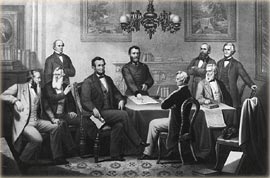
15lincoln_cabinet

The Whole of Government and National Power

Over time the Union developed what we would now refer to as a “whole of government approach” to the war. This included not only the military instrument but the use of every imaginable means of national power, from the diplomatic, the economic and the informational aspects of the Union in the effort to subdue the Confederacy. The understanding and use of the “whole of government approach” to war and conflict is still a cornerstone of United States military policy in “unified action, to achieve leverage across different domains that will ensure conditions favorable to the U.S. and its allies will endure.” [21] The working staff of the War Department headed by Edwin Stanton and Major General Montgomery Meigs developed rapidly. It effectively coordinated with railroads, weapons manufactures and suppliers of clothing, food and other necessities to supply the army and navy so well that “Union forces never seriously lacked the materials necessary to win the war.” [22] Stanton and Meigs were “aided by the entrepreneurial talent of northern businessmen” which allowed “the Union developed a superior managerial talent to mobilize and organize the North’s greater resources for victory in the modern industrialized conflict that the Civil War became.” [23]

The understanding of this eternal nature and ever changing character of war to leaders of nations as well as military commanders and planners has been very important throughout history. It can be seen in the ways that Jefferson Davis and Abraham Lincoln conducted their relationships with their military commanders, including during the Gettysburg campaign and we are reminded by Colin Gray notes that political leaders and policy makers who are in charge of policy often ignorant of the nature and character of war, and this fact “directs attention to the difficulties of translating political judgment into effective warmaking.” [24] Military leaders should be the people to advise and instruct policy makers in aligning their policy to what is actually feasible based on the ends ways and means, as well as the strengths and limitations of the military to carry out policy decisions and history reminds us “that policymakers committed strongly to their political desires are not easily deflected by military advice of a kind that they do not want to hear.” [25]

While there was much support for the Confederacy in the aristocracies of Europe, the effectiveness of the Union military in winning the key battles that allowed Lincoln to make his Emancipation Proclamation ensured that Europe would not recognize the Confederacy, . Charles F. Adams, the United States minister to Britain successfully defused the crisis of the Trent affair, which could have led to British recognition of the Confederacy and intervention in the war. Adams’ efforts were so successful that they “left Anglo-American relations in better shape than before the crisis.” [26]

(c) Southampton City Art Gallery; Supplied by The Public Catalogue Foundation

The Trent Affair

The Importance of Diplomacy

Related to this understanding of warfare one has to also look at the importance of diplomacy, especially in picking the right diplomat for a critical post is a part of a whole of government approach to war and warfare. This was very important in the early stages of the Civil War as there was much support for the Confederacy in the aristocracies of Europe. The effectiveness of the diplomacy was increased by the Union military efforts. The Union suffered many failures at the outset of the war by the time of the Gettysburg campaign they did enough to prevent English or French intervention on the side of the Confederacy, which was also aided by tensions in Europe regarding the Schleswig-Holstein problem between Prussia and Austria as well as unrest in Poland, and the British in particular were loath to risk intervening in a conflict that might be “a disturbance in the precarious balance of power which might be the signal for a general conflagration, they recalled Voltaire’s comment that a torch lighted in 1756 in the forests of the new world had promptly wrapped the old world in flames.” [27] Thus, European leaders and diplomats were very hesitant to allow Southern legations to convince them to intervene.

Though the Confederates won many early battles in 1861 and 1862 it was the success of the Union military that altered the diplomatic landscape and helped doom the Confederacy. The joint operations conducted by Ulysses Grant and Flag Officer Foote at Island Number Ten, Fort Henry, Fort Donaldson and Shiloh opened the door to the western Confederacy making it vulnerable to Union invasion. Likewise, the joint operations conducted by the Union Navy and Army against the Confederacy through the blockade and capture of key ports such as New Orleans by 1862; combined with the bloody repulses of Confederate armies at Perryville and Antietam allowed Lincoln to make his Emancipation Proclamation, an act which reverberated across the Atlantic.

These military successes enabled Lord Palmerston to reject a French proposal for France, England and Russia to propose to the warring parties, a “North-South armistice, accompanied by a six month lifting of the blockade. The result, if they had agreed- as they had been in no uncertain terms warned by Seward in private conversations with British representatives overseas- would have been a complete diplomatic rupture, if not an outright declaration of war.” [28]

The issuance of that proclamation ensured that Europe would not recognize the Confederacy because even pro-Southern English political leaders could not appear to even give the appearance of supporting slavery, especially as both England and France had abolished slavery decades before, while Russia had only recently emancipated its serfs and “was pro-Union from the start….” [29] Popular sentiment in those countries, outside of the ruling class and business elites, was heavily in favor of emancipation, especially among the working classes. The leaders of the workingmen of Manchester England, a major textile producer, who which had been among the “hardest hit by the cotton famine, sent him [Lincoln] an address approved at a meeting on New Year’s Eve, announcing their support of the North in its efforts to “strike off the fetters of the slave.” [30]

There were issues related to the blockade but Charles F. Adams, the United States minister to Britain successfully defused the crisis of the Trent affair, which could have led to British recognition of the Confederacy and intervention in the war in a manner that “left Anglo-American relations in better shape than before the crisis.” [31]

The Union blockade was a key factor in the diplomatic efforts. As I have noted there were many in both Britain and France who sympathized with the South and hoped for Southern victory that were not impressed by Southern moves to subject them to an embargo of Southern cotton until they received recognition. While many Englishmen were offended by Seward’s bluster, many “resented even more the Confederacy’s attempt at economic blackmail.” [32]

The British especially were keen on not going to war for the sake of the South, there was far too much at stake for them. This was something that the Southern leaders and representatives did not fully comprehend. Prime Minister Viscount Palmerston and Foreign Minister Lord Russell were concerned about the economic impact of the loss of Southern cotton but also “recognized that any action against the blockade could lead to a conflict with the United States more harmful to England’s interests than the temporary loss of Southern cotton.” [33] Palmerston well remembered the war of 1812 when he served as Minister of War, and the disastrous results for the British Merchant Marine, and he realized that “England could not only afford the risk of a loss in a sideline war; she could not even afford to win one.” [34]

Mahan_teaser

Dennis Hart Mahan the First American Military Theorist

The Development of American Military Culture and Theory

As we examine the Civil War as the first modern war we have to see it as a time of great transition and change for military and political leaders. As such we have to look at the education, culture and experience of the men who fought the war, as well as the various advances in technology and how that technology changed tactics which in turn influenced the operational and strategic choices that defined the characteristics of the Civil War and wars to come.

The leaders who organized the vast armies that fought during the war were influenced more than military factors. Social, political, economic, scientific and even religious factors influenced their conduct of the war. The officers that commanded the armies on both sides grew up during the Jacksonian opposition to professional militaries, and for that matter even somewhat trained militias. The Jacksonian period impacted how officers were appointed and advanced. Samuel Huntington wrote:

“West Point was the principle target of Jacksonian hostility, the criticism centering not on the curriculum and methods of the Academy but rather upon the manner of how cadets were appointed and the extent to which Academy graduates preempted junior officer positions in the Army. In Jacksonian eyes, not only was specialized skill unnecessary for a military officer, but every man had the right to pursue the vocation of his choice….Jackson himself had an undisguised antipathy for the Academy which symbolized such a different conception of officership from that which he himself embodied. During his administration disciple faltered at West Point, and eventually Sylvanus Thayer, the superintendent and molder of the West Point educational methods, resigned in disgust at the intrusion of the spoils system.” [35]

This is particularly important because of how many officers who served in the Civil War were products of the Jacksonian system and what followed over the next two decades. Under the Jackson administration many more officers were appointed directly from civilian sources than from West Point, often based on political connections. “In 1836 when four additional regiments of dragoons were formed, thirty officers were appointed from civilian life and four from West Point graduates.” [36]

While this in itself was a problem it was made worse by a promotion system based on seniority, not merit. There was no retirement system so officers who did not return to the civilian world hung on to their careers until they quite literally died with their boots on. This held up the advancement outstanding junior officers who merited promotion and created a system where “able officers spent decades in the lower ranks, and all officers who had normal or supernormal longevity were assured of reaching higher the higher ranks.” [37]

Robert E. Lee was typical of many officers who stayed in the Army. Despite his success he was haunted by his lack of advancement. While still serving in Mexico having gained great laurels including a brevet promotion to Lieutenant Colonel, but “the “intrigues, pettiness and politics…provoked Lee to question his career.” He wrote “I wish I was out of the Army myself.” [38] In 1860 on the brink of the war Lee was “a fifty-three year-old man and felt he had little to show for it, and small hope for promotion.” [39] Lee’s discouragement was not unwarranted, despite his exemplary service there was little hope for promotion and to add to it Lee knew that “of the Army’s thirty-seven generals from 1802 to 1861, not one was a West Pointer.” [40] Other exemplary officers including Winfield Scott Hancock languished with long waits for promotion between the Mexican War and the Civil War. The long waits for promotion and duty in often desolate duty stations separated from family caused many officers to leave the Army; a good number of whom in 1861 became prominent in both the Union and Confederate armies. Among these officers were such notables as Thomas “Stonewall” Jackson, Ulysses S. Grant, William Tecumseh Sherman, Henry Halleck, George McClellan and Jubal Early.

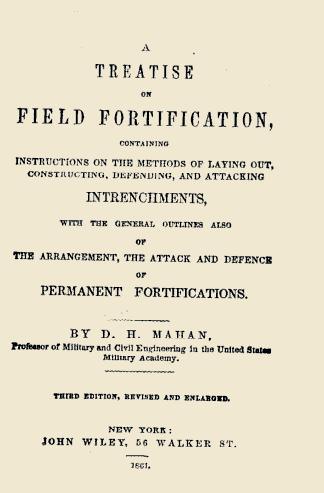
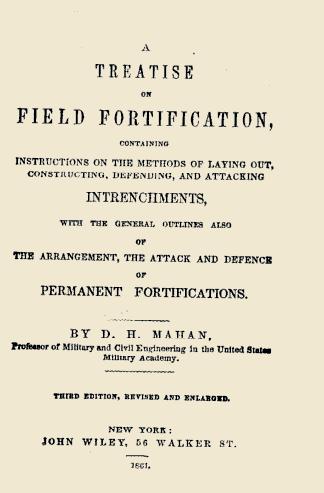
The military education of these officers at West Point was based on the Napoleonic tactics and methods espoused by Henri Jomini as Clausewitz’s works had yet to make their way to America. Most were taught by Dennis Hart Mahan. Mahan, who graduated at the top of the West Point class of 1824 and spent four years in France as a student and observer at the “School of Engineering and Artillery at Metz” [41] before returning to the academy where “he was appointed professor of military and civil engineering and of the science of war.” [42]

In France Mahan studied the prevailing orthodoxy of Henri Jomini who along with Clausewitz was the foremost interpreter of Napoleon and the former Chief of Staff of Marshal Ney. Jomini’s influence cannot be underestimated, some have noted, a correctly so that “Napoleon was the god of war and Jomini was his prophet.” [43]

The basic elements of Jominian orthodoxy were that: “Strategy is the key to warfare; That all strategy is controlled by invariable scientific principles; and That these principles prescribe offensive action to mass forces against weaker enemy forces at some defensive point if strategy is to lead to victory.” [44] Jomini interpreted “the Napoleonic era as the beginning of a new method of all out wars between nations, he recognized that future wars would be total wars in every sense of the word.” [45] Jomini laid out a number of principles of war including elements that we know well today, operations on interior and exterior lines, bases of operations, and lines of operation. He understood the importance of logistics in war, envisioned the future of amphibious operations and his thought would be taken to a new level by Alfred Thayer Mahan, the son of Dennis Hart Mahan in his book The Influence of Sea Power on History.

Jomini also foresaw the horrific nature of the coming wars and expressed his revulsion for them and desire to return to the limited wars of the eighteenth century:

“I acknowledge that my prejudices are in favor of the good old times when the French and English guards courteously invited each other to fire first as at Fontenoy, preferring them to the frightful epoch when priests, women. And children throughout Spain plotted the murder of individual soldiers.” [46]

Jomini’s influence was great throughout Europe and was brought back to the United States by Mahan who principally “transmitted French interpretations of Napoleonic war” [47]including that of Jomini. However, Mahan returned from France somewhat dissatisfied knowing that much of what he learned was impractical in the United States where a tiny professional army and the vast expenses of territory were nothing like European conditions. Mahan thought prevailing doctrine “was acceptable for a professional army on the European model, organized and fighting under European conditions. But for the United States, which in case of war would have to depend upon a civilian army held together by a small professional nucleus, the French tactical system was unrealistic.” [48]

Mahan set about rectifying this immediately upon his return and though “steeped in French thought, but acutely sensitive to American conditions that in his lectures and later writings he modified the current orthodoxy by rejecting one of its central tenants-primary reliance on offensive assault tactics.” [49] Mahan believed that “ If the offensive is attempted against a strongly positioned enemy, Mahan cautioned, it should be an offensive not of direct assault but of the indirect approach, of maneuver and deception. Victories should not be purchased by the sacrifice of one’s own army….To do the greatest damage to our enemy with the least exposure of ourselves,” said Mahan, “is a military axiom lost sight of only by ignorance to the true ends of victory.” [50] However, “so strong was the attraction of Napoleon to nineteenth-century soldiers that American military experience, including the generalship of Washington, was almost ignored in military studies here.” [51]

Thus there was a tension in American military thought between the followers of Jomini and Mahan. Conservative Jominian thinking predominated much of the Army, and within the army “Mahan’s decrees failed to win universal applause.” [52] This may have been due in part to the large number of officers accessed directly from civilian life during the Jacksonian period. Despite this it was Mahan who more than any other “taught the professional soldiers who became the generals of the Civil War most of what they knew through the systematic study of war.” [53]

Mahan’s influence on the future leaders of the Union and Confederate armies went beyond the formal classroom setting. Mahan established the “Napoleon Club,” a military round table at West Point.[54] Mahan dominated the academy in many ways, and for the most part he ran the academic board, which ran the academy, and “no one was more influential than Mahan in the transition of officership from a craft into a profession.” [55] Mahan was a unique presence at West Point who all students had to face in their final year. Mahan was:

“aloof and relentlessly demanding, he detested sloppy thinking, sloppy posture, and a sloppy attitude toward duty…Mahan would demand that they not only learn engineering and tactics, but that every manner and habit that characterizes an officer- gentlemanly deportment, strict integrity, devotion to duty, chivalric honor, and genuine loyalty- be pounded into them. His aim was to “rear soldiers worthy of the Republic.” [56]

Mahan’s greatest contributions in for American military doctrine were his development of the active defense and emphasis on victory through maneuver. Mahan stressed “swiftness of movement, maneuver, and use of interior lines of operation. He emphasized the capture of strategic points instead of the destruction of enemy armies,” [57] while he emphasized the use of “maneuver to occupy the enemy’s territory or strategic points.” [58]

That being said Mahan’s “greatest contribution to American military professionalism was, in all probability, his stress upon the lessons to be learned from history. Without “historical knowledge of the rise and progress” of the military art, he argued, it is impossible to get “even tolerably clear elementary notions” beyond “the furnished by mere technical language…It is in military history that we are able to look for the source of all military science.” [59] Mahan emphasized that “study and experience alone produce the successful general” noting “Let no man be so rash as to suppose that, in donning a general’s uniform, he is forthwith competent to perform a general’s function; as reasonably he might assume that in putting on robes of a judge he was ready to decide any point of the law.” [60] Such advice is timeless.

Mahan certainly admired Napoleon and was schooled in Jomini, but he believed that officers needed to think for themselves on the battlefield. And “no two things in his military credo were more important than the speed of movement- celerity, that secret of success- or the use of reason. Mahan preached these twin virtues so vehemently and so often through his chronic nasal infection that the cadets called him “Old Cobbon Sense.” [61] Like Jomini, Mahan was among the first to differentiate between strategy, which involved “fundamental, invariable principles, embodied what was permanent in military science, while tactics concerned what was temporary….and “the line which distinguishes one from another is “that which separates the science from the art.” [62]

Henry_Halleck_by_Scholten,_c1865

Henry Wager Halleck

Mahan’s teaching was both amplified and modified by the work of his star pupil Henry Wager Halleck wrote the first American textbook on military theory Elements of Military Art and Science which was published in 1846 and though it was not a standard text at West Point “it was probably the most read book among contemporary officers.” [63] The text was based on a series of twelve lectures Halleck had given the Lowell Institute in 1845, as Halleck was considered one of America’s premier scholars.

Like Mahan, Halleck was heavily influenced by the writings of Jomini, and the Halleck admitted that his book “was essentially a compilation of other author’s writings,” [64] including those of Jomini and Mahan; and he “changed none of Mahan’s and Jomini’s dogmas.” [65] In addition to his own book, Halleck also “translated Jomini’s Life of Napoleon” from the French. [66] Halleck, like his mentor Mahan “recognized that the defense was outpacing the attack” [67] in regard to how technology was beginning to change war and “five of the fifteen chapters in Halleck’s Elements are devoted to fortification; a sixth chapter is given over to the history and importance of military engineers.” [68] Halleck’s Elements became one of the most influential texts on American military thought during the nineteenth century, and “had a major influence on American military thought” [69] being read by many before, during and after the war, including Abraham Lincoln.

Halleck, as a part of Mahan’s enlightenment too fought against the Jacksonian wave, eloquently speaking out for a more professional military against the Jacksonian critics. Halleck plead “for a body of men who shall devote themselves to the cultivation of military science” and the substitution of Prussian methods of education and advancement for the twin evils of politics and seniority.” [70]

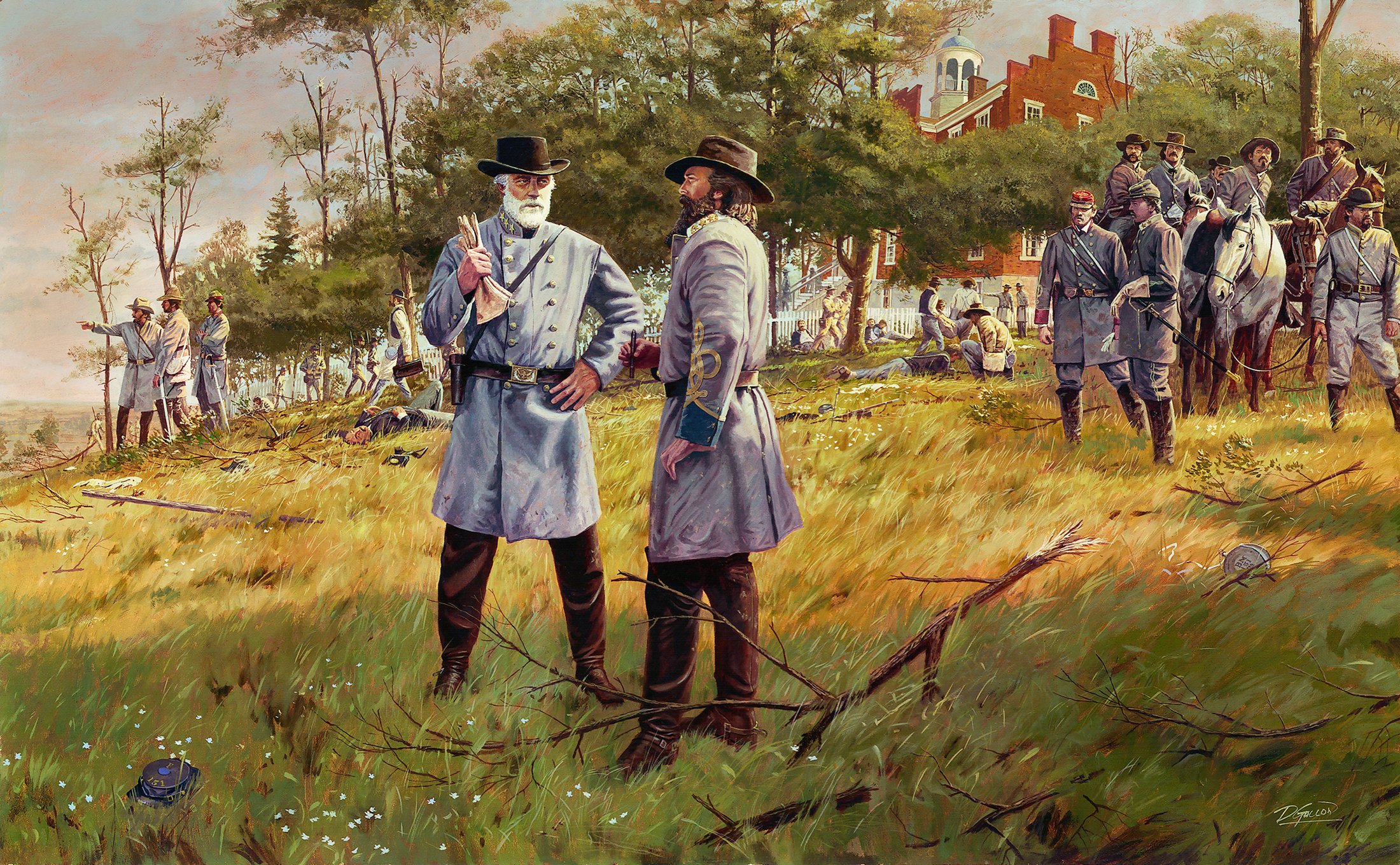
As we look the Gettysburg campaign it is important to note how much of Mahan’s teaching either shows up in the actions of various commanders, such as Meade’s outstanding use of interior lines on the defense; or how in some cases his advice, particularly on attacking strongly held positions was ignored by Lee. In fairness to Lee he “was the only principle general of the war who had attended West Point too early to study the military art under Dennis Mahan.” [71] Likewise, during his tenure as the Superintendent of West Point Lee had little time to immerse himself in new studies due to the changes being wrought at the Academy in terms of discipline and curriculum. If anything can be said about Lee was that he was much more affected by what he read about Napoleon’s battles and campaigns; in which he took a lifelong interest in while a cadet, reading the French editions of the “three volumes of General Montholon’s memoirs of Napoleon dealing with the early campaigns, and the first volume of General Segur’s Expedition de Russie dealing with Napoleon’s advance to Moscow in 1812” [72] than he was with Jomini’s theories, though he certainly would have had some familiarity with them. Lee continued his study of Napoleon’s campaigns during his time as superintendent of West Point, in which “of fifteen books on military subjects that he borrowed from the academy library during his superintendency, no more than seven concerned Napoleon.” [73] Lee’s studies of the emperor’s campaigns allowed him to draw “more aggressive strategic concepts that previous American generals” [74] concepts that he would execute with alacrity during his campaigns of 1862 and 1863.

While West Point was the locus of American military thought and professionalism there was in the South a particular interest in military thought and this “was manifest in the creation of local military schools. Virginia Military Institute was established in 1839, the Citadel and the Arsenal set up in South Carolina in 1842, Kentucky Military Institute in 1845. By 1860 every Southern state, except Texas and Florida, had its own state supported military academy patterned on the models of West Point and VMI.” [75] There was no such development in the North, making these schools a unique part of the American military heritage, only some of which remain.

As the American theorists began their period of enlightenment, there was no real corresponding development in tactical doctrine, in part because “in Europe almost all the tactical experience of the major armies seemed to bear Jomini out.” [76] The American Army lacked “an integrated tactical system for infantry, artillery and cavalry doctrine” [77] which showed up frequently during the Civil War as commanders struggled to adapt tactics to advances in weaponry. The events in Europe, “all seemed to testify that it was the army on offense that won European battles, and at lightning speed.” [78] As such there existed an “ambivalence of thinking on the merits of the offense versus the defense in infantry tactics….while American artillery doctrine firmly subordinated the artillery to the infantry” [79] as many American officers were convinced that this was the face of war and all the major infantry tactics handbooks “borrowed heavily from Napoleonic sources and stressed the virtue of quick, aggressive movements on the battlefield.” [80] The often disjointed developments in infantry, artillery and cavalry tactics of the ante-bellum Army demonstrated that “Military thinking, and even more strategic organization, remained essentially within the Napoleonic tradition filtered through an eighteenth-century world view….” [81] It would take the bloody experience of war to change them. As Fuller noted that “the tactics of this war were not discovered through reflection, but through trial and error.” [82]

To be continued….

Notes

[1] Clausewitz, Carl von. On War Indexed edition, edited and translated by Michael Howard and Peter Paret, Princeton University Press, Princeton NJ 1976 p.75

[2] Fuller, J.F.C. The Conduct of War 1789-1961 Da Capo Press, New York 1992. Originally published by Rutgers University Press, New Brunswick N.J p.99

[3] Gray, Colin S. Fighting Talk: Forty Maxims on War, Peace, and Strategy Potomac Book, Dulles VA 2009 p.36

[4] Ibid. Gray Fighting Talk p.36

[5] Fuller, J.F.C. A Military History of the Modern World, Volume Three: From the Seven Days Battle, 1862, to the Battle of Leyte Gulf, 1944 Minerva Press 1956 p.88

[6] Ibid. Fuller A Military History of the Modern World, Volume Three p.88

[7] Flood, Charles Bracelen, Grant and Sherman: The Friendship that Won the War, Harper Perennial, New York 2005 p.238

[8] Ibid. Clausewitz p.90

[9] McPherson, James. The Battle Cry of Freedom: The Civil War Era Oxford University Press, Oxford and New York 1988 p.809

[10] Weigley, Russell F. The American Way of War: A History of United States Military History and Policy University of Indiana Press, Bloomington IN, 1973 p.149

[11] Ibid. McPherson The Battle Cry of Freedom p.558

[12] Ibid. McPherson The Battle Cry of Freedom p.857

[13] Ibid. Fuller The Conduct of War 1789-1961 p.99

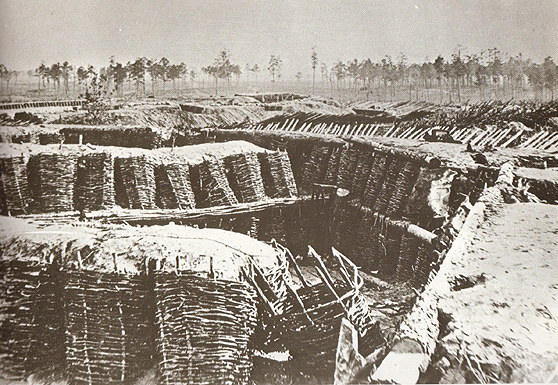
[14] Fuller has an excellent synopsis of this in his book A Military History of the Modern World, Volume Three (p.89). He wrote: The war fought by Grant and Lee, Sherman and Johnston, and others closely resembled the First of the World Wars. No other war, not even the Russo-Japanese War of 1904-1905, offers so exact a parallel. It was a war of rifle bullets and trenches, of slashings, abattis, and even of wire entanglements- an obstacle the Confederates called “a devilish contrivance which none but a Yankee could devise” because at Drewry’s Bluff they had been trapped in them and slaughtered like partridges.” It was a war of astonishing in its modernity, with wooden wire-bound mortars hand and winged grenades, rockets, and many forms of booby traps. Magazine rifles and Requa’s machine guns were introduced and balloons were used by both sides although the confederates did not think much of them. Explosive bullets are mentioned and also a flame projector, and in June, 1864, General Pendleton asked the chief ordnance officer at Richmond whether he could supply him with “stink-shells” which would give off “offensive gases” and cause “suffocating effect.” The answer he got was “stink-shells, none on hand; don’t keep them; will make them if ordered.” Nor did modernity end there; armoured ships, armoured trains, land mines and torpedoes were used. A submarine was built by Horace H. Hundley at Mobile….”

[15] Ibid. Fuller A Military History of the Modern World, Volume Three p.89

[16] Ibid. Clausewitz On War p.89

[17] Ibid. Gray Fighting Talk p.38

[18] Ibid. Gray Fighting Talk p.5

[19] Ibid. Gray Fighting Talk p.3

[20] Ibid. Clausewitz On War p.89

[21] ________ JCWS Student Text 1 3rd Edition, 14 June 2013 p.2-4

[22] Guelzo Allen C. Fateful Lightening: A New History of the Civil War Era and Reconstruction Oxford University Press, Oxford and New York 2012

[23] Ibid. McPherson. The Battle Cry of Freedom p.857

[24] Ibid. Gray Fighting Talk p.38

[25] Ibid. Gray Fighting Talk p.38

[26] Ibid. McPherson. The Battle Cry of Freedom p.391

[27] Foote, Shelby, The Civil War, A Narrative. Volume Two Fredericksburg to Meridian Random House, New York 1963 p.154

[28] Ibid. Foote , The Civil War, A Narrative. Volume Two p.153

[29] Ibid. Foote , The Civil War, A Narrative. Volume Two p.153

[30] Ibid. Foote , The Civil War, A Narrative. Volume Two p.155

[31] Ibid. McPherson. The Battle Cry of Freedom p.391

[32] Ibid. McPherson. The Battle Cry of Freedom p.384

[33] Ibid. McPherson. The Battle Cry of Freedom p.384

[34] Ibid. Foote , The Civil War, A Narrative. Volume Two p.154

[35] Huntington, Samuel P. The Soldier and the State: The Theory and Politics of Civil-Military Relations, The Belknap Press of Harvard University Press, Cambridge MA and London 1957 pp.204-205

[36] Ibid. Huntington The Soldier and the State p.206

[37] Ibid. Huntington The Soldier and the State p.207

[38] Thomas, Emory Robert E. Lee W.W. Norton and Company, New York and London 1995 p.139

[39] Korda, Michael. Clouds of Glory: The Life and Legend of Robert E. Lee Harper Collins Publishers, New York 2014 p.213

[40] Ibid. Huntington The Soldier and the State p.207

[41] Hagerman, Edward. The American Civil War and the Origins of Modern Warfare Midland Book Editions, Indiana University Press. Bloomington IN. 1992. p.7

[42] Ibid. Hagerman The American Civil War and the Origins of Modern Warfare p.7

[43] Hittle, J.D. editor Jomini and His Summary of the Art of War a condensed version in Roots of Strategy, Book 2 Stackpole Books, Harrisburg PA 1987 p. 429

[44] Shy, John Jomini in Makers of Modern Strategy, from Machiavelli to the Nuclear Age edited by Paret, Peter, Princeton University Press, Princeton New Jersey 1986 p.146

[45] Ibid. Hittle, Jomini and His Summary of the Art of War p. 428

[46] Ibid. Hittle Jomini p.429

[47] Ibid. Shy Jomini p.414

[48] bid. Hagerman The American Civil War and the Origins of Modern Warfare p.7

[49] Ibid. Hagerman The American Civil War and the Origins of Modern Warfare p.9

[50] Ibid. Weigley The American Way of War p.88

[51] Ibid. Shy Jomini p.414

[52] Ibid. Hagerman The American Civil War and the Origins of Modern Warfare p.13

[53] Ibid. Shy Jomini p.414

[54] Hagerman also notes the contributions of Henry Halleck and his Elements of Military Art and Science published in 1846 (p.14) and his influence on many American Officers.  Weigley in his essay in Peter Paret’s Makers of Modern Strategy would disagree with Hagerman who notes that in Halleck’s own words that his work was a “compendium of contemporary ideas, with no attempt at originality.” (p.14) Weigley taking exception gives credit to Halleck for “his efforts to deal in his own book with particularly American military issues.” Paret, Peter editor. Makers of Modern Strategy: For Machiavelli to the Nuclear Age Princeton University Press, Princeton NJ 1986 p.416.

[55] Millet, Allan R. and Maslowski, Peter, For the Common Defense: A Military History of the United States The Free Press a Division of Macmillan Inc. New York, 1984 p.126

[56] Waugh, John C. The Class of 1846: From West Point to Appomattox, Stonewall Jackson, George McClellan and their Brothers Ballantine Books, New York 1994 pp.63-64

[57] Wert, Jeffry D. General James Longstreet The Confederacy’s Most Controversial Soldier, A Touchstone Book, Simon and Schuster, New York and London 1993 p.30

[58] Ibid. Hagerman The American Civil War and the Origins of Modern Warfare p.14

[59] Ibid. Huntington The Soldier and the State p.220

[60] Ibid. Huntington The Soldier and the State pp.221

[61] Ibid. Waugh The Class of 1846 p.64

[62] Ibid. Huntington The Soldier and the State pp.220-221

[63] Ibid. Hagerman The American Civil War and the Origins of Modern Warfare p.14

[64] Marszalek, John F. Commander of All of Lincoln’s Armies: A Life of General Henry W. Halleck The Belknap Press of Harvard University Press, Cambridge MA and London 2004 p.42

[65] Ambrose, Stephen E. Halleck: Lincoln’s Chief of Staff Louisiana State University Press, Baton Rouge and London 1962 p.6

[66] Weigley, Russell F. American Strategy from Its Beginnings through the First World War. In Makers of Modern Strategy, from Machiavelli to the Nuclear Age edited by Paret, Peter, Princeton University Press, Princeton New Jersey 1986 p.416

[67] Ibid. Hagerman The American Civil War and the Origins of Modern Warfare p.14

[68] Ibid. Weigley, American Strategy from Its Beginnings through the First World War. In Makers of Modern Strategy, from Machiavelli to the Nuclear Age p.417

[69] Ibid. Ambrose Halleck p.7

[70] Ibid. Huntington The Soldier and the State p.221

[71] Ibid. Weigley, American Strategy from Its Beginnings through the First World War. In Makers of Modern Strategy, from Machiavelli to the Nuclear Age p.415

[72] Ibid. Korda, Clouds of Glory p.35

[73] Ibid. Weigley, American Strategy from Its Beginnings through the First World War. In Makers of Modern Strategy, from Machiavelli to the Nuclear Age p.424

[74] Ibid. Weigley, American Strategy from Its Beginnings through the First World War. In Makers of Modern Strategy, from Machiavelli to the Nuclear Age p.424

[75] Ibid. Huntington The Soldier and the State p.219

[76] Ibid. Guelzo Fateful Lighteningp.147

[77] Ibid. Hagerman The American Civil War and the Origins of Modern Warfare p.20

[78] Ibid. Guelzo Fateful Lighteningp.147

[79] Ibid. Hagerman The American Civil War and the Origins of Modern Warfare pp.20-21

[80] Ibid. Guelzo Fateful Lighteningp.147

[81] Ibid. Hagerman The American Civil War and the Origins of Modern Warfare p.27

[82] Ibid. Fuller. Grant and Lee p.269  A similar comment might be made of most wars including the war in Iraq current Afghanistan war.


Leave a comment

Filed under civil war, Foreign Policy, History, Military, national security

Parallels between Tea Party Ideology and the Ante-Bellum South


I read a lot of political commentary and as a historian as well as a theologian I try to carefully examine mass movements such as the modern Tea Party Movement from a historical, theological and moral point of view. To do this as dispassionately as I can I look to history and attempt to find parallels to other movements and ideologies in the country concerned. For example if I am examining a movement in France, I look to French history for precedent, the same for any other country or region.

In regard to the Tea Party movement I have watched it since its inception in the fall of 2008 not long after I returned from Iraq. At the time I saw it as a protest against the massive failure of the American economy during the housing and stock market collapse involving the big banks and investment firms on Wall Street. I honestly did not believe that it would be a movement that has lasted as long as it has or would gain the amount of influence it has in the Republican Party. But then I saw it as a political and social protest and did not know enough about its leaders and their actual political ideology to make a serious connection to other political and social movements in U.S. History.

That being said, over the past six years I have had time to examine the movement, and while it is not monolithic there are within it many connections to previous American political movements, most of which would be classified as radically conservative. The movement is a curious combination of Libertarian leaning conservatives that preach a Libertarian form of unbridled Capitalism. There is also a religiously conservative element primarily composed of, but not limited to Evangelical Christians and conservative Roman Catholics focused more on social morality issues, particularly in regards to women’s issues, especially reproductive rights, abortion and homosexuality and LGTB rights and equality. There is also a collection of Second Amendment, or gun ownership proponents, anti-public education and pro-home school proponents, as well as others that advocate a number of conservative political beliefs, especially that of limited government. There is a highly volatile nativist element which has a nearly xenophobic world view, and a growing separatist militia movement that actively seeks confrontation with the Federal government.

States_rights.GIF

However the movement does tend to mobilize over issues that they feel threaten their personal liberty, even if those issues have no actual effect on how they live their lives. This is particularly the case in terms of women’s issues and LGBT equality. This movement is particularly effective in taking political power at the local and state level and in many states have worked to roll back voting rights of minorities, particularly African Americans and uses the legislative and judicial process to advance their agenda, especially in terms of imposing a conservative Christian moral code on non-Christians or Christians that do not agree with them through the law, and this movement called Christian Dominionism is deeply ingrained in the personal philosophy and religious beliefs of many Tea Party leaders, both elected and unelected.

While many individual Tea Party members are moderate in their views, many are not and some advocate secession or overthrow of the present Federal government and are particularly united in their hatred of President Obama and any political official that will not completely embrace their agenda, thus Republican Tea Party members work to defeat moderate or conservative Republicans in primaries.

The thing is that none of this is new and that much of the current theology and philosophy in the Tea Party movement comes out of similar thought of the John Birch Society and well as the ante-Bellum South. While most Tea Party members would out rightly reject slavery, there often is a fair amount of racism displayed at their rallies, in their writings and in the declared goals of some groups. That is why that it is important to look to history, because the personal, religious, social and economic rights that many in the Tea Party embrace are directly concerned with limiting or rolling back the freedoms of minorities, women, immigrants and gays, thus the bridge to looking at the political, social, racial and religious issues that help to precipitate the American Civil War.

While the focus of this is on slavery, the same people who promoted the continued existence as well as expansion of slavery built a culture in which discrimination and the elevation of a political and social aristocracy was the goal. In addition to African Americans the leaders of the Southern states, especially the religious leaders fought tooth and nail against women’s suffrage, immigration, universal education and voting rights, especially for poor whites, who also for the most part were condemned to menial employment and hardscrabble farming whose social status was only just above that of African Americans. Those subjects, which are also very much a part of the modern Tea Party lexicon, each, could be addressed in its own article. But today I am focusing on the ideological differences between the North and the South related to the “particular institution” of slavery and briefly touch on other issues.

In his book Decisive Battles of the U.S.A. 1776-1981 British theorist and military historian J.F.C. Fuller wrote of the American Civil War:

“As a moral issue, the dispute acquired a religious significance, state rights becoming wrapped up in a politico-mysticism, which defying definition, could be argued for ever without any hope of a final conclusion being reached.” [1]

That is why it impossible to simply examine the military campaigns and battles of the Civil War in isolation from the politics polices and even the philosophy and theology which brought it about. In fact the cultural, ideological and religious roots and motivations of conflict are profound indicators of how savage a conflict will be and to the ends that participants will go to achieve their ends.

Thus the study of the causes of the American Civil War, from the cultural, economic, social and religious aspects which divided the nation, helps us to understand how those factors influence politics, policy and the primal passions of the people which drive them to war.

The political ends of the Civil War came out of the growing cultural, economic, ideological and religious differences between the North and South that had been widening since the 1830s. The growing economic disparity between the slave and Free states became more about the expansion of slavery in federal territories as disunion and war approached. This was driven by the South’s insistence on both maintaining slavery where it was already legal and expanding it into new territories and the vocal abolitionist movement. This not only affected politics, it affected religion and culture.

As those differences grew and tensions rose “the system of subordination reached out still further to require a certain kind of society, one in which certain questions were not publicly discussed. It must give blacks no hope of cultivating dissension among the whites. It must commit nonslaveholders to the unquestioning support of racial subordination….In short, the South became increasingly a closed society, distrustful of isms from outside and unsympathetic to dissenters. Such were the pervasive consequences of giving top priority to the maintenance of a system of racial subordination.” [2]

ruffin

Edmund Ruffin

The world was changed when Edmund Ruffin a 67 year old farm paper editor, plantation owner and ardent old line secessionist from Virginia pulled the lanyard which fired the first shot at Fort Sumter. Ruffin was a radical ideologue. He was a type of man who understood reality far better than some of the more moderate oligarchs that populated the Southern political and social elite. While in the years leading up to the war these men attempted to secure the continued existence and spread of slavery within the Union. Ruffin was not such a man. He and other radical secessionists believed that there could be no compromise with the north. He believed that in order to maintain the institution of slavery the slave holding states that those states had to be independent from the North.

Ruffin’s views were not unique to him, the formed the basis of how most slave owners and supporters felt about slavery’s economic benefits, Ruffin wrote:

“Still, even this worst and least profitable kind of slavery (the subjection of equals and men of the same race with their masters) served as the foundation and the essential first cause of all the civilization and refinement, and improvement of arts and learning, that distinguished the oldest nations. Except where the special Providence and care of God may have interposed to guard a particular family and its descendants, there was nothing but the existence of slavery to prevent any race or society in a state of nature from sinking into the rudest barbarism. And no people could ever have been raised from that low condition without the aid and operation of slavery, either by some individuals of the community being enslaved, by conquest and subjugation, in some form, to a foreign and more enlightened people.”[3]

The Ante-Bellum South was an agrarian society which depended on the free labor provided by slaves and in a socio-political sense it was an oligarchy that offered no freedom to slaves, discrimination against free blacks and little hope of social or economic advancement for poor and middle class whites. Over a period of a few decades, Northern states abolished slavery in the years after the United States had gained independence. In the years the before the war, the North embraced the Industrial Revolution leading to advances which gave it a marked economic advantage over the South. The population of the North also expanded at a clip that far outpaced the South as European immigrants swelled the population.

The divide was not helped by the various compromises worked out between northern and southern legislators. After the Missouri Compromise Thomas Jefferson wrote:

“but this momentous question, like a fire bell in the night, awakened and filled me with terror. I considered it at once as the knell of the Union. It is hushed indeed for the moment, but this is a reprieve only, not a final sentence. A geographical line, coinciding with a marked principle, moral and political, once conceived and held up to the angry passions of men, will never be obliterated; and every new irritation will mark it deeper and deeper.”[4]

The trigger for the increase in tensions was the war with Mexico in which the United States annexed nearly half of Mexico. The new territories were viewed by those who advocated the expansion of slavery as fresh and fertile ground for its spread. Ulysses S Grant noted the effects of the war with Mexico in his memoirs:

“In taking military possession of Texas after annexation, the army of occupation, under General [Zachary] Taylor, was directed to occupy the disputed territory.  The army did not stop at the Nueces and offer to negotiate for a settlement of the boundary question, but went beyond, apparently in order to force Mexico to initiate war….To us it was an empire and of incalculable value; but it might have been obtained by other means.  The Southern rebellion was largely the outgrowth of the Mexican war.”[5]

Liberator.JPG

In the North a strident abolitionist movement took root. It developed during the 1830s in New England as a fringe movement among the more liberal elites, inspired by the preaching of revivalist preacher Charles Finney who “demanded a religious conversion with a political potential more radical than the preacher first intended.” [6] Finney’s preaching was emboldened and expanded by the American Anti-Slavery Society founded by William Lloyd Garrison “which launched a campaign to change minds, North and South, with three initiatives, public speeches, mass mailings and petitions.” [7] Many of the speakers were seminary students and graduates of Lane Seminary in Cincinnati, who became known as “the Seventy” who received training and then “fanned out across the North campaigning in New England, Pennsylvania, New York, Ohio, Indiana and Michigan[8] where many received hostile receptions, and encountered violence. Garrison used his newspaper, The Liberator to “pledge an all-out attack on U.S. slavery.[9]

Douglass.JPG

Frederick Douglass

Garrison frequently traveled and conducted speaking engagements with Frederick Douglass, the most prominent African American in the nation and himself a former slave. Douglass escaped slavery in 1838 and in 1841 he was “recruited by an agent for the Massachusetts Anti-Slavery Society; four years later he published his Narrative of the Life of a Frederick Douglass, an American Slave. Within a decade he had become the most famous African American on the continent, and one of slavery’s most deadly enemies.” [10]

The abolition movement aimed to not only stop the spread of slavery but to abolish it. The latter was something that many in the North who opposed slavery’s expansion were often either not in favor of, or indifferent to. The movement was given a major boost by the huge popularity of Harriett Beecher Stowe’s 1852 novel Uncle Tom’s Cabin “a vivid, highly imaginative, best-selling, and altogether damning indictment of slavery” [11] the abolitionist movement gained steam and power and “raised a counterindignation among Southerners because they thought Mrs. Stowe’s portrait untrue…” [12] The images in Stowe’s book “were irredeemably hostile: from now on the Southern stereotype was something akin to Simon Legree.” [13]

The leaders of the Abolitionist movement who had fought hard against acts the Fugitive Slave Act and the Dred Scott decision were now beginning to be joined by a Northern population that was becoming less tolerant of slavery and the status quo. With the formation of the Republican Party in 1854, a party founded on opposition to the expansion of slavery in the territories found a formidable political voice and became part of a broad coalition of varied interests groups whose aspirations had been blocked by pro-slavery Democrats. These included “agrarians demanding free-homestead legislation, Western merchants desiring river and harbor improvements at federal expense, Pennsylvania ironmasters and New England textile merchants in quest of higher tariffs.” They also made headway in gaining the support of immigrants, “especially among the liberal, vocal, fiercely anti-slavery Germans who had recently fled the Revolution of 1848.” [14] One of those German immigrants, Carl Schurz observed that “the slavery question” was “not a mere occasional quarrel between two sections of the country, divided by a geographic line” but “a great struggle between two antagonistic systems of social organization.” [15]

In light of the threat posed to slavery by the emerging abolitionist movement forced slaveholders to shift their defense of slavery from it being simply a necessary evil. Like in the North where theology was at the heart of many abolitionist arguments, in the South theology was used to enshrine and defend the institution of slavery. The religiously based counter argument was led by the former Governor of South Carolina, John Henry Hammond. Hammond’s arguments included biblical justification of blacks being biologically inferior to whites and slavery being supported in the Old Testament where the “Hebrews often practiced slavery” and in the New testament where “Christ never denounced servitude.” [16] Hammond warned:

“Without white masters’ paternalistic protection, biologically inferior blacks, loving sleep above all and “sensual excitements of all kinds when awake” would first snooze, then wander, then plunder, then murder, then be exterminated and reenslaved.” [17]

Others in the South, including politicians, pundits and preachers “were preaching “that slavery was an institution sanction by God, and that even blacks profited from it, for they had been snatched out of pagan and uncivilized Africa and been given the advantages of the gospel.” [18]

Slave owners frequently expressed hostility to independent black churches and conducted violence against them, and “attacks on clandestine prayer meetings were not arbitrary. They reflected the assumption (as one Mississippi slave put it) “that when colored people were praying [by themselves] it was against them.” [19] But some Southern blacks accepted the basic tenets do slave owner-planter sponsored Christianity. Douglass wrote “many good, religious colored people who were under the delusion that God required them to submit to slavery and wear their chains with weakness and humility.” [20]

The political and cultural rift began to affect entire church denominations, beginning with the Methodists who in “1844 the Methodist General Conference condemned the bishop of Georgia for holding slaves, the church split and the following year saw the birth of the Methodist Episcopal Church.” The Baptists were next, when the Foreign Mission Board “refused to commission a candidate who had been recommended by the Georgia Baptist Convention, on the ground that he owned slaves” [21] resulting in the formation of the Southern Baptist Convention. Finally in 1861, “reflecting the division of the nation, the Southern presbyteries withdrew from the Presbyterian Church and founded their own denomination.” [22] Sadly, the denominational rifts persisted until well into the twentieth century. The Presbyterians and Methodists both eventually reunited but the Baptists did no. The Southern Baptist Convention is now the largest Protestant denomination in the United States and many of its preachers active in often divisive conservative social and political causes. The denomination that it split from, the American Baptist Convention, though much smaller remains a diverse collection of conservative and progressive local churches. Some of these are still in the forefront of the modern civil rights movement, including voting rights, women’s rights and LGBT issues, all of which find some degree of opposition in the Southern Baptist Convention.

As the 1850s wore on the divisions over slavery became deeper and voices of moderation retreated. The trigger for the for the worsening of the division was the political battle regarding the expansion of slavery, even the status of free blacks in the north who were previously slaves, over whom their owners asserted their ownership. Southerners considered the network to help fugitive slaves escape to non-slave states, called the Underground Railroad “an affront to the slaveholders pride” and “anyone who helped a man or woman escape bondage was simply a thief” who had robbed them of their property and livelihood, as an “adult field hand could cost as much as $2000, the equivalent of a substantial house.” [23]

dred scott

Dred Scott

In 1856 the Supreme Court, dominated by southern Democrats ruled in favor of southern views in the Dred Scott decision one pillar of which gave slavery the right to expand by denying to Congress the power to prohibit slavery in Federal territories. The decision in the case, the majority opinion which was written by Chief Justice Roger Taney was chilling, not only in its views of race, but the fact that blacks were perpetually property without the rights of citizens. Taney wrote:

“Can a negro, whose ancestors were imported into this country, sold as slaves, become a member of the political community formed and brought into existence by the Constitution of the United States, and as such become entitled to all the rights, and privileges, and immunities, guaranteed by that instrument to the citizen?…It is absolutely certain that the African race were not included under the name of citizens of a state…and that they were not included, and were not intended to be included, under the word “citizens” in the Constitution, and therefore claim none of the rights and privileges which that instrument provides for and secures to citizens of the United States. On the contrary, they were at that time considered as a subordinate and inferior class of beings, who had been subjugated by the dominant race, and, whether emancipated or not, yet remain subject to their authority, and had no rights or privileges but those who held the power and the Government might choose to grant them” [24]

The effect of the ruling on individuals and the states was far reaching. “No territorial government in any federally administered territory had the authority to alter the status of a white citizen’s property, much less to take that property out of a citizen’s hands, without due process of law or as punishment for some crime.” [25] Free slaves were no longer safe, even in Free States from the possibility of being returned to slavery, because they were property.

But the decision had been influenced by President-Elect James Buchanan’s secret intervention in the Supreme Court deliberations two weeks before his inauguration. Buchanan hoped by working with the Justices that he save the Union from breaking apart by appeasing slave owners and catering to their agenda. The president-elect wanted to know not only when, but if the Court would save the new administration and the Union from the issue of slavery in the territories. Would the judges thankfully declare the explosive subject out of bounds, for everyone who exerted federal power? The shattering question need never bother President Buchanan.” [26]In his inaugural address he attempted to camouflage his intervention and “declared that the Court’s decision, whatever it turned out to be, would settle the slavery issue forever.” [27]

This ignited a firestorm in the north where Republicans now led by Abraham Lincoln decried the decision and southerners basked in their judicial victory. Northerners quite rightly feared that an activist court would rule to deny their states the right to forbid slavery. As early as 1854 Lincoln posed the idea that the Declaration of Independence was “the standard maxim of free society …constantly spreading and deepening its influence,” ultimately applicable “to peoples of all colors everywhere.” [28]

But after the Dred Scott decision Lincoln warned that the Declaration was being cheapened and diluted “to aid in making the bondage of the Negro universal and eternal….All the powers of the earth seem rapidly combining against him. Mammon is after him; ambition follows, and philosophy follows, and the theology of the day is fast joining the cry. They have him in his prison house;…One after another they have closed the heavy doors upon him…and they stand musing as to what invention, in all the dominions of mind and matter, can be produced the impossibility of his escape more complete than it is.” [29]

In response to the decision the advocates of the expansion of slavery not only insisted on its westward expansion in Federal territories but to Panama, Nicaragua and Cuba as well. In 1857 Jefferson Davis further provoked northern ire when he insisted that “African Slavery as it exists in the United States is a moral, a social, and a political blessing.” [30]

Jefferson_Buford.JPG

Jefferson Buford

Southern leaders poured political, human and economic capital into the struggle for the imposition of slavery on the Kansas Territory. Victory in Kansas meant “two new U.S. Senators for the South. If a free labor Kansas triumphed, however, the North would gain four senators: Kansas’s immediately and Missouri’s soon.” [31] Rich Southerners recruited poor whites to fight their battles to promote the institution of slavery. Jefferson Buford of Alabama recruited hundreds of non-slaveholding whites to move to Kansas. Buford claimed to defend “the supremacy of the white race” he called Kansas “our great outpost” and warned that “a people who would not defend their outposts had already succumbed to the invader.” [32] To this end he and 415 volunteers went to Kansas, where they gained renown and infamy as members of “Buford’s Cavalry.” The day they left Montgomery they were given a sendoff. Each received a Bible, and the “holy soldiers elected Buford as their general. Then they paraded onto the steamship Messenger, waving banners conveying Buford’s twin messages: “The Supremacy of the White Race” and “Kansas the Outpost.” [33] His effort ultimately failed but he had proved that “Southern poor men would kill Yankees to keep blacks ground under.” [34]

The issue in Kansas was bloody and full of political intrigue over the Lecompton Constitution which allowed slavery, but which had been rejected by a sizable majority of Kansas residents, so much so that Kansas would not be admitted to the Union until after the secession of the Deep South. But the issue so galvanized the North that for the first time a coalition of “Republicans and anti-Lecompton Douglas Democrats, Congress had barely turned back a gigantic Slave Power Conspiracy to bend white men’s majoritarianism to slavemaster’s dictatorial needs, first in Kansas, then in Congress.” [35]

Taking advantage of the judicial ruling Davis and his supporters in Congress began to bring about legislation not just to ensure that Congress could not “exclude slavery” but to protect it in all places and all times. They sought a statute that would explicitly guarantee “that slave owners and their property would be unmolested in all Federal territories.” This was commonly known in the south as the doctrine of positive protection, designed to “prevent a free-soil majority in a territory from taking hostile action against a slave holding minority in their midst.” [36]

Other extremists in the Deep South had been long clamoring for the reopening of the African slave trade. In 1856 a delegate at the 1856 commercial convention insisted that “we are entitled to demand the opening of this trade from an industrial, political, and constitutional consideration….With cheap negroes we could set hostile legislation at defiance. The slave population after supplying the states would overflow to the territories, and nothing could control its natural expansion.” [37] and in 1858 the “Southern Commercial Convention…”declared that “all laws, State and Federal, prohibiting the African slave trade, out to be repealed.” [38] The extremists knowing that such legislation would not pass in Congress then pushed harder; instead of words they took action.

In 1858 there took place two incidents that brought this to the fore of political debate. The schooner Wanderer owned by Charles Lamar successfully delivered a cargo of four hundred slaves to Jekyll Island, earning him “a large profit.” [39] Then the USS Dolphin captured “the slaver Echo off Cuba and brought 314 Africans to the Charleston federal jail.” [40] The case was brought to a grand jury who had first indicted Lamar were so vilified that “they published a bizarre recantation of their action and advocated the repeal of the 1807 law prohibiting the slave trade. “Longer to yield to a sickly sentiment of pretended philanthropy and diseased mental aberration of “higher law” fanatics…” [41] Thus in both cases juries and judges refused to indict or convict those responsible.

There arose in the 1850s a second extremist movement in the Deep South, this to re-enslave free blacks. This effort was not limited to fanatics, but entered the Southern political mainstream, to the point that numerous state legislatures were nearly captured by majorities favoring such action. [42] That movement which had appeared out of nowhere soon fizzled, as did the bid to reopen the slave trade, but these “frustrations left extremists the more on the hunt for a final solution” [43] which would ultimately be found in secession.

lincolnearly

Abraham Lincoln

Previously a man of moderation Lincoln laid out his views in the starkest terms in his House Divided speech given on June 16th 1858. Lincoln understood, possibly with more clarity than others of his time that the divide over slavery was deep and that the country could not continue to exist while two separate systems contended with one another. The Union Lincoln “would fight to preserve was not a bundle of compromises that secured the vital interests of both slave states and free, …but rather, the nation- the single, united, free people- Jefferson and his fellow Revolutionaries supposedly had conceived and whose fundamental principles were now being compromised.” [44] He was to the point and said in clear terms what few had ever said before and which even some in his own Republican Party did not want to use because they felt it was too divisive:

“If we could first know where we are and whither we are tending, we could better judge what to do and how to do it. We are now far into the fifth year since a policy was initiated with the avowed object and confident promise of putting an end to slavery agitation. Under the operation of that policy, that agitation has not only not ceased but has constantly augmented. In my opinion, it will not cease until a crisis shall have been reached and passed. “A house divided against itself cannot stand.” I believe this government cannot endure, permanently, half slave and half free. I do not expect the Union to be dissolved; I do not expect the house to fall; but I do expect it will cease to be divided. It will become all one thing, or all the other. Either the opponents of slavery will arrest the further spread of it and place it where the public mind shall rest in the belief that it is in the course of ultimate extinction, or its advocates will push it forward till it shall become alike lawful in all the states, old as well as new, North as well as South.” [45]

Part of the divide was rooted in how each side understood the Constitution. For the South it was a compact among the various states, or rather “only a league of quasi independent states that could be terminated at will” [46] and in their interpretation States Rights was central. In fact “so long as Southerners continued to believe that northern anti-slavery attacks constituted a real and present danger to Southern life and property, then disunion could not be ruled out as an ugly last resort.” [47]

But such was not the view in the North, “for devout Unionists, the Constitution had been framed by the people rather than created as a compact among the states. It formed a government, as President Andrew Jackson insisted of the early 1830s, “in which all the people are represented, which operates directly on the people individually, not upon the States.” [48] Lincoln like many in the North understood the Union that “had a transcendent, mystical quality as the object of their patriotic devotion and civil religion.” [49] His beliefs can be seen in the Gettysburg Address where he began his speech with the words “Four score and seven years ago our fathers brought forth on this continent, a new nation, conceived in Liberty, and dedicated to the proposition that all men are created equal…” To Lincoln and others the word disunion “evoked a chilling scenario within which the Founders’ carefully constructed representative government failed, triggering “a nightmare, a tragic cataclysm” that would subject Americans to the kind of fear and misery that seemed to pervade the rest of the world.” [50]

Even in the South there was a desire for the Union and a fear over its dissolution, even among those officers like Robert E. Lee who would resign his commission and take up arms against the Union in defense of his native state. Lee wrote to his son Custis in January 1861, “I can anticipate no greater calamity for the country than the dissolution of the Union…I am willing to sacrifice everything but honor for its preservation…Secession is nothing but revolution.” But he added “A Union that can only be maintained by swords and bayonets has no charms for me….” [51] The difference between Lee and others like him and Abraham Lincoln was how they viewed the Union, views which were fundamentally opposed.

In the North there too existed an element of fanaticism. While “the restraining hand of churches, political parties and familial concerns bounded other antislavery warriors,” [52] and while most abolitionists tried to remain in the mainstream and work through legislation and moral persuasion to halt the expansion of slavery with the ultimate goal of emancipation, there were fanatical abolitionists that were willing to attempt to ignite the spark which would cause the powder keg of raw hatred and emotion to explode. Most prominent among these men was John Brown.

John_brown.JPG

John Brown

Brown was certainly “a religious zealot…but was nevertheless every much the product of his time and place….” [53] Brown was a veteran of the violent battles in Kansas where he had earned the reputation as “the apostle of the sword of Gideon” as he and his men battled pro-slavery settlers. Brown was possessed by the belief that God had appointed him as “God’s warrior against slaveholders.” [54] He despised the peaceful abolitionists and demanded action. “Brave, unshaken by doubt, willing to shed blood unflinchingly and to die for his cause if necessary, Brown was the perfect man to light the tinder of civil war in America, which was what he intended to do.”[55]

Brown’s attempt to seize 10,000 muskets at the Federal armory in Harper’s Ferry Virginia in order to ignite a slave revolt was frustrated and Brown captured, by a force of U.S. Marines led by Colonel Robert E. Lee and Lieutenant J.E.B. Stuart. Brown was tried and hung, but his raid “effectively severed the country into two opposing parts, making it clear to moderates there who were searching for compromise, that northerner’s tolerance for slavery was wearing thin.” [56]

It now did not matter that Brown was captured, tried, convicted and executed for his raid on Harper’s Ferry. He was to be sure was “a half-pathetic, half-mad failure, his raid a crazy, senseless exploit to which only his quiet eloquence during trial and execution lent dignity” [57] but his act was the watershed from which the two sides would not be able to recover, the population on both sides having gone too far down the road to disunion to turn back.

Brown had tremendous support among the New England elites, the “names of Howe, Parker, Emerson and Thoreau among his supporters.” [58] To many abolitionists he had become a martyr, “but to Frederick Douglass and the negroes of Chatham, Ontario, nearly every one of whom had learned something from personal experience on how to gain freedom, Brown was a man of words trying to be a man of deeds, and they would not follow him. They understood him, as Thoreau and Emerson and Parker never did.”

But to Southerners Brown was the symbol of an existential threat to their way of life. In the North there was a nearly religious wave of sympathy for Brown, and the “spectacle of devout Yankee women actually praying for John Brown, not as a sinner but as saint, of respectable thinkers like Thoreau and Emerson and Longfellow glorifying his martyrdom in Biblical language” [59] horrified Southerners, and drove pro-Union Southern moderates into the secession camp.

The crisis continued to fester and when Lincoln was elected to the Presidency in November 1860 with no southern states voting Republican the long festering volcano erupted. It did not take long before southern states began to secede from the Union. South Carolina was first, followed by Mississippi, Florida, Alabama, Georgia, Louisiana and Texas. Many of the declarations of causes for secession made it clear that slavery was the root cause. The declaration of South Carolina is typical of these and is instructive of the basic root cause of the war:

“all the States north of that line have united in the election of a man to the high office of President of the United States, whose opinions and purposes are hostile to slavery. He is to be entrusted with the administration of the common Government, because he has declared that that “Government cannot endure permanently half slave, half free,” and that the public mind must rest in the belief that slavery is in the course of ultimate extinction.”[60]

Throughout the war slavery loomed large. In his First Inaugural Address Lincoln noted: “One section of our country believes slavery is right and ought to be extended, while the other believes it is wrong and ought not to be extended. This is the only substantial dispute.”[61] Of course he was right, and his southern opponents agreed.

alexander-stephens

Alexander Stephens

Alexander Stephens the Vice President of the Confederacy noted in his Cornerstone Speech of March 21st 1861 that: “Our new government is founded upon exactly the opposite idea; its foundations are laid, its corner- stone rests upon the great truth, that the negro is not equal to the white man; that slavery — subordination to the superior race — is his natural and normal condition. [Applause.] This, our new government, is the first, in the history of the world, based upon this great physical, philosophical, and moral truth.”[62]

Thus the American ideological war was born, as J.F.C. Fuller wrote:

“At length on 12th April, the tension could no longer bear the strain. Contrary to instructions, in the morning twilight, and when none could see clearly what the historic day portended, the Confederates in Charleston bombarded Fort Sumter, and the thunder of their guns announced that the argument of a generation should be decided by the ordeal of war. A war, not between two antagonistic political parties, but a struggle to the death between two societies, each championing a different civilization…”[63]

After the bloody battle of Antietam, Lincoln published the emancipation proclamation in which he proclaimed the emancipation of slaves located in the Rebel states, and that proclamation had more than a social and domestic political effect, it ensured that Britain would not intervene.

In his Second Inaugural Address Lincoln discussed the issue of slavery as being the cause of the war:

“One-eighth of the whole population were colored slaves, not distributed generally over the Union, but localized in the southern part of it. These slaves constituted a peculiar and powerful interest. All knew that this interest was somehow the cause of the war. To strengthen, perpetuate, and extend this interest was the object for which the insurgents would rend the Union even by war, while the Government claimed no right to do more than to restrict the territorial enlargement of it. Neither party expected for the war the magnitude or the duration which it has already attained. Neither anticipated that the cause of the conflict might cease with or even before the conflict itself should cease. Each looked for an easier triumph, and a result less fundamental and astounding. Both read the same Bible and pray to the same God, and each invokes His aid against the other. It may seem strange that any men should dare to ask a just God’s assistance in wringing their bread from the sweat of other men’s faces, but let us judge not, that we be not judged. The prayers of both could not be answered. That of neither has been answered fully. The Almighty has His own purposes. “Woe unto the world because of offenses; for it must needs be that offenses come, but woe to that man by whom the offense cometh.” If we shall suppose that American slavery is one of those offenses which, in the providence of God, must needs come, but which, having continued through His appointed time, He now wills to remove, and that He gives to both North and South this terrible war as the woe due to those by whom the offense came, shall we discern therein any departure from those divine attributes which the believers in a living God always ascribe to Him? Fondly do we hope, fervently do we pray, that this mighty scourge of war may speedily pass away. Yet, if God wills that it continue until all the wealth piled by the bondsman’s two hundred and fifty years of unrequited toil shall be sunk, and until every drop of blood drawn with the lash shall be paid by another drawn with the sword, as was said three thousand years ago, so still it must be said “the judgments of the Lord are true and righteous altogether.”[64]

When Edmund Ruffin pulled the lanyard of the cannon that fired the first shot at Fort Sumter it marked the end of an era and despite Ruffin, Stephens and Davis’ plans gave birth to what Lincoln would describe as “a new birth of freedom.”

When the war ended with the Confederacy defeated and the south in ruins, Ruffin still could not abide the result. In a carefully crafted suicide note he sent to his son the bitter and hate filled old man wrote on June 14th 1865:

“… And now with my latest writing and utterance, and with what will be near my last breath, I here repeat and would willingly proclaim my unmitigated hatred to Yankee rule — to all political, social and business connections with Yankees, and the perfidious, malignant and vile Yankee race.” [65]

Though Ruffin was dead in the coming years the southern states would again find themselves under the governance of former secessionists who were unabashed white supremacists. By 1877 many southerners we taking as much pride in the “Lost Cause” as Northerners took in Appomattox.[66] This led to nearly a hundred more years of effective second class citizenship for now free blacks who were often deprived of the vote and forced into “separate but equal” public and private facilities, schools and recreational activities. The Ku Klux Klan and other violent organizations harassed, intimidated, persecuted and used violence against blacks. Lynching was common and even churches were not safe. It would not be until the Civil Rights movement of the 1950s and 1960s that blacks would finally begin to gain the same rights enjoyed by whites in most of the south.

Ruffin outlived Lincoln who was killed by the assassin John Wilkes Booth on April 14th 1864. However the difference between the two men was marked. In his Second Inaugural Address Lincoln spoke in a different manner than Ruffin. He concluded that address with these thoughts:

“With malice toward none, with charity for all, with firmness in the right as God gives us to see the right, let us strive on to finish the work we are in, to bind up the nation’s wounds, to care for him who shall have borne the battle and for his widow and his orphan, to do all which may achieve and cherish a just and lasting peace among ourselves and with all nations.” [67]

Conservative_citizens.JPG

Though the issues have changed since the time of slavery, there is a common denominator between the Tea Party movement, much of the modern conservative politically minded Dominionist Christianity and the conservative economic elites that back them. The Tea Party leaders, the well-off politically minded preachers, and their economic benefactors use fear of change, fear of race and fear of “the other” to motivate middle class and poor whites and others to vote for their causes and be their foot soldiers just as Jefferson Buford did in 1856. They set their liberty, social and economic position above others. Some in the Tea Party use religion to justify discrimination, and in many places use it as the basis to limit the rights of minorities, women and gays much as the Southern Plantation oligarchs used slavery to control African American slaves, poor whites and blacks who had escaped slavery. In some states Tea Party operatives attempt to use the legislative and judicial branches of government to ensure that they as a minority overrule the will of the majority. They use the same language, often punctuated with exhortations to revolt and violence as did their predecessors in the ante-bellum South.

This may sound harsh to some, especially for honest decent and caring people who have been taken up in the political crusade of the Tea Party and politically minded preachers. Unfortunately the parallels are all too real to dismiss them.

Peace

Padre Steve+

Notes


[1] Fuller, J.F.C. Decisive Battles of the U.S.A. 1776-1918 University of Nebraska Press, Lincoln 2007 copyright 1942 The Royal Society for the Prevention of Cruelty to Animals p.174

[2] Potter, David M. The Impending Crisis: America before the Civil War 1848-1861 completed and edited by Don E. Fehrenbacher Harper Collins Publishers, New York 1976 pp.457-458

[3] Ruffin, Edmund The Political Economy of Slavery in McKitrick, Eric L. ed. Slavery Defended: The Views of the Old South. Englewood Cliffs, NJ: Prentice Hall/Spectrum Books, 1963.Retrieved from http://www.pbs.org/wgbh/americanexperience/features/primary-resources/lincolns-political-economy/ 24 March 2014

[4] Jefferson, Thomas Letter to John Holmes dated April 22nd 1824 retrieved from www.loc.gov/exhibits/jefferson/159.html 24 March 2014

[5] U.S. Grant, Personal Memoirs of U.S. Grant New York 1885 pp.243-245

[6] Freehling, William W. The Road to Disunion Volume One: Secessionists at Bay Oxford University Press, Oxford and New York 1990 p.289

[7] Egnal, Marc Clash of Extremes: The Economic Origins of the Civil War Hill and Wang a division of Farrar, Straus and Giroux New York 2009 pp.125-126

[8] Ibid. Egnal Clash of Extremes p.125

[9] Ibid. Freehling The Road to Disunion Volume One p.12

[10] Guelzo, Allen C. Fateful Lightening: A New History of the Civil War Era and Reconstruction Oxford University Press, Oxford and New York 2012 p.91

[11] Ibid. Catton Two Roads to Sumter p.94

[12] Ibid. Catton Two Roads to Sumter p.94

[13] Ibid. Catton Two Roads to Sumter p.94

[14] Catton, William and Bruce, Two Roads to Sumter: Abraham Lincoln, Jefferson Davis and the March to Civil War McGraw Hill Book Company New York 1963, Phoenix Press edition London p.123

[15] Levine, Bruce Half Slave and Half Free: The Roots of the Civil War Revised Edition, Hill and Wang, a division of Farrar, Strauss and Giroux, New York 1992 and 1995 p.15

[16] Ibid. Freehling The Road to Disunion Volume One p.29

[17] Ibid. Freehling The Road to Disunion Volume One p.29

[18] Gonzalez, Justo L. The History of Christianity Volume 2: The Reformation to the Present Day Harper and Row Publishers San Francisco 1985 p.251

[19] Ibid. Levine Half Slave and Half Free p.116

[20] Ibid. Levine Half Slave and Half Free p.116

[21] Ibid. Gonzalez The History of Christianity Volume 2 p.251

[22] Ibid. Gonzalez The History of Christianity Volume 2 p.251

[23] Goodheart, Adam. Moses’ Last Exodus in The New York Times: Disunion, 106 Articles from the New York Times Opinionator: Modern Historians Revist and Reconsider the Civil War from Lincoln’s Election to the Emancipation Proclamation Edited by Ted Widmer, Black Dog and Leventhal Publishers, New York 2013 p.15

[24] Guelzo Fateful Lightening p.91

[25] Ibid. Guelzo Fateful Lightening pp.91-92

[26] Freeling, William. The Road to Disunion Volume II: Secessionists Triumphant 1854-1861 Oxford University Press, Oxford and New York 2007 p.115

[27] Ibid. Freeling, The Road to Disunion Volume II: Secessionists Triumphant 1854-1861 p.109

[28] Ibid. Catton Two Roads to Sumter p.139

[29] Ibid. Catton Two Roads to Sumter p.139

[30] Ibid.Catton Two Roads to Sumter p.142

[31] Ibid. Freeling, The Road to Disunion Volume II: Secessionists Triumphant 1854-1861 p.124

[32] Ibid. Freeling, The Road to Disunion Volume II: Secessionists Triumphant 1854-1861 p.125

[33] Ibid. Freeling, The Road to Disunion Volume II: Secessionists Triumphant 1854-1861 p.126

[34] Ibid. Freeling, The Road to Disunion Volume II: Secessionists Triumphant 1854-1861 p.126

[35] Ibid. Freeling, The Road to Disunion Volume II: Secessionists Triumphant 1854-1861 p.142

[36] Ibid. Catton Two Roads to Sumter p.142

[37] McPherson, James. The Battle Cry of Freedom: The Civil War Era Oxford University Press, Oxford and New York 1988 p.102

[38] Ibid Freeling, The Road to Disunion Volume II: Secessionists Triumphant 1854-1861 p.183

[39] Ibid. McPherson The Battle Cry of Freedom p.103

[40] Ibid. Freeling The Road to Disunion Volume II p.183

[41] Ibid. McPherson The Battle Cry of Freedom p.103

[42] Ibid. Freeling The Road to Disunion Volume II p.185

[43] Ibid. Freeling The Road to Disunion Volume II p.185

[44] Gallagher, Gary The Union War Harvard University Press, Cambridge MA and London, 2011 p.47

[45] Lincoln, Abraham A House Divided given at the Illinois Republican Convention, June 16th 1858, retrieved from www.pbs.org/wgbh/ala/part4/4h2934.html 24 March 2014

[46] Ibid. Guelzo Fateful Lightening p.55

[47] Ibid. Guelzo Fateful Lightening p.55

[48] Ibid. Gallagher The Union War p.46

[49] Ibid Gallagher The Union War p.47

[50] Ibid Gallagher The Union War p.47

[51] Korda, Michael. Clouds of Glory: The Life and Legend of Robert E. Lee Harper Collins Publishers, New York 2014 p.221

[52] Ibid. Freeling The Road to Disunion Volume II p.207

[53] Ibid. Levine Half Slave and Half Free p.197

[54] Ibid. Freeling The Road to Disunion Volume II p.207

[55] Ibid. Korda, Clouds of Glory p.xviii

[56] Ibid. Korda Clouds of Glory p.xxxix

[57] Ibid. Catton Two Roads to Sumter p.187

[58] Ibid. Potter The Impending Crisis p.381

[59] Ibid. Catton Two Roads to Sumter p.187

[60] __________ Declaration of the Immediate Causes Which Induce and Justify the Secession of South Carolina from the Federal Union. Retrieved from The Avalon Project, Yale School of Law http://avalon.law.yale.edu/19th_century/csa_scarsec.asp 24 March 2014

[61] Lincoln, Abraham First Inaugural Address March 4th 1861 retrieved from www.bartleby.com/124/pres31.html 24 March 2014

[62] Cleveland, Henry Alexander H. Stevens, in Public and Private: With Letters and Speeches, before, during and since the War, Philadelphia 1886 pp.717-729 retrieved from http://civilwarcauses.org/corner.htm 24 March 2014

[63] Ibid. Fuller . The Conduct of War 1789-1961 p.98

[64] Lincoln, Abraham Second Inaugural Address March 4th 1865 retrieved from www.bartleby.com/124/pres32.html 24 March 2014

[65] Edmund Ruffin (1794-1865). Diary entry, June 18, 1865. Manuscript Division, Library of Congress Retrieved from http://blogs.loc.gov/civil-war-voices/about/edmund-ruffin/ 24 March 2014

[66] Millet Allen R and Maslowski, Peter. For the Common Defense: A Military History of the United States of America The Free Press, a division of McMillan Publishers, New York 1984 p.230

[67] Ibid. Lincoln Second Inaugural Address


4 Comments

Filed under civil rights, civil war, History, Political Commentary, political commentary

The American Civil War as an Ideological War

picketts charge

“The More powerful and inspiring the motives for war, the more they affect the belligerent nations and the fiercer the tensions that precede the outbreak, the closer will war approach its abstract concept, the more important will be the destruction of the enemy, the more closely will the military and the political objects of war coincide, and the more military and less political will war appear to be….” [1]

One can never separate war and the means by which it is fought from its political ends. War according to Clausewitz is an extension or continuation of politics. The American Civil War was not only the first modern war based on the advancement of technology and the changing nature of war, but also in terms of it being the first modern war caused by the clash of radically different ideologies, ideologies which championed two very different views of civilization. British theorist and military historian J.F.C. Fuller wrote of it:

“As a moral issue, the dispute acquired a religious significance, state rights becoming wrapped up in a politico-mysticism, which defying definition, could be argued for ever without any hope of a final conclusion being reached.” [2]

That is why it impossible to simply examine the military campaigns and battles of the Civil War in isolation from the politics polices and even the philosophy and theology which brought it about. This is one reason why the American Civil War is very important in understanding civil wars in other nations which are currently raging as it brings an American or Western historical perspective to those wars, from which we can gain insight into how the people of a nation can war against each other in the most brutal of fashions. For American and western political and military policy makers this is particularly important in Iraq where many Americans have fought, and the related civil war in Syria. Thus the study of the American Civil War, from the cultural, economic, social and religious aspects which divided the nation, helps us to understand how those factors influence politics, policy and the primal passions of the people which drive them to war.

The political ends of the Civil War came out of the growing differences between the North and South that had been growing wider since the 1830s and included the growing economic disparity and cultural religious issues especially the South’s insistence on both maintaining slavery where it was already legal and expanding it into new territories. As those differences grew and tensions rose “the system of subordination reached out still further to require a certain kind of society, one in which certain questions were not publically discussed. It must give blacks no hope of cultivating dissention among the whites. It must commit nonslaveholders to the unquestioning support of racial subordination….In short, the South became increasingly a closed society, distrustful of isms from outside and unsympathetic to dissenters. Such were the pervasive consequences of giving top priority to the maintenance of a system of racial subordination.” [3]

ruffin

Edmund Ruffin

The world was changed when Edmund Ruffin a 67 year old farm paper editor, plantation owner and ardent old line secessionist from Virginia pulled the lanyard which fired the first shot at Fort Sumter. Ruffin was a radical ideologue. He was a type of man who understood reality far better than some of the more moderate oligarchs that populated the Southern political and social elite. While in the years leading up to the war these men attempted to secure the continued existence and spread of slavery within the Union. Ruffin was not such a man. He and other radical secessionists believed that there could be no compromise with the north. He believed that in order to maintain the institution of slavery the slave holding states that those states had to be independent from the North.

Ruffin’s views were not unique to him, the formed the basis of how most slave owners and supporters felt about slavery’s economic benefits, Ruffin wrote:

“Still, even this worst and least profitable kind of slavery (the subjection of equals and men of the same race with their masters) served as the foundation and the essential first cause of all the civilization and refinement, and improvement of arts and learning, that distinguished the oldest nations. Except where the special Providence and care of God may have interposed to guard a particular family and its descendants, there was nothing but the existence of slavery to prevent any race or society in a state of nature from sinking into the rudest barbarism. And no people could ever have been raised from that low condition without the aid and operation of slavery, either by some individuals of the community being enslaved, by conquest and subjugation, in some form, to a foreign and more enlightened people.”[4]

The South of the time was an agrarian society which depended on the free labor provided by slaves and in a socio-political sense it was a The Northern states had abolished slavery in the years since the United States had gained independence and over the intervening years the North had embraced the Industrial Revolution leading to advances which gave it a marked economic advantage over the South. The population of the North also expanded at a clip that far outpaced the South as European immigrants swelled the population.

The divide was not helped by the various compromises worked out between northern and southern legislators. After the Missouri Compromise Thomas Jefferson wrote:

“but this momentous question, like a fire bell in the night, awakened and filled me with terror. I considered it at once as the knell of the Union. It is hushed indeed for the moment, but this is a reprieve only, not a final sentence. A geographical line, coinciding with a marked principle, moral and political, once conceived and held up to the angry passions of men, will never be obliterated; and every new irritation will mark it deeper and deeper.”[5]

The trigger for the increase in tensions was the war with Mexico in which the United States annexed nearly half of Mexico. The new territories were viewed by those who advocated the expansion of slavery as fresh and fertile ground for its spread. Ulysses S Grant noted the effects of the war with Mexico in his memoirs:

“In taking military possession of Texas after annexation, the army of occupation, under General [Zachary] Taylor, was directed to occupy the disputed territory.  The army did not stop at the Nueces and offer to negotiate for a settlement of the boundary question, but went beyond, apparently in order to force Mexico to initiate war….To us it was an empire and of incalculable value; but it might have been obtained by other means.  The Southern rebellion was largely the outgrowth of the Mexican war.”[6]

uncletoms

Uncle Tom’s Cabin

In the North a strident abolitionist movement took root. This movement aimed to not only stop the spread of slavery but to abolish it. Given a boost by the huge popularity of Harriett Beecher Stowe’s 1852 novel Uncle Tom’s Cabin the abolitionist movement gained steam and power. The leaders fought against acts like the Fugitive Slave Act and the Dred Scott decision and with the formation of the Republican Party found a formidable political voice.

As the 1850s wore on the divisions over slavery became deeper and voices of moderation retreated. The trigger for the for the worsening of the division was the political battle regarding the expansion of slavery, even the status of free blacks in the north who were previously slaves, over whom their owners asserted their ownership. In 1856 the Supreme Court, dominated by southern Democrats ruled in favor of southern views in the Dred Scott decision one pillar of which gave slavery the right to expand by denying to Congress the power to prohibit slavery in Federal territories.

This ignited a firestorm in the north where Republicans now led by Abraham Lincoln decried the decision and southerners basked in their judicial victory. Northerners quite rightly feared that an activist court would rule to deny their states the right to forbid slavery. As early as 1854 Lincoln posed the idea that the Declaration of Independence was “the standard maxim of free society …constantly spreading and deepening its influence,” ultimately applicable “to peoples of all colors everywhere.”[7]

But after the Dred Scott decision Lincoln warned that the Declaration was being cheapened and diluted “to aid in making the bondage of the Negro universal and eternal….All the powers of the earth seem rapidly combining against him. Mammon is after him; ambition follows, and philosophy follows, and the theology of the day is fast joining the cry. They have him in his prison house;…One after another they have closed the heavy doors upon him…and they stand musing as to what invention, in all the dominions of mind and matter, can be produced the impossibility of his escape more complete than it is.” [8]

Jefferson Davis

In response to the decision the advocates of the expansion of slavery not only insisted on its westward expansion in Federal territories but to Panama, Nicaragua and Cuba as well. In 1857 Jefferson Davis further provoked northern ire when he insisted that “African Slavery as it exists in the United States is a moral, a social, and a political blessing.”[9]

Taking advantage of the judicial ruling Davis and his supporters in Congress began to bring about legislation not just to ensure that Congress could not “exclude slavery” but to protect it in all places and all times. They sought a statute that would explicitly guarantee “that slave owners and their property would be unmolested in all Federal territories.” This was commonly known in the south as the doctrine of positive protection, designed to “prevent a free-soil majority in a territory from taking hostile action against a slave holding minority in their midst.”[10]

jeffdavis

Abraham Lincoln

Previously a man of moderation Lincoln laid out his views in the starkest terms in his House Divided speech given on June 16th 1858. Lincoln understood, possibly with more clarity than others of his time that the divide over slavery was deep and that the country could not continue to exist while two separate systems contended with one another. He was to the point and laid out in clear terms what few had ever said before and which even some in his own Republican Party did not want to say because they felt it was too divisive:

“If we could first know where we are and whither we are tending, we could better judge what to do and how to do it. We are now far into the fifth year since a policy was initiated with the avowed object and confident promise of putting an end to slavery agitation. Under the operation of that policy, that agitation has not only not ceased but has constantly augmented. In my opinion, it will not cease until a crisis shall have been reached and passed. “A house divided against itself cannot stand.” I believe this government cannot endure, permanently, half slave and half free. I do not expect the Union to be dissolved; I do not expect the house to fall; but I do expect it will cease to be divided. It will become all one thing, or all the other. Either the opponents of slavery will arrest the further spread of it and place it where the public mind shall rest in the belief that it is in the course of ultimate extinction, or its advocates will push it forward till it shall become alike lawful in all the states, old as well as new, North as well as South.”[11]

The crisis continued to fester and when Lincoln was elected to the Presidency in November 1860 with no southern states voting Republican the long festering volcano erupted. It did not take long before southern states began to secede from the Union. South Carolina was first, followed by Mississippi, Florida, Alabama, Georgia, Louisiana and Texas. Many of the declarations of causes for secession made it clear that slavery was the root cause. The declaration of South Carolina is typical of these and is instructive of the basic root cause of the war:

“all the States north of that line have united in the election of a man to the high office of President of the United States, whose opinions and purposes are hostile to slavery. He is to be entrusted with the administration of the common Government, because he has declared that that “Government cannot endure permanently half slave, half free,” and that the public mind must rest in the belief that slavery is in the course of ultimate extinction.”[12]

Throughout the war slavery loomed large. In his First Inaugural Address Lincoln noted: “One section of our country believes slavery is right and ought to be extended, while the other believes it is wrong and ought not to be extended. This is the only substantial dispute.”[13] Of course he was right, and his southern opponents agreed.

alexander-stephens

Alexander Stephens

Alexander Stephens the Vice President of the Confederacy noted in his Cornerstone Speech of March 21st 1861 that: “Our new government is founded upon exactly the opposite idea; its foundations are laid, its corner- stone rests upon the great truth, that the negro is not equal to the white man; that slavery — subordination to the superior race — is his natural and normal condition. [Applause.] This, our new government, is the first, in the history of the world, based upon this great physical, philosophical, and moral truth.”[14]

Thus the American ideological war was born as Fuller wrote:

“At length on 12th April, the tension could no longer bear the strain. Contrary to instructions, in the morning twilight, and when none could see clearly what the historic day portended, the Confederates in Charleston bombarded Fort Sumter, and the thunder of their guns announced that the argument of a generation should be decided by the ordeal of war. A war, not between two antagonistic political parties, but a struggle to the death between two societies, each championing a different civilization…”[15]

After the bloody battle of Antietam Lincoln published the emancipation proclamation in which he proclaimed the emancipation of slaves located in the rebel states. Likewise in his Second Inaugural Address he discussed slavery as being the cause of the war:

“One-eighth of the whole population were colored slaves, not distributed generally over the Union, but localized in the southern part of it. These slaves constituted a peculiar and powerful interest. All knew that this interest was somehow the cause of the war. To strengthen, perpetuate, and extend this interest was the object for which the insurgents would rend the Union even by war, while the Government claimed no right to do more than to restrict the territorial enlargement of it. Neither party expected for the war the magnitude or the duration which it has already attained. Neither anticipated that the cause of the conflict might cease with or even before the conflict itself should cease. Each looked for an easier triumph, and a result less fundamental and astounding. Both read the same Bible and pray to the same God, and each invokes His aid against the other. It may seem strange that any men should dare to ask a just God’s assistance in wringing their bread from the sweat of other men’s faces, but let us judge not, that we be not judged. The prayers of both could not be answered. That of neither has been answered fully. The Almighty has His own purposes. “Woe unto the world because of offenses; for it must needs be that offenses come, but woe to that man by whom the offense cometh.” If we shall suppose that American slavery is one of those offenses which, in the providence of God, must needs come, but which, having continued through His appointed time, He now wills to remove, and that He gives to both North and South this terrible war as the woe due to those by whom the offense came, shall we discern therein any departure from those divine attributes which the believers in a living God always ascribe to Him? Fondly do we hope, fervently do we pray, that this mighty scourge of war may speedily pass away. Yet, if God wills that it continue until all the wealth piled by the bondsman’s two hundred and fifty years of unrequited toil shall be sunk, and until every drop of blood drawn with the lash shall be paid by another drawn with the sword, as was said three thousand years ago, so still it must be said “the judgments of the Lord are true and righteous altogether.”[16]

When Edmund Ruffin pulled the lanyard of the cannon that fired the first shot at Fort Sumter it marked the end of an era and despite Ruffin, Stephens and Davis’ plans gave birth to what Lincoln would describe as “a new birth of freedom.”

When the war ended with the Confederacy defeated and the south in ruins Ruffin still could not abide the result. In a carefully crafted suicide note he sent to his son the bitter and hate filled old man wrote on June 14th 1865:

“… And now with my latest writing and utterance, and with what will be near my last breath, I here repeat and would willingly proclaim my unmitigated hatred to Yankee rule — to all political, social and business connections with Yankees, and the perfidious, malignant and vile Yankee race.”[17]

Though Ruffin was dead in the coming years the southern states would again find themselves under the governance of former secessionists who were unabashed white supremacists. By 1877 many southerners we taking as much pride in the “Lost Cause” as Northerners took in Appomattox.[18] This led to nearly a hundred more years of effective second class citizenship for now free blacks who were often deprived of the vote and forced into “separate but equal” public and private facilities, schools and recreational activities. The Ku Klux Klan and other violent organizations harassed, intimidated, persecuted and used violence against blacks. Lynching was common and even churches were not safe. It would not be until the Civil Rights movement of the 1950s and 1960s that blacks would finally begin to gain the same rights enjoyed by whites in most of the south.

Ruffin outlived Lincoln who was killed by the assassin John Wilkes Boothe on April 14th 1864. However the difference between the two men was marked. In his Second Inaugural Address Lincoln spoke in a different manner. He concluded that address with these thoughts:

“With malice toward none, with charity for all, with firmness in the right as God gives us to see the right, let us strive on to finish the work we are in, to bind up the nation’s wounds, to care for him who shall have borne the battle and for his widow and his orphan, to do all which may achieve and cherish a just and lasting peace among ourselves and with all nations.” [19]

Notes

[1] Clausewitz, Carl von. On War Indexed edition, edited and translated by Michael Howard and Peter Paret, Princeton University Press, Princeton NJ 1976

[2] Fuller, J.F.C. Decisive Battles of the U.S.A. 1776-1918 University of Nebraska Press, Lincoln 2007 copyright 1942 The Royal Society for the Prevention of Cruelty to Animals p.174

[3] Potter, David M. The Impending Crisis: America before the Civil War 1848-1861 completed and edited by Don E. Fehrenbacher Harper Collins Publishers, New York 1976 pp.457-458

[4] Ruffin, Edmund The Political Economy of Slavery in McKitrick, Eric L. ed. Slavery Defended: The Views of the Old South. Englewood Cliffs, NJ: Prentice Hall/Spectrum Books, 1963.Retrieved from http://www.pbs.org/wgbh/americanexperience/features/primary-resources/lincolns-political-economy/ 24 March 2014

[5] Jefferson, Thomas Letter to John Holmes dated April 22nd 1824 retrieved from www.loc.gov/exhibits/jefferson/159.html 24 March 2014

[6] U.S. Grant, Personal Memoirs of U.S. Grant New York 1885 pp.243-245

[7] Catton, William and Bruce, Two Roads to Sumter: Abraham Lincoln, Jefferson Davis and the March to Civil War McGraw Hill Book Company New York 1963, Phoenix Press edition London p.139

[8] Ibid.

[9] Ibid. p.142

[10] Ibid.

[11] Lincoln, Abraham A House Divided given at the Illinois Republican Convention, June 16th 1858, retrieved from www.pbs.org/wgbh/ala/part4/4h2934.html 24 March 2014

[12] __________ Declaration of the Immediate Causes Which Induce and Justify the Secession of South Carolina from the Federal Union. Retrieved from The Avalon Project, Yale School of Law http://avalon.law.yale.edu/19th_century/csa_scarsec.asp 24 March 2014

[13] Lincoln, Abraham First Inaugural Address March 4th 1861 retrieved from www.bartleby.com/124/pres31.html 24 March 2014

[14] Cleveland, Henry Alexander H. Stevens, in Public and Private: With Letters and Speeches, before, during and since the War, Philadelphia 1886 pp.717-729 retrieved from http://civilwarcauses.org/corner.htm 24 March 2014

[15] Ibid. Fuller . The Conduct of War 1789-1961 p.98

[16] Lincoln, Abraham Second Inaugural Address March 4th 1865 retrieved from www.bartleby.com/124/pres32.html 24 March 2014

[17] Edmund Ruffin (1794-1865). Diary entry, June 18, 1865. Manuscript Division, Library of Congress Retrieved from http://blogs.loc.gov/civil-war-voices/about/edmund-ruffin/ 24 March 2014

[18] Millet Allen R and Maslowsk, Peter. For the Common Defense: A Military History of the United States of America The Free Press, a division of McMillan Publishers, New York 1984 p.230

[19] Ibid. Lincoln Second Inaugural Address

Leave a comment

Filed under civil war, History, Political Commentary

We Hold These Truths…

Declaration_of_Independence_by_JoeSnuffy

Last night I re-read the Declaration of Independence. I do this about every time this year. It is not a long read, but quite profound. As I read again I reflected on the beginning of the second sentence of that document.

“We hold these truths to be self-evident, that all men are created equal…” When penned by Thomas Jefferson and ratified by the Continental Congress in July 1776 these words, which begin the second sentence of the Declaration of Independence announced something unimaginable to the world, most of which labored under the rule of ensconced monarchies, nobilities and state religions, where your social status and religious affiliation counted more than anything else, places where few commoners had any hope of social advancement, no matter what their talent, ability or genius.

They were a clarion call of equality and revolutionary in their impact, not only in the American colonies but around the world. In the coming years people around the world would look to those words as they sought to free themselves from oppressive governments and systems where the vast majority of people had few rights, and in fact no equality existed.

But the liberty and equality stated in the Declaration of Independence did not extend to all in the United States, or in its territories as it expanded westward, and the inequity eventually brought on a great civil war.

Eighty seven years after those words were published the nation was divided, in the midst of a great civil war, a climactic battle having just been fought at Gettysburg. A few months later President Abraham Lincoln penned one of the most insightful and influential documents ever written, the Gettysburg Address.

One thing that our founders overlooked was that even while proclaiming equality, they later enshrined that one group of people, African slaves were not equal, in fact they only counted as three fifths of a person. Eventually, many states on their own abolished slavery, but because of the invention of the Cotton Gin slavery became even more fully entrenched in the American South, when an oligarchy of land and slave owners held immense power, where nearly half of the population was enslaved and where even poor whites had few rights and little recourse to justice.

After the Dred Scott decision of 1857 which declared that African Americans, no matter if they were slave or free could be American Citizens and had no standing to sue in Federal courts. Scott had sued to gain his family’s freedom after his owner refused to allow him to purchase it, because they were in a territory where slavery was but even more importantly held that the Missouri Compromise of 1824 which had prohibited the introduction of Slavery into Federal territories was unconstitutional and that the Federal government had no right to limit slavery in territories acquired after the creation of the United States. Chief Justice Roger Taney writing for the majority wrote that all African Americans were viewed by the authors of the Constitution as:

“beings of an inferior order, and altogether unfit to associate with the white race, either in social or political relations, and so far inferior that they had no rights which the white man was bound to respect.”

Taney held that Article V of the Constitution barred any law that would deprive a slave owner of his “property” on entrance into free states or territories. and enunciated a string of negative effects, or “parade of horribles” that would derive if Scott’s petition for freedom was granted. His declaration is amazing in its ignorance and prejudice. Taney wrote:

“It would give to persons of the negro race, …the right to enter every other State whenever they pleased, …to sojourn there as long as they pleased, to go where they pleased …the full liberty of speech in public and in private upon all subjects upon which its own citizens might speak; to hold public meetings upon political affairs, and to keep and carry arms wherever they went.”

The two dissenting Justices, Curtis and McLain disagreed with the proposition that the writers of the Constitution believed as Taney and the majority believed, noting that at the time of the ratification of the Constitution that blacks could vote in five of the thirteen states, making them citizens, not just of those states but the United States. Referring to the Declaration of Independence in 1854 Lincoln wrote: “the standard maxim of free society …constantly spreading and deepening its influence,” ultimately applicable “to peoples of all colors everywhere.”

However, much to the concern of slave holders and the South, the decision energized the abolitionist movement who believed that now no black, even those with a long history of being Freed Men living in non-slave states could be claimed as property by those claiming to be former owners, and that state laws which gave blacks equal rights and citizenship could be overturned. Lincoln again referring to the Declaration wrote of the Dred Scott decision:

“to aid in making the bondage of the Negro universal and eternal….All the powers of the earth seem rapidly combining against him. Mammon is after him; ambition follows, and philosophy follows, and the theology of the day is fast joining the cry. They have him in his prison house;…One after another they have closed the heavy doors upon him…and they stand musing as to what invention, in all the dominions of mind and matter, can be produced the impossibility of his escape more complete than it is.”

Eventually the tensions led to the election of Lincoln along sectional lines and the immediate secession of seven southern states and the establishment of the Confederacy. British military historian and theorist Major General J.F.C. Fuller wrote that the war was “not between two antagonistic political parties, but a struggle to the death between two societies, each championing a different civilization…”

The Confederate Vice President, Alexander Stephens openly proclaimed that the inequity of African Americans was foundational to the Confederacy in his Cornerstone speech of 1861, if there are any doubters about the “rights” the leaders of the Southern States longed to preserve in their secession from the Union, Stephen’s words are all to clear in their intent:

“Our new government is founded upon exactly the opposite idea; its foundations are laid, its corner- stone rests upon the great truth, that the negro is not equal to the white man; that slavery — subordination to the superior race — is his natural and normal condition. [Applause.] This, our new government, is the first, in the history of the world, based upon this great physical, philosophical, and moral truth.”

Lincoln, in his Second Inaugural Address acknowledged what everyone had known, but few, him included in the North were willing to say in 1861:

“One-eighth of the whole population were colored slaves, not distributed generally over the Union, but localized in the southern part of it. These slaves constituted a peculiar and powerful interest. All knew that this interest was somehow the cause of the war. To strengthen, perpetuate, and extend this interest was the object for which the insurgents would rend the Union even by war, while the Government claimed no right to do more than to restrict the territorial enlargement of it….”

Even so it took time for the abolition of slavery to be acknowledged as a major concern by the Federal government, it was not until 1862 after Lee’s failed invasion of Maryland and the Battle of Antietam that Lincoln published the Emancipation Proclamation, and that only applied to Confederate territories.

But in 1863 after Gettysburg Lincoln was asked to speak a “few words” at the dedication of the Soldiers’ cemetery. Lincoln’s words focused the issue of the war in relation to those first words of the second sentence of the Declaration of Independence, the understanding that all men are created equal.

“Four score and seven years ago our fathers brought forth on this continent, a new nation, conceived in Liberty, and dedicated to the proposition that all men are created equal.

Now we are engaged in a great civil war, testing whether that nation, or any nation so conceived and so dedicated, can long endure. We are met on a great battle-field of that war. We have come to dedicate a portion of that field, as a final resting place for those who here gave their lives that that nation might live. It is altogether fitting and proper that we should do this.

But, in a larger sense, we can not dedicate — we can not consecrate — we can not hallow — this ground. The brave men, living and dead, who struggled here, have consecrated it, far above our poor power to add or detract. The world will little note, nor long remember what we say here, but it can never forget what they did here. It is for us the living, rather, to be dedicated here to the unfinished work which they who fought here have thus far so nobly advanced. It is rather for us to be here dedicated to the great task remaining before us — that from these honored dead we take increased devotion to that cause for which they gave the last full measure of devotion — that we here highly resolve that these dead shall not have died in vain — that this nation, under God, shall have a new birth of freedom — and that government of the people, by the people, for the people, shall not perish from the earth.”

Unfortunately, the issue of equality has languished in our political debates. Equality is the sister of and the guarantor of the individual liberties enunciated in the Declaration. However because of human nature always more vulnerable to those that would attempt to enshrine their personal liberty over others, or attempt to use the courts and Constitution to deprive others of the rights that they themselves enjoy, or to enshrine their place in society above others. In some cases this is about race, sometimes religion, sometimes about gender and even sexual orientation. Likewise there are those that would try to roll back the rights of others, as those who seek to disenfranchise the poor and minorities, particularly African Americans at the ballot box.

That is why it is important, even as we celebrate and protect individual liberties that we also seek to fight for the equality of all citizens, irrespective of race, religion, gender or sexual orientation. The Declaration of Independence is our guide for this as Jefferson so eloquently wrote: “We hold these truths to be self-evident, that all men are created equal, that they are endowed by their Creator with certain unalienable Rights, that among these are Life, Liberty and the pursuit of Happiness.–That to secure these rights, Governments are instituted among Men…”

Have a happy 4th of July and please remember that unless liberty is liberty for all then it is really only liberty for some; those of great economic power and influence; or who happen to be the right race, religion, gender or sexual preference.

Peace

Padre Steve+

Leave a comment

Filed under civil rights, civil war, History, laws and legislation, News and current events, Political Commentary

“If the Enemy is There Tomorrow, We Must Attack Him” Lee’s Decision to Continue his Attack and Failure to Appreciate Changing Technology


lee-and-longstreet-10709161246_9f5baf6452_o

One of the key issues that military leaders must face is how new and changing technology changes the shape of the battlefield and impacts operations at the tactical as well as the operational level. While some technological advances merely adjust how military organizations fight, others force military organizations to completely change the way they conduct war. Examples are found throughout history, but truly became more far reaching during the Civil War with their echoes redounding to the present day.

Those changes can include firepower, protection, mobility, communication and even the frontiers of war to what goes on underwater, in the air, in space and cyber-space. None of these advances are necessarily limited to how military professionals conduct war at any given time. In fact technological changes are often unwelcome by military professionals who have invested their professional lives and careers defending doctrinal traditions. Likewise those victimized by opponents who use new technology to their advantage sometimes accuse their opponents as being unfair, as if fairness counts in war.

The development of the rifled musket just prior to the Civil War and its widespread usage on the battlefield brought about change that most leaders were slow to appreciate, including Robert E. Lee. The fact was that the rifled musket changed war even when military tactics were still rooted in Napoleonic tactics, which were built around the weaponry commonly employed in 1800, the smoothbore flintlock musket, with an effect range of barely 100 yards and smoothbore artillery. The artillery, even when firing grapeshot and canister was superior in range, lethality and as a result dominated the offense. [1] Thus Napoleonic tactics emphasized the artillery as an assault weapon, placed in advance of the infantry, breaking up enemy formations and allowing the infantry to close with the enemy and finish him with the bayonet charge.

The advent of the rifled musket, use of percussion caps and the Minie’ ball bullet by necessity changed how war had to be fought. Rifles firing the Minie’ ball “had an effective range of at least 500 yards” [2] and the new weapons outranged both grapeshot and canister, putting artillerymen exposed to the long range rifle fire in more danger on the battlefield. Not only did they do this but they allowed the infantryman to increase his rate of fire.

Prior to this the limitations of the smoothbore flintlock musket necessitated that the infantry form in dense formations where their firepower could be concentrated. Dennis Hart Mahan was one of the first to recognize how this would change warfare and in 1847 advocated that close line and columns be “replaced by the regular infantry advancing in the loose order of skirmishers” and “take advantage of available cover and close by rushing within about 200 yards.” [3] Even so both armies, as well as their European counterparts were restrained by their continued adherence to “a body of tactical doctrine with long roots back to the 1790s,” the debate between the virtues of line and column formations. [4] The effectiveness of the new weapons was seen by American observers to the Crimean War and despite this both the Union and Confederate armies insisted on employing the old tactics in massed infantry attacks.

This was in part because many of the senior leaders had last experienced combat in the Mexican War, where both sides still used smoothbore muskets and in which frontal attacks and bayonet charges were used effectively. However, as Bruce Catton so well noted:

“the generals had been brought up wrong. The tradition they had learned was that of close order fighting in the open country, where men with bayonets bravely charged a line of men firing smoothbore muskets. That used to work well enough, because the range at which defenders could kill their assailants was very short….But the rifle came in and changed all of that. The range which charging men began to be killed was at least five times as great as it used to be, which meant about five times as many of the assailants were likely to be hit…A few men, like young Colonel Upton, sensed that new tactics were called for, but most could not quite get the idea.” [5]

Lee was one of them.

This new technology changed the battlefield, although many leaders were slow to appreciate who. “The artillery now had to fall back behind the infantry and became a support instead of an assault weapon.” [6] The new firepower available to the infantry “reduced artillery to the defense and forced cavalry to fight dismounted beside the infantry,” [7] something that had been show in its best form in John Buford’s defense of McPherson Ridge on the morning of July first. “The devastating increase in firepower doomed the open frontal assault and ushered in the entrenched battlefield.” [8]

Despite the plentiful evidence which showed that the defense now had the advantage, including his own experience at Malvern Hill and at Fredericksburg, Lee as well as his “right arm” Thomas “Stonewall” Jackson were firm believers in the offense. In their vision of battle, the the close assault of infantry and the bayonet retained its Napoleonic prominence, in 1861 Jackson enunciated his tactical philosophy: “my opinion is that there should not be much firing at all. My idea is that the best mode of fighting is to reserve your fire until the enemy get- or until you get them- to close quarters. The deliver one deadly, deliberate fire- and charge [with the bayonet].” [9] In fact the more time that Lee worked with Jackson the more he became an adherent of the offense, requiring “large scale battles and large casualties” [10] in order to bring about a climactic victory that would secure Southern independence.

At Gettysburg, Lee was “counting on the fighting spirit- the élan, as it is called in the French army- of his officers and men to win the day.” [11] The war in Mexico had not prepared Lee for the advent of the rifle and its effect on the battlefield and despite the tactical preference for the bayonet, the use of that weapon proved rare in combat. Heroes Von Borcke, a Prussian who served under the command of Stuart wrote the “accounts of bayonet fights are current after every general engagement, and are frequently embodied in subsequent ‘histories,’ so called; but as my experience goes, bayonet-fights rarely occur, and exist only in the imagination.” [12] Russell Weigley noted that “bayonet and saber wounds combined accounted for only 922 of some 250,000 wounded treated in Union hospitals during the war.” [13] But as late as 1862 Jackson just before Second Manassas “urged the Light Division under attack to hold their fire and use their bayonets” while “Lee’s penchant for frontal attacks when flanking and enveloping maneuvers failed to secure the results he hoped for…suggests slowness on the part of this otherwise astute and even brilliant commander to appreciate the power of the new weaponry.” [14] However, that being said, in defense of Lee, Jackson and so many commanders of the Civil War, despite the predictions of Mahan 15 years prior, “had no precedent to guide them, for all intents and purposes this was a new weapon.” [15] However, that was before the war began and bitter experience and massive casualties had demonstrated the power of the new weapons, especially when used by troops in strong defensive positions.

At about 5 p.m. on July 1st Lieutenant General James Longstreet reached the battlefield ahead of his corps, the closest division being still six miles away from the battle. He joined Lee on Seminary Ridge and commenced to survey the battlefield for a period of about ten minutes. While the scene before him gave the appearance of Confederate victory, Longstreet thought otherwise and believed that the Federal troop’s position on Cemetery Hill and Ridge “was a strong one.” [16] However, Lee despite his initial hesitancy to engage the Federal army was now certain that he could follow up the success of the day, and if the Union forces which he had driven back to the hill were still there the next morning “he had plenty of fresh troops to move in behind them and finish them off.” [17] Lee believed, even without any true idea of where the rest of the Federal Army was that he would be able to defeat it in detail as each Union corps arrived on the field. But Lee had misjudged Meade’s response and the movement of the Army of the Potomac to Gettysburg, and instead of a part of that army, almost all of it would be in place on ground of Meade and his commanders choosing.

The actions of Lee and his “Old Warhorse” on Seminary Ridge are part of much of the myth of Gettysburg, and the cause of endless debate between Lee’s supporters and Longstreet’s detractors. After Longstreet surveyed the ground he was pleased. The battlefield appeared to be set up for what he believed was a repetition of the Confederate victory at Fredericksburg, as he was under the assumption that Lee had promised to fight a defensive battle when contact was made. [18]

However, Longstreet was not aware of Lee’s though process on the march up. Lee had discussed the matter with Isaac Trimble on June 27th, before he discovered that Hooker had been relieved and was across the Potomac. Trimble recalled Lee’s words:

“Our army is in good spirits, not overly fatigued, and can be concentrated on any point in twenty-four hours or less….They will come up, probably through Frederick; broken down with hunger and hard marching, strung out on a long line and march demoralized, when they come into Pennsylvania. I shall throw an overwhelming force on their advance, crush it, follow up the success, drive on corps back and another, and by successive repulses and surprises before they can concentrate; create a panic and virtually destroy the army.” [19]

Trimble’s account of Lee’s state of mind is consistent with how Lee had conducted his operations over the previous year, Lee’s watchword in nearly every encounter with Union forces was “we must destroy this army” and the “aim of his maneuvers was always the battle of annihilation.” [20]

The only record of the conversation between the two men is that of Longstreet, written in his memoirs after years of being blamed by Lee’s supporters for the loss at Gettysburg. Without that knowledge and still under the impression, or “delusion” as Clifford Dowdey wrote, [21] that Lee had accepted his idea of fighting defensive battles in Pennsylvania. He “said that “he didn’t like the look of things, and he urged quite vehemently that the Confederates avoid any attack on the union position at Gettysburg.” [22] Longstreet commented: to Lee: “We could not call the enemy to position better suited to our plans. All we do is have do is to file around his left and secure good ground between him and his capital.” [23] Thus Longstreet was stunned by Lee’s impatience with the suggestion noting that Lee said “If he is there tomorrow I will attack him.” [24] Longstreet and Lee debated the matter for a while and Longstreet replied to Lee’s comment: “If he is there, it will be because he is anxious that we would attack him- a good reason, in my judgment, for not doing so.” [25]

That conversation has ignited a debate that continues today, but both Lee and Longstreet had sound arguments to support their positions, but both were hamstrung by the absolute lack of intelligence as to where the rest of the Federal army was and Meade’s intentions. Longstreet’s strategic and tactical concepts regarding employing the tactical defensive in the offense “grew out of an appreciation of the advantages Civil War military technology gave to the side having strong defensive positions.” [26] But the course of action that he suggested to Lee was vague and impractical, he did not specify at any time whether he meant a strategic sweeping move to the south or a shorter tactical move around the Round Tops, and “Lee rightly dismissed it at the time. Without Stuart’s cavalry he could not agree to a movement into the unknown.” [27]

Those that believe that if only Longstreet’s advice to move around the enemy was followed that the Confederates would have won a victory are mistaken. One of the key errors that many military history buffs make is that they assume that if one strategy failed and another had been suggested that the neglected course of action would have brought about victory. This is the case with those who assume that if only had lee followed Longstreet’s advice he would have won the battle. That neglects the understanding that the enemy too has a say in one’s plan. Several other factors have to be considered in this. First Meade had already prepared at strong position at Pipe Creek on the Maryland Pennsylvania border, this position was actually a stronger defensive position than Gettysburg. Likewise it neglects to account for the fact that any such maneuver would have exposed Lee’s army’s flank as it was strung out on the march in front of a now concentrated Federal army, and it ignores the logistics of the move deep in enemy territory without knowledge of the enemy’s positions. Additionally and possibly more important neither Lee nor Longstreet “had no idea where this “magic” good ground could be found, and no way to look for it until Stuart arrived with the cavalry.” [28]

But while rejecting Longstreet’s advice to move around the enemy what other choices did Robert E. Lee have on the evening of July 1st 1863? Lee obviously and with good reason rejected maneuver as a possibility, but there were other options, as Porter Alexander and others have noted. Freeman and others have discussed the concern that Lee had with forage, and his fear that if he remained in place that with supplies low that “the Federals could easily block the mountain passes and limit the area in which the Southern army could forage.” [29] But this need did “not require his renewal of the battle on July 1 any more than days following….” [30] Alexander noted that it was possible “for the Confederates to have abandoned Seminary Ridge on the night of July 1 or on July 2: “The onus of the attack was on Meade….we could have fallen back on Cashtown & held the mountain passes… & popular sentiment would have forced Meade to take the aggressive.” [31]

It seems that Lee’s decision to attack on July 2nd was mistaken, despite his appraisal that “A battle had, became in a measure unavoidable, and that the success already gained gave hope of a favorable issue.” [32] But Lee’s assertion is very much a matter of his framing life and actions in the context a nearly fatalistic understanding of Divine Providence and God’s will, it was not in accordance with the facts on the ground. Lee remarked “as soon as I order my army into battle, I leave my army in the hands of God…” [33] Porter Alexander later wrote “Not fully appreciating the strength of the enemy’s position, and mislead by the hope that a large fraction of the Federal Army was out of reach, Lee had determined to strike….” [34]

Lee elected to attack again, and even when he had the knowledge that most of the Federal army had come up he continued with his attack, committing his troops to fight an enemy who had strong defensive positions, high ground and interior lines from which they could shift troops and artillery to endangered sectors. Lee had taken heavy casualties on July 1st, three of the four divisions committed had been severely blooded and two division commanders wounded and he still did not have his entire army in position. As night settled on July 1st the only decision Lee had not made was where to make his attack.

Lee’s decision to attack, even when knowing the full Federal army was on the field was an exercise of both bad strategy, hubris and the refusal to acknowledge how the battlefield had changed with the advent of the rifled musket. It showed that even a great commander and a man associated with military genius was not infallible, despite the myth of the Lost Cause and its icon, General Robert E. Lee.

Peace

Padre Steve+

Notes

[1] Fuller, J.F.C. The Conduct of War 1789-1961 Da Capo Press, New York 1992. Originally published by Rutgers University Press, New Brunswick N.J p.104

[2] Ibid. Fuller The Conduct of War 1789-1961 p.104

[3] Hagerman, Edward. The American Civil War and the Origins of Modern Warfare. Midland Book Editions, Indiana University Press. Bloomington IN. 1992 p.10

[4] Guelzo, Allen C. Gettysburg: The Last Invasion Vintage Books a Division of Random House, New York 2013 p.38

[5] Catton, Bruce. A Stillness at Appomattox Doubleday and Company Garden City, New York 1953 pp.154-155

[6] Ibid. Fuller The Conduct of War 1789-1961 p.104

[7] Ibid. Hagerman The American Civil War and the Origins of Modern Warfare. p.xii

[8] Ibid. Hagerman The American Civil War and the Origins of Modern Warfare. p.xi

[9] Weigley, Russell F. American Strategy from its Beginnings to the First World War in Makers of Modern Strategy from Machiavelli to the Nuclear Age edited by a Peter Paret, Princeton University Press, Princeton New Jersey, 1986 p.428

[10] Weigley, Russell F. American Strategyp.426

[11] Korda, Michael Clouds of Glory: The Life and Legend of Robert E. Lee Harper Collins Books, New York 2014 p.593

[12] Fuller, J.F.C. Grant and Lee: A Study in Personality and Generalship Indiana University Press, Bloomington Indiana 1957 p.48

[13] Ibid. Weigley American Strategy p.428

[14] Ibid. Weigley American Strategy p.428

[15] Ibid. Fuller Grant and Lee p.48

[16] Ibid. Korda Clouds of Glory p.559

[17] Ibid. Guelzo Gettysburg: The Last Invasion p.215

[18] Freeman, Douglas Southall, Lee’s Lieutenant’s a Study in Command, One volume abridgement by Stephen W Sears, Scribner, New York 1998 pp.574-575

[19] Thomas, Emory Robert E. Lee W.W. Norton and Company, New York and London 1995 pp.293-294

[20] Ibid. Weigley American Strategy p.427

[21] Dowdy, Clifford. Lee and His Men at Gettysburg: The Death of a Nation Skyhorse Publishing, New York 1986, originally published as Death of a Nation Knopf, New York 1958 p.169

[22] Coddington, Edwin B. The Gettysburg Campaign: A Study in Command, A Touchstone Book, Simon and Schuster New York, 1968 p.360

[23] Longstreet, James From Manassas to Appomattox, Memoirs of the Civil War in Americaoriginally published 1896, Amazon Kindle Edition loc. 5059

[24] Ibid. Longstreet From Manassas to Appomattox loc. 5059

[25] Sears, Stephen W. Gettysburg. Houghton Mifflin Co. Boston and New York 2003 p.234

[26] Ibid. Coddington The Gettysburg Campaign: A Study in Command p.360

[27] Wert, Jeffry D. General James Longstreet The Confederacy’s Most Controversial Soldier, A Touchstone Book, Simon and Schuster, New York and London 1993 p.258


[28] Ibid. Korda Clouds of Glory p.561

[29] Ibid. Freeman Lee’s Lieutenants p.575

[30] Nolan, Alan T. R. E. Lee and July 1 at Gettysburg in the First Day at Gettysburg edited by Gallagher, Gary W. Kent State University Press, Kent Ohio 1992 p.24

[31] Ibid. Nolan R. E. Lee and July 1 at Gettysburg p.24

[32] Ibid. Freeman Lee’s Lieutenants p.575

[33] Ibid. Fuller Grant and Lee p.112

[34] Alexander, Edward Porter Military Memoirs of a Confederate: A Critical Narrative 1907 republished 2013 by Pickle Partners Publishing, Amazon Kindle Edition loc. 7517


1 Comment

Filed under civil war, leadership, Military

The First Modern War: The American Civil War, its Lessons and Challenges for Today’s Military Planners

Note: This article is one that I am preparing for my Gettysburg Staff Ride in early March. It is more academic and theoretical in its emphasis being directed at those who will be involved in the planning of joint operations at the operational level of war. 

keith-rocco-hell-for-glory-picketts-charge

Pickett’s Charge Showcased the Futility of Napoleonic Tactics Against Modern Weaponry

The American Civil War was the first modern war. It was a watershed time which introduced changes in tactics, logistics, communications and the concept of total war to the world. Though it did not change the essential nature of war, which Clausewitz says is “is an act of violence to compel our opponent to fulfil our will.”  What the war did was add new dimensions to war, increased its lethality and for the first time since the 30 Years’ War saw opponents take war to civilian populations as part of a military campaign.

The Civil War was a precursor to the wars that followed. However, like all wars many of its lessons were forgotten by military professionals in the United States as well as in Europe. Thus 50 years later during World War One, British, French, German, Austrian and Russian wasted vast amounts of manpower and destroyed the flower of a generation because they did not heed the lessons of the Civil War.

The lessons of the war are still relevant today. Despite vast advances in weaponry, technology and the distances with which force can be applied by opponents, war remains an act of violence to compel an enemy to fulfill our will. War according to Clausewitz is a “chameleon” which changes its nature to some degree in each particular case, but it is always characterized by the violence of its elements, the province of chance and its subordination to the political objective.

The study of the Civil War can be helpful to the joint planner and commander because it so wonderfully shows the interplay of Clausewitz’s Trinity during an era of great technological change. It is my intent to introduce the reader to the manner in which the military theory and doctrine that dominated American military thought before was applied and changed as a result of the experience gained during the war.

dmahan-treastise

Dennis Hart Mahan’s Book: The First American Book on Military Theory

The professional American army officers on both sides were educated at West Point, VMI or the Citadel. In these institutions they were taught Henri Jomini’s interpretation of Napoleonic warfare and the theories of Dennis Hart Mahan and Henry Halleck.

The war exposed the serious weaknesses in all of these theories which were challenged by advances in weaponry and the vastness of the American continent.  During the war both Union and Confederate armies learned to value field fortifications and the limitations of the artillery of the day during offensive operations.

Logistics influenced campaigning on the American continent much more than previous European wars.  An example can be found in Lee’s Gettysburg Campaign where he had to travel far from his railheads and bases of supply, meaning that he had to live off the land in enemy territory. The concept of total war found its first application in the campaigns of General William Tecumseh Sherman and Robert E. Lee’s use of defensive maneuver and fortifications in positional warfare heralded a new era in warfare.

These factors influenced and affected the Union and Confederate armies as they campaigned. Likewise, the advances weaponry particularly the rifled musket, posed a conundrum for officers educated in the Napoleonic tactics that both armies began the war. Those tactics were developed at a time when the maximum effective range of muskets was barely 100 meters. Yet by 1860 the rifled muskets had an effective range of about 400 meters, and the advent of the repeating rifle increased the firepower available to individual soldiers.  Yet despite the increase in range and accuracy that came with the rifled musket tactics were slow to change.

Ante-bellum US Army leadership was most influenced by the theories of Henri Jomini, Clausewitz had yet to make his appearance in America. Dennis Hart Mahan, a professor at West Point challenged Jominian orthodoxy and modified the current orthodoxy by rejecting its central tenants-primarily offensive assault tactics.”[i] Thus there was a tension in American military thought between the followers of Jomini and Mahan. Conservative Jominian thinking predominated much of the Army, and within the army “Mahan’s decrees failed to win universal applause.”[ii]

However, Mahan did influence many future leaders of both the Union and Confederate armies who participated in his “Napoleon Club,” a military round table at West Point. [iii] Mahan’s greatest contributions were his development of the active defense and emphasis on victory through maneuver. Mahan’s thought contrasted with that of Jomini who thought maneuver was risky and believed that purpose of war was the “defeat of the enemy’s army.” As we look the Gettysburg campaign it is important to note how much Lee was affected by the thought of Jomini as he attempted to defeat the Army of the Potomac, while ignoring the advice of Longstreet to use maneuver and active defense too his advantage.

Mahan emphasized the use of “maneuver to occupy the enemy’s territory or strategic points.” [iv] Edward Hagerman wrestles with the disjointed developments in infantry, artillery and cavalry tactics of the ante-bellum Army in his book The American Civil War and the Origins of Modern Warfare.  Hagerman surmised that “Military thinking, and even more strategic organization, remained essentially within the Napoleonic tradition filtered through an eighteenth-century world view….” He asserted that “A broader vision was necessary to pose an alternative to the mechanistic program.”[v]

The leaders who organized the vast armies that fought during the war were influenced more than military factors. Social, political, economic, scientific and even religious factors influenced their conduct of the war. Commanders educated at West Point who had previously commanded small units were faced with the task of organizing, training and employing large armies made up primarily of militia units and volunteers. Most had little experience commanding such units and their experience with militia and volunteer formations during the Mexican War did not increase their appreciation for them or their leaders.

civil-war-2nd-michigan

The 2nd Michigan Regiment: Most Civil War Units on both sides were State Regiments

Both armies were changed by the war. Initially both sides sought to fight the war with volunteers. The South began a draft first followed by the Union in 1863. At the beginning of the war General George McClellan successful fought the break-up of the Regular Army. He helped keep it separate from the militia units organized by the States. This preserved a professional core in a time where the new volunteer units were learning their craft. The Confederacy did not have a Regular Army and all of its units were raised by the States and officered by a collection of professionals from the Ante-bellum Army, militia officers, political appointees or anyone with enough money to raise a unit. The draft laws created much consternation in both the Union and Confederate States and the efforts to enforce the draft were filled with controversy and sometimes violence as was evidenced during the New York Draft Riots of 1863 where Union Soldiers, recently victorious at Gettysburg were employed to end the rioting and violence.


civil-war-city-point-dock

The Integration of Sea and Land Logistics Systems in the Civil War Revolutionized the Way that Modern War is Supplied

The Ante-bellum Army developed its logistic doctrine from Napoleonic examples. That doctrine had to be modified in light of the American reality of a less developed continent with far greater distances involved in the movement of troops. During the war, both armies learned to adapt their logistical support services to the reality of war.

civil-war-locomotive

Railways Meant the Ability to Move Troops and Supplies Great Distances very Quickly

Where possible each side used railroads and maritime forces to move troops and supplies. The Confederacy, lacking in both was at a severe disadvantage. The Union however enjoyed a great advantage in modern rail networks, as well as ocean and river based maritime power. By late 1863 the Army of the Potomac, as well as forces in the West demonstrated “the close integration of operational planning and that of the general in chief and supply bureaus. In this one area, the development of a mature and modern staff was evident.”[vi]

In both armies commanders and their logisticians experimented with the number of wagons per regiment and how army commanders, modified that number at various points during the war based on their situation. Both armies experimented with the use of the “flying column” as a response to the dependency on wagons. The basic load of food and ammunition carried by each soldier in order to increase strategic maneuverability was adjusted to meet the operational need. Both armies often had to live off the land. The success and failure of forage operations and the requirements for people and animals in each theater of operations had a large impact on each army.

The size of the armies and the distances involved on the battlefield made command and control difficult.  As such communications became more important and each army experimented with new signals organizations that used both old and new communication technologies. At the beginning of the war both sides made extensive use of visual signals and couriers, but rapidly began to rely on the telegraph for rapid communications.

civil-war-us-signal-corps

Signal Corps Soldiers and Wire Communications

The organizational tension was particularly evident in the rivalry between the U.S. Army Signal Corps and the Military Telegraph Service.  The Signal Corps focused on wireless communications. It preferred the Beardslee wireless telegraphs which had the limitations of such early wireless technology. The Army command favored the traditional wire bound networks operated by the Military Telegraph due to better reliability and security. Though the Army rejected the Beardslee equipment some commanders requested it for their operations. [vii] As each Army became more dependent on the telegraph, each feared that their signals could be compromised through wiretapping and made efforts to encode their transmissions.

03-Beardslee-telegraph-US-Army-photo

The Beardslee Wireless Telegraph 

The evolution of how Union and Confederate armies used field fortifications is an interesting topic. McClellan made extensive use of them on the Peninsula in 1861 and Lee made sporadic use of them [viii] until 1864.  Lee made much more use of field fortifications during the Wilderness campaign, the battles around Richmond culminating in the defense of Petersburg.  The developments in field works and firepower gave the advantage to the defense. This was especially the case when opposing armies made the frontal attacks which were at the heart of Jominian offensive tactics.  Early in the war commanders including Grant at Shiloh and Lee at Antietam failed to dig in, but over time both the Union and Confederate armies learned to dig hasty field works as a matter of course.[ix]

dictator

Massive Siege Mortar outside Petersburg

Both sides also learned to use maneuver in combination with positional warfare to force the enemy to battle. Hagerman examines the campaigns in the West of Grant, Sherman and Rosencrans, particularly Stone’s River, the Vicksburg Campaign, and the campaign in middle Tennessee.[x] The last two chapters of Hagerman’s book detail these issues in the context of the 1864-65 campaign around Richmond and Sherman’s campaigns in Georgia and the Carolinas. Of particular note is how Sherman’s forces routinely entrenched on the offensive [xi] and how Confederate forces under Joseph Johnston employed entrenchments on the defensive.

civil-war-earthworks-petersburg Petersburg Fortifications a Harbinger of World War One

Surprisingly, it was Confederate Cavalry commander Joe Wheeler toward the end of the war made use of entrenchments, something not seen before by an arm traditionally known fro maneuver. Hagerman noted that Confederate Cavalry “perhaps best displayed the growing intensity of trench warfare” [xii] by the latter part of the war.

The Corps of Engineers in both armies adapted to the war. Prior to the war the Corps of Engineers was primarily responsible for building coastal fortifications and outposts in the west.  Both sides had to develop Engineer or Pioneer units from scratch in 1861.By the middle of the war organized units of Pioneers and Engineers were enhancing both offensive and defensive operations.

engineers-bridging-tenessee-river

Engineering Units were Built from Scratch and Accomplished Many Feats

The Corps of Engineers initially had a difficult time adapting to war. The dispersion of the Corps among the line and its civil duties were impediments to responding to the needs of war.  There was a hesitancy and resistance to creating engineering units by Congress, despite the pleas of McClellan and Lincoln for specialized engineering units.[xiii] When they were established it was ironic how the newly organized engineer units had few very few West Point trained Corps of Engineers officers. Most Union Engineer Units were primarily staffed and commanded by officers detailed from the line or who had come from civilian life. The effect was a “decline in the antebellum definition of professionalism embodied in the Corps of Engineers” [xiv] which prior to the war were considered the elite branch of the Army.

Strategy and operational level adapted to the new reality of war. Attrition and exhaustion became as important in relation to both positional and maneuver warfare. In 1864 in the East the “ascendancy of positional warfare” allowed Lee to hold out and force Grant into winter quarters at Petersburg.[xv] This demonstrated that “an army fighting on interior lines, even under nearly overwhelming conditions of deprivation and against vastly superior numbers, could sustain a prolonged existence by use of field fortification and defensive maneuver.”[xvi]

shermans-march-through-georgia

Sherman’s March to the Sea

Despite the increasing power of positional warfare in relation to fortifications in the East and around Atlanta, maneuver was not ignored. Sherman’s campaign in Georgia and the Carolinas demonstrated how an army could exploit “diversion, dispersion, and surprise to successfully pursue a modern total-war strategy of exhaustion against the enemy’s resources, communications and will.”[xvii] Sherman used maneuver to force his opponents out of their prepared positions and did not hesitate to target the key infrastructure and infrastructure needed by the Confederate armies. The same was true in Virginia where in 1864 General Phillip Sheridan laid waste to the Shenandoah Valley, the breadbasket of the Army of Northern Virginia.

The developments in tactics, maneuver, defense and logistics and how those were developed over the course of the war brought about a form of warfare that remained dominant of decades. In studying the campaigns, developments and tensions between the theories of Jomini and Mahan in the Civil War a student can begin to recognize them in future wars fought by the US Army including World War Two.

Russell Weigley picks up this theme in his book The American Way of War. Weigley  discusses Grant’s strategy of annihilation and its costs as well as Sherman’s campaign against Johnston and his attack upon Southern resources.[xviii] Weigley’s discussion of tactics used by both sides in the Civil War reflects the thought of British theoretician of J.F.C. Fuller. Fuller noted that “the tactics of this war were not discovered through reflection, but through trial and error.”[xix]

It is important for planners and commanders at the operational level to see the importance the developments of the Civil War on how we campaign today. While the technology is now antiquated, the ideas are not. The campaigns of Grant and Sherman in particular influence modern strategy.  This is reflected the Marine Corps which discusses the maneuver and attrition warfare continuum in MCDP 1 Warfighting.[xx] It is important for students of operational art to be able recognize the these developments and principles in what we do today, to see the logical development of each of these elements in modern war and to find new ways to apply them within the scope of the technologies we now use that those that will be available in the coming years.

traindes

The Destruction of Hood’s Ordnance Train Outside Atlanta

The important things that we learn from studying the various campaigns of the Civil War are timeless. If we only focus on the military aspects of the great battles we miss the really important lessons. The battles and leadership lessons that we learn from them are important. However it is the often arcane but important subjects such as transportation, logistics, communications and fortifications, as well as the diplomatic, economic and informational aspects of the war that are more important.

In his book Hagerman makes an astute observation on how change comes to military organizations. At the end of his discussion of the Corps of Engineers and the Army following the war, he notes “that change in war requires time for digestion before lessons are converted-if they are converted-into theory and doctrine.” [xxi] Such is true in every war.

When the United States entered ground combat operations in the First World War, General John Pershing’s strategy revisited some of the worst mistakes of the Civil War, as well as the bloody lessons learned by the Europeans during the first three years of that war. In light of this one wonders if the lessons were ever fully digested by the Army.

john-mosby-raid

Irregular Formations Such as Mosby’s Raiders Would Create Problems Behind Union Lines, much Like Insurgents in Iraq and Afghanistan 

Such an observation can be made about our present wars. We need to ask if the lessons of previous insurgencies have been digested, even going back to the lessons of the Union Army operating in the hostile lands of the conquered Confederacy.[xxii] Likewise it is fair game for us to examine how our military adjusts to developments in weaponry, technology and tactics today in relation to past examples. Such studies must include regular and irregular warfare. Thus when we look at the Civil War, it is important to use those lessons to better understand the timeless aspects of military history, theory, doctrinal development, logistics, communications and experiential learning in war.

If we do not believe that we can learn from history we will in the words of historian George Santayana “be doomed to repeat it.”

Peace

Padre Steve+

Notes: 

[i] Hagerman, Edward. The American Civil War and the Origins of Modern Warfare. Midland Book Editions, Indiana University Press. Bloomington IN. 1992. p.9

[ii] Ibid. p.13.

[iii] Hagerman also notes the contributions of Henry Halleck and his Elements of Military Art and Science published in 1846 (p.14) and his influence on many American Officers.  Weigley in his essay in Peter Paret’s Makers of Modern Strategy would disagree with Hagerman who notes that in Halleck’s own words that his work was a “compendium of contemporary ideas, with no attempt at originality.” (p.14) Weigley taking exception gives credit to Halleck for “his efforts to deal in his own book with particularly American military issues.” Paret, Peter editor. Makers of Modern Strategy: For Machiavelli to the Nuclear Age Princeton University Press, Princeton NJ 1986 p.416.

[iv] Ibid.

[v] Ibid. p.27.

[vi] Ibid. p.79.

[vii] Ibid. p.87.

[viii] The most notable use of them between the Peninsula campaign and the Wilderness was at Fredericksburg by Longstreet’s Corps. Many wonder why Lee failed to entrench at Antietam.

[ix] Fuller, J.F.C. Grant and Lee: A Study in Personality and Generalship, Indiana University Press, Bloomington IN 1957.  Fuller comments “Thus over a year of bitter fighting was necessary to open the eyes of both sides to the fact that the trench was a by product of the rifle bullet, and like so many by-products, as valuable as the product itself.” (p.269) He calls it “astonishing that Lee, an engineering officer, made no use of entrenchments at the battle of Antietam.” (pp.269-270)

[x] Ibid. pp. 198-219.

[xi] Ibid. p.295.  Hagerman comments how Sherman’s troops outside Atlanta began to entrench both the front and rear of their positions.

[xii] Ibid. p.297-298.

[xiii] Ibid. p.238.

[xiv] Ibid.

[xv] Ibid. p.272

[xvi] Ibid. p.274.

[xvii] Ibid. p.293.  B.H. Liddell-Hart in comparing the campaigns of Grant and Sherman makes an important note that Sherman’s strategy is more “suited to the psychology of a democracy…” and “ he who pays the piper calls the tune, and that strategists might be better paid in kind if they attuned their strategy, so far as rightly possible, to the popular ear.” Liddell-Hart, B.H. Strategy Faber and Faber Ltd, London 1954 and 1967, Signet Edition, The New American Library, New York 1974 p.132

[xviii] Weigley, Russell F. The American Way of War: A History of United States Military History and Policy University of Indiana Press, Bloomington IN, 1973. pp.145-146.

[xix] Ibid. Fuller. P.269  A similar comment might be made of most wars including the current Iraq war.

[xx] ___________. MCDP-1 Warfighting. United States Marine Corps, Washington D.C. 1997. pp. 36-39

[xxi] Ibid. Hagerman. P.239

[xxii] Ibid. Fuller. Fuller’s comments on the situation of the Northern Soldier are eerily similar to our current conflict in Iraq : “Consequently, minor tactics were definitely against the Northern soldier, because his major tactics demanded the offensive; for without the offensive the South could not be brought to heel.  It was the problem which had faced the French in LaVendee and in the Peninsula of Spain, which faced Napoleon in Russia, and the British in South Africa during the Boer War of 1899-1902. Not only was the Northern soldier, through force of circumstances, compelled to fight in the enemy’s country, but he was compelled to devastate it as well as conquer it, in order to protect himself against the bands of irregular troops which were here, there and everywhere.” pp.247-248

Bibliography

Fuller, J.F.C. Grant and Lee: A Study in Personality and Generalship, Indiana University Press, Bloomington IN 1957

Hagerman, Edward. The American Civil War and the Origins of Modern Warfare. Midland Book Editions, Indiana University Press. Bloomington IN. 1992

Liddell-Hart, B.H. Strategy Faber and Faber Ltd, London 1954 and 1967, Signet Edition, The New American Library, New York 1974

Paret, Peter editor. Makers of Modern Strategy: From Machiavelli to the Nuclear Age Princeton University Press, Princeton NJ 1986

Weigley, Russell F. The American Way of War: A History of United States Military History and Policy University of Indiana Press, Bloomington IN, 1973

___________. MCDP-1 Warfighting. United States Marine Corps, Washington D.C. 1997

Leave a comment

Filed under civil war, History, Military

Twilight of the Generals: The Deeper Implications of the Petraeus Scandal

“War with impersonal leadership la a brutal soul-destroying; business, provocative only of class animosity and bad workmanship. Our senior officers must get back to sharing danger and sacrifice with their men, however exalted their rank, just as sailors have to do. That used to be the British way, but, unfortunately, there was a grievous lapse from it in the last war.” Colonel C.S.O. Head, A Glance at Gallipoli 

It has been a strange week for the military. I will be writing some more on this over the next few days but in the wake of the scandals wracking the military.

Some of these things have been brewing for some time.  But the revelations of an extramarital affair of retired Army General and now former CIA Director David Petreus, the revelation that Petraeus’ successor in Afghanistan Marine General John Allen sending allegedly flirtatious e-mails with the woman whose complaints of e-mail harassment triggered the investigation that exposed the Petraeus and his mistress-biographer Paula Broadwell.

General William “Kip” Ward, the former commander of US AFRICOM was demoted following an investigation that tied him to “unauthorized expenses” and “lavish travel” to the tune of 129,000 on an 11 day “business trip” that only three days were actual business.

Meanwhile in Fort Bragg North Carolina Army Brigadier General Jeffery Sinclair is going through the military version of a grand-jury investigation for sexual harassment and other such crimes against a number of his female staff officers. One alleges that Sinclair forced her to have oral sex and that he threatened to kill her or her family if she told anyone.

As a career officer myself, having spent the last 31 years in the Army, the Reserve Components of the Army and the Active Duty Navy I am disappointed but not surprised. I spent almost over half my career as a company grade officer or enlisted man and a fan of the late Colonel David Hackworth, who called he senior leaders of the military “perfumed princes.”

I think part of the problem is that many of us in the military have become more supporters of the preservation of the institution of the military than we are of the Constitution or the country. This is not surprising and in a sense I can understand this and probably at more than one point in my career been guilty of this. We are afraid of cuts to the military institution because it impacts us.

The roots of the problem go back to Vietnam but can probably be traced further back. The revolt of liberals and young people against the war, the military and the draft forced an end to the draft and the beginning of the All Volunteer force. This was a two edged sword. On the positive side it allowed the military to reform, reorganize and become the premier fighting force in the world. On the minus side of the equation was the fact that the military became a society within the society. We became insular and in many cases, including mine distrusted liberals and Democrats on any national security issue. Those old enough can trace that back to how either we, or our fathers were treated by liberals, Democrats and the media during the Vietnam war and its aftermath. Others, younger than me simply have bought the lie that liberals and Democrats are inherently anti-military. This has been particularly the case since the end of the Reagan administration and the George H.W. Bush led Gulf War victory over Iraq which cemented a narrative that the military was invincible.

Over the course of the next 20 years, the 8 years of Bill Clinton, the 8 years of George W. Bush and the first 4 years of Barak Obama the esteem for the military by the general population has continued to go up, even as that population is increasingly divorced from the need to serve in the military. The military at any given times in the past 20 years numbered less than 1% of the American population. This statistic is unlikely to go up in the near future with the reduction of the military to its pre-Iraq war strength and the increase in the population.

While the military has been engaged in a protracted war since the attacks of 9-11 and heavily involved in other wars or “operations other than war” since the Gulf War it has continued to shrink in relative terms to the US population. At the same time the military has become a lot more top-heavy in  numbers of General and Flag Officers since before the Second World War. The percentage of Generals and Flag officers added to the military since the beginning of the War on Terror has only increased, especially at the 3 and 4 star level.

There were in 2011 a total of 964 Generals and Admirals in the US military down slightly from 1017 at the end of the Cold War when there were more than 600,000 more personnel in the military. In the Second World War there were about 1.7 Generals or admirals per 10,000 personnel, the line today is about 6.8 per 10,000. See ( http://www.pogo.org/pogo-files/testimony/national-security/ns-wds-20110914.html )

Regardless of the administration in power the senior ranks of the military have increased not only in numbers but in influence in the government. Highly respected by the public and with probably more power than at any time in our history the senior leadership of the Armed Forces has become insular and isolated. The senior ranks of the military have become a culture within a culture within the culture. The ongoing revelations of the Petraeus affair and possible involvement of General Allen regarding two women, most notably Jill Kelley a socialite who has cultivated close relationships with military leaders assigned to CENTCOM in Tampa as well as the culture of the Washington Beltway shows the depth of that disconnect.

At any given time there are well under 10% of flag and general officers commanding troops in combat. The rest are assigned to stateside units and staffs of various combatant commands, staffs and the Pentagon. In my service the Navy in World War II there were about 130 ships for every Admiral, today there are almost as many admirals as ships. While the ranks of the military have shrunk the numbers of Generals and Admirals has risen and the culture surrounding them has become more opaque. Generals and Admirals have become celebrities and power players in society in their own right. In fact I would guess that only the Great German Imperial General Staff of the Kaiser Reich had such influence in society at large or political power.

That respect which these men and women have earned in the nation which is often earned due to the incredible sacrifice of ordinary Soldiers, Sailors, Marines and Airmen. Likewise many General and Flag officer have done time in combat zones as lower ranking commanders and staff officers and have spent many years deployed and away from their families in direct combat or in supporting roles.

In spite of this there is obviously something amiss in the senior ranks of the military. The record numbers of the relief for cause of many senior officers and commanders due to various infractions, many of a personal, ethical or sexual nature is cause for concern. The concern that I hear from young men and women serving in the military and read about almost every day is that there is a separate set of standards for senior ranks than junior ranks. I have been fortunate that commands that I have been a part over the past 15 years have sensitive to this and have worked hard to ensure that standards are enforced regardless of rank but that is not always the case. High profile stories of scandal, privilege on the part of some have tarnished the hard work of many stellar officers and NCOs and the great sacrifice of those killed, maimed or wounded in mind, body and spirit in our current war.

The indiscreet and sometimes criminal actions of General Petraeus, General Ward, General Sinclair and fairly substantial number of other commanders who have been relieved for cause is is something to be concerned about.

Major General J.F.C. Fuller who served in the Royal Tank Corps in the First World War wrote a small but timeless book called “Generalship: Its Diseases and Their Cure: A Study of the Personal Factors of Command” in 1932. Fuller was quite critical of a culture in the higher ranks which had led to unnecessary slaughter and suffering during the First World War. It is a book that is well worth the read in such a time as ours. As the scandal continued to develop this week I remembered it and decided to re-read it.

The problems that we face are not unique to us. Scandals that are rocking the US Military are not new, they have been faced by other militaries before. The issue today is that the modern media and communications age has made it nearly impossible for those involved in salacious behavior to have it covered up. The Petraeus scandal has unfolded in large part due to the electronic media which almost all of us are dependent on, even for routine communications that never would have seen the light of day had they not been recorded in the cyber records of Google, Facebook, Twitter, text messages, e-mail providers or other electronic communication systems. There might have been insinuations, innuendo and accusations but many would have never seen the light of day.

The indiscretions of these men actually opened a door for honest questions and examination of the health of the American civil-military institutions. The military institution and those that swear to support and defend the Constitution of the United States cannot become just another special interest group. Yes it is important to maintain national security and to take care of the troops when they return to civilian society. We cannot allow ourselves to become a state within a state or culture within a culture. The exaggerated numbers of General and Flag Officers compared to the overall numbers of personnel in the military can only be justified by the necessary bureaucratic and institutional power provided by the rank, not by mission or responsibility.

The power of the institution is dangerous when its leaders subtly shift the mission from the defense of the Constitution and the people to the defense and maintenance of the institution itself and their own power.

This is not simply about sex, improper relationships, assault or financial indiscretions of leaders, it points to broader and perhaps more dangerous threats to our system of government, but the unbridled temptation of power and influence that believes that comes with the unquestioned adulation of politicians, pundits and preachers, the Unholy Trinity. So even as the scandals rock the military it is not a bad thing. If we do not address them they will become millstones about our necks that will drag us under and expose the people and Constitution that we are sworn to defend to untold disaster.

Dwight D. Eisenhower reminded us so well about this danger in his farewell address in 1961:

“In the councils of government, we must guard against the acquisition of unwarranted influence, whether sought or unsought, by the military-industrial complex. The potential for the disastrous rise of misplaced power exists and will persist. We must never let the weight of this combination endanger our liberties or democratic processes.”

Peace

Padre Steve+

2 Comments

Filed under History, leadership, Military, national security

The American Civil War and the Origins of Modern Warfare

Hagerman, Edward. The American Civil War and the Origins of Modern Warfare. Midland Book Editions, Indiana University Press. Bloomington IN. 1992

Pickett’s Charge Displayed the Futility of Napoleonic Tactics Against Modern Weaponry

Edward Hagerman postulates in The American Civil War and the Origins of Modern Warfare that the American Civil War is the first modern war. He examines developments in tactics, logistics and the concept of total war and looks specifically how tactical and strategic thought impacted the war.  Specifically Hagerman examines how Henri Jomini’s interpretation of Napoleonic warfare and the theories of Dennis Hart Mahan and Henry Halleck which were the prevalent military thought in America were challenged by advances in weaponry and the vastness of the American continent.  He surveys how the Union and Confederate armies learned the value and application of field fortifications and the limitations of artillery in the offense.  Even more importantly Hagerman argues how logistics influenced campaigning on the American continent as opposed to earlier European wars. Likewise he examines how the 20th Century concept of total war found its first application in the campaigns of General Sherman and how Robert E. Lee’s use of defensive maneuver and fortifications in positional warfare heralded a new era in warfare.

Dennis Hart Mahan’s Book: The First American Book on Military Theory

Hagerman examines how these factors influence and affected the Union and Confederate armies.  His initial focus is the tactical conundrum posed by the advances weaponry particularly the rifled musket to the Napoleonic tactics that both armies began the war. Napoleonic tactics were developed at a time when the maximum effective range of muskets was barely 100 meters and how despite the increase in range and accuracy that came with the rifled musket how tactical formations and tactics were slow to change.

Hagerman spends the first part of his book examining how the ante-bellum US Army leadership was influenced by the theories of Henri Jomini. He discusses the challenge to Jominian orthodoxy by Dennis Hart Mahan, who modified “the current orthodoxy by rejecting its central tenants-primarily offensive assault tactics.”[i] He examines the tension in American military thought between the conservative Jominian thinking which predominated much of the Army, noting that within the army “Mahan’s decrees failed to win universal applause.”[ii] However, Mahan influenced many future leaders of both the Union and Confederate armies in his “Napoleon Club” a military round table at West Point.[iii] Hagerman notes that Mahan’s greatest contributions were his development of the active defense and emphasis on victory through maneuver. Unlike Jomini, who thought maneuver as risky with the purpose of the “defeat of the enemy’s army,” Mahan emphasized “maneuver to occupy the enemy’s territory or strategic points.”[iv] In the book Hagerman wrestles with disjointed developments in infantry, artillery and cavalry tactics of the ante-bellum Army which and surmises that “Military thinking, and even more strategic organization, remained essentially within the Napoleonic tradition filtered through an eighteenth-century world view….” He asserts that “A broader vision was necessary to pose an alternative to the mechanistic program.”[v]

The 2nd Michigan Regiment: Most Civil War Units on both sides were State Regiments

Hagerman then discusses wartime developments in strategy, tactics and organization as they developed in both the Eastern and Western theaters.  He focuses on the themes of organization, logistics, communications, weaponry, field fortifications and maneuver. In each chapter he weaves these themes to show how they affected campaigns or were modified during the war based on experience.  He deals with leadership, but mostly in the context of how leaders responded to challenges posed in these arenas.  Of particular interest to him are the early efforts of successive commanders of the Army of the Potomac including McClellan, Burnside and Hooker to deal with these problems as well as the responses of Grant, Sherman and Rosecrans in the West to the same issues.

Hagerman’s discussion of army organization focuses on how each army developed sociologically as well as professionally prior to and during the war. He examines the ways that commanders educated at West Point initially dealt with large armies made up of militia units and volunteers and how these armies would be changed by the war.  He includes in the discussion i the institution of the draft in both the North and South.  His discussion of how McClellan successful fought the break-up of the Regular Army keeping it separate from the militia units organized by the States was important to development of the Army. He notes their importance and points out the problems of the militia units raised by the various states particularly in the early part of the war.

The Integration of Sea and Land Logistics Systems in the Civil War Revolutionized the Way that Modern War is Supplied

More significant to Hagerman’s narrative is his emphasis on logistics, and how each Army responded to the challenges of supplying their armies in the field.  Hagerman examines how the ante-bellum Army developed its logistic doctrine from the Napoleonic examples and how that doctrine had to be modified in light of the American reality of a less developed continent with far greater distances involved.

Hagerman’s discussion of logistics is quite detailed.  He examines topics such as the number of wagons per regiment and how army commanders, modified that number at various points during the war based on their situation. He discusses the development of the “flying column” as a response to the dependency on wagons and basic load of food and ammunition carried by each soldier in order to increase strategic maneuverability.  He details the forage requirements for people and animals in each theater of operations and how each army responded to requirement of living off the land for much of their forage requirements and their relative successes and failures in supplying their soldiers in this fashion.

Railways Meant the Ability to Move Troops and Supplies Great Distances very Quickly

Hagenman discusses the use of railroads and the use of naval forces to both assist the ground forces and to move supplies and troops.  In each of these areas he provides a detailed examination of the effect of logistical considerations on each army.  He notes that of all the areas of development that the Army of the Potomac was successful at putting logistic theory into practice. By late 1863 the Army of the Potomac demonstrated “the close integration of operational planning and that of the general in chief and supply bureaus. In this one area, the development of a mature and modern staff was evident.”[vi]

Hagerman’s discussion of the development of communications in both armies focuses on the fact that the size of the armies and the distances involved on the battlefield made command and control difficult.  As such each army experimented with signals organizations that used tradition visual signals and couriers but began to rely on the telegraph for rapid communications.  He deals with the conflict in the North between the Signal Corps and the Military Telegraph Service.  He discusses the use of wire telegraph equipment and the new Beardslee wireless telegraphs by the Signal Corps and how the Army eventually favored the traditional wire bound networks operated by the Military Telegraph.  Though the Army rejected the Beardslee equipment some commanders requested it for their operations.[vii] As they became more dependent on such communications armies feared that their signals could be compromised through wire tapping and made efforts to encode transmissions.

Signal Corps Soldiers and Wire Communications

Hagerman’s discusses the evolution of the Union and Confederate armies use of field fortifications including their use in offensive campaigns.  He discusses their use by McClellan on the Peninsula in 1861 and Lee’s sporadic use of them[viii] until 1864 beginning in the Wilderness campaign and culminating in the defense and siege of Petersburg.  Hagerman’s thesis is that the developments in field works and firepower gave the advantage to the defense when armies made the frontal attacks which were at the heart of Jominian theory.  He notes how various commanders including Grant failed at Shiloh and Lee at Antietam failed to dig in, but how both the Union and Confederate armies learned to dig hasty field works as a matter of course.[ix]

Both sides also learned to use maneuver in combination with positional warfare to force the enemy to battle. Hagerman examines the campaigns in the West of Grant, Sherman and Rosecrans, particularly Stone’s River, the Vicksburg Campaign, and the campaign in middle Tennessee.[x] The last two chapters mention these issues in the context of the 1864-65 campaign around Richmond and Sherman’s campaigns in Georgia and the Carolinas.  Of particular note is how Sherman’s forces routinely entrenched on the offensive[xi] and how Confederate forces under Joseph Johnston employed entrenchments on the defensive. Hagerman notes how Confederate Cavalry “perhaps best displayed the growing intensity of trench warfare” noting General Joe Wheeler’s use of them at the close of the war.[xii]

Massive Siege Mortar outside Petersburg

A sidebar to Hagerman’s discussion of fortification is his examination of the Corps of Engineers.  He discusses the development of Engineering or Pioneer units from nothing in 1861 to organized units by the middle of the war.  He examines the problems of the Engineering Corps in adjusting to the war. He notes its dispersion among the line and its civil duties as impediments to responding to the needs of war and both the hesitancy and resistance to creating engineering units by Congress, despite the pleas of McClellan and Lincoln.[xiii] He then looks at the institutional irony of the how newly organized engineer units had few West Point trained Corps of Engineers officers, but were primarily staffed and commanded by officers detailed from the line. The effect was a “decline in the antebellum definition of professionalism embodied in the Corps of Engineers.”[xiv]

Engineering Units were Built from Scratch and Accomplished Many Feats

Petersburg Fortifications a Harbinger of World War One

Hagerman’s last two chapters focus on the developments in the strategies of attrition and exhaustion in relation to positional and maneuver warfare.  He examines how this was by Grant in Virginia and Sherman in Georgia and the Carolinas.  He discusses the “ascendancy of positional warfare” which allowed Lee to hold out and force Grant into winter quarters at Petersburg.[xv] This demonstrated that “an army fighting on interior lines, even under nearly overwhelming conditions of deprivation and against vastly superior numbers, could sustain a prolonged existence by use of field fortification and defensive maneuver.”[xvi] Sherman’s campaign demonstrated how an army could exploit “diversion, dispersion, and surprise to successfully pursue a modern total-war strategy of exhaustion against the enemy’s resources, communications and will.”[xvii]

Sherman’s March to the Sea

Hagerman’s book is particularly strong in the discussion of tactical developments and logistics and how those were developed over the course of the war.  It is strong because it allows the serious student to trace the developments in each of the areas he examines to future wars fought by the US Army.  Russell Weigley picks up the effect of what Hagerman describes in his books The American Way of War discussing both Grant’s strategy of annihilation and its costs, and in Sherman’s campaign against Johnston and attack upon Southern resources.[xviii] His discussion of tactics reflects that of J.F.C. Fuller notes that “the tactics of this war were not discovered through reflection, but through trial and error.”[xix] The events described by Hagerman, especially the campaigns of Grant and Sherman influence modern strategy including that of the Marine Corps which discusses maneuver and attrition warfare continuum in MCDP 1 Warfighting.[xx] Hagerman’s work is best at helping tie the elements of war often ignored by other Civil War historians into a coherent whole that allows the reader to see the logical development of each of these elements in modern war.

Irregular Formations Such as Mosby’s Raiders Would Create Problems Behind Union Lines

Hagerman’s value to the literature is that he fills a void among many Civil War writers who often focus simply on the battles and campaigns and not arcane but important subjects such as transportation, logistics, communications and fortifications.  Hagerman makes an astute observation on how change comes to military organizations at the end of his discussion of the Corps of Engineers and the Army following the war.  He notes “that change in war requires time for digestion before lessons are converted-if they are converted-into theory and doctrine.” [xxi] In the light of the Pershing’s strategy in the First World War One, which revisited some of the worst mistakes of the Civil War one wonders if those lessons were ever fully digested by the Army. Such an observation can be made about our present war.  We need to ask if the lessons of previous insurgencies in conquered areas have been digested, even going back to the lessons of the Union Army operating in the hostile lands of the conquered Confederacy.[xxii] Likewise how an Army adjusts to developments in weaponry, technology and tactics are fair game when one analyzes past campaigns in relation to current wars.  Thus when we look at Hagerman it is important to use his work to understand the timeless aspects of military history, theory, doctrinal development, logistics, communications and experiential learning in war that are with us even today.


[i] Hagerman, Edward. The American Civil War and the Origins of Modern Warfare. Midland Book Editions, Indiana University Press. Bloomington IN. 1992. p.9

[ii] Ibid. p.13.

[iii] Hagerman also notes the contributions of Henry Halleck and his Elements of Military Art and Science published in 1846 (p.14) and his influence on many American Officers.  Weigley in his essay in Peter Paret’s Makers of Modern Strategy would disagree with Hagerman who notes that in Halleck’s own words that his work was a “compendium of contemporary ideas, with no attempt at originality.” (p.14) Weigley taking exception gives credit to Halleck for “his efforts to deal in his own book with particularly American military issues.” Paret, Peter editor. Makers of Modern Strategy: For Machiavelli to the Nuclear Age Princeton University Press, Princeton NJ 1986 p.416.

[iv] Ibid.

[v] Ibid. p.27.

[vi] Ibid. p.79.

[vii] Ibid. p.87.

[viii] The most notable use of them between the Peninsula campaign and the Wilderness was at Fredericksburg by Longstreet’s Corps. Many wonder why Lee failed to entrench at Antietam.

[ix] Fuller, J.F.C. Grant and Lee: A Study in Personality and Generalship, Indiana University Press, Bloomington IN 1957.  Fuller comments “Thus over a year of bitter fighting was necessary to open the eyes of both sides to the fact that the trench was a by product of the rifle bullet, and like so many by-products, as valuable as the product itself.” (p.269) He calls it “astonishing that Lee, an engineering officer, made no use of entrenchments at the battle of Antietam.” (pp.269-270)

[x] Ibid. pp. 198-219.

[xi] Ibid. p.295.  Hagerman comments how Sherman’s troops outside Atlanta began to entrench both the front and rear of their positions.

[xii] Ibid. p.297-298.

[xiii] Ibid. p.238.

[xiv] Ibid.

[xv] Ibid. p.272

[xvi] Ibid. p.274.

[xvii] Ibid. p.293.  B.H. Liddell-Hart in comparing the campaigns of Grant and Sherman makes an important note that Sherman’s strategy is more “suited to the psychology of a democracy…” and “ he who pays the piper calls the tune, and that strategists might be better paid in kind if they attuned their strategy, so far as rightly possible, to the popular ear.” Liddell-Hart, B.H. Strategy Faber and Faber Ltd, London 1954 and 1967, Signet Edition, The New American Library, New York 1974 p.132

[xviii] Weigley, Russell F. The American Way of War: A History of United States Military History and Policy University of Indiana Press, Bloomington IN, 1973. pp.145-146.

[xix] Ibid. Fuller. P.269  A similar comment might be made of most wars including the current Iraq war.

[xx] ___________. MCDP-1 Warfighting. United States Marine Corps, Washington D.C. 1997. pp. 36-39

[xxi] Ibid. Hagerman. P.239

[xxii] Ibid. Fuller. Fuller’s comments on the situation of the Northern Soldier are eerily similar to our current conflict in Iraq : “Consequently, minor tactics were definitely against the Northern soldier, because his major tactics demanded the offensive; for without the offensive the South could not be brought to heel.  It was the problem which had faced the French in LaVendee and in the Peninsula of Spain, which faced Napoleon in Russia, and the British in South Africa during the Boer War of 1899-1902. Not only was the Northern soldier, through force of circumstances, compelled to fight in the enemy’s country, but he was compelled to devastate it as well as conquer it, in order to protect himself against the bands of irregular troops which were here, there and everywhere.” pp.247-248

Bibliography

Fuller, J.F.C. Grant and Lee: A Study in Personality and Generalship, Indiana University Press, Bloomington IN 1957

Hagerman, Edward. The American Civil War and the Origins of Modern Warfare. Midland Book Editions, Indiana University Press. Bloomington IN. 1992

Liddell-Hart, B.H. Strategy Faber and Faber Ltd, London 1954 and 1967, Signet Edition, The New American Library, New York 1974

Paret, Peter editor. Makers of Modern Strategy: For Machiavelli to the Nuclear Age Princeton University Press, Princeton NJ 1986

Weigley, Russell F. The American Way of War: A History of United States Military History and Policy University of Indiana Press, Bloomington IN, 1973

___________. MCDP-1 Warfighting. United States Marine Corps, Washington D.C. 1997

1 Comment

Filed under History, Military