Tag Archives: joseph hooker

Strategy and Policy: Lee’s Offensive Gettysburg Campaign -The Worst of Both Worlds

A cohesive national strategy involves true debate and consideration of all available courses of action. It must look at the ends, ways and means of achieving national strategic objectives as well as the risk entailed in each course of action. It has to involve both the political leadership and military commanders. Clausewitz said: “the supreme, most far reaching act of judgment that the statesman and commander have to make is to establish by that test the kind of war on which they are embarking; neither mistaking it for, nor trying to turn it into, something that is alien to its nature.” [1]

“Wars are not free flowing events, sufficient unto themselves as objects for study and understanding. Instead they are entirely the product of their contexts.” [2] Thus it is imperative that both political and military leaders understand for what purpose they embark on a war or begin a campaign. Even in the recent American experience we can recount time after time where American political leaders of both the Republican and Democrat parties, as well as military leaders and planners have failed to grasp the central truth of was Clausewitz wrote about the nature of war.
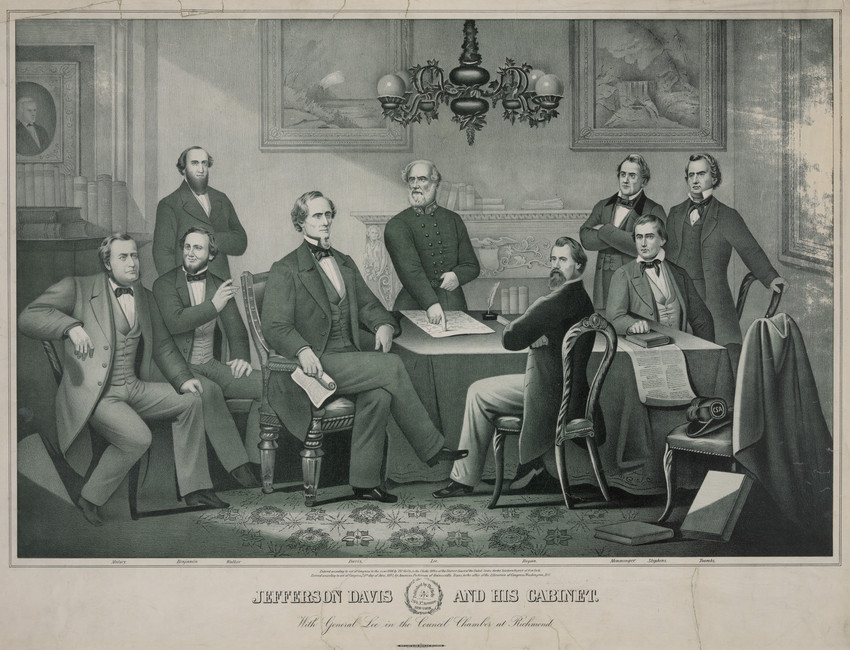
davis and cabinet

British political and military theorist Colin S. Gray writes: “Choice of strategy can determine whether or not policy goals will be attainable. And that choice must provide the most vital contexts for tactical behavior. Once policy objectives have been chosen, strategy is the function that delivers victory.” [3] In our recent wars and in the American Civil War this maxim has been born out time and time again.

Thus, the Gettysburg campaign has to be looked at in the context of Grand Strategy and what was necessary for both sides to achieve their goals. For the Confederacy this was independence and in the context of the Gettysburg campaign the key question is whether it should have been made at all. While Lee is regarded as a masterful commander by many, the myth created by the Lost Cause school of history, in which the failure of Confederate war aims cannot be ascribed to Lee, keeps many people from asking the hard questions of strategy, and how Lee as commander failed to understand what was best for his country.

The key consideration, as Alan T. Nolan observes “must be whether a general’s actions helped or hurt the cause of his government in view of that government’s grand strategy. In short, the appropriate inquiry is to ask whether a general’s actions related positively or negatively to the war objectives and national policy of his government.” [4] The question was one of following a strategy of the defensive as Washington had done in the Revolutionary War, or a strategy of the offense culminating in a climactic battle that would decide the outcome of the war.

A defensive strategy was seen by British observers early in the war as the most feasibly for achieving Southern military and political goals in relationship to attaining independence. In the Revolution, Washington remained on the “grand strategic defensive” and “lost many battles and retreated many times, but they kept their forces in the field to avoid being ultimately defeated, and they won because the British decided that the struggle was either too hopeless or too burdensome to pursue.” [5] They had no doubt that this was the best policy for the Confederate government and military to achieve their strategic end.

The terrain of Virginia, particularly the number of east-west running rivers, the swamps that lay to the east of Richmond and the nearly impassible Wilderness to its north made any Union offensive a costly proposition. Clausewitz noted that terrain has “a decisive influence on the engagement, both as to its course and to its planning and exploitation….Their principle effect lies in the realm of tactics, but the outcome is a matter of strategy” [6]

This naturally advantageous terrain gave the advantage to Lee on the defense, but Lee seemed to never fully appreciate the strategic strength that the nature of the terrain, especially that of the Wilderness offered him. J.F.C. Fuller noted that “the Wilderness had been his staunchest ally. It was not only a natural fortress protecting Richmond, but a spider’s web to any army advancing from the north. Lee never fully realized this, for if he had done so his strategy would have been based upon maneuvering his enemy again and again into this entanglement and defeating him.” [7]

However, the strategic defensive was not that of Robert E. Lee. Lee’s view throughout the war, even as late as the siege of Petersburg was that of the offensive and climactic battle: “If we can defeat or drive the armies of the enemy from the field, we shall have peace. Our efforts and energies should be devoted to that object.” [8]

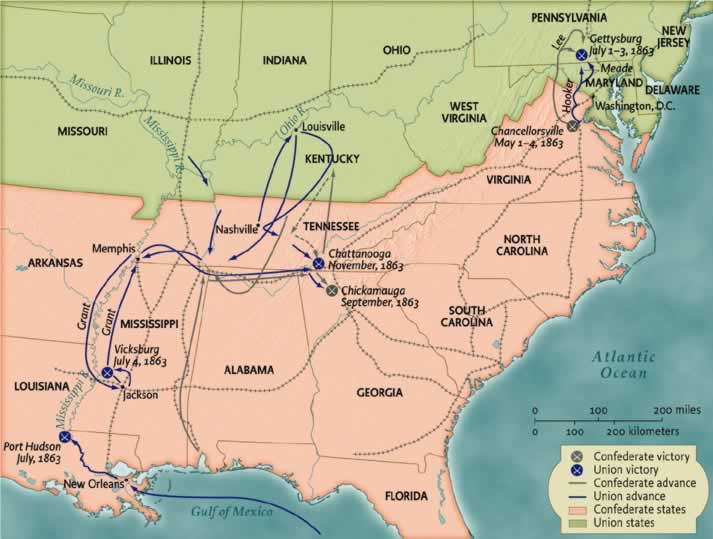
In 1863 the Confederacy was confronted with the choice of how it would deal with the multiple threats to it posed by Union forces in both the West at Vicksburg, as well as in Tennessee as well as the East, where the Army of the Potomac was in striking distance of Richmond. The strategic situation was bad but few Confederate politicians realized just how bad things were, or cared in the post Chancellorsville euphoria.

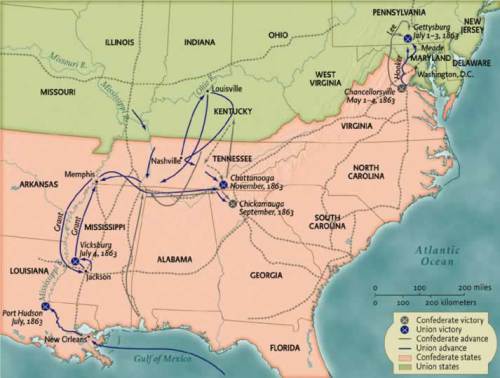
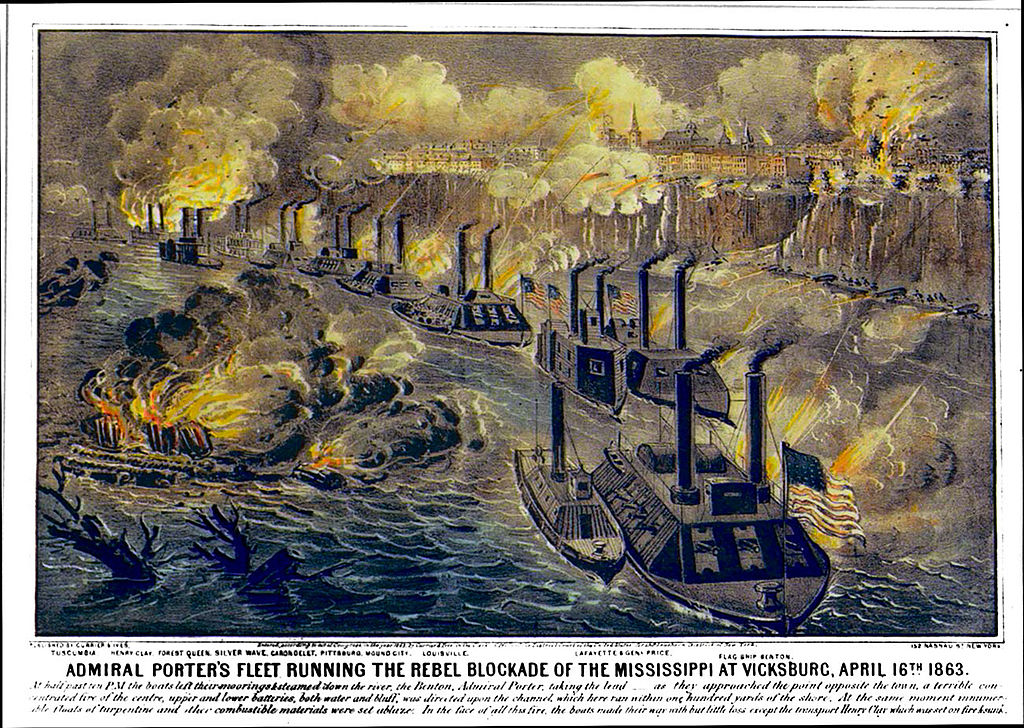
In the west the strategic river city of Vicksburg Mississippi was threatened by the Army of Union General Ulysses S Grant, and Naval forces under the command of Admiral David Farragut and Admiral David Dixon Porter. If Vicksburg fell the Union would control the entire Mississippi and cut the Confederacy in two. Union forces also maintained a strong presence in the areas of the Virginia Tidewater and the coastal areas of the Carolinas; while in Tennessee a Union Army under Rosecrans, was stalemated, but still threatening Chattanooga, the gateway to the Deep South. The blockade of the United States Navy continually reinforced since its establishment in 1861, had crippled the already tenuous economy of the Confederacy. The once mocked “anaconda strategy” devised by General Winfield Scott was beginning to pay dividends. [9] Of the nine major Confederate ports linked by rail to the inland cities the Union, all except three; Mobile, Wilmington and Charleston were in Union hands by April 1862. [10]

However, the Confederate response to the danger was “divided councils and paralysis” [11] in their upper leadership, between those like Lee who advocated for the offensive and those like Davis who advocated a defensive strategy. The military relationship between Lee and Davis “represented a continuous compromise between the president’s undeclared policy of outlasting the enemy and the general’s purpose of winning by breaking the enemy’s will to continue their effort at subjugation.” [12]

Davis, though he was Commander-in-Chief wavered between the two strategic ideas throughout the first years of the war, something that was worse than coming to no decision at all. Lee’s latest biographer Michael Korda makes the point that: “The danger that the Confederacy might unravel from west to east, whatever happened between the Rappahannock and the Potomac, was Grant’s central strategic idea, and should have been the overriding concern of the Confederate government; but Lee’s position as the South’s most respected and admired military figure, the high drama of his rapid marches and his victories against much larger armies had a profound effect on southern military strategy.” [13] Instead it was not, and a fog of confused policies confounded Confederate war efforts.

Confederate Secretary of War James Seddon and President Jefferson Davis recognized the danger in the winter of 1862-1863. During the winter Davis and Seddon suggested to Lee that he detach significant units, including Pickett’s division to relieve the pressure in the west and blunt Grant’s advance. Lee would have nothing of it; he argued that the war would be won in the East. He told Seddon that “The adoption of your proposition is hazardous, and it becomes a question between Virginia and the Mississippi.” [14] From a strategic point of view it is hard to believe that Lee could not see this, “but in the post-Chancellorsville aura of invincibility, anything seemed possible.” [15]

However, much of Lee’s reasoning can be explained by what he saw as his first duty, the defense of Virginia. Lee’s biographer Michael Korda points out that Lee’s strategic argument was very much influenced by his love of Virginia, which remained his first love, despite his deep commitment to the Confederacy. Korda noted that Lee: “could never overcome a certain myopia about his native state. He remained a Virginian first and foremost…..” [16] Fuller wrote that Lee “was so obsessed by the idea of threatening Washington in order to relieve Northern Virginia, that throughout his generalship he never saw the war as a whole.” [17] It was Lee’s view that if Virginia was lost, so was the Confederacy, and was concerned that whatever units left behind should he dispatch troops from his Army west, would be unable to defend Richmond.

Likewise, despite the success of his defensive battles at Fredericksburg and Chancellorsville, Lee was not encouraged. Those victories had elated the Confederacy and caused great concern in the North. But Lee was depressed after each. Lee told Harry Heth after Chancellorsville: “Our people were wild with delight- I, on the contrary, was more depressed than after Fredericksburg; our loss was severe, and again we had not gained an inch of ground, and the enemy could not be pursued…” [18]

Some Confederate leaders realized the mortal danger presented by Grant in the West including officials in the War Department, one of whom wrote “The crisis there is of the greatest moment. The loss of Vicksburg and the Mississippi river…would wound us very deeply in a political as well as a military point of view.” [19]

Despite this Seddon did remain in favor of shifting troops west and relieving Vicksburg. He was backed in this by Joseph Johnston, Braxton Bragg, P.T.G. Beauregard and James Longstreet. In Mid-May of 1863 Beauregard proposed a strategy to concentrate all available forces in in Tennessee and going to the strategic defensive on all other fronts. Beauregard, probably the best Southern strategist “saw clearly that the decisive point lay in the West and not the East.” [20] Beauregard’s plan was to mass Confederate forces was crush Rosecrans, relieve Vicksburg and then move east to assist Lee in destroying the Army of the Potomac in his words to complete “the terrible lesson the enemy has just had at Chancellorsville.” [21] His plan was never acknowledged and in a letter to Johnston, where he re-sent the plan he noted “I hope everything will turn out well, although I do not exactly see how.” [22]

James Longstreet had proposed a similar measure to Seddon in February 1863 and then again on May 6th in Richmond. Longstreet believed that “the Confederacy’s greatest opportunity lay “in the skillful use of our interior lines.” [23] He suggested to Seddon that two of his divisions link up with Johnston and Bragg and defeat Rosecrans and upon doing that move toward Cincinnati. Longstreet argued that since Grant would have the only Union troops that could stop such a threat that it would relieve “Pemberton at Vicksburg.” [24] Seddon favored Longstreet’s proposal but Jefferson Davis having sought Lee’s counsel rejected the plan, Longstreet in a comment critical of Davis’s rejection of the proposal wrote: “But foreign intervention was the ruling idea with the President, and he preferred that as the easiest solution of all problems.” [25] Following that meeting Longstreet pitched the idea to Lee who according to Longstreet “recognized the suggestion as of good combination, and giving strong assurance of success, but he was averse to having a part of his army so far beyond his reach.” [26]

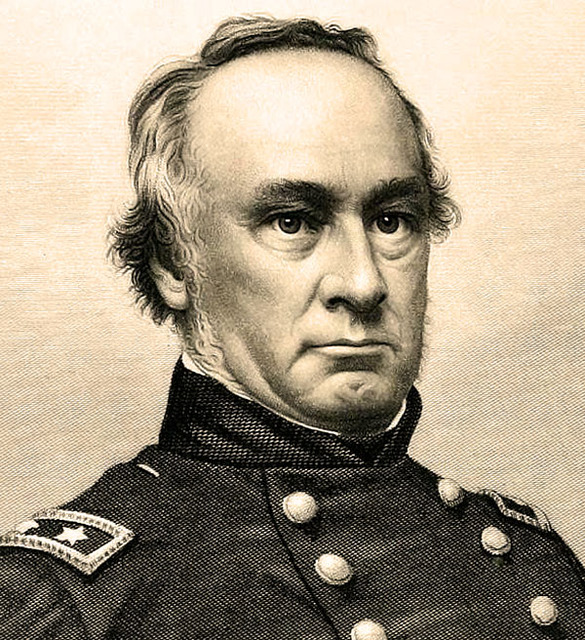
In early May 1863 Lee, commanding the Army of Northern Virginia realized that the Confederacy was in desperate straits. Despite numerous victories against heavy odds, Lee knew that time was running out. Though he had beaten the Army of the Potomac under General Joseph Hooker at Chancellorsville, he had not destroyed it and Hooker’s Army, along with a smaller force commanded by General Dix in Hampton Roads still threatened Richmond. He had rejected the western option presented by Seddon, Beauregard and Longstreet. Lee questioned “whether additional troops there would redress the balance in favor of the Confederacy, and he wondered how he would be able to cope with the powerful Army of the Potomac.” [27]

In Lee’s defense neither of these suggestions was unsound, but his alternative, an offensive into Pennsylvania just as unsound and undertaken for “confused” reasons. Confederate leaders realized that “something had to be done to save Vicksburg; something had to be done to prevent Hooker from recrossing the Rappahannock; something had to be done to win European recognition, or compel the North to consider terms of peace…[28] However added to these reasons, and perhaps the most overarching for Lee was “to free the State of Virginia, for a time at least, from the presence of the enemy” and “to transfer the theater of war to Northern soil….” [29]

On May 14th Lee travelled by train to Richmond to meet with President Jefferson Davis and War Secretary James Seddon. At the meeting Lee argued for an offensive campaign in the east, to take the war to Pennsylvania. Lee had three major goals for the offensive, two which were directly related to the immediate military situation and one which went to the broader strategic situation.

Lee had long believed that an offensive into the North was necessary, even before Chancellorsville. As already noted, Lee did not believe that reinforcing the Confederate Armies in the West would provide any real relief for Vicksburg. Lee believed, quite falsely, that the harsh climate alone would force Grant to break off his siege of Vicksburg. [30] Russell Weigley wrote that “In truth, Lee seems to have been less than fully responsive to the problems of the West, partly out of Virginia parochialism- he always regarded his sword as serving his first state of Virginia-and partly in adherence to his military philosophy,” [31] that of the offensive. Lee was not willing to sacrifice Virginia for the west, and “tenaciously fought every suggestion that the Army of Northern Virginia be denuded to reinforce the west, and his influence over Davis guaranteed, at least until the fall of 1863, that the defense of Virginia would always be able to outweigh the demands for help from the Confederate forces in the West.” [32]

Instead of sending troops west, Lee believed that his army, flush with victory needed to be reinforced and allowed to advance into Pennsylvania. Lee proposed withdrawing Beauregard’s 16,000 soldiers from the Carolinas to the north in order “increase the known anxiety of Washington authorities” [33] and he sought the return of four veteran brigades which had been loaned to D.H. Hill in North Carolina. In this he was unsuccessful. He received two relatively untested brigades from Hill; those of Johnston Pettigrew and Joseph Davis instead two of Pickett’s veteran brigades. The issue of the lack of reinforcements was a “commentary on the severe manpower strains rending the Confederacy…and Davis wrote Lee on May 31st, “and sorely regret that I cannot give you the means which would make it quite safe to attempt all that we desire.” [34]

Lee’s Chief of Staff Colonel Charles Marshall crafted a series of courses of action for Lee designed to present the invasion option as the only feasible alternative for the Confederacy. Lee’s presentation was an “either or” proposal. He gave short shrift to any possibility of reinforcing Vicksburg and explained “to my mind, it resolved itself into a choice of one of two things: either to retire to Richmond and stand a siege, which must ultimately end in surrender, or to invade Pennsylvania.” [35] As any military planner knows the presentation of courses of action designed to lead listeners to the course of action that a commander prefers by ignoring the risks of such action, downplaying other courses of action is disingenuous. In effect Lee was asking Davis and his cabinet to “choose between certain defeat and possibly victory” [36] while blatantly ignoring other courses of action or playing down other very real threats in the West.

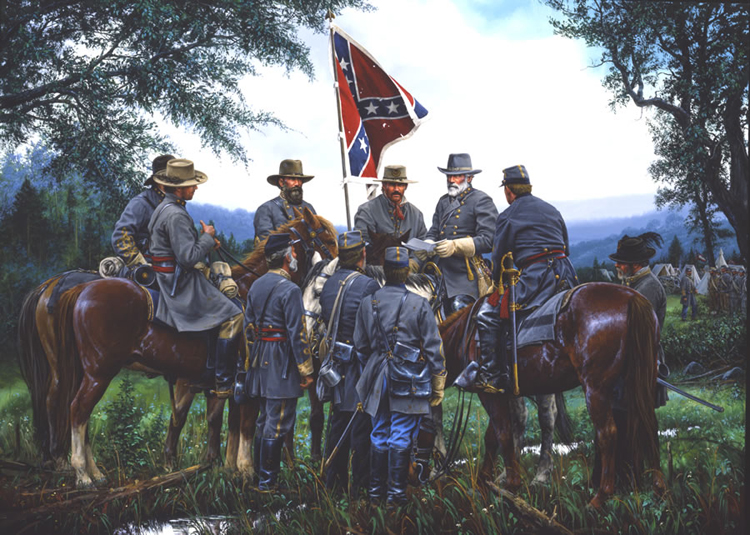
Lee embraced the offensive as his grand strategy and rejected the defensive in his presentation to the Confederate cabinet, and they were “awed” by Lee’s strategic vision. Swept up in Lee’s presentation the cabinet approved the invasion despite the fact that “most of the arguments he made to win its approval were more opportunistic than real.” [37] However, Postmaster General John Reagan objected and stated his dissent arguing that Vicksburg had to be the top priority. But Lee was persuasive telling the cabinet “There were never such men in any army before….They will go anywhere and do anything if properly led….” So great was the prestige of Lee, “whose fame…now filled the world,” that he carried the day.” [38]

Although both Seddon and Davis had reservations about the plan they agreed to it. Unfortunately for all of them they never really settled the important goals of the campaign including how extensive the invasion would be, how many troops would he need and where he would get them. [39] The confusion about these issues was fully demonstrated by Davis in his letter of May 31st where he “had never fairly comprehended” Lee’s “views and purposes” until he received a letter and dispatch from the general that day.” [40] That lack of understanding is surprising since Lee had made several personal visits to Davis and the cabinet during May and demonstrates again the severe lack of understanding of the strategic problems by Confederate leaders.

Lee believed that his offensive would relieve Grant’s pressure on Pemberton’s Army at Vicksburg. How it would do so is not clear since the Union had other armies and troops throughout the east to parry any thrust made had the Army of the Potomac endured a decisive defeat that not only drove it from the battlefield but destroyed it as a fighting force. Postmaster General Reagan believed that the only way to stop Grant was “destroy him” and “move against him with all possible reinforcements.” [41]

Likewise Lee believed that if he was successful in battle and defeated the Army of the Potomac in Pennsylvania that it could give the peace party in the North to bring pressure on the Lincoln Administration to end the war. This too was a misguided belief and Lee would come to understand that as his forces entered Maryland and Pennsylvania where there was no popular support for his invading army. The fact was that those that “though there was a strong peace party in the North, they did not realize that Lincoln’s Emancipation Proclamation had settled once and for all the question of foreign intervention, and second that to invade the North would consolidate the Federals instead of dividing them.” [42]

In the meeting with the cabinet, Postmaster-General Reagan, agreed with General Beauregard and warned that “the probability that the threatened danger to Washington would arouse again the whole of the Yankee nation to renewed efforts for the protection of their capital.” [43] Reagan was decidedly against Lee’s offensive. He “saw everything wrong with Lee’s plan and everything right with the plan it had superseded. Grant was the main threat to the survival of the Confederacy, and it was Grant at whom the main blow must be aimed and struck.” [44] But “Lee’s opinion carried so much weight that Davis felt compelled to concur” [45] with Lee and voted with the remaining cabinet members to allow the offensive.

Stephens the fire breathing Vice President “wanted to negotiate for peace, and he foresaw rightly that Lee’s offensive would strengthen and not weaken the war party in the North….Stephens was strongly of the opinion that Lee should have remained on the defensive and detached a strong force to assist Johnston against Grant at Vicksburg.” [46] However, he was kept in the dark as to Lee’s plans until after Lee had crossed the Potomac.

Likewise, Lee, the consummate defender of Virginia was determined to at least for a season remove the war from his beloved state. He believed that if he could spend a summer campaign season in the North, living off of Union foodstuffs and shipping booty back to the Confederacy that it would give farmers in Northern Virginia a season to harvest crops unimpeded by major military operations.

While the offensive did give a few months relief to these farmers it did not deliver them. Likewise Lee’s argument that he could not feed his army flies in the face of later actions where for the next two years the Army of Northern Virginia continued to subsist. Alan Nolan noted that if a raid for forage was a goal of the operation then “a raid by small, mobile forces rather than the entire army would have had considerably more promise and less risk.” [47] D. H. Hill in North Carolina wrote his wife: “Genl. Lee is venturing upon a very hazardous movement…and one that must be fruitless, if not disastrous.” [48]

Though Lee won permission to invade Pennsylvania, he did not get all that he desired. Lee wanted, and believed that he would have his entire army to conduct his offensive. However, Davis did not understand or conceive that Lee’s offensive scheme was a “change in the existing policy, a shift from the defense to the offense. To Davis, Lee’s invasion was merely a necessary expedient in the policy of static, scattered defensiveness.” [49]

Davis refused Lee reinforcements from the coastal Carolinas, and “had not the slightest intention of reducing a single garrison to support Lee’s offensive.” [50] Davis insisted on units being left to cover Richmond in case General Dix advanced on Richmond from Hampton Roads. Much of this was due to political pressure as well as the personal animus of General D. H. Hill who commanded Confederate forces in the Carolinas towards Lee. The units included two of Pickett’s brigades which would be sorely missed on July third in the doomed effort to break the Union center on Cemetery Ridge. As a result Lee was without a significant portion of his army when he moved north. Lee did not learn “until he had crossed the Potomac that four of his best brigades, the equivalent of a division, were to be uselessly employed away from the army.” [51]

Lee’s decision revealed an unresolved issue in Confederate Grand Strategy, the conflict between the strategy of the offensive and that of the defensive. Many in the Confederacy realized that the only hope for success was to fight a defensive campaign that made Union victory so expensive that eventually Lincoln’s government would fall or be forced to negotiate.

The conflict between those who believed in the offensive like Lee, and those that advocated a strategic defensive strategy resulted in indecision, which resulted in a policy that brought about “the worst of both worlds.” [52] The fact that Lee got permission to invade but was denied significant numbers of experienced troops as well as support from other departments meant that “what Lee designed as a total stroke from a concentration of its armed strength, was reduced to a desperate, unsupported gamble of one man with one army-and not all of that.” [53] Knowing this, Lee still chose to continue his offensive, something that along with his “own awareness of factors that argued against it.” [54]

Lee was convinced that ultimate victory could only be achieved by decisively defeating and destroying Federal military might in the East. His letters are full of references to crush, defeat or destroy Union forces opposing him. His strategy of the offensive was demonstrated on numerous occasions in 1862 and early 1863, however in the long term, the strategy of the offensive was unfeasible and “counterproductive in terms of the Confederacy’s “objects of war.” [55]

Lee’s offensive operations always cost his Army dearly in the one commodity that the South could not replace, nor keep pace with its Northern adversary, his men. His realism about that subject was shown after he began his offensive when he wrote Davis about how time was not on the side of the Confederacy. He wrote: “We should not therefore conceal from ourselves that our resources in men are constantly diminishing, and the disproportion in this respect…is steadily augmenting.” [56] Despite this, as well as knowing that in every offensive engagement, even in victory he was losing more men percentage wise than his opponent Lee persisted in the belief of the offensive.

When Lee fought defensive actions on ground of his choosing, like at Fredericksburg, he was not only successful but husbanded his strength. However, when he went on the offensive in almost every case he lost between 15 and 22 percent of his strength, a far higher percentage in every case than his Union opponents. In these battles the percentage of soldiers that he lost was always more than his Federal counterparts, even when his army inflicted greater aggregate casualties on his opponents. Those victories may have won Lee “a towering reputation” but these victories “proved fleeting when measured against their dangerous diminution of southern white manpower.” [57] Lee recognized this in his correspondence but he did not alter his strategy of the offensive until after his defeat at Gettysburg.

The course of action was decided upon, but one has to ask if Lee’s decision was wise decision at a strategic level, not simply the operational or tactical level where many Civil War students are comfortable. General Longstreet’s artillery commander, Colonel Porter Alexander described the appropriate strategy of the South well, he wrote:

“When the South entered upon war with a power so immensely her superior in men & money, & all the wealth of modern resources in machinery and the transportation appliances by land & sea, she could entertain but one single hope of final success. That was, that the desperation of her resistance would finally exact from her adversary such a price in blood & treasure as to exhaust the enthusiasm of its population for the objects of the war. We could not hope to conquer her. Our one chance was to wear her out.” [58]

What Alexander describes is the same type of strategy successfully employed by Washington and his more able officers during the American Revolution, Wellington’s campaign on the Iberian Peninsula against Napoleon’s armies, and that of General Giap against the French and Americans in Vietnam. It was not a strategy that completely avoided offensive actions, but saved them for the right moment when victory could be obtained.

It is my belief that Lee erred in invading the North for the simple fact that the risks far outweighed the possible benefits. As Russell Weigley noted “for a belligerent with the limited manpower resources of the Confederacy, General Lee’s dedication to an offensive strategy was at best questionable.” [59] The offensive was a long shot for victory at best, and Lee was a gambler, audacious possibly to a fault. His decision to go north exhibited a certain amount of hubris as he did not believe that his army could be beaten, even when it was outnumbered. Lee had to know from experience that even in victory “the Gettysburg campaign was bound to result in heavy Confederate casualties…limit his army’s capacity to maneuver…and to increase the risk of his being driven into a siege in the Richmond defenses.” [60] The fact that the campaign did exactly that demonstrates both the unsoundness of the campaign and is ironic, for Lee had repeatedly said in the lead up to the offensive in his meetings with Davis, Seddon and the cabinet that “a siege would be fatal to his army” [61] and “which must ultimately end in surrender.” [62]

Grand-strategy and national policy objectives must be the ultimate guide for operational decisions. “The art of employing military forces is obtaining the objects of war, to support the national policy of the government that raises the military forces.” [63] Using such criteria, despite his many victories Lee has to be judged as a failure as a military commander.

Lee knew from his previous experience that his army would suffer heavy casualties. Lee also understood that a victory over the Army of the Potomac deep in Northern territory could cost him dearly. He knew the effect that a costly victory would have on his operations, but he still took the risk. That decision was short sighted and diametrically opposed to the strategy that the South needed to pursue in order to gain its independence. Of course some will disagree, but I am comfortable in my assertion that it was a mistake that greatly affected the Confederacy’s only real means of securing its independence, the breaking of the will of the Union by making victory so costly that it would not be worth the cost.

In light of all of these factors one has to ask a question that is applicable as much today as it was to Lee. Since the object of a campaign is to be able to connect national strategy to the operational and tactical objectives of any campaign, in other words the connection of the campaign to grand-strategy objectives of a nation. In the case of the Confederacy it was to achieve independence, and as Clausewitz so keenly noted that “the political object, which was the original motive, must become an essential factor in the equation.” [64] The Gettysburg campaign, “Lee’s most audacious act, is the apogee of his grand strategy of the offensive.” But the question that has to be asked is “whether Lee should have been there at all.” [65] The same question should be asked by any political or military leader before embarking on a war or campaign within the war.

Notes

[1] Clausewitz, Carl von. On WarIndexed edition, edited and translated by Michael Howard and Peter Paret, Princeton University Press, Princeton NJ 1976 p.88


[2] Gray, Colin S. Fighting Talk: Forty Maxims on War, Peace, and Strategy Potomac Book, Dulles VA 2009 p.3

[3] Ibid. Gray Fighting Talk p.54

[4] Nolan, Alan T. Robert E. Lee: A Flawed General in Major Problems in American Military History: Documents and Essays Edited by Chambers, John Whiteclay II and Piehler, G. Kurt Houghton Mifflin Company, Boston and New York 1999 p.175

[5] Nolan, Alan T. R. E. Lee and July 1 at Gettysburg in the First Day at Gettysburg edited by Gallagher, Gary W. Kent State University Press, Kent Ohio 1992 p.9

[6] Clausewitz, Carl von. On WarIndexed edition, edited and translated by Michael Howard and Peter Paret, Princeton University Press, Princeton NJ 1976 p.348

[7] Fuller, J.F.C Grant and Lee: A Study in Personality and Generalship Indiana University Press, Bloomington Indiana, 1957 p.192

[8] Ibid. NolanR. E. Lee and July 1 at Gettysburg in the First Day at Gettysburg p.5

[9] Fuller, J.F.C. The Conduct of War 1789-1961 Da Capo Press, New York 1992. Originally published by Rutgers University Press, New Brunswick N.J p.101 Fuller has a good discussion of the Anaconda strategy which I discussed in the chapter: Gettysburg, Vicksburg and the Campaign of 1863: The Relationship between Strategy, Operational Art and the DIME

[10] Ibid. Fuller The Conduct of War 1789-1961 p.101

[11] McPherson, James. The Battle Cry of Freedom: The Civil War Era Oxford University Press, Oxford and New York 1988 p.629

[12] Dowdy, Clifford. Lee and His Men at Gettysburg: The Death of a Nation Skyhorse Publishing, New York 1986, originally published as Death of a Nation Knopf, New York 1958 pp.20-21

[13] Korda, Michael. Clouds of Glory: The Life and Legend of Robert E. Lee Harper Collins Publishers, New York 2014 pp.524-525

[14] Guelzo, Allen C. Gettysburg: The Last Invasion Vintage Books a Division of Random House, New York 2013 p.34

[15] Ibid. McPherson The Battle Cry of Freedom p.647

[16] Korda, Michael. Clouds of Glory: The Life and Legend of Robert E. Lee Harper Collins Publishers, New York 2014 p.525

[17] Ibid. Fuller, J.F.C Grant and Lee: A Study in Personality and Generalship p.193

[18] Guelzo Allen C. Fateful Lightening: A New History of the Civil War Era and Reconstruction Oxford University Press, Oxford and New York 2012 p.339

[19] Coddington, Edwin B. The Gettysburg Campaign: A Study in Command, A Touchstone Book, Simon and Schuster New York, 1968 p.5

[20] Ibid. Fuller, J.F.C Grant and Lee: A Study in Personality and Generalship p.193

[21] Foote, Shelby, The Civil War, A Narrative. Volume Two Fredericksburg to Meridian Random House, New York 1963 p.429

[22] Ibid. Foote The Civil War, A Narrative. Volume Two Fredericksburg to Meridian p.429

[23] Ibid. Korda Clouds of Glory: The Life and Legend of Robert E. Lee p.525

[24] Wert, Jeffry D. General James Longstreet The Confederacy’s Most Controversial Soldier, A Touchstone Book, Simon and Schuster, New York and London 1993 p.241

[25] Longstreet, James From Manassas to Appomattox, Memoirs of the Civil War in America originally published 1896, Amazon Kindle Edition location 4656

[26] Ibid. Longstreet, James From Manassas to Appomattox, Memoirs of the Civil War in America location 4705

[27] Ibid. Coddington The Gettysburg Campaign: A Study in Command, p.5

[28] Ibid. Fuller Grant and Lee: A Study in Personality and p.194

[29] Taylor, Walter. General Lee: His campaigns in Virginia 1861-1865 With Personal Reminiscences University of Nebraska Press, Lincoln Nebraska and London, 1994 previously published 1906 p.180.

[30] Ibid. Foote The Civil War, A Narrative. Volume Two Fredericksburg to Meridian p.430

[31] Weigley, Russell F. The American Way of War: A History of United States Military History and Policy University of Indiana Press, Bloomington IN, 1973 pp.114-115

[32] Ibid. Guelzo Fateful Lightening: A New History of the Civil War Era and Reconstruction p.340

[33] Ibid. Korda Clouds of Glory: The Life and Legend of Robert E. Lee p.528

[34] Sears, Stephen W. Gettysburg. Houghton Mifflin Co. Boston and New York 2003 p.51

[35] Ibid. Foote The Civil War, A Narrative. Volume Two Fredericksburg to Meridian p.431

[36] Ibid. Foote The Civil War, A Narrative. Volume Two Fredericksburg to Meridian p.431

[37] Tredeau, Noah Andre. Gettysburg: A Testing of Courage, Harper Collins Publishers, New York 2002 p.6

[38] Ibid. McPherson The Battle Cry of Freedom p.647

[39] Ibid. Coddington The Gettysburg Campaign: A Study in Command, p.7

[40] Ibid. Coddington The Gettysburg Campaign: A Study in Command, p.7

[41] Ibid. Foote The Civil War, A Narrative. Volume Two Fredericksburg to Meridian p.432

[42] Fuller, J.F.C. Decisive Battles of the U.S.A. 1776-1918 University of Nebraska Press, Lincoln 2007 copyright 1942 The Royal Society for the Prevention of Cruelty to Animals p.222

[43] Ibid. Foote The Civil War, A Narrative. Volume Two Fredericksburg to Meridian p.432

[44] Ibid. Foote The Civil War, A Narrative. Volume Two Fredericksburg to Meridian p.432

[45] Ibid. McPherson The Battle Cry of Freedom p.647

[46] Ibid. Fuller Grant and Lee: A Study in Personality and p.194

[47] Ibid. NolanR. E. Lee and July 1 at Gettysburgin the First Day at Gettysburg p.2

[48] Ibid. Sears. Gettysburg p.51

[49] Ibid. Dowdy Lee and His Men at Gettysburg p.27

[50] Ibid. Dowdy Lee and His Men at Gettysburg p.27

[51] Ibid. Dowdy Lee and His Men at Gettysburg p.36

[52] Ibid. Weigley The American Way of War p.118

[53] Ibid. Dowdy Lee and His Men at Gettysburg p.28

[54] Ibid. Nolan Robert E. Lee: A Flawed General p.176

[55] Ibid. Nolan Robert E. Lee: A Flawed General in Major Problems p.176

[56] Taylor, John M. Duty Faithfully Performed: Robert E Lee and His CriticsBrassey’s, Dulles VA 1999 p.134

[57] Gallagher, Gary W. The Confederate War: How Popular Will, Nationalism and Military Strategy Could not Stave Off Defeat Harvard University Press, Cambridge MA and London 1999 p.120

[58] Alexander, Edward Porter. Fighting for the Confederacy: The Personal Recollections of General Edward Porter Alexander, ed. Gary W. Gallagher, University of North Carolina Press, Chapel Hill NC, 1989 p.415

[59] Ibid. Weigley The American Way of War p.118

[60] Ibid. NolanR. E. Lee and July 1 at Gettysburg in the First Day at Gettysburg p.11

[61] Ibid. NolanR. E. Lee and July 1 at Gettysburg in the First Day at Gettysburg p.11

[62] Ibid. Foote The Civil War, A Narrative. Volume Two Fredericksburg to Meridian p.431

[63] Ibid. NolanR. E. Lee and July 1 at Gettysburg in the First Day at Gettysburg p.4

[64] Ibid. Clausewitz On War pp.80-81

[65] Ibid. NolanR. E. Lee and July 1 at Gettysburg in the First Day at Gettysburg p.10

Leave a comment

Filed under civil war, History, leadership, Military, national security, Political Commentary

The Failure to Link Grand-Strategy and Operational Objectives: Robert E. Lee and the Decision to Invade Pennsylvania 1863

jefferson_davis_and_his_cabinet

A cohesive national strategy involves true debate and consideration of all available courses of action. In 1863 the Confederacy was confronted with the choice of how it would deal with the multiple threats to it posed by Union forces in both the West at Vicksburg, as well as in Tennessee as well as the East, where the Army of the Potomac was in striking distance of Richmond. However in May of 1863 the leaders of the Confederacy allowed themselves to choose the worst possible course of action for their circumstances simply because it was proposed by Robert E. Lee.

The strategic situation was bad but few Confederate politicians realized just how bad things were, or cared in the euphoria after the Lee and Jackson’s victory at Chancellorsville. In the west the strategic river city of Vicksburg Mississippi was threatened by the Army of Union General Ulysses S Grant, and Naval forces under the command of Admiral David Farragut and Admiral David Dixon Porter.

If Vicksburg fell the Union would control the entire Mississippi and cut the Confederacy in two. Union forces also maintained a strong presence in the areas of the Virginia Tidewater and the coastal areas of the Carolinas; while in Tennessee a Union Army under Rosecrans, was stalemated, but still threatening Chattanooga, the gateway to the Deep South. The blockade of the United States Navy continually reinforced since its establishment in 1861, had crippled the already tenuous economy of the Confederacy. The once mocked “anaconda strategy” devised by General Winfield Scott was beginning to pay dividends. [1] Of the nine major Confederate ports linked by rail to the inland cities the Union, all except three; Mobile, Wilmington and Charleston were in Union hands by April 1862. [2]

However, the Confederate response to the danger was “divided councils and paralysis” [3] in their upper leadership. Some Confederate leaders realized the mortal danger presented by Grant in the West including officials in the War Department, one of whom wrote “The crisis there is of the greatest moment. The loss of Vicksburg and the Mississippi river…would wound us very deeply in a political as well as a military point of view.” [4]

american14_51

Confederate Secretary of War James Seddon and President Jefferson Davis recognized the danger in the winter of 1862-1863. During the winter Davis and Seddon suggested to Lee that he detach significant units, including Pickett’s division to relieve the pressure in the west and blunt Grant’s advance. Lee would have nothing of it; he argued that the war would be won in the East. He told Seddon that “The adoption of your proposition is hazardous, and it becomes a question between Virginia and the Mississippi.” [5] From a strategic point of view it is hard to believe that Lee could not see this, however, much of Lee’s reasoning can be explained by what he saw as his first duty, the defense of Virginia. Lee’s biographer Michael Korda points out that Lee’s strategic argument was very much influenced by his love of Virginia, which remained his first love, despite his deep commitment to the Confederacy. Korda noted that Lee: “could never overcome a certain myopia about his native state. He remained a Virginian first and foremost…..” [6] It was Lee’s view that if Virginia was lost, so was the Confederacy, and was concerned that whatever units left behind should he dispatch troops from his Army west, would be unable to defend Richmond.

Despite this Seddon did remain in favor of shifting troops west and relieving Vicksburg. He was backed in this by Joseph Johnston, Braxton Bragg, P.T.G. Beauregard and James Longstreet. In Mid-May of 1863 Beauregard proposed a strategy to concentrate all available forces in in Tennessee and going to the strategic defensive on all other fronts. Beauregard, probably the best Southern strategist “saw clearly that the decisive point lay in the West and not the East.” [7] Beauregard’s plan was to mass Confederate forces was crush Rosecrans, relieve Vicksburg and then move east to assist Lee in destroying the Army of the Potomac in his words to complete “the terrible lesson the enemy has just had at Chancellorsville.” [8] His plan was never acknowledged and in a letter to Johnston, where he re-sent the plan he noted “I hope everything will turn out well, although I do not exactly see how.” [9]

James Longstreet had proposed a similar measure to Seddon in February 1863 and then again on May 6th in Richmond. Longstreet believed that “the Confederacy’s greatest opportunity lay “in the skillful use of our interior lines.” [10] He suggested to Seddon that two of his divisions link up with Johnston and Bragg and defeat Rosecrans and upon doing that move toward Cincinnati. Longstreet argued that since Grant would have the only Union troops that could stop such a threat that it would relieve “Pemberton at Vicksburg.” [11] Seddon favored Longstreet’s proposal but Jefferson Davis having sought Lee’s counsel rejected the plan, Longstreet in a comment critical of Davis’s rejection of the proposal wrote: “But foreign intervention was the ruling idea with the President, and he preferred that as the easiest solution of all problems.” [12] Following that meeting Longstreet pitched the idea to Lee who according to Longstreet “recognized the suggestion as of good combination, and giving strong assurance of success, but he was averse to having a part of his army so far beyond his reach.” [13]

In early May 1863 Lee, commanding the Army of Northern Virginia realized that the Confederacy was in desperate straits. Despite numerous victories against heavy odds, Lee knew that time was running out. Though he had beaten the Army of the Potomac under General Joseph Hooker at Chancellorsville, he had not destroyed it and Hooker’s Army, along with a smaller force commanded by General Dix in Hampton Roads still threatened Richmond. He had rejected the western option presented by Seddon, Beauregard and Longstreet. Lee questioned “whether additional troops there would redress the balance in favor of the Confederacy, and he wondered how he would be able to cope with the powerful Army of the Potomac.” [14] In Lee’s defense neither of these suggestions was unsound, but his alternative, an offensive into Pennsylvania just as unsound and undertaken for “confused” reasons. Confederate leaders realized that “something had to be done to save Vicksburg; something had to be done to prevent Hooker from recrossing the Rappahannock; something had to be done to win European recognition, or compel the North to consider terms of peace…[15] However added to these reasons, and perhaps the most overarching for Lee was “to free the State of Virginia, for a time at least, from the presence of the enemy” and “to transfer the theater of war to Northern soil….” [16]

On May 14th Lee travelled by train to Richmond to meet with President Jefferson Davis and War Secretary James Seddon. At the meeting Lee argued for an offensive campaign in the east, to take the war to Pennsylvania. Lee had three major goals for the offensive, two which were directly related to the immediate military situation and one which went to the broader strategic situation.

Lee had long believed that an offensive into the North was necessary, even before Chancellorsville. As I have already noted, Lee did not believe that reinforcing the Confederate Armies in the West would provide any real relief for Vicksburg. He believed, quite falsely, that the harsh climate alone would force Grant to break off his siege of Vicksburg. [17] Instead, Lee believed that his army, flush with victory needed to be reinforced and allowed to advance into Pennsylvania. He proposed withdrawing Beauregard’s 16,000 soldiers from the Carolinas to the north in order “increase the known anxiety of Washington authorities” [18] and sought the return of four veteran brigades which had been loaned to D.H. Hill in North Carolina. In this he was unsuccessful receiving two relatively untested brigades from Hill, those of Johnston Pettigrew and Joseph Davis. The issue of the lack of reinforcements was a “commentary on the severe manpower strains rending the Confederacy…and Davis wrote Lee on May 31st, “and sorely regret that I cannot give you the means which would make it quite safe to attempt all that we desire.” [19]
Lee’s Chief of Staff Colonel Charles Marshall crafted a series of courses of action for Lee designed to present the invasion option as the only feasible alternative for the Confederacy. Lee’s presentation was an “either or” proposal. He gave short shrift to any possibility of reinforcing Vicksburg and explained “to my mind, it resolved itself into a choice of one of two things: either to retire to Richmond and stand a siege, which must ultimately end in surrender, or to invade Pennsylvania.” [20] As any military planner knows the presentation of courses of action designed to lead listeners to the course of action that a commander prefers by ignoring the risks of such action, downplaying other courses of action is disingenuous. In effect Lee was asking Davis and his cabinet to “choose between certain defeat and possibly victory” [21] while blatantly ignoring other courses of action or playing down very real threats.

Lee embraced the offensive as his grand strategy and rejected the defensive in his presentation to the Confederate cabinet, and they were “awed” by Lee’s strategic vision. Swept up in Lee’s presentation the cabinet approved the invasion despite the fact that “most of the arguments he made to win its approval were more opportunistic than real.” [22] However, Postmaster General John Reagan objected and stated his dissent arguing that Vicksburg had to be the top priority. But Lee was persuasive telling the cabinet “There were never such men in any army before….They will go anywhere and do anything if properly led….” So great was the prestige of Lee, “whose fame…now filled the world,” that he carried the day.” [23]Although both Seddon and Davis had reservations about the plan they agreed to it, unfortunately for all of them they never really settled the important goals of the campaign including how extensive the invasion would be, how many troops would he need and where he would get them. [24] The confusion about these issues was fully demonstrated by Davis in his letter of May 31st where he “had never fairly comprehended” Lee’s “views and purposes” until he received a letter and dispatch from the general that day.” [25] That lack of understanding is surprising since Lee had made several personal visits to Davis and the cabinet during May and demonstrates again the severe lack of understanding of the strategic problems by Confederate leaders.

Lee believed that his offensive would relieve Grant’s pressure on Pemberton’s Army at Vicksburg. How it would do so is not clear since the Union had other armies and troops throughout the east to parry any thrust made had the Army of the Potomac endured a decisive defeat that not only drove it from the battlefield but destroyed it as a fighting force. Postmaster General Reagan believed that the only way to stop Grant was “destroy him” and “move against him with all possible reinforcements.” [26]

Likewise Lee believed that if he was successful in battle and defeated the Army of the Potomac in Pennsylvania that it could give the peace party in the North to bring pressure on the Lincoln Administration to end the war. This too was a misguided belief and Lee would come to understand that as his forces entered Maryland and Pennsylvania where there was no popular support for his invading army. In the meeting with the cabinet Postmaster-General Reagan, agreeing with General Beauregard warned that “the probability that the threatened danger to Washington would arouse again the whole of the Yankee nation to renewed efforts for the protection of their capital.” [27] Likewise, Stephens the fire breathing Vice President “wanted to negotiate for peace, and he foresaw rightly that Lee’s offensive would strengthen and not weaken the war party in the North….Stephens was strongly of the opinion that Lee should have remained on the defensive and detached a strong force to assist Johnston against Grant at Vicksburg.” [28]

Lee believed that if he could spend a summer campaign season in the North, living off of Union foodstuffs and shipping booty back to the Confederacy that it would give farmers in Northern Virginia a season to harvest crops unimpeded by major military operations. While the offensive did give a few months relief to these farmers it did not deliver them. Likewise Lee’s argument that he could not feed his army flies in the face of later actions where for the next two years the Army of Northern Virginia continued to subsist. Alan Nolan notes that if a raid for forage was a goal of the operation then “a raid by small, mobile forces rather than the entire army would have had considerably more promise and less risk.” [29] D. H. Hill in North Carolina wrote his wife: “Genl. Lee is venturing upon a very hazardous movement…and one that must be fruitless, if not disastrous.” [30]

Though Lee won permission to invade Pennsylvania, he did not get all that he desired. Davis refused Lee reinforcements from the coastal Carolinas, and insisted on units being left to cover Richmond in case General Dix advanced on Richmond from Hampton Roads. Much of this was due to political pressure as well as the personal animus of General D. H. Hill who commanded Confederate forces in the Carolinas towards Lee. The units included two of Pickett’s brigades which would be sorely missed on July third.

Likewise Lee’s decision revealed an unresolved issue in Confederate Grand Strategy, the conflict between the strategy of the offensive and that of the defensive. Many in the Confederacy realized that the only hope for success was to fight a defensive campaign that made Union victory so expensive that eventually Lincoln’s government would fall or be forced to negotiate.

Lee was convinced that ultimate victory could only be achieved by decisively defeating and destroying Federal military might in the East. His letters are full of references to crush, defeat or destroy Union forces opposing him. His strategy of the offensive was demonstrated on numerous occasions in 1862 and early 1863, however in the long term, the strategy of the offensive was unfeasible and counterproductive to Southern strategy. Lee’s offensive operations always cost his Army dearly in the one commodity that the South could not replace, nor keep pace with its Northern adversary, his men. His realism about that subject was shown after he began his offensive when he wrote Davis about how time was not on the side of the Confederacy. He wrote: “We should not therefore conceal from ourselves that our resources in men are constantly diminishing, and the disproportion in this respect…is steadily augmenting.” [31] Despite this, as well as knowing that in every offensive engagement, even in victory he was losing more men percentage wise than his opponent Lee persisted in the belief of the offensive.

When Lee fought defensive actions on ground of his choosing, like a Fredericksburg he was not only successful but husbanded his strength. However, when he went on the offensive in almost every case he lost between 15 and 22 percent of his strength, a far higher percentage in every case than his Union opponents. In these battles the percentage of soldiers that he lost was always more than his Federal counterparts, even when his army inflicted greater aggregate casualties on his opponents. Those victories may have won Lee “a towering reputation” but these victories “proved fleeting when measured against their dangerous diminution of southern white manpower.” [32] Lee recognized this in his correspondence but he did not alter his strategy of the offensive until after his defeat at Gettysburg.

The course of action was decided upon, but one has to ask if Lee’s decision was wise decision at a strategic point level, not simply the operational or tactical level where many Civil War students are comfortable. General Longstreet’s artillery commander, Colonel Porter Alexander described the appropriate strategy of the South well, he wrote:

“When the South entered upon war with a power so immensely her superior in men & money, & all the wealth of modern resources in machinery and the transportation appliances by land & sea, she could entertain but one single hope of final success. That was, that the desperation of her resistance would finally exact from her adversary such a price in blood & treasure as to exhaust the enthusiasm of its population for the objects of the war. We could not hope to conquer her. Our one chance was to wear her out.” [33]

What Alexander describes is the same type of strategy successfully employed by Washington and his more able officers during the American Revolution, Wellington’s campaign on the Iberian Peninsula against Napoleon’s armies, and that of General Giap against the French and Americans in Vietnam. It was not a strategy that completely avoided offensive actions, but saved them for the right moment when victory could be obtained.

It is my belief that Lee erred in invading the North for the simple fact that the risks far outweighed the possible benefits. It was a long shot and Lee was a gambler, audacious possibly to a fault. His decision to go north also exhibited a certain amount of hubris as he did not believe that his army could be beaten, even when it was outnumbered. Lee had to know from experience that even in victory “the Gettysburg campaign was bound to result in heavy Confederate casualties…limit his army’s capacity to maneuver…and to increase the risk of his being driven into a siege in the Richmond defenses.” [34] The fact that the campaign did exactly that demonstrates both the unsoundness of the campaign and is ironic, for Lee had repeatedly said in the lead up to the offensive in his meetings with Davis, Seddon and the cabinet that “a siege would be fatal to his army” [35] and “which must ultimately end in surrender.” [36]

Grand-strategy and national policy objectives must be the ultimate guide for operational decisions. “The art of employing military forces is obtaining the objects of war, to support the national policy of the government that raises the military forces.” [37] Using such criteria, despite his many victories Lee has to be judged as a failure as a military commander. Lee knew from his previous experience that his army would suffer heavy casualties. He understood that a victory over the Army of the Potomac deep in Northern territory could cost him dearly. He knew the effect that a costly victory would have on his operations, but he still took the risk. That decision was short sighted and diametrically opposed to the strategy that the South needed to pursue in order to gain its independence. Of course some will disagree, but I am comfortable in my assertion that it was a mistake that greatly affected the Confederacy’s only real means of securing its independence, the breaking of the will of the Union by making victory so costly that it would not be worth the cost.


[1] Fuller, J.F.C. The Conduct of War 1789-1961 Da Capo Press, New York 1992. Originally published by Rutgers University Press, New Brunswick N.J p.101 Fuller has a good discussion of the Anaconda strategy which I discussed in the chapter: Gettysburg, Vicksburg and the Campaign of 1863: The Relationship between Strategy, Operational Art and the DIME

[2] Ibid. Fuller The Conduct of War 1789-1961 p.101

[3] McPherson, James. The Battle Cry of Freedom: The Civil War Era Oxford University Press, Oxford and New York 1988 p.629

[4] Coddington, Edwin B. The Gettysburg Campaign: A Study in Command, A Touchstone Book, Simon and Schuster New York, 1968 p.5

[5] Guelzo, Allen C. Gettysburg: The Last Invasion Vintage Books a Division of Random House, New York 2013 p.34

[6] Korda, Michael. Clouds of Glory: The Life and Legend of Robert E. Lee Harper Collins Publishers, New York 2014 p.525

[7] Fuller, J.F.C Grant and Lee: A Study in Personality and Generalship Indiana University Press, Bloomington Indiana, 1957 p.193

[8] Foote, Shelby, The Civil War, A Narrative. Volume Two Fredericksburg to Meridian Random House, New York 1963 p.429

[9] Ibid. Foote The Civil War, A Narrative. Volume Two Fredericksburg to Meridian p.429

[10] Ibid. Korda Clouds of Glory: The Life and Legend of Robert E. Lee p.525

[11] Wert, Jeffry D. General James Longstreet The Confederacy’s Most Controversial Soldier, A Touchstone Book, Simon and Schuster, New York and London 1993 p.241

[12] Longstreet, James From Manassas to Appomattox, Memoirs of the Civil War in America originally published 1896, Amazon Kindle Edition location 4656

[13] Ibid. Longstreet, James From Manassas to Appomattox, Memoirs of the Civil War in America location 4705

[14] Ibid. Coddington The Gettysburg Campaign: A Study in Command, p.5

[15] Ibid. Fuller Grant and Lee: A Study in Personality and p.194

[16] Taylor, Walter. General Lee: His campaigns in Virginia 1861-1865 With Personal Reminiscences University of Nebraska Press, Lincoln Nebraska and London, 1994 previously published 1906 p.180.

[17] Ibid. Foote The Civil War, A Narrative. Volume Two Fredericksburg to Meridian p.430

[18] Ibid. Korda Clouds of Glory: The Life and Legend of Robert E. Lee p.528

[19] Sears, Stephen W. Gettysburg. Houghton Mifflin Co. Boston and New York 2003 p.51

[20] Ibid. Foote The Civil War, A Narrative. Volume Two Fredericksburg to Meridian p.431

[21] Ibid. Foote The Civil War, A Narrative. Volume Two Fredericksburg to Meridian p.431

[22] Tredeau, Noah Andre. Gettysburg: A Testing of Courage, Harper Collins Publishers, New York 2002 p.6

[23] Ibid. McPherson The Battle Cry of Freedom p.647

[24] Ibid. Coddington The Gettysburg Campaign: A Study in Command, p.7

[25] Ibid. Coddington The Gettysburg Campaign: A Study in Command, p.7

[26] Ibid. Foote The Civil War, A Narrative. Volume Two Fredericksburg to Meridian p.432

[27] Ibid. Foote The Civil War, A Narrative. Volume Two Fredericksburg to Meridian p.432

[28] Ibid. Fuller Grant and Lee: A Study in Personality and p.194

[29] Nolan, Alan T. R. E. Lee and July 1 at Gettysburg in the First Day at Gettysburg edited by Gallagher, Gary W. Kent State University Press, Kent Ohio 1992 p.2

[30] Ibid. Sears. Gettysburg p.51

[31] Taylor, John M. Duty Faithfully Performed: Robert E Lee and His CriticsBrassey’s, Dulles VA 1999 p.134

[32] Gallagher, Gary W. The Confederate War: How Popular Will, Nationalism and Military Strategy Could not Stave Off Defeat Harvard University Press, Cambridge MA and London 1999 p.120

[33] Alexander, Edward Porter. Fighting for the Confederacy: The Personal Recollections of General Edward Porter Alexander, ed. Gary W. Gallagher, University of North Carolina Press, Chapel Hill NC, 1989 p.415

[34] Ibid. NolanR. E. Lee and July 1 at Gettysburg in the First Day at Gettysburg p.11

[35] Ibid. NolanR. E. Lee and July 1 at Gettysburg in the First Day at Gettysburg p.11

[36] Ibid. Foote The Civil War, A Narrative. Volume Two Fredericksburg to Meridian p.431

[37] Ibid. NolanR. E. Lee and July 1 at Gettysburg in the First Day at Gettysburg p.4

2 Comments

Filed under civil war, History, leadership, Military

Gettysburg: The Connection between Policy, Strategy, and Operational Art

fig-1-5-jp-03a

Friends of Padre Steve’s World

As I have been working to revise my materials form my next Gettysburg Staff Ride I did some revisions to my text that I use with my students. The footnotes did not show up so Monday I will repost the text of this article with them. The article is important even for non-military types who care about the country and are involved in politics or policy, because it shows the linkage between the advantages that a nation with a strong strong and effective central government has over one which adopts what we would call today a Libertarian form of government. In fact I would call the effort of the Confederacy in the Civil War “The Failed Libertarian War.” But that is possibly a subject for an article or maybe even a book, but I digress…

So anyway here is the latest,

Peace

Padre Steve+

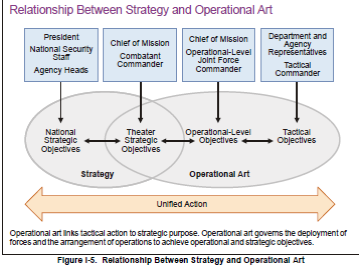
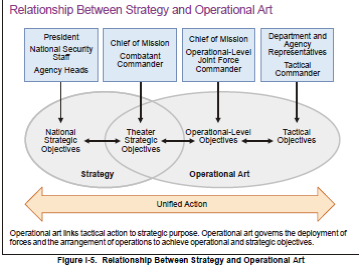
Today we look at the Gettysburg Campaign in terms of how we understand the connection between strategy and operational art. In doing so we have to place it in the context that Lee’s campaign has in relationship to the Confederate command relationships and where it fits in the continuum of unified action as we understand it today.

To do so we have to make the connection between national strategic objectives, theater objectives, operational objective and tactical objectives. We have to explore command and control structures, staff organization and the understand the effect of the Diplomatic, Informational, Economic and Military elements of national power that impact a nation’s ability to wage war.

The summer campaign of 1863 in the Civil War gives us the opportunity to do this as we explore the Gettysburg campaign in relation to Vicksburg and the overall strategic situation that both sides faced. This includes the elements that we now associate with the DIME.

While Confederate army units and their commanders generally excelled on the tactical level, and their soldiers endured hardship well, this would not be enough to secure victory. They displayed amazing individual initiative on the battlefield and they won many victories against superior forces, especially in the early part of the war. Even during the final year of the war, Lee’s forces fought skillfully and helped prolong the war. But neither the Confederate government nor the various army commanders were able to translate battlefield success to operational, theater specific or national strategic objectives.

The Confederacy had a twofold problem in its organization for war and how it conducted the war. First it had no organization at the strategic level to direct the war, and it never developed one to coordinate its military, military, diplomatic or economic policies. While Southern strategists understood that they needed to “wear down the ability of the North to wage war” they were consistently hobbled by its own internal political divisions which served to undermine efforts to coordinate the effort to defend the Confederacy. These divisions focused on the opposition of the states’ rights proponents to the central government in Richmond.

The overarching national strategic objective of the Confederacy was to attain independence. The Confederates could not hope to conquer the Union and because of that their “strategic problem was to resist conquest” and to do so they would have to “tire the Federals out, and force them to abandon the war.” Jefferson Davis seems to have understood this early in the war, but political considerations and the temperament of most Southerners and their political leaders frustrated his attempts. Generals like Lee and Joseph E. Johnston “were of the opinion that the more remote frontiers should be abandoned, and that the scattered forces of the Confederacy be concentrated, political reasons overruled their judgment.”

Southern politicians, especially the governors and congressmen demanded that troops “defend every portion of the Confederacy from penetration by “Lincoln’s abolition hordes.” Likewise, most Southerners believed that they “could whip any number of Yankees” and as early as 1861 the Confederate press was advocating an offensive strategy as the Richmond Examiner declared “The idea of waiting for blows rather than inflicting them, is altogether unsuited to the genius of our people….The aggressive policy is the truly defensive one. A column pushed forward into Ohio or Pennsylvania is worth more to us, as a defensive measure, than a whole tier of seacoast batteries from Norfolk to the Rio Grande.”

This combination of wanting to defend everything, which defied Frederick the Great’s classic dictum that “he who defends everything defends nothing” and the persistent employment of the offensive even when it “drained the Confederacy’s manpower and weakened its long term prospects for independence” were key strategic factors in its defeat.

The South did get an earlier start to in mobilizing for war then the Union. Even before the “Confederate Congress authorized an army of 100,000 volunteers for twelve months” on March 6th 1861 the governors of the eleven Confederate States raised units to fight any Federal armies which dared to force them back into the Union. This involved dusting off the old militias which had been allowed to decay in the period between the Mexican War and 1860. Most of these units in the South as well as the North were volunteer companies in which the discipline, equipment and training varied to a significant degree. Most had little in the way of real military training and “many of them spent more time drinking than drilling.” The early Confederate mobilization outstripped the availability of arms and equipment forcing many volunteers to be sent home.

Other than the stated desire for independence and their common hatred of the “Yankee,” there was little in the way of unity within the Confederate States, “the incurable jealousy of the States, especially those not immediately affected by the war, established a dry rot within the Confederacy.” Within the Confederacy, each state viewed itself as an independent nation only loosely bound to the other states and some legislatures enacted laws which actively opposed the central government in Richmond.

The various Confederate states controlled the use of their units and often resisted any effort at centralization of effort. Some kept their best units at home, while others dispatched units to Confederate armies such as Lee’s Army of Northern Virginia. Initially most states limited enlistment periods to one year despite the opposition of Robert E. Lee who helped Jefferson Davis pass the Conscription Act of 1862, a measure that was “heavily watered down by those politicians whose first concern was states’ rights and by those who felt that it would undermine patriotism.” That measure, even in its watered down form was distinctly unpopular, especially with the following declaration of martial law in parts of the Confederacy.

Both measures were brought by realists who understood that for the Confederacy to survive the war effort had to become a total war, with “the whole population and the whole production…put on a war footing.” Such measures provoke more attacks and opposition by their opponents who advocated states’ rights even if it worked against the overall interests of the Confederacy. By the time of Gettysburg if not sooner, “Confederate society began to unravel. The yeomanry and poor white people resented conscription, the tax-in-kind impressment, and other governmental measures than the wealthy. Planters sought to safeguard their property and status to the detriment of national goals.”

This included how state governments responded to the military needs of the Confederacy. Some governors hoarded weapons seized from Federal armories, “retaining these weapons to arm regiments that they kept at home… defend state boarders and guard against potential slave uprisings.” When in response to threats within the Confederacy Jefferson Davis suspended the writ of habeas corpus it resulted in a firestorm of opposition from the states. “Mississippi and Georgia passed flaming resolutions against the act; Louisiana presently did so, too, and North Carolina soon had a law on its books nullifying the action of the central government.” Alexander Stephens, the Confederate Vice President noted that there was “no such thing as a citizen of the United States, but the citizen of a State, and that “the object of quitting the Union, was not to destroy, but to save the principles of the Constitution.”

Likewise as economic conditions worsened and inflation soared in late 1861 the Confederate Congress “in its allotments to the War Department refused to face up to the costs of running the war…it forced the department to scramble in an atmosphere of uncertainty for allotments on a short-run basis.” There was much distrust of any attempt to organize a true central government with any actual authority or power in Richmond. Jefferson Davis may have been President but his country was hamstrung by its own internal divisions, including the often vocal opposition of Stephens for whom states’ rights remained a paramount issue. Stephens, in a statement that defied the understanding that military victory had to be achieved for independence to be won said during the habeas corpus debate “Away with the idea of getting independence first, and looking to liberty afterward.” This, like so many other aspects of the Confederate war effort showed the radical disconnection between legislators, policy makers and the Army and defied any understanding of the importance of government and the unity of effort in pursuing war aims. .

The Confederacy lacked a clear defined command structure to coordinate its war efforts. At the beginning of the war this was true of the Union as well, however, by the Union was much more adept at responding to the needs of the war, this included its military operations, diplomatic efforts and economy. Out of necessity it established a War Department as well as a Department of the Navy in February 1861 and Jefferson Davis, the new President who had served in Mexico and as Secretary of War prior to secession “helped speed southern mobilization in 1861.” However helpful this was initially Davis, who micromanaged Confederate war efforts “eventually led to conflict with some army officers.”

american14_5a

Jefferson Davis was an able man to be sure, but he “totally misunderstood the nature of the war.” Davis was a man given to suspicion and had major personality conflicts with all of his senior commanders save Robert E. Lee. These included Joseph Johnston who he loathed and P.T.G. Beauregard, both of whom he quarreled with on matters of strategy. These conflicts did impact operations, just as did the refusal of various states to support operations or campaigns apart from ones that impacted their state directly.

While Jefferson Davis and his Secretary of War theoretically exercised direction of the war no formal mechanism existed to coordinate the needs of the various military departments or armies. In 1863 Davis, Lee and the Secretary of War, James Seddon were acting as an “informal board which had a say in all major questions of Confederate strategy. Seddon, who had definite ideas of his own about military affairs, was usually but not always a party to Davis’ discussions with Lee…but Davis usually dominated them…. In contrast to the Northern command organization, the South had no general in chief. If anyone fulfilled his functions, it was the President.” It was not until February of 1865 that Lee was named as General in Chief of all armies, and by then the war had been lost.

While Jefferson Davis and his Secretary of War theoretically exercised direction of the war no formal mechanism existed to coordinate the needs of the various military departments or armies. In 1863 Davis, Lee and the Secretary of War, James Seddon were acting as an “informal board which had a say in all major questions of Confederate strategy. Seddon, who had definite ideas of his own about military affairs, was usually but not always a party to Davis’ discussions with Lee…but Davis usually dominated them…. In contrast to the Northern command organization, the South had no general in chief. If anyone fulfilled his functions, it was the President.” It was not until February of 1865 that Lee was named as General in Chief of all armies, and by then the war had been lost.

In effect each Confederate army and military department operated independently, often competing with each other for the troops, supplies and materials needed to fight. They also had to contend with recalcitrant state governments, each loathe to sacrifice anything that might compromise their own independence. Attempts by the authorities in Richmond to centralize some measure of authority were met with resistance by the states. Thus states’ rights were “not only the cause of the war, but also the cause of the Confederate downfall.”

In a country as vast as the Confederacy that lacked the industry, transportation infrastructure, population and economic power of the North this was a hindrance that could not be overcome by the soldierly abilities of its armies alone. An example of the Confederate problem was that “neither the army nor the government exercised any control of the railroads.” The Confederate Subsistence Department, which in theory was responsible for ensuring the supply of food, stores and the logistical needs necessary to maintain armies in the field could not plan with confidence. “Tied to the railroads, unable to build up a reserve; frequently uncertain whether or not their troops were going to be fed from one day to the next, field commanders understandably experienced a general loss of confidence in the Subsistence Department….” Even though the subsistence and even the survival of the army was dependent on the use of railroads, the railroad owners “responded by an assertion of their individual rights. They failed to cooperate….and Government shipments were accorded low priority. In May of 1863 the Confederate Congress finally granted the government broad authority over the railroads, but “Davis hesitated to wield the power. “ It would not be until early 1865 that the Confederacy would “finally take control of the railroads.”

All of these factors had a direct effect on the campaign of 1863. In the west, Confederate commanders were very much left to fend for themselves and to add to their misery failed even to coordinate their activities to meet the threat of Grant and his naval commander, Admiral David Dixon Porter. In the East, Lee having established a close relationship with Jefferson Davis as his military advisor during the first year of the war exercised a disproportionate influence on the overall strategy of the Confederacy because of his relationship with Davis. However, Lee was hesitant to use his influence to supply his army, even when it was suffering. Even though he willingly shared in the plight of his solders, Lee refused “to exert his authority to obtain supplies….” As the army prepared to invade Pennsylvania, “the paltry rationing imposed by Richmond was made worse by a tenuous supply line….”

Lee in theory was simply one of a number of army or department commanders, yet he was responsible for the decision to invade the Union in June of 1863. This decision impacted the entire war effort. The Confederate cabinet “could reject Lee’s proposal as readily as that of any other department commander, Bragg, or Pemberton or Beauregard, for example, each of whom was zealous to protect the interests of the region for which he was responsible…” But this was Lee, “the first soldier of the Confederacy- the first soldier of the world…” Lee’s plan was approved by the cabinet by a vote of five to one. The lone dissenter was Postmaster General John H. Reagan who “believed a fatal mistake had been made…”

Lee in theory was simply one of a number of army or department commanders, yet he was responsible for the decision to invade the Union in June of 1863. This decision impacted the entire war effort. The Confederate cabinet “could reject Lee’s proposal as readily as that of any other department commander, Bragg, or Pemberton or Beauregard, for example, each of whom was zealous to protect the interests of the region for which he was responsible…” But this was Lee, “the first soldier of the Confederacy- the first soldier of the world…” Lee’s plan was approved by the cabinet by a vote of five to one. The lone dissenter was Postmaster General John H. Reagan who “believed a fatal mistake had been made…”

Seddon desired to turn the tide at Vicksburg and proposed sending Longstreet’s Corps to reinforce Johnston to relieve the embattled city and maintain the front on the Mississippi. However, Lee believed that any attempt “to turn the Tide at Vicksburg…put Lee’s army in Virginia at unacceptable risk.”

The lack of any sense of unity in the Confederate hierarchy and lack of a grand strategy was disastrous. The lack of agreement on a grand strategy and the inability of the Confederate States Government and the various state governments to cooperate at any level culminated in the summer of 1863 with the loss of Vicksburg and the failure of Lee’s invasion of Pennsylvania. The Confederate failure in this demonstrates the absolute need for unity of effort and even more a whole of government and whole of nation approach to war.

This can be contrasted with the Union, which though it was slow to understand the nature of the war did have people who, through trial and error developed a cohesive strategy that led to success at the operational level and the tactical level. The genus in Union strategy came from Lieutenant General Winfield Scott who “appreciated the relationship between economic factors and attack.” Scott’s strategic plan was to establish a blockade and form two major armies, “one to move down the Mississippi and cut off the western half of the Confederacy from its eastern half, while the other threatened Richmond and pinned down the main Confederate forces in Virginia.” It was a plan for total war called Anaconda which was mocked in both the Northern and Southern press and it would become the blueprint of Federal success at the war progressed. Scott was the first to recognize that the war would not be short and his plan was the first to “recognize the North’s tremendous advantage in numbers and material, and it was the first to emphasize the importance of the Mississippi Valley in an over-all view of the war.”

Abraham Lincoln had little in the way of military acumen and frequently, until Grant took control of the armies interfered with his senior commanders, often with good reason. However, Lincoln was committed to winning the war and willing to take whatever steps necessary to do so. Fuller describes him as “none other than a dictator” by bypassing Congress and on his own authority declaring a blockade of Southern ports, calling for 75,000 volunteers and suspending habeas corpus.

Likewise Lincoln as well as Congress understood the value and necessity of the railroads and in January 1862 “Congress authorized to take possession of any railroads and place them under military control when the public safety warranted it.” Lincoln formed the Department of Military Railroads the following month and appointed Daniel C McCallum as its director. In May President Lincoln formally took possession of all railroads, but “saw to it that cooperative lines received government aid.”

George McClellan, who Lincoln appointed as commander of the Army of the Potomac in 1862, whatever his many faults as a field commander “possessed a strategic design for winning the war,” understood the necessity of unity of command and successfully built an effective army. Now his design was different than that of Scott, for he desired to “crush the rebels in one campaign” by an overland march to Richmond. While this was unrealistic because of McClellan’s constant overestimation of his enemy and inability to risk a fight when on the Peninsula and at the gates of Richmond, the Union might have at least had a chance should he have defeated the major Confederate forces deployed to defend that city. While that would have been unlikely to win the war in a single stroke it would have been a significant reversal for the Confederacy in 1862.

Logistics was one of the deciding factors of e war, both the Confederate weakness and Union ability to adapt society and government needs to wartime conditions. As a general principle Union leaders, government and business alike understood the changing nature of modern war. This stood in stark contrast to the inefficient and graft ridden Confederate agencies where even those who wanted more effective means to wage war were hindered by politicians, land owners and businessmen who insisted on their rights over the needs of the nation. The Union developed an efficient and well managed War Department where the importance of logistics inter-bureau cooperation became a paramount concern.

Union industry “geared up up for war production on a scale that would make the Union army the best fed, most lavishly supplied army that have ever existed.” The Quartermaster’s Department under the direction of Quartermaster General Montgomery Meigs was particularly efficient in supplying the needs of a military fighting on exterior lines in multiple theaters of operation. Unlike the Confederate Subsistence Bureau the Federal Quartermaster Bureau supplied almost everything the army could need: “uniforms, overcoats shoes, knapsacks, haversacks, canteens, mess gear, blankets, tents, camp equipage, barracks, horses, mules, forage, harnesses, horseshoes, and portable blacksmith shops, supply wagons, ships when the army could be supplied by water, coal and wood to fuel them, and supply depots for storage and distribution.” The ill-equipped Confederates could only look on with awe, in fact during his absence from Lee J.E.B. Stuart was ecstatic over the capture of “one hundred and twenty five of the best United States model wagons and splendid teams….” likewise one of the reasons that A.P. Hill allowed Harry Heth to send his division the Gettysburg was to find shoes that the Confederate Subsistence Department could not provide for them. Thus one of the reasons for the Battle of Gettysburg is directly linked to the failed logistics system of the Confederacy.

Early in the war the Union logistics effort was beset by some of the same problems that plagued the Confederacy throughout the war. Graft and corruption ran rife until 1862 when “Congress established investigative committees to uncover fraud and passed laws regulating the letting of contracts.” Meigs overhauled the bureau. At the beginning of the war it had only one department, for clothing. He modernized this and added eight new departments, which dealt with “specialized logistical functions such as forage and fuel, barracks and hospitals and wagon transportation.” During the war Meigs managed nearly half the direct costs of the Union war effort,” over 1.5 billion dollars in spending. He has been called by James McPherson as “the unsung hero of northern victory.”

meigs1

The Unsung Union Hero: General Montgomery Meigs 

This had a profound effect on operations. When the Union forces by necessity had to operate in enemy territory they were well supplied whereas whenever Confederate Forces conducted operations in the North or even in supposedly friendly Border States they were forced to subsist off the land. This meant that Confederate operations in the north were no more than what we would call raids, even the large invasions launched by Lee in 1862 and 1863, both which ended in defeat and near disaster.

Because of their poor logistic capabilities Confederate forces had no staying power to keep and hold any ground that they took in enemy territory. This can be contrasted with the Union which when it sent its forces south meant them to stay.

Lee could not fathom this and because he believed that no Federal Army could stand a summer in the Deep South and that Grant would be forced to withdraw. The use of railroads to supply its far flung forces operating in the south as well as its use of maritime transportation along the coast and on inland waterways ensured that Northern armies could always be supplied or if threatened could be withdrawn by ship.

Some senior Union officers also understood the importance of logistics. Henry Halleck was the first true American military theorist. He published the first American work on strategy, Elements of Military Art and Science in 1846. While his is often given short shrift because he was not an effective field commander and had an acerbic personality which rubbed people the wrong way, Halleck was one of the most important individuals in organizing the eventual Union victory. This included matters of strategy, picking effective subordinate commanders and understanding the logistical foundations of strategy.

Weigley wrote of Halleck:

“He sponsored and encouraged the operations of Brigadier General Ulysses. S. Grant and Flag Officer Andrew H. Foote that captured Forts Henry and Donaldson in February 1862 and thereby opened up the Tennessee and Cumberland Rivers for Union penetration deep into the state of Tennessee and toward the strategically important Memphis and Charleston Railroad. Halleck’s insights into the logistical foundations of strategy proved consistently accurate. Throughout the war, he maintained a shrewd eye for logistically viable lines of operation for the Union forces, and he increasingly recognized that one of the most effective weapons of offensive strategy, in an age when battle meant exposure to rifled firepower, was not to aim directly at the enemy armies but at their logistical base.”

Halleck was also instrumental in helping to oust Hooker just before Gettysburg and raise Meade to command the Army of the Potomac. When Lincoln brought Grant east to become General in Chief Halleck took on the new position of Chief of Staff. This was a task that he fulfilled admirably, allowing Grant to remain in the field and ensuring clear communication between Lincoln and Grant as well as relieving “Grant of the burden of personally corresponding with his department commanders.”

By establishing what we now understand as the beginning of a modern command and staff organizational structure the Union was far more able to link its national, theater and operational level objectives with its tactical objectives, even when some of its commanders were not as good as Confederates and blundered into defeats. Above the army, at the administration level Stanton, the Federal Secretary of war organized a War Board and “composed of department heads and chaired by Major General Ethan Allen Hitchcock…as an embryonic American-style general staff.”

In the end during the summer of 1863 it was the Union which was better able to link the ends, ways and means of the strategic direction of the war. This is something that Davis and Lee were unable to do as they struggled with political division, a lack of cooperation from the states, and the lack of any true grand strategy.

Lee’s strategy of the offensive was wrong and compounded the problems faced by the Confederacy. The losses that his army suffered were irreplaceable, not just in terms of overall numbers of soldiers but in terms of his mid-level leaders, his battalion, regiment and brigade commanders who suffered grievous losses and were even more critical to the leadership of his army.

Lee recognized the terrible effects of his officer casualties in a letter to General John Bell Hood on May 21st: “There never were such men in an Army before. But there is the difficulty- proper commanders- where can they be obtained?” His actions at Gettysburg only added to his crisis in keeping his army supplied with competent commanders, as so many were left dead, wounded or captured during the campaign.

Even had Lee won the battle of Gettysburg his casualties in Union territory would have been prohibitive. He would have spent most of his ammunition, incurred serious losses in personnel and horses, and been burdened by not having to care for his wounded and still been deep in Union territory away from his nearest logistics hub. Had Lee won at Gettysburg “his ammunition would have been nearly exhausted in victory, while Federal logistics would have improved as the Army of the Potomac fell back toward the eastern cities.” This would have forced him to withdraw from Pennsylvania even had he been victorious.

It is true that a victory on northern soil might have emboldened the peace party in the North, but even then that could not have an effect on the desired effect on the Lincoln Administration until the election of 1864, still 16 months away. Likewise, in July 1863 such a victory would probably not have triggered foreign recognition or assistance on the part of France or England. “Skilful northern diplomacy prevented an internal conflict from becoming an international war.” Jefferson Davis held on to his fantasy until August 1863, when even he was forced to deal with reality was a vain hope indeed and ended his diplomatic efforts to bring England into the war.

England would not intervene for many reasons and the Confederate government did not fully appreciate the situation of the countries that they hoped would intervene on their behalf:

“its dependence on northern foodstuffs, access to new cotton supplies, turmoil in Europe, fear of what might happen to Canada and to British commerce in a war with the Union, and an unwillingness to side with slavery. The British government also wanted to establish precedents by respecting the blockade, a weapon that it often used.”

Confederate politicians were hindered by a very narrow, parochial view of the world, had little understanding of modern industry, economics and the type of diplomacy employed by Europeans both to strengthen their nations, but also to maintain a balance of power.

As we look at the Gettysburg and Vicksburg campaigns in the summer of 1863 these are important things to consider. The relationship between national strategic objectives, theater objectives, operational objectives and tactical success cannot be minimized. Success on the battlefield alone is almost always insufficient to win a war unless those wins serve a higher operational and strategic purpose, and the costs of battles and campaigns have to be weighed in relation to the strategic benefits that derive from them.

In the end the total failure of the two campaigns destroyed any real hope of Confederate military victory. At Vicksburg the Confederacy lost all of Pemberton’s army, 33,000 men and Lee suffered over 28,000 casualties from an army which had begun the campaign with about 80,000 troops. The losses were irreplaceable.

This essay is certainly not an exhaustive look at the subject, but if we do not consider these factors we cannot really understand the bigger picture of the situation that the two sides faced and how they dealt with them. While the weapons and tactics employed by the sides are obsolete the thought processes and strategic considerations are timeless.

Leave a comment

Filed under civil war, History, leadership, Military, national security

A Council of War: Meade and his Generals Decide to Stay and Fight at Gettysburg July 2nd 1863

Gettysburg_Council_of_War

“In Mission Command, the commander must understand the problem, envision the end state and visualize the nature and design of the operation…describe the time, space, resources while constantly assessing the process” CJCS Mission Command White Paper, 3 April 2012

While Lee took no counsel and determined to attack on the night of July 2nd little more than two miles away Major General George Meade took no chances. After sending a message to Henry Halleck at 8 PM Meade called his generals together. Unlike Lee who had observed the battle from a distance Meade had been everywhere on the battlefield during the day and had a good idea what his army had suffered and the damage that he had inflicted on the Army of Northern Virginia. Likewise during the day he had been with the majority of his commanders as opposed to Lee who after issuing orders that morning had remained unengaged.

Meade wired Halleck “The enemy attacked me about 4 P.M. this day…and after one of the severest contests of the war was repulsed at all points.” [1] However Meade, realizing that caution was not a vice still needed to assess the condition of his army, hear his commanders and hear from his intelligence service. He ended his message: “I shall remain in my present position to-morrow, but am not prepared to say until better advised of the condition of the army, whether operations will be of an offensive or a defensive character.” [2]

As he waited for his commanders his caution was apparent. Before the attack on Sickles’ III Corps at the Peach Orchard Meade had asked his Chief of Staff Brigadier General Dan Butterfield to “draw up a contingency plan for withdraw to Pipe Creek.” After that attack Alfred Pleasanton said that Meade ordered him to “gather what cavalry I could, and prepare for the retreat of the army.” [3] Some of his commanders who heard of the contingency plan including John Gibbon and John Sedgwick believed that Meade was “thinking of a retreat.”[4]. Despite his flat assurances to Halleck his position was threatened on both flanks and he “foresaw disaster, and not without cause.” [5]

In assessing Meade’s conduct it has to be concluded that while he had determined to remain, that he was smart enough to plan of the worst and to consult his commanders and staff in making his decision. Meade wrote to his wife that evening “for at one time things looked a little blue,…but I managed to get up reinforcements in time to save the day….The most difficult part of my work is acting without correct information on which to predicate action.” [6]

Meade called Colonel George Sharpe from the Bureau of Military Information to meet with him, Hancock and Slocum at the cottage on the Taneytown Road where he made his headquarters. Sharpe and his aide explained the enemy situation. Sharpe noted that “nearly 100 Confederate regiments in action Wednesday and Thursday” and that “not one of those regiments belonged to Pickett.” He then reported with confidence that indicated that “Pickett’s division has just come up and is bivouac.” [7]

It was the assurance that Meade needed as his commanders came together. When Sharpe concluded his report Hancock exclaimed “General, we have got them nicked.” [8]

About 9 P.M. the generals gathered. Present were Meade, and two of his major staff officers Warren just back from Little Round Top, wounded and tired, and Butterfield his Chief of Staff. Hancock action as a Wing Commander was there with Gibbon now commanding II Corps, Slocum of XII Corps with Williams. John Newton a division commander from VI Corps who had just arrived on the battlefield now commanding I Corps was present along with Oliver Howard of XI Corps, John Sedgwick of VI Corps, George Sykes of V Corps and David Birney, now commanding what was left of the wounded Dan Sickles’ III Corps. Pleasanton was off with the cavalry and Hunt attending to the artillery.

The meeting began and. John Gibbon noted that it “was at first very informal and in the shape of a conversation….” [9] The condition of the army was discussed and it was believed that now only about 58,000 troops available to fight. Birney honestly described the condition of III Corps noting that “his corps was badly chewed up, and that he doubted that it was fit for much more.” [10] Newton who had just arrived was quoted by Gibbon as saying that Gettysburg was “a bad position” and that “Cemetery Hill was no place to fight a battle in.” [11] The remarks sparked a serious discussion with Meade asking the assembled generals “whether our army should remain on that field and continue the battle, or whether we should change to some other position.” [12]

The reactions to the question showed that the army commanders still had plenty of fight in the. Meade listened as his generals discussed the matter. Hancock said he was “puzzled about the practicability of retiring.” [13] Newton later noted that he made his observations about the battlefield based on the danger that Lee might turn the Federal left and impose his army between it and its supplies. He and the other commanders agreed that pulling back “would be a highly dangerous maneuver to attempt in the immediate presence of the enemy.” [14]

Finally Butterfield, no friend of Meade and one of the McClellan and Hooker political cabal who Meade had retained when he took command posed three questions to the assembled generals.

“Under existing circumstances, is it advisable for this army to remain in its present position, or retire to another nearer its base of supplies?”

It being determined to remain in present position, shall the army attack or wait the attack of the enemy?

If we wait attack, how long?” [15]

Gibbon as the junior officer present said “Correct the position of the army…but do not retreat.” Williams counselled “stay,” as did Birney and Sykes, and Newton after briefly arguing the dangers finally agreed. Howard not only recommended remaining but “even urged an attack if the Confederates stayed their hand.” Hancock who earlier voiced his opinion to Meade that “we have them nicked” added “with a touch of anger, “Let us have no more retreats. The Army of the Potomac has had too many retreats….Let this be our last retreat.” Sedgwick of VI Corps voted “remain” and finally Slocum uttered just three words “stay and fight.” [16]

None counselled an immediate attack; all recommended remaining at least another day. When the discussion concluded Meade told his generals “Well gentlemen…the question is settled. We remain here.” [17]

Some present believed that Meade was looking for a way to retreat to a stronger position, that he had been rattled by the events of the day. Slocum believed that “but for the decision of his corps commanders” that Meade and the Army of the Potomac “would have been in full retreat…on the third of July.” [18] Meade would deny such accusations before Congressional committees the following year.

Much of the criticism of his command decisions during the battle were made by political partisans associated with the military cabal of Hooker, Butterfield and Sickles as well as Radical Republicans who believed that Meade was a Copperhead. Both Butterfield and Birney accused Meade before the committee of wanting to retreat and “put the worst possible interpretation on Meade’s assumed lack of self-confidence without offering any real evidence to substantiate it.” Edwin Coddington notes “that Meade, other than contemplating a slight withdraw to straighten his lines, wanted no retreat from Gettysburg.” [19]

Alpheus Williams wrote to his daughters on July 6th “I heard no expression from him which led me to think that he was in favor of withdrawing the army from before Gettysburg.” [20] Likewise the message sent by Meade to Halleck indicates a confidence in the upcoming battle of July 3rd. If Meade had some reservations during the day, as he mentioned in the letter to his wife they certainly were gone by the time he received the intelligence report from Sharpe and heard Hancock’s bold assertion that the enemy was “nicked.”

As the meeting broke up after shortly after midnight and the generals returned to their commands Meade pulled Gibbon aside. Gibbon with II Corps held the Federal center on Cemetery Ridge. Meade told him “If Lee attacks tomorrow, it will be in your front.” Gibbon queried as to why Meade thought this and Meade continued “Because he has made attacks on both our flanks and failed,…and if he concludes to try it again it will be on our center.” Gibbon wrote years later “I expressed the hope that he would, and told General Meade with confidence, that if he did we would defeat him.” [21]

If some generals believed Meade to be a defeatist it was not present in his private correspondence. He wrote to his wife early in the morning of July 3rd displaying a private confidence that speaks volumes:

“Dearest love, All well and going on well in the Army. We had a great fight yesterday, the enemy attacking & we completely repulsing them- both armies shattered….Army in fine spirits & every one determined to do or die.” [22]

Meade did what Lee should have done, he had been active on the battlefield, he consulted his intelligence service and he consulted his commanders on the options available to him. Lee remained away from the action on July 2nd he failed to consult his commanders. He failed to gain accurate intelligence on the Federal forces facing him and he failed to fully take into account his losses. Meade better demonstrated the principles of what we now call “mission command.”


[1] [1] Sears, Stephen W Gettysburg Houghton Mifflin Company, New York 2003 pp.341-342

[2] Ibid. p.342

[3] Guelzo, Allen C. Gettysburg: The Last Invasion Vintage Books, a Division of Random House, New York 2013 p.355

[4] Ibid.

[5] Foote, Shelby The Civil War, A Narrative, Fredericksburg to Meridian Random House, New York 1963 p.524

[6] Trudeau, Noah Andre Gettysburg, A Testing of Courage Harper Collins, New York 2002 p.413

[7] Ibid. Sears p.342

[8] Ibid. Trudeau p.413

[9] Ibid. Sears

[10] Ibid. Trudeau p.415

[11] Ibid. Guelzo p.556.

[12] Ibid.

[13] Ibid. Sears p.343

[14] Ibid.

[15] Ibid. Trudeau p.415

[16] Ibid. Guelzo p.556

[17] Ibid. Foote p.525

[18] Ibid. Guelzo

[19] [19] Coddinton, Edwin Gettysburg, A Study in Command Simon and Schuster New York 1968 pp.451-452

[20] Ibid. p.452

[21] Ibid. Foote p.525

[22] Ibid. Trudeau p.345

1 Comment

Filed under civil war, History, leadership, Military

“For God’s Sake Forward!” John Reynolds at Gettysburg

reynoldsz_maritato_ironbrigadeforward

Iron Brigade Forward! Battle of Gettysburg, PA – July 1, 1863 by Mark Maritato

“…by his promptitude and gallantry he had determined the decisive field of the war, and he opened brilliantly a battle which required three days of hard fighting to close with a victory.” Major General Harry Hunt, Chief of Artillery, Army of the Potomac on the actions of Major General John F Reynolds at Gettysburg

Major General John Reynolds was one of the finest commanders on either side during the Civil War. He graduated in the middle of his class at West Point in 1841 and served in the artillery. He fought during the war with Mexico and was promoted for bravery twice, to Captain at Monterrey and Major at Buena Vista. Following the war he remained in the army serving in the west and as Commandant of the Corps of Cadets at West Point from 1860 to June of 1861 when he was appointed as Colonel of the 14th U.S. Infantry regiment. However before he could take command of that unit he was promoted to Brigadier General.

Reynolds commanded a brigade of Pennsylvania volunteers on the Peninsula and was captured on June 27th but was released in a prisoner exchange on August 15th. He fought as a Division commander at Second bull Run where his Division held firm as much of the army retreated. He missed Antietam as he was called to train Pennsylvania militia when Lee invaded Maryland. he commanded I Corps at Fredericksburg and again at Chancellorsville.

Reynolds now held command of his troops on his home soil. A native of Lancaster Pennsylvania  Reynolds was the senior Corps commander in the Army of the Potomac. Considered by his peers and superiors to be the best commander in the Army he had been given command of a wing of the Army, his own I Corps, Oliver Howard’s XI Corps and John Sedgewick’s III Corps. He also had John Buford’s 1st Cavalry Division under his command.

Early in June Abraham Lincoln had offered command of the Army of the Potomac to Reynolds. However according to some credible reports Reynolds set a condition which Lincoln in the political climate of the time could not grant. Reynolds insisted he would be free from the political interference which had beset previous Army commanders. Both Reynolds’ request and Lincoln’s response are understandable.

Reynolds was not a fan of Major General Joseph Hooker and opposed Hooker’s decision to retreat at Chancellorsville. When Hooker was relieved of command of the Army by Lincoln, Major General George Meade, commander of V Corps another Pennsylvanian took his place. Reynolds, a friend of Meade supported the decision and Meade, who trusted Reynolds’ judgement and abilities kept him in his key role as commander of the Left Wing.

Reynolds’ wing of three Infantry corps and Buford’s Cavalry division acted as the advance elements of the Army. Late in the afternoon of June 30th Buford’s troops observed Johnston Pettigrew’s brigade of Harry Heth’s division near Gettysburg. Pettigrew on detecting Buford’s cavalry refused to engage. Buford chose to take the good high ground west of Gettysburg and hold it. He sent word to Reynolds that he would hold the ground to give Reynolds time to arrive.

800px-John_Reynolds_death_2

The Death of Reynolds (Waud)

Buford sent messages late in the evening to both Reynolds and the Union Calvary Corps commander, Major General Alfred Pleasanton describing the situation. Reynolds’ units were south of Emmitsburg moving north. Early on the morning of the 1st of July Reynolds brought his troops up as Buford and his cavalry troopers engaged Heth’s division in a very successful delaying action.

Reynolds rode ahead and briefly met Buford at the Lutheran Seminary where Buford ensured Reynolds that his troopers could hold. With that Reynolds ordered his First Corps and the lead division under the command of Abner Doubleday to advance to the action at the double-quick. Reynolds sent a message to Meade through a staff officer stating “Tell the General that we will hold the heights to the south of the town, and that I will barricade the streets of the town if necessary.” Reynolds had an acute eye for the situation and rapidly brought his corps as well as Howard’s XI Corps to the field.

GenJFRenyoldsAs his units arrived into an already raging battle Reynolds directed them to key areas of the battlefield. With Confederate troops moving toward the high ground Reynolds directed the “Iron Brigade” into position in Herr’s (McPherson’s) Woods. Reynolds exhorted the men forward.“Forward! men, forward! for God’s sake, and drive those fellows out of the woods!” As he said these words he was struck by a bullet at the base of his skull and died instantly.

The Federal troops, I Corps under the command of Doubleday and XI under Major General Oliver Howard withdrew through Gettysburg to Cemetery Hill, where Howard had wisely placed two brigades as well as a significant amount of artillery earlier in the day. Reynolds’ old friend Major General Winfield Scott Hancock of II Corps arrived on the field to take command on the order of George Meade.

Hill’s troops entered the town but did not attempt to take the hill, he did not believe that his exhausted and disorganized troops were in a position to combat fresh troops in good defensive positions. Likewise Ewell passed on an opportunity to take nearby Culp’s Hill as his corps was not fully up and the divisions which had been in action were now in disarray and he recognized the strong position occupied by the Federal forces.

DSCN8774Monuments to Buford and Reynolds at McPherson’s Ridge

The first day ended with the Army of the Potomac holding the high ground in an easily defensible position on interior lines. Lee’s Army was spread out and the defense mounted by Buford and Reynolds had disrupted Hill’s Corps causing significant casualties to the Confederates and denying them the opportunity to take the high ground.

Buford is to be given much of the credit for choosing the ground of the battle and fighting a stellar delaying action against superior forces. But had Reynolds not brought his units up in the expeditious manner in which he did and then all of Buford’s efforts might have been in vain. The two men, bound by their professionalism and commitment to duty and their oath helped save the Union on that first day of July 1863.

Peace

Padre Steve+

Leave a comment

Filed under civil war, History, leadership, Military

Gettysburg: June 28th the Day of Surprises

army-potomac-1500Army of the Potomac on the March


If you were an ordinary soldier in either the Army of the Potomac or Army of Northern Virginia June 28th 1863 would not have been much different than any of the previous days. Both armies had been on the march, both were moving north and with the exception of a few minor cavalry engagements no troops had yet engaged in battle.

However it is almost never good when a commander gets surprised. On June 28th 1863, three men, General Robert E Lee, Lieutenant General J.E.B. Stuart and Major General George G Meade all were surprised by unexpected, and in the case of Lee and Stuart truly disturbing news. The manner in which each responded was critical to how the Battle of Gettysburg unfolded and indicative of each mans’ ability as a commander.

Harrison-1-

Harrison

On the morning of June 28th Lieutenant General James Longstreet was alerted to the presence of a man claiming to have information on the movement and location of the Army of the Potomac. The man’s name was Harrison and that he was an actor. Harrison is one of those mysterious figures that occasionally show up in the context of a historical event and make it even more interesting. He reported the location of Federal Cavalry as well as the location of five of the Army of the Potomac’s seven army corps, all too close for comfort. Questioned about the location and activities of Stuart, Harrison could give no information.

gettysburg-general-lee

Any commander that embarks on a high risk offensive operation in enemy territory must do so with great care, especially in regard to command and control of his forces. This is especially true regarding reconnaissance. Lee had been operating blind for well over a week and this was his fault. Because Lee had issued such vague orders Stuart was well to the east conducting his ride around the Federal army and completely useless to Lee.

longstreet

Longstreet

Though Lee still had three brigades of Stuart’s Cavalry Division available, none were in a position to assist his reconnaissance needs. Again blame for this has to be laid at the feet of Lee. Robertson’s and Jones’ brigades were still deep in Virginia guarding Snicker’s and Ashby’s Gap. Iboden’s Brigade was to the west at Hancock Maryland. Jenkins’ brigade, which was not a part of Stuart’s division, was far to the front with Ewell’s Corps.

In the case of the selection of Jones’ and Robertson’s brigades for the mission of screening Lee, Stuart made a critical mistake. Jones and Robertson both had serious deficiencies as leaders and proved that they had Lee’s “confidence or understood his expectations…and Stuart badly misread the amount of personal connection his superior required.”[i] Longstreet had recommended that Stuart assign the excellent Wade Hampton and his brigade to the mission of screening the Army, but Stuart ignored his counsel.

CWP015

Stuart

While Lee’s orders to Stuart allowed Stuart to go off on his mission Lee had plenty of cavalry available but employed it in a woeful manner and did not take the steps necessary to ensure that the commanders assigned understood his expectations. This was another critical mistake made by Lee and as Alan.T. Nolan wrote: “There seems to be no excuse for Lee’s finding himself at Chambersburg on the 28th without a single regiment of cavalry”[ii] The tragic thing for the Confederacy was that Lee would make this same mistake in failing to communicate his intent with other subordinates throughout the campaign.

Lee assumed quite wrongly that the reason he had not heard from Stuart was that Hooker’s army had not moved. This was a bad miscalculation on Lee’s part and Longstreet trusted Harrison and promptly reported the information to Lee. Lee refused to see Harrison as he had little appreciation for or confidence in the words of “spies.” That being said Lee reacted with alacrity and issued orders to concentrate his army near Cashtown.

The surprise of the Union Army being concentrated so near him took away Lee’s ability to retain the initiative of a campaign of maneuver. Likewise, because his army was so scattered he was now in danger of being hit and defeated in detail by the Federal army. It was a dangerous position for him to be in and he knew it. In a sense he was fortunate that on the 28th the Army of the Potomac was changing command and unable to strike while he was so vulnerable.

Seventy miles away J.E.B. Stuart was at Rockville Maryland where despite learning that the Army of the Potomac was moving did not hasten to re-join the main army. Instead, he and his troopers became distracted and captured a large Federal wagon train, 125 brand new wagons carrying supplies north. Instead of burning them and leaving his prisoners he decided to advance into Pennsylvania with his treasure. The effect was to radically slow down his march and keep him out of the battle when Lee most needed his presence.

While Lee and Stuart reacted to surprises that were largely of their own making another officer received a surprise of his own. On the night of June 27th George Meade was simply one of seven Corps Commanders in the Army of the Potomac. That changed suddenly when he was awoken at 3 Am on the 28th by Halleck’s messenger and Deputy Adjutant General Colonel James Hardie. In his hand Hardie had a letter of instruction from Halleck which began: “You will receive with this the order of the President placing you in command of the Army of the Potomac.” [iii]

meade2

Meade

Meade, though he desired the appointment as commander of the Army did not expect it.  He believed that if Hooker was relieved of command that John Reynolds of First Corps or another would receive it. He was outranked by two Corps commanders including Reynolds. Meade wrote to his wife the reasons he would not get command a few days before: “because I have no friends, political or others, who press or advance my claims or pretentions.”[iv] The latter was not because of he did not have friends, but because unlike Hooker, Sickles and so many others he stayed out of the various political cabals in the army and their constant intrigues.

The order gave Meade command of the troops at Harper’s Ferry which had been denied to Hooker just days before. It also gave him freedom of command. It read: “You will not be hampered by any minute instructions from these headquarters” and “you are free to act as you deem proper under the circumstances as they arise.”[v] Likewise he was authorized to command General Couch’s forces along the Susquehanna. A further power given to Meade which had not been given to previous commanders of the Army of the Potomac was the authority to relieve from command and dismiss officers from the army, or appoint to command officers regardless of seniority as he saw fit. It was a power that during the tumult of battle that he would use well.

The appointment of Meade was met with relief by most of his fellow Corps commanders. He was respected, despite having a temper which would occasionally erupt and send him into busts of rage. He was viewed as a truthful, honest and caring commander who after a blow up would do what he could to reconcile. He was passionate about the lives of his troops and whenever possible avoided battles that he believed their sacrifice would be in vain. He knew his trade, paid close attention to detail and knew and understood his troops and commanders. He had earned respect throughout his career and during the battles on the Peninsula, Antietam, Fredericksburg and Chancellorsville proved that he was an excellent leader and commander of troops.

Meade had an immense task to accomplish. When he went to bed on the night of the 27th he was unaware of the locations of the bulk of the Federal Army and knew that Lee was already deep in Pennsylvania. Meade was determined to bring Lee to battle was cautious as he did not want to take a chance of his forces being split up and defeated in detail. He knew that if he was to defeat Lee he had to concentrate his combat power. He wired Halleck that he would “move toward the Susquehanna keeping Baltimore and Washington well covered, and if the enemy is checked in his attempt to cross the Susquehanna or if he turns toward Baltimore, to give him battle.”[vi] He prepared a fallback position along Pipe Creek and gave his Corps commanders permission to withdraw back to the Pipe Creek line outside Taneytown Maryland if they felt threatened by a larger Confederate force.

He kept General Daniel Butterfield as his Chief of Staff despite Butterfield’s close association with Hooker and his political cabal and appointed Major General George Sykes to command his old V Corps. He also wired Halleck with an “unheard of request: to promote in one jump three brilliant young officers from the rank of captain to that of brigadier general. They were Elon J. Farnsworth of the 8th Illinois Cavalry, George A Custer of the 5th United States Cavalry and Wesley Merritt of the 2nd United States Cavalry.”[vii] Each was appointed to command brigades in Pleasanton’s Cavalry Corps which was being reorganized that day.

buford-on-mcphersons-ridge

Meade recognized the importance of Gettysburg and began to move his forces toward the town even as Lee gathered his army. By the evening of the 30th Meade’s 1st Cavalry Division under the command of Brigadier General John Buford detected Confederate infantry to the west of the town. Buford with a keen eye for terrain instantly recognized that it was favorable ground. He knew that the battle was to be there and sent word back to John Reynolds, commander of I Corps:

“Have Occupied Gettysburg. Contacted large force of Reb infantry. I think they are coming this way. Expect they will be here in force in the morning.”[viii]

Until tomorrow,

Peace

Padre Steve+


[i] Trudeau, Noah Andre. Gettysburg, A Testing of Courage Harper Collins, New York, 2003. p.69

[ii] Nolan, Alan T. R.E. Lee and July 1 at Gettysburgin The First Day at Gettysburg, Gallagher, Gary W. Editor, Kent State University Press, Kent Ohio 1992 p. 20

[iii] Foote, Shelby, The Civil War, A Narrative. Volume Two Fredericksburg to Meridian Random House, New York 1963 p.451

[iv] Ibid.

[v] Ibid.

[vi] Coddinton, Edwin B. The Gettysburg Campaign, A Study in Command A Touchstone Book, Simon and Shuster New York 1968 pp. 219-220

[vii] Ibid. p.220

[viii] Shaara, Michael. The Killer Angels. Ballantine Books, New York. 1974 p.40


Leave a comment

Filed under civil war, History, leadership, Military

Gettysburg, Vicksburg and the Campaign of 1863: The Relationship between Strategy and Operational Art

american14_5

Today we look at the Gettysburg Campaign in terms of how we understand the connection between strategy and operational art. In doing so we have to place it in the context that Lees campaign has in relationship to the Confederate command relationships and where it fits in the continuum of unified action as we understand it today.

To do so we have to make the connection between national strategic objectives, theater objectives, operational objective and tactical objectives. We have to explore command and control structures, staff organization and the understand the effect of the Diplomatic, Informational, Economic and Military elements of national power that impact a nations ability to wage war.

fig 1-5 jp-03

The summer campaign of 1863 in the Civil War gives us the opportunity to do this as we explore the Gettysburg campaign in relation to Vicksburg and the overall strategic situation that both sides faced.

The Confederacy had a twofold problem in its organization for war and how it conducted the war. First it had no organization at the strategic level to direct the war and it never developed a grand strategy from which its national strategic objectives could be translated for action at the theater, operational and tactical levels of warfare.

The overarching national strategic objective of the Confederacy was to attain independence. To such ends the governors of the 11 Confederate States raised units to fight any Federal armies which dared to force them back into the Union. The various states controlled the use of their units. Some kept their best units at home, while others dispatched units to Confederate armies such as Lees Army of Northern Virginia. After that there was not much thought given to how to fight the war.

Other than the stated desire for independence and their common hatred of the Yankee,there was little in the way of unity within the Confederate States. Each state viewed itself as an independent nation only loosely bound to the other states. There was much distrust of any attempt to organize a true central government with any actual authority or power in Richmond. Jefferson Davis may have been President but his country was hamstrung by its own internal divisions.

The Confederacy lacked a clear defined command structure to coordinate war efforts. This included its military operations, diplomatic efforts and economy. Jefferson Davis, an able man to be sure was a man given to suspicion and had major personality conflicts with all of his senior commanders save Robert E. Lee. These conflicts did impact operations, just as did the refusal of various states to support operations or campaigns apart from ones that impacted their state directly.

While Jefferson Davis and his Secretary of War theoretically exercised direction of the war no formal mechanism existed to coordinate the needs of the various military departments or armies. In effect each army operated independently often competing with each other for the troops, supplies and materials needed to fight, as well as having to contend with recalcitrant state governments, each loathe to sacrifice anything that might compromise their own independence. Attempts by the authorities in Richmond to centralize some measure of authority were met with resistance by the states. Thus statesrights were not only the cause of the war, but also the cause of the Confederate downfall.[i]

In a country as vast as the Confederacy that lacked the industry, transportation infrastructure, population and economic power of the North this was a hindrance that could not be overcome by the soldierly abilities of its armies alone.

VicksburgBlockade

This had a direct effect on the campaign of 1863. In the west, Confederate commanders were very much left to fend for themselves and to add to their misery failed even to coordinate their activities to meet the threat of Grant and his naval commander, Admiral David Dixon Porter. In the East, Lee having established a close relationship with Jefferson Davis as his military advisor during the first year of the war exercised a disproportionate influence on the overall strategy of the Confederacy.

Lee in theory was simply one of a number of army or department commanders, yet he was responsible for a decision that impacted the entire war effort. The Confederate cabinet could reject Lees proposal as readily as that of any other department commander, Bragg, or Pemberton or Beauregard, for example, each of whom was zealous to protect the interests of the region for which he was responsible…” But this was Lee, the first soldier of the Confederacy- the first soldier of the world…”[i] Lees plan was approved by the cabinet by a vote of five to one. The lone dissenter was Postmaster General John H. Reagan who believed a fatal mistake had been made…”[ii]

reagan

The Lone Dissenter, Postmaster General John H Reagan

Lees decision to launch an invasion of the north in hopes of a quick victory to secure independence had numerous adverse effects on the broader needs of the Confederacy at a time when the Confederacy had little room for a misstep. Lee was a remarkable commander at the operational level but his military thinking process was very much Napoleonic. To succeed Lees design required a climactic Napoleonic battle,[iii] to defeat Union armies and this was something that his new opponent Meade would not allow.

The lack of any sense of unity in the Confederate hierarchy was disastrous. The lack of agreement on a grand strategy and the inability of the Confederate States Government and the various state governments to cooperate at any level culminated in the summer of 1863 with the loss of Vicksburg and the failure of Lees invasion of Pennsylvania.

Confederate army units and their commanders generally excelled on the tactical level, and their soldiers endured hardship well. They displayed amazing individual initiative on the battlefield and they won many victories against superior forces, especially in the early part of the war. But neither the Confederate government nor the various army commanders were able to translate battlefield success to operational, theater specific or national strategic objectives.

This can be contrasted with the Union, which though it was slow to understand the nature of the war did have people who, through trial and error developed a cohesive strategy that led to success at the operational level and the tactical level. George McClellan, whatever his faults as a field commander possessed a strategic design for winning the war,[iv] the necessity of unity of command and successfully built an effective army.

meigs

General Montgomery Meigs, the Logistician

The Union understood the changing nature of modern war and in stark contrast to the inefficient and graft ridden Confederate agencies developed an efficient and well managed War Department where the importance of logistics interbureau cooperation became a paramount concern. The Quartermasters Department under the direction of Quartermaster General Montgomery Meigs was particularly efficient in supplying the needs of a military fighting on exterior lines in multiple theaters of operation.

This had a profound effect on operations. When the Union forces by necessity had to operate in enemy territory they were well supplied whereas whenever Confederate Forces conducted operations in the North or even in friendly Border States they were forced to subsist off the land. This meant that Confederate operations in the north were no more than raids, even the large invasions launched by Lee. They had no staying power to keep and hold any ground that they took in enemy territory. This can be contrasted with the Union which when it sent its forces south meant them to stay. Lee could not fathom this and because he believed that no Federal Army could stand a summer in the Deep South and that Grant would be forced to withdraw. The use of railroads to supply its far flung forces operating in the south as well as its use of maritime transportation along the coast and on inland waterways ensured that its armies could always be supplied.

Henry Halleck was the first true American military theorist who published Elements of Military Art and Science in 1846. While his is often given short shrift because he was not an effective field commander, and had an acerbic personality which rubbed people the wrong way was one of the most important individuals in organizing the eventual Union victory. This included matters of strategy, picking effective subordinate commanders and understanding the logistical foundations of strategy.

Weigley wrote of Halleck:

He sponsored and encouraged the operations of Brigadier General Ulysses. S. Grant and Flag Officer Andrew H. Foote that captured Forts Henry and Donaldson in February 1862 and  thereby opened up the Tennessee and Cumberland Rivers for Union penetration deep into the state of Tennessee and toward the strategically important Memphis and Charleston Railroad. Hallecks insights into the logistical foundations of strategy proved consistently accurate. Throughout the war, he maintained a shrewd eye for logistically viable lines of operation for the Union forces, and he increasingly recognized that one of the most effective weapons of offensive strategy, in an age when battle meant exposure to rifled firepower, was not to aim directly at the enemy armies but at their logistical base.[i]

Halleck was also instrumental in helping to oust Hooker, raise Meade to command the Army of the Potomac. When Lincoln brought Grant east to become General in Chief Halleck took on the new position of Chief of Staff. This was a task that he fulfilled admirably, allowing Grant to remain in the field and ensuring clear communication between Lincoln and Grant as well as relieving Grant of the burden of personally corresponding with his department commanders.[ii]

By establishing what we now understand as the beginning of a modern command and staff organizational structure the Union was far more able to link its national, theater and operational level objectives with its tactical objectives, even when some of its commanders were not as good as Confederates and blundered into defeats.

In the end during the summer of 1863 it was the Union which was better able to link the ends, ways and means of the strategic direction of the war. This is something that Davis and Lee were unable to do as they struggled with political division, a lack of cooperation from the states, and the lack of any true grand strategy.

Lee’s strategy of the offensive was wrong and compounded the problems faced by the Confederacy. The losses that his army suffered were irreplaceable, not just in terms of overall numbers of soldiers but in terms of his mid-level leaders, his battalion, regiment and brigade commanders who suffered grievous losses and were even more critical to the leadership of his army.

Lee recognized the terrible effects of his officer casualties in a letter to General John Bell Hood on May 21st: There never were such men in an Army before. But there is the difficulty- proper commanders- where can they be obtained?[iii] His actions at Gettysburg only added to his crisis in keeping his army supplied with competent commanders, as so many were left dead, wounded or captured during the campaign.

Even had Lee won the battle of Gettysburg his casualties in Union territory would have been prohibitive. He would have spent most of his ammunition, incurred serious losses in personnel and horses, and been burdened by not having to care for his wounded and still been deep in Union territory away from his nearest logistics hub. Had Lee won at Gettysburg his ammunition would have been nearly exhausted in victory, while Federal logistics would have improved as the Army of the Potomac fell back toward the eastern cities.[iv] This would have forced him to withdraw from Pennsylvania even had he been victorious.

It is true that a victory on northern soil might have emboldened the peace party in the North, but even then that could not have an effect on the desired effect on the Lincoln Administration until the election of 1864, still 16 months away. Likewise, in July 1863 such a victory would probably not have triggered foreign recognition or assistance on the part of France or England. Skilful northern diplomacy prevented an internal conflict from becoming an international war.[v] Jefferson Davis held on to his fantasy until August 1863, when even he was forced to deal with reality was a vain hope indeed and ended his diplomatic efforts to bring England into the war.

England would not intervene for many reasons and the Confederate government did not fully appreciate the situation of the countries that they hoped would intervene on their behalf:

its dependence on northern foodstuffs, access to new cotton supplies, turmoil in Europe, fear of what might happen to Canada and to British commerce in a war with the Union, and an unwillingness to side with slavery. The British government also wanted to establish precedents by respecting the blockade, a weapon that it often used.[vi]

Confederate politicians were hindered by a very narrow, parochial view of the world, had little understanding of modern industry, economics and the type of diplomacy employed by Europeans both to strengthen their nations, but also to maintain a balance of power.

As we look at the Gettysburg and Vicksburg campaigns in the summer of 1863 these are important things to consider. The relationship between national strategic objectives, theater objectives, operational objectives and tactical success cannot be minimized. Success on the battlefield alone is almost always insufficient to win a war unless those wins serve a higher operational and strategic purpose, and the costs of battles and campaigns have to be weighed in relation to the strategic benefits that derive from them.

gettysburg retreat

Retreat from Gettysburg

In the end the total failure of the two campaigns destroyed any real hope of Confederate military victory. At Vicksburg the Confederacy lost all of Pembertons army, 33,000 men and Lee suffered over 28,000 casualties from an army which had begun the campaign with about 80,000 troops.

This essay is certainly not an exhaustive look at the subject, but if we do not consider them we cannot really understand the bigger picture of the situation that the two sides faced and how they dealt with them. While the weapons and tactics employed by the sides are obsolete the thought processes and strategic considerations are timeless.

While I will be writing more about the specifics of the battle in the coming days including leadership issues, tactical considerations and even the relationships and friendships between commanders on both sides that transcended the war.

Notes


[i] Ibid. p.429-430

[ii] Millet, Allan R. and Maslowski, Peter, For the Common Defense: A Military History of the United States The Free Press a Division of Macmillan Inc. New York, 1984 p. 221

[iii] Sears, Stephen W Gettsyburg Houghton Mifflin Company Boston and New York, 2004 p.51

[iv] Ibid. Weigley, Russell. The American Way of War p.116

[v] Ibid. Millet and Maslowski p.220

[vi] Ibid.


[i] Foote, Shelby, The Civil War, A Narrative. Volume Two Fredericksburg to Meridian Random House, New York 1963 pp.432-433

[ii] Ibid. p.433

[iii] Weigley, Russell. The American Way of War Indiana University Press, Bloomington Indiana 1974, p.115

[iv] Weigley, Russell F. American Strategy from Its Beginnings through the First World War. In Makers of Modern Strategy, from Machiavelli to the Nuclear Age edited by Paret, Peter, Princeton University Press, Princeton New Jersey 1986. P.429


[i] Fuller, J.F.C Grant and Lee: A Study in Personality and Generalship Indiana University Press, Bloomington Indiana, 1957 p.35

Leave a comment

Filed under civil war, History, leadership, Military

The Gettysburg Campaign: Lee Moves North, the Battle of Brandy Station, Stuart’s Ride and the Relief of Fighting Joe Hooker

on-to-gettysburg-900L

Lee with his Commanders at Williamsport 

Note: This is another of my preparations for for the Gettysburg Staff Ride that I will be conducting with students from the Staff College that I teach. 

On June 3rd 1863 Robert E Lee began to move his units west, away from Fredericksburg to begin his campaign to take the war to the North. He began his exfiltration moving Second Corps under Richard Ewell and First Corps under James Longstreet west. Initially he left A.P. Hill’s Third Corps at Fredericksburg to guard against any sudden advance by Hooker’s Army of the Potomac toward Richmond.

Once it was ascertained that Hooker was not making for Richmond, Hill’s Corps followed and on June 7th all three Corps were reunited at Culpepper. Lee’s movement did not go unnoticed, Hooker’s aerial observers detected the move, but Hooker after throwing pontoon bridges across the river and discovering that Hill’s troops were firmly entrenched made no move to pursue. He asked permission to advance on Richmond but was order not to cross the river, lest his army be exposed and destroyed by a thrust at its rear

CWP015

General J.E.B. Stuart 

Meanwhile, J.E.B. Stuart and his Cavalry Corps had been at Brandy Station near Culpepper for two weeks. On the 5th Stuart staged a grand review of five of his brigades which included a mock charge against the guns of his horse artillery. According to witnesses it was a spectacular event, so realist that during the final charge some women fainted.

As Lee made his move Hooker attempted to ascertain Lee’s intentions. With Lee moving west he asked Lincoln for permission to advance on Richmond, which was denied. Lincoln did not believe that Hooker could take Richmond and believed that if he did it would leave the logistics train of Army of the Potomac as well as Washington exposed to Lee.

General-Hooker-002

Major General Joseph Hooker 

Hooker believed that Stuart’s intent was to disrupt his logistics and communications. He ordered his Cavalry Corps Commander, Major General Alfred Pleasanton to attack Stuart.  On June 9th Pleasanton’s forces, now reorganized under three aggressive division commanders, John Buford, David Gregg and Judson Kilpatrick and reinforced by two brigades of infantry surprised Stuart at Brandy Station.

Cav Fight at Brandy Station

The resultant action was the largest cavalry engagement of the war. Over 20,000 troopers engaged in an inconclusive see-saw battle that lasted most of the day. Stuart claimed victory as he maintained control of the battlefield and inflicted more casualties than his forces incurred.  But the battle was more significant than the number of casualties inflicted or who controlled the battlefield at the end of the day. For the first time Stuart had been surprised by an aggressively led Union Cavalry force.  The Union troopers fought a stubborn and fierce battle and retired in good order. Stuart did not appreciate it but the battle was a watershed, it ended the previous dominance of the Confederate Cavalry arm. It was something that in less than a years’ time would cost him his life.

800px-Brandy_Station_Overview

The Battle of Brandy Station (Map by Hal Jespersen, http://www.posix.com/CW)

However, Stuart’s repulse of Pleasanton’s force did enable Lee’s Army to continue north undetected by Hooker. Ewell’s Corps entered the Shenandoah Valley and defeated a Union force at Winchester on June 14th.  Then with the rest of the Army following he moved to Williamsport Maryland where he called a halt to allow the rest of his corps and the army to come up.

HD_halleckHW4.preview

Major General Henry Halleck 

Hooker was slow to appreciate what Lee was doing. Prodded by Lincoln Hooker moved the Army of the Potomac to a position where it could defend Washington in case Lee was to make a thrust at the Federal capitol. In a series of fierce cavalry clashes west of Washington, Stuart successfully kept the Federal cavalry from discerning the movements of Lee’s Army.

Lee’s initial move to break contact with the Federal Army and keep his movements and intentions secret was an excellent example of deception. Stuart’s success at screening Lee’s movements contributed to Federal confusion. Lee’s deception was so successful that Pleasanton believed that Lee’s objective was Pittsburgh, far to the west. Even when Hooker determined that the bulk of Lee’s infantry was in the Shenandoah he was not certain if Lee would move east toward Baltimore and Washington west or would Lee continue up the valley into Pennsylvania.  

But at this point Lee then made the first of a number of mistakes that would characterize his campaign.  The most grievous of these in my view was his inability to get his commanders to understand his intent. The necessity of subordinate commanders understanding the intent of their superior is essential to the success of any military operation. Lee failed to do this a number of times.

After Stuart recovered from the surprise at Brandy Station Lee gave Stuart permission to move the bulk of his cavalry into the Federal rear.  Lee instructed Stuart that once he determined that Hooker was moving to pursue that Stuart must return to guard Ewell’s flank. However, Lee did not insist on this and left the decision in Stuart’s hands.  When Stuart discovered the Army of the Potomac stationary near Manassas he suggested to Lee that he lead his force around the Federal Army to deceive Hooker as to Lee’s intentions. Lee agreed but told Stuart to maintain close observance of the Federal Army.

Unfortunately his orders left Stuart much in the way of interpretation. He wrote:

You will, however be able to judge whether you can pass around their army without hindrance, doing all the damage that you can, and cross the river east of the mountains. In either case you must move on and feel the right of Ewell’s troops, collecting information, provisions etc.”  Lee added, “Be watchful and circumspect in all your movements.” 

Lee expected Stuart to do this, but his lack of clarity and vagueness allowed to Stuart interpret the order in a manner that benefited him, as he had been stung by criticism of his conduct of the Battle of Brandy Station in the Southern press. For Stuart this was a chance to regain the limelight and add to his luster. He decided to move independently and continue his ride around the Army of the Potomac. It was the last time that Lee had contact with Stuart until the end of the second day of the battle at Gettysburg. Stuart’s absence was critical for it left Lee blind as to the whereabouts of Hooker’s Army or any other threats.

Historians have long wondered why Lee allowed and why Stuart conducted an operation that left Lee blind and had no obvious advantages. Stephen W Sears notes in his book Gettysburg that: “The very concept of Stuart’s expedition was fueled by overconfidence and misjudgment at the highest command level. As soldier-historian Porter Alexander judged the matter, “We took unnecessary risk, which was bad war, & the only bad war too, I think, in all our tactics.” (i)

Lee also took little notice of the events occurring to the west. The siege of Vicksburg was entering its final weeks and with it the hopes of the Confederacy, but Lee was convinced that the war had to be won in the east and quickly.

Lee had no idea that the man directing the campaign against that city, Ulysses S Grant would become his nemesis in less than a years’ time. While Lee had an understanding of all the men who had commanded the armies that he faced, Grant was a man that he never really understood.

As Vicksburg withered and Stuart dithered Lee continued to move north with his Army, crossing into Maryland. By June 24th Ewell’s lead division was near Chambersburg with orders to advance on the Susquehanna and Harrisburg

420px-Gettysburg_Campaign

The Gettysburg Campaign (Map by Hal Jespersen, http://www.posix.com/cw)

As Lee moved north Hooker attempted to convince Lincoln to attack Richmond, but Lincoln did not believe that the Confederate capitol was the key to victory. Lincoln denied Hooker’s request giving the following instruction:

“I think Lee’s army, not Richmond is your true objective point. If he comes toward the Upper Potomac, follow on his flank and on his inside track, shortening your line whilst he lengthens his. Fight him too when the opportunity offers. If he stays where he is, fret him, fret him and fret him.”

Hooker was upset by the constant directives from Lincoln and General Henry Halleck, the General in Chief of the Union Armies. Hooker complained to Lincoln in a letter which seemed to infer that he wanted Lincoln to remove Halleck from his position. On June 15th Lincoln responded:

“To remove all misunderstanding I now place you in the strict military relation to General Halleck of a commander of one of the armies to the general-in-chief of all of the armies. I have not intended differently, but as it seems to be differently understood I shall direct him to give you orders and for you to obey him.”

With that order Lincoln did something that he had not done in relation to the Army of the Potomac since the beginning of the war.  For the first time he enforced unity of command and stopped the commander of that army from directly appealing to him. Lee had tired of commanders such as McClellan and Hooker demanding absolute control of the Army and the war. This time it was Hooker that advocated having “one commander for all the troops whose operations which can have influence on General Lee’s operations.” Lincoln agreed and ensured that Hooker would not be that man.

Neither Lincoln nor Halleck agreed to give Hooker the authority that he demanded.  Lincoln insisted that Hooker obey the orders of Halleck, a man who Hooker despised. The final straw came on June 27th when Hooker demanded that the garrison of Harper’s Ferry be withdrawn and placed under his command. When this was refused he tendered his resignation as commander of the Army of the Potomac. Halleck forwarded that request to Lincoln and promptly sent an order via his Assistant Adjutant General, Colonel James Hardie relieving Hooker of command, simultaneously appointing Major General George Meade, commander of V Corps as the new commander of the army.

june16jenkinscav

By now the movements of Confederate forces deep into Maryland and Pennsylvania gave Lincoln and Halleck the information that they needed about Lee’s movements. Lee’s army was moving toward Harrisburg and the Susquehanna. On the day of Hooker’s relief Lee had no idea that the Union army had already crossed the Potomac, the absence of Stuart had left him blind.

general-george-meade

Major General George Meade 

To this point a number of issues important to those involved in planning campaigns became clear: Deception, commander’s intent and unity of command. Lee successfully used deception to prevent the Federals from discerning his purposes. That was balanced by his lack of clarity in communicating his intent to Stuart. Finally there was the principle of unity of command for the Union forces, something that had eluded Lincoln and his lieutenants throughout the first two years of the war.

All that said, I am going to leave you hanging for the night.

Peace

Padre Steve+


i. Sears, Stephen W. Gettysburg, Mariner Books, Houghton Mifflin Company, Boston and New York, 2003. P.106

1 Comment

Filed under civil war, History, leadership, Military

The First Modern War: The American Civil War, its Lessons and Challenges for Today’s Military Planners

Note: This article is one that I am preparing for my Gettysburg Staff Ride in early March. It is more academic and theoretical in its emphasis being directed at those who will be involved in the planning of joint operations at the operational level of war. 

keith-rocco-hell-for-glory-picketts-charge

Pickett’s Charge Showcased the Futility of Napoleonic Tactics Against Modern Weaponry

The American Civil War was the first modern war. It was a watershed time which introduced changes in tactics, logistics, communications and the concept of total war to the world. Though it did not change the essential nature of war, which Clausewitz says is “is an act of violence to compel our opponent to fulfil our will.”  What the war did was add new dimensions to war, increased its lethality and for the first time since the 30 Years’ War saw opponents take war to civilian populations as part of a military campaign.

The Civil War was a precursor to the wars that followed. However, like all wars many of its lessons were forgotten by military professionals in the United States as well as in Europe. Thus 50 years later during World War One, British, French, German, Austrian and Russian wasted vast amounts of manpower and destroyed the flower of a generation because they did not heed the lessons of the Civil War.

The lessons of the war are still relevant today. Despite vast advances in weaponry, technology and the distances with which force can be applied by opponents, war remains an act of violence to compel an enemy to fulfill our will. War according to Clausewitz is a “chameleon” which changes its nature to some degree in each particular case, but it is always characterized by the violence of its elements, the province of chance and its subordination to the political objective.

The study of the Civil War can be helpful to the joint planner and commander because it so wonderfully shows the interplay of Clausewitz’s Trinity during an era of great technological change. It is my intent to introduce the reader to the manner in which the military theory and doctrine that dominated American military thought before was applied and changed as a result of the experience gained during the war.

dmahan-treastise

Dennis Hart Mahan’s Book: The First American Book on Military Theory

The professional American army officers on both sides were educated at West Point, VMI or the Citadel. In these institutions they were taught Henri Jomini’s interpretation of Napoleonic warfare and the theories of Dennis Hart Mahan and Henry Halleck.

The war exposed the serious weaknesses in all of these theories which were challenged by advances in weaponry and the vastness of the American continent.  During the war both Union and Confederate armies learned to value field fortifications and the limitations of the artillery of the day during offensive operations.

Logistics influenced campaigning on the American continent much more than previous European wars.  An example can be found in Lee’s Gettysburg Campaign where he had to travel far from his railheads and bases of supply, meaning that he had to live off the land in enemy territory. The concept of total war found its first application in the campaigns of General William Tecumseh Sherman and Robert E. Lee’s use of defensive maneuver and fortifications in positional warfare heralded a new era in warfare.

These factors influenced and affected the Union and Confederate armies as they campaigned. Likewise, the advances weaponry particularly the rifled musket, posed a conundrum for officers educated in the Napoleonic tactics that both armies began the war. Those tactics were developed at a time when the maximum effective range of muskets was barely 100 meters. Yet by 1860 the rifled muskets had an effective range of about 400 meters, and the advent of the repeating rifle increased the firepower available to individual soldiers.  Yet despite the increase in range and accuracy that came with the rifled musket tactics were slow to change.

Ante-bellum US Army leadership was most influenced by the theories of Henri Jomini, Clausewitz had yet to make his appearance in America. Dennis Hart Mahan, a professor at West Point challenged Jominian orthodoxy and modified the current orthodoxy by rejecting its central tenants-primarily offensive assault tactics.”[i] Thus there was a tension in American military thought between the followers of Jomini and Mahan. Conservative Jominian thinking predominated much of the Army, and within the army “Mahan’s decrees failed to win universal applause.”[ii]

However, Mahan did influence many future leaders of both the Union and Confederate armies who participated in his “Napoleon Club,” a military round table at West Point. [iii] Mahan’s greatest contributions were his development of the active defense and emphasis on victory through maneuver. Mahan’s thought contrasted with that of Jomini who thought maneuver was risky and believed that purpose of war was the “defeat of the enemy’s army.” As we look the Gettysburg campaign it is important to note how much Lee was affected by the thought of Jomini as he attempted to defeat the Army of the Potomac, while ignoring the advice of Longstreet to use maneuver and active defense too his advantage.

Mahan emphasized the use of “maneuver to occupy the enemy’s territory or strategic points.” [iv] Edward Hagerman wrestles with the disjointed developments in infantry, artillery and cavalry tactics of the ante-bellum Army in his book The American Civil War and the Origins of Modern Warfare.  Hagerman surmised that “Military thinking, and even more strategic organization, remained essentially within the Napoleonic tradition filtered through an eighteenth-century world view….” He asserted that “A broader vision was necessary to pose an alternative to the mechanistic program.”[v]

The leaders who organized the vast armies that fought during the war were influenced more than military factors. Social, political, economic, scientific and even religious factors influenced their conduct of the war. Commanders educated at West Point who had previously commanded small units were faced with the task of organizing, training and employing large armies made up primarily of militia units and volunteers. Most had little experience commanding such units and their experience with militia and volunteer formations during the Mexican War did not increase their appreciation for them or their leaders.

civil-war-2nd-michigan

The 2nd Michigan Regiment: Most Civil War Units on both sides were State Regiments

Both armies were changed by the war. Initially both sides sought to fight the war with volunteers. The South began a draft first followed by the Union in 1863. At the beginning of the war General George McClellan successful fought the break-up of the Regular Army. He helped keep it separate from the militia units organized by the States. This preserved a professional core in a time where the new volunteer units were learning their craft. The Confederacy did not have a Regular Army and all of its units were raised by the States and officered by a collection of professionals from the Ante-bellum Army, militia officers, political appointees or anyone with enough money to raise a unit. The draft laws created much consternation in both the Union and Confederate States and the efforts to enforce the draft were filled with controversy and sometimes violence as was evidenced during the New York Draft Riots of 1863 where Union Soldiers, recently victorious at Gettysburg were employed to end the rioting and violence.


civil-war-city-point-dock

The Integration of Sea and Land Logistics Systems in the Civil War Revolutionized the Way that Modern War is Supplied

The Ante-bellum Army developed its logistic doctrine from Napoleonic examples. That doctrine had to be modified in light of the American reality of a less developed continent with far greater distances involved in the movement of troops. During the war, both armies learned to adapt their logistical support services to the reality of war.

civil-war-locomotive

Railways Meant the Ability to Move Troops and Supplies Great Distances very Quickly

Where possible each side used railroads and maritime forces to move troops and supplies. The Confederacy, lacking in both was at a severe disadvantage. The Union however enjoyed a great advantage in modern rail networks, as well as ocean and river based maritime power. By late 1863 the Army of the Potomac, as well as forces in the West demonstrated “the close integration of operational planning and that of the general in chief and supply bureaus. In this one area, the development of a mature and modern staff was evident.”[vi]

In both armies commanders and their logisticians experimented with the number of wagons per regiment and how army commanders, modified that number at various points during the war based on their situation. Both armies experimented with the use of the “flying column” as a response to the dependency on wagons. The basic load of food and ammunition carried by each soldier in order to increase strategic maneuverability was adjusted to meet the operational need. Both armies often had to live off the land. The success and failure of forage operations and the requirements for people and animals in each theater of operations had a large impact on each army.

The size of the armies and the distances involved on the battlefield made command and control difficult.  As such communications became more important and each army experimented with new signals organizations that used both old and new communication technologies. At the beginning of the war both sides made extensive use of visual signals and couriers, but rapidly began to rely on the telegraph for rapid communications.

civil-war-us-signal-corps

Signal Corps Soldiers and Wire Communications

The organizational tension was particularly evident in the rivalry between the U.S. Army Signal Corps and the Military Telegraph Service.  The Signal Corps focused on wireless communications. It preferred the Beardslee wireless telegraphs which had the limitations of such early wireless technology. The Army command favored the traditional wire bound networks operated by the Military Telegraph due to better reliability and security. Though the Army rejected the Beardslee equipment some commanders requested it for their operations. [vii] As each Army became more dependent on the telegraph, each feared that their signals could be compromised through wiretapping and made efforts to encode their transmissions.

03-Beardslee-telegraph-US-Army-photo

The Beardslee Wireless Telegraph 

The evolution of how Union and Confederate armies used field fortifications is an interesting topic. McClellan made extensive use of them on the Peninsula in 1861 and Lee made sporadic use of them [viii] until 1864.  Lee made much more use of field fortifications during the Wilderness campaign, the battles around Richmond culminating in the defense of Petersburg.  The developments in field works and firepower gave the advantage to the defense. This was especially the case when opposing armies made the frontal attacks which were at the heart of Jominian offensive tactics.  Early in the war commanders including Grant at Shiloh and Lee at Antietam failed to dig in, but over time both the Union and Confederate armies learned to dig hasty field works as a matter of course.[ix]

dictator

Massive Siege Mortar outside Petersburg

Both sides also learned to use maneuver in combination with positional warfare to force the enemy to battle. Hagerman examines the campaigns in the West of Grant, Sherman and Rosencrans, particularly Stone’s River, the Vicksburg Campaign, and the campaign in middle Tennessee.[x] The last two chapters of Hagerman’s book detail these issues in the context of the 1864-65 campaign around Richmond and Sherman’s campaigns in Georgia and the Carolinas. Of particular note is how Sherman’s forces routinely entrenched on the offensive [xi] and how Confederate forces under Joseph Johnston employed entrenchments on the defensive.

civil-war-earthworks-petersburg Petersburg Fortifications a Harbinger of World War One

Surprisingly, it was Confederate Cavalry commander Joe Wheeler toward the end of the war made use of entrenchments, something not seen before by an arm traditionally known fro maneuver. Hagerman noted that Confederate Cavalry “perhaps best displayed the growing intensity of trench warfare” [xii] by the latter part of the war.

The Corps of Engineers in both armies adapted to the war. Prior to the war the Corps of Engineers was primarily responsible for building coastal fortifications and outposts in the west.  Both sides had to develop Engineer or Pioneer units from scratch in 1861.By the middle of the war organized units of Pioneers and Engineers were enhancing both offensive and defensive operations.

engineers-bridging-tenessee-river

Engineering Units were Built from Scratch and Accomplished Many Feats

The Corps of Engineers initially had a difficult time adapting to war. The dispersion of the Corps among the line and its civil duties were impediments to responding to the needs of war.  There was a hesitancy and resistance to creating engineering units by Congress, despite the pleas of McClellan and Lincoln for specialized engineering units.[xiii] When they were established it was ironic how the newly organized engineer units had few very few West Point trained Corps of Engineers officers. Most Union Engineer Units were primarily staffed and commanded by officers detailed from the line or who had come from civilian life. The effect was a “decline in the antebellum definition of professionalism embodied in the Corps of Engineers” [xiv] which prior to the war were considered the elite branch of the Army.

Strategy and operational level adapted to the new reality of war. Attrition and exhaustion became as important in relation to both positional and maneuver warfare. In 1864 in the East the “ascendancy of positional warfare” allowed Lee to hold out and force Grant into winter quarters at Petersburg.[xv] This demonstrated that “an army fighting on interior lines, even under nearly overwhelming conditions of deprivation and against vastly superior numbers, could sustain a prolonged existence by use of field fortification and defensive maneuver.”[xvi]

shermans-march-through-georgia

Sherman’s March to the Sea

Despite the increasing power of positional warfare in relation to fortifications in the East and around Atlanta, maneuver was not ignored. Sherman’s campaign in Georgia and the Carolinas demonstrated how an army could exploit “diversion, dispersion, and surprise to successfully pursue a modern total-war strategy of exhaustion against the enemy’s resources, communications and will.”[xvii] Sherman used maneuver to force his opponents out of their prepared positions and did not hesitate to target the key infrastructure and infrastructure needed by the Confederate armies. The same was true in Virginia where in 1864 General Phillip Sheridan laid waste to the Shenandoah Valley, the breadbasket of the Army of Northern Virginia.

The developments in tactics, maneuver, defense and logistics and how those were developed over the course of the war brought about a form of warfare that remained dominant of decades. In studying the campaigns, developments and tensions between the theories of Jomini and Mahan in the Civil War a student can begin to recognize them in future wars fought by the US Army including World War Two.

Russell Weigley picks up this theme in his book The American Way of War. Weigley  discusses Grant’s strategy of annihilation and its costs as well as Sherman’s campaign against Johnston and his attack upon Southern resources.[xviii] Weigley’s discussion of tactics used by both sides in the Civil War reflects the thought of British theoretician of J.F.C. Fuller. Fuller noted that “the tactics of this war were not discovered through reflection, but through trial and error.”[xix]

It is important for planners and commanders at the operational level to see the importance the developments of the Civil War on how we campaign today. While the technology is now antiquated, the ideas are not. The campaigns of Grant and Sherman in particular influence modern strategy.  This is reflected the Marine Corps which discusses the maneuver and attrition warfare continuum in MCDP 1 Warfighting.[xx] It is important for students of operational art to be able recognize the these developments and principles in what we do today, to see the logical development of each of these elements in modern war and to find new ways to apply them within the scope of the technologies we now use that those that will be available in the coming years.

traindes

The Destruction of Hood’s Ordnance Train Outside Atlanta

The important things that we learn from studying the various campaigns of the Civil War are timeless. If we only focus on the military aspects of the great battles we miss the really important lessons. The battles and leadership lessons that we learn from them are important. However it is the often arcane but important subjects such as transportation, logistics, communications and fortifications, as well as the diplomatic, economic and informational aspects of the war that are more important.

In his book Hagerman makes an astute observation on how change comes to military organizations. At the end of his discussion of the Corps of Engineers and the Army following the war, he notes “that change in war requires time for digestion before lessons are converted-if they are converted-into theory and doctrine.” [xxi] Such is true in every war.

When the United States entered ground combat operations in the First World War, General John Pershing’s strategy revisited some of the worst mistakes of the Civil War, as well as the bloody lessons learned by the Europeans during the first three years of that war. In light of this one wonders if the lessons were ever fully digested by the Army.

john-mosby-raid

Irregular Formations Such as Mosby’s Raiders Would Create Problems Behind Union Lines, much Like Insurgents in Iraq and Afghanistan 

Such an observation can be made about our present wars. We need to ask if the lessons of previous insurgencies have been digested, even going back to the lessons of the Union Army operating in the hostile lands of the conquered Confederacy.[xxii] Likewise it is fair game for us to examine how our military adjusts to developments in weaponry, technology and tactics today in relation to past examples. Such studies must include regular and irregular warfare. Thus when we look at the Civil War, it is important to use those lessons to better understand the timeless aspects of military history, theory, doctrinal development, logistics, communications and experiential learning in war.

If we do not believe that we can learn from history we will in the words of historian George Santayana “be doomed to repeat it.”

Peace

Padre Steve+

Notes: 

[i] Hagerman, Edward. The American Civil War and the Origins of Modern Warfare. Midland Book Editions, Indiana University Press. Bloomington IN. 1992. p.9

[ii] Ibid. p.13.

[iii] Hagerman also notes the contributions of Henry Halleck and his Elements of Military Art and Science published in 1846 (p.14) and his influence on many American Officers.  Weigley in his essay in Peter Paret’s Makers of Modern Strategy would disagree with Hagerman who notes that in Halleck’s own words that his work was a “compendium of contemporary ideas, with no attempt at originality.” (p.14) Weigley taking exception gives credit to Halleck for “his efforts to deal in his own book with particularly American military issues.” Paret, Peter editor. Makers of Modern Strategy: For Machiavelli to the Nuclear Age Princeton University Press, Princeton NJ 1986 p.416.

[iv] Ibid.

[v] Ibid. p.27.

[vi] Ibid. p.79.

[vii] Ibid. p.87.

[viii] The most notable use of them between the Peninsula campaign and the Wilderness was at Fredericksburg by Longstreet’s Corps. Many wonder why Lee failed to entrench at Antietam.

[ix] Fuller, J.F.C. Grant and Lee: A Study in Personality and Generalship, Indiana University Press, Bloomington IN 1957.  Fuller comments “Thus over a year of bitter fighting was necessary to open the eyes of both sides to the fact that the trench was a by product of the rifle bullet, and like so many by-products, as valuable as the product itself.” (p.269) He calls it “astonishing that Lee, an engineering officer, made no use of entrenchments at the battle of Antietam.” (pp.269-270)

[x] Ibid. pp. 198-219.

[xi] Ibid. p.295.  Hagerman comments how Sherman’s troops outside Atlanta began to entrench both the front and rear of their positions.

[xii] Ibid. p.297-298.

[xiii] Ibid. p.238.

[xiv] Ibid.

[xv] Ibid. p.272

[xvi] Ibid. p.274.

[xvii] Ibid. p.293.  B.H. Liddell-Hart in comparing the campaigns of Grant and Sherman makes an important note that Sherman’s strategy is more “suited to the psychology of a democracy…” and “ he who pays the piper calls the tune, and that strategists might be better paid in kind if they attuned their strategy, so far as rightly possible, to the popular ear.” Liddell-Hart, B.H. Strategy Faber and Faber Ltd, London 1954 and 1967, Signet Edition, The New American Library, New York 1974 p.132

[xviii] Weigley, Russell F. The American Way of War: A History of United States Military History and Policy University of Indiana Press, Bloomington IN, 1973. pp.145-146.

[xix] Ibid. Fuller. P.269  A similar comment might be made of most wars including the current Iraq war.

[xx] ___________. MCDP-1 Warfighting. United States Marine Corps, Washington D.C. 1997. pp. 36-39

[xxi] Ibid. Hagerman. P.239

[xxii] Ibid. Fuller. Fuller’s comments on the situation of the Northern Soldier are eerily similar to our current conflict in Iraq : “Consequently, minor tactics were definitely against the Northern soldier, because his major tactics demanded the offensive; for without the offensive the South could not be brought to heel.  It was the problem which had faced the French in LaVendee and in the Peninsula of Spain, which faced Napoleon in Russia, and the British in South Africa during the Boer War of 1899-1902. Not only was the Northern soldier, through force of circumstances, compelled to fight in the enemy’s country, but he was compelled to devastate it as well as conquer it, in order to protect himself against the bands of irregular troops which were here, there and everywhere.” pp.247-248

Bibliography

Fuller, J.F.C. Grant and Lee: A Study in Personality and Generalship, Indiana University Press, Bloomington IN 1957

Hagerman, Edward. The American Civil War and the Origins of Modern Warfare. Midland Book Editions, Indiana University Press. Bloomington IN. 1992

Liddell-Hart, B.H. Strategy Faber and Faber Ltd, London 1954 and 1967, Signet Edition, The New American Library, New York 1974

Paret, Peter editor. Makers of Modern Strategy: From Machiavelli to the Nuclear Age Princeton University Press, Princeton NJ 1986

Weigley, Russell F. The American Way of War: A History of United States Military History and Policy University of Indiana Press, Bloomington IN, 1973

___________. MCDP-1 Warfighting. United States Marine Corps, Washington D.C. 1997

Leave a comment

Filed under civil war, History, Military

The Gettysburg Campaign: Lee Decides to Go on the Offensive

993scr_3a12918e0189d2e

I am preparing to lead a Staff Ride of our students to Gettysburg in early March. As part of my preparation I am doing a lot of study to refresh myself on both the campaign and the battle, not only as an operational study, but at the strategic level. This short essay deals with Lee’s decision to invade the North following his victory at Chancellorsville. I will follow it up with other articles the next talking about the Northern strategy at both the strategic and operational levels.

In early May 1863 General Robert E. Lee, commanding the Army of Northern Virginia realized that the Confederacy was in desperate straits. Despite numerous victories against heavy odds, Lee knew that time was running out. Though he had beaten the Army of the Potomac under General Joseph Hooker at Chancellorsville, he had not destroyed it and that Army, along with a smaller force commanded by General Dix in Hampton Roads still threatened Richmond.

The strategic situation was bad, even if many Confederate politicians realized it or cared in the post Chancellorsville euphoria. In the west the strategic river city of Vicksburg Mississippi was threatened by the Army of Union General Ulysses S Grant, and Naval forces under the command of Admiral David Farragut. If Vicksburg fell the Union would control the entire Mississippi and cut the Confederacy in two. Union forces also maintained a strong presence in the areas of the Virginia Tidewater and the coastal areas of the Carolinas, while in Tennessee a Union Army was stalemated, but still threatening Chattanooga, the gateway to the Deep South. The blockade of the United States Navy had crippled the already tenuous economy of the Confederacy.

Some Confederate leaders realized the danger presented by Grant in the West. Secretary of War James Seddon recognized the danger in the Winter of 1862-1863 both suggested to Lee that he detach significant units to relieve the pressure in the west and blunt Grant’s advance. Lee would have nothing of it, he argued that the war would be won in the East. It was his view that if Virginia was lost, so was the Confederacy, and was concerned that whatever units left behind should he dispatch troops from his Army west, would be unable to defend Richmond.

On May 14th Lee travelled by train to Richmond to meet with President Jefferson Davis and War Secretary James Seddon. At the meeting Lee argued for an offensive campaign in the east, to take the war to Pennsylvania. Lee had two goals three major goals, two which were directly related to the immediate military situation and one which went to the broader strategic situation. Unfortunately no notes from that conference are known to survive.

Lee had long believed that an offensive into the North was necessary, even before Chancellorsville. Lee did not believe that reinforcing the Confederate Armies in the West would provide any real relief, instead he believed that his Army, flush with victory needed to be reinforced and allowed to advance into Pennsylvania. Lee’s Chief of Staff Colonel Charles Marshall crafted a series of courses of action designed to present the invasion option as the only feasible alternative. Although both Seddon and Davis had reservations about the plan they agreed to it, unfortunately for all of them they never really settled the important goals of the campaign.

Lee believed that his offensive would relieve Grant’s pressure on Pemberton’s Army at Vicksburg. Likewise Lee believed that if he was successful in battle and defeated the Army of the Potomac in Pennsylvania that it could give the peace party in the North to bring pressure on the Lincoln Administration to end the war.  He also believed that if he could spend a summer campaign season in the North, living off of Union foodstuffs and shipping booty back to the Confederacy that it would give farmers in Northern Virginia a season to harvest crops unimpeded by major military operations.

However, the meeting evidently did not have all the results that Lee desired. Davis refused Lee reinforcements from the coastal Carolinas, and insisted on units being left to cover Richmond in case General Dix advanced on Richmond from Hampton Roads. Much of this was due to political pressure as well as the personal animus that existed between General D. H. Hill in the Carolinas towards Lee.

Likewise Lee’s decision revealed an unresolved issue in Confederate Grand Strategy. Many in the Confederacy realized that the only hope for success was to fight a defensive campaign that made Union victory so expensive that eventually Lincoln’s government would fall or be forced to negotiate.

However, Lee was convinced that ultimate victory could only be achieved by decisively defeating and destroying Federal military might. His letters are full of references to crush, defeat or destroy Union forces opposing him. His strategy of the offensive was demonstrated on numerous occasions in 1862 and early 1863, however it was unfeasible and counterproductive to Southern strategy. His offensive operations cost his Army dearly in the one commodity that the South could not replace, nor keep pace with its Northern adversary, his men.

When Lee fought defensive actions on ground of his choosing, like a Fredericksburg he was not only successful but husbanded his strength. However, when he went on the offensive in almost every case he lost between 15 and 22 percent of his strength, and the percentage of soldiers that he lost was always more than his Federal counterparts, even when his army inflicted greater aggregate casualties on his opponents. Lee recognized this as was evident in his correspondence but it did not deter his strategy of the offensive until after his defeat at Gettysburg.

The course of action was decided upon, but one has to ask if Lee’s decision was wise decision at a strategic point level, not simply the operational or tactical level where many Civil War students are comfortable. General Longstreet’s artillery commander, Colonel Porter Alexander described the appropriate strategy of the South well, he wrote:

“When the South entered upon war with a power so immensely her superior in men & money, & all the wealth of modern resources in machinery and the transportation appliances by land & sea, she could entertain but one single hope of final success. That was, that the desperation of her resistance would finally exact from her adversary such a price in blood & treasure as to exhaust the enthusiasm of its population for the objects of the war. We could not hope to conquer her. Our one chance was to wear her out.”  (Edward Porter Alexander, Fighting for the Confederacy: The Personal Recollections of General Edward Porter Alexander, ed. Gary W. Gallagher, University of North Carolina Press, Chapel Hill NC, 1989 p.415 

What Alexander describes is the same type of strategy successfully employed by Washington and his more able officers during the American Revolution, Wellington’s campaign on the Iberian Peninsula against Napoleon’s armies, and that of General Giap against the French and Americans in Vietnam. It was not a strategy that completely avoided offensive actions, but saved them for the right moment when victory could be obtained.

It is my belief that Lee erred in invading the North for the simple fact that the risks far outweighed the possible benefits. It was a long shot and Lee was a gambler, audacious possibly to a fault. His decision to go North also exhibited a certain amount of hubris as he did not believe that his army could be beaten, even when it was outnumbered.  Likewise he took the offensive in spite of the fact that many of his commanders were untested at the levels of command that they exercised. He had lost his right arm, General Stonewall Jackson, who died following being wounded at Gettysburg.

He knew from his previous battles the heavy casualties that even a victory over the Army of the Potomac would entail deep in Northern territory and the effect that a costly victory would have on his operations, but he still took the risk. That was short sighted and diametrically opposed to the strategy that the South needed to pursue in order to gain its independence. Of course some will disagree, but I am comfortable in my assertion that it was a mistake that greatly affected the Confederacy’s only real means of securing its independence, the breaking of the will of the Union by making victory so costly that it would not be worth the cost.

Peace

Padre Steve+

Leave a comment

Filed under civil war, History, leadership, Military