Tag Archives: Martin Luther

Oktoberfest Pilgrimage Live Blog: A Visit to Beer Land

IMG_0488.JPG

“Beer is proof that God loves us and wants us to be happy.” Benjamin Franklin

One of my favorite comic strips is Stephan Pastis’ Pearls Before Swine. A few months ago one of the main characters appropriately named Rat, since he is a rat, decides to open his own amusement park called Beer Land. The series of strips is amazingly brilliant, especially to true beer drinkers. I think the strip from that series that I most enjoyed was this one, because of the way Pastis linked a ride at the strip to the syrupy Disney ride It’s a Small World.

Today we did a bit of a road trip and took the U-Bahn from Munich to a small town on the outskirts of the city called Erding, for a visit and tour of the Erdinger Weisbier brewery, the largest brewer of wheat beers in the world. Before heading to Erding we had taken a short visit to the historic Marianplatz where we were able to see the famous Glockenspiel at the old city hall, or Rathaus.

IMG_0489-0.JPG

Now Judy has incurred a couple of injuries to her knee, ankle, and a couple of years ago had to her Achilles’ tendon repaired. As such sometimes a lot of walking causes her a lot, I mean a lot of pain. We tried to go out some yesterday but after a few minutes at Marianplatz but she was in such pain so we went back to our hotel until later in the evening when we went to dinner with our friends.

This morning she was in less pain but she knew if she didn’t get some European style crutches that she would not do well and possible be confined to the hotel for must of our remaining time here. For those that don’t know, European or as they are referred to in the United States Canadian crutches are far superior to the type most of us know and loath so much. They provide the user much more mobility and less pain to the armpits and shoulders because you do not swing from them.

So while she hung out with our friends I googled where to find the crutches in Munich. The word for crutches is krucken and they are sold at stores that specialize in equipment for those recovering from injuries as well as those with various physical disabilities called a Saniatshaus. The closest of these was about two miles away, so with google maps to guide me I set off. I walk pretty fast so it didn’t take that long to get there and when I did after the normal greetings with the lady at the counter I asked for a pair of crutches, which she showed me and allowed me to even pick the color. They cost about 34 Euros, which isn’t too bad, and for that quality I would have payed more in the U.S, had I gotten them at home. I made my way back by hailing a taxi to save time. Had a nice conversation about Munich, beer and the Oktoberfest with the driver and he delivered me back just city meters from where Judy and some of our friends had gathered. Since we were waiting on some of the rest of our group we had a beer at an outdoor cafe across from the Rathause where we saw the Glockenspiel do its thing when the clock stuck eleven.

Once all of us were gathered we boarded the U-Bahn to Erding a trip of about 45 minutes. Once in Erding we caught a city bus to the Erdinger brewery. We got our tickets for the tours and bought a couple of items in the gift shop and then went on the tour. The tour took about an hour and a half and was amazing.

I was impressed with how well a large brewery can make great beer using only the natural ingredients of hops, barley or wheat malt and water. There are no added sugars, food colorings known to be carcinogenic, Bisphenal A (BPA); cheap filler grains such as rice and corn as well as high fructose corn syrup, dextrose, and mono sodium glutamate, and even propylene glycol (a component of anti-freeze) are found in many mass produced American beers. This is because of the observance of the strict Bavarian or German beer purity law the Reinheitsgebot which stipulates what are acceptable ingredients in beer. Frankly the difference in taste is amazing as well as the effects, especially the morning after. But I digress….

As I mentioned the tour was informative and enjoyable. At the end of the tour, which cost 12 Euros per person we were provided freshly baked Bavarian pretzels, two large Bavarian Weiswurst, which are a mildly spiced and finely textured pork sausage and three half liter glasses of whichever of the eight styles of Weisbier that Erdinger brews.

10670000_10152772414817059_3414239591729879256_n

It truly was a visit to Beer Land and I am sorry to say that at each stage of the tour I kept thinking about that comic, but no, I didn’t see the German kid beat up the French kid for his Hefeweizen.

So Since this a religious pilgrimage, I will close with a quote from one of my favorite rebellious theologians, the eminent Doctor Martin Luther:

“Whoever drinks beer, he is quick to sleep; whoever sleeps long does not sin; whoever does not sin enters heaven! Thus let us drink beer!”

Have a great day.

Peace

Padre Steve+

Leave a comment

Filed under beer, civil rights, faith, History, nazi germany, Religion, travel

Churches that Ignore: The Mega-Church and the Least, the Lost and the Lonely

Lakewood-Church-1024x768-2

“Every sacramental encounter is an evangelical occasion. A smile warm and happy is sufficient. If people return to the pews with a smile, it’s been a good day for them. If the priest smiles after the exchanges of grace, it may be the only good experience of the week.”  (The Archbishop in Andalusia p.77)

Back when I was doing my Clinical Pastoral Education Residency at Parkland Memorial Hospital I was astounded to hear my pastor make a comment which I think was one of the most heartless that I have ever heard said from a pulpit.  The church was a large and trendy Evangelical-Charismatic Church which I had attended throughout seminary and had ordained my in October 1991.  The Pastor was recounting an incident where one of our members had been critically ill in hospital and had not been visited by him.  After the parishioner was released from hospital he asked the pastor: “How sick do I have to be for you to visit me in the hospital?”  The pastor told us his response: “Sir, you don’t want to be that sick.”

The congregation laughed at the pastor’s story and he went on to talk about how he and other senior pastors should not be doing that kind of work because it “distracted them from bigger Kingdom tasks.”  You see according to the pastor the care of sick parishioners did not contribute to the “growth” of the church and thus was a “distraction and better left to others.”

The comment struck a raw nerve now that I was dealing with the suffering and death every day of people who had been abandoned by the churches and pastors.  I lost all respect for him as a man and pastor during that sermon.  My philosophy of religion professor at Southwestern Baptist Seminary, Dr. Yandall Woodfin said: “You have not done Christian theology until you have dealt with suffering and death.”

Unfortunately my old pastor, and many more like had stopped doing Christian theology in order to be an “Apostle” and CEO.  He was “growing” the church and managing programs, but had for the most part stopped caring as in being a pastoral care giver.

Now this pastor is not alone and nor is the issue of the lack of care confined to Evangelical or Charismatic churches. The trend has has found its way across the denominational spectrum.  Sometimes this is by design as is the case of the Mega-churches.

Pastors of mega-churches are for all practical purposes CEOs of large organizations and have a multiplicity of specialized staff, but often which do little for pastoral care. Having attended a number of these churches, and worked for a prominent television evangelist I can sadly report seeing this first hand many times.

Sometimes this problem it is by default in cases such as the Roman Catholic Church.  In that church the ever worsening shortage of Priests is forcing the closure of smaller parishes and the increase of large parishes with a corresponding decrease in what Priests can do for their people.   Even very good Priests cannot keep pace with the demand of both Sacramental needs as well as pastoral care.

No matter if it is by design or default the result is similar.  The least, the lost and the lonely those “lambs” that Jesus talks about who need care and feeding are shunted aside.  In one case, that of the Catholic Church it is primarily a lack of Priests, Deacons and Sisters to provide this care, although sadly there are Catholic priests who do not see themselves as care givers.

The “by design” issue is more far more troubling as the focus of the church is growth, sustaining numbers, programs and buildings.  This requires that pastors spend their time with members who can supply the vast financial need that those plans require.  I have seen this in numerous congregations across the spectrum, which sometimes as was the case at a church that I attended in Florida results in a financial meltdown and collapse of the congregation, many of whom gave up and went elsewhere when the extent of the scandal became known.  Likewise the ripple effects that this caused in the denomination were like a Tsunami, it was disastrous and the church is still in recovery mode.  Going back to my pastor back when I was in residency I got the feeling that had he been the shepherd in the Parable of the lost sheep (Luke 15) that he would have let it go as hunting for it might have distracted him from the others.

When I was in seminary there were quite a number of my fellow students who chafed about having to take courses on pastoral care.  I remember friends and fellow students complaining that what they needed were more “practical courses” such as “church growth, evangelism and Sunday School program management.”  Courses dealing with Pastoral Care were seen as a bother and distraction.  Not to mention academic courses such as Systematic Theology, Philosophy of Religion and Church History which offer timeless lessons for pastors.  One friend talked about his Master of Divinity only having a “shelf-life of 5 years” because what he learned would be outdated.

Well in a way he was right.  His focus was on classes that dealt with programs and methods of church growth, programs and management.   From that perspective his degree would rapidly be obsolescent as soon as the next trend in church growth came along and everyone jettisoned the last method in favor of the new.

With the ubiquity of the Mega-church which unlike the Leisure Suit is not going away anytime soon.  The rise of the “Superstar” Pastors such as Bill Hybels, Joel Osteen and Rick Warren and the proliferation of massive “Ministry Media” conglomerates and stand-alone television ministries are actually dangerous to the vitality and health of the Christian Church in the United States.  They propagate methods which have the sole intent of getting people into church or giving to a ministry and keeping them there, doctrine, worship, sacraments or ordinances, and pastoral care of the least, lost and lonely be damned.  The methods are pragmatic and impersonal.   Numbers and crowds define expertise, credibility and worth. The bigger the church the better the church, it’s that simple.

Unlike others who pick these ministers apart for their theology or business practices my problem with what is happening is what happens to regular people in these large and often very impersonal churches.  It is easy for people to get lost, forgotten and when they are going through difficulty abandoned when the church stops making a conscious effort to do real pastoral care and focus purely on the programs which lend to growth.  Often the substitute for pastoral care is found in the home cell group, or care group or whatever cute name a church can pin on a meeting at a member’s house.
The home groups or cell groups have a noble intention.  They attempt to build community in an otherwise very impersonal organization.  There are some really good things that can come out of healthy home groups as well as long lasting friendships.  We have a couple from our time in San Antonio that is still a very real part of our lives, they showed us genuine love and care and we remain friends.  Of course this couple had an advantage over most home group leaders; he was a clinical social worker by trade who was heading off to seminary.

Most home groups are not that fortunate.  There are unhealthy groups which are led by people who are poorly trained and equipped to deal with broken people.  The good group leaders recognize their limitations and try to get help for those who are really hurting.  Others who do not know their limitations end up abusing these dear lambs of God. Often this is because sick, depressed or lonely people take too much time, are too needy, or that their problems don’t match up with their church theology.

My wife and I know this from personal experience as my wife suffered from a number of ailments throughout seminary and we were going through tremendous health and financial difficulties and in some places we felt cast aside and like we did not matter.  We were fortunate that some people did care and we did make it through, however it was not something that I would ever want to repeat.  I have heard similar stories from hundreds of people that I have come across in my life and work over the years.

I don’t care what you call it, but any church which has multiple services of several thousand or a major service of close to 20,000 as occurs at Osteen’s Lakewood Church is no longer focused on caring for people but sustaining their growth and market share.

I remember reading Charisma Magazine back in the mid-1990s when I still read it regularly about a church in North Dallas that has a period of incredible church growth in which it grew from 1,200 members to well over 7,000.  In the article the pastor touted the church programs which drew people to the church.  What the dirty little secret which was not mentioned was that two exits south of this church a Mega-church of some 10,000 members imploded when the Pastor, one Bob Tilton got caught doing some pretty bad stuff.  This church despite its claims of great programs simple picked up about 6,000 of these people because they were close by and a similar type of church.

All of this is dangerous as to its impact on people.  One only has to look at the latest Barna Polls about what is going on in churches to see that these large churches are alienating people even as they grow.  People come, but others either burn out trying to keep pace with the manic pace of programs proliferated by these churches or they get lost in the crowd and forgotten.  I meet a least a person every day who is a displaced Christian, often hurt, lonely and broken, not only by what they have experienced in life, but by the cold emptiness that they feel when a church surrounded by thousands of people who don’t even know their name.

Some churches do recognize that people have issues that need to be addressed and have in-house Christian counseling programs or refer members to Christian counseling services.   I think that there certainly is a place for clinically trained therapists in the life of a church; however this is not really pastoral care, even when they use “Biblical” methods.   In a sense it is the outsourcing by pastors of one of the most vital missions entrusted to a church, the pastoral care of the flock of God to others, in a sense, “hirelings.”  Again my issue is not with the therapists or Christian counselors, but rather pastors who refuse to do pastoral care as part of their ministry.

Ultimately it is people that are important, even those who are not rich, powerful and who have problems that don’t fit nicely into theological boxes or paradigms promoted by church growth experts. It is high time that churches start reclaiming one of the most vital missions given by Jesus to his Disciples, to care for the least, the lost and the lonely.
The onus for this falls on pastors who cannot simply outsource one of their primary missions as given by Jesus himself to others.  If pastors do not set the example of being caring pastoral care givers, it will not matter that they are supposedly “empowering” laypeople to do ministry.  Instead it sends another more ominous message, that if it is not important for the pastor, why should it be important to me?

Every member of the church at some time goes through a crisis when their faith, family, health or vocation.  Sometimes these are not isolated events but rather prolonged periods of anguish, as what Saint John of the Cross described as “the Dark Night of the Soul” where it seems that God has even abandoned the person.  Unfortunately people in this situation are often abandoned by their church as things fail to improve.  Despairing they become the lost sheep whose shepherd has abandoned.  This is the hardest time for pastoral care, the times where we as pastors are called to stand with someone as Mary the Mother of Jesus did at the Cross, just simply being there though nothing else can be done.

Now do I understand that the demands of running a large church can be sometimes become such that pastors have difficulty making time for pastoral care?

Of course I understand this, at the same time pastors, even those who function primarily as pastor-teacher/CEOs still have the responsibility of caring for people, not simply administering programs and preaching.  Pastors need to set the example of care for people, real people, the regular people who populate their pews, by their books and give to their ministry, even if it is only in small ways, not just the super-givers or the wealthy and powerful.

James’s “right strawy epistle” (Martin Luther’s words) has much to say about favoring the rich and powerful and neglecting the poor and seemingly insignificant people hanging about the peanut galleries of their large “Worship Centers.”  Even if the pastor has limited time he or she must be about the flock, or they will forget what the needs of the flock really are and instead of the People of God, the lambs who Jesus says to care for they will simply be the consumers of a religious message who we have to keep coming back to keep the operation going.

Peace,

Padre Steve+

2 Comments

Filed under christian life, faith, leadership, Pastoral Care

The Excommunication of Martin Luther and the Journey of Padre Steve

BullExurgeDomine

Leo X’s Papal Bull Exsurge Domine

“We are not yet what we shall be, but we are growing toward it, the process is not yet finished, but it is going on…” Martin Luther

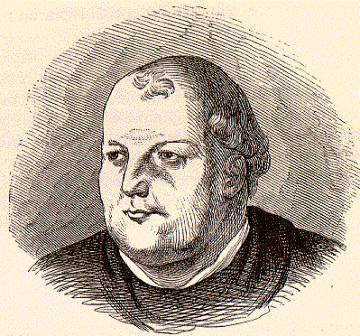
On the 3rd of January 1521 Pope Leo X issued his Papal Bull of Excommunication Decet Romanum Pontificem against Martin Luther. The excommunication followed Luther’s publication of his three masterful works published in 1520 To the Christian Nobility of the German Nation, On the Babylonian Captivity of the Church and On the Freedom of a Christian.

The excommunication was the second act of a three part drama. The first part began with Luther’s publication of the 95 Theses on October 31st 1517. That launched a series of actions by the Papacy in which various representatives were sent to bring Luther back into line. Failing this the last of the inquisitors, Johann Eck became Luther’s and other Reformer’s constant nemesis for the next 25 years.

In the summer of 1520 Eck brought back to Germany Leo X’s Papal Bull Exsurge Domine which attacked and condemned Luther’s writings, a prequel to the formal excommunication. Eck was not well received and Luther’s movement began to gain more traction especially among much of the nobility and among other theologians.

The message of the Bull was clear, Luther, his works and those who supported him or published his works were condemned. In part it read:

“…we likewise condemn, reprobate, and reject completely the books and all the writings and sermons of the said Martin, whether in Latin or any other language, containing the said errors or any one of them; and we wish them to be regarded as utterly condemned, reprobated, and rejected. We forbid each and every one of the faithful of either sex, in virtue of holy obedience and under the above penalties to be incurred automatically, to read, assert, preach, praise, print, publish, or defend them. … Indeed immediately after the publication of this letter these works, wherever they may be, shall be sought out carefully by the ordinaries and others [ecclesiastics and regulars], and under each and every one of the above penalties shall be burned publicly and solemnly in the presence of the clerics and people.” 

???????????????????????????????

Luther burning the Bull

Luther who received a copy in October of 1520 reacted in kind noting: “Since they have burned my books, I burn theirs. The canon law was included because it makes the pope a god on earth. So far I have merely fooled with this business of the pope.”

Neither the Bull dealt with the substance of Luther’s teachings, instead they were both heavy handed missives of Papal primacy and punishment on those that disobeyed. The Bull of excommunication read in part:

Nevertheless Martin himself—and it gives us grievous sorrow and perplexity to say this—the slave of a depraved mind, has scorned to revoke his errors within the prescribed interval and to send us word of such revocation, or to come to us himself; nay, like a stone of stumbling, he has feared not to write and preach worse things than before against us and this Holy See and the Catholic faith, and to lead others on to do the same.

He has now been declared a heretic; and so also others, whatever their authority and rank, who have cared nought of their own salvation but publicly and in all men’s eyes become followers of Martin’s pernicious and heretical sect, and given him openly and publicly their help, counsel and favour, encouraging him in their midst in his disobedience and obstinacy, or hindering the publication of our said missive: such men have incurred the punishments set out in that missive, and are to be treated rightfully as heretics and avoided by all faithful Christians, as the Apostle says (Titus iii. 10-11).

III. Our purpose is that such men should rightfully be ranked with Martin and other accursed heretics and excommunicates, and that even as they have ranged themselves with the obstinacy in sinning of the said Martin, they shall likewise share his punishments and his name, by bearing with them everywhere the title “Lutheran” and the punishments it incurs.

Our previous instructions were so clear and so effectively publicised and we shall adhere so strictly to our present decrees and declarations, that they will lack no proof, warning or citation.

Our decrees which follow are passed against Martin and others who follow him in the obstinacy of his depraved and damnable purpose, as also against those who defend and protect him with a military bodyguard, and do not fear to support him with their own resources or in any other way, and have and do presume to offer and afford help, counsel and favour toward him. All their names, surnames and rank—however lofty and dazzling their dignity may be—we wish to be taken as included in these decrees with the same effect as if they were individually listed and could be so listed in their publication, which must be furthered with an energy to match their contents.

On all these we decree the sentences of excommunication, of anathema, of our perpetual condemnation and interdict; of privation of dignities, honours and property on them and their descendants, and of declared unfitness for such possessions; of the confiscation of their goods and of the crime of treason; and these and the other sentences, censures and punishments which are inflicted by canon law on heretics and are set out in our aforesaid missive, we decree to have fallen on all these men to their damnation.”

It was an extraordinary and misguided document which failed to understand the significance of what was happening in the Church and in Europe. It was a document that echoes what every authoritarian structure does when challenged, it ignored the causes, it ignored the issues and simply condemned those involved. Instead of dialogue it chose retribution and destroyed the unity of the Western Church. Phillip Schaff, one of the great Church historians wrote about the Bull: “The bull of excommunication is the papal counter-manifesto to Luther’s Theses, and condemns in him the whole cause of the Protestant Reformation. Therein lies its historical significance. It was the last bull addressed to Latin Christendom as an undivided whole, and the first which was disobeyed by a large part of it.”

After his excommunication Luther appealed to Emperor Charles V who initially rejected it outright but reconsidered in light of the danger that the Empire faced if German states revolted. Charles invited Luther to the Diet promising him safe passage. The fact that Luther was able to appear at the council safely was in large part because of Elector Friedrich the Wise, his protector insisting that Luther not be imprisoned or outlawed without a hearing. Along the way Luther was greeted as a hero by townspeople, it was something like a victory parade.
20080102-luther

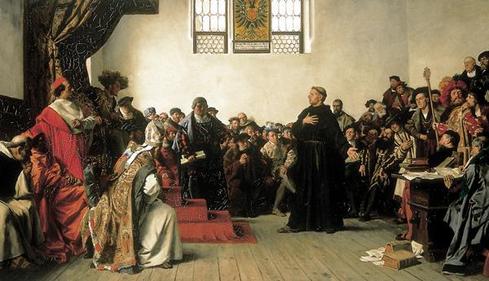
When the hearings began the Archbishop of Trier asked Luther if he would recant his writings. Luther asked for time to consider and at 4 PM the following day was called back to the Diet, where before the Emperor and the Princes of Germany he stood alone.

The Archbishop demanded: “Explain yourself now. Will you defend all your writings, or disavow some of them?” 

Luther provided a rather long answer regarding his writings, categorizing them and explaining them. Eventually the exasperated Archbishop asked: “Martin–answer candidly and without horns–do you or do you not repudiate your books and the errors which they contain?”

Luther then gave the answer in German rather than Latin, which has reverberated nearly half a millennium:

“Since then your sere Majesty and your Lordships seek a simple answer, I will give it in this manner, neither horned nor toothed. Unless I am convinced by the testimony of the Scriptures or by clear reason (for I do not trust either in the pope or in councils alone, since it is well known that they have often erred and contradicted themselves), I am bound by the Scriptures I have quoted and my conscience is captive to the Word of God. I cannot and I will not recant anything, since it is neither safe nor right to go against conscience. May God help me. Amen.”

Friedrich the Wise spirited Luther away in a staged “kidnapping” to the Wartburg Castle, allowing him to evade those that sought his life and to stabilize the Reformation in Germany.

I have always felt a closeness to Luther. He is one of my heroes. I recognize that he was neither perfect, nor do I agree with everything that he wrote or some of the things that he did. That being said, this very imperfect and often impetuous Monk, Priest and Professor is close to me. His “Theology of the Cross” makes more sense than others I have read, and his defense of the Eucharist was instrumental in my faith journey.

Luther, despite many in the Catholic Church who fight for him has not been “rehabilitated” nor the bans of excommunication removed. He has been called by some a “reluctant revolutionary.” I hope that Pope Francis will lift the excommunication despite the Roman tradition of not lifting such bans on those who have passed away.

Luther, like me was somewhat blunt, earthy and liked beer. In fact after Worms he wrote:

“I simply taught, preached, and wrote God’s Word; otherwise I did nothing.  And then, while I slept, or drank Wittenberg beer with my Philip [Melanchthon] and my Amsdorf [Nicholaus von], the Word so greatly weakened the papacy that never a prince or emperor did such damage to it.  I did nothing.  The Word did it all.” 

In seminary Luther, his writings and theology were instrumental in coming to a catholic understanding of the the Christian faith. Now that understanding was much more interpreted in light of the Second Vatican Council and more progressive theologians such as Hans Kung, Bernard Haring and Yves Congar, but it was still catholic and a clean break from my Evangelical Protestant background and education.

Likewise, when I was ordained as a Priest in a more conservative Anglo-Catholic denomination in the mid 1990s I never dreamed that I would face a time where my writings would mark me as a “heretic” in the eyes of some in that church. Nor did I think that I would be told that I was “too liberal” and needed to leave that church. Before that I had been censured and forbidden from writing because I was “too Catholic” by another bishop. Like Luther I assumed that what I wrote and said were readily apparent. Since I have written extensively about that situation and don’t feel the need to go into detail here.
1470237_10152110186432059_1784204366_n

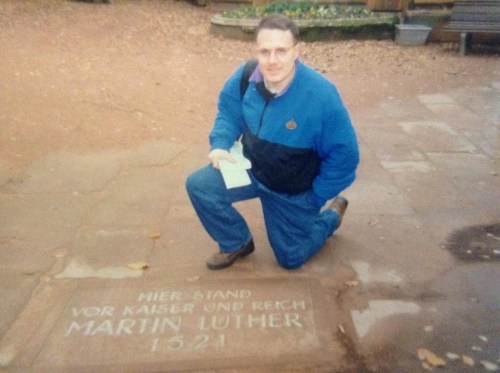
In 1996 I led a series of tours of Luther’s reformation sites in Germany, including Wittenberg, Heidelberg and Worms. I posed for pictures outside the door of the Castle Church as well as at the site where Luther gave his “Here I stand” speech. I was so familiar with the locations in Wittenberg that I was asked if I had ever been to them before. I could only say that I had never been there in person, but had been there many times in my mind. When at each location I felt a tremendous closeness to a man who had influenced so much of my spiritual journey.

As Luther wrote:

“This life therefore is not righteousness, but growth in righteousness, not health, but healing, not being but becoming, not rest but exercise. We are not yet what we shall be, but we are growing toward it, the process is not yet finished, but it is going on, this is not the end, but it is the road. All does not yet gleam in glory, but all is being purified.” 

Peace

Padre Steve+

1 Comment

Filed under christian life, faith, History, Religion

Faith’s Journey: A Progressive Christian Navy Chaplain Looks at the Journey to Wholeness

400236_10151328400862059_541742014_n

June 27th 2013: After the events of this week including the Supreme Court decision declaring the Defense of Marriage Act unconstitutional I decided to re-publish an article that was one of the most important that I ever published. Not so much because of the what I think was so earth shattering regarding the content but because of what happened after its publication. At the point in time that I wrote it I was pushing the envelope with my former denomination, but figured that in light of all the controversies and schisms in that church at the time that whatever I wrote would not result in any problems. But I was wrong. I received a call the next day from my bishop telling me that I needed to find a new home because I was “too liberal.”

It was actually quite fascinating, I was able to gain a new church home which was much more progressive, welcoming and catholic, being of the Old Catholic tradition. For me that phone call was just a few months later deposed for attempting to create yet another schism in the church. I think it is even more interesting because some of my friends still in that church think that he used this article as a reason to get rid of me in order to keep me from exposing his scheme. I don’t know if that it the case or not, but my friends believe it to be a distinct possibility. That being said one of my long time priest friends revealed his plot to the other bishops and the bishop who forced me  was deposed. Irony is fascinating. Since that time my former church is regaining its footing and doing better and for my friends in it I am glad for even if I have differences in theology, faith or beliefs with people who I consider to be friends, they are still friends and I wish them well.  

So anyway, for those that are fairly new followers on this site here is the article that in a sense served as a declaration of independence and station on the road to wholeness and integrity. 

Peace, Padre Steve+

Faith Journeys: Why I am Still a Christian (Originally published 22 September 2010)

There are many times that I totally empathize with author Anne Rice in saying that she has left Christianity yet still has faith in Christ.  For Rice it was the lack of love shown by the institutional church for people that are marginalized and treated as if they were unredeemable by often well meaning Christians.

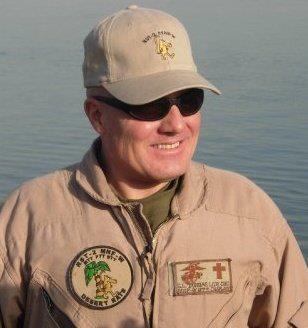
I know what it feels like to be marginalized after I came back from Iraq because many of my Christian friends seemed, at least in my view to be tied to the absolute hogwash that spews from talk radio hosts and allegedly “Christian” politicians.  I remember having some Christians question my patriotism and even my faith because I disagreed with them regarding certain aspects of the war, despite the fact that I had been on the ground in harm’s way serving with our advisors and Iraqis in Al Anbar province.  The fact that not a clergyman, civilian or military, took time to care for me when I was in a major PTSD meltdown and crisis of faith before I went to Naval Medical Center Portsmouth didn’t seem to matter because a political agenda was given primacy over the simple truths and hard demands of the Gospel.

Yesterday I wrote about Chaplains that experience a crisis of faith after coming home from a combat deployment.  For me there is nothing more symbolic of the lack of soul left in many Christians and Christian Churches in how they treat those that have served faithfully. Those Chaplains that have served  God, Church and Country and come back spiritually wondering what happened, not knowing what to believe and feeling abandoned by God and cast off by the Church and the military simply because we have a hard time with the so called “orthodoxy” of some Christians.

I went through a period after Iraq where feeling abandoned and isolated from those of a like faith that I was for all practical purposes an agnostic.  That was a really difficult time in my life and if you think that anything sucks try to be a Chaplain when you no longer know if God exists and the only person asking how you are doing with “the Big Guy” is your therapist. I can say without a doubt that it sucks like a Hoover and I know that I am not alone in my feelings.  I have met others whose experience is similar to mine but those that are struggling right now, caught between our faith and the feeling of being abandoned by God and his people because our experience of seeing the human suffering caused by war has shaken us.

Let’s talk about spiritual despair. Did you know that in the past couple of years that two Army Chaplains and one Navy Chaplain have committed suicide? These were men of faith who had served in peace and war at least one that had served at the Battle of Hue City as a Marine before becoming a Priest and Chaplain.  Another Army Chaplain that had served in Iraq as a minister of a conservative Charismatic and Evangelical Christian denomination became a Wiccan and was excoriated by Christians.  I don’t know his faith journey but I have to believe that part was his experience in Iraq and experience on his return. I don’t know about you but those are all signs of spiritual despair and feeling cut off from their faith community and even God, his or her self.

I am still a Christian. I believe in the God of Scripture, the Creeds and the Councils. At the same time that belief is not as rigid as it once was. I used to consider those that didn’t believe like I did in relation to Scripture, the Creeds and Councils not to be Christians.  I cannot say that now. I am much more to have the Grace and Mercy of God be my default position and let other things fall out where they may.  My practice of my faith has changed. When I came back from Iraq I attempted, as it were without success to keep my faith structure and practice the same as it was before I deployed to Iraq.  Within six months of Iraq I could no longer pray the Daily Office with any kind of faithfulness and by Lent 2009 give up the practice for Lent hoping to recover some authenticity to my faith. The authenticity has returned and after about a hear and a half I am seeking a way to reincorporate what had been a very important part of my daily practice of faith into my life without feeling like I am a phony in doing so.

I went through a period of absolute spiritual despair even leaving a Christmas Eve Mass in 2008 to walk home in the dark, alone, looking at the sky and asking God if he even existed.  A year later after my life had completely fallen apart I experienced what I call my “Christmas miracle” where I was called to our Emergency Room to provide the “last rites” to a retired Navy doctor and active Episcopalian when I was the duty Chaplain.  As I prayed the last prayer of commendation and removed my oil covered fingers from the man’s forehead he breathed his last. His wife told me that he was waiting to be anointed before he died.  The young doctor, a Psychology Resident doing his ER rotation who called me to the ER would die a couple of months later of natural causes in his living room not long after we had taken the “fat boy” program PT test together.

From that moment the paradigm shifted.  Faith began to return and I began to experience the presence of God again, not is the same was as before Iraq but one that was more relational, grace filled and informal.  I will likely begin praying the Daily Office again in the near future but I will approach it from a different point of view.  I will no longer use it simply to fulfill my priestly vows and obligations but rather as a way to re-experience and if need be re-imagine God.  Now before the heresy hunters think that I am re-imagining God is some unbiblical manner they are wrong. I want to re-imagine God as he has been revealed to his people both in Scripture, Tradition and in the life of his, or her people today.

moralssquad

How have I changed? I believe again. I am no longer an agnostic hoping and praying that God just might be there. My faith has become much more deeply rooted and grounded in the “Crucified God” and my faith in the “theology of the Cross.”  It is no longer connected to my politics and I refute any political ideology that attempts to use the Christian faith and the faith of well meaning Christians for purposes that Jesus himself would have condemned.  I don’t think Jesus was a big fan of his followers attempting to be the favorites of any political party or ideological system. In fact if I recall he really had pretty harsh words for his fellow Jews who were all wrapped around the axels with that kind of stuff. Jesus seems to befriend and hang around with those that are not connected to the religious, political or economic elites. In fact he seemed to reserve his harshest words for such people.  Jesus seemed to have a pretty good relationship with those marginalized and rejected by the religious folks of his day. He welcome sinners and tax collectors to his table and praised the faith of gentile Roman officers and stopped the super-religious folks from stoning an adulterous woman.

This is the Jesus that I follow and the Jesus that I believe is present in body, soul and spirit in the Eucharist.  I believe like Hans Kung and others that this table belongs to the baptized community of faith and not to an exclusive Priestly class who dictate who can come to the table.  It is not the exclusive property of any denomination or Church organization especially those that most loudly state this to be the case.

Now if saying this makes me a heretic then a heretic I will be. It is better to be a heretic in the eyes of Pharisees than to be one that denies justice to the persecuted people of God.  I guess that makes this moderate a liberal and to some an unbeliever.  Yet I believe in the God of Abraham, Isaac and Jacob. I believe in the Jesus that defied religious systems to offer the grace of God to the people that those systems rejected and the Jesus that was far more critical of “believers’ than those rejected as unbelievers.  I guess that is why I can accept women as ministers or even Priests, accept homosexuals as Christian brothers and sisters, and see Christ and the grace and love of God in people that are not “Christians” even the Muslims in Iraq that treated me with respect and even if they had an “Aryan” view of Jesus still showed a greater reverence for Jesus and the Blessed Virgin Mary than many that claim Jesus for themselves.

Why? You ask. Very simply I once was lost but now am found.  I thought that I knew it all before, now I know that I don’t know it all and that God is the God of surprises, just look in Scripture.  I doubt at times. I know that there are many answers that elude me and I cannot answer just by citing or using Scripture out of its historic, cultural and linguistic context.  I believe in the God that did not reject me when I didn’t know if he even existed.

Why am I still a Christian when I have so many problems with how many Christians practice the faith? Because I believe and not because will not I tow anyone’s party line be they liberals or conservatives. I believe in spite of my unbelief in a fellowship of those who as a result of war and trauma have trouble believing those that won’t race the cold realities of this life. I believe because many times it was those marginalized by others, especially those marginalized by the “faithful” showed me the love of God when the “faithful” for pure or impure motives, or even because they didn’t know what to do allowed me to sink into despair and isolation. So in the words of my favorite heretic Martin Luther I say “Here I stand, I can do no other. So help me God. Amen.”

Peace,

Padre Steve+

1 Comment

Filed under christian life, faith, Pastoral Care, philosophy, Religion

Feet of Clay: The Common Flaw of the Best and Brightest

Charlene and Michel de Carvalho

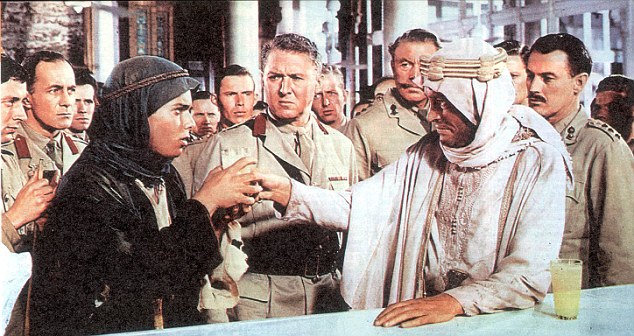
General Allenby: [leafing through Lawrence’s dossier] “Undisciplined… unpunctual… untidy. Knowledge of music… knowledge of literature… knowledge of… knowledge of… you’re an interesting man there’s no doubt about it.” 

Character is a terrible thing to judge. Mostly because those doing the judging also suffer from flaws in their own character.  Yet somehow the temptation is for us to stand as judge, jury and character executioner on those that we find wanting. As a culture we like tearing down those that we at one time built up. It is a rather perverse proclivity that we have as human beings, especially if we can find some kind of religious justification for it.

I think that is part of the complexity of the human condition. As a historian I find that the most exalted heroes, men and women of often great courage both moral and physical, intellect, creativity, humanity and even compassion have feet of clay.

I find that I am attracted to those characters who find themselves off the beaten track. Visionaries often at odds with their superiors, institutions, and sometimes their faith and traditions. Men and women who discovered in themselves visions for what might be and pursued those visions, sometimes at the costs of their families, friends, and in quite a few cases their lives.

Throughout my studies I have been attracted to men as diverse as Peter the Apostle, Martin Luther, T.E. Lawrence, Dietrich Bonhoeffer, Erwin Rommel, Admiral Horatio Nelson, Abraham Lincoln, John F Kennedy, Dwight D Eisenhower, Franklin Roosevelt, Dr Martin Luther King Jr, Jackie Robinson, Teresa of Avila, Nelson Mandela, Vaclav Havel and Emir Feisal Hussein of the Arab Revolt. All had flaws. Some involved fits of temper and violence, others sexual escapades, mistresses, affairs, greed avarice, and maybe some that stretched law and morality in their quest to achieve their goals. But all are considered great men and women.

Feet of clay. Who doesn’t have them? But them I think that I would rather have feet of clay than a heart of stone, an an unchallenged mind, or a lack of courage to do the right thing even if it does not directly benefit me.

Tonight I watched for the first time straight through the cinema classic Lawrence of Arabia. Peter O’Toole plays Lawrence in a most remarkable manner, showing his brilliance, courage, diplomatic ability and understanding of the Arabs with whom he served.

There are many people, leaders and others that we encounter in life or that we study. Even the best of the best are flawed and there is no such thing as a Saint who never sinned. But we love destroying them and their memory when to our “surprise” when we find that their hagiographers built them into an idol.

I am a great believer in redemption and the weight of the whole of a person’s life. Thus I try to put the flaws as they are called in perspective and their impact both positive and negative in history. Studying in this way gives me a greater perspective on what it is to be human and to place my own clay feet in appropriate perspective.

It was an interesting film to watch.

However, speaking of feet of clay I will probably be writing about the Baseball Writers who vote for the inductees for the Hall of Fame. Today for the first time in nearly 4 decades no players were selected for induction, mostly due to the steroid era. But that is a subject for another night.

Peace

Padre Steve+

1 Comment

Filed under faith, film, History

Padre Steve Gets into the Christmas Spirit in Spite of Himself

charlie-brown-asks

“Isn’t there anyone who knows what Christmas is about?” Charlie Brown

Well, it it still Advent but despite all my heartfelt leanings of liturgical calendar correctness I have caught the Christmas spirit early this year. I don’t know why, especially because I can be such a Grinch this time of year.

It began last week when I had to make 8 dozen cookies for our annual “cookie exchange” at the hospital where I serve. We had the exchange on Friday and it was combined with our Christmas Tree (Holiday Tree for those more politically correct than this moderate liberal) lighting.

Let’s face it without Martin Luther we wouldn’t do the Christmas tree thing anyway, the Calvinists that first settled this country were such party-poopers that that they thought the whole concept of celebrating Christmas was sinful. (See my article Christian Grinch’s: How the Puritans nearly stole Christmas  http://wp.me/prGqV-1tg  ) So I guess if we want to play the whole politically correct thing the Calvinists forefathers and mothers of our current Evangelical Christian defenders of “Christmas” actually had more in common with the current critics of the holiday than its defenders? But I digress…

martin-luther-on-christmas-eve-with-his-family

Martin Luther with his family at Christmas

So in the spirit of Martin Luther, that beer drinking foul mouthed German instigator of the Protestant Reformation, I have gotten into the Christmas spirit. For the first time since I was in Iraq I feel an eager anticipation of the coming of Christmas.

Puritan Christmas Ban

The Puritan’s Idea of a Very Calvin Christmas

Like I said it began last week. First there was my cookie baking adventure The Easy Baking Bachelor of Christmastide which was a success. In fact I plan on repeating it to some extent tonight, gifts for my minions at work and friends at the bar tomorrow. The cookie exchange took place Friday. I brought in the cookies and when I got to work one of the fellow members of the board of directors asked me if I was going to change into my dress blues as I was wearing my khakis. It was at that point that I thought to myself “Oh shit.” I had forgotten that those of us on the board of directors who are on active duty actually dress up when we do this. You see my dress blue uniform was hanging in my apartment, 25 miles away. Since I had to attend one of those good occasions where we were promoting a couple of dozen young sailors I could not leave immediately to change into the uniform.

I was happy to see the Sailors get promoted but I was not happy about having to make the trip home and back. Yes I could have weaseled my way out of the dress blue uniform but as much of a weasel as I can be I hate to look obvious. So when the ceremony ended at 0900 I dashed to my office, grabbed my cover, which is what we in the Navy call a hat and ran out to my car. I made it home in good time and then things started going to hell.

Molly, my little dog Molly decided that she needed to go out and since I was home early she assumed that I had all day to indulge her. It was a power fight, the little Papillon-Dachshund mix decided that she would fart around. Eventually I got her inside and went to get in my uniform, which to my surprise still had the large medals which I had on it for a change of command ceremony I had been participated in, and which I had to switch out for mere ribbons. I hurriedly changed the ribbons, gave Molly her “cookie” (not one of the chocolate chuck cookies but a dog treat) changed into my uniform and dashed to the car.

At that point something happened in me. It was as if I was having a Grinch moment, but in a good way: As the story goes: “And what happened, then? Well, in Whoville they say – that the Grinch’s small heart grew three sizes that day. And then – the true meaning of Christmas came through, and the Grinch found the strength of ten Grinches, plus two!”

4185921781_bcde7739cd

It was a damn close run adventure getting back to the base on time. It seemed that if there was a red light that I caught it and to make matters worse, if there was a minnie-van driven by a doddering retiree or soccer mom who decided to do 5 miles an hour under the speed limit in the left hand lane I got behind them. In between praying and cussing and dodging in and out of impossible traffic situations I realized that I really wanted to make it on time. It was as if the Force was with me as I wove in and out of the insidiously poor drivers who could not drive nails and should not be behind the controls of modern automobiles.

Now this was strange because such ceremonial events are usually, no matter what the occasion are painful for me to attend, being that I am mildly introverted and anti-social. It was like when the Grinch’s grew and he had to dash to Whoville to save Christmas. It was almost a conversion experience, a Christmas miracle if you will. I was possessed with the need to make it on time despite the obstacles.

Despite construction zones, slow drivers hogging the fast lane, and traffic lights I was able to get to the hospital parking lot at 1028 with the ceremony scheduled to begin at 1030. I had no time to waste. Our employee parking lots are not convenient to getting into the building fast. We reserve that right for patients and visitors. This is probably a good business and PR practice but not helpful at this particular moment. So I found an empty spot in the outfield got out of my car and started to run. It was like the good old days before O.J. Simpson allegedly killed his wife Nicole, when he ran through airports in a suit for Hertz Rent-A-Car in TV commercials. I was flying. This is the great thing about being in shape and not straining to get into the uniform. I ran up the hill by our ER and down the hill, jumped curbs, ditches, and barriers as I wove between pedestrians and cars in the parking lot.  Marines, Sailors and civilians looked at crazy Navy officer dashing through the lot with amazement. Surely they though it must be an emergency, and in a sense it was. I was running out of time and I had to give the invocation.

403476_10151380522552059_39760794_n

I made it on time and then the ceremony was delayed for 15 minutes. I breathed a sigh of relief and found that my heart had indeed grown three sizes that day because I was not cussing and swearing and acting like a complete idiot. It was a Christmas miracle. The ceremony went well and the two hours of conversations and chit-chatting that followed was enjoyable despite the uncomfortableness of my patent leather military issue shoes. I breathed a sigh of relief and knew that all was well in my world. When the day was done I went home and hung out with Molly before doing usual grilled chicken salad dinner at the neighborhood bar.

One would think that the story would end there but then one would be wrong. I carried the duty pager over the weekend and at about 0100 Saturday morning it went off. It was a call from the Emergency Room. A man was in cardiac arrest and I was needed. I rolled out of bed, waking up Molly who looked offended and I put on my uniform to head to the hospital. When I got there the patient had died, but I spent time and prayed with his wife, then other members of the family who arrived over the next hour. When all was done I drove back home where I woke up Molly, who by the way does not think kindly to being woken up at 0415.

The rest of the weekend was relatively uneventful. I went to our hospital Christmas party  Saturday night which was nice and on Sunday celebrated a Eucharist at home after sleeping late for the Second Sunday of Advent. I was tired but I felt great.

So this morning, despite not sleeping well due to holding the duty pager I got up and prepared for work. I had made one mistake however. I assumed that the North Carolina DOT had made appropriate traffic arrangements for traffic control since the bridge that connects us with the mainland is down to one lane due to the resurfacing of the road on it. I anticipated a 10-15 minute delay at the most, however the contractor did not use flagmen but used a timed traffic signal. The result was a traffic nightmare. It took an hour and a half to cover two miles. However instead of ranting and raving as might be my custom I decided instead of listening to news, political commentary, ESPN or even the 70’s channel to tune in to the Sirius radio station that played Christmas songs. It was great and I didn’t stress out. It took nearly 2 and a half hours to get to work today, normally it is about 35-45 minutes. But in that time I realized that I didn’t need to be a Christmas Grinch after all and that my dash to hospital on Friday was not a mistake.

So tonight, I made more cookies to distribute to my minions and friends tomorrow and watched my favorite television Christmas specials, A Charlie Brown Christmas and The Grinch that Stole Christmas. 

I am enjoying the lead up to Christmas for the first time in a long time and it feels good. I do hope that in spite of the Fiscal Cliff and all the problems of the world that maybe more people will have a Grinch conversion moment this year and perhaps like Charlie Brown discover the meaning of Christmas, not only now but all year round…

Christmas time is here

We’ll be drawing near

Oh, that we could always see

Such spirit through the year

Oh, that we could always see

Such spirit through the year…

Peace

Padre Steve+
3 Comments

Filed under christian life, faith

The Paths Taken and Not: The Tapestry of Life, Authenticity and Wisdom Passed Down

n671902058_2044112_2975

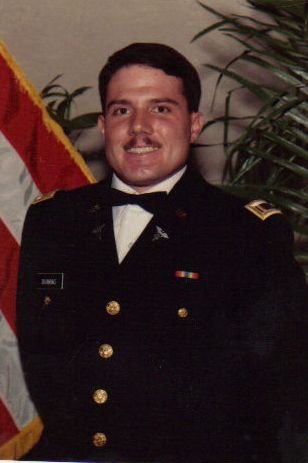
Nearly 32 years ago I was getting ready to embark on a military career. It was  the fall of 1980 and I was a junior at California State University Northridge. Within the year I was beginning my first furtive steps in my career by enlisting in the California National Guard and enrolling in the Army ROTC program at UCLA.

It was an interesting time. My imagination of the military back in the days of the Cold War was quite orthodox and founded on what a “normal” Army career should look like. I would get commissioned, serve as a platoon leader, company executive officer, battalion staff officer and company commander. I would attend the appropriate military schools, the officer basic course, the advanced course, specialized courses and Command and General Staff College and then hopefully be promoted to the field grade ranks and after serving 20-30 years would retire as a Major, Lieutenant Colonel or maybe even a Colonel.

If that had been the case I would have had a very different life than I have today. Certainly a good life, but not what I have today. I would be me, but a different me. I would have probably played everything safe and been the perfect servant of the institution while ensuring my own success.

Instead the tapestry of my life and choices have produced something different than I could have ever imagined 32 years ago. Those choices have resulted in successes and failures, blessings and great difficulties as well as trials that honestly I would never want to go through again. However all of those things have helped make me what and who I am today.

I look back at the people in my life who have influenced me at different points, as well as critical junctures where I made decisions I see a tapestry that I could never have thought possible, a tapestry much richer and diverse than I could have thought of back then. It has not been without pain but it has been worth it.

One of the things that I discovered early was that as hard as I tried to fit the mould of the Army, I was a non-comformistby nature.  I thought outside of the box and that in attempting to fit in I was not happy. I had one rater  in his evaluation of me offer the criticism that thought too much of my abilities that “lent me to criticism.” That may have been true to some extent, and my rather blunt and outspoken opinions to criticize higher ranking officers and to take liberties with orders got me in trouble at times.

However I did survive some of my more stupid escapades such as telling my Medical Group Commander that he had embarrassed our command as a very junior Army 1st Lieutenant and in another case banned the two local CID investigators from running amok on a fishing expedition in my barracks without probable cause or a warrant for their investigation. They never returned with probable cause or a warrant. Another time I told the the senior personnel officer in the command I was stationed as a Captain that he could take his spies out of my command, as well as getting thrown out of the Army Chaplain Officer Advanced Course in 1992. It would take too long to explain the details of these incidents here but assuredly they were the fault of a young, opinionated and outside the box thinking officer who dared to voice his opinion to men who were institutional careerists, they were not bad people, just people conformed to and servants of institutional norms. That being said my troubles were troubles brought on me by my own actions because I did not understand what the institution, any institution can do to otherwise well meaning and honorable people.

Despite some black eyes I did make Major in the Army Reserve and finally to get back on active duty reduced in rank to enter the Navy back in 1999. The good thing was that I learned from my experiences and have been able to use them to learn, survive and succeed in my Navy-Marine Corps career.

In the process there were men and women who at various times in my life and career passed along wisdom, not just advice, not just knowledge, but wisdom. It is to them that I owe my successes. Without their sage advice, authentic leadership and honesty I would have certainly crashed and burned a long time ago, a prisoner of my own limited insight and unlimited ambition.

400236_10151328400862059_541742014_n

But more than succeeding in my career I have learned that it is okay to be me, to be authentic and to be honest about who I am and what I do. My goal now as a relatively senior chaplain is to care for, mentor and allow those men and women who work directly for me to succeed, even as well as those that I serve.  It is no longer about my career. I am on the backside of my career regardless of my next assignment or even if I get promoted to Captain in the Navy several years from now when I am eligible. But promotion is not an end to itself, if I have learned anything it is that many times promotion to a higher office can be a prison that some men never escape.

The fact is that I have far fewer years left to serve than I have served to this point. Thus it is far more important to do right for the people that I serve and help them take lessons that I have learned into their futures and if they remain in the military pass them along to others as they become authentic leaders. Johann_von_Staupitz

Johann Von Staupitz

My study of history and more practically in my case military history and to some extent church history and theory shows me quite those who don’t achieve the highest levels of command or institutional power often have a greater influence in the long term than those who do. Without Johann von Stauptiz it is doubtful if the young Martin Luther would have began to study the Bible and hence bring about the Protestant Reformation.

clausewitz2

Carl Von Clausewitz

As the foremost interpreter of Napoleon, a relatively unknown Prussian General Staff Officer, Carl von Clausewitz had a greater impact on warfare and military theory than did Napoleon himself. There are many other examples of such individuals in history, men and women, many times of far lesser estate than Clausewitz or Staupitz who have by their wisdom helped those that eventually held power or influence in thinking outside the bounds of tradition to accomplish things that were not possible to their teachers.

Wisdom comes slowly to most of us, especially people like me. The problematic thing is that is, for the most part wisdom is a commodity that is not highly treasured in a society built upon expediency and crass materialism. It is certainly not something the most men and women that seek power are gifted with, despite their intellectual gifts and often well earned knowledge. But learned knowledge and raw intelligence are different than wisdom. Knowledge and intelligence are quite wonderful but ungoverned by wisdom the ambition that they breed is often the undoing of those that rely on them as well as their physical, economic or even military power.

The key thing is that wisdom, experience and learning was passed along to men and women who, God willing, will be serving long after I retire from the Navy. Today I was approached by one of our wounded warriors stationed at our hospital because of his injuries. He engaged me in a conversation and he said that he would like to spend some time with me, to listen to some of my stories about my life in the military and experience. Evidently a couple of his young friends have told him a bit about me. That meant a lot to me, just as the times that young people have come to me not because of my position, or rank, but because they see me as a real person, approachable and available.  The nice thing for me is that there are many times that I learn from them, for many times it is young people that can see the greatest problems and offer ideas and solutions that elude older and more experienced people in every walk of life.

liddellhart

B. H. Liddell-Hart

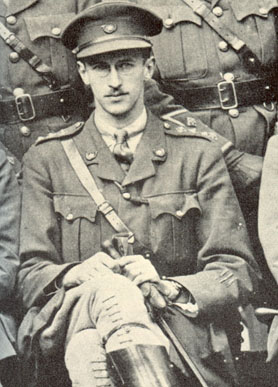
I recently read B.H. Liddell-Hart’s biography of T.E. Lawrence, perhaps one of the most gifted military commanders, philosophers and men of the 20th Century. Lawrence and to some extent Liddell-Hart understood something about wisdom that most of their contemporaries and even students miss. Liddell-Hart himself, though a medically retired as a Captain due to wounds suffered in World War One was one of the more influential thinkers of his day. His works had a profound impact on the most successful commanders of the Second World War. He understood that the key to wisdom is self understanding and a recognition of their own knowledge as well as limitations. Liddell-Hart wrote of Lawrence, wisdom and humanity in 1937:

“A study of history, past and in the making, seems to suggest that most of mankind’s troubles are man-made, and arise from the compound effect of decisions taken without knowledge, ambitions uncontrolled by wisdom and judgements that lack understanding.  Their ceaseless repetition is the grimmest jest that destiny plays on the human race. Men are helped to authority by their knowledge continually make decisions on questions beyond their knowledge. Ambition to maintain their authority forbids them from admitting the limits of their knowledge and calling upon the knowledge that is available in other men. Ambition to extend the bounds of their authority leads them to a frustration of others opportunity and interference with others’ liberty that, with monotonous persistency, injures themselves or their successors on the rebound.  

The fate of mankind in all ages has ben the plaything of petty personal ambitions. The blend of wisdom with knowledge would restrain men from contributing to this endless cycle of folly, but understanding can guide them toward progress.” B.H. Liddell-Hart “Lawrence of Arabia” DeCapo Press, Reprint, originally published as “The Man Behind the Legend” Halcyon House 1937 

410w

T. E. Lawrence

It is my hope that no matter what my next assignment is and no matter how long I have left in the military as well as in life that I will be able to be one of those wise old sages who helps the next generations do things that were impossible for my generation, to succeed where we failed and who like Staupitz, Clausewitz, Liddell-Hart and Lawrence inspired others to greatness far beyond their own.

I am coming up for orders soon, order that will take me to my next assignment. I have spent the past two years as a geographic bachelor, apart from my wife, by the time I leave this assignment it will be close to three years. I have been assured that my next assignment will be in the area where our home is, however I do not know what it will be. I know what I want to do but do not know if it is possible based on the needs of the Navy. However, that being said I do know enough that no matter where I am assigned the mission is the same, as well as the pay. That mission is to care for, guide and assist those that work for me as well as those that I have the honor of serving, or possibly simply be the wise old sage.

I think I like that idea.

Peace

Padre Steve+

1 Comment

Filed under faith, History, philosophy, Religion

By Their Budgets Ye Shall Know Them: A Reformation Day Reflection

“Lastly, works of piety and charity are infinitely better than indulgences, and yet they do not preach these with such display or so much zeal; nay, they keep silence about them for the sake of preaching pardons. And yet it is the first and sole duty of all bishops, that the people should learn the Gospel and Christian charity: for Christ nowhere commands that indulgences should be preached. What a dreadful thing it is then, what peril to a bishop, if, while the Gospel is passed over in silence, he permits nothing but the noisy outcry of indulgences to be spread among his people, and bestows more care on these than on the Gospel!” Martin Luther (Introductory Letter To The 95 Theses)

Back on October 31st 1517 a little known Monk and Professor of Theology and Bible at the University of Wittenberg proposed a theological debate regarding a practice called “Indulgences” where preachers from Rome came up to Germany and basically shook down the population for donations to help built the now majestic Saint Peters Basilica in Rome. Promises of spiritual blessings, to include time out of Purgatory for those that donated had an affect on German churches and the local political leaders.

What happened that day in Wittenberg was one of the most monumental events in Christian and Western History.

However, It seems that Christians and especially ministers of all traditions forget the lessons of history.  The church in the United States is at a critical point in history and is fast losing its credibility due to the arrogance and excess of many churches as well as individual clergy in matters related to personal behavior, financial accountability as well as accountability before the law concerning clergy that who have committed grievous crimes against children and others.  Likewise there is the nearly incestuous relationship between many ministers and those holding political and or economic power in which quite often one cannot tell where the “gospel” ends and the politics begin.  This exists in many churches large and small and spans the denominational spectrum not being the sole property of any particular body.  There is also the matter of accountability in which it seems that many churches, ministries and ministers practice a “do as I say, not as I do” lifestyle holding their subordinate clergy as well as parishioners to a higher standard than they practice themselves.

The United States has always had a strong Christian heritage that has impacted its faith as well as its national life.  This is not of itself a bad thing as one looks at how churches and Christian leaders have made an impact that goes beyond them and is beneficial to the nation as a whole.  Some of these achievements include the pressure put on James Madison by Virginia Baptists to ensure a guarantee of religious freedom in the Bill of Rights, the abolition of slavery the ending of child labor, the Civil Rights movement as well as numerous charitable and public interest oriented ministries to care for society’s most disadvantaged citizens as well as the aliens that have lived among us.  At the same time there were many Christians, churches and ministers that supported slavery, an established state religion, segregation and many other issues.  That being said churches and individual ministers have made a huge contribution to American life and community that cannot be easily dismissed despite the many problems, controversies, and scandals that have surrounded churches of almost all denominations since the founding of the United States.  Religious liberty as well as Christian churches and religion in general has traditionally been seen as a positive rather than a negative aspect of the United States going back to Alexis de Tocqueville in his comments on American democracy.

Clergy have enjoyed a special status in American life that exists in large part due the Bill of Rights and the Jeffersonian understanding of an “eternal wall of separation” between church and state.   This is because clergy were seen as fair arbiters because they were not an appendage of the state as were the clergy of most European states that had established state religion.  Thus the “clericalism” of Europe which was seen as a danger by our Founding Fathers was not a major issue. Yes some of the founders recognized a potential danger but that did not stop Congress from treating clergy and churches favorably in the early years of the republic and worked to ensure that no church became a “State church.”  Over the years since the founding of the United States clergy of many denominations have made many positive contributions to our Nation in both their pastoral and prophetic roles.  At the same time over the years some clergy have attempted to use their status and privileges as an entry into the elite parts of society, especially in the political, government policy and financial realms.

The point to be short is that many clergy in the United States, especially those in influential pulpits and ministries have forgotten the dangers of “clericalism” and the abuses of clerics who use their office as clergy to gain political, financial and personal power.  Jesus told his disciples that they had to be servants and not seek wealth, status or position something that was echoed by the New Testament writers as well as many of the Ante-Nicene Fathers.

By their budgets ye shall know them….I saw the report of the Reverend Robert Schuler of the “Crystal Cathedral” megachurch which declared bankruptcy last week being $43 Million dollars in debt and embroiled in struggles about Schuler’s successor call for his parishioners to give more money.  He asked “tithers to double tithe” and those that do not tithe to “start tithing.” He talked about what the church has given to them and earned their support. I found this to be a rather pompous plea from a man who has had the ear of Presidents and leaders in the political and business world.  The fact is that Southern California has been terribly hard hit by the economic downturn and recession and that obviously includes many of his parishioners both those that worship at the Cathedral as well as those who what Schuler’s “Hour of Power” show.  The Chrystal Cathedral tried to live “month to month on $2 Million dollars a month” cut back staff, curtailed programs and sold property to try to make ends meet. I’m sorry but when you live off of other people’s money you should never build a ministry requiring millions of dollars on the presumption that if you get it wrong that the faithful givers should have to bail you out.  I saw this at a local level a few years back and it all but destroyed the local church and the denomination that church belonged.  I wonder how many more megachurches built on piles of debt are facing what happened at the Chrystal Cathedral. The Church Campus was sold to the local Roman Catholic Diocese.

By their budgets ye shall know them….Other churches at denominational and local levels have often become embroiled in banking scandals that tarnished the reputation of those churches, their leaders and disillusioned their membership often causing mass defections to other churches or leave the organized church all together.  The Roman Catholic Church had to deal with a major scandal involving the Vatican Bank in the 1970s and 1980s and have recently had other allegations of another potential banking scandal involving the Vatican have surfaced.

By their budgets ye shall know them: If a ministry spends the bulk of its time and money working as surrogates for a political candidate or party it is highly likely that it has forgotten the basic mission of the Church as I can’t remember anything in the New Testament even remotely suggests we do this nor can a single time in Church history that it turned out well for the church, or for regular people in general.

By their budgets ye shall know them….I worked for a fairly reputable Television ministry while I was a seminary student. The common plea of these types of ministries is that they “are on a mission from God” well, maybe that is a Blues Brother’s paraphrase but you get my drift. Most are not part of any denominational structure and have little oversight and presume that since someone might watch them that they are entitled to financial support. They do not ask their audience for actual input into their “mission” strategy, they just ask for their audience’s money to do with as they “and as the Lord would have them to do” with it. This of course is not the sole property of television ministries but it occurs in many churches as well.  If someone questions the church and its financial accountability they are accused of “being unfaithful,” “not hearing God,” or being “disobedient to God’s will or to the church.”  Since many churches and ministries suffer a terrible lack of accountability and oversight these abuses are more widespread than we would want to believe. Sometimes it takes personal experience to see this but when one sees it up close and in person the blinders can be removed. In regard to television ministries in particular the amount of money required to keep their programs on the air is beyond exorbitant. It comes often from those that are barely surviving financially even in “good times” and the most desperate of people “believing in God for a miracle” in response to obediently shelling out of their meager incomes to ministries in response to persuasive pleas by ministers that should know better. The motivation, love and obedience of these often wonderful people is exploited in order to support air programs that have little impact on the world despite the boastings of these ministers that they are “fulfilling the great commission.” One has to ask if this is the case why there is so little to be seen in our society as a result of all the money poured into these pricy ministries.

By their budgets ye shall know them….If money was the only thing it would be a manageable problem…. Oh but wait money and power is the root of the problem as the problem extends to lifestyles of ministers and other church leaders which are hardly supported by the demands of the Gospel. It is not uncommon at all to see clergy living off of the offerings of their parishioners live opulent lifestyles and when times get tough demand more money from their flocks rather than amending their own behaviors.  Instead of accountability, repentance and a change in behavior there is a demand for obedience from their flock and if the flock objects they are the ones that are vilified.  This again cuts across denominational lines and includes Protestants and Catholics, those in parish as well as those in parachurch, television and radio ministries. In my old church those clergy who could not meet their tithe for whatever reason were told that they were being “disobedient to their vows” which instead of vows to the Church in regard to orthodoxy as well as orthopraxy were narrowed down to if you were paying your tithe on time. I remember one Bishop who left the church to go elsewhere told the assembled priests in his diocese that the tithe was the “essential test of obedience, and what bound us together.” Families and parishioners of parishes were described by another Bishop as “tithing units” not people and when I was in the reserves contemplating a mission parish start up was told that in order to be “successful” the church needed at least “x-number of tithing units.” Doctrine or even other forms of public witness were secondary to paying the tithe.  That church had many major financial scandals that are well documented elsewhere so I won’t go into detail about them.

By their budgets ye shall know them…. If churches spend more money on the salaries of their pastors than they do on outreach to the poor or missions something is severely out of order, one cannot imagine the Apostles of those Ante-Nicene Fathers who suffered poverty and persecution advocating for what amounts to be an “Imperial” church even those that advocated a firm hierarchy in regard to faith and belief.  When leaders of a church, especially a small church get together and dine in luxury on the monies donated by their often impoverished flocks it shows a tacit denial of the Gospel and lack of respect or care for the people of God.

By their budgets ye shall know them….When church building programs and plant maintenance are extravagant and require massive amounts of money to sustain without demanding more from their parishioners than something is out of kilter.  When chandeliers cost more than a mission budget for the poor something is wrong.  My Church History professor from who I appropriated the “by their budgets ye shall know them” line used to say that “God is going to get us for our stained glass windows when we neglect the poor.”  I love good church architecture including stained glass windows but it is presumptive on God the people of God for churches, ministries and ministers to demand monies when they have failed to play and manage effective especially when in spite of economic indicators they spend like drunken sailors and expect others to pick up the tab while crying crocodile tears about how “God’s plans will be thwarted” if their ministry fails.

By their budgets ye shall know them….Back prior to the Protestant Reformation in Europe there was a large amount of discontent which focused on the arrogance, opulence and financial demands of the Catholic Church.  In fact much of Dr. Martin Luther’s protest in the 95 Thesis dealt with the manner in which the Church used a practice called indulgences and the selling of “relics” to fund the construction of St Peters Basilica in Rome.  In people gave because they believed men like John Tetzel who preached in regard to indulgences “a penny into the coffer rings a soul from purgatory springs.”  Of course there was the manner that the Church also used its power to reward or punish rulers which was also part of the problem but the complaint of many reformers was often directly related to the Churches’ financial as well as political abuses of its members and nations to buttress its position in Europe.  Unfortunately I do not think that we have learned this lesson and that Churches and ministries in the United States are losing membership and the trend is that people are opting for individual expressions of faith rather than become a part of institutions that they feel are out of touch with real people.  I believe that if things do not change there will be a mass exodus from many churches and religious institutions because of the odious nature of the financial dealings and pressure put on people to support questionable programs and lavish lifestyles.

By their budgets ye shall know them….There are honest and hard working ministers and churches that emphasize ministry and care for people as part of the Gospel message.  Many are foreign missionaries that eke out support while working full time in “tentmaker” professions in order to fund their missions without unduly burdening those that support them.  I know many people like this and for them whether they be working in foreign missions or caring for the poor at home live the Gospel in word and deed and nothing in this essay should be construed to be against such people or their missions.  I may disagree with someone’s theology but when I see them demonstrate humility and the love of God in all that they do I can only commend them.

You see my friends and readers my experience leads me to believe that people are still searching for authentic faith and spirituality and have not necessarily given up on orthodox Christian beliefs.  The problem is they are finding little of substance in many churches and other religious institutions. Novelist and write Anne Rice recently did this, leaving “Christianity” but not Christ and I fully understand her reasoning for doing so.


Martin Luther and the 95 Thesis: What if the Church had listened to him rather than branding him as a heretic and criminal?

Some will say that by writing this that I am “causing division in the Church” or the more pious “causing division in the body of Christ.”  However that is a red herring argument that attempts to divert attention from the real problem. If the Church and I mean across denominations not any particular body fails to reform itself it will fall on its own and fall hard and in the process harm the faith of many people. Churches which have to defend the indefensible to “retain unity” are those that are in schism from Christ, not those that raise issues that the society at large recognizes but church and religious leaders seem incapable of admitting. The Church must reform and a big part of that in the United States involves how we deal with wealth. By their budgets ye shall know them.

This essay will be continued as I move to the next segment which will be about the incestuous relationship between many ministers and those of the political and financial elites.  I’m sure that I will come up with a catch title for that essay but need to ruminate some more.

Peace

Padre Steve+

2 Comments

Filed under christian life, faith, History, Religion

Talking Without Listening or Understanding: American Christianity 2012

“Christians, especially ministers, so often think they must always contribute something when they are in the company of others, that this is the one service they have to render. They forget that listening can be a greater service than speaking.” Dietrich Bonhoeffer

I think that “Christian” television, radio and entertainment is perhaps the among the most destructive forces in our society. In them a complete insulated subculture of demigods living in their own self made cloud-coo-coo land of make believe attempt to give answers for society’s ills, protect the faithful from the evil of non-Christian thought and for that matter of non-Christian people and to influence politics in ways that Jesus would never countenance.

I know this. I actually worked for a ministry of one of the current leading “Pastors” of the Christian political right back in the 1990s. The mindset inside the television and radio ministries of Evangelical Christianity is almost as insular, make believe, paranoid and power hungry as was the Papal Curia in 1517. Actually for someone who is a historian with a pretty in depth knowledge of the Reformation, particularly that of Martin Luther in Germany it is a frightening thing to see.

It seems today that preachers, in particular those in high profile mega-churches and ministries want to say something about everything under the sun and then throw in a “In Jesus Name” here and there to make their opinion sound Christian. Now that is not a problem limited to big name evangelists or even Evangelical Christianity. It exists in mainline churches, the Catholic Church and even other religions, can I get a Fatwah on that?

But because the leaders of the multi-billion corporate empires of the modern Evangelical movement have a vested interest in keeping the money flowing into their tax exempt institutions they must be relevant. Thus even if they no nothing about a subject they must write books and preach sermons on what God thinks of well you name the topic, everything from economics to foreign policy and even who God says you should vote for or against certainly not for the black guy in the White House, but I digress.

While beating their gums into a fervor and frothing at the mouth at evils real and imagined to keep their followers money coming they to use the Old Testament example of Esau “sell their birthright for a cup of soup.”

Bonhoeffer saw preachers of his era do the same thing and he was a critic of them with good reason. In their fear and hatred of the change that occurred when Imperial Germany went under and “Jews and Bolsheviks” threatened their position they ended up helping to create a climate where Hitler not only came to power but had the open support of many Christians and the tacit approval of the vast majority of German Christians of all denominations.

In the midst of crisis and uncertainty they gin up fear against “the non-Christian other.” The big problem for the German Christians of the 1920s and 1930s as well as our current crop of American church leaders is that they stopped listening and instead decided that they had the answers to all of society’s problems. In Germany after the Nazis were crushed by the Allies the Churches suffered major losses of credibility. Young people who had experienced the war, or who grew up in the desolation of post-war Europe left the churches in droves because of the terrible witness of supposedly Christian leaders and churches.

I would dare say that the vast majority of Evangelical leaders have simply stopped listening to anyone that would disagree with them. The evidence is manifold in our current political crisis in the United States where Christian leaders often are the most base and vile of all political pundits and politicians.

It is no wonder that the fastest growing religious preference in the country is called “the Nones.” In other words those with no-religious preference who have dissociated themselves from any Christian church. It is not because they have a problem with God or Jesus per say, it is because of the pompous asses that only care about them for the market share. Chuck Colson once noted that the Pastor of a large mega-Church told him that he was “paid to keep them coming in the door” not to preach any real truth, but to keep the empire afloat. Believe me the mega-churches and media empires of Evangelicalism require vast amounts of money just to keep their mortgages, air time and pastors well paid.

Moral lapses and corruption in these empires is rampant. Time after time the leaders of these “ministries” are exposed as money grubbing hypocrites who lash out at whatever group that they need in order to create straw men to keep their ministries alive.

Basically the leaders of Evangelicalism have stopped listening and even worse stopped caring about people. The empires must be maintained by “tithing units” as the son of a Bishop once called parishioners. It is the ultimate devaluing of people that Jesus died to save. Think about it. People only matter for the capital that they contribute to maintain the institution. I cannot think of anything more blasphemous and it will be the cause of the fall of contemporary American Evangelical Christianity.

Peace

Padre Steve+

2 Comments

Filed under christian life, faith, Pastoral Care, philosophy, Political Commentary, Religion

The Miscalculations of July

The Assassination of Archduke Franz Ferdinand 

“War is the unfolding of miscalculations.” Barbara Tuchman

Sometimes I miss the Cold War and the ever constant threat of Nuclear annihilation.  Not that I looked forward to getting nuked and having the world blown out from under us, but back in those days it was pretty much for sure that the United States and Soviets would keep their missiles in their silos no matter how much they jibber-jabbered. Things did get awfully sporting during the Cuban Missile Crisis and during the 1973 Yom Kippur War but cooler heads prevailed. Yes there were incidents but we survived. We fought proxy wars and helped despots that we liked while the Soviets did the same. There was an air of predicability as both sides restrained their client states. Those were the days, we only really had to worry about two sides keeping things under control. Yes, those were the days… not really but compared to now I wonder.

Now, it seems that the shit is really starting to hit the fan all over the world, especially in the Middle East, Southwestern and Central Asia and even Europe. As day does into day it is hard to keep track of all the boiling cauldrons of hatred and misery and the vast numbers of political, religious, military, economic and ideological “leaders” that pour gasoline on the fires that stoke them. While I cannot definitively predict exactly where the disaster of war will begin or what the reasons that men will justify it; I do know that whenever, wherever and for whatever reasons it will be because of a failure of political, religious, military and economic leaders to prevent it. Abba Eban said “History teaches us that men and nations behave wisely once they have exhausted all other alternatives.”

*Iran continues to threaten to close the Straits of Hormuz and unleash missiles on neighboring countries and Israel. 

*Israel is making plans for pre-emptive wars in Iran and Lebanon.

*The EU Oil Embargo on Iran has gone into effect.

*In Lebanon Hezbollah, the proxy army of Iran has made major strides in its ability to strike Israel and border skirmishes are now occurring between Israeli forces, Hezbollah fighters and even the Lebanese Army. 

*Syria’s Assad dictatorship is killing vast numbers of its own people and violence from its civil war is spreading to Lebanon. 

*Turkey has reinforced its borders with Syria after one of its aircraft was shot down by Syrian forces. 

*The United States sends additional naval and air forces to the Persian Gulf while maintaining a strong ground force in Kuwait. 

*Iraq, still beset by sectarian violence and undermined by Iranian agents is unable to maintain its traditional role as a balance to the Persians. 

*In Egypt a government led by the Muslim Brotherhood has taken power and threatens to end the peace with Israel even as they contend with the still powerful Egyptian military, and more secularist Egyptians for control of the country. 

*The United States and NATO are bogged down in a war in Afghanistan that cannot be won and works with a government that cannot be trusted and a military whose members are killing more NATO troops than actual “enemy” forces.

*Pakistan teeters on the brink and supports Taliban and Al Qaida forces even as the United States wages a clandestine war against those forces ensconced in their Pakistan bases. 

*The United States fights a drone war in Yemen as that country’s military fights Al Qaida Yemen forces, forces that are now more capable of harming the United States and its interests than those based in either Afghanistan or Pakistan. 

*Violence in the Horn of Africa spread by the Al Shabaab terrorist network threatens to spill over into neighboring countries. 

*In Nigeria Moslem extremists burn Christian churches and threaten that country’s oil production and economy. 

*European nations stand on the brink of disorder and anarchy should nations begin to default on their debts and abandon the Euro. 

*Simmering long term disputes in the Balkans continue to cause worry about more war and instability.

*Fascist political parties and movements are gaining momentum throughout Europe, especially in Eastern Europe.

*Leaders of all of nations make bellicose statements meant to stoke the passions of their most zealous political supporters often invoking apocalyptic visions of the future.

*Other leaders attempt to maintain a precarious balance in order to ride out the wave of change, hatred and discontent sweeping the Middle East and Europe.

*Religious and political leaders do their best to demonize anyone that does not agree with them or their version of “the truth.” 

*The war profiteers sell arms in abundance to every side to maximize their profits by legal and illegal sales and transfers.

I could keep going but the point is that eventually someone is going to miscalculate in one or more of these conflicts or situations and events will take on a life of their own. Leaders will commit themselves to wars that they think that they will be able to manage and like 1914 things will go horribly wrong. The hatreds of peoples, many which go back hundreds of years will spill out against their neighbors.  Martin Luther said “War is the greatest plague that can affect humanity; it destroys religion, it destroys states, it destroys families. Any scourge is preferable to it.”  Unfortunately it seems that we are heading down a path that will bring great suffering and misfortune all because of all types of leaders who are willing to take a chance on war rather than to do the hard work of peace. Confederate General Robert E Lee wrote about the American Civil War “The war…was an unnecessary condition of affairs, and might have been avoided if forbearance and wisdom had been practiced on both sides.” 

I wonder if any of the leaders now waging war or preparing for war will say the same when the coming wars are over, or if they will find words to justify the suffering that they have inflicted on millions of people. I imagine that it will be the latter.

Peace

Padre Steve+

1 Comment

Filed under History, middle east, national security, Political Commentary