Tag Archives: milton mayer

The Eternal Precedent of the Holocaust

conspiracy

Friends of Padre Steve’s World,

Saturday is Holocaust Remembrance Day. It is the anniversary of the day that the Red Army liberated the Nazi extermination and slave labor camp at Auschwitz.

Primo Levi wrote, “Monsters exist, but they are too few in number to be truly dangerous. More dangerous are the common men, the functionaries ready to believe and to act without asking questions.” 

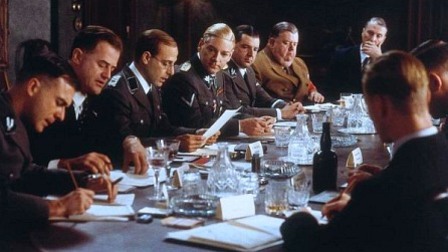
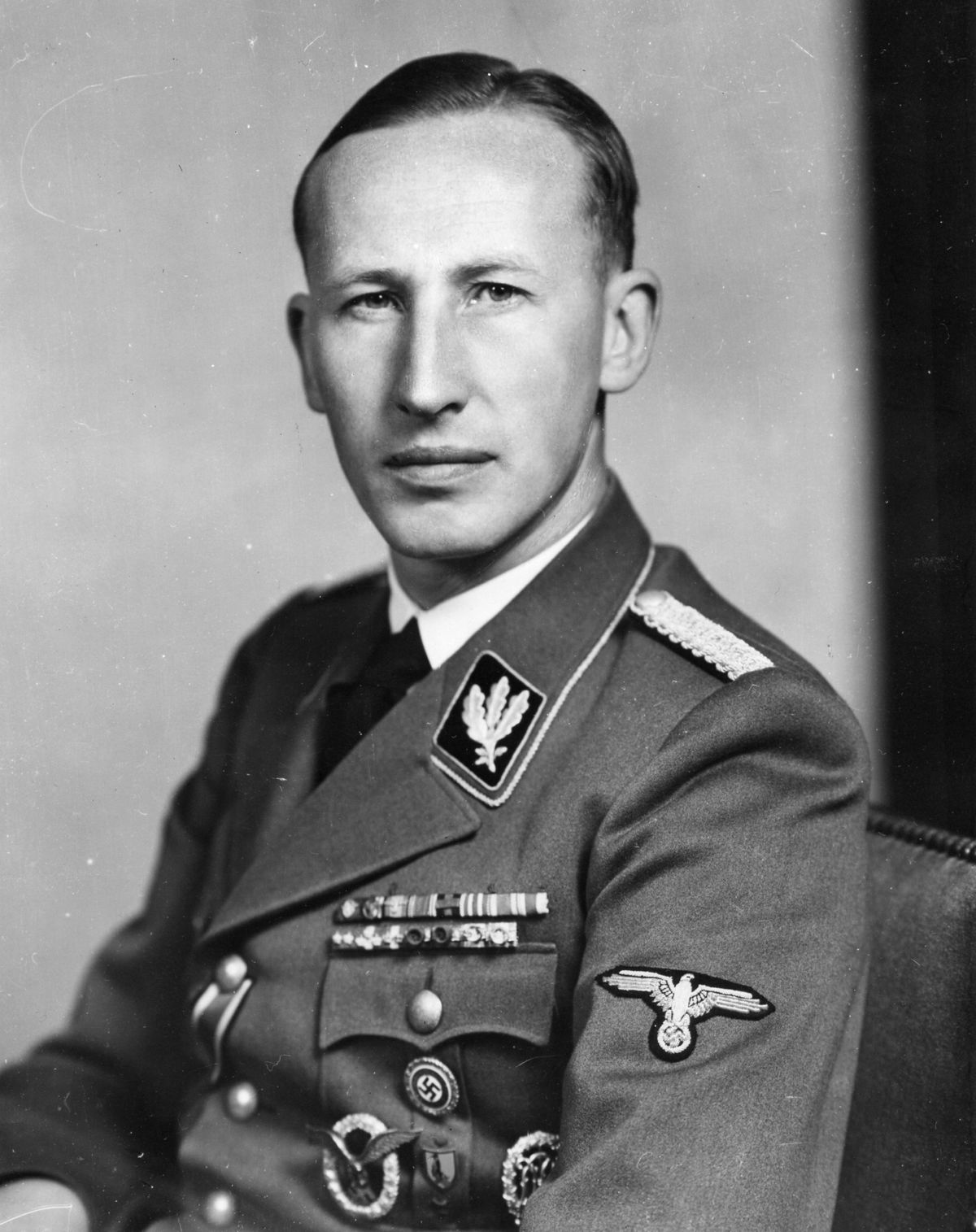
Seventy-six years ago this week group of 15 relatively common bureaucrats of various German government, police, and party agencies sat around a table and discussed the implementation of what is called the Final Solution. The meeting was chaired by SS Lieutenant General Reinhard Heydrich, who had been charged with the task of solving Germany’s “Jewish Problem” shortly after the German invasion of the Soviet Union. Hermann Goering, the number two man in the Nazi Reich sent Heydrich the following message:

Berlin, July 31st 1941

To: Gruppenfuhrer Heydrich

Supplementing the task assigned to you by the decree of January 24th 1939, to solve the Jewish problem by means of evacuation and emigration in the best possible way by according to present conditions, I hereby charge you to carry out preparations as regards organizational, financial, and material matters for a total solution (Gesamtlosung) of the Jewish question in all the territories of Europe under German occupation.

Where the competency of other organizations touches on this matter, the organizations are to collaborate. 

I charge you further to submit to me as soon as possible a general plan of the administrative material and financial measures necessary for the carrying out the desired final solution (Endlosung) of the Jewish question.”

Goering
1200x-1

Heydrich

When Goering wrote Heydrich, the head of the Reichssiecherhiethauptampt (RSHA) or Reich Security Main Office, in July 1941 it seemed that Nazi victory in Europe was all but assured. Goering’s words were businesslike. Early measures taken by Heydrich to rid Germany and annexed Austria had been reasonably successful to rid those areas of their Jews through emigration and evacuation. These were not benign measures, people were forced to leave their homes, businesses, communities, and had most of their belongings taken from them in order to leave the Reich. However with the occupation of most of Europe following the Nazi military success and the looming occupation and subjugation of the Soviet Union the process of giving the Jews a chance to emigrate to lands outside Nazi control had come to an end. In fact the Nazis occupied the countries that may Jews had found refuge.

Less than six months after he received the directive from Goering, on January 20th 1942 Heydrich summoned representatives from various Reich agencies were called for what turned out to be a brief, two hour meeting which decided the fate of the Jews. The meeting was held at an estate located in the suburbs of Berlin, called Wansee. Organized by Heydrich’s deputy Adolph Eichmann, involved Heydrich, Eichmann and 13 mid level representatives from various economic, governmental, justice and police entities.

At the conference Heydrich established his authority through Goering’s directive to overcome the bureaucratic and personal attempts of various attendees to take control of the Final Solution process. Despite objections from some attendees who favored sterilization and the use of Jews in the war armaments industries, Heydrich made it clear that the Final Solution would be a campaign of extermination. He was quite clear:

“Approximately 11 million Jews will be involved…in large single sex labor columns, Jews fit to work will work their way eastward constructing roads. Doubtless the large majority will be eliminated through natural causes. Any final remnant that survives will doubtlessly consist of the most resistant elements. They will have to be dealt with appropriately, because otherwise by natural selection, they would form the germ cell of a new Jewish revival.”
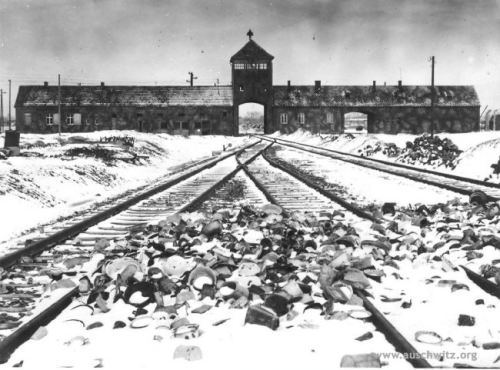
brama_birkenau-2

The Nazi leadership decided that its race war against the Jews needed to forge ahead. Within days of Wansee the orders went out and SS commanders at various concentration camps began devising more efficient means to exterminate Jews and other “sub-humans.” It was a matter of pride and efficiency for them. As Rudolph Hoess the Commandant of Auschwitz said at Nuremberg “the camp commandant at Treblinka told me that he had liquidated 80,000 in the course of one half year. He was principally concerned with liquidating all the Jews from the Warsaw Ghetto. He used monoxide gas, and I did not think that his methods were very efficient. So when I set up the extermination building at Auschwitz, I used Zyclon B….” Hoess estimated that some 2.5 million people were exterminated at Auschwitz at rates as high as 10,000 a day.

einsatzgruppen-nazi-death-squads-ww2-german-brutal-002_thumb

Einsatzgruppen in Action

In the Soviet Union four Einsatzgruppen followed each of the German Army Groups and systematically began to massacre the Jews of every city and village which German soldiers captured. The EinsatzgruppenOrdungspolizeibattalions, Army Security Divisions and locally recruited units in fewer than six months, killed over a million and a half Soviet Jews, and the slaughter would continue unabated until the dying days of the Reich.

Heinrich Himmler, Heydrich’s friend and superior told a gathering of senior SS leaders:

“I also want to mention a very difficult subject before you here, completely openly. It should be discussed among us, and yet, nevertheless, we will never speak about it in public…I am talking about the “Jewish evacuation” the extermination of the Jewish people.” 

It is One of the things that is easily said. “The Jewish people is being exterminated,” every Party member will tell you, “perfectly clear, it’s part of our plans, we’re eliminating the Jews, exterminating them, ha!, a small matter.” 

But then along they all come, all the decent upright Germans and each has his decent Jew. They all say: the others are all swine, but here is a first class Jew. And none of them has seen it, has endured it. Most of you will know what it means when 100 bodies lie together, or when there are 500 or 1000. And to have seen this through, and –with the exception of human weaknesses– to have remained decent, has made us hard and is a page of glory never mentioned and never to be mentioned….”
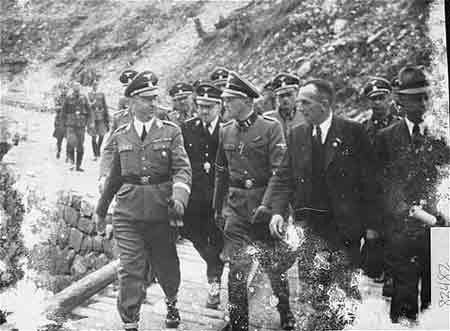
himmlervisit

Himmler and his entourage 

Whether the words are those of Goering, Heydrich, Hoess or Himmler, there is a certain businesslike banality to them. But these men, and many others like them orchestrated a campaign of genocide and race hatred unmatched in history. Yes, there have been other genocides, the Turks killing the Armenians during the First World War and the Hutu and Tutsi slaughter in Rwanda but neither they or the politically motivated campaigns of mass slaughter conducted by the Soviets, the Chinese Communists and the Khamer Rouge killing fields can match the systematized extermination campaign waged by the Nazis against the Jews.

The truly terrifying thing about the Nazi perpetrators of the Holocaust to me is that most of the men at Wansee, men that commanded the Concentration camps and the Einsatzgruppen were very ordinary men who simply believed that they were doing their jobs. Very few could be described as psychopathic killers by nature. They were lawyers, doctors, career police officials, businessmen, and bureaucrats who carried out an extermination campaign that killed by their own numbers between 5.5 and 6 million Jews, not to mention others deemed to be subhuman including the handicapped, the mentally ill, homosexuals, and other non-Jewish minorities like the Gypsies not to mention the wide variety of those considered political enemies. But it was the Jews that bore the most tragic fate and it was the Jews who were the object of Hitler’s most bloodthirsty actions.

But without the bureaucrats, the mayors, district leaders, party functionaries, police officers, soldiers, railroad officials, businessmen, and others who helped there could have been no Holocaust. As British Historian Laurence Rees wrote:

“human behavior is fragile and unpredictable and often at the mercy of the situation. Every individual still, of course, has a choice as to how to behave, it’s just that for many people the situation is the key determinate in that choice.” 

arbeitmachtfrei

Timothy Snyder correctly observed that “The world is now changing, reviving fears that were familiar in Hitler’s time, and to which Hitler responded. The history of the Holocaust is not over. Its precedent is eternal, and its lessons have not yet been learned.”

That is something that we must never forget lest the would be architects of annihilation of our day; the politicians, preachers, propagandists, and profiteers, who demonize the Jews, Muslims, dark skinned immigrants, LTBTQ people and other inconvenient elements and prepare people to do evil or ignore it: the ordinary men who just obey orders. Primo Levi who I quoted at the beginning was right, the common me, those that don’t think but simply follow orders or turn their heads and ignore the evil who are the most dangerous.

Milton Mayer wrote in his book They Thought They Were Free about a German colleague during the 1950s that had lived through the Hitler years as an academic. The man tried to explain how changes were so gradual that people like him who should have known better did not take action, if they did at all until it was too late. The man asked Mayer:

“How is this to be avoided, among ordinary men, even highly educated ordinary men? Frankly, I do not know. I do not see, even now. Many, many times since it all happened I have pondered that pair of great maxims, Principiis obsta and Finem respice—‘Resist the beginnings’ and ‘Consider the end.’ But one must foresee the end in order to resist, or even see, the beginnings. One must foresee the end clearly and certainly and how is this to be done, by ordinary men or even by extraordinary men? Things might have. And everyone counts on that might.”

We cannot forget and we must always be vigilant or we too could easily succumb, it’s not that hard.

Peace

Padre Steve+

3 Comments

Filed under History, holocaust

Resist the Beginning and Consider the End


Donald_Trump_official_portrait-e1485268487326-500x412

Friends of Padre Steve’s World,

Those who have followed my writings here know that I have been sounding the alarm about the Trump Presidency since well before he even became the GOP nominee last year. In fact on March 14th of last year I wrote of candidate Trump:

“I am afraid. Over the past few weeks violence has become commonplace at the campaign rallies of Donald Trump. In the past week a reporter from the Breitbart News service, an organization that is solidly behind Trump was assaulted by Trump’s campaign manager, and Breitbart threw her under the bus for him. Protesters have been assaulted, reporters threatened, Trump not only condones the actions, he encourages them, threatening to use the law and courts to ruin people’s lives, and offering to pay the legal bills of his supporters who have been charged with crimes. He labels any opponents as “bad people” who need to be punished. The ultimate cruelty is that though he is the one inciting the violence, he and his supporters blame that violence on the victims, be they Democrats or Republicans, protestors or media, pundits, politicians or preachers. He is creating a frenzy among his most violent supporters that demands victims to satiate their new found bloodlust…

If he succeeds in his takeover bid, it will forever change American politics, especially if he is able to ride the fear, and to the White House. I don’t think the latter will happen, but I would not exclude it from the realm of the possible…”

As President Donald Trump has not strayed a bit from the words, actions, and demeanor of candidate Trump. He still bullies and threatens his opponents and then whines about how “unfairly” he is being treated. He is following through on his promises to demolish the foundations of the American democracy even as he destroys long standing alliances and praises dictatorships just as he promised on the campaign trail.

This has surprised many people, including those who study presidential campaigns and presidencies for a living, who somehow despite his incredibly bad track record, his known propensity to lie, and his all-consuming narcissism, paranoia, and self-pity believed that he would become a different man once in office. That did not and will not happen because he has no capacity for self-reflection and suffers from an incredible absence of empathy and delusions about his greatness.

While I did not expect Trump to become President I always believed that it was possible and that if it happened it would fundamentally change the United States for the worse. Milton Mayer wrote of a German colleague during the 1950s that had lived through the Hitler years as an academic. The man tried to explain how changes were so gradual that people like him who should have known better did not take action, if they did at all until it was too late. The man asked Mayer:

“How is this to be avoided, among ordinary men, even highly educated ordinary men? Frankly, I do not know. I do not see, even now. Many, many times since it all happened I have pondered that pair of great maxims, Principiis obsta and Finem respice—‘Resist the beginnings’ and ‘Consider the end.’ But one must foresee the end in order to resist, or even see, the beginnings. One must foresee the end clearly and certainly and how is this to be done, by ordinary men or even by extraordinary men? Things might have. And everyone counts on that might.”

I have to say as I have said many times that I never wanted to be right about my intuition regarding a Trump Presidency, but with every passing day I see what I feared taking shape before my very eyes. I have tried to see though all the fog and deception and be true to the maxims that the German professor pondered as he examined his own guilt and shame for his inaction when resistance might have made a difference. “Principiis obsta and Finem respice—‘Resist the beginnings’ and ‘Consider the end.’”

In the course of this I have had to balance my learned feelings with reality and at every stage I have attempted to warn people while hoping for the best. I remember discussing the tension with a senior Navy officer who agreed with my concern that Trump is a danger and when it was appropriate for people to sound a warning; as he noted “we cannot yet see the end.”

There are many Trump opponents who are hoping that the vast amount of evidence connecting him and his closest advisers to Russia’s undermining of the 2016 elections will result in his impeachment. Others are hoping that some act of lunacy on his part will be enough to convince Vice President Pence and a majority of the cabinet to remove him from office through the process of the 25th Amendment.

However, I do not count on those happening soon enough to keep him from gaining complete control of the government using the pretext of war or terrorism to curtail civil liberties, political opposition, and Constitutional rights. Believe me I want more than anything to be wrong but I am sensing that this is where we are heading.

The President has called the Constitution “archaic” and suggested that it should be changed to grant the executive more power.  He has repeatedly acted to undermine the judiciary and turning Congress into nothing more than a compliant vassal. The structure would remain the same, but while the change would be striking most people wouldn’t notice until it was too late. Pastor Martin Niemoller wrote about this after World War Two:

First they came for the communists, and I did not speak out—because I was not a communist; Then they came for the socialists, and I did not speak out—because I was not a socialist; Then they came for the trade unionists, and I did not speak out—because I was not a trade unionist; Then they came for the Jews, and I did not speak out—because I was not a Jew; Then they came for me—and there was no one left to speak out for me.

We are in a precarious situation and it would not take much for our nation to slide into a totalitarian dictatorship, and if the circumstance were right, if the crisis large enough, most people would probably surrender their freedom for the supposed security offered by a dictator. As Timothy Snyder wrote:

“The European history of the twentieth century shows us that societies can break, democracies can fall, ethics can collapse, and ordinary men can find themselves standing over death pits with guns in their hands. It would serve us well today to understand why.”

Until tomorrow,

Peace

Padre Steve+

5 Comments

Filed under History, nazi germany, News and current events, Political Commentary

A Bridge Too Far: History, Dissent, and North Korea

51dQcS0yiEL._SX355_

Friends of Padre Steve’s World,

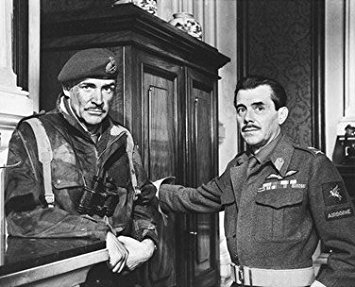
Major General Urquhart: I took 10,000 of our finest troops to Arnhem; I’ve come back with less than 2,000. I don’t feel much like sleeping.

Lt. General Frederick “Boy” Browning: I’ve just been on to Monty. He’s very proud, and pleased.

Major General Urquhart: [incredulous] PLEASED!

Lt. General Frederick “Boy” Browning: According to himself, technically, Market Garden was 90% successful.

Major General Urquhart: But what do YOU think?

Lt. General Frederick “Boy” Browning: Well, as you know, I always felt we tried to go a bridge too far…

Yesterday was our first full day back after our Memorial Day outing to Bethany Beach, a day of work as well as catching up. After our day of taking care of business we went and spent time with our friends at Gordon Biersch and then adoring our Papillon pups, I put on the classic film A Bridge too Far as a belated Memorial Day remembrance. For me as a veteran of Iraq the film conjures up images of heroic sacrifices of men and women who died or became victims of a plan gone wrong.

The film if you haven’t seen it depicts the failed Allied attempt of September 1994 to liberate the Netherlands, cross the Rhine and end World War Two by Christmas. It was a plan that depended much on luck, and ignored the capabilities of the Germans, who the Allies for the most part already believed had been beaten following the campaign in Normandy and the dash across France.

Despite the weakness of the Germans he Allied plan came close to succeeding yet failed and in doing so prolonged the war and inflicted much more suffering on the people of the Netherlands who were not liberated until the end of the war. The failure was one of a failed operational plan that had strategic consequences.

In the past few days I have been become even more concerned about the situation on the Korean Peninsula and the risks of a war that could have worldwide implications, and none of them good. Secretary of Defense Mattis warned of a potential catastrophe, even as the USS Nimitz departed the West Coast to join the USS Carl Vinson and USS Ronald Reagan in the operational area while the North Koreans launched more missiles. The concentration of three carrier battle groups, even for a short time provides the President a massive amount of military power in the region should he decide to launch a preemptive strike as he has more than once spoken about. The fact is that if war breaks out that the casualties will be in the hundreds of thousands if not millions, and that is if the war stays contained to the Korean Peninsula.

I am also concerned that a war with North Korea could be the pretext for the Trump administration to sharply curtail civil liberties at home including the freedom of speech and of political opposition. Be assured that if war breaks out on the Korean Peninsula that these rights will be suppressed and that anyone who opposes the government in  any way whatsoever will be labeled as a defeatist, traitor, or worse. We have seen the same pathology after the 9/11 attacks when those who were not opposed to actions agains Al Qaida were condemned because they opposed the expansion of the war into Iraq. I know this because I was one of those people who condemned these people; and sadly in retrospect in their condemnation of the invasion of Iraq they they were more patriotic than me because I supported it, knowing the dangers.

As far as the Allies were concerned Operation Market Garden was a delay in their plans to invade Germany proper, but for the Germans it was a pyrrhic victory which doomed more of their soldiers, civilians, and their victims to death. The Allied efforts were considered a part of a more righteous cause, while for the most part the German people remained under the spell of Hitler until the end, and even then those who opposed or even were thought to be “defeatists” in Germany were considered to be as bad or worse than the enemies of the Third Reich.

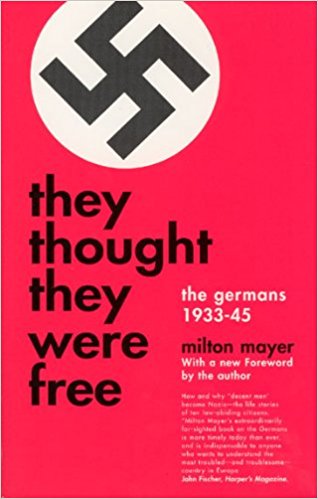
Milton Mayer who wrote the book They Thought They Were Free: The Germans 1933-1945 described the thoughts of a German academic colleague in 1955. Mayer’s friend said:

“Once the war began,” my colleague continued, “resistance, protest, criticism, complaint, all carried with them a multiplied likelihood of the greatest punishment. Mere lack of enthusiasm, or failure to show it in public, was ‘defeatism.’ You assumed that there were lists of those who would be ‘dealt with’ later, after the victory. Goebbels was very clever here, too. He continually promised a ‘victory orgy’ to ‘take care of’ those who thought that their ‘treasonable attitude’ had escaped notice. And he meant it; that was not just propaganda. And that was enough to put an end to all uncertainty.

“Once the war began, the government could do anything ‘necessary’ to win it; so it was with the ‘final solution of the Jewish problem,’ which the Nazis always talked about but never dared undertake, not even the Nazis, until war and its ‘necessities’ gave them the knowledge that they could get away with it. The people abroad who thought that war against Hitler would help the Jews were wrong. And the people in Germany who, once the war had begun, still thought of complaining, protesting, resisting, were betting on Germany’s losing the war. It was a long bet. Not many made it.”

That is something I worry about every day here as the Trump administration, facing failure on so many fronts, and under investigation of things that if any of the rest of us had even been accused of them would be considered treasonous, may embark on a war to save itself and at the same time use the extraordinary nature of such a conflict to consolidate power and crush dissent. That may sound far fetched, but all of his actions and words, as a candidate for President, as the President-Elect, and as President point in that direction and his most faithful followers show that they will even commitment treasonous acts and in some cases even resort to violence and murder to support him.

Trust me I want to be wrong about this more than anyone can imagine, but I cannot get rid of the feeling I have in my gut nor the terrible nightmares I have about this several times a week. I wonder if the Trump administration will gamble on an easy victory to end a very real North Korean threat to the region. If they do there will be no good outcome and we may lose freedoms that we never dreamt possible to lose.

If such an action does not succeed will the President then as he always does that his failure was a success? Will he pronounce like Field Marshal Montgomery that the failed attack was 90% successful or even more? And what of his military advisors? I dare not even attempt to answer that question anymore.

So until tomorrow I must ponder the words of General John Buford played by Sam Elliott in the film Gettysburg: 

“Devin, I’ve led a soldier’s life, and I’ve never seen anything as brutally clear as this. It’s as if I can actually see the blue troops in one long, bloody moment, goin’ up the long slope to the stony top. As if it were already done… already a memory. An odd… set… stony quality to it. As if tomorrow has already happened and there’s nothin’ you can do about it. The way you sometimes feel before an ill-considered attack, knowin’ it’ll fail, but you cannot stop it. You must even take part, and help it fail.”

Like I said, I want more than anything to be wrong about all of this but I fear that I am not and I cannot shake that feeling. So until tomorrow,

Peace

Padre Steve+

1 Comment

Filed under film, History, leadership, Military, nazi germany, News and current events, Political Commentary, world war two in europe

But Then It Was Too Late: An Excerpt from “They Thought They Were Free: The Germans 1933-1945”

they thought they were free

Friends of Padre Steve’s World,

This weekend we took a break from regular life and spent time relaxing with friends and our all of our 10 Papillon dogs. I spent very little time online and had pre-posted all of my articles for the weekend. It was wonderful to spend time with people, and of course enjoy the dogs as the played and cuddled and barked at anything walking down the street. But it was also nice to have little in the way of a scheduled agenda, which gave me some time to really do some reading.

One book that I took with me and finished while on the trip was Milton Mayer’s “They Thought They Were Free: The Germans 1933-1945.” Mayer was a visiting professor at the University of Frankfurt in the 1950s and lived in a small Hessian town near the city. The book is about the relationships that he built with ten ordinary citizens in the town and how they lived under Nazism and how most saw little wrong with it in the end.

The book is well worth the read and very timely when one compares the attitudes of the men who became Mayer’s friends and many people in the United States today. The last few chapters of the book are a reflection of the author’s opinions of the future of Germany at the time of his writing and he was mistaken on how the Germans would eventually become a society that embraced democracy and rejected authoritarianism (at the time he felt that it was very possible that democracy would fail in Germany,) they do not take away anything from the heart of the book and its message about how people adjust to authoritarian rule.

One chapter in particular struck me, it was a conversion that Mayer had with a colleague at the University who also reflected what it was like to live in the Third Reich and how in doing so he compromised himself and lost the opportunity to resist when resistance might have changed the course of events as Germany proceeded down the road to dictatorship and destruction. The chapter is particularly painful to read as the man understood that he should have known better but didn’t recognize the warning signs of the gradual nature of how life was changing with each new law or dictate from the Fuhrer.

In reading the chapter I see parallels in American society today. There are the Trump loyalists, many of who openly call for restrictions of liberty and crushing opposition to the President’s policies using extra-constitutional means including violence. Many are quite extreme while others, persuaded by years of right-wing talk radio, politically charged sermons by their pastors, and the daily dose of Fox News believe everything said by the President even when confronted by facts. Then there are Trump’s opponents, but many of the opponents are divided and cannot get along with each other. Some of these opponents actually helped Trump into office by circulating the Russian anti-Clinton conspiracy theories and falsehoods throughout the campaign. Each of these groups probably composes about 25-30% of the electorate each. The remaining segment are the people who simply go with the flow because life is too busy and crisis laden to get too deeply enmeshed in the political debate, and many have become so cynical that they see no difference in either side and are much more concerned about making it in a still uncertain economy.

So I invite you to read this and draw your own conclusions. Have a great day.

Peace

Padre Steve+

Chapter 13: But Then It Was Too Late

“What no one seemed to notice,” said a colleague of mine, a philologist, “was the ever widening gap, after 1933, between the government and the people. Just think how very wide this gap was to begin with, here in Germany. And it became always wider. You know, it doesn’t make people close to their government to be told that this is a people’s government, a true democracy, or to be enrolled in civilian defense, or even to vote. All this has little, really nothing, to do with knowing one is governing.

“What happened here was the gradual habituation of the people, little by little, to being governed by surprise; to receiving decisions deliberated in secret; to believing that the situation was so complicated that the government had to act on information which the people could not understand, or so dangerous that, even if the people could not understand it, it could not be released because of national security. And their sense of identification with Hitler, their trust in him, made it easier to widen this gap and reassured those who would otherwise have worried about it.

“This separation of government from people, this widening of the gap, took place so gradually and so insensibly, each step disguised (perhaps not even intentionally) as a temporary emergency measure or associated with true patriotic allegiance or with real social purposes. And all the crises and reforms (real reforms, too) so occupied the people that they did not see the slow motion underneath, of the whole process of government growing remoter and remoter.

“You will understand me when I say that my Middle High German was my life. It was all I cared about. I was a scholar, a specialist. Then, suddenly, I was plunged into all the new activity, as the university was drawn into the new situation; meetings, conferences, interviews, ceremonies, and, above all, papers to be filled out, reports, bibliographies, lists, questionnaires. And on top of that were the demands in the community, the things in which one had to, was ‘expected to’ participate that had not been there or had not been important before. It was all rigmarole, of course, but it consumed all one’s energies, coming on top of the work one really wanted to do. You can see how easy it was, then, not to think about fundamental things. One had no time.”

“Those,” I said, “are the words of my friend the baker. ‘One had no time to think. There was so much going on.’”

“Your friend the baker was right,” said my colleague. “The dictatorship, and the whole process of its coming into being, was above all diverting. It provided an excuse not to think for people who did not want to think anyway. I do not speak of your ‘little men,’ your baker and so on; I speak of my colleagues and myself, learned men, mind you. Most of us did not want to think about fundamental things and never had. There was no need to. Nazism gave us some dreadful, fundamental things to think about—we were decent people—and kept us so busy with continuous changes and ‘crises’ and so fascinated, yes, fascinated, by the machinations of the ‘national enemies,’ without and within, that we had no time to think about these dreadful things that were growing, little by little, all around us. Unconsciously, I suppose, we were grateful. Who wants to think?

“To live in this process is absolutely not to be able to notice it—please try to believe me—unless one has a much greater degree of political awareness, acuity, than most of us had ever had occasion to develop. Each step was so small, so inconsequential, so well explained or, on occasion, ‘regretted,’ that, unless one were detached from the whole process from the beginning, unless one understood what the whole thing was in principle, what all these ‘little measures’ that no ‘patriotic German’ could resent must some day lead to, one no more saw it developing from day to day than a farmer in his field sees the corn growing. One day it is over his head.

“How is this to be avoided, among ordinary men, even highly educated ordinary men? Frankly, I do not know. I do not see, even now. Many, many times since it all happened I have pondered that pair of great maxims, Principiis obsta and Finem respice—‘Resist the beginnings’ and ‘Consider the end.’ But one must foresee the end in order to resist, or even see, the beginnings. One must foresee the end clearly and certainly and how is this to be done, by ordinary men or even by extraordinary men? Things might have. And everyone counts on that might.

“Your ‘little men,’ your Nazi friends, were not against National Socialism in principle. Men like me, who were, are the greater offenders, not because we knew better (that would be too much to say) but because we sensed better. Pastor Niemöller spoke for the thousands and thousands of men like me when he spoke (too modestly of himself) and said that, when the Nazis attacked the Communists, he was a little uneasy, but, after all, he was not a Communist, and so he did nothing; and then they attacked the Socialists, and he was a little uneasier, but, still, he was not a Socialist, and he did nothing; and then the schools, the press, the Jews, and so on, and he was always uneasier, but still he did nothing. And then they attacked the Church, and he was a Churchman, and he did something—but then it was too late.”

“Yes,” I said.

“You see,” my colleague went on, “one doesn’t see exactly where or how to move. Believe me, this is true. Each act, each occasion, is worse than the last, but only a little worse. You wait for the next and the next. You wait for one great shocking occasion, thinking that others, when such a shock comes, will join with you in resisting somehow. You don’t want to act, or even talk, alone; you don’t want to ‘go out of your way to make trouble.’ Why not?—Well, you are not in the habit of doing it. And it is not just fear, fear of standing alone, that restrains you; it is also genuine uncertainty.

“Uncertainty is a very important factor, and, instead of decreasing as time goes on, it grows. Outside, in the streets, in the general community, ‘everyone’ is happy. One hears no protest, and certainly sees none. You know, in France or Italy there would be slogans against the government painted on walls and fences; in Germany, outside the great cities, perhaps, there is not even this. In the university community, in your own community, you speak privately to your colleagues, some of whom certainly feel as you do; but what do they say? They say, ‘It’s not so bad’ or ‘You’re seeing things’ or ‘You’re an alarmist.’

“And you are an alarmist. You are saying that this must lead to this, and you can’t prove it. These are the beginnings, yes; but how do you know for sure when you don’t know the end, and how do you know, or even surmise, the end? On the one hand, your enemies, the law, the regime, the Party, intimidate you. On the other, your colleagues pooh-pooh you as pessimistic or even neurotic. You are left with your close friends, who are, naturally, people who have always thought as you have.

“But your friends are fewer now. Some have drifted off somewhere or submerged themselves in their work. You no longer see as many as you did at meetings or gatherings. Informal groups become smaller; attendance drops off in little organizations, and the organizations themselves wither. Now, in small gatherings of your oldest friends, you feel that you are talking to yourselves, that you are isolated from the reality of things. This weakens your confidence still further and serves as a further deterrent to—to what? It is clearer all the time that, if you are going to do anything, you must make an occasion to do it, and then you are obviously a troublemaker. So you wait, and you wait.

“But the one great shocking occasion, when tens or hundreds or thousands will join with you, never comes. That’s the difficulty. If the last and worst act of the whole regime had come immediately after the first and smallest, thousands, yes, millions would have been sufficiently shocked—if, let us say, the gassing of the Jews in ’43 had come immediately after the ‘German Firm’ stickers on the windows of non-Jewish shops in ’33. But of course this isn’t the way it happens. In between come all the hundreds of little steps, some of them imperceptible, each of them preparing you not to be shocked by the next. Step C is not so much worse than Step B, and, if you did not make a stand at Step B, why should you at Step C? And so on to Step D.

“And one day, too late, your principles, if you were ever sensible of them, all rush in upon you. The burden of self-deception has grown too heavy, and some minor incident, in my case my little boy, hardly more than a baby, saying ‘Jewish swine,’ collapses it all at once, and you see that everything, everything, has changed and changed completely under your nose. The world you live in—your nation, your people—is not the world you were born in at all. The forms are all there, all untouched, all reassuring, the houses, the shops, the jobs, the mealtimes, the visits, the concerts, the cinema, the holidays. But the spirit, which you never noticed because you made the lifelong mistake of identifying it with the forms, is changed. Now you live in a world of hate and fear, and the people who hate and fear do not even know it themselves; when everyone is transformed, no one is transformed. Now you live in a system which rules without responsibility even to God. The system itself could not have intended this in the beginning, but in order to sustain itself it was compelled to go all the way.

“You have gone almost all the way yourself. Life is a continuing process, a flow, not a succession of acts and events at all. It has flowed to a new level, carrying you with it, without any effort on your part. On this new level you live, you have been living more comfortably every day, with new morals, new principles. You have accepted things you would not have accepted five years ago, a year ago, things that your father, even in Germany, could not have imagined.

“Suddenly it all comes down, all at once. You see what you are, what you have done, or, more accurately, what you haven’t done (for that was all that was required of most of us: that we do nothing). You remember those early meetings of your department in the university when, if one had stood, others would have stood, perhaps, but no one stood. A small matter, a matter of hiring this man or that, and you hired this one rather than that. You remember everything now, and your heart breaks. Too late. You are compromised beyond repair.

“What then? You must then shoot yourself. A few did. Or ‘adjust’ your principles. Many tried, and some, I suppose, succeeded; not I, however. Or learn to live the rest of your life with your shame. This last is the nearest there is, under the circumstances, to heroism: shame. Many Germans became this poor kind of hero, many more, I think, than the world knows or cares to know.”

I said nothing. I thought of nothing to say.

“I can tell you,” my colleague went on, “of a man in Leipzig, a judge. He was not a Nazi, except nominally, but he certainly wasn’t an anti-Nazi. He was just—a judge. In ’42 or ’43, early ’43, I think it was, a Jew was tried before him in a case involving, but only incidentally, relations with an ‘Aryan’ woman. This was ‘race injury,’ something the Party was especially anxious to punish. In the case at bar, however, the judge had the power to convict the man of a ‘nonracial’ offense and send him to an ordinary prison for a very long term, thus saving him from Party ‘processing’ which would have meant concentration camp or, more probably, deportation and death. But the man was innocent of the ‘nonracial’ charge, in the judge’s opinion, and so, as an honorable judge, he acquitted him. Of course, the Party seized the Jew as soon as he left the courtroom.”

“And the judge?”

“Yes, the judge. He could not get the case off his conscience—a case, mind you, in which he had acquitted an innocent man. He thought that he should have convicted him and saved him from the Party, but how could he have convicted an innocent man? The thing preyed on him more and more, and he had to talk about it, first to his family, then to his friends, and then to acquaintances. (That’s how I heard about it.) After the ’44 Putsch they arrested him. After that, I don’t know.”

I said nothing.

“Once the war began,” my colleague continued, “resistance, protest, criticism, complaint, all carried with them a multiplied likelihood of the greatest punishment. Mere lack of enthusiasm, or failure to show it in public, was ‘defeatism.’ You assumed that there were lists of those who would be ‘dealt with’ later, after the victory. Goebbels was very clever here, too. He continually promised a ‘victory orgy’ to ‘take care of’ those who thought that their ‘treasonable attitude’ had escaped notice. And he meant it; that was not just propaganda. And that was enough to put an end to all uncertainty.

“Once the war began, the government could do anything ‘necessary’ to win it; so it was with the ‘final solution of the Jewish problem,’ which the Nazis always talked about but never dared undertake, not even the Nazis, until war and its ‘necessities’ gave them the knowledge that they could get away with it. The people abroad who thought that war against Hitler would help the Jews were wrong. And the people in Germany who, once the war had begun, still thought of complaining, protesting, resisting, were betting on Germany’s losing the war. It was a long bet. Not many made it.”

Copyright notice: Excerpt from pages 166-73 of They Thought They Were Free: The Germans, 1933-45 by Milton Mayer, published by the University of Chicago Press. ©1955, 1966 by the University of Chicago. All rights reserved. This text may be used and shared in accordance with the fair-use provisions of U.S. copyright law, and it may be archived and redistributed in electronic form, provided that this entire notice, including copyright information, is carried and provided that the University of Chicago Press is notified and no fee is charged for access. Archiving, redistribution, or republication of this text on other terms, in any medium, requires the consent of the University of Chicago Press. (Footnotes and other references included in the book may have been removed from this online version of the text.)

4 Comments

Filed under History, nazi germany, News and current events, Political Commentary