Tag Archives: prinz eugen

The Death of Leviathan: Sinking the Bismarck

FinalBattle

Friends of Padre Steve’s World

This is the final part of my rendition of the great naval tragedy in three acts involving the German Battleship Bismarck. The first part was the sinking of the legendary and graceful pride of the Royal Navy, the Battle Cruiser Hood. The second part was the seemingly futile hunt and chase of the Bismarck by units of the British Home Fleet. What seemed hopeless changed when hours from the protection of night Bismarck was discovered and then torpedoed in a last ditch effort by Swordfish torpedo planes from the HMS Ark Royal. Today, the final act, the sinking of the Bismarck. 

I have written about this before and this is an edited version of that article. As I have mentioned before I have long been fascinated with this naval tragedy. I call it that because I have served at sea and in combat ashore; and because I understand that amid all the technology and weaponry that ultimately it is the men who suffer the terrors of war, and who suffer and die who matter. Soldiers, Sailors, Marines and Airmen seldom get a choice in the wars that the leaders of their nations send them to fight. Thus for me, even the Sailors of the Bismarck, the pride of Adolf Hitler’s Kriegsmarine are as much victims of war as the British Sailors aboard the HMS Hood. 

Peace

Padre Steve+
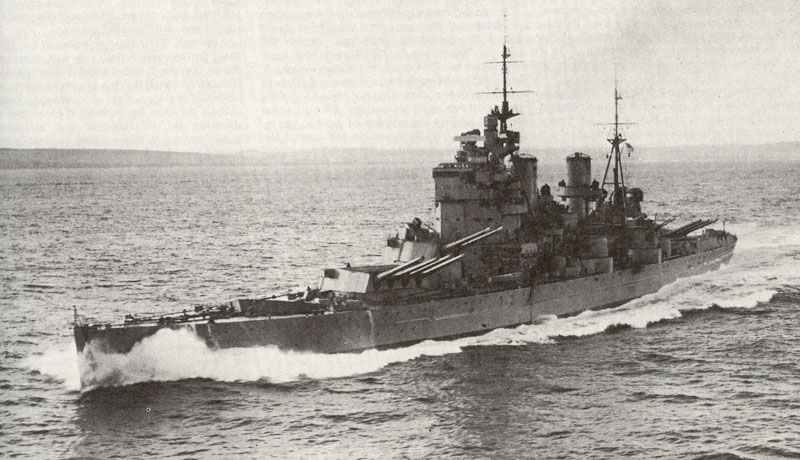
King_George_V-px800

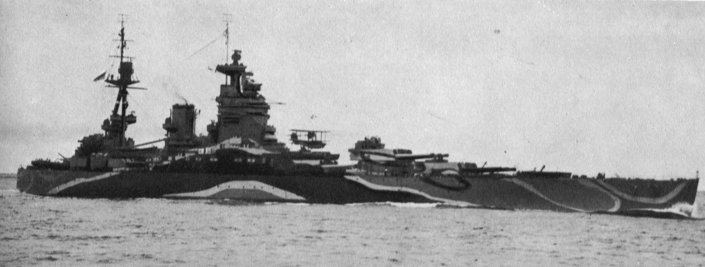
Rodney

HMS King George V (above) and HMS Rodney (below)

The torpedo from the Swordfish from the HMS Ark Royal that struck the Bismarck in her stern, jammed her rudders and wrecked her steering gear at last light on May 26th 1941, doomed that remarkable ship and her crew. It was an astounding turn of events, as just minutes before both the Germans and the British were expecting Bismarck to reach safety to fight again.

Just days before Bismarck had sunk the legendary British Battle Cruiser HMS Hood in minutes and had she persisted in her attack could have sunk the new Battleship HMS Prince of Wales. Instead, Vice Admiral Gunther Lutjens in command of the Bismarck and her consort the Heavy Cruiser Prinz Eugen decided to break off contact and make for safety in the French port of Brest.

Bismarck slipped her pursuers and allowed Prinz Eugen to escape. It seemed that nothing that the British could do would stop her from gaining the safety of the French port and with it the knowledge that she had sunk the most powerful ship in the Royal Navy and gotten away. Then out of nowhere Bismarck was spotted by a Royal Air Force Coastal Command PBY Catalina seaplane piloted by an American Naval Officer. Hours later a relatively small and slow torpedo dropped from an obsolescent Swordfish torpedo bomber, a stringbag hit the Bismarck in in her stern, wrecking her rudders and steering gear. Remarkably it was perhaps the only place that such a torpedo could have changed the developing narrative of a great German naval victory into defeat.

As darkness fell on May 26th, Bismarck, unable to steer towards Brest due to her damage and the following seas steered toward the oncoming British armada at a reduced speed. Her crew, now exhausted from countless hours on watch and at their battle stations knew that they were doomed.

Despite this the officers and sailors aboard Bismarck still labored trying in vain for a way to repair and save their their ship. As Bismarck’s engineers and damage control personnel sought at way to repair the damage on that dark night Royal Navy destroyers under the command of Captain Phillip Vian harassed her, closing to fire torpedoes and keep the exhausted crew of the mighty German ship engaged at their battle stations throughout the long night. Knowing that the end was near the Captain of the Bismarck ordered the contents of the ship’s store to be given to crew members.
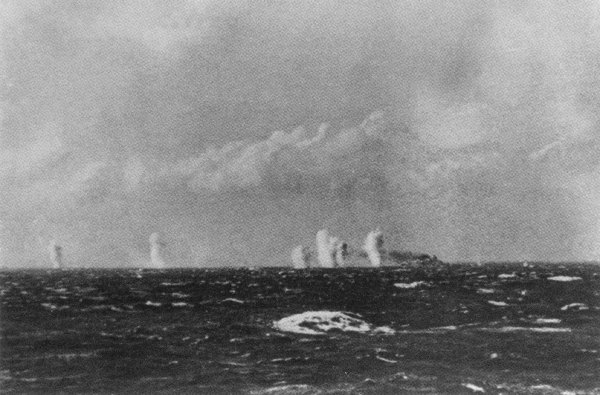
photo045

Bismarck under Fire from King George V and Rodney

As light broke on the morning of May 27th the remaining heavy units from the Home Fleet which still had enough fuel in their tanks to continue the action, the Battleships HMS King George V and HMS Rodney along with the Heavy Cruisers HMS Norfolk and HMS Dorsetshire which had broke from its convoy escort duties on the 26th closed in for the kill. Norfolk had been in on the hunt since the beginning when she and her sister ship the HMS Suffolk had discovered Bismarck and Prinz Eugen as the transited the Denmark Strait on the night of May 23rd and 24th.
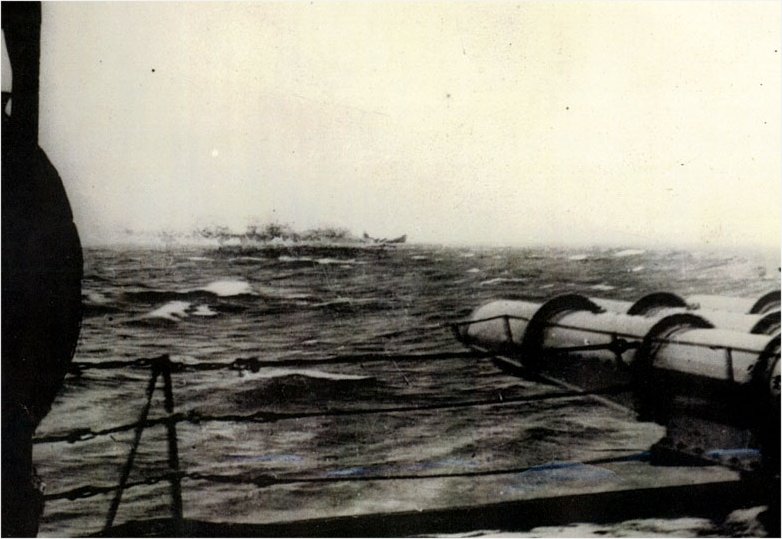
WTBR_Bismarck_Sinking_pic

Bismarck from Dorsetshire

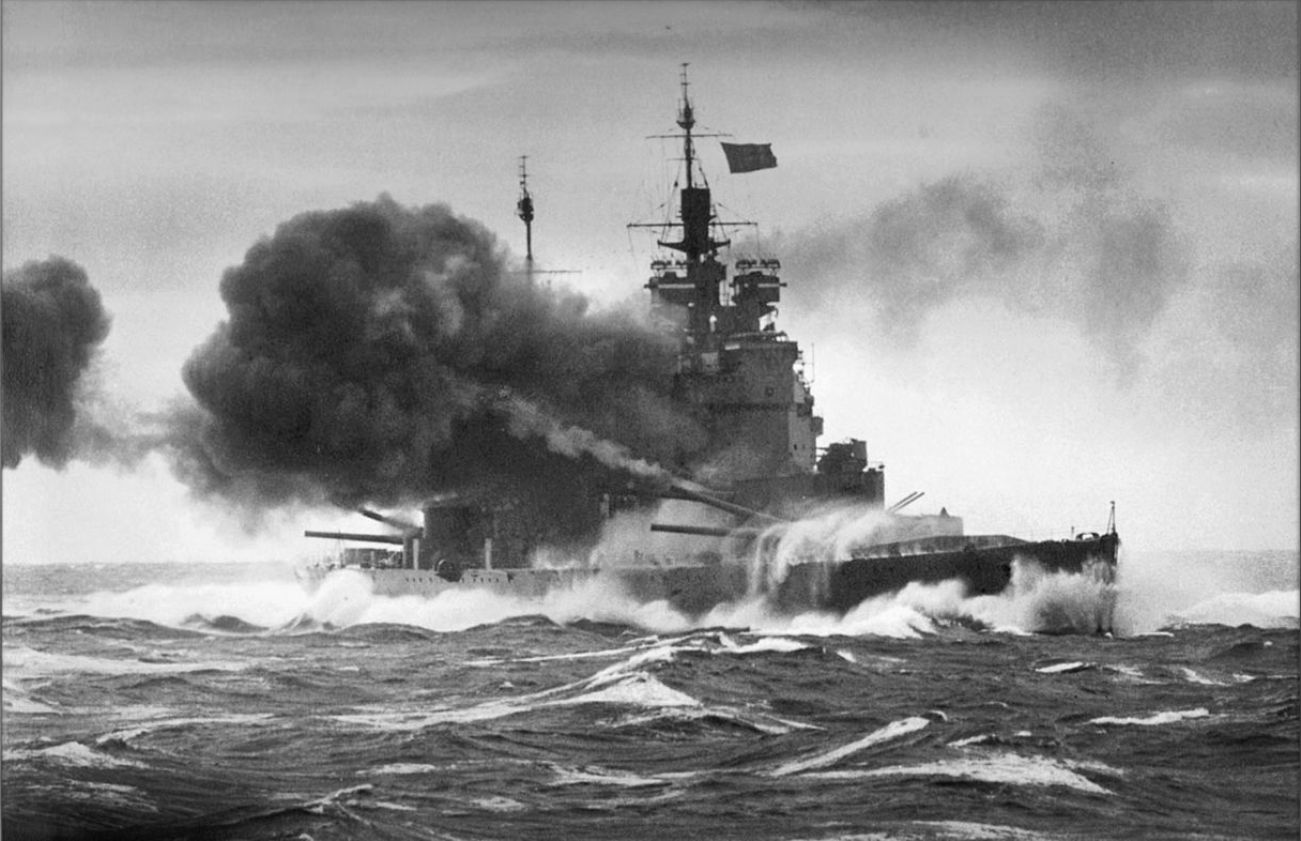
Warily the British ships closed the crippled but still powerful German battleship. At 0847 Admiral Tovey ordered British Battleships to open fire on Bismarck. The crippled German ship replied with accurate salvos and straddled Rodney. However, the British shells hammered the Bismarck. 16” shells from Rodney destroyed the command center of Bismarck and her main fire control stations. Within 30 minutes the mighty guns of the Bismarck which had sunk the Hood days before were silenced.  With no opposition from the stricken German ship the British battleships and cruisers pounded Bismarck from point blank range with 16”, 14”, 8” and 6” shells as well as torpedoes.
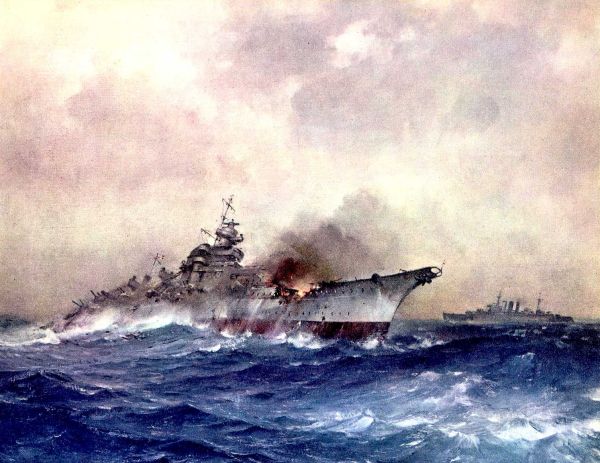
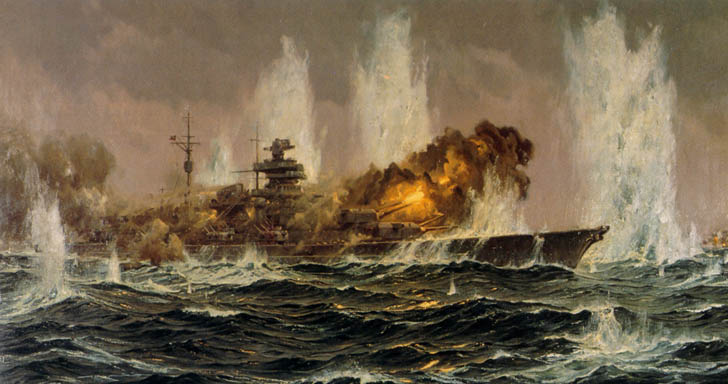
painting28

The end of the Bismarck

The British ships scored at least 400 hits on Bismarck and though they had silenced her and reduced the German ship to smoking ruins, the Bismarck remained afloat, defying her attackers. She was burning and certainly doomed but undaunted. The British battlewagons pounded Bismarck, until finally, with their adversary obviously doomed and their own fuel supplies dangerously low, Admiral Tovey ordered the battleships to break off the action. As he did this the British cruisers continued to fire their guns and torpedoes at the blazing helpless ship.
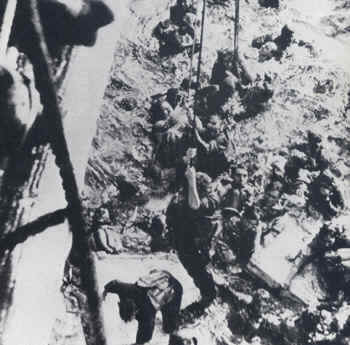
bismar1

Bismarck Survivors being hauled aboard Dorsetshire

The Bismarck’s First Officer, Fregattenkapitan (Commander) Hans Oels ordered her Chief Engineer Korvettenkapitan (Lieutenant Commander) Gerhard Junack to prepare the ship for scuttling and ordered the crew to abandon ship. The watertight doors were opened by Bismarck’s damage control teams and engineers as the scuttling charges fired at about the same time as HMS Dorsetshire launched her torpedoes at Bismarck. 1039 the Bismarck slipped beneath the waves. To this day those who claim the Bismarck sank because her crew scuttled her, and those who believe the the fish fired by Dorsetshire decided the fate of the ship, but truthfully it doesn’t matter. No matter what happened Bismarck was going to sink and no German forces could save her, or her crew.
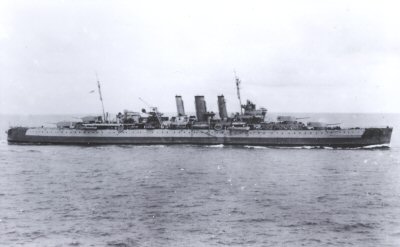
hmsdorsetshirempl1284

HMS Dorsetshire 1941

With the great ship headed to the depths of the North Atlantic, hundreds of survivors bobbed about in the cold Atlantic waters. Of these men, 110 were rescued by British ships, mostly by Dorchester. Then lookouts aboard the cruiser spotted the periscope of a U-Boat, and the British ships broke off their rescue operations leaving hundreds more survivors to die of exposure or their wounds in the Atlantic. In a cruel twist of fate, the U-Boat they believed they spotted had expended all of its torpedoes and was not a threat to them. A few more of the Bismarck’s survivors were rescued later by German ships or U-boats, but about 2200 German sailors went down with their ship or died awaiting rescue that never came. When it was all over just 2 officers and 113 men survived the sinking of the Bismarck, combined with the three men who survived the sinking of the Hood nearly 3700 British and German Sailors perished.
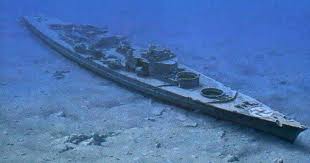
images-40

Artist’s image of the Wreck of the Bismarck

Subsequent investigations of the wreck of the Bismarck would show that all the British shells and torpedoes did not sink the Bismarck, and that it was indeed the scuttling charges that sent the mighty ship to the bottom of the Atlantic. But even had she not been scuttled, she was doomed, and the damage that she had sustained would have sent her to the bottom within 12 to 24 hours had Commander Oels not ordered Lieutenant Commander Junack to scuttle the ship.

Within a year the Ark Royal, Prince of Wales, and Dorsetshire would also lie at the bottom of the seas. Prince of Wales along the HMS Repulse was sunk by Japanese land based bombers off Malaya in 1941, Dorsetshire was sunk near Ceylon by Japanese Carrier aircraft in April 1942, and Ark Royal was torpedoed by the U-Boat U-81 in November 1941 not far from Gibraltar. Of the destroyers that harassed Bismarck the night before her sinking only one, the Polish Destroyer ORP Piorun would survive the war.

The tragedy of mission of the Bismarck is that nearly 3700 sailors died aboard the two mightiest ships in the world, and while legendary the losses of the two ships did not materially alter the course of the war. Hood’s loss though tragic did not alter the strategic equation as more new battleships of the King George V class entered service. Likewise the surfing German capital ships were harassed by RAF bomber sorties and attacks by the Royal Navy’s Fleet Air Arm. With few exceptions these ships remained confined to ports in France, Germany or Norway and slipped into irrelevance as the war progressed as the German U-Boat force took the lead in the Battle of the Atlantic. 

As an officer who has served at sea on a cruiser at war which came within minutes of a surface engagement with Iranian Revolutionary Guard patrol boats in the Northern Arabian Gulf in 2002 I have often wondered what would happened in the event of an engagement that seriously damaged or sank our ship. Thus I have a profound sense of empathy for the sailors of both sides who perished aboard the Hood and the Bismarck in the fateful days of May 1941.

I hope that no more brave sailors will have to die this way, but I know from what history teaches that tragedies like this will happen again. 

Peace

Padre Steve+
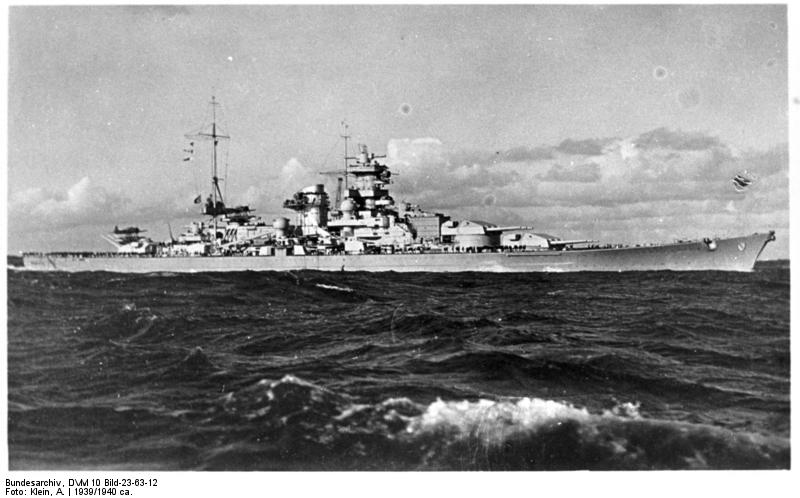
4 Comments

Filed under History, Military, Navy Ships, World War II at Sea

Death in the Arctic: Scharnhorst at North Cape

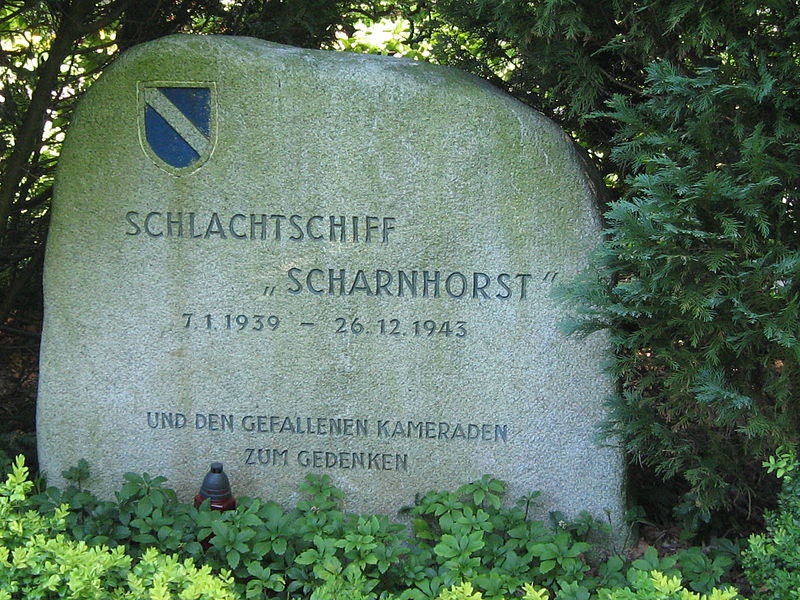
Schlachtschiff "Scharnhorst"

Christmastide is a joyous time for many, but in the course of history there have been times that military men have fought and died in hopeless battles far from their families. Thus it is often a time of sorry, especially for those that die alone. Among those who died alone in the Arctic darkness of December 26th 1943 were the officers and crew of the German battlecruiser Scharnhorst.

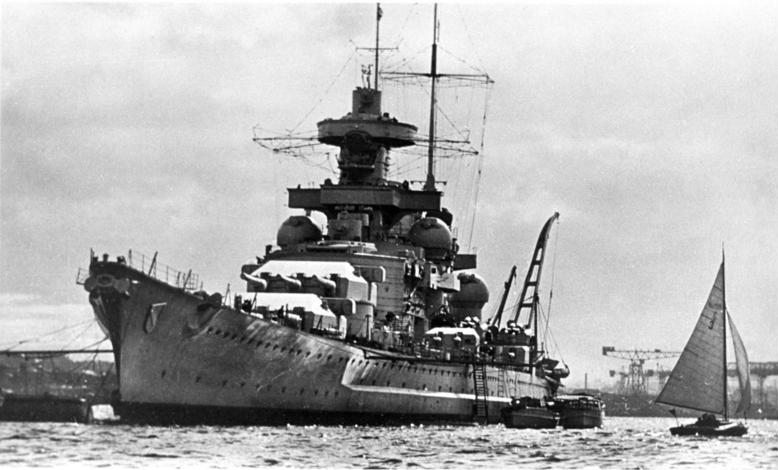
Schlachtschiff "Scharnhorst"

Scharnhorst in port

The Scharnhorst along with her sister ship Gneisenau were the product of the naval architects of Germany who in the early 1930s designed some of the most beautiful as well as deadly warships of the Second World War.  Following Germany’s rejection of the provisions of the Treaty of Versailles the Kreigsmarine enacted a building program to enlarge and modernize the German Navy which then was composed of obsolete pre-Dreadnaught battleships and a few modern light cruisers and destroyers.   The first major units constructed were actually begun by the predecessor to the Kreigsmarine, the Reichsmarine of the Weimar Republic.  These were the Deutschland class Armored Ships, sometimes called “Pocket Battleships” and later reclassified as Heavy Cruisers. These ships were designed to replace the old pre-Dreadnaught battleships and incorporated electric welds to reduce displacement, diesel engines for extended cruise range to enable them to serve as commerce raiders and a battery of six 11” guns.  While an advance over anything in the German inventory they were outclassed by the British battle cruisers Hood, Renown and Repulse.

However, the first truly capital ships built by the Kriegsmarine were the Scharnhorst and Gneisenau Rated as battleships, in reality they were battle cruisers because of their light main battery of 11” guns as opposed to the 14”, 15” or 16” batteries of other nations battleships.  Despite this in displacement and armor protection of the ships was comparable to other battleships of the era and their designed speed of 31.5 knots was superior to almost all other battleships of the era including the British King George V Class and the US Navy’s  North Carolina class.  Only the massive battlecruiser HMS Hood was their superior in speed and firepower.

As built Scharnhorst and Gneisenau displaced 31,000 toms, however at full combat load they both weighed in at nearly 38,000 tons and were 772 feet long.  They had an armor belt that was nearly 14 inches thick.  Armed with a main battery of nine 11” guns and a secondary armament of twelve 5.9 inch guns they also mounted a powerful for the time anti- aircraft battery of fourteen 4.1 inch guns, 16 37mm and 16 20mm anti-aircraft cannons.  Additionally they mounted six 21” torpedo tubes and carried three Arado 196 A3 scout planes.  The main battery was eventually to be replaced by six 15” guns but this never occurred although Gneisenau was taken in hand to mount the new weapons but the conversion was never completed.

scharnhorst2

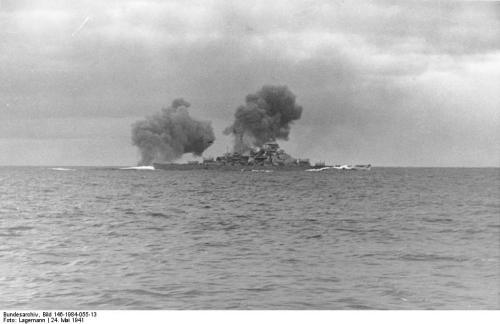
Scharnhorst firing at HMS Glorious 

Laid down on 15 June 1935 and launched 3 October 1936 Scharnhorst was commissioned 7 January 1939.  Her sister Gneisenau was laid down 6 May 1935, launched 8 December 1936 and commissioned 21 May 1938.  Upon the commencement of the Second World War the two sisters began a reign of destruction on British shipping. In November they sank the Armed Merchant Cruiser HMS Rawalpindi During Operation Weserübung the pair surprised sank the aircraft carrier HMS Glorious and her two escorting destroyers, the only time a Fleet carrier was caught and sunk by battleships during the war.   From January to March 1941 they conducted Operation Berlin against British merchant shipping in the North Atlantic sinking 22 ships before returning to base.

eeb893a0b92de4ae595de56fe0fd90ca

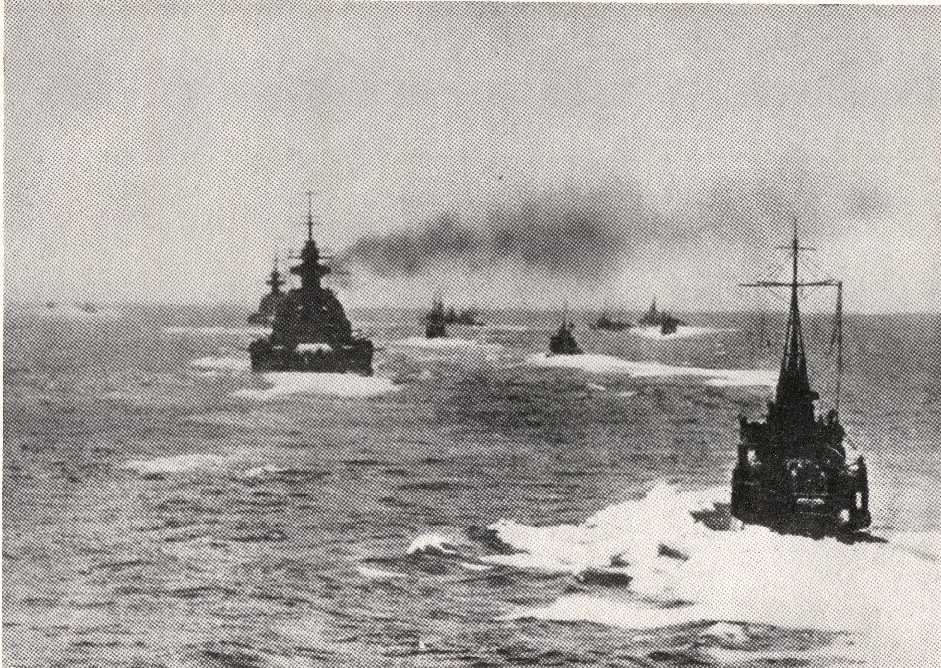
Scharnhorst and Gneisenau during Operation Cerebus

While in the port of Brest Gneisenau was bombed and torpedoed requiring extensive repairs.  Due to the exposed location of the port the German high command decided to return the ships to Germany along with the Heavy Cruiser Prinz Eugen.  The operation was called Operation Cerberus and it took place from 11-13 February 1942. The ships made a dash up the English Channel which was unsuccessfully contested by the British Royal Air Force and Royal Navy. However, both Scharnhorst and Gneisenau were damaged by mines and needed subsequent repairs.  While undergoing repairs in Kiel Gneisenau was further damaged by the Royal Air Force requiring repairs in or to steam to the port of Gotenhafen for repair and conversion.  Although some work was completed she was decommissioned and sunk as a blockship on 23 March 1945.  Following the war she was raised by the Poles and scrapped.

Scharnhorst was repaired following Operation Cerberes and in March 1943 was transferred to Norway where along with Tirpitz, Admiral Scheer, Lutzow (the former Deutschland), Admiral Hipper and Prinz Eugen she became part of a “fleet in being” poised to strike the Allied convoys bound for Russia.

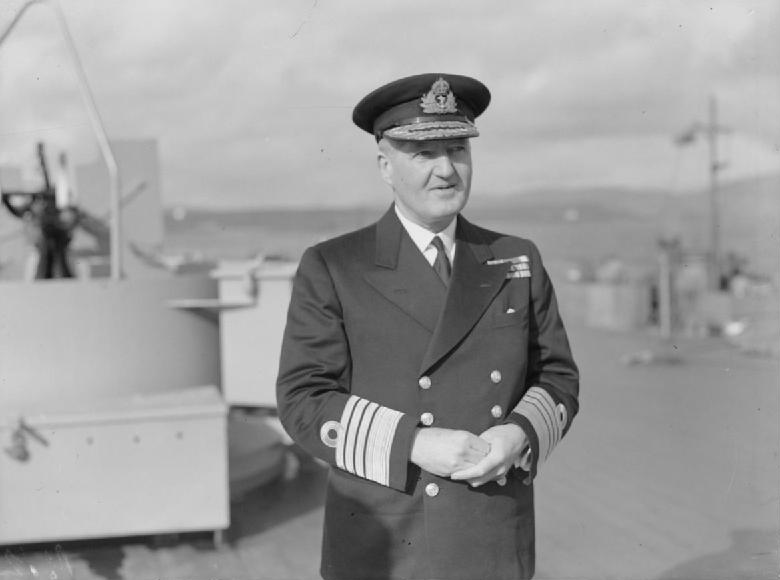
Admiral_Bruce_Fraser_1943_IWM_A_16489

Admiral Bruce Fraser

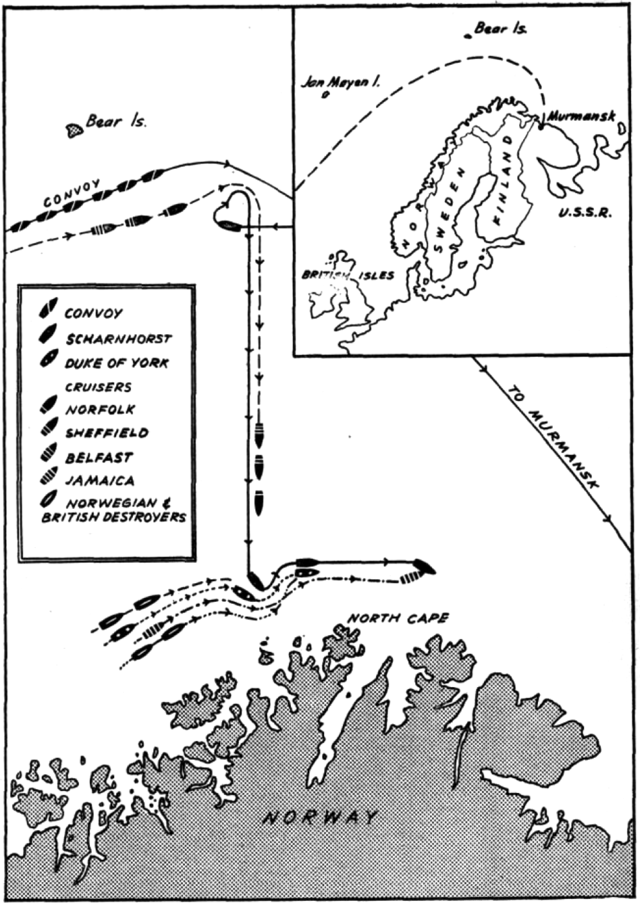
The German surface ships were a potent force that if the circumstances allowed could devastate the Russia bound convoys and the Commander of the British Home Fleet, Admiral Bruce Fraser was determined to entrap and destroy any of these ships that threatened any convoy. As such in December 1943 Fraser formed a task group built around the HMS Duke of York to be ready to pounce on any German raider that threatened the convoys. His intent was to catch any of these ships, especially Scharnhorst and trap them between the convoys and their base, in conduction with a second task group centered around the cruisers HMS Belfast, HMS Norfolk, and HMS Sheffield, Known as Force One, and destroy the German battleship.

The key to British the British operation was Enigma the German code machine and cipher system which they had acquired from captured U-Boats, and which British code-breakers had mastered. The Germans decided to send Scharnhorst and five destroyers to locate and destroy convoy JW-55B which had been spotted by Luftwaffe reconnaissance aircraft. Because of Enigma Fraser knew that Scharnhorst would attempt to intercept the convoy and put his plan in motion.

Battle_of_North_Cape_26_December_1943_map


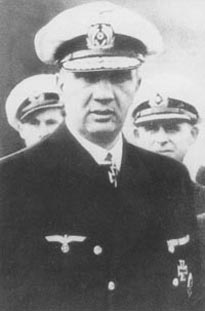
Scharnhorst and her escorts set sail on Christmas Day 1943 under the command of Rear Admiral Erich Bey to conduct Operation Ostfront. Since Fraser knew that the Germans were coming he had the convoy to temporarily reverse course which caused the Germans to miss the convoy. When he did not find the convoy in the expected location Bey detached his destroyers to expand the search area, leaving Scharnhorst alone to face the enemy.

scharnhort_operation_ostfront_5

Rear Admiral Erich Bey

At about 0900 on December 26th 1943 the cruisers of Force One discovered Scharnhorst and the  Battle of North Cape was on. Though little damage was suffered in the first engagement, the radar of Scharnhorst was knocked out, leaving her not only without air support or escort, but blind.

6050465664_e1f42ac7f8_o

HMS Duke of York firing at Scharnhorst

Scharnhorst attempted to flee but Fraser’s Duke of York  and her four escorting destroyers destroyers intercepted her. Without radar in the blinding snow squalls Scharnhorst was surprised. Duke of York’s first radar direct salvos knocked out her forward main battery but the German ship appeared to be making a getaway when a shell from Duke of York hit her number one boiler room and reduced her speed to barely ten knots. Although the German engineers and damage control teams made some repairs and were able to bring her speed back up to 22 knots, the British ships rapidly made up the distance enabling the British destroyers to launch torpedo attacks.

Knowing the ship was doomed Admiral Bey dispatched a message to the high command of the Kriegsmarine: “We will fight on until the last shell is fired.”

While she still attempted to fight off her attackers and escape she was struck by torpedoes from several destroyers as well as was pummeled by the at at distance of under 10,000 yards by Duke of York’s 14″ shells, as well as the 6″ shells of HMS Belfast and HMS Jamaica. Savaged by hits and incapable of further resistance the German ship capsized and sank at 1945 hours with the loss of all but 36 of her 1968 man crew.  Her wreck was discovered 3 October 2000 some 70 miles north of North Cape Norway.

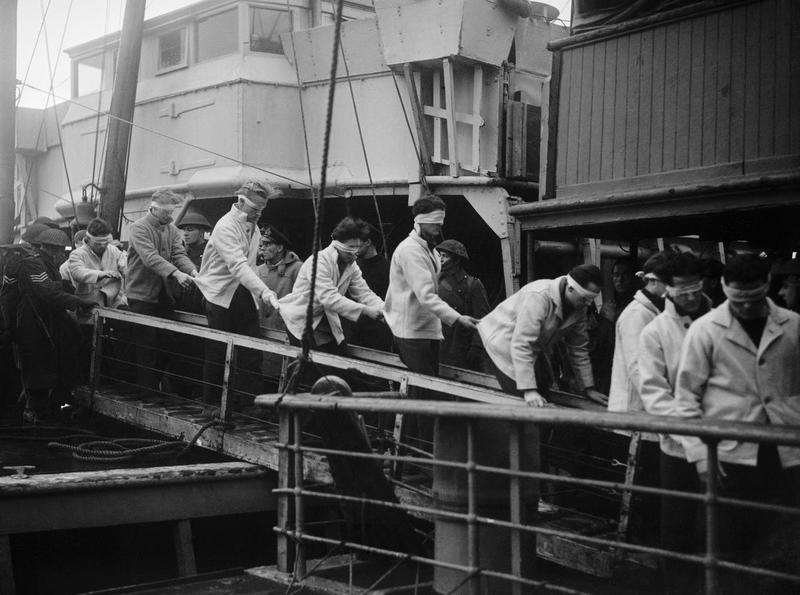
Scharnhorst_survivors_A_021202

Survivors of Scharnhorst 

Admiral Fraser praised the gallantry of the German ship to his officers later that night saying: “Gentlemen, the battle against Scharnhorst has ended in victory for us. I hope that if any of you are ever called upon to lead a ship into action against an opponent many times superior, you will command your ship as gallantly as Scharnhorst was commanded today”

After the battle Grand Admiral Erich Raeder who had authorized the sortie was relieved as commander in chief of the navy and was replaced by Grand Admiral Karl Donitz who commanded the U-Boat forces. Hitler was furious and ended most surface naval operations.

800px-Scharnhorst-WHV-April-2011

Memorial to Scharnhorst and her crew at Kiel

I have written many times about the tragedy of war, on land and at sea. Having served in combat zones on land and having been shot at by the enemy, as well as having served at sea on a cruiser I have a sense of what these men must have gone through on that final day of their lives. Though I am a realist and know that such tragedies will likely occur again, I do pray for the day that war will be no more and that those who serve in harm’s way will never have to again.

Peace

Padre Steve+

3 Comments

Filed under Military, History, Navy Ships, world war two in europe, nazi germany

Remembering the “Mighty Hood” and the Battle of the Denmark Strait

hms-hood-sinking11Artist rendition of the Loss of the HMS Hood

Seventy-three years ago today the “Mighty Hood” was sunk by the German Battleship Bismarck. It is an anniversary that I always mark. I first read about this battle in C.S Forrester’s little book Hunting the Bismarck which was used as the screenplay for the 1960 film Sink the Bismarck. This essay is in honor of the gallant HMS Hood and her crew.  It is fitting although the HMS Hood and her killer, the German battleship Bismarck were American. Both were great ships manned by gallant crews and the loss of both ships was tragic, especially from the aspect of the great loss of human life. May we never forget the sacrifice of these men and all others who have gone down to the sea in great ships.

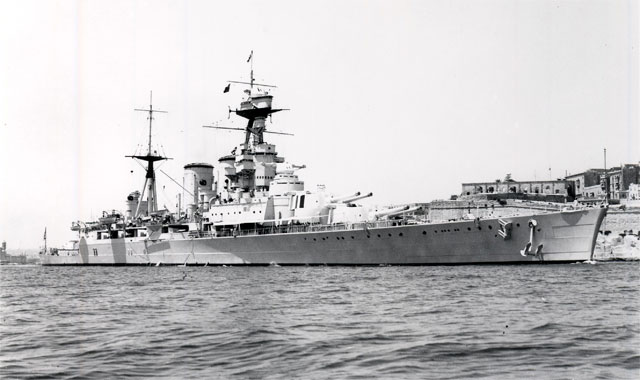
hood-malta1HMS Hood at Malta

There are some warships and naval engagements which assume legendary proportions.  The Battle of the Denmark Strait on 24 May 1941 between the two largest battleships in commission at the time, the pride of the British Royal Navy the HMS Hood and the German behemoth Bismarck is legendary as are those two mighty ships.  The battle came at a critical time as the Britain stood alone against the seemingly invincible German Blitzkrieg.

hood-at-san-francisco1Hood in San Francisco on 1920s goodwill tour

Britain had been driven from Western Europe and was being bombed regularly by Herman Goering’s Luftwaffe while a British expeditionary force that had been sent to Greece had been defeated and the Germans were assaulting Crete with airborne forces.  In the Western Desert the Afrika Korps under Field Marshall Erwin Rommel had driven off a British counter-offensive on the Libyan-Egyptian frontier and were laying siege to Tobruk and in the Atlantic German U-Boats sank 66 Allied Merchant Ships of over 375,000 tons and the Royal Navy would lose 25 warships not including the Hood.

hms_hood_march_17_19241

The Hood was the pride of the Royal Navy and was world famous due to her inter-war international presence and goodwill visits.  Displacing 47,430 tons full load she was armed with eight 15” guns in four twin turrets.  Designed as a battle cruiser she was less heavily armored than contemporary battleships and had very weak vertical protection from plunging shellfire.  This was a fault which was known but never rectified between the wars and when the war came the Royal Navy could ill-afford to take her out of service for the necessary improvements to her protection system.  She was fast with a designed speed of 31 knots which been reduced to 28 knots by 1939 as a result of modifications which increased her displacement.   This was further reduced by the wear and tear on her propulsion plant to 26.5 knots by 1940.

Hood was designed before the battle of Jutland (May 1916) where the weaknesses in the armor protection of British Battlecruisers was exposed as three, the HMS Invincible, HMS Queen Mary and HMS Indefatigable were destroyed by plunging fire which exploded their magazines.  Though her design was modified during construction she still was vulnerable to plunging fire. She was scheduled for a major refit which would have included significant improvement in armor protection in 1941 but the war prevented the Hood from receiving anything more than improvements to her anti-aircraft batteries.

Combat1lgHood (nearly hidden by falling shells) in action at Mers-El-Kebir

During the war Hood was engaged in patrol and search operations against German raiders in the North Atlantic and in June 1940 joined Force “H” in the Mediterranean.  As Flagship of Force “H” she took part in the sinking of French Fleet Units including the Battleship Bretagne at Mers-El-Kebir on 3 July 1940 following the French surrender to the Germans and remained in operation searching for the German Pocket Battleship Admiral Scheer and Heavy Cruiser Admiral Hipper until she was withdrawn for a brief refit in January 1941. Following another brief refit in mid-March, Hood was underway from mid-March searching for the German raiders Scharnhorst and Gneisenau and a false report of Bismarck breaking out into the Atlantic in April 1941. She returned to Scapa Flow on 6 May 1941.

bismarck1Bismarck

When the British discovered that Bismarck had entered the Atlantic, Hood as the flagship of Vice Admiral Lancelot Holland was dispatched with the newly commissioned battleship HMS Prince of Wales to join the Heavy Cruisers HMS Suffolk and HMS Norfolk at the entrance to the Denmark Strait.  When the cruisers discovered Bismarck along with her consort the Heavy Cruiser Prinz Eugen the two British battleships steamed into naval history.

flagshippg213

Bismarck was slightly larger than Hood and mounted the same main armament but that was about all the two ships had in common. If the battle was a battle between heavyweight prize fighters Hood was the valiant but crippled champion and Bismarck the young and overpowering challenger.  Bismarck was slightly faster than the limping Hood and was one of the most well protected ships ever built.  Her gunnery officers and the men that manned those deadly 15” guns were like previous generations of German sailors’ gunnery experts working some of the finest naval guns ever made.

Schlachtschiff Bismarck, SeegefechtBismarck firing on Hood

gallbismdenmarkstrait11

The German ships shadowed at a distance by the Norfolk and Suffolk German task force under the command of Admiral Gunther Lütjens emerged from the strait and was sighted by the British at 0537.  Knowing his ship’s weakness in regard to plunging fire Admiral Holland desired to steer a direct course at the German ships in order to close the range quickly. Events dictated otherwise and the British were forced to close the range much more slowly and exposing Hood and Prince of Wales to German plunging fire for a longer period of time.  Holland turned to close faster with the result that his gunnery was degraded by wind and spray coming over the bows of his ships and the inability to fire his after turrets.

hood0231Hood from Prince of Wales moments before being hit and sunk

At 0553 Holland ordered his ships to open fire without the benefit of Suffolk and Norfolk being in position to engage the Prinz Eugen.  The Hood initially concentrated her fire on Prinz Eugen assuming her to be the Bismarck while Prince of Wales engaged Bismarck.  Prince of Wales drew first blood striking Bismarck three times. One which damaged her seaplane catapult, a second which did minor damage to machinery spaces and a third which passed through the bow near the waterline which severed fuel lines from her forward fuel tanks.

prinzeugen-21Prinz Eugen

Both German ships opened fire at 0555 concentrating on the Hood.  Prinz Eugen immediately hit Hood with at least one 8” shell which set a large fire among the ready to use 4”ammunition stored in lockers near the mainmast. The hit started a large fire which Hood’s damage control teams raced to contain.  At 0600 Holland ordered his ships to turn to port in order to bring his rear turrets into the fight. As the squadron executed the turn Hood was straddled by a salvo from Bismarck and observers on Prince of Wales observed an explosion between “X” turret and the mainmast which consumed the Hood causing her bow to jut sharply out of the water before sinking beneath the waves in under 3 minutes time. Witnesses on both sides of the engagement were stunned by the sudden and violent end of the Hood and the Germans rapidly shifted fire to the Prince of Wales knocking her out of the action.  Against the advice of Bismarck’s Captain Ernst Lindemann, Lütjens did not follow up his advantage to sink the crippled British ship.

hood_explosion_sketch1Hood blows up. Drawing by the Captain of HMS Prince of Wales J.C. Leach

Only three crewmen Petty Officer Ted Briggs, Seaman Bob Tilburn and Midshipman Bill Dundas survived the sinking of Hood out of a total of 1415 souls embarked. They were rescued 4 hours later nearly dead of hypothermia staying awake by sinking “Roll out the Barrel” by the destroyer HMS Electra.

hood_blowup1

Briggs who died in 2008 recounted the sinking:

“Then she started listing to starboard. She righted herself, and started going over to port. When she had gone over by about 40 degrees we realised she was not coming back…” Briggs was sucked under the water “I had heard it was nice to drown. I stopped trying to swim upwards. The water was a peaceful cradle – I was ready to meet my God. My blissful acceptance of death ended in a sudden surge beneath me, which shot me to the surface like a decanted cork in a champagne bottle. I turned, and 50 yards away I could see the bows of the Hood vertical in the sea. It was the most frightening aspect of my ordeal, and a vision which was to recur terrifyingly in nightmares for the next 40 years.” (The Daily Telegraph 5 October 2008)

briggs1Ted Briggs

tilburn4111Bob Tilburn

The Admiralty reported the loss of the Hood later in the day saying Hoodreceived an unlucky hit in a magazine and blew up.”  The official report of the sinking released later in the year said:

That the sinking of Hood was due to a hit from Bismarck’s 15-inch shell in or adjacent to Hood’s 4-inch or 15-inch magazines, causing them all to explode and wreck the after part of the ship. The probability is that the 4-inch magazines exploded first.”

The commission’s findings have been challenged by a number of naval historians and there are several theories of how the magazines might have exploded but all point to a massive magazine explosion but probably not due to a plunging round but from another hit which detonated the unprotected 4” magazines or a hit from Bismarck below Hood’s waterline which stuck a magazine.  Hood’s wreckage was located in 2001 lying across two debris fields and the examination revealed that the after magazines had exploded.  The site is designated as a War Grave by Britain and protected site under the Protection of Military Remains Act of 1986.

bismarck-sinking1Bismarck sinking

Bismarck and her crew did not long survive her victory being crippled by a lucky aerial torpedo hit from a Fairley Swordfish bomber flying from the HMS Ark Royal on 26 May and being scuttled by her crew after absorbing massive damage from the HMS King George V, HMS Rodney and several cruisers including HMS Dorsetshire the plucky and persistent Norfolk and several destroyers. When she went down she took with her all but 115 souls of her crew of over 2200 which included the Fleet Staff of Admiral Lütjens.

hms-prince-of-wales1HMS Prince of Wales

Prince of Wales would take Winston Churchill to Argentia Bay Newfoundland to meet with Franklin Roosevelt from 9-12 August 1941 where the Atlantic Charter was drafted. She reported to the Far East where she was sunk along with the Battlecruiser HMS Repulse on 9 December 1941 by a force of land based Japanese aircraft.  The Prinz Eugen was the only heavy ship of the German Navy to survive the war and was taken by the US Navy at the end of the war. She was expended as a target during the Able and Baker nuclear tests at Bikini Atoll.  Too radioactive to be repaired she was towed to Kwajalein Atoll where she capsized and sank on 22 December 1946. Her wreck is still visible.

The loss of the Hood traumatized the people of Britain and the Royal Navy; she had been the symbol of British Naval power for over 20 years and people around the world were likewise stunned at her demise. The sinking of the Hood and the loss of her crew was a tragedy which all sailors assigned to large and prestigious ships and the nations that they sail for need to keep in mind.

No matter how mighty any ship may be, every ship has an Achilles heel and no ship is unsinkable.  Of the over 3600 officers and crew of the Hood and the Bismarck only 118 survived.

dundasw1

I will remember the Hood, her gallant crew especially my very distant relative Midshipman Bill Dundas who I never met.  He left the Royal Navy about 1960 and was killed in a car wreck in 1965.  According to the Hood Association website he was troubled by the sinking for the rest of his life.  One can understand.

Peace

Padre Steve+

4 Comments

Filed under History, Military, Navy Ships, world war two in europe

The Last Battle of the Bismarck

battleship-bismarck

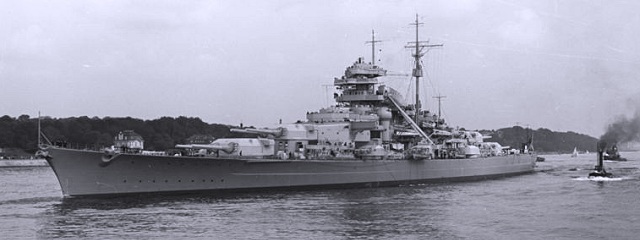
Battleship Bismarck

The torpedo from the Swordfish from the HMS Ark Royal that struck the mighty Bismarck in her stern and jammed her rudders doomed that ship and her crew. It was an astounding turn of events. The Bismarck had sunk the legendary British Battle Cruiser HMS Hood in minutes and had she persisted could have sunk the new Battleship HMS Prince of Wales. Instead, Vice Admiral Gunther Lutjens in command of the Bismarck and her consort the Heavy Cruiser Prinz Eugen decided to break off contact and make for safety in the French port of Brest.

images-39 Sinking of the Hood

Bismarck slipped her pursuers and allowed Prinz Eugen to escape. It seemed that nothing that the British could do would stop her from gaining the safety of the French port and with it the knowledge that she had sunk the most powerful ship in the Royal Navy and gotten away. Then out of nowhere Bismarck was spotted by a Royal Air Force Coastal Command PBY Catalina seaplane piloted by an American Naval Officer. Then a relatively small and slow torpedo dropped from an obsolescent Swordfish torpedo bomber, a “stringbag” hit the Bismarck in perhaps the only place that could have changed the developing narrative of a great German naval victory.

As darkness fell on May 26th, Bismarck, unable to steer towards Brest due to her damage and the following seas steered toward the oncoming British armada at a reduced speed. Her crew, now exhausted from countless hours on watch and at their battle stations knew that they were doomed.

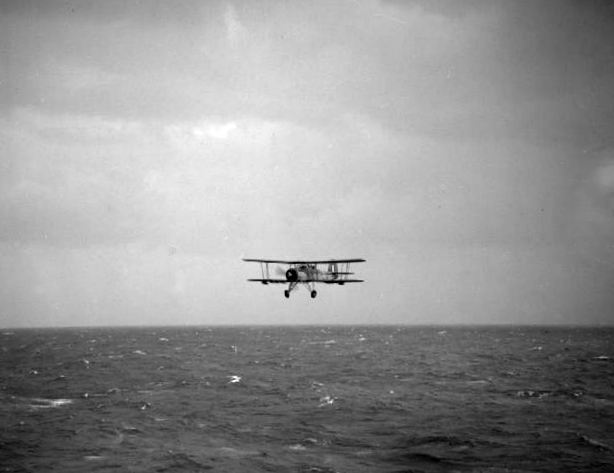
HMS_Ark_Royal_swordfish

Swordfish returning from attacking Bismarck

Despite this they still labored trying in vain for a way to repair their ship. As Bismarck’s engineers and damage control personnel sought at way to repair the damage on that dark night Royal Navy destroyers under the command of Captain Phillip Vian harassed her, closing to fire torpedoes and keep the exhausted crew of the mighty German ship engaged at their battle stations throughout the long night.

photo045

Bismarck under Fire from King George V and Rodney

As light broke on the morning of the 27th the remaining heavy units from the Home Fleet, the Battleships HMS King George V and HMS Rodney along with the Heavy Cruisers HMS  Norfolk which had been part of the pursuit since the first day and HMS Dorsetshire which had broke from its convoy escort duties on the 26th closed in for the kill.

WTBR_Bismarck_Sinking_pic

Bismarck from Dorsetshire

At 0847 the British Battleships opened fire on Bismarck, which replied with accurate salvos straddled Rodney. However British shells hammered the Bismarck, 16” shells from Rodney destroying the command center of Bismarck and her main fire control stations. Within 30 minutes the mighty guns which had sunk the Hood were silent and the British ships pounded Bismarck from point blank range with 16”, 14”, 8” and 6” shells as well as torpedoes.

painting28 The end of the Bismarck

The British ships scored at least 400 hits but though they had silenced Bismarck the ship was still afloat, burning and certainly doomed but undaunted. Finally, with their adversary obviously doomed and their own fuel supplies dangerously low Admiral Tovey ordered the battleships to break off the action even as the cruisers continued to fire their guns and torpedoes.

bismar1

Bismarck Survivors being hauled aboard Dorsetshire

Even so the Bismarck’s senior surviving officer, her First Officer Fregattenkapitan (Commander) Hans Oels ordered her Chief Engineer Korvettenkapitan (Lieutenant Commander) Gerhard Junack to prepare the ship for scuttling and ordered the crew to abandon ship. The watertight doors were opened and scuttling charges fired. At 1039 the Bismarck slipped beneath the waves.

hmsdorsetshirempl1284

HMS Dorsetshire 1941

Hundreds of survivors bobbed about in the cold waters of the North Atlantic. 110 were rescued by British ships, mostly by Dorchester. Then lookouts spotted the periscope of a U-Boat and the British ships broke off their rescue operations leaving hundreds more survivors to die of exposure or their wounds in the Atlantic. A few more were rescued later by German ships or U-boats but about 2200 German sailors went down with their ship or died awaiting rescue that never came. 2 officers and 113 men survived the sinking of the Bismarck.

images-40

Artist’s image of the Wreck of the Bismarck

Subsequent investigations would show that all the British shells and torpedoes could not have sunk the Bismarck and that it was indeed the scuttling charges that sent her to the bottom of the Atlantic. Even so, she was doomed and the damage would have sent her to the bottom within 12 to 24 hours had Oels not order Junack to scuttle the ship. Within a year the Ark Royal, Prince of Wales, and Dorsetshire would also lie at the bottom of the seas. Prince of Wales sunk by Japanese land based bombers off Malaya in 1941, Dorsetshire by Japanese Carrier aircraft in April 1942 and Ark Royal by the U-Boat U-81 in November 1941. Of the destroyers that harassed Bismarck the night before her sinking only one, the Polish Destroyer ORP Piorun would survive the war.

The tragedy of mission of the Bismarck is that nearly 3700 sailors died aboard the two mightiest ships in the world, the Hood and the Bismarck died in battles that though now legendary did not alter the course of the war. Hood’s loss though tragic did not alter the strategic equation as more new battleships of the King George V class entered service and German capital ships, harassed and damaged by RAF bomber sorties and attacks by the Royal Navy’s Fleet Air Arm confined to ports in France, Germany or Norway slipped into irrelevance as the war progressed and the German U-Boat force took the lead in the Battle of the Atlantic.

HMS_Hood

The Mighty Hood

As one who has served at sea on a cruiser at war which came within minutes of a surface engagement with Iranian Revolutionary Guard patrol boats in the Northern Arabian Gulf in 2002 I have wondered what would happen in the event of an engagement that seriously damaged or sank our ship. Thus I have a profound sense of empathy for the sailors that perished aboard both the Hood and the Bismarck in the fateful days of May 22-27 1941.

In hopes that no more brave sailors will have to die this way.

Peace

Padre Steve+

1 Comment

Filed under History, Military, Navy Ships, nazi germany, world war two in europe

The Death of the Mighty Hood: The Battle of the Denmark Strait 24 May 1941

HMS Hood arrives in Malta

Seventy years ago today the “Mighty Hood” was sunk by the German Battleship Bismarck. This essay is in honor of that gallant ship and crew.  May we never forget the sacrifice of these men and all others who have gone down to the sea in ships.

There are some warships and naval engagements which assume legendary proportions.  The Battle of the Denmark Strait on 24 May 1941 between the two largest battleships in commission at the time, the pride of the British Royal Navy the HMS Hood and the German behemoth Bismarck is legendary as are those two mighty ships.  The battle came at a critical time as the Britain stood alone against the seemingly invincible German Blitzkrieg.  Britain had been driven from Western Europe and was being bombed regularly by Herman Goering’s Luftwaffe while a British expeditionary force that had been sent to Greece had been defeated and the Germans were assaulting Crete with airborne forces.  In the Western Desert the Afrika Korps under Field Marshall Erwin Rommel had driven off a British counter-offensive on the Libyan-Egyptian frontier and were laying siege to Tobruk and in the Atlantic German U-Boats sank 66 Allied Merchant Ships of over 375,000 tons and the Royal Navy would lose 25 warships not including the Hood.

The “Mighty Hood” at San Francisco in the 1920s

The Hood was the pride of the Royal Navy and was world famous due to her inter-war international presence and goodwill visits.  Displacing 47,430 tons full load she was armed with eight 15” guns in four twin turrets.  Designed as a battle cruiser she was less heavily armored than contemporary battleships and had very weak vertical protection from plunging shellfire.  This was a fault which was known but never rectified between the wars and when the war came the Royal Navy could ill-afford to take her out of service for the necessary improvements to her protection system.  She was fast with a designed speed of 31 knots which been reduced to 28 knots by 1939 as a result of modifications which increased her displacement.   This was further reduced by the wear and tear on her propulsion plant to 26.5 knots by 1940.

Hood in September 1924

Hood was designed before the battle of Jutland (May 1916) where the weaknesses in the armor protection of British Battlecruisers was exposed as three, the HMS Invincible, HMS Queen Mary and HMS Indefatigable were destroyed by plunging fire which exploded their magazines.  Though her design was modified during construction she still was vulnerable to plunging fire. She was scheduled for a major refit which would have included significant improvement in armor protection in 1941 but the war prevented the Hood from receiving anything more than improvements to her anti-aircraft batteries.

The Killer the German Battleship Bismarck

During the war Hood was engaged in patrol and search operations against German raiders in the North Atlantic and in June 1940 joined Force “H” in the Mediterranean.  As Flagship of Force “H” she took part in the sinking of French Fleet Units including the Battleship Bretagne at Mers-El-Kebir on 3 July 1940 following the French surrender to the Germans and remained in operation searching for the German Pocket Battleship Admiral Scheer and Heavy Cruiser Admiral Hipper until she withdrawn for a brief refit in January 1941. Following a brief refit in mid-March Hood was underway from mid-March searching for the German raiders Scharnhorst and Gneisenau and a false report of Bismarck breaking out into the Atlantic in April 1941. She returned to Scapa Flow on 6 May 1941.

Bismarck Firing at Hood

When the British discovered that Bismarck had entered the Atlantic Hood as the flagship of Vice Admiral Lancelot Holland was dispatched with the newly commissioned battleship HMS Prince of Wales to join the Heavy Cruisers HMS Suffolk and HMS Norfolk at the entrance to the Denmark Strait.  When the cruisers discovered Bismarck along with her consort the Heavy Cruiser Prinz Eugen the two British Battleships steamed into naval history.

The last photo of Hood taken from HMS Prince of Wales

Bismarck was slightly larger than Hood and mounted the same main armament but that was about all the two ships had in common. If the battle was a battle between heavyweight prize fighters Hood was the valiant but crippled champion and Bismarck the young and overpowering challenger.  Bismarck was slightly faster than the limping Hood and was one of the most well protected ships ever built.  Her gunnery officers and the men that manned those deadly 15” guns were like previous generations of German sailors’ gunnery experts working some of the finest naval guns ever made.

Hood Blows up, picture taken from Prinz Eugen

The German ships shadowed at a distance by the Norfolk and Suffolk German task force under the command of Admiral Gunther Lütjens emerged from the strait and was sighted by the British at 0537.  Knowing his ship’s weakness in regard to plunging fire Admiral Holland desired to steer a direct course at the German ships in order to close the range quickly. Events dictated otherwise and the British were forced to close the range much more slowly and exposing Hood and Prince of Wales to German plunging fire for a longer period of time.  Holland turned to close faster with the result that his gunnery was degraded by wind and spray coming over the bows of his ships and the inability to fire his after turrets.

At 0553 Holland ordered his ships to open fire without the benefit of Suffolk and Norfolk being in position to engage the Prinz EugenHood initially concentrated her fire on Prinz Eugen assuming her to be the Bismarck while Prince of Wales engaged Bismarck.  Prince of Wales drew first blood striking Bismarck three times. One which damaged her seaplane catapult, a second which did minor damage to machinery spaces and a third which passed through the bow near the waterline which severed fuel lines from her forward fuel tanks.

The Heavy Cruiser Prinz Eugen. Mistaken for Bismarck bu Hood she scored the first hits on Hood

Both German ships opened fire at 0555 concentrating on Hood.  Prinz Eugen immediately hit Hood with at least one 8” shell which set a large fire among the ready to use 4”ammunition stored in lockers near the mainmast. The hit started a large fire which Hood’s damage control teams raced to contain.  At 0600 Holland ordered his ships to turn to port in order to bring his rear turrets into the fight. As the squadron executed the turn Hood was straddled by a salvo from Bismarck and observers on Prince of Wales observed an explosion between “X” turret and the mainmast which consumed the Hood causing her bow to jut sharply out of the water before sinking beneath the waves in under 3 minutes time. Witnesses on both sides of the engagement were stunned by the sudden and violent end of the Hood and the Germans rapidly shifted fire to the Prince of Wales knocking her out of the action.  Against the advice of Bismarck’s Captain Ernst Lindemann, Lütjens did not follow up his advantage to sink the crippled British ship.

Petty Officer Ted Briggs

Only three crewmen Petty Officer Ted Briggs, Seaman Bob Tilburn and Midshipman Bill Dundas survived the sinking of Hood out of a total of 1415 souls embarked. They were rescued 4 hours later nearly dead of hypothermia staying awake by sinking “Roll out the Barrel” by the destroyer HMS Electra.  Briggs who died in 2008 recounted the sinking:

“Then she started listing to starboard. She righted herself, and started going over to port. When she had gone over by about 40 degrees we realised she was not coming back…” Briggs was sucked under the water “I had heard it was nice to drown. I stopped trying to swim upwards. The water was a peaceful cradle – I was ready to meet my God. My blissful acceptance of death ended in a sudden surge beneath me, which shot me to the surface like a decanted cork in a champagne bottle. I turned, and 50 yards away I could see the bows of the Hood vertical in the sea. It was the most frightening aspect of my ordeal, and a vision which was to recur terrifyingly in nightmares for the next 40 years.” (The Daily Telegraph 5 October 2008)

Seaman Tilburn


Artist rendition of Hood’s destruction

The Admiralty reported her loss later in the day saying Hood “received an unlucky hit in a magazine and blew up.  The official report of the sinking released later in the year said:

“That the sinking of Hood was due to a hit from Bismarck’s 15-inch shell in or adjacent to Hood’s 4-inch or 15-inch magazines, causing them all to explode and wreck the after part of the ship. The probability is that the 4-inch magazines exploded first.”

The commission’s findings have been challenged by a number of naval historians and there are several theories of how the magazines might have exploded but all point to a massive magazine explosion but probably not due to a plunging round but from another hit which detonated the unprotected 4” magazines or a hit from Bismarck below Hood’s waterline which stuck a magazine.  Hood’s wreckage was located in 2001 lying across two debris fields and the examination revealed that the after magazines had exploded.  The site is designated as a War Grave by Britain and protected site under the Protection of Military Remains Act of 1986.

Revenge: Bismarck being pounded into a wreck by British Battleships

Bismarck did not long survive her victory being crippled by a lucky aerial torpedo hit from a Fairley Swordfish bomber flying from the HMS Ark Royal on 26 May and being scuttled by her crew after absorbing massive damage from the HMS King George V, HMS Rodney and several cruisers including HMS Dorsetshire the plucky HMS Norfolk and several destroyers. When she went down she took with her all but 115 souls of her crew of over 2200 which included the Fleet Staff of Admiral Lütjens.

HMS Prince of Wales

Prince of Wales would take Winston Churchill to Argentia Bay Newfoundland to meet with Franklin Roosevelt from 9-12 August 1941 where the Atlantic Charter was drafted. She reported to the Far East where she was sunk along with the Battlecruiser HMS Repulse on 9 December 1941 by a force of land based Japanese aircraft.  The Prinz Eugen was the only heavy ship of the German Navy to survive the war and was taken by the US Navy at the end of the war. She was expended as a target during the Able and Baker nuclear tests at Bikini Atoll.  Too radioactive to be repaired she was towed to Kwajalein Atoll where she capsized and sank on 22 December 1946. Her wreck is still visible.

Midshipman William Dundas, one of three surivors

The loss of the Hood traumatized the people of Britain and the Royal Navy; she had been the symbol of British Naval power for over 20 years and people around the world were likewise stunned at her demise. The sinking of the Hood and her crew was a tragedy which all sailors assigned to large and prestigious ships and the nations that they sail for need to keep in mind. No matter how mighty the ships all have an Achilles heel and none are unsinkable.  Of the over 3600 officers and crew of the Hood and the Bismarck only 118 survived.  I will remember the Hood, her gallant crew especially my very distant relative Midshipman Bill Dundas who I never met.  He left the Royal Navy about 1960 and was killed in a car wreck in 1965.  According to the Hood Association website he was troubled by the sinking for the rest of his life.  One can understand.

Peace

Padre Steve+

10 Comments

Filed under History, Military, Navy Ships, world war two in europe

Power and Beauty the Battle Cruisers Scharnhorst and Gneisenau

Scharnhorst

The naval architects of Germany in the early 1930s designed some of the most beautiful as well as deadly warships of the Second World War.  Following Germany’s rejection of the provisions of the Treaty of Versailles the Kreigsmarine enacted a building program to enlarge and modernize the German Navy which then was composed of obsolete pre-Dreadnaught battleships and a few modern light cruisers and destroyers.   The first major units constructed were actually begun by the predecessor to the Kreigsmarine, the Reichsmarine of the Weimar Republic.  These were the Deutschland class Armored Ships, sometimes called “Pocket Battleships” and later reclassified as Heavy Cruisers. These ships were designed to replace the old pre-Dreadnaught battleships and incorporated electric welds to reduce displacement, diesel engines for extended cruise range to enable them to serve as commerce raiders and a battery of six 11” guns.  While an advance over anything in the German inventory they were outclassed by the British battle cruisers Hood, Renown and Repulse.

Gneisenau

The next and first truly capital ships built by the Kriegsmarine were the Scharnhorst and Gneisenau battleships which in reality were battle cruisers because of their light main battery of 11” guns as opposed to the 14”, 15” or 16” batteries of other nations battleships.  Despite this in displacement and armor protection of the ships was comparable to other battleships of the era and their designed speed of 31.5 knots was superior to almost all other battleships of the era including the British King George V Class and the US North Carolina class.  Only the British Hood was their superior in speed.

Gneisenau Main Battery

As built they displaced 31,000 toms, however at full combat load they both weighed in at nearly 38,000 tons and were 772 feet long.  They had an armor belt that was nearly 14 inches thick.  Armed with a main battery of nine 11” guns and a secondary armament of twelve 5.9 inch guns they also mounted a powerful for the time anti- aircraft battery of fourteen 4.1 inch guns, 16 37mm and 16 20mm anti-aircraft cannons.  Additionally they mounted six 21” torpedo tubes and carried three Arado 196 A3 scout planes.  The main battery was eventually to be replaced by six 15” guns but this never occurred although Gneisenau was taken in hand to mount the new weapons but the conversion was never completed.

Scharnhorst in Action Against HMS Glorious

Laid down on 15 June 1935 and launched 3 October 1936 Scharnhorst was commissioned 7 January 1939.  Her sister Gneisenau was laid down 6 May 1935, launched 8 December 1936 and commissioned 21 May 1938.  Upon the commencement of the Second World War the two sisters began a reign of destruction on British shipping. In November they sank the Armed Merchant Cruiser HMS Rawalpindi During Operation Weserübung the pair surprised sank the aircraft carrier Glorious and her two escorting destroyers, the only time a Fleet carrier was caught and sunk by battleships during the war.   From January to March 1941 they conducted Operation Berlin against British merchant shipping in the North Atlantic sinking 22 ships before returning to base.

The Channel Dash Seen from Prinz Eugen

While in the port of Brest Gneisenau was bombed and torpedoed requiring extensive repairs.  Due to the exposed location of the port the German high command decided to return the ships to Germany along with the Heavy Cruiser Prinz Eugen.  This was Operation Cerberus and it took place from 11-13 February 1942 and involved the ships making a dash up the English Channel which was unsuccessfully contested by the British Royal Air Force and Royal Navy although both Scharnhorst and Gneisenau were damaged by mines and needed subsequent repairs.  While undergoing repairs in Kiel Gneisenau was further damaged by the Royal Air Force requiring repairs in or to steam to the port of Gotenhafen for repair and conversion.  Although some work was completed she was decommissioned and sunk as a blockship on 23 March 1945.  Following the war she was raised by the Poles and scrapped.

Gneisenau Sunk as Blockship

Scharnhorst was repaired following Operation Cerberes and in March 1943 was transferred to Norway where along with Tirpitz, Admiral Scheer, Lutzow (the former Deutschland), Admiral Hipper and Prinz Eugen she became part of a “fleet in being” poised to strike the Allied convoys bound for Russia. On Christmas Day 1943 under the command of Rear Admiral Erich Bey the Scharnhorst set sail with several destroyers undertook Operation Ostfront and the ensuing battle became known as the Battle of North Cape. This was to be an attack on two Russia bound convoys; however the orders were intercepted and decoded by the British which allowed Scharnhorst to be intercepted by the battleship HMS Duke of York four cruisers and a number of destroyers as she closed with the convoy after Bey had detached his escorting destroyers.  While attempting to escape she received damage that impacted her speed and maneuvering capabilities and was sunk with the loss of all but 36 of her 1968 man crew.  Her wreck was discovered 3 October 2000 some 70 miles north of North Cape Norway.

Thus ended the careers of two of the most beautiful ships to grace the seas, though their careers were short they both survived frequent heavy battle damage to return and fight again.  Perhaps their greatest weakness was the inability of the German Navy to provide them adequate escort and the Luftwaffe being unable to protect them against air strike while in port.

9 Comments

Filed under History, Military, Navy Ships, world war two in europe

The Treaty Cruisers: A Warship Review

Note: Since childhood I have loved naval history and the study of various types of warship design throughout history. My favorite period is really from the Spanish-American War through the mid 1970’s.  I find the leaps in Naval design and architecture, weapons and fire control systems and the diversity of the types of ships built absolutely fascinating.  Not only initial designs but the various modifications and modernizations of various ships or classes of ships went through during their service careers. The cruisers of the inter-war period were some of the most ascetically pleasing warships to ever grace the high seas. They were well proportioned, and graceful while still looking every part the warship.  This is something that many ships in our modern era lack, despite the fact that their armament despite limited gun power is formidable. With VLS launchers and Harpoon Missile tubes they pack a punch, but unlike the old cruisers, their offensive teeth are hidden. I had the privilege of serving aboard the USS HUE CITY CG-66 which is about the same size and displacement of the Chester Class

I think I actually began reading Naval history back in 2nd or 3rd grade, and it was not uncommon for me to spend hours at the public library going through reference stacks to read old issues of “Jane’s Fighting Ships” and the main collection to check out every book on Naval Warfare and warships that I could find. One of the most interesting types of ship to me was the Heavy Cruisers built under the restrictions of the Washington Naval Treaty. The treaty had several major provisions but today I only deal with the restrictions on Heavy Cruisers, the response of treaty nations to the limitations and the combat summary of each class.  This is all pretty much out of the deep recesses of my sometimes dark mind and tonight I didn’t have to crack a book to write this.  It’s thanks to having one of those phonographic memories that just keeps going around and around. This is another one of the things that I am passionate about.  Anchor’s Away! Peace, Steve+

atago

IJN Atago

The Washington Naval Conference of 1921-1922 set a number of limits on warship construction and fleet composition.  One of the ship types limited by the treaties was cruisers, notably heavy cruisers.  These ships, descended from the Armored Cruisers developed by the navies of the great powers prior to the First World War were considered a major part of each of the navies of the signatory nations.  The armored cruisers had 8-10 inch guns and a relatively substantial armored belt.  The type was not particularly successful as with few exceptions they were used in fleet actions where they were under-gunned and under-armored.  They were most successfully used in overseas service against raiders or commerce.  The most famous of the type were the German Scharnhorst and Gneisenau of the German Far East Squadron.  Smaller and faster than a battleship, the type had developed by the 1920s into a ship that could be used for fleet screening and scouting as well as showing the flag in foreign waters where many were found.  The Washington treaty did not limit numbers of these ships as it did Battleships and Aircraft Carriers, but it did place maximums on the gun size and displacement of individual ships.   A heavy cruiser could be armed with 8 inch guns and were limited to 10,000 tons displacement.  Of course this led to compromises in the designs of the ships which frequently gave up protection for speed.

uss pensacolaUSS Pensacola

The Americans were the leaders in the development of the treaty cruisers.  The Japanese only built one class of cruiser, the Kako class which complied with the terms of the treaty.  They mounted 6- 8” guns and displaced about 8,600 tons.  They were fast but because of their light displacement were top-heavy.  Subsequent classes, the Nachi and Atago classes violated the tonnage limits by as much as 4,000 tons while the Japanese reported them as 10,000 tons. They were armed with 10-8”guns in five turrets, had good protection and also mounted 12 24” “Long Lance” torpedo tubes.  Two subsequent cruisers of the Kumano and Tone classes were built in the 1930s. The Kumano class of about 13,000 tons were initially classed as “light cruisers” mounting 15- 6” guns prior to being re-armed with 10-8” guns.  The Tone’s mounted 8- 8”guns in 4 turrets all mounted forward leaving the entire aft section for use as a seaplane launching area; the Tone class carried 8 float planes for fleet scouting.

hms exeterHMS Exeter

The British treaty cruisers abided by the limits included the York and Exeter, of the same displacement and armament as the Kako class except they were slower, a common feature of British ships which were generally slower than their American and Japanese counterparts.  The later County class ships were armed with 8- 8” guns and were distinctive looking having three funnels. The County class included such famous ships as the Norfolk, Suffolk and Dorsetshire which played critical roles in the chase and sinking of the German Battleship Bismarck. Australia had two Counties, the Australia and Canberra which did most of their service in the Pacific. The Counties were armed with 8- 8” guns and were distinctive with their three funnels.  They were slower than their Japanese or American counterparts.

uss houstonUSS Houston with President Roosevelt Aboard

The first American treaty cruisers the Pensacola and Salt Lake City of about 9,500 tons with an unusual arrangement of 10- 8” guns mounted in 4 turrets.  However it was the Chester class which was the quintessential U.S. Treaty Cruiser design.  These ships, and the later Astoria class, also displaced 9,500-10,000 tons and mounted 9- 8” guns in three turrets.  A further “treaty” cruiser was Wichita, converted from a St. Louis class light cruiser. All were fast but were lacking in armored protection and none mounted the torpedoes found in Japanese or British ships.  Some of the more notable ships in the U.S. treaty classes included the Houston which served as the Flagship of the Asiatic Fleet which was sunk at the Battle of the Java Sea. The Augusta which took Franklin D Roosevelt to Argentia for the signing of the Atlantic Charter in 1941; The San Francisco which helped stop the Japanese fleet in a point blank encounter in the Naval Battle of Guadalcanal and Indianapolis which with just weeks left in the war having completed the secret mission to deliver the Atomic bomb was sunk by a Japanese submarine.

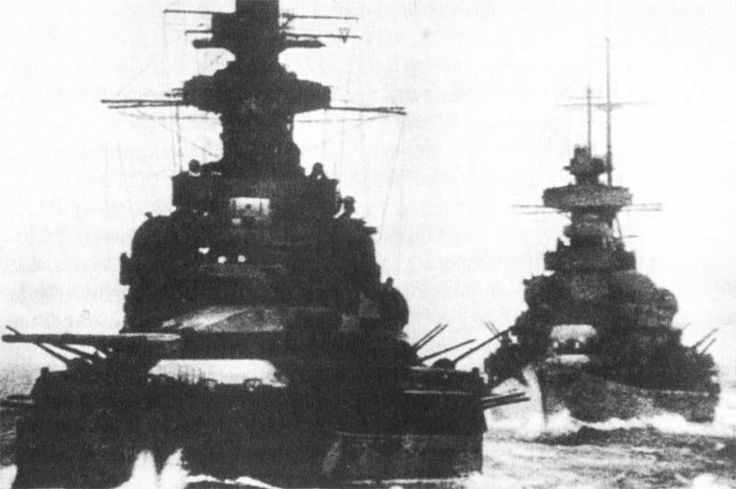
PrinzEugen-2Prinz Eugen

The Germans did not build true “heavy cruisers” until the late 1930’s and their ships, the Hipper, Blucher and Prinz Eugen mounted 8- 8” guns and displaced about 19,000 tons.  The German “Pocket Battleships” Deutschland, Graf Spee and Admiral Scheer, mounted 6-11” guns on a hull of about 11,000 tons (officially 10,000) in compliance with the Treaty of Versailles restrictions on German battleships.  They were designed to outgun and be more heavily armored than the heavy cruisers and be faster than battleships, much more in the Armored Cruiser tradition.  During the war the German Navy reclassified them as Heavy Cruisers. None of these ships were built under the treaty limits for cruisers.

hms suffolkHMS Suffolk

These ships saw distinguished service throughout the war.  The British ships remained their only heavy cruiser design throughout the war. The ships took part in the sinking of the Graf Spee and Bismarck. They also suffered heavily; York was sunk at Crete and Exeter in the Java Sea. Cumberland and Dorsetshire were sunk by Admiral Nagumo’s carriers which had attacked Pearl Harbor, in the Indian Ocean. Canberra was sunk at the Battle of Savo Island off Guadalcanal.  Some of the British Ships remained in service until the 1950s and all eventually we paid off and sent to the breakers.

The Japanese ships were involved in almost every major action of the Pacific war.  Fast, heavily armed and manned by well trained crews they dominated almost every surface action of the early war in the Pacific.  The were key at the Battle of Java Sea and Savo Island where they annihilated Allied or American cruiser and destroyer squadrons. In action so often they were destroyed leaving only two marginally operational at the end of the war. Three of the four Kako class were lost in the Solomon’s.  They were all involved at Savo Island, and the last survivor, Aoba was lost at in harbor to U.S. air strikes at Yokosuka at the close of the war.  The Nachi class saw considerable service and were the workhorses of the Japanese cruiser force. They were the principle executioners of the ABDA fleet in the Java Sea battles and continued their service until late 1944 and the end of the war. Nachi and Ashigara were sunk in the aftermath of Leyte Gulf while Haguro fought the last surface action of a major Japanese combatant in a surface action of the war against a British force in 1945 and was sunk. and Myoko survived the war in a damaged condition being surrendered in Singapore.  The Chokai class also served throughout the war and three of the four were lost at Leyte Gulf. The Atago and Maya were lost to the U.S. Submarines Darter and Dace, Chokai in the action at Samar to combined U.S. destroyer and air attacks from TAFFY-3. Takao survived the war in a damaged condition having been torpedoed at Leyte Gulf but making port.  Of the later cruisers Mikuma was sunk at Midway and Mogami survived almost unimaginable damage in that battle.  Mogami was sunk by the resurrected Pearl Harbor Battleships at the Battle of Surigo Strait while Kumano and Suzaya were lost off Samar.  Chikuma and Tone also served in many battles, it was Tone’s float plane which was delayed in launching and discovered the U.S. carriers at Midway too late. Chikuma too was lost at Samar; Tone was sunk at anchor at Yokosuka in 1945.  Leyte Gulf in a sense could be described as the “Death Ride” of the Japanese Cruiser force.

The U.S. cruisers fought valiantly in nearly every engagement of the Pacific war and a few in the Atlantic.  Houston was immortalized by her actions with ABDA in the Java Sea against hopeless odds.  Astoria, Vincennes and Quincy were sunk in the Savo Island debacle.  Northampton and Chicago lost also in later actions in the Solomon’s.  San Francisco and Portland fought toe to toe with the Japanese Battleships Hiei and Kirishima in the epic Naval Battle of Guadalcanal, inflicting so much damage on Hiei that she was later sunk by American Aircraft the following day.  Indianapolis met an unlikely fate at the close of the war being sunk by a Japanese submarine after returning from a secret mission delivering the Atomic bomb.  A series of unfortunate events led to her loss not being noted with the result that most of the survivors of the sinking being lost to the elements and shark attacks while waiting days for rescue.   Others survived horrific damage from “Long Lance” torpedoes and Kamikaze attacks.  Following the war the Pensacola’s were expended as targets and the remaining ships placed in “mothballs” until the late 1950s when all were scrapped.  Some artifacts of San Francisco including her mast are at “Land’s End” park in that city.

uss san franciscoUSS San Fransisco Returning After the  Naval Battle of Guadalcanal

Of all the navies involved only the United States Navy and German Kriegsmarine built or attempted to build new classes of heavy cruisers during the war.  The US Navy brought out the Baltimore Class which was highly successful and built upon lessons learned from the Treaty Cruisers and the follow on Oregon City class which incorporated design improvements based on experience with the Baltimore Class.  Some of these ships would be converted into the first US Guided Missile Cruisers. The later Des Moines Class the largest class of all gun cruisers ever built with fully automated 8″ gun systems.  Of these ships only Salem survives in Quincy MA as a museum ship, sadly the Des Moines which had been slated to become a Museum ship in Milwaukee was scrapped in 2007 .

No treaty cruiser survives today.  Their service, heroic, unceasing and tireless service is remembered only by their surviving crews and a few naval historians and buffs.  The epic damage control actions of the San Francisco are still taught at the Naval Surface Warfare School.  They have passed into history, of those sunk some have been rediscovered, the Ballard expedition discovered and photographed the wrecks of Astoria and Quincy and their Australian consort Canberra in the waters of “Iron Bottom Sound” off Guadalcanal.  The German “Prinz Eugen” though not a treaty cruiser survived the war and was expended as a target in the Atomic bomb tests.  Her wreck lies capsized and submerged at Bikini Atoll.  An attempt to salvage her by a German group was abandoned and one of her screws was brought back and placed on display near Kiel, Germany.

Though all had design drawbacks due to the treaties, the American and British ships performed magnificently and without their service, especially in the early days of the war history today might be different.  Here’s to gallant ships and steadfast crews. May they never be forgotten.

Peace,

Steve+

13 Comments

Filed under Loose thoughts and musings