Tag Archives: robert e lee

They Too Needed Emancipation: Remembering the Common Confederate Soldiers


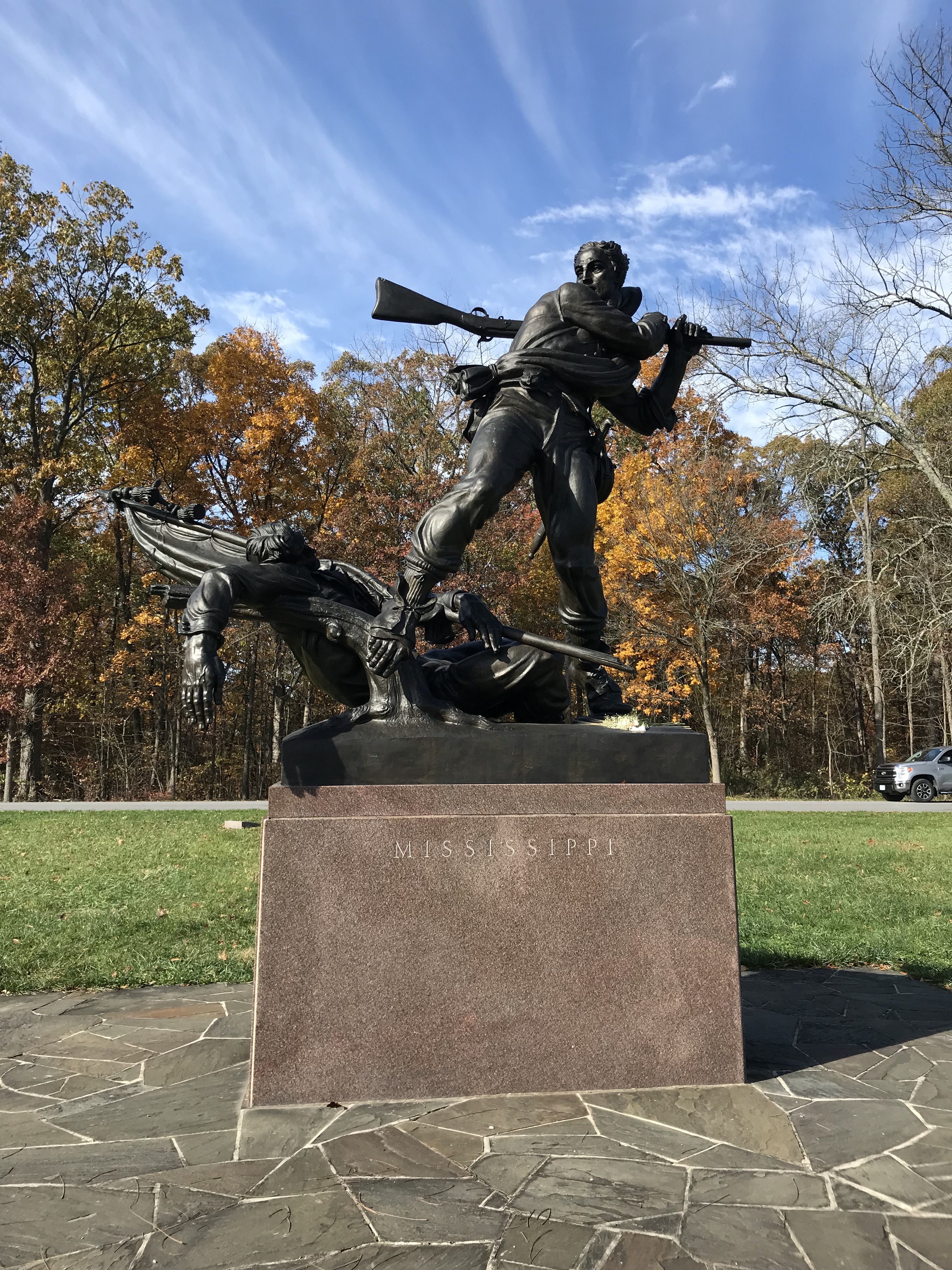
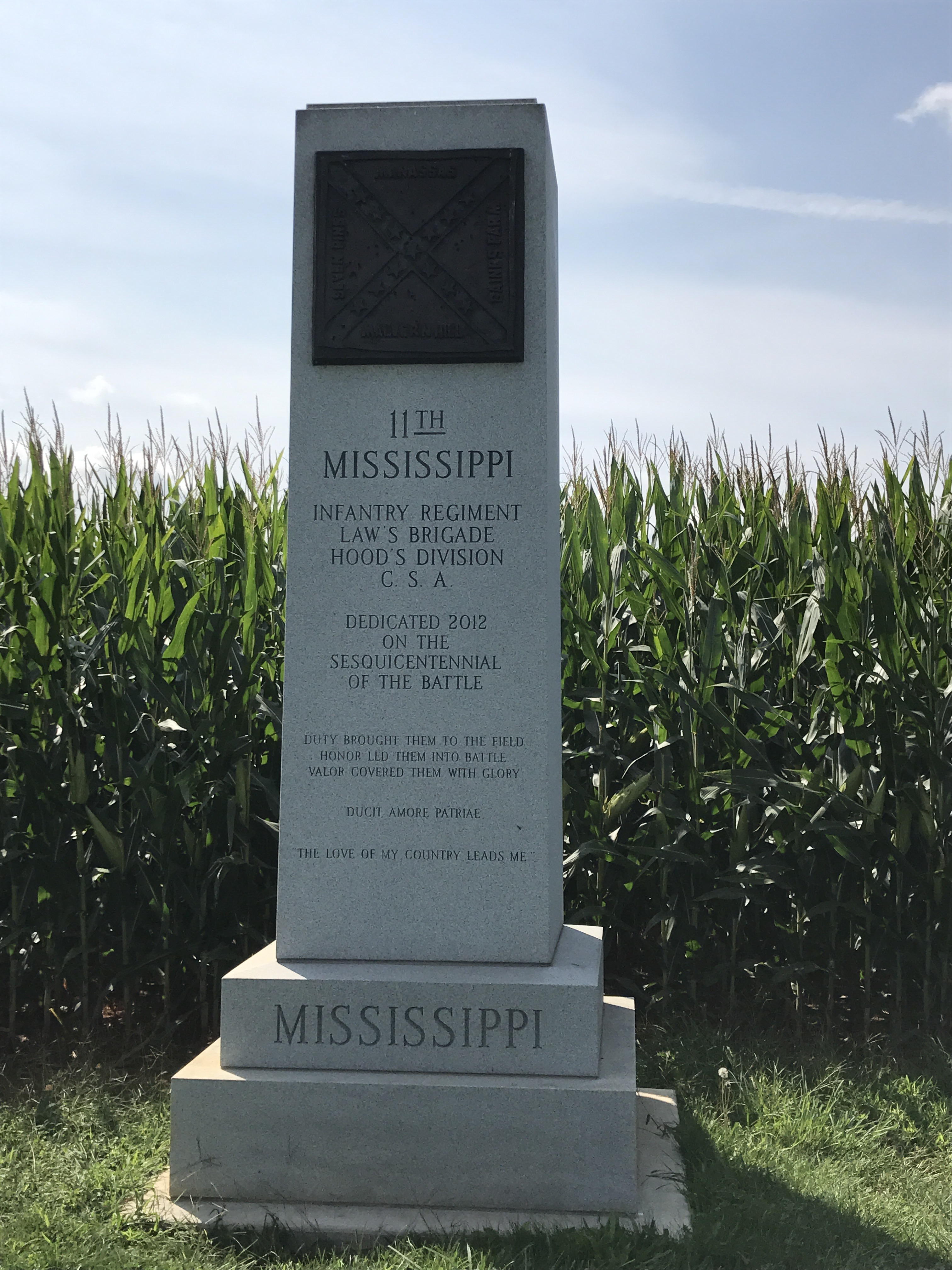
Monument to the 11th Mississippi on Seminary Ridge, Gettysburg 

Friends of Padre Steve’s World,

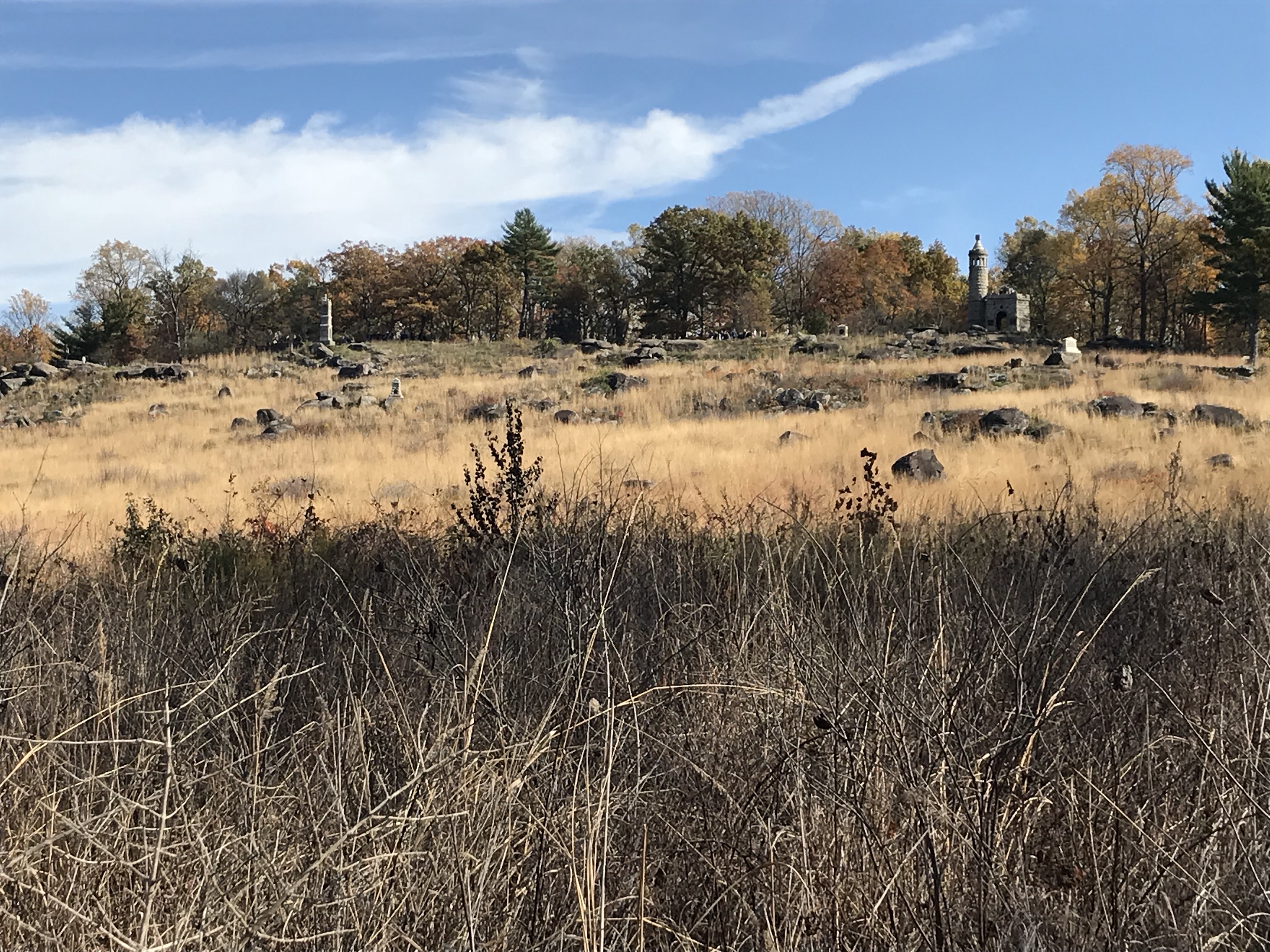
Today I drove home from Gettysburg after walking as an infantryman would have the battlefield in order to better get a feel for what the soldiers of both sides experienced. Over the two days I was there I walked almost 32 miles including walking across some of the most rugged terrain of the battle which gave me a far greater appreciation for the toughness, valor, and courage shown by the men of John Bell Hood and Lafayette McLaws’s divisions of the Confederate First Corps. Most of those men had marched between seven and twenty miles to get to their attack positions in the hot and humid weather of July 2nd 1863. If they even had them their shoes and boots were of relatively poor quality. As I walked seven miles with my hiking books and carrying a modern three day pack with about a 15 pound load I could only imagine the physical duress of those soldiers. To be sure I am 30 to 40 years older than most of those infantrymen, but still they had all marched between 200 to 300 miles before they even arrived at Gettysburg.

The physical stamina required of soldiers at war is something that most people today cannot imagine. Not only have most never served in the military but far fewer have served in combat. I have, but I didn’t have to walk everywhere like these soldiers did, and while I came under enemy fire I never had to charge up a rugged hill under rifle and artillery fire as did the men of Robertson, Benning, and Laws brigades did at Little Round Top on July 2nd 1863, nor did I have to fight outnumbered in an exposed position as did the men of the Union Eleventh Corps north of town on July First 1863.

I have always been able to admire the courage of any soldiers who fight in desperate battles, even those who fight for unjust causes. While I consider my service in Iraq to been the high point of my military career, I have come to see it as an unjust, and illegal war of aggression that under the Nuremberg codes could easily been declared an unjust war of aggression in which our political and military leaders could have been tried and found guilty as were men like Herman Goering, Alfred Jodl, Wilhelm Keitel, and Albert Speer.

Thus while I absolutely condemn the cause that the Confederate soldiers fought for I still admire their battlefield courage and toughness. Likewise I do not glorify their senior leaders including men like Robert E. Lee. I will write about him in a future article, maybe as soon as this week. Since I have the beginning of a draft article I should go back and finish it, but tonight I will only say that Lee was not that great of Commander and his battlefield decisions cost the lives of far too many Southern men, including those he had summarily shot for desertion after the war was irrevocably lost in the Fall and Winter of 1864 and 1865 many of who, having served two to three years in continuous combats were only trying to go home to their families who had lost all when William Tecumseh Sherman’s army cut its way through the heartland of Georgia and the Carolinas. I think that is one of the reasons that I find the monuments to Confederate leaders so despicable, these men cared nothing for the soldiers who sacrificed all in a morally wrong cause. I completely agree with Ulysses S. Grant who wrote of the vast majority of Confederate soldiers:

“The great bulk of the legal voters of the South were men who owned no slaves; their homes were generally in the hills and poor country; their facilities for educating their children, even up to the point of reading and writing, were very limited; their interest in the contest was very meagre–what there was, if they had been capable of seeing it, was with the North; they too needed emancipation.”

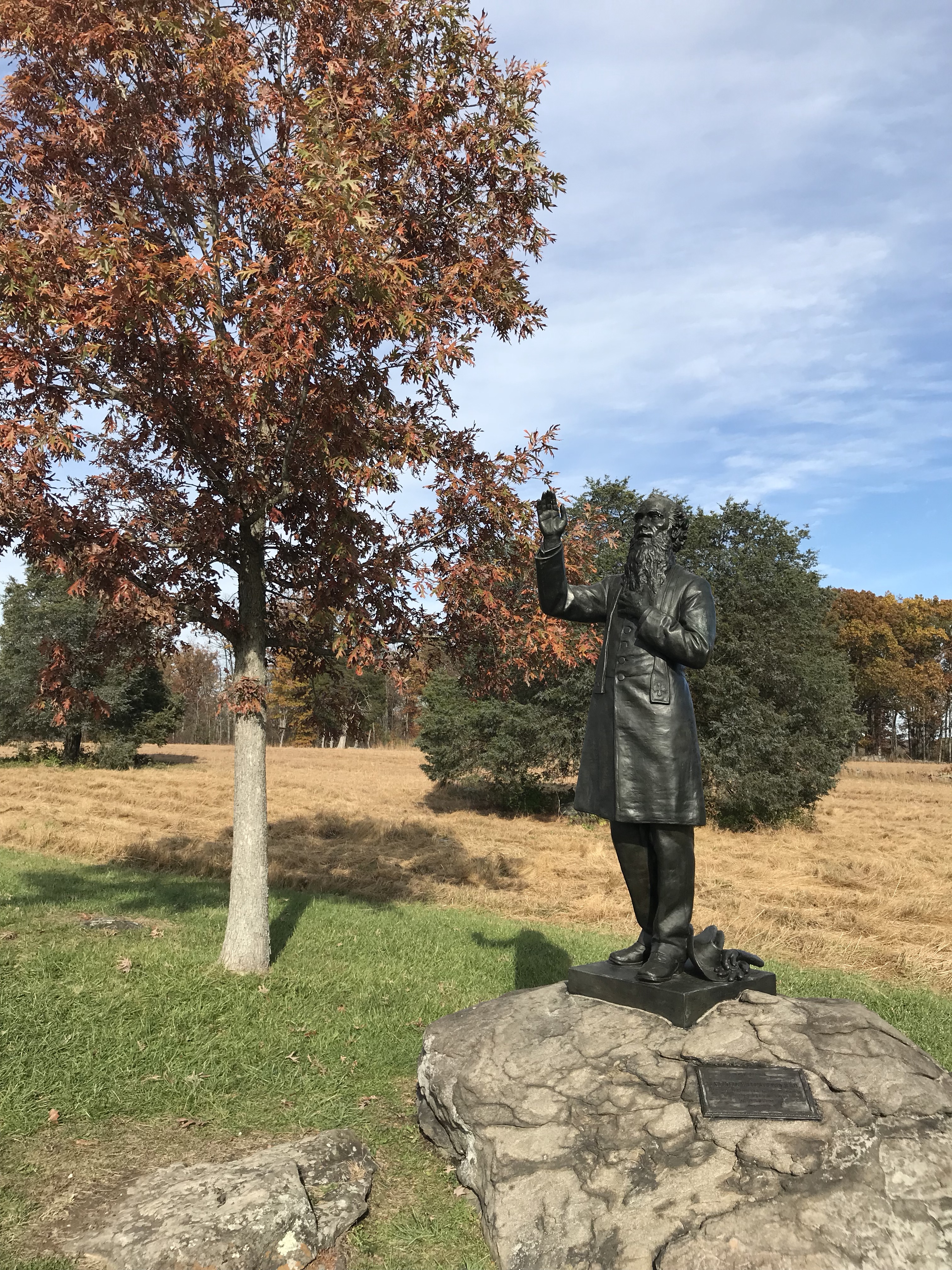
Speaking of monuments I write about the Confederate monuments at Gettysburg another time. Compared to the Union monuments they are few, and only two,that of the 11th Mississippi, and the 3rd Arkansas on Seminary Ridge are actually dedicated to specific units, the others are quite generic and convey mixed political and ideological messages which often demean the sacrifice of their soldiers who died on that battlefield. Once again I will defer writing about those messages until later, but as I walked Seminary Ridge and read each one I was stuck with the stories that each monument told.

So anyway, tomorrow begins a short work week for the Veteran’s Day holiday, a day where we honor all who served our country in peace and war. I usually get a bit melancholy over this weekend as I think about my friends and comrades that I served with over the course of my thirty-six year career in the Army and Navy.

So until tomorrow,

Peace,

Padre Steve+

1 Comment

Filed under civil war, History, Military, Political Commentary

Talking About Bad Ground: Walking the Gettysburg Battlefield, Devil’s Den, Little Round Top, the Wheat Field and more…


Friends of Padre Steve’s World,

Yesterday I wrote about my walk around the areas of the Battle of Gettysburg which transpired on the afternoon of July 1st 1863. Today was my crack at doing my best to experience walking the areas of the battlefield that were contested on July 2nd 1863 when Robert E. Lee ordered James Longstreet to assault the Federal left on the basis of Dick Ewell and Jubal Early’s intransigence in ordering a follow up assault on the Federal right, coupled with inaccurate information Lee had about where the end of the Federal line was. The result was the attacks by Longstreet’s divisions which came perilously close to succeeding but which after some of the bloodiest fighting during any three and a half hour period of the war were repulsed by Union troops the Third, Second, and Fifth Corps.


The engagements of that afternoon and evening are etched in our national conscience. Devil’s Den, Little around Top, the Bloody Wheat Field, and the Peach Orchard, not to mention the fights along Rose’s Woods, the Stoney Ridge, Trostle Farm, and Plum Run are each microcosms of the battle, each with heroes, villains, and tactical geniuses and idiots. But my purpose tonight is not to dissect those battles, I am doing that in a text about the Battle of Gettysburg. Instead it is to reflect upon military history and what the men who fought the battle endured.

If you want to understand military history and want to do so without having actually been to war or having taken the time to try to see and walk the ground the soldiers trod firsthand make a critical mistake, especially in campaigns where the soldiers had to walk into combat. As Guy Sager, who endured the Russian Front as an infantryman in the Second World War wrote in his book The Forgotten Soldier:

“Too many people learn about war with no inconvenience to themselves. They read about Verdun or Stalingrad without comprehension, sitting in a comfortable armchair, with their feet beside the fire, preparing to go about their business the next day, as usual…One should read about war standing up, late at night, when one is tired, as I am writing about it now, at dawn, while my asthma attack wears off. And even now, in my sleepless exhaustion, how gentle and easy peace seems!”


Like yesterday I walked. I left my car at my hotel and put on my boots and my three-day pack from Iraq. I ate a biscuit with a little bit of gravy, and had a small cup of coffee at the hotel before I set off. Since the hotel didn’t serve hardtack it was the closest I could get to a Civil War breakfast. From the hotel it is about a two mile walk to get to General Lee’s HQ on Seminary Ridge. Since Longstreet’s advanced elements were about that far back from Lee’s HQ on that morning I thought that it would approximate the march of some of his troops while understanding that some of his Corps had to march far more just to get there before beginning their movement to the south part of the battlefield.

Upon reaching Seminary Ridge I began walking down what would have been the areas occupied by A.P. Hill’s Third Corps that Longstreet’s troops would have passed as they moved south. The distance that they covered was about five miles as the crow flies, but due to bad staff work and coordination most of the men of John Bell Hood and Lafayette McLaws divisions had to go further just to get to their start point for the attack. In the case of Evander Law’s brigade of Hood’s division which had the mission of being the furthest south of the attacking Confederates, they had marched over twenty miles before beginning their attack on Little Round Top. When I reached the area that they did I had only walked about seven and a half miles as opposed to the men of Evander Law’s brigade who had marched over twenty miles to get into their attack positions, but as a mater of fact they were almost all a couple of decades or more younger than me.


When I got to the point of the Confederate attack I walked a path that intersected with the soldiers of Law’s brigade and Robertson’s Texas brigade, both of Hood’s division. Hood had vigorously protested the attack to Longstreet due to the bad ground that his troops would have to traverse to reach their objectives. As I wrote in my draft book on the battle:

Hood was never one to hesitate to attack, but when he saw the situation that faced First Corps, he objected to the attack. “For the first time in his army career Hood suggested a change of orders to his commanding general,” and pleaded with Longstreet to change it. “From his own observations and those of his scouts he concluded that the attack would be futile and result in wanton wage of life.” The fierce Texan “recognized that the battle order, written more than two miles away on mistaken information…did not fit existing conditions.” His objections included the rocky terrain which he believed would break up his battle formations, as well as “the concave character of the enemy’s line from the north end of Cemetery Ridge to Big Round Top would expose his division to a “destructive fire in flank and rear, as well as in front” if his men attacked it obliquely.” He told Longstreet that it was “unwise to attack up the Emmitsburg Road, as ordered” and requested that he be allowed to “turn Round Top and attack the enemy flank and rear.

Meanwhile, the debate between Longstreet and Hood continued as Hood objected and Longstreet reiterated Lee’s insistence on the planned attack. McLaws noted that Hood “found that the enemy were strongly posted on two rocky hills, with artillery and infantry…” and he pleaded for freedom of maneuver. He believed that an attack up the rocky hills was doomed and later noted “it seemed to me that the enemy occupied a position so strong- I may say impregnable – that independently of their flank fire, they could easily repulse our attack by merely throwing or rolling stones down the mountainside as we approached.”


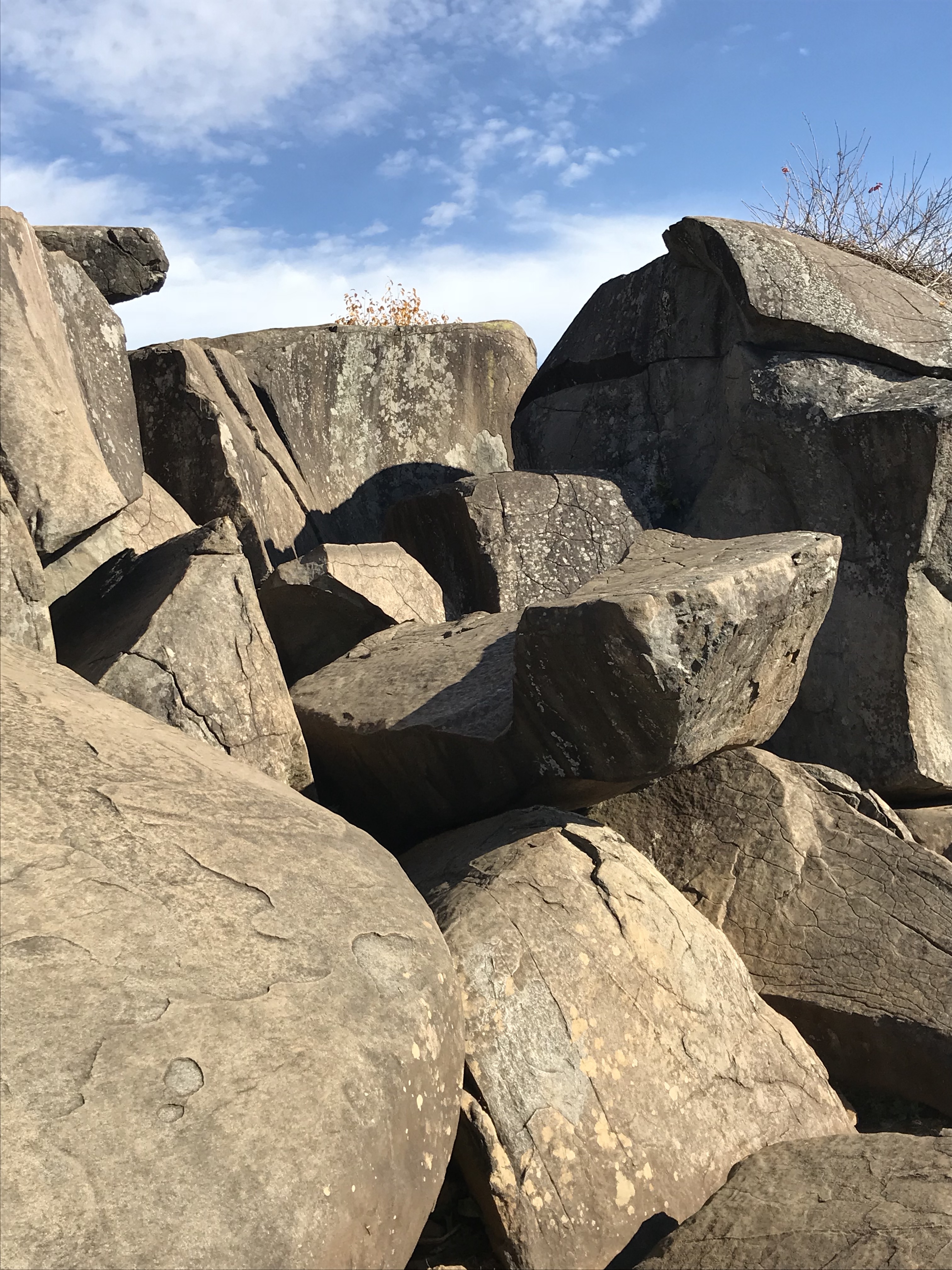
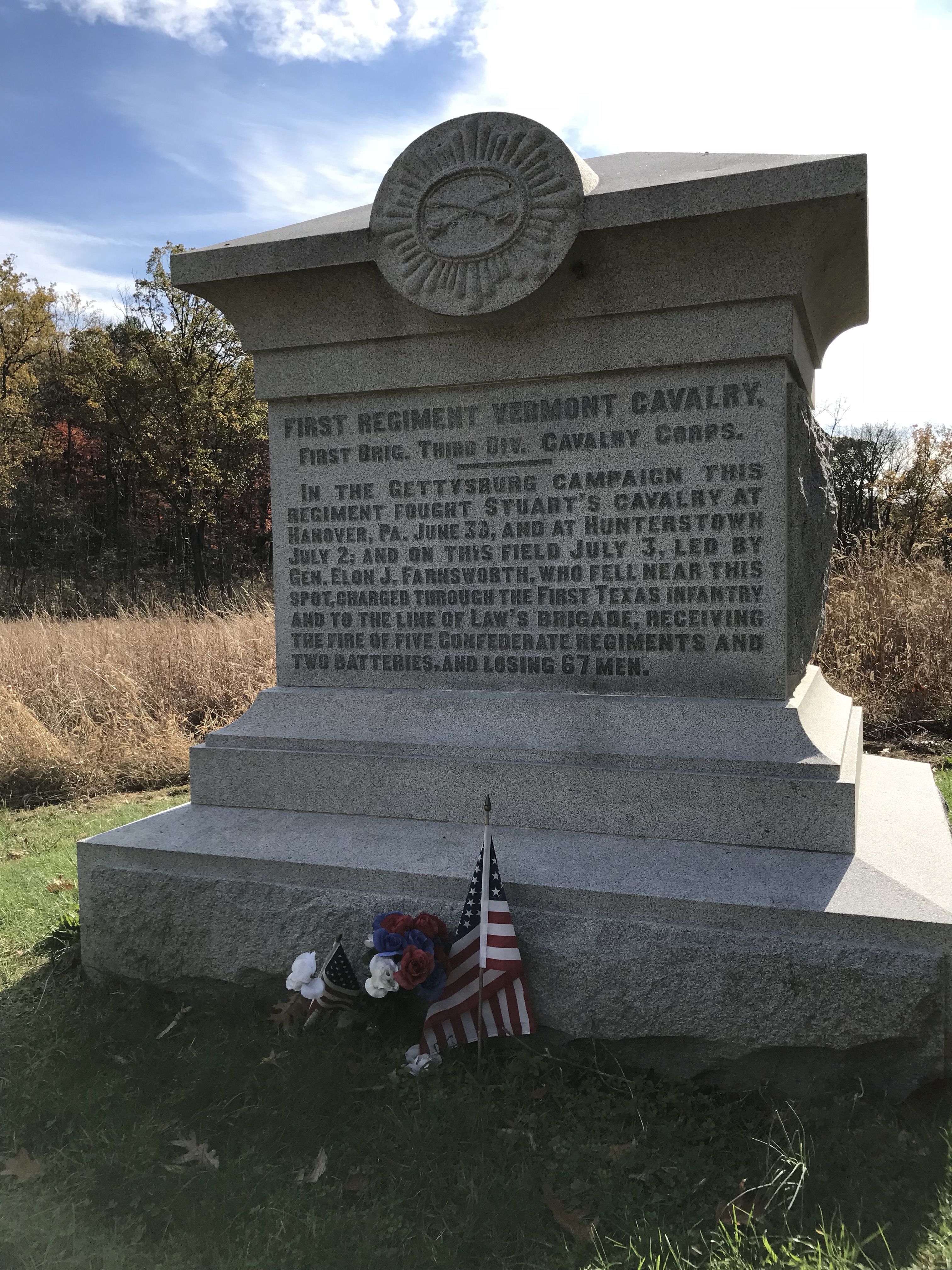
One can look at the ground and one can study it on maps, but until you walk that bad ground, even without doing it while subjected to enemy fire you won’t understand how bad it is. I made my way down a walking path and then tried to move off of it in order to get to Devil’s Den. It was awful, reeds, thrushes, a stream, boulders, and heavy brush prevented me from moving forward. So I went back, followed a trail to Big Round Top and then headed over to Devil’s Den. General Hood was right, the ground to use the words that he spoke to Longstreet after he was wounded “it was the worst ground I ever saw” is not an exaggeration. But the diversion allowed me to find the part of the battle where Brigadier General Elon Farnsworth, after having unsuccessfully resisted orders from Brigadier General Judson Kilpatrick was forced to attack the well dug in Confederate infantry of Lafayette McLaw’s division on July 3rd.


From Devil’s Den I worked my way to Little Round Top. Most of the front slope is inaccessible due to the National Park Service doing a reclamation project, but there is a trail that leads up to it that many of the Confederates would have used. It was steep, and the ground was rugged. By the time I reached the top near the New York Monument I was exhausted. Despite having been in combat and being shot at I cannot imagine how the Confederate soldiers threw themselves up that hill facing small arms and artillery fire at point blank range. Their cause may have been wrong but they were valiant and tough soldiers. The fact that I am 30 to 40 years older than most of them is irrelevant, that ground was a bitch.


After that I went back over to the part of the battlefield occupied by the famous 20th Maine Infantry under the command of Colonel Joshua Chamberlain, and then followed their counter-attack down the hill. From there I went back across the rear slope of Devil’s Den to Houck’s Ridge where heavily outnumbered Union Regulars held their own against Hood and McLaw’s soldiers. From there I went over to the Bloody Wheat Field. Like the Bloody Corn Field at Antietam this was a killing ground which exchanged hands several times during the battle, about 30% of the 20,000 or so soldiers engaged there became casualties. When on looks it the field it is hard to imagine that so many men were killed and wounded in such a short amount of time. Walking across the ground I could not help thinking about the thousands of souls who suffered and died there.


From there I continued through Rose’s Woods and the Stoney Ridge where still more Union and Confederate soldiers fell in desperate fights before walking back west to the Peach Orchard. This was another bloody contest in which General Dan Sickles of the Union Third Corps surprised both the Confederates and his own Commander, General George Meade by moving his corps into an exposed position. The battle there cost many lives and apologists for Sickles, Meade, and the Confederates have used for their own benefit. Sickles is claimed to have nearly lost the battle for the Union, but Longstreet said that his movement and defense of the Peach Orchard was key to the Union victory. Again my purpose in this article is not to take a side in that controversy but to imagine the carnage of the battlefield as well as the bravery of the soldiers on it. It is hard to imagine being a Third Corps Soldier at the Peach Orchard as Confederate artilleryman Porter Alexander’s guns swept their positions, nor being one of McLaw’s infantrymen who were being slaughtered by the experienced Union artillerymen of Third Corps and the Artillery Reserve.


By the time I got to the Peach Orchard I was hungry, thirsty, exhausted, and my feet were hurting. I had a choice. I could simply walk up the Emmitsburg Road and head back to the hotel or I could continue to follow the route of the Confederate advance spearheaded by General Barksdale’s brigade. I went back across Excelsior Field and to the Trostle Farm where Sickles fell wounded, before crossing Plum Run and heading up Cemetery Ridge where the Confederate advance was halted. I then walked back to the hotel via Cemetery Ridge, the Taneytown Road and the Soldiers Cemetery, before making a brief stop on East Cemetery Hill.

Since I was exhausted and darkness and rain were beginning to close in I decided not to do my walk around the Culp’s Hill battlefield. That will have to wait for another time. Since the rain is expected to continue into the morning and I hate getting wet I’ll put off my walk around Culp’s Hill until another time.

Tomorrow I will head home early to help Judy do some work around our house. My friend Bill who met me last night had take care of a business emergency call from one of his customers in the Shenandoah Valley this morning and since it’s just me I figure I can head back home. Lord willing there is always tomorrow right?


But as a closing commentary:

In the past couple of months I have walked nearly 50 miles across two of the nation’s bloodiest battlefields, Antietam and Gettysburg. Honestly I don’t know a lot of people in policy making positions who do things like that. The tragedy of the American Civil War and the nearly three quarters of a million soldiers of both sides who died during it seems to me to have been forgotten or relegated to the realm of myth by too many Americans, including the President and many of his advisers and supporters. If we forget the cost and meaning of the Civil War, the validation of the proposition of the Declaration of Independence that all men are created equal then we do a grave injustice to those who fell in that war, unless we want to support Confederate Vice President Alexander Stephens who said that slavery was the Cornerstone of the Confederate nation. The costs to our nation are too great to let the the lessons of our Civil War be relegated to myth or exploited to reimagine a recreated Confederacy dominating the rest of the country are too great to allow the President, who has called violent neo-Confederates and White Supremacists “very fine people” or to fail to resist theocratic people from imposing their religious beliefs on others as did the Southern clergy who helped break the bonds of the Union beginning in their own denominations in the 1840s.

Since I have now eaten and had a few beers  I will take my 57 year old body to bed and get ready to head home in the morning.

So until tomorrow,

Peace

Padre Steve+

2 Comments

Filed under civil war, Gettysburg, History, Military, Political Commentary

Not Everyone Deserves a Monument: Military Leaders and War Crimes

Friends of Padre Steve’s World,

Monuments to soldiers who served their country faithfully and honorably are not a bad thing. At the same time one has to look at the context of their service and if they serve in the high command or in other government postings their service needs to be carefully examined to see if the deserve to be memorialized.

In the United States we have frequently memorialized men whose actions as military and political leaders, while commendable in some aspects leaves much to be desired in terms of long standing memorials.

This weekend I had a friend whose family survived the Holocaust ask me where removing memorials to men like Robert E. Lee ends. I replied that it was all about context and the totality of life. We mythologize Robert E. Lee in a manner that his crimes and his flaws are intentionally hidden, though they are many. I will write about that soon, I actually have a draft of that article that I started a while back that I need to complete.

I then talked about German General Erich Hoepner who though he had been a part of plots to overthrow Hitler before the war and took part in the plot to overthrow Hitler in 1944 and was executed after a sham trial. The pictures and films of Hoepner being shamed and degraded by the Nazi Chief inquisitor, Judge Roland Freisler, give an impression that General Hoepner was a victim of the Nazi regime.

To some extent he was a victim of the regime, but while in command of Panzer Group Four during the invasion of the Soviet Union his actions place him in the pantheon of Nazi War Criminals. He fully cooperated with some the most criminal aspects of the Nazi regimes actions. He was a willing accomplice to crimes that stagger the imagination.

In his initial message to his troops Hoepner stated:

The war against Russia is an important chapter in the German nation’s struggle for existence. It is the old battle of the Germanic against the Slavic people, of the defence of European culture against Muscovite-Asiatic inundation and of the repulse of Jewish Bolshevism. The objective of this battle must be the demolition of present-day Russia and must therefore be conducted with unprecedented severity. Every military action must be guided in planning and execution by an iron resolution to exterminate the enemy remorselessly and totally. In particular, no adherents of the contemporary Russian Bolshevik system are to be spared.

Hoepner issued a number of other orders directing how Jews should be treated and the commander of Einsatzgruppe A, SS Brigadier General Walter Stahlecker whose units killed nearly 250,000 Jews between July and December 1941 praised the cooperation of the Wehrmacht and in particular of Hoepner with his execution squads. Stahlecker described the cooperation of the Wehrmacht with his men as “generally very good”, and “in certain cases, as for example, with Panzer Group 4 under the command of General Hoepner, extremely close, one might say even warm.” The fact is that the Einsatzgruppen could not have ran up such massive numbers of deaths without the cooperation of the German Army leaders in Russia.

That leaves us with the question of how does one remember such a military leader? Hoepner demonstrated bravery as a young officer in the First World War, and was prepared to help overthrow Hitler before the war and lost his life in the attempt to kill Hitler on July 20th 1944. But he enabled and participated in war crimes so vast and heinous that they beggar the imagination.

In 1956 a Berlin school was named after Hoepner for his role in the anti-Hitler plot, but in 2008, after his actions in relationship to the Nazi war crimes became public, the school was renamed. Because he perished in the attempt on Hitler’s life, Hoepner was included in the myth of the noble Wehrmacht. But that was a myth, the Wehrmacht was so complicit in the Nazi crimes that it cannot be exculpated from them. It’s leaders for the most part agreed with Nazi racial policies and had no hesitation in cooperating with the SS. Yes, there were exceptions, but they were and forever will remain exceptions, the myth be damned.

So in relation to the American controversy regarding monuments to Confederate leaders, or for that matter to leaders who planned, conducted, or supported our own genocide of Native Americans, the unlawful subjection and conquest of Mexico, the exploitation of territories and peoples gained following the Spanish-American War, those who conducted medical experiments not much different than the Nazi doctors on minorities and the handicapped, and so many other examples which would take too long to list for the purpose of this article: what are we to do?

As I have written before, this is a matter of context and honesty. Honestly I think this is something that we need to address, just as the Germans have since the end of the Second World War. We have to be brutally honest in our assessment of the men and women who we chose to memorialize. If we aren’t we simply bless their crimes and allow their veneration to inspire new generations of racial motivated criminals.

That is where we have to go if we have the moral courage to do so. However, I don’t think that will happen in the next few years, or even in my lifetime.

So until tomorrow,

Peace

Padre Steve+

1 Comment

Filed under civil rights, ethics, History, nazi germany

They Silently Gather Around Me: Walking the Antietam Battlefield


Friends of Padre Steve’s World,

As you know from yesterday’s article I am taking an extended weekend in the D.C. area and yesterday I took a trip up to the Antietam Battlefield which surrounds much of Sharpsburg, Maryland. It was a time of quiet reflection on a battle, on the lives of soldiers, and on our country. The Battle of Antietam was the bloodiest day in American military history, more Americans were killed and wounded on that day than any other single day. While the battle was a draw from a military point of view it was singularly important in that it stopped Robert E. Lee’s invasion of the North and gave Abraham Lincoln enough of a victory to announce the preliminary Emancipation Proclamation. The announcement of that, and creative Union diplomacy helped turn the tide of the war by helping to keep England and France from recognizing the Confederacy.


It was my intention to walk as much of the battlefield as I could and I did. The weather was good but a bit warmer and sunnier than what the soldiers who fought there experienced on September 17th 1862. Even so it is my opinion that walking battlefields, be it on a staff ride, reenactment, or simply doing what I did yesterday helps one put the battle into a human context especially if one has a fair amount of historical knowledge and familiarity with a given battle. Being hot, sweaty, feeling ones legs, feet, and back hurt, dealing with waterlogged shoes, being assaulted by swarms of insects, and fighting your way through thrushes, reeds, and high grass along the banks of a creek or river, and drinking the bare minimum of water, and getting a little bit sunburned, is a good way to get a feel for what the soldiers experienced at Antietam or other Civil War battles. I am just glad that I was not wearing a wool uniform, carrying a heavy rifle, 60 rounds of ammunition and cartridges, and all my kit wearing what we would no call substandard shoes, if like the Union soldiers did we even had them. If you were a Confederate soldier at Antietam you might have been barefoot. Since I have been to war and lugged heavy amounts of gear around Iraq I can imagine that, even though I never had to walk as far there as I did today. That’s a good thing.


In his book The Forgotten Soldier, Guy Sajer wrote:

“Too many people learn about war with no inconvenience to themselves. They read about Verdun or Stalingrad without comprehension, sitting in a comfortable armchair, with their feet beside the fire, preparing to go about their business the next day, as usual…One should read about war standing up, late at night, when one is tired, as I am writing about it now, at dawn, while my asthma attack wears off. And even now, in my sleepless exhaustion, how gentle and easy peace seems!”

I am sure that many a Civil War soldier would agree with him. The fact is that reading the history of various wars is important, but whenever possible it is good to experience some of the discomfort of those who fought the battle. When I finished the last part of my battlefield experience my feet hurt and when I took off my shoes they looked pretty bad, but much of that was from the dirt, grass, and moisture that had found its way into my shoes. But unlike the soldiers at Antietam I could return to a safe and dry place and care for my feet, they couldn’t.


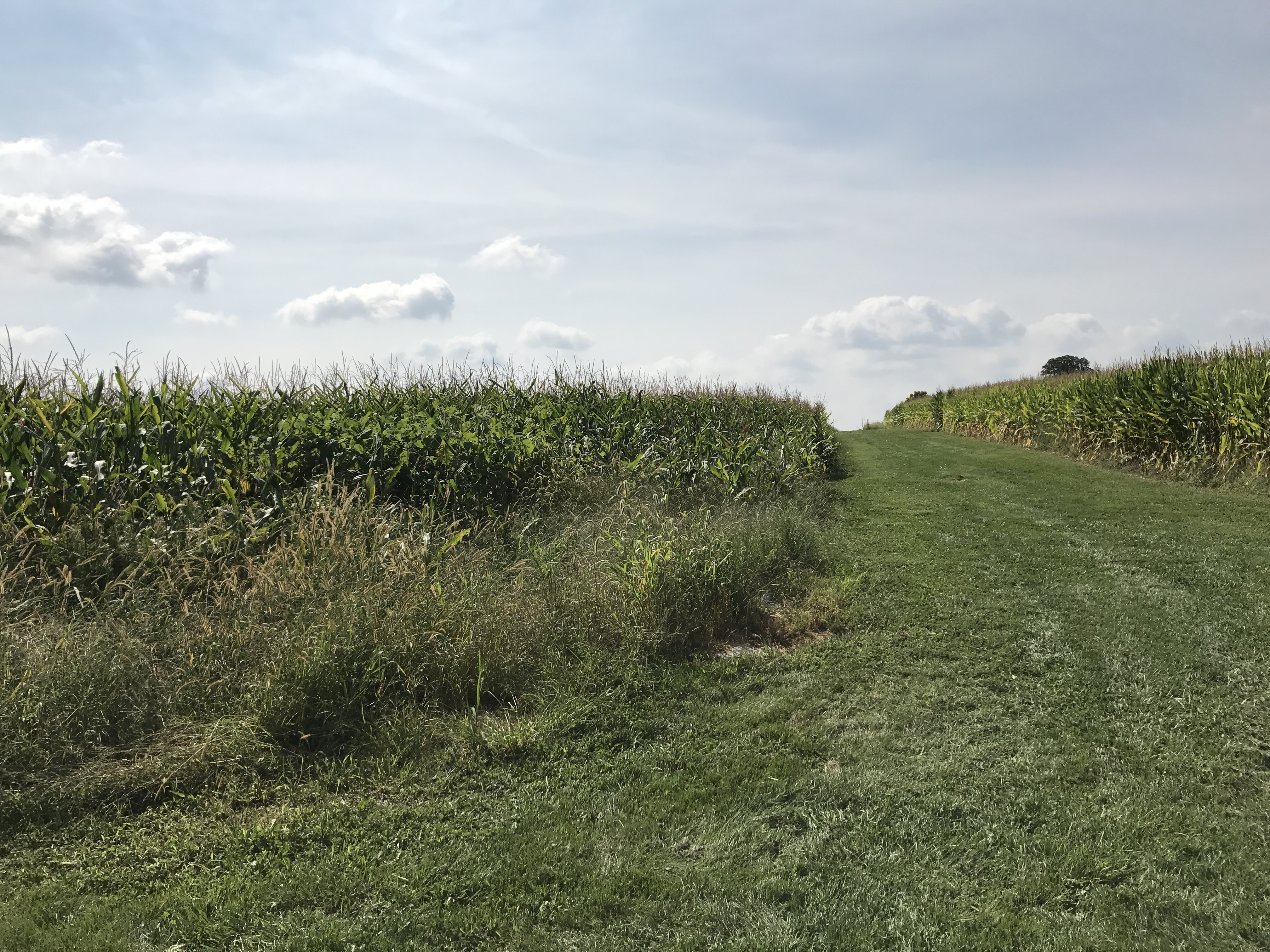
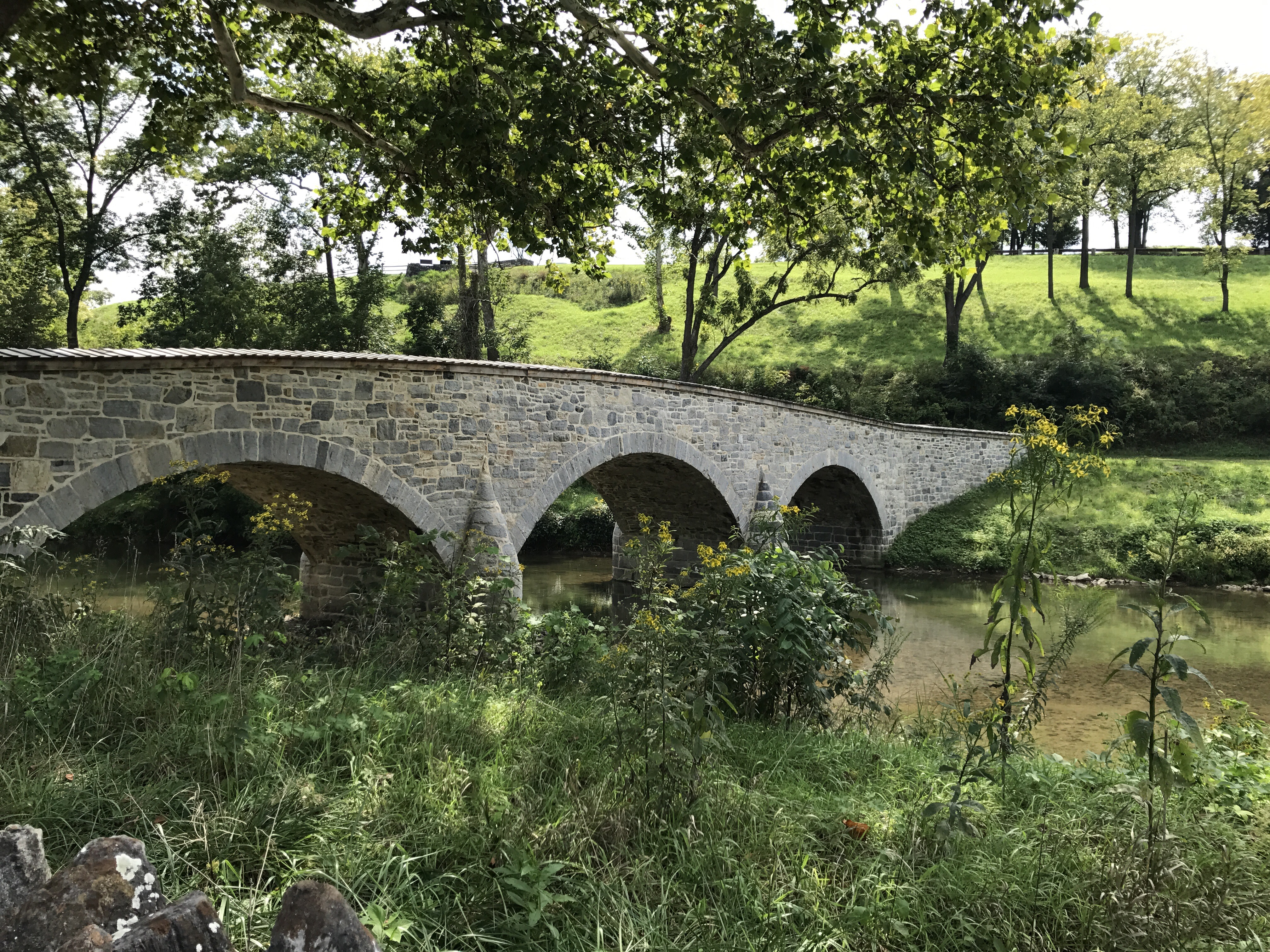
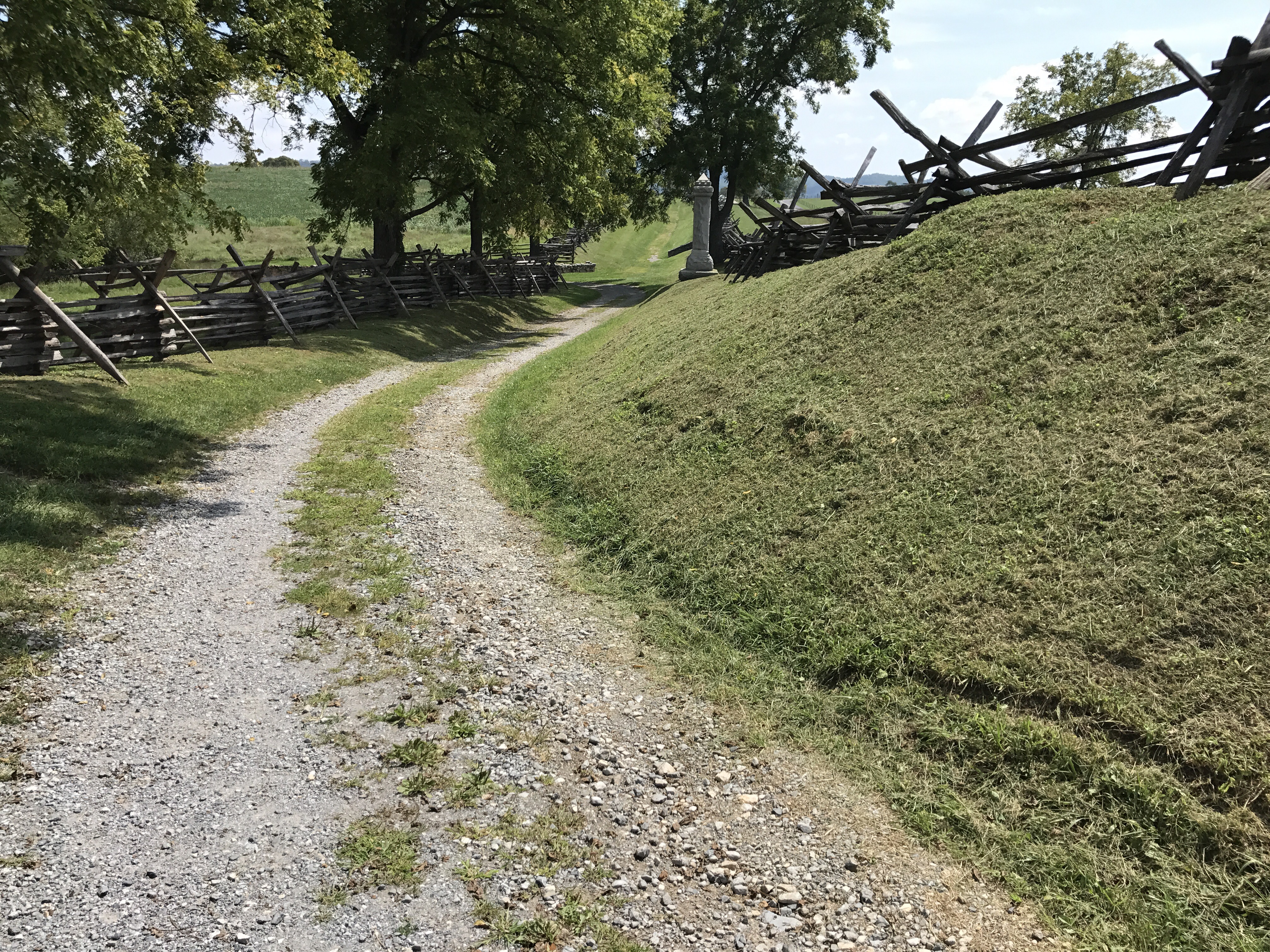
We are fortunate along much of the east and central parts of the United States to have many well preserved battlefields. I highly recommend those who have not gotten out to see them, walk them, and to remember those who were killed, wounded, or emotionally scarred for life. Walking the Antietam battlefield for the first time since 2001 I was able to sense the terrible reality that that battlefield was the bloodiest single day of fighting in American history. Depending on the estimate some 22,000 to 27,000 Union and Confederate soldiers were killed or wounded on that one day. As I walked through the Cornfield and the West Woods I tried to imagine how over 13,000 troops were killed or wounded in that part of the battlefield alone. I felt the same way along the Bloody Lane, near the Dunker Church, at the Burnside Bridge, and along the furthest point of the Union advance. Of course this is hallowed ground and the National Cemetery has in it the remains of over 5,000 Union soldiers.


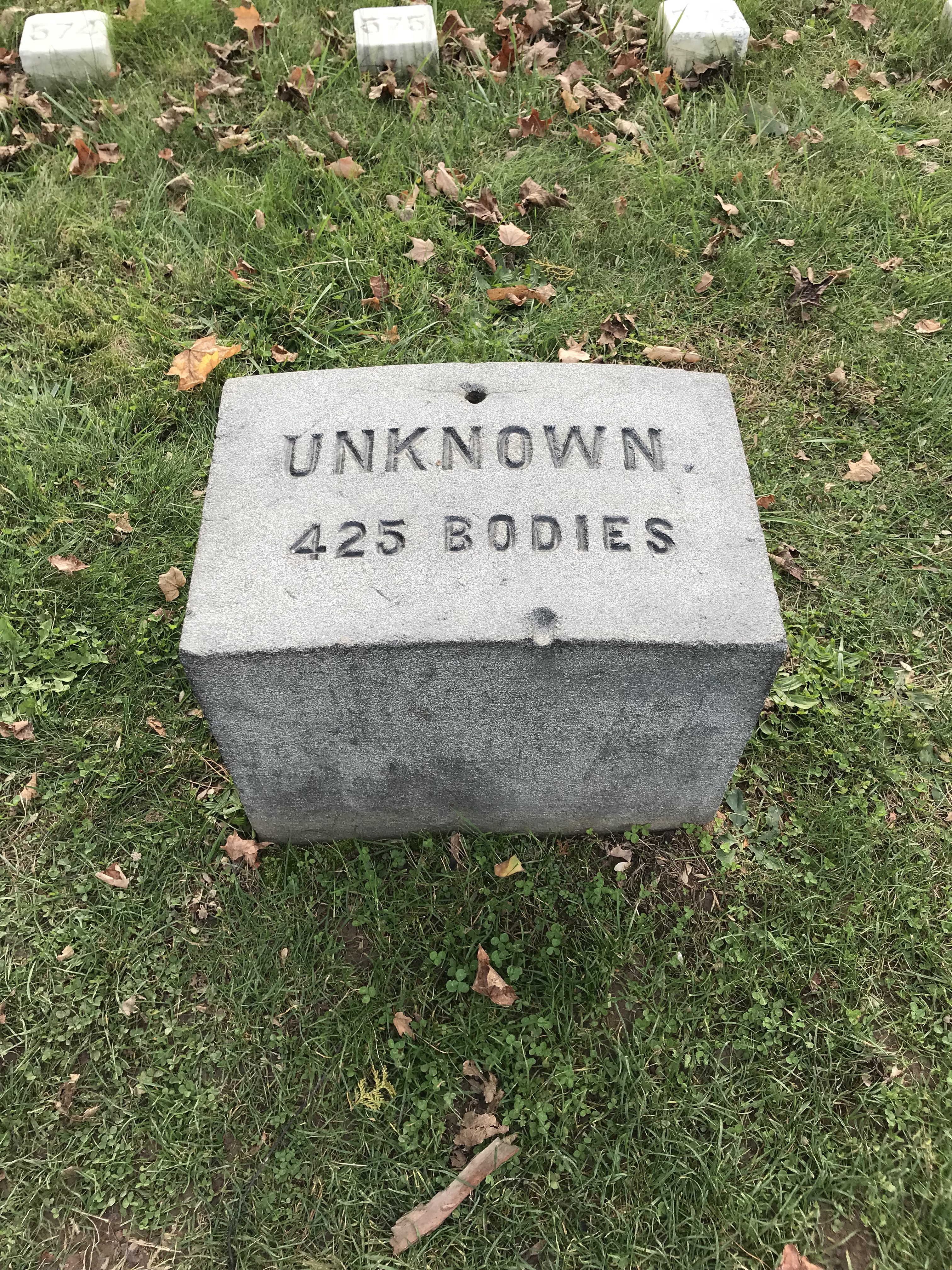
The remains of nearly 3,000 Confederates were interred in a new cemetery on the outskirts of Hagerstown which was dedicated in 1877 as well as two other cemeteries. This is interesting to me because at Gettysburg the Confederate dead were exhumed and taken back to the south with many buried in Richmond’s Hollywood Cemetery.


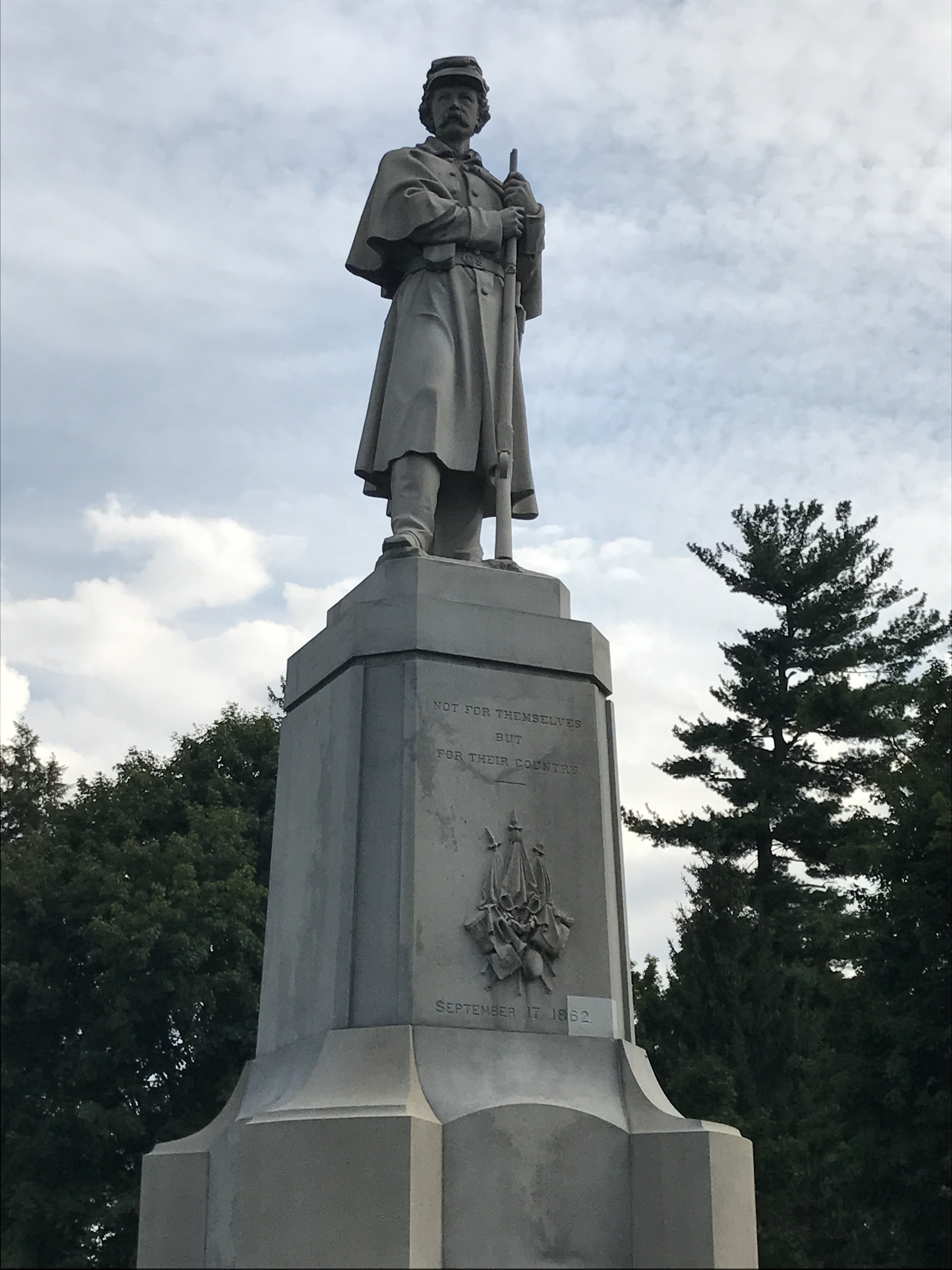
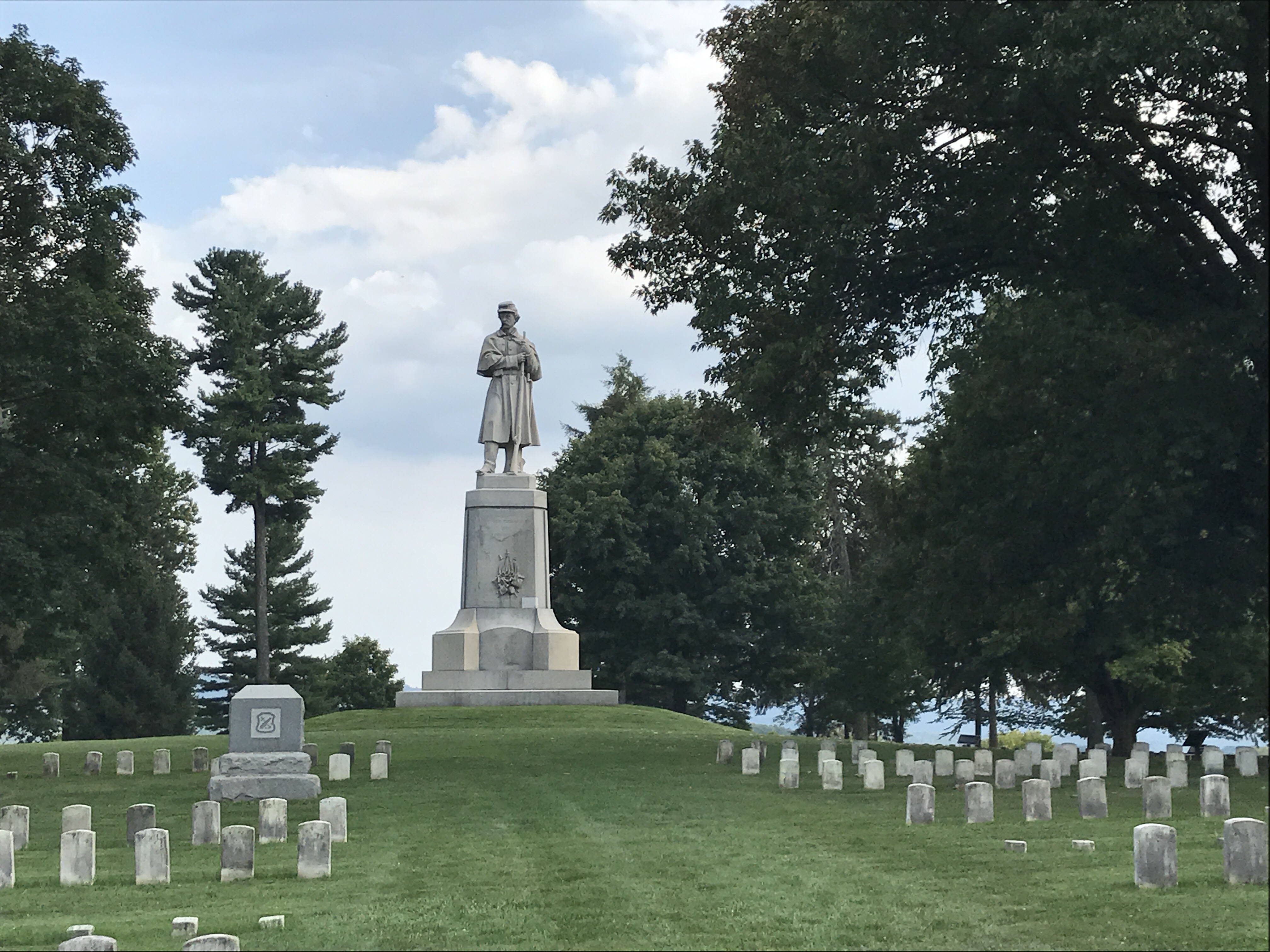
The National Cemetery is guarded by Old Simon a massive granite statue of a representative Union soldier. The monument is 44 feet tall, and Old Simon, designed and sculpted by James Batterson is 21 1/2 feet tall and weighs 30 tons. The inscription is appropriate. It simply reads: Not for themselves but for their country, September 17, 1862.


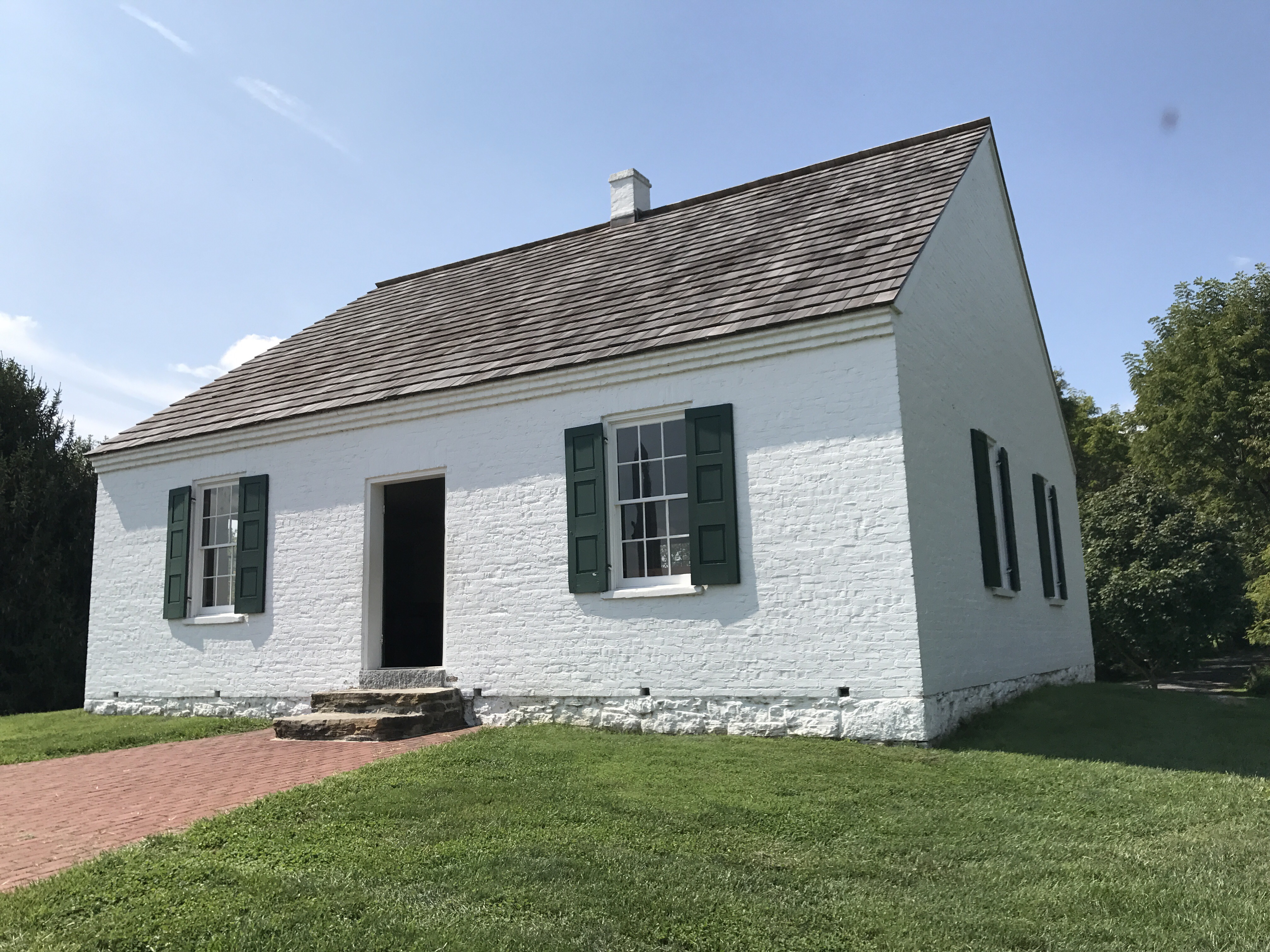
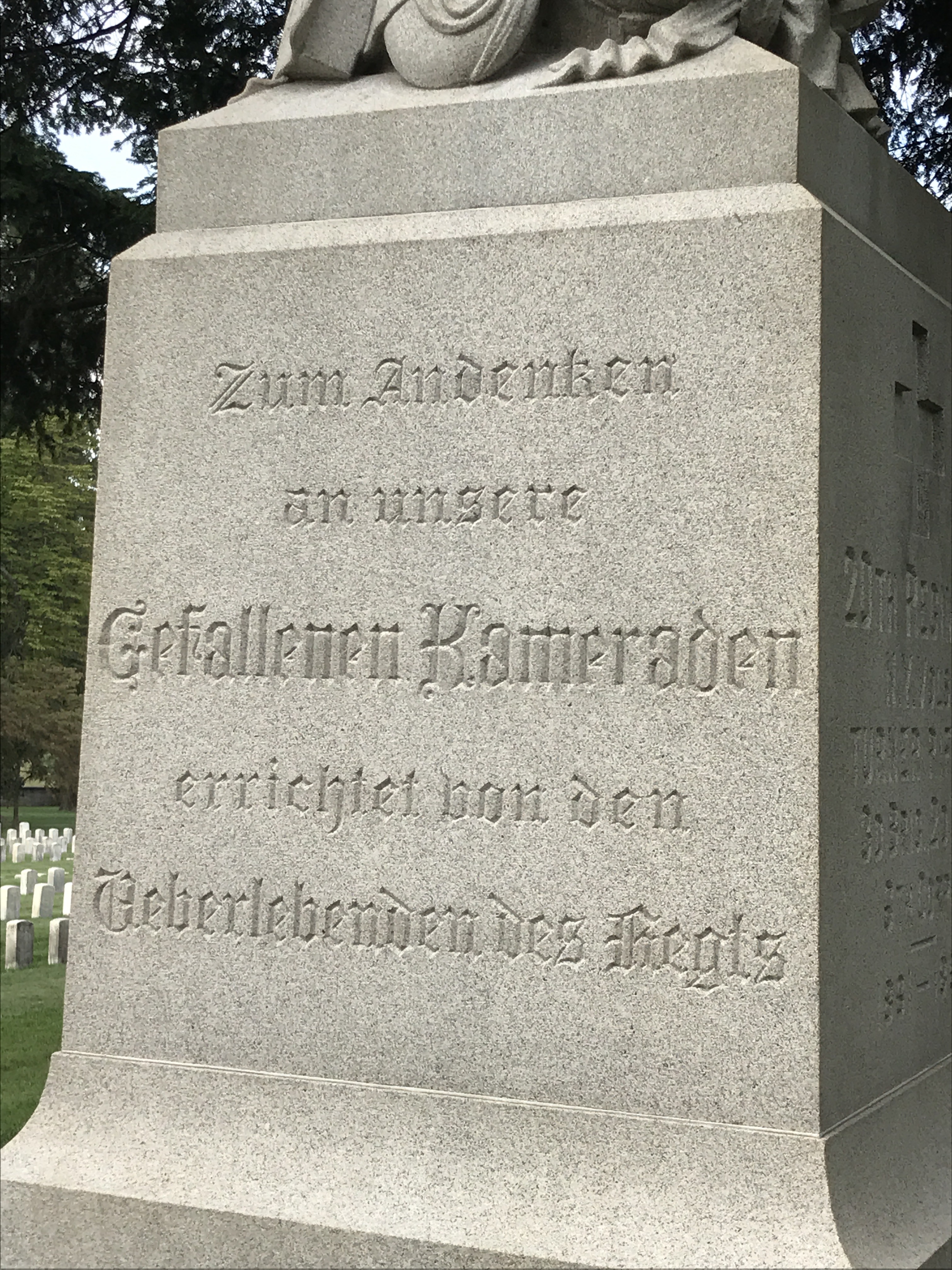
The graves of the soldiers are laid out around the statue grouped in the states from where they came. There are a few individual monuments and a monument erected by the survivors of the 20th New York, a unit primarily composed of German immigrants that also has a monument not far from the Dunker Church. The inscription on one side has in German the words Zum Andenken an unsere Gefallenen Kameraden, errichtet von dem Ueberlebenden des Regts. (Erected to our fallen comrades by the survivors of the regiment)


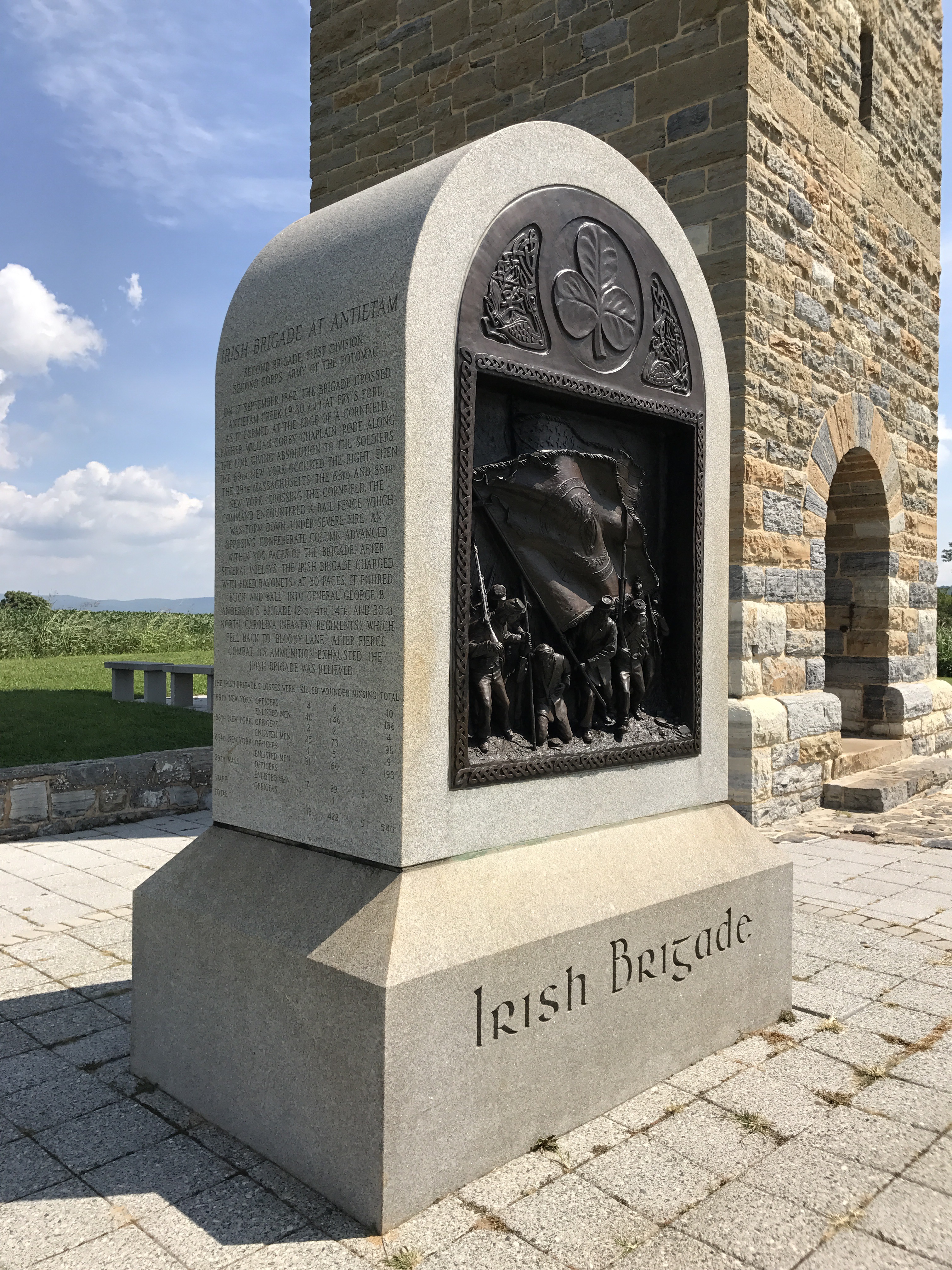
As far as battlefield monuments are concerned there are comparatively few, just 96 as compared to Gettysburg which has some 1,300 of all types. Almost all of the monuments at Antietam, with the exception of the ubiquitous bronze markers that show the positions of units and describe their actions, are dedicated to units of the Army of the Potomac. These were erected by states, communities that contributed troops and veteran associations. There are only six monuments specifically honoring Confederates with Maryland having a monument to its soldiers of both sides.


 Of the Confederate monuments most are of fairly recent import. Georgia and Texas have monuments to all of their soldiers, while Mississippi has one dedicated to the 11thMississippi Infantry. All three of these stand within a hundred yards of each other on the southern edge of the Cornfield.


There is a monument to Robert E. Lee near the new Burnside bridge off Maryland Highway 34 as you cross Antietam Creek. It too is a rather new addition, being funded by William F. Chaney and dedicated in June 2003. Chaney had noted that he just wanted “even things up a bit.” The inscription on it furthers the Lee myth promoted by the purveyors of the Lost Cause and the Noble South saying “Although hoping for a decisive victory Lee had to settle for a military draw, Robert E. Lee was personally against secession and slavery, but decided his duty was to fight for his home and the universal right of every people to self-determination.”


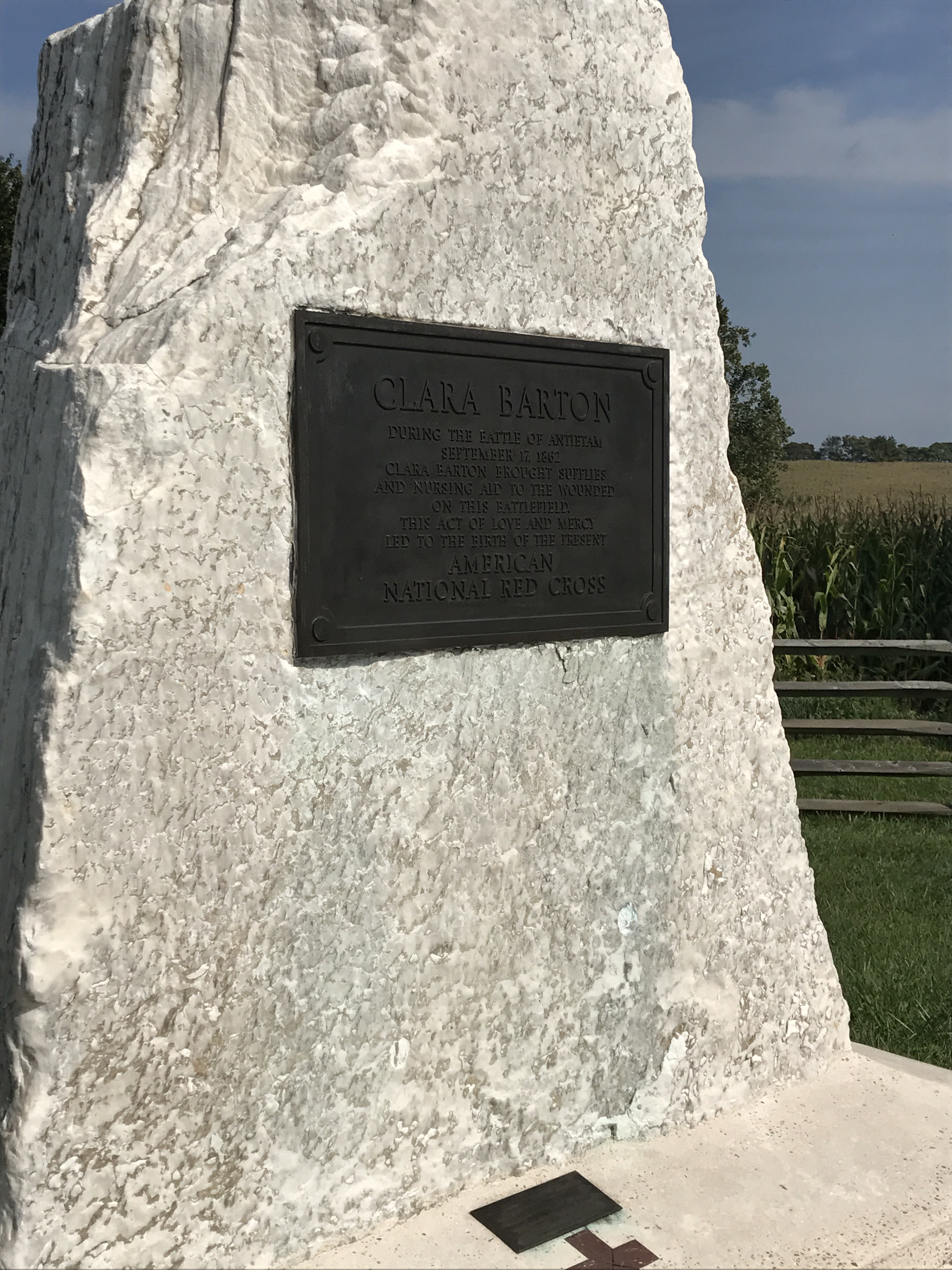
A monument on the northern edge of the Cornfield is dedicated to Clara Barton who along with other nurses helped to care for the wounded of the battle and one near the Burnside Bridge to President William McKinley who was a Sergeant in the 23rd Ohio Infantry. Six monuments each with a cannon placed upside down into a stone, these are mortuary markers noting where six Generals were killed or mortally wounded. They include Union Generals Joseph Mansfield, commander of XII Corps, and division commanders Israel Richardson and Isaac Rodman. Three Confederate brigade commanders, George Anderson, William Starke, and Lawrence O’Brien Branch are marked by identical monuments.


There was an eerie pristine feeling when I walked the battlefield yesterday. There were not many people on it, especially compared to Gettysburg. This led to a rather solitary experience amid the quite, only punctuated by the calls of birds, the chattering of squirrels, and the assorted buzzing, chirping, and humming of insects. As I walked the Cornfield, the West Woods, the Sunken Road and Bloody Lane, crossed the Burnside Bridge, made my way to the furthest point of the Union advance, and paused in the cemetery I was continually reminded of Walt Whitman’s poem, Ashes of Dead Soldiers:

“Ashes of soldiers South or North, As I muse retrospective murmuring a chant in thought, The war resumes, again to my sense your shapes, And again the advance of the armies. Noiseless as mists and vapors, From their graves in the trenches ascending, From cemeteries all through Virginia and Tennessee, From every point of the compass out of the countless graves, In wafted clouds, in myriads large, or squads of twos or threes or single ones they come, And silently gather round me…”


Until tomorrow,

Peace,

Padre Steve+

3 Comments

Filed under civil war, History, Loose thoughts and musings, Military, Travel

Statues With Limitations: Part One


Friends of Padre Steve’s World,

Over the past week I have written a number of articles about what happened in Charlottesville and I have promised to write something about the Confederate Monument controversy. Last night I posted an article about that controversy in light of one particular monument in Colfax, Louisiana, the site of one of the most brutal massacres committed in the name of White Supremacy in our nation’s history. I do hope that you read it and share it. 

Likewise I have I have posted quite a few articles and links to articles regarding what happened at Charlottesville and the subsequent debate about removing Confederate statues on my Facebook and Twitter pages. 

Today I am beginning a two part article dealing with my thoughts on the monuments themselves. This section is more of a background article before part two which will deal with my thoughts about the monuments themselves in the broader context of them, as well as other monuments not necessarily connected with the Confederate monuments. 

First, as to the Confederate Monuments, my comments are not meant to impugn the lives of people’s ancestors. My family on both my paternal and maternal sides fought as members of the 8th Virginia Cavalry on the side of the Confederacy even though their part of Virginia officially sided with the Union. One of them, the family patriarch on my paternal side was a slave holder who after the war refused to swear his allegiance to the United States and probably was a member of White Supremacist groups after the war. There is no doubt of what he fought for, and the fact that he was a traitor and remained a traitor to our country. I don’t know as many details about the maternal side except they were part of the same regiment, except that they were not subject to conscription and as such all volunteered willingly to fight against the United States. For that is a problem, I find it hard to honor their military service because it was against the United States. There are no records that I know of, no letters that they wrote which say what they thought, and they are not “mentioned in dispatches” (the manner in which the Confederate Army honored soldiers) for any particular gallantry, in fact the history of the regiment mentions that my paternal family patriarch deserted in February of 1865. 

I do draw a distinction between the kinds of men that served in the Confederate Army. In particular I make a distinction between those that were eager volunteers for the Confederacy and those who were unwilling conscripted in the Confederate Draft beginning in early 1862 because the Confederate Army could not get enough willing volunteers. These men were drafted, often against their will. Most had no means to pay for a substitute or did not have political connections. Interestingly one of the notable exemptions to the Confederate Draft were the men who were exempted  because they owned more than ten slaves or worked for someone that owned more than 20 slaves. This was known as the Twenty Slave Rule, which modified in Draft Law of 1864 to 15 slaves. As you can imagine many poor Whites who owned no slaves found the rule to be quite unjust, but privilege is just that, quite unjust. 

As a result the conscripts were frequently abused by the willing volunteers and frequently deserted. When found, most were summarily executed following a Drumhead Trial. As the war became more desperate, deserters were summarily exectuted without trial. Hundreds of deserters from the Army of Northern Virginia were executed in the last months of the war by the direct order of Robert E. Lee simply because they were trying to go home to their families who had been displaced by the advance of Sherman’s army in Georgia and the Carolinas. These men were victims of the war and secessionist leaders as much as anyone. If you read some of their letters they are heartbreaking. 

Those who volunteered to serve the Confederate cause, especially men who had been officers in the United States Army or Navy no-matter their reason for serving the Confederacy, their gallantry as soldiers, battlefield heroics, leadership skills, or tactical brilliance were traitors to the United States. Yes they were Americans, and many had served honorably before the Civil War, but that makes them no less traitors. After the war a good number of the survivors reconciled with the Union, opposed the growing myth of the Lost Cause, and took no part in subsequent violence or in implementing discriminatory measures against the now free Blacks. Among the most prominent of these men were Lee’s lieutenants James Longstreet, Richard Ewell, John Mosby, and Billy Mahone. I have no doubt that A.P. Hill would have joined them had he not been killed in action at the end of the war, and following the war his widow opposed Jubal Early and other proponents of the Lost Cause. Robert E. Lee himself did reconcile and opposed the use of the Confederate flags, uniforms, and monuments. I will explore Lee’s actions before, during and after the war in another article that I have already started to draft. 

Interestingly, very few monuments, except those on battlefields are dedicated to these men in the South, except from Robert E. Lee who ironically wanted no part of them. Nor are there monuments in the South to Southern officers who remained loyal to the Union during the war including Generals Winfield Scott, George Thomas, John Buford, John Gibbon, Montgomery Miegs, and Admiral David Farragut. 

Likewise there is another class of men who have to be considered when dealing with the Monument Controversy. These were the political leaders whose actions led directly to the deaths of three quarters of a million men, including hundreds of thousands of Southern men, and the destruction of much of the South. How even the most devoted Southerner who wants to honor their soldiers can tolerate monuments to these leaders in their back yards is beyond me. These were also the men who ensured that every state legislature made sure that the primary reason they gave for secession in their various articles of secession was preserving and expanding slavery, while maintain white superiority. As Confederate Vice President Alexander Stephens noted in his Cornerstone Speech:

“Our new Government is founded upon exactly the opposite idea; its foundations are laid, its cornerstone rests, upon the great truth that the negro is not equal to the white man; that slavery, subordination to the superior race, is his natural and normal condition.”

There is a final group that needs to be considered. These were Confederate veterans, including notables like General Nathan Bedford Forrest, as well as men who did not serve in the war who joined paramilitaries that terrorized and killed newly free blacks. There were others who established the Black Codes which were pre-Jim Crow laws that placed many former slaves into a form of slavery by other means, imprisoning them and making them forced laborers on plantations, and businesses, many owned by Northerners. 

Racism and slavery was at the heart of the war, and it was not just a Southern problem. Many Northern businesses and banks had a strong financial interest in slavery, and there was a strong anti-war, pro-Confederate movement in the North that fully approved of slavery, the post-war Black Codes, and Jim Crow. Likewise there were many Northerners who were just as racist before, during and after the war. There were and are still are many Sundown Towns in the North and states that were never a part of the Confederacy. In no way can Northerners be fully excused from the crime of slavery, nor can they be absolved of being as racist any pro-slavery Confederate or Jim Crow proponent. Some of these men have monuments built in their honor which likewise should be examined if we are going to talk about the Confederate monuments. 

As to the monuments themselves, the vast majority were erected after the Plessy v. Ferguson case that legalized the Jim Crow Laws and empowered the movement to disenfranchise blacks, to fire them from positions in Federal and State governments, and to use violence against Blacks to keep them in line. Almost all of the monuments which were erected between 1895 and 1930 were put up not to honor the men who served but to remind Blacks of their status. The same is true of the next major surge of monument building which occurred during the Civil Rights movement, again to demonstrate to Blacks that they were subordinate to Whites, and many of these monuments were erected in places where no Confederate soldiers came from, and others which commemorate men who committed terrorist acts and murder against Blacks in the years after the war. In many case these monuments are located in cities and towns that are heavily African American. Two of these are no far from where I live in Norfolk and Portsmouth Virginia. They have different histories which I think leads to a discussion about their context. 

So, that is some of the background. I’ve written a lot about slavery, secession, and Jim Crow and will put some of those articles out again, and tomorrow I will have my proposal on what I think should be done with the various monuments. This will take into the context each type of monument and how to respectfully deal with them and how people feel about them, both opponents and supporters. In looking at what I wrote here the series may well be more than two parts. 

Until tomorrow,

Peace

Padre Steve+ 

4 Comments

Filed under civil rights, civil war, History, News and current events, Political Commentary

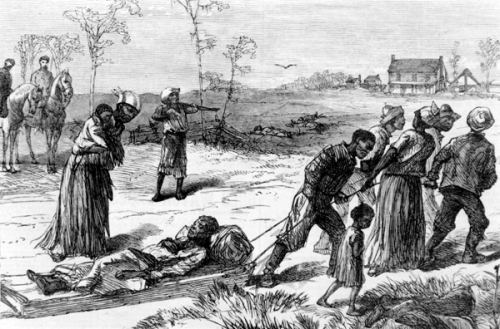
A Monument to Murder

Friends of Padre Steve’s World,

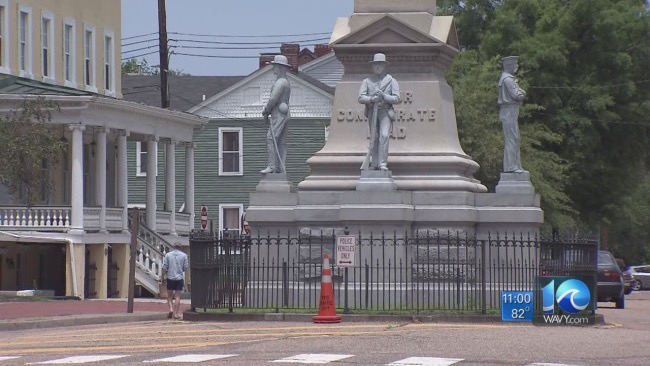
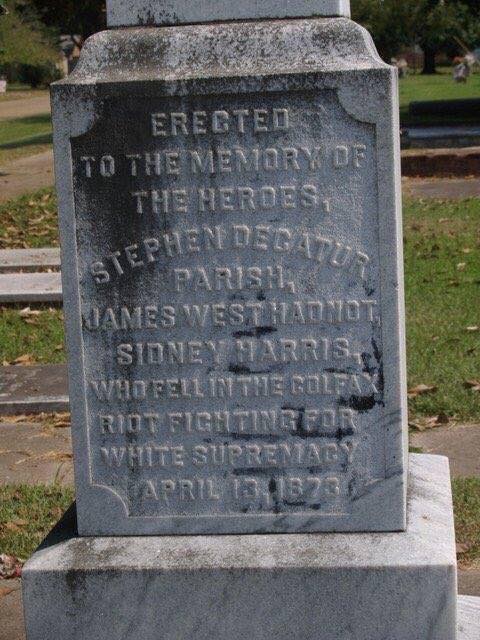
In light of the Confederate Monument controversy I am posting a part of one of my book drafts regarding the Colfax Massacre. This event occurred eight years after the Civil War ended when hundreds of heavily armed men from the White Liners, a White Supremacist movement in Louisiana attacked the town of Colfax on Easter Sunday 1863. There are monuments to the murderers, one which I have included in this article.

When it comes to the monuments everything depends on context. Since the vast majority of the monuments were placed in the aftermath of Plessy v. Ferguson during the height of the Jim Crow Era, and many others as a reaction to the Civil Rights Movement there is no doubt that those that erected them intended them to be symbols which reminded Blacks of their inferior place.

I am in the process of writing a number of articles dealing with the monuments.  This is not because I am trying in any way to denigrate the lives of ordinary Confederate soldiers, many of whom were drafted against their will beginning in 1862 because there were not enough volunteers. Many of those conscripted soldiers died in hopeless battles and others when they attempted to desert from the Army of Northern Virginia to help their families when Sherman’s Army marched through Georgia and the Carolinas, were summarily executed on the orders of General Robert E. Lee.

Likewise this is not an indictment of men who men who were gallant soldiers who in volunteering to serve alongside their friends and fellow townspeople fought for a abhorrent cause, as many of them didn’t see their fight in that manner. If you read their letters and correspondence on can see a number of different reasons that they fought, some were true believers in the Confederacy and Slavery, but others were not. But to be sure their leaders did understand.

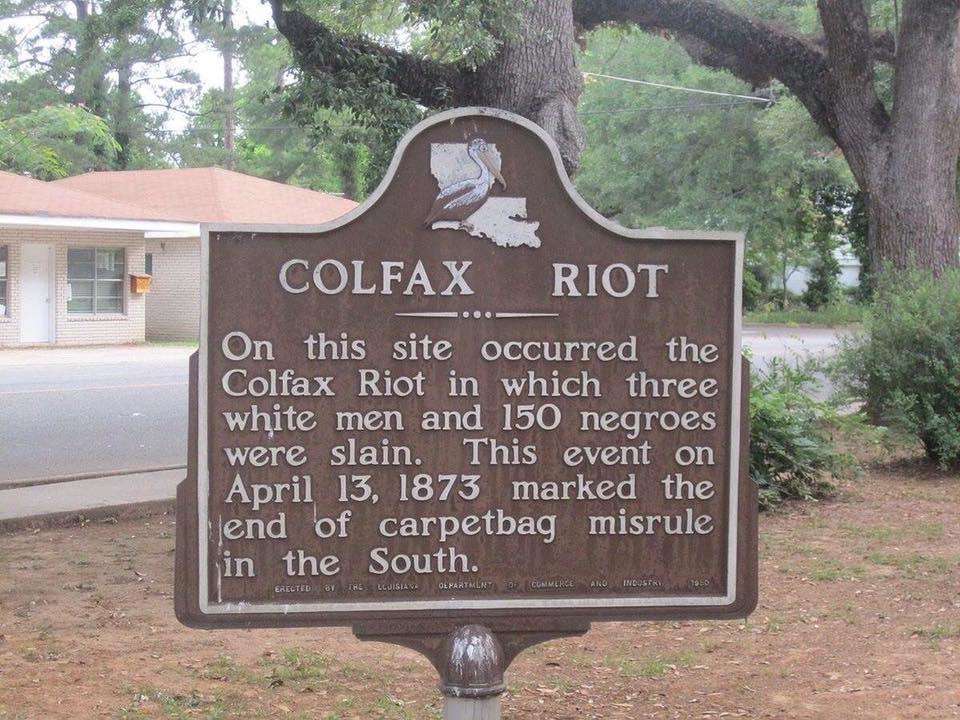
In the case of the Colfax massacre, some of the men involved were former Confederate soldiers, while others either never served or were to young to serve in the war. But at Colfax they were not soldiers, they were terrorists. In this case the heritage is hate. Interestingly the historical marker on the site terms in a “riot” not a massacre or act of terrorism and in blames in on “Carpetbagger misrule.”

So anyway, that is why the context of the various monuments matters. You’ll see more over the next few days, but this is something that matters more than a meme, more than a false comparison of being on a slippery slope to removing the statues of George Washington and other Founding Fathers who owned slaves.

Here is the excerpt from my book.

Peace

Padre Steve+

The violence against Southern blacks escalated in the wake of the passage of the Fourteenth and Fifteenth Amendments and with the increasing number of blacks being elected to office in some Southern states during the elections of 1872. In Louisiana a Federal court ruled in favor of Republican Reconstruction candidates following a Democrat campaign to interfere with the vote, which included attacks on polling sites and the theft of ballot boxes. As a result the Louisiana Democrats “established a shadow government and organized paramilitary unit known as the White League to intimidate and attack black and white Republicans.” [1]

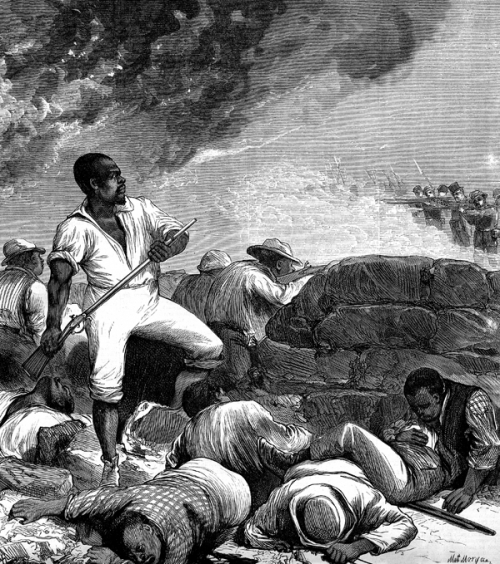
The White League in Louisiana was particularly brutal in its use of violence. The worst massacre committed by the White League occurred Easter Sunday 1873 when it massacred blacks in Colfax, Louisiana. Colfax was an isolated nondescript hamlet about three hundred fifty miles northwest of New Orleans. It sat on the grounds of a former plantation whose owner, William Calhoun, who worked with the former slaves who were now freedmen. The town itself“composed of only a few hundred white and black votes” [2] was located in the newly established Grant Parish. The “parish totaled about 4,500, of whom about 2,400 were Negroes living on the lowlands along the east bank of the Red.” [3] Between 1869 and 1873 the town and the parish were the scene of numerous violent incidents and following the 1872 elections, the whites of the parish were out for blood.

White leaders in Grant Parish “retaliated by unleashing a reign of terror in rural districts, forcing blacks to flee to Colfax for protection.” [4]The blacks of parish fled to the courthouse seeking protection from a violent white mob following the brutal murder of a black farmer and his family on the outskirts of town. The people of Colfax, protected by just a few armed black militiamen and citizens deputized by the sheriff took shelter in the courthouse knowing an attack by the White Supremacists was coming.  As the White League force assembled one of its leaders told his men what the day was about. He said, “Boys, this is a struggle for white supremacy….There are one hundred-sixty-five of us to go into Colfax this morning. God only knows who will come out. Those who do will probably be prosecuted for treason, and the punishment for treason is death.” [5] The attack by over 150 heavily armed men of the White League, most of whom were former Confederate soldiers, killed at least seventy-one and possibly as many as three-hundred blacks. Most of the victims were killed as they tried to surrender. The people, protected by just a few armed men were butchered or burned alive by the armed terrorist marauders. It was “the bloodiest peacetime massacre in nineteenth-century America.” [6]

The instigators of the attack claimed that they acted in self-defense. They claimed that “armed Negroes, stirred up by white Radical Republicans, seized the courthouse, throwing out the rightful officeholders: the white judge and sheriff” and they claimed that the blacks had openly proclaimed “their intention to kill all the white men, they boasted they would use white women to breed a new race.” [7]The claims were completely fabricated, after sending veteran former army officers who were serving in the Secret Service to investigate, the U.S. Attorney for Louisiana, J.R. Beckwith sent an urgent telegram to the Attorney General:

“The Democrats (White) of Grant Parish attempted to oust the incumbent parish officers by force and failed, the sheriff protecting the officers with a colored posse. Several days afterward recruits from other parishes, to the number of 300, came to the assistance of the assailants, when they demanded the surrender of the colored people. This was refused. An attack was made and the Negroes were driven into the courthouse. The courthouse was fired and the Negroes slaughtered as they left the burning building, after resistance ceased. Sixty-five Negroes terribly mutilated were found dead near the ruins of the courthouse. Thirty, known to have been taken prisoners, are said to have been shot after the surrender, and thrown into the river. Two of the assailants were wounded. The slaughter is greater than the riot of 1866 in this city. Will send report by mail.” [8]

Federal authorities arrested nine white men in the wake of the massacre and after two trials in which white majority juries were afraid to go against public opinion, three were “convicted of violating the Enforcement Act of 1871.” [9] None were convicted of murder despite the overwhelming evidence against them and even the lesser convictions enraged the White Supremacists in Louisiana who had employed the best lawyers possible and provided them and the defendants with unlimited financial backing. Assisted by the ruling of Supreme Court Associate Justice Joseph Bradley, who had a long history of neglecting Southern racism, white Democrats appealed the convictions to the Supreme Court.

The attack, and the court cases which followed, notably the judgment of the Supreme Court in United States v. Cruickshank which dealt with the appeal of the men responsible for the Colfax Massacre led to a “narrowing of Federal law enforcement authority” and were “milestones on the road to a “solid” Democratic South.” [10] The decision of the court in United States v. Cruikshank was particularly perverse in its interpretation of constitutional rights and protections. The court ruled in favor of the terrorists and declared that “the right of the black victims at Colfax to assemble hand not been guaranteed because they were neither petitioning Congress nor protesting a federal law. Assembling for any other cause was not protected.” [11] The Cruikshank decision amounted to a Supreme Court endorsement of violence against blacks, and made it “impossible for the federal government to prosecute crimes against blacks unless they were perpetrated by a state and unless it could prove a racial motive unequivocally.” [12] Northern politicians and newspapers, reeling under the effects of the stock market crash of 1873, which had denounced the massacre just a year before now ran from the story and from support of African Americans. A Republican office holder wrote, “The truth is, our people are tired out with this worn cry of ‘Southern outrages…. Hard times and heavy taxes make them wish the ‘nigger,’ the ‘everlasting nigger,’ were in hell or Africa.” [13] Racism and race hatred was not exclusively the parlance of the South.

In the wake of Justice Bradley’s reversal of the Colfax convictions whites in Grant Parish engaged in brutal reprisals against blacks, leading to many murders and lynching’s, crimes which law enforcement, even that favorable to the rights of African Americans were afraid to prosecute for fear of their own lives. Louisiana’s Republican Governor, William Pitt Kellogg wrote Attorney General Williams blaming the violence on Bradley’s ruling, which he wrote, “was regarded as establishing the principle that hereafter no white man could be punished for killing a negro, and as virtually wiping the Ku Klux laws of the statute books.” He added that with the Army leaving the state that his government and other Reconstruction governments would fall, “if Louisiana goes,” Kellogg wrote, “Mississippi will inevitably follow and, that end attained, all the results of the war so far as the colored people are concerned will be neutralized, all the reconstruction acts of Congress will be of no more value than so much waste paper and the colored people, though free in name, will be practically remitted back to servitude.” [14] Governor Kellogg could not have been more correct.

In the years that followed many of the men involved in the massacre and other murders before and after were hailed as heroes, some, including the leader of the attackers, Christopher Columbus Nash were again appointed to office in Colfax and Grant Parish and blacks were reminded every day of just what they had lost. On April 13th 1921 the men who committed the massacre were honored with a memorial in the Colfax cemetery honoring them as “Heroes… who fell in the Colfax Riot fighting for White Supremacy.” In 1951 the State of Louisiana Department of Commerce and Industry dedicated a marker outside the Courthouse which read: “On the site occurred the Colfax Riot in which three White men and 150 Negroes were slain, this event on April 13, 1873 marked the end of Carpetbag misrule in the South.”[15] That marker still stands, there is no marker commemorating the victims.

Other massacres followed across the South, aimed at both blacks and their white Republican allies. In Louisiana the White League had some 14,000 men under arms, in many cases drilling as military units led by former Confederate officers. A White League detachment southwest of Shreveport “forced six white Republicans to resign their office on pain of death – and then brutally murdered them after they had resigned.” [16] This became known as the Coushatta Massacre and it was a watershed because for the first time the White League targeted whites as well as African Americans. The violence, now protected by the courts ensured that neither would last long in the post-Reconstruction South and that the freedom of African Americans in those states would amount to a cruel illusion.

In 1875, President Ulysses S. Grant including comments about the Colfax massacre and the subsequent court decisions in his message to Congress. Grant was angry and wrote: “Fierce denunciations ring through the country about office-holding and election matters in Louisiana…while every one of the Colfax miscreants goes unwhipped of justice, and no way can be found in this boasted land of civilization and Christianity to punish the perpetrators of this bloody and monstrous crime.” [17]President Grant, the man who so wanted to help African Americans attain the full measure of freedom, was unable to do more as the Congress and Courts took sides with the Southern insurgents.

Notes

[1] Ibid. Foner Forever Free p.151

[2] Ibid. Langguth After Lincoln p.312

[3] Ibid. Lane The Day Freedom Died p.42

[4] Ibid. Goldfield America Aflame p.493

[5] Ibid. Lane The Day Freedom Died p.91

[6] Ibid. Goldfield America Aflame p.493

[7] Ibid. Lane The Day Freedom Died p.11

[8] Ibid. Lane The Day Freedom Died p.22

[9] Ibid. Goldfield America Aflame p.494

[10] Ibid. Lane The Day Freedom Died p.251

[11] Ibid. Langguth After Lincoln p.314

[12] Ibid. Goldfield American Aflame p.494

[13] Ibid. Lane The Day Freedom Died p.213

[14] Ibid. Lane The Day Freedom Died p.217

[15] Ibid. Lane The Day Freedom Died pp.261-262

[16] Ibid. McPherson The War that Forged a Nation p. 185

[17] Ibid. Lane The Day Freedom Died p.228


6 Comments

Filed under Loose thoughts and musings

“Time to Oblterate the Marks of Civil Strife and the Feelings of Oblivion the Feelings it Engendered”  


Friends of Padre Steve’s World,

Just a short post today because I have become weary of cyber-battles with neo-Confederates and Alt-Right Nazis. That is not to say that I won’t stop fighting them, but don’t have a lot of energy to put into this post because of those battles. I guess it could be worse, I could be tired because I had spent the day getting real bullets fired at me by these people’s Confederate and Nazi ancestors. I have been shot at in combat by Iraqi insurgents, and no it is not fun, especially when you are the only guy there without a weapon. That being said, my ancestors on both sides of my family fought for the Confederacy, and those on my paternal side were slave owners, Confederate officers, and unrepentant rebels who would not reconcile themselves to the defeat of the Confederacy. 

Unlike my ancestors, Confederate General James Longstreet was honest with himself and to the causes of the war. He wrote this in 1867:

“The surrender of the Confederate armies in 1865 involved: 1. The surrender of the claim to the right of secession. 2. The surrender of the former political relations of the negro. 3. The surrender of the Southern Confederacy. These issues expired on the fields last occupied by the Confederate armies. There they should have been buried. The soldier prefers to have the sod that receives him when he falls cover his remains. The political questions of the war should have been buried upon the fields that marked their end.” 

I am going to write about my rather nuanced view of statues dedicated to Confederate soldiers or leaders in the next few days. I had a really good, and lengthy discussion today with a fellow officer and friend about that subject. When I write it my words will probably not make anyone completely happy because I am not an absolutist in my views. While I reject what my ancestors fought for I also know that there were Confederate soldiers who were drafted against their will, Southerners like George Thomas and John Buford, who fought for the Union, and Northerners who fought political battles against Abraham Lincoln and wanted the South to win its independence because it would be good for business, and because they were as racist as the most rabid slave power secessionist. There were also Confederates who after their defeat, including James Longstreet, John Mosby, and Billy Malone who reconciled with the United States, recanted their secessionist views, and were demonized as if they were Judas Iscariot by the leaders of the Lost Cause cult because they did so. 

Robert E. Lee, who as so many statues in his honor including the one in Charlottesville that the Neo-Nazis supposedly went to defend, made this comment regarding such things, he was not in favor of them because he did not think it wise to keep open the wounds of war. He said:

“I think it wiser moreover not to keep open the sores of war, but to follow the examples of those nations who endeavored to obliterate the marks of civil strife and to commit to oblivion the feelings it engendered.” 

The neo-Confederates would be wise to heed to his words and those of James Longstreet. 

But I’ll leave that until I write that article. 

Peace

Padre Steve+ 

6 Comments

Filed under civil rights, civil war, ethics, History, Military, News and current events, Political Commentary

The Tragedy of Friends Divided By War: Winfield Scott Hancock and Lewis Armistead on Cemetery Ridge


Friends of Padre Steve’s World,

I have been rating but continuing to work on my Civil War and Gettysburg texts this weekend, and because of that I am retiring to an older post about the relationships of close friends in war. In this case, friends who had served together for many years who ended up fighting each other at Gettysburg. The story is tragic, because none of them hated each other, or held any animosity towards each other, but instead had followed what they believed to be their duty, some in the continued service of the Union, and others to that of their home states. Even so the bonds of friendship were never severed. Of course, unless you have served with people in war and in the military it it hard to comprehend such a fate. Even now, I know men that I consider friends, men who now hold very different political and social beliefs than me, and if God forbid there was ever another civil war, we would be on opposite sides, but they would still be friends, and I would grieve the fact that we would be fighting. 

I do plan on reworking this section of my Gettysburg text again, adding to it and further exploring the dynamics of the relationships at play in this story. But for now, since I have been working on other things, this will have to do.

Have a great day,

Peace

Padre Steve+

The bonds of friendship forged by soldiers are some of deepest and long lasting that are formed anywhere.  For American military professionals those bonds are formed in the small rather closed society that is the regular United States military. They are formed in war and peace, and are marked by years of deployments, isolated duty and combat. They are part of a culture that is often quite different than that of civilian society. That is the case now as it was in 1860.

When the Southern States seceded from the Union men who had spent much of their adult lives serving together discovered had to say goodbye and prepare to fight each other. Most did so with a heavy heart even though many had strong convictions about the rightness of their region’s cause. Those who left the army to serve the Confederate states were often torn by doubt and questions of where their loyalty lay. Robert E. Lee was a good example of the conflict that many Southern officers faced. “The Southern professional officer in 1861 was confronted with a cruel choice symbolized by Lee’s anguished pacing at Arlington. On one hand, the Southern officer’s political allegiances drew him to the Confederacy; on the other his professional responsibility drew him to the Union.” [1] They wrestled with their oath of office and the costs of perhaps having to face their dearest friends on future battlefields. Lee’s letter to his sister Ann Marshall, who remained a supporter of the Union, after he resigned from the army he had served for 32 years reflects that anguish, torn between his loyalties Lee wrote “With all my devotion to the Union, and the dear feeling of loyalty and duty of an American citizen, I have not been able to make up my mind to raise my hand against my relatives, my children, my home.” [2] He added: “I know you will blame me…but you must think as kindly of me as you can, and believe that I have endeavored to do what I think right.” [3]

They were different from the mass levies of civilian volunteers who rallied to the flags of the Union and Confederacy in 1861. The volunteers, most of whom did not have the deep and abiding friendships of the professionals were often motivated by ideological, sectional or religious hatred of the other and went to war with great aplomb. However, the professionals for the most part went to war against former comrades with heavy heart, “old army colleagues found themselves wrenched from the normal course of their lives when their states joined the Confederacy.” [4]

The American Civil War has many such tales. Porter Alexander wrote of his final words with his superior James B. McPherson, who later went on to be a highly successful corps commander under Grant and Sherman before being killed outside Atlanta in 1864. McPherson desired that Alexander remain in California as an Engineering officer and warned him about the nature of the coming war and gave him his counsel as a friend:

“Now this is not going to be any 90 day or six months affair as some of the politicians are predicting. Both sides are in deadly earnest & it is long & desperate & fought to the bitter end. ..God only knows what may happen to you individually, but for your cause there can be but one possible result. It must be lost….” [5]

Alexander wrote: “Nothing could exceed the kindness & real affection with which McPherson urged these views on me…. His earnest talk impressed me deeply & made me realize that a crisis in my life was at hand. But I felt helpless to avert it or even to debate the question what I should do. I could not controvert one of McPhersons’ statements or arguments; I could only answer this: “Mac, My people are going to war, & and for their liberty. If I don’t come & bear my part they will believe me a coward…” [6]

One of the most remembered is that of Union General Winfield Scott Hancock and Confederate General Lewis Armistead. It was key story line in Michael Shaara’s Pulitzer Prize winning novel The Killer Angels was immortalized in the movie Gettysburg which is based on Shaara’s novel.


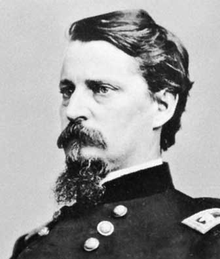
                                                                            Major General Winfield Scott Hancock USA

Hancock was from Pennsylvania. He was a career soldier and Infantry officer, a graduate of West Point Class of 1844. He served in Mexico and held numerous positions. In 1861 he was stationed in California as a Quartermaster under the command of Colonel (Brevet Brigadier General) Albert Sidney Johnston with the Sixth Infantry Regiment. One of his fellow officers was Captain Lewis Armistead, a twice widowed Virginian who also served as a commander of the New San Diego Garrison under Johnston’s command, and Richard Garnett commanding a company at Fort Yuma. Hancock and his wife Almira became fast friends with the widowed Virginian.

Armistead was a nephew of the officer who defended Fort McHenry from the British in the War of 1812. Armistead had academic and personal difficulties at West Point and “was bounced out, not once but twice.” [7] His troubles included an altercation with Jubal Early in which he broke a plate over Early’s head.  Between his academic difficulties and the fight with Early he resigned from the Academy. However, his father helped him obtain a commission as an Infantry officer in 1839. Armistead’s career from that point on was similar to many other officers of his day. He served with distinction in Mexico, the Great Plains, Kansas, Utah and California.

As the war clouds built and various southern states seceded from the Union numerous officers from the South were torn between their oath, their friendships and their deep loyalty to their home states and families. In the end most Southern officers resigned their commissions, many with mixed feelings and quite often sadness. A large minority, some “40 to 50 per cent of Southern West Point graduates on active duty in 1860 held on to their posts and remained faithful to the Union.” [8] The most prominent of these men were General Winfield Scott and Major General George Thomas, the “Rock of Chickamauga.” Likewise Union Brigadier General John Buford’s family in Kentucky supported the Confederacy.

For those southern officers who remained loyal to the Union to was often at a great personal cost. Thomas’s action cost him his relationship with his immediate family who deemed him to be a traitor. He and others were pilloried and demonized in the basest ways by many in the South. Some Southerners who served the Union were executed when they were captured. George Pickett, who called for his fellow Virginian Thomas’ death ordered 22 North Carolinians who he captured fighting for the Union in Kinston North Carolina to be executed. Pickett was not alone in such sentiments.


                                                                               Brigadier General Lewis Armistead CSA

However, for most it was different. As talk of secession and war heated up officers stationed on the frontier debated the issues and asked each other what they would do if war came. In California Armistead and other officers asked Hancock, who was a Democrat and not openly hostile to the South, advice on what he would do if war came. Hancock’s reply was simple. I shall not fight upon the principle of state-rights, but for the Union, whole and undivided” [9]

The parting came in 1861. When it was apparent that many officers would be resigning and heading home to join their state’s forces the Hancock’s hosted a going away party for their friends. Almira Hancock wrote of the party that “Hearts were filled with sadness over the surrendering of life-long ties.” [10]

Colonel Albert Sidney Johnston’s wife Eliza went to a piano and sang sentimental songs such as Mary of Argyle and the popular Irish song Kathleen Mavourneen. [11] Almira Hancock wrote “Those songs…will ever be remembered by survivors of that mournful gathering.” [12]

“Mavourneen, Mavourneen, my sad tears are falling, 

to think that from Erin and thee I must part!

It may be for years, and it may be forever, 

Then why art thou silent, thou voice of my heart?

The parting was especially emotional for Armistead who had been a friend of the Hancock’s for 17 years. They had helped in following the death of both of his wives and children. He was tearful. He put his arm on his friend’s shoulder as he said: “Hancock, good-by; you can never know what this has cost me, and I hope God will strike me dead if I am ever induced to leave my native soil, should worse come to worse.” [13] As he departed Armistead gave a wrapped Bible and Prayer book to Almira Hancock, in case of his death, inscribed were the words “Trust in God and fear nothing.” [14]

Armistead led his brigade during the Peninsula campaign and battles around Richmond and his brigade was decimated in Lee’s failed assault on prepared Federal positions at Malvern Hill. Armistead did not endear himself to many of the volunteer officers who served in the Confederate ranks. One of his Colonels resigned over Armistead’s supposedly harsh treatment to which Armistead replied: “I have felt obliged to speak to him as one military man would to another and as I have passed nearly all my life in camps my manner may not be understood or appreciated by one who has been all his life a civilian.” [15] Armistead’s words can easily be understood by military professionals whose lives have been shaped in a different manner than their civilian counterparts.

At Gettysburg Armistead spoke his fears about the charge to his comrades. One was Brigadier General Dick Garnett, another of Armistead and Hancock’s comrades from the California days on the night of July 2nd. Garnett’s career had paralleled that Armistead, the same age Garnett struggled at West Point in his third year “he failed and withdrew. Taking the same courses again during the next term, he finished fourteenth among his new classmates, then graduated in 1841 standing 29th of fifty-two graduates.” [16]

Armistead and Garnett served together in the Sixth Infantry for most of their careers. They were promoted at similar times, a pattern of promotion that continued into their Confederate service. The next afternoon, the two friends who had served together so long and whose careers were so similar led their brigades of Pickett’s Division across the valley between Seminary Ridge and Cemetery Ridge against their friend and comrade Winfield Scott Hancock’s II Corps which was defending Cemetery Ridge.

Garnett had to lead his brigade on horseback, having been injured during the army’s march to Gettysburg. During the engagement Garnett was killed just before reaching the Union lines and Hancock gravely wounded. Armistead, lead the remnants of his decimated brigade to the Stone Wall, near the Copse of Trees. He rallied his troops fearing that some were faltering calling out: “Come on boys, give them the cold steel! Who will follow me?” [17]

His troops breached the Union line and his black hat atop his sword led his troops forward. He reached the now unmanned artillery of Cushing’s battery and called to his remaining men “The day is ours men, come and turn this artillery on them.” [18] It was then that he met more Federal troops who unleashed a volley of musket fire that cut down many of the survivors. Armistead was wounded in the right arm and shoulder and fell near one of the Union artillery pieces, a point now known as “The High Water Mark” of the Confederacy.


As Armistead lay wounded he was approached by Major Bingham of Hancock’s staff. Bingham, a Mason noticed that Armistead was making a Masonic sign of distress. When Bingham told Armistead of Hancock’s injury Armistead was grieved and told Bingham to “Say to General Hancock for me that I have done him, and you all, an injury, which I shall always regret.” [19]

The meaning of those words is debated, especially by Southerners who cherish the myth of the Lost Cause. However, based on Armistead’s conduct and behavior in the time before he left California, it is not unreasonable to assume that as he lay dying he truly regretted what he had done. Armistead died from infections caused by his wounds which were initially not thought to be life threatening. A Union surgeon described him as: “seriously wounded, completely exhausted, and seemingly broken-spirited.” [20]

Garnett’s body was never found and was probably buried in a mass grave with other Confederate soldiers and was likely taken after the war to his native Virginia “together with thousands of unidentified bodies from Gettysburg, for burial in Richmond’s Hollywood Cemetery.[21] Armistead was buried by a member of the 107th Ohio near the XI Corps field hospital. About a month later a physician from Philadelphia tracked down the soldier and “dug up the “Rough box” containing the body and embalmed poor Armistead’s remains for sale to grieving family members.” [22] Armistead’s family buried the remains in Old Saint Paul’s Cemetery in Baltimore.

Robert Krick wrote: “Death on adjacent bits of blood soaked ground in Adams County, Pennsylvania, yielded a final common thread, that of indignity: Lewis Armistead’s corpse wound up a hostage to petty human greed, while Dick Garnett’s entirely disappeared.” [23]

Hancock’s injuries were severe, but he recovered. He would go on to continued fame and be one of the most admired and respected leaders of the Army during and after the war. He was gracious as a victor and spoke out against reprisals committed against Southerners after the war.

In 1880 Hancock was the Democratic nominee for President. He lost a close election to James Garfield, losing the popular vote by fewer than 40,000 votes. It was an era of great political corruption and Hancock was one of the few major public figures viewed favorably for his integrity. Even his political opponents respected him for his integrity and honesty. Former President Rutherford B Hayes said:

“if when we make up our estimate of a public man, conspicuous both as a soldier and in civil life, we are to think first and chiefly of his manhood, his integrity, his purity, his singleness of purpose, and his unselfish devotion to duty, we can truthfully say of Hancock that he was through and through pure gold.” [24]

A few years after his death Republican General Francis A Walker, lamenting the great corruption of the time said:

“Although I did not vote for General Hancock, I am strongly disposed to believe that one of the best things the nation has lost in recent years has been the example and the influence of that chivalric, stately, and splendid gentleman in the White House. Perhaps much which both parties now recognize as having been unfortunate and mischievous during the past thirteen years would have been avoided had General Hancock been elected.” [25]

The story of Hancock, Armistead and Garnett is one that reminds us of the depth of friendships that many military professionals develop and cherish. It is also a story that reminds us of how hardened ideologues can divide a nation to the point of civil war. It is a story that should give pause to any political or spiritual leader that incites people to war against their neighbor and uses their ideology to slander, demean or even enslave and brutalize their political opponents.

The blood of the approximately 50,000 soldiers that were killed or wounded during the three days of the Battle of Gettysburg is ample reminder of the tragedy of war, especially war that forces the dearest of friends to fight and even kill one another.

Notes 

[1] Huntington, Samuel P. The Soldier and the State: The Theory and Politics of Civil-Military Relations, The Belknap Press of Harvard University Press, Cambridge MA and London 1957 p.212

[2] Thomas, Emory Robert E. Lee W.W. Norton and Company, New York and London 1995 p.188

[3] Korda, Michael. Clouds of Glory: The Life and Legend of Robert E. Lee Harper Collins Publishers, New York 2014 pp.230-231

[4] Jordan, David M. Winfield Scott Hancock: A Soldier’s Life Indiana University Press, Bloomington and Indianapolis 1988 p.33

[5] Alexander, Edward Porter. Fighting for the Confederacy: The Personal Recollections of General Edward Porter Alexander edited by Gary Gallagher University of North Carolina Press, Chapel Hill 1989 p.24

[6] Ibid. Alexander. Fighting for the Confederacy p.25

[7] Guelzo, Allen C. Gettysburg: The Last Invasion Vintage Books a Division of Random House, New York 2013 p.379

[8] Ibid. Huntington The Soldier and the State p.213

[9] Ibid. Jordan Winfield Scott Hancock p.33

[10] Ibid. Jordan Winfield Scott Hancock p.34

[11] Ibid. Jordan Winfield Scott Hancock p.34

[12] Ibid. Jordan Winfield Scott Hancock p.34

[13] Ibid. Jordan Winfield Scott Hancock p.34

[14] Krick, Robert K. The Parallel Lives of Two Virginia Soldiers Armistead and Garnett in The Third Day at Gettysburg and Beyond edited by Gary Gallagher, University of North Carolina Press, Chapel Hill and London 1994 p.112

[15] Tagg, Larry The Generals of Gettysburg: The Leaders of America’s Greatest Battle Da Capo Press Cambridge MA 1998 Amazon Kindle Edition p.244


[16] Ibid. Krick Armistead and Garnett p.101

[17] Stewart, George R. Pickett’s Charge: A Micro-History of the Final Attack at Gettysburg, July 3rd 1863 Houghton Mifflin Company Boston 1959 pp.216-217

[18] Hess, Earl J. Pickett’s Charge: The Last Attack at Gettysburg University of North Carolina Press, Chapel Hill and London 2001 p.262

[19] Ibid. Stewart Pickett’s Charge pp.254-255

[20] Ibid. Stewart Pickett’s Charge pp.254

[21] Ibid. Krick Armistead and Garnett p.123

[22] Ibid. Krick Armistead and Garnett p.123

[23] Ibid. Krick Armistead and Garnett p.123

[24] Ibid. Jordan Winfield Scott Hancock p.319

[25] Stone, Irving They Also Ran Doubleday, New York 1943 and 1981 pg. 188

1 Comment

Filed under civil war, Gettysburg, History, leadership, Military

Vague Orders, Hubris, and the Need for Redemption: J.E.B. Stuart’s Ride at Gettysburg

Friends of Padre Steve’s World

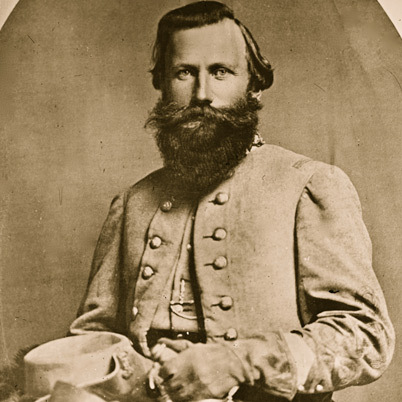
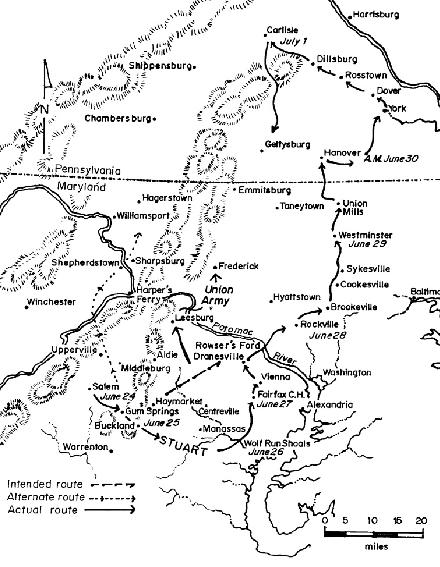
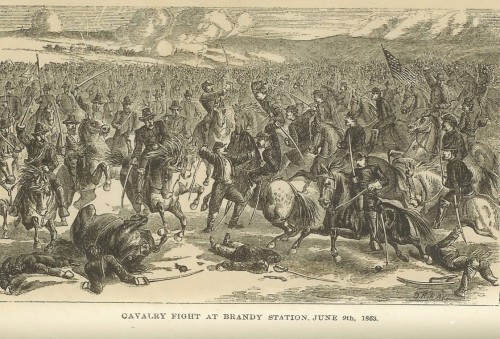
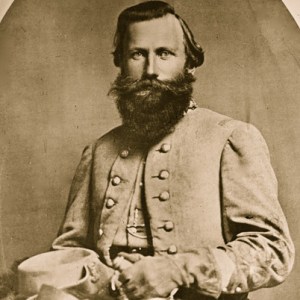
Today I am going back to the archives and re-posting an edited version of something that is part of my unpublished Gettysburg Campaign text. James Ewell Brown (J.E.B.) Stuart is legendary in American military history. A young cavalry officer from Virginia he was like a son to Robert E. Lee and was a man whose military accomplishments were matched by his unbridled vanity, which during the most critical moment in the history of the Confederacy led him to embark on an operation that left his commander in the lurch and helped doom the Confederacy. The story picks up following Stuart being surprised by Federal Cavalry at the Battle of Brandy Station in June of 1863 as Lee’s Army of Northern Virginia was moving north in an attempt to bring the Army of the Potomac to Battle, destroy it, and end the war. Both Stuart and Lee had much to do with the failure of this plan, but I hope that you enjoy this account.

Peace

Padre Steve+

While the embattled “Fighting Joe” Hooker slowly pursued Lee with the Army of the Potomac, a drama of major significance to the battle Robert E. Lee’s own making was beginning to engulf his operations and leave him blind to the movements of the Federal Army. It involved Lee and his Cavalry commander, J.E.B. Stuart and would be the first of a number of mistakes that would characterize Lee’s campaign. All of these failures dealt with Lee’s singular inability to get his commanders to understand his intent for the campaign and his inability to clearly communicate his wishes.

The necessity of subordinate commanders understanding the intent of their superior is essential to the success of any military operation. During the Gettysburg campaign Lee failed miserably to communicate his operational plan and desire to his commanders. The episode with Stuart was one of several that paint a portrait of Lee not being as good of General as the myth surrounding him.

After the surprise at Brandy Station Stuart’s troopers screened the right flank of the army as it moved north, defending the gaps in the Blue Ridge to keep Alfred Pleasanton’s Federal Cavalry Corps from interdicting the march of the Army of Northern Virginia, or discovering the location of Lee’s three infantry corps which were moving north behind the cover of the Blue Ridge.

In this Stuart was successful, but frustrated. Between June 17th and June 21st his troopers fought a series of engagements against the aggressive Federal Cavalry at Ashby’s Gap, Middleburg and Upperville in Northern Virginia. While Stuart’s troopers had held off Pleasanton’s confident troopers the “running combats were taking a toll on the Southern mounted arm, however. Stuart had already suffered several hundred casualties defending gaps and passes.” [1] Much to their dismay the Confederates noted the improvements in the Federal cavalry during these battles. Captain William Blackford, who served as an engineer on Stuart’s staff noted:

“the improvement of enemy cavalry was enormous, mainly in the heavy fire from long range carbines, and horse artillery that was a match for Stuart’s own These cavalrymen fought as if they had been taken from infantry regiments, for they knew how to fight with horses left behind.” [2]

Unlike the rest of the Army of Northern Virginia that was marching like victors into Pennsylvania and Maryland, Stuart’s Cavalry Division had little cause to rejoice. They had been surprised at Brandy Station and Stuart had been humiliated in the Southern press. The Federal cavalry under Pleasanton gave him no opportunity to redeem himself. While Pleasanton’s troopers never broke through Stuart’s screen, they had pressed him hard, and his division was “really fought out during those two weeks from June 9 until the misty morning of June 22…. Not only had Stuart’s cavalry been pressed on the defensive as never before, but also they had not been able to gain a spot of information about the enemy.” [3] Pleasanton’s troopers and proven that the days of “easy Confederate cavalry triumphs were gone,” [4] and Stuart, now “smarting over the cuts to his ego, refused to read the portents” [5] of future disaster.

Stuart had been fighting defensively the entire campaign, but desperately wanted to go on the offensive. As his troops battled at Aldie, Middleburg and Upperville, Stuart formulated a plan that he submitted to Lee. Stuart reasoned since now that “all the infantry were west of the Blue Ridge…that it would be possible to leave one or two brigades of cavalry to defend the gaps and with the remaining three to descend on the enemy and harass Hooker in any advance into Pennsylvania.” [6] For him the plan was designed for personal glory and redemption after the embarrassment at Brandy Station.

On the morning of the 22nd of June Stuart noticed that the Federal cavalry that had engaged him at Upperville the previous day was no longer present. That morning he also received an order from Lee ; an order that was the first of a series of vague, poorly written and contradictory orders that was to plague Lee throughout the campaign.

Unlike his new infantry corps commanders, Ewell and Hill, Stuart was very familiar with Robert E. Lee’s method of command, and Lee had “so much faith in Stuart’s judgment and ability to make the right moves that after indicating his wishes he gave him considerable latitude in carrying them out. His orders were more suggestions than commands….” [7] However well that may have worked for Lee in the past with Jackson and Stuart, the nature of Lee’s orders to Stuart, being conditional, needed to clearly address “the conditions upon which they are based.” [8] This Lee did not do. His order read:

“I judge the efforts of the enemy yesterday were to arrest our progress and ascertain our whereabouts. Perhaps he is satisfied. Do you know where he is and what he is doing? I fear he will steal a march on us and get across the Potomac before we are aware. If you find that he is moving northward and that two brigades can guard the Blue Ridge and take care of your rear, you can move with the other three into Maryland and take position on General Ewell’s right, place yourself in communication with him, guard his flank, keep him informed of the enemy’s movements and collect all the supplies you can….” [9]

James Longstreet, commander of the Confederate First Corps who Stuart was cooperating with on the northward march, added his own comments to Lee’s instructions which even further clouded the order:

General Lee has enclosed this letter for you, to be forwarded to you, provided you can be spared from my front, and provided I think that you can move across the Potomac without disclosing our plans. He speaks of your leaving via the Hopewell Gap and passing by the rear of the enemy. If you can get through by that route I think that you will be less likely to indicate what our plans are than if you should be passing to our rear. I forward the letter of instructions with these suggestions. Please advise me of the condition of affairs before you leave, and order General Hampton, whom I suppose will leave here in command, to report to me at Millwood, either by letter or in person, as may be most agreeable to him.” [10]  

But even without an order from Lee, Stuart was already planning his offensive that he believed would restore his glory. He had sent Major John Mosby with a small detachment of troops to reconnoiter behind the Union lines. Mosby reported the location of all the infantry corps of the Army of the Potomac. Mosby reported to Stuart on June 23rd that the Federal corps were stationary and “were so widely separated…that a column of cavalry could easily get between them.” [11] It was news that Stuart was delighted to hear. Mosby painted a glowing picture of how an operation using the Hopewell Gap could create havoc in the Federal rear and cause panic in Washington as he could “severe communications between Hooker and Pleasanton, destroy a “large portion” of Hooker’s transportation, and take some of the pressure off Lee by creating a diversion for the Union cavalry.” [12]

The inactivity of the Federal army reported by Mosby was exactly the news Stuart wanted to hear, and he asked Lee for permission to plunge into the Federal rear, and in his after action report wrote:

“I submitted to the commanding general the plan of leaving a brigade or so in my present front, and passing through Hopewell, or some other gap in Bull Run Mountain, attaining the enemy’s rear, and passing between his main body and Washington, to cross into Maryland and joining our army north of the Potomac.” [13]

Lee was rather cryptic in his after action report and wrote “Upon the suggestion of the former officer (General Stuart) that he could damage the enemy and delay his passage of the river by getting to his rear, he was authorized to do so.” [14] In that same report of the campaign Lee wrote:

“General Stuart was left to guard the passes of the mountains and observe the movements of the enemy, whom he was instructed to impede and harass as much as possible, should he attempt to cross the Potomac. In that event, General Stuart was directed to move into Maryland, crossing the Potomac east or west of the Blue Ridge, as, in his judgment, should be best, and take position on the right of our column as it advanced.” [15]

That night, during a heavy rainstorm Stuart’s chief of staff Major McClellan received Lee’s reply to his superior’s request. When he received it he immediately delivered to Stuart. Lee’s instruction stated:

“If General Hooker’s army remains inactive, you can leave two brigades to watch him, and withdraw with three others, but should he not appear to be moving northward, I think you had better withdraw this side of the mountains tomorrow night, cross as Shepherdstown next day, and move over to Frederickstown.

You will, however, be able to judge whether you can pass around their army without hindrance, doing them all the damage you can, and cross the river east of the mountains. In either case, after crossing the river, you must move on and feel the right of Ewell’s troops, collecting information, provisions, etc.” [16]

However, Stuart does not deserve the entirety of the blame for what happened. The orders or suggestions that he received from Lee and Longstreet gave Stuart were “so badly worded that it is difficult to make sense of them.” [17] Lee implicitly trusted Stuart but he was wrong in assuming that the young officer should be able to divine his intent after Brandy Station without taking into account the effect the negative press of that battle had on his subordinate. Lee should have “established that Stuart’s most important task was to guard Ewell’s right and report on the direction of Hooker’s advance once Lee crossed the Potomac.” [18] This he did not do. Instead, Stuart was given several conflicting instructions. Lee directed that Stuart maintain contact with Ewell, screen the Blue Ridge gaps, collect information, “raiding around the rear of Hooker’s forces” [19] damaging the enemy and collecting supplies. Stuart could have done any of these tasks, but not all of them, and the smorgasbord offered by Lee played directly into Stuart’s need to redeem himself after the beating that he took in the Confederate Press after Brandy Station.

Specifically, Lee’s lack of clarity and vagueness allowed to Stuart interpret the order in a manner that benefited him. The order could easily be interpreted as getting Stuart and his men into Pennsylvania as quickly as possible to guard Ewell’s flank and discern the intentions of the enemy, which in hindsight appears to be Lee’s intent, or as permission to conduct a raid “roam in the enemy’s rear for an unpredictable period of time, raising havoc with his communications, supplies, and isolated commands” and then “seek out Ewell’s corps and use it as a place of refuge from an aroused enemy.” [20]

The fact is that as they are today that different standards apply to each course of action laid out by a commander and that orders must be clear, otherwise subordinates may interpret them in a far different manner that intended. Such vague orders can have far reaching effects, often contrary to the intent of the commander who issued them; this was the case here.

By giving Stuart the latitude to go around the Federal army Lee undercut his own preference that Stuart cross into Maryland via Shepherdstown and Frederick on June 24th. Lee had provided Stuart an opportunity for something that “Longstreet half-apologetically called “something better than the drudgery of a march around our flank.” [21] It was a critical mistake, which was then further compounded by Stuart and the movement of the Army of the Potomac.

Stung by the criticism of his conduct of the Battle of Brandy Station in the Southern press and frustrated by Pleasanton’s constant thrusts at his troopers screening Lee’s flank on the Blue Ridge Stuart interpreted the orders in the manner that appealed to Stuart’s sense of glory. He would repeat his triumph of the previous year when he rode around the Army of the Potomac. For Stuart this was a chance to regain the limelight and add to his luster. Stuart “summed up his interpretation of his orders when he said later: …it was deemed practicable to move entirely in the enemy’s rear, intercepting his communications with his base (Washington), and, inflicting damage upon his rear, to rejoin the army in Pennsylvania in time to participate in its actual conflicts.”[22]

Historians have long wondered why Lee was not more explicit in his orders to Stuart and why Stuart conducted an operation that left Lee blind and had no obvious advantages, except to allow Stuart to recover his tarnished reputation. Stephen Sears noted in his book Gettysburg that: “The very concept of Stuart’s expedition was fueled by overconfidence and misjudgment at the highest command level.” [23] In a sense the decision harkens back to the hubris of Lee and others about the superiority of his army, and Lee’s distain for the capabilities of Army of the Potomac and Federal troops in general.

In organizing his movement around the Army of the Potomac, Stuart decided to take his three best cavalry brigades with him, and leave the brigades of “Grumble” Jones and Beverly Robertson to defend gaps and screen the rear of the army. The choice was unfortunate; Robertson was unpredictable but was “senior to the dependable Jones” [24] who was considered the “best outpost officer in his command.” [25] The choice ridded Stuart of Robertson, who he did not trust in battle and Jones “whose antipathy for Stuart at least equaled Stuart’s for him.” [26] The intent was that Robertson would screen the army and follow it into Maryland, in fact Stuart gave Robertson “explicit instructions” [27] to do so, but instead “the two brigades would remain fixed, as if planted there, in an inanition of command which immobilized the men for whom Lee in Pennsylvania was anxiously watching.” [28] Longstreet had requested the industrious and dependable Hampton command the remainder of the cavalry, but Stuart disregarded his counsel and took Hampton with him.

Stuart set off with his three best brigades, Wade Hampton’s, Fitzhugh Lee’s, and Rooney Lee’s, the latter now with Rooney Lee having been wounded was under the command of Colonel John R. Chambliss. Chambliss was another former West Pointer who had retired from the old army but had responded to the call to secession.

Almost immediately after setting off Stuart and his brigades encountered a situation that should have immediately stopped movement to the Federal rear and instead brought Stuart to move back to the west of the Blue Ridge. Moving through Glasscock’s Gap Stuart’s troopers  “bumped unexpectedly into “an immense wagon train,” which happened to be the tail end of Winfield Hancock’s 2nd Corps, blocking the road in exactly the fashion Lee had described as a hindrance.” [29] Instead of going back when he had the chance Stuart elected to continue with his “plan to go around the Federal army. It was a crucial decision, for he still could have turned back without losing any more time.” [30] Even so, Stuart had to spend a day grazing his horses since he had no grain with him, delaying his advance north and east, placing him a day behind schedule. Though Stuart and his brigades made better time on the 26th, advancing twenty-five miles, he had to again stop to graze his horses at the Occoquan River. It had “taken forty-eight hours to march thirty-five miles.” [31]

Stuart continued on past the outskirts of Washington on June 27th and was again delayed when attempting to cross the Potomac at Rowser’s Ford where the “water level was two feet higher than normal.” [32] Upon crossing the river he then encountered a large Federal wagon train not far from Washington capturing over 100 wagons and 600 mules. He reveled in that feat and boasted that “he had taken more than one hundred and twenty-five best United States model wagons and splendid teams and gay caparisons,” containing “foodstuffs, oats, hay…bacon, ham, crackers and bread” but his progress was slowed by his enormous wagon train of captured supplies…” [33] He and briefly wondered “whether it might be worth “our entering Washington City” [34] before determining that the effort might be too costly.

On June 28th Stuart received word that Joe Hooker and the Army of the Potomac were across the Potomac. Likewise, Stuart “knew nothing of Lee’s position,” [35] and instead of abandoning the wagon train he sacrificed the speed and mobility of his brigades to keep it. This was a direct consequence of how badly Lee had written his order to Stuart. Now, “far from guarding Ewell’s right, he was now moving away from Ewell, with no idea where Hooker’s army might be and no communication with Lee, who frequently inquiring of his aides, “Can you tell me where General Stuart is?” [36]

On the wrong side of the federal army, encumbered by the captured wagon train, “Stuart would have to make a half circle of more than fifty miles around Gettysburg before arriving there about noon on the second day of battle with most of his troopers, his artillery, and his wagon train lumbering far behind him.” [37] On June 30th his men were engaged by Judson Kilpatrick’s Federal near cavalry division near Hanover, and “his men never fought more poorly…and General Stuart and his staff were nearly captured.” [38] By the time Stuart’s troopers arrived in Gettysburg, the once proud outfit was “exhausted and too late to be of any service.” [39] His arrival at Gettysburg was not a moment of triumph, but was humiliating. Instead of reporting to his commander with information that Lee needed, it was Lee who informed him of the position of his own army and the Army of the Potomac. Lee’s words to his much beloved subordinate were painful. He asked him “General Stuart, where have you been?” [40] Stuart seemed to wilt at his mentor’s words, and attempted to put the best face forward, and told Lee “I have brought you 125 wagons and their teams, General,” to which Lee replied “Yes, General, but they are an impediment to me now.” [41]

Stuart’s raid was disastrous for Lee. Until July 2nd, Lee was blind and had no idea where the Federal army was. He learned some when he told of the location of the Army of the Potomac by Longstreet’s scout Harrison on June 28th but even then he had no clear idea of the Federal Army’s location, strength, or intentions until the second day of the Battle of Gettysburg. Stuart’s ride was “an act of folly – ill-planned, badly conducted, and (until the very end) executed with an almost total disregard for anything for any interest other than the self-promotion of J.E.B. Stuart.” [42]

To be clear, a number of important military factors important to those involved in planning campaigns are clear: Deception, commander’s intent, and unity of command. Lee successfully used deception to prevent the Federals from discerning his purposes, but that initial success was compromised by his lack of clarity in communicating his intent for the campaign to Stuart, and by Stuart’s careless disregard of any other consideration but his own reputation and vanity.

Both Stuart and Lee share culpability for the failure of the Confederate campaign at the operational and tactical level. Of course they were not the only ones, Longstreet, Ewell, A.P. Hill, Harry Heth, and Jubal Early and many others had a share in the defeat, but Lee in his orders, and his protégé Stuart in trying to redeem his reputation were most culpable in the defeat at Gettysburg.

Notes

[1] Petruzzi, J. David and Stanley, Steven The Gettysburg Campaign in Numbers and Losses: Synopses, Orders of Battle, Strengths, Casualties and Maps, June 9 – July 1, 1863 Savas Beatie LLC, El Dorado Hills CA 2012 p.41

[2] Davis, Burke J.E.B. Stuart: The Last Cavalier Random House, New York 1957 pp.319-320

[3] Dowdy, Clifford. Lee and His Men at Gettysburg: The Death of a Nation Skyhorse Publishing, New York 1986, originally published as Death of a Nation Knopf, New York 1958 p.57

[4] Freeman, Douglas Southall, Lee’s Lieutenant’s a Study in Command, One volume abridgement by Stephen W Sears, Scribner, New York 1998 p.553

[5] Ibid. Dowdy Lee and His Men at Gettysburg p.57

[6] Ibid. Freeman Lee’s Lieutenants p.553

[7] Coddington, Edwin B. The Gettysburg Campaign: A Study in Command, A Touchstone Book, Simon and Schuster New York, 1968 p.108

[8] Ibid. Coddington The Gettysburg Campaign p.108

[9] Ibid. Davis J.E.B. Stuart: The Last Cavalier p.321

[10] Oates, Willam C. and Haskell, Frank A. Gettysburg: The Confederate and Union Views of the Most Decisive Battle of the War in One Volume Bantam Books edition, New York 1992, originally published in 1905 p.61

[11] Ibid. Coddington The Gettysburg Campaign p.109

[12] Ibid. Coddington The Gettysburg Campaign p.109

[13] McClellan, Henry Brainerd The Life and Campaigns of Major General J.E.B. Stuart Commander of the Cavalry of the Army of Northern Virginia 1885. Digital edition copyright 2011 Strait Gate Publications, Charlotte NC Location 6087

[14] Ibid. McClellan The Life and Campaigns of Major General J.E.B. Stuart location 6106

[15] Lee, Robert E. Reports of Robert E Lee, C.S. Army, Commanding Army of Northern Virginia Campaign Report Dated January 20th 1864. Amazon Kindle Edition location 285

[16] Ibid. Davis J.E.B. Stuart: The Last Cavalier p.324

[17] Fuller, J.F.C. Decisive Battles of the U.S.A. 1776-1918 University of Nebraska Press, Lincoln 2007 copyright 1942 The Royal Society for the Prevention of Cruelty to Animals p.226

[18] Korda, Michael. Clouds of Glory: The Life and Legend of Robert E. Lee Harper Collins Publishers, New York 2014 p.540

[19] Ibid Korda Clouds of Glory p.540

[20] Ibid. Coddington The Gettysburg Campaign p.110

[21] Guelzo, Allen C. Gettysburg: The Last Invasion Vintage Books a Division of Random House, New York 2013 p.96

[22] Ibid. Freeman Lee’s Lieutenants p.555

[23] Sears, Stephen W. Gettysburg, Mariner Books, Houghton Mifflin Company, Boston and New York, 2003 p.106

[24] Ibid. Dowdy Lee and His Men at Gettysburg p.63

[25] Ibid. Davis J.E.B. Stuart: The Last Cavalier p.324

[26] Ibid. Dowdy Lee and His Men at Gettysburg p.63

[27] Ibid. Coddington The Gettysburg Campaign p.112

[28] Ibid. Dowdy Lee and His Men at Gettysburg p.63

[29] Ibid. Guelzo Gettysburg: The Last Invasion p.96

[30] Ibid. Coddington The Gettysburg Campaign p.112

[31] Ibid. Davis J.E.B. Stuart: The Last Cavalier p.325

[32] Ibid. Coddington The Gettysburg Campaign p.112

[33] Ibid Korda Clouds of Glory p.541

[34] Ibid. Guelzo Gettysburg: The Last Invasion p.98

[35] Ibid. Davis J.E.B. Stuart: The Last Cavalier p.325

[36] Ibid Korda Clouds of Glory p.541

[37] Ibid Korda Clouds of Glory p.541

[38] Ibid. Dowdy Lee and His Men at Gettysburg p.73

[39] Ibid. Fuller Decisive Battles of the U.S.A. 1776-1918 p.227

[40] Ibid. Davis J.E.B. Stuart: The Last Cavalier p.334

[41] Ibid. Davis J.E.B. Stuart: The Last Cavalier p.334

[42] Ibid. Guelzo Gettysburg: The Last Invasion p.98

2 Comments

Filed under civil war, Gettysburg, History, leadership, Military

The Battle of Brandy Station

Cav Fight at Brandy Station

Friends of Padre Steve’s World,

Today I take a look back at the battle of Brandy Station, the largest cavalry battle every fought on the North American continent. This is a section of my draft Gettysburg campaign text.

Have a great day,

Peace

Padre Steve+

Movement to attain operational reach and maneuver are two critical factors in joint operations. In the time since the American Civil War the distances that forces move to engage the enemy, or maneuver to employ fires to destroy his forces have greatly increased. Movement may be part of an existing Campaign Plan or Contingency Plan developed at Phase 0; it also may be part of a crisis action plan developed in the midst of a campaign. Lee’s movement to get to Gettysburg serves as an example of the former, however, since his forces were already in contact with the Army of the Potomac along the Rappahannock and he was reacting to what he felt was a strategic situation that could not be changed but by going on the offensive that it has the feel of a Crisis Action Plan. Within either context other factors come into play: clarity of communications and orders, security, intelligence, logistics and even more importantly the connection between operational movement and maneuver; the Center of Gravity of the enemy, and national strategy. Since we have already discussed how Lee and the national command authority of the Confederacy got to this point we will now discuss the how that decision played in the operational and tactical decisions of Lee and his commanders as the Army of Northern Virginia began the summer campaign and the corresponding actions of Joseph Hooker and the his superiors in Washington.

“One of the fine arts of the military craft is disengaging one’s army from a guarding army without striking sparks and igniting battle.” [1] On June 3rd 1863 Robert E. Lee began to move his units west, away from Fredericksburg to begin his campaign to take the war to the North. He began his exfiltration moving Second Corps under Richard Ewell and First Corps under James Longstreet west “up the south bank of the Rappahannock to Culpepper, near which Hood and Pickett had been halted on their return from Suffolk.” [2] Rodes’ division of Second Corps followed on June 4th with Anderson and Early on June 5th. Lee left the three divisions of A.P. Hill’s Third Corps at Fredericksburg to guard against any sudden advance by Hooker’s Army of the Potomac toward Richmond. Lee instructed Hill to “do everything possible “to deceive the enemy, and keep him in ignorance of any change in the disposition of the army.” [3]

The army was tremendously confident as it marched away from the war ravaged, dreary and desolate battlefields along the Rappahannock “A Captain in the 1st Virginia averred, “Never before has the army been in such a fine condition, so well disciplined and under such complete control.” [4] Porter Alexander wrote that he felt “pride and confidence…in my splendid battalion, as it filed out of the field into the road, with every chest & and ammunition wagon filled, & and every horse in fair order, & every detail fit for a campaign.” [5] Another officer wrote to his father, “I believe there is a general feeling of gratification in the army at the prospect of active operations.” [6]

Lee’s plan was to “shift two-thirds of his army to the northwest and past Hooker’s flank, while A.P. Hill’s Third Corps remained entrenched at Fredericksburg to observe Hooker and perhaps fix him in place long enough for the army to gain several marches on the Federals.” [7] In an organizational and operational sense that Lee’s army after as major of battle as Chancellorsville “was able to embark on such an ambitious flanking march to the west and north around the right of the army of the Potomac….” [8]

However, Lee’s movement did not go unnoticed; Hooker’s aerial observers in their hot air balloons “were up and apparently spotted the movement.” [9] But Hooker was unsure what it meant. He initially suspected that “Lee intended to turn the right flank of the Union army as he had done in the Second Bull Run Campaign, either by interposing his army between Washington and the Federals or by crossing the Potomac River.” [10] Lee halted at Culpepper from which he “could either march westward over the Blue Ridge or, if Hooker moved, recontract at the Rappahannock River.” [11]

Hooker telegraphed Lincoln and Halleck on June 5th and requested permission to advance cross the river and told Lincoln that “I am of opinion that it is my duty to pitch into his rear” [12] possibly threatening Richmond. Lincoln ordered Hooker to put the matter to Halleck, with whom Hooker was on the worst possible terms. Hooker “pressed Halleck to allow him to cross the Rappahannock in force, overwhelming whatever rebel force had been left at Fredericksburg, and then lunging down the line of the Virginia Central toward an almost undefended Richmond.” [13] On the morning of June 6th Hooker ordered pontoon bridges thrown across the river and sent a division of Sedgwick’s VI Corps to conduct a reconnaissance in force against Hill.

Lincoln and Halleck immediately rejected Hooker’s request. Lincoln “saw the flaw in Hooker’s plan at once” [14] and replied in a very blunt manner: “In one word,” he wrote “I would not take any risk of being entangled upon the river, like an ox jumped half over a fence and liable to be torn by dogs front and rear, without a fair chance to gore one way or kick another.” [15] Halleck replied to Hooker shortly after Lincoln that it would “seem perilous to permit Lee’s main force to move upon the Potomac [River] while your army is attacking an intrenched position on the other side of the Rappahannock.” [16] Lincoln, demonstrating a keen regard for the actual center of gravity of the campaign, told Hooker plainly that “I think Lee’s army and not Richmond, is your objective point.” [17]

The fears of Lincoln and Halleck were well founded. In stopping at Culpepper Lee retained the option of continuing his march to the Shenandoah and the Potomac, or he could rapidly “recall his advanced columns, hammer at Hooker’s right flank, and very possibly administer another defeat even more demoralizing than the one he suffered at Chancellorsville.” [18] Hooker heeded the order and while Hooker maintained his bridgehead over the Rappahannock he made no further move against Hill’s well dug in divisions.

Meanwhile, J.E.B. Stuart and his Cavalry Corps had been at Brandy Station near Culpepper for two weeks. Culpepper in June was a paradise for the cavalry, and with nearly 10,000 troopers gathered Stuart ordered a celebration, many dignitaries were invited and on June 4th Stuart hosted a grand ball in the county courthouse. On the 5th Stuart staged a grand review of five of his brigades. Bands played as each regiment passed in review and one soldier wrote that it was “One grand magnificent pageant, inspiring enough to make even an old woman feel fightish.” [19] The review ended with a mock charge by the cavalry against the guns of the horse artillery which were firing blank rounds. According to witnesses it was a spectacular event, so realistic and grand that during the final charge that “several ladies fainted, or pretended to faint, in the grandstand which Jeb Stuart had had set up for them along one side of the field.” [20] That was followed by an outdoor ball “lit by soft moonlight and bright bonfires.” [21] Stuart gave an encore performance when Lee arrived on June 8th, minus the grand finale and afterward Lee wrote to his wife that “Stuart was in all his glory.” [22]

Hooker received word from the always vigilant John Buford, of the First Cavalry Division on the night of June 6th that “Lee’s “movable column” was located near Culpepper Court House and that it consisted of Stuart’s three brigades heavily reinforced by Robertson’s, “Grumble” Jones’s, and Jenkins’ brigades.” [23] Hooker digested the information and believed that Stuart’s intent was to raid his own rear areas to disrupt the Army of the Potomac’s logistics and communications. The next day Hooker ordered his newly appointed Cavalry Corps Commander, Major General Alfred Pleasanton to attack Stuart.

After Chancellorsville, Hooker had reorganized the Union cavalry under Pleasanton into three divisions and under three aggressive division commanders, all West Pointers, Brigadier General John Buford, Brigadier General David Gregg and Brigadier General Judson Kilpatrick. While Stuart conducted his second grand review for Lee Pleasanton quietly massed his cavalry “opposite Beverly Ford and Kelly’s Ford so as to cross the river in the early morning hours of June 9th and carry out Hooker’s crisp orders “to disperse and destroy” the rebel cavalry reported to be “assembled in the vicinity of Culpepper….” [24] Pleasanton’s cavalry was joined by two mixed brigades of infantry “who had the reputation of being among the best marchers and fighters in the army.” [25] One brigade, commanded by Brigadier General Adelbert Ames consisted of five regiments drawn from XI Corps, XII Corps, and III Corps was attached to Buford’s division. The other brigade, under the command of Brigadier General David Russell was composed of seven regiments drawn from I Corps, II Corps and VI Corps. [26]

Stuart’s orders for June 9th were to “lead his cavalry division across the Rappahannock to screen the northward march of the infantry.” [27] The last thing that Stuart expected was to be surprised by the Federal cavalry which he had grown to treat with distain. Stuart who was at his headquarters “woke to the sound of fighting” [28] as Pleasanton’s divisions crossed the river and moved against the unsuspecting Confederate cavalry brigades.

The resultant action was the largest cavalry engagement of the war. Over 20,000 troopers engaged in an inconclusive see-saw battle that lasted most of the day. Though a draw “the rebels might have been swept from the field had Colonel Alfred N. Duffie, at the head of the Second Division acted aggressively and moved to the sounds of battle.” [29] The “Yankees came with a newfound grit and gave as good as they took.” [30] Porter Alexander wrote that Pleasanton’s troopers “but for bad luck in the killing of Col. Davis, leading the advance, would have probably surprised and captured most of Stuart’s artillery.” [31] Stuart had lost “over 500 men, including two colonels dead,” [32] and a brigade commander, Fitzhugh “Rooney” Lee, General Lee’s son, badly wounded. While recuperating at his wife’s home a few weeks later Lee “was captured by the enemy.” [33] Stuart claimed victory as he lost fewer troops and had taken close to 500 prisoners and maintained control of the battlefield.

But even Confederate officers were critical. Lafayette McLaws of First Corps wrote “our cavalry were surprised yesterday by the enemy and had to do some desperate fighting to retrieve the day… As you will perceive from General Lee’s dispatch that the enemy were driven across the river again. All this is not true because the enemy retired at their leisure, having accomplished what I suppose what they intended.” [34] Captain Charles Blackford of Longtreet’s staff wrote: “The fight at Brandy Station can hardly be called a victory. Stuart was certainly surprised, but for the supreme gallantry of his subordinate officers and men… it would have been a day of disaster and disgrace….” The Chief of the Bureau of War in Richmond, Robert H.G. Kean wrote “Stuart is so conceited that he got careless- his officers were having a frolic…” [35] Brigadier General Wade Hampton had the never to criticize his chief in his after action report and after the war recalled “Stuart managed badly that day, but I would not say so publicly.” [36]

The Confederate press was even more damning in its criticism of Stuart papers called it “a disastrous fight,” a “needless slaughter,” [37]and the Richmond Examiner scolded Stuart in words that cut deeply into Stuart’s pride and vanity:

The more the circumstances of the late affair at Brandy Station are considered, the less pleasant do they appear. If this was an isolated case, it might be excused under the convenient head of accident or chance. But the puffed up cavalry of the Army of Northern Virginia has twice, if not three times, surprised since the battles of December, and such repeated accidents can be regarded as nothing but the necessary consequences of negligence and bad management. If the war was a tournament, invented and supported for the pleasure of a few vain and weak-headed officers, these disasters might be dismissed with compassion, But the country pays dearly for the blunders which encourage the enemy to overrun and devastate the land, with a cavalry which is daily learning to despise the mounted troops of the Confederacy…” [38]

But the battle was more significant than the number of casualties inflicted or who controlled the battlefield at the end of the day. Stuart had been surprised by an aggressively led Union Cavalry force. The Union troopers fought a stubborn and fierce battle and retired in good order. Stuart did not appreciate it but the battle was a watershed, it ended the previous dominance of the Confederate Cavalry arm. It was something that in less than a years’ time would cost him his life.

Notes

[1] Sears, Stephen W. Gettysburg, Mariner Books, Houghton Mifflin Company, Boston and New York, 2003 p.59

[2] Foote, Shelby, The Civil War, A Narrative. Volume Two Fredericksburg to Meridian Random House, New York 1963 p.436

[3] Trudeau, Noah Andre. Gettysburg: A Testing of Courage, Harper Collins Publishers, New York 2002 p.25

[4] Wert, Jeffry D. A Glorious Army: Robert E. Lee’s Triumph 1862-1863 Simon and Schuster, New York and London 2011 p.218
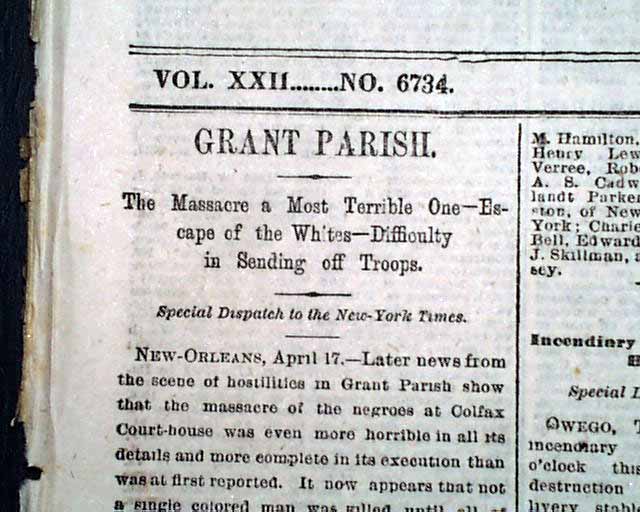
[5] Alexander, Edward Porter. Fighting for the Confederacy: The Personal Recollections of General Edward Porter Alexander edited by Gary Gallagher University of North Carolina Press, Chapel Hill 1989 p.221

[6] Ibid. Wert A Glorious Army p.219

[7] Ibid. Sears Gettysburg p.60

[8] Korda, Michael. Clouds of Glory: The Life and Legend of Robert E. Lee Harper Collins Publishers, New York 2014 p.530

[9] Ibid. Foote The Civil War, A Narrative. Volume Two p.436

[10] Wert, Jeffry D. The Sword of Lincoln: The Army of the Potomac Simon and Schuster, New York and London 2005 p.260

[11] Dowdy, Clifford. Lee and His Men at Gettysburg: The Death of a Nation Skyhorse Publishing, New York 1986, originally published as Death of a Nation Knopf, New York 1958 p.37

[12] Ibid. Sears Gettysburg p.61

[13] Guelzo, Allen C. Gettysburg: The Last Invasion Vintage Books a Division of Random House, New York 2013 p.50

[14] Ibid. Wert The Sword of Lincoln p.260

[15] Fuller, J.F.C. Decisive Battles of the U.S.A. 1776-1918 University of Nebraska Press, Lincoln 2007 copyright 1942 The Royal Society for the Prevention of Cruelty to Animals p.223

[16] Ibid Trudeau Gettysburg a Testing of Courage p.26

[17] Ibid. Guelzo Gettysburg: The Last Invasion p.50

[18] Coddington, Edwin B. The Gettysburg Campaign: A Study in Command, A Touchstone Book, Simon and Schuster New York, 1968 p.53

[19] Davis, Burke J.E.B. Stuart: The Last Cavalier Random House, New York 1957 p.304

[20] Ibid. Foote The Civil War, A Narrative. Volume Two p.437

[21] Ibid. Sears Gettysburg p.63

[22] Ibid. Wert A Glorious Army p.221

[23] Ibid. Coddington The Gettysburg Campaign p.54

[24] Ibid. Sears Gettysburg p.64

[25] Ibid. Coddington The Gettysburg Campaign p.54

[26] Petruzzi, J. David and Stanley, Steven The Gettysburg Campaign in Numbers and Losses: Synopses, Orders of Battle, Strengths, Casualties and Maps, June 9 – July 1, 1863 Savas Beatie LLC, El Dorado Hills CA 2012 p.7

[27] Ibid. Sears Gettysburg p.64

[28] Ibid. Davis JEB Stuart p.306

[29] Ibid. Wert The Sword of Lincoln p.261

[30] Wert, Jeffry D. General James Longstreet The Confederacy’s Most Controversial Soldier, A Touchstone Book, Simon and Schuster, New York and London 1993 p. 251

[31] Ibid. Alexander Fighting for the Confederacy p.223

[32] Ibid. Davis JEB Stuart p.310

[33] Ibid. Wert A Glorious Army p.221

[34] Ibid. Coddington The Gettysburg Campaign p.59

[35] Ibid. Davis JEB Stuart p.310

[36] Ibid. Coddington The Gettysburg Campaign p.60

[37] Ibid. Guelzo Gettysburg: The Last Invasion p.57

[38] Ibid. Davis JEB Stuart p.311-312

Leave a comment

Filed under civil war, Gettysburg, History, leadership, Military