Tag Archives: training teams

Going to War: Building Blocks for Success at TQ

Note: This is the latest chapter of my “Going to War” series which documents my deployment with RP2 Nelson Lebron to serve as the Religious Support Team for all advisors in Al Anbar Province.  Previous posts of this series are located in the “Tour in Iraq” link in the topics section on the left hand column of the website.  If you have friends or family who are serving in Iraq or Afghanistan and a little bit of an idea of what they might be experiencing or might have experienced feel free to read and share.  Peace and Blessings, Steve+
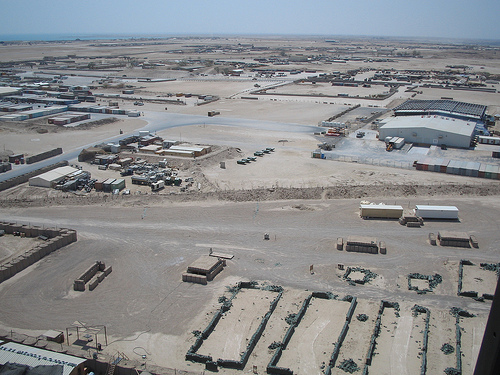
tq vew from airTQ: The Chow Hall is on the Right

It was about 0400 when I got to sleep after our flight to TQ.  About 0900 I woke up with the sun shining through the small holes in the metal shade over the window of my can.  I was still pretty groggy when I got up, went and got another shower just to try to wake up.  Even at 0900 it was close to 100 degrees and the sun beat down on me as I walked the 100-150 yards to the shower trailers in my PT gear.  After waking up and getting myself together I knocked on Nelson’s door and woke him up.  Nelson looked pretty beat as well and after this I walked over to the only non-military food outlet the “Green Beans Coffee” trailer and got me some coffee before I walked over to the Chapel.  The Green Bean is interesting; a couple of guys from California started with one store in Saudi Arabia and now is located around the world with U.S. Forces.  They have a program to buy a cup of Joe for a Joe.”  The company website is here: http://www.greenbeanscoffee.com/ now I have to admit I never got a free cup but it was good coffee.

I kind of surveyed the area.  My “can” was located not far from the chapel, the gym and MWR facilities.  A bit down the way a hundred and fifty yards or so was the Marine Corps exchange which though not bad was often like shopping in East Germany, long lines and limited quantities of merchandise.  If you needed something and waited to buy it there was a strong likelihood that the exchange would not have it on your next trip.  About 400 years past the exchange was the main chow hall which was pretty large and covered with a canopy designed to cause high explosive shells from rockets or mortars to burst before they could penetrate the roof of the actual facility.  The chow hall was staffed by contractors, mostly workers from the Indian subcontinent of Sri Lanka and like other areas inside the perimeter guarded by a contracted Ugandan security force.

I walked over to the Chapel and was met by RP1 who introduced me to Fr Jose Bautista Rojas, the Group Catholic Chaplain and the Apostle of TQ.  Jose and I instantly hit it off.  He is out of Los Angeles and really has a good way with people.  On his first tour and first deployment he was having a huge impact around the base.  His support and prayers would be greatly appreciated by me and by Judy in the coming months.  Not long afterward, Chaplain Pat McLaughlin came in after a meeting.  Pat was a fairly newly promoted Commander who was the 2nd Marine Logistics Group Chaplain and was on his second one year tour in Iraq.  He had previously served as the Chaplain at Camp David.  He immediately gave us his full support and put his staff to work helping us get settled and to link us up with all the support staff that we would need to conduct operations. Without this our tour would have never have had the success that we had.
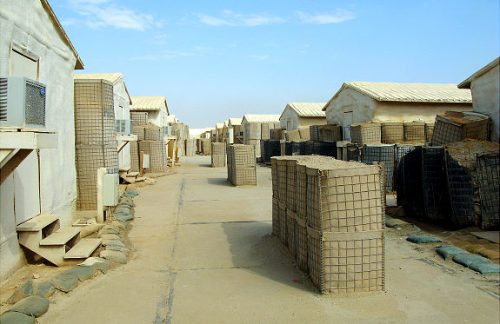
05_Flatbed_1 - NOVEMBERSouthwest Asia Huts or SWA Huts at TQ I stayed in one of these at the end of my tour

TQ was a major air and logistics hub perfectly suited to operate from to support advisers around the entirety of the province.  We had access to rotor and fixed wing aviation assets, excellent telephone and internet, secure and non-secure access, a place to call home and excellent support.  This is critical when you are operating independently and supporting multiple organizations.   Other Army Chaplain teams had gone into areas where they were given little or no support by the Army teams that they supported.  Unfortunately from a chaplain perspective the talk that I heard had more to do with the Army Chaplains than the units that they supported.  Part of the problem was that most of the Army teams were reservists with minimal training or preparation for a mission type that they were never taught about in chaplain School.   I know of a Navy Chaplain with Marine experience who had no significant problems when he was placed with an Army division level team in Mosel. There were probably a number of reasons for this, and to be charitable I will chalk it up to lack of experience, but lack of support was something that we never had to face.
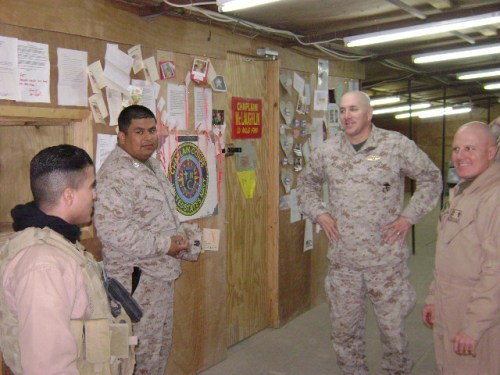
Lebron, Bautista, McLaughlin, Dundas 2A Great Team: Nelson, Jose, Pat and Me…Pat and Jose helped us tremendously

Within days we had our “operations center” set up in an office in the back of the Plywood Parish chapel. The office had a somewhat auspicious history having taken a hit by a rocket or mortar earlier in the year, a shot that had also made a mess of the drums and other musical instruments of the chapel praise team.  The chapel was kind of a ramshackle affair but had some interesting touches mostly donated by the military personnel to include doors which had been made with care and donated.  Part of getting it together was having phone and internet cables run to the office.  The communications people made this happen quickly and they also got our elderly computers set up and loaded with all that we would need to operate on the secure and non-secure side the house.  I think that we were one of the few ministry teams lower than Regiment or BCT level to have the communications suite that we had been provided.  Likewise the G-3 Air section at the MLG headquarters gave us tremendous support and quickly got us the ability to plan and submit our own air mission requests.

The information that Luke Fabiunke had provided me back at Fallujah now became a gold mine to begin operations.  It was an amazing amount of information, not all current but the situation with adviser teams was always fluid and subject to change based on operational considerations.  There were phone numbers, secure and no secure e-mail contacts for key leaders.  Once we had our communications up the communication began with teams across the province and our calendar was rapidly filled.  The only “glunk” that we had in this was with the senior adviser for one of the Military Training Teams in our local area.  Though his staff and subordinate unit team chiefs were happy for our arrival he for all intents and purposes froze us out of his area.  That did not keep me from continuing to build relationships with some of his people which paid dividends later.  I think that sometimes some chaplains are intimidated by people who rebuff their honest and well meaning efforts to provide support.  I don’t work that way and will constantly work whatever angle I need to in order to get the mission done.  In order not to burn bridges I usually use a slow and patient approach to continually work to build relationships with those in charge of the units that I serve.  It really is an indirect approach.  If I can’t get in one place I put it on the back burner without burning the bridge.  I then work with all the other teams that I can and get out among people.  As we did this “back doors” to ministry opened with teams where we had been locked out of before as they contacted us to get support.  So I did not give up on these local teams but reached out to the furthest reaches of the province with the teams of the 7th Iraqi Division and the 2nd Border Brigade with its Border units and Port of Entry teams.  The senior advisers of these units, Colonel Cottrell and Lieutenant Colonel Bien gave me absolute freedom to coordinate with their teams and opened doors that were never shut.

As we prepared for our mission the first few days were days of acclimatization to the base and to finally recover from the long road in.  One of the first things that we noticed was the pall cast over the mood of the camp by the crash of the Army CH-47 the day of our arrival.  The chapel was being rigged by the staff for the memorial service for the five Army aviators, all of who were significantly younger than me.  The Army was in charge of the service so except for the set up of the chapel and other miscellaneous administrative support.  It is a sobering thing to come into your base of operations and see the set up for five men who died in service of their country.  To look at their pictures and to read their biographies was humbling; one was on his last enlistment before retirement others at different points of their careers, all left behind families, friends and their fellow soldiers who did not know if the bird went  down to mechanical failure or hostile action.   This was in no small way lost on me as we would fly many missions with the men and women of this Army squadron.

Nelson and I worked hard that first day and thereafter to get set up for our first missions.  While I worked the big picture parts of the mission he took care of the little thinks that ensured our success.  Working with Pat, Jose and RP1 he became a key part of the team whenever we were not traveling.

That evening we went to dinner at the chow hall and took in some PT.  Following that I went back to my can where I continued to unpack and make the place somewhere that I could relax.  Though still exceptionally tired from the trip I had a difficult time getting to sleep between my own anxiety the din of UH-60 Army Medivac choppers coming in and out of the LZ for the Shock, Surgery and Trauma Platoon.  Not able to sleep I walked out of my can where I saw the sky light up to our north near Habbinyah with illumination rounds while outgoing artillery sent rounds somewhere into the night and small arms fire could be heard nearby.  A number of Marine and Navy officers gathered near me as we watched the display and talked among ourselves as we wondered what was going on.  Eventually I would get to sleep, but it was very late, that night I found the Office of Compline to be of great comfort, especially this collect.

“Be our light in the darkness, O Lord, and in your great mercy defend us from all perils and dangers of this night; for the love of your only Son, our Savior Jesus Christ.  Amen.”
2 Comments

Filed under iraq,afghanistan, Military, Tour in Iraq

The most dangerous assignment: 4 More Advisers Die In Afghanistan

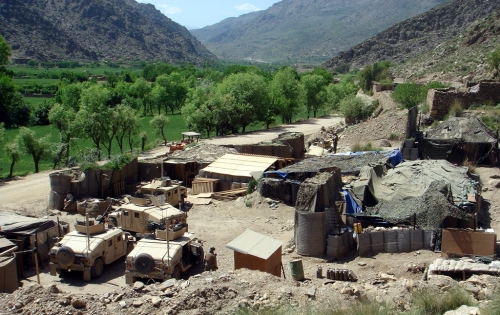
training team baseIsolated Embedded Training Team Base

Once know and relatively unglamorous group of American military men have suffered multiple casualties in a single engagement.  These men belong to are small units that do not have a lot of organic firepower.  They usually operate in remote areas far from immediate assistance if they get in trouble.  When one of these units suffers casualties, especially where they lose 3-5 men in one engagement they might have lost 20-25% of their unit.

On September 8th a team of these men was ambushed while on foot going to an Afghan with Afghan soldiers to meet tribal leaders with the intent of establishing a government presence in a hostile area.  In the ambush four were killed, three U.S. Marines and one U.S. Navy Hospital Corpsman attached to them.  On Tuesday the 8th Gunnery Sgt. Edwin W. Johnson Jr., 31, of Columbus, Ga., 1st Lt. Michael E. Johnson, 25, of Virginia Beach, Va., Staff Sgt. Aaron M. Kenefick, 30, of Roswell, Ga. and Petty Officer 3rd Class James R. Layton, 22, of Riverbank, Calif., were while working as trainers to Afghan soldiers on a mission to search for weapons and then meet village elders under an agreement to establish government authority there.  They were killed in “a complex attack according to a U.S. Military spokesman.  According to McClatchy news service who had a reporter that accompanied the mission, insurgents had set up positions in the village and in the mountains on both sides and apparently attacked as the men neared the village. 1st LT Johnson was wounded and while being attended Navy Hospital Corpsman Third Class James R. Layton when they both came under attack.  Both were killed.  Another Marine told the McClatchy reporter that they’d found the wrappings of bandages and other medical gear strewn around Layton and Johnson.  Eight Afghan troops and police and the Marine commander’s Afghan interpreter also died in the ambush and the subsequent battle that raged from dawn until 2 p.m. around the remote hamlet of Ganjgal in eastern Kunar province, close to the Pakistan border.

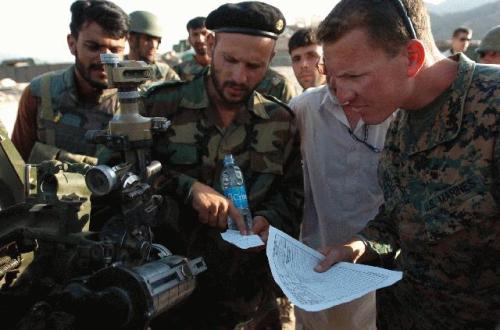
traiining team with afghan armyUSMC Advisers with Afghan Counterparts

The McClatchy reporter said: “We walked into a trap, a killing zone of relentless gunfire and rocket barrages from Afghan insurgents hidden in the mountainsides and in a fortress-like village where women and children were replenishing their ammunition.”  The reporter said that “U.S. commanders, citing new rules to avoid civilian casualties, rejected repeated calls to unleash artillery rounds at attackers dug into the slopes and tree lines — despite being told repeatedly that they weren’t near the village.”

The battle must have been intense.  I have been on foot patrols in areas crowded with Iraqis far away from significant support where if an insurgent group had attacked us we would have easily been overwhelmed. This is part of the world of the U.S. Military in the embedded training teams which work closely with Afghan and Iraqi soldiers.  I spent a lot of time with the advisers to Iraqi Army. Border and Port of Entry troops, Police and Highway Patrol spread across the entirety of Al Anbar Province.  These men and women are seldom thought of or mentioned by the press or even the military. . They come from all branches of the military and serve as advisers, trainers and mentors to these nations’ security forces.  The duty is dangerous.  The advisers, be they to the military, police, or civil administrations often work in the most isolated places in these countries and are stationed in small teams with the Iraqis and Afghans that they advise.  They are often far from the “big battalions” that have lots of firepower available and often operate out of larger and more secure bases with air support close at hand. Earlier in the year there were a number of incidents where advisers were killed by renegade soldiers or police, or by infiltrators posing as security personnel.  Two soldiers were working with an Iraqi unit in doing humanitarian work in a village when attacked and killed by someone who had infiltrated the Iraqi security forces.  . On March 27th Navy LT Florence Choe and LTJG Francis Toner IV were killed by an Afghan insurgent posing as an Afghan Army soldier. All of these events triggered anxiety in me as I remembered how many times I was incredibly exposed to danger conducting similar operations.

This incident was especially chilling as I read the reporter’s account of the ambush.  “Dashing from boulder to boulder, diving into trenches and ducking behind stone walls as the insurgents maneuvered to outflank us, we waited more than an hour for U.S. helicopters to arrive, despite earlier assurances that air cover would be five minutes away.”  According to the reporter Marine Maj. Kevin Williams” the commander of the team said: “We are pinned down. We are running low on ammo. We have no air. We’ve lost today, through his translator to his Afghan counterpart, responding to the latter’s repeated demands for helicopters.”  When I read this my mind flashed back to being in the middle of a massive crowd at the border crossing of Waleed on the Iraqi-Jordanian border.  There were about nine of us, of which only 8 were armed as I am not allowed by the U.S. interpretation of the law of war to carry a weapon.  There were thousands of Iraqis and others around us, very few border troops or port-of-entry police anywhere near us.  The port of entry had been the scene of numerous attempts to smuggle weapons, materials, and other supplies, drugs and to Iraq insurgents and Al Qaida.  Very few US troops were stationed there and many of these were dispatched off of the base at any given time.

The advisers are drawn from all services.  They are all Individual Augments that come from both the Active and Reserve components.  They do not deploy with their own units, which means that they go to war with people that they might have trained alongside getting ready for the mission, but otherwise have not served with.  When they come home they go back to their old assignments or new orders and are separated from the men and women that they served alongside for 7 to 15 months.  In other words they are isolated when they return home and go back to places where the majority of personnel, even those who have been “in country” have no earthly idea or appreciation of the conditions that they served in and dangers that they faced.  This happened to me when I returned and I went through an emotional collapse as the PTSD that I did not know I had kicked my ass.  Sights, smells, noises, crowds, airports and in fact almost everything but baseball diamonds caused me to melt down as they all brought the danger back to me. Don’t get me wrong, my tour in Iraq was the highlight of 27 plus years in the military, the part of which I am the most proud.

I have a special place for these men and women.  I served with them in Iraq’s Al Anbar Province as the first Navy Chaplain, and one of the first chaplains of any service to be assigned to cover these teams since Vietnam.  My assistant, RP2 Nelson Lebron and I deployed together from out unit.  I had prepared well.  I had been on the bubble to deploy for months.  My background in military history and past service with both the Army and Marines helped me. Likewise my military and civilian education helped me.  Shortly before we were notified of the deployment I went to the Jordanian Army Peace Operations Training Center course on Iraqi culture, religion and society.  I had served as a chaplain in the trauma department of one of the largest trauma centers in the country.  RP2 Lebron had deployed multiple times to Iraq, Beirut and Afghanistan where he was awarded the Defense Meritorious Service Medal (no small feat for an E-5).  He is also an incredibly gifted boxer, kick boxer and martial artist who has fought on Team USA and holds more title belts than I can count.  He most recently won the Arnold Schwarzenegger Classic. I had served with him before and he knew that his mission was to keep me safe.  I don’t want to sound arrogant, but the Chief of Staff of the Iraq Assistance Group said that we were “the best ministry team he had seen in 28 years in the Army.”

When we went to Al Anbar we were sent out with the Marines and Soldiers advising the 1st and 7th Iraqi Army Divisions, The Iraqi Police, Highway Patrol, the 2nd Border Forces Brigade and Port of Entry Police.  We operated in a area the size of the state of Oregon.  In some cases it would take us 2 days by air and convoy to reach isolated teams on the Syrian border.  When you travel by air in Iraq you are always at the mercy of the weather and aircraft availability. I had the rare privilege as a Lieutenant Commander to be able to arrange all of my own air transportation.  Most people, including people higher ranking than me had to depend on others to do this for them.  We worked with our advisers to get out to them.  We would be out 5-12 days at a time with anywhere from 4 to 7 days between missions.  In our 7 months we traveled over 4500 air miles and 1500 ground miles.  Almost all of our air travel was rotor wing. We flew in CH-46, CH-47 and MH-53s and the MV-22 Osprey.  Our convoys were usually not larger than 3 American HUMMVs and sometimes a few Iraqi vehicles.  Our biggest guns were .50 cal or M240B machine guns.

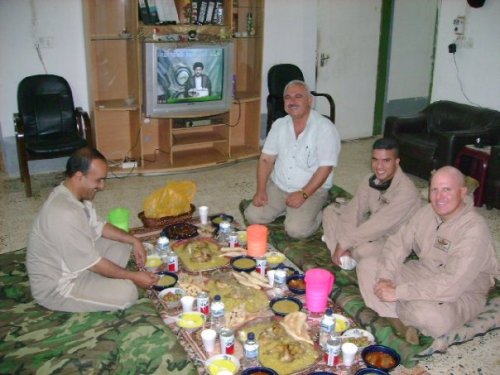
Dinner with Geneal SabahDinner with General Sabah in Ramadi

Many places we served were in places that had no large forces in position to help us if we got in trouble.  Even on the bases we were isolated.  Our teams were with the Iraqis in almost all cases.  We often ate in Iraqi chow halls and used Iraqi shower trailers.  Our advisers had us meeting their Iraqi counterparts.  We met and dined with Iraqi Generals, had ch’ai (tea) with small groups of Americans and Iraqis and got out with the Bedouins. We were in a number of particularly sensitive and dangerous situations with our advisers; one which I cannot go into great detail involved a senior advisor having to inform a new Iraqi Brigade Commander that a member of his staff was engaged in illegal activities and who had put out contracts to kill the American officer.  The bad Iraqi officer was confronted and relieved in a tense meeting where both Nelson and I were with that Colonel and two other advisors as they made the confrontation in the Iraq C.O.’s office, a confrontation that got quite heated until the Iraqi C.O. shut him up. At one point the cashiered officer appealed to the American “Imam” that he was a faithful Moslem, to whit the American Colonel and I asked him how a person who was living a good Moslem life could steal from his own countrymen and supply his county’s enemies with what they needed.

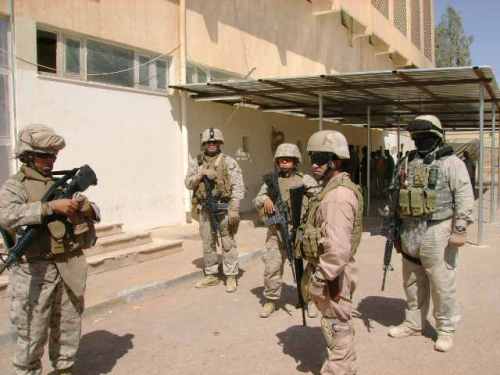
Waleed trip 006Team at Waleed on the “secure” side of the Port of Entry
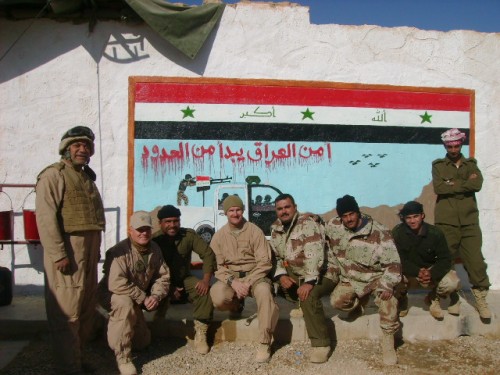
It was an incredible, once in a lifetime tour serving with some of the greatest Americans and Iraqis around. Iraqi soldiers in with our convoys would ask me to bless their trucks with Holy Water like I was doing with the American trucks.  I came to admire many of the professional Iraqi officers that I came to know and pray for the people of Iraq, that God would grant them peace. They are wonderfully hospitable and gracious.  We were often treated to food and tea by Iraqi soldiers, and civilians.  After nearly 30 years of nearly continuous war, dictatorship and terrorism, they deserve peace and security.

Me BTT CO and Iraqi LeadersAdvisers and Iraqi Border Troops near Syria
I had one Iraqi operations officer, a Sunni Muslim tell me that he wished that his Army had Christian priests because they would take care of his soldiers and had no political axe to grind. He said that the Army did not trust most Imams or Mullahs because they had compromised themselves during the civil war.  Another officer, a Shia Muslim came to me to thank me for being there to take care of our Marines.  He said that he, an Iraqi Shia Arab, hoped that if they had any problems from the Persians (Iranians), that we would help them.  These is little truth to what is floated that Iraqi and Iranian Shia like each other.  The memories of the past die hard in the Middle East.  When Persia ruled Iraq they treated the Arabs like dirt. Likewise the memories of the Iran-Iraq war are still alive.  Iraqi Arabs, Sunni, Shia and even Christian have little love for the “Persians.”  General Sabah of the 7th Division had us to his quarters for dinner. We had a wonderful and friendly discussion about similarities and differences in Christianity and Islam. We departed friends. The last time I saw him ws in the Ramadi heliport.  He saw me, ran up to me in from of his staff and Americans in the little terminal and gave me a bear hug, telling all that I was his friend. Another Iraqi General told me just before we left to come back as a tourist in 5 years because everything would be better.  I honestly think that he is right.  I hope to go back someday.  It would be a privilege to see my Iraqi friends again.

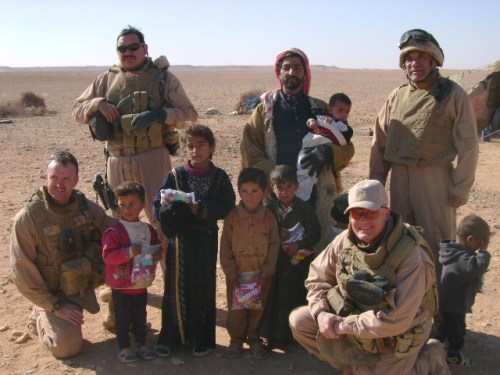
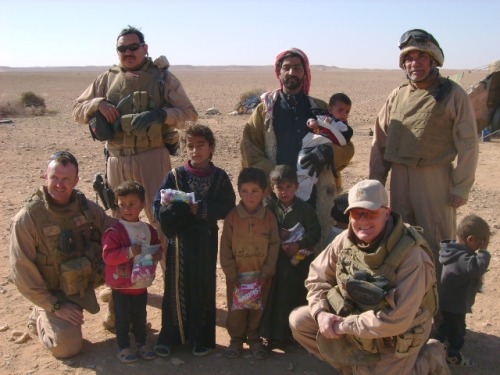
Me and BTT with Bedouin KidsWith a Bedouin Family

At the same time Afghanistan is a different animal. Iraq was not as easy of place for Al Qaida to work in and the Iraqis have a much more developed national identity which they trace back to the Babylonians and Chaldeans.  They also have adopted a lot of western ways.  Insurgents there once they had lost the confidence of the Iraqis lost traction.  In Afghanistan there is no real collective national identity and the form of Islam is much more severe than almost all Iraqi variants.  The Afghans insurgents have also due to the terrain; climate and inability of invaders to gain the confidence of the population have used the inability of invaders against them as they bring the population back under their control, sometimes quite peacefully.  The Taliban have secure bases on the Pakistani side of the border as did the North Vietnamese and they have the support of much of the population due to the unpopularity and corruption of the Afghan government.  The Taliban have begun to operate in larger better organized units and last year a battalion sized element attempted to overrun a small NATO base.  They did this with the Russians as well.  One troubling comment was reported about something overhead on the Taliban radio: “We will do to you what we did to the Russians,” the insurgent’s leader boasted over the radio, referring to the failure of Soviet troops to capture Ganjgal during the 1979-89 Soviet occupation.”  They also have outlasted or defeated a host of powerful empires.  The war in Afghanistan has much more in common with Vietnam than it does with Iraq. Counter Insurgency techniques learned in Iraq will be helpful but because of the terrain, climate and nature of the opposition will be tougher to execute and in order to have any chance of getting out of Afghanistan having accomplished the mission we will end of taking more casualties, especially in the teams of advisers.  Iraq was different, despite the problems and having to be rebuilt the Iraqi Army has a long history and tradition dating back to the Ottoman Empire, they led the way to westernizing Iraq and helping build an Iraqi identity, this is not the case in Afghanistan.  What happened to this team could easily happen to others and it looks to me like someone set them up to be hit, probably a Taliban sympathizer in the Afghan security forces or government. Afghanistan is much more treacherous than Iraq and in my view will be much more difficult.

What happened at Ganjgal is being investigated and in our area it is front page news as 1st Lt Johnson was from Virginia Beach.  The Taliban want to use events like this to break down the American home front and 8 years after the attacks of 9-11 2001 with that a fading memory they may well do this.  If they do Afghanistan will become Vietnam in the mountains.  We will be forced to withdraw and and the NATO alliance will be severely tested.  A defeat would have wide ranging consequences beginning in Afghanistan as it would fall back into the medieval world of Taliban rule, and would likely spread to Pakistan which which is already under severe strain.  This could threaten the Pakistani nuclear weapons.

Our advisers build bridges between peoples of different history and culture.  They are the unsung heroes of these wars and will likely never get credit for all that they have done.  Operating in isolation they are exposed to more danger that the average unit. They have my highest admiration and I hope that if you know one of these men or women that you will thank them.  I pray that they will all come home safe and be blessed with success.  I would certainly serve with them again at any time and in any place.

Please keep the families of the most recent casualties in your prayers. Peace, Steve+

1 Comment

Filed under iraq,afghanistan, Tour in Iraq

The Dangerous and Often Thankless Duty of Military Advisers

me-and-btt-with-bedouin-kids1 Me with Advisers to the 2nd Border Brigade with Bedouin Family on Syrian Border 23 December 2007
There are a group of US Military personnel that are seldom thought of or mentioned in the wars that we are waging in Iraq and Afghanistan. These men and women from all branches of the military are those who serve as advisers, trainers and mentors to these nations security forces.  The duty is dangerous.  The advisers, be they to the military, police, or civil administrations often work in the most isolated places in these countries and are stationed in small teams with the Iraqis and Afghans that they advise.  The are often far from the “big battalions” that have lots of firepower available and often operate out of larger and more secure bases with air support close at hand.

Recently there have been a number of incidents where advisers have been killed by either renegade soldiers or police, or by infiltrators posing as security force personnel.  In one humanitarian operation a couple of Army advisers were killed in Iraq.  These men were working with an Iraqi unit in doing humanitarian work in a village. On March 27th Navy LT Florence Choe and LTJG Francis Toner IV were killed by an Afghan insurgent posing as an Afghan Army soldier.  For me these events triggered some anxiety as I remembered how many times I was incredibly exposed to danger from the same kind of events.  A couple of days ago I mentioned that I had been feeling some anxiety that I could not explain.  I finally figured it out.  It began after I read about the death of these Naval Officers serving in Afghanistan. Since then every siren, loud noise and helicopter has raised my alert level.

The advisers are drawn from all services.  They are all Individual Augments that come from both the Active and Reserve components.  They do not deploy with their own units, which means that they go to war with people that they might have trained alongside getting ready for the mission, but otherwise have not served with.  When they come home they go back to their old assignments or new orders and are separated from the men and women that they served alongside for 7 to 15 months.  In other words they are isolated when they return home and go back to places where the majority of personnel, even those who have been “in country” have no earthly idea or appreciation of the conditions that they served in and dangers that they faced.  This happened to me when I returned and I went through an emotional collapse as the PTSD that I did not know I had kicked my ass.  Sights, smells, noises, crowds, airports and in fact almost everything but baseball diamonds caused me to melt down as they all brought the danger back to me. Don’t get me wrong, my tour in Iraq was the highlight of 27 plus years in the military, the part of which I am the most proud.

I have a special place for these men and women.  I served with them in Iraq’s Al Anbar Province as the first Navy Chaplain, and on of the first chaplains of any service to be assigned to cover these teams since Vietnam.  My assistant, RP2 Nelson Lebron and I deployed together from out unit.  I had prepared well.  I had been on the bubble to deploy for months.  My background in military history and past service with both the Army and Marines helped me. Likewise my military and civilian education helped me.  Shortly before we were notified of the deployment I went to the Jordanian Army Peace Operations Training Center course on Iraqi culture, religion and society.  I had served as a chaplain in the trauma department of one of the largest trauma centers in the country.  RP2 Lebron had deployed multiple times to Iraq, Beirut and Afghanistan where he was awarded the Defense Meritorious Service Medal (no small feat for an E-5).  He is also an incredibly gifted boxer, kick boxer and martial artist who has fought on Team USA and holds more title belts than I can count.  He most recently won the Arnold Schwarzenegger Classic. I had served with him before and he knew that his mission was to keep me safe.  I don’t want to sound arrogant, but the Chief of Staff of the Iraq Assistance Group said that we were “the best ministry team he had seen in 28 years in the Army.”

When we went to Al Anbar we were sent out with the Marines and Soldiers advising the 1st and 7th Iraqi Army Divisions, The Iraqi Police, Highway Patrol, the 2nd Border Forces Brigade and Port of Entry Police.  We operated in a area the size of the state of Oregon.  In some cases it would take us 2 days by air and convoy to reach isolated teams on the Syrian border.  When you travel by air in Iraq you are always at the mercy of the weather and aircraft availability. I had the rare privilege as a Lieutenant Commander to be able to arrange all of my own air transportation.  Most people, including people higher ranking than me had to depend on others to do this for them.  We worked with our advisers to get out to them.  We would be out 5-12 days at a time with anywhere from 4 to 7 days between missions.  In our 7 months we traveled over 4500 air miles and 1500 ground miles.  Almost all of our air travel was rotor wing. We flew in CH-46, CH-47 and MH-53s and the MV-22 Osprey.  Our convoys were usually not larger than 3 American HUMMVs and sometimes a few Iraqi vehicles.  Our biggest guns were .50 cal or M240B machine guns.  Most of the time we were in places that had no large forces in position to help us if we got in trouble.  Even on the bases we were isolated.  Our teams were with the Iraqis in almost all cases.  We often ate in Iraqi chow halls and used Iraqi shower trailers.  Our advisers had us meeting their Iraqi counterparts.  We met and dined with Iraqi Generals, had ch’ai (tea) with small groups of Americans and Iraqis and got out with the Bedouins. We were in a number of particularly sensitive and dangerous situations with our advisers.  It was an incredible, once in a lifetime tour serving with some of the greatest Americans and Iraqis around. Iraqi soldiers in with our convoys would ask me to bless their trucks with Holy Water like I was doing with the American trucks.  I came to admire many of the professional Iraqi officers that I came to know and pray for the people of Iraq, that God would grant them peace. They are wonderfully hospitable and gracious.  We were often treated to food and tea by Iraqi soldiers, and civilians.  After nearly 30 years of nearly continous war, dictatorship and terrorism, they deserve peace and security.

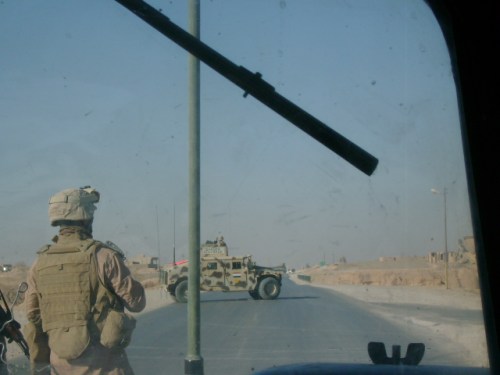
iraqi-army-hummv-in-convoy-paused-at-road-junctionCombined US Iraqi Convoy

I had one Iraqi operations officer, a Sunni Muslim tell me that he wished that his Army had Christian priests because they would take care of his soldiers and had no political axe to grind. He said that the Army did not trust most Imams or Mullahs because they had compromised themselves during the civil war.  Another officer, a Shia Muslim came to me to thank me for being there to take care of our Marines.  He said that he, an Iraqi Shia Arab, hoped that if they had any problems from the Persians (Iranians), that we would help them.  These is little truth to what is floated that Iraqi and Iranian Shia like each other.  The memories of the past die hard in the Middle East.  When Persia ruled Iraq they treated the Arabs like dirt. Likewise the memories of the Iran-Iraq war are still alive.  Iraqi Arabs, Sunni, Shia and even Christian have little love for the “Persians.”  General Sabah of the 7th Division had us to his quarters for dinner. We had a wonderful and friendly discussion about similarities and differences in Christianity and Islam. We departed friends. The last time I saw him ws in the Ramadi heliport.  He saw me, ran up to me in from of his staff and Americans in the little terminal and gave me a bear hug, telling all that I was his friend. Another Iraqi General told me just before we left to come back as a tourist in 5 years because everything would be better.  I honestly think that he is right.  I hope to go back someday.  It would be a privilege to see my Iraqi friends again.

This is what our advisers get to do every day. Yes they are exposed to great danger, but they are building bridges between peoples of different history and culture.  They are the unsung heroes of these wars and will likely never get credit for all that they have done.  They have my highest admiration and I hope that if you know one of these men or women that you will thank them.  I pray that they will all come home safe and be blessed with success.  I would certanly serve with them again at any time and in any place.

Please keep the families of LT Choe and LTJG Toner in your prayers. A link about these fine Naval Officers is below. Peace, Steve+

http://afghanistan.pigstye.net/article.php?story=FlorenceBChoe

3rd-bn-mtt-group-with-chaplainWith “Ronin” Advisors to 3rd Bn 3rd Brigade 7th Iraqi Division

2 Comments

Filed under Foreign Policy, Military, PTSD