Tag Archives: united states constitution

“No One is Bigger than the Game” Baseball, America and the Rules Trump Hates

Friends of Padre Steve’s World

This afternoon I will be attending an exhibition game between the Baltimore Orioles and their Triple A minor league affiliate the Norfolk Tides at Norfolk’s Harbor Park. The Tides won’t open their season until April 6th and while this is not the home opener it is for people like me a harbinger of goodness, as the late Commissioner of Baseball and President of Yale University A. Bartlett Giamatti said; “There’s nothing bad that accrues from baseball.”

Baseball is a game where the game itself is sacrosanct and is more important than any commissioner, team owner, manager, player or group of investors. In a way it is much like how our nation’s founders and many of our greatest political leaders, President’s, Justices of the Supreme Court, Senators and Congressmen, military leaders, civil rights leaders, and academics viewed the United States, its Constitution, and the very proposition upon which it was founded, the proposition that “all men are created equal.”

Fay Vincent who succeeded Giamatti after the Giamatti’s sudden death in 1989 noted:

“As all of us are aware, and no one more than I, Bart had a singular skill as a public speaker. He spoke well because he thought so well. But I point out to you that the most often quoted remark of Bart’s brief tenure as Commissioner is a very simple declarative sentence. That sentence is the cornerstone on which I will build my own administration. Bart said very simply, ‘No one is bigger than the game.’ I repeat today what Bart said in August, no one – no player, no executive, no owner, no Commissioner, no umpire is bigger than the game.” 

Today the United States has a President who truly believes that he is bigger and more important that all of our public norms and who has no respect for the Constitution or our form of government.

Alexander Hamilton wrote:

“If it were to be asked, What is the most sacred duty and the greatest source of our security in a Republic? The answer would be, An inviolable respect for the Constitution and Laws – the first growing out of the last . . . . A sacred respect for the constitutional law is the vital principle, the sustaining energy of a free government.”

The late conservative political commentator Micheal Novak once wrote about baseball connecting it with the heart and soul of the American political system. What he wrote is important for we who live in this day and age to understand, and which all too tragically President Trump does not. Novak said:

“Baseball is as close a liturgical enactment of the white Anglo-Saxon Protestant myth as the nation has. It is a cerebral game, designed as geometrically as the city of Washington itself, born out of the Enlightenment and the philosophies so beloved of Jefferson, Madison, and Hamilton. It is to games what the Federalist Papers are to books; orderly, reasoned, judiciously balanced, incorporating segments of violence and collision in a larger plan of rationality, absolutely dependent on an interiorization of public rules.”

The American political system, like baseball is, to use the words of Novak, “absolutely dependent on an interiorization of public rules.” This is something that our founders understood as have the vast majority of America Presidents and other political statesman regardless of their political party or whether or not they were a conservative or liberal. The fact is, that the interiorization of public rules, or rather, how we incorporate public rules, norms of behavior, traditions, customs, and the unwritten yet imperative rules of our social contract into our lives and behavior.

Neither President Trump or his most loyal supporters can fathom the meaning Novak’s words. The President flagrantly flaunts every norm of our American social and political contract that have existed since the days of the Continental Congress and is cheered and even given theological cover by his supporters.

That is why documents such as the Declaration of Independence, the Preamble of the Constitution of the United States, the Gettysburg Address, and the Four Freedoms are so important. None have the power of law, but all are essential to the functioning of the American political system. The American system is not a business contract, nor is it an Ayn Randish descent into a maelstrom of hyper-individualistic social Darwinism. Instead it is about the enlightenment, it is about reason, it is about freedom and responsibility. It is about obeying unwritten rules, rules that are placed upon our hearts.

Last year the President has continued his assault on that social and political contract drawn up by our founders. At the commissioning of the USS Gerald Ford he urged active duty military personnel to lobby their congressional representatives for his agenda. A few days later he turned a Boy Scout Jamboree into a political rally. He did a similar thing when he addressed the CIA at the beginning of his Presidency. But these are not new and they have continued, less than two weeks ago the President addressed Marines in San Diego and to their cheering delight he castigated the press and called them “enemies.”  It was a direct assault on the First Amendment and the Marines cheered him. I wondered what the hell was going on.

Since his campaign began the President has done everything that he can in order to subvert the American political system, and his words and actions show that he has no respect for the Constitution or laws for the land. If only there was someone who could call him out, as Bill Veeck said: “Baseball is almost the only orderly thing in a very unorderly world. If you get three strikes, even the best lawyer in the world can’t get you off.”

I do not say this with any malice, nor do I say it for any gain. I only say it because the President has stepped so far out from the norms of the American political system that it is impossible to say what he will do next. Our system of government is resilient but at the same time fragile. Unless the GOP majorities in Congress stand up to him our system will not survive in the way that our founders intended. Sadly, I have little hope that they will do so now.  For years most of them have fanned the flames of anti-government and anti-Federalist passions so vehemently that there is no room in their hearts for the very thing that holds our system together; the interiorization of public rules, norms, traditions, and behaviors; that is, the interiorization of liberty. The President show no evidence that he understands any of this.

Judge Learned Hand who has been called the greatest American jurist to have never served on the Supreme Court wrote:

“Liberty lies in the hearts of men and women; when it dies there, no constitution, no law, no court can save it; no constitution, no law, no court can even do much to help it.”

That is why I think that baseball serves to enlighten us to bigger things and why I welcome it with an open heart.

So anyway, until tomorrow,

Peace,

Padre Steve+

1 Comment

Filed under Baseball, Batlimore Orioles, History, laws and legislation, leadership, News and current events, norfolk tides, Political Commentary

Trump’s America: Saving the Form but Not the Soul

Friends of Padre Steve’s World,

In light of how President Trump and many of his advisors and defenders treat the Constitution, the principles, and norms of the American Experiment I went back to re-read British military historian Sir Basil Liddell-Hart’s small but significant work Why Don’t We Learn from History?

In it he makes some observations that are very pertinent to today, in fact very chilling words. He noted:

“What is of value in “England” and “America” and worth defending is its tradition of freedom, the guarantee of its vitality. Our civilization, like the Greek, has, for all its blundering way, taught the value of freedom, of criticism of authority, and of harmonising this with order. Anyone who urges a different system, for efficiency’s sake, is betraying the vital tradition.”

The President is an admirer of dictators and presumes himself to be above the Constitution and the laws that he swore to uphold. He uses the language and tactics of every aspiring despot labeling his critics as “enemies of the state” and uses his position for personal gain even initiates trade wars, alienates allies, praises dictators, and threatens nuclear war.

But his defenders and supporters don’t care. This includes those who are otherwise privately decent and law abiding people with supposedly Christian values tolerate and live their public lives by the code of social Darwinism.

“One can understand the point of view of the man who goes in for unabashed “piracy” and seeks his own profit regardless of others. He may draw his profit, although unconsciously his loss far exceeds it, because he is deadening his own soul.

But one cannot see sense, even of so shortsighted a kind, in those who maintain any standards of decency in private life yet advocate, or at least countenance, the law of the jungle in public and international affairs. More illogical still are those who talk of patriotic self-sacrifice and of its spiritual sublimity while preaching pure selfishness in world affairs.

What is the use of anyone sacrificing himself to preserve the country unless in the hope, and with the idea, of providing a chance to continue its spiritual progress toward becoming a better country? Otherwise he is merely helping to preserve the husk, saving the form but not the soul. Only a perverse patriotism is capable of such hopeless folly.

What is the value of patriotism if it means no more than a cat’s devotion to its own fireside rather than to human beings? And, like the cat, such a “patriot” is apt to get burned when the house catches fire.”

When I observe Trump, his administration, the Republican Congressional leaders, Evangelical Christians, and the Fox Propaganda Network I cannot but think of Liddell-Hart’s words and how relevant they are today.

When I swore my oath as a new Army Second Lieutenant in 1983 I swore that “I will support and defend the Constitution of the United States against all enemies, foreign and domestic, that I will bear true faith and allegiance to the same…” Since then I have served under six Presidents, four Republicans and two Democrats. I have found admirable characteristics in five of them even if I did disagree with all of them on matters of policy or ethics at one point or another. That being said until now never did I believe that a President of the United States posed an imminent threat to the Republic, or that he would be aided and abetted by men that at one time I admired. They are the kind of men that Liddell-Hart described, and they are dangerous.

At the same time I am one of those believe in telling the truth and will continue to speak because my oath to the Constitution still matters.

Until tomorrow,

Peace,

Padre Steve+

3 Comments

Filed under History, leadership, News and current events, Political Commentary

“My Oath did not Expire When I took off the Uniform” Ralph Peters Resigns from Fox News

Army-Lt.-Col.-Ralph-Peters-ret-on-Fox-News-screencap-800x430

Friends of Padre Steve’s World,

I have called Fox News and many of its hosts a propaganda network for some time. At one time, back in the late 1990s and up until I went to Iraq in July of 2007 I watched Fox nearly nonstop along with my daily diet of Rush Limbaugh and Sean Hannity on the radio. It took a number of years of their listening incessantly to their propaganda before I became revulsed by it while serving in Iraq.

Sitting in a dining facility late one evening after coming back from an intensive mission I saw some Fox News talking heads discussing the war on a television. What they were discussing was pure propaganda and had no relationship to what was going on in that country. At that point I made up my mind that what I had tried to believe was true was all lies; lies spun by the Bush administration and aided by the supposedly “Fair and Balanced” team at Fox News. When I returned home in 2008 every time I heard a Fox pundit or saw them on the news I became very angry. To this day I cannot watch them and when I see the lies and propaganda that they spread today I can only compare many of their hosts to the propagandists of Nazi Germany and the Soviet Union, except neither the Nazis or the Soviets claimed to be ‘fair and balanced.”

Yesterday I was pleasantly surprised to find out that retired Army Lieutenant Colonel Ralph Peters quit his post as a commentator for Fox. I met him in 1999 not long after I had transferred from the Army to the Navy and was serving at Camp LeJeuene with the Second Marine Division. Peters was doing a book tour for his first non-fiction title Fighting for the Future, and I got to meet and talk to him at the bookstore in the Main Exchange. He had enlisted in the Army five years before me and was commissioned three years before me. Both of us had served tours in Germany. He was an Intelligence officer with a specialization on the Soviet Union and Eastern Europe. I was a history major who in the wisdom of the Army assignment gods had been branched as a Medical Service Corps officer. Peters retired in 1998 as I was preparing to leave the Army for the Navy.

He certainly, like many military officers is very conservative but at the same time a realist. While initially supporting the war in Iraq he would become a critic by 2006 and in 2009 recommend pulling out of Afghanistan. He recently stated that assault weapons should be banned, something that is anathema to Fox and most of its loyal viewers.

Peters thought that President Obama was too soft on Putin and Russia, and despite being a big supporter of President Obama I had to agree with him. I think that while President Obama was in a no-win situation had he confronted and opposed Putin in 2016, he could have done more in 2015, and despite being in a no-win situation politically in 2016 that he should have hammered Putin and exposed the Russian attempts to undermine the country and elect Trump in 2016. His actions were too little and too late.

In his resignation from Fox, Peters showed something that is seldom seen in the media. He demonstrated courage and honor over personal gain. He had a good following on Fox and certainly could have stayed at the network and continued to make good money. But he finally hit the point with them that I hit in 2007, his honor and his commitment to his office would not allow him to stay.

His resignation latter was published by Buzzfeed on Tuesday. It is one of the most remarkable resignation letters I have ever read. It was an indictment of Fox and many of its hosts and commentators as pure propagandists “for a destructive and ethically ruinous administration.” I heartily agree with him. I have posted his letter in its entirety below.

On March 1st, I informed Fox that I would not renew my contract. The purpose of this message to all of you is twofold:

First, I must thank each of you for the cooperation and support you’ve shown me over the years. Those working off-camera, the bookers and producers, don’t often get the recognition you deserve, but I want you to know that I have always appreciated the challenges you face and the skill with which you master them.

Second, I feel compelled to explain why I have to leave. Four decades ago, I took an oath as a newly commissioned officer. I swore to “support and defend the Constitution,” and that oath did not expire when I took off my uniform. Today, I feel that Fox News is assaulting our constitutional order and the rule of law, while fostering corrosive and unjustified paranoia among viewers. Over my decade with Fox, I long was proud of the association. Now I am ashamed.

In my view, Fox has degenerated from providing a legitimate and much-needed outlet for conservative voices to a mere propaganda machine for a destructive and ethically ruinous administration. When prime-time hosts–who have never served our country in any capacity–dismiss facts and empirical reality to launch profoundly dishonest assaults on the FBI, the Justice Department, the courts, the intelligence community (in which I served) and, not least, a model public servant and genuine war hero such as Robert Mueller–all the while scaremongering with lurid warnings of “deep-state” machinations– I cannot be part of the same organization, even at a remove. To me, Fox News is now wittingly harming our system of government for profit.

As a Russia analyst for many years, it also has appalled me that hosts who made their reputations as super-patriots and who, justifiably, savaged President Obama for his duplicitous folly with Putin, now advance Putin’s agenda by making light of Russian penetration of our elections and the Trump campaign. Despite increasingly pathetic denials, it turns out that the “nothing-burger” has been covered with Russian dressing all along. And by the way: As an intelligence professional, I can tell you that the Steele dossier rings true–that’s how the Russians do things.. The result is that we have an American president who is terrified of his counterpart in Moscow.

I do not apply the above criticisms in full to Fox Business, where numerous hosts retain a respect for facts and maintain a measure of integrity (nor is every host at Fox News a propaganda mouthpiece–some have shown courage). I have enjoyed and valued my relationship with Fox Business, and I will miss a number of hosts and staff members. You’re the grown-ups.

Also, I deeply respect the hard-news reporters at Fox, who continue to do their best as talented professionals in a poisoned environment. These are some of the best men and women in the business..

So, to all of you: Thanks, and, as our president’s favorite world leader would say, “Das vidanya.”

The various oaths that I have sworn to the Constitution, first as an enlisted man and then as a Commissioned Officer in the Army, the Army National Guard, the Army Reserve, and the Navy are foundational to my life. I have served under six Presidents. I have agreed and disagreed with the various policies and positions of the first five, but never did I think that any of them were truly a threat to the Constitution and the foundation of the country as I believe that President Trump and his administration are such a threat.

It is my adherence to the Constitution; the radical proposition of the Declaration of Independence that “all men are created equal and endowed by their creator with certain unalienable rights, that among these are life, liberty, and the pursuit of happiness.” I could add the Gettysburg Address in which Abraham Lincoln gave new life to the propositions of the Declaration and the preamble of the Constitution. Now is the time for every American to be as recommit themselves to those ideals or lose them forever.

The President and his propagandists at Fox News are not patriots. One can place a thousand flags behind them or adorn the lapels of their suit jackets with American flag pins, but that does not mean that they are patriots. Patriots stand for those principles, and the Constitution; all of it, not just the parts that they agree with while working to undermine the protections of the Constitution to those who they may hate or disapprove.

In his book On Tyranny Dr Timothy Snyder wrote:

“The president is a nationalist, which is not at all the same thing as a patriot. A nationalist encourages us to be our worst, and then tells us that we are the best. A nationalist, “although endlessly brooding on power, victory, defeat, revenge,” wrote Orwell, tends to be “uninterested in what happens in the real world.” Nationalism is relativist, since the only truth is the resentment we feel when we contemplate others. As the novelist Danilo Kiš put it, nationalism “has no universal values, aesthetic or ethical.” A patriot, by contrast, wants the nation to live up to its ideals, which means asking us to be our best selves. A patriot must be concerned with the real world, which is the only place where his country can be loved and sustained. A patriot has universal values, standards by which he judges his nation, always wishing it well—and wishing that it would do better.” 

Ralph Peters is a patriot whether you agree or disagree with him on various issues. He did the right thing for the right reason. Some may think that it took him too long to do so, but just how many others in the Fox News and Right Wing media vortex or the Republican Party have stated the truth as Lieutenant Colonel Peters did? Even those who publicly disagree with the President, with nothing to lose, often equivocate and show that they are cowards when after they say that they will stand against him, simply slink away until the next time.

So until the next time,

Peace

Padre Steve+


1 Comment

Filed under ethics, Foreign Policy, History, iraq,afghanistan, leadership, Military, News and current events, Political Commentary

Repair Our Losses and Be a Blessing to Us: A Night at the Congressional Baseball Game


Friends of Padre Steve’s World,
Baseball legend Bill Veeck once noted:  “Baseball?  It’s just a game – as simple as a ball and a bat.  Yet, as complex as the American spirit it symbolizes.  It’s a sport, business – and sometimes even religion.”

Baseball is essential to the American spirit, it is complex and for people like me it is a religion, a true Church in which I find refuge. Likewise, as I get older and more disillusioned with the Christian Church and religion in general I tend to agree more and more with Annie Savoy in Bull Durham when she says   “The Only church that truly feeds the soul, day-in day-out, is the Church of Baseball”


I, like many people turn to baseball in times of trouble. My frequent trips to the ball park after Iraq were places of solace where I could escape the terror of my PTSD.


Last night I went up with Chaplain Vince Miller to see the Congressional Baseball game at National’s Stadium in D.C. It was  a last minute decision. My friend messaged me Wednesday evening and suggested it. He got the tickets, we got permission from our bosses, rearranged our schedules and I got the hotel and drove up. When he contacted me Wednesday he felt that it was something that we needed to do, and I immediately agreed. There were two reasons for this; First some long overdue self care that you can only have from people who are friends who have lived the same kind of life you have, but second because both of us thought it was important in a deeper way. 

After yesterday’s attempted assassination of Republican members of Congress both of us felt it necessary to go to show our support for our elected representatives from both parties. Both of us felt the need to be there for the members of Congress as Americans because both of us still believe in the ideals and the promise that still resides in the people of this country. 

I believe that we can vehemently disagree about policy, but the answers are found at the ballot box and by deciding to become friends again. Likewise I believe that one of the best places for that is the baseball diamond where last night members of the Democrat and Republican Senate and House faced each other as friends during a baseball game, the proceeds of which benefited charities in the Washington D.C. Metro area. 


Wednesday’s attack was an attack on America itself, our institutions, and based on the violent rhetoric and intense anger of many people it could have happened to either team. So last night’s game was a balm for the soul of the nation and I hope a sign of better things to come. Maybe it took something like this to realize that we have ventured too far down the road of hate and intolerance to continue that direction.

Walt Whitman wrote that baseball is “our game – the American game.  It will take our people out-of-doors, fill them with oxygen, give them a larger physical stoicism.  Tend to relieve us from being a nervous, dyspeptic set.  Repair these losses, and be a blessing to us.”


The game was fun to watch both sides played hard but the sportsmanship, camaraderie, and friendship showed. From the crowd there were few boos or catcalls from either side of the nearly 25,000 fans of both teams. Before the game the members of both teams went to second base and took a knee praying for their colleague Representative Steve Scalise and the police officers wounded in the attack. Even President Trump struck the right note in his remarks which were broadcast on the center field scoreboard. Among the fans of both sides there was absolute courtesy that was so unlike the intense and often mean spirited partisanship that has consumed the nation for the past decade or more. I know that I can only hope that this will continue.

The Democrats overwhelmed the GOP with a barrage of hits while their pitcher Representative Cedric Richmond of New Orleans threw a five hitter, and struck out seven. GOP shortstop Ryan Costello of Pennsylvania who had been moved from third base due to the shooting of Scalise  showed excellent defensive prowess making a number of outstanding defensive plays.


But on another level this trip was good for me and for Vince as well. We had both thought it important to show our support by going and we likewise both knew that we needed the time together to take care of each other, but it became bigger than that. After the game we went for a nightcap at the Gordon Biersch Brewery Restaurant near the stadium. While we were there two members of Congress, Republican Congressman Mark Walker of North Carolina and Democratic Congressman Tony Cardenas of California came in and we both greeted them and thanked them for coming out to play the game after what happened yesterday. Ever gracious both autographed baseballs for us and Cardenas extended an invitation to visit him in his House office.

The fact is that we in the military deal with losing friends to senseless violence everyday, but this is not what normal people deal with, including the men and women who serve in the House and Senate. To go out and play a ballgame after your colleagues were attacked is not an everyday event and there had to be some amount of fear for anyone that went out onto that field, perhaps for the first time in a long time members realized that they too could be the target of political violence. I think that that shook many people to the core, and I believe that it took a measure of courage for them to play the game after the attack, but I digress… 

Our time with both of these Congressmen was important, they were surprised and pleased that two Navy Chaplains completely changed their plans and travelled 200 miles to watch them play baseball. It was also interesting because Vince is from North Carolina, and Representative Walker was a pastor for many years, and the family of Congressman Cardenas had been migrant workers around Stockton California, my home town. I’m not going to speculate but I am going to assume by how they treated us that it meant a lot to them that we and so many others stood with them last night. I think they realized as many others did, that this is about all of us, Democrat and Republican, and as I said before I hope and pray that this might signal a new and less hateful era in American politics. 

When we went back to the hotel we talked about the mystery that is the work of the Holy Spirit of God, not the fatalism of providence, but the mystery of the Holy Spirit’s work in our lives and those around us. It was about more than us, and to quote Jake Blues “we’re on a mission from God.” 

So I’m going to leave you with the mystery of the Spirit that worked in the hearts of two Chaplains who needed some time to take care of each other had our lives intersect those of a lot of nice people, 

So anyway, let us try to all do better. 

Until tomorrow,

Peace

Padre Steve+

1 Comment

Filed under Baseball, faith, leadership, Political Commentary

From All-Volunteer Forces to Conscription: The Draft in the Civil War

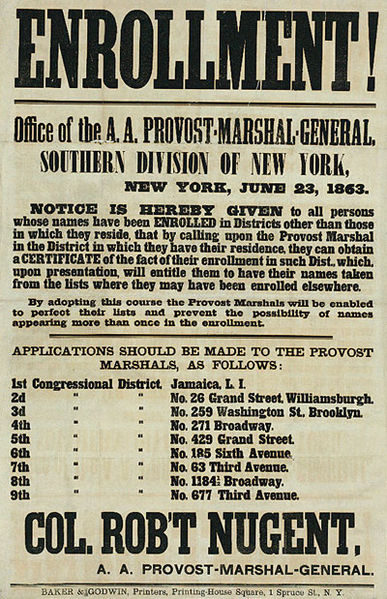
Enrollment-Poster-in-New-York-June-23-1863

Friends of Padre Steve’s World,

Today I am posting another heavily revised section of my Civil War and Gettysburg text, this dealing on the conscription efforts of both sides. It is an inte4resting subject as it brings up many issues that we still face in society, racial and religious prejudice, economic disparity, and social division.  Of course as always I will probably add more to this and revise it again, but you are probably getting used to that. I hope that you enjoy and have a great day.

Peace

Padre Steve+

The Changing Character of the Armies and Society

Gettysburg was the last battle where the original armies, composed of volunteers predominated.  As the war progressed the nature of both armies was changed. Initially both sides sought to fight the war with volunteers. However, the increasingly costly battles which consumed vast numbers of men necessitated new measures to fill the ranks, and this need led to the conscription, or draft of soldiers and the creation of draft laws and bureaus in the South and later the North.
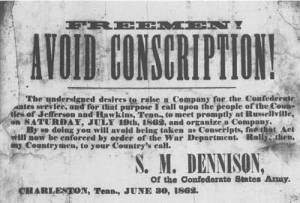
fig17

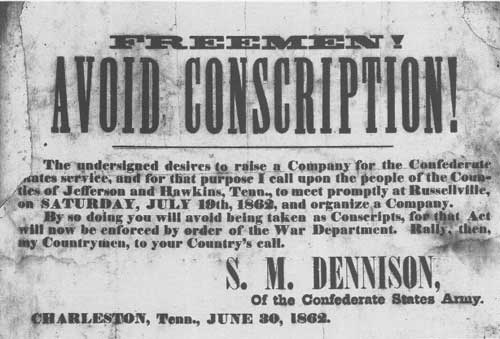
Confederate Conscription

The in April 1862 Confederate Congress passed the Conscription Act of 1862 which stated that “all persons residing in the Confederate States, between the ages of 18 and 35 years, and rightfully subject to military duty, shall be held to be in the military service of the Confederate States, and that a plain and simple method be adopted for their prompt enrollment and organization.” [1] The act was highly controversial, often resisted and the Confederate Congress issued a large number of class exemptions. Despite the exemptions “many Southerners resisted the draft or assisted evasion by others” [2] The main purpose of the conscription act was “to stimulate volunteering rather than by its actual use” [3] and while it did help increase the number of soldiers in Confederate service by the end of 1862 it was decidedly unpopular among soldiers, chafing at an exemption for “owners or overseers of twenty or more slaves” [4] who referred to the war as a “rich man’s war but a poor man’s fight.” [5]

Some governors who espoused state’s rights viewpoints “utilized their state forces to challenge Richmond’s centralized authority, hindering efficient manpower mobilization.” [6] Some, most notably Georgia’s governor Joseph Brown “denounced the draft as “a most dangerous usurpation by Congress of the rights of the States…at war with all principles for which Georgia entered the revolution.” [7]  Governor Brown and a number of other governors, including Zebulon Vance of North Carolina fought the law in the courts but when overruled resisted it through the many exemption loopholes, especially that which they could grant to civil servants.

In Georgia, Governor Brown “insisted that militia officers were included in this category, and proceeded to appoint hundreds of new officers.” [8] Due to the problems with the Conscription Act of 1862 and the abuses by the governors, Jefferson Davis lobbied Congress to pass the Conscription Act of 1864. This act was designed to correct problems related to exemptions and “severely limited the number of draft exemption categories and expanded military age limits from eighteen to forty-five and seventeen to fifty. The most significant feature of the new act, however, was the vast prerogatives it gave to the President and War Department to control the South’s labor pool.” [9] Despite these problems the Confederacy eventually “mobilized 75 to 80 percent of its available draft age military population.” [10]
recruit poster

The Enrollment Act: The Federal Draft

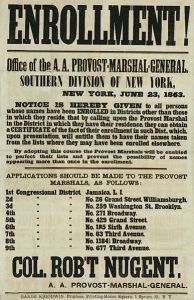
In the spring of 1863 a manpower crunch began to hit the Union Army as vast numbers of the nine-month militia regiments which were called out by Lincoln in accordance with the Militia Act of May 25th 1792 were to disband. Facing the reality that the all-volunteer system which had sustained the war effort the first two years of the war could no longer meet the need for adequate numbers of soldiers the Congress of the United States passed the “An Act for the enrolling and calling out the National Forces, and for other Purposes,” commonly known as the enrollment act of 1863” on March 3rd 1863. [11] The length of the war and the massive number of causalities were wearing on the population and the Union Army had reached an impasse as in terms of the vast number of men motivated to serve “for patriotic reasons or peer group pressure were already in the army.” Likewise, “War weariness and the grim realities of army life discouraged further volunteering” and “the booming war economy had shrunk the number of unemployed men to the vanishing point.” [12]

The Enrollment Act was controversial. Based on the power of Congress given by the Constitution in Article One, Section Eight, to raise and support armies. It was “the first direct Federal conscription statute in U.S. history, providing the first Federal compulsion upon individuals to enter directly into the military service of the United States, without intermediate employment in the militia systems of the states.” [13] In doing so the act “bypassed the state governments entirely and created a series of federal enrollment boards that would take responsibility for satisfying the federally assigned state quotas.” [14] In effect it was an act the nationalized military service and eventual became the basis for a truly national army which would be supported by state forces embodied in the National Guard as well as a Federal Army Reserve. Though Chief Justice of the Supreme Court Roger Taney believed that act of be unconstitutional it was never challenged during his lifetime, but “the Court eventually upheld the constitutionality of the similar Selective Service Act of May 18th, 1917 in a unanimous decision.” [15] The act made some exemptions, those who were physically or mentally unfit, certain high federal government officials and governors, only sons of dependent widows and infirm parents, or those convicted of a felony.

Like the Confederate legislation, this act was also tremendously unpopular and was ridden with exemptions which were frequently abused. All congressional districts were issued a quota for volunteers. Those districts that were able to fulfill their quotas were not subject to conscription, thus the districts that “could provide sufficient volunteers, or bounties high enough to lure volunteers, would not need to draft anyone, and in the end only seven Northern States would be subject to all four of the draft calls issued under the Enrollment Act.” [16]

The Federal draft was conducted by lottery in each congressional district with each district being assigned a quota to meet by the War Department. Under one third of the men drafted actually were inducted into the army, “more than one-fifth (161,000 of 776,000) “failed to report” and about 300,000 “were exempted for physical or mental disability or because they convinced the inducting officer that they were the sole means of support for a widow, an orphan sibling, a motherless child, or an indigent parent.” [17]

To ensure that the enrollment boards had teeth Congress “authorized a Provost Marshall Bureau in the War Department to enforce conscription.” [18] It was the task of the Provost Marshalls to enroll every male citizen, as well as immigrants who had applied for citizenship between the ages of twenty to forty-five.

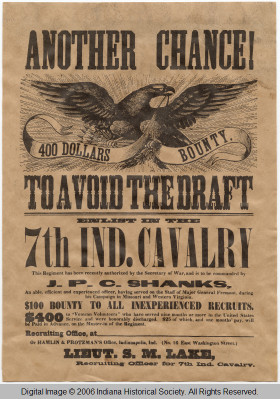
There was also a provision in the Federal draft law that allowed well off men to purchase a substitute who they would pay other men to take their place. Some 26,000 men paid for this privilege, including future President Grover Cleveland. Another “50,000 Northerners escaped service by another provision in the Enrollment Act known as “commutation,” which allowed draftees to bay $300 as an exemption fee to escape the draft.” [19] Many people found the notion that the rich could buy their way out of war found the provision repulsive to the point that violence ensued in a number of large cities.  Congress had good intentions in setting the price at $300 because they did not want the price to soar beyond the reach of many draftees, however, this was far more than most of the working poor could afford. Of course well off and influential people could pay for a substitute, but “the working poor, for whom three hundred dollars was a half a year’s wages, were especially outraged, and many saw the exemption as another indicator that the war no longer focused on their interests….” [20] Many were afraid that newly emancipated African Americans would be new competition for their already low paying jobs and that the notion of equality would upset their society and their lives. The financial wall was insurmountable for many, and the fact that many found it repulsive that “in a democracy someone could hire a substitute to take his place, was calculated to provoke the bloodiest sort of response among the poor.” [21]

Fraud was rampant and the boards often had little means to check the documentation of those who filed for exemptions. “Surgeons could be bribed, false affidavits claiming dependent support could be filed, and other kinds of under-the-table influence could be exerted. Some draftees feigned insanity or disease. Others practiced self-mutilation. Some naturalized citizens claimed to be aliens.” [22] All of this seemed to indicate to the poor, and to recent immigrants that the system was unfair. Some soldiers such as Irish-American soldier John England were not against the draft itself, but the inequity of the system. The law, English wrote, “was framed for the benefit of the rich and the disadvantage of the poor. For instance – a rich conscript can commute for$300! Now, it is a fact well known to all that there are some rich animals in the northern cities that can afford to lose $300, as much as some poor people can afford to lose one cent.” [23]

To make matters worse for the Army, many of the substitutes themselves were worthless to the Army, veteran soldiers distrusted them, often with good reason. “Of 186 such men assigned to a Massachusetts regiment, 115 deserted, 6 were discharged for disability, 26 were transferred to the navy, and 1 was killed in action.” Additionally the medically unfit, including men in the final stages of incurable disease were present in large numbers, of “57 recruits for the 6th New York Heavy Artillery, seventeen could not muster. In March of 1864, one-third of the replacements sent to a cavalry divisions were already on the sick list.” [24]

The Union draft law provoked great resentment, not because people were unwilling to serve, but from the way that it was administered, for it “brought the naked power of military government into play on the home front and went much against the national grain.[25] The resentment of the act grew, especially in large cities such as New York was fed by false rumors and lack of understanding as much as fact. The ensuing draft riots “were based upon ignorance, misery, fear, and the inability of one class of men to understand another class; upon the fact that there were “classes of men” in a classless American society.” [26]

New_York_Draft_Riots_-_fighting

The Draft Riots

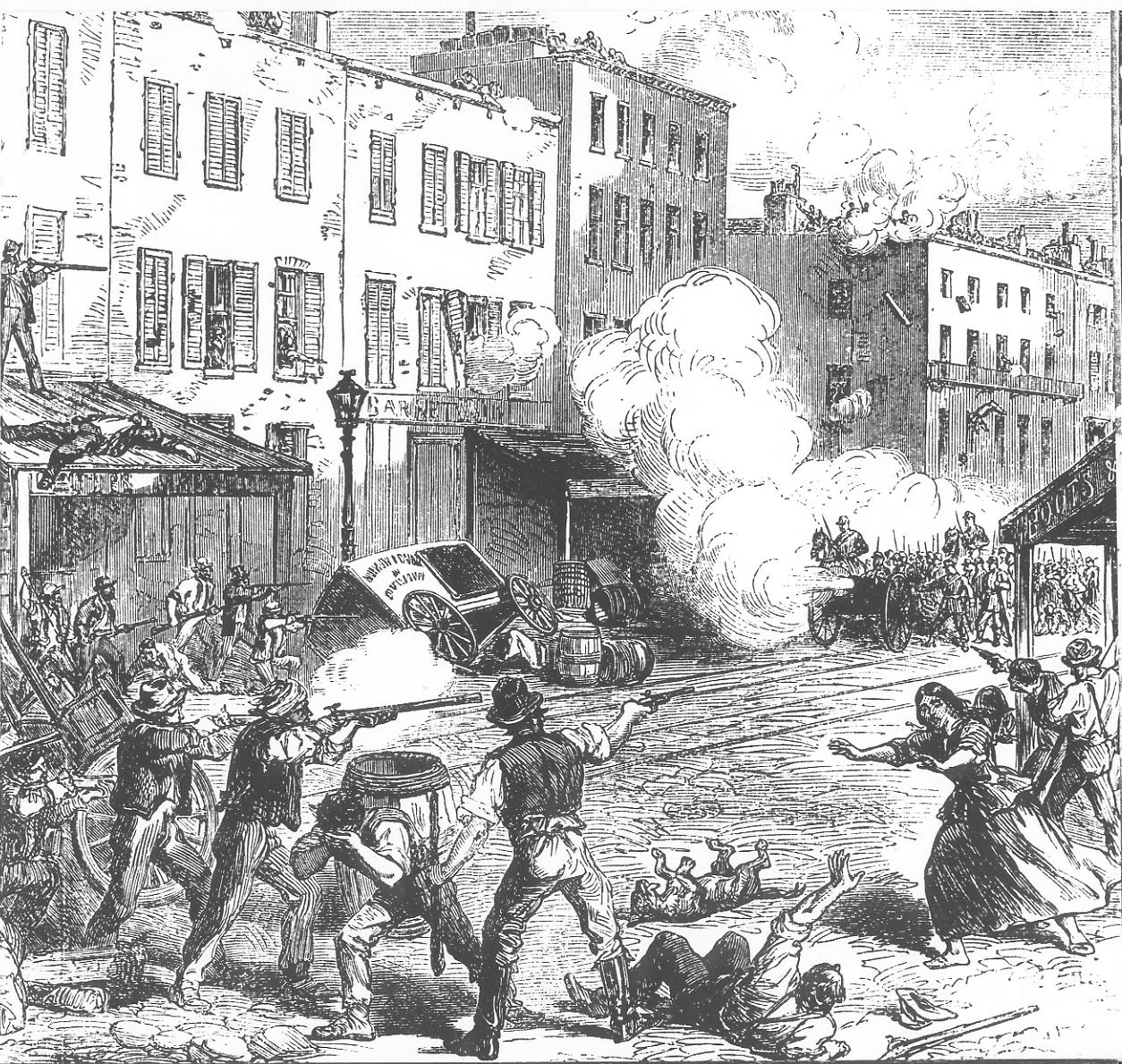
Barely a week after the Battle of Gettysburg, clashes and violence erupted in several cities. The riots became so violent that local police forces were incapable of controlling them. As a result President Lincoln was forced to use Union Soldiers, recently victorious at Gettysburg to end the rioting and violence. New York where protestors involved in a three day riot, many of whom were Irish immigrants urged on by Democratic Tammany Hall politicians, “soon degenerated into violence for its own sake” [27] wrecking the draft office, then seizing the Second Avenue armory while attacking police and soldiers on the streets. Soon “the mob had undisputed control of the city.” [28]

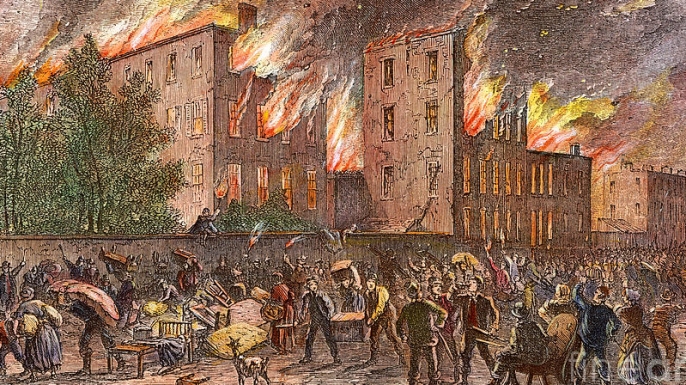
These rioters also took out their anger on blacks, and during their rampage the rioters “had lynched black people and burned the Colored Orphan Asylum.” [29] A witness described the scene:

“The furious, bareheaded & coatless men assembled under our windows & shouted for Jeff Davis!… Towards evening the mob, furious as demons, went yelling over to the Colored-Orphan Asylum in 5th Avenue… & rolling a barrel of kerosene in it, the whole structure was soon ablaze, & is now a smoking ruin. What has become of the 300 innocent orphans I could not learn…. Before this fire was extinguished, or rather burnt out, for the wicked wretches who caused it would not permit the engines to be used, the northern sky was brilliantly illuminated, probably by the burning of the Aged Colored-Women’s Home in 65th Street…. A friend…had seen a poor negro hung an hour or two before. The man in a frenzy, had shot an Irish fireman and they immediately strung up the unhappy African…. A person who called at our house this afternoon saw three of them hanging together.” [30]

hith-drafft-riots-E

Many of the rioters, but certainly not all of them were Irish, especially Catholics, who were also angry at the religious prejudice that the experienced at the hand of many Protestants. Rioters “targeted African-Americans, Republicans, abolitionists, and anyone associated with them…. Policemen and soldiers trying to suppress the riots also became targets, even if these men were Irish-Americans and Catholics.” [31] Many high profile Irish Catholics including Archbishop John Hughes refused to condemn the rioters or even call them by the term, earning the condemnation of the editors of the New York Times who wrote, “If the mob had burned the Catholic Orphan Asylum next door to the Bishop’s Cathedral… somebody besides “the papers” probably would have called them rioters.” [32]

The riots showed that the concept of racial or religious equality was difficult for many Americans, and not just those in the South. Prejudice, against African Americans, immigrants including the Irish, and Roman Catholics still burned in the hearts of many who had just a few years before had supported the Know Nothing Party and movement. Bruce Catton wrote, the “rioters had malignant prejudice, and those rioted against had another prejudice, equally malignant; if the lynchings and the burnings and the pitched battles in city streets meant anything they meant that this notion of equality was going to be hard to live with.” [33]

The violence did not abate until newly arrived veteran Union troops who had just fought at Gettysburg quickly and violently put down the insurrection. These soldiers, fresh from the battlefield and having experienced the loss of so many of their comrades “poured volleys into the ranks of protestors with the same deadly effect they had produced against the rebels at Gettysburg two weeks earlier.” [34] Republican newspapers which supported abolition and emancipation were quick to point out the moral of the riots; “that black men who fought for the Union deserved more respect than white men who fought against it.” [35]

In the end, the Enrollment Act contributed little to the Union war effort. Though it was called conscription it was not really conscription, it was “but a clumsy carrot and stick device to stimulate volunteering. The threat was being drafted and the carrot a bounty for volunteering.” [36] The organization of its machinery was so inefficient and the Act’s intentions so diluted “that the effort netted only 35,883 men – albeit along with $15,686,400 in commutation fees.” [37]

While an additional 74,000 men served as substitutes, the number pales in comparison to the nearly 800,000 who volunteered or reenlisted to serve while the act was in force. Only some six percent of the 2.7 million men who served in the Union Army were directly conscripted. Congress repealed the commutation provision in July 1864 and tightened requirements for exemptions.

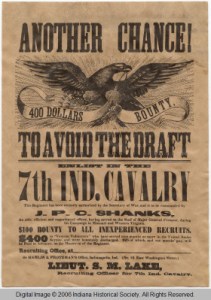
The Federal government got into the bounty business as well with a $300 bounty for new enlistment and reenlistment, all paid for by the commutation fees collected by through the enrollment Act. To meet the demand “Bounty brokers” went into business to enlist men into the service, getting the best deal possible while themselves taking part of the profit. Some enterprising recruits “could pyramid local, regional, and national bounties into grants of $1000 or more,” [38] and some even took the chance to change their names, move to another and enlist again to collect more bounty money and many deserted before they ever saw combat. “They were so unreliable that any regiment that had them in large numbers was bound to be decidedly weaker than it would have been without them.” [39]
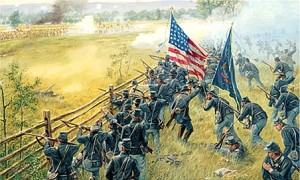
8th_Ohio_At_Gettysburg

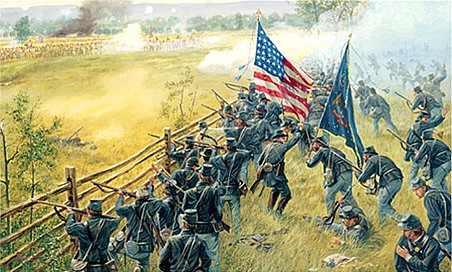
The men who had been fighting since 1861 and 1862 who had served without bounties and had reenlisted anyway; the veterans of Shiloh, Vicksburg, Antietam, Gettysburg and so many other hard fought battles in the West and the East, despised the substitutes and bounty men of 1864, and the poor qualities of such men made the good soldiers look even better. These men were proud of their service, their regiments, and what they had achieved. One soldier from Illinois wrote to his sister: “It is hard for a person to imagine how much a man sacrifices in the way of pleasure and enjoyment by going into the ‘Army,’ but I never think I shall regret being in the ‘Army’ if I get out alive & well.” He did.” [40]

Notes

[1] Ibid. Thomas, The Confederate Nation p.152

[2] Ibid. Thomas, The Confederate Nation p.152

[3] Ibid. McPherson. The Battle Cry of Freedom p. 432

[4] Ibid. Thomas, The Confederate Nation p.154

[5] Ibid. McPherson. The Battle Cry of Freedom p.431

[6] Millet, Allan R. and Maslowski, Peter, For the Common Defense: A Military History of the United States The Free Press a Division of Macmillan Inc. New York, 1984 p.166

[7] Ibid. McPherson. The Battle Cry of Freedom p.433

[8] Ibid. McPherson. The Battle Cry of Freedom p.431

[9] Ibid. Thomas, The Confederate Nation p.261

[10] Ibid. Gallagher The Confederate War p.28

[11] Ibid. Weigley A Great Civil War p.233

[12] Ibid. McPherson. The Battle Cry of Freedom p.600

[13] Ibid. Weigley A Great Civil War pp.233-234

[14] Ibid. Guelzo Fateful Lightening p.459

[15] Ibid. Weigley A Great Civil War p.234

[16] Ibid. Guelzo Fateful Lightening p.459

[17] Ibid. McPherson. The Battle Cry of Freedom p.601

[18] Ibid. McPherson. The Battle Cry of Freedom p.600

[19] Ibid. Guelzo Fateful Lightening p.460

[20] Bruce, Susannah Ural The Harp and the Flag: Irish American Volunteers and the Union Army, 1861-1865 New York University Press, New York and London 2006 p.173

[21] Ibid. Guelzo Fateful Lightening p.460

[22] Ibid. McPherson. The Battle Cry of Freedom p.601

[23] Ibid. Bruce The Harp and the Flag p.173

[24] Ibid. Robertson Soldiers Blue and Gray p.38

[25] Ibid. Foote. The Civil War, A Narrative Volume Two p.635

[26] Catton, Bruce. Never Call Retreat, Pocket Books a division of Simon and Schuster, New York 1965 p.205

[27] Ibid. Foote. The Civil War, A Narrative Volume Two p.636

[28] Ibid. Foote. The Civil War, A Narrative Volume Two p.637

[29] Ibid. McPherson. The Battle Cry of Freedom p.687

[30] Ibid. Guelzo Fateful Lightening p.461

[31] Ibid. Bruce The Harp and the Flag p.180

[32] Ibid. Bruce The Harp and the Flag p.180

[33] Ibid. Catton Never Call Retreat p.205

[34] Ibid. McPherson. The Battle Cry of Freedom p.610

[35] Ibid. McPherson. The Battle Cry of Freedom p.687

[36] Ibid. McPherson. The Battle Cry of Freedom p.605

[37] Ibid. Weigley A Great Civil War p.236

[38] Ibid. McPherson. The Battle Cry of Freedom p.606

[39] Ibid. Robertson Soldiers Blue and Gray p.40

[40] Ibid. Robertson Soldiers Blue and Gray p.40

Leave a comment

Filed under civil war, History

All Should be Equally Free: Recognizing the Terror of the New Religious Liberty Laws

john leland

Friends of Padre Steve’s World,

This may seem a familiar topic for my readers, but due to events in a number of states I feel compelled to talk about it again. The issue of religious liberty and the right to free expression has once again come to the fore in the wake of the Obergfell v. Hodges ruling and the pathetically un-American passage of particularly odious, religiously based anti-LGBT laws in North Carolina, Mississippi, and Tennessee, as well as one that was vetoed by Georgia’s governor. I call these laws pathetic and un-American because they fly in the face of the ideals of the real champions of religious liberty in the United States. One of these early proponents of religious liberty and freedom in the United States was the Virginia Baptist pastor, John Leland.

Sadly, many American Christians either have never heard of him. Likewise, if they have heard of him, as the great pontificator, Mike Huckabee should have in his brief tenure as a student at Southwestern Baptist Theological Seminary; they seem to have ignored his warnings about state religion. I guess that problems in his church history and Baptist history classes were a big reason that he left seminary. Ideologues like the Huckster didn’t last at Southwestern, at least until the fundamentalist takeover in 1994 that helped destroy the academic and scholarly reputation of that once fine school, but I digress….

Leland was a friend of Thomas Jefferson and James Madison and without him it is unlikely that the First Amendment of the Constitution would have mentioned religious faith. Leland had a very personal interest in this as during the 1780s the Anglican Church in Virginia was attempting to again become the official state religion. Anglicans, with the help of local authorities were attacking Baptist congregations and even resorting to physical violence. In defiance of the Anglicans, Leland wrote:

“The notion of a Christian commonwealth should be exploded forever. … Government should protect every man in thinking and speaking freely, and see that one does not abuse another. The liberty I contend for is more than toleration. The very idea of toleration is despicable; it supposes that some have a pre-eminence above the rest to grant indulgence, whereas all should be equally free, Jews, Turks, Pagans and Christians.”

There is a form of religion and indeed the “Christian” faith that is toxic and if not treated leads to the spiritual and sometimes the physical and emotional death of the infected person.

There is a nationalized version of this supposedly Christian faith in the Untied Stats today. It is a bastardized version of the Christian faith overlaid with the thin veneer of an equally bastardized version of American history. Its purveyors are quite popular in the world of “conservative” American Evangelicalism and Catholicism.

Supreme Court Justice Robert Jackson and chief Nuremberg war crimes trials prosecutor warned us about people like them over a half-century ago. Jackson wrote, “[I]n our country are evangelists and zealots of many different political, economic and religious persuasions whose fanatical conviction is that all thought is divinely classified into two kinds — that which is their own and that which is false and dangerous.”

Pat Robertson, evangelist and founder of the Christian Broadcasting Network is an example of what Leland and Jackson warned us about. Robertson said on his program that “You say you’re supposed to be nice to the Episcopalians and the Presbyterians and the Methodists and this, that, and the other thing. Nonsense, I don’t have to be nice to the spirit of the Antichrist.” — Pat Robertson, The 700 Club, January 14, 1991. The late David Chilton was another. He wrote: “We believe that institutionally Christianity should be the official religion of the country, that its laws should be specifically Christian”

It is quite fascinating when you look at it. This faith is a combination of a selective reading of American history, Christian teaching and Biblical interpretation that mixes and matches a wide variety of mutually conflicting and contradictory traditions. This Toxic “faith” if you can call it that; is based on a reading of American and Western History, which negates, marginalizes or willingly distorts the views or contributions of those who they disagree. It does not matter of their opponents are not Christians, or were Christians, including Baptists like John Leland and Roger Williams. Due to their experiences of religious persecution, Williams and Leland refused to buy into any form of state sanctioned religion.

I find it interesting that Conservative Icon and champion of limited government Barry Goldwater had great reservations about those that sought to establish the superiority of any religion. Goldwater said on the Senate floor: “The religious factions that are growing throughout our land are not using their religious clout with wisdom. They are trying to force government leaders into following their position 100 percent.”

The leaders of this new and quasi “Christian faith” are many and include some of the most popular religious leaders in the United States such as Pat Robertson, the pseudo-historian David Barton, James Robison, Gary North, Bryan Fischer, James Dobson, Gary Bauer Phyllis Schafley and a host of others. For them the Gospel has been equated with government legislation of supposedly “Christian” values; which conveniently are defined by their political agenda, often in complete contradiction to the Gospel and to nearly 2000 years of Christian experience. North, one of the most eloquent expositors of the Dominionist movement wrote:

“The long-term goal of Christians in politics should be to gain exclusive control over the franchise. Those who refuse to submit publicly to the eternal sanctions of God by submitting to His Church’s public marks of the covenant–baptism and holy communion–must be denied citizenship, just as they were in ancient Israel.”

That is quite a statement and those who think that they can co-opt people like North, Robertson or others are quite mistaken. Goldwater realized this. What is fascinating to me is to watch these men and women advocate religious and political positions in regard to Church-State relations that completely opposite of what early American Christian and non-Christian civil libertarians imagined when our country was founded. Positions that quite often are at odds with even the historical tenants of their own faith. Their only claim to innocence can be because not a one of them have any training in history and often are even worse when it comes to their understanding of the Christian tradition, which did not begin in and will not end in the United States.

In this confused and often hateful “faith” we see men and women who hate centralized government but extol a centralized religion. I was talking with a friend who is adamantly opposed to a powerful Federal Government but extols the perfection of the centralized bureaucracy of his Roman Catholic Faith. He could not see the contradiction. I watch others who extol an almost Libertarian understanding of the government and the Constitution who supposedly in their religious tradition are from the “Free Church” who now advocate the supremacy of the Church over the State and in doing so their particular and limited understanding of Church over that of the Church Universal.

In this confused and contradictory setting there are Catholics espousing political views that are in direct opposition to the understanding of government supported by the Magisterium of the Church. There are Evangelical and Charismatic Protestants that mix and match the untenable and contradictory beliefs of Dominionism and Millennialism which involve on one hand the takeover of earthly power by the Church and the ushering in of the Kingdom of God and the understanding that earthly power is ultimately under the dominion of Satan and must be overcome by the Second Coming of Christ.

Leland wrote:

“These establishments metamorphose the church into a creature, and religion into a principle of state, which has a natural tendency to make men conclude that Bible religion is nothing but a trick of state.”

Leland was one of the most important persons in regards to the relationship of the Christian Churches to the American Government. He was a champion of the religious liberty enshrined in the Bill of Rights and helped influence both James Madison and Thomas Jefferson. He noted in 1791:

“Is conformity of sentiments in matters of religion essential to the happiness of civil government? Not at all. Government has no more to do with the religious opinions of men than it has with the principles of mathematics. Let every man speak freely without fear–maintain the principles that he believes–worship according to his own faith, either one God, three Gods, no God, or twenty Gods; and let government protect him in so doing, i.e., see that he meets with no personal abuse or loss of property for his religious opinions. Instead of discouraging him with proscriptions, fines, confiscation or death, let him be encouraged, as a free man, to bring forth his arguments and maintain his points with all boldness; then if his doctrine is false it will be confuted, and if it is true (though ever so novel) let others credit it. When every man has this liberty what can he wish for more? A liberal man asks for nothing more of government.” John Leland, “Right of Conscience Inalienable, and Therefore, Religious Opinions Not Cognizable By The Law”

When the adherents of a faith, any faith, but especially the Christian faith enlist the government to enforce their understanding of faith they introduce a toxicity that is eventually fatal when consumed and acted on.

I think that much of what we are witnessing today is much more the product of fear mongering preachers that see opportunity in their political alliances and that are willing to reduce the Gospel to a number of “Christian values” in order to achieve a political end; even if that end is ultimately destructive to the Church and to the Gospel.

The message of the Apostle Paul to the Church in Corinth was this: “All this is from God, who reconciled us to himself through Christ, and has given us the ministry of reconciliation; that is, in Christ God was reconciling the world to himself, not counting their trespasses against them, and entrusting the message of reconciliation to us.” (2 Cor 5:18-19 NRSV) 

The early church thrived when it had no earthly power. It thrived when it was persecuted and when the Roman government openly supported almost every religion but it. However, once it became powerful and worldly it became ensnared in affairs far from that simple message of reconciliation.

It was in this country that the various sects of the Christian faith had the opportunity to make a new start, unencumbered by the trappings of power. But instead, like those that came before us, the toxin of power has all too often seduced us. John Leland understood this and fought to ensure that all people of faith were free and unencumbered by state supported religion.

Leland’s friend James Madison wrote to Edward Everett toward the end of his life:

“The settled opinion here is, that religion is essentially distinct from civil Government, and exempt from its cognizance; that a connection between them is injurious to both; that there are causes in the human breast which ensure the perpetuity of religion without the aid of the law; that rival sects, with equal rights, exercise mutual censorships in favor of good morals; that if new sects arise with absurd opinions or over-heated imaginations, the proper remedies lie in time, forbearance, and example; that a legal establishment of religion without a toleration could not be thought of, and with a toleration, is no security for and animosity; and, finally, that these opinions are supported by experience, which has shewn that every relaxation of the alliance between law and religion, from the partial example of Holland to the consummation in Pennsylvania, Delaware, New Jersey, &c., has been found as safe in practice as it is sound in theory. Prior to the Revolution, the Episcopal Church was established by law in this State. On the Declaration of Independence it was left, with all other sects, to a self-support. And no doubt exists that there is much more of religion among us now than there ever was before the change, and particularly in the sect which enjoyed the legal patronage. This proves rather more than that the law is not necessary to the support of religion” (Letter to Edward Everett, Montpellier, March 18, 1823).

That is the antidote to the toxic faith embodied in the politically motivated Christian Right. It stands against any idea of a state sanction or religion or a religion that like in Saudi Arabia or Iran controls the state. It stands in opposition to the beliefs of so many “Christian” religious leaders work to ensure that they control the powers of government. Attempts that try to proclaim their superiority above even the ultimate message of the Gospel that proclaims, “for God so loved the world….” 

By the way there are always results. The Puritans who many extoll were some of the most intolerant of dissenters of any group that has every held the reins of power over the state and religion ever known in this country. Their victims included Quakers as well as American Indian converts to Christianity. The picture below of the Puritans hanging Quakers in the Massachusetts Bay Colony should give pause to anyone who thinks that such actions are not possible today should any religion gain control of political power.

Peace

Padre Steve+

3 Comments

Filed under christian life, civil rights, faith, History, laws and legislation, LGBT issues, News and current events, Political Commentary, Religion

Liberty Lies in Our Hearts: Kim Davis & Civil Rights

IMG_2667

Friends of Padre Steve’s World

Just a short post today, and I do mean that. Yesterday, I promised a short article and a Facebook friend, a lawyer said, “That was short?” I replied that it was like an “Alan Shore closing.” For those who have not seen Boston Leal and watched James Spader play that character you really need to do so; but I digress…

In Boston Legal Alan Shore once quoted Learned Hand, a Federal Judge and judicial philosopher. He said, “Liberty lies in our hearts, and once it dies there, no constitution can save it.”

In light of my last few articles where I waded into the morass of the case of Kim Davis, the Recalcitrant County Clerk of Rowan County Kentucky, who was stupid enough to trust her money grubbing, politically motivated lawyers from Liberty Counsel and is now sitting in jail on contempt of court charges; I need to clarify a couple of things.

First, I feel bad that Mrs. Davis is being used as a pawn and sitting in jail while her lawyers collect all kinds of donations to support their next cause; and that as soon as they can they will jettison her. That is a fact, because these supposedly Christian legal groups are known for this. They take a case, promise the moon, usually lose and they abandon the person they represent after they have milked the case for every penny they can get. Sadly, other than their fifteen minutes of fame most of the clients get nothing for their efforts. Mrs. Davis is paying the price for that. She is going to be in jail at least a week while her lawyers try to appeal something that there is no precedent to appeal and which has not hope of succeeding. During the time they will make still more money. The truth is to get out of jail Mrs. Davis can find a way to do her job without violating her conscience, or she can resign and allow another to do it. However, when you, like Mrs. Davis, occupy an elected office that pays $80,000 a year in a county where the per capita income is well under $20,000; an office that your mother held for 37 years prior to you taking it less than a year ago; that can be tough.

Second, I cherish the freedoms guaranteed by the Constitution and my philosophy of life, professional and private is guided by the premise found in the Declaration of Independence that “all men are created equal, that they are endowed by their Creator with certain unalienable Rights, that among these are Life, Liberty and the pursuit of Happiness. – That to secure these rights, Governments are instituted among Men….”

That my friends is the essence of civil rights, and for that matter the foundation to protect religious rights of all people as well. Those rights are for all, not just Christians; and it is incumbent on elected and appointed officials of the government to follow the law in order to secure those rights for their fellow citizens. If they cannot they should not hold office. People can believe whatever they want. They can believe in any God, they can believe in any secular philosophy, they can hold any political ideology, they can believe that those who do not believe like them are going to hell or whatever; but when they swear to uphold the laws of the land in a public office where they are required to secure the freedom of others by serving them in accordance with the law; they have to either find a way to reconcile their personal beliefs or resign their office.

In fact I have for over 32 years as a commissioned officer in the United States military have had to do that. If by some chance this lands me in someone’s hell, or if indeed God is that petty, vindictive and capricious as to send me to hell for following the law of the land; then I will deal with that during my eternal vacation on the Lake of Fire. But I will not allow fear of what might happen to me in eternity to interfere with safeguarding the rights of the people in my care. My God is certainly big enough, loving enough, and gracious enough to deal with that; otherwise there would not be explicit commands in the Bible to obey the government.

A final thought and clarification on the rules for commenting on this site:

I welcome comments, especially from people who do not agree with me. I get many comments on my articles from different people and welcome comments, especially from people who do not agree with me. As long as they stay on point and are civil I enjoy them.

I have one man who frequently disagrees with me on my views of the Civil War, Reconstruction and Civil Rights. He is an honest man and pretty intelligent. He keeps his comments in line with the subject of the articles in question. He does not venture into tangents that have little to do with the articles in question. Likewise, even when he strongly disagrees he is polite and respectful. We do not agree on much, but I think that we could be friends and I welcome those kinds of comments.

Then I have other commentators. Sadly, most of these people are conservative Christians. These people seldom deal with the article itself, but decide use this site as their forum to promote or defend their denomination or their theology; most of the time in the most crude, ignorant and condescending manner possible.

As of today, I will not allow the comments of people who do not stay on point with the article, attempt to hijack this site as their forum; or who treat me with contempt. As of today I will simply disapprove those comments. If a person wants to comment they can deal with the article, if not I welcome them to start their own blog where they can spew their ignorance at will. But I will not give such people a forum ever again. I don’t have time and as much as I love bacon and pulled pork barbeque, I refuse to cast my pearls before swine.

So I am off to the Chicago and Earth Wind and Fire concert tonight. Was that short enough?

Have a great day,

Peace

Padre Steve+

11 Comments

Filed under civil rights, faith, News and current events, philosophy, Political Commentary

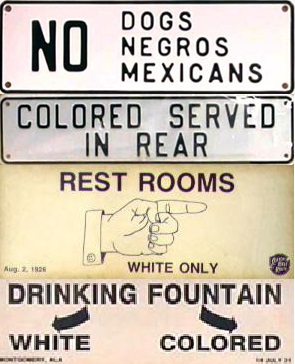
Jim Crow and the Anti-Gay Laws

jimcrowsignsorig

Friends of Padre Steve’s World

Yesterday I wrote about the case of Obergfell v. Hodges which will be argued in the Supreme Court tomorrow. I compared that case with the infamous Dred Scott decision of 1856 and commented on its importance to the LGBTQ community in terms of basic civil rights. Thomas Jefferson wrote in the Declaration of Independence something that is the heart and soul of the American experiment.

“We hold these truths to be self-evident, that all men are created equal, that they are endowed by their Creator with certain unalienable Rights, that among these are Life, Liberty and the pursuit of Happiness.–That to secure these rights, Governments are instituted among Men…” 

It is a concept that has always been practiced imperfectly in the nation, Blacks, Women and others have not always enjoyed the same rights as others, and the same is true for the Gay community today. Sadly, even when civil rights of people who are the targets of legal discrimination are advanced and legislated at the national level, opponents often attempt to use local and state laws to legalize discrimination banned at the federal level.

This was done frequently in the post-Reconstruction era, when so called “Black laws” or “Jim Crow” laws were enacted throughout the South. These laws paid lip-service to the Federal law but legalized almost every form of discrimination imaginable and established a culture of legal lawlessness where Blacks were the targets of discrimination, harassment, segregation and violence.

“From the 1880s onward, the post-Reconstruction white governments grew unwilling to rely just on intimidation at the ballot box and themselves in power, and turned instead to systematic legal disenfranchisement.” (1)

In 1896 these codes were upheld by the Supreme Court in the case of Plessy v. Ferguson. That ruling established the “separate but equal” doctrine and ushered in an era of de jure segregation in almost all arenas of life including education, transportation, entertainment and health care. What limited social equity and privileges enjoyed by Blacks were erased with the stroke of the judicial pen. The justices ruled on the concept that only peoples political rights were protected by the Constitution and that in the social arena that African-Americans could not interact with whites and assumed their racial inferiority.

Associate Justice Harlan wrote in dissent:

“The destinies of two races, in this country are indissolubly linked together, and the interests of both require that the common government of all should not permit the seeds of race hate to be planted under the sanction of law. What can more certainly arouse race hate, what more certainly create and perpetuate a feeling of distrust between these races, than state enactments, which, in fact, proceed on the ground that colored citizens are so inferior and degraded that they cannot be allowed to sit in public coaches occupied by white citizens? That, as all will admit, is the real meaning of such legislation as was enacted in Louisiana.” (2)

While the case of 1955 Supreme Court ruling in the case of Brown v. Board of Education swept away most of the effects of Plessy v. Ferguson, the underlying attitudes and actions of those who support legal discrimination are still with us. Prejudice and discrimination, not only towards African Americans and other people of color, but also women and even more so the LGBTQ community  has come back with a vengeance in the decades following Brown v. Board of Education.  Opponents of equality hate the sweeping civil rights advances made in the 1960s and 1970s, and more recently the advances made on behalf of the Gay community in the past decade. The end of the Defense of Marriage Act or DOMA, a law which mush like the Black Codes set up legal barriers for gays to marry and enjoy other civil rights brought forth a plethora of new anti-Gay legislation, especially at the local and state levels. Most of these laws are cloaked in the concept of “Religious Liberty” and permit people to discriminate against Gays in almost any arena of life: to refuse to serve them at their place of business, to deny them service in local government offices and even to deny them health care, should the provider determine that he or she will not serve someone who is gay, all based on the amorphous concept that the providers “sincerely held religious beliefs are at stake.”

These laws are being set up with the full knowledge that Obergfell v. Hodges will likely legalize Gay marriage throughout the country. Knowing that the opponents are raising the specter of Christians being put in concentration camps for opposing Gay marriage, and other equally apocalyptic and patently untrue statements, many coming from leading Republican presidential candidates and their backers in the Christian Right. Justice Harlan was correct about the intent of the Jim Crow laws and correct about the intent of the new anti-Gay laws. The seeds of hate cannot be allowed to be planted under the sanction of law. 

These are the new Jim Crow laws, and they must be fought at every turn even if the Supreme Court affirms the legality of Gay marriage in its ruling in Obergfell v. Hodges.

Opponents of Gay marriage should remember the words of Thomas Jefferson who wrote:

“I know also, that laws and institutions must go hand in hand with the progress of the human mind. As that becomes more developed, more enlightened, as new discoveries are made, new truths disclosed, and manners and opinions change with the change of circumstances, institutions must advance also, and keep pace with the times. We might as well require a man to wear still the coat which fitted him when a boy, as civilized society to remain ever under the regimen of their barbarous ancestors.” 

We must move forward.

Peace

Padre Steve+

1. Guelzo Allen C. Fateful Lightening: A New History of the Civil War Era and Reconstruction Oxford University Press, Oxford and New York 2012 p.526

2. LaMorte, Michael W. School Law: Cases and Concepts 9th Edition 2008 p.300

Leave a comment

Filed under civil rights, History, laws and legislation, LGBT issues, News and current events, Political Commentary

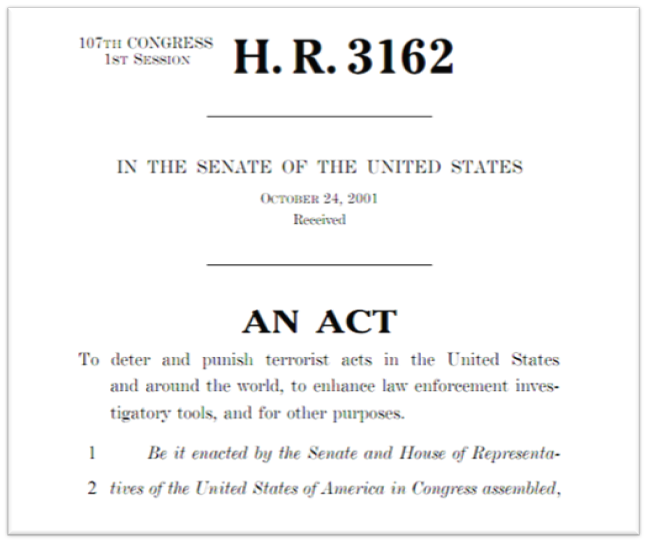
Living in the National Security State

Patriot-Act-HR-3162

Inter Arma Enim Silent Leges, in time of war the law stands silent…

James Madison wrote that “A popular government, without popular information, or the means of acquiring it, is but a prologue to a farce or a tragedy; or, perhaps both.”

After September 11th 2001 the National Security State went into overdrive with the passage of the so called Patriot Act. That act opened the floodgates for an ever expanding national security state.

I have a lot of apprehension when I read the reports about the activities of the National Security Agency, other intelligence and police agencies at all levels of government and the pervasive erosion of civil rights.  The national security state and the seeming all pervasive security and surveillance apparatus which demolishes any sense of privacy, especially the protections enunciated in the Fourth Amendment and to some extent the First Amendment. Of course the use of similar methods by the private sector, often in conduction with government agencies is another concern, but that needs to wait for another day.

I also understand from history and empirical evidence that many others, many from unfriendly countries do not share those apprehensions. Many of these competitors are willing to use whatever openness that we have as a society against us, using similar technology and methods used by our intelligence, police, governmental and private sector. It makes for an ethical, legal and even constitutional conundrum. I know that I am not comfortable with this, and perhaps maybe none of us should be.

It is very easy on one hand in light of history, our Constitution and democratic process to condemn the NSA, the FISA courts and other lawfully constituted agencies and those that drafted the laws over the decades that allow the activities which they now conduct. The same can be said of foreign intelligence agencies which all engage in similar activities including the British GCHQ, the German Bundesnachrichtendienst and so many others including the Chinese and Russians.

Likewise it is equally easy in light of history, current events and national security concerns for people to jump to the other side of the fence and not only defend the activities of the NSA and agencies like it, and to demonize those that protest or expose such activities.

When I see the talking heads on cable news shows defending or condemning such activities and not agonizing over the complexity and issues involved I get worried. Because there are legitimate concerns voiced by critics as well as defenders. But since we live in an era of soundbites, gotcha and half-truths being portrayed as all truth I find it helpful to use either historical examples, literature or fiction, and even science fiction to wrestle with the fundamental truths. So I find looking at such issues through the prism of Star Trek sometimes more interesting and provocative than simply doing the whole moralizing pundit thing.

enimsilentleges_210

There was an episode of  Star Trek Deep Space Nine that aired well before the events of 9-11-2001, and the subsequent Global War on Terror, that I find fascinating. The episode deals with a secretive agency in Starfleet operating in the gray areas between the laws and ideals of the Federation and the threats that the Federation faces. Even when the Federation is a peace, Section 31, as it is called is engaged in activities against historic or potential enemies. In a way it is somewhat like the NSA or the Defense Intelligence Agency.

At the beginning of the Deep Space Nine Episode Inter Arma Enim Silent Leges the head of Section 31, a man only known as Sloan comes back Doctor Julia Bashir to involve him in an clandestine operation. An operation to on the Romulans who at this point are a Federation ally against the Dominion.

Sloan makes his approach and Bashir, who expresses his reservations:

BASHIR: You want me to spy on an ally.

SLOAN: To evaluate an ally. And a temporary ally at that. I say that because when the war is over, the following will happen in short order. The Dominion will be forced back to the Gamma Quadrant, the Cardassian Empire will be occupied, the Klingon Empire will spend the next ten years recovering from the war and won’t pose a serious threat to anyone. That leaves two powers to vie for control of the quadrant, the Federation and the Romulans.

BASHIR: This war isn’t over and you’re already planning for the next.

SLOAN: Well put. I hope your report is equally succinct.

BASHIR: How many times do I have to tell you, Sloan? I don’t work for you.

SLOAN: You will. It’s in your nature. You are a man who loves secrets. Medical, personal, fictional. I am a man of secrets. You want to know what I know, and the only way to do that is to accept the assignment.

I find the exchange both illuminating and riveting. The fact is that in the situation we face today the arguments of both sides should make us very uncomfortable.

Whether we like it or not or not, the incredibly rapid technical and communication advances of the past couple of decades have primed us for our present conundrum of liberty and privacy or security. That technology, as wonderful as it is  has enabled a generation to grow up in a virtual world in many ways detached from the moral and ethical balances between individual rights and liberties as well responsibility to community.

All the wonderful gadgets that we employ in everyday life, make it easy for enemies and “friends” to do things that were unimaginable to people other than science fiction writers even twenty to thirty years ago. Likewise they were certainly beyond the wildest imaginations of any of the founders who drafted Constitution.

The reality is, the things that make are lives so easy are also the things that have the potential to remove the very liberties that we treasure, either by our enemies using them, or those that defend us.

The truth is, that throughout history, even our own there have been operatives within the government in charge of secrets, as well as spies. In the Inter Arma Enim Silent Leges episode we see an operation that is full of duplicity and moral ambiguity all committed in the name of security. I won’t go into the details because it is too full of twists, and turns, you can read the plot of the episode at Memory Alpha.org http://en.memory-alpha.org/wiki/Inter_Arma_Enim_Silent_Leges_%28episode%29

There is an exchange between Dr. Bashir and Admiral Ross of Starfleet command which is very enlightening because it practically mirrors how many on both the civil liberties and the national security side of the current controversy feel about the War on Terror.

BASHIR: You don’t see anything wrong with what happened, do you.

ROSS: I don’t like it. But I’ve spent the last year and a half of my life ordering young men and young women to die. I like that even less.

BASHIR: That’s a glib answer and a cheap way to avoid the fact that you’ve trampled on the very thing that those men and women are out there dying to protect! Does that not mean anything to you?

ROSS: Inter arma enim silent leges.

BASHIR: In time of war, the law falls silent. Cicero. So is that what we have become? A twenty fourth century Rome driven by nothing more than the certainty that Caesar can do no wrong!

ROSS: This conversation never happened.

In light of the controversy of today regarding the NSA, FISA Courts, government secrecy and intelligence gathering information on its own citizens, as well as allies, friends and and enemies we face a growing tide of reporters and others seeking to reveal those secrets. Back in 1989 ethicist Sissela Bok wrote something very important in her book Secrets: Moral Choice in Public and Private Life:

“…as government secrecy expands, more public officials become privy to classified information and are faced with the choice of whether or not to leak … growing secrecy likewise causes reporters to press harder from the outside to uncover what is hidden. And then in a vicious circle, the increased revelations give government leaders further reasons to press for still more secrecy.”

As we wade through the continuing controversy surrounding these issues we will see people do exactly what Bok said. These are the exact arguments are being made by the people and officials directly involved in such activities, as well as former elected and appointed officials, and members of the press.

nsa-operations-center

The interesting thing to me is that very few of the people or agencies, past and present, Republican and Democrat involved have clean hands. It is amazing to see former champions of civil liberties defend the NSA actions and those that empowered the NSA in the Patriot Act now condemn it. I find it both fascinating and frightening.

At the end of the Inter Arma Enim Silent Leges episode the mysterious Sloan pops back in on Doctor Bashir who is in his quarters, asleep and depressed by what he experienced during the operation on Romulus and with Admiral Ross.

SLOAN: Good evening.

BASHIR: Are you expecting applause? Have you come to take a bow?

SLOAN: I just wanted to say thank you.

BASHIR: For what? Allowing you to manipulate me so completely?

SLOAN: For being a decent human being. That’s why we selected you in the first place, Doctor. We needed somebody who wanted to play the game, but who would only go so far. When the time came, you stood your ground. You did the right thing. You reached out to an enemy, you told her the truth, you tried to stop a murder. The Federation needs men like you, Doctor. Men of conscience, men of principle, men who can sleep at night. You’re also the reason Section Thirty one exists. Someone has to protect men like you from a universe that doesn’t share your sense of right and wrong.

BASHIR: Should I feel sorry for you? Should I be weeping over the burden you’re forced to carry in order to protect the rest of us?

SLOAN: It is an honor to know you, Doctor. Goodnight.

We live in this kind of world and maybe it is good to sometimes step back and look at issues using a different prism. I really don’t have the answers. I am a civil libertarian who places a high value on the openness of a government to its people. I also know that there are those that have no regard for such openness or, to quote Sloan don’t “share your sense of right and wrong.”

Maybe that is not a good answer. I really don’t know. All I know is that as uncomfortable as this all is that those on both sides of the issue have valid points and concerns. It is a debate that needs to happen if we are able to balance that a society needs to balance individual rights and responsibility to the community; openness and secrecy; civil liberties and national security.

But that being said. it is a debate that needs to happen, even if it makes us uncomfortable. I for one think that it is better that we be uncomfortable when looking at such an important debate than to be prisoners of our certitude.

Peace

Padre Steve+

2 Comments

Filed under History, laws and legislation, national security, Political Commentary, star trek

Letter to a New Military Chaplain Part VI: Collegiality and Relationships

262_29132452058_529_n

With my Friend Fr Jose Bautista at  Habbaniyah Iraq 2007 

“A free theologian works in communication with other theologians…He waits for them and asks them to wait for him. Our sadly lacking yet indispensable theological co-operation depends directly or indirectly on whether or not we are willing to wait for one another, perhaps lamenting, yet smiling with tears in our eyes.” ― Karl Barth, The Humanity of God

This is fifth part of a response to a question I had from a new Navy Chaplain. I have decided to post it here without any identification of the chaplain because I know that many men and women who are new to the military chaplaincy or who are exploring the possibilities of becoming a chaplain have the same questions. I was fortunate to have had a number of chaplains who at various points in my decision process and formation as a minister, Priest and Chaplain in both the Army and the Navy help me with many of these questions. Likewise I learned far too much the hard way and blew myself up on some of the “land mines” that almost all who serve as chaplains experience in their careers. This is the fifth of several parts to the letter and is my attempt to systematically explain my understanding of what it is to be a Chaplain serving in the military and in particularly the Navy. As I wrote this tonight I thought of one more installment so I expect soon that I will write it, but not tonight. The first three parts are linked here:

Letter to a New Military Chaplain: Part One

Letter to a New Military Chaplain: Part Two The Minefields of the Heart 

Letter to a New Military Chaplain Part Three: The Minefields of the Soul: Power and Arrogance

Letter to a New Military Chaplain Part IV: The Minefields of the Flesh, Sex, Alcohol and Money

Letter to A New Military Chaplain Part V: Count it All Joy

Karl Barth’s words about how free theologians work in communication or community with other theologians is equally true for those men and women who serve in the secular and pluralistic ministry of the chaplaincy, particularly the military chaplaincy.

This was something that I learned early in my theological education in seminary as well as my more practical ministry lessons at the Army Chaplain School and during my Clinical Pastoral Education Residency.

652_55560577058_1525_n-1

Army Chaplain Officer Basic Course with LTC Rich Whaley (C) and CPT Bill Blackie (L)

Collegiality and relationships cannot be over-valued. In fact they are vital if we are to care for the people that are entrusted to us, men and women who volunteer to serve our nation in time of war and peace. Unfortunately they are probably harder to do now than they were when I first became a chaplain back in 1992. Harder but certainly not impossible.

I think part of this is due to how theological education has changed in the last 20 years. For better or worse for many people it is hard to attend seminary in residence. I did and it was painful. I would never want to do it again but it was important in my formation and I think indispensable. However many seminaries have placed much of their theological education, even the Master of Divinity online or via other distance education formats. The result is that many theological students do their seminary education isolated from collegial relationships with professors and other students. This isolation is often compounded in churches, especially mega-churches which have little use for seminary students who will leave them in order to become chaplains.

2334_63993192058_3194_n

With CAPT John Kaul and LT Romeo Biala at Camp LeJeune 1999

Another issue is the fact that the Chaplain Corps of the various services are not as reflective of the religious population of the services as they used to be. Part of this is because the mainline Protestant denominations in their cultural opposition to war and in some cases the military itself stopped sending as many chaplains as they once had done. Likewise due to the continuing clergy crisis in the Roman Catholic Church that institution has seen a marked decline in number of serving chaplains. On the other side of the coin many conservative denominations and independent churches increased their numbers of chaplains. The number of Jewish chaplains has declined and there are just a smattering of Islamic or Buddhist chaplains.

While the demographics of the Chaplain Corps have changed there has also been a shift in the religious demographic of the military population have shifted the fastest growing group being the “no religious preference” demographic. Of course I have found that in many cases that “no religious preference”  is not that they have no faith but that they go to church but are not terribly concerned about the denominational label. That being said there are lot more servicemen and women who are atheists, agnostics, free thinkers, Pagans, Wiccans or members of other groups traditionally overlooked.

295_27076762058_7573_n-2

In this setting the collegial relationships that chaplains maintain with one another irregardless of our denominational or religious traditions in order to serve and care for those men and women who volunteer to serve our country.

In my now rather lengthly career in the military as well as my time growing up as a Navy “Brat” I can say that I have been blessed by friendships and relationships with chaplains who have cared for me. Likewise I have had the chance to be there for chaplains when they needed someone to be there for them.

295_27076792058_8966_n-1

With Korean and American Chaplains 2001

The way this has worked has been fascinating. My best friends in Army Chaplain school when I was in an independent evangelical church were Roman Catholic, Orthodox and Episcopal Priests. One, Father Jim Bowman saved my ass when I was having a major meltdown and ripping my rank off after a near altercation with a numbskull in the Chaplain Officer Basic Course. Likewise the course director, Chaplain Rich Whaley an LDS (Mormon) Chaplain was there for me on more than one occasion and probably was the man that ensured that I was not tossed from the program. I stay in contact years later with these men.

As a Army Chaplain in the National Guard, Reserves and as a mobilized Reservist it was Lutherans, Catholics and Episcopalians who were there for me. As I became more seasoned and was promoted to Major and placed in supervisory billets I enjoyed good relationships with junior and senior chaplains across the denominational spectrum. Two of my enlisted assistants, one Army and one Navy both went on to become chaplains, both are much more conservative than me but stay in contact.

In the Navy due to our often very isolated duty in independent billets this is harder to do. There is a certain community that you have when you serve in the Army or as a Navy Chaplain serving with a Marine Division, or expeditionary force. However many Navy billets are stand alone billets on ships. Once again this is not impossible to do in the Navy, it is just harder.

The Chaplain Corps is a small community thus when you have good relationships with others, take the time to build friendships and care for people who are not like you there is a payback. That payback comes in the form of maintaining those relationships throughout a career. I constantly run into Navy Chaplains who I became friends with while serving in my first tour with Second Marine Division. Those guys tend to be like brothers to me and it is a good thing. Likewise some of my supervisory chaplains, men like Father John Kaul a now retired Catholic Priest and Navy Captain have been more than supervisors but mentors and friends.

As a practical matter the collegial relationships we build with other chaplains are important for a number of reasons.

First it is about caring for our people and when you have the relationships with other chaplains who are not like you you have a ready referral source. If I have a Mormon Sailor or Marine come to me I know Mormon Chaplains. If I have a Roman Catholic or Orthodox service member come to me seeking a type a Sacrament that has to come from their church I can contact people I know to help them.

In another way it is about having relationships with people who are safe to talk to and believe me this is important. I have a lot of chaplains who confide in me because they know that I am safe, that I will listen and care irrespective of any theological or even political difference. I have a number of Chaplains that I can do this with myself and it does help. There have been times where due to the isolation of my assignment or the inability to be around some of these guys that I have suffered. When I came back from Iraq and in the midst of a PTSD induced spiritual and psychological crisis I didn’t have this, in fact at that time the first person who asked me how I was doing spiritually was my first shrink. When I was able to re-connect with some of my older friends, my “go to” guys they shared similar experiences.

1905_50393032058_2131_n

Now I do work hard to build these collegial relationships. They matter to me.

Collegiality and friendship are at the heart of the military chaplain ministry. Without them we become the promoters of our agenda often at the expense of those that we serve or serve alongside. Since our Constitutional reason for being in the military is to provide for the religious and spiritual needs of our people regardless of their religious affiliation and perform the rites or sacraments of our own religious traditions it is imperative that we build these collegial relationships and friendships with any chaplain that we can.

Peace

Padre Steve+

Leave a comment

Filed under christian life, faith, Loose thoughts and musings, Military, ministry, Religion, US Navy