Tag Archives: US Navy

The Guadalcanal Campaign and the Beginning of Joint Operations

The Guadalcanal campaign was the first experiment by the United States of conducting a “joint” campaign in modern warfare involving Naval and Naval Air, Ground combat units, Army air assets and amphibious operations. The campaign involved numerous land, sea and air battles. It was under the command of Admiral Nimitz as CINCPACFLTand included commanders for ground, air and sea forces engaged.  For brevity and simplicity sake I will discuss the campaign and sea even though they are interconnected with the sea and air campaigns directly affecting the outcome of the land campaign.

Designated OPERATION WATCHTOWER and aptly called OPERATION SHOESTRING the campaign was launched on short notice, approved on 2 July the commanders of the operation first learned of it on 7 July. Utilizing the 1st Marine Division, which would later be reinforced by the Americal Division, landed on Guadalcanal and the neighboring island of Tulagi on 7 August.  The Marines took Tulagi after a brief but bloody fight and the few Japanese troops on Guadalcanal fled inland allowing the Marines to seize the airfield.  Unfortunately, the commander of the supporting US carrier task force, Admiral Frank Fletcher fearing danger to his carriers and withdrew following the landings. The forces in direct support were surprised by a Japanese cruiser force under Admiral Mikawa losing 3 American and 1 Australian heavy cruiser in one of the worst American naval defeats in history at the Battle of Savo Island. The next morning the transports, many still full of supplies left the Marines.  Admiral Fletcher’s action, which left the Marines without air cover and carrier support gave the Marines a new term, still in use today, for being left high and dry: “to be Fletchered.”

The Land Battles: The Japanese quickly responded sending in Naval Landing forces which went in light without all their troops or equipment. The Ichiki detachment was wiped out in the battle of the Tenaru (Ilu) river on 20 August.  The Kawaguchi detachment of 3,500 men landed in two groups, again short of men, material and equipment landed in the closing days of August and attempted to seize the now operational “Henderson” field on September 13 to 14th after one of its supporting units had been destroyed by the 1st Raider Battalion in a small amphibious assault.  Kawaguchi’s attack was disjointed and his units dispersed.  He was defeated in detail by the Marines in the Battle of “Edson’s ridge” or “Bloody Ridge.”  The Marines attacked and destroyed another Japanese force at the Mataniko river on 9 October.  The Marines were further reinforced by the 7th Marine Regiment while Kawaguchi was reinforced by the HQ of 17th Army under General Hyakutake who brought the 2nd Division onto the Island under the command of General Maruyama.  Kawaguchi would then be relieved and sent home following disagreements with Maruyama and his chief of staff prior to the next major Japanese attack which took place 23-25 October along the same ridgeline that Kawaguchi had assaulted. Though the Japanese now had 15,000 troops with good artillery support, the attacks were fierce but uncoordinated. Defended by 7th Marines under Chesty Puller as well as troops from the recently arrived Americal, the Marines again effectively destroyed the attacking Japanese force.  Despite additional reinforcements of the 38th Division, the Japanese, due to severe food, supply and ammunition shortages would not make any more major attempts to take the airfield.  The Americans would shift to the offensive with the Army XIV Corps composed of the 25th Division, Americal Division and Second Marine Division under Major General Lawton J “Lightening Joe” Collins commanding in December.

The Sea Battles: The sea campaign in the waters surrounding Guadalcanal would be marked by some of the bloodiest sea battles in the history of the US Navy.  So many ships from both navies would be sunk offshore that the waters would become known as “Ironbottom Sound.” Following the previously mentioned “Battle of Savo Island” the Americans lost the carrier Saratoga to torpedo damage and the Wasp was sunk while escorting a convoy. In the Battle of Eastern Solomon’s of 24 August the Americans have the Enterprise knocked out of action for 2 months and while sinking a Japanese light carrier and inflicting heavy aircraft losses on the Japanese.The Americans surprised a Japanese force on 11 October off Cape Esperance sinking a heavy cruiser and destroyer and heavily damaging a second heavy cruiser. The Japanese effort, now directed by Yamamoto brought battleships to support operations around Guadalcanal, including bombardments of the airfield on 13-14October in support of Maruyama. The attacks damaged but did not close Henderson field which was able to continue air support to the Marines and soldiers.  On 26 October a carrier engagement would be fought, the Battle of Santa Cruz Islands would be a tactical Japanese victory sinking the Hornet and damaging Enterprise, while losing no ships. Two Japanese carriers were damaged but they lost a large number of pilots and aircrews who could not be readily replaced. They also not succeed in their amphibious efforts to retake the island or Henderson field, gaining the Americans badly needed time.  On 13 November the Japanese attempted to repeat the bombardment of Henderson field but would be stopped from doing so by a task force under Admiral Daniel Callaghan.  The First Naval Battle of Guadalcanal cost the Japanese the battleship Hiei and two destroyers, additionally many of the transports bringing Japanese reinforcements would be sunk by aircraft from Henderson field and Enterprise.  The Americans lost 2 cruisers and 4 destroyers sunk and every other ship save the destroyer Fletcher damaged. Admiral Callaghan and Admiral Scott, the victor of Cape Esperance were both killed.  The following night the Japanese would lose the battleship Kirishima to the USS Washington task group under the command of Admiral Willis Lee.  Further Japanese naval activity would be limited to attempts to reinforce the island with destroyers; during one of these operations on 29 November they would clash with a force of American cruisers and destroyers at Cape Tassafaronga, sinking 1 cruiser and badly damaging three more at the cost of one destroyer, but was unable to complete his supply run.  Though the Americans lost more total warships, the Japanese could not replace what they lost.

Air Operations: The air operations would be decisive to the effort, land based aircraft of the Japanese played a key role in destroying some US shipping and sinking warships in waters off Guadalcanal however they could not maintain air superiority over the island which was maintained and increased by the Americans as Henderson field’s capacity grew and additional Army, navy and Marine aircraft were stationed there.  Naval air was extremely important in the sea battles around the island.

Japanese Reaction: The Japanese reaction was one of dismay; they could not fulfill their promise to the emperor to retake the island.  They had lost many ships and aircraft as well as ground troops. From this time on the Japanese would go over to a strategic defensive in the Pacific.  Japanese losses were devastating as they could not be made up.

Importance for the Americans: This was important in a number of ways. For the navy it showed that they could defeat Japanese surface ships in night engagements and gave the navy great experience as it moved forward in the South and Central Pacific. American carrier air crews had become experienced and gained superiority over the Japanese.  On the ground the myth of the Japanese “superman” was destroyed, yet American commanders also began to appreciate the skill, endurance and tenacity of the Japanese soldier in future operations.

Importance for Joint Operations: The campaign also was a triumph for the Americans in the fact that they were able to overcome inter-service rivalries undertake a difficult operation against a stronger opponent far from major fleet logistics and support basis.  To be sure this was Joint Operations in its infancy and until the arrival of significant Army forces on the island to relieve the Marines was for the most part a Navy, Marine Corps and Army Air Corps operation.  When Major General Lawton “Lightning Joe” Collins assumed command of the island from Marine Major General Alexander Vandergrift it became a true-inter service operation and the beginning of Joint Operations.

Leave a comment

Filed under Loose thoughts and musings

The Treaty Cruisers: A Warship Review

Note: Since childhood I have loved naval history and the study of various types of warship design throughout history. My favorite period is really from the Spanish-American War through the mid 1970’s.  I find the leaps in Naval design and architecture, weapons and fire control systems and the diversity of the types of ships built absolutely fascinating.  Not only initial designs but the various modifications and modernizations of various ships or classes of ships went through during their service careers. The cruisers of the inter-war period were some of the most ascetically pleasing warships to ever grace the high seas. They were well proportioned, and graceful while still looking every part the warship.  This is something that many ships in our modern era lack, despite the fact that their armament despite limited gun power is formidable. With VLS launchers and Harpoon Missile tubes they pack a punch, but unlike the old cruisers, their offensive teeth are hidden. I had the privilege of serving aboard the USS HUE CITY CG-66 which is about the same size and displacement of the Chester Class

I think I actually began reading Naval history back in 2nd or 3rd grade, and it was not uncommon for me to spend hours at the public library going through reference stacks to read old issues of “Jane’s Fighting Ships” and the main collection to check out every book on Naval Warfare and warships that I could find. One of the most interesting types of ship to me was the Heavy Cruisers built under the restrictions of the Washington Naval Treaty. The treaty had several major provisions but today I only deal with the restrictions on Heavy Cruisers, the response of treaty nations to the limitations and the combat summary of each class.  This is all pretty much out of the deep recesses of my sometimes dark mind and tonight I didn’t have to crack a book to write this.  It’s thanks to having one of those phonographic memories that just keeps going around and around. This is another one of the things that I am passionate about.  Anchor’s Away! Peace, Steve+

atago

IJN Atago

The Washington Naval Conference of 1921-1922 set a number of limits on warship construction and fleet composition.  One of the ship types limited by the treaties was cruisers, notably heavy cruisers.  These ships, descended from the Armored Cruisers developed by the navies of the great powers prior to the First World War were considered a major part of each of the navies of the signatory nations.  The armored cruisers had 8-10 inch guns and a relatively substantial armored belt.  The type was not particularly successful as with few exceptions they were used in fleet actions where they were under-gunned and under-armored.  They were most successfully used in overseas service against raiders or commerce.  The most famous of the type were the German Scharnhorst and Gneisenau of the German Far East Squadron.  Smaller and faster than a battleship, the type had developed by the 1920s into a ship that could be used for fleet screening and scouting as well as showing the flag in foreign waters where many were found.  The Washington treaty did not limit numbers of these ships as it did Battleships and Aircraft Carriers, but it did place maximums on the gun size and displacement of individual ships.   A heavy cruiser could be armed with 8 inch guns and were limited to 10,000 tons displacement.  Of course this led to compromises in the designs of the ships which frequently gave up protection for speed.

uss pensacolaUSS Pensacola

The Americans were the leaders in the development of the treaty cruisers.  The Japanese only built one class of cruiser, the Kako class which complied with the terms of the treaty.  They mounted 6- 8” guns and displaced about 8,600 tons.  They were fast but because of their light displacement were top-heavy.  Subsequent classes, the Nachi and Atago classes violated the tonnage limits by as much as 4,000 tons while the Japanese reported them as 10,000 tons. They were armed with 10-8”guns in five turrets, had good protection and also mounted 12 24” “Long Lance” torpedo tubes.  Two subsequent cruisers of the Kumano and Tone classes were built in the 1930s. The Kumano class of about 13,000 tons were initially classed as “light cruisers” mounting 15- 6” guns prior to being re-armed with 10-8” guns.  The Tone’s mounted 8- 8”guns in 4 turrets all mounted forward leaving the entire aft section for use as a seaplane launching area; the Tone class carried 8 float planes for fleet scouting.

hms exeterHMS Exeter

The British treaty cruisers abided by the limits included the York and Exeter, of the same displacement and armament as the Kako class except they were slower, a common feature of British ships which were generally slower than their American and Japanese counterparts.  The later County class ships were armed with 8- 8” guns and were distinctive looking having three funnels. The County class included such famous ships as the Norfolk, Suffolk and Dorsetshire which played critical roles in the chase and sinking of the German Battleship Bismarck. Australia had two Counties, the Australia and Canberra which did most of their service in the Pacific. The Counties were armed with 8- 8” guns and were distinctive with their three funnels.  They were slower than their Japanese or American counterparts.

uss houstonUSS Houston with President Roosevelt Aboard

The first American treaty cruisers the Pensacola and Salt Lake City of about 9,500 tons with an unusual arrangement of 10- 8” guns mounted in 4 turrets.  However it was the Chester class which was the quintessential U.S. Treaty Cruiser design.  These ships, and the later Astoria class, also displaced 9,500-10,000 tons and mounted 9- 8” guns in three turrets.  A further “treaty” cruiser was Wichita, converted from a St. Louis class light cruiser. All were fast but were lacking in armored protection and none mounted the torpedoes found in Japanese or British ships.  Some of the more notable ships in the U.S. treaty classes included the Houston which served as the Flagship of the Asiatic Fleet which was sunk at the Battle of the Java Sea. The Augusta which took Franklin D Roosevelt to Argentia for the signing of the Atlantic Charter in 1941; The San Francisco which helped stop the Japanese fleet in a point blank encounter in the Naval Battle of Guadalcanal and Indianapolis which with just weeks left in the war having completed the secret mission to deliver the Atomic bomb was sunk by a Japanese submarine.

PrinzEugen-2Prinz Eugen

The Germans did not build true “heavy cruisers” until the late 1930’s and their ships, the Hipper, Blucher and Prinz Eugen mounted 8- 8” guns and displaced about 19,000 tons.  The German “Pocket Battleships” Deutschland, Graf Spee and Admiral Scheer, mounted 6-11” guns on a hull of about 11,000 tons (officially 10,000) in compliance with the Treaty of Versailles restrictions on German battleships.  They were designed to outgun and be more heavily armored than the heavy cruisers and be faster than battleships, much more in the Armored Cruiser tradition.  During the war the German Navy reclassified them as Heavy Cruisers. None of these ships were built under the treaty limits for cruisers.

hms suffolkHMS Suffolk

These ships saw distinguished service throughout the war.  The British ships remained their only heavy cruiser design throughout the war. The ships took part in the sinking of the Graf Spee and Bismarck. They also suffered heavily; York was sunk at Crete and Exeter in the Java Sea. Cumberland and Dorsetshire were sunk by Admiral Nagumo’s carriers which had attacked Pearl Harbor, in the Indian Ocean. Canberra was sunk at the Battle of Savo Island off Guadalcanal.  Some of the British Ships remained in service until the 1950s and all eventually we paid off and sent to the breakers.

The Japanese ships were involved in almost every major action of the Pacific war.  Fast, heavily armed and manned by well trained crews they dominated almost every surface action of the early war in the Pacific.  The were key at the Battle of Java Sea and Savo Island where they annihilated Allied or American cruiser and destroyer squadrons. In action so often they were destroyed leaving only two marginally operational at the end of the war. Three of the four Kako class were lost in the Solomon’s.  They were all involved at Savo Island, and the last survivor, Aoba was lost at in harbor to U.S. air strikes at Yokosuka at the close of the war.  The Nachi class saw considerable service and were the workhorses of the Japanese cruiser force. They were the principle executioners of the ABDA fleet in the Java Sea battles and continued their service until late 1944 and the end of the war. Nachi and Ashigara were sunk in the aftermath of Leyte Gulf while Haguro fought the last surface action of a major Japanese combatant in a surface action of the war against a British force in 1945 and was sunk. and Myoko survived the war in a damaged condition being surrendered in Singapore.  The Chokai class also served throughout the war and three of the four were lost at Leyte Gulf. The Atago and Maya were lost to the U.S. Submarines Darter and Dace, Chokai in the action at Samar to combined U.S. destroyer and air attacks from TAFFY-3. Takao survived the war in a damaged condition having been torpedoed at Leyte Gulf but making port.  Of the later cruisers Mikuma was sunk at Midway and Mogami survived almost unimaginable damage in that battle.  Mogami was sunk by the resurrected Pearl Harbor Battleships at the Battle of Surigo Strait while Kumano and Suzaya were lost off Samar.  Chikuma and Tone also served in many battles, it was Tone’s float plane which was delayed in launching and discovered the U.S. carriers at Midway too late. Chikuma too was lost at Samar; Tone was sunk at anchor at Yokosuka in 1945.  Leyte Gulf in a sense could be described as the “Death Ride” of the Japanese Cruiser force.

The U.S. cruisers fought valiantly in nearly every engagement of the Pacific war and a few in the Atlantic.  Houston was immortalized by her actions with ABDA in the Java Sea against hopeless odds.  Astoria, Vincennes and Quincy were sunk in the Savo Island debacle.  Northampton and Chicago lost also in later actions in the Solomon’s.  San Francisco and Portland fought toe to toe with the Japanese Battleships Hiei and Kirishima in the epic Naval Battle of Guadalcanal, inflicting so much damage on Hiei that she was later sunk by American Aircraft the following day.  Indianapolis met an unlikely fate at the close of the war being sunk by a Japanese submarine after returning from a secret mission delivering the Atomic bomb.  A series of unfortunate events led to her loss not being noted with the result that most of the survivors of the sinking being lost to the elements and shark attacks while waiting days for rescue.   Others survived horrific damage from “Long Lance” torpedoes and Kamikaze attacks.  Following the war the Pensacola’s were expended as targets and the remaining ships placed in “mothballs” until the late 1950s when all were scrapped.  Some artifacts of San Francisco including her mast are at “Land’s End” park in that city.

uss san franciscoUSS San Fransisco Returning After the  Naval Battle of Guadalcanal
Of all the navies involved only the United States Navy and German Kriegsmarine built or attempted to build new classes of heavy cruisers during the war.  The US Navy brought out the Baltimore Class which was highly successful and built upon lessons learned from the Treaty Cruisers and the follow on Oregon City class which incorporated design improvements based on experience with the Baltimore Class.  Some of these ships would be converted into the first US Guided Missile Cruisers. The later Des Moines Class the largest class of all gun cruisers ever built with fully automated 8″ gun systems.  Of these ships only Salem survives in Quincy MA as a museum ship, sadly the Des Moines which had been slated to become a Museum ship in Milwaukee was scrapped in 2007 .

No treaty cruiser survives today.  Their service, heroic, unceasing and tireless service is remembered only by their surviving crews and a few naval historians and buffs.  The epic damage control actions of the San Francisco are still taught at the Naval Surface Warfare School.  They have passed into history, of those sunk some have been rediscovered, the Ballard expedition discovered and photographed the wrecks of Astoria and Quincy and their Australian consort Canberra in the waters of “Iron Bottom Sound” off Guadalcanal.  The German “Prinz Eugen” though not a treaty cruiser survived the war and was expended as a target in the Atomic bomb tests.  Her wreck lies capsized and submerged at Bikini Atoll.  An attempt to salvage her by a German group was abandoned and one of her screws was brought back and placed on display near Kiel, Germany.

Though all had design drawbacks due to the treaties, the American and British ships performed magnificently and without their service, especially in the early days of the war history today might be different.  Here’s to gallant ships and steadfast crews. May they never be forgotten.

Peace,

Steve+

13 Comments

Filed under Loose thoughts and musings

Going to War: Baghdad, Briefings, Coordination and Connections

This is the 10th installment of my “Going to War” series which Chronicles my deployment with RP2 Nelson Lebron to Iraq in 2007-2008.  This installment deals with our time at Camp Victory in Baghdad as were prepared to go west. For other segments go to the “Tour in Iraq” link on the sidebar.

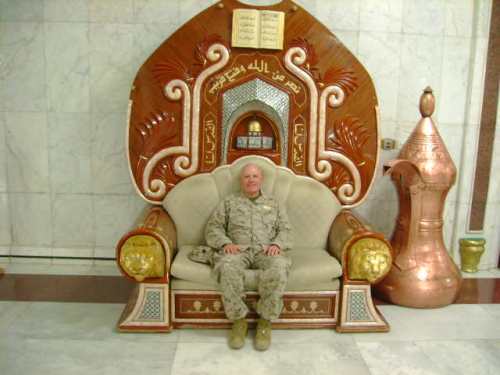
051Sitting on Saddam’s Throne

Following our arrival at Camp Victory Nelson and I continued to get our bearings. We went to the Iraq assistance Group where we checked in and began to meet the people who were going to be assisting us as we got ready to do our mission where we met with the Chaplain, Major Peter Dissmore, the Chief of staff, Colonel David Abramowitz and the Commanding General.  We received briefing and coordinating assistance from a number of the G-Shops in the IAG, the Chaplain and the Multi-National Corps Iraq Chaplain Office.

The visits with all were cordial and my long Army career as a Medical Service Corps Officer and Chaplain allowed me to have a edge in working with the Army because I knew the system, the language and the culture.  Now the IAG was run by the Army but was a joint command with Navy, Air Force and Marine staff in addition to the Army.  The IAG at least then was the coordinating office for the teams of Advisors and trainers working with the Iraqi Army, Border Forces and National Police.  Another command worked with the Provincial Police and other security forces throughout the country.

While we had an idea where we would be working before we deployed that we would work with the Marine and Army advisors in Multi-National Force West, we received the word that we would be going there.  MNF-West operates in Al Anbar Province which at that time was still a very dangerous place, although there were signs that things might be beginning to turn around.  It was funny as during our pre-deployment preparation and training took place almost everyone who heard that Nelson and I were going to Anbar expressed concern as the battle there had been very difficult since the U.S. led invasion.

The actual briefings and preparations did not take long, but the important part was building relationships that would assist us in our mission as it developed.  The two key people at IAG for our mission were Chaplain Dissmore and Colonel Abramowitz.  Chaplain Dissmore a chaplain of the Assemblies of God denomination, graduate of Princeton and ethics instructor at the Army Engineer school had been deployed like us as an individual augment as had Colonel Abramowitz.  We got along with both very well as we got details of the mission.  Colonel Abramowitz took a liking to us, especially Nelson, a fellow New Yorker.  Abramowitz is an Army Aviator and the son of an Army Infantry Colonel.  He is a big man, about 6′ 6′ or maybe taller and reminds me of a Jewish version of Patton.  When he found out that Nelson was a fighter and had multiple championship belts he had to “Google” him.  Nelson told him to “Google Nelson Lebron, kick boxer.”  When Colonel Abramowitz did he was amazed that Nelson was the real deal.  He became one of our strongest advocates in Baghdad.  We talked baseball of course the good Colonel being a Yankees fan. Another group of men who were invaluable to us were two former Iraqi Army and Air Force Generals who had fled the country during the reign of Saddaam after the the Gulf war.  Both helped us considerably as we gt to know more about the make up of the new Iraqi Army which after a couple of years had been purged of many of the opportunists and political hacks who had come in after it was re-established.  Many of the officers replacing the problem children were career military men, secular in outlook who had served since the Iran-Iraq war of the 1980s are well as in the First Gulf War.  These men wanted the chance to get the Iraqi Army back in shape as a fighting force, but faced opposition from certain political and religious groups in the country not to mention the insurgents who desired to undermine the effectiveness of this force from the beginning.

Almost immediately after meeting with the IAG staff we were on the phone with Navy Captain Mike Langston the Chaplain for MNF-W and II Marine Expeditionary Force Forward and his deputy Commander J. Hedges.  They were excited to have us coming to their area.  When Chaplain Dissmore informed them that they had the choice of a Navy team or an Army team they of course picked us.  This was also the intent of the IAG who realized that a Navy team would understand the more Marine oriented advisors and chain of command out west.  When Chaplain Langston heard that the team was composed of Nelson and me he expressed great pleasure as Nelson had served with him in Afghanistan and I had served with him at Second Marine Division.  As a result we had a great amount of trust placed in us because of prior service together as we were both known quantities.  Relationships matter in the military and this time they were a great help to us.

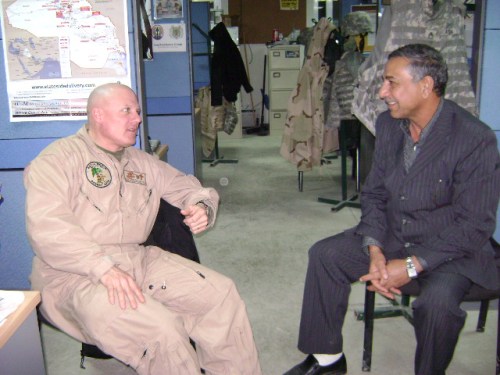
Dundas and FallahMeeting with General Falah

One of the things pointed out to us was that we were the first Navy team assigned to doing this type of mission since Vietnam.  Most of the Army teams doing the mission were reservists and according to the information that we were given were struggling.  A team that had been dispatched out west prior to us had been sent back early because of their ineffectiveness.  I had already known that we were the first Navy team to do this mission since Vietnam and had taken the time to read the histories of the chaplains who served in this “niche” role in that war.  Likewise being a history major and working on a second Masters in Military History I had been doing a lot of study on counter-insurgency and revolutionary warfare.  Not long prior to our deployment the Army and Marine Corps had issued a new manual on the subject.  When I read it I was surprised to find that I had already read many of the primary sources used in its compilation.  These are things that while not directly related o being a chaplain are things that help give a chaplain “street cred” and an ability to adapt to the culture and understand the language of the men that he serves with.  I did not stop being a Priest in this, but I knew where we fit and understood what the advisers on the MiTT  Military Transition teams, mission was and challenges that they faced.  This again put us ahead of the power curve going into the mission.  I do not think that any Religious Ministry or Army Unit Ministry Team has been as well prepared for this kind of mission than we were.

While at Camp Victory I met several old friends and acquaintances from Army and Navy service, as well as a Marine Corps Officer with who I had attended Command and Staff College.  One, LCDR Andy Wade who I had served with at 2nd MARDIV was completing a tour with the MNC-I Chaplain Office. Two of the Army Chaplains had been in my officer basic course and one, an Orthodox Priest was a friend from the Army Chaplain Officer basic course at Fort Monmouth NJ in 1990.  Peter Batkis was a newly commissioned 1LT when I went to the basic course and was the room mate of my good friend Fr Jim Bowman.  He was  now a Lieutenant Colonel and Chaplain for the 18th MP Brigade.  The other former classmate had been with an advisory team elsewhere in country and not had a good experience.  I was shocked to see how he had aged and how badly he wanted to get out of country.

While at Camp Victory we continued to get ourselves ready to go.  Our flight to Fallujah was arranged by the IAG staff and we began the process of waiting.  While waiting we were able to get some PT in and on the morning of the 8th of August (7 August in the States) while at breakfast I saw Barry Bonds hit home run #756 to break the record of Hank Aaron.  What I saw at Camp Victory amazed me.  The place was a veritable “little America” complete with the largest military exchange in country, about the size of a small Wal-Mart with a separate market for Iraqi vendors and, American fast food outlets housed in white trailers outside the exchange and a host of other exchange services found anywhere in the world, except to much of Al Anbar where we were heading.  It was kind of surreal, all of this Americana plunked down in there heart of Iraq, surrounded by blast walls and guarded with multiple check points. Parking lots were filled with a  mixture of tactical and non-tactical vehicles and every military person was armed. Helicopters overflew the area regularly, both transport aircraft and gunships, the gunships which flew what would have at one time been called a “Combat Air Patrol.” Additionally there was the ever present noise of small arms fire, distant explosions and sirens of various emergency and police vehicles.  The weather while 6-8 degrees cooler than Kuwait was still very hot and we were constantly picking up liter bottles of fresh water to stay hydrated.

Additionally we received the tour of the Al Faw Palace which was one of Saddaam Hussein’s major residences which had been taken over as the headquarters of Multi-National Force Iraq.  The palace was abuzz with the activity of the MNF-I staff.  In the lobby of the palace there is a throne given to Saddaam by Yasser Arafat in which almost everyone going through Camp Victory gets their photo taken in.

On our 4th day in country we got word that we would fly that night.  Nelson and I got ourselves packed, made final preparations and coordination with the IAG staff and waited.

Leave a comment

Filed under iraq,afghanistan, Military, Tour in Iraq

The Forgotten Cold Warriors

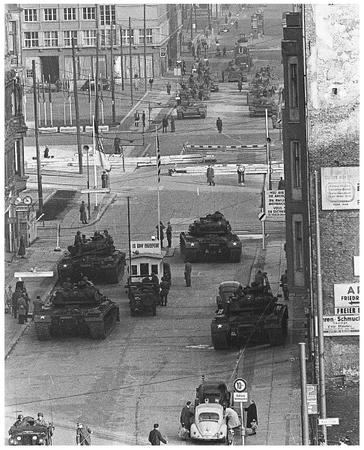
CheckpointCheckpoint Charlie in the Berlin Crisis

Note: As a follow up to this Article I posted “20 Years: The Fall of the Berlin Wall and the End of the Cold War” to this site.  The link to that article is here:

https://padresteve.wordpress.com/2009/11/08/20-years-the-fall-of-the-berlin-wall-and-the-end-of-the-cold-war/

From the Berlin Blockade and until the collapse of the Soviet Union in 1991 American, British, NATO and Asian Allies waged a Cold War against their Soviet and Warsaw Pact Countries, North Korea and at times China and Vietnam.  The war was a world war, fought by the major powers, their alliances and proxies throughout the world.  It was a world of gray areas where soldiers, sailors, airmen as well as Special Forces and intelligence agencies from both sides attempted to gain dominance over the world through political, military, economic, diplomatic and intelligence means and through use of surrogates.  Sometimes the war turned hot as in Korea, Vietnam and for the Soviet Union Afghanistan.

The conflict found its way to almost every corner of the earth and the world lived on edge wondering if the superpowers and their allies would end up in a hot war.  US and NATO Navies played a cat and mouse game with the Red Navy both under the sea and upon the waters.  Sometimes this war turned deadly as US and Red Navy Submarines disappeared and were never heard from again amid circumstances like those of the USS Scorpion that are still debated.  On the high seas US and NATO ships shadowed each other and occasionally played a game of chicken where ships collided attempting to gain advantage as they undertook surveillance missions or shadowed task forces.  Spy ships from both sides plied the seas collecting any type of information on their opponent’s operations.  In the air spy aircraft maintained a ready vigil with US SR-71s and U-2s flying missions over the Soviet Union.  Soviet Bear and Backfire Bombers probed the airspace of the United States and Canada and NATO forces at sea who responded by sending up interceptors.   In the closed confines of the Mediterranean the Navies sparred while a in the Middle East and North Africa both sides sought dominance through treaties with the surrounding nations who moved from Western to Soviet and Soviet to Western orbit as they deemed fit. Ideology and behavior of these client regimes was less important than having them in your camp, creating a surreal world of moral ambiguity in the shadow realm of alliances.

In divided Germany NATO and Warsaw Pact Forces faced off in a tense standoff along the inter-German Border and where millions of troops planned and trained for a hot war on the Fulda Gap and Northern German Plain which would include the use of Nuclear, Biological and Chemical weapons.  West Berlin was an island surrounded by the Olive uniformed Red Army and Field Gray of the German Democratic Republic.  A similar watch was maintained on the Korean DMZ.  In Africa, Asia, South and Central America, the Indian Subcontinent and the Middle East forces of the major powers worked with allies and surrogates to gain advantage.   The Soviets blockaded West Berlin while in response to the placement of Soviet missiles in Cuba the US imposed a naval blockade.  The CIA sponsored a failed attempt by Cuban expatriates to land at the Bay of Pigs.  The Soviets toppled governments and put down revolts in Hungary and Czechoslovakia while maintaining a system of Gulags at home.  Even international sporting events became occasions where each side used propaganda to show itself off to the world as the ideal society.  All of this occurring while the world lived under the constant threat of intentional or unintentional nuclear war.   In  missile silos and aboard Nuclear Ballistic Missile Submarines and manned bombers men stood by to push buttons and turn keys that could have ended the world as we know it.

763px-USS_Yorktown_collisionSoviet Krivak Class Frigate Intentionally Colliding with USS Yorktown CG-48 in the Black Sea 1988

Casualties were taken, even in places where the war was not “hot.”  Soldiers, Sailors, Marines, Airmen and Intelligence Service personnel undertook missions that are still classified the details of which they cannot reveal to this day.  Some suffer from PTSD from their involvement in and guilt over missions that they cannot reveal.  Men from both sides know that the weapons systems that they were involved with killed men on the other side in operations that will never be known.  American Veterans of the Cold War have been ignored by the country.  Russian Veterans have been forgotten as the Soviet Union crashed down on itself.  Countries spanning the globe bear the scars of the “hot” Cold War waged on their soil.  The results of the Cold War are still with us.  The West celbrated the collapse of the Soviet Empire but failed to make the new Russia a full member of the new world causing resentment which still boils today influencing Russian policy toward the West.

I met a man recently in hospital who was one of these veterans.  Tormented by the demons of operations he cannot reveal he suffers from physical and emotional wounds.  He is not alone.  There are many like him.  I do not suffer from my Cold War Service.  I served as a platoon leader, company executive officer and company commander in Germany in the mid-1980s.  If a war had broken out along the Fulda Gap my Chrysler Corporation bailout Dodge M-886 Ambulances with no communications systems adorned with bright red “mobile registration points’ were to be involved with reconstituting units which were expected to take 90% casualties.  We trained for chemical and biological warfare.  The maps used in my NBC defense officer course showed the housing area in which I lived.  We lived in a world of alerts where within two hours we had to be ready to head to war.  A world where Soviet spies operated and recruited Americans and where the German Red Brigade Terrorists bombed housing areas, clubs and even the Main Frankfurt PX, where we were on our way to when Judy felt sick and we had to return home.  Occasionally American Servicemen were murdered by Soviet Agents or Red Brigade Terrorists.  This was life for those stationed in Germany as well as South Korea.

I have been in East Berlin and was surprised as hell to see the Berlin Wall come down.  I have been to the Korean DMZ and the Northeast Gate of Guantanamo Bay Cuba.  I call it the “Commie trifecta.”  Without the Berlin Wall there are only two places where the US faces a Communist state directly.   Yet my time in a “hot” war has been in Iraq, I remember the days of the Cold War from childhood through my early Army career.

Cold War Veterans are the last forgotten Veterans group in the United States or even Russia.  Their sacrifices are not recognized.  The US belatedly issued a Cold war Service certificate for its veterans, but vets have to deal with a system that makes it difficult to even obtain a piece of paper that says “thank you” which gives them no other benefit.  The certificate is available to any person who worked for the Federal Government, including temporary holiday employees of the US Postal Service and does not mention military service. A Cold Service Medal was constantly fought by DOD during the last administration as too costly to support at this time.  The Cold War Service Medal last appeared in the FY 2008 DOD spending bills but was cut.   With the present demands on the military in the current wars and the fact that the cost of any award would come out of DOD’s budget it is unrealistic to expect this any time soon as it would cut into the funds needed to fight this war. At the same time these Veterans have no memorial and no status.  While their war was not “hot” it was world wide, lasted 40 years with many casualties.  Yes I agree it was not a hot war and that many who served in it were not in combat.  At the same time the Cold War veterans helped give the world a chance at a new beginning in 1991, unfortunately that has been squandered by governments around the world including the US government, but that is not the fault of those who stood the watch.  Someday they should be recognized.

Berlin WallMe on the East German Side of the Berlin Wall, November 1986
I have my medals from Iraq, the War on Terror and Korean Defense service.  I do believe that those men who stood the watch and many times paid with their lives or health should be recognized.  Other countries have done so.  I wonder why a few dollars per medal cannot be spent on men and women who served on the front line of freedom for 40 years. At the same time I understand that the costs of any such Medal would be born by DOD which is strapped to fight the ongoing wars.  I don’t think it realistic to have the money spent now, but maybe when the dust finally clears and these conflicts subside someone will take the time to remember these men and women.

The gentleman I saw recently never got a thank-you, never got a parade, and never was able to talk about the things that haunted him.  I wonder just how many more are waiting for the chance to come in from the cold.  If you know one of them, thank them for thier service and if they are one of those suffering from their service take care of them.

Peace, Steve+

Leave a comment

Filed under History, Loose thoughts and musings, Military, national security

Going to War: Reflections on My Journey to Iraq and Back- Part One

Two years ago today my assistant at EOD Group Two, RP2 Nelson Lebron and I began our Iraq adventure.  This is the first of a series of posts which will be published periodically to tell our story.  While they will not be daily posts, they will be sprinkled in on this site on a regular basis.  Hopefully they will be something that will help those who have not been in the remote parts of either Iraq or Afghanistan what it is for Navy personnel to go to war, not as ship’s company, not with their own unit, but as individual augments to other commands.  This is a different way to go to war…this is our story.

July 2nd 2007: I rolled into the parking lot for the Naval Mobilization Processing Site (NMPS) Norfolk.  As usual parking on Norfolk Naval Station was a bitch to find.  It had been a number of months since I had to make this commute having transferred from the Marine Security Force Battalion where I had served the past three years but thankfully I remembered to leave early because traffic was as gooned up as ever going down I-264, I-64 and I-564 to head into the base.  At that point I really missed my designated parking spot back at the battalion.

I looked around and finally found a spot and then after wandering around a bit found the NMPS offices.  I walked upstairs to the classroom in which we were to meet was located and found it empty, save for a couple of NMPS staff members.  I reported in my DCU’s, or Dessert Camouflage Uniform issued to me by EOD Group Two.   They are an older type uniform and unlike the Marine Pattern Digital Camouflage are not wash and wear.  I had worn them in March when I went to Jordan for the Jordanian Army/ UN Peace Operations Training Center course on Iraqi Culture, Religion, Politics and Language.  In fact until the Marines came out with their digital uniforms they were common to all of the services.  I looked around the empty classroom with every table stacked with folders filled with a butt-load of paperwork.  I found a spot, not hard to do with so many to choose from and sat down.  I took an aisle seat about three rows back and plunked my EOD issue Blackhawk backpack down, grabbed my Book of Common Prayer and did the morning office before anyone else arrived while drinking the large cup of black coffee I had gotten across the street.

Shortly thereafter others began to arrive in twos and threes, most dressed in utilities or officers in khakis.  A few Seabees had woodland BDUs on and a couple of folks wore DCUs which were obviously from previous deployments to the sandbox.  RP2 Lebron, who I will now refer to as Nelson from this point forward then showed up and we waited for the orientation and administrative stuff to start moving.  We surveyed the situation and looking upon our fellow sailors realized that this would be a different deployment.

What we noticed as we talked the varying ranks and uniforms really jumped out at both of us.  Most of our fellow sailors had never been deployed even in peacetime in such a manner.  Most of those who had deployed had done so on ship with the exception of the Seabees and maybe a Corpsman or two.  They spanned the spectrum of age, rank and rating.  There were the officers, mainly Lieutenants, Lieutenant Commanders and Commanders.  We also had one Captain.  These officers were Line Officers including Surface Warfare Officers and Aviators as well as a number of Doctors and Medical Service Corps Officers and some other Staff Corps officers.  The enlisted likewise spanned the spectrum of the Navy. Fire Control Technicians, Operations Specialists, Gunners Mates, Boatswains, Yeomen and Storekeepers, Intelligence Specialists, Corpsmen, and even Culinary Specialists.  They had qualifications as Submariners, Enlisted Surface Warfare, Aviation Warfare among others.  Some like me and Nelson had volunteered, others were voluntold.  The one that brought us all together was that we were US Navy Sailors and going to war, not with the shipmates that we had served with, but with strangers, well except for me and Nelson.

Now Nelson and I have deployed a lot and had served together in Okinawa and at EOD where I did a “drug deal” with his chaplain and the detailer to get him to EOD.  The guy is a hero, in the year and a half prior to our deployment he had been deployed to Afghanistan where he as an E-5 was awarded the Defense Meritorious Service Medal.  On his way back from Afghanistan he was pulled off of his flight to the states and sent back to his old ship, the USS Trenton to assist in the evacuation of Americans and others from Beirut. I think that he has done about nine or ten deployments now.  Unfortunately this has actually hurt his career since the biggest part of making rank as a Navy enlisted man is to do well on the advancement exam.  Unfortunately there were many times when he was forbidden to test because he was deployed, and when eventually allowed to test during a deployment was not provided the appropriate materials to study.  Even if he had them it would have been difficult since we were always on the road, just as he was in his last four or five deployments.

Nelson is a NY Rican and both a New York Golden Gloves boxing champ, a high school valedictorian, a full contact  kick boxer, martial artist, MMA fighter and has fought on Team USA and won last year’s Arnold Schwarzenegger Classic.   He is the real deal.  Proficient in many weapons systems from his service with the 3rd Recon Battalion, 4th Marine Regiment and Naval Special Warfare he is the ideal body guard for any Chaplain going to do the job we had been given to do, to work with Marine and Army advisers supporting two Iraqi Divisions.  Our mission would evolve and expand once we got there, but we didn’t know that yet.

As people filed in a Chief Petty Officer brought us to attention, the processing site Commanding Officer came in and spoke with us and then led us in the Sailors Creed.  With that we set down and began to get our orientation to how our mobilization, training and movement would unfold as we got ready to go to Iraq.

2 Comments

Filed under iraq,afghanistan, Military, Tour in Iraq

It’s what you learn after you know it all that counts-Thoughts on 26 Years of Commissioned Service

2LT Dundas 1983

When I Knew Everything: Me in August 1983 following completion of the Medical Service Corps Officer Basic Course

“It’s what you learn after you know it all that counts.” Earl Weaver

When I was commissioned as a Second Lieutenant in the US Army back in 1983 I knew that I was quite possibly the smartest new Lieutenant in the Army.  In fact in just a few days I will celebrate the anniversary of that auspicious occasion as I do most occasions by going to Harbor Park where I will see the Tides play the Lehigh Valley Iron Pigs, AAA affiliate of the Phillies. But anyway, back to how smart that I thought I was back then.  I graduated from my Medical Service Corps Officer Basic Course fairly high in my class without really trying too hard, had a pretty easy time at the Junior Officer Maintenance Course.  However, those were schools and anybody with half a brain can tell you that going to school is kind of like artificial real life.  Yeah, you may be doing the living and breathing stuff, sucking up food and band width, but it is not real life.  If you show up on time, read a little bit and take good notes you pass and move along.

However, real life has a tendency to take the smartest of the book smart people and kick their ass.  Sometimes it takes a while but young guys in the military who think they know more than old dudes who have served on all kinds of places and been to combat.  When I was the young guy there were still a fair amount of men who had served in Vietnam and even a few from Korea still in service.  Now these guys were a mixed bag.  Some had seen better days and were on what we referred to as the ROAD (Retired On Active Duty) program.  Others though were totally professional and absolutely committed to the Army and their soldiers, guys like SFC Harry Zilkan, 1SG Jim Koenig and Colonel Donald Johnson. These men were amazing, and even some of the ROAD program soldiers and officers still knew a lot more than I knew at that point.

When I got to Germany I can say that there were a number of occasions where as a young officer I had my ass handed to me, even when I was right.  I’m not going to go into ugly details but it suffices to say that a good number of those times I got what I deserved because I was arrogant and not nearly as smart as I thought I was.  I was like a rookie pitcher thinking that my stuff was unhittable and finding out that guys who had played in the show for a long time had seen it all before.  It was in Germany that I found that while I had good stuff that I wasn’t savvy enough to know when to change my stuff up or when to take the hint not to keep pushing my luck.  I was kind of like Ebby Clavin LaLoosh in Bull Durham in wanting to do what I wanted to do.

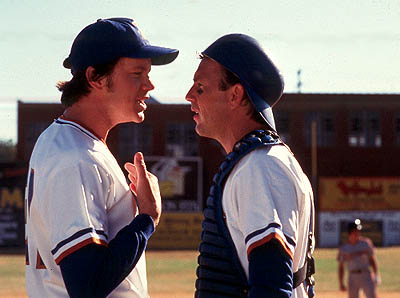
tim_robbins_kevin_costner_bull_durham_001I want to give him the heat and announce my presence with authority!
Crash calls for a curve ball, Ebby shakes off the pitch twice]
Crash Davis: [stands up] Hey! HEY!
[walks to meet Ebby at the mound]
Crash Davis: Why are you shaking me off?
Ebby Calvin LaLoosh: [Gets in Crash’s face] I want to give him the heat and announce my presence with authority!
Crash Davis: Announce your f***ing presence with authority? This guy is a first ball, fast ball hitter!
Ebby Calvin LaLoosh: Well he hasn’t seen my heat!
Crash Davis: [pauses] Allright meat, show him your heat.
[Walks back towards the box]
Crash Davis: [to the batter] Fast ball.

[after Ebby didn’t listen to Crash, and the ball became a home run]
Ebby Calvin LaLoosh: You told him didn’t you?
Crash Davis: Yup.

bull-durham after home run

You having fun yet?

That was me as a young officer.  You would think that I would have learned, but after I became a Army Chaplain I did the same damned thing.  Now admittedly it was not in the units that I served in, but my hotheadedness still got me in trouble especially when I decided to challenge guys who had been around a long longer than me and who were a lot more savvy than me.  I had no idea how cunning and brutal some chaplains could be despite having good warning from my XO and Brigade commander at the Academy of Health Sciences, LTC Jim Wigger.  LTC Wigger pulled me aside one day shortly before I left active duty to go to seminary.  He told me “Steve, I know that you think that the Medical Service Corps can be political and vicious, we can’t hold a candle to the Chaplain Corps.”  I should have listened to him. He was right, a lot of those guys were political animals and had no problem taking down or destroying a young chaplain if they thought that they needed to do so.  I got whacked pretty hard a number of times as a young Army Chaplain, but was fortunate that people who knew me and saw potential in me gave me some top cover and protection.  Not everyone gets this.  The Deity Herself must have taken an interest in my career to ensure that there were some guys around to save me from me. Chaplain Rich Whaley did this for me at the Chaplain school on a number of occasions even the time that I got thrown out of the Chaplain Officer Advanced Course (See one of my previous posts to read about this one.)

[Mechanized bull noises in background]
Crash Davis: Well, he really hit the shit outta that one, didn’t he?
[laughs]
Ebby Calvin LaLoosh: [softly, infuriated] I held it like an egg.
Crash Davis: Yeah, and he scrambled the son of a bitch. Look at that, he hit the f***ing bull! Guy gets a free steak!
[laughs]
Crash Davis: You having fun yet?
Ebby Calvin LaLoosh: Oh, yeah. Havin’ a blast.
Crash Davis: Good.
[pause]
Ebby Calvin LaLoosh: God, that sucker teed off on that like he knew I was gonna throw a fastball!
Crash Davis: He did know.
Ebby Calvin LaLoosh: How?
Crash Davis: I told him.

Thankfully by the time I had spent 17 ½ years in the Army I had learned my lessons.  By the time I got to the Navy I had pretty much discovered when and under what circumstances that I could push things.  I had learned the hard way in the Army.  I finally learned that I didn’t know nearly as much as I thought I did.  In fact when I went to the Navy I came in at a lower rank that my Army rank and took no constructive credit to try to get promoted sooner.  I went in with no time in grade to make sure that I got the experience that I needed on the Navy and Marine side.  When doing this I took the time to learn the nuances that made the work of a chaplain different in the Sea Services than in the Army.  While there are similarities even the similarities are often different.  These different similarities can kill you if you think that you’re smarter than everyone else.

I’m now coming up to 26 years of commissioned service and soon to 28 total years of service.  I’m now a lot more like Crash Davis than Ebby Calvin “Nuke” LaLoosh.  In fact now I try to make sure the young guys chaplains and non-chaplains alike don’t get themselves in unnecessary trouble by assuming that they know more than they do.  I have a dear friend who is an Army Chaplain. In his first three years in the Army he has won two Bronze Stars in Iraq.  He will probably be medically retired soon because of a rare pulmonary and respiratory problem that he developed in Iraq.  He was initially supposed to come in the Navy, until just before his care board met a washed up ROAD program chaplain supervising him on an OJT tour decided to torpedo him.   It was crushing to my friend.  He would have been a great Navy and Marine Corps Chaplain.  I helped him recover and assisted him going to the Army.  In his formation I used to require him to watch baseball movies and read books about baseball, and like Crash Davis I would call him “Meat.”  The guy is a gem; the Army is going to lose a superstar when he is medically retired.

Anyway, my mission now is to help the young guys along and continue to keep myself both in the game and always learn something new to keep me sharp and to help others. It’s like Master Yogi once said “In baseball you don’t know nothing.”  I’m sure that the Deity Herself would agree.

Peace, Steve+

1 Comment

Filed under Baseball, Loose thoughts and musings, Military, philosophy

Mid-Week Review-The Loss of a Shipmate, Hospital Duty is Not Easy and No Rational Thought Goes Unpunished

Today has been tough, actually it began yesterday.  We lost a dear shipmate this week. Hospital Corpsman Chief Pam Branum passed away while deployed on the USNS Comfort while on a humanitarian deployment.  She was the Leading Chief Petty Officer for our Critical Care Department, a great leader, genuinely nice person, and dear friend to many in our department.  She was passionate about her work and her people.  She set high standards for herself and worked hard to make sure that her Corpsmen were trained and became good not only what they do, but to help develop them as leaders with character.  She supported the nursing staff that she worked with as a friend and mentor.  She was like a mom to a lot of our staff.  Her loss at the age of 41 was shocking.  This has been a tough year for us in the Medical Center, back in April we lost a 4th Year Medical Student who just in a few weeks would have become a physician and started his internship and residency here.  We have lost a number of other staff members, active duty and civilian since December.  When we lose them we lose part of our family.  Those who have never served in the military cannot fully fathom how losses like this affect the rest of us.  I will be working with our staff and helping to plan Chief’s memorial service and maybe depending on the location the funeral.  Chief Branum will be sorely missed, I am still somewhat in shock.  Please keep her family, friends and co-workers in your prayers.  A link to the Blog of the Executive Officer of the USNS Comfort is here:   http://comfort-xo.blogspot.com/2009/06/thank-you-chief-may-you-rest-in-peace.html?showComment=1244112525886#c1602797664780974312

Another aspect of this difficult year is the number of our military staff being deployed.  Our “deployers” support current operations in Iraq, the Gulf, Horn of Africa and the Afghanistan surge.  Many have already been deployed, are getting ready to do so or are waiting for word.  Many have made other combat deployments in Iraq either with the Marines, Expeditionary Medical Facilities and Shock and Trauma units.  Sometimes they are sent on joint assignments helping train Afghan and Iraqi medical personnel.  Additionally they do humanitarian work in the combat zones in cooperation with Army and Air Force medical personnel.  Some of these Sailors have lost their lives after leaving home and the supposed security of a hospital assignment.  It is sometimes frustrating to listen to those who do not work in a place like this refer to hospital duty as easy.  Our clinicians deal with life and death every day here and are called upon to deploy at a moment’s notice.   They fight for life every day and sometimes when things go badly are as traumatized by the events as people in combat.  It’s hard to watch someone die or suffer and realize that sometimes you can’t win.  There are deaths, especially of children that I cannot get out of my head and I know from my relationships with physicians and nursing staff that they also have similar experiences.   Programs are being developed to help people before they become victims of operational stress, but these are just getting off the ground.  Please keep these heroes in your prayers.

I think today I was also a victim of my logical and reasonable brain.  I am now a declared enemy of at least one person in the anti-abortion movement.  I invested myself heavily the past three days in discussing the events of this weekend in Kansas.  I will not regurgitate this here, read those posts.  However there is something interesting.  I basically had someone comment that “they knew whose side I was on” and pretty much labeled me as someone who is not pro-life.  If they knew me they would know otherwise, but some people cannot take even constructive criticism of tactics and strategy.  Sorry but the confrontational strategy has not worked over a 30 year period and the escalation of rhetoric and violence will get the whole pro-life movement labeled as a domestic terrorist organization. Hell, even David Kupelian of the ultra conservative news site World Net Daily and I agree on this.

The guy who posted to my blog even used a line that was eerily reminiscent of Colonel Jessup in A Few Good Men.  “What happened to the “doctor” was wrong, it probably saved hundreds of lives.”  (Comment on yesterday’s post) The person who wrote this has adopted an end’s versus means situational ethic to make the leap that the murder while wrong is okay because it stopped one person from doing abortions.  Unfortunately that strategy will not stop others from doing abortions and may very well in fact lead to the dismemberment of the legislative gains of the mainstream pro-life movement which guess what will happen?  It will lead to more abortions.  If you make your living by fighting abortion like Randall Terry does this is a good thing.  You won’t lack for work or money unless however you are doing time in a Federal penitentiary as a domestic terrorist.   That aside it means as long as abortion is legal you can keep drawing a paycheck to fight it.  That is the kind of thing that makes me suspicious of Mr. Terry’s motives.  You use the same tactics for 30 years without any real change to the situation and then say we have to keep doing this.  I have to wonder when I see this. Is Mr. Terry truly committed to life or is this a means to stay in the spotlight?  I’m not accusing, just wondering.  I have met Randall on a number of occasions, never by the way at any rally or event, and he can be charming.  Personally he seems like a good guy to go out and get a beer with and maybe even engage in spirited discussions. However, his actions have planted a seed of doubt in my mind about his motives.   If he is really committed to the pro-life cause of saving babies why does he stick with tactics that only drive potential supporters away from him?  He seems to me  like Generals in wars who decide to take some enemy strongpoint.  They make an attack and it fails and they continue to do so until they bleed themselves dry and eventually lose the battle.  The real progress in the right to life movement has not been through protest. Instead it has been through prayer, practical help to women in need and legislative efforts of pro-life men and women committed to working through legal means.  These people do not vilify thier opposite numbers but seek engagement and redemption and reconcilliation.    I made sure that I allowed the comment so others can see just how this mindset plays out when guys like this judge people on the pro-life who advocate less incendiary tactics.

Well I chased that rabbit for what it was worth.  Anyway, things with my family in California still are difficult. My dad continues to worsen, the insurance company has been a pain in the ass causing my mom and brother much grief.   I covet your prayers for them.  The hospital is very busy and I have a number of very sick patients that I am caring for their families, both adults and children.  Likewise, I will be trying to make sure that I care for my ICU staff and help them get through this period of shock, grief and loss.  There may be a possibility of activating our SPRINT team to assist sailors in the medical center or on the Comfort and this could make things even more interesting.

In the midst of this I still deal with my own stuff.  In times like this I get the “electrical current” sensation running through my body.  I become more edgy, hyper vigilant and at times anxious.  Sleep is still difficult.  However, this too I will get through.  I have completed day three in a 12 day “home-stand” at the hospital.  I’ll have duty this weekend.  At least the Tides are in town. I’m taking Judy to the game against Buffalo tonight.  While there I will be keeping an eye on the scoreboard to see if Randy Johnson will get his 300th career win pitching for the Giants aganst the Nationals.  Only 24 major league pitchers have reached this mark and only one is active, that being Tom Glavine.  I’ll post a game synopsis later.

Pray for me a sinner.

Peace, Steve+

Post Script: In spite of the threat of thunderstorm we got through the game with barely a sprinkle. The Tides beat the Bisons 5-3. Kam Mickolio got the win in relief and Jim Miler got his 13th Save.  Bobby Livingston pitched 7 shutout innings but went away with a no-decision.  Jolbert Cabrerra of the Tides hit a 2 run double in the bottom of the 8th to give the Tides the win.  The Tides improve to 35 and 17 and lead the Durham Bulls by a game and a half in the International League South,  Despite the loss of several pitchers as well as Outfielder Nolan Reimold and Catcher Matt Wieters to the Orioles the Tides with a bunch of AA promotions from the Bowie Baysox continue to win.  It is fun to see a team that plays in an organization that has a solid farm system.

Speaking of teams that don’t the Bison’s are now the AAA affiliate for the NY Mets.  They have the worst record in the International League. The Mets as they did in Norfolk have no hot prospects and many of their players are former major leaguers  The sad thing is that Buffalo under the Indians had a consistently good team. The city is not happy with the Mets.  Join the club Bison fans. It sucks to be the Mets AAA affiliate.

Second Post Script: The “Big Unit” Randy Johnson and the Giants had their game with the Nationals postponed by rain.  The game will be made up Thursday as a part of a double-header.  Johnson will get his chance for 300 tomorrow. Meanwhile the Braves released Tom Glavine. This could be the end of the line for the future Hall of Fame Pitcher.

Third Post Script:  The rain which held off throughout the game decided to hit after we got home. This happend to coincide with our little dog Molly’s trip to hunt for squirrels and do her evening business. She hates rain and started barking to be let back in.  The wet little dog got the payment of her cookie, gave us a good laugh and started playing with aplush toy fox that looks somewhat like her.  She is funny.

3 Comments

Filed under alzheimer's disease, Baseball, ER's and Trauma, healthcare, iraq,afghanistan, Military, philosophy, Political Commentary, pro-life anti-abortion, PTSD, Religion

Gordon Klingenschmitt and his Followers- The Klingenfraud and the Klingenban

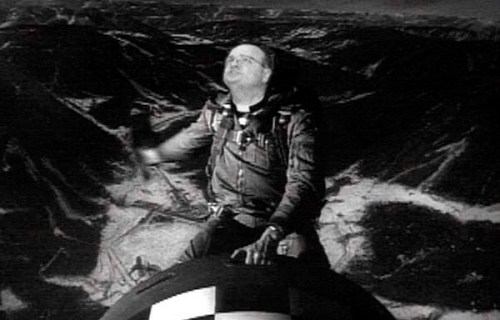
Gordon rides the bomb copyGordon Klingenschmitt in all his glory: Ride ’em Cowboy!

Note:  Please know that I am not attacking historic, Evangelical Christianity, nor Christians, Evangelical or otherwise who live their faith proclaiming the Gospel in this post.  Nor am I attacking anyone’s right to deeply held political beliefs.  This post focuses on Gordon Klingenschmitt and others like him who make their living by lying about others using character assassination, the promotion of sedition, secession and pray for the deaths of their political opponents.  Peaceful, law abiding protest and dissent are indispensable in our country.  Likewise the New Testament teaching of Jesus to “Love your enemies and pray for those who persecute you” is antithetical to what Klingenschmitt and the Klingenban are now doing. Unfortunately this bright but unstable man promotes himself in the crassest manner. Though he says what he is doing is for Jesus, it is readily apparent that he is not proclaiming Jesus but himself.    His lies and distortions have become legendary, yet he is a media darling of the Uber-Right.  So please, if you are a conservative Christian, Protestant or Catholic who lives a life upholding the Gospel, love your neighbor, living peaceably with others this does not apply to you. It applies to those who have been so consumed by hatred for the political and religious left that rules of good behavior, respectful dialogue and public decency have been abandoned.  They have been defined by and are now more faithful to extreme right wing political ideology than the Christian faith.  For literary purposes I will refer to them by naming them after their most prominent figure:  Former Chaplain disgraced Naval Officer, convicted criminal professional malcontent and protester Gordon J. Klingenschmitt.  His followers are the Klingenban.

“One-Minute Prayer: Let us pray. Almighty God, today we pray imprecatory prayers from Psalm 109 against the enemies of religious liberty, including Barry Lynn and Mikey Weinstein, who issued press releases this week attacking me personally. God, do not remain silent, for wicked men surround us and tell lies about us. We bless them, but they curse us. Therefore find them guilty, not me. Let their days be few, and replace them with Godly people. Plunder their fields, and seize their assets. Cut off their descendants, and remember their sins, in Jesus’ name. Amen.”  The Prayer of Gordon Klingenschmitt

But I say unto you, Love your enemies, bless them that curse you, do good to them that hate you, and pray for them which despitefully use you, and persecute you;” Matthew 5:44  Jesus Christ

Let every person be subject to the governing authorities. For there is no authority except from God, and those that exist have been instituted by God. Therefore he who resists the authorities resists what God has appointed, and those who resist will incur judgment.  Romans 13:1-2

There are two types of religious Fundamentalists who exist in every religion including Atheism and Secularism, which can for some have an almost religious quality.  There are those who while having and proclaiming their beliefs treat their opponents with respect, love and care.  These folks live their faith, treat others as they would want to be treated, understand that others, even if they believe them to be wrong and maybe even “Hell-bound” still have a right to their beliefs and equal treatment under the law.  In fact many of our nation’s most respected figures have been just these kinds of people.  They have helped make the United States a place where anyone can live peacefully and have the chance to better their lives while contributing to the general welfare of the nation.  They do not seek or desire that the Government take the side of any religious group.  In fact the religious liberty provision in the Bill of Rights was the result of Virginia Baptists who were being discriminated against by the Anglican Church which at the time was the State Church in Virginia.  These Baptists went to James Madison and presented their case and Madison included this in the Bill of Rights.  This was an extremely important event in the life of our Nation.  People forget that almost all of the original 13 colonies, save Rhode Island and Pennsylvania had established “State Churches.”  Eventually these all were disestablished, the last being the Congregational Church in Massachusetts in the 1830s. The second type is the radical Fundamentalist.  As I said these exist in every religion, even those religions which acknowledge no God. In recent times the focus has been on Moslem Extremists such as Al Qaida, the Taliban, Hamas, Hezbollah, the Islamic Jihad, radical Iranian Ayatollahs and other radical Moslem groups.  Likewise there are extremes in Judaism, Hinduism and other religions.  Some atheists and secularists too have had their moments of insanity.

Italy Afghanistan Commander KilledMullah Omar: Klingenschmitt’s Kindred Spirit

The common thread that runs through all of these groups is that they want to be in control of the government wherever they are and enforce their interpretation of their beliefs on others.  They are bullies of the faith.  What they cannot convince you to agree with you on they will push the state to do.  If the state is unwilling then be it through democratic process or hostile takeover they attempt to control the state and by doing so inflict their tyranny on others.  Europe had a long history of this. It has occurred elsewhere in the world.  In 1979 it was on full display when the Ayatollah Khomeini and his followers helped topple the Shah of Iran and then forced more secular reformers out of the government imposing their version of Islamic law.  While not to the same degree we have seen similar things happen in the United States both before and after our founding.  The Plymouth Bay Colony, which we are taught was founded on the principle of religious freedom, was just that.  It was founded so that these colonists could be free from the Church of England and be the State Church.  They were so heavy handed with dissenters that Roger Williams escaped, swimming the Narragansett to found the colony of Rhode Island. This became the first colony to guarantee religious freedom.  Secularists in Revolutionary France conducted routine religious purges.  Radical Hindus in India routinely target Christians and Moslems as well as Hindus of lower castes.   All of this was or is done with the active cooperation or tacit approval of the state.  If given the chance to actually influence policy Klingenfraud and his ilk would impose draconian measures on anyone who disagrees with them.

Yet, Klingenschmitt and the Klingenban exemplify this some of the most radical and compromised people who claim the name “Christian.”  Klingenschmitt’s prayer while unusually bold faced is not an uncommon belief among this radical fringe.  Numerous preachers re-interpret Romans 13: 1-7 180 degrees from what Paul and the early Church believed.  They seem to forget that Paul lived his life in the Roman Empire, which for Christians who were called atheists because they refused to call Caesar “Lord” were persecuted and killed.  Paul included.  Yet at no time do we see Paul telling Christians to take up the sword or to rebel against the Empire.  They died not for political power but for their faith which they refused to compromise.  The early church was known for their peaceful response to their tormentors. The Epistle to Diognetus writes of the Christians’ response to the hatred they received stating that Christians: “…love those who hate them.”  Tertullian in the Apology writes of Christian loyalty stating that Christians “…call upon God for the safety of the Emperor…” and that believers should know from Scripture “…that a superfluity of benevolence is enjoined on us, even so far as to pray God for our enemies and to entreat blessings for our persecutors.”  Such responses are far from those of the Klingenban.

In opposition to the early Church the Klingenban seek political power and the negation of those that oppose them.  Thus we see Klingenschmitt’s excoriation and prayer for the death of Michael Weinstein and Barry Lynn.  Additionally we see the calls for Christians to be prepared to use violence to resist the state.  Such attitudes in effect baptize behaviors that are not merely un-Christian but anti-Christian.  Praying for the death of people because they insult or demean you is not a Christian attitude.  It flies in the face of Jesus’ words on the Cross:  “Father forgive them for they know not what they do.”  It is as self seeking as those who came to this continent seeking religious liberty only for themselves and those willing to submit to them.

Klingenschmitt in practice actively question the faith of those who disagreed with him during his Navy career.  I know of a Priest in a conservative Anglican church who while in seminary elected to go to the Norfolk Chapel to discuss the Navy Chaplaincy with a Navy Chaplain.  He met with Klingenschmitt who instead of discussing what it was to be a Chaplain insinuated that the man was “unsaved.”  Accordining to crew members who served with him on the USS Anzio he accosted those who were not his definition of Christian. He harrassed sailors when they returned to the ship from liberty. Instead of looking out for the mulitude of religious needs and protecting the religious liberty of his sailors, Klingenschmitt used his time in the Navy to advance his own agenda.   Chaplains are mandated to protect the First Ammendment rights of men and women who away from home and away from thier religious tradition. They are also called to care for those with no religious beliefs.  In both cases the requirement is to protect the religious rights of our sailors, not to advance our own agenda.  We actually sign a statement when we come in the Navy that we will do this.  His commanding officer gave him every chance and gave him more personal time that most commanding officers would ever give to a Chaplain, hoping to help him.  For his efforts Klingenschmitt ensured that his commanding officer’s name was smeared in the right-wing media machine.  He did the same to the Commanding Officer of the Naval Station Norfolk.  Klingenschmitt spread such demented lies about this man that he was shunned by his church and pastor because they elected to believe the right wing media machine.  It shows that if you repeat a lie often enough that people will believe it.  Klingenschmitt is a bully and he was rightfully court-martialed after he refused non-judicial punishment for failing to obey a legal order not to wear his uniform at a political event, something that no-one in the military is allowed to do.  He made life hell for us who served honorably and rather then submit to authority he avoided combat by bad mouthing his country, the Navy and his corps.  He took your tax dollars and for months avoided providing ministry to any sailor or Marine.  This was solely a result of his actions.  While hundreds of Evangelical Christian Chaplains deployed to Iraq and Afghanistan and served honorably in combat, Klingenschmitt made up story after story to keep himself in the news. He even still refers to mhimself as “Chaplain” because the group which re-ordained him after being defrocked has endoresed him as “Chaplain to America.”  His website shows him in uniform protesting outside of the White House at the end of his hunger strike in 2006.

Klingenschmitt now markets himself as a victim of persecution, when in fact he brought everything on himself.  In his last days as an officer, no longer a chaplain as his own Church had stripped him of both his ordination and endorsement to serve as a chaplain while waiting discharge.  In spite of this one of his political allies in the Republican Party got Klingenschmitt invited to pray in uniform at the 2006 Conservative Political Action Committee (CPAC) Presidential Banquet at which the Vice President was scheduled to speak.  I saw the notice online and promptly complained to the committee the day before the event about this as a Chaplain telling them that it “insulted all who served honorably.” I also let the Norfolk Naval Station Chaplain know what was going on.  A call from the Commanding Officer of the base to the Chief of Naval Operations persuaded this political group not to let him attend the dinner or pray.  Instead Klingenschmitt waited until the banquet was over and facing an nearly empty auditorium in his Service Dress Blue uniform prayed “in Jesus Name.”  His photo at the podium was published in an article the next day on World Net Daily.  The article obfuscated the fact that the conference had ended when he did this and the headline made it look like he had prayed there with CPACs blessing.  Since then he has made his living in the margin of the far right speaking to churches and far right political groups and protesting wherever he can to keep some measure of media attention on him.

homelss jobless cluelessThe Gordon Klingenschmitt Tour 2007

He, his allies and followers are no different than the Taliban except that they wear suits and not robes.  Their agenda is eerily similar and should they ever gain control of this country they would bring in the worst type of persecution.  Thankfully I think there is little chance of this, but they will still do everything they can to incite trouble and even violence.  Klingenschmitt has prayed for the death of those opposing him, a group ran an advertisement in a Pennsylvania newspaper that said they wanted President Obama to meet the fate of Lincoln, Garfield, McKinley and Kennedy.  Klingenschmitt’s allies actively twist and obfuscate the truth in order to advance their cause at the expense of those who oppose them.  Klingenschmitt’s willing accomplice in the media Joseph Farah openly encourages military members to disobey orders because he does not feel that the President is eligible for the office.  Unfortunately he is doing this in war, and if it were not for the tolerance of the Administration would be tried for sedition.  This is something that Abraham Lincoln had no problem doing in the Civil War.  Farah is opening promoting sedition in time of war, this is a crime.  Conservatives were outrages when members of the Left did such things during the Vietnam war and the current war.   Klingenschmitt, Farah and those like them will not only bring harm to others, but they will continue to discredit the Christian faith by everything they do.  If they were not serious it would e funny.  Klingenschmitt and the Klingenban are dangerous to all who believe in liberty and for the principles on which the United States was founded.

Finally, I know that there are many honest people who have been taken in by Klingenschmitt and his media spin machine.  I encourage you to read for yourselves more about this man from sources other than his website and his allies who parrot what he says. Please know that I was a conservative Republican and worked for Gerald Ford’s campaign before I could vote.  I harbor no animus to conservatives who oppose the Democratic Administration and Congress.  The fact is that principled and respectful conservative opposition is needed, just as principled and respectful liberal Democratic opposition was needed when Republicans controlled the Presidency and Congress.  Klingenschmitt and the Klingenban’s actions are neither principled nor respectful.  Unfortunately they will attempt to destroy the country to save it.  God help us all.

Peace, Steve+

5 Comments

Filed under Loose thoughts and musings

The Dining Out

Tonight was a lot of fun.  I went to our 2009 Naval Medical Center Intern Class Dining Out. Now for those that do not know what a dining out is I must take some time to in the words of Ricky Riccardo, to “‘splain it to you.”

Dining outs, and their counter part the Dining in go back to the times of the Roman Legions, when the officers of the Legion would get together to honor to honor individuals or units.  In these events they would recall campaigns and battles, shared hardships and parade the booty from their campaigns.   Transplanted to Northern Europe the Viking and later the people of Britain. The Viking War Lords gave a new shape to these feasts.  Of course the Vikings, like the Klingons were quite the people for a hearty celebration of victory.  They ensured that the feast was something special. “These celebrations saw all clan members present with the exception of the lookout, or watch. Feats of strength and skill were performed to entertain the members and guests. The leader took his place at the head of the board, with all others to his right and left in descending order of rank.”  Transplanted to England the tradition further developed with the various councils of knights such as the Knights of the Round Table and the lesser known Knights of the somewhat Oblong Table with One Short Leg.

For those who are clergy and somewhat put off by such displays, we too have a hand in this.  The monastics of Europe had these types of events.  The clergy of course, being the learned educators of the day spread the custom to universities.  Professional British officers who graduated from these universities carried the tradition to their units where they became more developed.   Thus to all the officers who find these functions a waste of time or money, you can blame your chaplain.  He or she may not have any idea about this, but hey, you can call them out.

The tradition grew in Royal Navy and Royal Marines and was transplanted to the American Colonists.  These traditions continued to grow and prosper until Secretary of the Navy Josephus Daniels, a strict prohibitionist who definitely could not spell or even comprehend the concept of martial camaraderie and fun banned alcohol from US Navy ships in 1914.  The following World War, Great Depression and the Second World War contributed to its dormancy in the Navy.  The Marines kept the tradition of the Mess Night alive and by the 1950’s the tradition also began to return to the Navy.  The Air Force adopted the Tradition from the Royal Air Force while the Army had such events from the beginnings of their Service in the Continental Army.

The Dining In is something shared among the members of the Mess themselves.  The Dining Out can include spouses or other civilian and military guests from outside the Mess.  The two are very similar in most regards including an opening invocation by the unit chaplain, in our case tonight yours truly.  It is followed by other events such as the National Anthem, the parading of the beef, the testing of the beef by “Mr Vice,” the formal dinner, toasts and remarks of the guest speaker.  During the event there are certain infractions that can cause a member of the Mess to be fined or to have to partake of “the Grog.”  The Grog, depending on where you have a Mess Night can be quite an experience.  The Grog has its roots in the mixture of watered down rum and added citrus (to fight scurvy) aboard ships of the Royal Navy.  The daily ration of rum, or Grog was perhaps one of the few pleasurable moments for sailors and Marines on warships of the 18th and 19th centuries.   When I came in the Army in the early 1980s the grog was quite the witches brew, usually a nearly undrinkable concoction of whatever alcoholic beverages Mr Vice might decide to mix together.  I do think the grog has become a bit tamer over the years, but it still can have a good effect on the violator of one of the rules of the Mess.

Tonight’s event was as I said the Dining Out for our Intern Class.  They will be graduating in about two months, some will remain with us for residencies or go elsewhere in the Navy for their residency, or go for three years to be a Flight Surgeon, Diving Medical Officer, or General Medical Officer in the Fleet or with the Marines.  I have gotten to know a lot of these young men and women through my contact with them on the ICU or Pediatric ICU during good times and bad times.  I love being around them. They work hard.  Interns at our medical center spend about 79.5 hours a week in house, I’m sure some do more because they need to do research and study all the time they are there.  Some will end up in Iraq or Afghanistan in the next few months, they all are to be commended on their work in this year.

Tonight was a really good night.  I even missed a home game at Harbor Park to be at this event, but it was worth it. Unfortunately the Tides dropped their first game at home this year after 9 consecutive wins, losing 4-1 to Durham. Norfolk left 7 runners in scoring position.

Now my day in trying to get ready for the Dining Out got sporty as far as my uniform went.  In fact things reached Ludicrous Speed this afternoon as I tried to get ready for the event.  As a Lieutenant Commander I have to wear the Mess Dress Uniform.  A formal, black tie uniform complete with cummerbund, miniature medals, bow tie and jacket. It is a very sharp looking uniform, but it has a lot of moving parts.  I had to re-do my medals as I have picked up a few since the last time I wore the uniform before I went to Iraq.  I now do this myself and discovered during the process that I was missing a medal and a couple of devices to affix to a medal as well as some hardware to put things together.  After two trips to the uniform shop at Naval Amphibious Base Little Creek I thought I was ready.  I was wrong.  I mounted my medals and got them on my uniform.  So far so good.  Then I discovered with under two hours until showtime that I was missing the gold, studs to my formal white shirt.  They were in my office sitting on my desk.  I had a choice to make.  Do I go to my office at the medical center and take my chances with the traffic and the bridge tunnel, which oh by the way is closed east bound for re-paving, or do I make a third trip to Little Creek?  I opted for the latter figuring that I could get dressed in the dressing room of the uniform shop after I got the studs.  The ladies at the store, who now had become used to me showing up every other hour were gracious.  I bought the studs and started to get dressed.  Then I discovered that I did not have shirt stays to keep my shirt from riding up. Putting on my cargo shorts and Birkenstocks which did not go well with the black socks which I had just put on, I wore my formal pleated shirt with the aforementioned items and bought the shirt stays.  I was now absolutely sure that this would be it.  I got my uniform on and put on my jacket.  To my astonishment and disbelief I noticed that my button and chain set which are used to fasten the jacket were missing.  Yet another trip to into the store and to the cash register before I could safely pack my stuff and race across the town to get to the Spirit of Norfolk on which the Dining Out was to be held. I felt like an idiot, something that I am not in the habit of feeling as I made each trip to the cash register at the Uniform Shop, I’m sure that the ladies got a kick out of my antics.  I could almost see such a thing happening to George Costanza on Seinfeld.  Serenity Now!

Peace, Steve+

2 Comments

Filed under History, Military