Tag Archives: war crimes

The Continued Erosion of America’s Moral Authority: Tillerson to Shut Down War Crimes Office

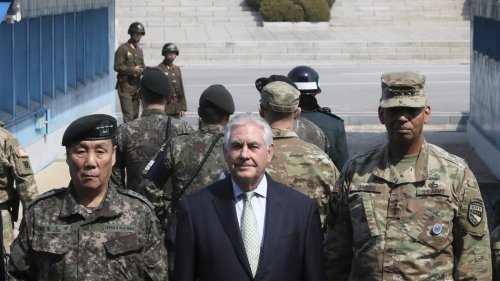
tillerosn dmz

Friends of Padre Steve’s World,

It seems to me that the Trump administration is doing everything it can to corrode any remaining moral authority that the United States has in the world. Yesterday I read that Secretary of State Rex Tillerson will disestablish the office that investigates potential war crimes. Though seemingly small in comparison to the many other actions the administration is taking this one speaks volumes about the attitudes of Trump, Tillerson, and others in the administration.

Tillerson has been working to concentrate the activities of the State Department on pursuing opportunities for American business and strengthening the U.S. Military. To do so he has been shutting down sections of the State Department that deal with U.S. Aid, humanitarian intervention, human rights, and world poverty. The decision to close the office which was founded in 1997 after the human catastrophes in the Balkans and the Rwandan Genocide is a major step backward.

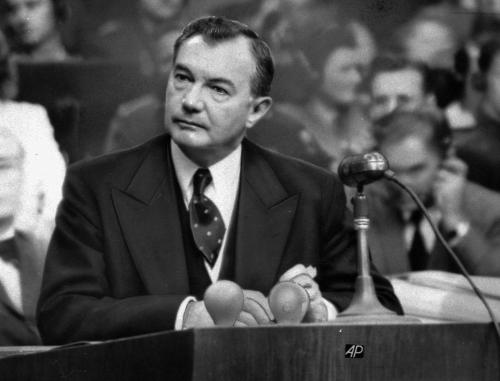
Supreme Court Justice Robert Jackson who was the senior American prosecutor and organizer of the Major War Crime Trials and Nuremberg noted:

“If certain acts of violation of treaties are crimes, they are crimes whether the United States does them or whether Germany does them, and we are not prepared to lay down a rule of criminal conduct against others which we would not be willing to have invoked against us.”

Sadly, after all of Jackson and his team’s efforts at Nuremberg the United States stepped back from participation in International tribunals or the International Criminal Court. Tillerson’s decision is a further step back from the norms of civilized behavior and a step towards increased barbarism.

David Scheffer, who served as the first U.S. Ambassador at Large for War Crimes and now teaches at Northwestern University’s Pritzker School of Law, told Foreign Policy: “This is a very harsh signal to the rest of the world that the United States is essentially downgrading the importance of accountability for the commission of atrocity crimes… This sends a strong signal to perpetrators of mass atrocities that the United States is not watching you anymore.”

I assume that is the case. The Trump administration has turned a blind eye to the Russian destabilization operations in the Ukraine, ignores the human rights violations of Saudi Arabia and is likely war crimes in Yemen, sends decidedly mixed messages on Syria, and voices his approval at the crimes of the Erdogan regime in Turkey and the actions of Philippine President Duarte.

It is apparent that President Trump, Secretary Tillerson, and possibly National Security Adviser McMaster have forgotten like so many Americans that the true power of the United States is not its economy, not its military power, but the ideals that it stands for, especially when they are most difficult. The administration has embraced the survival of the fittest philosophy of Charles Darwin and like the other totalitarian regimes which cluttered the Twentieth Century is throwing away the one thing that set the United States apart from other nations, the ideals found in the Declaration of Independence, the Preamble of the Constitution, the Gettysburg Address, and the Four Freedoms. While our country may not have always lived up to them, they were why people respected the United States even when we failed to live up to them. Timothy Snyder wrote: A patriot… wants the nation to live up to its ideals, which means asking us to be our best selves.” The actions of the Secretary of State and President show that they are not patriots, but nationalists, willing to cast aside the lifeblood of what makes America great for material gain and personal power, as Snyder notes, they encourage us to be our worst and then tell us that we are the best.

It is important that we do not throw away what little credibility we have left, but the neither the President nor many in his administration seem to care. The administration bases its arguments on necessity and expedience and has no hesitation in lying repeatedly to justify its actions. But, as William Pitt the Younger noted: “Necessity is the plea for every infringement of human freedom. It is the argument of tyrants; it is the creed of slaves.”

Robert Reich correctly noted: “Our moral authority is as important, if not more important, than our troop strength or our high-tech weapons. We are rapidly losing that moral authority, not only in the Arab world but all over the world.”

I am afraid that the further men like Trump and Tillerson move towards eliminating the last vestiges of our diplomatic and legal moral authority, and toward a transactional view of nationalism in which only economic and military power count, that it will not be long before our military and economic power is used for evil. This is not to say that it hasn’t been used for that in our history, but most of the time there were checks and balances, as well as self-restraint that kept them from being even worse. With every decision like this those restraints fall away and we edge closer to tyranny.So until tomorrow,

Peace

Padre Steve+

1 Comment

Filed under ethics, History, leadership, national security, News and current events, Political Commentary

What Does it take to Become a War Criminal? 


Friends of Padre Steve’s World,

Over the past few days I have been writing about the German invasion of the Soviet Union and the fact that senior leaders of the Wehrmacht actively cooperated with the crimes of the Nazi regime against the Jews, Soviet prisoners of war, and Soviet citizens. I have pointed out that Hitler’s ideology of the racial superiority of his Aryan Master Race and the corresponding view that the Jews and Slavs were untermenschen or subhuman justified the most extreme measures that the Nazis used to kill millions of innocent people through extermination, ethnic cleansing, and extermination. 

There was a common myth after the Second World War that the regular German Army, the Wehrmacht, fought an honorable and clean war while the criminal actions of war crimes and genocide were the fault of Hitler, the Nazi Party, and the SS. It was a comforting myth because it allowed a great number of men who agreed with Hitler’s policies, and often assisted in them to maintain a fiction of honor and respectability. While for the most part the German Army in the West fought according to international norms of conduct, it was a different matter on the Easter Front, where following Hitler’s lead the Wehrmacht from its senior officers in down was often at the tip of the spear in enforcing Hitler’s racial and ideological war. 


                                                                                       Field Marshal Wilhelm Keitel 

This came form the top. In addition to the Commissar order, also known as the Criminal Order, Field Marshal Keitel offered this directive to units fighting on the Easter Front:

“In view of the vast size of the conquered territories in the East, the forces available for establishing security in these areas will be sufficient only if instead of punishing resistance by sentencing the guilty in a court of law, the occupying forces spread such terror as is likely, by its mere existence, to crush every will to resist amongst the population.

The commanders concerned, together with all available troops, should be made responsible for maintaining peace within their areas. The commanders must find the means of keeping order within their areas, not by demanding more security forces, but by applying suitable drastic measures.”

                                                                                  Field Marshal Walter Von Reichenau 

Field Marshal Walter Reichenau issued what is something’s known as the Severity Order to his 6th Army which was part of Field Marshal Gerd Von Rundstedt’s Army Group South. Von Rundstedt, who was not a Nazi and who maintained his reputation after the war expressed his “complete agreement” with it and urged other subordinates to issue similar orders. 

“The most important objective of this campaign against the Jewish-Bolshevik system is the complete destruction of its sources of power and the extermination of the Asiatic influence in European civilization. … In this eastern theatre, the soldier is not only a man fighting in accordance with the rules of the art of war, but also the ruthless standard bearer of a national conception. … For this reason the soldier must learn fully to appreciate the necessity for the severe but just retribution that must be meted out to the subhuman species of Jewry…” 

An order was issued by General Erich Von Manstein’s Eleventh Army in November 1941 which stated in part:

“Jewry constitutes the middleman between the enemy in the rear and the remainder of the Red Armed Forces which is still fighting, and the Red leadership. More strongly than in Europe it holds all the key positions in the political leadership and administration, controls commerce and trades, and further forms the nucleus for all unrest and possible uprisings.

The Jewish-Bolshevist system must be exterminated once and for all. Never again must it encroach upon our European living space.

The German soldier has therefore not only the task of crushing the military potential of this system. He comes also as the bearer of a racial concept and as the avenger of all the cruelties’ which have been perpetrated on him and on the German people…

The food situation at home makes it essential that the troops should as far as possible be fed off the land and that furthermore the largest possible stocks should be placed at the disposal of the homeland. Particularly in enemy cities a large part of the population will have to go hungry. Nevertheless nothing which the homeland has sacrificed itself to contribute may, out of a misguided sense of humanity, be given to prisoners or to the population unless they are in the service of the German Wehrmacht.

The soldier must appreciate the necessity for the harsh punishment of Jewry, the spiritual bearer of the Bolshevist terror. This is also necessary in order to nip in the bud all uprisings which are mostly plotted by Jews…

Manstein claimed that he did not remember the order at his trial and that he sought to ensure that his troops did not engage in conduct not fitting of the honor of soldiers. He included the following in the order: “Severest action to be taken: against despotism and self-seeking; against lawlessness and lack of discipline; against every transgression of the honor of a soldier.”

In his defense at Nuremberg Manstien attempted to mitigate the damning words of the order. He explained that “I do want to point out to you that if it says here that the system must be exterminated, then that is extermination of the Bolshevik system, but not the extermination of human beings.” Despite Manstein’s clarification of what he meant in the order it would be hard for soldiers and commanders receiving the order as written could hardly have been expect not to interpret it literally. Likewise his order mentions the intentional starvation of Soviet citizens and harsh invectives against the Jews. 

Like Von Rundstedt, Manstein too would be rehabilitated and for the most part his complicity in Hitler’s racial and ideological war forgotten. 


There are many other examples of German Army commanders at various levels issuing orders similar to Von Reichenau and Von Manstein as well as accounts of Wehrmacht units cooperating with the Einsatzgruppen in various mass extermination actions against the Jews, including the action at Babi Yar. In many cases the cooperation was quite close as evidenced by the report of the commander of Einsatzgruppe C to Berlin on November 3rd 1941:

In a great number of cases, it happened that the support of the Einsatzkommandos was requested by the fighting troops. Advance detachments of the Einsatzgruppe also participated in every large military action. They entered newly captured localities side by side with the fighting troops. Thus, in all cases, the utmost support was given. For example, in this connection, it is worth mentioning the participation in the capture of Zhitomir, where the first tanks entering the city were immediately followed by three cars of Einsatzkommando 4a.

As a result of the successful work of the Einsatzgruppe, the Security Police is also held in high regard, in particular by the HQ of the German Army. The liaison officers stationed in Army HQ are loyally briefed of all military operations, and, besides, they receive the utmost cooperation. The Commander of the 6th Army, Generalfeldmarschall von Richenau, has repeatedly praised the work of the Einsatzkommandos and, accordingly, supported the interests of the SD with his staff.

It is true that in some cases individual Wehrmacht officers refused to cooperate with the Einsatzgruppen in their operational areas, but without the cooperation of the Wehrmacht the extermination campaigns against the Jews and other Soviet citizens could not have been successful. 

                                                                                                 The Rape of Nanking 

One has to ask what it takes for otherwise ordinary and law abiding people to carry out crimes of such magnitude. I do believe that the answer is found in the racial ideology that posits certain races as being less than human. The examples of such belief in action litter human history and are not limited to the Germans of the Nazi era. The disturbing thing as that the men who perpetrated the Nazi crimes against humanity and genocide were not unique. The actions of the Japanese army in China, Korea, and Southeast Asia to include the Rape of Nanking and their Unit 731; the American genocide committed against the Native American tribes and the enslavement of Blacks; the extermination of the Herero in German Southwest Africa, the Rwandan genocide, the mass killings of Bosnians by Bosnian Serbs,  the Armenian genocide committed by the Turks, and far too many more examples show this to be the case. 

I think one of our problems is that we want to believe that evil is simply done be evil people. That is why when we see a Hitler, Stalin, Pol Pot, or the monsters of the so-called Islamic State, we are often strangely comforted. This is often because we can point to a single person with a wicked ideology and say “they are evil,” all the while forgetting that they are, or were, like us, also human. 


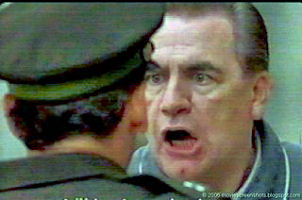
There is a scene in the movie Nuremberg in which an American psychologist named Gustave Gilbert questions the commandant of Auschwitz. When he asks the commandant if he felt guilty for the extermination of the Jews in his camp the commandant said “does a rat catcher feel guilty for killing rats.” Thereafter Gilbert confronts Herman Goering pointedly asking the number two Nazi “A rat catcher catching rats”. Is that the kind of thinking it takes to carry out state sanctioned mass murder? Not just blind obedience but also a belief that your victims are not human?” 

Goering replies: Let me ask you this. What was Hiroshima? Was it not your medical experiment? Would Americans have dropped bombs as easily on Germany as it did upon Japan killing as many civilians as possible? I think not. To an American sensibility, a Caucasian child is considerably more human than a Japanese child…. 

What about the negro officers in your own army? Are they not allowed to command troops in combat? Can they sit on the same buses as the whites? The segregation laws in your country and the anti Semitic laws in mine, are they not a difference of degree? 

The tragic thing is that while Gilbert was certainly correct in his question to Goering, Goering was also right. For all that is good about America there is a persistent strain of this kind of thinking which deems other people, especially non-white people as inferior racially, culturally, and intellectually. Over the decades we like to think that we have become better but the underlying attitudes are still present today, sometimes in plain view, but often just under our veneer of civility and good manners, but what maintains that civility is quite fragile. In his history of Auschwitz British historian Laurence Rees wrote:

“human behavior is fragile and unpredictable and often at the mercy of the situation. Every individual still, of course, has a choice as to how to behave, it’s just that for many people the situation is the key determinate in that choice.” The German military officers who took part in the campaign in the East were terrifyingly normal. They were raised in an advanced society, highly cultured, well educated, and raised in the cradle of Protestantism. Yet many of them became willing participants in crimes of their nation that are unimaginable. But the fact is that the character of nations can be as fragile as that if individuals. As Americans we like to think that we are different but our history often belies this, even our military history and this is part of our conundrum. 

Aleksandr Solzhenitsyn wrote of the struggle:

 “If only it were all so simple! If only there were evil people somewhere insidiously committing evil deeds, and it were necessary only to separate them from the rest of us and destroy them. But the line dividing good and evil cuts through the heart of every human being. And who is willing to destroy a piece of his own heart?”

When I taught ethics at the Joint Forces Staff College I challenged my students to deal with these kinds of questions. They are not easy and they require that we look into the darkest reaches of our hearts to see what we will do when we are confronted with choices to obey orders that go against the values of the institution but may reflect the more troubling aspects of our culture. Some of these men and women I am sure understood and will not break under pressure, but I am not so sure about others, and I worry about them in the crisis. The fact is we are only as good as we are in the crisis. Historian Timothy Snyder wrote something that we should not discount when asking the question about how ordinary men become war criminals:

“The European history of the twentieth century shows us that societies can break, democracies can fall, ethics can collapse, and ordinary men can find themselves standing over death pits with guns in their hands. It would serve us well today to understand why.”

This is something that we most ponder because it would not take much in our present day where the old ethnic race hatreds, religious hatreds, and resurgent nationalism are again raising their head not only in our own country, but around the world. I will address this in the recent American context next week. So until tomorrow, when I publish something more personal and unrelated to this subject.

Peace

Padre Steve+

1 Comment

Filed under ethics, History, holocaust, Military, movies, world war two in europe

Revisiting the Rape of Nanking

nanking_massacre_1

Japanese Soldiers using Chinese Prisoners for Bayonet Practice

Friends of Padre Steve’s World,

Not long after I started this blog I wrote an article on the Rape of Nanking. The event which occurred in 1937 was one of the most extensively documented war crimes in modern history. But despite that there are many, especially those of Japanese political right who deny that the event ever occurred and if if atrocities happened in Nanking it was the Chinese government which carried them out. It is amazing that I still get comments from such people on that original article.

Since many of my newer readers might have never seen that article I am re-posting it today. I am doing some more reading on the subject and will probably revisit it again sometime in the next few months.

Have a good day,

Peace

Padre Steve+

The historical controversy regarding the “rape” of Nanking in 1937 by the Japanese Army is hotly debated.[1] The massacres occurred in the initial occupation of the city and the two months following in mid December 1937.  The initial reaction to the actions of the Japanese was reported by western journalists and even a German Nazi Party member by the name of John Rabe who assisted in protecting Chinese during the massacre and reported it on his return to Germany.The action shocked many in the west and helped cement the image of the Japanese being a brutal race in the west.

Massacre Victims at Nanking

The controversy’s visibility has been raised since the 1997 publication of Iris Chang’s The Rape of Nanking. However, with few exceptions the incident had received little attention by Western historians until Chang’s book was published. The reason for this was  that  China was a sideshow for for the United States and Britain throughout much of the war. When Chiang Kai Shek’s Nationalists were overthrown by the Communists in 1948 the incident disappeared from view in the United States.   The  United States government  reacted to the overthrow of Chaing by helping to rebuild Japan and rehabilitate the Japanese while opposing the Chinese Communists.  In fact it was only “after the Cold War was the Rape of Nanking Openly discussed.”[2]

Bodies of Children Killed by the Japanese at Nanking

Chang’s book was instrumental as it brought new attention to the actions of the Japanese Army in the slaughter of Prisoners of War and civilians following the occupation of the city.  Even as Chang’s work was published “revisionist” works began to appear in the 1980s which have either denied the atrocities, sought to minimize numbers killed by Japanese Forces or rationalized the them began to appear in Japan.  The revisionists were led by Masaaki Tanaka who had served as an aide to General Matsui Iwane the commander of Japanese forces at Nanking.  Tanaka denied the atrocities outright calling them “fabrications” casting doubt upon numbers in the trial as “propaganda.” He eventually joined in a lawsuit against the Japanese Ministry of Education to remove the words “aggression” and “Nanjing massacre” from textbooks, a lawsuit which was dismissed but was influential to other revisionists and Japanese nationalist politicians and publishers.[3]

Japanese Officer Preparing to Execute Man in Hospital

Most early accounts of the occupation and war crimes have used a number of 200,000 to 300,000 victims based upon the numbers provided during the War Crimes Trials of 1946.[4] Unlike the numbers of victims of the Nazi Holocaust the numbers are less accurate.  Authors who maintain the massacres such as Chang and others such as Japanese military historian Mashario Yamamoto who admits Japanese wrongdoing and excess but challenges the numbers use the same statistical sources to make their arguments.  Chang not only affirms the original numbers but extrapolates that even more may have been killed as a result of the disposal of bodies in the Yangtze River rather than in mass graves away from the city as well as the failure of survivors to report family member deaths to the Chinese authorities.[5] She also notes contemporary Chinese scholars who suggest even higher numbers.

Prince Asaka, Granduncle of Emperor Hirohito Commanded Troops at Nanking

Herbert Bix discusses Japanese knowledge of the atrocities in detail up and down the chain of command including Prince Asaka, granduncle of Emperor Hirohito who commanded troops in Nanking, the military and Foreign Office, and likely even Hirohito himself.[6]

German National and Nazi Party Member John Rabe Protected Chinese at Nanking and Reported His Experience to the German Government.  He is known as “The Good Man of Nanking”

The publication of German citizen and witness to the massacres John Rabe’s diaries in 2000, The Good Man of Nanking, provided an additional first hand account by a westerner who had the unique perspective of being from Japan’s ally Nazi Germany.  His accounts buttress the arguments of those like Chang who seek to inform the world about the size and scope of Japanese atrocities in Nanking.

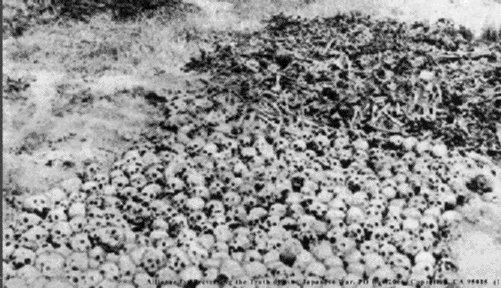
A Field of Skulls at Nanking

Yamamoto who is a military historian by trade and is viewed as a “centrist” in the debate, places the massacres in the context of Japanese military operations beginning with the fall of Shanghai up to the capture of Nanking. Yamamoto criticizes those who deny the massacres but settles on a far lower number of deaths, questioning the numbers used at the War Crimes Trials. He blames some on the Chinese Army[7] and explains many others away in the context of operations to eliminate resistance by Chinese soldiers and police who had remained in the city in civilian clothes. He  claims that  “the Japanese military leadership decided to launch the campaign to hunt down Chinese soldiers in the suburban areas because a substantial number of Chinese soldiers were still hiding in such areas and posing a constant threat to the Japanese.”[8] David Barrett in his review of the Yamamoto’s work notes that Yamamoto believes that “there were numerous atrocities, but no massacre….”[9] Yoshihisa Tak Mastusaka notes that while a centrist Yamamoto’s work’s “emphasis on precedents in the history of warfare reflects an underlying apologist tone that informs much of the book.”[10] Revisionist work also criticizes the trials surrounding Nanking and other Japanese atrocities.  An example of such a work is Tim Maga’s Judgment at Tokyo: The Japanese War Crimes Trials which is critiqued by historian Richard Minear as “having a weak grasp of legal issues” and “factual errors too numerous to list.”[11] Such is a recurrent theme in revisionist scholarship, the attempt to mitigate or minimize the scale of the atrocities, to cast doubt upon sources and motivations of their proponents or sources, to use questionable sources themselves or to attribute them to out of control soldiers, the fog of war and minimize command knowledge as does Yamamoto. Politics is often a key motivating factor behind revisionist work.

Iris Chang Would Later Commit Suicide

Chang would never be the same after researching and writing the Rape of Nanking. Traumatized by what she had learned and burdened by the weight of what she had taken on she killed herself on November 9th 2004.

Iconic Photo of Japanese Acts in China: A Wounded Child at Shanghai Station

“Revisionist” history will almost certainly remain with us, so long as people study the past.  However one has to be careful in labeling a divergent view of a historical subject as necessarily revisionist.  There are occasions when new evidence arises and a “new” or “revisionist” work may actually disprove previous conclusions regarding historic events or persons.  This might occur when what we know about a subject comes from a single or limited number of sources who themselves were limited in what they had available for research and new evidence comes to light. At the same time where numerous sources from diverse points of view attest to the genuineness of an event, the revisionist’s theses should be themselves scrutinized based on evidence presented as well as their political, ideological or racial motivations.  While one does not want to silence voices of opposition to prevailing beliefs one has to be careful in examining their claims, especially when they arise in the context of political or ideological conflicts.

Notes


[1] Bix, Herbert P. Hirohito and the Making of Modern Japan, Harper Collins Publishers, New York, NY 2000. pp.333-334. Bix does a good job explaining the number of victims of the incident drawing on Chinese and Japanese sources.

[2] Kreuter, Gretchen. The Forgotten Holocaust in The Bulletin of Atomic Scientists, March-April 1998 p.66

[3] Fogel, Joshua A. The Nanjing Massacre in History and Historiography, University of California Press, Berkley CA 2000, pp.87-89

[4] Toland, John. The Rising Sun: The Rise and Fall of the Japanese Empire 1936-45. Random House, New York, NY 1970 pp. 50-51. Toland in his brief discussion of the massacres notes both the civilian casualty figures and figures for male citizens of military age who were slaughtered.  Toland also notes the large numbers of women raped by Japanese soldiers.

[5] Chang, Iris. The Rape of Nanking: The Forgotten Holocaust of World War II Penguin Books, New York, NY 1997 pp.102-103. Chang has been criticized by some historians in a number of ways including that she was not a historian, that she compares the atrocities to the Nazi Holocaust and her emotional attachment to the subject which may have been a contributing factor in her 2004 suicide.

[6] Bix. p.336

[7] Yamamoto, Masahiro. The Rape of Nanking: Anatomy of an Atrocity. Praeger Publishers an imprint of the Greenwood Group, Westport, CT 2000. http://site.ebrary.com/lib/apus/docDetail.action?docID=10018001&p00=nanking  p.83

[8] Ibid. p.92.

[9] Barrett, David P.  Review of The Rape of Nanking: Anatomy of an Atrocity by Masashiro Yamamoto Canadian Journal of History/Annales canadiennes d’Histoire XXXVIII, April/Avril 2003 p.170

[10] Mastusaka, Yoshihisa Tak.  Review of The Rape of Nanking: Anatomy of an Atrocity by Masashiro Yamamoto American Historical Review, April 2002 p.525

[11] Minear, Richard. Review of Judgment at Tokyo: The Japanese War Crimes Trials by Tim Mata  American Historical Review. April 2002 p.526

Leave a comment

Filed under History, Military, war crimes, world war two in the pacific

The Unspeakable Taboo: Evil, Genocide & Human Nature

Friends of Padre Steve’s World,

This is the final section of the article that I have been posting over the last six days.

The material in this article that I have spread over the past six days is often troubling. At least it is to me because while I earnestly want to believe that humanity is essentially good, I cannot get around the fact that people in every clime and place throughout history often choose to either participate in, or to ignore evil committed against when it is in their own self-interest.  I can see into the darkness and I can understand it.

Joyce Carol Oates wrote, “And this is the forbidden truth, the unspeakable taboo – that evil is not always repellent but frequently attractive; that it has the power to make of us not simply victims, as nature and accident do, but active accomplices.” That is one of the things that makes the Holocaust, but even more so, the actions of those murdered millions of people up close and personal as members of the Einsatzgruppen, the Police battalions, the Romanian Army, or the locally recruited Eastern European militias.

While this of itself is troubling, the fact that many high ranking military and civilian officials in Germany, and some of their allied countries knew about it, and even if they disapproved did nothing to try to stop it. But even more damning is the fact that many other nations, including the United States knew what was happening and before the war would not accept Jewish immigrants who were being forced to leave Germany and Austria, and then during the war did little or nothing to attempt to stop the mass killings in the extermination camps. The fact is that people are people and most of the actors in this ghastly drama were much like us. That is what makes the period so troubling.

Peace

Padre Steve+
einsatzgruppen trial

Otto Ohlendorf at the Einsatzgruppen Trial

The German war against Poland and the Soviet Union was heavily dependent on the racist ideology of Adolf Hitler. He was the true spirit behind the atrocities committed by his nation as one Nazi leader noted in Russia, “Here too the Führer is the moving spirit of a radical solution in both word and deed.” 187Hitler saw the war in the East as “the chance to stamp out everything that stands against us.” 188Belief in Germany’s right to Lebensraum, was predicated on increasing the standard of living for Germans even if it meant destroying others to do it. The need for food security was one of Hitler’s biggest concerns, and he believed that need would be provided by the conquest of the Soviet Union and the exploitation of the breadbasket of the Ukraine. Hitler’s quest for unlimited natural resources to sustain his Thousand Year Reich and his belief in the racial superiority of the German Volk were combined with his belief in the necessity to settle the Jewish problem. These ideological and economic beliefs provided a fertile ground for Hitler’s followers.

But it was German military doctrine, especially its anti-partisan doctrine and plans for total warfare which allowed Hitler to realize so many of his goals. Without the Army’s support and compliance Hitler could never have succeeded. The post-war and early Cold War myth that the German military had no knowledge of and were not involved in the Holocaust committed against the Jews and others has been shattered as more and more records, correspondence, and testimony emerge.

It is now quite clear that many officers in the Wehrmacht were in agreement with Hitler’s ideology of racial war, including men who have been idolized by military historians and history buffs who marvel at their planning skills and operational precision, but ignore the uncomfortable truth that many either participated in or meekly acquiesced to Hitler’s agenda.
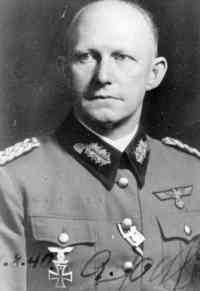
7010_1017630386

Alfred Jodl

These men, like so many in Germany were products of their culture. They were immersed in cultural prejudices against Jews and Slavs. When we examine the long traditions of racist ideology, coupled with military doctrine, the “Prussian and in later German military must be regarded as a significant part of the ideological background of the Second World War.189 General Walther Von Reichenau’s orders to his troops at the beginning of Operation Barbarossa are revealing in this regard, “The most important goal of the campaign against Jewish-Bolshevism is the complete destruction of its grip on power and the elimination of the Asian influence from our European cultural sphere.” 190 Reichenau’s superior, Field Marshal Gerd Von Rundstedt appeared to agree with von Reichenau’s orders, but wanted to keep the hands of the Army clean of the actual dirty work of the mass killings. Rundstedt had no problem with the “use the partisan threat as excuse for persecuting Jews, so long as the dirty work was largely left to SS Einsatzgruppen.” 191

On the whole the Army command…on the whole acquiesced in the extermination of the Jews, or at least closed its eyes to what was happening.” 192 This is absolutely true, but that being said, and as guilty as many of the Generals were, there are factors involved that if are honest might have influenced us to make the same choices as them if we stood in their shoes. This is not an excuse, it is reality and it is borne out by history. The sad truth is that most people act in accordance with their self-interest, especially their economic well-being and social status. We accommodate evil when it serves our needs, especially if we do not actually have to do the dirty work. Their actions show the truth of Primo Levi’s comment “Monsters exist, but they are too few in number to be truly dangerous. More dangerous are the common men, the functionaries ready to believe and to act without asking questions.”
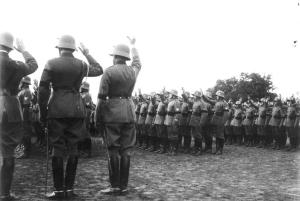
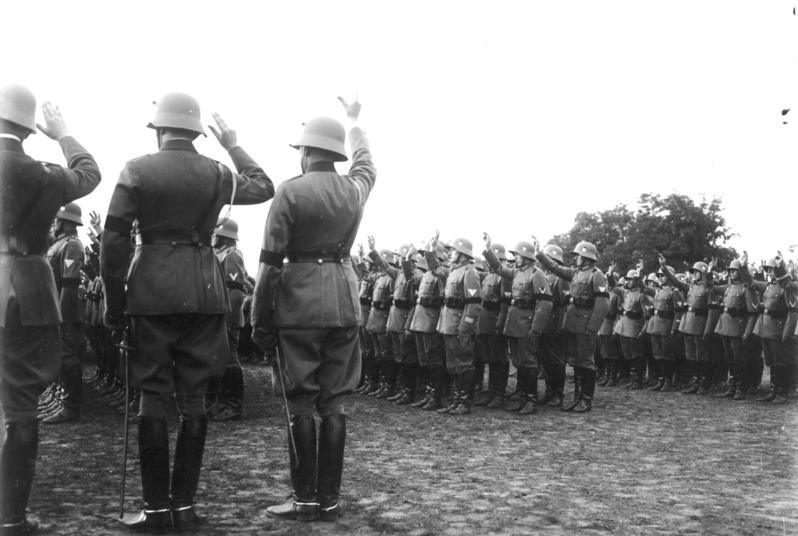
Die feierliche Vereidigung der Reichswehr auf den neuen Reichspräsidenten Adolf Hitler auf dem Kasernenhof der Wachtruppe in Berlin 1934 Offiziere und Mannschaften leisten den feierlichen Eid durcherheben der rechten Hand. Die Reichswehr trägt Trauerflor für den verstorbenen Reichspräsidenten.

Officers and men of the Reichswehr take the Oath to Hitler in 1934 following the death of President Hindenburg

Had the Generals had been more forceful in their opposition, they would have most likely been opposed by the highly Nazified youth that made up the bulk of their Army, especially many of the junior officers, NCOs and enlisted men. Likewise there was the matter of their oath and this is something that many Americans do not understand. During the Kaiser Reich German officers swore an oath to the Kaiser, during Weimar that was changed to the Constitution, when Hitler took power and assumed both the Presidency and Chancellorship following the death of President von Hindenburg, the officer corps swore a new oath, that to Hitler as President and Chancellor. While many saw the danger, almost all officers took the oath, in a sense it was a throwback to the old way of doing things in the Kaiser Reich, and most officers hated the Republic. To them the oath embodied their honor, to break it was to dishonor themselves and their family. When war came it became more than that, to break the oath was considered treason. General Alfred Jodl told American Army psychologist Gustave Gilbert at Nuremberg that “In war the moral pressure of obedience and the stigma of high treason are pretty hard to get around.” 193

Jodl’s superior Keitel stated his helplessness before Hitler saying to Gilbert “What could I do? There were only 3 possibilities: (a) refusal to follow orders, which naturally meant death; (b) resign my post, or (c) commit suicide. I was on the point of resigning my post 3 times, but Hitler made it clear that he considered my resignation in time of war the same as desertion. What could I do?” 194 This was obviously an after the fact excuse by Keitel who had been present in Hitler’s headquarters since the beginning and had witnessed the explosive General Heinz Guderian explode in rage against Hitler in 1945. Following that violent outburst in which Guderian and Hitler engaged in a lengthy heated argument in which those present thought would come to blows and the enraged dictator and general shouted at each other and were held back from contact by others in the conference room. Instead of arrest or imprisonment Hitler ordered Guderian to take extended sick leave and never accosted him afterwards.

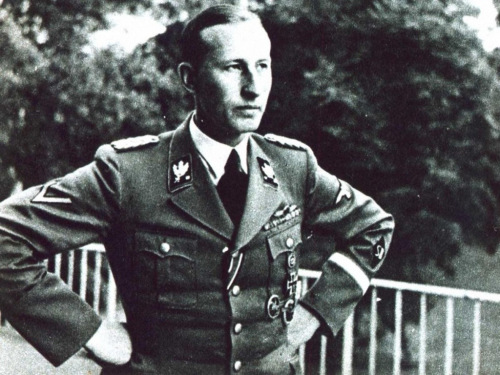
heydrich

Reinhard Heydrich

Himmler, Heydrich, Eichmann and other SS leaders fanatically executed Hitler’s policies and were aided by the civil administration, including the leaders of the Reichsbank, and the proponents of long term economic plans. Genocide was to bring the Reich “long term economic gains and trading advantages” and was seen as a way of “financing the war debt without burdening the German taxpayer.” 195

The willing participation of Army commanders is hard to get around. Otto Ohlendorf, commander of Einsatzgruppe D testified at the Einsatzgruppe Trial that Einsatzgruppen reported all of their tasks to the army commanders, and that together, they and the army agreed on the time, place, and possible support of the troops for any particular “liquidation action[s].” 196

Some individuals did attempt to resist the most brutal aspects of the Nazi campaign against the Jews, but few had the fortitude to make more than half-hearted attempts. Wilhelm Kube, the Reichskommissar for White Russia, himself a fanatical Nazi and a virulent anti-Semite was shocked at the mass murders of the Jews taking place in his region. He called them “unworthy of the German cause and damaging to the German reputation.” During his administration Kube would later attempt to spare Jews by employing skilled Jews in war industries, however, Kube’s efforts were “defeated by Himmler’s zealots.” 197

Army officers who objected to the killing of Jews, like Blaskowitz and Külcher in Poland were relieved of command or were reassigned. Others like Field Marshal Ritter von Leeb took their protests to Hitler. Such protests were readily dismissed and those who made them usually took no further action. Leeb was told by Hitler to “in so many words told to mind his own business.” Leeb later stated, “the only thing to do is to hold oneself at a distance.” 198 Field Marshall Erwin Rommel, who had burned the notorious Commando Order in front of his staff in North Africa could not bring himself to believe that Hitler was to blame. While commanding Army Group B in France Rommel heard of the crimes being committed against the Jews and others through information provided by Blaskowitz, and members of his own staff who had served in Russia. But Rommel, who became part of the plot of overthrow Hitler, was then still in the thrall of the Fuhrer and blamed the crimes “on Hitler’s subordinates, not Hitler himself.” 199

Of the men mentioned in this article who survived the war, only four, Wilhelm Keitel, Alfred Jodl, Otto Ohlendorf and Adolf Eichmann paid for their crimes with their lives Keitel and Jodl were found guilty in the major War Crimes Trials at Nuremberg. Ohlendorf at the Einsatzgruppen trial, while Eichmann was caught by the Israelis, tried, convicted and put to death in 1962. Blaskowitz committed suicide while being tried with thirteen other generals during the final Nuremberg trial, that of the generals. Of those eleven were convicted and none served out their full sentence.

keitel-jodl-hitler

Hitler with Jodl

Hitler’s ideology permeated German military campaigns and administration of the areas conquered by his armies. No branch of the German military, police or civil administration in occupied Poland or Russia was exempt guiltless in the crimes committed by the Nazi regime. It is a chilling warning of the consequences awaiting any nation that allows it to become caught up in hate-filled political, racial or even religious ideologies which dehumanizes opponents and of the tragedy that awaits them and the world. In Germany the internal and external checks that govern the moral behavior of the nation and individuals failed. Caught up in the Nazi system, the Germans, especially the police and military abandoned the norms of international law, morality and decency, banally committing crimes which still reverberate today and which were seen in the ethnic cleansing actions in the former Yugoslavia, and now throughout much of the Middle East.

In light of the fact that there is a growing food shortage in the world which will only get worse due to a factors including the global rise in population, the shrinking of the amount land which can be farmed due to climate change.  There are many other factors as well which could such a situation could bring about another Holocaust.  In such a case leaders will decide that the lands and resources of less developed people are theirs for the taking in order to maintain the standards of living of their people, and that the indigenous people who they will victimize are less than human and thus have no rights. The terminology used by them will be very neutral and full of euphemisms which will allow many people to maintain the illusion that any evil carried out is for the good. Politicians, pundits and preachers will talk of problems, and of solutions, and in trying to find a resolution yearn for a conclusive solution, a final solution.

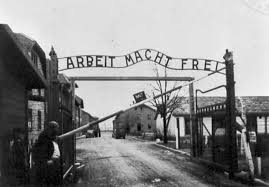
arbiet macht frei

I return to the quote from the movie Judgment at Nuremberg which I included in the first section of this article because it is worth repeating and all too true:

“Janning, to be sure, is a tragic figure. We believe he loathed the evil he did. But compassion for the present torture of his soul must not beget forgetfulness of the torture and the death of millions by the Government of which he was a part. Janning’s record and his fate illuminate the most shattering truth that has emerged from this trial: If he and all of the other defendants had been degraded perverts, if all of the leaders of the Third Reich had been sadistic monsters and maniacs, then these events would have no more moral significance than an earthquake, or any other natural catastrophe. But this trial has shown that under a national crisis, ordinary – even able and extraordinary – men can delude themselves into the commission of crimes so vast and heinous that they beggar the imagination….”

That quote might be applied to many of the people who participated in this genocide. Sadly, the fact is that in truth we are not really all that much different than the victims, the perpetrators and the bystanders who lived and died in the Holocaust, and similarly every other act of genocide.

History serves as a guide and a warning. We must always be alert and we must always when the truly difficult times come, in the midst of crisis, not to take the easy path and denude ourselves into the commission of such crimes.

Notes

187 Ibid. Bracher. The German Dictatorship p.430

188 Ibid. Megargee War of Annihilation p.65

189 Ibid. Wette. The Wehrmacht p.293

190 Ibid. Wette. The Wehrmacht p.97

191 Messenger, Charles. The Last Prussian A Biography of Field Marshal Gerd Von Rundstedt 1875-1953 Brassey’s London, 1991 p148

192 Ibid. Bracher The German Dictatorship pp.430-431

193 Gilbert, Gustave Nuremberg Diary DaCapo Press 1995 copyright G.M. Gilbert 1947 p.290

194 Ibid. Gilbert p.26

195 Ibid. Aly and Heim Architects of Annihilation p.242

196 Ibid. Hebert p.92

197 Ibid. Padfield Himmler pp.341-342

198 Ibid. Megargee War of Annihilation p.97

199 Fraser, David. Knight’s Cross: A Life of Field Marshal Erwin Rommel Harper Perennial, New York 1995, first published by Harper Collins in Britain, 1993. p.536

Bibliography for the series

Aly, Gotz and Heim, Susanne. Architects of Annihilation: Auschwitz and the Logic of Destruction Phoenix Paperbacks, London, 2003, originally published as Vordenker der Vernichtung, Hoffman und Campe, Germany 1991, English translation by Allan Blunden. First published in Great Britain Weidenfeld & Nicholson, London, 2002

Arendt, Hannah, Eichmann in Jerusalem: A Report on the Banality of Evil. Revised and Enlarged Edition. Penguin Books, Harmondsworth, England and New York, NY 1965. Originally published by Viking Press, New York, NY 1963

Blood, Philip. Hitler’s Bandit Hunters: The SS and the Occupation of Europe. Potomoac Books Inc. Washington, DC 2008

Bracher, Karl Dietrich. The German Dictatorship: The Origins, Structure, and Effects of National Socialism. Translated by Jean Steinberg, Holt Rinehart and Winston, New York, NY 1979. Originally Published under the title Die Deutsche Diktatur: Entstehung, Struktur,Folgen des Nationalsocialismus. Verlag Kiepenheuer & Witsch. Koln and Berlin, 1969

Browning, Christopher R. Ordinary Men: Reserve Police Battalion 101 and the Final Solution in Poland. Harper Perennial Books, New York, New York 1993 reissued 1996.

Burleigh, Michael and Wippermann, Wolfgang. The Racial State: Germany 1933-1945 Cambridge University Press, New York NY and Cambridge UK 1991

Condell, Bruce and Zabecki, David T. Editors. On the German Art of War: Truppenführung , Lynn Rienner Publishers, Boulder CO and London 2001

Craig, Gordon A. The Politics of the Prussian Army 1640-1945. Oxford University Press, London and New York, 1955

Davidowicz, Lucy S. The War Against the Jews 1933-1945 Bantam Books, New York, NY 1986.

Di Nardo, Richard L. Germany and the Axis Powers: From Coalition to Collapse. University Press of Kansas, Lawrence, KS. 2005

Erickson, John. The Road to Berlin. Cassel Military Paperbacks, London, 2003. First Published by Weidenfeld and Nicholson, 1983

Evans, Richard J. The Coming of the Third Reich Penguin Books, New York 2004. First published by Allen Lane 2003

Evans, Richard J. The Third Reich in Power 1933-1939. Penguin Press, New York, NY 2005

Ferguson, Niall. The War of the Worlds: Twentieth Century Conflict and the Descent of the West.

The Penguin Press, New York, 2006

Fest, Joachim, Hitler. Translated by Richard and Clara Winston. Harcourt Brace Jovanovich Publishers, San Diego, New York, London, 1974. German Edition by Verlag Ullstein 1973

Fraser, David. Knight’s Cross: A Life of Field Marshal Erwin Rommel Harper Perennial, New York 1995, first published by Harper Collins in Britain, 1993

Friedlander, Saul Nazi Germany and the Jews 1939-1945: The Years of Extermination. Harper Perennial, New York, NY 2007

Fritz, Stephen G. Frontsoldaten: The German Soldier in World War II. The University Press of Kentucky, Lexington, KY 1995

Geyer, Michael. German Strategy 1914-1945 in Makers of Modern Strategy from Machiavelli to the Nuclear Age. Peter Paret, editor. Princeton University Press, Princeton NJ. 198

Gilbert, Gustave Nuremberg Diary DaCapo Press 1995 copyright G.M. Gilbert 1947

Giziowski, Richard. The Enigma of General Blaskowitz. Hppocrene Books, New York 1997

Glantz, David M. and House, Jonathan. When Titans Clashed: How the Red Army Stopped Hitler. University Press of Kansas, Lawrence, KS. 1995

Goerlitz, Walter. History of the German General Staff.” Translated by Brian Battershaw, Westview Press, Boulder and London, 1985. Originally published as Die Deutsche Generalstab Verlag der Frankfurter Hefte, Frankfurt am Main, 1953

Goerlitz, Walter. The Memiors of Field Marshal Wilhelm Keitel: Chief of the German High Command 1938-1945. Translated by David Irving. Cooper Square Press 2000, First English Edition 1966 William Kimber and Company Ltd. German edition published by Musterschmnidt- Verlad, Gottigen 1961.

Hebert, Valerie Genevieve, Hitler’s Generals on Trial: The Last War Crimes Tribunal at Nuremberg University of Kansas Press, Lawrence Kansas 2010

Hitler, Adolf Mein Kampf translated by Ralph Manheim. Mariner Books, Houghton Mifflin Company, New York, NY 1999. Houghton Mifflin Company 1943, copyright renewed 1971. Originally published in Germany by Verlag Frz. Eher Nachf. GmbH 1925

Höhne, Heinze. Canaris: Hitler’s Master Spy. Traslated by J. Maxwell Brownjohn. Cooper Square Press, New York 1999. Originally published by C. Bertelsmann Verlag Gmbh, Munich 1976, first English edition by Doubleday and Company 1979

Höhne, Heinze. The Order of the Death’s Head: The Story of Hitler’s SS. Translated by Richard Barry. Penguin Books, New York and London, 2000. First English edition published by Martin Secker and Warburg Ltd. London 1969. Originally published as Der Orden unter dem Totenkopf, Verlag Der Spiegel, Hamburg 1966.

Hughes, Daniel J. editor. Moltke on the Art of War: Selected Writings, translated by Harry Bell and Daniel J Hughes. Presidio Press, Novato CA 1993

Liddell-Hart, B.H. The German Generals Talk. Quill Publishing, New York, NY. 1979. Copyright 1948 by B.H. Liddell-Hart

Lieber, Franz Instructions for the Government of Armies of the United States in the Field, prepared by Francis Lieber, LL.D., Originally Issued as General Orders No. 100, Adjutant General’s Office, 1863, Washington 1898: Government Printing Office. Retrieved from http://avalon.law.yale.edu/19th_century/lieber.asp 6 May 2014

Lindqvist, Sven Exterminate All the Brutes: One Man’s Oddessy into the Heart of Darkness and the Origins of European Genocide Translated from the Swedish by Joan Tate, The New Press , New York and London 1992

Macksey, Kenneth. Why the Germans Lose at War: The Myth of German Military Superiority. Barnes and Noble Books, New York 2006, originally published by Greenhill Books, 1996

Manstein, Erich von. Forward by B.H. Liddle Hart, Introduction by Martin Blumenson. Lost victories: The War Memoirs of Hitler’s Most Brilliant General. Zenith Press, St Paul MN 2004. First Published 1955 as Verlorene Siege, English Translation 1958 by Methuen Company

Shirer, William L. The Rise and Fall of the Third Reich. A Touchstone Book published by Simon and Schuster, 1981, Copyright 1959 and 1960

Megargee, Geoffrey P. War of Annihilation: Combat and Genocide on the Eastern Front 1941.Bowman and Littlefield Publishers Inc. Lanham, Boulder, New York. 2007

Messinger, Charles, The Last Prussian: A Biography of Field Marshal Gerd Von Rundstedt 1875-1953 Brassey’s (UK) London England 1991

Newton, Steven H. Hitler’s Commander: Field Marshal Walter Model-Hitler’s Favorite General

DaCapo Press a division of Perseus Books Group, Cambridge MA 2005 Novatny, Alfred. The Good Soldier. The Aberjona Press, Bedford, PA 2003 Padfield, Peter. Himmler. MJF Books, New York. 1990

Reitlinger, Gerald. The SS: Alibi of a Nation. The Viking Press, New York, 1957. Republished by Da Capo Press, New York, NY.

Rhodes, Richard. Masters of Death: The SS Einsatzgruppen and the Invention of the Holocaust.

Vintage Books a division of Random House, New York, NY 2002

Shepherd, Ben. War in the Wild East: The German Army and Soviet Partisans. Harvard University Press, Cambridge, MA 2004

Sofsky, Wolfgang. The Order of Terror: The Concentration Camp. Translated by William Templer. Princeton University Press. Princeton, NJ 1997. Originally published as Die Ordnung des Terrors: Das Konzentrationslager. S. Fischer Verlag, GmbH, Frankfurt am Main, 1993

Speer, Albert. Inside the Third Reich. Collier Books, a Division of MacMillan Publishers, Inc. New York, NY 1970.

Strachan, Hew. European Armies and the Conduct of War. George, Allen and Unwin, London, UK 1983

Stein, George H. The Waffen SS 1939-1945: Hitler’s Elite Guard at War. Cornell University Press, Ithaca and London, 1966

Stern, Fritz. Gold and Iron: Bismarck, Bleichroder and Building of the German Empire. Vintage Books a division of Random House, New York 1979 First published by Alfred a Knopf 1977

Sydnor, Charles W. Soldiers of Destruction: The SS Death’s Head Division, 1933-1945. Princeton University Press, Princeton, NY 1977

Taylor, Fred, Editor and Translator. The Goebbels Diaries 1939-1941, Penguin Books Ltd, Harmondsworth UK and New York NY 1984.

Tooze, Adam. The Wages of Destruction Penguin Books, New York, NY, 2008. First Published by Allen Lane Books, Penguin Group, London UK, 2006

Trevor-Roper, H.R. Hitler’s Table Talk 1941-1944 with an introduction by Gerhard L Weinberg, Translated by Norman Cameron and R.H. Stevens, Enigma Books, New York, NY 2000. Originally published in Great Britain by Weidenfeld & Nicholoson, London 1953.

Warlimont, Walter. Inside Hitler’s Headquarters 1939-45. Translated by R.H. Berry, Presido Press, Novato CA, 1964.

Weinberg, Gerhard L. Germany Hitler and World War II . Cambridge University Press, New York, NY 1995

Weinberg, Gerhard L. Ed. Hitler’s Second Book: The Unpublished Sequel to Mein Kampf by Adolph Hitler. Translated by Krista Smith, Enigma Books, New York, NY 2006. Originally published as Hitlers zweites Buch, Gerhard Weinberg editor, 1961.

Weinberg, Gerhard L. Visions of Victory: The Hopes of Eight World War II Leasers. Cambridge University Press, New York, NY 2005

Westermann, Edward B. Hitler’s Police Battalions: Enforcing Racial War in the East.

University Press of Kansas, Lawrence, KS. 2005

Wette, Wolfram. The Wehrmacht: History, Myth, Reality. Translated by Deborah Lucas Schneider. Harvard University Press, Cambridge, MA 2006. Originally published as Die Wehrmacht: Feindbilder, Vernichtungskreig, Legenden. S. Fischer Verlag, GmbH, Frankfurt am Main, 2002

Wheeler-Bennett, John. The Nemesis of Power: The German Army in Politics 1918-1945. St. Martin’s Press Inc. New York, NY 1954



1 Comment

Filed under crime, History, laws and legislation, leadership, Military, Political Commentary, world war two in europe

Vast and Heinous Crimes: Ordinary Men & War Crimes

babi yar

Friends of Padre Steve’s World,

As part of my academic work at the Staff College I teach military ethics as related to the Just War Theory. In the class on jus post bellum or justice after war I deal with the implication of participating in war crimes. It is a serious subject and in the class I attempt to make my students, all relatively senior officers from the United States and allied nations as uncomfortable as possible. I use a number of examples from the major war crimes trials at Nuremberg as well as the Generals Trial. I had an exceptionally good class over the past several weeks and that caused me to go back and do some revisions to a number articles that I have written in the past. I have published a version of this before but I have made some additions and expect that like my work on Gettysburg that this work too will be an ongoing project.

As I went through previous notes and research I felt a tenseness and revulsion for the actions of those that ordered, committed or condoned these crimes, men who were like me professional officers. I realize how easily it is for normal, rational, and even basically decent people to succumb to either participating in or turning a blind eye to crimes against others, even on a massive scale, in fact the bigger they are they seem easier to dismiss, because the victims cease be human, and simply a statistic. Sadly, Josef Stalin probably got human nature right when he said “The death of one man is a tragedy. The death of millions is a statistic.” That comment causes great revulsion in my soul, but I have to admit it seems to be the way that many people deal with such great crimes.

September 29th 2015 was the 74th anniversary of the Babi Yar massacre. It was committed by members of the SS Einsatzgruppen C near Kiev shortly after the German Army captured that city. 33,771 Jews were exterminated by the members of Sonderkommando 4b of Einsatzgruppen C as well as Police battalions. About 10,000 others, mainly Communist Officials and Gypsies were rounded up and killed in the same operation. The victims were stripped of all of their belongings taken to a ravine and shot. It was the second largest killing action by the various Einsatzgruppen in the war. It was committed by men who either believed that the people that they were killing were sub-human, or did not have the courage to stand up and say no.

These issues are still with us. Hannah Arendt made the comment that “The sad truth is that most evil is done by people who never make up their minds to be good or evil.”

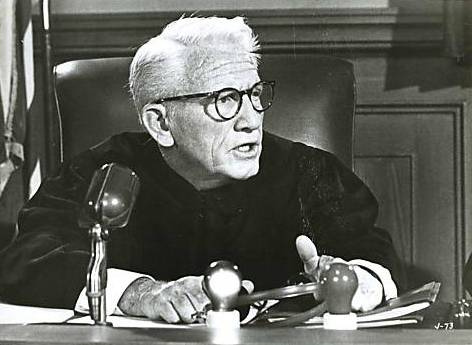
These are uncomfortable subjects. We like to say that the Nazis were different than us or others. To some extent this is true, but the real truth is that most of the Christian Western European countries, and I include the United States have also committed gross crimes against humanity against peoples that we believed were less than human and not afforded human rights or protections. In the movie Judgement at Nuremberg Spencer Tracy makes a comment that should send chills through any of us. He spoke concerning one of the judges on trial, “Janning, to be sure, is a tragic figure. We believe he loathed the evil he did. But compassion for the present torture of his soul must not beget forgetfulness of the torture and the death of millions by the Government of which he was a part. Janning’s record and his fate illuminate the most shattering truth that has emerged from this trial: If he and all of the other defendants had been degraded perverts, if all of the leaders of the Third Reich had been sadistic monsters and maniacs, then these events would have no more moral significance than an earthquake, or any other natural catastrophe. But this trial has shown that under a national crisis, ordinary – even able and extraordinary – men can delude themselves into the commission of crimes so vast and heinous that they beggar the imagination….”

Babi Yar is just one example of how civilized people can get can commit great atrocities in the name of ideology and race, and it does not stand alone. The tragic fact is that it really doesn’t take much to condition people to go commit such crimes; just teach people from childhood that people of certain races or religions are less than human. Then subjugate them to incessant propaganda and then turn them loose using the pretext that they are killing terrorists or insurgents. In the coming days I am posting in small sections an article that I wrote that deals with the ideological as well as military reasons that brought about Babi Yar and so many other atrocities committed by the Nazis during the campaigns in Poland and the Soviet Union.

What happened at Babi Yar is just one example of how civilized people can get can commit great atrocities in the name of ideology and race, and it does not stand alone. The tragic fact is that it really doesn’t take much to condition people to go commit such crimes; just teach people from childhood that people of certain races or religions are less than human. Then subjugate them to incessant propaganda and then turn them loose using the pretext that they are killing terrorists or insurgents.

The article deals with the ideological as well as military reasons that brought about Babi Yar and so many other atrocities committed by the Nazis during the campaigns in Poland and the Soviet Union.

To be continued….

Peace

Padre Steve+

6 Comments

Filed under crime, film, History, Political Commentary, world war two in europe

Tragedy in Kunduz: Mistake, Accident or War Crime?

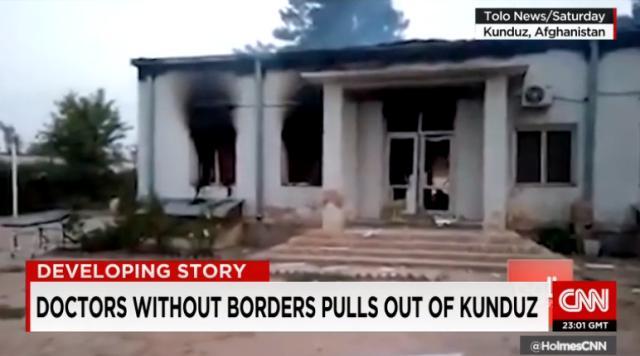
kunduz-hospital-bombing

Friends of Padre Steve’s World

I have been troubled by the disaster at the Doctor’s Without Borders in Kunduz Afghanistan, a disaster that appears to be linked to the actions of U.S. and or NATO, Coalition, and Afghan forces as well as the Taliban who had taken control of that city a few days before the attack.

There are so many things about this incident that trouble me, but truthfully I, like almost everyone, know very little about it, other than the fact that too many innocent people died as a result of what appears to be a prolonged air strike against what should have been a known hospital. Now, truthfully, none of us knows enough about the incident to declare it a justified act, a tragic mistake, or a war crime, and there are people who without full knowledge of the facts are arguing for each of these positions. However, that has not stopped the speculation about the circumstances concerning the incident. Today the American command released a statement saying that Afghan forces requested the air strikes.

The fact is that the circumstances are unclear, and in the fog of war we may never know the truth about what happened. I do not pretend to think that the Taliban are entirely without blame, nor is the incredibly corrupt Afghan government and military; and most importantly are American, NATO and other non-Afghan coalition forces.

I do caution anyone who attempts to place the blame for what happened on any one group in this conflict, and I think that it was irresponsible for people in the United Nations to declare that this could be a war crime without knowing all the facts.

That being said I believe, as a career military officer, that we as Americans need to hold ourselves, and our military to a higher standard than our enemies and even our coalition partners. Sadly, we have not always done this and sometimes we have not only committed war crimes, but also we often hold ourselves above international sanction and law when our forces are suspected of committing war crimes. Even more importantly we ignore the words of a man who acting as an agent of the United States, and the United Nations set the standard for prosecuting war criminals. I am talking about Supreme Court Associate Justice Robert Jackson, who organized the trials of the major Nazi War Criminals at Nuremburg.

When the trials were being organized Justice Jackson set down a rule of conduct for his American, and allied colleagues from Britain, the Soviet Union and France. Sadly, we Americans have failed to heed his words on many occasions. Jackson noted:

“If certain acts of violation of treaties are crimes, they are crimes whether the United States does them or whether Germany does them, and we are not prepared to lay down a rule of criminal conduct against others which we would not be willing to have invoked against us.” Justice Robert Jackson International Conference on Military Trials, London, 1945, Dept. of State Pub.No. 3080 (1949), p.330.

Now personally I hope that this is a tragic accident brought about by a confused tactical situation that was worsened by the fog of war. Truthful that does not lessen the pain and tragedy of what happened in Kunduz, but it is far better than the alternative; that American forces ignored warnings and intelligence that this was a hospital and kept attacking even after being told that it was a hospital. If the latter is the case the charge that this could be a war crime cannot be ignored.

As a veteran of Iraq and a career officer who knows the terrible horrors of war first hand, as well as being a historian and theologian I am especially sensitive to the nuances of such events and know that many times that what happens is difficult to fully understand or comprehend. I can only hope that Secretary of Defense Carter and President Obama will ensure that an investigation, coordinated with the U.N. and our coalition partners fully explores what happened, and if American forces acted improperly, or even in a criminal manner take the moral high ground and assume responsibility.

We cannot ignore the precedent that we ourselves set when we tried the surviving leaders of the Nazi regime at Nuremburg. War crimes are war crimes no matter what people commit them, and we must hold ourselves to this higher standard. But then we must also realize as Hannah Arendt noted “The sad truth is that most evil is done by people who never make up their minds to be good or evil.”

Likewise there are people, like a younger me, who agree with Commodore Stephen Decatur who declare “my country right or wrong” and then ignore any possible evils committed by the United States. I love and serve my country, but if we are complicit in war crimes then what have we become? Are we willing to throw away our ideals, our ethics, our humanity to ensure our survival?

Personally, even if the worst outcome is true, I cannot imagine that those involved meant to commit a war crime, but that being said there is a rationalization that even good people make during war, that their actions, or the actions of their nation are excused by necessity. I am reminded of the words of Spencer Tracy in the movie Judgment at Nuremburg when he said:

There are those in our own country too who today speak of the “protection of country” – of ‘survival’. A decision must be made in the life of every nation at the very moment when the grasp of the enemy is at its throat. Then, it seems that the only way to survive is to use the means of the enemy, to rest survival upon what is expedient – to look the other way. Well, the answer to that is ‘survival as what’? A country isn’t a rock. It’s not an extension of one’s self. It’s what it stands for. It’s what it stands for when standing for something is the most difficult! Before the people of the world, let it now be noted that here, in our decision, this is what we stand for: justice, truth, and the value of a single human being.”

At Kunduz over twenty medical personnel at the Doctors Without Borders died, another three dozen were wounded when American, or other coalition aircraft responded to the call of Afghan ground forces for air support against the Taliban. Regardless of if the Taliban were taking advantage of the hospital to engage the Afghan troops, the location of the hospital was known to coalition forces, it had been there and in operation for four years.

Please do not get me wrong, I want my country to always be in the right. For over 30 years I have sworn an oath to defend the Constitution of the United States and followed what I believe is a call to uphold the best that our country has to offer. I do not support the Taliban or any other group that would seek to impose a theocracy on their people, but at the same time how can I countenance the support of a discredited, unethical and corrupt regime that has squandered the lives and trust of its own people while at the same time taking advantage of American and NATO forces, our military and intelligence support as well our massive economic support without which they could not remain in power?

When I see what the U.S. backed governments in Afghanistan, not to mention Iraq have done to their people with our support I feel much like T.E. Lawrence who wrote of the British administration in 1920 Iraq:

“The people of England have been led in Mesopotamia into a trap from which it will be hard to escape with dignity and honour. They have been tricked into it by a steady withholding of information. The Bagdad communiqués are belated, insincere, incomplete. Things have been far worse than we have been told, our administration more bloody and inefficient than the public knows. It is a disgrace to our imperial record, and may soon be too inflamed for any ordinary cure. We are to-day not far from a disaster.”

Like about everyone I do not pretend to know everything that happened in this incident. But that being said; of we as Americans cannot uphold and subject ourselves to the same standards that we have imposed on others, then what does that say about us? I wonder what our response will be and I am troubled, because I think that we will not hold ourselves to the standards that we ourselves claim to uphold. I say this because we have not done so since Nuremberg.

If we fail in this task, the task to embody the truth of what is in our Declaration of Independence and Constitution, to embody the spirit of the city set upon a hill that inspired so many before we were ever a military power to come here, to believe that the principles that we stood for were better than their own countries;  it will not matter how many Taliban we kill for we will have lost thawed and in the process our collective soul. As Lawrence wrote in 1920 “We are to-day not far from a disaster.”

Praying for Peace and Justice,

Padre Steve+

Leave a comment

Filed under ethics, History, leadership, Military

The Romantic Rebel: George Pickett

Friends of Padre Steve’s World

I am continuing to periodically intersperse and publish short articles about various commanders at Gettysburg on the site. These all are drawn from my student text and may become a book in their own right.  The reason is I am going to do this is because I have found that readers are often more drawn to the lives of people than they are events. As I have noted before that people matter, even deeply flawed people, and we can learn from them.

Today’s article is about Major General George Edward Pickett who gained immortal fame at Gettysburg. He too is a complex, contradictory and controversial  figure in the Civil War, particularly in regard to the post war controversies regarding who was to blame for the Confederate defeat and his open criticism of Robert E. Lee’s decision to order the ill fated charge that made him famous.

Peace

Padre Steve+

Pickett

George Pickett was born to wealth and privilege in a Neo-feudal society [1] and came from an old and distinguished Virginia family with a long military heritage dating to the Revolution and the War of 1812. He attended the Richmond Academy until he was sixteen and had to withdraw due to the financial losses his parents had suffered during the panic of 1837.

This led to the young Pickett being sent to live with and study law under his mother’s older brother, Andrew Johnston in Quincy Illinois. Johnston was a lawyer, Whig politician and friend of Abraham Lincoln. The family’s continued financial distress led them to get George to consider the free education provided by West Point. His mother asked Johnston to assist and Johnston set about obtaining an appointment for his nephew. As befit an up-and-coming politician, his quest was short and successful. His Springfield acquaintances included a United States Congressman who happened to be a fellow Southerner and brother Whig, Kentucky native John T. Stuart. [2] There is a long running myth that connects Pickett’s appointment to West Point to Abraham Lincoln, but it is fiction, fabricated by Pickett’s widow Sallie long after her husband and Lincoln’s death. [3]

Pickett entered West Point in 1842 where he was described by a fellow cadet thought a jolly good fellow with fine natural gifts sadly neglected [4] through his tendency to demonstrate in word and deed that henhouse neither to authority nor submit to what’re considered the Academys narrow, arbitrary, unrealistic, harshly punitive, and inconsistently applied code of conduct [5] became a loyal patron of Benny Havens tavern where he was stealing away regularly now to life his glass in good fellowship…” [6]

Pickett’s academic performance, as well as his record of disciplinary infractions at West Point was exceptionally undistinguished. He racked up vast amounts of demerits for everything from being late to class, chapel and drill, uniform violations and pranks on the drill field where he mocked those who observed proper drill and ceremonies. Pickett graduated last in the class of 1846, something that his vast amount of demerits contributed.

His widow Sallie wrote after his death that he accumulated them so long as he could afford the black marks and punishments they entailed. He curbed his harmful behavior, however, when he found himself approaching the magic number of 200 demerits per year that constituted grounds for dismissal. [7] Pickett finally graduated only five behavioral demerits short of expulsion. [8] The graduating class included George McClellan, A.P. Hill, Thomas, later “Stonewall” Jackson as well as a number of other cadets, most of whom who went on to distinguished military and other careers. At West Point Pickett was considered to be the class clown by many of his classmates was the most popular and prominent young man in the class. [9] Among the many friends that he made was an upperclassman named Ulysses S. Grant and their friendship would span decades and would survive the fire of a war that placed them at swords point. [10]

Pickett was commissioned into the infantry and served alongside James Longstreet in the Mexican War where they fought valiantly in a number of battles, including Contreras, Churubusco, El Molino Del Rey. [11] Pickett distinguished himself at Chapultepec where he had been the first American to scale the ramparts of Chapultepec, where he planted the flag before the admiring gaze of his friend Longstreet. [12] During that assault Longstreet was wounded and Pickett had snatched the colors and planted them on the castle heights for all to see and cheer. [13] For his actions he received a brevet promotion to First Lieutenant.

Following the war Pickett married but was widowed less than two years later when his wife Sally Minge Pickett died during childbirth along with their infant son in 1852. The loss was devastating to the young officer. He went into a deep depression caused by grief and considered leaving the army. He was persuaded by friends, peers and understanding commanding officers to remain.

While on leave following Sally’s death, he was at Fort Monroe, laying under an umbrella at Point Comfort when a child approached him and took pity on him. The child was the nine year old La Salle “Sallie” Corbell and she broke through his emotional defenses by persistently, as only a child can do asking what the source of his grief was. Pickett told the child that his heart had been broken by a sorrow almost too great to bear. When the child asked how ones heart could break, he replied that God broke it when he took from him his loved ones and left him so lonely. [14] While Pickett may not have thought much of the meeting, he did give the little girl a ring and a golden heart bearing his wife’s name. He likely expected never to see her again but though she was a child she was a willful and determined one. She knew her own mind and heart, both told her that one day she would marry George Pickett. [15]

Pickett returned to Texas to serve with the 8th Infantry and was promoted to Captain and ordered to take command of the newly raised Company “D” 9th Infantry at Fort Monroe. Transferred to the Pacific Northwest he married. Widowed after that war he served in the Pacific Northwest where he took a Native American wife who bore him a son, however she did not survive childbirth and when she died in early 1858 Pickett was again widowed. In 1859 Captain Pickett faced down British troops from the Hudson Bay Company in an incident now known at the Pig War which at its heart was a dispute about whether the British or the Americans own San Juan Island. The dispute, which brought the two nations to the brink of war, was settled without bloodshed, save for the unfortunate pig, and Pickett became a minor celebrity in the United States and anathema to the British.

When Virginia seceded from the Union, Pickett like many other southern officers was conflicted in his feelings and loyalties and hoped to the last that he would have to take up arms against neither state nor country. [16] Pickett resigned his commission on June 25th 1861. He wrote to Sallie with who he now maintained a frequent correspondence about his decision and decidedly mixed feelings as he:

Always strenuously opposed disunion…” But While I love my neighbor, i.e., my country, I love my household, i.e., my state, more, and I could not be an infidel and lift my sword against my own kith and kin, even though I do believethat the measure of American greatness can be achieved only under one flag. [17]

Pickett returned to Virginia by a circuitous route where he was commissioned as a Captain in the new Confederate army on September 14th and two weeks later was promoted to Colonel and assigned to command forces along the Rappahannock. Though he had as yet seen no combat serving in the Confederate army, Pickett was promoted to brigadier General and assigned to command a Virginia brigade belonging to Longstreet’s division.

Pickett led his brigade well on the peninsula and at Williamsburg was instrumental in routing an advancing Federal force, and at Seven Pines had helped repel a dire threat to the Confederate position. At Gaines Mill Pickett was wounded in the shoulder during the assault put out of action and placed on convalescent leave to recover from his wounds. During his convalescence he fell in love with an old acquaintance; La Salle Corbell, who as a young girl had cheered him after the loss of his wife now a beautiful young woman nursed him back to health and started a chain reaction that would nearly engulf the Confederate officer. [18]

Pickett was promoted to Major General in October 1862 and was assigned command of the division formerly commanded by David R. Jones, which was assigned to Longstreet’s First Corps. The division was sent to peripheral areas and took no part in the battles of late 1862 or Chancellorsville serving instead in the Tidewater with Longstreet’s corps. The corps took part in a series of operations against Union forces in the Hampton Roads area and Pickett’s division bested a Federal force at Suffolk on April 24th 1863, though it was hardly a true test of his ability to command the division in combat. During this time Pickett spent much time visiting La Salle, much to the concern of some of his officers and Longstreet’s staff, and by the time the corps left the area the two were engaged to be married.

When the Division returned to the Army of Northern Virginia after Chancellorsville, it was among the forces considered by Jefferson Davis to be sent west for the relief of Vicksburg. Since that operation never materialized, the division was assigned to accompany First Corps with the army during the upcoming Pennsylvania campaign. However, much to the consternation of Lee, Longstreet and Pickett, two of its brigades were detached by the order of Jefferson Davis to protect Richmond from any Federal incursion.

During the advance into Pennsylvania the division, now composed of the brigades of James Kemper, Lewis Armistead and Richard Garnett was the trail division in Longstreet’s corps and often, in the absence of cavalry assigned to guard the corps and army trains. Due to its late release from these duties at Chambersburg, Pickett’s Division did not arrive at Gettysburg until late afternoon on July 2nd. Lee decided that they would not be needed that day and Longstreet placed that the division in bivouac at Marsh Creek for the night, sending word by messenger to tell Pickett I will have work for him tomorrow. [19]

Pickett spent the night with his soldiers and woke them about 3 a.m. After a quick breakfast Pickett moved the division to Seminary Ridge marshaling his troops in Spangler’s Woods where there was a modicum of protection from Federal fires and observation. However, despite these advantages it placed his division about 1000 yards from the extreme right of Pettigrew’s division with which he would have to coordinate his attack that fateful day.

Pickett scribbled a final note to Sallie as his troops prepared to attack. Oh, may God in his mercy help me as He never has helped me beforeremember always that I love you with all my heart and soul That now and forever I am yours. [20]

Pickett was never the same after the charge of July 3rd 1863. Pickett’s after action report which complained about the lack of support his division received was suppressed and destroyed by Lee who wrote Pickett You and your men have crowned yourselves in glory But we have an enemy to fight, and must carefully, at this critical moment, guard against dissections which the reflections in your report will create. [21]

Pickett married La Salle “Sallie” Corbell in September of 1863, and the marriage would last until his death in 1875. Sallie, impoverished by the death of “her soldier” took up writing as well as speaking tours in both the South and the North. Sallie was a stalwart defender of her husband, who she said had the keenest sense of justice, most sensitive consciousness of right, and the highest moral courage but also opposing hatred, sectionalism and strife. [22] Though much of her work was panned by historians and shunned by established magazines and periodicals; her writing were published by newer popular magazines. Her book The Heart of a Soldier, as Revealed in the Intimate Letters of General George Pickett, C.S.A. was for the most part fabrications authored by her, but she found a niche in newer popular magazines and journals, including Cosmopolitan for which she authored a ten part serial of the Pickett family story on the fiftieth anniversary of the battle. Sallie Pickett’s:

idealized portrait of her husband made him a Confederate hero. He never reached the status of Robert E. Lee or Stonewall Jackson, but his association with the famed but futile charge at Gettysburg helped. Virginia veterans and newspapers began romanticizing Picketts all-Virginia divisions role soon after the battle; it was almost by association that George too would share in this idolization…” [23]

Pickett retained command of his division after Gettysburg. The division was reconsituted and shipped off to North Carolina where he and it performed adequately but without marked distinction. Pickett had one moment of glory when reacting to a Federal Army under Benjamin Butler advancing on Petersburg he threw a scratch force together which preserved Petersburg and its vital rail line in early May 1864. This allowed General P.T.G. Beauregard to bring up more troops to hold the city.

The division performed adequately in the defensive battles around Richmond and Petersburg, though it suffered terribly from the lack of rations, medicines, clothing and equipmentaggravated by the rigors of life in the trenches. [24] Morale and desertion was a terrible problem in Pickett’s division and Lee was concerned enough to bring enough to bring the matter to Longstreet. Lee used terms like unsoldierly and unmilitary, lax in discipline, loose in military instruction [25] to describe the division. Though he was fully cognizant of the conditions of the trenches Lee identified the source of the problem as Pickett and his officers who were not sufficiently attentive to the men,not informed as to their condition and he told Longstreet: I desire you to correct the evils in Picketts divisionby every means in your power… I beg that you will insist upon these points. [26]

During the Richmond and Petersburg campaign, Pickett was often sick, and at several intervals he was unable to exercise command, and the poor state of his general health, aggravated by the unusually stressful conditions of the past year, age him beyond his years. [27]

The end came at the battle at Five Forks where Pickett’s division was deployed on the far right of the Confederate line, was overwhelmed by a massive assault by Sheridan’s cavalry and the Fifth Corps which destroyed it as a fighting formation. Pickett, for unknown reasons did not put much effort into the defense of Five Forks. He successfully repulsed an attack by Sheridan on March 31st but evidently did not expect an attack the following day. On the afternoon of April 1st Pickett was away from his division at a Shad bake with Fitzhugh Lee and Thomas Rosser when the attack came and destroyed his division as a fighting unit. No cowardice was involved; Pickett simply misjudged the situation by assuming that no attack was imminent, yet it left a bad taste in everyones mouth. [28] That being said Picketts lackadaisical effort in holding Five Forks is indefensible. So to is his incredible derelict behavior late on the morning of April 1st when he slipped away from his command to the shad bake not even informing the next senior officer, Rooney Lee that he was gone. [29]

Whether cowardice was involved or not, Pickett’s decision to be away from his division with a very aggressive Federal army at his front was ill-advised and demonstrated to Lee that Pickett was unfit for command. Two days later Pickett and two other generals, including Richard Anderson were relieved of their duties and dismissed by Lee. However Pickett remained with his division until the end and at Appomattox Lee was heard to remark in what some believed was a disparaging manner Is that man still with this army? [30]

George Pickett attempted to rebuild his life after the war and the task was not easy, for though he applied for amnesty, his case was complicated by an incident where he had ordered the execution of twenty-two former North Carolina militiamen who had defected to the Union and been re-captured by the Confederates. Pickett’s action was no different than many Confederate commanders who followed the Richmond government’s decision to take ruthless measures to suppress Unionist sentiments and secession of areas of the Confederacy where Union sympathies ran high. The area of Pickett’s operation was a haven for Tories who openly supported U.S. troops. What was worse, hundreds of local Unionists engaged in the most violent guerrilla activities, shooting and burning out their secessionist neighbors, waylaying Confederate supply trains, attacking outposts. [31] Some of these men had previously served in Confederate service which in the eyes of Pickett and many others made them traitors to the Confederate cause.

In a sense Pickett was engaged in what are now known as counter-insurgency operations. Like many commanders involved in such operations, he descended into the same type of barbaric actions of those he was fighting. “By early 1864 the war was turning into a grim, hate-filled struggle that knew few rules and niceties, and Pickett was changing to the pattern. [32] When Pickett captured the former militiamen he refused to treat them as prisoners of war and instead he court-martialed them and hanged them all. [33] He established a military court composed of Virginia, North Carolina and Georgia officers, hauled the deserters-in-arms before it, and approved the death sentences. [34] When the prisoners went to the gallows Pickett reportedly told each of them God damn you, I reckon you will ever hardly go back there again, you damned rascals; Ill have you shot, and all the other damned rascals who desert. [35]

Federal authorities thought about charging him with war crimes. Pickett fled to Canada in late 1865 before returning to Virginia. It took the intervention of Pickett’s faithful friend Ulysses S. Grant to have the charges dismissed and for Pickett to be granted amnesty by President Johnson in 1868. Grant admitted that the punishment was harsh, however, Grant’s judgment was steeped in the fact that many Northern commanders had resorted to similar actions in combating insurgents and deserters. Grant wrote in his friend’s defense:

But it was in time of war and when the enemy no doubt it necessary to retain, by some power, the services of every man within their reach. Gen. Pickett I know personally to be an honorable man but in this case his judgement [sic] prompted him to do what can not well be sustained though I do not see how good, either to the friends of the deceased or by fixing an example for the future, can be secured by his trial now. [36]

Even so, Pickett’s life was difficult. Health difficulties plagued him and employment was scarce, even for a man of Pickett’s stature in Virginia. He refused employment which would take him away from Sallie and his children and finally took a job as an insurance agent in Richmond. It was a job which he felt demeaning, requiring that he attempt to sell insurance policies to destitute and out of work Confederate veterans and their families. Sallie wrote that he could not come to terms with a profession that made its profits through what one colleague called gall, gall, old man, gall and grub. [37] Distinctly unhappy the dejected old soldier told her Id sooner face a canon,than to take out a policy with me. [38]

In 1870 he was convinced by John Singleton Mosby to visit Lee when the latter was visiting Richmond as Lee was making a final tour of battlefields and other sites. For Pickett the visit only reinforced his resentment that he felt for Lee, who he felt blamed him for the defeat at Five Forks and had ostracized him. The meeting occurred in Lees room at the Ballard Hotel was icy and lasted only two or three minutes. [39]

Mosby realized quickly that the meeting was not going well and Sensing the unpleasantness of the meeting, Mosby got up in a few moments and Pickett followed him. Once outside the room, Pickett broke out bitterly against that old man who, he said, had my division massacred at Gettysburg. [40] Mosby attempted to assuage his friend’s feelings but Pickett was not mollified by Mosbys rejoinder that it made you immortal. [41] Edwin Coddington wrote that it would have been better for his reputation if had been called to give his life or if the attack had been known for what it was, Longstreets Second Assault. [42]

George Pickett was a romantic as well as a true believer in the cause of the Confederacy. Pickett was vain, often self-serving and even irresponsible. He certainly as Porter Alexander noted was a better brigade commander than division commander, a position that he desired but at which never excelled. He was a poor administrator, and in the campaigns of 1864 and 1865 demonstrated exceptionally poor leadership.

His temperament, especially his seeming inability to function in a hierarchical structure, and the rebellious streak that he had as a cadet at West Point was never exercised: He resented authority and chafed at deferring to any man as his superiorPickett never understood his place in the hierarchy. He considered himself part of the cream of the Army of Northern Virginia, but without being willing to shoulder all the responsibilities and sacrifices that entailed. [43]

He died in the summer of 1875 while on a business trip to Norfolk with his wife at his side, but a single tragic charge had made his name immortal. [44] Bitter and discouraged at the end of his life he uttered his last words to Sallie’s uncle who had also served in the Army of Northern Virginia Well, Colonel, the enemy is too strong for me againmy ammunition is all out He closed his eyes, and settled back as if at peace for the first time in his life. Sallie never left his side; two hours after his death they gently pried her hands from his. [45]

[1] Ibid. Longacre Pickett p.4

[2] Ibid. Longacre Pickett p.6

[3] See Longacre Pickett pp.6-7. The myth was quite successful and it endures in some accounts of Pickett’s life and in a number of military histories including Larry Tagg’s The Generals of Gettysburg

[4] Waugh, John C. The Class of 1846 from West Point to Appomattox: Stonewall Jackson, George McClellan and their Brothers A Ballantine Book, New York 1994 pp.38-39

[5] Ibid. Longacre Pickett p.7

[6] Ibid. Waugh The Class of 1846 from West Point to Appomattox p.39

[7] Ibid. Longacre Pickett p.12

[8] Guelzo, Allen C. Gettysburg: The Last Invasion Vintage Books a Division of Random House, New York 2013 p.378

[9] Ibid. Guelzo Gettysburg: The Last Invasion p.378

[10] Ibid. Longacre Pickett p.20

[11] Ibid. Hess Picketts Charge p.37

[12] Ibid. Dowdy Lee and His Men at Gettysburg p.264

[13] Ibid. Waugh The Class of 1846 p.457

[14] Ibid. Longacre Pickett p.32

[15] Ibid. Longacre Pickett p.33

[16] Ibid. Longacre Pickett pp.50-51

[17] Ibid. Longacre Pickett p.51

[18] Ibid. Hess Pickett’s Charge p.38

[19] Ibid. Hess Pickett’s Charge p.47

[20] Ibid. Dowdy Lee and his Men at Gettysburg p.296

[21] Ibid. Hess Pickett’s Charge p.354

[22] Ibid. Reardon The Convergence of History and Myth in the Southern Past: Pickett’s Charge p.76

[23] Gordon, Lesley J. “Let the People See the Old Life as it Was” La Salle Corbell Pickett and the Myth of the Lost Cause in The Myth of the Lost Cause and Civil War History edited by Gallagher, Gary W. and Nolan, Alan T. Indiana University Press, Bloomington and Indianapolis 2000 p.170

[24] Ibid. Longacre Pickett p.160

[25] Selcer, Richard F. Lee vs. Pickett: Two Divided by War Thomas Publications, Gettysburg PA 1998 p.66

[26] Ibid. Selcer Lee vs. Pickett p.66

[27] Ibid. Longacre Pickett pp.160-161

[28] Ibid. Hess Pickett’s Charge p.375

[29] Ibid. Longacre Pickett pp.166-167

[30] Ibid. Hess Pickett’s Charge p.375

[31] Ibid. Longacre Pickett p.137

[32] Ibid. Longacre Pickett p.141

[33] Guelzo Allen C. Fateful Lightening: A New History of the Civil War Era and Reconstruction Oxford University Press, Oxford and New York 2012 p.368

[34] Ibid. Longacre Pickett p.140

[35] Ibid. Guelzo Fateful Lightening p.368

[36] Ibid. Longacre Pickett p.175

[37] Ibid. Longacre Pickett p.178

[38] Ibid. Longacre Pickett p.178

[39] Ibid. Hess Pickett’s Charge p.377

[40] Ibid. Freeman Lee p.569

[41] Ibid. Waugh The Class of 1846 p.529

[42] Ibid. Coddington The Gettysburg Campaign p.528

[43] Ibid. Selcer Lee vs. Pickett p.101

[44] Ibid. Waugh The Class of 1846 p.529

[45] Ibid. Longacre Pickett p.180

4 Comments

Filed under civil war, Gettysburg, History, leadership, Military

Warmongers, Chicken Hawks & War Porn Addicts

Iraq-unrest

Make no bones about it, the Islamic State, or ISIL needs to be defeated. It is evil, it is ruthless and it is a danger to the people that it controls and those in its path. Likewise it sates that it has larger goals. Because of this many Americans, over 60 percent in the most recent poll favor sending in ground troops to fight the Islamic State. Politicians talk about sending, 5,000, 10,000 or other nice round numbers of troops which they seem to pull from thin air as fast as they can. Others not only want to take on ISIL, but that the same time seem to want to go after Iran as well. Benjamin Netanyahu got a great round of applause for that boner strategy.

But the real fact of the matter is that American boots on the ground are not the answer. Now can American troops help, most certainly, but despite our great technological ability to kill our enemies and overrun territory, we are not the people to win this war.  The Iraqi Sunni and Shia to get their shit together to beat these guys. T.E. Lawrence so wisely wrote:

“Do not try to do too much with your own hands. Better the Arabs do it tolerably than that you do it perfectly. It is their war, and you are to help them, not to win it for them. Actually, also, under the very odd conditions of Arabia, your practical work will not be as good as, perhaps, you think it is.”

Sadly we ignored that and like the British efforts, our efforts to invade, conquer and re-make Iraq in our image have failed miserably. Our failure is as poetic and terrible as Lawrence’s description of British efforts:

“We had been hopelessly labouring to plough waste lands; to make nationality grow in a place full of the certainty of God… Among the tribes our creed could be only like the desert grass – a beautiful swift seeming of spring; which, after a day’s heat, fell dusty.”  

But to the warmongers, the Chicken Hawks and the War Porn addicts who have no skin in the game this counsel doesn’t matter. Despite the fact that American soldiers, sailors, marines and airmen have been continuously in combat or supporting combat operations for the last thirteen and a half years, this country is not a country at war.  That was something that was shattering for me to realize when I stepped off the plane coming home from Iraq. Believe me, there is a big difference between saying “I support the troops” and having skin in the game.

The fact is that all of those who beat the drums of war but are unwilling to pay the cost, be they the Politicians, Pundits and Preachers, the Trinity of Evil as I call them, or their war addicted followers don’t care about the troops.  In my book the war-mongering preachers are the worst of the lot, but then some of those guys like Mike Huckabee are not only preachers, but politicians and pundits, I guess that must be a new twist on the biblical “prophet, priest and king” thing.  But even as these people counsel war, they refuse to raise taxes to support it, or even pay for the equipment needed by the troops. Likewise, they refuse to make national service, including the military draft a part of national policy. Why don’t we do this? The fact is that then we as a nation would actually have to have skin in the game, give up some of our luxuries and lace up the boots and go to war.

But we will die before we raise taxes or institute the draft. Politicians that suggest such things are driven out of office. Instead we will rely on that under one percent of our population who have shouldered the burden of war for over a decade, even while our political and business leaders scheme to find ways to cut military pay and benefits, especially those medical benefits incurred while serving.

It’s funny, well, no, it’s not funny, that the people leading this charge to war are the same assholes who brought about the Iraq debacle in the first place. But be assured, just as last time their sons and daughters will no serve, and they will not only not be held accountable, but they will profit from the war, just as they have since the days of Smedley Butler.

The fact is that those who brought about this debacle from the Bush administration should be tried as war criminals. But now we have potential Republican presidential candidates, and I might add Evangelical Christians say that there should be no war crimes, that war crimes are not bad, I guess as they are not being committed against us, but I digress.

Supreme Court Justice Robert Jackson, who led the prosecution of the major Nazi War Criminals at Nuremburg wrote something that men like Ben Carson, Mike Huckabee and others cannot seem to fathom:

“If certain acts of violation of treaties are crimes, they are crimes whether the United States does them or whether Germany does them, and we are not prepared to lay down a rule of criminal conduct against others which we would not be willing to have invoked against us.”

I say that there is a special place in hell for the warmongers, Chicken Hawks and War Porn addicts who are so willing to throw other people’s kids into wars that are unwinnable, if those who we are there to defend do not step up and do their part.

So with that my friends I wish you a happy and fun Friday.

Peace

Padre Steve+

2 Comments

Filed under Foreign Policy, History, iraq,afghanistan, middle east, Military, national security, Political Commentary

Padre Steve’s Year in Review

10570298_10152872503382059_5058681841617456899_n

Well it has been a year, well almost a year unless your are like in Australia when you read this.

As Charles Dickens’ wrote, “it was the best of times” and depending who you are or where you live it could have been one, the other or both. For me it has been one of those, not that there is anything wrong with that.

But really, look at the past year, personally it has been a mixed bag for me, in the end the plusses outweigh the minuses but what can I say? Great job, back with my wife, complete PTSD meltdown, being nearly suicidal for a while, but in the end a trip to Oktoberfest, the Orioles win the AL East, the Giants win the World Series and I’m doing better. On the other hand a whole lot of people are not doing better in a lot of places in the world. I’ve written about some of the events of the year as they affected me. Not all of them would be major, but hey, this was my year. If I had a song that described the year it would be Barry Manilow’s Trying to get the Feeling Again”

On January 6th I lost a man who had shown compassion and empathy for me, Captain Tom Sitsch, US Navy retired. Captain Sitsch was a true hero who worked his way up throughout the ranks in the Navy Explosive Ordinance Demolition community, made many combat deployments and suffered untreated PTSD and TBI. He took his own life. It was a sobering time for me, as he was one of the few people who showed much compassion for me when I was falling apart in the summer of 2008. He asked me “where does a chaplain go for help?” The best I can remember was that I told him not to other chaplains or clergy. I had no idea what he was going through and after he left the Navy under a cloud in 2009 I lost contact with him. His death brought me back into contact with men I had served with and who had served with him. I wrote about that a number of times as it was such a shattering event. I wish I had known and could have been there for him. The first article I wrote about that was on January 7th and can be found here: Rest In Peace Captain Tom Sitsch USN

February was a month of reflection on the sixth anniversary of my return from Iraq, the Winter Olympics in Sochi Russia and a time of intense preparation for my first journey to Gettysburg leading the Gettysburg Staff Ride for the Joint Forces Staff College. It also was a month where we began to see the tip of the iceberg of the attempt of some Christians in Kansas to enshrine  religious intolerance in law, that article A Matter of Degree: The Taliban, Kansas, Jim Crow and Nuremberg really pissed some people off.

goering3

I wrote a reflection about the long strange trip back from Iraq in this article The Long Strange Trip: Six Years After Returning from Iraq

In March Russia pulled off its occupation of Ukraine and Malaysian Airlines flight 370 disappeared from the face of the earth. I also led my first trip to Gettysburg and really began to sink my teeth into writing about the battle as well as many other components of the American Civil War, including the politics, ideology, economic and religious aspects of the war. But for the most enduring mystery was the disappearance of MH-370. I ended up writing a “conspiracy theory” about it, which because it hasn’t been proven wrong could possibly be right, if not maybe the basis of a great terrorism novel. That article is here  My Malaysian Airlines Flight MH-370 Conspiracy Theory

April was the beginning of baseball season, the end of Lent, Holy Week and more work on a lot of history. I wrote about civil rights, Jackie Robinson, and a whole series on a Roman Centurion in Jerusalem during the first Holy Week. I also took on former half-term Governor of Alaska Sarah Palin in this article  War Crimes are Us: I Want No Part of Sarah Palin’s Torture Loving Christianity But it was an interesting time because I was asked to do an interview about my struggle with PTSD for the Washington Times. The article about that is here Not the Cover of the Rolling Stone but the Front Page: Padre Steve Featured in Washington Times article on PTSD

In May I took another group of students to Gettysburg and did a lot more writing about that subject as well as the subject of Memorial Day. But an event occurred that caused me to reflect on the way Christians often use the power of religion in attempts to silence or shame others who are in pain. That came after I had an experience trying to get help in the Navy Mental Health system and because of how I was treated began to implode all over again. That article is here: Frightened by Christians. I also did a fair amount of reflecting on the sacrifice of others in articles about Memorial Day, including this one “The Offering We Bring…” Remembering the First Memorial Day

isis3-840x550

In June my struggle continued and was intensified by the collapse of Iraqi forces as ISIL swept into Iraq, overrunning many of the places I had served in Al Anbar province. Looking back at all that I wrote about other subjects that month I am amazed. I wrote about the assassination of Franz Ferdinand which triggered the events leading to the outbreak of World War I in this article A Wrong Turn, a Holy Cause and Two Bullets: The Assassination of Archduke Franz Ferdinand But here is the first article that I wrote about the collapse of the Iraqi forces and reflected on all the history that we should have paid attention to in 2003 The Results of Ignoring History: The Implosion of Iraq as well as my own reflection of my time there and hope for better Inshallah Iraq (إن شاء الله) Maybe Someday things will be Better

In July I did a lot more work on Gettysburg as I got ready to take another group there in August. I reflected on Iraq, PTSD, the Declaration of Independence and in my work on Gettysburg and Civil War issues I wrote this article about some of the similarities that I see in some Tea Party ideology and that of the ante-bellum South, the Confederacy and Jim Crow. That article is here Parallels between Tea Party Ideology and the Ante-Bellum South I took another stab at the situation in Iraq in this article Iraq, ISIS and Al Qaeda: Sowing the Wind…  and this about the moral responsibility of a nation at war to those that it sends to fight its wars  “You Broke it, You Bought It” The Responsibility of a Nation at War and Broken and Unlikely to Get Better: Military Mental Health Care

In August I led another trip to Gettysburg, and I reflected on a number of subjects, but as I was struggling so much after my collapse in May I decided to write a number of new articles about PTSD, Suicide and the military mental health care system. Here are two of them No Shutting Up Until it is Fixed: Veteran and Military Mental Health Care and  Moral Injury: Betrayal, Isolation, Suicidality, & Meaninglessness; the War after the War But I also ventured into the initial police reaction in Ferguson Missouri in the article The Misuse of Force: Shock and Awe Backfires in Ferguson But one of my favorite articles to write was this one on the Gettysburg Address, something that I always find important to reflect upon Reembracing the New Birth of Freedom

IMG_0491

In September I made pilgrimage to Oktoberfest. However I ventured into the discussion of the new, old kind of war that we are facing again, that of religious ideology and war without mercy. That article is here Wars Without Mercy: The New Old Way of War and The Islamic State and the New, Old Nature of War

In October, of course I continued to write about Gettysburg and the Civil War, baseball and the World Series, and was inducted into my High School’s Hall of Fame, which was a great honor. But I decided to tackle some of the religious ideologues who are actively engaged in the political process and did an article about Senator Ted Cruz’s father Rafael Cruz. That is here: Rafael Cruz and the Dangerous Heresy of the Self-Annointed

In November I made my final trip for the last academic year to Gettysburg and had the honor of meeting a real hero, retired Army Colonel Walter Marm, who won the Medal of Honor for his actions at the Battle of Ia Drang, a battle made famous by the movie We Were Soldiers that reflection is here: Return from Gettysburg: Table Talk and Meeting a Hero

December was another big month, the Senate Report on the CIA torture program was released much to the chagrin of the program’s most ardent supporters including a host of “Christian” leaders. I decided to take them on in this article Conservative Christians and Torture: Wedded at the Hip

Those are just some of the highlights. I wrote about so many other things as well, and I invite you to browse the site. Like I said, all things considered I am surprised I have been so productive this year. So anyway, thank you so much for reading what I put out, for sharing it and for your wonderful comments and encouragement. So I’ll wish you well and if I don’t get anything else done later today I wish you all a happy and blessed New Year.

Peace

Padre Steve+


2 Comments

Filed under History, Loose thoughts and musings, PTSD

Dick Cheney: Justice, Truth and the Value of a Single Human Being

Dick Cheney

Yesterday while he was in the process of throwing his boss, former President Bush and former head of the National Security Council and Secretary of State Condi Rice under the bus regarding the issue of torture and war crimes, former Vice President Cheney defended the death of an innocent man and the imprisonment of hundreds of others deemed to be innocent.

The words were damning and absolutely frightening for anyone that believes in the rule of law and human rights.

Cheney told Chuck Todd when questioned about the fact that over 25% of those held during the Bush Administration were innocent and should not have been detained or imprisoned on Meet the Press:

“I have no problem as long as we achieve our objective. And our objective is to get the guys who did 9/11 and it is to avoid another attack against the United States.”

The sad thing is, that Cheney in his office of Vice President of the United States had such a low regard for the rule of law and human rights that over a decade after his policies were proved to be wrong, illegal and immoral under any standards of human rights and international law that he not only continues to defend them, but is willing to throw his superior, the President, and other cabinet officials under the bus to justify his position.

As I read his remarks I was reminded of the testimony of Herman Goering and other Nazis at Nuremberg. Likewise I was reminded of the film classic Judgement at Nuremberg where Spencer Tracy plays judge Dan Haywood who is the head of he tribunal that ties Nazi judges in the fictionalized version of the Nuremberg Judges Trials…

julga-tracy

In the fictionalized version of the Nazi Judge’s trail at Nuremberg, in the film Judgement at Nuremberg Spencer Tracy, playing judge Dan Heywood noted:

“But this trial has shown that under a national crisis, ordinary – even able and extraordinary – men can delude themselves into the commission of crimes so vast and heinous that they beggar the imagination. No one who has sat through the trial can ever forget them: men sterilized because of political belief; a mockery made of friendship and faith; the murder of children. How easily it can happen. There are those in our own country too who today speak of the “protection of country” – of ‘survival’. A decision must be made in the life of every nation at the very moment when the grasp of the enemy is at its throat. Then, it seems that the only way to survive is to use the means of the enemy, to rest survival upon what is expedient – to look the other way. Well, the answer to that is ‘survival as what’? A country isn’t a rock. It’s not an extension of one’s self. It’s what it stands for. It’s what it stands for when standing for something is the most difficult! Before the people of the world, let it now be noted that here, in our decision, this is what we stand for: justice, truth, and the value of a single human being.”

Dick Cheney exemplifies exactly what judge Haywood testified to in the film. Sadly, unlike the primary defendant in that film, Ernst Janning who was played by Burt Lancaster, Cheney has no redeeming features or ethical tragedy. Cheney is simply an unrepentant war criminal who is not only unapologetic for his own actions but perfectly willing to condemn those that he served under or alongside as war criminals while attempting to maintain the fiction of his innocence. The man has no honor, and for people who consider themselves to be “principled conservatives” or even worse “conservative Christians” to defend Cheney’s defense of war crimes to the death, is simply apprehensible.

There are times when one can look at a war criminal and feel a certain measure of tragedy. However, Dick Cheney is neither a dumb man, nor a victim. As vice President to a President with no foreign policy experience or skills, a man who was out of his league intellectually to serve as President, Cheney not only gave bad advice, he was willing to for practical purposes indict George Bush in the commission of the very war crimes that he was the ideological wellspring.

Sadly, Dick Cheney is nothing more than a sociopath and war criminal who should, provided that the executive branch has any balls should be remanded to the International Criminal Court in the Hague for prosecution of war crimes. But then, President Obama, like others before hi will not, much to his own dishonor will not do this.

If if the same crimes that we tried and executed Nazi and Japanese War Criminals for committing is not enough to send Dick Cheney to the gallows, I do not know what is. But then, even the International Criminal Court, unlike Texas and Florida, has renounced the death penalty.

So what do we as Americans stand for?

Do we adapt to and defend our the very methods of our enemies?

Do we simply forget the standards that our grandfathers and great-grandfathers sent Nazi and Japanese war criminals to the gallows?

Do we excuse the actions of those in supreme positions of power that should have known better?

I think not… unless we decide that expediency trumps the Constitution, unless we decide that war crimes are only such if they don’t apply to us…unless we decide as a people that we as a nation are above the very laws that we enacted to prevent the repetition of the crimes of the Nazis…

ROBERT H. JACKSON

Justice Robert Jackson noted in the Major War Crimes trails at Nuremberg:

“If certain acts of violation of treaties are crimes, they are crimes whether the United States does them or whether Germany does them, and we are not prepared to lay down a rule of criminal conduct against others which we would not be willing to have invoked against us.”

Sadly, Dick Cheney,Fox News and all of the defenders of torture and other war crimes do not seem to get that, and in doing so they lower us to the level of all the Nazis that we tried and convicted of war crimes.

But human nature does not change…and it should it be, if we fail to correct it and turn over those suspected of war crimes to the appropriate authorities, than we should share in the collective and divine judgement upon them.

If that is an uncomfortable proposition, than I guess I have done my job tonight.

Peace

Padre Steve+


2 Comments

Filed under Foreign Policy, History, national security, News and current events, War on Terrorism