Tag Archives: washington naval treaty

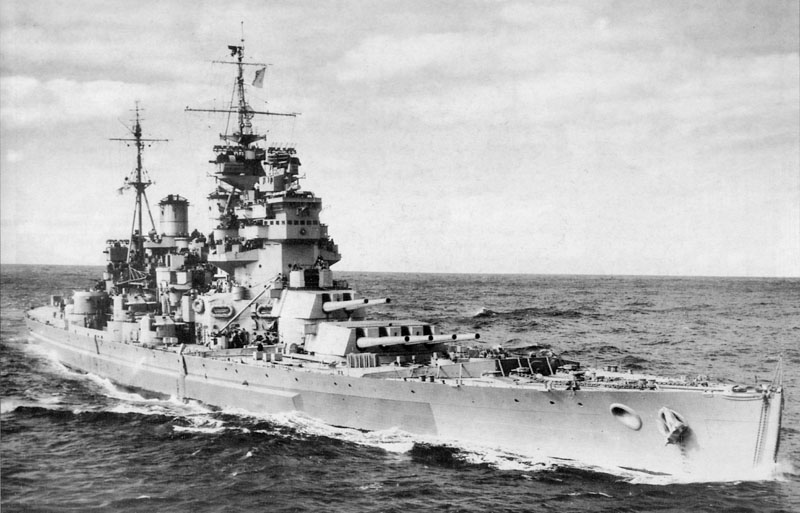
The King George V Class Battleships: British Bulwarks

kgv2

Friends of Padre Steve’s World,

It has been a very busy couple of days so I am reaching back deep into the archives to re-post an old article about the British King George V Class battleships of the Second World War. These ships and their brave crews were of great importance to the Allied cause. Sadly, like so many great ships of that war all the surviving ships were scrapped due to measures of austerity and obsolescence and none preserved to honor their service or crews. 

Hope to post something fresh tomorrow,

Peace’

Padre Steve+
HMS King George V II

HMS King George V

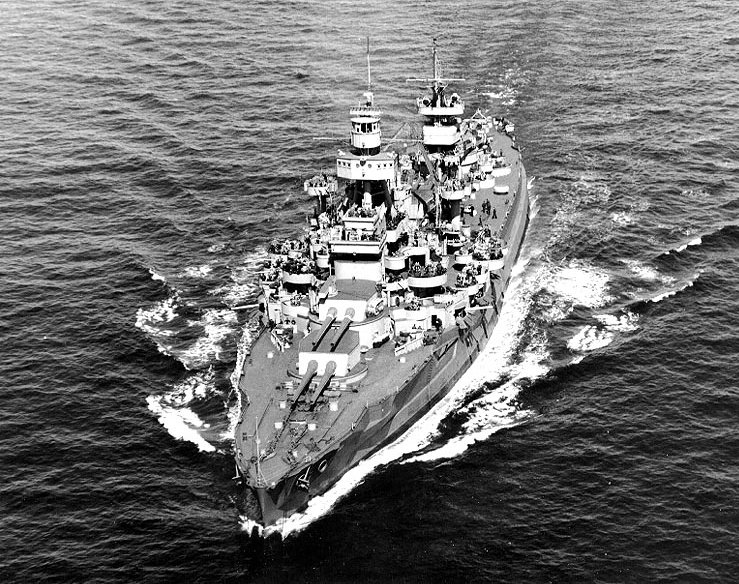
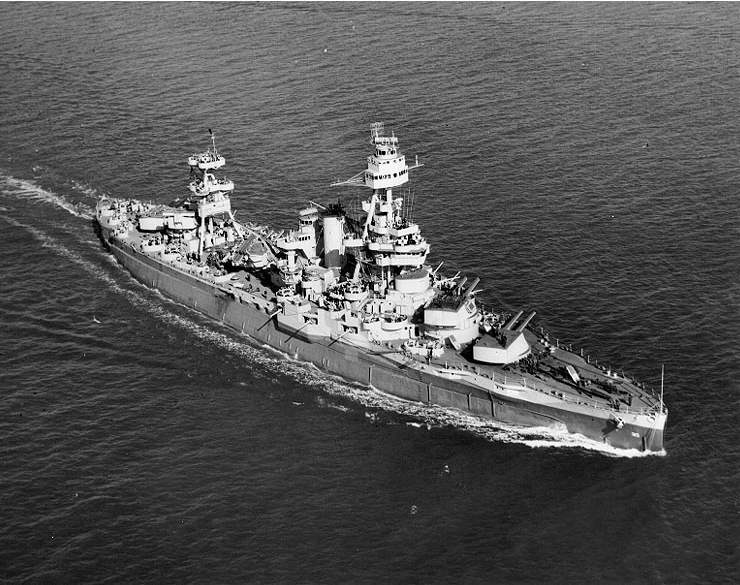
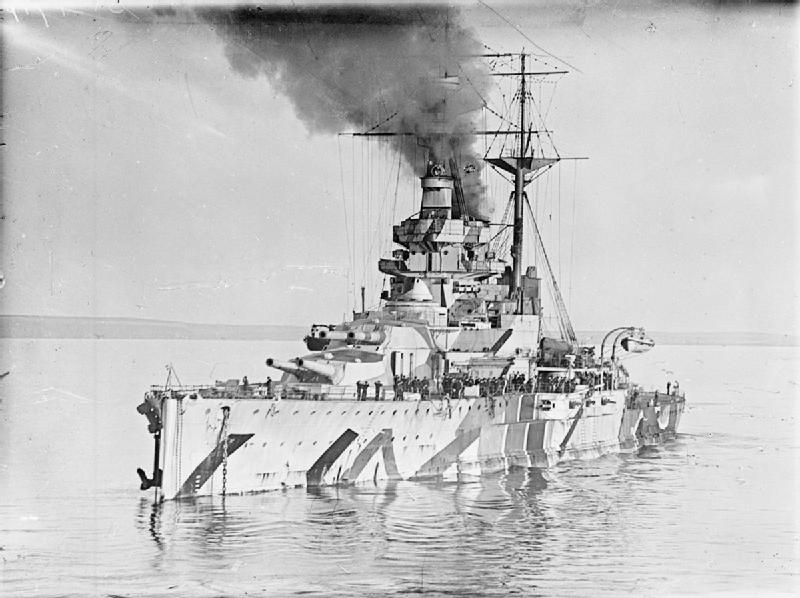
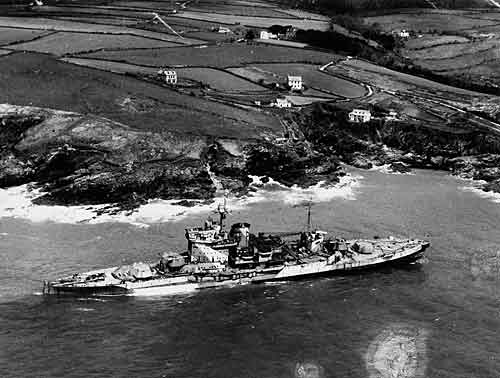
This is the third in a series of five articles on the battleships built under the provision of the Washington and London Naval Treaty limitations in the 1930s. I am not including the ships which were completed in the immediate aftermath of the Washington Treaty limitations. This series looks at the modern battleships that the World War II combatants would produce in the 1930s which saw service in the war. This article covers the British Royal Navy King George V Class battleships. Part one covered the Italian Vittorio Veneto class entitled The Pride of the Regina Marina: The Vittorio Veneto Class Battleships. Part two French Firepower Forward: The unrealized potential of the Dunkerque and Richelieu Class Battleships covered the French Dunkerque class and Richelieu class Battleships. Part Four the American North Carolina and South Dakota Classes. I have already published the final part which covers the German Scharnhorst Class entitled Power and Beauty the Battle Cruisers Scharnhorst and Gneisenau. The German Bismarck, Japanese Yamato, British Vanguard and American Iowa Classes will be covered in a subsequent series.
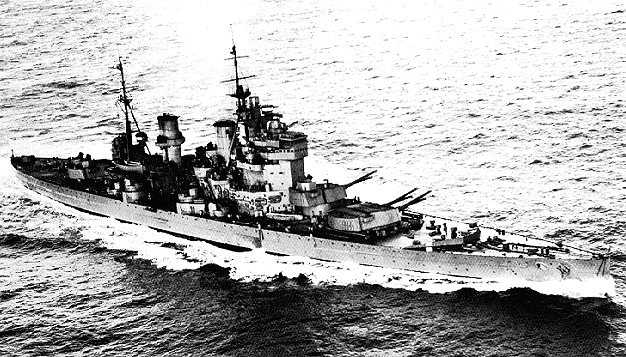
HMS_King_George_V_in_1941

HMS King George V in 1941

In the wake of the First World War the major naval powers entered into an agreement restricting the construction of capital ships and limiting the numbers that treaty signatories were allowed to keep. As a result numerous ships were scrapped or disposed of and the majority of planned ships were either cancelled while building or never laid down. In some cases to comply with treaty restrictions ships such as the Royal Navy’s Nelson Class which was a compromise design which sacrificed speed for protection and firepower. By the late 1920s the Royal Navy’s battle force was comprised of the Nelson’s, the fast Battlecruisers Hood, Renown and Repulse and 10 ships of the Queen Elizabeth and Revenge classes all designed before the First World War.
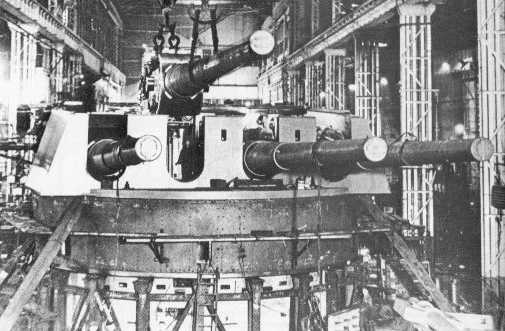
kgv class 14-45_mk7_pic

King George V Class Quad Turret being built

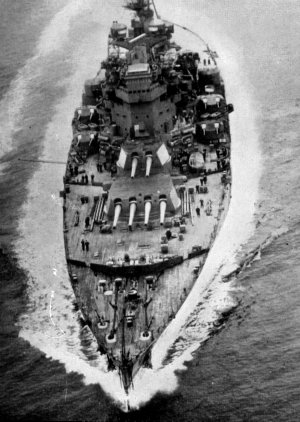
The Royal Navy began planning for a new class of battleships in 1928 but the plans were shelved with the signing of the London Naval Treaty which continued the “building holiday” on capital ship construction as well as size and armaments until 1937. With the realization that its battle force was becoming dated as other nations laid down new classes of battleships the Royal Navy recommenced planning in 1935. The Navy planned to build to the maximum of the 35,000 displacement limitation and placed a great measure of emphasis on armor and protection. The ships were designed to achieve a 28 knot speed which made them faster than all British battleships although slower than the Battlecruisers.

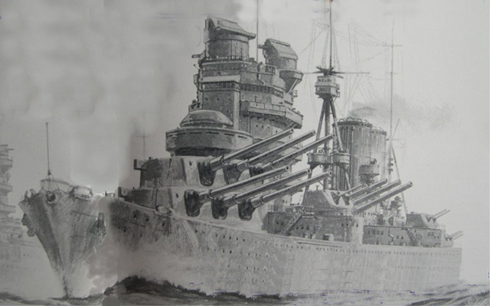
The planners had alternative designs to use 14”, 15” or 16” guns with the Navy favoring the 15” models which had equipped all of their other ships with the exception of the Nelson’s. However the Admiralty to use 14” as the government was endeavoring to negotiate with other powers to impose a 14” limitation on armament for new battleships. While the Americans and French agreed to the limit neither the Japanese nor Italians followed suit and as a result all new battleships of other powers had larger guns than the King George V Class ships with the French and Italians opting for 15”on the Richelieu and Vittorio Veneto Class, the Americans 16” on the North Carolina, South Dakota and Iowa Classes and the Japanese 18” guns for their Yamato Class. The Germans who were not a signatory built their Scharnhorst Class with 11” although they were planned as 15” ships and would equip the Bismarck Class with 15” guns. The Royal Navy attempted to rectify this by placing more guns on the ships than those of other navies but the planned armament of twelve 14” guns mounted in quadruple turrets but this was impossible on the 35,000 platform without compromising protection or speed. Thus the Admiralty compromised on 10 guns mounted in 2 quadruple and 1 twin turret.
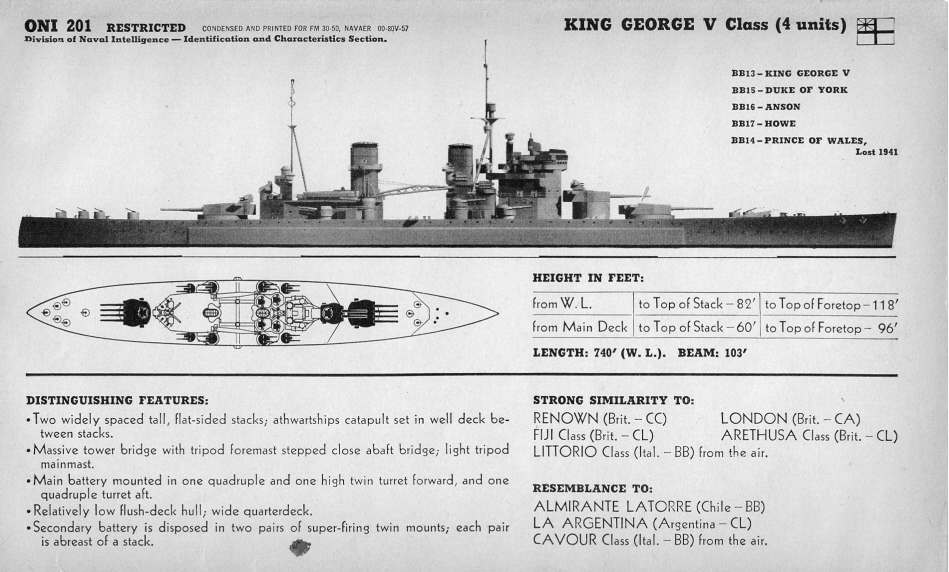
king george v class drawing

ONI Drawing of King George Class

The ships displaced a full load displacement of 42,237 tons in 1942 which had increased to 44,460 tons in 1944. The were 745 feet long had a beam of 103 feet, a top speed of 28 knots with a cruising range of 5,400 nautical miles at 18 knots. Their relatively poor endurance limited their operations in the Pacific and even nearly caused King George V to have to abandon the chase of the Bismarck in May 1941.

The main batteries of the ships proved problematic in combat with the quadruple turret design causing all the ships problems. This was demonstrated in the engagement of the Prince of Wales against the Bismarck as well as the King George V in its duel with the German behemoth when A turret became disabled and completely out of action for 30 minutes and half of the main battery being out of action for most of the engagement for mechanical reasons. The Duke of York achieved excellent results against the Scharnhorst but even in that engagement the main battery was only able to be in action 70% of the time. One of the other drawbacks of the design was that in order to replace a gun due to wear that the turret itself had to be dismantled in order to remove and replace the guns.

The main secondary armament of 5.25” dual purpose guns in twin mounts suffered from poor rate of fire and slow traverse well below their designed standards.

The mounting of the armament was designed to provide protection against turret explosions which could potentially detonate the ship’s magazines. The main side and underwater protection scheme was sound and protected the ships well in combat. The vertical protection was also sound as was the protection afforded to the turret barbets and placement of the magazines to shield them from plunging fire. Only the Prince of Wales was lost due to enemy action had later examination of her wreck revealed that the culprit was a torpedo which detonated in a propeller shaft outside of the armored belt which caused uncontrolled flooding when she was attacked by Japanese aircraft on 8 December 1941.
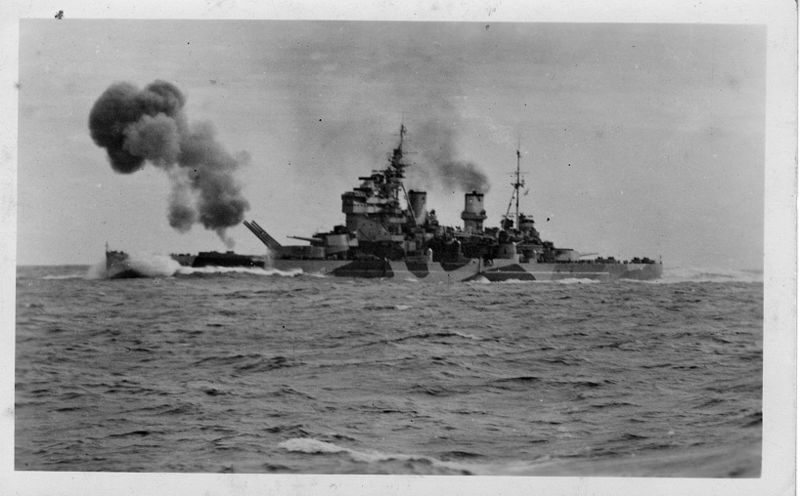
HMS_Anson_firing_guns

HMS Anson conducting gunnery exercises

The propulsion systems developed problems after 1942 when fuel oil quality was decreased because of the need for aviation gas. The new mixtures which were higher viscosity and contained more water than the boilers could effectively burn increased maintenance costs and decreased efficiency. To compensate the Admiralty designed new higher pressure fuel sprayers and burners which returned the boilers to full efficiency.

The lead ship of the class the King George V was laid down on 1 January 1937, launched on 21 February 1939 and commissioned on 11 December 1940. As the flagship of the Home Fleet she took part in the unsuccessful search for the Scharnhorst and Gneisenau and in the hunt for the Bismarck in which she earned lasting fame in helping to sink that ship. She took part in the Murmansk convoy protection as well as Operation Husky, the invasion of Sicily before sailing to the Far East for operations against the Japanese. She finished the war with the British Pacific Fleet and was present at the Japanese surrender in Tokyo Bay. She returned as flagship of Home Fleet until she was decommissioned in 1949. She was subsequently sold for scrap in 1957.
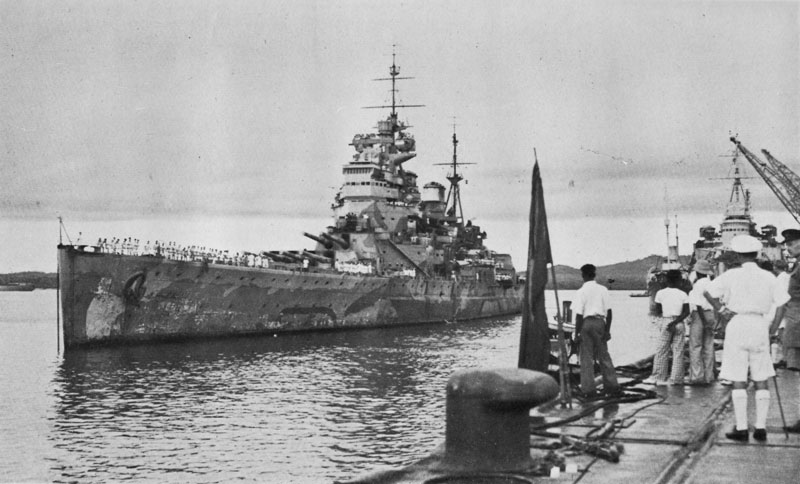
prince of wales

Prince of Wales pulling into Singapore, December 1941

The second ship the Prince of Wales laid down on 1 January 1937, launched on 3 May 1939 and commissioned 19 January 1941 although she was not officially completed until March 1941. Her initial operation came in May 1941 when she sailed with the HMS Hood to intercept the Bismarck. When she sailed she still had shipyard technicians aboard. Damaged in the action she did score an important hit on Bismarck which cut a fuel line making her forward tanks inaccessible and causing her to make her run for Brest which she did not complete. Another hit damaged her aircraft catapult and a third an electric dynamo.

Prince_of_Wales-4

Church Service on Prince of Wales at Argentia Bay with Churchill and Roosevelt in attendance

Following repairs she carried Winston Churchill to the Argentia Bay Newfoundland where he met with Franklin D. Roosevelt and together drafted the Atlantic Charter. She accompanied the HMS Repulse to Singapore to bolster the British presence in the Far East but without air cover was sunk by Japanese aircraft which struck her with 4 torpedoes and a bomb, the key hit being a lucky hit on her propeller shaft which caused flooding that caused a loss of power to pumps and anti-aircraft defenses.
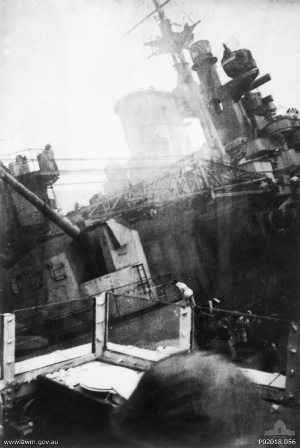
Prince_of_Wales_sinking

Prince of Wales sinking and being abandoned

The third ship the Duke of York was laid down 5 May 1937, launched on 28 February 1940 and commissioned 4 November 1941. She provided convoy escort for the Lend Lease convoys to the Soviet Union as well the sinking of the Scharnhorst on 26 December 1943 during the Battle of North Cape. She was transferred to the Pacific in 1944 and served at Okinawa. She was decommissioned in 1949 and scrapped in 1957.

duke_of_york_02

Duke of York

The fourth ship of the class the Howe was laid down on 1 June 1937, launched 9 April 1940 and commissioned on 29 August 1942. She served with the Home Fleet and in the Mediterranean until she was transferred to the Pacific in August 1944. She was stuck by a Kamikaze in May 1945 and Howe was sent for refit at Durban South Africa. She was still in refit when the war ended. She returned home and was placed in reserve in 1950 and scrapped in 1958.
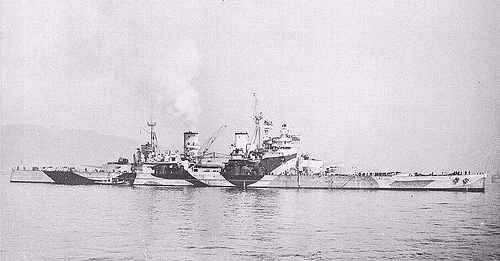
hms howe

HMS Howe

The last of the class the Anson was laid down 20 July 1937, launched 24 February 1940 and commissioned on 22 June 1942. She operated in the Mediterranean and the North Atlantic and was sent to the Pacific in 1945 where she accepted the surrender of the Japanese Forces at Hong Kong. She returned to Britain and was decommissioned in 1951 and scrapped in 1957.
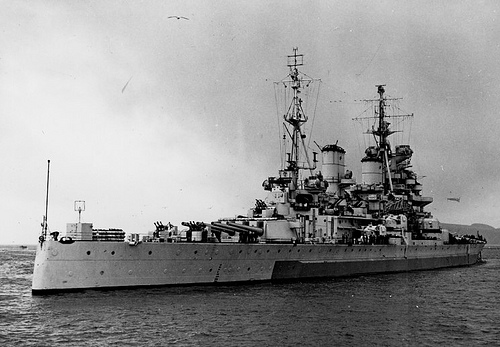
hms anson

HMS Anson

The ships had rather unremarkable careers for the most part with the exception of the Prince of Wales and King George V in the hunt for the Bismarck and the Duke of York sinking the Scharnhorst. They had a number of technical problems which limited their operations in the war. However they and their brave crews deserve to be remembered as helping to hold the line against the Axis in the early years of the war and sank two of the four German Battleships lost during the war. This alone was as remarkable achievement as of their contemporaries only the USS Washington sank an enemy battleship in combat.
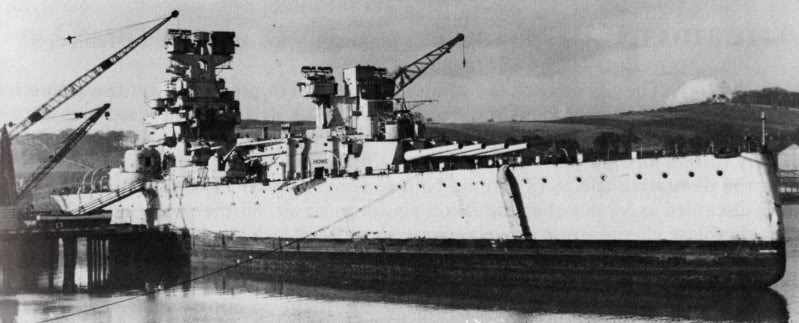
hmshoweundergoingscrappingatwards-n

The End: HMS Howe Being Scappped 1958 
1 Comment

Filed under History, Military, Navy Ships

Pride of the Regina Marina: The Vittorio Veneto Class Battleships

vittorio veneto and littorio

Friends of Padre Steve’s World

It has been another really hectic and busy day and though I want so much to comment on Donald Trump’s exceptionally inept answers or Matt Lauder’s incredibly moronic interview on foreign policy and military matters, I am too tired to do so. Perhaps tomorrow, but today I am going back deep into the archives and post an article about a class of battleships that are often overlooked, but for their time they were magnificent ships. These were the Vittorio Veneto, Littorio, and Roma. 

I hope that you enjoy,

Peace

Padre Steve+

This is the first in a series of five articles on the battleships built under the provision of the Washington and London Naval Treaty limitations in the 1930s. I am not including the ships which were completed in the immediate aftermath of the Washington Treaty limitations. This series looks at the modern battleships that the World War II combatants would produce in the 1930s which saw service in the war. Part one covers the Italian Vittorio Veneto class, Part Two the French Dunkerque and Richelieu Classes, Part Three the British King George V Class and Part Four the American North Carolina and South Dakota Classes. I have already published the final part which covers the German Scharnhorst Class entitled Power and Beauty the Battle Cruisers Scharnhorst and Gneisenau The German Bismarck, Japanese Yamato, British Vanguard and American Iowa Classes will be covered in a subsequent series.

Technically many of these ships were constructed after the expiration of the treaties but since most of the navies at least attempted to maintain a façade of compliance with them most were officially listed as complying with the treaty restrictions.

The Washington Treaty placed a limit on the displacement and armament of battleships. The London Treaty continued them which limited the displacement of new ships to 35,000 tons with the main battery being limited to 16” guns. Each of the treaty signatories as well as the Germans who had been bound by the much more stringent Treaty of Versailles restrictions endeavored to build to the limit of the treaty and if possible skirt the limitations in terms of displacement which allowed them to increase protection as well as more powerful engineering plants.

The Royal Italian Navy had not completed a battleship design since the Andria Doria Class which were constructed between 1912 and 1915 and modernized given an extensive modernization between 1937 and 1940. A subsequent class the Francesco Caracciolo class was started during the First World War but no ships of the class were completed.

In the 1930s a new naval arms race was underway in the Mediterranean as the French Navy had begun a new class of Fast Battleships, the Dunkerque class which were designed to defeat the German Deutschland class “pocket battleships” and the follow on Richelieu Class. Mussolini saw the new French ships as a threat to the control of the Mediterranean and ordered the construction of a new class of battleships to help Italy achieve naval dominance in the Mediterranean.

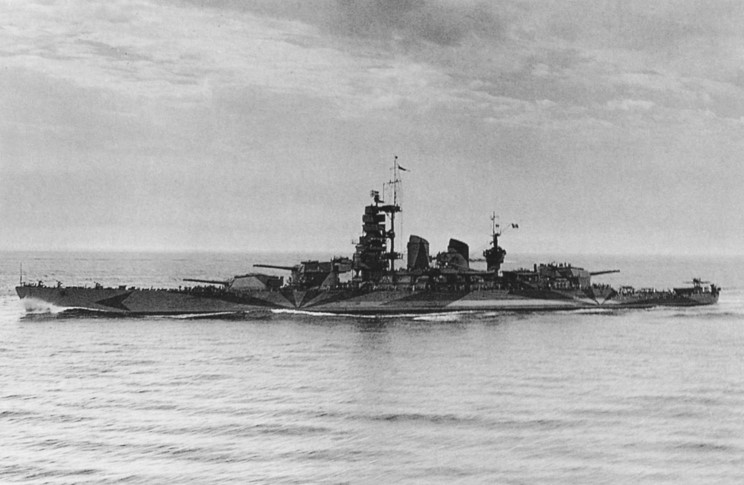
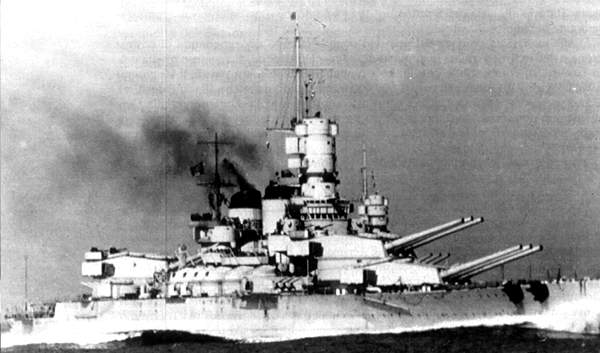
The new ships were of a breathtaking design, large, fast and heavily armed officially listed as meeting the prescribed treaty limit of 35,000 tons they actually would displace 41,177 tons standard displacement and 45,963 tons full load. Armed with a main battery of 9 15” guns in triple turrets and a secondary armament of 12 6” and 12 3.5” guns along with 20 37mm and 30 20mm anti-aircraft guns and capable of 29 knots in service and with a relatively short range of 3900 miles at 20 knots they were formidable ships for operations in the Mediterranean. They were well protected although their Pugliese torpedo defense system proved inferior to traditional designs.

Their main armament though formidable was not without its flaws. The 15” guns had a very long range of 42 km or 26.6 miles and high muzzle velocity of 2900 fps. The high muzzle velocity led to a barrel life of only about half that of their counterparts and inconsistent shell fall patterns. The guns also suffered from a slow rate of fire of only 1.3 rounds per gun a minute.

The Ships:

vittorio_veneto_1943

Vittorio Veneto in 1943

Vittorio Veneto: The lead ship of the class, Vittorio Veneto was laid down 1934 along with her sister the Littorio and was launched on 25 July 1937 and commissioned on 28 April 1940. She would see action numerous times and give a good account of herself against the British taking part in 56 war missions. She fought at the Battle of Cape Spartivento (Teulada) where she fired 19 salvos to drive off a 7 ship British cruiser squadron in a pitched battle that also included the battleship HMS Ramillies and battle cruiser HMS Renown. In 1941 she took part in the Battle of Cape Matapan where she was damaged by an aerial torpedo after driving off a British cruiser squadron. After repairs she was back in action and on 15 June 1942 participated in the Battle of Mid-June, where she and her sister ship Littorio successfully fenced off a large British convoy from Alexandria by their mere presence at sea. She was also the first Italian battleship equipped with radar. She surrendered with the Italian fleet to the Allies on 8 September 1943 surviving furious German air attacks. She was interred at the Great Bitter Lakes in the Suez Canal. After the war she taken as war compensation and was returned to Italy and scrapped beginning in 1948.

Littorio

Littorio

Littorio (later Italia): Littorio was laid down in 1934 and launched on 22 August 1937 and commissioned on 6 May 1940. She participated in 43 operations including the Battle of Sirte and several actions against British convoys. Following the Battle of Mid-June she was struck by an aerial torpedo dropped by a Wellington bomber. She was repaired and upon the removal of Mussolini from power was renamed Italia and surrendered with the Italian Fleet on 8 September 1943 being damaged by a Fritz-X radio controlled bomb. With her sister Vittorio Veneto she was interred in the Great Bitter Lake and was returned to Italy where she was decommissioned and scrapped beginning in 1948.

Roma_(1940)

Roma

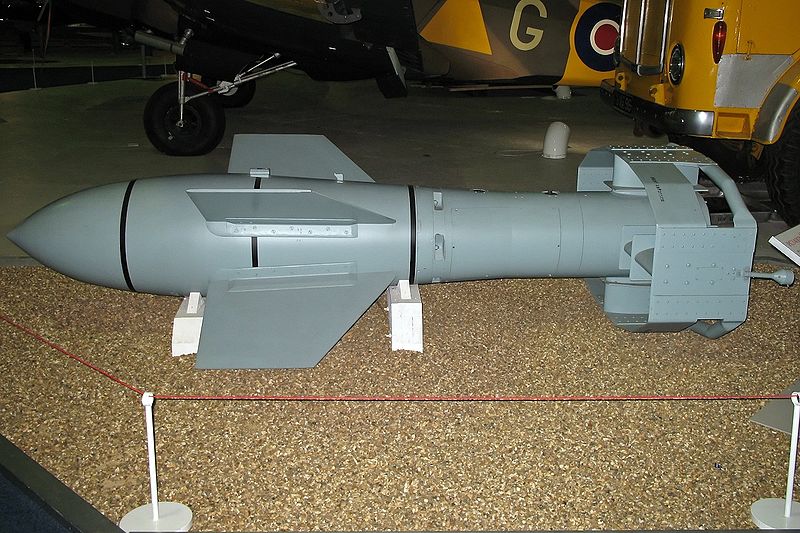
Roma: Roma was laid down 18 September 1938, launched on 9 June 1940 and commissioned 14 June 1942. Despite her addition to the fleet she was not deployed due to a fuel shortage. She sailed with the Italian Fleet to surrender on 8 June under the guise of the fleet sailing to attack the Allied invasion fleet off Salerno. The Germans discovering the ruse launched air attacks by Dornier Do-217s armed with Fritz-X radio controlled bombs attacked the fleet as it transited the Strait of Bonafacio.

Roma_(1940)_exploding

Roma exploding after being hit by Fritz-X radio guided bomb

Roma was hit by two of the missiles the first which flooded two boiler rooms and the aft engine room. She was hit soon after by a second Fritz-X which hit in the forward engine room causing catastrophic damage and igniting the number two turret magazine blowing the turret off the ship and causing the ship to capsize and break in two as she sank carrying 1255 of her crew including Admiral Carlo Bergamini to their death. Roma was the first ship sunk by a radio controlled bomb, the forerunner of our current air launched anti-ship missiles. Her wreck was discovered in June of 2012 about 30 kilometers off the northern coast of Sardinia.

Fritz_X_

The Fritz-X Radio Guided Bomb

Impero: The last ship of the class, the Impero was laid down but never completed and scrapped after the war.

The Vittorio Veneto class was a sound design and operationally successful against the Royal Navy and the brave sailors of the Regina Marina who manned these fine ships should not be forgotten.

Leave a comment

Filed under History, Military, Navy Ships, world war two in europe

From Monitor to Musashi: a Tale of Legendary Warships

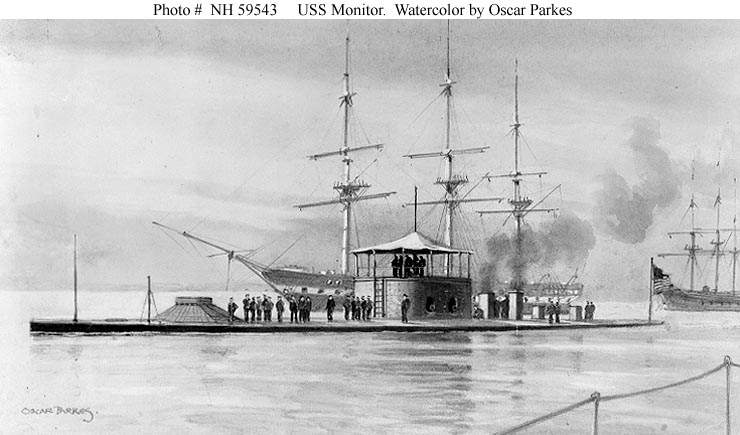
300px-Japanese_battleship_Musashi_cropped monitor watercolor

Musashi and Monitor

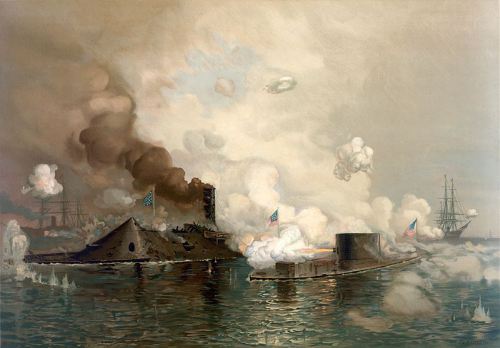
I have been thinking about two ships this past week. One of these ships was the Japanese Super-Battleship Musashi. The Musashi was one of the two largest battleships ever constructed and her wreck was discovered last week where she sank in the Sibuyan Sea. The other ship was the USS Monitor. The tiny Monitor was progenitor of all the great battleships that followed and 153 years ago Monitor helped propel naval architecture and warfare into a new era when she challenged the CSS Virginia at the Battle of Hampton Roads.

The Monitor was one of three experimental designs chosen by the Navy’s Ironclad board to deal with the Virginia. Her design and construction were remarkable, especially for her day. The ship was entirely experimental, nothing like Monitor had ever been built before, but even so it was less than five months from the date she was ordered until she was commissioned and just a few days more than that before she was in action. I cannot imagine any warship ship new design ever breaking that record.

Her designer was John Ericsson, a Swede. Ericsson was the inventor of the screw propeller and designer of the first U.S. Navy Screw Frigate the USS Princeton. Ericsson had be shunned by the Navy after a rifled cannon, which was not of his design or construction exploded aboard Princeton during a gunnery demonstration which killed the Secretary of the Navy and others. Ericcson was not planning to submit a design but was persuaded to and his design, the Monitor was one of the three designs selected.

officersondeckweb1

The Officers of Monitor

The Monitor was like nothing ever seen on the ocean. Described by some as a “cheese box on a raft” the small ship had all of her machinery located below the waterline on a completely iron hull that only drew 11 feet of water. She was 179 feet long, had a beam of 41 and a half feet and displaced 987 tons. Her single vibrating lever steam engine powered by two boilers produced 340 horsepower and drove her at a top speed of six knots.

Her hull was protected by armor plate, but the most notable and innovative feature was a heavily armored revolving turret with eight inches of armor, mounted two massive 11 inch Dahlgren smoothbore guns which “could fire a 170-pound shot or 136-pound shell in any direction except straight ahead, where the pilot house sheathed in nine inches of armor was located.” Future ships remedied this defect. Ericcson’s ship was mocked around the navy and by naval designers, but he and it would prove them wrong. The Monitor’s most notable features, full steam propulsion, heavy armor and the revolving turret mounting heavy caliber guns would set the standard to which future battleships would be constructed.

800px-the_monitor_and_merrimac1

The Battle of Hampton Roads

Monitor had a brief service life, she fought the Virginia, took part in actions along the James River and sank in a storm off Cape Hatteras North Carolina on December 31st 1861. The British Royal Navy designed an improved monitor with higher freeboard and finally an ocean going turret ship, the HMS Devastation.

Soon, the navies of the world began to build battleships and in 1906 the Royal Navy built the HMS Dreadnought which like Monitor revolutionized warship construction and naval warfare. Navies around the world began building ever larger, faster and more powerful Dreadnoughts culminating the designs of the late 1930s, the German Bismarck class, the American Iowa class, the British Vanguard, and the Japanese Yamato Class. It is the last ships, the Yamato and her sister Musashi that I want to discuss here, not that the others are not interesting or important, but because of the almost mythic status that these ships maintain in the annals of naval history, as well as their tragic end.

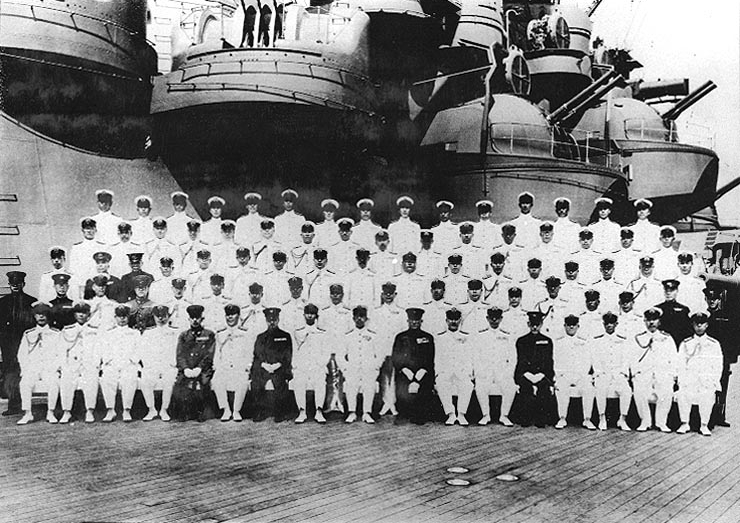
 Hiro-Hito_on_Musashi

Emperor Hirohito on Musashi in 1943

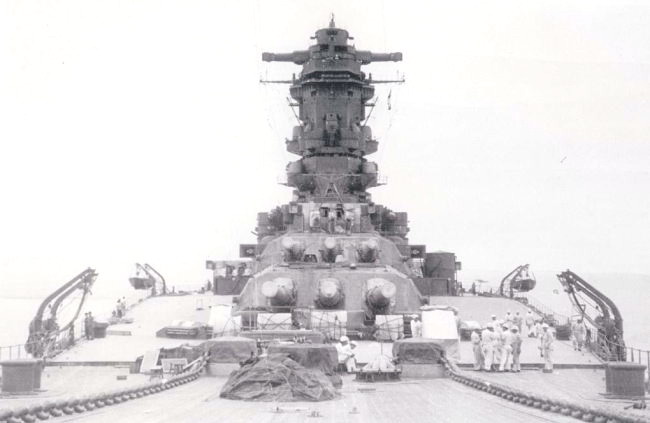
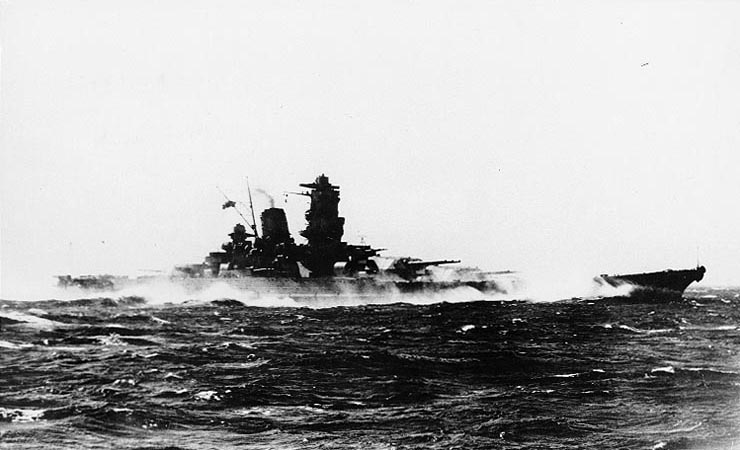
The Yamato and Musashi were the largest and most heavily armed battleships ever built. Shrouded in secrecy by the Imperial Japanese Navy and Government the ships were designed to offset projected American numerical superiority. Their names were symbolic of Japan’s history. Yamato was named after Yamato Province, the ancestral home of the Yamato People, the dominant native ethnic group in Japan. Musashi was named after Musashi Province in which lays Tokyo Prefecture.  A third ship of the class, Shinano, was named after Shinano Province in central Japan which was the home of the prestigious Taketa Shingen family during the Senguku period.

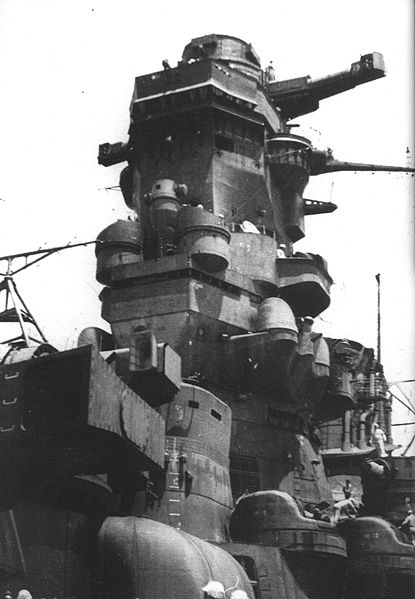
415px-Musashi,Bridge

The Conning Tower and Bridge of Musashi

The secrecy surrounding their design and construction was unprecedented. Those charged with their design and construction were thoroughly checked out by Japan’s secret police and sworn to an oath of secrecy. The oath sworn by builders of Musashi at the Mitsubishi Heavy Industries Nagasaki Shipyard were sworn to the oath shown below:

I am aware that all work involving the construction of the No. 2 Battleship is vital to national security. I will make utmost effort to maintain the secrecy of the project, and swear that I will leak no information relating to the said battleship, even to relatives and close friends. In the event I violate this oath,  I will submit to the punishment determined by the company and the Navy.  

Security measures around the shipyards where Yamato and Musashi were constructed were immense. At Nagasaki where there was a large foreign business and missionary population where the shipyard was visible from most of the city at hemp screen of 75,000 square meters was constructed to shield the ship from prying eyes and spies.

1938_Japan_Navy_battleship

Musashi under Construction

When actual preparations for construction were taken in 1937 secret police swept the areas of foreign, especially Chinese workers. Security was increased inside and outside the shipyard, all blueprints accounted for and placed under strict guard while all shipyard workers were photographed with any having knowledge of the plans or supervising the construction sworn to the secrecy oath.

When a top secret blueprint went missing in 1938 at Nagasaki an intense investigation that included the torture of numerous suspects and the jailing of a blueprinter who accidentally swept the document into the trash was sentenced to 3 years in prison.

heel1

Armor and Protection of Yamato Class

Few pictures exist of the ships and Japanese Naval Officers destroyed many of the records of the ships design and construction just prior to the end of the Second World War. Throughout their existence they were a mystery to the American Navy. During the war the U.S. Navy estimated them to carry nine 16” guns and displace between 40,000-57,000 tons. Even the highly regarded Jane’s Fighting Ships listed them at just 45,000 tons.

800px-YamatoClassBattleships

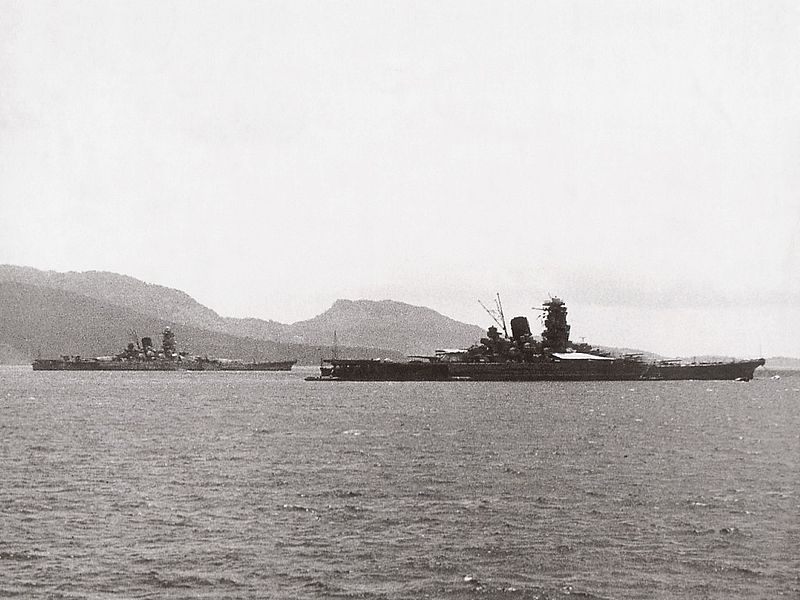
Yamato and Musashi together in 1943

Preliminary design work began in 1934 and progressed rapidly following Japan’s withdraw from the League of Nations and renunciation of the Washington and London Naval Treaties and withdraw from the 1936 naval talks in London. The early designs varied in the caliber of guns, size and armor, propulsion systems and endurance. Gun calibers ranged from 16” to 18.1” and a combined diesel-turbine system was considered but rejected in favor of traditional steam turbines.

The final design was for a class of five ships. Each would displace 64,000 tons standard displacement and 72,000 tons at full load. They were 862 feet long with a beam of 127 feet.  They were so large that the docks they were built needed to be expanded and special extra-large launch platforms had to be built.  At Nagasaki the dock at to be expanded by cutting into the hill adjacent to it.

They were armed with nine 18.1 inch guns in triple turrets which could fire a projectile weighing over a ton. The secondary armament consisted of 12 6.1 inch guns mounted in triple turrets formerly mounted on the Mogami Class cruisers when those ships were equipped with 8” guns. Anti-aircraft defense included twelve 5” guns and twenty-four 25mm anti-aircraft guns. During the war two of the 6.1 inch turrets were removed and replaced with twelve more 5” guns and the 25mm battery was raised to 162 guns. Fire control systems were designed in such a way that the ships could engage multiple surface targets at the same time.

The ships were protected by a massive armored belt ranging from 16 inches to 8 inches with 26 inch armor on the face plates of the main gun turrets. The armor was advanced with excellent sloping but had a flaw where the upper and lower belts connected just below the waterline which exposed them to damage from torpedoes.

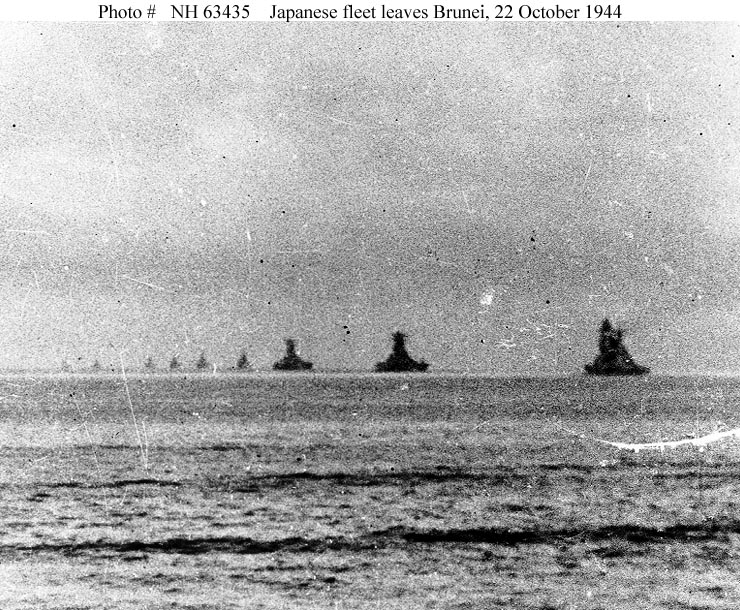
Photographed just prior to the Battle of Leyte Gulf. Ships are, from left to right Musashi, Yamato, a cruiser and Nagato.

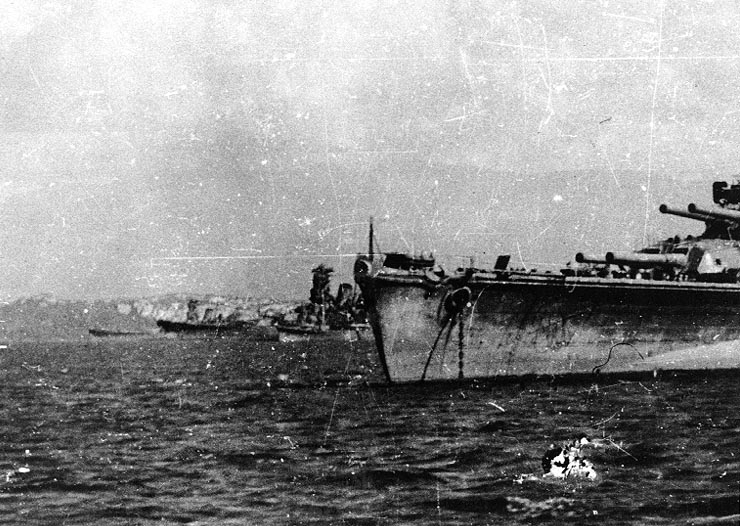
Yamato and Musashi viewed beside Battleship Nagato (foreground) just before the Battle of Leyte Gulf

They were powered by 12 Kampon boilers which powered 4 steam turbines and four three bladed propellers. These developed 150,000 shp and could drive the ship at a top speed of 27 knots.

Construction of Yamato began on November 4th 1937 at Kure Naval Shipyard. Musashi on March 28th 1938. Traditionally such events were large public ceremonies but these were limited to just a few Naval Staff and Shipyard executives.  Yamato was launched on August 8th 1940 and commissioned on December 16th 1941, just 9 days after Pearl Harbor. Musashi was launched on November 8th 1940 and commissioned on August 5th 1942 just two days before the U.S. Marines invaded Guadalcanal and two months after the disaster at the Battle of Midway.

Yamato served as Admiral Yamamoto’s flagship at Midway where she saw no action. The next two years she was and Musashi alternated as fleet flagship and conducted operations with Battleship Division One in operations between Mainland Japan and the major Japanese base at Truk. On December 25th 1943 while escorting a convoy she was torpedoed by the submarine USS Skate and suffered heavy damage which flooded a magazine.  On March 29th while underway Musashi was struck near the bow by a torpedo from the USS Tunny.

Musashi_under_fire

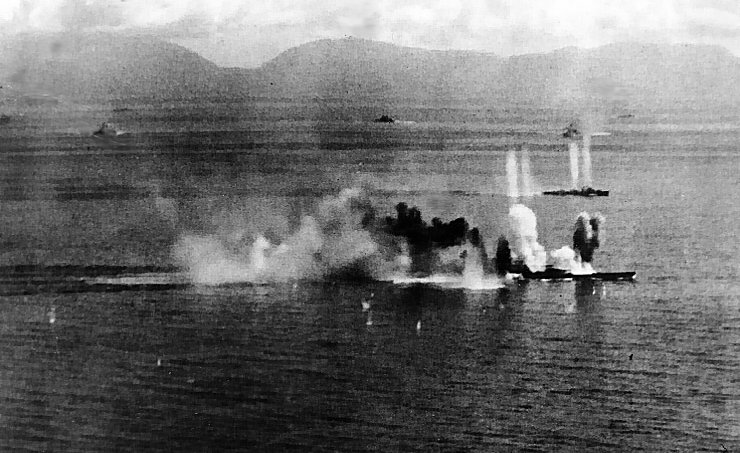
Musashi under attack at the Battle of Sibuyan Sea

Both ships participated in the Battle of the Philippine Sea and were part of Vice Admiral Takeo Kurita’s Central Force in the Battle of Leyte Gulf. Musashi was sunk by U.S. Navy Carrier aircraft from the Third Fleet on October 24th 1944 during the Battle of the Sibuyan Sea. Hit by 17 bombs and 19 torpedoes she sank with the loss of nearly 1100 of her crew of almost 2400 men. The survivors were rescued by destroyers and disembarked at Corregidor. Some were sent by troop transport to Japan but one of the ships was torpedoed and sunk leaving her survivors adrift for 19 hours before rescue. Those who reached Japan were isolated from the population while about half of the survivors remained in the Philippines where 117 of 146 of those assigned to the defense of Manila were killed in action.

Yamato_hit_by_bomb

Yamato or Musashi under air Attack

Yamato saw action in the surface engagement on October 25th against the Escort Carriers and Destroyers of Taffy-3 during the Battle off Samar. Her guns helped sink the Escort Carrier USS Gambier Bay but was forced away from the action by torpedo attacks from the valiant destroyers of Taffy-3.

last-05

Yamato under Attack April 7th 1945

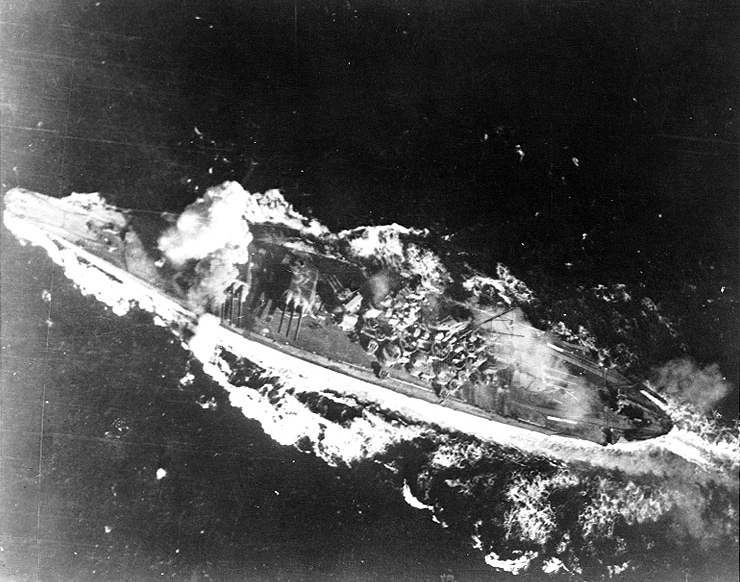
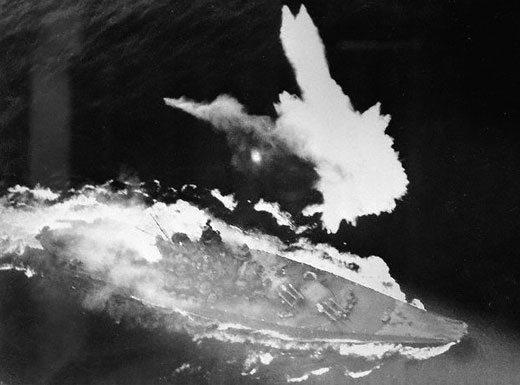
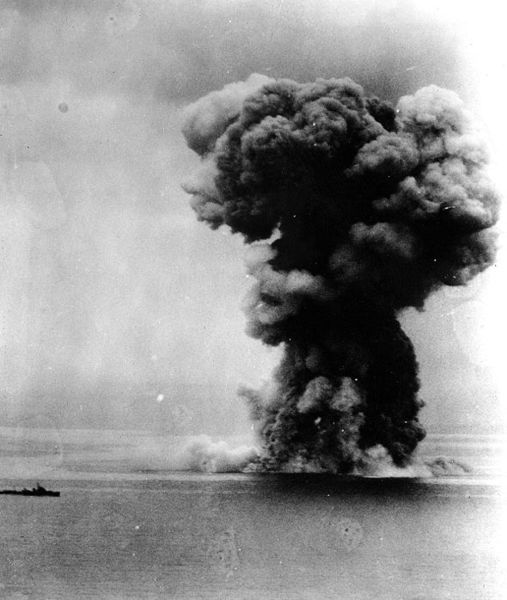
By April 1944 Japan’s Navy was decimated and U.S. Naval Forces were raiding Mainland Japan. When the United States landed on Okinawa the Japanese Navy and air force launched wave after wave of Kamikaze attacks on the ships in the waters around the island. Yamato, along with Light Cruiser Yahagi and eight destroyers were designated the Surface Special Attack Force and loaded with a full load of ammunition but only enough fuel for a one way trip got underway on April 6th. The mission was for Yamato to reach Okinawa, beach herself and serve as an “unsinkable” gun battery until she was destroyed. The force was spotted by U.S. Navy flying boats hours after their departure and on April 7th over 400 aircraft launched from Task Groups 58.1 and 58.3. The first wave began its attack at 1230 and by 1400 the ship was mortally wounded. Stuck by at least 8 torpedoes and 11 bombs she was dead in the water and began to capsize at 1405. At 1420 she turned turtle and at 1423 exploded when her forward blew up sending up a mushroom cloud nearly 20,000 feet.  Under 300 of her crew of nearly 2400 were rescued.

507px-Yamato_explosion

The End: Yamato Explodes

What had begun with the tiny “cheese box on a raft” had culminated in two of the largest warships ever built, designed when naval experts planned for a war where the battleship would rule and aircraft carriers play a supporting role. Instead both never faced enemy battleships in combat and both were destroyed by the weapon that the battleship admirals had discounted. It is somewhat fitting that each was commissioned shortly after the triumphs of Japanese and American Naval air power at Pearl Harbor and Midway. However they have attained an almost mythic status in naval lore and are symbols to many Japanese of the sacrifice and futility of the war. Both of the cities where the ships were constructed were destroyed by Atomic bombs. They are tragic reminders of the cost of war in human lives, suffering, economic cost and destruction.

musashi wreck

Musashi’s wreck was discovered by Microsoft co-founder Paul Allen. He posted the first picture of the ship taken in over seventy years, showing the Chrysanthemum seal on her bow to Twitter. As a devotee of these great ships I was amazed to see this.

In a sense their poetic names and the myth ascribed to them are a tragic requiem to the Japanese Empire and the cost of war. They and their brave sailors were sacrificed when the war was already for all intents and purposes lost. They, especially the Yamato were sacrificed for no military purpose save a convoluted sense of honor. Let us pray that it never happens again.

Peace

Padre Steve+

Leave a comment

Filed under civil war, History, Military, Navy Ships, US Navy, world war two in the pacific

The Never Built Battlecruisers of 1921: The G3, Amagi and Lexington Classes

artist

Artists Depiction of G3 Battlecruiser 

As the First World War ended a new Naval Race was heating up. The United States had announced its intention during the war to build a navy second to none while Imperial Japan was making plans for a fleet that would give it superiority in the Western Pacific. The British, though still be far the largest naval power in the world were burdened by the massive costs of war and empire, but also seeking to maintain their naval dominance.

The ships known as battle cruisers were first built by the British Royal Navy as a compliment to the all big gun Dreadnought battleships. The Battle Cruiser concept was a ship of roughly the same size and firepower as a Battleship but sacrificing protection for greater speed, endurance and range.  and Japan joined in the Battle Cruiser race before and during the war. The United States had concentrated on Battleships.

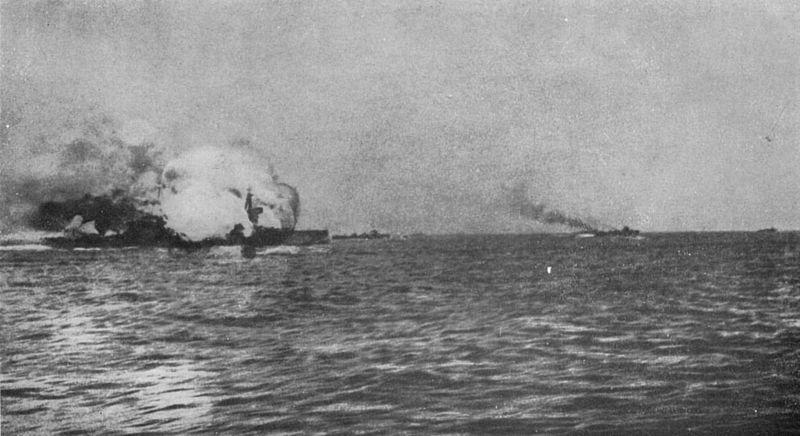
800px-InvincibleBlowingUpJutland1916

HMS Invincible Blowing Up at Jutland 

During the war the weaknesses of the type were exposed during the Battle of Jutland where three British Battle Cruisers, the HMS Invincible, HMS Indefatigable and HMS Queen Mary blew up with the loss of most of their crews of the  3311 officers and sailors on the ships only 26 survived. The HMS Lion was almost lost in a similar manner but for the heroic actions of her crew. The British ships had glaring deficiencies in armor protection and the arrangement of their ammunition magazines and hoists which certainly contributed to their loss. Their German counterparts on the other hand proved much tougher and though all sustained heavy damage while engaging British Battleships and Battle Cruisers, only one the Lützow was lost. She absorbed over 30 hits from large caliber shells and only lost 128 crew members.

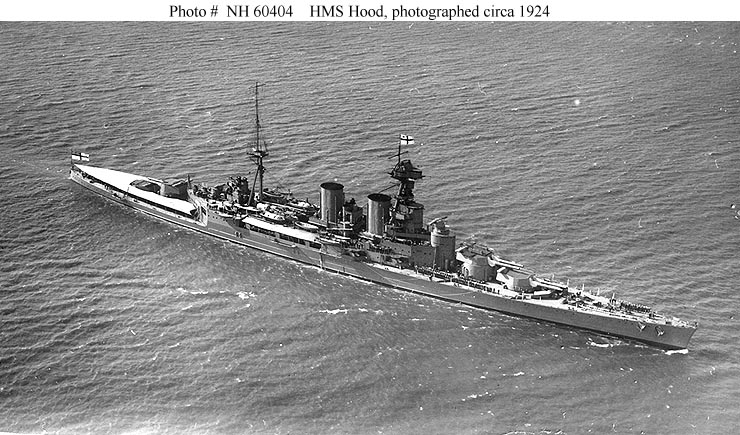
h60404

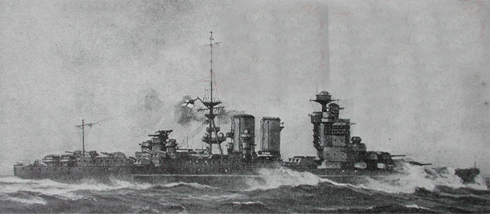
As the war progressed other Battle Cruisers were built, the British launched the HMS Repulse and HMS Renown and completed the HMS Hood shortly after the war was over. The Japanese built the four ship Kongo class from a British design. As the powers embarked on the next Naval Race planners and naval architects designed ships of massive firepower, better protection and higher range and speed. All would have been better classed as Fast Battleships.

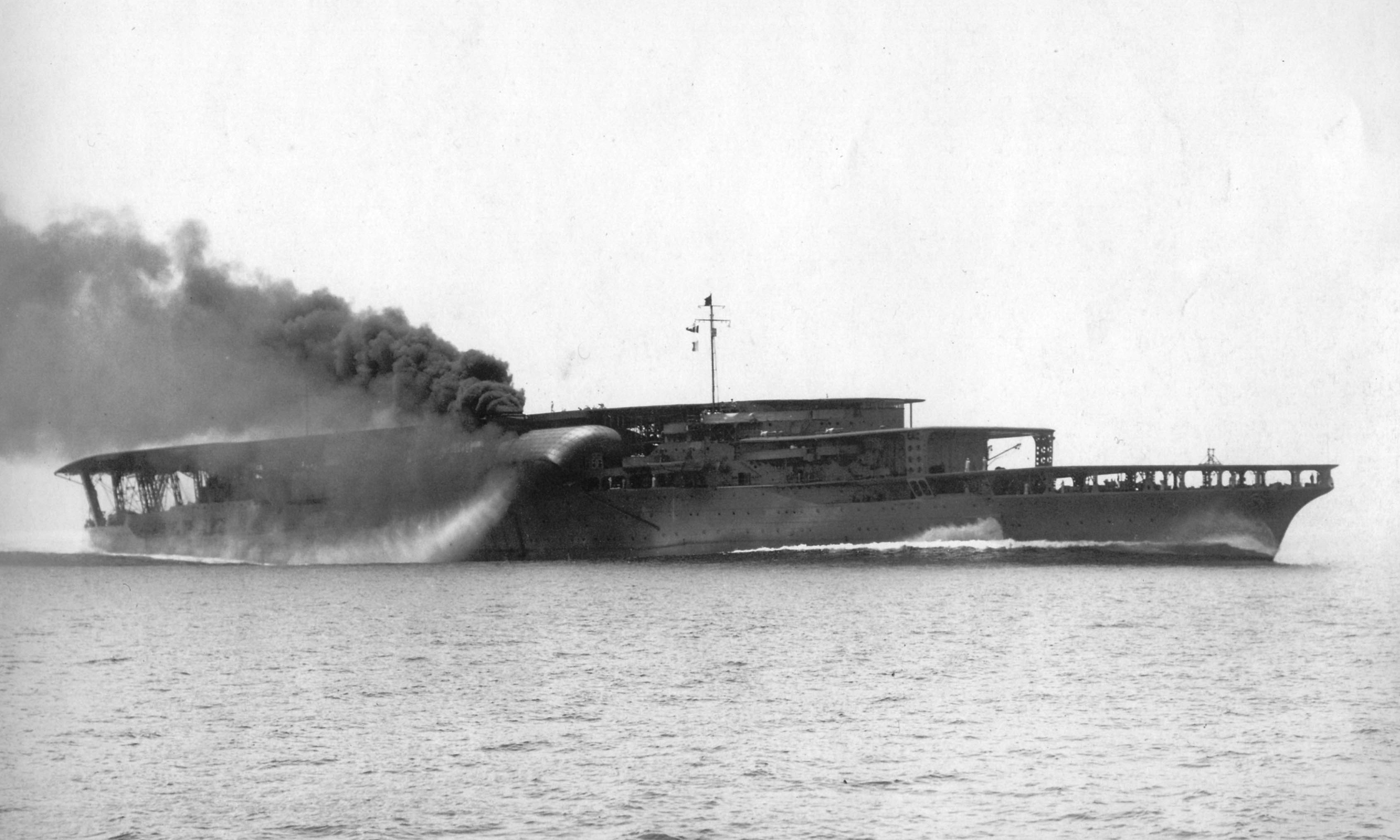
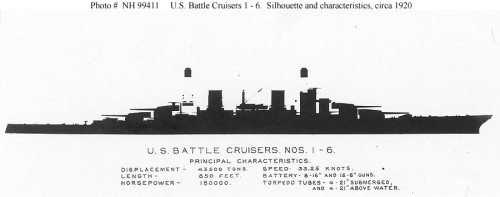
The British designed and began construction on the G3 class in 1921, the Japanese the Amagi Class, and the United States the Lexington Class. However the construction and completion of these ships as Battle Cruisers was prevented by the Washington Naval Treaty.

invincible 490

The treaty was ratified in 1922 limited the United States and Great Britain to a maximum of 525,000 tons in their battle ship fleets and 125,000 tons in aircraft carriers.  The Japanese agreed to a limit of 315,000 tons and the French and Italians 175,000 tons each. Tonnage for battleships was limited to a maximum of 35,000 tons with a limitation on guns size to 16 inches.  Since the bulk of the ships planned or being built by the US and Japan exceeded those limits they would be effected more than the British whose post war shipbuilding program had not begun in earnest, in fact the G3 Class had just been approved for construction.

The G3 class would have comprised four ships and been similar to the N3 Class Battleships. They were very well balanced ships and would have mounted nine 16” guns in three turrets on a displacement of 49,200 tons and deep load of 54,774 tons. They had an all or nothing protection plan meaning that the armored belt was concentrated in vital areas around the armored citadel, conning tower, turrets and magazines and engineering spaces. Their armor belt would have ranged from 12-14 inches, deck armor from 3-8 inches, conning tower 8 inches, barbettes 11-14 inches, turrets 13-17 inches and bulkheads 10-12 inches. Their propulsion system of 20 small tube boilers powering 4 geared steam turbines connected to 4 propeller shafts would have produced 160,000 shp with a designed speed of 32 knots.

The four ships, none of which were named were ordered between October and November of 1921. Their construction was suspended on November 18th 1921 and they and the N3 Battleships were cancelled in February 1922 due to the limitations of the Washington Naval Treaty. Many concepts of their design were incorporated in the Nelson Class Battleships.

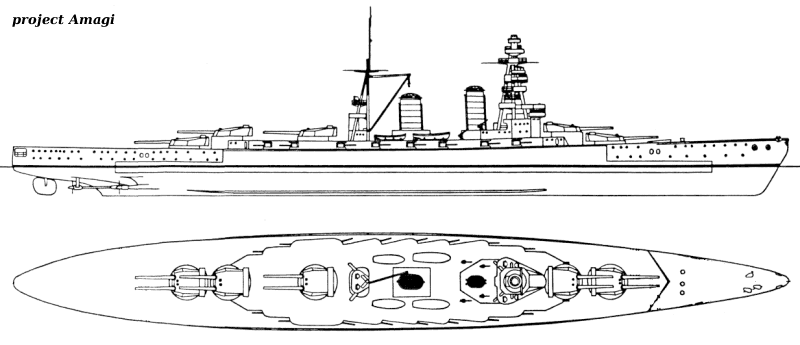
rys-amagi

Amagi Class as Designed, Akagi as Completed (below) 

JapaneseAircraftCarrierAkagi3Deck_cropped

The four planned Japanese Amagi Class ships would have mounted ten 16” guns on a displacement of 47,000 tons at full load. Their propulsion system 19 Kampon boilers powering four Gihon turbines would have given them a maximum speed of 30 knots, They would have had less protection than the G3 ships being more of a traditional Battle Cruiser design. As a result of the Washington Naval Treaty the Japanese elected to convert two of the ships, the Amagi and Akagi to aircraft carriers. Amagi was destroyed on the ways during the great Tokyo earthquake and Akagi was completed as a carrier. The other two vessels were scrapped on the ways.

lexington-class-battle-cruisern11978

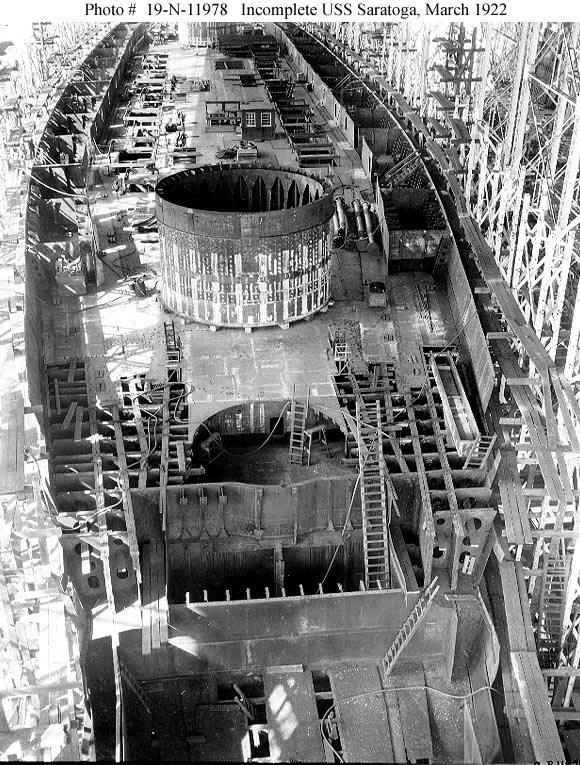
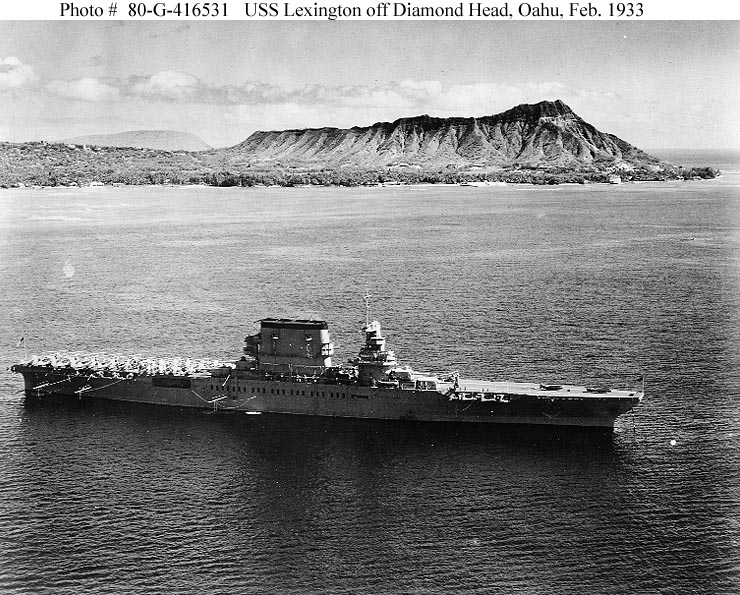
The United States Navy planned the six ship Lexington Class. These ships would have mounted eight 16” guns on a ship displacing 43,254 tons at full load. They would have had a maximum speed of 33 knots being powered by 16 boilers which drove 4 GE electric turbines producing 180,000 shp. It was a massive engineering plant and the class did not have as heavy armor protection as either the G3 or Amagi classes but were superior in speed as well as endurance. Upon ratification of the Washington Naval Treaty four of the six ships were cancelled and the remaining two, the Lexington and Saratoga competed as aircraft carriers.  Had any of the ships been completed as Battle Cruisers it is likely due to their speed that they would have operated primarily with the the carriers that the US Navy built during the 1930s.

g416531

One can only speculate what the navies of World War II would have looked like had the Washington and the subsequent London Naval Treaties not been ratified. One can also only imagine how the war at sea would have been different had the ships completed as carriers been completed as Battle Cruisers.

However that was not to be, of the planned 14 ships of these three classes only three were completed, all as aircraft carriers. Thus they are an interesting footnote in the annals of naval ship design and not much more.

Until tomorrow,

Peace

Padre Steve+

4 Comments

Filed under History, Military, Navy Ships, US Navy

Battleship Row: The Story of the Battleships of Pearl Harbor

the-japanese-attack-on-pearl-harbor-everett-2

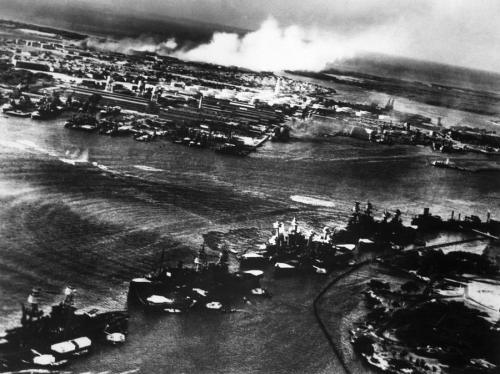
“Yesterday, Dec. 7, 1941 – a date which will live in infamy – the United States of America was suddenly and deliberately attacked by naval and air forces of the Empire of Japan…. The attack yesterday on the Hawaiian Islands has caused severe damage to American naval and military forces. Very many American lives have been lost.” Except of President Franklin D Roosevelt’s Pearl Harbor Speech December 8th 1941

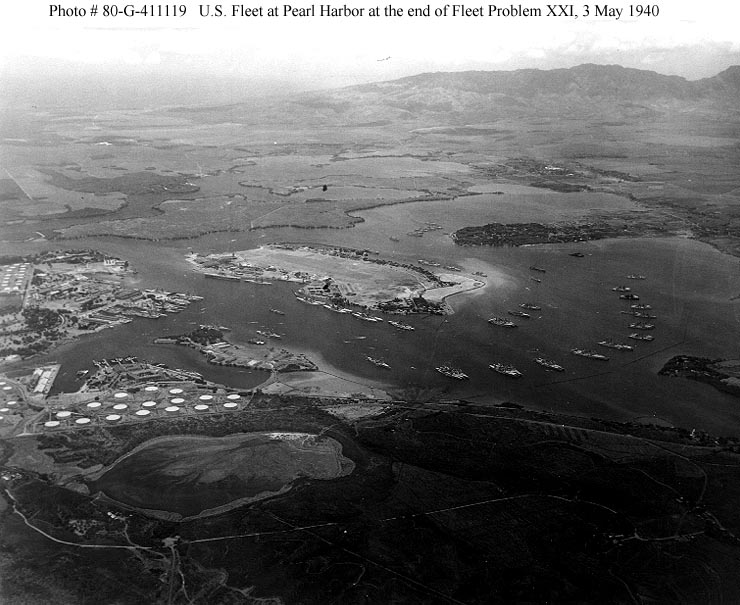
g411119

Today is the 72nd anniversary of the Japanese attack on Pearl Harbor and as we were then we are at war. Of course it is not the same kind of war and most Americans live in the illusion of peace which makes it even more important to remember that terribly day of infamy.

I remember reading Walter Lord’s classic and very readable book about Pearl Harbor “Day of Infamy” when I was a 7th grade student at Stockton Junior High School back in 1972.  At the time my dad was on his first deployment to Vietnam on the USS Hancock CVA-19.  As a Navy brat I was totally enthralled with all things Navy and there was little that could pull me out of the library.  In fact in my sophomore year of high school I cut over one half of the class meetings of the 4th quarter my geometry class to sit in the library and read history, especially naval and military history.

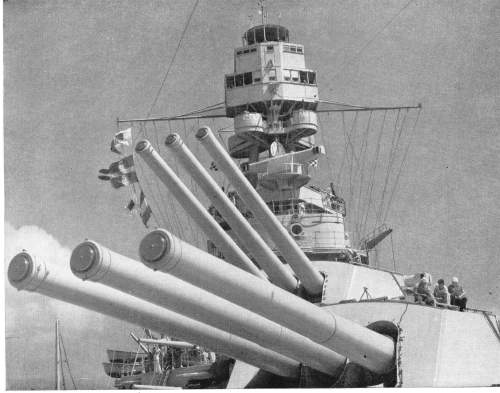
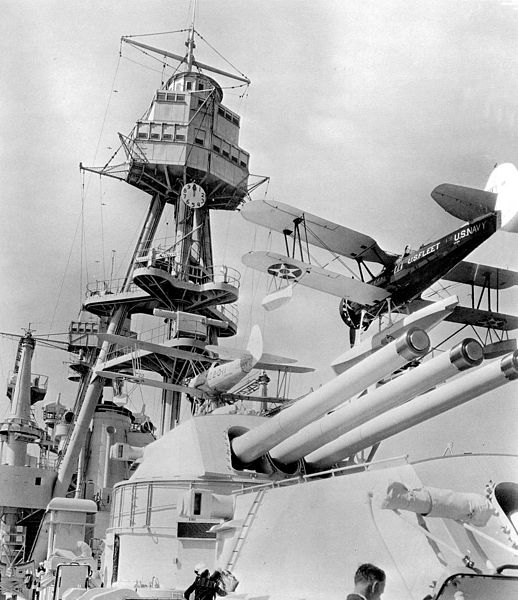
arizon-main-battery2-2

The main battery of either USS Arizona or Pennsylvania 

Over the years I have always found the pre-World War Two battleships to be among the most interesting ships in US Navy history.  No they are not the sleek behemoths like the USS Wisconsin which graces the Norfolk waterfront. They were not long and sleek, but rather squat yet exuded power. They were the backbone of the Navy from the First World War until Pearl Harbor.  They were the US Navy answer to the great Dreadnaught race engaged in by the major Navies of the world in the years prior to, during and after World War One.

pennsylvania-under-golden-gate

USS Pennsylvania passing under the Golden Gate

Built over a period of 10 years each class incorporated the rapid advances in technology between the launching of the Dreadnaught and the end of the Great War.  While the United States Navy did not engage in battleship to battleship combat the ships built by the US Navy were equal to or superior to many of the British and German ships of the era.

puyBfl

US Battleships at the Grand Fleet Review of 1937

Through the 1920s and 1930s they were the ambassadors of the nation, training and showing the flag. During those years the older ships underwent significant overhaul and modernization.

arizona-and-battleline

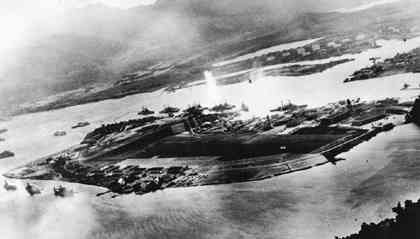
The Battle Force of the Pacific Fleet in 1941 included 9 battleships of which 8 were at Pearl Harbor on the morning of December 7th.  In the event of war the US War Plan, “Orange” called for the Pacific Fleet led by the Battle Force to cross the Pacific, fight a climactic Mahanian battle against the battleships of the Imperial Japanese Navy and after vanquishing the Japanese foe to relieve American Forces in the Philippines.  However this was not to be as by the end of December 7th all eight were out of action, with two, the Arizona and Oklahoma permanently lost to the Navy.

The ships comprised 4 of the 6 classes of battleships in the US inventory at the outbreak of hostilities.  Each class was an improvement on the preceding class in speed, protection and firepower.  The last class of ships, the Maryland class comprised of the Maryland, Colorado and West Virginia, was the pinnacle of US Battleship design until the North Carolina class was commissioned in 1941.  Since the Washington Naval Treaty limited navies to specific tonnage limits as well as the displacement of new classes of ships the United States like Britain and Japan was limited to the ships in the current inventory at the time of the treaty’s ratification.

uss_oklahoma

USS Oklahoma

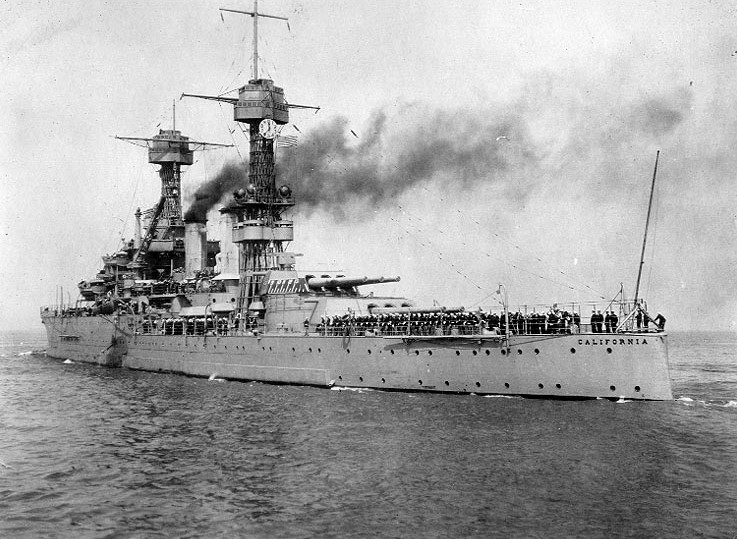
The ships at Pearl Harbor included the two ships of the Nevada class, the Nevada and Oklahoma they were the oldest battleships at Pearl Harbor and the first of what were referred to as the “standard design” battleships. The two ships of the Pennsylvania class, the Pennsylvania and her sister the Arizona served as the flagships of the Pacific Fleet and First Battleship Division respectively and were improved Nevada’s. The California class ships, California and Tennessee and two of the three Maryland’s the Maryland and West Virginia made up the rest of the Battle Force.

california-1938

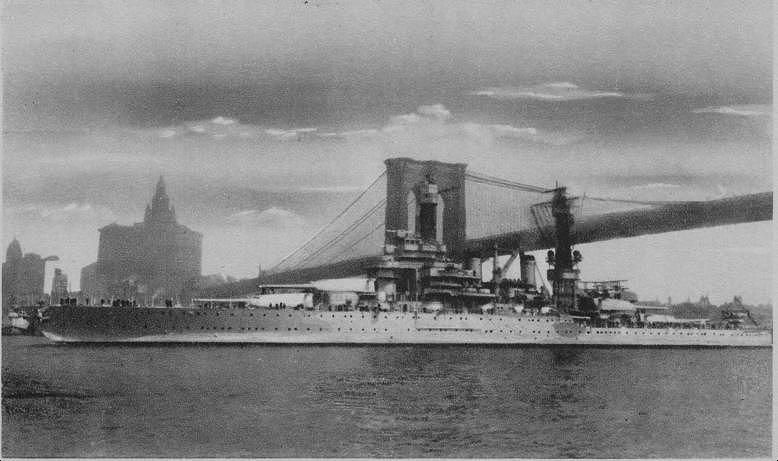
USS California passing under Brooklyn Bridge

The Colorado was undergoing a yard period at Bremerton and the three ships of the New Mexico class, New Mexico, Mississippi and Idaho had been transferred to the Atlantic before Pearl Harbor due to the German threat.  The three oldest battleships  ships of the New York and Wyoming Classes, the New York, Arkansas and Texas also were in the Atlantic. Two former battleships, the Utah and Wyoming had been stripped of their main armaments and armor belts and served as gunnery training ships for the fleet. The Utah was at Pearl Harbor moored on the far side of Ford Island.

9.athumb

The ships that lay at anchor at 0755 that peaceful Sunday morning on “Battleship Row” and in the dry dock represented the naval power of a bygone era, something that most did not realize until two hours later. The age of the battleship was passing away, but even the Japanese did not realize that the era had passed building the massive super-battleships Yamato and Musashi mounting nine 18” guns and displacing 72,000 tons, near twice that of the largest battleships on Battleship Row.

bb36_06

USS Nevada at Pearl Harbor

The Oklahoma and Nevada were the oldest ships in the Battle Force.  Launched in 1914 and commissioned in 1916 the Nevada and Oklahoma mounted ten 14” guns and displaced 27,500 tons and were capable of 20.5 knots. They served in World War One alongside the British Home Fleet and were modernized in the late 1920s. They were part of the US presence in both the Atlantic and Pacific in the inter-war years. Oklahoma took part in the evacuation of American citizens from Spain in 1936 during the Spanish Civil War.

013717


USS Oklahoma Capsized (above) and righted (below)


oklahoma-salvage

During the Pearl Harbor attack Oklahoma was struck by 5 aerial torpedoes capsized and sank at her mooring with the loss of 415 officers and crew. Recent analysis indicates that she may have been hit by at least on torpedo from a Japanese midget submarine. Her hulk would be raised but she would never again see service and sank on the way to the breakers in 1946.

nevada-1

USS Nevada aground off Hospital Point

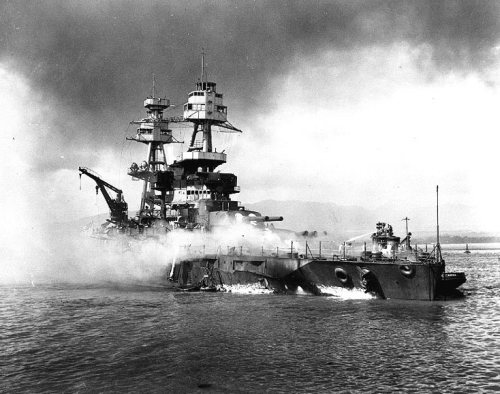
Nevada was the only battleship to get underway during the attack.  Moored alone at the north end of Battleship Row her Officer of the Deck had lit off a second boiler an hour before the attack.  She was hit by an aerial torpedo in the first minutes of the attack but was not seriously damaged. She got underway between the attack waves and as she attempted to escape the harbor she was heavily damaged. To prevent her from sinking in the main channel she was beached off Hospital Point.

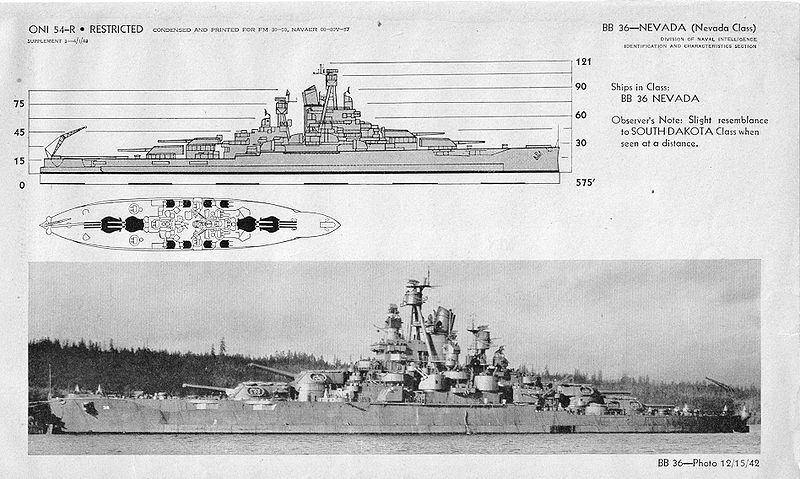
800px-USS_Nevada_(BB-36)_specs

nevada-utah-beach

USS Nevada at Normandy 

Nevada was raised and received a significant modernization before returning to service for the May 1943 assault on Attu.  Nevada returned to the Atlantic where she took part in the Normandy landings off Utah Beach and the invasion of southern France.  She returned to the Pacific and took part in the operations against Iwo Jima and Okinawa where she again provided naval gunfire support.  Following the war the great ship was assigned as a target at the Bikini atoll atomic bomb tests. The tough ship survived these tests and was sunk as a target on 31July 1948.

USS_Arizona_(BB-39)_-_1930s

USS Arizona

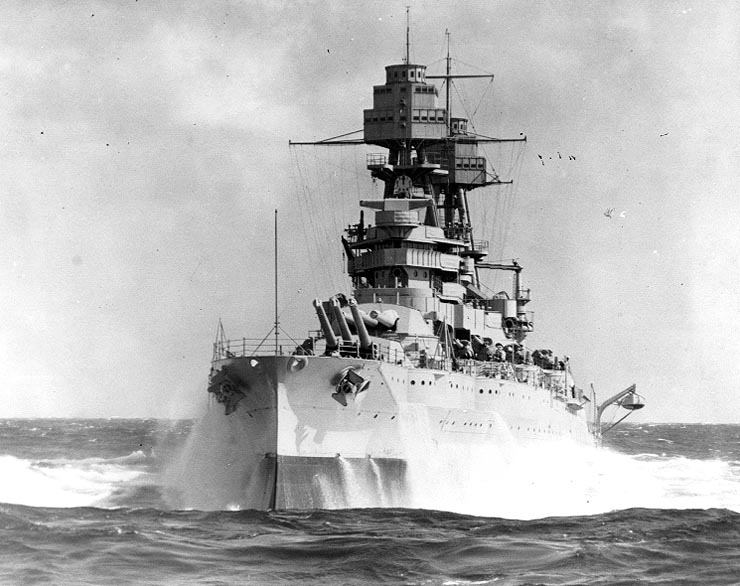
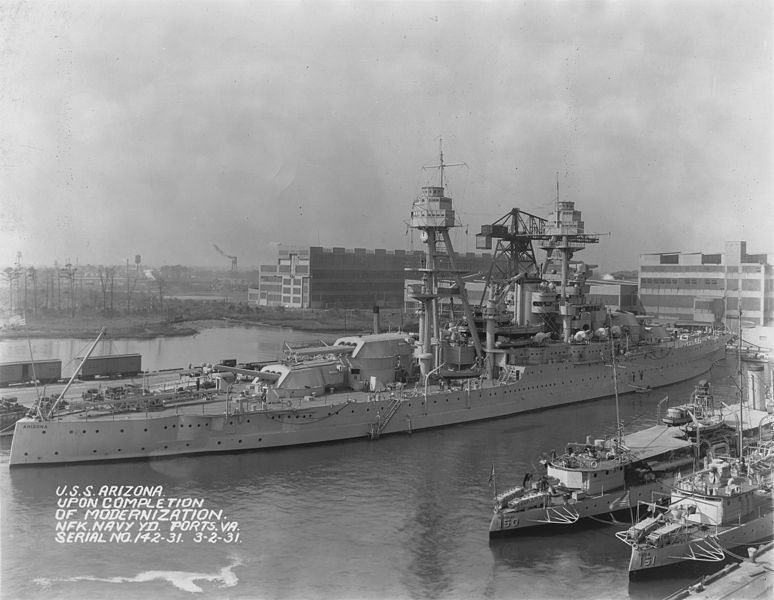
The two ships of the Pennsylvania Class were improved Oklahoma’s.  The Arizona and Pennsylvania mounted twelve 14” guns and displacing 31,400 tons and capable of 21 knots they were both commissioned in 1916. They participated in operations in the Atlantic in the First World War with the British Home Fleet. Both ships were rebuilt and modernized between 1929-1931.

518px-O3U-3s_on_USS_Pennsylvania_(BB-38)_in_1935

They were mainstays of the fleet being present at Presidential reviews, major fleet exercises and making goodwill visits around the world.  Pennsylvania was the Pacific Fleet Flagship on December 7th 1941 and was in dry dock undergoing maintenance at the time of the attack. She was struck by two bombs and received minor damage.

pennsylania-drydock

She was back in action in early 1942. She underwent minor refits and took part in many amphibious landings in the Pacific and was present at the Battle of Surigao Strait.  She was heavily damaged by an aerial torpedo at Okinawa Pennsylvania and was repaired. Following the war the elderly warrior was used as a target for the atomic bomb tests. She was sunk as a gunnery target in 1948.

774px-USS_Arizona_after_1931_modernization_NARA_19-LC-19B-1

arizona-buring

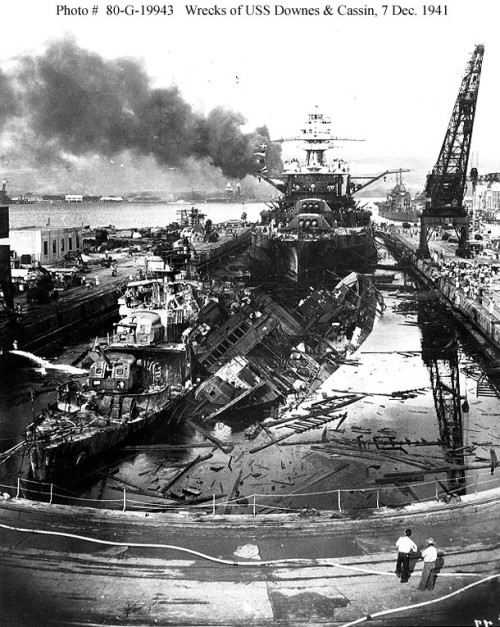
Arizona was destroyed during the attack. As the flagship of Battleship Division One she was moored next to the repair ship USS Vestal.  She was hit by 8 armor piercing bombs one of which penetrated her forward black powder magazine. The ship was consumed by a cataclysmic explosion which killed 1103 of her 1400 member crew including her Captain and Rear Admiral Isaac Kidd, commander of Battleship Division One.  She was never officially decommissioned and the colors are raised and lowered every day over the Memorial which sits astride her broken hull.

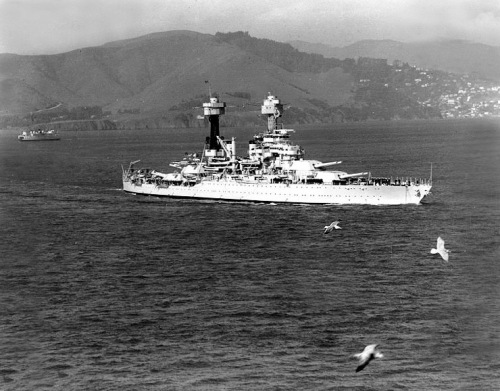
tennessee-1938

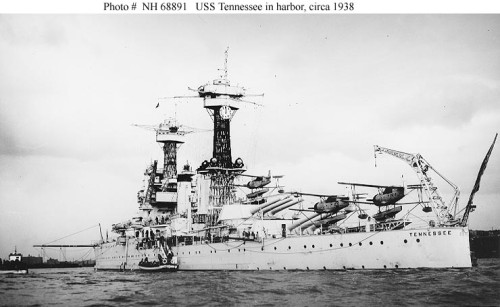
The Tennessee class ships the Tennessee and California were the class following the New Mexico class ships which were not present at Pearl Harbor. These ships were laid down in 1917 and commissioned in 1920. Their design incorporated lessons learned at the Battle Jutland. They mounted twelve 14” guns, displaced 32,300 tons and were capable of 21 knots. At Pearl Harbor Tennessee was moored inboard of West Virginia and protected from the aerial torpedoes which did so much damage to other battleships. She was damaged by two bombs. California the Flagship of Battleship Division Two was moored at the southern end of Battleship Row. She was hit by two torpedoes in the initial attack. However, she had the bad luck to have all of her major watertight hatches unhinged in preparation for an inspection.

uss_california_bb44_03

h64474

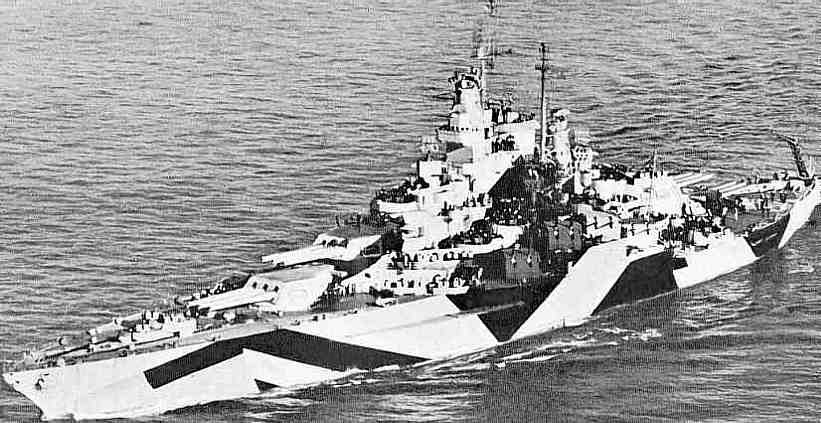
Despite the valiant efforts of her damage control teams she sank at her moorings. She was raised and rebuilt along with Tennessee were completely modernized with the latest in radar, fire control equipment and anti-aircraft armaments. They were widened with the addition of massive anti-torpedo bulges and their superstructure was razed and rebuilt along the lines of the South Dakota class.

USS California Late WWII

USS California following Modernization

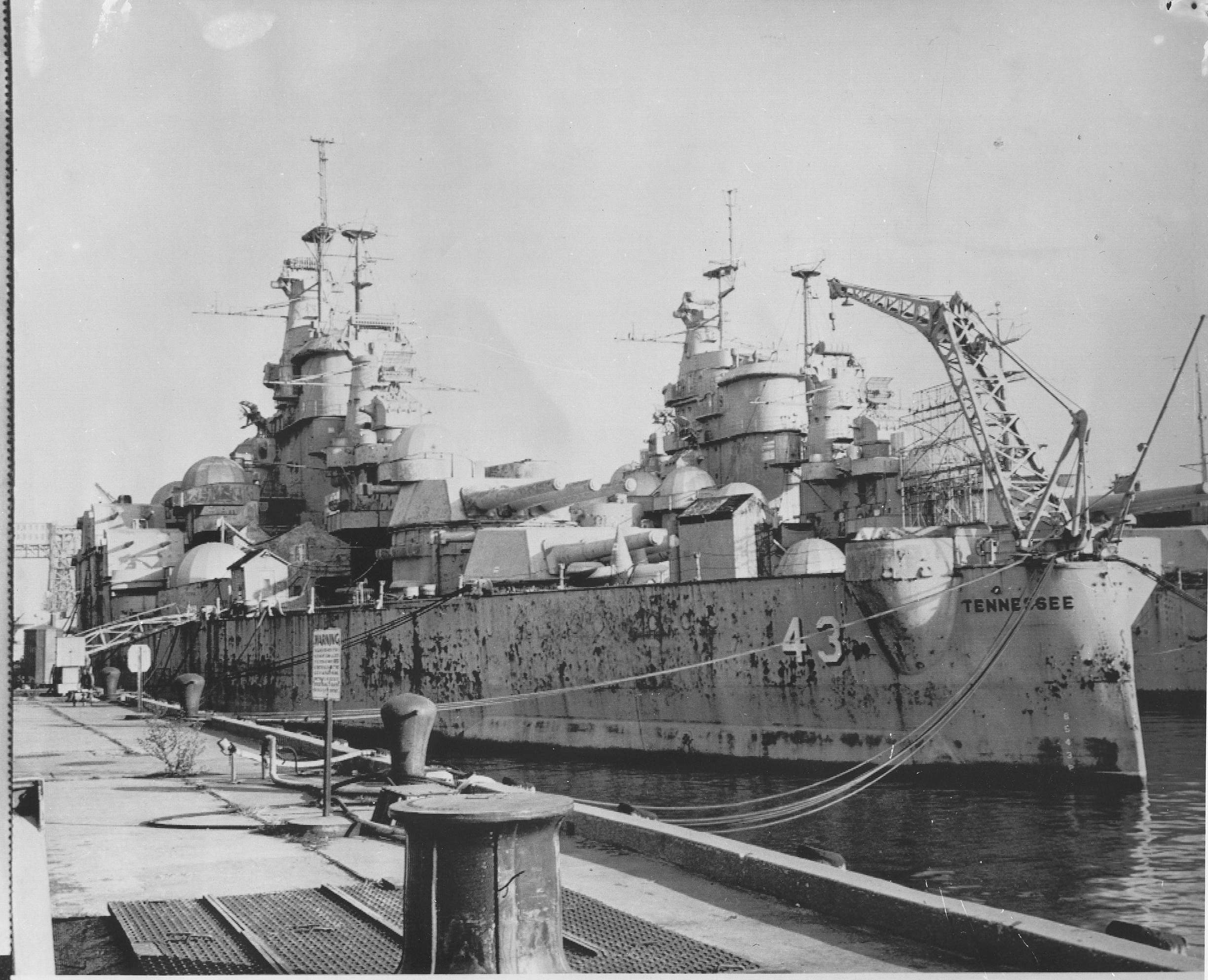
014389o

USS Tennessee with another ship, possibly California in reserve awaiting the breakers

When the repairs and modernization work was completed they looked nothing like they did on December 7th. Both ships were active in the Pacific campaign and be engaged at Surigao Strait where they inflicted heavy damage on the attacking Japanese squadron. Both survived the war and were placed in reserve until 1959 when they were stricken from the Navy list and sold for scrap.

west-virginia-1934

USS West Virginia 

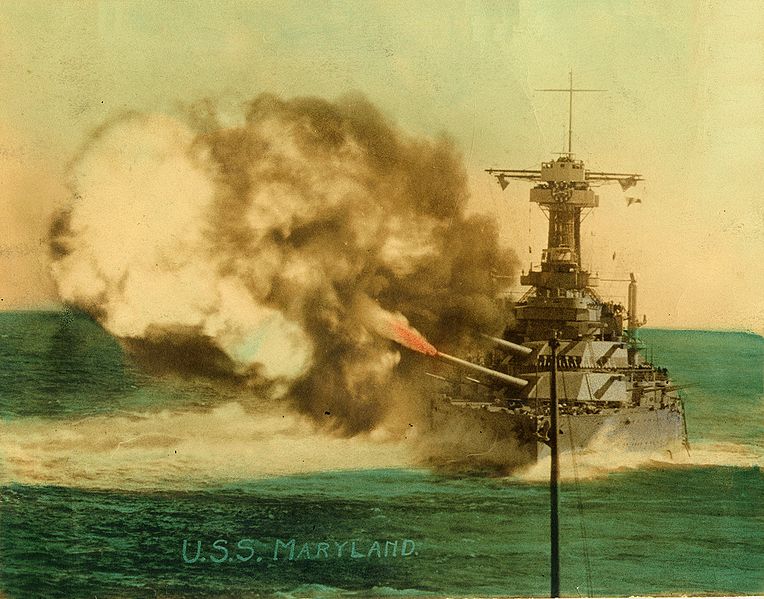
The Maryland and West Virginia were near sisters of the Tennessee class.  They were the last battleships built by the United States before the Washington Naval Treaty. and the first to mount 16” guns. With eight 16” guns they had the largest main battery of any US battleships until the North Carolina class.

764px-USS_Maryland_broadside_1920s

They displaced 32,600 tons and could steam at 21 knots. Laid down in 1917 and commissioned in 1921 they were modernized in the late 1920s. They were the most modern of the Super-Dreadnoughts built by the United States and included advances in protection and watertight integrity learned from both the British and German experience at Jutland.

09_maryland_oklahoma_pearl_harbor

USS Maryland behind the capsized Oklahoma

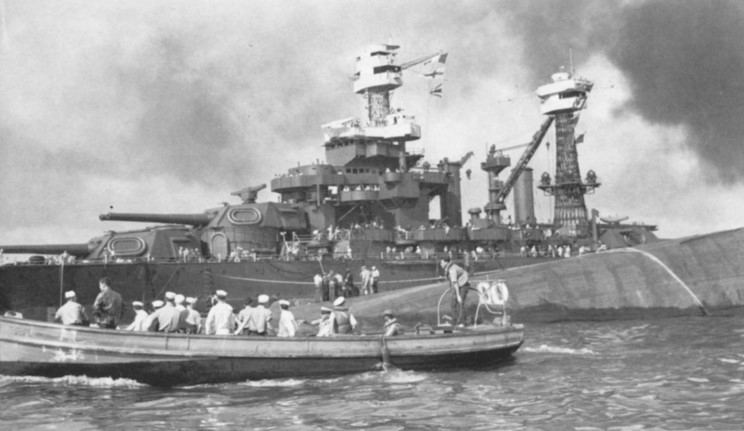
At Pearl Harbor Maryland  was moored inboard of Oklahoma and was hit by 2 bombs and her crew helped rescue survivors of that unfortunate ship.  She was quickly repaired and returned to action.  She received minimal modernization during the war. She participated in operations throughout the entirety of the Pacific Campaign mainly conducting Naval Gunfire Support to numerous amphibious operations. She was present at Surigao Strait where despite not having the most modern fire control radars she unleashed six salvos at the Japanese Southern Force.

729px-Photograph_of_the_damage_done_to_the_USS_West_Virginia,_sunk_in_the_Japanese_raid_on_Pearl_Harbor_-_NARA_-_306536

754px-USS_West_Virginia_5-21-42,_Port_quarter_showing_previous_water_line_(FCP)_-_NARA_-_296915

west-virginia-damage

USS West Virginia, sunk, raised and in dry dock, note the massive damage to Port Side

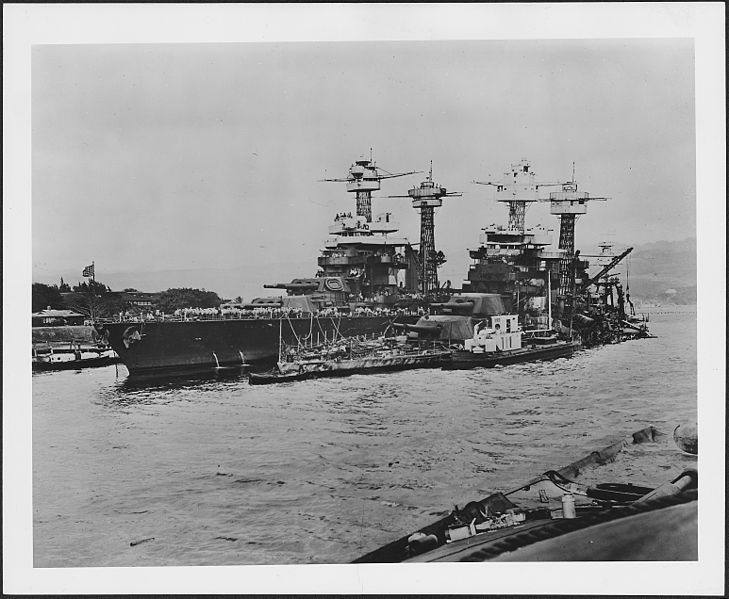
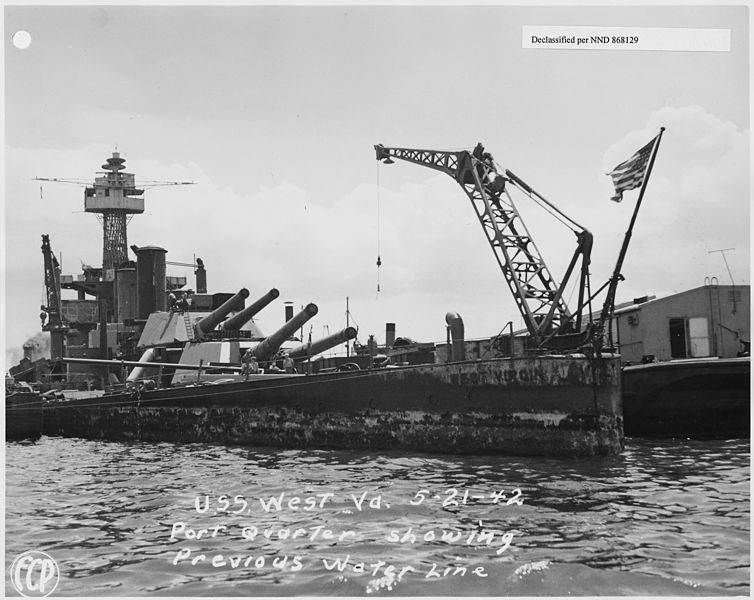
West Virginia suffered some of the worst damage in the attack. She was hit by at least 5 torpedoes and two bombs. She took a serious list and was threatening to capsize. However she was saved from Oklahoma’s fate by the quick action of her damage control officer who quickly ordered counter-flooding so she would sink on an even keel.  She was raised from the mud of Pearl Harbor and after temporary repairs and sailed to the West Coast for an extensive modernization on the order of the Tennessee and California.

west-virginia-final-config

USS West Virginia after salvage and modernization 

West Virginia was the last Pearl Harbor to re-enter service. However when she returned she made up for lost time.  She led the battle line at Surigao Strait and fired 16 full salvos at the Japanese squadron. Her highly accurate gunfire was instrumental in sinking the Japanese Battleship Yamashiro in the last battleship versus battleship action in history.  West Virginia, Maryland and their sister Colorado survived the war and were placed in reserve until they were stricken from the Naval List and sold for scrap in 1959.

The battleships of Pearl Harbor are gone, save for the wreck of the Arizona and various relics such as masts, and ships bells located at various state capitals and Naval Stations.  Unfortunately no one had the forethought to preserve one of the survivors to remain at Pearl Harbor with the Arizona.  Likewise the sailors who manned these fine ships, who sailed in harm’s way are also passing away.  Every day their ranks grow thinner, the youngest are all 89-90 years old.

As this anniversary of the Pearl Harbor attack passes into history it is fitting to remember these men and the great ships that they manned.

Peace,

Padre Steve+

4 Comments

Filed under History, Military, Navy Ships, News and current events, US Navy, world war two in the pacific

Remembering USS Indianapolis CA-35: Disaster, Dishonor and Redemption

USS_Indianapolis_at_Mare_Island

“Our peoples have forgiven each other for that terrible war and its consequences. Perhaps it is time your peoples forgave Captain McVay for the humiliation of his unjust conviction.” Mochitsura Hashimoto, Captain of the I-58 to Senator John Warner
On July 30th 1945 the USS Indianapolis CA-35 was speeding from the island of Guam where she had made some personnel transfers to Leyte to join other American forces for the final campaign against Japan.

Indianapolis under the command of Captain Charles B McVay III had completed one of the most important secret missions of the war. She had delivered the component parts and enriched Uranium for the the first Atomic Bomb, Little Boy which in less than a week would be detonated over the Japanese City of Hiroshima on August 6th 1945.

Indianapolis was the second ship of the Portland Class heavy cruisers built under the terms of the Washington Naval Conference. Displacing 9800 tons and mounting a main battery of 9 8” guns she typical of the American cruisers of the era. During the 1930s she hosted President Franklin D. Roosevelt three times. When Pearl Harbor was attacked she was on gunnery exercises and from that point played an active role in combat operations in the South Pacific, the Aleutians later served as flagship to Admiral Raymond Spruance, Commander 5th Fleet. After being damaged a Kamikaze off Okinawa on March 31st 1945. She then returned to Mare Island for repairs and a rendezvous with destiny.

With the components for Little Boy aboard Indianapolis sailed unescorted to Pearl Harbor in complete secrecy and then to Tinian where she delivered her deadly cargo. After her brief port call in Guam she made haste to join Vice Admiral Jesse Oldendorf’s Task Force 95 at off Leyte. Her Captain used discretion in his use of a zig-zag course and was not employing it on the night of July 30th.

ce006i58
What Captain McVay and his crew did not know was that the Japanese Imperial Navy submarine I-58 under the command of Lieutenant Commander Mochitsura Hashimoto was stalking Indianapolis. At 2300 on the 29th while surfaced the Japanese noted a ship approaching and submerged. At 0014 after he gained firing position Hashimoto launched a spread of 6 Type 95 torpedoes, one of the most powerful type of torpedoes used during the war. Two stuck Indianapolis on her starboard side. The powerful charges caused catastrophic damage and 12 minutes later the cruiser rolled over and sank taking about 300 of her nearly 1200 man crew down with her.

She sank so quickly that few lifeboats or rafts were launched and no distress call issued. It took the Navy nearly three days to even know that she was missing. Finally on August 2d the survivors, now decimated by exposure, dehydration and shark attacks were spotted by a patrol plane. The aircraft sent a message out and other aircraft and the USS Cecil J. Doyle DE-368 as well as a number of other ships which responded to the call. Only 321 crewmen out of the estimated 880 survivors of the sinking lived.

USS_Indianapolis-survivors_on_Guam

The tale of the sinking and the stories of the survivors would be recorded in Fatal Voyage by Daniel Kurzman and All the Drowned Sailors by Raymond Lech. It was also mentioned in the movie Jaws by Robert Shaw’s character, the fishing boat Captain “Quint” who was supposed to be an Indianapolis survivor. The made for television film Mission of the Shark: The Saga of the U.S.S. Indianapolis staring Stacy Keach as Captain McVay brought a renewed interest in the sinking and the story of the survivors.

indy4

Captain McVay would be tried at court-martial and convicted of “hazarding his ship by failing to zig-zag.” The sentence was controversial as McVay was the only commander of a U.S. Navy ship lost during the war to be tried by court-martial. The true fact of the matter was that McVay was a scapegoat for the failure of several systems of reporting and communication that he did not control.

Admiral Nimitz commuted the sentence and restored McVay to active duty. He retired in 1949 after being promote to Rear Admiral. Despite the fact that many of the crew felt that he was innocent many families of those lost at sea took their revenge on McVay. He received much hate mail and was frequently threatened in writing and by phone. On November 6th 1968 McVay, despondent over the death of his wife and the continued harassment committed suicide using his Navy issued revolver in his back yard. In one hand he grasped a toy sailor doll given to him by his father when he was a child.

In the years following many survivors banded together with Captain McVay’s family and others including the commander of I-58, Mochitsura Hashimoto to clear his name. The president of the USS Indianapolis Survivor’s Association testified “Capt. McVay’s court-martial was simply to divert attention from the terrible loss of life caused by procedural mistakes which never alerted anyone that we were missing.” 

220px-Mochitsura_Hashimoto

Hashimoto, who spent much of his time after the war as a Shinto priest sought the forgiveness of survivors. He returned to a survivor reunion in 1991 and said: “I came here to pray with you for your shipmates whose deaths I caused.”   

Hashimoto wrote Senator John Warner on behalf of the late Captain McVay in 1999 when he learned of the efforts being made to clear McVay’s name. The letter is touching in its honesty and speaks of the deep respect that warriors who once fought against each other can maintain for one another. It also speaks to the deep sense of honor of Hashimoto:

“I hear that your legislature is considering resolutions which would clear the name of the late Charles Butler McVay III, captain of the USS Indianapolis which was sunk on July 30, 1945, by torpedoes fired from the submarine which was under my command.

“I do not understand why Captain McVay was court-martialed. I do not understand why he was convicted on the charge of hazarding his ship by failing to zigzag because I would have been able to launch a successful torpedo attack against his ship whether it had been zigzagging or not.

“I have met may of your brave men who survived the sinking of the Indianapolis. I would like to join them in urging that your national legislature clear their captain’s name.

“Our peoples have forgiven each other for that terrible war and its consequences. Perhaps it is time your peoples forgave Captain McVay for the humiliation of his unjust conviction.”

Finally in October 2000 Congress passed a resolution stating of Captain McVay that “he is exonerated for the loss of the USS Indianapolis.” President Clinton signed the resolution and in July 2001 Secretary of the Navy Gordon England order Captain McVay’s record cleared of wrong doing. Hashimoto would die on 25th 2000 at the age of 91.

This year, on the 68th anniversary of the sinking 17 survivors gathered to mark the occasion and pay tribute to their shipmates. The Facebook page of the association has this memorial:

Goodnight and sleep well, crew of the USS Indianapolis. On this night, sixty-eight years ago, you had no way of knowing that a Japanese torpedo would hit your ship in just a few short hours. Your floating home away from home would sink within twelve minutes. Unable to get topside in time, three hundred of you would go to the bottom of the ocean with your ship. Nine hundred of you would find yourselves in the water, about to experience a terrifying existence amid sharks, dehydration, hallucinations, and the elements. 

You were so young, Indy sailors. 

Tonight, like that night, let your minds be free from nightmares and flashbacks. Tonight, like that night, know that your families and friends miss and love you. Tonight, like that night, just be “The Crew of the USS Indianapolis” instead of “Survivors” or “Lost at Sea.”

800px-USS_Indianapolis_(CA-25)_Memorial

I cannot say more.

Peace

Padre Steve+

Leave a comment

Filed under History, Navy Ships, US Navy, world war two in the pacific

An older post of mine about Pearl Harbor as we approach the 71st anniversary of that “Day of Infamy.”

padresteve's avatarThe Inglorius Padre Steve's World

Arizona Leading the Battle Line

“Yesterday, Dec. 7, 1941 – a date which will live in infamy – the United States of America was suddenly and deliberately attacked by naval and air forces of the Empire of Japan…. The attack yesterday on the Hawaiian Islands has caused severe damage to American naval and military forces. Very many American lives have been lost.” Except of President Franklin D Roosevelt’s Pearl Harbor Speech December 8th 1941

Today is the 68th anniversary of the Japanese attack on Pearl Harbor and as we were then we are at war.

A Date that Will Live in Infamy: USS Arizona Burning

I remember reading Walter Lord’s “Day of Infamy” when I was a 7th grade student at Stockton Junior High School back in 1972.  At the time my dad was on his first deployment to Vietnam on the USS Hancock CVA-19.  As…

View original post 1,837 more words

1 Comment

Filed under History, Military, Navy Ships, traumatic national events, US Navy, world war two in the pacific

Requiem of Empire: The Yamato Class Battleships

Emperor Hirohito on Musashi in 1943

The is a long delayed installment of my series on Battleships. Previous were about the Battleships constructed under conditions of the London Naval Conference.  These have dealt with the British King George V Class, French Dunkerque and Richelieu Classes, Italian Vittorio Vento Class and the American North Carolina and South Dakota ClassesI then wrote an introduction to the Post Treaty Super-Battleships. This article is the first in that series which will include articles on the German Bismarck and Tirpitz, British Vanguard and American Iowa Class.

They were the largest and most heavily armed battleships ever built. Shrouded in secrecy by the Imperial Japanese Navy and Government the ships were designed to offset projected American numerical superiority. Their names were symbolic of Japan’s history. Yamato was named after Yamato Province, the ancestral home of the Yamato People, the dominant native ethnic group in Japan. Musashi was named after Musashi Province in which lays Tokyo Prefecture.  A third ship of the class, Shinano, was named after Shinano Province in central Japan which was the home of the prestigious Taketa Shingen family during the Senguku period.

The Conning Tower and Bridge of Musashi

The secrecy surrounding their design and construction was unprecedented. Those charged with their deign and construction were thoroughly checked out by Japan’s secret police and sworn to an oath of secrecy. The oath sworn by builders of Musashi at the Mitsubishi Heavy Industries  Nagasaki Shipyard were sworn to the oath shown below:

I am aware that all work work involving the construction of the No. 2 Battleship is vital to national security. I will make utmost effort to maintain the  secrecy of the project, and swear that I will leak no information relating to the said battleship, even to relatives and close friends. In the event I violate this oath,  I will submit to the punishment determined by the company and the Navy.  

Yamato during Consrtuction

Security measures around the shipyards where Yamato and Musashi were constructed  were immense. At Nagasaki where there was a large foreign business and missionary population where the shipyard was visible from most of the city at hemp screen of 75,000 square meters was constructed to shield the ship from prying eyes and spies.

Musashi under Construction

When actual preparations for construction were taken in 1937 secret police swept the areas of foreign, especially Chinese workers. Security was increased inside and outside the shipyard, all blueprints accounted for and placed under strict guard while all shipyard workers were photographed with any having knowledge of the plans or supervising the construction sworn to the secrecy oath.

When a top secret blueprint went missing in 1938 at Nagasaki an intense investigation that included the torture of numerous suspects and the jailing of a blueprinter who accidentally swept the document into the trash was sentenced to 3 years in prison.

Armor and Protection of Yamato Class

Few pictures exist of the ships and Japanese Naval Officers destroyed many of the records of the ships design and construction just prior to the end of the Second World War. Throughout their existence they were a mystery to the American Navy. During the war the U.S. Navy estimated them to carry nine 16” guns and displace between 40,000-57,000 tons. Even the highly regarded Jane’s Fighting ships listed them at just 45,000 tons.

Yamato and Musashi together in 1943

Preliminary design work began in 1934 and progressed rapidly following Japan’s withdraw from the League of Nations and renunciation of the Washington and London Naval Treaties and withdraw from the 1936 naval talks in London. The early designs varied in the caliber of guns, size and armor, propulsion systems and endurance. Gun calibers ranged from 16” to 18.1” and a combined diesel-turbine system was considered but rejected in favor of traditional steam turbines.

The final design was for a class of five ships. Each would displace 64,000 tons standard displacement and 72,000 tons at full load. They were 862 feet long with a beam of 127 feet.  They were so large that the docks they were built needed to be expanded and special extra large launch platforms had to be built.  At Nagasaki the dock at to be expanded by cutting into the hill adjacent to it.

They were armed with nine 18.1 inch guns in triple turrets which could fire a projectile weighing over a ton. The secondary armament consisted of 12 6.1 inch guns mounted in triple turrets formerly mounted on the Mogami Class cruisers when those ships were equipped with 8” guns. Anti-aircraft defense included twelve 5” guns and twenty-four 25mm anti-aircraft guns. During the war two of the 6.1 inch turrets were removed and replaced with twelve more 5” guns and the 25mm battery was raised to 162 guns. Fire control systems were designed in such a way that the ships could engage multiple surface targets at the same time.

The ships were protected by a massive armored belt ranging from 16 inches to 8 inches with 26 inch armor on the face plates of the main gun turrets. The armor was advanced with excellent sloping but had a flaw where the upper and lower belts connected just below the waterline which exposed them to damage from torpedoes.

Yamato and Musashi viewed beside Battleship Nagato (foreground) just before the Battle of Leyte Gulf

They were powered by 12 Kampon boilers which powered 4 steam turbines and four three bladed propellers. These developed 150,000 shp and could drive the ship at a top speed of 27 knots.

Yamato

Construction of Yamato began on November 4th 1937 at Kure Naval Shipyard. Musashi on March 28th 1938. Traditionally such events were large public ceremonies but these were limited to just a few Naval Staff and Shipyard executives.  Yamato was Launched on August 8th 1940 and commissioned on December 16th 1941, just 9 days after Pearl Harbor. Musashi was launched on November 8th 1940 and commissioned on August 5th 1942 just two days before the U.S. Marines invaded Guadalcanal and two months after the disaster at the Battle of Midway.

Yamato served as Admiral Yamamoto’s flagship at Midway where she saw no action. The next two years she was and Musashi alternated as fleet flagship and conducted operations with Battleship Division One in operations between Mainland Japan and the major Japanese base at Truk. On December 25th 1943 while escorting a convoy she was torpedoed by the submarine USS Skate and suffered heavy damage which flooded a magazine.  On March 29th while underway Musashi was struck near the bow by a torpedo from the USS Tunny.

Musashi Under Attack at the Battle of Sibuyan Sea

Both ships participated in the Battle of the Philippine Sea and were part of Vice Admiral Takeo Kurita’s Central Force in the Battle of Leyte Gulf. Musashi was sunk by U.S. Navy Carrier aircraft from the Third Fleet on October 24th 1944 during the Battle of the Sibuyan Sea. Hit by 17 bombs and 19 torpedoes she sank with the loss of nearly 1100 of her crew of almost 2400 men. The survivors were rescued by destroyers and disembarked at Corregidor. Some were sent by troop transport to Japan but one of the ships was torpedoed and sunk leaving her survivors adrift for 19 hours before rescue. Those who reached Japan were isolated from the population while about half of the survivors remained in the Philippines where 117 of 146 of those assigned to the defense of Manila were killed in action.

Yamato or Musashi under air Attack

Yamato saw action in the surface engagement on October 25th against the Escort Carriers and Destroyers of Taffy-3 during the Battle off Samar. Her guns helped sink the Escort Carrier USS Gambier Bay but was forced away from the action by torpedo attacks from the valiant destroyers of Taffy-3.

Yamato under Attack April 7th 1945

By April 1944 Japan’s Navy was decimated and U.S. Naval Forces were raiding Mainland Japan. When the United States landed on Okinawa the Japanese Navy and air force launched wave after wave of Kamikaze attacks on the ships in the waters around the island. Yamato, along with Light Cruiser Yahagi and eight destroyers were designated the Surface Special Attack Force and loaded with a full load of ammunition but only enough fuel for a one way trip got underway on April 6th. The mission was for Yamato to reach Okinawa, beach herself and serve as an “unsinkable” gun battery until she was destroyed. The force was spotted by U.S. Navy flying boats hours after their departure and on April 7th over 400 aircraft launched from Task Groups 58.1 and 58.3. The first wave began its attack at 1230 and by 1400 the ship was mortally wounded. Stuck by at least 8 torpedoes and 11 bombs she was dead in the water and began to capsize at 1405. At 1420 she turned turtle and at 1423 exploded when her forward blew up sending up a mushroom cloud nearly 20,000 feet.  Under 300 of her crew of nearly 2400 were rescued.

The End: Yamato Explodes

The ships were the largest battleships ever built, designed when naval experts planned for a war where the battleship would rule and aircraft carriers play a supporting role. Instead both never faced enemy battleships in combat and both were destroyed by the weapon that the battleship admirals had discounted. It is somewhat fitting that each was commissioned shortly after the triumphs of Japanese and American Naval air power at Pearl Harbor and Midway. However they have attained an almost mythic status in naval lore and are symbols to many Japanese of the sacrifice and futility of the war. Both of the cities where the ships were constructed were destroyed by Atomic bombs. They are tragic reminders of the cost of war in human lives, suffering, economic cost and destruction.

In a sense their poetic names and the myth ascribed to them are a tragic requiem to the Japanese Empire and the cost of war. They and their brave sailors were sacrificed when the war was already for all intents and purposes lost. They, especially the Yamato were sacrificed for no military purpose save a convoluted sense of honor.

Let us pray that it never happens again.

Peace

Padre Steve+

3 Comments

Filed under Military, Navy Ships, world war two in the pacific

The Battleships of D-Day

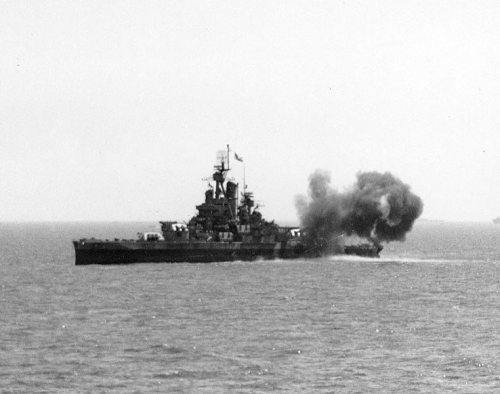
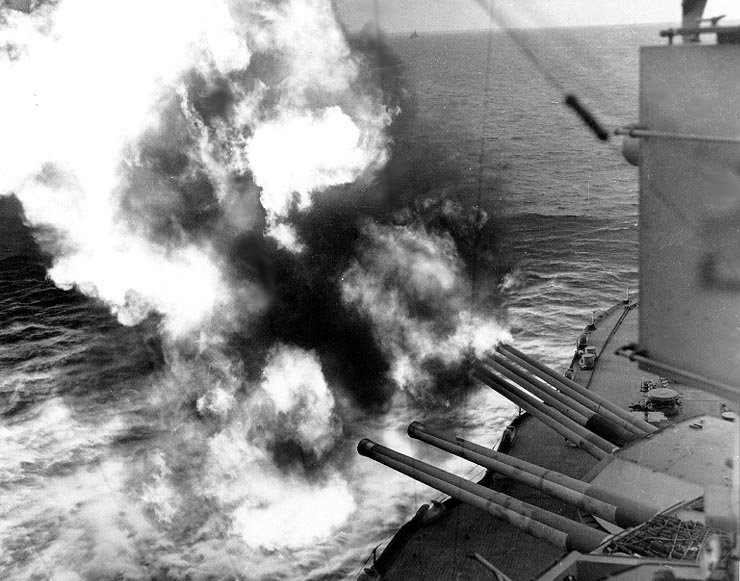
The 14″ Guns of USS Nevada in action at Normandy

On June 6th 1944 Allied Forces landed on the beaches of Normandy. Six American, British and Canadian Infantry Divisions, three Airborne Divisions and numerous supporting units came ashore in landing craft or were airdropped into Normandy. Backing them was an immense Naval Task Force which provided naval gunfire support, screened the force from German U-Boat or surface naval forces and transported the massive ground force.  It was an amazing armada.

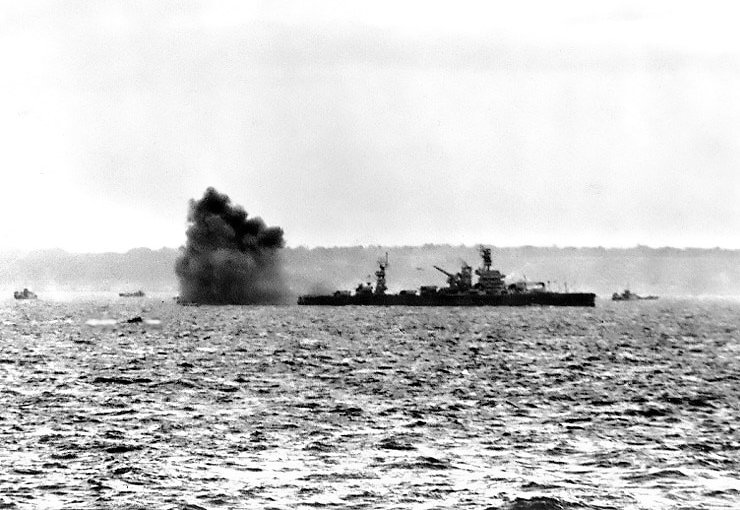
HMS Rodney bombarding German positions off Caen

It was an armada that also is forgotten by many who read about Normandy or whose only exposure to the landings are films such as Saving Private Ryan. Today I think it is fitting to remember Battleships that served at Normandy, USS Arkansas, USS Texas, USS Nevada, HMS Warspite, HMS Ramillies and HMS Rodney.

USS Arkansas off Omaha Beach

The naval gunfire support force included Battleships, Cruisers and Destroyers as well as specialized gunfire support ships.  The largest and most powerful ships were the six American and British Battleships.  These ships were important in providing the heavy firepower needed to destroy the strongest fortifications and shore batteries and to fire at targets far beyond the shoreline that were vital for German reinforcements.

However the ships involved were not the modern behemoths which were built in the 1930s and since the beginning of the war but rather among the oldest ships still active in either the United States or the British Royal Navy. At one time they had all been the hearts for their navies but now old, slow and with less than modern armament and fire control systems they were regulated to supporting amphibious forces or escorting convoys.

USS Arkansas BB-33

The oldest of these venerable ships was the USS Arkansas BB-33 which was commissioned in 1912. A Wyoming Class Battleship she mounted twelve 12” guns in six twin turrets, two forward, two aft and two midships. She displaced just over 27,000 tons. She had spent most of the war escorting convoys in the Atlantic before being assigned to the Normandy landings. She stood off Omaha Beach dueling with German shore batteries and pounding the German troops who were making Omaha a living hell for the men of the US 1st and 29th Infantry Divisions.  She would continue her valuable service off of Normandy and would do the same in to support the landings in Southern France before steaming to the Pacific where she would do the same at Iwo Jima and Okinawa.

USS Texas BB-35

The USS Texas, BB-35 of the New York class had been in commission since 1914. She mounted ten 14” guns in 5 twin turrets, two forward, two aft and one midships and was slightly larger than the Arkansas.  More modern she was more extensively modernized between the wars than was Arkansas and was one of the first US ships to carry experimental radar sets.  She also conducted convoy operations but was used to bombard Vichy French troops and positions during Operation Torch, the Allied invasion  of North Africa.  At D-day she was in the western sector of Omaha and bombarded Point Du Hoc and cruised to within 3000 yards of the beach to clear the western exits of the beach near Vierville.  She remained in the area a number of days and would subsequently support the attack on Cherbourg, the invasion of South France and then serve in the Pacific at Iwo Jima and Okinawa.

USS Nevada BB-36

The USS Nevada BB-36 was the first of a new class of battleships which set the basic pattern of US Battleship design through the ratification of the Washington Naval Treaty. Her main battery of ten 14” guns was mounted in four turrets, mounted fore and aft two triple and 2 twin turrets.  She was he powered by oil fired boilers as opposed to coal and   was designed with a longer cruising radius to meet the demands of War Plan Orange.  Nevada received major upgrades between the wars and on December 7th 1941 was moored on Battleship Row when Peal Harbor was attacked by the Japanese. The only Battleship to get underway during the attack Nevada was set upon by Japanese aircraft as she steamed toward the harbor entrance. Heavily damaged she was grounded off Hospital Point. She was re-floated and sailed to the United States where she was heavily modernized with a modern AA battery of twin 5” 38 caliber guns, and fire direction radars. She was modernized to the point that she no longer resembled the ship sunk at Pearl Harbor. After her repair and modernization she participated in the invasion of Attu Island and did convoy escort duty before reporting for the invasion of Normandy. Nevada supported the US 4th Infantry Division at Utah Beach and subsequently served with Texas and Arkansas in South France before going to the Pacific to support the invasions of Iwo Jima and Okinawa. Had the war continued she would have been involved in the invasion of the Japanese Mainland.

HMS Warspite

The Royal Navy Battleships of D-Day were also elderly veterans. The eldest was the heroic HMS Warsipte commissioned in 1915 and a veteran of the Battle of Jutland and numerous actions during the Second World War including the slaughter of the German Destroyers at Narvik, the Battle of Cape Matapan and the invasion of Sicily and Italy.  The Queen Elizabeth Class Battleship mounted eight 15” guns in twin turrets and was extensively modernized between the wars. At Salerno Warspite was hit by three of the earliest guided missiles, the Fritz-X type launched by Luftwaffe Aircraft. She was heavily damaged and required major repairs before returning to service at Normandy. She supported British troops at Sword Beach and later Gold Beach. She again was heavily damaged by a magnetic mine and received temporary repairs to allow her to continue bombardment duties against German positions France and Belgium before being placed in reserve in January 1945.

HMS Ramillies

The HMS Ramillies was a Revenge Class Battleship commissioned in 1917. These ships were a compromise design that was smaller, slower and cheaper than the Queen Elizabeth Class but had the same main battery of eight 15” guns.  The compromises prevented them from receiving significant upgrades between the wars and limited their employment. Ramillies operated as a convoy escort and was also involved in action in  the Mediterranean and Indian Ocean. She participated in the hunt for the German Pocket Battleship Graf Spee and shielded Convoy HX-106 from the Scharnhorst and Gneisenau and later took part in the hunt for the Bismarck. However she but was not engaged against any of the German ships but her presence prevented Admiral Lutjens from risking Scharnhorst and Gneisenau to attack the convoy. She took part in the initial battle between the Royal Navy and the Italians at the Battle of Cape Spartivento getting off several salvos before her slow speed forced her out of the action. She was heavily damaged by a torpedo from a Japanese mini-submarine in Diego Suarez harbor during the invasion of Madagascar in May 1942. Following repairs and the addition of extra deck armor and modern anti-aircraft guns she returned to action at Normandy were she supported British troops ashore and drove off an attack by German Destroyers. She stayed in action firing over 1000 shells at Normandy before supporting the invasion of Southern France. Too slow to be of use in the Pacific she was placed in Reserve in January 1945.

HMS Rodney

The youngest of the Battlewagons at Normandy on June 6th was the HMS Rodney which was commissioned in 1927. She and her sister ship HMS Nelson were to be the first of the post WWI super battleships and was designed as a larger and more powerful ship. With the limitations of the Washington Naval Treaty the ships were “cut down” and reduced in size and speed. Her armament made her one of the most powerful battleships of period but her engineering plant was not always reliable. Since she was relatively modern she did not receive any major refits before the war and apart from a repairs to her engines in Boston in 1941 (before the US entry into the war) and a brief refit in 1942 she received no further refits during the war. With the HMS King George V she helped sink the Bismarck and would escort convoys and participate in the Allied invasions of North Africa, Sicily and Salerno before being assigned to the Normandy invasion force attacking targets near Caen.  Her sister HMS Nelson was held in reserve and joined the battle on June 10th but she was not present on D-Day.

Warspite aground and Rodney being scrapped (below)

Despite their age and limitations all of these ships and their performed heroically during the war. The post war period was not as kind to the ships. Arkansas and Nevada were used in the Atomic Bomb tests at Bikini Atoll. Nevada survived and was expended as a target in 1948. All of the British ships were scrapped following the war due to their age, wear and damage incurred during the war. Warspite was being towed to the breakers when she broke a tow line and went aground. She ended up being partially scrapped in place.  Mementos of all these ships remain including a gun from Ramillies at the Imperial War Museum. The lone survivor was the USS Texas which became a museum ship and memorial at the San Jacinto battlefield in 1948. She is the last of the Dreadnought ships remaining. Other more modern US Battleships have been preserved but only Texas remains from those ships that at one time ruled the waves and pounded the Germans at Normandy.

The author aboard USS Texas in March 2011

The fire support provided by these proud ships and their consorts ensured the success of the Normandy landings. Without them it is very possible that the landings would not have succeeded and many more Allied soldiers would have died and the war extended.

To these great ships and all their heroic crews…

Peace

Padre Steve+

28 Comments

Filed under History, Military, Navy Ships, US Navy, world war two in europe

From the Sea: The Absolute Need of a Strong Navy, Merchant Marine, Coast Guard and Viable National Maritime Strategy

The USS Enterprise CV-6. Ordered in 1933 she was one of the most decorated and battle proven ships ever to fly the flag of the United States

“A good Navy is not a provocation to war. It is the surest guaranty of peace.” Theodore Roosevelt

“A powerful Navy we have always regarded as our proper and natural means of defense; and it has always been of defense that we have thought, never of aggression or of conquest. But who shall tell us now what sort of Navy to build? We shall take leave to be strong upon the seas, in the future as in the past; and there will be no thought of offense or provocation in that. Our ships are our natural bulwarks.” Woodrow Wilson

As the economic crisis continues to envelop the nation there is much talk about the certain reduction in the size and capabilities of the U.S. Military components.  At the present time it seems that politicians of both parties are more interested in the immediate savings that can be derived from cuts.  Regardless of how they are done each service will see force reductions but coming at a time when we are at war those responsible for the cuts must be conscious of the effects on the capabilities that the United States has to defend itself and its interests overseas and to influence world affairs.

The wars in Iraq and Afghanistanhave been ground intensive requiring the strengthening of the Army and Marine Corps to conduct counter insurgency operations. After 9-11 the Navy voluntarily reduced its fleet and personal strength in relatively dramatic fashion intending the savings be used to rebuilt the fleet.  Personnel strength was reduced by nearly 40,000 sailors and many ships were retired well before their anticipated retirement dates.  Unfortunately the Defense Department under then Secretary of Defense Donald Rumsfeld shifted the savings to fund the ground campaigns in Iraq and Afghanistan.  Navy shipbuilding was cut and the Navy failed to help itself by investing much of the service’s budget to the development of three classes of ships and that are over budget, under performing and full of controversy, the Zumwalt Class Destroyers, the Freedom and Independence Class Littoral Combat Ships and the San Antonio Class Landing Ships.

Further cuts are already occurring or envisioned based on the planned cuts in Federal Government programs.  These cuts would reduce the Navy which is now smaller than at any time since the early 1930s following the 1922 Washington Naval Conference which limited the size of the Navies of the signatory countries.  From 1922-1932 the Republican Harding, Coolidge and Hoover administrations not only reduced the force but failed to lay down a single new ship to replace outdated ships and reduced maintenance funds to keep up the ships in service.  Budget cutting gutted the Navy during those years and it was only theRooseveltadministration which realized that a strong Navy was essential to national security began to rebuild the fleet in the 1930s and funded the development of the ships that would win World War Two.  The shipbuilding program had economic benefits as shipyards which had been inactive were able to employ skilled American workers which helped military preparedness, American business and American workers.  The ships that came out of that building program sustained us at the beginning of the war and those designed in the years just before the war served us for decades to come.  Even so the build up byRoosevelt, constrained by the dire economic crisis of the Great Depression could not add ships fast enough to have us fully ready for the Second World War and left us dangerously stretched by the demands of the Japanese advance in the Pacific and the German U-Boat campaign in theAtlantic.  Many good Americans died and the war was decidedly more difficult because of what was done to the Navy in the 1920s by successive short sighted Republican administrations.

The current ship production is at a level not seen in decades and bad surface ship designs and poor workmanship have hurt the Navy.  If the Navy is cut back significantly without a change in mission or corresponding shift in National Security Policy it will degrade the Navy’s ability to respond to emerging threats. Likewise if a coherent shipbuilding program is not undertaken that meets the projected threats American interests can and will be harmed as other nations gain local superiority in critical areas and sea lanes.   While the U.S. Navy currently enjoys a vast superiority over any current or potential adversary there are places that a cunning adversary could hurt American and allied interests simply because we are already spread very thin in regard to the number of ships available and the increasing number of missions and threat areas.

The challenge now is not to give in to the temptation to make indiscriminant cuts until we actually decide on a National Maritime Strategy that is not simply about the Navy but also the Coast Guard and Merchant Marine.  The strategy must include the interrelationship that we have with our allies and other nations and their navies.

The necessity for this goes beyond military preparedness it goes to our economic security since the vast majority of our commerce exports and imports are by sea.  If we take the time to think through a comprehensive maritime strategy it can go a long way to strengthen American industry, labor, commerce as well as national and economic security for us and the world.  A strong Navy, Merchant Marine and Coast Guard are far more important to the United Statesthan large ground forces.

An effective and judicious use of national power: USS Hue City CG-66 passing an impounded Iraqi smuggler in 2002

This is demonstrated in our history as well as that of Great Britain.  When we are strong at sea we are strong, when we commit to long wars of attrition overseas we cause ourselves untold problems. As our first President George Washington said:

“It follows than as certain as that night succeeds the day, that without a decisive naval force we can do nothing definitive, and with it, everything honorable and glorious.”

This is something that our politicians inWashingtonand those that populate the think tanks need to learn.

Peace

Padre Steve+

1 Comment

Filed under national security, Navy Ships, US Navy