Tag Archives: william hardee

Innovations of Death: The Minié Ball, the Rifled Musket, and the Repeating Rifle

claude_etienne_minie

                                                                                  Claude Minié

Friends of Padre Steve’s World,

I have to admit that I am kind of a geek about militaria and weaponry but in order to understand the broad brush aspects of history one also has to know something about detailed facts. So anyway, here is a section or one of my yet to be published books. This section deals with the advances in weaponry that made the American Civil War and subsequent wars so much more deadly.

Peace

Padre Steve+
minnie-ball

                                                                             The Minié Ball 

While various individuals and manufacturers had been experimenting with rifles for some time the weapons were difficult to load as the rifled groves slowed down the loading process. The British pioneered the use of the rifle during the Napoleonic Wars and the War of 1812. The issue of the Baker rifle, a rifled flintlock which was accurate to about 300 yards was limited to specific Rifle Regiments which were considered elite units, as well as skirmishers in some other regiments. The soldiers assigned to the Rifle regiments wore a distinctive green uniform as opposed to the red wore by the rest of the British Army. When the United States Army formed its first Sharpshooter regiments in late 1861 under the command of Colonel Hiram Berdan. Like the British the men of the regiment as well as the 2nd Regiment of Sharpshooters wore a distinctive green uniform instead of the Union Blue.

In 1832 a captain Norton of the British Army “invented a cylindroconoidal bullet. When fired, its hollow base automatically expanded to engage the rifling of the barrel, thus giving the bullet a horizontal spin.” [1] But the bullet was unwieldy, so it and other bullets that were “large enough to “take” the rifling was difficult to ram down the barrel” and slowed down the rate of fire significantly, and since “rapid and reliable firing was essential in a battle, the rifle was not practical for the mass of the infantrymen.” [2]

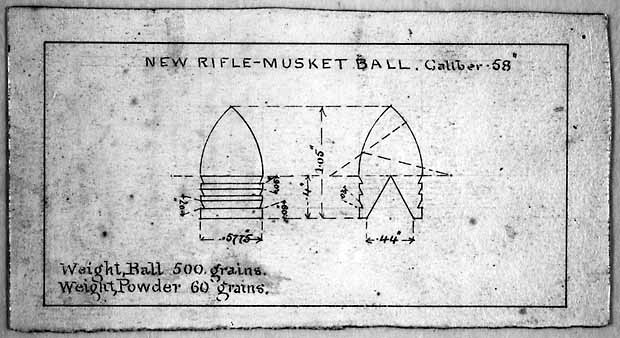
In was not until 1848 when French Army Captain Claude Minié who “perfected a bullet small enough to be easily rammed down a rifled barrel, with a wooden plug in the base of the bullet to expand it upon firing to take the rifling.” [3]Unfortunately the bullets were expensive to produce and it was not until in 1850 an American armorer at Harpers Ferry, James Burton “simplified the design that had made Minié famous and developed a hollow based, .58-caliber lead projectile that could be cheaply mass-produced.” [4] Burton’s ammunition was very easy to load into weapons, and soldiers were able to drop the cartridge into the muzzle of their rifles as easily as they could musket balls down a smoothbore.

The tactics the officers were educated in were developed at a time when the maximum effective range of muskets was barely 100 yards. However, the Army did make some minor adjustments to its tactics to increase speed and mobility in the tactic movement of the infantry. Colonel William J. Hardee went on to become a Confederate General adapted changes first made by the French to the U.S. infantry manual. These changes “introduced double-quick time (165 steps per-minute) and the run and allowed changes to the order of march to be made in motion rather than after coming to a halt.” [5]

During Napoleon’s time assaulting an opponent with a large body of troops was a fairly easy proposition, one simply maneuvered out of the rage of the enemy’s artillery and muskets, thus “to bring a heavy mass of troops upon them was possible because of the limited destructiveness of smoothbore firearms. Their range was so restricted that defenders could count on getting off only one reasonably effective volley against advancing soldiers. By the time that volley was unloosed, the attackers would be so close to their objective that before the defenders could reload, the attacking troops would be upon them.” [6] One of Napoleon’s favorite tactics was for his troops to make well executed turning maneuvers aimed at the enemy’s flanks, but the increased range and lethality meant that even when such maneuvers were executed, they often produced only a short term advantage as the defenders would form a new front and continue the action.

Yet by 1860 the rifled muskets had an effective range of about 500 yards and sometimes, depending on the type of weapon even more, but in most cases during the Civil War infantry engagements were fought at considerable shorter ranges. Paddy Griffith notes that even in the modern era long range firing by infantry units is still rare, and that there is “a fallacy in the notion that longer range weapons automatically produce longer-range fire. The range of firing has much more to do with the range of visibility, the intentions of the firer and the general climate of the army.” [7] Drew Gilpin Faust wrote that Civil War battles still “remained essentially intimate; soldiers were often able to see each other’s faces and to know who they had killed.” [8] They knew their weapons could fire at longer range, and one Union soldier explained, “when men can kill one another at six hundred yards they would generally would prefer to do it at that distance.” [9] But for the average infantryman such occasions were the exception.

The advent of the breach loading and later the repeating rifle and carbine further increased the firepower available to individual soldiers. However, with the exception of the Prussian Army, armies in Europe as well as the United States Army were slow to adapt the breech loading rifles. In “1841 the U.S. Arsenal at Harpers Ferry, Virginia, had prepared the pattern weapons of the first general-issue rifled shoulder arm of the U.S. Army”[10]

The process of conversion to the new weapons was slow, conservatism reigned in the Army and the lack of suitable ammunition was a sticking point. However, the U.S. Army began its conversion “to the rifled musket in the 1840s but rejected both the repeating rifle and the breechloader for infantry because of mechanical problems.” [11] Even so there was a continued resistance by leaders in the army to arming infantry with the rifled muskets despite the already noted obsolescence of them during the Crimean War. In discussing the differences of rifles and smoothbore muskets during the Peninsular Campaign, Edward Porter Alexander wrote that “In the Mexican War fought with smooth bore, short range muskets, in fact, the character of the ground cut comparatively little figure. But with the rifles muskets & cannon of this war the affair was proven both at Malvern Hill, & at Gettysburg….” [12]

However, in 1855 the new Secretary of War, Jefferson Davis ordered the Army to convert to “the .58 caliber Springfield Rifled Musket. Along with the similar British Enfield rifle (caliber .577, which would take the same bullet as the Springfield), the Springfield became the main infantry arm of the Civil War.” [13] Even so the production of the new rifles was slow and at the beginning of the war only about 35,000 of all types were in Federal arsenals or in the hands of Federal troops.

The one failure of Union Chief of Ordnance Ripley was his “insistence in sticking by the muzzle loading rifle as the standard infantry arm, rather than introducing the breach-loading repeating rifle.” [14] Ripley believed that a “move to rapid fire repeating rifles would put too much stress on the federal arsenals’ ability to supply the repeaters in sufficient quantities for the Union armies.”[15] There is a measure of truth in this for troops armed with these weapons did have the tendency to waste significantly more ammunition than those armed with slow firing muzzle loaders, but had he done so the war may not have lasted nearly as long.

weapons

Had Ripley done this Union infantry would have enjoyed an immense superiority in sheer weight of firepower on the battlefield. The noted Confederate artilleryman and post-war analyst Porter Alexander believed that had the Federals adopter breech-loading weapons that the war would have been over very quickly, noting, “There is reason to believe that had the Federal infantry been armed from the first with even the breech-loaders available in 1861 the war would have been terminated within a year.” [16] Alexander’s observation is quite correct. As the war progressed and more Union troops were armed with breach loaders and repeaters Confederates found themselves unable to stand up to the vastly increased firepower of Union units armed with the newer weapons. A Union soldier assigned to the 100thIndiana of Sherman’s army in 1865:

“I think the Johnnys are getting rattled; they are afraid of our repeating rifles. They say that we are not fair, that we have guns that we load up on Sunday and shoot all the rest of the week. This I know, I feel a good deal confidence in myself with a 16 shooter in my hands, than I used to with a single shot rifle.” [17]

During the war both the Union and Confederate armies used a large number of shoulder-fired rifles and muskets of various manufactures and vintage. This was in large part because of a shortage of the standard M1861 Springfield Rifled Musket at the beginning of the war and initially standardization was a problem, and as a result many units went to war armed with various types of weapons which made supply, training, and coordinated fires difficult. At the beginning of the war, the Federal government had only about 437,000 muskets and rifles in its inventory, and only about 40,000 of these were rifled muskets, either older weapons converted from smoothbores or the newly manufactured Springfield rifles.

The disparity of types of weapons that might be found in a single regiment contributed to difficulties in supplying ammunition to them, and proved to be nightmarish for experienced quartermasters. This was especially the case when the amateur quartermasters of many regiments did not specify exactly what types of ammunition they required.

Likewise, in addition to the existing stocks of weapons available for use, the Federal government only had two armories capable of manufacturing arms, Harpers Ferry Virginia, which had to be abandoned in 1861 when Virginia seceded from the Union, and the other in Springfield Massachusetts, which had a capacity to manufacture between 3,000 and 4,000 rifles a month. Ordnance Chief Ripley solved that problem by contracting with U.S. and foreign manufacturers to make up for what government armories could not do. In the first year of the war he contracted for nearly 750,000 rifles from U.S. and foreign arms suppliers. During the war he expanded the capacity at Springfield so that it could produce over 300,000 weapons a year. Even so at Gettysburg sixty-five of the 242 Union infantry regiments, some 26%, were fully or partially armed with older substandard weapons, both smoothbores and antiquated rifles. In 1863 and 1864, the Confederate Army of the Tennessee over half of the army was armed with smoothbores or antiquated rifles. [18]

But the initial shortage of weapons caused problems for both sides. The Confederacy had to make the best use of what they had obtained in captured federal depots at the beginning of the war, which amounted to 140,000 smoothbores and another 35,000 rifled muskets.  Like the Federal Government, the Confederacy which had much less industrial capacity was forced to purchase many of its weapons from England expending badly needed capital to do so and requiring the weapons to be shipped through the Union blockade on blockade runners operating from England, the Bahamas, or other English Caribbean possessions. During the war the Confederates purchased approximately 300,000 rifled muskets and 30,000 smoothbores from Europe while producing just over 100,000 shoulder fired weapons of all types during the war. The Union through its economic superiority was able to acquire a million rifled muskets, 100,000 smoothbores from Europe in addition to the 1.75 million rifled muskets, 300,000 breechloaders, and 100, repeaters of its own wartime manufacture. [19]

In the end the disparity in quality and quantity of arms would doom the élan of the Confederate infantry in battle after battle. Porter Alexander wrote of the Confederate equipment situation:

“The old smooth-bore musket, calibre 69, made up the bulk of the Confederate armament at the beginning, some of the guns, even all through 1862, being old flint-locks. But every effort was made to replace them by rifled muskets captured in battle, brought through the blockade from Europe, or manufactured at a few small arsenals which we gradually fitted up. Not until after the battle of Gettysburg was the whole army in Virginia equipped with the rifled musket. In 1864 we captured some Spencer breech-loaders, but we could never use them for lack of proper cartridges.” [20]

The number of kinds of weapons that a given unit might be equipped was difficult for commanders and logisticians on both sides.  For example, Sherman’s division at the Battle of Shiloh “utilized six different kinds of shoulder arms, with each necessitating a different caliber of ammunition,” [21]which caused no end of logistical problems for Sherman’s troops as well as other units equipped with mixed weaponry.

Commonly Used Union and Confederate Rifles and Muskets

Type Designed Manufactured Weight Length Caliber Rate of Fire (Rounds per Minute) Feed System Effective Range Maximum Range
M1861 Springfield 1861 ~1,000,000

9 Lbs.

56 inches .58 2-4  Muzzle Loaded 100-400 yards 500-620 yards
M1863 Springfield 1863 700,000 9 Lbs. 56 inches .58 2-3 Muzzle Loaded 200-300 yards 800-1000 yards
Pattern 1853 Enfield (England) 1853 1,500,000 total 900,000 estimated used in Civil War 9.5 Lbs.  55 inches .58 3+  Muzzle Loaded  200-600 Yards 1250 yards
Lorenz Rifle (Austria) 1853  ~325,000 used in Civil War 8.82 Lbs. 37.5 inches .54 2 Muzzle Loaded 100-600 yards 900-1000 yards
M186 to M1842 Springfield Musket 1816-1842 ~1,000,000 10 Lbs. 58 inches .69 2-3 Muzzle Loaded 75-100 yards 200 yards
Sharps Rifle 1848 120,000+ 9.5 Lbs. 47 inches .52 8-9 Breech Loading 500 yards 1000 yards
Spencer Repeating Rifle 1860 200,000 10 Lbs. 47 Inches .52 14-20 Breech Loading 500 yards

1000 yards


While this increase in range, accuracy, and rate of fire were important, they were also mitigated by the fact that the smoke created by the black, non-smokeless gunpowder powder expended by all weapons during the Civil War often obscured the battlefield, and the stress of combat reduced the rate and accuracy of fire of the typical soldier. This was compounded by the fact that most soldiers received little in the way of real marksmanship training. Allen Guelzo notes that the “raw inexperience of Civil War officers, the poor training in firearms offered to the Civil War recruit, and the obstacles created by the American terrain generally cut down the effective range of Civil War combat to little more than eighty yards.” [22] That being said well-drilled regiments engaging enemy troops in the open on ground of their choosing could deliver devastating volley fire on their enemies.

But the real increase in lethality on the Civil War battlefield was the Minié ball “which could penetrate six inches of pine board at 500 yards.” [23] as such, the bullet was decidedly more lethal than the old smoothbore rounds, and most wounds “were inflicted by Minié balls fired from rifles: 94 percent of Union casualties were caused by bullets.” [24] The old musket balls were fired at a comparatively low velocity and when they hit a man they often pass through a human body nearly intact, unless there was a direct hit on a bone. Thus wounds were generally fairly simple to treat unless a major organ or blood vessel had been hit. But the Minié ball ushered in for those hit by it as well as the surgeons who had to treat their wounds:

“The very attributes that increased the bullet’s range also increased its destructive potential when it hit its target. Unlike the solid ball, which could pass through a body nearly intact, leaving an exit would not much larger than the entrance wound, the soft, hollow-based Minié ball flattened and deformed on impact, while creating a shock wave that emanated outward. The Minié ball didn’t just break bones, it shattered them. It didn’t just pierce organs, it shredded them. And if the ragged, tumbling bullet had enough force to cleave completely through the body, which it often did, it tore out an exit wound several times the size of the entrance wound.” [25]

When these bullets hit the arm and leg bones of soldiers the effects were often catastrophic and required immediate amputation of the limb by surgeons working in abysmal conditions. “The two minie bullets, for example, that struck John Bell Hood’s leg at Chickamauga destroyed 5 inches of his upper thigh bone. This left surgeons no choice but to amputate shattered limbs. Hood’s leg was removed only 4 and 1/2 inches away from his body. Hip amputations, like Hood’s, had mortality rates of around 83%.” [26]

This technological advance changed the balance and gave armies fighting on the defensive an edge. The advance in the range and killing power embodied in the rifled musket made it especially difficult for the armies that fought the Civil War to successfully execute frontal assaults on prepared defenders. The defensive power was so enhanced that even a “well executed turning maneuver was likely to produce only a decidedly temporary advantage in the Civil War.” [27] Well trained units could change their front against enemies assailing their flanks and turning them back as was demonstrated by Joshua Chamberlain’s 20thMaine at Little Round Top. Occasionally some assaulting troops would get in among the enemy’s lines, despite the enormous costs that they incurred during their attacks, but “the greater problem was how to stay there and exploit the advantage once the enemy’s line had been pierced. Almost invariably, by that time the attacker had lost so heavily, and his reserves were distant, that he could not hold on against a counterattack by the defending army’s nearby reserves.”[28]

Despite the increased range of the rifled muskets many infantry firefights were still fought at closer ranges, usually under 200 yards, not much more than the Napoleonic era. Much of this had to do with the training of the infantry as well as visibility on the battlefield which in North America was often obscured by heavy forested areas and thickets in which armies would battle each other at close range. Battles such as the Seven Days, Chancellorsville, and much of the Overland Campaign were fought in such terrain.

This was demonstrated time and time again throughout the course of the war as commanders attempted frontal assaults on such positions. “The only way to impose heavy enough casualties upon an enemy army to approximate that army’s destruction was to accept such heavy casualties oneself that no decisive advantage could accrue.” [29]Lee’s assault on Malvern Hill and his numerous frontal assaults on prepared positions at Gettysburg, Burnside’s ghastly assaults at Fredericksburg, Grant’s first attack at Vicksburg, and Grant’s ill-advised attack at Cold Harbor demonstrated the futility and ghastly cost of such tactics. The ability of infantry in the assault to “rise up and deliver a frontal attack became almost always futile against any reasonably steady defenders. Even well executed flank attacks tended to suffer such heavy casualties as experienced riflemen maneuvered to form new fronts against them that they lost the decisiveness they had enjoyed in the Napoleonic Wars.” [30] During the Wilderness Campaign battles were fought for hours on end at point blank range amid heavy woods and fortifications.

As important as the rifled muskets were, the real revolution in battlefield firepower was brought about by the repeating rifles and muskets which came into use during the war. The early examples were not reliable because the ammunition available was in a paper cartridge which sometimes caused gas and flames to escape form the breach, making the weapon dangerous to the user. But this was corrected with the introduction of brass cartridges and later weapons became deadly instrument. Because of its range as compared to the older smoothbores, the rifled musket “added a new spatial dimension to the battlefield,” [31] but the repeating rifles, which had a shorter range than the rifled muskets looked forward to the day of semi-automatic and automatic weapons. The repeaters could “pump out so many shots in such a short time that it offered a new perspective in tactical theory from that used by the old carefully aimed one-shot weapons,” and added “a new temporal dimension to the close range volley.” [32]

Despite the fact that leaders knew about the increased range and accuracy that came with the rifled musket, tactics in all arms were slow to change, and “on every occasion, a frontal assault delivered against an unshaken enemy led to failure.” [33]Even at Gettysburg Robert E. Lee would demonstrate that he had not fully appreciated the effects of the lethality of the rifled musket when he ordered Hood’s assault on Federal troops at Little Round Top on July 2nd and Pickett’s assault on the Union center on July 3rd1863. Lee should have learned during the bloody battles of 1862 and early 1863 which cost his army over 50,000 casualties.

I find it most interesting and tragic that this increase in firepower, among many other things, was not appreciated by the military leaders of the European powers who went to war in 1914. As a result millions of men died unnecessary deaths.

                                                                                   Notes 

[1] Ibid. Hagerman The American Civil War and the Origins of Modern Warfare p.15

[2] Ibid. McPherson. The Battle Cry of Freedom p.474

[3] Ibid. McPherson. The Battle Cry of Freedom p.474

[4] Leonard, Pat The Bullet that Changed History in The New York Times Disunion: 106 Articles from the New York Times Opinionator edited by Ted Widmer with Clay Risen and George Kalogerakis, Black Dog and Leventhal Publishers, New York 2013 p.372

[5] Ibid. Hagerman The American Civil War and the Origins of Modern Warfare p.20

[6] Ibid. Weigley A Great Civil War p.33

[7] Griffith, Paddy, Battle Tactics of the Civil War Yale University Press, New Haven and London 1989 p.148

[8] Ibid. Faust This Republic of Suffering: Death and the American Civil War p.41

[9] Ibid. Faust This Republic of Suffering: Death and the American Civil War p.41

[10] Ibid. Weigley A Great Civil War p.32

[11] Ibid. Hagerman The American Civil War and the Origins of Modern Warfare p.17

[12] Ibid. Alexander Fighting for the Confederacy: The Personal Recollections of General Edward Porter Alexander p.111

[13] Ibid. McPherson. The Battle Cry of Freedom p.474

[14] Ibid. Guelzo Fateful Lightning p.317

[15] Ibid. Guelzo Fateful Lightning p.251

[16] Alexander, Edward Porter Military Memoirs of a Confederate: A Critical Narrative 1907 republished 2013 by Pickle Partners Publishing, Amazon Kindle Edition location 1691 of 12969

[17] Davis, Burke. Sherman’s March Open Roads Integrated Media, New York, 2016, originally published by Vintage Press 1980 p.196

[18] Ibid. Griffith,  Battle Tactics of the Civil War  pp.76-77

[19] Ibid. Griffith, Battle Tactics of the Civil War p.80

[20] Ibid. Alexander Military Memoirs of a Confederate location 1683 of 12969

[21] Ibid. McDonough William Tecumseh Sherman: In the Service of My Country, A Life  p.2

[22] Ibid. Guelzo Fateful Lightening pp.255-256

[23] Ibid. Guelzo Fateful Lightening p.250

[24] Ibid. Faust This Republic of Suffering: Death and the American Civil War p.41

[25] Ibid. Leonard, Pat The Bullet that Changed History p.372

[26] Goellnitz, Jenny Civil War Battlefield Surgery The Ohio State University, Department of History retrieved from https://ehistory.osu.edu/exhibitions/cwsurgeon/cwsurgeon/amputations 22 December 2016

[27] Ibid. Weigley A Great Civil War: A Military and Political History 1861-1865 p.34

[28] Ibid. Weigley The American Way of War p.117

[29] Ibid. Weigley A Great Civil War: A Military and Political History 1861-1865 p.34

[30] Ibid. Weigley, American Strategy from Its Beginnings through the First World War In Makers of Modern Strategy, from Machiavelli to the Nuclear Age p.419

[31] Ibid. Griffith, Battle Tactics of the Civil War p.75

[32] Ibid. Griffith, Battle Tactics of the Civil War p.75

[33] Ibid. Fuller, The Conduct of War 1789-1961 p.104

2 Comments

Filed under civil war, ER's and Trauma, Gettysburg, History, Military, us army

Union and Confederate Infantry Tactics at the Beginning of the Civil War

2nd michigan

Friends of Padre Steve’s World,

We are beginning our trip to Germany in the morning and because we are busy I am pre-posting this section of one of my Civil War texts. 

Peace,

Padre Steve+

The heart of the Civil War armies was the infantry, of which the key unit was the infantry regiment. The U.S. Army had ten Regular Army infantry regiments that the outbreak of the war, most of which were scattered about the country in small garrisons especially in the west, where they were engaged in providing security in the newly acquired territories and states. The few Regular Army units of the United States Army were expanded during the war, and more importantly were joined by hundreds of volunteer regiments during the war.

The Confederacy, lacking a regular army also raised hundreds of volunteer infantry regiments.  The regiment was built around the infantry company that was composed of sixty to one hundred soldiers commanded by a Captain. Most companies, in the case of the volunteer regiments came from the same town, county or neighborhood. The infantry regiment was composed of ten companies. Union infantry regiments “maximum strength was fixed at 39 officers and 986 men. A Confederate regiment was larger: 49 officers and 1,340 men maximum.”  [1] However, in practice these guidelines were not rigidly adhered to, depending on recruiting efforts some regiments have fewer men than their authorized strength when organized and others from more populous areas had more.

However, most regiments were rarely at their authorized strength after their muster into service and this got far worse for units after they had been on campaign and in battle. Federal statistics show that, “by April 1862, an average regiment had 560 men; by July 1863, it would number only 375 soldiers.” [2] These were average numbers, at Gettysburg, some regiments like the 8th Ohio Volunteer Infantry, which on July 3rd decimated the men of John Brockenbrough and Joseph Davis’s brigades on the left flank during Pickett’s Charge had just 209 men in its the ranks. The 124th New York Volunteer Infantry had just 18 officers and 220 men in its ranks when Hood’s brigades of Texans, Georgians and Arkansas men hit them at Devil’s Den on July 2nd 1863 at Gettysburg. [3]

Prior to the war regiments tended to be scarred about the nation in small garrisons or on the frontier, and the brigade was the largest unit within the army, and then only put together for combat or expeditionary operations. A brigade was typically composed of two to five regiments. In theory brigades were commanded by Brigadier Generals but many times commanded by Colonels. In addition to their organic infantry brigades usually had their “own quartermaster, commissary, and ammunition trains. Medical teams and sometimes artillery, were assigned to brigades.” [4] With the attachments the brigade could function as an independent unit.

With the expansion of the armies divisions of infantry were formed. Composed of two or more brigades divisions could operate independently or banded together as part of an army corps. Corps were composed of two or more divisions. Two or more corps would compose an army.

Infantry formations on both sides relied on Napoleonic infantry tactics which when they were formulated worked well due to the types of weapons used by opposing armies. Depending on the tactical situation, infantry regiments, brigades and divisions advanced into battle in either column formation or line shoulder to shoulder.

The column formation, a tactic borrowed from the French, but also used by other armies was used to move quickly into battle. It involved “massing troops on a narrow front, like a swinging a ram, could smash into, and disrupt, an enemy infantry formation and make it run for its life.”[5] During the Napoleonic Era the French often used to charge in the offense as it could provide weight of numbers at the point of attack. The drawback to this formation was that the attacking units were extremely vulnerable to enemy artillery fire, particularly Solid Shot cannonballs “which could do hideous damage to a tightly packed column with just a few well-placed rounds” [6] if the enemy artillery was not sufficiently disrupted or destroyed before they came into range.

Columns could be formed from battalion level up. At Waterloo Napoleon deployed a Corps in column, to gain a better understanding it is best to look at the battalion or regiment in column. Typically a column would be one to two companies wide making a front of 30 to 60 soldiers. Thus a full strength regiment deployed in a two company front column would have about 17 ranks.

The line formation was adopted from the British although the French and Prussians used it as well. The line formation was designed to maximize the fire of regiments by placing the men in a formation of “two or three lines which allowed the full play of musket fire along its front.” [7] Since the rate of fire of muzzle loading muskets, rifled or not was much slower in battle conditions, the tactic enabled infantry regiments to maintain a good volume of fire against enemy units, in the offense or in the defense. However the line was an “extremely fragile formation. Attempting to march a line forward across anything except the smoothest parade ground led to disorder. Men straggled, stumbled, wavered, and the line would soon lose all cohesion.” [8] Confederate General D.H. Hill “later in life once asked, rhetorically but memorably: ‘Whoever saw a Confederate line advancing that was not crooked as a ram’s horn? Each ragged rebel yelling on his own hook and aligning on himself.’” [9]

The great virtue of the line formation was “its ability to deliver musket fire by volley and its relative immunity to artillery fire,” [10] at least fire delivered from the front as it presented a small target. However if enemy artillery was able to get in position to deliver enfilade fire, or fire from the flank as happened to the Confederate troops who made Pickett’s Charge, the effect could be devastating.  Unlike the column formation, the line formation took a great deal of time to deploy in line of battle and to maneuver swiftly as a unit once formed and it was vulnerable to cavalry if caught in the open.

The first American infantry drill manual was issued in 1779 when General Von Steuben was given the task of training the Continental Army. The books was based on the tactics of the Prussian Army under Frederick the Great. However, over time, Americans came to favor French drill manuals. In 1835 General Winfield Scott translated the revised French drill manual and issued it as Infantry Tactics and Rules for the Exercise and Manoeuvers of the United States Infantry. The Army that Scott led into Mexico in 1846 used the manual with success and it remained in publican until 1861, and “its general structure remained the heart of all the civil War drill manuals.” [11] As tacticians began to appreciate the impact of the rifled musket infantry tactics saw some adjustments in order to “increase the speed and mobility of tactical movement.” [12]

Scott’s manual was superseded by the volume produced by William J. Hardee who later became a Confederate general. Hardee’s work, Rifle and Light Infantry Tactics for the Exercise of Manoeuvers of Troops when acting as Light Infantry or Riflemen was “based directly on a new generation of French manuals.” [13] Hardee modified the line formation from three lines to two and had an increased role for skirmishers. Likewise Hardee added “extra provisions for rifle fire and manoeuvers at a gymnastic pace (‘double quick’) of 165 to 180 steps a minute.” [14] While an improvement on the older manuals it was still very similar to Scott’s work.

civilwararmyinfantry

In 1862 the U.S. Army adopted Silas Casey’s manual, Infantry Tactics as its official doctrine. Casey’s work was for the most part a composite of Scott’s and Hardee’s work. That being said, Casey “also contributed tactical doctrine for brigade and larger-unit tactics and made revisions that improved the deployment from column to line.” These contributions were important to both armies as the “Confederates quickly followed the Union army in adapting his revisions.” [15] While Casey’s became the official doctrine it was Hardee’s that “won the widest usage and was issued in the most variants.” [16] These included adaptations for U.S. Colored Troop regiments as well as militia forces.

Casey’s manual was particularly helpful for officers serving as brigade and regimental commanders. Previous manuals had been unclear as to where they should place themselves in the order of march, or when the unit was moving in line or column on the attack. Casey clarified this so that “Budding commanders could easily work out where they should place themselves as their regiments marched to the front in column or line, how brigade artillery should be employed, how the head of a column should be maneuvered to give direction to the main mass, and so on.” [17] Even so new officers who had crammed their heads with Scott, Hardee, or Casey for a few weeks could cause havoc among his own troops. A soldier of the 14th New Hampshire Infantry noted: “The men were serene in their ignorance of tactics; but ambitious officers of the line, who had been cramming Casey for a fortnight, were in a vertebral, cold-shiver temperature…. That the men got caught in a snarl, a tangle, a double twisted, inextricable tactical knot, is tame delineation. The drill caused a great deal of serious reflection…” [18]

As the war went on more use was made of skirmishers, which traditionally had deployed in front of the line. With the rifled muskets the skirmishers, advancing ahead of the massed formations could use the longer range and greater accuracy of their weapons to inflict significant numbers of casualties on the enemy, and to pick off enemy officers and artillerymen. The artillery despised the skirmishers as they could do little to combat them without having their own close infantry support.

But skirmishers took a long time to train and the massed volunteer armies, mostly officered  by volunteers had precious little time or experience to train good skirmishers. The Union attempted to rectify this by organizing Sharpshooter regiments, “two of which were organized for the army of the Potomac by Hiram Berdan in 1862.” [19] Both of these units served well at Malvern Hill in 1862 and Gettysburg on July 2nd and proved their worth on other battlefields of the war.  Highly trained and motivated Berdan’s sharpshooters “lived like a band of brothers, imbued with the one feeling of patriotism in their voluntary enlistment for three years.”[20]

Notes

[1] Robertson, James I. Soldiers Blue and Gray University of South Carolina Press, Columbia 1988 p.21

[2] Ibid. Robertson Soldiers Blue and Gray p.19

[3] For a listing of the numbers of soldiers that each regiment went into battle with at Gettysburg see Petruzzi, J. David and Stanley, Steven The Gettysburg Campaign in Numbers and Losses: Synopses, Orders of Battle, Strengths, Casualties and Maps, June 9 – July 1, 1863 Savas Beatie LLC, El Dorado Hills CA 2012

[4] Ibid. Robertson Soldiers Blue and Gray p.24

[5] Guelzo, Allen C. Gettysburg: The Last Invasion Vintage Books a Division of Random House, New York 2013 p.38

[6] Ibid. Guelzo Gettysburg the Last Invasion p.39

[7] Ibid. Guelzo Gettysburg the Last Invasion p.38

[8] Ibid. Cornwell Waterloo: The History of Four Days, Three Armies, and Three Battles p.69

[9] Ibid. Griffith, Battle Tactics of the Civil War p.111

[10] Ibid. Guelzo Gettysburg the Last Invasion p.38

[11] Ibid. Griffith, Battle Tactics of the Civil War p.100

[12] Ibid. Hagerman The American Civil War and the Origins of Modern Warfare p.20

[13] Ibid. Griffith, Battle Tactics of the Civil War p.100

[14] Ibid. Griffith, Battle Tactics of the Civil War p.100

[15] Ibid. Hagerman The American Civil War and the Origins of Modern Warfare p.20

[16] Ibid. Griffith, Battle Tactics of the Civil War p.101

[17] Ibid. Griffith, Battle Tactics of the Civil War p.103

[18] Ibid. Robertson Soldiers Blue and Gray p.50

[19] Ibid. Guelzo Gettysburg the Last Invasion  p.38

[20] Ibid. Guelzo Gettysburg the Last Invasion  p.261

2 Comments

Filed under civil war, History, Military, us army

Infantry Tactics at the Beginning of the American Civil War

2nd michigan

Friends of Padre Steve’s World,

Today another revised section of one of my Civil War texts.

Blessings

Padre Steve+

The heart of the Civil War armies was the infantry, of which the key unit was the infantry regiment. The U.S. Army had ten Regular Army infantry regiments that the outbreak of the war, most of which were scattered about the country in small garrisons especially in the west, where they were engaged in providing security in the newly acquired territories and states. The few Regular Army units of the United States Army were expanded during the war, and more importantly were joined by hundreds of volunteer regiments during the war.

The Confederacy, lacking a regular army also raised hundreds of volunteer infantry regiments.  The regiment was built around the infantry company that was composed of sixty to one hundred soldiers commanded by a Captain. Most companies, in the case of the volunteer regiments came from the same town, county or neighborhood. The infantry regiment was composed of ten companies. Union infantry regiments “maximum strength was fixed at 39 officers and 986 men. A Confederate regiment was larger: 49 officers and 1,340 men maximum.”  [1] However, in practice these guidelines were not rigidly adhered to, depending on recruiting efforts some regiments have fewer men than their authorized strength when organized and others from more populous areas had more.

However, most regiments were rarely at their authorized strength after their muster into service and this got far worse for units after they had been on campaign and in battle. Federal statistics show that, “by April 1862, an average regiment had 560 men; by July 1863, it would number only 375 soldiers.” [2] These were average numbers, at Gettysburg, some regiments like the 8th Ohio Volunteer Infantry, which on July 3rd decimated the men of John Brockenbrough and Joseph Davis’s brigades on the left flank during Pickett’s Charge had just 209 men in its the ranks. The 124th New York Volunteer Infantry had just 18 officers and 220 men in its ranks when Hood’s brigades of Texans, Georgians and Arkansas men hit them at Devil’s Den on July 2nd 1863 at Gettysburg. [3]

Prior to the war regiments tended to be scarred about the nation in small garrisons or on the frontier, and the brigade was the largest unit within the army, and then only put together for combat or expeditionary operations. A brigade was typically composed of two to five regiments. In theory brigades were commanded by Brigadier Generals but many times commanded by Colonels. In addition to their organic infantry brigades usually had their “own quartermaster, commissary, and ammunition trains. Medical teams and sometimes artillery, were assigned to brigades.” [4] With the attachments the brigade could function as an independent unit.

With the expansion of the armies divisions of infantry were formed. Composed of two or more brigades divisions could operate independently or banded together as part of an army corps. Corps were composed of two or more divisions. Two or more corps would compose an army.

Infantry formations on both sides relied on Napoleonic infantry tactics which when they were formulated worked well due to the types of weapons used by opposing armies. Depending on the tactical situation, infantry regiments, brigades and divisions advanced into battle in either column formation or line shoulder to shoulder.

The column formation, a tactic borrowed from the French, but also used by other armies was used to move quickly into battle. It involved “massing troops on a narrow front, like a swinging a ram, could smash into, and disrupt, an enemy infantry formation and make it run for its life.” [5] During the Napoleonic Era the French often used to charge in the offense as it could provide weight of numbers at the point of attack. The drawback to this formation was that the attacking units were extremely vulnerable to enemy artillery fire, particularly Solid Shot cannonballs “which could do hideous damage to a tightly packed column with just a few well-placed rounds[6] if the enemy artillery was not sufficiently disrupted or destroyed before they came into range.

Columns could be formed from battalion level up. At Waterloo Napoleon deployed a Corps in column, to gain a better understanding it is best to look at the battalion or regiment in column. Typically a column would be one to two companies wide making a front of 30 to 60 soldiers. Thus a full strength regiment deployed in a two company front column would have about 17 ranks.

The line formation was adopted from the British although the French and Prussians used it as well. The line formation was designed to maximize the fire of regiments by placing the men in a formation of “two or three lines which allowed the full play of musket fire along its front.” [7] Since the rate of fire of muzzle loading muskets, rifled or not was much slower in battle conditions, the tactic enabled infantry regiments to maintain a good volume of fire against enemy units, in the offense or in the defense. However the line was an “extremely fragile formation. Attempting to march a line forward across anything except the smoothest parade ground led to disorder. Men straggled, stumbled, wavered, and the line would soon lose all cohesion.” [8] Confederate General D.H. Hill “later in life once asked, rhetorically but memorably: ‘Whoever saw a Confederate line advancing that was not crooked as a ram’s horn? Each ragged rebel yelling on his own hook and aligning on himself.’” [9]

The great virtue of the line formation was “its ability to deliver musket fire by volley and its relative immunity to artillery fire,” [10] at least fire delivered from the front as it presented a small target. However if enemy artillery was able to get in position to deliver enfilade fire, or fire from the flank as happened to the Confederate troops who made Pickett’s Charge, the effect could be devastating.  Unlike the column formation, the line formation took a great deal of time to deploy in line of battle and to maneuver swiftly as a unit once formed and it was vulnerable to cavalry if caught in the open.

The first American infantry drill manual was issued in 1779 when General Von Steuben was given the task of training the Continental Army. The books was based on the tactics of the Prussian Army under Frederick the Great. However, over time, Americans came to favor French drill manuals. In 1835 General Winfield Scott translated the revised French drill manual and issued it as Infantry Tactics and Rules for the Exercise and Manoeuvers of the United States Infantry. The Army that Scott led into Mexico in 1846 used the manual with success and it remained in publican until 1861, and “its general structure remained the heart of all the civil War drill manuals.” [11] As tacticians began to appreciate the impact of the rifled musket infantry tactics saw some adjustments in order to “increase the speed and mobility of tactical movement.” [12]

Scott’s manual was superseded by the volume produced by William J. Hardee who later became a Confederate general. Hardee’s work, Rifle and Light Infantry Tactics for the Exercise of Manoeuvers of Troops when acting as Light Infantry or Riflemen was “based directly on a new generation of French manuals.” [13] Hardee modified the line formation from three lines to two and had an increased role for skirmishers. Likewise Hardee added “extra provisions for rifle fire and manoeuvers at a gymnastic pace (‘double quick’) of 165 to 180 steps a minute.” [14] While an improvement on the older manuals it was still very similar to Scott’s work.

civilwararmyinfantry

In 1862 the U.S. Army adopted Silas Casey’s manual, Infantry Tactics as its official doctrine. Casey’s work was for the most part a composite of Scott’s and Hardee’s work. That being said, Casey “also contributed tactical doctrine for brigade and larger-unit tactics and made revisions that improved the deployment from column to line.” These contributions were important to both armies as the “Confederates quickly followed the Union army in adapting his revisions.” [15] While Casey’s became the official doctrine it was Hardee’s that “won the widest usage and was issued in the most variants.” [16] These included adaptations for U.S. Colored Troop regiments as well as militia forces.

Casey’s manual was particularly helpful for officers serving as brigade and regimental commanders. Previous manuals had been unclear as to where they should place themselves in the order of march, or when the unit was moving in line or column on the attack. Casey clarified this so that “Budding commanders could easily work out where they should place themselves as their regiments marched to the front in column or line, how brigade artillery should be employed, how the head of a column should be maneuvered to give direction to the main mass, and so on.” [17] Even so new officers who had crammed their heads with Scott, Hardee, or Casey for a few weeks could cause havoc among his own troops. A soldier of the 14th New Hampshire Infantry noted: “The men were serene in their ignorance of tactics; but ambitious officers of the line, who had been cramming Casey for a fortnight, were in a vertebral, cold-shiver temperature…. That the men got caught in a snarl, a tangle, a double twisted, inextricable tactical knot, is tame delineation. The drill caused a great deal of serious reflection…” [18]

As the war went on more use was made of skirmishers, which traditionally had deployed in front of the line. With the rifled muskets the skirmishers, advancing ahead of the massed formations could use the longer range and greater accuracy of their weapons to inflict significant numbers of casualties on the enemy, and to pick off enemy officers and artillerymen. The artillery despised the skirmishers as they could do little to combat them without having their own close infantry support.

But skirmishers took a long time to train and the massed volunteer armies, mostly officered  by volunteers had precious little time or experience to train good skirmishers. The Union attempted to rectify this by organizing Sharpshooter regiments, “two of which were organized for the army of the Potomac by Hiram Berdan in 1862.” [19] Both of these units served well at Malvern Hill in 1862 and Gettysburg on July 2nd and proved their worth on other battlefields of the war.  Highly trained and motivated Berdan’s sharpshooters “lived like a band of brothers, imbued with the one feeling of patriotism in their voluntary enlistment for three years.” [20]

Notes

[1] Robertson, James I. Soldiers Blue and Gray University of South Carolina Press, Columbia 1988 p.21

[2] Ibid. Robertson Soldiers Blue and Gray p.19

[3] For a listing of the numbers of soldiers that each regiment went into battle with at Gettysburg see Petruzzi, J. David and Stanley, Steven The Gettysburg Campaign in Numbers and Losses: Synopses, Orders of Battle, Strengths, Casualties and Maps, June 9 – July 1, 1863 Savas Beatie LLC, El Dorado Hills CA 2012

[4] Ibid. Robertson Soldiers Blue and Gray p.24

[5] Guelzo, Allen C. Gettysburg: The Last Invasion Vintage Books a Division of Random House, New York 2013 p.38

[6] Ibid. Guelzo Gettysburg the Last Invasion p.39

[7] Ibid. Guelzo Gettysburg the Last Invasion p.38

[8] Ibid. Cornwell Waterloo: The History of Four Days, Three Armies, and Three Battles p.69

[9] Ibid. Griffith, Battle Tactics of the Civil War p.111

[10] Ibid. Guelzo Gettysburg the Last Invasion p.38

[11] Ibid. Griffith, Battle Tactics of the Civil War p.100

[12] Ibid. Hagerman The American Civil War and the Origins of Modern Warfare p.20

[13] Ibid. Griffith, Battle Tactics of the Civil War p.100

[14] Ibid. Griffith, Battle Tactics of the Civil War p.100

[15] Ibid. Hagerman The American Civil War and the Origins of Modern Warfare p.20

[16] Ibid. Griffith, Battle Tactics of the Civil War p.101

[17] Ibid. Griffith, Battle Tactics of the Civil War p.103

[18] Ibid. Robertson Soldiers Blue and Gray p.50

[19] Ibid. Guelzo Gettysburg the Last Invasion  p.38

[20] Ibid. Guelzo Gettysburg the Last Invasion  p.261

1 Comment

Filed under civil war, History, Military

A Revolution in Killing: The Rifled Musket and the Minié Ball

claude_etienne_minie

Claude Minié

Friends of Padre Steve’s World,

I have continued to work on my various Gettysburg and Civil War texts and today something from one of them that should appeal to those interested in Civil War infantry weaponry and tactics.  I have to admit that I am kind of a geek about this kind of stuff but in order to understand the broad brush aspects of history one also has to know something about detailed facts. So anyway, here is a section of my text dealing with the advances in weaponry that made the American Civil War and subsequent wars so much more deadly.

Peace

Padre Steve+

minnie-ball

Minié Ball 

While various individuals and manufacturers had been experimenting with rifles for some time the weapons were difficult to load as the rifled groves slowed down the loading process. The British pioneered the use of the rifle during the Napoleonic Wars and the War of 1812. The issue of the Baker rifle, a rifled flintlock which was accurate to about 300 yards was limited to specific Rifle Regiments which were considered elite units, as well as skirmishers in some other regiments. The soldiers assigned to the Rifle regiments wore a distinctive green uniform as opposed to the red wore by the rest of the British Army. When the United States Army formed its first Sharpshooter regiments in late 1861 under the command of Colonel Hiram Berdan. Like the British the men of the regiment as well as the 2nd Regiment of Sharpshooters wore a distinctive green uniform instead of the Union Blue.

In 1832 a captain Norton of the British Army “invented a cylindroconoidal bullet. When fired, its hollow base automatically expanded to engage the rifling of the barrel, thus giving the bullet a horizontal spin.” [1] But the bullet was unwieldy, so it and other bullets that were “large enough to “take” the rifling was difficult to ram down the barrel” and slowed down the rate of fire significantly, and since “rapid and reliable firing was essential in a battle, the rifle was not practical for the mass of the infantrymen.” [2]

In was not until 1848 when French Army Captain Claude Minié who “perfected a bullet small enough to be easily rammed down a rifled barrel, with a wooden plug in the base of the bullet to expand it upon firing to take the rifling.” [3] Unfortunately the bullets were expensive to produce and it was not until in 1850 an American armorer at Harpers Ferry, James Burton “simplified the design that had made Minié famous and developed a hollow based, .58-caliber lead projectile that could be cheaply mass produced.” [4] Burton’s ammunition was very easy to load into weapons, and soldiers were able to drop the cartridge into the muzzle of their rifles as easily as they could musket balls down a smoothbore.

The tactics the officers were educated in were developed at a time when the maximum effective range of muskets was barely 100 yards. However, the Army did make some minor adjustments to its tactics to increase speed and mobility in the tactic movement of the infantry. Colonel William J. Hardee went on to become a Confederate General adapted changes first made by the French to the U.S. infantry manual. These changes “introduced double-quick time (165 steps per-minute) and the run and allowed changes to the order of march to be made in motion rather than after coming to a halt.” [5]

During Napoleon’s time assaulting an opponent with a large body of troops was a fairly easy proposition, one simply maneuvered out of the rage of the enemy’s artillery and muskets, thus “to bring a heavy mass of troops upon them was possible because of the limited destructiveness of smoothbore firearms. Their range was so restricted that defenders could count on getting off only one reasonably effective volley against advancing soldiers. By the time that volley was unloosed, the attackers would be so close to their objective that before the defenders could reload, the attacking troops would be upon them.” [6] One of Napoleon’s favorite tactics was for his troops to make well executed turning maneuvers aimed at the enemy’s flanks, but the increased range and lethality meant that even when such maneuvers were executed, they often produced only a short term advantage as the defenders would form a new front and continue the action.

Yet by 1860 the rifled muskets had an effective range of about 500 yards and sometimes, depending on the type of weapon even more, but in most cases during the Civil War infantry engagements were fought at considerable shorter ranges. Paddy Griffith notes that even in the modern era long range firing by infantry units is still rare, and that there is “a fallacy in the notion that longer range weapons automatically produce longer-range fire. The range of firing has much more to do with the range of visibility, the intentions of the firer and the general climate of the army.” [7] Drew Gilpin Faust wrote that Civil War battles still “remained essentially intimate; soldiers were often able to see each other’s faces and to know who they had killed.” [8] They knew their weapons could fire at longer range, and one Union soldier explained, “when men can kill one another at six hundred yards they would generally would prefer to do it at that distance.” [9] But for the average infantryman such occasions were the exception.

The advent of the breach loading and later the repeating rifle and carbine further increased the firepower available to individual soldiers. However, with the exception of the Prussian Army, armies in Europe as well as the United States Army were slow to adapt the breech loading rifles. In “1841 the U.S. Arsenal at Harpers Ferry, Virginia, had prepared the pattern weapons of the first general-issue rifled shoulder arm of the U.S. Army” [10]

The process of conversion to the new weapons was slow, conservatism reigned in the Army and the lack of suitable ammunition was a sticking point. However, the U.S. Army began its conversion “to the rifled musket in the 1840s but rejected both the repeating rifle and the breechloader for infantry because of mechanical problems.” [11] Even so there was a continued resistance by leaders in the army to arming infantry with the rifled muskets despite the already noted obsolescence of them during the Crimean War. In discussing the differences of rifles and smoothbore muskets during the Peninsular Campaign, Edward Porter Alexander wrote that “In the Mexican War fought with smooth bore, short range muskets, in fact, the character of the ground cut comparatively little figure. But with the rifles muskets & cannon of this war the affair was proven both at Malvern Hill, & at Gettysburg….” [12]

However, in 1855 the new Secretary of War, Jefferson Davis ordered the Army to convert to “the .58 caliber Springfield Rifled Musket. Along with the similar British Enfield rifle (caliber .577, which would take the same bullet as the Springfield), the Springfield became the main infantry arm of the Civil War.” [13] Even so the production of the new rifles was slow and at the beginning of the war only about 35,000 of all types were in Federal arsenals or in the hands of Federal troops.

The one failure of Union Chief of Ordnance Ripley was his “insistence in sticking by the muzzle loading rifle as the standard infantry arm, rather than introducing the breach-loading repeating rifle.” [14] Ripley believed that a “move to rapid fire repeating rifles would put too much stress on the federal arsenals’ ability to supply the repeaters in sufficient quantities for the Union armies.” [15] There is a measure of truth in this for troops armed with these weapons did have the tendency to waste significantly more ammunition than those armed with slow firing muzzle loaders, but had he done so the war may not have lasted nearly as long.

weapons

Had Ripley done this Union infantry would have enjoyed an immense superiority in sheer weight of firepower on the battlefield. The noted Confederate artilleryman and post-war analyst Porter Alexander believed that had the Federals adopter breech loading weapons that the war would have been over very quickly, noting, “There is reason to believe that had the Federal infantry been armed from the first with even the breech-loaders available in 1861 the war would have been terminated within a year.” [16] Alexander’s observation is quite correct. As the war progressed and more Union troops were armed with breach loaders and repeaters Confederates found themselves unable to stand up to the vastly increased firepower of Union units armed with the newer weapons. A Union soldier assigned to the 100th Indiana of Sherman’s army in 1865:

“I think the Johnnys are getting rattled; they are afraid of our repeating rifles. They say that we are not fair, that we have guns that we load up on Sunday and shoot all the rest of the week. This I know, I feel a good deal confidence in myself with a 16 shooter in my hands, than I used to with a single shot rifle.” [17]

During the war both the Union and Confederate armies used a large number of shoulder-fired rifles and muskets of various manufactures and vintage. This was in large part because of a shortage of the standard M1861 Springfield Rifled Musket at the beginning of the war and initially standardization was a problem, and as a result many units went to war armed with various types of weapons which made supply, training, and coordinated fires difficult. At the beginning of the war, the Federal government had only about 437,000 muskets and rifles in its inventory, and only about 40,000 of these were rifled muskets, either older weapons converted from smoothbores or the newly manufactured Springfield rifles.

The disparity of types of weapons that might be found in a single regiment contributed to difficulties in supplying ammunition to them, and proved to be nightmarish for experienced quartermasters. This was especially the case when the amateur quartermasters of many regiments did not specify exactly what types of ammunition they required.

Likewise, in addition to the existing stocks of weapons available for use, the Federal government only had two armories capable of manufacturing arms, Harpers Ferry Virginia, which had to be abandoned in 1861 when Virginia seceded from the Union, and the other in Springfield Massachusetts, which had a capacity to manufacture between 3,000 and 4,000 rifles a month. Ordnance Chief Ripley solved that problem by contracting with U.S. and foreign manufacturers to make up for what government armories could not do. In the first year of the war he contracted for nearly 750,000 rifles from U.S. and foreign arms suppliers. During the war he expanded the capacity at Springfield so that it could produce over 300,000 weapons a year. Even so at Gettysburg sixty-five of the 242 Union infantry regiments, some 26%, were fully or partially armed with older substandard weapons, both smoothbores and antiquated rifles. In 1863 and 1864, the Confederate Army of the Tennessee over half of the army was armed with smoothbores or antiquated rifles. [18]

But the initial shortage of weapons caused problems for both sides. The Confederacy had to make the best use of what they had obtained in captured federal depots at the beginning of the war, which amounted to 140,000 smoothbores and another 35,000 rifled muskets.  Like the Federal Government, the Confederacy which had much less industrial capacity was forced to purchase many of its weapons from England expending badly needed capital to do so and requiring the weapons to be shipped through the Union blockade on blockade runners operating from England, the Bahamas, or other English Caribbean possessions. During the war the Confederates purchased approximately 300,000 rifled muskets and 30,000 smoothbores from Europe while producing just over 100,000 shoulder fired weapons of all types during the war. The Union through its economic superiority was able to acquire a million rifled muskets, 100,000 smoothbores from Europe in addition to the 1.75 million rifled muskets, 300,000 breechloaders, and 100, repeaters of its own wartime manufacture. [19]

In the end the disparity in quality and quantity of arms would doom the élan of the Confederate infantry in battle after battle. Porter Alexander wrote of the Confederate equipment situation:

“The old smooth-bore musket, calibre 69, made up the bulk of the Confederate armament at the beginning, some of the guns, even all through 1862, being old flint-locks. But every effort was made to replace them by rifled muskets captured in battle, brought through the blockade from Europe, or manufactured at a few small arsenals which we gradually fitted up. Not until after the battle of Gettysburg was the whole army in Virginia equipped with the rifled musket. In 1864 we captured some Spencer breech-loaders, but we could never use them for lack of proper cartridges.” [20]

The number of kinds of weapons that a given unit might be equipped was difficult for commanders and logisticians on both sides.  For example, Sherman’s division at the Battle of Shiloh “utilized six different kinds of shoulder arms, with each necessitating a different caliber of ammunition,” [21] which caused no end of logistical problems for Sherman’s troops as well as other units equipped with mixed weaponry.

Commonly Used Union and Confederate Rifles and Muskets

Type Designed Manufactured Weight Length Caliber Rate of Fire (Rounds per Minute) Feed System Effective Range Maximum Range
M1861 Springfield 1861 ~1,000,000

9 Lbs.

56 inches .58 2-4 Muzzle Loaded 100-400 yards 500-620 yards
M1863 Springfield 1863 700,000 9 Lbs. 56 inches .58 2-3 Muzzle Loaded 200-300 yards 800-1000 yards
Pattern 1853 Enfield (England) 1853 1,500,000 total 900,000 estimated used in Civil War 9.5 Lbs. 55 inches .58 3+ Muzzle Loaded 200-600 Yards 1250 yards
Lorenz Rifle (Austria) 1853  ~325,000 used in Civil War 8.82 Lbs. 37.5 inches .54 2 Muzzle Loaded 100-600 yards 900-1000 yards
M186 to M1842 Springfield Musket 1816-1842 ~1,000,000 10 Lbs. 58 inches .69 2-3 Muzzle Loaded 75-100 yards 200 yards
Sharps Rifle 1848 120,000+ 9.5 Lbs. 47 inches .52 8-9 Breech Loading 500 yards 1000 yards
Spencer Repeating Rifle 1860 200,000 10 Lbs. 47 Inches .52 14-20 Breech Loading 500 yards

1000 yards


While this increase in range, accuracy, and rate of fire were important, they were also mitigated by the fact that the smoke created by the black, non-smokeless gunpowder powder expended by all weapons during the Civil War often obscured the battlefield, and the stress of combat reduced the rate and accuracy of fire of the typical soldier. This was compounded by the fact that most soldiers received little in the way of real marksmanship training. Allen Guelzo notes that the “raw inexperience of Civil War officers, the poor training in firearms offered to the Civil War recruit, and the obstacles created by the American terrain generally cut down the effective range of Civil War combat to little more than eighty yards.” [22] That being said well-drilled regiments engaging enemy troops in the open on ground of their choosing could deliver devastating volley fire on their enemies.

But the real increase in lethality on the Civil War battlefield was the Minié ball “which could penetrate six inches of pine board at 500 yards.” [23] as such, the bullet was decidedly more lethal than the old smoothbore rounds, and most wounds “were inflicted by Minié balls fired from rifles: 94 percent of Union casualties were caused by bullets.” [24] The old musket balls were fired at a comparatively low velocity and when they hit a man they often pass through a human body nearly intact, unless there was a direct hit on a bone. Thus wounds were generally fairly simple to treat unless a major organ or blood vessel had been hit. But the Minié ball ushered in for those hit by it as well as the surgeons who had to treat their wounds:

“The very attributes that increased the bullet’s range also increased its destructive potential when it hit its target. Unlike the solid ball, which could pass through a body nearly intact, leaving an exit would not much larger than the entrance wound, the soft, hollow-based Minié ball flattened and deformed on impact, while creating a shock wave that emanated outward. The Minié ball didn’t just break bones, it shattered them. It didn’t just pierce organs, it shredded them. And if the ragged, tumbling bullet had enough force to cleave completely through the body, which it often did, it tore out an exit wound several times the size of the entrance wound.” [25]

When these bullets hit the arm and leg bones of soldiers the effects were often catastrophic and required immediate amputation of the limb by surgeons working in abysmal conditions. “The two minie bullets, for example, that struck John Bell Hood’s leg at Chickamauga destroyed 5 inches of his upper thigh bone. This left surgeons no choice but to amputate shattered limbs. Hood’s leg was removed only 4 and 1/2 inches away from his body. Hip amputations, like Hood’s, had mortality rates of around 83%.” [26]

This technological advance changed the balance and gave armies fighting on the defensive an edge. The advance in the range and killing power embodied in the rifled musket made it especially difficult for the armies that fought the Civil War to successfully execute frontal assaults on prepared defenders. The defensive power was so enhanced that even a “well executed turning maneuver was likely to produce only a decidedly temporary advantage in the Civil War.” [27] Well trained units could change their front against enemies assailing their flanks and turning them back as was demonstrated by Joshua Chamberlain’s 20th Maine at Little Round Top. Occasionally some assaulting troops would get in among the enemy’s lines, despite the enormous costs that they incurred during their attacks, but “the greater problem was how to stay there and exploit the advantage once the enemy’s line had been pierced. Almost invariably, by that time the attacker had lost so heavily, and his reserves were distant, that he could not hold on against a counterattack by the defending army’s nearby reserves.” [28]

Despite the increased range of the rifled muskets many infantry firefights were still fought at closer ranges, usually under 200 yards, not much more than the Napoleonic era. Much of this had to do with the training of the infantry as well as visibility on the battlefield which in North America was often obscured by heavy forested areas and thickets in which armies would battle each other at close range. Battles such as the Seven Days, Chancellorsville, and much of the Overland Campaign were fought in such terrain.

This was demonstrated time and time again throughout the course of the war as commanders attempted frontal assaults on such positions. “The only way to impose heavy enough casualties upon an enemy army to approximate that army’s destruction was to accept such heavy casualties oneself that no decisive advantage could accrue.” [29] Lee’s assault on Malvern Hill and his numerous frontal assaults on prepared positions at Gettysburg, Burnside’s ghastly assaults at Fredericksburg, Grant’s first attack at Vicksburg, and Grant’s ill-advised attack at Cold Harbor demonstrated the futility and ghastly cost of such tactics. The ability of infantry in the assault to “rise up and deliver a frontal attack became almost always futile against any reasonably steady defenders. Even well executed flank attacks tended to suffer such heavy casualties as experienced riflemen maneuvered to form new fronts against them that they lost the decisiveness they had enjoyed in the Napoleonic Wars.” [30] During the Wilderness Campaign battles were fought for hours on end at point blank range amid heavy woods and fortifications.

As important as the rifled muskets were, the real revolution in battlefield firepower was brought about by the repeating rifles and muskets which came into use during the war. The early examples were not reliable because the ammunition available was in a paper cartridge which sometimes caused gas and flames to escape form the breach, making the weapon dangerous to the user. But this was corrected with the introduction of brass cartridges and later weapons became deadly instrument. Because of its range as compared to the older smoothbores, the rifled musket “added a new spatial dimension to the battlefield,” [31] but the repeating rifles, which had a shorter range than the rifled muskets looked forward to the day of semi-automatic and automatic weapons. The repeaters could “pump out so many shots in such a short time that it offered a new perspective in tactical theory from that used by the old carefully aimed one-shot weapons,” and added “a new temporal dimension to the close range volley.” [32]

Despite the fact that leaders knew about the increased range and accuracy that came with the rifled musket, tactics in all arms were slow to change, and “on every occasion, a frontal assault delivered against an unshaken enemy led to failure.” [33] Even at Gettysburg Robert E. Lee would demonstrate that he had not fully appreciated the effects of the lethality of the rifled musket when he ordered Hood’s assault on Federal troops at Little Round Top on July 2nd and Pickett’s assault on the Union center on July 3rd 1863. Lee should have learned during the bloody battles of 1862 and early 1863 which cost his army over 50,000 casualties.

Notes 

[1] Ibid. Hagerman The American Civil War and the Origins of Modern Warfare p.15

[2] Ibid. McPherson. The Battle Cry of Freedom p.474

[3] Ibid. McPherson. The Battle Cry of Freedom p.474

[4] Leonard, Pat The Bullet that Changed History in The New York Times Disunion: 106 Articles from the New York Times Opinionator edited by Ted Widmer with Clay Risen and George Kalogerakis, Black Dog and Leventhal Publishers, New York 2013 p.372

[5] Ibid. Hagerman The American Civil War and the Origins of Modern Warfare p.20

[6] Ibid. Weigley A Great Civil War p.33

[7] Griffith, Paddy, Battle Tactics of the Civil War Yale University Press, New Haven and London 1989 p.148

[8] Ibid. Faust This Republic of Suffering: Death and the American Civil War p.41

[9] Ibid. Faust This Republic of Suffering: Death and the American Civil War p.41

[10] Ibid. Weigley A Great Civil War p.32

[11] Ibid. Hagerman The American Civil War and the Origins of Modern Warfare p.17

[12] Ibid. Alexander Fighting for the Confederacy: The Personal Recollections of General Edward Porter Alexander p.111

[13] Ibid. McPherson. The Battle Cry of Freedom p.474

[14] Ibid. Guelzo Fateful Lightning p.317

[15] Ibid. Guelzo Fateful Lightning p.251

[16] Alexander, Edward Porter Military Memoirs of a Confederate: A Critical Narrative 1907 republished 2013 by Pickle Partners Publishing, Amazon Kindle Edition location 1691 of 12969

[17] Davis, Burke. Sherman’s March Open Roads Integrated Media, New York, 2016, originally published by Vintage Press 1980 p.196

[18] Ibid. Griffith,  Battle Tactics of the Civil War  pp.76-77

[19] Ibid. Griffith, Battle Tactics of the Civil War p.80

[20] Ibid. Alexander Military Memoirs of a Confederate location 1683 of 12969

[21] Ibid. McDonough William Tecumseh Sherman: In the Service of My Country, A Life  p.2

[22] Ibid. Guelzo Fateful Lightening pp.255-256

[23] Ibid. Guelzo Fateful Lightening p.250

[24] Ibid. Faust This Republic of Suffering: Death and the American Civil War p.41

[25] Ibid. Leonard, Pat The Bullet that Changed History p.372

[26] Goellnitz, Jenny Civil War Battlefield Surgery The Ohio State University, Department of History retrieved from https://ehistory.osu.edu/exhibitions/cwsurgeon/cwsurgeon/amputations 22 December 2016

[27] Ibid. Weigley A Great Civil War: A Military and Political History 1861-1865 p.34

[28] Ibid. Weigley The American Way of War p.117

[29] Ibid. Weigley A Great Civil War: A Military and Political History 1861-1865 p.34

[30] Ibid. Weigley, American Strategy from Its Beginnings through the First World War In Makers of Modern Strategy, from Machiavelli to the Nuclear Age p.419

[31] Ibid. Griffith, Battle Tactics of the Civil War p.75

[32] Ibid. Griffith, Battle Tactics of the Civil War p.75

[33] Ibid. Fuller, The Conduct of War 1789-1961 p.104

5 Comments

Filed under civil war, History, Military
