Tag Archives: winston churchill

The Power of Folly

lemmi_cliff

Friends of Padre Steve’s World,

We are entering a dangerous time and while we hold out hope that our new President will be a wise and judicious executive, his words and actions after his election give us little hope of that.

Barbara Tuchman wrote in her book The March of Folly: From Troy to Vietnam, “Strong prejudices in an ill-formed mind are hazardous to government.” We are about to see just how those strong prejudices in the ill-formed mind of our President-Elect will do to our Republic, and the actions of his already powerful friends and lackeys jockeying for position in the incoming Trump administration. Tuchman wrote, “Chief among the forces affecting political folly is lust for power, named by Tacitus as “the most flagrant of all passions.” One can already see how this is likely to play out over the coming months and years.

Dietrich Bonhoeffer was a German pastor and theologian who openly opposed Hitler and his policies in an age when the bulk of German Christians either threw their wholehearted allegiance behind Hitler, or simply did nothing. Bonhoeffer wrote about the violence of Nazi power, and how it, like other brazen displays of power produces outbursts of folly. He noted:

“If we look more closely, we see that any violent display of power, whether political or religious, produces an outburst of folly in a large part of mankind; indeed, this seems actually to be a psychological and sociological law: the power of some needs the folly of others. It is not that certain human capacities, intellectual capacities for instance, become stunted of destroyed, but rather that the upsurge of power makes such an overwhelming impression that men are deprived of their independent judgment, and…give up trying to assess the new state of affairs for themselves.”

Our Republic and democracy is a brilliantly engineered system of government. It has a certain resiliency, but ultimately it is a fragile thing, one can look at our own history and the history of other republics with democratic institutions to see just how fragile it is.  To survive it depends on educated citizens to recognize the dangers of demagogues who rely on the folly others to gain power, but in this case we have failed to do that. If we are not careful we very well may see the institutions of our country used to destroy the foundations of our form of government.

We stand at a precipice and in the coming months and years it will be incumbent on people who value the proposition that of our Declaration of Independence and Lincoln’s Gettysburg Address that “all men are created equal” to do all that we can to hinder the march of folly that our newly elected President and Congress are about to embark upon. W.H. Auden penned the verse in his poem September 1, 1939:

Exiled Thucydides knew
All that a speech can say
About Democracy,
And what dictators do,
The elderly rubbish they talk
To an apathetic grave;
Analysed all in his book,
The enlightenment driven away,
The habit-forming pain,
Mismanagement and grief:
We must suffer them all again.


We are going to be pummeled by an Orwellian disinformation campaign and it is terribly important that we continually speak the truth, for the truth may well be the only weapon that will remain at our side. As Winston Churchill wrote:

“You see these dictators on their pedestals, surrounded by the bayonets of their soldiers and the truncheons of their police … yet in their hearts there is unspoken fear. They are afraid of words and thoughts: words spoken abroad, thoughts stirring at home — all the more powerful because forbidden — terrify them. A little mouse of thought appears in the room, and even the mightiest potentates are thrown into panic.” 

Peace

Padre Steve+

Leave a comment

Filed under History, News and current events, philosophy, Political Commentary

I’m Back: Realism and Responsibility after the Election of Donald Trump 


Friends of Padre Steve’s World, 

Winston Churchill wrote: “Courage is is what it is to stand up and speak. Courage is also what it takes to sit down and listen.” 

Last night I was in a state of shock regarding the election of Donald Trump to the office of President. I was despairing and I said that I was going to immediately put in my retirement papers and move to Europe. I did really mean it, and that may yet happen. But my wife Judy helped put things in perspective this morning and told me not to make any hasty moves. That allowed me to take a deep breath. I spent this morning alone in my office with the door closed. I pretty much stayed off social media and apart from checking my work e-mail and reading the comics I just sat back reflecting on what happened before taking the afternoon off and going to lunch. I needed to sit down and listen, and one of my older bar buddies showed up and he too helped me put things in perspective. 

During that time I saw a good number of comments posted to the blog and my Facebook account encouraging me to stay engaged and not to give up. Those were also helpful and while I have not answered any of them yet but I appreciate all of the kind words and thoughts. 

Now I am not happy with the results of the election and I am frightened at what Trump and his congressional majorities have promised to do. That being said now that the election is over I am committed to doing what neither he or congressional Republicans did for President Obama, I will give him a chance and treat him with the respect his office is due. I remember how badly President Obama was treated by Mitch McConnell, and if I thought it was wrong for him to be treated in such a manner, how could I be a part in doing that to anyone? even Donald Trump. Two wrongs don’t make a right, and if you are a Democrat, being obstructionists will only worsen the party’s situation. We have to be mature and show that we can endure defeat with dignity and grace. 

The fact is, that whether or not progressives like me like it, he has been elected with majorities in both the House and Senate, and we cannot change that. That being said, if we want to be taken seriously we must work for the common good and then figure out what we really believe as progressives and how to win elections. It is not good enough to simply oppose Trump and the GOP; we have to enunciate a positive vision and then go back to basics and that includes being the party of decency and civility. 

As for now I will not be retiring or leaving the country, even though an old German friend is now begging me to move there and promising to help me. That still might happen, but not yet. 

So anyway, it’s time to take a deep breath and do the right thing for the country. We cannot afford for Trump to fail, if he fails it hurts all of us and we can’t afford for him to screw up. If he does, let it be his doing, not ours, and let his supporters take the blame for electing him. As Abraham Lincoln correctly observed: “Elections belong to the people. It’s their decision. If they chose to turn their backs on the fire and burn their behinds, then they’ll have to sit on the blisters.” That may seem unpalatable, but it is reality, and I am the ultimate realist. I guess that’s why I’m still here. 

Until tomorrow. 

Peace,

Padre Steve+ 

6 Comments

Filed under News and current events, Political Commentary

The Cautionary Tale of the Desert Fox: The Murder of Field Marshal Erwin Rommel

rommel

Friends of Padre Steve’s World,

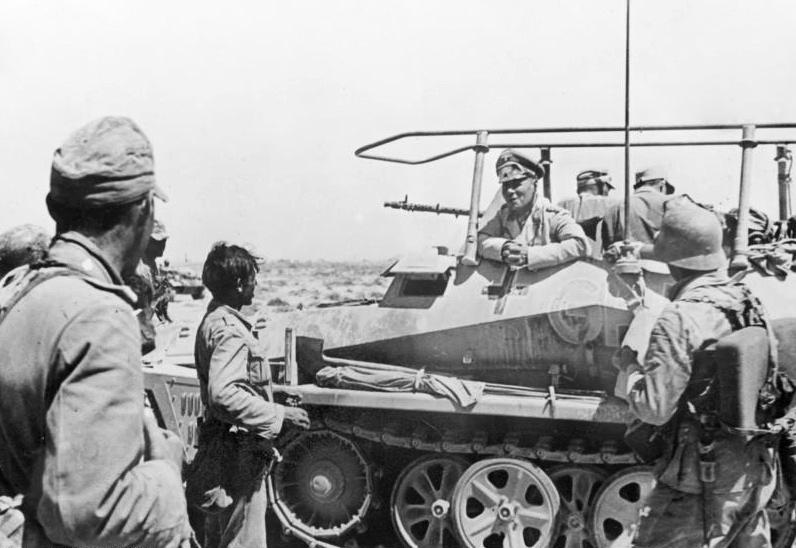
It was 72 years ago in Ulm Germany that a car pulled up to the residence of Field Marshal Erwin Rommel. In the car was the driver and two Generals dispatched by Hitler.  Rommel was recuperating following being severely wounded in an air attack in Normandy on July 17th 1944.

Rommel had been awarded the Pour le Merite, Imperial Germany’s highest award for valor in the First World War. He was never an official member of the Nazi Party, but like many Germans he believed Hitler’s promises and propaganda. As Hitler rose to power he like many others was carried away by early Nazi successes, the bloodless conquests of the Rhineland, Austria, Czechoslovakia, and the spectacle of the Olympics.

Like most other officers he would serve the regime as it spread its dark pall over Europe, and unlike so many others when he suffered a crisis in conscience about the Nazi leadership and their policies he refused to obey orders that he knew were illegal and immoral and then risked his life by joining the conspiracy to kill Hitler.

After years of stalled promotion, Hitler’s expansion of the military allowed Rommel to be promoted, and when Germany went to war he was commander of the unit which guarded Hitler’s headquarters train when he went into Poland. Rommel received command of the 7th Panzer Division after Poland and as a division commander in France he led his troops on some of the most epic advances of the French campaign.

He was then given command of the troops sent to bail out Mussolini’s failed African adventure. His small force and always ill-supplied force, which became known as the Afrika Korps scored impressive victories against British forces. In Africa, Rommel gained fame and earned rapid promotion. Though Africa was a sideshow in the Nazi war effort, Rommel became a poster-child for Joseph Goebbels’ propaganda machine. His fame also earned the resentment of many fellow officers who because he was not an officer of the General Staff regarded him with jealous envy and distain. Even so, Rommel was a soldier’s soldier. He believed in sharing in the suffering of his troops. He once said:Be an example to your men in your duty and in private life. Never spare yourself, and let the troops see that you don’t in your endurance of fatigue and privation. Always be tactful and well-mannered, and teach your subordinates to be the same. Avoid excessive sharpness or harshness of voice, which usually indicates the man who has shortcomings of his own to hide.”

bundesarchiv_bild_146-1991-031-25a_nordafrika_vor_tobruk_rommel

That was until he discovered the reality of Hitler’s promises as the troops of the Afrika Corps found themselves subjected to constant privation from lack of supply, air support and reinforcements. As commander of the Afrika Corps and later the Panzer Armee Arfika he and his troops achieved amazing success against an enemy that was always better supplied and equipped and which had air and sea superiority. Battling the British as well as the political machinations of Mussolini and Germany’s Italian Allies as well as opponents in the German government such as Hermann Goering, Rommel saw his troops crushed under the press of the British as well as the Americans who landed in French North Africa. Eventually, sick and worn out, Rommel was sent back to Germany to recuperate.

rommel-with-soldier

Rommel had a sense of honor and humanity that many other German generals lacked. He refused to allow anti-Jewish measures in areas occupied by German troops in North Africa, ensuring that the approximately 425,000 Jews living in Libya, Tunisia, Algeria, and Morocco were spared the fate of the Holocaust. He refused to execute Jewish POWs, and refused to follow the notorious “commando order.” In June of 1994 he protested the massacre of the people of the village of Oradour-sur-Glane by units of the 2nd SS Panzer Division directly to Hitler and asked for the authority to punish those responsible, but was refused.

His honest assessments of the chances of the Germans winning the war which he spoke candidly to Hitler and the High Command made him persona non grata in Berlin and Berchtesgaden. In the time before he was posted to France in late 1943 he became a part of the plot to end the war and overthrow Hitler. Rommel’s Chief of Staff at OB West, General Hans Speidel, was a key man in the conspiracy and Rommel had contacts with a number of key conspirators. He believed that the war was lost unless his forces could repel the coming Allied invasion on the beaches and worked feverishly to bolster the beach fortifications. He recommended that the Panzer Divisions be deployed near the coast where they could immediately counterattack Allied invasion forces while they were still vulnerable. But his advice was not taken. He was given command of the Army Group but was not given control of most of the Panzer Divisions, which Hitler kept under his direct control.

When the invasion came Rommel was away from Normandy visiting his wife. On learning of the invasion he sped back to Normandy. When he arrived he fought a desperate battle against the Allied forces. His outnumbered forces were under constant assault from the land, sea and air received paltry reinforcements compared to the Allies. Even so, German troops inflicted many local defeats and exacted a heavy price in allied blood in Normandy but were ground to dust. Even so, many American and British infantry regiments suffered 100% casualties but remained in action because of a continuous stream of replacements. Rommel urged Hitler and the High Command to withdraw German forces from Normandy before the allies broke through his front. By doing so he found that he was now considered a defeatist.

Rommel was severely wounded in an air attack on his vehicle by a just days before the attempt on Hitler’s life. Hitler survived the attempted assassination and exacted a terrible revenge on anyone connected with the plot. Show trials and public hangings of officers who had served valiantly at the front were common. Thousands were killed and thousands more imprisoned.

Eventually, other conspirator’s testimony exposed that Rommel was part of the plot. He was recommended by the “Court of Military Honor” to be expelled from the military and tried by the “People’s Court” of Judge Roland Freisler. During the purge that followed the attempt on Hitler’s life, many noted German military commanders were hauled before this court and humiliated by Freisler before they were sent to their deaths. Freisler, a fanatic Nazi judge has been part of the infamous Wansee Conference which planned the details of the Final Solution was killed when his courtroom was bombed in February 1945.

Because of his fame and popularity in Germany Hitler was decided to offer Rommel a choice of being tried by the People’s Court or committing suicide and ensuring his family’s safety. Hitler dispatched two generals from Berlin to personally deliver the message.

492px-Erwin_rommel_death

Rommel suspected that he would be identified and killed and told that to his friends and family in the days leading up to the arrival of Generals Wilhelm Burgorf and Ernst Maisel from OKW with the ultimatum. They met with Rommel for a short time before giving him the opportunity to say goodbye to his family. Rommel told them of his choice and left his home for the last time. 15 minutes later the Generals called his wife to say that he had died of a heart attack. Rommel was given a state funeral and the German people were lied to about his cause of his death.

Winston Churchill wrote of Rommel:

“He also deserves our respect because, although a loyal German soldier, he came to hate Hitler and all his works, and took part in the conspiracy to rescue Germany by displacing the maniac and tyrant. For this, he paid the forfeit of his life. In the sombre wars of modern democracy, chivalry finds no place … Still, I do not regret or retract the tribute I paid to Rommel, unfashionable though it was judged.”

Rommel was just 52 years old when he died. I find in the story of Rommel some commonality in my own life. Before Rommel went to Africa he believed that Germany would win the war, during his command there he discovered that what he believed was lies and that Hitler had little regard for him or his troops. Before I went to Iraq in 2007 I believed much of the political propaganda promoted by the Bush administration and right wing news media and pundits about that war.

The example of Erwin Rommel is a cautionary tale of what can happen when a brilliant and honorable man comes under the spell of a demagogue. Rommel believed Hitler and blindly followed him until he ran into the hard face of reality in Africa at which point he had the moral courage to do the right thing, but many didn’t. Sadly there are otherwise honorable men and women in the current United States military who are blindly supporting a delusional madman for President, a man who promises to order soldiers to commit war crimes, who threatens to jail political opponents, who condemns whole races of people and religions, a man who has no respect for the courts, the law, or the Constitution.  Personally as a historian I cannot understand that. Thankfully I am glad that I am not one of them for I know if Donald Trump ever became President that I would become a target.

Peace,

Padre Steve+

Leave a comment

Filed under ethics, History, leadership, Military, world war two in europe

From Limited War to Total War: The American Civil War Pt.2

Friends of Padre Steve’s World,

As always I continue to revise my Gettysburg and Civil War text and it looks like I will have to split the text into at least two volumes. I am posting the second half of a majorly revised section dealing the the nature of the war, and how it changed from a limited war to a total war. This subject may be uncomfortable to many readers, and I admit that. Truthfully I abhor war but I am a realist when it comes to human nature, politics, economics, ideology, religion, and even racism and race hatred play in the world. Truthfully, if the North had continued the war with limited force, and goals, the Confederacy would have either become independent, or it would have been re-admitted to the Union with slavery intact, no Thirteenth, Fourteenth, or Fifteenth Ammendments would have been passed and any concept of civil rights destroyed. You can be sure that with Southern States read mites without change that other things would not have occurred; Women’s sufferage, Native American citizenship, citizenship and civil rights for Asian immigrants, and most recently, LGBT people are directly tied to the constitutional amendments that the war made possible.  Sometimes, as distasteful and repugnant as that may sound, a hard war is necessary to prevent an unjust peace. 

From a point of realpolitik,  the fact is that leaders in the South and the North, like so many other leaders in history and even today, failed to understand what the war that they helped unleash would bring about. War is not to be entered into lightly without connecting the dots between the act of policy that guides the war, as well as having the policy’s ends supported by the ways and means necessary to fulfill it, and not all of those are military. Diplomacy, economic power, and  information all play a part. 

Abraham Lincoln and his advisors came to understand this, maybe better than any presidential administration in United States history. Sadly, Lincoln was assassinated before he could guide the country through reunion, and Andrew Johnson was not up to the task. By the time Ulysses Grant became President, the opportune moment for reunion had passed. Though the South succeeded in rolling back civil rights for another century, they never were able to repeal those three critical amendments. That is why the hard war pursued by the Lincoln administration still matters for everyone with a stake in civil rights. 

Think about that, and have a great weekend,

Peace

Padre Steve+
gburg dead1

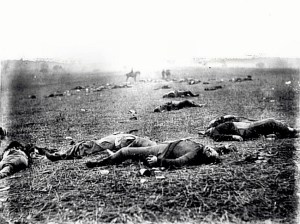
While the nature of war remained unchanged, the American Civil war changed the character of war, as it had been known for centuries, since the Peace of Westphalia, and the end of the Thirty Years War changed dramatically. In the American Civil War the character of war changed from the emphasis of the limited wars of the 18th Century and the Napoleonic era where opposing armies dueled each other into a war that encompassed the entire population. It also challenged a generation of military officers who had grown up with Jomini’s principles of war and his emphasis on limited war.

The leading catalyst that convinced Lincoln and other Northern leaders of the need to abandon the strategy of limited war was the fact that the Confederates had “blurred the distinction between combatants and noncombatants in the parts of the Confederacy and border states occupied by Union forces. The crops and livestock of Southern civilians were feeding and clothing Confederate armies. Their slaves were the principle labor force in the Confederate War economy. Thousands of Southern civilians became guerillas who roamed behind Union lines destroying supplies and ambushing unarmed as well as armed Unionists.” [1]

The Union reaction to the Confederate actions would portent a change in the war. And soon, the war bordered on Clausewitz’s definition of absolute or total war, especially in Sherman’s march through the South, and in the actions of Confederate irregulars who used terror against Unionist civilians. The actions of irregular Confederate forces to attack his troops and supply lines caused Sherman, who earlier in the war had taken a conciliatory attitude to Southern civilians, to change his views. They had blurred the lines between combatants and non-combatants, he noted that the Union army must act “on the proper rule that all in the South are enemies of all in the North….. The whole country is full of guerilla bands…. The entire South, man woman, and child, is against us, armed and determined.” [2]

In response Henry Halleck, now backed with the legal authority of General Order 100, also known as The Lieber Code, which for the first time in American history defined the differences between partisans acting in the capacity as soldiers of the enemy army, and those who were not a part of a military unit, but rather men who blended back into the population after conducting armed attacks, [3] wrote to Sherman,

“I am fully of opinion that the nature of your position, the character of the war, the conduct of the enemy (and especially of non-combatants and women of the territory we have heretofore conquered and occupied), will justify you in gathering up all the forage and provisions which your army will require, both for a siege of Atlanta and for your supply in your march farther into the enemy’s country. Let the disloyal families of the country, thus stripped, go to their husbands, fathers, and natural protectors, in the rebel ranks; we have tried three years of conciliation and kindness without any reciprocation; on the contrary, those thus treated have acted as spies and guerillas in our rear and within our lines…. We have fed this class of people long enough. Let them go with their husbands and fathers in the rebel ranks; and if they won’t go, we must send them to their friends and protectors. I would destroy every mill and factory within reach which I did not want for my own use…..” [4]

The strategy of Sherman was to ensure that the Confederate heartland of the Deep South could no longer help to sustain Confederate armies in the field, it was military, economic, political, and diplomatic. He explained:

“I propose to act in such a manner against the material resources of the South as utterly to negative Davis’ boasted …promises of protection. If we can march a well-appointed army right through hiss territory, it is a demonstration to the world, foreign and domestic, that we have a power which Davis cannot resist.” [5]

Sherman was a pioneer of psychological warfare, he was “convinced that not only economic resources but also the will of Southern civilians sustained the Confederate War effort…. Sherman was well aware of the fear that his soldiers inspired among Southern whites. This terror “was a power,” he wrote, “and I intend to utilize it… to humble their pride, to follow them to their innermost recesses, and to make them dread and fear us…” [6]

When Confederate General John Bell Hood elected to fortify Atlanta, the largest and most important industrial city in the Confederacy against a Union attack, thereby making the population of the city a target, Sherman wrote to the Mayor of Atlanta to warn him of the consequences of allowing this:

“The use of Atlanta for warlike purposes is inconsistent with its character as a home for families. There will be no manufactures, commerce, or agriculture here, for the maintenance of families, and sooner or later want will compel the inhabitants to go…. You cannot qualify war in any harsher terms than I will. War is cruelty, and you cannot refine it; and those who brought war into our country deserve all the curses and maledictions a people can pour out…. You might as well appeal against the thunder-storm as against these terrible hardships of war. They are inevitable…” [7]

Sherman’s strategy worked, “it deprived Confederate armies of desperately needed supplies; it also crippled morale both at home front and in the army,” [8] His armies did more than destroy factories and farms in its path, wherever they went “they broke the power of the secessionist government, the slaveholder’s social order, and most of whatever fighting spirit remained among Confederate partisans.” [9] Jefferson Davis understood the effect that Sherman’s army was having, he wrote, “Sherman’s campaign has produced a bad effect on our people, success against his future operations is needed to restore public confidence.” [10] Mary Boykin Chesnut saw the clouds of doom approaching and confided in her diary, “Since Atlanta I have felt as if all were dead in me, forever,” she wrote. “we are going to be wiped off the map.” [11]

The effects of Sherman’s march through Georgia and the Carolinas were felt in the Confederate armies at the front as just as he had predicted. Lee’s artillery chief, Brigadier General Porter Alexander wrote, “The condition of the country at large was one of almost as great deprivation & suffering as that of the army itself; & in many localities even of much greater. North Carolina, South Carolina, & Georgia had been over-run by Sherman’s army carrying off many of the Negroes & most of the stock & destroying all accumulation of provisions which they could not use, & often burning barns & dwellings & all implements of agriculture…. Naturally, the wives & mothers left at home wrote longingly for the return of the husbands & sons who were in the ranks in Virginia. And, naturally, many of them could not resist these appeals, & deserted in order to return & care for their families.” [12]  A member of the 20th Maine noted the effect on Lee’s troops opposing them at Petersburg wrote, “Since Sherman’s victories… we see the affect it is having on Lee’s Army.” They were deserting in groups, “not only privates, but many officers with them.” [13] Lee was so frustrated and angry with the desertion problem that he resorted to summary executions of the men, occasionally without hearing their appeals.

The war was revolutionary in other ways, and brought about a host of social, philosophical, economic, and political changes which continue to impact the lives of people in the United States and around the world even today. Some of these, especially those regarding the abolition of slavery and emancipation, as well as the beginnings of the Women’s Rights movement have had a ripple effect in matters of political and social equality for other previously disenfranchised groups of citizens. One writer noted in regard to the social impacts that “The Civil War uprooted institutions, transformed our politics, influenced social relationships of half a continent, and wrought changes that echo down the generations.” [14] Mark Twain wrote in 1873 that the war “uprooted institutions that were centuries old, changed the politics of a people …and wrought so profoundly upon the national character that cannot be measured short of two or three generations.” [15]

In a sense, when Abraham Lincoln proclaimed  “a new birth of freedom” in his Gettysburg address it served as a watershed moment in American history because it brought to the forefront the understanding of Jefferson and the other signers of the Declaration of Independence that all men are created equal.  That statement, flowing from the Declaration was key to Lincoln’s understanding of human rights and dignity, and from it came the Emancipation Proclamation and the Thirteenth Amendment, which abolished slavery. Those would be followed by the Republican Congresses’ passage of the Fourteenth Amendment, which overturned the Dred Scott Decision, which denied all citizenship to blacks across the country, and by Ulysses S. Grant’s Fifteenth Amendment, which gave African American men to right to vote. These were all revolutionary ideas, and there was a counterrevolutionary backlash after the war “overthrew the fledgling experiment in racial equality” but “did not fully restore the old order. Slavery was not reinstated. The Fourteenth and Fifteenth Amendments were not repealed.” [16]  That is the human and political context by which we have to understand the American Civil War.

Thus it is important to study the Gettysburg campaign in the context of the Civil War because the campaign of 1863 in the east cannot be divorced from what was happening in the west at Vicksburg, nor the Union blockade, nor the diplomatic, economic and informational aspects of the war.  Likewise the Gettysburg campaign cannot be separated from its relationship to the broader understanding of the nature and character of war. To do this one must examine the connection between them and policies made by political leaders; to include the relationship of political to military leaders, diplomats, the leaders of business and industry and not to be forgotten, the press and the people. Likewise we must understand the various contexts of war, to include the social, political, ideological and even the religious components of war, how they impacted Civil War leaders and why civilian policy makers and military leaders must understand them today.

While the essential nature of war remains constant, wars and the manner in which they are fought have changed in their character throughout history, and this distinction matters not only for military professionals, but also policy makers. The changing character of war was something that military leaders as well as policy makers struggled with during the American Civil War much as today’s military leaders and policy makers seek to understand the character of warfare today. British military theorist Colin Gray writes “Since the character of every war is unique in the details of its contexts (political, social-cultural, economic, technological, military strategic, geographical, and historical), the policymaker most probably will struggle of the warfare that is unleashed.” [17]

That was not just an issue for Abraham Lincoln and Jefferson Davis, both of whom struggled with the nature of the war which had been unleashed, but it is an issue for our present and future political leaders, who as civilian politicians are “likely to be challenged by a deficient grasp of both the nature of war as well as its contemporary context-specific character.” [18] This is actually very important in our present context as since “the end of the Cold War, the tendency among civilians – with President Bush as a prime example – has been to confuse strategy with ideology. The president’s freedom agenda, which supposedly provided a blueprint for how to prosecute the global war on terror, expressed grandiose aspirations without serious effort to assess the means required to achieve them.” [19] Strategy is hard and mostly ignored until there is a crisis, “soldiers focus on their professional military duties, while politicians exercise their skill in policymaking. The strategy bridge between the two worlds, the two cultures, generally is left poorly guarded, if it is guarded at all.” [20] In the American Civil War, Abraham Lincoln and his administration as well as military advisers came to develop a realistic strategy to match his political goals, Lincoln understood the contexts of the war far better than his Confederate counterpart Jefferson Davis, whose administration and military leadership was never able to devise a coherent strategy because they did not fully grasp the contexts of the war, never seriously considered the ends, ways, and means to victory.

In addition to being the first modern war, or maybe I should say, the first war of the Industrial Age, the Civil War prefigured the idea of total war written about by Clausewitz that occurred in the World Wars of the Twentieth Century. The war combined a massive number of technological advances, which both preceded and occurred during it, in which the philosophical nature of the Industrial Revolution came to the fore.

Likewise, the enmity of the two sides for one another had been fostered by a half century of relentless and violent propaganda that ushered from the mouths of politicians, the press and even from the pulpit brought the element of hatred to the fore of the conflict; as Clausewitz correctly observed, “Even the most civilized of peoples, in short, can be filled with passionate hatred for each other.”  [21]

As the war went on the feelings of animosity and hatred often boiled over and were reflected in the words and sometimes the actions of the soldiers. A Confederate Captain wrote his wife to teach his children “a bitter and unrelenting hatred of the Yankee race” that had “invaded our country and devastated it… [and] murdered our best citizens…. If any luckless Yank should unfortunately come my way he need not petition for mercy. If he does I will give him lead.” A soldier from a Wisconsin regiment wrote to his fiancée after the assault on Resaca, Georgia that his unit had captured twenty-three Confederates and “or boys asked if they remembered Fort Pillow and killed them all. Where there is no officer with us, we take no prisoners…. We want revenge for our brother soldiers and will have it…. Some of the [rebels] say they will fight as long as there is one of them left. We tell them that is what we want. We want to kill them all off and cleanse the country.” [22]

While this was hatred was not universal and many times the combatants behaved with great chivalry on the battlefield, and Northern and Southern veterans led efforts at reconciliation after the war; such hatred was something that had not been a part of the American military experience.  The deep rooted enmity, especially in the South, would remain a constant over the next one hundred years. “White southerners who retained Confederate loyalties against Federal soldiers and northerners in general…. Confederates defiantly refused to forgive enemies who had inflicted such pain on their society.” [23] Likewise, many Union veterans felt that in their sacrifices to defeat the Confederacy and end slavery would be forgotten as time slipped by and the memory of the war subsided.

This very real hatred meant that there were many times when the American Civil War came close to Clausewitz’s understanding of absolute war in its in character, and it prefigured the great ideological wars of the twentieth century. J.F.C. Fuller noted “for the first time in modern history the aim of war became not only the destruction of the enemy’s armed forces, but also of their foundations- his entire political, social and economic order.” [24] It was the first war where at least some of the commanders, especially Ulysses S. Grant and William Tecumseh Sherman were men of the Industrial Age, in their thought and in the way that they waged war, in strategy, tactics even more importantly, psychologically. Fuller wrote:

“Spiritually and morally they belonged to the age of the Industrial Revolution. Their guiding principle was that of the machine which was fashioning them, namely, efficiency. And as efficiency is governed by a single end- that every means is justified- no moral or spiritual conceptions of traditional behavior must stand in its way.” [25]

President Lincoln, as well as Grant and Sherman realized in early 1864 that “the South was indeed a nation in arms and that the common European practice of having standing armies engaged each other in set-piece battles to determine the outcome of a war was not enough to win this struggle.” [26] Though neither man was a student of Clausewitz, their method of waging war was in agreement with the Prussian who wrote that “the fighting forces must be destroyed; that is, they must be put in such a position that they can no longer carry on the fight” but also that “the animosity and the reciprocal effects of hostile elements, cannot be considered to have ended so long as the enemy’s will has not been broken.”  [27]

Sherman told the mayor of Atlanta after ordering the civilian population expelled that “we are not only fighting hostile armies, but a hostile people, and must make the old and young, the rich and poor, feel the hard hand of war.” [28] Sherman was one of the first American military leaders to understand that a civil war could not be waged according to the limited war doctrines most American officers had been taught. He not only “carried on war against the enemy’s resources more extensively and systematically than anyone else had done, but he developed also a deliberate strategy of terror directed against the enemy’s minds.” [29] While some might find this troubling, the fact remains that it was Sherman’s Southern sweep of all that lay before him that broke the back of the Confederacy.

But Sherman and Grant were not alone in understanding the problem of fighting a limited war against the Confederacy. In the fall of 1862 a twenty-five year volunteer officer, Colonel Strong Vincent serving with McClellan’s army in Virginia understood what had to happen if the Union were to overcome the rebellion of the Confederacy. Vincent who would be instrumental in throwing back Hood’s assault on Little Round Top, and die leading the defense of that edifice, wrote to his wife about the need for harder measures.

“We must fight them more vindictively, or we shall be foiled at every step.  We must desolate the country as we pass through it, and not leave a trace of a doubtful friend or foe behind us; make them believe that we are in earnest, terribly in earnest; that to break this band in twain is monstrous and impossible; that the life of every man, yea, of every weak woman or child in the entire South, is of no value whatever compared with the integrity of the Union.” [30]

Abraham Lincoln came to embrace the eternal nature of war as well as the change in the character of the war over time. Lincoln had gone to war for the preservation of the Union, something that for him was almost spiritual in nature, as is evidenced by the language he used in both of his inaugural addresses and the Gettysburg Address. Instead of a war to re-unite the Union with the Emancipation Proclamation the war became a war for the liberation of enslaved African Americans, After January 1st 1863 when the Emancipation Proclamation went into effect, Lincoln “told an official of the Interior Department, “the character of the war will be changed. It will be one of subjugation…The [old] South is to be destroyed and replaced by new propositions and ideas.” [31] That too was a modern understanding of war.

Of course, the revolution in military affairs that characterized the Civil War took time, but it was the political and military leaders of the North who better adapted themselves and their nation to the kind of war that was being fought. “Lincoln’s remarkable abilities gave him a wide edge over Davis as a war leader, while in Grant and Sherman the North acquired commanders with a concept of total war and the determination to make it succeed.” [32]

At the beginning of the war the leaders and populace of both sides still held a romantic idea of war. The belief that the war would be over in a few months and that would be settled by a few decisive battles was held by most, including many military officers on both sides. There were some naysayers like the venerable and rather corpulent General Winfield Scott, but politicians and the press mocked Scott and those who even suggested that the war would be long, hard, and bloody. Of course those who predicted a short, easy, and relatively bloodless war who were proven wrong, and the war became the bloodiest war ever waged by Americans, and it was against other Americans.

Notes

[1] Ibid. McPherson The War that Forged a Nation: Why the Civil War Still Matters p.35

[2] Ibid. McPherson Drawn With the Sword: Reflections on the American Civil War p.81

[3] Lieber noted in Article 82 of the code that “Men, or squads of men, who commit hostilities, whether by fighting, or inroads for destruction or plunder, or by raids of any kind, without commission, without being part and portion of the organized hostile army, and without sharing continuously in the war, but who do so with intermitting returns to their homes and avocations, or with the occasional assumption of the semblance of peaceful pursuits, divesting themselves of the character or appearance of soldiers – such men, or squads of men, are not public enemies, and, therefore, if captured, are not entitled to the privileges of prisoners of war, but shall be treated summarily as highway robbers or pirates.” And in Article 85 that, “War-rebels are persons within an occupied territory who rise in arms against the occupying or conquering army, or against the authorities established by the same. If captured, they may suffer death, whether they rise singly, in small or large bands, and whether called upon to do so by their own, but expelled, government or not. They are not prisoners of war; nor are they if discovered and secured before their conspiracy has matured to an actual rising or armed violence.” Lieber, Francis, General Orders No. 100 : The Lieber Code INSTRUCTIONS FOR THE GOVERNMENT OF ARMIES OF THE UNITED STATES IN THE FIELD 24 April 1863 Retrieved from The Yale Law School, Lillian Goldman Law Library, The Avalon Project Documents in Law, History and Diplomacy http://avalon.law.yale.edu/19th_century/lieber.asp#sec4 1 June 2016

[4] Ibid. Weigley The American Way of War: A History of United States Military History and Policy p.148

[5] Guelzo Allen C. Fateful Lightening: A New History of the Civil War Era and Reconstruction Oxford University Press, Oxford and New York 2012 p.445

[6] Ibid. McPherson Drawn With the Sword: Reflections on the American Civil War p.82

[7] Sherman, William Tecumseh, Letter to James M. Calhoun, Mayor of Atlanta September 12, 1864 in Perman, Michael and Murrell Taylor, Amy editors The Civil War and Reconstruction Documents and Essays Third Edition Wadsworth Cengage Learning Boston MA 2011 pp.147-148

[8] Ibid. McPherson Drawn With the Sword: Reflections on the American Civil War p.83

[9] Levine, Bruce The Fall of the House of Dixie: The Civil War and the Social Revolution that Transformed the South Random House, New York 2013 p.233

[10] Goldfield, David. America Aflame: How the Civil War Created a Nation Bloomsbury Press, New York 2011 p.348

[11] McPherson, James. The Battle Cry of Freedom: The Civil War Era Oxford University Press, Oxford and New York 1988 p.775

[12] Alexander, Edward Porter. Fighting for the Confederacy: The Personal Recollections of General Edward Porter Alexander edited by Gary Gallagher University of North Carolina Press, Chapel Hill 1989 pp.508-509

[13] Ibid. Guelzo Fateful Lightening p.469

[14] Lowry, Thomas P. The Stories the Soldiers Wouldn’t Tell: Sex in the Civil War Stackpole Books, Mechanicsburg PA 1994 p.176

[15] Ibid. McPherson The War that Forged a Nation: Why the Civil War Still Matters p.48

[16] McPherson, James. The Second American Revolution in Perman, Michael and Murrell Taylor, Amy editors The Civil War and Reconstruction Documents and Essays Third Edition Wadsworth Cengage Learning Boston MA 2011 p.14

[17] Gray, Colin S. Fighting Talk: Forty Maxims on War, Peace, and Strategy Potomac Book, Dulles VA 2009 p.36

[18] Ibid. Gray Fighting Talk p.36

[19] Bacevich, Andrew J. The Limits of Power: The End of American Exceptionalism (The American Empire Project) Metropolitan Books, Henry Holt and Company, New York 2008 Amazon Kindle Edition, Location 2375 of 3875

[20] Ibid. Gray Fighting Talk p.49

[21] Ibid. Clausewitz On War p.76

[22] Ibid. McPherson The War that Forged a Nation pp.49-50

[23] Gallagher, Gary W. The Confederate War: How Popular Will, Nationalism and Military Strategy Could not Stave Off Defeat Harvard University Press, Cambridge MA and London 1999 p.34

[24] Fuller, J.F.C. A Military History of the Modern World, Volume Three: From the Seven Days Battle, 1862,  to the Battle of Leyte Gulf, 1944  Minerva Press 1956 p.88

[25] Ibid. Fuller  A Military History of the Modern World, Volume Three p.88

[26] Flood, Charles Bracelen, Grant and Sherman: The Friendship that Won the War, Harper Perennial, New York 2005 p.238

[27] Ibid. Clausewitz p.90

[28] Ibid. McPherson The Battle Cry of Freedom: The Civil War Era  p.809

[29] Ibid. Weigley  The American Way of War: A History of United States Military History and Policy  p.149

[30]Nevins, James H. and Styple, William B. What death More Glorious: A Biography of General Strong Vincent Belle Grove Publishing Company, Kearney NJ 1997 p.57

[31] Ibid. McPherson The Battle Cry of Freedom p.558

[32] Ibid. McPherson The Battle Cry of Freedom p.857

1 Comment

Filed under civil war, History, Military

From Limited War to Total War: The American Civil War Pt.1

fort-sumter-higher-res

Friends of Padre Steve’s World,

As always I continue to revise my Gettysburg and Civil War text and it looks like I will have to split the text into at least tow volumes. I am posting about half of a majorly revised section dealing the the nature of the war, and how it changed from a limited war to a total war. The fact is that leaders in the South and the North, like so many other leaders in history and even today, failed to understand what the war that they helped unleash would bring about.

Have a great weekend,

Peace

Padre Steve+

The American Civil War was the first modern war. It was waged between two peoples who shared much in common but were divided by different ideologies which encompassed politics, economics, society, law, and even religion. But even so, at the beginning of the war few people on either side anticipated what the war would entail, the sacrifices involved, or the change that would be wrought by it. Winston Churchill’s words of caution to leaders that embark on war, would have been good advice to leaders in the South and the North in early 1861: “Never, never, never believe any war will be smooth and easy, or that anyone who embarks on the strange voyage can measure the tides and hurricanes he will encounter. The statesman who yields to war fever must realize that once the signal is given, he is no longer the master of policy but the slave of unforeseeable and uncontrollable events.”

Likewise the American Civil War was a watershed event in an era of incredibly rapid change. It was an era which introduced changes in weaponry. New types of weapons were developed, more lethal versions of older weapons were introduced. Likewise, tactics, army organization, logistics, intelligence and communications, as well as social, and economic structures across the country evolved as the war progressed.

Though the war did not change the essential nature of war, which Clausewitz says is “is an act of violence to compel our opponent to fulfill our will” [1] it expanded the parameters of war and changed the character of the war by re-introducing the concept of “total war” to the world. As such, “because its aim was all embracing, the war was to be absolute in character” [2] it was a true revolution in military affairs.

The Civil War was truly a revolution in military affairs, but at the beginning of the war many people, including military leaders failed to understand this. It was a war that began as one type of “war and evolved into something quite different.” The conflict began as a limited war in which both sides imagined that small armies would fight a relatively quick war which would end with either a restored Union, or an independent Confederacy. But by late 1862 it had become a total war, involving massive armies, as well as the destruction of vast areas of civilian lands and properties. The miscalculation of Southern leaders about the will of the Northern leaders and population to pursue a war, their precarious assumption that Great Britain and France would enter the war, followed by their inept diplomatic efforts to be recognized by those nations, their lack of resources or an industrial base to produce the weapons needed for war, coupled with their inability to anticipate what would be needed to win the war, and to defend their territory ensured their eventual defeat. In marked contrast to the South the Federal government headed by Abraham Lincoln “developed a national strategy to give purpose to a military strategy of total war, and preserved a political majority in support of this national strategy through the dark days of defeat, despair, and division.” [3]

At the beginning of the war President Lincoln attempted a strategy of conciliation in order to attempt to coax seceding states back into the Union and by conciliation to keep those considering seceding from doing so. However, Lincoln’s attempts were met with outright rejection, before, during, and after the secession crisis. He spoke directly to the Southern states in his First Inaugural Address, saying “We are not enemies, but friends,” [4] only to be accused of deliberately lying to the South by pledging to maintain control of Federal installations and forts in the South, like Fort Sumter which was now surrounded by massed batteries of Confederate artillery and demands that it surrender. Jefferson Davis wrote, “The Lincoln Administration deliberately lied to us, baiting us with false promises and pacific pledges all the while it was planning for war. Never in history has a government behaved with such malicious deceit and bad faith.” [5]

When the troops of South Carolina opened fire on Fort Sumter the die was cast, and Lincoln chose the path of war in order to restore the Union, “not because he wanted to, but because the South forced his hand.” [6] His proclamation calling for troops to suppress the rebellion described the kind of war that he foresaw, “the utmost care will be observed… to avoid any devastation, any destruction of, or interference with, property, or any disturbance of peaceful citizens in any part of the country.” [7]

Though he pursued the option of war to restore the Union, Lincoln initially he adopted a soft-war strategy in which Confederate armies were the target. This was in large part due to the efforts of Secretary of State Henry Seward and General-in-Chief Winfield Scott. Though he adopted a strategy that required the North to conquest the South, initially he did so with the expectation that after battlefield defeats the Confederates would eventually return to the Union. Some early victories, particularly those of Grant in the west at Forts Henry and Donaldson seemed to confirm the validity of such an approach.

However, Grant, after being roughly handled in the near disaster at Shiloh, gave up on the idea of limited war. He now believed that it was necessary to seize or destroy any property or resources that could be used to sustain the Confederate war effort. Before the Confederate counteroffensive at Shiloh Grant had said that he had been careful to “protect the property of the citizens whose territory was invaded;” and afterwards his policy became to “consume everything that could be used to support or supply armies.” [8]

Henry Wager Halleck, who had long been a proponent of Jominian limited war, backed up Grant in August 1862 ordering Grant to “Take up all active [rebel] sympathizers… and hold them as prisoners or put them beyond our lines. Handle that class without gloves, and take their property for public use…. It is time that they should begin to feel the presence of the war.” [9]

As the war went on it became apparent to many people in the North, and in the armies on the front lines that harder measures were required, especially with the escalation of guerilla attacks behind Union lines, as well as the involvement of Southern civilians in attacking Union troops in occupied areas of the South. “Senator John Sherman wrote his brother William of a growing sentiment “that we must treat these Rebels as bitter enemies to be subdued – conquered – by confiscation – by the employment of their slaves – by terror – energy – audacity – rather than by conciliation.” [10]

Some Union military commanders other than Grant became early exponents of a hard war, among them was Major General John Pope, who as commander of the Army of Virginia issued a “series of orders authorizing his officers to seize Confederate property without compensation, to execute captive guerillas who had fired on Union troops, and to expel from occupied territory any civilians who had sheltered guerillas or who had refused to take an oath of allegiance to the United States.” [11]

Henry Halleck as well wrote to Grant in April 1863 that “the character of the war has changed very much…. There is now no possible hope of reconciliation with the rebels. The Union party in the South is virtually destroyed. There can be no peace but that which is forced upon it.” In May he wrote another general in Memphis, “We must live upon the enemy’s country as much as possible, and destroy his supplies. This is cruel warfare, but the enemy has brought it on himself by his own conduct.” [12]

As late as 1862 there were some in the North, especially in the Democratic Party fought against any move toward a harder war strategy. One of these was Major General George McClellan who in a brazen attempt to be named General-in-Chief after his failed Peninsular campaign attempted to school President Lincoln in the ways of politics and strategy.

“The time has come when the Government must determine upon a civil and military policy, covering the whole ground of our national trouble…. This rebellion has assumed the character of a war: as such it must be regarded; and should be conducted upon the highest principles known to Christian Civilization. It should not be a War looking to the subjugation of the people of any state, in any event. It should not be, at all, a War upon the population; but against armed forces and political organizations. Neither a confiscation of property, political executions of person, territorial organization of states or forcible abolition of slavery should be contemplated for a moment.” [13]

Lincoln read McClellan’s letter in his presence and refused to comment upon it. Instead he infuriated McClellan by naming Henry Halleck as General-in-Chief, calling for more troops, and deciding on a strategy in which emancipation would play a key role. Since the leaders of the Confederacy to its dying day refused to countenance emancipation, these decisions would change the character of the war from a limited war to bring about political reunion to a war that would drastically change American politics, economics, and society.

Notes

[1] Clausewitz, Carl von. On War Indexed edition, edited and translated by Michael Howard and Peter Paret, Princeton University Press, Princeton NJ 1976 p.75

[2] Fuller, J.F.C. The Conduct of War 1789-1961 Da Capo Press, New York 1992. Originally published by Rutgers University Press, New Brunswick N.J p.99

[3] McPherson, James M. Abraham Lincoln and the Second American Revolution Oxford University Press, Oxford and New York 1991 p.74

[4] Weigley, Russell F. The American Way of War: A History of United States Military History and Policy University of Indiana Press, Bloomington IN, 1973 p.133

[5] Davis, Jefferson in Oates, Stephen B. The Approaching Fury: Voices of the Storm 1820-1861 University of Nebraska Press. Lincoln and London, 1997 p.413

[6] Stoker, Donald The Grand Design: Strategy and the U.S. Civil War Oxford University Press, Oxford and New York 2010 p.18

[7] Ibid. Weigley The American Way of War: A History of United States Military History and Policy p.133

[8] McPherson, James M. Drawn With the Sword: Reflections on the American Civil War Oxford University Press, Oxford and New York 1996 p.76

[9] Ibid. McPherson  Drawn With the Sword: Reflections on the American Civil War p.79

[10] McPherson, James M. Tried by War: Abraham Lincoln as Commander in Chief Penguin Books, New York and London 2008 p.103

[11] Ibid. McPherson Drawn With the Sword: Reflections on the American Civil War p.79

[12] Ambrose, Stephen E. Halleck: Lincoln’s Chief of Staff Louisiana State University Press, Baton Rouge and London 1960 and 1992  p.119

[13] McClellan, George B. Letter to Abraham Lincoln July 7, 1862 in Perman, Michael and Murrell Taylor, Amy editors The Civil War and Reconstruction Documents and Essays Third Edition Wadsworth Cengage Learning Boston MA 2011 p.140

Leave a comment

Filed under civil war, History, Military

A New Grand Alliance to Defeat DAESH

image.adapt.960.high

Friends of Padre Steve’s World,

We are now waking up to the fourth day in the next phase of a war that began too long ago, a war that too many people have been victimized by, which only is getting worse and more widespread.

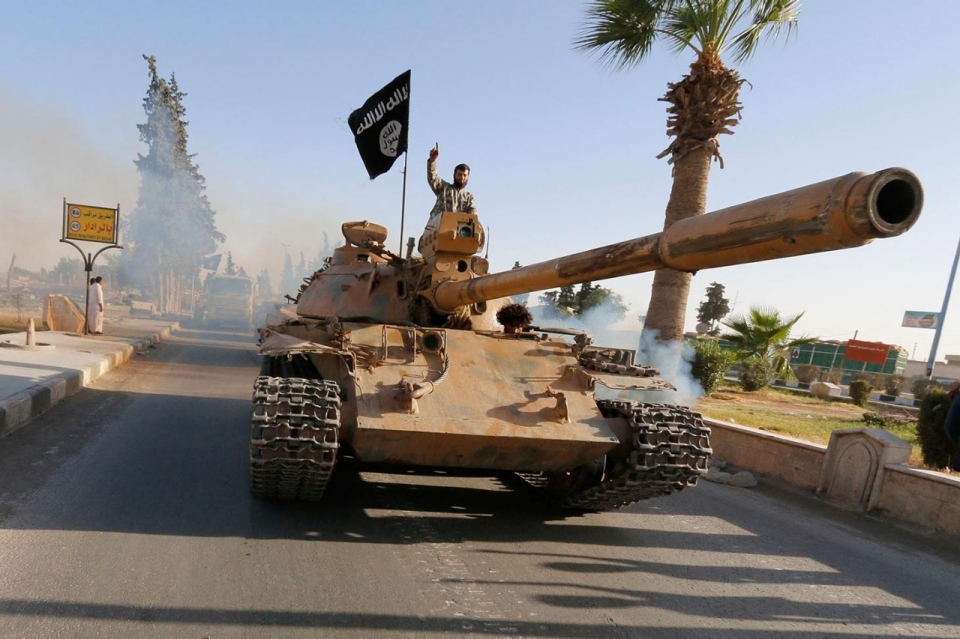
Winston Churchill wrote, “If Hitler invaded hell I would make at least a favorable reference to the devil in the House of Commons.” That may seem an odd statement, Churchill made it in reference to the alliance with the Soviet Union to defeat Hitler in World War Two, but it bears a particular relevance to the situation that we find ourselves in with ISIL, or as they are also known, DAESH.

This is a follow up to my posts of the last few days regarding the attacks of Islamic State supporters in Paris and it will not be the last. French President Hollande has correctly noted that the attack was an act of war, and he promised that the French campaign against DAESH would be ruthless. Hollande and other leaders, including President Obama are now beginning to plan a coordinated strategy to defeat DAESH. That being said, any real strategy to defeat DAESH has to include more than a few partners, it must be truly a grand alliance. 

I am a career military officer, an Iraq veteran and an anti-war liberal, but I am also a realist in terms of the world. I have no illusions about the world. I do not believe that the United States always acts with honor and I know in my heart of hearts that much of the chaos that we are seeing in the world, particularly the Middle East comes from years of misbegotten American intrigue and intervention. Of course the Americans were not the only ones involved in creating this mess, we can thank the French and the British for the Sykes-Picot agreement. That agreement and the subsequent post-war agreements artificially divided the Middle East based on British and French colonial interests and disregarded the traditional and historic interests of the people in the region. Those agreements also handed the Arabian Peninsula over to the House of Saud, rather than the more moderate Arabs that fought alongside the British against the Ottoman Empire. We can also thank the Russians for their contributions to the instability of the region, as well as the Israelis who in defending their interests have often made things worse. Finally we cannot forget the role played by many corrupt and despotic Arab leaders who have oppressed their people, and exploited their countries riches for their own gain. Finally, back to the Americans it was the ill-advised and criminal invasion of Iraq by the Bush administration that opened Pandora’s Box and unleashed what we now know as the Islamic State. Sadly, almost all the countries currently involved have had a hand in creating the monster that we know as DAESH and the Islamic State, and all should bear part of the responsibility for defeating it.

That being said, whether any of us like it or not we are at war, a war that has been going on in earnest since 2003. This is not a new war, it is simply DAESH’s continuation of the war that was declared by Al Qaeda, and that Al Qaeda Iraq fought against American, allied, and Iraqi forces from 2003 through 2011.

The genie of war is out of its bottle and it will not return on its own accord, and it will create more chaos, death and destruction, both in the Middle East, but also other parts of the world. The threats of DAESH need to be taken seriously and countered.

We have to understand that this war is not a movie, it is not a video game, and it has the potential to change all of our lives, and not for the better.

Likewise, the fight against DAESH will not be solved or won by military action alone. The falsehoods of the warn porn addicts who believe deploying ground troops without the support of the people in the region, nor dropping more bombs will win the war. President Obama noted correctly, in response to suggestions that large numbers of ground troops be deployed, “that that would be a mistake, because we would see a repetition of what we’ve seen before, which is if you do not have local populations that are committed to inclusive governance and who are pushing back against ideological extremes, that they resurface….” He is right for saying this because those who propose sending in large numbers of ground troops are not committed enough to the hard thing and fully mobilize the nation for war. Instead they would as they always do, put the burden of the war on an already worn out professional volunteer military force without being willing to work with other powers, even rivals that have an interest in defeating DAESH.

The full spectrum of national and international power must be deployed to fight DAESH. This includes the U.S., NATO, Russia, China, Japan, the Arab world, and even Iran. Yes, some of these nations are competitors and rivals, but all have a vested interest in defeating DAESH and all have capabilities that would be helpful in the fight. In the Second World War the President Franklin Roosevelt United States and Britain’s Prime Minister Winston Churchill allied themselves with the Josef Stalin and the Soviet Union in what was then known as the Grand Alliance to defeat Hitler. The Grand Alliance was a real world demonstration of the art of realpolitik. Realpolitik demands compromise and finding common ground with nations that we may not like. Those that practice realpolitik also understand that almost all alliances are temporary. This may be unsavory to idealists, but it is reality, and it is the only thing that will defeat DAESH. It is high time the world leaders to get real in combatting DAESH.

Military force seems always to be the first thing that people think of, and while important, it is not the only kind of power that must be used. If we are going to use military force, we need to work with our allies and commit ourselves to a massive use, on the order of World War II, and coupled with a massive new Marshal Plan for the Middle East. We must use diplomatic and economic power, intelligence and information, coordinate national and international law enforcement efforts, and seek to redress many of the wrongs committed against the people in the region.

Since I am a realist, I understand that whether I want it or not, that this war will most likely remain part of our lives, maybe for a generation or more. Honestly, if we do not make a full effort, I expect that a hundred years from now that young men and women will still be fighting this war. Most will have no idea how it began, even as their governments, corporations, and others make a steady profit off of the war.

I will continue this tomorrow with some thoughts on the civil liberties that we will undoubtedly lose as this war progresses. I think that I will write about the dangers of how xenophobic racists, and others who demonize all Moslems, and who want to punish all Moslems for the actions of DAESH, especially those who are the victims of DAESH who have fled to Europe and other areas to escape them. That is already beginning in this country. 

But that is all for today,

Peace

Padre Steve+

1 Comment

Filed under History, middle east, Military, national security, News and current events, Political Commentary

Hard Truth, War, & ISIL

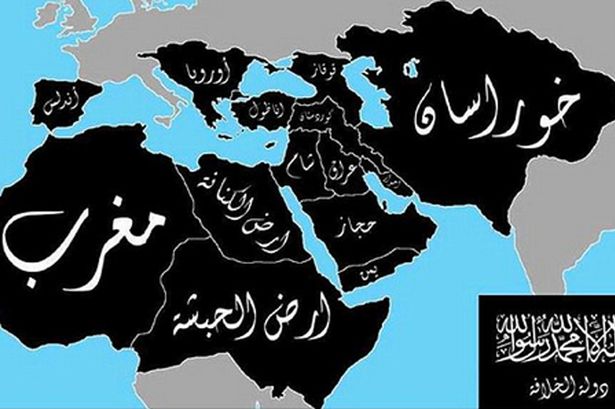
ISIS-MAP

The Imagined Caliphate of ISIL 

Friends of Padre Steve’s World,

Please know this is a difficult article to write. I have been to war, I have seen its devastation and heartache and I came back changed from the experience. I hate it. That being said, despite being a progressive who hates war I am also a realist. I am not one that finds any romance or glory in war, but I know that sometimes it becomes unavoidable and sometimes necessary. I have written about the nature of war, the kind of war we are now engaged in with ISIL and some of the ethical and moral compromises that could easily be made in such a war. Thus what I write here is a continuation of those thoughts and I encourage you to look at those articles. That being said, I do intend on adding some more thoughts to this in the coming days.

I do not expect that all of my readers will agree with me. In fact I had a reader who took exception to yesterday’s article because he could not agree with the fact that the Bush administration’s criminal war against Saddam Hussein’s Iraq was a major cause of today’s problem. He proceeded to lecture me that I was wrong, despite all of the evidence from Congressional hearings, the CIA, and other analysts that disproved his point. That is disheartening, but I expect that now.

That being said I know that there are people on the political right and the political left who will disagree with what I write today. All I ask is that people, regardless of their ideology actually read and take the time to think about what I write before they write me off.

I will be writing more on this subject in the coming days, including about the moral and ethical dangers, as well as the potential threat to our own civil liberties. 

Peace

Padre Steve+

Over the past two weeks elements of ISIL have brutally slaughtered nearly 400 civilians outside of areas that they control. The attacks on the Russian airliner, Beirut, and Paris were committed against innocent civilians going about their daily lives. In the areas that they control in Iraq and Syria, where their brutality is unmatched in modern times. This is disconcerting for those of us that would prefer a peaceful solution to the current conflict. But it is the truth.

Despite having served in the military for over thirty-four years, I am not a warmonger, and I am not enamored with the supposed glory of war, or American military superiority. I hate war, but I am a realist. I am a historian with a considerable background in ethics, philosophy, sociology, and political science. I have experience serving with American advisers in Iraq’s Al Anbar province.

Since 2012 ISIL has invoked a reign of terror in the areas of Syria and Iraq that they control. Massacres of opponents, videotaped executions of captives, including humanitarian aid workers and journalists, ethnic and religious cleansing, the forced conversion of female captives with the added element of rape, before and after their capture and enslavement, the execution of homosexuals, and the destruction or religious, cultural, and historic treasures. ISIL is not seeking peace, but rather to destroy everything that they find abhorrent. They are no different than Christians, Jews, Hindus, and even Buddhists that use the police and military power of the state to persecute those who do not believe just like they do.

We must recognize the significance of the attacks of the Islamic State in the past two weeks. These attacks have killed nearly 400 civilians and wounded close to 400 more. ISIL is not targeting military targets, but innocent people; as such their actions are nothing short of criminal. If they were a real nation state, their leaders would be war criminals.

Islamic scholar Reza Aslan understands ISIL better than many people. Aslan told CNN last year:

“Number one, you do have to respond militarily to ISIS soldiers and fighters. These guys are fighting a war of the imagination, a war that they think is happening between the forces of good and evil. There is no negotiation. There’s no diplomacy. There’s nothing to talk about with these guys. They have to be destroyed.”

Let that set in for a moment.

That is not the opinion of an American or Eurocentric scholar; it is not the ranting of an Islamophobic pundit or preacher, but it is the opinion of a learned, moderate, Moslem scholar. As such it needs to be given a lot of credibility. Aslan’s comment takes me back to the words of General William Tecumseh Sherman during the American Civil War. Sherman, who had to deal with insurgents and other Confederate sympathizers who attacked his supply lines and isolated garrisons noted, “This war differs from other wars, in this particular: We are not fighting armies but a hostile people, and must make old and young, rich and poor, feel the hard hand of war.”

President Obama came into office as a President determined to end the wars that the United States was engaged in and usher in an era of peace. That did not happen. The genie of war and chaos that was unleashed when President Bush stopped pursuing Al Qaeda and attacked Saddam Hussein’s Iraq refused to go back into its bottle. Obama, dealt with the situation with quiet diplomacy and soft power. One cannot blame him. He was hamstrung by the financial crisis of 2008 which blew up just as he became President, as well as the consequences of the Bush foreign policy, and the deal that the Bush administration made with the Shia Moslem regime of Maliki in Iraq for the withdraw of U.S. troops. Since Obama took office, new and more violent terrorist groups have been spawned from the loins of Al Qaeda Iraq. Now, the dogs of war that have been unleashed on the region, which threaten all of the peoples who live there, and now have reached out to other regions.

I know that many of my readers are liberals, and progressives who lean toward pacifism. I am okay with that, because at my heart I am a pacifist, I have been to war, and I hate it. Even the must just war, waged for the best of reasons, and with right motives, still can bring about evil. The well-respected ethicist and philosopher Michael Walzer understands the moral, ethical, and legal aspects of war. He wrote in his book Just and Unjust Wars:

“We don’t call war hell because it is fought without restraint. It is more nearly right to say that, when certain restraints are passed, the hellishness of war drives us to break with every remaining restraint in order to win. Here is the ultimate tyranny: those who resist aggression are forced to imitate, and perhaps even to exceed, the brutality of the aggressor.”

The Islamic State of Iraq and the Levant is different than Al Qaeda. It is a hybrid that will not be defeated by traditional means. ISIL is a terrorist group to be sure, but it is also an embryonic state, which is conquering territory, subduing people, butchering its enemies and murdering innocents in cold blood. The leaders of ISIL boast in their atrocities and honestly believe what they are doing is blessed by their God. They have grown up and been nurtured by a culture of victimhood which they believe that past or present oppression justifies their actions. Eric Hoffer wrote something that is quite poignant if we are to understand the mindset of ISIL:

“It is doubtful if the oppressed ever fight for freedom. They fight for pride and power — power to oppress others. The oppressed want above all to imitate their oppressors; they want to retaliate.”

The leaders and fighters of ISIL are 12th Century people living in the 21st Century. They make use of 21st Century communications technology to further their crusade against all opponents. As Reza Aslan noted, they are incapable of negotiation, seeing it as only weakness and a way to impose their will on those unable to, or unwilling to resist them. Hoffer described their mindset well in his book The True Believer:

“A doctrine insulates the devout not only against the realities around them but also against their own selves. The fanatical believer is not conscious of his envy, malice, pettiness and dishonesty. There is a wall of words between his consciousness and his real self.”

Thus this war will be something different, something that we in the west do not want to comprehend. We want war to be neat, fast and comparatively bloodless, but this will not be the case in the war against ISIL. Such wars may be possible against traditional nation states with weak militaries. But to believe that war with ISIL will be neat, fast, and bloodless is wrong headed and dangerous because it ignores the nature of that group. Carl Von Clausewitz noted that:

“Kind-hearted people might of course think there was some ingenious way to disarm or defeat the enemy without too much bloodshed, and might imagine this is the true goal of the art of war. Pleasant as it sounds, it is a fallacy that must be exposed: war is such a dangerous business that the mistakes which come from kindness are the very worst.”

Ultimately, despite the fact that I almost always counsel that war should be avoided and peaceful solutions found to resolve conflict, there are times that wars must be fought. If ISIL were a true nation-state with a conventional understanding of diplomacy and the relationship between nations it would be conceivable that the United Nations or perhaps the Arab League could help broker a deal. But ISIL is neither your father’s terrorist organization, nor a real nation-state. It is a hybrid that is not driven by realpolitik but rather a fanatical religious belief in their cause.  This allows them to dispense with diplomatic niceties and allows them no compromise with those they believe are the enemies of their God; including other Moslems.

Their war has been raging for some time in both Syria and Iraq. What they are doing is further destroying the mosaic of peoples who are part of the Arab heritage in both countries. The atrocities committed by ISIL against Shi’ite Moslems, secular Sunnis, Yidazi and Christians have been displayed around the world. Mass executions, beheadings and the destruction of historic sites, which are important parts of the Christian, Moslem, and Jewish heritage, are only part of their crimes.

The only condition for peace given by ISIL to those it considers the enemy is “convert or die.”  Whether we like it or not, war is now unavoidable, the attacks on the Russian airliner, the citizens of Beirut, and the people of Paris show that.

Some politicians and pundits seem to think that this will be easy, simply destroy ISIL where they stand. But that belief is illusory. ISIL and its sympathizers may seem to be concentrated in Iraq and Syria, which is enough of a problem for us, but their supporters, financial supporters and sympathizers are worldwide. Interestingly Pope Francis noted: “Even today, after the second failure of another world war, perhaps one can speak of a third war, one fought piecemeal, with crimes, massacres, destruction….”

That being said there is a warning that all must remember about this war. It is at its heart ideological and for ISIL is driven by a perversion of religion. The war will be long, brutal and most importantly, the Islamic State believes that it can and will win it.

Winston Churchill said:

“Never, never, never believe any war will be smooth and easy, or that anyone who embarks on the strange voyage can measure the tides and hurricanes he will encounter. The statesman who yields to war fever must realize that once the signal is given, he is no longer the master of policy but the slave of unforeseeable and uncontrollable events…. Always remember, however sure you are that you could easily win, that there would not be a war if the other man did not think he also had a chance.”

Thus in this war we cannot waver, and we must believe in our ideals of freedom, justice, equality and the value of a single human life. We must do this even though our own practice often makes a mockery of them. But they are still ideals that are worth fighting for, because without them we lose something of our already flawed humanity. Carl Clausewitz recognized this and wrote:

“If the mind is to emerge unscathed from this relentless struggle with the unforeseen, two qualities are indispensable: first, an intellect that, even in the darkest hour, retains some glimmerings of the inner light which leads to truth; and second, the courage to follow this faint light wherever it may lead.”

Barbara Tuchman said, “War is the unfolding of miscalculations.” For over a century the leaders of the West as well as Arab leaders throughout the region have miscalculated far too many times, and what is going on now is the tragic and bloody result of all of those miscalculations. The suffering and the human cost will be great. It was General William Tecumseh Sherman who wrote:

“You cannot qualify war in harsher terms than I will. War is cruelty, and you cannot refine it; and those who brought war into our country deserve all the curses and maledictions a people can pour out…

The young Union hero of Little Round Top at the Battle of Gettysburg, Colonel Strong Vincent wrote his wife about how he believed the Union had to defeat the Confederacy. His words were much like Sherman’s and in dealing with ISIL I would hope that the American, Iraqi and coalition forces will take them to heart in combating ISIL: Vincent wrote:

“We must fight them more vindictively, or we shall be foiled at every step.  We must desolate the country as we pass through it, and not leave a trace of a doubtful friend or foe behind us; make them believe that we are in earnest, terribly in earnest…” 

Sherman and Vincent’s words may sound unduly harsh, but ISIL knows no other kind of war.

Pray my friends for peace, but remember reality, peace is not possible when the kind of religious extremism that motivates ISIL is the driving force. That kind of ideology cannot be negotiated with it has to be defeated.

It has been a long time since we in the west have had to wage that kind of war and it will come at some cost to our psyche, and it will take some getting used to, if you can ever get used to the evil, the carnage, the suffering and the devastation that is the essence of war. As William Tecumseh Sherman said “War is Hell.”

To be continued…


7 Comments

Filed under Foreign Policy, History, middle east, Military, News and current events, Political Commentary, terrorism, War on Terrorism

The Lamps are Going Out: Paris & the End of the Illusion of Peace

Lamplighter

Friends of Padre Steve’s World,

It is barely a day and a half after the massacre committed by Islamic terrorists in Paris, and the shock is still being felt around the world. In watching the images and listening to the words of various leaders I feel that something has changed; that the illusion of peace that we have lived under, has been shattered.

sKLhhPT

In two weeks the self-proclaimed Islamic State has claimed credit for the downing of a Russian airliner over the Sinai Peninsula, an attack in Beirut Lebanon, and, on Friday night the horrific series of attacks in Paris. The combined death toll for the three attacks is close to 400, almost all of who were innocent civilians doing nothing more than going about their daily lives. Hundreds more were wounded in Beirut and Paris. ISIL has promised to conduct more attacks on all nations that oppose them in Syria and Iraq. The attacks have awakened people to the fact that ISIL is not just a threat to the Middle East, but around the world.

Some are now calling this war, and in fact it is, a war that most of us have ignored though it has been going on for over two decades. But in just two weeks, the hybrid terrorist state known as ISIL has changed the course of that war. The war as we know it began in the years after the First Gulf War as young Saudis returning from Afghanistan, led by Osama Bin Laden took up arms against the “infidel” Americans based in Saudi Arabia. In the 1990s the terrorism was confined to Al Qaeda attacks throughout the Middle East, and included attacks on American military personnel, installations, and ships. Then on September 11th 2001 Al Qaeda changed the narrative by attacking the United States, killing nearly 3000 people at the World Trade Center, the Pentagon, and aboard four airliners. The United States responded by going after Al Qaeda and its supporters in Afghanistan.

Had the American response been contained to that action, the war might have taken a different course, and we might not be here today. But within months of 9-11 the Bush Administration began planning to attack Saddam Hussein’s Iraq and propagandizing the American people to support it, with or without allied or United Nations sanction. The operation to topple Saddam opened Pandora’s box, and who knows when we will ever live in peace again. Twelve years after President Bush announced the end operations in Iraq aboard the USS Abraham Lincoln with a banner that boldly proclaimed, “Mission Accomplished” behind him, the war that he unleashed in Iraq has spread in ways that even the most pessimistic critics of Bush did not predict.

With the war now entering an even more troubling and dangerous phase we should remind ourselves of the words of Winston Churchill, “Never, never, never believe any war will be smooth and easy, or that anyone who embarks on the strange voyage can measure the tides and hurricanes he will encounter. The statesman who yields to war fever must realize that once the signal is given, he is no longer the master of policy but the slave of unforeseeable and uncontrollable events…. Always remember, however sure you are that you could easily win, that there would not be a war if the other man did not think he also had a chance.”

As I observe events on I am reminded of Barbara Tuchman’s description of Sir Edward Gray on the eve of the First World War, “Watching with his failing eyes, the lamps being lit in St. James Park, Grey was heard to remark that “the lamps are going out all over Europe; we shall not see them again in our lifetime.”

Sadly, I do believe that the last lamps of peace are going out around the world in the fight against the Islamic State. I have no idea when, how, or even if this conflict will end.

Praying for peace,

Padre Steve+

7 Comments

Filed under Foreign Policy, History, iraq,afghanistan, middle east, News and current events, Political Commentary, terrorism

Be Clear in Your Mind: The Lesson of 9-11’s Aftermath

IMG_2671

Friends of Padre Steve’s World

I have been reflecting about the attacks of September 11th 2001 and their aftermath, and today a final post on that subject for now. The great German military theorist Carl von Clausewitz wrote, “No one starts a war-or rather, no one in his senses ought to do so-without first being clear in his mind what he intends to achieve by that war and how he intends to conduct it.” Sadly, the leaders of nations seldom heed his sage advice.

Nations and peoples who suffer devastating attacks often respond out of deep anger and emotion, and many times. The United States did so after 9-11-2001, and while the initial response to attempt to kill Osama Bin Laden and destroy Al Qaeda in Afghanistan was considered justified by most of the world, what that war, and the subsequent war invasion of Iraq became can be best described as best ill-advised and at worst criminal. After over fourteen years of war, these wars are by no means over, and I have to use the words of T.E. Lawrence to describe the situation, “We have not reached the limit of our military commitments…”

The great Greek Historian Thucydides wrote words which pretty much describe how we got to where we are in this war without end:

“Think, too, of the great part that is played by the unpredictable in war: think of it now, before you are actually committed to war. The longer a war lasts, the more things tend to depend on accidents. Neither you nor we can see into them: we have to abide their outcome in the dark. And when people are entering upon a war they do things the wrong way round. Action comes first, and it is only when they have already suffered that they begin to think.”

Likewise, we, and I don’t just mean the former Bush administration, but many others today who think that war is always the first and best option. We forget the words of Winston Churchill who, despite his many blunders in both World Wars wrote:

“Never, never, never believe any war will be smooth and easy, or that anyone who embarks on the strange voyage can measure the tides and hurricanes he will encounter. The statesman who yields to war fever must realize that once the signal is given, he is no longer the master of policy but the slave of unforeseeable and uncontrollable events…. Always remember, however sure you are that you could easily win, that there would not be a war if the other man did not think he also had a chance.”

The imperial hubris of our actions following 9-11-2001, most notably the invasion of Iraq have opened the gates of Hell in the Middle East and it will take a lot, and not just military power to contain them. Let’s face it, as much as we don’t like to admit it, General James Mattis was right when he said, “No war is over until the enemy says it’s over. We may think it over, we may declare it over, but in fact, the enemy gets a vote.”

image.adapt.960.high

What is next, I do not know; but if history teaches us anything, people, especially the leaders of nations don’t learn from it. Barbara Tuchman said it so well:

When information is relayed to policy-makers, they respond in terms of what is already inside their heads and consequently make policy less to fit the facts than to fit the notions and intentions formed out of the mental baggage that has accumulated in their minds since childhood.”

Peace

Padre Steve+

1 Comment

Filed under History, iraq,afghanistan, Military, national security, Political Commentary

Coming this Week: Midway, D-Day and the Greatest Generation

Friends of Padre Steve’s World

I hope that your week is starting out well. This week promises to be interesting on Padre Steve’s World as I will be doing some writing about  the Battle of Midway and the Normandy landings. I have done a lot on both subjects before but will try to be doing something different with them. The reason why I do this is because both battles are important. Each in their own way was a watershed that helped to change the course of the war.

Now those who know me and probably many who regularly follow my writings know that I don’t readily fit into anyone’s mold. I am a career military officer, chaplain and military historian and I am certainly a liberal-progressive  in most of my politics, at least as defined in the current American political-ideological climate. I am a curious blend of idealist and realist, I like to think the best about my country, but know that we don’t always live up to the ideals enunciated in the Declaration of Independence. This makes me true minority group. But I digress…

Battle%20of%20Midway%20flat_080817160843

The Battle of Midway, which was fought on June 4-6 1942 turned back the previously undefeated Japanese Imperial Navy by all that the U.S. Navy had left, three aircraft carriers and a handful of surface ships in a classic David versus Goliath encounter. The battle is referred sometimes referred to, with good reason, as the Miracle at Midway or the Incredible Victory. Had the U.S. Navy lost at Midway, the Japanese would have held a dominant position in the Pacific, and though the United States would probably still won the war, it may have taken at least an extra  year, maybe more for that to happen.

british commandos d-day

The Allied invasion of France on in Normandy was another watershed moment. In June 1944 Nazi Germany still had a stranglehold on much of Europe. Finally, the Allied Expeditionary Force under Dwight D. Eisenhower was ready to attack. It was the greatest amphibious operation ever conducted. Six Allied Infantry divisions and three Airborne Divisions supported by an invasion fleet of 5,000 ships and landing craft and thousands of warplanes were sent against the Germans. Had the invasion failed, the result would have been disastrous. The Germans would have been able to shift troops to the Eastern Front where Josef Stalin’s Soviet Red Army was about to launch its offensive on the German Army Group Center, an event that might have led to stalemate in the East.

Political pressure was already going against Winston Churchill and Franklin Roosevelt as the war continued and a defeat could have brought to power politicians in Britain and the United States willing to make a deal for peace with the Nazis. Such an occurrence would have led to even more genocide in Nazi occupied territories and the possibility of a Nazi atomic bomb, and please remember the Germans were far beyond the United States in building delivery systems, including ballistic missiles for such weapons. The thought of either instance is too horrifying to imagine. Likewise the thought of Imperial Japan continuing to rape China and Indochina, the East Indies and to possibly even to threaten Australia and India is equally horrifying.

These are things that more than seventy years later that we forget, to our detriment,  but they were the reality that our grandparents and great-grandparents who were part of that Greatest Generation faced.

Now, these seventy years later most of the men and women of that generation who defeated the mortal enemies of freedom, and I do not use that term flippantly are passing away. The young ones are in their late eighties, soon most will be gone, and the question has to be asked: Would we find the wherewithal to stand against mortal enemies of freedom, and then when the war was over, help them rebuild their shattered nations and turn former enemies into friends, even while ensuring that war criminals were brought to justice?

I would hope so, but I don’t know. I guess that is why I am a realist.

So until tomorrow I wish you a good night.

Peace

Padre Steve+

Leave a comment

Filed under History, leadership, Military, World War II at Sea, world war two in europe, world war two in the pacific