Monthly Archives: October 2009

The Worst Call Ever Made: I Hate to Say it but We Need Replay Now and LCS Updates

“The best umpired game is the game in which the fans cannot recall the umpires who worked it.” Bill Klemm

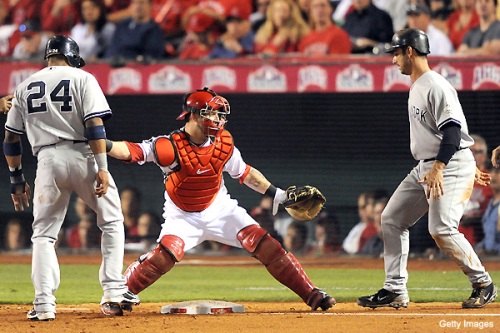
blown callAngels Catcher Mike Natoli Puts Both Posada and Cano Out…Well Not According to Umpire Tim MacClelland

Monday was such a great night for baseball, two excellent games both decided by walk off hits which left the Angels back in their series with the Yankees and the Phillies within a game of going back to the World Series when they came back in the 9th inning with 2 outs and Jimmy Rollins at the plate with two strikes on him.  It was awesome to behold and it looked like all was well again in the 2009 MLB League Championship Series.

Then fallen humanity struck…

And 3rd Base Umpire Tim McClelland has now discovered what it means to be remembered for all the wrong reasons, two badly blown calls and a lame excuse for blowing them.

See the calls:

http://sports.yahoo.com/video/player/mlb;_ylt=Ahzw4dvilocLtjFLCKQAyusRvLYF#mlb/16204489

As I sat watching the Yankees destroy the Angels last night I was amazed at the bad calls.  Now this playoff season there have been a number of really grotesque calls on the part of umpires. This year I have found some of the calls so unbelievably bad that even I, a traditionalist in the Church of Baseball who detests replay reviews in the NFL think that the time has come to consider some form of replay.

My view that that baseball is the most human of sports, perfection is seldom reached and never maintained.  People who hit .300 make it to All-Star teams as well as the Hall of Fame.  Rain delays, bad calls and close calls that could go either way are all part of the fabric of baseball.  In principle I don’t like replay.  I believe that umpires, like everyone else are human and that the imperfection of the umpires is as much as part of the game as a fielding error, wild pitch or bad at bat.  However some of the calls this post-season have been particularly egregious and the crew chief on the field should have overruled to call, especially when Angels Catcher Mike Napoli clearly tagged out Robinson Cano and Jorge Posada who were both well of the base. McClellan’s excuse about how he missed the call was lame and he compounded the issue by calling Nick Swisher out for supposedly leaving third base early on a sacrifice fly, which the replay showed that he had not done so and should have scored.  Once again though there were two extra umpires no one caught the play.

My recommendation is for an “eye in the sky” umpire who can review the call in real time and overrule the call on the field if the call is clearly wrong, this would not apply to called balls and strikes, but only on balls that are put in play.  To overturn the call the “eye in the sky” umpire would have to determine that the play was clearly blown and not simply a call that could have gone either way.  He would have to account for the umpires position and visibility in relationship to the play and if it could be reasonably expected that any umpire would make the same call.  If the replay clearly shows that the umpire on the field missed the call the “eye in the sky” umpire could then overturn the call.  Such a mechanism would maintain the flow of the game as the umpire on the field would not have to go to a replay booth, taking valuable time and would provide some measure of accountability when a play is as badly called as McClellan’s.  It would not take out the human factor of calls that can go either way or where bad positioning or visibility could have affected the call.  It would however ensure that calls like last night’s by McClellan are quickly rectified with minimal delay to the game, calls that could easily decide the fate of a series in a close game.  Thankfully because of the blowout of neither Angels nor the Yankees could claim that the calls affected the game’s outcome.

I missed the game tonight because of being involved with critical situations here at the Medical Center, but the Evil Dodgers were crushed by the Phillies tonight 10-4 ending their season.  I picked the Phillies in 7 because I thought that the Dodgers bullpen would make a difference but the Dodgers bullpen was about as effective as a pocketknife in a gunfight and the Phillies bullpen, derided by many stepped up, especially closer Brad Lidge who had such a miserable and ineffective season after a great 2008 where he was just about perfect.  The Phillies hitters owned the Dodgers pitching staff driving in 45 runs in the 5 games of the series.  Anytime a team averages nine runs a game it will win the series.

Tonight the Yankees and Angels square off in Anaheim for what could be the deciding game of their series. The question is can the Angels mount a comeback and will the “X” factor of Nick Adenhart inspire them enough to win the game and get the series back to New York?  I had picked the Angels in six figuring that the Yankees could not keep up the pace, but the Yankees are locked on, they have an edge and every member of the team is playing hard, Alex Rodriguez is in the process of establishing himself as a clutch Mr.October the likes which have not been seen since Reggie Jackson.  Derek Jeter has helped lead the team and hit well while the pitching staff led by C.C. Sabathia has been amazing and Mariano Rivera as usual has been a hero.  Joe Girardi has managed the team exceptionally well and is getting performance and teamwork out of the Yankees far more effectively than Joe Torre who was ushered out of the playoffs with the Dodgers in much the same way that he was ushered out with the Yankees from 2003 to the end of 2007.

Peace,

Padre Steve+

Leave a comment

Filed under Baseball

Give me that Old Time Religion: Book & Bible Burnings that Warm Your Heart…Can We Make Smores? Witch Children…Shall we Duck Them? And Can VDOT ever Clear the Crap off the Road?

I’m a Scripture, Tradition and Reason kind of Christian, pretty moderate in about everything and maybe a bit cynical about some things, however nothing warms my heart more than a good old fashioned book burning.  There is something about this tradition that makes for good fellowship on a crisp fall night. Everyone is gathered round the fire and the grand master of the congregation, sometimes referred as the “Pastor” or in some cases “Preacher Boy” exhorts his otherwise illiterate congregation to burn books which they have never read and for which in many cases cannot pronounce the author’s name, much less know anything about the books being burned.

The cool thing for the folks doing this at Amazing Grace Baptist Church in Canton North Carolina near Ashville is that they not only are burning “heretical” books, but Bibles too, I think over 10 different translations to boot…now that really adds “fuel to the fire” if you ask me.  The “Pastor” of the 14 member congregation a Marc Grizzard who seemingly appropriately is wearing bib overalls in his interview with a local television station, which coincidently is of the Devil too.  That link is here and they have a nice little video too: http://www.kbmt12.com/news/local/63968712.html

The church has a pretty good list of Bibles and authors and even musicians, of course everyone knows that musicians are all Satanists so why shouldn’t they get their stuff burned too?  Some of the Bible translations which are called by Grand Master Marc “Satan’s Bibles” include the New International Version.  Now I admit I’ve never been a fan of what I consider a pretty bland and unexciting translation, but can’t see burning them.  Likewise the New American Standard Bible, the Good News for Modern Man and a bunch of others make the list.  I’m sure that my two preferred translations have to be in the mix somewhere, the Revised Standard Version and the New Revised Standard Version.  Since these too have to be the Devil’s handiwork I will guard them with my life just in case Grand Master Marc comes up my way at 666 Lake of Fire Way.

Burning books is one thing, I would actually start with most Christian fiction, especially the Left Buttocks series if I were to start burning books, but even then I figure that maybe the Deity Herself would not approve.  Of course the Grand Master Marc being a good Scripture only kind of guy, screw that demonic tradition reason too, does find scriptural precedent for this in Acts 19: 18-20 which I quote from one of Satan’s Bibles, the New Living Translation or the NLT:

“Many who became believers confessed their sinful practices. A number of them who had been practicing sorcery brought their incantation books and burned them at a public bonfire. The value of the books was several million dollars. So the message about the Lord spread…”

Of course the passage in questions refers to recent converts who had been into sorcery in a place where this was big business and not to Bible translations, or works of popular Christian writers of their day such as Peter, Paul and Mary…wait sorry, Peter, Paul and John my bad.  Likewise the “Amazing Grace” church has identified a number of heretical authors whose works will be burned including such known betrayers of the faith as the Pope, Mother Teresa, Billy Graham and Rick Warren.  Now I wouldn’t read Rick Warren if you paid me too, well maybe I’d prostitute myself if the money was right, but still I can’t recommend burning his books.  I like the way that Billy Graham preached but was bored by his books, but still burning?  I don’t know…and Mother Teresa’s books are too small to be more than kindling.  As to burning the Pope’s books, which Pope, all of the Popes with a number after their name, or maybe those with a Latin or Italian name?  Nope, must be all of them.  Add to the mix others such as conservative stalwart James Dobson, award winning Chuck Colson, John, “no I’m not having fun” MacArthur and a host of others you get a pretty good pile of books to burn.

The church website: http://amazinggracebaptistchurchkjv.com/Download99.html is hard to reach right now because it has exceeded its bandwidth however they plan a good time including serving food for those who attend.  Since there is food can I make Smores?

The interesting thing about the good folks at Amazing Grace Baptist Church which I think is a pretty uninspired name for a church which is to say the least a bit intolerant and has been used in a really popular song that I heard Willie Nelson sing is that the are KJOVers .  In English that means King James Only Version people.  For them there is no other version in English that is the true, inspired, inerrant Bible, the King James Version 1611, or 1611 for short. I knew a Army National Guard Chaplain in Texas who once visited one of his church “shut-ins” at her home. He asked her if she would like him to read something out of the Bible to her.  She told him that only if he would read from the original language.  He was dumbfounded, he didn’t have his Greek New Testament available nor anything in Hebrew, so he said that he didn’t have it with him. The lady said “Oh I have it in my drawer.” She reached to her bedside nightstand and pulled out; you guessed it the KJV 1611.

Now I have nothing against the KJV, I even have one or two in my collection.  However it is not my language, I’m an American of the late 20th and early 21st Century.  All the doests, don’tist, thousist and shallists really killeth me.  Even in the liturgy I’m a 1979 Book of Common Prayer Rite Two kind of guy.  Rite One is a lot like the KJV and while nice I find myself stumbling all over it like I was trying to celebrate the Mass in Urdu or Pashto. It just doesn’t work for me.  If that makes me a heretic or worse I’m sorry.

However there is something I find perplexing about the KJOV crowd.  The King James Bible as it was originally published in 1611was a little different than that called the 1611 today.  First, it was translated by a bunch of Anglican scholars from the Greek and Hebrew assisted by the Latin Vulgate and Luther’s German translation.  Second, it included the books commonly referred to as the Deuterocanonicals, sometimes known as the Apocrypha.  Third the King James Version was “Authorized” not necessarily by God, but rather the Good King James of England, defender of the Faith who happened to believe that the “Faith” was that prescribed by the Church of England, not Catholics, nor Puritans and especially not Baptists was the faith to defend.  In fact the Good King James despised the forefathers and foremothers of the Grand Master Marc and the stalwart Amazing Grace Baptist Church persecuting them, jailing them and even executing them.  Of course the Defender of the Faith happened to be a flaming homosexual, not that there’s anything wrong with that.  Somehow I wonder why they wouldn’t pick a Bible that was more Baptist friendly.  Oh well, I love irony but will take my shirts to the cleaners.

Moving on to Africa where some rather extremist type Christians are trying to go back to the times of the Round Table up to the 1600s in England and Her Colonies in the “New World” aka Virginia and the Massachusetts Bay Colony by deciding children are witches and deciding the exorcise them.  I said “exorcise” and not “exercise.”  Unfortunately these folks have updated the exorcism manuals to include forcing acid down their throats.  The story is heart rending:

The nine-year-old boy lay on a bloodstained hospital sheet crawling with ants, staring blindly at the wall.

His family pastor had accused him of being a witch, and his father then tried to force acid down his throat as an exorcism. It spilled as he struggled, burning away his face and eyes. The emaciated boy barely had strength left to whisper the name of the church that had denounced him – Mount Zion Lighthouse.

A month later, he died.

Nwanaokwo Edet was one of an increasing number of children in Africa accused of witchcraft by pastors and then tortured or killed, often by family members. Pastors were involved in half of 200 cases of “witch children” reviewed by the AP, and 13 churches were named in the case files.

Some of the churches involved are renegade local branches of international franchises. Their parishioners take literally the Biblical exhortation, “Thou shalt not suffer a witch to live.” http://www.latimes.com/news/nationworld/wire/sns-ap-af-nigeria-child-witches,0,5276725.story

There is little humor in this story, it is tragic.  The fact that anyone anywhere would abuse and kill children in such a manner is abhorrent and unfortunately happens far too often.  I live about a mile from “Witchduck” road in Virginia Beach Virginia.  If you have seen Monty Python and the Holy Grail you will understand what I am talking about.  I think that if anyone is going to accuse someone of witchcraft they should be tried by the ancient tradition of the witch ducking.  I will not go as far as some to deny incidents of demonic possession but think that we need to be careful when we deal with the subject.

And lastly, is it wrong of me to think ill of the Virginia Department of Transportation, better known as VDOT? I have a number of beefs with the kind folks who manage our Interstate and State Highways.  In the nearly 6 years that I have lived here I have had to replace two windshields and 8 tires due to debris that has littered I-64 and I-264 in the Hampton Roads area.  Tonight as I pulled tire number eight off of my trusty 2001 Honda CR-V this afternoon to find a piece of metal imbedded in it I muttered a few epitaphs concerning the agency of ill-repute and leadership of questionable parentage and oedipal tendencies.  I am tempted to send Governor Tim “Eyebrows” Kaine a bill for the money that I have had to spend to buy windshields or tires.

Tomorrow I have duty and the Abbess will take my tire back to the place that I bought it to see if it is still salvageable or if I need to get a new one with a bit of credit on my road hazard warranty.

Peace,

Padre Steve+

2 Comments

Filed under hampton roads and tidewater, philosophy, Religion

The American Campaign in Normandy

Note: This is the first of a series of four articles dealing with the campaign in France and Germany in 1944-1945.  The second installment “Mortain to Market-Garden” was posted a couple of months back. The link to that article is here: https://padresteve.wordpress.com/2009/09/17/mortain-to-market-garden-a-study-in-how-armies-improvise-in-rapidly-changing-situations/

The others should be posted in the coming weeks.


Introduction
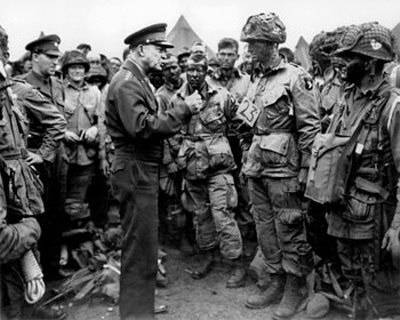
eienhower and 101stEisenhower and 101st Airborne

The American landings on Omaha Beach were critical to the success of the Allied invasion northwestern Europe in the overall Overlord plan.  Without success at Omaha there would have been a strong chance that the German 7th Army and Panzer Group West could have isolated the remaining beachheads, and even if unsuccessful at throwing the Allies into the sea could have produced a stalemate that would have bled the Allies white.  This quite possibly could have led to a political and military debacle for the western allies which would have certainly changed the course of World War II and maybe the course of history.[i] This is not to say the Germans would have won the war, but merely to state that a defeat on Omaha could have changed the outcomes of the war significantly.   Subsequent to the successful landing there were opportunities both for the Allies and the Germans to change the way that the campaign unfolded, thus the battles leading up to the breakout at Avranches are critical to its development and the subsequent campaign in France.

OVERLORD: The Preparations

The planning for the Normandy invasion began in earnest after the QUADRANT conference in Quebec in August 1943.  The timetable for the operation was established at the Tehran conference where Stalin sided with the Americans on the need for an invasion of France in the spring of 1944.[ii] Prior to this there had been some planning by both the British and Americans for the eventual invasion initially named ROUNDUP.  These preparations and plans included a large scale raid at Dieppe in 1942 which ended in disaster but which provided needed experience in what not to do in an amphibious assault on a heavily defended beach.        The failure at Dieppe also darkened the mood of the Allies, the British in particular to the success of such operations, bringing to mind the failed Gallipoli campaign of 1915 as well as the opposed landings at Salerno and the USMC experience at Tarawa.[iii] Despite this the Americans led by General Marshall pushed for an early invasion of northwest Europe. Churchill and the British due to their weakness in land power pushed for land operations in the Mediterranean, and even in Norway as an option to the assault in France. The conflicted mindset of the Allies left them in the position of planning almost exclusively for the success of the initial landings and build up to the near exclusion of planning for the subsequent campaign once they landed. This especially included what one writer described as “the maze of troubles awaiting behind the French shore.”[iv]
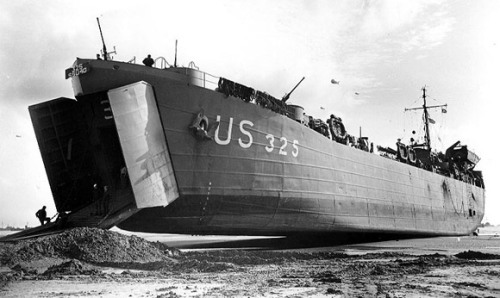
lst-325 at normandyLST-325 at Normandy, Specialized Landing Ships and Craft were in High Demand and Short Supply in June 1944

Despite conflicts between the Americans and British political and military leadership the planning for the Normandy landings detailed in NEPTUNE and OVERLORD moved ahead.  General Dwight Eisenhower was appointed as the commander of SHAEF with his major subordinates for Land, Air and Sea which caused consternation on both sides of the Atlantic.[v] [vi] The planned operation was expanded from the initial 3 division assault on a narrow front to a minimum 5 division assault on a broad front across Normandy[vii] supplemented by a strong airborne force.[viii] Overall the plan as it developed reflected a distinctly “American willingness to confront the enemy head-on in a collision which Britain’s leaders had sought for so long to defer.”[ix] It is ironic in a sense that the British avoidance of the head on attack was based on their known lack of manpower.  Britain had few infantry reserves to sustain the war effort and the Americans only late recognized their own deficiency in both quantity and quality of infantry forces on which their strategy depended.  That the western allies, so rich in material and natural resources would be so deficient in infantry manpower was a key constraint on the subsequent campaign in France and Germany.  The shortage of infantry forces would cause great consternation among the Allies as the campaign in France wore on. The Germans too faced manpower shortages due to the immense losses sustained on the Eastern front, those lost in Africa and those tied down in Italy, the Balkans and Norway as well as the drain caused by Luftwaffe Field Divisions and troops diverted into the Waffen-SS.   The German Army resorted to smaller divisions and the created many “static” divisions manned by elderly or invalid Germans to plug the gaps along the Atlantic wall. The Germans were also forced to recruit “Volksdeutsch” and foreign “volunteers” to fill out both Wehrmacht and Waffen-SS formations.
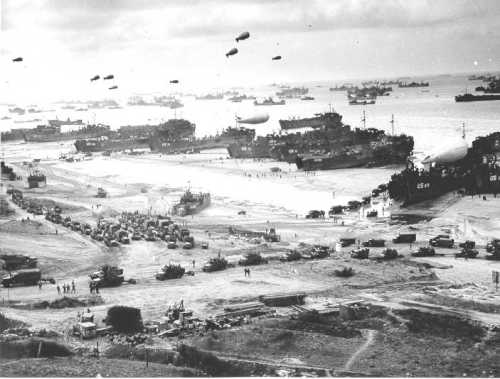
omaha_beach_low_tideOmaha Beach

Prior to the final decision to mount an invasion the Allied planners had contended with the location of the assault in northwestern France.  The Pas de Calais provided a direct route was rejected because it was where the Germans would expect the strike to occur and because it was where the German defenses were strongest.  The fiasco at Dieppe had provided ample proof of what could happen when making an assault into a heavily fortified port.  Likewise the mouth of the Seine near Le Harve was rejected because of the few beaches suitable for landing and because the forces would be split on both sides of the river.  Brittany was excluded due to its distance from the campaigns objectives in Germany.[x] This left Normandy which offered access to a sufficient number of ports and offered some protection from the weather. Normandy offered options to advance the campaign toward the “Breton ports or Le Harve as might be convenient.”[xi] Omaha beach, situated on the center right of the strike would be crucial to the success of the assault situated to the left of UTAH and the right of the British beaches.
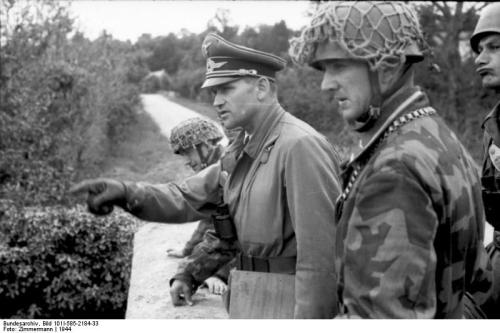
Bild 101I-585-2184-33Outnumbered Paratroops of II Fallschirmjaeger Corps Delayed US Forces Considerably in Normandy

Once Normandy was selected as the location for the strike by the Allies, the planning sessions remained contentious.  This was especially true when the Allies debated the amount and type of amphibious lift that could be provided for the landings, particularly the larger types of landing ships and craft to support the Normandy invasion and the planned invasion of southern France, Operation ANVIL.  The increase in OVERLORD requirements for landing craft had an impact in the Mediterranean and resulted in ANVIL being postponed until later in the summer.

As part of their preparations the Allies launched a massive deception campaign, Operation FORTITUDE.  This operation utilized the fictitious First Army Group under the “command” of General George Patton. Patton was still smarting from his relief of command of 7th Army following slapping commanded an “Army Group” which incorporated the use of dummy camp sites, dummy tanks, aircraft and vehicles, falsified orders of battle and communications to deceive German intelligence.[xii] The success of this effort was heightened by the fact that all German intelligence agents in the U.K. had been neutralized or turned by the British secret service.  Additionally the Luftwaffe’s limited air reconnaissance could only confirm the pre-invasion build ups throughout England without determining the target of the invasion.[xiii] The German intelligence chief in the west, Colonel Baron von Roenne “was deceived by FORTITUDE’s fantasy invasion force for the Pas de Calais.”[xiv] Despite this Commander of the 7th Army recognized by 1943 that Normandy was a likely Allied target and efforts were made to shift 7th Army’s center of gravity from Brittany to Normandy.  The one potential German success in getting wind of when the Allied landings would occur was lost when German intelligence discovered two lines of Verlaine’s “Chason d’ Automme” in June 1944 which were to alert the French Resistance of the invasion.  The security section of 15th Army heard them transmitted on the afternoon of 5 June and notified General Jodl at OKW, but no action was taken to alert forces on the coast.[xv] Allied intelligence was aided by ULTRA intercepts of coded German wireless transmissions. However this was less of a factor than during the African and Italian campaigns as more German communications were sent via secure telephone and telegraph lines vice wireless.[xvi] Allied deception efforts were for the most part successful in identifying German forces deployed in Normandy. However they were uncertain about the location of the 352nd Infantry Division which had been deployed along OMAHA and taken units of the 709th Infantry Division under its command when it moved to the coast.[xvii]
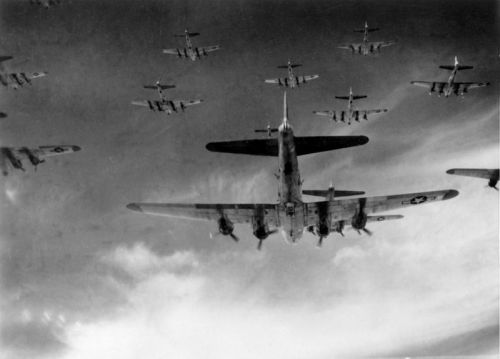
b-17_group_in_formation8th Air Force Bombers Helped Hit German Oil Production Facilities and caused the Luftwaffe to spend its fighter squadrons over Germany than France

The Allied air campaign leading up to the invasion was based on attempting to isolate the invasion site from German reinforcements. Leigh-Mallory the Air Chief developed the “TRANSPORTATION PLAN” which focused efforts on destroying the French railroad infrastructure.[xviii] A more effective effort was led by General Brereton and his Ninth Air Force which was composed of medium bombers and fighters.  Brereton’s aircraft attacked bridges and rapidly achieved success in crippling German efforts to reinforce Normandy.[xix] Max Hastings gives more credit to the American bombing campaign in Germany to crippling the German defense in the west. General Spaatz and the 8th Air Force destroyed German production capacity in oil and petroleum as well as the degraded the German fighter force.  The American daylight raids so seriously degraded the German fighter force that it could not mount effective resistance to the invasion.[xx] Russell Weigley also notes that Albert Speer the Reich Armaments Minister said that “it was the oil raids of 1944 that decided the war.”[xxi]
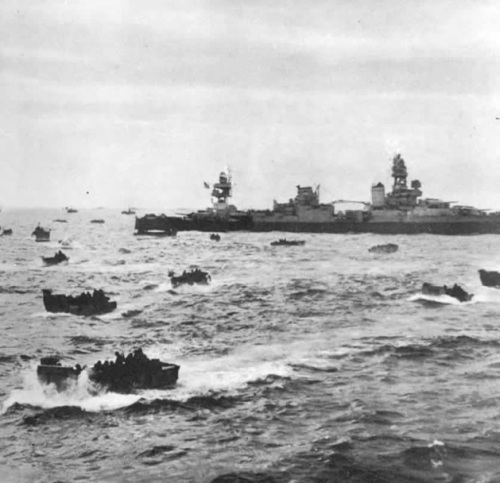
omaha_beach_uss_augusta1944Landing craft passing USS Augusta

Planning and preparations for OMAHA were based around getting the 1st and 29th Infantry Divisions ashore and them securing a beachhead “twenty-five kilometers wide and eight or nine kilometers deep.”[xxii] American preparations were thorough and ambitious, but the American assault would go through the most heavily defended sector of German defenses in Normandy.  The landing beaches were wide and bordered by dunes which were nearly impassable to vehicles and “scrub covered bluffs thirty to fifty meters high…rough and impassable to vehicles even to tracked vehicles except at a few places.  The exits were unimproved roads running through four or five draws that cut the bluffs.”[xxiii] Dug in along those bluffs was the better part of the 352nd Division. The Americans compounded their selection of a difficult and heavily defended landing zone the Americans failed to take advantage of many of the “gadgets” that were offered by the British which in hindsight could have aided the Americans greatly.  The Americans made use of two battalions of DD (Dual Drive) tanks but turned down the offer of flail tanks, flamethrower tanks, and engineer tanks, the “funnies” developed by General Hobart and the British 79th Armored Division.[xxiv] Weigley believes that the American view of “tanks as instruments of mobility rather than of breakthrough power.” Likewise the Americans victories in the First World War were won by infantry with little tank support.[xxv] In this aspect the Americans were less receptive to utilizing all available technology to support their landings, something that when considering the fact that Americans were great lovers of gadgets and technology. The British use of the Armor, including the “Funnies” on the beaches to provide direct fire into German strong points lessened their infantry casualties on D-Day. Due to this lack of armor support on the beach American forces on OMAHA had little opportunity to exercise true combined arms operations during the initial landings.[xxvi]
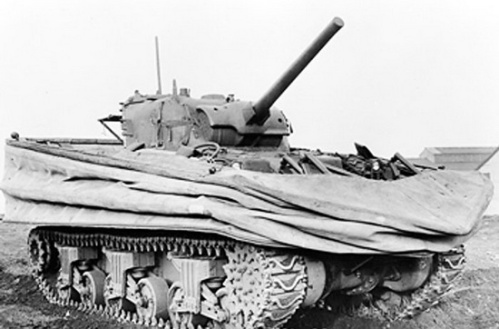
dd-tankDual Drive or DD Tanks took heavy Losses at Omaha

German preparations for an Allied landing in Normandy were less advanced than the Pas de Calais.  However they had made great strides since late 1943. Field Marshal Rommel greatly increased defensive preparations along the front, including the Normandy beaches.  One of Rommel’s initiatives was to deploy Panzer Divisions near the coast where they could rapidly respond to an invasion.  However Rommel did not get everything that he wanted.  The OKW only allotted him two Panzer Divisions to be deployed near the Normandy beaches.  Only one of these the 21st Panzer Division was deployed near Caen in the British sector.  One wonders the result had the 12th SS Panzer Division been deployed behind OMAHA. [xxvii]

OMAHA: The Landings

Like the rest of the Allied invasion forces the 1st and 29th U.S. Infantry Divisions set sail from their embarkation ports with the intent of landing on June 5th.  General Bradley, commanding the First Army until the American XII Army Group would be activated accompanied the invasion force.  The OMAHA landing was under the command of General Gerow and his V Corps while VII Corps led by the 4th Infantry Division landed at Utah supported by airdrops of the 82nd and 101st Airborne Divisions inland.  American command and control during the invasion was exercised from sea as in the Pacific, although General Officers were to go ashore with each of the American divisions.  A severe channel storm disrupted the plan to land on the 5th and Eisenhower delayed the invasion one day catching a break in the weather and electing to go on the 6th.[xxviii] This delay while uncomfortable for the embarked troops caused the Germans to believe that no invasion would take place until the next favorable tide and moon cycle later in the month.[xxix] The assumption that no invasion was possible ensured that a number of key senior German leaders, including Rommel were absent from the invasion front when the Allies landed.[xxx]
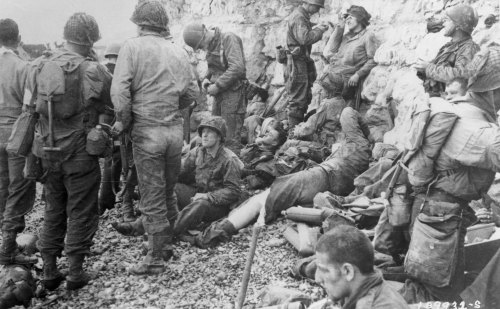
1st id normandy1st Infantry Divison Troops at the Omaha Beach Sea Wall

The landing beaches at OMAHA stretched about 6500 meters from Colleville-Sur-Mer to Vierville-Sur-Mere in the west.  The beaches are wide with bluffs overlooking them and a seawall between the beaches and the bluffs.  Additionally several small towns dot the beach. To the west of the town of Vierville, a prominent height overlooked the entire beachhead.  Named Pont du Hoc, it was believed to house a 150mm battery sighted where it could enfilade the OMAHA landing zones.  The Americans assigned to the 2nd Ranger Battalion to make a seaborne assault to land, scale the cliffs and take the battery.  Companies from this battalion made a heroic landing and scaled the cliffs to capture the strongpoint only to discover that the guns had not been emplaced.  The Rangers took heavy casualties and held their isolated beachhead against German counterattacks until relieved by the 29th Division on the morning of June 8th.[xxxi]

H-Hour for OMAHA was 0630.  Unfortunately the assault troops were transferred to their LCVP landing craft 16-20 kilometers from the beach.  The result was a long and dangerous ride in the small craft for the infantry.  Most of the infantry were completely soaked in sea spay and seasick before going ashore and they carried loads far above what they normally would carry into battle.[xxxii] The Armor support was one battalion of DD tanks, the 741st Armored Battalion, supporting the 16th Infantry Refiment of 1st Infantry Division. These were also launched too far out and nearly all of the tanks were swamped and lost before firing a shot in anger.[xxxiii] Other American support units needed to provide firepower on the beach were equally unfortunate. Weigley notes that at OMAHA “at least 10 of the LCVPs sank” as did “the craft carrying almost all of the 105mm howitzers that were to be the first artillery ashore after the tanks.”[xxxiv] The losses would cripple the assault on OMAHA and nearly cause its abandonment.
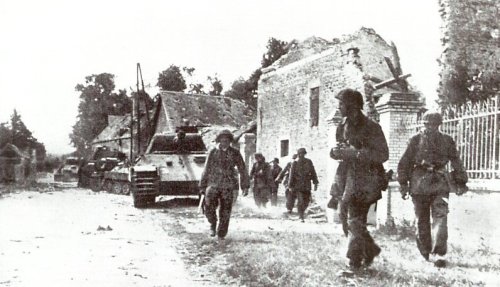
panzer111Panzers and Grenadiers in Normandy

As the soldiers of the American divisions on OMAHA came ashore they faced German defenders of the 352nd, 716th and a regiment of the 709th Infantry Division, the latter under the tactical command of the 352nd.   Without the bulk of their tanks artillery and lacking close air support the Americans struggled across the beaches and were cut down in large numbers before being pinned down behind the sea wall.[xxxv] With the Americans pinned down on the beach unable to advance, the time tables for the reinforcing waves became snarled amid the German beach obstacles which had not been cleared.  This was in large part due to 40% casualties among the Combat Engineers and the loss of all but five bulldozers.[xxxvi] Naval officers were frustrated in their attempts to provide naval gunfire support by the lack of identifiable targets on the beaches.  Yet German strongpoint’s were “knocked out by either by superbly directed vigorous gunfire from destroyers steaming as close as 800 yards offshore, or by determined action from Rangers or infantry.[xxxvii]

Soldiers ashore discovered that they were not facing the static 716th Division but the veteran 352nd Division as well.[xxxviii] Only the leadership and actions of Brigadier General Norman Cota the 29th Division’s Deputy Commander and Colonel Charles Canham of the 116th Infantry kept the situation from complete collapse.  They were able to rally their troops. Under their leadership small units from the 116th which had its linage back to the “Stonewall Brigade” as well as elements of the 16th and 18th Infantry Regiments began to move forward.  Surviving junior leaders began to lead survivors through the dunes and up the bluffs to attack German defenders of the roads leading up from the beach from the flank and rear.  A mid-day break in the weather allowed some close tactical air support giving the troops badly needed support.

With the situation desperate General Bradley considered the evacuation of OMAHA.  At sea events were as confused as Bradley and his staff attempted to make sense of what was going on.  Even later in the evening there was discussion of diverting all further reinforcements from OMAHA to the British beaches.[xxxix]At 1330 hours “Gerow signaled Bradley: “Troops formerly pinned down on beaches…advancing up heights behind beaches.”[xl] By the end of the day Bradley’s aid Major Hansen noted Bradley’s comments to Collins: “They are digging in on Omaha beach with their fingernails. I hope they can push in and get some stuff ashore.”  And Montgomery: “Someday I’ll tell Gen[eral] Eisenhower just how close it was for a few hours.”[xli]
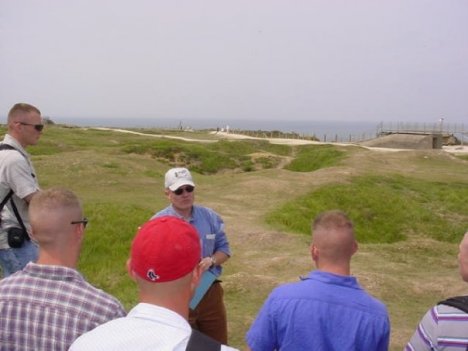
me-at-normandy

The Author Teaching at Point du Hoc in 2004

The landings at OMAHA succeeded at a cost of over 2000 casualties.  Critical to the success of the landings were the German inability to reinforce their defending troops on the beach.  Likewise the weakness of the units available to mount the standard counterattack that was critical to German defensive plans on D-Day itself kept the Germans from driving the Americans back into the Channel. The 352nd Division fought superbly under the full weight of V Corps and the British XXX Corps on its right suffering heavy casualties as they contested every inch of ground.  The 716th Division composed of second rate troops melted under the onslaught.  Allied air supremacy played a key role as sorties by the 8th and 9th Air Forces helped keep German reinforcements from arriving and interdicted counter attacks inland.  Weigley credits the Allied air superiority with the success of the landings and with limiting casualties.[xlii] Von Rundstedt and other German commanders in France were limited by the delay and refusal of Hitler and OKW to release Panzer reserves when needed most early on June 6th.  By the close of D-Day allied forces had secured the five invasion beaches but not achieved their objectives of taking Caen and Bayuex.  Since the forces on the various beachheads had not linked up the beaches would have been extremely vulnerable had the Germans been able to mount a rapid counterattack by Panzers and strong infantry formations as they had at Salerno.

Major Battles to the Breakout at Avranches


Securing the Beachheads:

It took the V and VII Corps nearly a week to secure the beachheads. German forces including the stalwart 352nd Division resisted stubbornly and mounted sharp local counterattacks which kept the Americans off balance.  Elements of the 29th Division and the 90th Division began to push inland and to expand the beachhead toward UTAH. Opposed by the 352nd Division and elements of the 91st Airlanding Division and other non-divisional units the fighting revealed the inexperience of the American infantry formations and the uneven quality of their leadership.  As the Americans tackled the Germans in the labyrinth of the Bocage country the defensive skill of the Germans cost many American lives and delayed the joining of the beachheads. On the 13th the link up was solid enough to enabling the Americans to conduct the follow up operations needed to expand the beachhead, secure Cherbourg and clear the Cotentin.
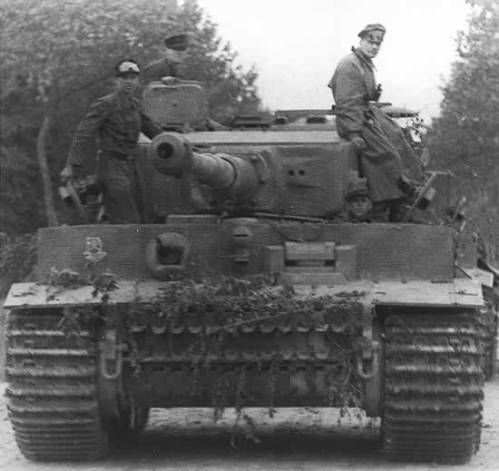
tiger-tank normandyTiger Tank and Crew in Normandy

In some American divisions the hard fighting triggered a leadership crisis.  The lack of success of the 90th Division led General “Lightening Joe” Collins of VII Corps relieve the division commander and two regimental commanders of command, a portent of things to come with other American units.[xliii] As the V and VII corps pushed into the “Bocage” they were followed by a massive build up of troops and equipment delivered to the beaches and to the artificial “Mulberry” harbors.  Despite their numeric superiority, air supremacy and massive Naval gunfire support and facing the weakened 352nd, 91st and the 6th Parachute Regiment and other less than quality formations, survivors of the static divisions, the Americans made painfully slow progress as they moved off the beachhead and into the Bocage.[xliv]

The Capture of Cherbourg

Once the beachheads had been consolidated the Americans turned their attention toward Cherbourg. Cherbourg was the major naval port at the far northwest tip of the Cotentin.  D-Day planners counted on its swift capture and rehabilitation to serve as a supply port for the Allied forces. The 9th Division drove south to the coast near Barneville on the 18th of June cutting off the German forces covering the approaches to Cherbourg.[xlv] This put the Germans in a bind as the 7th Army “had to split its forces in the peninsula in order to hold the fortress a little longer and thus to gain time for the establishment of the southern front on the Cotentin peninsula.[xlvi] The German forces arrayed before Cherbourg waged a desperate defense centered around the 243rd Infantry Division and other assorted battle groups of LXXXIV Corps, whose commander General Marcks one of the best German Generals was killed in action on 12 June.[xlvii] The U.S. VII Corps under Collins with the 9th, 4th and 79th Divisions pushed up the peninsula capturing Cherbourg on June 29th.  Bradley pushed hard for the capture of the port as the Mulberries had been ravaged by a severe Channel storm the week prior. The port of Cherbourg was thoroughly demolished by German engineers and would not be fully operational for months. The loss of the Mulberries and delay in Cherbourg’s availability meant that few supplies were landed on the beaches would “hinder the escape from the constricting land of the hedgerows into which the Americans had come in search of a port.[xlviii]

The Battle of Caumont Gap

V Corps under Gerow made a cautious advance by phase lines toward Caumont, St Lo and Carentan.  The deliberate advance by the Corps toward a line weakly held by the Reconnaissance battalion of the 17th SS Panzer Grenadier Division was directed by Bradley who did not want to divert attention from the effort against Cherbourg.   After capturing Caumont V Corps halted and continued aggressive patrolling to deceive the Germans while digging in.[xlix] The possibility existed that a strong push against the weak German line could have led to an opportunity to envelope the German line west of Caen. This was a missed opportunity that in part led to the bloody and controversial campaign to capture Caen.[l]

British efforts around Caen

Montgomery had ambitious plans to break out of Normandy by capturing Caen on D-Day and driving toward Falaise and Argentan.  The British plans for this were frustrated by the rapid reinforcement of the sector by the Germans and the activities of 21st Panzer, Panzer Lehr, and the 12th SS Panzer Divisions.  A flanking maneuver at Villers-Bocage was frustrated by a few Tiger tanks led by the legendary Waffen SS Panzer commander Captain Michael Wittman whose tanks devastated a British Armored battalion.[li] A series of disastrous attacks toward Caen (EPSOM, CHARNWOOD and GOODWOOD) strongly supported by air strikes and Naval gunfire finally succeeded in taking that unfortunate city on July 18th but failed to take the heights beyond the town.[lii] Against crack well dug in German forces the British took heavy casualties in tanks and infantry seriously straining their ability to conduct high intensity combat operations in the future.[liii] The one benefit, which Montgomery would claim after the war as his original plan was that German forces were fixed before Caen and ground down so they could not be used against Bradley’s breakout in the west at St Lo.[liv]
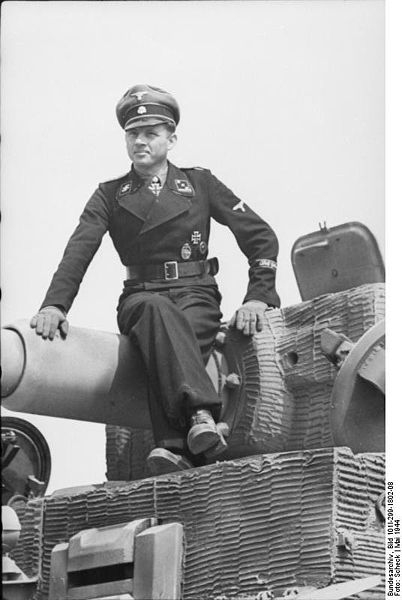
Holding the line Michael_Wittmann_auf_Panzer_VI_(Tiger_I)Panzer Ace Captain Michael Wittmann on His Tiger Tank

Clearing the Bocage: The Battle of the Cotentin Plain

Other German forces arrived, and reinforced the Caumont gap which no longer “yawned invitingly in front of V Corps.” [lv] Bradley wished to push forward rapidly to achieve a breakthrough in the American sector.[lvi] Facing the most difficult terrain in France amid the Bocage and swamps that limited avenues of approach to the American divisions committed to the offensive.  The Americans now faced their old foe the 352nd division as well various elements of II Parachute Corps, the 17th SS Panzer Grenadier and Panzer Lehr Divisions.  American tanks and infantry made slow progress and incurred high losses as they dueled the Germans at close range.  In the VIII Corps sector alone the attack “consumed twelve days and 10,000 casualties to cross eleven kilometers of the Bocage…the achievements of the VII and XIX Corps were no better than comparable.[lvii]

St. Lo

St. Lo was a key to Bradley’s breakout efforts.  His Army had to capture it and the roads leading out of it to launch Operation COBRA along the coast.  The task of capturing St. Lo was assigned to GEROW’S V Corps and Corlett’s XIX Corps.  They faced opposition from the tough paratroops of the German 3rd Parachute Division of II Parachute Corps.  The 2nd, 29th, 30th and 83rd Divisions fought a tough battle advancing eleven kilometers again with high numbers of casualties especially among the infantry to secure St. Lo on 18 July.[lviii] They finally had cleared the hedgerows.  St Lo epitomized the struggle that the American Army had to overcome in the Bocage.  Hard fighting but outnumbered German troops in excellent defensive country exacted a terrible price in American blood despite the Allied control of the skies.[lix]
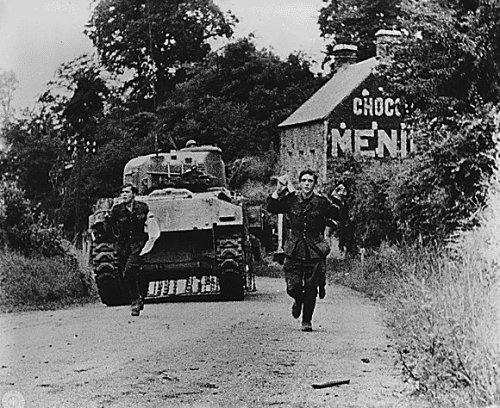
st-loUS Tanks and German Prisoners at St Lo

Operation COBRA

With the Bocage behind him Bradley desired to push the Germans hard.  COBRA was his plan to break out of Normandy.  Bradley ably assisted by Collins they realized that the better terrain, road networks favored a breakout.  American preparations included a technical advance that allowed tanks to plow through hedgerows. This was the “Rhino” device fashioned by American troops which was installed on 3 of every 5 First Army Tanks for the operation.[lx] VII Corps was to lead the attack which was to begin on July 24th. American planning was more advanced than in past operations.  Collins and Bradley planned for exploitation operations once the breakthrough had been made. A massive air bombardment would precede the attack along with an artillery barrage by Collins corps artillery which was reinforced by additional battalions.   A mistake by the heavy bombers in the 24th resulted in the American troops being hit with heavy casualties and a postponement of the attack until the 25th.[lxi] The following day the attack commenced.  Another mistake by the bombers led to more American casualties[lxii] but VII Corps units pressed forward against the determined resistance of the survivors of Panzer Lehr and the remnants of units that had fought the Americans since the invasion began.  Although it was a “slow go” on the 25th Bradley and his commanders were already planning for and beginning to execute the breakout before the Germans could move up reinforcements.  The 26th of June brought renewed attacks accompanied by massive air strikes.  While not much progress was made on the 26th, the Americans discovered on the 27th that the German forces were retreating.  The capture of Marigny allowed VIII Corps to begin exploitation down the coastal highway to Coutances.  On the 27th General Patton was authorized to take immediate command of VIII Corps a precursor to the activation of his 3rd Army.  COBRA ripped a hole in the German line and inflicted such heavy casualties on the German 7th Army that it could do little to stop the American push.[lxiii] As the American forces pushed forward they reinforced their left flank absorbing the local German counterattacks which were hampered by the Allied close air support.

Avranches and Beyond

As the breakthrough was exploited the command of the forces leading it shifted to Patton and the newly activated 3rd Army. By the 28th VIII Corps led by the 4th and 6th Armored Divisions had reached Avranches and established bridgeheads over the See River with additional bridges being captured intact on the 30th.[lxiv] The capture of Avranches allowed the Americans to begin exploitation operations into Brittany and east toward the Seine. Weigley notes that for the first time in the campaign that in Patton the Americans finally had a commander who understood strategic maneuver and would use it to great effect.[lxv]

Conclusion

The American campaign in Normandy cost the U.S. Army a great deal. It revealed weaknesses in the infantry, the inferiority of the M4 Sherman tank to most German types, problems in tank-infantry cooperation and also deficiencies in leadership at senior, mid-grade and junior levels. Heavy casualties among infantry formations would lead to problems later in the campaign. Numerous officers were relieved including Division and Regimental commanders.  Nonetheless during the campaign the Americans grew in their ability to coordinate air and ground forces and adapt to the conditions imposed on them by their placement in the Cotentin.  The deficiencies would show up in later battles but the American Army learned its trade even impressing some German commanders on the ground in Normandy.[lxvi]


[i] See the alternative history of by Peter Tsouras Disaster at D-Day: The Germans Defeat the Allies, June 1944, Greenhill Books, London 1994. Tsouras describes the defeat of the Omaha landings and the effect on the course of the campaign leading to the overthrow of Hitler and a negotiated armistice in the west.  While this outcome could be rigorously debated other outcomes could have led to the fall of the Roosevelt and Churchill governments and their replacement by those not committed to unconditional surrender or a continuation of the war that brought about more German missile attacks on the U.K. and the introduction of other advanced German weapons that could have forced such a settlement. Another option could have led to the dropping of the Atomic Bomb on a German city vice Hiroshima.

[ii] Weigley, Russell F. Eisenhower’s Lieutenants: The Campaign of France and Germany, 1944-1945, Indiana University Press, Bloomington IN, 1981 p.33

[iii] Ibid pp. 34-35

[iv] Ibid p.35

[v] General Montgomery 21st Army group and Land Forces, Admiral Sir Bertram Ramsey as Allied Naval Expeditionary Force and Air Marshall Sir Trafford Leigh-Mallory as Commander in Chief Allied Expeditionary Air Force. Weigley p.43

[vi] Max Hastings in Overlord: D-Day and the Battle for Normandy Vintage Books, New York, 1984, comments that many in Britain wondered if Eisenhower with the lack of actual battle experience could be a effective commander and that Eisenhower was disappointed in the appointment of Leigh-Mallory and Ramsey, and had preferred Alexander over Montgomery, pp. 28-29.

[vii] Ibid. Weigley p.40.  Montgomery was the first to object to the 3 division narrow front invasion rightly recognizing that seizing Caen with its road junctions could provide a springboard for the campaign into open country.

[viii] Ibid. p.37

[ix] Hastings, Max. Overlord: D-Day and the Battle for Normandy Vintage Books, New York, 1984 p.29  Hastings finds the irony in the selection of the British officers to execute the plan that reflected the American way of thinking.

[x] The Germans agreed with this in their planning leaving Brittany very lightly defended.  See  Isby, David C. Ed. “The German Army at D-Day: Fighting the Invasion.” p.27 The report of General Blumentritt, Chief of Staff OB West noted that only 3 divisions were assigned to Brittany.

[xi] Ibid. Weigley, pp. 39-40

[xii] Ibid. p.73

[xiii] See Isby p. 69.  General Max Pemsel of 7th Army noted that “During  the spring of 1944, Seventh Army received only tow good photographs of British southern ports, which showed large concentrations of landing craft.”

[xiv] Ibid. Hastings p.63.  Hastings comments also about the success of using the turned Abwehr agents.

[xv] Warlimont, Walter. “Inside Hitler’s Headquarters: 1939-1945.” Translated from theGerman by R.H. Barry. Presidio Press, Novao CA, English Edition Copyright 1964 Wiedenfeld and Nicholson Ltd. Pp.422-423

[xvi] Ibid. Weigley pp. 53-54

[xvii] Ibid. p. 67

[xviii] Ibid. pp.57-64  Weigley spends a great deal of time on the wrangling between Eisenhower, Leigh Mallory and Spaatz on the nature of the plan, the allocation of forces both strategic and tactical assigned to carry it out and its success, or in the light of postwar analysis the lack of effect that it had on German operations.

[xix] Ibid. p.67-68.

[xx] Ibid. Hastings pp. 43-44 In large part due to the long range P-51 Mustang which accompanied the American bombing raids beginning in 1943.  Another comment is that the campaign drew the German fighters home to defend Germany proper and prevented their use in any appreciable numbers over the invasion beaches.

[xxi] Ibid. Weigley p.69

[xxii] Ibid. p.89

[xxiii] Ibid. pp. 88-89

[xxiv] Ibid. p.87

[xxv] Ibid. Weigley also talks about the rejection of General Corlett’s ideas to use Amtracks used by the Marines in the Pacific to land on less desirable, but less defended beaches to lessen casualties on the beaches and the need for additional support equipment even on smooth beaches.  One of Corlett’s criticisms was that too little ammunition was allotted to supporting the landings and not enough supporting equipment was provided. pp. 46-47

[xxvi] Hastings notes that with the strength and firepower of the German forces on OMAHA that many of these vehicles had they been employed would like have ended up destroyed further cluttering the beachhead. “Overlord” p.102

[xxvii] The battle over the deployment of the Panzer Divisions is covered by numerous historians.  The source of the conflict was between Rommel who desired to place the Panzer Divisions on the Coast under his command due to the fear that Allied air superiority would prevent the traditional Panzer counterthrust, General Gyer von Schweppenburg commander of Panzer Group West (Later the 5th Panzer Army) and Field Marshal Von Rundstedt who desired to deploy the divisions order the command of Rundstedt for a counter attack once the invasion had been launched, a strategy which was standard on the Eastern Front, and Hitler who held most of the Panzer reserve including the SS Panzer Divisions under his control at OKW.  Hitler would negotiate a compromise that gave Rommel the satisfaction of having three Panzer Divisions deployed behind coast areas in the Army Group B area of responsibility.  21st Panzer had those duties in Normandy.

[xxviii] Ibid. p.74-75

[xxix] Von Luck, Hans.  “Panzer Commander“ Dell Publishing, New York, 1989 pp. 169-170.  Von Luck a regiment commander in 21st Panzer noted that General Marcks of 84th Corps had predicted a 5 June invasion at a conference May 30th.

[xxx] Almost every D-Day historian talks about the weather factor and its effect on the German high command’s reaction to the invasion.  Rommel was visiting his wife for her birthday and planned to make a call on Hitler. Others including commanders of key divisions such as the 91st Airlanding Division were off to a war game in Rennes and the 21st Panzer Division to Paris.

[xxxi] Ibid. Weigley p. 96

[xxxii] See Cornelius Ryan, “The Longest Day” Popular Library Edition, New York 1959. pp. 189-193 for a vivid description of the challenges faced by soldiers going from ship to landing craft and their ride in to the beaches.

[xxxiii] Ibid. Weigley. p.78 Weigley talks about the order for the tanks to be carried ashore on their LCTs that did not get transmitted to the 741st.

[xxxiv] Ibid.

[xxxv] Ibid. Weigley  p. 87 The weather prevented the aerial bombardment from being effective. Because the bombers could not see their targets they dropped their bomb loads further inland, depriving the infantry of support that they were expecting.  Naval gunfire support had some effect but had to be lifted as the troops hit the beach leaving much of that support to come from Destroyers and specially equipped landing craft which mounted rockets and guns.

[xxxvi] Ibid. Hastings. pp. 90-91.

[xxxvii] Ibid. p.99

[xxxviii] Ibid. Weigley p.80

[xxxix] Ibid. p.101  Also see Weigley p.80

[xl] Ibid. p.99

[xli] Ibid. Weigley. p.95

[xlii] Ibid. p.94

[xliii] Ibid. p.99 Both Weigley and Hastings make note of the failure of both the Americans and British to train their troops to fight in the bocage once they had left the beaches.

[xliv] Ibid. Hastings. pp.152-153

[xlv] Ibid. Weigley p.101

[xlvi] Isby, David C., Ed. “Fighting in Normandy: The German Army from D-Day to Villers-Bocage.” Greenhill Books, London,  2001.  p.143

[xlvii] Ibid. Hastings p.173 Allied fighter bombers exacted a fearful toll among German commanders. The Commanders of the 243rd and 77th Divisions fighting in the Cotentin were also killed by air attacks on the 17th and 18th.   Further east facing the British the commander of the 12th SS Panzer Division, Fritz Witt on the 17th.

[xlviii] Ibid. Weigley. p.108

[xlix] Ibid. p.111-112.

[l] Ibid.

[li] The efforts of the 51st Highland Division and 7th Armored Division were turned aside by the Germans in the area and were dramatized by the destruction of  a British armored battalion by SS Captain Michael Wittman and his platoon of Tiger tanks.  See Hastings pp.131-135.

[lii] The British 8th Corps under General O’Connor lost 270 tanks and 1,500 men on 18 July attempting to crack the German gun line on the ridge beyond Caen. Weigley, pp.145-146.

[liii] Hastings comments about the critical British manpower shortage and the pressures on Montgomery to not take heavy casualties that could not be replaced. Overlord. pp.241-242.

[liv] Ibid. Weigley pp.116-120

[lv] Ibid. p.122

[lvi] Ibid. p121 Bradley told Eisenhower “when we hit the enemy this time we will hit him with such power that we can keep going and cause a major disaster.”

[lvii] Ibid. 134

[lviii] Ibid. Weigley. pp. 138-143.  Weigley notes of 40,000 U.S. casualties in Normandy up to the capture of St. Lo that 90% were concentrated among the infantry.

[lix] Weigley quotes the 329th Regiment, 83rd Division historian “We won the battle of Normandy, [but] considering the high price in American lives we lost. P.143. This is actually a provocative statement that reflects America’s aversion to massive casualties in any war.

[lx] Ibid. p.149

[lxi] Ibid. p. 152

[lxii] Ibid. pp. 152-153.  Among the casualties were the command group of the 9th Division’s 3rd Battalion 47th Infantry and General Leslie McNair who had come to observe the assault.

[lxiii] Ibid. pp.161-169. Weigley notes the advances in U.S. tactical air support, the employment of massive numbers of U.S. divisions against the depleted German LXXXIV Corps, and the advantage that the “Rhino” device gave to American tanks by giving them the ability to maneuver off the roads for the first time.

[lxiv] Ibid. pp.172-173.

[lxv] Ibid. p.172

[lxvi] Ibid. Isby, David C. “Fighting in Normandy,” p.184, an officer of the 352nd Division referred to the American soldier “was to prove himself a in this terrain an agile and superior fighter.”

Bibliography

Carell, Paul. “Invasion: They’re Coming!” Translated from the German by E. Osers, Bantam, New York 1964.

Hastings, Max. Overlord: D-Day and the Battle for Normandy Vintage Books, New York, 1984

Isby, David C. Ed. “The German Army at D-Day: Fighting the Invasion.” Greenhill Books, London 2004

Isby, David C., Ed. “Fighting in Normandy: The German Army from D-Day to Villers-Bocage.” Greenhill Books, London, 2001.

Ryan, Cornelius, “The Longest Day” Popular Library Edition, New York 1959

Tsouras, Peter. “Disaster at D-Day: The Germans Defeat the Allies, June 1944,” Greenhill Books, London 1994.

Von Luck, Hans.  “Panzer Commander“ Dell Publishing, New York, 1989

Warlimont, Walter. “Inside Hitler’s Headquarters: 1939-1945.” Translated from theGerman by R.H. Barry. Presidio Press, Novao CA, English Edition Copyright 1964 Wiedenfeld and Nicholson Ltd. Warlimont, Walter. “Inside Hitler’s Headquarters: 1939-1945.” Translated from theGerman by R.H. Barry. Presidio Press, Novao CA, English Edition Copyright 1964 Wiedenfeld and Nicholson Ltd.

Weigley, Russell F. Eisenhower’s Lieutenants: The Campaign of France and Germany, 1944-1945, Indiana University Press, Bloomington IN, 1981

5 Comments

Filed under Loose thoughts and musings

A Winter Epic in New York: 13 Innings of Drama in Horrible Conditions

Last night the Yankees and the Angels placed an epic game in the New Yankee Stadium.  It was the kind of game that only can happen in baseball because of its nature. The drama kept me glued to the television once I returned from patient visits during my on-call duty earlier in the evening.  I have seen these types of games before and when they get to extra innings they take on a life of their own.

The weather conditions in New York were terrible.  If it was the regular season the game would have been postponed.  With temperatures which started at 47 degrees they dropped into the lower 40s as the game went on with a stiff wind and mist and drizzle, which turned worse as the rain became steady with the wind blowing rain into player’s faces as they attempted to catch fly balls.  The conditions were some of the worst that I have ever watched with the exception of the 2005 home opener for the Norfolk Tides at Harbor Park where the temperature was 38 degrees at game time with a 25-40 knot wind coming out of left center.  Thank God for global warming or we would have really frozen our asses off that night.

The Yankees got out to a 2-0 lead with one of the runs coming off of a Derek Jeter home run in the 3rd. In the top of the 5th the Angels tied the game using some small ball as well as a wild pitch which scored the tying run.  The game would remain knotted at 2 each another 6 innings until the 11th inning.   With the weather getting worse and both teams beginning to scrape the bottom of their bullpens the Angels scored when Chone Figgins singled to drive in Gary Matthews Junior with 1 out.  The Yankees gave the intentional walk to Bobby Abreu to load the bases and Tory Hunter grounded into a double play to end the inning.  Had Hunter gotten a hit the Angels might well have gone back to Anaheim with a split in the City.

In the bottom of the 11th with the Angels leading 3-3 Alex Ramirez led off for the Yankees.  Angels pitcher Brian Fuentes got ahead of Rodriguez quickly and with a 0-2 count served up a fastball low and outside that Rodriguez lined into the right field bleachers about 18 inches over the outstretched glove of Tory Hunter.  Fuentes got out of the inning but blew the save.  The 12th inning saw the Angels with another chance to move ahead but could not get a runner across the plate.  The Yankees now left the bases loaded in the bottom of the 12th allowing the Angels another shot at them.  They got runners to second and third but Vladimir Guerrero grounded out to the pitcher.  Once again a great scoring opportunity was lost.

In the bottom of the 13th the Yankees got their leadoff hitter, Jerry Hairston on base and he was advanced on a sacrifice grounder.   The Angels intentionally walked Robinson Cano to set up a chance at a double play.  Melky Cabrera hit a ground ball to Angels 2nd Baseman Maicer Izturis who attempted to get the runner at second but threw the ball away skipping it past Erick Aybar and Chone Figgins who could not get the ball to make the play at the plate which allowed Hairston to score the winning run. The game was a marathon lasting over 5 hours and will go down as a memorable game.

The hero of the game was Alex Rodriguez.  His 11th inning home run kept the Yankees in the game and was his third home run in clutch situations this post season.

I picked the Angles in 6 figuring a split in New York.  I have the feeling that this series could quickly go south for the Halo’s if they are unable to get things back together in Anaheim.  Though I picked the Angels, largely due to the “X” factor of Nick Adenhart, the Yankees in my view are the best team in baseball, something that I have said for months.  They are playing with an attitude and there is not a player on the team who is not hungry to bring the World Series Championship back to New York.  Rodriguez and C.C. Sabathia are shedding their reputations as players who “choke” in the playoffs.  The Yankees are for real and I do not know if the Angels can come back.  It is true that they have owned the Yankees in Anaheim this year but these Yankees do not look like they will be at all intimidated by what happened in the regular season in Anaheim.

More commentary in the coming days my friends, so until then stay safe, be blessed and take care.

Peace,

Padre Steve+

Leave a comment

Filed under Baseball

MLB League Championship Series so Far, I will wear Short Pants until the World Series is Over and Learning that I am a “Wounded Healer”

So far things appear to be working out the way that I thought that they would in the MLC League Championship Series between the Phillies and Dodgers. I predicted that the teams would split at Chavez Ravine and go back to Philly knotted.  The Phillies took game one and looked like they had game two in the bag with Pedro Martinez shutting the Dodgers out through seven giving up only two hits.  Then the Phillies problematic bullpen took over in the eighth and it went down from there with the Dodgers coming back to win.

The ALCS has been played at the new Yankee Stadium amid the din of a Nor’easter.  The Yankees took game one 4-1 as the Angels quite literally “froze” in the cold and damp weather.  Game two played in even worse conditions has been influenced by the weather and was a superb pitcher’s duel.  The game went into extra innings tied at two and though the Angels went ahead in the top of the 11th as the rain started coming down harder only to have Alex Rodriguez come up big again for the Yankees in the bottom of the 11th with a home run to tie the game.  The game went to the bottom of the 13th when with one out the Yankees scored on a throwing error to win the game 4-3.  It was an amazing game that I could not pull myself away from but will write more about later.

On another note, the weather here in Hampton Roads has been miserable as we also have had some of the residue of the Nor’easter with cold rain, fog and drizzle that has not let up.  Amid this positively crappy weather I am maintaining my vow to wear short pants as long as I can with the exceptions being my uniform and going to church.  This means that I am bundling up from the belt up while keeping my legs bare.  I have never done this before which means either I’m nuts or I’m nuts, but nonetheless I am in this until the World Series is over at the minimum.  Since with the exception of church, work and one social event where shorts were unacceptable I have not worn long pants since sometime in April.  Tonight I had a Norfolk Tides jacket and sweatshirt on.  We’ll see how this goes…

I have the duty this weekend and have been in and out of the hospital a number of times.  One of the visits called to mind just how much I am like the people I serve and what it means to have to ask the same questions about God, faith and what it is to be human and a Christian. What got me tonight was a gentleman struggling with his faith, much as I have after returning from Iraq and battling PTSD and other nagging injuries.  Having him ask the same questions that I have wrestled with and having him ask me directly what I thought.  I have learned that I don’t have to “fake it” and try to give the man some textbook answer of how he needed to believe more, read his Bible more, go to church more, pray more or harder.  Instead I was able to be honest that I have wrestled with the same question but somehow the words of the 23rd Psalm speak to me.  “Even though I walk through the valley of the shadow of death, I will fear no evil for you are with me.”  The Psalm is very reassuring for me as it is so honest.  Reality is that we do walk through the valley of the shadow of death.  In fact it is a difficult and pain filled world.  That I will fear no evil means that evil is in fact very real but in the middle of this there is an understanding that God is still with us.  It is an understanding that even when life is more like Good Friday than Easter, that God as far away as he may seem is still there.  Maybe that is actually the miracle that most people need, the miracle to know that no matter how bad things suck, and I do use the word “suck” because that is how it is sometimes, especially when there is no “miracle” to be had otherwise.  When I told the man that I had spent the past 18 months wrestling with those questions he opened up and we had a wonderful discussion and prayer.   I am totally okay with this somehow God uses me in my weakness more than when I had all the answers.

Tonight I discovered that  Bishop John Holloway, the medically retired former Ordinary of the Charismatic Episcopal Church Diocese of the Mid-South and one of the early leaders of the Church, his wife Elaine and two youngest children have to leave their home in Thomaston Georgia.  They moved there as a missionary bishop giving up pension and medical from the Methodist Church to follow God’s call into the CEC.  The home is being foreclosed on after the church, which has no pension or insurance plan in most dioceses for clergy and had provided a great deal of money to help pay off debts in the past has had to reduce the money they were providing by half and now according it the Holloways’ son Jared to nothing.  Their home is being foreclosed on and they have to be out by December 1st and if you want to read more go to his blog: http://jzholloway.wordpress.com/  If there is a question as to how the CEC currently handles finaces go to www.cechome.com where the budgets and expenses of every diocese are posted.  There had been great problems in the past in the finacial management of the CEC largely done by people no longer associated with the church, including some former bishops.  I think this is getting better under Archbishop Bates unfotunately the residue and distaste of that era is still out there.

I really don’t know what to think about that except that I did talk to a CEC Bishop about it and hear that there are other parts to the story.  That aside, when the CEC was formed and one of the things that drew me to it was that the CEC was to would be more personal and relational than churches where the bishops did not really know their clergy. I think that is still the ideal in the Church but what Jared is reporting and what I hear from Elaine on Facebook gives me some cause for concern because it deals with a bishop who can no longer function and is completely disabled. Additionally Elaine is a cancer survivor who has exeeded her life expectancy with the disease.  Obiviously things are not good for them and I have to trust that the situation will be resolved in a spirit of love and reconcilliation and that ultimately the Holloways will be taken care of by the church and God’s people.  I cannot say anything else because I do not know anything else, but to say how this grieves me as Bishop Holloway was and I’m sure, even in his greatly de-habilitated and totally dependent state is a gracious and giving man.  I always felt comfortable and safe around him.  He ordained my friend Father Stu King back in 2001.  Stu has left the CEC having been accepted into Seminary and in now working to become a Roman Catholic Priest.  I’m sure that Bishop John would approve and give his blessing.  Please keep the Holloways in your prayers. I have no idea if there is anything that can be done to help them, if there is Jared may know or one could contact the Mid South Diocese of the CEC.

I also found that a friend, the sister of our dear friend Dr Helen Linkey who taught at Marshall University who battled breast cancer for two years before succumbing to it in 2005 has found a lump in her breast. She is going in for a biopsy which is expected to find cancer. Maryellen occasionally comments on my website and her news was included in her comment to my post from last night at https://padresteve.wordpress.com/2009/10/16/war-remembrance-and-healing-a-chaplain-officer-and-historian-makes-his-way-home/

Please keep Maryellen in your prayers also. Anyway, it is time for me to try to get to sleep.

Peace,

Padre Steve+

Leave a comment

Filed under Baseball, healthcare, Pastoral Care, philosophy, PTSD

The Readers Keep Coming 470,000+ Much Due to Alpha Inventions

My readership continues to expand. Much of this is due to Alpha Inventions. It helps me gain readers as well as see some other good bloggers, my favorite being the Polycarp who has a great site called The Church of Jesus Christ.

Leave a comment

Filed under Loose thoughts and musings

War, Remembrance and Healing: A Chaplain, Officer and Historian Makes His Way Home

The first version of this post was written in the spring of 2008 when I was doing a lot of soul searching and reflecting after Iraq. It was originally run in my church’s online news service.  I post it now with some updates that have been brought about by new ways that I am rediscovering God and because of the current situation in Afghanistan which has become worse in the past year. As I read news releases about casualties and attacks on NATO forces and Afghan civilians, especially those in small outposts or serving as advisers and trainers I am reminded of my time in Iraq.  Please don’t forget those who serve in Iraq and Afghanistan, or those who have served in prior wars. Especially keep in your prayers and help assist those who have returned injured in mind, body or spirit and those who made the supreme sacrifice.

874Leaving a Bedouin Camp 1 mile from Syria

I have been doing a lot of reflecting on ministry and history over the past since returning from Iraq. Since I’ve been back about a year and a half I can say that I have changed as a result of my service there.  Change can be scary but in my case it has been both necessary and probably good.  Ministry, theology and history have been part of my life for many years; they have taken on a new dimension after serving in Iraq. When I first wrote this piece not long after returning I was in pretty bad shape but in the months since I have been attempting to integrate my theological and academic disciplines with my military, life and faith experience since my return. I’m not done yet by any means, but things are getting better, not quite like Chief Inspector Dreyfus in The Pink Panther Strikes Again “Every day in every way I’m getting better and better…Kill Clouseau!” but a slowly getting better with some occasional bumps in the road.

One of the things that I have wrestled with is my faith, and returning from war changes a man.  Before I went to Iraq I thought that I had things pretty much together.  When I came home and fell apart it also affected my faith, doing little things became difficult and the effects were exaggerated by my isolation.  In a sense it was my Saint John of the Cross Dark night of the Soul experience.  I felt that God had abandoned me, people would come to me with their crisis of faith and I had to dig deep to stay with them, but in doing so I became acutely aware of the fact that I shared this with them. I couldn’t hide behind my collar or the cross on my uniform as the crisis was an interruption which drove me out of my comfort zone and forced me to deal with the world that the people I minister among deal with every day.

291Iraqi Police in Ramadi Escorting Civilians Across the War Zone of Route Michigan

There are those who believe that all forms of ministry are basically the same and that lessons learned are universally applicable and that somehow all ministries are proclamation oriented.  Unfortunately that is not the case and one of the places that this is true is the Military Chaplain ministry.  This mibnistry is much different than parish or para-church ministries and even different than other institutional ministries such as Police, Fire, Industrial or civilian health care chaplaincy.   It is different in that it is more incarnation versus proclamation. We not only minster to our people but we live among them.  We live the experience of those that we serve, especially in the uncertainly of war and deployments.  Chaplains live in a world where we are fully military officers and fully ministers of our own church or faith tradition. As a chaplain I never lose my calling of being a priest, but I am a priest in uniform, a military professional and go where our nations send me to serve the Sailors, Marines, Soldiers and Airmen who I live among be that overseas, or in the States.

142Always a Priest Eucharist with Advisers in the Far West of Al Anbar

There is always a tension in the military chaplain ministry. This is  especially true when the wars that we are sent to are unpopular at home and seem to drag on without the benefit of a nice clear victory such as VE or VJ Day in World War II or the homecoming after Desert Shield and Desert Storm. There are those that oppose the military chaplaincy on theological or philosophic grounds, usually some manner of absolutist understanding of ministry, church-state relations or social justice considerations.  My purpose is here not to defend military chaplain institutions against such criticism but rather to share the world and tension that military chaplains live in when our nation is engaged in unpopular which some consider unjust or illegal wars.

training team baseIsolated Base Camp for Advisers in Afghanistan

A lot of people have no “ethical” or “moral” qualms about wars that are easy to pigeonhole as just wars, especially if we win quickly and easily.  It is my belief that when things go well and we have easy victories that it is easy for religious people, especially more conservative Christians to give the credit to the Lord for the “victory.”  Unfortunately such “Credit” is given without them ever understanding or sometimes even caring about the human cost of war.   Likewise it is easy for others to give the credit to superior strategy, weaponry or tactics to the point of denying the possibility that God’s involvement.  Conversely and maybe even perversely I have heard some say that God has blessed the use of weapons or tactics that violate principles of fighting a “just war” especially that of proportionality. Such is the case in almost every war and Americans since World War Two have loved the technology of war seeing it as a way to easy and “bloodless” victory. In such an environment ministry can take on an almost “cheer-leading” dimension. It is hard to get around it, because it is a heady experience to be on a winning Army in a popular cause but I do think that many chaplains have a less “cheerleading” approach than many in conservative churches. The challenge for chaplains in such an environment is to keep our ministry of reconciliation in focus. To do so we must care for the least, the lost and the lonely and never forget the victims of war, especially the innocent and the vanquished, as well as our own wounded, killed and their families.

237Iraqi Kids in Al Anbar Province, a couple of months before they could not venture outside because of insurgent attacks, children are never winners in war

We are now seeing the conflict in Iraq winding down and what until this year had been “the good war” in Afghanistan go bad and support for it decline.  Strategy is being debated as how to best “win” the war in Afghanistan even as the United States withdraws from Iraq. The task of chaplains in the current war, and similar wars fought by other nations is different and really doesn’t allow for them to indulge themselves in “cheerleading.” In fact chaplains can themselves through isolation, lack of experience and fear can become more reflective and less “cheerleader” oriented the longer the war goes on without sign of appreciable progress, much less victory.  They feel the onslaught of their soldiers doubts, fears as well as the loss of friends and the chapel congregation through being killed or wounded in action. This  can take a terrible toll even for the most resilient of chaplain. In these wars, sometimes called counter-insurgency operations, revolutionary wars, guerilla wars or peace keeping operations, there is no easily discernible victory. These types of wars can drag on and on, sometimes with no end in sight. Since they are fought by volunteers and professionals, much of the population acts as if there is no war since it does often not affect them, while others oppose the war, all of which can affect the chaplain.

dien_bien_phu paras landingFrench Paratroops Landing at Dien Bien Phu

Chaplains volunteer to go with and place themselves in harms way to care for God’s people in the combat zone or far away from home. While they do this there are supporters of war as well as detractors who have no earthly clue about war or life in the military other then what they see in the media or experienced in peacetime or the cold war. Some supporters often seem more interested in political points of victory for their particular political party than for the welfare of those that are sent to fight the wars. This has been the case in about every war fought by the US since World War II. It is not a new phenomenon. Only the cast members change with the particular war.

legion indo-chinaForeign Legion Troops in Indochina

In order to somehow make sense of going on we cannot simply think of what is politically expedient for either those who support or want to expand the war, or others who want it ended now, both of which have consequences many of which are bad.  I think that we have to look at history and not just to American history to find answers, not simply answers to how to win or end the war but answers to the consequences that either course of action posits. Thus I think that we can find parallels in other militaries. I think particularly of the French professional soldiers, the paratroops, Colonials (Marines) and Foreign Legion who bore the brunt of the fighting in Indo-China. These men, not all of who were French were placed in a difficult situation by their government and alienated from their own people. In particular I think of the Chaplains, all Catholic priests save one Protestant, at the Battle of Dien Bien Phu, the epic defeat of the French forces that sealed the end of their rule in Vietnam. The Chaplains there went in with the Legion and Paras. They endured all that their soldiers went through while ministering the Sacraments and helping to alleviate the suffering of the wounded and dying. Their service is mentioned in nearly every account of the battle. During the campaign which lasted 6 months from November 1953 to May 1954 these men observed most of the major feasts from Advent through the first few weeks of Easter with their soldiers in what one author called “Hell in a Very Small Place.”

french troops indochinaFrench Troops on the March in Indochina

One author describes Easter 1954: “In all Christendom, in Hanoi Cathedral as in the churches of Europe the first hallelujahs were being sung. At Dienbeinphu, where the men went to confession and communion in little groups, Chaplain Trinquant, who was celebrating Mass in a shelter near the hospital, uttered that cry of liturgical joy with a heart steeped in sadness; it was not victory that was approaching but death.” A battalion commander went to another priest and told him “we are heading toward disaster.” (The Battle of Dienbeinphu, Jules Roy, Carroll and Graf Publishers, New York, 1984 p.239) This can be a terrible burden for the Padre who cares for such men.  Ministry in such places is truly an incarnational experience because there is no place to hide and the chaplain is as vulnerable as his flock.  It is the ministry that places us “in the valley of the shadow of death” where as the Psalmist says we are “to fear no evil for you are with us.” It is the ministry of Good Friday where to all appearances seems that God has abandoned the field and evil has won.

VIETNAM DIEN BIEN PHUFrench Surrender at Dien Bien Phu

Of course one can find examples in American military history such as Bataan, Corregidor, and certain battles of the Korean War to understand that our ministry can bear fruit even in tragic defeat. At Khe Sahn in our Vietnam War we almost experienced a defeat on the order of Dien Bien Phu. It was the tenacity of the Marines and tremendous air-support that kept our forces from being overrun.

legion algeriaLegionaries in Algeria, many French Troops Went from one War in Indochina to another in Algeria only to have the De Gaulle Government throw the Military Victory Away and Cause a Crisis
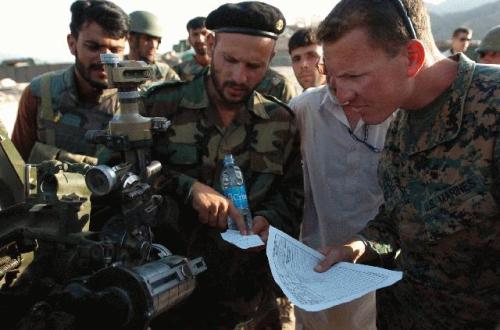
You probably wonder where I am going with this, back when I first drafted this year and a half ago I wondered too. But here is where I think I am going. We live in difficult of times at home and in Afghanistan.  It home we are mired in an economic crisis clouded by deep political division.  In Afghanistan we are engaged in a hard fight where units we are taking casualties and the mission is being debated.  Sometimes to those deployed and those who returned that their sacrifice is not fully appreciated by a nation absorbed with its own issues.  This of course is not universally true as there a people of all political viewpoints who care for the welfare and attempt to ensure that those who serve are not abandoned as those men who served in Vietnam.  I think that part of the feeling comes from the presentation of the war by the media which tends to focus only on the negative outcomes and not positive things that our soldiers accomplish. That can be discouraging to the men and women on the ground.  One of the most difficult things for me upon my return was to see the bitterness a division in the American people and political establishments and becoming quite depressed about it.   I stopped watching the perpetual news cycle and listening to talk radio.  The hatred, ignorance and crassness of it all was disheartening and I refuse to take any part in something that is so hate filled, power driven and unredemptive.

traiining team with afghan armyUSMC Training Team With Afghan Troops

For the French the events and sacrifices of their soldiers during Easter 1954 was page five news in a nation that was more focused on the coming summer. This is very similar to our circumstances today because it often seems that own people are more concerned about economic considerations and the latest in entertainment news than what is going on in Iraq or Afghanistan. The French soldiers in Indo-china were professionals and volunteers, much like our own troops today. Their institutional culture and experience of war was not truly appreciated by their own people.  Nor was it fully appreciated by their government which sent them into a war against an opponent that would sacrifice anything and take as many years as needed to secure their aim.  At the same time their own countrymen were unwilling to make the sacrifices needed to win and in fact had already given up their cause as lost. The sacrifice of French soldiers would be lost on their own people and their experience ignored by the United States when we sent major combat formations to Vietnam in the 1960s. In a way the French professional soldiers of that era have as well as British colonial troops before them have more in common with our force than the citizen soldier heroes of the “Greatest Generation.” Most of the “Greatest Generation” was citizen soldiers who did their service in an epic war and then went home to build a better country as civilians. We are now a professional military fighting unpopular wars and that makes our service just a bit different than those who went before us.  I related to the French troops who fought in Indochina and Algeria as well as our own Vietnam Vets than I do to others.  These is a kinship among us that goes beyond nationality, politics or age.

This is the world in which military chaplains’ minister.  It is a world of volunteers who serve with the highest ideals, men and women who enlist knowing that they will be deployed and quite likely end up in a combat zone. We go where we are sent, even when it is unpopular. It is here that we make our mark; it is here that we serve our Soldiers, Sailors, Marines and Airmen. Our duty is to bring God’s grace, mercy and reconciliation to men and women, and their families who may not see it anywhere else. It is a ministry of reconciliation by the means of incarnation. Many times those outside the military do not understand this. It is a different world full of contradictions and ambiguity.  Such situations even impact the families of those who serve.

When my dad was serving in Vietnam in 1972 I had a Sunday school teacher tell me that he was a “Baby Killer.” It was a Catholic Priest and Navy Chaplain who showed me and my family the love of God when others didn’t. As the country builds to the 2010 mid-term Congressional elections I anticipate that people from all parts of the political spectrum will offer criticism or support to our troops or the war in order to bolster their election chances which do not always coincide with what is in the best interest of the troops or the mission. Chaplains cannot be concerned about the politics nor even the policy as our duty is to be there as Priests, Ministers, Rabbis and Imams for those that we serve. We cannot afford to allow ourselves to be discouraged in caring for our men and women and their families because of all the strife in the body politic.  In addition we must continue on because most churches and other religious communities, even those supportive of our troops really don’t understand the nature of our service or the culture that we represent. We live in a culture where the military professional is in a distinct minority group upholding values of honor, courage, sacrifice and duty which may be foreign or archaic to many Americans, or for those countries with troops and chaplains in Afghanistan or Iraq. We are called to that ministry in victory and if it happens someday, defeat. In such circumstances we must always remain faithful to God as well as to those that we serve.

For those interested in the French campaign in Indo-China it has much to teach us. Good books on the subject include The Last Valley by Martin Windrow, Hell in a Very Small Place by Bernard Fall; The Battle of Dienbeinphu by Jules Roy; and The Battle of Dien Bien Phu- The Battle America Forgot by Howard Simpson. For a history of the whole campaign, read Street Without Joy by Bernard Fall. I always find Fall’s work poignant, he served as a member of the French Resistance in the Second World War and soldier later and then became a journalist covering the Nurnberg Trials and both the French and American wars in Vietnam and was killed by what was then known as a “booby-trap” while covering a platoon of U.S. Marines.

There is a picture that has become quite meaningful to me called the Madonna of Stalingrad. It was drawn by a German chaplain-physician named Kurt Reuber at Stalingrad at Christmas 1942 during that siege. He drew it for the wounded in his field aid station, for most of whom it would be their last Christmas. The priest would die in Soviet captivity and the picture was given to one of the last officers to be evacuated from the doomed garrison. It was drawn on the back of a Soviet map and now hangs in the Kaiser Wilhelm Memorial Church in Berlin where it is displayed with the Cross of Nails from Coventry Cathedral as a symbol of reconciliation. I have had it with me since before I went to Iraq. The words around it say: “Christmas in the Cauldron 1942, Fortress Stalingrad, Light, Life, Love.” I am always touched by it, and it is symbolic of God’s care even in the midst of the worst of war’s suffering and tragedy.

Madonna of StalingradMadonna of Stalingrad

So as you can see I have done a lot of reflecting over the past year and a half. It has been a spiritual journey, an intellectual and academic journey and a personal journey of slowly healing and recovery.  I have gone through some changes in the process which have not been easy, but certainly have deepened my faith even as I struggled and made me much more appreciative of life, love and peace.

I write in order to wrestle with what I have mentioned here, and I try to write something every night. I can full agree with Father Henri Nouwen in his book Beyond the Mirror as to the purpose that writing serves me in my journey.

“These many interruptions calling me ‘beyond’ compelled me to write. First of all, simply because writing seemed to be the only way for me not to lose heart to in the frightening and often devastating interruptions and to hold onto my innermost self while moving from known to unknown places. Writing helped me to remain somewhat focused amid the turmoil and discern the small guiding voice of God’s Spirit in the midst of the cacophony of distracting voices.  But there is a second motivation. Somehow I believed that writing was the one way tom let something of lasting value emerge from the pains and fears of my little, quickly passing life.  Each time life required me to take a new step into unknown spiritual territory, I felt a deep, inner urge to tell my story to others- perhaps as a need for companionship but maybe, too, out of an awareness that my deepest vocation is to be a witness of the glimpses of God I have been allowed to catch.”

pub2Slowly Getting Better

I am healing though it has been at times painful, but faith is returning and I can say that though it has not been easy it has been worth it.  I do hope that what little I do in my work and in my writing will be of help to those who struggle and those who recognize their own need for reconciliation, healing who need to hope again no matter who they are and what their circumstance.

Peace,

Padre Steve+

2 Comments

Filed under Loose thoughts and musings

My Life and Baseball: How Padre Steve Makes Some Sense of the World

harbor park opening dayThe Church of Baseball, Harbor Park Parish

“This is my most special place in all the world, Ray. Once a place touches you like this, the wind never blows so cold again. You feel for it, like it was your child.” Dr. Archibald “Moonlight” Graham in Field of Dreams

“I love baseball. You know it doesn’t have to mean anything, it’s just beautiful to watch.” Woody Allen in Selig (1983)

I went to Harbor Park last week just to talk with staff and sit in the concourse.  Tomorrow after work, though the weather is not predicted to be very good I plan on doing the same. There is something about baseball people and my seats down in section 102, row B, seat 2 and 3 that help me even when there is not game going on.  I walked around the diamond, the weather was gorgeous and it was so peaceful, even as the head groundskeeper aerated the field in preparation for the winter.  I feel close to God when I am around a ballpark, even without the game being played there is something almost mystical about it.  To me there is nowhere more peaceful than a ballpark.  Tonight as I sit watching game one of the National League Championship Series between the Dodgers and the Phillies my mind goes back to how much baseball has been part of my life, and how in a very real way that God speaks to me through this special game.

grainger stadiumGranger Stadium Kinston NC

“Baseball, it is said, is only a game. True. And the Grand Canyon is only a hole in Arizona. Not all holes, or games, are created equal.” George Will

Baseball is part of my life and I think this goes back to my childhood when my dad introduced me to it in our back yard in Oak Harbor Washington.  Even before I played an organized game dad played catch with me, showed me how to grip a ball and told me about the great ballplayers.  He made me learn the fundamentals of the game and weather we were attending a game in person, watching one on television or playing catch, pepper or practicing infield or pitching dad was all about the game.  Of course he was the same way with football, hockey and basketball, but the sport that he seemed most passionate about was baseball.  As a kid he was a Cincinnati Reds fan.  His mother, my grandmother who hailed from the hollers of Putnam County West Virginia was a diehard Dodgers fan, though I am sure that God forgives her for that.  She was an independent woman of conviction and determination that has to in some way influenced her love for the game, even as a little boy if there was a game on television she would have it on.  I still wonder about to this day how she became a Dodger’s fan but it probably had something to do with her independent streak.  Granny as she chose to be called was a woman who as a widow in the late 1930s went to work, raised her two boys and bought her own house.  Unlike most of the people in West Virginia she was also a Republican, a rare breed especially in that era. As independent in her choice of baseball teams as she was in her politics Granny was a Dodgers fan in a land of Reds, Indians and Pirates fans, so even with Granny we were immersed in baseball.

Me and Lefty PhillipsCalifornia Angels Manager Lefty Phillips and Young Padre Steve 1970

Dad always made sure that we got to see baseball wherever we lived. In 1967 he took us to see the Seattle Pilots which the next year went to Milwaukee and became the Brewers. The pilots were an expansion team in a town with a long history of minor league ball. They played at an old park named Sick Stadium, which if you ask me is a really bad marketing plan.  The game that we went to was the “Bat Day” giveaway.  Then they game regulation size Louisville Slugger bats.  Mine had the name of the Pilots First Baseman Mike Hegan on the barrel.  That was my first trip to a Major League stadium and I still can remember it as if it was yesterday.  Somewhere in my junk I have a button with the Pilots logo on it.  I’ll have to find it again sometime.  The next year I played my first organized baseball with the Oak Harbor Little League “Cheyenne’s.” My coach was a kind of gruff old guy who stuck me out in right field.  I don’t know why but our team uniforms did not match, half of us had white and the other half gray.   Unfortunately due to military moves I didn’t get to play organized ball again until 1972.

jim_spencer_autographMY Favorite Angel Jim Spencer as a Yankee

In the elementary schools of those days our teachers who put the playoff and World’s Series games as many were played during daylight hours.  I remember watching Bob Gibson pitch when the Cardinals played against the Red Sox in the 1967 series.  It was awesome to see that man pitch.   I remember the Amazin’ Mets upsetting the Orioles in 1969 and seeing the Orioles take down the Reds in 1970.  I never will forget the 1970 All Star Game where Pete Rose ran over Ray Fosse at home plate for the winning run.  I watched in awe as the great dynasty teams of the 1970s, the Reds and the Athletics who dominated much of that decade and the resurgence of the Yankees in the summer that the Bronx burned.  Back then every Saturday there was the NBC Game of the Week hosted by Curt Gowdy, Tony Kubek and Joe Garragiola.

halicki no hitterEd Halicki No Hitter

When we were stationed in Long Beach California from 1970-1971 my dad had us at Anaheim stadium all the time.  I imagine that we attended at least 30 games there and a couple at Dodger stadium that first year and a good number more before we moved to Stockton California in the middle of the 1971 season.  That was disappointing, it took forever to get adjusted to Stockton and I think that part of it was not seeing the Angels every week at the Big “A.” At those games I met a lot of the players and coaches and even some opposing players.  The Von’s grocery store chain and the Angels radio network had a “My Favorite Angel” contest.  My entry about Angels First Baseman Jim Spencer was a runner up, netting me two seats behind the plate and having Dick Enberg announce my name on the radio.  Spencer was a Gold Glove First Baseman who later played for the Yankees on their 1978 World Series team.  My first hat from a Major League team was the old blue hat with a red bill, the letters CA on the front and a halo stitched on top. I still have a hat from the 1971 team with the lower case “a” with a halo hanging off of it.  It has numerous autographs on the inside of the bill including Sandy Alomar, Jim Spencer, and Jim Fregosi, Chico Ruiz and Billy Cowan and sits in a display case on my kitchen wall.

Me and last last picMy Dad and Me May 2009

While we didn’t live as close to a major league team baseball did not go away, though we were not at the ballpark as much it got more interesting as I got to see playoff games and a no-hitter.  We saw the A’s dynasty teams including games one and two of the 1972 American League Championship Series between the A’s and the Tigers.  Across the Bay a few years later I got to see Ed Halicki of the Giants no-hit the Mets a Candlestick on August 24th 1975.  In those days I got to see some of the greats of the era play, Catfish Hunter, Reggie Jackson, Willie Mays, Willie McCovey, Steve Garvey, Vida Blue, Harmon Killebrew, Rollie Fingers, and so many others at the Oakland-Alameda County Coliseum and Candlestick Park.

While in Stockton I became acquainted with Minor League Baseball through the Stockton Ports, who then were the Class “A” California League farm team for the Orioles.  I remember a few years back talking to Paul Blair the Orioles great Paul Blair who played for the Ports in the early 1960s about Billy Hebert Field and how the sun would go down in the outfield blinding hitters and spectators in its glare.  I would ride my bike over in the evening to try to get foul balls that came over the grand stand when I didn’t have the money to get a ticket.

1972 Oak Park AL RamsMy Championship Season

When I was a kid I had a large baseball card collection which I kept in a square cardboard box.  I must have had hundreds of cards including cards that if I had them now would be worth a small fortune, unfortunately when I went away to college I left them in the garage and during a purge of junk they were tossed out.  This year I started collecting cards again, mostly signed cards that I obtained at the Church of Baseball at Harbor Park.  In a sense they kind of serve a purpose like Holy Cards due in the Catholic Church for me.  They are a touch point with the game and the players who signed them.

As I have grown older my appreciation for the game, despite strikes and steroids still grows.  I am in awe of the diamond.  I have played catch on the field of dreams, seen a game in the Yankee Stadium Right Field bleachers seen games in other venues and thrown out the first pitch in a couple of minor league games.  I am enchanted with the game. The foul lines theoretical go on to infinity, only broken by the placement of the outfield wall.  Likewise unlike all other sports there is no time limit, meaning that baseball can be an eschatological game going on into eternity. The Hall of Fame is like the Calendar of Saints in the Catholic, Orthodox and Anglican Churches.  There are rituals, the exchange of batting orders and explanation of the ground rules, the ceremonial first pitch, players not stepping on the foul line when entering and leaving the field of play, no talking about it when a pitcher is throwing a no-hitter and the home run trot. The care of a field by an expert ground crew is a thing to behold, especially when they still use the wooden box frames to lay down the chalk on the baselines and the batter’s box.

We have travelled to many minor league parks often in tiny out of the way locations and even to the Field of Dreams in Dyersville Iowa where once again Judy indulged me and let me play catch. Likewise my long suffering wife has allowed our kitchen and much of my dining room are as close to a baseball shrine as Judy will let me make them; thankfully she is most tolerant and indulges this passion of mine.

042Elliott the Usher

Since I returned from Iraq the baseball diamond is one of my few places of solace.  For the first time I bought a season ticket to my local minor league team the Norfolk Tides.  Section 102, row B seat 2 and 3 and was able to watch the game from the same place game after game.  It became a place of refuge during some of my bad PTSD times, and I got to know and love the people around me; Elliot the Usher, Chip the Usher, Ray and Bill the Vietnam Veteran Beer guys behind home plate, Kenny “Crabmeat” the Pretzel Guy and Barry the Scorekeeper.

122Moon Over Harbor Park

My dad is slowly dying of Alzheimer’s Disease and a shell of his former self but the last time I visited him we had a few minutes where he was with it we talked baseball and I gave him a new Giants t-shirt and hat.  I plan on going back next month sometime to spend some time with him.  Maybe we’ll get a few minutes of lucidity and a bit of time together again, I wish he was able to get up and play catch, but that will have to wait for eternity on the lushest baseball field imaginable.

The season there is over, but God is not done speaking to me through baseball as I close my eyes and recollect the words of Terrance Mann (James Earl Jones) in Field of Dreams: “The one constant through all the years has been baseball. America has rolled by like an army of steamrollers. It’s been erased like a blackboard, rebuilt, and erased again. But baseball has marked the time. This field, this game, is a part of our past. It reminds us of all that once was good, and what could be again.”

044Jeff Fiorentino hits a 3 run shot at Harbor Park

In a sense this says it all to me in an age of war, economic crisis and bitter partisan political division.  In a sense it is a prayer, a prayer for a return to something that can be good again.

Peace and blessings,

Padre Steve+

Leave a comment

Filed under Baseball, philosophy, Religion

Padre Steve’s MLB Championship Series Picks

Well sports fans I’m back on some predictions.  The fact that I am neither the Prophet nor the Son of the Prophet makes no difference here, and since my picks with the exception of the Evil Dodgers sweep of the Cardinals were pretty accurate here it goes again.  Now obviously since I am merely Padre Steve and not the Pope nothing I say is infallible my picks can be wrong and I hate that.  Thankfully since I am not claiming to speak from the Most High a wrong pick will not leave me crushed to death with heavy stones by the faithful.  At the same time I get a certain satisfaction about being right like the time I was waiting in the ER with Judy as they tried to diagnose her throat swelling.  I “Googled” the symptoms and got it right, before they did, it was Epiglottis, something extremely rare in adults which they were neither looking for nor expecting.  I thought that was pretty cool as did my ICU attending physicians.

So how do I get my picks?  First I try to put emotion aside and look at trends, stats and intangibles.  It does not matter if I like the team or not when it comes to picking such things.  What I want is to be dispassionate in my analysis because I love the game.

So a quick review of the Divisional Series:

I picked the Cardinals in 4 over the Dodgers.  Dodgers swept the Cards 3-0.  The tow things that I believed that would bring about a Cardinals win did not happen.  First the starting pitching did not get it done.  Second the Cardinals hitting died like 1981 Chevette, trust me I know as we had one.  It was not pretty and then if you throw in the improbable muff a ball that Matt Halliday made in Left Field with two outs in the bottom of the 9th in game two with the Cardinals ahead…..  Ouch!

I picked the Phillies in 5 figuring that the Rockies would win at home.  Instead they split in Philly and the Phillies swept the Rockies in Denver despite cold weather and what should have been home field advantage.  The Phillies choice of Cliff Lee to pitch game one paid off in spades and the Phillies hitters did not disappoint.  Rockies fans must have had their hearts ripped out when they scored three in the bottom of the 8th to take a 4-2 lead in game four only to have closer Huston Street blow the save for the second night in a row.

Moving to the American League I picked the Angels in 5 over the Red Sox.  I figured that the Angels were a better team than the last few times they played the Sox and that the Red Sox had lost their edge.  I thought that the “X” factor of Nick Adenhart would work in the Angels favor and I expected a close series with the Angels winning it.  Instead the Angels dominated the Bosox and swept them with an improbable rally with 2 outs in the bottom of the 9th when they were down to their last pitch.

Finally there was the series between the Yankees and the Twins.  The Twins had a remarkable September and captured the AL Central crown in a one game playoff against the Tigers.  I picket the Yankees in 4 allowing for a game three Twins win at the Hubert H Humphrey Metrosexual Dome, also known as visiting team Hell.  The Yankees swept the Twins but game two and three were close and the Yankees came from behind in both to win.

So here they are:  First the National League and the Phillies against the Dodgers.  Pitching is a wash as the Phillies have the better starters with Lee and Clay Hammels but have a suspect bullpen. Closer Brad Lidge seems to have gotten his stuff back after a miserable season.  The Dodgers have a patchwork rotation of decent but not outstanding pitchers but have an amazing bullpen.  In the hitting department both teams have great offensive potential but I give the edge to Ryan Howard’s wrecking crew.  In the regular season the Dodgers took the series between the two teams 4-3.  This will be close and the Dodgers are capable of winning in unusual ways as evidenced by game two of the NLDS.  I think this goes 7 with the teams splitting in LA, Philly taking 2 at home and splitting the final pair with the Phillies taking the down the Dodgers for the second year in a row.  While I am picking the Phillies this series could go the other way.  I never will forget the 1981 Dodgers who played had a miraculous series of playoff wins which culminated against the Yankees.  They lost the first two games and won the next four closing the series at Yankee Stadium.  So I believe that anything is possible, but I’m still picking the Phillies and watch the game in my San Francisco Giants gear.  I guess I do have some emotions invested in this series after all.

Now I’ll move over to the American League and talk about the Yankees and the Angels.  This should be a great series.  The Halo’s won 4 of 6 in the regular season and outscored them by a pretty large margin in Anaheim.  Now both teams have a lot of firepower as well as pretty solid pitching.  The Yankees are coming off the best season the have had in a number of years and their 103 wins were the most in baseball.  The Angels have had a very good season as well.  At this point it is hard to pick a winner.  I think that the Yankees have the edge in personnel and are the hungriest for the pennant that I have seen them in years.  The Angels too are hungry and have something of an “X” factor in the incredible bonding and team spirit brought about by the loss of rookie pitcher Nick Adenhart.  The series will start in New York where the weather forecast is crappy for the weekend, especially Friday where there is an 80% chance of rain and temperatures in the low 40s.  The temps will remain about the same the entire weekend and the precipitation is forecast at 40% for the weekend.   These are not baseball conditions and could be a factor in who wins and loses the games in New York.  With the weather as much as a factor as it could be I think that negates some of the Yankees home field advantage.  I think that the teams split in New York and go to Anaheim at 1-1.  When the teams get to Anaheim next week the weather should be perfect Southern California fall weather clear and temperatures in the 70s at game time.  They Angels dominated the Yankees at home and I think that they will take at least two of the three in Anaheim and go back to New York up 3-2.  The Yankees are a great clutch team and this year and have been awesome in the come from behind situations.  The series could go either way at this point but I think that the Angels can steal this from the Yankees and put them away in game six, just as they came from behind to defeat the Red Sox in game three of their series.  My pick is the Angels in six.

So my picks are the Angels and Phillies to get to the World Series.  Of course I could be wrong as these are all great teams and each has something to prove. The Phillies want to repeat, the Yankees want to make up for years of disappointment of being so close but so far away, the Dodgers are trying to reclaim a winning heritage and gain the respect that they deserve and the Angels, they are playing for something so totally intangible that it is hard to put a value on, they are playing for the love and memory of a team-mate and have an almost magical and mystical feel to their season.  There are individual players trying to recapture past triumphs and others still trying to escape the demons and come out from under the cloud of not having won it all. I expect some great baseball no matter who advances to the Series.  The way I see it even if I am wrong on my picks this should be some great baseball.

Peace,

Padre Steve+

Leave a comment

Filed under Baseball

For the Love of the Game and the Love of Life; Finding Meaning Life and Love in the Perfect Game

for_love_of_the_gameKevin Costner as Billy Chapel

One of my favorite movies is the baseball story For the Love of the Game which starred Kevin Costner.  This is the film rendition of Michael Shaara’s Pulitzer Prize winning novel The Perfect Game. Both the book and the movie tell the story of “Billy Chapel” a pitcher who played 19 seasons with the same team, in the movie the Detroit Tigers.  The story focuses on the last game of the season in which Chapel is to start.  The game for his team is meaningless; they will not be going to the playoffs as they are a bad team.  Compounding the team’s situation is the uncertainty of the team’s future as the long time owner who signed Chapel out of high school is about to sell the team.  The new ownership group wants to make changes, among the changes a trade involving Billy Chapel to the Giants. The trade would force him to play the next season in another uniform and another city when he wants to finish his career in the same city where it started.  Before the game the owner comes to Chapel to talk about possibilities and then begins to criticize the game, saying that it stinks.  Chapel responds: “The game doesn’t stink, Mr. Wheeler. It’s a great game.”

The book and the movie present a tapestry of the Billy Chapel’s life in between pitches.  Unlike most baseball films this focus’s not on a season, but a game, a single game.  Woven in this rich tapestry of this game are the lives of several people besides the lead character played by Kevin Costner.  The manager of the team has a wife with cancer.  His love, Jane Aubrey played by Kelly Preston is leaving him, going to London for a new job and stands him up the previous night.  She tells him “You’re perfect. You, and the ball, and the diamond, you’re this perfectly beautiful thing. You can win or lose the game, all by yourself. You don’t need me.” It is the classic cry of a woman whose true love is absolutely passionate about what he does well.

costner and preston for the love of the gameBilly Chapel (Costner) and Jane Aubrey (Kelly Preston)

A friend and former team mate now plays for the Yankees who Chapel’s Tigers will play in the last game of the season. Billy’s catcher Gus is not much of a hitter and the manager wants to play a better hitting catcher but Chapel will have nothing of it as Gus is “his catcher.”  As the game goes on Chapel’s arm begins to hurt from an old off season injury, he’s tired and feeling the pressure. Throughout the game Gus helps Billy keep it together and as they go out for the last inning he goes out to the mound and says to Billy: “The boys are all here for ya, we’ll back you up, we’ll be there, cause, Billy, we don’t stink right now. We’re the best team in baseball, right now, right this minute, because of you. You’re the reason. We’re not gonna screw that up, we’re gonna be awesome for you right now. Just throw.” It’s the kind of word that anyone can need when they are exhausted but about to accomplish something great, the team is there for them.

for the love of the gameThe Wind Up

Billy chapel is old.  He has had a mediocre season for anyone else but for him a bad season.  His all star days are past.  His dad who taught him the game and witnessed his greatest moments is dead as is his mother.  He is, with the exception of Gus alone.  It is a story that could end like so many stories in sadness or despair.  Instead it is the story of triumph.  It is the story of how in spite of a whirl of emotions and a lot of pain from past injuries he triumphs.  He does so against an opponent that is going to the playoffs, the always dangerous Yankees in the venerable Yankee Stadium.  Chapel pitches a perfect game against the odds.  Supporting players who had failed during the season make stellar plays.  The team which had nothing to look forward to celebrates one of the rarest of human events, a Major League perfect game. Not just a “no-hitter” which I have been specially graced by the Deity Herself to see in person, but a perfect game of which only 18 have been thrown.  Perfect games are unforgettable and this story gets it right.  The game itself is a story of redemption, in life, love and the pursuit of excellence.  During the game the grandson of the owner is sent to get Chapel’s answer about taking the trade.  Chapel writes his response on a baseball: Tell them I’m through, “for love of the game”, Billy Chapel. Chapel the game is more than a paycheck, it is about life and relationships.

After the post game celebration he pours Gus out in his room and He then goes to find Jane, who due to a flight delay is stuck waiting at JFK in a bar watching the game.  She realizes what she is walking out on.  When Chapel finds out about her leaving the next morning he goes to the airport.  He says something that I think really sticks out to guys who have invested much in their careers but left love behind or had it go stale:

“I used to believe, I still do, that if you give something your all it doesn’t matter if you win or lose, as long as you’ve risked everything put everything out there. And I’ve done that. I did it my entire life. I did it with the game. But I never did it with you, I never gave you that. And I’m sorry. I know I’m on really thin ice but, when you said I didn’t need you… well last night should’ve been the biggest night of my life, and it wasn’t. It wasn’t because you weren’t there. So I just wanted to tell you, not to change your mind or keep you from going, but just so you know, that I know, that I do need you.”

Dundas at HitPadre Steve Doing What He Loves

The story of Billy Chapel is one of finishing well.  So many people start their lives full of promise and somewhere along the way give up. They exist, go through the motions and stop believing in themselves and those who love them.  For whatever reason some people, maybe a lot of people stop living long before they die. The wake up, go through the motions and stop striving for excellence and forget about love, life and friendship. They forget what loyalty means and take for granted the love of people who care about them.  They have lost their love and passion and simply go through the motions of existence.  It happens in all phases of life. In the military we have a slang term called the “ROAD program.”  It means “Retired On Active Duty.  These are the guys who have stopped trying; they know that short of committing a criminal act that they can retire.  They go through the motions.  There are these kinds of folks everywhere, not just the military and unfortunately a decent number in minstry.  Somewhere, somehow they have given up. I don’t want to do that.  I want my last game to be my best.

Billy Chapel is the epitome of a man who gives his all in what he knows will be his final game, a game that for everyone else but him is meaningless.  However in the microcosm of that game everyone finds meaning.  As he pitches and the tension builds, those who had just been along for the ride get caught up in the magic.  His manager, his journeyman catcher “Gus,” his team mates, and even the opposing players and the hostile Yankee fans discover what it is to live again.  People who had given up find inspiration and hope. Billy Chapel creates magic on the mound which in that moment of time makes life right.  Sure it is just a novel, it is just a film, but it is life just as baseball is life, a game played like most of us live, some great performances, slumps, winning and losing streaks, errors, bad calls, trades, being fired and even rain or on rare occasion Colorado fans, snow delays.  In baseball great players are still not perfect the majority of the time, baseball unlike any other sport is humanity at its best and worst.

Judy and Steve[1]_edited-1Me with My Love

I find the story of Billy Chapel in The Perfect Game to be compelling.  I love baseball and for me the story of someone at the tail end of their career achieving the next to impossible is inspiring.  I find inspiration in other old ball players who keep doing well. It is the old guys of baseball who inspire me now, guys like Jamie Moyer of the Phillies and Mike Mussina who retired from the Yankees last year at the top of his game. I could well be finishing my career in the next few years.  I want my time in the Navy to matter in my last few years. If I get promoted and remain a few more, that is okay, but even then I want to finish well.  When I’m done with that I hope that the Deity Herself will give me the grace to continue to strive for excellence in serving people as a priest.  I never want to be on the ROAD program even if I live to be 90. I want my last years, be they a military career, or the rest of my life and ministry to be my best and that means my life.

Peace, Padre Steve+

5 Comments

Filed under Baseball, Loose thoughts and musings, marriage and relationships