Monthly Archives: December 2009

More Lies and Distortions from WorldNet Daily’s Bob Unruh

Note: It has been a good number of months since I have addressed the Lies of WorldNet Daily and it’s leadership Joe Farah and his designated hit man Bob Unruh. I stumbled across an article yesterday evening when my curser hit the Worldnet Daily link on my “favorites.” I seldom go there unless I think that they might be getting crazy, but this was accidental, or if I was a Calvinist possibly God’s will. Unfortunately late last night I saw an attack on a fellow officer by this influential “Conservative Christian” website.  The attack was gratuitous and directed at an officer currently serving in Afghanistan Major Brian Stuckert who as part of a military education course published a monograph which is in the public domain entitled “Strategic Implications of American Millennialism.” As I mentioned the last time that I wrote against something that Unruh and WND published that I would limit myself to military issues as I do in this article.  I try to ignore the folks at WND but feel in this case that that are again in the process of attempting to stir up opinion against an officer who has done nothing wrong but to disagree with their political-religious ideology. While the folks at WND and those like them have every right to their opinions an beliefs, which are defended by those of us in uniform, they are way out of line in this article and owe Major Stuckert an apology. Unfortunately the WND leadership doesn’t do this as is evidenced in their past treatment of the Commanding Officers of Gordon Klingenschmitt. These men have no honor and stoop to the basest means to attack those that disagree with their narrow point of view. Some will not like what I write. That is fair, I do not claim to be infallible not do I practice censoring those that disagree with me. But I will not let a fellow officer who is serving in a combat zone be the subject of an egregious attack by the folks at WND. If it were an attack by a “liberal” website I would feel the same way. The fact that it is a “conservative” website which claims to “support the troops” that attacks Major Stuckert and other military officers who disagree with their point of view only makes me angry.  Now to my response:

Just when you think it is safe to go in the water and just enjoy the Christmas season Joe Farah and the good folks at Worldnet Daily come out with another whopper to attempt to whip people up against those in the military with differing opinions than that of their own.  Written by noted propagandist Bob Unruh who helped spin the lies of former Navy Chaplain, defrocked Evangelical Episcopal Priest Gordon Klingenschmitt into a frenzy that had many Christians believe that the Navy was attempting to muzzle Klingenschmitt’s religious rights, the article takes aim at an monograph written by Army Major Brian Stuckert ( the link to Stuckert’s monograph is here: http://www.wnd.com/files/Millennial.pdf ) for the Advanced Military Studies program. Officers who attend courses such as this are often required to produce a research paper on a subject that deals with political, military and foreign policy topics to include how social, ideological or religious can impact military operations at the strategic and operational levels including effects on foreign policy and diplomacy.  The Worldnet Daily article is linked here:   http://www.wnd.com/index.php?fa=PAGE.view&pageId=119315

Unruh in his usual manner has manipulated the facts to make it appear that Stuckert and the Army is attempting to silence what Unruh calls “Evangelical beliefs.”  In fact the title of the article U.S. Army Major: Lose evangelical Christian beliefs” is a straw man intentional thrown out by Unruh to chum the waters so to speak.  Unruh takes a research paper which he does not agree with and demonizes the writer.  These papers are akin to any research paper done for a graduate level academic program. They reflect the opinion of the author and not the institution.  Like all papers of this type they have to be evidenced based, in other words the author has to have data to show that his hypothesis and conclusions actually are not simply whims but have impact in the world in which the writer serves and for the topic that he or she addresses.  One does not have to agree with them and in fact in the future other officers might actually write articles to refute what Stuckert says.  This is an academic program and as such differing points of view are sought.

Instead of just leaving this be both Unruh and undoubtedly Joe Farah is using this article to again whip up the faithful against any idea that might contradict their political-religious views.  Stuckert has criticized the foundational philosophy of the Worldnet Daily leadership that of Pre-millennial Dispensationalist theology which does have very real foreign policy implications for the United States.   As such Stuckert’s article is important because it draws attention to how Pre-Millennial Dispensationalist effects how many Americans view the world and international relations to include how such beliefs can influence policy making.  Stuckert’s premise is found in his abstract:

“Since the beginning of the Republic, various forms of millennial religious doctrines, of which dispensational pre-millennialism is the most recent, have shaped U.S. national security strategy. As the dominant form of millennialism in the U.S. evolves, it drives changes in U.S. security policy and subsequent commitment of the instruments of national power. Millennial ideas contribute to a common American understanding of international relations that guide our thinking irrespective of individual religious or political affiliation. Millennialism has great explanatory value, significant policy implications, and creates potential vulnerabilities that adversaries may exploit.”

This is a fair characterization of the effect of pre-millennial dispensational theology on American national thought.  Thus it is fair to examine its effect on current policy both foreign and domestic.

Instead of taking Stuckert’s observations and critiques for what they are Unruh and his co-conspirators turn this into a conspiracy of people in the Army and government against true Christians. In the usual manner Unruh quotes someone that he agrees with on the article: Unruh quotes John McTernan a writer on Biblical Prophecy who says that Stuckert’s article is “the most dangerous document to believers that I have ever read in my entire life” and “After reading this document, it is easy to see the next step would be to eliminate our Constitutional rights and herd us into concentration camps.”

I am sorry, this is beyond reason: “eliminate our Constitutional rights and herd us into concentration camps?  That is nothing more than propaganda. In fact it is delusional paranoia designed implicitly to scare people and move them further into WorldNet Daily’s orbit turning good people against honest and decent military officers.  Unruh did this with Klingenschmitt in grand fashion through character assassination of Captain Carr, Klingenschmitt’s Commanding Officer on USS Anzio and Captain Pyle, the Commanding Officer of Naval Station Norfolk.  This got so bad regarding Captain Pyle, a conservative evangelical Christian of the Assemblies of God denomination that he was ostracized by his own church and demonized by the Christians who were the closest to his theological views.  It was shameful; people still believe the lies about Klingenschmitt spewed by the WorldNet Daily crowd.  Now they attack an Army Major who is serving in combat in Afghanistan.  Such conduct is beyond crude and unseemly, it is dishonest, disingenuous and dishonorable.

Unruh, no stranger to such behavior ends his article with a totally unrelated reference to the terrorist who killed 13 and wounded many others at Fort Hood just a month ago.  Major Stuckert’s article was published in 2008 and has nothing to do with the actions of Major Hasan.  The implication is that Stuckert supports the traitorous terrorist Hasan. This is another disingenuous attempt to link someone who disagrees with them with terrorists or other extremists.  Such behavior by alleged “journalists” is simply dishonest and to use a term from American history is “Yellow Journalism.”

The conduct of WorldNet Daily and in particular Bob Unruh is shameful and shows none of the graces associated with true Christian faith. Lying and mischaracterizing what others say and demonizing them in apocalyptic terms is not Christian behavior. It is crass cynical propaganda and WorldNet Daily is one of the worst offenders around.  Unfortunately these people are vicious in their attacks.  The article talks of “losing evangelical beliefs” however many evangelicals either oppose or have out rightly condemned pre-Millennial Dispensationalist as heresy. Yet many pre-millennial dispensationalists, especially the type found at WorldNet Daily effectively write off all evangelicals who do not hold to one of their several Rapture theories: “All people who believe the Bible believe in a Rapture” Mark Hitchcock “What Jesus Says About Earth’s Final Days” (p. 96).  This is just one example of how this camp views other Christians. If you do not believe in the Rapture as they define it you do not believe the Bible. The deduction is that Christians believe the Bible, you disagree with the Rapture, and you don’t believe the Bible and are thus not a Christian.

Even Prominent Evangelicals such as A. W. Pink (1886-1952) have disagreed with the tenants of Dispensationalism:

“Dispensationalism is a device of the enemy, designed to rob the children of no small part of that bread which their heavenly Father has provided for their souls; a device wherein the wily serpent appears as an angel of light, feigning to “make the Bible a new book” by simplifying much in it which perplexes the spiritually unlearned. It is sad to see how widely successful the devil has been by means of this subtle innovation.”

Many conservative Christian churches and individuals do not hold this position; in fact to take the view of Unruh is to assume that Stuckert is attacking Evangelical Christianity.  Stuckert is not doing so, he is simply critiquing one of several competing Christian Eschatological theories and how its influence helps shape US foreign policy and the worldview of many Americans.  He asserts that such beliefs when not recognized by those that propagate them can leave the United States vulnerable to our enemies, nothing more, nothing less. In fact Stuckert is careful to differentiate the various factions in what is considered by some radical secularists to be a monolithic “Evangelical” movement.

“Millennialism, and especially dispensational pre-millennialism, derives in large part from extraordinary literalism of even the most figurative passages of the Bible. In America, literalism in biblical interpretation is most closely associated with fundamentalism. Theologically, it is best to begin a discussion of American millennialism with a brief review of fundamentalism as the term applies to the contemporary American religious tradition. Fundamentalism is a frequently misunderstood term in America. Although it has connections to each, fundamentalism is distinct from evangelicalism, the charismatic movement or conservative Christianity in general. Fundamentalism is also poorly understood when we attempt to define it as a personality style, a form of militancy, or a particular worldview.” (Stuckert pp. 6-7)

Stuckert is fair in this; to not admit that religious, ideological or philosophical views do not serve is “filters” as McTernan and Unruh seem loathe doing is simply wrong. To understand the prism of how religious, ideological and other beliefs can influence worldview and decision making is important. This is what Stuckert does as pre-millennial dispensationalism is one of the major shapers of American thought; not only for Fundamentalist Christians but anyone who follows the popular fictional writings of Tim LaHaye’s Left Behind series.

Stuckert continues his monograph by discussing the importance of how Christian Fundamentalists view the Bible and the influence of pre-millennial eschatology on American political thought and foreign policy.   Since the popularized version of this eschatology influences the way that many Americans view the world it is appropriate that the effects of it be analyzed by those who study foreign and domestic policy. In his summery and conclusions Stuckert makes an erudite observation that is lost on many people:

“Because religion in America directly impacts policy, military leaders and planners must learn to recognize the tenets and implications of American millennial thought. Millennialism has always been a feature of the American culture and has shaped not only the objectives of U.S. government policy, but also the way in which we interpret the words and actions of other actors on the international stage. Millennial ideas contribute to a common American understanding of international relations that guide our thinking regardless of individual religious or political affiliation. Millennialism has great explanatory value, significant policy implications, and creates potential vulnerabilities that adversaries may exploit. By gaining insight into and embracing intellectual honesty where our own prejudices and proclivities are concerned, we can greatly improve the quality and clarity of our decision-making.” (Stuckert pp. 58-59)

Unruh “cherry picks” what he wants from Stuckert’s monograph in order to paint Stuckert as some kind of anti-Christian officer.  The use of McTernan’s claims to buttress his article shows how biased that Unruh as since McTernan’s livelihood is based on writing books and speaking about Bible prophecy from a pre-millennial dispensational point of view.  He claims to be a “student of American history” but has no academic credentials save a BA from Virginia Commonwealth University in an unnamed field. He has no military experience, no education in military or political theory other than what he may have learned on his own “study” and is in no position to be a legitimate critic of Major Stuckert’s work.  McTernan claims that the “last third (of Stuckert’s work) is an interpretation of Bible belief on world events. “This report blames all the world evils on believers! World peace would break out if it were not for Bible believers in America.” In fact it says no such thing.  It is not a “report” as McTernan calls it, but simply the equivalent of a graduate level thesis. This is nothing but a hit piece on a fellow officer who disagrees with McTernan and the crowd at WorldNet Daily.  McTernan talks about an argument that he had with Colonel Stefan Banack of the School for Advanced Military Studies who McTernan attacks:

“The conversation was extremely heated between us, and he hid behind the freedom of speech to produce it. He refused to let me write an article to refute this attack on Bible believers. He refused to tell me what this study was used for and who within the military was sent copies. I believe that it represents an official military view of Bible believers as Col. Banack said there was no study or article refuting this one.”

The fact that these papers are in the public domain and on the center’s website makes no difference to McTernan. He attempts to paint this is a some kind of conspiracy against Evangelical Christians when in fact it is the equivalent of an academic thesis in a Masters Degree program.  The fact that he says that Colonel Banack “hid behind the freedom of speech to produce it” sends a chilling message. Freedom of speech for McTernan goes only for McTernan not for those who disagree with him. Likewise McTernan uses the refusal of Colonel Banack to allow him to “refute this attack on Bible believers” is a red-herring. The School’s academic publications are for students to publish not for people with no standing in the military to use the platform to propagate their beliefs.  Mr. McTernan to my knowledge is not a student at the Advanced Military Studies program and would not be using the forum for actual academic debate but to advance his own cause which he does on his own website without any restriction.

So once again WorldNet Daily drops a whopper on its readers and attacks the character beliefs and academic thought of a military officer. Their conduct in this is much more like the Taliban and the Iranian Ayatollah’s than anyone who claims to value the right to freedom of speech and religion as they do. Like the early Puritans who came to the New World for “religious freedom” the only religious freedom or freedom of speech that Unruh, Farah and other like them value is their own. Those who dissent from their narrow understanding of eschatology stand condemned as do those who ask legitimate questions about the policy implications of their belief system. If they were ever to be in a position to impose their beliefs in this country men like Major Stuckert and probably yours truly would be persecuted.

Although I am but a “pip-squeak” in comparison to the WorldNet Daily behemoth but I cannot let a fellow officer who is serving in harm’s way be the subject of a gratuitous attack by these people. May God keep Major Stuckert and those he serves with in harm’s way safe and may they accomplish the mission that they have been sent to do.  As far as WorldNet Daily goes…I hope that they continue to have the freedom to speak in the manner that they would deny to those who disagree with them, especially those who serve in the uniform of the United States of America in harm’s way.

Peace,

Padre Steve+
10 Comments

Filed under Foreign Policy, Lies of World Net Daily, Military, national security

Padre Steve’s Pre-Navy Navy Experiences

I officially entered the Navy in 1999 however I had spent a significant amount of my young life hanging around the Navy as a “Navy Brat” as well as a Navy Junior ROTC Cadet.

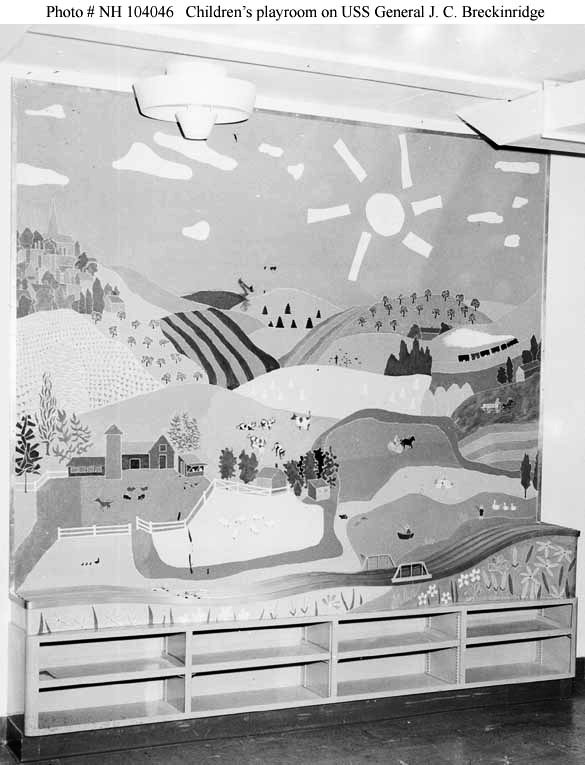
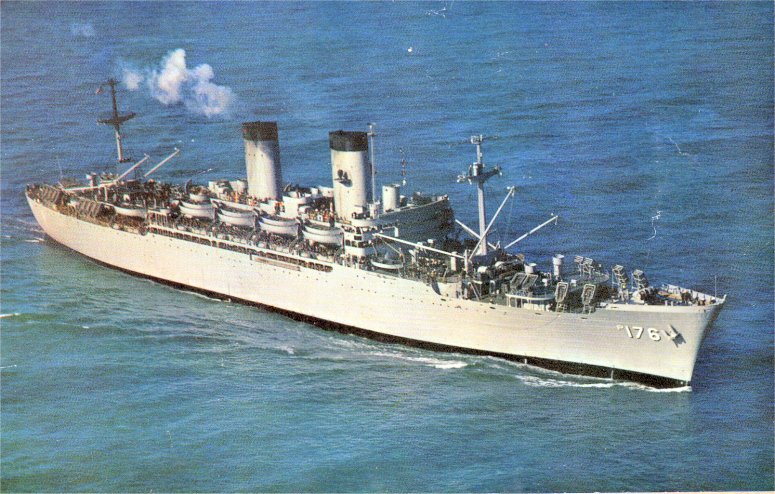
USS J. C. Breckenridge AP 176

My first “underway” was returning from the Philippines on the USS J. C. Breckenridge AP 176 in 1964.  The ship was a troopship and at the time was engaged in the transport of military personnel and their dependents from the Far East to San Fransisco.  In this capacity the ship made regular stops at Guam, Yokosuka, Okinawa, and Inchon, as well as Adak, Alaska, and Midway Island as she sailed between the Philippines, Japan and the west coast.  We rode her back following my father’s assignment at Cubi Point Naval Air Station.

Children’s Playroom on Breckenridge

The trip across the Pacific was something that I remember to this day.  A Marine stood guard outside of the family quarters in a starched “sateen” fatigue uniform.   I remember Marines going over the side of the ship into waiting landing craft at one stop, probably Inchon. I had a tee-shirt from the ship that I wore proudly until it was a tattered rag.

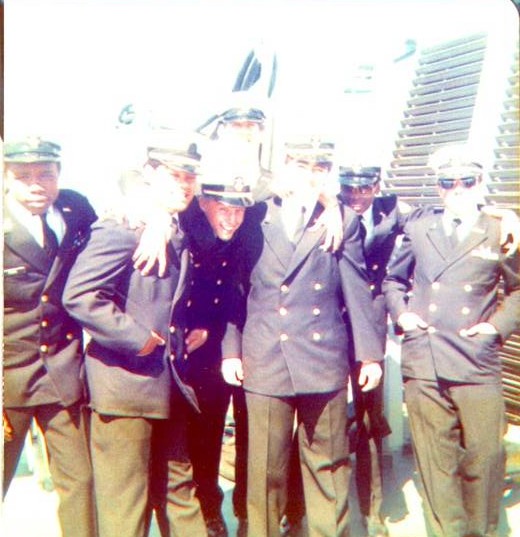
Edison High School NJROTC Cadets on USS Gray April 1978 L-R Alvin Friend, Mark DeGuzman, Jeff Vanover, Joe Mariani (top) Randy Richardson, Delwin Brown and Padre Steve

When I entered High School I joined the Navy Junior ROTC unit.  I was very fortunate because our instructors, LCDR Jim Breedlove and Senior Chief Petty Officer John Ness ensured that we had many opportunities to go underway on various ships.

USS Agerholm DD-826

The first of these was the USS Agerholm DD-826 a Gearing Class destroyer commissioned in 1946 which had received a  FRAM-1 modernization and fired the only live nuclear ASROC.  I embarked Agerholm in San Diego with 5 other cadets in October 1975.  During the trip we were able to observe gunnery exercises in the #2 5″ 38 gun mount and help man a towing hawser in exercises with the USS O’Callahan and USS Carpenter DD-825.  The trip was exhilarating as we rode heavy seas, and got to stand watches alongside real sailors.

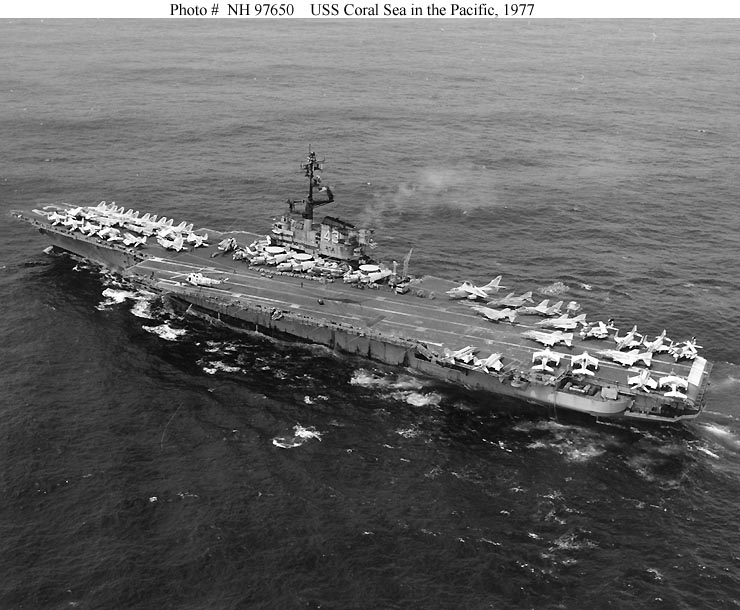
USS Coral Sea CVA-43

The second trip for me was on the USS Coral Sea in July 1976 where I spent 2 weeks working in the ship’s medical department. The trip about Coral Sea was interesting as we were able to observe flight operations and see how carrier operated.

USS Pyro AE-24

I then went on the USS Pyro in the fall of 1976 for a 5 day underway where I witnessed a burial at sea and met the chaplain who covered the service force.  On Pyro I was able to work with the Signalmen.

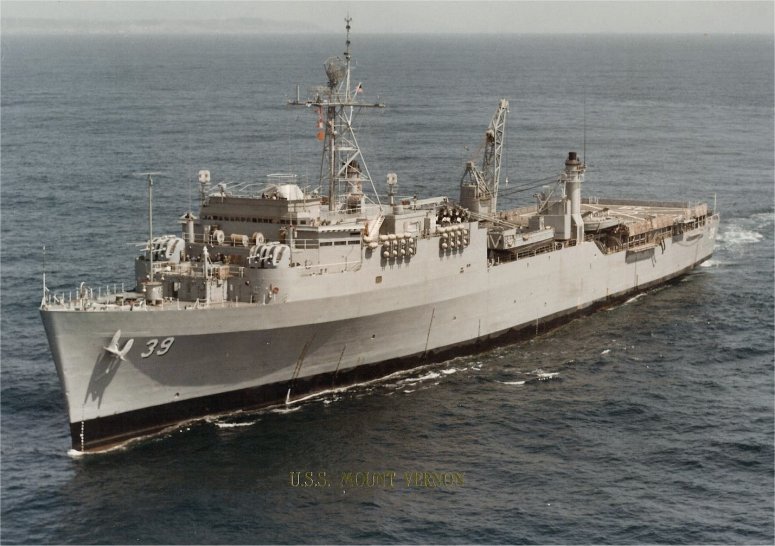
USS Mount Vernon LSD-39

In February 1977 a number of us traveled to Portland Oregon to embark on USS Mount Vernon LSD-39 for its trip from an overhaul back to her home port of San Diego during which we disembarked at Alameda.  That was an interesting trip as well as upon entering the Pacific from the Colombia River we ran into a major storm and we got to see how a flat-bottomed amphibious ship rode in heavy seas, the answer, not well. On the Mount Vernon we stood various watches the most memorable was in the Main Engineering plant.  Mount Vernon like most of the ships of the day was powered by steam turbines and the Engine Room was about 100 degrees.

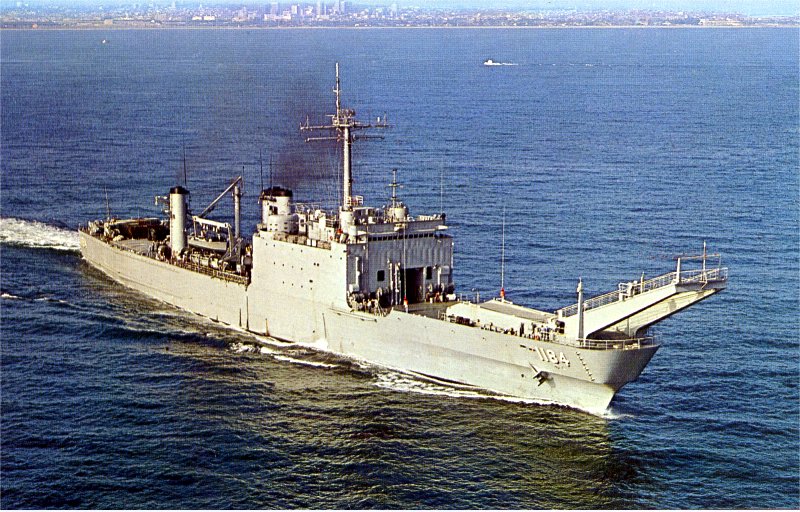
USS Frederick LST-1184

My final underway was a round trip from San Diego to Pearl Harbor and back.  On the outbound trip we rode the USS Frederick LST-1184 as it transited with its Amphibious Group of 7 ships for a WESTPAC deployment.  On Frederick I was paired with the Operations department and Navigation division.  This was interesting as I got to practice skills that I had learned in the classroom as well as learn about the early satellite navigation systems Loran and Omega.  It was on Frederick that I first felt the call to be a Navy Chaplain and aboard which I would celebrate my first Eucharist underway 23 years later.

We spent a week in Peal Harbor when I was able to visit the USS Arizona and USS Utah Memorials, meet Navy Divers, Army Maritime Transportation Corps personnel and tour their landing craft.  We had some liberty in Pearl and the son of one of my parents friends from the Navy picked me up from a day of snorkeling during which I was badly sunburned with 2nd degree burns on my back. This lent me the nickname “Lobsterman” by my fellow cadets.

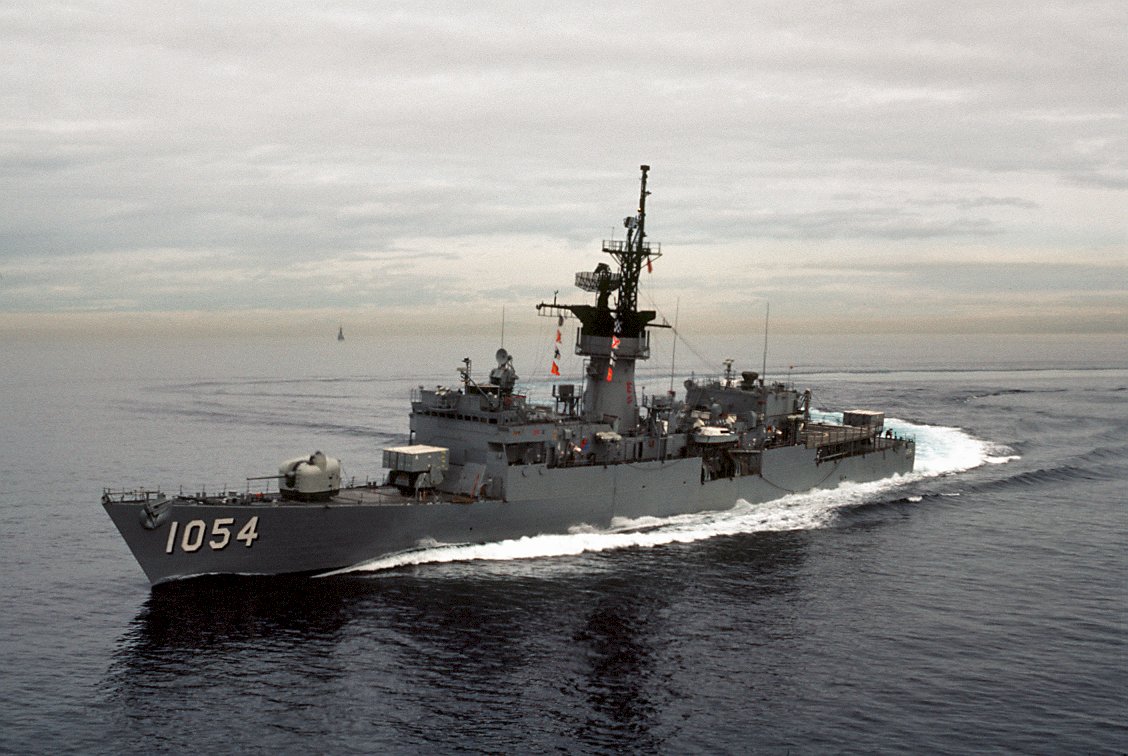
USS Gray FF-1054

The return trip was on the USS Gray FF-1054 a Knox Class Frigate which my dad had helped prepare for commissioning in 1970. Gray and a cruiser destroyer force headed by the USS Chicago CG-10 was returning from deployment.  On Gray I got to see my first underway replenishment

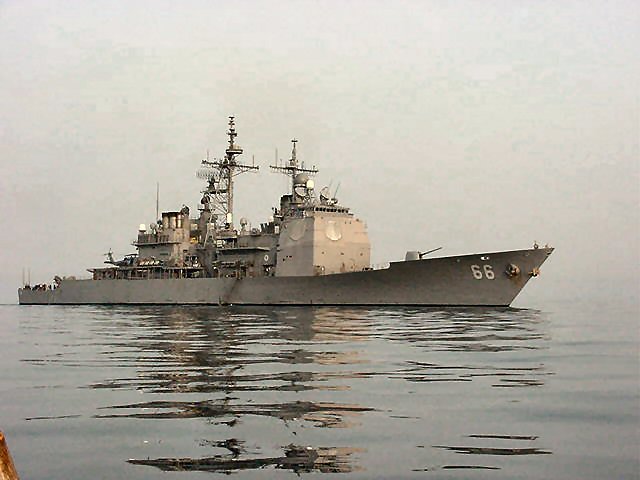
These journeys were important in my life, they put a love of the sea and love of the Navy deep in me that could not be quenched even by my 17 and a half years of service in the Army.  As a Chaplain I had the privilege of serving on the USS Hue City CG-66.

One of my photos of USS Hue City CG-66 during boarding Operations in the Northern Arabian Gulf

I still love the sea and who knows if I will get another sea tour, but I have been blessed in all of these experiences.  Of the ships themselves only Hue City is active in the US Navy while Frederick was sold to Mexico where she still serves.

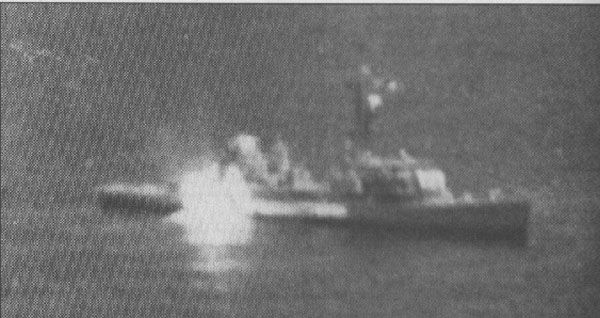
Harpoon Hitting Agerholm

Agerholm was expended as a target for the Harpoon missile system, Breckenridge, Coral Sea, Gray, Portland were scrapped and Pyro was decommissioned and remains in the National Defense Reserve Fleet at Suisun Bay California.   They were all great ships manned by great crews.

Peace, Padre Steve+
11 Comments

Filed under Navy Ships

Marshall, Eisenhower and Senior Military Leadership

Great military leaders are the products of the militaries in which they serve.  This begins in their early career and includes their education, training, assignments as well as the men that they serve under in their formative years.  They are shaped by the character, doctrine and organization of the military that they serve and are products of the times that they live and serve. Even the difference of a few years can make a major difference in the career path and development of a leader.  Such was the case with two of the great figures of the US Army in World War Two Generals of the Army George Marshall and Dwight David Eisenhower.

George Marshall

The careers of Marshall and Eisenhower prior to the Second World War were somewhat similar but also included major differences that would shape them for their roles in the war.  Marshall was commissioned 13 years prior to Eisenhower in 1902.  As a result he served his early years in a peacetime army marked by slow promotion.  Marshall was promoted to Captain in 1916 after serving 14 years as a Lieutenant despite attendance at the Army Staff College then called the Infantry and Cavalry School.  As an infantry officer he served in the Philippines for 2 years and served in various battalion and regimental level staff positions. Marshall’s career also included as assignments working with the National Guard and State militias.   His skills as a planner brought him to France as Assistant Chief of Staff for the 1st Infantry Division and later the American Expeditionary Force (AEF) under General Pershing.

While serving in these positions he was promoted rapidly to Major, Lieutenant Colonel and Colonel. In France he worked with the training, supply and operations of the American Forces as well as coordination with the French and British. His skills were invaluable and he played a major role in the rapid transition of the AEF from the St Michel salient to the Meuse-Argonne and though he reduced in rank when the war ended he was appointed aide-de-camp to Pershing in 1919.

During the 1920 Marshall served as Executive officer of the 15th Infantry Regiment in China and on his return to the United States he was assigned to the Army War College during which time his first wife died.  Following her death he would become Director of the Academic Department of the Infantry School.  His tenure at the War College was marked by his training numerous officers who would later become generals, including Eisenhower. He played a key role in the Preparation of the book “Infantry in Battle” which became a standard textbook for Army infantry officers.  He then served as senior instructor for the Illinois National Guard from 1933-1936 and was promoted to Brigadier General in 1936. After his promotion he worked to improve the Civilian Conservation Corps.  His organizational talents were recognized by President Franklin D Roosevelt and he was appointed Chief of Staff of the Army in 1939.  Marshall’s career is unique; he never served in command of anything more than a company. His positions above the company level were all in staff or instructor duty. In our current military an infantry officer or other combat arms officer who never commanded a maneuver unit at battalion, regiment or division level would never become a General and certainly never become Chief of Staff of the Army or Commandant of the Marine Corps.  Marshall was a brilliant organizer, leader, judge of men and visionary in understanding the necessity of coalitions and inter-dependence of nations in the modern world.  His organizational leadership skills, ability to pick the right officers for key positions and his political and diplomatic acumen made him one of the foremost military leaders in US Military history.

Dwight D Eisenhower

Eisenhower was commissioned in 1915 less than two years prior to the entry of the US into the First World War. Like Marshall was commissioned as an Infantry officer and his career progressed in normal fashion until the entry of the United States into the war.  Though Eisenhower never served in France, he was assigned to training troops and became one of the early leaders of the Armored Forces until they were disbanded after the war.  In the rapidly expanded wartime army Eisenhower was promoted from 2nd Lieutenant to Lieutenant Colonel in less time than Marshall spent as a 2nd Lieutenant.

During his tenure in the Tank Corps he served with George Patton, commanded a tank battalion and was executive officer of an armored brigade.  Following the disestablishment of the Tank Corps Eisenhower served as an infantry regiment executive officer in Panama.  In this position he was schooled by General Fox Conner in classic military theory.   It was fortunate for Eisenhower in that he was able to serve with and was able to gain seasoning and education under an excellent officer. Eisenhower returned to the United States and commanded an infantry battalion at Fort Benning and following this served on the faculty of the Infantry School under Marshall who would remember him at the beginning of World SWar Two.

His subsequent career was somewhat mundane. He served on the Battle Monument’s Commission under Pershing and then on the staff of the Assistant Secretary of War.  However both of these assignments put him in the eye of other important officers and officials.  Eisenhower was then transferred to the Philippines where he served as Chief of Staff to Douglas MacArthur from 1935-39. He returned to the US to serve concurrently as the regimental Executive Officer and a battalion commander in the 15th Infantry regiment and later Chief of Staff to the Commander of 3rd Army.  Through his excellent work in every assignment he gained the attention of Conner, Pershing and eventually Marshall. While at the Infantry school he helped prepare Pershing’s memoirs.  His experience with MacArthur in Washington and the Philippines helped prepare him for the myriad of difficult personalities with which he would deal with as Supreme Commander of Allied Forces in Europe. In 1941 he came to Washington to serve under Marshall at the WPA.

As far as who was the better officer, opinions vary; there are arguments to be made for both yet Eisenhower himself seemed to subordinate himself to Marshall.  Omar Bradley says of Marshall “if there ever was an indispensable man in time of national crisis, he was that man.” (A Soldier’s Story p.205) However both Marshall and Eisenhower were excellent officers and each played a vital role in the Allied victory.   However their careers were markedly different. In fact one could say that they were “apples and oranges.” Marshall served entirely as a staff officer and instructor after his service as a company officer.  Eisenhower served in numerous command positions as well as staff jobs. Their careers would intersect and had commonalities but each was shaped by their different experiences in the Army.

In World War Two Marshall seems to have fewer critics.  However this seems to more a result of Eisenhower’s exposed position in Europe where he was comparatively junior to many of the officers that that he would command.  He also had to deal with the competing interests of such strong personalities as Marshall, Patton, Roosevelt, Churchill, DeGaulle and Montgomery while fighting the Germans. This has lent him to criticism from both British and American officers as well as various historians.  But these observations are based on wartime experience and not their early careers.   Field Marshall Alan Brooke seems to have had more respect for Marshall and many in the British high command showed little respect toward Eisenhower.

“Better” in the military is in the eye of the beholder and often dependant on assignments as well as the superiors that one works for.  From a traditional point of view Eisenhower had the better career path with command at battalion and executive officer at regiment levels. However Marshall’s career provided him with a wider spectrum in dealing with senior staff, school, reserve component, government civilian agencies and Washington bureaucracy and politics that Eisenhower did not experience until Marshall tapped him in 1941 to work with the WPA. Their personalities were different and they dealt with subordinates in different manners, but both successfully managed their subordinates. Eisenhower was able to manage Patton and Montgomery while working in Churchill’s back yard, while others such as DeGaulle walking through his door.  Both men were uniquely suited to work with each other and in the positions that they found themselves during the war and one has a hard time imagining a better partnership in command.

The interesting thing to me is Marshall’s career.  In the current era he would never rise to the heights that he served.  Since the Second World War no officer who has not served command in major combat arms units at all levels has risen to be Chief of Staff of the Army, Air Force, Commandant of the Marine Corps or Chief of Naval Operations.  Nor has any risen to the Chairmanship of the Joint Chiefs of Staff or major Combatant Command such as EUCOM, CENTCOM or PACOM.  Of we look at Marshall and his impact one has to ask if “punching tickets”in the combat arms  is necessarily optimal  when it comes to managing the organization at the service level.  While it is proven that command is a great asset to senior command in combatant commands it may not be as necessary for the chief of a service.  One can ask if an officer who has served in staff and instructor positions, especially those where they have to deal with politicians, civilian agencies, as well as active and reserve component forces as well as an instructor and writer of doctrine could not serve as successfully in a position such as the Army Chief of Staff or the Commandant of the Marine Corps as an officer who has had the “well rounded career.”

In the light of George Marshall these are valid questions to ask. Might someone who has had the ability to step back and examine the personnel, logistics and training of a force as well as having experience with reserve component and civilian agencies could conceivably serve as effectively as an officer who has served rotating between command and staff positions.  In today’s world the staff oriented officer would also have experience dealing with industry and intelligence.  While I do not advocate such a change I think it would be wise to consider officers such as Marshall for these service level positions.

Following the war Marshall would become Secretary of State and help rebuild Europe while serving under Eisenhower how had become President of the United States.

Peace,

Padre Steve{

3 Comments

Filed under History, leadership, Military, national security, world war two in europe

“Revisionist” History and the Rape of Nanking 1937

Japanese Soldiers at Work in Nanking

The historical controversy regarding the “rape” of Nanking in 1937 by the Japanese Army is hotly debated.[1] The massacres occurred in the initial occupation of the city and the two months following in mid December 1937.  The initial reaction to the actions of the Japanese was reported by western journalists and even a German Nazi Party member by the name of John Rabe who assisted in protecting Chinese during the massacre and reported it on his return to Germany.The action shocked many in the west and helped cement the image of the Japanese being a brutal race in the west.

Massacre Victims at Nanking

The controversy’s visibility has been raised since the 1997 publication of Iris Chang’s The Rape of Nanking. However, with few exceptions the incident had received little attention by Western historians until Chang’s book was published. The reason for this was  that  China was a sideshow for for the United States and Britain throughout much of the war. When Chiang Kai Shek’s Nationalists were overthrown by the Communists in 1948 the incident disappeared from view in the United States.   The  United States government  reacted to the overthrow of Chaing by helping to rebuild Japan and rehabilitate the Japanese while opposing the Chinese Communists.  In fact it was only “after the Cold War was the Rape of Nanking Openly discussed.”[2]

Bodies of Children Killed by the Japanese at Nanking

Chang’s book was instrumental as it brought new attention to the actions of the Japanese Army in the slaughter of Prisoners of War and civilians following the occupation of the city.  Even as Chang’s work was published “revisionist” works began to appear in the 1980s which have either denied the atrocities, sought to minimize numbers killed by Japanese Forces or rationalized the them began to appear in Japan.  The revisionists were led by Masaaki Tanaka who had served as an aide to General Matsui Iwane the commander of Japanese forces at Nanking.  Tanaka denied the atrocities outright calling them “fabrications” casting doubt upon numbers in the trial as “propaganda.” He eventually joined in a lawsuit against the Japanese Ministry of Education to remove the words “aggression” and “Nanjing massacre” from textbooks, a lawsuit which was dismissed but was influential to other revisionists and Japanese nationalist politicians and publishers.[3]

Japanese Officer Preparing to Execute Man in Hospital

Most early accounts of the occupation and war crimes have used a number of 200,000 to 300,000 victims based upon the numbers provided during the War Crimes Trials of 1946.[4] Unlike the numbers of victims of the Nazi Holocaust the numbers are less accurate.  Authors who maintain the massacres such as Chang and others such as Japanese military historian Mashario Yamamoto who admits Japanese wrongdoing and excess but challenges the numbers use the same statistical sources to make their arguments.  Chang not only affirms the original numbers but extrapolates that even more may have been killed as a result of the disposal of bodies in the Yangtze River rather than in mass graves away from the city as well as the failure of survivors to report family member deaths to the Chinese authorities.[5] She also notes contemporary Chinese scholars who suggest even higher numbers.

Prince Asaka, Granduncle of Emperor Hirohito Commanded Troops at Nanking

Herbert Bix discusses Japanese knowledge of the atrocities in detail up and down the chain of command including Prince Asaka, granduncle of Emperor Hirohito who commanded troops in Nanking, the military and Foreign Office, and likely even Hirohito himself.[6]

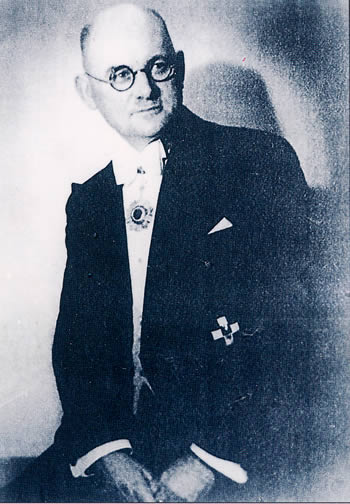
German National and Nazi Party Member John Rabe Protected Chinese at Nanking and Reported His Experience to the German Government.  He is known as “The Good Man of Nanking”

The publication of German citizen and witness to the massacres John Rabe’s diaries in 2000, The Good Man of Nanking, provided an additional first hand account by a westerner who had the unique perspective of being from Japan’s ally Nazi Germany.  His accounts buttress the arguments of those like Chang who seek to inform the world about the size and scope of Japanese atrocities in Nanking.

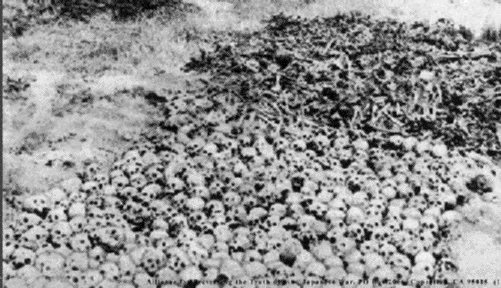
A Field of Skulls at Nanking

Yamamoto who is a military historian by trade and is viewed as a “centrist” in the debate, places the massacres in the context of Japanese military operations beginning with the fall of Shanghai up to the capture of Nanking. Yamamoto criticizes those who deny the massacres but settles on a far lower number of deaths, questioning the numbers used at the War Crimes Trials. He blames some on the Chinese Army[7] and explains many others away in the context of operations to eliminate resistance by Chinese soldiers and police who had remained in the city in civilian clothes. He  claims that  “the Japanese military leadership decided to launch the campaign to hunt down Chinese soldiers in the suburban areas because a substantial number of Chinese soldiers were still hiding in such areas and posing a constant threat to the Japanese.”[8] David Barrett in his review of the Yamamoto’s work notes that Yamamoto believes that “there were numerous atrocities, but no massacre….”[9] Yoshihisa Tak Mastusaka notes that while a centrist Yamamoto’s work’s “emphasis on precedents in the history of warfare reflects an underlying apologist tone that informs much of the book.”[10] Revisionist work also criticizes the trials surrounding Nanking and other Japanese atrocities.  An example of such a work is Tim Maga’s Judgment at Tokyo: The Japanese War Crimes Trials which is critiqued by historian Richard Minear as “having a weak grasp of legal issues” and “factual errors too numerous to list.”[11] Such is a recurrent theme in revisionist scholarship, the attempt to mitigate or minimize the scale of the atrocities, to cast doubt upon sources and motivations of their proponents or sources, to use questionable sources themselves or to attribute them to out of control soldiers, the fog of war and minimize command knowledge as does Yamamoto. Politics is often a key motivating factor behind revisionist work.

Iris Chang Would Later Commit Suicide

Chang would never be the same after researching and writing the Rape of Nanking. Traumatized by what she had learned and burdened by the weight of what she had taken on she killed herself on November 9th 2004.

Iconic Photo of Japanese Acts in China: A Wounded Child at Shanghai Station

“Revisionist” history will almost certainly remain with us, so long as people study the past.  However one has to be careful in labeling a divergent view of a historical subject as necessarily revisionist.  There are occasions when new evidence arises and a “new” or “revisionist” work may actually disprove previous conclusions regarding historic events or persons.  This might occur when what we know about a subject comes from a single or limited number of sources who themselves were limited in what they had available for research and new evidence comes to light. At the same time where numerous sources from diverse points of view attest to the genuineness of an event, the revisionist’s theses should be themselves scrutinized based on evidence presented as well as their political, ideological or racial motivations.  While one does not want to silence voices of opposition to prevailing beliefs one has to be careful in examining their claims, especially when they arise in the context of political or ideological conflicts.


[1] Bix, Herbert P. Hirohito and the Making of Modern Japan, Harper Collins Publishers, New York, NY 2000. pp.333-334. Bix does a good job explaining the number of victims of the incident drawing on Chinese and Japanese sources.

[2] Kreuter, Gretchen. The Forgotten Holocaust in The Bulletin of Atomic Scientists, March-April 1998 p.66

[3] Fogel, Joshua A. The Nanjing Massacre in History and Historiography, University of California Press, Berkley CA 2000, pp.87-89

[4] Toland, John. The Rising Sun: The Rise and Fall of the Japanese Empire 1936-45. Random House, New York, NY 1970 pp. 50-51. Toland in his brief discussion of the massacres notes both the civilian casualty figures and figures for male citizens of military age who were slaughtered.  Toland also notes the large numbers of women raped by Japanese soldiers.

[5] Chang, Iris. The Rape of Nanking: The Forgotten Holocaust of World War II Penguin Books, New York, NY 1997 pp.102-103. Chang has been criticized by some historians in a number of ways including that she was not a historian, that she compares the atrocities to the Nazi Holocaust and her emotional attachment to the subject which may have been a contributing factor in her 2004 suicide.

[6] Bix. p.336

[7] Yamamoto, Masahiro. The Rape of Nanking: Anatomy of an Atrocity. Praeger Publishers an imprint of the Greenwood Group, Westport, CT 2000. http://site.ebrary.com/lib/apus/docDetail.action?docID=10018001&p00=nanking  p.83

[8] Ibid. p.92.

[9] Barrett, David P.  Review of The Rape of Nanking: Anatomy of an Atrocity by Masashiro Yamamoto Canadian Journal of History/Annales canadiennes d’Histoire XXXVIII, April/Avril 2003 p.170

[10] Mastusaka, Yoshihisa Tak.  Review of The Rape of Nanking: Anatomy of an Atrocity by Masashiro Yamamoto American Historical Review, April 2002 p.525

[11] Minear, Richard. Review of Judgment at Tokyo: The Japanese War Crimes Trials by Tim Mata  American Historical Review. April 2002 p.526

49 Comments

Filed under History, Military, world war two in the pacific

Oral Passes, Tiger Crashes, Baseball Dances and Odd Thoughts

A few thoughts for the mid-week…

First an Icon of American Religious life passed away yesterday.  Oral Roberts died at the age of 91.  Regardless of one’s views of his ministry, theology or lifestyle Reverend Roberts was a trendsetter. For better or worse he was a major influence on American religious life. Roberts in his television ministry, crusades and university helped to bring Pentecostalism into the mainstream of American life.  His positive message of “Something good is going to happen to you” inspired many who were not Pentecostals.   The University that bears his will likely be his legacy in merging his beliefs with an institution that became regionally accredited breaking out of the simple unaccredited Bible College tradition that was a hallmark of Pentecostalism and Evangelicalism.  There are some that loved him and some that loathed him but one cannot deny his influence on the American religious life and culture.  His departure from the scene leaves Billy Graham, Pat Robertson and Paul Crouch from the pioneers of modern Christian media.  While Roberts was controversial in terms of some of his pleas for financial support and criticism of his lifestyle, he never seemed to me to have the angry edge of other early televangelists including Jimmy Swaggart, Jerry Fallwell (in his early ministry) and others.  Having worked in a television ministry while I was in seminary back in the early 1990s I am not a big fan of  television ministries from the standpoint of the huge amounts of money involved and potential for abuse.  However one cannot deny the impact that Oral Roberts had on the American religious scene.

Tiger Woods has crashed hard and I pray that for the sake of him and his family that he will be reconciled with his wife and make amends.  I have no double that he will return to greatness on the PGA Tour but for now I hope that he is able to reclaim his life.  As much as his actions speak poorly of him as a person I am disappointed with the media which has used every opportunity to take him down further.  Of course this was aided by his media advisers who let him be a target and did not pre-empt  things that they obviously knew would come to light.  Can anyone say Bill Clinton or Richard Nixon?  I hope that the media frenzy around Tiger dies down so he and his wife can attempt to salvage their marriage if it is even possible now.

The Phillies, Blue Jays and Mariners deal to bring Roy Halliday to Philly and send Cliff Lee to Seattle looks to me like a bad deal for the Phillies, Halliday is a great pitcher but unproven in the post-season and the Phillies gave up their best pitcher and top pitching prospect to get him.  The addition of John Lackey to the Red Sox makes their rotation very strong.  The departure of Hideki Matsui for the Yankees to the Angels helps the Halos who had lost Chone Figgens and Lackey.  The Angels will need to find a good starter to replace Lackey.  The Yankees picked up Curtis Granderson from the Tigers at very little expense to them.  The Giants have not done much as of yet and the Orioles acquired starting pitcher Kevin Millwood from the Rangers and came to terms with Matt Albers and Cla Meredith.  The Orioles could use some power in their offensive lineup.

Barry Bonds agent Jeff Borris stated last week that Barry Bonds would not return to playing baseball.  Bonds has not played the last two season but not retired.  His name will be forever linked to the steroids controversy and his reputation tainted for years to come.  I do not know if he will get in the Hall of Fame, but if the players from the 1940s and 1950s who used amphetamines can be admitted and Gaylord Perry who admitted using the spit-ball, which was illegal can be in the club I see no reason not to admit Bonds.  Many players have been named in the scandal but only Bonds has been pursued by investigators and prosecutors who have spent millions of dollars of our tax money over the past number of years to attempt to catch Bonds.  However, their misconduct of investigators and prosecutors themselves who violated the law in attempt to gather evidence to convict Bonds is shameful and their inability to get charges to stick shows the weakness of their case.  It is time for the investigation of Bonds and the others to end. Let baseball fans, writers and players determine their future.

The Most Valuable Network which I had been invited on in the summer to write The View From 102 went Tango Uniform last week.  I had been unable to post as they had been going through a transition that did not work out. I am contacting media outlets who are taking writers from MVN to relaunch the View from 102.

The Navy released the promotion zone message for FY 2011.  I am right in the middle of the zone for consideration to the grade of Commander.  I hope that I make it.

My Bishop for the Armed Services visited this week for a trip to the USS Carl Vinson.  We had a nice time with him and I deeply appreciate him.  Bishop Woodall is a dear friend.

I am looking at a couple of writing projects for actual books.  As they develop you may see snippets of them here.

I watched two of my favorite Christmas movies last night Scrooged and Christmas Vacation. They are classic albeit a bit twisted.  Would you expect anything else from me?

In less than two weeks I will have oral surgery to emplace my implant where the Undead Tooth of Terror used to live. While I look forward to getting something back into the empty slot were the Undead Tooth of Terror lived, thrived and survived I am not looking forward to the surgery, the anesthesia or the excavation and drilling process.

Christmas is coming and I am nowhere near ready.  Maybe I should move my celebration to January 6th, the Russian Orthodox Christmas…more time plus post Christmas sales….hmmm….

I have duty tomorrow, get to stay in house at the medical center.

Peace

Padre Steve+

1 Comment

Filed under Baseball, golf, Loose thoughts and musings, My Other Blogs, Religion

Padre Steve’s Favorite Christmas Movies and Shows

Where do you think you’re going? Nobody’s leaving. Nobody’s walking out on this fun, old-fashioned family Christmas. No, no. We’re all in this together. This is a full-blown, four-alarm holiday emergency here. We’re gonna press on, and we’re gonna have the hap, hap, happiest Christmas since Bing Crosby tap-danced with Danny Kaye.”

This is the time of year that a lot of Christmas movies are shown on almost every television outlet known to humanity.  Of course there are many that are absolutely timeless such as “Miracle on 34th Street,” “White Christmas” and “It’s a Wonderful Life.” There are also ones of various religious themes, usually involving the birth of Jesus, like no duh, it’s Christmas. Unfortunately most of these films as classic as they are bore me to tears.  Yes they have nice messages and tug at the heartstrings but without wanting to sound too much like Scrooge I get bored by them.  I guess part of this is a generational thing.  The ones set in the 1930s and 1940s are from a different era, an era that I know from history books and family members but not something that is a part of my life.  It’s like the film “The Bell’s of Saint Mary’s” is about the Roman Catholic Church of a half century ago, not the one that I know.  They are fictional and while touching are indelibly tied to their time.  The religious themed films tended often to be major productions and Hollywood Gospel.  Not that there’s anything wrong with that but I’m sorry Cecil B. De Mille did not write the 5th Gospel, or the 6th Book of Moses (You have to know your Luther Bible for that one.)

Frank Cross (Bill Murray) with the Ghost of Christmas Past

Instead every year there are several Christmas movies and television shows that I cannot live without seeing.  Of the television shows my all time favorite is “A Charlie Brown Christmas” followed by “How the Grinch Stole Christmas.” As a kid I had a deep affinity for both Charlie Brown and Linus. The frustration of Charlie Brown with the commercialization of Christmas was something that resonated in me at a young age.  Likewise Linus’ reading of the Luke’s account of the Angel’s message to the shepherds always brings tears to my eyes.  As for the Grinch, and I mean the television Grinch where Boris Karloff voiced the part of the Grinch not the Jim Carey movie version it has always been a favorite of mine.  I find the plot of the Grinch to steal Christmas from the “Whos” of “Whoville” to be a masterful account of how the message of Christmas can touch even the smallest and coldest of hearts.  Of course I absolutely loved the Grinch’s dog “Max.”

As far as movies I have watched “Scrooged” and “National Lampoon’s Christmas Vacation” almost religiously and am doing so tonight.  I relate to both of the main characters in both movies.  That’s not necessarily a compliment to me, but when I watch both there are times that I almost need to cover my eyes because of the resemblance, especially the scene in Christmas Vacation” where Clark Griswold, played by Chevy Chase starts kicking his decorative reindeer and sleigh across the lawn when he can’t get his house lights on and his rants about when his Christmas Tree goes up in flames and when his family tries to leave are scary close to the way that I can act under the stress of the holidays.  The Abbess says that this indeed is me and I agree.  Three other films that get me are “Home Alone” and “A Christmas Story” and though not really a Christmas story “Trading Places.” These are what I grew up with and which were the films about Christmas as it takes place in the United States that I became an adult in that typify my era, not that of my grandparents.  I think that is why they are my favorites and not the classics of a bygone time.  Of course there is the “Festivus” episode of “Seinfeld” that is almost scary in how things were in my house with my folks, I think at times we only lacked the “feats of strength” and the Festivus Pole to complete the picture.  Likewise when George makes up a fake charity called “The Human Fund: Money for People” to give to the folks at Kruger Industrial Smoothing it cracks me up because I know that there are people who give gifts in other people’s names to charity.

Finally I like the “X-Files” Christmas episode where Ed Asner and Lilly Tomlin played ghosts in a haunted house that Agents Scully and Mulder get trapped in while investigating a case.

Okay, so these are not the classics of a bygone era, but they are my classics and I will enjoy Charlie Brown, Linus, the Grinch, Clark Griswold, Frank Cross, the Costanzas and the rest of my warped favorites as I rediscover Christmas.

Peace,

Padre Steve+
Leave a comment

Filed under Loose thoughts and musings, purely humorous

Doubt and Faith: My Crisis in Faith and Why I am Still a Christian an Advent Meditation

Note to my readers. This is an older article that I wrote back in December 2009, when after nearly two years of struggle with the effects of PTSD, depression, anxiety, loss and a crisis of faith that made me for all practical purposes an agnostic. I think it is timely now, not because of what is currently going on in my life but rather because of the stories I hear from those that struggle with faith at Christmas. Peace, Padre Steve+

Lord I believe, help me in my unbelief.

A new liturgical year is upon us and with the season of Advent Christians look forward to the “Advent” of Christ both in looking forward to the consummation of all things in him as well as inviting him back into our lives as we remember his Incarnation, as the Creed says “For us and for our salvation he came down from heaven: by the power of the Holy Spirit he became incarnate from the Virgin Mary, and was made man.”

At the same time for a lot of people the season of Advent and Christmas are incredibly difficult and times where faith, already difficult becomes nearly impossible.  For many the season is not a time of joy but depression, sadness and despair.

For me Advent and Christmas were times of wonder and mystery and I really found it difficult to understand how anyone could be depressed during the season.  Until I came home from Iraq…

While I believe the Scriptures and the Creed this I have to admit that for the last 22 months since returning from Iraq I have doubted, been depressed and at times felt like God had abandoned me.  Things were so difficult last year that I went to the Christmas Eve Mass with the Abbess and was crashing so hard that I had to leave. I walked through the night for over an hour until I got home, a walk that is a maximum of 10 to 15 minutes from the church.  It was probably the lowest point of my life as a Priest, chaplain and Christian.

Since I returned from Iraq my life has been a series of ups and major downs. In dealing with PTSD, anxiety, depression and chronic insomnia as well as my dad’s painfully slow degeneration with Alzheimer’s disease to the point that he no longer recognized me on my last visit, I have struggled with faith.  Prayer became difficult at best and as I dealt with different things in life I knew that I didn’t have any easy answers.  Going to church was painful. Chaplain conferences even more so, except being with others who struggled like me.  About the only place that I could find solace was at a baseball park.  For some reason the lush green diamond comforts me.

I find that the issue of doubt is not uncommon for a lot of people, including ministers of all faiths. For those of us who are ordained and view our ministry or our Priesthood as a sacred vocation this is difficult to deal with.  Ministers and others who suffer a crisis in faith, depression or despair endure a hell because it is not supposed to happen to us. I do believe that for many people a religious leader who has doubts and struggles with his or her faith is disconcerting.  I can remember a myriad of situations where pastors due to a myriad of reasons experienced a crisis in faith many of which involved great personal loss such as the loss of a child, a failed marriage, being let go or fired by a church, or experiencing a major traumatic event.  These were good people and quite often instead of being enfolded by a caring community of faith they were treated as faithless, failed and worthless, often abandoned or excluded from their faith community as if they were criminals.

When I was younger I used to look askance at pastors who had given up, lost their faith, or abandoned the ministry for whatever reason.  As a young seminary student and later young chaplain I had a hard time with this, it made no sense to me and I was somewhat judgmental until I started to get to know a decent number of “broken” ministers from various faith traditions that a lot more went into their decision than simply not being tough enough to hang in there until things got better.  At the same time I never thought it would happen to me. I thought I was “bulletproof,” that it could never happen to me. And it did and I was stunned.

When I came back from Iraq I came home to find that my office had been packed up and many mementos lost, it took months to find most and there are still important documents that have never been recovered. My accomplishments went unrecognized on my return home.  As I crashed no one asked about my faith until Elmer the shrink did when he met me.  Later my Commodores, first Frank Morneau when he found out about my condition and Bob Sitsch when he took command of EOD Group 2 both asked me about my faith.  I told them that I was struggling. Commodore Sitsch asked me “Where does a Chaplain go for help?”  On the professional side I felt isolated from much of my church and many chaplains.  I was angry because I felt that I deserved better, because I had done all that was asked of me and more.  The Chaplains that I knew cared all worked in different commands and were not immediately available and I was ashamed to go ask them for help.

I appreciated simple questions like “How are you doing with the Big Guy?” or “Where does a Chaplain go to for help?” It showed me that people cared.  When I went to the medical center I dealt with many difficult situations and was haunted by my dad’s deterioration, the latter which I still deal with today.  To have a close family member mock my vocation, service and person and provoke me into rages was equally taxing.  Likewise the absolute hatred and divsion in the American political debate tore my heart out.  I felt like, and in some ways still feel like we are heading down a path to being “Weimar America.”

There were many times that I knew that I had no faith.  People would ask me to pray and it was all that I could do to do to pray and hoped that God would hear me.  Even the things that I found comforting, the Mass, the Liturgy and the Daily Office were painful.

This Christmas and Advent is better than last.  I am finding meaning again.  The little Episcopal Church that I attend helps me in this.  It is much like the churches that I grew up in.  The hymns and the liturgy are comforting.  I am beginning to rediscover faith.  A week and a half ago I was paged stat or our ER where an elderly man was dying.  He was 91 years old and had suffered a heart attack at his family home not far from the hospital.  He has served as a Navy Officer and later Navy doctor and had done his internship at our medical center in the 1940s.

I sprinted to the ER and when I got to his room was introduced to his wife.  She asked if I would pray and then asked if I was Episcopal.  I said I was a Priest in an Episcopal denomination and she asked if I could give her husband, a life-long Episcopalian the last rites.  The man was obviously in his last moments of life.  I performed the Rite and when I finished he passed away.  My hand was on his brow when he breathed his last and his body began to lose its warmth.  One of the Doctors said it was like he had waited until I got there.  The man died with his family, was at home in the house his father built and had eaten what he said was the best “stew of his life” before he passed out.  He died at the hospital he trained at and loved with his family at his side and received the last rites of the Church.  I left the ER after a wonderful chat with his wife, who reflected on his life and how blessed that he was to go out like this.  I left the ER knowing that I had been part of something miraculous.  My eyes were opened and for one of the few times in the past 22 months I felt the presence of God again.

I am still a Christian.  Why is sometimes hard to figure.  I am not a Christian because of the my Church, though I love the Church, it often has been for me a sourse of pain and rejection.  I am not a Christian because of what is called “Christian” nor can I ignore the injustice, violence and oppression wrought by those who called themsleves Christian throughout history.  Slavery, the subjectation and conquest of who peoples to take their land and resources and wars of agression blessed by “Christian” leaders are all part of history.  At the same time much progress has come through the work, faith and actions of Christians and the Church. Despite all of the warts I can like Hans Kung “I can feel fundamentally positive about a tradition that is significant for me; a tradition in which I live side by side with so many others, past and present.” (Kung, Hans Why I am Still a Christian Abingdon Press, Nashville 1987 p. 36)

Neither am I a Christian because I think that the Christian faith has “all” of the answers.  In fact coming through Iraq I understand what my Church History Professor, Dr Doyle Young said “all of people’s deepest needs are not religious.”  Nor am I a Christian because I think that Christians are somehow better or more spiritual than others.  In fact I find the crass materialism and self centered “What can God to for me?” theology and way of life to be deeply offensive.  People get sick, young children die, innocents are subjected to trauma even from their parents or siblings.  Good people endure unspeakable trials while sometimes it seems that evil people get away with murder.  I can’t chealk it all up to a naive “it’s God’s will” kind of theology.  I don’t presume to know God’s will and I can’t be satisfied with pat answers like I see given in so many allegedly Christian publications, sermons and media outlets.  Praying doesn’t always make things better. I remain a Christian in spite of these things.  I still believe that God cares in spite of everything else, in spite of my own doubts, fears and failure.  I still believe, Lord help me in my unbelief.

I look forward to Christmas this year. I look forward to the coming of Emmanuel, God with us.  We sang the hymn “O Come O Come Emmanuel” at Church Sunday.  It was what I needed to hear.

O come, O come, Emmanuel
And ransom captive Israel
That mourns in lonely exile here
Until the Son of God appear
Rejoice! Rejoice! Emmanuel
Shall come to thee, O Israel.

O come, Thou Rod of Jesse, free
Thine own from Satan’s tyranny
From depths of Hell Thy people save
And give them victory o’er the grave
Rejoice! Rejoice! Emmanuel
Shall come to thee, O Israel.

O come, Thou Day-Spring, come and cheer
Our spirits by Thine advent here
Disperse the gloomy clouds of night
And death’s dark shadows put to flight.
Rejoice! Rejoice! Emmanuel
Shall come to thee, O Israel.

O come, Thou Key of David, come,
And open wide our heavenly home;
Make safe the way that leads on high,
And close the path to misery.
Rejoice! Rejoice! Emmanuel
Shall come to thee, O Israel.

O come, O come, Thou Lord of might,
Who to Thy tribes, on Sinai’s height,
In ancient times did’st give the Law,
In cloud, and majesty and awe.
Rejoice! Rejoice! Emmanuel
Shall come to thee, O Israel.

For those that like me struggle with faith, feel abandoned by God, family and friends.  For those who have experienced the crisis of faith or even a loss of faith I pray that all of us will experience joy this season.  I’m sure that I will have some ups and downs, I certainly don’t think that I am over all that I am still going through.  However I know that I am not alone to face my demons and pray that by opening up that others who are going through similar experiences will find hope.  O come, Thou Day-Spring, come and cheer, our spirits by Thine advent here. Disperse the gloomy clouds of night, and death’s dark shadows put to flight.

Peace,

Padre Steve+

17 Comments

Filed under Pastoral Care, PTSD, Religion

War Without Mercy: Race, Religion, Ideology and Total War

Dower, John W. War without Mercy: Race and Power in the Pacific War.” Pantheon Books, a Division of Random House, New York, NY 1986.

The study of war cannot simply be confined to the study of battles, weapons and leaders. While all of these are important one must as Clausewitz understood examine the human element of policy, ideology and the motivations of nations as they wage war. Clausewitz understood that war could not be reduced to formulas and templates but involved what he called the “remarkable trinity” which he described in on war as (1) primordial violence, hatred, and enmity; (2) the play of chance and probability; and (3) war’s element of subordination to rational policy. Clausewitz connects this with the people being connected to the primordial forces of war, the military with the non-rational elements of friction, chance and probability and the government.

The Clausewitzian understanding of war is rooted in the Enlightenment and classic German Liberalism, born out of his experience in the Napoleonic Wars, which forever changed the face of warfare.  From the defeat of Prussia and its liberation from Napoleonic rule under Scharnhorst and Gneisenau Clausewitz developed the understanding that war was more than simply tactics and weapons.  Thus when we examine war today we deprive ourselves of properly understanding the dynamic of war if we fail to appreciate the human factor which is frequently not rational.  Such is especially the case when one fights an enemy who wages war on religious, racial or ideological grounds as is the case in the current war against Al Qaida and other extremist Moslem groups. Such groups would like to turn this war into such a conflict as do certain figures in the American political milieu who repeatedly label all of Islam as the enemy.  In such a climate it is imperative to look at history to show us the results of such primal passions.

It is in such conflict as we are engaged in today it is good to look at previous wars from the human experiential component and not simply military operations.  If one wants to look at how inflamed passion driven by racial prejudice and hatred took war to a level of barbarity and totality that defy our comprehension we only need to look back to the Pacific war between Japan and the United States.  In another post I dealt with the how racial ideology influenced Nazi Germany’s conduct of the war against Poland and the Soviet Union.  https://padresteve.wordpress.com/2009/09/14/the-ideological-war-how-hitlers-racial-theories-influenced-german-operations-in-poland-and-russia/

To do this I will look at John Dower’s “War Without Mercy.” In this book Dower examines World War Two in the Pacific from the cultural and ideological viewpoints of the opposing sides.  He looks at the war as a race war, which he says “remains one of the great neglected subjects of World War Two.”[i] Dower examines race hated and its influence on both the Japanese and the Allies, particularly in the way that each side viewed one another and conducted the war.  He examines the nature of racial prejudice and hate in each society, including its religious, psychological, ideological, scientific and mythological components.  He also examines the use of media and propaganda, and how racial attitudes not only influenced national and individual attitudes, but also the military and intelligence operations of both sides.  This book is not about military campaigns, thus it is much more like “In the Name of War” by Jill Lepore[ii] than any history of the Pacific war.

Dower uses sources such as songs, movies, cartoons and various writings of the times to demonstrate the totality of the war.  Dower admits many of these are difficult to handle and “not respectable sources in some academic sources.”[iii] Despite this he puts together a work that is sometimes chilling, especially when one looks at the current war that our country is engaged in. He also endeavors to explain how after a war where “extraordinarily fierce and Manichean”[iv] race hate predominated, it could “have dissipated so easily”[v] after the war was over.

Dower divides his work into three major sections.  The first which examines how the aspect of race effected the fighting of the war, the second, the war through Western eyes and the third the war through Japanese eyes.  The first section begins with how racial attitudes in Western and Japanese societies helped fuel the war and compares similar attitudes and concepts in Western and Japanese thought, including how “prejudice and racial stereotypes frequently distorted both Japanese and Allied evaluations of the enemy’s intentions and capabilities.”[vi] He looks at the language of the conflict; at how war words and race words came together “in a manner which did not reflect the savagery of the war, but truly contributed to it….”[vii] the result being “an obsession with extermination on both sides.”[viii] He comes back to this theme throughout the book comparing the two sides and occasionally contrasting these attitudes with corresponding attitudes of the Allies to their German and Italian foes in Europe.[ix]

In the first chapter Dower examines the role played by the propaganda used by both sides.  In particular he expalins how the “Know Your Enemy: Japan” movies commissioned by the War Department and directed by Frank Capra, and the Japanese works “Read this and the War is Won” and “The Way of the Subject” helped shape the view of each side. Propaganda developed the idea of the war in terms of good versus evil and the mortal threat posed to their respective cultures by the enemy.

From this he looks at the visceral emotions that the war engendered and how those emotions spilled over into the conduct of the war especially in regard to its ferocity and the war crimes that were spawned by the unbridled hatred of both sides.  He notes the targeted terror bombings of civilians by both sides and how those actions were portrayed as “barbaric” by the other side when they were the victim.[x] He notes the viciousness of the war and how for the Americans the war brought forth “emotions forgotten since our most savage Indian wars.”[xi] He contrasts this with European war in particular how the Japanese and their actions were portrayed in Western media, and how similar actions by the Germans, such as the Holocaust, were ignored by Western media until the war was over.[xii] He traces some of this to the understanding of the psychological effects of the defeats and humiliations of the Allies at the hands of the Japanese, and the corresponding brutality toward Allied prisoners by the Japanese as compared to that of the Germans.[xiii] He uses this section to also examine the prevailing attitudes of the Japanese toward the Allies as being weak and “psychologically incapable of recovery” from blows such as the Pearl Harbor attack, and the Allied view of the Japanese as “treacherous.”[xiv]

Dower’s second major section describes the attitudes and actions of the Americans and British toward their Japanese enemy.  He looks at the view that the Japanese were less than human and often portrayed as apes or other primates such as monkeys.  To do this he examines cartoons and illustrations in popular magazines and military publications, and includes those cartoons in the book.   The sheer vulgarity of these cartoons is easily contrasted with those promoted and published by Nazis such as Julius Streicher in Der Stürmer, something often overlooked or ignored in other histories.[xv] The early Western views of Japan as sub-human continued throughout the war, while at the same time, especially after the rapid series of Allied defeats and Japanese victories they were viewed as almost “super-human.”  Paradoxically some allied leaders turned the Japanese from “the one time “little man” into a Goliath.”[xvi] They were now “tough, disciplined and well equipped.”[xvii] Ambassador Joseph Grew, reported on his return from Japan, that the Japanese were; “”sturdy,” “Spartan,” “clever and dangerous,” and that “his will to conquer was “utterly ruthless, utterly cruel and utterly blind to the values that make up our civilization….””[xviii] The juxtaposition of such conflicting attitudes is curious, although understandable, especially in light of other Western wars against Asians or Arabs.[xix]

Dower then examines how some Americans and British explained the Japanese “National Character,” their approach to war, and actions during the war from Freudian psychiatry as well as Anthropology and other social and behavioral sciences.   Beginning with the widespread Allied understanding that the Japanese were “dressed-up primitives-or “savages” in modern garb…”[xx] he notes that these interpretations of the Japanese national character stemmed from “child-rearing practices and early childhood experiences,”[xxi] including toilet training and Freudian interpretations that saw an arrested psychic development at the “infantile (anal or genital) stage of development.”[xxii] Dower deduces that it was not hard to see how “Japanese overseas aggression became explicable in terms of penis envy or a castration complex….”[xxiii] The views were widespread and emphasized  that the “Japanese were collectively unstable.”[xxiv] Dower notes that the “very notion of “national character”-was the application to whole nations and cultures of an analytical language that had been developed through personal case studies…”[xxv] which he is rightly critical in suggesting that this premise “was itself questionable.”[xxvi] In addition to this was the understanding of Margaret Mead and others of the Japanese as “adolescents” and “bullies,”[xxvii] and notes that from “the diagnosis of the Japanese as problem children and juvenile delinquents, it was but a small step to see them as emotionally maladjusted adolescents and, finally as a deranged race in general.”[xxviii] Dower cites numerous other “experts” of the time and their interpretations of the Japanese national character, but the overwhelming message is that the application of these theories, regardless of their validity had a major impact on the Allied war against Japan.

He follows this chapter with one with much importance in explaining the similarities in how Americans and Westerners in general viewed the Japanese in relationship to other races that they had dealt with including Blacks, Chinese, Filipinos, and American Indians.  Common themes include the views of each as primitives, children and madmen and the view of the Japanese as part of the “Yellow Peril.”  Of particular note is his analysis of the work of Homer Lea’s 1909 book The Valor of Ignorance and the vision of Japanese supermen which enjoyed a revival after Pearl Harbor.[xxix] Dower examines depictions of Asians in general in the Fu Manchu and Charlie Chan series of films and other racial aspects hearkening back to the “specter of Genghis Khan and the prospect that the white races “may be liquidated.”[xxx] He notes how Japanese propagandists attempted to use Allied prejudice to influence the Chinese and other Asians against the Allies[xxxi] and American blacks against whites,[xxxii] while attempting to maintain their own racial superiority which is the subject of the next section.

The chapters dealing with the Japanese view of themselves and their opponents tie together neatly.  These deal with the Japanese view of themselves as the leading race in Asia and the world.  Dower talks about symbols and the understanding of racial purity that motivated the Japanese from the 1800s to the rejection of Japan’s request for a declaration of “racial equity” at the League of Nations.[xxxiii] He notes the “propagation of an elaborate mythohistory in Japan and the time spent “wrestling with the question of what it really meant to be “Japanese” and how the “Yamato race” was unique among races….”[xxxiv] He notes the relationship of Shinto with whiteness and purity and connotations of how the Japanese indulged in “Caucasianization” of themselves vis-à-vis other Asians during World War Two,”[xxxv] and their emphasis on a Japanese racial worldview.[xxxvi] He also tackles the way in which the Japanese wrestled with evolution and its relationship to other racial theories contrasting books such as A History of Changing Theories about the Japanese Race and Evolution of Life with Cardinal Principles of the National Polity published by the Thought Bureau of the Ministry of Education in1937.  These declared that the Japanese were “intrinsically different from the so-called citizens of Occidental countries.”[xxxvii] He also deals with the Kyoto school and the Taiwa concept.[xxxviii] In Chapter Nine Dower looks at how the Japanese viewed themselves and outsiders, in particular the characterization of Westerners as nanbanjin or  barbarians and how this eventually train of thought carried through the war led to the “Anglo-American foe emerged full blown as the demonic other.”[xxxix] Dowers final chapter deals with how quickly the race hatred dissipated and genuine goodwill that developed between the Japanese and Americans after the war.[xl]

This book holds a unique place in the literature of the Pacific war.  It is not a comfortable book, it is challenging. No other deals with these matters in any systemic way.  If there is a weakness in Dower is that he does not, like Lepore in “In the Name of War” deal with the attitudes of soldiers and those who actually fought the war.  His examples are good and go a long way in explaining the savagery with which the war was conducted, but could have been enhanced with reflections and accounts of those who fought the war and survived as well as the writings of those who did not, and the way those attitudes were reflected in different services, times and theaters during the war, including adjustments that commanders made during the war.[xli] His description of how Japanese “reluctance to surrender had meshed horrifically with Allied disinterest …in contemplating anything short of Japan’s “thoroughgoing defeat.”[xlii]

The lessons of the book are also contemporary in light of the cultural and religious differences between the West and its Moslem opponents in the current war. Possibly even more so than the war between the United States and Japan which was fought by nation states that still were signatories to international conventions, not nation states against terrorists unbound by any Western code or law or indigenous forces engaged in revolutionary war against the west such as the Taliban.[xliii] The temptation is for both sides to demonize one’s opponent while exalting one’s own way of life through official propaganda and popular media, with a result of increased viciousness and inhumanity in pursuit of ultimate victory.   In today’s world with the exponential rise in the radicalization of whole people groups and the availability of weapons of mass destruction, it is possibility that the war could develop into one that is a racial as well as religious and ideological war that would make the War in the Pacific look like a schoolyard brawl.

Bibliography

Alexander, Joseph H. Utmost Savagery: The Three Days of Tarawa. Ivy Books, Published by Ballantine Books, New York, NY 1995

Dower, John W. War without Mercy: Race and Power in the Pacific War.” Pantheon Books, A Division  of Random House, New York, NY 1986.

Leckie, Robert. Okinawa. Penguin Books USA, New York NY, 1996

Lepore, Jill  The Name of War Vintage Books a Division of Random House, New York, NY 1998

Tregaskis, Richard Guadalcanal Diary Random House, New York NY 1943, Modern Library Edition, 2000.


[i] Dower, John W. War without Mercy: Race and Power in the Pacific War.” Pantheon Books, A Division  of Random House, New York, NY 1986. p.4

[ii] Lepore, Jill  The Name of War Vintage Books a Division of Random House, New York, NY 1998.  Lepore’s book deals with King Phillip’s War and how that war shaped the future of American war and how it shaped the views of Indians and the English Colonists and their later American descendants both in the language used to describe it, the histories written of it and the viciousness of the war.

[iii] Ibid. p.x

[iv] Ibid. p.ix

[v] Ibid. p.x

[vi] Ibid. p.11

[vii] Ibid.

[viii] Ibid.   Also see Alexander, Joseph H. Utmost Savagery: The Three Days of Tarawa. Ivy Books, Published by Ballantine Books, New York, NY 1995 Alexander notes an incident that shows a practical application of the Japanese views and the ruthlessness inflicted on their enemies, in this case prisoners in response to an American bombing raid. In 1942 the commander of the Japanese Garrison of Makin Island ordered 22 prisoners beheaded after one cheered following a bombing raid. (p.32)

[ix] An interesting point which Dower does not mention but is interesting for this study is how the Germans referred to the British and Americans as “Die gegener” (opponents) and the Soviets as “Die Feinde” (the enemy), the implication being that one die gegener was a common foe, much like an opposing team in a sport, and the other a mortal enemy, the implication of Feinde being evil, or demonic.

[x] In particular he makes note of the Japanese actions during the “Rape of Nanking,” and the 1945 sack of Manila, as well as the fire bombing of Japanese cities by the US Army Air Corps in 1945.

[xi] Ibid. Dower. p.33

[xii] Ibid. p.35

[xiii] Ibid.  This is important in the fact that the Allies tended not to make much of German brutality to the Jews, Russians and other Eastern Europeans.

[xiv] Ibid. p.36.

[xv] Dower does not make this implicit comparison, but having seen both and studied the Nazi propaganda directed toward the Jews, Russians and other Slavic peoples considered to be Untermenschen (sub-humans) by the Nazis the similarities are striking.

[xvi] Ibid. pp.112-113.

[xvii] Ibid. p.113

[xviii] Ibid.

[xix] In the 2006 Israeli invasion of Lebanon, Israeli soldiers who previously showed no respect to any Arab fighter described their Hezbollah opponents as “soldiers and warriors.”  Similar attitudes were voiced by American soldiers in Vietnam when they fought NVA regulars.

[xx] Ibid. p.123

[xxi] Ibid.

[xxii] Ibid.

[xxiii] Ibid.

[xxiv] Ibid. p.124

[xxv] Ibid.

[xxvi] Ibid.

[xxvii] Ibid. p.129

[xxviii] Ibid. p.143

[xxix] Ibid. P.157.  Lea is interesting because he predicts a decline in the stature of the British Empire and softness of both the Americans and British as peoples.  Also see John Costello in The Pacific War 1941-1945 Quill Books, New York, NY 1982 pp.31-32 notes Lea’s concerns and how they drove the American Pacific strategy until the outbreak of World War Two.

[xxx] Ibid. p.161

[xxxi] Ibid. p.169

[xxxii] Ibid. pp.174-180.  This is an interesting section.  One of the most interesting topics being the reaction of the NAACP’s Walter White’s book A Rising Wind published which “suggested a sense of kinship with other colored-and also oppressed-peoples of the world….he senses that the struggle of the Negro in the United States is part and parcel of the struggle against imperialism and exploitation in India, China, Burma….” (p.177-178)

[xxxiii] Ibid. p.204

[xxxiv] Ibid. p.205

[xxxv] Ibid. p.209  This is interesting when one compares the Japanese emphasis on “Pan-Asianism” and the inherent contradiction between the two.

[xxxvi] Ibid. p.211  Dower notes that the article Establishing a Japanese Racial Worldview in the monthly Bungei Shunju “clarified the Japanese character, whose basic traits were brightness, strength and uprightness.  These qualities made the Japanese “the most superior race in the world.”

[xxxvii] Ibid. p.221

[xxxviii] Ibid. p.227 This was the theory of Zen Buddhism’s Suzuki Daisetsu (D.T. Suzuki) in his teaching of the struggle for the Great Harmony “Taiwa” which attempted to identify “an intuitive sense of harmony and oneness that he declared to be characteristic of Oriental thought.”

[xxxix] Ibid. p.247.  Descriptions of the Allies as Barbarians, Gangsters and Demons permeated Japanese propaganda.

[xl] Ibid. Dower makes a number of observations relating to how the Japanese were able to use their own self concept to adapt to their defeat.  He also notes that the Japanese were able to transfer their self concept to a peaceful orientation.

[xli] See Leckie, Robert. Okinawa. Penguin Books USA, New York NY, 1996 p.35.  Leckie quotes General Ushijima “You cannot regard the enemy as on par with you,” he told his men. “You must realize that material power usually overcomes spiritual power in the present war. The enemy is clearly our superior in machines. Do not depend on your spirits overcoming this enemy. Devise combat method [sic] based on mathematical precision-then think about displaying your spiritual power.”  Leckie comments: “Ushijima’s order was perhaps the most honest issued by a Japanese commander during the war. It was Bushido revised, turned upside down and inside out-but the revision had been made too late.”

[xlii] Ibid. Dower. p.37

[xliii] See Tregaskis, Richard Guadalcanal Diary Random House, New York NY 1943, Modern Library Edition, 2000. p.95.  Tregaskis notes when commenting on Japanese POWs on Guadalcanal “We stared at them and they stared back at us. There was no doubt what we or they would have liked to do at that moment-if we had not remembered our code of civilization or if they had not been unarmed.”

2 Comments

Filed under History, iraq,afghanistan, world war two in the pacific

Padre Steve and the Army-Navy Game

I love irony and at one time took my shirts to the cleaners at the same time if irony is so rich why aren’t I a millionaire?

I grew up with the Army-Navy game.  As a Navy “brat” I have always had a deep affinity for Navy and can say that no matter who they play I am pretty much always for the Midshipmen. Now my affinity for Navy went against my dad who despite being a Navy Chief had grown up as an Army fan with little love for the Midshipmen.

Padre Steve Army 1983

The irony is something that I find fascinating, my dad the Army fan joins the Navy and serves a full career but never embraces the Midshipmen. His son, me, Padre Steve after being told by the Abbess that she will not marry him if he joins the Navy enlists in the Army goes through the Army ROTC program and becomes an Army officer spending a total of 17 ½ years in the Army, the Army National Guard and Army Reserve before resigning from the Army and entering the Navy in February 1999 taking a reduction for the rank of Major to Navy Lieutenant to do so. Of course my dad the Army fan was at loss that I joined the Army but rejoiced practically parading a picture of me in my Dress Whites around the neighborhood according to what I heard from my vantage point 3000 miles away.

So anyway the Navy brat turned Army Officer turned Navy Officer and Chaplain is still a Navy fan.  When I was in the Army I would wear a “Go Navy” button on the inside of whatever Army uniform, be it the BDU or the Class A uniform the week of the game.  If someone asked what I thought about the game or who I thought would win I would whip out the “Go Navy” button.

Now I do have one connection with an Army all-time great, Bill, “The Lonely End” Carpenter also known as Lieutenant General Carpenter who in Vietnam was nominated for the Congressional Medal of Honor.  I met the General the summer of my pre-commissioning camp and troop leadership training at Fort Lewis Washington.  I had had a pretty rough six weeks in the ROTC “Advanced Camp.”  Having been destroyed and built back up by Sergeant First Class, or Drill Sergeant Harry Ball.  Moving across the base I went to the 2nd Battalion, 1st Infantry of the 9th Infantry Division.  It was with the 2nd of the 1st that things got better and I came into my own.  I was assigned as a platoon leader during the unit’s ARTEP, Army Readiness Test and Evaluation Program, the mother of all training events in the life of an Army unit.  During our time on the defense I was inspecting the far end of our positions which happened to be the right flank of the company at dusk.  Now dusk at Fort Lewis in the summer comes pretty late and it was close to 2100, or 9:30 PM to civilians and those in the Air Force.  With dusk approaching I wanted to make sure that the flank was secure.  I walked out a bit further staying concealed as I checked things out a couple of hundred meters past our farthest position.  At his point I saw a tall man in uniform waiting down a trail that could be a high speed avenue of approach.  I took a position to surprise him and when he came in range I ordered him to drop his weapon and surrender, using some colorful euphemisms in the process.

The man didn’t stop and turned toward me and said: “Son, you can calm down, I’m Brigadier General Carpenter the Assistant Division Commander.”  I had never met a General before and certainly never spoken to one in that manner, but General Carpenter took it in stride.  As I popped smartly to attention and gave a snappy salute he introduced himself, asked my name and thanked me for my vigilance.  With that he allowed me to lead him of a tour of the platoon’s positions and pass him off to our adjoining platoon whose platoon leader took him on from there.  The company commander had a good laugh that evening as we met to plan our “withdraw under pressure” that would take place in the early morning hours.

So that is my connection with an Army legend and great man.  However the fact that I had met Army’s “Lonely End” did not convert me to the cause.  When I entered the Navy it was like coming home.  My Army friends were almost always incredulous that I could root against the Black Knights of the Hudson.

Padre Steve Navy

Today’s victory against Army was not the blowout that I thought it would be though it easily could have been.  However it paid an unexpected dividend in that it brought the UCLA Bruins to a Bowl Game.  I can’t remember the last time they have been to a bowl game and their record was not very good this year either…I wonder how any team that 6-6 record rates going to a bowl, but heck if the University of Florida and Notre Dame can go why not UCLA?

Now Navy plays Missouri in the Texas Bowl on December 31st.

Leave a comment

Filed under football, Military

FEP and Shipshape…the Kinder and Gentler Fat Boy Program

Well friends according to the Navy I am officially fat.  I think I mentioned this fact a couple of weeks ago.  So being criminally short and stocky and a bit heavier than I normally am I have been enrolled in the Fitness Enhancement Program or FEP which includes both physical fitness and diet and nutritional awareness.  Until I can get below my weight limit or body fat percentage I am sentenced to have my physical fitness monitored and signed off on by others, have weekly weigh-ins and go to a mandatory fitness and nutritional education program called ship shape.

Now, before anyone thinks that I am whining it is my fault that I am in this situation.  When anyone gains 25 pounds in under six months, mainly due to stopping at Krispy Kreme Doughnuts and getting a dozen hot and fresh glazed on the way home from a ball game three or four times a week and devouring 3-6 of them washing them down with a beer.  You combine 1000 to 1500 calories at bedtime while working 60-75 hours a week and not doing any PT with PTSD and chronic insomnia and you, like me will get fat.  Such is not a recipe for success.  As a result I gained weight and could not take it off before the semi-annual weigh in.  The deceptive thing for me is that I have a barrel chest so the waist does not look as wide as someone my height with a wimpy little sunken chest.  I am kind of build like a pre-World War Two American Battleship.

This was the first time in 28 years in the military that I was officially on what back in the day was known as the “Fat Boy” program. I have always made weight and my scores on the Navy and the Marine Corps Physical Fitness tests have been very good, in fact damn good.  Until this fall I have consistently scored at the  Outstanding level for the Navy and Class One Marine PT.  After the debacle of the summer I was overweight and only scored an “Excellent Low” on my Navy PT test, which really wasn’t bad because I only did three workouts between April and November.  My “out of shape” is better than a lot of people who work their ass off to pass the PT test.  Just a couple of years ago I was running half-marathons. The fact that I blew it this time actually pisses me off and I don’t blame the Navy for it but myself.  I hate to lose and hate to fail anything.  It sucks like a Hoover.

Now I got myself into this mess and will get myself out of it before the next PT cycle.  However I have found that being on the program is somewhat like being a criminal.  Even though I did well on the PT test I have to make sure that my PT sessions are signed off on by certain people, like on a piece of paper that is turned in at the end of the week. In addition there is a weekly weigh-in and body fat measurement.  This week I both lost weight and body fat.  Good for me.  Not enough yet but by the time I am done with this Mickey Mouse program I am going to look like fricking Arnold.  My PT and diet and nutrition are back to what they were before Iraq.

Those on the program get to participate in other fun reindeer games.  First every month we get to do a mock PT test, complete with weigh-in and body fat measurement.  I did better than my last PT test and it was ironic that I did better than almost everyone and even finished second on the run portion of the test did 90 sit ups and was a bit low, only 42 push-ups when I normally do 70-80 of them.  Since I am a good 10-25 years older than most of the people on the program with me I think that is impressive.  However as a 49 and nearly 50 year old man I am treated like a child by the system.  I understand why this is the case because there are a good number of people who will try to skate by, but it isn’t any fun.  In  fact the fitness standards that I am held to now are actually higher than when I first entered the military as a 21 year old back in 1981.  This isn’t a game for old men but I am still in the game.

My diet is back on track, I am getting some really good and diverse PT including classes on bicycle spinning and body shaping led by a young woman who kicks ass, she drives hard and very demanding sessions and I like it.  I also am running again and feeling good with it.  My times and distance are not yet where I want them but they will get better, Lord willing and the creek don’t rise.

As if all of this is not bad enough if you are over the body fat you go into a mandatory 8 week, tow hour a week program called “shipshape.”  Now when one looks at ships and me one knows that I will never be a destroyer.  I am shipshape, but more like the USS West Virginia following her post-Pearl Harbor rebuild.  I am short, squat, a bit heavy, not as fast as I used to be, but still powerful and able to kick the ass of anyone that I would have to.

The USS West Virginia BB-48…Like Me was “Shipshape”

So, that is my rant.  I will kick this in the ass, lose the weight, lose the body fat and have myself up to the Outstanding level again in the next few months and hopefully well before the next PT/Weigh-in cycle.  I am back in the groove on this and hopefully will be able to help encourage and inspire my fellow sailors who are on the program either due to weight, body fat, or physical fitness test failure.

Anyway….I need to crash for the night so I can try to catch the early spinning class.

Peace,

Padre Steve+

9 Comments

Filed under Military