Monthly Archives: December 2009

The Danger of Believing Historical Myths: Hitler, the Stab in the Back and the United States

The are many times in history where leaders of nations and peoples embrace myths about their history even when historical, biographical and archeological evidence points to an entirely different record.  Myths are powerful in the way that they inspire and motivate people. They can provide a cultural continuity as a people celebrates the key events and people that shaped their past, even if they are not entirely true.  At the same time myths can be dangerous when they cause leaders and people to make bad choices and actually become destructive. Such was the case in Germany following the First World War.

After the war the belief that the German Army was not defeated but was betrayed by the German people, especially those of the political left.  Like all myths there was an element of truth in the “stab in the back” myth, there were revolts against the Monarchy of Kaiser Wilhelm II and even mutiny on elements of the German High Seas Fleet and Army units stationed in Germany. However the crisis had been brought about by General Ludendorff who until the last month of the war refused to tell the truth about the gravity of Germany’s position to those in the German government.  So when everything came crashing down in late October and early November 1918 the debacle came as a surprise to most Germans.  The myth arose because the truth had not been told by Ludendorff who was arguably the most powerful figure in Germany from 1916-1918.  In the looming crisis which included Ludendorff’s collapse and relief, General Wilhelm Groener presented the facts to the Kaiser and insisted on his abdication.  The Republic that was proclaimed on the 9th of November was saddled with the defeat and endured revolution, civil war and threats from the extreme left and right.  When it signed the Treaty of Versailles it accepted the sole responsibility of Germany for the war and its damages. Ordered to dismantle its military, cede territory that had not been lost in battle and pay massive reparations the legend of the “stab in the back” gained widespread acceptance in Germany.

Hitler and Many in Germany Doubted the War making Potential of the United States

Hitler always believed that the defeat of Germany in the First World War was due to the efforts of internal enemies of the German Reich on the home front and not due to battlefield losses or the entry of the United States.  This was a fundamental belief for him and was expressed in his writings, speeches and actions.  The internal enemies of Germany for Hitler included the Jews, as well as the Socialists and Communists who he believed were at the heart of the collapse on the home front.  Gerhard Weinberg believes that the effect of this misguided belief on Hitler’s actions has “generally been ignored” by historians. (Germany, Hitler and World War II p. 196)

Hitler believed that those people and groups that perpetrated the “stab in the back” were “beguiled by the by the promises of President Wilson” (World in the Balance p.92) in his 14 Points.  Thus for him Americans were in part responsible for undermining the German home front, something that he would not allow to happen again.  In fact Hitler characterization of Wilson’s effect on the German people in speaking about South Tyrol.  It is representative of his belief about not only the loss of that region but the war: “South Tyrol was lost by those who, from within Germany, caused attrition at the front, and by the contamination of German thinking with the sham declarations of Woodrow Wilson.” (Hitler’s Second Book p.221)

While others will note Hitler’s lack of respect for the potential power of the United States, no other author that I am familiar with links Hitler’s actions and the reaction of the German political, military and diplomatic elites to the entry of the United States into the war to the underlying belief in the “stab in the back.”   Likewise Hitler had little regard for the military abilities or potential of the United States. Albert Speer notes that Hitler believed “the Americans had not played a very prominent role in the war of 1914-1918,” and that “they would certainly not withstand a great trial by fire, for their fighting qualities were low.” (Inside the Third Reich: Memoirs by Albert Speer p.121)

Hitler not only dismissed the capabilities of the Americans but also emphasized the distance that they were from Germany and saw no reason to fear the United States when “he anticipated major victories on the Eastern Front.” (Germany Hitler and World War II p.92)   Hitler’s attitude was reflected by the majority of the military high command and high Nazi officials. Ribbentrop believed that the Americans would be unable to wage war if it broke out “as they would never get their armies across the Atlantic.” (History of the German General Staff, Walter Goerlitz, p.408).  General Walter Warlimont notes the “ecstasy of rejoicing” found at Hitler’s headquarters after Pearl Harbor and the fact that the he and Jodl at OKW caught by surprise by Hitler’s declaration of war. (Inside Hitler’s Headquarters 1939-1945 pp.207-209) Kenneth Macksey notes Warlimont’s comments about Hitler’s beliefs; that Hitler “tended to dismiss American fighting qualities and industrial capability,” and that he “regarded anyone who tried to show him such information [about growing American strength] as defeatist.” (Why the Germans Lose at War, Kenneth Macksey, p.153.)

Others like Field Marshal Erwin Rommel record the disregard of senior Nazis toward American capabilities in weaponry.  Quoting Goering who when Rommel discussed 40mm anti-aircraft guns on aircraft that were devastating his armored forces Goering replied “That’s impossible. The Americans only know how to make razor blades.” (The Rommel Papers edited by B.H. Liddell-Hart p.295) Rommel was one of the few German commanders who recognized the folly of Hitler’s  declaration of war on the United States noting that “By declaring war on America, we had brought the entire American industrial potential into the service of Allied war production. We in Africa knew all about the quality of its achievements.” (The Rommel Papers p.296)

When one also takes into account the general disrespect of the German military for the fighting qualities of American soldiers though often with good reason (see Russell Weigley’s books Eisenhower’s Lieutenants and The American Way of War) one sees how the myth impacted German thought.  This is evidenced by the disparaging comments of the pre-war German military attaché to the United States; General Boeticher, on the American military, national character and capability. (See World in the Balance pp. 61-62)

The overall negative view held by many Germans in regard to the military and industrial power and potential of the United States reinforced other parts of the myth. Such false beliefs served to bolster belief in the stab-in-the back theory as certainly the Americans could not have played any important role in the German defeat save Wilson’s alleged demoralization of the German population.  This was true not only of Hitler, but by most of his retinue and the military, diplomatic and industrial leadership of the Reich. Hitler’s ultimate belief, shaped by the stab-in-the back and reinforced by his racial views which held the United States to be an inferior mongrel people. This led him to disregard the impact that the United States could have in the war and ultimately influenced his decision to declare war on the United States, a decision that would be a key factor in the ultimate defeat of Germany.

Myth can have positive value, but myth which becomes toxic can and often does lead to tragic consequences. All societies have some degree of myth in relationship to their history including the United States.  The myths are not all the same, various subgroups within the society create their own myth surrounding historic events.  It is the duty of historians, philosophers and others in the society to ensure that myth does not override reality to the point that it moves policy both domestic and foreign in a manner that is ultimately detrimental to the nation.  The lesson of history demonstrated by myths surrounding the German defeat and role of the United States in that defeat shows just how myth can drive a nation to irrational, evil and ultimately tragic actions not only for that nation and its people, but for the world.

Peace,

Padre Steve+

7 Comments

Filed under History, Military, philosophy

The Italian Military at War in the Second World War

Italian Armor in North Africa

The Italian military had very little combat power with which to fight a modern war, apart from the sheer size of its Army and Navy. The size of its military made it one of the larger military powers in Europe in the late 1930s but this would prove no advantage during the war.  Following the First World War Italy did little to modernize its forces or learn from the experiences of the war. This was not confined to the institutional military services but to the armaments industry that developed and supplied the weapons systems that Italy would use in the war. All services were hampered by Italy’s poor literacy rate, lack of national identity, poor industrialization and lack of natural resources. Despite attempts to build a modern military and even having the leading exponent of strategic bombing in their air force the Italian military was woefully prepared to engage in combat operations during the Second World War.

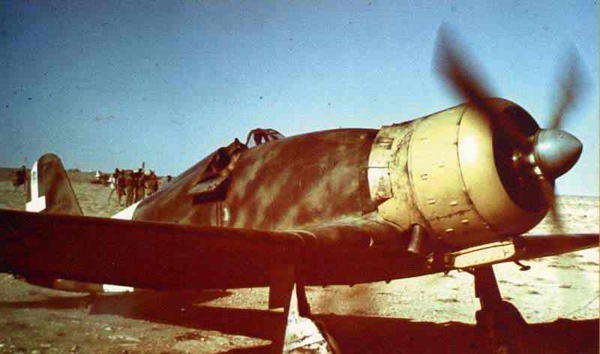
Italian First Line Aircraft Such as the Savoia-Marchetti SM79 and the Fiat G.50 (below) were obsolete by any standard and suffered badly at the Hands of the Royal Air Force


The Italian Air Force produced one of the most influential thinkers on modern warfare Marshall Giulio Douhet. Douhet’s theories on strategic bombing would become the staple of the American Army Air Corps (and later Air Force) and the British Royal Air Force.  Although Douhet was influential in other air forces and even on Mussolini’s thought the Italian Air Force constantly invoked Douhet’s theories but never grasped really grasped them. This was evidenced by having never built or trained a bomber force that could even remotely attempt to execute them, including building the types of aircraft and the bombs needed to carry out such a strategy. The Air Force neglected tactical air support to the Army and only late in Italy’s War began to produce fighter aircraft that could compete with Allied designs. Part of this was due to Italy’s Air Force leadership’s lack of understanding of modern air warfare and design and the need for high octane fuels and petroleum needed to power modern aircraft and instead “sought to make a virtue of these deficiencies by standardizing them,” by continuing to produce substandard aircraft even when modern designs were available.  As a result Italy’s Air Force failed in every way during the war.

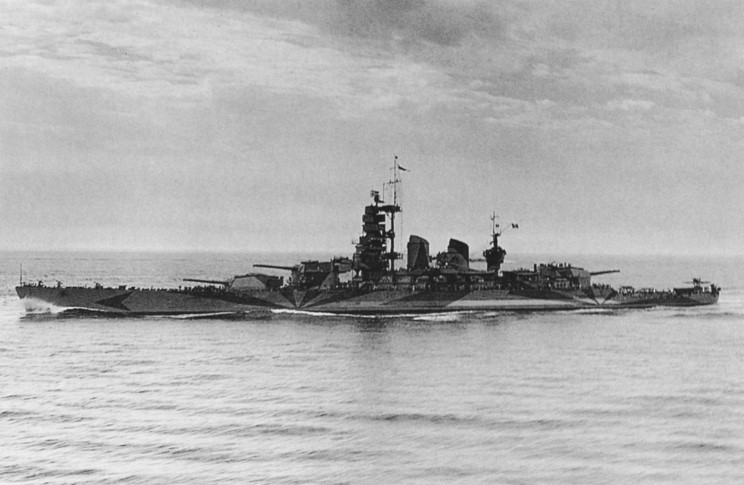
Despite Fast Modern Battleships Like the Vittorio Ventio the Italian Navy waged a Timid Campaign in the Mediterranean against the British

Like the Air Force the Italian Navy enjoyed Mussolini’s favor.  Mussolini saw an offensive minded fleet which would dominate the Mediterranean.  He did succeed in building up the strength and tonnage of the Navy during the 1920s and early 1930s. Italy entered the war with the largest submarine for in the world, but despite their superior numbers this force was hampered by bad designs with numerous combat deficiencies, as well as poor tactical doctrine. Light forces which could have been used extremely effectively in the confines of the Mediterranean in conjunction with air power and submarines were neglected.  The Italian Admirals favored capitol ships and focused on battleships and large cruisers.  While many of these were good designs with adequate speed and armor to fight, they also had numerous flaws related to ammunition, fire direction and control systems and lack of radar.  Added to this was the lack of offensive mindedness on the part of the Italian Naval leadership that contradicted what Mussolini desired and which focused on preserving the fleet vice seeking maritime supremacy.  The Italian Navy also was hampered by shortages of fuel oil to conduct naval operations.  The Navy had one weapon that provided some measure of success, the manned torpedo.  The Navy’s operations were never integrated with the Air Force on which it depended for air cover having no naval air arm and failed to support the Army by keeping the Italian forces in North Africa supplied.  The Navy lost a number of opportunities during the early part of the war to deal heavy blows on British naval forces but were dealt significant defeats at the Battle of Cape Matapan and the British Naval Air Strike on the major Italian Naval Base at Taranto, an action which helped inspire the Imperial Japanese Navy to attack Pearl Harbor.

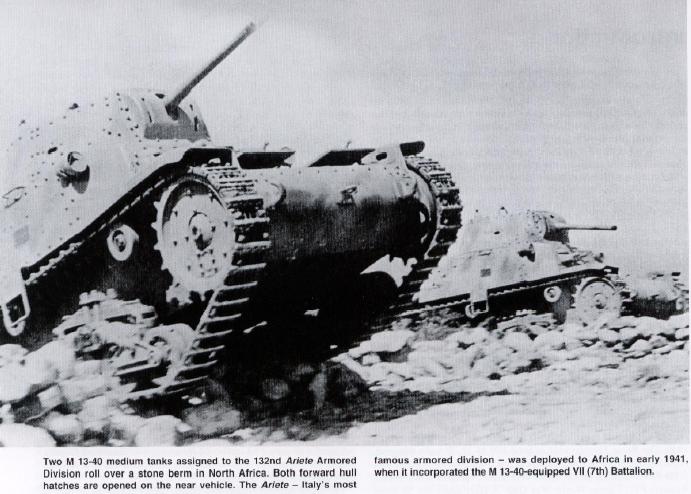
Captured Italian Tanks in Australian Service in North Africa

The Italian Army could best be characterized as a large an ineffective force bent on maintaining a bloated and antiquate force structure. Italian Army leaders put their faith in numbers and the strength of the human will rather than in the technological revolution that was beginning in the 1930s.  It had not evolved in the inter-war years as had other armies in use of modern artillery, mechanized forces, motor transport and armored forces.  It built up a large number of divisions, almost all of which were non-motorized infantry divisions. The Army’s “armored” divisions were poor in comparison to British, French or Russian equivalents with obsolescent tanks and poor tactical doctrine . Italian artillery remained dependant on horse and mule teams to transport the gun carriages that mounted obsolete World War One vintage gun designs, despite newer weapons being available as well as motor transport. Italy had the lowest vehicle to personnel percentage of any of the major European powers making her forces nearly immobile in terms of modern war.  Tank designs were limited by lack of team planning and obsolete designs which were unable to compete with allied designs of even the early war years.  Italian tanks were small, underpowered, under armored and under gunned. Italian units at all levels suffered from lack of heavy weapons, machine guns and anti-tank guns. As such in nearly every theater they were outclassed by their opponents and defeated even by weak powers, notably the invasion of Greece.  Italian Army leadership was most often inept and produced only one notable combat commander, General Messe who commanded Italian troops in the Soviet Union and later assumed commanded of Panzer Army Afrika when Field Marshal Rommel was ordered back to Germany by Hitler. .

The Italian Army’s performance in the new forms of mechanized warfare seen in the Second World War was abysmal in most cases with the exception of a few units such as the Arête Armored Division in North Africa which won both the respect and admiration of the Germans and their British opponents.

The stage for this debacle was set by the Army’s senior leadership whose credo was that men were the invaluable resource not machines.  It was a illogical “mind over matter” mindset that was a military and cultural that predated Mussolini and Fascism and was almost impervious to change even in the wartime conditions.  This mindset emphasized a large number of divisions, almost all of which were unmechanized.  These were nearly immobile infantry divisions with weak artillery, limited anti-tank and automatic weapons capabilities which were numerical inferior (2 regiments with only 7000 troops) when compared to German or British infantry divisions which averaged 14,000 to 17,000 full strength in the early war years.  They also suffered a dearth of communications capability or means to coordinate close air support from the equally unprepared Italian Air Force.  It was in short an army incapable of waging a modern war.

Had the army been well trained and equipped, the troops better led and their commanders competent their performance might have been better.  However the training was poor, leadership bad at every level, especially at junior levels where the Army made “virtually no attempt to select its reserve officers for military aptitude or to train them to acceptable standards of tactical or technical competence.”  The Italian High Command failed to organize train or equip mechanized divisions even when they realized that one motorized division had the capability of 4 non motorized divisions. The few Italian mechanized divisions such as the Trieste suffered from an inability to fight mounted operations and a lack of armored cars and support vehicles, while Armored divisions had to make do with poor quality tanks that had neither the firepower, protection or mechanical reliability and speed of either their German allies or British and Russian opponents.  The armored divisions also suffered from a lack of armored cars for reconnaissance, mobile modern artillery and inadequate numbers of radios for communication. Any attempt at mechanized warfare was also hampered by the backward Italian logistics system which was incapable of supporting a mobile army.

With all of these limitations it is not surprising to see how the Italian Army failed to effectively wage modern mechanized war, despite having done so against the Ethiopians in 1936. In that campaign they employed tanks, mechanized forces and aircraft, as well as chemical weapons against the valiant but ill equipped Ethiopians to a devastating effect.  These lessons were not learned by the Army. In the three major theaters where it was engaged the Italians had an opportunity to use mechanized forces yet failed in every case. In Greece the Italian Army fought a disjointed campaign.  They failed to concentrate forces against the Greeks or to make use of mechanized forces.  Neither did they coordinate air support and were handily defeated by the Greeks. This was the result of poor planning, poor leadership and poor execution and forced the Germans to come to the aid of Italy.

In North Africa the Italian 10th Army a mostly infantry force was defeated in detail by one British armored and one motorized infantry division under General O’Connor in the fall of 1940. The Italian defeat again ended with German intervention in the form of Rommel’s Afrika Korps.

Italian performance in mechanized warfare in North Africa remained poor mainly due to the inability of the Italian high command to rectify shortfalls in vehicles, tanks, mobile artillery, anti-tank units and provide adequate communications systems.  Despite all the handicaps imposed on them the leaders of Italian mechanized forces in North Africa learned “far more quickly than the British the lesson that armor, artillery and infantry must function as a team both operationally and tactically.” These forces gave a good account of themselves in the Battle of El Alamein.  In Russia the Italian forces had great difficulty and the 8th Army was decimated during the Stalingrad campaign and following actions.  Only a few leaders grasped the need for an effective mechanized and armored force and these leaders such as General Messe (Italian Corps in Russia 1941 and Panzer Army Africa 1943) were not in position to influence policy despite being effective combat leaders.

In the end it must be said that the Italian Army was ill-prepared to re-fight World War One much less the mechanized war that was the Second World War. This was a key factor in Italy’s battlefield failures and ultimate defeat.  Italy’s strategy was ineffective and poor leadership at all levels coupled with poor command and control, power struggles between Mussolini and his Generals and poorly executed operations all led to defeat. In Greece insufficient forces were used in conjunction with bad assumptions of how the Greeks would deploy their forces and the effectiveness of the Greek Army.  In North Africa a timid advance and failure to use what armored forces were available left the Italian 10th Army in a bad tactical position from which it was routed. Likewise Italian reluctance to ask for or accept German help when offered in the form of a Panzer division contributed to this defeat.

On the land, sea and air the Italian military failed to coordinate the grand strategy of coordinating land, air and sea operations and the economic, mobilization and war production issues needed to win the war.  Italian participation in the war proved to be a liability to the Germans despite the “paper” strength of the Italian military.  Mussolini’s lust for power and dominance in southern Europe, the Balkans and North Africa brought Italy into a conflict that its military was doomed to lose.

3 Comments

Filed under Loose thoughts and musings

The Battleships of Pearl Harbor

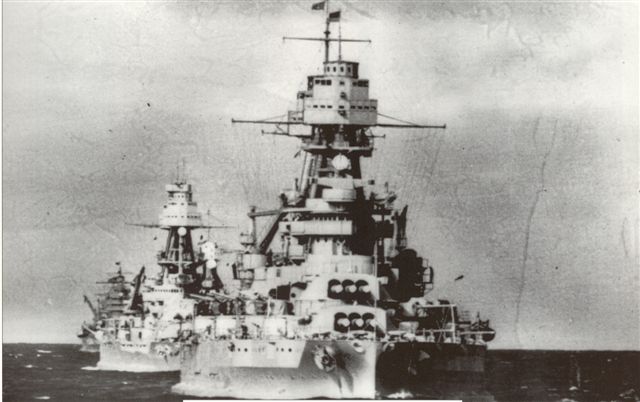
Arizona Leading the Battle Line

“Yesterday, Dec. 7, 1941 – a date which will live in infamy – the United States of America was suddenly and deliberately attacked by naval and air forces of the Empire of Japan…. The attack yesterday on the Hawaiian Islands has caused severe damage to American naval and military forces. Very many American lives have been lost.” Except of President Franklin D Roosevelt’s Pearl Harbor Speech December 8th 1941

Today is the 68th anniversary of the Japanese attack on Pearl Harbor and as we were then we are at war.

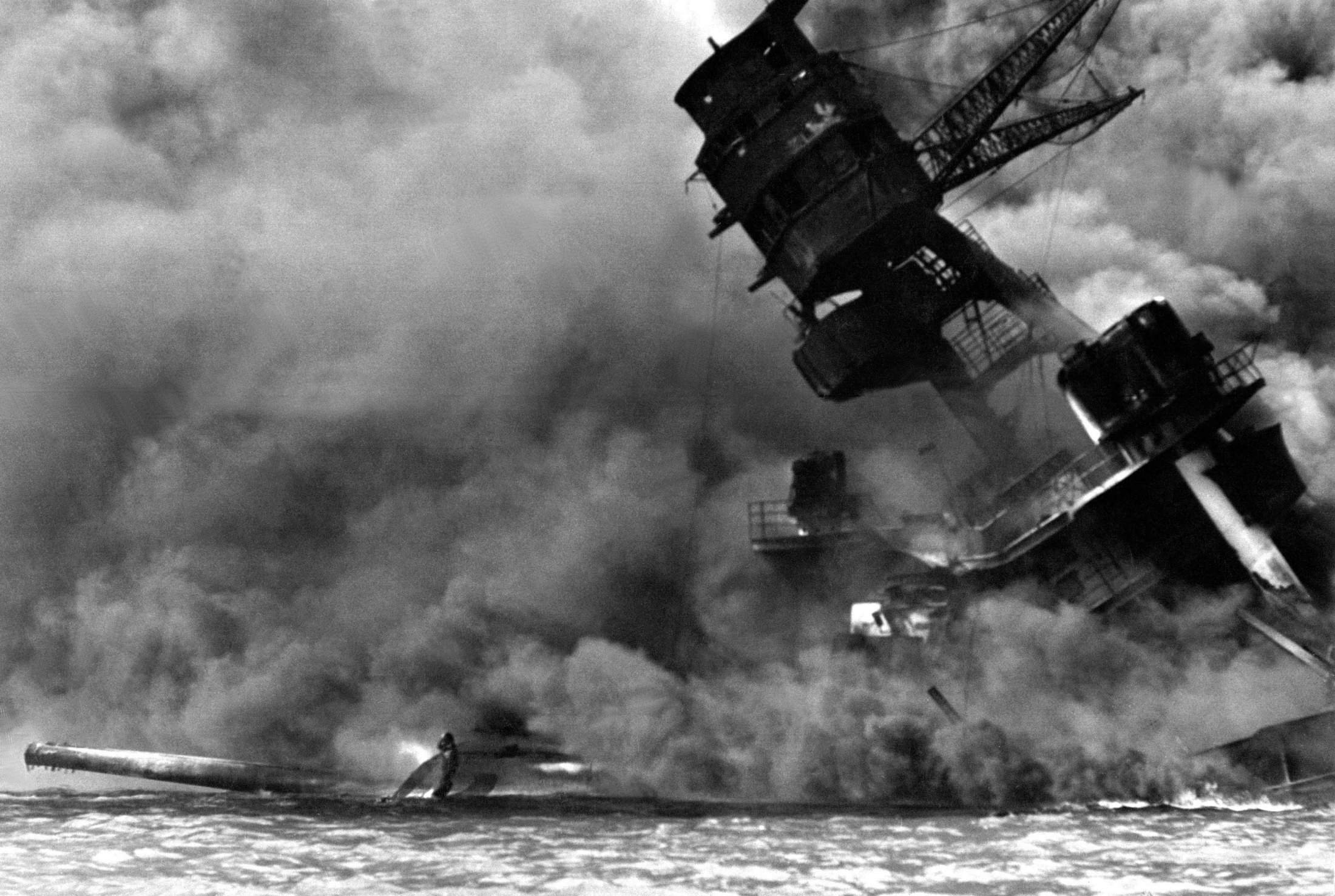
A Date that Will Live in Infamy: USS Arizona Burning

I remember reading Walter Lord’s “Day of Infamy” when I was a 7th grade student at Stockton Junior High School back in 1972.  At the time my dad was on his first deployment to Vietnam on the USS Hancock CVA-19.  As a Navy brat I was totally enthralled with all things Navy and there was little that could pull me out of the library.  Over the years I have always found the pre-World War Two battleships to be among the most interesting ships in US Navy history.  No they are not the sleek behemoths like the USS Wisconsin which I look at almost every day from Portsmouth Naval Medical Center as it lays moored across the Elizabeth River in Norfolk.  No these ships were the backbone of the Navy from the First World War until Pearl Harbor.  They were the US Navy answer to the great Dreadnaught race engaged in by the major Navies of the world in the years prior to, during and after World War One.

These ships were built over a period of 10 years and incorporated the advances in technology since the HMS Dreadnaught first came down the ways in 1906 to the experience gained in combat during the “Great War.”  While the United States Navy did not engage in battleship to battleship combat the ships built by the US Navy were the equal of many of the British and German ships of the era.

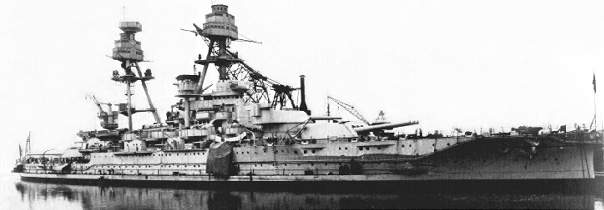
Oklahoma Before the War

The Battle Force of the Pacific Fleet in 1941 included 9 battleships of which 8 were at Pearl Harbor on the morning of December 7th.  In the event of war the US War Plans, called “Orange” called for the Pacific Fleet led by the Battle Force to cross the Pacific, fight a climactic Mahanian battle with the battleships of the Imperial Japanese Navy and after vanquishing the Japanese foe to relieve American Forces in the Philippines.  However this was not to be as by the end of December 7th all eight were out of action, with two, the Arizona and Oklahoma permanently lost to the Navy.

USS Oklahoma Being Raised from the Mud

These ships comprised 4 of the 6 classes of battleships in the US inventory at the outbreak of hostilities.  Each class was an improvement on the preceding class in speed, protection and firepower.  The last class of ships, the Maryland class composed of the Maryland, Colorado and West Virginia, was the pinnacle of US Battleship design until the North Carolina class was commissioned in 1941.  Since the Washington Naval Treaty limited navies to specific tonnage limits as well as the displacement of new classes of ships the United States like Britain and Japan was limited to the ships in the current inventory at the time of the treaty’s ratification.

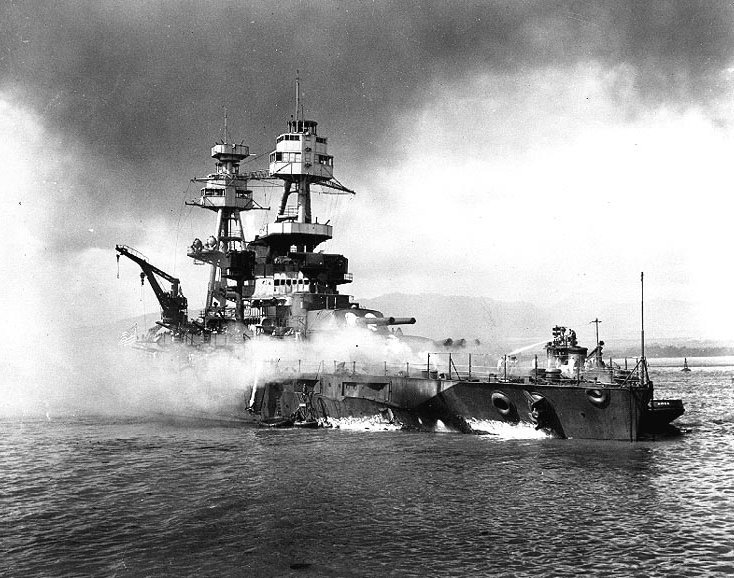
USS Nevada Aground and Burning

The ships at Pearl Harbor included the two ships of the Nevada Class, the Nevada and Oklahoma. The Two ships of the Pennsylvania class, the Pennsylvania and her sister the Arizona, the two California class ships, the California and Tennessee and two of the three Maryland’s the Maryland and West Virginia.  The Colorado was undergoing a yard period at Bremerton and the three ships of the New Mexico class, New Mexico, Mississippi and Idaho had been transferred to the Atlantic before Pearl Harbor to bolster US strength in that area due to the German threat.  The three older ships of the New York and Wyoming Classes, the New York, Arkansas and Texas also were in the Atlantic. Two older battleships, the Utah and Wyoming had been stripped of their main armaments and armor belts and served as gunnery training ships for the fleet. The Utah was also at Pearl Harbor.

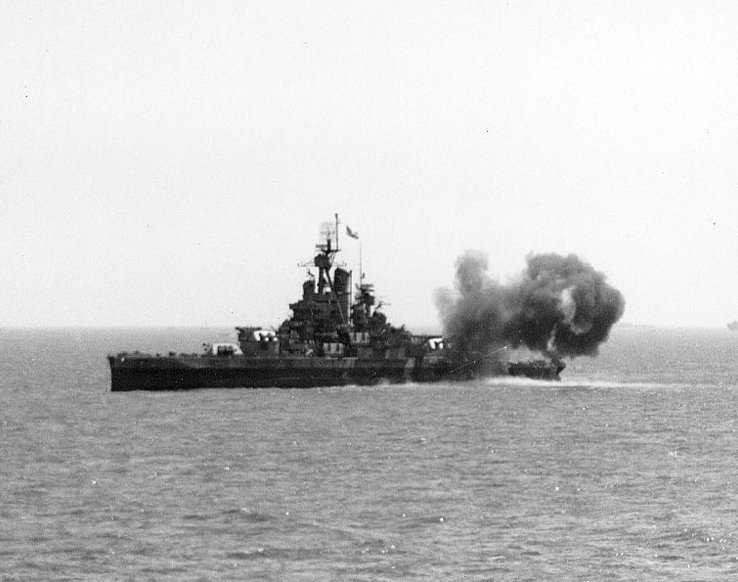
USS Nevada Firing on Utah Beach: D-Day

The ships that lay at anchor at 0755 that peaceful Sunday morning on “Battleship Row” and in the dry dock represented the naval power of a bygone era which was not recognized until two hours later. The age of the battleship had passed, but even the Japanese who launched the attack did not realize that the era had passed as they continued to build the massive super-battleships Yamato and Musashi mounting 9 18” guns and displacing 72,000 tons, near twice that of the battleships of the Pacific Fleet.

Arizona’s Main Battery

The Oklahoma and Nevada were the oldest ships in the Battle Force.  Launched in 1914 and commissioned in 1916 the Nevada and Oklahoma mounted ten 14” guns and displaced 27.500 tons and were capable of 20.5 knots. Serving in World War One alongside the British Home Fleet they were modernized in the late 1920s they were part of the US presence in both the Atlantic and Pacific in the inter-war years. Oklahoma would take part in the evacuation of American citizens from Spain in 1936 during the Spanish Civil War.  During the Pearl Harbor attack Oklahoma was struck by 5 aerial torpedoes capsized and sank at her mooring with the loss of 415 officers and crew. Recent analysis indicates that she may have been hit by at least on torpedo from a Japanese midget submarine. Her hulk would be raised but she would never again see service and sank on the way to the breakers in 1946.

USS Pennsylvania in Drydock with Wrecked USS Cassin and USS Downs

Nevada was the only Battleship to get underway during the attack.  As she attempted to escape the harbor she was heavily damaged and to prevent her sinking in the main channel she was beached off Hospital Point.  She would be raised and returned to service by the May 1943 assault on Attu.  She would then return to the Atlantic where she would take part in the Normandy landings off Utah Beach and the invasion of southern France in July 1944.  She then returned to the Pacific and took part in the operations against Iwo Jima and Okinawa where she again provided naval gunfire support.  Following the war she would be assigned as a target at the Bikini atoll atomic bomb tests, surviving these she would be sunk as a target on 31 July 1948.

USS Pennsylvania at Guam

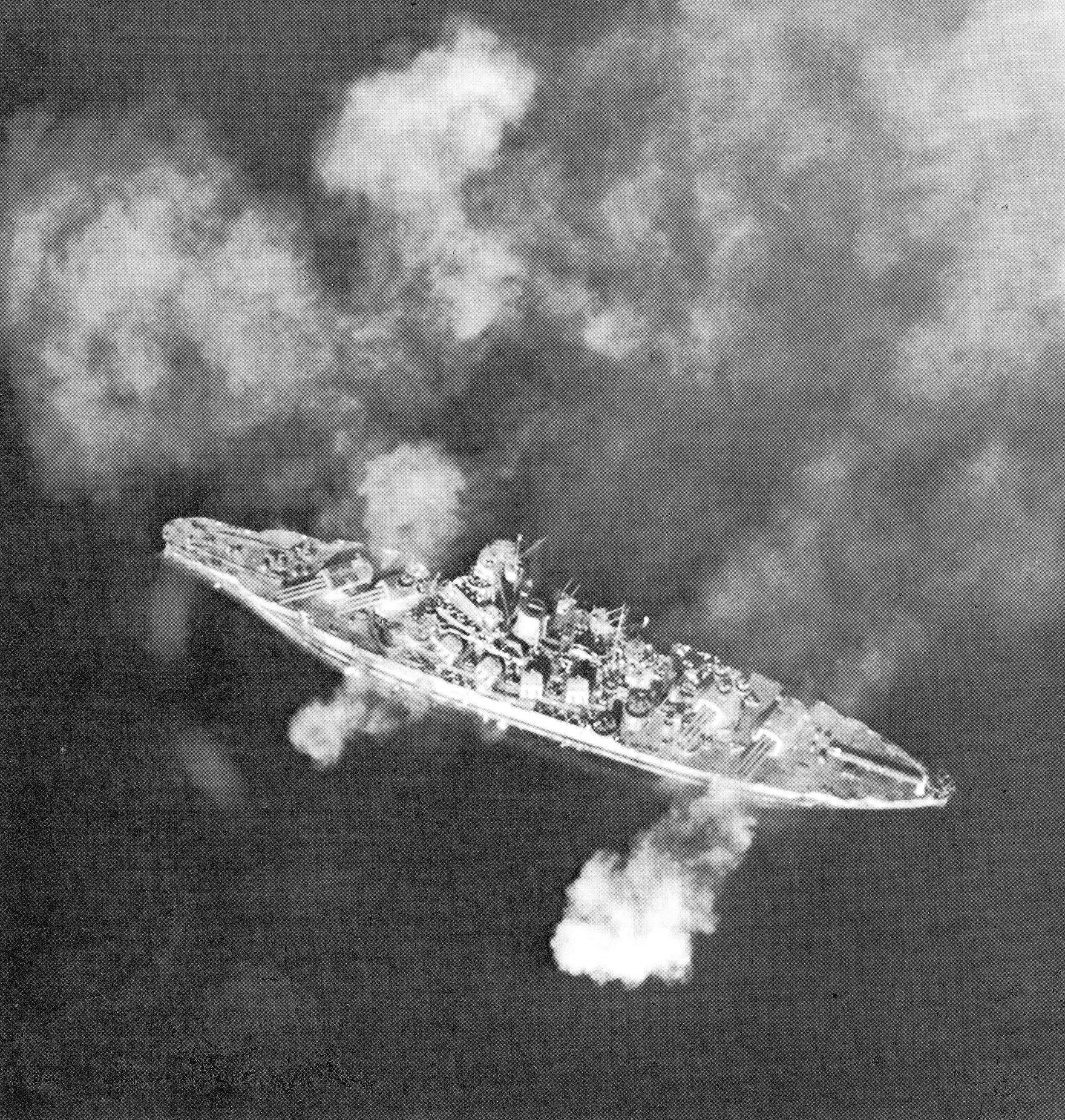
The two ships of the Pennsylvania Class were improved from the Oklahoma’s.  Mounting twelve 14” guns and displacing 31,400 tons and capable of 21 knots they were commissioned in 1916 and also participated in operations in the Atlantic in the First World War.  Both being rebuilt and modernized in 1929-1931 they were mainstays of the fleet being present at Presidential reviews and making goodwill visits around the world.  Pennsylvania was the Pacific Fleet Flagship on December 7th 1941 and was in dry dock undergoing maintenance at the time of the attack. Struck by two bombs she received minor damage and would be in action in early 1942. She underwent minor refits and took part in many amphibious landings in the Pacific and was present at the Battle of Surigo Strait.  Heavily damaged by an aerial torpedo at Okinawa Pennsylvania would be repaired and following the war used as a target for the atomic bomb tests. She was sunk as a gunnery target in 1948.

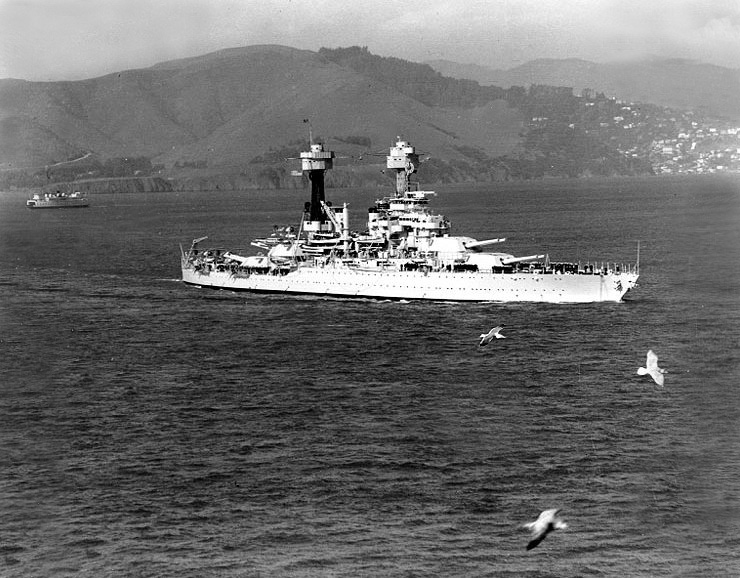
USS Pennsylvania Passing Under Golden Gate Bridge Before the War

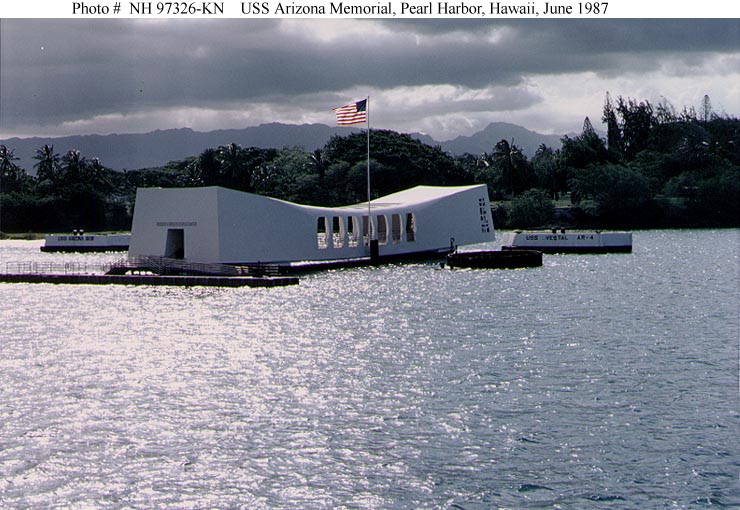
Arizona was destroyed during the attack.  Hit by 8 armor piercing bombs one of which penetrated her forward black powder magazine she was consumed in a cataclysmic explosion which killed 1103 of her 1400 member crew.  She was never officially decommissioned and the colors are raised and lowered every day over the Memorial which sits astride her broken hull.

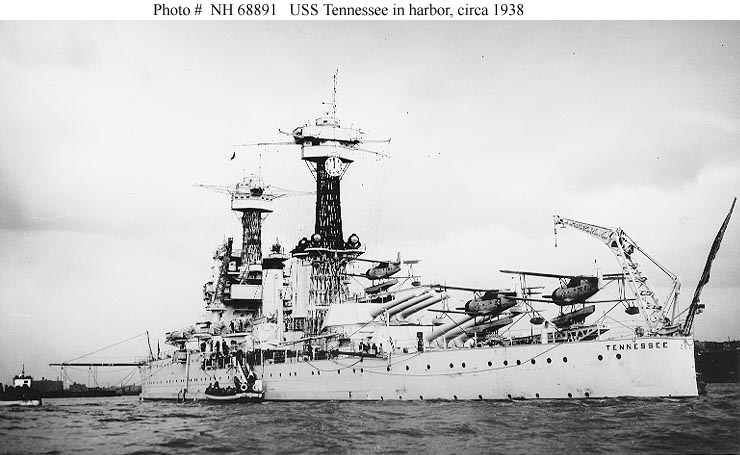
USS Tennessee 1938

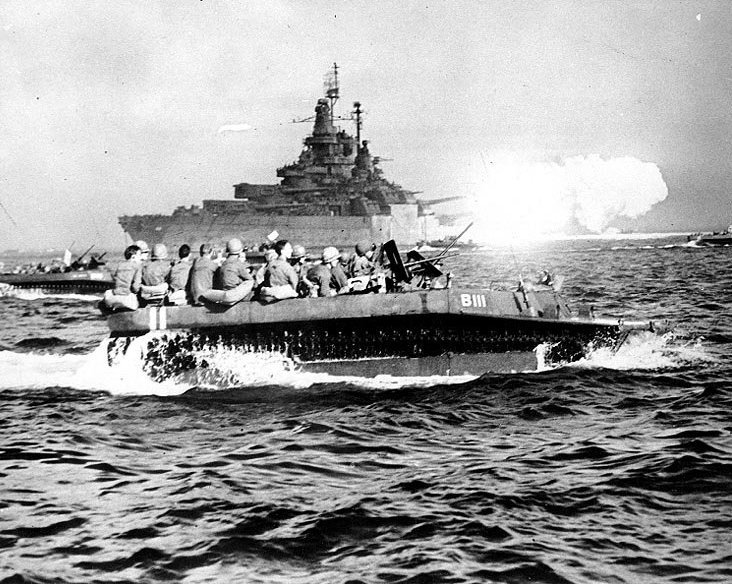
The Tennessee and California were the class following the New Mexico’s which were not present at Pearl Harbor.  These ships were laid down in 1917 and commissioned in 1920.  They mounted twelve 14” guns, displaced 32.300 tons and were capable of 21 knots.  Tennessee was damaged by two bombs and was shield from torpedo hits by West VirginiaCalifornia was hit by two torpedoes but had the bad luck to have all of her major watertight hatches unhinged in preparation for an inspection.

USS Tennessee at Okinawa

She sank at her moorings and would be refloated, rebuilt and along with Tennessee modernized with the latest in radar, fire control equipment and anti-aircraft armaments.  Both ships would be active in the Pacific campaign and be engaged at Surigo Strait where they inflicted heavy damage on the attacking Japanese squadron. Both would survive the war and be placed in reserve until 1959 when they were stricken from the Navy list and sold for scrap.

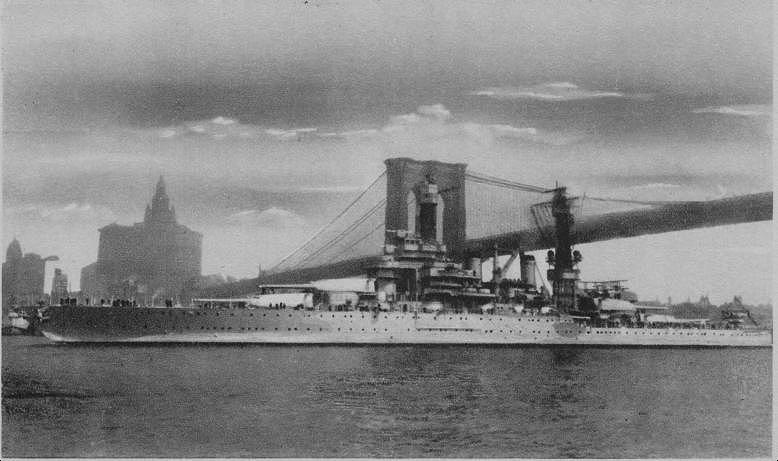
USS California Passing Under Brooklyn Bridge

The Maryland and West Virginia were near sisters of the Tennessee class.  They were the last battleships built by the United States before the Washington Naval Treaty.  Mounting eight 16” guns they had the largest main battery of any US ships until the North Carolina class.

USS Maryland 1944

The displaced 32,600 tons and could steam at 21 knots. Laid down in 1917 and commissioned in 1921 they would be modernized in the late 1920s they were the most modern of the “Super-Dreadnoughts” and included advances in protection and watertight integrity learned from British and German experience at Jutland.

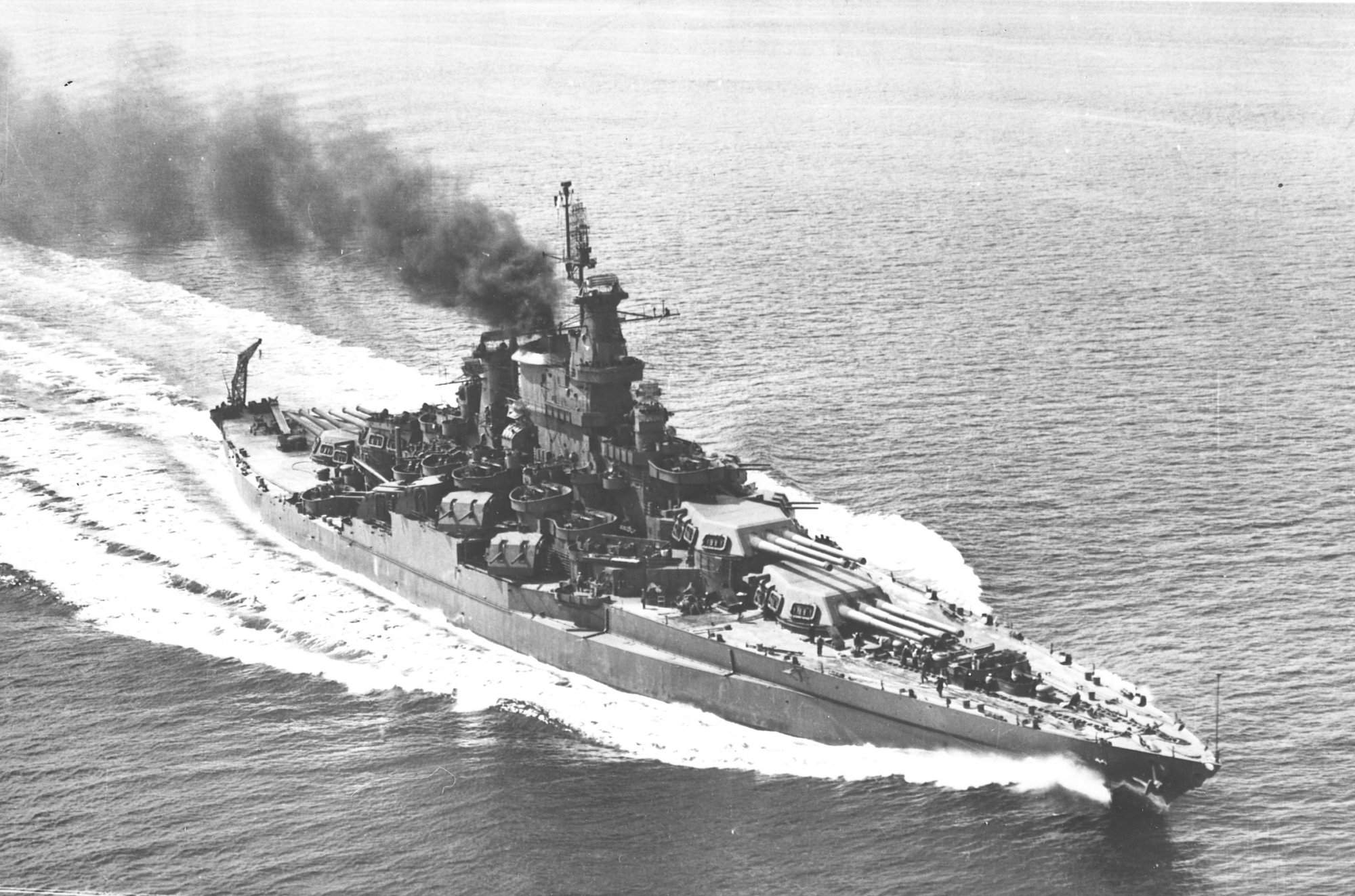
USS California 1944

At Pearl Harbor Maryland  was moored inboard of Oklahoma was hit by 2 bombs.  She would be quickly repaired and returned to action.  She received minimal modernization during the war. She would participate in operations throughout the entirety of the Pacific Campaign mainly conducting Naval Gunfire Support to amphibious operations. 

USS West Virginia 1934

and in 1944


West Virginia suffered some of the worst damage in the attack. Hit by at least 5 torpedoes and two bombs she was saved from Oklahoma’s fate by the quick action of her damage control officer to counter flood so she would sink on an even keel.  She would be raised, refloated and taken back to the West Coast for an extensive modernization on the order of the Tennessee and California. 

Damage to West Virginia’s Hull

The last Pearl Harbor to re-enter service she made up for lost time as she lead the battle line at Surigo Strait firing 16 full salvos at the Japanese squadron helping sink the Japanese Battleship Yamashiro in the last battleship versus battleship action in history.  West Virginia, Maryland and their sister Colorado would survive the war and be placed in reserve until they were stricken from the Naval List and sold for scrap in 1959.

The battleships of Pearl Harbor are gone, save for the wreck of the Arizona and various relics such as masts, and ships bells located at various state capitals and Naval Stations.  Unfortunately no one had the forethought to preserve one of the survivors to remain at Pearl Harbor with the Arizona.  Likewise the sailors who manned these fine ships, who sailed in harm’s way are also passing away.  Every day their ranks grow thinner.  As December 7th  passes into history it is fitting to remember these men and the great ships that they manned.   If you know a Pearl Harbor survivor or a sailor who served on one of these ships take the time to thank them.

Peace,

Padre Steve+

USS Arizona Memorial

21 Comments

Filed under History, Military, Navy Ships, world war two in the pacific

Padre Steve’s Thoughts on the BCS and the NFL

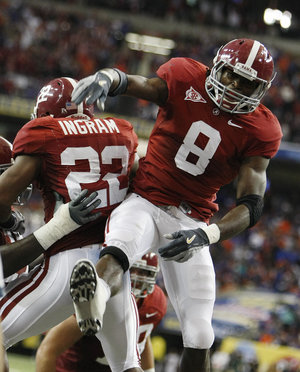
The Crimson Tide “Rolled” over the Florida Gators to reach the BCS Championship

Well the long wait to see who will compete in the BCS Championship and it looks like we have the Alabama Crimson Tide up against the Texas Longhorns.  The Tide won their SEC championship in a walk over the overrated Florida Gators.  The Gators who have not been dominant this year and struggled in a good number of games despite being undefeated before yesterday didn’t look like they belonged on the same field as the Crimson Tide.  The Gators conference opponents excluding the championship game were a combined 44-40 and their division opponents were 30-30.  Exclude the three sacrificial lambs and this is not a dominant team.  The fact that as reigning National Champion they had Florida International University (FIU) of the Sunbelt Conference as their next to last game before the SEC Championship speaks volumes to me about the school as they ran up the score on the hapless FIU 63-3.  Schools from the PAC Ten, the Big 12 and even the Big 10 don’t put schools like that in their schedule that late in the season.  Sorry Florida has no class in picking three teams from either the Sunbelt or Big South on their Schedule.  They deserved to lose.

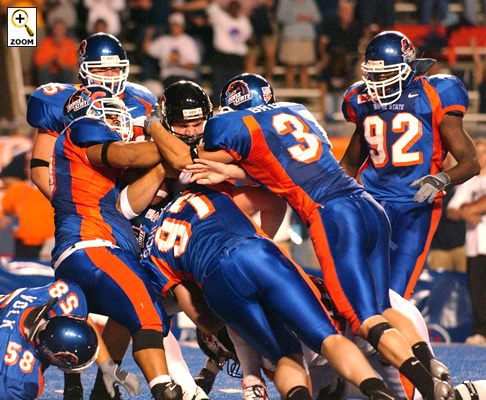
Boise State: The Team the Big Teams Won’t Play

Texas and Nebraska played one hell of a game, Nebraska came up big and I thought should have won the game.  I think that Texas has the better team but Nebraska played well enough to win. I have no dog in the fight between Texas and Alabama and I expect that it should be a great championship game. Alabama was definitely far more deserving of being in the BCS Championship Game than did Florida.

As far as the rest of the BCS games they are in a sense meaningless except to the teams involved because none can produce a National Champion.  I personally think that the NCAA needs a true playoff system the fact that so many people, the NCAA, the Polls and the Bowl sponsors and the schools themselves have so say due to the money involved that is unlikely that such would ever happen.  I think a 16 tourney would do wonders for the NCAA but what do I know.  As it stands now teams from the “middle” conferences will never get a true shot at an NCAA title despite having superior teams’ because the big conferences, big universities and their powerful backers in the media will never allow it to happen. That sucks for teams like Cincy, Boise State and TCU, all undefeated and regulated to playing in bowls that will not allow them to be considered for the national championship.  At least the NCAA Basketball tournament and the NCAA Baseball World Series give teams from other conference a fighting chance to compete.  Until then the current system promotes a fascist and undemocratic system where the true manta of “any given Saturday” will never be tested in a championship game.  Simply put the way the NCAA runs this show is pathetic.  Why not introduce a tournament? Simply put it is money and the vested interests of big conferences who due to financial remuneration will never allow their conferences to be really put to the test.  The big teams refuse to play teams like Boise State in the regular season because they could lose. Thus Florida plays Florida International, Charleston Southern and Troy rather than halfway competitive teams that might just beat them.  Florida played just 2 ranked teams the entire year and lost to one of them.  I did have cause for rejoicing this year as “Troy Tech” better known as the USC Trojans despite beating my Alma Mater UCLA finished 6th in the PAC 12.  They are such an arrogant school and I love to see them lose, unless they are playing Ohio State or another overrated Big 10 team in the Rose Bowl.  Hell I even root for Notre Dame against Troy Tech. Pete Carroll runs a dirty show and likes to run up the score when there is no cause to do so.  He has no honor and I hope that USC sinks to nothing. That may not happen anytime soon, but life isn’t fair and there is always hope.  I’m not a San Francisco Giants fan because I like what happens to my team.

The Immaculate Reception

Now time to skewer the NFL.  Most teams in the NFL would have to be terrible to even be good. I long for the days without replay.  Back in the old days there were plays that were historic because they were blown calls.  They helped build rivalries and actually motivate fans. My dad was a rabid Oakland Raiders fan back in the day. The Raiders of that time were no stranger to on the field controversy.  The “Immaculate Reception” of Franco Harris helped spur the Steelers to greatness.  At the same time it motivated the Raiders and the rivalry was historic.  The same is true with the “Immaculate Deception” of the Raiders against the Chargers.  Fans of other teams can probably recall similar instances in their team’s history.  Today I watched the Redskins lose to the Saints.  The Saints no doubt are the best or one of the best teams in football. However they got lucky today, a missed chip shot field goal and some creative timeouts that led to ungodly long replay delays doomed the Redskins.  I personally think that the NFL’s anal insistence on trying to get every call right hurts the game.  I think that replay reviews should be limited to 30 seconds and the reviewer only have access to full speed replays.  If they can’t figure it out then well humanity strikes again. The fact that there is an unlimited amount of time, extra views and the ability to go frame by frame if needed takes that away, it is artificial and unnatural. Vince Lombardi and the other greats would find it embarrassing. Once again I could have cared less who won the game because I don’t like either team.  I just think that the NFL is afraid of real controversy and has forgotten that life isn’t fair.  Human beings make mistakes and since referees are human they will make them too. It sucks if is your team that loses because of a blown call, but that is part of life.  It means that there is real motivation to go get the bastards next year.

See the video of the Immaculate Deception:  http://www.youtube.com/watch?v=yUuOqUIHBZc

Today in the NFL was cool because a bunch of the “bad” or underdog teams won.  In fact they beat the “good” read “overrated” teams.  I loved it that the Raiders beat the Steelers and that the Dolphins beat the Patriots and the “Fork stuck in them” Giants handed the Cowboys ass to them.  I love mayhem.  Since with the exception of the Colts, Saints and the Vikings who lost to a good and underrated Cardinals team, there really are no exceptional teams in the NFL.  At least in the NFL unlike the NCAA the “bad” teams get a crack at the “good” teams. Yes Cleveland will always be with us and Detroit too, but once in a great while they surprise someone.

However, all this said it is what it is. The big conferences, bowl sponsors and media will crown who they want as national champion and the NFL is hell bent on trying to make everything fair.  Yes there are some legitimately great players and some outstanding teams in college football and the NFL but the systems that they are part of are ruining the game.

Will people agree with me on this…maybe more than I think, but I know that if there are partisans of Troy Tech and Florida out there who read this post that I may get flame sprayed by them, however, I just say look at the facts.  Facts don’t lie.  Yes my teams all suck this year. Thankfully this is merely a game to fill time in the cold winter and not the one true religion of Baseball, the Church of Baseball of which I am a member in good standing at Harbor Park Parish.  Only 4 months and 2 days to opening day at Harbor Park.  Thanks be to God.

Peace,

Padre Steve+

Leave a comment

Filed under football, philosophy

Lessons on Coalition Warfare: The Dysfunctional Coalition German and the Axis Partners on the Eastern Front

“The Dysfunctional Coalition: The Axis Powers and the Eastern Front in World War Two” by R. L. DiNardo. Published in The Journal of Military History October 1996, 60 Research Library pp. 711-730

A Romanian Renault 35 Light Tank Rather Than

The question of the German dominated European Axis alliance in the Second World War is one of the more neglected subjects of World War Two and has application to today’s multi-national campaign in Afghanistan. In most accounts of World War Two the relationship of the Germans to their coalition partners is minimal.  This includes the standard works on the subject of B.H. Liddell-Hart, Williamson Murray, Chester Wilmot and David M Glantz,   Of Germany’s Allies Italy usually receives some attention in the context of the campaign in North Africa and Mediterranean.  Its efforts on the Eastern Front are usually neglected except for how the Italian 8th Army was shattered during the Stalingrad campaign.  The efforts of Hungary, Rumania and Finland receive scant attention from anyone. Popular German memoirs provide little substantive help as most German commanders looked down on their military capabilities. Kesselring’s memoirs and Rommel’s papers give some views, mostly negative of the Italians and Manstein some mention on the Italians, Hungarians and Rumanians in the Stalingrad campaign.

Field Marshal Von Mannerheim of Finland Kept an Independent Course from Germany

In this badly needed essay Robert DiNardo examines the relationship of Germany to her allies on the Eastern Front where they came closest to fighting coalition warfare. This is a subject that he would expand on in his book “Germany and the Axis Powers: from Coalition to Collapse” (University of Kansas Press, 2005).  DiNardo believes that it is important to learn from the failure of Germany and its coalition just as we do from the success of the Allies.  This perhaps is his greatest contribution in an age where the United States must work with coalitions whose members have significant military weaknesses.  The situation in some ways places he United States in a similar position to Germany in the current wars on terror and campaigns in Iraq and especially Afghanistan.

Hungarian Soldiers on Obsolete CV-35 Tankettes at the Beginning of Barbarossa

DiNardo asserts “the way in which Germany conducted coalition warfare was reflective of the manner in which Hitler and the German military looked at the world, as well as the war in general” was a key factor in her defeat. German arrogance and hubris frequently kept them from gaining any advantage from their coalition partners. DiNardo believes that it was “a significant factor that contributed to the ultimate defeat of Nazi Germany.” (p.712)  He then notes the few successes of the coalition, particularly the German work with Rumanian air defense around the Ploesti oil refineries and the German-Finnish Winter Warfare School.  Apart from these he characterizes Axis coalition warfare on the eastern front as “poor” with “failures at every level.” (p.713)

DiNardo analyzes language barriers, the wide disparity between the modernity of the armies and the levels of technology and training of her coalition partners. He also deals with Germany’s failure to become the “arsenal of Fascism” as well as the lack of understanding of all the partners of the “relationship between national objectives, strategy and the morale of soldiers of officers and soldiers alike.” (p.713)  He provides a good description of the German liaison detachments allotted to the coalition armies, dealing with language, tactical communications weaknesses and the generally haughty attitude that the Germans displayed to their partners. He provides an excellent illustration of this in analyzing with the failure of XLVIII Panzer Corps at Stalingrad when the German Liaison to the Rumanian 1st Panzer Division was wounded and the division was destroyed for lack of German support.  So bad was the German attitudes toward their Allies at higher levels that DiNardo describes the German policies and attitudes as “imperialist.” (p.718)

Hungarian Withdraw from the Donets Bend

DiNardo also looks at the wide gap in transportation capabilities of the various armies and the failure of the Germans to better provide for the needs of their partners in contrast to the United States assistance to her allies.  In his analysis he notes how the Germans provided obsolete captured Czech and French weapons and vehicles to the allies instead of providing them with the plans to build German designs in Rumanian and Hungarian industrial concerns capable of their manufacture. (pp.718-719) The lack of modern equipment among the German allies impacted operations against the Red Army and was a factor the eventual defeat of the Germans the hands of the Red Army.

While even elite German formations often had significant equipment shortages and sometimes substandard equipment he does not note that the principle reason for this was that German did not go to a “total war” industrial production until Albert Speer took over as Armaments Minister.  This is perhaps the one weakness in the essay. The final part of the essay deals with the strategic goals and conflicts among the Axis coalition which were never worked out.  In this discussion he again goes to the relationships of the Germans at every level to their partners and how the Germans had a general distain for their allies’ capabilities. He discusses how various partners refused to cooperate with the Germans in different ways and times.

These problems impacted German efforts in significant way. The Finns never signed a formal alliance with Germany and pursued their own war goals, the underlying tensions between Hungary and Rumania over their own territory disputes meant that the Germans could not count on these key partners to work together in the campaign in Russia.  He finishes his essay by detailing the morale problems in the Hungarian, Italian and Rumanian armies as they fought on the Eastern front.

He sources this article well using histories, archival sources, operational orders and analysis by the various armies as well as interviews. Of particular note is that he goes to sources of the coalition partners and not just German sources.  This allows him to be far more nuanced and detailed in his discussion as opposed to others who simply ignore the contributions of the Axis partners.  His footnotes provide added detail and provide and lend support to his arguments.

The importance of this essay is twofold; first it provides a look at the relationship of German to her coalition partners on the Eastern Front.  This is important from a historic standpoint simply because it is such a neglected topic in most histories of the period and gives added depth to the reasons for Germany’s defeat.  One has to ask the “what if questions” in regard to had the Germans better treated, equipped and recognized their allies’ contributions to the war effort.

The second point of interest pertains to how history can inform the leaders of the United States and NATO in the Afghanistan campaign.  The lessons provided to any nation which has to engage in coalition warfare are important, especially of one of the partners enjoys significant military advantages over its allies.  This is the case in Afghanistan and the War on Terror where United States has found itself as the senior and vastly superior partner in a war which has multiple coalition partners in several theaters of operations.  Each coalition partner has certain military weaknesses in relationship to the United States as well as their own national interests, geo-political and economic relationships with competitors to the United States and internal political realities which impact their cooperation in the war.  As such the United States cannot allow itself to be cast in the role of a haughty imperialistic senior partner as did Germany and it must cultivate an attitude of assistance, respect and trust among its partners to assure their full cooperation and assistance in relation to U.S. goals in the war.  Failure to head the German lesson will ensure failure in the current campaigns.

1 Comment

Filed under History, iraq,afghanistan, world war two in europe

The Paradox of Conflicting Doctrine: The US Campaign in France and Germany 1944-1945

The Paradox

The paradox of the American Army’s training in speed and mobility and the strategic tradition of U.S. Grant influenced the final campaign in Germany just as they had the campaign in France.  This is one of the Russell Weigley in Eisenhower’s Lieutenants asserts that the American strategic tradition of U.S. Grant emphasized direct confrontation and defeat of the enemy’s major forces.  He asserts the development of this tradition by officers assigned to the Leavenworth schools was influenced by the Civil War and World War One and the Army’s experience as a frontier constabulary force.  He develops this theory alongside his discussion of the formation of the highly mobile and less powerful forces that the Army would deploy in World War Two and how this paradoxical combination of doctrine and force determined by conflicting legacies “put the army at cross purposes with itself…as it began to prepare for European War.”[i]

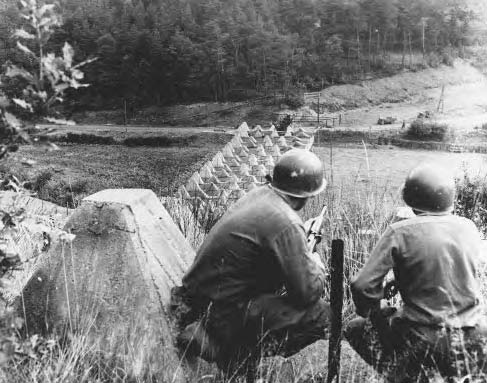
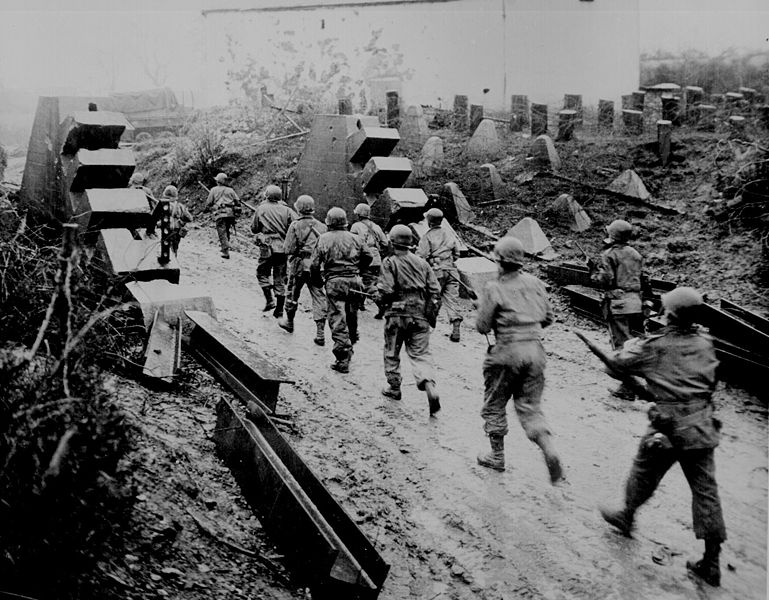
Crossing the Siegfried Line

The dogma of the Leavenworth School emphasized that “victory in large-scale war depends on a strategy of direct confrontation with the enemy’s main forces in order to destroy them.”[ii] This was not in itself different than the thought of contemporary European armies influenced by Clausewitz; but the Americans differed from the Europeans “in the extent to which they expected overwhelming power alone, without subtleties of maneuver, to achieve the objective.”[iii] The tradition developed from an emphasis on Ulysses S. Grant’s campaign in Virginia which understood that Grant had “defeated the armies of the Confederacy through head on assault by overwhelming strength to destroy them, so that in any future great war the United States would seek the destruction of the enemy armed forces by similar means.”[iv] It is perplexing that the Army failed to truly appreciate William Tecumseh Sherman’s use of strategic maneuver on the offense with the goal of destroying the enemy’s army. The fact that the Army failed to incorporate those lessons into its strategic thought, even as it built forces that were better suited to Sherman’s campaign is one of the contradictions of American military thought.[v]

Grant’s tradition was put into practice by Pershing in World War One to the extent that he could influence allied strategy, with mixed results.[vi] The reduction of the St Michel Salient and Meuse-Argonne offensive, though aided by German withdraws and achieved with high casualties, helped convince the Germans that the war was lost.[vii] “Only in late 1918 did the veteran American divisions show the same degree of tactical skill as their Allied and German counterparts, and the lessons came by bloody experience.”[viii] Pershing’s campaigns were bloody, but they came at a when maneuver had again become part of the war, and at the point where the Germans were beginning to collapse.  George Marshall warned about “generalizing about modern warfare from their 1918 experiences against a German army already stumbling into exhaustion.”[ix] Yet for “the American military, the First World War confirmed the doctrines of concentration and of fighting for complete victory, and out of the battlefields of Europe came the foundations of strategic faith….”[x] Weigley notes that: “In strategy, most American soldiers believed, the modern mass army left frontal assault as the only recourse.”[xi]

While Grant’s tradition remained a dominant feature of American strategic thought, the Army was becoming a mobile army whose divisions were to be “tough and lean.”[xii] General Leslie McNair reorganized the structure of the infantry division and later that of the armored divisions.  The heavy “square” infantry division of the First World War was reorganized with three infantry regiments and supporting elements and was characterized by its mobility than its sustained combat power.  McNair reorganized the armored divisions into lighter, though extremely flexible organizations built around the “Combat Command” and the tank was viewed as viewed as an instrument of exploitation, not a means to defeat enemy armor.  The result was an army formed “upon the principle of mobility and its lack of sustained combat power…did not serve it so well when it faced resolute and skillful enemies in strong defensive positions….”[xiii]

The new divisional structures were both mobile and flexible but in the context of the European campaign were wanting in sustained combat power.  Peter Mansoor comments that divisions “literally fought themselves out in constant operations.”[xiv] At the same time he takes issue with Weigley on the staying power of U.S. divisions commenting on the efficiency of the American individual replacement system.[xv] A U.S. Army study commented that in direct assaults against a emplaced enemy that “heavy casualties in such operations were more than the triangular division could sustain, with the result that the entire division was often rendered combat ineffective….”[xvi] McNair’s reorganization ignored General Chaffee’s 1941 admonition that armor must be organized into corps and employed in mass using not “hundreds but thousands of tanks…” calling the failure to train and organize “an adequate number of command echelons and corps troops to ensure proper employment and timely supply for these larger armored formations in active operation is indefensible.”[xvii]

To further complicate the American situation, the application of Grant’s tradition failed to take into account the principle of mass or concentration, which was vital to the success of a strategy of direct confrontation.  The theory demanded that the Americans have enough troops divisions to keep up pressure everywhere. Grant had such power at his disposal, Eisenhower did not.  The thought that “if the United States applied its superior power everywhere it must be able to rupture the defenses somewhere,”[xviii] was dominant.  But to be successful it required overwhelming superiority in numbers and firepower.  This strategy was in conflict with the Army that the Americans built to pursue the war, and in conflict with one of the more influential prewar American thesis on the subject, Infantry in Battle. This treatise stated:

“Generalship consists at being stronger at the decisive point-having three men there to attack one.  If we attempt to spread out so as to be strong everywhere, we shall end up being weak everywhere.  To have real main effort-and every attack and attack unit should have one- we must be prepared to risk extreme weakness elsewhere.”[xix]

It was an army designed for Sherman’s campaigns in Georgia and the Carolina’s, not Grant’s Virginia campaign. It was best suited to campaigns of strategic maneuver and concentration rather than frontal assaults along a broad front.  Its organization called for this and this fact was recognized before the war.[xx] Weigley notes that the “paradoxical commitment to a power drive strategy of head-on assault in an army shaped for mobility further contributed to the prolonging of the war by undermining the possible uses of mobility itself.”[xxi]

The theory of Grant, espoused by the Leavenworth school is fine there are sufficient forces to make it work. General McNair and Army planners initially planned for an Army of over 200 divisions.  Such an army would have been able to execute the strategy without the problems experienced by the Allies in 1944 and 1945.  Unfortunately the American Army was afflicted by the War Department’s decision in 1943 to limit the Army to 90 divisions.[xxii] The limitation on the number of divisions ensured that it would be “difficult or impossible once the battle of France was launched to rotate them out of line for rest or refitting.”[xxiii] This became a key consideration of allied planning by late 1944 because once the existing divisions were deployed to Europe or the Pacific there were no more to replace them.  Drastic measures were taken to increase the number of infantry troops by speeding up the movement of the last available divisions to Europe and by combing troops out of the COMMZ and from the Army Air Force.[xxiv] Training programs were put in place to train tank crews and junior officers.  Yet, these programs did not begin to put significant numbers of replacements into the line until March 1945.[xxv] Mansoor, a critic of Weigley, agrees with him on many points and notes that the “90 division gamble was a decision that cost the lives of numerous servicemen-primarily infantry replacements-in Europe in 1944 and 1945.”[xxvi] The decision to limit the number of divisions forced Eisenhower into a position where he frequently faced an equivalent number of German divisions to those that he could employ.  This would be the case in at the beginning of 1945 despite the steady erosion of the German forces arrayed before him.

Leadership, Strategy and Tactics and the Performance of the Army
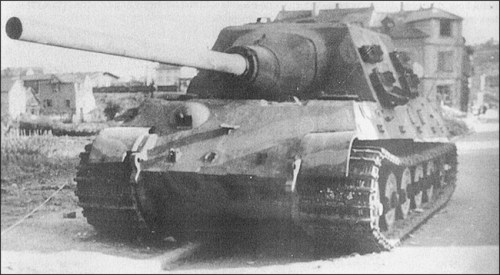
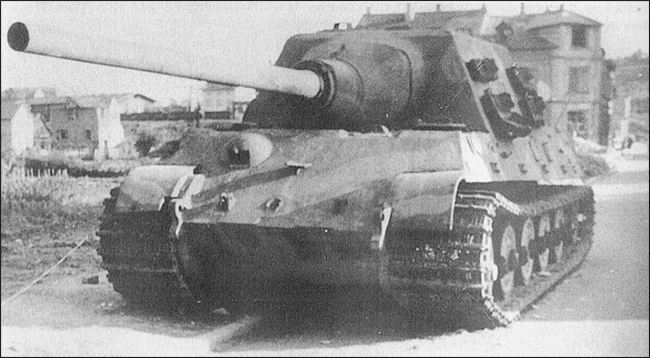
The Germans Employed the Jagdtiger in Small Numbers Against the American Onslaught

After the Bulge the Allies began their push to the Rhine.  Eisenhower “interpreted the Ardennes as confirming the necessity for his broad front strategy, particularly in closing up to the Rhine all the way to Switzerland.”[xxvii] Hastings notes that the Wehrmacht “retained psychological dominance on the battlefield,”[xxviii] and that “Allied commanders remained fearful about exposing their flanks in attack, even when the Germans no longer possessed the resources or mobility to intervene with conviction.”[xxix] In many places GIs and their British counterparts in Montgomery’s 21st Army Group failed to take the initiative and often the Allied commanders “expressed dismay about the lack of aggression shown by their troops.”[xxx] Gavin noted in his diary that: “With better troops, I see no reason why we could not run all over them…Our American army means well and tries hard, but….it is untrained and inefficient… certainly our infantry lacks courage and élan.”[xxxi] Despite this the Allied armies, in particular the Americans, made headway and in many places when well led performed admirably.

The Eifel

Following the reduction of the Bulge Eisenhower allowed Bradley to begin to break the West Wall in the Eifel. After the attack began Eisenhower stopped Bradley short of a breakthrough in order to shift weight of the offensive to Montgomery in the north ordering 12th Army Group to revert to the defensive.  Yet, Eisenhower allowed Bradley a “measure of freedom for limited attacks,”[xxxii] and Patton termed his “operations in the Eifel an “aggressive defense.””[xxxiii] The campaign was primary conducted against oddments of a number of Volksgrenadier divisions of 7th Army.

First Army was diverted on February 1st after making good progress in the Eifel to safeguard the right flank of 9th Army by capturing the Roer dams.  Hastings notes that a “more flexible and imaginative commander-or one unconstrained by the demands of inter-allied relations-would have allowed Hodges forces to keep going to the river and delayed Montgomery for the necessary few days.”[xxxiv] However Bradley felt that Eisenhower “had little choice but to accede to Montgomery’s demand.”[xxxv] Bradley allowed 3rd Army to continue “probing attacks,” and 3rd Army advanced across the Eifel breaking through the West Wall at Prüm and Bitburg.  For the first time the enemy showed “cracks in the admirable cohesion and discipline of the German army.”[xxxvi] Aggressive units of Patton’s 3rd Army were rewarded with dramatic advances. 4th Armored Division in “one bound covered 25 miles, taking 5,000 prisoners and killing several hundred Germans for the loss of 111 of its own men,”[xxxvii] and 10th Armored took Trier on 14 March.  Patton called the campaign “a long hard fought fight with many river crossings, much bad weather, and a great deal of luck.”[xxxviii] Despite this there were problems in some formations.  Hastings recounts how a platoon leader in a VII Corps unit told his commander during a crossing of the Sauer River that “These men have had it sir! They won’t budge for me or anybody else….”[xxxix]The G-3 of 6th Armored division noted that “some of our divisions are too sensitive to their flanks…the result of this is timidity…”[xl]

The Roer Dams, Grenade and Lumberjack

1st Army supported 9th Army by capturing the Roer river dams in preparation of Grenade.  The inexperienced 78th Division was able to secure the dams with help from the veteran 9th Division, though not before the Germans had destroyed the release valves to “flood the Roer valley for about two weeks.”[xli] This delayed the start of Grenade but the Americans finally captured a prize that had eluded them the previous fall.  The one truly notable aspect of this campaign was the continued erratic leadership of Hodges.  Gavin called it “impatient” and it nearly cost the Commanding General of 78th division his command.  Bradley’s aide, Major Hanson remarked that Hodges “was near exhaustion.”[xlii]

9th Army’s attack was conducted in concert with Operation Veritable of 2nd Canadian Army.  The plan was that the two armies would clear the area west of the Rhine destroying as much of the enemy as possible in preparation for the crossing of the river.  As such 9th Army remained under the operational control of Montgomery’s 21st Army Group.  9th Army crossed the Roer, hampered by the high waters and German resistance but captured Düren and München-Gladbach and closed up to the Rhine.  The “rapid build-up enabled Simpson to maintain intense pressure and on the last Day of February his armor broke away.”[xliii] 9th Army met up with the Canadians eliminated elements of the German Army that remained west of the river.  9th Army took over 30,000 prisoners and killed an estimated 6,000, but substantial numbers were evacuated by skillful German commanders.[xliv] The greatest disappointment was that Grenade failed to capture any bridges over the Rhine.   Montgomery turned down Simpson’s request to make a fast crossing of the Rhine at Urdingen, where there were few German troops.[xlv]

South of 9th Army the 1st and 3rd Armies launched Operation Lumberjack to attempt to envelope the German forces west of the Rhine in its sector in similar fashion to Grenade-Veritable. Facing weak German forces 1st Army made good progress capturing Cologne on March 5th.   3rd Army’s advance was exceptional.  Its plan to cut off the Germans on the west bank worked almost to perfection despite poor roads, snow and the opposition of the 2nd Panzer Division.[xlvi] General Gaffney’s 4th Armored division, drove 40 air miles, captured 5,000 prisoners killed another 700 Germans, capturing much equipment with the loss of only 29 men killed.[xlvii] Bradley called the division’s performance “the most insolent armored blitz of the Western war.”[xlviii] Patton’s armor covered “56 miles in three days to reach the Rhine near its confluence with the Moselle.”[xlix] For the first time “senior officers and headquarters fell into the American bag,”[l] including the command post of LXVI Corps and the commander of LIII Corps. In these operations the bold use of maneuver and concentration by Simpson, Hodges and especially Patton exploited the natural strengths of their formations to achieve their objectives.

Remagen
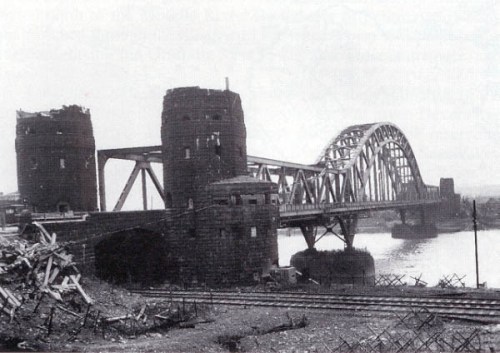
Remagen Bridge

1st Army’s swift advance and the chaos wreaked by Patton’s army led to the only instance in the campaign where the Allies captured a bridge over the Rhine intact.  The Ludendorff railway bridge at Remagen remained and on 7 March 9th Armored division detached a task force from CCB to take the bridge before it could be blown.   This force surprised the Germans and reached Remagen by 1300. General Hoge, hero of St. Vith, arrived quickly and ordered the capture the bridge as quickly as possible.[li] Hoge ignored orders to divert most of his troops to another crossing of the Ahr River and without orders “threw the rest of his armored infantry across the Rhine….”[lii] “In spite of the threat of the bridge being blown by the fleeing Germans, bold action by American infantry and engineers captured the bridge and established a bridgehead over the Rhine by 1630.  III Corps ordered 9th Armored division to “exploit the opportunity,”[liii] and “within 24 hours they had 8,000 men across.”[liv] Hodges exploited the opportunity and pushed the 9th, 78th and 99th divisions across the river where they continued to enlarge the bridgehead while fighting off fierce German counter-attacks.  By 24 March 1st Army had “three corps, six infantry divisions, and three armored divisions across the Rhine River.”[lv] The best German formations “arrived piecemeal and spent themselves in the same way, mustering only limited, scattered counterattacks instead of any major blow.”[lvi]

The Remagen crossing was not welcomed by all and restrictions were placed on 1st Army as it enlarged the bridgehead.  Carlo D’ Este saw Remagen as “typical of the lack of connection between SHAEF and its subordinate elements.”[lvii] “Pinky” Bull, the SHAEF G-3 was at Bradley’s headquarters when the Bradley was informed of the crossing.  Bull told Bradley that the Remagen crossing “just doesn’t fit in with the plan.”[lviii] Bradley recalled telling Bull: “What the hell do you want us to do,” I asked him, “pull back and blow it up?”[lix] During the next few days however “Bull’s unbending skepticism infected Eisenhower himself.”[lx] And by March 9th Bull informed Bradley that Eisenhower “did not want the Remagen bridgehead expanded beyond the ability of five divisions to defend it.”[lxi] The decision to favor Montgomery’s crossing of the Rhine by detaching divisions from 12th Army Group to support it caused consternation among Bradley and his commanders who feared that Montgomery would “use most of the divisions on the Western Front, British and American, for an attack on the Rhine plains…and the First and Third Armies be left out on a limb.”[lxii] Liddell-Hart noted that the order was “all the more resented because the U.S. Ninth Army…four days earlier, had been stopped by Montgomery from trying to cross the river immediately, as its commander, Simpson, desired and urged.”[lxiii]

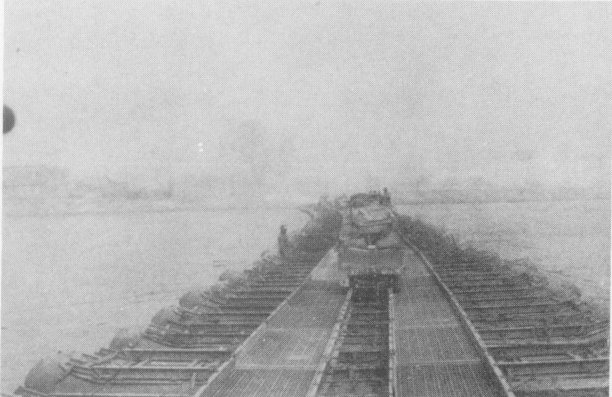
Patton’s 3rd Army Crossed the Rhine on the Fly at Oppenheim

Remagen’s aftermath showed Eisenhower’s continued commitment to the broad front, to closing up to the Rhine along its entire length, and his inordinate fear of German counter-stokes.  He remained “fearful that, as long as some German forces survived on the Western side of the Rhine, the potential existed for another potential unpleasant surprise, a counter-attack across an exposed American flank.”[lxiv] The facts belied the situation and Model, commander of Army Group B “had not only given up on trying to eliminate the American bridgehead at Remagen but had covertly begun ordering large elements of Army Group B to evacuate the Rhine and cross the river.”[lxv] This decision resulted “in a lost opportunity to have established a larger bridgehead across the Rhine.”[lxvi] It was another example of Eisenhower’s failure to exploit opportunity when it presented itself and of a desire more to not lose the war than to win it. Despite this “Remagen bridge was one of the great sagas of the war and an example of inspired leadership.”[lxvii] Wilmont called it “a brilliant coup,”[lxviii] a thought echoed by Liddell-Hart.[lxix] The German response to rush numerous units to contain the bridgehead made the Allies task when they crossed the Rhine at other points “much easier than they had anticipated.”[lxx]

Patton’s Saar-Palatinate Campaign

Patton’s 3rd Army attacked the Saar-Palatinate in concert with the 7th Army with the intent of assailing the West Wall from the rear and trapping the remnant of the German Seventh Army and the German First Army.  7th Army assaulted the West Wall while Patton’s army began its assault on 13 March with the XII and XX Corps attacking into scattered German resistance.  With the infantry making the breakthrough both corps unleashed their armored divisions in an exploitation role.  Patton’s attack was so successful that he was allowed to adjust his assault to carry it into 7th Army’s zone to encircle the collapsing German Army.  In an unusual command and control move Devers of the 6th Army Group gave Patch and Patton “the authority to communicate directly with each other, bypassing their different army group headquarters.”[lxxi] Large scale surrenders began to take place for the first time, including that of 3 Volksgrenadier divisions and the remnants of 2nd Panzer division.[lxxii]

US Soldier Standing Watch over Disabled Jagdtiger

Patton was urged on by Bradley, who warned him about “the danger of losing his divisions to Montgomery if he did not secure a Rhine crossing.”[lxxiii] Patton got his engineers and bridging equipment up quickly and Bradley ordered him to “take the Rhine on the run.”[lxxiv] On March 19th alone the Third Army overran more than 950 square miles of territory.”[lxxv] Third Army “cleaned up the west bank of the Rhine all the way south to Worms and Speyer; Third and Seventh Armies claimed well over 100,000 German prisoners in the victory.”[lxxvi] On the 22nd Third Army launched the 5th Infantry division across the Rhine at Nierstein and Oppenheim, surprising the Germans and beating Montgomery across the Rhine. Patton called Bradley: “Brad, for God’s sake tell the world we’re across…I want the world to know that Third Army made it before Monty.”[lxxvii] Weigley notes in this campaign “the American army’s sharpening instinct for the jugular,” and that it was a model “of not only how to gain ground of not only how to gain ground but to destroy enemy forces.”[lxxviii]

Plunder

9th Army and Allied Airborne forces participated in 21st Army Group’s grand set-piece crossing of the Rhine on 23 March.  The attack had been prepared for weeks by Montgomery and more resembled an amphibious operation than a river crossing. The attack employed 25 divisions supported by 3,000 guns with maximum air support and naval amphibious units.   Opposing the Army group were “five weak and exhausted German divisions”[lxxix] of 1st Parachute Army.  The assault cost 9th Army thirty casualties.  Montgomery also employed the American 17th and 6th British Airborne divisions in Operation Varsity which was the largest single day airborne operation of the war. Over 21,000 paratroops were dropped or air-landed in gliders into the face of heavy flak. Numerous troop transport planes and gliders were lost.  The operation was of doubtful utility, ground forces were already well on their way to the objective the paratroops were landed on and the operation had a heavy cost, 17th Airborne took “some 1500 casualties, including 159 killed.” And 6th Airborne lost another 1400.[lxxx]

The Ruhr Pocket and the Decision to Stop on the Elbe
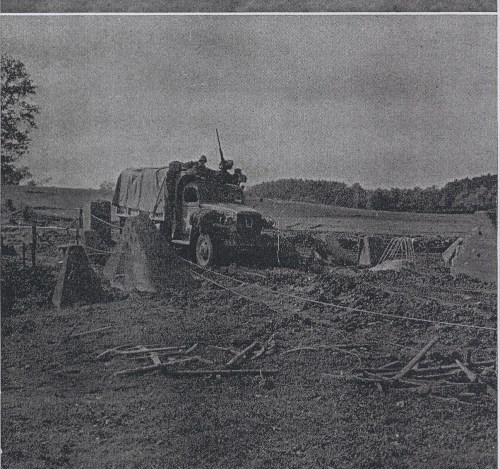

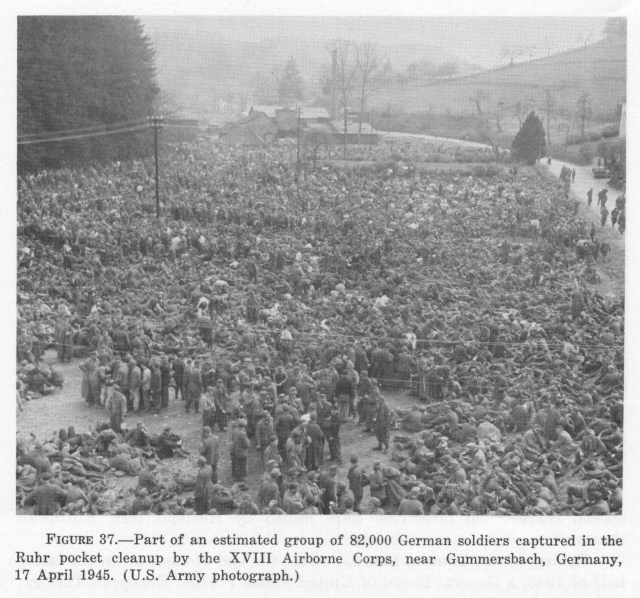
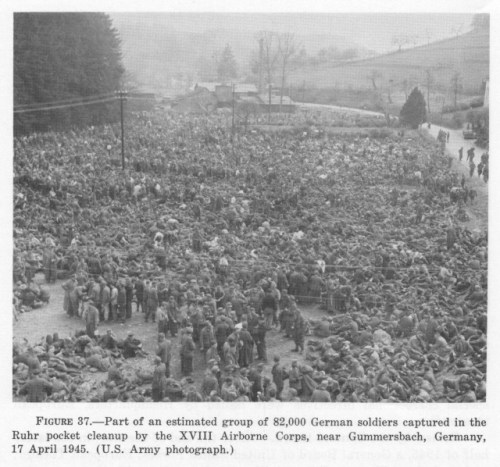
The last major operation in the West following the breakouts from the bridgeheads over the Rhine was the encirclement and reduction of the Ruhr pocket.  This operation involved the 9th Army and 1st Army. The 3rd Army continued its operations east and south toward Nurnberg.   Bradley, his blood stirred by the large numbers of prisoners taken in the Saar, Palatinate and Rhineland now became addicted by the completion of envelopments and he told his staff as “he shifted Hodges’ direction toward a meeting with Simpson encircling the Ruhr: “I’ve got bags on my mind.””[lxxxi] The Army Group completed the encirclement and reduced the pocket by April 18th. Two Army commanders, Von Zangen of 15th Army and Harpe of 5th Panzer Army as well as 25 other Generals and Admirals were caught in the American net.  Vaunted formations such as Panzer Lehr and 116th Panzer were among the 317,000 German prisoners taken by the Army Group. XVII Corps alone captured 160,000 prisoners.[lxxxii] Field Marshal Model, the commander of Army Group B took his own life on the 21st. The one setback during the battle was during the spirited advance of the 3rd Armored division to Paderborn a task force ran into a Kampfgrüppe of King Tigers manned by Waffen SS Panzer training students stopped them with heavy losses.[lxxxiii] To make matters worse the 3rd Armored Division Commanding General, Maurice Rose was killed when his jeep encountered Tigers and a jittery German Panzertroop shot him when he removed his pistol attempting to surrender.[lxxxiv]
Despite the great number of prisoners taken and the elimination of the bulk of the Wehrmacht in the West the battle detracted from what had been hereto the overriding goal of the campaign, the capture of Berlin.[lxxxv] The reasons for this were twofold.  At the Army Group level Bradley was determined to engage as many of his troops as possible so they would not be sucked into any offensive commanded by Montgomery who continued to clamor for control of American troops to make the final drive for Berlin.   Eisenhower supported Bradley’s decision as he believed “that the Western Allies no longer had much chance of capturing “the main prize,” Berlin, anyway.”[lxxxvi] Weigley suggests that a better purpose for the troops that Bradley used to reduce the Ruhr pocket would have been to us them to aid 9th Army’s drive toward Berlin which was already closing on the Elbe.  With the reuniting of the 1st and 9th Armies Bradley was poised to begin his drive to Berlin with the largest field command in American history.[lxxxvii]

US Vehicles Driving Towards Kassel

The second reason was that Eisenhower had made a decision based on political and tactical considerations to shift the focus of the Allied effort from Berlin to Dresden and Leipzig yet not completely ruling out an advance toward Berlin.[lxxxviii] Attempts by 9th Army to drive toward Berlin were frustrated by unexpected German resistance to its bridgeheads over the Elbe. On the 15th of April Simpson flew to Bradley’s headquarters to propose an attack on Berlin.  Bradley called Eisenhower who on hearing Bradley’s estimate of 100,000 casualties to take the city elected not to continue the attack towards Berlin.[lxxxix] Eisenhower had now concluded “that the National Redoubt was now over more importance than Berlin,”[xc] and directed Patton and Devers to secure it.  Patton and Simpson were both incredulous at the decision and felt that it was “a terrible mistake.” Patton felt 9th Army could take Berlin in 48 hours.[xci] In a similar vein Patton’s move into Czechoslovakia was halted before Prague.

Overage German Recruits Captured by US Forces

Eisenhower’s decision was political and tactical and was supported by the U.S. Chiefs of Staff;[xcii] Berlin would be in the Soviet zone even if he took it.  Hastings sates the decision was “surely the correct one” noting that nothing could change the post-war settlement.[xciii] Murray and Millett agree.[xciv]Others such as J.F.C. Fuller felt that the political decisions had turned the fruits of victory “into the apples of Sodom, which turned to ashes as soon as they were plucked,”[xcv] leaving Eastern and Central Europe under the control of the Soviets.  D’ Este notes that no matter what was decided that Eisenhower’s “hands were already tied by the agreement of the Big Three agreement over the division of occupied Germany.”[xcvi] In the end there may have been a political advantage to taking Berlin before the Soviets, but as Hastings notes: “It is hard to see how this could have been prevented, given the Western Allies sluggish conduct of the war.”[xcvii] This was the fault of both the British and Americans and this was in fact as much a part of the final settlement in Europe as any decision made in the final weeks of the war.

In retrospect one can see the historical consequences of Eisenhower’s decision, but how much that decision was influenced by the way the American Army’s organization and conduct for war is seldom mentioned. Perhaps had Eisenhower had the 200 plus divisions envisioned by the Victory plan, or had he been bolder and abandoned the broad front strategy inherited from Grant, history might be different today.  There are always results.  One should not devise strategies for the conduct of war that do not match up with the forces that you plan to employ.  Organization, training and equipment must be designed for the type of war one intends to fight and are just as important as a grand strategy.   This was the lesson of the American involvement in the European campaign.  The American Army succeed in spite of the restraints that its leadership and saddled it with.  The final campaign in Germany showed that at least parts of it had learned the hard lessons of war and could conduct a highly successful campaign.

Handshake on the Elbe: US and  Red Army Troops Meeting


[i] Weigley, Russell  F. Eisenhower’s Lieutenants: The Campaign in France and Germany 1944-1945. Indiana University Press, Bloomington IN 1981. p.2.

[ii] Ibid.  p.728

[iii] Ibid. p.4.

[iv] Ibid.

[v] See Weigley’s article American Strategy, in Peter Paret’s Makers of Modern Strategy from Machiavelli to the Nuclear Age. Paret, Peter, editor.  Makers of Modern Strategy from Machiavelli to the Nuclear Age. Princeton University Press, Princeton, NJ 1986 pp.434-436.

[vi] See Keene, Jennifer D. Doughboys, the Great War, and the Remaking of America. The John’s Hopkins University Press. Baltimore,MD. 2001. pp.42-44.  Keene notes the results of the AEF’s training and Pershing’s organization and employment of the Army in WWI.  The similarities to the American experience in WWII are startling.  A comment of George Marshall after the war that: “Officers leading their men into battle, abandoned tactical maneuvering in favor of “steamroller operations” that forced men to keep going until exhaustion stopped them…” reminds one of the Huertgen Forrest.  Likewise a similar situation arose in regard to training.  Other comments are that the infantry was not well trained and that “many troops resisted advancing without artillery support….”

[vii] Herwig, Holger H. The First World War: Germany and Austria-Hungary 1914-1918. Arnold a Member of the Hodder Headline Group, London England 1998. p.424.

[viii] Millett, Allen R. and Maslowski, Peter. For the Common Defense: A Military History of the United States of America. The Free Press, New York 1984. p.349.

[ix] Ibid. Weigley. p.25

[x] Matloff, Maurice Allied Strategy in Europe in Makers of Modern Strategy from Machiavelli to the Nuclear Age. Paret, Peter, editor.  Makers of Modern Strategy from Machiavelli to the Nuclear Age. Princeton University Press, Princeton, NJ 1986 p.696.

[xi] Ibid. Weigley. p.5

[xii] Ibid. Weigley. p.23

[xiii] Ibid. p.728

[xiv] Mansoor, Peter R. The GI Offensive in Europe: The Triumph of American Infantry Divsions 1941-1945. University Press of Kansas, Lawrence KS. 1999 p.31.

[xv] Ibid. pp.253-254.  Mansoor is the only historian that I have ever seen defend this system.  Even Stephan Ambrose who generally leads the cheering section for the American Army in WWII condemned the system, which Mansoor admits in his account.

[xvi] Gabel, Christopher R. The Lorraine Campaign: An Overview September-December 1944. U.S. Army Command and Staff College, Ft. Leavenworth KS 1985.  pp.34-35.

[xvii] Chaffee, Adna R. Mechanization in the Army, Statement to Congress, April 1941. p.19.  Combined Arms Research Library, Digital Library http://cgsc.leavenworth.army.mil/carl/contentdm/home.htm

[xviii] Ibid. p.6.

[xix] _________Infantry in Battle 2nd Edition The Infantry Journal Incorporated, Washington DC 1939. p.68

[xx] See Chaffee and Infantry in Battle. Likewise this was echoed in S.L.A. Marshall’s book Armies on Wheels, William and Morrow Company, New York, NY 1941.

[xxi] Ibid. p.729.

[xxii] Ibid. p.14

[xxiii] Ibid.

[xxiv] Ibid. p.662-663. Initially, 21,000 troops were taken from the COMMZ and 10,000 were directed to be transferred from the AAF.  Additionally 2,253 black troops were formed into 37 platoons and distributed among the divisions of 12th and 6th Army Groups.

[xxv] Ibid. p.664.  The efforts were successful and by April there was a surplus of 50,000 infantry soldiers beyond reported shortages, despite the fact that no more American or British divisions were available for deployment to the continent.

[xxvi] Ibid. Mansoor,

[xxvii] Ibid. Weigley. p.578

[xxviii] Hastings, Max. Armageddon:  The Battle for Germany 1944-1945 Alfred A Knopf, New York NY 2004 p.340.

[xxix] Ibid.

[xxx] Ibid. Hastings. p.340

[xxxi] Ibid. p.341

[xxxii] Ibid. Weigley. p.583

[xxxiii] Bradley, Omar  N. A Soldier’s Story Henry Holt and Company, New York NY 1951. p.501

[xxxiv] Ibid. Hastings. p.348

[xxxv] Ibid. Bradley. p.497

[xxxvi] Ibid. p.589.

[xxxvii] Ibid. Hastings. p.348.

[xxxviii] Patton, George S. War as I Knew It Originally published by Houghton Mifflin Company NY 1947, Bantam Paperback Edition,  Bantam Books, New York, NY 1980 p.242

[xxxix] Ibid. Hastings. p.345

[xl] Ibid.

[xli] Ibid. Weigley. p.603

[xlii] Ibid. p.602

[xliii] Wilmont, Chester. The Struggle for Europe Harper and Brothers Publishers, New York, NY 1952 p.673

[xliv] Ibid. p.616

[xlv] Ibid. Hastings. p.365

[xlvi] Ibid. Weigley. p.621

[xlvii] Ibid.

[xlviii] Ibid. Bradley. p.509

[xlix] Ibid. Wilmont. p.674

[l] Ibid. Weigley. p.622.

[li] Ibid. 627

[lii] Ibid. Hastings. p.365

[liii] Ibid.

[liv] Murray, Williamson and Millett, Allan R. A War to Be Won: Fighting the Second World War The Belknap Press of Harvard University Press, Cambridge Massachusetts and London England, 2000 p.478

[lv] Ibid. Mansoor. P.244.

[lvi] Ibid. Weigley. p.632

[lvii] D’Este, Carlo. Eisenhower: A Soldier’s Life Owl Books, Henry Holt and Company, New York NY 2002. p.681

[lviii] Ibid. p.682

[lix] Ibid. Bradley. p.511

[lx] Ibid. Weigley. p.629.

[lxi] Ibid.

[lxii] Ibid. Wilmont. p.676

[lxiii] Liddell Hart, B.H. The History of the Second World War G.P. Putnam’s Sons, New York NY 1970. p.678.

[lxiv] Ibid. Hastings. p.366.

[lxv] Newton, Steven H. Hitler’s Commander: Field Marshal Walter Model, Hitler’s Favorite General. DeCapo Press, Cambridge MA 2005. p.351.

[lxvi] Ibid. D’Este. Eisenhower p.682

[lxvii] Ibid.  By this D’Este is obviously not referring to Bull and Eisenhower.

[lxviii] Ibid. Wilmont. p.677.

[lxix] Ibid. Liddell-Hart. p.677

[lxx] Warlimont, Walter. Inside Hitler’s Headquarters 1939-1945 translated by R.H. Barry. Presidio Press, San Francisco, CA 1964. p. 506.

[lxxi] Ibid. Weigly. p.635.

[lxxii] Ibid. p.638

[lxxiii] Ibid. Wilmont. p.678.

[lxxiv] Ibid.

[lxxv] D’Este, Carlo. Patton: A Genius for War. Harper Collins Publishers New York, 1995  p.711

[lxxvi] Ibid.  Murray and Millet. p.479.

[lxxvii] Ibid. D’Este Eisenhower p.683

[lxxviii] Ibid. Weigley. p.639

[lxxix] Ibid. Liddell-Hart. p.678.

[lxxx] Ibid. Hastings. p.369.

[lxxxi] Ibid. Weigley. p.673.

[lxxxii] Ibid. p.680

[lxxxiii] Ibid. Hastings. p.377.

[lxxxiv] Ibid. p.675.

[lxxxv] Ibid. Weigley. p.674.

[lxxxvi] Ibid. p.684.

[lxxxvii] Ibid.

[lxxxviii] Ibid. p.688.

[lxxxix] Ibid. pp.698-699.  Weigley believes that neither Eisenhower nor Bradley wanted to continue to Berlin; Bradley for the reason that Montgomery would steal the credit and Eisenhower because it was a “prestige objective” that would remain in the Soviet zone no matter who captured it.

[xc] Ibid. Wilmont. p.690.

[xci] Ibid. D’Este Patton. P.721

[xcii] Ryan, Cornelius. The Last Battle The Fawcett Popular Library, New York NY.1966.  p.240.

[xciii] Ibid. Hastings. p.425

[xciv] Ibid. Murray and Millett. P.480

[xcv] Fuller, J.F.C. The Conduct of War 1789-1961 DaCapo Press edition, San Francisco, CA 1992. p.296.

[xcvi] Ibid. D’Este. Eisenhower. P.694.

[xcvii] Ibid. Hastings. p.512.

Bibliography

Bradley, Omar  N. A Soldier’s Story Henry Holt and Company, New York NY 1951.

Chaffee, Adna R. Mechanization in the Army, Statement to Congress, April 1941.  Combined Arms Research Library, Digital Library http://cgsc.leavenworth.army.mil/carl/contentdm/home.htm

D’Este, Carlo. Eisenhower: A Soldier’s Life Owl Books, Henry Holt and Company, New York NY 2002.

D’Este,  Carlo. Patton: A Genius for War. Harper Collins Publishers New York, 1995

Fuller, J.F.C. The Conduct of War 1789-1961 DaCapo Press edition, San Francisco, CA 1992.

Gabel, Christopher R. The Lorraine Campaign: An Overview September-December 1944. U.S. Army Command and Staff College, Ft. Leavenworth KS 1985.

Hastings, Max. Armageddon:  The Battle for Germany 1944-1945 Alfred A Knopf, New York NY

Herwig, Holger H. The First World War: Germany and Austria-Hungary 1914-1918. Arnold a Member of the Hodder Headline Group, London England 1998

Keene, Jennifer D. Doughboys, the Great War, and the Remaking of America. The John’s Hopkins University Press. Baltimore, MD. 2001.

Liddell Hart, B.H. The History of the Second World War G.P. Putnam’s Sons, New York NY 1970

Mansoor, Peter R. The GI Offensive in Europe: The Triumph of American Infantry Divsions 1941-1945. University Press of Kansas, Lawrence KS. 1999

Millett, Allen R. and Maslowski, Peter. For the Common Defense: A Military History of the United States of America. The Free Press, New York 1984

Murray, Williamson and Millett, Allan R. A War to Be Won: Fighting the Second World War The Belknap Press of Harvard University Press, Cambridge Massachusetts and London England, 2000

Newton, Steven H. Hitler’s Commander: Field Marshal Walter Model, Hitler’s Favorite General. DeCapo Press, Cambridge MA 2005

Paret, Peter, editor.  Makers of Modern Strategy from Machiavelli to the Nuclear Age. Princeton University Press, Princeton, NJ 1986

Patton, George S. War as I Knew It Originally published by Houghton Mifflin Company NY 1947, Bantam Paperback Edition,  Bantam Books, New York, NY 1980

Ryan, Cornelius. The Last Battle The Fawcett Popular Library, New York NY.1966

Warlimont, Walter. Inside Hitler’s Headquarters 1939-1945 translated by R.H. Barry. Presidio Press, San Francisco, CA 1964

Weigley, Russell  F. Eisenhower’s Lieutenants: The Campaign in France and Germany 1944-1945. Indiana University Press, Bloomington IN 1981.

Wilmont, Chester. The Struggle for Europe Harper and Brothers Publishers, New York, NY 1952

_________Infantry in Battle 2nd Edition The Infantry Journal Incorporated, Washington DC 1939

2 Comments

Filed under History, Military, world war two in europe

Yes Friends, God Really Does Speak to Me Through Baseball

“Baseball, it is said, is only a game. True. And the Grand Canyon is only a hole in Arizona. Not all holes, or games, are created equal.” George Will

Padresteve, Jeff and Angels 3rd Base Coach Rocky Bridges in 1970

Well we are deep into football season, while hockey, basketball that World Cup qualifiers move along.  Don’t get me wrong.  I know these sports well but for me they are not the same as baseball.  I have played all of them in school, the biggest mistake that I made as a kid was forsaking organized baseball first for hockey and then for football.  I gave up playing my first love for short term flings with other sports.

The Church of Baseball, Harbor Park Parish

I was down walking the concourse at Harbor Park the other day to relax following about 32 hours spanning two nights at the hospital.  I like going to the ballpark even when it is the off season because it is one of the few places where I can be fully relaxed and at peace.  Tuesday was beautiful, the temperature was in the mid 50s with sunshine and a light breeze, the field was a brilliant great and the ever present grounds crew was at work.  In the front office I talked with a number of the office staff about players who would and would not be coming back for the 2010 season as well as highlights of the past season.  The Tides have a wonderful front office staff.  To walk the concourse from behind home plate, out to the right field corner and then back across to the left field picnic area and then to go down to my seat in Section 102, Row B seats 1 and 2 at the Church of Baseball, Harbor Park Parish is a highlight of the week when I have the chance to do it.  I feel closeness to God at the ballpark that after Iraq is hard for me to find in many other places.  For me there is a mystery and magic about a ballpark that just isn’t there for the other sports, not that there’s anything wrong with that.

For me the other sports can grab my momentary attention but because of their nature cause them to be merely ordinary and occasionally interesting.  Baseball is another matter, it is more than a game, it is a metaphor for life, a spiritual experience and a game that mirrors life and faith in many ways. For me this goes back to childhood.

As a kid my dad made me learn the fundamentals of the game and whether we were attending a game in person, watching one on television or playing catch, pepper or practicing infield or pitching in the back yard or in a park, dad was all about the game.  Of course he was the same way with football, hockey and basketball, but the sport that he seemed most passionate about was baseball.  As a kid he was a Cincinnati Reds fan.  His mother, my grandmother who hailed from the hollers of West Virginia was a die hard Dodgers fan.  That I still wonder about to this day, but she was the same woman who as a widow in the late 1930s went to work, raised her two boys and bought her own house.  Unlike most of the state she was also a Republican, long before West Virginia ever voted for a Republican either President or statewide office. True to form Granny was a Dodgers fan in a land of Reds, Indians and Pirates fans, fierce and independent.  However, as a Giants fan I mourn how she had been taken in by the power of the dark side.  Despite having fallen under the spell of the Dark Lords Granny was a real baseball fan. Any time you went to Granny’s house and there was a game on, the television was tuned in to it.  We were immersed in baseball thanks to my dad and his mother.

Dad always made sure that we got to see baseball wherever we lived. In 1967 he took us to see the Seattle Pilots during their first and only season in that fair city before they went to Milwaukee and became the Brewers.  In the elementary schools of those days many our teachers would put the playoff and World’s Series games on the TV as many of those games were played during daylight hours.  I remember watching Bob Gibson pitch when the Cardinals played against the Red Sox in the 1967 series.  It was awesome to see that man pitch.   I remember the Amazing Mets upsetting the Orioles in 1969 and the Orioles take down the Reds in 1970. I will never forget the 1970 All Star Game where Pete Rose ran over Ray Fosse at home plate for the winning run and the great dynasty teams of the 1970s, especially the Reds and the Athletics who dominated much of that decade and the resurgence of the Yankees in the summer that the Bronx burned.

Me with Angel’s Manager Lefty Phillips 1970

When we were stationed in Long Beach California dad had us at Anaheim stadium all the time.  I imagine that we attended at least 20 games there in 1970 and another 25-30 in 1971 as well as a couple at Dodger stadium that year.  We met a lot of the Angel players at community events and before the games. I entered the “My Favorite Angel” contest and my entry was picked as a runner up. This netted me two seats behind the plate and having Dick Enberg announced my name on the radio.  I wrote about Jim Spencer a Gold Glove First Baseball who later played for the Yankees.  I still have a hat from that team with numerous autographs on the inside of the bill including Sandy Alomar, Jim Spencer, Jim Fregosi, Chico Ruiz, and Billy Cowan. It was a magical time for a 10 year old boy.

When we moved to Stockton California dad took us to see the A’s dynasty teams including a number of playoff games.  But he also took us across San Francisco Bay to watch the Giants.  I got to see Ed Halicki of the Giants no-hit the Mets a Candlestick on August 24th 1975.  I got to see some of the greats of the era play in those stadiums, Catfish, Reggie, McCovey, Garvey, Vida Blue, Harmon Killebrew and so many others.  I also became acquainted with Minor League Baseball at this time through the Stockton Ports. At the time the Ports were the Class A California League farm team for the Orioles.  I remember a few years back talking to Paul Blair the Orioles great Paul Blair who played for the Ports in the early 1960s about Billy Hebert Field and how the sun would go down in the outfield blinding hitters and spectators in its glare.  Today I have a renewed interest in the Orioles because of their affiliation with the Norfolk Tides.

As I have grown older my appreciation for the game only deepens despite strikes and steroids and other problems that plague the game at the major league level.  I am in awe of the game and the diamond on which it is played.  I have played catch on the field of dreams, seen a game in the Yankee Stadium Right Field bleachers, seen a no-hitter, playoff games and met players. I’ve watched the game in Japan, seen historic moments when deployed to combat zones in and have thrown out the first pitch in a couple of minor league games.  I am enchanted with the game. The foul lines theoretical go on to infinity, only broken by the placement of the outfield wall.  Likewise unlike all other sports there is no time limit, meaning that baseball can be an eschatological game going on into eternity. The Hall of Fame is like the Calendar of Saints in the Catholic, Orthodox and Anglican Churches.  There are rituals, the exchange of batting orders and explanation of the ground rules, the ceremonial first pitch, players not stepping on the foul line when entering and leaving the field of play, no talking about it when a pitcher is throwing a no-hitter and the home run trot. The care of a field by an expert ground crew is a thing to behold, especially when they still use the wooden box frames to lay down the chalk on the baselines and the batters box.

My kitchen and much of my dining room are as close to a baseball shrine as Judy will let me make them.

Since I returned from Iraq the baseball diamond is one of my few places of solace.  For the first time last year I bought season tickets to my local minor league team the Norfolk Tides.  Section 102, row B seats 1 and 2 from which I will, the Deity Herself willing take in the 2010 season at the Church of Baseball, Harbor Park Parish.  The home opener is April the 8th against the Durham Bulls, barely 4 months away.  From there I will sit back and imagine the words of James Earl Jones in Field of Dreams:

“The one constant through all the years has been baseball. America has rolled by like an army of steamrollers. It’s been erased like a blackboard, rebuilt, and erased again. But baseball has marked the time. This field, this game, is a part of our past. It reminds us of all that once was good, and what could be again.”

In a sense this says it all to me in an age of war, economic crisis and division.  In a sense it is a prayer. Peace and blessings, Steve+

2 Comments

Filed under Baseball, philosophy, Religion

The Afghan War 2009-2012: Lessons from Algeria 1954-1960 A Review of “A Savage War of Peace

“A Savage War of Peace.” By Alistair Horne. The New York Review of Books, 1977, 1987, 1996, 2006.  Maps. Photographs. Bibliography. Index. 608 pp.

Foreign Legion in Algeria

In light of the developing situation in Afghanistan and the plan to apply the counterinsurgency techniques of clear and hold, or “the oil slick” in that country it is wise to look at other instances of this type of warfare before criticizing those about to implement the strategy.  Of course when doing this the best place to look is history, especially where the strategy worked, at least until the DeGaulle government abandoned the nearly complete military success achieved by French forces in Algeria triggering a national crisis.

Alistair Horne’s “A Savage War of Peace” is a most needed addition for anyone seriously interested in studying the dynamics of insurgency and counterinsurgency warfare; especially political and military leaders of a western nation occupying a Moslem country.  Horne’s work is important and one of the few in English that cover this subject.  The two other books in English to cover the subject, albeit only on part of the campaign is Paul Aussaresses’ controversial memoir “The Battle of the Casbah” and Ted Morgan’s memoir “My Battle of Algiers” though useful suffer from the fact that they are limited in scope to the events the individuals experienced while serving as French Army officers in Algeria. In both the author’s personal biases are readily in evidence and by the fact that they were written many years after the events in question.  Since those books are heavily dependent on the author’s memories.

Paratroops of the First Colonial Paratroop Regiment in Algeria

Horne is not limited by these factors.  Horne is a historian who served as a British Army officer assigned to the MI5 in the Middle East and later as a foreign correspondent for the Daily Mail who has written a trilogy of excellent works on the Franco-German wars: The Fall of Paris: The Siege and the Commune 1870-1871, The Price of Glory: Verdun 1916 and To Lose a Battle: France 1940. As such his account is as close to being objective as any could be in the case of writing this particular history.

Horne approaches the subject from the perspective of the broader issues that France and the Fourth Republic were facing in 1954, economic, military and psychological recovery from the Second World War, the loss of colonies, defeat in Indochina culminating in the Dien Bien Phu debacle.  Such is important when examining a military campaign as the latter do not take place in isolation of other events in the life of a nation. When the history of the US campaigns in Iraq and Afghanistan are written they will have to take into account many other factors apart from the military operations.

Horne tackles the complex issues of the Algerian war in a multifaceted manner looking not only at the military issues, but the political and social issues faced by the French, the European Pied-Noir Algerians and the Algerian natives, both Berber and Arab alike.  Horne also looks at the conflict in the broader context of the Cold War, the emergence of the Non-Aligned nation movement and the rise of Arab nationalism, skillfully weaving the actions of these movements and key individuals such as Egypt’s Nasser, Khrushchev of the Soviet Union and the most influential, and President Jacques de Gaulle into the story of the Algerian conflict. Unlike other writers Horne had access to many of the individuals involved, including leaders from each rebel faction, the Pied-Noir and the French government and military.  Included in those he interviewed is Algerian President Boumedienne who had commanded rebels during the conflict and was instrumental in Algeria’s independence as well as Jacque Soustelle who had been Governor General from 1955 through 1956. These sources as well as numerous others help give his narrative a depth and subtlety lacking in the first hand English language memoirs and accounts.

Terrorism by FLN Militias and Sympathizers Caused Great Problems for the French

Horne begins his account with the story of the aborted revolt and massacre at Setif on May 8th, VE Day, 1945 and the attempt by the French government to reassert its control over Algeria. Of particular interest in this section is Horne’s analysis of the mistake of the Pied Noirs and the French government in not offering a settlement to the Algerian separatists under magnanimous terms due to the scale of the victory they had won following the Setif uprising and their security forces “decapitation” of the leadership of the various Algerian nationalist factions.  He compares the victory to that of the Israelis in the 1967 War and the political reaction of the Pied Noir to the Israelis, who instead of negotiating a settlement that could have long term effects advantageous to them from a position of strength determined to humiliate and subjugate their foe.[1] If the US military is able to reverse the situation in Afghanistan the United States and the Afghan government will need to be magnanimous to a defeated foe in order to prevent yet another repetition of another Al Qaida and Taliban resurgence.

French Paratroops Going House to House in Algiers

In examining the period before the actual outbreak of the war in 1954 Horne looks at the missed opportunities of the French to prevent it.  He also examines the development of the Algerian independence movement, especially the senior leaders of the movement; many of whom had served in the French Army during the Second World War with distinction. His portrayal of the conflicts within the independence movement, show that this was not a monolithic movement, but that each faction had its own goals which often were in conflict with other groups.  This is also the case in Afghanistan where a disparate number of ethnic, political, criminal, nationalist and terrorist groups who often are at war with each other.  Likewise, Horne’s treatment of the Pied Noir and certain parts of the French leadership examine how they too were divided at some points in regard to the ultimate plan for the relationship of Algeria to France.

Horne makes much of political mistakes and machinations of French leaders that culminated in the end of the Fourth Republic and subsequent impact on de Gaulle when he became president in June 1958.  Some mistakes that Horne explores are those committed in the immediate wake of Setif. He also examines mistakes during the revolt; such as not taking it seriously, to individuals in the National Assembly impeding the efforts of Soustelle to effect reforms and compromise between hard line factions in the Pied Noir and Moslem communities.[2] Likewise he notes how the draconian treatment of Algerian Moslems by the French Army in the early phases of the counter-insurgency effort, including the assignment of “collective responsibility” to punish communities for the actions of individuals helped alienate the populace and strengthen the insurgency.  Such was the case in the first part of the Iraq occupation and helped inspire that insurgency.  One member of Soustelle’s cabinet noted: “the cycle of repression getting ever tougher, and the rebellion ever stronger, will ruin all your efforts of pacification.”[3]

Besides political mistakes Horne examines issues in military tactics that seem to plague counterinsurgency efforts to the present time.  He describes the early application of heavy conventional forces in an attempt to defeat the insurgency.  Horne discusses unsuccessful efforts in 1954-1955 and how they not only did not destroy the insurgency but how the insurgency spread in response to the efforts.  The question: “Did ‘pacification’, for instance mean trying to regain the confidence of the inhabitants; or did it mean crushing the rebellion by whatever means available?”[4] This question is still asked today by soldiers fighting insurgencies and often the latter is counseled by those who still think along the lines of the conventional tactics of the Cold War and World War Two, which many conservative pundits are enamored with.  Horne also discusses the successful tactics of commando units used by General Challe to effectively combat the insurgency.[5]

Horne examines the attitudes of the French Army which in a sense fought the war for itself.  Armies that have fought many campaigns together often have a sense of comradeship that transcends even the loyalty that they have to their nation.  It is the understanding of a “Band of Brothers” and can be found throughout history.  When the histories of Iraq and Afghanistan are written they will certainly include the fact that many soldiers, Marines and Sailors engaged in actual combat operations fought for the men and women with whom they served more than for anything else.

The French Army felt little affinity for the Pied Noir who they often saw as only interested in their interest at the expense of the campaign.  Likewise the Army, felt little more than contempt for the French government which they felt had betrayed them. General Lorillot noted “They made fools of us in Indo-China…they screwed in Tunisia…We are being screwed in Morocco. But they will never screw us in Algeria. I swear to you. Let this be known in Paris.”[6] Instead attitudes of not losing, stopping the humiliations were animated by the feeling of anti-communism in French ranks, especially in the Elite Parachute, Foreign Legion, Commando and Colonials (Marines). The novel The Centurions and voiced the feelings of one Paratroop commander “We want to halt the decadence of the West and the march of Communism.”[7]

Horne provides a narrative analysis of the military campaigns within the Algerian War.  In particular he describes the successes of units designed to live among and better the lives of the Algerians and the SAS,[8] He describes the building of the border wall to keep weapons out of rebel hands.  He describes the “success” of units which specialized in torture,[9] which turned out to be helpful in the short run but which ultimately damaged the fabric of the Army.  Horne notes the effects of torture on soldiers who participated and how it negatively affected support of the war in France and internationally.[10] The use of torture in Algeria has parallels with Iraq. Horne notes: “one has to take into account all those factors…horror at the atrocities of the F.L.N., a determination not to lose yet another campaign, and the generally brutalizing effect of so cruel and protracted war.”[11]

The most powerful part of the narrative is the drama when French President de Gaulle was faced with the revolts of 1959. At this time the Pied Noir militias, dissatisfied with potential political settlements went to the barricades in Algiers and other major cities, assisted in some cases by Army units.  These forces again revolted against his attempts to mediate a settlement and were followed by the General’s revolt of April 1961 which nearly became a military coup in France itself.   President de Gaulle’s role in bringing these revolts to an end, without the collapse of the government or a civil war was miraculous.  Though his actions undercut the military success of the Army in Algeria which had virtually eliminated the insurgency his foresight in recognizing that France had a future not dependant on Algeria remaining French was exceptional.  The actions of de Gaulle should be studied by those who closely link their country’s future to holding a foreign country, even one that is considered an integral part of the mother country, as Algeria was to France.

Horne’s book is as timely as it was when first published, maybe more so with the current escalation in Afghanistan.  Along with works by David Galula “Pacification In Algeria 1956-1958, Bernard Fall “Street Without Joy” and “Hell in a Very Small Place,” Andrew Krepinevich’s  “The Army in Vietnam,” Brian McAllister Linn’s “The Philippine War: 1899-1902” and Ben Shepherd’s “War in the Wild East: The German Army and Soviet Partisans” Horne’s work is vital reading for military and political leaders fighting counter-insurgency operations.  Unfortunately many militaries are often enamored by high tech innovation are not often receptive to the decidedly human factors and strategies necessary to fight insurgencies until they experience frustration and failure attempting to use conventional forces and tactics to win a counter-insurgency campaign.  Effective intelligence, efforts to win the hearts and minds of the populace by protecting them, knowledge of public affairs and the effect of media on operations are all key elements of a proper counter-insurgency campaign are covered by Horne. Horne’s work reminds us that these conflicts are not won by the forces with the greatest firepower or most modern weapons. This is something that the United States and its NATO and other Allies in Afghanistan should never forget.


[1] Horne, Alistair. A Savage War f Peace: Algeria 1954-1962. The New York Review of Books, New York, NY 1977, 1987, 1996 2006. p.69

[2] Ibid. pp. 113-114

[3] Ibid. p.115  Some would later compare the attitudes of the French Army to those of the Nazis. In one point of his narrative Horne notes the attitude of an officer who saw nothing wrong with the tactics used by the Nazis in the Second World War.

[4] Ibid. p.112.  Another question noted is something that seems to be commonplace in the Iraq War ““Limited Repression” did not always make the clearest sense to a patrol of young soldiers caught in a vicious ambush.” When one reads Horne’s accounts one sometimes almost feels that he is writing about the current American experience in Iraq.

[5] Ibid. pp. 334-335

[6] Ibid. pp.175-176

[7] Ibid. p.176

[8] The SAS Section Administrative Specialise first set up by Soustelle.  These units had great success but also suffered heavy losses as their efforts were recognized as having a positive effect by the FLN and other Algerian rebel groups.

[9] Such as the 11th Shock Regiment

[10] See pp. 195-207.

[11] Ibid. p.198.

2 Comments

Filed under Foreign Policy, History, iraq,afghanistan, Military

The Manhattan Transfer: Why I Cannot Sign the Manhattan Declaration

“It behooves every man who values liberty of conscience for himself, to resist invasions of it in the case of others: or their case may, by change of circumstances, become his own.” Thomas Jefferson

Note: I do not expect that everyone will agree with my views on this subject.  Thus it is good that I am neither the Pope nor even a bishop.  I fully support the rights of all who have signed this declaration to do so and have the utmost respect for Chuck Colson as well as the Bishops of my Church who have signed this declaration.  I would never impugn the earnest beliefs or motives of these men and women.  However I do not believe that the Manhattan Declaration is fully reflective of the preponderance of the Gospel being that it does not address any traditional theological distinctive of the Christian faith.  It addresses instead moral, social and political issues that are used as wedge issues in contemporary American society.  While I believe that every Church has a right to comment on such issues to use them in their own realm that in a democracy or constitutional republic that such statements serve little purpose other than to rally the troops who already are convinced of them and do little to change the hearts and minds of those who do not.

Recently a fairly sizable number of Christian Leaders from Evangelical Protestant, Roman Catholic and Orthodox Churches have drafted and signed a document called the Manhattan Declaration.  It is a statement of four basic sociological and political issues with significant religious and theological overtones.  Let me provide a brief synopsis of the major points of the declaration:

1. The sanctity of human life.
2. The sanctity of marriage.
3. The protection of religious liberty.
4. The rejection of unjust laws.

To be honest these are all worthwhile goals and I can agree with them.  In fact I agree that the right to life of the unborn as well as the born must be protected.  I believe in sanctity of Christian marriage but recognize that the institution of marriage pre-dates the Christian Church and that descriptions of “traditional marriage” in the Old Testament do not reflect a Christian understanding of marriage but rather a ancient Near Eastern Culture of marriage that is more reflective of Islam than Christianity.  I believe in the protection of religious liberty as defined by the founders of the United States in our Constitution.  While I am a Christian every citizen in the United States has a Constitutional right that protects their religious liberty even if offends and is in contradiction to the Christian faith.  The United States was the first nation of the Enlightenment and the drafters of the Constitution would not allow any denomination to impose its interpretation of the Christian faith on any citizen.  Finally there is the rejection of unjust laws; who can be against that?  At the same time who determines what law is unjust? Or is it a matter of political dogma and not the faith that defines what is or is not an unjust law?
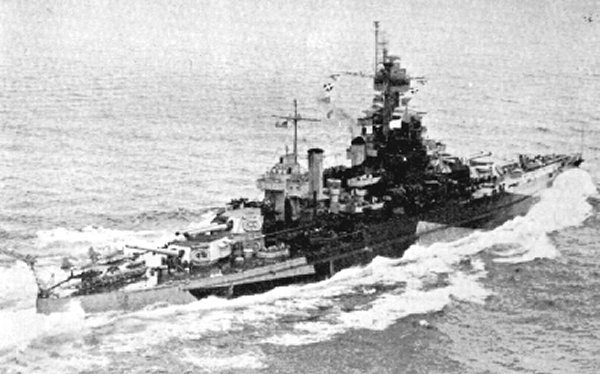
By definition Christians should strive to protect life as a matter of course.  Defending the rights of the innocent both the unborn and the born are essential if one truly is pro-life.  As such simply being anti-abortion is not enough to call oneself pro-life.  Unfortunately the vast majority of those who have signed the Manhattan Declaration would limit it to that and pay lip service to everything else that would make one pro-life including the provision of adequate health to those of inadequate means or access to healthcare, the use of the death penalty and the proper application of the Christian understanding of the “Just War” which prohibits preemptive wars or attacks against nations that have not attacked us. Pro-life would also include the implicit command for the Church to be leading the way in caring for the poor, indigent and the foreigner among us.  Likewise such would assume that the government would also have some responsibility to care for its citizens as the institution that God has raised up to maintain public order and maintain a just society.

Likewise it is within the context of the Church define marriage recognizing that while the vast majority of Christians would define marriage as the union of one man and one woman, that is the understanding of the vast majority of people who have signed this document.  No church or religious body should be required to perform rites that are in contravention to their beliefs. At the same time they cannot under the laws of the land impose those beliefs on others or force the government to do so.  The understanding of religious liberty as defined by the Constitution does not allow this.  One of the good things about going to a Southern Baptist Seminary before the Fundamentalist takeover of the denomination was the deep understanding of religious liberty and the freedom of conscience that is given to all citizens.

Likewise defending religious liberty, both to practice one’s religion as well as respect the rights of others to practice theirs is a sacrosanct principle of being an American.  This is especially true for those who serve as Chaplains in the Federal government.  To use a Star Trek metaphor, such is our “Prime Directive.”  Religious liberty is essential and protected in the First Amendment to the Constitution which also guards the rights of free speech and association.  It is my hope that what I model to others in word and deed, and definitely helped by the Holy Spirit, will allow people, even those hostile to the Church or the Christian faith to maybe reconsider, especially if they have rejected the faith because of the intolerance of other Christians or our sometimes sordid history in regard to the treatment of people.

Finally the rejection of “unjust laws” is a bit of a Red Herring.  An unjust law is in the eye of the beholder. The founders of the country believed that a African American only counted as 3/5ths of a person. Which 3/5ths I don’t know, but certainly this cannot be considered a “just law” however it was supported by many Churches including those that resisted anti-slavery provisions adopted by their denominations and left those denominations in the years preceding the Civil War.

However it is not the theological principles of the sanctity of human life, the sanctity of marriage, freedom of religious expression and resistance of unjust laws that is the problem.  Rather it is the tacit political emphasis of the document in spite of the comments by major supporters such as the President and CEO of Focus on the Family:

“It is important, first off, to note that the Manhattan Declaration is not a partisan or political statement…Instead, it addresses and elevates four specific areas of universal consensus. Some have referred to these as “threshold issues,” meaning they represent the foundation of our faith and the pivot point from which everything else flows. This is the bedrock. If we can’t agree on these areas of doctrine, everything else will be of reduced value.” Jim Daly, President and CEO of Focus on the Family

As a Christian of the Anglo-Catholic tradition the bedrock of the faith resides in the Bible and the testimony of the Church in the Creeds and the first seven Ecumenical Councils of the Church. These are not areas that “represent the foundation of our faith and the pivot point from which everything else flows.” I dare anyone to show me this in scripture or church tradition.  While there are places that one can draw inferences of these issues to be scriptural one can claim that the Scripture at no point forbids abortion. In fact the one place where these is even an inference of this is in Exodus 21:22-25 where a man injures a woman to cause a miscarriage is fined and not treated as a murderer.  Likewise the “imprecatory prayers” in the Psalms calm for dashing infants against stones.  If one looks at marriage it is obvious that Israel, like all Middle Eastern cultures of the day and many of the Moslems condemned by many supporters of the Manhattan Declaration practice was more of a property transfer than a true union of husband and wife as we now understand it to be. As far as freedom of religion one can cite numerous examples in the Old Testament where there is no religious freedom or rights given to non-Jews.   So to claim any of these as universal and foundational is inaccurate, even if they are worthy goals.

The drafters of the document refer to the Barmen Declaration of the Confessing Church during the Nazi era as a precedent for their work.  This is a bad analogy and bad history.  The Barmen Declaration was a statement of faith. The bulk of the declaration dealt with historic Lutheran and Reformed beliefs in the context of bearing witness and being faithful as members of a State Church which was falling in line and becoming a political instrument of the Nazis sacrificing its actual Christian faith and adopting a Nazi-Aryan faith.  This was viewed as heresy and apostasy by the members of the Confessing Church.  These men had no political party to support them, they were alone.  This is not the case with those who sign the Manhattan Declaration.  It is not a statement of orthodox Christianity against the apostasy of a church but a statement of political and social beliefs that have a religious component.

The partisan nature of the document is shown in the timing.  It now occurs with a President who is a liberal Democrat.  It well could have been issued during the Bush administration where little than political speeches were made in support of pro-life or anti-abortion causes.  In fact the Chief Justice of the Supreme Court in his confirmation hearings referred to Roe v. Wade as “settled law.” Likewise the Bush administration adopted the policy of pre-emptive warfare as a matter of doctrine.  This is blatantly in contravention of both international law as well as the Christian understanding of the Just War.  One has to remember that the United States prosecuted the Nazis for wars of aggression; wars that the Nazis believed were justified.  Likewise the open support of Gay marriage by the former Republican Vice President was never criticized by many of these people.  It seems that such a document would have had much more credibility has the writers published it during the past administration.
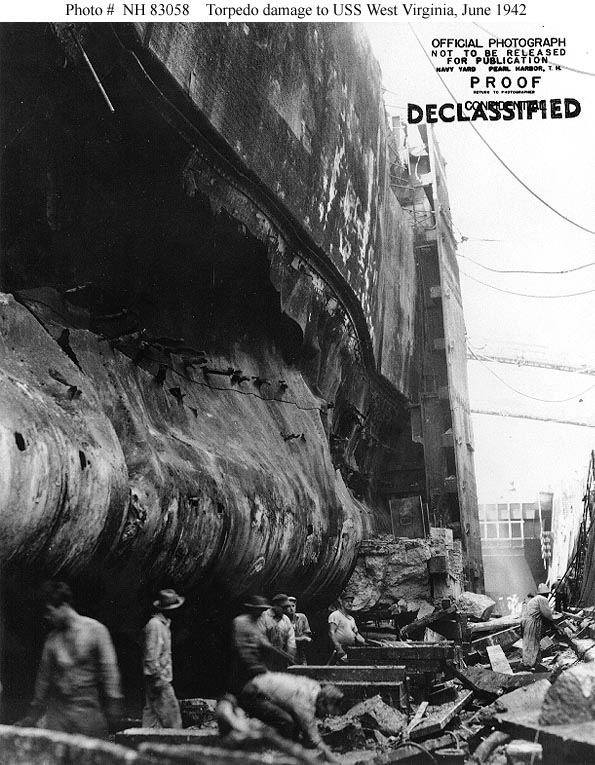
The point of this article is to reaffirm actual Christian doctrine defined by the Creeds, Councils and Scriptures as the standard of the Christian faith and not a list which is not and has never been the central component of the Christian faith.  It is my belief that the Manhattan Declaration is well meaning but ill-conceived and can and is being construed as the litmus test of what it means to be a faithful Christian.  I have seen two friends this weekend, who are totally orthodox in their denomination’s understanding of the Christian faith, theological conservatives who have difficulty with such declarations attacked as liberals and unbelievers.  I expect that some will do this with me.  It is my belief that this statement will serve to ghettoize Christians into a particular wing of the Republican Party providing their critics with the opportunity to simple count them as a subgroup of that party.  That is a real and present danger.
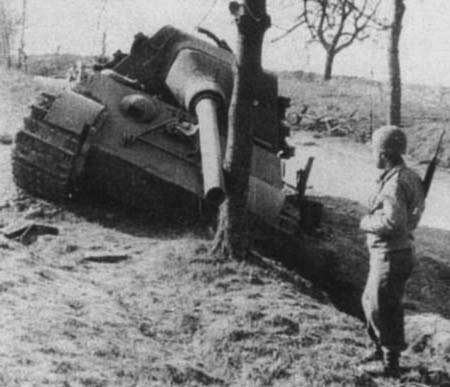
I do find that the preamble to the declaration has much that I can agree with, however it is the focus on a narrow band of issues that concerns me, issues that have been for the past 30-40 years hot button political issues where both major political parties play upon religious groups to further their agendas.

Again, I am totally pro-life and orthodox in my faith as a Christian.  I just believe that such declarations serve only to reaffirm the previously held positions of those who support them and have little effect on the vast majority of people and almost none on the government.

My friends Joel and Jared have made some interesting observations on their own sites.  Joel is at

http://thechurchofjesuschrist.us/ and Jared at

http://jzholloway.wordpress.com/

The text of the Manhattan Declaration is here:

http://www.manhattandeclaration.org/images/content/ManhattanDeclaration.pdf

Peace,

Padre Steve+

4 Comments

Filed under marriage and relationships, philosophy, Political Commentary, pro-life anti-abortion, Religion