Monthly Archives: May 2011

Facing the Darkness that Lurks Behind Trauma

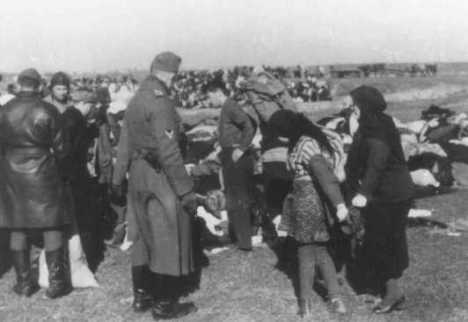
The Einsatzgrüppen: The Banality of Evil

I am in the second day of my conference and as I noted yesterday that the presenter, Dr. Robert Grant is dealing with spirituality and trauma.  As was the last time I listened to him this conference is full of good information.  For me though it is not merely information for information sake, but something very personal having gone through the living hell of a psychological, spiritual and physical collapse following my tour in Iraq and battle with chronic PTSD.  For me it was passing though the abyss and when I emerged I was a changed man.

Today Dr. Grant began with some existential truths about life which have to be acknowledged.  The basic list is his but I have taken those thoughts and ran with them.

Everyone Dies…. We can’t get around this one a recent study said that 96% of Americans will die someday.

No Guarantees…. We are not guaranteed anything in this life. You can live right, maintain good health, treat others right but still can meet with tragedy, betrayal and abandonment. 

No one can cover all contingencies…. No matter how well we plan there will be unanticipated events in life that shred our plans.  The old saying that “no plan ever survives contact with the enemy” is true.

The things that we sometimes believe are solid and long lasting are often transitory in nature…. Even things that we think are solid and will last to the end of time change, deteriorate or dissolve over time

We and our world are finite…. We have a beginning and an end and our finiteness is sandwiched between the creation and the consummation. Dietrich Bonhoeffer talked about “living in the uncomfortable middle.” Bonhoeffer was right, we don’t know the beginning because we were not there and we do not know the end because it has not yet happened.

Evil and malevolence exists in individuals, organizations and systems, even those that we esteem highly…. One only has to look at the number of trusted people and organizations that have perpetrated and covered up their own evil acts to know the truth of this. 

Nothing exposes these truths faster than trauma.  It does not matter if the trauma is impersonal and the result of a natural disaster or the result of individual or corporate evil and malevolence, be it physical, psychological or spiritual trauma the effect is often destructive.

In response to these facts we all as well as our society and culture develop patterns of denial about these existential truths.  They are truths that most of us don’t want to face and which we often will do anything to avoid most often attempting to find meaning and comfort in materialism and consumerism. Others seek a “solid” faith in more fundamental branches of their religious tradition.  Still others see to recreate a world that supposedly existed before our time attempting to roll back the clock to a time when the world was right. This is true especially in our political life, progressives think back to the Great Society or the New Deal, while conservatives tend to look back to what the Founding Fathers wrote or the ones that they agree with wrote.  The overarching theme, be it in the life philosophy, religion or political-ideological arena people seek to create a world that is stable, where they can exist in their comfort zone free of trauma and free of anxiety.  However the experience of trauma often blows such constructs into a million pieces.

The fact is that the comforts and protections that we seek refuge in are often fleeting or the myth that we have created for our self protection.  Such beliefs are often illusions.  One thing about trauma is that it tends to shake one’s world.  In fact trauma can destroy long held belief structures including faith in God, humanity and deeply held beliefs about life and one’s place in the world. Religious beliefs, political ideologies and belief the righteousness of one’s country, friends, family and heroes can be devastated when trauma picks the lock of our soul and reveals our vulnerability.  Such events including war, natural and manmade disasters, the loss of loved ones to death, divorce or the loss of one’s position in life, work and safety net all can be events that trigger crisis and reveal the startling truth that we are not invulnerable.  The recent earthquake and Tsunami in Japan is a classic example as it has shaken the long held beliefs of the Japanese people regarding the respect that they have for their government and corporations.

Collectively as Americans we have experienced numerous national traumas in the past 10 years beginning with the 9-11 attacks.  We have seen war, financial disaster and numerous natural disasters which have impacted our collective psyche as a nation.  In response we elect to deny the effect of trauma on us as individuals and on our society.  Politicians seek to find quick material fixes to a greater problem which is both spiritual and existential.  Simply put we seek to treat the symptom rather than the greater problem which is that we have been so shaken that we have stopped believing in our nation, our fellow human beings and sometimes even the Divine.

We do the same as individuals because the darkness of trauma and the malevolence of those individuals and systems, governmental, corporate and ecclesiastical that inflict trauma on us is so great that we bear not to face them and face further trauma.  The impact on individuals is often devastating as the perpetrators often use their power to dehumanize people.  Thus facing the evil is to expose one to even greater danger.  Thus the more common reaction is to edit the trauma, sealing it off so that we can reenter the safety of our protected sandbox without having to face the darkness that exists.  The malevolence of evil, or what Hannah Arendt called the “banality of evil” manifests itself in ways that most of don’t ever want to face, thus the damage done by the trauma remains unhealed.

The problem is in order to really experience healing we have to be willing to face that darkness without succumbing to it.  To do this requires not only facing the existential truths about ourselves but also uncomfortable truths about respected individuals,  government, corporate and ecclesiastical organizations and systems which perpetuate trauma.   Most of us do not want to go there.  I know I didn’t until my crisis became an existential one where I had to face the darkness or try to cover it up.  For me it was a crisis of faith in God, my church and even in the actions of my government and the political party that I had been loyal to for 36 years.

The journey was painful but in time I began to recover beginning a process that continues to this day and which I expect will be part an ongoing part of my life.  In the process I know that I have changed hopefully for the better.   As I began my recovery I found that not everyone understood, in fact when I began to write about my faith journey it cost me friends and resulted in me being asked to leave my church.  To me it seemed that some people especially in the church were more comfortable with me being damaged and quiet than recovering and posing difficult questions especially when I deviated from the party line.

I found that many people did not want to walk with me through those dark times and I can understand why not.  To walk with someone through the darkness exposes us to that darkness and sometimes takes us to places that we would rather not go places that lay outside of our safety zone.  However those that did walk with me, those who held me but let me walk though the crisis without trying to force feed me formulas for success or what I needed to do to “be healed” when I was in free fall gave me the freedom to experience healing. Part of that was healing was spiritual, God’s grace became real again and not just a concept. Part was psychological as I became more stable and had fewer symptomatic episodes, and part was physical as the nagging injuries healed and I was able to reassert control over my diet and exercise.  Finally part has been relational as I have started to rebuild the relationship that I have with my wife Judy because I had neglected that relationship for far too long and when I came home from Iraq I did her no favors.   A few weeks ago she told me that she felt that she had me back for the first time since Iraq.

I have been through the abyss and have emerged from it different but I think better. I still have work to do because I know that I am still full of issues.  I still have anxiety at night, trouble sleeping, especially without medication.  Other times I can experience bouts of depression and anxiety and on some occasions still battle anger and occasionally rage when I feel endangered or see injustice being inflicted on others. I still have some measure of hyper-vigilance and hyper-arousal and I am much more aware of my surroundings than I used to be.  Even in ministry I am careful what I share with people. I figure on this website people can pick and chose what they want to read, but when counseling or teaching I have to be more careful.  I know that I have some deep work to do especially in relation to forgiveness of those people and systems that I felt hurt or betrayed me.  I don’t know how all of that will work out but that is part of the journey.

In the mean time I will walk in faith and hope even knowing that some of the answers that I seek will not always sit well with me or others. But then such is life.

Peace

Padre Steve+

5 Comments

Filed under film, PTSD, traumatic national events

To the Edge of Darkness: Notes on a Conference

I’m home for a conference on Spirituality and Trauma at Naval Medical Center Portsmouth this week. The primary speaker is Dr. Robert Grant, author of The Way of the Wound a Spirituality of Trauma and Transformation.  I had the pleasure of meeting him last year when I coordinated his visit and speaking engagement when I was stationed at Portsmouth.

One of the ideas that Robert is willing to address is going beyond the symptoms of PTSD and what are the underlying causes of trauma including the understanding of evil and malevolence and the understanding of moral injury that stems from trauma.  Last year when spoke I was really beginning to integrate my own moral and spiritual injuries that were part and parcel of my battle with PTSD and I found his presentation quite helpful.

Now 8 months after that I have come to understand more about what he talked about back then.  For me it is that what I experienced changed me and that I had to deal with things that I saw and that I know that make me radioactive to many people, especially fellow ministers and many Christians. I found that when I came back to faith and began to write about it that I was asked to leave my former church.  Evidently being an agnostic despairing of life was fine as long as I didn’t question non-creedal social issues and right wing politics.  I now ask questions that make many people uncomfortable and I have become much more sensitive to seeing things that many people want to pass over.  Recently this was the case when I suggested that legendary preacher David Wilkerson may have committed suicide by car.  But such is life when you have passed into the abyss and come back different than when you began the journey.  Thankfully I have come back.  Now I hope to be there and walk through the valley of the shadow of death with those who are walking where I have walked.

I also found that there is a good reason that I am still taking medications to help me sleep.  I inadvertently left my medications or “docile pills” as I call them in North Carolina and had to try to sleep last night without them. I was hyper-vigilant as hell and got almost no sleep.  Today I got up, forgot my hearing aids and left the front door open on my way to work.  I was absolutely exhausted and to stay awake I drank entirely too much coffee, Coke Zero and Diet Dr. Pepper.  I was tired and wired. Thankfully one of my psychiatrist friends prescribed me enough of what I take to get me through the week.  However, I was funny especially toward the end of the day when I got myself slapped by a friend when a question was asked about a book title.  The book was Odysseus in America: Combat Trauma and the Trials of Homecoming and as people searched their brain housing groups for the title I leaned over to my friend Duke and said “isn’t that that book Oedipus in America.”   Duke paused for a second, realized that I was pulling his leg and slapped me, not that there is anything wrong with that.

While at the Medical Center I saw a good number of friends that I had worked with for two years. It was a genuine joy to see each of them again and to realize that the most important part of any assignment is the people that you have relationships with.  I am blessed. I have a couple more days in the symposium and look forward to what I will learn as well and seeing people that mean a great deal to me.

Peace

Padre Steve+

2 Comments

Filed under faith, Pastoral Care, PTSD

Remembering Hammerin’ Harmon: Harmon “Killer” Killebrew 1936-2011

Harmon Killebrew 1936-2011

Baseball lost one of its best today. Harmon “Killer” Killebrew, or Hammerin’ Harmon died of Esophageal Cancer at the age of 74.  He died today with his wife Nita, friends and family at his side. Jack Morris the 1991 World Series MVP said something that I can totally understand in regard to Harmon Killebrew:

“To remember the innocence of being a young kid who just looked up to a guy he didn’t know because of what he did as a baseball player, something that you hoped that maybe someday you could be like. But as a grown man, I look back at him now not as that guy, but as the guy who tried to show me that you don’t have to be angry. You don’t have to be mad. You can love and share love. We’re all going to miss him, and we’re all going to love him forever.”

Harmon was one of the classiest players who ever played the game. A genuine star he did not make a show of fame or demean an opponent.  He played with a singular passion for the game and was a consummate gentleman who engendered the respect from his teammates and opponents and love from those that knew him.  A true superstar he hit 573 home runs and stands at 11th on the all-time home run leader list and drove in 1584 runs.   He was a 13 time All Star and the American League MVP in 1969.  In 1970 he led the American League with 41 home runs and hit over 40 home runs 8 times during his career. He began his career with the Washington Senators in 1954 and went with the franchise when it moved to Minnesota in 1961.  He finished his career with the Kansas City Royals in 1975.  In 1969 he hit 49 home runs and drove in 140 runs, a career best.  Since his records were set in the non-steroid era at a time when ballparks were larger than when many of the current home run leaders played they are truly remarkable. He was elected to the Major League Baseball Hall of Fame in 1984  on his fourth year of eligibility with 81.3% of the vote.

He was a generous man who contributed much to his community and to cancer treatment and research. He made sure that he continued his association with the Twins until this season when after his diagnosis with Esophageal Cancer he spent his customary time with the team during Spring Training.  Due to his treatments he was unable to attend opening day.

I had the privilege of meeting him twice. The first time was on Sunday July 12th 1970 when I was 10 years old at Anaheim Stadium when the Twins were playing the Angels. It was photo day and though my parents took pictures of us with many of the players including Harmon who I remember teasing me about my Angels’ cap.  He hit a two run home run in the first inning off Angels’ starter Tom Murphy.  It was amazing thing to see for a ten year old.  That picture must have been lost years ago as I found only a few from that day when I was searching my parents’ collection of photos after my father died last year.

One of his nicknames was “killer” but that was in relation to his hitting and how he played the game. In life he was a kind, generous, soft spoken and gentle man who exemplified all that is good. He was a mentor to young people and players and many players who played with or on teams where he coached credit him with lessons in life as well as baseball. He was engaged in many charitable beginning in 1977 when he established the Danny Thompson Memorial Gold Tournament which has raised over 8.6 million dollars in the fight against Leukemia and Cancer and is named after a teammate from the Twins who died of Leukemia in 1976 at the age of 29.  In 1991 he established the Harmon Killebrew Foundation.

I met Harmon again in the summer of 2003 when I was stationed aboard the USS Hue City at Mayport Florida.  He was on a USO tour co-sponsored by AT&T called the Heroes to Heroes Tour. He was travelling with fellow Hall of Famer Ferguson Jenkins, John Tudor, Manny Sanguillen, Paul Blair and Jimmy Winn. There were two visits that day in Mayport, one at the Naval Station Galley at breakfast and one at the Navy Exchange. The breakfast meeting was not well publicized and due to traffic congestion the players arrived late. However, I was one of just a few sailors who where there when they arrived. We spent an hour together the players outnumbered the sailors. I remember Harmon as one of the nicest athletes that I had ever met. I told him about meeting him in 1970 and he remembered the day but not the 10 year old, but then there were hundreds of us out there that day.

He was one player that I always admired. Legend has it that his image was used as the Major League Baseball logo, although that his contested by the artist. Personally I think that he had to be the model for the logo as the image is so true to Killebrew that I cannot believe that it is anyone other than him. But then I can believe what I want, if he wasn’t and it was a composite as the author claims his image had to be part of it.

George Brett the All Star of the Kansas City Royals said something that I hope will be said of me when it is my time to pass from this world into the next:

“He was just a fierce competitor and a perfect gentleman at the same time. You don’t see that a lot. Sometimes you get fierce competitors who are bad people. You see guys that are not fierce competitors but nice guys. You don’t see the two of them together very much.”

Harmon Killebrew was an amazing man who I am honored to have met and seen play on television and in person. I have his autograph on a card with the other 5 players that I met in Mayport that morning in 2003 as well as the Stockton Ports hat that I was wearing that day.  Though I only met him those tow times I feel like I have lost a friend. The things that he signed and my memories of him are what I have left of one of baseball and humanity’s greats. Harmon you will be missed. May you rest in peace.

Peace

Padre Steve+

2 Comments

Filed under Baseball, remembering friends

Joy in Mudville: The Comeback

“Age is a case of mind over matter. If you don’t mind, it don’t matter.” Satchel Paige

“One of the beautiful things about baseball is that every once in a while you come into a situation where you want to, and where you have to, reach down and prove something” Nolan Ryan

Baseball is more like life than any sport it is a game that requires stamina and gives players who continue to produce a chance to keep playing longer than most other sports, even players that are not super stars.  But sometimes life like baseball presents every person situations where it takes everything that you have to keep yourself in the game.

The military is something like sports because in order to remain viable in the military you have to remain physically fit and in an age where the military is shrinking there is little grace given to the old veterans.  I am not going to recount most of my post-Iraq experience battling PTSD as well as a number of nagging physical injuries to my shoulders, left elbow, right knee and right ankle.  Neither my brain nor my body was responding the way I thought that they should and for the first time I discovered the connection between the two.  Jeff Passan wrote concerning ball players, particularly in light of the recent plight of Yankees great Jorge Posada and his battle with age and deteriorating performance “It’s a battle with the brain, with knowing and feeling you belong despite your body’s revolt. The two work symbiotically, and once one turns, it’s difficult to keep the other from following.”

That was true for me for the first time in over 25 years in the military.  I have shared my struggle with my weight recently but another hurdle that I faced was trying to get my head back in the game regarding my physical fitness.  I felt my injuries; they were nagging and took forever to heal. Gone were the days of taking a day or two off and then going back into my usual fitness regime.  I was old and I felt like it. Mickey Mantle said “I always loved the game, but when my legs weren’t hurting it was a lot easier to love.” It wasn’t until the spring of 2010 that my mind began to get back into the game and I began to test my body in ways that I hadn’t since Iraq.  I began to get back in physical shape and though my weight kept me from getting off the fat boy program my score of 265 for the physical fitness test portion was rated as “high excellent” not quiet the top level but not bad for someone on the comeback trail. I was just one pushup shy of the outstanding score and I stopped because I thought I had the number that I needed, I had more in me but quit.  As a result the spring of 2010 went down as my second failure.  In the Navy if you fail three times in 4 years you can be processed for administrative separation. For me this would have meant being forced to retire despite having been selected for promotion to Commander.  It would have been humiliating.

When I reported to my new command it became my goal to not only be in weight standards but to continue to improve my physical performance.  I had to. A failure on either portion would have probably meant the end of my career.  I had to dig deep and as the weight came off my physical performance became better and I began to feel like a whole person again. Even so as the time neared for the Physical Fitness Assessment I was concerned I could not take any chances on my weight and likewise could not do badly on the physical readiness test.  Nolan Ryan was right. I had to prove something and I wanted to prove something and I was willing to dig deep to do it.

As I mentioned before I came in 6 pounds below my maximum weight.  This afternoon I took the physical readiness test with about a dozen officers and sailors from the hospital.  As at many commands people wait until the last day to take the test so attendance today was light.  Another 700 or so will take their PRT in the coming days.

The weather this afternoon was wonderful. I have taken the PRT and the Marine PFT at Camp LeJeune in May before. Usually the weather is already uncomfortably warm and humid even in the morning. I had planned on doing the 0630 time because of this but I had been up late counseling a former shipmate so I elected to go in to work at my normal time and take my chances that the weather would cooperate in the afternoon.  When the time came the temperature was about 75 degrees with a nice breeze and bearable humidity.  I felt good and knew that I was going to do very well; the question would be cracking the “outstanding” barrier, something I had not done since shortly after my return from Iraq when despite injuries I pushed myself to make the grade. After than the injuries owned me and I went through several tests where I simply did okay, not failing but nothing to write home about.

We lined up and the first exercise was sit ups or crunches.  I have always done well in this event but over the past few years have really gotten my technique down.  In 2 minutes I did 101, well above the 85 that I needed for the highest score of 100 points.  I could have done more as I stopped about 15 seconds before the end of the time but you don’t get extra credit.  The next even was the pushup.  When I was young I struggled with pushups.  It really was a mental thing. Back then when I was 23 the Army required 65 pushups for the maximum score. Now at the age of 51 I still need 64 for the maximum score. I did 65 and again it came down to technique. I have worked to perfect my pushups to keep the best form using the most compact movements and breathing on every rep to get the most I can in 2 minutes.  Bad form ensures fewer pushups can be performed and if you don’t breathe you tend to wear out sooner and often not be able to go much more than a minute.  Despite exceeding the maximum score I don’t think that I am really in my best shape and I will continue to work.  Knowing that I had blown out the first two events all that was left was the 1.5 mile run.  For me the 1.5 mile run is too short. I tend not even to get into a good stride and have my breathing right until the 1 mile point, so I have always liked the Army 2 mile and Marine 3 mile runs better than the Navy variant and before Iraq would run 5-8 miles every time I went out.  If I really want to blow the Navy run out I have to turn on the afterburners. If I do this when I am in stellar shape I can nail the run in 9.45 to 10.45 minutes.  With the injuries I had not did the run since the spring of 2009 instead doing the elliptical machine or stationary bike.  That was not so much because I couldn’t do the run but it was a mental thing, I no longer believed that I could.   I finally realized that I could and today I ran the run in 12.31.  I decided that I didn’t need to push too hard. I knew the number of points and run time that I needed to get them. I was well under that time but well below what I know that I can do. Next time I will do better.

This was a victory for me but I cannot rest. I avoided the failure that would have ended my career but I cannot fail again.  There is nothing like living on the brink to provide a little extra motivation.  But as Satchel Paige said “Age is a case of mind over matter. If you don’t mind, it don’t matter.”

Peace

Padre Steve+

2 Comments

Filed under Baseball, Military, philosophy, US Navy

The Week before Armed Forces Day 2011

Armed Forces Day is a holiday, sort of.  It is an official holiday but no-one gets a day of work off for it. It is a holiday where we as a nation honor those serving in the Armed Forces. Other nations also have Armed Forces Day commemorations.  Ours was established in 1949 after the establishment of the Department of Defense and replaced individual days for each of the five armed services.  Each service maintains its own celebration and some are marked with great fanfare particularly those of the Marine Corps and to a lesser extent the Navy.  It is celebrated the third Saturday in May and this year will occur May 21st.

It is different than Memorial Day where we pay homage to the fallen and Veteran’s Day where we remember all who have served because it really focuses on those currently serving.  When it occurs during a war as it has for the past nine years it tends to be more significant at least for those of us currently serving.

Many local and state governments as well as private organizations and businesses do special things to honor the Armed Forces.  There are parades, ceremonies at historic locations and even at baseball games. Fireworks and cookouts as well as discounts at various retailers are common.  At the same time in many places the day goes by without fanfare. This is in part due to the fact that we have had a volunteer military which due to force cutbacks since the end of the Cold War is smaller and based in fewer locations, generally concentrated on bigger bases as many smaller and mid-sized bases were closed or consolidated under the various iterations of the Base Realignment and Closure Act (BRAC).

As a result for many Americans the military is an institution set apart, a closed profession and community with its own culture and worldview.  Less than 1% of Americans serve in the military today. That number includes active and reserve forces. The lack of a draft or some other type of compulsorily military service ensures that those who do not want to serve in the military, those that prefer stability and the chance to make a lot of money don’t have to sully themselves with serving in the military.  As a result a pitiful few politicians and business leaders have any real understanding of the military, much to our detriment as a nation.  We lack the cultural cross leveling that the draft brought.  Personally I don’t think we would have a Red State-Blue State divide if more people served together in the military.  When you serve together in war it is much easier to treat your fellow veterans with respect when you get out.

At the same time our military has become a tremendously professional organization that had it not been an all volunteer force would probably not survived the wars that we have been in for the past 10 years.  Conversely our politicians may have been more prudent in committing us to major ground wars after 2001.

Thus as a profession the military is often misunderstood and what it does overseas often shrouded in mystery as very few news organizations take the time anymore to live with the troops and those reporters that do are few and far between.  The lack of a significant number of political, business, academic and religious leaders with military experience only serves to worsen the situation simply because those leaders are ignorant of the cost that our military members and their families bear.  World War Two was a war that made us Americans because so many people had to serve in the military and serve alongside of people from different parts of the country and economic classes.  Thus the men and women that served in that war had a bond that transcended politics, religion and with the desegregation of the Armed Forces in 1948 race which had divided the country since its inception.

Today the military is one of the most trusted institutions in the country.  It bears a special place in our society and even though many have not served there is an appreciation by many people of the sacrifice of those who serve at the present time.  I am glad for that because I remember when my father came home from Vietnam and the years following that war where the military was scorned and often vilified.

My plea is that as we approach Armed Forces Day that people will take the time to thank the serving Soldiers, Sailors, Airmen, Marines and Coast Guardsmen that they know or meet.  For those that do not serve there are ways to demonstrate your care by volunteering with the Red Cross or USO or donate to any of the military relief societies (Army Relief, Navy-Marine Corps Relief, Air Force Relief) or the Fisher House Foundation which helps the families of military personnel suffering from war wounds or life threatening conditions in hospital at military medical facilities.

It is a profound honor to continue to serve the Constitution and the people of the country. I have serve alongside the best America has to offer and as we continue to serve in Afghanistan, Iraq, Libya, the War on Terrorism and elsewhere around the world please remember us.

Peace

Padre Steve+

1 Comment

Filed under History, iraq,afghanistan, Military, shipmates and veterans

A New Start…Life off the Fat Boy Program

Back in Standards 

“Every day is a new opportunity. You can build on yesterday’s success or put its failures behind and start over again. That’s the way life is, with a new game every day, and that’s the way baseball is.” Bob Feller

One of the biggest effects of my post-Iraq PTSD crash was how I tried to cope with this multi-faceted beast. Of course psychologically and spiritually I was in the toilet so much so that I was in the midst of a spiritual crisis so great that I was for all practical purposes an agnostic.  I struggled to hold myself together during 2008 and early 2009 trying to believe again and keep in shape. To compensate for my lack of belief, depression and the other nasty effects of PTSD such as night terrors, insomnia, hyper-vigilance, flashbacks I threw myself totally into work on the critical care units of the hospital I was serving. I finished my Masters Degree program and worked hard to better our hospital’s Clinical Pastoral Education Program and served on various committees including the Ethics Committee.  It was too much and the collapse deepened so I sought other coping mechanisms. I turned to comfort food and drink as a way to cope, especially food that was bad for me and way too much very good beer.

After my physical fitness test and weigh in during April of 2009 I lost all control of the latter two. While I had been drinking more since my return from Iraq than before the deployment in the spring of 2009 it became a problem.  I would leave work and on days when the Norfolk Tides were in town I would take to my season ticket seat in Section 102 Row B Seat 2 and seek refuge from my problems.  The ballpark and baseball helped bring some peace to my soul, but it would only last for 3 hours.  At the ballpark I would drink two to three beers with a chili dog and fries and maybe a pretzel, peanuts or ice cream.  After the game I would swing by the Krispy Crème Donut shop on the way home and pick up a dozen hot and fresh glazed donuts. I would then get on my computer and write on this site. While writing I would down three to six of the donuts with another two to four beers and repeat the cycle the next day for the rest of the home stand. On other nights I would go over to get donuts and drink more beer with them often after eating a heavy meal with very good beer at the Gordon Biersch Brewery Restaurant in Town Center.  By November I weighed 194 pounds and though I passed the PT test with a very good score for someone my age I was way over my weight and body fat limits. Thereafter it was a struggle to get below 180 pounds. I failed my next body composition assessment by a percentage point and though scoring well enough to qualify for the DOD waiver which would have taken me off of the program it was not approved.  I weighed in weekly and continued to improve my physical condition to the point that I was within the body fat standard by the time I left that duty assignment I transferred before the next official physical fitness assessment and got to my new assignment after the period was over.  Thus I remained on the program.

To those that have never experienced life in any military branch Fat Boy or Girl program it is humiliating, at least if you are a military professional.  There is a stigma to being fat because the military is run by tall skinny people.  Those of us of the under tall variety understand this stigma very well even when we are within standards.  I know a good number of good Soldiers, Sailors and Marines put out of the military because they did not meet their service body fat and weight standards.  Many like me are those suffering the effects of war and just trying to cope with life.  Others are men and women who are suffering the effects of time with shrinking bodies due to spinal disc compression and other injuries, illnesses and the slowing of metabolism which conspire against them. The military is a young person’s game and 51 year old 30 year veteran relics like me are in the minority.  For me the physical requirements are little different than when I first went on active duty in 1983. Back then I thought that when you got older you would catch a few breaks. Well in the age of budget cutting and a shrinking military force those standards continue to tighten and few breaks are to be found.

Bursting at the seams in my Summer Whites in 2009, this was not a comfortable uniform at the time, now it is very loose

While I had lost weight and body fat I was still over my weight limit.  The body fat measurement in the Navy is the measuring tape around the neck and the fattest part of the belly.  It is a terribly subjective and according to many scientific studies inaccurate test.  Nonetheless if you are over the weight limit you must be taped.  I didn’t want to go through that again so I decided that I was going to start really eating healthy and diversifying my exercise regimen.  When I arrived at my new assignment I weighed 184 pounds and during the winter added a few more pounds. At the beginning of January I bought a digital scale and began to weigh myself several times a week. I stopped the comfort foods except for an occasional hamburger or piece of pizza.  Even if I ate a hamburger I omitted the fries and held the cheese and mayo. I began to look at the nutritional information on everything that I ate even looking up restaurant data to ensure that I had the healthiest food that I also liked, it does no good to eat healthy if you hate what you are eating because you don’t stick with it.  I cut back on my drinking a lot, even going to Yuengling Light Beer at home.  I counted every calorie and measured calories burned. If I went over on one thing I compensated rather than continuing as if I had not.

As winter became spring I noticed a difference, I was weighing less and all of my clothes continued to get loose to the point that things that I could not get into during the fall were baggy and some nearly falling off.  As the date approached my scales had me near the limit for a half inch below my real height just in case I got a bad measurement on my height, five pounds is five pounds.  I felt a lot of stress over the week and could feel every muscle in my back completely tense to the point that I was in pain. I weighed in Friday at 169 pounds and was six pounds below my weight limit and one pound below the lower height limit.  I have lost all 25 pounds that I gained during that horrible period of my life. On Monday I will take the physical fitness test something that I never have a problem doing well on.  When I do that I will be officially off the program.

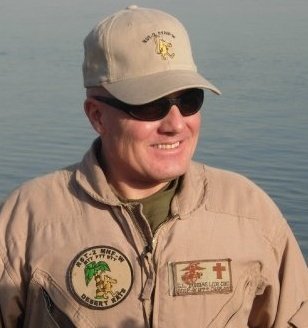
Last night I was invited to do the invocation at the Navy Nurse Corps Birthday Ball at Camp LeJeune. I eased into my Mess Dress Blue uniform which last May I could barely squeeze my body into and in which I looked terrible.  The uniform was loose and fit very well. I went to the ball and had a wonderful time with my colleagues from the Naval Hospital and their guests.  I made sure that I had a friend take the picture which accompanies this post.

For me this is a comeback. I still have my struggles with PTSD but on the whole on the physical, psychological and spiritual aspects of life I am doing much better. Yes I still struggle at times and experience some of the manifestations of PTSD and of my spiritual crisis but I am not collapsing when something shakes me like I was between 2008 and even into 2010.

Had I failed the body composition assessment I could have been separated from the Navy and while I probably would have been able to retire it would have been a most humiliating way to leave the service.  Instead as long as I am alive and haven’t done anything incredibly stupid I will be promoted to Commander on September 1st and continue to be able to serve God’s people in the Navy for years to come. Of course I cannot fail a physical fitness assessment for the next two years but now that I have my diet stabilized and composed of things that I like and live in a place at the Island Hermitage where I love to run, walk and bike I do not expect to ever fail that again. My goal is to get back to the weight that I was when I was commissioned as an Army Officer in 1983, 158 pounds and keep it there. Thus my task is still incomplete.  I have succeeded in my first goal and now it is time to complete the deal and live healthy from here on out.

Today is a new opportunity and I am putting past failures behind.

Peace

Padre Steve+

3 Comments

Filed under faith, healthcare, Military, PTSD, US Navy

Yes God Really does Love the Real World

“God loves human beings. God loves the world. Not an ideal human, but human beings as they are; not an ideal world, but the real world. What we find repulsive in their opposition to God, what we shrink back from with pain and hostility, namely, real human beings, the real world, this is for God the ground of unfathomable love.” — Dietrich Bonhoeffer

I think one of the greatest joys that I have as a Priest is when people tell me that they like me because I am “real.”  It’s not so much that they think I am a great preacher, which I am not or that I have all the answers especially because my answer to many questions that I am asked is “I don’t know.”  In fact what those that like me say what they like about me is that I am approachable and care enough to give them the time of day and listen to them.

My psychological and spiritual collapse following my tour in Iraq caused me to see why who live in the real world appreciate pastors, Priests or Rabbis that are real.  There were very few people, especially ministers that in the years following my return that I felt that cared about me enough to share what I was going through with them.  In fact I found that many were not interested or simply did not want to deal with a “bruised reed.”  I think that when a minister, Priest or Rabbi expresses doubt or is in crisis be it a long term physical illness that will not be healed, a deep depression that causes them despair or a spiritual crisis that causes them to question their faith that the tendency among most ministers is to run away as if they were radioactive or that it was catching.

In fact I have heard this for years as friends or pastors that I met in their crisis expressed the pain of being ostracized by other ministers or their denominations or local churches.  Likewise I have also all too often seen churches and pastors ignore or ostracize people simply because they are not easily “fixed” or those that are considered “problems” because they ask uncomfortable questions or point out inconsistency or injustice in the church.  Then there are the times where the Church mistreats, abuses and uses people without any real care for them as people treating them as numbers or even more crass “tithing units.” Finally there are the times that the Church covers up the crimes of its ministers against the weak including sexual abuse and pedophilia and when found out blames the victims or protect the criminals from the justice of the state using Canon Law to subvert the justice system.  Such actions are not unique to the Roman Catholic Church that most often stands accused but can be found in almost any church or denomination.

I think a lot of this is simply that many of us clergy types become so invested in “defending” what we believe that we forget that the call of Jesus is to care for those that are the least, the lost and the lonely. Without getting preachy it seems to me that Jesus preferred to be with such people and often castigated the clergy of his day for doing exactly what we do.  The whole “woe to you Scribes and Pharisees…” passage should send chills up any minister’s spine because we are often no different than them.

Likewise when we refuse serve people that come to us because of denominational differences or because they are not Christians or someone of our faith tradition and then refuse to help them find someone that can we do a disservice to them and to God.  Since have served nearly my entire time in ministry in some form of the chaplaincy I deal with this often. I represent a small religious tradition which is Catholic but not Roman and very ecumenical, thus I am in a distinct minority.  I know man who serves as a Priest in a small communion that has many similar beliefs to my church who told me that he loved being his denomination because when he was a Chaplain “he did not have to worship with Protestants or give them communion.”

One of the men that serve as a model for me is the late German Redemptorist Priest Bernard Häring. Häring was drafted as a medic by the German Wehrmacht at the beginning of the Second World War and taken out of the parish.  In his service as a medic he never forgot that he was a priest and performed his duties as a priest to non-Catholics in his units even celebrating the Eucharist with them.  He also took the time to serve and care for civilians, Poles, Ukrainians, Russians and French in the areas that he served.  One story that he told was when he told his Protestant Soldiers that their official pastor would be coming for service that they told him “There really is no reason to make any changes for us because you are ‘one of us.’” (Bernard Häring “Priesthood Imperiled: A Critical Examination of Ministry in the Catholic Church” Triumph Books Ligouri, MO 1996 p.9)  Häring was transparent about exactly what he was, a Roman Catholic Priest whether he dealt with Protestant or Orthodox Christians and because he was “one of us” they accepted him and made him their pastor even without becoming Catholic themselves. A Polish parish that he served as a prisoner of war sought to make him their pastor following the war despite him being a member of the Army that brutally subjugated their country.  After the war he continued with that same spirit and I have sought to emulate that spirit in my Priestly ministry.

I definitely am not perfect but I try to listen and care for those in my charge regardless of their faith or lack thereof.  I just hope that in my imperfect attempts to care that people see that God loves them. My trust is in the simple message that “in Christ God was reconciling the world to himself, not counting their trespasses against them, and entrusting the message of reconciliation to us.”

As Bonhoeffer said “God loves the real world.”

Peace

Padre Steve+

2 Comments

Filed under christian life, faith, Pastoral Care, philosophy

Meditations on the Faith Journey

Last year I was in the midst of a spiritual struggle as I recovered from the collapse of my faith following due to the effects of PTSD that begat a psychological and spiritual collapse following my return from in Iraq in 2008.  That collapse which left me for all practical purposes an agnostic caused me to question many things but eventually faith returned.  On the big matters such as the core beliefs of the Christian faith I was still orthodox in my belief as a member of a conservative Anglo-Catholic communion. At the same time many of my beliefs concerning matters of social justice, war and peace, economic philosophy and a host of other Moral Theology questions returned me to the writings of those that are considered more progressive or forgive the loaded term “liberal.”

As I began to struggle with these and write about that struggle and my journey on this website last summer I found that I was on the outs with my church and was asked by my Bishop to leave.  As a military Chaplain that was a definite threat and for a while I had been talking with the Episcopal Church about the possibility of going to Canterbury.  Well that process really didn’t get far due to changes in the diocese where I was attempting to make the move and an Episcopal Bishop suggested a number of Churches to include my current Church, an Old Catholic Denomination the Apostolic Catholic Orthodox Church (ACOC).

It turns out that the ACOC and Old Catholicism is a good fit for me.  On the basics the ACOC and Old Catholics are Catholic, just not Roman holding to the faith of the undivided Catholic Church before the Roman Catholic-Eastern Orthodox split of 1054.  Old Catholicism began in the Netherlands even before the Reformation due to the neglect of the church by Rome and finally by the 1700s this National Catholic Church of the Netherlands was in conflict with Rome which sent Roman Bishops to set things right. But try as they might they could not eliminate this Catholic Church in a heavily Protestant country.  Following the First Vatican Council of 1870 which defined the dogma of Papal Infallibility which had been instituted by Pope Pius IX in 1854 when he unilaterally without the benefit of a General Council the Dogma of the Immaculate Conception of the Blessed Virgin Mary. Dissenting Bishops and Clergy from Germany, Austria and Switzerland began national Catholic Churches and entered into communion with the Dutch Church to form the Utrecht Union.  The basic beliefs include the Eucharist as the core of the church which is a community of believers. The historic Creeds, Apostolic Success, the seven Sacraments and first seven Ecumenical Councils are core beliefs as are a commitment to the ecumenical movement.  Transubstantiation is rejected with the Eucharist being considered a mystery of faith as it is in the Orthodox Churches.  The church has married clergy and since 1994 has ordained women including bishops.  Its apostolic succession is recognized as valid by Rome although Old Catholics are defined as being in schism. With the exception of women clergy many of these tenants were the same as my old church.

I have found a home in this movement where my faith and charisms are valued and where I know that following my time in the Navy that I will still have a spiritual home and connection.

It has been an interesting journey and I can see the hand of God in the move.  I am at peace and my faith continues to grow.  Last year I knew that I was living on borrowed time in my old denomination as my writings diverged from the mainstream of that church, most notably in social policy.  Some will find fault with this and probably lump me in with men like theologians Hans Kung and the late Bernard Häring who are vilified by conservatives in the Roman Catholic Church for their progressive views.  But I am okay with that, they are two of the men who helped bring me from Evangelical Protestantism to the Catholic faith.

Pray for me a sinner,

Peace

Padre Steve+

3 Comments

Filed under christian life, faith, Religion

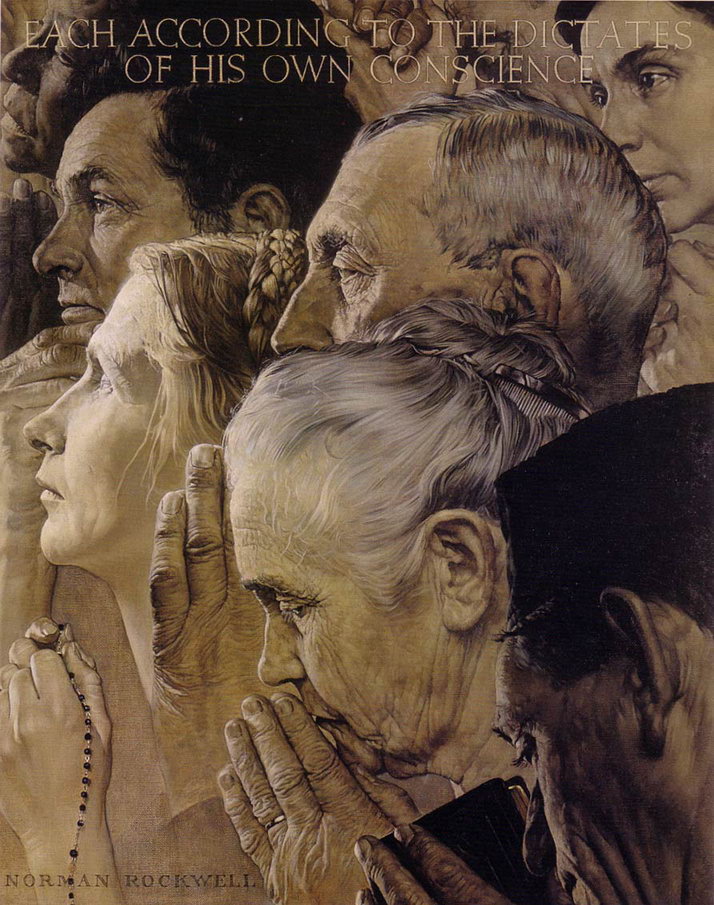
The Gift of Religious Liberty and the Real Dangers to It

“Congress shall make no law respecting the establishment of religion, or prohibiting the free exercise thereof; or abridging the freedom of speech, or of the press; or the right of the people peaceably to assemble, and to petition the Government for a redress of grievances.” The First Amendment of the US Constitution

“no man shall be compelled to frequent or support any religious worship, place, or ministry whatsoever, nor shall be enforced, restrained, molested, or burdened in his body or goods, nor shall otherwise suffer, on account of his religious opinions or belief; but that all men shall be free to profess, and by argument to maintain, their opinions in matters of religion, and that the same shall in no wise diminish, enlarge, or affect their civil capacities.” Thomas Jefferson in the 1779 Virginia Statute for Religious Freedom

Religious freedom is a central tenant of the Bill of Rights and has been a central facet of American life since our inception as a country, in fact pre-dating our founding in some of the original 13 colonies most notably Rhode Island and Pennsylvania.  Now before anyone gets the idea that I am about to write something in favor of limiting the freedom to worship or for that matter any limitation on religious practices I am not in fact I am a stalwart supporter of religion in the Public Square and not just mine. You see I am a bit of a purest about this at least most of the time and my view is as long as the practice is not hurting anyone who cares. Some might take me to task for that as a Christian, but my point is not to argue for the Christian faith in this article but rather point out some of the inconsistencies of those of various faiths who while proclaiming their defense of this fundamental right of all American citizens who seek to limit the practice of others that they find disagreeable or even repugnant. What I will do in this essay is to do what I did back in my seminary days, where fellow students asked me why I hadn’t gone to Law School instead of seminary, which mind you was not a complement and actually play the “Devil’s advocate” in the matter of the free exercise of religion as it currently exists in the United States.

You see my gentle readers it is my view that while many individuals and religious organizations loudly proclaim their defense of the right to free exercise it is more their free exercise rights that they are defending than the rights of others. In fact many that proclaim this the loudest are also those that would seek to limit the religious rights of others using the laws of the Federal Government and the various States and Commonwealths that make up the Untied States to do so.  Since law in the United States is based on legal precedence everything that goes to court on matters of religious liberty as well as the actions of various legislatures matters, precedent matters and once precedent has been established it is very hard to change. Thus it is a matter of importance to all that no one acts hastily and emotionally on any issue that I might bring up since each decision sets a precedent and can effect decisions in entirely unrelated matters.

Our First Amendment Rights are marvels which are envied by the citizens of most of the rest of the world and why shouldn’t they be?  In many nations simply being born as a member of a minority religion is enough to ensure that you will never have full legal rights and may even face persecution and death at the hands of those in power, Sudan anyone? Kosovo? Saudi Arabia? Iran? Indonesia?  These rights have provided the opportunity for churches that were suppressed on the European continent and elsewhere to thrive free of government persecution, take Baptists for instance.  In the early 1600’s the first Baptists, English Baptists were persecuted, imprisoned and even killed for their beliefs by the English Crown in particular by King James who despite authorizing the Bible given his name and loved by many Baptists as the “only” valid English translation was a notorious homosexual, not that there is anything wrong with that, hated those early Baptists and persecuted them throughout the land.  On the continent itself the Anabaptists and Mennonites as well as others referred to as “enthusiasts,” obviously forerunners of the Pentecostal movements of the 20th Century were brutally suppressed in many European lands.  The Jews were persecuted often brutally almost everywhere except surprisingly in places like the Ottoman Empire where in places like Baghdad they composed a rather sizable part of the population and were quite prominent in the Empire.  Of course Catholics were heavily persecuted in England and could not hold public office for many years following the English Reformation.  In fact there were hundreds of Catholics martyred for simply practicing their religion in private, simply celebrating Mass could get them a death sentence. Then there were the Huguenots in France, they were French Protestants who had gained a great deal of influence and power that were brutally suppressed and many killed by the French Crown and the Catholic Church.  The Lutherans were not big fans of other religions in Germany and worked with their Archrival Roman Catholics to kill off the Anabaptists and the Enthusiasts.  Spain was a great place to be anything but Roman Catholic but I jest, even some Roman Catholics now canonized as Saints were brought before the show called the Inquisition, Protestants, Jews, Moslems, none had a good time in Spain and Spain was equally repressive of native religions in the lands that it colonized in the “New World.”   The Russian Empire was known for its toleration of Catholics, Protestants and Jews especially in the equal treatment given to them in various Progroms conducted by the government and the Orthodox Church.  The Ottoman Empire had a limited amount of religious toleration; one cannot call it liberty and persecuted anyone equally that threatened the Caliphate or that they thought were heretical including the Arab tribes of the Arabian Peninsula that practiced something called Wahabi Islam.

Of course one can go around the world to see other stirring examples of religious toleration and expression.  Then along came the United States where our forefathers said to each other “gee wouldn’t it be nice if we could all just get along” or something like that and enjoined that right in our Bill of Rights right up there in the number one spot along with freedom of speech, assembly and the press.  Well it seems that we have a few contradictions in the applications of these rights in our history and sometimes the more religious people have had a negative influence in this notwithstanding all of the good things that many have done as religious individuals, particularly Christians and that churches have done in promoting human rights and the civil rights of all in our country.

While Christians were in the forefront of the Abolitionist movement whole denominations split on the issue of Slavery including the Southern Baptists, the Methodists and the Presbyterians. Curiously neither the Episcopalians nor the Catholics split over the issues although the war found them heavily engaged on both sides of the conflict.  After the war many American Christians worked for the rights of workers, the abolition of child labor and even something that I oppose, Prohibition. Notwithstanding the unbiblical and inhuman temperance movement, at least some Christians and Churches advocated  for the full civil rights of African Americans though few spoke up for rights of the Native Americans. Chinese immigrants to California were frequently mistreated and worked for almost nothing on the most demanding jobs like building the trans-continental railroad, mining gold and building stone walls for ranchers.

While enshrining the right to the free exercise of religion the Founding Fathers kind of ignored the human rights of a whole class of people, African American slaves and allowed the practice of slavery every allowing Blacks to be counted as 3/5ths of a person, which 3/5ths I don’t know but nonetheless only 60% of a full human being.  We also did wonderful things to Native Americans driving them off of their lands, hunting them down and confining them to reservations all while ignoring the treaties that we made with the various Indian Nations, try that with a European Country and see what happens.  Of course if we believe the “history” promoted by some on the Religious Right we have to believe that the vast majority of the people perpetuating these acts were solid Bible Believing Christians, but then how do we reconcile these crimes against humanity, even crimes against fellow Christians with the Christian faith?  In fact nearly every ethnic group that immigrated to the United States has experienced some form of discrimination, often religious from the good citizens of this land.  It turns out that throughout history we have had some problems in the matter of religious liberty and toleration, especially of those whose customs, language, culture and religion are different than our own.  My goodness my own family owned slaves and the family patriarch who fought as a Confederate officer in the American Civil War and after the defeat of the Confederacy refused to sign the loyalty oath, which good honorable men like Robert E Lee did and lost the family lands to the Federal Government.

But the crux of all of this comes down to religious liberty which as Americans we hold dear, at least our own religious liberty though I cannot be sure about the extension of this right to others that we disagree with in belief, practice or even politics.
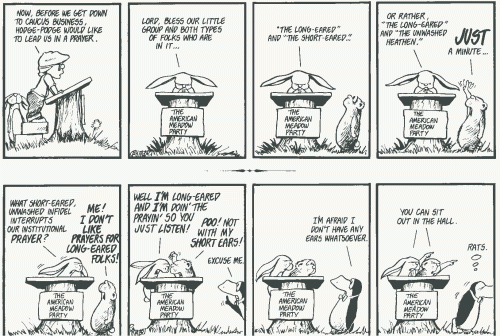
Now everyone is for religious liberty in the Public Square until a loathsome man like Fred Phelps and his family owned and operated “Westboro Baptist Church” shows up to protest and hurl vile epithets at those grieving the loss of family members killed in war, taunting these people in the most abhorrent of ways.  However, as grievous as these people are they do this under the right to the free exercise of religion.  Fundamentalist Moslems have as a stated goal of instating Sharia Law in this land, at least for Moslems. This they proclaim under the banner of religious liberty, however the imposition of Sharia Law on Moslems in the name of their religion also takes away their civil rights under the Constitution and the various laws of the Federal Government of the States that make up our fair land.  The Roman Catholic Church at the direction of the Vatican has attempted rather successfully until a recent Supreme Court ruling to shield Bishops that were complicit in personnel moves and cover ups regarding Priests accused or convicted of sexual misconduct and the sexual abuse of minors from criminal prosecution and civil suits under the guise of diplomatic immunity as the Vatican is a nation state. Now I ask you dear reader could any other religious organization shield its clergy from the laws of the land that any other citizen would be subject too? Not on your or my life, but the Vatican has blatantly done so and since we all value religious liberty we have as a nation turned a blind eye to this until now.  What about those of various beliefs and practices that use television, radio and the internet to espouse hatred and violence in the name of their religious beliefs and under the banner of religious liberty?

What about the question of the Metropolitan Community Church, a predominantly Homosexual Christian church wants to see the legalization of Gay Marriage as well as the right for homosexuals to serve openly in the Military.  The part about marriage is particularly fraught with peril because both the Church and the State have interests in marriage. For many marriage is primarily a religious act with civil overtones, in fact ministers of all denominations are licensed by the state to perform marriages on behalf of the State becoming in effect de-facto officers of the courts and at the same time most states deny homosexual couples the right to marry, regardless of one’s position on the legitimacy of such unions who could say that it is right for the states to approve and license the clergy of almost every religious tradition to conduct weddings that have the full civil effect, including tax breaks for all but a certain group?  We have this enshrined in our culture but would deny it to the Metropolitan Community Church to perform weddings for its members.  What if someone said that any other minister could not marry members of their own church under their church laws, ordinances and beliefs? There would be a public outcry, but not for the Metropolitan Community Church or other denominations that sanction Gay marriage.

What about adherents of Wicca and other Earth based religions or Native American religions? Some of their practices would not be welcomed by those of many Christian denominations as well as secularists and atheists but if they are not hurting anyone else why should others object? Likewise why should people object if a religious symbol is displayed on private property or on state property where it has been displayed for decades or longer? Is it hurting anyone? Not really but hurt feelings and being offended count as much as real injury to the litigious and as such there have been long, expensive and divisive court proceedings that have served little purpose.  Now am I in favor of the government using such symbols to advance the rights of a given religion?  Absolutely not, but there are times where religious symbols and American culture, particularly that which seeks to honor veterans from previous wars is not about the advancement of any religion but simply a memorial with intent of promoting a religious cause.

Likewise there are those that would attempt to limit the free speech rights and religious rights of Christians and others that protest the practice of abortion using civil disobedience to do so, some in polite and well mannered demonstrations but others in pretty unseemly manners.  At the same time there are Christians who call themselves “pro-life” who bless and baptize practices condemned by the same Church Fathers and Biblical writers who they uses to support the rights of the unborn. They support the death penalty despite evidence that in many states that the practice is abused and sentences often wrong. Many advocate for harsh treatment of aliens and exhibit a xenophobic attitude towards some immigrant groups, especially those that are not Christian. Then there is a now popular belief that the economic Social Darwinism of unfettered Capitalism is not only Biblical but God’s best ordained economic system while treating the poor and the elderly with distain and treat their political opponents as agents of the Devil rather than people that God might actually care about.

Local governments and even home owners associations have acted to quash home churches and Bible studies, acted to zone land so that the construction of religious buildings, edifices or displays is illegal all of which have been protested and fought in the courts by the groups involved particularly Evangelical Christians of various denominations.  Even churches that neighbors have deemed to be too loud in their expression of worship have been penalized by local governments and courts.

Yet many Christians had little problem with the suppression of the Branch Davidians at their Waco compound after all David Koresh was a “dangerous” cult leader.  Nor do many seem to have a problem in limiting the rights of Moslems that happen to be American citizens and protest if a Moslem clergyman becomes a military Chaplain or if Moslems want to build a Mosque in their neighborhood.  I think that religious intolerance is often in the eye of the beholder.  As David Barton the President of Wallbuilders an organization that seeks to promote America’s “Christian heritage” quoted William Penn “Whatever is Christian is legal; whatever is not is illegal.”

So as you can see my dear friends the subject of religious liberty and the freedom to practice our religions is one that is not as clear cut as we would like to admit.  The question, to play the Devil’s advocate here is “Should we limit the rights to the free exercise of religion?”    If we do so where do we draw the line? If we say everything goes does this mean for everyone or just us?  Could it be that in the enshrining of this right that the Founders actually meant the expression of rational and enlightened religion and not religious expression that limits the rights of other groups or supports the abolition of others Constitutional Rights?

You see that I think that our religious liberty is something to be cherished but I can see times and places where there would be a need for the community or state to limit such expression, not to take it away but to ensure that such expression is not used as a weapon against others as religious beliefs have been used in the past and present by people and governments around the world.

You see the lawyer that dwells deep within my heart that my fellow seminarians saw could argue the point for any position in this debate, which I guess kind of makes me a bit of a prostitute but still there are valid points to be made on all sides of this issue and to the extenuating civil, social and even economic and national security concerns that the absolute right to the freedom of religious expression impacts.  It seems that the waters get pretty muddy here my concern is that those on various sides of this issue are more about promoting their religion if they have one and do not really care about the religious rights of others while the devoted secularists would seek to expunge religion from the public square.  As I said at the beginning of this essay the issue is about legal precedence and sometimes the unintended consequences of decisions reached hastily when those on the various sides of an issue take it to court.

The question of religious liberty and the tension between competing Free Exercise rights and concerns about the “excessive entanglement” of religion in government will be with us for a long time. I think the result of the heated and often litigious nature of the debate will actually turn people away from the more strident groups in the debate and will actually do damage to the First Amendment protections that we all enjoy.  This causes me great concern and if you value your rights to the free exercise of your religion or expression or your right not to have the religious views of any group made the law of the land.  Religion can be abused and used as a dictatorial bludgeon and those who now advocate so stridently for their faith to be made the law of the land should well remember the words of James Madison:

“Who does not see that the same authority which can establish Christianity, in exclusion of all other religions, may establish with the same ease any particular sect of Christians, in exclusion of all other sects?”

Peace

Padre Steve+

33 Comments

Filed under faith, History, laws and legislation, philosophy, Political Commentary, Religion

A Quiet Remembrance: The Fall of Dien Bien Phu May 7th 1954

French Prisoners

On May 7th in Hanoi a small remembrance was held to mark the fall of Dien Bien Phu and honor the victor, 101 year old General Vo Nguyen Giap at his home.  It was one of the few remembrances held anywhere marking that battle which was one of the watersheds of the 20th Century. A half a world away in Houston Texas a small group of French veterans, expatriates and historians laid a wreath at the Vietnam War Memorial.  In Paris an ever shrinking number of French survivors gather each year on May 7th at 1815 hours for a religious service at the Church of Saint Louis des Invalides to remember the dead and missing of the French Expeditionary Corps lost in Indochina.  This battle is nearly forgotten by time even though it and the war that it symbolized is probably the one that we need to learn from before Afghanistan becomes our Indochina.

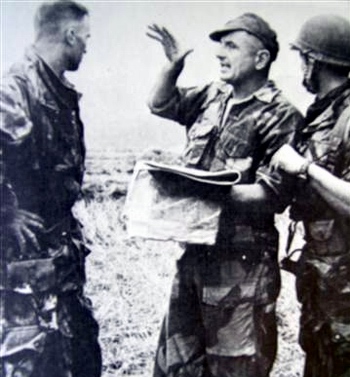
French Major Marcel Bigeard at Dien Bien Phu. A revered leader he died in 2010

On May 8th 1954 the last of the French garrison of Dien Bien Phu surrendered to the Viet Minh following the surrender of the main garrison the previous day.  It was the end of the ill-fated Operation Castor in which the French had planned to lure the Viet Minh Regulars into open battle and use superior firepower to decimate them.  The strategy which had been used once on a smaller scale the previous year at Na Son would prove to be the Göttdammerung of French colonial rule in Indochina.

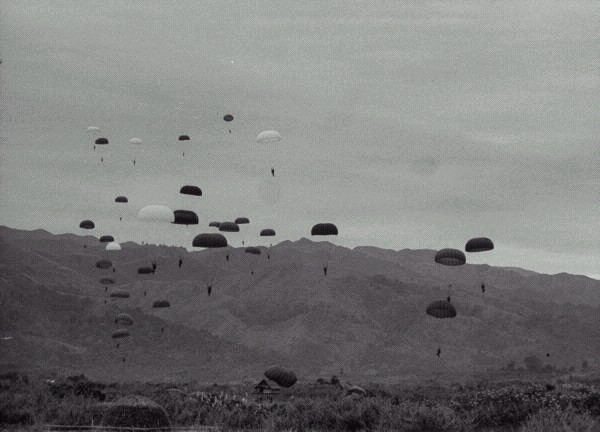
French Paras landing at Dien Bien Phu

The French had thought they had come up with a template based on Na Son in how to engage and destroy the Viet Minh which had in the years between 1945 and 1954 had turned an insurgent force into a strong Army capable of taking on large French forces.  As a result the French decided that they would attempt to draw Giap’s Army into open combat where their superiority in heavy weaponry and in the air could be used to destroy the Viet Minh. The plan was called the “Air-land base.”  It involved having strong forces in a defensible position deep behind enemy lines supplied by air.  At Na Son the plan worked as the French were on high ground and had superiority in artillery and air forces.  They were also were blessed by General Giap using human wave assaults which made the Viet Minh troops fodder for the French defenders.  Even still Na Son was a near run thing for the French and had almost no effect on Viet Minh operations elsewhere in Indochina while tying down a almost a full division of troops and a large portion of French air power. They inflicted heavy losses on the Viet Minh but did not destroy them.

The French command assumed that they had found a way to defeat the Viet Minh.  They decided to repeat the strategy used at Na-Son at the remote the remote town of Dien Bien Phu near the Laotian border.  The French desired to use Dien Bien Phu as a base from which they could conduct offensive operations against the Viet Minh and to draw Giap’s forces into a conventional fight that they thought they could win.  Unfortunately the French chose badly. Dien Bien Phu lay in a marshy valley surrounded by mountains which were covered in dense nearly impassible jungle.  It was a poor location to conduct offensive operations from and a worse place to defend.

Viet Minh Main Force Regulars

The French elected to go light on artillery and due to the terrain it had to be deployed in nearly open conditions with neither cover not concealment.  Unlike Na Son the Dien Bien Phu air head was at the far end of the range of French aircraft, especially relatively weak tactical air assets.  French logistics needs were far greater than the French Air Force and American contractors could supply.  The French strong points in the valley were exposed and not mutually supporting and as such Giap and the Viet Minh were able to close with and attack each strong point in time overwhelming each after valiant French resistance.  The terrain was so poor that French units were incapable of any meaningful offensive operations against the Viet Minh.  As such they could only dig in and wait for battle.  Even so many positions were not adequately fortified and the artillery was exposed. The French garrison was a good force.  It was comprised of airborne units, the Foreign Legion, Colonial Paratroops (Marines), North Africans from Tunisia and Algeria as well as Vietnamese troops.  Many of the officers including Lieutenant Colonel Langlais and Major Bigeard commander of the 6th Colonial Parachute Battalion were among the best leaders in the French Army. Others who served in Indo-China including David Galula and Jacques Trinquier would write books which would help Americans in Iraq.  Unfortunately the French High Command badly underestimated the capabilities and wherewithal of the Giap and his divisions.

Giap rapidly concentrated his forces and built excellent logistics support.  He placed his artillery in well concealed and fortified positions which could use direct fire on French positions. Giap also had more and heavier artillery than the French believed him to have.  Additionally he brought in a large number of anti-aircraft batteries whose positions enabled the Viet Minh to take a heavy toll among French Aircraft.  Giap also did not throw his men away in human assaults.  Instead he used his Sappers (combat engineers) to build protective trenches leading up to the very wire of French defensive positions.  In time these trenches came to resemble a spider web.

Without belaboring this post the French fought hard as did the Viet Minh.  Many French positions were overwhelmed by accurate artillery and well planned attacks.  The French hoped for U.S. air intervention, even the possibility of using nuclear weapons against the Viet Minh.  They were turned down.  Relief forces were unable to get through.  The garrison died, despite the bravery of the Paratroops and Legionaries.  The French garrison was let down by their high command and their government and lost the battle due to inadequate logistics and air power.  The survivors endured a forced march of nearly 400 miles by foot to POW camps in which many died.  Many were subjected to torture and group discipline.  Few French caved to the Viet Minh interrogations but some would come away with the belief that one had to use such means to fight the revolutionaries.  French and their Algerian comrades would apply these lessons against each other within a year of their release.  French soldiers and officers were shipped from Indo-China to Algeria to wage another protracted counterinsurgency.  Militarily they had all but won the war when their government pulled out. French troops, especially the Legionaries and Paratroops felt betrayed by their nation, much like many Vietnam Vets felt about the United States government after that war.  I find today that both our government and people are caring for our returning troops in a far better manner than the past.  Even still the veterans of Iraq and Afghanistan share almost a spiritual link to our American and French brothers in arms who fought at Dien Bien Phu, the Street Without Joy and places like Khe Sanh, Hue City, the Ia Drang and the Mekong.

The lessons of the French at Dien Bien Phu and in Indo-China were not learned by the United States as it entered Vietnam.  In fact the US Army made a conscious effort to ignore the advice of those that they called “losers.”  It was an arrogance for which we paid dearly in that war.

Despite our efforts in Afghanistan and the valiant sacrifices of our Marines and Soldiers we seem to have difficulty learning the lessons of the Vietnam Wars.  Old habits die hard, counterinsurgency done right isn’t sexy and there are no easy formulas to make it work.  What works in one country may not work in another as we are found when we tried to emulate our counterinsurgency success in Iraq in Afghanistan.  Despite a lot of institutional resistance from traditionally minded Army officers we were able to apply the lessons of counterinsurgency in Iraq and work with Iraqis to make that country more secure than it was before we took this type of warfare seriously.  Despite its continued problems Iraq is doing better and will likely do well in the long run as it recovers from the damage caused by the war.  They have known civilization since antiquity and are a proud people.  Someday I hope to take up the invitation of Iraqi friends to go back as they say as a tourist.

I am concerned about Afghanistan, despite the killing of Osama Bin Laden in neighboring Pakistan because it seems that the Taliban spring offensive is off to a good start.  U.S. and NATO Forces in Khandehar and Helmand Province have been placed on a higher alert and confined to their bases following a major assault on the Afghan provincial government installations in Khandehar.  The Taliban and other Afghan insurgents are only concerned with Afghanistan and even though Bin Laden is dead the deepening rift between the United States and Pakistan will likely ensure that they will enjoy military, personnel, financial support from many in Pakistan including the Intelligence agency in the remote and ungovernable northwest territories of that country which are a safe haven much like Communist China was for the Viet Minh.

Will there be a situation where an isolated NATO garrison is overrun by Taliban forces as French forces were in Indochina?  An isolated outpost was nearly overrun at Wanat in July of 2008 and at two isolated outposts near the Pakistani border in October 2009.  One would hope not, but we cannot underestimate the Afghans and their ability to adapt to NATO tactics and weapons.   Their predecessors successfully drove out the Soviets, the British, the Persians and the Greeks.  Dien Bien Phu is a warning from history not to leave troops in places where their exposure leaves them vulnerable.

But even more Dien Bien Phu serves to remind us that in such wars it is not always the highly trained and organized Western forces that win.  These are local wars and once the momentum shifts to the insurgent they are difficult to turn around.  In a sense the French were trying to do what we are trying to do now in taking the fight to the enemy.  It turned out badly for them and it could turn out badly for us.  I hope that we don’t forget.

Peace

Padre Steve+

2 Comments

Filed under History, iraq,afghanistan, Military, vietnam