Monthly Archives: July 2013

The Uneasy Alliance: The Army and Government during the German Revolution and Civil War 1919-1922

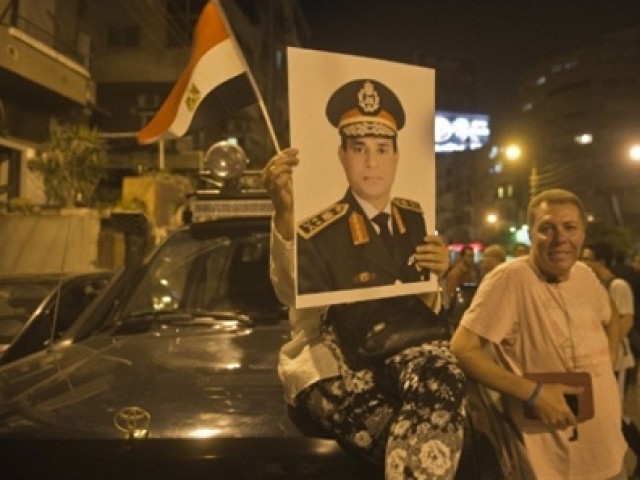
Thinking of the relationship of the Egyptian Army to its government I am always brought back to the influence of the German General Staff and the Reichswehr to the Weimar government in the days following the abdication of Kaiser Wilhelm II and the early days of the Weimar Republic. The relationship is somewhat similar. At least interesting to think about. Peace, Padre Steve+

padresteve's avatarThe Inglorius Padre Steve's World

Introduction

bundesarchiv_bild_146-1970-051-65_kapp-putsch_berlinThe Kapp Putsch

The German Revolution of 1919 and civil war is important for those who study highly developed states when they enter a period of social and political upheaval. Often such upheavals occur following military defeats or economic crisis that cause the society to question or even overthrow the established order.  The end of Imperial Germany and the establishment of the Weimar Republic on November 9th 1918 is a prime example.  Following the declaration of the Republic the Majority Socialists who had assumed power had no military force of any caliber to support it. The Army had melted away following the end of the war and the units which remained were unreliable and heavily infiltrated by Soviet style “workers and soldiers councils.”

Chaos ruled the streets, Communists and Independent Socialists of The situation being chaotic the Majority Socialists under the leadership of Friedrich Ebert joined forces with…

View original post 6,046 more words

Leave a comment

Filed under Loose thoughts and musings

The More Things Change and What You Leave Behind…

images-50

“It’s like I said. The more things change, the more they stay the same.” Quark (the final line of Star Trek Deep Space Nine)

Today has been one of those weird, somewhat challenging, a bit difficult on an emotional level and at the same time rewarding days. It was a day that involved dealing with people that I care for, that work for me that within a bit over a month I will be leaving. Men and women that have impacted my life and from what I understand will miss me, as one said “my quirkiness and all.”

This happened to be the second day of the sequester which will impact me and my staff and will ensure that my last month in my current billet will be challenging and meaningful. What I hope is that the things that I am able to do in the next month will not only survive me but help provide the resources, structure and environment to allow my successor to take things to the next level in providing spiritual care for the diverse population of Sailors, Marines, their families, veterans, retirees and their families, as well as our civilian employees.

You see ultimately, the show here will go on without me and the best that I can do besides caring for those in my charing in the here and now is to help ensure that I leave something behind that others can build on. That too is something that you learn in this military life, that what you do is not ultimately about you.  It is about service to the nation and to the people that you have the privilege to serve alongside no matter what the duty station.

When one lives their life in the military these transitions happen all too often. In a sense our lives in the military are very transitory, maybe more so than many would be comfortable with. For relatively short periods of our lives, maybe months, or a few years or in the case of deployments in combat zones sometimes days, hours or even minutes. But in those transitory times our lives can be bound together in ways unimagined by most people that do not share this military life or experience.

My regular readers know that I grew up in this environment as a child and that as an adult I have always felt the strange call to serve. What I find amazing is that after nearly 32 years of service between the Army and the Navy, active, reserve and National Guard around the world in peace and war is that I am still serving and will be, Lord willing for a number of years more and truthfully God only knows when this rather lengthly chapter of my life ends and another begins.

In light of the events of the past few days, the situations that I am dealing with at work, what I am trying to wrap up even as next month promises to be busy I found it fascinating that I was completing the viewing of the final episode of Star Trek Deep Space Nine called What You Leave Behind. I found the title of the episode to be serendipitous with my recent experiences and feelings about my impending transfer.

Despite how much I have moved around in life I find that I do not do “goodbyes” well. I like to imagine that I will see people again and I do, as many of the people that I have gone to school with, served with in the military or in the ministry together know I am one that treasures relationships. Heck, I look on my Facebook page there are people from almost every era of my life, many who I have served alongside dating to the very beginning of my military career. There are many others that I would dearly love to find and meet again.

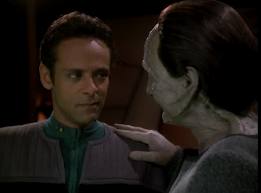
In one of the final scenes of the episode Dr Bashir and the Cardassian tailor and former spy Garak part ways after a devastated Cardassia is liberated from the Dominion. Bashir as is typical of many of us is attempting to off some consolation to his friend who is grieving what has happened to his planet.

images-51

BASHIR: You and I both know that the Cardassians are a strong people. They’ll survive. Cardassia will survive. 

GARAK: Please, Doctor. Spare me your insufferable Federation optimism. Of course it will survive, but as not the Cardassia I knew. We had a rich and ancient culture. Our literature, music, art were second to none. And now, so much of it is lost. So many of our best people, our most gifted minds.
BASHIR: I’m sorry, Garak. I didn’t mean
GARAK: Oh, it’s quite all right, Doctor. You’ve been such a good friend. I’m going to miss our lunches together.
BASHIR: I’m sure we’ll see each other again.
GARAK: I’d like to think so, but one can never say. We live in uncertain times.

As I approach my last month before my transfer I will certainly be experiencing many feelings that tend to bring a certain amount of sentimental melancholy. I will miss the people I have come to know here even as I rejoice in being able to return home and live with my wife Judy again full time.

There are times that I feel like Garak and Bashir. I like to believe, I like to be optimistic like Bashir, but there is a certain amount of sometimes cynical realism that pervades my thoughts, like Garak. I can understand both men. But as much as I understand them I also understand the military and like Quark have to admit “that the more things change the more they stay the same.”

But regardless of that, I can say about those that I have the the honor of working with, like Captain Sisko in that last episode of Deep Space Nine: “This may be the last time we’re all together, but no matter what the future holds, no matter how far we travel, a part of us, a very important part, will always remain here…”

Peace

Padre Steve+

Leave a comment

Filed under leadership, Military, philosophy, remembering friends, star trek

The Coming Egyptian Civil War: Disaster Beckons

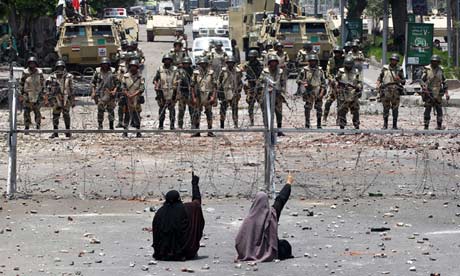
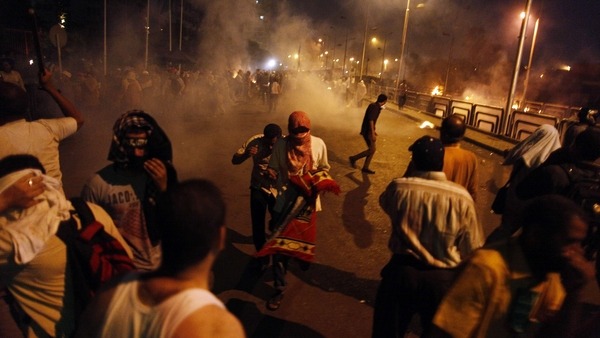
Cairo protesters

History has a strange way of playing itself out in the lives of individuals, nations and peoples. I wish that I was wrong bit as I look at the situation in Egypt today I see a situation which is as fluid as the shifting sands of the desert and as dangerous as the legendary Biblical plagues of the time of Moses.

When the dictatorship of Hosni Mubarak was overthrow by the military in 2011 it was hoped by many that Egypt would defy he odds of history, not Islamic or Egyptian history, but human history in that a revolution of a people without their own history of freedom and representative democracy seldom in its initial stages produces freedom and representative democracy.

images-49

In Europe alone Britain, France, Spain, Germany and Russia have endured bloody civil wars following the overthrow of autocratic regimes. Likewise the same is true of the history of South America, Africa, Asia and the Middle East the history of most successful oppressed peoples who do not have practical experience in democratic government tend to fight things out and even endure more oppressive governments before eventually, often at great cost to themselves and their neighbors achieve peaceful, stable and representative democratic rule.

egypt-coup-morsi-3_2609447b

Egypt has great potential, many of its people have exactly in temperament, education and wisdom what is needed to become a leading democracy in the region. That being said there are many obstacles to this. First is the longstanding tension between the radical Islamists of the Moslem Brotherhood, secularist military leaders, Social Democrats and others. Second the underlying religious and social tensions between rival Islamic denominations as well as Coptic Christians with generations of internecine bloodshed being played against one another by outside powers, the Ottoman Turks, the French, the British and even to a lesser extent the Soviets and Americans.

571825-Abdel_Fattah_alSisiAFP-1372840335-993-640x480

The fact is that Egypt as much as I do not want it to admit is that I believe that there is little that can save Egypt from a bloody civil war with unknown outcomes. The only thing that is sure is that thousands, possibly hundreds of thousands of Egyptians will die before the end of it and that Egypt’s instability will exponentially increase the violence and instability of the region.

egypt-morsi_2608190b

I think the best outcome is that a coalition of Social Democrats and militarists will cobble together enough of a government to stabilize the situation, but it will not be without much bloodshed. It will likely be like the early days of Weimar Germany when an unlikely coalition of military leaders and Social Democrats fought a Civil War against the extreme Soviet style Communists and then resisted Right wing extremist putsch attempts. Unfortunately that democracy died as the economies of the world melted down and the cost of reparations levied by Allied Powers at Versailles and radicals of the extreme Right and Left eventually leaving Hitler in power. It took another World War to eventually end that tyranny.

Muslim-Brotherhood-Clash-Getty

I guess that a best prospect is pretty much as bad as the worst prospect.

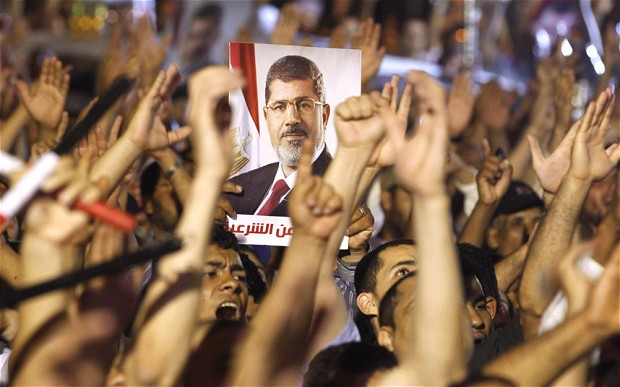
The ouster of the Moslem Brotherhood’s elected President Mohammed Morsi by the Egyptian military follow the protests of the vast majority of the Egyptian electorate is as much of a bad thing as it is a good thing. Morsi was to be sure democratically elected but he governed as an autocrat with increasing dictatorial tendencies. The reaction of the people and the Army was a natural reaction, as one Egyptian boy put it we did not overthrow a dictatorship to replace it with a dictatorial theocracy.  In effect both sides killed the democratic process, Morsi and the Moslem Brotherhood for the sake of Islamic religious power, the military for the sake of their place in society, stability and control and the protestors and democrats the sake of democracy and freedom.

EGYPT-POLITICS-UNREST-ARMY

The situation is much like the days following the the Army High Command’s forced abdication of Kaiser Wilhelm II, when in the face of a Communist revolution the German military establishment represented by Field Marshal Paul Von Hindenburg wrote to the new Socialist Chancellor Friedrich Ebert:

“I am convinced that only the following measures can help us overcome the present difficulties: 

  1. Summoning of the National Assembly in the course of December.
  2. Until then, or until the decision of the National Assembly can be carried out, conduct of the administration solely by the government and legitimate administrative organs. 
  3. So as to fulfill the justified wishes of the working class… qualified people of working class origin should be attached to the administrative authorities in an advisory capacity….
  4. The security service must be solely in the hands of the legal police organs and of the armed forces.
  5. Safeguarding of the orders of government by a reliable police force and, after the restoration of discipline, by the army.   

   In your hands lies the fate of the German nation. It will depend on your decision whether the German nation will rise once more. I am persuaded, and with me the whole army, to support you without any reservation…” (Letter from Field Marshal Hindenburg, likely written by General Groener to Chancellor Ebert December 8th 1918. In The Reichswehr and Politics 1918-1933 by F.L. Carsten, Oxford University Press, London 1966 pp.13-14)

The unfortunate thing is that no one will be happy until they achieve their goals and that will probably not only mean bloodshed, but a full scale civil war. No matter what the talking heads and experts say this has little chance of ending well. Centuries of injustice, dictatorship, colonialism, religious intolerance and economic inequities argue against other eventualities.

n_50238_4

The fact of the matter is that whether or not advocates of democracy like it at the present time no elected government in Egypt can survive without the support of the military. Like Weimar Germany, the fate of Egypt’s democracy will in large part lie in the hands of a military that at its heart is not democratic. It is a conundrum that we would rather not see, but it is reality.

All that being said there is always hope that things can turn out differently and we had better hope, for the people of Egypt, the region and the world that it does, because an Egyptian Civil War now will be disastrous.

Peace

Padre Steve+

1 Comment

Filed under Foreign Policy, History, middle east, national security

It’s What You Learn After You Know It All That Counts: Thoughts on the Occasion of 17th Anniversary of Being Ordained a Priest

163017_10150113444907059_3944470_n

“It’s what you learn after you know it all that counts.” Earl Weaver

It is hard to believe that it has been 17 years since I was ordained to the Priesthood. A lot has happened since then, much struggle and difficulty but also many blessings, which I think far outweigh the struggles.

I find that over the years I have matured. As a young Priest my goal was to be a great apologist for the faith using theology and history to drive home the points that I wanted to make, often in quite bombastic terms. A dear friend, an Army Chaplain who was once my enlisted Chaplain Assistant in the Army said that I was like a Catholic “Rush Limbaugh.” At the time I wore the moniker with pride, but over the years I see that no mater how sincere my faith, beliefs and arguments were that they were often more a reflection of my own insecurity and need to show that I and my former church were as valid and relevant as the Roman Catholics, Orthodox or Anglicans and certainly much more than Protestants not in Apostolic succession.

Looking back all these years later I have to admit that was quite arrogant. It is from what I understand a common failing in young Priests, Ministers or Rabbis as well as Navy Ensigns, and Army, Marine Corps and Air Force Second Lieutenants. But sometimes, not always in some cases, age and experience sometimes kick the hell out of arrogance and make you a better minister or military officer.

Since I have been through various renditions of the “young minister” or “young officer” phase of life, and each time had my arrogant tendencies exposed and learned that I knew a whole lost less than I thought that I knew. I guess that Earl Weaver was right, it is “what you learn after you know it all that counts.”

My faith journey since being ordained as a Priest has been full of ups and downs. I figure that between deployments, field exercises, underway periods aboard ship, schools and geographic bachelor assignments, not including the numerous overnights as a hospital chaplain while stationed at home that since July of 1996 I have spent about ten of those 17 years apart from my wife Judy. Next month I return home to Virginia to be with her and take a teaching assignment at the Joint Forces Staff College and with any luck and God willing I will spent the next three years with her and our dogs, Molly and Minnie while teaching, writing and serving as the Chaplain at the small chapel that is part of the Staff College. As my Iraqi friends say “Inshallah.”

Likewise my faith journey has been fascinating when I look back on it. Back in the early days I had an absolute certainty about my beliefs. Those beliefs would be shaken by experiences at war and in my former church. Those experiences were the bombs that blew up my theological playground and I really haven’t been the same since and for that I am actually glad.

The experiences of being used and abused by several bishops of my former church made me wary in a way that I had not been before about those in authority. Coincidentally those men are no longer part of that church having used it for their own gain and through their machinations ruined many lives and destroyed many parishes. Those men at various times forbid me from contact with their diocesan priests, banned me from writing and one finally told me to leave the church. They were not good examples and none are associated with that Church now. Thankfully there are many people, clergy and laity alike in my former church who are doing great things and attempting to put the pieces back together of what the men that mistreated me, and others like them did to that church.

The result of being asked to leave was being received into an an Old Catholic Denomination with a very similar ministry model and ethos to the Old Catholic Church of the Netherlands. I am blessed for nearly the past three years to be a Priest in the Apostolic Catholic Orthodox Church. It is where I need to be and a church that embodies what I have come to believe.

Over time my ecclesiology (doctrine of the Church) went from a monarchical monstrosity to a belief that true Apostolic authority is not just a matter of having a correct or valid apostolic succession but also is bound up in the whole people of God, that consensus, collegiality and charity are of the essence in our relationships as Christians as well as our witness to the world. The prayer of Jesus that his people “may be one” is part of my daily life and personal prayer.

n671902058_1153804_6925

Back in May of 2011 I wrote: “I think a lot of this is simply that many of us clergy types become so invested in “defending” what we believe that we forget that the call of Jesus is to care for those that are the least, the lost and the lonely. Without getting preachy it seems to me that Jesus preferred to be with such people and often castigated the clergy of his day for doing exactly what we do.  The whole “woe to you Scribes and Pharisees…” passage should send chills up any minister’s spine because we are often no different than them.”

Likewise my experiences in war and my return from Iraq with a severe case of chronic PTSD also shook the core of my faith. For almost two years I have to admit that for all practical purposes that I was an Agnostic who was praying that God was still around. It took some time before faith returned and when it did it was different. It was questioning, not absolutist and much more willing to be accepting of those different than me and willing to show grace to those whose faith, lifestyle or beliefs that I would have treated much more judgmentally or harshly as new Priest.

One of the authors that helped my through the most difficult of times was the late Father Andrew Greeley whose Bishop Blackie Ryan novels I began reading in Iraq and were about the only spiritual reading that I had during the darkest, most difficult at painful days of my life. One thing that Greeley said which was something that I have come to believe was:  “I don’t think Jesus was an exclusivist. He said, and we believe, that He is the unique representation of God in the world. But that doesn’t mean this is the only way God can work.” (The Life of Meaning: Reflections on Faith, Doubt, and Repairing the World Edited by Bob Abernathy) 

Such an understanding has impacted my ministry as a Priest and Navy Chaplain since my return from Iraq. I have come to believe that the high pressure manner in which many American Christians market their faith under the misnomer of “evangelism” is doing more damage than good and is actually something that the early Church would not have recognized. Greeley put it well:

“People came into the Church in the Roman Empire because the Church was so good — Catholics were so good to one another, and they were so good to pagans, too. High-pressure evangelization strikes me as an attempt to deprive people of their freedom of choice.”

But apart from that I rediscovered my humanity during those dark days and it is something that helps me when I encounter people who are suffering, in crisis, ostracized or struggling and questioning God and their faith. I have learned through my own struggle and despair that simply being preached at told that I didn’t have enough faith, to pray more, read my Bible more or give more money to the church (the latter is quite a popular American way of getting God’s favor) actually drove me away from the grace of God and made me resentful of those that preached at me.

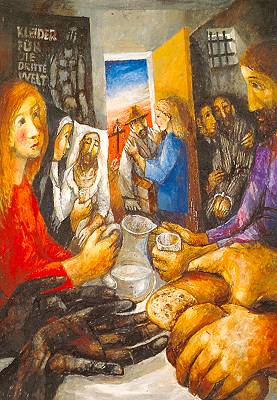
As such I have changed my ministry model. Jesus was about town and hobnobbing with all the wrong kinds of people, often offending both the religious establishment and his own disciples. As a Priest I began to realize while deployed on a Guided Missile Cruiser and in Iraq that I was too protective, much like the post Apostolic era Christians of the Eucharist, which is at the center of my faith. I realize now that Jesus both actively shared bread and wine with those considered to be “unclean” or sinners and never turned away those who sought his presence.
barmherzigkeit

I also realize that anything I do as a Priest, be as simple as an encounter with a person in a hallway or parting lot, with friends at a ball game or bar, at the bedside of a dying man or woman, sitting with the family of a young man one woman that has taken their life, holding a stillborn baby with a grieving mother, administering the Sacrament of Reconciliation, Baptism or the Eucharist that what matters is being being authentic and showing the love of God to people.

One of the most powerful things that I remember reading from Greeley was in his final Bishop Blackie Ryan novel. In it Bishop Blackie notes:

“Every sacramental encounter is an evangelical occasion. A smile warm and happy is sufficient. If people return to the pews with a smile, it’s been a good day for them. If the priest smiles after the exchanges of grace, it may be the only good experience of the week.”  (Andrew Greeley: The Archbishop in Andalusia p.77)

Seventeen years. It doesn’t seem that long. I assume that I still have much to learn.

Peace

Padre Steve+

5 Comments

Filed under christian life, faith, Military, Pastoral Care

To Iraq and Back: Prelude: I was Born for This

295_27076757058_7361_n-1

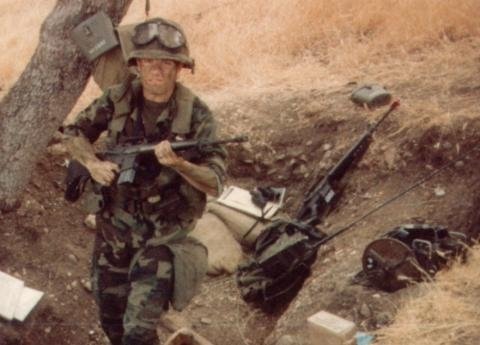
Me in 1982 

This is the first actual chapter in my series “To Iraq and Back: Padre Steve’s War and Return.” I wrote last night that I was going to be doing this and I figure that there is no time like the present to start. Just about 6 years ago I was preparing to deploy to Iraq as an individual augment supporting the US Marine and Army advisors to Iraqi Army and Security Forces in Al Anbar Province. After 6 years I think I can finally complete my literary account of my experiences in Iraq, my return and subsequent struggle with Post Traumatic Stress Syndrome (PTSD). 

Though I am not certain, I do think that many of us were born for what we feel called to do. As bit of a theologian I can honestly say that I am not a Calvinist or strict Augustinian who believes that we are simply playing out some predetermined role or fate on earth. Neither am I a fatalist but I really do feel, that whether it was something God ordained, something genetic or a product of my environment growing up, that I was born to do what I do.

As one who has some training as well in psychology and pastoral care I also understand that the human mind is a very complicated lump of gray matter. I know that we as human being as products of our genetic make up, our upbringing and environment, education, spiritual formation, relationships ad infinitum, ad nauseum.

So I know what I believe about my calling to serve in the military and the priestly vocation cannot be scientifically proven. That being said, I believe and that belief in my calling survived even in my times of unbelief.  A paradox for sure, belief and unbelief coexisting at the same time in the same person, but Father Andrew Greeley said it well in his novel The Bishop and the Beggar Girl of St Germain: “Most priests, if they have any sense or any imagination, wonder if they truly believe all the things they preach. Like Jean-Claude they both believe and not believe at the same time.”

My tour in Iraq in a sense was the culmination of my calling, a call that I felt at a very early age, to serve in the military and later to be called to serve as a Priest in the military. I have long figured that to have served a full career in the military in time of war and not to have gone forward into danger to do what I have trained all my life to do.

I have a hard time not remembering when I wanted to serve in the military and serve in combat. That may sound strange but for some reason, even though I was not encouraged to follow this path it was something that growing up as the son of a Navy Chief Petty Officer who served at the Battle of An Loc in the Vietnam War that I felt was my destiny. Maybe it is faith, maybe it is some sort of mysticism or even fatalism, but I do believe that for good or for bad that I am doing what I was born to do.

George Patton commented: “A man must know his destiny. if he does not recognize it, then he is lost. By this I mean, once, twice, or at the very most, three times, fate will reach out and tap a man on the shoulder. if he has the imagination, he will turn around and fate will point out to him what fork in the road he should take, if he has the guts, he will take it.”

I am sure that my family and my earliest friends can testify to my love of all things military and the nearly romantic calling that soldiering had on my life. At nearly every turn in life I have responded to the military calling by volunteering for assignments that would place me closest to the action. There were times that my wishes were thwarted and my desires placed on hold, but they never died.

I served on the Fulda Gap in the Cold War and missed serving in ht First Iraq War because I had left active duty to attend seminary and my National Guard unit just missed being mobilized. I did support the Bosnia operation as a mobilized Army Reserve Major and during that mobilized period of service was told that I was not a place for me in the Regular Army. However, a few months after my last active reserve posting I was given the chance to apply for active duty as a Navy Chaplain. Less than 7 weeks after the first talk with the Navy I resigned my Army Reserve commission as a Major and accepted a lower rank, that of a Navy Lieutenant to enter active duty in February 1999.

The Marine unit that I was serving with in 1999 came very close to being sent to the Kosovo crisis and had Slobodan Milosevic not made a last minute peace deal after a 70 day air campaign I am sure I would have ended up there.

555306_316970661755579_1118848704_n

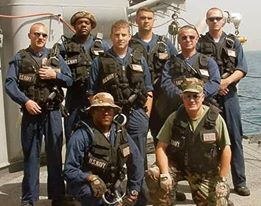
With my Boarding Team, April 2002 aboard USS Hue City

However it was 9-11-2001 that changed everything. I was in Camp LeJeune North Carolina with the 2nd Marine Division when the hijacked aircraft hit the Twin Towers and the Pentagon. Shortly after those attacks I was transferred to the USS Hue City, a Aegis Guided Missile Cruiser. My first wartime deployment was in 2002 aboard Hue City supporting Operation Enduring Freedom and Southern Watch. On that deployment I served as an advisor to one of our boarding teams and took part in over 70 boarding party operations against Iraqi and other oil smugglers who were breaking the United Nations oil sanctions against Iraq.

We were in the yards when Operation Iraqi Freedom began and in the fall of 2003 I was assigned to the Marine Security Force Battalion. In my time at Security Forces I travelled around the world and often to the Middle East and Europe, but not to Iraq or Afghanistan. Because the elements that we sent to Iraq were too small to rate an organic chaplain I did not deploy with them, though I heard about the experiences of many of those Marines and Navy Corpsmen as they came to me for counsel when they came home.

Despite having spent time of the boarding teams and having deployed numerous other places in my career there were times that I felt like William Tecumseh Sherman, who missed the war with Mexico having been sent to California who wrote: “I have felt tempted to send my resignation to Washington and I really feel ashamed to wear epaulettes after having passed through a war without smelling gun-powder.”

In October 2006 I was assigned to Navy EOD Group Two and shortly thereafter my life which had been very active with more time spent away from home than with my wife since my call up in 1996 to support the Bosnia operation became much more complicated. While at EOD I was supporting very skilled sailors most of whom had deployed multiple times in the always dangerous work of defusing and defending against Improvised Explosive Devices, or IEDs, the signature weapon of the wars in Iraq and Afghanistan. I also was called to support sailors either preparing to go to Iraq or Afghanistan as Individual Augments or those that were returning home.  As I heard their stories, especially those serving as advisors with Iraqis or Afghani soldiers I knew that was what I needed to be doing.

In early 2007 a call went out seeking chaplains to serve in Iraq and Afghanistan in various roles that were not supported by unit chaplains. With the permission of my supervisory Chaplain, Captain Deborah McGuire who was at the Navy Expeditionary Combat Command I put my name in the hat and was notified that I would be sent overseas. I explained to Judy that despite her misgivings that I felt that Nelson and I were the most ready, qualified and prepared team to take on the mission. Needless to say that did not assuage her fears and concerns and an emotional distance began to grow between us.

Initially we thought it would be sent to Iraq, then it was Afghanistan, and finally the first week of June 2007 the orders came down for Iraq. My faithful assistant, Religious Program Specialist Nelson Lebron would go with me. It was the first time that an existing Religious Ministry Team had been tagged to take on an independent mission of this nature.

Our orders were to support Marine Corps and Army advisors in Al Anbar Province, a mission that was new because when the advisory teams were first formed no one thought about organic religious or spiritual support. It was assumed that chaplains from nearby units would suffice but the Army and Marines learned that the assumption was wrong and that the advisors needed their own chaplain support.

The next few weeks would be a whirlwind as we prepared to go. They would be weeks that were trying both individually and for our families and neither of us would realize how much we would be impacted by our time in Iraq, but in June of 2007 that was still a part of our yet uncharted future.

Peace

Padre Steve+

Next: The Preparations


Leave a comment

Filed under PTSD, to iraq and back, Tour in Iraq

To Iraq and Back: Padre Steve’s War and Return

400236_10151328400862059_541742014_n

“All men dream: but not equally. Those who dream by night in the dusty recesses of their minds wake up in the day to find it was vanity, but the dreamers of the day are dangerous men, for they may act their dreams with open eyes, to make it possible.” ― T.E. Lawrence, Seven Pillars of Wisdom: A Triumph

It is hard to believe that six years ago I was almost ready to deploy to Iraq with my bodyguard and assistant Religious Program Specialist First Class Nelson Lebron. I had been in the military 26 years, 17 1/2 in the Army and at that time almost eight in the Navy. Our mission was to support the American advisors to the Iraq 1st and 7th Divisions, the 2nd Border Brigade, Port of Entry Police, Highway Patrol and Police forces in Al Anbar Province.

I was to be a life changing experience for both of us, no strangers to deployment or danger. In 2008 we returned to the United States changed by our experiences. It was also to test my marriage and even my career in the Navy. Both of which I thought might be lost within a year or two of my return.

To quote Charles Dickens “it was the best of times, it was the worst of times.” I came back diagnosed with a case of severe and chronic PTSD as well as chronic Tinnitus and and severely impaired ability to understand speech. Nightmares, and night terrors chronic insomnia, flashbacks, hyper vigilance, panic attacks and claustrophobia have all been part of my life since then.

The experience left me severely depressed, at times feeling the pain of despair and hopelessness, a loss of faith and it’s restoration.

Despite all of that I consider my time in Iraq to be the high point of my military career. It was a place that I was able to use every gift, talent and skill at my disposal to do a job that took me to places and allowed me to work with people that I could not have imagined. My tour in Iraq, though painful and life changing was also the best of times, it opened my eyes to things that I never thought possible, relationships unimagined and ministry unbound by the constraints of the terrible model of contemporary American Christianity.

Over the next six or seven months I am going to clean up and republish articles about our deployment and then add additional articles that back when I started to write back in 2009 was unable to do because the memories even then were still to fresh and painful to relive.

It is hard to believe just how vivid the memories still are. I found my notebook from my time there and hope that it as well as my memories don’t fail me. Of course I will take time to write about the post-Iraq experience as well.

Hopefully when they are complete I can get them published as a book. The goal, I hope is that others who have been through what I have been through, and those who have been through much worse will be able to know that what happened to them can happen to anyone that goes to war, including Chaplains and other care givers who are by nature of or calling and training supposed to be immune from such experiences.

I will place these articles under a new page tab at the top of the website called To Iraq and Back.

Peace

Padre Steve+

Leave a comment

Filed under faith, iraq,afghanistan, middle east, Military, Tour in Iraq

What if Hitler was assassinated in 1943? An Alternative History of Kursk and the End of World War II in Europe

Since I publsihed something on the Battle for Kursk, “The Battle that Wasn’t Necessary” I am republishing another old post, an “alternative history” of that battle presuming that Hitler had been killed in an unsuccessful assassination attempt in March of 1943. What follows is what I think might have happened, or at least been in the realm of possibility. Peace, Padre Steve+

padresteve's avatarThe Inglorius Padre Steve's World

This is an alternative history of how the Germans might have avoided the disaster at Kursk. It looks at what might have happened if an actual assassination attempt on Hitler had succeeded in March 1943 and how Manstein might have been able to execute the “backhand” strategy that he favored using a mobile defense.  This is predicated by Hitler’s death, based on Hitler’s actions and control of operational decisions Manstein would never have been allowed the freedom to conduct operations in this manner.  In eliminating Hitler I have also included personnel changes and the overall strategy for the German High Command, and the probable response of Stalin to Hitler’s death had it occurred in the spring of 1943. I have tried to be faithful to known historical opinions and actions of the participants and likely reactions to such a situation although one cannot predict precisely what people would have done. …

View original post 6,455 more words

Leave a comment

Filed under Loose thoughts and musings

The Battle that Wasn’t Necessary: Kursk 1943

On July 5th 1943 the climactic battle that sealed the fate of Nazi Germany began. The Battle of Kursk was a slugfest that both sides knew would be decisive. It included the greatest tank battle in history, but from the German perspective was a battle that should not have been fought. This is an older article of mine but should be of interest to anyone that studies war and its consequences. Peace, Padre Steve+

padresteve's avatarThe Inglorius Padre Steve's World

The Battle of Kursk was the climactic battle on the Eastern Front from which the Germans never recovered. It was a battle that should not have been fought, at least at the time that it was fought. It was high risk operation with minimal payoff should it succeed. A while back I posted an “alternative history” of this entitled “Operation DACHS.” I have also posted articles on events leading up to Kursk, one on Stalingrad and the other on Manstein’s counter-stroke.  In a sense this is a trilogy with an alternative scenario included.


The German Situation and Dilemma in April 1943

Battle_of_Kursk_(map)

The Germans faced a dilemma in April 1943.  Manstein’s brilliant counter-stroke had turned what could have been disaster into an opportunity to salvage prospects for the Eastern Front. The German action had “repaired its front, shattered the hopes of the Allies, and nipped the Russian spearhead.”[i] Unfortunately…

View original post 5,687 more words

Leave a comment

Filed under Loose thoughts and musings

Four Score and Seven: July 4th at Gettysburg

Remembering the 87th anniversary of our Independence. The day after the Battle of Gettysburg and Lincoln’s Gettysburg Address. Peace, Padre Steve+

padresteve's avatarThe Inglorius Padre Steve's World

“Dead men and plenty here – and I saw plenty [3] of them in all shapes on the field – Help to wound & Kill men then Patch them up I could show more suffering here in one second than you will see in a Life…” Elbert Corbin, Union Soldier at Gettysburg 1st Regiment, Light Artillery, N. Y. S. Volunteers (Pettit’s Battery)

“In great deeds something abides. On great fields something stays. Forms change and pass; bodies disappear, but spirits linger, to consecrate ground for the vision-place of souls.” Colonel Joshua Lawrence Chamberlain

The Army of Northern Virginia and Army of the Potomac remained on the bloodstained Gettysburg battlefield on July 4th 1863. Both armies had suffered severely in the fighting around 50,000 soldiers from both sides lay dead, dying or wounded on the battlefield. Surgeons and their assistants manned open air hospitals while parties of stretcher bearers evacuated wounded men for…

View original post 800 more words

Leave a comment

Filed under Loose thoughts and musings

Gettysburg at 150: The Accounting in Lives and Difficult Moral Questions

gettysburg-devils-den

“Why do men fight who were born to be brothers?”James Longstreet

“It is well that war is so terrible. We should grow too fond of it.” Robert E Lee

As the sun set on the evening of July 3rd 1863 the battered Army of Northern Virginia and the battered but victorious Army of the Potomac tended their wounds, buried their dead and prepared for what might happen next.

Following the disastrous attack aimed at the Union center, what is commonly called “Pickett’s Charge” Lee and his surviving commanders prepared for an expected Union counter attack. However, George Meade, the commander of the Army of the Potomac who had correctly anticipated Lee’s assault decided not to gamble on a counter attack, though it was tempting. He knew too well the tenacity and skill of the Confederate commanders and soldiers on the defense and did not want to risk a setback that might give Lee another chance.

Savages_Station_field_hospital-600x374

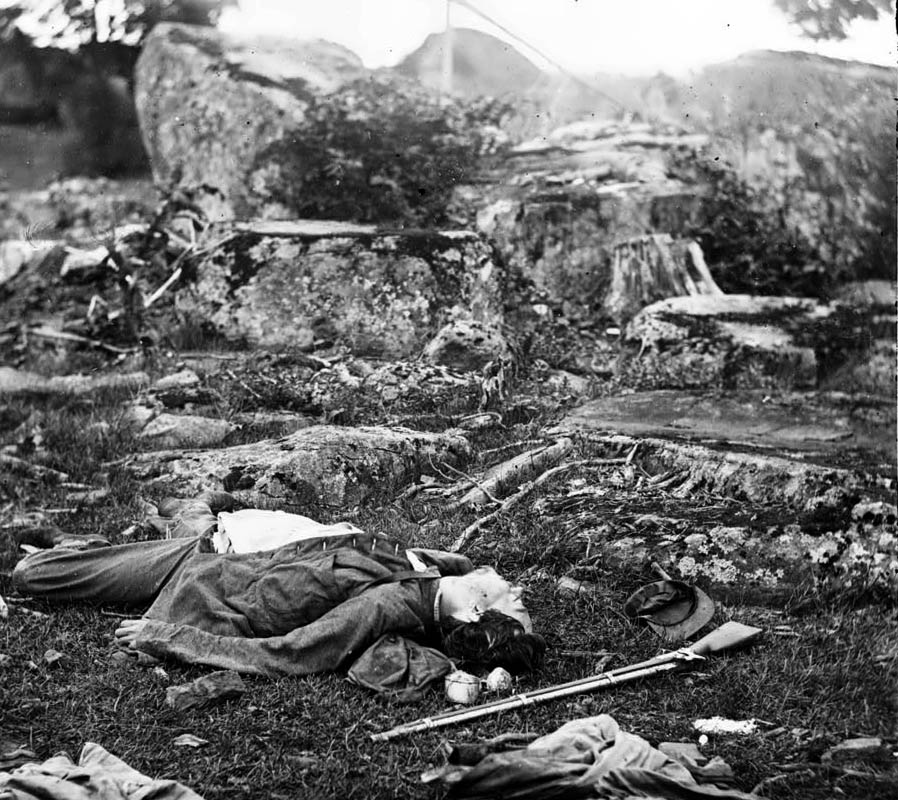
The dead and wounded littered the battlefield. Field hospitals, little more than butcher shops where arms and legs were amputated by overworked surgeons and attendants while those with abdominal wounds that could not be easily repaired were made as comfortable as possible. Triage was simple. If a casualty was thought to have a reasonable chance at survival he was treated, if not they were set aside in little groups and allowed to die as peacefully as possible. Chaplains made their way around, Protestant’s ensuring that their soldiers “knew Jesus” and Catholics administering the Last Rites.

dead-civil-war-soldiers

One Confederate soldier describe the scene west of the town on July 4th:

“The sights and smells that assailed us were simply indescribable-corpses swollen to twice their size, asunder with the pressure of gases and vapors…The odors were nauseating, and so deadly that in a short time we all sickened and were lying with our mouths close to the ground, most of us vomiting profusely.” 

Among the killed and wounded were the great and the small. John Reynolds who died on day one, Winfield Scott Hancock, the valiant commander of the Union II Corps wounded during Pickett’s Charge, Mad Dan Sickles, who had nearly brought disaster on the Federal lines by advancing to the Peach Orchard on July 2nd had a leg amputated.

The Confederates suffered grievous losses. Divisional commanders like Dorsey Pender were mortally wounded. John Bell Hood was severely wounded, Isaac Trimble was wounded and captured while Harry Heth was wounded. Numerous Generals were killed or wounded and among regimental commanders the toll was fearful. In Picket’s division alone all three brigade commanders, Kemper, Armistead and Garnett were killed or wounded while 26 of 40 Field Grade officers were casualties. 46% (78 of 171) of the regiments of the Army of Northern Virginia suffered casualties at the command level. The Confederate casualties, especially among the best leaders were irreplaceable and Lee’s Army never recovered from the loss of seasoned leaders who were already in short supply.

One witness, Frank Haskell looked in at a field hospital in the Union II Corps area and wrote:

“The Surgeons with coats off and sleeves rolled up…are about thier work,… “and their faces and clothes are spattered with blood; and though they look weary and tired, their work goes systematically and steadily on- how much and how long they have worked, the piles of legs, arms, feet, hands, fingers…partially tell.” (Gettysburg by Stephen W Sears, Mariner Books, Houghton Mifflin Company Boston, New York 2004 p.466)

All told between 46,000 and 51,000 Americans were killed or wounded during the three days of Gettysburg. Busey and Martin’s Regimental Strengths and Losses at Gettysburg lists the following casualty figures, other accounts list higher numbers. One also has to remember that many of the missing were killed but simply never found or if their bodies were found identified:

killed           wounded         missing         total

Union                    3,155          14,531             5,369           23,055

Confederate         4,708          12,693             5,830            23,231

Total                     7,863           27,224            11,199          46,286

To provide a reference in 8 years of war in Iraq the United States suffered fewer casualties than during the three days of Gettysburg. It was the bloodiest single battle in American history.

At the end of the war, Joshua Chamberlain, the hero of Little Round Top who was well acquainted with the carnage of war asked the most difficult questions:

“…men made in the image of God, marred by the hand of man, and must we say in the name of God? And where is the reckoning for such things? And who is answerable? One might almost shrink from the sound of his own voice, which had launched into the palpitating air words of order–do we call t?–fraught with such ruin. Was it God’s command that we heard, or His forgiveness that we must forever implore?”

May we pray for peace that such an event never take place again.

Peace

Padre Steve+

Leave a comment

Filed under civil war, History, Military