Yearly Archives: 2016

Hell Hath no Fury Like a Fundamentalist Scorned: Phyllis Schafly Dead at 92


Friends of Padre Steve’s World,

I never rejoice in the death of anyone, but there are some people who because of their body of life’s work that I will not miss. Phyllis Schafly is one of them. She was one of the leading religious agitators who fought to deny equal rights to women by stopping the passage of the Equal Rights Amendment which by an act of Congress would have guaranteed women the same rights as men, and to the end of her life was a strident opponent of equality for LGBTQ people, and immigrants. 

Schafly used her religious beliefs as a weapon to deny rights to fellow citizens, and in doing so became one of the most forceful advocates of a supposedly Christian theocracy which mobilized millions of voters and made her the darling of the political preachers of the religious right for over forty years. Most recently she had cast her political power as a leader of the Christian Right behind Donald Trump. Honestly, I can think of few people who so vehemently and successfully used the power of religiously infused politics to such a degree as Schafly, and the words of James Spader’s character in the television series The Blacklist seem to apply to this now dead woman, “hell hath no fury like a fundamentalist scorned.” 

But there is always a price for such foolishness. Schafly and her allies in the political Christian Right who so desired to bring about the Kingdom of God by attempting to both subvert the Constitution through biased religious lawmaking, by demonizing her opponents, and by denying the very source of life of our nation, the proposition that all men are created equal actually helped destroy the real spiritual influence of the Christian faith in the United States more than anyone. They sold their birthright, discredited the church, and for what? The illusion of political power and influence. 

A few years back the Barna Report, a very reputable Evangelical Christian polling organization noted that the fastest growing segment of the American religious mosaic was “the nones,” people who have no preference in religious belief, and the fastest growing subsets of the “nones” are Atheists, Agnostics, and Free Thinkers. In fact number one of the reasons cited by Barna is that a vast majority of young people, including those who grew up in the church, described the church as too political. A February 2016 study by Barna noted that almost half of non-religious Americans view Christianity as extremist, and dangerous. That should trouble any Christian leader, but it never bothered Schafly or for that matter any of her political preacher allies. Likewise according to a Barna study released in October 2014, nearly half of the ever rising number of “the unchurched” find it hard to name a single positive contribution of the church to society. 

But the situation is worse if you look at why young Christians leave the church. According to a Barna survey in September 2011 young Christians believe that the church is overprotective, shallow, antagonistic toward science, that they feel judged by older church members who are simplistic and judgemental, that church is like a “country club” that is antagonistic and unwelcoming of outsiders, and that it is a place unfriendly to those that doubt. Specific comments by large numbers of Christian young people who are feeling the church include that it is “too political,” “fear based and risk adverse,” and that it “demonizes those outside the church.” But I think the most damning finding of that survey was that twenty percent  of Christian young people said that “God seems missing from my experience in church.” 

Throughout her life Phyllis Schafly made her money and fame by demonizing all opposition, she rallied supporters by promoting fear, and she, maybe even more that the Elmer Gantry types of charlatan political and prosperity preachers is in large part responsible for the current sad state of the Christian church in the United States. I remember back in the late 1970s and 1980s the hold that she had on churches that I attended. She was practically deified for her opposition to women’s rights, and LGBTQ people. She could be found at the side of any political hack willing to give her a place in the podium almost to the day she died, even this summer she appeared at the side of Donald Trump, as always casting the pearls of the Gospel at the feet of a man whose life and work exemplifies the complete opposite of what was once considered Christian virtue. 

When I learned of Mrs Schafly’s death I was watching an episode of The Blacklist. Reddington made the comment “you know what my problem with religion is? Man. Like anything that has potential to be beautiful, man will turn it into somethings ugly.” I could not help by think of the irony. 


Schafly spent her last year nearly destroying the Eagle Forum organization that she helped to found by endorsing Trump, a man who she called “the last hope for America” even as she filed a lawsuit against nephew Tom from trademarking his Schafly Beer because she was the person who made her name famous. 

Truthfully, like I said, I never rejoice in the death of anyone, even someone like Mrs Schafly whose actions I believe we’re so detrimental to so many people and to the church itself. I pray that she finds God to be more merciful to her than she was to others, and I do hope after a life spent demonizing and denying the rights of people that she despised, I hope that her tortured and embittered soul finds some measure of peace that she seemed unable to find in life. 

What a shame… 

So until tomorrow,

Peace,

Padre Steve+ 

7 Comments

Filed under civil rights, Political Commentary, Religion

The Importance of the Worker: Labor Day 2016

First_United_States_Labor_Day_Parade,_September_5,_1882_in_New_York_City

Friends of Padre Steve’s World,

It is Labor Day and so I am going back to the vault to remember what this day is all about. By the way, it has nothing to do with the troops, or nationalism, or the greatness of America. But it is really all about the people who labor, especially those who paid with their blood for basic human rights, rights that are under fire today and which will die if we as a people do not stand up for the very workers who make our country great.

Abraham Lincoln, who was perhaps our only President who was a real working man once said, “If any man tells you he loves America, yet hates labor, he is a liar. If any man tells you he trusts America, yet fears labor, he is a fool.”

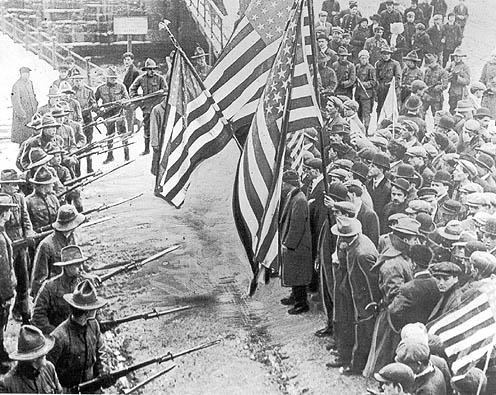
It is hard to believe that at one time workers had no rights. It was not until the mid-1800s in the United States and Europe that workers began to organize and protest for the right to decent wages and working conditions. There were many instances when this cost them their lives. Employers, often backed by heavily armed private security contractors like the Pinkerton Agency, used deadly force to break up peaceful strikes. In the days of the Robber Barons, when business ran the government at almost every level, employers frequently called in local and state law enforcement, as well as the National Guard, and occasionally Federal troops to break strikes. They played various ethnic and racial groups off of each in order to divide the labor movement. There are hundreds of instances of such violence being used against workers, in some strikes the dead numbered in the hundreds.

1912_Lawrence_Textile_Strike_1

Lawrence Massachusetts Textile Strike; the National Guard with Bayonets Fixed against unarmed strikers

Some of these attacks on workers occurred in major cities, others at isolated work sites and factories. Some are famous, the Haymarket Massacre of May 4th 1886 in Chicago, the Pullman Strike Massacre of 1894, the Homestead Strike and Massacre of 1892, the Lattimer Massacre of 1897, the Ludlow Massacre of 1914, and the Columbine Mine Massacre of 1927.

1024px-Ruins_of_Ludlow_restored

Aftermath of the Ludlow Massacre (above) and the Bisbee Deportation

Others less so, but there was more. In the Bisbee Deportation of 1917 1300 striking miners and their families were deported from their homes in Bisbee Arizona by 2000 armed deputies, put in box cars and transported 200 miles to the New Mexico desert, where without food, water or money they were left. There was the Triangle Shirtwaist Factory Fire where managers locked the doors in order to ensure that the fleeing women workers did not put anything unauthorized in their purses. One hundred forty-four workers, mostly young women died.

There are many other instances where workers were shot down in cold blood by private security forces, local police, the National Guard of Federal Troops for simply protesting or striking to gain better conditions of employment, safe working places, or a living wage.

Image_of_Triangle_Shirtwaist_Factory_fire_on_March_25_-_1911

The Triangle Shirtwaist Factory Fire

Early labor organizations such as the Knights of Labor led the effort to bring about better conditions. For doing so they were labeled subversive and even called communists. Their meetings were often attacked and the leaders jailed and some lynched.

The sacrifices of those early workers, and organizers are why we have Labor Day. One of the early American labor leaders was a man named Eugene Debs. He said something remarkable which still is as timely as when he uttered the words:

“I am opposing a social order in which it is possible for one man who does absolutely nothing that is useful to amass a fortune of hundreds of millions of dollars, while millions of men and women who work all the days of their lives secure barely enough for a wretched existence.”

On September 5th 1882 the first Labor Day was observed when members of several Unions in New York City organized the first Labor Day parade. The police came armed and ready to intervene if the workers got out of hand, but the parade was peaceful. It ended and the marchers moved over to Wendell’s Elm Park where they had a party. Twenty-five thousand Union men and their families celebrated, with hundreds of kegs of lager beer.

Within a few years many states began to institute Labor days of their own. In 1894, just days after the violent end of the Pullman strike in which Federal troops and Marshalls killed 30 workers and wounded 57 more, Congress and President Grover Cleveland rushed through legislation to establish a Federal Labor Day.

BisbeeDeportation

My Great Aunt Goldie Dundas was a labor organizer for the International Ladies Garment Worker’s Union in West Virginia in the 1920s – 1950s. I wish I had gotten to really know her, but she died when I was about 8 or 9 years old. Sadly the workers represented by that Union have had almost all of their jobs in the textile industry outsourced to China, India, Pakistan, the Caribbean, and Bangladesh where cheaply made garments are produced, and workers abused. The examples of mass deaths due to safety issues and fires in Bangladeshi factories are too numerous to list. But then who cares? The fact is you can drive through many parts of the South and see the poverty created by the exodus of these Union employers, the textile industry, which was part of the fabric of the South is gone. Empty factories and poverty stricken towns dot the countryside. I saw a lot of them living in Eastern North Carolina, towns that once thrived are ghost towns, riddled with crime, unemployment and no hope, unless Wal-Mart opens a store in town. Ironically it sells the clothing made overseas that used to be manufactured by the parents, grandparents and great-grandparents of the people who live there today.

International_Ladies_Garment_Workers_Union_logo

Adam Smith, the father of Capitalism understood it in a very different manner than those who claim to be Capitalists today. He wrote in his magnum opus, The Wealth of All Nations:

“In regards to the price of commodities, the rise of wages operates as simple interest does, the rise of profit operates like compound interest. Our merchants and masters complain much of the bad effects of high wages in raising the price and lessening the sale of goods. They say nothing concerning the bad effects of high profits. They are silent with regard to the pernicious effects of their own gains. They complain only of those of other people.”

The fact is that today, labor is under threat. Unions have been demonized by politicians and pundits and their power and influence much reduced. Some of this was due to their own success in improving conditions from workers, and not just Union workers. When my dad retired from the Navy in 1974, he went to work at one of the few non-Union warehouses of the John Deere Company in Stockton, California. While they were not union, the workers received every benefit won by the majority of the workers in the company who were members of the United Auto Workers Union. Due to that my dad had high wages, excellent working conditions and benefits. The company had a program for the children of workers, which allowed them to work in the summer in the warehouse and receive incredibly high pay and benefits while in college. I did that for two years, and it helped pay for much of my college. I was not a union member but I benefited.

However, in many places, Unions and labor are under attack, sometimes not just by corporations, but also by state governments. Job security and stability for most American workers is a thing of the past. Federal and State agencies charged with protecting those rights, including safety in the workplace are being cut in the mad rush to reduce government power. It seems to me that we are returning to the days of the Robber Barons. I wonder when violence against workers and those who support them will be condoned or simply ignored.

So please, when you celebrate Labor Day, do not forget that it is important, and that we should not forget why we celebrate it. If we forget that, it will become a meaningless holiday and our children may have to make the same sacrifices of our ancestors.

Oh, by the way…. If you see a meme on Facebook telling you to “thank the troops” for Labor Day, it is a bullshit meme. We troops have our days. Labor day is not ours. Labor Day is a day to remember those civilians, some of them who may have been former soldiers, but more often than not were civilian labor leaders, organizers and union members; some of whom were killed by National Guard and Federal troops for their efforts to secure the rights of working men and women; which paved the way for workers today.

Peace

Padre Steve+

Leave a comment

Filed under civil rights, economics and financial policy, History

Friendship Matters more than Anything 


Friends of Padre Steve’s World,

Today just a short reflection on friendship following the unexpected death of yet another friend. Today some of us gathered at our favorite watering hole who remember him, and to console each other. There were hugs, tears, and many shared memories, but there was also silence because all too often the words failed us, and all we hand was the silence, and the embrace of friends. 

I value true friendship more than most anything and I am loathe to give up friends for any reason. Sadly, all too many people are willing to toss friendship aside for extreme politics or religion. I hate to say it but I have had to separate myself from people that I presumed were friends whose extreme right or left wing ideology, or religious beliefs were so toxic and seemingly uncaring about my friendship to for them that I had to withdraw. 

Ulysses S. Grant who is one of my heroes with feet of clay remarked, “The friend in my adversity I shall always cherish most. I can better trust those who helped to relieve the gloom of my dark hours than those who are so ready to enjoy with me the sunshine of my prosperity.” Grant’s ever mindful friend and subordinate William Tecumseh Sherman noted, “Grant stood by me when I was crazy, I stood by him when he was drunk. Now we stand together.”  

Having endured gloom, having been what some would call crazy, and having been drunk, I understand this. One cannot put a price on true friendship, be it the steadfast friends of many years, or newer friends who maybe do not have the benefit of th  years, but certainly have bonded with me and become my brothers or sisters. William Shakespeare wrote that Henry V said “We, we happy few, we band of brothers…” That is friendship. Maybe that is why as a career military man I find that friendship, especially the friendship borne of adversity matters more than anything. I can handle disagreement over politics or religion so long as I believe that the person still values and cares about me as much as I do them, and as long as that is the case I will do everything I can for them, in good times and bad. 

Tonight I again watched the movie Gettysburg. In it there is a scenes where the late Richard Jordan, playing Confederate General Lewis Armistead talked of his friendship with other officers just before they went their separate ways prior to the beginning of the Civil War. He recalled a song of friendship, love, and loss called Kathleen Mouvereen. The words to that Irish song are haunting, 

Mavoureen, mavoureen, my sad tears are falling, to think that from Erin and thee I must depart. It may be for years, it may be forever, then why art thou silent, thou voice of my heart… 

Those words are haunting to anyone who truly loves friends in times of loss and adversity, I know that they are for me. Maybe it is just the Irish in my DNA, maybe it is also being a career military man, for truly I know little different, for being both a military officer, a priest, and a historian is what I was meant to be, honestly I cannot imagine anything else. Thus, my views and values of friendship reflect that reality. 

There are many quotes and sayings about friendship and believe me I read a lot of them today, but I always return to Grant, Sherman, and my own band of brothers. 

So have a good night. 

Peace

Padre Steve+ 

1 Comment

Filed under philosophy, remembering friends

Unexpected Loss in the Wake of a Storm


Friends of Padre Steve’s World,

Today was a sad day as we unexpectedly lost a friend due to a heart attack or pulmonary embolism. Our friend Dave Shaw had just returned from a business trip and we actually saw him last night before Tropical Storm Hermine hit our area. When I saw him leaving the bar he did not seem to be well, but I assumed that it was simply being tired from his flight home, but I was wrong. 

I found out about Dave’s passing from my friend John as I was cleaning up the mess left by the storm. A mess that was only that as well suffered no real property damage, though we are going to have to find out why water is entering our house from our back yard. That is why we have insurance, but I digress. Had all we had to deal with was the post storm hassle today would have been easy, but we lost Dave, something far greater than our temporary inconvenience. 

Dave was really a good guy, and a friend to many people. He was a retired Navy Chief Hospital Corpsman and was only 61 years old. Dave had friends who were much closer to him than me and I am sure that our mutual friends Randy and Dave are grieving more than I could ever grieve his loss as they were both much closer to him than I ever was. We were able to go with him, Jeri, and a number of other friends to the Oktoberfest in Munich just two years ago. While we were ther Dave donned a Burger King Crown and a German nicknamed him the King of Virginia, a nickname that he relished, and with good reason. 

It was sad for so many reasons, but especially because Dave and his wife Jeri were happy. They were married less than a year ago, but from the time that they met a few years ago I had never seen Dave so happy. They had just purchased a motor home so they could travel and create new adventures when he planned on retiring from his civilian job in the spring. 

I went an visited Jeri this evening, and we will do what we can to help her over the days ahead, as will many other dear friends. 

When you lose a friend unexpectedly it is most difficult, but that being said it would be worse never having to know them or have missed out on the simple joy of friendship. I would have rather that Dave had been able to live out another twenty or thirty years with his beloved Jeri traveling around the country and also enjoying his time with so many of his other friends, here, and around the world. 

As word of his passing spread I saw many wonderful comments and expressions of love and loss. Dave will be missed by so many people. Today the folks at Gordon Biersch leaned the barstool where he sat against the bar and placed a full stein of his favorite beer in front of it. It was a gesture of love and respect for a friend who though gone from us in the flesh will remain part of all of us forever. 


So until tomorrow, please take the time to love and care for your friends, and if you will, please lift a stein or pint in memory of Dave, the King of Virginia. 

Peace

Padre Steve+

3 Comments

Filed under remembering friends

When Despots Gain Power


Friends of Padre Steve’s World,

I have returned home from my vacation in time to spend some time relaxing over the Labor Day weekend while hopefully dodging the worst of what will be Tropical Storm Hermine. I am going to be writing a number of articles as well as pictures from our time in Huntington, West Virginia this weekend, articles that will deal with history, art and culture, as well as social and political commentary. 

Yesterday I posted a short article about how despots come to power referencing the words of British military historian B.H. Liddell-Hart in his book Why Don’t We Learn from History?  Since I gave a brief introduction to that work yesterday I will not repeat the introduction. Instead I will go to the second part of how he described despots, or what we commonly call dictators today. 

Yesterday I briefly discussed Liddell-Hart’s understanding of the important differences between democracy and dictatorship and why despite all the inefficiency of the former that it is infinitely preferable to the latter or for that matter any other form of government. 

Since I left off and let you my friends and readers meditate on how despots come to power, I will now finish with what Liddell-Hart said about what happens after a despot takes power. He is right of course. Since the French Revolution we can look to Napoleon, Stalin, Hitler, three generations of North Korean Kims, Mussolini, Ceausescu, Pol Pot, the Castros, Pinocet, Mugabe, not to mention the multitude of other despots of the Middle East, Africa, Asia, the Americas, and Europe, but I digress. 

Liddell-Hart wrote:

We learn from history that time does little to alter the psychology of dictatorship. The effect of power on the mind of the man who possesses it, especially when he has gained it by successful aggression, tends to be remarkably similar in every age and in every country.

Yesterday I asked you my readers to compare what Liddell-Hart said about how despots come to power and think about how what he said is evidenced in the campaign of Donald Trump. So that being said, Liddell-Hart noted that once a despot achieves power that their reign is marked by the following types of events:

On gaining power: 

They soon begin to rid themselves of their chief helpers, “discovering” that those who brought about the new order have suddenly become traitors to it. 

They suppress criticism on one pretext or another and punish anyone who mentions facts which, however true, are unfavourable to their policy. They enlist religion on their side, if possible, or, if its leaders are not compliant, foster a new kind of religion subservient to their ends. 

They spend public money lavishly on material works of a striking kind, in compensation for the freedom of spirit and thought of which they have robbed the public. 

They manipulate the currency to make the economic position of the state appear better than it is in reality. 

They ultimately make war on some other state as a means of diverting attention from internal conditions and allowing discontent to explode outward. 

They use the rallying cry of patriotism as a means of riveting the chains of their personal authority more firmly on the people. 

They expand the superstructure of the state while undermining its foundations by breeding sycophants at the expense of self-respecting collaborators, by appealing to the popular taste for the grandiose and sensational instead of true values, and by fostering a romantic instead of a realistic view, thus ensuring the ultimate collapse, under their successors if not themselves, of what they have created. 

This political confidence trick, itself a familiar string of tricks, has been repeated all down the ages. Yet it rarely fails to take in a fresh generation.

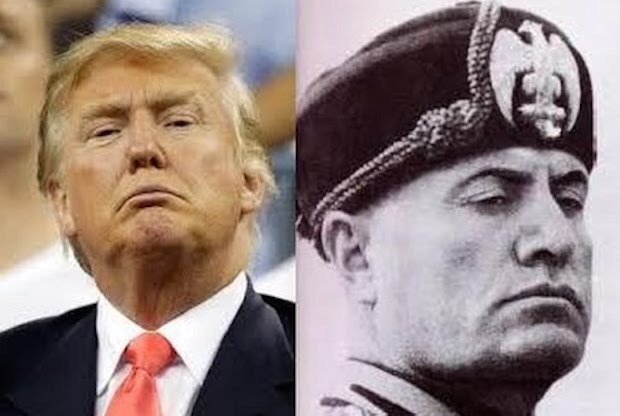
Now pause for a moment. Donald Trump has not been elected to anything, but compare his business career and current political campaign rhetoric to Liddell-Hart’s words about despots in power. And since I am tired I will leave you to contemplate Liddell-Hart’s words from a half-century ago and imagine a Trump presidency. 

Peace

Padre Steve+

1 Comment

Filed under History, Political Commentary

How Despots Gain Power


Friends of Padre Steve’s World,

Today I am traveling back home after a wonderful visit with friends and family in Huntington, West Virginia. The visit was nice, I got a chance to do some serious reflection, especially as I walked about the city and along the Ohio River waterfront, visited the Museum of Art, and walked the entirety of its wonderful Ritter Park. 

I did some writing but spent more time in reading and reflection than anything. I kept up on some of the headlines but didn’t let myself get beaten down by the negativity and cynicism of our time.

Last night I read the short but poignant little but by the British military historian B.H. Liddell-Hart entitled Why Don’t We Learn from History. The book was written in not long before his death in 1970 and it is good quite good. It deals with a number of issues, including the conflict between history and propaganda, or when faith, especially religious faith as treated as historic or scientific fact; especially when propaganda or faith is preached as if it were history, if it were truth. But he also contrasted democracy and totalitarianism. 

Liddell-Hart was a realist, especially about democracy and totalitarianism. While he admitted the inefficiencies of democracy, he realized that it was far less dangerous than the “stupidity” of totalitarianism. In fact it was important for him to note just how this inefficient system was for freedom. He wrote:

What is of value in “England” and “America” and worth defending is its tradition of freedom, the guarantee of its vitality. Our civilization, like the Greek, has, for all its blundering way, taught the value of freedom, of criticism of authority, and of harmonising this with order. Anyone who urges a different system, for efficiency’s sake, is betraying the vital tradition.

There was was much to ponder in his book and I will probably write some more of my thoughts on it, but since I am going to be traveling I will quote what he said about self-made despotic rulers and how they come to power. When I read it I was struck by just how much Liddell-Hart in his description of a despot describes Republican Presidential nominee Donald Trump through the his campaign and especially his remarks on immigration hours after returning from a brief meeting with Mexican President Pena Nieto. 

We learn from history that self-made despotic rulers follow a standard pattern. In gaining power: They exploit, consciously or unconsciously, a state of popular dissatisfaction with the existing regime or of hostility between different sections of the people. They attack the existing regime violently and combine their appeal to discontent with unlimited promises (which, if successful, they fulfil only to a limited extent). They claim that they want absolute power for only a short time (but “find” subsequently that the time to relinquish it never comes). They excite popular sympathy by presenting the picture of a conspiracy against them and use this as a lever to gain a firmer hold at some crucial stage.

He wrote about how they behave in power as well, but for now I will close and let you my readers ponder his statement before I follow up with Liddell-Hart’s observations from history on how despots act once they achieve power. 

Peace,

Padre Steve+

Leave a comment

Filed under History, philosophy, Political Commentary

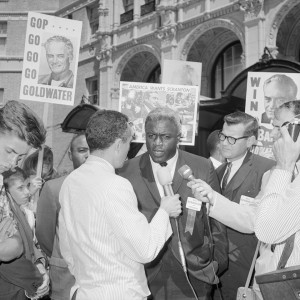
Jackie Robinson and the Freedom Summer

Jackie Robinson Speaking with the Press

Friends of Padre Steve’s World,

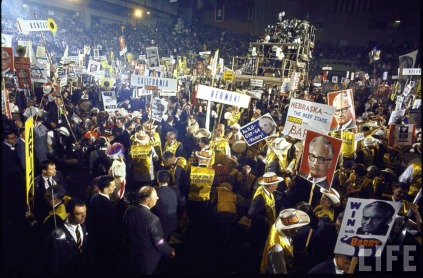
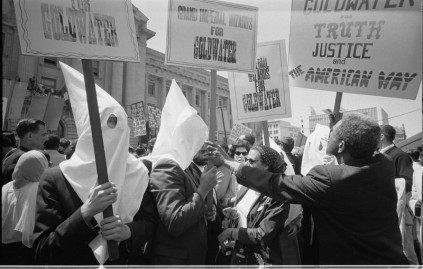
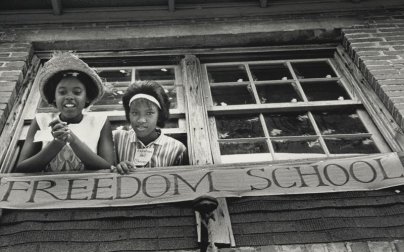
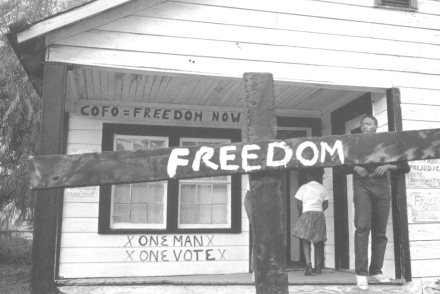
I am still on vacation and will posting some new material have brought an older article out of the vault. I think it is important because it covers a watershed moment in American politics, a moment that started the Republican Party down the path that has culminated today. It is about the Freedom Summer of 1964 and baseball icon and civil rights pioneer Jackie Robinson’s trip to the 1964 Republican National Convention. Though the events happened some fifty-two years ago, they are not ancient history, and the spirit and ideology that characterized them is all to present today, especially in the modern Republican Party. 

So have a great day. 

Peace

Padre Steve+
republican-national-convention-delegates_1964

“A new breed of Republicans had taken over the GOP. As I watched this steamroller operation in San Francisco, I had a better understanding of how it must have felt to be a Jew in Hitler’s Germany.” Jackie Robinson on his observations of the 1964 Republican National Convention

Jackie Robinson was a Republican. So was I for 32 years and for much of that time I considered myself a “conservative” whatever that means, though I thought it meant freedom, limited government and opportunity for all regardless of race, color, religion or any other trait or belief. I also believed and still do in a strong defense, but I can no longer consider myself a man that blesses American intervention in other people’s wars unless there is a clear and present danger to the United States, not simply our so called “interests” which may not be those of the nation at all but of multi-national corporations which were originally American businesses but not only need our military, diplomatic and intelligence resources to increase their profits.

My parents were Kennedy type Democrats, but in the 1970s, torn by the extremism of the 1972 Democratic Convention in Chicago and feeling the hatred of people for those in the military, including a Sunday School teacher who told me that my dad, then serving in Vietnam was “baby killer” I at the age of 12 decided that I would be a Republican. I was a Republican until I returned from Iraq in 2008, fully aware of the lies that took us into that war and seeing the cost both to American servicemen and the people of Iraq.

fsms1

I have been doing a lot of reading lately on a period of history that as a historian I had pretty much skipped over. That is the period of the Civil Rights movement of the early to mid-1960s. I guess I skipped over it because I was more interested in the glory of war and patriotism wrapped in historic myth than in the experiences of fellow citizens who had been killed, abused, tormented and persecuted by people like me simply because of the color of their skin. I had not yet begun to appreciate the concept of justice at home being interconnected to our deepest held principles and how we embody them in our foreign policy.

For many years I echoed the point made by some conservatives that it was the GOP that helped make the Voter’s Rights Act of 1964 and Civil Rights Act of 1965 passed into law. That is true. Most Republicans voted for them, with a notable exception, Barry Goldwater. However, what is also true is that the Republicans that voted for the 1964 act were considered “liberals” and treated shamefully at the 1964 convention, whose delegates voted down a part of the platform that would have supported that act. Of the Democrats that voted against those bills almost all came from the Deep South, a region which within a decade become a Republican stronghold and a key part of the Southern Strategy of every GOP Presidential Candidate since Richard Nixon. A Republican aide at the 1964 convention told a reporter that “the nigger issue was sure to put Goldwater in the White House.” (See Freedom Summer by Bruce Watson p.163)

However as a life long baseball fan there is one thing that I know, that if there had been no Branch Rickey and Jackie Robinson we might not have gotten Rosa Parks or the Reverend Martin Luther King Jr.
$(KGrHqF,!qEF!GdOTlS(BQOjfQWE0w~~60_57

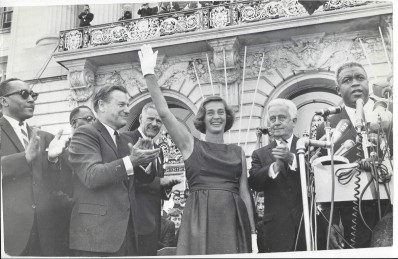
Robinson was appointed as a special delegate to New York Governor Nelson Rockefeller who was running against Goldwater and attended the convention. He had given up his job as a spokesman for and Vice President of the Chock Full O’Nuts Coffee Company to assist Rockefeller’s campaign in 1964.

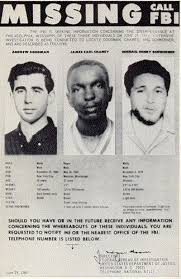
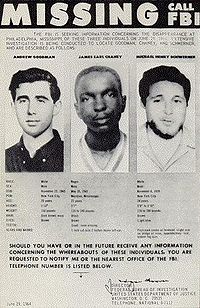
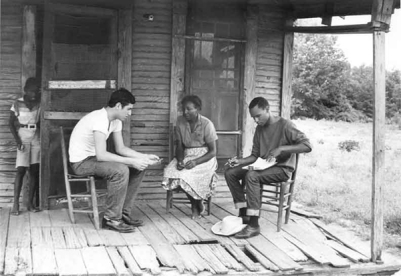
Robinson knew what it was like to be the “point man” in the integration of baseball and in his career was threatened with physical violence and death on many occasions. Some teammates circulated petitions that they would not play for a team that had a “black” on it. Robinson, encouraged by Rickey persevered and became an icon in baseball, the Civil Rights movement and the history of the United States. However, not even 10 years after his retirement from baseball and 2 years after he was elected to the Hall of Fame he once again discovered just how deep racism still ran in this country. As he attended the convention FBI agents and other Federal authorities attempted to find the bodies of three young Voting Rights staff who were part of the 1964 Freedom Summer campaign in Mississippi. Eventually, later in the summer the bodies of James Chaney, Andrew Goodman and Michael Schwerner would be discovered buried in the base of a dam near Philadelphia Mississippi. Their killers were local law enforcement officers and members of the Ku Klux Klan.
200px-AndrewGoodman-JamesChaney-MichaelSchwerner

Maybe I lived in my own fantasy world. My experience growing up was on the West Coast living in a military family in small towns and big cities. I am proud to be part of the first class that attended high school in my home town when the courts ordered desegregation in our schools. That experience at Edison High School of Stockton California from 1975-78 changed me, as did having a black roommate in college.

However, that being said it took me a long time to realize that things really haven’t changed that much from 1964 in many parts of the country, especially since I have lived most of my adult live in the historic States that comprised the Confederacy. I can say from practical observation and knowledge that racism and other forms of more acceptable prejudice live on in this country. There is not a day that goes by that I do not run into the vestiges of the hate that lived during the Freedom Summer of 1964. It is more subtle in some cases, but other times is so blatant that is sickening. I never expected that I would ever be called a “nigger lover” or “wigger” until I had people make those comments on this website in response to articles that had nothing to do with race relations or civil rights, nor did I expect physical threats from people who call themselves “Christian.” Those were learning experiences that I won’t soon forget.
G21767P

Robinson wrote of his experience at the 1964 Convention:

“I wasn’t altogether caught of guard by the victory of the reactionary forces in the Republican party, but I was appalled by the tactics they used to stifle their liberal opposition. I was a special delegate to the convention through an arrangement made by the Rockefeller office. That convention was one of the most unforgettable and frightening experiences of my life. The hatred I saw was unique to me because it was hatred directed against a white man. It embodied a revulsion for all he stood for, including his enlightened attitude toward black people.

A new breed of Republicans had taken over the GOP. As I watched this steamroller operation in San Francisco, I had a better understanding of how it must have felt to be a Jew in Hitler’s Germany.

The same high-handed methods had been there.

The same belief in the superiority of one religious or racial group over another was here. Liberals who fought so hard and so vainly were afraid not only of what would happen to the GOP but of what would happen to America. The Goldwaterites were afraid – afraid not to hew strictly to the line they had been spoon-fed, afraid to listen to logic and reason if it was not in their script.

I will never forget the fantastic scene of Governor Rockefeller’s ordeal as he endured what must have been three minutes of hysterical abuse and booing which interrupted his fighting statement which the convention managers had managed to delay until the wee hours of the morning. Since the telecast was coming from the West Coast, that meant that many people in other sections of the country, because of the time differential, would be in their beds. I don’t think he has ever stood taller than that night when he refused to be silenced until he had had his say.

It was a terrible hour for the relatively few black delegates who were present. Distinguished in their communities, identified with the cause of Republicanism, an extremely unpopular cause among blacks, they had been served notice that the party they had fought for considered them just another bunch of “niggers”. They had no real standing in the convention, no clout. They were unimportant and ignored. One bigot from one of the Deep South states actually threw acid on a black delegate’s suit jacket and burned it. Another one, from the Alabama delegation where I was standing at the time of the Rockefeller speech, turned on me menacingly while I was shouting “C’mon Rocky” as the governor stood his ground. He started up in his seat as if to come after me. His wife grabbed his arm and pulled him back.

“Turn him loose, lady, turn him loose,” I shouted.

I was ready for him. I wanted him badly, but luckily for him he obeyed his wife…” From Jackie Robinson “I Never Had it Made” Chapter XV On Being Black Among the Republicans
1*HLP1tcduxglV4VtdWHUI0Q

Belva Davis, then a young journalist wrote of her experiences at that convention:

While the Goldwater organization tried to keep its delegates in check on the floor, snarling Goldwater fans in the galleries around us were off the leash. The mood turned unmistakably menacing…

Suddenly Louis and I heard a voice yell, “Hey, look at those two up there!” The accuser pointed us out, and several spectators swarmed beneath us. “Hey niggers!” they yelled. “What the hell are you niggers doing in here?’”

I could feel the hair rising on the back of my neck as I looked into faces turned scarlet and sweaty by heat and hostility. Louis, in suit and tie and perpetually dignified, turned to me and said with all the nonchalance he could muster, “Well, I think that’s enough for today.” Methodically we began wrapping up our equipment into suitcases.

As we began our descent down the ramps of the Cow Palace, a self-appointed posse dangled over the railings, taunting. “Niggers!” “Get out of here, boy!” “You too, nigger bitch!” “Go on, get out!” “I’m gonna kill your ass!”

I stared straight ahead, putting one foot in front of the other like a soldier who would not be deterred from a mission. The throng began tossing garbage at us: wadded up convention programs, mustard-soaked hot dogs, half-eaten Snickers bars. My goal was to appear deceptively serene, mastering the mask of dispassion I had perfected since childhood to steel myself against any insults the outside world hurled my way.

Then a glass soda bottle whizzed within inches of my skull. I heard it whack against the concrete and shatter. I didn’t look back, but I glanced sideways at Louis and felt my lower lip began to quiver. He was determined we would give our tormentors no satisfaction.

“If you start to cry,” he muttered, “I’ll break your leg.” ( Belva Davis “Never in My Wildest Dreams: A Black Woman’s Life in Journalism)

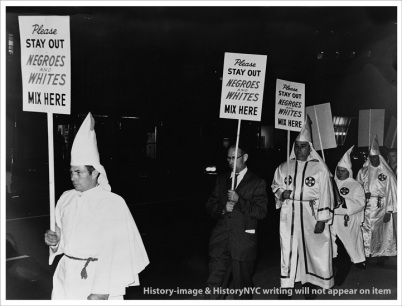
The sad thing is that in many states the new GOP has taken a page out of the past and has been either passing legislation or attempting to pass legislation that makes it harder for Blacks and other minorities to vote. Groups have shown up armed at heavily black polling sites in recent elections and efforts have been made to ensure that minorities cannot vote. They have also challenged the 1964 Voter’s Rights Act in Court and have a friend in Justice Antonine Scalia who called it a “racial entitlement” and violation of State sovereignty.
8399w

The tactics are quite similar to those used in the Deep South prior to 1964 which made it virtually impossible for a Black man or woman to cast a vote, and if they tried even to register to vote did so at the peril of their lives or families. The opponents of integration, voter’s rights and equal rights used some of the same lines used today against those that support these rights. “Communists sympathizers, Socialists, Atheists, Anti-Christian, Anti-American, Anti-Constitution,” you name it the same labels are being applied to those that simply want to be at the table. The sad thing that many of the most vicious users of such untruths are my fellow Christians.
ae-eop-freedom-school_tx700

These are hard things to look at and it is far easier to believe myth than it is to actually seek truth. A few years back I cannot every in a million years having written this article. However the threats to minorities be they racial, religious or even gender have become part an parcel of the new GOP, the GOP that I could not remain a part of when I returned from Iraq.

I guess that I am becoming a Civil Rights advocate, or then, maybe it’s that I’m actually becoming more of a Christian. Branch Rickey said “I may not be able to do something about racism in every field, but I can sure do something about it in baseball.” Oh well, I amy not be able to do something about racism and other prejudice everywhere but I can do it here and wherever I work or preach.
freedom_cross1

Oh well whatever, it really doesn’t matter so long as I can live with myself. Besides, I’ll get labeled anyway so what does it matter? I would rather be in the same camp as someone like Jackie Robinson and Branch Rickey than Antonine Scalia or those that seek to keep people down simply because they are different anyway.

Martin Niemoller once said:

First they came for the , communist
and I didn’t speak out because I wasn’t a communist.

Then they came for the socialists,
and I didn’t speak out because I wasn’t a socialist.

Then they came for the trade unionists,
and I didn’t speak out because I wasn’t a trade unionist.

Then they came for me,
and there was no one left to speak for me.

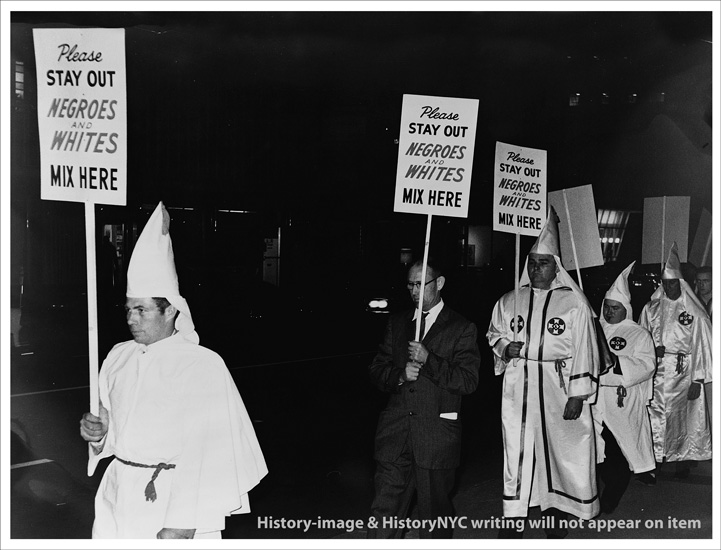
Friends, it is all too important that we not forget this, even as Donald Trump and many of his supporters who include most of the White Supremacists, Klansmen, and Neo-Nazis in this country offer the same threats against blacks, other minorities, and political moderates and liberals. Make no mistake, what is happening now is nothing more than a resurgence of the hatred and violence that was unleashed against those who fought for civil rights fifty years ago.


Leave a comment

Filed under civil rights, History, Political Commentary

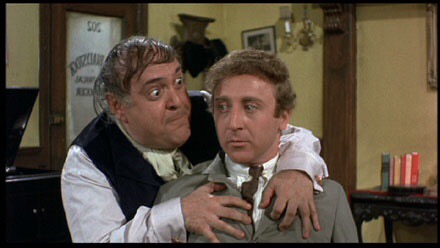
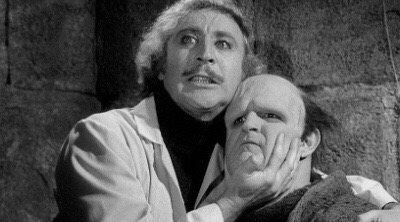
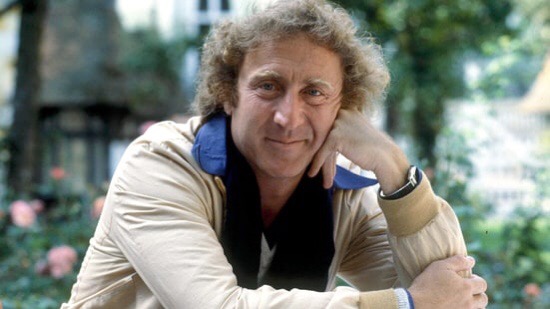
The Waco Kid Rides into the Sunset: Rest in Peace Gene Wilder


http://www.movieclips.com/videos/blazing-saddles-official-clip-applause-for-the-waco-kid-409395779531
Friends of Padre Steve’s World,

Sunday night lost a comic genius and great human being. Gene Wilder passed away with his family surrounding him at the age of 83 from complications of Alzheimer’s disease. While many remember him most for his role as the quirky candy genius Willy Wonka, I will always remember him most for his roles in Blazing Saddles, Young Frankenstein, and The Producers. Of course I will never forget him in Stir Crazy or The Silver Streak, but for me it was his roles in the Mel Brooks comedies that I will never forget. 


http://nyti.ms/1xh2yeM 
The first time I saw him was in The Producers where he played the neurotic accountant Leo Blum who helped Max Bialystok (Zero Mostel) figure out that he could make more money producing a Broadway flop than a hit. I saw that film on television when I was about 12 years old, well before I ever saw him in Blazing Saddles or Young Frankenstein, and I never forgot him. Then in 1974 I was able to convince the box office attendants and ushers that I was old enough to be admitted to the latter two films. Actually, it wasn’t that hard back then to fake it, no one ever asked for I.D., and I’m sure that some of them were stoned before they even showed up for work but I digress… 


https://www.yahoo.com/movies/video/blazing-saddles-clip-waco-kid-192608486.html
There are few people who could play neurotic people with the comic sensitivity that Gene Wilder did, the man was brilliant.  The next film that I saw him appear was Brooks’s classic Western spoof, Blazing Saddles where he played the washed up alcoholic gunfighter, the Waco Kid, whose name was Jim, though most people called him Jim. Wilder was a last minute replacement for Gig Young who actually did have an alcohol problem and collapsed on set forcing Brooks to shut down production for a day and bring Gene Wilder in relief. Wilder was perfect for the role and complimented Clevon Little who play the Black sheriff Bart to a tee. I think my favorite scene is where Sheriff Bart wishes a little old lady a “good day” and is told by her “up yours nigger.” Almost inconsolable Bart comes back to the office where the Waco Kid gives him some great advice. 

https://youtu.be/KHJbSvidohg

https://youtu.be/IpiHCZHGbF8


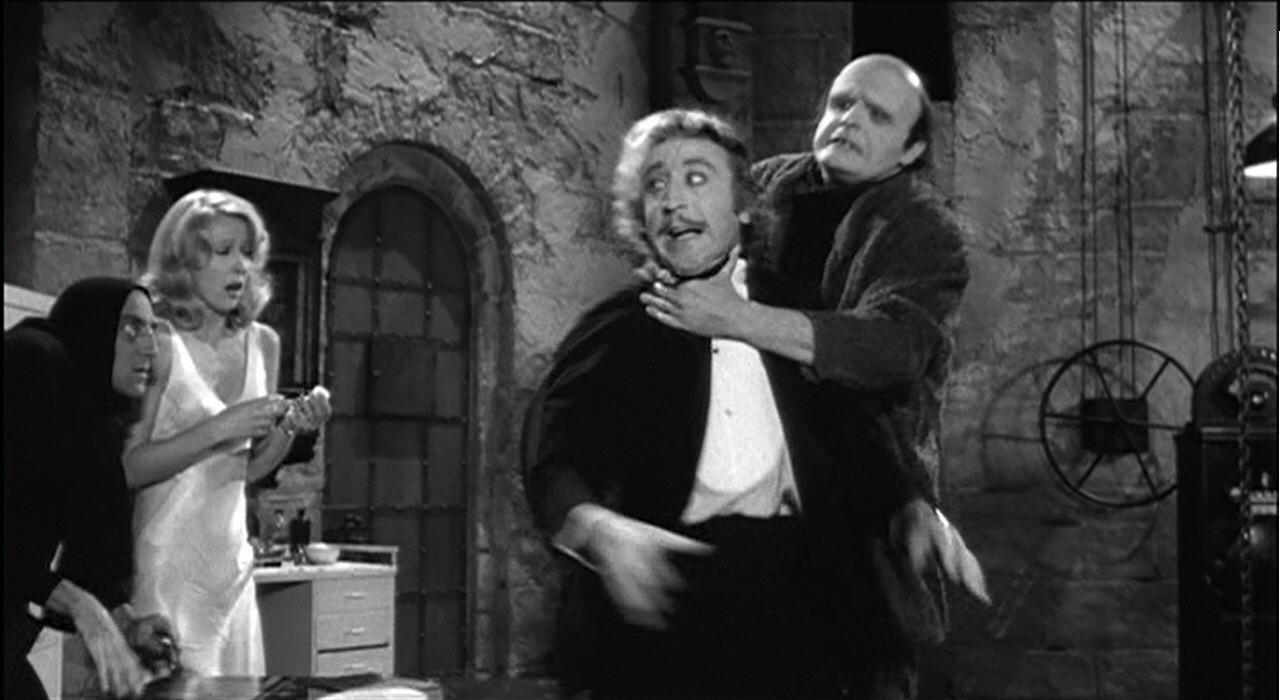
Then there was Young Frankenstein where Wilder played the grandson of the original Dr. Frankenstein opposite Marty Feldman, Terri Garr, Madeline Kahn, Cloris Leachman, and Peter Boyle. This was followed by Willy Wonka and so many others. I loved Wilder when he was paired with Richard Pryor as well. 

https://youtu.be/MySGAaB0A9k
I could go on and on about Gene Wilder, by I will stop for now. He and so many of his fellow cast members from these films are gone. Zero Mostel, Kenneth Mars, Clevon Little, Madeline Kahn, Harvey Korman, Richard Pryor, Alex Karras, and Peter Boyle to name but a few. He never announced that he was suffering from Alzheimer’s because he didn’t want to upset kids who saw him and said “look there’s Willy Wonka.” He was a joyful spirit who loved life, and now joins the love of his life, the late Gilda Radner, and now he goes into that final sunset. 


Rest in peace,

Padre Steve+ 

Leave a comment

Filed under alzheimer's disease, film, movies

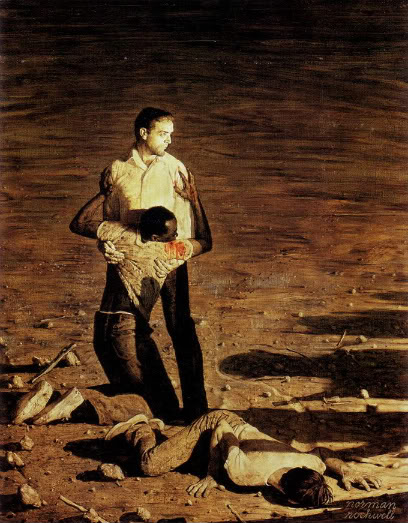
Norman Rockwell’s Southern Justice and the Continued Fight for Civil Rights

normanrockwellsouthernjustice-2

Friends of Padre Steve’s World,

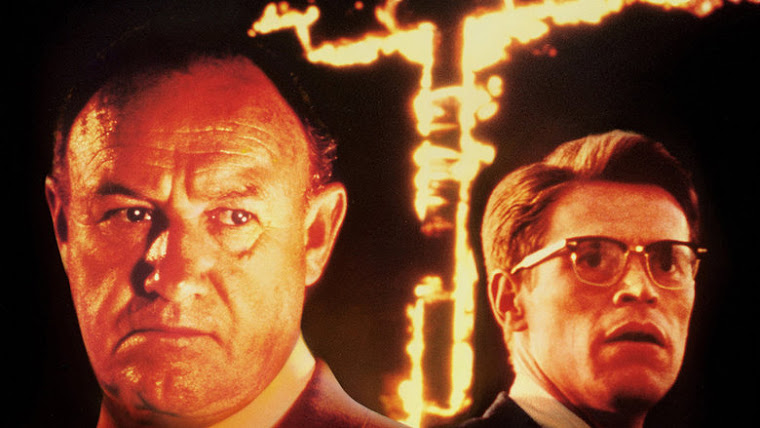
I am on vacation this week and though I have posted a few new articles today I am going back to the vault to reflect on the killings of three young civil rights workers during the Freedom Summer of 1964. Their brutal murders by Ku Klux Klan members aided and abetted by law enforcement officials was memorialized in Norman Rockwell’s painting Southern Justice and dramatized in the film Mississippi Burning. It is import that we remember this because the ideology and spirit of their killers is rising again in too many places in this country, and not just in the South. 

Please never forget their sacrifice and why it is important to fight for real justice. 

Peace

Padre Steve+

Fifty-two years ago three young men working to register blacks to vote as part of the Freedom Summer in Mississippi were brutally murdered by members of the Ku Klux Klan.

The men, twenty year old Andrew Goodman from New York City, was a progressive activist and Anthropology student at Queens College. Twenty-four year old Mickey Schwerner was a graduate student at Columbia University’s School of Social Work. Both Goodman and Schwerner were Jewish. Twenty-one year old James Chaney was from Meridian Mississippi and was a volunteer with CORE, the Congress of Racial Equity working on voter registration and education with local churches.

southern justice 4

On June 21st 1964 the three men were in Philadelphia Mississippi where they were investigating the burning of Mount Zion Methodist Church which had been working with CORE in the town. In the wake of that many black citizens and church members were beaten by whites, and they accused Sheriff’s Deputy Cecil Price of abuse.

The three were arrested for an alleged traffic violation, jailed and released that evening without being allowed to make any phone calls. On the way back to Meridian, two carloads of Klan members forced them over, abducted them and killed them. The bodies were not discovered for 44 days. Their disappearance brought national attention and a major investigation to the town. Eventually seven men, including deputy Price were convicted of the murders. The murders and the investigation became the subject of the movie Mississippi Burning.

Rockwell, well known for his portraits of American life and the Civil Rights movement painted “Southern Justice” which is sometimes known as “Murder in Mississippi” in 1965. This was not long after passage of the Voting Rights Act of 1964, which has been under attack in many southern states over the past decade and had a key provision gutted by the Supreme Court last year.

MississippiBurningPressRelease

52 years ago the murders of these three young men brought national attention to the pervasive racism and discrimination in the country. So many murders, lynchings and burnings of homes businesses and that went before had been covered up by the media. I do hope and pray that we never go back to those days, but as laws are passed to limit voting rights in various states I wonder if the clock will be turned back. I don’t thing that it will in the long run, but the sacrifice of so many for those rights should never be forgotten.

In memory of Andrew Goodman, James Chaney and Mickey Schwerner and others of the Freedom Summer and the Civil Rights movement who died or suffered to peacefully bring about change to our society.

Peace

Padre Steve+

1 Comment

Filed under civil rights, film, History, Political Commentary

The Dream at 53: Still Laboring for the New Birth of Freedom


Friends of Padre Steve’s World,

Since I am out of town this week I am going to post a short article tonight. Today was the fifty-third anniversary of one of the greatest speeches in American history. It was on this day that Dr. Martin Luther King Jr. spoke at the Lincoln Memorial during the March on Washington for Jobs and Freedom. The speech was powerful, eloquent, and even today when one listnes to Dr. King’s marvelous oratory the effect is electrifying. I was on three years old and living in the Philippines when he spoke them and so it was not until years later that I heard it for the first time.  Every time I watch the films of Dr. King speaking those words I am forced to recall not just his eloquence, but the depth of what he said, and how much is still true today. While I think I am a pretty good writer I would only hope to half as gifted as a speaker as Dr. King. 

https://vimeo.com/2158959
http://www.americanrhetoric.com/speeches/mlkihaveadream.htm 
I did get to speak yesterday at the Morehead Pride Festival and afterwards I was thinking about Dr. King’s message for all people. I do have that dream for all who are oppressed. I was talking to a lot of people before and after and so many told me how many of how they had been ostracized by the church for being Gay but still longed for that sense of spiritual support and acceptance. I began thinking what it would be like if most churches would simply accept people and love them. But many churches and Christians, especially the more conservative types of churches who are so willing to accept people and even bless people like Donald Trump as “God’s choice” for the highest office in the land, treat LGBTQ people as worse than the devil. Why? Because they are gay and according to their interpretation of the Bible that seems to be the only sin God cannot forgive. Less than fifty years ago many people in this country felt the same way about African Americans. But I digress… 

But the fact is that for many people, especially African Americans, other people of color, poor whites, women, religious minorities, as well as LGBTQ people, the promise of this nation is not yet fully realized. Dr. King equated the words of the Declaration of Independence as a promissory note, meant for all people that had been defaulted on by our nation, and how could he not? 

As a historian I know the words of the preamble of the Declaration, as well as the Gettysburg Address are for all purposes are the cornerstone of American Secular Scripture. They define what we can and should be. And yesterday while I was speaking I again realized just how much promise those words have: they are what make us Americans and if we fail to remember them, if we fail to work to ensure that they are the basis of who we are as a people both in word and deed, then we too will default on that promissory note, and the treasury of freedom and justice will be bankrupt; and we have none to blame but ourselves. 

But I have a dream, as Dr. King so eloquently put it “that one day this nation will rise up and live out the true meaning of its creed: “We hold these truths to be self-evident, that all men are created equal.” Far too many people have shed their blood for that sacred proposition for us to abandon it: soldiers, civil rights leaders, men and women, black and white, straight and gay, of every religion and race that have ever longed for the realization of that proposition. Dr. King was one of them, as was Harvey Milk, they and so many others cut down by assassin’s bullets, or murdered, or lynched. So with them in mind we must take heed of the words of Abraham Lincoln, another martyr in the cause of freedom, who reminded those present at the dedication of the Soldier’s Cemetery at Gettysburg, “that is for us the living rather to be dedicated here to the unfinished work that they have thus far so nobly advanced. It is rather for us here to be dedication to the great task remaining before us – that from these honored dead we take increased devotion to the cause for which they gave the last full measure of devotion – that we here highly resolve that these dead shall not have died in vain, that this nation under God shall have a new birth of freedom, and that government of the people, by the people, for the people shall not perish from the earth.” 

So until tomorrow. 

Peace

Padre Steve+ 

Leave a comment

Filed under civil rights, History, Political Commentary