Author Archives: padresteve

padresteve's avatar

About padresteve

I'm a Navy Chaplain and Old Catholic Priest

The Development of Artillery from the Napoleon Period to the American Civil War: Part One

cannons

Friends of Padre Steve’s World,

I’ve been working on revisions to one of my Civil War texts, A Great War in a Revolutionary Age of Change and decided to post one of those today. Hopefully tomorrow I will follow up with the second part of this section, which deals with the development of artillery from the pre-Napoleonic era to the beginning of the American Civil War. This is kind of a post for geeks who study the period.

I hope that you enjoy.

Peace

Padre Steve+

The Gribeauval System, Napoleon, and the U.S. Army

Like the infantry and cavalry the technical specifics and tactics of the artillery of the United States Army had their roots in the Napoleonic era. Artillery theory “emphasized both the offensive and defensive role of field artillery, with the emphasis on the offensive role in support of infantry assault tactics.” [1] Much of this was due to how Napoleon, a master of artillery tactics, employed his artillery. Napoleon depended heavily on his artillery, he “liked to assemble them in a Grand Battery and use them as an offensive, as against a defensive weapon. At Wagram, in 1809, Napoleon had torn the heart out of an Austrian army with a Grand Battery of 112 guns.” [2] Napoleon would also use a tactic called the artillery rush in which just prior to launching an attack, “the greater part of his artillery reserve would rush to the front. An intensive bombardment would pulverize the opposing line at the point of assault.” [3] If successful he would unleash his heavy and light cavalry in pursuit of broken enemy formations, if not, the guns would cover the retreat of the assault troops.

Napoleon used the system of General Jean Baptiste Gribeauval (1715-1789) who was the real father of artillery in the French army. Gribeauval adapted the Prussian system of Frederick the Great for France. “He “undertook a complete overhaul of the French artillery system.” [4] He developed an entire artillery system for the French army including field, siege and coastal artillery manned by specially trained soldiers. These soldiers were trained in specialized artillery schools. Napoleon, who was trained in the artillery school of the Regiment La Fere in 1785, “used Gribeauval’s guns, equipment, and organization as steppingstones on the path to becoming First Counsel of France and later of a large part of Europe.” [5]

In order to improve mobility, Gribeauval standardized weapons in each arm of the artillery, and most importantly for field artillery he reduced the number of gun types found in different artillery units. He “selected 4-, 8-, and 12-pr guns, all plain unchambered pieces of 18 caliber length, and 6-in howitzers. All of these fired well-fitting projectiles with powder charges about one-third the weight of the shot.” [6] To increase accuracy he ordered that the bore of artillery pieces be drilled rather than case which “produced more exact tolerances within the bore and reduced the windage between the projectile and the bore’s wall.” [7] To enhance mobility he designed standardized limbers and caissons for his guns and all field artillery pieces were “mounted on the same basic carriage so that many carriage parts were interchangeable.” [8] Likewise, the Frenchman “introduced a series of innovations that aimed at improving the artillery’s accuracy. He introduced an elevating screw to adjust the guns range instead of a wedge, allowing for more precise ranging. Gribeauval also provided the gun crews with graduated rear sights. The elevating screw and the rear sight were seen as the most significant improvements regarding cannon in two hundred years.” [9]

One of the most important aspects of Gribeauval’s system was that it touched “nearly every aspect of cannon design, construction, carriages, and deployment, the so-called Gribeauval System served France into the Napoleonic Era. It was so far reaching that it also profoundly influenced artillery in other nations, including that of the emerging United States” [10] which adopted the Gribeauval System in 1818.

American Army officers had long been in the thrall of Napoleon and had been educated in Napoleon’s theory of war by Napoleon’s Swiss interpreter, Henri Jomini, through Denis Hart Mahan, the first military theoretician of the United States who had studied in France and taught at West Point. As such the army sent officers to France to study, among them was Lieutenant Daniel Tyler who went to France in 1828. He translated all of Gribeauval’s System and noted that the French were in the process of adopting British designs of weapons and accouterments, which they had found to be superior to the older designs. Tyler recommended that the Army continue with the Gribeauval System.

One of these advancements was the stock-rail carriage to mount artillery, which was superior to the Gribeauval designs. Janice McKenny, in her book The Organizational History of Field Artillery 1775-2003 noted that Tyler also translated copies of the French evaluations of British designs, and “obtained complete drawings and specifications of the Système anglais modié, which the Americans later named the “stock-trail system” after the design of the carriage. The new trail consisted of a solid block of wood, simpler and stronger than the old split-trail then in use by the American army, and was significantly superior in maneuverability.” [11] In response to Tyler, some American designers “began fabricating stock trail prototypes” [12] from Tyler’s drawings. However, it took over a decade for the Army to adopt the design, but once adopted the army would use the stock-rail system for its field artillery guns until after the Civil War.

This was in large part due to the work of Captain Alfred Mordecai, who traveled to France in 1833-1834 and collected data on the French development of the stock-rail system. His information, “which included detailed drawings, became the basis for U.S. prototypes of the design.” [13] An Ordnance officer, Mordecai went on to become head of the Frankford Arsenal and later was appointed to the Ordnance Board where he wrote the 1841 Ordnance Manual for the Use of Officers in the United States Army. Mordecai was instrumental in standardizing weapons types and carriages. The guns of his 1841 Pattern, 6- and 12-pound guns, as well as the 12-pound howitzer were all mounted on a standard carriage. Larger weapons, the 24- and 32- pound howitzers of the 1841 pattern were developed but did not see as much service due to their weight. Additionally, limbers and caissons were redesigned to lighten them and improve mobility. Though approaching obsolescence, many these guns saw action in early part of the Civil War and Confederate artilleryman Porter Alexander noted that the 24-pound howitzer was “his favorite gun” [14] for the effectiveness of its heavy shells and canister.
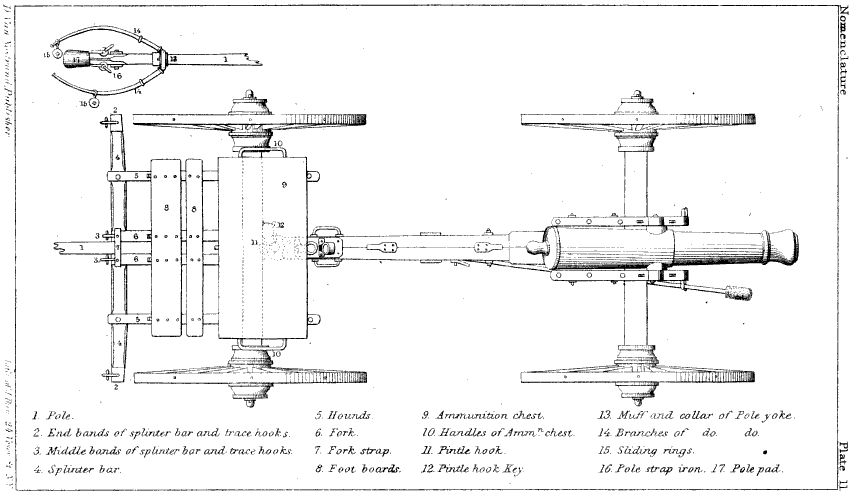
6pdrcarriagetravel

M-1841 6-Pounder Artillery Carriage and Limber

The artillery service in United States Army was organized like the French army into batteries of six guns, which in turn were detailed to brigades, regiments or battalions. The regimental system was adopted in 1821, following discussions by Secretary of War John C. Calhoun and Congress. As a result, the existing artillery of the army, “the Corps of Artillery and the Regiment of Light Artillery were consolidated to form the 1st, 2d, 3d, and 4th Regiments of Artillery. One of the nine companies authorized to each of the four regiments was to be equipped as light artillery…. The number of artillery companies was reduced from forty-two (thirty-two in the Corps of Artillery and ten in the Regiment of Light Artillery) to thirty-six in the four artillery regiments.[15] The units were dispersed at forts as coastal artillery and depots around the country.

Most of the artillery companies of the period were maintained well below strength and none were organized as horse artillery. In order to give artillerymen practical experience and training working as part of a larger force, Calhoun and the Army established an artillery school at Fortress Monroe. This was an important step. The mission of the school was to provide artillerymen the necessary training in the science of gunnery and artillery tactics, which could not be accomplished in isolated posts. To ensure that the total force was trained the army determined that, “ten artillery companies were to be drawn from the four regiments and assembled as the Artillery Corps for Instruction. The faculty was to be selected from the artillery at large. Through a plan of rotation, all artillery companies were eventually to pass through the school. Cadets assigned to the artillery after graduating from West Point were to receive a year’s instruction at the school before joining their regiments.” [16] The school was closed in 1835 due to the demands for artillerymen in the increased number of coastal fortifications and the need for troops to serve in Florida against the Seminoles.

Though almost all artillery units participated in the war “for the most part, the artillerists were limited in employment to manning the numerous stockades erected to confine the Indians to the Everglades.” [17] Thus they gained no practical experience in their trade. In spite of this by the late 1830s a high percentage of the West Point faculty and staff were men who had served with the artillery in Florida. Major Richard Delafield, an artilleryman became Superintendent in 1838 and gave “artillery instruction wider curricular attention: an artillery “laboratory” would be set up, and practice with lightweight and mobile cannon would receive new impetus.” [18] In another move, Secretary of the Army Joel Poinsett decided to implement the provision of the 1821 regulations to establish four light companies. Using surplus horses from the war he mounted one company as horse artillery in which each crew member had his own horse or rode on the limber, and three as mounted units, “meaning that though the guns were horse-drawn, the cannoneers rode on the carriages or caissons or they walked. In theory the mounted units were to be employed with infantry as regular field artillery and the horse (or light) artillery was to be employed with cavalry.” [19]

The Apex of the Smoothbore

12 pound napoleon

12 Pound M-1857 Napoleons at Gettysburg

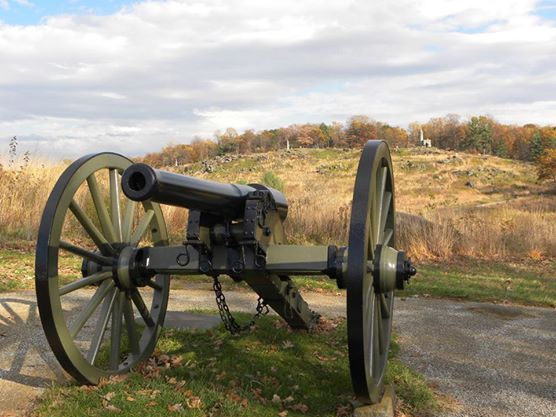
Most of the improvements in artillery design between the Napoleonic era and the Civil War were on focused on lightening the weight of the tube, developing better and more mobile limbers, and improvements to fuses and ammunition. During this time the smoothbore cannon reached the apex of its development. In the United States this was realized with the brass M 1857 12-pound Napoleon, which was developed from a French design, however the gun “embodied none of the recent advances in technology” and was “already considered obsolescent by the French Army.” [20] However, much of the choice was dictated by purchasing agents and the budget which required any new ordnance to be cheap. The Napoleon was intended to replace the 1841 patter 6 and 12 pound guns and the 12 pound howitzer. It was nearly 500 pounds lighter than the old guns and “though it was technically a gun, owing to its ability to fire canister and solid shot, the Napoleon was often referred to as a gun-howitzer for its ability to fire explosive shell.” [21] It would see its first action at the Battle of Bull Run and nearly 1,800 of these versatile cannon would be produced in Northern and Confederate foundries during the war. Despite its obsolescence it “proved to be the most popular field piece during the Civil War,” [22] and Union artillery General Henry Hunt later acclaimed the Napoleon as “the best all round field piece of this era.” [23] Robert E. Lee told the Prussian observer to the Army of Northern Virginia, Justus Scheibert: “Nothing surpasses… the impression of a battery of 12-pound smoothbores which approaches to within 400-600 paces of the enemy…. In such moment rifled artillery, the advantages of which in open country I fully appreciate, cannot replace the smoothbore.” [24] Some of these guns remained in service until 1880.

The Development of Rifled Cannon and Breechloaders

While the development of rifled, breech loading, and repeating rifles advanced the capabilities of the infantry in terms of firepower, range, accuracy and battlefield lethality, developments to modernize the artillery around the world lagged behind the rifled musket due to the economic costs involved. Because of the cost “no country would face the cost of re-equipment.” [25] This would begin to change in the mid-1850s as the experience of the Crimean began to give new impetus to weapons development.

However, a number of artillerymen and innovators began to experiment with breech loading and rifled cannon. These were not new ideas, and “when combined, they were first experimented with in England in 1745,” [26] but it would take another hundred years before Italian Major Giovanni Cavalli developed “a cast iron gun, its bore cut with simple two groove rifling to accept an elongated projectile fitted with corresponding lugs that mated with the gun’s grooves.” [27] As Cavalli improved his design others in Europe designed rifled guns. In France Colonel Treuille de Bealieu designed a similar gun to Cavalli; but which fired a cylindrical projectile. Napoleon III who was himself authority on artillery ordered brass smoothbores to be rifled on Bealieu’s design. [28] Swedish Baron Martin Wahrendorf “experimented with smaller, multiple-grooved rifling using lead-sheathed projectiles” [29] Cavalli’s guns were used by the Sardinian army, while the French deployed a number of theirs to Algeria and against the Austrians in Italy.

In the 1850s three English inventors, Charles William Lancaster, Joseph Whitworth, and William George Armstrong began to develop rifled guns. During the Crimean War the British Army modified some old large-caliber guns as breech-loaders. The “first British rifled ordnance consisted of a few old 68-pr and 8-in. cast iron guns, which were made oval and twisted in the bore and so converted to pieces rifled on the Lancaster principle.” [30] Some of these guns saw action during the siege of Sevastopol. Whitworth also produced a breech loading rifled cannon. His gun had a very long range and was exceptionally accurate, however the design was complex and temperamental, and the gun “ultimately proved impractical for general use.” This was in part due to their complexity and the “precise tolerances used in the manufacture… required meticulous maintenance by gun crews to avoid malfunctions, and even moderate bore wear led to jamming in the bores.” [31] A few Whitworth rifles were employed by the Confederate army during the Civil War, two seeing action in Richard Ewell’s Second Corps at Gettysburg.

Armstrong, proposed a lightweight rifled field gun, made of forged rather than cast iron to the Duke of Newcastle, Secretary of State for War in 1854. [32] His design incorporated features that remain today. “His rifled breechloader had multiple groves to distribute the twisting force equally around the projectile. The iron projectile was coated with lead to permit a tight sealing into the grooves. Later projectiles have employed copper rotating bands to produce the tight seal without leaving the deposits of lead which tended to foul the cannon.” [33] The only real issues with Armstrong’s guns was that his “breech-loading system was complex and rather advance of its time, and there were a number of accidents due to various mechanical weaknesses.” [34] Likewise, the early breech-loading systems “were so clumsy and slow to operate that a good crew could fire a muzzle-loader faster than a breach loader.” [35]

The United States Army began to examine the possibilities of rifled guns, but the process took time, and much struggle due to the bureaucracy and political infighting. “In the mid-1850s, experiments with the forerunners of rifled cannon began at Fort Monroe. In 1860, a board of artillery and ordnance officers was established to make further tests on rifling, and the board submitted its report late that year. It recommended that at least 50 percent of the guns at forts and arsenals be converted into rifles.” [36]
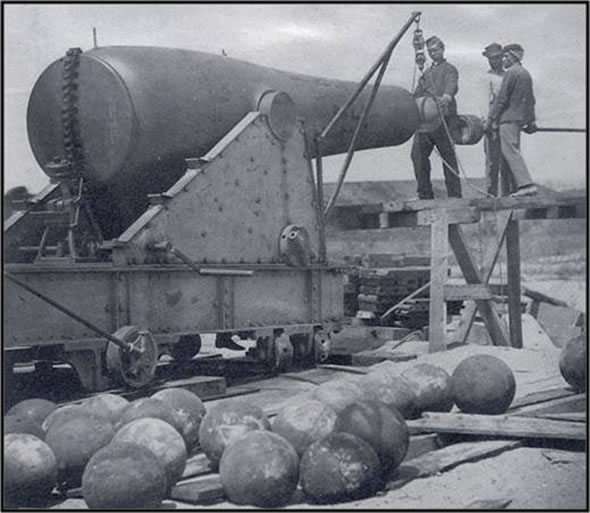
15inch-rodman-gun

15 inch Rodman Gun

During the same time period a number of Americans both military, and civilian, began to develop their own variations of rifled cannon for use in the U.S. Army. The most important of these were Captain Robert Jackson Rodman and Captain Robert Parrott. Rodman was a true scientist who understood both metallurgy and gunpowder. Rodman was instrumental in using his knowledge to design the largest guns of the era. Called Columbiads, these heavy guns came in 8 inch, 10 inch, 15 inch and even a 20 inch model. They were used in coastal fortifications. In the 1870s over 200 of the 10 inch model were converted to 8 inch rifles. The Rodman guns remained in service the rest of the century and are considered to be the best cast-iron cannon ever produced.

Parrott was the Superintendent of the West Point Iron and Cannon Foundry of Cold Spring New York. Parrott “became interested in rifled guns after the successes of Krupp in Germany. In the following years he applied his own skills to designing an American rifled gun.” [37] Parrott focused on improving cast-iron guns. He “developed a method for shrinking wrought-iron bands around the breech of a cast barrel.”[38] The band was designed to strengthen the cast iron barrel and “the final result was a relatively lightweight, economical gun and gave the Parrot rifle its distinctive profile.” [39] For field artillery use Parrot designed a 2.9 inch 10-pounder in 1861 which was modified to a 3 inch bore in 1863 to standardized ammunition with the 3 inch Ordnance Rifle. Parrot also designed a 20-pound 4.7 inch rifle for field service. Both models were manufactured in the North and the South and saw wide use with over 2,000 produced for the Federal government. When he was at VMI in 1860, Thomas “Stonewall” Jackson was “one of the first to test and recommend for adoption the rifled Parrott guns.” [40] At Jackson’s “recommendation, Virginia purchased twelve” of the new rifled guns. [41]
999130_10152038135167059_1801660138_n

10 Pound Parrot Rifle at Devil’s Den Gettysburg

Parrot also produced heavy guns used by the Navy for use on ships, and the Army for seacoast and siege weapons. The one problem with the Parrot rifles was the fact that the cast-iron barrel was brittle and prone to burst, especially those of large caliber, which made it unpopular among its crews and caused the Navy to withdraw them from service aboard ship. Porter Alexander reported that during the Battle of Fredericksburg that for the first and only time he had 30-pound Parrott rifles in the field and that during the battle “they filled a great want, until they, unfortunately, both exploded towards the middle of the day, one on the 37th round & one on the 42nd.” [42]

A civilian, John Griffen of the Phoenix Ironwork of Phoenixville, Pennsylvania, “pioneered the use of wrought iron in the construction of field pieces[43] and patented his prototype in 1855. The designed was slightly modified by the Ordnance Department and adopted by the army in 1861. The weapon was known as the Ordnance Rifle and is had a bore of 3 inches and threw a 10-pound projectile. Unlike the cast iron Parrot, it was “constructed of tougher wrought iron, consisting of iron bands welded together around a mandrel and then lathed to a sleek, modern profile. It was then bored and rifled.” [44] The Ordnance rifles were light, easy to maneuver and beloved by their crews for their accuracy, and dependability. Phoenix manufactured over 1,000 of these weapons for the Federal government.

To be continued…

Notes

[1] Ibid. Hagerman The American Civil War and the Origins of Modern Warfare p.21

[2] Ibid. Cornwell Waterloo: The History of Four Days, Three Armies, and Three Battles p.165

[3] Nesmith, Vardell E. Stagnation and Change in Military Thought: The Evolution of American Field Artillery Doctrine, 1861-1905 – An Example United States Army Command and Staff College, Fort Leavenworth, KS 1976 p.5

[4] Kinard, Jeff Artillery: An Illustrated History of Its Impact ABC Clio, Santa Barbara, Denver, and Oxford 2007 p.148

[5] Stevens, Phillip H. Artillery Through the Ages Franklin Watts Inc. New York 1965 p.47

[6] Rogers, H.C.B. A History of Artillery The Citadel Press, Secaucus NJ 1975 p.58

[7] Ibid. Kinard Artillery: An Illustrated History of Its Impact p.148

[8] Ibid. Stevens, Phillip H. Artillery Through the Ages Franklin Watts Inc. New York 1965 p.48

[9] Garcia, Manuel R. The Pursuit of Precision in Field Artillery School of Advanced Military Studies, United States Army Command and General Staff College, Fort Leavenworth KS 2010 pp.7-8

[10] Ibid. Kinard Artillery: An Illustrated History of Its Impact p.148

[11] McKenny, Janice E. The Organizational History of Field Artillery 1775-2003 Center For Military History, United States Army, Washington D.C. 2007 p.36

[12] Ibid. Kinard Artillery: An Illustrated History of Its Impact p.170

[13] Ibid. Kinard Artillery: An Illustrated History of Its Impact p.169

[14] Ibid. Alexander Fighting for the Confederacy: The Personal Recollections of General Edward Porter Alexander p.182

[15] Ibid. McKenny The Organizational History of Field Artillery 1775-2003 p.32

[16] Ibid. McKenny The Organizational History of Field Artillery 1775-2003 p.34

[17] Ibid. McKenny The Organizational History of Field Artillery 1775-2003 p.34

[18] Longacre, Edward G. The Man Behind the Guns: A Military Biography of General Henry J. Hunt, Chief of Artillery, Army of the Potomac Da Capo Press, a Perseus Group, Cambridge MA 2003 p.28

[19] Ibid. McKenny The Organizational History of Field Artillery 1775-2003 p.38

[20] Ibid. Stevens, Phillip H. Artillery Through the Ages Franklin Watts Inc. New York 1965 pp.62-63

[21] Ibid. Kinard Artillery: An Illustrated History of Its Impact p.188

[22] Ibid. McKenny The Organizational History of Field Artillery 1775-2003 p.49

[23] Ibid. Longacre The Man Behind the Guns: A Military Biography of General Henry J. Hunt, Chief of Artillery, Army of the Potomac p.70

[24] Ibid. Guelzo Fateful Lightening p.257

[25] Ibid. Fuller The Conduct of War 1789-1961 p.89

[26] Ibid. Fuller The Conduct of War 1789-1961 p.89

[27] Ibid. Kinard Artillery: An Illustrated History of Its Impact p.222

[28] Ibid. Rogers A History of Artillery p.94

[29] Ibid. Kinard Artillery: An Illustrated History of Its Impact p.222

[30] Ibid. Rogers A History of Artillery p.94

[31] Ibid. Kinard Artillery: An Illustrated History of Its Impact p.223

[32] Ibid. Rogers A History of Artillery p.94

[33] Ibid. Stevens, Phillip H. Artillery Through the Ages Franklin Watts Inc. New York 1965 p.60

[34] Ibid. Rogers A History of Artillery p.94

[35] Ibid. Stevens, Phillip H. Artillery Through the Ages Franklin Watts Inc. New York 1965 p.60

[36] Ibid. McKenny The Organizational History of Field Artillery 1775-2003 pp.50-51

[37] Ibid. Kinard Artillery: An Illustrated History of Its Impact p.190

[38] Ibid. Stevens, Phillip H. Artillery Through the Ages Franklin Watts Inc. New York 1965 p.61

[39] Ibid. Kinard Artillery: An Illustrated History of Its Impact p.190

[40] Ibid. Gwynne Rebel Yell: The Violence, Passion, and Redemption of Stonewall Jackson p.88

[41] Ibid. Nesmith Stagnation and Change in Military Thought: The Evolution of American Field Artillery Doctrine, 1861-1905 – An Example p.15

[42] Ibid. Alexander Fighting for the Confederacy: The Personal Recollections of General Edward Porter Alexander p.172

[43] Ibid. Nesmith Stagnation and Change in Military Thought: The Evolution of American Field Artillery Doctrine, 1861-1905 – An Example p.14

[44] Ibid. Kinard Artillery: An Illustrated History of Its Impact p.192

2 Comments

Filed under Loose thoughts and musings

Where the Distinction Between Fact and Fiction, True and False, No Longer Exists

hannah-arendt

Hannah Arendt 

Friends of Padre Steve’s World,

Yesterday I wrote about presidential spokesperson Kellyanne Conway who defended a number of outright lies posited by Press Secretary Sean Spicer as alternative truth. The statement was astounding and was met with much criticism and ridicule, but it reflects an attitude that of cynicism that has swept our nation that facts as they are, are unimportant, that truth itself is malleable.

In her book The Origins of Totalitarianism Hannah Arendt wrote: “The ideal subject of totalitarian rule is not the convinced Nazi or the dedicated communist, but people for whom the distinction between fact and fiction, true and false, no longer exists.”

The world that most of us grew up with is changing before our eyes and it is happening around the world and it is hard to say what is going to happen. I started re-reading Hannah Arendt’s book last night. It was one of my texts as an undergraduate when studying Hitler’s Germany. The book deals with both Naziism and Stalinism which makes it in some sense like Timothy Snyder’s Bloodlands: Europe Between Hitler and Stalin. While the latter focuses more on how Hitler and Stalin used their power on their own people as well as the Poles, the Ukrainians, the Belorussians, and others who happened to find themselves swallowed up by the two totalitarian states; Arendt’s book more at the underlying social conditions. In a time when populist politicians around the world are speaking in the the language of authoritarians, and promising to deliver their people from various political, racial, and religious enemies, it is important to remember where such talk almost always ends, totalitarian states.

But the fact is based on numerous polls in this country and around the world going back two decades show a rise in people of all ages and ideologies who are willing to accept authoritarian government and to abandon democracy. Well before President Trump ever announced his run for the presidency in 2015 the stage was set for an authoritarian leader to arise in the United States just as many are doing in Europe. Whether President Trump actually ends up ruling as an authoritarian is not yet clear, but the signs keep pointing that he may be heading in that direction, and that his followers will have no problem with it. His inaugural address was marked by his distain for both political parties and the political establishment and linking himself with the people. It was loaded with populism and nationalism, as are the messages of  Vladimir Putin, Nigel Farage, Marine Le Pen, and others in Europe.

William Shirer wrote of how Adolf Hitler convinced many Germans to follow him. His message was basic populism in which certain groups were responsible for their problems and he promised to fix it. Yes Hitler was anti-semitic and especially blamed the Jews, but most Germans, many who were raised in a culture of anti-Semitism, just ignored that part and followed him because anti-Semitism was normal for them. Shier wrote:

“To all the millions of discontented Hitler in a whirlwind campaign offered what seemed to them, in their misery, some measure of hope. He would make Germany strong again, refuse to pay reparations, repudiate the Versailles Treaty, stamp out corruption, bring the money barons to heel (especially if they were Jews) and see to it that every German had a job and bread.”

So how did we get here? How did we get to the point that a presidential spokesperson can defend lies and refer to them as alternative facts?

I won’t answer that today in fact I want to think about it more, and do more research, but much is based on the constant repetition of simple propaganda messages that are designed to bypass the intellect and appeal to raw passion. I have written about this trend for several years using different historical examples but today I am just going to leave you with one other thing that Arendt wrote:

“In an ever-changing, incomprehensible world the masses had reached the point where they would, at the same time, believe everything and nothing, think that everything was possible and that nothing was true. … Mass propaganda discovered that its audience was ready at all times to believe the worst, no matter how absurd, and did not particularly object to being deceived because it held every statement to be a lie anyhow. The totalitarian mass leaders based their propaganda on the correct psychological assumption that, under such conditions, one could make people believe the most fantastic statements one day, and trust that if the next day they were given irrefutable proof of their falsehood, they would take refuge in cynicism; instead of deserting the leaders who had lied to them, they would protest that they had known all along that the statement was a lie and would admire the leaders for their superior tactical cleverness.”


I will discuss that passage in depth at another time but I think it is good just to let it sink in.

Have a good day,

Peace,

Padre Steve+

Leave a comment

Filed under ethics, History, News and current events, philosophy, Political Commentary

The World of Alternative Facts and the Danger to the Republic

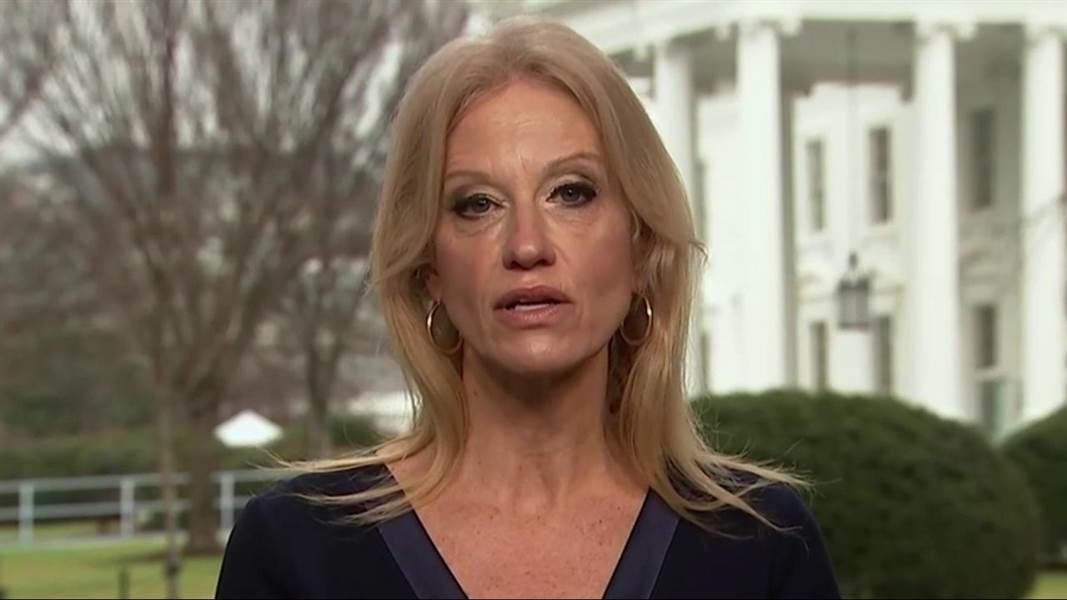
kellyanne-conway

Friends of Padre Steve’s World,

We have entered a world that our founders never expected to happen but warned us about. Alexander Hamilton wrote in Federalist No. 1, that the fiercest enemies of the republic were those men who begin “by paying an obsequious court to the people, commencing demagogues and ending tyrants.”

I think that we have entered that era in our history.

Press Secretary Sean Spicer’s embarrassing attack on those who disagreed with the President’s claim that the inauguration of President Trump had the highest attendance in history when every analysis of the crowds revealed to be far smaller than the last few inaugurations was defended by President Trump’s advisor Kellyanne Conway. Conway turned absolutely Orwellian to defend that and a number of other claims that were patently false. She called them Alternative Facts.

Sadly, this has been the modus operandi of Mrs. Conway and the President’s spokespeople since the beginning of his campaign. Rather than admit to a falsehood they reinforce the lie, time after time. The behavior is extraordinary in the American experience but not in history.

I hate to bring up a Nazi example but the the tactic is that of the Nazi, the Soviet, and every other authoritarian and dictatorial propaganda machine. But being a historian who has spent much of my life researching and writing about the Nazi seizure of power I was actually taken aback by her comments and the use of the term “alternative facts.” There are no such thing. John Adams, our second President said it well: “Facts are stubborn things; and whatever may be our wishes, our inclination, or the dictates of our passions, they cannot alter the state of facts and evidence.” 

But such clarity cannot be found in what Mr. Spicer or Mrs. Conway said. They repeated a lie and then Mrs. Conway called it an “alternative fact.” It was absolutely Orwellian, not that it matters to many of the President’s diehard supporters. He told us during the campaign: “You know what else they say about my people? The polls, they say I have the most loyal people. Did you ever see that? Where I could stand in the middle of Fifth Avenue and shoot somebody and I wouldn’t lose any voters, okay? It’s like incredible,” and he was absolutely correct. Hitler told his generals when he was about to stage a propaganda coup to blame Poland for starting the war, “I shall give a propagandist reason for starting the war – never believe if it is plausible or not. The victor will not be asked afterward if he told the truth…” It seems that from day one of his campaign the President has followed a similar course of action to first win the nomination of his party and then the general election. I don’t think that he can stop now that he is office. In his inaugural address the President noted: “America will start winning again, winning like never before.”  Winning at all costs seems to be everything, and nothing will stand in the way, even facts.

The Nazi Propaganda Minister, Joseph Goebbels once said:“It would not be impossible to prove with sufficient repetition and a psychological understanding of the people concerned that a square is in fact a circle. They are mere words, and words can be molded until they clothe ideas and disguise.”

Sadly, this will not be the last of these kind of statements made by Mrs. Conway or Mr. Spicer. We have entered a new era, and while many people think that the Trump administration will sink itself, and that maybe the GOP will revolt, impeach him, and make Mike Pence the President, they are deluded. That will not be allowed to happen by Trump or his supporters. The stream of alternative facts are going to become so commonplace that people will stop noticing them, they will get numb to them.

William Shirer who served as a correspondent in Berlin from 1934 to 1941 wrote in his book The Rise and Fall of the Third Reich:

“I myself was to experience how easily one is taken in by a lying and censored press and radio in a totalitarian state. Though unlike most Germans I had daily access to foreign newspapers, especially those of London, Paris and Zurich, which arrived the day after publication, and though I listened regularly to the BBC and other foreign broadcasts, my job necessitated the spending of many hours a day in combing the German press, checking the German radio, conferring with Nazi officials and going to party meetings. It was surprising and sometimes consternating to find that notwithstanding the opportunities I had to learn the facts and despite one’s inherent distrust of what one learned from Nazi sources, a steady diet over the years of falsifications and distortions made a certain impression on one’s mind and often misled it. No one who has not lived for years in a totalitarian land can possibly conceive how difficult it is to escape the dread consequences of a regime’s calculated and incessant propaganda. Often in a German home or office or sometimes in a casual conversation with a stranger in a restaurant, a beer hall, a café, I would meet with the most outlandish assertions from seemingly educated and intelligent persons. It was obvious that they were parroting some piece of nonsense they had heard on the radio or read in the newspapers. Sometimes one was tempted to say as much, but on such occasions one was met with such a stare of incredulity, such a shock of silence, as if one had blasphemed the Almighty, that one realized how useless it was even to try to make contact with a mind which had become warped and for whom the facts of life had become what Hitler and Goebbels, with their cynical disregard for truth, said they were.”

I am sorry, but when it comes to facts and truth, that is the kind of world we on entered on January 20th. Please note I am not saying that President Trump is a Nazi, or commit Nazi style atrocities. I am simply comparing the methods, and the language of his spokespeople to the Goebbels propaganda machine, and I am also calling to mind the words of our founders on the danger of demagogues.

Honestly, I hope that our President governs wisely and gains a sense of humility as he holds in his hands such great power. I want him to succeed for all of us, but this opening weekend has given me much cause for concern and this has less to do with policy than it does the deceptive words that I see coming from those who shape his message.

I know that is a hell of a way to start the week, but this does matter.

Have a great day.

Peace

Padre Steve+

Leave a comment

Filed under ethics, History, leadership, News and current events, Political Commentary

The Day After: Reflections

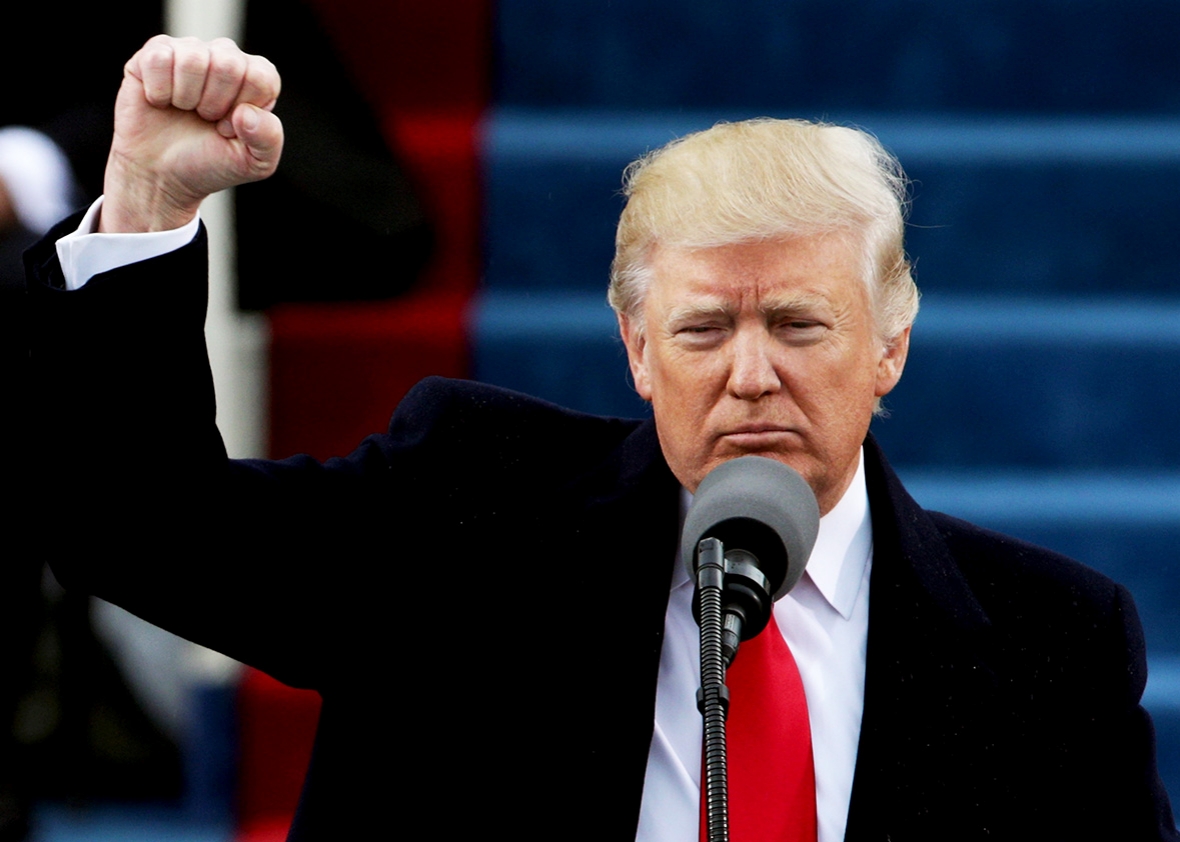
trump-fist-pump

Friends of Padre Steve’s World,

Just a short note this morning. I was pretty busy around the house yesterday and I have been battling a cold for the past week that keeps lingering. I hate being woken up coughing during the night.

Anyway, this morning before I started to do some work around the house I took time to read articles and opinions from around the world and from many points of view on the meaning of President Trump’s assumption of office and inaugural address. They varied with from great concern and near panic to hope. What I am not going to do today is talk about details of those articles. They are all over the web and I encourage my readers to take the time to visit American newspapers and publications of various political and ideological points of view as well as the English language websites of European, Asian, and Middle Eastern news services, newspapers and journals. If you don’t have the time for that the New York Times Opinion section has a great interactive section with many writers of various political views from around the world that you can scroll through at your leisure as it goes on and on. But I really think that no-matter what your political beliefs or ideology are that it does help to read things outside of your bubble or comfort zone. Too many people never leave their bubble and it does us great harm because we don’t understand each other, we don’t know each other, and what we believe about each other is indelibly poisoned because all we see is the caricature, and not real people.

Anyway, the latest book that I finished reading was German historian Heinz Hohne’s tome about Heinrich Himmler and his SS entitled The Order of the Death’s Head: The Story of Hitler’s SS. The book is a fascinating read because it describes the chaotic administration of Nazi Germany which though it was a totalitarian state was a bureaucratic nightmare of competing organizations of the Nazi Party and the German State, bound together, yet each dependent on the graces of Adolf Hitler, who in order to maintain his undisputed power would play them off against each other. But I do highly recommend Hohne’s book. I am not going to go into detail here, I may write something in the near future on the subject as I go through my old texts from my undergraduate and graduate school dealing with the Nazi state, but I digress…

Anyway, my takeaway from President Trump’s inaugural address and subsequent remarks yesterday and today is that he is going to maintain a very small number of trusted advisors, and play off competing factions of the Republican Party and various Federal agencies, maintain his rhetoric to keep his personal base of voters in line all to ensure his personal power. I think that he will be successful in this as he seems to be rather genius at outmaneuvering his opponents. Those in the GOP who think that they can control him or to reign him in to their more traditional conservatism should take note of his words as he ripped the political class of Washington DC; his words were aimed as much at the GOP insiders as they were the Democrats. His administration will be centered on him.

His raised fist served as a visible symbol and reminder to those who think that they can get the best of him. Some of the articles that I read seem to indicate that he will fall afoul of the GOP Congress if he maintains his populist rhetoric and does not tow the GOP think tank policy that has long dominated the GOP caucus. But Congress should beware, Trump does not appear to care about the norms of how things are done in Washington and his followers expect him to act, and he will use them to intimidate Congressional Republicans if they try to use their majority to get in his way. He said as much when he said: “What truly matters is not which party controls our government, but whether our government is controlled by the people.”

I am not going to speculate what the result of this will be, but I do think that it will be chaotic because that seems to be what he thrives on.

After reading all of those reactions, re-watching the speech and his body language, and reading it again, I could not help but think that we are heading toward something we have never seen before in this country: an authoritarian leader at the helm of a populist movement that is not bound by party loyalty or ideology, whose opponents in both parties are disorganized and unable to grasp that the playing field itself has changed, as have the rules.

That is something that gives President Trump with his executive authority a huge advantage. He will invoke this authority through executive orders to move faster than the Republican congressional majority or the divided Democrats can, and to bypass them and the media by communicating directly with his supporters.

Anyway, those are just a few thoughts on the day after.

Peace

Padre Steve+

Leave a comment

Filed under History, laws and legislation, leadership, News and current events, Political Commentary

A Dark and Dystopian Recycled Campaign Speech: The Trump Inaugural Address

highlights_from_president_donald_trump___0_7097922_ver1-0_640_360

Friends of Padre Steve’s World,

I watched the inauguration ceremony of President Donald Trump with a number of my colleagues, all senior military officers today. I think that all of us left far from impressed and a bit worried about how President Trump will govern, and whether he will blunder us into a war with a country that can do us great harm, or leave us isolated from our allies and left as a isolated pariah nation.

The President’s inaugural address was underwhelming to be kind. But to be truthful it was not inspiring.  It was dark, and presented a dystopian view of the country and world that President Ronald Reagan, who took office in a far more dangerous time would reject. It was not Reagan’s cheerful “Morning in America” theme of hope in the midst of economic chaos and the challenge of an expanding and aggressive Soviet Union.

Conservative columnist George Will called it “the most dreadful inaugural address in history.” Instead Trump emphasized long established myths of chaos and despair to invoke fear and to promote himself as a messiah figure. I have read and studied the inaugural speeches of many Presidents and have never seen something as dreadful as this. It was a curious blend of darkness, isolationism, militarism, and personal egoism masked in an anti-establishment populism with a bit of “Gott mit Uns” theocracy thrown in.  In fact when President Trump talked about the security of the nation being in the hands of law enforcement and the military, he also threw in “most importantly we will be protected by God” I made the comment to my colleagues, “we’ll see about that.” That drew a curious look and I made the comment that “as a historian the whole “Gott mit Uns” thing has bothered me for a long time.” My colleagues nodded in agreement.

Personally I think that anyone who claims that “we will be protected by God” when they support polices and lifestyles that are best exemplified by the “seven deadly sins” is committing blasphemy, and that goes for the preachers on the podium who echoed the President’s message. President Trump talked of unity in the sense of nationalism and patriotism, but he never mentioned justice or equality. He talked of the future and relegated the past, our great American past, to insignificant nothingness. There was no mention of past presidents, national events, or triumphs in the face of terrible challenges. It was all about him and a people united to him, now, and a yet to be written future in which America would again be strong, wealthy, proud, and yes, even great again. I hate to admit it but the end of the speech almost reminded me of the words “ein Reich, ein Volk, ein Fuhrer.” But I digress…

When I was out at the brewery restaurant I frequent a man who I had never met before got upset about a headline on CNBC which called Trump “the great disrupter.” His comment was “he’s only saying what he campaigned on.” Since he was talking to me, I said, “well that was what he promised in the campaign” and the man got more belligerent so I simply ignored him and was relieved when someone I knew sat between us.  The friend who sat between us and I we were able to talk about the the inauguration in a civil manner even though our times our opinions diverged. I stuck to facts and remained dispassionate whenever we disagreed, and it was good.

I could go on about what I thought of the inaugural address, but I heard exactly what I anticipated President Trump said today, it was a recycled campaign speech like I heard in person when he came to Virginia Beach in October.

But what really bothered me almost as much was the actions of a minority of protesters who went on a rampage of violence and vandalism not far from the inauguration parade. I don’t know who they were. They can claim to be progressives, but such actions show that claim to be a lie. They are disruptive anarchists who if they were in power would be as or more destructive that President Trump will ever be. Their actions endanger the lives and freedom of every peaceful and non-violent protester who marched today, and who will march in the future, as every time they do this they confirm Trump’s dark description of America. 

My comments of yesterday about how to deal with the Trump Presidency before the inaugural address remain my views today: Truth, non-violence, activism, and civility. If you didn’t read that post you need to.

I am worried, but at the same time I will not give up hope. There are still too many good people who will fight for justice, and who will not be taken in by propaganda and vitriol, and they are not all liberals or progressives. They include men like George Will, my friend, and at least some of my military colleagues.

So anyway. I’m going to be doing some work around the house today and will probably have to go out and replace my twenty-year old dryer and maybe my washer too.

So until the next time, have a great  day. 

Peace,

Padre Steve+

4 Comments

Filed under News and current events, Political Commentary

Dealing With the Reality of the Trump Presidency

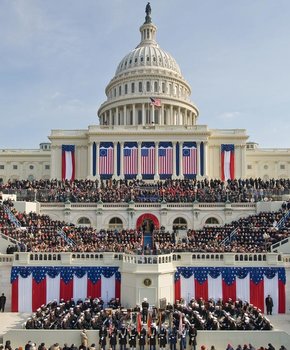
us-capitol-west-front-inauguration-2009-barack-obama

Friends of Padre Steve’s World,

There are times in history when eras end and new ones begin. As a historian I think that we are on the verge of one of those moments in history and that is not necessarily a good thing. Barbara Tuchman wrote that as England declared war on Germany in 1914 of British Foreign Secretary Earl Edward Grey:

“Watching with his failing eyes, the lamps being lit in St. James Park, Grey was heard to remark that “the lamps are going out all over Europe; we shall not see them again in our lifetime.”

I believe that could well be the case in our country and the world in the not too distant future, the symbolism of the lamps going out may be all too real.

At 12:01 today Donald Trump will take the Oath of Office and become the President of the United States. That is a fact. We can argue about his legitimacy. Like it or not he is the legal and thus the legitimate President. Of course that is one definition of legitimate. But there is another definition that can be argued to say that he is not, and this one is quite important to our form of government. That definition is “conforming to recognized principles or accepted rules and standards.” This is something that no-one can claim that Mr. Trump has done in his long business life or in his short political life. The latter is incredibly important, but it does not take away the legality of his election. Unless something extraordinary happens in the next five and a half hours he will be the President, and if something were to happen the resulting chaos who likely be worse than the transition of power to a man who appears to have been elected with the help of a hostile foreign power, and who lost the popular vote by one of the widest margins ever for someone who won the electoral vote. The truth be told I wish I had never seen this day come, but it has.

That my friends, like it or lump it is reality, and as the masthead of this site reads, I am a “progressive realist in Wonderland.” 

Now we can say “Never Trump” all we want, but he will still be President. We can put hashtags saying “not my President,” but he will still be President. That is cold hard reality. We can talk about resistance, but if we resist we need to be smart in how we do it and apply reason, logic, and hard work.

Does that mean that his policies should not be opposed on principle of they harm people? Never. There are many of his stated policies which if implemented will be harmful to the country. Likewise, some of the things that he has said regarding foreign policy not only will make us weaker but could end up in an even chaotic world and the real possibility of war with nations that could do us great harm, militarily and economically. Of course we could find out that once in office he becomes more pragmatic, realistic, and flexible. I kind of doubt it but it is a possibility.

A lot depends on what he says tomorrow, if he conducts himself with humility, dignity, and shows respect for all Americans, he could change the tenor of the debate in the country and instead of having to crush those who question his legitimacy, he could earn their respect, even if it is grudging. Again, while this is possible, I am not hopeful that it will happen, but I could be wrong. Even so, no-matter how he conducts himself today, he will still be President.

So what are the realistic options?

Protest is always an option, but those who do so must be very careful and not allow themselves to be provoked into any action that could cause President Trump to enact measures that are written in the Constitution, in established law, and in executive orders that deal with civil unrest. We have to remember that there are “agent provocateurs” who do things to cause individuals to do things that puts them on the wrong side of the law. One stupid or violent action against the President could bring the whole house down. If we protest it must be peaceful and those who do cannot allow themselves to respond to violence and intimidation in kind. That is what we learned from men like Dr. Martin Luther King Jr. and Representative John Lewis. The path has to be non-violent.

What else can we do?

Get involved. Write your state and Federal representatives and senators on all important issues. Don’t just tweet to your friends.

Revitalize the political party system in the country by participating at all levels.

Run for office, especially at the local and state level. That is where real change happens, if your don’t win there it doesn’t matter if you win the Presidency once in a while. Many offices around the country are won by people who run unopposed; don’t let that happen.

Donate money to political groups, parties, and those who represent what you believe.

Speak up for those who have no voice and who are demonized by Trump’s most radical followers as well as those in the Republican Party who have demonized them far longer than Mr. Trump has been a member of that party.

Speak truth to power and do not spread rumors or innuendo. Get away from spreading political memes that even if they are factual are not conducive to reasoned debate.

Read long articles in newspapers, and journals. Things that require thought and reflection. When you share them do what I do. Ask people to read them and then ask them if the want to comment pro or con to do so themselves and not on your social media timeline or to discuss things in personal messages or even better in person. Avoid Twitter wars and Facebook rants, be careful of what you say in e-mails and comment sections of public forums.

Gather together in person and discuss issues, even with people with whom you disagree. Do it over a meal, a drink, but do it respectfully and build bridges that break down the walls of division. It’s hard to hate people that you break bread with.

Remember, there are people who initially support authoritarian leaders who sooner or later realize that they were deceived by false promises and come around. One of those was the German Pastor Martin Niemoller who initially supported Hitler, then when he realized that he had been lied to, spoke up, and resisted. In a concentration camp he wrote these words:

“I hated the growing atheistic movement, which was fostered and promoted by the Social Democrats and the Communists. Their hostility toward the Church made me pin my hopes on Hitler for a while. I am paying for that mistake now; and not me alone, but thousands of other persons like me.” 

Believe me, there will be a lot of people who voted for President Trump and his GOP allies who will be dealing with buyer’s remorse in the not too distant future. When that happens we need to be there for them.

Read. Barbara Tuchman wrote:

“Books are the carriers of civilization. Without books, history is silent, literature dumb, science crippled, thought and speculation at a standstill. Without books, the development of civilization would have been impossible. They are engines of change (as the poet said), windows on the world and lighthouses erected in the sea of time. They are companions, teachers, magicians, bankers of the treasures of the mind. Books are humanity in print.”

Read real books on history, political science, law and the Constitution. Read how we got the Declaration of Independence and the story of how in the face of real rebellion and war, Abraham Lincoln began the quest for “a new birth of freedom.”

Read the biographies of statesmen and women, politicians, Presidents, and Prime Ministers, civil rights leaders, labor leaders, and even religious leaders. Read the classics, and even poetry. Learn about courage to face trying times and uncertain futures from those who went before us. Learn from their successes and also their failures. Most of them had feet of clay, but the good ones made a difference. We can too.

These are things that matter and in the long run can defeat the worst attempts of Trump, his cabinet officials, people he appoints as justices and judges, and GOP dominated legislatures.

Will you get instant gratification? No. This is hard work. It requires patience, humility, the ability to admit when we are wrong, and the courage to face reality. Part of that reality is that Donald Trump will be President at 12:01 today. I will not bury my head in the sand, and as painful and distasteful as it will probably be I will watch the inauguration today, if nothing else to show my respect to our outgoing President and his family, who I will miss as President.

I remember watching Barak Obama’s inauguration in 2009. When he took the Oath of Office, I was standing beside the bed of a critically ill African American woman in the ICU of the Medical center that I then worked. She was nearly 90 years old. Her late husband had been a military man back during Jim Crow and then the Civil Rights era, she remembered the hatred and discrimination that they both faced. I remember watching that moment with her, holding her hand, and listening to her joy in spite of her pain at seeing a moment that she never dreamed that she would live to see. It was a profound honor for me.

Truthfully, all of that being said, I am very afraid of what President Trump and his administration may do in a very short amount of time. It is much easier to destroy systems and crush dissent than to built bridges and renew the country. At the same time I will be a voice of reason and speak the truth the best I can given the limitations of my own office. I do want to be wrong, and I will pray for him and his family because if he screws up we are all screwed. That too is reality.

But that’s what we have to do. we cannot give up, but if we resist, we must do it smartly and effectively. Highly emotional outbursts that lead to less than wise actions will doom resistance. We must be to use the words of Jesus, “wise as serpents and gentle as doves.”

So until tomorrow.

Peace,

Padre Steve+


4 Comments

Filed under civil rights, History, laws and legislation, News and current events, Political Commentary

On Inauguration 2017

Friends of Padre Steve’s World

I seldom re-post other people’s work but Frank Angle is a blogger that I have followed for years. I think there is a lot of wisdom in this article.

Peace

Padre Steve+

Frank @ Beach Walk Reflections's avatarA Frank Angle

Because Inauguration Day of a new president coincides with my normal posting of Opinions in the Shorts, I decided to forego my normal OITS for a posting that is fitting for the day.

In a short moment of time, Barack Obama goes from the one with the title to a former occupant of the Oval Office. My view of President Obama is different from the many who follow partisan lines. At this moment I want to thank him for his service. Thank him for the way he handled himself in representing our nation. Thank him for the way he carried the extra burden of being the first non-white to serve in the most powerful office in the land. Thank him for taking us from where we were in January 20, 2009 to today. (A good read in USA Today.)

Inauguration Day marks the peaceful transition from one…

View original post 431 more words

2 Comments

Filed under Loose thoughts and musings

“It is More Important to Tell the Truth” Teddy Roosevelt and the Freedom to Criticize a President

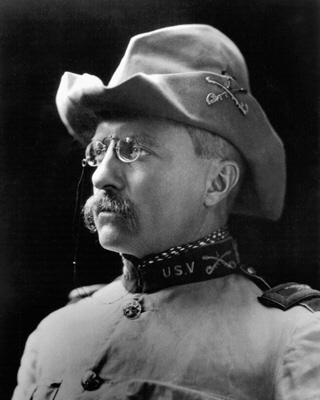
db_theodore_roosevelt_rough_rider9

Friends of Padre Steve’s World,

I have seen a lot of people, especially conservative Christians demanding that critics of our soon to be President Trump to stop criticizing him and fully support him. It is actually fascinating to watch and listen to as for the past eight years neither the President Elect or most of his supporters have stopped questioning the legitimacy of President Obama. My God, for the past eight plus years his policies have not only been criticized, but his very person has been defamed by the very people who now say that criticizing or failing to support the President is “unpatriotic,” “un-American,” and even “treasonable.” I’ve also seen not so subtle threats made against critics of President-Elect Trump, even before he was elected.

Of course that is bullshit. One of the fundamental rights that all of us have as Americans is the right to freedom of speech, freedom of association, and freedom of religion. It’s called the First Amendment of the Constitution. Our founders were terrified that some nutcase might get the idea to become a tyrant and that the people would let them. That’s why we have all the checks and balances between the Executive, Legislative, and Judicial branches of the Federal government, and that is why that freedom of speech has been the cornerstone of the American experiment.

But not anymore. I am not going to say a word about President-Elect Trump or my opinion about him or his possible policies. Instead I am going to note what one of my favorite President’s said about criticizing the President or a Presidential administration. That man was Theodore Roosevelt. Roosevelt, if you recall was no Nansy Pansy. The man volunteered for combat and led troops up San Juan Hill in the face of a fusillade of enemy fire, he sent the Great White Fleet around the World, he helped to end child labor, and he created the National Park system. What he wrote in 1918 is important. The United States was at war having joined Britain and France to fight Imperial Germany.

Roosevelt said this when it came to criticizing the President:

“The President is merely the most important among a large number of public servants. He should be supported or opposed exactly to the degree which is warranted by his good conduct or bad conduct, his efficiency or inefficiency in rendering loyal, able, and disinterested service to the Nation as a whole. Therefore it is absolutely necessary that there should be full liberty to tell the truth about his acts, and this means that it is exactly necessary to blame him when he does wrong as to praise him when he does right. Any other attitude in an American citizen is both base and servile. To announce that there must be no criticism of the President, or that we are to stand by the President, right or wrong, is not only unpatriotic and servile, but is morally treasonable to the American public. Nothing but the truth should be spoken about him or any one else. But it is even more important to tell the truth, pleasant or unpleasant, about him than about any one else.” The Kansas City Star, 18 May 1918

That being said criticism must be based on fact. Roosevelt was criticizing the Wilson administration because of how badly he thought they were pursuing the war effort against Germany. For this people were castigating him. People said that newspapers should not print what Roosevelt had to say as well as “He should stand by the President” and “He should be stood before a stone wall and shot.” So I guess things haven’t changed too much, but I digress…

The point is that criticism of a President should not be considered unpatriotic nor criminal. If we are to believe Theodore Roosevelt; reasoned, respectful, and truthful criticism of our elected officials, up to and including the President is not only necessary, but it is patriotic. Stephen A. Douglas, who later ran against Abraham Lincoln for President destroyed his own chances of becoming President by opposing James A. Buchanan’s deceitful and illegal attempt to make Kansas a Slave state in 1858. Buchanan said that he would destroy him if he opposed the measure. Douglas stood his ground and he told his congressional colleagues: “God forbid,” I said “that I ever surrender my right to differ from a President of the United States for my own choice. I am not a tool of any President!”

None of us should be regardless of who the President is or what our political beliefs. Principled support, or if need be, opposition, to a President, is both necessary and patriotic. Blind obedience, selling out ones principles, or knuckling under to threats is not. Likewise, those who demand respect, support, and obedience for the person that they voted for without giving it to the other side is not only a hypocrite, but a supporter of tyranny.

This is important, especially when the President-Elect has a long history of lying, cheating small business owners who he contracted with, falsifying, and hiding the truth. His statements in terms of civil liberties, our allies and foreign policy, his questionable relationship with the leader of a hostile foreign power, his manifold conflicts of interest related to his businesses, and his unhinged tirades on social media against any and all critics are all reason to question what he says and does. Those statements are all verifiable, they are not innuendo nor slanderous. They are facts that make a reasonable person question what he says he will do.

Of course, as an American I want President-Elect Trump to do well for all of us and the world. The stakes are too high for me not to care about that. However, to surrender the moral and and Constitutional responsibility to speak out is something that none of us should be prepared to surrender, and those who suggest anyone do should be ashamed of themselves, if they have any sense of shame.

So anyway, until tomorrow.

Peace

Padre Steve+

Leave a comment

Filed under ethics, History, News and current events, Political Commentary

A Useful Nostrum Against Despair: History and Future

edward-vii-funeral

Friends of Padre Steve’s World,

In two days we will have a new President. While his supporters see great things in his Presidency, many others, not just in this country do not. We can try to deduce how President Trump will govern in a number of ways, but the best is through the lens of the past. I am a historian and I am not hopeful of what the future has in store for us, but given that I will not give in to despair. Barbara Tuchman whose books covered many of greatest eras of change and crisis in world history wrote these words:

“The story and study of the past, both recent and distant, will not reveal the future, but it flashes beacon lights along the way and it is a useful nostrum against despair.”

That being said given my study of history and my observations of our soon to be President I am not optimistic. Many people more learned and informed than I have written volumes about what they think will happen in the coming weeks and months. I have read a lot of those analysis and most give me cause for concern. My one hope is that the in spite of his past, including his recent statements, that President Trump will listen to men like soon to be Secretary of defense James Mattis, who alone among our leaders I believe can stand up to Trump’s most unreasonable and problematic actions in regard to NATO, Russia, and China. He actually may be the man who will save the nation from disaster if President Trump makes good on his promises and threats worldwide.

Of course I hope things never reach that point and that some modicum of sanity will possess the President as well as Congress. Likewise I hope that our institutions will be able to survive.

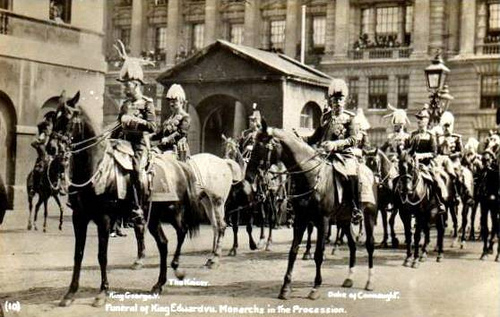
Even so I expect that when President Trump departs the Capital building for the White House that our world will be irrevocably changed. Tuchman wrote of the gathering of leaders at the death of King Edward VII in 1910 in words that I think could easily be modified to 2017 Washington DC.

“The muffled tongue of Big Ben tolled nine by the clock as the cortege left the palace, but on history’s clock it was sunset, and the sun of the old world was setting in a dying blaze of splendor never to be seen again.”

I believe that the world that we knew is never going to be the same. While I have no idea how our future will play out, I still look to the light of the past to keep from despair.

Until tomorrow,

Peace

Padre Steve+

1 Comment

Filed under History, News and current events, Political Commentary

The Friend in My Adversity…

grant-and-sherman-122304

Friends of Padre Steve’s World,

Today just a short thought. I spent most of this holiday weekend down with a nasty cold which allowed me to do some reading and working on my book A Great War in a Revolutionary Age of Change: The Foundations of the American Civil War and Why it Still Matters Today. What I was working on was more on the technical “wonk” side of the development and use of artillery that preceded the war and how artillery was used in it. Lots of analysis, and delving through obscure books which I found absolutely fascinating, but anyway I digress and someday soon you’ll get to read that as well.

Last night a got a wonderful phone call from an old friend, a priest from my former denomination who remarkably hasn’t cast me off. We had a wonderful time, he’s a brilliant man, a combat veteran of Iraq and suffers from some of the same issues that plague me, but with added medical issues from inhaling so many toxins during his two combat tours. He’s gone through a lot, but he and his family are doing well. He is now in medical school and doing very well, but like I said he’s brilliant.

After we returned from Iraq we suffered and commiserated a lot, sometimes over a lot of alcoholic beverages. Last night our talk went on for quite a while and it was great just to do that, so relaxing, good memories, thoughtful discussion of what is going on in the country and in our lives. One thing he said that meant the world to me was the difference I had made as a mentor, encourager, and friend and how important I was to him. He said I was like the character that Kevin Costner played in Bull Durham, Crash Davis, the old catcher sent down to help out the rising star. In a way he is right, and I love the comparison.

As we talked he noted it was so seldom that people take the time to listen, care, encourage, and mentor others. In fact its something that is mentioned quite often in the New Testament. I mentioned to him that one of the people who recently expressed a similar thought to me was a former Navy doctor who I knew when he was an intern; he’s an atheist, but we truly appreciate and value each other.

Sadly, as a culture we have lost that connection and ability to care and learn from each other, even when we disagree on certain points, even important ones. Additionally, we often tend to discard those who are broken in some way, or who color too far outside the lines. There is a creeping Ayn Rand, survival of the fittest style of Social Darwinism that has infiltrated our culture, and especially the church. It has become part of our politics as well and I am sure under the new administration we will see it bloom as we have never seen it before, but I digress again…

Being friends means to let each other know how much we appreciate each other and encourage one another.

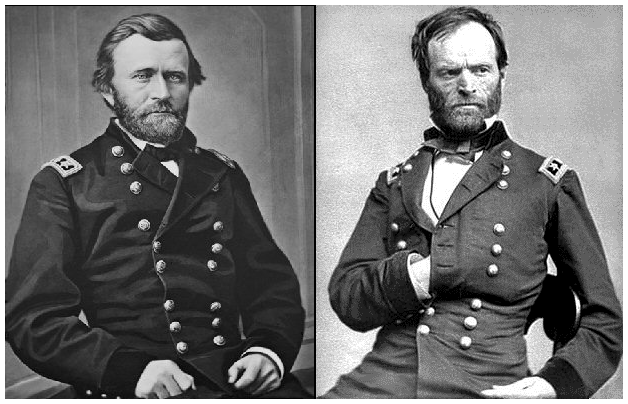
Ulysses S. Grant, who is one of my heroes with feet of clay remarked, The friend in my adversity I shall always cherish most. I can better trust those who helped to relieve the gloom of my dark hours than those who are so ready to enjoy with me the sunshine of my prosperity.” Grant’s ever mindful friend and subordinate William Tecumseh Sherman noted, “Grant stood by me when I was crazy, I stood by him when he was drunk. Now we stand together.” 

With that I wish you a good day,

Peace

Padre Steve+

2 Comments

Filed under christian life, Loose thoughts and musings, Pastoral Care, PTSD, remembering friends