Author Archives: padresteve

padresteve's avatar

About padresteve

I'm a Navy Chaplain and Old Catholic Priest

Unlikely and Incredible: Victory at Midway

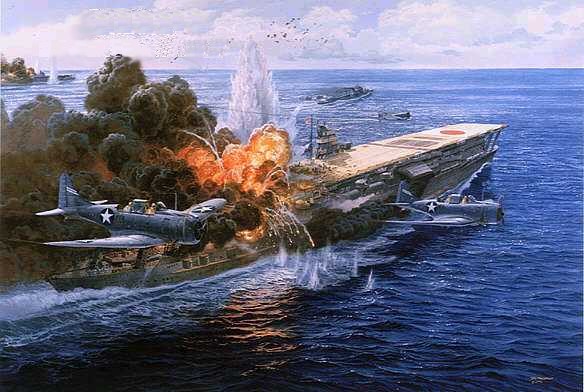
SBDstoastjapcarrier

Friends of Padre Steve’s World

As I mentioned that I would be writing about a number of watershed events this week. Today is the 74th anniversary of the beginning of the Battle of Midway. As a Navy officer and having grown up in a Navy family, this battle is still something that I find fascinating. It was a battle that could have easily been lost, and with it the war in the Pacific significantly lengthened, and which had the Japanese won, forced a change in strategy that might have allowed Hitler to strengthen his grip on Europe and maybe even defeat the Soviet Union.

It was a watershed event because it was the first real defeat that the Japanese Imperial Navy sustained in the war, and it ensured that the Japanese would not be able to win the war, except by exhausting the United States.

So it still remains important even today. If you are interested in books about Midway I recommend Walter Lord’s classic “Incredible Victory” and Gordon Prange’s “Miracle at Midway.

Peace

Padre Steve+

Prelude to Battle

The Imperial Japanese Navy under the command of Admiral Isoruku Yamamoto had been humiliated. On April 18th 1942 16 B-25 bombers under the command of Colonel Jimmy Doolittle were launched from the deck of the USS Hornet and bombed Tokyo.  Though the physical damage was insignificant the psychological impact was massive on the Japanese military establishment. In response to the threat, Yamamoto was directed to bring the aircraft carriers of the U.S. Navy to battle and to destroy them.

Prior to the Doolittle Raid, Yamamoto and his deputy Rear Admiral Matome Ugaki had explored the possibility of attacking Midway. However, the Japanese armed forces were competing with each other to determine an overall strategy for the war effort. The Army was insistent on a China strategy while the Navy preferred expansion in the Western, South and Central Pacific.  Yamamoto’s idea envisioned seizing Midway and using it as a forward base from which an invasion of Hawaii could be mounted as well as the bait to draw the carrier task forces of the U.S. Navy into battle and destroy them. Until the Doolittle Raid shocked the Japanese leadership he was unable to do this.

“I Shall Run Wild for the First Six Months”

yamamoto-isoroku1

Admiral Isoruku Yamamoto

Yamamoto was one of the few Japanese military or political leaders who opposed war with the United States. He had lived in the United States, gotten to know Americans and recognized the how the massive economic and industrial power of the United States would lead to the defeat of Japan. He told Premier Konoye in 1941 “I shall run wild for the first six months or a year, but I have utterly no confidence for the second or third years of the fighting.”

It is hard to imagine now, but in June of 1942 it seemed a good possibility that the Americans and British could be on the losing side of the Second World War.

True to Yamamoto’s words in 1942 the Japanese onslaught in the Pacific appeared nearly unstoppable. The Imperial Navy stormed across the Pacific and Indian Oceans in the months after Pearl Harbor decimating Allied Naval forces that stood in their way.  The British Battleships HMS Prince of Wales and HMS Repulse were sunk by land based aircraft off of Singapore. A force of Royal Navy cruisers and the Aircraft Carrier HMS Hermes were sunk by the same carriers that struck Pearl Harbor in the Indian Ocean.  Darwin Australia was struck with a devastating blow on February 19th and on February 27th the Japanese annihilated the bulk of the American, British, Dutch and Australian naval forces opposing them at the Battle of the Java Sea. American forces in the Philippines surrendered on May 8th 1942 while the British in Singapore surrendered on February 15th.

In only one place had a Japanese Naval task force been prevented from its goal and that was at the Battle of the Coral Sea.  Between 4-8 May the US Navy’s Task Force 11 and Task Force 17 centered on the Carriers USS Lexington and USS Yorktown prevented a Japanese invasion force from taking Port Moresby. Their aircraft sank the light carrier Shoho, damaged the modern carrier Shokaku and decimated the air groups of the Japanese task force. But it was the unexpected raid by US Army Air Corps B-25 Bombers launched from the USS Hornet under command of Colonel Jimmy Doolittle on April 18th 1942 which embarrassed Yamamoto so badly that he ordered the attack to take Midway and destroy the remaining US Naval power in the Pacific.

Cracking the Code
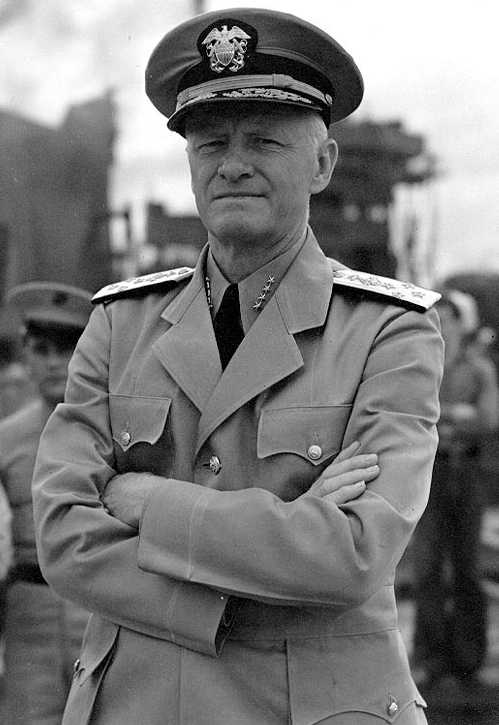
Chester-W.-Nimitz-militarymuseum.org_

Admiral Chester Nimitz

United States Navy codebreakers had broken the Japanese diplomatic and naval codes in 1941, and in May the Navy code breakers at Pearl Harbor discovered Yamamoto’s plan to have the Imperial Navy attack Midway Island and the Aleutian Islands.  Knowing the Japanese were coming, and that the occupation of Midway by Japanese forces would give them an operational base less than 1000 miles from Pearl Harbor, Admiral Chester Nimitz, commander of the U.S. Pacific Fleet committed the bulk of his naval power, the carriers USS Enterprise CV-6, USS Yorktown CV-5 and USS Hornet CV-8 and their 8 escorting cruisers and 15 destroyers to defend Midway.  This force of 26 ships with 233 aircraft embarked to defend Midway while a force of smaller force 5 cruisers and 4 destroyers was dispatched to cover the Aleutians.  The forces on the ground at Midway had a mixed Marine, Navy and Army air group of 115 aircraft which included many obsolete aircraft, 32 PBY Catalina Flying Boats and 83 fighters, dive bombers, torpedo planes and Army Air Force bombers piloted by a host of inexperienced but resolute airmen with which to defend itself. It also had a ground force of U.S. Marines, should the Japanese actually land on the island.

With the foreknowledge provided by the code breakers the US forces hurried to an intercept position northeast of Midway. They eluded the Japanese submarine scout line which the Japanese Commander Admiral Yamamoto presumed would find them when they sailed to respond to the Japanese attack on Midway.  Task Force 16 with the Enterprise and Hornet sailed first under the command of Rear Admiral Raymond A Spruance in place of the ailing William “Bull” Halsey. Task Force 17 under Rear Admiral Frank “Jack” Fletcher was built around the Yorktown which had been miraculously brought into fighting condition after suffering heavy damage at Coral Sea. Fletcher assumed overall command by virtue of seniority and Admiral Nimitz instructed his commanders to apply the principle of “calculated risk” when engaging the Japanese as the loss of the US carriers would place the entire Pacific at the mercy of the Japanese Navy.

On June 3rd a PBY Catalina from Midway discovered the Japanese invasion force transport group.  US long-range B-17 bombers launched attacks against these ships but inflicted no damage.

“Our hearts burn with the conviction of sure victory.”
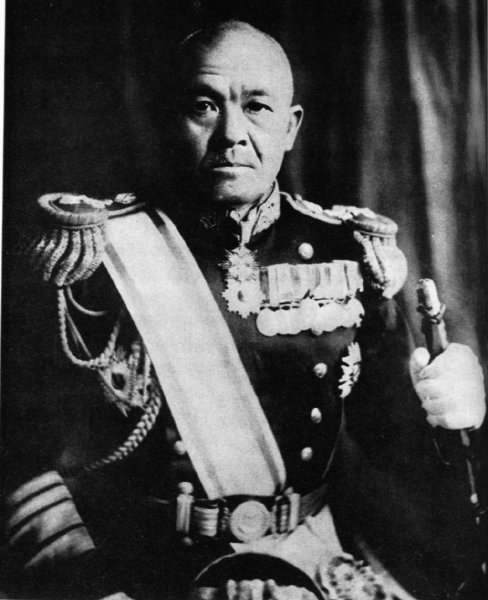
On the night of June 3rd 1942 Nagumo’s First Carrier Strike Force sailed east toward the tiny Midway Atoll. Nagumo had seen many of the risks involved in the plan and considered it an “impossible and pointless operation” before the Doolittle Raid on Tokyo, but even the reluctant Nagumo fell in line as Yamamoto relentlessly lobbied for the operation.

As the First Carrier strike force closed within 300 miles of Midway on the night of June 3rd 1942 Nagumo and his staff prepared for the battle that they and many others believed would be the decisive battle. Aircraft received their final preparations, bombs were loaded and as night faded into early morning air crew arose, ate their breakfast and went to their aircraft. The ships had been observing radio silence since they departed their bases and anchorages in Japan the previous week. Honed to a fine edge the crews of the ships and the veteran aircrews anticipated victory.

The crews of the ships of the task force and the air groups embarked on the great aircraft carriers Akagi, Kaga, Soryu and Hiryu as well as their escorts were confident. They had since the war began known nothing but victory. They had devastated the Pacific Fleet at Pearl Harbor and roamed far and wide raiding allied targets and sinking allied shipping across the Pacific and deep into the Indian Ocean. Commander Magotaro Koga of the destroyer Nowaki wrote in his diary “Our hearts burn with the conviction of sure victory.

PERSON JAP Nagumo1

Vice Admiral Chuichi Nagumo

However, Nagumo and his sailors had no idea that most of what they knew about their American opponents was wrong. Nagumo and Yamamoto were confident that the Americans could field no more than two operational carriers to defend Midway. They had no idea that the Yorktown, which they believed had been sunk at Coral Sea was operational and her air group reinforced by the aircraft of the damaged Saratoga which was being repaired on the West Coast. Unknown to the Japanese the Yorktown and her escorts had joined Enterprise and Hornet northeast of Midway.

The Japanese were going into battle blind. They had planned to get aerial surveillance of US Fleet dispositions at Pearl Harbor, but that had been cancelled because the atoll at French Frigate Shoals that the Japanese flying boats would operate from had been occupied by a small US force. Likewise a line of Japanese submarines arrived on station a day too late, after the US carrier task forces had passed by them. Those aboard the First Carrier Strike Force, including Nagumo or his senior commanders and staff had no idea that the Americans not only knew of their approach but were already deployed in anticipation of their strike.

Within a day all of the Japanese carriers would be sunk or sinking. Thousands of Japanese sailors would be dead and the vaunted air groups which had wreaked havoc on the Allies would be decimated, every aircraft lost and the majority of pilots and aircrew dead. It would be a most unexpected and devastating defeat stolen out of the hands of what appeared to be certain victory.

There is a lesson to be learned from the Japanese who sailed into the night on June 3rd 1942 and saw the sunrise of June 4th. There is no battle, campaign or war that goes according to plan. Thousands of Japanese sailors and airmen went to bed on the night of the 3rd expecting that the following night, or within the next few days they would be celebrating a decisive victory. Thousands of those sailors would be dead by the night of the 4th of June 1942, and as their ships slid beneath the waves, the ambitions of Imperial of Japan to defeat the United States Navy and end the war were dealt a decisive defeat from which they never recovered.

Hawks at Angles Twelve
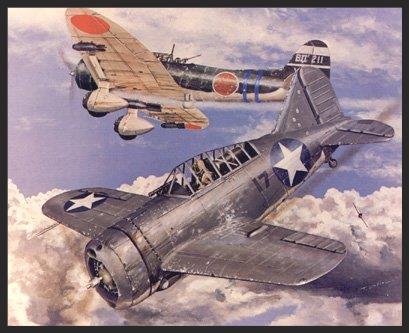
F2A-3+Buffalo

One of the more overlooked aspects of the Battle of Midway is the sacrifice of Marine Fighter Squadron 221 on the morning of June 4th 1942.   The Marine aviators flying a mix of 21 obsolescent Brewster F2A-3 Buffalos and 7 Grumman F4F-3 Wildcats engaged a vastly superior force of Japanese Navy aircraft as they vectored toward the atoll to begin softening it up for the planned invasion.

Led by Major Floyd Parks the squadron had arrived at Midway on Christmas day 1941 being delivered by the USS Saratoga after the aborted attempt to relieve Wake Island.  The squadron along with Marine Scout Bombing Squadron 241 (VMSB 241) formed Marine Air Group 22.  They fighter pilots of VMF-221 scored their first victory shooting down a Japanese Kawanishi H8K2 “Emily” flying boat. The squadron which initially was composed of just 14 aircraft, all F2A-3’s was augmented by 7 more F2A-3s and 7 of the more advanced F4F-3s before the battle.

When the Japanese First Carrier Striking Group was spotted in the wee hours of June 4th the Marines and other aircrew aboard Midway scrambled to meet them.  The 18 SBD-2 Dauntless’ and 12 Vought SB2-U3 Vindicator dive bombers of VMSB-241, the 6 TBF Avengers of the Navy Torpedo Eight detachment, 4 Army Air Corps B-26 Marauders and 15 B-17 Flying Fortresses flew out to attack the Japanese carriers while the fighters rose to intercept the 108 aircraft heading toward Midway. The 72 strike aircraft, 36 Aichi 99 Val Dive Bombers and 36 Nakajima B5N Torpedo/ High Level Bombers were protected by 36 AM6-2 Zeros which thoroughly outclassed the Marine opponents in speed, maneuverability and in the combat experience of their pilots.

The Marine fighters audaciously attacked the far superior Japanese force, throwing themselves against the Japanese phalanx with unmatched courage.  Despite their courage the Marine fighters were decimated by the Japanese Zeros.  The Marines shot down 4 Val dive bombers and at least three Zeros but lost 13 Buffalos and 3 Wildcats during the battle.  Of the surviving aircraft only three Buffalos and three Wildcats were in commission at the end of the day. Among the casualties killed was Major Parks.  Of the surviving pilots of VMF-221, two became “Aces” during the war. Lieutenant Charles M. Kunz would later fly in VMF-224, adding six victories to end the war with 8 victories. Capt. Marion E. Carl would later fly in VMF-223 raising his score to 18.5 Japanese aircraft shot down.  Other pilots like 2nd Lieutenant Clayton M. Canfield shot down two additional aircraft while flying with VMF-223. 2nd Lieutenant Walter W. Swansberger won the Medal of Honor at Guadalcanal.

The last remaining Marine fighter pilot of VMF-221 from the battle of Midway, Williams Brooks died in January 2010 and was buried with full military honors, in Bellview, Nebraska. Brooks in his after action report described his part in the battle:

I was pilot of F2A-3, Bureau number 01523, Our division under Capt. Armistead was on standby duty at he end of the runway on the morning of June 4, 1942, from 0415 until 0615. At about 0600, the alarm sounded and we took off. My division climbed rapidly, and I was having a hard time keeping up. I discovered afterwards that although my wheels indicator and hydraulic pressure indicator both registered “wheels up”, they were in reality about 1/3 of the way down. We sighted the enemy at about 14,000 feet, I would say that there were 40 to 50 planes. At this time Lt. Sandoval was also dropping back. My radio was at this time putting out no volume, so I could not get the message from Zed. At 17,000 feet, Capt. Armistead led the attack followed closely by Capt. Humberd. They went down the left of the Vee , leaving two planes burning. Lt. Sandoval went down the right side of the formation and I followed. One of us got a plane from the right side of the Vee. At this time, I had completely lost sight of my division. As I started to pull up for another run on the bombers, I was attacked by two fighters. Because my wheels being jammed 1/3 way down, I could not out dive these planes, but managed to dodge them and fire a burst or so into them as they went past me and as I headed for the water. As I circled the island, the anti-aircraft fire drove them away. My tabs, instruments and cockpit were shot up to quite an extent at this time and I was intending to come in for a landing. 

It was at this time that I noticed that a important feature in their fighting. I saw two planes dog-fighting over in the east, and decided to go help my friend if at all possible. My plane was working very poorly, and my climb was slow. As I neared the fight both planes turned on me. It was then that I realized I had been tricked in a sham battle put on by two Japs and I failed to recognize this because of the sun in my eyes. Then I say I was out-numbered, I turned and made a fast retreat for the island, collecting a goodly number of bullets on the way. After one of these planes had been shaken, I managed to get a good burst into another as we passed head-on when I turned into him. I don’t believe this ship could have gotten back to his carrier, because he immediately turned away and started north and down. I again decided to land, but as I circled the island I saw two Japs on a Brewster. Three of my guns were jammed, but I cut across the island, firing as I went with one gun. But I could not get there in time to help the American flier and as soon as the Brewster had gone into the water I came in for a landing at approximately 0715 (estimated). 

As for VMF-221 it was re-equipped with the F4F-4 and later with the F4U Corsair during the course of two more deployments overseas.  VMF-221 finished the war with a score of 155 victories, 21 damaged and 16 probable kills, the second highest total of any Marine Corps Squadron during the war.

Their bomber counterparts of VMSB 241 attacked the Japanese task force on the morning of June 4th and scored no hits while losing 8 aircraft. The survivors were again in action later in the day as well as the following day where they helped sink the Japanese Heavy Cruiser Mikuma with their squadron leader Major Henderson diving his mortally wounded aircraft into the cruiser’s number 4 8” gun turret. While the Marines’ actions are not as well known or as successful as those of their Navy counterparts they were brave.  Fighter pilots had to engage some of the most experienced pilots flying superior machines while the bomber crews had little to no experience before being thrown into combat.
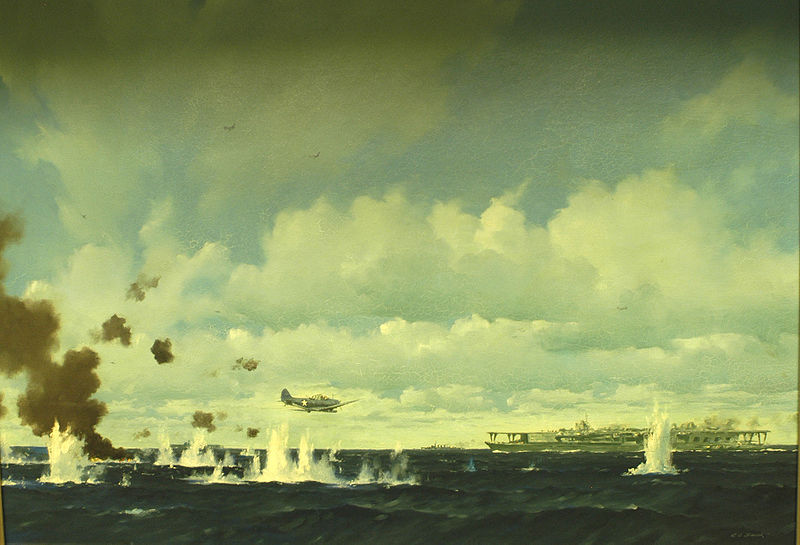
800px-tbd_attacking_at_midway_painting-1

Into the Valley of Death: The Last Ride of the Torpedo Bombers

Alfred, Lord Tennyson wrote in the Charge of the Light Brigade something that echoes to this day when we talk or write about men who charge the gates of death against superior enemies.

Half a league half a league,

Half a league onward,

All in the valley of Death

Rode the six hundred:

‘Forward, the Light Brigade!

Charge for the guns’ he said:

Into the valley of Death

Rode the six hundred.

They were not six hundred and they were not mounted on horses, but the Naval Aviators of Torpedo Squadrons 3, 6 and 8 and their aerial steeds 42 Douglas TBD Devastators and 6 TBF Avengers wrote a chapter of courage and sacrifice seldom equaled in the history of Naval Aviation. Commanded by veteran Naval Aviators, LCDR Lance “Lem” Massey, LCDR Eugene Lindsey and LCDR John Waldron the squadrons embarked aboard the carriers flew the obsolete TBD Devastators. The young pilots of the Midway based Torpedo 8 detachment under the command of LT Langdon Fieberling flew in the new TBF Avengers.

he TBD which first flew in 1935 entered service in 1937 and was possibly the most modern naval aircraft in the world when it entered service.  It was a revolutionary aircraft. It was the first monoplane widely used on carriers and was first all-metal naval aircraft.  It was the first naval aircraft with a totally enclosed cockpit, the first with hydraulic powered folding wings.  The TBD had crew of three and had a maximum speed of 206 miles an hour and carried a torpedo or up to 1500 pounds of bombs (3 x 500) or a 1000 pound bomb.  129 were built and served in all pre-war torpedo bombing squadrons based aboard the Lexington, Saratoga, Ranger, Yorktown, Enterprise and Hornet with a limited number embarked aboard Wasp. 

The Devastator saw extensive service prior to the war which pushed many airframes to the end of their useful service life and by 1940 only about 100 were operational by the beginning of the war.  They were still in service in 1942 as their replacement the TBF Avenger was not available for service in large enough numbers to replace them before Midway.  The TBDs performed adequately against minor opposition at Coral Sea and in strikes against the Marshalls but the squadrons embarked on Yorktown (VT3), Enterprise (VT-6) and Hornet (VT-8) were annihilated at Midway with only 6 of 41 aircraft surviving their uncoordinated attacks against the Japanese Carrier Strike Force.  They were too slow, had poor maneuverability, insufficient armor and defensive armament.

The Torpedo squadrons attacked independently of each other between 0920 and 1030 on June 4th 1942. The Japanese Combat Air Patrol ripped into the slow, cumbersome and under armed TBD Devastators as they came in low to launch their torpedoes.  Torpedo Eight from Hornet under the command of LCDR John C Waldron pressed the attack hard but all 15 of the Devastators were shot down.  Only Ensign George Gay’s aircraft was able to launch its torpedo before being shot down and Gay would be the sole survivor of the squadron to be picked up later by a PBY Catalina patrol plane.

Torpedo Six from the Enterprise under the command of LCDR Eugene Lindsey suffered heavy casualties losing 10 of 14 aircraft with Lindsey being one of the casualties.  The last group of Devastators to attack was Torpedo Three from the Yorktown under the command of LCDR Lem Massey losing 11 of 13 aircraft with Massey a casualty last being seen standing on the wing of his burning aircraft as it went down.  These aircraft were also decimated and Massey killed but they had drawn the Japanese Combat Air Patrol down to the deck leaving the task force exposed to the Dive Bombers of the Enterprise and Yorktown.  The six aircraft of the Torpedo Eight detachment from Midway under the command of LT Fieberling lost 5 of their 6 aircraft while pressing their attacks.  Only Ensign Bert Earnest and his aircraft survived the battle landing in a badly damaged state on Midway.  Four U.S. Army B-26 Marauder Medium Bombers were pressed into service as torpedo bombers of which 2 were lost.  No torpedo bomber scored a hit on the Japanese Task force even those torpedoes launched at close range failed to score and it is believe that this was in large part due to the poor performance of the Mark 13 aircraft torpedoes.

Despite the enormous losses of the torpedo squadrons their sacrifice was not in vain. Their attacks served to confuse the Japanese command and delay the rearmament of aircraft following the Japanese strikes on Midway. They also took the Japanese Combat Air Patrol down to sea level and opened the way for American Dive Bombers to strike the Japanese with impunity fatally damaging the Akagi, Kaga and Soryu in the space of 5 minutes.
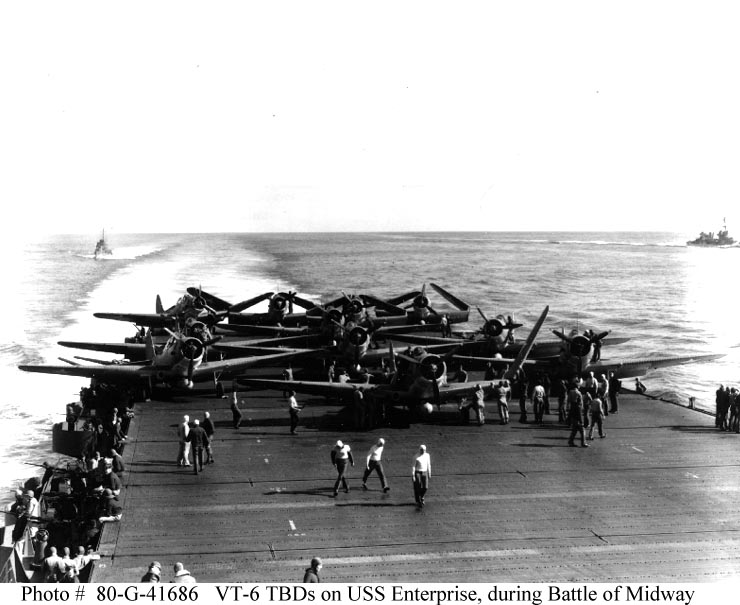
eneterprise vt-6 midway

After Midway the remaining TBDs were withdrawn from active service and no example survives today. The TBF became the most effective torpedo bomber of the war and some remained in service in a civilian capacity to fight forest fires until 2012.

img_0064

The Provence of Chance: Five Minutes that Changed the War

The land based aircraft from Midway attacked the Japanese carrier force taking heavy casualties and failed to damage the Japanese task force. When the results of the first strike of the Japanese bombers that hit Midway was analyzed Nagumo readied his second wave.

As this was happening the American carriers launched their strike groups at the Japanese fleet leaving enough aircraft behind as for Combat Air Patrol and Anti-submarine patrol missions.  As the Americans winged toward the Japanese fleet the Japanese were in a state of confusion. The confusion was caused when a scout plane from the Heavy Cruiser Tone that had been delayed at launch discovered US ships but did not identify a carrier among them until later into the patrol. The carrier was the Yorktown and TF 17, but for Nagumo who first expected no American naval forces, then received a report of surface ships without a carrier followed by the report of a carrier the reports were unsettling.

Aboard the Japanese ships, orders and counter-orders were issued as the Japanese attempted to recover their strike aircraft and prepare for a second strike on the island, but when the Yorktown task force was discovered, orders were changed and air crews unloaded ground attack ordnance in favor of aerial torpedoes and armor piercing bombs. In their haste to get their aircraft ready to strike the Americans, the hard working Japanese aircrews did not have time to stow the ordnance removed from the aircraft. But due to their hard work at 1020 they had the Japanese strike group ready to launch against the US carriers. Aircraft and their crews awaited the order to launch, their aircraft fully armed and fully fueled.

There had been confusion among the Americans as to the exact location of the Japanese Carriers. Bombing 8 and Scouting 8 from Hornet made a wrong turn and not find the Japanese carriers. The squadrons had to return due to a lack of fuel and a number of bombers and their fighter escort had to ditch in the ocean and wait for rescue. The Enterprise group composed of Bombing-6 and Scouting 6 under CDR Wade McClusky was perilously low on fuel when they spotted the wake of a Japanese destroyer steaming at high speed to catch up with the Japanese carriers.  Taking a chance, McClusky followed it straight to the Japanese Task Force arriving about 1020. The Yorktown’s group under LCDR Max Leslie arrived about the same time.

When the American dive bombers arrived over the Japanese Carrier Strike Force they found the skies empty of Japanese aircraft. Below, aboard the Japanese ships there was a sense of exhilaration as each succeeding group of attackers was brought down and with their own aircraft ready to launch and deal a fatal blow to the American carrier wondered how big their victory would be. The war would soon be decided.

At 1020 the first Zero of the Japanese attack group began rolling down the flight deck of the flagship Akagi, aboard Kaga aircraft were warming up as they were on the Soryu.  The unsuspecting Japanese were finally alerted to the threat of the American dive bombers when lookouts screamed “helldivers.” The Japanese fighters assigned to the combat air patrol were flying too low as the mopped up the last of the doomed torpedo bombers and were not in a position to intercept the Americans.

Wade McClusky’s aircraft lined up over the Akagi and Kaga pushing into their dives at 1022. There was a bit of confusion when the bulk of Scouting 6 joined the attack of Bombing 6 on the Kaga. That unprepared ship was struck by four 1000 pound bombs which exploded on her flight deck and hangar deck igniting the fully fueled and armed aircraft of her strike group and the ordnance littered about the hangar deck.  Massive fires and explosions wracked the ship and in minutes the proud ship was reduced to an infernal hell with fires burning uncontrollably. She was abandoned and would sink at 1925 taking 800 of her crew with her.

LT Dick Best of Scouting 6 peeled off from the attack on Kaga and shifted to the Japanese flagship Akagi. On board Akagi were two of Japan’s legendary pilots CDR Mitsuo Fuchida leader of and CDR Minoru Genda the architect of the Pearl Harbor attack and subsequent string of Japanese victories. Both officers were on the sick list and had come up from sick bay to watch as the fleet was attacked. Seeing Kaga burst into flames they stood mesmerized until Akagi’s lookouts screamed out the warning “helldivers” at 1026.

Best’s few aircraft hit with deadly precision landing two of their bombs on Akagi’s flight deck creating havoc among the loaded aircraft and starting fires and igniting secondary explosions which turned the ship into a witch’s cauldron.  By 1046 Admiral Nagumo and his staff were forced to transfer the flag to the cruiser Nagara as Akagi’s crew tried to bring the flames under control. They would do so into the night until nothing more could be done and abandoned ship at 2000.  Admiral Yamamoto ordered her scuttled and at 0500 on June 5th the pride of the Japanese carrier force was scuttled.

VB-3 under LCDR Max Leslie from the Yorktown stuck the Soryu with 17 aircraft, however only 13 of the aircraft had bombs due to an electronic arming device malfunction on 4 of the aircraft, including that of Commander Leslie.  Despite this Leslie led the squadron as it dove on the Soryu at 1025 hitting that ship with 3 and maybe as many as 5 bombs. Soryu like her companions burst into flames as the ready aircraft and ordnance exploded about her deck. She was ordered abandoned at 1055 and would sink at 1915 taking 718 of her crew with her. A few hours later Hiryu, which had succeeded in launching strikes that seriously damaged Yorktown met the fate of her sisters. Yorktown would be sunk by a Japanese submarine, along with the destroyer Hamman a few days later as her crew attempted to get her to Pearl Harbor. In five pivotal minutes the course of the war in the Pacific was changed.

A Final Ignominy
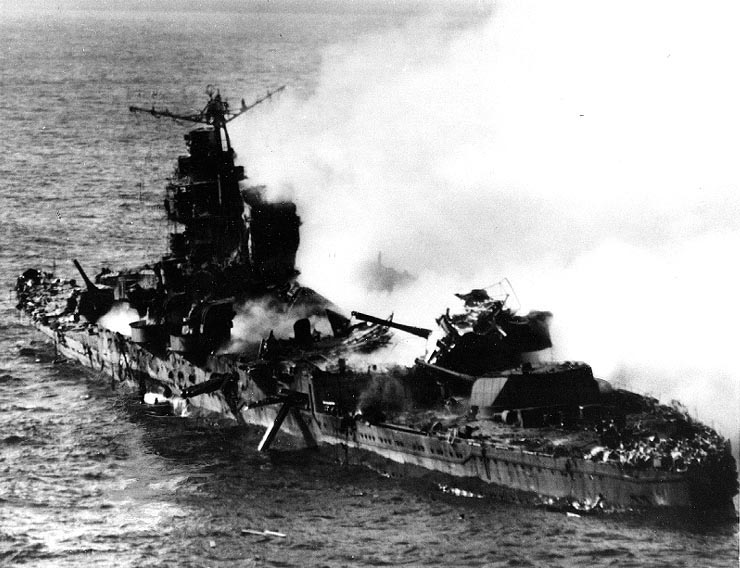
Sinking_of_japanese_cruiser_Mikuma_6_june_1942

Admiral Yamamoto was still attempting to digest the calamity that had befallen Admiral Nagumo’s carrier task force. In the shocked atmosphere of the mighty Super Battleship Yamato’s command center the Staff of the Combined Fleet was hastily attempting to arrive at a solution which might reverse the disaster and bring victory.  Admiral Ugaki, Yamamoto’s Chief of Staff, despite strong personal doubts, ordered Vice Admiral Nobutake Kondo to prepare for a night surface engagement with the US Fleet and dispatched a strong surface force to bombard Midway in order to prevent the Americans from reinforcing it and to prevent its further use against his forces should the invasion move forward.  Kondo then organized his fleet to attempt to find the American carriers and bring them to battle before dawn.

Kondo detached Vice Admiral Takeo Kurita’s Close Support Group composed of Cruiser Seven, the fastest and most modern cruisers in the Imperial Navy proceed at full speed to attack Midway.  Kurita’s cruisers, the Kumano, Suzuya, Mikuma and Mogami were each armed with 10 8” guns and were escorted by the two destroyers.

Kurita’s force was 80 miles from Midway when Yamamoto realizing that his plan was unrealistic ordered Kondo’s forces to retreat and rendezvous with his main force shortly after midnight. The order was met with a measure of relief by most officers in the force and the force turned northwest and steamed at 28 knots to meet the Main Body.  At 0215 lookouts on Kumano sighted a submarine on the surface which turned out to be the USS Tambor which had been shadowing the group, and made a signal for the force to make a emergency 45 degree turn to port.

During the process Mogami’s Navigator took over from the watch to oversee the tricky maneuver. In doing so he thought that there was too much distance between him and the ship ahead, the Mikuma. So he adjusted his course to starboard and then realized his mistake. The ship he thought was Mikuma was actually Suzuya and Mikuma was directly ahead. As soon as he recognized his mistake Mogami’s Navigator ordered a hard turn to port and reversed the engines but it was too late. Mogami’s bow crashed into Mikuma’s port quarter. The impact caused minimal damage to Mikuma but Mogami was heavily damaged. She lost 40 feet of her bow and everything else was bent back to port at right angles to her number one turret.

Mogami’s damage control teams isolated the damage and worked the ship up to 12 knots. This was not fast enough for Kurita to make his rendezvous so he left Mikuma and the destroyers to escort Mogami while he steamed ahead with Kumano and Suzuya.

Tambor’s skipper LCDR John W Murphy sent a contact report at 0300 reporting “many unidentified ships.” He followed this with more detailed information and the Americans on Midway began to launch its remaining serviceable aircraft to attack the threat. A flight of B-17 Bombers launched at 0430 could not find the Japanese ships but at 0630 a PBY Catalina found the Japanese and radioed Midway “two Japanese battleships streaming oil.”  The remaining 12 aircraft of VSMB-241 under command of Captain Marshall Tyler a mix of SBD Dauntless and SB2U Vindicators took off at 0700. His force attacked at 0808 scoring no hits. However, Marine Captain Richard Fleming, his Vindicator on fire dropped his bomb and then crashed his aircraft into Mikuma’s after turret. Sailors aboard Mogami were impressed, the American had sacrificed himself in a suicide attack worthy of the Samurai. The fire was sucked down air intakes into the starboard engine room with disastrous results. The Mikuma’s engineers were suffocated by the smoke and fumes and Mikuma was greatly reduced in speed.

The two ships limped northwest at 12 knots escorted by the destroyers and were unmolested through much of the day with the exception of an ineffective attack by the B-17s at 0830. The following morning the Dive Bombers of Enterprise and Hornet were at work and found the crippled Japanese ships. Waves over US Dive Bombers attacked the cruisers throughout the morning and into the afternoon. Mikuma was hit at least 5 times and secondary explosions of ammunition and torpedoes doomed the ship. Mogami was also heavily damaged but remained afloat while both destroyers received bomb damage.  At sunset the tough cruiser rolled over to port and sank into the Pacific. Mogami whose damage control teams had performed miracles to keep their ship afloat helped the destroyers rescue survivors from Mikuma.  Only 240 were rescued with 650 officers and sailors going down with the ship.

The action against the cruisers ended the combat operations at Midway. The Japanese ships were doomed by Yamamoto’s decision to try to salvage victory from defeat and the error of Mogami’s Navigator during the emergency turn when Kumano sighted Tambor. The only thing that kept the result from being total was the efficacy of Mogami’s damage control teams.  Mogami was out of the war for 10 months following repairs and conversion to an Aircraft Cruiser in which her aft turrets were removed to increase the number of float plane scouts that the ship could carry. She rejoined the fleet in April 1943 and was sunk following the Battle of the Surigao Strait on 25 October 1944.

The Mogami and Mikuma proved to be tough ships to sink. Unprotected by friendly aircraft they fought hard against the unopposed American Dive Bombers. They suffered massive damage from 500 and 1000 pound bombs, both direct hits and near misses. Mogami was saved by the skill of her damage control teams and the foresight of her Damage Control Officer to jettison her torpedoes so that they did not explode and compound the damage wrought by the American bombs.

Epilogue

At Midway a distinctly smaller force defeated a vastly superior fleet in terms of experience, training and equipment. At the very moment that it appeared to the Japanese that they would advance to victory their vision disappeared. In a span of less than 5 minutes what looked like the certain defeat of the US Navy became one of the most incredible and even miraculous victories in the history of Naval warfare. In those 5 minutes history was changed in a breathtaking way. While the war would drag on and the Japanese still inflict painful losses and defeats on the US Navy in the waters around Guadalcanal the tide had turned and the Japanese lost the initiative in the Pacific never to regain it.

The Japanese government hid the defeat from the Japanese people instead proclaiming a great victory. The American government could not fully publicize the victory for fear of revealing the intelligence that led to the ability of the US Navy to be at the right place at the right time and defeat the Imperial Navy.

The American victory at Midway changed the course of the war in the Pacific. The Battle of Midway established the aircraft carrier and the fast carrier task force as the dominant force in naval warfare which some would argue it still remains. Finally those five minutes ushered in an era of US Navy dominance of the high seas which at least as of yet has not ended as the successors to the Enterprise, Hornet and Yorktown ply the oceans of the world and the descendants of those valiant carrier air groups ensure air superiority over battlefields around the world today.


1 Comment

Filed under History, Military, Navy Ships, US Navy, World War II at Sea, world war two in the pacific

From Limited War to Total War: The American Civil War Pt.1

fort-sumter-higher-res

Friends of Padre Steve’s World,

As always I continue to revise my Gettysburg and Civil War text and it looks like I will have to split the text into at least tow volumes. I am posting about half of a majorly revised section dealing the the nature of the war, and how it changed from a limited war to a total war. The fact is that leaders in the South and the North, like so many other leaders in history and even today, failed to understand what the war that they helped unleash would bring about.

Have a great weekend,

Peace

Padre Steve+

The American Civil War was the first modern war. It was waged between two peoples who shared much in common but were divided by different ideologies which encompassed politics, economics, society, law, and even religion. But even so, at the beginning of the war few people on either side anticipated what the war would entail, the sacrifices involved, or the change that would be wrought by it. Winston Churchill’s words of caution to leaders that embark on war, would have been good advice to leaders in the South and the North in early 1861: “Never, never, never believe any war will be smooth and easy, or that anyone who embarks on the strange voyage can measure the tides and hurricanes he will encounter. The statesman who yields to war fever must realize that once the signal is given, he is no longer the master of policy but the slave of unforeseeable and uncontrollable events.”

Likewise the American Civil War was a watershed event in an era of incredibly rapid change. It was an era which introduced changes in weaponry. New types of weapons were developed, more lethal versions of older weapons were introduced. Likewise, tactics, army organization, logistics, intelligence and communications, as well as social, and economic structures across the country evolved as the war progressed.

Though the war did not change the essential nature of war, which Clausewitz says is “is an act of violence to compel our opponent to fulfill our will” [1] it expanded the parameters of war and changed the character of the war by re-introducing the concept of “total war” to the world. As such, “because its aim was all embracing, the war was to be absolute in character” [2] it was a true revolution in military affairs.

The Civil War was truly a revolution in military affairs, but at the beginning of the war many people, including military leaders failed to understand this. It was a war that began as one type of “war and evolved into something quite different.” The conflict began as a limited war in which both sides imagined that small armies would fight a relatively quick war which would end with either a restored Union, or an independent Confederacy. But by late 1862 it had become a total war, involving massive armies, as well as the destruction of vast areas of civilian lands and properties. The miscalculation of Southern leaders about the will of the Northern leaders and population to pursue a war, their precarious assumption that Great Britain and France would enter the war, followed by their inept diplomatic efforts to be recognized by those nations, their lack of resources or an industrial base to produce the weapons needed for war, coupled with their inability to anticipate what would be needed to win the war, and to defend their territory ensured their eventual defeat. In marked contrast to the South the Federal government headed by Abraham Lincoln “developed a national strategy to give purpose to a military strategy of total war, and preserved a political majority in support of this national strategy through the dark days of defeat, despair, and division.” [3]

At the beginning of the war President Lincoln attempted a strategy of conciliation in order to attempt to coax seceding states back into the Union and by conciliation to keep those considering seceding from doing so. However, Lincoln’s attempts were met with outright rejection, before, during, and after the secession crisis. He spoke directly to the Southern states in his First Inaugural Address, saying “We are not enemies, but friends,” [4] only to be accused of deliberately lying to the South by pledging to maintain control of Federal installations and forts in the South, like Fort Sumter which was now surrounded by massed batteries of Confederate artillery and demands that it surrender. Jefferson Davis wrote, “The Lincoln Administration deliberately lied to us, baiting us with false promises and pacific pledges all the while it was planning for war. Never in history has a government behaved with such malicious deceit and bad faith.” [5]

When the troops of South Carolina opened fire on Fort Sumter the die was cast, and Lincoln chose the path of war in order to restore the Union, “not because he wanted to, but because the South forced his hand.” [6] His proclamation calling for troops to suppress the rebellion described the kind of war that he foresaw, “the utmost care will be observed… to avoid any devastation, any destruction of, or interference with, property, or any disturbance of peaceful citizens in any part of the country.” [7]

Though he pursued the option of war to restore the Union, Lincoln initially he adopted a soft-war strategy in which Confederate armies were the target. This was in large part due to the efforts of Secretary of State Henry Seward and General-in-Chief Winfield Scott. Though he adopted a strategy that required the North to conquest the South, initially he did so with the expectation that after battlefield defeats the Confederates would eventually return to the Union. Some early victories, particularly those of Grant in the west at Forts Henry and Donaldson seemed to confirm the validity of such an approach.

However, Grant, after being roughly handled in the near disaster at Shiloh, gave up on the idea of limited war. He now believed that it was necessary to seize or destroy any property or resources that could be used to sustain the Confederate war effort. Before the Confederate counteroffensive at Shiloh Grant had said that he had been careful to “protect the property of the citizens whose territory was invaded;” and afterwards his policy became to “consume everything that could be used to support or supply armies.” [8]

Henry Wager Halleck, who had long been a proponent of Jominian limited war, backed up Grant in August 1862 ordering Grant to “Take up all active [rebel] sympathizers… and hold them as prisoners or put them beyond our lines. Handle that class without gloves, and take their property for public use…. It is time that they should begin to feel the presence of the war.” [9]

As the war went on it became apparent to many people in the North, and in the armies on the front lines that harder measures were required, especially with the escalation of guerilla attacks behind Union lines, as well as the involvement of Southern civilians in attacking Union troops in occupied areas of the South. “Senator John Sherman wrote his brother William of a growing sentiment “that we must treat these Rebels as bitter enemies to be subdued – conquered – by confiscation – by the employment of their slaves – by terror – energy – audacity – rather than by conciliation.” [10]

Some Union military commanders other than Grant became early exponents of a hard war, among them was Major General John Pope, who as commander of the Army of Virginia issued a “series of orders authorizing his officers to seize Confederate property without compensation, to execute captive guerillas who had fired on Union troops, and to expel from occupied territory any civilians who had sheltered guerillas or who had refused to take an oath of allegiance to the United States.” [11]

Henry Halleck as well wrote to Grant in April 1863 that “the character of the war has changed very much…. There is now no possible hope of reconciliation with the rebels. The Union party in the South is virtually destroyed. There can be no peace but that which is forced upon it.” In May he wrote another general in Memphis, “We must live upon the enemy’s country as much as possible, and destroy his supplies. This is cruel warfare, but the enemy has brought it on himself by his own conduct.” [12]

As late as 1862 there were some in the North, especially in the Democratic Party fought against any move toward a harder war strategy. One of these was Major General George McClellan who in a brazen attempt to be named General-in-Chief after his failed Peninsular campaign attempted to school President Lincoln in the ways of politics and strategy.

“The time has come when the Government must determine upon a civil and military policy, covering the whole ground of our national trouble…. This rebellion has assumed the character of a war: as such it must be regarded; and should be conducted upon the highest principles known to Christian Civilization. It should not be a War looking to the subjugation of the people of any state, in any event. It should not be, at all, a War upon the population; but against armed forces and political organizations. Neither a confiscation of property, political executions of person, territorial organization of states or forcible abolition of slavery should be contemplated for a moment.” [13]

Lincoln read McClellan’s letter in his presence and refused to comment upon it. Instead he infuriated McClellan by naming Henry Halleck as General-in-Chief, calling for more troops, and deciding on a strategy in which emancipation would play a key role. Since the leaders of the Confederacy to its dying day refused to countenance emancipation, these decisions would change the character of the war from a limited war to bring about political reunion to a war that would drastically change American politics, economics, and society.

Notes

[1] Clausewitz, Carl von. On War Indexed edition, edited and translated by Michael Howard and Peter Paret, Princeton University Press, Princeton NJ 1976 p.75

[2] Fuller, J.F.C. The Conduct of War 1789-1961 Da Capo Press, New York 1992. Originally published by Rutgers University Press, New Brunswick N.J p.99

[3] McPherson, James M. Abraham Lincoln and the Second American Revolution Oxford University Press, Oxford and New York 1991 p.74

[4] Weigley, Russell F. The American Way of War: A History of United States Military History and Policy University of Indiana Press, Bloomington IN, 1973 p.133

[5] Davis, Jefferson in Oates, Stephen B. The Approaching Fury: Voices of the Storm 1820-1861 University of Nebraska Press. Lincoln and London, 1997 p.413

[6] Stoker, Donald The Grand Design: Strategy and the U.S. Civil War Oxford University Press, Oxford and New York 2010 p.18

[7] Ibid. Weigley The American Way of War: A History of United States Military History and Policy p.133

[8] McPherson, James M. Drawn With the Sword: Reflections on the American Civil War Oxford University Press, Oxford and New York 1996 p.76

[9] Ibid. McPherson  Drawn With the Sword: Reflections on the American Civil War p.79

[10] McPherson, James M. Tried by War: Abraham Lincoln as Commander in Chief Penguin Books, New York and London 2008 p.103

[11] Ibid. McPherson Drawn With the Sword: Reflections on the American Civil War p.79

[12] Ambrose, Stephen E. Halleck: Lincoln’s Chief of Staff Louisiana State University Press, Baton Rouge and London 1960 and 1992  p.119

[13] McClellan, George B. Letter to Abraham Lincoln July 7, 1862 in Perman, Michael and Murrell Taylor, Amy editors The Civil War and Reconstruction Documents and Essays Third Edition Wadsworth Cengage Learning Boston MA 2011 p.140

Leave a comment

Filed under civil war, History, Military

Watershed Days


D-Day, June 6th 1944

Friends of Padre Steve’s World,

Today I am posting just a relatively small thought. For those that do not know, the next few days are full of amazing historical events.

On June 3rd 1940, the British finished the evacuation of the British Expeditionary Force and some French forces from Europe, though defeated, the British action preserved the British Army and kept Britain in the war. 


Midway 

 From June 4th through June 6th 1942 a small American fleet defeated a much larger, more experienced and better equipped fleet at the Battle of Midway. The battle did not end the war, but it ensured that Japan never could win the war against the United States in the Pacific. It was a turning point. It has rightly been called an “Incedible Victory” as all the elements that make war what it is, the element of chance, the element of friction, and the  element of surprise all broke the American way. The Japanese leaders, and for that matter many if not the vast majority of their soldiers and sailors were full of hubris, believing themselves invincible they were decisively defeated. 

Two Years later on June 6th 1944, Allied forces landed on the Normandy Peninsula of France to begin their long awaited attack on Nazi occupied Europe. The invasion, code named Operation Overlord did not end the war, but coupled with the Soveit offensive against the German Army Group Center which began just two weeks later, Operation Bagration, it was the beginning of the end for Hitler’s Germany. 

Twenty-six years earlier, two-regiments of U.S. Marines turned back the Germans at the Battle of Belleau Wood near Chateau-Thierry France. The effort blocked a German drive on Paris, giving the Allies the time to begin a counter-offensive that would end the war. 


Senator Robert F. Kennedy lays Mortally Wounded after being shot by Sirhan Sirhan 

But in addition to the battles other important events shook the world, in 1919 the Congress passed the 19th Amendment, which when ratified gave women the right to vote. In 1968, Senator Robert F. Kennedy was gunned down by the assassin Sirhan Sirhan in Los Angeles after winning the Democratic Party primary. He would have been the odds on favorite to defeat Republican Richard Nixon in the general election. On June 8th 1789 James Madison introduced twelve amendments to the U. S. Constitution, of which ten were ratified by the states to become known as the Bill of Rights. On June 8th 1967, the USS Liberty, a surveillance ship, was attacked by Israeli ships and aircraft during the Six Day War, the attack resulted in the death of 34 American sailors and the wounding of 171 more. 

Of course there are numerous other events that took place, some which were very important, and others which are Interesting but less important in world history, though they were important in certain countries or regions. I’ll be tacking some of these events in the coming days. 

Have a great day,

Peace

Padre Steve+

Leave a comment

Filed under History, world war one, world war two in europe, world war two in the pacific

Reading, Reflecting and Verdun


Friends of Padre Steve’s World,

It is now Wednesday following the long Memorial Day holiday weekend. As I mentioned I did not do much writing the past few days, instead I spend the time with Judy, our two Papillons, and friends. Likewise I did a lot of reading and reflection and took the time to watch the classic film A Bridge Too Far and the first four episodes of the HBO series  Band of Brothers.

But anyway…

It was good to take some time that was not directly related to the research and writing of my Civil War and Gettysburg text, even though some of my reading prompted me to do some more research and writing on that text which should prove beneficial to the end product, but as always I digress…


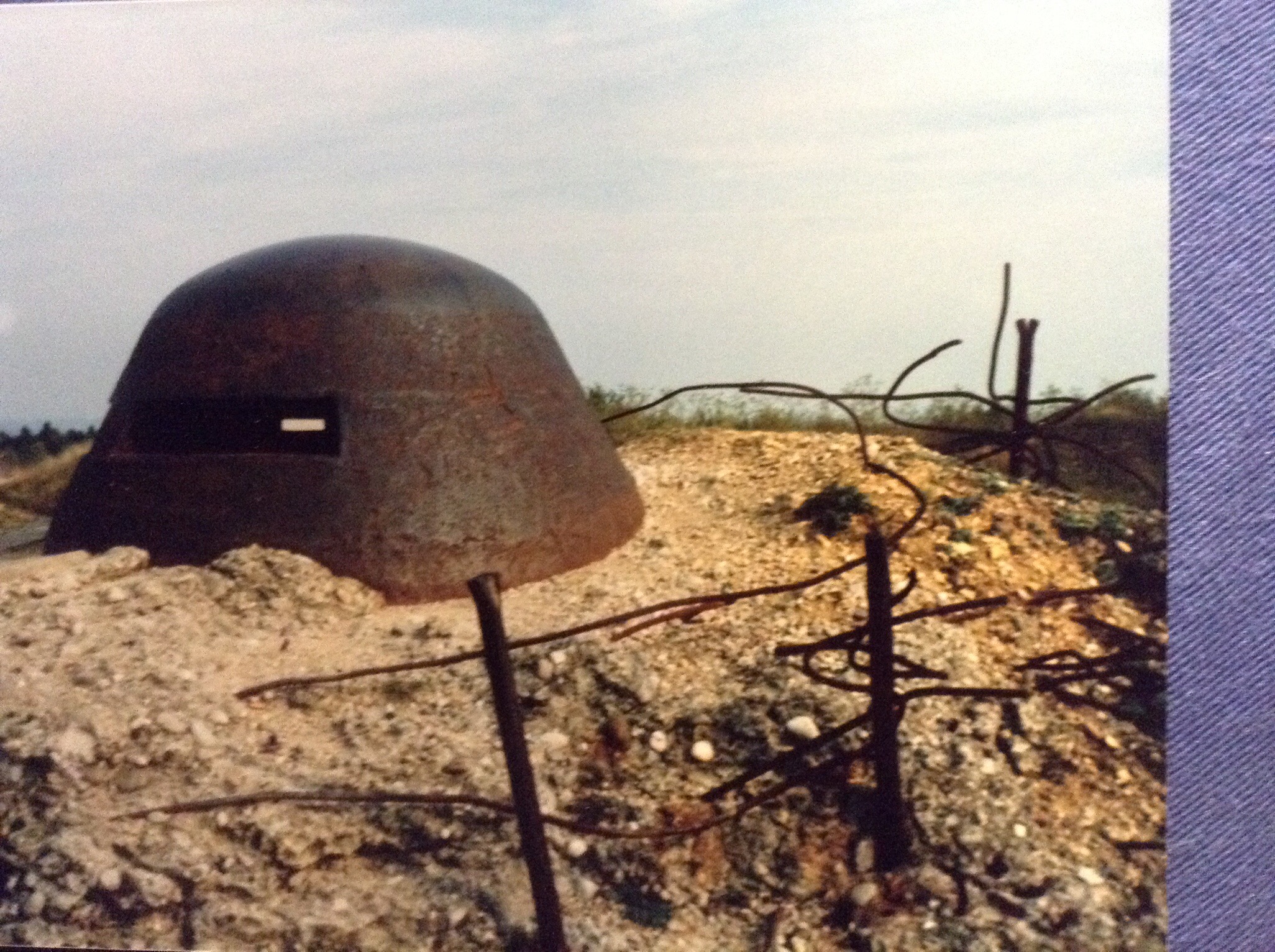
Gun turret at Fort Douaumont 

Over the weekend I caught up on some reading. I was able to read Colonel Andrew Bacevich’s book, The Limits of Power,  Alistair Horne’s Hubris: The Tragedy of War in the Twentieth Century, Nate Braden’s American Renegade Marine: The Life and Times of Smedley Butler USMC, and I re-read Eric Hoffer’s classic work, The True Beleiver, and Walter Lord’s classic history of the Battle of Midway, Incredible Victory. All of these books are well worth weeding regardless of one’s political or ideological viewpoint because they deal with the human condition. Of course I have a number of other works in the que and will continue to read simply because all of these works help me make sense of the incredibly nonsensical world that we live in.

I also did some reading about the Battle for Verdun in the First World War and plan on re-reading Horne’s book on it, The Price of Glory. That battle began in 1916 and lasted 303 days. During that time about 750,000 French and German Soldiers were killed, wounded, or missing. Other more recent estimated place that number at 976,000 with about 1.25 million lost there during the course of the war. When it appeared that the Germans might take the forts surrounding the city and break the French line, General Petain issued the order “they shall not pass.” The battle made a tremendous impact on the French military and political psyche after the war, due to the French policy of rotating units through Verdun during the battle close to three-quarters of the French Army served there. Those who did never forgot the hell that was Verdun. 


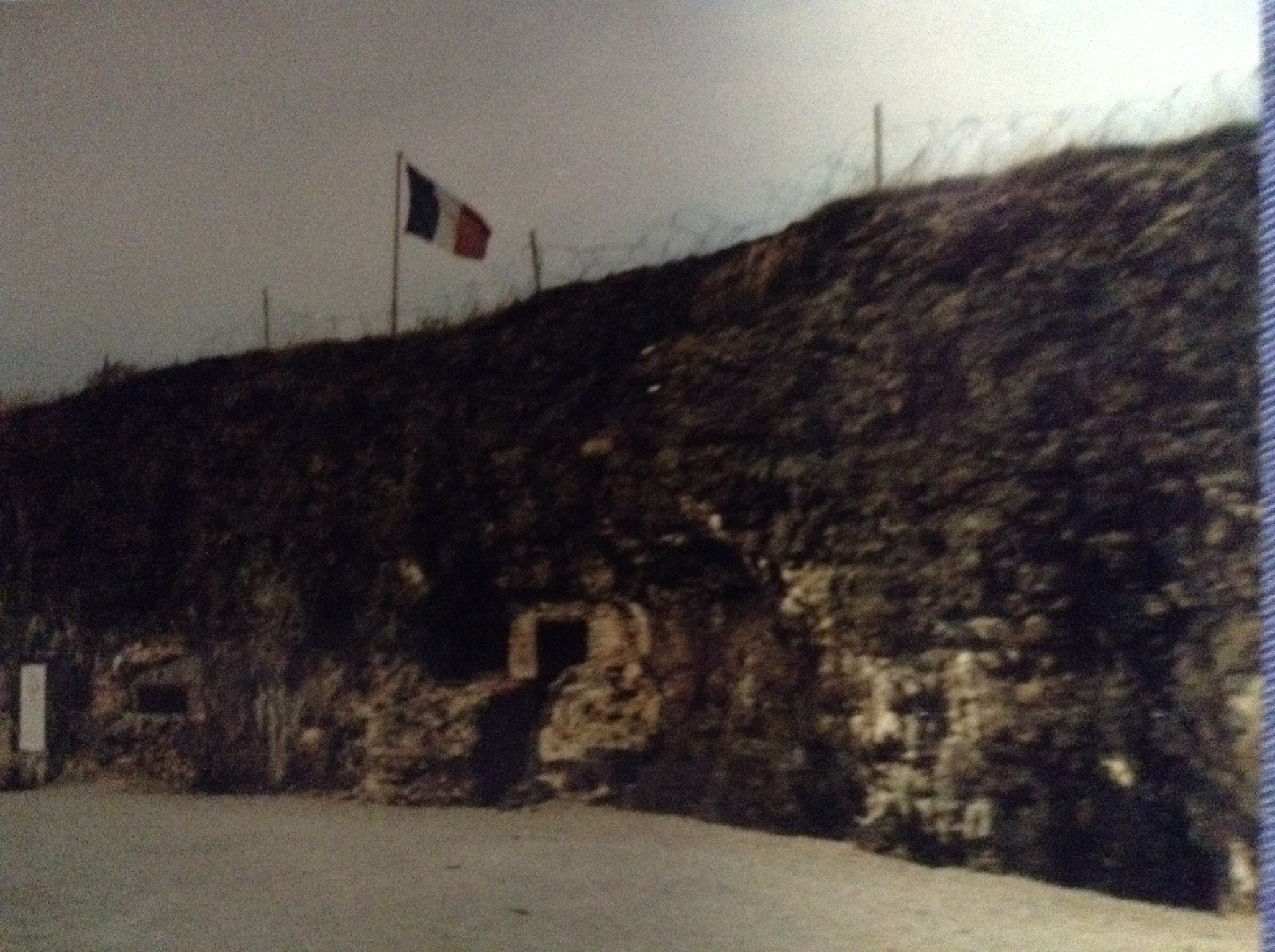
If you go there you will find a battlefield unlike any other, it has a significance in France like Gettysburg, but unlike Gettysburg there are not legions of monuments dotting the battlefield commemorations men or units dotting an otherwise pristine battlefield. Yes, there are some, but what impresses is the fact that the land itself, a century after the battle still bears the scars of it. The landscape is still cratered by the immense number of artillery shells fired there. There are areas that are off limits because of the amount of unexploded ordnance, and residue of Mustard Gas. In the areas one can visit there are the remains of the great forts, two of which, Fort Douaumont and Fort Vaux can be toured. The village of Fleurey, which changed hands sixteen times during the battle can be walked through. A path paved with small pieces of shrapnel goes through a quit wood, small markers denote where each house, or shop in the village stood. At the center of the town, a small chapel built from the bricks and stones of destroyed buildings stands as a reminder. 

There are other monuments on the battlefield such as the Trench of Bayonets where the tips of rifles with bayonets affixed to them mark the location of a French squad buried when the trench collapsed. Of course there are the cemeteries, including one that contains the bodies of thousands of Algerian Muslim troops. But then there is the ossuary, a massive structure in the center of the cemeteries. Crowned by a tower shaped like an artillery shell which serves as a place where one can survey the battlefield, it has a great hall commemorating the units tha fought there. Underneath that great hall are interred the bones of about 130,000 unknown soldiers who were pulverized by the artillery. More are added every year, in fact while shuffling my feet around Fort Vaux in 1984 I unearthed what appeared to be part of a tibia. I contacted one of the staff so it could be properly interred. 


Fort Vaux 

Verdun has become a symbol of reconciliation between France and Germany over the years. It is a place where French and German leaders come, to honor the dead and to pledge themselves to continued reconciliation and peace. Last weekend President Hollande and Chancellor Merkel renewed that pledge. 

When I visited Verdun I was a young Army Second Lieutenant stationed in Germany, constantly training and preparing for the day the Soviets would cross the Fulda Gap and bring about a war that would have devastated Europe, and maybe led to a nuclear holocaust. The battlefield, the vast cratered landscape where little grows; dotted by forts, gun turrets, wire, pillboxes, ruins, cemeteries, and occasional monuments is still etched in my mind some thirty-two years later. To read the accounts of the men who fought a Verdun is to see the fact that war is brutal and dehumanizing, the sights, and smells of death, of rotting flesh, of men shattered, is sobering. I have been to war, I have seen those sights, smelled those smells, thankfully not on such a scale, for what I did see and experience in Iraq changed me for life, but I cannot imagine carnage and death on the scale of Verdun. 

So anyway, until tomorrow, 

Peace,

Padre Steve+


Leave a comment

Filed under History, Military, world war one

Dreaming of Home… Oceans Away: A Post-Memorial Day Meditation

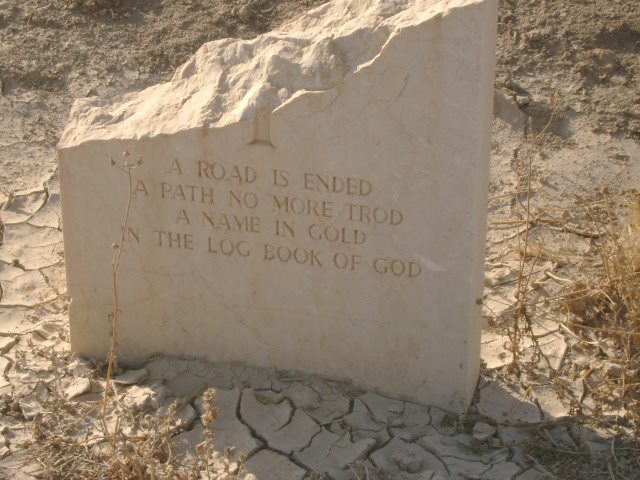
481801_10151367001287059_1003164983_n1

British Grave at Habbanyah, Al Anbar, Iraq

Friends of Padre Steve’s World,

Though it is now the day after Memorial Day I believe that this reflection is worth the read, as well as listening to the music that is part of it.

img_0600

After the end of the American Civil War, the poet Walt Whitman reflected on the human cost of it. Whitman wrote,

“Ashes of soldiers South or North, As I muse retrospective murmuring a chant in thought, The war resumes, again to my sense your shapes, And again the advance of the armies. Noiseless as mists and vapors, From their graves in the trenches ascending, From cemeteries all through Virginia and Tennessee, From every point of the compass out of the countless graves, In wafted clouds, in myriads large, or squads of twos or threes or single ones they come, And silently gather round me…”

I have been posting a number of articles about Memorial Day this weekend, all of which were edited versions of previous articles posted before the weekend began. As such I had time this weekend to reflect on the day, and the sacrifices of those who never returned home, many of who lay in graves on or near the battlefields that they fought and died on so far away from home.

Memorial Day is always an emotional time for me, especially since I returned from Iraq in 2008, and this weekend I have been thinking about the men and women that I knew who died in action or died after they left the service, some at their own hand, unable to bear the burdens and trauma that they suffered while at war. In an age where less than one percent of Americans serve in the military, I think that it is important that we take the time to remember and reflect on the human cost of wars.

imagesCA580JS0

I think of the battlefields that I have served on in Al Anbar Province, the one my father served on at An Loc, Vietnam, or the battlefields and the graveyards I have been to, Verdun, Waterloo, Arnhem, Normandy, Belleau Wood, Luxembourg, the Shuri Line, the Naktong River, Yorktown, Chancellorsville, Antietam, Stone’s River, Bentonville, Gettysburg, the wrecks of the USS Arizona and USS Utah at Pearl Harbor, and so many more, I think about the men and women who never returned. To me all of these places are hallowed ground, ground that none of us can hallow, the sacrifices of the men who gave their last full measure of devotion have done that better than we can ever do.

There are some songs that are haunting yet comfort me when I reflect on the terrible costs of war, even those wars that were truly just; and yes there are such wars, even if politicians and ideologues demanding revenge or vengeance manage to mangle the peace following them. Of course there are wars that are not just in any manner of speaking and in which the costs far outweigh any moral, legal, or ethical considerations, but I digress…

Joshua Lawrence Chamberlain, the hero of the Battle of Little Round Top at Gettysburg wrote something that talks about the importance and even the transcendence of the deeds of those who lost their lives in those wars fought and died to achieve.

In great deeds, something abides. On great fields, something stays. Forms change and pass; bodies disappear; but spirits linger, to consecrate ground for the vision-place of souls… generations that know us not and that we know not of, heart-drawn to see where and by whom great things were suffered and done for them, shall come to this deathless field, to ponder and dream; and lo! the shadow of a mighty presence shall wrap them in its bosom, and the power of the vision pass into their souls.”

Elton John wrote and performed this song, Oceans Away on the centenary of the First World War. It speaks of the men that never came home, and he related it to those who continue to go off to war today.
I hung out with the old folks

In the hope that I’d get wise

I was trying to bridge the gap

Between the great divide

Hung on every recollection

In the theater of their eyes

Picking up on this and that

In the few that still survive


Call em up

Dust em off

Let em shine

The ones who hold onto the ones, they had to leave behind

Those that flew, those that fell,

The ones that had to stay,

Beneath a little wooden cross


They bend like trees in winter

These shuffling old grey lions

Those snow-white stars still gather

Like the belt around Orion

Just to touch the faded lightning

Of their powerful design

Of a generation gathering

For maybe the last time

Oceans away

Where the green grass sways

And the cool wind blows

Across the shadow of their graves.

Shoulder to shoulder back in the day

Sleeping bones to rest in earth, oceans away

Call em up

Dust em off

Let em shine

The ones who hold onto the ones, they had to leave behind

Those that flew, those that fell,

The ones that had to stay,

Beneath a little wooden cross

Oceans away

Elton John “Oceans Away”


Likewise I find myself thinking about all those times alone overseas, and realize that many did not come home. The song I’m Dreaming of Home or Hymne des Fraternisés from the film Joyeux Noel which was adapted by French composer Philippe Rombi from the poem by Lori Barth I think speaks for all of us that served so far away, both those who returned and those who still remain oceans away.

I hear the mountain birds

The sound of rivers singing

A song I’ve often heard

It flows through me now

So clear and so loud

I stand where I am

And forever I’m dreaming of home

I feel so alone, I’m dreaming of home


It’s carried in the air

The breeze of early morning

I see the land so fair

My heart opens wide

There’s sadness inside

I stand where I am

And forever I’m dreaming of home

I feel so alone, I’m dreaming of home


This is no foreign sky

I see no foreign light

But far away am I

From some peaceful land

I’m longing to stand

A hand in my hand

… forever I’m dreaming of home

I feel so alone, I’m dreaming of home.

Please take the time to remember those who whose spirits still dream of home, oceans away.

Until tomorrow,

Peace,

Padre Steve+

Leave a comment

Filed under civil war, Gettysburg, History, iraq,afghanistan, Korean Conflicts, Military, News and current events, remembering friends

The Offering We Bring: Memorial Day

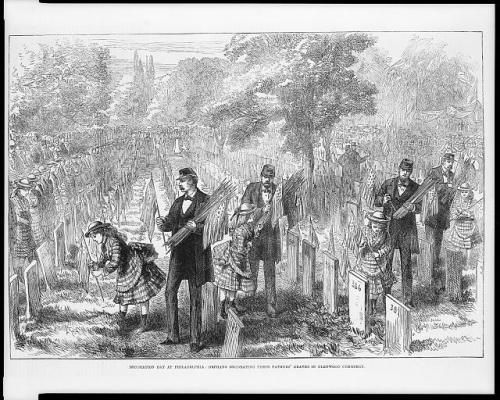
decoration-day1

“Dark and sad will be the hour to this nation when it forgets to pay grateful homage to its greatest benefactors. The offering we bring to-day is due alike to the patriot soldiers dead and their noble comrades who still live; for, whether living or dead, whether in time or eternity, the loyal soldiers who imperiled all for country and freedom are one and inseparable.” From Frederick Douglass’ Memorial Day Speech 1884

Memorial Day, at one time known as Decoration Day is one of our most sacred civil holidays that we celebrate in the United States, or at least it should be. It was a holiday born out of the shedding of the blood of about 600,000 American soldiers, from the North and the South in the Civil War, a singular event that still echoes in our history and in some sense defines who we are. The sad thing is that many; if not most Americans it is simply another holiday, a chance maybe to get a three day weekend at the end of the school year and beginning of summer vacation. This is so because we and our government dominated by business interests and our own wallets for decades knowingly made the decision to sacrifice of the teaching of history and heritage at the altar of “education” that “produces jobs.”

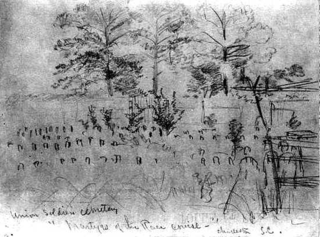
racecourse_t600

The Racecourse Cemetery

But the first observance of what we now know as Memorial Day is fascinating and it needs to be remembered. Frederick Douglass was absolutely right when he spoke the words that I began this article, and we need to remember the humble beginnings of this day which was first marked by recently freed slaves in Charleston South Carolina on May 1st 1865, barely two weeks after Abraham Lincoln was assassinated and three weeks after the surrender of Robert E. Lee and the Army of Northern Virginia at Appomattox Court House. Their commemoration was for the most part forgotten as Charleston sought to remove the vestiges of any Union sacrifice within the city limits in the 1880s.

The acrid smell of smoke of the last battles of the American Civil War was still lingering over many towns and cities in the South on May 1st 1865. Charleston South Carolina, the hotbed of secession was particularly hard hit during the war. In 1861 Cadets of the Citadel and South Carolina militia forces began the war with the bombardment of Fort Sumter. Union Forces laid siege to the city in late 1863, a siege which ended with the city’s surrender to Union forces on 18 February 1865. The day of the surrender was somewhat ironic. Charleston, the city most associated with the opening of the conflict surrendered to Union forces on the fourth anniversary of the inauguration of Jefferson Davis as President of the Confederacy. By the time of its surrender much of the city had been destroyed by Union siege artillery and naval forces.

Charleston had also been the home of three of the Prisoner of War Camps. One was located in the Charleston City Jail and the other at Castle Pinckney which had been one of the ante-bellum U.S. Army installations in the city. A third camp was erected on the site of the Washington Race Course and Jockey Club in 1864. This was an open air camp and Yale Historian David Blight wrote that “Union soldiers were kept in horrible conditions in the interior of the track; at least 257 died of exposure and disease and were hastily buried in a mass grave behind the grandstand.”

By the end of the war most of the white population of the city had left and most of those remaining were recently freed slaves. After their liberation and the city’s occupation by Federal forces, which included the famous 54th Massachusetts as well as the 20th, 35th and 104th US Colored Troops Regiments, about 28 these recently liberated Black men went to work and properly reinterred these 257 Union dead on the raceway building a high fence around it. They inscribed “Martyrs of the Race Course” on an arch above the cemetery entrance.

6a01b8d0781960970c01b7c7901048970b-320wi

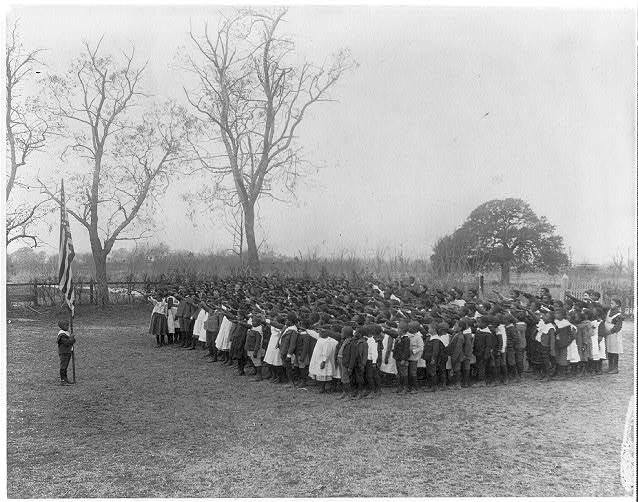
On May 1st over 10,000 Black Charlestonians gathered at the site to honor the fallen. Psalms, Scriptures and prayers were said, hymns were sung and many brought flowers. A parade of 2800 children covered the burial ground with flowers. They were followed by members of the Patriotic Association of Colored Men and the Mutual Aid Society. This society’s members provided relief supplies to Freedmen and provided aid to bury those Blacks who were too poor to afford burial. More citizens followed many laying flower bouquets on the graves. Children then led the singing of The Star Spangled Banner, America and Rally around the Flag. The Brigade composed of the 54th Massachusetts and the 35th and 104th Colored Regiments marched in honor of their fallen comrades. Following the formalities many remained behind for a picnic.

Other communities established their own Memorial Day observances in the years following the war, but the event in Charleston was the first. The first “Official” commemoration was on 30 May 1868 when Union General John Logan who headed the veteran’s organization called The Grand Army of the Republic appealed to communities to honor the dead by holding ceremonies and decorating the graves of the fallen.

In the South three different days served a similar purpose. In Virginia people commemorated the day on June 3rd, the birthday of Confederate President Jefferson Davis, the Carolinas marked the day on 10 May, the birthday of General Thomas “Stonewall” Jackson. In much of the Deep South the event was conducted April 26th, the anniversary of the surrender of General Joseph Johnson’s Army to General William Tecumseh Sherman. For many in the South, still attempting to come to grips with their defeat the day would become about “The Lost Cause” or “the defense of Liberty” or “States Rights” and the war was often referred to as the “War of Northern Aggression.”

The “Martyrs of the Racecourse” cemetery is no longer there. The site is now a park honoring the fascinatingly complex Confederate General and post-Reconstruction Governor of South Carolina Wade Hampton. An oval track remains in the park and is used to run or walk by the local population and cadets from the Citadel. Thankfully, at long last in 2010, one hundred and forty-five years after the dedication of that cemetery a marker was placed in that park commemorating the cemetery and the event that we now recognize as the first Memorial Day.

First-Memorial-Day-honoring-257-Union-soldier-martyrs-10000-freedmen-march-led-by-3000-children-05011865

The Union dead who had been so beautifully honored by the Black population were moved to the National Cemetery at Beaufort South Carolina by the 1880s. Some state that the reason for this was that the cemetery had fallen into neglect, and this may be the case, but the event and their memory conveniently erased from memory of Charlestonians. I do not think that this would have happened had the people who had the bodies moved simply restored and maintained the cemetery. Had not historian David Blight found the documentation we probably still would not know of this touching act by former slaves who honored those that fought the battles, and gave their lives to win their freedom. Blight wrote in 2011 in the 1870s Charleston “had no place for the former slaves’ march on their masters’ racecourse.”

The African American population of Charleston understood the bonds of slavery and oppression. They understood the tyranny of prejudice in which they only counted as 3/5ths of a person. They understood and saw the suffering of those that were taken prisoner while attempting to liberate them from the tyranny of slavery. They stand as an example for us today.

But their suffering was not over. Within little more than a decade Blacks in the South would be subject to Jim Crow and again treated by many whites as something less than human. The struggle of they and their descendants against the tyranny of racial prejudice, discrimination and violence over the next 100 years would finally bear fruit in the Civil Rights movement, some of whose leaders, like the Reverend Doctor Martin Luther King Jr. would also become martyrs. Unfortunately that struggle is not over.

Frederick Douglass spoke to Union Veterans on Memorial Day 1878. His words, particularly in light of the war and the struggles of African Americans since and the understanding of what those who were enslaved understood liberation to be are most significant to our time. It was not merely a war based on sectionalism or even “States rights,” it was a war of ideas, a war of diametrically opposed ideologies. He said:

“But the sectional character of this war was merely accidental and its least significant feature. It was a war of ideas, a battle of principles and ideas which united one section and divided the other; a war between the old and new, slavery and freedom, barbarism and civilization; between a government based upon the broadest and grandest declaration of human rights the world ever heard or read, and another pretended government, based upon an open, bold and shocking denial of all rights, except the right of the strongest.”

Douglass’s words were powerful then and they resonate today as many of the same ideas that were the cause of the Civil War and were continued during Jim Crow are still alive. Unfortunately there are those in our society who labor daily to establish the “rights” of the strongest over the weak, the poor, the powerless and minorities of all kinds. Of course such actions, often wrapped in the flag, patriotism and buttressed with cherry picked quotes (many of which are fake, changed or taken out of context) from some of our founders are designed to re-establish the oligarchy of the power of the few, much like the men who owned the lives of the slaves and poor whites in the ante-bellum American South. Such actions do nothing but demean and trample the sacrifice of those who fought for freedom and the only remedy is to fight them with the full knowledge of truth.

american-flag

I do hope that today we will celebrate Memorial Day in a fitting manner. Let us honor those Americans who died that others might be free. Let us look back at what freedom actually means and not forget the sacrifices of those that gave, and still give their lives in the “last full measure of devotion to duty” that others might live. Take a moment today at noon to pause what you are doing and go silent for at least one minute, and remember.

Peace

Padre Steve+

Leave a comment

Filed under civil war, History, News and current events

The Unfinished Work of Memorial Day

img_0578

Friends of Padre Steve’s World,

This is Memorial Day Weekend, a weekend where we remember those who died in the service of our country. It is not a day to thank the living veterans, that day is Veteran’s Day. Nor is it the day to thank those men and women who currently wear the uniform and fight the wars of our country. This weekend I am reposting a number of articles from past years to remind my regular readers and those new to my writings about how important this remembrance is, not just to me, but to all of us. I do not say that lightly. Memorial Day is the offspring of the families of the American Civil War dead, when people who lost loved ones in the cause of liberty and the defense of the Union honored their loved ones.

No matter what your political views, ideology, or religious beliefs, please take time to remember the high human cost of freedom this weekend, especially on Monday when we observe Memorial Day.

Peace,

Padre Steve+

burford reynolds monuments

Abraham Lincoln said that “It is for us the living, rather, to be dedicated here to the unfinished work which they who fought here have thus far so nobly advanced…” Likewise, Joshua Chamberlain, the hero of Little Round Top at Gettysburg said, “Heroism is latent in every human soul – However humble or unknown, they (the veterans) have renounced what are accounted pleasures and cheerfully undertaken all the self-denials – privations, toils, dangers, sufferings, sicknesses, mutilations, life-” 

Sometimes it is best to remember that people that lived long before us have profound things to say about subjects that we often address in rather cheap and banal ways. It is easy to do this; in fact many people, especially ideologues and pundits simply quote the great men and women of history simply to buttress what they want to say in much the same manner that preachers from all sides of the theological spectrum will comb the Bible or the Church Fathers to find support for often decidedly un-Christian ideas. Of course unscrupulous preachers of other religions do the same with their sacred texts so it tends be a universal problem.

Of course we should know better than to do this but all of us do it to one degree or another. Even worse are those that will misquote people either to bolster their arguments or to tear down the person that they quote. It should not be that way on Memorial Day. The sacrifices of those that gave “the last full measure” in defense of their homeland, principles and those that they loved are too great to trivialize by using the sacrifices of the fallen to promote themselves as they prepare to launch political campaigns as was recently done by a prominent politician at an annual event which honors veterans in Washington DC.

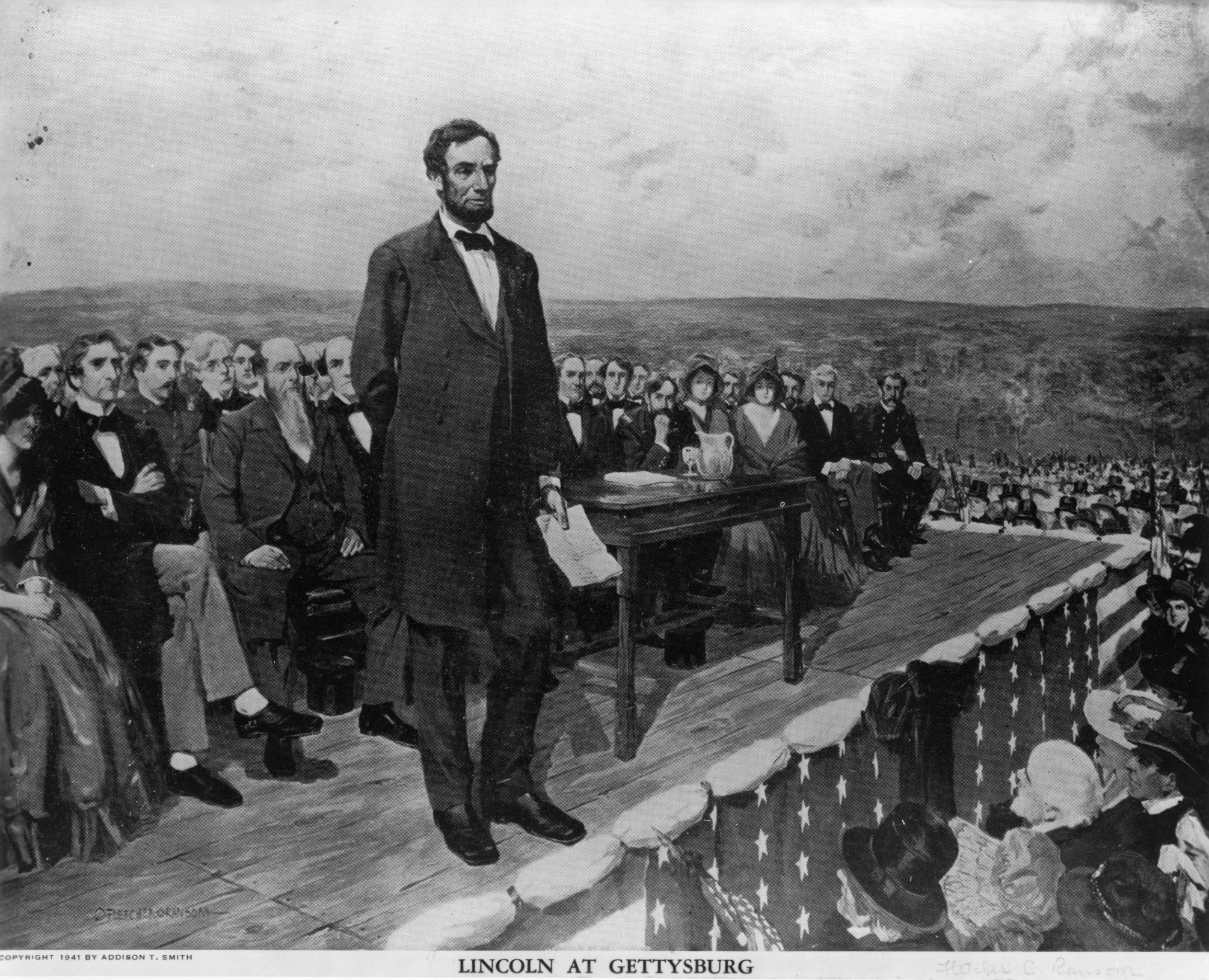
Gettysburg Address

I think that Abraham Lincoln eulogized the fallen better than almost anyone in the history of our nation when he traveled to Gettysburg and gave a refreshingly short speech for a politician. Lincoln considered the speech a failure but history shows it to be one of the most remarkable ever made by any American public figure.

“Four score and seven years ago our fathers brought forth on this continent, a new nation, conceived in Liberty, and dedicated to the proposition that all men are created equal.

Now we are engaged in a great civil war, testing whether that nation, or any nation so conceived and so dedicated, can long endure. We are met on a great battlefield of that war. We have come to dedicate a portion of that field, as a final resting place for those who here gave their lives that that nation might live. It is altogether fitting and proper that we should do this.

But, in a larger sense, we cannot dedicate—we cannot consecrate—we cannot hallow—this ground. The brave men, living and dead, who struggled here, have consecrated it, far above our poor power to add or detract. The world will little note, nor long remember what we say here, but it can never forget what they did here. It is for us the living, rather, to be dedicated here to the unfinished work which they who fought here have thus far so nobly advanced. It is rather for us to be here dedicated to the great task remaining before us—that from these honored dead we take increased devotion to that cause for which they gave the last full measure of devotion—that we here highly resolve that these dead shall not have died in vain—that this nation, under God, shall have a new birth of freedom— and that government of the people, by the people, for the people, shall not perish from the earth.”

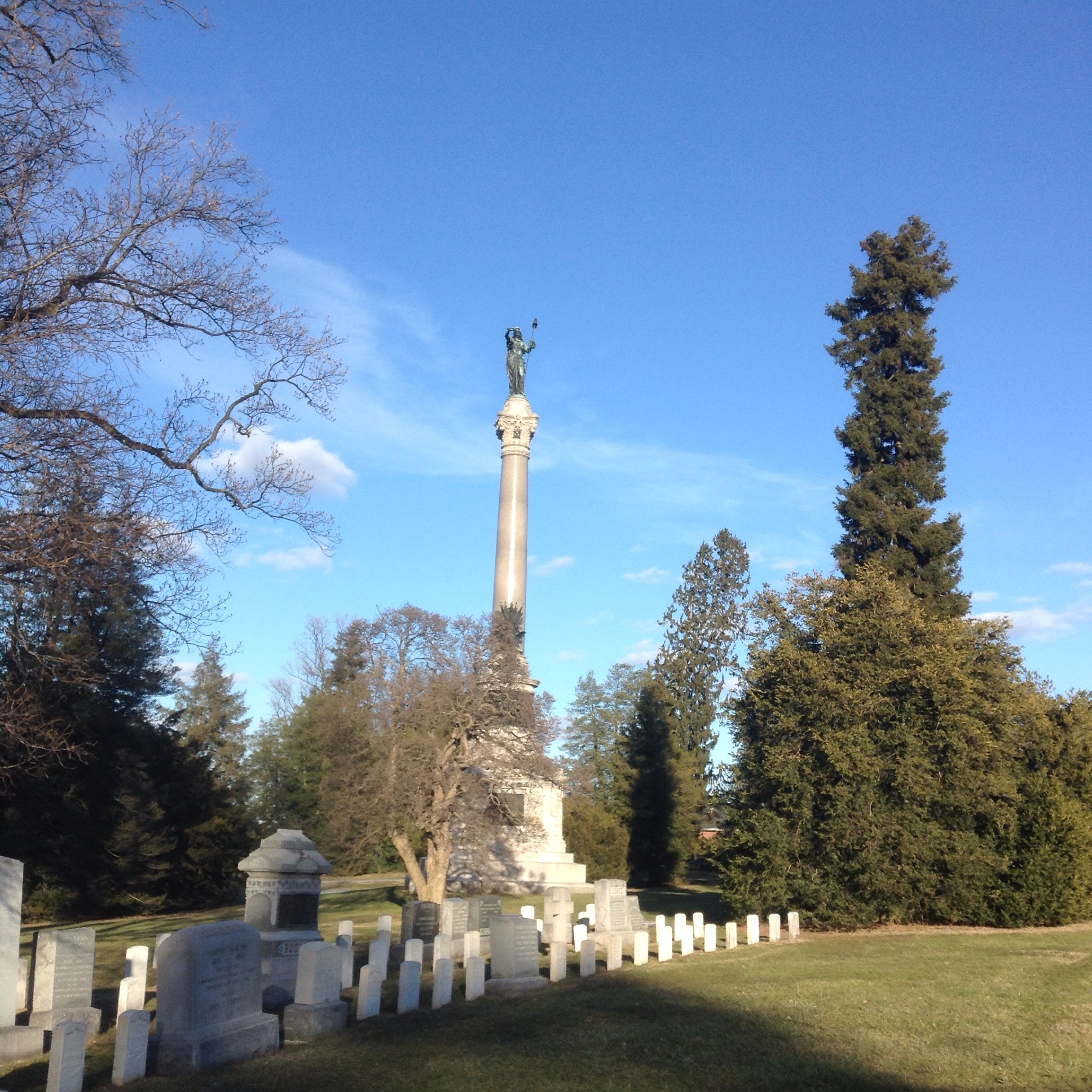
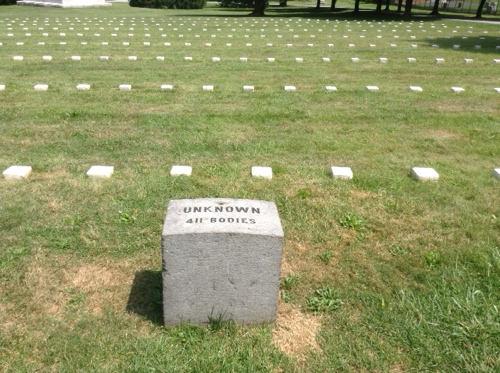
Gettysburg_Unknowns.JPG

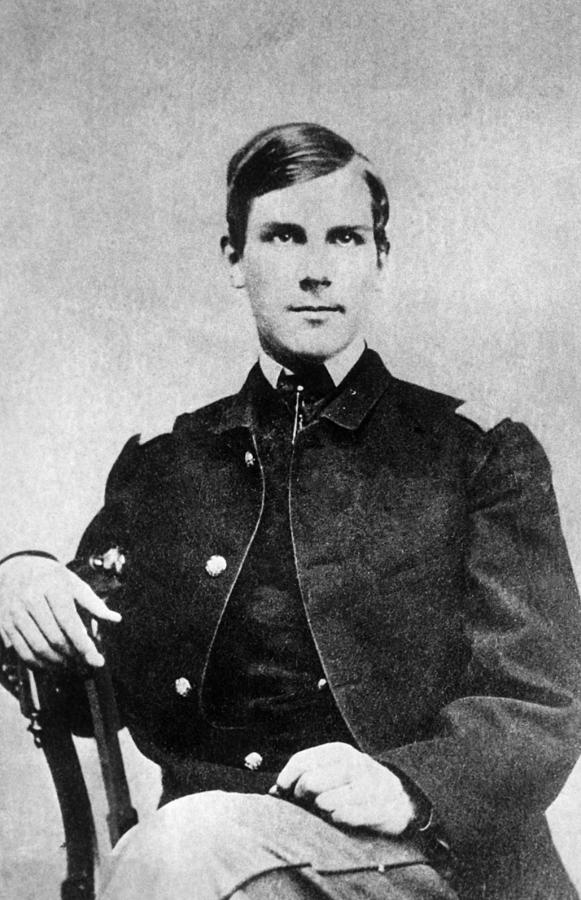
Supreme Court Justice Oliver Wendell Holmes gave a speech in 1884 twenty years after his service in the 20th Massachusetts Regiment in the Civil War. A veteran of Antietam and other major engagements he made these remarks in a speech so powerful that it was a key factor in Theodore Roosevelt’s decision to nominate him for the Court.

“Every year–in the full tide of spring, at the height of the symphony of flowers and love and life–there comes a pause, and through the silence we hear the lonely pipe of death. Year after year lovers wandering under the apple trees and through the clover and deep grass are surprised with sudden tears as they see black veiled figures stealing through the morning to a soldier’s grave. Year after year the comrades of the dead follow, with public honor, procession and commemorative flags and funeral march–honor and grief from us who stand almost alone, and have seen the best and noblest of our generation pass away…

But grief is not the end of all. I seem to hear the funeral march become a paean. I see beyond the forest the moving banners of a hidden column. Our dead brothers still live for us, and bid us think of life, not death–of life to which in their youth they lent the passion and joy of the spring. As I listen, the great chorus of life and joy begins again, and amid the awful orchestra of seen and unseen powers and destinies of good and evil our trumpets sound once more a note of daring, hope, and will.”

kennedy-john-f-flag

In his inaugural address President John F. Kennedy a combat veteran of the Solomons Campaign provided a message which though not directly related to Memorial Day certain echoed the themes of the sacrifices of our fallen but also call us to the highest ideals of our nation. As a Naval Officer in command of PT 109 his boat was rammed and sunk by a Japanese destroyer after which his leadership and courage was a deciding factor in the survival of most of his crew. Kennedy was a child of privilege but he volunteered for the arduous duty of service on the tiny PT Boats. The speech is considered one of the premier speeches by an American President.

“In your hands, my fellow citizens, more than mine, will rest the final success or failure of our course. Since this country was founded, each generation of Americans has been summoned to give testimony to its national loyalty. The graves of young Americans who answered the call to service surround the globe.

Now the trumpet summons us again — not as a call to bear arms, though arms we need — not as a call to battle, though embattled we are — but a call to bear the burden of a long twilight struggle, year in and year out, “rejoicing in hope; patient in tribulation,”² a struggle against the common enemies of man: tyranny, poverty, disease, and war itself….

In the long history of the world, only a few generations have been granted the role of defending freedom in its hour of maximum danger. I do not shrink from this responsibility — I welcome it. I do not believe that any of us would exchange places with any other people or any other generation. The energy, the faith, the devotion which we bring to this endeavor will light our country and all who serve it. And the glow from that fire can truly light the world.

And so, my fellow Americans, ask not what your country can do for you; ask what you can do for your country.

My fellow citizens of the world, ask not what America will do for you, but what together we can do for the freedom of man.

Finally, whether you are citizens of America or citizens of the world, ask of us here the same high standards of strength and sacrifice which we ask of you. With a good conscience our only sure reward, with history the final judge of our deeds, let us go forth to lead the land we love, asking His blessing and His help, but knowing that here on earth God’s work must truly be our own.”

fort hood memorial

In 1984 President Ronald Reagan visited Omaha Beach in Normandy, the site of the bloodiest of the D-Day landings on June 6th 1944. Reagan was a master of rhetoric and understood the importance of his visit to this hallowed site at the apex of the Cold War. At that time it was unimaginable to most people that the Soviet Union would be no more barely 5 years hence and Reagan used the speech to link the sacrifices of those who fought and died at Normandy to those that served in his day. While his focus was on the sacrifice of America and its British, Canadian and French allies that landed on the beaches of Normandy he recognized the sacrifices of the Soviet Union which lost 20 million soldiers and civilians in the war against the Nazis. Reagan said of those who went ashore in Normandy:

“The men of Normandy had faith that what they were doing was right, faith that they fought for all humanity, faith that a just God would grant them mercy on this beachhead or on the next. It was the deep knowledge — and pray God we have not lost it — that there is a profound, moral difference between the use of force for liberation and the use of force for conquest. You were here to liberate, not to conquer, and so you and those others did not doubt your cause. And you were right not to doubt.

You all knew that some things are worth dying for. One’s country is worth dying for, and democracy is worth dying for, because it’s the most deeply honorable form of government ever devised by man. All of you loved liberty. All of you were willing to fight tyranny, and you knew the people of your countries were behind you….The men of Normandy had faith that what they were doing was right, faith that they fought for all humanity, faith that a just God would grant them mercy on this beachhead or on the next. It was the deep knowledge — and pray God we have not lost it — that there is a profound, moral difference between the use of force for liberation and the use of force for conquest. You were here to liberate, not to conquer, and so you and those others did not doubt your cause. And you were right not to doubt.

You all knew that some things are worth dying for. One’s country is worth dying for, and democracy is worth dying for, because it’s the most deeply honorable form of government ever devised by man. All of you loved liberty. All of you were willing to fight tyranny, and you knew the people of your countries were behind you.”

President Barak Obama made these remarks a few years ago to conclude his speech following the solemn duty that all Presidents have in laying a wreath at the Tomb of the Unknowns at Arlington National Cemetery. Obama who is vilified by his most extreme opponents, as was Reagan for that matter ended his speech with these comments in which he eloquently expressed what the nation must do for its military, veterans and those killed in action or missing as well as the highest example of the brotherhood that those of us who have served in harm’s way feel for our fellow Soldiers, Marines, Sailors, Airmen and Coast Guardsmen:

“Our nation owes a debt to its fallen heroes that we can never fully repay. But we can honor their sacrifice, and we must. We must honor it in our own lives by holding their memories close to our hearts, and heeding the example they set. And we must honor it as a nation by keeping our sacred trust with all who wear America’s uniform, and the families who love them; by never giving up the search for those who’ve gone missing under our country’s flag or are held as prisoners of war; by serving our patriots as well as they serve us — from the moment they enter the military, to the moment they leave it, to the moment they are laid to rest.”

That is how we can honor the sacrifice of those we’ve lost. That is our obligation to America’s guardians — guardians like Travis Manion. The son of a Marine, Travis aspired to follow in his father’s footsteps and was accepted by the USS [sic] Naval Academy. His roommate at the Academy was Brendan Looney, a star athlete and born leader from a military family, just like Travis. The two quickly became best friends — like brothers, Brendan said.

After graduation, they deployed — Travis to Iraq, and Brendan to Korea. On April 29, 2007, while fighting to rescue his fellow Marines from danger, Travis was killed by a sniper. Brendan did what he had to do — he kept going. He poured himself into his SEAL training, and dedicated it to the friend that he missed. He married the woman he loved. And, his tour in Korea behind him, he deployed to Afghanistan. On September 21st of last year, Brendan gave his own life, along with eight others, in a helicopter crash.

Heartbroken, yet filled with pride, the Manions and the Looneys knew only one way to honor their sons’ friendship — they moved Travis from his cemetery in Pennsylvania and buried them side by side here at Arlington. “Warriors for freedom,” reads the epitaph written by Travis’s father, “brothers forever.”

The friendship between 1st Lieutenant Travis Manion and Lieutenant Brendan Looney reflects the meaning of Memorial Day. Brotherhood. Sacrifice. Love of country. And it is my fervent prayer that we may honor the memory of the fallen by living out those ideals every day of our lives, in the military and beyond. May God bless the souls of the venerable warriors we’ve lost, and the country for which they died.

Sometimes our fallen are eulogized by the less notable and sometimes oft vilified people. One of these men was Robert Ingersoll, a politician, orator and lecturer as well as an agnostic in a time when that was not a popular belief. Ingersoll was the son of a Congregationalist minister who often preached for revivalist Charles Finney. Ingersoll was also a veteran of the Civil War where he raised and commanded the 11th Illinois Cavalry Regiment which fought at Shiloh. remarked:

“These heroes are dead. They died for liberty – they died for us. They are at rest. They sleep in the land they made free, under the flag they rendered stainless, under the solemn pines, the sad hemlocks, the tearful willows, and the embracing vines. They sleep beneath the shadows of the clouds, careless alike of sunshine or of storm, each in the windowless Place of Rest. Earth may run red with other wars – they are at peace. In the midst of battle, in the roar of conflict, they found the serenity of death. I have one sentiment for soldiers living and dead: cheers for the living; tears for the dead.”

As we look forward this Memorial Day let us remember those who have given the last full measure of duty for our nation, those who have served those that continue to serve and the friends and loved ones who cherish the lives and memories of each one. Let us remember as a nation, as fellow citizens and never let our own agendas, ambitions or even our baser instincts sully their memory. May we choose the higher calling of service to our country and each other as Americans, the ideals of which are woven in the lives and sacrifices of those that we honor today and as Lincoln said to finish “the great task remaining before us—that from these honored dead we take increased devotion to that cause for which they gave the last full measure of devotion—that we here highly resolve that these dead shall not have died in vain—that this nation, under God, shall have a new birth of freedom— and that government of the people, by the people, for the people, shall not perish from the earth.”


1 Comment

Filed under civil war, Gettysburg, History, Military, News and current events

Why We Keep Memorial Day

Friends of Padre Steve’s World,

This is Memorial Day Weekend, a weekend where we remember those who died in the service of our country. It is not a day to thank the living veterans, that day is Veteran’s Day. Nor is it the day to thank those men and women who currently wear the uniform and fight the wars of our country. This weekend I am reposting a number of articles from past years to remind my regular readers and those new to my writings about how important this remembrance is, not just to me, but to all of us. I do not say that lightly. Memorial Day is the offspring of the families of the American Civil War dead, when people who lost loved ones in the cause of liberty and the defense of the Union honored their loved ones.

No matter what your political views, ideology, or religious beliefs, please take time to remember the high human cost of freedom this weekend, especially on Monday when we observe Memorial Day.

Peace,

Padre Steve+

1-oliver-wendell-holmes-jr-1841-1935-everett

Oliver Wendell Holmes 

“even if those who come after us are to forget all that we hold dear, and the future is to teach and kindle its children in ways as yet unrevealed, it is enough for us that this day is dear and sacred…”

Nearly 20 years after the Civil War, Oliver Wendell Holmes Jr. then serving as Chief Justice of the Massachusetts Supreme Court spoke on Memorial Day 1884 in Keene New Hampshire at a gathering of veterans. He recalled an incident not long before where he had heard a young man ask “why people still kept up Memorial Day. The question was one that he pondered before his speech and that he attempted to find an answer, not to his fellow veterans who certainly understood their shared memories of war “but an answer which should command the assent of those who do not share our memories.”

3rd Infantry Places American Flags At The Graves Of U.S. Soldiers

I think that having an answer for the question is as timely now as when Holmes first pondered it. Though his war was twenty years past and had torn the nation apart, there were still many men on both sides who had served in that terrible time and but even so many people were not only forgetting the war and the sacrifices made by so many but intent on becoming rich. Something that he would directly state in a Memorial Day address to the graduating class of Harvard University in 1895:

“The society for which many philanthropists, labor reformers, and men of fashion unite in longing is one in which they may be comfortable and may shine without much trouble or any danger. The unfortunately growing hatred of the poor for the rich seems to me to rest on the belief that money is the main thing (a belief in which the poor have been encouraged by the rich), more than on any other grievance. Most of my hearers would rather that their daughters or their sisters should marry a son of one of the great rich families than a regular army officer, were he as beautiful, brave, and gifted as Sir William Napier. I have heard the question asked whether our war was worth fighting, after all. There are many, poor and rich, who think that love of country is an old wife’s tale, to be replaced by interest in a labor union, or, under the name of cosmopolitanism, by a rootless self-seeking search for a place where the most enjoyment may be had at the least cost.”

However his message to his fellow veterans, mostly men from his own former regiment, the 20th Massachusetts was quite personal and something that they could find meaning in. Holmes understood war, he had seen much action and had been wounded at Ball’s Bluff, Antietam and Chancellorsville. He talked of the shared experience of war, something that those who have fought in our nation’s wars, as well as combat veteran soldiers in other countries can understand far more than people that have only known peace, even while their countrymen are at war.

Memorial Day Series

Holmes’s remembrances of the war and the comrades that he and those present had served with, those living and those dead is powerful. Many of us who have served in the wars that began on September 11th 2001 have lost friends in either Iraq or Afghanistan, and many more who are wounded or maimed in body, mind and spirit. Many survivors of wounds today would have died in previous wars.

Likewise his descriptions of the memories of war, triggered by “accidents” are real to those that have experienced war and combat.

“Accidents may call up the events of the war. You see a battery of guns go by at a trot, and for a moment you are back at White Oak Swamp, or Antietam, or on the Jerusalem Road. You hear a few shots fired in the distance, and for an instant your heart stops as you say to yourself, The skirmishers are at it, and listen for the long roll of fire from the main line. You meet an old comrade after many years of absence; he recalls the moment that you were nearly surrounded by the enemy, and again there comes up to you that swift and cunning thinking on which once hung life and freedom–Shall I stand the best chance if I try the pistol or the sabre on that man who means to stop me? Will he get his carbine free before I reach him, or can I kill him first?These and the thousand other events we have known are called up, I say, by accident, and, apart from accident, they lie forgotten.”

We all have our memories of our wars, those of us who remain, be we veterans of Iraq or Afghanistan, Somalia, Desert Storm, Lebanon, Vietnam, Korea or World War II. It is hard to believe that so few remain from World War II and Korea, and that even the Vietnam veterans are aging rapidly, most now in their 60s or 70s. In as much as the wars of the past decade have been fought by a tiny minority of American citizens fewer and fewer will understand the bond that we share through our memories of the living and the dead. We have been set apart by our experiences, even though the wars that we have fought differ in many ways.

481801_10151367001287059_1003164983_n-1.jpg

As such we should whenever possible take the time to meet and remember. That might be as groups of friends, unit associations or perhaps local chapters of Veterans organizations. We do this to remember but also to remind ourselves that we cannot live in the past alone, for the present likewise calls us to action, even after our service is complete.

Holmes put it well: “When we meet thus, when we do honor to the dead in terms that must sometimes embrace the living, we do not deceive ourselves. We attribute no special merit to a man for having served when all were serving. We know that, if the armies of our war did anything worth remembering, the credit belongs not mainly to the individuals who did it, but to average human nature. We also know very well that we cannot live in associations with the past alone, and we admit that, if we would be worthy of the past, we must find new fields for action or thought, and make for ourselves new careers.”

We remember the past, we remember our fallen and we remember the families who have lost loved ones in these wars as well as those whose lives have been changed and maybe even torn apart by the changes that war has wrought in their loved ones who returned different from war. In our service we have been set apart and as such as Holmes so well states we have the duty to “bear the report to those who will come after us.” His words carry forth to us today, we few we happy few as Shakespeare so eloquently wrote.

“nevertheless, the generation that carried on the war has been set apart by its experience. Through our great good fortune, in our youth our hearts were touched with fire. It was given to us to learn at the outset that life is a profound and passionate thing. While we are permitted to scorn nothing but indifference, and do not pretend to undervalue the worldly rewards of ambition, we have seen with our own eyes, beyond and above the gold fields, the snowy heights of honor, and it is for us to bear the report to those who come after us.”

I will remember my time in Iraq and those that I served alongside. I will also remember friends who served in other units who did not return as well as those Marines, Sailors and Soldiers that I see every day in our Naval Hospital suffering from the physical, psychological and spiritual wounds of war.

This weekend I will remember and on Monday, that sacred day that we set aside to remember the fallen I take some time at noon to join in that time of remembrance and pray that maybe someday war will be no more.

That is why I think that we should remember Memorial Day even if others forget.

Peace

Padre Steve+

Leave a comment

Filed under civil war, History, iraq,afghanistan, Military, News and current events, shipmates and veterans, vietnam, world war one, world war two in europe, world war two in the pacific

Memorial Day Weekend 2016: The Buddy Poppy

flanders_field

Friends of Padre Steve’s World

This is Memorial Day Weekend, a weekend where we remember those who died in the service of our country. It is not a day to thank the living veterans, that day is Veteran’s Day. Nor is it the day to thank those men and women who currently wear the uniform and fight the wars of our country. This weekend I am reposting a number of articles from past years to remind my regular readers and those new to my writings about how important this remembrance is, not just to me, but to all of us. I do not say that lightly. Memorial Day is the offspring of the families of the American Civil War dead, when people who lost loved ones in the cause of liberty and the defense of the Union honored their loved ones.

While the Buddy Poppy was something that came out of the First World War, and Armistice Day, which after the Second World War became Veteran’s Day. In time it has also become connected with the original Memorial Day. So today’s post is my first reflection of this weekend on the Buddy Poppy and Memorial Day.

No matter what your political views, ideology, or religious beliefs, please take time to remember the high human cost of freedom this weekend, especially on Monday when we observe Memorial Day.

Until tomorrow,

Peace,

Padre Steve+

1144221_orig

In Flanders Fields

John McCrae, 1915.

In Flanders fields the poppies blow

Between the crosses, row on row

That mark our place; and in the sky

The larks, still bravely singing, fly

Scarce heard amid the guns below.

We are the Dead. Short days ago

We lived, felt dawn, saw sunset glow,

Loved and were loved, and now we lie

In Flanders fields.

Take up our quarrel with the foe:

To you from failing hands we throw

The torch; be yours to hold it high.

If ye break faith with us who die

We shall not sleep, though poppies grow

In Flanders fields.

Besides the American Flag the Buddy Poppy is perhaps the most ubiquitous symbol of Memorial Day. This poppy as we know it came about when Mrs.VFW Moina Michael read McRea’s poem and inspired wrote this verse:

We cherish too, the Poppy red

That grows on fields where valor led,

It seems to signal to the skies

That blood of heroes never dies.

She then had the inspiration to begin wearing Red Poppies on Memorial Day and sold the poppies to friends and others with the money going to those in need. A French woman visiting the United States, a Madame Guerin discovered the new custom and took it back to France where she began to make artificial red poppies to sell with the proceeds going to the widows and orphans of the First World War. The custom spread to other countries and in 1921 the Franco-American Children’s League sold the poppies but disbanded in 1921. Madame Guerin approached the newly formed Veteran’s of Foreign Wars, the VFW in 1922 for assistance and in 1922 the VFW became the first American organization to sell poppies. Two years later the Buddy Poppy program began. The artificial poppies were made by disabled veterans who were paid for their work in order to provide them some form of income and distributed by other veterans across the country. Today the VFW continues to distribute the Buddy Poppies which are still produced by disabled Veterans at the nation’s Veteran’s Administration Hospitals.

I remember the first Buddy Poppy that I every received. It was just before Memorial Day 1970, before it became a 3 day weekend falling on the last Monday of May. We were living with my Grandparents in Huntington West Virginia as my dad sought suitable housing for us in Long Beach California while he was in the Navy.

Our initial move from the small town of Oak Harbor Washington, where my dad had been stationed at Naval Air Station Whidbey Island to Long Beach had not gone well. The first place we lived was in a dangerous neighborhood and with my dad traveling frequently to Naval Shipyards around the country to help commission new ships the stress on the family, especially my mother in dealing with that and two young boys was too much. Dad sent us back to Huntington where my Grandparents and numerous other relatives still lived for the duration of the school year as he sought better housing.

veterans-day-05-26-10-1

Memorial Day then was filled with visits to cemeteries to place flowers on the graves of departed relatives as well as flags on the graves of relatives who had served in the military. We made a number of stops that day at the Bowen and Dundas cemeteries as well as others where relatives were interred. Afterward we had a home cooked meal prepared by my maternal grandmother Christine and then made a trip on a city bus to my paternal grandmother Verdie.

Holidays, were much like that for us during that time that we lived in Huntington, until my dad came back and brought us back to Long Beach in June. Just before my dad arrived to take us back to Long Beach my mom, her cousin Valerie and I were shopping downtown, which at the time before I-64 took traffic around the town and led to a new mall and shopping complex being built just out of town, was a bustling place of commerce and activity. Major retailers all had their stores downtown, while the best movie theaters and restaurants were there as well.

We were coming out of the old SS Kresge store on Fourth Avenue and an elderly man wearing a VFW cap approached us and handed me a poppy. He had to be in his 70s so I presume that he was a Veteran of the First World War. He chatted briefly with my mom and Valerie and I am sure my mom gave him a bit of money for the poppy. I kept it for many years and it was eventually lost in one of our moves. But I will not forget it and any time I see a Veteran distributing them I make sure that I get one.

Babe-Ruth_MAIN

Babe Ruth and President Warren G Harding with the first official Buddy Poppy of 1923

For me the Buddy Poppy is a symbol of thanks for the sacrifices made by so many, those who did not come home from wars being killed or missing in action, as well as the wounded and the families of the dead and those that came home forever changed by their time in war. This year marks the 90th anniversary of it being the official flower of remembrance for those who died in our nation’s wars.

The poppy has even more significance for me now having served in Iraq. Seeing war’s devastation and knowing so many who have either been killed or wounded in the wars that we have engaged since September 11th 2001 has impacted me in ways that I could not have imagined before the war. Likewise having come back changed by my experience and having to deal with the affliction of severe PTSD I sense a camaraderie with those men who came home changed from war and in many cases returned to a country that did not understand them.

I will be observing the “Go Silent” moment at 12:01 Monday with the Iraq Afghanistan Veterans Association to honor those who have given the last full measure.

Peace

Padre Steve+

1 Comment

Filed under History, Military

Realism & Racism: The Confederate Emancipation Debate


Union U.S.C.T. Troops march into Richmond 

Friends of Padre Steve’s World,

As I have been doing the past few days I am posting another heavily revised section of my Civil War and Gettysburg text. This one deals with the less than successful efforts of some in the Confederacy to deal with reality and recommend that the Confederacy emancipate African American slaves. It really is a fascinating study that I expect to do more work on, but I think that youn will find it quite informative. 

Until tomorrow,

Peace

Padre Steve+

In the South where before the war about forty percent of the population was composed of African American slaves there was no question regarding abolition or enlistment of African American soldiers. The Confederate States of America was a pro-slavery nation which hoped to “turn back the tide of abolition that had swept the hemisphere in the Age of Revolution…. Confederate founders proposed instead to perfect the slaveholder’s republic and offer it to the world as the political form best suited to the modern age.” [1]

The political and racial ideology of the South, which ranged from benevolent paternal views of Africans as less equal to whites, moderate prejudice and at tolerance of the need for slavery, and extreme slavery proponents who wanted to expand the institution beyond the borders of the Confederacy, as well as extreme prejudice and race race-hatred; was such that almost until the end of the war, Confederate politicians and many senior Confederate officers fought against any allowance for blacks to serve; for they knew if they allowed this, that slavery itself must be swept away. As such, it was not until 1864 when the Confederacy was beginning to face the reality that they could no longer win the war militarily, that any serious discussion of the subject commenced.

But after the fall of Vicksburg and the shattering defeat at Gettysburg, some Southern newspapers in Mississippi and Alabama began to broach the subject of employing slaves as soldiers, understanding the reality that doing so might lead to emancipation, something that they loathed but understood the military and political reality for both if the Confederacy was to gain its independence from the Union. The editor of the Jackson Mississippian wrote that, “such a step would revolutionize our whole industrial system” and perhaps lead to universal emancipation, “a dire calamity to both the negro and the white race.” But if we lose slavery anyway, for Yankee success is death to the institution… so that it is a question of necessity – a question of choice of evils. … We must… save ourselves from the rapacious north, WHATEVER THE COST.” [2]

The editor of the Montgomery Daily Mail “worried about the implications of arming slaves for “our historical position on the slavery question,” as he delicately put it. The argument which goes to the exclusion of negroes as soldiers is founded on the status of the negro.” Negroes, he asserted, are “racially inferior[s],” but “the proposition to make the soldiers… [would be but a] practical equalization of the races.” Nonetheless they had to do it. “The War has made great changes,” he insisted, and, “we must meet those changes for the sake of preserving our existence. They should use any means to defeat the enemy, and “one of those, and the only one which will checkmate him, is the employment of negroes in the military services of the Confederacy.” [3]  Other newspapermen noted “We are forced by the necessity of our condition,” they declared, “to take a step which is revolting to every sentiment of pride, and to every principle that governed our institutions before the war.” The enemy was “stealing our slaves and converting them into soldiers…. It is better for us to use the negroes for our defense than that the Yankees should use them against us.” [4] These were radical words, but neither Jefferson Davis, nor the Confederate Congress was willing to hear them, and the topic remained off the table as a matter of discussion.


Major General Patrick Cleburne CSA

Despite this, there were a few Confederate military leaders who understood that the South could either fight for freedom and independence from the Union, but not for slavery at the same time, especially if the Confederacy refused to mobilize its whole arms-bearing population to defeat the Union. The reality that the “necessity of engaging slaves’ politics was starting to be faced where it mattered most: in the military.” [5] One of these men was General Patrick Cleburne, an Irish immigrant and a division commander in the Army of Tennessee who demonstrated the capacity for forward thinking in terms of race, and political objectives far in advance of the vast majority of Confederate leaders and citizens. Cleburne openly advocated that blacks should be allowed to serve as soldiers of the Confederacy, and that they should be emancipated.

Cleburne, who was known as “the Stonewall Jackson of the West” was a bold fighter who put together a comprehensive plan to reverse the course of the war by emancipating slaves and enlisting them to serve in the Confederate military. Cleburne was a lawyer, and his proposal was based on sound logic. Cleburne noted that the Confederacy was losing the war because it did not have enough soldiers, supplies, or resources to sustain the war effort. He stressed that the South had an inadequate number of soldiers, and that “our soldiers can see no end… except in our own exhaustion; hence, instead of rising to the occasion, they are sinking into a fatal apathy, growing weary of hardships and slaughters which promise no results.” [6]

Most significantly the Irishman argued that “slavery, from being one of our chief sources of strength at the beginning of the war, has now become in a military point of view, one of our chief sources of weakness,” [7] and that “All along the lines… slavery is comparatively valueless to us for labor, but of great and increasing worth to the enemy for information,” an “omnipresent spy system, pointing out our valuable men to the enemy, revealing our positions, purposes, and resources.” [8] He noted, that “Every soldier in our army already knows and feels our numerical inferiority to the enemy…. If this state continues much longer we shall surely be subjugated.” [9]

Cleburne was the ultimate realist in terms of what was going on in the Confederacy and the drain that slavery and the attempts to control the slave population were having on it. The Conscription Act of 1862 acknowledged that men had to be retained at home in order to guard against slave uprisings, and how exemptions diminished forces at the front without adding any corresponding economic value. Cleburne wrote of how African Americans in the South were becoming increasingly pro-Union, and were undermining Southern morale at home and in the ranks. He noted that they brought up “fear of insurrection in the rear” and filled Confederate soldiers with “anxieties for the fate of loved ones when our armies have moved forward.” And when Union forces entered plantation districts, they found “recruits waiting with open arms.” There was no point in denigrating their military record, either. After donning Union blue, black men had proved able “to face and fight bravely against their former masters.” [10]

Cleburne’s proposal was radical for he recommended that “we immediately commence training a large reserve of the most courageous of our slaves, and further that we guarantee freedom within a reasonable time to every slave in the South who shall remain to the confederacy in this war.” [11] Cleburne’s realism came through in his appeal to the high command:

“Ever since the agitation of the subject of slavery commenced the negro has been dreaming of freedom and his vivid imagination has surrounded the condition with so many gratifications that it has become the paradise of his hopes.” It was also shrewd politically: “The measure we propose,” he added, “will strike dead all John Brown fanaticism, and will compel the enemy to draw off altogether or in the eyes of the world to swallow the Declaration of Independence without the sauce and disguise of philanthropy.” [12]

The Irishman’s “logic was military, the goal more men in uniform, but the political vision was radical indeed.” [13] He was asking more from his fellow Southerners than most were willing to risk, and even more than Lincoln had asked of the North in his Emancipation Proclamation. Cleburne was “asking them to surrender the cornerstone of white racism to preserve their nation” [14] something that most seemed even unwilling to consider. He presented his arguments in stark terms that few Southern leaders, or citizens could stomach “As between the loss of independence and the loss of slavery, we can assume that every patriot will freely give up the latter- give up the Negro slave rather than be a slave himself.” [15] Cleburne’s words were those of a heretic, he noted “When we make soldiers of them we must make free men of them beyond all question…and thus enlist their sympathies also.” [16] But Cleburne’s appeal would be quashed in Richmond.

In January 1864 General W.H.T Walker obtained a copy of Cleburne’s proposal and sent it to Jefferson Davis. Walker opposed it and expressed his outrage over it. Cleburne’s proposal went from being a military matter to a political matter, and in Walker’s opinion, the political arguments were out of line for any military officer to state in public. Jefferson Davis intervened to quash the proposal, as he could only see negative results coming from it. Davis was “Convinced that the “propagation of such opinions” would cause “discouragements, distraction, and dissension” in the army,” and he “ordered the Generals to stop discussing the matter…The only consequence of Cleburne’s action seemed to be the denial of promotion to this ablest of the army’s division commanders, who was killed ten months later at the Battle of Franklin.” [17] In fact Cleburne was “passed over for command of an army corps and promotion to lieutenant general” three times in the next eight months, and in “each care less distinguished, less controversial men received the honors.” [18] All copies of Cleburne’s proposal were destroyed by the War Department on the order of Davis.

Cleburne was not the only military man to advocate the formation of Negro units or even emancipation. Richard Ewell suggested to Jefferson Davis the idea of arming the slaves and offering them emancipation as early as 1861, and Ewell went as far as “volunteering to “command a brigade of Negroes.” [19] During the war Robert E. Lee became one of the chief proponents of this. Lee said after the war that he had told Davis “often and early in the war that the slaves should be emancipated, that it was the only way to remove a weakness at home and to get sympathy abroad, and divide our enemies, but Davis would not hear of it.” [20]


Jefferson Davis 

Ten months later Davis raised the issue of arming slaves, as he now, quite belatedly, believed that military necessity left him little choice. On November 7th 1864 he made his views known to the Confederate Congress, and they were a radical departure from the hitherto political orthodoxy of slavery. Davis had finally come to the realization the institution of slavery was now useless to the Confederate cause, as he had become a more ardent Confederate nationalist, and to Davis, “Preserving slavery had become secondary to preserving his new nation,” [21] and his words shocked the assembled Congress. The slave, he boldly declared that “the slave… can no longer be “viewed as mere property” but must be recognized instead in his other “relation to the state – that of a person.” As property, Davis explained, slaves were useless to the state, because without the “loyalty” of the men could be gained from their labor.” [22]

In light of the manpower needs of the South as well as the inability to achieve foreign recognition Davis asked their “consideration…of a radical modification in the theory of law” of slavery…” and he noted that the Confederacy “might have to hold out “his emancipation …as a reward for faithful service.” [23]

This drew the opposition of previously faithful supporters and in the press, especially that of North Carolina. Some newspapers in that state attacked Davis and his proposal, as “farcical” – “all this done for the preservation and perpetuation of slavery,” and if “sober men… are ready to enquire if the South is willing to abolish slavery as a condition of carrying on the war, why may it not be done as a condition of ending the war?” [24] Likewise, Davis now found himself opposed by some of his closest political allies including Robert Toombs and Howell Cobb.  Toombs roared, “The day that the army of Virginia allows a negro regiment to enter their lines as soldiers they will be degraded, ruined, and disgraced.” [25] Likewise, Cobb warned “The day that you make soldiers of them is the beginning of the end of the revolution. If slaves will make good soldiers our whole theory of slavery is wrong.” [26] Some in the military echoed his sentiments, Brigadier General Clement H. Stevens of South Carolina declared “I do not want independence if it is to be won by the help of the Negro.” [27] A North Carolina private wrote, “I did not volunteer to fight for a free negroes country…. I do not think I love my country well enough to fight with black soldiers.” [28]

Robert E. Lee, who had emancipated his slaves before the war, began to be a formidable voice in the political debate going on in the Confederacy regarding the issue of blacks serving as soldiers and emancipation. He wrote to a member of Virginia’s legislature: “we must decide whether slavery shall be extinguished by our enemies and the slaves used against us, or use them ourselves at the risk of the effects which may be produced on our social institutions…” and he pointed out that “any act for the enrolling of slaves as soldiers must contain a “well digested plan of gradual and general emancipation”: the slaves could not be expected to fight well if their service was not rewarded with freedom.” [29] He wrote another sponsor of a Negro soldier bill “The measure was “not only expedient but necessary…. The negroes, under proper circumstances will make effective soldiers. I think we could do as well with them as the enemy…. Those employed should be freed. It would be neither just nor wise… to require them to serve as slaves.” [30]


Howell Cobb

When Howell Cobb heard of Lee’s support for black soldiers and emancipation he fired of a letter to Secretary of War Seddon, “I think that the proposition to make soldiers of our slaves is the most pernicious idea that has ever been suggested since the war began. It is to me a source of deep mortification and regret to see the name of that good and great man and soldier, General R. E. Le, given as authority for such policy.” [31]

The debate which had begun in earnest in the fall of 1864 revealed a sharp divide in the Confederacy between those who supported the measure and those against it. Cabinet members such as Judah Benjamin and a few governors “generally supported arming the slaves.” [32] The Southern proponents of limited emancipation were opposed by the powerful governors of Georgia and North Carolina, Joe Brown and Zebulon Vance, and by the President pro-tem of the Confederate Senate R.M.T. Hunter, who forcibly opposed the measure. Senator Louis Wigfall who had been Davis’s ally in the conscription debates, now became his opponent, he declared that he “wanted to live in no country in which the man who blacked his boots and curried his horse was his equal.” [33]

Much of the Southern press added its voice to the opposition. Newspapers in North Carolina declared the proposal “farcical” – “all this was done for the preservation and the perpetuation of slavery,” and if “sober men…are willing to enquire if the South is willing to abolish slavery as a condition of carrying on the war, why may it not be done, as a condition of ending the war?” [34] The Charleston Mercury considered the proposal apostasy and proclaimed “Assert the right in the Confederate government to emancipate slaves, and it is stone dead…” [35] In Lynchburg an editor noted, “If such a terrible calamity is to befall us… we infinitely prefer that Lincoln shall be the instrument pf our disaster and degradation, that we ourselves strike the cowardly and suicidal blow.” [36]

Some states in the Confederacy began to realize that slaves were needed in the ranks, but did not support emancipation. Led by Governor “Extra Billy” Smith, Virginia’s General Assembly finally approved a law in 1865 “to permit the arming of slaves but included no provision for emancipation, either before or after military service.” [37]  Smith declared that without slavery the South “would no longer have a motive to fight.” [38]

Many Confederate soldiers displayed the attitude that would later propel them into the ranks of the Ku Klux Klan, the Red Shirts, the White League and the White Liners after the war. A North Carolina soldier wrote, “I did not volunteer to fight for a free negroes country… I do not think I love my country well enough to fight with black soldiers.” [39]

But many agreed with Lee, including Silas Chandler of Virginia, who stated, “Gen Lee is in favor of it I shall cast my vote for it I am in favor of giving him any thing he wants in the way of gaining our independence.” [40] Finally in March of 1865 the Confederate Congress passed by one vote a watered down measure of the bill to allow for the recruitment of slaves. It stipulated that “the recruits must all be volunteers” [41] and those who volunteered must also have “the approbation of his master by a written instrument conferring, as far as he may, the rights of a freed man.” [42] While this in itself was a radical proposition for a nation which had went to war to maintain slavery, the fact was that the slave’s service and freedom were granted not by the government, but by his owner, and even at this stage of the war, few owners were willing to part with their property. It was understood by many that giving freedom to a few was a means of saving the “particular institution.” The Richmond Sentinel noted during the November debate:  “If the emancipation of a part is the means of saving the rest, this partial emancipation is eminently a pro-slavery measure.” [43] Thus the law made “no mention of emancipation as a reward of military service” [44] and in deference to “state’s rights, the bill did not mandate freedom for slave soldiers.” [45]

But diehards opposed even the watered down measure. Robert Kean, who headed the Bureau of War and should have understood the stark reality of the Confederacy’s strategic situation, note in his diary, that the law:

“was passed by a panic in the Congress and the Virginia Legislature, under all the pressure the President indirectly, and General Lee directly, could bring to bear. My own judgment of the whole thing is that it is a colossal blunder, a dislocation of the foundations of society from which no practical results will be reaped by us.” [46]

It was Lee’s prestige alone that allowed the measure to pass, but even that caused some to question Lee’s patriotism. The Richmond Examiner dared to express a doubt whether Lee was “a ‘good Southerner’: that is, whether he is thoroughly satisfied of the justice and beneficence of negro slavery.”  [47] Robert Toombs of Georgia stated that “the worst calamity that could befall us would be to gain our independence by the valor of our slaves” [48] and a Mississippi congressman stated, “Victory itself would be robbed of its glory if shared with slaves.” [49]

But even if the final bill passed was inadequate, the debate had finally forced Southerners “to realign their understanding of what they were protecting and to recognize the contradictions in their carefully honed rationalization. Some would still staunchly defend it; others would adopt the ostrich’s honored posture. But many understood only too well what they had already surrendered.” [50]

On March 23rd 1865 the War Office issued General Order Number 14, which authorized the call up and recruitment of slaves to the Confederate cause. The order read in part: “In order to provide additional forces to repel invasion…the President be, and he is hereby authorized to ask for and to accept from the owners of slaves, the services of such able-bodied negro men as he may deem expedient, for and during the war, to perform military service  in whatever capacity he may direct…” While the order authorized that black soldiers “receive the same rations, clothing and compensation as are allowed to other troops in the same branch of service,” it did not provide for the emancipation of any of the black soldiers that might volunteer. Instead it ended “That nothing in this act shall be construed to authorize a change in the relation which the said slaves shall bear to their owners, except by the consent of the owners and of the States which they may reside….”  [51]

Twelve days after the approval of the act, on March 25th two companies of blacks were formed for drill in Richmond’s Capitol Square. As the mobilized slaves assembled to the sounds of fifes and drums they were met with derision and violence as even “Small boys jeered and threw rocks” [52] at them. None of those few volunteers would see action as within a week the Confederate government had fled Richmond, leaving them and the capital at the mercy of the victorious Union army. .

But some would see that history was moving, and attitudes were beginning to change. It took time, and the process is still ongoing. As imperfect as emancipation was and though discrimination and racism remained, African Americans had reached “levels that none had ever dreamed possible before the war.” [53] In April 1865 as Jefferson Davis and his government fled Richmond, with Davis proclaiming, “again and again we shall return, until the baffled and exhausted enemy shall abandon in despair his endless and impossible task of making slaves of a people resolved to be free.” [54]

The irony in Davis’s empty vow was stunning. Within a week Lee had surrendered and in a month Davis himself would be in a Federal prison. In the wake of his departure the Confederate Provost Marshall set fire to the arsenal and the magazines to keep them from falling into Union hands. However, the fires “roared out of hand and rioters and looters too to the streets until the last Federal soldiers, their bands savagely blaring “Dixie,” marched into the humiliated capital and raised the Stars and Stripes over the old Capitol building.” [55]

The Federal troops who led the army into Richmond came from General Godfrey Weitzel’s Twenty-fifth Corps, of Ord’s Army of the James. The Every black regiment in the Army of the James was consolidated in Weitzel’s Corps, along with Ferrero’s former division that had suffered so badly at the Battle of the Crater. “Two years earlier in New Orleans, Weitzel had protested that he did not believe in colored troops and did not want to command them, and now he sat at the gates of Richmond in command of many thousands of them, and when the citadel fell he would lead them in and share with them the glory of occupying the Rebel capital.” [56] Among Weitzel’s units were regiments of black “cavalrymen and infantrymen. Many were former slaves; their presence showed their resolve to be free.” [57]


Lincoln in Richmond 

On April 4th 1865 Abraham Lincoln entered Richmond to the cheers of the now former slaves still in the city. A journalist described the scene,

“The gathered around the President, ran ahead, hovered upon the flanks of the little company, and hung like a dark cloud upon the rear. Men, women, and children joined the consistently increasing throng. They came from the by-streets, running in breathless haste, shouting and hallooing and dancing with delight. The men threw up their hats, the women their bonnets and handkerchiefs, clapped their hands, and sang, Glory to God! Glory! Glory! Glory!” [58]

One old man rushed to Lincoln and shouted “Bless the Lord, the great Messiah! I knowed him as soon as I seed him. He’s been in my heart four long years, and he’s come at last to free his children from their bondage. Glory, hallelujah!” He then threw himself at the embarrassed President’s feet and Lincoln said, “Don’t kneel to me. You must kneel to God only, and thank Him for the liberty you will enjoy hereafter.” [59]

Emancipation had finally arrived in Richmond, and in the van came the men of the U.S. Colored Troops who had rallied to the Union cause, followed by the man who had made the bold decision to emancipate them and then persevere until that was reality.

Notes

[1] Ibid. McCurry Confederate Reckoning p.310

[2] Ibid. McPherson. The Battle Cry of Freedom p.832

[3] Ibid. McCurry Confederate Reckoning p.324

[4] Ibid. McPherson. The Battle Cry of Freedom p.831

[5] Ibid. McCurry Confederate Reckoning p.325

[6] Ibid. Levine The Fall of the House of Dixie p.167

[7] Ibid. Thomas, The Confederate Nation p.262

[8] Ibid. Levine The Fall of the House of Dixie p.167

[9] Ibid. McCurry Confederate Reckoning p.326

[10] Ibid. Levine The Fall of the House of Dixie p.167

[11] Ibid. Thomas, The Confederate Nation p.262

[12] Winik, Jay April 1865: The Month that Saved America Perennial an Imprint of Harper Collins Publishers New York 2002 p.53

[13] Ibid. McCurry Confederate Reckoning p.327

[14] Ibid. Guelzo Fateful Lightening p. 370

[15] Ibid. Thomas, The Confederate Nation p.262

[16] Ibid. McCurry Confederate Reckoning p.327

[17] Ibid. McPherson. The Battle Cry of Freedom p.833

[18] Ibid. Thomas, The Confederate Nation p.262

[19] Ibid. Guelzo Fateful Lightening p. 370

[20] Ibid. Gallagher The Confederate War p.47

[21] Ibid. Davis, William C. Jefferson Davis p.598

[22] Ibid. McCurry Confederate Reckoning p.335

[23] Ibid. McCurry Confederate Reckoning p.335

[24] Ibid. Guelzo Fateful Lightening p. 370

[25] Ibid. McPherson. The Battle Cry of Freedom p.835

[26] Ibid. Guelzo Fateful Lightening p. 370

[27] Ibid. Foner Forever Free p.55

[28] Ibid. Guelzo Fateful Lightening p. 370

[29] Korda, Michael. Clouds of Glory: The Life and Legend of Robert E. Lee Harper Collins Publishers, New York 2014 p.643

[30] Ibid. McPherson. The Battle Cry of Freedom p.836

[31] Cobb, Howell Letter to James A. Seddon, Secretary of War, January 8, 1865 in the Confederate and Neo-Confederate Reader: The “Great Truth” about the “Lost Cause” Loewen, James W. and Sebesta, Edward H. Editors, University Press of Mississippi, Jackson 2010 Amazon Kindle edition location 4221 of 8647     

[32] Ibid. Thomas, The Confederate Nation p.293

[33] Ibid. McPherson. The Battle Cry of Freedom p.836

[34] Ibid. Guelzo Fateful Lightening p. 370

[35] Ibid. McCurry Confederate Reckoning p.337

[36] Ibid. McPherson. The Battle Cry of Freedom p.836

[37] Ibid. Foote. The Civil War, A Narrative Volume Three pp.754-755

[38] Ibid. Guelzo Fateful Lightening p. 370

[39] Ibid. Guelzo Fateful Lightening p. 370

[40] Ibid. Pryor Reading the Man p.396

[41] Ibid. Foote. The Civil War, A Narrative Volume Three p. 755

[42] Ibid. Thomas, The Confederate Nation p.296

[43] Ibid. McPherson. The Battle Cry of Freedom p.836

[44] Ibid. Foote. The Civil War, A Narrative Volume Three p.755

[45] Ibid. McPherson. The Battle Cry of Freedom p.837

[46] Ibid. Foote. The Civil War, A Narrative Volume Three p.860

[47] Ibid. McPherson. The Battle Cry of Freedom p.837

[48] Ibid. Foote. The Civil War, A Narrative Volume Three p.860

[49] Ibid. McPherson. The Battle Cry of Freedom p.835

[50] Ibid. Pryor Reading the Man p.397

[51] Confederate Congress General Orders, No. 14, An Act to Increase the Military Force of the Confederate States, Approved March 13, 1865 in the Confederate and Neo-Confederate Reader: The “Great Truth” about the “Lost Cause” Loewen, James W. and Sebesta, Edward H. Editors, University Press of Mississippi, Jackson 2010 Amazon Kindle edition location4348 of 8647

[52] Ibid. Foote. The Civil War, A Narrative Volume Three p.860

[53] Ibid. Guelzo Fateful Lightening p. 386

[54] Levine, Bruce Half Slave and Half Free: The Roots of the Civil War Revised Edition, Hill and Wang, a division of Farrar, Strauss and Giroux, New York 1992 and 1995 p.241

[55] Ibid. Guelzo Fateful Lightening p. 476

[56] Catton, Bruce Grant Takes Command Little, Brown and Company Boston, Toronto and London 1968 p.411

[57] Ibid. Levine Half Slave and Half Free pp.241-242

[58] Ibid. Levine The Fall of the House of Dixie p.275

[59] Ibid. Foote. The Civil War, A Narrative Volume Three p.897

3 Comments

Filed under civil rights, civil war, History