
Friends of Padre Steve’s World. Those who follow me on Twitter and Facebook know how seriously I take the funnies. In fact I think my wife Judy finds it pathetic in the way I can find me in the comics. One of my favorite cartoon Characters is RJ Raccoon from Michael Fry’s “Over the Hedge.” Somehow RJ’s Theory of Strategic Sensitivity makes complete sense to me. Have a great day! Peace, Padre Steve+
Author Archives: padresteve

RJ’s Theory of Strategic Sensitivity


Filed under Loose thoughts and musings
The Insidious and Orwellian “Religious Liberties Protection Act” of “Christian” Kansas

“There is no such thing as part freedom.” Nelson Mandela
In their desire to protect the rights of conservative Evangelical and Catholic Christians the representatives of the State of Kansas enacted a new law. It really is an amazing law that enshrines discrimination against homosexuals based on religious preference. The law is targeted to allegedly protect people who do not want to serve homosexuals based on their religious beliefs. However, the law is so broadly written that it can be used against anyone for any reason by an individual, business or organization “if it would be contrary to the sincerely held religious beliefs of the individual or religious entity.”
It is legislation that is reminiscent of Jim Crow laws used against blacks, Nazi Germany’s Nuremberg Laws against the Jews of the 1930s, and the laws of Islamic nations that allow non-Moslems or more open minded Moslems to be prosecuted or even killed for anything that offends Islam.

Kansas Representative Charles Macheers
The language of the authors of the Bill is Orwellian. It is called The Religious Liberties Protection Act. The sponsor of the legislation State Representative Charles Macheers noted:
“Discrimination is horrible. It’s hurtful … It has no place in civilized society, and that’s precisely why we’re moving this bill. There have been times throughout history where people have been persecuted for their religious beliefs because they were unpopular. This bill provides a shield of protection for that.”
However, Macheers and his supporters seek to prevent discrimination by enshrining it as law. Unlike Bills in some other states, this Bill does not simply apply to private business or individuals, but it also empowers government employees to discriminate against people if it violates “their sincerely held religious beliefs.” It is a law that allows public employees, paid by taxpayers being free to discriminate. (Read the Bill as enacted here: http://www.kslegislature.org/li/b2013_14/measures/documents/hb2453_01_0000.pdf)
What this does is to give anyone claiming a “sincerely held religious belief” in a private or public capacity to deny people basic civil rights and liberties. It is license to discriminate and it is something that James Madison warned us about:
“Who does not see that the same authority which can establish Christianity, in exclusion of all other religions, may establish with the same ease any particular sect of Christians, in exclusion of all other sects?”

The authors of this legislation and its supporters throughout the country don’t seem to get the fact that once you begin down this path that you set precedent. That precedent to discriminate against a person or group of people based on religious beliefs is dangers. The writers seem unconcerned about the ramifications of what would happen if this bill became law. In their hatred of homosexuality and homosexuals they forget that any law can which legalizes discrimination can be used against anyone, including those that enact it order to supposedly protect their religious liberty.
They also fail to understand the words of Thomas Jefferson who wrote:
“I know also, that laws and institutions must go hand in hand with the progress of the human mind. As that becomes more developed, more enlightened, as new discoveries are made, new truths disclosed, and manners and opinions change with the change of circumstances, institutions must advance also, and keep pace with the times. We might as well require a man to wear still the coat which fitted him when a boy, as civilized society to remain ever under the regimen of their barbarous ancestors.”
I am a defender of religious liberty, but religious liberty needs to be for all, not just for some. Religious liberty is something that our founders understood, and they took great care to ensure that the rights of religious minorities and unbelievers were respected in our Constitution. Just as I do not want the government regulating religion, even religious views that I do not agree, I do not want religion to be used to deny the civil rights of others simply because those people are different from those that choose to use the law to discriminate. I wonder what those that support this law would do if in another state the same kind of law was passed to discriminate against their basic civil and human rights. I don’t think that they would like it very much.
My view is much like Andrew Sullivan. I may not agree with someone’s deeply held religious convictions, they may be intolerant and even hateful must be allowed the space to speak about them and even enter into the public discourse. I do not want to see religious people silenced. I may disagree with what some say and how they say it but they like everyone else need to have the space to speak their convictions. Allowing that space is what “true liberals do.” Sullivan notes that those who advance the agenda of Gay rights and equality “should be wary of being seen to trample on religious freedom and be defined as discriminators of another sort.”
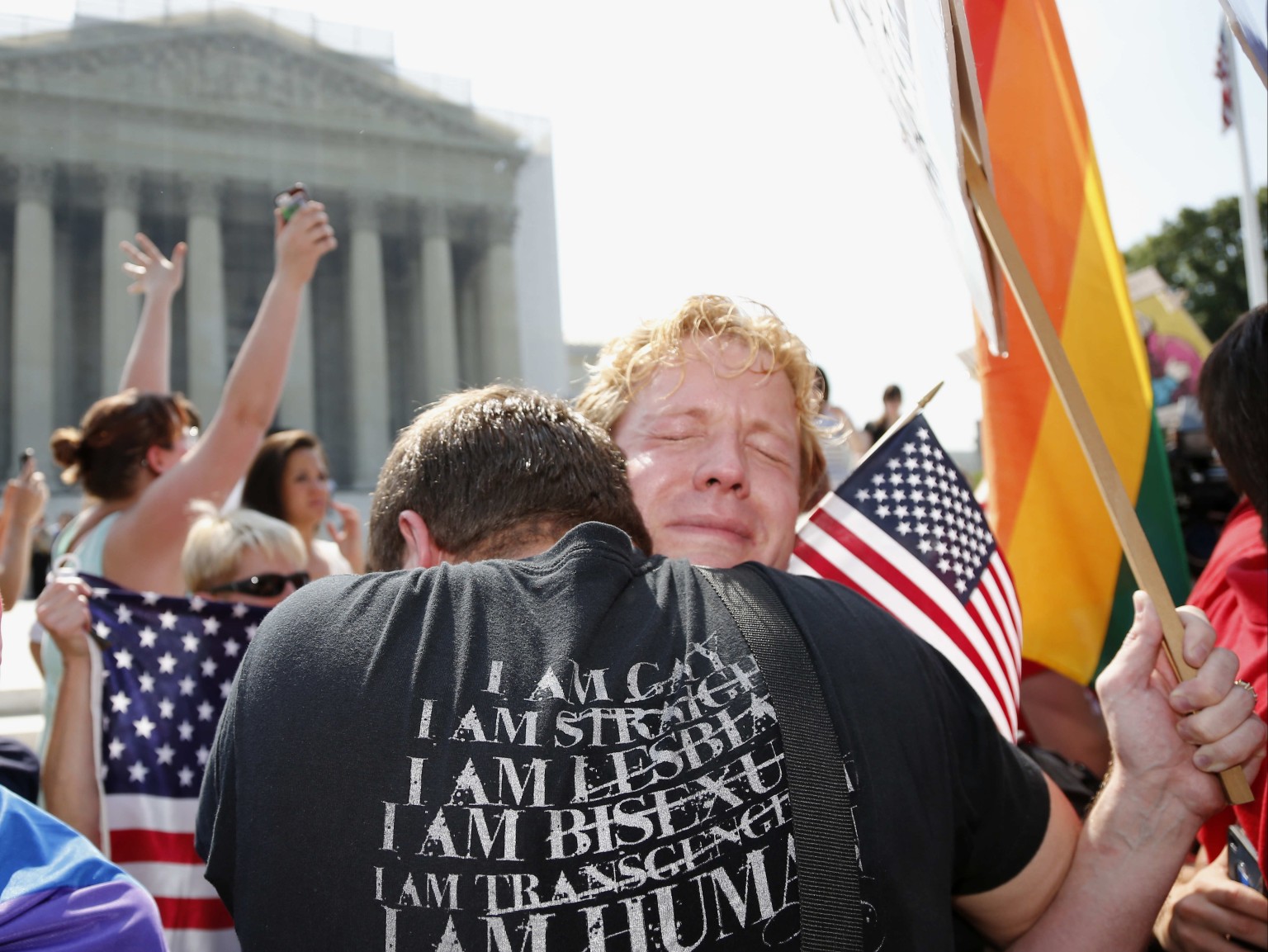
I agree with Sullivan on this, the fact is that Gays like so many others have been the target of state sanctioned religious discrimination throughout history. It is natural that the LGBT community, which has been so hated and discriminated against would want to push hard against those that use religion to attack, demean and marginalize them. But it is important remember that reconciliation and acceptance is a two way street. The actions of the late Nelson Mandela after the fall of Apartheid in South Africa should be a model. Mandela said: “For to be free is not merely to cast off one’s chains, but to live in a way that respects and enhances the freedom of others.”
Unfortunately in Kansas, many religious people, for reasons, some real but many imagined; feel the compelling need to use the power of the law to suppress LGBT people or others that they believe threaten them. In other places religious people attempt to use the police power of the government at the Federal, State and Local level to suppress anything or the activities of anyone they deem to be against God, or rather their interpretation of God.
Though I am not Gay I feel the sting of these laws because although my Church will allow me to marry a Gay couple I cannot in the state that I reside or many others. I know a number of Gay couples that have asked me if I could perform their marriages, but such will have to wait until we can find a time and a place where I can legally perform their nuptials. The sad thing is that in some places like Indiana there are legislators who in defending their religious freedom would criminalize an attempt by me or any other minister performing such an act if they could. Thankfully that amendment to the Indiana Constitution has been pushed back for at least two years.
Their belief compels them to use the law against homosexuals, non-Christian religious minorities, secularists and humanists and attempt to curtail the advances and discoveries of science, archeology and history. I believe that such attempts are short sighted and do violence to the religious beliefs that many espouse. Eric Hoffer wrote in his book The True Believer that “Faith in a holy cause is to a considerable extent a substitute for the lost faith in ourselves.”
The proposed law in Kansas, which looks as if may stall in the State Senate is an evil being enacted to supposedly support the good. Nothing good can come of it, if passed it will poison the hearts and minds of the very people it is supposedly written to protect. It will give them legal right to treat people who are different than them in a way that does not reflect the Gospel, and encourage the worst type of self-righteous behavior, and it will blow back in their face.
The attempt of the Kansas legislature to pass this Bill into law reminds me of something that Spencer Tracy’s character, Henry Drummond said in the film Inherit the Wind:
“I say that you cannot administer a wicked law impartially. You can only destroy, you can only punish. And I warn you, that a wicked law, like cholera, destroys every one it touches. Its upholders as well as its defiers.”
This is a wicked law, and if it is made law it will do great harm to those that is directed against, those who the precedents in it may be used against in the future and those that think that will protect their. It is Orwellian and at its heart it is evil. If it is enacted into law it should be opposed at every opportunity by every person of good will, no matter what their faith, political ideology or sexual preference, because all people have the right to life, liberty and the pursuit of happiness.
Peace
Padre Steve+
Filed under faith, laws and legislation, News and current events
From the Miracle On Ice to the Shootout at Sochi: Drama and Sportsmanship on the Hockey Rink
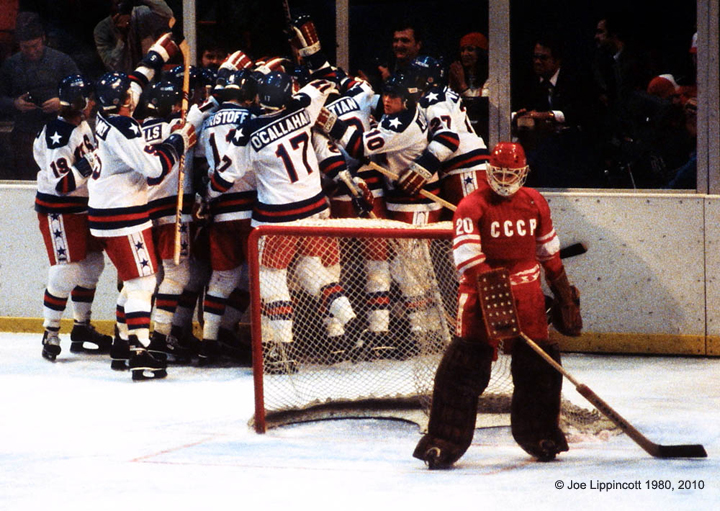
On February 22nd 1980 the impossible took place, a underdog team of American college hockey players defeated the might Soviet Union Team at Lake Placid New York. It was one of the most memorable and legendary moments in sports history.
I cannot forget that day. I had finished work making and rolling pizza dough at Shakey’s Pizza in Stockton, went home and showered. I then got in my 1966 Buick LeSaber 400 to head over to Judy’s house. On my way over I was listening to the music on a local AM radio station when ABC news radio broke in to air final few seconds of the game live. I remember listening as Al Michaels made the famous call:
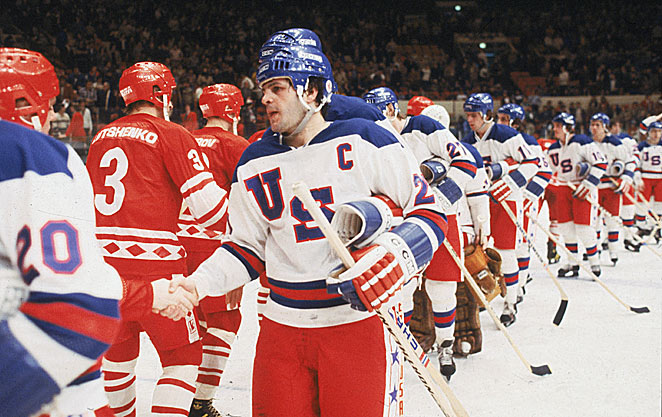
“Eleven seconds, you’ve got ten seconds, the countdown going on right now! Morrow up to Silk. Five seconds left in the game. Do you believe in miracles? YES!”
The last minute of play in the Miracle on Ice: http://www.youtube.com/watch?v=qYscemhnf88 and about ten key minutes of that game. http://www.youtube.com/watch?v=fztlLwgSFCg
I could not believe it. I found that was screaming in the car. As soon as I got to Judy’s I went in and told her and her parents. When the game came on, as it was tape delayed I watched it with undivided attention. To this day I cannot forget that night and as I watch the tapes of that game I am still moved to tears by the emotions that come from it.
The underdog Americans had beaten the vaunted Soviet team 4-3. That team went on to defeat Finland in the Gold medal game 4-2. The next day they were guests at the White House and after that the team broke up. Thirteen of those players went on to NHL careers. Brooks led the 2002 Team USA to a Silver Medal in 2002 before being killed in a car crash in 2003. That Silver Medal was the first medal in Hockey for the US since 1980.

The Soviet people and their news media were stunned by the loss. Though the Soviet Team won Silver by defeating Sweden 9-2 the team had lost its luster. While the Soviet Team remained dominant until the break-up of the Soviet Union in 1990 it was the end of an era. The Soviets who had taken Gold in the four previous Olympics went on to win Olympic Gold in 1984, 1988 and again after the fall of the Soviet Union as the Unified Team in 1992.
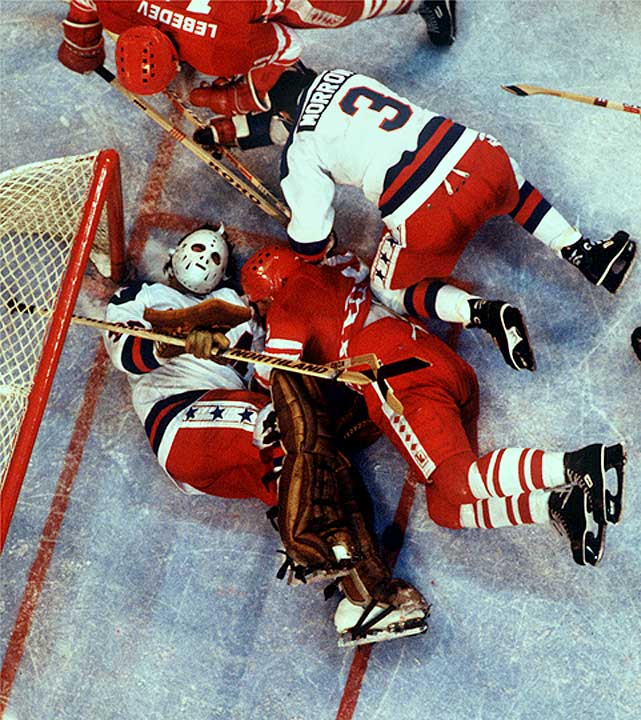
But even so, the upset loss to the young Americans was something that many never really got over. It was not about Cold War politics, it was about pride in their team and their passion for the sport of Hockey. For years many Russians, even after the fall of the Soviet Union longed for Olympic revenge against the Americans.
Los Angeles Times sports columnist Bill Plaschke watched today’s United States versus Russia game at a bar in Sochi with ordinary Russians. His story is well worth the read, but one comment stood out to me in relation to the 1980 game.
“The 1980 game will forever be a scar on my heart,” said 69-year-old Vladimir Makushkin, pausing while carrying his beer from table to table. “Every American knew we were the stronger team. It was students that beat us … young students!”
You can read his article here: http://www.latimes.com/sports/olympics/la-sp-sochi-mens-hockey-plaschke-20140216,0,1790197.column#ixzz2tRThGXrh

Today in Sochi the American and Russian teams met in a first round game. It was different than 1980. These teams are very evenly matched. Many of the players on both teams play together or against each other in the NHL. They are professionals, they are teammates but today they were playing for something different, Olympic Gold.

It was a game of greatness, high drama with the teams being tied as the Third Period ended. A shootout ensued and in the 8th round of the shootout T.J. Oshie scored the deciding goal to give the Americans the win.
For many Russians today’s loss was devastating. But at the same time the fans that Plaschke watched the game with displayed the sportsmanship that one expects of fans that love their team, but also love and respect the game even more than the politics that so often enters into Olympic and other International athletic competitions.

I think that Americans and Russians alike are much more appreciative of each other as well as the shortcomings of our respective governments in post Cold War era. Maybe, just maybe such appreciations will help both of our peoples become closer in the coming years, despite the pressure exerted by the unholy Trinity of Politicians, Pundits and Preachers that is so strong in each of our countries.

Though I was for the American team, I have tremendous respect for the Russians, many of whom I cheer for in the NHL. I am happy that Team USA won, but I will not gloat. It was a tremendous game between tow outstanding teams and the Russians could have won as easily as the Team USA. The Russians and many of the other teams are hugely talented and this tournament could be won by any team. I think that the Canadians probably have the best team in the tournament, but anything can happen.
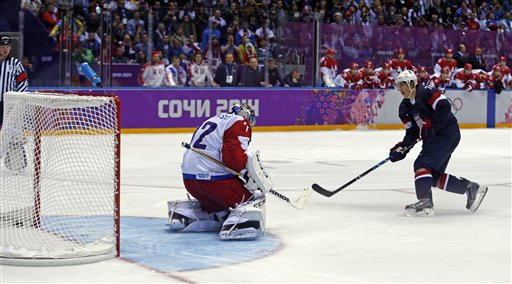
Vladislav Tretyak, who was the starting Goalie for the Soviet squad at Lake Placid and was replaced at the end of the second period with the game tied is often asked about the Miracle on ice. He sees it through the lens of hockey and not politics. He noted: “It was cold above us, but we (the U.S. and Soviet players) always had fine relations… There was none of that, no politics involved.” When asked about the loss he simply says “That’s ice hockey.”
So on that, in the hopes that good sportsmanship, camaraderie and the love of a game can bring better appreciation for each other by Americans and Russians I wish you a good night.
Peace
Padre Steve+
Filed under History, News and current events, sports and life
From the Heart: Padre Steve’s Favorite Songs of Love and Life for Valentine’s Day
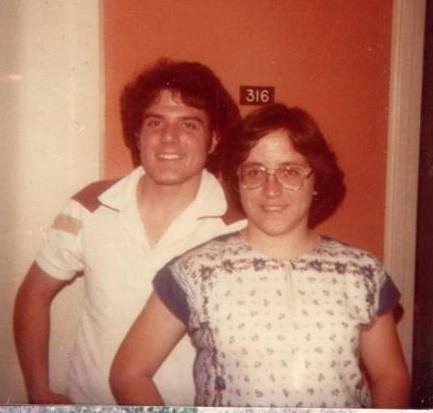
I have spent many Valentine’s Days away from my wife Judy over the course of my military career. Tonight though, for the second time in a row time. I will be with her. Two years ago I was stationed away from her and holding the duty pager for the hospital where I served as the Director of Pastoral Care. I added up the time between when I was mobilized from the Army Reserve in 1996 to support the Bosnia Operation until when I returned from Camp Lejeune in August of 2013 and I figured at we had been apart 10 of 17 years due to military assignments. I am glad I am now on my last active duty assignment before retiring in 2017, and God willing won’t have to spend months or years away from her again.
In all of these times I have loved music. I remember dating Judy and every week bring in new LP albums or pop 45 singles on vinyl back in the late 1970s and early 1980s. Most of the songs were popular on the radio and I would hear them on American Top 40.
I find that music expresses love in ways that I find difficult to do on my own. Perhaps this is because of the fact that I am a historian and not a poet or artist. Here are 25 of my favorites of all time. They are songs that express the emotions of love, love embraced and love requited the joy of love and the agony of losing it.
These are songs that men and women express the feelings of those who have loved, lost and longed for love. They are songs of men and women who sometimes are geographically far away but still close and others that can be sitting next to each other but be as far from each other emotionally and even spiritually as Earth is from the furthest star system in the galaxy.
I think that in my life that many speak to the relationship that I have with the woman that I have loved since the day that I met her back in the late summer of 1978.
It is interested because a number of years later Barry Manilow wrote a song called The Summer of 78 which expresses much of what I felt and still feel about her.
It was one of those summer’s
lasting forever
making the winter wait
a summer of music and passion
the summer of ’78
you appeared like the summer
sudden and perfect
and not a day too late
I swear there was music when I found you
that summer of ’78
it seem we floated through the days
and nights were always filled with stars
and it seemed every song they played on the radio
was ours
it was one of those summer’s
only for lovers
touched by the hand of faith
and now when the winter’s are long
I remember the summer of ’78

I think any compilation of love songs has to begin with Barry Manilow’s“Weekend in New England” http://www.youtube.com/watch?v=olApnMheBW8 I think for me, as a career military man who has spent many years away from my wife, sometimes in harm’s way the questions asked in the song resonate. “When will our eyes meet?” “When can I touch you?” “When will this long journey end and when will I hold you again?” have particular meaning and they are part of the longing that I have.

The Carpenter’s breakthrough hit “Close to You” http://www.youtube.com/watch?v=6inwzOooXRU written by Burt Bacharach is a song that is fitting for the love that many young lovers feel when they first meet. I remember when we first started dating I could hardly stand to be away from Judy. The song is more one of infatuation than actual love, but I think unless we first have that infatuation that love often remains dormant.

Bread’s classic mellow ballad “If” http://www.youtube.com/watch?v=GzgBULcFaLw is a song that expresses an almost eternal nature to love.
Jim Croce’s hit “I’ll Just Have to Say I Love You in a Song” http://www.youtube.com/watch?v=EN1nMpmC0n4 is one that expresses how badly the words often come out when we try to communicate with the one that we love. There are so many times the words that I have said have not come across how I meant them. So much of a relationship that is based on how we communicate that care and love for each other, the lament that “every time I’d try to tell you, the words just came out wrong” can be true for many of us.

England Dan (Dan Seals and John Ford Coley) “I’d Really Love to See You Tonight” http://www.youtube.com/watch?v=jxdsk-cFX-k Sometimes when we love someone we somehow lose contact, or maybe have grown apart emotionally. The song begins with small talk on a phone call and is the words of someone who wants very badly to be together again with the one that he misses.
In a similar vein to “I’d really love to See You Tonight” but perhaps even more heart wrenching is Paul Davis’ “I Go Crazy” http://www.youtube.com/watch?v=_L886mjb0O8 because the woman that he loves is now with someone else and he sings “when I look in your eyes I still go crazy. That old flame comes alive, it starts burning inside…”
All couples sometimes have arguments and sometimes those arguments lead to complete silence and even the break up of a relationship. Sir Cliff Richard’s “We Don’t Talk Anymore” http://www.youtube.com/watch?v=htZir_Taizg is one of those songs where one partner blames the other for the breakup and boldly states that he isn’t losing sleep over the end of the relationship. Not a very good way to go, but a very real feeling for many people in the Lonely Heart’s Club.
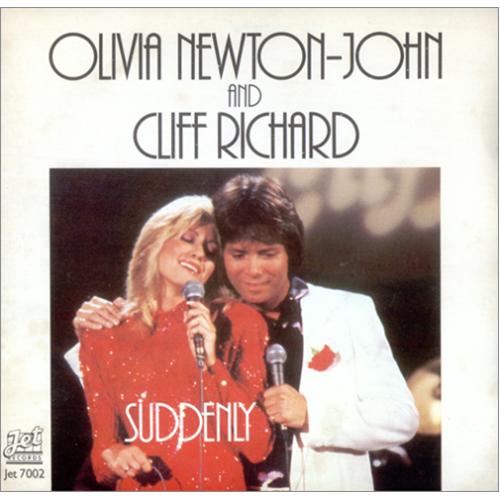
Olivia Newton John and Cliff Richard’s duet “Suddenly” http://www.youtube.com/watch?v=-GxxhjFcngM is a song that is a 180 out from We Don’t Talk Anymore. This song is one that speaks of a deep love and admiration for each of the two people in the relationship that they are willing to do anything and go anywhere to be with one another.
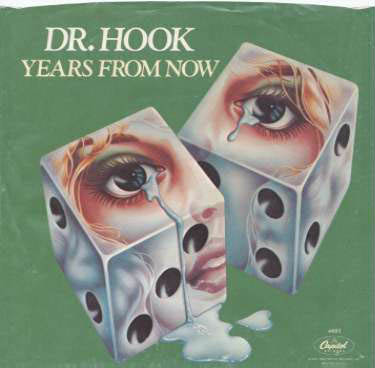
The Dr Hook hit “Years from Now” http://www.youtube.com/watch?v=EfsPeVVL8zE is one that always manages to bring a tear to my eye. It came out about a year after Judy and I started dating and even though it is now well over 30 years since I first heard it I imagined the future, now we are deep into it and I feel the same way. One verse says “I know this world that we live in can be hard, Now and then and it will be again, Many times we’ve been down,Still love has kept us together the flame never dies, When I look in your eyes the future I see.” Since we have gone through many difficult times it is a song that is intensely personal and one that I almost feel that I could have written the lyrics.
David Soul riding high on his success in Starsky and Hutch released “Don’t Give up on Us Baby” http://www.youtube.com/watch?v=YY8APrYU2Gs in 1977. It hit number one in both the US and UK and was his one big hit. It is a song of a man trying to convince a woman that they have a relationship that is more than just one night. “Don’t give up on us, baby, We’re still worth one more try, I know we put a last one by, Just for a rainy evening, When maybe stars are few, Don’t give up on us, I know, We can still come through.”
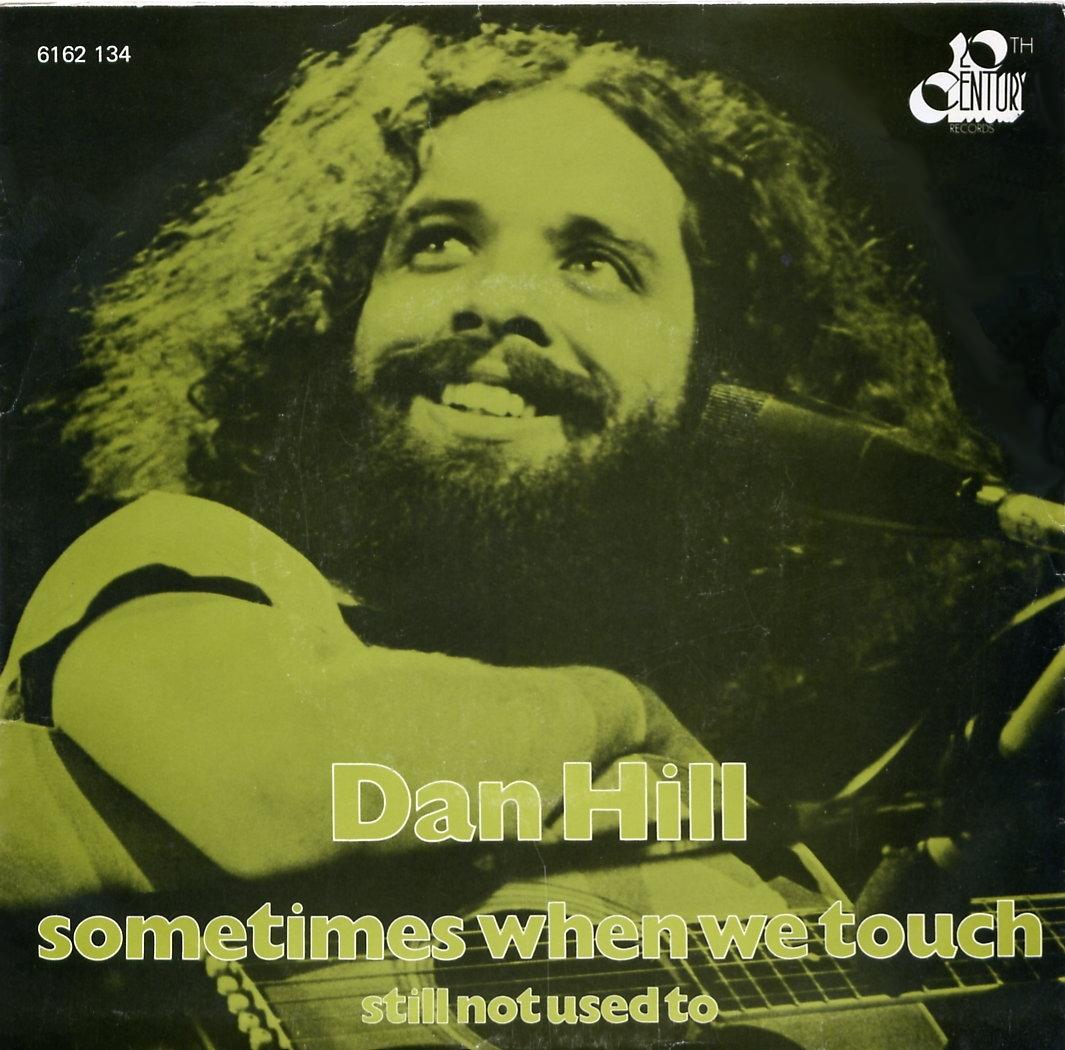
Dan Hill’s “Sometimes When We Touch” http://www.youtube.com/watch?v=-xnyHG96vY8 is a song that means a great deal to both Judy and I. The words are somehow haunting and healing. One verse and the chorus really get to me. “Romance and all its strategy leaves me battlin’ with my pride, But through the insecurity some tenderness survives, I’m just another writer, still trapped within my truth, A hesitant prize fighter, still trapped within my youth. And sometimes when we touch, the honesty’s too much, And I have to close my eyes and hide, I wanna hold you till I die, till we both break down and cry, I wanna hold you till the fear in me subsides.”
Van Morrison wrote “Have I Told You Lately That I Love You” http://www.youtube.com/watch?v=AQ4NAZPi2js in 1989. Recorded and released by Rod Stewart in 1993 it is a song that originally was written as a prayer by Morrison. It is sung at many weddings and it a song that I will stop and listen to whenever I hear it.
The Australian duo Air Supply is known for their mellow love songs and one of them“Two Less Lonely People in the World” http://www.youtube.com/watch?v=RidVsFXE2Y0 is one that I like. Sometimes I think that had I not met Judy that I never would have married. I am quite the introvert and often a loner that prefers the adventure of being independent and adventurous and does not like to be tied down. When my father retired from the Navy in 1974 I thought that my life was over, because we were going to remain in one place. Judy had spent most of her life in one city but I took her away from that because throughout my life I have been afflicted with this wanderlust and spirit of adventure. That being said the fact that we are together means that even though we are often apart that there are still “two less lonely people in the world tonight.”
Meat Loaf’s “I Would do Anything for Love” http://www.youtube.com/watch?v=iOikQWAL8qc from his 1993 Bat Out of Hell Album is one of the big world wide rock power ballads of the past two decades. The focus is probably more on the physical relationship that some of the other songs in this list but it has a resonance because the physical is also a big part of why we fall in love with each other. “As long as the planets are turning, As long as the stars are burning, As long dreams are coming true, You’d better believe it, that I would do, Anything for love, And I’l be there until the final act, I would do anything for love, and I’ll take a vow and seal a pact…”
Elton John’s “Your Song” http://www.youtube.com/watch?v=mTa8U0Wa0q8 is a tender ballad of a musician who has little to give his love except a song.
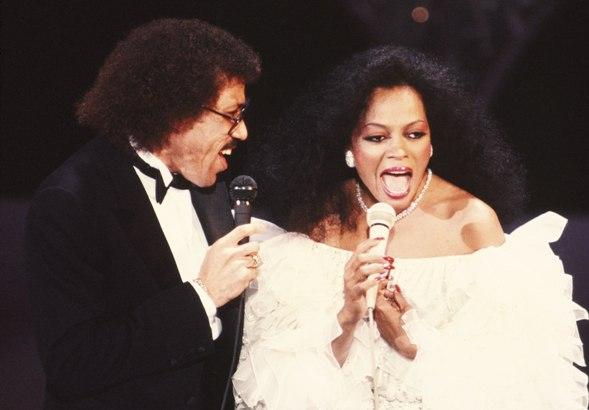
One of the tenderest duets for Valentine’s Day comes from Lionel Richie and Diana Ross, the hit Endless Love http://www.youtube.com/watch?v=MP7m5VqQ6f8 was written for the movie of the same name.
The Bee Gee’s How Deep is Your Love http://www.youtube.com/watch?v=XpqqjU7u5Yc is another tender song of devotion to a love.
Chicago’s “Hard to Say I’m Sorry” http://www.youtube.com/watch?v=wEwNcnklcsk is a song that hits hard at a situation that many couples that love each other find themselves. That is when for whatever reason they find that they need to be away from each other, but the key is that they find their way back.
REO Speedwagon’s “I Can’t Fight this Feeling” http://www.youtube.com/watch?v=dqJK29zsO44 is actually quite good because it is a song that sees a relationship go from a friendship to something more, something that sometimes scares the people involved because somehow we often think that we don’t want to “ruin the friendship.” I really think that any relationship that is meant to be has to begin with friendship and the words in the song “What started out as friendship, Has grown stronger. I only wish I had the strength to let it show” is a reality for so many people.
Anne Murray release a song called Daydream Believer http://www.youtube.com/watch?v=9gN37gEKDrM that had been recorded years before by the Monkees http://www.youtube.com/watch?v=nU615FaODCg , but in 1980 it became one of my favorites as my relationship with Judy began to really develop
Bonnie Tyler’s “It’s a Heartache” http://www.youtube.com/watch?v=h8VGQTtENSs has been recorded and been a hit for Juice Newton and Rod Stewart as well as Tyler. It is a song that speaks of the pain of a broken relationship when one of the people involved is more dependent on the other person than that person is committed to them.
Juice Newton’s “Angel of the Morning” https://www.youtube.com/watch?v=HTzGMEfbnAw is a song that describes the breakup of what may be an illicit love affair. Since a lot of people become involved in such relationships it is a powerful reminder of the pain associated with the end of those relationships.

A similar theme is part of Laura Branigan’s “How am I Supposed to Live Without You” http://www.youtube.com/watch?v=MN6JBTGcr68 though it seems that this song is not about an illicit relationship but the betrayal felt by a person who finds that the one that they love is leaving them. Her son Will You Still Love Me Tomorrow? http://www.youtube.com/watch?v=XSDvFUy4ayk tells the story of a woman wondering if her love will still love her.

I find a lot of commonality with Journey’s power ballad “Faithfully” http://www.youtube.com/watch?v=OMD8hBsA-RI. Written about the love of a couple, one of whom spends his life on the road as a musician and rediscovers his love for his bride. I think that it is a song that any man or woman in the military, or for that matter any other profession that spends much time away from home can relate.
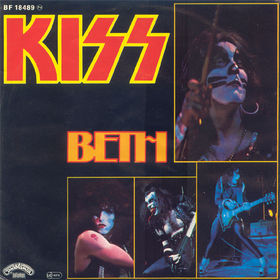
The tender ballad by Kiss “Beth” http://www.youtube.com/watch?v=KbtO_Ayjw0M is a song that I think expresses how many people deal with the tension between what they love and who they love. The song is about a man who promises to come home as soon as he is done playing music with his band and keeps calling back until finally he admits that he will not be coming home that night.

Blondie’s Heart of Glass http://www.youtube.com/watch?v=WGU_4-5RaxU is another song that talks about misplaced love and how many relationships appear to be real but then end with at least one partner hurting and wondering what happened. The Tide is High http://www.youtube.com/watch?v=Bv_mQIZHeHs is Judy’s ringtone on my iPhone, it is about a girl who won’t give up on her love and Dreaming http://www.youtube.com/watch?v=TU3-lS_Gryk is another song of dreams of love.
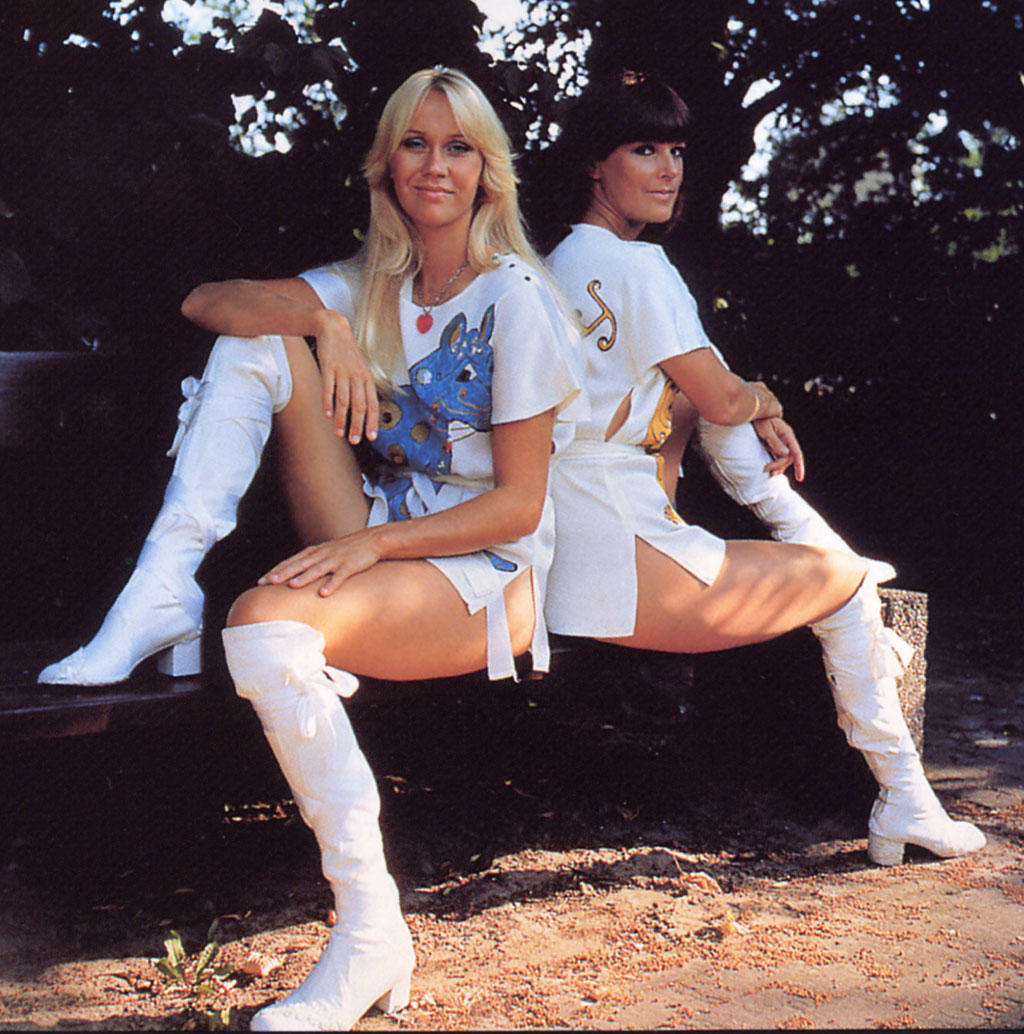
The Swedish super group Abba had numerous songs dealing love, hope, love lost and love found. “One of Us” http://www.youtube.com/watch?v=IIKAe8Wi0S0 is song about a relationship where one partner thinks that they can do better only to find out that they were wrong. The chorus “One of us is crying, One of us is lying, In her lonely bed, Staring at the ceiling, Wishing she was somewhere else instead, One of us is lonely, One of us is only, Waiting for a call, Sorry for herself, feeling stupid feeling small, Wishing she had never left at all….” finds an echo in many of the people that I meet. Their lesser known song, Our Last Summer http://www.youtube.com/watch?v=Z6YqC3D0GMo tells the story of a woman remembering her last summer in Paris with a former lover. Knowing Me Knowing You http://www.youtube.com/watch?v=iUrzicaiRLU tells the story of a breakup as does The Winner Takes it All https://www.youtube.com/watch?v=92cwKCU8Z5c
In the ;late 1970s and early 1980s Kenny Rogers released a number of songs suitable for the Valentine’s Day. She Believes in Me http://www.youtube.com/watch?v=pSPvv2EUdCA is wonderful because it talks of an experience that many young lovers know that of having someone who believes in them and their dreams, even when they wonder. You Decorated My Life http://www.youtube.com/watch?v=uY-CKe4lvwY talks about the difference a love makes in life, while Don’t Fall in Love with a Dreamer http://www.youtube.com/watch?v=JOU4TWGSxZM a duet he sang with singer songwriter Kim Carnes talks about the hazards of falling in love with a dreamer.

Finally there is a song that from the first time I heard it has been a song that speaks to me about my love for Judy. It is a song that like Dr Hook’s Years from Now, is a reminder of how far we have come and how much we have been through; that song is Kenny Rogers’ “Through the Years” http://www.youtube.com/watch?v=TzEwadgcZnQ which was released in 1982, a year before we were married.

So to all of my readers, enjoy the music and have a happy Valentine’s Day.
Peace
Padre Steve+
Filed under Just for fun, marriage and relationships, music
Manstein’s Counter-Stroke: Pulling Victory from Certain Defeat
Friends of Padre Steve’s World, It has been a long and busy day and I am a bit too tired to put anything new out, however here is something that is probably more interesting to the World War II history buffs out there. After the German 6th Army surrendered at Stalingrad the Red Army was advancing and threatening much of Army Group South. The Germans were faced with the potential of a cataclysmic disaster on their front. This is the story of a fortnight in February 1943 where to cool head of a commander and his subordinates that reversed a situation that would have overwhelmed others. This is the story of Manstein’s Counterstroke.
Peace, Padre Steve+

Introduction
After Stalingrad the Soviets followed up on their success and attempted to entrap the rest of Army Group South. Field Marshall von Manstein attempted to save the Army Group and perhaps prevent the Soviets from collapsing the entire German front.
 Manstein planning at the front
Chaos and Peril in the South
As 6th Army died at Stalingrad field Marshall von Manstein was faced with one of the most challenging situations faced by any commander in modern times. He faced strategic and operational “problems of a magnitude and complexity seldom paralleled in history.”[i] Manstein had to deal with a complex military situation where he had minimal forces to counter the moves of a superior enemy force that was threatening to entrap all German forces in southern Russia. Additionally Manstein had to deal with the “Hitler’s obstinate opposition to a maneuver defense and a Red Army flushed with the…
View original post 5,601 more words
Filed under Loose thoughts and musings
The Orangeburg Massacre and the Uncertain Memory of Justice Clarence Thomas
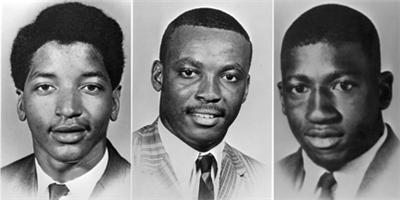
Last February, Supreme Court Justice Clarence Thomas lamented the “race consciousness” and “sensitivity” as compared to growing up in Savannah Georgia in the 1960s.
If he were not in a position of nearly unlimited power and influence where he can through a legal opinion overturn established laws regarding voters rights, equal opportunity and discrimination it would be laughable. However, Justice Thomas seems to have missed so much of what was happening to African Americans and others during the Jim Crow Era, the campaigns for resistance in the “segregation forever” movement and the wanton violence used on African Americans who simply wanted the same rights that other Americans enjoyed.
How a man as educated and supposedly aware as Thomas supposedly is can make such an absurd statement is beyond me. In fact it is ludicrous and speaks volumes about how Thomas would willingly cover up the gross injustices that were perpetrated against African-Americans.

The brutality of those in power against those who demonstrated and campaigned for civil rights was widespread. If Thomas did not hear about it in his childhood it was more likely that it was because Blacks had no voice in local or state government, no support in the local media and those who spoke out were brutalized, their homes, churches or businesses burned or or bombed, and for their trouble many went to jail. It took extraordinarily courageous men and women to stand up to the tyranny perpetrated by politicians, police, businessmen, and even church leaders at the local and State level, which were often directly connected to the activities of the Ku Klux Klan in many parts of the South.
Thomas said that he was treated worse by the Northeastern Liberal Elites, than he was in his home town. That may be so, racial prejudice was not unique to the South, in fact some of the worst riots against desegregation occurred in Boston, not far from Thomas’ college Alma mater. In fact in some Northern cities racism and discrimination were as bad than in parts of the South.
Likewise there were incidents of violence in Watts California by the Los Angeles Police Department that helped trigger the Watts Riots. That being said, there can be no doubt that in terms of organized systemic discrimination, persecution, and violence, it was in the South where Blacks suffered the gravest injustice. The South was the unparalleled hotbed of resistance to change, and resistance to the simple desire of people to receive equal treatment under the law.
Today, even many whites remember some of those incidents; the burning of the Freedom Riders bus in Anniston Alabama, the baring of James Meredith from the University of Mississippi, the 16th Street Baptist Church Bombing in which four little girls going to Sunday School were murdered, the brutal attacks on protestors in that same city that sent Dr Martin Luther King to jail, the murder of Medgar Evers, the murder of the Mississippi Civil Rights Workers, Bloody Sunday on the Edmund Pettus Bridge in Selma Alabama, and the assassination of Martin Luther King Jr.
We all know about those, well at least some of us do. They all occurred early in my lifetime and certainly if Thomas didn’t know about them as a child, he most certainly knows about them now.But the good Justice willingly chooses to ignore and treat them if they never happened, to Thomas, those were the “good ole days.”
But such an attitude denies history. It is inexcusable for any man or woman, of any race holding such an important position as Thomas to have, that of a Supreme Court Justice to hold such ahistoric and racist views. For man like Thomas, who in his office helps to make and interpret law that affects the civil rights of all Americans it is unconscionable. But then, I do not believe that Thomas has a conscience.

But for each of those incidents there were many more, some very bloody which have been forgotten. I was reminded of one of those last year when a speaker talked about an incident that occurred at his alma mater, South Carolina State University in Orangeburg South Carolina, the Orangeburg Massacre. I think I had read about it once, but I had forgotten about it.
The massacre occurred on February 8th 1968 when students at the college began to protest for equal access to local businesses, especially at the only bowling alley in town, the All Star Lanes. The owner refused to allow Blacks to patronize his establishment. In the days leading up to the massacre students were beaten by police as they engaged in peaceful protests.

Protests continued on campus, hundreds of police and state troopers were dispatched as well as armored vehicles from the National Guard. On campus about 200 students milled around a dying bonfire.

During a protest the local and state police opened fire on a crowed of students at a bonfire. Contrary to the claims of the police no student was armed, three students were killed, and twenty seven wounded. Many were shot in the back. The dead included a college Army ROTC Cadet named Henry Smith, another, a member of the college football team, Samuel Hammond who died reciting the 23rd Psalm with his mother at his side, and lastly the young Delano Middleton, a local high school student who had joined the protest.

J. Edgar Hoover ordered agents to make false statements to Justice Department officials to cover for the State Troopers involved. When nine of the police officers went to trial for excessive use of force all were acquitted. But how could they be? Evidence was suppressed, false statements made and testimony of the victims discounted.

For years the subject was covered up, and disinformation spread by elected and police officials, including the governor who blamed the protest on outside “Black Power agitators” and who claimed that the protest took place off campus. Activist Cleveland Sellers was convicted of “inciting a riot” and spent seven months in jail. Twenty five years later he was pardoned. It was not until 2001 that a Governor, then Jim Hodges attended the school’s annual memorial and it was not until 2005 when then Governor Mark Sanford made a formal apology for the massacre.

The massacre received almost no coverage in the national media and was forgotten. The energy of most Americans was focused on the Vietnam War, the Kent State Shootings and the assassination of Dr Martin Luther King Jr.

Justice Thomas may have historical amnesia, but history is history, even history that those in power desired to cover up.

History and justice, even belated justice matter because there are those in our country, not all in the South, who would like to roll back the protections that exist in law to protect African Americans and other minorities from institutional discrimination in matters of voters rights and equality. There are business owners who openly boast of their refusal to serve minorities, and are hailed by some for doing so.
I encourage my readers to explore this subject, the book, The Orangeburg Massacre by Jack Bass and Jack Nelson published by Mercer University Press, a number of websites as well as a video that I have provided a link to here http://www.democracynow.org/2008/4/3/1968_forty_years_later_a_look are good places to start.
Like Montgomery, Birmingham, Anniston, Memphis and Selma, Orangeburg though forgotten by most, still matters. Never forget and do not let it happen again.
Peace
Padre Steve+
Filed under civil rights, History, News and current events
What Do You Say When You’re Not Sure? An Essay on Doubt

“Doubt can be a bond as powerful and sustaining as certainty. When you are lost, you are not alone.”
I am watching the movie Doubt tonight. It was a movie that came out when I was deployed to Iraq. I never had seen it before tonight. I purchased it after the death of the lead actor, Phillip Seymour Hoffman, when a friend of mine from my former denomination posted a remembrance about one of the scenes from this film. It was the sermon about gossip. That moved me, so after reading more about the film I purchased it. However, I was not prepared for the opening scene where Hoffman’s character in his homily speaks about doubt.
http://www.youtube.com/watch?v=YOSxGuUuvQY
http://www.youtube.com/watch?v=1OwpGUI-TAI
“Last year, when President Kennedy was assassinated, who among us did not experience the most profound disorientation? Despair? Which way? What now? What do I say to my kids? What do I tell myself? It was a time of people sitting together, bound together by a common feeling of hopelessness. But think of that! Your bond with your fellow being was your Despair. It was a public experience. It was awful, but we were in it together. How much worse is it then for the lone man, the lone woman, stricken by a private calamity?
‘No one knows I’m sick.’
‘No one knows I’ve lost my last real friend.’
‘No one knows I’ve done something wrong.’
Imagine the isolation. Now you see the world as through a window. On one side of the glass: happy, untroubled people, and on the other side: you.
I want to tell you a story. A cargo ship sank one night. It caught fire and went down. And only this one sailor survived. He found a lifeboat, rigged a sail…and being of a nautical discipline…turned his eyes to the Heavens and read the stars. He set a course for his home, and exhausted, fell asleep. Clouds rolled in. And for the next twenty nights, he could no longer see the stars. He thought he was on course, but there was no way to be certain. And as the days rolled on, and the sailor wasted away, he began to have doubts. Had he set his course right? Was he still going on towards his home? Or was he horribly lost… and doomed to a terrible death? No way to know. The message of the constellations – had he imagined it because of his desperate circumstance? Or had he seen truth once… and now had to hold on to it without further reassurance? There are those of you in church today who know exactly the crisis of faith I describe. And I want to say to you: doubt can be a bond as powerful and sustaining as certainty. When you are lost, you are not alone.
In the name of the Father, the Son, and the Holy Ghost.”
Since Iraq I have experienced much doubt related to my experiences there, PTSD and Moral Injury. For nearly two years I experienced such a crisis of faith that for all practical intent I was an agnostic, praying to a God that I wasn’t sure existed hoping that there was a God.
When I watched that opening scene, as well as many others I found that I was reduced to tears, uncontrollable, they flooded me. The actors in the film, Hoffman, Meryl Streep, Amy Adams and Viola Davis, brought a power to their performances that made it so real, and powerful. It has been a long time since a film affected me like this, perhaps the last two were We Were Soldiers and Taking Chance, both of which related directly to my military experiences.
The writing of the screenplay, adapted to from a play by John Patrick Shanley,in part based on growing up in a small Catholic School run by the Sisters of Charity. I found it fascinating because of the mystery involved in the story, there is so much uncertainty in the story, a Priest who may be doing something wrong, a Nun who has no proof but is determined to drive him out, young Sister who in her innocence wants to believe the best about both the Priest and her superior, and a mother who just wants her son to survive, despite the abuse of his father and the racial prejudice of the community.
For me the film stuck on two levels, one my logical, suspicious and oft judgmental spirit, and my desire to want to believe the best about people, even me. It is a tension that I live with on a daily basis. In a way I could understand all three of the major characters.
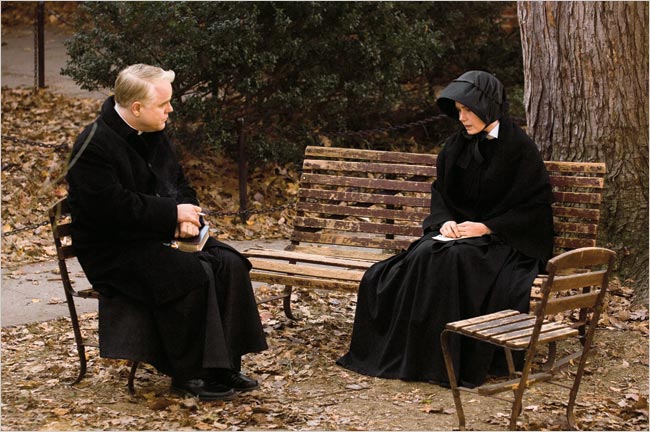
There is a scene where Father Flynn (Hoffman) talks with Sister James (Adams) and he tells her:
“There are people who go after your humanity, Sister, that tell you that the light in your heart is a weakness. Don’t believe it. It’s an old tactic of cruel people to kill kindness in the name of virtue.”
I understand it, because I am both, I am the one who believes the best but is also able to see the same “light” in others as weakness. The juxtaposition was quite stunning, and took me by surprise and perhaps was part of my emotional response to the film.
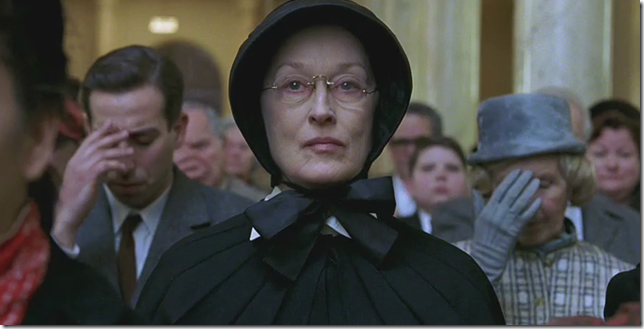
Another thing that made the film especially pertinent to me were the people, and the parts of the Catholic Church they represented. The Priest played by Hoffman was a man who really believed in the reforms of the Second Vatican Council, like so many Priests who helped me along my way. The Sisters, played by Streep and Adams were from the Sisters of Charity, founded by Saint Elizabeth Ann Seton and headquartered in Emmittsburg Maryland. There was a sister that I met at that location, when I was stationed at Fort Indiantown Gap when I was still an Army Chaplain. Sister Cornelia Colgan, touched my life in a special way and I am sure is still offering prayers for me from heaven. She passed a way an number of years ago, but for about 5 years between 1997 and 2002 we maintained a close correspondence until deployments and war intervened and we lost contact. I still have a couple of mementos that she gave me and I remember her fondly.
http://www.youtube.com/watch?v=1OwpGUI-TAI
At an emotional level the sermons and words of Father Flynn and the final words of the film spoken by Sister Aloysius (Streep) speak to where I am still at in my faith. I believe, but I have such doubt.
Likewise there is a sense of aloneness, that still sometimes haunts me, despite close friendships and relationships. There are many times that I felt that I was alone when I returned from Iraq in 2008, but I have discovered that there are many like me. Some of them like Sister Aloysius who despite her certitude also doubts, having not really gotten over her own grief and loss.
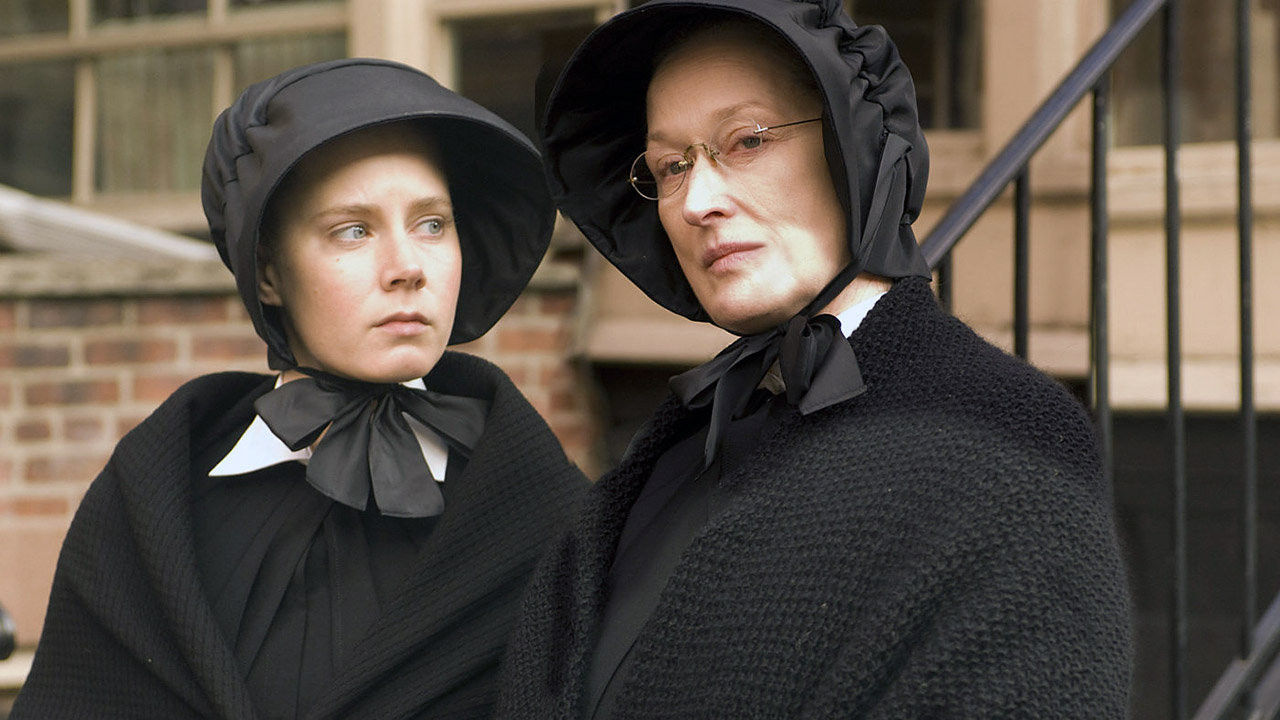
At the end of the film there is a touching scene, Sister Aloysius has succeeded in forcing Father Flynn out of the Parish and Sister James approaches her in the garden and a conversation ensues. Aloysius is alone, and appears quite vulnerable. Crying she admits to Sister James: “I have doubts. I have such doubts.”
http://www.youtube.com/watch?v=TAOUtgdcjik
I think that is reality for anyone who honestly wrestles with faith. I know that it is for me, for doubt reminds me that I am not alone.
Peace
Padre Steve+
Filed under christian life, faith, film, Religion
The Gettysburg Campaign: Lee Decides to Go on the Offensive
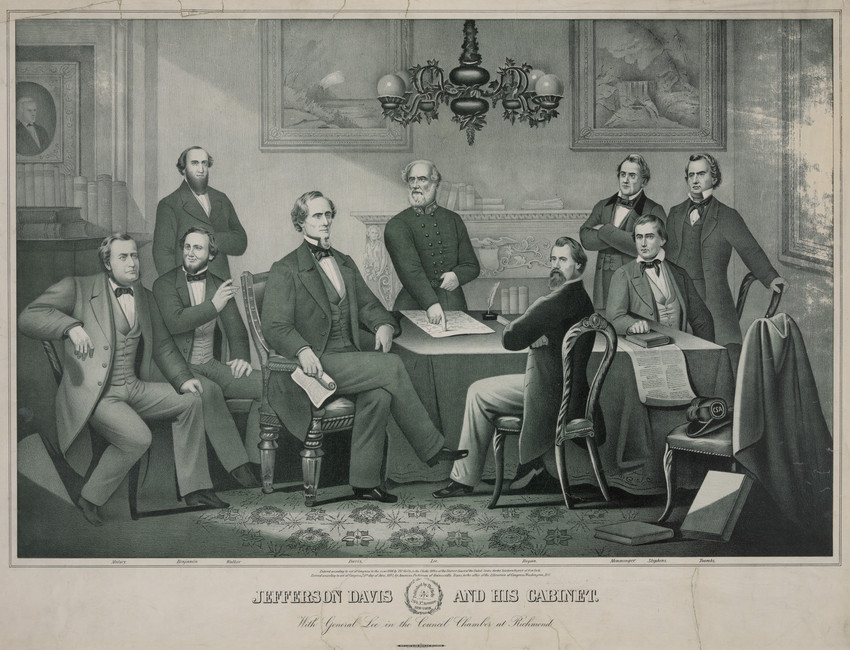
I am preparing to lead a Staff Ride of our students to Gettysburg in early March. As part of my preparation I am doing a lot of study to refresh myself on both the campaign and the battle, not only as an operational study, but at the strategic level. This short essay deals with Lee’s decision to invade the North following his victory at Chancellorsville. I will follow it up with other articles the next talking about the Northern strategy at both the strategic and operational levels.
In early May 1863 General Robert E. Lee, commanding the Army of Northern Virginia realized that the Confederacy was in desperate straits. Despite numerous victories against heavy odds, Lee knew that time was running out. Though he had beaten the Army of the Potomac under General Joseph Hooker at Chancellorsville, he had not destroyed it and that Army, along with a smaller force commanded by General Dix in Hampton Roads still threatened Richmond.
The strategic situation was bad, even if many Confederate politicians realized it or cared in the post Chancellorsville euphoria. In the west the strategic river city of Vicksburg Mississippi was threatened by the Army of Union General Ulysses S Grant, and Naval forces under the command of Admiral David Farragut. If Vicksburg fell the Union would control the entire Mississippi and cut the Confederacy in two. Union forces also maintained a strong presence in the areas of the Virginia Tidewater and the coastal areas of the Carolinas, while in Tennessee a Union Army was stalemated, but still threatening Chattanooga, the gateway to the Deep South. The blockade of the United States Navy had crippled the already tenuous economy of the Confederacy.
Some Confederate leaders realized the danger presented by Grant in the West. Secretary of War James Seddon recognized the danger in the Winter of 1862-1863 both suggested to Lee that he detach significant units to relieve the pressure in the west and blunt Grant’s advance. Lee would have nothing of it, he argued that the war would be won in the East. It was his view that if Virginia was lost, so was the Confederacy, and was concerned that whatever units left behind should he dispatch troops from his Army west, would be unable to defend Richmond.
On May 14th Lee travelled by train to Richmond to meet with President Jefferson Davis and War Secretary James Seddon. At the meeting Lee argued for an offensive campaign in the east, to take the war to Pennsylvania. Lee had two goals three major goals, two which were directly related to the immediate military situation and one which went to the broader strategic situation. Unfortunately no notes from that conference are known to survive.
Lee had long believed that an offensive into the North was necessary, even before Chancellorsville. Lee did not believe that reinforcing the Confederate Armies in the West would provide any real relief, instead he believed that his Army, flush with victory needed to be reinforced and allowed to advance into Pennsylvania. Lee’s Chief of Staff Colonel Charles Marshall crafted a series of courses of action designed to present the invasion option as the only feasible alternative. Although both Seddon and Davis had reservations about the plan they agreed to it, unfortunately for all of them they never really settled the important goals of the campaign.
Lee believed that his offensive would relieve Grant’s pressure on Pemberton’s Army at Vicksburg. Likewise Lee believed that if he was successful in battle and defeated the Army of the Potomac in Pennsylvania that it could give the peace party in the North to bring pressure on the Lincoln Administration to end the war. He also believed that if he could spend a summer campaign season in the North, living off of Union foodstuffs and shipping booty back to the Confederacy that it would give farmers in Northern Virginia a season to harvest crops unimpeded by major military operations.
However, the meeting evidently did not have all the results that Lee desired. Davis refused Lee reinforcements from the coastal Carolinas, and insisted on units being left to cover Richmond in case General Dix advanced on Richmond from Hampton Roads. Much of this was due to political pressure as well as the personal animus that existed between General D. H. Hill in the Carolinas towards Lee.
Likewise Lee’s decision revealed an unresolved issue in Confederate Grand Strategy. Many in the Confederacy realized that the only hope for success was to fight a defensive campaign that made Union victory so expensive that eventually Lincoln’s government would fall or be forced to negotiate.
However, Lee was convinced that ultimate victory could only be achieved by decisively defeating and destroying Federal military might. His letters are full of references to crush, defeat or destroy Union forces opposing him. His strategy of the offensive was demonstrated on numerous occasions in 1862 and early 1863, however it was unfeasible and counterproductive to Southern strategy. His offensive operations cost his Army dearly in the one commodity that the South could not replace, nor keep pace with its Northern adversary, his men.
When Lee fought defensive actions on ground of his choosing, like a Fredericksburg he was not only successful but husbanded his strength. However, when he went on the offensive in almost every case he lost between 15 and 22 percent of his strength, and the percentage of soldiers that he lost was always more than his Federal counterparts, even when his army inflicted greater aggregate casualties on his opponents. Lee recognized this as was evident in his correspondence but it did not deter his strategy of the offensive until after his defeat at Gettysburg.
The course of action was decided upon, but one has to ask if Lee’s decision was wise decision at a strategic point level, not simply the operational or tactical level where many Civil War students are comfortable. General Longstreet’s artillery commander, Colonel Porter Alexander described the appropriate strategy of the South well, he wrote:
“When the South entered upon war with a power so immensely her superior in men & money, & all the wealth of modern resources in machinery and the transportation appliances by land & sea, she could entertain but one single hope of final success. That was, that the desperation of her resistance would finally exact from her adversary such a price in blood & treasure as to exhaust the enthusiasm of its population for the objects of the war. We could not hope to conquer her. Our one chance was to wear her out.” (Edward Porter Alexander, Fighting for the Confederacy: The Personal Recollections of General Edward Porter Alexander, ed. Gary W. Gallagher, University of North Carolina Press, Chapel Hill NC, 1989 p.415
What Alexander describes is the same type of strategy successfully employed by Washington and his more able officers during the American Revolution, Wellington’s campaign on the Iberian Peninsula against Napoleon’s armies, and that of General Giap against the French and Americans in Vietnam. It was not a strategy that completely avoided offensive actions, but saved them for the right moment when victory could be obtained.
It is my belief that Lee erred in invading the North for the simple fact that the risks far outweighed the possible benefits. It was a long shot and Lee was a gambler, audacious possibly to a fault. His decision to go North also exhibited a certain amount of hubris as he did not believe that his army could be beaten, even when it was outnumbered. Likewise he took the offensive in spite of the fact that many of his commanders were untested at the levels of command that they exercised. He had lost his right arm, General Stonewall Jackson, who died following being wounded at Gettysburg.
He knew from his previous battles the heavy casualties that even a victory over the Army of the Potomac would entail deep in Northern territory and the effect that a costly victory would have on his operations, but he still took the risk. That was short sighted and diametrically opposed to the strategy that the South needed to pursue in order to gain its independence. Of course some will disagree, but I am comfortable in my assertion that it was a mistake that greatly affected the Confederacy’s only real means of securing its independence, the breaking of the will of the Union by making victory so costly that it would not be worth the cost.
Peace
Padre Steve+
Filed under civil war, History, leadership, Military
God With Us? The Misuse of God’s Promise by Political Partisans
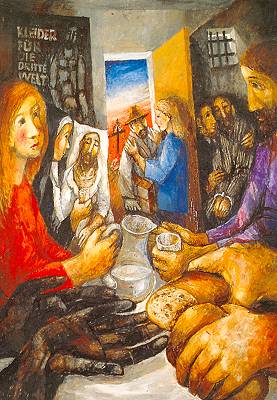
It is one of the most amazing stories of salvation history. The Incarnation of God in Jesus the Christ. Matthew’s Gospel (Ch 1 v.24), referring back to the words of Isaiah delivers the message in words which find their way into our culture every Christmas through Georg Friedrich Handel’s Messiah: “Behold, the virgin shall conceive and bear a son, and they shall call his name Emmanuel, ‘God with us.’”
That message, which lays at the heart of the Christian Gospel is really amazing. It is a message that points to a Gospel meant for all people and not any particular nation, nor any political, racial, or ethnic group that wishes to appropriate it for themselves alone.
It is the message of the humility and grace of God. It is the message God humbling himself to become incarnate and not only live among his creation, but to suffer and die for the salvation of it. All of it. As Paul wrote so well in his epistle to the Philippians:
“Let the same mind be in you that was in Christ Jesus, who, though he was in the form of God, did not regard equality with God as something to be exploited, but emptied himself, taking the form of a slave, being born in human likeness. And being found in human form, he humbled himself and became obedient to the point of death– even death on a cross.” (Phil 2:5-7)
Unfortunately that message is all too often appropriated and twisted into something unrecognizable by those who seek to use it to bolster their particular ideology, nationalism or even racism. In practice, human beings are much more likely to claim this message to bolster their own hatred and intolerance or justify their nation’s desire for conquest. It matters not if the a Christian in any sense of the word or not. One sees the same idea floated by zealots of almost every major religion. The appeal to being on the same side of God trumps all other arguments.
As a historian I have studied this often. In the United States it is encompassed in the idea of Manifest Destiny; but can be seen in the life and history of many nations who in their belief that God was on their side have slaughtered hundreds of millions of people. One does not have to look far to see leaders of nations, political factions, ideologues or other fanatics appropriate God as the trump card of their message. However, it is not just a matter for history. It happens every day, and it is not pretty. Many use it to justify the most reprehensible crimes, persecution, ethnic cleansing and even genocide. They do so all in the name of God, preaching that God is with them, and not those who they despise.
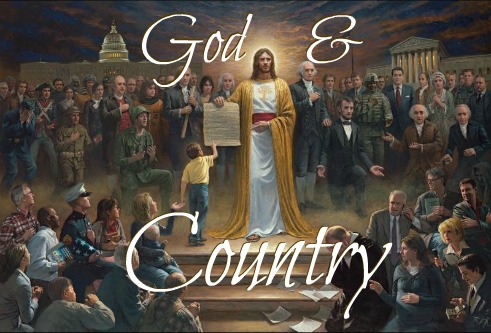
Today I saw a blog on a service that I use to promote my website. The author of the blog promotes an extremely conservative political ideology with most of his posts being directed with some vehemence, often colored by blatant racism at President Obama and others that he does not agree with. Usually his posts are filled with such hyperbole and nonsense that I simply ignore them. However, today he posted something that as a Christian really bothered me. His post was titled Do Not Fear, God is With Us, and it featured the picture shown above. When I saw it, I felt a chill run down my spine. It was as if I was envisioning the virulent hatred of other races, creeds and nations exhibited by those who have claimed that mantle before. I can see it now, a belt-buckle with a Swastika, ringed in the words “Gott Mit Uns.”
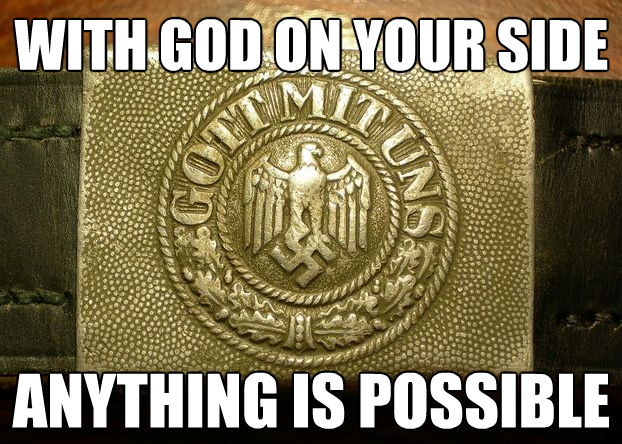
The sad thing is that the Christians who claim this mantle misuse scripture and twist it to justify their hatred of all that they disagree with, have lost sight of the Gospel. Instead they have allowed their passionate hatred and prejudice to hijack the message of the Gospel to promote political partisanship, hyper nationalism and xenophobia. This can hardly be called Christian. If such ideas were was limited to the fringe of society it would not be so concerning. However, this blogger represents a significant portion of the American electorate; and his comments are echoed by the very powerful, and allegedly Christian leaders of partisan political organizations, as well as pundits, politicians and preachers. If you do not agree with them you are not a real American.
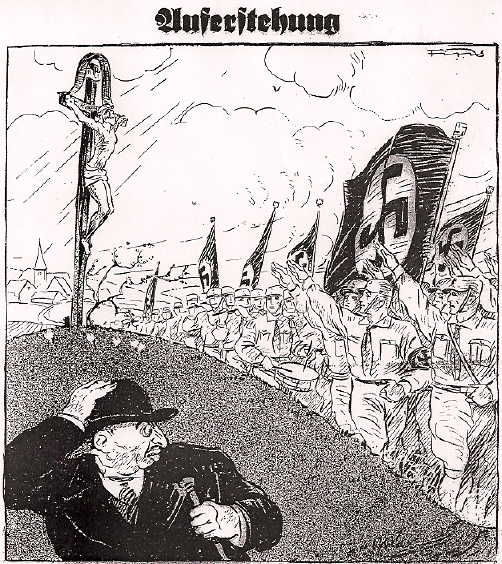
Cartoon from the Nazi Der Sturmer linking the Nazi Movement to Christ, with the Jew being the villain
Instead of seeing the message of God’s grace, love and mercy for all people, we see triumphalist Christians that claim that God is with them. In their zeal they ride roughshod over others, and despise all who disagree with or oppose them. Their opponents are painted as being in league with the Devil, modern Judas Iscariots. In their lives and ideology many Christians follow leaders who espouse brutal doctrines of Social Darwinism and sell their birthright for a pittance. They attempt to use of the police power of government at every level against those that they disapprove, in matters of faith, lifestyle or politics. Likewise they have no compunction about using the military and economic power of the nation to crush weaker nations, all because they believe that they and their country have God on their side.
But do such sentiments have any place in the message of Christians? I think not. As Paul the Apostle notes: if in Christ “there is no longer Jew or Greek, there is no longer slave or free, there is no longer male and female; for all of you are one in Christ Jesus.” (Gal 3:28) Or as Paul writes in 2 Corinthians “in Christ God was reconciling the world to himself, not counting their trespasses against them, and entrusting the message of reconciliation to us.” (2 Cor 5: 19)
The Gospel is not about God being on the side of any nation or political ideology. Such ideas always end in disaster for those that believe them, and who use God to justify their actions.
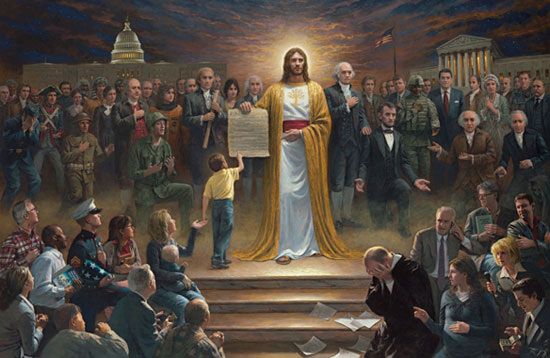
McNoughton’s “One Nation under God”
The picture on the website that triggered this little article is one by a Mormon artist, John McNoughton. McNoughton has frequently blended the image of Jesus with the most banal appeal to American “patriotism” and crude attacks on President Obama. In this picture as well as others the artist has Jesus holding a copy of the Constitution of the United States in his right hand, with his friends on that side, and his foes, including judges, others viewed as liberals and women. In his more crass attacks on the President in other paintings he shows Obama trampling the Constitution while white people are bound in chains. All of these show up with startling frequency on supposedly Christian websites.

US Political Cartoon from 1896
The sad truth is that McNoughton is not the first to practice this crude form of xenophobic patriotism, which appeals to God in order to vilify the opponents of their ideology. It has been used in this country before, as well as in Europe to vilify Jews, racial minorities and political opponents.
Yes, I do believe that God is with us, however, that is not confused with appeals to my patriotism, which is real and has led me to serve this nation for over 30 years in the military including two combat tours in the Middle East. Nor does it add or detract from my support of our Constitution, why does not mention God once, despite its guarantee of religious freedom for all, not just Christians. It is an amazing document, one that I will die to defend, but it is not handed down by God, and Jesus never referred to it.
Instead, my belief that God is with us flows from the mystery of the Incarnation, that miracle of salvation history. I believe in the message wonderfully referred to in the liturgy as the “mystery of faith,” that Christ has died, Christ is risen and Christ will come again. My belief flows from the simple message that for God so loved the world… and not that God so established this or any other nation or political ideology as his own.
I understand the fear that drives men like the blogger who posted the article I saw, as well as men like McNoughton. Their fear of the other allows them to use these images to promote their hopelessly confused faith and ideology. Dietrich Bonhoeffer who saw the same fear and hatred present among his fellow Germans, especially German Christians wrote:
“The Christian must treat his enemy as a brother, and requite his hostility with love. His behavior must be determined not by the way others treat him, but by the treatment he himself receives from Jesus; it has only one source, and that is the will of Jesus.”
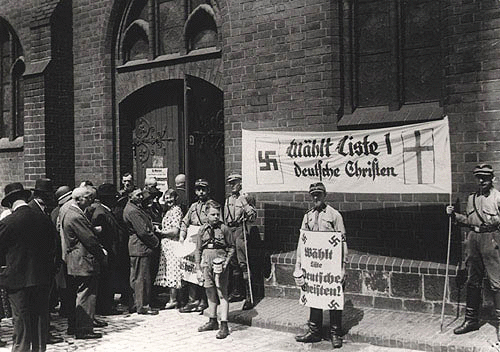
What I see from the present political ideologues has nothing to do with love of God or our neighbor, but their efforts to protect their status in society, their political power and subject all others to their will.
God is with us indeed, in the humility of a borrowed manger, on the gibbet of a Roman cross, and in shame of a borrowed tomb. God is really present with us in the the bread and wine, in the word, and in the lives of his people; especially the least, the lost and the lonely. To attempt to crudely use God to buttress any earthy power is heresy. Those that use it in such a manner, though proclaiming their fealty to Christ, or any other God, willingly trample the message of the God who humbled himself, even to death on a cross.
Peace
Padre Steve+
Filed under christian life, faith, Political Commentary, Religion
The Long and Slow Integration of the Major Leagues: A Reflection on Desegregation and Spring Training
Friends of Padre Steve’s World. Pitchers and catchers are reporting to Spring Training as they always do this time of year, by the end of the week the rest of the players will report. This year American and Canadian players, white, black, hispanic and asian will report, along with men from other nations, men who speak different languages, hail from different cultures and are of races that in 1946 would have not been allowed at Spring Training. It is hard to believe now, but in 1947 when Branch Rickey brought Jackie Robinson to the Dodgers minor league camp. In 1948 when Robinson reported he was being groomed by Rickey to be the first African American to play in the Major Leagues. That was a major step, but it took years before every team in the Major Leagues integrated despite a plethora of talent in the Negro Leagues and coming up in the integrated Minor Leagues. The last team to integrate was the Boston Red Sox, whose first Black player, Shortstop Pumpsie Green did not debut until July of 1959. During those eleven intervening years Jim Crow still ruled the South, Rosa Parks refused to go to the back of the Bus, young Emmett Till was brutally murdered, President Eisenhower sent in Federal Troops to Little rock to intervene and help the nine African American High School students entering the formerly all-white Central High School. Martin Luther King Jr, Charles Steele and Fred Shuttlesworth established the Southern Christian Leadership Conference, which brought organization and an ethic of non-violence in civil disobedience protests against segregation, discrimination and Jim Crow laws. But the tide was turning and the men who integrated the Major Leagues did much to speed the process of destroying Jim Crow, and promoting civil rights, not just for African Americans, but for all Americans. Of course there is still much to do, racism and discrimination still exist. That being said, I am always amazed when I meet the pioneers of the Negro Leagues who dis so much to break the color barrier in Baseball and in society at large. Peace, Padre Steve+

John Jorgensen, Pee Wee Reese, Ed Stanky and Jackie Robinson on opening day 1947
“Thomas Jefferson, when he wrote the Declaration, made proper provision for baseball when he declared that ‘all men are, and of right out to be, free and equal.’ That’s why they are at the ball game, banker and bricklayer, lawyer and common laborer.” – Baseball magazine (1921)
“Baseball should be taken seriously by the colored player — and in this effort of his great ability will open the avenue in the near future wherein he may walk hand in hand with the opposite race in the greatest of all American games — baseball.” Ossie Davis

Charles Thomas
It was in 1903 when Branch Rickey, then a coach for the Ohio Wesleyan University baseball team had to console his star player, Charles Thomas when a hotel in South Bend Indiana refused him a room because he was…
View original post 1,686 more words
Filed under Loose thoughts and musings

 The Inglorius Padre Steve's World