Author Archives: padresteve

padresteve's avatar

About padresteve

I'm a Navy Chaplain and Old Catholic Priest

Military Ethics, Legality and Morality: The Damage Being Caused by the Emphasis on STEM to the Detriment of the Humanities in Military Officer Programs

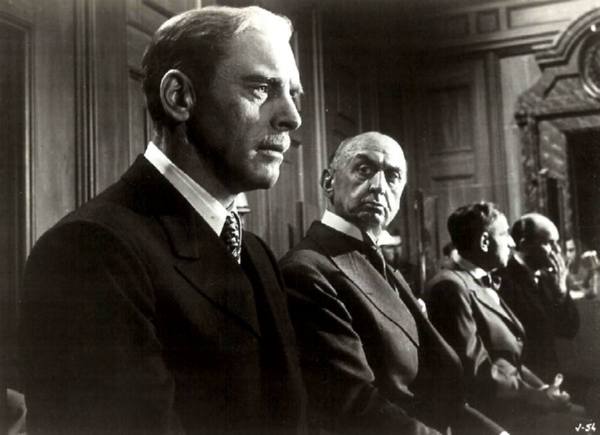
photo-jugement-a-nuremberg-judgment-at-nuremberg-1961-1

“We have been silent witnesses of evil deeds: we have been drenched by many storms; we have learnt the arts of equivocation and pretense; experience has made us suspicious of others and kept us from being truthful and open; intolerable conflicts have worn us down and even made us cynical. Are we still of any use?” Dietrich Bonhoeffer 

I have lost count of the number of scandals regarding the ethical failures of American military leaders. Today at lunch I was talking with a gentleman in charge of the military outreach for a local university where I am considering beginning a Ph.D. program in Organizational Leadership.

There are many reasons given for the these ethical failures, everything from the disintegration or the nuclear family, to the lack of religious upbringing, to the supposedly liberal educational system. However, while I think some of these issues may have some impact, I am not convinced that they are the root cause of the ethics crisis that seems to be plaguing the military.

As we discussed aspects of the program the subject got to the subject of military leaders being fired for ethical, legal and moral lapses. This is something that I am giving much though since I am now teaching ethics at a senior level military staff college. What I am noticing is that many officers struggle with basic concepts regarding history, philosophy, ethics, political science, religion, the arts and literature and other subjects that because I immerse myself in them just assume that any military professional should know.

But that is not the case. For the last thirty to forty years the commissioning programs of our services have given preference to those in the STEM, Science, Technology, Engineering and Mathematics fields. In fact the probability is that the liberal arts or social science major will not be admitted to service academy or ROTC program, even a non-scholarship program unless they are in a STEM major. This is especially true of my own service, the Navy and the Air Force but is not absent from the Army and the Marine Corps.

This is not new. In 1981 I joined Army ROTC because the Navy told me that even to be a non-scholarship student in the program I would have to change my major from history to a STEM major.

This is not simply a military issue, but it is a systemic issue in higher American education programs, programs which due to the demands of the business and technology sectors have gutted liberal arts programs and the social sciences. All of this has been done in the name of making sure that people are “prepared for jobs” and that education is related directly to employability and again jobs. That is why in large part for profit schools have proliferated offering programs focused on narrow job fields in technical majors. This has impacted higher education in public and private universities which at one time had thriving liberal arts, humanities and social science programs as well as the military where the emphasis on STEM has created havoc in terms of ethics.

Dietrich Bonhoeffer wrote:

“The ‘polymath’ had already died out by the close of the eighteenth century, and in the following century intensive education replaced extensive, so that by the end of it the specialist had evolved. The consequence is that today everyone is a mere technician, even the artist…”

Education is now viewed by most as a pathway to a better job, not a quest for understanding, knowledge or even personal improvement. That attitude is enmeshed in our culture and has been for decades. It even shows up in seminaries where programs are not focused in the classics and timeless subjects in theology, history, philosophy, ethics, languages and hermeneutics but instead methods of “growing” a church or running a program. When I was in seminary, a large conservative evangelical seminary many students complained about having to take classes that had nothing to do with running their church. Many of my fellow students despised Church History, Ethics, Philosophy of Religion, and even Systematic Theology and then complained that the courses that were oriented to running a church would be out of date in a few years.

The common theme whether this be in the for profit schools, the public and private universities, the military and seminaries is that we have trained two generations of people to be good technicians and technocrats. Men and women very skilled at getting at job done but that lack the basic ethical and moral grounding that those in previous generations received as part of their education, in the home, in their religious institutions and in the educational system.

The problem is that when you strip away a solid grounding in the arts, liberal arts and social sciences you breed people who may be very good at getting a job done. However they are people who lack the knowledge passed on by people who have shaped civilization for millennia.  They are ignorant of Hammurabi, Moses, Plato, Cicero, Aristotle, Marcus Aurelius, Thomas Aquinas, the great philosophers and thinkers from the East and the West, those who brought about the Reformation, the Renaissance and the Enlightenment and even the Scientific and Industrial Revolutions, Universal Suffrage, Emancipation and Civil Rights.

Their technical education divorces them from those that developed the legal, ethical and moral codes of our culture. They lack the cohesive understanding of social responsibility and connection that have held western civilization together. Those have been replaced by ethics that are dominated by pragmatism or utilitarianism, even in seminaries where classes on ethics or moral theology are often relegated to elective status. How else can we explain the wholesale disintegration of moral and ethical codes of behavior across the vocational spectrum be it business, government, the military or religious institutions?

The question for many people, and maybe most people in our society, including the military is not what is moral or ethical but what is “legal,” and what are the loopholes in the law that allow one to escape the consequences of their immoral, illegal or unethical behavior.

We have raised at least two, maybe three generations of technicians and technocrats, and that trend shows no sign of abating. In North Carolina last year the Republican Governor proposed eliminating tuition assistance from any program not directly related to “jobs.” By that he meant eliminating such assistance from non-STEM programs.

What this does, and I think we are seeing this today is produces people who are good at doing jobs, but have a difficult time in critical thinking or looking at the logical consequences of their ideas and actions.

Many cannot see the moral or ethical dimensions of life and even turn religion to an exercise designed to benefit them in a tangible material way. Thus there is a proliferation of churches that preach some kind of “prosperity Gospel” and those that pervert religion and use it to suppress the freedoms of others by force of law.

But let me return to the military implications of my thesis. What I have observed in my career of over 30 years of military service is a culture that has developed in an ethical vacuum. We have sought to inculcate a service culture based on Army, Navy, Air Force or Marine Corps “values” such as “honor, courage and commitment.” However, for many maybe even most those are mere words. They are shibboleths akin to religious creeds recited by people for whom they are irrelevant because they are not job related.

Now this is not an attack on those in the military, for those in the military simply reflect the culture that they come from. This includes the family, religious, social and educational systems of our society. In fact I actually believe that for the most part people in the military do a better job with values, ethics and morality than many in the civilian society. That being said there is something seriously wrong in what we are doing. If there wasn’t there would not be so many egregious lapses that call the moral fitness of senior military leadership into question.

This is especially important because the trust of the nation is invested in these men and women. The responsibilities that they have regarding the lives of people, the security of the nation and the maintenance, security and use of powerful weapons, including nuclear weapons and information technology that can be used to pry into the private lives of unknowing citizens all dictate that the ethical and moral standards of the military have to be above those found in the private sector.

Unfortunately there is no immediate “fix” for the problem because it it so systemically rooted in our society. However something will have to be done, the Chairman of the Joint Chiefs of Staff and Secretary of Defense have directed the military redouble its emphasis on teaching ethics at every level. However it is my opinion that we will have to go far beyond the recitation of creeds and repetition of words about “values” that have little relevance to people educated and brought up to simply do a job. This will be a difficult task, especially in military organizations being reduced in number while still engaged in war and increasing other operations around the world.

As to the broader societal issues, those run deep, but one thing in my mind is certain, there has to be a renewed emphasis on the humanities, liberal arts and social sciences to include the classics of western and world literature, art, philosophy, history and thought. We cannot reduce education to technical elements that require little in the way of critical thought, or for that matter provide people with “education” that does not force them to deal with the dark areas of life that are uncomfortable and the gray areas that fill our universe.

In the Second World War many of the best and brightest of young German intellectuals joined the SS and its sister organizations, organizing and executing the extermination of the Jews and others in Germany and occupied lands. Most of these men did not give their actions a second thought. They were doing their jobs, most of the time in a very dispassionate matter. They carried out orders because they were “legal.” Ethics and morality were no concern simply because they were sworn to obey orders.

The task to change this cannot be that of the military and its leadership alone. If we fail to change our education systems, our home life and even our religious life we will unleash the greatest generation of amoral technocrats who have ever walked the face of the earth. They will be men and women who will have no problem committing the greatest crimes, simply because they are “legal” and because they have only been taught to do their job.

Peace

Padre Steve+

5 Comments

Filed under ethics, leadership, Military, News and current events, philosophy

The Gettysburg Campaign: Lee Moves North, the Battle of Brandy Station, Stuart’s Ride and the Relief of Fighting Joe Hooker

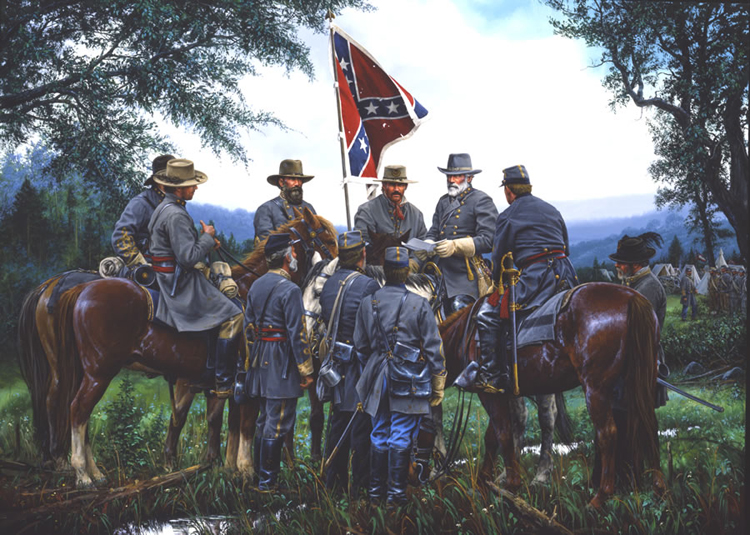
on-to-gettysburg-900L

Lee with his Commanders at Williamsport 

Note: This is another of my preparations for for the Gettysburg Staff Ride that I will be conducting with students from the Staff College that I teach. 

On June 3rd 1863 Robert E Lee began to move his units west, away from Fredericksburg to begin his campaign to take the war to the North. He began his exfiltration moving Second Corps under Richard Ewell and First Corps under James Longstreet west. Initially he left A.P. Hill’s Third Corps at Fredericksburg to guard against any sudden advance by Hooker’s Army of the Potomac toward Richmond.

Once it was ascertained that Hooker was not making for Richmond, Hill’s Corps followed and on June 7th all three Corps were reunited at Culpepper. Lee’s movement did not go unnoticed, Hooker’s aerial observers detected the move, but Hooker after throwing pontoon bridges across the river and discovering that Hill’s troops were firmly entrenched made no move to pursue. He asked permission to advance on Richmond but was order not to cross the river, lest his army be exposed and destroyed by a thrust at its rear

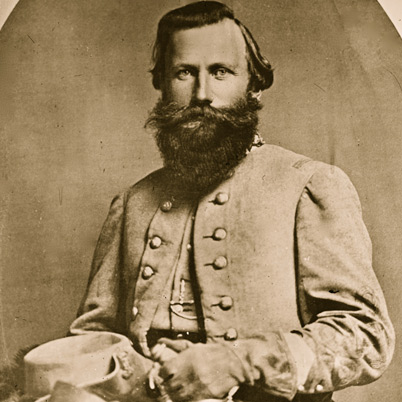
CWP015

General J.E.B. Stuart 

Meanwhile, J.E.B. Stuart and his Cavalry Corps had been at Brandy Station near Culpepper for two weeks. On the 5th Stuart staged a grand review of five of his brigades which included a mock charge against the guns of his horse artillery. According to witnesses it was a spectacular event, so realist that during the final charge some women fainted.

As Lee made his move Hooker attempted to ascertain Lee’s intentions. With Lee moving west he asked Lincoln for permission to advance on Richmond, which was denied. Lincoln did not believe that Hooker could take Richmond and believed that if he did it would leave the logistics train of Army of the Potomac as well as Washington exposed to Lee.

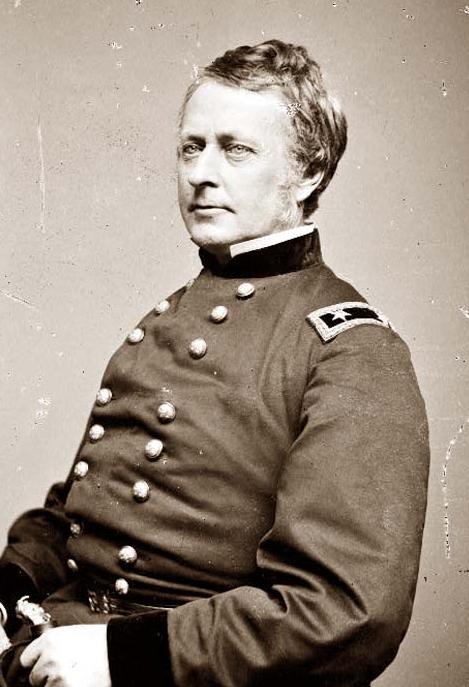
General-Hooker-002

Major General Joseph Hooker 

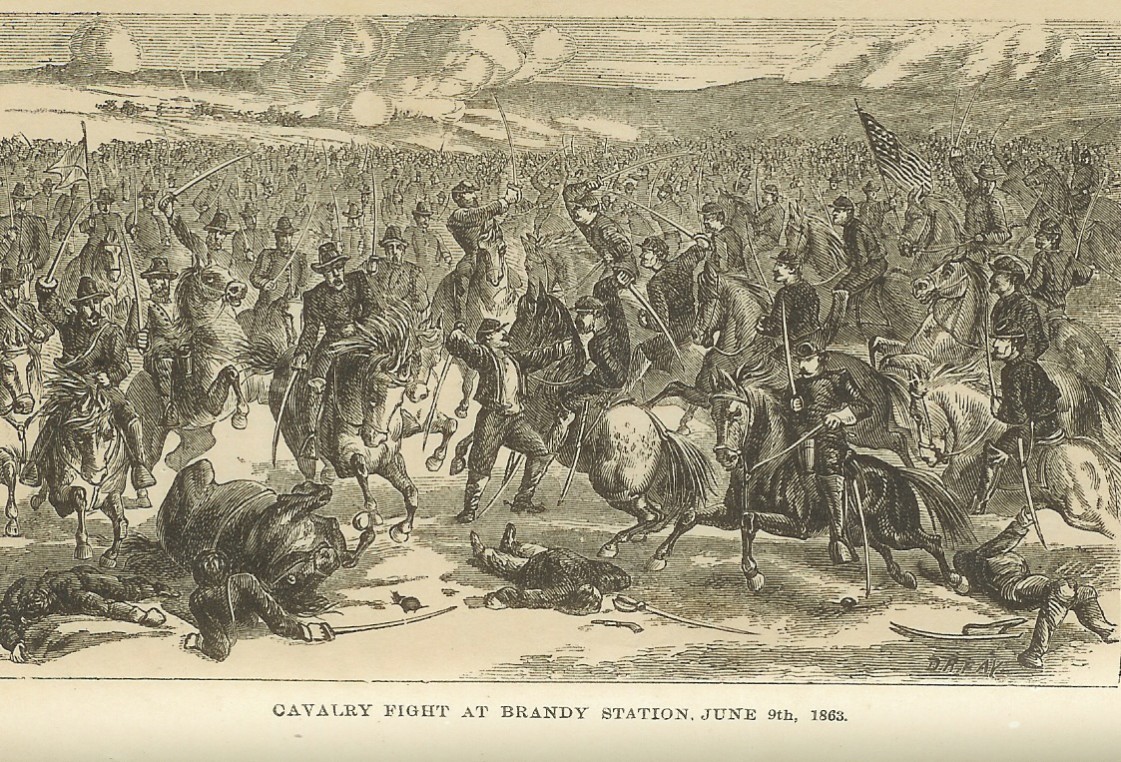
Hooker believed that Stuart’s intent was to disrupt his logistics and communications. He ordered his Cavalry Corps Commander, Major General Alfred Pleasanton to attack Stuart.  On June 9th Pleasanton’s forces, now reorganized under three aggressive division commanders, John Buford, David Gregg and Judson Kilpatrick and reinforced by two brigades of infantry surprised Stuart at Brandy Station.

Cav Fight at Brandy Station

The resultant action was the largest cavalry engagement of the war. Over 20,000 troopers engaged in an inconclusive see-saw battle that lasted most of the day. Stuart claimed victory as he maintained control of the battlefield and inflicted more casualties than his forces incurred.  But the battle was more significant than the number of casualties inflicted or who controlled the battlefield at the end of the day. For the first time Stuart had been surprised by an aggressively led Union Cavalry force.  The Union troopers fought a stubborn and fierce battle and retired in good order. Stuart did not appreciate it but the battle was a watershed, it ended the previous dominance of the Confederate Cavalry arm. It was something that in less than a years’ time would cost him his life.

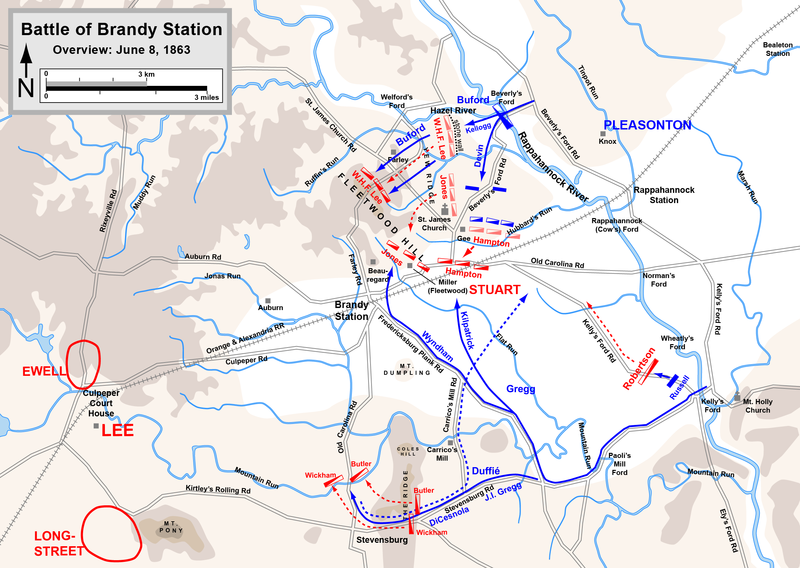
800px-Brandy_Station_Overview

The Battle of Brandy Station (Map by Hal Jespersen, http://www.posix.com/CW)

However, Stuart’s repulse of Pleasanton’s force did enable Lee’s Army to continue north undetected by Hooker. Ewell’s Corps entered the Shenandoah Valley and defeated a Union force at Winchester on June 14th.  Then with the rest of the Army following he moved to Williamsport Maryland where he called a halt to allow the rest of his corps and the army to come up.

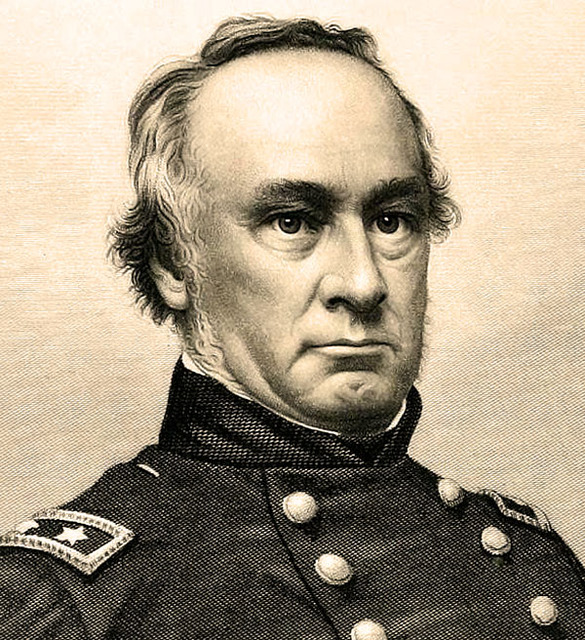
HD_halleckHW4.preview

Major General Henry Halleck 

Hooker was slow to appreciate what Lee was doing. Prodded by Lincoln Hooker moved the Army of the Potomac to a position where it could defend Washington in case Lee was to make a thrust at the Federal capitol. In a series of fierce cavalry clashes west of Washington, Stuart successfully kept the Federal cavalry from discerning the movements of Lee’s Army.

Lee’s initial move to break contact with the Federal Army and keep his movements and intentions secret was an excellent example of deception. Stuart’s success at screening Lee’s movements contributed to Federal confusion. Lee’s deception was so successful that Pleasanton believed that Lee’s objective was Pittsburgh, far to the west. Even when Hooker determined that the bulk of Lee’s infantry was in the Shenandoah he was not certain if Lee would move east toward Baltimore and Washington west or would Lee continue up the valley into Pennsylvania.  

But at this point Lee then made the first of a number of mistakes that would characterize his campaign.  The most grievous of these in my view was his inability to get his commanders to understand his intent. The necessity of subordinate commanders understanding the intent of their superior is essential to the success of any military operation. Lee failed to do this a number of times.

After Stuart recovered from the surprise at Brandy Station Lee gave Stuart permission to move the bulk of his cavalry into the Federal rear.  Lee instructed Stuart that once he determined that Hooker was moving to pursue that Stuart must return to guard Ewell’s flank. However, Lee did not insist on this and left the decision in Stuart’s hands.  When Stuart discovered the Army of the Potomac stationary near Manassas he suggested to Lee that he lead his force around the Federal Army to deceive Hooker as to Lee’s intentions. Lee agreed but told Stuart to maintain close observance of the Federal Army.

Unfortunately his orders left Stuart much in the way of interpretation. He wrote:

You will, however be able to judge whether you can pass around their army without hindrance, doing all the damage that you can, and cross the river east of the mountains. In either case you must move on and feel the right of Ewell’s troops, collecting information, provisions etc.”  Lee added, “Be watchful and circumspect in all your movements.” 

Lee expected Stuart to do this, but his lack of clarity and vagueness allowed to Stuart interpret the order in a manner that benefited him, as he had been stung by criticism of his conduct of the Battle of Brandy Station in the Southern press. For Stuart this was a chance to regain the limelight and add to his luster. He decided to move independently and continue his ride around the Army of the Potomac. It was the last time that Lee had contact with Stuart until the end of the second day of the battle at Gettysburg. Stuart’s absence was critical for it left Lee blind as to the whereabouts of Hooker’s Army or any other threats.

Historians have long wondered why Lee allowed and why Stuart conducted an operation that left Lee blind and had no obvious advantages. Stephen W Sears notes in his book Gettysburg that: “The very concept of Stuart’s expedition was fueled by overconfidence and misjudgment at the highest command level. As soldier-historian Porter Alexander judged the matter, “We took unnecessary risk, which was bad war, & the only bad war too, I think, in all our tactics.” (i)

Lee also took little notice of the events occurring to the west. The siege of Vicksburg was entering its final weeks and with it the hopes of the Confederacy, but Lee was convinced that the war had to be won in the east and quickly.

Lee had no idea that the man directing the campaign against that city, Ulysses S Grant would become his nemesis in less than a years’ time. While Lee had an understanding of all the men who had commanded the armies that he faced, Grant was a man that he never really understood.

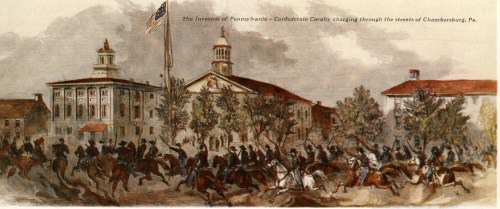
As Vicksburg withered and Stuart dithered Lee continued to move north with his Army, crossing into Maryland. By June 24th Ewell’s lead division was near Chambersburg with orders to advance on the Susquehanna and Harrisburg

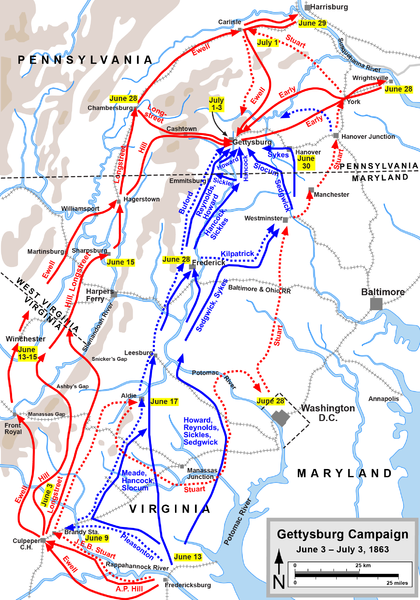
420px-Gettysburg_Campaign

The Gettysburg Campaign (Map by Hal Jespersen, http://www.posix.com/cw)

As Lee moved north Hooker attempted to convince Lincoln to attack Richmond, but Lincoln did not believe that the Confederate capitol was the key to victory. Lincoln denied Hooker’s request giving the following instruction:

“I think Lee’s army, not Richmond is your true objective point. If he comes toward the Upper Potomac, follow on his flank and on his inside track, shortening your line whilst he lengthens his. Fight him too when the opportunity offers. If he stays where he is, fret him, fret him and fret him.”

Hooker was upset by the constant directives from Lincoln and General Henry Halleck, the General in Chief of the Union Armies. Hooker complained to Lincoln in a letter which seemed to infer that he wanted Lincoln to remove Halleck from his position. On June 15th Lincoln responded:

“To remove all misunderstanding I now place you in the strict military relation to General Halleck of a commander of one of the armies to the general-in-chief of all of the armies. I have not intended differently, but as it seems to be differently understood I shall direct him to give you orders and for you to obey him.”

With that order Lincoln did something that he had not done in relation to the Army of the Potomac since the beginning of the war.  For the first time he enforced unity of command and stopped the commander of that army from directly appealing to him. Lee had tired of commanders such as McClellan and Hooker demanding absolute control of the Army and the war. This time it was Hooker that advocated having “one commander for all the troops whose operations which can have influence on General Lee’s operations.” Lincoln agreed and ensured that Hooker would not be that man.

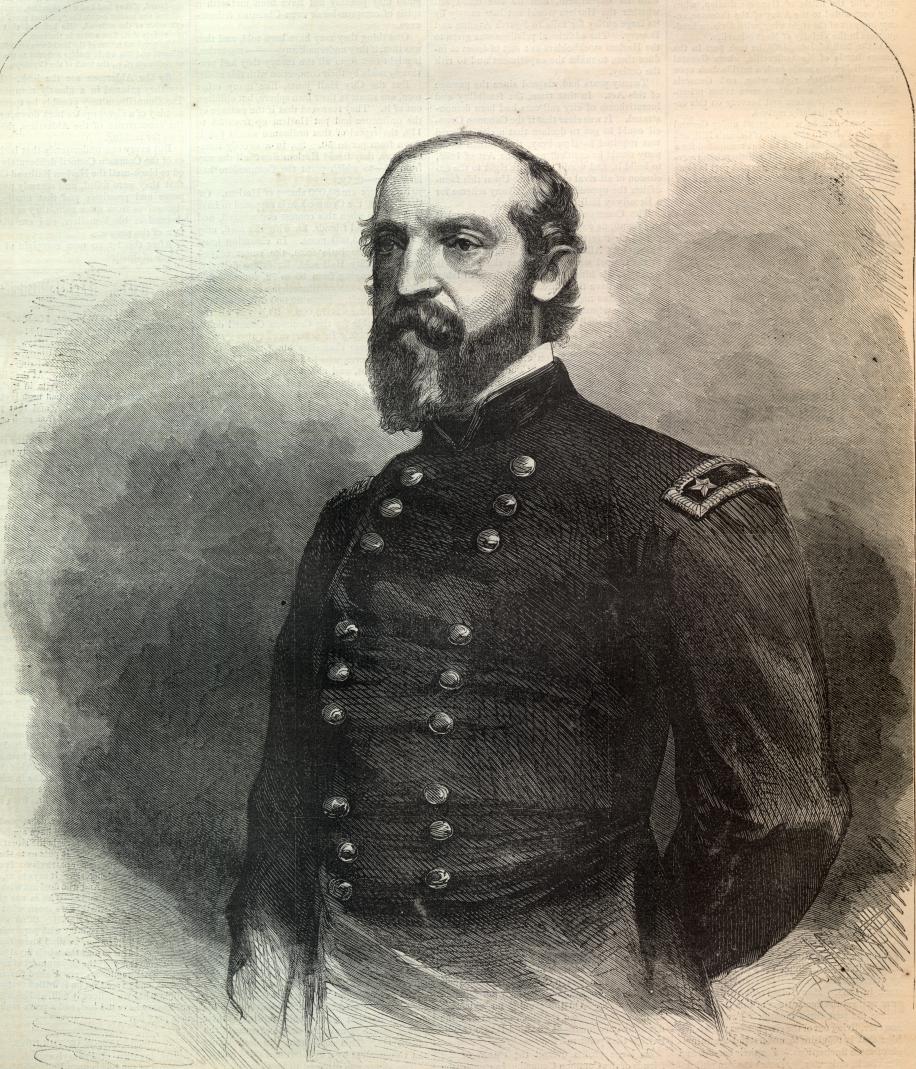
Neither Lincoln nor Halleck agreed to give Hooker the authority that he demanded.  Lincoln insisted that Hooker obey the orders of Halleck, a man who Hooker despised. The final straw came on June 27th when Hooker demanded that the garrison of Harper’s Ferry be withdrawn and placed under his command. When this was refused he tendered his resignation as commander of the Army of the Potomac. Halleck forwarded that request to Lincoln and promptly sent an order via his Assistant Adjutant General, Colonel James Hardie relieving Hooker of command, simultaneously appointing Major General George Meade, commander of V Corps as the new commander of the army.

june16jenkinscav

By now the movements of Confederate forces deep into Maryland and Pennsylvania gave Lincoln and Halleck the information that they needed about Lee’s movements. Lee’s army was moving toward Harrisburg and the Susquehanna. On the day of Hooker’s relief Lee had no idea that the Union army had already crossed the Potomac, the absence of Stuart had left him blind.

general-george-meade

Major General George Meade 

To this point a number of issues important to those involved in planning campaigns became clear: Deception, commander’s intent and unity of command. Lee successfully used deception to prevent the Federals from discerning his purposes. That was balanced by his lack of clarity in communicating his intent to Stuart. Finally there was the principle of unity of command for the Union forces, something that had eluded Lincoln and his lieutenants throughout the first two years of the war.

All that said, I am going to leave you hanging for the night.

Peace

Padre Steve+


i. Sears, Stephen W. Gettysburg, Mariner Books, Houghton Mifflin Company, Boston and New York, 2003. P.106

1 Comment

Filed under civil war, History, leadership, Military

The Never Ending Struggle Against Racism and Its Terrible Effects

ted-nugent-sotu-ap

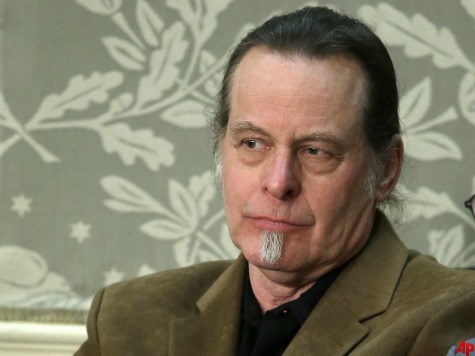
On the 149th Anniversary of Pickett’s Charge at the Battle of Gettysburg washed up rocker and right wing political activist Ted Nugent wrote in the Washington Times: “I’m beginning to wonder if it would have been best had the South won the Civil War.”  I found his remark appalling and disgraceful but I have come to expect such comments from him and and others who voice similar sentiments. If Nugent’s rant was a one time slip of the tongue there might be some grace, but even last week he called President Obama a “subhuman mongrel” a term so load with Ku Klux Klan, Jim Crow and Nazi imagery it defies imagination to hear it used today. When I hear such words spoken towards anyone I can only believe that the man that utters them is an unrepentant racist bent on the reestablishment of White Supremacy.

When I hear such sentiments, I think of men like Joshua Chamberlain. Chamberlain was a college professor who served in the Union Army and won fame and the Medal of Honor for the defense of Little Round Top at Gettysburg. There is a quote from the film Gods and Generals which I think about when I hear anyone suggesting that it would have been better for the Confederacy to have won the war:

“Now, somewhere out there is the Confederate army. They claim they are fighting for their independence, for their freedom. Now, I can not question their integrity. I believe they are wrong but I can not question it. But I do question a system that defends its own freedom while it denies it to an entire race of men. I will admit it, Tom. War is a scourge, but so is slavery. It is the systematic coercion of one group of men over another. It has been around since the book of Genesis. It exists in every corner of the world, but that is no excuse for us to tolerate it here when we find it right in front of our very eyes in our own country. As God as my witness, there is no one I hold in my heart dearer than you. But if your life, or mine, is part of the price to end this curse and free the Negro, then let God’s work be done.”

There is a spot near the Copse of Trees along Cemetery Ridge which is referred to as the “High Water Mark of the Confederacy.” It is close to where Confederate Brigadier General Lewis Armistead fell mortally wounded as the decimated remains of his command were overwhelmed by Union forces shortly after they breached the Union line. It is a place immortalized in history, literature and film. It is the place that marked the beginning of the end for the great evil of slavery in America.

My ancestors lived in Cabell County which in 1861 was part of Virginia. They were slave holders along the Mud River, a tributary of the Ohio River just to the north of what is now Huntington West Virginia. When war came to the country the family patriarch James Dundas joined the 8th Virginia Cavalry Regiment in which he served the bulk of the war as a Lieutenant.  When the war ended he refused to sign the loyalty oath to the Union. As a penalty his lands, which are now some of the most valuable in that part of West Virginia were confiscated and sold by the Federal Government. James Dundas was a true believer in the romantic and confused myth of the “Lost Cause.”

Because he served I am eligible for membership in the Sons of the Confederacy. But that is something that I will not do. While some join that organization to honor their ancestors, others that take that devotion to places that I cannot go.  As much as I admire the valor and personal integrity of many military men who served the Confederacy I cannot for a moment think that their “cause” was just.

It has been said that the North won the war but that the South won the history.  I think this is true. Many people reduce the reasons for the war to the South protecting its rights.  Sometimes the argument for the South is “states rights” or “economic freedom.” Those that make these arguments frequently romanticize the valor shown by Confederate soldiers on the battlefield. But sadly they often ignore or obscure the racism and evil of the Southern economic system.

full_1361408284slave.market

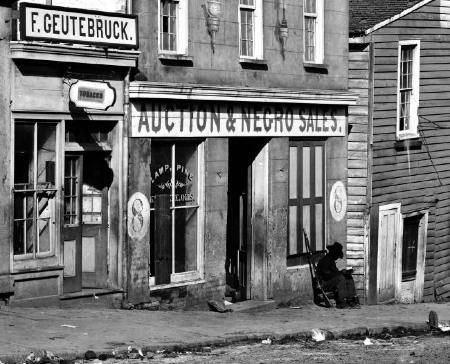
The “rights” and the “economic freedom” espoused by those that led the secession and that are lamented by those like Nugent were categorically evil. Those rights and freedoms were built upon the rotten edifice of slavery. The South fought to maintain their rights to enslave and exploit Blacks to maintain an archaic economy based on agriculture, particularly the export of King Cotton. Thus I have no desire to become part of an organization enshrines the myth of the “Lost Cause” no matter what my family connections.

Some attempt to place the blame on the North, to turn the Northern States into economic predators’ intent on suppressing the economic rights of Southerners. These arguments serve to show the bankruptcy of the idea itself. The fact that the “economic and political freedom” of Southerners was founded on the enslavement of a whole race of people matters not because to such people the “cause” is greater.

The fact was that the longer the Southern economy relied on agriculture supported slavery it deprived itself of the means of economic progress. The same progress that propelled the North to prosperity. Because it cast its lot with King Cotton and slavery the South lagged in all industrial areas to include transportation infrastructure. Most non-slave owning whites lived at the poverty line. They were disrespected by the wealthy Plantation owners only enjoyed some elevated social status because the slaves ranked beneath them in the sociological and economic hierarchy.

To support its slave economy the South depended on cheap imports from England, which then was still considered an enemy of the United States. When tariffs to protect newly establish American industries were enacted in 1828 South Carolina attempted to nullify the Federal law and even raised troops and threatened to revolt in 1832.

The Southern economic system was immoral and antiquated. It enslaved blacks and it impoverished most rural Southerners.  The only exception to this were those that owned the land and the slaves, and small numbers of entrepreneurs. It was a hateful, backward and loathsome system which even Southern churches attempted to justify from Scripture.  Southern Baptists, Methodists and Presbyterians all broke away from their parent denominations in the 1840s over the issue of slavery.

So many died and so much of the South was destroyed in the defense of  the “cause” that one has to wonder just why Southern political and religious were willing to defend such an inadequate and evil economic system. Perhaps it was an innate sense of racial superiority that ran deep in the South, perhaps it was a misplaced sense of political pride and honor. Regardless of the reason, the war that they brought about devastated their homeland. The radicals that ran “Reconstruction” after the assassination of Abraham Lincoln ensured that Southerners suffered terrible degradation and impeded any real efforts to promote reconciliation between the races and between the regions.  Their misguided and often brutal rule ensured that Southern blacks would have even more obstacles raised against them by the now very angry and revengeful whites.  It would take another 80-100 years to end segregation and secure voting rights for blacks.

I was raised on the West Coast but have lived in the South much of my adult life due to military assignments. I served in National Guard units that trace their lineage to Confederate regiments in Texas and Virginia. Despite my Confederate connections both familial and by service I can find little of the romance and idealism that some find in the Confederacy and the “Lost Cause.” I see the Civil War for what it was, a tragedy of the highest order brought about by the need of some to enslave others to maintain their economic system.

BWeqwULCEAA72jU.jpg-large

Today there are many that use the flags of the Confederacy outside of their historic context. They are most often used as a symbol of continued racial hatred or of defiance to the Federal Government by White Supremacist or anti-government organizations.  Many that use them openly advocate for the overthrow of the Federal Government.  The calls for such “revolt” can be found all over the country even in the halls of Congress much as they were in the 1830s, 40s and 50s.

Some of this is based on libertarian economic philosophy which labels the government as the enemy of business. Some is religious opposition to some social policies, while some is based in xenophobic racial hatred, not just of Blacks, but also Latin Americans, Asians and Middle Eastern immigrants. The divisions in the country are probably as great as or greater than they were in the 1850s as the country lurched inexorably to Civil War.

I often see the symbols of the Confederacy, particularly the Battle Flag displayed in manners that can only be seen as symbols of defiance.  Somehow I find the display of that flag outside of its historic context revolting.

For such people the Federal Government is the enemy. I know that our system of government has its flaws. Likewise I cannot agree more about the corruption of many in political office, regardless of their political allegiance or ideology.

Today quite a few people on the political right call for revolt or secession. Some moderate politicians have attempted to compromise with such radicals, but those efforts only make things worse. Radicals are never satisfied and view compromise as weakness. Thus Thomas Jefferson said of the Missouri Compromise of 1824: “but this momentous question, like a fire bell in the night, awakened and filled me with terror. I considered it at once as the knell of the Union. It is hushed indeed for the moment, but this is a reprieve only, not a final sentence. A geographical line, coinciding with a marked principle, moral and political, once conceived and held up to the angry passions of men, will never be obliterated; and every new irritation will mark it deeper and deeper.”

We have allowed the issues of our time to become a fire of unbridled angry passion. We have allowed those with almost no historical understanding and who promote myth stake claims and promote ideas that are destructive to our union. Unfortunately I do not think that we have reached the high water mark of this movement. I fear like Jefferson that the hatred and division will only grow worse as some prepare for conflict.

A few months after the Battle of Gettysburg Abraham Lincoln made a few remarks at Gettysburg war cemetery.  Lincoln is reviled by men like Nugent and others that romanticize the Lost Cause. He is often demonized by many “conservative” politicians and pundits today, but his remarks are still remarkably pertinent:

“Four score and seven years ago our fathers brought forth on this continent, a new nation, conceived in Liberty, and dedicated to the proposition that all men are created equal.

Now we are engaged in a great civil war, testing whether that nation, or any nation so conceived and so dedicated, can long endure. We are met on a great battlefield of that war. We have come to dedicate a portion of that field, as a final resting place for those who here gave their lives that that nation might live. It is altogether fitting and proper that we should do this. But, in a larger sense, we cannot dedicate—we cannot consecrate—we cannot hallow—this ground. The brave men, living and dead, who struggled here, have consecrated it, far above our poor power to add or detract. The world will little note, nor long remember what we say here, but it can never forget what they did here. It is for us the living, rather, to be dedicated here to the unfinished work which they who fought here have thus far so nobly advanced. It is rather for us to be here dedicated to the great task remaining before us—that from these honored dead we take increased devotion to that cause for which they gave the last full measure of devotion—that we here highly resolve that these dead shall not have died in vain—that this nation, under God, shall have a new birth of freedom— and that government of the people, by the people, for the people, shall not perish from the earth.”

Today with so many radicals doing all that they can to plunge us into yet another civil war we should remember Lincoln’s words. We need to rededicate ourselves to this Union.  Tony Blair the former Prime Minster of Great Britain remarked in 2011:

“It may be strange for a former British Prime Minister to offer thoughts on America when the country will be celebrating its independence from Britain. But the circumstances of independence are part of what makes America the great and proud nation it is today. And what gives nobility to the American character.

That nobility isn’t about being nicer, better or more successful than anyone else. It is a feeling about the country. It is a devotion to the American ideal that at a certain point transcends class, race, religion or upbringing. That ideal is about values, freedom, the rule of law, democracy. It is also about the way you achieve: on merit, by your own efforts and hard work.

But it is most of all that in striving for and protecting that ideal, you as an individual take second place to the interests of the nation as a whole. This is what makes the country determined to overcome its challenges. It is what makes its soldiers give their lives in sacrifice. It is what brings every variety of American, from the lowest to the highest, to their feet when “The Star-Spangled Banner” is played.

Of course the ideal is not always met – that is obvious. But it is always striven for.

The next years will test the American character. The world is changing. New powers are emerging. But America should have confidence. This changing world does not diminish the need for that American ideal. It only reaffirms it.”

I think that the Prime Minister got it right and that Ted Nugent and those like him or defend his hateful ideology are ignorant racist fools. But hatred, ignorance and the belief in myth are often quite powerful in the hands of those who desire to maintain their power at any cost. History proves this, thus we must always confront them and not back down until we truly know that “new birth of freedom.”

Peace

Padre Steve+

Leave a comment

Filed under civil rights, civil war, News and current events, Political Commentary

Sweet Dreams: The Desire of Those that Return Traumatized by War

947188_10151670056587059_1172426886_n

Sweet dreams are made of this

Who am I to disagree?

I travel the world and the seven seas

Everybody’s looking for something… (Sweet Dreams- Eurythmics) 

The night before last Judy woke me up as I was screaming. For her it was very real, her husband was screaming in his sleep. For me, I do remember her waking me, and I remember parts of the ream. I was being attacked in a small space and somehow it related to my time in Iraq. Unfortunately it was not an isolated occurrence. It is

My dreams are strange, parts are logical, other parts disjointed and disturbing, while other parts are frightening. My dreams and nightmares, the two are frequently indistinguishable have increased in intensity since I returned from Iraq in 2008. Sleep at best is fitful. Some nights I get a few hours of decent sleep, but most nights that is not the case.

The night before last the dreams, or as they might better be described as nightmares dealt with Iraq. They were not logical, parts of my tour blended into others but in my dreams, in my subconscious I was back in Iraq, with people familiar and unfamiliar. When Judy woke me I was screaming a a woman dressed in a hajib. The last place I encountered women dressed in such apparel I was at the border crossing between Iraq and Syria at Al Waleed.

Actually I don’t know why that incident and memory triggered my nightmare. At Waleed the scariest thing occurred when I was in a meeting where the senior Iraqi Officer and senior American officer. They had to confront and relieve of his duties the Iraqi senior logistics officer who had been selling coalition and Iraqi military fuel to the insurgents who were killing Americans and Iraqis in great numbers. No women were at that meeting, but many were at the crossing point. However, I was at the meeting and was the only unarmed man in a room which resembled a Mafia meeting more than anything I hand been trained to do or experienced before that time.

It was an interesting experience. I was one of three Americans in the room along with an interpreter. There were Iraqi officers and soldiers, most believed to be allies, but also the man who was playing both sides of the street and others that might or might have not been his confederates. The really scary thing that I remember to this day was the accused officer’s appeal to me as the Chaplain, Priest and Imam. It was the first time in my life where someone who was doing something so wrong appealed to me as a representative of God to defend him. I felt soiled, dirty and dishonored. How could a man involved in criminal activity appeal to an representative of God to defend his actions?

I did my best to to deflect the conversation back to the Iraqi Commander and his American, but to this day the incident haunts me. I am disturbed by how the man appealed to me as a representative of God to vouch for his malfeasance. That still frightens me because of how often I see religious people from every tradition and faith appeal to any representative of God to justify their misdeeds. It almost felt like I was a new Priest stuck in the middle of a meeting of Mafia types, each appealing to me as the representative of God. It makes me distrust all who would do the same to this day.

Sweet dreams would be so nice. A full night sleep without being woken up screaming would be incredible. Unfortunately it seems that my brain has been re-wired by PTSD. I know that there are studies that suggest that PTSD is both a psychological as well as physical condition, the physical being the changes wrought in the brain of the afflicted.

How often I long for a good night sleep. Unfortunately no matter what I do I do not think that I will ever enjoy sweet dreams again. That is something that I wold never want to contemplate, but six years after returning from Iraq I see little reason to thing that things will change. Nonetheless I will do my best.

Maybe the upcoming baseball season will help soothe my demons and allow me to sleep again.

At least I can hope…can’t I?

Peace

Padre Steve+


2 Comments

Filed under iraq,afghanistan, Pastoral Care, PTSD, Tour in Iraq

The First Modern War: The American Civil War, its Lessons and Challenges for Today’s Military Planners

Note: This article is one that I am preparing for my Gettysburg Staff Ride in early March. It is more academic and theoretical in its emphasis being directed at those who will be involved in the planning of joint operations at the operational level of war. 
keith-rocco-hell-for-glory-picketts-charge

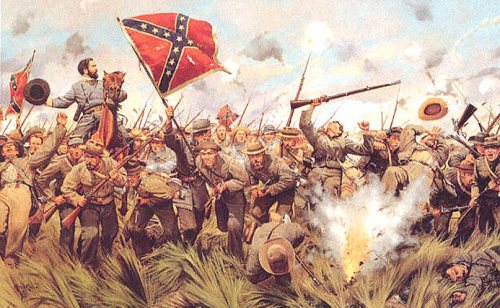
Pickett’s Charge Showcased the Futility of Napoleonic Tactics Against Modern Weaponry

The American Civil War was the first modern war. It was a watershed time which introduced changes in tactics, logistics, communications and the concept of total war to the world. Though it did not change the essential nature of war, which Clausewitz says is “is an act of violence to compel our opponent to fulfil our will.”  What the war did was add new dimensions to war, increased its lethality and for the first time since the 30 Years’ War saw opponents take war to civilian populations as part of a military campaign.

The Civil War was a precursor to the wars that followed. However, like all wars many of its lessons were forgotten by military professionals in the United States as well as in Europe. Thus 50 years later during World War One, British, French, German, Austrian and Russian wasted vast amounts of manpower and destroyed the flower of a generation because they did not heed the lessons of the Civil War.

The lessons of the war are still relevant today. Despite vast advances in weaponry, technology and the distances with which force can be applied by opponents, war remains an act of violence to compel an enemy to fulfill our will. War according to Clausewitz is a “chameleon” which changes its nature to some degree in each particular case, but it is always characterized by the violence of its elements, the province of chance and its subordination to the political objective.

The study of the Civil War can be helpful to the joint planner and commander because it so wonderfully shows the interplay of Clausewitz’s Trinity during an era of great technological change. It is my intent to introduce the reader to the manner in which the military theory and doctrine that dominated American military thought before was applied and changed as a result of the experience gained during the war.
dmahan-treastise

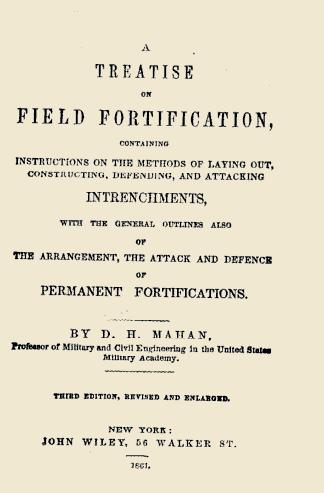
Dennis Hart Mahan’s Book: The First American Book on Military Theory

The professional American army officers on both sides were educated at West Point, VMI or the Citadel. In these institutions they were taught Henri Jomini’s interpretation of Napoleonic warfare and the theories of Dennis Hart Mahan and Henry Halleck.

The war exposed the serious weaknesses in all of these theories which were challenged by advances in weaponry and the vastness of the American continent.  During the war both Union and Confederate armies learned to value field fortifications and the limitations of the artillery of the day during offensive operations.

Logistics influenced campaigning on the American continent much more than previous European wars.  An example can be found in Lee’s Gettysburg Campaign where he had to travel far from his railheads and bases of supply, meaning that he had to live off the land in enemy territory. The concept of total war found its first application in the campaigns of General William Tecumseh Sherman and Robert E. Lee’s use of defensive maneuver and fortifications in positional warfare heralded a new era in warfare.

These factors influenced and affected the Union and Confederate armies as they campaigned. Likewise, the advances weaponry particularly the rifled musket, posed a conundrum for officers educated in the Napoleonic tactics that both armies began the war. Those tactics were developed at a time when the maximum effective range of muskets was barely 100 meters. Yet by 1860 the rifled muskets had an effective range of about 400 meters, and the advent of the repeating rifle increased the firepower available to individual soldiers.  Yet despite the increase in range and accuracy that came with the rifled musket tactics were slow to change.

Ante-bellum US Army leadership was most influenced by the theories of Henri Jomini, Clausewitz had yet to make his appearance in America. Dennis Hart Mahan, a professor at West Point challenged Jominian orthodoxy and modified the current orthodoxy by rejecting its central tenants-primarily offensive assault tactics.”[i] Thus there was a tension in American military thought between the followers of Jomini and Mahan. Conservative Jominian thinking predominated much of the Army, and within the army “Mahan’s decrees failed to win universal applause.”[ii]

However, Mahan did influence many future leaders of both the Union and Confederate armies who participated in his “Napoleon Club,” a military round table at West Point. [iii] Mahan’s greatest contributions were his development of the active defense and emphasis on victory through maneuver. Mahan’s thought contrasted with that of Jomini who thought maneuver was risky and believed that purpose of war was the “defeat of the enemy’s army.” As we look the Gettysburg campaign it is important to note how much Lee was affected by the thought of Jomini as he attempted to defeat the Army of the Potomac, while ignoring the advice of Longstreet to use maneuver and active defense too his advantage.

Mahan emphasized the use of “maneuver to occupy the enemy’s territory or strategic points.” [iv] Edward Hagerman wrestles with the disjointed developments in infantry, artillery and cavalry tactics of the ante-bellum Army in his book The American Civil War and the Origins of Modern Warfare.  Hagerman surmised that “Military thinking, and even more strategic organization, remained essentially within the Napoleonic tradition filtered through an eighteenth-century world view….” He asserted that “A broader vision was necessary to pose an alternative to the mechanistic program.”[v]

The leaders who organized the vast armies that fought during the war were influenced more than military factors. Social, political, economic, scientific and even religious factors influenced their conduct of the war. Commanders educated at West Point who had previously commanded small units were faced with the task of organizing, training and employing large armies made up primarily of militia units and volunteers. Most had little experience commanding such units and their experience with militia and volunteer formations during the Mexican War did not increase their appreciation for them or their leaders.
civil-war-2nd-michigan

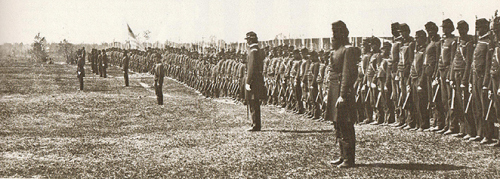
The 2nd Michigan Regiment: Most Civil War Units on both sides were State Regiments

Both armies were changed by the war. Initially both sides sought to fight the war with volunteers. The South began a draft first followed by the Union in 1863. At the beginning of the war General George McClellan successful fought the break-up of the Regular Army. He helped keep it separate from the militia units organized by the States. This preserved a professional core in a time where the new volunteer units were learning their craft. The Confederacy did not have a Regular Army and all of its units were raised by the States and officered by a collection of professionals from the Ante-bellum Army, militia officers, political appointees or anyone with enough money to raise a unit. The draft laws created much consternation in both the Union and Confederate States and the efforts to enforce the draft were filled with controversy and sometimes violence as was evidenced during the New York Draft Riots of 1863 where Union Soldiers, recently victorious at Gettysburg were employed to end the rioting and violence.


civil-war-city-point-dock

The Integration of Sea and Land Logistics Systems in the Civil War Revolutionized the Way that Modern War is Supplied

The Ante-bellum Army developed its logistic doctrine from Napoleonic examples. That doctrine had to be modified in light of the American reality of a less developed continent with far greater distances involved in the movement of troops. During the war, both armies learned to adapt their logistical support services to the reality of war.
civil-war-locomotive

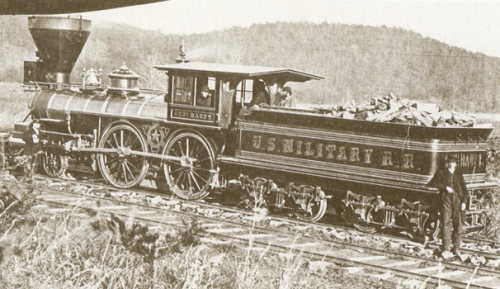
Railways Meant the Ability to Move Troops and Supplies Great Distances very Quickly

Where possible each side used railroads and maritime forces to move troops and supplies. The Confederacy, lacking in both was at a severe disadvantage. The Union however enjoyed a great advantage in modern rail networks, as well as ocean and river based maritime power. By late 1863 the Army of the Potomac, as well as forces in the West demonstrated “the close integration of operational planning and that of the general in chief and supply bureaus. In this one area, the development of a mature and modern staff was evident.”[vi]

In both armies commanders and their logisticians experimented with the number of wagons per regiment and how army commanders, modified that number at various points during the war based on their situation. Both armies experimented with the use of the “flying column” as a response to the dependency on wagons. The basic load of food and ammunition carried by each soldier in order to increase strategic maneuverability was adjusted to meet the operational need. Both armies often had to live off the land. The success and failure of forage operations and the requirements for people and animals in each theater of operations had a large impact on each army.

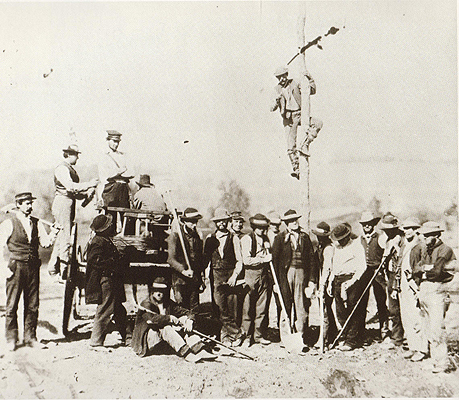
The size of the armies and the distances involved on the battlefield made command and control difficult.  As such communications became more important and each army experimented with new signals organizations that used both old and new communication technologies. At the beginning of the war both sides made extensive use of visual signals and couriers, but rapidly began to rely on the telegraph for rapid communications.
civil-war-us-signal-corps

Signal Corps Soldiers and Wire Communications

The organizational tension was particularly evident in the rivalry between the U.S. Army Signal Corps and the Military Telegraph Service.  The Signal Corps focused on wireless communications. It preferred the Beardslee wireless telegraphs which had the limitations of such early wireless technology. The Army command favored the traditional wire bound networks operated by the Military Telegraph due to better reliability and security. Though the Army rejected the Beardslee equipment some commanders requested it for their operations. [vii] As each Army became more dependent on the telegraph, each feared that their signals could be compromised through wiretapping and made efforts to encode their transmissions.

03-Beardslee-telegraph-US-Army-photo

The Beardslee Wireless Telegraph 

The evolution of how Union and Confederate armies used field fortifications is an interesting topic. McClellan made extensive use of them on the Peninsula in 1861 and Lee made sporadic use of them [viii] until 1864.  Lee made much more use of field fortifications during the Wilderness campaign, the battles around Richmond culminating in the defense of Petersburg.  The developments in field works and firepower gave the advantage to the defense. This was especially the case when opposing armies made the frontal attacks which were at the heart of Jominian offensive tactics.  Early in the war commanders including Grant at Shiloh and Lee at Antietam failed to dig in, but over time both the Union and Confederate armies learned to dig hasty field works as a matter of course.[ix]
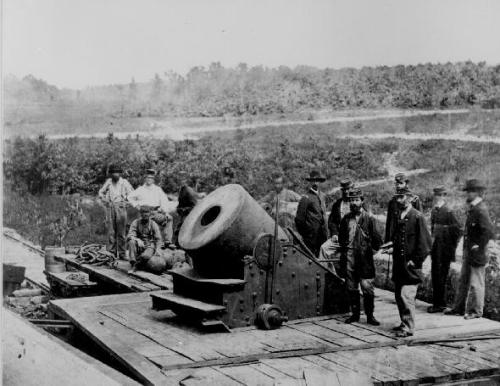
dictator

Massive Siege Mortar outside Petersburg

Both sides also learned to use maneuver in combination with positional warfare to force the enemy to battle. Hagerman examines the campaigns in the West of Grant, Sherman and Rosencrans, particularly Stone’s River, the Vicksburg Campaign, and the campaign in middle Tennessee.[x] The last two chapters of Hagerman’s book detail these issues in the context of the 1864-65 campaign around Richmond and Sherman’s campaigns in Georgia and the Carolinas. Of particular note is how Sherman’s forces routinely entrenched on the offensive [xi] and how Confederate forces under Joseph Johnston employed entrenchments on the defensive.
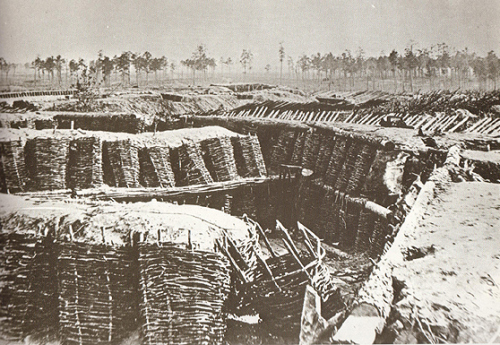
civil-war-earthworks-petersburg Petersburg Fortifications a Harbinger of World War One

Surprisingly, it was Confederate Cavalry commander Joe Wheeler toward the end of the war made use of entrenchments, something not seen before by an arm traditionally known fro maneuver. Hagerman noted that Confederate Cavalry “perhaps best displayed the growing intensity of trench warfare” [xii] by the latter part of the war.

The Corps of Engineers in both armies adapted to the war. Prior to the war the Corps of Engineers was primarily responsible for building coastal fortifications and outposts in the west.  Both sides had to develop Engineer or Pioneer units from scratch in 1861.By the middle of the war organized units of Pioneers and Engineers were enhancing both offensive and defensive operations.

engineers-bridging-tenessee-river

Engineering Units were Built from Scratch and Accomplished Many Feats

The Corps of Engineers initially had a difficult time adapting to war. The dispersion of the Corps among the line and its civil duties were impediments to responding to the needs of war.  There was a hesitancy and resistance to creating engineering units by Congress, despite the pleas of McClellan and Lincoln for specialized engineering units.[xiii] When they were established it was ironic how the newly organized engineer units had few very few West Point trained Corps of Engineers officers. Most Union Engineer Units were primarily staffed and commanded by officers detailed from the line or who had come from civilian life. The effect was a “decline in the antebellum definition of professionalism embodied in the Corps of Engineers” [xiv] which prior to the war were considered the elite branch of the Army.

Strategy and operational level adapted to the new reality of war. Attrition and exhaustion became as important in relation to both positional and maneuver warfare. In 1864 in the East the “ascendancy of positional warfare” allowed Lee to hold out and force Grant into winter quarters at Petersburg.[xv] This demonstrated that “an army fighting on interior lines, even under nearly overwhelming conditions of deprivation and against vastly superior numbers, could sustain a prolonged existence by use of field fortification and defensive maneuver.”[xvi]
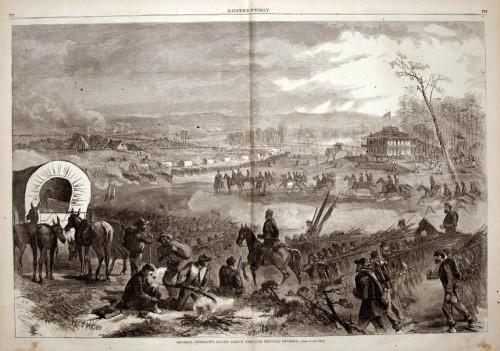
shermans-march-through-georgia

Sherman’s March to the Sea

Despite the increasing power of positional warfare in relation to fortifications in the East and around Atlanta, maneuver was not ignored. Sherman’s campaign in Georgia and the Carolinas demonstrated how an army could exploit “diversion, dispersion, and surprise to successfully pursue a modern total-war strategy of exhaustion against the enemy’s resources, communications and will.”[xvii] Sherman used maneuver to force his opponents out of their prepared positions and did not hesitate to target the key infrastructure and infrastructure needed by the Confederate armies. The same was true in Virginia where in 1864 General Phillip Sheridan laid waste to the Shenandoah Valley, the breadbasket of the Army of Northern Virginia.

The developments in tactics, maneuver, defense and logistics and how those were developed over the course of the war brought about a form of warfare that remained dominant of decades. In studying the campaigns, developments and tensions between the theories of Jomini and Mahan in the Civil War a student can begin to recognize them in future wars fought by the US Army including World War Two.

Russell Weigley picks up this theme in his book The American Way of War. Weigley  discusses Grant’s strategy of annihilation and its costs as well as Sherman’s campaign against Johnston and his attack upon Southern resources.[xviii] Weigley’s discussion of tactics used by both sides in the Civil War reflects the thought of British theoretician of J.F.C. Fuller. Fuller noted that “the tactics of this war were not discovered through reflection, but through trial and error.”[xix]

It is important for planners and commanders at the operational level to see the importance the developments of the Civil War on how we campaign today. While the technology is now antiquated, the ideas are not. The campaigns of Grant and Sherman in particular influence modern strategy.  This is reflected the Marine Corps which discusses the maneuver and attrition warfare continuum in MCDP 1 Warfighting.[xx] It is important for students of operational art to be able recognize the these developments and principles in what we do today, to see the logical development of each of these elements in modern war and to find new ways to apply them within the scope of the technologies we now use that those that will be available in the coming years.

traindes

The Destruction of Hood’s Ordnance Train Outside Atlanta

The important things that we learn from studying the various campaigns of the Civil War are timeless. If we only focus on the military aspects of the great battles we miss the really important lessons. The battles and leadership lessons that we learn from them are important. However it is the often arcane but important subjects such as transportation, logistics, communications and fortifications, as well as the diplomatic, economic and informational aspects of the war that are more important.

In his book Hagerman makes an astute observation on how change comes to military organizations. At the end of his discussion of the Corps of Engineers and the Army following the war, he notes “that change in war requires time for digestion before lessons are converted-if they are converted-into theory and doctrine.” [xxi] Such is true in every war.

When the United States entered ground combat operations in the First World War, General John Pershing’s strategy revisited some of the worst mistakes of the Civil War, as well as the bloody lessons learned by the Europeans during the first three years of that war. In light of this one wonders if the lessons were ever fully digested by the Army.
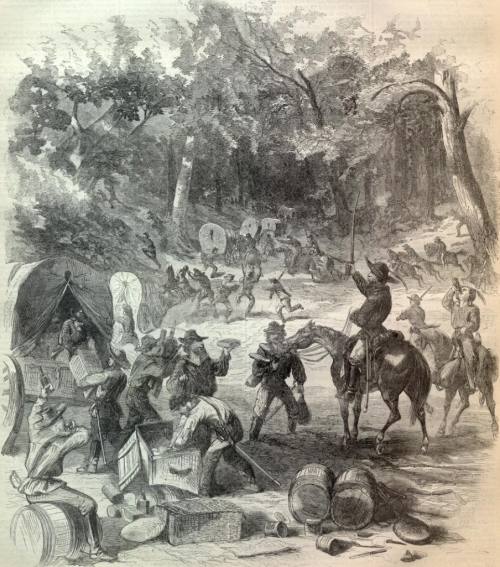
john-mosby-raid

Irregular Formations Such as Mosby’s Raiders Would Create Problems Behind Union Lines, much Like Insurgents in Iraq and Afghanistan 

Such an observation can be made about our present wars. We need to ask if the lessons of previous insurgencies have been digested, even going back to the lessons of the Union Army operating in the hostile lands of the conquered Confederacy.[xxii] Likewise it is fair game for us to examine how our military adjusts to developments in weaponry, technology and tactics today in relation to past examples. Such studies must include regular and irregular warfare. Thus when we look at the Civil War, it is important to use those lessons to better understand the timeless aspects of military history, theory, doctrinal development, logistics, communications and experiential learning in war.

If we do not believe that we can learn from history we will in the words of historian George Santayana “be doomed to repeat it.”

Peace

Padre Steve+

Notes: 

[i] Hagerman, Edward. The American Civil War and the Origins of Modern Warfare. Midland Book Editions, Indiana University Press. Bloomington IN. 1992. p.9

[ii] Ibid. p.13.

[iii] Hagerman also notes the contributions of Henry Halleck and his Elements of Military Art and Science published in 1846 (p.14) and his influence on many American Officers.  Weigley in his essay in Peter Paret’s Makers of Modern Strategy would disagree with Hagerman who notes that in Halleck’s own words that his work was a “compendium of contemporary ideas, with no attempt at originality.” (p.14) Weigley taking exception gives credit to Halleck for “his efforts to deal in his own book with particularly American military issues.” Paret, Peter editor. Makers of Modern Strategy: For Machiavelli to the Nuclear Age Princeton University Press, Princeton NJ 1986 p.416.

[iv] Ibid.

[v] Ibid. p.27.

[vi] Ibid. p.79.

[vii] Ibid. p.87.

[viii] The most notable use of them between the Peninsula campaign and the Wilderness was at Fredericksburg by Longstreet’s Corps. Many wonder why Lee failed to entrench at Antietam.

[ix] Fuller, J.F.C. Grant and Lee: A Study in Personality and Generalship, Indiana University Press, Bloomington IN 1957.  Fuller comments “Thus over a year of bitter fighting was necessary to open the eyes of both sides to the fact that the trench was a by product of the rifle bullet, and like so many by-products, as valuable as the product itself.” (p.269) He calls it “astonishing that Lee, an engineering officer, made no use of entrenchments at the battle of Antietam.” (pp.269-270)

[x] Ibid. pp. 198-219.

[xi] Ibid. p.295.  Hagerman comments how Sherman’s troops outside Atlanta began to entrench both the front and rear of their positions.

[xii] Ibid. p.297-298.

[xiii] Ibid. p.238.

[xiv] Ibid.

[xv] Ibid. p.272

[xvi] Ibid. p.274.

[xvii] Ibid. p.293.  B.H. Liddell-Hart in comparing the campaigns of Grant and Sherman makes an important note that Sherman’s strategy is more “suited to the psychology of a democracy…” and “ he who pays the piper calls the tune, and that strategists might be better paid in kind if they attuned their strategy, so far as rightly possible, to the popular ear.” Liddell-Hart, B.H. Strategy Faber and Faber Ltd, London 1954 and 1967, Signet Edition, The New American Library, New York 1974 p.132

[xviii] Weigley, Russell F. The American Way of War: A History of United States Military History and Policy University of Indiana Press, Bloomington IN, 1973. pp.145-146.

[xix] Ibid. Fuller. P.269  A similar comment might be made of most wars including the current Iraq war.

[xx] ___________. MCDP-1 Warfighting. United States Marine Corps, Washington D.C. 1997. pp. 36-39

[xxi] Ibid. Hagerman. P.239

[xxii] Ibid. Fuller. Fuller’s comments on the situation of the Northern Soldier are eerily similar to our current conflict in Iraq : “Consequently, minor tactics were definitely against the Northern soldier, because his major tactics demanded the offensive; for without the offensive the South could not be brought to heel.  It was the problem which had faced the French in LaVendee and in the Peninsula of Spain, which faced Napoleon in Russia, and the British in South Africa during the Boer War of 1899-1902. Not only was the Northern soldier, through force of circumstances, compelled to fight in the enemy’s country, but he was compelled to devastate it as well as conquer it, in order to protect himself against the bands of irregular troops which were here, there and everywhere.” pp.247-248

Bibliography

Fuller, J.F.C. Grant and Lee: A Study in Personality and Generalship, Indiana University Press, Bloomington IN 1957

Hagerman, Edward. The American Civil War and the Origins of Modern Warfare. Midland Book Editions, Indiana University Press. Bloomington IN. 1992

Liddell-Hart, B.H. Strategy Faber and Faber Ltd, London 1954 and 1967, Signet Edition, The New American Library, New York 1974

Paret, Peter editor. Makers of Modern Strategy: From Machiavelli to the Nuclear Age Princeton University Press, Princeton NJ 1986

Weigley, Russell F. The American Way of War: A History of United States Military History and Policy University of Indiana Press, Bloomington IN, 1973

___________. MCDP-1 Warfighting. United States Marine Corps, Washington D.C. 1997

Leave a comment

Filed under civil war, History, Military

Faith Journeys: Why I am Still a Christian

Friends of Padre Steve’s World. Tonight I have the privilege of posting an old article that it quite meaningful to me. I hope that it went through this time, evidently WordPress had difficulty uploading it. I wrote it and ended up being asked to leave my former church, which I had served for over 14 years. It was in a sense a coming out. I had gone through a terrible period of doubt, despair and unbelief, and when faith returned it was different. This article was a watershed for me. I re-publish it tonight for a couple of reasons. First, because it is appropriate since it plays such an important role in my life, and second because it helps explain to new readers a little bit of who I am and how I got to this point. A few edits have been are from the original to correct grammar and to ensure that what I wrote then actually reads like what I intended it to mean. Unfortunately first drafts are not always the best and when one reads what they wrote before it can be a rather interesting experience. So tonight I present to you “Faith Journeys: Why I am Still a Christian.” Peace, Padre Steve+

padresteve's avatarThe Inglorius Padre Steve's World

There are many times that I totally empathize with author Anne Rice in saying that she has left Christianity yet still has faith in Christ.  For Rice it was the lack of love shown by the institutional church for people that are marginalized and treated as if they were unredeemable by often well meaning Christians.

I know what it feels like to be marginalized. After I came back from Iraq many of my Christian friends seemed, at least in my view to be tied to the absolute hogwash that spews from talk radio hosts and allegedly “Christian” politicians.  I remember having some Christians question my patriotism and even my faith because I disagreed with them regarding certain aspects of the Iraq war. This despite the fact that I had been on the ground in harm’s way serving with our advisors and Iraqis in Al Anbar Province. After I returned no…

View original post 1,766 more words

Leave a comment

Filed under Loose thoughts and musings

Faith Journeys: Why I am Still a Christian

Friends of Padre Steve’s World. Tonight I have the privilege of posting an old article that it quite meaningful to me. I wrote it and ended up being asked to leave my former church, which I had served for over 14 years. It was in a sense a coming out. I had gone through a terrible period of doubt, despair and unbelief, and when faith returned it was different. This article was a watershed for me. I re-publish it tonight for a couple of reasons. First, because it is appropriate since it plays such an important role in my life, and second because it helps explain to new readers a little bit of who I am and how I got to this point. A few edits have been are from the original to correct grammar and to ensure that what I wrote then actually reads like what I intended it to mean. Unfortunately first drafts are not always the best and when one reads what they wrote before it can be a rather interesting experience. So tonight I present to you “Faith Journeys: Why I am Still a Christian.” Peace, Padre Steve+

Leave a comment

Filed under Loose thoughts and musings

Faith Journeys: Why I am Still a Christian

Friends of Padre Steve’s World. Tonight I have the privilege of posting an old article that it quite meaningful to me. I wrote it and ended up being asked to leave my former church, which I had served for over 14 years. It was in a sense a coming out. I had gone through a terrible period of doubt, despair and unbelief, and when faith returned it was different. This article was a watershed for me. I re-publish it tonight for a couple of reasons. First, because it is appropriate since it plays such an important role in my life, and second because it helps explain to new readers a little bit of who I am and how I got to this point. A few edits have been are from the original to correct grammar and to ensure that what I wrote then actually reads like what I intended it to mean. Unfortunately first drafts are not always the best and when one reads what they wrote before it can be a rather interesting experience. So tonight I present to you “Faith Journeys: Why I am Still a Christian.” Peace, Padre Steve+

Leave a comment

Filed under Loose thoughts and musings

A Matter of Degree: The Taliban, Kansas, Jim Crow and Nuremberg

goering3

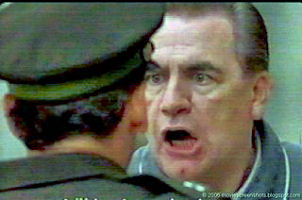
“The segregation laws in your country and the anti-semitic laws in mine, are they not just a difference of degree? Herman Goering (Brian Cox) to Captain Gustav Gilbert (Matt Craven) in the film Nuremberg)

http://www.youtube.com/watch?v=WjbsD-TYi3s

Over the weekend I posted a link to an article about the attempt by the Kansas State of Representatives to pass a law entitled the “Religious Liberties Protection Act.” The Bill, which seems innocuous was actually a law written to enshrine the discrimination against Gays in the public and private sectors by anyone claiming that serving them would infringe upon their “sincerely held religious beliefs.”

The law was held up in the State Senate, and today the Bill was shelved, but it’s author Representative Charles Macheers, insisted that in order to protect Christians and other religious people that anyone claiming that their religious beliefs were infringed upon should be legally able to discriminate against others.  Though specifically directed against Gays it would have set a terrible legal precedent.

I posted a link to an article about the Bill on my Facebook page. Most people, even many of my more conservative Evangelical Christian friends, who are not big fans of Gay rights or Marriage Equity, to their credit were appalled by the law and by the attitude of my former colleague.

AP120323112975-620

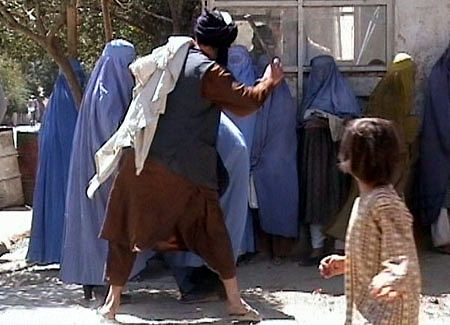
When someone asked me about it on my page, I made a comment that the law was a product of “the Kansas Taliban.” The comment was deliberately designed to be provocative. It was loaded and it did what I intended.

I honestly believe that there is little difference between the religious zealots of the Taliban and those that introduce such religiously based laws here. Such laws enshrine discrimination and differ from the Sharia of the Taliban only in a matter of degree. The attitude exhibited by such zealots, be they Christian, Moslem or any other religion is so strikingly similar it is frightening.

My comment elucidated a response from a man who I had worked with years ago at a Evangelical Christian television ministry. The head of that ministry has become one of the leading figures in the politically active Christian Right and is quite active politically, especially in Texas. The man who jumped in on my conversation has been working for that ministry for over 20 years.

His comments were so hateful, disrespectful and ignorant that my friends, who range from very conservative Evangelical and Fundamentalist Christians to devoted secularists, Gays and Lesbians and even an Atheist jumped in to defend me and what I said. The fact that my friends really know me and understand me, and even if they disagree with me they are willing to defend me. That is remarkable tribute to American values. It was a testament to the good nature of most Americans, as well as Brits who commented on the post. The fact is I would do the same for them.

Taliban_beating_woman_in_public_RAWA

My comment about the “Kansas Taliban” was not about religious people who despite their strongly held beliefs are respectful of others and hold the rights of people who believe differently than them to matter. It was directed at those who use fear and hate to promote an agenda that vilifies and demonizes others based on their religious or ideological beliefs. The fact that the people promoting the Kansas law were conservative Christians is only important as it demonstrates that some Christians can be just as brutal and thoughtless as the Taliban.

That is a nuance that people driven totally by ideology miss. Some might think I am attacking Christians. That is not the case. The attack is on any group that would attempt to enforce their religious beliefs on others through the police power of the state.

The real fact of the matter is that the Mullahs of the Taliban have much in common with Christians and others who desire to impose their beliefs by the law of the state on those that do not agree with them, be it in religious beliefs, political ideology or racial, ethnic, cultural or linguistic differences.

My former colleague called me many things before he dropped me as a Facebook friend. He made himself look foolish. It was his loss. I would have been willing to listen, care for and respect his views had he not resorted to name calling and character assassination in his attempt to shame and silence me. Anyone who really knows me knows that for me life is more about caring for and having relationships with people, even if we differ in our beliefs than attempting to argue them into my position or abandon a relationship with them because they do not agree with me.

Sadly for him my former colleague did not understand that. It was a loss that he brought about, and in that sense it is his loss, because I actually do care for him and remember him fondly from when I knew him 20 years ago; but in the end of the day it is probably a loss for both of us.

Unfortunately that is the cost of those more committed to their ideology than they are to people. It matters not if they are Christians, Moslems, Jews, Hindus, secularists, or others that hold the purity of their political, social, ideological, racial or economic theories as more important than people.

My comment about the Kansas Taliban was fitting, and like Hermann Goering’s comments at Nuremberg to Gustav Gilbert the difference between the ideology and actions of the Taliban as opposed to militant Christians who attempt to use the power of the State to suppress, control and persecute those that they find offensive is only a matter of degree.

That may not seem important to some. But it is the difference between a divided society that can agree to disagree respecting the differences within it, and one for which factions attempt to use the police power of the State and the law of the land to persecute those that are different.

Goering in his critique of America in the 1930s and 1940s was correct; what we as a society enshrined in law and in our culture to discriminate against others differed little from what the Nazis did, only in the matter of degree.

It is something for us all to think about.

Peace

Padre Steve+

1 Comment

Filed under christian life, civil rights, faith, News and current events, Political Commentary

Padre Steve’s World at Five Years: Writing My Way to Freedom as a Passionate Moderate

1622612_10152232336042059_727365308_n

“If you want to be a writer, you have to write every day… You don’t go to a well once but daily. You don’t skip a child’s breakfast or forget to wake up in the morning…” Walter Moseley

Friends of Padre Steve’s World. Five years ago I began to write on Padre Steve’s World…Musings of Passionate Moderate.

The name was chosen for a number of reasons. Padre Steve’s World hearkened back to one of my favorite Saturday Night Live skits and later films, Wayne’s World. The idea of musings is fairly self explanatory, these are, regardless of the subject my musings, inspired by whatever muse inhabits me. Finally the idea of a “Passionate Moderate” hearkened back to my days in seminary. Passionate and moderate are not terms that one generally links together, in fact when I was in seminary the term moderate was a term of distain used by some Christian Conservatives and Fundamentalists to vilify those that did not match their definition of a conservative. I chose the two ideas because to many people, on the right and the left cannot imagine a “Moderate” being passionate.

403194_10150592726767059_1694849983_n

However that moderation does not mean that I do not have strong ideas, beliefs and convictions, even when I can see truth in what others who do not agree with me have to say. Over the past five years my identity has become more established. I am a moderate, but in some ways I am a progressive liberal, in others a conservative. Regardless of where I fall in the religious, social and political continuum I am passionate about what I believe, I do seek the truth, but at the same time I attempt to maintain a moderate view that allows me to hear what others say and believe with an open heart.

66676_10151588314727059_1328768518_n

Padre Steve’s World began as a place to share my struggles with faith, PTSD and its effects on my life and coming home from war changed. It was something that was born out of pain, but also born out of love, love for writing, love for truth, love for justice and love of knowledge.

599056_10151549893822059_1921818584_n

As I began to write my life was coming apart, and writing became a place where could express my inner angst, find community and begin to heal. Engaging my creative muse enabled me to share those things that it was hard to do anywhere else. Many times those were the hardest things to say, the hardest things to put down in pen and ink, the things that were the secrets of my heart. Sometimes, just trying to write them was gut wrenching and filled my eyes with tears. But as I wrote, I discovered myself, discovered people for whom what I wrote resinated, and others that Stephen King said something that finds an echo in my life and heart:

“The most important things are the hardest to say. They are the things you get ashamed of, because words diminish them — words shrink things that seemed limitless when they were in your head to no more than living size when they’re brought out. But it’s more than that, isn’t it? The most important things lie too close to wherever your secret heart is buried, like landmarks to a treasure your enemies would love to steal away. And you may make revelations that cost you dearly only to have people look at you in a funny way, not understanding what you’ve said at all, or why you thought it was so important that you almost cried while you were saying it. That’s the worst, I think. When the secret stays locked within not for want of a teller but for want of an understanding ear.”

That being said when I began much of what I wrote about was either dealing with my struggles or about things I knew a lot about. Those subjects included history, military subjects, theology and the Christian life and baseball. As I began to expand my writings the topics broadened to include political commentary, music, civil rights and the role of religion in public life.

n671902058_1153828_4309

When I did this I decided not to shy away from controversial topics and to risk the rejection of some. The consequences of this his became quite real in September of 2010 when I was told to leave a church that I had served for 14 years as a Priest. Since then I still write about topics that are controversial, though I do try my best to be fair when I do so.

bloom-county-the-label-stuck

Mark Twain advised writers to “write what they know.” Fortunately for me that was not hard, I know a lot about a lot of subjects. That is not a boast, but merely a recognition that between a lot of academic study, a lot of reading and a lot of life experience I have a pretty good repository of knowledge, including a lot of odd knowledge. That would make me a Keeper Of Odd Knowledge, or KOOK. I can live with that too.

971505_10151793473982059_531695883_n

That being said I am not one to think that I know it all, I follow the advice of the late manager of the Baltimore Orioles, Earl Weaver that “It’s what you learn after you know it all that counts.” Since PTSD and the Moral Injury that I had suffered in Iraq was kicking my ass when I began to write, and I was finding that I really didn’t know much of anything that I thought I knew about life I did take this advice to heart.

Stephen King noted that “If you want to be a writer, you must do two things above all others: read a lot and write a lot.”  The fact is I have always been an avid reader, mostly of history, military history and theory, church history, theology, biography and other more academic writings from the social and political sciences. I do not read a lot of fiction, however that being said there are some books as well as book series that I like. I love fiction that deals with history, as well as mysteries and science fiction, the latter because both lure me into the realm of possibility and mystery, subjects that fascinate me.

321466_10151445269932059_173643368_n

The fact that I read a lot inspires me to write on a wide variety of subjects. Likewise the more I write the more I become conscious of life as well as a desire to seek out truth, and when I write, whether it is something to do with history, faith, baseball or even my occasional forays into fiction and fantasy. As I do this it makes me appreciate the other writers even more, because I no longer see them just in light of what they write, but how they struggle with the same things I struggle with, I can appreciate the truth and beauty in what they write, and it decreases my sense of isolation, which since Iraq has often been crushing. I can agree with Annie Lamott wrote:

“Becoming a writer is about becoming conscious. When you’re conscious and writing from a place of insight and simplicity and real caring about the truth, you have the ability to throw the lights on for your reader. He or she will recognize his or her life and truth in what you say, in the pictures you have painted, and this decreases the terrible sense of isolation that we have all had too much of.”

I read all the time and I try to write every day, if I cannot do that I feel that I have missed out on something. If I do not write it is almost if I have missed breathing. My mind is constantly musing on things to write about and sometimes it is only the fact that I have a day job that keeps me from writing even more than I do. Like Hedley Lamarr (Harvey Korman) in Blazing Saddles I have to admit that “My mind is aglow with whirling, transient nodes of thought careening through a cosmic vapor of invention.” But I digress…

Admittedly I do write a lot and I do try to write every day. Not counting what I do for work, academic pursuits or teaching I have posted over 1700 articles on this website since I started it in February 2009. If I ever take the time to organize and edit what I have on this site there is probably enough for several books.

530402_10151878451172059_1439813480_n

For me writing has been part of my quest for healing, the discovery of truth and the desire to be part f a community of people that is bigger than me, or anything that I can do on my own.  It really is about life, and if as some would think that I am a fool for doing this, then that is their loss. I don’t mind being considered a fool in this quest. Ray Bradbury, author of Fahrenheit 451 wrote:

“If you want to write, if you want to create, you must be the most sublime fool that God ever turned out and sent rambling. You must write every single day of your life. You must read dreadful dumb books and glorious books, and let them wrestle in beautiful fights inside your head, vulgar one moment, brilliant the next. You must lurk in libraries and climb the stacks like ladders to sniff books like perfumes and wear books like hats upon your crazy heads.”

I can agree with Bradbury’s thoughts on this. I do not know what the future holds. If I were God I would live to be one hundred years old and be active reading, writing, thinking and interacting with others who seek truth.

994899_10151847060517059_47934649_n

So tonight I wish the writers, artists and thinkers who read this the best. To close I provide you the benediction of Bradbury:

“I wish you a wrestling match with your Creative Muse that will last a lifetime. I wish craziness and foolishness and madness upon you. May you live with hysteria, and out of it make fine stories — science fiction or otherwise. Which finally means, may you be in love every day for the next 20,000 days. And out of that love, remake a world.”

Peace

Padre Steve+


1 Comment

Filed under faith, Loose thoughts and musings