Author Archives: padresteve

padresteve's avatar

About padresteve

I'm a Navy Chaplain and Old Catholic Priest

Cheating in Baseball: The Case of Barry Bonds and it’s Relationship to Modern America

Barry Bonds was convicted of one count of Obstruction of Justice in his trial on perjury charges. The obstruction count came as a result of Bonds’ 2003 Grand Jury testimony.  The three perjury charges were deadlocked and the judge has the option of retrying them.  Bonds’ defense team asked for the verdict to be set aside and the judge did not immediately rule on the request.  The Bonds legal saga is not over as a decision to retry the deadlocked perjury charges, the judge acting on the defense motion to set aside the guilty verdict and the outcome sentencing and any appeals are still to come.

Meanwhile the steroids era just will not go away as Roger Clemons is soon to stand trial for lying to Congress about his alleged steroid use and Manny Ramirez ended his already tarnished career with yet another positive steroid sample.  Ramirez should have known better. He was on the list of 103 players that tested positive in 2003 and he was suspended for 50 games last year for a positive test while playing on the Los Angeles Dodgers.  The fact that he was caught once again suggests that he was either incredibly arrogant or stupid or possibly both.

Unfortunately they are not alone. In fact 6 of the top 14 home run leaders (in italics) of all time are tainted by steroids only one of whom is still active.  Jim Thome who is also active has not been implicated in the steroids scandals but will still likely be scrutinized simply because he hit a lot of home runs during the era.  The sad thing is that the use of steroids according to some was so prevalent that almost anyone who set records during the era tainted or not will be viewed with suspicion.  As for Bonds people made up their minds about him years ago and there is little middle ground when it comes to him. The only thing now is how baseball will deal with the records of Bonds and the other players of the steroid era and admit him or any of them into the Hall of Fame.

1              Barry Bonds           762

2              Hank Aaron            755

3              Babe Ruth               714

4              Willie Mays             660

5              Ken Griffey, Jr.      630

6              Alex Rodriguez      617

7              Sammy Sosa          609

8              Jim Thome              590

9              Frank Robinson     586

10           Mark McGwire      583

11           Harmon Killebrew 573

12           Rafael Palmeiro                    569

13           Reggie Jackson      563

14           Manny Ramírez                    555

Now some like Palmeiro went and shook their fingers at Congress and then popped positive, not smart but so many others could very well have done steroids that have not been caught that we will never know.  There are numerous reports which implicate others most of whom will never be prosecuted or banned from baseball.  But thanks to IRS Special Agent Jeff Novitsky who transferred to the FDA to pursue elite athletes Bonds, Clemons and other legends of various sports have been singled out for prosecution in what amounts to a witch hunt designed to bring down the biggest names in sports.  In the case of Bonds this has cost the taxpayer over 50 million dollars.  In an era of massive deficits is this a good way to spend our money to get a guilty verdict on just one charge after almost 8 years of work?  To me it seems that Novitsky and his team have made a special effort including violating court prescribed limitations of search and seizure at the BALCO labs and to ensure that the case was tried in the media before Bonds ever went to court.  Do the math: 1 player, 8 years, 50 million dollars and 1 guilty verdict on one count of 5 that went to trial and 4 that went to the jury.

That being said I believe that Bonds knowingly took steroids as did so many of the players of his era and though Bonds has not admitted anything I imagine that he started to take steroids because of the wild success of those that were taking such as Mark McGuire and Sammy Sosa neither of who had all of the natural talent and ability of Bonds who was on course to be a Hall of Famer before he started using.  I wish that he had admitted that he did back in 2003 it probably would have done much to help end the era as well as put others on notice and it is likely that instead of being ever in our face the Steroid era would be in the past.  The conviction even on the one count of obstruction says much in how he is perceived in court and in public. While Bonds has many supporters he also has many detractors.

I think as does Bob Costas that Bonds should be elected to the Hall of Fame, not on the first ballot for sure because unlike McGuire and Sosa he was heading to hall of fame well before his numbers became inflated after the 1997 season.  Despite the fact that steroids undoubtedly had some impact there were many others that took steroids and still couldn’t hit, many that couldn’t get out of the minor leagues. To quote Minnesota Twins outfielder Shannon Stewart who was interviewed by Minneapolis Star Tribune sports writer Paul Reusse:

“The truth is, there were so many guys taking steroids for a few years, and they couldn’t hit like Barry Bonds. In my opinion, a guy hitting with a corked bat is taking a bigger advantage than someone who was on steroids….If Bonds was doing all of this … you still have to hit the ball. He still was going to hit 40 or 50 (each season), with or without steroids.”

Zach Moore compiled an interesting and enlightening portrait of Bonds’ performance before he began allegedly using steroids in 1998. I post it here with the link because with or without steroids Bonds would have made the Hall of Fame based on his pre-1998 statistics.  True he may not have topped Aaron or Ruth in Home Runs but the numbers and the company they put him in are impressive.

“Bonds’ stats prior to the 1998 season include a .288 batting average, a .408 on-base percentage, and a .551 slugging percentage. He had 1,750 hits, which included 321 doubles, 56 triples, and 374 round trippers. He drove in 1,094 runs, while crossing the plate 1,244 times himself.

He did all that while also walking 1,227 times. Bonds was not only a threat at the plate, but once he got on base, he stole 417 times. He did all this while only striking out 958 times.

In The New Bill James Historical Baseball Abstract, which was written just before the 2001 season during which Bonds hit 73 home runs, he calls Bonds “the most un-appreciated superstar of his lifetime.” That is one reason for Bonds’ desire to use steroids, according to Mark Fainaru-Wada and Lance Williams in Game of Shadows.

In the section of the Abstract where James ranks his 100 best players at each position of all time, James ranks Bonds the third best left fielder ever, only behind Ted Williams and Stan Musial.

James also calls Bonds “probably the second- or third-best hitter among the 100 listed left fielders (behind Williams and perhaps Musial), probably the third-best baserunner (behind Henderson and Raines), probably the best defensive left fielder. Griffey has always been more popular, but Bonds has been a far, far greater player.”

The astounding part about this is that James wrote this before Ken Griffey Jr. started getting hurt, so he could still vividly remember Griffey gliding around centerfield, robbing home runs, stealing bases, and that beautiful swing.

On the next page, James then went on to list his 10 best players of the 1990s; Bonds leads that list, with Craig Biggio of the Houston Astros coming in second, the 10th player on that list is Greg Maddux. I say this because James goes on to say, “the No. 2 man, Biggio, is closer in value to the No. 10 man than he is to Bonds.”

We tend to forget how good Bonds was, even before he went on this steroid-aided home run tear of recent years sometimes.

I can’t compare his 12-year career statistics with any one player because his ability to do everything does not allow that. Instead, I’ll use a few different Hall of Famers to nail home the point.

His .288 average is higher than both Rickey Henderson’s .282 and Carl Yastrzemski’s .285.

He hit 101 fewer home runs then Stan Musial in about eight less seasons and also hit 13 more home runs than Joltin’ Joe DiMaggio.

His on-base percentage was one point lower then Manny Ramirez’s current .409 career mark, and it tied Jackie Robinson’s career OBP.

Listen carefully to this next statistic, with his 12-year all-natural career, Bonds’ career slugging percentage of .551 would be eight points lower than Musial’s, six points lower than his godfather Willie Mays’, five points lower than Mickey Mantle’s, and only three points lower than Hammerin’ Hank Aaron’s.

Bonds had 15 less career runs scored than HOF centerfielder Duke Snider.

He finished with 29 less hits than HOF infielder Lou Boudreau.

Kirby Puckett’s 1,085 RBIs were nine less than Bonds’ sum. His 321 doubles tied Yogi Berra’s.

Bonds’ 1,227 base on balls are still more than future Hall of Famers Ken Griffey Jr., Chipper Jones, and Manny Ramirez’s current totals. He even had more than walk machine Jason Giambi, and he did it in only 12 seasons.

Bonds’ 417 stolen bases put him in the top 65 all-time.

Another testament to his incredible combination of speed and power is that he is one of only four players in the 40/40 Club (home runs and steals). He actually did it during 1996 when he was clean.

The other three members of that club are fellow abuser Jose Canseco who did it in 1988, Alex Rodriguez who did it in 1998 when he was still with the Mariners, and Alfonso Soriano who did it in 2006.

After only 12 seasons in the Major Leagues, Barry Bonds was unquestionably a first-ballot Hall of Famer.”  http://bleacherreport.com/articles/40505-were-barry-bonds-and-roger-clemens-hall-of-famers-before-steroids

Additionally Bonds before 1998 was a 7 time Gold Glove winner, 3 time MVP and 6 time Silver Slugger Award winner. For a complete list of Bonds accolades see the Baseball Almanac page at http://www.baseball-almanac.com/players/awards.php?p=bondsba01  Even after he was alleged to use steroids he won the 2004 Hank Aaron Award, the 2004 Most Valuable Player Award, 2004 Players Choice Outstanding Player of the Year Award, 2004 Players Choice Player of the Year Award, 2004 National League Silver Slugger Award and 2004 Sporting News Major League Player of the Year Award.  In a sense despite a widespread suspicion that he was using steroids the players and media recognized him as the best in the game. Then they didn’t seem very concerned about the possibility that he might have cheated. Now many in the media who made their money promoting Bonds condemn him as do many fans that have since abandoned him.  To me it is hypocritical.  Yes I think that he cheated but that takes little away from his pre-steroid accomplishments.

Because of the alleged steroid use and the subsequent investigation, trial and conviction he will be remembered as a cheater. However morally he is no different than all the players of the Steroid eras who abused PEDs but who were nowhere close to his skills and performance.  Bonds was certainly was an amazing player. His overall numbers would very well be lower without steroids especially the home runs, but he very well may have been the greatest overall player since his Godfather Willie Mays even without them.  Not many players can say that.

Bonds biggest problem was that he displayed a sense of arrogance toward the game and the law, the same arrogance that made him such a fearsome hitter even before steroids. The same is true with Roger Clemons, quite probably the greatest pitcher of the modern era. Like Bonds before him Clemons’ refusal to deal with the issue of his alleged steroid use forthrightly before Congress; will likely end in some kind of criminal conviction and Clemons in his first 14 seasons was certainly a Hall of Famer. I won’t go into his statistics here but they are also covered in Zack Moore’s article.

Are there men that cheated in the Hall of Fame? Yes one of the most flagrant being Gaylord Perry who admitted after his retirement and before his election to the Hall of Fame that he threw the “spit ball” which was illegal his entire career.  Players who “corked” bats were common but most were never caught because unlike today their bats were never inspected.  Pitchers used the spit ball, emery boards, diamond rings and sandpaper to alter the baseball to give it extra movement.  Since all ballplayers are human beings I have no doubt that had the technology to produce PEDs been available between the end of the Dead Ball era in 1919 and the late 1980s when they arrived on the scene that players would have abused them in order to increase their performance, win games and extend their careers.  Likewise they would have been cheered as much as the home run leaders of the 1990s were until they were exposed.  All one has to do is take a look at those who are known to have cheated as documented in this ESPN article http://espn.go.com/page2/s/list/cheaters/ballplayers.html  a number of whom are in the Hall of Fame.

My contention in this article is not that Bonds did not cheat the evidence certainly looks like he used steroids which were banned when he allegedly started using. Instead I would say that Bonds has been unfairly singled out by people in the government, the media and even in the game that would rather tear down a man than to place his actions in the broader context of the game, the era, human nature and history.  This will happens to Clemons too but not many others.

Meanwhile the government bails out financial institutions and industries that have defrauded the American public and helped impoverish the nation. We excuse the illegal and unethical lives of politicians and Presidential Candidates so long as they our on our side of the politic spectrum or failing that against the party that we oppose and we give churches and clergy who harm innocents a pass and say that the accusers are persecuting the Church. We worship celebrity and idolize people with talent or looks but not much else but we will do our best to destroy athletes who break the rules of their game.  Isn’t that somewhat hypocritical.

To put things in context I am 51 years old and coming up on 30 years in the military between the Army and Navy. In order to get the highest category of score on my Physical Fitness Test I have to perform at almost the same level as I did as a young Army enlisted man, ROTC Cadet and Officer. Likewise I have to meet almost identical height, weight and body fat standards.  On the physical side I can still outperform many young men 20-30 years younger than me. I deal with nagging injuries to my knees, shoulders and have a very fragile ankle that I have sprained or broken so many times that it is not even funny.  I suffer chronic pain. If someone had a way other than Icy Hot and 800mg Motrin to ease the pain and help my performance I cannot say that I wouldn’t take it, I probably wouldn’t break the law if it was illegal to use but if it wasn’t illegal but merely questionable I might use it.  I have another 5-7 years left before I expect to retire and like Mickey Mantle said “I always loved the game, but when my legs weren’t hurting it was a lot easier to love.”

Peace

Padre Steve+

4 Comments

Filed under Baseball

Adjusting Strategy to Reality

Taliban Fighters

“The core goal of the U.S. strategy in the Afghanistan and Pakistan theater remains to disrupt, dismantle, and eventually defeat al-Qa’ida in the region and to prevent its return to either country…” US Strategy in Afghanistan for 2011

“The aim of war should be the defeat of the enemy.  But what constitutes defeat?  The conquest of his whole territory is not always necessary, and total occupation of his territory may not be enough.” Carl Von Clausewitz

Strategic goals cannot remain fixed on geographic objectives which have lost their strategic importance because it is no longer the enemy’s center of gravity. On September 11th 2011 the Taliban ruled Afghanistan which harbored Osama Bin Laden’s Al Qaeda terrorist organization became the central front in the new “War on Terrorism.”  For about a year Afghanistan remained the central focus of United States efforts against Al Qaeda until President Bush and his administration changed the primary effort to the invasion of Iraq and the overthrow of the Saddam Hussein regime.

The effect of switching the American strategic focus from Afghanistan where we were making headway despite the limited resources provided to Iraq was a mistake of epic proportions that only became evident when Iraq did not go the way that the Bush administration led by Vice President Dick Cheney. Secretary of Defense Donald Rumsfeld and Paul Bremer the head of the Coalition Provision Authority planned.  Instead of a quick withdraw a series of mistakes and miscalculations turned the majority of the Iraqi people who had welcomed US Forces with open arms against us and an insurgency which claimed over 4000 American military personnel deaths and over 30,000 wounded became our primary focus.  We are still trying to figure out how to end our involvement in that country hoping that Iraq will not sink into another civil war.

Contrary to expectations Iraq became a front which consumed U.S. Forces and limited strategic flexibility in other regions of the world including Afghanistan.  In that country the indigenous Taliban which had been driven from power in 2001 began a gradual and deliberate return to political and military viability which was finally noticed by the United States in 2008 and 2009.  The Taliban were supported by the Pakistani Taliban, elements of the Bin Laden organization and in many cases duplicitous elements within the Pakistani military and intelligence services which were using the situation to support their own strategic goals of gaining influence in Afghanistan while strengthening their position against their perceived mortal enemy India.  Throughout the war the Pakistanis acted in their own interest while placating American demands to do more against the Taliban and Al Qaeda operating in Pakistan proper.

The Obama administration attempted to regain the initiative with a “surge” of 30,000 additional troops which raised the overall commitment of the United States to a force of over 100,000 troops assisted by NATO Allies and the corrupt, ill-trained and often Taliban Afghan Army and Police.  The surge was controversial and marked with controversy was the US Commander General Stanley McCrystal was relieved of command after an article in the Rolling Stone magazine which made it appear that he held the Obama administration in contempt. Since McCrystal recently returned to the Administration in a civilian capacity one wonders if the administration discovered that the article was meant to discredit McCrystal. McCrystal was relieved by his superior CENTCOM Commander General David Petreaus who had helped devise the strategy which in conjunction with the Anbar Awakening turned the tide against Al Qaeda and indigenous Iraqi insurgents in 2007-2008.  It achieved some success but even the United States recognizes that whatever success has been wrought is fragile and could easily be erased.

Unfortunately while the United States and its Allies continue to reinforce the campaign in Afghanistan their efforts are often undercut by the corrupt and duplicitous regime of Mohammed Karzai as well as our supposed Pakistani allies.  The Karzai regime hunkered down in Kabul has little influence outside the Presidential Palace except in its dealing in the Opium trade which helps finance the Taliban. The Pakistanis have over the 10 year duration of the war failed to maintain the security on their side of the border and often have clandestinely supported the Taliban and according to some may have given sanctuary to Al Qaeda.  The most recent setback came today when the Pakistani Chief of the General Staff General Ashfaq Parvez Kayani and Chief of Intelligence Ahmed Shuja Pasha issued a demand for the US to stop Predator Drone strikes in the border regions, cut Special Forces and CIA Staff and give the Pakistani Intelligence Service, the ISI visibility on CIA operations.  This has been long in the works but came to a head with the arrest of a CIA contractor under the suspicion of murdering two Pakistanis.  The incident created quite a rift in US and Pakistani relations in part brought about by internal Pakistani politics.  Of course the ISI has long been a source of aid to the Taliban so the United States has good reason not to trust the ISI with information that could endanger American lives.

Protests in Bahrain: The Arabian Peninsula as the new Center of Gravity

The fact is without full Pakistani cooperation and substantial Afghani political reform to end corruption and provide real security to Afghani people there is no way to set conditions for a US withdraw that would leave Afghanistan a less dangerous place for its own people and for US and Western security interests. After all no one wants another 9-11 attack.  The US plans to begin withdrawing forces this year but the mission has been extended to at least 2014 at a cost of 119.4 billion dollars per year at the estimated 2011 rate and has increased exponentially since the US involvement began in 2001. The cost of the Afghanistan war in human, material and economic terms has imperiled other strategic priorities and limits the flexibility of the United States in other more vital regions.

Afghanistan is now an expensive sideshow in a larger war where the strategic center of gravity has shifted decisively to the Arabian Peninsula, North Africa and the Eastern Mediterranean where Al Qaeda seeks to use democratic revolts against autocratic despots to further its own ends. The key countries are Yemen, Saudi Arabia, Bahrain and Egypt with Lebanon, Syria, Jordan and the Israeli-Palestinian conflict boiling over.  While all of these crises grow on what seem to be a daily basis the United States and its Allies are mired in Afghanistan reinforcing failure.  Our troops on the ground have not lost a battle but like our brothers in Vietnam could “lose” the war.

This is the point where political and military leaders have to count the cost of the operation and weigh them against our actual strategic interests. The fact is if we withdrew the bulk of our ground combat forces and shifted to a lower footprint special operations and CIA campaign with a goal of ensuring that Al Qaeda cannot operate in Afghanistan with impunity as they did before 9-11 that we would likely be no worse off than we are now and have a greater amount of strategic flexibility to deal with other crises, political, military and humanitarian around the world.

The real crux of the issue is that Afghanistan is much like Stalingrad to the Germans in 1942. It has become a psychological more than a military campaign. We have invested so much in it that we do not believe that we can withdraw even though a scaled back presence would do much to improve our overall strategic situation.  Hitler denuded more important areas to attempt to capture Stalingrad and lost everything. Yes Al Qaeda used Afghanistan as its base to attack us in 2001 but they have moved on and Al Qaeda in Yemen and the Arabian Peninsula is a far greater strategic danger simply because of the oil supplies and strategic waterways in the area.

We simply need to look at all components of national strategy and decide where to concentrate.  Sometimes a strategic withdraw is necessary and actually vital to recover the initiative and set the stage for long term success. In Afghanistan this is not an admission of defeat but rather an acknowledgement that the central focus of the war and our strategic interests are elsewhere.  Our enemies would love to have us continue the campaign in Afghanistan in its current form, they know that our commitment drains our military, imperils our overall strategy and bleeds us dry economically all the while providing propaganda grist for them in their war against us.

However despite the cost the political situation in the United States keeps President Obama invested in Afghanistan. If he withdraws his opponents will say that he lost the war. Unfortunately the war in Afghanistan was ceded to the Taliban in 2003 when we decided that Iraq was more important. Now we reap the terrible consequences of that decision.  Now we have to decide how to make something positive out of this unenviable strategic position. But as Napoleon Bonaparte said “In order to govern, the question is not to follow out a more or less valid theory but to build with whatever materials are at hand. The inevitable must be accepted and turned to advantage.”

Peace

Padre Steve+


2 Comments

Filed under Loose thoughts and musings

The Current American Crisis and Drawing Comparisons from the End of the Imperial Germany

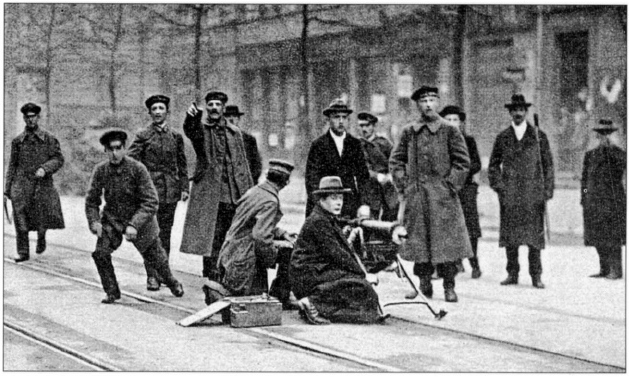
Revolution: Members of the Spartacists Bund in Berlin

Introduction

There are times when great nations face catastrophe. It is something that has befallen every world power at one time or another. Therefore it should not be a surprise if the United States despite the claims of those supporting American Exceptionalism succumbs to some great crisis which fundamentally changes it.  While I do not proclaim the end of the United States it does appear that we are experiencing events which have the potential of reducing our status as a great power and plunge the nation into political and economic chaos.  Some including California Governor Jerry Brown have compared the current state of the country to the division of the country in the American Civil War.

Likewise since there are some leaders of the loud and influential Tea Party movement who openly talk about revolution it is important to know what can happen if there is a political or economic collapse that leads to revolution at home while troops are still in combat. All of this happened in Germany in 1918.  In our current time such a possibility is higher than at any time in American History. Thus I feel we are in a potentially perilous time where long standing institutions are in crisis even while wars rage around the world.

However I do not, for all the vitriol spent believe that our current crisis is comparable to the Civil War except the absolute contempt that the opposing sides hold each other. The Civil War was a war which pitted region against region and our divisions know few geographic boundaries and even the “Red State versus Blue State” divide is deceiving.  It is my belief that what we are experiencing is much more similar to the crisis faced by Imperial Germany at the end of the First World War.  Then Germany was about to concede the loss of the war despite having known enormous battlefield success that lasted until the summer of 1918 when the tide of the war turned irreversibly against them as Allies collapsed and pulled out of the war was coupled with battlefield defeats, economic ruin and massive political and social unrest. The result of the collapse of Imperial Germany was a civil war and the foundation of the ill-fated Weimar Republic which eventually succumbed to the extremism and dictatorship of Adolf Hitler and his National Socialist Party of Germany, the Nazis.

The German Revolution of 1919 and civil war is important for those who study highly developed states when they enter a period of social and political upheaval usually following military defeat that causes the society to question or even overthrow the established order.  The end of Imperial Germany and the establishment of the Weimar Republic on November 9th 1918 is a prime example.   This paper concerns the first years of the Republic, and the dependency of the Majority Socialist leadership to the General Staff and their use of Freikorps to quell revolutionary chaos and avert the establishment of a Soviet State.

Members of the Leftist “People’s Naval Division” occupied the government quarter and terrorized Berlin

This study begins with the establishment of the Republic and concludes with the Kapp Putsch.  This is an era that is seldom referenced by political or military leaders in western states and historians themselves are often divided in their interpretation of the subject.  The study of this period is vital to those who study politically polarized societies which are either war weary or have suffered the shock of military defeat coupled with a government which is blamed for the events.  Thus, it is important to study the relationship of the military to the government and in particular the military’s relationship to politicians who have little connection to or affinity for the military, its traditions and culture and the often adversarial relationship of these politicians to military leadership which often sees them as adversaries.  The period also shows how actions of those who in their antipathy to the military create a climate where the military loathes the civilian leadership and the government.  The results of such conditions can endanger the society as a whole and ultimately usher in periods of great tragedy.  This occurred in Weimar Germany with the result that the military in the later years of the Republic neither the military nor the Majority Socialists could not work together against the Nazi takeover of the state.  However, the first years of the relationship set the tone and foredoomed the Republic.

The Complexity of the Situation

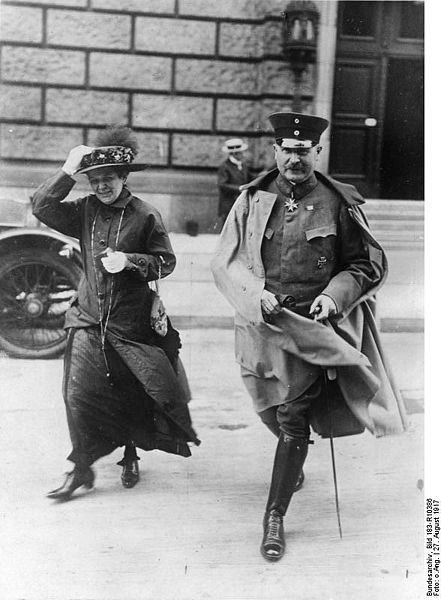
General Wilhelm Groener convinced Kaiser Wilhelm II to abdicate and helped forge an alliance between the Majority Socialists and the Army to head off a Soviet style Revolution

The history of Weimar, particularly that of the military and Freikorps in their relationship to the Republic is complex.  Not only is the relationship between the military and government complex, but the Freikorps themselves, their organization, leadership and political affiliation were not monolithic as is sometimes maintained,[i] nor were the Freikorps the direct ancestors of the Nazi SS/SA organizations despite often similar ideology,[ii] nor can they dismissed by saying that they were composed of “former soldiers and officers ill-disposed to return to civilian life.”[iii] The Freikorps’ association with the Army and Republic is more complex than some historians assert.  Despite the right wing leanings of many of units and fighters and future association of some to the Nazis, the blanket claim that the Freikorps were forerunners of the Nazi movement is not supportable.[iv]

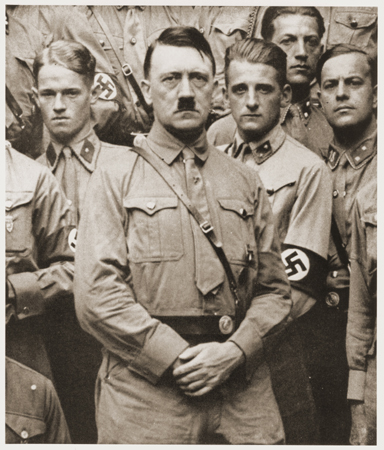
It is true that without Freikorps support in Munich, along with support of the Thule Society, business leaders and others “that the transition of the DAP into the Hitler party could not have taken place.”[v] It is also true that elements of the Freikorps branded too revolutionary and unruly for service in the Army continued as secret societies and affiliated themselves with various right-wing political groups.[vi] Likewise a case can be made that the fierceness of many Freikorps veterans, younger leaders of the Army helped lay the foundation for the brutality of both the Army and Waffen SS as they prosecuted the Second World War.[vii] Yet simply because certain aspects of a subject are true does not make for a broader “truth.”  Heinz Höhne argues the reverse of what some have written in regard to the relationship of the Freikorps and Reichswehr to the Nazis, that in fact the Nazis did not issue from the Freikorps, but rather that many former members of the Freikorps, Imperial Army or the Reichswehr were attracted to the Nazis, particularly to the SS by its “philosophy of “hardness” and its attitude of bellicosity per se, basically unconnected with ideology.”[viii] Others historians state similar views especially those that study the relationship of the Reichswehr leadership to the Freikorps.  Thus the thesis of this paper is that the historiography like the period itself is complex; that the composition, leadership and motivations of the Freikorps were not monolithic, nor were they beloved by the Reichswehr, nor were they the “trailblazers” for the Nazi movement.  The focus of this paper is on the relationship of the Reichswehr and the Freikorps to the Republic to the Kapp Putsch and the dangers of a relationship built on necessity without mutual trust.  Such a relationship is dangerous and can lead to unintended consequences.   This paper will explore the first years of the Weimar Republic and specifically look at several key events that were pivotal in the relationship between the Army and Freikorps and the Majority Socialists.

The Supporting Literature

The literature covering this period includes both well written academic histories and popular works which attempt to present a particular view. Additionally there are biographical works which shed some light on the subject. The Reichswehr and the German Republic 1919-1926 by Harold Gordon Jr. is perhaps the best study of the Freikorps and their relationship to the state and the army.  Gordon’s work is exceptional in documenting the numbers, types, political affiliation, action and ultimate disposition of the Freikorps.  The History of the German General Staff by Walter Goerlitz; The Nemesis of Power: The German Army in Politics 1918-1945 by John Wheeler-Bennett, The Reichswehr and Politics 1918-1933 by F.L. Carsten and The Politics of the Prussian Army: 1640-1945 by Gordon A. Craig are all extremely valuable in exploring the relationship between the military and the Republic.  The best of the general histories of the period, which focus on the National Socialist state are The German Dictatorship by Karl Dietrich Bracher, and Richard Evans’ The Coming of the Third Reich. Richard Watt’s The Kings Depart is one of the best for telling the story of the fall of the Empire and the revolution in Germany.  Watt’s account is well written and documented work and touches on other factors affecting the new republic including Versailles and Allied political actions. The final chapter of Holger Herwig’s The First World War: Germany and Austria-Hungary 1914-1918 gives a good account of the Army’s role in the end of the Empire and beginning of the Republic.  Andreas Dorpalen’s Hindenburg and the Weimar Republic adds an interesting dimension of Hindenburg’s role in the republic’s formation and negotiations between Groener, Noske and Ebert. Steven Ozments’ A Mighty Fortress is superficial in its treatment of the period.  Nigel Jones’ Birth of the Nazis: How the Freikorps Blazed a Trail for Hitler is an interesting and somewhat entertaining but not very well documented tending to “broad brush” in a sensational way the Freikorps having none of the detail or nuance of Gordon, Craig, or Carsten on the Freikorps, nor the depth of Goerlitz or Wheeler-Bennett on the Republic’s relationship with the Army, or the attitude of the Reichswehr leadership to the Freikorps.  William Shirer’s The Rise and Fall of the Third Reich, Gerald Reitlinger’s The SS: Alibi of a Nation 1922-1945 and Heinz Höhne’s The Order of the Death’s Head all add some information which details early Nazi involvement in the period, but are less useful to this early period most of their work focuses on later events.  Of other works, Kenneth Macksey’s Why the Germans Lose at War has an insightful but short chapter dealing with this period and Wolfram Wette’s The Wehrmacht: History, Myth, Reality offers an interesting and at times provocative look at anti-Semitism in the German military in the years following the First World War.  Carlos Caballero Jurado’s The German Freikorps 1918-1923 is a short but very detailed study of those organizations and their actions.  B.H. Liddell-Hart who has a small chapter on General Hans Von Seeckt in The German Generals Talk which though it does not deal with the events in this paper make for interesting commentary on later actions of former Reichswehr officers who served the Nazi state.

A number of biographies touch on actions of German Officers who played key roles in World War Two.[ix] Most auto-biographies gloss over the Weimar period; however Admiral Erich Reader’s memoir Grand Admiral offers the insight of a naval officer with some direct observation of the revolution and the Kapp Putsch.  General Heinz Guderian in Panzer Leader omits his service in the Baltic “Iron Division.”  Field Marshal Albert Kesselring’s memoirs has a brief section covering the period, but one comment is typical attitude toward of many officers throughout its existence:

“My cup of bitterness was full when I saw my devoted work rewarded by a warrant for my arrest for an alleged putsch against the socialist-influenced command of my III Bavarian Army Corps. Notwithstanding the degrading episodes during my imprisonment after 1945, I do not hesitate to describe this as the most humiliating moment of my life.”[x]

One thing that has to be noted about all the memoirs is that each of the writers was writing after the German Defeat and their imprisonment. Many times their words mask other actions and attitudes that are  not mentioned, thus while an important source one also has to have some suspicions when using them even the unintentional errors that come from time as well as the human tendency to have a somewhat selective memory.

Analysis
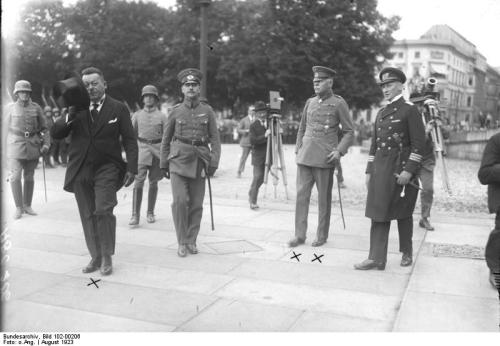
President Friedrich Ebert and his military commanders including General Hans Von Seeckt (2nd from right)

This paper will first examine the formation of the Freikorps by the Army and the Ebert government in response to uprisings by armed groups of leftists and the effectiveness of the Freikorps in putting down the various uprisings.   We will then address the relationship of the Army with the Majority Socialists and then move on to the crisis engendered by the Kapp Putsch.

The relationship of the Republic to the Army was born in the moment of crisis of the abdication of Kaiser Wilhelm II and the armistice discussions with the Allies.  Beset by revolts in key naval bases and mutinies aboard ships of the High Seas Fleet and unrelenting Allied pressure on the German armies in the west the situation continued to deteriorate as the “red flag was flying in all the principle cities, soldiers behind the front were electing soldiers councils Russian fashion.”[xi] Revolutionary and defeatist propaganda spread by the radical left wing of the Independent Socialists and Spartacus League spread through the country and even affected combat units,[xii] while the “Majority Socialists had found out that the militant factions of the Independents had secretly armed themselves out of funds supplied by the Soviet ambassador and adopted the slogan “all or nothing.””[xiii] The situation had deteriorated so badly that Karl Liebknecht, leader of the Spartacus League “was announcing the establishment of a Soviet regime from the steps of the Imperial Palace.”[xiv]

Under these dire conditions, General Wilhelm Groener who had succeeded General Ludendorff as Quartermaster General called an emergency meeting of fifty “of his most senior army commanders.”[xv] In response to his question of whether the troops would follow the Kaiser and oppose the revolts only one answered in the affirmative, and eight responded that “there was no hope of using regular Army units to quell unrest at home.”[xvi] On November 9th Groener went to the Kaiser on behalf of the Supreme Command and in response to a suggestion that the Kaiser lead the Army back and suppress the revolts boldly stated “The Army will march home in peace and under its leaders and commanding generals, but not under the command of Your Majesty, for it stands no longer behind Your Majesty.”[xvii] The Emperor abdicated fleeing to Holland and Friedrich Ebert leader of the Majority Socialists was named Chancellor on November 9th and upon hearing the news, Philipp Scheidemann, without consulting Ebert announced that Ebert was Chancellor and “Long live the great German Republic!”[xviii] The mobs were not placated by the announcement and far left organizations with the Independents “had no intention of letting the revolution stop there.”[xix] In the streets of Berlin soldiers sold their weapons and vehicles officers were attacked by crowds on the streets and whenever “crowds found an Army officer; they tore off his epaulettes and medals.”[xx] Everywhere mutual recrimination was in the air, soldiers “blamed revolutionaries for the betrayal and stab-in-the back while revolutionaries blamed officers for all the costs and losses of the war.”[xxi]

Groener called Ebert promising the Army’s support of the new government in return for the government’s assistance to the Army in the maintenance of discipline and supply.[xxii] He also drafted a letter signed by Hindenburg pledging the Army’s loyalty and telling him that “the destiny of the German people is in your hands….”[xxiii]One source notes: “Thus, in half a dozen sentences over a telephone line a pact was concluded between a defeated army and a tottering semi-revolutionary regime; a pact destined to save both parties from the extreme elements of revolution but, as a result of which the Weimar Republic was doomed at birth.”[xxiv]

The High Command was able to bring the Army home in good order following the armistice but upon arriving most units “melted away like snow under a summer sun,”[xxv] those which remained were often shells of their former selves beset by soldier’s councils and leftist revolutionaries.  To support the government the High Command issued a directive stating that it “put itself as the disposal of the present government led by Ebert without any reservation.”[xxvi] Yet in December delegates of the National Assembly continued to sow resentment in the military by military discipline be placed in the hands of soldiers’ councils, that all badges of rank be removed with all decorations of insignia and honor.[xxvii] Reaction was heated,[xxviii] but despite this Groener, Colonel Walter Reinhardt, the Prussian Minister of War and the Republic’s Defense Minister, Gustav Noske endeavored to find forces to combat the growing revolution and rebellious military units.  The choice was not hard, the Army was of no use, so called “democratic forces” were in most cases both unreliable and ineffective, while only the Freikorps “provided suitable material for the immediate creation of an efficient, combat-ready army.”[xxix] Thus the Freikorps became the instrument of necessity to ensure that the government was not swept away by a Soviet style revolution.

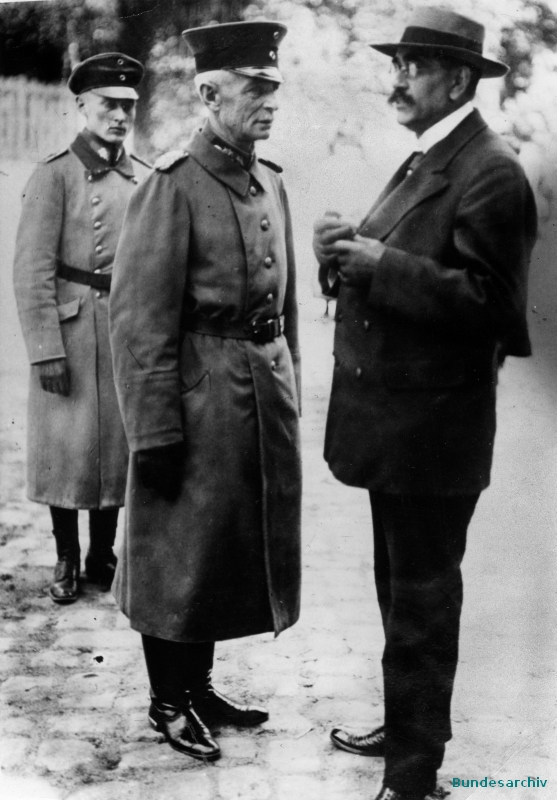
Gustav Noske and General Von Luttwitz. Luttwitz would lead the Reichswehr and Freikorps units that participated in the Kapp Putsch

Gustav Noske, of the Majority Socialist party “saw himself as a patriot, a man of action…who had no time for theories…and was one of the few Socialists that the Supreme Command trusted.”[xxx] He had already distinguished himself by helping to bring under control the sailors revolts in Kiel by forming a loyal “Naval Brigade”[xxxi] and he  “realized that the government must have a dependable military force behind it if it was to survive and rule Germany” and the “old Officer Corps must be the backbone of any such force.”[xxxii] The Army had melted away and units of the workers and soldiers councils were poorly trained, organized and led “”fought against the government as often as for it” and “were of little practical value to either the government or the rebels.”[xxxiii] In the chaos of a Spartacus, now called the German Communist Party uprising and vacuum of political leadership of January 1st 1919 agreed to become defense minister stating “Someone must be the bloodhound, I won’t shirk the responsibility!”[xxxiv]
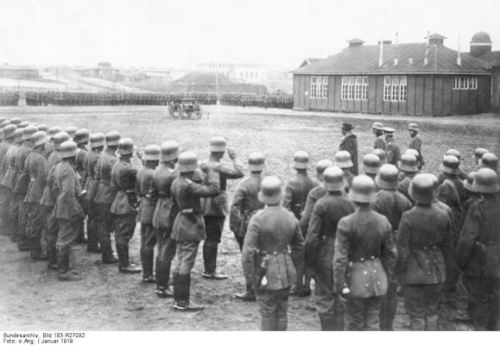
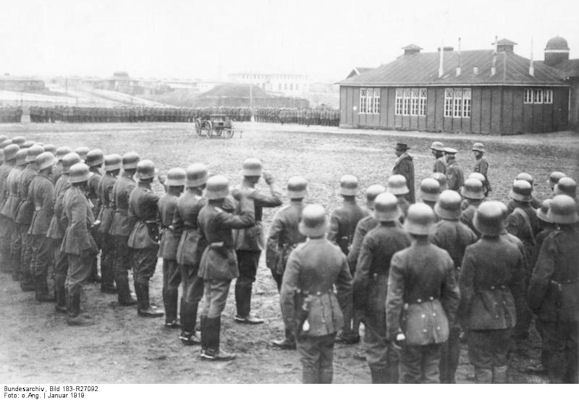
Noske reviewing Freikorps Hulsen. Many of the Freikorps were composed of professional soldiers and brought into the Reichswehr

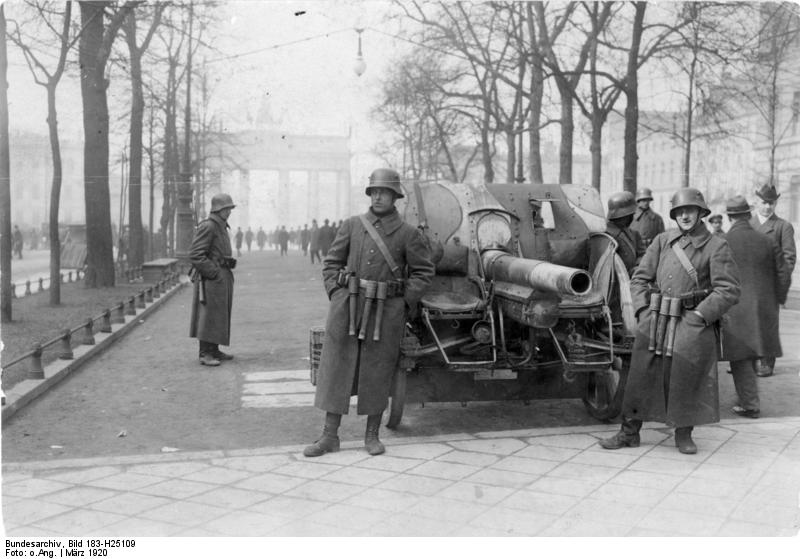
Noske helped by the High Command helped organize volunteer units led by officers and NCOs composed of reliable veterans.  Freikorps varied in size from divisions to companies and were led by Generals down to Sergeants and even a Private First Class.  Their greatest success was in early 1919 when the Republic was beset by “Red” revolutions in many major cities.  Without the use of the Freikorps by the government it is unlikely that the Republic would have survived.[xxxv] On January 4th Ebert and Noske reviewed the troops of General Maercker’s Freiwillege Landesjaegerkorps and Maercker informed them that every volunteer had pledged loyalty to the government, seeing the discipline and order Noske told Ebert “Don’t worry. Everything going to turn out all right now.”[xxxvi] On January 5th 1919 mobs attacked the Chancellery and the officers of the Socialist Vörwarts newspaper and Noske led the Freikorps[xxxvii] to regain control of the city[xxxviii] and crush the revolt during which “Karl Liebknecht and Rosa Luxemburg were lynched by the officers of the Guards Cavalry Rifle Division.”[xxxix] In March after a period of uneasy calm the Freikorps, now reinforced by the 2nd Naval Brigade, or Ehrhardt Brigade[xl] were called upon to put down the revolt of the “People’s Naval Division.”[xli] Making liberal use of heavy weapons including tanks the Freikorps inflicted heavy losses on the leftists with over 1500 dead and 12,000 wounded in the uprising.[xlii] Other revolts were crushed and the Freikorps reached their zenith in Württemberg where Freikorps led by Lieutenant Hahn, a Social Democrat put down leftist revolts[xliii] and in Bavaria where Independents and Communists had taken the city with their “Bavarian Red Army which numbered nearly 25,000 men[xliv] on April 7th. After failed attempts by the Socialist government to retake Munich, they asked for Berlin’s help.  Violence and massacres of citizens by the various leftist groups inflamed the Freikorps, including the Ehrhardt Brigade and the revolt was crushed by May 2nd.[xlv] Dorpalen calls the Freikorps ruthlessness “completely unwarranted in view of the weakness of the opposing forces” and noted though they broke the leftist powers they deepened the nations’ cleavages”[xlvi] while Macksey writes that “where Freikorps’ brutality stained the pages of history there was invariably a forgoing or simultaneous record of excess by their sworn opponents.”[xlvii]
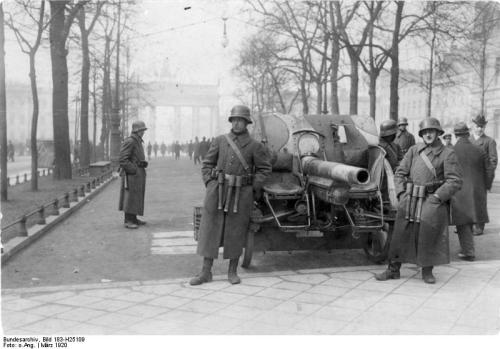
The Erhardt Brigade in Berlin during the Kapp Putsch

The Provisional Reichswehr was established on March 6th 1919 and the High Command began to assemble it from the Freikorps, remaining Army units and Republican defense forces.  Some Freikorps were brought into the new Army in total, but the tumult had not yet ceased.  There was a great distrust between many in the Army, the remaining Freikorps and the Socialists.  The crisis was precipitated by the signing of the Treaty of Versailles, Noske and others threatened resignation over the war guilt clauses, but Groener warned that if the treaty was rejected the Army could not win against the Allies if hostilities were renewed.[xlviii] The treaty imposed harsh limitations on the German Army which many bitterly resented, however, Seeckt, the Chief of Staff of the Army felt that it was “more important to keep the Army in being and preserve the possibility of a military resurrection.”[xlix] Yet the government had lost the support of the Officer Corps and many looked to General Walther von Lüttwitz, the Reichswehr’s senior commander for leadership.[l]

Korvettenkapitan (Lieutenant Commander) Erhardt commander of the 2nd Naval Brigade whose announced demobilization triggered the Kapp Putsch. Erhardt would have to flee after the Nazi takeover. Even revolutionaries become victims as revolutions end

Other right-wing groups and individuals made plans to overthrow the government.  They favored revolt against the government, but “their political aims were hazy.”[li] Seeckt and Reinhardt felt it necessary to demobilize Freikorps who’s ill-discipline and political radicalism was a “danger to the consolidation desired by the army command.”[lii] This movement climaxed with the alliance of Lüttwitz to Wolfgang Kapp and was triggered by the orders disbanding the 2nd and 3rd Naval Brigades in compliance with Versailles and due to their radical views.[liii] In spite of the opposition of his chief of staff Von Lüttwitz began planning a coup to save Germany.[liv] The conspirators showed “little regard for coordination of effort and a quite amazing ability to work at cross purposes.”[lv] On March 12th without consulting Kapp, Lüttwitz and Ehrhardt launched the Putsch and Ehrhardt’s brigade in full battle dress entered Berlin. At this point the Reichswehr command froze; officers refused to condone the putsch but at the same time refused to support Noske and Reinhardt who demanded armed opposition,[lvi] while Navy officers openly supported it.[lvii] Seeckt declared that “Troops do not fire upon troops!” and “When at occurs, then the true catastrophe, which was avoided with so much difficulty on November 9, 1918 will really occur.”[lviii] The coup died amid massive strike by workers and lack of popular support but the damage was done.  Noske resigned, many officers in were discredited[lix] and dismissed including Lüttwitz and Admiral Von Trotha, who openly supported the coup,[lx] though Raeder says that Von Trotha and the Navy staff only” thought of anything of complete loyalty to the government.”[lxi] The relationship which had endured the dire days of the Republic was ended.  The Reichswehr would emerge a lean and highly trained organization and remain a power broker in the Republic but the animosity between the Army and the Socialists that they could not stand together against the Nazis despite a mutual interest in doing so.[lxii]

Conclusion

The end of Weimar and the beginning of a nightmare

The period was a critical and complex and should be studied by anyone living in a state with a powerful military tradition and institutions in crisis.  Unlike popular notions, the Freikorps were diverse and not the seed-bed of the Nazi movement and though many former members would become Nazis.  Several, including Ehrhardt narrowly escaped death at Nazi hands.[lxiii] Freikorps were viewed by Army leadership as an expedient force that could not remain in the service once the Army was functional.

Key lessons include that the military cannot become a “state within a state,” and that both military and civilian leaders must seek to bridge any gulf that separates them in times of crisis.  In Weimar both the military and the Socialists thoroughly distrusted one another with the result that they eventually, despite early success[lxiv] worked against each other in later years.  Actions by both Socialists and the military ultimately subverted the Republic and ensured its demise and Seeckt’s policy of separation from politics “tended toward a renunciation of the soldier’s potential restraining influence on adventurous statesmen.”[lxv] Such is the fateful lesson for today.


[i] Jones, Nigel. The Birth of the Nazis: How the Freikorps Blazed a Trail for Hitler. Constable and Robinson Ltd. London, U.K. 1987 and 2004.  This is Jones assertion and he attempts to make the tie using careers of some individuals who served both in Freikorps and either in the Nazi Party or Military and attitudes common in many Freikorps with similar attitudes found in the Nazi movement.  The 2004 edition of his work includes an introduction by Michael Burleigh echoing his sentiments.

[ii] Evans, Richard J. The Coming of the Third Reich. Penguin Group. London, U.K. and New York, NY. 2003. pp.227-229.  Evans discusses the fact that the Nazis did have a number of Freikorps veterans but at no point makes the connection that the Freikorps are a direct ancestor.

[iii] Ozment, Steven. A Mighty Fortress: A New History of the German People. Harper-Collins Publishers, New York, NY 2004 p.246

[iv] Gordon, Harold J. Jr. The Reichswehr and the German Republic 1919-1926. Princeton University Press, Princeton NJ 1957.  Gordon’s work is perhaps the most detailed study involving the Freikorps and the Reichswehr. He is exceptional in discussing the relationship of both with the various political parties including the Nazis.  He refutes this assertion throughout the book.

[v] Bracher, Karl Dietrich. The German Dictatorship. Translated by Jean Steinberg. Praeger Publications, New York, NY 1970. Originally published as Die Deutsche Diktatur: Enstehung, Struktur, Folgen des Nationalsozialismus. Verlag Kiepenheuer & Witsch, Koln und Berlin. 1969. p.101

[vi] Wheeler-Bennett, John W. The Nemesis of Power: The German Army in Politics 1918-1945. St. Martin’s Press, New York, NY 1954 pp. 91-92

[vii] Shepherd, Ben. War in the Wild East: The German Army and Soviet Partisans. Harvard University Press, Cambridge, MA and London, U.K. 2004. p.28

[viii] Höhne, Heinz. The Order of the Death’s Head: The Story of Hitler’s SS. The Penguin Group, London U.K. and New York, NY 1969. Translated by Richard Barry. Originally Published as Der Ordnung unter dem Totenkopf. Verlag der Spiegel, Hamburg, 1966. p.54.

[ix] These include Macksey’s biographies of Kesselring and Guderian , Richard Giziowski’s The Enigma of General Blaskowitz. Peter Padfield’s Dönitz: the Last Führer, David Fraser’s biography of Field Marshal Rommel Knight’s Cross, Messenger’s work on Von Rundsedt, The Last Prussian, and Höhne’s Canaris: Hitler’s Master Spy all provide brief but interesting views of the actions and attitudes of these officers during the revolution and during the  Weimar period.

[x] Kesselring, Albrecht. The Memoirs of Field Marshal Kesselring with a new introduction by Kenneth Macksey. Greenhill Books, London UK. 1997. Translated from the German by William Kimber Ltd. Originally published as Soldat bis zum letzen Tag. Athenaum, Bonn, Germany 1953 pp.18-19

[xi] Goerlitz, Walter. History of the German General Staff 1657-1945. Translated by Brian Battershaw. Westview Press. Boulder CO and London. 1985 Originally published as Der Deutsche Generalstab, Verlag der Fankfurter Hefte, Frankfurt am Main.  First U.S. publication in 1953 by Preager Publishers. p.200

[xii] Gordon, Harold Jr. The Reichswehr and the German Republic 1919-1926. Princeton University Press, Princeton, NJ 1957 pp.4-5 Gordon recounts the story of an entire replacement train revolting when it reached the front which had to be disarmed by a shock battalion.

[xiii] Watt, Richard M.  The Kings Depart: The Tragedy of Germany: Versailles and the German Revolution. Simon and Schuster, New York, NY 1968. p.186

[xiv] Wheeler-Bennett, John W. The Nemesis of Power: The German Army in Politics 1918-1945. St. Martin’s Press, New York, NY 1954. p.18

[xv] Herwig, Holger H. The First World War: Germany and Austria Hungary 1914-1918. Arnold Press a member of the Hodder-Headline Group, London, UK and New York NY 1997 p.445

[xvi] Ibid. Herwig. p.445

[xvii] Carsten, F.L. The Reichswehr and Politics 1918-1933. Oxford University Press, Oxford, UK 1966 p.6.  It is noted by a number of author’s that Groener did this, to maintain the unity of Germany and prevent its division.

[xviii] Ibid. Watt. p.196  Watt notes Ebert’s reaction as being enraged as the proclamation of the Republic technically “invalidated the existing constitution; Germany was now technically without a government.” (p.197)

[xix] Ibid. Watt. p.197

[xx] Ibid. Watt. p.197

[xxi]Giziowski, Richard. The Enigma of General Blaskowitz Hippocrene Books Inc. New York NY, 1997. p.65

[xxii] Craig, Gordon A. The Politics of the Prussian Army 1640-1945. Oxford University Press, Oxford, UK 1955 pp.347-348.  Craig gives an interesting account noting the Groener’s call to Ebert shows recognition of the legitimacy of the new government and notes that the offer was somewhat conditional.

[xxiii] Dorpalen, Andreas. Hindenburg and the Weimar Republic. Princeton University Press, Princeton, NJ. 1964 p.26

[xxiv] Ibid. Wheeler-Bennett. p.21

[xxv] Ibid. Gordon. p.15

[xxvi] Ibid. Carsten. p.11. This was of critical importance as Carsten later notes that the Army realized that the government could not survive without its support.  Groener was perhaps the officer who most recognized the situation and endeavored to ensure that “the best and the strongest element of the old Prussia, was saved for the new Germany, in spite of the revolution.” (p.12)

[xxvii] Ibid. Carsten. p.18 Carsten produces the bulk of the English translation of these points and notes that the anti-military feeling had become widespread.

[xxviii] Ibid. Giziowski. p.66  Giziowski recounts the speech of Hermann Goering in response to the announcement. This shows how such treatment can breed anger and resentment in a military that feels it has been betrayed after serving its country in a long and difficult war: For four long years we officers did our duty and risked all for the Fatherland. Now we have come home, and how do they treat us? The spit on us and deprive us of what we gloried in wearing. I will tell you that the people are not to blame for such conduct. The people were are comrades…for four long years.  No, the ones who have stirred up the people, who have stabbed this glorious army in the back…. I ask everyone here tonight to cherish a hatred, a deep and abiding hatred, for these swine who have outraged the German people and our traditions.  The day is coming when we will drive them out of our Germany.”

[xxix] Ibid. Gordon. p.15

[xxx] Ibid. Watt. p.168

[xxxi] Ibid. Gordon. pp. 19 and 24.  This was the 1st Marine Brigade, or Brigade Von Roden of which elements would later serve in under the command of other Freikorps such as the Guards Calvary Rifle Division.

[xxxii] Ibid. Gordon. p.14

[xxxiii] Ibid. Gordon. p.18

[xxxiv] Ibid. Watt. p.239

[xxxv] Ibid. Gordon. p.426

[xxxvi] Ibid. Watt. p.247

[xxxvii] Thee forces included the Landesjaegerkorps and Guards Cavalry Rifle division.

[xxxviii] Ibid. Gordon. p.30

[xxxix] Ibid. Wheeler-Bennett. p.36

[xl] This was one of two additional Naval Brigades formed by Noske after the success of Naval Brigade Von Roden.  It was one of the most combat effective but unfortunately violent and radical of the Freikorps, it would as we will see be a key unit in the Kapp Putsch but would not be absorbed into the Reichswehr.

[xli] This unit was not a Navy unit at all but was composed of many who were criminals and other rabble. See Gordon, Carsten and Watt.

[xlii] Jurado, Carlos Caballero. The German Freikorps 1918-23. Illustrated by Ramiro Bujeiro. Osprey Publishing, Oxford, UK 2001 p.12

[xliii] Ibid. Gordon. p.42  His units were known as Security Companies.

[xliv] Ibid. Jurado. p.13

[xlv] Ibid. Gordon. pp.47-49. An estimated 550 people including 200 innocent bystanders were killed in the fighting.

[xlvi] Ibid. Dorpalen. p.29

[xlvii] Macksey, Kenneth. Guderian: Creator of the Blitzkrieg. Stein and Day Publishing, New York, NY 1975 p.45

[xlviii] Ibid. Wheeler-Bennett. pp.57-59

[xlix] Ibid. Goerlitz. p.216

[l] Ibid. Wheeler-Bennett. p.61

[li] Ibid. Carsten. p.74

[lii] Ibid. Carsten. pp.74-75

[liii] Ibid. Carsten. p.76  Another consideration is that Noske, Reinhardt and Seeckt all were seeking to retire Lüttwitz.

[liv] Ibid. Gordon. p.97

[lv] Ibid. Craig. p.376

[lvi] Ibid. Carsten. pp.78-79

[lvii] Höhne, Heinz. Canaris: Hitler’s Master Spy. Cooper Square Press, New York, NY 1979 and 1999. Translated from the German by J. Maxwell Brownjohn, Originally published in Germany by C. Bertelsmann Verlag Gmbh, München. 1976. p. 78.  Canaris also had been suspected of complicity in the murders of Rosa Luxemburg and Karl Liebknecht but was acquitted. (pp.56-71)

[lviii] Ibid. Gordon. pp.114-115

[lix] Among them Maercker who had been such a strong supporter of the Republic in the early days.

[lx] Ibid. Carsten. p.98

[lxi] Raeder, Erich. Grand Admiral. Translated from the German by Henry W. Drexell. United States Naval Institute, Annapolis MD, 1960. Da Capo Press edition published 2001. p.111. This is interesting as almost all histories implicate the Navy High Command of either some complicity or at least agreement with the Putsch participants.

[lxii] The final part in the drama would come when General Kurt Von Schleicher became the last Chancellor before Hitler.  Schleicher had assisted Groener and Noske in the early days of the Republic and often attempted to use the Army’s influence in politics. He was fatally short sighted and was a victim of the SS “night of Long Knives” which was directed against the SA.

[lxiii] Ibid. Jones. p.266  Others such as Gerhard Rossbach had similar experiences.  Korvettenkapitän Löwenfeld of the 3rd Naval Brigade became an Admiral, Wilhelm Canaris , who was implicated in the Kapp Putsch but kept his career would later head the Abwehr and die in a concentration camp.

[lxiv] Ibid. Gordon. p.426  Gordon has a good discussion of this topic in his conclusion.

65 Liddell-Hart, B.H. The German Generals Talk. Published 1948 B.H. Liddell-Hart, Quill Publications, New York, NY. 1979. p.18 Liddell-Hart’s analysis of the results of the Reichswehr’s disconnection from the larger society and political process is remarkable due to current trends in the American military which like the Reichswehr has become somewhat more conservative and disconnected from society, exceptionally technically proficient but not adept in politics or grand-strategy.


Works Cited


Bracher, Karl Dietrich. The German Dictatorship: The Origins, Structure and Effects of National Socialism. Translated from the German by Jean Steinberg with an introduction by Peter Gay.  Praeger Publishers, New York, NY. 1970 Originally published in Germany as Die deutsche Diktator: Entstehung, Struktur, Folgen den Nationalsozialismus by Verlag Kiepenheuer und Witsch. Koln und Berlin.


Carsten, F.L. The Reichswehr and Politics 1918-1933. Oxford University Press, Oxford, UK 1966


Craig, Gordon A. The Politics of the Prussian Army 1640-1945. Oxford University Press, Oxford, UK 1955


Dorpalen, Andreas. Hindenburg and the Weimar Republic. Princeton University Press, Princeton, NJ. 1964


Evans, Richard J. The Coming of the Third Reich. Penguin Books, New York, NY and London, UK. 2003


Giziowski, Richard. The Enigma of General Blaskowitz Hippocrene Books Inc. New York NY, 1997


Goerlitz, Walter. History of the German General Staff 1657-1945. Translated by Brian Battershaw. Westview Press. Boulder CO and London. 1985 Originally published as Der Deutsche Generalstab, Verlag der Fankfurter Hefte, Frankfurt am Main.  First U.S. publication in 1953 by Preager Publishers


Gordon, Harold Jr. The Reichswehr and the German Republic 1919-1926. Princeton University Press, Princeton, NJ 1957


Guderian, Heinz. Panzer Leader. (abridged) Translated from the German by Constantine Fitzgibbon, Ballantine Books, New York 1957


Herwig, Holger H. The First World War: Germany and Austria Hungary 1914-1918. Arnold Press a member of the Hodder-Headline Group, London, UK and New York NY 1997


Höhne, Heinz. Canaris: Hitler’s Master Spy. Cooper Square Press, New York, NY 1979 and 1999. Translated from the German by J. Maxwell Brownjohn, Originally published in Germany by C. Bertelsmann Verlag Gmbh, München. 1976.


Höhne, Heinz. The Order of the Death’s Head: The Story of Hitler’s SS. The Penguin Group, London U.K. and New York, NY 1969. Translated by Richard Barry. Originally Published as Der Ordnung unter dem Totenkopf. Verlag der Spiegel, Hamburg, 1966.


Jones, Nigel. The Birth of the Nazis: How the Freikorps Blazed the Way for Hitler. Constable and Robinson Ltd. London, UK 1987


Jurado, Carlos Caballero. The German Freikorps 1918-23. Illustrated by Ramiro Bujeiro. Osprey Publishing, Oxford, UK 2001


Kesselring, Albrecht. The Memoirs of Field Marshal Kesselring with a new introduction by Kenneth Macksey. Greenhill Books, London UK. 1997. Translated from the German by William Kimber Ltd. Originally published as Soldat bis zum letzen Tag. Athenaum, Bonn, Germany 1953.


Liddell-Hart, B.H. The German Generals Talk. Published 1948 B.H. Liddell-Hart, Quill Publications, New York, NY. 1979


Macksey, Kenneth. Guderian: Creator of the Blitzkrieg. Stein and Day Publishing, New York, NY 1975


Macksey, Kenneth. Kesselring: The German Master Strategist of the Second World War. Greenhill Books, London, UK 2000.


Ozment, Steven. A Mighty Fortress: A New History of the German People. Harper-Collins Publishers, New York, NY 2004


Shepherd, Ben. War in the Wild East: The German Army and Soviet Partisans. Harvard University Press, Cambridge, MA and London, U.K. 2004


Wheeler-Bennett, John W. The Nemesis of Power: The German Army in Politics 1918-1945. St. Martin’s Press, New York, NY 1954


Watt, Richard M.  The Kings Depart: The Tragedy of Germany: Versailles and the German Revolution. Simon and Schuster, New York, NY 1968


Wette, Wolfram. The Wehrmacht: History, Myth, Reality. Harvard University Press, Cambridge, MA and London, UK  2006. Translated from the German by Deborah Lucas Schneider. Originally published as Die Wehrmacht: Feindbilder, Vernichtungskrieg, Legenden. S. Fischer Verlag Gmbh, Frankfurt am Main, Germany 2002


1 Comment

Filed under History, Military, national security, Political Commentary

Changes of Plans: It’s what you learn after you know it all that counts

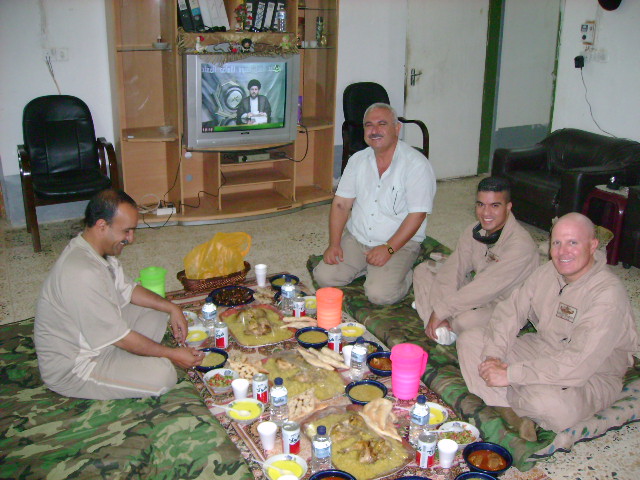
Dinner as a Guest of Brigadier General Sabah of 7th Iraqi Division

Today I was planning on traveling about an hour from here up to Kinston to see the Kinston Indians play the Winston-Salem Dash. That did not happen as I was called out of the “bullpen” so to speak to see a lady in our ICU.  I got the word as I was celebrating Mass and when I was done went to the hospital to make the visit which was delightful. The lady was one of those indefatigable people that despite a serious medical condition exuded grace, confidence and life and who up to the day she came to us was taking care of people worse off than her, taking them to the store, the doctor, preparing meals and making quilts for young mothers. The visit lasted about an hour with her doing most of the talking as if I was a neighbor who had dropped by for a chat.  We prayed and she shared a couple of poems that were actually touching.  I do pray that the specialist that we send her to will be able to correct the problems that brought her to us as we need as many people like her as we can get.

So anyway with my well laid plans disrupted I have been doing some thinking and if you know me that can be a dangerous thing because I never know exactly what the muse will inspire.  It began early even before I got out of bed when I saw a Facebook chat message from an Army Chaplain of my denomination serving with an infantry unit in Afghanistan.  He asked if I had read a story in the Christian Science Monitor about an Army National Guard Chaplain who had been convicted of fraudulently awards for valor including the Bronze Star with the “V” device for valor, the Purple Heart and the Ranger Tab denoting his completion of the arduous Ranger School.  He added those awards to his recorded after Operation Desert Storm where he served as a clerk and saw no action and he carried the charade on into the time where he was commissioned as a Chaplain.

http://www.csmonitor.com/USA/Military/2011/0403/Did-a-chaplain-s-fake-Purple-Heart-erase-good-deeds

He was tripped up after he returned from a tour in Afghanistan and was tried and convicted under the provisions of the Stolen Valor Act.  If he wasn’t a Chaplain it would have been bad enough.  However as a Chaplain his falsification discredited all the good work that he did in Afghanistan. What really did him in with his former soldiers was lying about his experiences to them point of wearing fraudulent awards for valor. His deception has caused many of the soldiers that he counseled to be angry and wonder if he was lying about other things.  When a Chaplain loses his or her credibility for an integrity issue it undermines their ministry, damages relationships with the people that they serve as well as their colleagues.  Their actions if married also negatively impact their families who suffer for their actions. The man in question received an Other Than Honorable Discharge which means that he receives none of the benefits that he would have received as a veteran including retirement. He is now getting help but the damage is done.

He certainly is not the first Chaplain to fall and won’t be the last.  I have spent a decent amount of my career being a “relief pitcher” for line officers and chaplains who have been relieved of their duties and been assigned to try to help rehabilitate others who have merely messed up without committing any crimes.  I have been fortunate in my long career to have men that have looked after me and protected me when I screwed up, sometimes with great aplomb.  My screw ups always seemed to be to being cocky and sometimes arrogant thinking that I was the greatest thing since micro-brewed beer.

When I was commissioned as a Second Lieutenant in the US Army back in 1983 I knew that I was quite possibly the smartest new Lieutenant in the Army.  I graduated from my Medical Service Corps Officer Basic Course fairly high in my class without really trying too hard, had a pretty easy time at the Junior Officer Maintenance Course.   However, real life has a tendency to take the smartest of the book smart people and kick their ass.  Sometimes it takes a while but young guys in the military who think they know more than old dudes who have served on all kinds of places and been to combat tend to blow themselves up and hopefully there will be someone to save their sorry ass.

When I got to Germany I can say that there were a number of occasions where as a young officer I had my ass handed to me, even when I was right.  I’m not going to go into ugly details but it suffices to say that a good number of those times I got what I deserved because I was arrogant and not nearly as smart as I thought I was.  I was like a rookie pitcher thinking that my stuff was unhittable and finding out that guys who had played in the show for a long time had seen it all before.  It was in Germany that I found that while I had good stuff that I wasn’t savvy enough to know when to change my stuff up or when to take the hint not to keep pushing my luck.  I was kind of like the young pitcher Ebby Clavin “Nuke” LaLoosh in Bull Durham in wanting to do what I wanted to do and it got me in trouble.  One of my favorite scenes in the movie has this dialogue.

Crash calls for a curve ball, Ebby shakes off the pitch twice]
Crash Davis: [stands up] Hey! HEY!
[walks to meet Ebby at the mound]
Crash Davis: Why are you shaking me off?
Ebby Calvin LaLoosh:
[Gets in Crash’s face] I want to give him the heat and announce my presence with authority!
Crash Davis: Announce your f***ing presence with authority? This guy is a first ball, fast ball hitter!
Ebby Calvin LaLoosh: Well he hasn’t seen my heat!
Crash Davis:
[pauses] Allright meat, show him your heat.
[Walks back towards the box]
Crash Davis: [to the batter] Fast ball. [Ebby throws a fastball which is hit out of the park and Crash comes to the mound]
Ebby Calvin LaLoosh: You told him didn’t you?
Crash Davis: Yup.

That was me as a young officer.  You would think that I would have learned, but after I became an Army Chaplain I did the same damned thing.  Now admittedly it was not in the units that I served in, but my hotheadedness still got me in trouble especially when I decided to challenge older Chaplains who had been around a long longer than me and who were a lot more savvy than me.  I had no idea how cunning and brutal some chaplains could be despite having good warning from my XO and Brigade commander at the Academy of Health Sciences, Lieutenant Colonel Jim Wigger before I left active duty for seminary.  Colonel Wigger pulled me aside one day shortly before I left active duty and said “Steve, I know that you think that the Medical Service Corps can be political and vicious, we can’t hold a candle to the Chaplain Corps.”   He was right and I would have been wise to listen to him.  There are some Chaplains that have no problem taking down or destroying a young chaplain sometimes for good reasons but sometimes for less than noble reasons. Anyone that has served as an Active Duty Chaplain probably knows about or has experienced such an encounter up close and personal.  I got whacked pretty hard a number of times as a young Army Chaplain, but was fortunate that people who knew me and saw potential in me gave me some top cover and protection.  Not everyone gets this.  Chaplain Rich Whaley did this for me at the Chaplain school on a number of occasions even the time that I got thrown out of the Chaplain Officer Advanced Course. That was not one of my finer moments; I left the school like former Atlanta Braves Manager Bobby Cox would when he got tossed from games.

While Rich was not quite like Crash Davis he knew how to handle me when I got stupid. There is another scene in Bull Durham where Ebby ignored Crash and paid the price.  

[Mechanized bull noises in background after ball hits the Bull over the Right Field wall]
Crash Davis: Well, he really hit the shit outta that one, didn’t he?
[laughs]
Ebby Calvin LaLoosh: [softly, infuriated] I held it like an egg.
Crash Davis: Yeah, and he scrambled the son of a bitch. Look at that, he hit the f***ing bull! Guy gets a free steak!
[laughs]
Crash Davis: You having fun yet?
Ebby Calvin LaLoosh
: Oh, yeah. Havin’ a blast.
Crash Davis: Good.
[pause]
Ebby Calvin LaLoosh: God, that sucker teed off on that like he knew I was gonna throw a fastball!
Crash Davis: He did know.
Ebby Calvin LaLoosh: How?
Crash Davis: I told him.

Thankfully by the time I had spent 17 ½ years in the Army I had pretty much learned my lessons.  By the time I got to the Navy I had pretty much discovered when and under what circumstances that I could push things without crossing the line.  I had learned the hard way in the Army.  I finally learned that I didn’t know nearly as much as I thought I did.  In fact when I went to the Navy I came in at a lower rank that my Army rank and took no constructive credit to try to get promoted sooner.  A lot of people have asked me why I did this but I went in with no time in grade to make sure that I got the experience that I needed on the Navy and Marine side. By doing this I took the time to learn the nuances that make the work of a chaplain different in the Sea Services than in the Army.  While there are similarities that are common to all Chaplains even the similarities are often different depending on the service and even the type of unit you serve in or platform that you serve aboard.  These different similarities can kill you if you think that you’re smarter than everyone else.

Christmas at COP South

I’m now coming up to 26 years of commissioned service and soon to 28 total years of service.  I’m now a lot more like Crash Davis than Ebby Calvin “Nuke” LaLoosh.  Now I try to make sure the young chaplains and other Sailors, Marines or Soldiers don’t get themselves in unnecessary trouble by assuming that they know more than they do.  I know from bitter experience the price that any service member and especially Chaplains can pay for screwing up. I had some OERs in the Army that were less than stellar when seniors tried to torpedo me.  Thankfully like baseball statistics they don’t follow you when you get traded to or sign with a team in another league mid season. They are there for posterity but you get a clean start in the new service.  I am blessed because my Navy and Marine Corps stats are far better than my Army stats.

The Chaplain in question now suffers the ignominy of being put out of the service for his actions.  From the article it seemed that he had a need to appear more than he was failing to realize that there is honor in simply serving be it as a clerk or a Chaplain.  Military awards tell a story about a person, those that earn them for valor or for wounds suffered should have earned them. I see many young men and women that wear Purple Hearts and awards for valor in combat. While I have many awards and service medals, even for service in a combat zone I cannot dishonor the brave men and women that have paid with their lives by wearing something that I didn’t earn and find it hard to fathom others doing this.

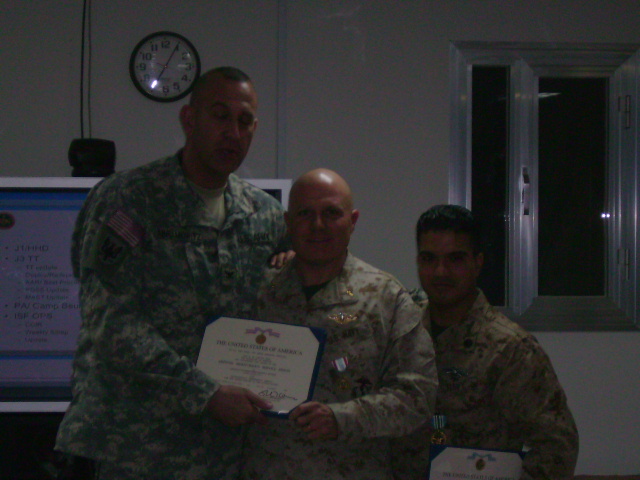
Receiving the Defense Meritorious Service Medal on my way out of Iraq from Colonel David Abramowitz Chief of Staff Iraq Assistance Group on 31 January 2008. RP2 Nelson Lebron my assistant is to the right

There are other ways that chaplains can get in trouble and I have seen them all I think. Moral issues, alcohol and drug abuse, adultery, misappropriating or even stealing government funds and doing things in combat zones that cross the line such as actually engaging the enemy.  There was a Chaplain back during Operation Iraqi Freedom that displayed photos of him in combat carrying an M-16 and I have heard of others in previous wars that have crossed that line. That last offense violates the U.S. interpretation of the Geneva and Hague Conventions and the consequences are greater than the individual chaplain as a Chaplain that does such surrenders his status as a non-combatant and exposes himself to potential war crimes charges. Likewise in the current war with much media coverage and an enemy that would exploit such actions to incite further violence and embarrass the United States it would be criminal for a Chaplain to take part as a combatant. It would harm the war effort, make him a potential target and endanger all other chaplains in the combat zone.

Chaplains are already a high priority target for Al Qaeda as our capture would be of great propaganda value. I had a number of Iraqi officers express their admiration for my service and care for American and Iraqi soldiers and the fact that they recognized that I was in constant danger and was unarmed.  I felt that it was high praise. Chaplains don’t need to be anything except what they are, servants of God and servants of the men and women that they serve. Being recognized with awards and promotion is cool but at the same time if that becomes the focus then we have somehow forgotten why we are in uniform and probably shouldn’t be.

Anyway, my mission now is to help the young guys and gals along and hopefully keep them from stepping on the land mines that I stepped on in my career.  I also know and am very aware that even as smart as I think that I am that I don’t know nearly as much as I did when I entered the military.  It’s like Earl Weaver said “It’s what you learn after you know it all that counts.”

Peace,

Padre Steve+


1 Comment

Filed under Baseball, christian life, iraq,afghanistan, leadership, Military, Pastoral Care

The Gift My Dad Gave to Me: Baseball and the Mystery of Life

The Big A

This post is an updated and edited version of an article that I published here in 2009.  It is something that I come back to often because it deals with my dad and the influence that he had on my life especially in giving me a gift, the gift of baseball something that almost more than anything else which been a bastion of peace since I returned from Iraq in 2008.

Baseball, it is said, is only a game. True. And the Grand Canyon is only a hole in Arizona. Not all holes, or games, are created equal.” George Will

Basketball, hockey and track meets are action heaped upon action, climax upon climax, until the onlooker’s responses become deadened.  Baseball is for the leisurely afternoons of summer and for the unchanging dreams.  Roger Kahn

Baseball has always been a source of enjoyment for me.  I’ve noted in numerous other posts that God speaks to me through baseball.  For me there is something mystical about the game.  It extends beyond the finite world in some respects and there is symmetry to the sport unlike any other.  George Will’s quote at the beginning of this post is dead on.  Not all holes or games are created equal.

Though I had played Little League Ball in the 1960s and well as a lot of backyard or sandlot games, it was during the 1970-1971 season when my dad began taking us to California Angels games while stationed in Long Beach California that the game really captured me.  The seed of course had been planted by him long before when we watched games on a black and white TV and going to see the Seattle Pilots in their inaugural and final season back in 1969 and in our back yard when he taught me to throw, field and run the bases. He tried to teach me to hit, but that didn’t work too well as I never hit above the Mendoza line in any organized league. The only mistake he made, a mistake that my kindergarten teacher also made was to turn me from a natural lefty to a right hander.  I think that this is one of the reasons that I am as warped as I am.  Bill “Spaceman” Lee once said “You have two hemispheres in your brain – a left and a right side. The left side controls the right side of your body and right controls the left half. It’s a fact. Therefore, left-handers are the only people in their right minds.” In a sense my mind has been at war with my body since kindergarten but at least I am in my right mind.  In spite of that he did turn me into a pretty good pitcher something that unfortunately my Little League coaches never noticed.

While my dad thrived on all sports, baseball was the one that he gave me as a gift.  He gave my brother golf, another spiritual game, which Zen master’s love.  But Gold is not to be compared with baseball because it is not a team sport though individual accomplishment is key to both and neither

Growing up with baseball was something that I cannot imagine have not done.  It was part of life from as far back as I can remember and this was because dad made it so.  It kind of reminds me of the beginning of the movie For the Love of the Game where home movies of a child playing ball with dad are shown during the opening credits and score.  I can close my eyes and remember vivid details of ball fields and backyards where dad would play catch with me play pepper and fungo and teach me to pitch.  He never did much with hitting except turn me around at the plate.  When I had him in a brief lucid moment when I visited in May of 2009 when he was markedly deteriorating from Alzheimer’s disease and I thanked him for teaching me to love the game. I told him I still heard his voice telling me to keep my butt down on ground balls and that he did not teach me to hit.  He simply said “you can’t teach someone to hit, it’s a gift, lots of people can’t hit.”

In 1970 we moved to Long Beach California where we lived about 15 minutes from Anaheim Stadium, the home of the then named California Angels.  Back then Anaheim Stadium was called “the Big A” due to the scoreboard shaped like a large “A” with a halo ringing the top in left center field.  Dad took us to more games than I can count and the times there were simply magical.  It was and still is a wonderful place to watch a game.  Back then access to players was easy.  I met players, got signed balls and hats, and was even selected as a runner up in the “My Favorite Angel” contest.  For that I met my favorite Angel, First Baseman Jim Spencer a Golden Glove Winner who later played for the White Sox and Yankees, and two tickets behind home plate.  Now I find that I have a hard time sitting anywhere except behind home plate and when I had season tickets at Norfolk’s Harbor Park that is where I sat.

When we moved to northern California we reconnected with the San Francisco Giants and the Oakland A’s.  This was during the A’s dynasty years and we saw a number of games including an ALCS game against the Tigers.  To be able to watch the greats like Catfish Hunter, Reggie Jackson, Rollie Fingers, Campy Campaneris and Vida Blue was awesome but our first love was the Giants.  We only occasionally got to Candlestick Park where they played in those days because it was a lot more difficult to get to from Stockton as opposed to Oakland.  Candlestick if you have ever been there is a miserable place to see a baseball game if for no other reason that it is colder than hell, if hell were cold.   One game we did see was Ed Halicki’s no-hitter against the Mets in 1975.

Me with Angel’s Manager Lefty Phillips in 1970

Minor League ball became a part of my life around the same time. While dad was deployed to Vietnam my mom would drop me off at Billy Herbert Field in Stockton California so I could see the Stockton Ports who at the time the California League single “A” affiliate of the Baltimore Orioles.  Those games were always fun.  I remember talking to Orioles great Paul Blair when he visited a military base that I was serving and he told me how he remembered playing in Stockton as a minor leaguer.

In junior high school I switched to hockey and in high school football and never played organized baseball again falling to the temptation to do what the popular people were doing.  In college I played softball where I did hit better and I always longed to be either playing in or watching a game.  I did get to a few Dodger’s games when attending California State University at Northridge and although I am not a Dodger’s fan I remember their World Series comeback against the Yankees and I have always thought that Vin Scully painted the best verbal picture of a ballgame and season that has ever been done.

I like other sports but they do not hold me captive the way baseball does.  I think there is the nearly spiritual dimension baseball which gives it a timeless and sometimes other worldly dimension.  I find that other sports such as football, basketball, hockey and soccer are limited in this aspect.  Baseball yards are all different, with the exception of the infield dimensions there is a great variance allowed to designers.  The other sports are limited to rectangular playing surfaces of set dimensions determined by their leagues. With the exception of a few old hockey rinks which have smaller playing surfaces there is no individuality to these venues, save perhaps for team or sponsor logos and the quality of the seating.  Likewise all of the other sports play a set time clock which determines much of what happens during the game giving these sports an almost industrial feeling where baseball is not bound by time. In the other major team sports if a team gets way ahead early, it is likely that they will win the game.  While it is possible that a game could go into “overtime” the overtime in these games often has different rules than regulation time.  “Sudden death” “Shootouts” and truncated times show that these games are not meant to go past regulation time.  It is an aberration from what is considered “normal.” In these games a team with a big lead can simply sit on the ball and run out the clock.  

Baseball is not like that.  Legendary Orioles Manager Earl Weaver put it well: “You can’t sit on a lead and run a few plays into the line and just kill the clock. You’ve got to throw the ball over the damn plate and give the other man his chance. That’s why baseball is the greatest game of them all.” In order to win a baseball game you have to throw the ball over the plate and give the other team a chance to come back. A baseball game in theory might not ever end and I have been to a number that I thought had some eschatological dimensions.  W.P. Kinsella’s novel The Iowa Baseball Confederacy, depicts a game that is patently eschatological, though not in a pre-millennial dispensationalist manner between the 1908 Cubs and a semi-pro team in Iowa. The game which is recorded by a young man who steps into a time warp on a country road goes on for well over 2000 innings eventually provoking the intervention of a Native American deity.  In baseball the foul lines in theory go on for eternity and only the arbitrary placement of the outfield wall and the physical limitation of hitters keep the game within earthly limits.  I’m sure that the outfield in heaven is a lot more spacious and has a much more wonderful playing surface than is even imaginable for us on this terrestrial ball.

Baseball stadiums all have their own distinct design and personality. Save for the late 1960s and early 1970s when fascists took over the design of stadiums in order to make them suitable places to play football, baseball parks have had maintained their individuality.  It is a pity that some of the great parks have disappeared, Ebbets Field, the Polo Grounds and Yankee Stadium to name a few are gone but new parks have recaptured the magic.  Outfield dimensions, type of grass, the kind of infield and warning track soil which is used, are all determined by the team.  Some fields cater to hitters, others pitchers.  And with the overthrow of the stadium fascists at Baltimore’s Camden Yards, the baseball park regained its dignity.  Gone were the ugly, drab oval stadiums, fields covered in often shoddy artificial turf.  The unsightly and even hideous venues such as Riverfront, Three Rivers, Veteran’s Stadium and others, even dare I say the Astrodome and Kingdome were demolished and made nice piles of rubble, replaced by beautiful ballparks each with its own unique character that reflect the beauty of the game.

In 2009 and 2010 I was blessed to be a season ticket holder at Norfolk’s Harbor Park home of the Norfolk Tides.  Harbor Park was one of the first of the new generation of minor league parks and a wonderful place to see a game, or as I like to say “Worship at the Church of Baseball.”   When Harbor Park was built the Tides were affiliated with the New York Mets. As such the outfield dimensions are nearly identical to the former Shea Stadium, making it a very large yard and pitchers playground.  The outfield backs up to the East Fork of the Elizabeth River, shipyards and bridges dominate the view.  There is not a bad seat in the house.

With every home game the gift that my father gave me begins to unfolded again as I gazed in wonderment at the diamond.  This year is different; my dad passed away last year but up to a year before his death he still knew enough of what was going on to talk about baseball, especially the San Francisco Giants while  bad mouthing the American League. Dad was always National League fan and he loathes the designated hitter. He used to call the American League the “minor league.”  Likwise I do not have my season tickets in Norfolk since I am now stationed at Camp LeJeune North Carolina, but I will get up to a number of games including Norfolk’s home opener next Saturday.

When I was a child he told me stories about the greats of his childhood and he was an avid fan of Pete Rose, he loved his high intensity play and hustle, something that he passed on to me. I can still recall him yelling at me to “get your butt down,” “stay in front of the ball,” “hustle down the line any time you hit the ball” and “don’t be afraid to run over a catcher or go in hard to break up a double play.”   Rose’s banishment from baseball for gambling hit him hard.  I guess it was for him like the banishment of “Shoeless Joe” Jackson and for me the agony of the Steroid Era which was a stain on game but now is now history. Unfortunately it is being used by self-righteous politicians a bureaucrats to make baseball and baseball players look bad so they can look good.   At this point I say reinstate Shoeless Joe and Pete Rose and stop with the endless illegal leaks of documents and alleged positive tests of players whose names are being leaked out one or two at a time.  I think my dad would say the same now, if only he could.

Tomorrow I will take in an afternoon game at Grainger Stadium in Kinston North Carolina. It is the home of the Kinston Indians, or the K-Tribe, the Advanced Single “A” affiliate of the Cleveland Indians in the Carolina League. It will be nice to take in a game, even if not at Norfolk.

Dad gave me a gift, a gift called the game, the game of baseball.  Sure, it’s only just a game.  Right… Baseball is only a game in the sense of the Grand Canyon just being a hole in the ground and the Pacific Ocean a pond.  I’m sure that the Deity Herself must agree.

Peace, Steve+

1 Comment

Filed under Baseball, faith

A Portrait of America: Baseball and Budget Battles

“Baseball is an allegorical play about America, a poetic, complex, and subtle play of courage, fear, good luck, mistakes, patience about fate, and sober self-esteem.”  Saul Steinberg

Baseball is a game of tough decisions, compromises and suspense that at times seems to go on forever. In it there are times where we see courage and fear, good luck and bad, the necessity of patience about fate and the importance of sober self-esteem. It is very much like the system of government in American life at times.  It is somewhat slow to watch at times and during the middle of the season to casual observers it seems that nothing is really happening but as the pennant race begins the trading deadline approaches and the tough decisions are made to each team to try to win the pennant.

In the budget fight we saw Nancy Pelosi not even submit a budget last year, something that was almost like watching the Mets implode on and off the field, and then a new team entered the race totally upsetting the established order, the Tea Party.  After that we saw a debate that seemed to go on forever at a fever pitch. Finally the opposing sides agreed to a deal like a major trade with many parts and ramifications that needed to be worked out in order to get the deal done. They managed to get it done before the trading deadline.

The cuts were deep compared to what were offered in the beginning. Now like baseball more details need to be worked out and the teams have to figure out the long term fixes for the greater problem.

I’m not going to say much more tonight as I spent the night watching the Braves defeat the Phillies and coverage of the other games and baseball headlines on the MLB Network.

The budget stalemate kept me in town to cover duty this weekend but at least I know that my people will get paid and that I will not have to furlough my civilian workers that care for our brave Marines and Sailors.

Peace

Padre Steve+

Leave a comment

Filed under Baseball, Political Commentary

Dumb Guy Things: The Male Hormone Causes Brain Damage….I’m Proof of It

Last night my friends I violated “Shafer’s Law” which is “let’s not do dumb things.” The etymology of term goes back to my Commanding Officer while I was the Brigade Adjutant at the Academy of Health Sciences back in 1988.  Wow, that is a long time ago. Any my Brigade Commander was a good man and a man who was a common sense leader who cared for his troops. His motto was “let’s not do dumb things.” Unfortunately two months before he was to complete his command tour he with all the other senior officers on the base he attended a banquet in honor of some Chinese Generals touring the school.  I won’t go into details but he was relieved of command for an unfortunate incident where he violated his own motto, he did a very dumb thing. I leave it at that because he was a good man and cared for his troops and was human and made a grievous mistake which ended his career.

Anyway I digress but I did a dumb thing. Now there are degrees of dumb as my wife Judy sometimes known as “the Abbess” can tell you. She has witnessed me do many dumb things in our nearly 28 years of marriage and our additional 5 years of courtship and as she is apt to quite correctly say “the male hormone causes brain damage.”

What I did last night was not as dumb as other things that I have done in the past such as leaving the high pressure wand at a car wash on the ground while I put quarters in the little change slot. Of course the high pressure hose and wand got very animated at this point as she sat in our 1984 Buick Skyhawk Station Wagon watching in horror the wand reached up and smacked me square in the forehead knocking me senseless and causing her to have to rush me to the Brooke Army Medical Center ER, the first of several such trips in my tour there for treatment also for dumb things.

I could go on with incident after incident where I did dumb guy things thankfully with no lasting consequences but I know Judy’s response to each event “What the hell were you thinking?”  Of course since there was usually no good answer she would repeat her theory of male responsibility “the male hormone causes brain damage.” Of course she is correct we even see the theory demonstrated in the story of Adam and Eve when Adam who God presumed would know better than to take the apple from his voluptuous red-headed trophy wife Eve and instead took the apple, ate it and upon becoming too smart too fast, for it was the Tree of the Knowledge of Good and Evil from which it was plucked then said something like “oh shit we’re in trouble we better get dressed.” Since we all know that the Bible is true the theory must be correct.

Well last night I did a dumb thing. I had purchased some pre-sliced cantaloupe at a local grocery chain a couple of days back as I am endeavoring to lead a more healthy life.  I must add that of itself this is not a dumb thing and with my healthy diet I am losing weight and feeling great, except last night and this morning. You see I bought the cantaloupe when it was on sale, just before the no-sale date. Unfortunately I waited a day or two too long to consume the still tasty looking fruit. I took it out of the fridge after my dinner of two low fat turkey sandwiches on low-carb whole wheat and oat Pita bread covered in lettuce, Roma tomatoes and sliced Pepperonici peppers.  Yes it was a very healthy meal indeed. Heck I didn’t even slather this healthy delight in mayonnaise. I took the cantaloupe and lovingly opened it disregarding the label which said that it was dead two days before. It didn’t look too bad and it didn’t smell bad and I didn’t see any mold or anything on it so I consumed it. It didn’t taste as near as good as it looked and by early morning I was depositing it at the great white throne in my bathroom. I felt horrible and to call in sick to work as my bowels remained in a state of agitation for much of the rest of the day.  I feel better now but have received little sympathy nor should I if  prepared cantaloupe is past the expiration date you don’t eat it and I shouldn’t have, I should have eaten more Cheez-its.  Again I have done a dumb guy thing and again, although Judy didn’t say it the male hormone must cause brain damage.

Speaking of dumb guy things, with the exception of the former Speaker of the House Nancy Pelosi much of our current political and economic mess is caused by guys doing dumb guy things, only on a majorly huge scale. Things that I might say that most have them and their predecessors have been doing for decades, now we are in a real live crisis where we need to do something and neither side in the political debate wants to find real answers. One side just wants to avoid making hard decisions, the other wants to make those decisions and drive home their political philosophy as the law of the land at the same time.   Both are fiddling while Rome burns and since the vast majority of these people are of the male species I have to say that they are engaging in dumb guy things. Hell it’s like watching a bunch of high school bullies and wimps playing dodge ball in gym class. Of course it is the Tea Party that are the bullies and the moderate Republicans and liberal Democrats that are the wimps. Obviously the Tea Party even it’s female leaders like Michelle Bachmann are loaded with much more testosterone than their opponents. It’s embarrassing and no matter what happens even if they somehow avoid a government shutdown for now I expect more of the same from the whole lot and since the country seems to have lost its mind in the process cheering on their favorite dumb guys I expect it to continue.

As Judy so appropriately says “the male hormone causes brain damage.” Who can argue against that?

Peace

Padre Steve+


1 Comment

Filed under Just for fun, Loose thoughts and musings, Political Commentary

An Unnecessary Condition of Affairs

“The war… was an unnecessary condition of affairs, and might have been avoided if forbearance and wisdom had been practiced on both sides.” Robert E. Lee

I am always attracted to military leaders with a tragic and honorable history, men who maintain honor and humanity even when the nations that they serve was on the wrong side of history.  There have been such men in almost every war and I admire them even in defeat more than I do those that win victories at all costs and in the process lose their souls. This puts me in a select minority and minorities are not always appreciated we tend to make people uncomfortable just by existing. Since I have been threatened by threatened by Neo-Nazis, called weak, a heretic, apostate and sometimes worse by fellow Christians even being tossed from my former church for now being “too liberal” I am now officially used to this even when it comes from friends Romans and countrymen and the occasional nutty European, Asian or Islamist from abroad.

Today we stand at a political divide not seen since the days leading up to the American Civil War but it didn’t have to come to this had our political and corporate leadership been responsible and acted with wisdom the past 40 years or so. Robert E Lee a man unquestioned integrity was torn by his desire to see the Union preserved and his allegiance to it and his loyalty to his own family and the Commonwealth of Virginia.  Lee is a tragic figure a true man of courage, faith and decency, a man of moderation who maintained a profound respect and love for the United States even while leading the Confederate Army of Northern Virginia.  He had his flaws as well but on the whole he was one of the truly great men in American history. When the war was lost he was an advocate of reconciliation between the deeply divided North and the conquered South.

In an age of bitterness brought about by defeat and the repression of the draconian measures of Reconstruction Lee was a man that understood that as Americans it was necessary to put aside bitterness.  After the defeat he was accosted by a woman professing her hatred of the North. His reply to her would be a good start for all of those today who hate their fellow Americans be they Republicans, Democrats, Libertarians or Tea Partiers on the basis of political ideology and the raw quest for power.  Lee said to this woman “Madam, don’t bring up your sons to detest the United States Government. Recollect that we form one country now. Abandon all these local animosities, and make your sons Americans.”

Unfortunately among certain parts of the electorate the Government of the United States is detested and some even call for revolution if not at the ballot box if need be by violence.  The rhetoric is certainly pointing that direction as conservatives and liberals alike turn up the heat on this witches cauldron that our country has become. Compromise is considered anathema by both sides especially by the Tea Party movement and the fact is that we are at war with ourselves the national fabric is broken even worse than or economic state or moral state.  We may not be shooting at each other yet but unless we see some kind of national decision by all Americans to stop the political fratricide and work together to solve the problems that have been festering for decades it may come to down to bullets and the tragedy will be worse than that of the Civil War because despite the tragedy of it some good did come, the end of slavery and an understanding of being Americans rather than simply New Yorkers or Virginians. Lee writing about the war said “What a cruel thing is war: to separate and destroy families and friends, and mar the purest joys and happiness God has granted us in this world; to fill our hearts with hatred instead of love for our neighbors, and to devastate the fair face of this beautiful world.”

This political fratricide is in large part due to the manner in which our politicians, political parties and even religious institutions are the servants of multinational corporations and financial groups. When everything comes down to it all of these institutions are deeply subservient to the whims of special interests especially multinational corporations and financial institutions.  It is no wonder that leaders as diverse as Thomas Jefferson, Theodore Roosevelt and Napoleon Bonaparte recognized the threat that they pose to nations and in the case of the United States to democracy itself. Jefferson wrote “The end of democracy and the defeat of the American Revolution will occur when government falls into the hands of lending institutions and moneyed incorporations.”

Roosevelt noted quite rightly, much to the chagrin of his fellow Republicans “Behind the ostensible government sits enthroned an invisible government owing no allegiance and acknowledging no responsibility to the people. To destroy this invisible government, to befoul the unholy alliance between corrupt business and corrupt politics is the first task of the statesmanship of today.” While Napoleon cut to the heart of the matter when he wrote “When a government is dependent upon bankers for money, they and not the leaders of the government control the situation, since the hand that gives is above the hand that takes. Money has no motherland; financiers are without patriotism and without decency; their sole object is gain.”

Yet in the midst of our political fratricide there seems to be one special interest group above all which always seems to win even when the people of the country suffer. That group is the multinational corporations and financial institutions.  It doesn’t matter what party is in power they somehow come out with a big fat profit margin and get treatment that regular people could never hope to get. Now since the Supreme Court has ruled that big corporations (and labor too) now have no limits on what they can contribute to political campaigns you can bet your ass that politicians of all ilk’s will be suckling lucrative money milk from the tits of these corporations which will dispense billions of dollars to political campaigns in the coming year and a half leading up to the 2012 election.  We expect this of Republicans and Democrat but rest assured my friends that even Tea Party candidates will line up for their turn in order suckle at this tit to keep their newly acquired offices or gain more in the coming election. Such is the nature of politics in our fair country.

Meanwhile both parties dither about a budget that if they had been doing their jobs would have been completed months ago had Nancy Pelosi bothered to submit a budget for 2011 while Speaker of the House.  Now about three months into the new Congress both parties are posturing on the next year’s budget all the while the government lurches toward a shutdown of unpredictable consequences.

Yes we have to deal with the mess that these same people of both parties aided and abetted by their special interest group supporters have made over years to get us in this mess. Administration after administration and Congress after Congress have kicked this can down the road and now they have kicked it and the country into the ditch. Now something has to be done and Democrats seem loathe to step up to the plate and take political risks  while Republicans, particularly the Tea Party leadership are acting like the Jacobins during the French Revolution even threatening even their own party leadership if they don’t get everything that they want. All seem to ignore the fact that the vast majority of the country just wants both sides to figure the damned thing out and fix the problem for real even if it means personal sacrifice rather than seeing these people pursue the policy of mutually assured destruction.

Why does this seem so personal to me? Let me tell you. When I came back from Iraq after seeing the results of unbridled hatred in that country and having travelled in the Balkans after the Yugoslav Civil War I became frightened when I saw politicians of both parties speaking with the same invective as I saw in those countries. Nothing like seeing the effects of a real live shooting civil war to give one pause when political enemies threaten to cross that same line in this country.  Don’t dismiss this out of hand. For years certain pundits, politicians and preachers on both sides of the political chasm have been dehumanizing their opponents and once people are no longer seen as human it is very easy to resort to violence against them. Just take a look at the ordinary Germans who took part in the extermination of the Jews under the Hitler regime.

Am I forgetting something here? Yes I almost forgot, in 2008 we saw the housing crisis in which the very institutions caused the crisis were bailed out by both President Bush and President Obama with Congress willing and lovingly joining in to approve billions and billions of dollars for them. This included huge amounts of money which went to foreign financial institutions. Meanwhile regular people had their home value and credit slashed even as unemployment skyrocketed and in the following years we have seen the same banks seizing the foreclosed homes in record numbers while millions of others now owe far more on their loans than their homes are worth. It’s a great deal for the banks. Approve loans for people who will have a hard time repaying them, crash the economy have the government bail you out and then take the homes and sell them while still collecting the cash from the unfortunate former owners. Well to quote a great line from the Roman Empire segment of Mel Brooks’ classic comedy History of the World Part One

Leader of Senate: All fellow members of the Roman senate hear me. Shall we continue to build palace after palace for the rich? Or shall we aspire to a more noble purpose and build decent housing for the poor? How does the senate vote?
Entire Senate: F*** THE POOR!

It’s funny how a comedy from the late 1970s offers such remarkable political and social insights for us today. But then Teddy Roosevelt said of the Roman Republic as a warning to us back in 1903 “The death-knell of the republic had rung as soon as the active power became lodged in the hands of those who sought, not to do justice to all citizens, rich and poor alike, but to stand for one special class and for its interests as opposed to the interests of others.”

Well if these present rulers don’t get their act together parts of the government will shut down and your military which is currently involved in four wars, Iraq, Afghanistan, Libya and the nearly forgotten War on Terrorism in lots of places that the media doesn’t mention will not get paid. Ain’t that a hoot?  But mind you as military personnel try to salvage the wars that our politicians have plunged us into we still serve even if we won’t get paid.  Yet when push comes to shove we are cast aside by the political ruling class for their short term political gain.  I remember a quote of Robert E Lee which speaks volumes on this subject. Lee was besieged at Petersburg, his haggard and outnumbered Army deprived of food, ammunition and replacements was dying in the cold mud of the trenches when he went to seek help from the Confederate Congress. After his visit he remarked “I have been up to see the Congress and they do not seem to be able to do anything except to eat peanuts and chew tobacco, while my army is starving.”

Seems that nothing really changes, does it? This unnecessary condition of affairs, and might have been avoided if forbearance and wisdom had been practiced on both sides. When will we ever learn?

God help us all,

Peace

Padre Steve+


3 Comments

Filed under History, laws and legislation, leadership, Military, philosophy, Political Commentary

The Unchristian Christianity of Modern America

I cannot and will not recant

We live in an era where religion and politics especially in conservative circles have become one just as they were in the days following Constantine’s granting of religious freedom to all in the Empire while making the Catholic Church the State religion which went from a persecuted Church to an Imperial Church overnight. The Church in the coming centuries became an arm of the State something that until the enlightenment it remained in many nations. Most of the English Colonies that became the United States had State Religions even after the Bill of Rights the last to disestablish its state religion being the Commonwealth of Massachusetts in 1833.  Most European State Churches remained until the fall of the Empires after the First World War but many countries in Europe still have State Churches which are not very vibrant now days.

The curious thing is that until the 18th and 19th Centuries the powers of State Churches were great and heavily benefited greatly through their allegiance to the State.  To disobey the Church was to disobey the State and to disobey the State was often tantamount to disobeying God since the State and the rulers thereof were not simply ordained by God but in fact God’s instruments. Unfortunately this led to many abuses of power by those in the Church as well as the State and thankfully we in the United States were able to for the most part break with that tradition which was and is repugnant to the Gospel as well as human freedom.

In fact the United States has been the foremost proponent of religious freedom and tolerance of any nation in history. It was something that we enshrined, the right of all people to worship according to their faith. Now we haven’t been perfect practitioners of our ideal as there have been plenty of religious based prejudice and persecution in this country dating to colonial times, especially of religions outside the mainstream of Protestant Christianity, it took nearly 150 years for Catholics to become part of mainstream America and longer for others especially religions outside of the Judeo-Christian tradition. Despite those instances our experiment of religious liberty has been an amazing success in which many denominations have prospered.

All that being said I fear we are entering a stage where authoritarian religious groups closely allied with the rich and the powerful are on the ascendant in the United States just as radicals in other religions, particularly Islam but not limited to Islam are on the rise. Frankly I expect that people who are either living in a culture that still believes that the world is like it was back in the 13th Century and those that have become fantastically rich and enamored with the technology of the West to be that way. Let us face facts most of the counties in the Middle East lack the centuries of related social, political, philosophic or religious development that is part of Western culture and we still screw things up. The Islamic World has not experienced anything like the Renaissance, Reformation or Enlightenment. There is a chance that it might amid the pro-democracy and freedom protests that are occurring throughout the Middle East even as radical Islamists dream of a new Caliphate, something that seems to be anathema to many of the young protestors in Egypt and other Arab Nations.

In the United States the movement to religious authoritarian systems closely allied with politicians and the State to do their bidding comes from conservative circles, particularly conservative and fundamental Evangelical Christian churches and the Roman Catholic Church which since the reforms of Vatican Two has retreated into its old Ultramontanistic self.

That being said I figure I should go ahead and continue to dig my grave with my conservative brethren who view anyone to the left of them as a wild eyed raving liberal and quite possibly a Socialist.  I am a moderate and I might be classed as a liberal conservative or conservative liberal.  Thus I and people like me stand in the uncomfortable middle of a deeply polarized society where most to our left or right despise us for actually deviating from the established dogmas of the left or the right.

To the extreme right I might be a raving liberal, and the far left an intolerant conservative but the I choose to live in the tension between the two, although I think that in today’s Tea Party charged environment I would be called a liberal.  But I am a moderate and I will not give up the middle ground simply because others have adopted a scorched earth policy in faith and politics where “if you ain’t for us you’re against us” is the norm. In fact I think that Jesus stood against that kind of thought process, if you don’t believe me look at Mark 9:38-40 where Jesus says something different when the disciples confront him about others casting out demons in his name “he who is not against us is for us.”

As a passionate moderate who is also a Priest and Christian my goal in life is to get along, find common ground among disparate groups and care for God’s people.  I do this by acknowledging and maintaining the tensions that are inherent in a pluralistic society and not simply going along what whatever is popular or expedient. This takes a lot of effort and does not exclude being prophetic.  However that prophetic role comes in relationship with others where there is mutual respect, civility and care for each other even when we do not agree. It does not come from being angry or acting disrespectfully just because I can.  The prophetic role does not come from the outside looking in railing at your opponents.  That only increases your isolation, eventually to the point that you are no longer a player in the debate, simply an annoying pest with absolutely no say in anything.  It takes more courage to be open and dialogue with people respectfully than it does to rail against them.  Anyone can be a critic and anyone can be a wrecking ball.  That’s easy.  There is little personal risk in doing so, because you don’t have to open you self up to the possibility that there may be some merit in your opponent’s view and once you have a relationship with someone it is hard to demonize or dehumanize them.  Unfortunately that is what is happening across the religious and political divide in our society.

Despite the rancor on the extremes I think that there are more people out there like me than not. My belief is that voices like ours are drowned out by drumbeat of competing demagogues on the far right and the far left.  Since I am a priest my focus will be on the dangers that I see in the current climate and the captivity that churches have unwittingly placed themselves in making political alliances.  These alliances, particularly those of conservative Christians have become so incestuous and so intertwined that they are seen as one with supposed political conservatives. As such these churches and Christian leaders have become the religious voice of political movements fighting a cultural war in which only one side can win and in which there is no room for compromise or dialogue.

In doing so these religious leaders have compromised themselves so that only their followers give any credence to what they are saying.  They are so to speak “preaching to the choir” and not reaching out to or even caring about the welfare of their opponents, they are in a sense like the Taliban. They frequently demonize their opponents or for that matter anyone, even other Christians that might disagree with their understanding of the Christian faith.

That is why I say that many have become like the Taliban. If you do not agree with them on their social-religious agenda you are a heretic regardless of how orthodox you are in your actual theology.  Theology and belief is no longer the test, the test is if you agree with a social-political-religious agenda which often is at odds with the Christian faith proclaimed by Jesus.  This is like the Taliban because the goal is to gain control of the government and use the government to impose a social-religious theocracy where the church uses the “police power of the government” to achieve its goals.  Such a message is anathema to the Gospel and its redemptive message that “God was in Christ reconciling the world to himself, not counting men’s sins against them.” What many churches and Christian leaders have done is to for practical purposes discard any real attempts to engage people with the message of the Gospel in favor of using political power to coerce non-believers into compliance through the police power of the government.  This in stark opposition to the early Church which was martyred for their faith in Christ versus their opposition to government policy or social ills, of which there were plenty that they could have protested.

Early in his “Reforming” days the young Martin Luther wrote a book entitled “The Babylonian Captivity of the Church.” It was a severe critique of abuses in the Roman Catholic Church of his era.  I think churches today have become captive to various political parties, social and economic theories, movements and ideas.  These are not necessarily Christian even though any churches have “baptized” them so to speak.  Capitalism for instance is has many benefits, however unbridled capitalism which is not moderated with true concern for the least, the lost and the lonely, is nothing more that economic social Darwinism.  It is the survival of the fittest with little concern or regard for real people.  People in the world of baptized unbridled capitalism are not people, but consumers and economic units.  In the United States we can see this in practical terms where historically US corporations which at one time employed millions of Americans and produced actual good that were in turn exported to the world have outsourced so many jobs and industries to other nations.

This was done in order to increase corporate profits by paying foreign workers almost nothing and not having to abide by US environmental laws or tax codes.  This may bring cheaper goods in the marketplace but it has endangered our economic and even strategic military security. Economic power is one of the key elements of national security.  In the military we call this the DIME:  Diplomatic, Intelligence, Military and Economic power and unless your economy can keep up you will fail.  Just ask the Soviet Union.  It is interesting to see many Christian leaders and churches talk of capitalism as if came down from heaven even using the Bible to try to bolster their argument.  This is just one of many areas where the church is not longer a prophetic voice, but a willing captive mouthpiece for political and economic institutions which at their heart could care less about the Christian faith and wouldn’t mind it going away.

On the left many churches have embraced social reform, the civil rights movement, women’s liberation as well as left leaning and even socialistic economic models and a demonstrated preference for the Democratic Party.  While none of these goals of themselves are anti-Christian the linkage to the causes often over the Gospel has hurt progressive Christianity.

On the right conservative churches beginning in the 1970s in reaction to the social revolutions of the 1960s moved lock, stock and barrel to the Republican Party. They were led by men such as Jerry Falwell who founded the Moral Majority in 1979, Pat Robertson who founded the Christian Coalition and Dr D. James Kennedy who founded the now defunct “Center for Reclaiming America for Christ.”  Ronald Reagan was the political spokesman and was an outspoken advocate of the role of America’s Judeo-Christian heritage. Conservative religious leaders solidified that relationship in the 1990s during the presidency of Bill Clinton, whose sexual proclivities did nothing to help his cause with Christians despite him signing the Defense of Marriage Act.  The 1994 “Republican Revolution” and “Contract for America” helped solidify Christian conservatives as a central component of the Republican Party and by that point there was a clear alliance between Christian conservatives and the Republican Party.  It was also during this time that politically conservative talk radio became a force in American politics and many on the Christian Right gravitated to broadcasters such as Rush Limbaugh and later Sean Hannity.  Conservative Christians now stand at the center of the Tea Party movement and are a force that no Republican politician can ignore if he or she wants to keep their job.

Despite what I have said I am not saying that people’s faith should not play an important part of their political viewpoint.  Churches and influential pastors have been an important part of American life and has contributed to many advances in our society including the civil rights movement, which could not have succeeded without the efforts of the Reverend Martin Luther King Jr. and many other clergymen and women, from across the denominational and racial spectrum.

Other examples of where churches spoke to societal wrongs included slavery and child labor.  Now this was not a unified front as many churches especially regarding slavery and civil rights opposed these measures.  This included the major denominations that split into northern and southern factions over the issue of slavery prior to the Civil War.  The Southern Baptist Church is a product of this split.  Other churches such as the Methodists and Presbyterians eventually came back together, the Presbyterian Church USA doing so in 1982, 117 years after the Civil War…better late than never I guess.  This will not happen with the Southern and American Baptist Convention’s as they are now theologically poles apart.

There has been a trend over the last 20 years or so by many clergy and laity in both liberal and conservative churches to be uncritical in their relationships with political parties. In my view this has emasculated the witness of the church.  I have experienced this on both the left and the right. When I was a kid my dad, a career Navy Chief Petty Officer was serving in Vietnam. New to the area we went to a church of the denomination that my parents had grown up in and in which I had been baptized.  This was a mainline Protestant church, the name I will not mention because it is irrelevant to the discussion.  The minister constantly preached against the war and the military probably assuming that he had no military families in the congregation.  At that church I had a Sunday school teacher tell me that my dad was a “baby killer” when I told her that my dad was serving in Vietnam.  If it had not been for the Roman Catholic chaplain at the little Navy base in town who showed my family the love of God when that happened, caring for our Protestant family without trying to make us Catholic I would have probably never reconciled with the church.

I trace my vocation as a priest and chaplain to that man. Since I have spent more of my life in conservative churches in the days since I have seen a growing and ever more strident move to the political right in conservative churches.  I think this has less to do with the actual churches but the influence of conservative talk radio which has catered to conservatives, especially social conservative Christians.  Conservative Christians are a key part of this demographic and it is not unusual to hear ministers as well as lay people simply parroting what these broadcasters are saying. I often hear my fellow Christians on the right talk more vociferously about free markets capitalism, the war on terror and justifying the other conservative causes which are general less than central to the faith in public forums like Facebook.  Some of what is written is scary.  People who pray for the government to fail, pray for the President to be killed, call anyone who disagrees with them pretty horrible names or prays the “imprecatory Psalms” against their opponents.  I saw an active duty Army Chaplain call the President “that reject.” The words of a lot of these folks are much more like Sean Hannity than the Apostle Paul.  When I have challenged conservative Christian friends on what I think are inconsistencies I have in some cases been attacked and pretty nastily if I might add.

I see this in stark contrast to the witness of the early church.  Pliny’s letter to the Emperor Trajan sums up how Christians responded to real, not imagined persecution for their Christian faith, not social-political cause.

“They stated that the sum of their guilt or error amounted to this, that they used to gather on a stated day before dawn and sing to Christ as if he were a god, and that they took an oath not to involve themselves in villainy, but rather to commit no theft, no fraud, no adultery; not to break faith, nor to deny money placed with them in trust. Once these things were done, it was their custom to part and return later to eat a meal together, innocently, although they stopped this after my edict, in which I, following your mandate, forbade all secret societies.”

Pliny was perplexed because although he thought their religion to be “fanatical superstitions” he could find no other fault in their lives; they even obeyed his order to stop meeting together.  My view is that Christians some on the left but especially on the right lost any prophetic voice not only in society, in their respective political party alliances.  They have become special interest groups who compete with other special interest groups, which politicians of both parties treat as their loyal servants.  This is what I mean by captivity.  I think that the church has to be able to speak her mind and be a witness of the redemption and reconciliation message of the Gospel and hold politicians, political parties and other power structures accountable for their treatment of the least, the lost and the lonely; caring for those that to those who seek to maintain political and economic control, merely numbers.  The church has to maintain her independence or lose submit to slavery.  There are many examples we can look to in this just a couple of relatively modern examples being William Wilberforce and Dr. Martin Luther King Jr.  We can find many others throughout Church history. These men were not apolitical, but they and their ministries were both prophetic and redemptive.  They maintained peaceful dialogue with their opponents and helped bring about justice.  Billy Graham never gave in to the temptation to endorse any political party.  Instead he had a voice and relationship with every US President during his active ministry, be they Republican or Democrat.

It is incumbent on Christians and other people of faith seek to embody this witness in our divided and dangerous world.  Christians especially cannot allow themselves to be ghettoized in any political party, or political faction where they are just another interest group even an important one. Nor can they allow their public witness to be absorbed and consumed by the promotion of political agendas or causes, even if those causes are worthy of support.  It is a matter of keeping priorities causes can never take precedence over the message of God’s love and reconciliation in Christ.  Unfortunately this is too often the case.

My view is that if you build relationships with people by loving them, caring for them and treating them with the same respect that you would want for yourself; even with those that you have major differences, then you will have a place at the table and your voice will be heard.  If we on the other hand cauterize ourselves from relationships and dialogue we will be relegated, and rightly so to the margins of the social and political process of our nation.  In effect we will ensure that people will stop listening to us not only on the social and political issues, but more importantly in our proclamation of the faith in the Kingdom of God which was proclaimed by Jesus which that comes to us from the Apostles.

Unfortunately I believe that Christians thinking that they are more influential than they are have marginalized themselves.  This is because many have compromised the faith by allowing extremists to be the public face of the Christian church in public debates on social, morale and political issues.  I hope someday we will rebuild our credibility as people who actually care about the life of our fellow citizens and our country and not just those who agree with us.  God have mercy on us all.

Peace, Steve+


9 Comments

Filed under christian life, faith, History, philosophy, Religion

It’s all about Leadership: The Orioles Sweep the Rays to Open the Season

Orioles starting Pitcher Chris Tillman (shown in Norfolk 2010) pitched 6 no-hit inning against the Rays before being lifted when his pitch count went over 100

“Nobody likes to hear it, because it’s dull, but the reason you win or lose is darn near always the same – pitching.”  Earl Weaver

Note: This is my first baseball post of the 2011 season which actually deals with what is happening on the field. Last year I wrote almost exclusively about the Baltimore Orioles AAA affiliate the Norfolk Tides. I was a season ticket holder and decided to write on every game.  This year since I am stationed in Camp LeJeune and cannot go to Harbor Park every home game I will focus on the Baltimore Orioles and to a lesser degree the Tides. I do this because I know a lot of the players from their time in Norfolk and have met various scouts and team officials to include Orioles General Manager Andy McPhail. I would like to do this for the team that I grew up with the San Francisco Giants but since they are a West Coast team it is harder to keep up with them the way I can the Orioles.  I will also do some commentary on other teams, especially in the AL East but also try to tell the stories of players that I know from Norfolk who are now in the Major Leagues.

Can you say the word “winner in the same sentence as Orioles?” I knew you couldn’t. Well the Orioles started the season off right sweeping the Tampa Bay Rays in Tampa with dominant pitching, solid defense and more than enough hitting to get the job done. Orioles starting pitchers Jeremy Guthrie, Chris Tillman and Zach Britton allowed just 1 run on 6 hits in 20 innings work. Tillman who pitched a no-hitter as a starter for the AAA Norfolk Tides last year had a no-hitter going after 6 innings but was lifted by Manager Buck Showalter as his pitch count had gone over 100.  Orioles’ relievers were solid and some players picked up in the off-season, particularly J.J. Hardy and Mark Reynolds.

Are the Orioles for real? I say most definitely yes.

In 2010 the Baltimore Orioles began the season under the direction of Manager Dave Trembley lost 9 of their first 10 and 16 of their first 20 games.  Under Trembley the O’s went 15-39 before he was fired and replaced by Third Base Coach Juan Samuel who went 17-34.  The season was in the tank and it looked like the Orioles were on track to lose well over 100 games.  Then proven winner and leader Buck Showalter was as hired as Manager on August 2nd.  After that the Orioles were a different team, the players were the same but the attitude and performance was as if the team itself had risen like the legendary Phoenix. From the time that Showalter took over the Orioles went 34-23 having the second best record in Major League Baseball between August and the end of the season.  It was an amazing turnaround and it was due to leadership. At the beginning of 2010 I thought that the Orioles had the talent to finally break .500 and turn a winning season for the first time since 1997 when they went 98-64 under Davey Johnson and reach the ALCS.  They didn’t finish anything close to .500 but the turnaround at the end of the season showed that it wasn’t the level of talent it was the on-field leadership that was the difference.

Young veteran Jeremy Guthrie pitched 8 scoreless innings against the Rays on opening day

This season as always the Orioles are getting little respect from the so called experts, most predicting a slightly better year than 2010 but almost all saying that the Orioles will finish at the bottom of the AL East once again. I don’t think that this will be the case at all. I think that the O’s are going to surprise everyone this year and break .500 and finish at least 3rd in the division. They are going to give everyone trouble including the vaunted Red Sox and Yankees.  This is a tough division and though the Red Sox and Yankees have a lot of money to spend a decent number of their stars are beginning to show their age and over the course of the 162 game season injuries will be a factor.

Rookie Zach Britton called up from Norfolk to replace the injured Brian Matusz got his first Major League win on Sunday

As for the Orioles they have excellent pitching that goes deep into their minor league system and they picked up a solid closer in Kevin Gregg.  Pitching is a big deal and the Yankees will struggle in this department. The Red Sox have good pitching but some of their best including ace closer Jonathan Papelbon are showing their age and do not have the same stuff that they had before. In fact the Red Sox were shelled by Texas Rangers hitting this weekend and swept in Arlington by the Rangers who do not seem to have missed a beat coming off of their American League Championship in 2010. The Yankees took 2 of 3 from the Tigers but gave up 18 runs to the Tigers in those three games.

I know that it is very early in the season but the Orioles made all the right moves in the off season and have improved in every aspect of the game. The young pitchers after having been blooded in 2010 are about to show what they are made of against the AL East and the rest of the American League and the difference will be the pitching.  I think that Orioles will win between 85-and 90 games and make a lot of teams miserable. Of course I could be wrong but I think that I will be more right than the experts when it comes to the 2011 Baltimore Orioles squad under the direction of Buck Showalter.

Peace

Padre Steve+


2 Comments

Filed under Baseball, Batlimore Orioles, norfolk tides