Author Archives: padresteve

padresteve's avatar

About padresteve

I'm a Navy Chaplain and Old Catholic Priest

Fort Hood Shooting URGENT

I’ve been following the shootings at Fort Hood.  There is still very sketchy information about what is going on.  So far information on most news outlets saying at least 7 dead and 12-15 wounded.  A Sergeant Major interviewed on CNN said that there were multiple shooters of which one has been caught.  There is a manhunt underway.  The friends that I know are safe, both young chaplains and certainly involved in what is going on.  Reports say that the shooters were wearing the Army Combat Uniform and using “M-16s.”  My guess is that the weapons were AR-15’s which can be bought on the outside and are readily available for $500-$800 through legitimate sellers.  The are semi-automatic but can be modified to fire fully automatic.

No one is saying if the shooters were military or impostors or their motivation other than to kill soldiers. The shooting occurred at the “Soldier Readiness Center.”    This is a place where deployers and returning warriors are processed and appears to also house the Combat Stress treatment center.

I used to train at Fort Hood when I was in the Texas Army National Guard back in the 1980s and 1990s.  It is a huge base and the area where the shootings occurred is quite congested and heavily populated at mid-day.

I have suspicious that the shooters were impersonating Army personnel, agents of a terrorist organization planted in the military, or possibly members of a separatist or fundamentalist group that has infiltrated the Army.

Senator Kay Bailey Hutchinson is reporting close to 30 casualties.

More to follow…Pray for the the victims and their families.

Peace, Padre Steve+


Leave a comment

Filed under Military, traumatic national events

World Series Game Six: Yankees Win it All

Part Two: Written after the game

matsuiHideki Matsui World Series MVP

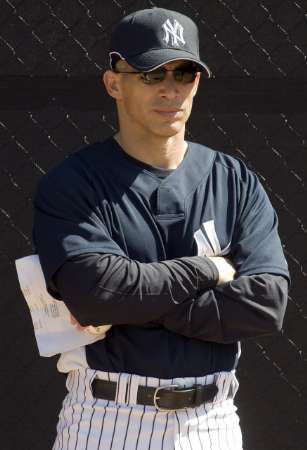
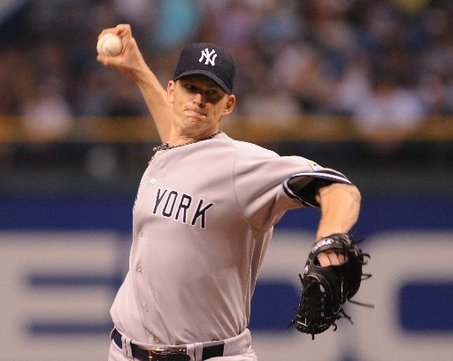
Yankees Pitchers against Phillies Batters: Andy Pettitte had very good stuff in the first five innings giving up one run on a sacrifice fly by Jimmy Rollins following a 1 out triple by Carlos Ruiz.  In the sixth Ryan Howard hit a one out two run homer driving in Chase Utley off of Pettitte who then stuck out Jayson Wirth.  With 2 outs Raul Ibanez doubled down the line to right. Joba Chamberlain came in to get the final out of the Phillies sixth. Ruiz singled and Jimmy Rollins hit into a fielder’s choice and then Chamberlain walked Shane Victorino.  Joe Girardi then pulled Chamberlain for Damaso Marte who came in to face Chase Utley who he struck out to end the inning. Marte struck out Ryan Howard who with the “K” set a new World Series record of 13 strike outs.  The Yankees then brought in Mariano Rivera who struck out Jayson Wirth for the second out. Raul Ibanez doubled to center after battling Rivera at the plate.  Pedro Feliz then popped out to Posada in foul territory to end the inning. Rivera faced pinch hitter Matt Stair to lead off the ninth getting him to line out to Jeter at short. Carlos Ruiz came up next and worked the count full before drawing a one out walk.  Jimmy Rollins flew out to Swisher in right bringing up Shane Victorino.  Ruiz took second on a strike to Victorino who after a battle with Rivera where he worked the count full grounded out to Cano at second to begin the celebration for the Yankees and their fans.

joegirardiYankees Manager Joe Girardi Led the Yankees back to the Top

Phillies Pitchers against Yankees Batters: Pedro Martinez struggled and was hit hard by Hideki Matsui who homered in the second with Alex Rodriguez on base and who singled with the bases load in the bottom of the third to drive in two more. By the end of the fourth he had pitched 62 pitches, giving up 4 runs on 3 hits with 2 walks and hitting Mark Teixeira with a pitch. Pedro was pulled by Charlie Manuel at the end of the fourth for reliever Chad Durbin who gave up a double to Derek Jeter to lead off the bottom of the 5th.  Jeter was advanced by a sacrifice bunt by Jerry Hairston who Mark Teixeira hit an RBI single to drive in Jeter.  After walking Alex Rodriguez Durbin was relieved by J.A. Happ who gave up a double to left to Matsui scoring Teixeira and Rodriguez.  By the end of the inning the Yankees were up 7-1. With one out and one on the Phillies sent in Chan Ho Park who got Derek Jeter to hit into a fielder’s choice and Jerry Hairston to fly out.  In the bottom of the seventh Park got Mark Teixeira on a strike out but gave up a grounder with eyes which got through for a base hit to Alex Rodriguez.  Park left the game as Scott Eyre came in to face Matsui. Rodriguez stole 2nd as Eyre struck out Matsui.  Eyre then walked Posada and stuck out Cano to end the inning.  In the 8th Eyre remained in the game getting Nick Swisher to ground out to third for the first out and Brett Gardner to ground out to second. With two outs Brett Myers came in to face Jeter who singled to right for his 175th career playoff hit and got Jerry Hairston to fly out on a soft fly to left.

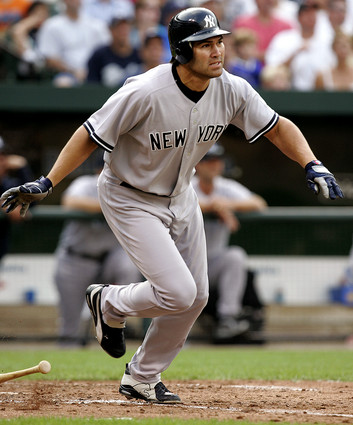
With the win the Yankees won their 27th World Series and their first in the new Yankee Stadium.  In a historic sense it was fitting. In 1923 the Yankees won their first World Series title in the inaugural year of the original Yankee Stadium which sat silently in the dark next to the new ballpark. Hideki Matsui was the Series Most Valuable Player and the Yankees won their first series since they beat the Mets in the “Subway Series of 2000.  For the Yankees it was the end of a long streak of frustration in post season play.  The Yankee “old guard” of Jeter, Posada, Pettitte and Rivera returned to glory, additions since the last series win  including  Alex Rodriguez, C.C. Sabathia, Matsui and Johnny Damon got their rings as Yankees while Sabathia and Rodriguez shook off years of frustration.

In my next post I will give my analysis and reflections on the Series, the playoffs and the 2009 season.

yankees celebrateWorld Champion Yankees

1 Comment

Filed under Baseball

World Series Game Six: Duel of the Old Dogs

Part One: Before the game at dinner in the Food Court after my first set of rounds

“Baseball?  It’s just a game – as simple as a ball and a bat.  Yet, as complex as the American spirit it symbolizes.  It’s a sport, business – and sometimes even religion.”  Ernie Harwell, “The Game for All America,” 1955

andypettitte33How Will Andy Pettitte Pitch on 3 Days Rest?

I am a member of the Church of Baseball, Harbor Park Parish.  So I guess baseball is like a religion to me.  It is one of the few things that I can count on that will relax and excite me at the same time that ball parks are among the few places that I can go to find a measure of peace.  To quote Sharon Olds “Baseball is reassuring.  It makes me feel as if the world is not going to blow up.” Baseball has much in common with the Christian faith it has a cycle and rhythm much like the liturgical year, it has its sacraments, law and grace and even its own Communion of Saints as Richard Gilman said:  “Baseball is a game dominated by vital ghosts; it’s a fraternity, like no other we have of the active and the no longer so, the living and the dead.” It is a sport that venerates respects and remembers its greats, and holds them to higher standards than just their performance on the field. It is a game that unlike other sports, those who transgress even if they are some of the best ballplayers who ever lived are banned from the game, in a sense excommunicated.  Pete Rose, Shoeless Joe Jackson and the players involved in the “Black Sox” scandal after the 1919 World Series stand in witness to that fact.  Many of those proven to have taken steroids or suspected of doing so are being shunned by many of baseball’s greats.

pedro-martinez-7001381Old Dog: Padro Martinez, Can He Come up Big?

The crescendo of the baseball season amid its ebb and flow is the World Series.  Players who excel in the Series are venerated by their team’s fans and sometimes the rest of the baseball world.  This year the Series has seen some incredible baseball and some great drama as each game is played and the story, the legend and even the myth is renewed. Men like Reggie Jackson have become known as “Mr. October” for their exploits in the series and almost every year there is a player, great or small who does something that leads to greatness or sometimes disgrace.

Andy Pettitte went to the pitchers mound at the new Yankee Stadium and delivered the first pitch of game six of the 2009 World Series.  In the Philadelphia Phillies dugout another old dog, Pedro Martinez wrapped in his warm up jacket waited even as Jimmy Rollins stepped into the batters box.  It is a drama with another twist, for the first time in World Series history both starting pitchers will be over 37 years old, in other words for their sport old men.  Yes there have been older players but you don’t see many, especially starting pitchers.  Tonight we see two men who are in different stages of the tail end of their careers.  Pettitte may have a few more years left in him, but Martinez began the year not even on a team and was a late season acquisition by the Phillies.

The question for tonight’s game is if Pettitte, pitching on 3 days rest will be able to deliver a solid outing and if Pedro will have as good of stuff as he had against the Dodgers in the NLCS.  The Yankees know Pedro well and if he is the slightest bit off they could make short work of him. If Pettitte is off the Phillies hitting machine may crank it up a notch.

Since I as a Giants, Orioles and Athletics fan have no dog in this fight I did a careful analysis of the numbers and I predicted that the Yankees will win the series in six.  I said that the Yankees and Phillies would split in New York.  I also said that the Yankees would take games three and four in Philly and that Cliff Lee would win game 5, so far so good.  Based on my analysis I have predicted that Andy Pettitte will get the win to close the series but give the Phillies a chance of getting the win and forcing game seven.  This time I think that the Yankees hit Pedro hard and that will be the difference. (to see my complete analysis and prediction follow this link: https://padresteve.wordpress.com/2009/10/27/padre-steve%e2%80%99s-world-series-prediction-and-book-and-bible-burning-update/

mariano-riveraIf the Game is Close Expect Mariano Rivera to Come in During the 8th Inning

I think that Pettitte will do well enough to get the ball to Mariano Rivera in the 8th inning.  Rivera will then have a six out save.  I think on the hitting side of the house that Derek Jeter will continue to hit well, that Johnny Damon will hit and that Alex Rodriguez will have clutch hits.  The addition of the bats of Jorge Posada who came in halfway through game five and Hideki Matsui who showed up in a pinch hitting role in that game will give the back half of the Yankees lineup some extra power which was not present in game five.  For the Phillies I think that Chase Utley and Jayson Wirth have a good game and one or the other may take a Yankee pitcher yard.   In the end I do not think that it will be enough, I think that the Yankees win their 27th World Series tonight.  The only thing to do is sit back and watch, and if by some chance I am wrong about the outcome of this game, know that I am neither the Prophet nor the Son of the Prophet and since I am merely a miscreant Priest and not the Pope I am certainly not infallible.

Leave a comment

Filed under Baseball

I’m Leaving on a Jet Plane…Reflections on the Islands of Unhappy Travelers

The 80’s group Blondie had a hit called “Island of Lost Souls.”  I love that song; it is kind of quirky and fun.  However, there is a time when you run into a place where the song seems more true than not. Airports are one of those places, they tend to be some of the most angst and anger filled venues known to man, excepting of course Fed-Ex Field where Dan Snyder is doing his best to destroy the Redskins and drive off their fans. However, I digress as I couldn’t care a whit about the Redskins because they are a football team, though I have sympathy for the fans that have been banned from bringing signs into the stadium.  With that exception and maybe the U.S. Capitol building and the set of any Cable Television talk show where politics is being debated the airports have to be pretty close to the top of the hate and discontent list.

I had to travel to Florida in the spring for chaplain conference.  Since I came back from Iraq I do travel a lot less well than I used to and to make matters worse conferences of almost any kind at best come close to pushing me to the edge.  Sleep tends to be difficult for me, especially before I travel on commercial airlines and endure the hell of airports.  The night before I travel, I try to anticipate every contingency, going through my packing list and ensuring I have everything that I need. Then after I go to bed I get up an hour later to make sure that I indeed get everything. Once I am sure that I do I go back and check the multiple alarm clocks that I have set just to make sure I don’t miss my flight.  I know why I do this. Before Iraq I traveled a lot and got good at it.  However in Iraq a did a lot more of this and got into a routine of checking, double checking and even triple checking to make sure that I had everything that I needed.  Over there I knew that if I forgot something, even something simple that it would not be available the places that I was going or places that I might get marooned.  I have carried that experience back with me.  I pack and lay out all my clothes the night before I go to work.  I actually use the same pack that I carried on every mission in Iraq.  It is an excellent piece of gear, made by Blackhawk.

Anyway that day was a hellish travel day. The weather across the east coast was crappy.  My first flight was delayed an hour, my second flight as well. If that was not bad enough the good folks at Delta airlines failed to have people at gates and jet ways when gate changes happened, leaving people to miss flights and nearly miss vacation cruises.  On our connecting flight at Atlanta’s Harts-Jackson Field was delayed, in my case that was a good thing as had it been on time I would have missed it.  While in line waiting for the flight announcements were periodically made, each one either delivering a later flight time or excuse for the delay.  The excuses often were inconsistent.  I began to think that they were lying to us.  Now I’m not saying that an airline would lie, but it seemed to my little pea brain that the excuses conflicted and each new excuse contradicted the last pathetic excuse.  I hate bad liars.  Let’s face it, if you are going to lie be consistent and strive to make it believable, politicians, lawyers and TV evangelists are great at this.  Unfortunately the people lying to us were not very believable.  However it may have been that they actually believed what they were saying which would be as George Costanza once said: “It’s not a lie if you believe it.”

As I waited that day I surveyed my fellow disgruntled travelers.  I was deep into a PTSD induced ass kinking anxiety attack.  By the time this was going on time I had taken both of my extra meds as well as my 8 AM and 1230 PM doses of Samuel Adams Boston Lager.  Normally I’ll wait until dinner for a beer, but I knew that I needed a bit more on that trip.  I try not to self-medicate and over the past year have gotten a lot better in not doing this. However there as something about airports and airline travel that almost inevitably pushes my buttons and so I will do this to take the edge off and keep me somewhat sane until I can get to my destination and hide.

I went to a conference in Orlando in the summer of 2008 shortly after my PTSD diagnosis and that about put me over the edge. If you have PTSD the Gateway to the fricking “Happiest place in the world” is the portal to hell.  Thus only a few months after coming out of a combat zone I discovered that Orlando during the height of the summer pilgrimage to Wally World to see Randy Rodent and Doofey is not a fun experience.

Thanks be to God for her good care during this trip.  She ensured that my doctor had given good drugs and the airport pubs provided good beer not to mention a Chili Dog with mustard.  Thus by the middle of the afternoon I was doing far better than most of my fellow travelers.  It definitely sucked to be them.  It was then that the Blondie song came into my mind.  Atlanta’s airport was not the Island of Lost Souls but the Land of Unhappy Travelers.  I listened to some of the folks around me as they lamented their situation and it sounded like “Lemony Snickets: A Series of Unfortunate Events.” Atlanta had become the vortex of very disgruntled travelers who had missed flights, been bumped from flights or delayed endlessly.  If you don’t believe in the Catholic in the doctrine of Purgatory just try Atlanta on a day like that, which is about 362 days a year.  I looked around, and though barely holding on myself I was able to find some gallows humor in the midst of this agony.  I looked around the people around me and said “Ladies and gentlemen it is my distinct displeasure to welcome you to the land of unhappy travelers.”  I actually got a few laughs.  I then made a comment about the airline, which I had not flown in a couple of years, saying “I’m glad to see that some things stay the same, our airline still has same crappy service that they had a few years ago.”  As we started boarding we boarded by zones as some airlines do.  I personally prefer the first come or first signed in first seated way that Southwest does things, unfortunately the government contract was no longer with Southwest. As they announced “boarding zones one through five,” I commented, “Yep, you guys in zone 92 still have a while to wait.  On each flight we had bad weather, turbulence and on one flight the air condition did not start kicking in until we were getting ready to land.

When I got to my destination I heard stories even worse than mine, all focused around the vortex of doom that swirled around Atlanta.  The only place that I thought it could have gone worse was Washington Dulles, where my experiences have been nearly all bad. I survived but by the time I got to my hotel my ass was kicked. At the end of the day I had survived.  A few beers and a bit of wine with good fellowship with friends made things better.

Saturday I get to fly again and make my third trip to California to see my folks.  I am already making my list and getting mentally prepared for the trip.  I get to fly though Chicago O’Hare and on the way back LAX and O’Hare.  Thank the Deity Herself that Atlanta is not on the itinerary. I’ll do my best to at least find the humor as I pass through these islands of unhappy travelers, so pray for me a sinner.

Peace,

Padre Steve

Leave a comment

Filed under PTSD, travel

Okinawa: Göttdammerung in the Pacific

Plans and Preparation
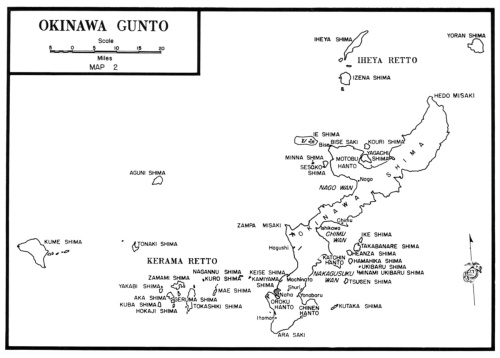
USMC-M-Okinawa-2

The United States decided to invade Okinawa in the fall of 1944 following the seizure of Peleliu and the Philippine landings.  The planned invasion of Formosa was cancelled after General Simon Bolivar Buckner objected.[i] Buckner argued that the Japanese army on it was “much too strong to be attacked by the forces by American Forces then available in the Pacific.”[ii] The strategic rationale behind the decision to invade Okinawa included Okinawa’s proximity to Japan as a staging base for a future invasion of the Japanese mainland.  Likewise taking the island would severe Japan’s lines of communication and commerce with Southeast Asia and to serve as base for strategic bombers.[iii] Planning began in October 1944 and the detailed plan for OPERATION ICEBERG was issued 9 February 1945.[iv] The campaign was not planned in isolation but “was bound up strategically with the operations against Luzon and Iwo Jima; they were all calculated to maintain unremitting pressure against Japan and to effect the attrition of its military forces.”[v]
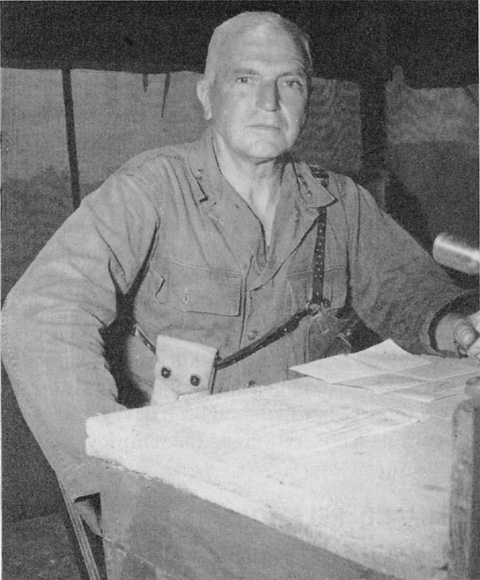
LIEUTENANT_GENERAL_SIMON_B._BUCKNER_in_OkinawaLt General Simon Bolivar Buckner Commander of US 10th Army

The War Department insisted that Lieutenant General Simon Bolivar Buckner command the newly formed 10th US Army.[vi] .  Buckner was chosen to command based on his taking of the Aleutians, displacing the veteran Marine Holland M. Smith. One critical history noted that “compared to his subordinates, Buckner was hardly fit to command a corps, let alone a field army.”[vii]

The 10th Army consisted of the 3rd Amphibious Corps (1st, 2nd and 6th Marine Divisions) under Major General Roy Geiger and the XXIV Army Corps (7th, 27th, 77th and 96th Divisions) under Major General John Hodge.[viii] 2nd Marine Division was designated as a diversionary force, and the 77th Division was assigned to take the nearby island of Kerama Retto prior to the landings to provide the Navy a safe anchorage and as an artillery platform to shell Okinawa. The 27th Division was in corps reserve.  All were veteran units and had it was believed they would be “more than enough to overwhelm the estimated 70,000 Japanese on Okinawa.”[ix] However, much of XXIV Corps had only been engaged in hard combat on Leyte and was not relieved of their duties on Leyte on 1 March 1945.  This provided these units with no time to rest and refit.[x] More importantly badly needed troop replacements had been diverted to Europe due to the crisis in infantry strength there during the battle of the Bulge.[xi] The operation was very large and “mounted on a scale that matched the previous year’s Allied landing in Normandy.”[xii]

The Japanese Preparations
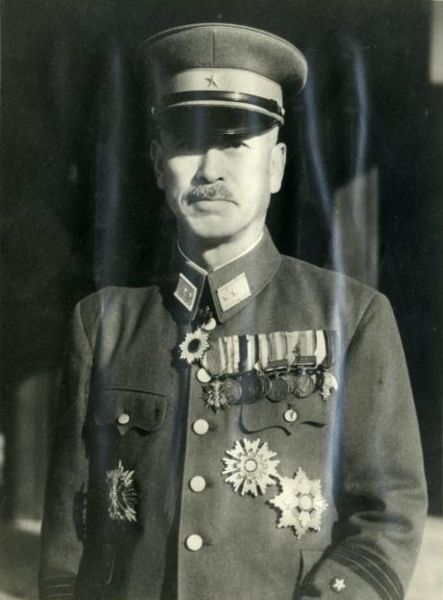
Mitsuru_UshijimaJapanese Commander Lt General Ushijima

American intelligence underestimated the number of Japanese on the island, with an estimate of 55,000 with the expectation of 66,000 by 1 April.[xiii] However by the time of the invasion the Japanese defenders numbered over 100,000.[xiv] The defense of Okinawa was entrusted to the 32nd Army was activated in 1 April 1944 commanded by Lieutenant General Ushijima.  In addition to Okinawa the 32nd Army was responsible for the entire Ryukyu chain.[xv] General Ushijima had commanded an infantry group in Burma and was commander of the military academy when appointed to command 32nd Army and ordered to Okinawa.  His Chief of Staff, General Cho was a firebrand.  Cho had served in China and had participated in a number of attempted military coups in the 1930s as a member of the “Cherry Group.”[xvi] Another key officer though relatively junior was Colonel Yahara the Operations Officer. He had served as an exchange officer in the United States and was intellectual and a modern soldier. He viewed war as a science, won by “superior tactics adjusted to terrain, weapons and troops…not Banzai charges.”[xvii] He was “widely recognized as an expert in his field,”[xviii] and devised the Japanese defensive plan for Okinawa.
Yahara_HiromichiColonel Yahara Architect of the Japanese Defensive Plan

Until 32nd Army was activated Okinawa was garrisoned by a mere 600 troops,[xix] and until major units arrived these soldiers concentrated on airfield construction.[xx] Eventually the 9th, 24th and 62nd Infantry Divisions, the 44th Mixed Brigade along with a light tank regiment and significant artillery came to Okinawa. Additional forces were alloted to outlying islands.  The 24th Division was a triangular division of 3 infantry regiments of 3 battalions each and supporting arms. The 62nd Division was a “brigaded” division activated in 1943 was formed from the veteran 63rd and 64th brigades each with 4 infantry battalions and supporting arms. It had no organic artillery.  Both of the brigades of this division received an additional infantry battalion in January 1945 giving the division ten maneuver battalions.[xxi] Okinawa’s defenses were significantly weakened when 9th Division was transferred to Formosa by the 10th Area Army in late 1944. To compensate General Ushijima converted Naval and service troops on the island into front line troops. Additionally he called the Okinawan Boeitai volunteers and conscripts into service.[xxii] The Boeitai numbered 20,000 and burned “with ardor to serve their emperor.”[xxiii] Seven sea raiding units were converted into infantry battalions.[xxiv] The major units, with the exception of 24th Division which had been transferred from Manchuria had combat experience.[xxv]
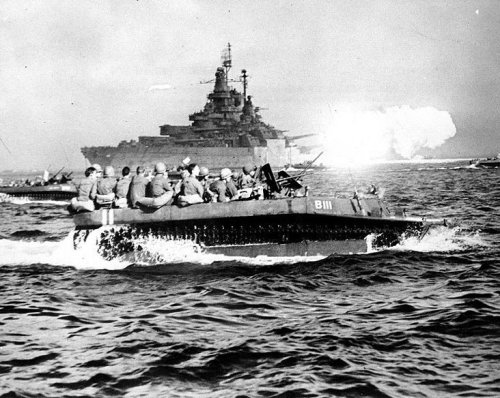
BB-43-LVT-okinawaUSS Tennessee Provides Naval Gunfire Support while LVTs Advance toward the Beaches

Ushijima’s plans to concentrate his forces in the south were delayed by Tokyo.[xxvi] Likewise the number and disposition of troops in the Ryukyu’s were decided by Imperial Headquarters.[xxvii] Colonel Yahara wrote that had Imperial Headquarters “been able to give us an overall plan with specific unit names and arrival dates, we would have been able to follow a consistent policy, disposing units in an efficient manner rather than moving them left and right.”[xxviii] He noted how the 44th Mixed Brigade had to change location and thus its defensive preparations “seven times during the ten months before the actual battle….”[xxix]
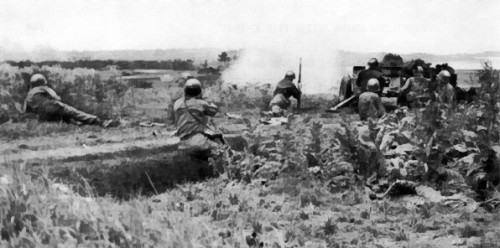
XXIV_Corps_turns_southXXIV Corps Advancing South

The loss of the 9th Division and its 25,000 soldiers forced Ushijima to change his initial plan to defend the beaches and then launch a major counterattack to drive the Americans into the sea.[xxx] Ushijima decided to defend the south end of the island. This was the most defensible area, with a network of fortifications and underground caves centered on the ancient citadel of Shuri Castle. “Troop disposition would conform to local terrain; troop strength would be concentrated; and an extensive system of subterranean fortifications constructed.”[xxxi] The defenses were “anchored in natural and artificial caves which dotted the mountainous regions around Shuri.”[xxxii] “Terrain features were incorporated into the defense and weapons were well sited with excellent fields of fire.”[xxxiii] General Ushijima left Colonel Udo’s 2nd Infantry Unit to fight a delaying action in the north,[xxxiv] having decided that the area was of “little military value.”[xxxv] Likewise Ushijima decided not to contest the landings or to defend the airfields at Kadena and Yontan.[xxxvi] He planned to use Boeitai units to demolish the airfields when the Americans approached.[xxxvii]
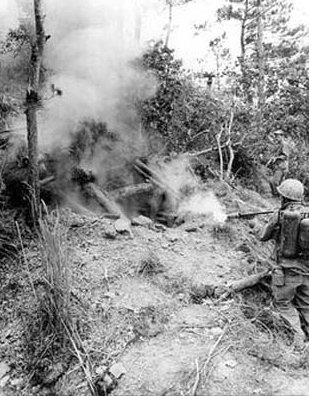
Okinawa_flamethrowerFlamethrowers were Widely Employed their Operators were Targeted by the Japanese

Ushijima’s defensive scheme laid out by Yahara involved concentric defensive lines, tunnels and bunker systems and even the Chinese tombs which dotted the island were converted to pillboxes over the objections of Okinawan elders.[xxxviii] Yahara and Ushijima planned a battle of attrition with all artillery in the army concentrated on the southern end of Okinawa.  Yahara believed the battle would be a “bitter yard-by-yard” defense of the island,[xxxix] with a focus on defense in depth with preparations for anti-tank warfare. There were to be no Banzai charges.[xl] Ushijima turned Bushido “inside out” and urged his soldiers to “Devise combat method [sic] based on mathematical precision, then think about displaying your spiritual power.”[xli] The defenders would be assisted by suicide boat squadrons based on Okinawa and Kerama Retto and over 4000 aircraft, conventional and Kamikaze and a naval force built around the super battleship Yamato.[xlii]

The Landings
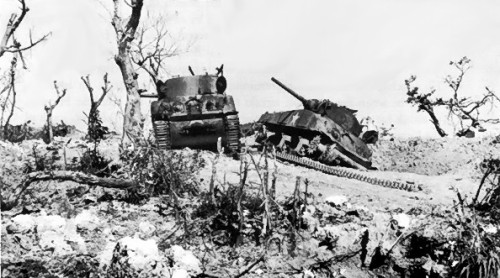
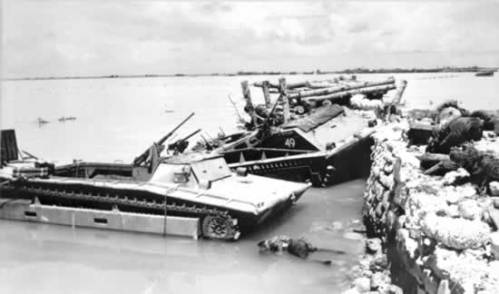
Attack_on_bloody_ridgeWrecked Tanks on Skyline Ridge

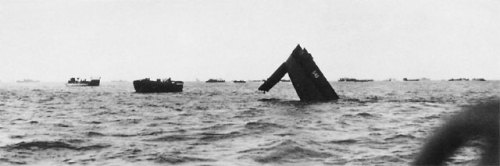
The assault on Okinawa began with landings by 77th Division on Kerama Retto on 26 March.   The landings were met with little opposition as most of the combat troops on the islands had been moved to Okinawa leaving only base and service troops and members of a Sea Raiding Unit and Korean laborers to defend the small island.[xliii] By the 29th of March the islands were taken, along with numerous prisoners.  Over 350 of the fast “Suicide Boats” that were to attack US transports and landing craft were destroyed at Kerama Retto and long range artillery was emplaced were it could support the Okinawa landings.[xliv] More importantly Kerama Retto provided the Navy a safe anchorage, and Service Squadron 10 arrived on 27 March to support naval forces around the island.[xlv] The naval bombardment was led by Admiral Deyo’s battleships and Admiral Blandy’s escort carriers[xlvi] and culminated on 1 April when 10th Army went ashore. By the time of the landing 10 battleships and 11 cruisers would join the attack.[xlvii] Over 13,000 large caliber shells were fired and a total of 5,162 tons of ammunition were expended on ground targets and 3,095 air sorties were flown by L Day.[xlviii] Fortunately for the Japanese Ushijima had listened to Colonel Yahara and elected not to defend the beach, and thus most of the shells fell on empty positions and terrain.[xlix]

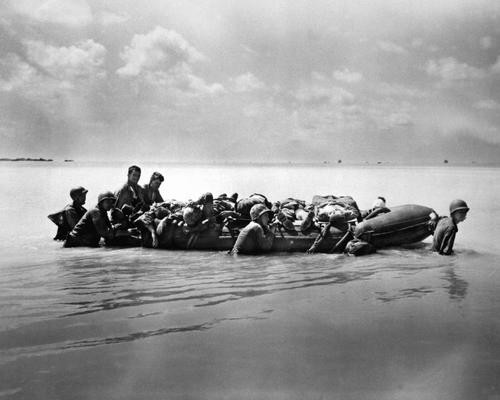
The Americans landed on the Hagushi beaches adjacent to Kadena and Yontan air bases.  No organized resistance was encountered and in the first hour 16,000 troops landed.[l] There was little disorganization and all units landed on time on the planned beaches.[li] The beaches were bisected by the Bishi River which served as the Corps boundary.  The 1st and 6th Marine Divisions landed north of it and the 7th and 96th to the south.  The Marines chopped up the “Bimbo Butai” in their area many of whom melted back into the civilian population.[lii] The Americans moved rapidly inland and by nightfall over 60,000 Marines and Soldiers were ashore.[liii] As the landings were made the 2nd Marine Division conducted a demonstration off Minatoga on the east side of the Okinawa actually launching several waves of landing craft.[liv] On 2 April the operation was repeated which helped divert some Japanese attention off of the actual landings. Ushijima reported that the attempt “was complete foiled, with heavy losses to the enemy.”[lv] Some Marine veterans of Peleliu were jubilant at not having to land and some wondered what the Japanese were up to.[lvi]
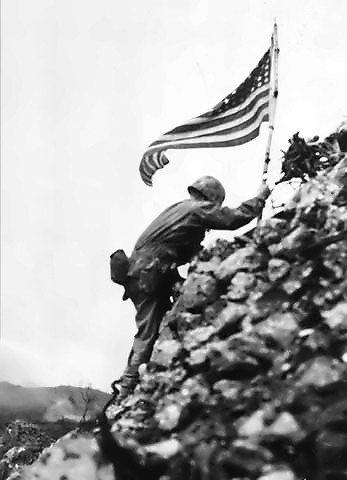
US_Flag_raised_over_Shuri_castle_on_OkinawaMarine Battalion Commander Raising Flag over Shuri Castle

In the following days the two Marine divisions would race north and east while Army troops advanced cautiously to the south first encountering light opposition.[lvii] The 1st Marine Division cut the island in two on April 3rd and was allowed to clear the Katchin Peninsula which it took without opposition.[lviii] The 6th Marine Division moved north and by the 7th it had had taken Nago.  Colonel Udo’s troops of the 2nd infantry Unit defended the Motubu with great skill[lix] but the Marines took the center of resistance on April 18th.[lx] They then cleared the remainder of the peninsula and the rest of the northern end of the island by the 20th.[lxi] The Marines had advanced 84 miles and killed 2,500 Japanese at the cost of 261 killed and 1,061 wounded. The Japanese survivors according to the plan of Colonel Udo afterward retreated into the hills and engaged in guerilla warfare.[lxii]

The Ordeal Begins
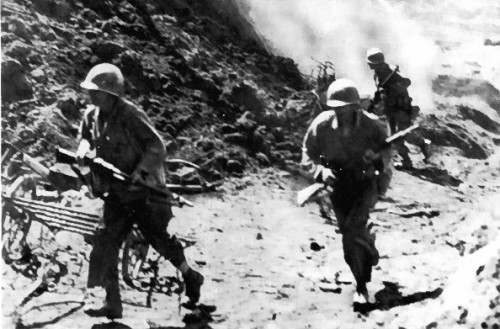
Corkscrew-demolition_teamDemolition Team Advancing

As the Soldiers of the 7th and 96th Infantry Divisions felt their way south, they began to encounter resistance from Japanese outposts.  On 4 April 96th Division’s advanced elements including the 96th Recon Troop and 763rd Tank Battalion encountered the first Japanese anti-tank defenses, losing 3 tanks to well concealed 47mm anti-tank guns.[lxiii] The following day both the 7th and 96th divisions encountered more resistance and were held to minimal gains as they drove the Japanese out of their outpost positions. On the 6th and 7th they captured “the Pinnacle” and “Cactus ridge” from elements of 3 independent infantry battalions which put up stiff resistance.[lxiv] By the end of 8 April against strong opposition XXIV Corps had suffered 1,510 battle casualties and was virtually halted.[lxv] Savage hand to hand fighting took place as the defenders worked to separate the American tanks from their infantry. They held the Americans outside the Shuri zone for 8 days.[lxvi]
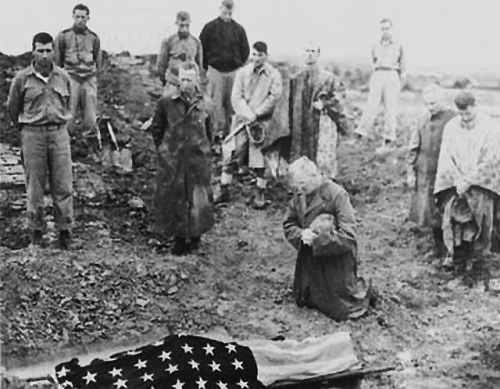
USMC-C-Okinawa burialThe Human Cost of War: Marine Colonel Fenton prays for his Fallen Son

The 96th Division attacked the heavily defended Kakazu Ridge and Tombstone Ridge and was repulsed.  The 7th Division was halted at Hill 178.  The Japanese fought at close quarters and desperate hand to hand fighting “would characterize the Okinawa land battle.” While the Japanese infantry contested every yard “carefully concealed anti-tank guns seemed anchored into the terrain.”[lxvii] The deployment and concealment of the anti-tank guns helped nullify the American advantages in armor. The Japanese also employed 320mm spigot mortars[lxviii] and well sited machine guns and artillery sited on reverse slopes took a heavy toll of the attacking Americans. Of one company of 89 men which attacked Kakazu on 9 April “only three returned unwounded.”[lxix] Assisted by monsoon rains, “the Japanese turned every hill, every ridge into a bloody deathtrap.[lxx] On the 10th two regiments of 96th Division attempted a power drive with battalions advancing on line and were thrown back.[lxxi] The two divisions suffered 2.890 casualties in their abortive attacks while the Japanese lost close to 4,000, mainly to artillery fire.[lxxii] Ushijima’s defense planned by Yahara was “chillingly professional and efficient. Within a week the Japanese had stopped two very good Army divisions in their tracks.”[lxxiii] General Buckner paused sent for the 1st and 6th Marine Divisions and brought the 27th and 77th Divisions ashore to strengthen XXIV Corps.[lxxiv]

Counterattack
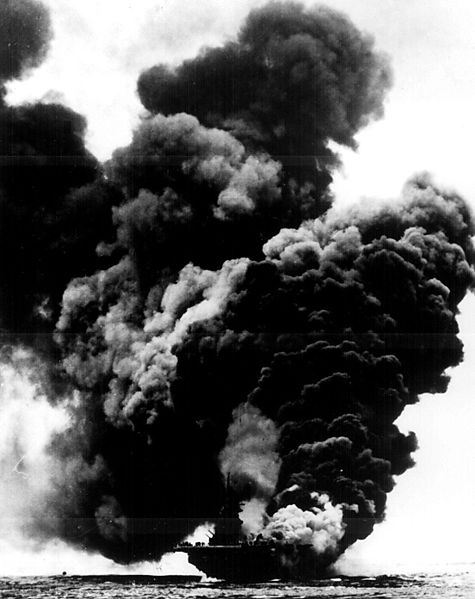
475px-USS_Bunker_Hill_burningThe War at Sea: Kamikaze Attack on USS Bunker Hill

It was at this point when “Yahara’s war of attrition was working well” that a division arose in the 32nd Army Staff, when General Cho; Ushijima’s Chief of Staff had “his first outburst of samurai offensive fever.”[lxxv] Cho noted the failure of the American attacks and believed reports that the American Navy had been heavily damaged by Japanese air power and by the reported success of Operation Ten-Go, the sortie of the Yamato and her escorts on their suicide mission.  He based his optimism on a telegraph from Imperial Navy headquarters “claiming that Ten-go had been “very successful”[lxxvi] when in fact the Yamato and her escorts had been dispatched in hours by carrier aircraft with few American losses.  Cho also assumed a reduction in the number of ships in the Hagushi anchorage and in the number of air sorties as signs of American weakness.[lxxvii] Cho persuaded Ushijima to launch a counterattack over the protestations of Yahara who argued that “it would waste men.”[lxxviii] The attack by four battalions of the 62nd and 24th Divisions began the night of 12-13 April. Based on infiltration tactics and supported by artillery the attack was badly planned and coordinated. One attack almost overran American positions on the draw on Kakazu Ridge, but the Japanese return to “bamboo spear tactics” exposing them to the “overwhelmingly superior America artillery fire….”[lxxix] The attack was a “total failure.”[lxxx]The Japanese lost nearly 1,600 men, half their force in an “operation ill conceived, understrength, misdirected, haphazard and uncoordinated.”[lxxxi]

Cracking the Outer Line

Reinforced by the 27th Division XXIV Corps prepared for another attack against the outlying Shuri defenses. In the interval between the Japanese attack and the new offensive the 77th Division landed on Ie Shima on 16 April and secured it on the 24th amid very heavy fighting killing over 4,700 Japanese, many armed civilians against the loss of 172 killed and 902 wounded Americans.[lxxxii] Among the American dead was legendary reporter Ernie Pyle.

The Americans aimed to penetrate the defenses and “seize the low valley linking Yonabaru on the east coast with the capital of Naha on the west.”[lxxxiii] The attack was supported by 27 battalions of artillery[lxxxiv] including 9 Marine artillery battalions.[lxxxv] Additional Naval gunfire support in the form of 6 battleships, 6 cruisers and 9 destroyers added to the rain of steel unleashed on the Japanese.[lxxxvi] Morison notes that Army historians stated that “Naval gunfire…was employed in greater quantities in the battle for Okinawa than in any other in history.”[lxxxvii] The 7th Division was to take Hill 178 and drive south to the Naha Yonabaru road. 96th Division minus the 383rd Infantry was to “drive straight through the heart of the Shuri defenses seizing the town of Shuri and the highway beyond.”  27th Division attacking 50 minutes later to take advantage of artillery was to take Kakazu ridge and the coast plain north of Naha.[lxxxviii]

The attack began on April 19th and was preceded by a 19,000 shell bombardment.[lxxxix] Ushijima wisely ordered his men to remain in their caves.  The Corps Artillery commander “doubted as many as 190 Japanese…had been killed in the bombardment.”[xc] The attack was immediately halted all along the line, gains, where there were any were measured in yards. Over 750 casualties were inflicted by the Japanese on the corps and 27th Division’s tank battalion lost 22 of 30 tanks to well positioned 47mm anti-tank guns.[xci] Buckner rejected the requests of the Corps commander Hodge and the Marine divisional commanders,[xcii] to launch a flanking amphibious operation at Minatoga with the 2nd Marine Division, and continued the frontal attacks.  John Toland writing of the rejection of the amphibious operation noted that Ushijima “feared such a maneuver (“It would bring a prompt end to the fighting”) and had already been forced to move his “rear guard division north to beef up the Shuri line.”[xciii] Thus the three divisions continued to press their attacks, suffering heavy casualties.  Eventually the Americans forced the Japanese off Skyline ridge[xciv] though the Japanese still held Kakazu.[xcv] When the 27th Division attacked again it found Kakazu abandoned by the Japanese.[xcvi] By the 24th Ushijima’s line was “pierced in so many places that it was in danger of collapsing….So General Ushijima withdrew to his next chain of defenses.”[xcvii] On April 30th the 1st Marine Division relieved the battered 27th Division which had suffered 2,661 casualties in less than two weeks.”[xcviii] The 1st Marine Regiment launched an attack on 1 May and was driven back with heavy causalities.[xcix]

General Cho’s Final Offensive

General Cho supported by 62nd Division’s commander, General Fujioka persuaded Ushijima over the strenuous objections of Yahara to launch a counter-offensive with the intention of isolating and annihilating the 1st Marine Division and “rolling up” XXIV Corps.[c] The attack was to occur along the entire line and include an amphibious landing behind American lines.[ci] The 62nd Division would take the lead as it had been less heavily engaged than 24th Division.[cii] Yahara argued his case strongly and warned the Ushijima that to attack “is reckless and will lead to an early defeat.”[ciii] The attack began on the night of 3 May and the forces making the amphibious landing were annihilated by the Marines.[civ] The Japanese made little headway during the main attack; one battalion achieved a small penetration of American lines at Tanabaru but was eliminated the next day.[cv] The Japanese 27th Tank Regiment lost most of its tanks and those remaining were used as “stationary artillery and pillboxes.”[cvi] The Japanese lost about 5,000 troops in the offensive.[cvii] Ushijima halted it and told Yahara “as you predicted this offensive has been a total failure.  Your judgment was correct….”  He ordered Yahara “to do whatever you feel is necessary.”[cviii] Cho saw “no hope at all”[cix] and asked Yahara jokingly “when will it be okay for me to commit hari-kari?” [cx]

Göttdammerung

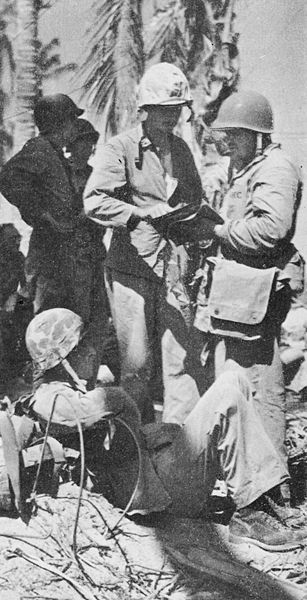
The American offensive resumed on 11 May and amid stubborn Japanese defense and heavy rains which hindered movement. The 1st and 6th Marine Divisions[cxi] and the 77th and the 96th infantry divisions attacked along the line but the primary objective was Shuri.[cxii] The Americans continued to apply pressure and make small gains against strong Japanese resistance put up by the 44th Mixed Brigade.  The defense was particularly strong on Sugar Loaf Hill[cxiii] which cost 6th Marine Division nearly 4,000 total casualties before it was cleared out on 21 May.[cxiv] The 96th Division turned the Japanese east flank at Conical Hill on the 13th  [cxv] while the First Marine Division cracked through the Japanese lines at Dakeshi Ridge.  It fought through Wana Ridge[cxvi] and engaged the Japanese in a costly battle in the Wana Draw. The 2nd Battalion 5th Marines supported by 30 tanks blasted their way through the draw, again against brutal Japanese resistance.[cxvii] On the 22nd Yahara persuaded Ushijima to withdraw from Shuri to the Kiyan Peninsula.[cxviii] The 1st Battalion 5th Marines crossed the divisional boundary of 77th Division to capture Shuri Castle on 24 May.[cxix] The Company commander, from South Carolina who took it did not have an American flag so he “substituted the flag of the Confederacy, a banner that he…carried in his helmet.” [cxx] Two days later the American flag was raised along with the standard of the 1st Marine Division in full view of the Japanese.[cxxi]

Following the Japanese withdraw from Shuri the battle continued with heavy rains hampering both sides, especially the more vehicle dependant Americans.[cxxii] The 6th Marine Division cleared the Oruku Peninsula south of Naha the first two weeks of June[cxxiii] killing 5,000 of the Japanese Navy defenders at a cost of 1,608 Marines. The Japanese resistance crumbled when Admiral Ota committed suicide and many defenders fled while others surrendered.[cxxiv] 7th Division pushed onto the Chinen Peninsula and 1st Marine and both 77th and 96th Infantry Divisions pushed steadily south against Japanese rear-guards.[cxxv] The 8th Marines from 2nd Marine Division were brought to the island to reinforce the depleted 3rd Amphibious Corps[cxxvi] A hard fight was fought along the Kunishi-Yuza-Yaeju escarpment where the Japanese conducted their last organized defense.[cxxvii] By the 17th the “32nd Army was dazed and shattered. Discipline had evaporated.”[cxxviii] The 32nd Army’s discipline and morale collapsed, and it “degenerated into a mob.”[cxxix] Yahara noted that “naturally, morale is low at the end of a battle, but we had never experienced anything like this.”[cxxx]
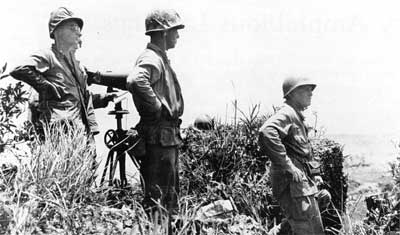
Last_picture_of_LtGen._Buckner_at_OkinawaLt General Buckner (Right) Observing 8th Marines Assault minutes before Being Killed

General Buckner was killed while observing 8th Marines attack Kunishi on the 18th and was succeeded by General Geiger of the Marine amphibious corps.[cxxxi] A final message from Tokyo congratulated 32nd Army on its achievements on the 20th.[cxxxii] General Ushijima and General Cho committed Hari-Kari early on the 23rd after ordering Yahara not to do so. Cho told Yahara “to bear witness as to how I died.”[cxxxiii]

American battle casualties totaled 49,151 including 12,520 dead.[cxxxiv] The Japanese lost over 110,000 killed and 7,400 taken prisoner by the Americans.[cxxxv] About 75,000 Okinawan civilians were killed.[cxxxvi] Small numbers of Japanese renegades and Okinawan rebels conducted low-level guerilla operations until 1947.[cxxxvii]

Analysis

The key Japanese mistake occurred at the strategic level when 9th Division was transferred off the island[cxxxviii] and no further reinforcements were sent.  With these forces Ushijima might have been able to hold out until the end of hostilities. Yahara criticized Imperial Headquarters which panicked when the landings occurred and ordered a counterattack which “left our army in utter confusion.”[cxxxix] General Ushijima’s major mistakes during the battle were the two costly offensives urged by General Cho against the protest of Colonel Yahara. These attacks sacrificed of some of his best troops for no effect and significantly weakened the 32nd Army’s defensive posture.  Yahara objected to both of these offensives. According to the American intelligence debriefing Yahara considered the May 4th offensive “as the decisive action of the campaign.”[cxl] Gordon Rottman simply called that attack a “blunder.”[cxli]

On the American side Buckner fought an unimaginative and uninspired battle, much like Mark Clark’s Italian campaign or Courtney Hodges at the Huertgen Forrest.  Murray and Millett, note that Buckner’s “flawed generalship contributed to the slaughter.”[cxlii] Buckner’s decision not to land the 2nd Marine Division or the 77th Division at Minatoga surrendered his one opportunity to maneuver against the Japanese to force them out of their prepared positions.[cxliii] Ronald Spector notes that “in retrospect Buckner ought to have given more consideration to an amphibious attack[cxliv] while Murray and Millett state that Buckner “did not have the experience to make such a critical decision.”[cxlv] Nimitz wondered if “the Army was using slow, methodical tactics to save the lives of soldiers at the expense of the Navy”[cxlvi] which was exposed to Kamikaze attacks as they had to continue to provide the close in support to 10th Army. Buckner’s rejection of this opportunity left him with the straight ahead attack.   Another option which was available to Buckner was to seal off the Japanese and let them wither on the vine. Such an action in effect would have bypasses the Japanese defenders and force them to make Banzai attacks against dug in Americans.[cxlvii] The Americans had the airfields on day one and most of the key facilities needed for future operations and there was little to gain by continuing offensive operations in the south.  Sealing off the Japanese would have certainly caused the Americans fewer casualties than the strategy which Buckner employed.[cxlviii]

Buckner’s leadership was poor his strategy and tactics both unimaginative and foolish bordering on incompetent.  In a time when American infantry replacements were tapped out and no new Infantry divisions were available for action he decimated good formations by throwing them into frontal attacks against well prepared fortified positions manned by experienced troops.  Had Ushijima not followed General Cho’s advice squandering is own troops the battle would have cost even more American lives with the invasion of Japan looming.  The War Department in its attempt to wrest control of an operation that should have remained under the control of the Navy and Marine Corps put the wrong man in the job when other more competent corps commanders such as General “Lighting Joe” Collins who had finished off the Japanese at Guadalcanal were available with European hostilities winding down.  Why Buckner was chosen despite his incredibly limited command experience serving in the relatively inactive Aleutians and not even commanding a company in World War One had to be due to Army politics and in the end it cost nearly 50,000 American casualties on the land alone, not counting Navy casualties which totaled almost 10,000 including over 4,900 dead. The capture of Okinawa provided the Americans with valuable anchorages and airfields close to Japan had there been an invasion of the home islands, but they were obtained at great cost.


[i] Appleman, Roy, E., Burns, James M., Gugeler, Russell A., and Stevens, John. The United States Army in World War II, The War In the Pacific. Okinawa: The Last Battle, Center of Military History, United States Army. Washington DC. 1948.  p.4

[ii] Leckie, Robert. Okinawa: the Last Battle in the Pacific Penguin Books, New York NY 1996. p.2.  Although not mentioned by Leckie this shortage of forces was due to the American decision to limit the Army to 90 Divisions with dire consequences in Europe and Asia especially in the number of infantry available.  For a good account of the impact of this see Russell Weigley’s Eisenhower’s Lieutenants.

[iii] Willmont, H.P. The Second World War in the Far East. John Keegan General Editor. Cassell Books, London, 1999. p.186.

[iv] Morison, Samuel Eliot. The Two Ocean War: A Short History of the United States Navy in the Second World War. An Atlantic Monthly Press Book, Boston MA 1963. p.525

[v] Ibid. Appleman. p.4

[vi] Costello, John. The Pacific War: 1941-1945 Quill Publishers, New York, NY 1981. p.554.

[vii] Murray, Williamson and Millett, Allan R. A War to Be Won: Fighting the Second World War.  The Belknap Press of Harvard University, Cambridge, MA. 2000. p.515

[viii] Ibid. Leckie. pp. 53-54.  Note Costello misidentifies both of these corps calling them 3rd Marine Corps and XIV Army Corps.   He also does not count the 77th Division in his figures.

[ix] Ibid. Costello. pp. 554-555.  Costello’s figures are slightly above the official estimates listed below.

[x] Ibid. Leckie. p.56

[xi] Ibid. Leckie. p.57 An important point to note is that the Army had reached a critical point in its ability to conduct the war.  The steady drain on infantry strength that began in Normandy was heightened in the Huertgen Forrest and the Bulge.

[xii] Ibid. Costello. p.556

[xiii] Ibid. Appleman. p.15

[xiv] Ibid. Costello. p.555

[xv] Yahara, Hiromichi. The Battle for Okinawa. Introduction and Forward by Frank Gibney. Translated by Frank Pineau and Masatoshi Uehara. John Wiley and Sons, New York, NY. 1995. p.3

[xvi] Rottman, Gordon R. Okinawa 1945: The Last Battle. Osprey Publishing, Oxford, United Kingdom, 2002. p.35

[xvii] Ibid. Leckie. pp.31-32

[xviii] Ibid. Rottman. p.37

[xix] Toland, John. The Rising Sun: The Decline and Fall of the Japanese Empire 1936-1945. Random House, New York, NY 1970. p.683.

[xx] Ibid. Yahara. p.7

[xxi] Ibid. Rottman. Pp.47-48

[xxii] Ibid. Toland. pp.683-684.  Yahara also notes the arrival of the 15th Mixed Brigade and the fact that the Japanese considered the 44th Mixed Brigade “one of our Army’s prized units.” (p.12)

[xxiii] Ibid. Toland. p.683.  Leckie comments on the low opinion of many Japanese soldiers about the Boeitai calling them Bimbo Butai (Poor Detachment), as the most of the Japanese had come to loathe Okinawa and all things Okinawan. A comment from my own service in Okinawa in 2000-2001 is that this loathing of Okinawa by Japanese is still common, Japanese tend to look down on Okinawans and the Okinawans now tend to resent the Japanese.

[xxiv] Ibid. Appleman. p.87

[xxv] Ibid. Yahara. p.31 All sources note that the 24th was a “well trained” division.

[xxvi] Ibid. Costello. p.555

[xxvii] Ibid. Yahara. p.15

[xxviii] Ibid. Yahara. pp. 14-15

[xxix] Ibid. Yahara. p.15

[xxx] Ibid. Yahara. pp. 20-22 and 32.  Yahara details the initial plan and the changes necessitated by the departure of 9th Division.  Rottman gives 9th Division a strength of 17,000. (Rottman p.46)

[xxxi] Ibid. Yahara. p.20

[xxxii] Spector, Ronald H. Eagle Against the Sun: The American War With Japan. The Free Press and Division of MacMillan, Inc. New York, NY 1985. p.533

[xxxiii] Ibid. Rottman. p.25

[xxxiv] Ibid. Leckie p.32 and Costello. p.555. The unit was between 3000 and 3500 strong. Leckie simply identifies the force as the 2nd Infantry Unit while Costello identifies them as a Special Naval Landing Force. Appleman identifies Colonel Udo and the approximate number of troops but does not identify the unit. There appears to be confusion about the Japanese units, Appleman says that the 2nd Infantry Unit was constituted from survivors of 44th Mixed Brigade (which had lost most of its troops when their ship was sunk by an American submarine) and 15th Independent Mixed Regiment which was brought in to bolster it, but Yahara consistently places the reconstituted 44th in the south as part of the main defense. (see Appleman p.87) I will relay on Yahara as he was the 32nd Army Operations Officer and in a position to have first hand knowledge.

[xxxv] Ibid. Yahara. pp.22-23

[xxxvi] Ibid. Leckie. p.32

[xxxvii] Ibid. Leckie. pp.32-33

[xxxviii] Ibid. Toland. p.684

[xxxix] Ibid. Yahara. p.32

[xl] Ibid. Yahara. p.25

[xli] Ibid. Leckie. p.35

[xlii] Ibid. Leckie. p.19

[xliii] Ibid. Appleman. pp.52-58

[xliv] Ibid. Appleman. p.60

[xlv] Potter, E.B. Nimitz. Naval Institute Press. Annapolis, MD. 1976. p.369

[xlvi] Ibid. Costello. p. 556 and Morison p.530.

[xlvii] Ibid. Appleman. p.64. Leckie (pp. 67-68) names only 9 battleships: Arkansas, New York, Texas, Nevada, Idaho, New Mexico, Colorado, Tennessee and West Virginia. Of these ships all were built before the war and four were in commission before the US entered the First World War.  Three had been at Pearl Harbor and with the exception of their engines the Tennessee and West Virginia had been completely rebuilt and modernized to the standards of the fast new battleships of the South Dakota class.

[xlviii] Ibid. Appleman. p.64

[xlix] Ibid. Leckie. p.69.

[l] Ibid. Leckie. p.72

[li] Ibid. Appleman. p.74

[lii] Ibid. Leckie. p.73

[liii] Ibid. Appleman. p.75

[liv] Ibid. Appleman. p.74

[lv] Ibid. Leckie. p.72  A point to note is that the “Demonstration” is still one of the Amphibious Operations in the USMC Amphibious doctrine.

[lvi] Sledge, E.B. With the Old Breed at Peleliu and Okinawa. Presidio Press. Novato, CA. 1981. Oxford University Press Paperback, New York, NY 1990. pp. 187-188  William Manchester in Goodbye Darkness talks about the first few days as his 6th Marine Division moved up North.  He talks of the minimal resistance and the beauty of the island. Manchester, William, Goodbye Darkness: A Memoir of the Pacific War Little Brown and Company, New York NY, 1979.pp.356-357

[lvii] Ibid. Potter. pp.370-371

[lviii] Ibid. Leckie. p.78

[lix] Ibid. Manchester. p.357.  Manchester notes that the fight in the north was like “French and Indian Warfare.”

[lx] Ibid. Appleman. p.148

[lxi] Ibid. Leckie. p.83

[lxii] Ibid. Appleman. p.148

[lxiii] Ibid. Appleman. p.104

[lxiv] Ibid. Appleman. pp.107-110

[lxv] Ibid. Appleman. pp.112-113.

[lxvi] Ibid. Appleman. p.112.

[lxvii] Ibid Yahara. p.35

[lxviii] Ibid. Leckie. p.104

[lxix] Ibid. Spector. p.534

[lxx] Ibid. Murray and Millet. p.514

[lxxi] Ibid. Appleman. pp. 126-127

[lxxii] Ibid. Leckie. pp.104-105

[lxxiii] Ibid. Murray and Millett. p.514

[lxxiv] Ibid. Murray and Millett. p.514

[lxxv] Ibid. Yahara. p.36

[lxxvi] Ibid. Leckie. p.108

[lxxvii] Ibid. Leckie. p.108

[lxxviii] Ibid. Yahara. p.36  The battle for a counter-offensive began on 6 April but was rejected. (Appleman. p.130)  Yahara actually went to the commanders of the 24th and 62nd divisions and persuaded them not to use 3 battalions each but only two. (Leckie. pp.107-108)

[lxxix] Ibid. Leckie. p.113

[lxxx] Ibid. Appleman. p.137

[lxxxi] Ibid. Leckie. p.113.

[lxxxii] Ibid. Appleman. p.182. Leckie gives the total of 258 killed and 879 wounded. (Leckie. p.125) and estimates that most might have been uniformed civilians.  Appleman citing Army figures estimates about 1,500 civilians.  Even adding the American MIA totals the differences between Appleman and Leckie’s count of US casualties is puzzling.

[lxxxiii] Ibid. Leckie. p.126

[lxxxiv] Ibid. Leckie. p.127

[lxxxv] Ibid. Appleman. p.185

[lxxxvi] Ibid. Leckie. p.127

[lxxxvii] Ibid. Morison. p.553

[lxxxviii] Ibid. Appleman. pp.184-185

[lxxxix] Ibid. Leckie. p.128

[xc] Ibid. Leckie. p.128

[xci] Ibid. Leckie. p.131 It is interesting to note the vulnerability of the Sherman tanks to the obsolescent 47mm anti-tank guns used by the Japanese.  By this stage of the war comparable German and Russian tanks would not be stopped by such weapons, baring a luck shot.

[xcii] Ibid. Murray and Millett. p.515

[xciii] Ibid. Toland. p.706

[xciv] Ibid. Toland. pp.708-709

[xcv] Ibid. Leckie. p.138

[xcvi] Ibid. Appleman. pp. 243 and 247

[xcvii] Ibid. Leckie. p.139

[xcviii] Ibid. Toland. p.709

[xcix] McMillan, George. The Old Breed: A History of the First Marine Division in World War Two. The Infantry Journal Inc., Washington DC. 1949. p.375

[c] Ibid. Leckie. pp.148-149

[ci] Ibid. McMillan. p.377

[cii] Ibid. Yahara. p.37

[ciii] Ibid. Toland. p.710

[civ] Ibid. Toland. p.710

[cv] Ibid. Appleman. p.299

[cvi] Ibid. Appleman. p.302

[cvii] Ibid. Appleman. p.302.  Rottman states 7,000 and Leckie 6,000.

[cviii] Ibid. Yahara. p.41

[cix] Ibid. Toland. p.712

[cx] Ibid. Yahara. p.42

[cxi] Ibid. Manchester. pp. 358-359. Manchester notes the distain that the Marines felt toward 27th Division which both they and 1st Marine Division had relieved in the south.  Manchester comments that they felt that “the dogfaces lacked our spirit.”

[cxii] Ibid. Rottman. p.80

[cxiii] See Manchester pp.363-378 for a chilling description of the battle for Sugar Loaf.

[cxiv] Ibid. Leckie. pp.172-173

[cxv] Ibid. Appleman. pp.355-356

[cxvi] Ibid. McMillan. pp.385-395. 7th Marine Regiment suffered 1,249 casualties in this fight.

[cxvii] Ibid. Sledge. p.243

[cxviii] Ibid. Yahara. pp.67-73.  Yahara has an interesting account both listing the military options available and the interaction between him and the other officers leading tom the withdraw.  Among those he had to persuade were the divisional commanders of 24th and 62nd Divisions.

[cxix] Ibid. McMillan. p.401

[cxx] Ibid. McMillan. p.401

[cxxi] Ibid. Leckie. p.186

[cxxii] Ibid. Rottman. p.81

[cxxiii] Ibid. Rottman. p. 82  This included an amphibious landing by two regiments to flank the position which was the last opposed amphibious landing in the war.

[cxxiv] Ibid. Leckie. pp.199-200

[cxxv] Ibid. Rottman. p.83

[cxxvi] Ibid. Leckie. p.197  Leckie notes that the 2nd Marine Division had been transported back to Saipan rather than remain at sea as a target for Kamikazes.  As a result the Marines had no reserve on the island.

[cxxvii] Ibid. Sledge. p.301

[cxxviii] Ibid. Toland p.721

[cxxix] Ibid. Appleman. p.456

[cxxx] Ibid. Yahara. p.133

[cxxxi] Ibid. Rottman. p.83

[cxxxii] Ibid. Yahara. p.144

[cxxxiii] Ibid. Yahara. pp.154-156.  Yahara would hide among refugees hoping that he might escape to Japan but was discovered by an interrogation panel and identified on 26 July. (Yahara pp.189-191)

[cxxxiv] Ibid. Appleman. p. 473 This includes Navy losses of 4,907 killed and 4,824 wounded, mostly to Kamikaze strikes on ships supporting the operation. 10th Army lost 7,613 killed and 31,800 wounded. (Morison. p.556)

[cxxxv] Ibid. Appleman. pp473-474.  Other sources report Japanese losses at 65,000 to 70,000.  This may be from listing military civilians like those in the Naval Force and Okinawan militia as civilian casualties and only counting actually Japanese Army and Navy troops in this tally.  Costello gives a count of 10,755 prisoners; this could again be a tally including these civilians and auxiliaries. (Costello. p.578)  Rottman spends some time analyzing the discrepancies in the Japanese casualty numbers and comes to the same conclusion. (Rottman pp.84-85)

[cxxxvi] Ibid. Toland. p.726

[cxxxvii] Ibid. Rottman. p.85

[cxxxviii] Ibid. Yahara. p.31

[cxxxix] Ibid. Yahara. p.196.

[cxl] Ibid. Yahara. p.214

[cxli] Ibid. Rottman. p.73

[cxlii] Ibid. Murray and Millett. p.514

[cxliii] Ibid. Leckie. p.162

[cxliv] Ibid. Spector. p.535

[cxlv] Ibid. Murray and Millett. p.515

[cxlvi] Ibid. Potter. p.373

[cxlvii] Ibid. Leckie. p.162  Leckie does not know if this was considered by Buckner though the tactic was used throughout the “island hopping” campaign where Japanese strong points were bypassed and isolated to whither on the vine.

[cxlviii] Ibid. Leckie. p.162


Bibliography


Appleman, Roy, E., Burns, James M., Gugeler, Russell A., and Stevens, John. The United States Army in World War II, The War In the Pacific. Okinawa: The Last Battle, Center of Military History, United States Army. Washington DC. 1948

Costello, John. The Pacific War: 1941-1945 Quill Publishers, New York, NY 1981

Leckie, Robert. Okinawa: the Last Battle in the Pacific Penguin Books, New York NY 1996.

McMillan, George. The Old Breed: A History of the First Marine Division in World War Two. The Infantry Journal Inc., Washington DC. 1949.

Manchester, William, Goodbye Darkness: A Memoir of the Pacific War Little Brown and Company, New York NY, 1979

Morison, Samuel Eliot. The Two Ocean War: A Short History of the United States Navy in the Second World War. An Atlantic Monthly Press Book, Boston MA 1963

Murray, Williamson and Millett, Allan R. A War to Be Won: Fighting the Second World War.  The Belknap Press of Harvard University, Cambridge, MA. 2000.

Potter, E.B. Nimitz. Naval Institute Press. Annapolis, MD. 1976.

Rottman, Gordon R. Okinawa 1945: The Last Battle. Osprey Publishing, Oxford, United Kingdom, 2002.

Sledge, E.B. With the Old Breed at Peleliu and Okinawa. Presidio Press. Novato, CA. 1981. Oxford University Press Paperback, New York, NY 1990.

Spector, Ronald H. Eagle Against the Sun: The American War With Japan. The Free Press and Division of MacMillan, Inc. New York, NY 1985.

Toland, John. The Rising Sun: The Decline and Fall of the Japanese Empire 1936-1945. Random House, New York, NY 1970.

Willmont, H.P. The Second World War in the Far East. John Keegan General Editor. Cassell Books, London, 1999.

Yahara, Hiromichi. The Battle for Okinawa. Introduction and Forward by Frank Gibney. Translated by Frank Pineau and Masatoshi Uehara. John Wiley and Sons, New York, NY. 1995.


3 Comments

Filed under History, Military, world war two in the pacific

All Saints Day, the “Book and Bible Burning” Turns into a Shred Fest and the Yankees win game four in Philly 7-4 go up 3-1 in Series

Sunday was the Feast of All Saints.  This is one of my favorite Feasts in the Liturgical year. The feast is celebrated in both the Eastern Orthodox and Western Churches such as the Roman Catholic Church, the Anglican Communion, certain Lutheran Churches, as well as some Wesleyans and Methodist. The feast is celebrated on the First Sunday after Pentecost in the East and on November 1st in the West.  In the Eastern expression it is celebrated in honor of all the Saints, known and unknown while in the West, Particularly the Roman Catholic Church it is dedicated to the Saints who have attained the beatific vision of heaven.  Other churches in the West have different takes on this.  I believe that the Orthodox which honor saints known and unknown is the more accurate position while at the same time not demeaning the Roman position.

Willibald-EichstaettStatue of Willibald in the Eichstadt Cathedral
For me this Feast is special as are other feasts commemorating individual Saints and Martyrs.  I feel a special closeness to those who have gone before us and certain days.  I really began to experience this shortly after being ordained as a Priest and being deployed to Würzburg Germany.  My ordination service was head the evening of July 7th 1996 which was already July 8th in Germany.  The 7th is the Feast Day of St. Willibald of Eichstadt which is in Bavaria between Munich and Nurnberg.  Willibald was a Celtic missionary who worked with St. Boniface to help bring the Christian faith to Germany.  Willibald settled in the area and served and the pastor and later the Bishop of Eichstadt serving as the bishop for 40 years.  Willibald’s brother Wunibald was also as missionary to Germany and served in Thuringia, Mainz and the Oberpfalz finally ending up in Bavaria founding the Kloster at Heidenheim with his sister Walburga, who was a Nun. Wunibald died there in 761 AD.  Wunibald’s feast day is December 18th which is also my baptismal date.  July 8th is the Feast of St Killian, the patron saint and Martyr Bishop of Würzburg, the first place that I served as a Priest.  October 6th the date of my Protestant Ordination in 1991 is the Feast Day of St Bruno the founder of the Carthusian Order and my birthday March 27th is the Feast day of Saint Rupert of Salzburg Austria and on the Anglican calendar it honors Bishop Charles Henry Brent.  Bishop Brent was a missionary bishop to the Philippines and later served as the Senior Chaplain to the American forces in Europe and later as the Bishop the Western New York.  There are two things that really connect me to Bishop Brent, first are his ecumenical views well expressed in this quote:

“The unity of Christendom is not a luxury, but a necessity. The world will go limping until Christ’s prayer that all may be one is answered. We must have unity, not at all costs, but at all risks. A unified Church is the only offering we dare present to the coming Christ, for in it alone will He find room to dwell.”

Bishop Brent penned the following prayer which is in the 1979 Book of Common Prayer and one of my favorite prayers:

“Lord Jesus Christ, who didst stretch out thine arms of love upon the hard wood of the Cross, that all men everywhere might come within the reach of thy saving embrace: So clothe us with thy Spirit that we, reaching forth our hands in love, may bring those who do not know thee to the knowledge and love of thee; for the honor of thy Name.”

The prayer for his commemoration in the Book of Lesser Feasts and Fasts also is something that resonates in my heart. It is something that as a Chaplain and as a Priest I pray for daily and hopefully that I embody as I work with Christians of many backgrounds as well as those who are not Christians:

Heavenly Father, whose Son prayed that we all might be one: deliver us from arrogance and prejudice, and give us wisdom and forbearance, that, following your servant Charles Henry Brent, we may be united in one family with all who confess the Name of thy Son Jesus Christ: who lives and reigns with you and the Holy Spirit, one God, now and forever.

For me the understanding that the Saints intercede for us at the very throne of God gives me great comfort, the fact that they too pray for me and hopefully I will pray for others from there when my time comes.  When I have visited various shrines in Europe to include those of Saints Killian in Würzburg, Willibald in Eichstadt and Boniface in Fulda as well as others I have felt a real presence of God that is not ordinary.  But also I realize that Saints who are not on any calendar are also interceding for us encourages me.  When I think of those who taught me in the faith, which showed me the love of God, and left a legacy that stretched beyond their lives here and realizes that they too are in that great company of the faithful is a great comfort.  I feel a connection with those saints whose feast days are somehow connected with days that are important in my life and realize the Communion of Saints as stated in the Creed is more than just an amorphous belief, but the extension of the Church beyond earthly bounds and that this is a reality that we are privileged to be a part of.

The morning the processional hymn at St. James was For All the Saints which is one of my favorite hymns.  I think that the hymn states the essence of the Communion of the Saints more than I can do in my feeble attempts so I have placed the lyrics here:

For All the Saints

Text: William W. Howe, 1823-1897
Music: Ralph Vaughan Williams, 1872-1958
Tune: SINE NOMINE, Meter: 10 10 10 with Alleluias

For all the saints, who from their labors rest,

who thee by faith before the world confessed,

thy name, O Jesus, be forever blest.

Alleluia, Alleluia!


Thou wast their rock, their fortress, and their might;

thou Lord, their captain in the well-fought fight;

thou in the darkness drear, their one true light.

Alleluia, Alleluia!


O may thy soldiers, faithful, true, and bold,

fight as the saints who nobly fought of old,

and win with them the victor’s crown of gold.

Alleluia, Alleluia!


O blest communion, fellowship divine!

We feebly struggle, they in glory shine;

yet all are one in thee, for all are thine.

Alleluia, Alleluia!


And when the strife is fierce, the warfare long,

steals on the ear the distant triumph song,

and hearts are brave again, and arms are strong.

Alleluia, Alleluia!


From earth’s wide bounds, from ocean’s farthest coast,

through gates of pearl streams in the countless host,

singing to Father, Son, and Holy Ghost:

Alleluia, Alleluia!


Anyway with my beliefs about the Communion of the Saints certainly pegging me as some sort of unbeliever to the Grand Master Pastor Marc Grizzard of the Amazing Grace Baptist Church in Canton North Carolina I need to mention how he says the Halloween Book and Bible Burning went.  It seems that the local law enforcement officials insisted that they take their event inside their church building.  I guess that the church does not have a fireplace so they had to resort to other means to be good citizens and comply with the law.  The website in bold letters claims “BOOK BURNING GREAT SUCCESS!” However they didn’t actually burn any books.  It seems that they had to use scissors and their bare hands.  I don’t know if they had a shredder available but Grand Master Pastor Marc puts it this way:

“Some have written praising God that he intervened and stopped the Book Burning because of the rain, protestors, and state laws about burning paper. Nothing was stopped. Our goal was to destroy garbage as noted below, and we did just that. We didn’t care how it was destroyed; only that it was destroyed. These same people must have never heard about “Paper, Rock, & Scissors.” Scissors cut paper, and paper tears real easy. We destroyed everything as planned. Praise God! God answered every prayer that everyone prayed, but they don’t like the answer.”

However they are planning for next year even as Grand Master Pastor Marc blasts his local Independent Fundamental Baptist neighbors: If there were any disappointments, it was that there were no other Independent Fundamental Baptist churches or individuals standing with us locally on the KJV. They hook up with the Southern Baptist and the Freewill Baptist to fight the liquor crowd, and the abortionist, but will not stand with KJV, the Word of God.” Seems that his local brethren can’t stand him or his methods either, thank God for some people with some sense of reality.  However he plans on people joining him next year saying: “Next year we will have others standing with us, as you will see. We have heard from hundreds of churches and individuals from around the world that will be happy to do the same thing next year.” We’ll see….

Anyway, to finish with him until next year or until he posts me on his heretic list, which I am thinking about asking him to do; I will share his one comment that puts everything in perspective.  It seems that the Grand Master Pastor Marc actually places the King James Bible over God himself, or the Deity Herself:     “God magnifies His Word above His name, and so do we.” This is called “Bibliodolatry” and it is as much of a sin as anything else, maybe worse because it involves putting a translation of the Word of God above God Himself.  Sorry Marc, you are playing with fire….

johnny damonJohnny Damon Helped Lead the Yankees in Game Four

Well the World Series is not being kind to the Phillies. Tonight’s game was close with the Phillies tying it on a Pedro Feliz home run with two outs in the bottom of the eighth inning.  In the top of the 9th the Phillies brought in Brad Lidge who got Hideki Matsui to pop up to left and struck out.  Then Johnny Damon fought off Lidge and singled to left.  The Phillies shifted their infield to right when Mark Teixeira came up. Damon stole second and getting around Feliz went to 3rd which was not covered for 2 stolen bases in one play.  Lidge then hit Teixeira bringing up Alex Rodriguez who is returning to his playoff clutch form doubled and scored Damon to give the Yankees the lead.  Jorge Posada singled to drive in Teixeira and Damon to give the Yankees a three run lead.  This brought the Phillies to the plate to face Mariano Rivera who shut them down in order.  The determination on the faces of players like Rodriguez, Jeter, Damon, Teixeira and Posada shows a hunger to win the series. They are not gloating in interviews and keeping their cool.  These guys want to win and I predicted that they would win in six, but it is possible with their bats coming alive that they could win it in five.  In tomorrow’s game the amazing Cliff Lee and his 0.54 playoff ERA will face A. J. Burnett.  I think that the pitching matchup favors the Phillies however it is conceivable that Lee could revert to his past performance against the Yankees and get hit hard.

1 Comment

Filed under Baseball, Religion

Reformation Day: How Martin Luther and Hans Kung Brought Me to an Anglo-Catholic Perspective, a Book and Bible Burning Reaches Ludicrous Speed and Yankees take Game Three 8-5

Today is Reformation Day that is right sports fans, Reformation Day.  Now most people, unless they are Lutheran or a really “reformed” Presbyterian or Reformed Church kind of Christian have no clue about this. However when a young Priest and Theology Professor at the University of Wittenberg named Martin Luther posted the 95 Theses on the door of the Schlosskirche in Wittenberg it changed the course of Western as well as Church history.

martin-lutherMartin Luther

Luther posted his “theses” which was basically points of theological debate on the door of the Schlosskirche it broke the hold of the Roman Catholic Church of Europe, brought about what would become an increasingly fractured and diverse church in the west and established the primacy of the State over the Church in Western nations.  Luther intended nothing more than reforming and curtailing abuses in the Catholic Church and how the Church saw grace, faith and scripture.  His act and subsequent actions when put under the “ban” by the Pope drew to him the support of German nobility who desired to be free of the Holy Roman Empire and rapidly engulfed Europe in religious, political and military conflict.

The theology that Luther developed based upon the Three Solas; Sola fides by faith alone, Sola Gratia by grace alone and Sola Scriptura by scripture alone became the hallmarks of the Reformation and without getting into the weeds to dissect all the ramifications for the Church and the world impact the way that many Christians practice and express their faith to the current day.

For me Martin Luther was along with Fr Hans Kung, Jurgen Moltmann, and Alistair McGrath a key figure in the development of my faith.  At some point I will probably get deeper into this on this blog, but right now it suffices to say that it was Martin Luther who confirmed to my the essential nature of the Eucharist to the Christian faith and which helping bring me to a catholic understanding of the faith versus a truly reformed Protestant understanding of it.  I do not agree with all of Luther’s points or ideas but his Theology of the Cross brought me to a much more incarnational understanding of the Christian faith especially in regards to understanding that it is only through the Cross that we come to know God in a truly Christian sense of understanding.  For Luther the Cross was central to understanding the humanity’s relationship to the Trinity, not as Calvin would enunciate God’s will and predestination from before time began.  Kung from the Catholic side is a big Luther supporter (see On Being a Christian) and Moltmann has brought Luther’s thought to the 21st Century in Theology of Hope and The Crucified God as has Anglican Theologian and Luther scholar Alistair McGrath (The Mystery of the Cross.) All of these men helped me in my transition following seminary to a moderate Anglo-Catholic expression of faith that places a high place to Scripture, Apostolic Tradition and Reason in interpreting and living out the faith.

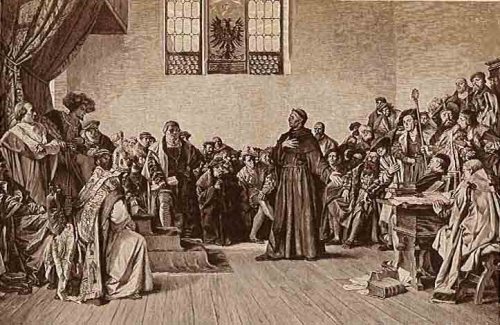
luther_at_wormsLuther at the Diet of Worms

I did a lot of study on the Lutheran Reformation in and after seminary and in 1996 while stationed in Germany as a mobilized Army Reserve Chaplain had the privilege of organizing a series of Reformation tours to Wittenberg on Reformation day where we attended the Reformationstag service at the Schlosskirche and I led a walking tour of the town.  One of the parishioners from the chapel asked me if I had been to Wittenberg before because I seemed like I knew every place in the town.  I had to tell her that I had not been there in person but because of my study felt like I had from the time we stepped off of our tour bus.  I also directed a tour to Worms where Luther on trial before Charles V was told to recant his writings and made his timeless statement:

“Unless I am convicted by scripture and plain reason – I do not accept the authority of the popes and councils, for they have contradicted each other – my conscience is captive to the Word of God. I cannot and I will not recant anything for to go against conscience is neither right nor safe. God help me. Amen.” It is legend that Luther said the words “Here I stand. I cannot do otherwise. God help me, Amen!” These words were probably only added later by someone else to make the story more interesting as they do not appear in the council notes.  Not that Luther would have objected.  The film version is linked here:

http://www.youtube.com/watch?v=U0tk_EvWXQQ&feature=player_embedded

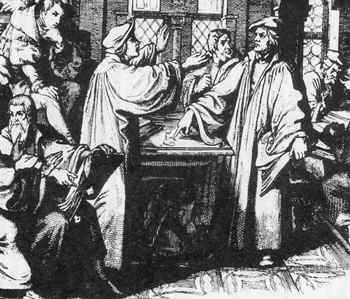
marburgZwingli and Luther at Marburg

Likewise his debate with Swiss Reformer Ulrich Zwingli at the Marburg colloquy regarding points of doctrine was significant for me. It was held that they might unify their movements. They agreed on all points except the Eucharist where Luther enunciated a very catholic understanding of the “Real Presence” and Zwingli held to be a symbolic memorial though might have some spiritual component.   Luther would not budge and to each of Zwingli’s arguments pulled back the tablecloth to reveal the words “This is my body, this is my blood” which he had carved on the table.  They departed without achieving unity, something that has plagued Protestants to this day and when Zwingli was killed in battle when leading the militia from Zurich to fight the approaching Catholic Army.  When Luther heard about the Zwingli’s death he commented Zwingli drew his sword. Therefore he has received the reward that Christ spoke of, ‘All who take the sword will perish by the sword’ [Matt. 26:52]. If God has saved him, he has done so above and beyond the rule.” (Table Talk #1451)

I have always had a special place in my heart for Luther even with all of his flaws which were many; he was earthy, spoke his mind, and had no problem with having fun or good beer.  Additionally he had a bit of an anger problem, suffered from clinical depression and had issues with his father.  Luther could be an ass, but then I can be an ass too.

Well the “unhappy few” at the Amazing Grace Baptist Church in Canton North Carolina are moving right along in their book and Bible burning crusade led by their Grand Master Pastor Marc Grizzard. In the past few days he has gotten into a pissing contest with a very conservative and should I even say “Fundamentalist” theologian named James White.  Evidently Mr. White is on the opposite end of the Fundamental spectrum according to Grand Master Pastor Marc along with “the agnostics, liberals, New Evangelicals, and Bible doubters.”  I did find it fascinating to see how Grand Master Pastor Marc’s little brain works in the text of their terrible translation tiff which is linked here: http://amazinggracebaptistchurchkjv.com/subpage570.html

I especially enjoyed this comment from his most recent webpage update where he castigates Mr. White:

“I had rather be uneducated and irrational and know that I have God’s preserved, inspired, infallible, inerrant Word of God, than to be a scholar who doesn’t know where God’s Word is. One person said, “I’d rather be an fool on fire, than a scholar on ice.” Don’t get me wrong, I am not saying a person should not better themselves or study. They should! But if study and education is going to rob you of your unwavering faith in the KJB, than leave the education to the Bible doubters. I will never be open to anything but the KJV, call me what you want. I don’t care!” Pastor Marc Grizzard

MARC KNEELING2Profiles in Stupidity Pastor Marc Grizzard
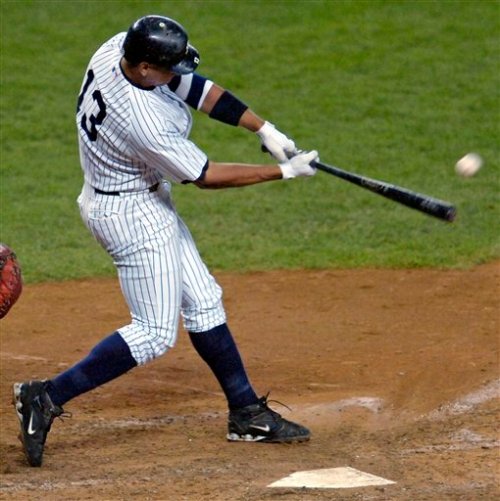
Since he has invited people to call him anything they want I think idiot works well. Have no fear he is already talking about next year’s event:

God has showed me why this years event went around the world. Check back in a couple of weeks as we begin to “Turn this world upside down.” Acts 17:6 “…These that have turned the world upside down” “Coming to a town near you!!!!” Please not my town.

Make arrangements now, if it gets popular you might have to book through Ticketmaster or the Amazing Grace Baptist Church Box Office.  By the way the start time is 7PM and Marc has said if you are not a member or have an invitation from him you are not welcome, and that includes law enforcement who promise to be there, kind of reminds me of the concert in the Blues Brothers. Of course he will have to compete with the folks at the fictional Landover Baptist Church to have the world’s greatest book and Bible burning. http://www.landoverbaptist.org/news1002/bookburning.html

Of course I wonder about a group of separatist Baptists staking their faith not on Jesus but the King James Version. It seems absurd for a group that descends from people who valued religious liberty to be burning book or Bibles of any kind.  The fact that they have set an Anglican translation, authorized by a flaming homosexual who hated, persecuted and killed the early English Baptists and which is actually a later version than the 1611 that has multiple versions, the Oxford and the Cambridge and is based on a text that was not the most common text used by the early or “ante-Nicene” church is beyond me.  The fact that King James onlyism is only about 100 years old and comes from a unusual 7th Day Adventist preacher and was advanced by the founder of the Pensacola Bible Institute who experimented with Zen Buddhism, thought about becoming a Jesuit and believed in a bunch of stuff including UFO;s that most Fundamentalists would deride only adds to my mystification.  But then to quote Forrest Gump “stupid is as stupid does.”  Congratulations Pastor Marc you win the Gump award for 2009. Congratulations, your 1973 orange Ford Pinto is waiting in the A-1 Auto Salvage in Fayetteville.

Tonight the Abbess and I will go to a Halloween party at our favorite restaurant the Gordon Biersch Brewery Restaurant in Virginia Beach.  I went as a baseball player from a scary team, the Orioles and the Abbess is going as a Hippy Chick.  It was fun, nice people, good music and 70’s and 80’s music videos and great beer.

Mariners Yankees BaseballAlex Rodriguez Broke out of His Slump

Now I sit watching game three of the World Series. For once replay was used to overturn a bad call, Alex Rodriguez getting his first hit, a 2 run home run that hit the lens of the right field television camera that was initially ruled a double.  Cole Hammels was hit hard as I predicted giving up five runs before he was pulled in the 5th, one of the runs coning off the bat of Andy Pettitte who drove in Nick Swisher and then later scored.  The Yankees bats began to come alive, Nick Swisher who had had a miserable post season hit a home run and a double, and Alex Rodriguez broke out of his slump with his 2 run homer. Hideki Matsui hit his second home run of the series with 2 outs in the 8th as a pinch hitter against Brett Myers.  For the Phillies the hot hitting Ryan Howard has continued to slump striking out 3 more times tonight to make him 2 for 13 with 9 strike outs in the first three games.  On the other hand Jayson Wirth continues to hammer the ball hitting two solo shots tonight.

Tomorrow should be nice, Church in the morning after an extra hour sleep, followed by some study for my exams and game four of the series tomorrow with C.C. Sabathia coming back against Joel Blanton.  Advantage has to go to the Yankees with Sabathia on the hill and thier bats starting to come to life. Should be another great game.

Peace,

Padre Steve+

3 Comments

Filed under Baseball, History, Religion

One Square Mile of Hell: The Invasion of Tarawa

On November 20th 2009 the Marine Corps and especially the 2nd Marine Division will mark the 66th anniversary of the amphibious assault on the Tarawa Atoll and the island of Betio.  It was fought at a great cost but would yield lessons that would be invaluable in future amphibious operations. The veterans of the landing are fewer every day. Please take time to remember their sacrifice that they made and Marines continue to make in Afghanistan and Iraq. I have served with the 1st and 3rd Battalions, 8th Marine Regiment the 2nd Combat Engineer Battalion and HQ Battalion 2nd Marine Division.  I have had the honor to meet some of the surviving Tarawa Veterans so this is not only history for me, but a way to pay tribute to the Marines who served at Tarawa and all Marines since. Especially those Marines that I served with at 2nd Marine Division, Marine Security Forces and the Marine Advisers to the Iraqi 7th and 1st Divisions, 2nd Border Brigade, Port of Entry Police, Police and Highway Patrol in Al Anbar Province. Semper Fidelis, Padre Steve+

The Decision: Operation Galvanic

USMC-M-Tarawa-3The Target: Betio Island at Tarawa Atoll
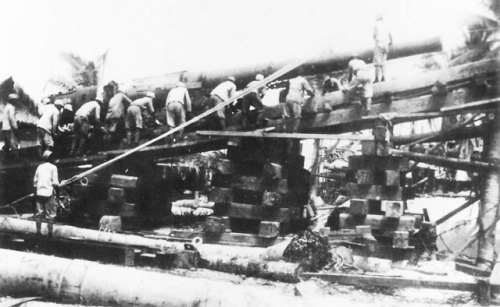
Following Guadalcanal and the shift of significant naval forces from the Solomons the focus of the US shifted to the thrust across the Central Pacific.  Unlike the Solomons which were initially a Navy and Marine Corps Operation and shifted to the Army under MacArthur as the campaign shifted to Borneo, the operations here would be an almost total Navy and Marine Corps operation. Operation Galvanic, the first offensive operation in the Central Pacific, came about as a result of the Joint U.S. Strategic Committee decision in April 1943 to favor an advance in the Central Pacific while maintaining the offensive in the South Pacific.[i] The driving force behind this strategy was Admiral King who fought for the plan and “insisted that any campaign should focus on the destruction of Japan’s overseas resources, which meant an offensive directed only toward the Western Pacific sea lanes.”[ii] The Joint Chiefs believed that a simultaneous attack by Nimitz in the Central Pacific and MacArthur in the South Pacific would “keep the Japanese guessing.”[iii] The decision was presented to the British at the TRIDENT meetings in May 1943 and though the British resisted the American plans a compromise was reached allowing the Americans to “simultaneously…maintain and extend unremitting pressure against Japan….”[iv]

japanese emplacing gunJapanese Emplacing 8″ Vickers Gun

The decision to begin operations in the Central Pacific meant that MacArthur’s priority in logistics and personnel would be reduced in order to launch the Central Pacific operation.  MacArthur protested, to no avail and the Joint Chief’s stood firm in their decision that the Central Pacific operation “would make it easier to isolate Japan from her domain in the south.”[v] MacArthur was allowed to continue OPERATION CARTWHEEL while Nimitz seized the Marshall and Caroline islands.[vi] Nimitz’s staff began preparations and decided on a conservative course to capture the Gilberts first before taking the more heavily defended Marshalls.[vii] This was in part due to the “need to minimize the risks to his untried amphibious forces against such heavily fortified enemy bases out of reach of air cover.”[viii]

japanese conducting firing exerciseJapanese conducting Live Fire Range prior to the Assault
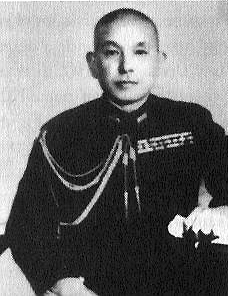
Several factors were considered by Nimitz and his planners considerations in this choice.  Nimitz did not have enough troops to capture all of the vital heavily defended locations in the Marshalls without dividing his forces.[ix] Additionally the Gilbert operation could be supported by land based bombers.[x] A final consideration was the Joint Chief’s decision to allow MacArthur to retain control of 1st Marine Division which Nimitz had hoped would be available for operations in the Central Pacific.[xi] CINCPAC did a thorough photo reconnaissance of the Gilbert’s convinced the Joint Chiefs that Tarawa and Makin needed to be taken to provide air bases for the assault on the Marshalls.  Finally the order for Galvanic was issued on 20 July 1943 with its execution planned for November 1943.[xii]

Japanese Preparations

shibasakiAdmiral Shibasaki boasted that it would take a million men a thousand years to take Betio
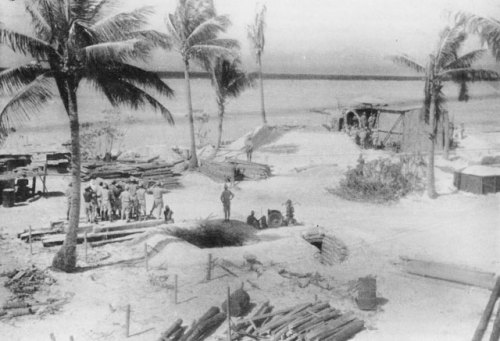
The Japanese did little to prepare against potential American offensive operations against the Gilbert’s until Makin Island was raided by elements of 2nd Raider Battalion in August 1942.  The Makin raid shook the Japanese and at which time they reinforced Makin and occupied Betio.[xiii] The Japanese occupied Betio with the Yokosuka 6th Special Landing Force, essentially Naval Infantry or Marines[xiv] and the 111th Construction Battalion on 15 September 1942, over nine months after they attacked Pearl Harbor.[xv] These forces were commanded by Admiral Tomanari, who at once began to fortify Betio. Recognizing his need for more troops  Tomanari asked Tokyo for reinforcements.  The reinforcements came in the form of Commander Sugai’s 7th Sasebo Special Naval Landing Force, which landed on 14 March.[xvi] Commander Sugai’s troops were the Rikusentai, the best of the Japanese Navy’s land forces.

USMC-M-Tarawa-p6Japanese Conducting Gunnery Exercises

The fortification of Betio proceeded slowly until the arrival of Rear Admiral Shibasaki, who relieved Tomanari who returned to Japan.[xvii] Shibasaki, a tough veteran of service at sea and ashore including 19 months as a Rikusentai[xviii] officer in China was chosen by Admiral Koga to instill a better fighting spirit on the island.  The Imperial General Headquarters “New Operations Plan” ordered the outer defensive islands, such as Tarawa, to “hold up any American advance while an inner line of fortresses was constructed….”[xix] Shibasaki drove the garrison hard, inspiring them to “extraordinary heights of labor that resulted in Betio’s superb defenses.”[xx] Betio mounted four 8” Naval guns[xxi], four 14 cm guns, four dual mount 5.5” dual purpose guns[xxii] six 80 mm anti-boat guns, eight 75 mm dual purpose guns, ten 75 mm mountain guns, six 70 mm guns and nine 37 mm anti-tank guns, numerous machine guns and light AA guns and 14 light tanks.[xxiii] These weapons were mounted in well camouflaged armored or reinforced pillboxes.[xxiv] In accordance with the directives of the high command Shibasaki ordered his troops “to defend to the last man all vital areas and destroy the enemy at the waters’ edge.”[xxv] The Japanese records note that Shibasaki “immediately began to strengthen morale and carried out advanced training, and as a result…the garrison remarkably enhanced its fighting capability and they were full of confidence.”[xxvi] Even the service troops were thoroughly trained to fight from their superb defensive positions.[xxvii] Shibasaki reportedly told his men that it would take a million men a thousand years to take Betio.

American Preparations

lvtLVT

Nimitz organized his forces into three major commands, the 5th Fleet, commanded by Admiral Raymond Spruance, the 5th Amphibious Force under Admiral Richmond “Kelly” Turner and the V Amphibious Corps under Major General Holland “Howlin’ Mad” Smith, USMC.[xxviii] The 2nd Marine Division which would make the assault at Tarawa was commanded by Major General Julian Smith. The force that sustained in this operation and subsequent amphibious operations was the Service Force Pacific Fleet.[xxix] This was a collection of ships whose mission it was to sustain the fleet in mobile operations,[xxx] which greatly “increased the range and power of the Navy in amphibious operations.”[xxxi] The planned assault called for the Army’s 27th Division take Makin and the veteran 2nd Marine Division which had been blooded at Guadalcanal to take Tarawa supported by the carriers and battleships of 5th Fleet.

This was the first application of new amphibious tactics developed for the Pacific war.[xxxii] Air and sea bombardment would precede the actual assault. The Marines would be transported ashore in a new vehicle called an LVT (Landing Vehicle Tracked) and other amphibious ships and craft including the LSD (Landing Ship Dock), LCM (Landing Craft Mechanized) and LCVP (Landing Craft Vehicle Personnel).  The LVTs were absolutely vital, nicknamed “Amtracks” or “Amphtracks” they were essentially a tracked amphibious personnel carrier. They were developed from a commercial vehicle used by U.S. Forrest Service Rangers in the Florida Everglades and were capable of crossing coral reefs that would cause other craft to go aground.  The early LVTs had retrofitted armor and mounted a .50 cal. machine gun.  At Tarawa the Marines deployed 75 LVT-1s[xxxiii] and 50 LVT-2s. 93 LVTs would be part of the first wave of the Marine assault.[xxxiv] The LVTs were transported to Tarawa aboard LSTs (Landing Ship Tanks.)  Other innovations included the assignment of Naval Gunfire Support teams to the Marine Regiments and some battalions,[xxxv] and the first use of the M4 Sherman tank by the Marines.[xxxvi] Tarawa was a proving ground for the tactics and equipment which would be improved on and used in every subsequent amphibious operation in the Pacific.  Tarawa would also mark the last major use of rubber landing craft by the Marine Corps in an opposed landing.[xxxvii]

There were limitations to American preparations. First the size of the force meant that it could not be assembled in one place for rehearsals or to train as a team.[xxxviii] A second problem for the Americans was the assumption that high and low tides would be sufficient to get their landing craft across the reef in spite of warnings to the contrary.[xxxix] Likewise the Americans failed to completely anticipate the scope to which the Japanese had fortified the island. This was despite good intelligence that they had done so. In particular aerial photos taken by the air force and ULTRA intercepts provided good information on the Japanese units on the island and the layout of the defenses.[xl] Additionally some equipment shortages were not remedied. The Marine Bazooka’s did not arrive, and neither the 6th or 8th Marines had made an actual amphibious assault.  At Guadalcanal they made an administrative landing and few field-grade officers remained from the 2nd Marine Regiment who had landed at Tulagi.[xli] They were far from “amphibious experts” that they would become.[xlii] However, they made up for their lack of experience by their cohesiveness, high morale and esprit, being well armed and equipped, in top physical condition and knowing the basic tools of their trade: “weapons proficiency and field firing, close combat techniques, fire and maneuver, tactical leadership, fire discipline.”[xliii]

tarawa 8 inch gun8 Inch Gun Emplacement

The most critical aspect of the operation was to get across the reef onto the island.  There were few good landing sites and it was decided to make the landings from inside the atoll’s lagoon onto the Betio’s north shore.  This decision meant that transports embarking the Marines would unload outside of the lagoon and that the landing craft would have to make a 10 mile trip.[xliv] There was only one entrance into the lagoon and it was not deep enough for heavy ships to enter.[xlv]This meant that heavy ships such as battleships and cruisers would not be able to have direct fire on the Japanese positions best situated to disrupt the Marines.

The execution of the plan involved land based bomber strikes beginning on D minus 7. Carrier aircraft would begin their operations on D minus 2.  Cruisers and destroyers joined the cacophony of destruction on D minus 1 and the battleships on D Day itself.[xlvi] On D-Day itself Navy planned to bombard the island with 3,000 tons of shells in 2 ½ hours.[xlvii] The Navy was confident in the bombardment plans. Rear Admiral Kingman commanding the fire support group declared “We will not neutralize; we will not destroy; we will obliterate the defenses on Betio!”[xlviii] Four battalions of Marines would land in the first wave, the three battalions of the 2nd Marines and 2nd Battalion 8th Marines all commanded by Colonel David Shoup. Colonel Shoup who would win the Medal of Honor on Betio and later became the Commandant of the Marine Corps assumed command of 2nd Marines when its Regimental commander fell ill on the journey to Efate.[xlix] The division reserve was the remaining 8th Marine Regiment battalions. The 6th Marine Regiment served as the corps reserve.[l] The assault units would be reinforced by tanks and the 1st and 2nd Battalions 18th Marine Regiment, the division’s combat engineers.

Invasion: Day One

landing craft going to beachGoing Ashore

The naval gunfire bombardment commenced at 0542 on 20 November, and the assault waves began their trek to the beaches.  The transports were out of range of Japanese guns but ththat ensured boats would have to make a 10 mile trip.[li] At this point things began to go wrong.

lcm sinking at tarawaNavy LCT Sinking after Being Hit By Japanese Fire
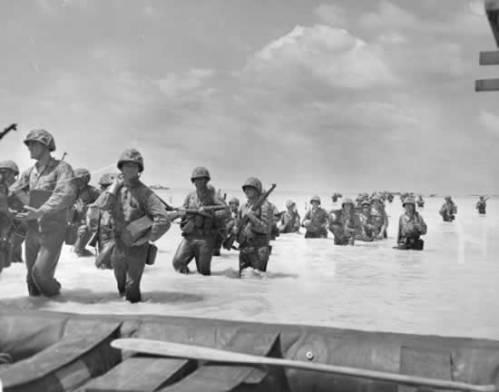
The Navy had “badly miscalculated the amount of softening-up that could be done in two and a half daylight hours bombardment.” Although major coast defense guns were silenced not enough damage was done to the Japanese defenses.[lii] The Japanese helped the Marines by firing their larger guns at warships, identifying their positions to Navy gunners.[liii] The bombardment lifted to allow an attack by carrier based aircraft. However the aircraft were late to arrive and the ships did not resume fire, allowing the Japanese to emerge and re-train their weapons.[liv] Likewise the destroyers Ringgold and Dashiell inside the lagoon had to cease fire, knowing the Japanese gunners along the shore were still active.[lv] Some believe that an extra half hour of direct fire from the destroyers would have saved many lives.[lvi] The LVTs in the first three waves were delayed by heavy chop and did not make landfall until 0913 throwing off the landing schedule.[lvii] The expect and planned for rise in tides did not materialize and they remained unpredictably low for the first 48 hours. No landing boats could cross the reef and the Marines were forced to wade ashore from 600 to 1000 yards.[lviii]

marines wade ashore at tarawaMarines Wading Ashore

Shoup’s Marines landed on three beaches.  Red one and two lay to the west of a 500 yard long pier and Red three lay to the east.  3/2 landed on Red-1, 2/2 on Red-2, 2/8 on Red-3, elements of 1/18 and the scout snipers on the pier, with 1/2 in reserve to land behind the battalion making the best progress.[lix] As soon as the Amtracks hit the reef the Japanese began firing.  Every “working weapon along the north and west shorelines….blazed forth in fierce, interlocking fields of fire.”[lx] As they watched the Amtracks craw over the reef that Japanese knew they were in for a tough fight, one of Warrant Officer Ota’s men exclaimed “Heavens! The God of Death has come!”[lxi] The Marines of 3/2 on Red-1 received enfilade fire from Japanese guns emplaced in a U around the beach.  Before the Marines landed they began to take causalities, Amtracks were hit in the lagoon and most that were not sunk or destroyed were unfit for further use.[lxii] The 2000 Marines who landed in the first hour were badly disorganized, the commanding officer’s of 2/2 and the Amtracks were killed, 3/2’s commander was isolated on the reef and only 2/8’s commander was with his troops. 2/8 was the only battalion being to reach the shore relatively intact.[lxiii] 3/2 was down to 65% of its strength and K/3/2 had taken over 50% casualties.[lxiv] The Marines in the fourth to sixth waves were struggling to wade ashore from the reef. Landing craft “ran aground or milled about helplessly outside the reef, which was swept by crossfire from behind the beaches and from a grounded hulk northwest of the pier.”[lxv] Most of the tanks were put out of action either through accurate fire by Japanese guns or by sinking in deep areas of the lagoon, the Tank battalion commander was blown out of his Amtrack, wounded and survived 24 hours by clinging to a pile of dead bodies to keep from drowning.[lxvi]

Col_Shoup_on_TarawaColonel Shoup Directing Operations on Tarawa
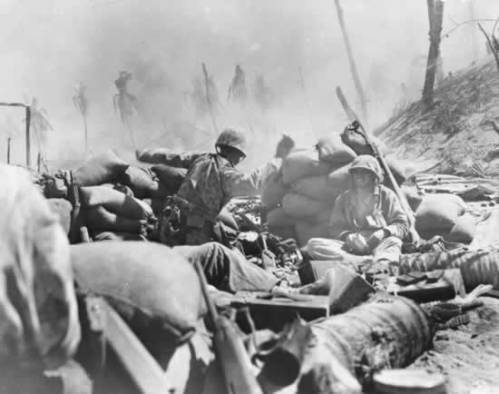
Shoup himself landed at Red-2 and began directing operations on the beach.  He knew that he had to get more troops ashore to exploit the minimal gains his Marines had made.  The news from Red-1 and Two was bad; he decided to bring 1/2 in at Red-2 thought that 3/8 should go in at Red-3.[lxvii] At 1018 General Julian Smith ordered the 8th Marines to dispatch 3/8 to Red-3.[lxviii] 3/8 had to make their way across 700 yards through the water to get to the beach.  It was a slaughter, only 30 percent of the first wave got ashore, in the second less and the third “were practically wiped out.”[lxix]

taraw close combatClose Combat on Betio

As his Marines struggled ashore those who had gotten ashore engaged the Japanese at point blank range.  Lt. Hawkins of the 2nd Marine Scout and Sniper platoon and 5 of his men engaged the Japanese on the pier in vicious hand to hand fighting,[lxx] Sergeant Bordelon of the Engineers on Red-2 though grievously wounded knocked out four gun positions, some by lobbing dynamite charges into them and galvanizing survivors into action, finally being killed while taking on a Japanese position alone.  He would be awarded the Medal of Honor.[lxxi]

HD-SN-99-02572Wounded Marines Being Evacuated by Rubber Raft
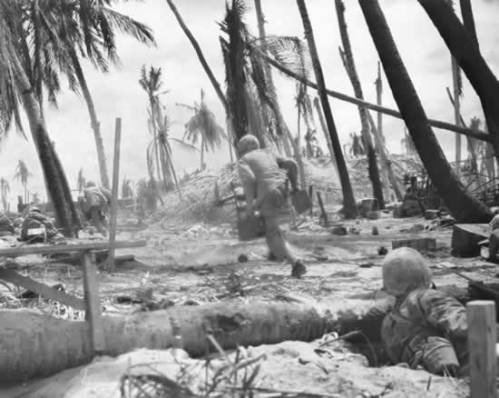
By afternoon Julian Smith realized that he needed more troops, his last battalion, 1/8 waited to go ashore.[lxxii] Smith asked for the 6th Marines and had Admiral Hill send a message to Admiral Turner stating “Issue in doubt. I concur.” This sent a chill through the listening Naval Staff.[lxxiii] Ashore Shoup brought howitzers from 1st Battalion 10th Marines on surviving Amtracks to the eastern edge of Red-2 near the pier,[lxxiv] which landed in the early evening.[lxxv] He sent Lieutenant Colonel Carlson to make a personal report to General Smith that he would hold his beachhead no matter what happened. Shoup ordered his Catholic Chaplain to lay out a cemetery and begin burying the dead who were already decomposing in the tropical heat.[lxxvi] As this transpired 2/8 got two 37mm anti-tank guns into position to drive off Japanese tanks approaching the beachhead.[lxxvii] The Division Band assisted corpsmen in bringing back wounded Marines.[lxxviii] The rest of the day the Marines continued to eke out a beachhead; Shoup’s Marines on Red-2 and Red-3 managed to advance about halfway across the island, 3/2 and elements 1/2 and 2/2 was isolated and Major Ryan of Lima Company pulled them back to meet an expected Japanese counter-attack.[lxxix] The Marines had taken over 1500 casualties of 5000 men landed the first day.[lxxx] There is no evidence that Shoup considered withdraw that night.[lxxxi] No counterattack occurred due to Japanese command and control problems, Admiral Shibasaki and his staff were killed while shifting headquarters during the afternoon,[lxxxii] and their communications were in shambles. A counterattack would have been disastrous in their condition,[lxxxiii] yet they assembled over 1000 men to oppose the Marines on day two.[lxxxiv] Had Shibasaki lived and communications survived a counterattack might have had ramifications far beyond Tarawa.[lxxxv]

Day Two: D+1

marines advancingMarines Advancing

The second day began with 1/8 landing on Red-2 and the 6th Marines began to land on Green Beach at the far western tip of Betio.  1/8’s landing turned into a bloodbath, the tide fell even lower than the previous day and as they hit the reef and waded ashore drifted into some of the heaviest Japanese defenses. Japanese guns, including the dual 5.5” guns took direct aim at the boats, and Marines ashore watched helplessly, and correspondent Robert Sherrod noted: “This is worse, far worse than it was yesterday.”[lxxxvi] Only half of 1/8 reached the beach with none of their heavy weapons or equipment.  Shoup ordered the remnants of the battalion into line on his western flank in preparation for an advance inland.[lxxxvii] During five hours of landings on day two, the “Marine casualties reached a higher rate than that sustained on the first morning.”[lxxxviii]

Meanwhile, Shoup ordered Ryan’s “orphans” to make an attack down the right flank of the Japanese positions on Green beach and the “ultimate American victory at Betio evolved from the attack during one intense hour the second morning.”[lxxxix] Taking every available Marine, two surviving Shermans and some mortars, Ryan gathered his force and coordinated Naval Gunfire support.  The area contained a number of heavy guns including two of the 8” mounts.  A destroyer blanked the Japanese positions with 5” shells and fire from her light AA guns.[xc] Attacking behind the beach, Ryan’s Marines isolated and destroyed everyone and everything that looked hostile.[xci] Against minimal opposition Ryan’s Marines quickly seized the gun positions and the western end of the airfield.  Within an hour his Marines occupied the entire western side of Betio up to a 200 yard depth by 1200 and he radioed to let Shoup know the good news and that he intended to advance east against the airfield.[xcii] The attack allowed the Marines to be able to land intact battalions with supporting arms for the first time battle.[xciii]

To the east behind Red-2 and Red-3 The 8th Marines and survivors of 1/2 and 2/2 attacked against fierce Japanese opposition near Shibasaki’s former command bunker and two other large bunkers which were mutually supporting.  The attack by the 2nd Marine survivors eventually succeeded in getting completely across the south side of the island.[xciv] During the attack Lt. Hawkins of the Scout Snipers was mortally wounded.  He too would win the Medal of Honor.  The attack cut the island in two but the Japanese launched a counterattack on the Marine positions which was beaten back.[xcv] The 8th Marines faced a more difficult task going against what was now the heart of the Japanese defense, as its defenders had been reinforced by Lt. Minami and his third company of the 7th Special Naval Landing Force.  Vicious fighting ensued and by nightfall “the Marines had little to show for their heavy losses,[xcvi] but they did make significant inroads against the Japanese to warrant optimism for D+2.[xcvii] By evening the Marines on Red-1 and Red-2 had consolidated their beachhead so that reinforcements were landing, including jeeps, artillery and heavy equipment, and other Marines noted that Japanese defenders were beginning to commit suicide and they began to feel that Japanese morale had broken.  By late afternoon Shoup transmitted the message: “Casualties many. Percentage of dead unknown. Combat efficiency-We are winning.”[xcviii] By late afternoon Major Jones’ 1/6 landed on Green beach in their rubber boats, reinforcing Ryan’s orphans, it was the first of the 7 battalions landed to get ashore intact and the two officers coordinated their units for a night defense and an early attack the next morning.[xcix] 2/6 cleared the nearby island of Bairiki allowing 2/10 to land its howitzers on the island.  This in effect cut off any line of retreat for the defenders of Betio.[c] Colonel Edson came ashore during the evening to relieve Shoup[ci], who remained ashore to help coordinate the next day’s attack.  Again there were no coordinated Japanese counterattacks, the only senior officer, Sugai was isolated in the pocket between the Red and Green beaches and no senior officer could coordinate any attacks.[cii]

Day Three and Four: D+2 and D+3

tarawa wreckageWrecked LVY’s and Bodies on the Beach: The Marines Released Photos to Get the Public to Understand the Cost of the Battle
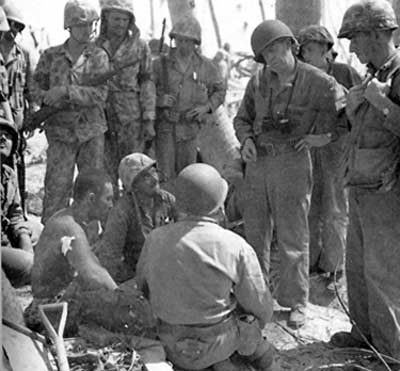
Day three began with attacks against Japanese strong points and the arrival of more reinforcements including 3/6 which landed on Green beach and three light tank platoons which landed on Red-2.[ciii] The Marines attacked off of Green beach sweeping east to join the 2nd Marines who had cut the island in two the day before.  The 8th Marines continued to attack the heavily fortified bunker complex eventually taking these heavily fortified and defended positions.  During the assault Lt Sandy Bonnyman of 1/18 won the Medal of Honor for leading the assault on these positions.[civ] Fighting remained fierce throughout the day and General Smith arrived to take command on shore.  The Marines attacked supported by tanks, artillery and naval gunfire.  By the evening they were established at the east end of the airfield.  The Japanese launched a series of Banzai charges which beginning about 1930 hours and ending about 0400 when the Marines annihilated the last attack with the assistance of artillery.[cv] The attack, which could have succeeded the first or early the second day, now aided the Marines by sacrificing strength that might have been used to exact a higher price for the tail of the island.[cvi] The next morning the Marines pushed forward and eliminated the last Japanese defenders and by 1200 Betio was secured.  Of about 5000 defenders only 17 Japanese and some Korean laborers were taken prisoner.[cvii] The Marines lost over 1000 killed and 2300 wounded.[cviii]

Tarawa prisonerOne of the 17 Japanese Who Survived the Battle being Interrogated by Marines, only one Chief Warrant Officer Ota was an Officer
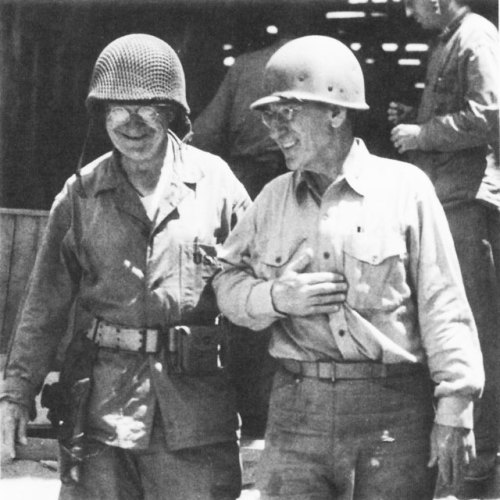
Epilogue

The Marines paid a heavy price for Betio, but it was not to be a useless sacrifice, though it was a source of great controversy especially among politicians.[cix] Spector wonders if waiting for better tides or a full moon would have saved lives.[cx] Holland Smith later argued that Tarawa should have been bypassed, but Nimitz’s biographer Potter notes “if the lessons of the amphibious assault had not been learned at Tarawa, they would have to be learned elsewhere, probably at greater cost.”[cxi]The lessons learned alone aided all future amphibious operations in the Central Pacific and elsewhere.  Timing and coordination of naval gunfire support, air strikes and combat loading of transports were all refined in future operations. Large numbers of armored and up-gunned Amtracks would be part of every future operation.[cxii] Intelligence was emphasized and replicas of the Japanese fortifications were built and tested to determine the best way of destroying them.[cxiii] The Marines shocked the public by releasing photos and films of the carnage on Tarawa to awaken them to the challenges ahead.[cxiv]

Today the battle is remembered annually by the 2nd Marine Division at Camp LeJeune, an ever shrinking number of veterans of the battle attend the ceremonies.  Samuel Eliot Morison put it best: “All honor, then, to the fighting heart of the United States Marine. Let the battle for that small stretch of coral sand called Betio of Tarawa be remembered as terrible indeed, but glorious, and the seedbed for victory in 1945.”[cxv]

Appendix: Leaders on Tarawa

smith and smith at tarawaLieutenant General Holland Smith and Major General Julian Smith on Betio
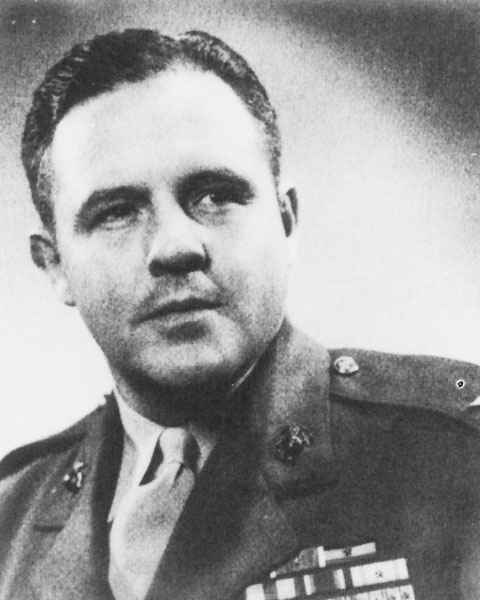
General Holland M. “Howling Mad” Smith USMC: (1882-1967) Lieutenant General Holland M. Smith command V Amphibious Corps during the Gilberts operation.  Prior to the war he had worked extensively on amphibious warfare doctrine for both the Marine Corps and Navy. Unlike many senior officers Smith was not a Academy graduate having matriculated from the Alabama Polytechnic Institute (now Auburn University) in 1903 and law school in 1903.  Smith served as Adjutant of the 4th Marine Brigade in the First World War and served in Panama and the Dominican Republic in addition to other Marine tours afloat and ashore.  He served well and had many key assignments between the wars culminating in as the Assistant Commandant of the Marine Corps.  Subsequent to the Gilbert campaign he served as Commanding General of the Fleet Marine Force, Pacific and later commanded the Marines at Iwo Jima.  He retired in 1946.

Major General Julian Smith USMC: (1885-1975) Major General Julian Smith served as Commanding General 2nd Marine Division at Tarawa.  He graduated from the University of Delaware and was commissioned as a Second Lieutenant in 1909.  He served in Haiti, Santo Domingo and the Vera Cruz expedition. During the First World War he served as an instructor in the Marine Officer training camps at Quantico. After the war he served in Cuba, Nicaragua and various command and staff posts including the Army Command and General Staff College.  He commanded 5th Marines in 1938 and in 1942 was promoted the Major General serving as director of Fleet Marine Force Schools, New River, NC.  He took command of 2nd Marine Division in May 1943 and served there until April 1944 when he became Commanding General, Expeditionary Troops, Third Fleet and in December 1944 took command of the Military Department of the Pacific.  He retired in 1946.

shoupColonel Shoup After the Battle

Colonel David Shoup USMC: (1904-1983) Colonel David Shoup commanded the 2nd Marines at Tarawa, being appointed as commander when its commander fell ill.  Shoup won the Congressional Medal of Honor for his actions on Tarawa.  A 1926 graduate of DePauw University, Shoup was commissioned a Second Lieutenant through the ROTC program that year.  He served in various assignments to include service in China, at sea on the battleship Maryland and Marine Barracks Puget Sound Navy Yard. He joined the staff of 6th Marines in October 1940 and assumed command of 2/6 in February 1942.  He was assigned as the Assistant Operations Officer for 2nd Marine Division in July 1942 and promoted the Lieutenant Colonel.   He went with the Division to New Zealand where he became the G-3 and from which he was fleeted up to command 2nd Marines at Tarawa.  After Tarawa he served as the Division Chief of Staff at Saipan and Tinian.  After the war Shoup continued to be assigned in key billets at the Pentagon and as commanding General, 1st Marine Division and then the Third Marine Division.  He became Chief of Staff, HQMC in 1958 and was appointed as the 22nd Commandant of the Marine Corps by President Eisenhower, a post that he retained until his retirement in 1963.

Admiral Tomanari Sachiro IJN: (1887-?) Commander of Tarawa garrison until relieved by Rear Admiral Shibasaki.   Graduate Naval Academy 1910, initially a communications officer he held various commands including Heavy Cruiser Haguro and Battleship Kirishima and two smaller ships.  Assigned to Tarawa in February 1943 he helped design and supervised the initial construction of Tarawa Defenses until relieved by Admiral Shibasaki on 20 July1943.  He returned to Japan and served the remainder of the war on Navy Division of Imperial General Headquarters.  Tomonari survived the war though nothing is mentioned as to his postwar fate.

Rear Admiral Shibasaki Keiji IJN: (1894-1943) Commanded Tarawa Garrison until his death during the battle.  He graduated from the Naval Academy in 1915 and he was a skilled navigator and instructor.  Prior to the war he had served afloat and ashore and ashore and had commanded a ship and naval station and served as a naval attaché to a member of the Imperial Family.  Among his assignments was 19 month combat tour with the special Naval Landing Forces in China, where he served as Chief of Staff of Shanghai Special Naval Landing Force.  Shibasaki’s leadership helped the garrison improve their defensive capabilities and combat skills as he inspired them to great heights and executed an intense training program. He was killed in the battle.

A Personal Note

I have not been to Tarawa but feel that I know it well.  I served in Second Marine Division from April 1999 through December 2001.  Due to my prior service experience I was used to fill gaps where chaplains were needed and ended up serving in four different battalions.  I served in 2nd Combat Engineer Battalion, the descendant of 1/18, the combat engineers.  We had a WWII Bulldozer outside our command post named after Sergeant Bordelon, the Medal of Honor Citations for Bordelon and Boonyman were prominently displayed.  I also served in 1/8 and 3/8.  I knew the accounts of the slaughter of these Marines as they attempted to land but as I re-read the accounts I was moved by their courage under fire.  The CPs of these battalions are also adorned with citations of their heroes lost at Tarawa.  Veterans would visit our units during Tarawa Days at Camp LeJeune, worn by the battle and the years they always made an impression. There is almost a mystical connection between the Second Marine Division and the Marines of Tarawa; it was a crucible that defined the division, whose motto is the same as the Army Infantry School. “Follow Me!”

Semper Fidelis,

Padre Steve


[i] Spector, Ronald H. Eagle Against the Sun: The American War with Japan.  The Free Press, New York, NY 1985. p.253


[ii] Murray, Williamson and Millett, Allan R. A War to Be Won: Fighting the Second World War, The Belknap Press of Harvard University Press, Cambridge, MA 2000. p.338

[iii] Ibid. Spector. p.253

[iv] Ibid. p.255 The conference also set a date for the invasion of France.

[v] Toland, John. The Rising Sun: The Decline and Fall of the Japanese Empire, 1936-1945. Random House, Inc. New York, NY 1970. p.468

[vi] Ibid. Spector. p.255

[vii] Costello, John. The Pacific War 1941-1945. Quill Publishing, New York, NY 1982. p.430

[viii] Ibid.

[ix] Potter, E.B. Nimitz. Naval Institute Press, Annapolis, MD, 1976, Third Printing with Revisions 1979. p.243. Nimitz’s forces would have had to seize 5 major Japanese bases and his staff was not sure that the Pacific carrier force would be strong or experienced enough to provide the necessary air cover for the operation.

[x] Ibid.

[xi] Ibid. pp.243-245

[xii] Morison, Samuel Elliott. The Two Ocean War: A Short History of the United States Navy in the Second World War. Little Brown and Company, Boston and Toronto, 1963. p.296.

[xiii] Hammell, Eric and Lane, John E. Bloody Tarawa: The 2nd Marine Division, November 20-23, 1943. The Zenith Press, St. Paul MN 2006.  Text copyright 1998 Eric Hammell and John E. Lane. p.4

[xiv] See Alexander, Joseph H. Utmost Savagery: The Three Days of Tarawa. Ivy Books, published by Ballantine Books, New York, NY. 1995. pp. 39-40.  This unit became the Third Special Base Unit on its deployment and was joined by the 111th Construction Battalion.

[xv] Ibid. Hammell. p.4

[xvi] See Alexander pp.39-40. This unit was basically a reinforced infantry battalion with 3 rifle companies, a weapons battery, anti-aircraft battery, a light tank company and support units numbering about1600 men.

[xvii] Ibid. Alexander. p.43

[xviii] Alexander p.27 The Rikusentai was the Japanese equivalent of Marines, who numbered about 50,000 men.  The officers attended Army schools and qualified enlisted men attended additional Army specialist training.

[xix] Ibid. Costello. p.431

[xx] Ibid. Hammell. p.22

[xxi] See Alexander p.77. While most writers say that these guns were brought from Singapore, Alexander notes that British writer William H Bartsch submitted proof (serial numbers) that the guns were sold by Vickers to Japan in 1905 as a legitimate business transaction.

[xxii] These are the same guns (127mm) mounted as the secondary armament of Nachi and Takao Class Heavy Cruisers and later mounted on light cruisers to replace the main battery with a more effective anti-aircraft armament.

[xxiii] Ibid. Hammell. p.22

[xxiv] Hammell notes that many of these bunkers and pillboxes were so well concealed that they could not be seen.

[xxv] Ibid. Toland. p.469.

[xxvi] Ibid. Alexander. p.43.

[xxvii] Ibid. Hammell. p.28

[xxviii] Ibid. Morison. p.297

[xxix] Ibid. Costello. p.429

[xxx] At this point the force could provide everything except major permanent repairs to warships.

[xxxi] Liddell-Hart, B.H.  History of the Second World War. G.P. Putnam’s Sons, New York, NY 1970. p.511

[xxxii] Ibid. Costello. p.431

[xxxiii] The older LVT-1s had boiler plate armor added as a field modification and were given a heavy machine gun. Prior to this they were unarmored and had two light machine guns.

[xxxiv] Ibid. Morison. p.303

[xxxv] Hammell includes a by name list of these officers in Appendix B.  Of note for today, each MEUSOC (Marine Expeditionary Unit, Special Operations Capable) has an assigned Naval Gunfire Support Team.

[xxxvi] Ibid. Alexander. pp. 61-62.  The Shermans had to be transported aboard pre-loaded LCM-3s carried in the well decks of the LSDs.

[xxxvii] Ibid. Alexander. pp.58-59

[xxxviii] Ibid. Morison. p.297.  As a sidebar discussion it should be noted that Galvanic helped provide the model for the organization of all further Marine Corps amphibious doctrine now known by the acronym PERMA; Planning, Embarkation, Rehearsal, Movement and Assault, which describes the 5 phases of a amphibious assault.

[xxxix] Ibid. Hammell details the intricacies of the particular tides seen at Tarawa and the knowledge that the Marines had from the former Resident Commissioner of the Island, Major Frank Holland who warned the division staff that he knew that there would not be enough water over the reef to get landing craft across it. (pp.18-20)

[xl] Ibid. Alexander. pp.75-77

[xli] Ibid. Alexander. pp.67-68.

[xlii] Ibid. p.70

[xliii] Ibid. p.71

[xliv] Ibid. Morison. p.302

[xlv] Ibid. Hammell. p.16

[xlvi] Johnston, Richard W. Follow Me! The Story of the Second Marine Division in world War II.  Copyright 1948 by the Second Marine Division History Board and published by Random House Publishers, New York, NY 1948. p.106

[xlvii] Ibid. Liddell-Hart. p.511  Johnson says 2,700 tons. (p.106)

[xlviii] Ibid. Johnston. p.106

[xlix] Ibid. Hammell. p.17

[l] Ibid.

[li] Ibid.. Hammell. 46-47

[lii] Ibid. Morison. p.303

[liii] Ibid. Alexander. p.113.  Alexander notes that the Japanese would have been better served by using these guns on the stalled out landing craft.

[liv] Ibid. Hammell. p.47.

[lv] Ibid. Hammell. p.58

[lvi] Ibid.

[lvii] Ibid. Morison. p.303

[lviii] Ibid. Alexander. p.79

[lix] Ibid. Hammell. p.17

[lx] Ibid. Alexander. p.121

[lxi] Wukovits, John. One Square Mile of Hell: The Battle for Tarawa. NAL Caliber, published by New American Library, a division of Penguin Group USA, New York NY, 2006. p.112

[lxii] Ibid. Johnston. p.116

[lxiii] Ibid.

[lxiv] Ibid. Wukovits. P.119  Other companies suffered as grievously, K/3/2 was not alone in its suffering.

[lxv] Ibid. Spector. pp.263-264

[lxvi] Ibid. Alexander. pp.136-138

[lxvii] Ibid. Hammell. p.90

[lxviii] Ibid. p.95

[lxix] Ibid. Spector. p.264

[lxx] Ibid. Wukovits. p.114

[lxxi] Ibid. Alexander. pp.139-140

[lxxii] 1/8 did not arrive on the beach due to botched communications until D plus 1.

[lxxiii] Ibid. p.150  The last time this signal had been sent it was by Major Devereaux at Wake Isalnd

[lxxiv] Ibid. p.151

[lxxv] Ibid. Johnston. p.132

[lxxvi] Ibid. Hammell. p.112

[lxxvii] Ibid. p.130

[lxxviii] Ibid. Johnston. p.122

[lxxix] Ibid. Johnston. p.122

[lxxx] Ibid. Costello. p.436

[lxxxi] Ibid. Alexander. p.163

[lxxxii] Ibid. Alexander. pp.157-158  Hammell notes that Shibasaski was most likely killed by fire from Ringgold or Dashiell.

[lxxxiii] Ibid. Hammell.pp.139-140

[lxxxiv] Ibid. Alexander. p.162

[lxxxv] Ibid.  Wukovits. p.176. Wukovits notes how this could have affected the planning for the Normandy invasion.

[lxxxvi] Ibid. Alexander. p.173

[lxxxvii] Ibid. Hammell. p.160

[lxxxviii] Ibid. Costello. p.437

[lxxxix] Ibid. Alexander. p.170

[xc] Ibid. Hammell. p.163

[xci] Ibid. Hammell. p.166

[xcii] Ibid. Wukovits. p.178

[xciii] Ibid. Alexander. p.170 Ryan would be awarded the Navy Cross for his efforts.

[xciv] Ibid. Hammell. p.172

[xcv] Ibid. Alexander. p.179

[xcvi] Ibid. Alexander. p.181

[xcvii] Ibid. Hammell. p.178

[xcviii] Ibid.. Wukovits. p.194

[xcix] Ibid. Hammell. p.202

[c] Ibid. Hammell. p.212

[ci] Shoup would be awarded the Medal of Honor and eventually go on to be the Commandant of the Marine Corps.

[cii] Ibid. Alexander. pp.191-192

[ciii] Ibid. Johnston. p.134  2 platoons landed on Red-2 and one on Green Beach.

[civ] Ibid. Alexander. pp.202-205

[cv] Ibid. Johnston. pp.145-146

[cvi] Ibid. Johnston. p.147

[cvii] Ibid. Toland. p.470

[cviii] Ibid. Murray and Millett. p.345

[cix] Ibid. Liddell-Hart. p.511

[cx] Ibid. Spector. p.266

[cxi] Ibid. Potter. P.264

[cxii] Ibid. Murray and Millett. p.347  The Amtrack in improved forms has been part of the Marines ever since. The current model serves in a traditional amphibious role as well as a Armored Personnel Carrier for Marines involved in ground combat operations ashore.

[cxiii] Ibid. Costello. p.439. The method found to work best was long range plunging fire by heavy guns found on battleships and heavy cruisers.

[cxiv] Ibid. Murray and Millett. p.346

[cxv] Ibid. Morison. p.306

Bibilography

Alexander, Joseph H. Utmost Savagery: The Three Days of Tarawa. Ivy Books, published by Ballantine Books, New York, NY. 1995.

Costello, John. The Pacific War 1941-1945. Quill Publishing, New York, NY 1982

Morison, Samuel Elliott. The Two Ocean War: A Short History of the United States Navy in the Second World War. Little Brown and Company, Boston and Toronto, 1963

Hammell, Eric and Lane, John E. Bloody Tarawa: The 2nd Marine Division, November 20-23, 1943. The Zenith Press, St. Paul MN 2006.

Johnston, Richard W. Follow Me! The Story of the Second Marine Division in world War II.  Copyright 1948 by the Second Marine Division History Board and published by Random House Publishers, New York, NY 1948

Murray, Williamson and Millett, Allan R. A War to Be Won: Fighting the Second World War, The Belknap Press of Harvard University Press, Cambridge, MA 2000

Potter, E.B. Nimitz. Naval Institute Press, Annapolis, MD, 1976, Third Printing with Revisions 1979

Spector, Ronald H. Eagle Against the Sun: The American War with Japan.  The Free Press, New York, NY 1985 Toland, John. The Rising Sun: The Decline and Fall of the Japanese Empire, 1936-1945. Random House, Inc. New York, NY 1970

6 Comments

Filed under History, Military, world war two in the pacific

The World Series: Cliff Lee was Amazing and the Yankees come back, the Influenza Outbreak, a Visit Home, and Honors to the Fallen by the President

“The only thing that matters is what happens on the little hump out in the middle of the field.” Earl Weaver

large_2aj-burnett415A. J. Burnett dominated the Phillies in Game 2
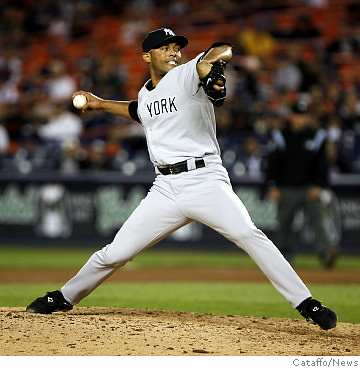
Last night we were treated to one of the best pitching performances in the history of the World Series.  Phillies start Cliff Lee who has had an incredible playoff run.  In four games he has pitched 33.1 innings, winning 3 games, two of which were complete games.  In those games he pitched 30 strikeouts and on 3 walks and only given up 2 earned runs.  His ERA through game one of the World Series is a minuscule 0.54.  Last night was a fantastic demonstration of pitching as Lee controlled the game from start to finish defeating his former teammate C.C. Sabathia who was good but not good enough giving up 2 solo home runs to Chase Utley before being pulled after the 7th.  One can compare his performance against the best hitting team in the Majors to the greats Sandy Koufax, Bob Gibson and Don Larson.  I remember seeing Gibson’s game back in 1968 on TV and I am forever amazed at his intensity as hit mowed down batter after batter.  On the other hand Lee was the epitome of the “just another day at work” that was so evidenced in his lackadaisical catch of a pop up to the pitcher’s mound and his quick behind the back grab of a pitch hit behind him.

Honestly I was surprised but not disappointed.  I do not have a dog in the fight so to speak since the Giants, Orioles, A’s or Angels are not in the series.  However I appreciate a great performance even when it cuts down my well thought out statistic based prediction. Lee was until last night a career 4-4 against the Yankees but had, again until last night a whopping 5.02 against them.  I predicted that it would be a close game but that I thought it would be Lee who gave up the key hits or have mistakes committed behind him which would in turn bring on the bullpen which the Yankees would demolish.  Instead it was 180 degrees out as Sabathia gave up the key hits and the Yankee bullpen melted down.  To top it off the Yankees were completely baffled and shut down by Lee almost being shut out save a Jimmy Rollins throw into the bullpen which allowed Derek Jeter to score the Yankees only run of the game with one out in the bottom of the 9th. I’m watching another pitcher’s duel tonight, at least through 7 innings between Pedro “I’m the most influential player to play in Yankee Stadium” and A.J. Burnett. Burnett dominated the Phillies big guns and Pedro has like Sabathia last night given up 2 solo home runs to Mark Teixeira and Hideki Matsui and was pulled with 2 on and no out in the bottom of the 7th.  Mariano Rivera came on to get a six out save and the Yankees won 3-1.  The amazing thing to me is the dominance of pitching so far.  The fact that Ryan Howard stuck out 4 times tonight and Alex Rodriguez 3 times last night shows just how dominant the pitchers have been. Both were having an amazing playoff run and at least the first two games have had their fires extinguished.

mariano-riveraMariano Rivera got a 6 out Save

The first two games give me some hope. I would prefer a 7 game series that is a well played drama filled classic for the ages.  That is my hope anyway as they are the best teams in baseball and it would be fitting for the series to live up to that status.

I just got over a bout with a stomach bug yesterday, on Monday I was doubled over in pain and the stuff lingered a couple of days.  Turns out that this is going around and a lot of folks are going down with it as well as Influenza A, B and H1N1, the Swine Flu.  I personally know several people who have been hammered by the Swine flu and am seeing a lot more influenza related cases in our ICU including a number of young people on ventilators.  A cursory look around the news shows a lot of kids getting sick and so far at least 100 schools being closed due to influenza outbreaks and it is only October.  Look for a long and difficult flu season. This may not be as bad as 1918 but anyone is a fool to make light of it or efforts to keep people from getting it.  I think such people are damned fools who jeopardize their lives as well as the lives of their families, friends and co-workers, from what I see in my little corner of the world this will not be fun.

Speaking of not fun I am going home to go assist my mom and brother with some of my dad’s affairs. He remains in the nursing home and continues his slow downward trend defying the doctors who said that he would be dead months ago.  The emotional cost on my mom, brother and to a lesser extent I because I don’t have to deal with this up close every day has been exacting. It is painful.  I received a e-mail from an old friend this week who described what his family went through as his dad wasted away in mind and body before their eyes.  I will be glad to see everyone and will spend as much time with dad as I can, hopefully I will have him with me for at least a few minutes.  I am not looking forward to having to go through belongings or some of the administrative or banking tasks that will need to be done.

APTOPIX Obama Fallen SoldiersPresident Obama Honoring the Fallen at Dover
Late last night President Obama did something that earned my admiration.  I know some will see his action as cynical or opportunistic but as a career officer and Iraq Veteran who has served under five Presidents I saw it differently.  I think it is the first time that a President has greeted and rendered honors to the fallen at Dover in my career.  I could be wrong but I don’t think that any of the President’s that I have served under have ever met an aircraft bearing 18 fallen Americans.  He didn’t have to do it, but it is my opinion that any wartime leader who has not experienced the enormity of the loss of Americans that he has sent into combat has not fully assumed the mantle of leadership.  Part of that mantle is to be there in the times of suffering. One source close to the President told ABC News reporter Jake Tapper that  meeting with the families at Dover and seeing the return of the fallen was was “one of the most profound experiences of Mr. Obama’s young presidency.”

It was a sobering reminder of the extraordinary sacrifices that our young men and women in uniform are engaging in every single day, not only our troops but their families as well,” Obama said later Thursday, hours after his return to the White House. “The burden that both our troops and their families bear in any wartime situation is going to bear on how I see these conflicts, and it is something that I think about each and every day.”

I do appreciate all that President Bush did in visiting the wounded and caring for the families of the fallen, there is no disrespect intended by me toward the former President as he had to make many tough and often unpopular decisions during his presidency including the surge in Iraq that along with the Anbar Awakening that helped turn the course of events in that unfortunate land.  He took heavy criticism from the Left and parts of the Right for that decision as well as scaling back efforts in Afghanistan. I do hope and pray that the President’s decision, whatever it ends up being will bear success and help the security of the region and peace to Afghanistan and I certainly do not want him to be like Lyndon Johnson in Vietnam and commit us deeper into to a war without counting the cost ahead of time.  That is a tall order, but for the sake of our troops is something that we should be able to pray will happen.  To quote one commentator: “No matter what your political views are or your position on the wars, we should never forget those making the ultimate sacrifice.”  Thank you Mr. President for remembering these men,  Ten men were lost in the crash of an MH-47, 7 Army Soldiers and 3 DEA agents and 8 soldiers killed when an IED destroyed their Stryker Light Armored Vehicle.  I close with their names:

Killed:

1st Battalion, 17th Infantry Regiment, 5th Stryker Brigade Combat Team, 2nd Infantry Division, Fort Lewis, Washington

Staff Sgt. Luis M. Gonzalez, 27, of South Ozone Park, N.Y.

Sgt. Fernando Delarosa, 24, of Alamo, Texas.

Sgt. Dale R. Griffin, 29, of Terre Haute, Ind.

Sgt. Issac B. Jackson, 27, of Plattsburg, Mo.

Sgt. Patrick O. Williamson, 24, of Broussard, La.

Spc. Jared D. Stanker, 22, of Evergreen Park, Ill.

Pfc. Christopher I. Walz, 25, of Vancouver, Wash.

From the 3rd Battalion, 160th Special Operations Regiment (Airborne), Hunter Army Airfield, Georgia

Chief Warrant Officer Michael P. Montgomery, 36, of Savannah, Ga.

Chief Warrant Officer Niall Lyons, 40, of Spokane, Wash.

Staff Sgt. Shawn H. McNabb, 24, of Terrell, Texas.

Sgt. Josue E. Hernandez Chavez, 23, of Reno, Nev.

Sgt. Nikolas A. Mueller, 26, of Little Chute, Wisc.

From the 3rd Battalion, 7th Special Forces Group (Airborne), Fort Bragg, North Carolina

Sgt. 1st Class David E. Metzger, of San Diego Ca

Staff Sgt. Keith R. Bishop, 28, of Medford, N.Y.

From the Drug Enforcement Agency

Special Agent Forrest N. Leamon, Woodbridge Va.

Special Agent Chad L. Michael, Quantico Va

Special Agent Michael E. Weston, Washington DC

Rest eternal grant to them, O Lord; and let light perpetual shine upon them

May their souls, and the souls of all the departed, through the mercy of God, rest in peace.  Amen

american-flag-2a

Leave a comment

Filed under Loose thoughts and musings

Going to War: Life at TQ, Chuck Norris Visits and Mass Casualties

While we prepared for our first mission we adjusted to what life was like on a large airbase and logistics hub. Ta Qaddum is one of the larger Iraq Air Force bases from Saddam’s time but has a history going back to the old Royal Air Force base at Habbinyah which is just down the hill.  In 1941 the Iraqi Army laid siege to the British forces in Habbinyah from the escarpment that overlooks the town from what is now the northern edge of TQ.  One only has to imagine the feelings of the Iraqi soldiers short on supply and exposed to air attack on the escarpment while waiting for German intervention only to be driven off by the British when their relief force arrived from Jordan.

iraqi bomber at tqWrecked Iraqi Bomber at TQ

The Iraqi legacy on the base looms in some of the infrastructure as well as the hulks of Soviet made Iraqi Air Force bomber and fighter aircraft near the edge of the airfield.  When I was there in 2007-2008 the base was under the command of the 2nd Marine Logistics Group or 2nd MLG.  The MLG is a command and control headquarters for logistics support units of the 2nd Marine Expeditionary Force.  It is tailored to support the Ground Combat Element, the 2nd Marine Division and the Air Combat Element, the 2nd Marine Air Wing and attached units.  Its function is similar to an Army Corps Support Command or whatever the Army calls them now.  TQ was also the home of several helicopter squadrons Marine and Army as well as a local defense force at the time made up of the 1st Battalion 11th Marines from Camp Pendleton. 1/11 was an artillery battalion but was being primarily used as a security and convoy protection force.  Other units including Navy Seabees and Army logistics units operated from TQ.  A Marine Infantry Battalion was stationed in Habbinyah while elements of a Marine Expeditionary Unit (MEU) were operating in the area as part of the surge.

The base is about mid-range on the amenity scale for troop comfort. At the time we were there the only non-DFAC/ Chow Hall was the Green Beans Coffee trailer as opposed to places like Al Asad and Camp Victory which had a multiplicity of fast food places for the troops.  The Marines are tougher on communication security than the Army and many websites which troops could use on other bases were unavailable unless one went to the Iraqi internet café or the MWR computer and phone center.  The Iraqi run shop had the fastest internet on the base but you had to contend with huge amounts of second hand smoke and pay a nominal charge to use it.  The MWR facility often had broken machines, had a waiting list to use them and the connections were very poor with pages slower to load that the old dial up days.  On the plus side TQ did have a relatively decent Marine Corps exchange, not as big as Al Asad or Camp Victory, but one of the larger exchanges in Iraq and second only to Al Asad in the West.  Most places including Ramadi had pretty small and not well stocked exchanges.  TQ had nice fitness center facilities which I used a lot being coached by Nelson.

060Chaplains and RPs with Chuck Norris

The base MWR worked with the USO and other agencies to bring sports stars or celebrities to the base.  Just before we left on our first mission Chuck Norris came through.  Chuck was made an “Honorary Marine” a few years back and has made it his task to try to meet every Marine deployed in Iraq and Afghanistan, shaking the hand of each one he met.  The chapel was the host facility for the visit which last about 2 hours in which Chuck pressed the flesh and had his picture taken with probably close to 5000 Marines and other personnel, maybe more.  The Chaplains were drafted to be the photographers and I lost count of how many different types of digital cameras that I took pictures with.  Chuck enjoyed the heck out of Nelson and was impressed with his fighting resume.  I think that Nelson got more face time with Chuck than anyone on the base and he deserved it.  Chuck was accompanied by Chaplain Langston and RP1 Roland our friend from Fallujah.  After they were done he had to get on the waiting helo and fly out to his next stop.

058Chuck and Nelson

The chow halls, of which there were two, were large and usually had a pretty good menu.  I especially came to like the Indian nights where Indian specialties were served.  Since many of the cooks employed by Gulf Catering who had the contract were Indian, Pakistani, Bangladeshi or from Ceylon so it generally was pretty good unless they had to scrounge for suitable ingredients.  I like the curry chicken, but occasionally it was made with chicken nuggets when the real chicken was in short supply.  It almost reminded me of the Spam Lamb in the TV series M*A*S*H or the great quote out of the movie Meatballs: “Attention. Here’s an update on tonight’s dinner. It was veal. I repeat, veal. The winner of tonight’s mystery meat contest is Jeffrey Corbin who guessed “some kind of beef.”   I think that there were a number of times when I really wondered what the meat was.  They usually had a pretty good salad bar unless resupply convoys were interrupted and fresh vegetables had run out.  There were a number of times where the pickins were slim and Nelson and I had to get creative.  Breakfast was usually good with a good choice of food choices, some even healthy.  The workers were great, always friendly despite working 12 hour days 6 days a week for $300 a month.  Many had signed up through agencies which cost them $4000 so the first year that many worked was for nothing.  It was in my opinion a case of a KBR/ Halliburton subcontractor using them in effect as indentured servants and pretty well damned close to slaves, all legal by the US Government.  I thought that it was pretty immoral and certainly a case of a company contracted by the government reducing labor costs on the back of some of the poorest people in the world. Back at the end of the Cold War the military downsized and eliminated most of the Army and Marine mess specialists which paved the way for the contracting industry, led by the former Secretary of Defense and his Halliburton team to begin their massive contracting operations with the Bosnia deployments back in 1995.  They were limited to their own compound far away from anything and were always the last to eat.  They were polite and really tried to accommodate sometimes rude and condescending Americans, the local management did the best they could to give them good accommodations but were limited by their parent company.  Many of the workers were Roman Catholic or Anglican Christians  and Fr Jose had a great ministry that he took on to support them by going to their camp a couple of times a week to celebrate Mass.  His masses were packed and what a source of life and the love of God he was to so many people at TQ, Americans and non-Americans alike.

988Fr Jose on the bank of the Euphrates at Habbinyah

About a week after we got to TQ Marines from the battalion in Habbinyah were hit in an IED complex ambush while on patrol.  A couple of vehicles were hit, Jose was across the base celebrating Mass and Pat was in Fallujah.  A chaplain was needed in the Shock Surgical Trauma Unit or SSTP.  Wounded were being brought in, the platoon had been hit hard, 14 wounded and a couple killed.  I figured that since I was a pretty experienced trauma and critical care chaplain who had dealt with over 500 deaths, many traumatic with bullet wounds, burns and the host of other types of trauma, and tended to probably twice that many who did not die that I could handle this.  When I got to the SSTP I was greeted by a couple of nurses and docs and briefed as to what was going on.  Within a few minutes the casualties were beginning to roll in as the UH-60 Dust-off MEDIVAC helicopters landed and teams went out to meet them.  Some were ambulatory, or walking wounded bandaged with lacerations and burns on their faces and upper bodies, other were brought in on stretchers and ushered into the treatment beds in the area outside the OR.  It was like a scene out of M*A*S*H as the well honed surgical teams, surgeons, anesthetists, nurses and corpsmen went to work.  I now work with a number of these fine people. I was able to make my way about to the wounded Marines, praying with some, holding hands as and with a couple performing the sacrament of healing, or the anointing of the sick.  As I listen to Marines, prayed with them or anointed them there was a tremendous sense that this was different than what I did at Parkland or Cabell-Huntington.  These young men wore the same uniform that I wore, served the same country that I served and travelled the same roads that I would soon be on.  As each was assessed and moved off to surgery, prepared for further evacuation or treated and sent to a ward I noticed the little things about each of them.  The wounds, the torn uniforms, the burns and even the tattoos, these were our guys, they weren’t gang bangers or criminals but young Americans fighting a brutal war against a enemy that had terrorized Iraqis and found devastating ways to kill Americans.  Some of the Marines asked if they would be okay, others asked about friends and in those moments I learned what it was to care and be with men traumatized by the violence and brutality of war against an enemy that would not fight by our rules, much as the North Vietnamese and Viet Cong refused to fight our war.  The enemy was clever and determined and his weapons were deadly.

Stars and Stripes sstpTQ Surgical During Mass Casualty Event (Stars and Stripes Photo)
The teams did their work quickly and soon the event in the ER was done as the Marines were moved off to OR, the ward or further evacuation. I spent some time talking with unit Corpsmen and less wounded Marines and learned about the attack. They were in a convoy heading back to Habbinyah when the there was an enemy contact ahead of them.  As they moved forward to engage a primary and secondary IED hit the convoy heavily damaging two trucks with an ensuing firefight.  The Marines fought off their attackers, the wounded were treated and security set up as Dust-off came in to evacuate the wounded.  I thought back to my days as a Medical Service Corps Officer in the Army and remembered my friends who had elected to apply for flight school to become Dust-off pilots.  I remembered learning to call in MEDIVAC missions and some of the Army MSC aviators that I knew; some had flown in Vietnam, being a Dustoff pilot can be a sporty occupation.  They fly an unarmed bird into hot landing zones and get badly wounded troops to medical facilities in 100 degree plus weather without killing them enroute, those guys are good. As the crowd dissipated I spend so time with some of the staff.  Eventually with night having fallen I began the walk back to my office in the Chapel.  I looked up at the night sky, in the darkness a another UH-60 sat down to pick up others being evacuated on to Baghdad or Balad.  I looked up at the sky and saw more stars than I had seen at any time since I was at sea on the USS HUE CITY.  It was amazing; it looked like you could almost walk across them from horizon to horizon. When I got to my office I checked on my our mission status, I had submitted our first Air Support Request earlier in the day, of course it had not moved yet, but at least it gave me something to do.  I checked my unclassified e-mail and knew that there was nothing that I could share with anyone so I looked at baseball scores, checked a couple of news sites and headed off to my “can.”

medivacPackaging a Casualty for Further Evacuation on the TQ Surgical Pad

That night I did not sleep well, the images of the wounded Marines were burned into my mind; I could see their faces, their wounds and their tattoos.  I prayed the office of Compline from the Book of Common Prayer using Psalm 91 and the prayer “Be our light in the darkness, O Lord, and in your great mercy defend us from all perils and dangers of this night; for the love of your only Son, our Savior Jesus Christ.  Amen.” I took some comfort in this, walked out again into the night to see illumination rounds in the vicinity of Habbinyah and the distant sound of automatic weapons fire.   For once my insomnia was not related to jet lag or exhausting night flights, it was instead a realization that what happened to these Marines could well happen to me as I we launched later in the week.

The next morning another eight or ten Marines from the same company came in, this time I went to the SSTP with Jose and we did a tag team match, we tried to determine religious affiliation of the wounded Marines with him taking the Roman Catholics to provide sacramental needs and me taking the rest.  Once again the images were vivid; these Marines were on a mission to recover the damaged vehicles and were hit by IEDs on their way back to base.  This time one Marine was killed.  I walked to the graves registration and mortuary affairs team with the battalion surgeon and a corpsman who were to identify the body.  I listened to their frustration and heartache as they described what they had been through the past two days.  The company had taken over 20 casualties including 3 dead.  A high percentage of casualties for a unit that probably numbered about 120 men.  Once again I walked back, this time in the hot mid-morning sun with Jose to the Chapel.  We talked for a while about the past two days, he knew the battalion that had been hit well as he supported them as well.  The surgeon was one of his parishioners.  After we went our separate ways I did my morning prayer and settled in to study more about where we were going.  Nelson and I got PT later in the evening and I spent a restless night in my “can” playing computer Maj-Jong and Chess on my laptop deep into the morning.  Once again I spent time walking in the dark looking at the vast sea of stars above me.

3 Comments

Filed under iraq,afghanistan, Military, Tour in Iraq