Category Archives: civil war

The Power of Noble Deeds and the Fallibilty of those that Do Them

12 pound napoleon

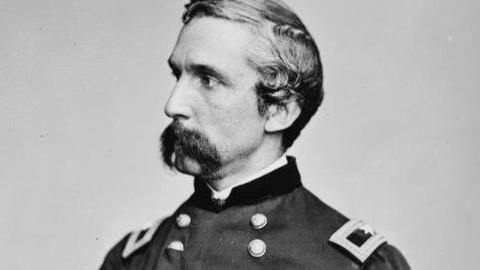
“The power of noble deeds is to be preserved and passed on to the future.” Joshua Chamberlain

Today I was at the Gettysburg battlefield leading a Staff Ride for students from our Staff College. Today’s portion of the Staff Ride encompassed the first two days of the battle. We will continue it tomorrow with the actions of the night of July second 1863 at Culp’s Hill and the climatic event we know as Pickett’s Charge.

The Staff Ride is a optional trip for our students and the get no academic credit for it. However since I have taken it over I have been working to connect it to aspects of what they are learning in our courses, issues of campaigning, mission command and the diplomatic, information, military and economic aspects of war. I am working with our academic course developers and directors to turn this into an actual elective that students can receive academic credit for in addition to the chance to go the the battlefield.

I have a passion for this. The American Civil War and the Battle of Gettysburg are intrinsic parts of who we are as Americans today. The events of that war and this battle continue to reverberate in many aspects of our political, social and national life. Thus for me teaching about this event and what happened on this “hallowed ground” matters for more than the fact that it is interesting history and a fascinating battle.

As someone who has served in the military for most of my life, coming up on 33 years I feel like Joshua Chamberlain, the hero of Little Round Top that “The power of noble deeds is to be preserved and passed on to the future.” I do this in what I teach and what I write, both in the academic setting as well as on this website.

We live in a time of great cynicism, some of which I can understand. We also live in a time where many people and our institutions operate in a “zero defect” culture, those who fail in any way are shunted aside, punished or even chastised or ostracized. However, when I look at the men who fought at Gettysburg, or for that matter almost any individual who has accomplished great things, very few are perfect people.

Many great leaders, or other men and women that we consider today to be great, influential or important were quite fallible. They made many mistakes and even had great flaws in their character, some even did things in their lives that were not good and in some cases scandalous. Such deeds may tarnish them or take some of the luster away from their accomplishments. But I think that from a historical as well as pastoral point of view that these flaws are often as important as their successes. They demonstrate the amazing capacity of imperfect humanity to accomplish great things, as well as the incredible complexity of who we are as people. No one is perfect. There are degrees of goodness and even evil in all of us. It is part of the human condition. Thus the personal failures of those men and women should not detract from their great accomplishments.

When I look at the perfection that imperfect people expect of others I am reminded of something that William Tecumseh Sherman said about his relationship with Ulysses Grant. The fact is that neither man who were in large part responsible for the Union victory in the Civil War would never reach the level of command that they rose to in our current military culture, nor would they rise to the top in corporate America. Sherman said: “Grant stood by me when I was crazy, and I stood by him when he was drunk, and now we stand by each other.”

That s one of the enduring facts of being human and being in relationship with others. Neither Grant or Sherman were at Gettysburg, they were at Vicksburg preparing to receive the surrender of that city as the Battle of Gettysburg ended. However, what Sherman said is true and needs to be more a part of our lives today.

That being said, even less tan perfect people can rise to do great deeds, deeds that need to be remembered, passed down and told to succeeding generations. That is a part of my passion about Gettysburg and my appreciation and admiration of the brave men who fought in that battle.

Have a great night.

Peace

Padre Steve+

Leave a comment

Filed under civil war, History

“The Unfinished Work” Another Teaching Weekend at Gettysburg

The First Minnesota

“In great deeds, something abides. On great fields, something stays. Forms change and pass; bodies disappear; but spirits linger, to consecrate ground for the vision-place of souls… generations that know us not and that we know not of, heart-drawn to see where and by whom great things were suffered and done for them, shall come to this deathless field, to ponder and dream; and lo! the shadow of a mighty presence shall wrap them in its bosom, and the power of the vision pass into their souls.” Joshua Chamberlain

Tonight I am getting ready for bed but still preparing for tomorrow and Sunday as I lead about 30 of our officer students and their family members on what is called a “Staff Ride” of the Gettysburg Battlefield.

This is the second time that I have led this trip since I have been assigned to this teaching position. Since I learned that I was going to take over the responsibility for the trip I have written produced a text of around 180 pages for my own work, a text that grows with each month. Many of the chapters of that text have been posted to the Gettysburg page on this site.

We drove up today and in the van I was in we were able to talk about aspects of the campaign as well as the Civil War connected to this battle. We also discussed the timeless aspects of leadership and dealing with the complexities of people and organizations. Unlike the last trip we had good weather for the trip up, although we may be dodging rain showers and thunderstorms tomorrow.

To me Gettysburg is indeed “hallowed ground.” That is why I led the article with the comments of Joshua Lawrence Chamberlain, the hero of Little Round Top. I feel that “mighty presence” that Chamberlain described every time I come here. I am drawn here by the actions of men who I never knew but through books and movies, but men who I feel a deep kinship, something spiritual, something deep, something that abides.

I know that as I lead the staff ride the next two days that I will see things that I never noticed before, and those things will inspire me to study more and write more. On my last trip I was drawn to the actions of Brigadier General George Sears “Pop” Greene at Culp’s Hill and Lieutenant Colonel Freeman McGilvery directing his artillery to stop the crushing Confederate assault at the Peach Orchard, the Wheat Field and Cemetery Ridge on day two of the battle and the sound preparations and expert leadership of Brigadier General Henry Hunt of the Federal artillery on day two and three.

I don’t know what will grab me tomorrow and Sunday, but I know that something will and of course you will hear about it here.

I am honored to teach, and in a sense to pass along a bit of what the men who fought here did to consecrate this ground and to give our nation a “new birth of freedom.” It is my part to continue to bring to fruition what Abraham Lincoln said in the Gettysburg Address:DSCN8774

“It is for us the living, rather, to be dedicated here to the unfinished work which they who fought here have thus far so nobly advanced. It is rather for us to be here dedicated to the great task remaining before us — that from these honored dead we take increased devotion to that cause for which they gave the last full measure of devotion — that we here highly resolve that these dead shall not have died in vain — that this nation, under God, shall have a new birth of freedom — and that government of the people, by the people, for the people, shall not perish from the earth.”

Peace

Padre Steve+

Leave a comment

Filed under civil war, History

“The Artillery…Must Concur as a Unit” -Henry Hunt and the Union Artillery at Pickett’s Charge

220px-HJHunt

Major General Henry Hunt

Fires are defined as the use of weapon systems to create specific lethal or nonlethal effects on a target. All fires are normally synchronized and integrated to achieve synergistic results.Joint Publication 3-09 Joint Fire Support30 June 2010 p.I-1


Major General Henry Hunt the Chief of Union artillery was the admitted expert of all the artillerymen present at Gettysburg. Prior to the war he had taught artillery theory and tactics at West Point and written the Army’s artillery doctrine. However, he was no mere theoretician. He was an excellent battlefield leader who had a keen eye to assess the tactical situation and effectively employ his batteries. Hunt also understood the change in warfare brought about by small arms, particularly the rifled musket and that artillery had become a support weapon instead of an assault weapon, something that Lee had not yet fully appreciated as we have seen from his use of artillery.

The employment of fires is an important part of military art and to be effective it must be understood and used in concert with maneuver. As George Patton wrote in War as I Knew It Battles are won by fire and by movement. The purpose of the movement is to get the fire in a more advantageous place to play on the enemy. In contrast to Lee and his employment of artillery at Gettysburg which was ineffective in large part because he declined to use maneuver to his advantage, Meade, Hancock, Hunt and the various Union Corps commanders used their artillery to maximum effect taking advantage of their interior lines.

After Hooker’s disastrous experiment at Chancellorsville to decentralize the command and organization of the artillery Hunt was give a free hand to reorganize the artillery of the Army of the Potomac. The changes were sweeping. Batteries were removed from divisions and consolidated into brigades for each corps. Additionally Hunt created an Artillery Reserve of five Brigades totaling 21 batteries which could be employed to support the army at any given point and provided both him and the army commander a flexible and powerful source of firepower. Hunt put his best veteran artillerymen in charge of these brigades, and their deployment was in the hands of Hunt and the corps commanders.[1] At Gettysburg the changes would be of decisive importance.

Hunt had been very active on July 2nd in working with Meade, Hancock and vital in ensuring that Sickles beleaguered command received batteries from the artillery reserve. He was not present at the council of war held that night but was informed of the decision to remain upon his return from his last inspection of his lines and supervision of artillery at Culp’s Hill. In his inspection of the Federal artillery positions he took charge and moved units as needed and coordinated his work with the brigade commanders of each corps ensuring that they understood their part in the next day’s action.

Unlike his Confederate counterpart William Pendleton, Hunt went into battle on July 3rd with very definite ideas of how he was going to employ his artillery and developed a detailed plan of fire support. Hunt’s artillery regulations dictated that in the attackthe artillery is employed to silence the batteries that protect the [enemy] position. In the defense it is better to direct its fire on the advancing troops.[2]

One of his most critical decisions was in relation to the Artillery Reserve to address Meade’s concerns about an attack on the Union center. About 11 A.M. Hunt went to Cemetery Hill where he was able to gain a good view of Confederate preparations. He wrote that Here a magnificent display greeted my eyes. Our whole front for two miles was covered by batteries in line or going into position. Never before had such a sight been witnessed on this continent, and rarely if ever abroad…”[3]Hunt placed twenty batteries of his artillery reserve along Cemetery Ridge and laid out a deadly latticework of crossfire lanes designed to scourge the fields in front of every living thing.[4] Hunt was aided in his efforts by the commander of the Artillery Reserve Brigadier General Robert O. Tyler who was able to increase the number of guns available through repairs and reconditioning.[5]

As Hunt examined the situation before him he had to discern what the Confederate intentions were. He thought there was the possibility that Lee might use them to cover a move of infantry to support Ewell but he dismissed that as he did the possibility of Lee withdrawing his army. Despite the fact that he could not see the deployment of the Confederate infantry massing for the assault Hunt was convinced that the attack would hit the center. In light of his understanding of the how artillery should be employed in the defense he grasped the essence of the situation-that the duty of the artillery was not to combat the opposing ones, but to reserve themselves to smash the infantry assault.[6]

fig59

As such his guns, both of the artillery reserve as well as II Corps deployed on Cemetery Ridge was confronted with an artilleryman’s dream. “He was posted on the high ground…with clear fields of fire. He had 119 guns of high quality massed in battery, with plentiful reserves and sufficient ammunition. He was positioned to catch an infantry attack in a deadly crossfire. His brigade commanders were chosen by him and trained by him….”[1] This total included the guns on Cemetery Hill as well as Cemetery Ridge.

Hunt knew that any Confederate infantry assault on Cemetery Ridge would be preceded by an artillery bombardment and once he was sure that this was the Confederate intent Hunt “immediately set out to ride his lines once again”[2]and went to each of his artillery commanders and instructed them. Another insightful Union officer, Gouverneur Warren felt counter battery fire was doing little goodand from his observation post on Little Round Top, sent a message to Meade, suggesting that the Union batteries cease firing. [3] The message was unnecessary as Hunt was working to ensure this but it showed that insightful officers on the Union side were not adverse to recommending changes in deployments or tactics to meet the conditions of the battlefield.

“I gave instructions to the batteries and to the chiefs of artillery not to fire at small bodies! nor to allow their fire to be drawn without promise of adequate results; to watch the enemy closely, and when he opened to concentrate the fire of their guns on one battery at a time until it was silenced; under all circumstances to fire deliberately, and to husband their ammunition as much as possible.” [4]

Until the Confederate bombardment began at 1:07 P.M. Hunt continued to “check on the condition of his batteries” [5] and was with Hazlett’s former battery of 10 pounder Parrotts on Little Round Top, now commanded by Rittenhouse. When the cannonade began reiterated his orders to Rittenhouse to ensure that he “would not tolerate any yielding to the usual artilleryman’s temptation to fire back and turn things into a useless artillery duel.” [6]and then rode down to Freeman McGilvery’s guns on the south end of Cemetery Ridge.

In the process he observed the performance of his former students commanding the Confederate artillery. He was not impressed by their performance. At Appomattox Hunt, the consummate instructor recounted to Colonel Armistead Lindsey Long of Lee’s staff been his student:

I was not satisfied with the conduct of this cannonade which I heard was under his direction, inasmuch as he had not done justice to his instruction; that his fire, instead of being concentrated on the point of attack, as it ought to have been, or as I expected it would be, was scattered, over the whole field.” [7]

Though Long was not in charge of the Confederate barrage Hunt remembered that his former student’s was amused and replied “I remembered my lessons at the time, and when the fire became so scattered I wondered what you would think about it!” [8]

As a Hunt moved back up the Union gun line he was pleased that his artillerymen were doing as he had told, except for guns of Hancock’s II Corps Artillery commanded by Captain John Hazard. Hancock, confused as to why his guns were not replying to the Confederate barrage berated his artillery Chief and ordered him to open fire. He believed that the moral of an infantryman under an artillery barrage is best maintained by a heavy and vigorous counterbarrage by ones own artillery. [9] It was a classic clash between the points of view of an infantryman and an artillery expert.

Hancock seeing McGilvery’s guns silent rode to that officer to demand that he open fire. McGilvery refused as he was not under Hancock’s command which “brought a red-hot stream of language…profane and blasphemous such as a drunken Ruffian would use.” McGilvery was the wrong officer to attempt such a tactic. The former sea captain told Hancock straight up that “he was not under General Hancock’s orders, and….his orders would result in a most dangerous and irreplaceable waste of ammunition.” [10]

During the barrage Hunt supervised the rotation of batteries off of Cemetery Ridge from the reserve and from the VI Corps artillery brigade. Hunt’s persistence paid off with fresh batteries ready for the Confederate infantry assault.

Many Confederates later assumed that their massive barrage had severely damaged the union batteries and caused significant casualties. There were some areas around Cemetery Hill that the early part of the cannonade had an effect, causing heavy damage to a few batteries. However the damage caused much less than the effort and ammunition expended. The Prussian observer to the Army of Northern Virginia referred to the barrage as a “Pulververschwendung” which can be translated as “a waste of powder.” [11]

As Pickett’s men prepared to advance the essential batteries capable of the crossfire that would slaughter them were unaffected, and the morale of the Union infantry awaiting the assault still high. The infantry brigade at the center of the Confederate maelstrom commanded by brigadier General A. S. Webb only suffered about 50 casualties. The Union counter battery fire caused about 350 casualties among the waiting Confederate infantry, especially among Kemper’s brigade of Pickett’s division. [12]

As Pickett’s, Pettigrew’s and Trimble’s divisions advanced across the mile separating Cemetery and Seminary Ridge the came under fire from the concentrated enfilade and cross fire from batteries of Osborne’s on Cemetery Hill, Rittenhouse on Little Round Top and McGilvery’s powerful brigade of 8 batteries poured a merciless fire into them. “The gun crews manned their pieces and directed them on the advancing gray line in-that most cold blooded of military phrases- “anti-personnel fire.” They were firing bursting shells, some solid shots, and much canister.” [13]

The barrage from the well protected Union artillery was devastating. The storm of hot metal shredded the attacking column, which suffered 50 percent casualties. [14] Fifty percent is a good round number but the Confederate casualties were likely higher. Stewart whose micro-history of focuses solely on Pickett’s Charge in relation to the rest of the battle notes and who examined numerous sources, discounting many “official” reports as inaccurate believes that Pickett’s division suffered 67 percent casualties, Pettigrew 60 percent and Trimble 52 percent. [15]

McGilvery and Hunt had skillfully deployed his brigade behind a rise of high ground that shielded them from view of the Confederates. Pickett’s division was advancing oblique angle past McGivery’s brigade. McGilvery explained “the Rebel battle lines “presented an oblique front to the guns under my command, and by training the whole line of guns obliquely to the right, we had a raking fire through all three of these lines.” [16]As a Florida regiment of Wilcox’s brigade which had come up in support of Pickett passed in front of McGilvery’s brigade an officer found “himself in a bewildering storm of “men falling all around me with brains blown out, arms off, and wounded in every direction.” [17]One of McGilvery’s captains later testified “We had a splendid chance at them…and we made the most of it.” [18]

It was almost all that Hunt had hoped for. [19] But because Hancock had ordered his guns to fire throughout the Confederate cannonade Hazlett’s guns kept silence until the enemy was within canister range. Hunt believed that has his “instructions been followed here, as they were by McGilvery, I do not believe that Pickett’s division would have reached our line. We lost not only the fire of one third of our guns, but the resulting cross fire, which would have doubled its value.” [20]

A few hundred Confederates led by Brigadier General Lewis Armistead survived the blistering fire and broke into the Federal lines at the angle. The subsequent minutes of fierce hand to hand fighting caused heavy casualties in the artillery batteries posted there from Hazlett’s brigade. Hunt noted that of the five II Corps battery commanders there that four were killed or mortally wounded a fifth severely wounded and that four batteries had to be combined in order to form two complete batteries after the battle. [21]

Fresh batteries arrived and opened fired even as masses of Confederates attempted to surrender. One rebel soldier approached Captain Gulian Weir of Battery C, 5th United States Light Artillery out of the maelstrom and asked “Where can I go to get out of this Hellish fire?” [22]But the attack was spent and Pickett’s charge was history, soon “Confederates on both sides of the wall three down their arms and were taken prisoners of war. All those who could do so streamed back to their own lines” [23]

The devastation that Hunt’s well planned artillery defense and it’s execution by most of his commanders sealed the doom of the Robert E Lee’s plan to break the Army of the Potomac. Like Malvern Hill, Fredericksburg and Cold Harbor it showed that a frontal assault on an unshaken enemy led to a costly failure.[24] Hunt’s command of the artillery was an excellent example of mission command applied to fires and the value of well executed planning of fires in the defense.


[1] Sears, Stephen W. Gettysburg  Houghton Mifflin Co. Boston and New York 2003 p.376

[2] Ibid

[3] Jordan, David M. Happiness is Not My Companion: The Life of G.K. Warren Indiana University Press, Bloomington Indiana 2001 p.97

[4] Hunt Henry Report of Brigadier General Henry Hunt, USA, chief of Artillery, Army of the Potomac in Guide to the Battle of Gettysburg edited by Luvaas, Jay and Nelson, Harold W. University Press of Kansas, Lawrence Kansas 1994 p.175

[5] Coddington, Edwin B. The Gettysburg Campaign, A Study in Command A Touchstone Book, Simon and Schuster New York 1968 p.496

[6] Guelzo, Allen C. Gettysburg: The Last Invasion Vintage Books a Division of Random House, New York 2013 p.402

[7] Ibid. Hunt, The Third Day at Gettysburg p.386

[8] Ibid.

[9] Jordan, David M. Winfield Scott Hancock: A Soldier’s LifeIndian University Press, Bloomington and Indianapolis 1988 p.96

[10] Ibid. Guelzo p.404

[11] Ibid. Stewart p.160

[12] Ibid. pp.160-161

[13] Downey, Clifford Lee and his Men at Gettysburg: The Death of a Nation Skyhorse Publishing New York 1958 p.309

[14] Millet, Allan R. and Maslowski, Peter, For the Common Defense: A Military History of the United StatesThe Free Press a Division of Macmillan Inc. New York, 1984 p.206


[15] Ibid. Stewart p.263

[16] Ibid. Sears p.425

[17] Ibid. Guelzo p.415

[18] Ibid. Foote p.555

[19] Ibid. Sears p.424

[20] Ibid, Hunt The Third Day at Gettysburg p.387

[21] Ibid.

[22] Ibid. Trudeau p.510

[23] Ibid. Coddington p.519

[24] Fuller, J.F.C. The Conduct of War 1789-1961 Da Capo Press New York 1992, originally published by Rutgers University Press, Brunswick NJ 1961 p.104


[1] Sears, Stephen W. Gettysburg. Houghton Mifflin Co. Boston and New York 2003 p.32

[2] Foote, Shelby, The Civil War, A Narrative. Volume Two Fredericksburg to Meridian Random House, New York 1963 p.545

[3] Hunt, Henry The Third Day at Gettysburg in Battles and Leaders of the Civil War edited by Bradford, Neil Meridian Press, New York 1989 p.385

[4] Trudeau, Noah Andre. Gettysburg: A Testing of Courage, Harper Collins Publishers, New York 2002 p.486

[5] Ibid. Sears p.375

[6] Stewart, George R. Pickett’s Charge: A Micro-History of the Final Attack at Gettysburg, July 3rd 1863 Houghton Mifflin Company Boston 1959 p.131

1 Comment

Filed under civil war, History, leadership, Military

Indescribably Grand… a Mere Waste of Ammunition: The Confederate Artillery at Pickett’s Charge

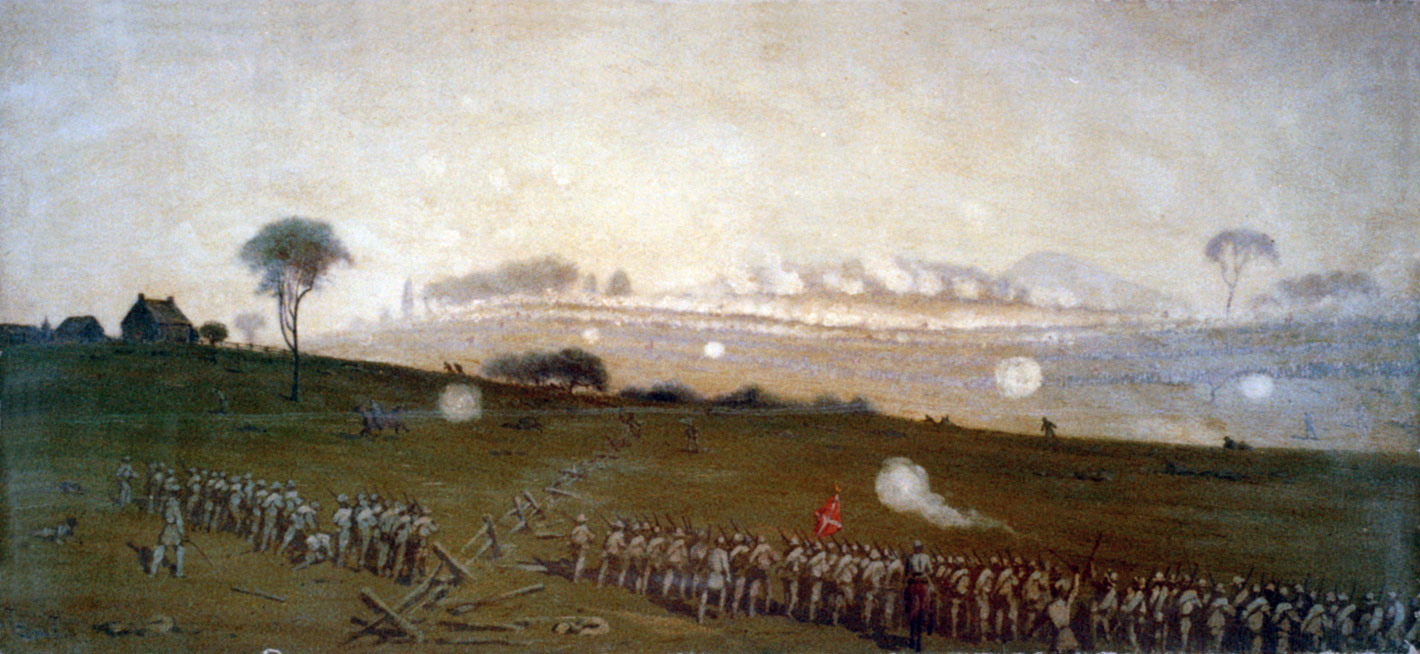
Edwin_Forbes_Pickett's_Charge

Many times battles are won or lost due to organizational failures as much as they are by tactical decisions. One of the issues that plagued Robert E Lee at Gettysburg was the effects of the army reorganization prior to and after Chancellorsville. While much attention is given to the reorganization of the Second Corps following the death of Stonewall Jackson and its division between A.P. Hill and Richard Ewell, less attention is given to the reorganization of the artillery.

Following Chancellorsville Lee abolished his artillery reserve and split all artillery between the three corps of his army. Each corps now had its own artillery reserve while divisions maintained control of their own organic batteries. Each corps had its own artillery reserve commander. The reorganization had been delegated by Pendleton to Porter Alexander and Jackson’s Corps Artillery Chief Colonel Stapleton Crutchfield. 1 The initial reorganization approved by Lee on April 16th 1863 retained a 36 gun general reserve was retained, but after Chancellorsville the battalions assigned to it were distributed to the corps. 2 While the reorganization did give the corps commanders more firepower it took away the ability of the army commander to have a ready reserve of firepower that could be used at when he needed.

At Gettysburg the artillery of the Army of Northern Virginia was assigned to each of the three army corps. First Corps under James Longstreet was assigned 5 battalions with 21 total batteries of 84 guns. Longstreet’s artillery chief was Colonel James B Walton, though during the battle Longstreet would come to rely on Lieutenant Colonel Edward Porter Alexander as his de facto artillery chief. Richard Ewell’s Second Corps also had five battalions of artillery, again with 21 assigned batteries totaling 84 guns. The chief of Second Corps artillery was Colonel J. Thomson Brown. Lastly A. P. Hill’s Third Corps had five battalions composed of 20 batteries with 80 guns under direction of Colonel Lindsey Walker. 3

It was an idea the Union army had experimented with but Henry Hunt had the wisdom to retain the reserve. 4 The actions of the union artillery reserve on the second day were in large measure responsible for breaking the back of Confederate assaults on both flanks of July 2nd. The the fact Meade and his artillery Chief Henry Hunt had this reserve available and not split up among the various army corps gave them a flexibility in employing massed firepower at critical points throughout the battle.

The head of the Army of Northern Virginia’s artillery Brigadier General William Pendleton, given the inflated title of “General in Chief Artillery” had his actual role “deflated to purely advisory.” 5 However as Lee’s advisor he was still the senior artilleryman in the army and Lee issued orders regarding the employment of the artillery through him. Pendleton was a 1830 graduate of West Point but had left the army to enter the Episcopal Priesthood. A “well meaning bumbler” 6 he owed his appointment to his “friendship with both Lee and Davis.” 7 He had no combat experience prior to the war, had missed the war with Mexico, shared in the responsibility for the disaster at Malvern Hill and he “lacked any instinct for the battlefield.” 8

At Gettysburg Pendleton was especially ineffectual and his role on July 3rd was to sow confusion in Confederate artillery units as he “sought to supervise the whole artillery operation.” 9 Though his administrative skills should have made him effective in the advisory role he contributed to the failure of the attack.

Since the Confederates were more than 200 miles from their nearest artillery depot the amount of ammunition for the operation was always an issue. This became critical after the first two days of battle because Pendleton did not keep track of his ammunition expenditure and failed to let Lee know of ammunition shortages, information that might have made Lee reconsider the ill-fated attack of July 3rd.

During the day of July 3rd without a real job of his own to do Pendleton moved batteries on his own authority without coordination with the commanders to which they belonged. Even more importantly he placed the artillery ammunition supply trains too far to the rear to resupply the guns. This was discovered by Alexander during the great artillery barrage when his ammunition ran low and he had to tell Longstreet and Pickett at a critical point that he could not maintain his fire much longer. Pendleton who should have ensured that the ammunition was located where it needed to be instead “lurked about the artillery corps commanders and gave them the impression that he was exercising the supervisory control implied by his title.” 10 As a result “some of the guns remained mute and their gunners stood help’ess during the cannonade and charge.” 11

With Longstreet’s First Corps given the assignment of breaking the center of the Federal line priority of fires was given to him. Lee had high expectations of the artillery. Alexander recorded that Lee’s intent was “First, to give the enemy the most effective cannonade possible. It was not meant simply to make a noise, but to try to cripple him-to tear him limbless, as it were, if possible….” 12 Lee wanted the artillery from all of his corps to concentrate on the Federal position. In theory the exterior lines that his army occupied which were such a disadvantage to him in the attack should have allowed Ewell’s and some of Hill’s batteries to enfilade the Federal position, in a sense creating a cross fire.

This should have been the job of Pendleton as the General in Chief of Artillery, but as noted he was not effective in coordinating anything. It was the biggest artillery operation ever attempted by the Army of Northern Virginia and it required a great deal of coordination, “assigning or approving the best firing positions, specifying targets, ordering and coordinating the fire of a dozen artillery battalions of three army corps” 13 and a host of other important details, which Pendleton, though he claimed to have given “earnest attention” to all of these matters fell short. Alexander noted “our line was so extended that all of it was not well studied, and the officers of the different corps had no opportunity to examine each other’s ground for chances to cooperate.” 14

Instead the real responsibility for the artillery battle fell upon the shoulders of three corps artillery commanders, each unaware of what the other was doing. “Alexander did not know what Lindsey Walker was doing with Hill’s artillery and Walker was apparently not even sure of what he was doing himself.” 15 While Porter Alexander attempted to provide what Lee and Longstreet required Ewell’s artillery took almost no part in the battle and Hill’s artillery under Walker was largely ineffectual in large part because it had spent much of its ammunition supporting a meaningless skirmish prior to Pickett’s attack. Likewise, Second Corps artillery badly needed supervision as Crutchfield was now wounded and out of action. 16

As a result “two thirds of Lee’s guns were idle or improperly employed.” Instead of shattering Meade’s lines as Lee intended “the guns achieved little beyond adding to the terrifying noise, and overshooting, scaring the men in Meade’s noncombatant services…” 17 In all at least 58 guns assigned to support the attack never fired a shot.

When the bombardment began at 1:07 P.M. Henry Hunt described the sight as “indescribably grand.” but he noted that “most of the enemy’s projectiles passed overhead, the effect being to sweep all the open ground in our rear, which was of little benefit to the Confederates – a mere waste of ammunition.” 18 Their target, a thin infantry and gun line was hard to hit and complicating matters was the smoke which obscured their view and “the inferior quality of their fuzes.” 19

Command, control, logistics and organization helped make the largest artillery attack on American soil fall far short of what Robert E. Lee expected. As Lee stood by Alexander watching the battered remnants of Pickett’s division return from the assault Alexander noted that “at this moment he must have foreseen Appomattox.” 20

1. Golay, Michael To Gettysburg and Beyond: The Parallel lives of Joshua Lawrence Chamberlain and Edward Porter Alexander Crown Publishers Inc. New York 1994 p.1552

2. Coco, Gregory A. A Concise Guide to the Artillery at Gettysburg Colcraft Industries Ortanna PA 1998 p.43

3 Ibid.

4 Dowdey, Clifford Lee and His Men at Gettysburg: The Death of a Nation, Skyhorse Publishing New York 1958 p.284

5 Sears Stephen W Gettysburg Houghton Mifflin Company Boston and New York 2004 p.377

6 Ibid Dowdey, p.284

7 Ibid. Sears p.377

8 Ibid.

9 Ibid. Dowdey p.285

10 Ibid. p.286

11 Coddington, Edwin The Gettysburg Campaign, a Study in Command A Touchstone Book, Simon and Schuster New York 1968 p.499

12 Trudeau, Noah Andre Gettysburg A Testing of Courage Harper Collins New York 2002 pp.444-445

13 Ibid. Sears p.379

14 Alexander, Edward Porter The Great Charge and the Artillery Fighting at Gettysburg in Battles and Leaders of the Civil War edited by Bradford, Neil Meridian Press New York 1989 p.395

15 Ibid. Dowdey p.286

16 Ibid.

17 Ibid.

18 Hunt, Henry The Third Day at Gettysburg in Battles and Leaders of the Civil War edited by Bradford, Neil Meridian Press, New York 1989 p.386

19 Ibid. Sears p.381

20 Ibid. Alexander p.397

Leave a comment

Filed under civil war, History, leadership, Military

A Council of War: Meade and his Generals Decide to Stay and Fight at Gettysburg July 2nd 1863

Gettysburg_Council_of_War

“In Mission Command, the commander must understand the problem, envision the end state and visualize the nature and design of the operation…describe the time, space, resources while constantly assessing the process” CJCS Mission Command White Paper, 3 April 2012

While Lee took no counsel and determined to attack on the night of July 2nd little more than two miles away Major General George Meade took no chances. After sending a message to Henry Halleck at 8 PM Meade called his generals together. Unlike Lee who had observed the battle from a distance Meade had been everywhere on the battlefield during the day and had a good idea what his army had suffered and the damage that he had inflicted on the Army of Northern Virginia. Likewise during the day he had been with the majority of his commanders as opposed to Lee who after issuing orders that morning had remained unengaged.

Meade wired Halleck “The enemy attacked me about 4 P.M. this day…and after one of the severest contests of the war was repulsed at all points.” [1] However Meade, realizing that caution was not a vice still needed to assess the condition of his army, hear his commanders and hear from his intelligence service. He ended his message: “I shall remain in my present position to-morrow, but am not prepared to say until better advised of the condition of the army, whether operations will be of an offensive or a defensive character.” [2]

As he waited for his commanders his caution was apparent. Before the attack on Sickles’ III Corps at the Peach Orchard Meade had asked his Chief of Staff Brigadier General Dan Butterfield to “draw up a contingency plan for withdraw to Pipe Creek.” After that attack Alfred Pleasanton said that Meade ordered him to “gather what cavalry I could, and prepare for the retreat of the army.” [3] Some of his commanders who heard of the contingency plan including John Gibbon and John Sedgwick believed that Meade was “thinking of a retreat.”[4]. Despite his flat assurances to Halleck his position was threatened on both flanks and he “foresaw disaster, and not without cause.” [5]

In assessing Meade’s conduct it has to be concluded that while he had determined to remain, that he was smart enough to plan of the worst and to consult his commanders and staff in making his decision. Meade wrote to his wife that evening “for at one time things looked a little blue,…but I managed to get up reinforcements in time to save the day….The most difficult part of my work is acting without correct information on which to predicate action.” [6]

Meade called Colonel George Sharpe from the Bureau of Military Information to meet with him, Hancock and Slocum at the cottage on the Taneytown Road where he made his headquarters. Sharpe and his aide explained the enemy situation. Sharpe noted that “nearly 100 Confederate regiments in action Wednesday and Thursday” and that “not one of those regiments belonged to Pickett.” He then reported with confidence that indicated that “Pickett’s division has just come up and is bivouac.” [7]

It was the assurance that Meade needed as his commanders came together. When Sharpe concluded his report Hancock exclaimed “General, we have got them nicked.” [8]

About 9 P.M. the generals gathered. Present were Meade, and two of his major staff officers Warren just back from Little Round Top, wounded and tired, and Butterfield his Chief of Staff. Hancock action as a Wing Commander was there with Gibbon now commanding II Corps, Slocum of XII Corps with Williams. John Newton a division commander from VI Corps who had just arrived on the battlefield now commanding I Corps was present along with Oliver Howard of XI Corps, John Sedgwick of VI Corps, George Sykes of V Corps and David Birney, now commanding what was left of the wounded Dan Sickles’ III Corps. Pleasanton was off with the cavalry and Hunt attending to the artillery.

The meeting began and. John Gibbon noted that it “was at first very informal and in the shape of a conversation….” [9] The condition of the army was discussed and it was believed that now only about 58,000 troops available to fight. Birney honestly described the condition of III Corps noting that “his corps was badly chewed up, and that he doubted that it was fit for much more.” [10] Newton who had just arrived was quoted by Gibbon as saying that Gettysburg was “a bad position” and that “Cemetery Hill was no place to fight a battle in.” [11] The remarks sparked a serious discussion with Meade asking the assembled generals “whether our army should remain on that field and continue the battle, or whether we should change to some other position.” [12]

The reactions to the question showed that the army commanders still had plenty of fight in the. Meade listened as his generals discussed the matter. Hancock said he was “puzzled about the practicability of retiring.” [13] Newton later noted that he made his observations about the battlefield based on the danger that Lee might turn the Federal left and impose his army between it and its supplies. He and the other commanders agreed that pulling back “would be a highly dangerous maneuver to attempt in the immediate presence of the enemy.” [14]

Finally Butterfield, no friend of Meade and one of the McClellan and Hooker political cabal who Meade had retained when he took command posed three questions to the assembled generals.

“Under existing circumstances, is it advisable for this army to remain in its present position, or retire to another nearer its base of supplies?”

It being determined to remain in present position, shall the army attack or wait the attack of the enemy?

If we wait attack, how long?” [15]

Gibbon as the junior officer present said “Correct the position of the army…but do not retreat.” Williams counselled “stay,” as did Birney and Sykes, and Newton after briefly arguing the dangers finally agreed. Howard not only recommended remaining but “even urged an attack if the Confederates stayed their hand.” Hancock who earlier voiced his opinion to Meade that “we have them nicked” added “with a touch of anger, “Let us have no more retreats. The Army of the Potomac has had too many retreats….Let this be our last retreat.” Sedgwick of VI Corps voted “remain” and finally Slocum uttered just three words “stay and fight.” [16]

None counselled an immediate attack; all recommended remaining at least another day. When the discussion concluded Meade told his generals “Well gentlemen…the question is settled. We remain here.” [17]

Some present believed that Meade was looking for a way to retreat to a stronger position, that he had been rattled by the events of the day. Slocum believed that “but for the decision of his corps commanders” that Meade and the Army of the Potomac “would have been in full retreat…on the third of July.” [18] Meade would deny such accusations before Congressional committees the following year.

Much of the criticism of his command decisions during the battle were made by political partisans associated with the military cabal of Hooker, Butterfield and Sickles as well as Radical Republicans who believed that Meade was a Copperhead. Both Butterfield and Birney accused Meade before the committee of wanting to retreat and “put the worst possible interpretation on Meade’s assumed lack of self-confidence without offering any real evidence to substantiate it.” Edwin Coddington notes “that Meade, other than contemplating a slight withdraw to straighten his lines, wanted no retreat from Gettysburg.” [19]

Alpheus Williams wrote to his daughters on July 6th “I heard no expression from him which led me to think that he was in favor of withdrawing the army from before Gettysburg.” [20] Likewise the message sent by Meade to Halleck indicates a confidence in the upcoming battle of July 3rd. If Meade had some reservations during the day, as he mentioned in the letter to his wife they certainly were gone by the time he received the intelligence report from Sharpe and heard Hancock’s bold assertion that the enemy was “nicked.”

As the meeting broke up after shortly after midnight and the generals returned to their commands Meade pulled Gibbon aside. Gibbon with II Corps held the Federal center on Cemetery Ridge. Meade told him “If Lee attacks tomorrow, it will be in your front.” Gibbon queried as to why Meade thought this and Meade continued “Because he has made attacks on both our flanks and failed,…and if he concludes to try it again it will be on our center.” Gibbon wrote years later “I expressed the hope that he would, and told General Meade with confidence, that if he did we would defeat him.” [21]

If some generals believed Meade to be a defeatist it was not present in his private correspondence. He wrote to his wife early in the morning of July 3rd displaying a private confidence that speaks volumes:

“Dearest love, All well and going on well in the Army. We had a great fight yesterday, the enemy attacking & we completely repulsing them- both armies shattered….Army in fine spirits & every one determined to do or die.” [22]

Meade did what Lee should have done, he had been active on the battlefield, he consulted his intelligence service and he consulted his commanders on the options available to him. Lee remained away from the action on July 2nd he failed to consult his commanders. He failed to gain accurate intelligence on the Federal forces facing him and he failed to fully take into account his losses. Meade better demonstrated the principles of what we now call “mission command.”


[1] [1] Sears, Stephen W Gettysburg Houghton Mifflin Company, New York 2003 pp.341-342

[2] Ibid. p.342

[3] Guelzo, Allen C. Gettysburg: The Last Invasion Vintage Books, a Division of Random House, New York 2013 p.355

[4] Ibid.

[5] Foote, Shelby The Civil War, A Narrative, Fredericksburg to Meridian Random House, New York 1963 p.524

[6] Trudeau, Noah Andre Gettysburg, A Testing of Courage Harper Collins, New York 2002 p.413

[7] Ibid. Sears p.342

[8] Ibid. Trudeau p.413

[9] Ibid. Sears

[10] Ibid. Trudeau p.415

[11] Ibid. Guelzo p.556.

[12] Ibid.

[13] Ibid. Sears p.343

[14] Ibid.

[15] Ibid. Trudeau p.415

[16] Ibid. Guelzo p.556

[17] Ibid. Foote p.525

[18] Ibid. Guelzo

[19] [19] Coddinton, Edwin Gettysburg, A Study in Command Simon and Schuster New York 1968 pp.451-452

[20] Ibid. p.452

[21] Ibid. Foote p.525

[22] Ibid. Trudeau p.345

1 Comment

Filed under civil war, History, leadership, Military

Councils of War at Gettysburg: Robert E Lee and James Longstreet a Contest of Wills

Lee1

As night fell on July 2nd 1863 General Robert E Lee had already made his decision. Despite the setbacks of the day he was determined to strike the Army of the Potomac yet again. He did not view the events as setback, and though he lacked clarity of how badly many of his units were mauled Lee took no council. With the exception of A.P. Hill who came and submitted a report to him Lee neither required his other two corps commanders, James Longstreet or Richard Ewell to consult with him, nor took any action to visit them.

Lee did “not feel that his troops had been defeated” and he felt that “the failure on the second day had been due to a lack of coordination.”[1]

In his official report of the battle he wrote:

The result of this day’s operations induced the belief that, with proper concert of action, and with the increased support that the positions gained on the right would enable the artillery to render to the assaulting columns, that we should succeed, and it was ultimately determined to continue the attack…” [2]

While Lee’s charge of a “lack of coordination” of the attacks can certainly be substantiated his decision to attack was “utterly divorced from reality.” [3] His plan was essentially unchanged from the previous day. Longstreet’s now battered divisions were to renew their assault on the Federal left in coordination with Pickett and two of Hill’s divisions.

In light of his belief that “a lack of coordination” was responsible for the failures of July 2nd “Lee would have done well to have called out his three lieutenants to confer with them and spell out exactly what he wanted. That was not the way he did things however…” [4]

Lee knew about the heavy losses among his key leaders but “evidently very little was conveyed to him regarding the condition of the units engaged this day.” [5] This certainly had to be because during the day his only view of the battlefield was from Seminary Ridge through binoculars and because he did not get first hand reports from the commanders involved. Lee was undeterred and according to some who saw Lee that night he seemed confident noting that when Hill reported he shook his and said “It is well, General,…Everything is well.” [6]

It was not an opinion that his subordinates shared. Ewell and his subordinates were told to renew their attack on Cemetery and Culp’s Hill but “he and his generals believed more than ever that a daylight assault against the ranked guns on Cemetery Hill would be suicidal-Harry Hays said that such an attack would invite “nothing more than slaughter”…[7]

Longstreet was now more settled in his opposition to another such frontal attack and early shortly after dawn when Lee visited him to deliver the order to attack again argued for a flanking movement around the Federal left. His order was for Longstreet to “attack again the next morning” according to the “general plan of July 2nd.” [8] Longstreet had not wanted to attack the previous day and when Lee came to him Longstreet again attempted to persuade Lee of his desire to turn the Federal flank. “General, I have had my scouts out all night, and I find that you still have an excellent opportunity to move around to the right of Meade’s army and maneuver him into attacking us.” [9]

LongstreetJ_main

Lee would have nothing of it. He looked at his “old Warhorse” and as he had done the previous day insisted “The enemy is there,” he said, pointing northeast as he spoke, “and I am going to strike him.” [10] Longstreet’s gloom deepened and felt “it was my duty to express my convictions.” he bluntly told Lee:

“General, I have been a soldier all of my life. I have been with soldiers engaged in fights by couples, by squads, companies, regiments, divisions and armies, and should know, as well as any one, what soldiers can do. It is my opinion that no fifteen thousand men ever arranged for battle can take that position.” [11]

Lee was determined to force his will on both his subordinates and the battle, Lee was convinced that the plan could succeed and Longstreet “was certain” that the plan “was misguided and doomed to fail.” [12] Longstreet, now realized that further arguments were in vain recalled Lee “was impatient of listening, and tired of talking, and nothing was left but to proceed.” [13]

Even a consultation with Brigadier General William Wofford whose brigade had help crush Sickle’s III Corps at the Peach Orchard and had nearly gotten to the crest of Cemetery Ridge could not alter Lee’s plan. Wofford had to break off his attack when he realized that there were no units to support him. Lee asked if he could “go there again” to which Wofford replied “No, General I think not.” Lee asked “why not” and Wofford explained: “General, the enemy have had all night to intrench and reinforce. I had been pursuing a broken enemy, and now the situation is very different.” [14]

The attack would go forward despite Longstreet’s objections and the often unspoken concerns of others who had the ear of Lee, or who would carry out the attack. Walter Taylor of Lee’s staff wrote to his sister a few days after the attack the “position was impregnable to any such force as ours” while Pickett’s brigadier Richard Garnett remarked “this is a desperate thing to attempt” and Lewis Armistead said “the slaughter will be terrible.” [15]

Pickett’s fresh division would lead the attack supported by Johnston Pettigrew commanding the wounded Harry Heth’s division of Hill’s Third Corps and Isaac Trimble commanding two brigades of Pender’s division, Trimble having been given command just minutes prior to the artillery bombardment.[16] On the command side few of the commanders had commanded alongside each other before July 3rd. Trimble having just recovered from wounds had never been with his men. Pettigrew had been given command when Pender was wounded was still new and relatively untested, and Pickett’s three brigadiers and their brigades had never fought together. Two of the divisions had never served under Longstreet. From a command perspective where relationships and trust count as much as strength and numbers the situation was nearly as bad is it could be. Although the Confederates massed close to 170 cannon on Seminary Ridge to support the attack ammunition was in short supply and the Lieutenant Colonel Porter Alexander who had been tasked with coordinating fires only controlled the guns of First Corps.

The assaulting troops would attack with their right flank exposed to deadly enfilade fire from Federal artillery and with the left flank unsupported and exposed to such fires from Union artillery on Cemetery Hill. It was a disaster waiting to happen.

Longstreet noted “Never was I so depressed as on that day…” [17]


[1] Freeman, Douglas Southall, Lee’s Lieutenant’s a Study in Command, One volume abridgement by Stephen W Sears, Scribner, New York 1998 p.558

[2] Lee, Robert E, Reports of Robert E Lee, C.S. Army, Commanding Army of Northern Virginia Campaign Report Dated January 20th 1864. Amazon Kindle Edition location 594 of 743

[3] Sears, Stephen W Gettysburg Houghton Mifflin Company, New York 2003 p.349

[4] Coddinton, Edwin Gettysburg, A Study in Command Simon and Schuster New York 1968 p.455

[5] Trudeau, Noah Andre Gettysburg, A Testing of Courage Harper Collins, New York 2002 p.411

[6] Ibid p.412

[7] Ibid. p.347

[8] Ibid. p.430

[9] DeWert, Jeffry General James Longstreet, the Confederacy’s Most Controversial Soldier A Tuchstone Book, Simon and Schuster, New York 1993 p.283

[10] Foote, Shelby The Civil War, A Narrative, Fredericksburg to Meridian Random House, New York 1963 p.529

[11] Ibid. Dewert p.283

[12] Ibid. Sears p.349

[13] Guelzo, Allen C. Gettysburg: The Last Invasion Vintage Books, a Division of Random House, New York 2013 p.377

[14] Ibid. Foote p.531

[15] Ibid. DeWert p.287

[16] Ibid. Freeman p.589

[17] Ibid. DeWert p.290

Leave a comment

Filed under civil war, History, leadership, Military

“This Fiery Line” The Triumph of Lieutenant Colonel Freeman McGilvery and the Artillery at Plum Run, Gettysburg July 2nd 1863

12 pound napoleon

Artillery at the Trostle Farm

The disaster that engulfed Sickles’ III Corps now threatened the Federal center. Meade and Hancock rushed reinforcements in the form of V Corps and much of II Corps. The tip of the Sickle’s salient at Sherfy’s Peach Orchard manned by Graham’s brigade of David Birney’s division was overwhelmed and retreated in disorder. Once “the angle had been breached, the lines connecting to it on the east and north were doomed.” [1] This exposed the left of Humphery’s division and it too was forced to retreat under heavy pressure sustaining heavy casualties. The final collapse of Humphrey’s division a large gap opened in the Federal lines between the elements of V Corps fighting along Devil’s Den and Little Round Top and II Corps along the central portion of Cemetery Ridge.

fig20

When Meade realized the seriousness of the situation he gave Sickles’ free reign to call for reinforcements from Harry Hunt’s Artillery Reserve as III Corps had only batteries organic to it. Those five batteries were in the think of the fighting providing invaluable support to Sickles’ hard pressed and outnumbered corps. Firing canister they cut swaths of death and destruction through the massed ranks of wildly cheering Confederates of Kershaw and Semmes and Barkdale’s brigades of McLaws’ division.

The Confederates believed that they had cut the Union line in half and advanced through the Peach Orchard and across the Wheat Field toward Cemetery Ridge.

mcgilvery

Among the artillery called into action was the First Volunteer Brigade under the command of Lieutenant Colonel Freeman McGilvery. McGilvery, a Maine native was a former sea captain who had organized and commanded the 6th Maine Battery at the beginning of the war. He commanded it with distinction in a number of engagements. Promoted to Major in early 1863 he assumed command of the Brigade and fought at Chancellorsville and was promoted to Lieutenant Colonel in June as the Army of the Potomac pursued Lee’s Army.

McGilvery rode into the maelstrom of the retreating III Corps soldiers and broken guns. His horse was hit four times but he remained unwounded despite “exposing himself to enemy missiles on all parts of the field from Cemetery Ridge to the Peach Orchard.” [2] He noted that there was no infantry anywhere that could plug the gap and acted instantly on his own authority to make a decision that likely saved the Union line. In the confusion of III Corps disintegration three of his batteries had withdrawn leaving Captain John Bigelow’s 9th Massachusetts battery alone at the Trostle farm telling them they must “hold at all hazards.” [3] Bigelow later explained that McGilvery said that “for 4 or 500 yards in my rear there were no Union troops.” He was then instructed by McGilvery “For heavens [sic] sake hold that line…until he could get some other batteries in position…” [4] In another account Bigelow recorded “Captain Bigelow…there is not an infantryman back of you along the whole line which Sickles moved out; you must remain where you are and hold your position at all hazards, and sacrifice your battery if need be, until at least I can find some batteries to put in position and cover you.” [5]

fig22

The order could have been considered suicidal; the 21st Mississippi was nearly upon them and they were but one battery and barely one hundred troops. Bigelow did not hesitate to obey; he brought his guns into line at the Trostle house “facing one section slightly to the southwest and the other two sections directly into the path of the oncoming Confederates.” [6]

Bigelow’s artillerymen fought like demons he described the effect of his fire on Kershaw’s South Carolinians “the Battery immediately enfiladed them with a rapid fire of canister, which tore through their ranks and sprinkled the field with their dead and wound, until they disappeared in the woods on our left, apparently a mob.” [7] They poured a merciless stream of fire into the advancing Confederates until “they had exhausted their supply of canister and the enemy began to close in on his flanks.” [8] A German born gunner noted “we mowed them down like grass, but they were thick and rushed up.” [9] A hand to hand fight ensued among the guns but the Massachusetts men escaped losing 28 of its 104 men engaged,[10] the brave commander Bigelow was wounded and nearly captured but one of his men helped him to the rear.

Their sacrifice was not in vain. They bought McGilvery an additional 30 minutes to set up a line of guns along Plum Run. Hunt praised the battery “As the battery had sacrificed itself for the safety of the line, its work is specially noticed as typical of the service that artillery is not infrequently called to render, and did render in other instances at Gettysburg besides this one.”[11]

fig23

Bigelow’s Map of the Action at Trostle Farm

Barksdale’s brigade did not pause and continued in their relentless advance towards Cemetery Ridge, sweeping Union stragglers up as they moved forward led by their irrepressible Colonel. Before them was McGilvery’s new line, hastily cobbled together from any batteries and guns that he could find. Initially composed of 13-15 guns of four different batteries he was joined by two more batteries giving him about 25 guns in all. Subjected to intense Confederate artillery fire and infantry attacks his guns held on even as their numbers were reduced until only six guns remained operational. “Expertly directed by McGilvery a few stouthearted artillerymen continued to blaze away and keep the low bushes in front of them clear of lurking sharpshooters. Although they had no infantry supports, they somehow managed to create the illusion that the woods to their rear were filled with them, and they closed the breach until the Union high command could bring up reinforcements.” [12]

The reinforcements came in the form of Colonel George Willard’s “Harper’s Ferry” Brigade which was looking for revenge and redemption. This unit hit Barksdale’s now disorganized force which had reached its cumulating point hard. Willard was killed and Barksdale mortally wounded and captured in the violent clash which spelled the end of one of the greatest threats to the Union line of the entire battle. Philip Tucker in his book Barksdale’s Charge: The True High Tide of the Confederacy at Gettysburg, July 2, 1863 refers to Barksdale’s charge as the real “high water mark of the Confederacy.”

fig19

Plum Run Line

However it was McGilvery who recognized the emergency confronting the line and on his own took responsibility to rectify the situation. He courageously risked “his career in assuming authority beyond his rank” [13] and without his quick action, courage under fire and expert direction of his guns Barksdale’s men might have completed the breakthrough that could have won the battle for General Lee despite all of the mistakes committed by his senior leaders that day.

It was another example of an officer who had the trust of his superiors who did the right thing at the right time. It is an example of an officer used the principles of what we today call Mission Command to decisively impact a battle. McGilvery rose higher in the Federal service and was promoted to Colonel and command of the artillery of X Corps. He was slightly wounded in a finger at the battle of Deep Bottom in August 1864. The wound did not heal properly so surgeon’s decided to amputate the finger. However they administered a lethal dose of chloroform anesthesia and he died on September 9th, the Union losing one its finest artillerymen. He was buried in his native Maine and the State legislature designated the first Saturday in September as Colonel Freeman McGilvery Day in 2001.

[1] Trudeau, Noah Andre Gettysburg: A Testing of Courage Harper Collins, New York 2002 p.368

[2] Coco, Gregory A A Concise Guide to the Artillery at Gettysburg Colecraft Industries, Orrtanna PA 1998 p.31

[3] Hunt, Henry I Proceeded to Cemetery Hill in Battles and Leaders of the Civil War Bradford, Ned editor, Meridian Books, New York 1956 p.378

[4] Guelzo, Allen C Gettysburg, The Last Invasion Vintage Books, a Division of Random House, New York 2013 p.314

[5] Ibid. Trudeau p.385

[6] Ibid.

[7] Bigelow, The Peach Orchard, 54; History of the Fifth, 638 retrieved from WE SAVED THE LINE FROM BEING BROKEN: Freeman McGilvery, John Bigelow, Charles Reed and the Battle of Gettysburg by Eric Campbell http://www.nps.gov/history/history/online_books/gett/gettysburg_seminars/5/essay4.htm#52

[8] Coddington, Edwin. The Gettysburg Campaign: A Study in Command Touchstone Books, New York 1960 p.416

[9] Ibid. Guelzo pp.314-315

[10] Ibid Hunt p.379

[11] Ibid. Hunt. P.379

[12] Ibid. Coddington p.417.

[13] Ibid. Coddington.

1 Comment

Filed under civil war, History, leadership, Military

“The Glory of Fighting” The Anticlimactic Clash of Cavalry at Gettysburg, July 3rd 1863

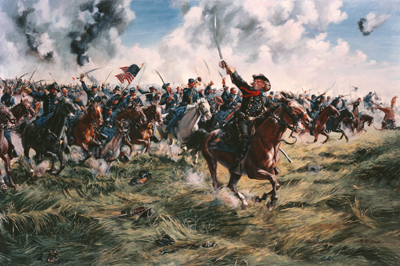
4 RCuster leads his Michigan Brigade  on July 3rd

Robert E. Lee’s prodigal son had finally returned. On the evening of July 2nd 1863 with the attacks of Longstreet now finished and Ewell’s abortive battle for Culp’s Hill reaching its bloody Lieutenant General J.E.B. Stuart finally arrived at Robert E Lee’s headquarters on Seminary Ridge. The meeting was brief and unwitnessed by anyone but the participants.

Apparently the meeting between Lee and his Cavalry division commander was short “abrupt and frosty.” Porter Alexander noted that Lee only said “Well General, you are here at last” and Stuart’s aide Major Henry McClellan reported that Stuart “regarded the incident as painful beyond description.” (1) In his official report of the battle “Lee would allude to Stuart with but a single pejorative sentence: “The movements of the Army preceding the Battle of Gettysburg had been much embarrassed by the absence of the cavalry.” (2) In Stuart’s defense it needs to be re-emphasized that Lee had four brigades of cavalry at his disposal but did not use them effectively.

Stuart left as quickly as he arrived and in his official report he noted that his new orders were to take up a position “on the left wing of the Army of Northern Virginia.” (3) For a man like Stuart whose soldierly skills as a cavalry commander and leader were only matched by his vanity the incident was humiliating, he had failed Robert E Lee.

300px-Gettysburg_East_Cavalry_Field3

Lee’s plan for Stuart the next day was that Stuart Stuart moved four of his brigades the following morning to the north and east. The plan was for his forces to be in position to assist the exploitation of any breakthrough made by Pickett’s attack. Stuart hoped to cover his movement from Federal observation but he was discovered and his movement reported back to Meade. Stuart blamed the discovery on the trail brigades of Hampton and Fitzhugh Lee who had “debouched onto open ground and disclosed his presence.” (4)

david-greggBrigadier General David Gregg

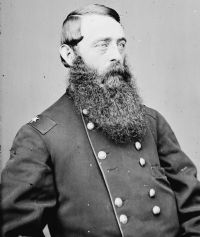
Brigadier General David Gregg commanding the Second Cavalry Division received word of Stuart’s approach and prepared to intercept him and in the process relieve the Michigan Brigade of the newly minted Brigadier General George Custer so it could rejoin Jusdon Kilpatrick’s division.

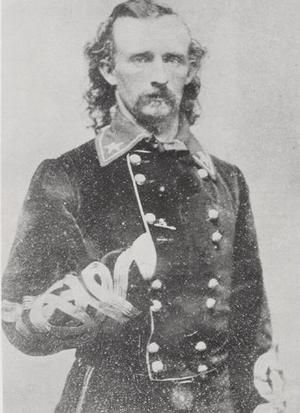
300_2631176Brigadier General George Armstrong Custer

Upon his arrival Gregg realized that he would be outnumbered and that Stuart posed “a serious threat to the Federal rear.”(5) Custer indicated that he thought Gregg would soon have a battle and Gregg replied “in that case he would like to have the assistance of his Michigan brigade.” (6) Custer indicated his agreement and without bothering to consult the Cavalry Corps Commander Alfred Pleasanton Gregg ordered Custer to remain with him and “willingly risked his military career and reputation in his anxiety to protect the Federal rear.” (7)

Gregg’s action was yet another of the superior judgements executed by a Federal commander during the battle. It was an outstanding example of how Federal commanders on the whole recognized the overall tactical situation and used their judgement to take action when waiting for a superior could prove fatal to the army. In our modern understanding it would be an example of how Mission Command is to work.

During the battle Stuart displayed little of his normally sharp tactical leadership and took little part in the battle leaving the conduct of it to his subordinates. Though the Federal Horse Artillery was outnumbered Gregg used the two batteries he had far more effectively than Stuart used his. Additionally Gregg had two brigade commanders willing to take the fight to the Confederates.

The main battle took place after Three PM when Pickett’s attack was battling for its life during its assault on Cemetery Hill. There were a number of charges and counter charges and the battle was tactically a draw but a victory for Gregg who had forced Stuart to enter a battle “in which the Confederates gained nothing except the “glory of fighting” (8) and had stopped Stuart from his objective of disrupting the Federal rear and aiding Pickett’s assault.

Stuart’s aid Major Henry McClellan wrote of the battle:

“The result of this battle shows that there is no possibility that Stuart could successfully have carried out his intention of attacking the rear of the Federal right flank, for it was sufficiently protected by Gregg’s command. As soon as General Gregg was aware of Stuart’s presence he wisely assumed the aggressive and forced upon Stuart a battle…while Gregg himself performed the paramount flank of protecting the right flank of the Federal Army.” (9)

McClellan’s analysis is both succinct and accurate. As Stuart’s forces retired and Pickett’s shattered command withdrew the Battle of Gettysburg was effectively over.

1. Sears, Stephen W. Gettysburg A Mariner Book, Houghton Mifflin Company, Boston and New York 2003. pp.257-258

2. Taylor, John M. Duty Faithfully Performed: Robert E Lee and his Critics Brassey’s Dulles VA 1999 p.150

3 Trudeau, Noah Andre. Gettysburg: A Testing of Courage, Harper Collins Books New York 2001 p.316 

4 Coddinton, Edwin B. Gettysburg: A Study in Command. A Touchstone Book, Simon and Schuster, New York 1968 pp.520-521

5. Ibid. p.521

6. Ibid.

7. Ibid. p.522

8. Ibid. p.523

9. McClellan, Henry Brainerd The Life and Campaigns of Major General J.E.B. Stuart Commander of the Cavalry of the Army of Northern Virginia 1885. Digital edition copyright 2011 Strait Gate Publications, Charlotte NC location 6516 of 12283

4 Comments

Filed under civil war, History, leadership, Military

The Forgotten Hero: Brigadier General George Sears Greene at Culp’s Hill: Night of July 2nd and 3rd 1863

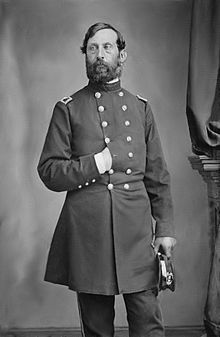
220px-George_S._GreeneBrigadier General George Sears Greene

On the night of July 1st 1863 Dick Ewell’s Second Corps of the Army of Northern Virginia and the Army of the Potomac on Cemetery and Culp’s Hill prepared for another day of battle. Despite a significant amount of success Lee’s Army had failed to drive the lead elements of the Army of the Potomac off of Cemetery Hill. As the evening progressed more Federal troops in the form of Henry Slocum’s XII Corps began to take up positions on Cemetery Hill as well as Culp’s Hill which Oliver Howard and Winfield Scott Hancock recognized to be vital to holding the Federal position.

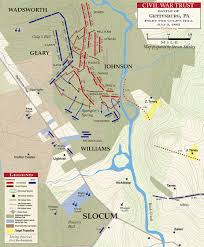
The three brigades of Geary’s division entered the line to the east of Wadsworth’s division of I Corps along the northern and eastern face of Culp’s Hill. Key to the position was the placement of the brigade of Brigadier General George S. Greene one of the oldest, if not the oldest Union officer on the field. Greene’s brigade took a position next to the remnants of the Iron Brigade which had fought so hard along Seminary Ridge earlier in the day.

Greene had been born in 1801 and had graduated from West Point as an artillery officer some six years before Robert E. Lee. He graduated second in his class at West Point in 1823 and after 13 years left the army in 1836 to enter civilian life as an engineer. Greene missed the Mexican War but when the call came for volunteers in 1861 he was appointed to command the 60th New York Volunteer Infantry. Promoted to Brigadier General in 1862 he commanded his brigade and served as an acting division commander at Antietam. He was a descendent of Nathaniel Greene and his son Lieutenant Dana Greene USN was the Executive officer of the USS Monitor at the Battle of Hampton Roads against the CSS Virginia.

culps hill map

As the Federal units on Culp’s Hill took their positions they began to do something that was not yet commonplace in either army. They began to construct field fortifications and breastworks. Working through the night with the ample materials at hand they dug in and linked their positions with each other as well as Brigadier General Thomas Kane’s brigade to Greene’s right. The line of fortifications took advantage of the natural terrain which on its own made the ground good for the defense, but when fortified made it nearly impregnable to assault.

During the day of July second little happened on Ewell’s front. Though he had persuaded General Lee to leave his troops in place Ewell remained mostly inactive on July second with the exception of some skirmishing and a battle between the Stonewall Brigade and Gregg’s division of Federal Cavalry on Brinkerhoff’s Ridge about two and a half miles east of the town.

It would not be until the evening of the 2nd that Ewell’s troops went into action against the now very well entrenched Federal Forces on Cemetery and Culp’s Hill. The assaults began on Cemetery Hill where Jubal Early’s division attacked forces along the north and east section of the hill to be supported by Robert Rodes’ division on the west.

However as with most of the Confederate offensive actions of the battle this too fell apart as Rodes division gave little support to Early’s attack as due to both Rodes’ and Ewell’s indecisiveness Rodes “did not give himself enough time to get his big division into formation for the attack. By the time he had completed the complicated maneuver of wheeling his brigades forty-five degrees to the left and advancing them half a mile to a good place from which to charge up Cemetery Hill the battle was over.” [1]

Though Early achieved some success his division was repulsed and the threat to the Union gun line on Cemetery Hill was ended. One author noted of Early’s attack: Courage and determination could not offset superior numbers and fresh troops. With no help coming and enemy units swarming around them, all those Rebels who were still under some command and control began to fall back.” [2]

Longstreet’s attack on the Federal left forced George Meade to pull troops from his quiet sector along Culp’s Hill in order to reinforce his forces in the Peach Orchard, the Wheat Field and along the southern extension of Cemetery Ridge. According to most accounts Meade directed Slocum to send “at least one division” to the threatened sector which weakened the forces deployed on Culp’s Hill considerably.

However within XII Corps there was much confusion and in addition to William’s division Geary had pulled two of his brigades out of line leaving only George Greene’s brigade to defend Culp’s Hill “guarding nearly half a mile of Twelfth Corps works.”[3] Neither Slocum nor Williams realized the danger and before the units which had left the hill could return Allegheny Johnson’s division of Ewell’s corps which had sat inactive and impatiently awaiting orders to attack all day jumped off.

culp's hill149th New York Volunteer Infantry on Culp’s Hill

The Confederate attack began around Seven PM and continued through the night. Johnson sent some 4,700 men to attack Greene’s 1,300 dug in veterans. “That kind of manpower edge would have likely been decisive elsewhere on the field that day, but against Pop Greene’s providential and well-constructed breastworks the odds leveled out.” [4]Greene’s men fought hard as Greene directed them and requested reinforcements from I Corps and XI Corps who in turn sent units including the Iron Brigade to help. However, the six regiments that arrived had been reduced to fractions of their former strength by the first day’s battle “increased Greene’s force only by about 755 men.” [5]Additionally, Hancock who heard the battle raging “sent two regiments to the relief of Slocum as well.”[6] Greene’s report of the battle noted:

“we were attacked on the whole of our front by a large force few minutes before 7 p.m. The enemy made four distinct charges between 7 and 9.30 p.m., which were effectually resisted. No more than 1,300 were in our lines at any one time. The loss of the enemy greatly exceeds ours.”[7]

As the night wore on Confederate attacks continued and in the darkness other Federal units arrived, including those from XII Corps which had gone earlier in the day. By mid-morning Johnson’s assault was done. His units had suffered severe casualties and his division had been drained of all attacking power by the time Lee needed it on the morning of July 3rd to support Pickett’s attack. “This division, formed by Stonewall Jackson was never the same again. Its glories were in the past.”[8] In the end the Army of the Potomac still held both Cemetery and Culp’s Hill, in large part due to the actions of the old soldier, George Greene who’s foresight to fortify the hill and superb handling of his troops and those who reinforced him kept Johnson’s division from rolling up the Federal right.

Ewell’s troops would play no further role in the battle. In the end his presence around Cemetery and Culp’s Hill diminished the resources that Lee needed to support his other assaults on the second and third day of battle. In effect it left Lee without one third of his forces. The result was the sacrifice of many troops with nothing to show for it. Ultimately Lee is to blame for not bringing Ewell’s forces back to Seminary Ridge where they and their artillery may have had a greater effect on the battle.

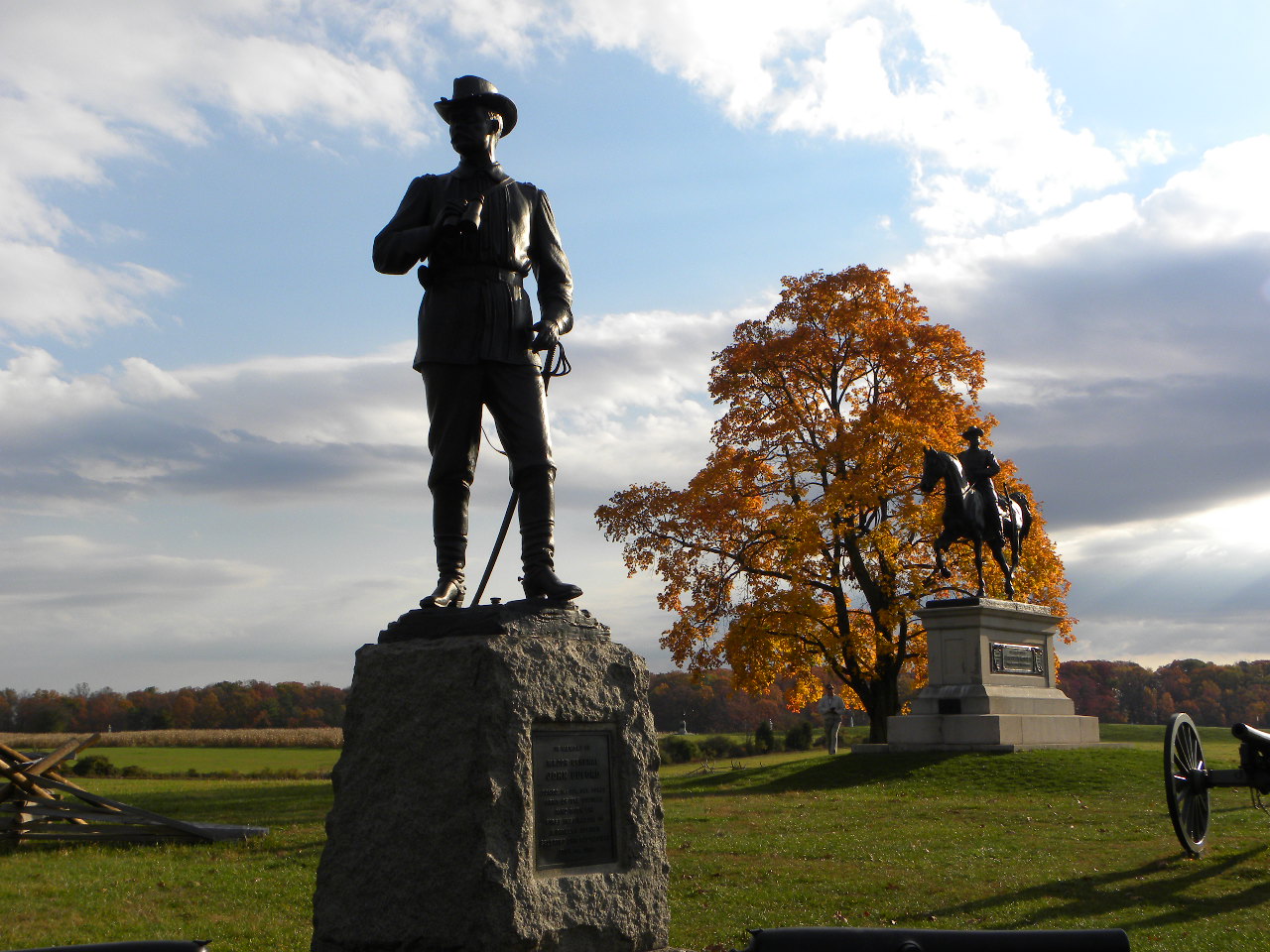
greene monumentMonument to General George S Greene on Culp’s Hill

The real hero of Culp’s Hill was Greene. But Greene in many ways is a forgotten hero, he was not given much credit in Meade’s after action report though Slocum attempted to rectify this and Meade made some minor changes to his report. But it was in later years that Greene was began to receive recognition for his actions. James Longstreet gave Greene credit for saving the Union line on the night of July 2nd and said that “there was no better officer in either army” at the dedication of the 3rd Brigade monument on Culp’s Hill in 1888. Greene died in 1899 having been officially retired from the Army in 1893 as a First Lieutenant, his highest rank in the Regular Army. A monument to Greene stands on Culp’s Hill looking east in the direction of Johnson’s assault.

Until tomorrow,

Peace

Padre Steve+


[1] Coddington, Edwin B. The Gettysburg Campaign: A Study in Command, A Touchstone Book, Simon and Schuster Ne5w York, 1968 pp.429-430

[2] Tredeau, Noah Andre. Gettysburg: A Testing of Courage, Harper Collins Publishers, New York 2002 p.409

[3] Pfanz, Harry W. Gettysburg: Cemetery Hill and Culp’s Hill University of North Carolina Press, Chapel Hill NC 1993 p. 204

[4] Sears, Stephen W. Gettysburg. Houghton Mifflin Co. Boston and New York 2003 p.326

[5] Ibid. Coddington p.431

[6] Jordan, David M. Winfield Scott Hancock: A Soldier’s Life Indian University Press, Bloomington and Indianapolis 1988 p.94

[7] Luvaas, Jay and Nelson Harold W. editors. The U.S. Army War College Guide to the Battle of Gettysburg South Mountain Press, Carlisle PA 1986 pp. 159-160

[8] Dowdy, Clifford. Lee and His Men at Gettysburg: The Death of a Nation Skyhorse Publishing, New York 1986, originally published as Death of a Nation Knopf, New York 1958 p.262

5 Comments

Filed under civil war, History, leadership, Military

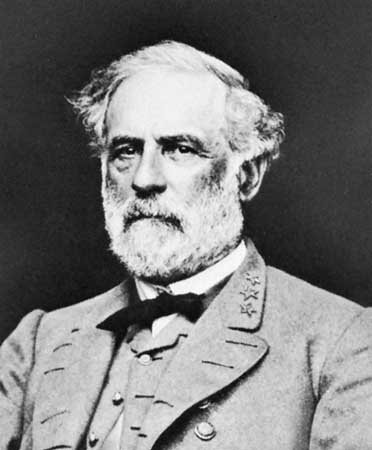
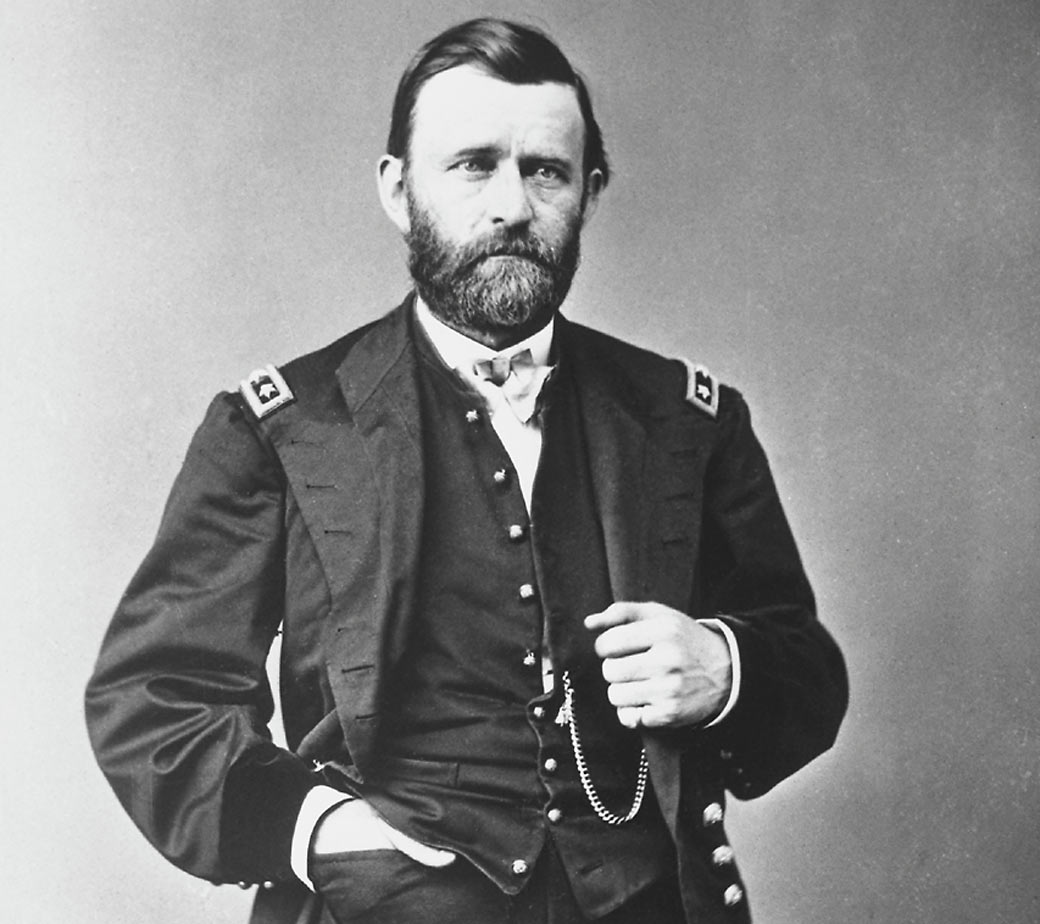
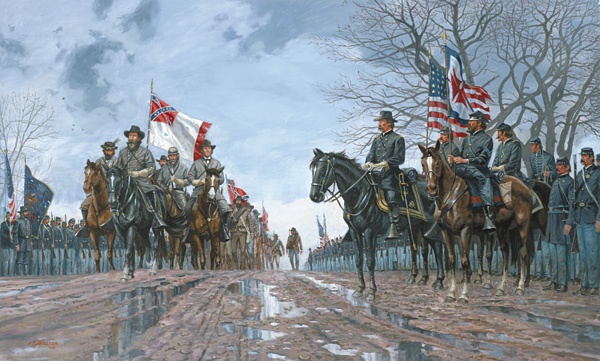
Surrender at Appomattox: Ulysses S. Grant, Robert E. Lee and Joshua Lawrence Chamberlain teach us about Reconciliation

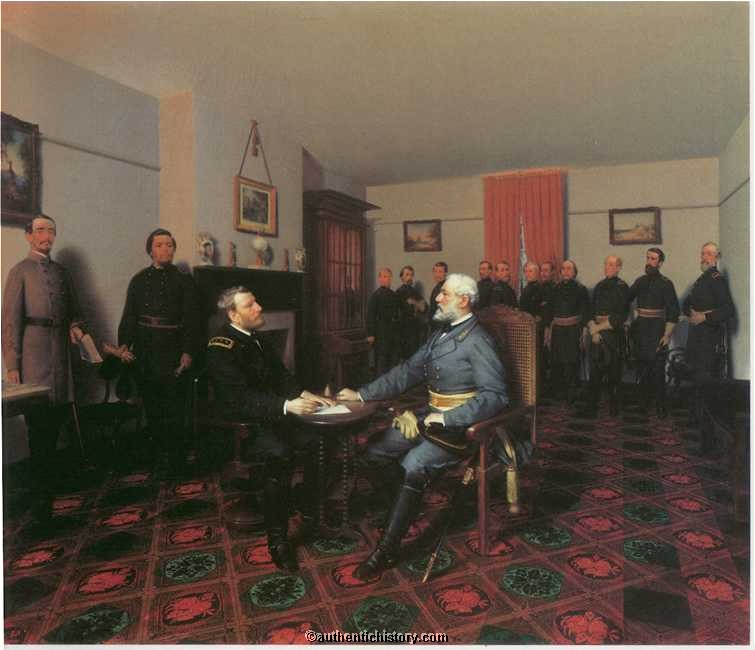
The Authentic History Center

It was the day after General Robert E Lee had requested to Lieutenant General Ulysses S. Grant that his Army of Northern Virginia be allowed to surrender. The once mighty army now a haggard but proud force of about 11,000 soldiers faced hopeless odds against a vastly superior enemy. Since Gettysburg Lee’s army had been on the defensive, Lee’s ill fated offensive into Pennsylvania being one of the two climactic blows that sealed the doom of the Confederacy, the other Grant’s victory at Vicksburg which fell a day after Pickett’s Charge.

On the 9th and 10th of April three men, Ulysses S Grant, Robert E Lee and Joshua Lawrence Chamberlain taught succeeding generations the value of mutual respect and reconciliation after a bitter and bloody war.

ileerob001p1

With each battle following Gettysburg the Army of Northern Virginia became weaker and finally after the nine month long siege of Petersburg ended with a Union victory there was little else to do. When his artillery chief Porter Alexander recommended that the Army be released, “take to the woods and report to their state governors” Lee replied:

“Already [the country] is demoralized by the four years of war. If I took your advice, the men would be without rations and under no control of their officers. They would be compelled to rob and steal in order to live…. We would bring on a state of affairs it would take the country years to recover from… You young fellows might go bushwhacking, but the only dignified course for me would be to go to General Grant and surrender myself and take the consequences of my acts.”

Abraham Lincoln had already set the tone for the surrender in his Second Inaugural Address given just over a month before the surrender of Lee’s army. Lincoln closed that speech with these words of reconciliation:

“With malice toward none, with charity for all, with firmness in the right as God gives us to see the right, let us strive on to finish the work we are in, to bind up the nation’s wounds, to care for him who shall have borne the battle and for his widow and his orphan, to do all which may achieve and cherish a just and lasting peace among ourselves and with all nations.”

poor--ulysses-s-grant-president-1040cs021412

Grant provided his vanquished foe generous surrender terms. Grant met with Lee and offered the following terms of surrender:

“In accordance with the substance of my letter to you of the 8th inst., I propose to receive the surrender of the Army of N. Va. on the following terms, to wit: Rolls of all the officers and men to be made in duplicate. One copy to be given to an officer designated by me, the other to be retained by such officer or officers as you may designate. The officers to give their individual paroles not to take up arms against the Government of the United States until properly exchanged, and each company or regimental commander sign a like parole for the men of their commands. The arms, artillery and public property to be parked and stacked, and turned over to the officer appointed by me to receive them. This will not embrace the side-arms of the officers, nor their private horses or baggage. This done, each officer and man will be allowed to return to their homes, not to be disturbed by United States authority so long as they observe their paroles and the laws in force where they may reside.”

When Lee left the building Federal troops began cheering but Grant ordered them to stop. He later noted: “The Confederates were now our countrymen, and we did not want to exult over their downfall.”

The surrender itself was accomplished with a recognition that soldiers who have given the full measure of devotion can know when confronting a defeated enemy. Major General Joshua Lawrence Chamberlain, the heroic victor of Little Round Top was directed by Grant to receive the surrender of the defeated Confederates. As they passed, moved with emotion he ordered his soldiers to salute the defeated enemy for whose cause he had no sympathy.

PH2010062902996

Chamberlain was not just a soldier, but before the war had been Professor of Natural and Revealed Religions at Bowdoin College, and a student of theology before the war. He could not help to see the significance of the occasion. He understood that he would be criticized by some for offering the salute, however unlike some, the staunch abolitionist and Unionist who had nearly died on more than one occasion fighting the defeated Confederate Army understood that no true peace could transpire unless the enemies became reconciled to one another.

He noted that his chief reason for doing so:

“The momentous meaning of this occasion impressed me deeply. I resolved to mark it by some token of recognition, which could be no other than a salute of arms. Well aware of the responsibility assumed, and of the criticisms that would follow, as the sequel proved, nothing of that kind could move me in the least. The act could be defended, if needful, by the suggestion that such a salute was not to the cause for which the flag of the Confederacy stood, but to its going down before the flag of the Union. My main reason, however, was one for which I sought no authority nor asked forgiveness. Before us in proud humiliation stood the embodiment of manhood: men whom neither toils and sufferings, nor the fact of death, nor disaster, nor hopelessness could bend from their resolve; standing before us now, thin, worn, and famished, but erect, and with eyes looking level into ours, waking memories that bound us together as no other bond;—was not such manhood to be welcomed back into a Union so tested and assured? Instructions had been given; and when the head of each division column comes opposite our group, our bugle sounds the signal and instantly our whole line from right to left, regiment by regiment in succession, gives the soldier’s salutation, from the “order arms” to the old “carry”—the marching salute. Gordon at the head of the column, riding with heavy spirit and downcast face, catches the sound of shifting arms, looks up, and, taking the meaning, wheels superbly, making with himself and his horse one uplifted figure, with profound salutation as he drops the point of his sword to the boot toe; then facing to his own command, gives word for his successive brigades to pass us with the same position of the manual,—honor answering honor. On our part not a sound of trumpet more, nor roll of drum; not a cheer, nor word nor whisper of vain-glorying, nor motion of man standing again at the order, but an awed stillness rather, and breath-holding, as if it were the passing of the dead!”

The next day Robert E Lee address his soldiers for the last time. Lee’s final order to his loyal troops was published the day after the surrender. It was a gracious letter of thanks to men that had served their beloved commander well in the course of the three years since he assumed command of them outside Richmond in 1862.

General Order
No. 9


After four years of arduous service marked by unsurpassed courage and fortitude, the Army of Northern Virginia has been compelled to yield to overwhelming numbers and resources.

need not tell the survivors of so many hard fought battles, who have remained steadfast to the last, that I have consented to the result from no distrust of them.
But feeling that valour and devotion could accomplish nothing that could compensate for the loss that must have attended the continuance of the contest, I have determined to avoid the useless sacrifice of those whose past services have endeared them to their countrymen.

By the terms of the agreement, officers and men can return to their homes and remain until exchanged. You will take with you the satisfaction that proceeds from the consciousness of duty faithfully performed, and I earnestly pray that a merciful God will extend to you his blessing and protection.

With an unceasing admiration of your constancy and devotion to your Country, and a grateful remembrance of your kind and generous conideration for myself, I bid you an affectionate farewell. — R. E. Lee, General

Warriors_Tribute_at_Appomattox

The surrender was the beginning of the end. Other Confederate forces continued to resist for several weeks, but with the surrender of the Army of Northern Virginia led by the man that nearly all Southerners saw as the embodiment of their nation the war was effectively over.

Lee had fought hard and after the war was still under the charge of treason, but he understood the significance of defeat and the necessity of moving forward as one nation. In August 1865 Lee wrote to the trustees of Washington College of which he was now President:

“I think it is the duty of every citizen, in the present condition of the Country, to do all in his power to aid the restoration of peace and harmony… It is particularly incumbent upon those charged with the instruction of the young to set them an example of submission to authority.

It is a lesson that all of us in our terribly divided land need to learn regardless of or political affiliation or ideology. Lee learned that Grant’s Aide-de-Camp was a Seneca and said after the surrender “It is good to have one real American here.” The officer replied, “Sir, we are all Americans.”

It is time again that we learn that lesson.

Peace

Padre Steve+

Leave a comment

Filed under civil war, History, Military, philosophy, Political Commentary