Category Archives: crime

Reflections on Life as an Authoritarian State Arises

Friends of Padre Steve’s World,

We are visiting friends in the Washington DC area as we get ready to celebrate our wedding anniversary Monday. It is nice to be relaxing with each other, another friend who is down from Pennsylvania and combined flock of 12 Papillon dogs, three of which are ours. Everyone but me has now gone to their bedrooms while I sip a glass of McClelland’s Highland Single Malt Scotch Whiskey with my little boy Pierre at my side, all 4.8 pounds of him. That’s a good thing.

Since tomorrow’s weather forecast is for continued rain I will probably watch World Cup games, read and spend time with Judy, our friends and the Papillons. If the weather is good Sunday Monday hope to take Judy to the Smithsonian Museum of American History. Monday night we will celebrate our 35th wedding anniversary with our friends. Depending on the weather I hope to get some decent runs and walks in along the Potomac River.

Likewise, despite all that is going on try to take a break from the incessant pounding of crises manufactured by the President and the chaos that he uses to increase his personal power over his administration, the Congress, the media, and yes all of us. Sadly, none of this is going away anytime soon and it will likely become much worse before it gets better; such is the nature of fledgling dictatorships. Even today he demonized all immigrants as criminals and their supporters as being against the rule of law and his supporters applaud as the leaders of his political party cower before him. Eric Hoffer wrote:

Should Americans begin to hate foreigners wholeheartedly, it will be an indication that they have lost confidence in their own way of life.

The words and actions of the President and his supporters bear this out, they claim to be making America great again but they are destroying the very fabric of the ideals on which the nation was founded.

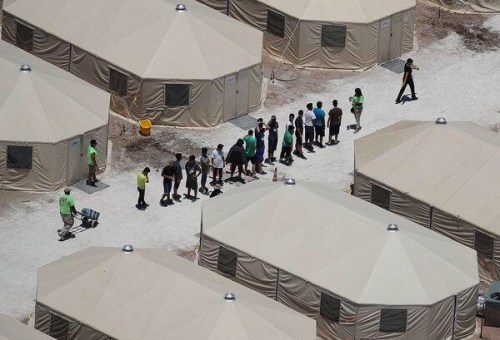
He did this as his administration and immigration agencies imprisons thousands of children, refuses to reunite them with their families, makes plans for camps on military bases to house nearly 150,000 immigrants, sets up checkpoints on American highways demanding that travelers have proof of citizenship, details military JAG officers with no experience in immigration law to serve as Acting US Attorneys to prosecute immigrants.

At a publicity stunt Friday the President compared all immigrants from south of the border to criminals by parading the survivors of people killed by illegals and spouting absolute lies about the number of crimes committed by immigrants, legal and illegal alike. He then took the time to sign his name on the pictures of the victims of those crimes.

Don’t get me wrong, I have a tremendous amount of compassion for the victims of any violent crime. I have stood over the bodies of men, women, and children killed by the bullets of criminals and tried to console their survivors. I did that so many times that I have lost count of the number.

Likewise I have been the victim of violent crime. I was held up at gunpoint with my wife and her family when we were dating and had a pistol pointed at my head as I sat in the back seat of a car unable to go after the gunman without risking the lives of Judy and her parents. I have also had my liefe threatened by White Supremacist for things that I have written, one that was so specific that I reported it to both the local police and the FBI. But in all cases the people who attacked or threatened me were native born Americans.

In the President’s view if you are killed by a dark skinned immigrant your families are called “Angel Families” but if you are killed by an American you and your family do not exist because you serve no political purpose. That my friends is a fact and the statistics show that far more violent crimes are committed by Americans than all immigrants and most actual cases of domestic terrorism in the United States are committed by White Supremacists, and mass murders including those at schools, businesses, entertainment venues, churches or other places of worship are committed by White people, not immigrants. But those go largely unheralded by the President, except for incidental tweets that express thoughts and prayers and praise of law enforcement.

But that is how incipient dictatorships behave. Certain groups are targets, demonized and compared to the worst examples. In the parlance of Trump they are all murderers, rapists, terrorists, gang members, and drug dealers. This behavior runs rampant in dictatorships and authoritarian states. The President has persistently and insidiously invoked that immigrants are evil. Hoffer wrote:

“Hatred is the most accessible and comprehensive of all the unifying agents. Mass movements can rise and spread without belief in a god, but never without a belief in a devil.” 

That has been happening since the day that President Trump announced his candidacy for President and it is no secret. Mexicans were the first devil of his campaign, and he called them criminals, murderers and rapists on the day that he announced his candidacy. The videos of his speeches, his manifold number of Tweets, and the actions of his administration are all too widely available not to be found by anyone seeking the truth about him, but for his most fervent supporters all of those facts are fake, even if he said them in front of millions of people.

Now, events in the United States and at our borders have shown that the President was absolutely correct about his followers when he said that they would continue “to follow him even if he shot somebody on 5th Avenue.”

My friends, it is not going to get any better and we better be ready for what comes next or we will be swept away in the flood of lies and evil to come. Despite his buffoonery, one cannot underestimate the potential evil of the President and his followers. Likewise do not assume that a Blue Wave will happen in November because there may be events that occur which will allow the President to use executive orders enacted by his predecessors during the height of the Cold War and the potential of nuclear war to postpone elections or rule by decree. I refer to this as a Reichstag Fire moment.

Historian Timothy Snyder wrote in his book On Tyranny:

“Modern tyranny is terror management. When the terrorist attack comes, remember that authoritarians exploit such events in order to consolidate power. The sudden disaster that requires the end of checks and balances, the dissolution of opposition parties, the suspension of freedom of expression, the right to a fair trial, and so on, is the oldest trick in the Hitlerian book. Do not fall for it.”

We live in a very perilous time where the vision of our founders could be overturned in the blink of an eye and our Republic, as flawed as it is, but always has embraced the ideal of building a more perfect union will perish from the face of the earth. The nation and people may remain, but the ideal will be gone and with it the Republic.

So until tomorrow or the next post, have a good day.

Peace

Padre Steve+

4 Comments

Filed under civil rights, crime, dogs, ER's and Trauma, ethics, faith, History, holocaust, leadership, marriage and relationships, News and current events, Political Commentary

Leak: Why Mark Felt Became Deep Throat

Friends of Padre Steve’s World,

Back in 2012 I was asked to do a review of Max Holland’s book about Watergate Leak: Why Mark Felt Became Deep Throat. It think that the book is very pertinent today and well worth the read for anyone immersed in the daily revelations of numerous members of the Trump campaign and administration. The sheer number of these allegations, not to mention the number of convictions and plea deals already racked up by the Muller investigation demonstrates the seriousness of the allegations while the web of connections to the fact of Russian meddling in the 2016 demands answers. That being said we need to look back at the history of the Nixon administration to help us understand what is going on today.

So I am posting my review that I published for TLC Book Reviews on June 12th 2012. The review is exactly how I wrote it with no editing for today. I recommend the book to my readers. 

Until tomorrow,

Peace

Padre Steve+

Motives do matter and actions often have unintended consequences. That is the lesson of Max Holland’s book about Mark Felt. Felt was the man whose leaks helped end the Presidency of Richard Nixon and skyrocket the young and obscure Bob Woodward and Carl Bernstein to fame. For more than three decades Mark Felt’s identity remained hidden a mystery man to the public, a man popularized by the dark moniker “Deep Throat.” His role as the leaker was suspected by some, including President Nixon and some of his staff but known only for sure by Woodward, Bernstein and Washington Post Editor Ben Bradlee.

In this truly scholarly book Max Holland pieces together the dark underside of the Watergate tapestry that Woodward and Bernstein helped to break in 1972 and would go on to write about in All the President’s Men and The Final Days. It is a book that is important because it is the first account to seriously explore the motivation of Mark Felt when he began to leak and the background story of the monumental post J. Edgar Hoover FBI power struggle.  That story which in normal times would have been a major story was missed in an era where the country was in turmoil and there were so many other “big” stories to cover.

Taking advantage of more recent revelations, disclosures and evidence Holland paints a picture that not only broadens one’s understanding of Watergate but helps the reader understand how important it is to understand the motivations of those that were involved, Nixon and his staff, Felt and other FBI officials and the media.

The picture painted by Holland of Felt makes his role in the story more understandable. Felt was not the altruistic leaker of myth who sought to destroy the Nixon Presidency, something that was the picture painted by Woodward and Bernstein. His motivations were much more down to earth. He wanted to use his knowledge to ensure that he became Hoover’s successor as the Director of the FBI. He used it to destroy L. Patrick Gray who served as the interim Director and his chief rival in the Bureau William C. “Bill” Sullivan in the eyes of the White House, Congress, the Bureau and the media. Felt’s leaks helped blow the lid off of the White House cover up of the Watergate break-in and which led to the resignation of President Nixon and the conviction of a number of his closest advisors. Felt’s duplicity which included deceiving the Administration, Congress, his superiors and the media with falsehoods even as he revealed key truths is amazing to behold.

The picture that Holland paints of the White House is not pretty. The moral depravity and ruthlessness of Nixon and his advisors is shown without dehumanizing them.  In fact they become more human in Holland’s account.  Likewise Holland’s portrayal of other key figures in Felt’s story at the FBI, L. Patrick Gray, William Ruckelshaus and William Sullivan is compelling. The naive and compliant Gray, Felt’s bitter rival Sullivan and the “sweeper” (to use the term given to Harvey Keitel’s character Winston “the Wolf” Wolfe in Pulp Fiction) Ruckelshaus who helps to “sweep” Felt out of the FBI.

But the most interesting part of the book for me is Holland’s portrayal of Woodward and Bernstein. They are young and idealistic and Woodward believes whatever Felt tells him, including deliberate misinformation. What jumped out at me was their willingness to take at face value what Felt told them and not to explore his motivations which could have led to even more revelations that could have shaken the FBI to its core.  Likewise was Woodward’s willingness to press the limits with information provided by Felt going beyond what Felt demanded for secrecy but which Felt, even though upset by the reporter continued to provide information cumulating in his long and rambling confession to Woodward following his retirement under pressure on May 16th 1973.

They, particularly Woodward did not ask themselves the three key questions that anyone should ask when someone comes to them with this kind of information: Why this? Why this information. Why Me?  Why am I being chosen to receive the information. Why Now? Why is the source telling me this information now. Those three questions could have blown the case open even more had they explored them. Of course they were caught up in the chase for “scoops” with rivals at the New York Times, The Washington Sun and Time Magazine and chose to believe what Felt told them, something that occasionally left them hanging when the information was wrong.

Conversely Felt’s distain and lack of respect for the media and the belief that he could use Woodward, Bernstein and others in the media to further his goals with impunity proved false. He became careless and caused the Nixon Administration to suspect him and work to force him out of the FBI without drawing more attention to themselves.

Holland also covers the “cover-up” of “Deep Throat’s identity which was maintained by Felt, Woodward and Bernstein until Felt was in the beginning stages of dementia and his family was ready to reveal his role.  The dual myths of Deep Throat’s motives and the role of the press as the “men in the  white hats” against the evil bad guys in the White House are exposed by Holland who points out how much of the investigation broken by Woodward and Bernstein was being accomplished by FBI agents and appointed to investigate the break-in and staff members at the Committee to Re-Elect the President who were appalled by the illegality of what they saw being done by their superiors.

The book is excellently sourced and researched. It is a compelling narrative that sheds light on a dark period of our nation’s history which also serves as a reminder to those who investigate “leaks” from well placed sources that there is always another layer of motivation and intent that cannot be discounted and must be factored into the investigation.

This is relevant today as the media, Congress and the the Justice Department investigate leaks from inside the Obama White House regarding national security information. Why This? Why Me? Why Now? Those are the questions. Thanks to Max Holland we now know much of what transpired behind the scenes as Woodward and Bernstein investigated and published their accounts of the Watergate break-in and cover up with the information provided by Mark Felt.

The book Leak: How Mark Felt Became Deep Throat is published by the University of Kansas Press and is available at http://www.amazon.com/Leak-Mark-Felt-Became-Throat/dp/0700618295/ref=sr_1_1?ie=UTF8&qid=1339544616&sr=8-1&keywords=leak

Leave a comment

Filed under books, crime, ethics, History, News and current events, Political Commentary

“The Coexistence of Normality and Bottomless Cruelty” Timothy McVeigh and the Terrorist Next Door

murrah bombing

Friends of Padre Steve’s World,

Just a short note to close out the work week. Amid all the political drama surrounding President Trump, James Comey, and the release of the Comey memos this week, one thing that was overlooked by most people was the anniversary of the bombing of the Murrah Federal Building by Timothy McVeigh and Terry Nichols in 1995.

I don’t think that I could ever forget the day. I was working as a hospital ER department chaplain where I worked a 3:00-11:00 shift and usually didn’t get to bed until one or two in the morning. I was also a Chaplain in the Army National Guard. Not long after I got up I turned on the news and was drinking my coffee when the news about the bombing flashed across the screen. I was stunned, especially when I found out that the bombers were Americans, and both former soldiers. I could not imagine American soldiers turning their hatred agains the government into an act of terrorism.

They killed 168 people, including babies and young children in the day care center were killed, hundreds of others wounded. McVeigh and Nichols were part of the anti-government so-called “militia” movement that still exists in parts of this country, of which the Bundy family, which occupied a Federal Wildlife Sanctuary in 2016 in order to bring about a revolt against the government is part.

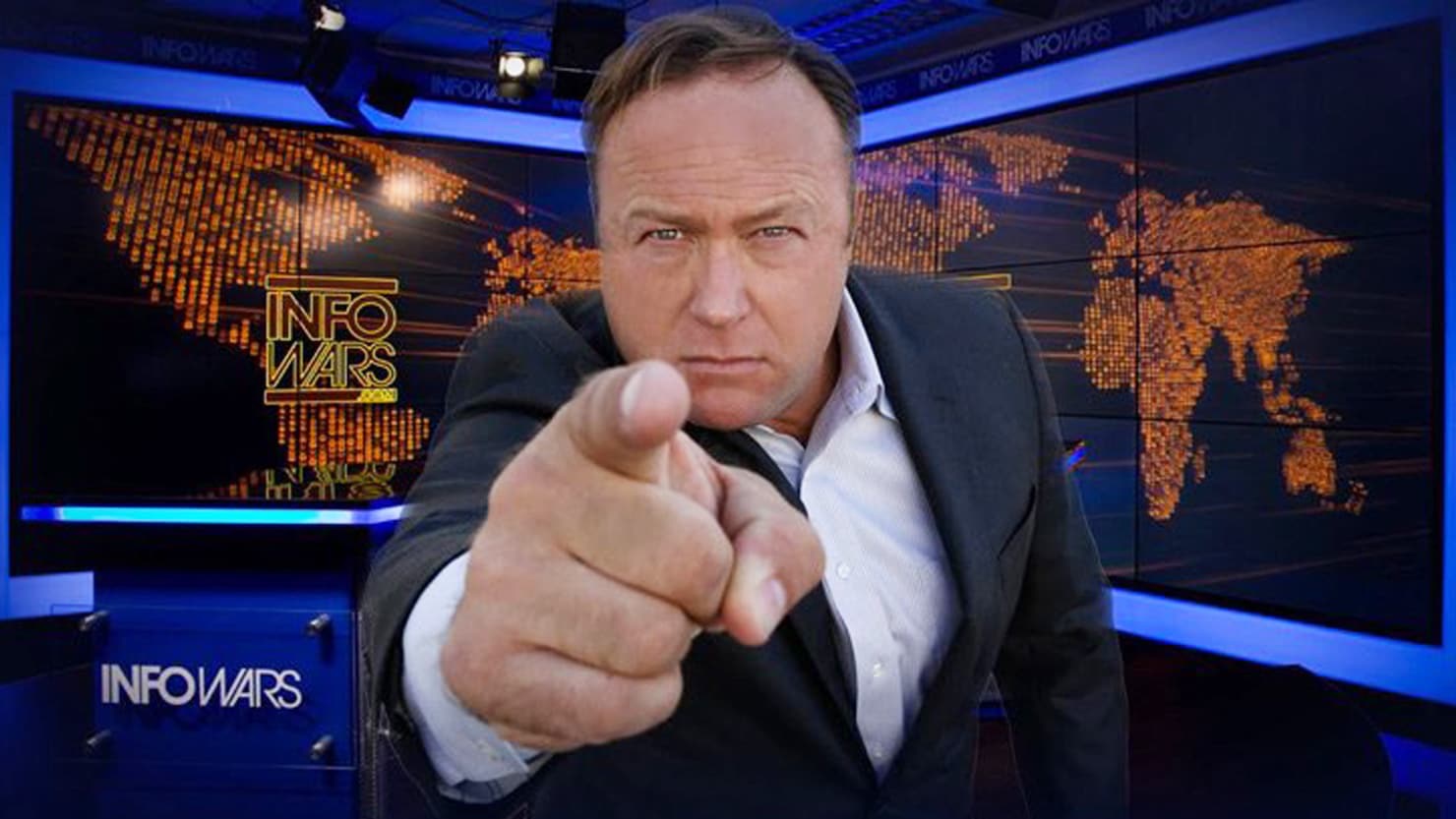
Sadly, there are such people who would do the same today if given the chance. As this attack shows, most of them are not Islamic terrorists, but some are plain old Americans, people you might see in the grocery store or at the gas station. Some belong to the White Supremacist and Neo-Nazi Alt-Right, others to heavily armed self-appointed “militia” groups, and still others simply deluded followers of conspiracy theorists like Alex Jones. Members of all of these groups or movements have committed violent acts or have been stopped from doing so by the work of the FBI and other law enforcement agencies.

What is scary is that almost all of them repeat the same words, thoughts and ideology that McVeigh wrote about before and after the attack. In the end McVeigh rationalized his violence and defended his actions, never showing any hint of remorse for his victims, they were simply collateral damage, and the children he killed, a distraction from his message. Those that interviewed him said that he seemed completely normal and it was hard for them to reconcile his normalcy with what he did and his attitude toward his victims.

Reading his words and what others observed about him reminded me of what the Israeli court psychologist who interviewed Adolf Eichmann noted about Eichmann. Hannah Arendt recounted it:

“The Israeli court psychiatrist who examined Eichmann found him a “completely normal man, more normal, at any rate, than I am after examining him,” the implication being that the coexistence of normality and bottomless cruelty explodes our ordinary conceptions and present the true enigma of the trial.” 

I find it sad to see others like McVeigh doing their damnedest to impugn the character, honor and work of the men and women of the FBI. Unfortunately they have found a friend in President Trump who impugns the honor, decency, and loyalty of the FBI, members of the Justice Department, and Federal Judges; not to mention his political enemies and the free press.

So let’s never forget the events of that terrible morning and remember that to paraphrase Arendt using McVeigh instead of Eichmann:

The trouble with McVeigh was precisely that so many were like him, and that the many were neither perverted or sadistic, that they were, and still are, terribly and terrifyingly normal. 

Until tomorrow.

Peace

Padre Steve+

1 Comment

Filed under crime, History, News and current events, Political Commentary, terrorism

No One Will Be Spared: Beleaguered Sessions Fires McCabe

Friends of Padre Steve’s World,

On Friday Night Attorney General Jeff Sessions fired former FBI Deputy Director Andrew McCabe just hours from his retirement. I expected this because of the incredible pressure being put upon him in public, and probably in private to dispatch McCabe. Last night McCabe maintained his innocence of any wrongdoing. For months President Trump has led the chorus of condemnation against McCabe so I am not at all surprised that the last minute firing was an act of personal vengeance by Trump calculated to instill fear in the heart of anyone in the FBI or Justice Department that dares to oppose him or investigate his actions in relation to Russia or any other potential crimes committed by him or his administration.

To do this to McCabe he used Attorney General Jeff Sessions who has been the constant whipping boy of the President for recusing himself in the Muller investigation. It is believed that because of the President’s personal antipathy to Sessions because of his perceived “lack of personal loyalty” means that the the Attorney General will also soon be gone. Sessions may have acted against McCabe to spare his own job and prove his loyalty but I am sure that it will not be enough to save him.

I was reminded of two incidents following the failed attempt on Hitler’s life on July 20th 1944. The first was General Erich Fromm when he ordered the spot execution of Colonel Claus Von Stauffenberg, General Friedrich Olbricht, Lieutenant Colonel Albrecht Mertz Von Quirnheim, and Lieutenant Werner Von Haeften.

Fromm had known of the plans for the coup but would neither declare himself for it nor expose it. When it failed he rapidly declared himself for Hitler but to cover his tracks disobeyed orders to take the men alive ordered their execution and is told that he will not escape.

That moment is depicted in the 2008 film Valkyrie:

Von Haeften : You’re as guilty as any of us.

Fromm: [scoffing]  Spare me, Lieutenant.

Stauffenberg: No one will be spared.

Stauffenberg was correct. Two days later Fromm was arrested and interrogated. He was discharged from the Army in September 1944, tried before the Volksgericht and convicted of cowardice before the enemy. He was executed on March 12th 1945.

Sessions should have known better and in firing McCabe has given up any shred of honor that he might have retained during his tenure as Attorney General.

Likewise I thought about the words of Field Marshal Erwin Von Witzleben before Judge Roland Freisler and the Volksgericht following the July 20th 1944 attempt on Hitler’s life. Freisler was one of the most notorious of all the Nazis using his People’s Court, which was separate from the regular judicial system to viciously humiliate the accused before sentencing most (90%) to death. During his reign he personally pronounced the death sentence on over 5000 German citizens including distinguished military personnel, civil servants, and opponents of the regime including many people connected with the July 20th plot, as well as Sophie Scholl and the other members of the White Rose resistance.

After his death sentence was pronounced Von Witzleben who had been one of the earliest military opponents of Hitler used his last moments in public to tell Freisler:

“You may hand us over to the executioner, but in three months time, the disgusted and harried people will bring you to book and drag you alive through the dirt in the streets.” At their trial in February 1943 Sophie and Hans Scholl were convicted for having “published leaflets at a time of war, calling for people to sabotage armaments, and to overthrow our people’s National Socialist way of life. They propagated defeatist ideas and visciously insulted the Fuhrer.”

Hans Scholl told the court: “If you and Hitler weren’t afraid of our opinion, we wouldn’t be here.” Sophie told Freisler, “You will soon be standing where we stand now.”

Freisler was spared that ignominy when he was killed by an American bomb which destroyed his courtroom.

But the Nazi regime which had so twisted law and Justice that it was no longer recognizable ended up on the ash heap of history, leaving Germany devastated. Unless the Trump administration changes its ways it will do the same to the United States.

Luise Jodl, the wife of General Alfred Jodl was working at the Lützow Hospital when Freisler’s body was brought in, recalled that a worker commented, “It is God’s verdict.” According to Mrs. Jodl, “Not one person said a word in reply.”

I believe that when Sessions falls to Trump that few will mourn for him. He should have remembered the words of Stauffenberg, no one will be spared.

Until tomorrow,

Peace,

Padre Steve+

Leave a comment

Filed under crime, ethics, film, History, leadership, national security, News and current events, Political Commentary

The Pariah: Dan Sickles Part Four

Friends of Padre Steve’s World,

I am taking a break over the next few days to do some reading and reflection. Thus I am re-posting some articles from my Gettysburg text dealing with a man that I consider one of the most fascinating , salacious, scandalous, heroic, and incredible figures ever to grace and disgrace American history, Congressman, and Civil War General Daniel E. Sickles.

I hope that you enjoy,

Peace

Padre Steve+
dan-sickle-teresa-key


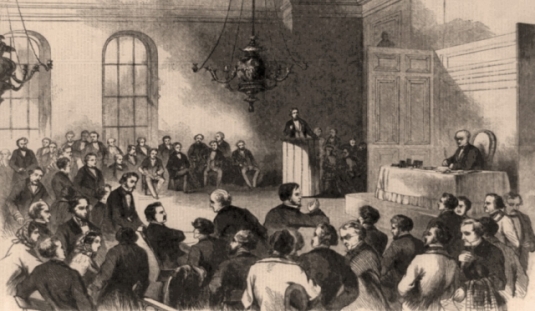
After a brief absence, Sickles returned to Congress and to Teresa, who was now even a worse social pariah than her husband. After the murder and for the duration of the trial, Teresa remained at one of the family homes in the New York countryside under the care of her parents. She followed the trial and occasionally wrote to Dan in jail, and over time he began to write back. Teresa was thrilled with the verdict and she honestly believed that the marriage and her reputation could be rehabilitated, and that she could be restored to a normal wife. The normal family values system of the time would have now involved Sickles divorcing his tarnished wife. That would have been “the predictable and conservative course.” [1] But despite his own continuing excursions into infidelity and his rage over hers, Sickles still loved her, and could not fathom divorcing her. His father George and Teresa’s father Antonio “were stricken with the same delusion as Teresa – that reconciliation would be tolerated by society.” [2]

Had the recently celebrated Congressman done divorced Teresa, his political career, while crippled, might have resumed its previous upward trajectory. But the ever unpredictable Dan Sickles “shocked everyone by forgiving Teresa and resuming their former relationship.” [3]

It was a characteristic of the time, and in some place even today in that maintained the belief that an adulterous wife knew no forgiveness, and Sickles “put himself beyond the pale by the simple act of forgiving his wife and restoring her to his bosom.” [4] Murder could be forgiven, a man’s indiscretions as well, but forgiving an adulterous women, especially a wife and mother was unforgivable. All the better people had already assigned the appropriate scarlet letter to the fallen woman, and they were shocked into paroxysms of moral outrage when Sickles apparently forgave her transgression.” [5] Sickles action was totally “out of kilter with an age that neatly divided women into “saintly mothers,” “pure virgins,” and “fallen women.” [6] Frankly the action was shocking to New York and Washington society, and both Dan and Teresa paid the price, but the price paid by Teresa would be greater, and ultimately contribute to her death, a death that occurred far too early.

Sickles was flailed in the papers, the New York Dispatch noted “His warmest personal and political friends bitterly denounce his course.” While the Sunday Courier wrote, “His political aspirations, his career in life, once so full of encouraging brightness, and his business prospects, have all been blasted by this act.” [7]

The Sunday Mercury put their condemnation published a biting bit of poetry lampooning both Dan and Teresa:

Hail matchless pair! United once again, In newborn bliss forget your bygone pain…

What the world may say, “with hands all red Yon bridegroom steals to a dishonored bed”

And friends, estranged, exclaim on every side: “Behold! Adultery couched with Homicide! [8]

Even long time friends were like James Topham Brady who had defended him at his trial were livid. Interestingly enough it was Sickles old foe Horace Greeley who “flew in the face of convention by commending Sickles for his forgiveness.” [9] But Greeley was an exception, and in the face of the critics sent a letter to the New York Herald in which he fired a broadside:

“Referring to the forgiveness which my sense of duty and my feelings impelled me to extend to an earring and repentant wife… I am prepared to defend what I have done before the only tribunal I recognize as having the slightest claim to jurisdiction over the subject – my own conscience and the bar of Heaven. I am not aware of any statute or code of morals which makes it infamous to forgive a woman… And I cannot allow even all the world combined to dictate to me the repudiation of my wife, when I think it right to forgive her and restore her to my confidence and protection. If I have ever failed to comprehend the utterly desolate position of an offending though penitent woman – the hopeless future, with its dark possibilities of danger, to which she is proscribed as an outcast – I can now see plainly in the in the almost universal howl of denunciation with which she is followed to my threshold…” [10]

Dan Sickles the sinner had struck back at his Pharisaical accusers with the aplomb of Christ himself, who had forgiven the adulteress woman, but it did little to change public perception. Teresa would always be the adulteress, abandoned by friends and scorned by society at large. Dan, who even with the scandal of the Key murder behind him and who would have been forgiven had he denounced and divorced his wife, was now a pariah, even among his peers and colleagues. Mary Boykin Chesnut, wife of a renowned senator, and prolific diarist from South Carolina “sat in the House gallery one day and saw Sickles deliberately, and totally ostracized. He was sitting all alone, like Catiline, every other member careful not to come near him – “left to himself as if he had the smallpox.” [11] When Chesnut asked a friend why he was shunned, the friend noted that the murder of Key “was all right… It was because he condoned his wife’s profligacy and took her back… Unsavory subject.” [12]

But for Teresa it was worse. She was “socially exiled, shunned even by humble neighbors, compelled to keep the house by day or face the sneers and hoots of such street trash as recognized her, cut off from her cherished riding and walking, coped up with a loving but over emotional mother, a penurious, egocentric father, Teresa, torn between grief for the dead, contrition for the living, began to fail…” [13] Despite his defense of her and officially taking her back, he spent little time with her and she never again accompanied him in any of his assignments, in the military, or after the war. But his policy of leaving her behind was not due to cruelty or neglect, as Dan and Teresa were “merely accepting an accomplished social fact, knowing Teresa would forever be an outcast and forever be an outcast and would be exposed to endless snubs and torment were she be so rash as to essay a new entrance into society.” [14] In his own way Dan loved her, but neither could change the attitude of a society where Puritanical morality still reigned, and the granddaughter of Giacomo Casanova’s friend could never be forgiven, and whose relationship with her husband would always be haunted by the ghost of Barton Key. Nothing could change that, and soon Teresa lost the will to live though she was not even twenty-five years old. “Sleepless, she took refuge in opiates….She sank slowly from frailty to invalidism.” [15] She contracted tuberculosis, and though she attempted to maintain her household she suffered from severe depression, and again took up her family’s Catholic faith. Catholic rosaries, missals, holy cards, and other items filled her bedroom. Eventually, she died unexpectedly in January of 1867, with most people thinking that she would yet recover. She was only thirty-one years old. Dan, now serving as military governor in South Carolina was stunned. Her pallbearers include James Topham Brady, and four U.S. Army generals including Sickles former comrade Alfred Pleasanton and his Gettysburg aide Henry Tremain. In death she finally found a measure of public sympathy, the funeral Mass was attended by many mourners, and as Sickles and his now teenage daughter Laura followed Teresa’s casket out of the church, “His feelings now broke forth and he wept, and the large congregation rushed tumultuously from the building after him, testifying to the hold he held on their hearts, and the extent to which they shared his affliction.” [16] In light of the prevailing morality of the day can wonder if most of the mourners had more sympathy for Sickles than his now dead wife. Unlike the adulteress of the Gospels, Teresa Sickles had no one to

Notes

[1] Ibid. Sears Controversies and Commanders p.200

[2] Ibid. Keneally American Scoundrel p.202

[3] Ibid. Wilson and Clair They Also Served p.100

[4] Ibid. Catton Glory Road p.152

[5] Ibid. Sears Controversies and Commanders p.200

[6] Ibid. Pinchon Dan Sickles p.136

[7] Ibid. Swanberg Sickles the Incredible p.72

[8] Ibid. Keneally American Scoundrel p.203

[9] Ibid. Swanberg Sickles the Incredible p.73

[10] Ibid. Swanberg Sickles the Incredible p.74

[11] Ibid. Catton Glory Road p. 152 Catiline was a counsel of Ancient Rome is best known for two attempts to overthrow the Roman Republic in 62 BC. His plot was exposed before the Senate by Cicero and he is famously depicted in Cesare Macari’s painting sitting alone in with his head down as Cicero denounces him before the Senate.

[12] Ibid. Hessler Sickles at Gettysburg p.20

[13] Ibid. Pinchon Dan Sickles p.136

[14] Ibid. Swanberg Sickles the Incredible p.282

[15] Ibid. Pinchon Dan Sickles p.137

[16] Ibid. Keneally American Scoundrel p.329

Leave a comment

Filed under civil war, crime, History, marriage and relationships

Dan Sickles Part Three: “The Whole Country Turned Jury”

Friends of Padre Steve’s World,

I am taking a break for a while to read and reflect and as such I and am re-posting some articles from my Gettysburg text dealing with a man that I consider one of the most fascinating , salacious, scandalous, heroic, and incredible figures ever to grace and disgrace American history, Congressman, and Civil War General Daniel E. Sickles.

I hope that you enjoy,

Peace

Padre Steve+

HD_TrialofDanielSickles1859.preview

The Sickles Trial

The stage was now set for the one of the most unbelievable and storied trials in American history, a trial that would have been much more suited to the era of 24/7 cable news coverage and the Internet than the era of the telegraph and newspaper, but even so it was sensational by any standard and it riveted the attention of the public in every part of the nation, from the largest cities to the smallest towns.

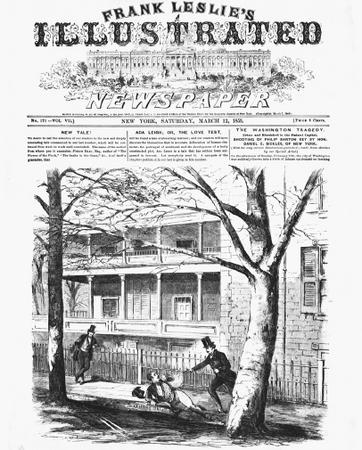
Almost immediately swarms of journalists were camped outside the prison and Sickles’ house where distraught Teresa sought a way to gain Dan’s forgiveness having received his broken wedding band which he sent to her from the jail. Witnesses to her dalliances with Key at the 15th Street house and other venues were brought to the Stockton Mansion to identify her. “She was the meat in the market, the ogre at the carnival. A little way across the square, souvenir hunters were cutting fragments of wood out of the tree by which Key had fallen, and artists from the illustrated papers set up their easels and began sketching every aspect of the area – the railings, the Stockton Mansion, the Clubhouse.” [1] A Presbyterian pastor who knew the couple found her obsessed by the shame that she had brought upon herself and her daughter, and he “found her in such mental agony that he feared for her sanity and even felt that she might try to take her life.” [2]

It was a credit to her own emotional strength that Teresa survived the ordeal that she had helped to bring about, and which she found herself blamed for, even by her father, who felt that she had dishonored the Bagioli family name. Antonio Bagioli wrote to Dan in prison, “You have heaped on my child affection, kindness, devotion, generosity. You have been a good son, a true friend, and a devoted, kind, loving husband and father.” [3] Of all the commentators, it was the eminent historian and diplomat George Bancroft who seemed to have any “sense of Teresa’s pain: “Poor child, what a cruel thing to deprive her of her sole stay and support. Key was the only man she could look to for sympathy and protection.” [4]

After Barton Key’s lifeless body was borne off in a mahogany casket to the Presbyterian cemetery in Baltimore and buried in the grave of his dead wife, and his children placed in the care of his family, his effects, what they amounted to, including his resplendent Montgomery Guards uniform were “sold off to a morbid, bargain-hunting, souvenir-hounding crowd.” [5] It was an ignoble end to the scandalous story of the son of Francis Scott Key, a story that soon with all of its salacious detail would be revealed to the public.

Meanwhile, inside the jail her husband, alternating between fits of rage and calm was visited by Washington’s Mayor James Barret, Sam Butterworth, Attorney General Black, Vice President John C. Breckinridge, and Speaker of the House, James Orr. He was comforted by the many expressions of support and sympathy found in scores of letters from people around the country, one of the first “a kindly note from the President,” [6] and others from total strangers. He was also joined by friends and allies from New York and Washington. “James Topham Brady, John Graham, and Thomas Francis Meagher, able lawyers all, arrived post haste to defend their rash ally” [7] as well as his father who before offering encouragement to his son offered a sharp chastisement, “You hot-headed fool! That’s no way to settle things! No woman’s worth it! No matter how you come out of this, you’ve killed your career – White House and everything else.” [8]Undeterred and calm Dan told his father that he understood and that if he had to he would do it again, after which, his father began to discuss the organization of his son’s defense with this legal team.

rerl_02_img0122

The case was front page news in all the major newspapers, which provided “extensive coverage of the “Sickles Tragedy.” Sickles’ murder of his friend Key in broad daylight in view of the White House had all of the scandalous elements that have thrilled Americans then and even today: “adultery, politics, celebrity, and a handsome corpse,” [9] not to mention a beautiful young woman who even more than her husband who had killed a man, stood accused in the eye of the public.

Despite the notoriety of the case, many people found sympathy with Sickles and believed that no jury would convict him of murder or manslaughter, after all, Teresa was the one who committed adultery with Key. The New York Herald “doubted that a grand jury would indict him. Even if he were indicted, Harper’s Weekly presumed that no jury would convict him of manslaughter if the adultery charge were proven, which it considered a foregone conclusion.” [10] The New York Times noted well before the trial opened, “there appears to be no second opinion as to the certainty of Mr. Sickles acquittal” but “national interest” arose from “the general desire to see the whole case fairly put, and the million scandals of mystery laid to rest by the plain facts.”[11]Newspapers like the New York Evening Post, his political arch-enemy found the murder an excellent opportunity to attack Sickles, “That wretched man, Daniel E. Sickles, has in his career reached the stage of assassination, and dipped his hands in human blood… It is certain that a man… who in his own practice, regards adultery as a joke and the matrimonial bond as no barrier against the utmost caprice of licentiousness – has little right to complain when the mischief which he carriers without scruple into other families enters his own.” [12] But such commentary was the exception, and it came from the organ of a political enemy. It is an interesting comment on the era, that a woman’s adultery, even when committed by the wife of an adulterous male who had killed her lover, was consider more of a social stigma and crime than murder.

Within days Sickles had assembled one of the most formidable defense teams ever to dominate an American court. Brady, who was considered to be the ablest criminal defense lawyer of his day became the lead attorney for the defense team, and was joined by Sickles’ New York friends, Graham and Meagher. Brady was an excellent choice, he “was admired and even loved by society in general, but on top of that, though his legal repertoire was wide, he had been involved successfully in more than fifty murder cases.” And he “had also made a special study of pleas of insanity,” [13] something that would figure greatly in the trial.

Additionally, President Buchanan helped recruit one of the finest attorneys in the country, the future Secretary of War, Edwin Stanton to the team. They were joined by four lesser known, yet high-powered attorneys; Samuel Chilton a Virginian who later represented John Brown, and his partner Allen Magruder, Daniel Ratcliffe, and Philip Phillips, a former Alabama Congressman and member of Washington’s Jewish community. Additionally, Reverdy Johnson, one of the most respected attorneys of the day served as an occasional advisor. “The Washington Evening Star observed that Sickles was collecting a lot of lawyers for a man whose defenders did not expect to leave their box before acquitting him.” [14]

Sickles’ defense team was a nineteenth century legal Dream Team against which the government deployed but one attorney, Key’s former assistant District Attorney Robert Ould. Ould, described by one of Sickles’ biographers as “a dull bull of a man, at one time a Baptist parson,” [15] had been named acting District Attorney by President Buchanan when Key was killed. It was an odd place for Ould, as he was serving to prosecute his former boss’s killer, at the behest of the President, who happened to be one of the defendant’s best friends. Ould, the former parson “was placed by inference in the unhappy position of defending adultery – something that he indignantly denied, insisting that he was merely prosecuting a killer….” [16] but to many people, the murderer of an adulterer by an aggrieved husband was complete justified. Ould was totally outclassed by the defense team, and Key’s family paid to have John Carlisle a respected Washington attorney to aid Ould in the case, but the trial would prove them appear incompetent and not up to the task of convicting Sickles.
HarpersMagazineTeresaConfession

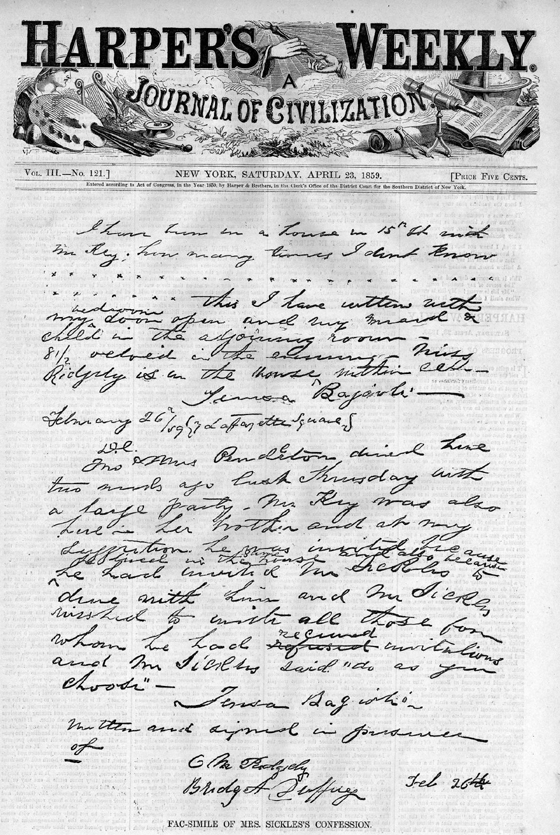
Teresa Sickles Confession on the Front Page of Harper’s Weekly

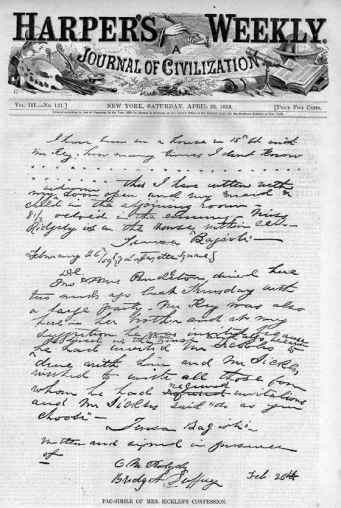
The defense pushed for a speedy trial and decided, as many lawyers do today, to try the case in the newspapers, which in light of the lurid nature of the story hung on every word coming out of Washington. The defense team pursued the strategy of “entirely reversing the roles of Sickles and Key by putting the dead man on trial for having made a victim of the defendant, and the New York Press prepared the public for just such an emotional appeal.” [17] The news stories printed by papers that supported Sickles as well as those of his detractors helped inflame the public as the newspapers across the country “wherever wires ran, were front-paging the story under screaming headlines and, in larger cities, rushing out extras every hour or two, as fresh details came to hand.” [18] The private affairs of Dan and Teresa Sickles became known around the nation, and even though the judge in the case refused to admit the confessions Sickles had forced from Teresa into evidence they found their way into the papers, some like Harper’s not only ran the text but reproduced the confession in enlarged facsimile form. The question in many people’s mind “was Dan Sickles justified in slaying the man who had betrayed his confidence and seduced his wife?… As a consequence the whole country turned jury.” [19]

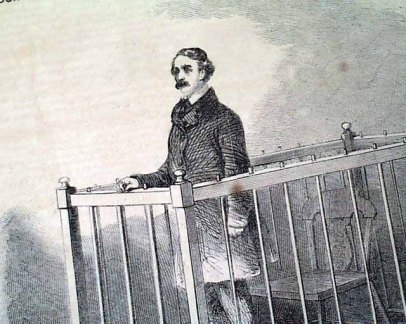
The trial began on April 4th, just over a month after the killing and barely a week after the indictment was handed down. The first three days involved jury selection, a task that the defense turned over to Philip Phillips, who sparred with the prosecutor Ould over the twelve men who would eventually sit in judgment of Dan Sickles. Ould attempted to gain a favorable jury by introducing the property qualifications of jurors, he “ruled out jurors who did not meet the requirement of owning property valued at $800. Since this $800 property limit had not been imposed in similar cases, Ould’s insistence on it would attract much scorn from Dan’s lawyers…”[20]Sickles’ team fought back embarrassing Ould in the process, but not getting the judge to change his narrow application of the law to help the defense. Over two hundred potential jurors were examined before twelve unbiased jurors could be found, and a “great majority of those dismissed confess strong prejudice in favor of the prisoner.” [21] When the jury was seated it was composed of twelve men, two farmers, four grocers, a merchant, a tinner, a coach maker, a men’s clothing salesman, a shoemaker, and a cabinetmaker, “but not a single “gentleman” in the occupational sense.” [22]

Ould opened his case, “ponderously, powerfully, in the blackest of terms,” [23] he drew a picture of the killing. He delivered an “emotionally charged argument that Sickles, “a walking magazine,” had taken deliberate care in arming himself against Key, who only had “a poor and feeble opera-glass.” [24] Ould argued “that homicide with a deadly weapon, perpetrated by a party who has all the advantage on his side and with all the deliberate cruelty and vindictiveness, is murder, no matter what the antecedent provocation in the case.”[25]He then called twenty-eight witnesses, the majority of whom had actually witnessed the shooting, but he did not call upon Butterworth, Teresa, or the young White House page boy who had told President Buchanan and been sent away. Likewise he had not established intent, a key factor in any murder trial, nor had he introduced evidence that he had obtained regarding Sickles’ own affairs with women in Philadelphia, Baltimore, and elsewhere. The presentation of the physical evidence of Barton Key’s clothing and the bullet that supposedly killed Key was botched, the bullet that the prosecution claimed to have killed key did not fit either the Derringer, or the Colt revolver. Thus Ould left open for the defense the chance to explore all the salacious details of the case to put Key on trial, and to establish exculpatory reasons why Sickles had killed Key. Ould’s presentation of his case was brief, and so futile “that it seemed that Key was on trial for seduction, not that Sickles was on trial for murder.” [26]
sickles in the box

Sickles in the Prisoner’s Dock

The defense team made mincemeat of the prosecution. John Graham’s opening statement was a work of oratory genius that “would massively outshine Robert Ould’s more cumbersome opening.” [27]Weaving allusions from Shakespeare and other literary greats into his statement, he painted Sickles as the victim of a adulterous rogue who had on a Sunday, a day when he should have “sent his aspirations heavenward,” had instead besieged “that castle where for security and repose the law had placed the wife and children of his neighbor.” [28] Casting Sickles as the aggrieved and temporarily insane victim he also asked if it was a “crime for a husband to defend his family altar.” From there he proceeded to use quotes from Shakespeare’s Othello he inveighs against the adulterer as the supreme criminal, piling up quotation upon quotation from the Old Testament and Roman law to show that in wiser days the punishment invariably was death’” [29] to paint the picture of Sickles’ agony as he saw the man who had defiled his wife prowling outside of his home. Graham then went to provocation and argued that due the circumstance of the crime, a friend and confidant attempting to defile Sickles’ wife on a Sunday that the prosecution “needed to prove Dan’s sanity at the time of the act. And they could not do that, because there was not enough in the case “to melt the heart that is not cut from the unwedgeable gnarled oak.” [30] It was a masterful performance.

Over the next two weeks, Brady, Stanton, and Graham would continue to hammer the prosecution case. The defense proved that Key’s family had tampered with evidence, including testimony from a locksmith who had changed the locks at the 15th Street house at the direction of Key’s family. Witness after witness was introduced to undermine the prosecution and support the defense’s claim that Sickles’ was indeed in a state of uncontrollable madness, and the defense deftly parried the prosecutor’s rebuttal witnesses. When Ould attempted to keep African American witnesses from testifying Stanton, thundered and“accused the prosecution of a “monstrous” attempt to suppress evidence in its zeal of the defendant’s blood,” [31] and argued from North Carolina precedent that the prosecution was not willing to grant Sickles the same right as a slave. As his lawyers argued his case and witnesses gave testimony Sickles maintained his composure except for a number of times when he broke down and had to be excused from the proceedings. “Whether the courtroom histrionics were real or an award-winning performance, the jury witnessed firsthand a husband who was mentally unable to bear his wife with another man.” [32] On the Friday the 22nd of April Judge Crawford declared the testimony closed and the next day began the closing arguments.

Saturday April 23rd dawned with a violent gale, but that did not prevent crowds of people from trying to gain admittance to the courtroom. Edwin Stanton began the defense closing arguments in a manner that was calm and precise. He brought up that justifiable homicide included that which was “committed in defense of family chastity, the sanctity of the marriage bed, the matron’s honor, the virgin’s purity.” [33] Since the prosecution had never brought into evidence Sickles’ own violation of these covenants his attacks on Key and the prosecution case hit home. As he continued his voice rose to a roar, sounding like a prophet of ancient Israel “Who seeing this thin, would not exclaim to the unhappy husband, “Hasten, hasten, to save the mother of your child! And may the Lord who watches over the home and family guide the bullets and direct the stroke!” [34] When Stanton finished the court erupted in a frenzy as spectators as well as supporters of Sickles applauded his closing.

Next up was Brady who went on for three hours, captivating the audience which hung on every word. “When Daniel Sickles realized how he had been betrayed, all the emotions of his nature changed into a single impulse; every throb of his heart brought before him the sense of his great injuries; every drop of his blood was burdened with a sense of shame; he was crushed by inexorable agony in the loss of his wife, in the dishonor that he had come upon his child, in the knowledge that the future – which had opened to him so full of brilliancy – had now been enshrouded in eternal gloom by one who, contrawise, should have invoked form the eternal God his greatest effulgence on the path of his friend….” [35]

The closing had been masterful, emotional, and dramatic. In response Ould attempted to recover, but his arguments were weak, he agreed with the defense about the crime of adultery, and attempted to redirect the jury’s attention that it was Sickles who was on trial for murder and not Key for adultery, but he had already lost that argument. He called the defense of temporary insanity a ploy and “mentioned how easily, and readily a man on trial for his life might pretend to be deranged if he were on trial for his life.” But it was too little, too late. Since there was no psychiatric profession to weigh in on the matter, the argument of temporary insanity fell back on the “tradition of male marital dominance” and “that argument played well among men who rarely wore collars on their shirts…” [36] the very kind of men seated in the jury booth.

When the jury recessed to deliberate Sickles’ fate on the 26th it took them less than an hour to return their verdict, and few were surprised when it came back “not guilty.” Stanton “was so excited that he did a jig in the courtroom, the hoarsely called for three cheers.” [37]As he did “Pandemonium and cheers broke out in the courtroom.” [38]People crowded around to congratulate Sickles and the crush was so great that Sickles had to be escorted for the courtroom. President Buchanan on hearing the verdict was delighted, later in the evening, though he sought rest, Sickles was taken by Brady to a gala in his honor attended by nearly 1500 supporters and well-wishers. The trial was over but the trials of Dan Sickles were not.

Notes

[1] Ibid. Keneally American Scoundrel p.142

[2] Ibid. Swanberg Sickles the Incredible p.63

[3] Ibid. Keneally American Scoundrel p.146

[4] Ibid. Keneally American Scoundrel p.147

[5] Ibid. Pinchon Dan Sickles p.117

[6] Ibid. Pinchon Dan Sickles p.117

[7] Ibid. Swanberg Sickles the Incredible pp.62-63

[8] Ibid. Pinchon Dan Sickles p.116

[9] Ibid. Hessler Sickles at Gettysburg p.12

[10] Marvel, William Lincoln’s Autocrat: The Life of Edwin Stanton University of North Carolina Press, Chapel Hill 2015 p.103

[11] Ibid. Hessler Sickles at Gettysburg pp.12-13

[12] Ibid. Swanberg Sickles the Incredible p.63

[13] Ibid. Keneally American Scoundrel p.151

[14] Ibid. Marvel Lincoln’s Autocrat p.103

[15] Ibid. Pinchon Dan Sickles p.121

[16] Ibid. Swanberg Sickles the Incredible p.64

[17] Ibid. Marvel Lincoln’s Autocrat p.104

[18] Ibid. Pinchon Dan Sickles p.118

[19] Ibid. Pinchon Dan Sickles pp.118-119

[20] Ibid. Keneally American Scoundrel p.162

[21] Ibid. Pinchon Dan Sickles p.120

[22] Ibid. Marvel Lincoln’s Autocrat p.105

[23] Ibid. Pinchon Dan Sickles p.122

[24] Ibid. Hessler Sickles at Gettysburg p.14

[25] Ibid. Pinchon Dan Sickles p.122

[26] Ibid. Swanberg Sickles the Incredible p.65

[27] Ibid. Keneally American Scoundrel p.173

[28] Ibid. Keneally American Scoundrel p.173

[29] Ibid. Pinchon Dan Sickles p.124

[30] Ibid. Keneally American Scoundrel p.175

[31] Ibid. Marvel Lincoln’s Autocrat p.107

[32] Ibid. Hessler Sickles at Gettysburg p.15

[33] Ibid. Pinchon Dan Sickles p.127

[34] Ibid. Pinchon Dan Sickles p.128

[35] Ibid. Pinchon Dan Sickles p.129

[36] Ibid. Marvel Lincoln’s Autocrat p.110

[37] Ibid. Swanberg Sickles the Incredible p.66

[38] Ibid. Hessler Sickles at Gettysburg p.17

Leave a comment

Filed under crime, History, Loose thoughts and musings

Murder in Lafayette Square, Dan Sickles: Part Two

Friends of Padre Steve’s World,

I am taking a break over the next few to read and reflect I am re-posting some articles from my Gettysburg text dealing with a man that I consider one of the most fascinating , salacious, scandalous, heroic, and incredible figures ever to grace and disgrace American history: Congressman, and Civil War General Daniel E. Sickles.

I hope that you enjoy,

Peace

Padre Steve+

philip-barton-key-granger


Within a year of his assignment Sickles returned to the United States to help prepare the Democratic nomination for his friend Buchanan who had long desired the office, and return to his lucrative post in New York. In the spring of 1856 Sickles began to work on Buchanan’s nomination for the Presidency and while doing so began his own campaign for New York’s Third District’s Congressional seat. Buchanan won the election of 1856 against an opposition divided between the Know Nothing candidacy of former President Millard Fillmore and the candidate of the new Republican Party, John C. Fremont.

In the election of 1856, Sickles carried the district easily. For Sickles it was a triumph, he was “riding a flood tide of political fortune that might carry him far,” [1] and like any wife Teresa too was delighted with the result. Even so, Teresa must have wondered if her husband would mend his ways now that he was on the national spotlight, or if he would continue his extramarital romps around the nation’s capital. Following the election Dan and Teresa moved to Washington D.C. where they took up a fashionable residence, the Stockton Mansion, on Lafayette Square, not far from the White House and Sickles friend, James Buchanan.

Once he was established in Washington Sickles was in his element, politics at its grandest. It was a different style than of politics than Tammany, where brass knuckled force often ruled, but it suited Sickles, who was “a fixer who knew all the tricks of Tammany at its crookedest but who seems not to have taken graft himself. He had his sights fixed on the presidency, and he was making about as much progress in that direction as a Tammany man can,” [2]   until a strange combination of unrequited love, infidelity, the personal betrayal of a friend, and a murder intervened.

HarpersMagazineMrs.Sickles

Teresa Sickles

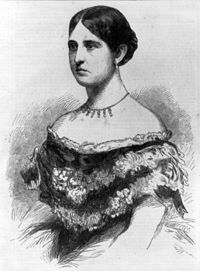
While her husband politicked along the Potomac, the new congressman’s wife was adapting to her life in Washington D.C. The wives were expected to entertain and host parties on a regular basis at their residences, but they also knew their share of loneliness and neglect. Since legislators routinely were “busy with night sessions, committee meetings, and plain nocturnal politicking over whiskey punch, that their wives either accepted other escorts or spent lonely evenings at home with fancywork or a book.” thus it was not surprising that Teresa, “should seek the gayety of the capital in her first year there.” [3] In the absence of their husbands it “was not uncommon for available bachelors to act as escorts for married women when their husbands were unavailable.” [4] Since Dan Sickles was frequently unavailable and since Teresa probably still suspected that Dan was still engaged in extramarital affairs, it is not surprising that the young Mediterranean beauty found comfort in another man.

The years of 1857 and 1858 would be a tumultuous time for the nation as well as the Sickles. Buchanan had been elected because of his stability and moderation in an age of pro and anti-slavery radicalism. However, over the next year his presidency, and his would be overwhelmed by events and Buchanan’s decisions supporting the expansion of slavery. While Sickles was neither a slave owner, nor himself fond of the institution, it was part of life, and many of his friends in Washington D.C. and in Congress were slave holders. Buchanan had schemed before his inauguration with Chief Justice of the Supreme Court Roger Taney in the Dred Scott decision, which was handed down in the days following Buchanan’s inauguration, followed by the fiasco over the Lecompton constitution and the attempted admission of Kansas as a Slave State, an event which split the Democratic party in the 1860 election, ensuring Abraham Lincoln’s defeat of Buchanan’s Lecompton foe in the Senate, Senator Stephen A. Douglas who would have been the prohibitive favorite in the election had the split not occurred.

Likewise, Sickles and his beautiful young wife would become part of one of the most sensational trials of American history, rivaling the Lindbergh kidnapping trial, the trial of O.J. Simpson, the Scopes Monkey Trial, and the Impeachment of President Bill Clinton in its captivation of America. As in London, Teresa became popular and she and Dan were much sought after and their home “became the scene of a gradual number of and entertainments,” [5]and even as Sickles continued his robust politicking and philandering Teresa became the object of another’s affection, the District of Attorney for the District of Columbia, Philip Barton Key, the son Francis Scott key, the writer of the Star Spangled Banner. Interestingly enough it was Sickles who had helped Key the troubled man to be reappointed to his office in early 1857 after Key had helped Sickles overcome legal and financial difficulties to secure Sickles in the Stockton Mansion and the two men developed a warm friendship.

Philip Key was extraordinarily handsome, especially when outfitted in his green and gold militia uniform of the Montgomery Guards, and was considered one of the most desirable men in Washington. An accomplished horsemen he rode about town on his “horse Lucifer – a nobly bred, dapple gray hunter.”[6] When he gained Sickles’ friendship many of his well to do political and society friends became frequent visitors to the Sickles household. After Sickles had helped Key to be reappointed to his office, Key was instrumental in helping make the arrangements for Sickles to rent the Stockton Mansion.

During his first term in office Key was not known for being a particularly good District Attorney and spent much time away from the office complaining about his allegedly poor health. But his health did not keep him away from Washington’s party scene and “One hostess called him “the handsomest man in all Washington… he was a prominent figure at all the principle functions; a graceful dancer, her was a favorite of every hostess of the day.” [7] When he met Teresa, the dashing bachelor took an intense interest in the wife of the man who had helped him retain his job. The two were soon attending many functions together that Sickles, due to his work schedule could seldom attend.

Within weeks Key became a frequent guest at the Sickles home and few were surprised at this, as most observers knew that Sickles was responsible for Key’s reappointment. With Sickles now fully engaged in the dramatic political battles of late 1857, Teresa and Key began to spend much more time together. The two were seen together at the “theater, at teas, at hops. But most of all they went riding together.” [8] The frequency of these visits was noted and became the source of much gossip but Sickles was unaware of it and entertained no suspicions that his new friend was becoming deeply involved with his wife, and that Key had rented a room where the two could intimate.

That was until a young man equally smitten by Teresa had a few drinks with a colleague and the colleague shared the information with a loyal Sickles ally who then told Sickles. Sickles was shocked and called for a meeting with Key, however, after a brief conversation, Key convinced Sickles that there was nothing to the rumors, and Sickles was satisfied.

Though Sickles had been satisfied by the explanation, “despite his own well-publicized moral lapses, Daniel Sickles was a man of intense personal pride who would not countenance the breath of scandal attaching to his wife.” [9] He took the time to warn her to make sure that she was not involved in any other indiscretions, and left the subject. However, Key and Teresa continued to see each other, and “she and Barton thought that they were taking more care, and being less observed by people than they were.” [10] Yet as they pursued one another their affair became increasingly public, and seen by too many people not to go unnoticed. The two were seen together in at the Congressional Cemetery, and frequently at a house at “385 15th Street where he would enter the by the front door – and she the back.” [11] When a mutual friend expressed his concerns, Key shrugged off the warning, and “with the bravado of a proud weakling, he still held his course. And Teresa, ductile, enamored, blindly followed his lead.” [12] Another friend of Key suggested to him that he could be in danger, but Key “bridled and patted the breast of his coat. “I am prepared for any emergency,” he snapped. Key was a crack pistol shot and his friend believed that Key was preparing for a possible confrontation. [13]

Like so many people young spouses who find their needs unfulfilled at home, and who suspect their spouse of infidelity, , “Teresa did not see this love affair as tragic and dangerous. She lived within it as a secret fantasy, as in a virtual and time-consuming experience that lacked any power to inflict damage on other areas of her life.” [14] She became less discreet, Key would signal to her from across the street to confirm their dalliances and despite their insipidly inept attempt to hide the affair it became clear to Sickles’ coachman and household maids that the two were engaged in sexual encounters in the Sickles carriage and in the Stockton Mansion itself.

The situation finally came to a head in February 1859 following Sickles reelection and return to Washington. “Made more reckless than ever by their recent separation, Barton and Teresa now again were seen everywhere together.” [15] The couple were now making clandestine liaisons on a nearly daily basis, and eventually, one of the observers decided to tell Sickles. The anonymous source, using the initials of R.P.G. sent Sickles a letter detailing the affair. Sickles received the letter from a butler on the night of Thursday February 24th as he was leaving the usual dinner party at his house for the traditional hop that followed at the Willard Hotel.

Sickles did not read the letter until after the couple returned home and Teresa had gone to bed. Sickles was stunned and at first did not believe the contents as he placed little stock in anonymous messages. So he had George Wooldridge, a longtime friend and congressional clerk investigate, and on Saturday February 26th Wooldridge confirmed Sickles worst fears. That evening at their home Sickles confronted Teresa about the letter and as he stormed about angrily in their bedroom she confessed, after which Sickles had her write out her confession detailing everything. He may have been desolate and angry, but he was a lawyer, and he got his written proof.

But scandal was the last thing that Sickles wanted, as he had higher aspirations in politics, so he immediately called his friends for counsel and by Sunday morning several, including Wooldridge and Samuel Butterworth were at the Stockton Mansion with Sickles. As always, Sickles’ “first thoughts were for himself, and he melodramatically”[16] exclaimed to Butterworth, “I am a dishonored and ruined man…I cannot look you in the face.” [17]

4P8V9475

Murder

His friends “were profoundly touched by the depth of his feeling, and were convinced that he needed to be saved from a severe derangement of his senses; from lunacy, that is.” [18] his friends attempts to calm him, Sickles was beside himself with anger, and his anger now swirled around his marriage and what he believed was the scandal that would cost hi his career. That afternoon, Key again tempted fate, this time, for the last time. He had been tipped off by an anonymous letter that the affair was public, but he was determined to see Teresa. He made several passes by the house, each time signaling with a handkerchief, until Sickles observed him. Sickles called out to Butterworth “That villain has just passed my house! My God, this is horrible!” [19]

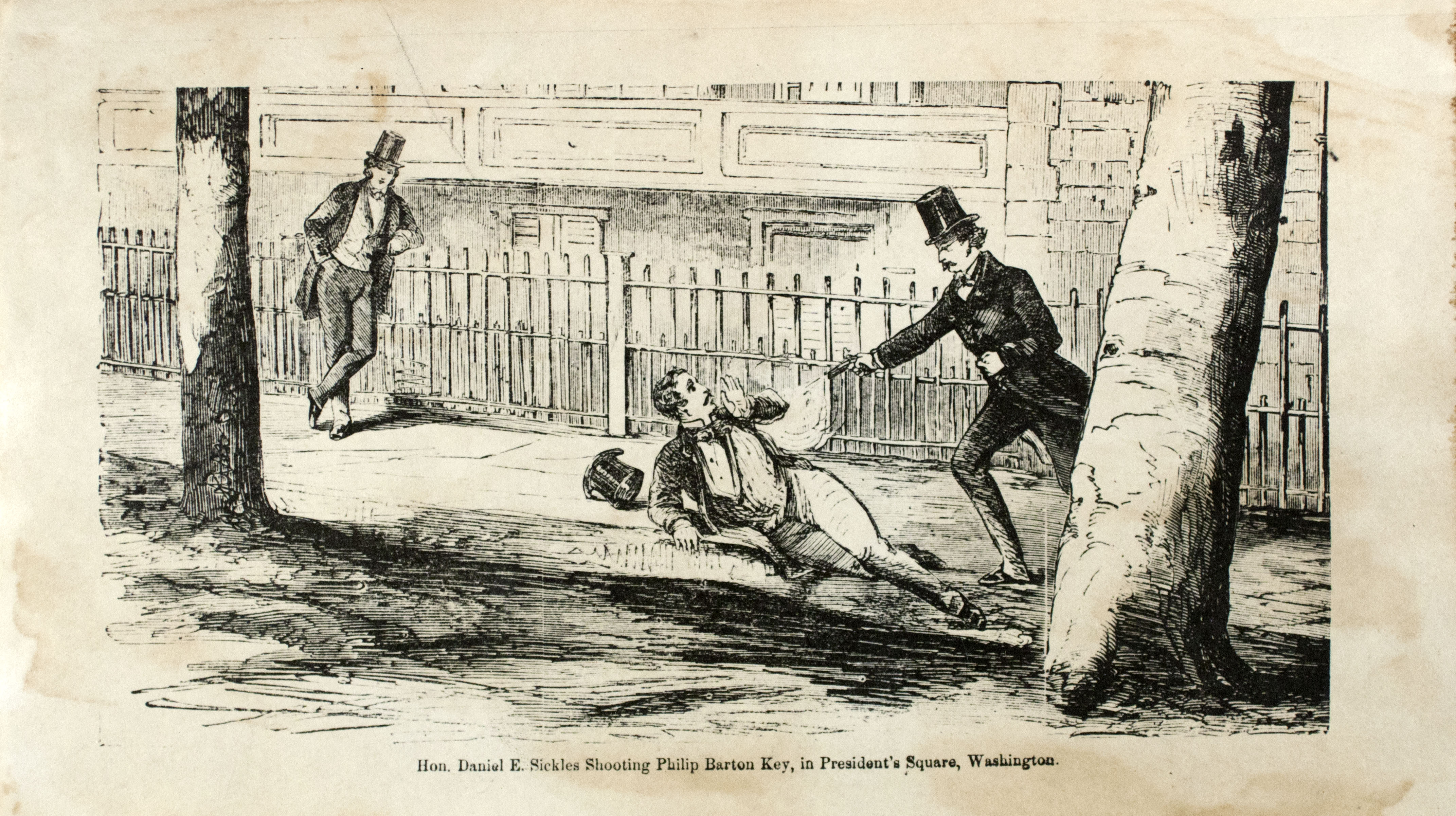
Butterworth left the house first and met Key at the southeast corner of Lafayette Square across from the White House. Allegedly not knowing Sickles intended any harm, Butterworth walked with Key to for a few minutes and then left. The exchange delayed Key and gave Sickles, who had armed himself with a single shot large caliber Derringer, and a muzzle-loading Colt revolver, enough time to catch up with Key near the Club House on Madison on the east side of the square. Sickles was raving but Dan’s fury transcended reality,” [20] as at least a dozen witnesses were nearby as he screamed, “Key, you scoundrel, … you have dishonored my bed – and you must die!” [21] Sickles pulled out the revolver, the first shot from which grazed Key, and the second which misfired. A brief scuffle ensued as Key lunged at his assailant, but Sickles flung him to the ground, and drew the Derringer as Key threw the opera glasses that he viewed Teresa at Dan. A third shot hit Key in the groin and he slumped to the ground screaming “Murder! Murder!… Don’t shoot!” [22]

If there was a chance for Sickles to prove that he acted in self-defense it was now, but he could not control himself. He fired the revolver yet again and it misfired. He placed the weapon in his pocket and drew the Derringer, and fired a shot which hit Key in the Liver. As Key writhed on the ground Sickles tossed the Derringer to the ground and he again drew the Colt. As the stunned witnesses to the attack looked on, Sickles advanced toward the fallen Key and placed the gun at his head and pulled the trigger, but again the weapon misfired. As Sickles attempted to place another cap in the pistol, a number of witnesses began to intervene. One man, “a member of the club, running up, stopped him. Mr. sickles – for God’s sake!” And Butterworth, coming forward, took Dan by the arm. Without a word, they walked away together.” [23] Witnesses took the mortally wounded Key away to the Club, where he expired.

President Buchanan was almost immediately told of the murder by a White House page boy, was aware of the implications of the scandal, Sickles was a friend and political ally with much promise. Buchanan told the boy leave town and gave him a sum of money to facilitate his departure. Soon after Sickles and Butterworth went by carriage “to the home of Attorney General Black, where the Congressman formally surrenders himself to the silver-haired Cabinet member who had regarded him as a protégé.” [24]He declined bail in favor of a speedy trial, was allowed to go home where he told Teresa that he had killed her lover, retrieved some personal items and then went to the District jail, “a foul hole, swarming with vermin, destitute of sewage, bath, water, ventilation, and so inadequate to its purpose that often a dozen or more prisoners were herded into a single narrow cell.” [25] When he arrived he reportedly asked the jailer if they were the best accommodations available, to which the jailer responded “this is the best place you members of Congress have afforded us.” [26] Dejected, but undeterred Sickles sent a message to the public, “In doing what I had to do I have broken the law. Therefore I place myself behind bars. It is for you to set me free.” [27] The stage was now set for the one of the most unbelievable and storied trials in American history.

Notes

[1] Ibid. Swanberg Sickles the Incredible p.4

[2] Ibid. Catton The Army of the Potomac: Glory Road p.151

[3] Ibid. Swanberg Sickles the Incredible p.15

[4] Ibid. Hessler Sickles at Gettysburg p.8

[5] Ibid. Swanberg Sickles the Incredible p.16

[6] Ibid. Pinchon Dan Sickles p.74

[7] Ibid. Hessler Sickles at Gettysburg p.9

[8] ibid. Swanberg Sickles the Incredible p.20

[9] Ibid. Swanberg Sickles the Incredible p.25

[10] Ibid. Keneally American Scoundrel p.92

[11] Ibid. Wilson and Clair They Also Served p.99

[12] Ibid. Pinchon Dan Sickles p.94

[13] Ibid. Swanberg Sickles the Incredible p.44

[14] Ibid. Keneally American Scoundrel p.92

[15] Ibid. Pinchon Dan Sickles p.93

[16] Ibid. Hessler Sickles at Gettysburg p.10

[17] Ibid. Swanberg Sickles the Incredible p.53

[18] Ibid Keneally American Scoundrel p.121

[19] Ibid. Hessler Sickles at Gettysburg p.10

[20] Ibid. Keneally American Scoundrel p.127

[21] Ibid. Swanberg Sickles the Incredible p.54

[22] Ibid. Hessler Sickles at Gettysburg p.11

[23] Ibid. Pinchon Dan Sickles p.112

[24] Ibid. Swanberg Sickles the Incredible p.55

[25] Ibid. Pinchon Dan Sickles p.114

[26] Ibid. Keneally American Scoundrel p.135

[27] Ibid. Swanberg Sickles the Incredible p.114

1 Comment

Filed under civil war, crime, History, laws and legislation

Thoughts and Prayers but No Action…

Friends of Padre Steve’s World,

I am at loss for words when I hear members of Congress, the media, and others react to yet another massacre by men using military grade killing machines with the words “praying for the victims” or expressing their thoughts and sympathy for them while refusing to take any action I grow weary. Mind you, I do pray but I am reminded of how many times that the prophets of the Old Testament condemned people who prayed but did nothing about injustice, or the injustices that they themselves condoned, abetted, and took part in. Likewise, I am reminded of the words of James in his epistle that “faith without works is dead.”

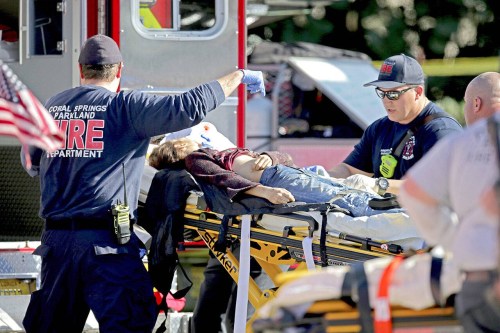
Speaking of dead there are another seventeen people, including 14 children dead in Parkland, Florida, just the latest casualties in a speaking epidemic of gun violence where the perpetrators used various models of the AR-15 semi-automatic assault rifle, including weapons modified to fire on full automatic, and the vast majority of these crimes have been committed by Americans with no connection to Muslim terrorists. Targets have included schools, churches and other places of worship, movie theaters, concert venues, and businesses.

The number of attacks, their frequency, and their deadliness are all increasing, and all that happens in response from the politicians whose pockets are lined by the National Rifle Association, is to offer thoughts and prayers while loosening existing restrictions on gun ownership and weapon types, ammunition, and magazines. Likewise, the same politicians who turn the issue from guns to the mental health of the shooters are the same men and women who seek to reduce access to mental health care. The same politicians, pundits, and preachers that blame the crisis on the breakdown of American families are the ones who support economic policies that force both parents to have to work. The ones who,lay the blame on the educational system are those that reduce funding and eliminate the programs like music, art, literature, as well as vocational classes, and after school programs that broadened the minds and hopes of students.

All we get is thoughts and prayers coupled with an idolatrous worship of the Second Amendment which has been so twisted by its current supporters in ways that the men who wrote it would be appalled. Conservative columnist Brett Stephens recommended repealing the Second Amendment because of how the advances in weapons, and the difference between the situation of our country in 1787 versus today make it obsolete in its current form and interpretation.

Now I am not against guns nor gun ownership. I actually plan on getting my wife and I bolt-action carbines at some point for target shooting. That being said having served in the military for over 36 years and have qualified or familiarized on almost all of the personal or crew served weapons up to the .50 caliber machine gun the LAW, or Light Anti-Tank Weapon; of course that includes the M-16 and M-4 variants of the AR-15. I’m actually pretty good with them. Likewise, as a trauma department chaplain in two U.S. trauma centers, including Parkland Memorial Hospital in Dallas, and having seen the wounded in Iraq, I know the killing power of these weapons; I have seen the dead and mutilated bodies of adults and children. These weapons turn bones into dust and internal organs into jelly. The wounds created by the .223 caliber bullets of the AR 15 and its clones are ghastly. I have seen them up close and personal.

I fully agree with novelist Stephen King who remarked:

“Semi-automatics have only two purposes. One is so owners can take them to the shooting range once in awhile, yell yeehaw, and get all horny at the rapid fire and the burning vapor spurting from the end of the barrel. Their other use – their only other use – is to kill people”

I fully agree, I love shooting them on a rifle range and I love the smell of freshly expended 5.57 or .223 rounds. I like disassembling them, cleaning out the carbon, and putting them back together. When I was going through pre-deployment training on the way to Iraq I had no weapon because I was a chaplain, but I spent my time teaching other Navy and Air Force officers how to use and maintain their weapons. My assistant, who was dual armed on my suggestion with a pistol and an M-16 and I had an agreement when we were in country: if we got into a close combat situation he would pass me the pistol and get credit for anything I hit. Thankfully it never came to that but there were a number of situations in country where we both thought it might happen. Admittedly in our situation it would have been in self-defense but I don’t know if I could live with killing another human being, and yes we were shot at from a distance, on the ground and in the air, and when I was a teenager I was held up at gunpoint.

A lot of people are focusing on the AR-15 or the Russian AK47 or AK-74 assault rifles, but there are a lot of other weapons with similar capabilities that don’t look nearly as threatening which should be banned from civilian use or restricted to 5-10 round magazines rather than the 30-50 round magazines that are frequently used in mass killings, after all anyone using such weapons for anything than killing mass numbers of people shouldn’t need a bigger magazine. That includes personal defense, hunting, and target shooting.

Please do not forget that President Ronald Reagan supported the ban on assault weapons in 1992, after which the NRA led a decade long campaign against the “Jack booted government thugs who were coming to get our weapons.” That campaign succeeded in making sure that Congress decided to not renew the ban. Since then the NRA has done whatever it could to oppose or repeal common sense gun laws that would make it harder to own a weapon; make them less capable of mass killing by restricting magazine sizes and outlawing “bump stocks”; or keeping convicted criminals, the mentally ill, and even people linked to terrorist groups from acquiring such weapons.

Since 2016 such weapons have killed 169 people and wounded more than 500 others in mass shootings alone. That does not count the many times they are used in individual killings or ambushes targeting police officers.

The problem is not just the number of rounds that can be fired quickly from such weapons but the intended effects of their ammunition on human beings. This type of weapon was designed as a military weapon intended to inflict massive damage on enemy soldiers. People armed with them outgun the average patrol officer in any given situation making them perfect weapons for cop killers.

But even so despite the carnage, despite everything, the NRA, gun advocates, gun manufacturers, their lobbyists, and their bought and paid for political representatives fight any strengthening of gun laws.

For me this is a pro-life issue mostly driven by my faith and the practical experience of seeing exactly what happens to people when shot with this type of weapon. I saw an article today posted by a friend on Facebook about a Sheriff in Washington State who claimed that guns haven’t changed but society has in its glorification of violence. In a way he is correct, society has glorified violence, and that includes people who are vicariously living their lives as military heroes in very violent video games. But the fact is that the guns available to civilians have changed, they are far more lethal and available than they were in the overly mythologized days of the 1950s. When the AR-15 became available to civilians in the 1960s it was a game changer, it’s a inexpensive, lightweight, killing machine which enterprising individuals can convert to a fully automatic weapon using commercially available off the shelf kits.

In my opinion prayers are fine, provided that those who pray are willing to do the hard things required to stop the killing; and the first of those is either outlawing or severely restricting the ownership of weapons that have such capabilities.

Honestly I really don’t think that things will change until people of my generation and older who are the most ardent supporters of the NRA are gone from the scene and the young people who have been so often victimized by these weapons attain significant political power and put a stop the bullshit.

I know that I have friends and other readers that will disagree with me, but I can find no place in civilian society for these weapons other than on a shooting range.

Until tomorrow,

Peace

Padre Steve+

6 Comments

Filed under crime, faith, laws and legislation, News and current events, Political Commentary

The Orangeburg Massacre at 50

633060317174650000_Smith-Hammond-Middleton-1

Friends of padre Steve’s World,

Thursday was the 50th anniversary of a massacre that most people have forgotten, even if they knew about it. On Febuary 8th 1968 three African American students were killed by police and twenty-seven others wounded while protesting on the campus of South Carolina State University. All were unarmed and none had resisted the police.

In February 2013, Supreme Court Justice Clarence Thomas lamented the “race consciousness” and “sensitivity” of the present time as compared to when he was growing up in Savannah Georgia in the 1960s.

If he were not in a position of nearly unlimited power and influence where he can through a legal opinion overturn established laws regarding voters rights, equal opportunity and discrimination his memory of the era would be laughable. However, Justice Thomas seemed to have missed so much of what was happening to African Americans and others during the Jim Crow Era, the campaigns for resistance in the “segregation forever” movement and the wanton violence used on African Americans who simply wanted the same rights that other Americans enjoyed.

How a man as educated and supposedly aware as Thomas supposedly is can make such an absurd statement is beyond me. In fact it is ludicrous and speaks volumes about how Thomas would willingly cover up the gross injustices that were perpetrated against African-Americans.

ScarredJustice

The brutality of those in power against Blacks and their allies  who demonstrated and campaigned for civil rights was widespread. If Justice Thomas did not hear about it in his childhood it was more likely that it was because Blacks had no voice in local or state government, no support in the local media and those who spoke out were brutalized, their homes, churches or businesses burned or or bombed, and for their trouble many went to jail. It took extraordinarily courageous men and women to stand up to the tyranny perpetrated by politicians, police, businessmen, and even church leaders at the local and State level, which were often directly connected to the activities of the Ku Klux Klan in many parts of the South.

Thomas said that he was treated worse by the Northeastern Liberal Elites, than he was in his home town. That may be so, racial prejudice was not unique to the South, in fact some of the worst riots against desegregation occurred in Boston, not far from Thomas’ college Alma mater. In fact in some Northern cities racism and discrimination were as bad than in parts of the South.

Likewise there were incidents of violence in Watts California by the Los Angeles Police Department that helped trigger the Watts Riots. That being said, there can be no doubt that in terms of organized systemic discrimination, persecution, and violence, it was in the South where Blacks suffered the gravest injustice. The South was the unparalleled hotbed of resistance to change, and resistance to the simple desire of people to receive equal treatment under the law.

Today, even many whites remember some of those incidents; the burning of the Freedom Riders bus in Anniston Alabama, the baring of James Meredith from the University of Mississippi, the 16th Street Baptist Church Bombing in which four little girls going to Sunday School were murdered, the brutal attacks on protestors in that same city that sent Dr Martin Luther King to jail, the murder of Medgar Evers, the murder of the Mississippi Civil Rights Workers, Bloody Sunday on the Edmund Pettus Bridge in Selma Alabama, and the assassination of Martin Luther King Jr.

We all know about those, well at least some of us do. They all occurred early in my lifetime and certainly if Thomas didn’t know about them as a child, he most certainly knows about them now. But the good Justice willingly chooses to ignore and treat them if they never happened, to Thomas, those were the “good ole days.”

But such an attitude denies history. It is inexcusable for any man or woman, of any race holding such an important position as Thomas to have, that of a Supreme Court Justice to hold such ahistoric and surprisingly for a Black man to hold such racist views. For man like Thomas, who in his office helps to make and interpret law that affects the civil rights of all Americans it is unconscionable. But then, after Anita Hill I never believed that Justice Thomas has a conscience.

orangespan

But for each of those incidents there were many more, some very bloody which have been forgotten. I was reminded of one of those incidents when I was stationed at the Joint Forces Staff College and our Commandant, Rear Admiral John Smith talked about an incident that occurred at his alma mater, South Carolina State University in Orangeburg South Carolina, the Orangeburg Massacre. I think I had read about it once, but I had forgotten about it until he spoke of it during the Black History Month observance.

The massacre occurred on February 8th 1968 when students at the college began to protest for equal access to local businesses, especially at the only bowling alley in town, the All Star Lanes. The owner of the bowling alley refused to allow Blacks to patronize his establishment. In the days leading up to the massacre students were beaten by police as they engaged in peaceful protests in the town.

6a01053653b3c7970b0148c8716ecb970c-800wi

The protests continued on campus and hundreds of police and state troopers were dispatched to the scene as well as troops and armored vehicles from the South Carolina National Guard. On the campus about 200 students milled around a dying bonfire.

020_orangeburg_massacre_wounded_jpg

It was then that local and state police opened fire on a crowed of students at a bonfire. Contrary to the claims of the police none of the students were armed, three students were killed, and twenty seven wounded. Many of the students were shot in the back. The dead included a college Army ROTC Cadet named Henry Smith, another, a member of the college football team, Samuel Hammond who died reciting the 23rd Psalm with his mother at his side, and lastly the young Delano Middleton, a local high school student who had joined the protest.

022_ORANGEBURG_NATIONAL_GUARD

FBI Director J. Edgar Hoover ordered agents to make false statements to Justice Department officials to cover for the State Troopers involved. When nine of the police officers went to trial for excessive use of force all were acquitted. But how could they be? Evidence was suppressed, false statements made and testimony of the victims discounted.

16768434_BG1

For years the subject was covered up, and disinformation spread by elected and police officials, including the governor who blamed the protest on outside “Black Power agitators” and who claimed that the protest took place off campus. Activist Cleveland Sellers was convicted of “inciting a riot” and spent seven months in jail. Twenty five years later he was pardoned. It was not until 2001 that a Governor, then Jim Hodges attended the school’s annual memorial and it was not until 2005 when then Governor Mark Sanford made a formal apology for the massacre.

6a01053653b3c7970b0147e26870b8970b-800wi

The massacre received almost no coverage in the national media and was soon forgotten. The energy of most Americans was focused on protesting the Vietnam War, the Kent State Shootings and the assassination of Dr Martin Luther King Jr.and the deaths of a few Black students in South Carolina passed without notice in most of the county.

10p816

Justice Thomas and others, whether they be white or black may have historical amnesia, but history is history, even history that those in power desired to cover up.

5129b1bbb6c38.preview-620

History and justice, even belated justice matter because there are those in our country; not all in the South, who would like to roll back the protections that exist in law to protect African Americans and other minorities from institutional discrimination in matters of voters rights and equality. Even today there are business owners who openly boast of their refusal to serve minorities, and are hailed by some for doing so.

I encourage my readers to explore this subject, the book, The Orangeburg Massacre by Jack Bass and Jack Nelson published by Mercer University Press, a number of websites as well as the video here are good places to start.

http://www.democracynow.org/2008/4/3/1968_forty_years_later_a_look

Like Montgomery, Birmingham, Anniston, Memphis and Selma, Orangeburg though forgotten by most, still matters. Denial is not an option, it is up to us the living not to forget and never to let it happen again.

Peace

Padre Steve+

3 Comments

Filed under civil rights, crime, History, Political Commentary

Clowns to the Left of Me Jokers to the Right… Irresponsible and

Friends of Padre Steve’s World,

Just a short post today about some of the most remarkable comments about the massacre in Las Vegas. Truthfully, I am still trying to get my head around what happened; and since there is as yet no evidence of why Stephen Paddock committed this heinous act I am still perplexed by it. I cannot imagine anyone whether they were in their right mind or not deciding to meticulously plan and execute such a cold blooded massacre. I can say that it was an act of unequivocal evil and had it been perpetrated by a Muslim, an undocumented alien, or an African American there would be more outrage and you can bet that people who in the immediate aftermath of the massacre said it shouldn’t be politicized would have politicized the hell out of it.

But instead of outrage I see Alex Jones blaming it on “the deep state,” Pat Robertson blaming it on “a lack of respect for President Trump and the flag,” Bill O’Reilly saying it was “the price of freedom,” Senator John Thune seemingly blaming the victims saying that “they should have made themselves smaller,” and a CBS News legal counsel said that she had no sympathy because “I’m actually not even sympathetic bc country music fans are often republican gun toters.” At least CBS fired her within hours of her abominable comments. However, I honestly doubt that any supporter of Robertson, Jones, Thune, or O’Reilly, would demand that they be fired. Of course there were a host of others that said that the shooting was part of God’s judgment or blamed people for any of a number of half-baked theological reasons.

The terrible thing about the commentators was that none of them seemed to give a damn about the victims, or those who lost loved ones or friends in this. For these soulless hacks it is all about finding blame and exculpating themselves from any responsibility when they all through their constant political invective and promotion of conspiracy theories help prepare the way for people to justify the massacre of so many people. In fact other right wing outlets like the Gateway Pundit seemed almost gleeful when they made a false identification of the shooter as “Registered Democrat and anti-Trump partisan.” They had to delete their posts and articles because they blamed the wrong person. But for a while they certainly defamed and libeled an innocent man all in the hope of making a cheap political point.

So anyway, I am frustrated and angry about those who make such comments, but that doesn’t mean that I don’t think that we shouldn’t debate the politics of the availability of the weapons and devices that made Stephen Paddock’s assault so deadly. As a career military officer I cannot imagine why we allow weapons like those used by Paddock, modified military weapons that have only one purpose: efficiently killing people in mass numbers, to be legal. I’ll probably write more about the subject another time, but the irresponsibility of ideologues only makes events like this even more tragic.

Until tomorrow,

Peace

Padre Steve+

Leave a comment

Filed under crime, Loose thoughts and musings, News and current events