Category Archives: faith

Books The Window to My Soul and the Guard of my Conscience

Friends of Padre Steve’s World,

George R.R. Martin wrote in his book A Dance With Dragons:  “A reader lives a thousand lives before he dies, said Jojen. The man who never reads lives only one.”

I constantly read and because I try to imagine what I am reading so that in a way I live it. I have been to places that have never traveled to before and on entering them I know exactly where everything is and what happened there. I remember leading a group from my Army chapel in Wurzburg Germany to Wittenberg, where Martin Luther began the Protestant Reformation. As I led the group through the town a couple of people asked me how many times I had been there. I told them, “physically, never until today, but I have been here a thousand times before because of books. I saw Wittenberg in my minds eye before I ever saw the city.” They were surprised and both said that it seemed like I had been there many times.

I have had the same thing happen other places that I have visited, and again, it is because I read, and as I read, I imagine and occasionally dream.

I have a huge number of my books in my office most dealing with the history, especially the American Civil War and Reconstruction, the World Wars, and the insurgencies and counter-insurgency wars of the past seventy or so years. I have a lot of biographies, books on American history, military theory, sociology, philosophy, psychology related to war and PTSD, and a few theological works, though most of my theology books are at home because I don’t have room for them in the office.

Coupled with mementos of my military career, other militaria, artwork, and baseball memorabilia the sight and smell can be both overwhelming and comforting at the same time. I hear that a lot from my visitors, including those who come in for counseling, consolation, or just to know someone cares. They tell my visitors volumes about me without them ever asking a question or me telling them, and occasionally someone will ask to borrow a book, and most of the time I will lend them the book, or if I have multiple copies even give it to them.

In a sense my books are kind of a window to my soul, the topics, and even how I have them organized, and they are not for decoration. Many times while I am reflecting on a topic, a conversation, or something that I read in the news I peruse my books and pull one or more out to help me better understand it, or relate it to history. sometimes when in conversation something will come up and I can pull out a book. One of my Chaplains said that he should “apply for graduate credit” for what he learns in our often off the cuff talks. But, for me that is because I read so much and absorb it.

Likewise my memorabilia is there to remind me of all the people in my past who I have served with. I don’t have all my medals, honors, and diplomas up for everyone to see, instead I have pictures and collages, many signed by people who made a difference in my life. When I see the signatures and often all too kind words on them I am humbled, and in some cases a tear will come to my eye, but I digress…

I always try to read a decent amount everyday. I in the past couple of weeks I have finished reading a number of very good books dealing with different historical dramas. I have mentioned a number of my recent reads. Today I finished reading a very good book called Hidden Horrors: Japanese War Crimes In World War II, by Yuki Tanaka. The book is primarily focused on Japanese War Crimes In the Southwest Pacific against Allied POWs, civilians, including German missionaries, and indigenous peoples. I will be referring to it in future articles as I deal with Japanese War Crimes In the Second World War. I am well versed in the Nazi War crimes and only somewhat familiar with Japanese war crimes, but the the takeaway from the book was that both the German War Crimes and Japanese War Crimes committed during the Second World War were committed by men who placed unconditional loyalty to a supreme leader, in the case of the Germans, Hitler’s Fuhrer cult, and in the case of the Japanese, Emperor worship, much like the present day Trump Cult. But I digress, I will go into that in a future article.

I love reading and writing about complex characters, people who may be heroes and at the same time scoundrels. I like the contradictions and the feet of clay of people, because I am filled with my own, and truthfully saints are pretty boring. Unfortunately I haven’t read any biographies of late, although most of my reading deals a lot with biography as the characters weave their way through history.

Last year we observed the Centenary of the end of World War One. As a result I re-read Edmond Taylor’s The Fall of the Dynasties: The Collapse of the Old Order, 1905-1922 and Richard Watt’s The Kings Depart: The Tragedy of Germany: Versailles and the German Revolution. Both of these are very important reads which should help us to reflect reflect on what is happening in our world today. There are many similarities and reading them causes me to wonder if world leaders will allow hubris, arrogance, greed, and pride to drag the world into another catastrophic war. Sadly President Trump, doesn’t read, and doesn’t learn from history. Unfortunately, his ignorance is very much a reflection of our twenty-first century media culture.

But to me, books are important, far more important than anything that is shouted at me on television. Unfortunately, the latter is how most people get information today. I often sit at the bar and on quiet days simply listen to those near me repeat ad-nauseam the bullshit echoed by badly educated and historically ignorant conservative pundits, usually from Fox News. Historian Timothy Snyder wrote in his little but profound book, On Tyranny:

“Staring at screens is perhaps unavoidable, but the two-dimensional world makes little sense unless we can draw upon a mental armory that we have developed somewhere else. When we repeat the same words and phrases that appear in the daily media, we accept the absence of a larger framework. To have such a framework requires more concepts, and having more concepts requires reading. So get the screens out of your room and surround yourself with books. The characters in Orwell’s and Bradbury’s books could not do this—but we still can.”

Likewise, Barbara Tuchman wrote:

“Books are the carriers of civilization. Without books, history is silent, literature dumb, science crippled, thought and speculation at a standstill. Without books, the development of civilization would have been impossible. They are engines of change (as the poet said), windows on the world and lighthouses erected in the sea of time. They are companions, teachers, magicians, bankers of the treasures of the mind. Books are humanity in print.”

But anyway, I signed in to my final duty station today where not only my Chaplain skills, but my historical knowledge will be appreciated. I immediately felt at home, far more than I did in my last assignment.

So have a great day and a better tomorrow, so pick up a book and read.

Peace

Padre Steve+

6 Comments

Filed under ethics, faith, History, imperial japan, life, Military, national security, nazi germany, Political Commentary, world war two in the pacific

A Senseless and Fanatical Sacrifice: Kamikazes Enter the War at Leyte Gulf


886896

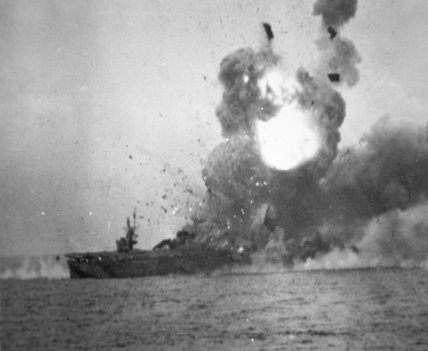
                  USS St Lo exploding after being hit by a Kamikaze

Friends of Padre Steve’s World,

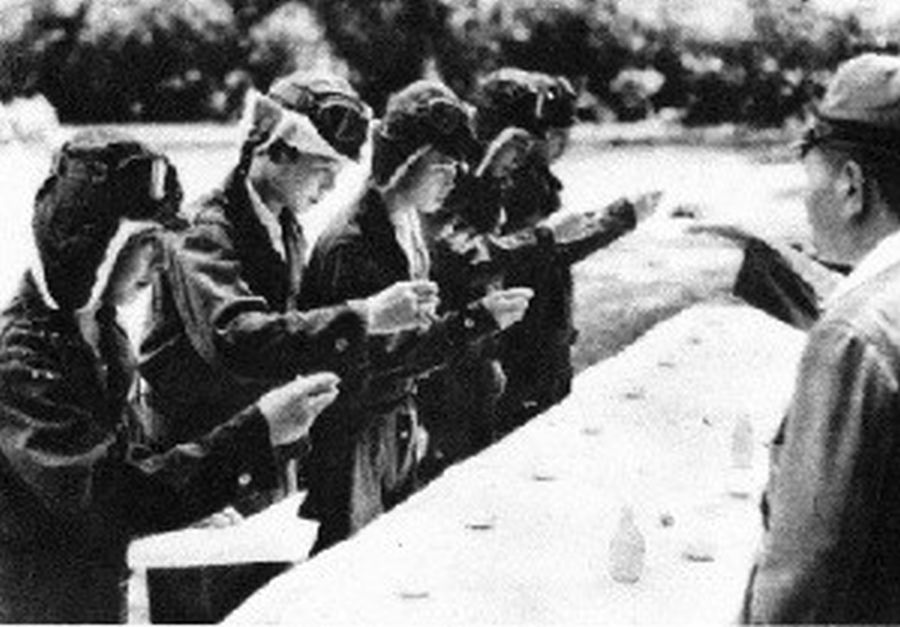
Again I am taking some time off from current events as fast as they are moving, and I am posting edited articles about Battle of Leyte Gulf. The battle was the largest naval battle every fought and harborslessons that redound to our day. This article deals with the first use of Kamikaze aircraft whose pilots would attempt to dive into Allied warships, committing suicide rather than attempting to bomb a ship and return home.

In an age where suicide bombers and attackers do such things it is important to remember that this is not new. The Kamikaze pilots for the most part brainwashed by the Samurai ideology which had been drilled into them since they were children. One who survived because of engine failure and did not get a second chance told the BBC:

“Common sense says you only have one life,” he says, “so why would you want to give it away? Why would you be happy to do that? But at that time everyone I knew, they all wanted to volunteer. We needed to be warriors to stop the invasion from coming. Our minds were set. We had no doubt about it.”

While most Kamikaze pilots hated that ideology, some did not. Regardless, such a mentality is true of many fanatical idealists and terrorists even today. Such men and women span the religious and ideological spectrum. That is the truth, and it is profoundly depressing. Human nature being what it is means that there will be many more like them, the terrorists of September 11th 2001 were little different than the Kamikazes, but instead of the Bushido creed of the Samurai, it was a fanatical belief in Jihad.

Peace

Padre Steve+

In 1944 one of the leading Japanese Naval aviators, Admiral Takijirō Ōnishi wrote:

“In my opinion, there is only one way of assuring that our meager strength will be effective to a maximum degree. That is to organize suicide attack units composed of A6M Zero fighters armed with 250-kilogram bombs, with each plane to crash-dive into an enemy carrier…” 

kamikaze

It was a tactic born of desperation but one that fit in well with the philosophy of Bushido. After the Battle of the Philippine Sea, the “Marianas Turkey Shoot” in June 1944 and the slaughter of land based Japanese Naval and Army air forces based in Formosa in September of that year Japanese leaders began to look to a tactics born of desperation but which fit their Bushido based ethos of sacrifice.

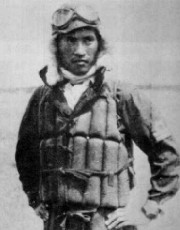
Lt_Yukio_Seki_in_flightgear

                                                        Lt. Yukio Seki

Suicide attacks were nothing new to the Japanese, but until October 1944 they were tactics decided on by individuals who saw no alternative to the choice. In October 1944 that calculus changed, instead of individuals or isolated units which had no hope of victory conducting suicide attacks, commanders decided to employ suicide attackers as a matter of course.

When the American forces invaded the Philippines Admiral Takijirō Ōnishi was commander of the First Air Fleet based in the Northern Philippines. He was not a fan of Kamikaze tactics and viewed them as heresy. However after the slaughter of the reconstituted Naval Air Force at the Battle of the Philippine Sea he reluctantly changed his mind. I say reluctantly based on his previous views and because after he committed ritual suicide following the Japanese surrender he apologized to the estimated 4000 pilots that he sent to their death and their families.

Admiral_Takijiro_Onishi

                                                Admiral Ōnishi

But in October 1944 with Japan reeling from defeats in the Pacific and its supply route for oil and other raw materials threatened desperation was the order of the day.

The 201st Navy Flying Corps based out of Clark Field near Manila was the major land based Japanese Naval Air Force unit in the Philippines. Among its pilots was a young Naval Officer and Aviator named Lt. Yukio Seki. Seki was a graduate of the Japanese Naval Academy at Eta Jima and was recently married. He was not an ideologue or believer in suicide attacks. When questioned by a reporter before his squadron launched the first Kamikaze attacks he remarked to Masashi Onoda, a War Correspondent :“Japan’s future is bleak if it is forced to kill one of its best pilots. I am not going on this mission for the Emperor or for the Empire… I am going because I was ordered to!”

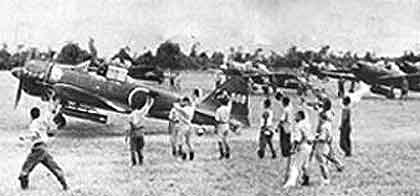
On October 25th 1944 Seki led his group of 5 A6M2-5 Zero fighters, each carrying a 550 pound bomb took off and attacked the Escort Carriers of Rear Admiral Clifton Sprague’s “Taffy-3.” The five pilots all died in their attacks but two damaged the USS Kalinin Bay and USS Kitkun Bay while two aircraft, one believed to be Seki’s hit the USS St Lo causing mortal damage which sank that ship in less than half an hour with the loss of over 140 sailors.

1st_Kamikaze_Mission_19441025-1

The attacks of Seki’s small squadron were a harbinger of what was to come. Over the next 10 months over 4000 Japanese pilots would die in Kamikaze attacks against US Navy and Allied Naval units. Numbers of ships destroyed or damaged by Kamikazes are debated by some historians believe that 70 US and Allied ships were sunk or damaged beyond repair and close to 300 more damaged. 2525 Imperial Japanese Navy pilots and 1387 Imperial Army pilots died in Kamikaze attacks killing almost 5000 sailors and wounding over 5000 more.

Seki_photo_ma1944-10-20

Another pilot, who did not swallow the propaganda was Lieutenant Ryoji Uehara. He wrote his mother before his final mission:

“Tomorrow, one who believes in democracy will leave this world, he may look lonely but his heart is filled with satisfaction. Fascist Italy and Nazi Germany have been defeated. Authoritarianism is like building a house with broken stones.”

Admiral Ōnishi who made the decision to make Kamikazes a part of Japan’s offensive strategy in 1944 appeared to regret that decision. In his suicide note he urged young Japanese to rebuild the country and seek peace with all people and offered his death a penance for the nearly 4000 pilots he sent to their deaths. Accordingly when he committed ritual suicide (seppuku) he did so alone, with a second to finish the job and died over 15 hours after disemboweling himself.

kamikaze-pilots

                                                     A Final Toast

The Kamikaze campaign did not alter the course of the war, but it did introduce a new dimension of terror and misguided sacrifice. Despite the propaganda of the ideologues who urge men and women to undertake suicide missions, there is no honor for those that do so. I do pray that one day war will be no more and that even though I expect war to remain part of our world until longer after my death  that nations, peoples or revolutionary groups will no longer send their best and brightest to certain death.

1 Comment

Filed under culture, ethics, faith, History, Military, Political Commentary, racism, Religion, suicide, World War II at Sea, world war two in the pacific

Of Demagogues and Tyrants: The Declaration, the Constitution, and the Current President


Friends of Padre Steve’s World,

In the Declaration of Independence these words stand out. “A Prince whose character is thus marked by every act which may define a Tyrant, is unfit to be the ruler of a free people.”

I cannot think of an American President who these were more pertinent to, then  Donald Trump. He is the man who Alexander Hamilton warned us in his words and in the Federalist Papers.

“Of those men who have overturned the liberties of republics, the greatest number have begun their career by paying an obsequious court to the people, commencing demagogues and ending tyrants.”

From the beginning of his campaign in 2015 the President has been nothing more than a demagogue, charlatan, and compulsive liar. Additionally, he has shown contempt for the Constitution, the laws, and the institutions of this country in such a myriad of ways it is hard to list them all here; but they include domestic, and foreign affairs which certainly Hamilton and the other Founders believed would eventually happen in our land.

This is all exploding on us now. Those who warned us were derided by Trump’s loyal Army conservative Evangelical Christian supporters, members of White Supremacist groups, and Neo-Nazis; as well as the unofficial, yet official State Propaganda television network, Fox News, and hundreds of right wing television and radio pastors, and other propaganda pundits, many with dubious records of personal and legal conduct.

We are living in a dangerous time. Based on his long history of unfaithfulness to wives, children, employees, investors, and contractors it would be foolish to believe that this President would be faithful to the oath that he took when he was inaugurated as President in 2017.

I am tired and will sign off for the night and continue my series on the Battle of Leyte Gulf tomorrow since I got ahead of myself last night.
So until tomorrow,

Peace,

Padre Steve+

2 Comments

Filed under civil rights, ethics, faith, Foreign Policy, History, laws and legislation, leadership, natural disasters, News and current events, Political Commentary

Conflicted War Criminals: They do not Deserve Monuments


Colonel General Erich Hoepner 
Friends of Padre Steve’s World,

Monuments to soldiers who served their country faithfully and honorably are not a bad thing. At the same time one has to look at the context of their service and if they serve in the high command or in other government postings their service needs to be carefully examined to see if the deserve to be memorialized.

In the United States we have frequently memorialized men whose actions as military and political leaders, while commendable in some aspects leaves much to be desired in terms of long standing memorials.

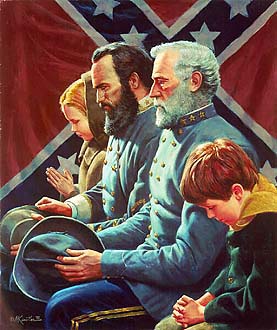
A couple of years ago I had a friend whose family survived the Holocaust ask me where removing memorials to men like Robert E. Lee ends. I replied that it was all about context and the totality of life. We mythologize Robert E. Lee in a manner that his crimes and his flaws are intentionally hidden, though they are many. Since then I have written about Lee, and his crimes against the slaves that his family owned, and his meaningless sacrifice of thousands of Confederate Solders and the destruction of much of the South because he did not have the personal courage to tell Jefferson Davis and the Confederate Congress that the war lost in late 1863 or early 1864. He was the most respected man in the Confederacy and his words word have created an uproar that the Confederacy could not have survived. Instead he is remembered for the myth of his nobility with statues throughout the South and even the former Union States.

I then talked about German General Erich Hoepner who though he had been a part of plots to overthrow Hitler before the war and took part in the plot to overthrow Hitler in 1944 and was executed after a sham trial. The pictures and films of Hoepner being shamed and degraded by the Nazi Chief inquisitor, Judge Roland Freisler, give an impression that General Hoepner was a victim of the Nazi regime.

To some extent Hoepner was a victim of the regime, but while in command of Panzer Group Four during the invasion of the Soviet Union his actions place him in the pantheon of Nazi War Criminals. He fully cooperated with some the most criminal aspects of the Nazi regimes actions. He was a willing accomplice to crimes that stagger the imagination.

In his initial message to his troops Hoepner stated:

The war against Russia is an important chapter in the German nation’s struggle for existence. It is the old battle of the Germanic against the Slavic people, of the defence of European culture against Muscovite-Asiatic inundation and of the repulse of Jewish Bolshevism. The objective of this battle must be the demolition of present-day Russia and must therefore be conducted with unprecedented severity. Every military action must be guided in planning and execution by an iron resolution to exterminate the enemy remorselessly and totally. In particular, no adherents of the contemporary Russian Bolshevik system are to be spared.

Hoepner issued a number of other orders directing how Jews should be treated and the commander of Einsatzgruppe A, SS Brigadier General Walter Stahlecker whose units killed nearly 250,000 Jews between July and December 1941 praised the cooperation of the Wehrmacht and in particular of Hoepner with his execution squads. Stahlecker described the cooperation of the Wehrmacht with his men as “generally very good”, and “in certain cases, as for example, with Panzer Group 4 under the command of General Hoepner, extremely close, one might say even warm.” The fact is that the Einsatzgruppen could not have ran up such massive numbers of deaths without the cooperation of the German Army leaders in Russia.

That leaves us with the question of how does one remember such a military leader? Hoepner demonstrated bravery as a young officer in the First World War, and was prepared to help overthrow Hitler before the war and lost his life in the attempt to kill Hitler on July 20th 1944. But he enabled and participated in war crimes so vast and heinous that they beggar the imagination.

In 1956 a Berlin school was named after Hoepner for his role in the anti-Hitler plot, but in 2008, after his actions in relationship to the Nazi war crimes became public, the school was renamed. Because he perished in the attempt on Hitler’s life, Hoepner was included in the myth of the noble Wehrmacht. But that was a myth, the Wehrmacht was so complicit in the Nazi crimes that it cannot be exculpated from them. It’s leaders for the most part agreed with Nazi racial policies and had no hesitation in cooperating with the SS. Yes, there were exceptions, but they were and forever will remain exceptions, the myth be damned.

So in relation to the American controversy regarding monuments to Confederate leaders, or for that matter to leaders who planned, conducted, or supported our own genocide of Native Americans, the unlawful subjection and conquest of Mexico, the exploitation of territories and peoples gained following the Spanish-American War, those who conducted medical experiments not much different than the Nazi doctors on minorities and the handicapped, and so many other examples which would take too long to list for the purpose of this article: what are we to do?

As I have written before, this is a matter of context and honesty. Honestly I think this is something that we need to address, just as the Germans have since the end of the Second World War. We have to be brutally honest in our assessment of the men and women who we chose to memorialize. If we aren’t we simply bless their crimes and allow their veneration to inspire new generations of racial motivated criminals.

That is where we have to go if we have the moral courage to do so. However, I don’t think that will happen in the next few years, or even in my lifetime, but I can hope and I can act in my own way to bring attention to to them, and hopefully do what I can to keep people of our present time from heading down the same evil path.

So until tomorrow,

Peace

Padre Steve+

Leave a comment

Filed under civil war, ethics, faith, History, holocaust, leadership, Loose thoughts and musings, Military, nazi germany, News and current events, Political Commentary, racism, war crimes, White nationalism, world war two in europe

John Brown: Fanatical Idealist and “Warrior for God”

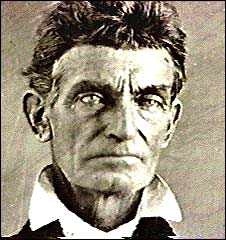
John_brown.JPG

                                                        John Brown

Friends of Padre Steve’s World,

October 16th is the anniversary of John Brown’s attempted seizure of the Federal Armory at Harpers Ferry. He was executed after trial on December 2nd 1859. Brown was  a man who had a righteous cause, but surrendered the moral high ground because of his fanaticism. Justice Robert Jackson wrote:“[I]n our country are evangelists and zealots of many different political, economic and religious persuasions whose fanatical conviction is that all thought is divinely classified into two kinds — that which is their own and that which is false and dangerous.” John Brown was a fanatic who in his desire to achieve his goal was not above committing murder as he did in Kansas, and insurrection as he did at Harper’s Ferry. There are many people in this country who harbor similar beliefs. John Brown serves as a warning to all of us. Violent means in service of a honorable or righteous cause often make things far worse.

This article is part of my draft book Mine Eyes have Seen the Glory: Race, Religion, Ideology and Politics in the Civil War Era. 

Peace

Padre Steve+

In the North there too existed an element of religious fanaticism. While “the restraining hand of churches, political parties and familial concerns bounded other antislavery warriors,” [1] and while most abolitionists tried to remain in the mainstream and work through legislation and moral persuasion to halt the expansion of slavery with the ultimate goal of emancipation; there were fanatical abolitionists that were willing to attempt to ignite the spark which would cause the powder keg of raw hatred and emotion to explode.

Most prominent among these men was John Brown. Brown was a “Connecticut-born abolitionist…a man with the selfless benevolence of the evangelicals wrought into a fiery determination to crush slavery.” [2] His father was an early abolitionist who helped later found Oberlin College. In his early years Brown “formulated a certitude about divine intervention against sinners, starring himself as God’s warrior against slaveholders.” [3] As early as 1834 John Brown was “an ardent sympathizer the Negroes,” desiring to raise a black child in his own home and to “offering guidance to a colony of Negroes on the farm of the wealthy abolitionist Gerrit Smith at North Elba New York.” [4]Brown regarded moderate free Staters with distain and though he was a fanatical Christian he never joined any church, and “obeyed only his conception of God’s unbounded command.” [5]

Brown “ridiculed Republican’s mainstream tactics. He disparaged even Yankee extremists for deploying too non-violent a strategy.” [6] After a series of failed business ventures the militant Brown went to Kansas and set about to change the equation through the use of terror. After the sack of Lawrence, Brown and a company of his marauders set upon and slaughtered the family of a pro-slavery settler at Pottawatomie Creek. [7] Brown and his son’s entered the house of one family, “dragged three men outside, shot the father through the head, and hacked and mutilated his two sons with broadswords.”[8] Two years later Brown went to Missouri where he “murdered a slaveholder, seized eleven slaves, and led the new freedmen 1100 miles to Canadian sanctuary.” [9]

The example of John Brown provides us with a good example to understand religious extremism, especially when it becomes violent. The counterinsurgency field manual notes in words that are certainly as applicable to Brown as they are to current religiously motivated terrorists, that “Religious extremist insurgents….frequently hold an all-encompassing worldview; they are ideologically rigid and uncompromising….  believing themselves to be ideologically pure, violent religious extremists brand those they consider insufficiently orthodox as enemies.”[10] 

Brown was certainly “a religious zealot…but was nevertheless every much the product of his time and place….” [11] Brown was a veteran of the violent battles in Kansas where he had earned the reputation as “the apostle of the sword of Gideon” as he and his men battled pro-slavery settlers. Brown was possessed by a zealous belief that God had appointed him as God’s warrior against slaveholders. He despised the peaceful abolitionists and demanded action. “Brave, unshaken by doubt, willing to shed blood unflinchingly and to die for his cause if necessary, Brown was the perfect man to light the tinder of civil war in America, which was what he intended to do.” [12]

Brown attempted to gain financing from wealthy abolitionists for a new expedition to seize the Federal arsenal at Harper’s Ferry Virginia, and most would have nothing to do with his scheme. When they “touted their pacific antislavery societies, Brown responded that “your methods are perfectly futile; you would not release five slaves in a century; peaceful emancipation is impossible.” [13] After hearing William Lloyd Garrison and other abolitionist leaders plead for peaceful abolition he remarked: “We’ve reached a point,” I said, “where nothing but war can get rid of slavery in this guilty nation. It’s better that a whole generation of men, women, and children should pass away by a violent death than that slavery should continue to exist.” I meant that literally, every word of it.” [14]

Following that meeting, as well as a meeting with Frederick Douglass who rejected Brown’s planned violent action, Brown went about collecting recruits for his cause and set out to seize 10,000 muskets at the Federal armory in Harper’s Ferry, Virginia in order to ignite a slave revolt. Brown and twenty-one followers, sixteen whites and five blacks moved on the arsenal. As they went, Brown:

“believed that we would probably fail at the Ferry, would probably die. But I believed that all we had to do was make the attempt, and Jehovah would do the rest: the Heavens would turn black, the thunder would rend the sky, and a mighty storm would uproot this guilty land, washing its sins away with blood. With God’s help, I, John Brown, would effect a mighty conquest even though it was like the last victory of Samson.” [15] 

After initial success in capturing the armory, Brown’s plan was frustrated and Brown captured by a force of U.S. Marines, led by Colonel Robert E. Lee and Lieutenant J.E.B. Stuart. Brown was tried and hanged, but his raid “effectively severed the country into two opposing parts, making it clear to moderates there who were searching for compromise, that northerner’s tolerance for slavery was wearing thin.” [16]

It now did not matter that Brown was captured, tried, convicted and executed for his raid on Harper’s Ferry. Brown to be sure was “a half-pathetic, half-mad failure, his raid a crazy, senseless exploit to which only his quiet eloquence during trial and execution lent dignity” [17] but his act was the watershed from which the two sides would not be able to recover; the population on both sides having gone too far down the road to disunion to turn back.

Brown had tremendous support among the New England elites, the “names of Howe, Parker, Emerson and Thoreau among his supporters.” [18] To abolitionists he had become a martyr “but to Frederick Douglass and the negroes of Chatham, Ontario, nearly every one of whom had learned something from personal experience on how to gain freedom, Brown was a man of words trying to be a man of deeds, and they would not follow him. They understood him, as Thoreau and Emerson and Parker never did.” [19]

But to Southerners Brown was the symbol of an existential threat to their way of life. In the North there was a nearly religious wave of sympathy for Brown, and the “spectacle of devout Yankee women actually praying for John Brown, not as a sinner but as saint, of respectable thinkers like Thoreau and Emerson and Longfellow glorifying his martyrdom in Biblical language” [20] horrified Southerners, and drove pro-Union Southern moderates into the secession camp. The Richmond Enquirer wrote in its editorial, “The Harper’s Ferry invasion has advanced the cause of Disunion, more than any other event that has happened since the foundation of the Government; it has rallied to that standard men who formerly looked on it with horror; it has revived, with ten fold strength the desire of a Southern Confederacy…” [21]

The day that Brown went to his hanging he wrote his final missive. This was written once more in apocalyptic language, but also in which he portrayed himself as a Christ figure going to his cross on the behalf of a guilty people, but a people whom his blood would not atone:

“It’s now December second – the day of my hanging, the day the gallows become my cross. I’m approaching those gallows while sitting on my coffin in the bed of a military wagon. O dear God, my eyes see the glory in every step of the divine journey that brought me here, to stand on that platform, in that field, before all those soldiers of Virginia. Thank you, Father, for allowing an old man like me such might and soul satisfying rewards. I am ready to join thee now in Paradise…

They can put the halter around my neck, pull the hood over my head. Hanging me won’t save them from God’s wrath! I warned the entire country: I, John Brown, am now quite certain that the crimes of this guilty land will never be purged away, but with blood.” [22]

Brown’s composure and dignity during trial impressed Governor Henry Wise of Virginia who signed Brown’s death warrant as well as that of fire-eater Edmund Ruffin. In his diary Ruffin “praised Brown’s “animal courage” and “complete fearlessness & insensibility to danger and death.” [23]

UBrown’s death was marked with signs of mourning throughout the North, for Brown was now a martyr. Henry David Thoreau “pronounced Brown “a crucified hero,” [24] while through the North, Brown’s death was treated as a martyr’s death. Even abolitionists like William Lloyd Garrison who had condemned violence in the quest of emancipation praised Brown’s actions, while throughout the North:

“Church bells tolled, black bunting was hung out, minute guns were fired, prayer meetings assembled, and memorial resolutions adopted. In the weeks following, the emotional outpouring continued: lithographs of Brown circulated in vast numbers, subscriptions were organized for the support of his family, immense memorial meetings took place in New York, Boston and Philadelphia…” [25]

Future Confederate General Lafayette McLaws spoke for many Southerners in the army when he wrote: His diary entry for February 27th 1860 noted:

“Debates in congress show no mitigation of sec. feeling…. I think it would be better not to be so fanatical on any subject, the extreme pro-slavery man is as bad as that type as that type of anti-slavery, John Brown. I do not consider slavery an evil by any means, but I certainly do not think it the greatest blessing.” [26]

But in the South there was a different understanding of Brown’s assault on Harper’s Ferry. Despite official denunciations of Brown by Abraham Lincoln and other Republican leaders, the message proclaimed by Southern newspapermen, ministers and politicians was that the North could not be trusted.  Brown’s raid, and the reaction of Northerners to it “was seized upon as argument-clinching proof that the North was only awaiting its opportunity to destroy the South by force….” [27]

Of course that was not the feeling in much of the North, but Brown’s actions and words were seized upon by the Southern versions of Brown to make Civil War inevitable once the political balance changed, and they neither controlled the Presidency, House, or Senate.

                                                          Notes 

[1] Ibid. Freehling The Road to Disunion Volume II p.207

[2] Ibid. Guelzo Fateful Lightning p.81

[3] Ibid. Freehling The Road to Disunion Volume II p.207

[4] Ibid. Potter The Impending Crisis p.211

[5] Ibid. Freehling The Road to Disunion Volume II p.207

[6] Ibid. Freehling The Road to Disunion Volume II p.206

[7] Ibid. Potter The Impending Crisis pp.211-212

[8] Ibid. Goldfield America Aflame p.118

[9] Ibid. Freehling The Road to Disunion Volume II p.208

[10] Ibid. U.S. Army/ Marine Counterinsurgency Field Manual p.27

[11] Ibid. Levine Half Slave and Half Free p.197

[12] Ibid. Korda, Clouds of Glory p.xviii

[13] Ibid. Freehling The Road to Disunion Volume II p.208

[14] Ibid. Oates The Approaching Fury p.203

[15] Ibid. Oates The Approaching Fury p.284

[16] Ibid. Korda Clouds of Glory p.xxxix

[17] Ibid. Catton Two Roads to Sumter p.18

[18] Ibid. Potter The Impending Crisis p.381

[19] Ibid. Potter The Impending Crisis p.375

[20] Ibid. Catton Two Roads to Sumter p.187

[21] ___________ The Harper’s Ferry Invasion as Party Capital The Richmond Enquirer, 23 October 1859 in The Civil War and Reconstruction: A Documentary Collection edited by William E. Gienapp, W.W. Norton and Company, New York and London 2001 p.54

[22] Ibid. Oates The Approaching Fury p.290

[23] Ibid. Thomas The Confederate Nation p.3

[24] Ibid. McPherson The Battle Cry of Freedom p.210

[25] Ibid. Potter The Impending Crisis p.378

[26] Oefinger, John C. Editor A Soldier’s General: The Civil War Letters of Major General Lafayette McLaws University of North Carolina Press, Charlotte and London 2002 p.18

[27] Ibid. Guelzo Fateful Lightning p.119

3 Comments

Filed under civil rights, civil war, ethics, faith, History, leadership, Political Commentary, racism, Religion

The Navy: It’s Not Just a Job, It’s an Adventure, even When Trying to Retire

Friends of Padre Steve’s World,

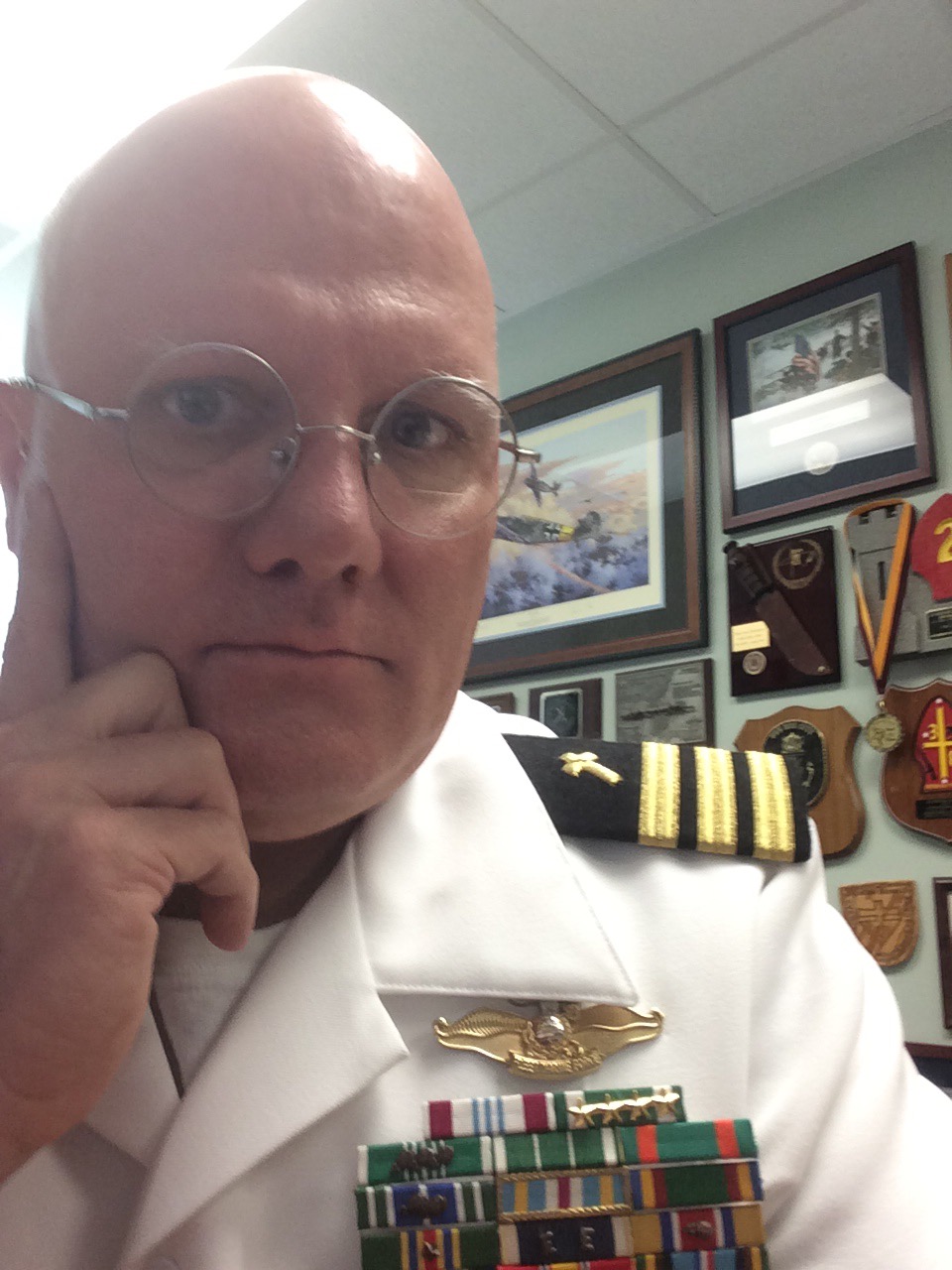
Way Beck before I ever entered the military, the Navy had a recruiting commercial called “The Navy, it’s Not Just an Adventure.” I can state with all honesty that after over 38 years of combined Army and Navy Service that yes, even when trying to retire, the adventure continues.

Most of my followers know that last year I chose to retire before my mandatory date. I should have retired September 1st. However, Navy Medicine did me no favors with my injured knees and I had to withdraw my voluntary retirement request to retire at what the Navy said was my mandatory retirement date. That was supposedly April 1st of 2020. The personnel system planned on it as did I.

Since I hadn’t seen a copy of my orders I sent a message to Officer Retirements Branch asking when to expect them. Today, my relief showed up, and I got a call from the Chief of the Officer Retirements Branch that my current retirement orders were cancelled because they miscalculated my actual mandatory retirement date, which is now August 1st, 2020. Mandatory retirement works differently than voluntary retirement. The former is mandatory. The latter you have to apply for and the process can take several months for approval.

Since there is only a four month lag time between my now ex-mandatory retirement date and the new one I have no need of throwing another date out there. So I recommended that my detailer find another local place to stash me until I can once again start the retirement process with the VA, which can only begin 6 months prior to the approved retirement date. I recommend the Joint Forces Staff College where I served as Chaplain, taught ethics, and led the Gettysburg Staff Ride because even though they have a newly assigned Chaplain, they are critically short on military faculty.

Anyway, the adventure continues. Pray for me a sinner.

Peace,

Padre Steve+

7 Comments

Filed under faith, life, Military, US Navy

“If You Are Offended I am not In the Least Bit Sorry” Witnesses to Genocide: George Patton, Dwight Eisenhower and Edward R. Murrow

Friends of Padre Steve’s World,

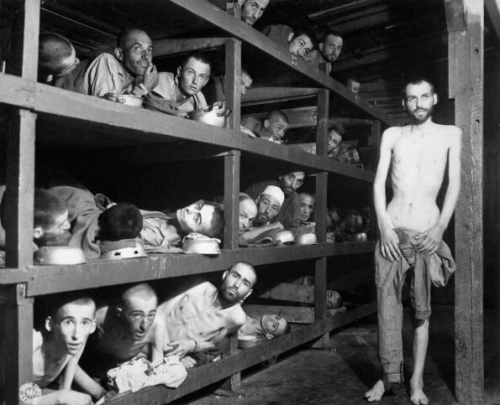
During our trip to Germany last year we visited the Buchenwald Concentration Camp, which as a Major Camp had numerous sub-Camps, including Ohrdruf which Generals George Patton and Dwight Eisenhower visited shortly after its liberation in April 1945. Both went out of their way to describe the horrors they saw.

In our day there are fewer and fewer people who lived through or personal saw or documented the evils of the Nazi Concentration Camps. Likewise, there are a host of Holocaust deniers who produce a plethora of pseudo-scholarly articles claiming to be legitimate historians. Even more frighteningly the rise of apologists for the Nazi regime including those who are active members of allegedly conservative parties in the United States and the European Union is beginning to influence politics. The abject racism, rejection of anyone considered racially inferior, and quite often their unhidden anti-Semitism show that what lies in the dark heart of Naziism is not dead and in fact is rising.

In the United States its rise is being fueled and legitimized by the Presidency of Donald Trump who has referred to American Nazis and White Supremacists as “very good people” after one of their protests where an anti-Nazi demonstrator was murdered and others brutally attacked. In the same time frame a good number of Republican candidates have exposed themselves as White Supremacists and actual Nazis while running for office. A host of new-Nazi and White supremacist organizations openly meet and flood the internet with their race hatred, and it goes unchecked by the Administration and the Justice Department.

The fact is that anyone who denies the Holocaust, attempts to minimize it, or advocates the same policies of race hatred and violence against political, religious, or other opponents is no better than the perpetrators of the Holocaust. Likewise, those who stand by and say nothing are worse. As Yehuda Bauer wrote:

“The horror of the Holocaust is not that it deviated from human norms; the horror is that it didn’t. What happened may happen again, to others not necessarily Jews, perpetrated by others, not necessarily Germans. We are all possible victims, possible perpetrators, possible bystanders.”

The good thing is that there were people who took the time to record what they saw in the Nazi Concentration Camps and exposed those deeds to the world in such a way that only perverted and evil people could brazenly deny those facts.

One of the most detailed descriptions of a liberated Concentration Camp was written by General George Patton in his memoirs entitled War as I Knew It.

… we drove to Ohrdruf and visited the first horror camp any of us had ever seen. It was the most appalling sight imaginable.

A man who said he was one of the former inmates acted as impresario and showed us first the gallows, where men were hanged for attempting to escape. The drop board was about two feet from the ground, and the cord used was piano wire which had an adjustment so that when the man dropped, his toes would just reach the ground and it would take about fifteen minutes for him to choke to death, since the fall was not sufficient to break his neck. The next two men to die had to kick the board out from under him. It was stated by some of the Germans present that the generals who were executed after the Hitler bomb incident were hanged in this manner.

Our guide then took us to the whipping table, which was about the height of the average man’s crotch. The feet were placed in stocks on the ground and the man was pulled over the table, which was slightly hollowed, and held by two guards, while he was beaten across the back and loins. The stick which they said had been used, and which had some blood on it, was bigger than the handle of a pick.

Our guide claimed that he himself had received twenty-five blows with this tool. It later developed that he was not a prisoner at all, but one of the executioners. General Eisenhower must have suspected it, because he asked the man very pointedly how he could be so fat. He was found dead next morning, killed by some of the inmates.

Just beyond the whipping table there was a pile of forty bodies, more or less naked. All of these had been shot in the back of the head at short range, and the blood was still cooling on the ground.

In a shed near-by was a pile of forty completely naked bodies in the last stages of emaciation. These bodies were lightly sprinkled with lime – not, apparently, for the purpose of destroying them, but to reduce the smell. As a reducer of smell, lime is a very inefficient medium.

The total capacity of the shed looked to me to be about two hundred bodies. It was stated that bodies were left until the shed was full and then they were taken out and buried. The inmates said some three thousand people had been buried from this shed since January 1, 1945.

When our troops began to draw near, the Germans thought it expedient to remove the evidence of their crimes. They therefore used the inmates to exhume the recently buried bodies and to build a sort of mammoth griddle of 60 cm. railway tracks laid on a brick foundation. The bodies were piled on this and they attempted to burn them. The attempt was a bad failure. Actually, one could not help but think of some gigantic cannibalistic barbecue. In the pit itself were arms and legs and portions of bodies sticking out of the green water which partially filled it.

General Walker and General Middleton had wisely decided to have as many soldiers as possible visit the scene. This gave me the idea of having the inhabitants themselves visit the camp. I suggested this to Walker, and found that he had already had the mayor and his wife take a look at it. On going home those two committed suicide. We later used the same system in having the inhabitants of Weimar go through the even larger slave camp (Buchenwald) north of that town. (Excerpted for G. Patton War as I Knew It)

Dwight D. Eisenhower wrote after seeing the camp:

The same day [April 12, 1945] I saw my first horror camp. It was near the town of Gotha. I have never felt able to describe my emotional reactions when I first came face to face with indisputable evidence of Nazi brutality and ruthless disregard of every shred of decency. Up to that time I had known about it only generally or through secondary sources. I am certain, however that I have never at any other time experienced an equal sense of shock.

Eisenhower was so moved that he ordered that the best reporters and newsmen come and record what he had seen. He did not want the horrors to be denied by history. He wrote:

I visited every nook and cranny of the camp because I felt it my duty to be in a position from then on to testify at first hand about these things in case there ever grew up at home the belief or assumption that `the stories of Nazi brutality were just propaganda.’ Some members of the visiting party were unable to through the ordeal. I not only did so but as soon as I returned to Patton’s headquarters that evening I sent communications to both Washington and London, urging the two governments to send instantly to Germany a random group of newspaper editors and representative groups from the national legislatures. I felt that the evidence should be immediately placed before the American and British publics in a fashion that would leave no room for cynical doubt.

One of those reporters was Edward R. Murrow who broadcast his visit to Buchenwald:

There surged around me an evil-smelling stink, men and boys reached out to touch me. They were in rags and the remnants of uniforms. Death already had marked many of them, but they were smiling with their eyes. I looked out over the mass of men to the green fields beyond, where well-fed Germans were ploughing….

[I] asked to see one of the barracks. It happened to be occupied by Czechoslovaks. When I entered, men crowded around, tried to lift me to their shoulders. They were too weak. Many of them could not get out of bed. I was told that this building had once stabled 80 horses. There were 1200 men in it, five to a bunk. The stink was beyond all description.

They called the doctor. We inspected his records. There were only names in the little black book — nothing more — nothing about who had been where, what he had done or hoped. Behind the names of those who had died, there was a cross. I counted them. They totaled 242 — 242 out of 1200, in one month.

As we walked out into the courtyard, a man fell dead. Two others, they must have been over 60, were crawling toward the latrine. I saw it, but will not describe it.

In another part of the camp they showed me the children, hundreds of them. Some were only 6 years old. One rolled up his sleeves, showed me his number. It was tattooed on his arm. B-6030, it was. The others showed me their numbers. They will carry them till they die. An elderly man standing beside me said: “The children — enemies of the state!” I could see their ribs through their thin shirts….

We went to the hospital. It was full. The doctor told me that 200 had died the day before. I asked the cause of death. He shrugged and said: “tuberculosis, starvation, fatigue and there are many who have no desire to live. It is very difficult.” He pulled back the blanket from a man’s feet to show me how swollen they were. The man was dead. Most of the patients could not move.

I asked to see the kitchen. It was clean. The German in charge….showed me the daily ration. One piece of brown bread about as thick as your thumb, on top of it a piece of margarine as big as three sticks of chewing gum. That, and a little stew, was what they received every 24 hours. He had a chart on the wall. Very complicated it was. There were little red tabs scattered through it. He said that was to indicate each 10 men who died. He had to account for the rations and he added: “We’re very efficient here.”

We proceeded to the small courtyard. The wall adjoined what had been a stable or garage. We entered. It was floored with concrete. There were two rows of bodies stacked up like cordwood. They were thin and very white. Some of the bodies were terribly bruised; though there seemed to be little flesh to bruise. Some had been shot through the head, but they bled but little.

I arrived at the conclusion that all that was mortal of more than 500 men and boys lay there in two neat piles. There was a German trailer, which must have contained another 50, but it wasn’t possible to count them. The clothing was piled in a heap against the wall. It appeared that most of the men and boys had died of starvation; they had not been executed.

But the manner of death seemed unimportant. Murder had been done at Buchenwald. God alone knows how many men and boys have died there during the last 12 years. Thursday, I was told that there were more than 20,000 in the camp. There had been as many as 60,000. Where are they now?

I pray you to believe what I have said about Buchenwald. I reported what I saw and heard, but only part of it. For most of it, I have no words.I

If I have offended you by this rather mild account of Buchenwald, I’m not in the least sorry….

The fact is that as much as we want to pretend that what happened a Buchenwald, Flossenbürg, Dachau, Bergen-Belsen, Auschwitz, Soribor, Belzec, and Treblinka are images from history that cannot happen again, however, they are an ever present reality and they cannot be ignored. Sadly, I cannot help but to imagine that this can and will happen again in my lifetime. The late Primo Levi, a Jewish Italian philosopher and survivor of Auschwitz wrote: “It happened, it can happen again.” 

I will now quote from one of my favorite episodes of Star Trek the Next Generation called The Drumhead uttered by Jean Luc Picard:

We think we’ve come so far. Torture of heretics, burning of witches it’s all ancient history. Then – before you can blink an eye – suddenly it threatens to start all over again.

That is our reality. There are people, even neighbors and those that we think are friends who would be perpetrators or bystanders when those that transgress the way of Trump are take us from our homes and families because of our beliefs. I would love to be wrong about this, but I am a historian and a theologian and I know the human condition far too well to sit back and remain silent, no matter what the cost.

Last year I had a Facebook exchange with a friend who is a retired Navy Chaplain. He is very much a Trump supporter and apologist. He is very happy about Justice Kavanaugh being in the Supreme Court. The stories of the victims and their claims did not matter to him. Despite that I do not believe that he is a bad man or an evil person. I simply believe that like Martin Niemöller that he has made a bad choice in the man and party that he currently supports and that he will eventually regret it. I could be wrong, he might not turn out to be a Niemöller, but a Reichsbishof Müller. Sincerely hope that he does not become the latter.

I keep quoting historian Timothy Snyder, but he was all too correct when he wrote these words less than two years ago:

The European history of the twentieth century shows us that societies can break, democracies can fall, ethics can collapse, and ordinary men can find themselves standing over death pits with guns in their hands. It would serve us well today to understand why.

If you don’t believe me read the words of the President, his closest supporters, the prominent political preachers of the Christian Right, and any number of Trump leaning columnists, pundits, and politicians. There are some who are so far gone that they will accuse any opponent of being disloyal, not the the Constitution or the law but to President Trump.

Last year, one of those people tried to get my commanding officer to have me tried by Court Martial for a sermon in which he lied about what I said. I had to spend my money to hire a lawyer to defend me from the false charges and have them dismissed during the preliminary investigation.
Trust me, I know what resistance will mean if this President and his cult like followers are not stopped. Our fate will be worse than that of Nazi Germany because we should have known better. We should have learned from Dwight Eisenhower and George Patton. We should have learned fro Dietrich Bonhoeffer and Martin Niemöller, we should have learned from the Nuremberg trials, but we have not.

Facing possible impeachment, and with a growing likelihood that the Democrats will extend their control of the House, possibly regain the Senate, and maybe defeat Trump in the 2020 elections, a desperate Trump, backed  by his true believers may very well attempt to circumvent those elections and impeachment hearings.  With the laws already enacted in the Patriot Act and numerous executive orders there is little to stop a President who has no respect for the law or the Constitution from declaring full emergency powers should any war, terrorist act, or natural disaster be declared. That’s what makes all of this so frightening. Trump only needs an event which is scary enough to frighten people into following any emergency decree. Americans wouldn’t be the first to do so, it’s human nature: the need for security overrides the need for the rule of law and freedom.

So with all of that happy commentary I will leave you until tomorrow.

Until then have a good night, and please, never forget.

Peace

Padre Steve+

10 Comments

Filed under ethics, faith, History, holocaust, leadership, Military, nazi germany, News and current events, Political Commentary

Threats of Civil War and Accusations Of Treason: Trump, His Reichsbishof, and Those Ready to Kill in his Name

Friends Of Padre Steve’s World,

Just a couple of thoughts tonight. We celebrated Judy’s Birthday with our friends in Germany and even made a trip over the border to France where we got her birthday cake. But I digress…

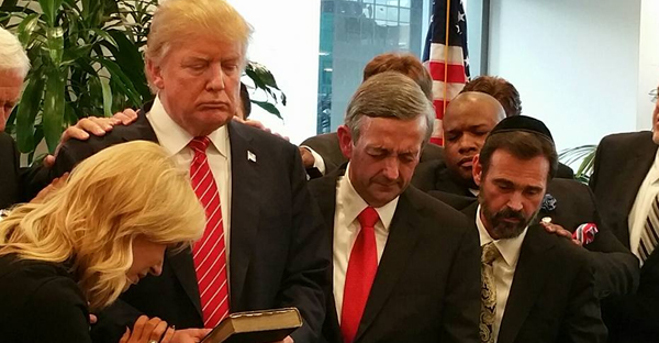
Tonight I am very concerned about what President Trump and some of his leading supporters, especially his Reichsbishof , Pastor Robert Jeffress, of First Baptist Church Dallas threatened that if he were impeached that it would bring about a civil war. During his Twitter tirade the President accused the Congressman Adam Schiff, Chairman of the House Intelligence Committee of Treason.

First, the whole concept of Treason when it comes to United States law and the Constitution, which set very tight limitations on what can be charged as treason.

In fact it is spelled out in the Constitution:

“Treason against the United States, shall consist only in levying war against them, or in adhering to their enemies, giving them aid and comfort.” 

That does not sound like Schiff, the Whistleblower, or any of Trumps political opponents or media critics. The only ones coming close to the definition is Trump himself, Rudi Giuliani, Attorney General Barr, and Secretary of State Mike Pompeo who all seem to be neck deep in not only the Ukrainian affair, but those involving other countries as well. Sadly, this is just the tip of the iceberg.

Unlike Hitler’s Germany, the Soviet Union Of Stalin, or for than matter any government ruled by a dictator, our Constitution does not say that the President is above the law. That is why the process impeachment of impeachment, and what can trigger it is in the Constitution. It is not about where you like a President or his policies at all, it is about holding the Chief Executive accountable to the Legislative Branch, which is given first place in the Constitution, including oversight of the Exectutive Branch, and advice, consent, and voting on the appointment of those of the Judicial Branch.

Okay, that was bad enough, a President who does not respect the Constitution and law is pretty bad, but one who re-tweets men like Jeffress that make threats of civil war is repugnant and repulsive. Trump tweeted Jeffress’s comments with his own his own comments:

If the Democrats are successful in removing the President from office (which they will never be), it will cause a Civil War like fracture in this Nation from which our Country will never heal,”

This is dangerous. The fact that first a Pastor would threaten civil war should the man he supported for president and defends today is much more like an Ayatollah, Taliban preacher, or somebody out of the religiously supported wars of the Reformation, or the Crusades than anything our Founders accepted. The fact that Jeffress pastors the flagship church of a denomination which was founded upon its support of slavery and later secession and civil war is ironic. They are remarks that any Southern Baptist today should flee from, and I am a graduate of Southwestern Baptist Theological Seminary, class of 1992.

Likewise I am a historian who has studied and written extensively about the American Civil War, Slavery, Reconstruction, Jim, Crow and the Civil Rights Movement, the German Civil War that followed World War One, during the Weimar Republic, and the wars which followed the Reformation in Europe and England. I have also visited countries in the Balkans after their civil wars of the 1990s, and been in the middle of of the Sunni-Shia Civil War in Iraq in 2007-2008.

The civil war that Trump, Jeffress, and other Trump supporters, including the so-called Oath Keepers threaten, will not be like the American Civil War with massed armies fighting a continental war, instead it will be much more like the Spanish Civil War, Iraq, Syria, Ireland, the wars in the former Yugoslavia, or those of the 1970s and 1980s in Central America. They will be murderous, terrorist type wars, insurgencies with no end. I have seen and studied these wars. Anyone advocating them is either evil, or insane.

I think that applies to both the President, the Pastor, and their armed fanatical supporters.

I say, let the Congress do its job and follow the law and Constitution regardless of where it leads.

So until tomorrow,

Peace,

Padre Steve+

30 Comments

Filed under civil rights, civil war, ethics, faith, History, Political Commentary

A Day to Disconnect: Friends, Family History, and a Walk up a Mountain and Through the Forest

Friends of Padre Steve’s World,

I kind of disconnected from most American media today to spend time with our German friends in the countryside of Hessen; to visit the county seat, Weilburg, that my wife’s father’s family left in the 1700s to go to the Volga region of Russia at the invitation of Catherine the Great before coming to the United States after the failed 1905 revolution as the Russian Government had continually reneged on its promises to the German settlers, who had been basically sold a bill of good by unscrupulous agents acting in the name of the Russian government.

I pride myself on being informed and trying the best I can to write about life, history, faith, religion and politics, with a keen eye. But there are times for one’s sanity that we have to take a break. The world and its problems will more than likely be here tomorrow, and to paraphrase Dietrich Bonhoeffer, we were not here at the beginning of creation, we won’t be here when it ends, we live in the uncomfortable middle.

With that in mind is important to take a break once in a while.

Following breakfast and our visit to Weilburg we had lunch with our friend Gottfried before visiting a Kloster just down the road. We got home about 2:30 PM or so and after a while I decided to make my annual pilgrimage up the highest mountain in the area and visit to old Jewish Cemetery which has been preserved with care by the town following the Holocaust. There is a memorial on the city hall to the Jews of the town who were sent East, at least one survived and she was invited to dedicate the memorial on the city hall in 1991. The gravestones at the cemetery date to the 1800s and early 1900s.

I ended up doing a power walk up, down, and around the mountain before ending up back at our friends after a two hour walk of just over eight miles, for a day long total of about ten and a half miles.

Then we went out with Gottfried’s wife Hannelore to an Italian Restaurant, and upon our return Gottfried to me to to meet some of his friends in the next town over. On our return we talked and watched TV together before heading up to bed, where I am writing this. Tomorrow will be a full day. We will take a two hour train ride to Fulda, visit there for a few hours then return home. That should be an interesting trip. I have been to Fulda a number of times, Judy never has. It was a key city in Cold War planning, and the old city and Cathedral are magnificent. My first trip there was a tour of the old inter-German Border between West and East Germany in 1984. I made a couple of other trips related to our potential mission to fight the Soviets if they attacked, and then after the Wall fell I visited the old city and Cathedral in late 1996. The fact that we are taking the train and not having to drive is very nice, since we will be driving Sunday to see friends near Karlsruhe on the Rhein River.

It is interesting that although I have kept myself apprised of the latest events in the United States I have disconnected enough to keep my sanity, even when occasionally checking my Twitter feed and Facebook page. The walk up the mountain and through the forest was good for me, it was not only a good workout but put me in touch with nature and history. John Muir said, “Climb the mountains and get their good tidings. Nature’s peace will flow into you as sunshine flows into trees.” 

That happened to me today.

So until tomorrow,

Peace,

Padre Steve+

Leave a comment

Filed under faith, History, life, Loose thoughts and musings, spirituality

Sophie Scholl and the White Rose: Resistance is Not Futile

Friends of Padre Steve’s World,

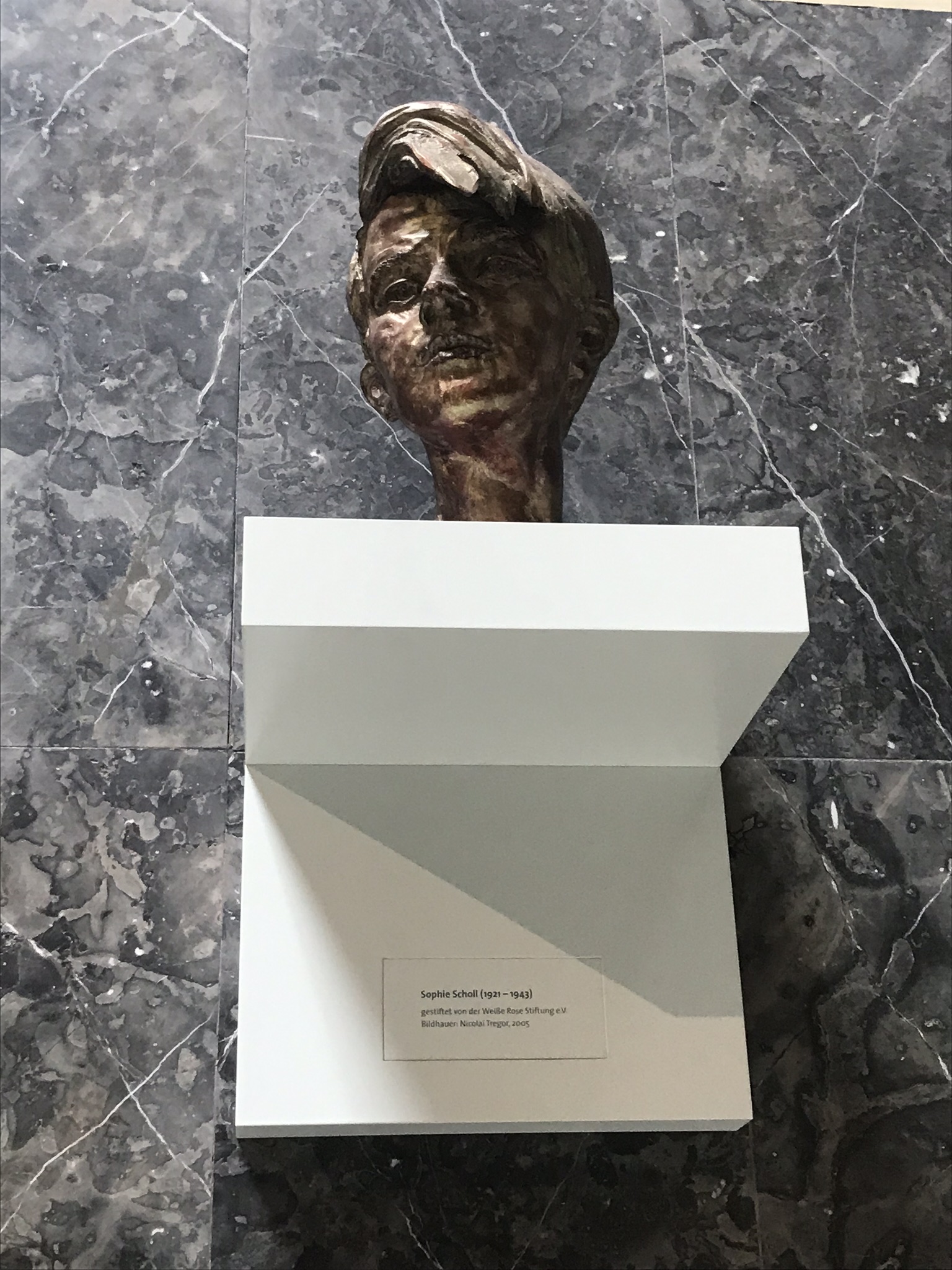
I have written about Sophie Scholl and the White Rose resistance against Hitler before, in fact I again wrote about her last night, and as I watch what is going on in the United States I cannot get her off my mind. The 22 year old German university student who dared to speak out, to tell the truth, despite having no power of her own, just a belief in freedom and that one had to resist the Hitler regime.

I spent time in September on my last visit to Munich to visit a number of the places where Sophie Scholl, her brother Hans, and other members of the resistance worked to write and distribute six pamphlets exposing the crimes of the Nazi regime. I also visited her grave. We are here again, until tomorrow when we travel north to visit old friends in Hessen. While there I will make a second trip to the Hadamar T4 Euthanasia facility, but I digress…

Yesterday, I visited the Sophie Scholl-White Rose Museum at the University Of Munich, where she and her friends were students. While distributing the sixth pamphlet, Sophie and Hans were caught when a maintenance man at Munich University spotted them and reported them to the Gestapo. To stand in the place where she threw the last copies of that letter into the atrium of the University entrance was humbling. I wonder if I could have done it. Write such materials, certainly, distribute them, for sure, but to take the chance that someone might see me as I did it, I don’t know.

I find that the the German language film Sophie Scholl: The Final Days is a powerful portrayal of her last days. Whenever I watch the film I find that it is an intensely emotional experience. It was shot on location in places that I have walked, so it resonates in real time as I watch the freedoms that the United States was founded on being attacked in real time right now. I wonder how long it will be until the Constitution is turned upon its head and the law and the courts are turned into accomplices of terror.

I think the scenes in the film that were the most powerful to me were those that depicted the interrogation of Sophie by the Gestapo investigator Robert Mohr. He was a Nazi, but he is was also a professional police office and investigator, devoted to the law, a law which though the words had not been changed since before Hitler’s assumption of power, had been commandeered by the Nazis to prescribe loyalty to the Hitler regime above all. The real Robert Mohr survived the war and lived until 1977. Was Mohr Evil? I doubt it. He was simply doing his job as the law dictated without asking questions. Believe me, there are many Americans in law enforcement and the military who would do no differently.

By the end of the film I was in tears, especially in the scene just before her execution her parents are allowed to visit her, and her father tells her that he is proud of her. Try as I might I couldn’t see my mother doing that for me, my late father yes, but my mother no, at least until recently.

When in 2009 I visited them shortly after my father had been placed in a nursing home and I was in a state of emotional and spiteful collapse after my return from Iraq, I objected to her agreement with the Fox News pundits our their portrayal of the war and she called me a coward. I had spent seven months in Al Anbar Province with American advisors and our Iraqi allies, being exposed to constant danger and being shot at on several occasions. She would have been a perfect and obedient servant of the Third Reich. As a career officer returned broken from War I would have probably shared the fate of men like Claus Schenk von Stauffenberg and the other anti-Hitler plotters of the July 20th bomb plot. That night I left her house for a hotel, and though I have visited her and been to the house since then, I have always stayed in a hotel when visiting home. I haven’t been back since October 2014 and that is probably a good thing.

In their trial Hans Scholl, though berated by the President of the People’s Court, Judge Roland Freisler told him: I have served on the Eastern Front, as have many others here, but you haven’t. That is my feeling toward those who combat veterans who object to nationalist propaganda being disguised and patriotism by people who have never spent a day in uniform much less who have never put on a uniform, or even fewer who have served in harms way.

Honestly, in our current day I fear for freedom in this land, and I must always do my best to speak the truth. That might mean making waves or enemies, Lord knows how many supposed friends have condemned my political and religious beliefs because they do not reflect the the ideology of the supposedly Evangelical Christian America First followers of our current President, not to mention those who decide that they cannot speak up simply because they do not want to make waves in order to survive though they know in their hearts that their actions betray their faith and life.

Sophie wrote:

“The real damage is done by those millions who want to ‘survive.’ The honest men who just want to be left in peace. Those who don’t want their little lives disturbed by anything bigger than themselves. Those with no sides and no causes. Those who won’t take measure of their own strength, for fear of antagonizing their own weakness. Those who don’t like to make waves—or enemies. Those for whom freedom, honour, truth, and principles are only literature. Those who live small, mate small, die small. It’s the reductionist approach to life: if you keep it small, you’ll keep it under control. If you don’t make any noise, the bogeyman won’t find you. But it’s all an illusion, because they die too, those people who roll up their spirits into tiny little balls so as to be safe. Safe?! From what? Life is always on the edge of death; narrow streets lead to the same place as wide avenues, and a little candle burns itself out just like a flaming torch does. I choose my own way to burn.”

Though Sophie, Hans, and a number of their friends were executed and others imprisoned, their message got out. Smuggled out of Germany the sixth pamphlet was reprinted in the millions and dropped by the Royal Air Force and American Army Air Force over Germany. That leaflet said:

For us there is but one slogan: fight against the party! Get out of the party organisation, which are used to keep our mouths sealed and hold us in political bondage! Get out of the lecture rooms of the SS corporals and sergeants and the party bootlickers! We want genuine learning and real freedom of opinion. No threat can terrorise us, not even the shutting down of the institutions of higher learning. This is the struggle of each and every one of us for our future, our freedom, and our honour under a regime conscious of its moral responsibility…

Fellow Fighters in the Resistance!

Shaken and broken, our people behold the loss of the men of Stalingrad. Three hundred and thirty thousand German men have been senselessly and irresponsibly driven to death and destruction by the inspired strategy of our World War I Private First Class. Fuhrer, we thank you!

The German people are in ferment. Will we continue to entrust the fate of our armies to a dilettante? Do we want to sacrifice the rest of German youth to the base ambitions of a Party clique? No, never! The day of reckoning has come – the reckoning of German youth with the most abominable tyrant our people have ever been forced to endure. In the name of German youth we demand restitution by Adolf Hitler’s state of our personal freedom, the most precious treasure we have, out of which he has swindled us in the most miserable way.

We grew up in a state in which all free expression of opinion is unscrupulously suppressed. The Hitler Youth, the SA, the SS have tried to drug us, to revolutionise us, to regiment us in the most promising young years of our lives. “Philosophical training” is the name given to the despicable method by which our budding intellectual development is muffled in a fog of empty phrases. A system of selection of leaders at once unimaginably devilish and narrow-minded trains up its future party bigwigs in the “Castles of the Knightly Order” to become Godless, impudent, and conscienceless exploiters and executioners – blind, stupid hangers-on of the Fuhrer. We “Intellectual Workers” are the ones who should put obstacles in the path of this caste of overlords. Soldiers at the front are regimented like schoolboys by student leaders and trainees for the post of Gauleiter, and the lewd jokes of the Gauleiters insult the honour of the women students. German women students at the university in Munich have given a dignified reply to the besmirching of their honour, and German students have defended the women in the universities and have stood firm…. That is a beginning of the struggle for our free self-determination – without which intellectual and spiritual values cannot be created. We thank the brave comrades, both men and women, who have set us brilliant examples.

For us there is but one slogan: fight against the party! Get out of the party organisation, which are used to keep our mouths sealed and hold us in political bondage! Get out of the lecture rooms of the SS corporals and sergeants and the party bootlickers! We want genuine learning and real freedom of opinion. No threat can terrorise us, not even the shutting down of the institutions of higher learning. This is the struggle of each and every one of us for our future, our freedom, and our honour under a regime conscious of its moral responsibility.

Freedom and honour! For ten long years Hitler and his coadjutor have manhandled, squeezed, twisted, and debased these two splendid German words to the point of nausea, as only dilettantes can, casting the highest values of a nation before swine. They have sufficiently demonstrated in the ten years of destruction of all material and intellectual freedom, of all moral substance among the German people, what they understand by freedom and honour. The frightful bloodbath has opened the eyes of even the stupidest German – it is a slaughter which they arranged in the name of “freedom and honour of the German nation” throughout Europe, and which they daily start anew. The name of Germany is dishonoured for all time if German youth does not finally rise, take revenge, and atone, smash its tormentors, and set up a new Europe of the spirit. Students! The German people look to us. As in 1813 the people expected us to shake off the Napoleonic yoke, so in 1943 they look to us to break the National Socialist terror through the power of the spirit. Beresina and Stalingrad are burning in the East. The dead of Stalingrad implore us to take action. “Up, up, my people, let smoke and flame be our sign!”

Our people stand ready to rebel against the Nationals Socialist enslavement of Europe in a fervent new breakthrough of freedom and honour.

Honestly, I do not know how many Americans today regardless of their political party who would if faced with the possibly imprisonment and death of speaking out against the anti-American, illegal, and unconstitutional actions of the Trump Administration, or for that matter any administration. Sophie said “Somebody, after all, had to make a start. What we wrote and said is also believed by many others. They just don’t dare express themselves as we did.”

Freedom matters, as does truth. There is no excuse for the Christian to stay silent in the face of evil. As Dietrich Bonhoeffer noted, “Silence in the face of evil is itself evil: God will not hold us guiltless. Not to speak is to speak.”

Never forget that resistance is never futile. If anyone thinks this is simply a political screed against President Trump, it is not. It goes to the heart of my faith as a Christian, something that I believe speaking about is still protected under the First Amendment.

So until tomorrow,

Peace,

Padre Steve+

1 Comment

Filed under ethics, faith, History, holocaust, laws and legislation, leadership, nazi germany, News and current events, Political Commentary, racism, White nationalism