Category Archives: faith

“On History’s Clock it was Sunset” a Reflection on the Funeral of Senator John McCain

Friends of Padre Steve’s World,

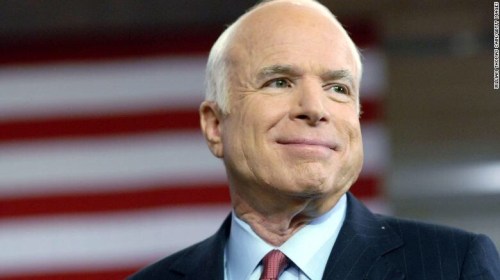
Senator John McCain’s memorial service in the Capitol, his funeral at rites at Washington’s National Cathedral, and his burial at the United States Naval Academy in Annapolis marked the end of an age that he symbolized. McCain had an outsized influence around the world for a United States Senator. As Senators go it is hard to find one with his moral, and political influence around the world. I think that maybe we would have to go back to Senator Henry “Scoop” Jackson to find one with his influence abroad.

Likewise, one has to go back far longer to find a Senator who could oppose a malignant President of his own political party as did McCain oppose Donald Trump. Barry Goldwater facing off with Richard Nixon in 1974 is one, but I think the most similar comparison with with Senator Stephen Douglas who stood up to James Buchanan in 1857 and 1858.

Though McCain was a flawed man, something that he readily acknowledged, he was an honorable man. Like Abraham Lincoln, McCain believed that the soul of America, its found in the principles of the Declaration of Independence. This was a document that both men based their lives in understanding the full meaning: those principles were not just limited to white male property owners as was the case in 1776, but extended beyond that, to every American, and for that matter every human being.

We hold these truths to be self evident, that all men are created equal, that they are endowed by their Creator with certain unalienable Rights, that among these are Life, Liberty and the pursuit of Happiness.–That to secure these rights, Governments are instituted among Men, deriving their just powers from the consent of the governed…

McCain understood that in terms of human rights, the environment, civil rights, and a respect for the underlying philosophical, religious, and legal principles that are the foundation of free societies everywhere. But now, in the United States and around the world those foundational principles are under attack from power hungry autocrats. Sadly they are led by the man whose name was unmentioned at his funeral but whose malignant presence was felt overwhelming by many who were there or who watched it, President Donald Trump.

Some attendees and others recorded that they momentarily felt that perhaps what has been lost will be recovered. But within hours most realized that this was not just a funeral for John McCain, it was a funeral for what America was and will likely never be again regardless of how the Trump presidency ends. The malevolent forces that he has unleashed were already there in the United States and in many other countries, but they were held in check until a leader unbound by the principles of the Declaration, without respect for law, without appreciation for the unwritten codes of morality, political, and civil behavior that are essential for the maintenance of a republic like ours became President.

In a sense the election of Donald Trump opened wide the gates of Hell, to the worst aspects of human behavior. If Donald Trump was to choke on a chicken wing while raving at a cable news host while tweeting and die, the damage would not only be done, but it would continue until those who would “support him even if he killed someone on 5th Avenue” are defeated at the polls, driven from power, and shamed into a sense of normalcy as were the Germans after Hitler’s Thousand Year Reich was overthrown. America will survive, we may even return to our founding principles, but it will not be without much pain, much sacrifice, and the loss of many things that we currently hold dear.

Thus when I read a column today that mentioned that McCain’s funeral was also a funeral for what we have lost I began to think about the opening chapter of Barbara Tuchman’s classic work The Guns of August. In that chapter Tuchman recounted the funeral of Britain’s King Edward VII in 1910, four years before the beginning of the First World War. She wrote:

SO GORGEOUS WAS THE SPECTACLE on the May morning of 1910 when nine kings rode in the funeral of Edward VII of England that the crowd waiting in hushed and black-clad awe, could not keep back gasps of admiration. In scarlet and blue and green and purple, three by three the sovereigns rode through the palace gates, with plumed helmets, gold braid, crimson sashes, and jeweled orders flashing in the sun. After them came five heirs apparent, forty more imperial or royal highnesses, seven queens—four dowager and three regnant—and a scattering of special ambassadors from uncrowned countries. Together they represented seventy nations in the greatest assemblage of royalty and rank ever gathered in one place and of its kind the last. The muffled tongue of Big Ben tolled nine by the clock as the cortege left the palace, but on history’s clock it was sunset, and the sun of the old world was setting.

At the end of the chapter Tuchman wrote:

Along Whitehall, the Mall, Piccadilly, and the Park to Paddington Station, where the body was to go by train to Windsor for burial, the long procession moved. The Royal Horse Guards’ band played the “Dead March” from Saul. People felt a finality in the slow tread of the marchers and in the solemn music. Lord Esher wrote in his diary after the funeral: “There never was such a break-up. All the old buoys which have marked the channel of our lives seem to have been swept away.”

Until tomorrow,

Peace,

Padre Steve+

1 Comment

Filed under culture, ethics, faith, History, leadership, News and current events, Political Commentary

The Importance of Labor and Labor Day

Friends of Padre Steve’s World,

Today is Labor Day and sadly many people don’t really understand its significance. For decades organized labor has been demonized by the descendants of people who died to secure decent working conditions, wages, and benefits for regular hard working people. The attacks on labor and workers have become much more pronounced under the Trump Administration than any prior administration since that of Herbert Hoover.

But most of the people lucky enough not to have to work on Labor Day really don’t know why it it matters, and whips in spite of those who despise labor and care not a whit about working people, who simply to use business terminology are simply human capital or resources. I actually despise those terms because they dehumanize people by turning them into impersonal economic units of measure.

So today I am digging into the vault to explore why Labor Day and what it represents matters to us now. This article is one that I have taken the time to edit and update.

Until tomorrow,

Peace,

Padre Steve+

Abraham Lincoln, who was perhaps our only President who was a real working man once said, “If any man tells you he loves America, yet hates labor, he is a liar. If any man tells you he trusts America, yet fears labor, he is a fool.” 

It seems that nothing about humanity ever changes, even so it is hard to believe that at one time American workers had no rights and I am not talking about African American slaves who as slaves didn’t even count as human beings. No I’m talking about the people Mel Brooks called in Blazing Saddles: “the white God fearing citizens of Rock Ridge” and for that matter every place and every race in America.

It was not until the mid-1800s in the United States and Europe that workers began to organize and protest for the right to decent wages and working conditions. But this came at a cost; the loss of jobs, homes, property, prison, deportation, deportation, and death.

There were many instances when this cost workers and labor organizers their lives. Employers, often backed by heavily armed private security contractors like the Pinkerton Agency, used deadly force to break up peaceful strikes. In the days of the Robber Barons, when business ran the government at almost every level, employers frequently called in local and state law enforcement, as well as the National Guard, and occasionally Federal troops to break strikes. They played various ethnic and racial groups off of each in order to divide the labor movement. There are hundreds of instances of such violence being used against workers, in some strikes the dead numbered in the hundreds.

Troops Putting Down the Pullman Strike 

Some of these attacks on workers occurred in major cities, others at isolated work sites and factories. Some are famous, the Haymarket Massacre of May 4th 1886 in Chicago, the Pullman Strike Massacre of 1894, the Homestead Strike and Massacre of 1892, the Latimer Massacre of 1897, the Ludlow Massacre of 1914, and the Columbine Mine Massacre of 1927.

Others less so, but there was more. In the Bisbee Deportation of 1917 1300 striking miners and their families were deported from their homes in Bisbee Arizona by 2000 armed deputies, put in box cars and transported 200 miles to the New Mexico desert, where without food, water or money they were left. There was the Triangle Shirtwaist Factory Fire where managers locked the doors in order to ensure that the fleeing women workers did not put anything unauthorized in their purses. One hundred forty-four workers, mostly young women died, many jumping from the burning building to their death.

Police and other Onlookers Looking up at the burning Triangle Shirt Factory with the bodies of Women Workers who jumped from it at Their Feet

Early labor organizations such as the Knights of Labor led the effort to bring about better conditions. For doing so they were labeled subversive and even called communists. Their meetings were often attacked and the leaders jailed and some lynched.

Eugene Debs

The sacrifices of those early workers, and organizers are why we have Labor Day. One of the early American labor leaders was a man named Eugene Debs. Debs eventually became a Socialist, but he said something remarkable which still is as timely as when he uttered the words:

“I am opposing a social order in which it is possible for one man who does absolutely nothing that is useful to amass a fortune of hundreds of millions of dollars, while millions of men and women who work all the days of their lives secure barely enough for a wretched existence.”

I wish that wasn’t true but it is. The Social Darwinists who follow Ayn Rand as if she were the Prophet and who populate Wall Street boardrooms and every major school of business ensure that it is. The disparity between wage laborers and CEOs is higher than it has ever been. But I digress…

On September 5th 1882 the first Labor Day was observed when members of several Unions in New York City organized the first Labor Day parade. The police came armed and ready to intervene if the workers got out of hand, but the parade was peaceful. It ended and the marchers moved over to Wendell’s Elm Park where they had a party. Twenty-five thousand Union men and their families celebrated, with hundreds of kegs of lager beer.

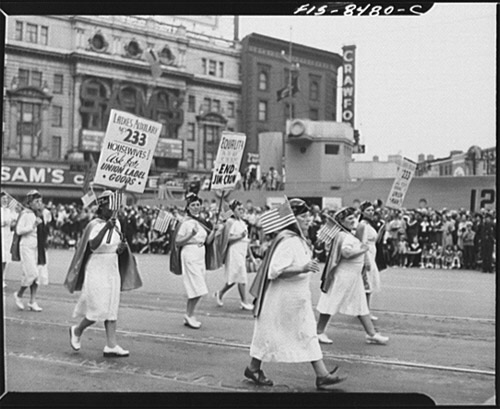
Within a few years many states began to institute Labor days of their own. In 1894, just days after the violent end of the Pullman strike in which Federal troops and Marshalls killed 30 workers and wounded 57 more, Congress and President Grover Cleveland rushed through legislation to establish a Federal Labor Day.

My Great Aunt Goldie Dundas was a labor organizer for the International Ladies Garment Worker’s Union in West Virginia in the 1920s – 1950s. I wish I had gotten to really know her, but she died when I was about 8 or 9 years old. Sadly the workers represented by that Union have had almost all of their jobs in the textile industry outsourced to China, India, Pakistan, the Caribbean, and Bangladesh where cheaply made garments are produced, and workers abused. The examples of mass deaths due to safety issues and fires in Bangladeshi factories are too numerous to list. But then who cares? The fact is you can drive through many parts of the South and see the poverty created by the exodus of these Union employers, the textile industry, which was part of the fabric of the South is gone. Empty factories and poverty stricken towns dot the countryside. I saw a lot of them living in Eastern North Carolina, towns that once thrived are ghost towns, riddled with crime, unemployment and no hope, unless Wal-Mart opens a store in town. Ironically it sells the clothing made overseas that used to be manufactured by the parents, grandparents and great-grandparents of the people who live there today.

Adam Smith, the father of Capitalism understood it in a very different manner than those who claim to be Capitalists today. He wrote in his magnum opus, The Wealth of All Nations:

“In regards to the price of commodities, the rise of wages operates as simple interest does, the rise of profit operates like compound interest. Our merchants and masters complain much of the bad effects of high wages in raising the price and lessening the sale of goods. They say nothing concerning the bad effects of high profits. They are silent with regard to the pernicious effects of their own gains. They complain only of those of other people.”

The fact is that today, labor is under threat. Unions have been demonized by politicians and pundits and their power and influence much reduced. Some of this was due to their own success in improving conditions from workers, and not just Union workers. When my dad retired from the Navy in 1974, he went to work at one of the few non-Union warehouses of the John Deere Company in Stockton, California. While they were not union, the workers received every benefit won by the majority of the workers in the company who were members of the United Auto Workers Union. Due to that my dad had high wages, excellent working conditions and benefits. The company had a program for the children of workers, which allowed them to work in the summer in the warehouse and receive incredibly high pay and benefits while in college. I did that for two years, and it helped pay for much of my college. I was not a union member but I benefited because Union men and leaders did the hard work to make that job happen.

However, in many places, Unions and labor are under attack, sometimes not just by corporations, but also by state governments. Job security and stability for most American workers is a thing of the past. Federal and State agencies charged with protecting those rights, including safety in the workplace are being cut in the mad rush to reduce government power. Corporations are offshoring and outsourcing jobs without regard to American workers or the country itself. Part of that is due to globalization and I understand that, but these companies frequently relocate jobs to places where they can exploit workers, deny them benefits, pay them less, and suffer no penalty for ignoring safety procedures or harming the environment. It seems to me that we are returning to the days of the Robber Barons. I wonder when violence against workers and those who support them will be condoned or simply ignored.

Pope Leo XIII wrote in his encyclical Renum Novarum:

“The following duties . . . concern rich men and employers: Workers are not to be treated as slaves; justice demands that the dignity of human personality be respected in them, … gainful occupations are not a mark of shame to man, but rather of respect, as they provide him with an honorable means of supporting life. It is shameful and inhuman, however, to use men as things for gain and to put no more value on them than what they are worth in muscle and energy.”

He also wrote:

“Equity therefore commands that public authority show proper concern for the worker so that from what he contributes to the common good he may receive what will enable him, housed, clothed, and secure, to live his life without hardship. Whence, it follows that all those measures ought to be favored which seem in any way capable of benefiting the condition of workers. Such solicitude is so far from injuring anyone, that it is destined rather to benefit all, because it is of absolute interest to the State that those citizens should not be miserable in every respect from whom such necessary goods proceed.”

But sadly there are far too few church leaders of any denomination who will take the side of workers or the poor, and when they do they are either condemned by the disciples of Ayn Rand or politely thanked and ignored by politicians and corporate leaders.

So please, when you celebrate Labor Day, do not forget that it is important, and that we should not forget why we celebrate it. If we forget that, it will become a meaningless holiday and our children may have to make the same sacrifices of our ancestors.

Labor Day is a day to remember the men and women, some of them former soldiers, workers, labor organizers, and leaders; some of whom were killed by National Guard and Federal troops for their effort, who paved the way for workers today. We cannot forget that. So when you see a politician attacking Labor and seeking to diminish workers rights or benefits ask them what Abraham Lincoln or Adam Smith would think. If they can’t answer, turn your backs on them and start fighting for what is right.

WASHINGTON, : US civil rights leader Martin Luther King,Jr. (3rd from L) walks with supporters during the “March on Washington” 28 August, 1963 after which, King delivered the “I Have a Dream” speech from the steps of the LIncoln Memorial. 28 August, 2003 marks the 40th anniversary of the famous speech, which is credited with mobilizing supporters of desegregation and prompted the 1964 Civil Rights Act. King was assassinated on 04 April 1968 in Memphis, Tennessee. James Earl Ray confessed to shooting King and was sentenced to 99 years in prison. AFP PHOTO/FILES (Photo credit should read AFP/AFP/Getty Images)

Dr. Martin Luther King Jr., who always stood for the rights of workers no-matter what their race, creed, or color, said:

“We must rapidly begin the shift from a “thing-oriented” society to a “person-oriented” society. When machines and computers, profit motives and property rights are considered more important than people, the giant triplets of racism, materialism, and militarism are incapable of being conquered.” 

Likewise, one cannot forget that Dr. King was assassinated when he went to Memphis to support the Memphis Sanitation Worker strike.

This my friends is why Labor and the protection of working people from those who abase them, mistreat them, and exploit them is so important.

3 Comments

Filed under civil rights, ethics, faith, History, labor, laws and legislation, News and current events, Political Commentary

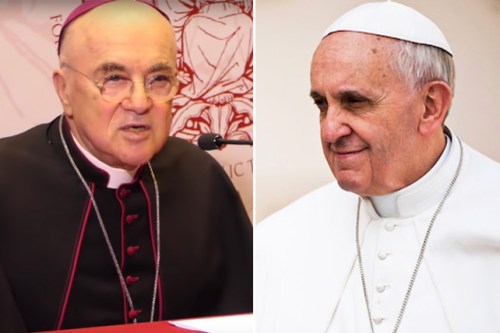
What Did He Know, When Did He Know It? The Question that Now Haunts the Papacy of Pope Francis

CL_ArchbishopCarloMariaVigano_PopeFrancis_642x428

Friends of Padre Steve’s World,

Please do not get me wrong, this is a difficult post to write. Those who know me will understand that this is not an ad hominem attack on the Roman Catholic Church. Though I am not Roman Catholic I have always loved it as our Mother Church and I have been an admirer of Pope Francis since he ascended to the Papacy when Pope Benedict resigned. Likewise I am not a particular admirer of Archbishop Carlo Maria Viganò nor his faction of the Church, his charges that Pope Francis was of the crimes of Cardinal McCarrack shortly after he was elected Pope seems within the realm of the possible.

Whether it is true or not I do not know, but the Vatican and especially Pope Francis himself must deal with these accusations before they destroy the Church, and left alone to fester without being refuted and disproved that will happen and the results are unimaginable, unless you are a historian. The last two times the Church split, in 1054 and 1517 the results were dreadful, nit just from a religious point of view but from a human perspective.

But the question of what Pope Francis knew and when he knew is is not only a good question, but a necessary question; what did this Pope know and when did he know it?

If I can ask that of a political leader that I despise, I can ask it of a religious leader I respect and admire because I value truth more than sentiment. While I acknowledge that Archbishop Carlo Maria Viganò, the Vatican’s former top diplomat to the United States, and a conservative reactionary who often seems to be attempting to justify himself against criticism from across the spectrum of the Roman Catholic Church could have less than honorable intentions when he released an 11 page accusatory diatribe against Francis, I cannot simply dismiss his accusations. They are well within the realm of the possible, no matter what his motive.

The fact is every Pope in recent memory has been covering up scandal after scandal to protect their allies, the Roman Catholic Church, like all churches or religious organizations is a political beast and has been since Constantine. However, unlike what was said by Archbishop Viganò, this is not the fault of homosexuals. It is the fault of a secretive culture, absolute monarchy, and rules about celibacy which are not normal. Celibacy has to be a special grace, it is not the normal order. For a man or woman to maintain it is difficult. I know this for a fact because between 1996 and 2013 I spent 10 of 17 years away from my wife due to military deployments, schools and assignments. It was voluntary celibacy to remain true to my marriage vows when it would have been very easy to violate them and keep my reputation clean in the process. I cannot imagine trying to do that for life. Likewise, while it is probably true that some, and maybe even a sizable number of Catholic Catholic clergy are homosexuals, as were some of the offenders listed in the Pennsylvania Grand Jury report, but the problem is bigger than them as was shown in that report.

I knew a Navy Catholic Chaplain who was removed from the service for multiple affairs with married women who were members his Navy Chapel parishes. Most were officer’s wives. He was turned in by a jilted woman who had was shacking up with until he told her to leave his home. She had the good on him and contacted close to 30 other women who corroborated her allegations which she sent to his Bishop as well as the Marine General commanding his unit, who by the way was Catholic.

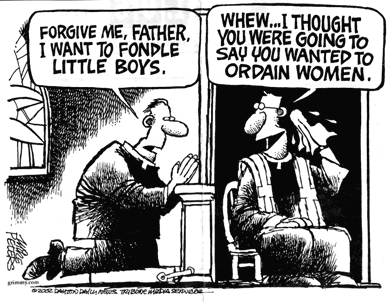
peters0210c

He was a sexual predator masquerading as a priest. He, as most predators was sent to a retreat center for such clergy. Unlike others, this man was such a sociopath that the retreat center, run by a world renowned Catholic pastoral care and psychologist sent him back uncured. He was not in the slightest bit repentant. He told me that when his bishop saw the accusations that all he said was “at least it wasn’t little boys” and before he was kicked out of the Navy tried his wiles on one of my neighbors.

The Navy had the courage to throw him out and remove him from service with an Other Than Honorable discharge, an administrative separation that is the equivalent of a Dishonorable Discharge without a trial by Court Martial. However the Church was slow to respond, after he was discharged from the Navy he retained his clerical faculties for many years. He is finally listed as having his faculties suspended and being forbidden to represent himself as a Catholic Priest as of the dates of the initial accusations, but that did not occur for years, during which time he took on a Ph.D. and spoke at many Catholic conferences.

Sadly the culture of the Catholic Priesthood, as well as many other religious vocations across the faith spectrum is attractive to men who want power. They do so in an institution that normalizes such power and for which the protection of offenders is the default setting of Church leaders regardless of whether they are liberal or conservative. In fact they don’t even have to be Roman Catholic. The Bishop who ordained me in a conservative Anglo-Catholic denomination in 1996 was hit with multiple accusations which took down him and the religious community that he had founded. I knew some of the accusers, the Bishop and that community were attempting to be more like the Roman Catholics of a century ago than the current Roman Catholic Church. If you want to know more details sent me an email and I will put you on the trail to discover that this is not just a Roman Catholic problem.

Likewise, this is not simply an American problem, it can be found around the world in the Roman Catholic Church and is bolstered when the Church is also the State religion or the religion of the colonial regimes whose native descendants rule in autocratic fashion. Of course other religious and other Christian denominations have similar issues, but they are not the Roman Catholic Church which for good or bad is so often the face of Christianity at large than it is not.

Regardless of this, there are many faithful priests and bishops who are not criminals and regardless of their sexual orientation have never harmed anyone. I personally know many of them who are disgusted by the power hungry prelates that scorn justice and defend the indefensible. They are men who I have served with in the military and in the civilian world, men who helped Judy and I in our spiritual development. Likewise there are the Nuns who helped and cared for both of us along the course of our life and faith.

That being said, I want the Church to face its demons, and reform. If it does not I am all for the State exercising it’s legal duty to protect citizens by investigating the Church, uncovering the truth, and bringing the guilty wherever possible to justice even if it brings shame to the Church. The same goes for any other church or religious body which allows such crimes to continue and attempts to cover them up.

I read a columnist today who noted two pathways to reform in the Church, that of Saint Francis of Assisi, and that of Martin Luther. As a historian, theologian, and student of both Saint Francis and Martin Luther I think that is a bit simplistic. There are reforms that take place within the Church, like Francis, and those that thrown out and branded as heretics for their dissent like Luther. But even with the Church there are “reforms” that are either progressive or reactionary, defensive or redemptive. There are many examples of all of these movements in Church history, and not just in the Roman Church.

As far as the costs of being a reformer who started in the Church and got thrown out like Martin Luther, I understand that. I got thrown of my former church about this time of year in 2010 for publicly stating my views about favorable views about women’s ordination, homosexuality, and Muslims. Thankfully, I had others who were willing to take me in to continue to serve as a priest, and that my former church was not the state religion. The ironic thing was that the Bishop who threw me out was later thrown out and stripped of his episcopate for attempting to go behind the backs of his fellow bishops to remove the nearly 25 active duty military chaplains to a different denomination. He extremely duplicitous and got his comeuppance.  If you want call it Karma.

But this is reality. If the Catholic Church does not face it the results will be more catastrophic for it than the Protestant Reformation. Wise leaders, and I really do pray that Pope Francis is one of them recognize the trends of history and the necessity to stand for justice and mercy even if it is costly. Truth and integrity matter. If religious leaders and institutions cannot stand for truth and integrity, if they cannot cry out for justice, and if they instead try to protect themselves and project an aura of infallibility, wrapped in historic myth they will only destroy themselves.

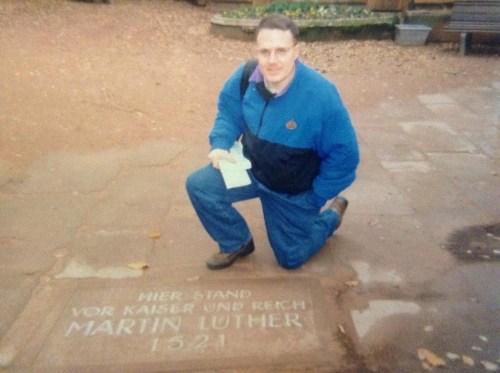
1470237_10152110186432059_1784204366_n

As Luther said to the Emperor, princes, and prelates of the Holy Roman Empire at Worms:

“Hier stehe Ich, Ich kann nicht anders.”
(“Here I stand, I can do no other”)”

If that pisses off Catholics or Protestants, or for that matter members or leaders of any other religion or cult, even the Trump Cult, I am not sorry. Truth is truth, justice demands justice and as much as I admire Pope Francis, the truth must be told. It may not be pretty, and it may for a time seem like a disaster, but it will be the salvation of the Church. The same is true for the leaders of other Christian denominations and non-Christian religious.

Until tomorrow,

Peace

Padre Steve+


5 Comments

Filed under christian life, faith, History, leadership, ministry, News and current events, Pastoral Care, Political Commentary, Religion

God’s Not Quite Chosen People: Confederate Christianity and the “Christian” Trump Cult

thumb

Friends of Padre Steve’s World

Unlike many areas of study, history never goes out of date. While I do not think that history necessarily repeats itself, I do believe that essentially humans never real change. Yes we sometimes do get better, but we often instead of rising to our best, we repeat the errors of those who have gone before us. 

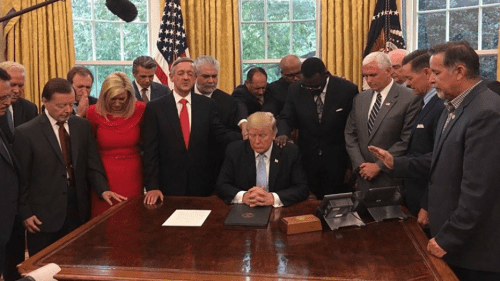
Today I read about President Trump’s closed door meeting with about 100 Trump supporting Evangelical Christian leaders at the White House. As he usually does the President laced his comments with outright lies about laws and legislation that he has supposedly enacted which his cult like supporters fawned over him. It was yet another display of how far those who with one breath claim the name of Christ in the next take Judas’s 30 pieces of silver in order to gain temporal power. But I digress…

But this tendency to do their worst is especially true in he arenas of politics and religion, especially when societies decide to merge the two.

I have written about this good number of times citing contemporary and historical examples, but today I am pulling out yet another section of the chapter of my Civil War and Gettysburg Staff Ride text dealing with how the Southern Confederacy for all practical purposes merged church and state during the Civil War. Now it did not become a full fledged theocracy, but I have no doubt that it would have had the Confederacy succeeded in its quest to become independent. The philosophical and religious thought that undergirded so much of what the Confederacy stood for almost demanded this.

And so today when we look at the fracturing of religion along political and ideological lines political resurgence of the Christian Right in the Republican Party we see many of the themes of the Confederacy being recast and broadcast as what it is to be authentically American and even more dangerously, that only Christians can be real Americans. That it what almost all the current field of Republican candidates cow-tow to the most extreme leaders and spokesmen of the Christian Right, some of whom are openly neo-Confederate in their beliefs and have ties to neo-Confederate and White Supremacist organizations.  

Since those supposedly Christian leaders seek to use their influence to force their religion on others, this subject remains very important. 

Have a great day.

Peace

Padre Steve+

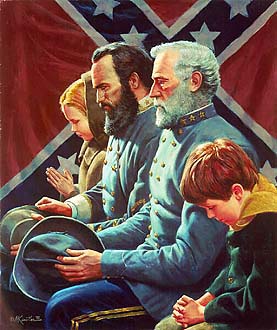
lee-jackson-in-prayer

Perhaps more than anything, the denominational splits helped prepare the Southern people as well as clergy for secession and war. They set precedent by which Southerners left established national organizations. When secession came, “the majority of young Protestant preachers were already primed by their respective church traditions to regard the possibilities of political separation from the United States without undue anxiety.”[1]

One of the most powerful ideological tools since the days of the ancients has been the linkage of religion to the state. While religion has always been a driving force in American life since the days of the Puritans in the Massachusetts Bay Colony, especially in the belief about the destiny of the nation as God’s “Chosen People,” it was in the South where the old Puritan beliefs took firm root in culture, society, politics and the ideology which justified slavery and became indelibly linked to Southern nationalism. “Confederate independence, explained a Methodist tract quoting Puritan John Winthrop, was intended to enable the South, “like a city set on a hill’ [to] fulfill her God given mission to exalt in civilization and Christianity the nations of the earth.” [2]

Religion and the churches “supplied the overarching framework for southern nationalism. As Confederates cast themselves as God’s chosen people.” [3] the defense of slavery was a major part of their mission. A group of 154 clergymen calling themselves “The Clergy of the South” “warned the world’s Christians that the North was perpetuating a plot of “interference with the plans of Divine Providence.” [4] A Tennessee pastor bluntly stated in 1861 that “In all contests between nations God espouses the cause of the Righteous and makes it his own….The institution of slavery according to the Bible is right. Therefore in the contest between the North and the South, He will espouse the cause of the South and make it his own.” [5]

The effect of such discourse on leaders as well as individuals was to unify the struggle as something that linked the nation to God, and God’s purposes to the nation identifying both as being the instruments of God’s Will and Divine Providence:

“Sacred and secular history, like religion and politics, had become all but indistinguishable… The analogy between the Confederacy and the chosen Hebrew nation was invoked so often as to be transformed into a figure of everyday speech. Like the United States before it, the Confederacy became a redeemer nation, the new Israel.” [6]

This theology also motivated men like the convinced hard line Calvinist-Presbyterian, General Stonewall Jackson on the battlefield. Jackson’s brutal, Old Testament understanding of the war caused him to murmur: “No quarter to the violators of our homes and firesides,” and when someone deplored the necessity of destroying so many brave men, he exclaimed: “No, shoot them all, I do not wish them to be brave.” [7]

In effect: “Slavery became in secular and religious discourse, the central component of the mission God had designed for the South….The Confederates were fighting a just war not only because they were, in the traditional framework of just war theory, defending themselves against invasion, they were struggling to carry out God’s designs for a heathen race.” [8]

From “the beginning of the war southern churches of all sorts with few exceptions promoted the cause militant” [9] and supported war efforts. The early military victories of Robert E. Lee’s Army of Northern Virginia and the victories of Stonewall Jackson in the Shenandoah Valley   were celebrated as “providential validations of the cause that could not fail…” Texas Methodist minister William Seat wrote: “Never surely since the Wars of God’s ancient people has there been such a remarkable and uniform success against tremendous odds. The explanation is found in the fact that the Lord goes forth to fight against the coercion by foes of his particular people. Thus it has been and thus it will be to the end of the War.” [10]

This brought about a intertwining of church and state authority, a veritable understanding of theocracy as “The need for the southern people to acknowledge God’s authority was bound up with a legitimation of the authority of clerical and civil rulers. Christian humility became identified with social and political deference to both God and Jefferson Davis.” [11]

Jefferson Davis and other leaders helped bolster this belief:

“In his repeated calls for God’s aid and in his declaration of national days of fasting, humiliation, and prayer on nine occasions throughout the war, Jefferson Davis similarly acknowledged the need for a larger scope of legitimization. Nationhood had to be tied to higher ends. The South, it seemed, could not just be politically independent; it wanted to believe it was divinely chosen.” [12]

Davis’s actions likewise bolstered his support and the support for the war among the clergy. A clergyman urged his congregation that the people of the South needed to relearn “the virtue of reverence- and the lesson of respecting, obeying, and honoring authority, for authority’s sake.” [13]

Confederate clergymen not only were spokesmen and supporters of slavery, secession and independence, but many also shed their clerical robes and put on Confederate Gray as soldiers, officers and even generals fighting for the Confederacy. Bishop Leonidas Polk, the Episcopal Bishop of Louisiana, who had been a classmate of Jefferson Davis at West Point was commissioned as a Major General and appointed to command the troops in the Mississippi Valley. Polk did not resign his ecclesiastical office, and “Northerners expressed horror at such sacrilege, but Southerners were delighted with this transfer from the Army of the Lord.” [14] Lee’s chief of Artillery Brigadier General Nelson Pendleton was also an academy graduate and an Episcopal Priest. By its donations of “everything from pew cushions to brass bells, Southern churches gave direct material aid to the cause. Among all the institutions in Southern life, perhaps the church most faithfully served the Confederate Army and nation.” [15] Southern ministers “not only proclaimed the glory of their role in creating the war but also but also went off to battle with the military in an attempt to add to their glory.” [16]

Sadly, the denominational rifts persisted until well into the twentieth century. The Presbyterians and Methodists both eventually reunited but the Baptists did not, and eventually “regional isolation, war bitterness, and differing emphasis in theology created chasms by the end of the century which leaders of an earlier generation could not have contemplated.” [17] The Southern Baptist Convention is now the largest Protestant denomination in the United States and many of its preachers are active in often divisive conservative social and political causes. The denomination that it split from, the American Baptist Convention, though much smaller remains a diverse collection of conservative and progressive local churches. Some of these are still in the forefront of the modern civil rights movement, including voting rights, women’s rights and LGBT issues, all of which find some degree of opposition in the Southern Baptist Convention.

But the religious dimensions were far bigger than denominational disagreements about slavery; religion became one of the bedrocks of Confederate nationalism. The Great Seal of the Confederacy had as its motto the Latin words Deo Vindice which can be translated “With God as our Champion” or “Under God [Our] Vindicator.” The issue was bigger than independence itself; it was intensely theological. Secession “became an act of purification, a separation from the pollutions of decaying northern society, that “monstrous mass of moral disease,” as the Mobile Evening News so vividly described it.” [18]

The arguments found their way into the textbooks used in schools throughout the Confederacy. “The First Reader, For Southern Schools assured its young pupils that “God wills that some men should be slaves, and some masters.” For older children, Mrs. Miranda Moore’s best-selling Geographic Reader included a detailed proslavery history of the United States that explained how northerners had gone “mad” on the subject of abolitionism.” [19] The seeds of future ideological battles were being planted in the hearts of white southern children by radically religious ideologues, just as they are today in the Madrassas of the Middle East.

While the various theological and ideological debates played out and fueled the fires of passion that brought about the war, they also provided great motivation to their advocates. This was true especially to Confederates during the war, that their cause was righteous. While this fueled the passion of the true believers, other very real world decisions and events in terms of politics, law and lawlessness, further inflamed passions.

Notes

[1] Brinsfield, John W. et. al. Editor, Faith in the Fight: Civil War Chaplains Stackpole Books, Mechanicsburg PA 2003 p.67

[2] Ibid. Faust The Creation of Confederate Nationalism p.27

[3] Ibid. Gallagher The Confederate War pp.66-67

[4] Ibid. Daly When Slavery Was Called Freedom p.145

[5] Ibid. Daly When Slavery Was Called Freedom p.138

[6] Ibid. Faust The Creation of Confederate Nationalism p.29

[7] Fuller, J.F.C. Grant and Lee: A Study in Personality and Generalship, Indiana University Press, Bloomington IN 1957

[8] Ibid. Faust, The Creation of Confederate Nationalism: Ideology and Identity in the Civil War South p.60

[9] Ibid. Thomas The Confederate Nation 1861-1865 pp.245-246

[10] Ibid. Daly When Slavery Was Called Freedom pp.145 and 147

[11] Ibid. Faust The Creation of Confederate Nationalism p.26

[12] Ibid. Faust The Creation of Confederate Nationalism p.33

[13] Ibid. Faust The Creation of Confederate Nationalism p.32

[14] Foote, Shelby, The Civil War, A Narrative. Volume One: Fort Sumter to Perryville Random House, New York 1963 1958 p.87

[15] Ibid. Thomas The Confederate Nation p.246

[16] Ibid. Daly When Slavery Was Called Freedom p.142

[17] Ibid. McBeth The Baptist Heritage pp.392-393

[18] Ibid. Faust The Creation of Confederate Nationalism p.30

[19] Ibid. Faust The Creation of Confederate Nationalism p.62

3 Comments

Filed under civil rights, civil war, faith, History, News and current events, Political Commentary

The Capstone of a Life: John McCain’s Parting Words

Friends of Padre Steve’s World,

Last night I didn’t get to sleep until about 4 A.M. I had been up until 1 A.M. working in the house and today I spent about 10 hours ripping out carpet, moving furniture, and working to lay new flooring in our house. My friend who has been doing the really hard stuff that requires skill to make it look good is coming back tomorrow to help finish the job. I I’d the furniture moving and carpet removal. Why anyone would put carpet in a house is beyond me. It is amazing, even with vacuuming and shampooing just how much dirt and crap is in and under the carpet. All I can say is yuck, which coincidentally is the mildest thing that I can say or think about President Trump.

However, that term does not apply to the late Senator John McCain’s message as he decided not to go on a ventilator to try to prolong his life. He knew his time had come and he released this message in which he quoted John Hemingway. McCain’s words were that of a thankful man who knew the ups and downs of life, it’s success and failure, but left life thankful and content.

In life he taught us much in positive and negative examples. He owned his failures but was happy that he had some influence in the life of this nation and the world at this time in history. I think that it is important that Senator McCain was the kind of person who did not reject people if they differed in opinion with him. His selection of President Barack Obama to do a eulogy at his funeral symbolizes that far too scarce ability to be friends with political or ideological adversaries. That used to be a pretty normal state of affairs in our country, but it is almost extinct today.

His words about the end of his life are remarkable and should be read by all. But before I share them I have to note that his last Tweet on Twitter was extending his sympathy to an Army officer and pilot killed in Iraq on his ninth deployment in 16 years of service. I cannot imagine something similar to be President Trump’s final tweet.

However, what I cannot say that there was anything in Senator McCain’s final note that could be described as “yuck.” Instead is was a very personal letter of someone schooled in life who never stopped reading or learning. The Senator from Arizona wrote:

“The world is a fine place and worth the fighting for and I hate very much to leave it … I hate to leave it. But I don’t have a complaint. Not one. It’s been quite a ride. I’ve known great passions, seen amazing wonders, fought in a war, and helped make a peace. I’ve lived very well and I’ve been deprived of all comforts. I’ve been as lonely as a person can be and I‘ve enjoyed the company of heroes. I’ve suffered the deepest despair and experienced the highest exultation. I made a small place for myself in the story of America and the history of my times. What an ingrate I would be to curse the fate that concludes the blessed life I’ve led. I prefer to give thanks for those blessings, and my love to the people who blessed me with theirs. The bell tolls for me. I knew it would. So I tried, as best I could, to stay a ‘part of the main.‘ I hope those who mourn my passing, and even those who don’t, will celebrate as I celebrate a happy life lived in imperfect service to a country made of ideals, whose continued service is the hope of the world. And I wish all of you great adventures, good company, and lives as lucky as mine.” —John McCain

Rest In Peace Senator McCain, for I know that you will.

Peace,

Padre Steve+

1 Comment

Filed under faith, leadership, life, News and current events, philosophy, Political Commentary

Forgiveness Will Not Change the Past, but It Could Change the Future: Dealing with the Aftermath of a Painful Experience

Friends of Padre Steve’s World,
As my regular readers know I went through a decidedly difficult time over the past coupled of months. If you are a new reader or have not read the post in which I wrote about this experience let me explain.
In mid-June I substituted for one of my chaplains so that he could have a weekend off. The preached from Second Corinthians chapter five regarding Christian responsibility towards other people and the creation. I discussed how the Trump Administration’s border policies were in opposition to that. I explained that the words used by the President and administration about darker skinned immigrants and refugees was dehumanizing. That the use of terms such as “animals” and ‘infestations” while labeling them all as “rapists” and “criminals” of the worst kind was little different than what others had done in the past. I used a number of historical examples; including the American experiences dealing with the extermination and forced relocation of native American tribes, slavery, Jim Crow, the incarceration of Japanese Americans in World War II, and the Nazi treatment of Jews and others deemed “subhuman.” I quoted Dietrich Bonhoeffer, Martin Niemöller, Dr. Martin Luther King Jr., and others to emphasize that such treatment and demonization was in complete opposition to the teaching of the Gospel and the Christian tradition.
It was probably one of the most powerful and heartfelt sermons that I have ever preached. One of the chapel members present told one of my staff chaplains that it was like “hearing the voice of God thunder from the pulpit.” 
For that I had a member of the congregation try to have me tried by court martial for conduct unbecoming an officer and contempt towards the President of the United States. The man accused me of many things including comparing the President to Adolf Hitler and law enforcement officers to the Nazis. I did no such thing but that is what I was accused of. I was investigated and had to retain an attorney. The investigation confirmed that I had not done what the man said and exonerated me.
Since then I have tried to work through my feelings and emotions and decide what to do. I talked with a number of people and decided that I would need to address the subject before the congregation at a future point.
So I did that today and am pleased to report that my talk with the congregation regarding went well. I was very nervous and fearful going in to the service and during the half hour or so before the service while sequestered in my office I thought that I was going to throw up. 
 
I talked for a little over 8 minutes and humbly explained what happened without any judgment on the man or the congregation. In fact I confessed my fear about even coming before them. I explained that of all the things in my 37 year career that this was the most difficult, including going to combat, getting shot at and dealing with PTSD. I explained that I never expected anything like that. I explained that I had thought that even if someone disagreed with the sermon that they would come to me as is taught in the words of Christ and the writings of the Apostle Paul and not try to have me punished by attempting to have me punished. 
 
I explained that I had worked through my anger but that I was still hurt and that I did not feel safe with the congregation. I invited anyone that wanted to see me either after the service or make a time with me to talk over coffee, lunch, or a beer at a later time. I discussed forgiveness and remarked that even though I had gotten through the anger and forgave my accuser and those who turned their backs on me after that service that the pain remained and that I did not feel safe or that I was fully able to trust them. I also asked forgiveness for anything that I might have said to offend anyone present. I noted that forgiveness will not change the past but could very well change the future. 
Likewise I explained that during my anger I had considered taking revenge on my accuser by suing him in civilian court for libel and defamation of character. But I realized that if I did so that it would not be helpful to anyone. When I was binge watching The Blacklist over the past few weeks I remembered a comment made by Raymond Reddington. He said: “Revenge isn’t a passion. It’s a disease. It eats at your mind and poisons your soul.” 
When I completed my remarks, I exited the pulpit and handed the service back to my Protestant pastor and waited in my office.
 
The response was good, I don’t think that I could have asked for more. A number of people came to me after the service and were very kind. Two of them were men who in their interviews with the investigating officer refuted all of the accusations against me. The response of the people who came to me was quite touching and very encouraging. 
Since I do not know what the man who made the charges looks like I do not know if he was in attendance today. At the end of my talk I announced my plans to retire and that I may not preach again at this chapel, but that the decision was not final. Those who visited with me all told me that they wanted me to continue to preach the truth, all of them said that it was badly needed in our chapel if it were to survive. One elderly couple said that the congregation was dying. I haven’t decided if I will preach again because I am not there yet, but I haven’t ruled it it. 
As far as forgiveness, I do forgive, but it is a process, but it is impossible to forget. Maybe that is one thing that makes us human. The memories of such experiences will always be a part of us, and just maybe that is a good thing. That may sound strange because so many people say to “forgive and forget” as if that is part of scripture or a Biblical command. In fact that the phrase is not found anywhere in the Bible. I believe that we should forgive but that because we cannot forget we should remember what was done so that we learn from it and are able to move on and do better ourselves.
So for tonight I thank all of my readers for your kind words, thoughts, and prayers over the past two months.
Until tomorrow.
Peace
Padre Steve+

13 Comments

Filed under christian life, faith, life, ministry, Pastoral Care

You Have to Make Choices and be Happy with Them

img_5808-1

Friends of Padre Steve’s World,

Today was an exhausting day. Last night I found out that one of the military personnel that I had served with in a previous assignment many years ago was in a bad way. It was already well after midnight but since I didn’t have his phone number I sent him a personal message on a social media site. I asked him to call me and gave him my number. I cannot divulge any details but he was struggling and our conversation lasted a long time. I didn’t get to sleep until almost 3 AM. But the good thing is that he is getting help at the VA and I am sure that he will be okay. But his trust in me was a validation of the work that I do, and will continue to do for the people that I have served with for the rest of my life, long after I retire from the Navy next year.

Unfortunately before I went to bed I found my wife’s car keys in my pants. I decided to go hang them on the key rack downstairs. I was tired and wasn’t paying attention, didn’t keep a grip on the railing and slipped on the second or third stair from bottom and jammed my left leg and less badly my right leg. I hurt like a son of a bitch. I ended up getting less than three hours of very uncomfortable sleep and when I swung  my leg out of be was jolted by excruciating pain.

It would be that this morning I had to get up early to cover a number of meetings that lasted until noon. I had to limp to those meetings and in the midst of fighting off the sleep monster and trying to keep myself in a position that my legs didn’t hurt. After my meetings I limped back to my car and the office and handled before driving to the Naval Medical Center ER.

The ER and the radiology techs were great, despite bending me into positions that made me scream. The good thing was that they found no broken bones. I have some bruising on my femur, and have some pulled muscles and sprains and they discovered that I have some arthritis in my knees, hips, and ankles. No doubt from all of my running, athletic injuries, and from lugging around too much gear in criss crossing Al Anbar Province back in 2007-2008, and far too many field exercises in the Army and while serving with the Marines.

That made for a very long day, I left the ER about 5 PM and drove to my favorite local German restaurant, the Bier Garden, in Portsmouth to avoid rush hour and the pain in the ass known getting through the Downtown Tunnel, but I digress…

I usually have the Sauerbraten with a Semmel Knodel and red cabbage or sauerkraut, or sometimes their Bockwurst. Both are great and their rotating beer selections of German, European, and American craft beers is wonderful, But today I had their Ruben on German sourdough bread. I haven’t had that in a long time and and it is still to die for. The wonderful owner and operator of the Bier Garden is a German lady named Hannelore. She is an absolute doll, Judy and I love her to death.

But while I was out I was able to read the comics and check the news only to find that the President had stripped former CIA director’s security clearance and is looking at doing so to others. The interesting thing as that of those he is looking at doing this to none have committed any crimes, they are simply critics. Of course the reason that these men and women retain their clearances is not to give them access to information when they leave the organization, but rather if their expertise is needed that they can be used to help the agencies that they once ran.

The same is true for military personnel who leave the service. It is a pain in the ass to start a new clearance and takes time, that’s why the government allows such men and women to maintain clearances. It was interesting to note that the one person not being looked at to have their clearance revoked was an actual convicted criminal, Trump’s first National Security Advisor, former General Michael Flynn. I find that fascinating, only non-criminal critics are being looked at while an actual criminal is not. This leads me to believe that this unprecedented action was done to silence not just Brennan, but all critics. But then I have recently experienced the kind of fanatical vengeance from a Trump Cultist parishioner that tried to get me tried by court martial for a sermon. So I understand the what John Brennan is going through, but I digress…

Anyway, when I was done with dinner and a couple of marvelous beers, I limped to the car and went home to Judy and the the Papillon puppies and have been binge watching The Blacklist. It may not be much but I am happy. It was a fascinating day,, I got to reflect on the good things that I have been able to do in my career, muse on my current situation, think about what I will say to the congregation that the man who tried to get me tried by court martial this weekend, and be thankful for the people that I now work with, as well as Judy and the our Minnie, Izzy, and Pierre. So I didn’t make Captain or get any of the assignments, except the Staff College that I wanted after I made Commander, but Raymond Reddington once said:

“You can’t do every silly thing you want to in life. You have to make choices and be happy with them.”

I have to say that I am really learning to be happy with those choices, even the ones that were forced upon me and even with the recent experience with my parishioner. So have a great night,

Peace,

Padre Steve+

4 Comments

Filed under faith, life, ministry

Raymond Reddington, Me, and the Forgiveness of Sins

7852066-12185069

Friends of Padre Steve’s World,

In spite of being very busy working in the house and going  back to work to deal with the crisis d’jour I have been very reflective about all I have been through over the past few months. Unlike past times of reflection this has been a rather uplifting experience of grace and not a de-evolution into a morbid state of moroseness.

As I wrote on Saturday I drafted and sent up my retirement letter today for my Commanding Officer’s endorsement. I also let my detailer, the officer who manages officer assignments know that I was putting in my papers so he can plan to replace me. I also let the men and . It was a strange but very freeing. I will have much to do to get ready for that day about a year from now but knowing that I can begin working on everything that I need to accomplish. There is much to do but I am at peace and really looking forward to what comes next, whatever it may be.

Due to a situation dealing with my Catholic congregation  I am having to do a town hall meeting to explain howe things work to all of my faith group leaders and contractors on Sunday afternoon. Thus I will be going in to the chapel on Sunday and I will make an appearance before my Protestant congregation to discuss my feelings about the member that tried to get me sent to court martial. I have finally been able to deal with the anger from that experience but the pain is still there. At least I am in a better place to talk about it and know now that I won’t do anything to blow the situation up.

This experience has taught me something about grace, forgiveness, and trust, but I digress…

The fact is that I have a tremendous ability to dwell upon injustices and I have a terrible time with forgiveness. I do really love the concept and as a Christian I have no idea of how Jesus managed to forgive nor the great saints of every faith who managed to live lives full of grace and forgiveness have managed to do so. It probably goes back to my Irish-Scottish DNA, the DNA that can make one a hilarious hoot one minute and a brooding bore the next regardless of whether or not alcohol is involved.

But there is something that I have learned recently: forgiveness doesn’t require me to be dishonest about how I feel about something. I learned that from Raymond Reddington, and yes I have been binge-watching The Blacklist of late and I find Reddington’s grip on philosophy, religion, and the human condition to be quite fascinating. Reddington observed:

“Sins should be buried like the dead. Not that they may be forgotten but we may them and find our way forward nonetheless.”

Truthfully I don’t believe in the forgive and forget bullshit, it’s a nice thought, but our brains don’t work that way. We can forgive someone every day, but the memories will still be there. That’s what makes it so hard. That is why the Christian understanding of the forgiveness of since is so important and so difficult. It wasn’t meant to be easy or painless, but it might make a difference, as Reddington noted:

“A friend told me recently that forgiveness won’t change the past but could very well change their future. Apparently, everything is forgivable.” 

So that’s all for tonight. Yes I know there are many things going on that I can write about but right now I need to stay in this place for a moment.

Peace,

Padre Steve+


3 Comments

Filed under christian life, ethics, faith, life, ministry, philosophy

All Good Things: My Decision to Retiree from the Military

img_4376

Friends of Padre Steve’s World,

In the Star Trek Film Generations Captain Jean Luc Picard told Commander William Riker:

“Someone once told me that time was a predator that stalked us all our lives. But I rather believe than time is a companion who goes with us on the journey, and reminds us to cherish every moment because they’ll never come again. What we leave behind is not as important how we lived. After all, Number One, we’re only mortal.” 

Today was like any other Saturday for me except that I made the decision to put in my retirement papers from the Navy. Lord willing about this time next year I will be “piped ashore” in a retirement ceremony.

When that day comes it will be the end of a thirty-eight year military career in which I have served as an enlisted man, then an officer. I have served in the active duty Army, the Army Reserve, and California, Texas, and Virginia Army National Guard. Then in February of 1999 after 17 1/2 years in the Army I declared free agency so to speak and joined the Navy.  On February 8th I was a Major in the Army Reserve and on the 9th I was taking the oath of office as a Navy Lieutenant. My wife and my paternal grandmother were there when I took the oath in a humble, and now abandoned Naval Reserve Center in Huntington West Virginia.

So now, some 19 years and 8 months later I have made the decision to put in my retirement papers. For me it is a time for reflecting and realizing that it is the right time to do this. The last number of months in my assignment have been difficult and brought me little joy. I have sought to serve my congregations and to mentor, help, and protect the personnel assigned to me.

I have grown weary of the frustrations of dealing with a moribund bureaucracy, decaying facilities with no money to fix them, the prospect of losing most of my experienced enlisted personnel with no experienced personnel coming in, and dealing with Protestant and Catholic congregations that try my very soul. When one of my Protestant parishioners attempted to have me tried by court martial because he disagreed with my sermon content and then wrote a lying letter to my commander forcing an investigation in which I had to spend money on a lawyer to defend myself I crossed the Rubicon. I knew that I was going to retire at the end of my current tour.

Then this week I hit the culminating point when the faith group leader of my Catholic congregation and my new contract Priest raised such a ruckus and problems for my enlisted personnel and one of my Chaplains that I had to intervene despite being on leave and in the middle of massive work on my house. I spent Friday evening texting that lay leader and it only made me more upset. I realized that no matter what I did that had done to keep them going in the absence of a priest and how I fought for them that they had no loyalty of concern for me or my personnel. Gratefulness to others is not a virtue for most American Christians today, I knew that but learned it again.

This morning I read a Navy Message announcing a Selective Early Retirement Board for Captains and Commanders. I am in the zone and if chosen to be retired I would have little lead time to plan my retirement and do all the things that I would need to do medically, administratively, and personally to retire and have a decent chance of landing on me feet. Honestly, I would have rather spent the last year in a combat zone in Iraq like I did in 2007 and 2008 than deal with the bullshit that I have been dealing with lately.

I know that did the best that I could and I can say that the team of chaplains and Religious Program Specialists whose work I help direct and support are some of the finest people I have ever served with. Their honesty and likewise their care for me has been about the only thing that got me through. Honestly, I am so grateful for them and I treasure them all, just as I have so many of my other soldiers, sailors, marines, airmen, and civilians employed by the military for the last thirty-seven years.

I am at peace, and I am going to spent the time leading up to my retirement to cherish every moment. Now I know that my situation at work is not going to change but I am going to cherish the moments with the people that I care for and do my best to serve without getting to stressed out because I know now that I my future is only beginning. “Second star to the right and straight on till morning.”

Peace

Padre Steve+


17 Comments

Filed under christian life, faith, History, iraq, leadership, life, Military, ministry