Category Archives: faith

Thoughts on the National Day of Prayer Controversy

Today like many institutions in the Federal Government our Medical Center observed the National Day of Prayer. Ours was a very low key affair which I led where we simply invited people to pray after reading the Presidential Proclamation for 2010 and a short opening prayer.  People were invited to pray silently and for the benefit of our Nation and its people, especially for those serving in the military and their families.  Likewise tom offer prayer for the victims of war, natural disasters and accidents in this county and around the world.

The National Day of prayer was recently ruled unconstitutional by U.S. District Judge Barbara Crabb who ruled in favor of a suit brought about by the Freedom from Religion Foundation against The National Day of Prayer Task Force, former President George Bush and others which was expanded to name President Barack Obama when he requested that Judge Crabb to dismiss the case in 2009 when the administration argued that the foundation had no legal standing to sue.  The President and administration appealed the ruling and went ahead with the proclamation and observance of the National Day of Prayer.

The modern National Day of Prayer was enacted by President Truman and Congress in 1952 in the 36 U.S.C. § 119 : US Code – Section 119: National Day of Prayer and various Presidents at different times have called for days of fasting, prayer or thanksgiving.  The heart of President Truman’s proclamation is contained in this section:

Now, Therefore, I, Harry S. Truman, President of the United States of America, do hereby proclaim Friday, July 4, 1952, as a National Day of Prayer, on which all of us, in our churches, in our homes, and in our hearts, may beseech God to grant us wisdom to know the course which we should follow, and strength and patience to pursue that course steadfastly. May we also give thanks to Him for His constant watchfulness over us in every hour of national prosperity and national peril.

In 1982 a group of Evangelical Christians led by Shirley Dobson formed The National Prayer Committee. This organization was exclusively Christian and was formed to coordinate and implement a fixed annual day of prayer, the purpose of which was to organize evangelical Christian prayer events with local, state, and federal government entities.  This organization has since grown in popularity and prominence often being the primary organizer of such events.

Ronald Reagan eloquently stated the purpose and significance of the National Day of Prayer in his 1983 proclamation which in part read:

It took the tragedy of the Civil War to restore a National Day of Prayer. As Abraham Lincoln said, “Intoxicated with unbroken success, we have become too self-sufficient to feel the necessity of redeeming and preserving grace, too proud to pray to the God that made us.”

Revived as an annual observance by Congress in 1952, the National Day of Prayer has become a great unifying force for our citizens who come from all the great religions of the world. Prayer unites people. This common expression of reverence heals and brings us together as a Nation and we pray it may one day bring renewed respect for God to all the peoples of the world.

From General Washington’s struggle at Valley Forge to the present, this Nation has fervently sought and received divine guidance as it pursued the course of history. This occasion provides our Nation with an opportunity to further recognize the source of our blessings, and to seek His help for the challenges we face today and in the future.

Now, Therefore, I, Ronald Reagan, President of the United States of America, do hereby proclaim Thursday, May 5, 1983, National Day of Prayer. I call upon every citizen of this great Nation to gather together on that day in homes and places of worship to pray, each after his or her own manner, for unity of the hearts of all mankind.

President Reagan’s 1983 and subsequent proclamations stood firmly in the American tradition of Civil Religion and was decidedly non-sectarian.  It acknowledged that our citizens “come from all the great religions of the world” and called on Americans to gather on the day “in homes and places of worship to pray, each after his or her own manner, for unity of the hearts of all mankind.”  In fact the spirit of the declaration is much like that of the hymn God of Our Fathers which is recognized as our National Hymn.  This hymn is not explicitly Christian and never mentions Christ or the Trinity yet it is widely sung in churches on days such as the Sunday nearest to Independence Day.  The lyrics to that hymn are here:

God of our fathers, Whose almighty hand, Leads forth in beauty all the starry band

Of shining worlds in splendor through the skies, Our grateful songs before Thy throne arise.

Thy love divine hath led us in the past, In this free land by Thee our lot is cast,

Be Thou our Ruler, Guardian, Guide and Stay, Thy Word our law, Thy paths our chosen way.

From war’s alarms, from deadly pestilence, Be Thy strong arm our ever sure defense;

Thy true religion in our hearts increase, Thy bounteous goodness nourish us in peace.

Refresh Thy people on their toilsome way, Lead us from night to never ending day;

Fill all our lives with love and grace divine, And glory, laud, and praise be ever Thine.

While the American religious tradition is highly Christian and even more so from the Reformed tradition this has always existed in tension with a decidedly secularist philosophy embodied by many of the Founding Fathers who were very careful to recognize the importance of religion but at the same time both sought to protect religious liberty by NOT enacting laws to establish a particular religion nor to entangle the government in the affairs of religion which could in their view be detrimental to true religious liberty.

In fact both Thomas Jefferson and James Madison were very careful about proclamations and ensuring that government was not favoring any particular religious body. Jefferson wrote to Reverend Samuel Miller in 1808 that:

Fasting and prayer are religious exercises; the enjoining them an act of discipline. Every religious society has a right to determine for itself the time for these exercises, and the objects proper for them, according to their own particular tenets; and right can never be safer than in their hands, where the Constitution has deposited it. …civil powers alone have been given to the President of the United States and no authority to direct the religious exercises of his constituents.”

Madison who was the author of the Bill of Rights and included religious liberty in the First Amendment in support of Virginia Baptists who were under pressure from those who were determined to make and keep the Episcopal Church as the state religion of the commonwealth. Madison wrote to Edward Livingston in 1822 that:

“There has been another deviation from the strict principle in the Executive Proclamations of fasts & festivals, so far, at least, as they have spoken the language of injunction, or have lost sight of the equality of all religious sects in the eye of the Constitution. Whilst I was honored with the Executive Trust I found it necessary on more than one occasion to follow the example of predecessors. But I was always careful to make the Proclamations absolutely indiscriminate, and merely recommendatory; or rather mere designations of a day, on which all who thought proper might unite in consecrating it to religious purposes, according to their own faith & forms. In this sense, I presume you reserve to the Govt. a right to appoint particular days for religious worship throughout the State, without any penal sanction enforcing the worship.”

Even Republican Presidents such as Ronald Reagan and George H. W. Bush were careful to attempt to keep this in tension only holding one official event each during their presidencies.  It was not until George W. Bush that the President hosted events in every year of his presidency.  Remember the language of the law was that the President shall issue a proclamation for the people of the nation to pray.  Likewise the proclamations are a call for Americans, as Ronald Reagan and Harry Truman wrote to gather together on that day in homes and places of worship to pray, each after his or her own manner, for unity of the hearts of all mankind. The Day of Prayer was not intended to entwine the government in exclusively religious observances by any particular religious tradition as many of the National Day of Prayer observances in many local, state and federal government agencies.

I have in my military career been ordered to attend such events.  I have no problem with praying or even gathering for prayer but there was pressure to attend and often the observances were quite exclusivist and dominated by Evangelicals aligned with the National Day of Prayer Task Force.

While I cannot agree with Judge Crabb who I think applies the law to the manner in how some groups brazenly enmesh their particular faith tradition into these observances.  However I think that she misses that actual intent of the law and proclamations which are both non-sectarian and voluntary focusing on people observing this in their homes and places of worship.  To make the blanket judgement that the law itself is unconstitutional as Judge Crabb did is a brazen overreach.  She may rule that observances which are sectarian but done or sponsored by government agencies where employees feel pressured to attend are unconstitutional is another matter. When any religious group uses their position to organize and promote their particular view in a setting where military members or other government employees are “encouraged” to attend and where the senior leadership of these agencies is present there is the presumption that attendance is mandatory even if it is not explicitly stated.  In such cases military personnel or government employees could feel that promotion or fair treatment could be negatively impacted by not participating in what some could arguably call an establishment of religion.  Such could be the case with any faith and not just the Christian faith. This was something that the Founding Fathers despite the overwhelming Christian make up of the country strove to avoid.  They recognized the importance that religion played in public and private life and many were not afraid to use explicitly Christian in referring God but did not want the Christian faith, any denomination of it or any other religion to be either the master of or the servant of the state as was the case in all of Europe at the time of the founding of this country.

What I think has happened within the time of my military career is that many Evangelical groups have made the National Day of Prayer “their event” and use people withing government agencies or the military to organize events which lean heavily toward Evangelical Christianity.  I have seen it myself especially when I was in the Army. Not only has this occurred but many times the leadership of these religious groups promote the political agenda of a particular political party or philosophy and as such that political philosophy sometimes becomes part of the event.  It happens quite often.  When it does happen a perilous boundary is crossed and the group or groups that do this invite opposition including legal challenges such as happened in Wisconsin because such proceedings give the appearance of the establishment of religion.

To be fair to Evangelicals and others it also appears to me that some strident atheist groups are bent on removing religion from the public square and quite often use the courts and legislatures to push their agenda.  I think that the founders did not intend for this to be the case either.  The secret to the American political and religious tradition is that for the most part we have maintained the tension needed to ensure that religious liberties are protected without establishing a state religion.  This is something that people throughout the world have admired about this country as opposed to Europe where state churches worked hand in hand with their governments to persecute religious minorities even engaging in progroms or religiously based mass murder.  The same is true in much of the rest of the world where leaders of other faiths act as agents of their government and persecute those who are not of their faith.

Our society now is extremely polarized and there is little middle ground or moderation in regard to religion, politics or civil behavior.  Instead rhetoric is heated. Liberals often mock conservative Christians or others who hold their faith deeply and believe their faith to have a public voice. Likewise some political and religious people that would trample the in response to the increased secularism of modern times want to restore some sort of balance even if it means overriding the long standing tradition in American life, that tradition of tolerance and protection of the rights of others, even those that that are different or even unusual.  Such behavior on both sides becomes more heated and less compromising.  The opposing parties mirror each others attitudes, actions and tactics and use the media to stir up people to support their side and use the courts and legislatures to promote their agendas which they all believe are more in keeping with the founders intent than the other side.

This is why there is such a controversy in an event that was intended to be a unifying activity, an event that was to help Americans of all religious traditions to work for the common good of all Americans and not just their party and I use the term in a non-political sense.  My hope is that Americans in all places will have the freedom to gather to observe the National Day of Prayer but in the sense that it was originally intended, a religious observance in a civil context which promotes the public good and recognizes the influence of God and religion in the life of the country.

I know that my views will not make zealots of both sides of many faiths and creeds happy.  It seems that moderation and civility is out and those who actually believe in tolerance, respect and civility are marginalized by extremists of many forms.  Since in the past few months I have been called various names including “Communist, Marxist, Liberal, non-Christian and unbeliever” I expect that once again I will collect some fan mail.  I’m okay with that so long as you don’t call me a Dodger fan.

Peace,

Padre Steve+

2 Comments

Filed under faith, philosophy, Religion

How Baseball Helps Padre Steve Make Sense of the World

Opening Night 2010 at Harbor Park

“This is my most special place in all the world, Ray. Once a place touches you like this, the wind never blows so cold again. You feel for it, like it was your child.” Dr. Archibald “Moonlight” Graham in Field of Dreams

“I love baseball. You know it doesn’t have to mean anything, it’s just beautiful to watch.” Woody Allen in Selig (1983)

Last night was Opening Night at Harbor Park and I the visit took me back to memories of how important baseball is to me.  The Church of Baseball at Harbor Park and in particular my little corner of the world in Section 102, Row “B” Seats 1 and 2 are one of my places of sanctuary in a world that seems to have gone mad.  Baseball has always meant a lot to me but even more so after returning from Iraq in 2008.  Until recently Harbor Park was one of the few places that I felt safe, I have added to the “safe” zones since last season with Saint James Episcopal Church in Portsmouth Virginia and the Gordon Biersch Brewery Restaurant in Virginia Beach where Judy and I are members of the “Stein Club.” Slowly normalcy is returning to other parts of my life but during baseball season Harbor Park is about the center of my world.

Lefty Phillips and Me

In the fall after last season ended I would go to Harbor Park just to talk with staff and sit in the concourse.  There is something about baseball people and my seats down in section 102 that help me even when there is no game being played.  There is a peace that I have when I walk around the diamond and I feel close to God when I am around a ballpark, even without the game being played there is something almost mystical about it.  To me there is nowhere more peaceful than a ballpark and every time I watch a game on TV my mind goes back to how much baseball has been part of my life, and how in a very real way that God speaks to me through this special game.

“Baseball, it is said, is only a game. True. And the Grand Canyon is only a hole in Arizona. Not all holes, or games, are created equal.” George Will

Me Rich Reese and my brother Jeff

Baseball became part of my life as a child when my dad introduced me to it in our back yard in Oak Harbor Washington.  Even before I played an organized game dad played catch with me, showed me how to grip a ball and told me about the great ballplayers.  He made me learn the fundamentals of the game and whether we were attending a game in person, watching one on television or playing catch, pepper or practicing infield or pitching dad was all about the game.  Of course he was the same way with football, hockey and basketball, but the sport that he seemed most passionate about was baseball.  As a kid he was a Cincinnati Reds fan.  His mother, my grandmother who hailed from the hollers of Putnam County West Virginia was a diehard Dodgers fan, though I am sure that God forgives her for that.  She was an independent woman of conviction and determination that has to in some way influenced her love for the game, even as a little boy if there was a game on television she would have it on and could talk intelligently about it.  I still wonder about to this day how she became a Dodger’s fan but it probably had something to do with her independent streak.  “Granny” as she chose to be called was a woman who as a widow in the late 1930s went to work, raised her two boys and bought her own house.  Unlike most of the people in West Virginia she was also a Republican, a rare breed especially in that era. Likewise she left the Baptist church of her family and became a Methodist. As independent in her choice of baseball teams as she was in her politics Granny was a Dodgers fan in a land of Reds, Indians and Pirates fans, so even with Granny we were immersed in baseball.

Jeff, Me and Rocky Bridges

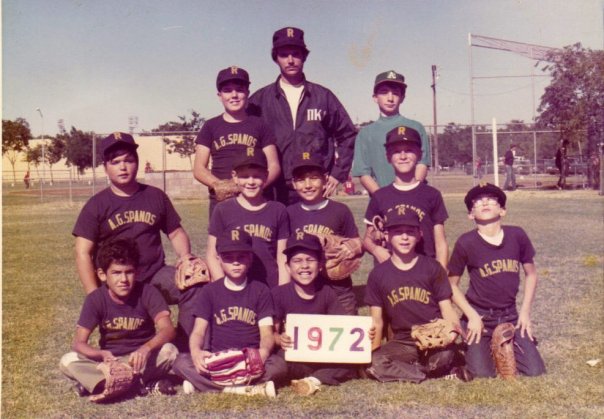
Dad always made sure that we got to see baseball wherever we lived. In 1967 he took us to see the Seattle Pilots which the next year went to Milwaukee and became the Brewers. The Pilots were an expansion team in a town with a long history of minor league ball. They played at an old park named Sick Stadium, which if you ask me is a really bad marketing plan.  The game that we went to was the “Bat Day” giveaway.  Then they gave out regulation size Louisville Slugger bats.  Mine had the name of the Pilots First Baseman Mike Hegan on the barrel.  That was my first trip to a Major League stadium and I still can remember it as if it was yesterday.  Somewhere in my junk I have a button with the Pilots logo on it.  I’ll have to fish it out again sometime.  The next year I played my first organized baseball with the Oak Harbor Little League “Cheyenne’s.” My coach was a kind of gruff old guy who stuck me out in right field when as any little kid would I was pretty much a spectator as almost nothing came my way.  I don’t know why but our team uniforms did not match, half of us had white and the other half gray. Unfortunately due to military moves I didn’t get to play organized ball again until 1972.

Oak Park Little Little League A.L Rams 1972 and yes A G Spanos of the Chargers was our sponsor

In the elementary schools of those days our teachers would put the playoff and World’s Series games on television in our classrooms as then many of the games were played during daylight hours.  I remember watching Bob Gibson pitch when the Cardinals played against the Red Sox in the 1967 series.  It was awesome to see that man pitch.   I remember the Amazin’ Mets upsetting the Orioles in 1969 and seeing the Orioles take down the Reds in 1970.  I never will forget the 1970 All Star Game where Pete Rose ran over Ray Fosse at home plate for the winning run.  I watched in awe as the great dynasty teams of the 1970s, the Reds and the Athletics who dominated much of that decade and the resurgence of the Yankees in the summer of 1978 when the Bronx burned.  Back then every Saturday there was the NBC Game of the Week hosted by Curt Gowdy, Tony Kubek and Joe Garragiola.  It was a sad day when that broadcast went off the air.

When we were stationed in Long Beach California from 1970-1971 my dad had us at Anaheim stadium watching the California Angels all the time.  I imagine that we attended at least 30 to 40 games there and a couple at Dodger stadium that first year and a good number more before we moved to Stockton California in the middle of the 1971 season.  The move north was disappointing, it took forever to get adjusted to Stockton and I think that part of it was not seeing the Angels every week at the Big “A.” At those games I met a lot of the players and coaches and even some opposing players.  The Von’s grocery store chain and the Angels radio network had a “My Favorite Angel” contest when I was in 5th Grade.  I submitted an entry about Angels First Baseman Jim Spencer and was named as a runner up.  This netted me two seats behind the plate and legendary sportscaster Dick Enberg announced my name on the radio.  Spencer was a Gold Glove First Baseman who later played for the Yankees on their 1978 World Series team.  My first hat from a Major League team was the old blue hat with a red bill, the letters CA on the front and a halo stitched on top. I still have a hat from the 1971 team with the lower case “a” with a halo hanging off of it.  It has numerous autographs on the inside of the bill including Sandy Alomar, Jim Spencer, and Jim Fregosi, Chico Ruiz and Billy Cowan and sits in a display case on my kitchen wall.

Harbor Park in the Fall

While we didn’t live as close to a major league team baseball did not cease to be a part of my life.  While we were not at the ballpark as much it got more interesting in some aspects as for the first time I attended playoff games and saw a no-hitter. We saw the A’s dynasty teams including games one and two of the 1972 American League Championship Series between the A’s and the Tigers.  Across the Bay a few years later I got to see Ed Halicki of the Giants no-hit the Mets a Candlestick on August 24th 1975.  In those days I got to see some of the greats of the era play, Catfish Hunter, Reggie Jackson, Willie Mays, Willie McCovey, Steve Garvey, Vida Blue, Harmon Killebrew, Rollie Fingers, and so many others at the Oakland-Alameda County Coliseum and Candlestick Park.

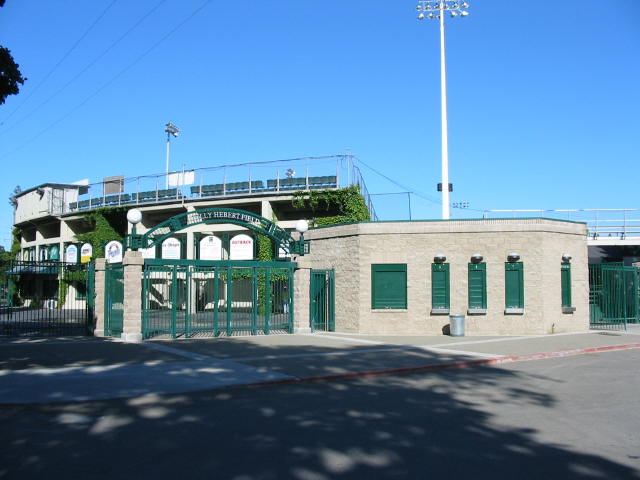
While in Stockton I became acquainted with Minor League Baseball through the Stockton Ports, who then were the Class “A” California League farm team for the Orioles.  I remember a few years back talking to the Orioles great Paul Blair who played for the Ports in the early 1960s about Billy Hebert Field and how the sun would go down in the outfield blinding hitters and spectators in its glare.  I would ride my bike over in the evening to try to get foul balls that came over the grand stand when I didn’t have the money to get a ticket.

When I was a kid I had a large baseball card collection which I kept in a square cardboard roller-skate box.  I must have had hundreds of cards including cards that if I had them now would be worth a small fortune. Unfortunately when I went away to college I left them in the garage and during a purge of my junk they were tossed out.  Last year I started collecting cards again, mostly signed cards that I obtained at the Church of Baseball at Harbor Park.  In a sense they kind of serve a purpose like Holy Cards due in the Catholic Church for me.  They are a touch point with the game and the players who signed them.

Billy Hebert Field

As I have grown older my appreciation for the game, despite strikes and steroids still grows.  I am in awe of the diamond.  I have played catch on the field of dreams, seen a game in the Yankee Stadium Right Field bleachers seen games in many other venues at the Major League and Minor League levels and thrown out the first pitch in a couple of Kinston Indians games.  I am enchanted with the game. The foul lines theoretically go on to infinity, only broken by the placement of the outfield wall.  Unlike almost all other sports there is no time limit, meaning that baseball can be an eschatological game going on into eternity. The Hall of Fame is like the Calendar of Saints in the Catholic, Orthodox and Anglican Churches.  There are rituals in baseball such as the exchange of batting orders and explanation of the ground rules and the ceremonial first pitch.  Likewise there are customs that border on superstition such as players not stepping on the foul line when entering and leaving the field of play, no talking about it when a pitcher is throwing a no-hitter and the home run trot. Even the care of the playing field is practiced with almost liturgical purity. The care of a field by an expert ground crew is a thing to behold, especially when they still use the wooden box frames to lay down the chalk on the baselines and the batter’s box.

Grand Slam Home Run by Robby Hammock 2009

We have travelled to many minor league parks often in tiny out of the way locations and even to the Field of Dreams in Dyersville Iowa where once again Judy indulged me and let me play catch. Likewise my long suffering wife has allowed our kitchen and much of my dining room is as close to a baseball shrine as Judy will let me make them; thankfully she is most tolerant and indulges this passion of mine.

Since I returned from Iraq the baseball diamond has been one of my few places of solace.  For the first time last season I bought a season ticket to the Tides and in section 102, row B seats 2 and 3 was able to watch the game from the same place every day.  It became a place of refuge during some of my bad PTSD times, and I got to know and love the people around me; Elliot the Usher, Chip the Usher, Ray and Bill the Vietnam Veteran Beer guys behind home plate, Kenny “Crabmeat” the Pretzel Guy and Barry the Scorekeeper.  This year Ray is not at the park nor is Charlie one of the other Vietnam Vets and the Veterans beer stand is now down the first base concourse where they have been relegated to the boring beers. I now have seats 1 and 2 in the same section and row as last year and it was good to see so many of the old crowd last night.

Chris Tillman

Even still there is some sadness in baseball this year as there was last year.  My dad is slowly dying of Alzheimer’s disease and a shell of his former self but the last time I saw him he did not know me and could not talk about baseball even for a minute.  Maybe if I go back we’ll get a few minutes of lucidity and a bit of time together again but I know that that will not happen because there is little left of him, I wish he was able to get up and play catch, but that will have to wait for eternity on the lush baseball field that only heaven can offer.

Dad Jeff and I around 1973

The season is just beginning and God is not done speaking to me through baseball as I close my eyes and recollect the words of Terrance Mann (James Earl Jones) in Field of Dreams: “The one constant through all the years has been baseball. America has rolled by like an army of steamrollers. It’s been erased like a blackboard, rebuilt, and erased again. But baseball has marked the time. This field, this game, is a part of our past. It reminds us of all that once was good, and what could be again.”

In a sense this says it all to me in an age of war, economic crisis and bitter partisan political division.  In a sense it is a prayer, a prayer for a return to something that was good and what could be good again.

Peace and blessings,

Padre Steve+

2 Comments

Filed under Baseball, faith

She knew that it was Time….Padre Steve’s Reflections on Pastoral Care Residency

Sometimes death comes unannounced but other times it sounds a warning.  Most of the time we think of such warnings as what our body is saying to us, maybe someone is having chest pains or that we know of a terminal condition which is getting worse and the doctors say that there is nothing else that they can do.  Other times it appears that some people almost have a sixth sense about their impending death and leave notes or say “goodbye” to loved ones in a different way than they would normally do.

When I see or hear about the sixth sense kind of incident I find that I am intrigued.  As a student of history I have read accounts where soldiers know that they will not survive a particular battle and leave things for their friends to give to loved ones.  There have been times when I have had a sixth sense about what was going to happen to someone and the feeling is like you are watching something unfold in slow motion but can do nothing to stop it.  A strange feeling that I’m sure some of my reads have experienced.

This story is a bit different and took place during an overnight as the “on call” chaplain at Parkland Memorial Hospital in Dallas during my Clinical Pastoral Education Residency. Parkland is a rather large, at the time of my residency a 940 bed county hospital and Level One Trauma center.  The “on call” chaplain after normal hours was the only chaplain in the hospital to cover all emergencies in the house.  Usually I stationed myself in the ER area as that was the “hottest” place for ministry at any given time.  I would always take a spin around our 9 ICUs but unless something was going bad on one of them would always end up back in the ER.

One night I had just finished with a situation involving a death in the ER when about 9 PM I got a page from “9 South” our General Medicine Step-Down ward.  The nurse that I talked to when I returned the page said that I needed to come up because she had a patient who was convinced that they were going to die that night.  I said that I would be right up and made my way up to the ward.

I got to the ward about 9:15 PM and met the nurse who further explained the situation to me while I reviewed the chart.  The lady was in her mid-30s and was HIV positive. She was Baptist and her husband who was also HIV positive and in a more advanced stage of the disease had just been discharged from the hospital the day before. The lady had come in for a few day stay as she had been spiking a fever but that was under control and was scheduled to be discharged in the morning.  She was not at the point of having any of the major opportunistic infections or diseases associated with full blown AIDS and her T-Cell count was good.  Clinically she was stable and expected to do well for a number of years to come.

The problem was that just after shift change the patient had told the nurse that “the Lord was going to take her home tonight.”  The nurse said that she had called the Medicine resident to come and speak with the lady but that the resident could not convince here that she was going to be okay and that she told both of them that she was going to die that evening and “go home and be with Jesus.”

Now for those who have never lived in the south “going home” is not like leaving the office at the end of the day.  Elvis “went home” wherever that was (see “Men in Black”) and if you are talking with someone raised in the south starts talking about “going home” you better stop and clarify to make sure that they are going home to watch the Braves on television and drink a beer or if they are planning on dying.  I had a grandmother who from the time that I was 5 years old kept telling that she was either “going home” or “wasn’t going to be around much longer,” of course she almost lived to be 90 and “went home” when I was 40.  But I digress.

Now patently I am generally of the mind that if the numbers say that you will live I believe the numbers.  I’m a baseball guy, God speaks to me through baseball and I play the percentages, it is the rational thing to do, which means that while I believe that God can intervene in situations I don’t bet on that happening. I read the chart, talk to the nurse, talk with the resident and I am convinced that this lady will walk out of the hospital in the morning.

Then I met the lady. She was sitting up in bed with her Bible open beside her on the mattress and she appeared to be very calm and there was a peaceful sense about her.  She was from Jamaica and very polite and when I introduced myself to her she greeted me warmly with the accent characteristic of that island nation.

“So you are the pastor?” she asked.

I replied that I was the Chaplain and a minister and that the nurse and doctor had asked me to spend some time with her.

She then said “Ah yes, they do not believe me.”  So I asked her what was going on.

She then described to me what had occurred that evening.

“You see pastor, the doctors say that I will go to my house tomorrow but I will not.” She paused and I nodded for her to go on and said “really? Tell me more.”

She continued “Pastor you see this evening Jesus came to me, he visit me and tell me that I will go and be with him tonight.”

Now I have to admit that I was skeptical but she was not acting emotional or even bothered by what she just said.  I was fascinated and asked her to tell me more.

She then went on a recitation of her faith journey from the time that she was a young girl and how she frequently would sense God’s presence and hear his voice at different points in her life, how she had gotten HIV from her husband and how much it meant for her to be right with others and God.  So I asked about the specifics of “why tonight?”

Calmly she explained. “The doctors tell me that I will be well and go home tomorrow. They tell me that I am in good condition, but that does not matter to me because Jesus told me today that he will take me home to be with him….tonight.”  Her tone was as if this was a regular every day occurrence and her face was radiant.  She continued “I love Jesus and know that he will not lie to me so I know that I will be with him tonight.” Her faith was touching and powerful in its simplicity and the amount of trust that she showed even to a message that she believed to be from Jesus that was completely different than the news of the doctors.

After our conversation which lasted about 30 minutes with me probing her faith, asking what she understood about her condition, talking about family which seemed to me for her was a conversation where she was tying up the loose ends of her life and that I was the person that she was taking the time to share them with.   As we closed she asked me if I would pray with her and give her a blessing which I did.  She thanked me, reached out and asked for a hug and she embraced me weakly let go, and thanked me again.  I was moved by this, still not convinced that Jesus would take her home, but not disbelieving her either.  When I was done I charted my visit, wrapped things up with the resident and the nurse and went back down to ER where more carnage was waiting.

About 2:30 AM my pager went off and it was 9 South calling.  I returned the call and the nurse that I had talked with earlier was on the line.

“Chaplain, please come quick, I went in to check her vitals and she is dead!”  I put on my best calm voice and said “Who is dead?”  The nurse nearly in a panic said “the lady that said that God was going to take her home, she died.”  I said okay I’ll be right up and went up as quickly as I could and got to the ward to find the nurse pacing anxiously outside the door of the patient’s room.  I asked if the nurse if she was okay, meaning her and not the now deceased patient and the nurse replied that she was upset by the death because the lady should not be dead and that she didn’t understand how the patient could calmly know that she was going to die.  Now the nurse was not a southerner unless it was the south part of the Indian Subcontinent.  Relatively new to Texas and the south she was not as attuned to some of the religious and cultural aspects of either the south or south Jamaica.  After helping the nurse calm down I met the resident who was in the room looking perplexed and as I walked in he said she shouldn’t be dead.  I just said to him “that sometimes it’s just someone’s time even if the numbers don’t say so.”  He said “Yeh, I know, but this was really freaky she told me that she was going to die tonight and she did.” I did concur that it was a bit on the unusual side but that we couldn’t discount what she believed especially since she had been correct.

As the resident went to finish up paperwork I looked at the woman. It looked like she had simply fallen asleep her Bible was on her lap and opened to Revelation around the 21st chapter and although I cannot be sure exactly what she was reading can only imagine that it was this verse “See, the home of God is among mortals. He will dwell with them as their God; they will be his peoples, and God himself will be with them; he will wipe every tear from their eyes. Death will be no more; mourning and crying and pain will be no more, for the first things have passed away.” (Revelation 21:3b-5 NRSV) This dear woman had passed away, gone home looking forward to a place where whatever tears or sorrows she had would be wiped away.

I closed her Bible, placed her hands together over it and prayed a prayer of commendation before pulling the bed sheet over her face and body. On leaving the room I spent a bit more time with the nurse who was beginning to gather herself after this unusual death.  A couple of hours later I would escort the body of this woman to our morgue accompanied by the nurse and a LVN.  As we rode the elevator down we talked a bit more and as we made the walk down the long and empty basement corridor to the morgue we did so in silence.  Once I had admitted the body and locked the door the two nurses left to head back to the 9th floor and I took the chart and other paperwork up to our office where our decedent affairs clerk would complete the death certificate.  I thought how unusual this case was as I sat for a while in the office.  I had heard of similar things but had never seen something like this before where the person in question made such a claim and was right defying the numbers that said she would walk out of the hospital.

With that I wish you a good night.

Peace,

Padre Steve+

Leave a comment

Filed under christian life, faith, healthcare, Pastoral Care, Religion

Struggling with Faith and God at Easter

“God weeps with us so that we may one day laugh with him.” 
Jürgen Moltmann

Easter Sunday is past and we are now in the Easter Season I was thinking today on encounters that I have had with Christians of various denominations who have suffered a crisis in faith or loss of faith due to some kind of trauma in their lives which gets worse at Easter.  For these people the time in which their churches celebrate Christ’s resurrection becomes their own little acre of Hell on earth.  Having known plenty of these people I can say that this phenomena is one of the more tragic aspects of the season when people who at one time felt the presence of God in their life only sense emptiness and aloneness which sometimes becomes a feeling of hopelessness where even death appears more comforting than life in the present.  I write this because I really believe that these often very sensitive and wonderful people are either ignored or not even seen by most of their fellow church members and that many if not most pastors and priests are either unaware of them, uncomfortable around them or irritated by them because they don’t respond like “normal” people do to the message of Easter.  I have found from my own experience returning from Iraq that Easter despite the message of resurrection and hope often triggers a despair of life itself when one no longer senses the presence of God and feels alone against the world, especially in church.

Many times the crisis of faith is caused by prolonged depression, PTSD or other trauma often involving family members, clergy or other trusted authority figures in their lives.  Sometimes the trauma is due to a physical injury, perhaps a near death experience due to an illness, combat or accident and can be neurological as in the case of Traumatic Brain Injury or TBI not something that routine counseling either psychological or pastoral or an anti-depressant medication will correct.  In my case it was PTSD and chronic pain and insomnia which overwhelmed me and along with a crisis of faith triggered such hopelessness that I barely held on for almost two years.

I remember when I first started dealing with this in others while in seminary that I was of the mind that if someone was in the midst of a crisis in faith if they read the Bible more, prayed more and made sure that they were in church that things would work out.  I believed then that somehow with counseling, the right concept of God and involvement in church activities that God would “heal” them.  Call me a heretic but that line of thinking is nice for people experiencing a minor bump in their life but absolutely stupid advice for people who are severely traumatized or clinically depressed and suicidal who no longer percieve the presence of God in their lives.

I cannot condemn those who have lost their faith or are wavering in their faith due to trauma, abuse or other psychological reason. So many people like this have been victimized by family, teachers, clergy other authority figures or physical trauma related to accidents, near death experiences or combat that it is mind numbing.  The fact that I went through a period for the nearly two years where I was pretty much an agnostic praying to believe again because of my PTSD injury incurred in Iraq that felt hopelessly isolated for the first year after my return until I finally reconnected with others and began to feel safe again gives me just a bit of an idea at what these people are going through.  My isolation from Christian community and sense of despair during that time showed me that such a loss of faith is not to be trifled with or papered over with the pretty wallpaper or neat sets of “principles” drawn up in the ivory theological towers by theologians and “pastors” who refuse to deal with the reality of the consequences of a fallen world and their impact on real people.

Sometimes the damage wrought on people makes it nearly impossible to comprehend a God who both cares about them and who is safe to approach.  My experience came from Iraq and the trauma of my return and were absolutely frightening so much so that I left a Christmas Eve Mass in 2008 and walked through the dark wondering if God even existed.  Now with help and the deliberate action of my boss and co-workers to protect me as I recovered, received therapy and recover were key factors to being able to step back from the abyss. For those abused by parents or clergy this is I think an even deeper wound one in which the very concept and understanding of God becomes skewed in the minds and hearts of the victims.

The feeling that people who go through this crisis or loss of faith almost always mention to me is that God no longer speaks to them.  The feel cut off and even abandoned by God and it is not simply depression that they are dealing with but despair of life itself when death or just going to sleep is preferable to living.  This overwhelming despair impacts their relationships especially with their family and frequently will destroy families as the spouse grows weary and loses hope seeing their loved one get better.  It is if they never are able to leave the “God forsakenness” of Good Friday and cannot climb out of the tomb.   For some the pain is so much the last and previously unthinkable alternative of suicide becomes the only course of action that they think will help.  Such thoughts are not simply narcissism as some would believe but from the “logical” belief that their family, friends and loved ones would be better off without them.  I have seen this too many times to count. 

It is hard to reach out to people in this situation.  I have to admit in my case that it was only people who chose to remain with me and walk with me through the ordeal in spite of my frequent crashes, depression, anger and even rage that helped get me through the worst of this.  However I’m sure that my condition burned some people out.  There are some that would not walk with me as I first began to go down and the sad thing is that many were ministers and fellow chaplains.  In some ways I don’t blame them at the same time the first person that asked me how my spiritual life “or how I was with the Big Guy” was my therapist.  When I reported to my current duty station I was shocked to find Chaplains who were willing to come alongside of me, even when they didn’t have the answers and remain with me. 

The topic of a loss of faith or the reality of feeling God forsaken is had to deal with.  It is seldom dealt with in many seminaries or Bible schools because it is not comfortable or something that you can “grow your church” with.  But the reality is there are more people going to church praying for an answer who no one reaches out to, in fact they are often invisible amid the busyness of program oriented ministry. 

It is my prayer that this post will help people be able to reach out to those crushed under burdens that they can no longer bear.  It is not enough simply to tell them that “God won’t give you more than you can bear” when they have been beyond the “red line” longer than one can imagine.  They want to believe that scriptural principle but no longer believe because God is no longer real to them. 

Yet scripture plain teaches that we are to “bear one another’s burdens, and in this way you will fulfill the law of Christ.” As Dietrich Bonhoeffer said      “We must learn to regard people less in light of what they do or omit to do, and more in the light of what they suffer.”  It is our willingness to be with people in their suffering that is one of the true marks of the Christian.  Being with someone in triumph is far easier than with those who suffer the absence of God.  It is presence and love not sermons that people who have lost their faith need as Bonhoeffer so eloquently said “Where God tears great gaps we should not try to fill them with human words.”

I do pray that as we celebrate the joy of the Resurrection that we will not forget those who despair of live and feel as if they are “God-forsaken.”  It is not easy as those who walked with me can testify but in doing so there is the chance that such action will prevent tragedy.

Peace

Padre Steve+

So anyway, my best to everyone and please be safe….

Padre Steve+

7 Comments

Filed under christian life, faith, Pastoral Care, philosophy

Musings on Lent and Holy Week…The Recovery of Joy in Doing Theology and Living

This has been an interesting time.  I began Lent with an actual desire to see some more spiritual progress in my life. By that I meant actually being able to slow down and take stock in order that I might continue what had begun with my Christmas miracle.  Last year I was still in a mess but Lent was a time that I found a local church home in the Hampton Roads area, St James Episcopal Church in Portsmouth. While I was not doing well it was a beginning.

This year Lent took an unexpected turn of events when on the 20th of February I was felled by a 7mm Kidney stone that pretty much put me down for almost a month, I returned to work on Saint Patrick’s Day.  That little stone stopped me cold and by chance, or some might say “God’s will” and allowed me to really think through a lot of what I believe as well as deepen my relationship with the Deity.  I found it strange to be down so hard but despite being in pretty much constant pain and unable to sleep well with pain medications just taking the edge off of the pain while making me loopy at times to be able to read and meditate on aspects of my faith as a Christian.  It was interesting as I came to integrate faith, theology and life and for the first time in many years actually began to write serious theology again.

The time was interesting from reminiscing about my Clinical Pastoral Education Residency at Parkland Memorial Hospital, thoughts on baseball and my dad, a number of articles dealing Glenn Beck and his attacks on churches and Christians that were opposed to his political and economic ideology which ended up getting a bit heated at times when a few miscreants decided to take me on.  I was surprised by the amount of negative energy and even hatred displayed by some of those who attacked me to include physical threats by another blogger.  However I did not back down once and even still tried to remain gracious to those who were critics, for the most part with the exception of the aforementioned blogger I was able to do so.

The latter part of Lent and most of Holy Week included articles about how life under the Cross impacts life in both an individual and corporate manner.  For the first time in years I was doing serious theology again.  This was very good because for the past 6 years I have been focused on doing a lot of academic work in history and military theory where I completed a Masters of Arts in Military History as well as the Marine Corps Command and Staff College which actually helped me become a better writer and researcher than I was in years past. The extra work as well as my tour in Iraq with our advisers and time at the Jordanian Army and UN Peace Operations Training Center gave me an academic depth as well as breadth that I lacked in seminary and in my early years as a priest. The fact that I had also gone through a terrible two years of psychological, physical and spiritual crisis returning from Iraq where much changed in my life.  That time was somewhat like what Saint John of the Cross called “The Dark Night of the Soul” where it seemed that God himself had turned his back on me.  This tied me back in to my seminary training and theological background of Luther’s theology of the Cross and reengaged me with the writings of Luther, Dietrich Bonhoeffer, Jürgen Moltmann, Hans Kung and Alistair McGrath.  Having gone through a period where I felt abandoned by God, the Church and many of my peers in ministry I gained a new appreciation for the theology of the Cross as something that made sense of life.  It was not as Luther called scholastic theology a “theology of glory” but a theology of reality in a broken world which I had now experienced hopelessness as something more than a theological or psychological concept. All of this combined during Lent to force me back to my theological roots.

The last week of Lent and Holy Week saw me return to some topics that have been important to me including returning to my journey in Iraq which I had not added to since last fall and a return to baseball.  I also found time to go back to write about some darkly humorous events of my Clinical Pastoral Education residency at Parkland Memorial Hospital and a couple of somewhat silly articles.

Life which had begun to return at Christmas came back through Lent to include the spiritual, psychological and physical.  I was able to come off of the “fat boy program” last week, recover from the Kidney stone and experience renewal and community.  To top things off my sense of humor and self-confidence has returned.  All in it was a rather eventful Lent and Holy Week in ways that I did not anticipate and ways that have helped me as of last week declare myself “back in commission.”

All in all I have gained a new found appreciation of God’s grace and mercy as well as an appreciation of friends of all kinds.  The understanding that “if anyone is in Christ, there is a new creation: everything old has passed away; see, everything has become new! All this is from God, who reconciled us to himself through Christ, and has given us the ministry of reconciliation; that is, in Christ God was reconciling the world to himself, not counting their trespasses against them, and entrusting the message of reconciliation to us” (2 Cor. 5:17-19) has found new meaning as I rediscovered the practical applications of what Bonhoeffer wrote “God loves human beings. God loves the world. Not an ideal human, but human beings as they are; not an ideal world, but the real world. What we find repulsive in their opposition to God, what we shrink back from with pain and hostility, namely, real human beings, the real world, this is for God the ground of unfathomable love.”

Since I am one of these kinds of rough cut human beings that Bonhoeffer talked about I have a propensity to enjoy fellowship with similar people.  I am certainly not perfect and sometimes my actions disappoint some of my more religious friends.  In a certain ironic twist I had a verbal altercation at Gordon Biersch late on Good Friday evening when Judy and I went in for a light meal and a beer. While attempting to take a seat I was threatened by a drunk and I refused to back down or shrink away getting back in his face using certain coarse language to get him to back down. It is funny how having been held up at gunpoint and shot at in combat will influence the fight or flight reaction in the direction fight even for a miscreant priest.  If the guy had actually tried anything big Randy and about five other Stein Club members were about to come over the bar to protect “their padre.” So I know that I miss the ideal of the “theologians of glory” and those who find such human faults as unworthy of God’s grace.

Even so joy has returned to my life admittedly part of this has to be the fact that Baseball season’s opening night coincided with Easter.  Luther said “It is pleasing to God whenever thou rejoice or laugh from the bottom of your heart” and I heartily agree.  It is good to have joy back in my life as Karl Barth said “Joy is the simplest form of gratitude” and “laughter is the closest thing to the grace of God.” The joy and laughter has even made to writing of theology an experience of God’s grace as Barth also said “The theologian who has no joy in his work is not a theologian at all.” To such theologians and preachers who have a joyless life heaven must be a tedious place and like Luther I would have to say “If you are not allowed to laugh in heaven, I don’t want to go there.” Thank God for his grace that enables flawed people like me to even have a chance and at the same time to experience that grace in joy and laughter.

So to all of my readers and friends who have walked through Lent and Holy Week with me I wish you all the best. I pray that if you at experiencing hard times that you will experience the grace, love and mercy of God and that joy and laughter will again be part of your life.

Peace and love,

Padre Steve+

Leave a comment

Filed under christian life, faith, philosophy, Religion

Alleluia Christ is Risen!

After the sabbath, as the first day of the week was dawning, Mary Magdalene and the other Mary went to see the tomb. And suddenly there was a great earthquake; for an angel of the Lord, descending from heaven, came and rolled back the stone and sat on it. His appearance was like lightning, and his clothing white as snow. For fear of him the guards shook and became like dead men. But the angel said to the women, “Do not be afraid; I know that you are looking for Jesus who was crucified. He is not here; for he has been raised, as he said. Come, see the place where he lay. Then go quickly and tell his disciples, `He has been raised from the dead, and indeed he is going ahead of you to Galilee; there you will see him.’ This is my message for you.” So they left the tomb quickly with fear and great joy, and ran to tell his disciples. Suddenly Jesus met them and said, “Greetings!” And they came to him, took hold of his feet, and worshiped him. Then Jesus said to them, “Do not be afraid; go and tell my brothers to go to Galilee; there they will see me.” Matthew 28:1-10

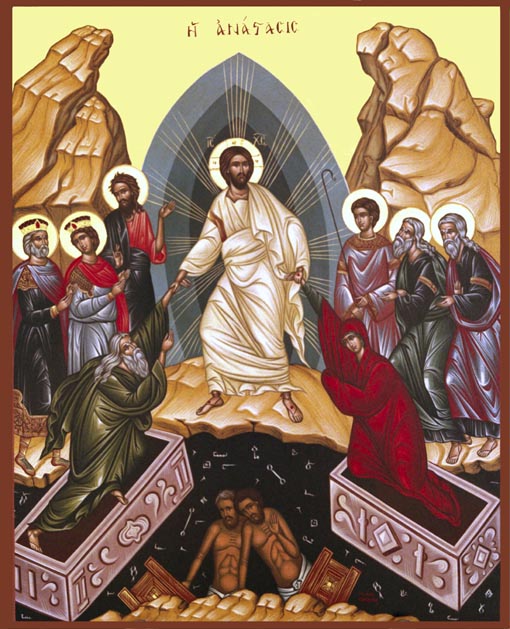
It is Easter at last and Christians around the world sing the triumphant message “alleluia Christ is risen, he is risen indeed!”  Just as the first disciples walked with Jesus we too have walked with Jesus through the penitential season of Lent beginning on Ash Wednesday where we remembered that “we are but dust and to dust we shall return.” With each thing that we abstained from or added to our spiritual discipline we in a small way were reminded that we are to “deny ourselves, take up our Cross and follow.”  In Holy week we experienced the nearly schizophrenic emotions of triumph and tragedy of Palm or Passion Sunday, the solemnity that comes on Holy or Maundy Thursday as we recall the institution of the Eucharist or the Lord’s Supper and the humility of Jesus as he takes on the mantle of a lowly servant and washes the feet of his disciples.  Leaving that we enter into the suffering of Jesus on Good Friday and see how even his friends betrayed or abandoned him with only a thief on an adjacent cross and the officer in charge of the crucifixion realizing just who was on that middle cross.  We wait overnight Friday and through Saturday in the uncomfortable middle between the crucifixion and resurrection that so often mirrors events in our own life where we sometimes experience what we feel to be forsaken by family, friends, church and sometimes even God.  Yet in the pre-dawn darkness of that first Easter morning we like the disciples awake to find that something has happened, that the stone is rolled away, the tomb is empty and Jesus is raised from the dead crushing sin death and hell.  We are greeted by Jesus who tells us not to be afraid but to go and tell others what has happened.  He greets us on the road to Emmaus and breaks bread with us even as we tell him about the tragedy of his death and then our eyes are opened.  Jesus is the victor and in his death burial and resurrection we have the forgiveness of sins.  The event is also eschatological in that it opens the door for him to return in glory and for him to be revealed in his people For the creation waits with eager longing for the revealing of the children of God;  “for the creation was subjected to futility, not of its own will but by the will of the one who subjected it, in hope that the creation itself will be set free from its bondage to decay and will obtain the freedom of the glory of the children of God.” Romans 8:20-21

Likewise it is in this series of inseparable events that Christ establishes our redemption by the forgiveness of sins “For while we were still weak, at the right time Christ died for the ungodly. Indeed, rarely will anyone die for a righteous person—though perhaps for a good person someone might actually dare to die. But God proves his love for us in that while we still were sinners Christ died for us.” Romans 5:6-8.

It is a universe changing event whereby Christ sets his people free and destroys the power of his enemies. Karl Barth wrote: “Look once again to Jesus Christ in his death upon the cross.  Look and try to understand that what he did and suffered he did and suffered for you, for me, for us all.  He carried our sin, our captivity and our suffering, and did not carry it in vain.  He carried it away.  He acted as the captain of us all.  He broke through the ranks of our enemies.  He has already won the battle, our battle.  All we have to do is to follow him, to be victorious with him.  Through him, in him we are saved.  Our sin no longer has any power over us.  Our prison door is open…when he, the Son of God, sets us free, we are truly free.” This is the redemption that the world awaits, not a redemption that is to be hoarded by believers but a redemption that extends beyond the present redemption for all people, especially those who believe and the people of God are to toil and struggle for this “For to this end we toil and struggle, because we have our hope set on the living God, who is the Savior of all people, especially of those who believe.” 1 Timothy 4:10

The Cross and Resurrection are to be a new and purifying wind in the world and the people of God are to be the vehicle for this wind empowered by the Holy Spirit of God.  It is not simply about mastering the art of dying as Socrates did but experiencing resurrection.  Christ did not merely die but he overcame the last enemy which is death itself. (1 Corinthians 15:26)  The power of this is not to be taken lightly in its possibilities for real change for as Dietrich Bonhoeffer wrote “If a few people really believed that and acted on it in their daily lives, a great deal would be changed. To live in the light of the Resurrection—that is what Easter means.”

While we live in the reality of the light of the Resurrection we simultaneously live under the shadow of the Cross of Christ as well as the cross that we are obliged by God to carry in our own lives. In the duality and unity of the Cross and Resurrection we have hope and in that hope we are not to be overwhelmed by events in the world that we cannot control.  Nor are we to be consumed by false “gospels” presented by various ideologues of the right and the left who may identify themselves as “Christian” but place their ideologies, social, political, national and economic over the Gospel itself.  Ideologues who quote scripture to buttress their arguments so that their ideology and the “Gospel” are one in the same much as Satan did during the temptation of Jesus to provide a veneer of Christianity to ideologies that are often opposed to the message of the Gospel. Such an idea is much like the message on German soldier’s belt buckles in the Second World War proclaimed “Gott Mit Uns” even as their nation made war on the world and executed an evil ideology of death upon the Jews and others unfortunate enough to be considered the enemies of the Nazi Party.

It is the ideologues who now endanger the Church and Gospel itself for many choose to remain inside the walls of the church and attempt to turn it into a tool of their ideology and in doing so these ideologues measure and evaluate “others only from the standpoint of whether they are supporters of this ideology, or whether they might become such, or whether they might at least be useful to it even without their consent, or whether they must be fought as its enemies. Its glory has already become for him the solution not only to the personal problem of his own life but to each and all of the problems of the world.” But the Cross and resurrection cry out “NO!” to such ideas even when they are drenched with so called “Biblical” support.

The Cross and the Resurrection bring us to life and promise that Christ who died and was raised will come again and in doing so will complete the redemption of the world for which he suffered and died. It is the real world for which God cares for enough to live suffer and die to save, as Dietrich Bonhoeffer so eloquently wrote “God loves human beings. God loves the world. Not an ideal human, but human beings as they are; not an ideal world, but the real world. What we find repulsive in their opposition to God, what we shrink back from with pain and hostility, namely, real human beings, the real world, this is for God the ground of unfathomable love.”

It is God’s unfathomable love that Easter proclaims as victorious and allows us will all people to cry out “Alleluia Christ is Risen! The Lord is Risen indeed!”

Peace and Happy Easter

Padre Steve+

1 Comment

Filed under christian life, faith, Religion

Holy Saturday….Living in the Uncomfortable Middle

“Man no longer lives in the beginning–he has lost the beginning. Now he finds he is in the middle, knowing neither the end nor the beginning, and yet knowing that he is in the middle, coming from the beginning and going towards the end. He sees that his life is determined by these two facets, of which he knows only that he does not know them” Dietrich Bonhoeffer

Holy Saturday reminds us of the fact that we live as Bonhoeffer so eloquently put it “in the middle, knowing neither the end nor the beginning. The Gospel accounts are silent as to what was happening during this interregnum between the crucifixion and the resurrection except that the women prepared the body of Jesus for burial and that the tomb was sealed and a Roman guard detachment detailed to ensure that the tomb remained secure.

One has to use their imagination as to what was occurring in the lives of the characters in this story. We know that on the day of the crucifixion that after Jesus’ death that Joseph of Arimathea provided a tomb where Jesus’ body was prepared and in which he was laid.  We know that the tomb was sealed and that Roman guards were at it as ordered by Pilate.  We know that the disciples with the exception of John had abandoned Jesus and that following the crucifixion that they had scattered and went underground with the exception of Judas who was last seen hanging around.  Most of Jerusalem was observing Passover between Friday evening and Saturday evening.  Life for many went on without a second thought as Jesus was now yesterday’s news.  The disciples wondered if they would be next, a mother mourned, members of the Sanhedrin likely were relaxing for the first time since Jesus entered Jerusalem as potential Messiah the previous Sunday while Roman soldiers far from home wondered just why they were guarding the tomb of a criminal.

We know from the reactions of the disciples the next day that they really believed that Jesus was not only dead but not coming back. There was a finality that they lived a grief that they bore. Their teacher the one that they had given up all to follow was dead executed as a criminal between common criminals and buried in a borrowed tomb.  One of their friends that they had shared the previous three years had betrayed Jesus.  Their world was upended; the one that they assumed to be the Messiah was mortal.  Their faith was crushed.

The life of faith that we live in the interregnum between life and death creation and consummation is often similar to that the disciples experienced.  We experience situations where faith is hard to come by and since we are in the uncomfortable middle nothing seems certain.  Much of this comes when like the disciples we expect something from God or expect God to do something only to find that our expectations were perhaps just a bit different from those of the Deity.  Disappointment with God I think one has called it and if we are honest it is a part of life because none of really know the will of God or even what will transpire tomorrow something that scripture is rather clear about.

We live in the middle every time we walk with Jesus and his followers through Holy Week just as we walk through life and Holy Saturday is in a sense a metaphor for life when we don’t understand it when we are in the middle wondering what transpired before and not knowing the future.  It is a time to again seek out our faith and with our friends who share this life to maintain hope that things will work out, that in fact resurrection will come.

Until tomorrow we leave the disciples in hiding, the city sleeping and the Roman soldiers cold and bored at a tomb which in reality they care less about.

Peace,

Padre Steve+

Leave a comment

Filed under christian life, faith, Religion

It is Finished

“28 After this, when Jesus knew that all was now finished, he said (in order to fulfill the scripture), “I am thirsty.” 29 A jar full of sour wine was standing there. So they put a sponge full of the wine on a branch of hyssop and held it to his mouth. 30 When Jesus had received the wine, he said, “It is finished.” Then he bowed his head and gave up his spirit.” John 19: 28-30 NRSV

 Good Friday, I wrote about it last night and published it very early this morning.  I just completed the Good Friday Liturgy at the hospital and am set to get an early start on the rest of the Easter Weekend.  I am not going to repeat last night’s article here, just something that struck me as I prepared for the service and read the Passion narrative from John’s Gospel.  The words It is finished” which come from the lips of Jesus as he dies convey a finality that sometimes we miss as we fast forward to Easter. Upon the Cross Jesus really did die and this can be very uncomfortable in fact a number of major religions reject the notion that God would condescend to become human and certain would never consent to death.  Such a stream of thought was even evidenced in Gnostic Christianity where God is “pure spirit” and the God of the Old Testament was corrupt being powerful enough o create humanity and wicked enough to do so as for the Gnostics the flesh was evil and the spirit good.  Likewise the Aryan Heresy invoked the notion of a Jesus who was not really God, more like a superman as God could not die.  The thought of the Aryans is still present in Islam as Mohammed the Prophet had exposure to Aryan Christianity and the image of Jesus in Islam is nearly identical to the Aryans.

 “It is finished.” They are haunting words and when one reads the words of Isaiah one gets the picture of something that if we passed by on the street that we would probably turn our heads away from to avoid the unpleasantness of the sight as “he had no form or majesty that we should look at him, nothing in his appearance that we should desire him. 3He was despised and rejected by others; a man of suffering and acquainted with infirmity; and as one from whom others hide their faces he was despised, and we held him of no account.”   

 The hymn When I Survey the Wondrous Cross is particularly vivid in painting the picture of the crucified Christ: “See, from his head, his hands, his feet, sorrow and love flow mingled down. Did e’er such love and sorrow meet, or thorns compose so rich a crown.”

 The fact that Jesus dies on the cross and dies rejected is a paramount truth of the Gospel and is necessary if we are to comprehend the Gospel, we do not get to the resurrection without the crucifixion and any attempt to do so especially by his people creates a false Gospel, a Gospel devoid of the forgiveness of sins and a Gospel where God knows not our sorrows.  It is the Gospel of Theism where God is not involved in the real world; untouched and unmoved by human suffering and even arbitrary and capricious in his dealings with humanity.   Dietrich Bonhoeffer wrote Jesus is a rejected Messiah. His rejection robs the passion of its halo of glory. It must be a passion without honor. Suffering and rejection sum up the whole cross of Jesus. To die on the cross means to die despised and rejected of men. Suffering and rejection are laid upon Jesus as a divine necessity, and every attempt to prevent it is the work of the devil, especially when it comes from his own disciples; for it is in fact an attempt to prevent Christ from being Christ.” 

 The fact that Jesus did not let the cup from him has implications for his disciples which again are not comfortable as they stand opposed to the “Gospel” of those who present the faith as one of respect, prosperity, earthy power and health.  It is not the “Gospel” of materialism where we remain in relationship with God only for the blessings but the Gospel of discipleship and suffering.  It is the cry My God, my God why have you forsaken me?” which Jesus utters as rejected by man and by God as Bonhoeffer said “It is not suffering per se but suffering-and-rejection, and not rejection for any cause of conviction of our own, but rejection for the sake of Christ. If our Christianity has ceased to be serious about discipleship, if we have watered down the gospel into emotional uplift which makes no costly demands and which fails to distinguish between natural and Christian existence, then we cannot help regarding the cross as an ordinary everyday calamity… We have then forgotten that the cross means rejection and shame as well as suffering.”

 Again, such a Gospel is not comfortable for the disciple the Gospel of the Cross whereby we come to know God is the Gospel which “bids a man to come and die.” This is not the kind of martyrdom sought by fanatics who seek to destroy their and presumably God’s enemies but a call that is unique to every disciple:

 “But each has a different share: some God deems worthy of the highest form of suffering, and given them the grace of martyrdom, while others He does not allow to be tempted above that they are able to bear…. The cross is laid on every Christian. The first Christ-suffering which every man must experience is the call to abandon the attachments of this world. … we surrender ourselves to Christ in union with His death—we give over our lives to death. … When Christ calls a man, He bids him come and die.…death in Jesus Christ, the death of the old man [or nature] at his call. Jesus’ summons to the rich young man was calling him to die, because only the man who is dead to his own will can follow Christ. In fact, every command of Jesus is a call to die, with all our affections and lusts. But we do not want to die…”

 There is a hymn that means much to me is “And Can it be” which personalizes the great mystery inherent in the Gospel.

And can it be that I should gain
an interest in the Savior’s blood!
Died he for me? who caused his pain!
For me? who him to death pursued?
Amazing love! How can it be
that thou, my God, shouldst die for me?
Amazing love! How can it be
that thou, my God, shouldst die for me?

’Tis mystery all: th’ Immortal dies!
Who can explore his strange design?
In vain the firstborn seraph tries
to sound the depths of love divine.
’Tis mercy all! Let earth adore;
let angel minds inquire no more.
’Tis mercy all! Let earth adore;
let angel minds inquire no more.

He left his Father’s throne above
(so free, so infinite his grace!),
emptied himself of all but love,
and bled for Adam’s helpless race.
’Tis mercy all, immense and free,
for O my God, it found out me!
’Tis mercy all, immense and free,
for O my God, it found out me!

 It is finished and with it we wait. Like the disciples we know not what tomorrow holds we live in a tension knowing Christ’s suffering and awaiting resurrection.  The Centurion Loginous at the Cross saw what no one else saw that day knew that “surely this was the Son of God” and like the disciples would lay down his duties to follow Christ.

 I pray that God will richly bless us this Good Friday with his peace which as he says passes all understanding.

 Peace

Padre Steve+

Leave a comment

Filed under christian life, faith, Religion

Good Friday…Ecce Homo! Behold the Man

“God is nowhere greater than in his humiliation. God is nowhere more glorious than in his impotence. God is nowhere more divine than when he becomes man” Jürgen Moltmann Trinity and Kingdom


“So they took Jesus; 17and carrying the cross by himself, he went out to what is called The Place of the Skull, which in Hebrew* is called Golgotha. 18There they crucified him, and with him two others, one on either side, with Jesus between them.” John 19: 16b-18

4Surely he has borne our infirmities
and carried our diseases;
yet we accounted him stricken,
struck down by God, and afflicted.
5But he was wounded for our transgressions,
crushed for our iniquities;
upon him was the punishment that made us whole,
and by his bruises we are healed.
6All we like sheep have gone astray;
we have all turned to our own way,
and the Lord has laid on him
the iniquity of us all. Isaiah 53:4-6

“My God my God why have you forsaken me?”

Today is Good Friday, the Altars are bare and we simply “Behold the Man.” The picture that we have today is paradoxical, it is the picture of a suffering man betrayed by a friend, abandoned by his closest followers and executed in a barbaric fashion under the orders of a man who washes his hands of his own responsibility.  It is a picture that is troubling because of its unpleasantness it is not the kind of picture of God that we want.  While we gladly acknowledge God’s grace and God forgiving our sins through Jesus we want to stay on this side of the resurrection. But like it or not we are confronted with questions about why do the innocent suffer and how could God do this to me or the one that I love.  Much of the problem is that we often buy in to a God untouched by human suffering a God who is arbitrary, unfeeling and cold no matter how much we try to convince ourselves that he cares.  A God incapable of suffering is a cold comfort when we or a loved one suffers. This is not the Christian God even if we try to baptize this “god” in our theology.  “In Christianity the cross is the test of everything that deserves to be called Christian” so writes Jürgen Moltmann in “The Crucified God.”

The Cross and the Passion of Christ is the center of how Christians come to understand God and if we attempt to regulate it to the background we do the message of the Gospel violence.  This is very apparent in the number of churches that do nothing to acknowledge the event on Good Friday even as they adorn their churches for the Easter celebration. It is as if the central event in God’s revelation to humanity and means by which he reconciles humanity to himself is a stepchild to the resurrection, but without the Cross there is no resurrection. It is also seen by some who find the symbol of the Crucifix offensive often derisively saying “Jesus isn’t on the Cross anymore, I worship the Risen Jesus.” While we worship the Risen Christ he also remains the Crucified God who in his human flesh bore the sins of the world. It is as Dietrich Bonhoeffer writes:

“The figure of the reconciler, of the God-man Jesus Christ, steps into the middle between God and the world, into the center of all that happens.  In this figure is disclosed the mystery of the world, just as the mystery of God is revealed in it.  No abyss of evil can remain hidden from him through whom the world is reconciled to God.  But the abyss of the love of God embraces even the most abysmal godlessness of the world.  In an incomprehensible reversal of all righteous and pious thought, God declares himself as guilty toward the world and thereby extinguishes the guilt of the world.  God treads the way of humble reconciliation and thereby sets the world free.  God wills to be guilty of our guilt; God takes on the punishment and suffering that guilt has brought on us.  God takes responsibility for godlessness, love for hate, the holy one for the sinner.  Now there is no more godlessness, hate, or sin that God has not taken upon himself, suffered, and atoned.  Now there is not longer any reality, any world, that is not reconciled with God and at peace.  God has done this in the beloved son, Jesus Christ.  Ecce homo!” –Dietrich Bonhoeffer, Ethics: Dietrich Bonhoeffer Works, Volume 6, edited by Clifford J. Green and translated by Reinhard Krauss, Charles C. West, and Douglas W. Scott (Minneapolis: Fortress, 2005), 83.

In addition to its salvific value the Cross of Christ is also relevant to all who suffer as “the deep meaning of the cross of Christ is that there is no suffering on earth that is not borne by God.” In the Cross God identifies himself with all of humanity especially those afflicted or persecuted.

Today we take the time to reflect and remember this event. Many people will have a day of fasting and accompany it with prayer or service.  My prayer is that in the midst of the various crises that we face in the country and the world that we will take the time as Christians to ponder the depth of God’s love and identification with his all people and the ramifications for how we treat others, even those that we view as our opponents or even enemies.  If God can condescend to love us while we were at enmity with him, just how can we fail to treat others with the same love? To again quote Bonhoeffer with whom I have walked this Lenten season:

“God loves human beings. God loves the world. Not an ideal human, but human beings as they are; not an ideal world, but the real world. What we find repulsive in their opposition to God, what we shrink back from with pain and hostility, namely, real human beings, the real world, this is for God the ground of unfathomable love.”

Ecce Homo! Behold the Man!

Peace

Padre Steve+

Leave a comment

Filed under christian life, faith, Religion

Holy or Maundy Thursday….Pausing to Reflect on Communion

Today is Holy or Maundy Thursday, a day where many Churches and Christians take the time within their theological traditions to reflect upon in their worship, the institution of the Eucharist or the Lord’s Supper.  Today for me is always special, though the past couple years I was not doing well do to PTSD and other stuff.  This year is different in the sense that I have began to recover that sense of mystery and awe that comes in this celebration.

I grew up in kind of an eclectic faith tradition as a Navy brat. My family was Methodist and I was baptized in my parents and grandparents home church, Southside Methodist Church in Huntington West Virginia.  However living on the West coast we went to Navy Chapels or local civilian churches of various denominations.  During my dad’s time in Vietnam it was a Roman Catholic Navy chaplain who showed us the love of God when many civilian churches made military families unwelcome.  I owe my vocation and faith to that man who took care of our Protestant family.  I remember attending the Holy Thursday Mass at the little Naval Communication station in 1971. There was a sense of mystery and holiness in that service that stayed with me.  When I was in high school I went to a Conservative Baptist church where communion was not observed in the same manner but the Pastor, Reverend Ron Lundy made it special. There was a sense of holiness and thankfulness that I have seldom seen in Evangelical churches since.

When I went to seminary I was attending a non-denominational evangelical/charismatic church.  It was a good church but little emphasis was placed on communion and apart from Easter Sunday no attention was paid to Holy Week. However as a seminary student at Southwestern Baptist Theological Seminary in 1988-1992 before the great purge of moderates I had a number of professors, but in particular my Church History professor Dr Doyle Young took the time to look at how the major traditions within the Christian faith viewed the Eucharist or Holy Communion.   I was acquainted with most in a fairly rudimentary manner Dr Young brought out the really important theological aspects of each in the context of how each view came about.  I always had a sort of Reformed or Presbyterian view of Holy Communion in that unlike most of my Baptist and Evangelical friends I really believed that there was a “spiritual” presence of Christ in communion as opposed to it being a symbolic memorial.  That changed as I was taught the Roman Catholic and Orthodox understandings of the Eucharist but was nailed down as we studied Martin Luther, his understanding of the Eucharist and the discussion between Luther and Ulrich Zwingli at the Marburg Colloquy.  It was Luther’s argument from Scripture “This is my Body, this is my Blood” with which he responded to every argument posed by Zwingli that convinced me of the reality of Jesus’ presence in the Eucharist in more than just a spiritual manner.  I could not ignore Scripture and that was the watershed in bringing me to an Anglican or Anglo-Catholic understanding of faith and the Eucharist.

My purpose here is not to argue for my theological view but rather to encourage Christians to take advantage of the communion that we have with Jesus and through him with the Father and the Spirit as well as the communion that we share with each other.  Though I may believe my understanding of the Eucharist fits best with Scripture and the earliest teaching of the Church I will not use this to attack those who have different viewpoints.  Instead regardless of the theological perspective I hope that my readers will be able to renew their faith tonight as we celebrate this holy evening where Jesus met with his disciples before he was betrayed a Luke the Evangelist wrote:

“When the hour came, he took his place at the table, and the apostles with him. 15He said to them, ‘I have eagerly desired to eat this Passover with you before I suffer; 16for I tell you, I will not eat it* until it is fulfilled in the kingdom of God.’ 17Then he took a cup, and after giving thanks he said, ‘Take this and divide it among yourselves; 18for I tell you that from now on I will not drink of the fruit of the vine until the kingdom of God comes.’ 19Then he took a loaf of bread, and when he had given thanks, he broke it and gave it to them, saying, ‘This is my body, which is given for you. Do this in remembrance of me.’ 20And he did the same with the cup after supper, saying, ‘This cup that is poured out for you is the new covenant in my blood.” Luke 22:14-20

And Paul to the Corinthians

“ For I received from the Lord what I also handed on to you, that the Lord Jesus on the night when he was betrayed took a loaf of bread, 24and when he had given thanks, he broke it and said, ‘This is my body that is for* you. Do this in remembrance of me.’ 25In the same way he took the cup also, after supper, saying, ‘This cup is the new covenant in my blood. Do this, as often as you drink it, in remembrance of me.’ 26For as often as you eat this bread and drink the cup, you proclaim the Lord’s death until he comes.” 1 Corinthians 11:23-26

And Saint John’s comments in the Gospel bearing his name:

“This is the bread that comes down from heaven, so that one may eat of it and not die. 51I am the living bread that came down from heaven. Whoever eats of this bread will live forever; and the bread that I will give for the life of the world is my flesh.” John 6:50-51

It is important that no matter whether we view this as a Sacrament or a symbolic memorial that we take this feast of God’s love for us seriously for he comes to us in Word, Sacrament in this moment where we take the time to spend with him and his people as we prepare to celebrate the “Mystery of Faith” “Christ has Died, Christ is Risen, Christ will come again.”

My prayer is that we all find God’s peace and life during this Easter Triduum of Holy Thursday, Good Friday and Easter Sunday as we walk with Jesus and his disciples through that tumultuous time.  Lent is ended, our seasonal penitence is done so let us take the time to pause remember and reflect of the remarkable depth of God’s love for us in that “while we were yet sinners Christ died for us.” As Martin Luther said “For here in the sacrament [Communion] you receive from Christ’s lips the forgiveness of sins, which contains and conveys God’s grace and Spirit with all his gifts, protection, defense, and power against death and the devil and all evils” (The Large Catechism — p. 98).

Another feature of Holy Thursday is the enactment by the clergy of Jesus washing his disciple’s feet. This is important in a world where power and fame is sought after over service to one another, even in churches.  The call of Christ is that we are to be servants of all.

In a world wracked by so much division including Christians who cannot agree on exactly what is going on when we come to the Altar or to the Communion table it is imperative that Christians even given their longstanding differences regarding this would be good to acknowledge their dependence upon God and one another.  If while acknowledging our differences we can at least share in the love and communion of God in Christ even if our individual churches will not share communion with one another. After all in the end it really is about the Lord and his relationship with his people and their relationship with each other and the world that he came to save.

Peace

Padre Steve+

1 Comment

Filed under christian life, faith, philosophy, Religion