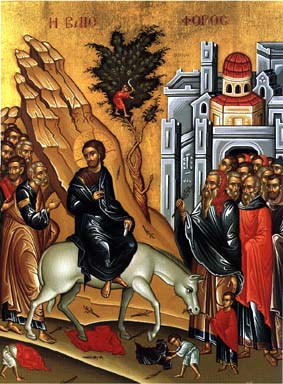
 The Triumphant Entry
“Although we praise our common Lord for all kinds of reasons, we praise and glorify him above all for the cross. Paul passes over everything else that Christ did for our advantage and consolation and dwells incessantly on the cross. The proof of God’s love for us, he says, is that Christ died for us while we were yet sinners. Then in the following sentence he gives us the highest ground for hope: If, when we were alienated from God, we were reconciled to him by the death of his Son, how much more, now that we are reconciled, shall we be saved by his life!” John Chrysostom (AD 347-407)
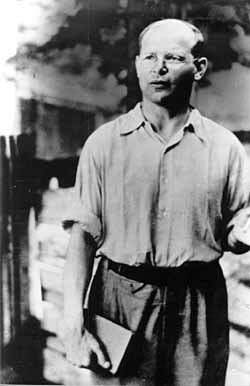
“God speaking to Luther: “Discipleship is not limited to what you can comprehend—it must transcend all comprehension. … Not to know where you are going is the true knowledge. My comprehension transcends yours. Thus Abraham went forth from His father… not knowing whither he went. … Behold, that is the way of the cross. You cannot find it yourself, so you must let me lead you as though you were a blind man. Wherefore it is not you, no man… but I myself, who instruct you by my Word and Spirit in the way you should go. Not the work which you choose, not the suffering you devise, but the road which is clean contrary to all you choose or contrive or desire—that is the road you must take. To that I call you and in that you must be my disciple.” Dietrich Bonhoeffer the Cost of Discipleship
Palm or Passion Sunday always is a day that invokes mixed emotions in me. It is the last Sunday of the Lenten Season and in modern times has become a juxtaposition of two events, the Triumphant Entry of Jesus into Jerusalem where he according to all four Gospels was greeted by crowds of people who lined the street with palms as Jesus riding on a donkey processed from Bethany and Bethphage where he had been staying with Lazarus into Jerusalem and the narrative of the Passion. As such it is a roller coaster ride in our experience of walking with Jesus in the most difficult times.
This particular occasion is the Sunday where the disciples of Jesus are confronted with the reality that our earthy expectations of him do not meet the reality of his condensation to walk among us fully Divine yet fully Human but one too well acquainted with suffering, rejection and shame. He shatters our expectations that he will bless any particular political or social ideology that we allow to take pre-eminence over him, even those that invoke his name. Thus our liturgy brings us to this strange day where in a sense we are confronted with celebrating the entrance of the King and in the next breath cursing him and betraying him to those who torture and crucify him.
In the Roman Catholic and Anglican liturgy the observance is divided between the Liturgy of the Palms which takes place outside the Church Nave either outside the church building or in the Narthex in cold or inclement weather. After an opening collect and reading of the Gospel passage from one of the synoptic Gospels, which one depends on which of the three year liturgical readings that the church is in. Following the reading of the Gospel the congregation led by choir, acolytes and clergy process into the church reciting the words of Psalm 118: 18-29 or singing a hymn such as “All Glory Laud and Honor.” Once the congregation is in the church the Liturgy of the Word continues and when the Passion Gospel is read and specific roles may be assigned to members of the congregation, while the congregation remains seated through the first part of the Passion the congregation stands at the verse where “Golgotha” is mentioned and remains standing.
The liturgy takes the congregation on an emotional and spiritual roller coaster. As the congregation begins outside the following is read:
When Jesus had come near Bethphage and Bethany, at the place called the Mount of Olives, he sent two of the disciples, saying, “Go into the village ahead of you, and as you enter it you will find tied there a colt that has never been ridden. Untie it and bring it here. If anyone asks you, ‘Why are you untying it?’ just say this, ‘The Lord needs it.'” So those who were sent departed and found it as he had told them. As they were untying the colt, its owners asked them, “Why are you untying the colt?” They said, “The Lord needs it.” Then they brought it to Jesus; and after throwing their cloaks on the colt, they set Jesus on it. As he rode along, people kept spreading their cloaks on the road. As he was now approaching the path down from the Mount of Olives, the whole multitude of the disciples began to praise God joyfully with a loud voice for all the deeds of power that they had seen, saying,
“Blessed is the king who comes in the name of the Lord!
Peace in heaven, and glory in the highest heaven!”
Some of the Pharisees in the crowd said to him, “Teacher, order your disciples to stop.” He answered, “I tell you, if these were silent, the stones would shout out.” Luke 19:29-40
It is hard when you read this passage and be caught in the reenactment of this procession not to feel the excitement that must have accompanied that procession. It has the feeling of a victory parade but this road ends in a manner that those present, those seeking an earthly king and Messiah who would drive our the Roman oppressor and restore the kingdom to Israel would not expect with some of them perhaps playing a role in the drama that would take place later in the week. I particularly like the hymn “All Glory Laud and Honor.”
All glory, laud and honor,
To Thee, Redeemer, King,
To Whom the lips of children
Made sweet hosannas ring.
Thou art the King of Israel,
Thou David’s royal Son,
Who in the Lord’s Name comest,
The King and Blessèd One.
Refrain
The company of angels
Are praising Thee on High,
And mortal men and all things
Created make reply.
Refrain
The people of the Hebrews
With palms before Thee went;
Our prayer and praise and anthems
Before Thee we present.
Refrain
To Thee, before Thy passion,
They sang their hymns of praise;
To Thee, now high exalted,
Our melody we raise.
Refrain
Thou didst accept their praises;
Accept the prayers we bring,
Who in all good delightest,
Thou good and gracious King.
During the Liturgy of the Word one of the following is read, either Isaiah 45:21-25 or Isaiah 52:13-53:12, the second being the Song of the Suffering Servant. The Psalm is Psalm 22 where the Psalmist foretells Jesus’ anguished cry from the Cross; “My God, my God, why have you forsaken me? and are so far from my cry and from the words of my distress?”And then we have the New Testament reading Philippians 2: 5-11, the hymn to Christ is read:
“Let the same mind be in you that was in Christ Jesus, who, though he was in the form of God, did not regard equality with God as something to be exploited, but emptied himself, taking the form of a slave, being born in human likeness. And being found in human form, he humbled himself and became obedient to the point of death– even death on a cross. Therefore God also highly exalted him and gave him the name that is above every name, so that at the name of Jesus every knee should bend, in heaven and on earth and under the earth, and every tongue should confess that Jesus Christ is Lord, to the glory of God the Father.”
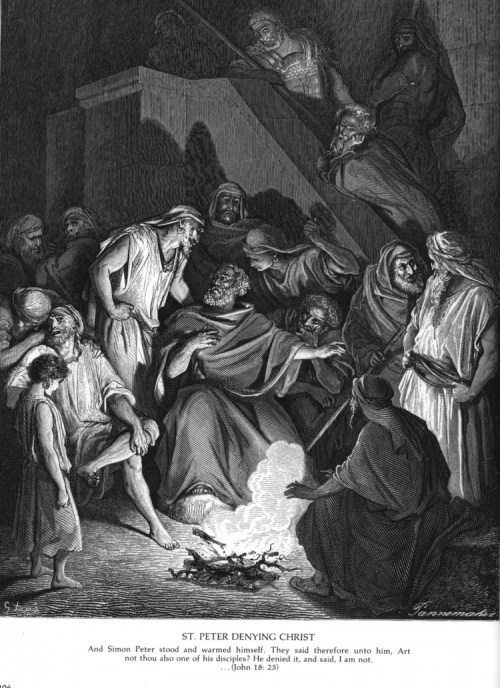 Peter Denies Christ
This year the Passion Narrative is that of Luke (22:39-71) 23:1-49 (50-56). The three parts that stand out in this narrative for me are Peter’s denial of Jesus:
“Then they seized him and led him away, bringing him into the high priest’s house. But Peter was following at a distance. When they had kindled a fire in the middle of the courtyard and sat down together, Peter sat among them. Then a servant-girl, seeing him in the firelight, stared at him and said, “This man also was with him.” But he denied it, saying, “Woman, I do not know him.” A little later someone else, on seeing him, said, “You also are one of them.” But Peter said, “Man, I am not!” Then about an hour later still another kept insisting, “Surely this man also was with him; for he is a Galilean.” But Peter said, “Man, I do not know what you are talking about!” At that moment, while he was still speaking, the cock crowed. The Lord turned and looked at Peter. Then Peter remembered the word of the Lord, how he had said to him, “Before the cock crows today, you will deny me three times.” And he went out and wept bitterly.”
Peter’s denial is in large part because he has had his illusions about Jesus shattered and the fact that he had not understood the message up to that point. As Bonhoeffer says “Jesus is a rejected Messiah. His rejection robs the passion of its halo of glory. It must be a passion without honor. Suffering and rejection sum up the whole cross of Jesus. To die on the cross means to die despised and rejected of men. Suffering and rejection are laid upon Jesus as a divine necessity, and every attempt to prevent it is the work of the devil, especially when it comes from his own disciples; for it is in fact an attempt to prevent Christ from being Christ.”
Likewise Jesus interaction with the condemned thieves that were crucified with him:
“One of the criminals who were hanged there kept deriding him and saying, “Are you not the Messiah? Save yourself and us!” But the other rebuked him, saying, “Do you not fear God, since you are under the same sentence of condemnation? And we indeed have been condemned justly, for we are getting what we deserve for our deeds, but this man has done nothing wrong.” Then he said, “Jesus, remember me when you come into your kingdom.” He replied, “Truly I tell you, today you will be with me in Paradise.”
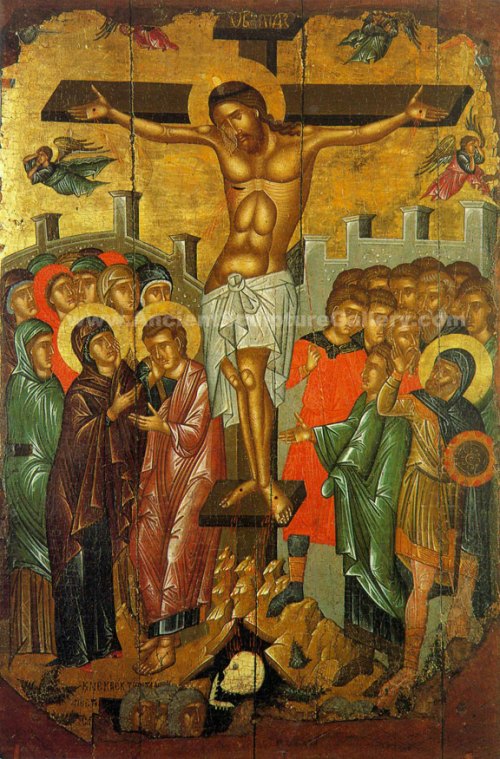 The Crucifixion
The final passage from this narrative that strikes me is the moment of Jesus’ death on the Cross:
“It was now about noon, and darkness came over the whole land until three in the afternoon, while the sun’s light failed; and the curtain of the temple was torn in two. Then Jesus, crying with a loud voice, said, “Father, into your hands I commend my spirit.” Having said this, he breathed his last. When the centurion saw what had taken place, he praised God and said, “Certainly this man was innocent.” And when all the crowds who had gathered there for this spectacle saw what had taken place, they returned home, beating their breasts. But all his acquaintances, including the women who had followed him from Galilee, stood at a distance, watching these things.”
The darkness of this is event is perplexing to those who want to find God in some place where he is untouched by human suffering to them the Cross is folly for what kind of God would submit himself to such ignominy but as Martin Luther wrote “He who does not know Christ does not know God hidden in suffering. Therefore, he prefers works to suffering, glory to the cross, strength to weakness, wisdom to folly. For they hate the cross and suffering and love works and the glory of works. Thus they call the good of the cross, evil and the evil of a deed, good. God can only be found in suffering and the cross.” It is in the contradiction of this week that we come to know God, not a God who seeks not the righteous or the powerful, those who seek the power of an earthy kingdom backed by an ideology of power which tramples the weak, but rather those who will simply walk in the footsteps of Jesus the Christ who rules by serving the least, the lost and the lonely.
The liturgy of this day takes us to the heart of the Gospel as we led by the writers through the triumph of the entrance into Jerusalem, to the betrayal of Jesus by Judas, the abandonment of him by the disciples and the denial of Peter. As the writers lead us through his trial, conviction, scourging and trek to Golgotha we see the gamut of human emotions and reactions to Jesus and we know that we can be there as well in any of the characters simply because we are human and capable of compassion or betrayal. As Jesus is on the Cross it is not the religious or upstanding that remain with him. He is left with his mother, the other Mary and John the beloved. He is shown compassion by a thief and recognized as the Son of God by the Roman Centurion, a gentile serving an empire oppressing the people of Israel and whose governor had pronounced the sentence of death upon him. In this liturgy we have been taken from the heights of exhilaration in the triumphant entry to the depths of despair felt by his disciples that Friday afternoon. It is in this time that we realize how right Dietrich Bonhoeffer is when he writes “God loves human beings. God loves the world. Not an ideal human, but human beings as they are; not an ideal world, but the real world. What we find repulsive in their opposition to God, what we shrink back from with pain and hostility, namely, real human beings, the real world, this is for God the ground of unfathomable love.”
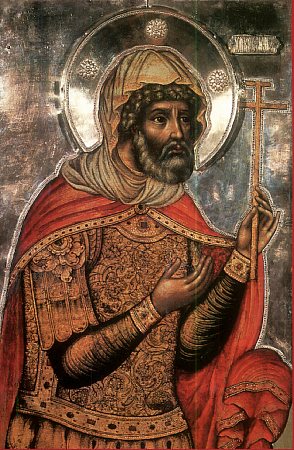 St Longinus, Centurion at the Cross and Martyr
It is the Centurion for which I have the greatest affinity in this story. He is a soldier and in the words of so many soldiers who have obey orders carried out the sentence upon Christ by crucifying him and then as the life ebbs out of Christ’s crucified body exclaims “surely this was a good man” or in other accounts “surely this was the Son of God.” That is the cry of a man who knows that he has executed an unjust sentence, the reaction of a true penitent, the reaction of a man who comes to realize even before many of Jesus’ closest followers understood. According to tradition the Centurion was named Longinus who left the service of the Imperial Legion, was baptized by the Apostles and was martyred under the orders of Pontius Pilate by soldiers of the unit that he had once commanded.
It is important for the Church not to lose this identification. The Church is not to become enmeshed and co-opted by those who attempt to use the Gospel to promote ideologies foreign to it as is the temptation in times of crisis. As Jürgen Moltmann notes:
“In Christianity the cross is the test of everything which deserves to be called Christian… The Christian life of theologians, churches and human beings is faced more than ever today with a double crisis: the crisis of relevance and the crisis of identity. These two crises are complementary. The more theology and the church attempt to become relevant to the problems of the present day, the more deeply they are drawn into the crisis of their own Christian identity….
Christian identity can be understood only as an act of identification with the crucified Christ, to the extent to which one has accepted that in him God has identified himself with the godless and those abandoned by God, to whom one belongs oneself.” The Crucified God [pgs. 7, 19]
Nor is our task is not to attempt to invent “crosses” for ourselves in acts of pseudo-martyrdom but simply to be faithful in loving Jesus and our neighbor as Bonhoeffer noted “Must the Christian go around looking for a cross to bear, seeking to suffer? Opportunities for bearing crosses will occur along life’s way and all that is required is the willingness to act when the time comes. The needs of the neighbor, especially those of the weak and downtrodden, the victimized and the persecuted, the ill and the lonely, will become abundantly evident.” The mark of the Christian is not to blindly give his life for a cause or be consumed by the false “messiah’s” promoted by politicians, pundits and even preachers captivated by the lust for power and glory.
As we walk through the mystery of Holy Week together let us renew our faith in the Crucified One and not be conformed to those things that seek to turn us from the way of discipleship and the way of the Cross.
Peace
Padre Steve+

 Padre Steve is Back in Commission
 USS West Virginia in the 1930s
 Damage to the West Virginia
 USS California 1945 after her rebuild
 USS West Virginia 1944 after the rebuild



















 The Inglorius Padre Steve's World
Ash Wednesday…Padre Steve’s Lenten Survival Tips to Make this a Happy Lent
“God, deliver me from gloomy saints.” – – Saint Teresa of Avila
We’ll it is here, my least favorite season of the liturgical year. As I have mentioned before I do not do well, at the same time it is something that I need to commit myself to observing for the sake of actually wanting a better spiritual life that is not simply a way to make me feel better about life but help me more fully to love and serve God my neighbor with an attitude of thanksgiving and joy.
Those who know me know that such is not an easy task and that for me no matter how hard I have tried Lent has always been painful. By the end of Lent I am thankful for Easter not simply because of the resurrection and the promise of redemption, but frankly because I was glad that Lent was over. In my early days as a Priest I tried to out do others on Lent doing not just Friday but Wednesday as meatless. I have even tried doing opposite of what I was doing and hope that it would work. Last year in the midst of my spiritual crisis I tried to go extra-lean on Lent and that didn’t help either. Perhaps that was due to my overall poor emotional, physical and spiritual condition as I was trying to climb out of the abyss of PTSD but still, Lent was not very productive for me no matter what I did.
So this year I’m going to be a good Anglican and find the via media where I actually gain some spiritual benefit, give up something that I can actually succeed at giving up for Lent and add or increase some spiritual discipline that I can succeed at doing not just for Lent but in real life too. I realize that I can’t overdo it or I will simply give up when something keeps me from doing it and the same time I need to do something not too difficult but not so easy as to be meaningless. The goal is to have a meaningful Lent that actually does me some spiritual good while not becoming any more of a pain in the ass to the people around me that have to endure me.
Today was Ash Wednesday and I had the responsibility for conducting the Protestant service which for me comes straight out of the Book of Common Prayer. The Gospel lesson from Matthew chapter 6 was Jesus telling folks how to fast not be idiots about it, in other words to “Steveicize” the language Jesus wants his followers to be able to and pray without drawing attention to ourselves and actually look happy about it. I figure and I assume that Jesus figured out that there were too many gloomy religious people around and that the disciples needed to get a life before he sent them out into the world; of course just like me and maybe you too made plenty of mistakes and at times made a mess of things in their time with Jesus and even after. The disciples who with the exception of Judas who got hung up on the details all became Apostles still all finished well and most got schwacked by the Romans or others displeased with their message.
So with this in mind here are a few hints on how to get through Lent, not that I have been successful at doing this but figure that through my failures I might have a few insights in how to navigate the often treacherous season of Lent.
First there are the spiritual disciplines, like starting simple, go to church, pray every day, even if it is something short and sweet. If you are a superstar Christian you can go onward and upward using spiritual steroids to improve your performance but I’m not there yet, I just use spiritual steroids to help my soul heal faster. As Saint Bernard of Clairvaux said:
“Wherever…thou shalt be, pray secretly within thyself. If thou shalt be far from a house of prayer, give not thyself trouble to seek for one, for thou thyself art a sanctuary designed for prayer. If thou shalt be in bed, or in any other place, pray there; thy temple is there.”
Now to what to give up: Most of the time for Americans this involved food, particularly meat on Friday’s and sometimes other things. I’ve heard of people giving up chocolate or certain delicacies but most of the time it is meatless Fridays and sometimes Wednesdays and there have been some that I have met who have gone on 40 days fasts during Lent. I can get the meatless Fridays and I am going to give up something that I love that I don’t eat much of normally, like maybe once a week after successful weigh-ins, but really enjoy…I mean really enjoy, the Gordon Biersch Cheeseburger cooked medium rare with everything on it and Garlic Fries on the side. Since there is not a lot else for me to give up being on the Fat Boy program, that once a week treat will be a sacrifice.
Now since I tend not too eat most things that swim in their own toilet such as fish the whole deal of fish on Friday is something that I don’t observe…now I still go meatless but find alternative ways to do it. In the past I have done bean burritos, meatless salads, meatless pasta usually with a Marinara sauce, pizza with tomatoes, garlic, olives and mushrooms, or something simple like red or black beans and rice, vegetable soup, pea soup, black bean soup and other things like that. This makes meatless doable. One year though I had to suffer for Jesus on the USS Hue City as Friday was “surf and turf.” Since the turf was definitely out for Lent I had to make due with Alaskan King Crab or lobster tails. That was difficult but I did survive.
I think one of the things that I missed during previous Lenten seasons was the grace of God, somehow in trying to jump through all the Lenten hoops I became so fixated on the actions that I forgot to experience the love of God and the joy that comes with that. This year will be all about that process and discovering the joy in life that has been coming back to me after my “Christmas miracle.”
Martin Luther the German reformer wrote something very appropriate about how to approach Lent,a s well as the rest of the Christian life which I think is pretty profound as Lutehr sees the process of the Christian life:
“‘Be ye transformed by the renewing of your mind (Rom. 12:2).’ In this way the Apostle describes (Christian) progress; for he addresses those who already are Christians. The Christian life does not mean to stand still, but to move from that which is good to that which is better. St. Bernard (of Clairvaux) rightly says: ‘As soon as you do not desire to become better, then you have ceased to be good.’ It does not help a tree to have green leaves and flowers if it does not bear fruit beside its flowers. For this reason – (for not bearing fruit) – many (nominal Christians) perish in their flowering. Man (the Christian) is always in the condition of nakedness, always in the state of becoming, always in the state of potentiality, always in the condition of activity. He is always a sinner, but also always repentant and so always righteous. We are in part sinners, and in part righteous, and so nothing else than penitents. No one is so good as that he could not become better; no one is so evil, as that he could not become worse.'” (Commentary on Romans, by Martin Luther, Translated by J. T. Mueller, Kregel Publications, Grand Rapid MI 49501, reprinted 1976, page 167-168.)
On a side note one cool thing about this Lent is that it is happening about as early in the year as it can, thus it will not affect the baseball season as opening day at Harbor Park is the week following Easter. So anyway with all of this in mind I bid you a blessed Lent and hope and pray that you will come to experience the love of God in a special way this year that impacts you and those around you. Pray for me a sinner.
Peace, Padre Steve+
Share this:
2 Comments
Filed under faith, Pastoral Care, philosophy, PTSD, Religion
Tagged as ash wednesday, baseball opening day, bernard of clairvaux, book of common prayer, easter, gordon biersch, harbor park, jesus, lent, lenten fasting, luther's commentary on romans, Martin Luther, meatless friday, PTSD, spiritual crisis, teresa of avila, the disciples, uss hue city