Category Archives: History

Oktoberfest Pilgrimage Live Blog: A Visit to Beer Land

IMG_0488.JPG

“Beer is proof that God loves us and wants us to be happy.” Benjamin Franklin

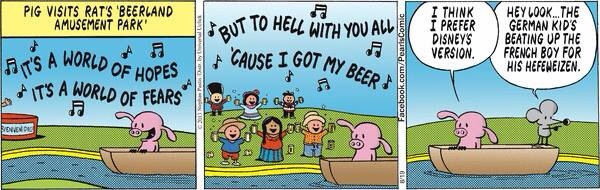
One of my favorite comic strips is Stephan Pastis’ Pearls Before Swine. A few months ago one of the main characters appropriately named Rat, since he is a rat, decides to open his own amusement park called Beer Land. The series of strips is amazingly brilliant, especially to true beer drinkers. I think the strip from that series that I most enjoyed was this one, because of the way Pastis linked a ride at the strip to the syrupy Disney ride It’s a Small World.

Today we did a bit of a road trip and took the U-Bahn from Munich to a small town on the outskirts of the city called Erding, for a visit and tour of the Erdinger Weisbier brewery, the largest brewer of wheat beers in the world. Before heading to Erding we had taken a short visit to the historic Marianplatz where we were able to see the famous Glockenspiel at the old city hall, or Rathaus.

IMG_0489-0.JPG

Now Judy has incurred a couple of injuries to her knee, ankle, and a couple of years ago had to her Achilles’ tendon repaired. As such sometimes a lot of walking causes her a lot, I mean a lot of pain. We tried to go out some yesterday but after a few minutes at Marianplatz but she was in such pain so we went back to our hotel until later in the evening when we went to dinner with our friends.

This morning she was in less pain but she knew if she didn’t get some European style crutches that she would not do well and possible be confined to the hotel for must of our remaining time here. For those that don’t know, European or as they are referred to in the United States Canadian crutches are far superior to the type most of us know and loath so much. They provide the user much more mobility and less pain to the armpits and shoulders because you do not swing from them.

So while she hung out with our friends I googled where to find the crutches in Munich. The word for crutches is krucken and they are sold at stores that specialize in equipment for those recovering from injuries as well as those with various physical disabilities called a Saniatshaus. The closest of these was about two miles away, so with google maps to guide me I set off. I walk pretty fast so it didn’t take that long to get there and when I did after the normal greetings with the lady at the counter I asked for a pair of crutches, which she showed me and allowed me to even pick the color. They cost about 34 Euros, which isn’t too bad, and for that quality I would have payed more in the U.S, had I gotten them at home. I made my way back by hailing a taxi to save time. Had a nice conversation about Munich, beer and the Oktoberfest with the driver and he delivered me back just city meters from where Judy and some of our friends had gathered. Since we were waiting on some of the rest of our group we had a beer at an outdoor cafe across from the Rathause where we saw the Glockenspiel do its thing when the clock stuck eleven.

Once all of us were gathered we boarded the U-Bahn to Erding a trip of about 45 minutes. Once in Erding we caught a city bus to the Erdinger brewery. We got our tickets for the tours and bought a couple of items in the gift shop and then went on the tour. The tour took about an hour and a half and was amazing.

I was impressed with how well a large brewery can make great beer using only the natural ingredients of hops, barley or wheat malt and water. There are no added sugars, food colorings known to be carcinogenic, Bisphenal A (BPA); cheap filler grains such as rice and corn as well as high fructose corn syrup, dextrose, and mono sodium glutamate, and even propylene glycol (a component of anti-freeze) are found in many mass produced American beers. This is because of the observance of the strict Bavarian or German beer purity law the Reinheitsgebot which stipulates what are acceptable ingredients in beer. Frankly the difference in taste is amazing as well as the effects, especially the morning after. But I digress….

As I mentioned the tour was informative and enjoyable. At the end of the tour, which cost 12 Euros per person we were provided freshly baked Bavarian pretzels, two large Bavarian Weiswurst, which are a mildly spiced and finely textured pork sausage and three half liter glasses of whichever of the eight styles of Weisbier that Erdinger brews.

10670000_10152772414817059_3414239591729879256_n

It truly was a visit to Beer Land and I am sorry to say that at each stage of the tour I kept thinking about that comic, but no, I didn’t see the German kid beat up the French kid for his Hefeweizen.

So Since this a religious pilgrimage, I will close with a quote from one of my favorite rebellious theologians, the eminent Doctor Martin Luther:

“Whoever drinks beer, he is quick to sleep; whoever sleeps long does not sin; whoever does not sin enters heaven! Thus let us drink beer!”

Have a great day.

Peace

Padre Steve+

Leave a comment

Filed under beer, civil rights, faith, History, nazi germany, Religion, travel

Oktoberfest Live Blog: Munich Musings; History and Bier

IMG_2051.JPG

I have spent a total of about four years of my life in Germany. I enjoy the country and the people and I love traveling here because for me it is relaxing. When I have a car I enjoy driving on the Autobahn, and I find the mass transportation more than effective and convenient but a great way to travel.

As a historian who for many years specialized in the study of the latter years of the Kaiser Reich, the German revolution and civil war, the Weimar Republic and the Nazi period visiting here always intellectually stimulating. Munich is a very interesting and sometimes contradictory city, rich in culture, music, art, literature and scientific-technological achievements. Likewise it has always been a more cosmopolitan center of a very conservative state, especially religiously conservative as Bavaria is the heart of Catholic Germany. Thus there has always been a tension in the city, between the local more religious conservatives and business leaders and the more secular and progressive inhabitants, and the immigrants from Eastern Europe, especially more traditional and conservative Orthodox Jews.

This tension continues today with the large numbers of foreigners that live and work in the city. Many are Turkish guest workers and their descendants that have been in Germany almost half a century. But many are new immigrants from the Middle East and Africa, some who have embraced German life in a secular state, but many who have not and stand out in the crowd. In particular I think of the number of Moslems who retain their traditional dress and ways, which in many ways is reminiscent of the Eastern European Orthodox Jews, who likewise stood out as they attempted to maintain their cultural and religious identity.

Munich is the capital city of Bavarian, or as it is known here, Bayern. It was ruled for centuries by the Wittelsbach dynasty, which included “Mad King Louis” who built the amazing Neuschwanstein and Linderhof castles. That dynasty, with the rest of the German royalty was overthrown at the end of the a First World War. It was replaced for about three months by what was known as the Bavarian Soviet led by Kurt Eisner, an “independent socialist.” Eisner could not hold power and resigned in February 1919 and on the way to his resignation he was assassinated by a right wing extremist who held the views of the racist Thule Society. Eisner was replaced by a Majority Socialist leader who could not form a government and then by an Independent Socialist and Communist government. This government was both inept and brutal, it took hostages from the elite of the city as well as conservative reactionaries and had them executed. This brought a response from Berlin which sent a force of 30,000 Weimar Government employed Freikorps troops, including many Bavarians from rural areas, under the command of Ritter Von Epp to crush the Munich Soviet. After hard fighting against the Communist troops Epp’s men crushed the opposition and executed hundreds of the Communists and Independent Socialist fighter and leaders.

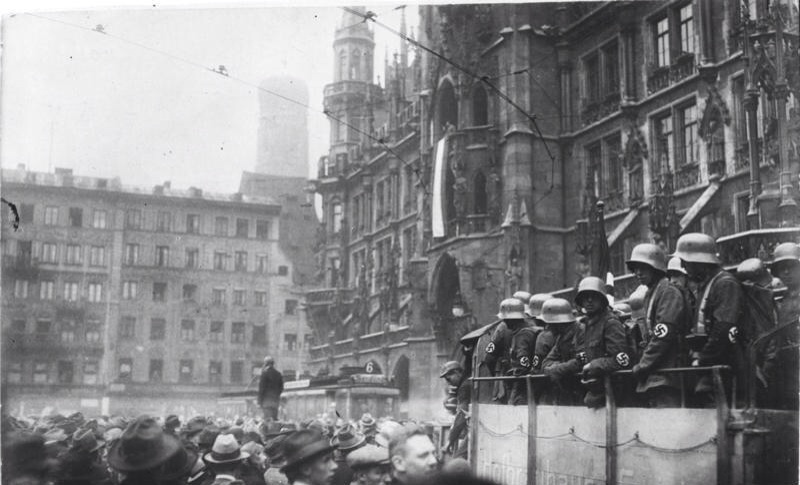
The city was still rife with revolutionary and reactionary elements and in 1919 a new political party was established. This party became the National Socialist Workers Party of Germany, or the NSDAP. Adolf Hitler joined the party and quickly became its head. He along with General Erich Ludendorff led a coup, or “putsch” against the government on the 8th and 9th of November 1923. The putsch originated at the NDSAP headquarters and Hitler led about 2000 armed members of the party to the Burgerbrau Keller beer hall where the Gustav Von Kahr, who had been appointed with dictatorial powers due to the unrest, was making a speech.

IMG_0483.JPG

Hitler took Kahr and other members of the government hostage and declared a revolution and enjoined those present to “join in this grave eleventh hour for our German Fatherland.” While many present were turned by his speech, the revolt did not gain momentum and in desperation Hitler ordered a march to overthrow the government. At Odeonsplatz at the bridge over the Isar River near the Feldherrenhalle his group of nearly 2000 followers including future Nazi Leaders Hermann Goering and Rudolf Hess were confronted by about 100 Bavarian police, and defeated. Hitler was arrested and tried, spent nine months in prison during which he wrote Mein Kampf. The Burgerbraukeller and the Feldherrenhalle became Nazi shrines which after Hitler’s takeover became places where Hitler would return yearly to mark his failed putsch.

All of these events took place in a small area of the Munich city center. Sadly most people who come to Munich are aware of the events that occurred here, and many fail to realize how easily a city know for so many cultural and scientific achievements can become the locus of evil for a man like Adolf Hitler.

While I love Munich my love is tempered by how many events which still affect us today occurred here just eight to ninety years ago. To use a German expression, that amount of in the sense of history is merely an “augenblick” or “blink of an eye”. It is hard to believe that so much has happen here, and just how few people understand just how easily such events can happen again.

When I look at my own country I see parallels between the more extreme elements of the Tea Party movement, White Supremacists and others with some of those that followed Hitler to the Burgerbraukeller. The hatred that they express towards liberals, racial minorities, immigrants and Moslems is so similar to the words of those precursors to the Nazi party rule in Germany that it is frightening. Comforting myths are substituted for history. Race, ideology and xenophobic nationalism, often clothed in the language of tradition “Christian” beliefs are used to demonize those who are different. Sadly too I see some of my fellow progressives inflamed with such a hatred of conservatives that they can not see the dangers inherent in such polarization. As a historian, I find the parallels disturbing.

But despite that we are here to have fun, and that I am. After all, I choose to believe in the power of acceptance, tolerance and inclusiveness. Those are found in the words that are imprinted on the modern German Army belt buckles and in the German National anthem “eingekeit, recut und freiheit” or “unity, Justice and freedom.” Those words are also implicit in our own Declaration of Independence which states that “all men are created equal. Thus for me, not believe that good can overcome evil is central to who I am.

IMG_2059.JPG

And from Munich, I am your friend,

Peace

Padre Steve

Leave a comment

Filed under History, philosophy, Political Commentary

The U.S. Civil War: Beginning of Modern Warfare Part One

culp's hill

Note: This is the first part of a major revision to my article on the American Civil War being the first modern war. Part two will follow tomorrow. This is actually the beginning of the first chapter of my Gettysburg text, much of which has been appearing in various forms on this site for the past year, much of this deals with the connection between policy and strategy and the relationship of political leaders to the military.

The American Civil War was the first modern war. It was a watershed time which introduced changes in tactics, logistics, communications and the concept of total war to the world. Though it did not change the essential nature of war, which Clausewitz says is “is an act of violence to compel our opponent to fulfil our will” [1] it expanded the parameters of it and re-introduced the concept of “total war” to the world and “because its aim was all embracing, the war was to be absolute in character.”[2] In a sense it was a true revolution in military affairs.

While the essential nature of war remains constant, wars and the manner in which they are fought have changed in their character throughout history, and this distinction matters not only for military professionals, but also policy makers. The changing character of war was something that military leaders as well as policy makers struggled with during the American Civil War much as today’s military leaders and policy makers seek to understand the character of warfare today. British military theorist Colin Gray writes “Since the character of every war is unique in the details of its contexts (political, social-cultural, economic, technological, military strategic, geographical, and historical), the policymaker most probably will struggle of the warfare that is unleashed.” [3] That was not just an issue for Abraham Lincoln and Jefferson Davis, both of whom struggled with the nature of the war which had been unleashed, but it is one for our present political leaders, who as civilian politicians are “likely to be challenged by a deficient grasp of both the nature of war as well as its contemporary context-specific character.” [4]

In addition to being the first modern war, or maybe I should say, the first war of the Industrial Age, the Civil War became a “total war.” It was the product of both the massive number of technological advances which both preceded and occurred during it, in which the philosophical nature of the Industrial Revolution came to the fore. Likewise, the enmity of the two sides for one another which had been fostered by a half century of relentless and violent propaganda which ushered from the mouths of politicians, the press and even from the pulpit, even to the point of outright armed conflict and murder in “Bleeding Kansas” during the 1850s.

As a total war it became a war that was as close to Clausewitz’s understanding of absolute war in its in character waged on the American continent, and it prefigured the great ideological wars of the twentieth century, as J.F.C. Fuller noted “for the first time in modern history the aim of war became not only the destruction of the enemy’s armed forces, but also of their foundations- his entire political, social and economic order.” [5] It was the first war where at least some of the commanders, especially Ulysses S. Grant and William Tecumseh Sherman were men of the Industrial Age, in their thought and in the way that they waged war, in strategy, tactics even more importantly, psychologically. Fuller wrote:

“Spiritually and morally they belonged to the age of the Industrial Revolution. Their guiding principle was that of the machine which was fashioning them, namely, efficiency. And as efficiency is governed by a single end- that every means is justified- no moral or spiritual conceptions of traditional behavior must stand in its way.” [6]

Both men realized in early 1864 that “the South was indeed a nation in arms and that the common European practice of having standing armies engaged each other in set-piece battles to determine the outcome of a war was not enough to win this struggle.” [7] Though neither man was a student of Clausewitz, their method of waging war was in agreement with the Prussian who wrote that “the fighting forces must be destroyed; that is, they must be put in such a position that they can no longer carry on the fight” but also that “the animosity and the reciprocal effects of hostile elements, cannot be considered to have ended so long as the enemy’s will has not been broken.” [8] Sherman told the mayor of Atlanta after ordering the civilian population expelled that “we are not only fighting hostile armies, but a hostile people, and must make the old and young, the rich and poor, feel the hard hand of war.” [9] Sherman not only “carried on war against the enemy’s resources more extensively and systematically than anyone else had done, but he developed also a deliberate strategy of terror directed against the enemy’s minds.” [10]

Abraham Lincoln came to embrace eternal nature of war as well as the change in the character of the war over time. Lincoln had gone to war for the preservation of the Union, something that for him was almost spiritual in nature, as is evidenced by the language he used in both of his inaugural addresses and the Gettysburg Address. Instead of a war to re-unite the Union with the Emancipation Proclamation the war became a war for the liberation of enslaved African Americans, After January 1st 1863 when the Emancipation Proclamation went into effect, Lincoln “told an official of the Interior Department, “the character of the war will be changed. It will be one of subjugation…The [old] South is to be destroyed and replaced by new propositions and ideas.” [11]

Of course, the revolution in military affairs took time and it was the political and military leaders of the North who better adapted themselves and their nation to the kind of war that was being fought. “Lincoln’s remarkable abilities gave him a wide edge over Davis as a war leader, while in Grant and Sherman the North acquired commanders with a concept of total war and the determination to make it succeed.” [12]

At the beginning of the war the leaders and populace of both sides still held a romantic idea of war. The belief that the war would be over in a few months and that would be settled by a few decisive battles was held by most, including many military officers on both sides, there were some naysayers like the venerable General Winfield Scott, but they were mocked by both politicians and the press.

The Civil War became an archetype of the wars of the twentieth century, and the twenty-first century. It became a war where a clash between peoples and ideologies which extended beyond the province of purely military action as “it was preceded by years of violent propaganda, which long before the war had obliterated all sense of moderation, and awakened in the contending parties the primitive spirit of tribal fanaticism.” [13]

The conduct of the American Civil War added new dimensions to war, increased its lethality and for the first time since the 30 Years’ War saw opponents intentionally target the property, homes and businesses of civilian populations as part of their military campaign. The Civil War was a precursor to the wars that followed, especially the First World War which it prefigured in so many ways. [14]

However, like all wars many of its lessons were forgotten by military professionals in the United States as well as in Europe. Thus 50 years later during World War One, British, French, German, Austrian and Russian wasted vast amounts of manpower and destroyed the flower of a generation because they did not heed the lessons of the Civil War. Fuller noted:

“Had the nations of Europe studied the lessons of the Civil War and taken them to heart they could not in 1914-1918 have perpetuated the enormous tactical blunders of which that war bears record.” [15]

The lessons of the war are still relevant today. Despite vast advances in weaponry, technology and the distances with which force can be applied by opponents, war remains an act of violence to compel an enemy to fulfill our will. War according to Clausewitz is “more than a chameleon that slightly adapts its characteristics to the given case.” [16] but it is always characterized by the violence of its elements, the province of chance and its subordination to the political objective and as such forces political and military leaders as well as policy makers to wrestle with “the practical challenge of somehow mastering the challenge of strategy in an actual historical context.” [17]

The study of the Civil War can be helpful to the joint planner and commander because it so wonderfully shows the interplay of Clausewitz’s “paradoxical trinity- composed of primordial violence, hatred, and enmity, which are to be regarded as a blind natural force; of the play of chance and the element of subordination, as an instrument of policy, which makes it subject to reason alone.” [18] during an era of great technological and philosophical change. The importance of this cannot be underestimated, for in this era of change, like in every era, some leaders and commanders were either resistant to, or failed to understand the changes being forced upon them in their conduct of war by the industrialization of war and its attendant technology; while others, like Sherman, Grant and Sheridan not only understood them, but embraced them and applied them with skill and vigor in ways that stunned the people of the South.

Over time the Union developed what we would now refer to as a “whole of government approach” to the war. This included not only the military instrument but the use of every imaginable means of national power, from the diplomatic, the economic and the informational aspects of the Union in the effort to subdue the Confederacy. The understanding and use of the “whole of government approach” to war and conflict is still a cornerstone of United States military policy in “unified action, to achieve leverage across different domains that will ensure conditions favorable to the U.S. and its allies will endure.” [19] The working staff of the War Department headed by Edwin Stanton and Major General Montgomery Meigs developed rapidly. It effectively coordinated with railroads, weapons manufactures and suppliers of clothing, food and other necessities to supply the army and navy so well that “Union forces never seriously lacked the materials necessary to win the war.” [20] Stanton and Meigs were “aided by the entrepreneurial talent of northern businessmen” which allowed “the Union developed a superior managerial talent to mobilize and organize the North’s greater resources for victory in the modern industrialized conflict that the Civil War became.” [21]

The understanding of this eternal nature and ever changing character of war to leaders of nations as well as military commanders and planners has been very important throughout history. It can be seen in the ways that Jefferson Davis and Abraham Lincoln conducted their relationships with their military commanders, including during the Gettysburg campaign and we are reminded by Colin Gray notes that political leaders and policy makers who are in charge of policy often ignorant of the nature and character of war, and this fact “directs attention to the difficulties of translating political judgment into effective warmaking.” [22] Military leaders should be the people to advise and instruct policy makers in aligning their policy to what is actually feasible based on the ends ways and means, as well as the strengths and limitations of the military to carry out policy decisions and history reminds us “that policymakers committed strongly to their political desires are not easily deflected by military advice of a kind that they do not want to hear.” [23]

While there was much support for the Confederacy in the aristocracies of Europe, the effectiveness of the Union military in winning the key battles that allowed Lincoln to make his Emancipation Proclamation ensured that Europe would not recognize the Confederacy, . Charles F. Adams, the United States minister to Britain successfully defused the crisis of the Trent affair, which could have led to British recognition of the Confederacy and intervention in the war. Adams’ efforts were so successful that they “left Anglo-American relations in better shape than before the crisis.” [24]

Related to this understanding of warfare one has to also look at the importance of diplomacy, especially in picking the right diplomat for a critical post is a part of a whole of government approach to war and warfare. This was very important in the early stages of the Civil War as there was much support for the Confederacy in the aristocracies of Europe. The effectiveness of the diplomacy was increased by the Union military efforts. The Union suffered many failures at the outset of the war by the time of the Gettysburg campaign they did enough to prevent English or French intervention on the side of the Confederacy, which was also aided by tensions in Europe regarding the Schleswig-Holstein problem between Prussia and Austria as well as unrest in Poland, and the British in particular were loath to risk intervening in a conflict that might be “a disturbance in the precarious balance of power which might be the signal for a general conflagration, they recalled Voltaire’s comment that a torch lighted in 1756 in the forests of the new world had promptly wrapped the old world in flames.” [25] Thus, European leaders and diplomats were very hesitant to allow Southern legations to convince them to intervene.

Though the Confederates won many battles it was the Union military whose success Island Number Ten, Fort Donaldson and Shiloh in the West, and the bloody repulses of Confederate armies at Perryville and Antietam; as well as the joint operations conducted by the Union Navy and Army confederacy through the blockade and capture of key ports such as New Orleans early in the war that allowed Lincoln to make his Emancipation Proclamation. These military successes enabled Lord Palmerston to reject a French proposal for France, England and Russia to propose to the warring parties, a “North-South armistice, accompanied by a six month lifting of the blockade. The result, if they had agreed- as they had been in no uncertain terms warned by Seward in private conversations with British representatives overseas- would have been a complete diplomatic rupture, if not an outright declaration of war.” [26]

The issuance of that proclamation ensured that Europe would not recognize the Confederacy because even pro-Southern English political leaders could not appear to even give the appearance of supporting slavery, especially as both England and France had abolished slavery decades before, while Russia had only recently emancipated its serfs and “was pro-Union from the start….” [27] Popular sentiment in those countries, outside of the ruling class and business elites, was heavily in favor of emancipation, especially among the working classes. The leaders of the workingmen of Manchester England, a major textile producer, who which had been among the “hardest hit by the cotton famine, sent him [Lincoln] an address approved at a meeting on New Year’s Eve, announcing their support of the North in its efforts to “strike off the fetters of the slave.” [28]

There were issues related to the blockade but Charles F. Adams, the United States minister to Britain successfully defused the crisis of the Trent affair, which could have led to British recognition of the Confederacy and intervention in the war in a manner that “left Anglo-American relations in better shape than before the crisis.” [29]

The Union blockade was a key factor in the diplomatic efforts. As I have noted there were many in both Britain and France who sympathized with the South and hoped for Southern victory that were not impressed by Southern moves to subject them to an embargo of Southern cotton until they received recognition. While many Englishmen were offended by Seward’s bluster, many “resented even more the Confederacy’s attempt at economic blackmail.” [30]

The British especially were keen on not going to war for the sake of the South, there was far too much at stake for them, something that the Southern leaders and representatives did not fully comprehend. Prime Minister Viscount Palmerston and Foreign Minister Lord Russell were concerned about the economic impact of the loss of Southern cotton but also “recognized that any action against the blockade could lead to a conflict with the United States more harmful to England’s interests than the temporary loss of Southern cotton.” [31] Palmerston well remembered the war of 1812 when he served as Minister of War, and the disastrous results for the British Merchant Marine, and he realized that “England could not only afford the risk of a loss in a sideline war; she could not even afford to win one.” [32]

[1] Clausewitz, Carl von. On War Indexed edition, edited and translated by Michael Howard and Peter Paret, Princeton University Press, Princeton NJ 1976 p.75

[2] Fuller, J.F.C. The Conduct of War 1789-1961 Da Capo Press, New York 1992. Originally published by Rutgers University Press, New Brunswick N.J p.99

[3] Gray, Colin S. Fighting Talk: Forty Maxims on War, Peace, and Strategy Potomac Book, Dulles VA 2009 p.36

[4] Ibid. Gray Fighting Talk p.36

[5] Fuller, J.F.C. A Military History of the Modern World, Volume Three: From the Seven Days Battle, 1862, to the Battle of Leyte Gulf, 1944 Minerva Press 1956 p.88

[6] Ibid. Fuller A Military History of the Modern World, Volume Three p.88

[7] Flood, Charles Bracelen, Grant and Sherman: The Friendship that Won the War, Harper Perennial, New York 2005 p.238

[8] Ibid. Clausewitz p.90

[9] McPherson, James. The Battle Cry of Freedom: The Civil War Era Oxford University Press, Oxford and New York 1988 p.809

[10] Weigley, Russell F. The American Way of War: A History of United States Military History and Policy University of Indiana Press, Bloomington IN, 1973 p.149

[11] Ibid. McPherson The Battle Cry of Freedom p.558

[12] Ibid. McPherson The Battle Cry of Freedom p.857

[13] Ibid. Fuller The Conduct of War 1789-1961 p.99

[14] Fuller has an excellent synopsis of this in his book A Military History of the Modern World, Volume Three (p.89). He wrote: The war fought by Grant and Lee, Sherman and Johnston, and others closely resembled the First of the World Wars. No other war, not even the Russo-Japanese War of 1904-1905, offers so exact a parallel. It was a war of rifle bullets and trenches, of slashings, abattis, and even of wire entanglements- an obstacle the Confederates called “a devilish contrivance which none but a Yankee could devise” because at Drewry’s Bluff they had been trapped in them and slaughtered like partridges.” It was a war of astonishing in its modernity, with wooden wire-bound mortars hand and winged grenades, rockets, and many forms of booby traps. Magazine rifles and Requa’s machine gune were introduced and balloons were used by both sides although the confederates did not think much of them. Explosive bullets are mentioned and also a flame projector, and in June, 1864, General Pendleton asked the chief ordnance officer at Richmond whether he could supply him with “stink-shells” which would give off “offensive gases” and cause “suffocating effect.” The answer he got was “stink-shells, none on hand; don’t keep them; will make them if ordered.” Nor did modernity end there; armoured ships, armoured trains, land mines and torpedoes were used. A submarine was built by Horace H. Hundley at Mobile….”

[15] Ibid. Fuller A Military History of the Modern World, Volume Three p.89

[16] Ibid. Clausewitz p.89

[17] Ibid. Gray Fighting Talk p.38

[18] Ibid. Clausewitz p.89

[19] ________ JCWS Student Text 1 3rd Edition, 14 June 2013 p.2-4

[20] Guelzo Allen C. Fateful Lightening: A New History of the Civil War Era and Reconstruction Oxford University Press, Oxford and New York 2012

[21] Ibid. McPherson. The Battle Cry of Freedom p.857

[22] Ibid. Gray Fighting Talk p.38

[23] Ibid. Gray Fighting Talk p.38

[24] Ibid. McPherson. The Battle Cry of Freedom p.391

[25] Foote, Shelby, The Civil War, A Narrative. Volume Two Fredericksburg to Meridian Random House, New York 1963 p.154

[26] Ibid. Foote , The Civil War, A Narrative. Volume Two p.153

[27] Ibid. Foote , The Civil War, A Narrative. Volume Two p.153

[28] Ibid. Foote , The Civil War, A Narrative. Volume Two p.155

[29] Ibid. McPherson. The Battle Cry of Freedom p.391

[30] Ibid. McPherson. The Battle Cry of Freedom p.384

[31] Ibid. McPherson. The Battle Cry of Freedom p.384

[32] Ibid. Foote , The Civil War, A Narrative. Volume Two p.154

Leave a comment

Filed under civil war, Foreign Policy, History, Military, national security

ISIL: A Generational Problem in Which the Enemy Gets a Vote

295_26912117058_5652_n

I have been writing much in recent days about the war that we are now in against the Islamic State, or ISIL.  Today Secretary of defense Hegel and Chairman of the Joint Chiefs of Staff General Martin Dempsey briefed the Senate Armed Services Committee about the developing strategy to defeat ISIL. They both echoed what I have been writing, that this is not going to be a short and easy war. It was the kind of briefing that Secretary Rumsfeld, Paul Wolfowitz and others should have given Congress before launching the Iraq war in 2003.

Unlike Rumsfeld and others who plainly concocted a fairy tale about the character, length and cost of the war which they and their propagandists in the media deceived the American public into supporting that war, this was a briefing conducted by realists who did not paint beautiful picture of just how easy it will be to win this war, and how it really won’t be over until it’s over. Retired Marine Corps General James Mattis very wisely said: “No war is over until the enemy says it’s over. We may think it over, we may declare it over, but in fact, the enemy gets a vote.”

In fact the aftermath of that 2003 invasion opened a Pandora’s box of chaos, and opened the door to what T.E. Lawrence warned about in 1919: “A Wahabi-like Moslem edition of Bolshevism is possible, and would harm us almost as much in Mesopotamia as in Persia…” ISIL is exactly that, a fulfillment of Lawrence’s warning.

Unfortunately no one really likes realists, they rain on people’s ideological parades and no one likes to have their parade rained on. Both men recognize that after the past thirteen years of war, as well as the massive upheaval spawned in the region in large part because of it, and the many other crises  that the American military and our NATO allies are having to confront, that American military and diplomatic options are less than optimal and as General Mattis said the enemy gets a vote. As Winston Churchill said:

“Never, never, never believe any war will be smooth and easy, or that anyone who embarks on the strange voyage can measure the tides and hurricanes he will encounter. The statesman who yields to war fever must realize that once the signal is given, he is no longer the master of policy but the slave of unforeseeable and uncontrollable events…. Always remember, however sure you are that you could easily win, that there would not be a war if the other man did not think he also had a chance.”

General Dempsey cautioned the Senators that this was not going to be a short or easy effort. He noted as any realist would : “It’s a generational problem, and we should expect that our enemies will adapt their tactics as we adjust our approach.” 

They outlined a number of elements of the strategy to include the continued air campaign, coordination with the Iraqis, the advisory mission and the diplomatic efforts being made to build an alliance, as well as to build up “moderate” Syrian rebel forces that are functioning under some kind of “moderate” authority, whatever that is, and if there is such a thing in Syria I hope we find it.

The fact is there is nothing easy about any of these options, even the advisory piece is fraught with danger and the potential of being expanded into a ground combat operation. President Obama has promised not to enter into a ground war, but remember the enemy, as well as the other participants in war get a vote. General Dempsey acknowledged this when he told the committee: “If we reach the point where I believe our advisors should accompany Iraqi troops on attacks against specific ISIL targets, I’ll recommend that to the president.” Yes, the decision to commit troops in a ground combat role is ultimately that of the President as Commander in Chief, but the Congress and the American people need to be part of the decision making process and get a vote. If Congress fails to weigh in on this, and either vote for committing troops, or putting limitations on military action, they will have failed in one of their chief constitutional duties.

General Dempsey also noted the nature of the air campaign that is being conducted and which will be conducted in Syria, saying: “we will be prepared to strike ISIL targets in Syria that degrade ISIL’s capabilities. This won’t look like a ‘shock and awe’ campaign because that is simply not how ISIL is organized, but it will be a persistent and a sustainable campaign.” Part of this is due to ISIL as General Dempsey said, but also as he later noted the growing mismatch between policy ends and the means available to deal with them including the will of Congress to provide those means. Dempsey warned of the danger if the “will to provide means does not match the will to pursue ends,”  a time bomb that the austerity minded Congress foisted on the nation through sequestration in 2012. 

Dempsey was cautiously optimistic in his assessment:

“Given a coalition of capable, willing regional and international partners, I believe we can destroy ISIL in Iraq, restore the Iraq-Syria border and disrupt ISIL in Syria…ISIL will ultimately be defeated when their cloak of religious legitimacy is stripped away and the populations on which they have imposed themselves reject them. Our actions are intended to move in that direction.”

General Dempsey recognized that American military power alone cannot solve this situation and that ultimately if ISIL is to be defeated and destroyed, those people that they have conquered need to rise up and reject them. I think that is possible, but it may take years of suffering and oppression at the hands of ISIL for those people to rise up against them. The Sunni did it in Anbar in 2006-2009 to help turn around the Iraq campaign, but they did so on the basis that their rights would be respected and that they would have a real voice in the Shi’ite dominated Iraqi government. Instead they were tossed aside by the Maliki government making them far more apprehensive and unwilling to go all in on defeating ISIL as they did its predecessor.  The Sunni attitude is much like that of the Arabs who rebelled against the Turks, of whom T. E. Lawrence wrote:

“The Arabs rebelled against the Turks during the war not because the Turk Government was notably bad, but because they wanted independence. They did not risk their lives in battle to change masters, to become British subjects or French citizens, but to win a show of their own.”

This is the reality and it is not pretty. Reality sucks, but as Mark Twain said

“Reality can be beaten with enough imagination.”

Peace

Padre Steve+

1 Comment

Filed under Foreign Policy, History, iraq,afghanistan, middle east, Military, national security, Political Commentary, War on Terrorism

Prepare for a Long and Brutal Ideological War Against the Islamic State

“This war differs from other wars, in this particular: We are not fighting armies but a hostile people, and must make old and young, rich and poor, feel the hard hand of war.” William Tecumseh Sherman

Note: Please know, I have been to war, I have seen its devastation and heartache and I came back changed from the experience. I hate it. That being said, despite being a progressive who hates war, I am also a realist. I am not one that finds any romance or glory in war, but I know that sometimes it becomes unavoidable. In the past few articles I have written about the nature of war, the kind of war we are now engaged in with ISIL and some of the ethical and moral compromises that could easily be made in such a war. Thus what I write here is a continuation of those thoughts and I encourage you to look at those articles. 

President Obama came into office as a President determined to end the wars that the United States was engaged in and usher in an era of peace. That did not happen. The genie of war and chaos that was unleashed when President Bush stopped pursuing Al Qaeda and attacked Saddam Hussein’s Iraq refused to go back into its bottle. The new and more violent terrorist groups spawned from the loins of Al Qaeda in Iraq are now the dogs of war that have been unleashed on the region, threatening all of the peoples there.

This menace to the people of the region as well as to the West, known as the Islamic State of Iraq and the Levant is different than Al Qaeda.  It is a terrorist group to be sure, but it is also an embryonic state which is conquering territory, subduing people, butchering its enemies and murdering innocents in cold blood. They boast in their atrocities and believe what they are doing is blessed by their God. They have grown up and been nurtured by a culture of victimhood which they believe that past or present oppression justifies their actions. Eric Hoffer wrote something that is quite poignant if we are to understand the mindset of ISIL:

“It is doubtful if the oppressed ever fight for freedom. They fight for pride and power — power to oppress others. The oppressed want above all to imitate their oppressors; they want to retaliate.”

The leaders and fighters of ISIL are people of the 12th Century living in the 21st Century. Prisoners of their doctrine they are incapable of negotiation, seeing it as only weakness and a way to impose their will on those unable to, or unwilling to resist them. Hoffer described their mindset well in his book  The True Believer:

“A doctrine insulates the devout not only against the realities around them but also against their own selves. The fanatical believer is not conscious of his envy, malice, pettiness and dishonesty. There is a wall of words between his consciousness and his real self.”

Thus this war will be something different, something that we in the West do not want to comprehend. We want any war to be neat, fast and comparatively bloodless, but this will not be the case in the war against ISIL. Such wars may be possible against traditional nation states with weak militaries. But to believe that it can be with ISIL is wrong headed and dangerous because it ignores the nature of that group. Carl Von Clausewitz noted that:

“Kind-hearted people might of course think there was some ingenious way to disarm or defeat the enemy without too much bloodshed, and might imagine this is the true goal of the art of war. Pleasant as it sounds, it is a fallacy that must be exposed: war is such a dangerous business that the mistakes which come from kindness are the very worst.”

Ultimately, despite the fact that I almost always counsel that war should be avoided and peaceful solutions found to resolve conflict, there are times that wars must be fought. If ISIL was a true nation-state with a conventional understanding of diplomacy and the relationship between nations it would be conceivable that the United Nations or perhaps the Arab League could help broker a deal. But ISIL is neither your father’s terrorist organization, nor a real nation-state. It is a hybrid which is not driven by realpolitik but rather a fanatical religious belief in their cause.  This allows them to dispense with diplomatic niceties and allows them no compromise with those they believe are the enemies of their God; including other Moslems.

Their war has been raging for some time in both Syria and Iraq. What they are doing is further destroying the mosaic of peoples who are part of the Arab heritage in both countries. The atrocities committed by ISIL against Shi’ite Moslems, secular Sunnis, Yidazi and Christians have been displayed around the world. Mass executions, beheadings and the destruction of historic sites which are important parts of the Christian, Moslem and Jewish heritage are only part of their crimes.

Some of those images inflamed people in the West, but it was the images of American and British hostages being beheaded amid dire threats to kill others and bring vengeance on the Western Infidels that finally got our attention.  The only condition for peace given by ISIL to those it considers the enemy is “convert or die.”  Whether we like it or not, war is now unavoidable. President Obama, the “peace President,” and some of his peers in Western Europe have reluctantly decided to fight ISIL and are now gaining international support for their efforts, even in the Arab world.

Some politicians and pundits seem to think that this will be easy, simply destroy ISIL where they stand. But that belief is illusory. ISIL and its sympathizers may seem to be concentrated in Iraq and Syria, which is enough of a problem for us, but their supporters, financial supporters and sympathizers are world wide. Interestingly Pope Francis noted that:“Even today, after the second failure of another world war, perhaps one can speak of a third war, one fought piecemeal, with crimes, massacres, destruction….”

That being said there is a warning that all must remember about this war. It is at its heart ideological, and it will be long and brutal and very importantly, the Islamic State believes that it can and will win it.

Winston Churchill said:

“Never, never, never believe any war will be smooth and easy, or that anyone who embarks on the strange voyage can measure the tides and hurricanes he will encounter. The statesman who yields to war fever must realize that once the signal is given, he is no longer the master of policy but the slave of unforeseeable and uncontrollable events…. Always remember, however sure you are that you could easily win, that there would not be a war if the other man did not think he also had a chance.”

Thus in this war we cannot waver, and we must believe in our ideals of freedom, justice, equality and the value of a single human life. We must do this even though our practice of them often makes a mockery of them. But they are still ideals that are worth fighting for, because without them we lose something of our already flawed humanity. Carl Clausewitz recognized this and wrote:

“If the mind is to emerge unscathed from this relentless struggle with the unforeseen, two qualities are indispensable: first, an intellect that, even in the darkest hour, retains some glimmerings of the inner light which leads to truth; and second, the courage to follow this faint light wherever it may lead.”

It was said by Barbara Tuchman that “War is the unfolding of miscalculations.” For over a century the leaders of the West as well as Arab leaders throughout the region have miscalculated far too many times, and what is going on now is the tragic and bloody result of all of those miscalculations. The suffering and the human cost will be great.

Pray my friends for peace, but remember reality, peace is not possible when the kind of religious extremism that motivates ISIL is the driving force. That kind of ideology cannot be negotiated with, it has to be defeated.

It has been a long time since we in the West have had to wage that kind of war and it will come at some cost to our psyche and it will take some getting used to, if you can ever get used to the evil, the carnage, the suffering and the devastation that is the essence of war. As William Tecumseh Sherman said “War is Hell.”

Peace

Padre Steve+

5 Comments

Filed under ethics, Foreign Policy, History, history, middle east, Military, Religion, War on Terrorism

War is Cruelty, and You Cannot Refine it… The War Against ISIL

Iraq-unrest

The war that we are in, and please let’s call it that, which we have been in for over thirteen years now; and which has been extended indefinitely by the actions of the Islamic State and the announced intentions of President Obama to fight it will become much worse than people want to believe regardless of whether it is a long or a short war.

Americans have grown up for the past twenty years with hi-tech wars that with a few exceptions of terrorism inflicted on American civilians have been waged by a comparatively small professional military; a military that at any given time over the last 20 years has comprised less than one percent of the American population. As such war is a spectator sport for most Americans, we watch it on television, or on You Tube videos on the internet, but it is a distant thing, happening to others that doesn’t touch us too deeply because most of us think that we have no skin in the game. In fact people that bet on baseball have more skin in the game than most Americans do in the current war, but that will probably change.

Since I have written much about that military at its sacrifices in the war that began on September 11th 2001 I am not going to belabor that today. Instead I am going to go back to the nature of war, even wars that may be fought in self-defense and with just cause. It was General William Tecumseh Sherman who wrote:

“You cannot qualify war in harsher terms than I will. War is cruelty, and you cannot refine it; and those who brought war into our country deserve all the curses and maledictions a people can pour out…

Chris Hedges wrote: “Violence is a disease, a disease that corrupts all who use it regardless of the cause,” and as Clausewitz noted of war’s nature, that it is: “a paradoxical trinity-composed of primordial violence, hatred and enmity…”

We try to use language to soften war; to make it more palatable, but to do so is an Orwellian charade that is deceptive and destructive to the soul. Dave Grossman, the army infantry officer who has spent his post military life writing about the psychology of war and killing wrote:

“Even the language of men at war is the full denial of the enormity of what they have done. Most solders do not “kill,” instead the enemy was knocked over, wasted, greased, taken out, and mopped up. The enemy is hosed, zapped, probed, and fired on. The enemy’s humanity is denied, and he becomes a strange beast called a Jap, Reb, Yank, dink, slant, or slope. Even the weapons of war receive benign names- Puff the Magic Dragon, Walleye, TOW, Fat Boy, Thin Man- and the killing weapon of the individual soldier becomes a piece or a hog, and a bullet becomes a round.”

Likewise Thucydides wrote:

“Words had to change their ordinary meaning and to take that which was now given them. Reckless audacity came to be considered the courage of a loyal supporter; prudent hesitation, specious cowardice; moderation was held to be a cloak for unmanliness; ability to see all sides of a question incapacity to act on any….”

Such language gives those who have never been to war but cannot live without it to bring it on, but as Sherman noted: “It is only those who have neither fired a shot nor heard the shrieks and groans of the wounded who cry aloud for blood, more vengeance, more desolation. War is hell.”

President Obama in his address to the nation, and the world on the eve of September 11th talked of a war against the Islamic State, using far more diplomatic, restrained and less warlike language than did Vice President Biden who said:

“As a nation we are united and when people harm Americans we don’t retreat, we don’t forget. We take care of those who are grieving and when that’s finished, they should know we will follow them to the gates of hell until they are brought to justice because hell is where they will reside. Hell is where they will reside.”

I commend the President for his humanity and desire to fight the Islamic State with a matter of restraint. That restraint will last so long as the Islamic State is unable or unwilling to strike at American civilians in the American homeland, or in a country that is not in the war zone, or an American ship or military installation at home or abroad. But once that happens, and it will the pretense of restraint will drop and what the Vice President said will become our goal, even if we do not officially say it. But once those restraints are passed, the war will get really messy. Michael Walzer wrote in his book Just and Unjust Wars:

“We don’t call war hell because it is fought without restraint. It is more nearly right to say that, when certain restraints are passed, the hellishness of war drives us to break with every remaining restraint in order to win. Here is the ultimate tyranny: those who resist aggression are forced to imitate, and perhaps even to exceed, the brutality of the aggressor.”

The problem with this war is that it has lasted so long already, and such long wars are detrimental to the nations and peoples that fight them, as Sun Tzu wrote: “There is no instance of a nation benefitting from prolonged warfare,” as such the longer we drag this war against the Islamic State and other similar groups out, the longer the war continues, the crueler it will become and the more damage it will do to our civil liberties, our economy and even more importantly to the spirit of our nation. One can only look at the Patriot Act and related measures undertaken in the name of national security after 9-11-2001 and recall the words of President John F Kennedy who said in respect to the epidemic of loyalty oaths and restrictions on civil liberties enacted in the 1950s:

“We have also seen a sharpening and refinement of abusive power. The legislative investigation, designed and often exercised for the achievement of high ends, has too frequently been used by the Nation and the States as a means for effecting the disgrace and degradation of private persons. Unscrupulous demagogues have used the power to investigate as tyrants of an earlier day used the bill of attainder.

The architects of fear have converted a wholesome law against conspiracy into an instrument for making association a crime. Pretending to fear government they have asked government to outlaw private protest. They glorify “togetherness” when it is theirs, and call it conspiracy when it is that of others.”

Thus the place that we now find ourselves is not good. On one hand by using restraint the war goes on and on, war without end, and if we embrace Sherman’s realism and admit that “War is cruelty. There’s no use trying to reform it. The crueler it is, the sooner it will be over” is that we will imitate or exceed the brutality of the Islamic State. Either way, we lose something of ourselves. But as Abraham Lincoln said “There’s no honorable way to kill, no gentle way to destroy. There is nothing good in war. Except its ending.”

My hope is that somehow, when this is war is done, maybe in our time or in another generation or two, that we will be able to establish peace by making our enemies our friends.

Peace

Padre Steve+

3 Comments

Filed under History, iraq,afghanistan, middle east, Military, national security, News and current events, Political Commentary, War on Terrorism

9-11-2014 War Without End…

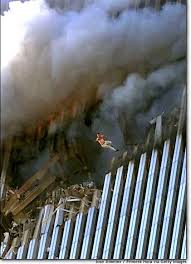
9-11 jumpers

“We have not reached the limit of our military commitments…” T.E. Lawrence (Mesopotamia 22 August 1920 in the Sunday Times)

Thirteen years after the Al Qaeda attacks on the World Trade Center and Pentagon in which nearly 3000 Americans were killed and the American response against Al Qaeda and its Taliban hosts in Afghanistan a month later we enter a new phase of war against old and familiar as well as new and frighteningly brutal enemies.

Of course the war was extended to Iraq by the Bush Administration, pursuing the goal of toppling Saddam Hussein and his non-existent weapons of mass destruction. That extension of the war, which so reminds me of what T.E. Lawrence wrote about the British adventure in Mesopotamia in 1920 has led to the creation of a much more ruthless and capable enemy than Al Qaeda ever was and strengthened our old adversary Iran in ways that it could not have done itself. Lawrence wrote of the British effort:

“The people of England have been led in Mesopotamia into a trap from which it will be hard to escape with dignity and honour. They have been tricked into it by a steady withholding of information. The Bagdad communiqués are belated, insincere, incomplete. Things have been far worse than we have been told, our administration more bloody and inefficient than the public knows. It is a disgrace to our imperial record, and may soon be too inflamed for any ordinary cure. We are to-day not far from a disaster.”

Like the Bush administration the British reasons for going into Mesopotamia were cloaked in the words of liberation and protection, only from the Turks, not Saddam. Lawrence noted in words that are hauntingly familiar to those that paid attention to the American war in Iraq:

“Yet our published policy has not changed, and does not need changing. It is that there has been a deplorable contrast between our profession and our practice. We said we went to Mesopotamia to defeat Turkey. We said we stayed to deliver the Arabs from the oppression of the Turkish Government, and to make available for the world its resources of corn and oil. We spent nearly a million men and nearly a thousand million of money to these ends. This year we are spending ninety-two thousand men and fifty millions of money on the same objects.”

Perhaps the most poignant and relevant note on the ill thought out Bush decision to invade Iraq in 2003 was by Thucydides who wrote:

“Think, too, of the great part that is played by the unpredictable in war: think of it now, before you are actually committed to war. The longer a war lasts, the more things tend to depend on accidents. Neither you nor we can see into them: we have to abide their outcome in the dark. And when people are entering upon a war they do things the wrong way round. Action comes first, and it is only when they have already suffered that they begin to think.”

Last night President Obama announced his intention to fight the brutal and extreme fighters of the Islamic State, or ISIL by building a broad coalition spearheaded by American airpower and intelligence agencies. Of course the President’s announcement was met with cries of not being enough by some on the political right, and with equal vehemence by opponents on the political left who feel that he has displayed cowardice in the face of “9/11 fear mongering” and the implementation of a policy of “perpetual war.” Of course the answer is more complex than anyone wants to admit, the critics on both sides are right in some things and wrong in some things, and the fact is there are no good answers.

Sadly because of what we and the British and others have done in Iraq and Syria the President is left with few options, mainly those that are bad, and those that are worse. So now, as the President, with a fair amount of judiciousness and caution commits the country to continue and maybe even expand the war that began thirteen years ago, it is time to remember those burning towers, the flailing bodies of our fellow Americans and others falling to their deaths to escape the surety of death in those flames and those who have perished in Iraq and Afghanistan; not just Americans, but coalition partners and the people of those lands who had no say in what Osama Bin Laden and Al Qaeda did or what Saddam did or didn’t do; and who went from the oppression of Saddam or the Taliban, to unending civil, tribal and religious wars, in which they were caught in the middle, the Iraqis in a war that was devised by President Bush and his advisors.

There are always results and today we are dealing with the results of at least a century of incredibly short sighted decisions of Western as well as Arab leaders which have blighted the Middle East and caused immense suffering to the peoples of the region. Now because of those decisions there exists a terrorist organization which is rapidly becoming a state in the areas of Iraq and Syria that it occupies. Islamic scholar Reza Aslan described the Islamic State on CNN Monday:

“Number one, you do have to respond militarily to ISIS soldiers and fighters. These guys are fighting a war of the imagination, a war that they think is happening between the forces of good and evil. There is no negotiation. There’s no diplomacy. There’s nothing to talk about with these guys. They have to be destroyed.”

Sadly, Aslan is right in his analysis of the Islamic State. Because of that fact, on this thirteenth anniversary of the 9-11-2001 attacks we and the already suffering people of the region will see war continue without end. One wonders how many generations it will last and what the cost on lives and treasure will be.

481801_10151367001287059_1003164983_n

Peace

Padre Steve+

1 Comment

Filed under History, iraq,afghanistan, middle east, national security, News and current events

The Eve of 9-11-2001 +13

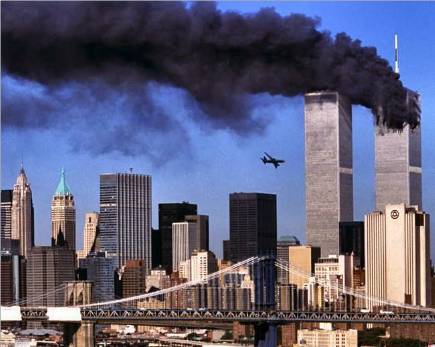
flight_175_photo


On the night of September 10th 2001 my mind was as far from war and terror as it could be. I was much more interested in the MLB Pennant Race than I was anything going on in the world, after all the only issues we faced were occasional, if deadly terrorist attacks on foreign installations and deployed ships like the USS Cole.  But as to the security of the Continental United States, or as it has been referred to since 9-11 as “the Homeland” I wasn’t concerned. Somehow, despite my knowledge, understanding and study of terrorist groups I just never thought anyone could pull off an attack of this magnitude.  The next morning I discovered just how wrong I was as the first reports came in while I was on my way to a late PT session at Camp LeJeune North Carolina where I was serving with the Second Marine Division.

That day changed all of our lives and ushered in what is now 13 years of war which has cost the United States military almost 60,000 casualties including nearly 7,000 dead or died of wounds. Of course that does not count non-DOD agency casualties, or those of the contractors who have been a big part of the war effort.

Today I was in Washington DC participating in the Military Officers Association of America “Warrior-Family” Symposium, which was an effort to bring together DOD, VA and the private sector to pool ideas, share best practices and attempt to make the connections that we need to serve and care for our military personnel and their families. It was a very good day and I will report out on it in detail in the coming days. That being said I was nervous my entire time in DC because of the approaching anniversary of the 9-11-2001 attacks as my hotel, and the facility where the symposium were conducted were both just three blocks from the White House. Needless to say with the anniversary occurring tomorrow I am glad to be home.

This evening I watched as President Obama addressed the nation regarding the military and diplomatic actions that he is taking against the Islamic State, also known and ISIS or ISIL. Whether we wanted it to or not the war which began on 9-11, which was so stupidly expanded into Iraq by the Bush Administration, opening the door to Al Qaeda Iraq and now the Islamic State, and which greatly strengthened Iran by eliminating their worst enemy, Saddam Hussein have made our task most difficult.

Thirteen years after 9-11-2001 we are not only still at war, but it is becoming a war without end.

Thirteen years ago, I figured that after a few months Al Qaeda would be no more, and the war that they had unleashed upon us would be over. however I was wrong .

Have a good night, until tomorrow,

Peace

Padresteve.wordpress.com

2 Comments

Filed under Foreign Policy, History, history, iraq,afghanistan, Military, philosophy

The Sinking of the Aboukir, Cressy and Hogue and the Advent of Submarine Warfare

livebait_pc_weddigen1

“There was a fountain of water, a burst of smoke, a flash of fire, and part of the cruiser rose in the air. Then I heard a roar and felt reverberations sent through the water by the detonation.”

Otto Weddigen describing the sinking of HMS Aboukir 

Ninety years ago this month an event took place that changed naval warfare and introduced the world to how deadly a single submarine could be. In September 1914 most naval experts held the submarine was not much of a threat. The submarines of the day were limited in range, diving depth, speed, armament and endurance.

U9Submarine1


U-9

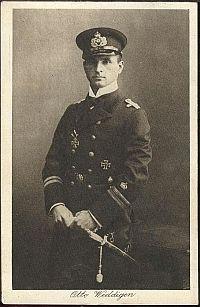
The U-9 was powered by kerosene engines on the surface which charged batteries which were used when the boats were submerged. Later submarines would be powered by diesel engines. U-9 was small, displacing only 543 tons on surface and 674 submerged. She was 188 feet long and just 19.7 feet in beam. The living conditions for her crew of 4 officers and 25 enlisted men were less than spartan. She was armed with four 17.7 inch torpedo tubes, two forward and two aft and carried six torpedoes, four in the tubes and two reloads for the forward torpedo tubes. The boat had been commissioned in April 1910 and on the outbreak of the First World War she was commanded by Kapitänleutnant Otto Weddigen.

kapitaenleutnant_-_otto_eduard_weddigen_-_03_01_1918


Otto Weddigen 

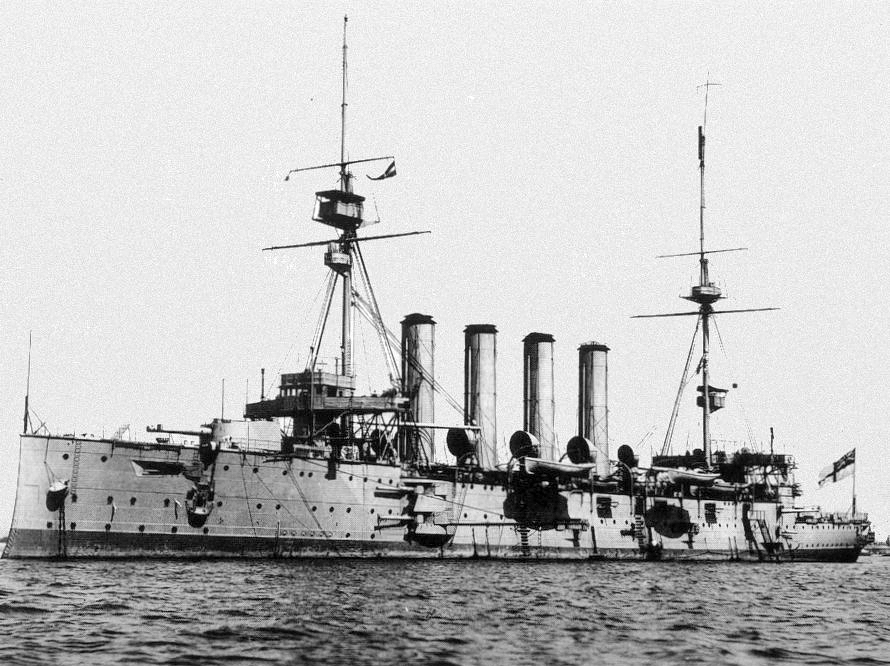
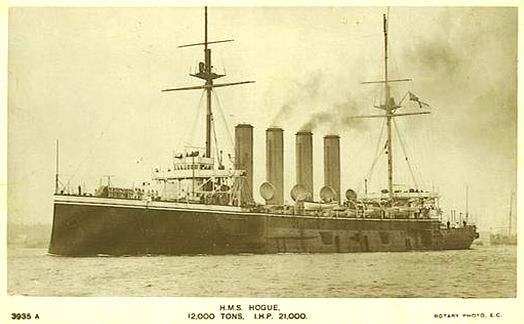
On September 22nd 1914 with enormous battles raging on the Western Front and the High Seas Fleet in port the soon to be famous submarine was patrolling in the North Sea. The U-9 was about 18 miles off the Dutch Coast near the Hook of Holland when she encountered three ships of the Royal Navy’s 7th Cruiser Squadron, or Cruiser Force C. The squadron was composed of three obsolete Cressy Class Armored Cruisers, the HMS Cressy, HMS, Aboukir and HMS Hogue displacing 12,000 tons and mounting two 9.2” and 12 6” guns each.

HMS_Aboukir


HMS Aboukir at Malta before the War, HMS Cressy (below)

HMS_Cressy

wjb_hogue_2

HMS Hogue shortly after being commissioned

The three ships were manned primarily by recently called up reservists and were derisively known throughout the fleet as the “Live Bait Squadron.” On that September morning they would be just that. The squadron was reduced in number as the squadron flagship was not present and the HMS Euryalus had to drop out due to lack of coal and weather damage to her wireless. The weather was bad, so the admiral in command was had to remain with the ship, unable to transfer. As such he delegated command to the captain of the Aboukir. The same bad weather also kept the destroyers that would of accompanied the patrol in port.


The ships were steaming in a line ahead formation when Weddigen on the U-9 spotted them about 0600 on the morning of September 22nd. They were not zig-zagging to lessen the chance of submarine attack and thought they had posted lookouts had no idea that U-9 was stalking them.

Weddigen on worked the boat into what he felt was a better firing position and launched his first torpedo at the center cruiser, the Aboukir at 0620 from a distance of just 550 yards. The torpedo struck her midships and broke her back. She began to sink and within 25 minutes capsize taking 527 of her crew of 760 down with her. Weddigen wrote in his post battle report:

“Her crew were brave, and even with death staring them in the face kept to their posts, ready to handle their useless guns….”

livebait_aboukir_sinking1

Aboukir Sinking

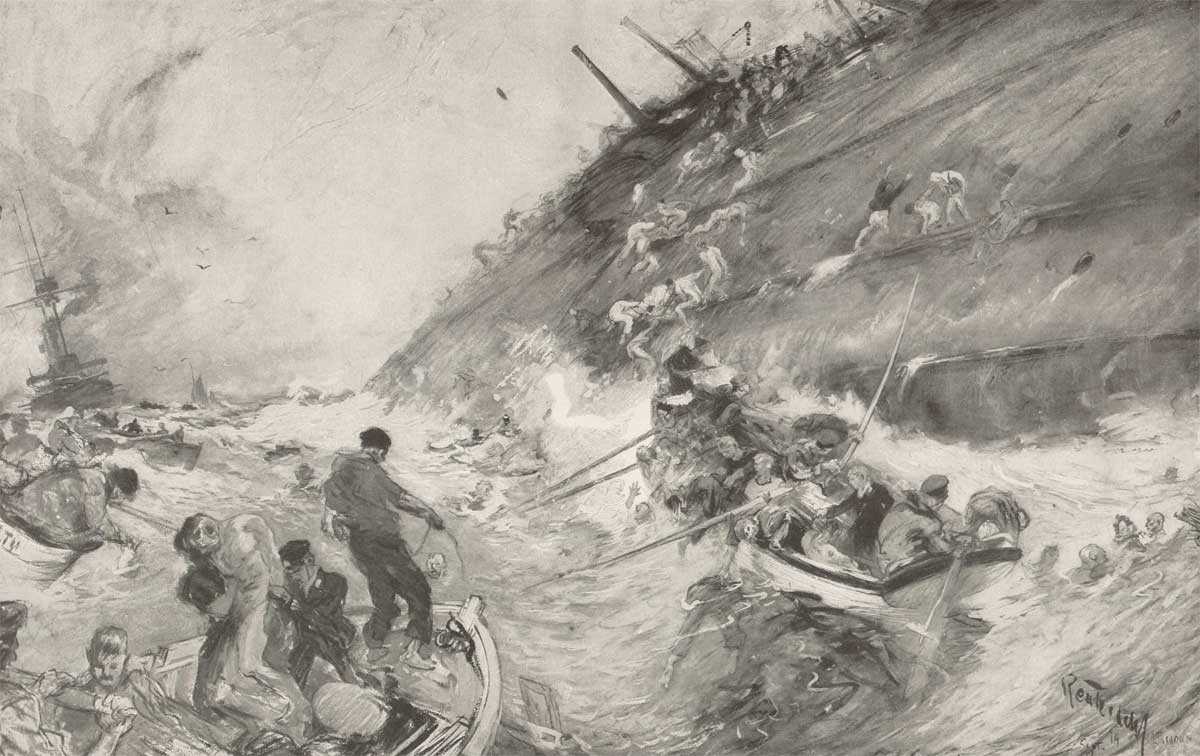
Thinking that Aboukir had struck a mine the Captains of the Cressy and Hogue moved their ships close to rescue survivors. Weddigen had surfaced to observe the British and then fired two torpedoes into Hogue from a range of just 300 yards and then dived with Hogue opening fire as she did so. Hogue capsized and sank in 15 minutes.

The British now knew that a submarine was responsible for the attack and the last ship and after reloading his forward tubes attacked Cressy at 0720 firing two torpedoes from her stern tubes. Weddigen then surfaced to bring his bow tubes into action and fired another shot, as he dis so the British cruiser opened fire and attempted to ram. Cressy was struck by two torpedoes during the attack, the doomed ship capsized and then sank at 0755.

Reuterdahl_-_HMS_Cressy_Sinking


Cressy Sinking 

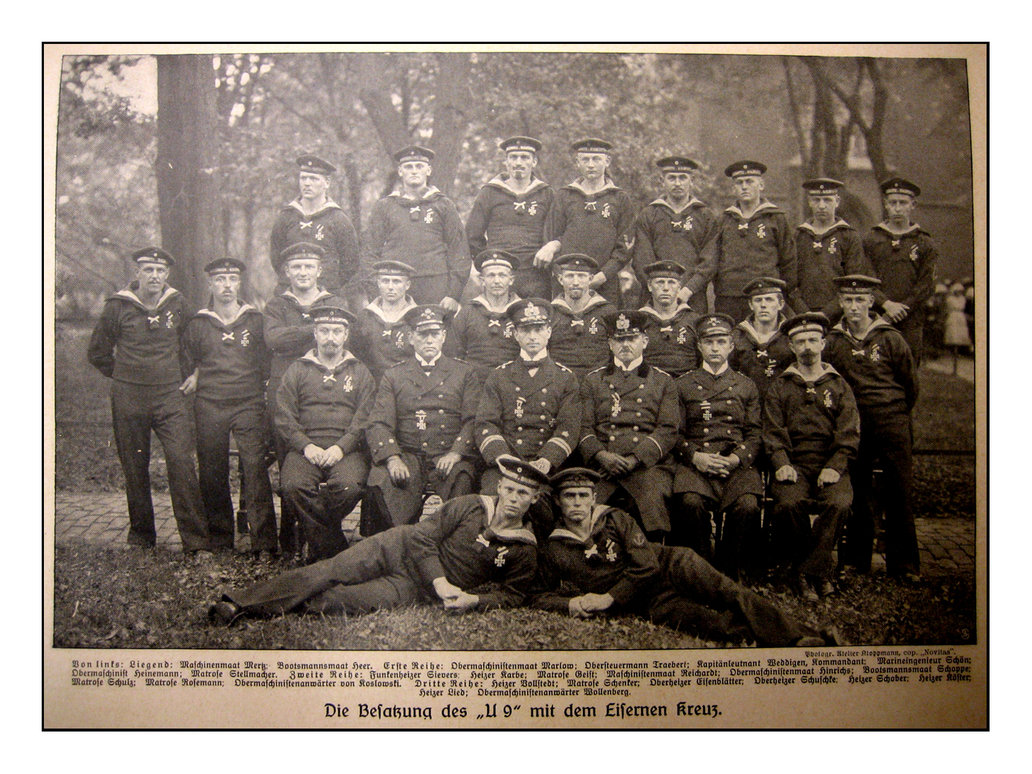
In a little over an hour the U-9 had sunk three British cruisers. A total of 1459 British sailors died in the attacks and only 837 crew members from all three ships survived. Weddigen withdrew from the area as he knew that the British would be looking for the U-9. When the boat returned to port, Weddigen, and his crew were hailed as heroes. Weddigen was awarded the Iron Cross First Class and later the Pour le Merite which he received personally from Kaiser Wilhelm II. The U-9 was one of only two ships of the Imperial Navy awarded the Iron Cross. The other was the Light Cruiser Emden, nicknamed the “Swan of the East” which tied down a large number of British, French and Russian ships in the Pacific and Indian Ocean during her short but productive deployment as a commerce raider.

U9_Heimkehr

The Return of the U-9 to Wilhelmshaven

The plucky U-9 would survive the war, sinking another cruiser, the HMS Hawke in 1915 and 13 other merchant ships or fishing boats. She was withdrawn from front line service in 1916 and assigned to training duties.

German_marines___U9_submarine_by_G497


The Crew of U-9

Weddigen was less fortunate, the aggressive young officer was killed on March 18th 1915 when his new command the U-29 was rammed and sunk by the HMS Dreadnought.

Future First Sea Lord Dudley Pound then serving on the Battleship HMS St. Vincent wrote:

“Much as one regrets the loss of life one cannot help thinking that it is a useful warning to us — we had almost begun to consider the German submarines as no good and our awakening which had to come sooner or later and it might have been accompanied by the loss of some of our Battle Fleet.”

Submarines would go on to be one of the most feared and effective weapons ever developed for naval warfare. German U-Boats nearly brought Britain to its knees in both World Wars and the submarines of the US Navy’s Pacific Fleet decimated the Japanese merchant fleet and inflicted great losses on the Imperial Japanese Navy in the Second World War. After Pearl Harbor and the many defeats of early 1942 it was the submarine force that according to Admiral Chester Nimitz “held the lines against the enemy.”

Today the most deadly submarines ever built prowl underneath the surface of the world’s oceans. Nuclear powered and advanced diesel electric boats armed with torpedoes and cruise missiles, and giant nuclear powered ballistic missile submarines armed with long range nuclear ballistic missiles provide an invisible and nearly undetectable deterrent.

Unlike 1914 today all navies take the submarine threat seriously. Should any significant naval war be fought in the Persian Gulf or the Pacific submarines will certainly have an impact not only at sea but in strategic strikes on enemy installations and land based units. In 1914 no one would have thought that the success of the tiny U-9 would eventually lead to such a dominating weapon.

Peace

Padre Steve+

Leave a comment

Filed under History, history, Military, Navy Ships, world war one

The Dangers of the Reductionist Religion of Fundamentalism

IMG_1915.JPG

My friends, today will be a busy day so I wanted to share a few thoughts about religious fundamentalism in it’s various forms. Now I want to say up front this is not an attack on God or people that believe it God, or in what God they choose to believe in for either their eternal salvation or just getting through life. Instead it is some observations about fundamentalist, or absolutist belief systems that allow no room for doubt or that any other view of God might have some measure of truth and how some groups use political, police and military power, even terror to impose those views on others.

It occurred to me a few years back that many Christians, among them Evangelicals, certain Reformed types, Fundamentalists, and even some conservative Roman Catholics practice a reductionist form of the Christian faith. It is a form that woefully short changes those that embrace it. Now I am speaking very general terms right now and the subject probably needs to be fleshed out some for each particular form. I probably will do that sometime soon, but let me continue.

What I have observed is that the richness, the history, the intellectual achievements, and the diverseness of the Christian experience, whether it that of the mystics like Hildegarde of Bingen, the patristic theologians such as Basil, Origen or Gregory of Nyssia, the scholastics such as Anselm of Canterbury who penned a philosophy that I much admire, “faith seeking understanding” the reformers such as Martin Luther, those of the awakenings such as John and Charles Wesley, the humanists such as Erasmus of Rotterdam, those of the enlightenment such as Schleiermacher, and Kierkegaard, the Neo-Orthodox of the early part of the Twentieth Century like Karl Barth, Dietrich Bonhoeffer, Emil Brunner and Paul Tillich, or the Catholic reformers leading up to and following Vatican II like Pierre Teilhard de Chardin, Hans Kung, Yves Congar, Bernhard Haring, and Andrew Greeley, and the Theologians of Hope led by Jurgen Moltmann.

This list is certainly not exclusive by any means. However, the one common thing about these men was that they understood their faith in the context of the society, history, culture and learning of their day. They used reason informed by faith and wrestled with subjects that are for the most part denied to the reductionists of Christian Fundamentalism. The fact is that most fundamentalists of any stripe tend to disregard history, science, philosophy and other disciplines that seek to interpret the world and instead place their own understanding of God, their scriptures or creeds above all others. Various groups of Christians, Jews, Moslems, Buddhists, Hindus and other religions all do this, even some Atheists and other Secularists are not immune. It is a reality of many people’s need for certitude in a world that is full of too many troubles and contradictions.

Christian fundamentalism in its various forms reduces the faith to a small set of absolute principles from which no deviation is allowed. As I mentioned there are different forms of this, but in a sense adherents to any version of Christian Fundamentalism treat the Bible, their Statement of Faith, catechism or Creed as a sort of “tech manual” that provides quick solutions to those that “know the truth.”

By this I mean is that when there is a really difficult question that requires critical thinking, reasoning and nuance, instead of wrestling with it they throw out a Bible verse or a credal type statement to shut down the person asking the question. I think I remember the classic line that I heard when I was in high school: “Jesus is the answer, what was the question?” The sad thing was this was not a joke, the person who said it meant it.

Now I admit for some people a simple faith works well, that is human nature, but when religious leaders present the faith in such reductionist and absolute terms they impoverish their followers and end up driving off those who ask the hard questions. These are questions which cannot be answered by the shibboleths thrown out by these leaders because they are not easy, and defy attempts to simplify them. This is because they often deal with existential matters and the mysteries of human life and nature.

The fundamentalism in all it’s forms reduces life to a dualism in which one is either on God’s side (that is whoever’s God) or not in which all life’s questions are resolved by faith or religion. I would dare say that most of people’s most difficult questions, issues and needs are not religious at all and that is why so many people reject fundamentalism, either because they see the fallacies inherent in such inflexible systems of belief, or because they experience disappointment in those groups when the ideal of God presented, either as individuals or the community does not match reality.

As for as what people believe as individuals or within their religious communities that does not bother me one bit, even if I disagree with them. I fact I think the discussion of religion should be allowed in the public square. However, I believe that to discussion should include everyone, not just which religious group has the most power in government or influence in society.

The problem that I see is when such groups, regardless of what God they believe in decide to impose their beliefs on others through the power of the government, and for that matter even use their beliefs to silence others in the public square. The danger is when any such group decides it is superior, that it’s leaders have a lock on the truth, are “anointed” or whatever term they call it, hear directly from God, authoritatively speak for God and then use that to suppress dissenters or control unbelievers through the power of the state, of in the case of the new Islamic State, the power of military conquest and terror.

In fact the leaders and followers of such groups almost practice a form of Gnosticism, where if you have the right understanding of “the truth” you are superior to those that do not. Since God is the ultimate trump card in any argument those who believe they have the direct line are the most dangerous.

In spirit, this reductionist understanding of faith is ultimately destructive and when people take it to its logical end use it to justify the most heinous crimes against their fellow human beings. What we see with the Islamic State is really no different than other fundamentalist religions with absolute control of their society do to unbelievers. The ultimate choice for those under their rule, is to “convert or die.”

Christians have done this numerous times since Christianity became the state religion of the Empire under Constantine, and Catholics, Orthodox and Protestants have all exercised that option. One only has to look at the persecution of various Protestants by Roman Catholics, the persecution of the Anabaptists by Catholic and Protestant State Churches, the burning of heretics and witches, even in Colonial America, and the persecution of Catholic immigrants from Europe by American Protestants in the 1800s, not to mention the pogroms conducted against the Jews in Europe, the Holocaust, or the extermination of Native Americans in the name of the Christian God.

Moslems have done this too throughout history and in the present,where the Islamic State and other groups like it, Boko Haram, Al Shabab, and Hezbollah among them practice it in its worst form.

It is also part of the earliest forms of Judaism in the conquest of Canaan where God’s command, to put it in the modern vernacular was “kill them all and let God sort them out later.” In fact I remember scandalizing my Old Testament class in seminary by blurting that out. But when I read supposedly Christian apologists defending the legitimacy of what even they refer to as genocide it sickens me.

Likewise it was fascinating thing for me this week was to hear the star of the Duck Dynasty Phil Robertson, a Christian fundamentalist explain that “convert or die” was the choice that the people in the Islamic State should be offered. Others have said similar things and not just in regard to Islamic radicals.

Again, I have no problem who need to believe in a God of absolutes, some people need that and it is a free country. But I think that such beliefs shortchange and deprive them of the richness of faith, life and the mystery of God and faith, even the great mystery of the Christian faith that we proclaim in the celebration of the Eucharist “Christ has died, Christ is risen, Christ will come again.” The mystery of God who became man, or as Anselm of Canterbury wrote “cur Deus homo” “Why God Man?” or what Christians call the Incarnation, is central to the the Christian faith.  Like creation and the eschaton is a mystery, as Bonhoeffer wrote and we would be so wise to remember:

“Man no longer lives in the beginning–he has lost the beginning. Now he finds he is in the middle, knowing neither the end nor the beginning, and yet knowing that he is in the middle, coming from the beginning and going towards the end. He sees that his life is determined by these two facets, of which he knows only that he does not know them.”

The fact is that no matter what we say, we do not know and when we make absolutist claims based on our scriptures we have to remember that they as well are shrouded in mystery, but then Eric Hoffer noted “We can be absolutely certain only about things we do not understand.”

The mystery associated with the Canon of Scripture, includes the authorship as well as the contents of scripture. Since we don’t have the original autographs of any book of the Bible, or for that matter any major religions scriptures there is a certain mystery associated with the scriptures. We believe them by faith, just as we do in the existence of God. The reality is that in many cases we don’t know who the actual authors were and even as to when some of them were written.

This might make the Christian Canon of scriptures as well as those of other major religions sources of inspiration, spirituality, sources of good advice, lessons and ethics; but not absolute truth and fact in matters of history, science or anything else we might want them to be. The fact is we believe in God by faith, and we trust scriptural accounts by faith.

However, for those who must claim the Bible as absolute there is a need to prove it, and that need brings about the controversies of “inerrancy” that are part and parcel of Protestant fundamentalism as well as the absolutist claims of others in regards to their scriptures. Sadly, for many, their absolutist understandings of scripture or creedal claims are dogma to be defended to the death and to force upon others, rather than mysteries by which we experience the love and grace of God.

The problem is that such beliefs, even if they are from antagonistic or competing groups are all variations on a theme. They are all variations of the same species of religion, religion that must control or suppress dissenters at all costs, and if given the chance to use the police and military power of the state to succeed when dialogue fails. The only differences these religions have, besides the God that they believe is right, is the matter of degree with which they apply those beliefs. For some they are quite happy with keeping such matters in house and leave outsiders alone. But there are others in every major religion who have a need to impose their beliefs on others using any means necessary, including special privileges for themselves that no other groups get as well as to use the state to persecute, terrorize against or conquer by brute military force those who do not believe.

That is why the Islamic State must be defeated and why we must be ever vigilant at home to such beliefs, no matter what religious group utters them. Sadly the reality is that there are Americans as well as those in Western Europe and other countries

Now I am sure that I have offended some today, but that was not the intention. I believe in a person’s right to believe in anything they chose to believe or not to believe and to defend those rights, while at the same time defending others from anyone that wants to use the state to impose those beliefs on others.

Have a great night,

Peace.

Padre Steve+

1 Comment

Filed under faith, History, Loose thoughts and musings, philosophy, Political Commentary, Religion