Category Archives: History

Missed Opportunities: The Allies in Europe from Mortain to Market Garden

Arnhem Bridge

In 1985 Judy and I visited her cousin and her family in the Netherlands when I was an Army Lieutenant in Germany. Since I was a history major in college and had done a lot of reading and study about Operation Market Garden, which most people associate with the movie A Bridge Too Far I decided that on our way back to Germany that we needed to stop by Arnhem and Oosterbeek to visit the battlefield and the British Airborne Museum. It was one of those places that even today evokes poignant memories. When we walked through the British cemetery across from the museum which is in the former British headquarters, the Hartenstein Hotel I saw a grave marker. It read Capt. J.S. (James Strathern) Dundas, 7th KOSB (7th King’s Own Scottish Borderers) of the British 1st Airborne Division. He was the 2IC, or Executive Officer of Company B of that Regiment. He assumed command of the company on the 19th after its commander was reported missing in action. He commanded the unit until his death on September 25th when commanding the rearguard of the battalion as it and the remnants of the 1st Airborne Division evacuated the bridgehead over the Rhine. It was a sobering reminder of the cost of war. 

Grave marker of Captain J.S. Dundas at the British Cemetery at Oosterbeek

September 17th was the 68th anniversary of the Allied attempt to liberate the Netherlands, secure a crossing across the Rhine and plunge into the heart of German industry and war making capacity the Ruhr basin. The plan is better known as Operation “Market-Garden” and was the first major use of Airborne Divisions in a strategic jump versus a tactical or operational mode.  What made this operation different was the distance that the Airborne would be dropped from the front lines and the number of obstacles that the ground troops would have to cross to get to them.  It was a high risk strategic plan to end the war early.  However this operation did not occur in a vacuum and was the product of operational and strategic decisions that the Allies made from the time of the Normandy breakout.  Each decision was made on the fly as the situation rapidly developed from a static slugfest in the hedgerows to the pursuit of a broken enemy.  As the Allies advanced across France decisions had to be made of how the advance would be made which became a major bone of contention between Eisenhower and his subordinates.  To understand how the Allies got to the point of launching Market-Garden one has to look back at the events leading up to it beginning with the Allied decisions made shortly after the breakout.  The actual campaign does not always correlate to popular myths nor does it allow for a uncritical analysis or generalization of the events which made up this part of the campaign in Western Europe.

It is a campaign that teaches us even today that mundane things such as logistics, weather and the failure to recognize moments of opportunity and times for caution matter in a military campaign. The campaign is a reminder that every military campaign has risks and that even crippled enemy can inflict costly defeats on superior forces and regain lost initiative. 

Introduction 

Patton Bradley and Montgomery, Time Magazine Photo

Lieutenant General Omar Bradley’s 12th Army Group breakout from Normandy opened a realm of possibilities for the Allies to defeat the German Army in detail and end the war.  The manner in which the Allies exploited their success and their failure to destroy the German Army in the west in the late summer of 1944 was a key factor in prolonging the war.  Both the Allies and the Germans faced challenges due to the change in the nature of the campaign. For nearly two months they had waged a nearly static war of attrition in the Norman hedgerows.  The breakout changed the dynamic of the campaign to one of maneuver.  In the post-breakout period the Allies had several opportunities to envelope large portions of the German Army in western France, Belgium and southern Holland.  The campaign became one of maneuver and a “commander’s battle” in which it was “the decisions of the generals that determined the manner in which events unfolded in August, their successes and failures which brought about the position that was achieved by September.”[1] Prior to the breakout success in the hedgerows was determined on “the ability of British, American and Canadian units to seize ground from their German opponents on the next ridge, the next hedge, beyond the next road.” [2]The change would expose the weaknesses in the quality of allied generalship and logistics management.  The Allies failure to recognize the ability of the Germans to recover from disaster conspired with key elements in the campaign to end the war by Christmas.[3]

Grenadiers and Tanks of 12th SS Panzer Division (Hitler Jugend) in Normandy

A key decision reached early in the campaign was for Bradley’s XII Army Group to capture Brest and other Brittany ports.  This decision meant that when 3rdArmy exploited the break out the preponderance of its forces went west, the opposite way that the battle was developing.  This deprived the Americans of forces and logistical assets that could have supported the envelopment of the major part of the German Army still engaged in Normandy. Russell Weigley lays the blame for this decision on Bradley.  The dash into Brittany did little to help the Allied logistical problems and diverted much needed troops away from the focal point of the action in Normandy.[4] Hastings criticizes Bradley’s lack of imagination in the initial stages of the breakout in adhering to the original OVERLORD exploitation plan[5] rather than adapting to the situation on the ground. Patton’s biographer Carlo D’Este seconds this opinion and it makes sense from an operational standpoint.[6] Why send significant forces to an area far away from the critical part of the battle for little practical gain?  In the end German forces held out, in some cases to the end of the war, denying the Americans the use of the ports either by just holding out or by demolishing the port facilities.

Mortain: German Counter Attack and the Short Envelopment

The American exploitation of the breakout, notably by elements of Patton’s 3rdArmy pushing east combined with the continued pressure of the British Army Group toward Falaise. The breakout forced forced the Germans into a strategic decision to attempt to restore the front in Normandy or withdraw to the Seine or further east as there was no “defensive position short of the permanent fortifications of the West Wall on Germany’s frontier offered so many defensive strengths as the Normandy line the Americans had just breached and turned.”[7]

With limited options Hitler determined that German forces again needed to ensnare the allies in the hedgerows.[8] There was disagreement between Hitler and Field Marshal von Kluge regarding the offensive while von Kluge opposed it.  Hitler believed that the American breakout gave the Germans a chance to cut off the American forces in Brittany and possibly more believing that “once the coast had been reached at Avranches a beginning should be made with rolling up the entire Allied position in Normandy!”[9]

The German attack named Operation Lüttich was led by XLVII Panzer Corps assisted by elements of 1st SS Panzer Division.  Despite warnings from ULTRA the panzers achieved tactical surprise on the front of the 30th US Division at Mortain on the night of 6-7 August when the Germans attacked without the customary preparatory artillery bombardment.[10] The Germans made initial progress against the 30th Division which had recently taken over positions at Mortain.  However the 2nd Battalion 120th Infantry “Old Hickory” Regiment held key ground which enabled them to call artillery fire and air strikes on German forces attempting to advance on Avranches.[11] The Americans quickly reinforced 30th Division with elements of 2nd Armored Division, 35th Infantry Division and the veteran 4th Infantry Division to hold the line against the weakened German Panzer divisions.  Bradley and other American commanders viewed Lüttich as “an opportunity, not a threat.”[12] Bradley was “not merely confident of withstanding them, but expected to destroy them.”[13] Bradley attempted to lure more Germans into the potential trap by radio transmissions hoping that the Germans to persist in their attacks around Mortain.[14]

American Armor Advancing in Normandy

The German plan included the use of a significant number of aircraft to support the attack.  However this did not happen and German troops were furious at the failure of the Luftwaffe to shield them from Allied air attacks which devastated the Panzers.  The 300 fighters promised by the commander of Luftwaffe forces were engaged by British and American fighters and savaged so badly that no Luftwaffe units made an appearance over Mortain.[15] Despite some local success the German ground forces were turned back by the Americans who did not even halt their eastward movement further imperiling the German forces in Normandy.
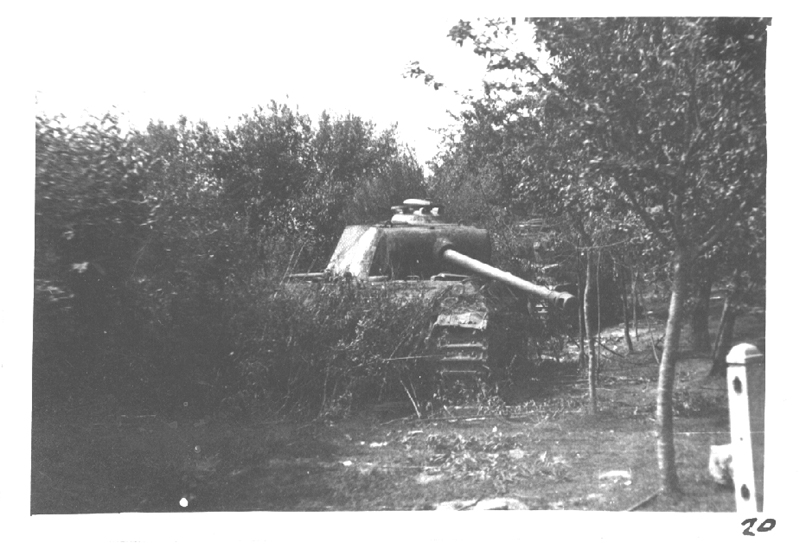
Knocked out Panzer V Panther Tank at Mortain

With the Germans ensnared at Mortain, the 3rd Army driving east and the Canadians advancing on towards Falaise, Bradley suggested a short envelopment in which over 100,000 German troops would be trapped between the Patton’s troops and the Canadians who had opened their TOTALIZE offensive from Caen to Falaise on August 8th.  This modified plans for a deep envelopment by XV Corps of 3rd Army to entrap the Germans against the Seine crossings with an operation that might promise “still surer results.”[16] Speaking to Secretary of the Treasury Henry Mongenthau Bradley said that “he told the Cabinet officer he had “an opportunity that comes to a commander not more than once in a century. We’re about to destroy and entire hostile army.”[17] However the short envelopment was predicated on the Germans continuing their advance, had they as Hastings notes “behaved rationally, recognized the threat of envelopment to their entire front and begun a full-scale retreat east, then Bradley could indeed been accused of losing his armies a great prize.”[18]

The decision to turn the better part of 3rd Army west into Brittany deprived Bradley of forces that could have better accomplished the mission of enveloping the German 7th Army.  General Wood of 4th Armored Division to his dying day “remained embittered over the lost opportunity”[19] lost when his division was turned back into Brittany rather than being allowed to move east toward the Seine.   Weigley points out an even deeper flaw regarding the Brittany decision that was that OVERLORD planners “had not thought anything resembling the Avranches breakout and pursuit without pause to the Seine likely…” Weigley critically stated that it is among the worst forms of generalship that takes counsel of its fears. Yet that was exactly the condition of OVERLORD logistical planning.”[20]

The Falaise Pocket
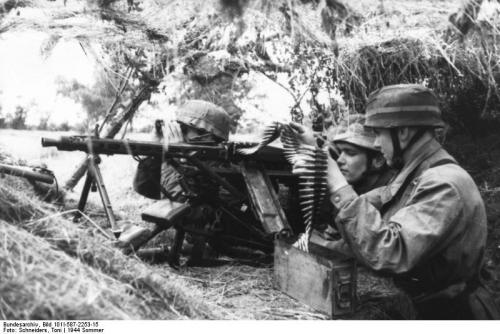
Fallschirmjaeger in France

The Allies did have a chance to destroy the German 7th Army.  LXVII Panzer Corps and II SS Panzer Corps as well as the remnants of II Parachute Corps and other formations battered in Normandy were attempting to move east from Mortain following the failure to break through.  The remnants of I SS Panzer Corps led by 12 SS Panzer Division Hitlerjügend and various battle groups of other decimated divisions and Army units such as 21st Panzer Division offered determined resistance to the Canadians toward Falaise.  In the south only scattered Kampfgruppen of divisions shattered in Normandy opposed Patton’s forces at Avranches.  These German units, outnumbered and without air support were aided by a fortuitous decision of the commander of the 2nd French Armored Division to move a combat command along a road needed by the American 5thArmored Division.  The delay allowed the Germans to send a battalion into the town which could have “fallen easily a few hours before.”[21]

Grenadiers of the 12th SS at Falaise

At this point the Allies were bedeviled by several failures which prevented the short double envelopment from occurring and allowed the remnants of 7th Army to escape to fight again. The Germans suffered grievous losses in men, material, and especially armored fighting vehicles, artillery and motor transport but more often than not their units retained their cohesion and ability to operate.

Carnage in the Falaise Pocket

The first failure belonged to the Canadians who failed to push the Germans out of Falaise despite overwhelming material and air superiority.  The Canadian attack Operation TOTALIZE was planned by the best of the Canadian generals, Simonds.  The operation began on a promising note but bogged down halfway to Falaise due to a quick counterattack by 12th SS Panzer kampfgruppen. The Canadians were not helped when a misguided bombing attack by “friendly” air units hit them rather than the Germans.  Likewise the inexperience of the Canadian 4th and Polish 1st Armored Divisions showed when they paused to eliminate strong points rather than bypassing them and advancing to disrupt the Germans.  As such they gave the Germans the opportunity to reform their lines.[22] The second failure was that of Montgomery who had refused to adjust army group boundaries with Americans which put more pressure on the Canadians to “renew their drive promptly and vigorously.”[23] Rather than pushing on General Crerar of Canadian 1st Army spent five days “doing what really battlewise generalship could do by regrouping and making diversionary attacks.”[24] It took Crerar over 48 hours to launch a determined attack to close the gap despite the weakness of German forces that opposed him despite the fact that even Montgomery personally called him urging him to “Close the gap between First Canadian Army and 3rd U.S. Army.”[25] General Kurt Meyer of 12th SS faulted the Canadian leadership with a failure to use imaginative planning, and noted that “none of the Canadian attacks showed the genius of a great commander.”[26] American units which Patton had cautiously advanced north of Argentan towards Falaise were recalled after Bradley was unable to convince Montgomery to alter the army-group boundary in light of the new circumstances.[27] Patton recounts that he believed that his units could have “easily entered Falaise and closed the gap” and that the “halt was a great mistake.”[28] Weigley blames Bradley as much for the halt order as much he does Montgomery for “discouraging whatever might have been done to rectify the blunder- even discouraging on August 13th a call from the Supreme Commander to Montgomery about the inter-allied boundary.”[29] Thus through a series of Allied mistakes particularly by senior commanders the first opportunity to envelop the Germans passed into history as a great yet incomplete victory.

Opportunities in South France

The invasion of South France Operations ANVIL and DRAGOON[30] had been debated by the Allies as early as April 1943.  The British resisted ANVIL from the beginning with Winston Churchill not yielding “his struggle until five days before the eventual D-Day of August 15th.”[31] American planners saw the need for the operation and had never given up on it despite its postponement due to a shortage of amphibious lift at the time of OVERLORD.  Following the invasion the perilous logistic situation created by the lack of operational major ports in Normandy and Brittany caused American planners to “believe that ANVIL was virtually imperative.”[32] Landings in the south offered significant advantages to the logistical needs of the Allies.  The major seaports and naval bases at Marseilles and Toulon were both closer to Germany than Cherbourg.  Both offered major modern port facilities and the south included rail nets that had not suffered significant damage from Allied air attacks. Likewise the presence of a major navigable river, the Rhone, made it possible to move supplies into the heart of France by water.  From a strategic point of view the move into southern France would “help Eisenhower form a front along the whole German border from the North Sea to Switzerland, to stretch the German army as perilously thin as possible for its defense of the Fatherland.”[33] ANVIL also offered the opportunity to bring more trained American divisions into the fight which could not otherwise come ashore in Normandy due to the port and supply problems.[34]

The Allies initially allotted three American divisions of 7th Army and VI Corps as well as units of the French Army based in the Mediterranean to the invasion.  Commanding VI Corps and its three veteran Divisions, the Regular Army 3rdInfantry Division, the “Rock of the Marne”, the 36th “Texas” Division and 45th“Thunderbird” Division of the National Guard was Lieutenant General Lucian Truscott.  Truscott was of the best American Corps commanders. Early in the war he had created the Rangers and had distinguished himself in Italy commanding 3rd Infantry Division.  He followed this by taking over to rescue the unhappy Anzio campaign from utter fiasco.[35] A hard driving officer and prewar friend of Patton Truscott was the ideal commander for the operation.[36]

Truscott’s forces were opposed by the weak and widely scattered German 19thArmy of General Blaskowitz’s Army Group G.  The landings were highly successful and the Americans made rapid progress inflicting heavy casualties and capturing large numbers of Germans with relatively low American casualties.  However in Blaskowitz the Americans faced a skilled commander who managed to extricate the bulk of his forces and form a continuous front with the remnants of Army Group B by mid September.  Hitler had recognized the necessity of this link up but held Blaskowitz in low regard due to his resistance to Nazi policy while Military Governor of Poland in 1939, said to Field Marshall von Rundstedt of Blaskowitz: “If he contrives to do that (i.e. join up 19th Army rapidly with the main body) then I will make him a solemn apology for everything.”[37]

Truscott made the German army his objective. Truscott pushed his units hard but was hampered by his meager forces and his tendency to outrun his supplies.  German delaying actions hampered the American advance and prevented the Americans from utterly destroying the 19th Army.   Despite this the campaign in the south prevented the Allied logistical situation in France from becoming “insurmountable” in the fall of 1944 and “contributed directly and mightily to bringing the bulk of the American Army to grips with the German army in the West, to defeat and destroy it.”[38] Had Truscott had more forces and adequate supplies he may have achieved even more than he did. One can only imagine the “what if” scenarios that could have developed in the West with the application of more force to this option rather than feed the limited number of American divisions into the cauldron of the hedgerow country.

The Seine and Beyond

With the closing of the Falaise pocket too late to catch most of the German forces the next opportunity for the now postponed “long envelopment” was now staring the Allies in the face.  The Seine beckoned.  Could the Allies prevent the fleeing remnants of the 7th Army and Panzer Group West, soon to be renamed the 5thPanzer Army from escaping across the Seine?   Bradley’s belated decision to restart the drive to the Seine on 14 August was beset with the problem of the logistical sustainment.  The logistics problem was not limited to port facilities.  The Allies had moved well past the eastern edge of the Normandy lodgment area over two weeks before planners anticipated. Fuel to propel the Allied armies forward became a critical consideration. Despite this the Allied high command saw the opportunity to complete the destruction of the German forces fleeing Normandy and Montgomery “anticipated for weeks the possibility of the long envelopment at the Seine.”[39] Adjustments were made on the fly. The plan to pause at the Seine dictated by OVERLORD was discarded in favor of trying to cross it on the run.  XV Corps of 3rd Army had reached Mantes crossing into the British 21st Army Group zone.  Montgomery refused an American offer of trucks to assist the British and Canadians to Mantes to complete the envelopment from the west. However he gave permission for XV Corps to continue its advance into the British zone in the hopes of completing the encirclement of the estimated 75,000 German troops west of the Seine.[40]

American Soldiers Cross the Seine

Yet again the Allied hopes for the encirclement of German forces west of the Seine were dashed.  XIX Corps came up to assist XV Corps in its advance into the German rear on the 24th of August at Elbeuf.  However a scratch Kampfgrüppemade up of elements of eight panzer divisions made a stand that delayed the American forces five days.[41] The British and Canadian forces did not push hard.  The determined resistance of the panzer battle group and the failure of the British and Canadians to push harder enabled Army Group B to evacuate many of its troops, 25,000 vehicles and most of its higher headquarters across the Seine before the Canadians and XIX Corps linked up on 26 August.[42] [43] While the envelopment attempt ran its course the Americans pushed across the Seine. The Americans allowed the French 2nd Armored division to liberate Paris on August 25th and rapidly began to move east in pursuit of the German forces.

Despite horrendous losses in men and material including all but about 100 of the 2300 tanks and assault guns committed to Normandy[44] the German command rapidly organized the survivors into Kampfgrüppen.  These battle groups though hastily organized were well led and usually comprised of hardened veterans skilled in the active defense.  Field Marshall Model “Hitler’s Fireman” took command of Army Group B after Von Kluge committed suicide when returning to Germany after being implicated in the attempt on Hitler’s life.  Hitler gave the western front priority on tank replacements. Likewise reinforcements of newly formed Panzer Brigades flowed into France even as the Americans advanced east fighting not only the Germans but the gasoline shortage.[45] Patton’s army reached the Moselle but by September 2nd its tanks had run dry.  “Third Army received just 25,390 gallons, when its divisions needed at least 450,000 gallons to resume their advance.”[46] Patton continued by scavenging fuel wherever he could get it whether captured German stocks or by various creative means. Patton had his logistics officers divert fuel or send raiding parties into 1st Army’s depots. His agents bartered for fuel at port facilities and depots by offering captured souvenirs to those running those facilities in exchange for gas.[47]

American M-8 Armored Car at the Arch d’Triumph during the Liberation of Paris

The Allied shortage of gasoline, a product of both the lack of ports, damage to the French rail system and the unexpected rate of advance[48] ultimately forced Eisenhower to make the decision to halt Patton’s advance in favor of a push by Montgomery in the north. Now complicating Eisenhower’s situation the Germans Likewise the ability of the Germans to join Army Group B with Army Group G’s 1st and 19th Armies from Army Group G further assisted the German defense.  The German army’s self preservation in late August and early September became known to them as the “Miracle of the West.”[49] A successful envelopment of German forces took place at Mons just south of the Belgium border where 1st Army captured over 25,000 prisoners from units that had escaped from Normandy.[50] Throughout the campaign in France the Allies were beset by logistical problems and sometimes by bad generalship as they attempted to change the campaign plan on the fly.[51]

Antwerp and the Scheldt: Missed Opportunity

While Bradley and Patton’s American units sped across France “advancing faster and further than any Army in history,” Montgomery’s 21st Army Group crossed the Seine and began a drive that rivaled the Americans in speed.  XXX Corps under the recently appointed General Horrocks attacked out of the Seine bridgehead on 29 August.  After overcoming initial stiff resistance from the German Kampfgrüppen defending the area XXX Corps advanced with great speed capturing Brussels and Antwerp by 4 September.  Logistics also tied Montgomery’s hands just as it had Patton in the south.[52] He was forced to immobilize 8th Corps to supply XXX Corps which advanced north as 1st Canadian Army attempted to capture the channel ports.[53]

Canadian Soldiers during the Battle of the Scheldt

The quickness of the advance and erroneous decision making kept the XXX Corps attack from complete success.  This caused serious complications to further operations and which gave the Germans the break that they needed to stabilize the front.  General “Pip” Roberts commander of 11th Armored division which had just liberated Antwerp assumed that the British drive would turn east toward the Ruhr industrial area of Germany. In doing so he failed to capture the crossings over the Albert Canal.[54] Additionally he failed to advance the few miles needed to cut off the German 15th Army on the Scheldt thus missing the opportunity to trap an entire German Army against the sea.  Hastings lays the blame for this not entirely on the Division and Corps Commanders, Roberts and XXX Corps commander Horrocks, but on those responsible for the overall strategy, Eisenhower, Montgomery and Dempsey who should have realized this and especially that Montgomery “might have been expected to see for himself the pivotal importance of the Antwerp approaches.”[55] While the British rested in Antwerp the Germans blew the bridges over the Albert Canal. General Von Zangen of 15th Army took the opportunity to extricate his Army using any vessel available to cross the Scheldt. He occupied the strategic island of Walchern on the Antwerp approaches and placed his troops in position to assist in the defense of Holland and northern Germany.  Due to British inaction and his own creativity Von Zangen evacuated 65,000 troops, 225 guns, 750 vehicles and over 1000 horses across the waterway in 16 days to fight again.[56]

North of the Albert General Kurt Chill in the typical fashion of so many German commanders in a crisis situation took charge and halted the panicked retreat of German forces into Holland. Chill organized personnel from all branches of the German military into something resembling an Army.[57] Likewise Generals Bittrich of II SS Panzer Corps and Harmel of 10th SS Panzer Division salvaged “vehicles abandoned by other groups and weapons from deserted army depots” including 12 brand new howitzers on abandoned train.  The improvisation of the German commanders in these few days would be of decisive importance in the coming days.[58]

While the British paused to regroup in Belgium the Germans took the opportunity to form a new Army, the 1st Parachute Army under the Luftwaffe paratroop expert, General Kurt Student. 1st Parachute Army was hardly an army at all, barely the size of a fully manned allied division.  Made up of battle groups formed around remnants of the elite 6th Parachute regiment, assorted parachute training battalions, Flak units, a hodge-podge of Army Kampfgrüppen, General Chill’s units and divisions evacuated from the Scheldt, Student laid out a defensive line along the Albert Canal.[59] Student expected the British to attack when he was so terribly weak. He could not believe that he was not attacked when his line was most vulnerable to a determined assault that much of the German command believed would cause the front in Belgium to collapse.  The British Guards Armored division slowly advanced from the Albert to the Meuse-Escaut canal but the German defense had assured that any further advance to the north would be on a narrow front with a vulnerable left flank.[60] Von Rundstedt’s new Chief of staff at OB West Siegfried Westphal noted that “the situation was desperate. A major defeat anywhere along the front-which was so full of gaps that it did not deserve that name would lead to catastrophe if the enemy were to fully exploit the opportunities.”[61] Hastings and Weigley both note that the British failure to close the gap were of decisive importance to the coming campaign in Holland.[62]

Arnhem: The Failed Vertical Envelopment
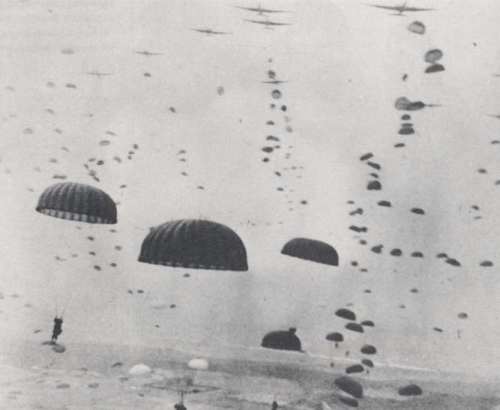
Operation Market Garden, the Largest Airborne Operation in History

The Allies still believed there was the chance to break into Germany in 1944.  Lacking the logistical base to sustain a wide front advance Eisenhower opted to make Montgomery the primary effort. Montgomery planned to utilize the 1stAllied Airborne Army in a bold and “in the context of Anglo-American generalship in France, refreshingly daring”[63] operation.[64] The concept of “vertical envelopment” had been advocated by General Marshall and General H.H. Arnold and throughout the campaign 18 airborne exploitation operations had been planned “each of them cancelled by the rapidity of the advance of the ground forces.”[65] Eisenhower made Montgomery the primary effort on September 10th and Montgomery “immediately detailed planning …for an idea he had already conceived to use the airborne reserve.”[66]
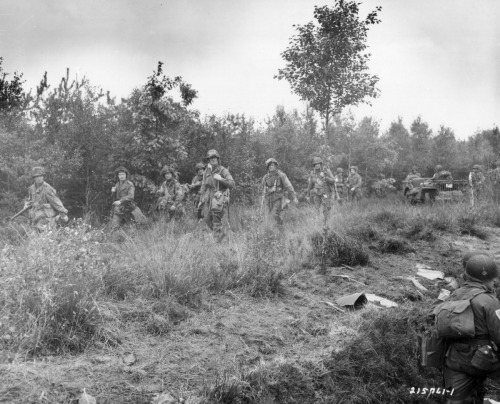
American Paratroops in Holland

The plan was Operation MARKET-GARDEN and to be successful Montgomery’s forces would have to cross 8 water obstacles including 3 major rivers.[67] He had to use one two lane highway bordered by soft Dutch podder, thick woods and drainage ditches that restricted armor and mechanized forces to the road itself.[68] The was for three Allied airborne divisions, the American 82nd and 101st, the British 1st Airborne and the Polish 1st Parachute Brigade to secure the bridges over the waterways between the front and Arnhem 65 miles north of the front.  The goal was to establish a bridgehead over the Rhine for the British Second Army to advance deep into the German heartland.  XXX Corps was to advance up this “corridor of death” and link up with each of the airborne divisions with the goal of breaking the German defense in the west.

British Paras in the ruins of Arnhem

Nearly all the writers agree that had the offensive been launched 7-10 days earlier when the Germans were in complete disarray it might have succeeded in its objective of crossing the Rhine and getting into Germany.  Hastings and Weigley both believe that the axis of the offensive was wrong and that the attack should have been made further south using 21st Army Group and 1st Army to drive to the Rhine.[69] All believe that an attack by Patton’s 3rd Army would not have achieved significant strategic gain as he now faced the bulk of the Wehrmacht’s strength and that there was little of strategic value in the part of Germany he could attack.

German Sturmgeschutz III in Arnhem 

The attack was made on 17 September.   The shortcomings of the plan became rapidly apparent.[70] German resistance in South Holland was much stronger than expected, the Son bridge was demolished by the Germans which created a major delay as bridging equipment had to be found and brought forward.  Due to the presence of battle groups from the 10th SS Panzer Division and other units dug in the city around the bridge the 82nd could not secure the Nijmegen Bridge until XXX Corps arrived.  The 1st Airborne was landed too far away from Arnhem Bridge to secure it in the face of the 9th and 10th SS Panzer Divisions of II SS Panzer Corps.  Due to a shortage of aircraft and refusal of the air transport command to make two drops on the first day the drops took 3 days to get all the airborne units into the fight.  The single road ensured that the spearhead of the XXX Corps advance was limited to a squadron of tanks and supporting infantry on a front two tanks wide.[71] The flanks were weakly held and German units salvaged from the Scheldt attacked the west and units from the Germany proper attacked the 82nd’s lodgment area.  Communications problems in the 1st Airborne Division prevented it from communicating with its own units as well as higher headquarters leaving everyone wondering what was happening.[72] The advance of XXX Corps was often both before Eindhoven and after Nijmegen lacking in urgency.[73] When all was said and done 1st Airborne Division was all but destroyed and had to be evacuated from its bridgehead and the operation ended in failure.[74] Numerous events contributed to the failure of the operation, many of which occurred before it was planned.  The German ability to make an army out of nothing coupled with planning which was based more on assumptions about what the Germans were incapable of doing rather than what was happening on the ground was a major fact. Likewise the British command discounted intelligence reports of Panzers in or near the drop the drop zones.

SS Panzer Grenadiers in Arnhem

The plan itself left much to chance and was built around the assumption that the Germans lacked the ability to stop them, neglecting the restrictions in which the Allied forces would have to execute the plan. If things could go wrong they did, especially in the 1st Airborne area of operations. Critical equipment failed to arrive, communications broke down, 2 of 3 battalions detailed to seize the Arnhem Bridge were stopped by a mixed bag of German forces including Panzers, an SS training battalion and various Army units and only one battalion reached the bridge. The failure to plan for and establish a landing zone on the south side of the Rhine kept them from being able to take the bridge, which became a key factor in the German ability to move troops from Arnhem to Njimegen. General Urquart was trapped in a house by German units which posted themselves around it and the commander of 1st Airborne Brigade was wounded.  The Germans succeeded in over running the drop zones and without communications British Airborne could not let the air transport know that supplies were not getting to them.

Summary

This phase of the French campaign exhibited the best and the worst of Allied generalship. The reasons; generally inexperienced American leadership at this level of warfare and poor leadership by the more experienced British command.  The key failures were logistics management and the strategic focus following the breakout which changed the nature of the planned campaign. The Allies were running at the limit of their capacity, shortages of fuel and other supplies and heavy casualties incurred in Normandy weakened the Allied advance demonstrating von Clausewitz’s understanding of what happens when a offensive reaches its culminating point. The drive into Brittany, the failure at the Falaise gap, the failure to close the door at the Seine, the failure to trap the 15th Army at the Scheldt and its failure to cross the Albert Canal, as well as the Market-Garden fiasco can all be directly attributed to Allied leadership at high levels.  Likewise the extraordinary ability of German commanders to restore seemingly hopeless situations all demonstrated how Clausewitz’s understood “genius” in war.

The campaign from the Normandy to Arnhem was one of spotty performance by the Allies especially in terms of generalship and logistics planning and the ability to improvise.  The Germans suffered from Hitler’s interference, especially at Mortain where he insisted on counterattack versus withdraw. Likewise they suffered from a critical lack of air support.  However German commanders were masters of improvisation taking advantage of Allied errors and confusion to recover the situation time and time again.

[1] Hastings, Max. Overlord: D-Day and the Battle for Normandy Vintage Books, New York, 1984 p.280

[2] Ibid.

[3] Hastings, Max. Armageddon: The Battle for Germany 1944-1945 Alfred a Knopf, New York, 2004 p.37.  Hastings comments that “British planners threw away it had learned since 1939 about the speed of reaction of Hitler’s army, its brilliance at improvisation, its dogged skill in defense, its readiness always to punish allied mistakes.”

[4] Weigley, Russell F. Eisenhower’s Lieutenants: The Campaign of France and Germany, 1944-1945, Indiana University Press, Bloomington IN, 1981pp.184-186

[5] Ibid. Hastings. Overlord pp.282-283

[6] D’Este,  Carlo. Patton: A Genius for War. Harper Collins Publishers New York, 1995 pp.632-633

[7] Ibid.  p.195

[8] Ibid. Also

[9] Warlimont, Walter. Inside Hitler’s Headquarters 1939-45 Presidio Press, Novato CA 1964 pp.449-450.

[10] Ibid pp.195-196. Weigley notes that Montgomery and most other Allied commanders  had been optimistic in not anticipating the German counter attack despite the ULTRA warnings, while Bradley and Patton were cautious in making troop deployments.

[11] Michael Reynolds in Steel Inferno: The 1st SS Panzer Corps in Normandynotes that the Americans inflicted “astonishing casualties on the northern thrusts of 2nd SS Panzer and remained undefeated when the Germans withdrew 4 days later.”  Reynolds, Michael Steel Inferno: The 1st SS Panzer Corps in NormandyDell Publishing, New York, 1997 p.264

[12] Ibid. Hastings Overlord p.283

[13] Ibid.

[14] Ibid. Weigley p.199.

[15] Carrell, Paul. Invasion! They’re Coming!” Trans. E. Osers, Originally published as Sie Kommen! Gerhard Stalling Verlag 1960, Bantam Books New York, 1964, 5th Printing June 1984. p. 249

[16] Ibid. Weigley p. 199

[17] Ibid. p.200

[18] Ibid. Hastings. Overlord. pp.282-283

[19] Ibid. D’Este. p.631

[20] Ibid. Weigley. p.286  He also points out that the Brittany diversion could have been “worse had it not been for Montgomery’s influence”  p.288

[21] Ibid. p. 202

[22] Ibid. p.204

[23] Ibid.

[24] Ibid.

[25] Reynolds, Michael Steel Inferno: 1st SS Panzer Corps in Normandy Dell Publishing New York, 1997. p.320.

[26] Meyer, Kurt Grenadiers trans. By  Michael Mende and Robert J.  Edwards, J.J. Fedorowicz Publishing, Inc. Winnipeg Manitoba, Canada 2001 p.290.

[27] Ibid. Hastings Overlord pp.288-289.

[28] Patton, George S. War As I Knew It Bantam Books NY  published 1980, originally published by Houghton Mifflin Company 1947. pp.101-102

[29] Ibid. Weigley p.209  Weigley quotes Major Hansen, Bradley’s aide in stating that the Falaise halt orde was “the only decision he has ever questioned.”

[30] DRAGOON was the airborne component of he south France operation.

[31] Ibid. p.218

[32] Ibid.

[33] Ibid.

[34] Ibid.

[35] Ibid. pp.222-224

[36] Patton and Truscott had a clash during the Sicilian campaign over Patton’s push for an amphibious operation accusing him of being “afraid to fight” and threatening to relieve him but then throwing his arm around him and offering him a drink. See D’Este pp.526-528  This incident was made famous in the movie “Patton.”

[37] Giziowski, Richard. The Enigma of General Blaskowitz. Hippocrene Books, New York 1997 p.338

[38] Ibid. Weigley

[39] Ibid. p.241

[40] Ibid.

[41] Ibid. p.243

[42] Ibid. p.246

[43] Hans Von Luck, the commanding a Kampfgrüppe of 21st Panzer Division describes how he and his troops camouflaged his “Schwimmwagen” with bushes to cross the Seine successfully disguising the vehicle to avoid persistant Allied air attacks. VonLuck, Hans Panzer Commander Dell Publishing New York 1989. p.209

[44] Ibid. Weigley. p.255

[45] Weigley, Hastings and D’Este all place a fair amount of blame for the logistical crisis on the commander of the COMMZ, General John C.H. Lee.

[46] Ibid. Hastings, Armageddon p.24

[47] Ibid D’Este pp.647-652

[48] Weigley notes that OVERLORD plans had not envision support American divisions for offensive operations across the Seine until D+120, yet by “D+90, sixteen United States divisions were already 200 kilometers beyond the Seine.” p.268.  Hastings and Weigley also note the waste in the American supply system noting that of “twenty-two million fuel jerrycans shipped to France since D-Day, half had vanished since September.” Hastings. Armageddon p.23.

[49] Ibid. Weigley

[50] Ibid. p.275-276

[51] Both Weigley and Hastings note the logistical problems of the British which not only included the problems that beset the Americans but problems of their own making including poor trucks of numerous makes rather than the standardized American trucks.  Hastings notes that for a time around Antwerp that “Montgomery’s armies were obliged for a time to commandeer thousands of horse-drawn wagons abandoned by the Wehrmacht, to make good its shortage of vehicles for the haulage of supplies.” Hastings. Armageddon p.23

[52] Weigley notes that Montgomery had a fiasco of British logistics in which some “1,400 British three-ton lorries, plus all the replacement engines for this model, had been discovered to have faulty pistons rendering them useless.” p.281.

[53] Ibid. Hastings. Armageddon. p.20

[54] Ryan in A BridgeToo Far quotes the XXX Corps Commander Horrocks who said in his memoirs “My excuse is that my eyes were entirely fixed on the Rhine and everything else seemed of subsidiary importance.” Ryan, Corrnelius. A Bridge Too Far Fawcett Popular Library by Arrangement with Simon and Schuster Publishing, New York, 1974  p.60

[55] Ibid.

[56] Ibid. Hastings p.20.  Weigley on p.293 gives a higher figure of 86,000 troops, 600 artillery pieces, 6,000 vehicles and 6,000 horses.

[57] Ibid. Ryan. p.49

[58] Reynolds, Michael Sons of the Reich Casemate, Havertown PA 2002 p.98

[59] A significant unit that was to plan a key role in the German defense against XXX Corps was Kampfgrüppe Walter formed around the 6th Parachute Regiment and other assorted units.  It is noted in almost every volume devoted to the campaign.

[60] Ibid. Weigley. p.294

[61] Ibid. Ryan. p.52

[62] See Hastings p.22 “The fumbled handling of Antwerp was among the principal causes of Allied failure to break into Germany in 1944.  It was not merely that the port was unavailable for the shipment of supplies; through two months that followed, a large part of Montgomery’s forces had to be employed upon a task that could have been accomplished in days if the necessary energy and “grip” been exercised at the beginning of September, when the enemy was incapable of resistance.”  and Weigley pp.293-294

[63] Ibid. Weigley p.288

[64] Hastings notes that since the Airborne Army had been created that “the apostles of the new art of envelopment from the sky were determined that it should be used.” Armageddon p.35

[65] Ibid. p.289

[66] Ibid.

[67] Ibid. Weigley. p.291

[68] Ibid. p.295

[69] Also see Ryan. p.81 Ryan notes that in the planning General Dempsey because of his doubts about the ability of 2nd Army suggested an attack “seizing the Rhine crossing at Wesel….” as “it would be better, he believed to advance in conjunction with the U.S. First Army northward toward Wesel.”

[70] All the commentators make reference too the misgivings voiced at the final planning conference. Hastings comments on Gavin who believed that “If I get through this one, I will be very lucky.”

[71] Ibid. Weigley. p.295

[72] Hastings comments “It was a scandal-for which in the Russian or German armies some signals officers would have been shot-that the communications of 1stAirborne Division remained almost non-existent from 17 September onwards.Armaggedon p.58

[73] Ibid. p.293

[74] Casualties in 1st Airborne were high, of “the original 10,005 man force only 2,163 troopers, along with 160 Poles and 75 Dorsets, came back across the Rhine. After nine days the division had approximately 1,200 dead and 6,642 missing, wounded or captured.” Ryan p.509.

Bibliography

Carrell, Paul. Invasion! They’re Coming!” Trans. E. Osers, Originally published as Sie Kommen! Gerhard Stalling Verlag 1960, Bantam Books New York, 1964, 5th Printing June 1984

D’Este,  Carlo. Patton: A Genius for War. Harper Collins Publishers New York, 1995

Giziowski, Richard. The Enigma of General Blaskowitz. Hippocrene Books, New York 1997

Hastings, Max. Armageddon: The Battle for Germany 1944-1945 Alfred a Knopf, New York, 2004

Hastings, Max. Overlord: D-Day and the Battle for Normandy Vintage Books, New York, 1984

Meyer, Kurt Grenadiers trans. By  Michael Mende and Robert J.  Edwards, J.J. Fedorowicz Publishing, Inc. Winnipeg Manitoba, Canada 2001

Patton, George S. War As I Knew It Bantam Books NY  published 1980, originally published by Houghton Mifflin Company 1947.

Reynolds, Michael Sons of the Reich Casemate, Havertown PA 2002

Reynolds, Michael Steel Inferno: 1st SS Panzer Corps in Normandy Dell Publishing New York, 1997

Ryan, Corrnelius. A Bridge Too Far Fawcett Popular Library by Arrangement with Simon and Schuster Publishing, New York, 1974

Von Luck, Hans Panzer Commander Dell Publishing New York 1989

Warlimont, Walter. Inside Hitler’s Headquarters 1939-45 Presidio Press, Novato CA 1964

Weigley, Russell F. Eisenhower’s Lieutenants: The Campaign of France and Germany, 1944-1945, Indiana University Press, Bloomington IN, 1981
2 Comments

Filed under History, Military, world war two in europe

The Bloodiest Day: The Battle of Antietam 17 September 1863

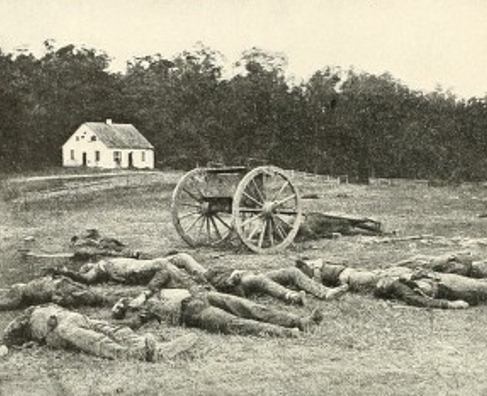
“Of all the days on all the fields where American soldiers have fought, the most terrible by almost any measure was September 17, 1862. The battle waged on that date, close by Antietam Creek at Sharpsburg in western Maryland, took a human toll never exceeded on any other single day in the nation’s history. So intense and sustained was the violence, a man recalled, that for a moment in his mind’s eye the very landscape around him turned red.” Stephen W Sears

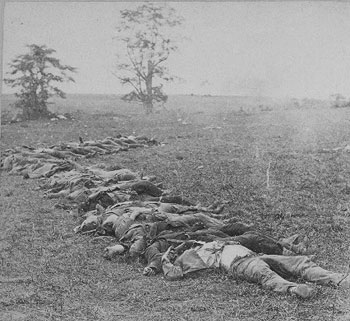
“I have heard of ‘the dead lying in heaps’, but never saw it till this battle. Whole ranks fell together.” Captain Emory Upton, 2nd U.S. Artillery, at Antietam

“We were in the very maelstrom of the battle. Men were falling every moment. The horrible noise was incessant and almost deafening. Except that my mind was absorbed in my duties, I do not know how I could have endured the strain.” Lt. Frederick L. Hitchcock, 132nd Pennsylvania, at Bloody Lane, Sept. 17, 1862

To the west of Frederick Maryland a small town named Sharpsburg sits on the west side of a creek. Named Antietam the creek’s headwaters are in Franklin County Pennsylvania and it meanders south where just to the south of Sharpsburg it empties into the Potomac River.

It is a peaceful place, rolling hills and agricultural country with some well preserved stone arch bridges, including one just outside of Sharpsburg. It is hard to believe that 150 years ago the town and the creek were the scene of the bloodiest single day of battle in American history.

On that indian summer day of 1862 the Confederate Army of Northern Virginia, General Robert E Lee, commanding made a stand against the much larger Union Army of the Potomac, Major General George B. McClellan, commanding.

Lee had invaded Maryland following a string of successes in Northern Virginia during that summer of 1862, defeating McClellan outside of Richmond in the Seven Days, and in a campaign of maneuver bested a newly formed Army, the Union Army of Virginia commanded by Major General John Pope defeating it at the Second Battle of Bull Run between 28-30 August 1862. With Northern Virginia’s crops and livestock depleted and his opponents in crisis Lee moved his army north into Maryland. The decision was driven partly by the need to provision his army, but also had the hope of drawing Maryland away from the Union mistakenly believing that public sentiment in that state was pro-Confederate. If the people of Maryland rose up to support Lee it would be disastrous to the Union and endanger the capital itself. A final consideration was the hope that a Confederate victory on Northern soil would bring about the foreign recognition and possibly the intervention of Great Britain on the side of the Confederacy.

The Lost Order

Lee crossed the Potomac on September 3rd and sent his Second Corps west with some elements seizing the Union armory in Harper’s Ferry, others to secure the Baltimore and Ohio Railroad at Martinsburg the rest of the Army was in the area of Frederick. He was pursued by the very cautious McClellan at the head of the Army of the Potomac.

On September 9th Lee issued General Order 191, the infamous “lost order” which a copy of which was found by Union soldiers wrapped around three cigars at a campground recently occupied by Lee’s rear guard element, the division of D.H. Hill on September 13th. The order detailed the disposition of Lee’s army and McClellan seized the opportunity. On the 14th the Army of the Potomac attacked part of Lee’s army at the Battle of South Mountain. The Union won that battle forcing the outnumbered Confederate forces to withdraw, though the delay allowed Lee to concentrate more of his army at Sharpsburg on the 15th.

Although he outnumbered Lee McClellan believed the reports of the Pinkerton Detective Agency which provided intelligence to the army. Those estimates which credited Lee with more than 100,000 troops. He delayed his attack until he had drawn up his full army on the on the 17th.

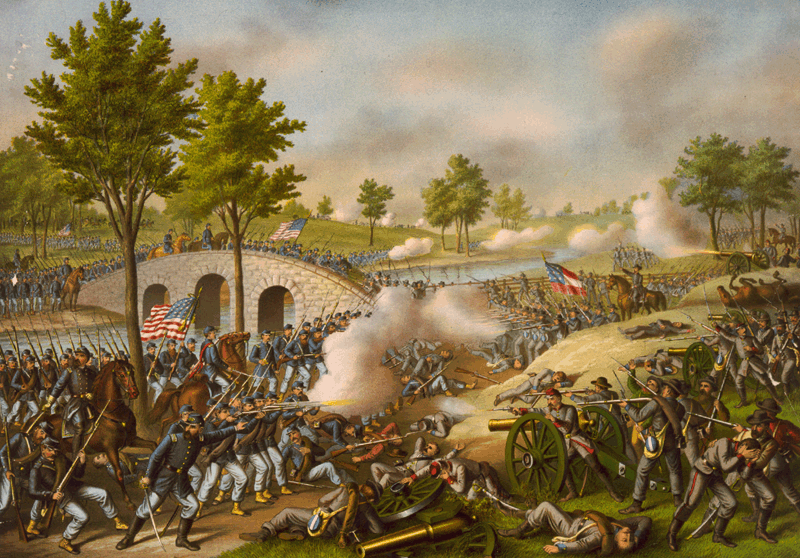
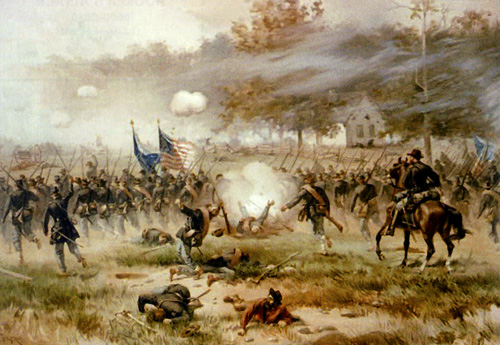
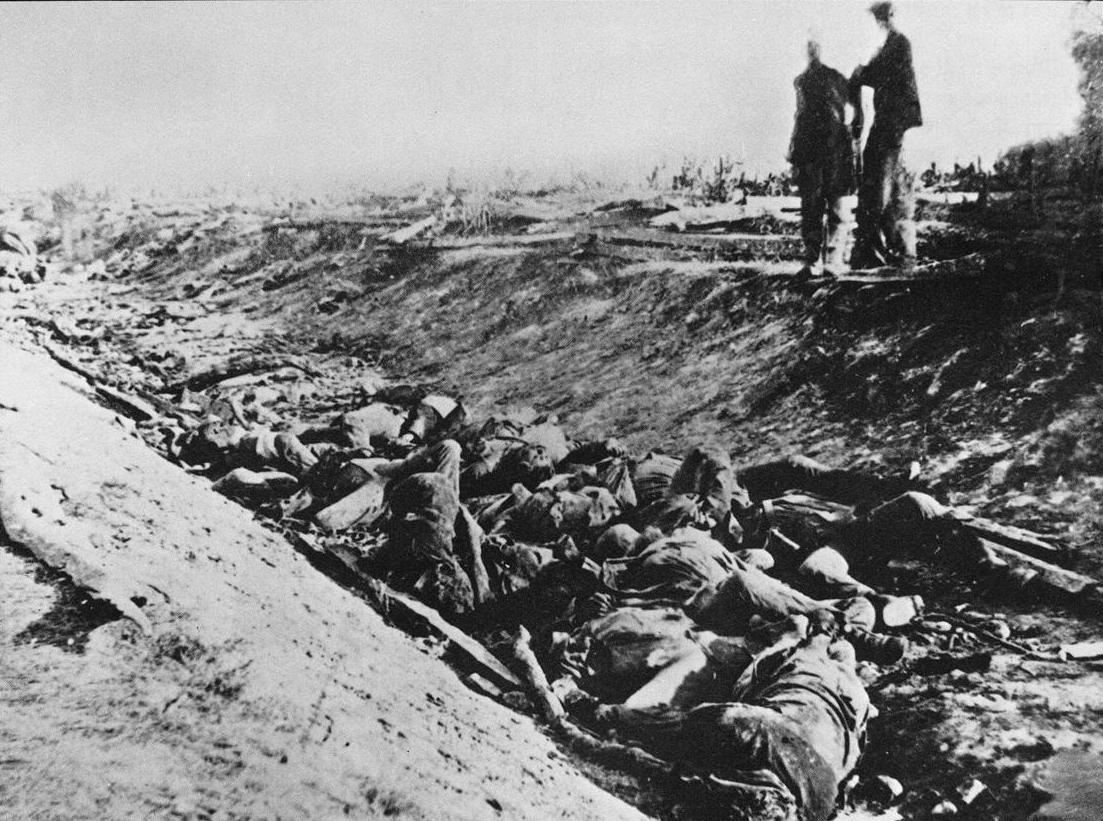
When he did attack on the 17th his attacks were uncoordinated and though he came close to decisive breakthrough Lee’s army desperately clung to its positions. The action began to the north of the town in the morning and both sides showed incredible ferocity at the Cornfield, where in the space of about three hours nearly 8000 soldiers were killed or wounded. The fighting shifted to the center of the line opposite the town by mid-day. Amid the destructive storm of artillery the armies fought around the Dunker Church and a sunken lane now known as “Bloody Lane.” In the confines of that 800 yard stretch of road over 5000 soldiers were killed or wounded in the course of about four hours. The Union forces broke the Confederate line but reinforcements were not sent and when the the division commander, Major General Israel Richardson was mortally wounded the attack lost its verve and the Confederates under Lieutenant General James Longstreet were able to restore the line.

The south remained quiet as McClellan ordered Major General Ambrose Burnside’s IX Corps to hold off on attacking. Burnside did not receive his orders to attack until 1000. He finally attacked across the south bridge, now known as Burnside’s Bridge in the afternoon. It was another tough fight and Burnside, after several attempts move to the south to flank Confederate forces in the late afternoon with the intention of cutting Lee from off his only escape route.  The Confederates were in a desperate condition. It was at this point, about 3 PM when the division of Major General A.P. Hill arrived and immediately counterattacked breaking up Burnside’s attack. Burnside requested reinforcements from McClellan who refused saying that he had none available. This was not the case, McClellan had two full corps of infantry uncommitted to the battle but still believing that he was outnumbered and that Lee was attempting to trap him.

The actioned ended by 530 PM with both sides rested and reorganized for action the next day. Lee prepared to defend but no Union attack was offered on the 18th. An informal truce was observed to allow the evacuation of the wounded and Lee began his withdraw across the Potomac into Virginia that night. Despite being goaded by Lincoln to pursue McClellan did not and the Union lost the opportunity to destroy Lee’s army n Union territory.

Casualty estimates vary but according to Stephen W Sears in his book Landscape Turned Red that the Army of the Potomac lost 2108 dead, 9540 wounded and 753 missing. He states the best estimate of Confederate casualties are 1546 dead, 7752 wounded and 1018 missing. Most of the missing were likely killed and buried in mass graves or discovered and buried by civilians after the battle. In the space of 12 hours 22719 Americans were killed or wounded. It was the bloodiest single day in American military history.

Though the battle was inconclusive in that Lee’s army survived but had to break off its offensive it had more influence than expected. President Lincoln issued the Emancipation Proclamation on September 22nd and though it did not take effect until January 1st 1863 it marked a turning point in the war.

McClellan failed to take up the offensive in the next tow months and Lincoln relieved him of command giving the Army of the Potomac to Burnside who goaded by Lincoln took the army into battle at Fredericksburg where it met with defeat.

I have been to the battlefield a number of times, once as part of a “staff ride” with the Marine battalion that I was assigned in May of 2000. Each time I go I take the time to ponder the great losses endured by both armies and the individual courage of the soldiers involved. Some of the units that I served with in the Army National Guard in Texas and Virginia trace their lineage and honors to regiments that fought at Antietam and I have felt a connection to the battle because of that. It is hard to imagine the amount of death and carnage taking place in such a placid location in such a short amount of time.

It is something to ponder when some Americans openly suggest another civil war if their party does not win the election.

Peace

Padre Steve+

1 Comment

Filed under civil war, History, Military

Where Were You on 9-11-2001? Share Your Memories

I was reminded today about how the terrible events of September 11th 2001 are part of our national fabric and how those that remember that day have in some way been affected by it. Most of us I am sure remember where they were when they found out and what they were doing. I have written about my experience at Camp LeJeune but I know that others have just as vivid memories.

I was asking one of my sailors where he was on 9-11. He is young, just a year in the Navy and he replied that he was in 3rd grade. He explained that he remembers his teachers and other adults in states of shock and disbelief. He said that as a kid the significance was not understandable, that the pictures looked like a movie.

One of my friends who I served with in Germany early in my Army career was a hospital administrator at a large medical center on the New Jersey side of the Hudson across from Manhattan when the towers were hit and how he watched from his office as the towers burned and fell.

I have many friends from the USS Hue City which I reported aboard in December 2001 who were at sea and after the attack patrolled the East Coast. Another one of my friends who works with me on our pastoral care staff was in the gym at 29 Palms following a combined arms exercise with the 2nd Marine Regiment when the news showed the second aircraft hitting the South Tower of the WTC. He informed his disbelieving commanding officer of the attack.

My wife Judy was in a doctor’s office waiting room when the news came on the television. She said to a friend who was with her that “it was terrorism” and the friend said “that damned Saddam Hussein.”

I had friends that served as first responders or provided support to first responders at the site. Many were clergy, both Navy Chaplains serving with the US Coast Guard and civilian clergy.

Quite a few of the young Sailors, Marines, Soldiers and Airmen that I have served alongside joined following in the days, months and years after 9-11-2001 because of that terrible event. Others who had done their time on active duty volunteered as Reservists or National Guardsmen to return to active duty .  They are part of the 9-11 Generation, a new Greatest Generation, who have served in the longest and most far flung war in our nation’s history.

I believe that we should never forget that day and the lives of those that were killed or injured during the attack, the families who lost husbands, wives, children or parents and those that laid down their lives going up to save lives even as the buildings came down. Some of us knew people killed in the attacks. One of my Army Officer Basic Course Classmates, Lieutenant Colonel Karen Wagner died in the Pentagon. Other friends and comrades have died in the wars in Afghanistan and Iraq. For their sake we should remember and never forget 9-11-2001.

Many of us have gone to war, deploying more than once to Iraq, Afghanistan or the Arabian Gulf, the Horn of Africa and other less known theaters of the Global War on Terrorism. Over 6,000 of us, twice the number killed on 9-11-2001 have died in those wars, tens of thousands of others wounded and forever changed. The name Operation Enduring Freedom is no misnomer, it has gone on far longer than anyone of us imagined that it would.

However on 9-11-2001and in the days following that day Americans stood as one. Liberals and conservatives, Republicans and Democrats, straight and gay, religious people and non-religious people, secularists and humanists, Christians of all denominations, Jews, Hindus, Sikhs, Buddhists, followers of Wicca and earth based religions and American Moslems who often took the brunt of others anger for the actions of the terrorists all stood together. We were Americans again.

We have lost unity that over the past eleven years and all of us, especially those  probably share some of the blame for the division. I do hope that as we remember the events of 9-11-2001 that we somehow recover a sense that we are all in this together and come together as Americans no matter which political party is in power.

Tomorrow at the Naval Hospital that I serve we will mark the events of 9-11-2001 with a small ceremony at morning Colors and have moment of silence at the time of the first attack. Others around the country, especially at the World Trade Center where the Freedom Tower is rising, the Pentagon and in Somerset County Pennsylvania will have more elaborate ceremonies. Regardless of where we are we will be one in spirit.

I invite anyone reading this to share in the comments your memories of the day, perhaps your experiences of it.

Peace

Padre Steve+


1 Comment

Filed under History, News and current events

Padre Steve Remembers 9-11 and the Forgotten War

It has been nearly eleven years since that fateful Tuesday when the world changed.

I can still remember it like it was yesterday despite the intervening years.

I was in my office at Camp LeJeune where I was serving as Chaplain for Headquarters Battalion 2nd Marine Division. I had just finished an early morning counseling case and had delayed my early morning PT in order to handle the case and after I checked e-mail I was about to close my internet browser when I saw a small headline on the Yahoo News headline section.

The headline simply read “Plane crashes into World Trade Center Building.” My immediate thought was “some dumb ass flew his Cessna into the building.” I simply thought that some inexperienced pilot had gotten lost and crashed his plane into a tower. Thinking nothing more I closed out the page and left the office. It was 0900.

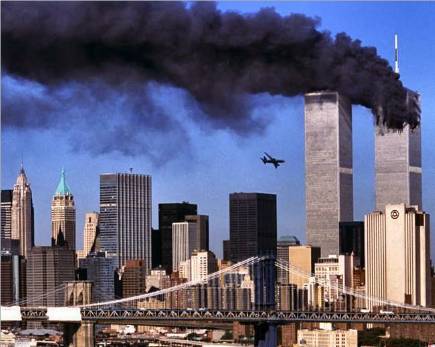
I got in my car and the radio was tuned in to a local right-wing talk radio station, yes I used to listen to it all the time. The talk show host was former Congressman Bob Dornan. He was talking with someone about what kind of aircraft had struck the building when he shouted “oh my God another plane has crashed into the other tower!”

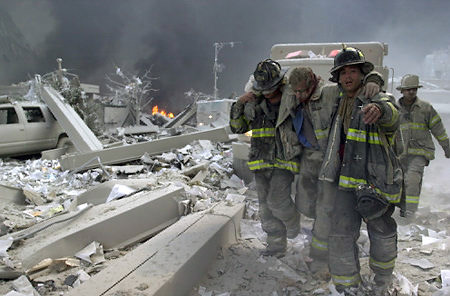
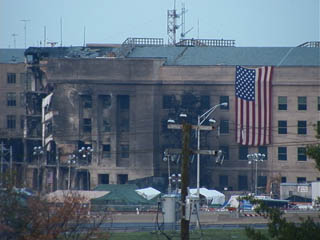
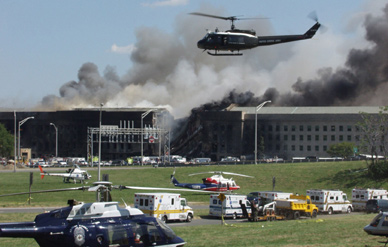
I was stunned. I knew that it had to be terrorism. I drove to the gym since they had multiple televisions and I figured that I could find out more there. I walked in and saw Marines, Sailors and civilians gathered around the sets. Every TV was tuned in to different news programs, CNN, Fox News, MSNBC as well as shows such as the Today Show and Good Morning America. Some whispered to each other but the silence of most was deafening. I remained a few minutes, transfixed by the images on the set. I then left the gym, got in my car and went back to the office where I showered, got into uniform, made a check of the news which was now reporting a strike on the Pentagon and the collapse of the South Tower of the WTC.

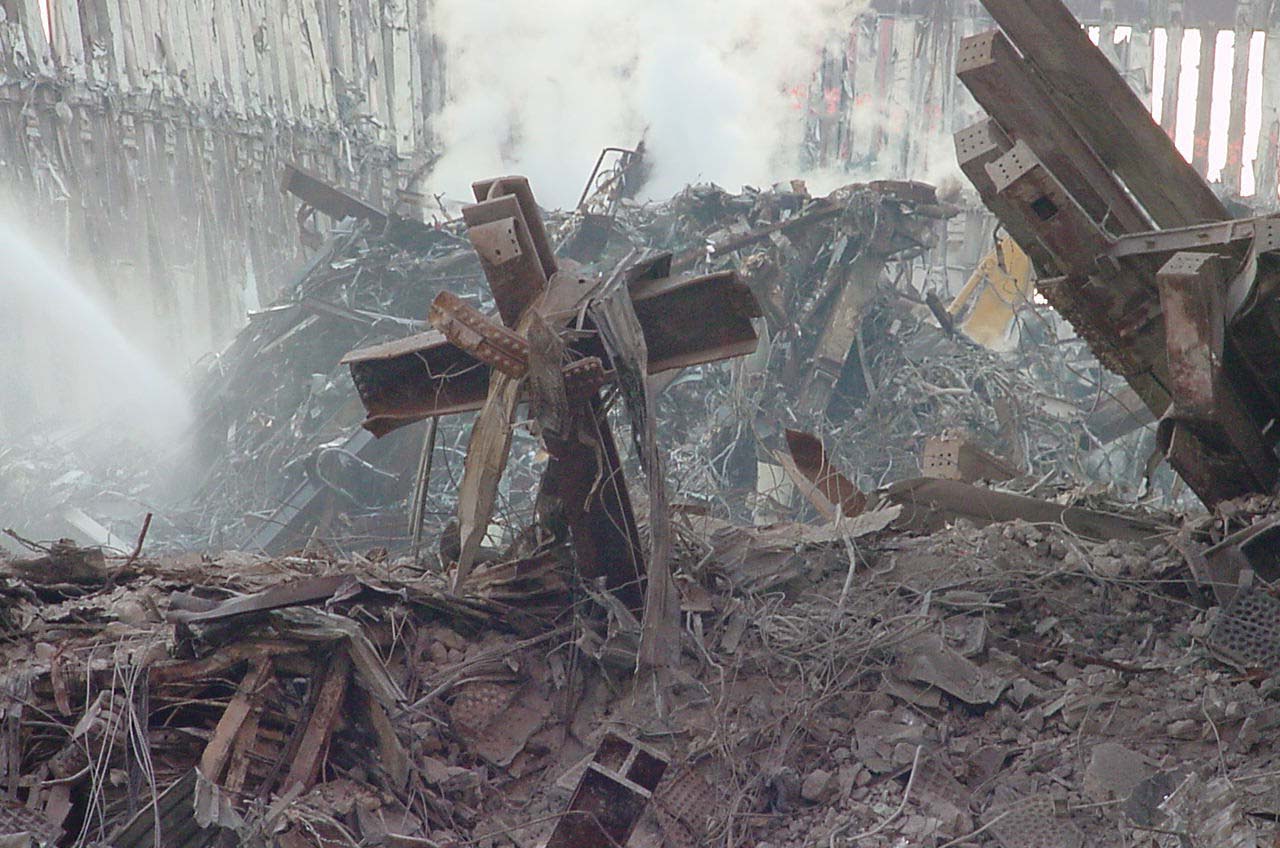
I drove to our battalion command post where I met with our Commanding Officer, Colonel Lake and Executive Officer Major Foster. We all knew that this was the beginning of a war and all of us had been through countless instances where we had been notified to get ready to deploy, most recently during the Kosovo action where Marines were to take a lead roll had the Serbians not backed down. While we talked the North Tower of the WTC collapsed. The emotions on everyone’s face showed, it was hard to believe that so much had happened and the great towers were smoldering heaps of rubble with possibly tens of thousands of victims crushed or incinerated in the ruins. I was instructed to get my gear and be back for a staff meeting as Colonel Lake was heading to division to meet with the Staff of 2nd Marine Division.

I made a quick run to my town home, hugged the dogs since Judy was out and grabbed my gear and some extra uniforms and underwear and headed back into the base through the back gate. I deposited my gear in my office and went around the building so see our Marines and Sailors assigned to our Truck Company, MP Company, Medical Company and Headquarters Company and all were waiting for more word, most gathered around televisions and watching breaking news. Some came to me and asked what it meant and expressed concern for families and friends in the affected locations. Then I went back to our headquarters where we heard from Colonel Lake what was known and what our actions would be. We were placed on high alert, patrols by full combat ready Marines were to patrol vulnerable areas of the base while roadblocks and checkpoints were established near every major headquarters aboard the base. The base was also locked down and only Marines, Sailors or Civilian workers returning to work were allowed aboard.

Later in the day I met with the chaplains who served our independent battalions, 2nd Combat Engineer Battalion, 2nd Light Armored Reconnaissance Battalion, 2nd Recon Battalion and 2nd Tank Battalion. I explained what I knew from my meetings with the Division Chaplain and Battalion Commander. We concluded our meeting with prayer for the victims of the attacks, the responders and for our Marines and Sailors.

It was both grim and surreal as the day passed and night fell. We remained in that condition four days. Meals were served at the Chow Hall, MRE’s issued and we went everywhere in full combat gear. I visited Marines at their guard posts during the night and worked counseling those who were concerned about family members or friends. They did so for good reason as nearly 3000 people were killed in the WTC, Pentagon and aboard the four hijacked aircraft.

Within a month U.S. Forces were engaged in combat in Afghanistan, driving the Taliban from power and sending Osama Bin Laden and Al Qaeda into hiding. Various units of the division were deployed to Afghanistan and the Horn of Africa over the coming weeks and months and even as we did so rumors circulated about Iraq.

I knew that the war would not be the short war that everyone hoped for and within 6 months I would be deployed with the USS Hue City and the USS John F Kennedy Carrier Strike Group to the Arabian Gulf, Horn of Africa and Gulf of Oman.  We would take part in maritime interception operations off the Horn of Africa and in the Arabian Gulf where we took part in the UN Oil Embargo on Iraqi smugglers.

I would travel to the Middle East frequently over the coming years supporting Marines from the Marine Security Force Battalion and later deploy to Iraq from EOD Group Two. I have lost friends and see the effects of the war every day at Camp LeJeune.

Osama Bin Laden is now dead, and it has been 11 long years of war. However it has been a war that for the most part has not been a national effort. After 9-11 the nation was not called to sacrifice, it was told by political leaders to “go shopping.” The brave men and women of our military and their families have made incredible sacrifices over the past 11 years. 2024 have died in Afghanistan while 4486 died in Iraq before the withdraw of US forces in December 2011. Another 32,223 were wounded in Iraq while 15,332 have been wounded in Afghanistan. These numbers do not count American contractors, State Department, CIA, FBI or other law enforcement agencies.

They also do not count the thousands afflicted by PTSD or other illnesses contracted in the combat zone, nor does it count the large number of Iraq and Afghanistan veterans who have taken their lives on active duty or following their discharge or retirement. Then there are the lives of over 1500 coalition soldiers, mostly British, Canadians and Australians who have given their lives in these wars. Finally there are the hundreds of thousands of Iraqis and Afghan civilians who have died or suffered injury or have been dislocated or exiled as a result of the wars.

Then there is the economic cost which amounts to trillions of dollars for both wars which have been funded by borrowing against our economic future.

Despite this for most Americans the war in Afghanistan is unpopular, little understood and distant, far from daily life. This is backed by polling data and by words of some politicians of both major political parties, in every major poll over 60% of Americans say that the war in Afghanistan is not worth the cost and needs to end.

One of the most glaring examples of how political leaders think about Afghanistan, but certainly not the only one is Republican Presidential nominee Mitt Romney. Romney did not mention either Iraq or Afghanistan in his acceptance speech at the Republican National Convention, although he did mention “strengthening the military.” He explained it later in an interview by saying to Fox News anchor Brett Baier “When you give a speech you don’t go through a laundry list, you talk about the things that you think are important….”

The sad fact is that no matter why Romney left out any mention of an ongoing war out of his speech that his words “you talk about the things that you think are important” are indicative not only of him but the majority of Americans. The reality is that Romney and most Americans have no personal connection with the war or the military. The war has been fought by a relatively small professional military that represents less than one percent of the population. Marine Lieutenant General John Kelly who lost his son, a Marine Lieutenant in Afghanistan noted at the 2012 American Legion national convention:

“America as a whole today is certainly not at war, not as a country, not as a people… Only a tiny fraction of American families fear all day and every day a knock at the door that will shatter their lives….” 

This Tuesday we will reflect on something called Patriot’s Day and pause to remember the events of that bloody Tuesday of September 11th 2001. I hope, probably in vain that the American people and their leaders will do more than mouth a few words, talk about how terrible the day was and go back to business as usual. I hope, probably again in vain that Americans will wake up to the fact that tens of thousands of Americans are in harm’s way and that even more and probably more terrible wars loom just over the horizon.

I have no idea what it will take to actually engage the vast bulk of the American population that what happens in Afghanistan is still important. Nor do I think that most people have any idea that a war with Iran could be disastrous for US and coalition forces fighting in Afghanistan.

It is odd to think that we can think about 9-11 and then ignore the subsequent wars the way that we have done. I really don’t.

Peace

Padre Steve+


4 Comments

Filed under Foreign Policy, History, iraq,afghanistan, News and current events

Real Independence: The Treaty of Paris 1783…We Didn’t do it Alone

It is easy to declare independence but it is far more difficult to achieve it. It is also easy to mythologize our history and ignore the fact that we did not achieve independence by our own efforts alone. No matter what country is involved there is almost always help in gaining independence. One only has to look at history to see the reality of this.

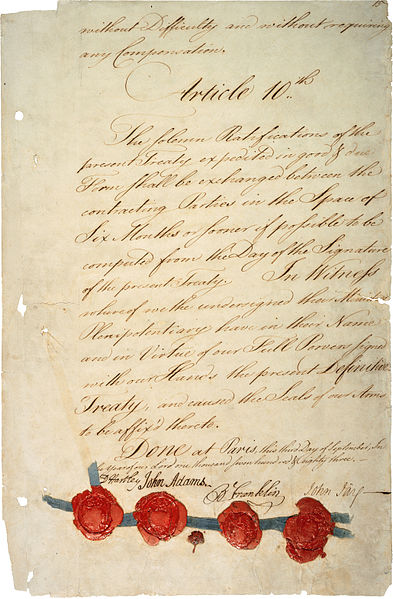
This was the case for the United States. In 1783 after over years of hostilities and over seven after the Continental Congress issued the Declaration of Independence the British Empire signed a treaty with the representatives of the colonies in Paris. The first article of the treaty was something that has not been seen before in modern European history:

“His Brittanic Majesty acknowledges the said United States, viz., New Hampshire, Massachusetts Bay, Rhode Island and Providence Plantations, Connecticut, New York, New Jersey, Pennsylvania, Delaware, Maryland, Virginia, North Carolina, South Carolina and Georgia, to be free sovereign and independent states, that he treats with them as such, and for himself, his heirs, and successors, relinquishes all claims to the government, propriety, and territorial rights of the same and every part thereof.”

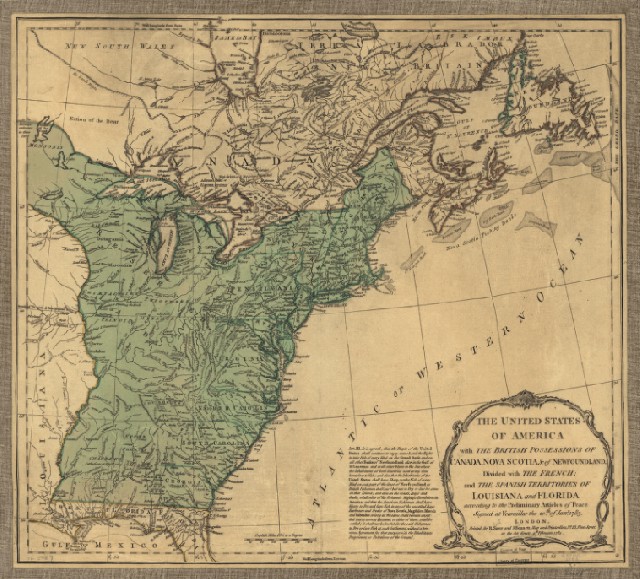
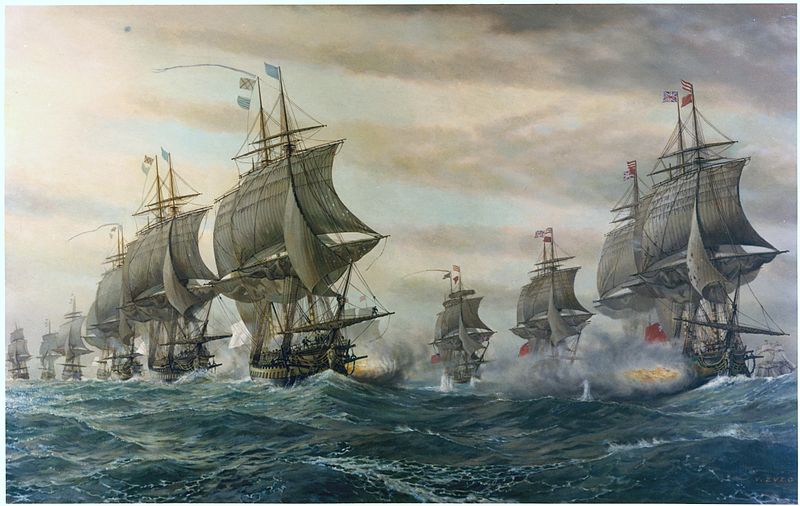
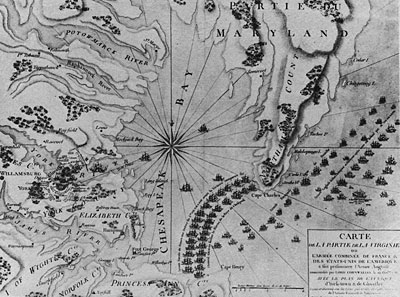
The treaty established the independence of the former British colonies and a new boundary, the Mississippi River which more than doubled the size of the new nation. The treaty was signed nearly two years after the American and French Armies, ably helped by the timely intervention of the French Navy forced Lord Cornwallis to surrender his army at Yorktown.

It is quite easy to fall prey to simple answers regarding the independence of the American nation. In fact it is not inaccurate to state that the vast majority of Americans today know little more than that the colonies declared their independence in 1776 and that George Washington led the armies and eventually became the first President. However the reality was that the independence of the new nation was secured by a number of factors including negotiations with a power that realized that the expenditure of lives and capital in what had become for them a world war of great cost.

The British negotiated a peace that was generous and which gave the American colonies more than they had begun the war. It required British garrisons to evacuate territories and fortifications in strategic areas on the Great Lakes and areas still occupied. However, the peace allowed the British to secure and expand their empire at the expense of the French, Spanish and Portuguese around the world. The new American nation would eventually eclipse the British Empire but it was not an easy journey and is something that should not be turned into myth or fiction by those that want to seek easy answers that align with their theology or myth.

Independence was declared in 1776 but was not attained until nearly two years after Yorktown. It took military efforts of the colonies as well as diplomatic efforts of men like Benjamin Franklin to gain the vital assistance of the French who helped pay for our independence with their blood, treasure, overseas territories  and ultimately the overthrow of the French monarchy by a revolution partly inspired by the American Revolution and the economic problems brought about by the French war with England. That fact is something that we should not forget nor take lightly. We didn’t achieve our independence all by ourselves, just in case we think that we did.

Peace

Padre Steve+


1 Comment

Filed under History

September 1st 1939: The Day the World Changed Forever

In the early dawn hours of September 1st 1939 the the Panzer spearheads of the German Wehrmacht rolled across the Polish Frontier. In the Free City of Danzig the elderly battleship Schweswig-Holstein fired her 11” guns into Polish positions on the Westerplatte at point blank range. In the air the Luftwaffe swept the small Polish Air Force from the skies. Ju-87 Stuka dive bombers screeched down in merciless attacks on Polish units, cities and even refugees. Behind the front lines came the Einsatzgruppen their mission to exterminate the elite of the Polish nation and the Jews.

It was a different kind of war. Hitler told his military chiefs  at Obersalzburg the week before the before the campaign:

“Our strength consists in our speed and in our brutality. Genghis Khan led millions of women and children to slaughter—with premeditation and a happy heart. History sees in him solely the founder of a state. It’s a matter of indifference to me what a weak western European civilization will say about me. I have issued the command—and I’ll have anybody who utters but one word of criticism executed by a firing squad—that our war aim does not consist in reaching certain lines, but in the physical destruction of the enemy. Accordingly, I have placed my death-head formation in readiness—for the present only in the East—with orders to them to send to death mercilessly and without compassion, men, women, and children of Polish derivation and language. Only thus shall we gain the living space (Lebensraum) which we need. Who, after all, speaks to-day of the annihilation of the Armenians?

The war would be marked by brutality unseen in modern warfare, especially on the Eastern Front and between the Allies and the Japanese in the Pacific. It would end with the dropping of the Atomic bombs on Hiroshima and Nagasaki. By the end of the war between 50 and 78 million people were dead. Europe was divided between the Soviet dominated East and the Western Allies by the Iron Curtain. Proxy wars would be waged by the United States and the Soviet Union as a Cold War settled over the world.

The Cold War has been over for over 20 years now and now other wars rage around the world and war clouds loom, especially in the Middle East. Madmen threaten to exterminate their enemies.

Pray for peace

Padre Steve+

1 Comment

Filed under History, world war two in europe, world war two in the pacific

“We Built This” Part One: Smedley Butler Tells Just How Big Business Did it All by Themselves

I am amazed at the hubris of the Romney campaign doubling down on this “we built it” crap. The fact is that many of if not most of the “American” corporations that now in fact are multinationals that couldn’t give a crap about Americans were and are made much of their profits off of war and the sacrifices made by American military personnel for over 100 years. Politicians of both parties have been in on this game since the beginning and while I mention the Romney campaign he is not the first nor the last that will play it.

Now don’t get me wrong. I am a big fan of how American business and ingenuity can get things done. Nor am I against people making money, even lots of money especially if they produce something worthwhile and they earn their money honestly. Nor am I jealous of those that were born into money, so long as they are honest about it and admit that that it was the product of those that gave it to them or provided them the opportunity to succeed. Nor do I criticize those small business owners that invest their heart, soul and treasure into becoming successful and doing great things, often against the odds and government regulations which are written to favor the big players and multinationals.

At the same time I also know that despite the rhetoric none of our major corporations or their CEOs got there all by themselves. Despite all the hype the facts are that our major corporations including the banks have subsisted on the government and American taxpayers for years. Bailouts, subsidies, government loans and all sorts of other perks are part of this history, but nowhere more glaring is how many in business got where they are by being war profiteers.

While these corporations have produced some the the best weapons systems ever seen. However they have also produced a lot of crap that failed the military, or which was not needed, or which were so bad or problem laden that they were rejected by the military. However they still got paid or are still getting getting paid for by the taxpayer.

To me there is something unseemly in saying “we built it ourself” when the profits are made off the taxpayer and with the blood of American military personnel. What is even more obscene is that some of these companies make money from our enemies  by supplying them even while those enemies use the weapons and materials paid at least in part by American taxpayers against our troops.

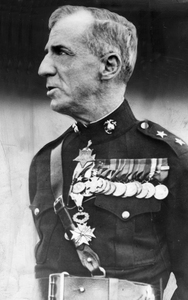
Major General Smedley Butler, US Marine Corps who was awarded the Medal of Honor twice wrote about how American business engorged themselves at the cost of Americans during the First World War, often without any positive result, apart from their profits. The fact is that little has changed since then.

Butler’s book, War is a Racket should be required reading for all voters if nothing else to demonstrate the absolute cynicism and moral bankruptcy of the “we built this ourselves” argument. The book was written after the war and Butler’s retirement during the Great Depression. The monetary figures are those of the period. One can adjust them for inflation if they want to, but it suffices to say that the big banks and corporations didn’t do it all by themselves.

Chapter Two of the book is entitled Who Makes the Profits. If you believe that these companies got where they were all by themselves then you need to read this. This article only discusses World War One. Volumes can be written about how American business has made much of its profit from none other than Uncle Sam, and our tax dollars.  The interesting thing is that many of the corporations named by Butler are still doing this today, sometimes under different names because of mergers but still the same companies.

I am already thinking about doing some more articles on just how various corporations made their money and exploited the government and taxpayers in order to do it. That is the wonderful thing about history. It shows when people are lying in order to increase their power.

So enjoy Chapter Two of War is a Racket

Who Makes The Profits?

The World War, rather our brief participation in it, has cost the United States some $52,000,000,000. Figure it out. That means $400 to every American man, woman, and child. And we haven’t paid the debt yet. We are paying it, our children will pay it, and our children’s children probably still will be paying the cost of that war.

The normal profits of a business concern in the United States are six, eight, ten, and sometimes twelve percent. But war-time profits — ah! that is another matter — twenty, sixty, one hundred, three hundred, and even eighteen hundred per cent — the sky is the limit. All that traffic will bear. Uncle Sam has the money. Let’s get it.

Of course, it isn’t put that crudely in war time. It is dressed into speeches about patriotism, love of country, and “we must all put our shoulders to the wheel,” but the profits jump and leap and skyrocket — and are safely pocketed. Let’s just take a few examples.

Take our friends the du Ponts, the powder people — didn’t one of them testify before a Senate committee recently that their powder won the war? Or saved the world for democracy? Or something? How did they do in the war? They were a patriotic corporation. Well, the average earnings of the du Ponts for the period 1910 to 1914 were $6,000,000 a year. It wasn’t much, but the du Ponts managed to get along on it. Now let’s look at their average yearly profit during the war years, 1914 to 1918. Fifty-eight million dollars a year profit we find! Nearly ten times that of normal times, and the profits of normal times were pretty good. An increase in profits of more than 950 per cent.

Take one of our little steel companies that patriotically shunted aside the making of rails and girders and bridges to manufacture war materials. Well, their 1910-1914 yearly earnings averaged $6,000,000. Then came the war. And, like loyal citizens, Bethlehem Steel promptly turned to munitions making. Did their profits jump — or did they let Uncle Sam in for a bargain? Well, their 1914-1918 average was $49,000,000 a year!

Or, let’s take United States Steel. The normal earnings during the five-year period prior to the war were $105,000,000 a year. Not bad. Then along came the war and up went the profits. The average yearly profit for the period 1914-1918 was $240,000,000. Not bad.

There you have some of the steel and powder earnings. Let’s look at something else. A little copper, perhaps. That always does well in war times.

Anaconda Copper for instance. Average yearly earnings during the pre-war years 1910-1914 of $10,000,000. During the war years 1914-1918 profits leaped to $34,000,000 per year. (One should read their history of strip mining massive pollution, ARCO bought them in the 1970s but was stuck with massive environmental problems, such that the company is only on the books to show the losses)

Or Utah Copper. Average of $5,000,000 per year during the 1910-1914 period. Jumped to an average of $21,000,000 yearly profits for the war period.

Let’s group these five, with three smaller companies. The total yearly average profits of the pre-war period 1910-1914 were $137,480,000. Then along came the war. The average yearly profits for this group skyrocketed to $408,300,000. A little increase in profits of approximately 200 per cent.

Does war pay? It paid them. But they aren’t the only ones. There are still others. Let’s take leather. For the three-year period before the war the total profits of Central Leather Company were $3,500,000. That was approximately $1,167,000 a year. Well, in 1916 Central Leather returned a profit of $15,000,000, a small increase of 1,100 per cent. That’s all.

The General Chemical Company (now part of Honeywell) averaged a profit for the three years before the war of a little over $800,000 a year. Came the war, and the profits jumped to $12,000,000. a leap of 1,400 per cent.

International Nickel Company — and you can’t have a war without nickel — showed an increase in profits from a mere average of $4,000,000 a year to $73,000,000 yearly. Not bad? An increase of more than 1,700 per cent.

American Sugar Refining Company (largest Sugar refining company in the world, name brand Domino Sugar) averaged $2,000,000 a year for the three years before the war. In 1916 a profit of $6,000,000 was recorded.

Listen to Senate Document No. 259. The Sixty-Fifth Congress, reporting on corporate earnings and government revenues. Considering the profits of 122 meat packers, 153 cotton manufacturers, 299 garment makers, 49 steel plants, and 340 coal producers during the war. Profits under 25 per cent were exceptional. For instance the coal companies made between 100 per cent and 7,856 per cent on their capital stock during the war. The Chicago packers doubled and tripled their earnings.

And let us not forget the bankers who financed the great war. If anyone had the cream of the profits it was the bankers. Being partnerships rather than incorporated organizations, they do not have to report to stockholders. And their profits were as secret as they were immense. How the bankers made their millions and their billions I do not know, because those little secrets never become public — even before a Senate investigatory body.

But here’s how some of the other patriotic industrialists and speculators chiseled their way into war profits.

Take the shoe people. They like war. It brings business with abnormal profits. They made huge profits on sales abroad to our allies. Perhaps, like the munitions manufacturers and armament makers, they also sold to the enemy. For a dollar is a dollar whether it comes from Germany or from France. But they did well by Uncle Sam too. For instance, they sold Uncle Sam 35,000,000 pairs of hobnailed service shoes. There were 4,000,000 soldiers. Eight pairs, and more, to a soldier. My regiment during the war had only one pair to a soldier. Some of these shoes probably are still in existence. They were good shoes. But when the war was over Uncle Sam has a matter of 25,000,000 pairs left over. Bought — and paid for. Profits recorded and pocketed.

There was still lots of leather left. So the leather people sold your Uncle Sam hundreds of thousands of McClellan saddles for the cavalry. But there wasn’t any American cavalry overseas! Somebody had to get rid of this leather, however. Somebody had to make a profit in it — so we had a lot of McClellan saddles. And we probably have those yet.

Also somebody had a lot of mosquito netting. They sold your Uncle Sam 20,000,000 mosquito nets for the use of the soldiers overseas. I suppose the boys were expected to put it over them as they tried to sleep in muddy trenches — one hand scratching cooties on their backs and the other making passes at scurrying rats. Well, not one of these mosquito nets ever got to France!

Anyhow, these thoughtful manufacturers wanted to make sure that no soldier would be without his mosquito net, so 40,000,000 additional yards of mosquito netting were sold to Uncle Sam.

There were pretty good profits in mosquito netting in those days, even if there were no mosquitoes in France. I suppose, if the war had lasted just a little longer, the enterprising mosquito netting manufacturers would have sold your Uncle Sam a couple of consignments of mosquitoes to plant in France so that more mosquito netting would be in order.

Airplane and engine manufacturers felt they, too, should get their just profits out of this war. Why not? Everybody else was getting theirs. So $1,000,000,000 — count them if you live long enough — was spent by Uncle Sam in building airplane engines that never left the ground! Not one plane, or motor, out of the billion dollars worth ordered, ever got into a battle in France. Just the same the manufacturers made their little profit of 30, 100, or perhaps 300 per cent.

Undershirts for soldiers cost 14¢ [cents] to make and uncle Sam paid 30¢ to 40¢ each for them — a nice little profit for the undershirt manufacturer. And the stocking manufacturer and the uniform manufacturers and the cap manufacturers and the steel helmet manufacturers — all got theirs.

Why, when the war was over some 4,000,000 sets of equipment — knapsacks and the things that go to fill them — crammed warehouses on this side. Now they are being scrapped because the regulations have changed the contents. But the manufacturers collected their wartime profits on them — and they will do it all over again the next time.

There were lots of brilliant ideas for profit making during the war.

One very versatile patriot sold Uncle Sam twelve dozen 48-inch wrenches. Oh, they were very nice wrenches. The only trouble was that there was only one nut ever made that was large enough for these wrenches. That is the one that holds the turbines at Niagara Falls. Well, after Uncle Sam had bought them and the manufacturer had pocketed the profit, the wrenches were put on freight cars and shunted all around the United States in an effort to find a use for them. When the Armistice was signed it was indeed a sad blow to the wrench manufacturer. He was just about to make some nuts to fit the wrenches. Then he planned to sell these, too, to your Uncle Sam.

Still another had the brilliant idea that colonels shouldn’t ride in automobiles, nor should they even ride on horseback. One has probably seen a picture of Andy Jackson riding in a buckboard. Well, some 6,000 buckboards were sold to Uncle Sam for the use of colonels! Not one of them was used. But the buckboard manufacturer got his war profit.

The shipbuilders felt they should come in on some of it, too. They built a lot of ships that made a lot of profit. More than $3,000,000,000 worth. Some of the ships were all right. But $635,000,000 worth of them were made of wood and wouldn’t float! The seams opened up — and they sank. We paid for them, though. And somebody pocketed the profits.

It has been estimated by statisticians and economists and researchers that the war cost your Uncle Sam $52,000,000,000. Of this sum, $39,000,000,000 was expended in the actual war itself. This expenditure yielded $16,000,000,000 in profits. That is how the 21,000 billionaires and millionaires got that way. This $16,000,000,000 profits is not to be sneezed at. It is quite a tidy sum. And it went to a very few.

The Senate (Nye) committee probe of the munitions industry and its wartime profits, despite its sensational disclosures, hardly has scratched the surface.

Even so, it has had some effect. The State Department has been studying “for some time” methods of keeping out of war. The War Department suddenly decides it has a wonderful plan to spring. The Administration names a committee — with the War and Navy Departments ably represented under the chairmanship of a Wall Street speculator — to limit profits in war time. To what extent isn’t suggested. Hmmm. Possibly the profits of 300 and 600 and 1,600 per cent of those who turned blood into gold in the World War would be limited to some smaller figure.

Apparently, however, the plan does not call for any limitation of losses — that is, the losses of those who fight the war. As far as I have been able to ascertain there is nothing in the scheme to limit a soldier to the loss of but one eye, or one arm, or to limit his wounds to one or two or three. Or to limit the loss of life.

There is nothing in this scheme, apparently, that says not more than 12 per cent of a regiment shall be wounded in battle, or that not more than 7 per cent in a division shall be killed.

Of course, the committee cannot be bothered with such trifling matters.

Smedley Butler, War is a Racket 

Peace

Padre Steve+

1 Comment

Filed under History, News and current events

Praying for the Gulf: Hurricane Isaac Channels the Ghost of Katrina

Hurricane Katrina was a devastating event. The hurricane nearly came ashore as a category 5 hurricane, weakening at the last minute before coming ashore in Louisiana, Mississippi and Alabama. Even so the storm had major and long lasting effects. Over 1800 people lost their lives and property damage exceeded $81 billion. Parts of New Orleans still remain an uninhabited ghost town. It is etched in the psyche of the inhabitants of the Gulf Coast and the nation. Whenever a storm forms in the Gulf of Mexico it brings back those terrible memories of August 2005 when death came to New Orleans in the form of Katrina. The ghosts of Katrina still remain and Hurricane Isaac has channeled those ghosts.
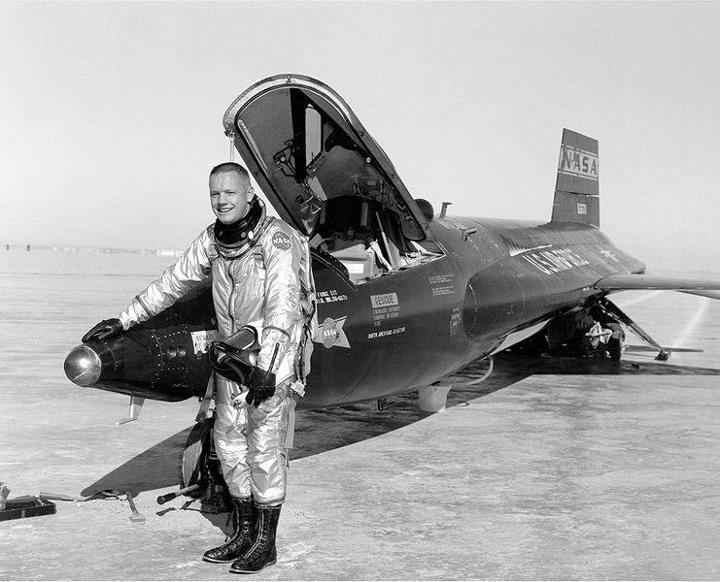
Katrina

In 2005 I was serving as the Chaplain for the Marine Security Forces in Norfolk. I preparing to fly to New Orleans for a conference on Sexual Assault and Prevention. I was watching the weather closely and as Hurricane Katrina tracked toward New Orleans and grew stronger I got word that the conference had been postponed. I was disappointed because I was looking forward to the conference, meeting some colleagues that I had not seen and had planned to see a Minor League ballgame when in town.

My disappointment rapidly shifted to concern about the areas of New Orleans and Gulfport Mississippi. Initially I wasn’t too concerned but watched in horror as the storm strengthened. I was thinking hard about the Navy in Gulfport where I had talked the detailer out of sending me in to be the junior chaplain in the base chapel 2003 because I wanted to remain operational. Had I meekly agreed to the detailer we would have been directly in the path of Katrina’s track.

To watch the disaster unfold was frightening. To see people suffering and the breakdown in civil order as the city was inundated was frightening. Emergency response was woefully insufficient, public order completely broke down as levees failed and local response providers became victims themselves. The Super Dome was a prime evacuation center but it was hit hard, supplies we short and the attempt to provide shelter to the poor who could not evacuate a disaster. State, Local and Federal responses were poorly coordinated and executed.  I some ways New Orleans will never completely recover from Katrina.

It appears Isaac is tracking to New Orleans and Gulfport.  If it continues its path and the models are correct the effects should be nothing like Katrina although massive rainfall and storm surge could create some chaos. Thankfully some dry air is keeping Isaac from gaining too much momentum however Katrina surprised many by gaining a huge amount of power in a very short time.

Local, State and Federal government agencies are on alert, the National Guard has been activated in some areas and evacuations of coastal areas have been going on for a couple of days.

Isaac will have economic impacts beyond any life or property damage due to the storm but, hopefully only short term. Oil drilling and production facilities will be shut down for several days even if they sustain no or little damage and gas prices are moving up. Oil platforms have been strengthened since Katrina but all it takes as one platform to fail to create an ecological disaster.

Isaac has delayed the Republican National Convention in Tampa which was very much in the target zone just a few days ago. Anyone who has ever been to Tampa knows the danger if a storm was to hit it. There have been studies one of which, Project Phoenix http://www.tbrpc.org/tampabaycatplan/pdf/Project_Phoenix_Scenario_Info.pdf  which analyzes the effects of a worst case scenario. In 1921 Tampa was hit by a category 4 storm that did great damage to Tampa and St Petersburg which were then much smaller metropolitan areas.
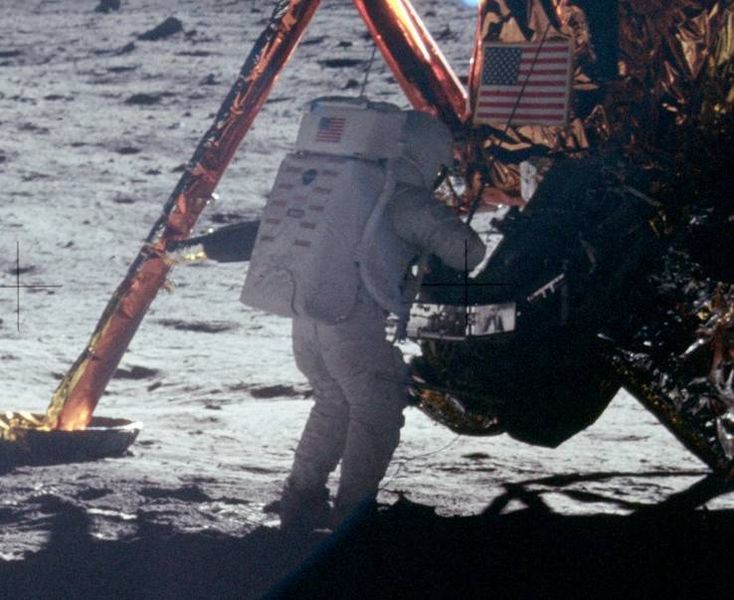
Damage from the 1921 Tampa Bay Hurricane

While Tampa should suffer little from Isaac, the city was right to take preparations and the GOP leadership was right to delay the start of the convention. Since hurricanes often make unexpected moves and sometimes strengthen in ways not expected they could not take that chance. That being said if Isaac hits New Orleans hard it could put a damper on media coverage of the convention. After all in our society natural disasters and human tragedies always get more coverage than political rallies.

I have been through about 6 or 7 hurricanes or tropical storms in North Carolina and Virginia and another in Okinawa. I have rode out hurricanes and Indian Ocean cyclones at sea. they are not to be taken lightly. Last year I experienced Hurricane Irene which was a very large slow moving category one storm which did enough damage in North Carolina, Virginia, Maryland and Pennsylvania to be classed as one of the top ten natural disasters in the history of the country.

So I pray for all of those in the path of Isaac tonight and in the coming days as the storm hits the Gulf Coast and then moves inland.

Peace

Padre Steve+

1 Comment

Filed under History, natural disasters, News and current events

Thoughts on Choosing a President and the Results of Not Getting it Right: Lieutenant General Harold Moore at West Point

Lt.Gen. Harold (Hal) Moore is a legitimate American hero. Moore was commissioned as an infantry officer in the closing months of the Second World War, served in Korea and later in 1965 ed the 1st Battalion 7th Cavalry, 1st Cavalry Division into combat at the Battle of Ia Drang in Vietnam. In that battle, the first major engagement of US forces against North Vietnamese Army Regulars Moore’s outnumbered battalion held off elements of two NVA regiments. Moore’s book We Were Soldiers Once, and Young was adapted and released as the film We Were Soldiers where Moore was portrayed by Mel Gibson. His second book, We are Soldiers Still: A Journey back to the Battlefields of Vietnam are must reads for anyone who wants an honest assessment of going to war and the costs involved.

In 2005 Lt. Gen. Moore was invited to speak at West Point. It was during some of the worst times of the Iraq insurgency and Moore had been a critic of the war and Defense Secretary Donald Rumsfeld. He recounted the question and answer session in We are Soldiers Still:

“In a long question-and-answer session following my speech I was asked about Iraq and then Defense Secretary Rumsfeld. In this place-where cadets live by a code that says they never lie, cheat, steal, or quibble-I was bound to speak the truth as I knew it.

The war in Iraq, I said, is not worth the life of even one American soldier. As for Secretary Rumsfeld, I told them, I never thought I would live long enough to see someone chosen to preside over the Pentagon who made Vietnam-era Defense Secretary Robert McNamara look good by comparison. The cadets sat in stunned silence; their professors were astonished. Some of these cadets would be leading young soldiers in combat in a matter of a few months. They deserved a straight answer.

The expensive lessons learned in Vietnam have been forgotten and a new generation of young American soldiers and Marines are paying the price today, following the orders of civilian political leaders as they are sworn to do. The soldiers and those who lead them will never fail to do their duty. They never have in our history. This is their burden. But there is another duty, another burden, that rests squarely on the shoulders of the American people. They should, by their vote, always choose a commander in chief who is wise, well read in history, thoughtful, and slow-exceedingly slow-to draw the sword and send young men and women out to fight and die for their country. We should not choose for so powerful an office someone who merely looks good on a television screen, speaks and thinks in sixty-second sound bites, and is adept at raising money for a campaign.

If we can’t get that part right then there will never be an end to the insanity that is war and the unending suffering that follows in war’s wake-and we must get it right if we are to survive and prosper as free Americans in this land a million Americans gave their lives to protect and defend.” (Lt. Gen. Harold Moore at West Point Spring 2005) http://www.dailypaul.com/81039/inspiring-quote-from-lt-gen-harold-hal-moore-usa-ret

I make many comments about politics on this site. I am a critic of both parties and and their Presidential candidates. I find much to be desired in the leadership being displayed by many in political office and those running for office. However no matter which party a candidate belongs to I expect, like Lt. Gen. Moore that they are “wise, well read in history, thoughtful, and slow-exceedingly slow-to draw the sword and send young men and women out to fight and die for their country.”

I completely agree with Moore that We should not choose “someone who merely looks good on a television screen, speaks and thinks in sixty-second sound bites, and is adept at raising money for a campaign.”  

We should know better by now. We have experienced the tragedy of leaders who failed their soldiers and this nation in Vietnam, Somalia, Iraq and Afghanistan. However it is the responsibility of the American people to elect well qualified men and women to office. It is not to simply for people vote for their special interests and vote for those that can play the electoral game the best regardless of their actual qualifications or for that matter their wisdom.

I have served as an officer for 29 years in the Army and the Navy. I have served under five Presidents all of whom I found reason to agree with and disagree with on matters of policy. But they were the President and I was and still am not. It is possible that I will serve a sixth President before I retire from the military. Regardless of who that is or which party they represent I will be faithful to my oath and to the Constitution and be respectful of Office of the President and the man, or woman who holds it and I will pray for them. Likewise I pray that the men, or women that they chose as the civilian leaders of the military are both wise and morally courageous, unlike Robert McNamara or Donald Rumsfeld. The same is true for senior officers that set policy and lead troops in combat. We do not need what David Hackworth called the “perfumed princes” as leaders.

That being said I do pray that whoever is elected this November will be more than a good campaigner and be wise and thoughtful before committing the nation, and especially those that serve in the military to war. Our men and women serving in harms’ way deserve as much. Too many American Soldiers, Marines, Sailors and Airmen have died or come back horribly maimed from Vietnam, Iraq and Afghanistan for us not to expect as much from those that seek to lead the nation regardless of their political party.

Moore’s co-author, journalist Joe Galloway, a critic of both President Bush and President Obama wrote concerning Afghanistan in 2010:

“For God’s sake, don’t ratchet up slowly, buying time with the bodies of dead and wounded American soldiers, while you try to sell the wrong war in the wrong place against the wrong enemy to the American people.

For eight years, we’ve heard presidents and other politicians talk about setting conditions for a democratic central government in a country — really a bunch of tribes and clans — that’s never had such a thing in 2,000 years and seemingly doesn’t want one now.” http://www.mcclatchydc.com/2009/09/03/74876/commentary-afghanistan-isnt-worth.html#storylink=cpy   

We should listen more to men like Lt. Gen. Moore and Joe Galloway than to those that use the military for their political or economic gain spouting sound bite foreign policy to mask their ignorance.

Peace

Padre Steve+

4 Comments

Filed under History, iraq,afghanistan, leadership, News and current events, Political Commentary

One Giant Loss for Mankind: Neil Armstrong Dead at 82

http://www.youtube.com/watch?v=sTBIr65cL_E&feature=related

http://www.youtube.com/watch?v=RMINSD7MmT4

Today the United States and the World lost a true hero. Neil Armstrong, the first man to set foot on the Moon died of complications of heart surgery today at the age of 82.

Armstrong was born on August 5th 1930 in Wapakoneta Ohio. He fell in love with flying at an early age and earned his flight certificate when he was just 15 years of age. He became a Naval Aviator at the age of 20 and flew 78 missions over Korea while assigned to VF-51 aboard the USS Essex (CV-9) flying the F9F Panther.  He transferred to the Naval Reserve in August 1952 and returned to Perdue University where he earned a BS in Aeronautical Engineering and the to the University of Southern California where he earned a MS in the same subject. He became a Test Pilot with the National Advisory Committee for Aeronautics in 1955.

After seven years as a test pilot Armstrong was asked to join the fledgling NASA space program in 1962. He was one of two civilian test pilots to join the program, the other Astronauts were active duty Naval Aviators or Air Force Pilots.

He first flew in space in 1966 as the Command Pilot of Gemini 8 and as Commander of the Apollo 11 flight which made history landing on the Moon on July 20th 1969. I was 9 years old and remember it like it was yesterday. His words on setting foot on the surface of the Moon “That’s one small step for [a] man, one giant leap for mankind.” still echo as one of the most memorable statements in human history.

Armstrong retired from NASA in 1971 but remained active in teaching, business international contact and conferences regarding space travel. He served on NASA accident investigations for Apollo 13 of 1970 and the Space Shuttle Challenger disaster in 1986. He remained a proponent of further manned space expeditions and was openly critical of the cancellation of the Ares 1 Launch Vehicle and Constellation Moon Landing program in 2010. He also spoke out in favor of manned missions to Mars even offering his services to command such a mission in 2010 at the age of 80.

The loss of Armstrong is a great loss. He was both a visionary and an explorer.  Our leaders during the great era of the Space Program, from John F Kennedy to Ronald Reagan were visionaries who could unite disparate groups of Americans for common and great goals. One of our great problems today is that our leaders, especially political and business leaders have ceased being visionaries.  Religious leaders are even worse with the most influential promoting ignorance and fear while ignoring or denying science and anything that might challenge faith or more importantly their stranglehold on power. To me such leaders must have an awfully small God in order to promote such ignorance. There seems no vision on either side of the political divide for anything more than what political power and spoils benefits their side.  As a man who comments a lot on this site noted we cannot even accomplish unambitious goals, which have become “pie in the sky dreams.”  Our leaders seem to forget that without vision the people perish. The greatest accomplishment of humankind have been when when men or women reached for more than they could see, when they took risks, dreamed dreams and even in times of war or crisis were willing to believe that better was possible.

We need men and women of  real vision, courage and good will like Armstrong who are willing to make “that giant step.” We need people who actually believe in causes greater than themselves and their interests. We need men and women who are willing, to use the words of Gene Roddenberry “to boldly go where no one has gone before.”

Rest in peace Neil Armstrong.

Peace

Padre Steve+

3 Comments

Filed under History, News and current events