Category Archives: History

Gettysburg Day Three: The Tragedy of Friends at War; Lewis Armistead and Winfield Scott Hancock

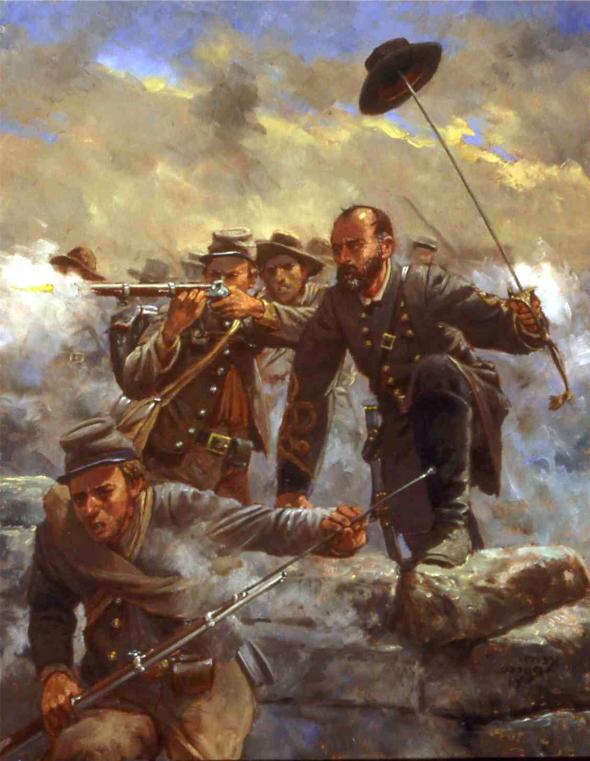
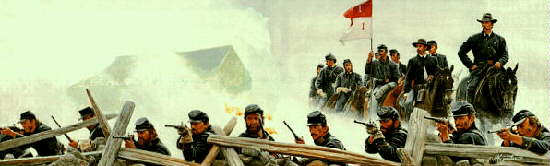
“Armistead at Gettysburg” by Keith Rocco

The bonds of friendship forged by soldiers are some of deepest and long lasting that are formed anywhere.  Those bonds are formed by military professionals in the small rather closed society that is the regular United States military over years of deployments, isolated duty, combat and a culture that is often quite different than that of civilian society.

When the people of a nation goes to war against each other the military is often the last to split and when it does men that were friends and comrades turn their weapons against each other and seldom with pleasure. Mass levies of civilian volunteers motivated by ideological, sectional or religious hatred tend to take up such causes with great aplomb. But those that serve together, even those that may believe in their cause are often torn between oaths that they swore to defend their country and their family and home. When their decisions are made they often part with great sadness knowing that they could one day meet each other on a battlefield.

The American Civil War has many such tales. One of the most remembered due to it being a key story line in Michael Shaara’s Pulitzer Prize winning novel The Killer Angels is that of Union General Winfield Scott Hancock and Confederate General Lewis Armistead. This friendship was immortalized in the movie Gettysburg which is based on Shaara’s novel.

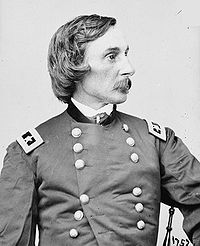
Major General Winfield Scott Hancock USA

Hancock was from Pennsylvania was a career soldier and Infantry officer, a graduate of West Point Class of 1844. He served in Mexico and held numerous positions and in 1861 he was stationed in California as a Quartermaster under the command of Colonel (Brevet Brigadier General) Albert Sidney Johnston. One of his fellow officers, who he and his wife Almira became fast friends with was Captain Lewis Armistead, a twice widowed Virginian who also served as a commander of the New San Diego Garrison under Johnston’s command. Armistead was a nephew of the officer who defended Fort McHenry from the British in the War of 1812, a battle which occasioned Francis Scott Key to pen the Star Spangled Banner.  Armistead had academic difficulties at West Point and also had an altercation with Jubal Early in which he broke a plate over Early’s head.  His father helped him obtain a commission as an Infantry officer and his career was similar to many other officers of his day, Mexico, the Great Plains, Kansas, Utah and California.

As the war clouds built and various southern states seceded from the Union numerous officers were torn between their oath, their friendships with their fellow officers and their deep loyalty to their home state and families even if they personally opposed secession. In the end it was a decided minority of of Southern born officers that remained loyal to the Union, the most prominent of these men were General Winfield Scott and Major General George Thomas, the Rock of Chickamauga. Thomas’s action cost him his relationship with his immediate family who deemed him to be a traitor. Both men were pilloried and demonized in the most base ways by many in the South, during and after the war. Some Southerners who served the Union were executed when captured, George Pickett, who called for Thomas’ death ordered 22 North Carolinians captured fighting for the Union in Kinston North Carolina and he was not alone.

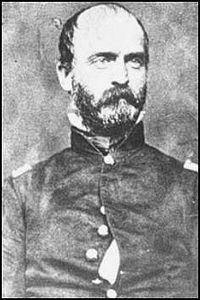
Brigadier General Lewis Armistead CSA

Armistead and other officers asked Hancock, who was a Democrat advice on what he would do if war came. Hancock’s reply was simple. I shall not fight upon the principle of state-rights, but for the Union, whole and undivided” 

The Hancock’s hosted a going away party for their friends departing from the service to join the Confederacy. Almira Hancock wrote that “Hearts were filled with sadness over the surrendering of life-long ties.”with the Johnston’s wife Eliza singing the popular Irish song Kathleen Mavourneen:

“Mavourneen, mavourneen, my sad tears are falling, To think that from Erin and thee I must part!

It may be for years, and it may be forever, Then why art thou silent, thou voice of my heart?…”

Armistead was tearful and said “Hancock, good-by; you can never know what this has cost me, and I hope God will strike me dead if I am ever induced to leave my native soil, should worse come to worse.”

At Gettysburg Armistead spoke his fears to his comrades, including Brigadier General Dick Garnett, another of his comrades from the California days as they met the night before the fateful charge of July 3rd. The next afternoon Armistead and Garnett led their brigades of Pickett’s Division against Hancock’s II Corps which was defending Cemetery Ridge.

During the engagement Garnett was killed just before reaching the Union lines and Hancock gravely wounded. Armistead, leading his brigade breached the Union line with his black hat atop his sword was wounded in the right arm and shoulder and fell near one of the Union artillery pieces, a point now known as “The High Water Mark” of the Confederacy.  As Armistead lay wounded he was approached by Major Bingham of Hancock’s staff who was responding to Armistead’s making a Masonic sign of distress. When Bingham told Armistead of Hancock’s injury Armistead was grieved and told Bingham to “Tell General Hancock for me that I have done him and you all an injury which I shall regret the longest day I live.” He gave Bignham a wrapped Bible and Prayer book to give to Almira Hancock, inscribed were the words “Trust in God and fear nothing.” 

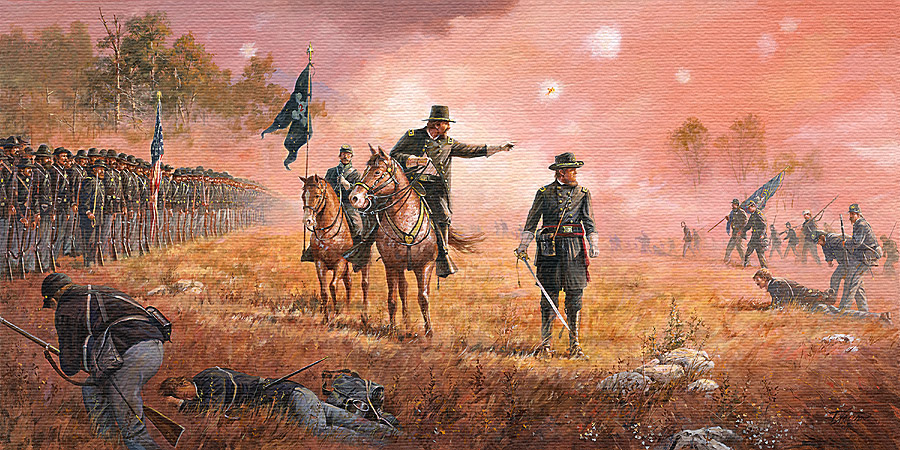
“Minnesota Forward” Hancock directing the Defense by Dale Gallon

Armistead would die from infections caused by his wounds which were initially not thought to be life threatening. Hancock would go on to continued fame and be one of the most admired and respected leaders of the Army during and after the war. He was gracious as a victor and spoke out against reprisals committed against Southerners after the war. He was the Democratic nominee for President losing a close election to James Garfield, losing the popular vote by under 40,000 votes.  It was an era of great political corruption and Hancock was one of the few major public figures Even his political opponents respected him for his integrity and honesty. Former President Rutherford B Hayes said “[i]f, when we make up our estimate of a public man, conspicuous both as a soldier and in civil life, we are to think first and chiefly of his manhood, his integrity, his purity, his singleness of purpose, and his unselfish devotion to duty, we can truthfully say of Hancock that he was through and through pure gold.” 

A few years after his death Republican General Francis A Walker, lamenting the great corruption of the time said:

“Although I did not vote for General Hancock, I am strongly disposed to believe that one of the best things the nation has lost in recent years has been the example and the influence of that chivalric, stately, and splendid gentleman in the White House. Perhaps much which both parties now recognize as having been unfortunate and mischievous during the past thirteen years would have been avoided had General Hancock been elected.”

The story of Hancock and Armistead is one that reminds us of how hardened ideologues can divide a nation to the point of civil war. It is a story that should give pause to any political or spiritual leader that incites people to war against their neighbor and use their ideology to enslave or brutalize their political opponents.

The blood of the approximately 50,000 soldiers that were killed or wounded during the three days of the Battle of Gettysburg is ample reminder of the human suffering brought about by unrestrained ideologues.

Peace

Padre Steve+

8 Comments

Filed under civil war, History

Gettysburg Day Two: The Engineer and the Professors on the Hill, Major General Gouverneur Warren and Colonels Strong Vincent and Joshua Chamberlain

The Confederate Onslaught

“In great deeds, something abides. On great fields, something stays. Forms change and pass; bodies disappear; but spirits linger, to consecrate ground for the vision-place of souls… generations that know us not and that we know not of, heart-drawn to see where and by whom great things were suffered and done for them, shall come to this deathless field, to ponder and dream; and lo! the shadow of a mighty presence shall wrap them in its bosom, and the power of the vision pass into their souls.” ― Joshua Lawrence Chamberlain

The Federal Army at Gettysburg had a wide variety of officers. Many senior officers were graduates of West Point but in the expansion of the Army and the call of up militia from the various states other officers were appointed. Many had no prior military service and at times that lack of experience was tragic. However some of the time those volunteers were the men who by their service helped save the Union.

On July 2nd 1863 the situation at Gettysburg was precarious. Robert E Lee had ordered an attack to seize a hill at the far end of the Federal line, Little Round Top and turn the Union flank. General Meade had ordered III Corps under Major General Dan Sickles to extend it’s line to defend the southern section of his line on Cemetery Ridge. Unfortunately Sickles moved his Corps several hundred yards west forming a vulnerable salient at the Peach Orchard leaving the southern flank undefended.

Major General Gouverneur Warren

When Meade saw the developing situation he sent his Chief Engineer, Major General Gouverneur Warren to take charge of the situation. When Warren arrived he found the hill undefended and he dispatched staff officers to get assistance from any units in the area. Major General George Sykes of V Corps responded sending a messenger to the commander of his 1st Division. The messenger encountered the commander of the division’s 3rd Brigade Colonel Strong Vincent who immediately took the initiative and ordered his four regiments up Little Round Top without waiting for permission.

Warren at Little Round Top

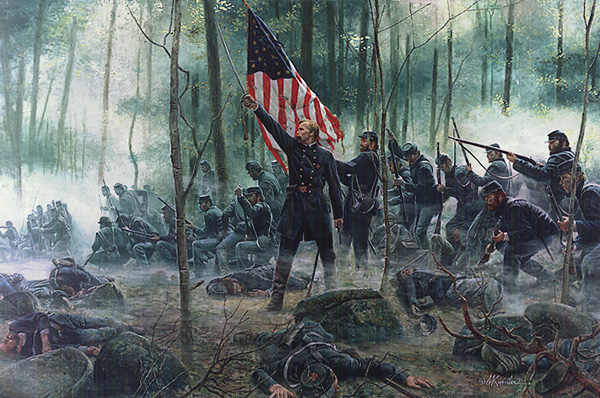
Vincent placed and his regiments arrived in a nick of time. He deployed his regiments, along the spur running to the south if the top of the hill. The 16th Michigan on the right with the 44th New York, 83rd Pennsylvania at his center and the 20th Maine under the Command of Colonel Joshua Chamberlain on the extreme left of the line. His order to Chamberlain was ordered to “hold at all costs.” Chamberlain led his regiment skillfully and when nearly out of ammunition led a charge down the slope of Little Round Top which ended the Confederate chances of gaining the hill and turning the flank of Meade’s Army.

Warren was a West Point graduate and had been a topographical engineer for most of his pre-war career and saw combat against the Sioux at the Battle of Ash Grove in 1855. When the war began Warren was a mathematics instructor at West Point. He helped raise a militia regiment in New York and was appointed to Lieutenant Colonel. As a regimental commander and later brigade commander he saw much combat and was wounded at the Battle of Gaines Mill during the Seven Days.  When the Army was reorganized in February 1863 he was named Chief Engineer of the Army of the Potomac by Major General Joseph Hooker. When Major General Meade relieved Hooker on June 28th he retained Warren.

The 26 year old Colonel Strong Vincent

Colonel Strong Vincent was a 26 year old Harvard graduate and lawyer from Erie Pennsylvania. He was appointed as a 1st Lieutenant and Adjutant of the Erie Regiment and married his wife Elizabeth the same day.  He wrote her before his death “If I fall, remember you have given your husband to the most righteous cause that ever widowed a woman.”  He was commissioned as a Lieutenant Colonel in the 83rd Pennsylvania September 14th 1861and assumed command of the regiment when the commander was killed during the Seven Days in June of 1862. He commanded the regiment at Fredericksburg in December 1862 and was promoted to command the 3rd Brigade when its commander was killed at Chancellorsville in May 1863.

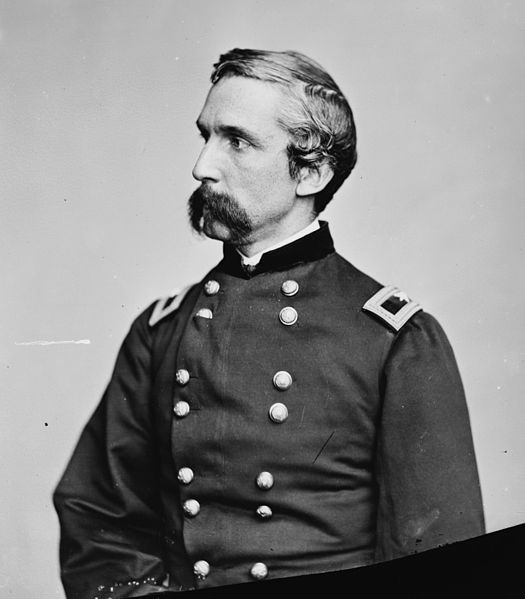
Major General Joshua Chamberlain

Colonel Joshua Chamberlain was a graduate of Bowdoin College and Bangor Theological Seminary, fluent in 9 languages other than English. He was Professor of Rhetoric at Bowdoin before seeking an appointment in a Maine Regiment without consulting either the college or his family. He was offered command of the 20th Maine but asked to be appointed as a Lieutenant Colonel which he was in August 1862. He fought at Fredericksburg and was named commander of the regiment when Colonel Ames, his commander was promoted following Chancellorsville.

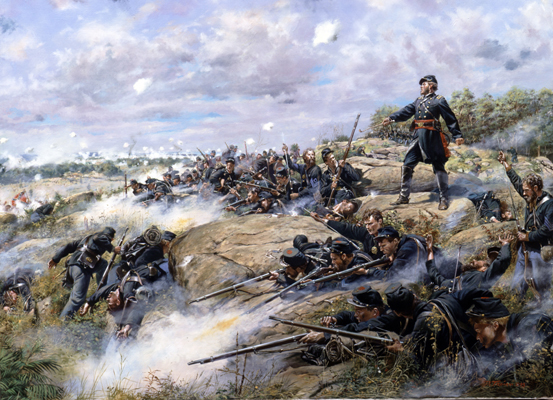
“Don’t Give and Inch!”

The battle of Little Round Top is one of the most famous of all Civil War battles and Chamberlain along with Vincent are immortalized in the film Gettysburg which is based on Michael Shaara’s Pulitzer Prize winning novel The Killer Angels. Vincent was mortally wounded while leading the defense of the hill standing on a large boulder with a riding crop ordering the men of the 16th Michigan who were beginning to waiver “don’t give an inch.” Two months later his wife gave birth to a baby girl. The baby would not live a year and was buried next to him

Warren would become a distinguished Corps commander until he ran afoul of the fiery General Phillip Sheridan in 1865. Sheridan relieved Warren of command of V Corps following the Battle of Five Forks where Sheridan believed that Warren’s Corps had moved too slowly in the attack. The relief was brutal and ruined his career.  Warren resigned his commission as a Major General after the war and returned to his permanent rank as a Major of Engineers. He served another 17 years doing engineering  duty being promoted to Lieutenant Colonel in 1879. He sought a Court of Inquiry to exonerate himself but this was refused until President Grant left office. The Court eventually exonerated him but he died before the results were published. Embittered he directed that he be buried in civilian clothes and without military honors.

Chamberlain was awarded the Medal of Honor for his valor at Little Round Top in 1893. He was gravely wounded during the siege of Petersburg in June of 1864 while commanding a brigade and promoted to Brigadier General. He returned to duty later in the year as commander of the 1st Brigade, 1st Division V Corps and was again wounded at Petersburg in a skirmish at Quaker Road and was promoted to Brevet Major General by Abraham Lincoln. Chamberlain received the surrender of Lee’s decimated Army if Northern Virginia. He would go on to serve as a four term Governor of Maine and remained active with the Grand Army of the Republic veteran’s organization, remained active as an educator and President of Bowdoin College and founded the Maine Institute for the Blind which is now known as the Iris Foundation. He died of his wartime wounds on February 24th 1914.

These three men acted with great courage and alacrity on the afternoon of July 2nd 1863. Warren for his immediate action to call for assistance when he discovered that the hill was undefended and the line exposed, Vincent for his swift taking of responsibility and getting his brigade up the hill before the Confederates could gain the summit and Chamberlain for his dogged refusal to yield against repeated assaults. Only one of the three, Warren was a professional soldier but as a topographic engineer he was an outsider and not fully appreciated by Grant or Sheridan who destroyed his career. The youthful Vincent died of his wounds days after the battle. He was recommended for promotion to Brigadier General by Meade but the promotion was never confirmed by the Senate and Chamberlain is still one of the revered commanders of the Civil War.

It is easy for those enamored with military history to forget the stories behind the men that fought the battles of war. It is easy to isolate and analyze a commander’s actions in battle and ignore the rest of their lives.  I think that this does a great disservice to the men themselves. I say this because everyone who serves in the military has their reasons, some more noble than others and likewise everyone who dons the uniform in time of war gives up something of themselves and sometimes even heroes are destroyed by the institutions that they serve.

Chamberlain wrote: “It is something great and greatening to cherish an ideal; to act in the light of truth that is far-away and far above; to set aside the near advantage, the momentary pleasure; the snatching of seeming good to self; and to act for remoter ends, for higher good, and for interests other than our own.”

Peace

Padre Steve+

1 Comment

Filed under civil war, History, leadership, Military

Gettysburg Day One Accident and Intent: How the Actions of Harry Heth and John Buford Helped Decide the Battle

On June 30th 1863 the Confederate Army of Northern Virginia under the Command of General Robert E Lee was deep in enemy territory. His mission was to draw the Federal Army of the Potomac now under the command of Major General George Gordon Meade into battle and destroy it.  His Army composed of three Corps, the First Corps under Lieutenant General James Longstreet, the Second under Lieutenant General Richard Ewell and the Third Corps under the command of Lieutenant General A.P. Hill.  Lieutenant General J.E.B. Stuart commanded his cavalry but was operating independently of Lee conducting a movement around the Army of the Potomac and unable to provide Lee information on the deployment or movement of the Union forces.

Lee’s army was spread out. Early’s Second Corps was spread out near the Susquehanna River near Harrisburg while his other two corps were concentrated in the area around Cashtown about 8 miles west of Gettysburg. On the 30th a brigade of Major General Harry Heth’s division of Hill’s Corps made a reconnaissance in the direction of Gettysburg. The brigade commander Brigadier General James Pettigrew observed Federal cavalry entering the town and chose not to engage reporting the matter to General Heth.

Major General Henry (Harry) Heth

Heth was a graduate of West Point who had served as an Infantry Officer in the United States Army until he resigned to enter the Confederate Army. He had commanded a company in battle against the Lakota Sioux in 1855 and wrote the first marksmanship manual for use in the U.S. Army. Unlike many of his fellow officers he had not taken part in the Mexican-American War.

Heth spent the early part of the war as Lee’s Quartermaster where he became one of Lee’s favorite officers and began a relationship where Lee looked after his career.  He then served as regimental commander in the actions in the Kanawha Valley of Western Virginia being assigned to Kirby Smith’s Department of Tennessee where he commanded a division but took part no no major actions. Lee brought him back to the Army of Northern Virginia in 1863 to command a brigade in Hill’s Division. He took commanded that brigade at Chancellorsville in which he made an ill advised unsupported attack against Union forces with heavy casualties. He was promted to command of the Division when Hill assumed command of Third Corps when it was created following the death of Lieutenant General Thomas “Stonewall” Jackson.

Lee had given his commanders orders not to provoke a major engagement until the Army was fully concentrated to meet Meade’s troops which had crossed the Potomac and was moving north. However neither Heth nor Hill believed that the troops that Pettigrew observed were a threat, believing them to be nothing more than local militia. Heth ordered half of his division to make a reconnaissance in force on the morning of July 1st. It was not what Lee wanted and Heth’s conduct of it and the resultant action led to the largest battle of the Civil War, the costliest battle.

Lee’s intent was clear. He desired to have a tired and weary Union force under a new commander under political pressure attack him on ground of his choosing. He hoped to defeat the Union forces piecemeal as they came into the battle. By initiating the action Heth caused Lee to have to improvise an attack contrary to his initial plan.  It was an accidental encounter which was compounded by Heth’s action to commit his entire division into battle in spite of his orders.

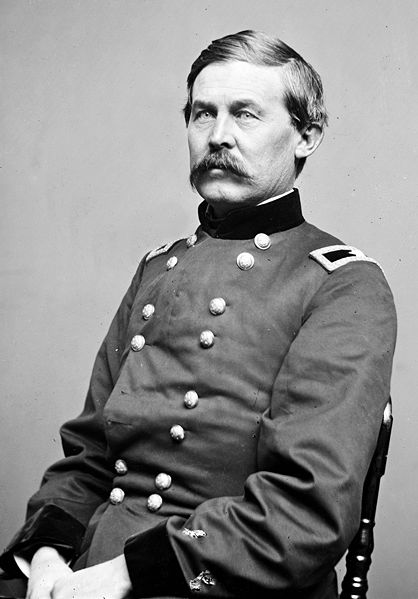
Brigadier General John Buford

The Federal Cavalry was the First Cavalry Division under the Command of Brigadier General John Buford. Buford’s division arrived in Gettysburg ahead of the Army of the Potomac on the 30th. Buford and his brigade commanders immediately recognized the importance of the ground when they saw Pettigrew’s troops. Buford order his troops to deploy on the ridges west of Gettysburg, Herr Ridge, McPherson Ridge and Seminary Ridge. It was the perfect place for a delaying action against superior forces.

Buford was also a graduate of West Point and served as a Cavalry officer in the Army before the war. He was from Kentucky and though his father was a Democrat who had opposed Abraham Lincoln and had family that chose to fight for the Confederacy he remained loyal to his oath and remained in the Army. He served against the Sioux and on peacekeeping duty in the bitterly divided State if Kansas before serving in the Utah War in 1858. He was a modern soldier who recognized that the tactics of the Army had to change due to improvements in weapons and technology.  He was promoted to Brigadier General in 1862 and served in numerous engagements as a Cavalry Brigade commander before being given command of the 1st Cavalry Division after Chancellorsville.

The Delaying Action, July 1st 1863 Map by Hal Jespersen, http://www.posix.com/CW

Buford was a keen student of war and a commander who was able to control his forces. When Heth engaged his division he fought a masterful action which allowed the Infantry Corps of the Army of the Potomac to arrive on the field of battle. His action to select the ground upon which the battle was fought led to the Union victory because even though Federal forces were pushed back on the first day they were able to maintain control of the high ground east of the city with interior lines of communication which they fortified.

Lee decided that he had to force the battle and continue the attack despite the objections of General Longstreet and the fact that he did not fully know the numbers and disposition of the troops arrayed against him. It would be a fateful decision born of a ill conceived action of Heth and correspondingly excellent command decisions of Buford. I am sure that part of the reason for this was Heth’s lack of experience in the East against the Army of the Potomac and limited battle experience as a senior commander. Buford had spent the war in action against Lee’s Army. He knew the capabilities of his enemies and what had to be done to give his side a chance to win.

Like many battles success is often due to such factors.  Had Heth held up and had Lee followed Longstreet’s advice the battle and war might have turned out quite differently. Had Buford not seen the importance of the ground that he selected and deployed himself accordingly the rest of the Army may not have gotten to Gettysburg before Lee had gained the critical ground east and south of the town.

On such decisions battles are decided and wars won.  Heth’s relative inexperience and inability to control his command was a decisive factor in the battle while Buford’s experience and poise under pressure probably saved the Army of the Potomac from a decisive defeat.

Peace

Padre Steve+

3 Comments

Filed under civil war, History, leadership, Military

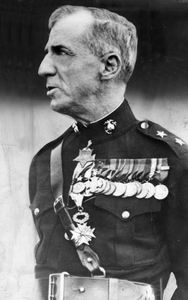
War is a Racket: Remembering Major General Smedley Butler USMC and Why He Matters

What is the cost of war? what is the bill? Major General Smedley Butler wrote: “This bill renders a horrible accounting. Newly placed gravestones. Mangled bodies. Shattered minds. Broken hearts and homes. Economic instability. Depression and all of its attendant miseries. Back -breaking taxation for generations and generations. For a great many years as a soldier I had a suspicion that war was a racket; not only until I retired to civilian life did I fully realize it….”

With all the domestic political news and the apocalyptic talk and actions surrounding John Roberts the Supreme Court and Obamacare it is hard to believe that we are at war for over 10 years and are at war or now preparing for war all over the Middle East. Iran, Syria, Afghanistan, Yemen, Somalia, the Persian Gulf, Libya, Egypt, Pakistan, you name the place there is a real a present danger of US forces becoming involved in even more war.

Maybe it is just me but it doesn’t seem that anybody in Washington has a damned bit of sense. I saw the “tweet” of a Michigan Republican party leader asking if “armed revolt was now justified” because of the Supreme Court ruling on Obamacare. That makes my blood boil, we are at war and this idiot wants to have a real live civil war and he is not alone. The process is to win elections if you want to change laws not to threaten civil war or revolution when the cause that you are against and take to the Supreme Court gets upheld for whatever reason. Anyone with a half a grain of sense knows that if you take something to the Supreme Court that you need to ask yourself the “Dirty Harry” question: “Do you feel lucky? Well do you punk?” When you go to the Supreme Court you put your case in front of nine Justices and not the electorate. That goes for Liberals as well as Conservatives.

The simple act of working together in the legislative process has been sabotaged by both parties over the years.  This finally hit the culminating point when GOP pushed through the self inflicted wound of the Budget Control Act of 2012. It is this act which now threatens the military which is at war with “sequestration.”  This threatens deep cuts in the military beyond those already anticipated and planned for by DOD. The Republicans are now trying to change it and the Administration is refusing to budge on the issue. Again this didn’t need to happen but brinksmanship is the order of the day.

There are no statesmen left in Washington DC only shills of the Right and Left and their masters from Wall Street to K Street. The only people profiting from this are the war profiteers who even if the budget gets cut and they fail to deliver usable weapon systems on time or in budget will still get paid. The losers will be the military personnel who must fight the wars who will get tossed onto the street by those that claim that personnel costs are the problem. Of course those that make this point are almost always the same lobbyists that shill for the defense industries and the banks. But enough about them.

Right now over 100,000 American military personnel and tens of thousands of other Department of Defense, Federal law enforcement, intelligence, diplomatic, humanitarian workers as well as contractors are fighting a war in Afghanistan. Tens of thousands more (mostly contractors)  are helping to shore up the Iraqi government or are fighting wars by other names in Pakistan, Yemen, the Horn of Africa or are deployed to counter Iran or standing by to assist Turkey if it comes into conflict with Syria. Of course this does not take into account the instability in Egypt, Libya, Eastern and Central Africa that threatens even more war or the potential of turmoil in Europe should the Euro Crisis bring about more financial disaster or even revolution in countries that are our allies. By the way let’s not forget about the nutcase leaders of North Korea who could provoke war on that side of the world in a heartbeat.

But never mind this, let’s fight each other instead threaten insurrection when we don’t get our way. But wait, I digress…

Did you know that while Americans stand in harms way almost every real or potential enemy has been armed, subsidized or assisted by American corporations and paid for by American tax dollars.  We have armed much of the world with weapons that have already in Iraq and Afghanistan killed thousands of American military personnel. But those were small time weapons compared to what we have provided to Egypt, Pakistan, Saudi Arabia and yes even Israel. F-15, F-16 and F-18 fighter planes, Tomahawk cruise missiles and Harpoon Anti-Ship Missiles, M-1 Tanks, M113 Fighting vehicles, Patriot Air Defense systems, you name the weapons system the war profiteers will sell it and US taxpayers will pay for it. These are weapons that very easily could be used with great effect to attack American interests should leaders in any of those countries decide to use them against us. I only include Israel because in 1967 its forces viciously attacked the USS Liberty which was operating in the Eastern Mediterranean Sea as Israel launched its pre-emptive war against Egypt. Although all of these countries are “allies” we must remember that alliances are only as good as the interests and values that unite nations.

Our defense industries with the support of the government sell advanced weapons to nations that often are less than trustworthy allies, allies of convenience that have little love for the United States but welcome the weapons and training that we provide.  They often use them to suppress the aspirations of their own people and plant the cultivate the seeds of radicalism and revolution.  It is hard not to cringe when pro-democracy protestors are killed by totalitarian regimes whose police and military are armed to the teeth with American made weapons. When those totalitarian regimes fall as did that of the Shah of Iran in 1979 those weapons fall into the hands of people radicalized against us by our support of their former oppressors.

Certainly nobody seriously believes that the angry masses in the countries that we have armed to the teeth with the latest in American weaponry would not use that weaponry against us should they desire.  But wait…. our politicians, arms dealers, bankers and their political, religious and financial backers certainly wouldn’t put Americans in harms way? Perish the thought, but not so quickly. They have done so before and will do it again.

Smedley Butler is one of under two dozen American military personnel to win the Congressional Medal of Honor twice. He saw the dangers of Fascism as well as the danger of unlimited corporate and business power to profit by war. Butler was not only a  valiant Marine he was also a commander that in war and peace cared about those who served. He saw how American finance and banking interests helped drag us into the Fist World War, the promises broken by the government and the lives destroyed by war.
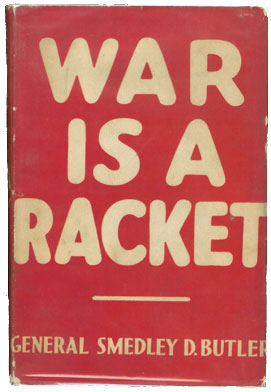
In his book War is a Racket Butler wrote eloquently about how the heads of corporations and their political supporters in both parties were the only benefactors of war. He wrote of the plight of the soldiers that served and returned wounded and often changed by war and he did not mince words in what he saw. He became an anti-war activist. He was a supporter of the Bonus Army, the veterans that “occupied” Washington DC during the last year of the Hoover Administration to get the bonuses promised for their service and were violently evicted by troops under the command of General Douglas MacArthur. If he was alive today I have no doubt that he would be an active supporter of the current “Occupy” movement and opponent of politicians, political activists, lobbyists and even preachers that advocate even more war.

Butler’s War is a Racket as well as other published works are a worthwhile read and should make the most rabid fan of war think twice. Butler’s patriotism and devotion to the United States and the Constitution is unquestioned. His warnings are strong, he was a prophet in regard to the dangers of the Military-Industrial Complex well before President Eisenhower coined the term as he left office. He detailed how corporations made obscene profits often by selling the US Military vast amounts of materials that it could not possibly use and which taxpayers bought while business leaders and bankers made their fortunes that they never had realized when the nation was at peace. He reminds us of the dangers that our founders recognized about entwining ourselves in other people’s wars. While his answers on how to end war are now utopian dreams because of advances in technology and the wars which now rage without end in sight they are nonetheless not a bad place to start a debate.

Butler writes movingly about the price paid by veterans years after the war, men broken in body, mind and spirit from their war service.

“But the soldier pays the biggest part of this bill.

If you don’t believe this, visit the American cemeteries on the battlefields abroad. Or visit  any of the veterans’ hospitals in the United States….I have visited eighteen government hospitals for veterans. In them are about 50,000 destroyed men- men who were the pick of the nation eighteen years ago. The very able chief surgeon at the government hospital in Milwaukee, where there are 3,800 of the living dead, told me that mortality among veterans is three times as great as among those who stayed home.” 

One would think that things would be better now but our veterans’ health care system is a train wreck and there is an epidemic of suicide among active duty troops and veterans. In 2005 after years of hand wringing the Bush administration grudgingly increased the number of Soldiers and Marines even while cutting Navy personnel and ships to the  minimum that they could despite ever increasing operational tempos. The Navy was reduced by over 50,000 sailors during the Bush years and now when the Navy is needed more it has been reduced to the point that 8-10 month deployments with short turn arounds will be normal.

Now the Obama administration is cutting back partly due to the withdraw from Iraq but mostly because of the economic crisis. However the bulk of these cuts are falling on the military personnel and not the war profiteers. The Army will be cut by nearly 80,000 in the coming years the Marines by 20,000 and that may increase if the budget takes the sequestration hit without any reduction in operational tempo. These Soldiers and Marines will enter a bleak job market where many employers give little value to military experience or training, which has resulted in a vastly higher unemployment rate for Iraq and Afghanistan veterans than the general population.

It wasn’t much different in Butler’s day. He writes:

“Boys with a normal viewpoint were taken out of the fields and offices and factories and classrooms and put into the ranks. They were remolded; they were made over; they were made to “about face”; to regard murder as the order of the day. They were put shoulder to shoulder and through mass psychology, they were entirely changed. We used them for a couple of years and trained them to think of nothing but killing and being killed.

The suddenly, we discharged them and told them to make another “about face”! This time they had to do their own readjusting, sans mass psychology, sans officers’ aid and advice, sans nation-wide propaganda. We didn’t need them anymore. So we scattered them about without any “three minute” or “Liberty Loan” speeches or parades.”

Butler recounted another visit to a different veterans’ hospital:

“In the government hospital at Marion, Indiana 1,800 of these boys are in pens! Five hundred of them in a barracks with steel bars and wires all around the outside of the buildings and on the porches. These have already been mentally destroyed. These boys don’t even look like human beings. Oh, the looks on their faces! Physically they are in good shape but mentally they are gone.” 

There are thousands and thousands of these cases and more and more are coming in all the time…

That’s a part of the bill. So much for the dead-they have paid their part of the war profits. So much for the mentally and physically wounded- they are paying now with thier share of the war profits. But others paid with the heartbreaks when they tore themselves away for their firesides and their families to don the uniform of Uncle Sam- on which a profit had been made….”

I could go on but I think that Butler says it quite well and with the passion of a Marine who was wounded on more than one occasion and won the Medal of Honor twice.

The only people that want war are those that profit from it and don’t have to pay the price paid by those that have to fight them and pay for them. When I see pictures of Mitt Romney protesting in support of the Vietnam war while getting deferment after deferment to avoid service it makes my head spin. My head spins even more when I hear him talking brazenly about committing US troops to even more war. For me the pictures of Romney’s pro-war protests as a college student avoiding war on educational and religious service deferments as millions of other Americans went to war are up there with the pictures of “Hanoi” Jane Fonda giving aid and comfort to those that were killing our troops.

Butler’s detractors and they are legion on the political right attempt to paint him as an isolationist or appeaser of Hitler. However they misunderstand him and his work. They don’t understand as Butler understood that there would not have been a Nazi Germany without Versailles and that was not possible without the American intervention on the side of Britain and France in 1917. That involvement was driven by the bankers and industrialists who had supplied raw materials, weapons and technical patents to the British and French, and had done so before with the Germans who believed that they would lose their investments if the Germans won the war. That would have happened in late 1917 or early 1918 had not the Americans declared war and entered the war on the side of the British and French.

Most of Butler’s current critics have never served a day in uniform much less a day in a combat zone. They make their livings and profits by the sacrifice of others and other than a few of his quotes have never read anything about him.

If you sense indignation in my voice it is real. I have lived the nightmare of PTSD for over 4 years. I see and work with the young men and women that have bravely endured the hardship of combat deployments and come home physically, mentally and spiritually wounded. To our credit we are trying to do better but for the war profiteers that will be too much. If military spending is cut you can bet that they will not take the hit that military personnel, their families and our veterans will take. They and their political benefactors will not allow it.

I am a military man through and through. I have spent nearly my whole life associated with the military as a dependent of a Navy Chief who served in Vietnam and a career of over 30 years divided between the Army and Navy. Some of my friends dads did not return from Vietnam, other friends and those who I have served with have paid with their lives in Iraq or Afghanistan while others suffer the continuing wounds of war.

This is personal for me and it is also motivated by my faith as a Christian. Butler chided the pro-war clergy propagandists of the Great War. He wrote:

“So vicious was this war propaganda that even God was brought into it. With few exceptions our clergymen joined in the clamor to kill, kill, kill. To kill Germans. God is on our side…it is his will that the Germans be killed.”

Such preaching is not much different from the right wing pro-war preachers who advocate killing Moslems simply because they are Moslems and that go out of their way to preach the value of “pre-emptive war” despite such wars being against the Christian understanding of the  “Just War” or international law against such war that we as Americans helped develop after World War Two at Nuremberg and to which we hold the leaders of what we call “rogue nations.”

I only wish that our leaders; political leaders of both parties, religious leaders, and even business leaders would see the folly of this course and their responsibility for the results.

Someone has to say it.

Peace

Padre Steve+

Note: All quotations from “War is a Racket” by Smedley Butler copyright 1935 and 2003 by the Butler family. Amazon Kindle edition. 

6 Comments

Filed under faith, History, iraq,afghanistan, Military, national security, News and current events, Political Commentary, PTSD, shipmates and veterans

Corpsman Up! U.S. Navy Hospital Corps Turns 114 Years Old

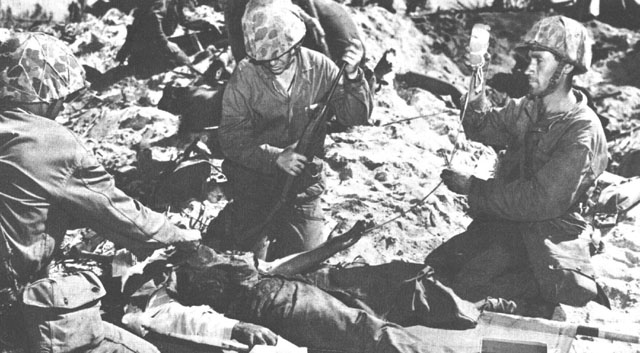
Corpsmen treating wounded Marine on Eniwetok Island 

“You guys are the Marine’s doctors; There’s no better in the business than a Navy Corpsman….”  Lieutenant General Lewis B. “Chesty” Puller, U.S.M.C

The numbers speak volumes: 22 Congressional Medals of Honor,174 Navy Crosses, 31 Distinguished Service Crosses (US Army Decoration), 946 Silver Stars1582 Bronze Stars, 22 Ships named after Corpsmen and 2012 Corpsmen killed in action since President William McKinley the establishment of the rating by by Congress which was into law on June 17th 1898.

Known by Marines and Sailors simply as “Doc” Corpsmen have served everywhere the Navy and Marine Corps have served or fought since the Spanish American War. The rating is quite remarkable because the Corpsmen are often the only medical support immediately available to sailors and Marines at “the tip of the spear.”

As medicine and surgery became more scientific and advanced during the industrial and scientific revolutions of the 1800s military physicians began to lobby for trained assistants.  Early in our nation’s history it was up to individual ships Captains to appoint assistants to the ship’s surgeons. Initially known by the British Royal Navy nickname “Lolly Boys” which referred to the ladle of porridge given to the sick, the men helped the surgeon prepare the operating area usually found deep in the hold of the ship on the Orlop Deck before battle and to help keep the surgeon supplied with hot irons to cauterize wounds and to sand the deck to keep the surgeon from slipping on the blood of the wounded.  The terminology would change throughout the years and in 1841 a senior rating of Surgeon’s Steward was introduced and later changed to Apothecary which required the completion of a course in basic pharmacy.

By the 1870s pressure was growing for reform of the rating but it was not until 1897, 10 years after the US Army established its enlisted Hospital Corps that the reformers were successful and the Surgeon General and his supporters were able to convince the Navy Department to push for the reforms in Congress.

The new Corpsmen served throughout the fleet and with the Marines and the rating was expanded to include two Apprentice ranks, three grades of Petty Officers and a Chief Petty Officer who were called Pharmacist Mates. Following World War Two the Navy changed the name of the rating to the generic term that Sailors and Marines had used for years, Hospital Corpsman or Hospitalman. The current rank structure was adopted in 1958.

Corpsmen with the Marines in every battle since their inception in 1898. They have  served aboard ships and often are the sole medical provider. Those serving in such capacity receive additional training as Independent Duty Corpsmen.  Those that serve with the Marines receive additional training at Field Medical Service School while many others receive specialized training in various technical fields within the Medical Department.  Many serve with the Marines, EOD, SEALS, Seabees and in Field Hospitals in Afghanistan caring for US and Allied wounded as well as local Afghan civilians. They can be found around the world wherever the Navy is in humanitarian and operations from Haiti to Indonesia. In every clime and place Corpsmen have accompanied Marines and Sailors to war. Today over 20,000 active duty and reserve Corpsmen serve aboard ships, in medical facilities, with EOD, Special Warfare, the Seabees and with the Fleet Marine Force. Many Navy Physicians, Nurses and Medical Service Corps Officers began their careers as Corpsmen.

As a Navy Brat a lot of my medical care as a child came from Corpsmen. One saved me from an overdose of baby Aspirin when I was about 3 years old when we were stationed in the Philippines, another set a cast on my arm when I broke it jumping my bike across a ditch in 6th grade. As an adult I have had the honor of serving with Corpsmen in the Fleet Marine Force, aboard the USS Hue City, in Iraq, with Navy EOD and for the past four years in Naval Medical Centers and Hospitals.

Corpsmen are amazing, especially when you need them.

Happy Birthday “Doc.”

Peace

Padre Steve+

Leave a comment

Filed under History, US Navy

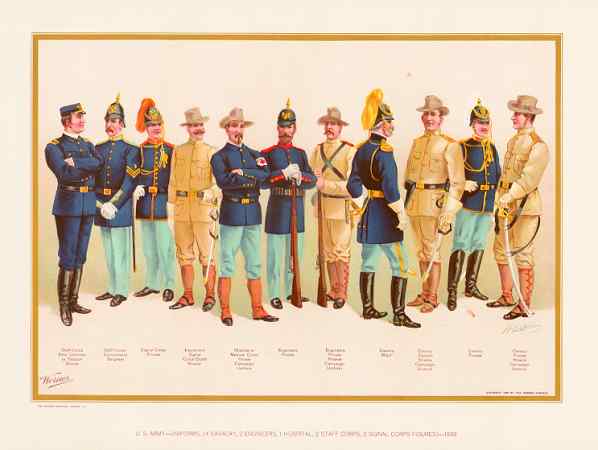
Happy 237th Birthday United States Army!

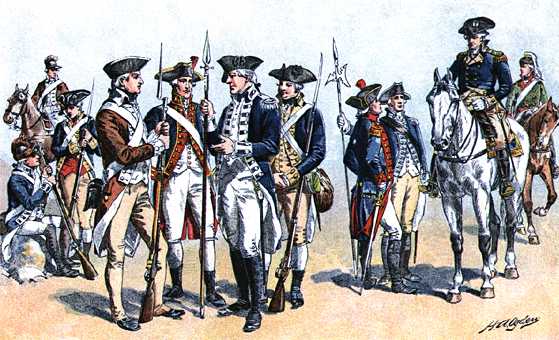
On June 14th 1775 the Continental Congress authorized the enlistment of soldiers for 10 companies of infantry. From that humble beginning the United States Army has been part of the tapestry of the United States for 237 years.

For most of its history the Army was a small volunteer force backed up by the Militia forces of each State.  In major conflicts it was expanded by the mobilization of militia and the recruitment of volunteers, both Regular and State and during the latter part of the Civil War men were conscripted by the use of a draft.  This was repeated during the World Wars, Korea and Vietnam.

Its battle honors are many. Saratoga and Ticonderoga, Princeton and Trenton, Valley Forge, Cowpens and Yorktown helped secure our freedom from England. The Army was an integral part of the nation’s westward expansion and actions against the British in Canada and against Mexico at various times. It was divided during the Civil War as men who had fought together in Mexico and had served on the Frontier declared their loyalty to the Union or their home States. The conflict was the deadliest in our nation’s history with over 600,000 American Soldiers from the North and the South dying in battle. The battles are legendary but to most modern Americans unimaginable. Names like Antietam, Chancellorsville, Fredericksburg, Shiloh, Vicksburg, Cold Harbor, the Seven Days, the Wilderness, Spotsylvania Court House, First and Second Bull Run, Chickamauga, Petersburg, Appomattox Courthouse and Gettysburg became etched into our history.

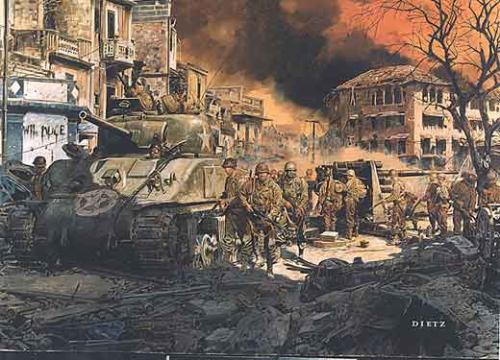
The Army would serve overseas in Cuba at San Juan Hill and at Manilla during the Spanish American War, over a half million Americans would serve in France during the First World War as part of the American Expeditionary Force under General John “Black Jack” Pershing. It was blooded on the Marne and St Michel and though less experienced than it’s British and French Allies it learned fast and became an effective fighting force. After the war it was reduced in size and the Army was expanded again in 1940 as war clouds gathered in Europe and Asia and in the Second World War 90 Divisions would be formed to battle the Germans, Italians and Japanese. Millions of Americans who served in the Army became part of what we know as the “Greatest Generation” and following the war would lead the country even as Soldiers continued to guard the perimeter of freedom during the 40 years of the Cold War.

Called on again the Army served in Korea and then Vietnam. Those were thankless wars that took a bitter toll on the Army and the men and women, both volunteers and draftees who served.  It became an all volunteer force in 1974 when the draft was ended. It served in the 1980s in areas closer to home at Grenada and Panama and in 1990 even as it was drawing down in numbers it sent hundreds of thousands of soldiers to liberate Kuwait from Saddam Hussein in 1991.  It served in Somalia and Haiti and was part of the NATO actions in the Balkans and provided a shield to Kuwait during the 1990s.

Following the attacks of September 11th 2001 the Army has served in Afghanistan and Iraq. Hundreds of thousands of Regular Army, National Guard and Army Reserve Soldiers have served in those wars, many having deployed numerous times.

Many Americans who have led our nation as civilians, in government, industry and in the struggle for civil rights are veterans of the Army. Presidents, legislators and Supreme Court Justices have worn Army blue.

Today the Army remains engaged in Afghanistan and is working to prepare itself for whatever the future will bring. Soldiers train, deploy and fight every day. Army families have stood by their Soldier’s since the beginning of the nation.

I served the first 17 1/2 years of my military career in the Army, the National Guard and Army Reserve. Though I am in the Navy now I can say that I was once a Soldier.

Happy Birthday to all those who serve and thank you to all that have worn the uniform of the United States Army.

Peace

Padre Steve+

Leave a comment

Filed under History, Military

Why This? Why Me? Why Now? “Leak: Why Mark Felt Became Deep Throat” by Max Holland

Motives do matter and actions often have unintended consequences. That is the lesson of Max Holland’s book about Mark Felt. Felt was the man whose leaks helped end the Presidency of Richard Nixon and skyrocket the young and obscure Bob Woodward and Carl Bernstein to fame. For more than three decades Mark Felt’s identity remained hidden a mystery man to the public, a man popularized by the dark moniker “Deep Throat.” His role as the leaker was suspected by some, including President Nixon and some of his staff but known only for sure by Woodward, Bernstein and Washington Post Editor Ben Bradlee.

In this truly scholarly book Max Holland pieces together the dark underside of the Watergate tapestry that Woodward and Bernstein helped to break in 1972 and would go on to write about in All the President’s Men and The Final Days. It is a book that is important because it is the first account to seriously explore the motivation of Mark Felt when he began to leak and the background story of the monumental post J. Edgar Hoover FBI power struggle.  That story which in normal times would have been a major story was missed in an era where the country was in turmoil and there were so many other “big” stories to cover.

Taking advantage of more recent revelations, disclosures and evidence Holland paints a picture that not only broadens one’s understanding of Watergate but helps the reader understand how important it is to understand the motivations of those that were involved, Nixon and his staff, Felt and other FBI officials and the media.

The picture painted by Holland of Felt makes his role in the story more understandable. Felt was not the altruistic leaker of myth who sought to destroy the Nixon Presidency, something that was the picture painted by Woodward and Bernstein. His motivations were much more down to earth. He wanted to use his knowledge to ensure that he became Hoover’s successor as the Director of the FBI. He used it to destroy L. Patrick Gray who served as the interim Director and his chief rival in the Bureau William C. “Bill” Sullivan in the eyes of the White House, Congress, the Bureau and the media. Felt’s leaks helped blow the lid off of the White House cover up of the Watergate break-in and which led to the resignation of President Nixon and the conviction of a number of his closest advisors. Felt’s duplicity which included deceiving the Administration, Congress, his superiors and the media with falsehoods even as he revealed key truths is amazing to behold.

The picture that Holland paints of the White House is not pretty. The moral depravity and ruthlessness of Nixon and his advisors is shown without dehumanizing them.  In fact they become more human in Holland’s account.  Likewise Holland’s portrayal of other key figures in Felt’s story at the FBI, L. Patrick Gray, William Ruckelshaus and William Sullivan is compelling. The naive and compliant Gray, Felt’s bitter rival Sullivan and the “sweeper” (to use the term given to Harvey Keitel’s character Winston “the Wolf” Wolfe in Pulp Fiction) Ruckelshaus who helps to “sweep” Felt out of the FBI.

But the most interesting part of the book for me is Holland’s portrayal of Woodward and Bernstein. They are young and idealistic and Woodward believes whatever Felt tells him, including deliberate misinformation. What jumped out at me was their willingness to take at face value what Felt told them and not to explore his motivations which could have led to even more revelations that could have shaken the FBI to its core.  Likewise was Woodward’s willingness to press the limits with information provided by Felt going beyond what Felt demanded for secrecy but which Felt, even though upset by the reporter continued to provide information cumulating in his long and rambling confession to Woodward following his retirement under pressure on May 16th 1973.
They, particularly Woodward did not ask themselves the three key questions that anyone should ask when someone comes to them with this kind of information: Why this? Why this information. Why Me?  Why am I being chosen to receive the information. Why Now? Why is the source telling me this information now. Those three questions could have blown the case open even more had they explored them. Of course they were caught up in the chase for “scoops” with rivals at the New York Times, The Washington Sun and Time Magazine and chose to believe what Felt told them, something that occasionally left them hanging when the information was wrong.
Conversely Felt’s distain and lack of respect for the media and the belief that he could use Woodward, Bernstein and others in the media to further his goals with impunity proved false. He became careless and caused the Nixon Administration to suspect him and work to force him out of the FBI without drawing more attention to themselves.

Holland also covers the “cover-up” of “Deep Throat’s identity which was maintained by Felt, Woodward and Bernstein until Felt was in the beginning stages of dementia and his family was ready to reveal his role.  The dual myths of Deep Throat’s motives and the role of the press as the “men in the  white hats” against the evil bad guys in the White House are exposed by Holland who points out how much of the investigation broken by Woodward and Bernstein was being accomplished by FBI agents and appointed to investigate the break-in and staff members at the Committee to Re-Elect the President who were appalled by the illegality of what they saw being done by their superiors.

The book is excellently sourced and researched. It is a compelling narrative that sheds light on a dark period of our nation’s history which also serves as a reminder to those who investigate “leaks” from well placed sources that there is always another layer of motivation and intent that cannot be discounted and must be factored into the investigation.

This is relevant today as the media, Congress and the the Justice Department investigate leaks from inside the Obama White House regarding national security information. Why This? Why Me? Why Now? Those are the questions. Thanks to Max Holland we now know much of what transpired behind the scenes as Woodward and Bernstein investigated and published their accounts of the Watergate break-in and cover up with the information provided by Mark Felt.

The book Leak: How Mark Felt Became Deep Throat is published by the University of Kansas Press and is available at http://www.amazon.com/Leak-Mark-Felt-Became-Throat/dp/0700618295/ref=sr_1_1?ie=UTF8&qid=1339544616&sr=8-1&keywords=leak

5 Comments

Filed under books and literature, History, Political Commentary

The Uncomfortable Truth about the Rise in Military Suicides

The truth can be uncomfortable and truthfully most people don’t like to deal with uncomfortable things.  Suicide is one of those things that tend to make us uncomfortable.  Occasionally someone will demand the truth and when they finally get, the truth becomes a very uncomfortable thing and frankly many people cannot handle the truth. It reminds me of the exchange in the movie A Few Good Men where Colonel Jessup played by Jack Nicholson tells Lieutenant Dan Caffey played by the Tom Cruise: “You want the truth, you can’t handle the truth!”

The United States Military has been struggling with an upsurge of suicides and suicide attempts among its personnel since 2005.  Before that point military suicide rates were comparable or lower than comparable civilian populations. That is no longer the case, the military suicide rate is now higher than the civilian rate by a statistically significant percent.

The Associated Press reported a Defense Department report noting that in the first 155 days of 2012 that 154 active duty service members had killed themselves. That number is going up, I know of at least two at my base that have occurred since this report was released including a murder suicide committed by a Staff Sergeant who had recently returned from Afghanistan.

The military has tried to stem the tide. It has bolstered its mental health services and suicide prevention programs but the numbers despite leveling out in 2010 and 2011 have been rising. These numbers are reaching staggering proportions in the active duty, reserve and discharged veteran ranks.

A Veteran’s Administration Crisis line reported that in in 2011 it had received over 164,000 calls last year. It reported 6760 rescues and noted that 2300 self reported Active Duty personnel had called their hotline as well as over 12000 calls from family members or friends of veterans regarding their loved ones.

The rise in suicides particularly as the mission in Iraq has ended and Afghanistan is beginning to draw down has surprised many both inside and outside the military. While many of the men and women who committed or   attempted suicide even more have done so who have not deployed. People are speculating about the reasons for this and we know a lot of the answers and underlying causes.

First and foremost is the stress put on the force by 10 years of non-stop deployments to combat zones and fighting two major insurgencies at the same time and the resultant effects: Soldiers, Sailors, Marines and Airmen killed and wounded, combat stress injuries, PTSD, TBI, moral injury, family issues, divorce, infidelity, financial problems, domestic violence, sexual assault, alcoholism and drug abuse. As a Chaplain I know many young men and women who grew up in Christian homes and had what they described as a deep faith who after war have lost their faith. I see an increasing number of these young men and women.

An additional factor is the fact that we are entering a period of time where Soldiers and Marines and to a lesser degree Sailors and Airmen are being threatened with a massive drawdown in numbers.  This will force many to leave the military in the midst of a long term economic downturn that could get worse based on the precarious economy of the Eurozone which threatens the US economy.

There is the perception on the part of many in the military that they fight the war alone. There is a real lack of understanding in the civilian population as a whole about what is involved in going to war. Since only about one half of one percent of the American population is in the military at any given time this should not be a surprise. Finally there is a widely held belief among those that fight the war, no matter what sacrifices they make in Afghanistan that it will not matter in the end, that the war cannot be won. No one wants to admit this but the fact of the matter is that it is true because neither political reads history.

However as important as all of those factors are they are now joined by another factor that was not a factor in the early part of the war. The bond of unit cohesion which was a positive factor is eroding. Prior to the war and during the first few years of it unit cohesion was strengthened by seasoned and mature Staff NCOs, Petty Officers. These men and women had risen through the ranks and were seasoned by years of training, well rounded careers, combat experience and deployments. Many had some amount of college education. They dealt with their own stress well and were excellent leaders and mentors to junior personnel and the young officers that they helped to train.

I was at a training conference in March attended by a couple of hundred Chaplains and Mental Health Professionals. One of the seminars dealt with a program to train the young NCOs and Petty Officers to be first responders who could care for their Marines and Sailors. During the question and answer portion I decided to bring this up. I said that “the program would be great if we had the same force that we started the war with and that the men and women that we were depending on to do this job were themselves among the injured.” I said that the force was “hardened but brittle.” A number of people including the Subject Matter Expert agreed with me, others, mostly those who were relatively new to the military looked at me like I had gone off the reservation. I brought this up at another conference this month with a similar response.

That seasoned core is gone. In their place are younger, combat hardened veterans. Unfortunately many of these young men and women, charged with leading and training the new Soldiers, Marines, Sailors and Airmen are damaged goods themselves. They have been back and forth to war so many times that they bear unspeakable burdens. Many suffer from unreported PTSD, struggle with alcoholism and have pressing personal or family problems. Some of them take out these issues on the new troops, something that I think is directly related to the suicide epidemic and other problems. The attitudes of some have become poisonous to good order and discipline and actually compromise the trust of of service members to the chain of command. That trust was essential and helped get the military through the first part of this war but I see it being eroded on a daily basis.

A glaring example of this comes not from a NCO but a Army General, the Commander of the 1st Armored Division at Fort Bliss Texas, Major General Dana Pittard at Fort Bliss Texas. General Pittard wrote on his blog: “I am personally fed up with soldiers who are choosing to take their own lives so that others can clean up their mess. Be an adult, act like an adult, and deal with your real-life problems like the rest of us.”  His attitude serves as a reminder that for many that some leaders see those suffering from PTSD, TBI or other psychological conditions as ‘broken.” Ask any Marine, Soldier, Sailor or Airmen what what it is to be labeled as “broken.” There is still a stigma attached to mental illness, depression, PTSD, suicide and being “broken” that is not helped by statements of leaders like General Pittard.

As a result the resiliency of the force is at stake. Anyone who served in the years following the Vietnam War and the beginning of the all volunteer military can see similarities then and now.  We have not reached the point where the force is broken but the situation will not show much improvement until some point of stability is reached.

I cannot state with certainty the actual proportions of this factor, just my own observations that come from counseling and listening to Marines and Sailors every day. I’m sure that the same is true in the Army where judging by what I read it seems to be worse. The Army suicide rates are the highest in the military.

What has to be done is bigger than the military itself can do. There has to be a national commitment to both finding a way to lessen the stress on the force and to do more than offer platitudes about “supporting the troops.” The truth is that as a nation we refused to pay the cost of these wars and tried to fight them on the cheap. Political leaders after September 11th 2001 told people to “go back to normal” or “go shopping” and did not call the nation to war. The nation was untouched, no one paid a dime in extra taxes and no one was forced to join the military. The burden was placed squarely on those who volunteered. That burden has not been removed and unless the American people and Congress do more than telling the military to “do more with less” while lining the pockets of defense contractors who cannot seem to produce weapons systems without major production problems, cost overruns that are never produced in the promised numbers as well as the war profiteers of the military industrial complex, the lobbyists and Wall Street.

Of course that is just my opinion. It is an opinion formed by serving over 30 years in the military and having gone to war myself. It is an opinion of someone that has been involved with suicide prevention in the military for close to 20 years. It is an opinion based on conversations that I have every day with the young Marines and Sailors that I encounter. It is quietly shared by many leaders.

I have seen what has happened first hand and if anyone actually wants to do something to change the suicide epidemic they need to look at the whole problem. It is a national problem that needs a national solution. As a nation we have burdened a comparatively small part of or population with fighting our wars without a true national commitment to either winning the wars or supporting them.

Military Medicine, Mental Health Services and Chaplains are performing heroic work to care for our troops. Many leaders “get it” and are trying to build a culture where those suffering can get help without suffering the stigma and pain of alienation that comes from being “broken.” Yet despite increases in funding, numbers and emphasis the problem continues to escalate. That is the truth and it will not significantly change until the causes that I have listed are addressed, not simply by the military but the nation.

God help us.

Peace

Padre Steve+

2 Comments

Filed under History, iraq,afghanistan, Military, national security, News and current events, Pastoral Care

The Battleships of D-Day

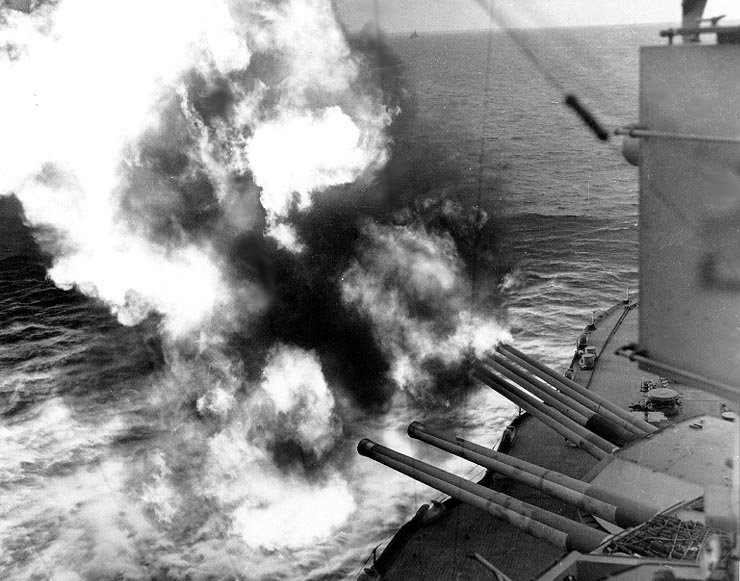
The 14″ Guns of USS Nevada in action at Normandy

On June 6th 1944 Allied Forces landed on the beaches of Normandy. Six American, British and Canadian Infantry Divisions, three Airborne Divisions and numerous supporting units came ashore in landing craft or were airdropped into Normandy. Backing them was an immense Naval Task Force which provided naval gunfire support, screened the force from German U-Boat or surface naval forces and transported the massive ground force.  It was an amazing armada.

HMS Rodney bombarding German positions off Caen

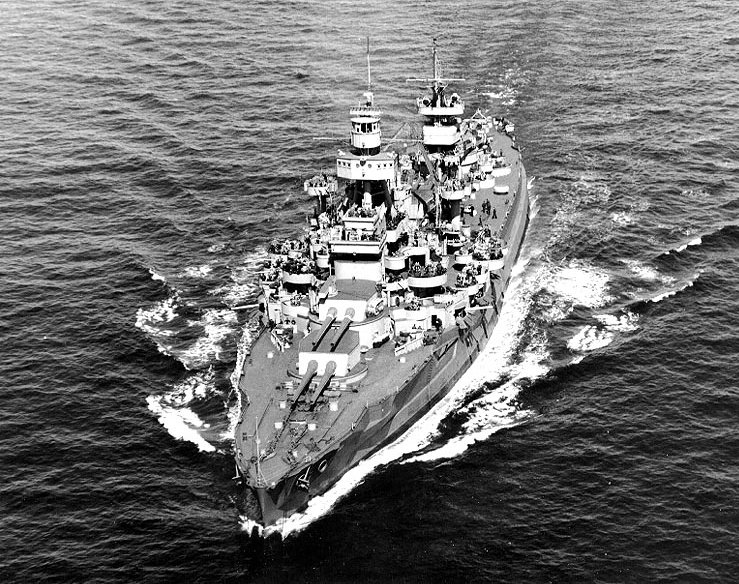
It was an armada that also is forgotten by many who read about Normandy or whose only exposure to the landings are films such as Saving Private Ryan. Today I think it is fitting to remember Battleships that served at Normandy, USS Arkansas, USS Texas, USS Nevada, HMS Warspite, HMS Ramillies and HMS Rodney.

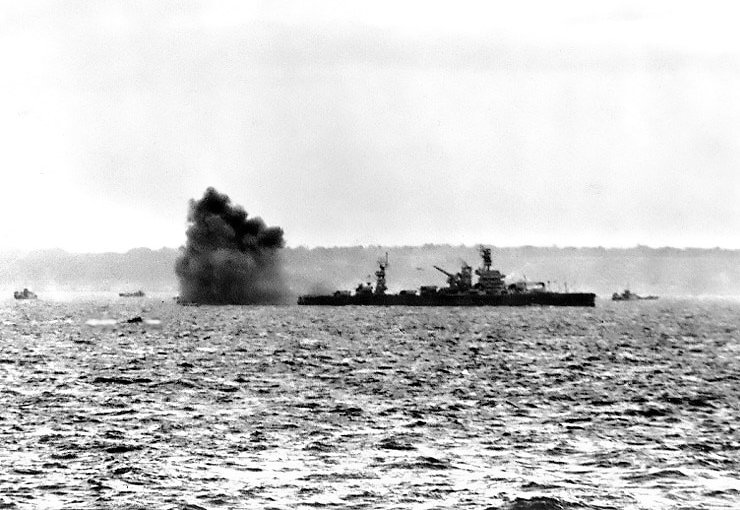
USS Arkansas off Omaha Beach

The naval gunfire support force included Battleships, Cruisers and Destroyers as well as specialized gunfire support ships.  The largest and most powerful ships were the six American and British Battleships.  These ships were important in providing the heavy firepower needed to destroy the strongest fortifications and shore batteries and to fire at targets far beyond the shoreline that were vital for German reinforcements.

However the ships involved were not the modern behemoths which were built in the 1930s and since the beginning of the war but rather among the oldest ships still active in either the United States or the British Royal Navy. At one time they had all been the hearts for their navies but now old, slow and with less than modern armament and fire control systems they were regulated to supporting amphibious forces or escorting convoys.

USS Arkansas BB-33

The oldest of these venerable ships was the USS Arkansas BB-33 which was commissioned in 1912. A Wyoming Class Battleship she mounted twelve 12” guns in six twin turrets, two forward, two aft and two midships. She displaced just over 27,000 tons. She had spent most of the war escorting convoys in the Atlantic before being assigned to the Normandy landings. She stood off Omaha Beach dueling with German shore batteries and pounding the German troops who were making Omaha a living hell for the men of the US 1st and 29th Infantry Divisions.  She would continue her valuable service off of Normandy and would do the same in to support the landings in Southern France before steaming to the Pacific where she would do the same at Iwo Jima and Okinawa.

USS Texas BB-35

The USS Texas, BB-35 of the New York class had been in commission since 1914. She mounted ten 14” guns in 5 twin turrets, two forward, two aft and one midships and was slightly larger than the Arkansas.  More modern she was more extensively modernized between the wars than was Arkansas and was one of the first US ships to carry experimental radar sets.  She also conducted convoy operations but was used to bombard Vichy French troops and positions during Operation Torch, the Allied invasion  of North Africa.  At D-day she was in the western sector of Omaha and bombarded Point Du Hoc and cruised to within 3000 yards of the beach to clear the western exits of the beach near Vierville.  She remained in the area a number of days and would subsequently support the attack on Cherbourg, the invasion of South France and then serve in the Pacific at Iwo Jima and Okinawa.

USS Nevada BB-36

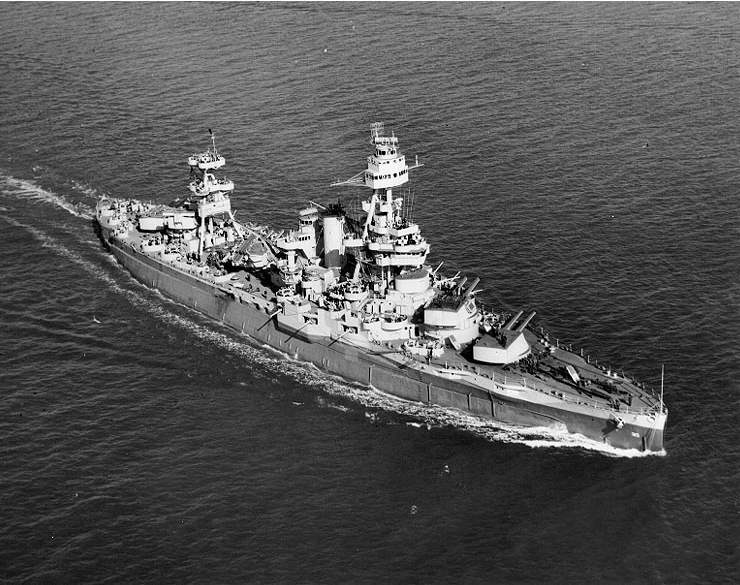
The USS Nevada BB-36 was the first of a new class of battleships which set the basic pattern of US Battleship design through the ratification of the Washington Naval Treaty. Her main battery of ten 14” guns was mounted in four turrets, mounted fore and aft two triple and 2 twin turrets.  She was he powered by oil fired boilers as opposed to coal and   was designed with a longer cruising radius to meet the demands of War Plan Orange.  Nevada received major upgrades between the wars and on December 7th 1941 was moored on Battleship Row when Peal Harbor was attacked by the Japanese. The only Battleship to get underway during the attack Nevada was set upon by Japanese aircraft as she steamed toward the harbor entrance. Heavily damaged she was grounded off Hospital Point. She was re-floated and sailed to the United States where she was heavily modernized with a modern AA battery of twin 5” 38 caliber guns, and fire direction radars. She was modernized to the point that she no longer resembled the ship sunk at Pearl Harbor. After her repair and modernization she participated in the invasion of Attu Island and did convoy escort duty before reporting for the invasion of Normandy. Nevada supported the US 4th Infantry Division at Utah Beach and subsequently served with Texas and Arkansas in South France before going to the Pacific to support the invasions of Iwo Jima and Okinawa. Had the war continued she would have been involved in the invasion of the Japanese Mainland.

HMS Warspite

The Royal Navy Battleships of D-Day were also elderly veterans. The eldest was the heroic HMS Warsipte commissioned in 1915 and a veteran of the Battle of Jutland and numerous actions during the Second World War including the slaughter of the German Destroyers at Narvik, the Battle of Cape Matapan and the invasion of Sicily and Italy.  The Queen Elizabeth Class Battleship mounted eight 15” guns in twin turrets and was extensively modernized between the wars. At Salerno Warspite was hit by three of the earliest guided missiles, the Fritz-X type launched by Luftwaffe Aircraft. She was heavily damaged and required major repairs before returning to service at Normandy. She supported British troops at Sword Beach and later Gold Beach. She again was heavily damaged by a magnetic mine and received temporary repairs to allow her to continue bombardment duties against German positions France and Belgium before being placed in reserve in January 1945.

HMS Ramillies

The HMS Ramillies was a Revenge Class Battleship commissioned in 1917. These ships were a compromise design that was smaller, slower and cheaper than the Queen Elizabeth Class but had the same main battery of eight 15” guns.  The compromises prevented them from receiving significant upgrades between the wars and limited their employment. Ramillies operated as a convoy escort and was also involved in action in  the Mediterranean and Indian Ocean. She participated in the hunt for the German Pocket Battleship Graf Spee and shielded Convoy HX-106 from the Scharnhorst and Gneisenau and later took part in the hunt for the Bismarck. However she but was not engaged against any of the German ships but her presence prevented Admiral Lutjens from risking Scharnhorst and Gneisenau to attack the convoy. She took part in the initial battle between the Royal Navy and the Italians at the Battle of Cape Spartivento getting off several salvos before her slow speed forced her out of the action. She was heavily damaged by a torpedo from a Japanese mini-submarine in Diego Suarez harbor during the invasion of Madagascar in May 1942. Following repairs and the addition of extra deck armor and modern anti-aircraft guns she returned to action at Normandy were she supported British troops ashore and drove off an attack by German Destroyers. She stayed in action firing over 1000 shells at Normandy before supporting the invasion of Southern France. Too slow to be of use in the Pacific she was placed in Reserve in January 1945.

HMS Rodney

The youngest of the Battlewagons at Normandy on June 6th was the HMS Rodney which was commissioned in 1927. She and her sister ship HMS Nelson were to be the first of the post WWI super battleships and was designed as a larger and more powerful ship. With the limitations of the Washington Naval Treaty the ships were “cut down” and reduced in size and speed. Her armament made her one of the most powerful battleships of period but her engineering plant was not always reliable. Since she was relatively modern she did not receive any major refits before the war and apart from a repairs to her engines in Boston in 1941 (before the US entry into the war) and a brief refit in 1942 she received no further refits during the war. With the HMS King George V she helped sink the Bismarck and would escort convoys and participate in the Allied invasions of North Africa, Sicily and Salerno before being assigned to the Normandy invasion force attacking targets near Caen.  Her sister HMS Nelson was held in reserve and joined the battle on June 10th but she was not present on D-Day.

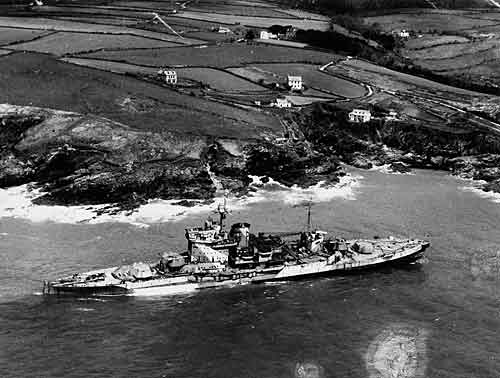
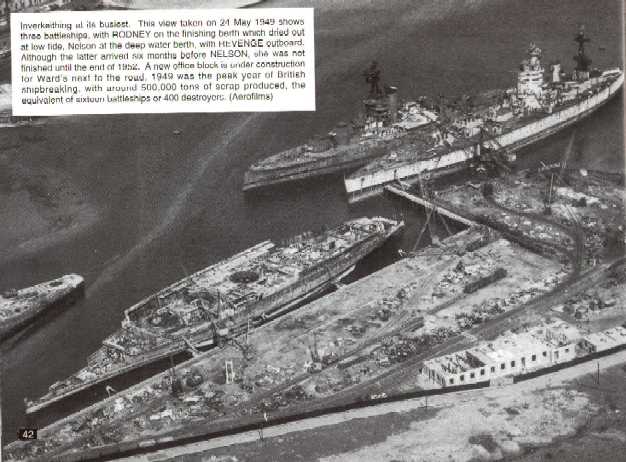
Warspite aground and Rodney being scrapped (below)

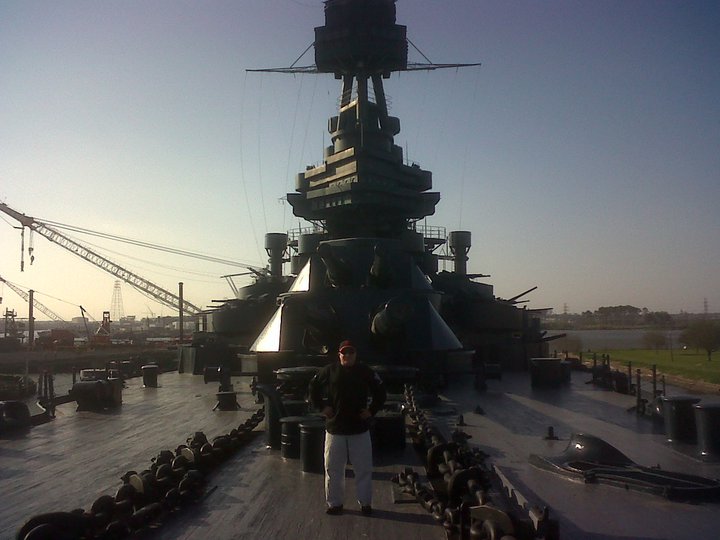
Despite their age and limitations all of these ships and their performed heroically during the war. The post war period was not as kind to the ships. Arkansas and Nevada were used in the Atomic Bomb tests at Bikini Atoll. Nevada survived and was expended as a target in 1948. All of the British ships were scrapped following the war due to their age, wear and damage incurred during the war. Warspite was being towed to the breakers when she broke a tow line and went aground. She ended up being partially scrapped in place.  Mementos of all these ships remain including a gun from Ramillies at the Imperial War Museum. The lone survivor was the USS Texas which became a museum ship and memorial at the San Jacinto battlefield in 1948. She is the last of the Dreadnought ships remaining. Other more modern US Battleships have been preserved but only Texas remains from those ships that at one time ruled the waves and pounded the Germans at Normandy.

The author aboard USS Texas in March 2011

The fire support provided by these proud ships and their consorts ensured the success of the Normandy landings. Without them it is very possible that the landings would not have succeeded and many more Allied soldiers would have died and the war extended.

To these great ships and all their heroic crews…

Peace

Padre Steve+

28 Comments

Filed under History, Military, Navy Ships, US Navy, world war two in europe

Compounding Disaster: The Loss of the Mikuma at Midway

Mikuma as Built

Admiral Isoroku Yamamoto was still attempting to digest the calamity that had befallen Admiral Nagumo’s carrier task force. In the shocked atmosphere of the mighty Super Battleship Yamato’s command center the Staff of the Combined Fleet was hastily attempting to arrive at a solution which might reverse the disaster and bring victory.  Admiral Ugaki, Yamamoto’s Chief of Staff despite his personal doubts ordered Vice Admiral Nobutake Kondo to prepare for a night surface engagement with the US Fleet and to dispatch a strong surface force to bombard Midway in order to prevent the Americans from reinforcing it and to prevent its further use against his forces should the invasion move forward.  Kondo organized his fleet to attempt to find the American carriers and bring them to battle before dawn.

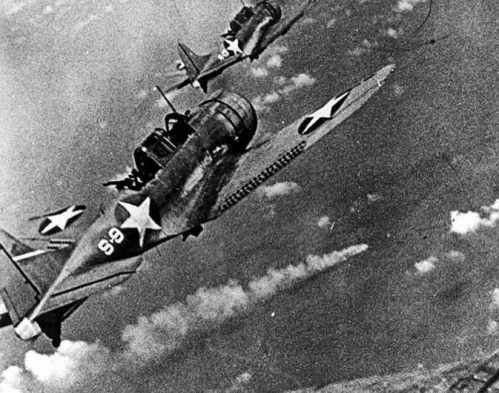
SBD Dauntless Dive Bombers from Hornet attacking Mogami and Mikuma 

Kondo detached Vice Admiral Takeo Kurita’s Close Support Group composed of Cruiser Seven, the fastest and most modern cruisers in the Imperial Navy proceed at full speed to attack Midway.  Kurita’s cruisers, the Kumano, Suzuya, Mikuma and Mogami were each armed with 10 8” guns and were escorted by the two destroyers.

Kurita’s force was 80 miles from Midway when Yamamoto realizing that his plan was unrealistic ordered Kondo’s forces to retreat and rendezvous with his main force shortly after midnight. The order was met with a measure of relief by most officers in the force and the force turned northwest and steamed at 28 knots to meet the Main Body.  At 0215 lookouts on Kumano sighted a submarine on the surface which turned out to be the USS Tambor which had been shadowing the group, and made a signal for the force to make a emergency 45 degree turn to port.

During the process Mogami’s Navigator took over from the watch to oversee the tricky maneuver. In doing so he thought that there was too much distance between him and the ship ahead, the Mikuma. So he adjusted his course to starboard and then realized his mistake. The ship he thought was Mikuma was actually Suzuya and Mikuma was directly ahead. As soon as he recognized his mistake Mogami’s Navigator ordered a hard turn to port and reversed the engines but it was too late. Mogami’s bow crashed into Mikuma’s port quarter. The impact caused minimal damage to Mikuma but Mogami was heavily damaged. She lost 40 feet of her bow and everything else was bent back to port at right angles to her number one turret.

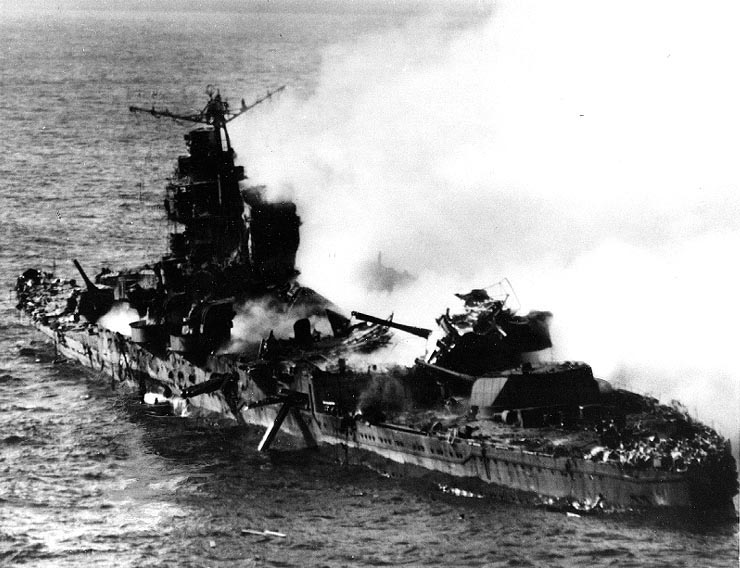
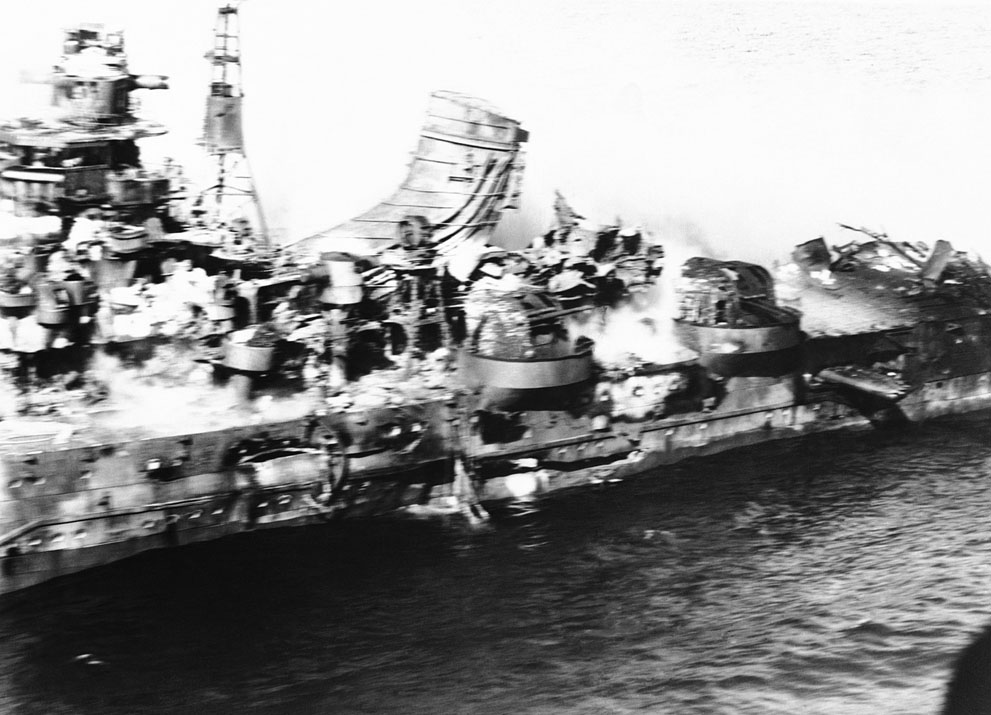
Ariel Photo of Mikuma damaged

Mogami’s damage control teams isolated the damage and worked the ship up to 12 knots. This was not fast enough for Kurita to make his rendezvous so he left Mikuma and the destroyers to escort Mogami while he steamed ahead with Kumano and Suzuya.

Mikuma adrift and sinking. The wreckage of Captain Fleming’s Vindicator can be seen on X- Turret 

Tambor’s skipper LCDR John W Murphy sent a contact report at 0300 reporting “many unidentified ships.” He followed this with more detailed information and the Americans on Midway began to launch its remaining serviceable aircraft to attack the threat. A flight of B-17 Bombers launched at 0430 could not find the Japanese ships but at 0630 a PBY Catalina found the Japanese and radioed Midway “two Japanese battleships streaming oil.”  The remaining 12 aircraft of VSMB-241 under command of Captain Marshall Tyler a mix of SBD Dauntless and SB2U Vindicators took off at 0700. His force attacked at 0808 scoring no hits but Captain Richard Fleming, his Vindicator on fire dropped his bomb and then crashed his aircraft into Mikuma’s after turret. The fire was sucked down air intakes into the starboard engine room with disastrous results. The engineers were suffocated by the smoke and fumes and Mikuma was greatly reduced in speed.

Close up shot of Mikuma with survivors visible 

The two ships limped northwest at 12 knots escorted by the destroyers and were unmolested through much of the day with the exception of an ineffective attack by the B-17s at 0830. The following morning the Dive Bombers of Enterprise and Hornet were at work and found the crippled Japanese ships. Waves over US Dive Bombers attacked the cruisers throughout the morning and into the afternoon. Mikuma was hit at least 5 times and secondary explosions of ammunition and torpedoes doomed the ship. Mogami was also heavily damaged but remained afloat while both destroyers received bomb damage.  At sunset the tough cruiser rolled over to port and sank into the Pacific. Mogami whose damage control teams had performed miracles to keep their ship afloat helped the destroyers rescue survivors from Mikuma.  Only 240 were rescued with 650 officers and sailors going down with the ship.

The action against the cruisers ended the combat operations at Midway. The Japanese ships were doomed by Yamamoto’s decision to try to salvage victory from defeat and the error of Mogami’s Navigator during the emergency turn when Kumano sighted Tambor. The only thing that kept the result from being total was the efficacy of Mogami’s damage control teams.  Mogami was out of the war for 10 months following repairs and conversion to an Aircraft Cruiser in which her aft turrets were removed to increase the number of float plane scouts that the ship could carry. She rejoined the fleet in April 1943 and was sunk following the Battle of the Surigao Strait on 25 October 1944.

The Mogami and Mikuma proved to be tough ships to sink. Unprotected by friendly aircraft they fought hard against the unopposed American Dive Bombers. They suffered massive damage from 500 and 1000 pound bombs, both direct hits and near misses. Mogami was saved by the skill of her damage control teams and the foresight of her Damage Control Officer to jettison her torpedoes so that they did not explode and compound the damage wrought by the American bombs.

For the Americans it was a fitting end to the Battle of Midway and revenge for the Battle of the Sunda Strait where Mikuma and Mogami sank the USS Houston.

Peace

Padre Steve+

3 Comments

Filed under History, Military, Navy Ships, US Navy, world war two in the pacific