Category Archives: History

The Minstrel Boy: The Song of Souls Changed by War

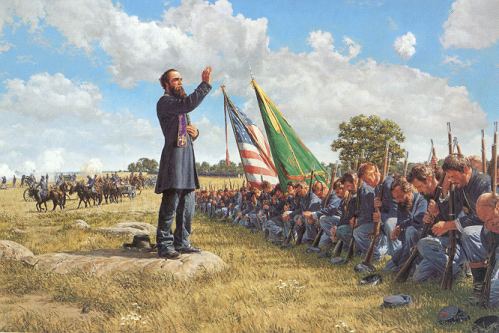
Fr Corby gives absolution to the Irish Brigade at Gettysburg

The Minstrel Boy (Thomas Moore)

The minstrel boy to the war is gone,
In the ranks of death ye will find him;
His father’s sword he hath girded on,
And his wild harp slung behind him;
“Land of Song!” said the warrior bard,
“Tho’ all the world betray thee,
One sword, at least, thy rights shall guard,
One faithful harp shall praise thee!”

The Minstrel fell! But the foeman’s chain
Could not bring his proud soul under;
The harp he lov’d ne’er spoke again,
For he tore its chords asunder;
And said “No chains shall sully thee,
Thou soul of love and bravery!
Thy songs were made for the pure and free
They shall never sound in slavery!”

The Minstrel Boy will return we pray
When we hear the news we all will cheer it,
The minstrel boy will return one day,
Torn perhaps in body, not in spirit.
Then may he play on his harp in peace,
In a world such as heaven intended,
For all the bitterness of man must cease,
And ev’ry battle must be ended.

(Last verse anonymous Civil War)

Three years ago I was in the process of returning home from Iraq spending my last couple of days in country before flying out to Kuwait and then the United States. I was already in a rather melancholy state knowing that the Chaplain incoming higher headquarters had turned off my relief for Al Anbar Province after I had paved the way for him with all of the teams of advisors that I had worked with during my time serving them. My relief a personal friend was diverted to the Army advisors with a different Iraqi Division in the north of the country. I felt that the incoming senior chaplain had betrayed and abandoned the men that I worked so hard to care for. Later I heard that he had disregarded my heavily detailed after action reports and told at least one senior chaplain that he “had heard that I was out there but didn’t know if I had done anything.”

On the Syrian Border with members of a Border Team and Bedouin family

It was at that point that I realized that you could do your job and sacrifice yourself to complete a mission only to have someone with their own agenda do what they could to discredit you.  Where the senior Chaplain that I worked for did all that he could to support my team’s mission and see that we were properly recognized at Multi-National Corps Iraq in Baghdad his successor dismissed our work. It was the first time in my Navy career that I had experienced that.  I think it was the fact that I worked for a non-traditional billet working for an Army led joint command outside the normal Navy-Marine Corps chain was a big part of this. Inter-service rivalries and the distain of those bound by conventional thinking are not new and those that have done such non-conventional work have frequently been treated in a similar manner.

Looking back there are some songs which are particularly meaningful to me after my time in Iraq that send a chill up my spine when I hear them. One of these is the patriotic Irish song The Minstrel Boy written by Thomas Moore while a student in honor of friends killed in the Irish Rebellion of 1798.  The song was very popular among soldiers of Irish descent in the American Civil War as well as soldiers fighting in Irish Regiments in World War One and World War Two.

The song is powerful when you hear it for it speaks of the reality of war, war that changes those, even those that return home are not unchanged by it.  It speaks of the sacrifices required by those that go to war and even the effects on the community, the loss of young people.  The final verse added by an anonymous author during the American Civil War in a sense is a prayer, a prayer of return as well as reconciliation. It has been recorded a number of times including an instrumental during the film Blackhawk Down. Another rendition is in the telvision mini-series Rough Riders about the 1st U.S. Volunteer Cavalry at the Battle of San Juan Hill.

http://www.youtube.com/watch?v=un_AVYB-GI8&feature=player_embedded

My life has been changed and faith challenged. When I went to Iraq I still maintained a sense of idealism.   After Iraq and having to deal with PTSD and a psychological, spiritual and physical breakdown as well as a profound sense of abandonment by some senior chaplains, my former church and even God I am a different person. My faith which had been shattered to the point of being a practical agnostic for nearly two years has returned. I don’t regret that and do believe that it is a good thing. If we are not changed by what God allows or by what life brings I don’t think that we grow. As a Priest I wonder if I could work in the environment that I work without having gone through what I did.

I see many of the “minstrel boys” and girls of our era and having also been to war and come back changed the last lines of the final verse is a prayer that I echo. One of the versions that I particularly like is the one sung in the Star Trek the Next Generation episode “The Wounded.” While it is only the first verse it deals with the lives of two officers whose lives are forever changed by war. http://www.youtube.com/watch?v=RJudJ9S579A

This is dedicated to all those who have served who have gone through the pain of war and return until war shall be no more.

Peace

Padre Steve+

5 Comments

Filed under faith, film, History, iraq,afghanistan, Tour in Iraq, US Navy

Remembering Challenger

http://www.youtube.com/watch?v=j4JOjcDFtBE

About 5:30 PM on January 28th 1986 I was a young Army Medical Service Corps 1st Lieutenant in command of the 557th Medical Company (Ambulance) which was based on Wiesbaden Air Base in Wiesbaden Germany. I was hoping to close out the day by 7PM which was early for me as well as most officers in the 68th Medical Group and 3rd Support Command of the Imperial Army on the Rhine.

I had a stack of work in my inbox, NCO evaluations, criminal investigations, maintenance reports and upcoming missions, not to mention trying to get a head start on my Unit Status Report. Most of my soldiers except those on duty had finished for the day.

Back then communications and television for military personnel stationed overseas was primitive. The Armed Forces Network had one channel then and only recently had added live needs feeds from stateside news programs on CNN and morning shows such as NBC’s Today Show. By 1986 the Space Shuttle missions had become routine but this one was different because of a school teacher, Christa McAuliffe who was a payload specialist on the flight.

The Challenger was making her 10th flight in less than 3 years having first flown on April 4th 1983.  The mission STS-51-L had been delayed due to weather on the 22nd and rescheduled several times due to weather or in one case due to problems with an exterior access hatch.  The morning of the launch the weather was predicted to be at or below the 31 degree minimum safe launch threshold. Engineers from the builder of the Challenger’s Solid Rocket Boosters (SRBs) Morton Thiokol contacted NASA with their concerns that the O-Rings which sealed the joints on the SRBs which they believed might not seal properly.  NASA engineers argued that even if the primary O-Ring failed that the secondary O-Ring would be sufficient even though this was an unproven theory. Eventually Thiokol management overruled their engineers influenced by NASA management which demanded that Thiokol prove that it was not safe to launch rather than prove that it was safe to launch. Considering it was a “Criticality 1” component meaning that there was no backup in case of a failure of both joints. It was a clear violation of protocol but the later Rogers Commission would show that NASA managers frequently ignored or evaded safety regulations to meet their very ambitious mission schedule. This decision doomed Challenger and her crew of seven.

I had heard that the Challenger was to launch that morning in Florida which of course was the early evening for us in Germany.  However I had seen numerous shuttle launches on television, considered them routine and by then rather uninteresting.  Since I was a very junior 1st Lieutenant commanding a company forward deployed with a mission to race to the Fulda Gap in the event of a Soviet invasion of West Germany up to my ears in work I had no interest in watching another one.

Challenger disintegrates (BBC Photo)

About 20 minutes until 6 my senior duty person at the company, the Charge of Quarters or CQ in Army parlance came to my door which was at the far end of the hallway from where the CQ was stationed. Specialist Lisa Daley was a solid medic and outstanding soldier who had a great personality that caused her to be well liked in the company.  She came to my door and blurted out “Lieutenant Dundas! The Space Shuttle just blew up!”

I looked up from my desk and I remember my words to this day. “Specialist Daley, Space Shuttles don’t blow up.” She then said, “No sir they do, it’s on TV right now!” That startled me. I grew up with the space program and remembered the Apollo 11 Moon landing. Although I remember the fire on Apollo 1 which killed three astronauts on the launch pad, but that was different, no American spacecraft had ever been lost though Apollo 13 was nearly lost while on a Moon mission.

I got up and followed her as she told me what had happened. While I reached the CQ desk I saw the small television which she and her assistant CQ were watching. There was a live feed from CNN replaying the disaster, the twin plumes of smoke careening across the screen.  I was stunned and will never forget the image that I saw with my soldiers that day.

Seventeen years after that event I was waiting at the Naval Air Station at Mayport Florida for General Peter Pace.  General Pace who was then the Vice Chairman of the Joint Chiefs of Staff was coming to be the guest speaker at the Battle of Hue City Memorial weekend hosted by the USS Hue City. I got to the ship early and while drinking coffee in the Wardroom saw the news of the breakup of the Space Shuttle Columbia. It brought back the images of the Challenger disaster. General Pace was delayed as the Joint Chiefs and National Security Council held an emergency meeting and arrived several hours late and when he arrived he spoke of the Challenger disaster along with the Columbia.

There are two more shuttle flights scheduled before the program ends this year. An era will be ever. The shuttles will pass into history and unfortunately for many the signature moment of the program will not be the many successes it will be the Challenger disaster and the images shown on CNN that cold and clear Tuesday in 1983.

The brave astronauts of all of our space programs deserve our highest admiration. The Mercury, Gemini, Apollo and Shuttle programs pioneered space travel. We should not forget their sacrifices especially those that gave the last full measure especially those that we remembered yesterday. Ronald Reagan ended his short speech the evening of the Challenger’s demise with this line:

“The crew of the space shuttle Challenger honored us by the manner in which they lived their lives. We will never forget them, nor the last time we saw them, this morning, as they prepared for the journey and waved goodbye and ‘slipped the surly bonds of earth’ to ‘touch the face of God.’”

As a child I grew up with the space program and Star Trek. It is my hope that manned missions aboard better and more capable space ships capable of reaching the far reaches of this solar system and the galaxy will be built and humanity’s constant desire for exploration and discovery will herald a better future.

Peace

Padre Steve+


1 Comment

Filed under History, traumatic national events

The Post Treaty Super Dreadnought Battleships: Introduction

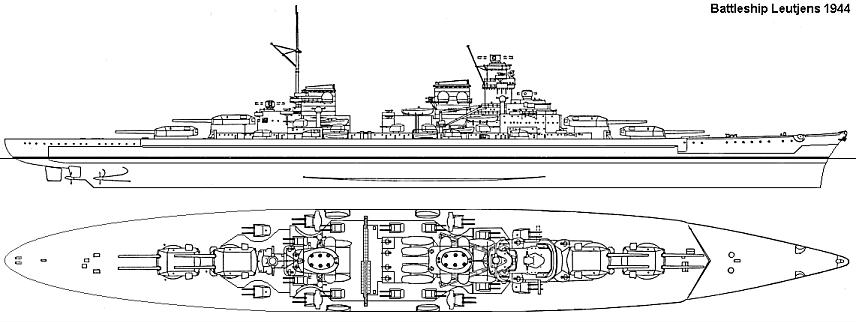
Line Drawing of the German H-39 Class Battleship

Note: This is the introductory article for a series of 8 articles on the classes of battleships built or planned by the major powers following the expiration of the Second London Naval Treaty. A previous series of articles dealt with the battleships constructed in compliance or close compliance with the treaty. This series will cover the Japanese Yamato Class, the British Lion Class and the Vanguard, the German Bismarck Class and H39 Class, the Soviet Sovyetskiy Soyuz Class and the American Iowa and Montana classes.

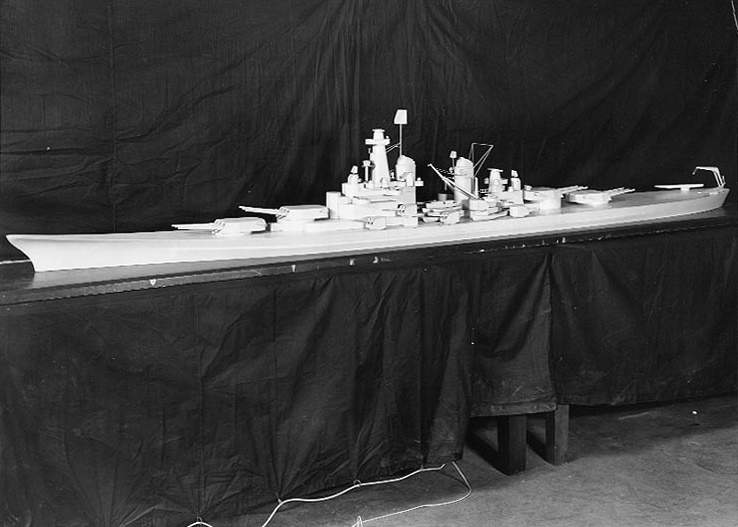
Model of the Montana Class

All of these ships were designed and built or designed in the late 1930s and early 1940s and with the exception of the Sovietetskiy Soyuz Class built on each navy’s experience. The Japanese had constructed no treaty battleships in the 1930s so the Yamato’s were the first battleships constructed by Japan since the Nagato Class which had been completed in the 1920s and the incomplete Tosa Class.

The Bismarck

The Second London Naval Treaty of 25 March 1936 was signed by France, Britain and the United States. Japan walked out on the conference and the Italians did not sign because of the outcry that their invasion of Abyssinia had evoked.  The treaty called for ships to have a standard displacement of no more than 35,000 tons and main armament of 14” guns, a reduction in size of armament from the previous London and Washington treaties. When the Japanese pulled out and the Italians refused to sign the United States invoked the escalator clause which permitted them to disregard treaty limitations.

USS Iowa lead ship of the Iowa class

The Americans who invoked only the armament part of the clause on the North Carolina and South Dakota classes but took full advantage of it to construct the 45,000 ton Iowa class. The Montana Class of 65,000 tons mounting twelve 16” guns and protection proof against that type of shell. Those ships were never laid down but will be covered in this series of articles.

Line Drawing of the Lion Class

The British Royal Navy planned the Lion Class which was in essence an enlargement of the King George V Class armed with nine 16” guns.  The Lion class of which 4 ships were to built was cancelled early in the war and only one further battleship the 44.500 ton HMS Vanguard would be completed by the Royal Navy but not until 1946.

HMS Vanguard

The Germans, who were not a signatory to the treaty but had an agreement with Britain to limit their total naval tonnage to 35% of Britain’s had build the Scharnhorst Class Battlecruisers in the mid 1930s and began the Bismarck Class the largest capital ships completed in Europe. These were to be followed by the H39, H41, H42, H43 and H44 classes ranging in displacement from 56,444 tons to 131,000 tons with armament ranging from eight 16” to eight 20” guns. Only two of the H39’s were laid down and cancelled while in the early stages of construction and I will only discuss the H39 class in this series.

Sovyetskiy Soyuz Class

The Soviet Union which was never a signatory to any of the naval treaties and had not built a battleship since the First World War planned the massive Sovyetskiy Soyuz Class which would have displaced 58,220 tons and mounted nine 16” guns. The four initial ships of the class but were never completed.

Yamato

The Japanese Yamato Class, the largest battleships ever constructed of 69,998 tons standard displacement armed with nine 18” guns, the largest main battery ever installed on battleships were the largest capital ships built before the second generation of U.S. Navy super carriers.

The first article I write will be about the Bismarck Class and that will appear later this week.


10 Comments

Filed under History, Military, Navy Ships

Save the USS Olympia! News Update Number One

This is a follow up to my article Save the USS Olympia! Which was published in September 2010.

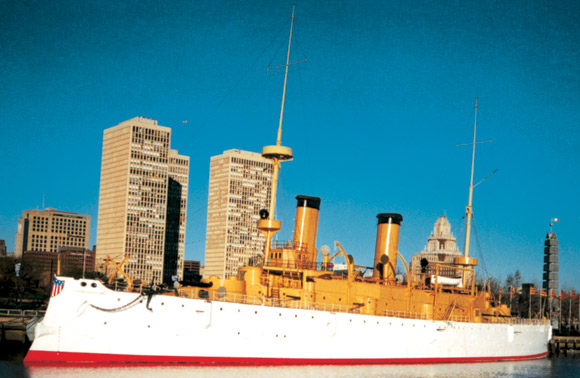
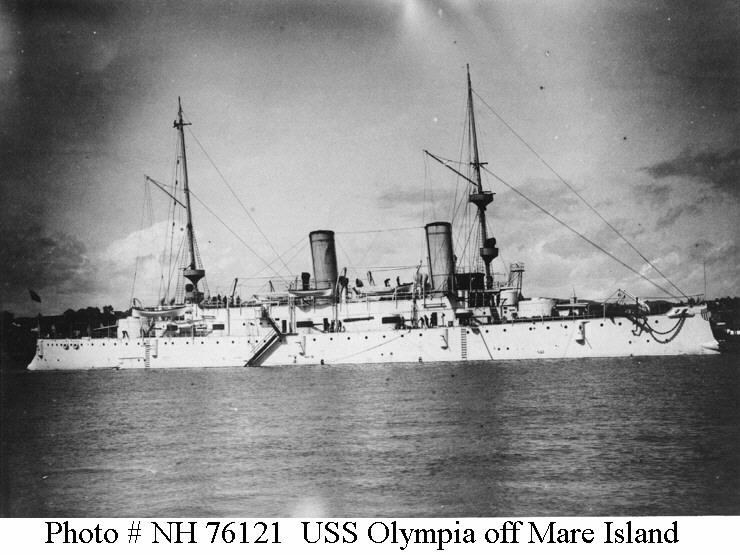
There is news concerning the Flagship of Admiral Dewey during the Battle of Manila Bay in 1898. The one a kind ship and the only surviving steel warship of her era has been moored in Philadelphia since 1957 when she was taken over by the Cruiser Olympia Association in 1957 and restored to her 1898 configuration. Since 1957 she has been a museum ship in Philadelphia and in 1996 the Cruiser Olympia Association merged with the Independence Seaport Museum due to the major costs of upkeep. Since then she has been moored at Penn’s Landing where she has been open for tours. During the Fall of 2010 the museum announced plans to close the ship due to the poor material condition of the ship which has not been in drydock or had a major overhaul since 1957 as well as the high operating costs.  However the Olympia has been kept open for tours and the museum plans on keeping her open through March 2011.

The museum and a new group dedicated to saving the ship, the Friends of the Cruiser Olympia has announced that they cannot raise the funding for the repairs needed to maintain the ship in Philadelphia.  The Independence Seaport Museum Chief Executive Officer John Gazzola said the museum cannot raise the at minimum amount of $10 million needed to dredge the marina where she is moored, dry dock the ship and repair Olympia’s hull and deck. A bid request has been issued for organizations that might want to obtain and preserve the ship. A group from Vallejo California the Navy Yard Association which is made up of former workers from Mare Island Naval Shipyard has announced their intention to bid on the ship when the auction takes place in February. In order to raise money the group plans on trying to align itself with non-profit groups since they are not.

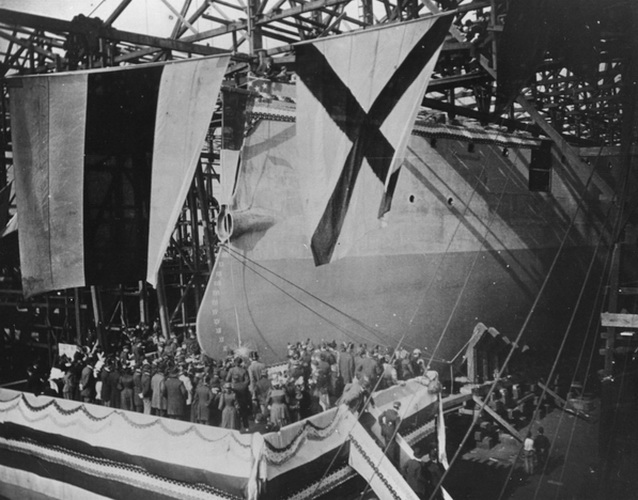
The Christening of the USS Olympia at San Francisco’s Union Iron Works

The Olympia was built at San Francisco’s Union Iron Works in 1892 and if the group is successful this could return the ship to the place that she left for her assignment in the Far East in 1895. This is a unique ship and she needs to be preserved. Despite her status as a National Historic Landmark she has been allowed to deteriorate to the point that major repairs are necessary.  If a bidder cannot be found and the ship is unable to be restored it is possible that she could be scrapped or sunk as a reef.

As the situation develops I will provide updates on this site.

Peace

Padre Steve+


2 Comments

Filed under History, Military, Navy Ships, US Navy

The South Dakota Class Battleships: The Best of the Treaty Battleships

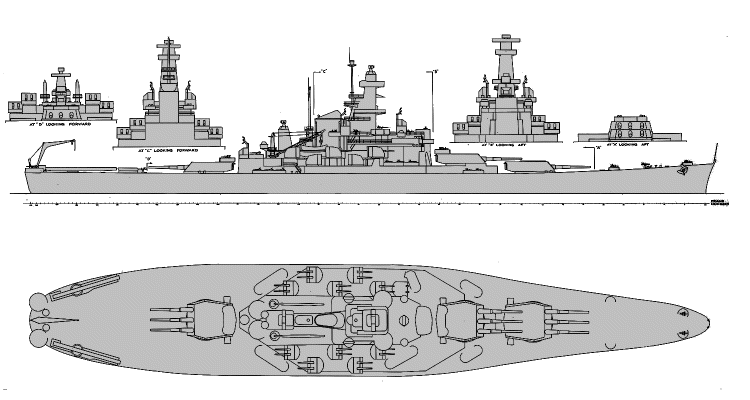
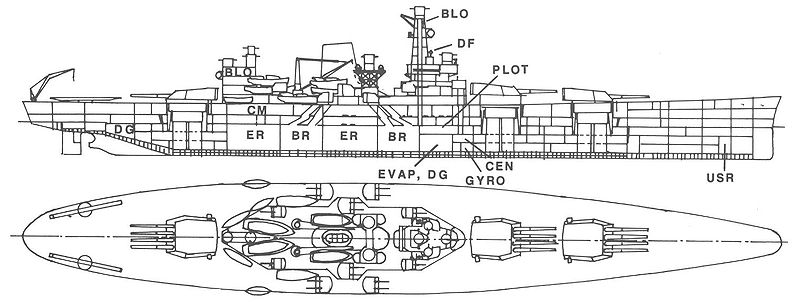
USS South Dakota Class Line Drawing

This is the fifth in a series of six articles on the battleships built under the provision of the Washington and London Naval Treaty limitations in the 1930s. I am not including the ships which were completed in the immediate aftermath of the Washington Treaty limitations. This series looks at the modern battleships that the World War II combatants would produce in the 1930s which saw service in the war. Part one covered the Italian Vittorio Veneto class entitled The Pride of the Regina Marina: The Vittorio Veneto Class Battleships. Part two French Firepower Forward: The unrealized potential of the Dunkerque and Richelieu Class Battleships covered the French Dunkerque class and Richelieu class Battleships. Part three covered the British Royal Navy King George V Classbattleships entitled British Bulwarks: The King George V Class Battleships Part Four  which was about the North Carolina Class is entitled The Next Generation: The North Carolina Class Battleships. I have already published the final part which covers the German Scharnhorst Class entitled Power and Beauty the Battle Cruisers Scharnhorst and Gneisenau . The German Bismarck, Japanese Yamato, British Vanguard and American Iowa

Classes will be covered in a subsequent series.

As the world edged closer to war in the late 1930s the U.S. Navy followed up its decision to build the two ship North Carolina class battleships with additional fast battleships. Initially the General Board wanted two additional North Carolina’s but the Chief of Naval Operations William H. Standley wanted a different design.

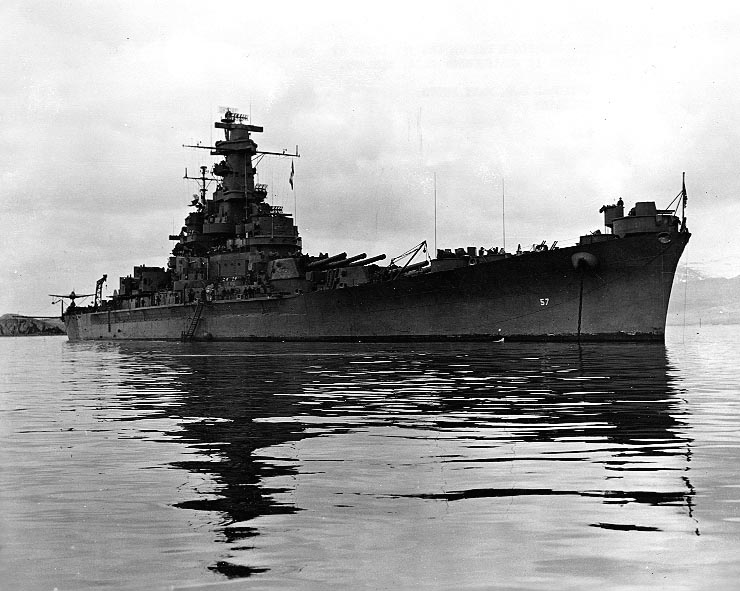
USS South Dakota BB-57 in 1943

Design work started in 1937 and several designs were proposed in order to correct known deficiencies in the preceding North Carolina class to include protection and the latest type of steam turbines.  As in the North Carolina’s the Navy struggled to find the optimal balance between armament, protection and speed. In the end the Navy decided on a shorter hull form with greater beam which necessitated greater power to maintain a high speed. The armor protection was maximized by using an interior sloped belt of 12.2 inch armor with 7/8” STS plates behind the main belt which made the protection the equivalent to 17.3 inches of vertical armor. The Belt continued to the bottom of the ship though it was tapered with the belt narrowing to 1 inch to provide addition protection against plunging fire which struck deeper than the main belt. As an added feature to protect against torpedo hits a multi-layered four anti-torpedo bulkhead system was included, designed to absorb the impact of a hit from a 700 pounds of TNT.

In order to accommodate the machinery necessary to provide the desired speed of 27 knots on the shorter hull the machinery spaces were rearranged.  The new design placed the boilers directly alongside the turbines with the ship’s auxiliaries and evaporators also placed in the machinery rooms. Additional design changes made to save space included making the crew berthing areas smaller. This included that of officers as well as the senior officers and shrinking the size of the galley’s and the wardroom from those on the North Carolina’s. The resultant changes allowed the ships to achieve the 27 knot speed, improved protection and the same armament of the North Carolina’s within the 35,000 treaty limit.

Two ships of the design were approved and with the escalator clause invoked by the Navy two more ships were ordered all with the nine 16” gun armament of the North Carolina’s.  The leading ship of the class the South Dakota was designed as a fleet flagship and in order to accommodate this role two of the 5” 38 twin mounts were not installed leaving the ship with 16 of these guns as opposed to the 20 carried by the rest of the ships of the class. The final design was a class of ships capable of 27.5 knots with a range of 17,000 miles at 15 knots mounting nine 16” guns with excellent protection on the 35,000 tons and full load displacement of 44,519 tons.

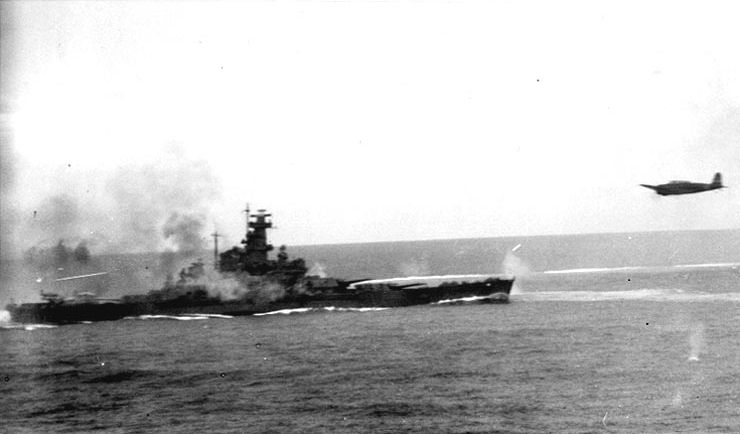
The lead ship of the class the USS South Dakota BB-57 was laid down 5 July 1939 at New York Shipbuilding in Camden New Jersey, launched on 7 June 1941 and commissioned on 20 March 1942.  Following her commissioning and her shakedown cruise South Dakota was dispatched to the South Pacific. Soon after her arrival she struck a coral reef at Tonga which necessitated a return to Pearl Harbor for repairs.  When repairs were complete she was attached to TF 16 escorting the USS Enterprise CV-6 during the Battle of the Santa Cruz Islands on 26 October 1942.  During the battle she was credited with shooting down 26 Japanese aircraft but was struck by a 500 lb bomb on her number one turret. She joined TF-64 paired with the battleship USS Washington during the Second Naval Battle of Guadalcanal on14-15 November 1942. During the action South Dakota suffered a power outage and was hit by over 40 shells from Japanese ships which knocked out 3 fire control radars, her radio and main radar set. 3 destroyers were also lost but the Washington mortally wounded the fast battleship Kirishima and destroyer Ayanami which were scuttled the next day and damaged the heavy cruisers Atago and Takao. She returned to New York for repairs which completed in February 1943 and joined the carrier USS Ranger CV-4 for operations in the Atlantic until April when she was attached to the British Home Fleet. She sailed for the Pacific in August 1943 and rejoined the Pacific Fleet in September and joined Battleship Divisions 8 and 9 and supported the invasion of Tarawa providing naval gunfire support to the Marines. The rest of the war was spent escorting carriers as well as conducting bombardment against Japanese shore installations. She was present at the Japanese surrender in Tokyo Bay and returned to the United States in 1945 and was decommissioned and placed in reserve on 31 January 1947. She was stricken from the Naval Register on 1 June 1962 and sold for scrap in October of that year. Various artifacts of this gallant ship to include a propeller, a 16” gun and the mainmast are part of the USS South Dakota Memorial Park in Sioux Falls South Dakota and 6,000 tons of armored plate were returned to the U.S. Atomic Energy Commission for use in civilian nuclear programs and a second screw is displaced outside the U.S. Naval Museum in Washington D.C.  She received 13 battle stars for World War II service.  South Dakota had the dubious distinction of having the youngest sailor of the war 12 year old Calvin Graham who confessed lying about his age to the Gunnery Officer Sergeant Schriver. Graham was court-martialed and given a dishonorable discharge spending 3 months in the ship’s brig before he was able to be returned to the United States where just after his 13th birthday he entered 7th grade.

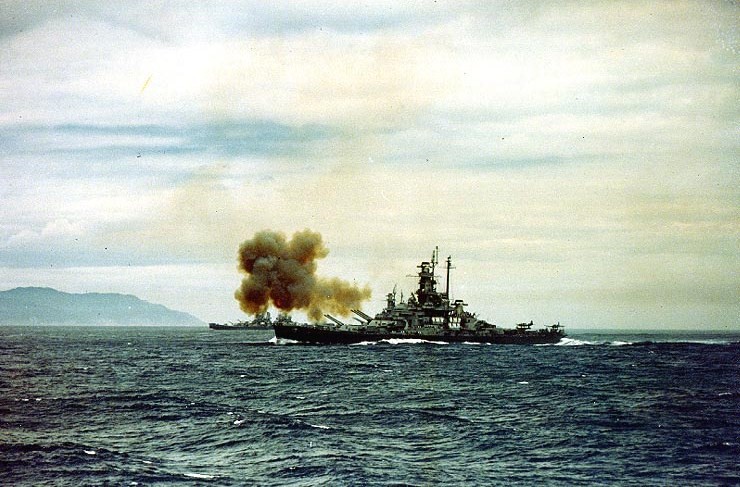
USS Indiana BB-58 Bombarding Japan in 1945

The second ship of the class the USS Indiana BB-58 was laid down at Newport News Naval Shipyard on 20 November 1939 launched on 21 November 1941 and commissioned on 30 April 1942.  She served throughout the Pacific War by serving with the fast battleships of Vice Admiral Willis Lee’s TF-34, escorting carriers during major battles such that the Battle of the Philippine Sea or as it is better known the Marianas Turkey Shoot. She returned to the United States for overhaul and missed the Battle of Leyte Gulf but served at Iwo Jima, Okinawa and operations against the Japanese home islands.  Following the war she was decommissioned in 1947 and sold for scrap in September 1963.   A number of her relics are preserved at various locations in Indiana and her prow is located in Berkeley California.

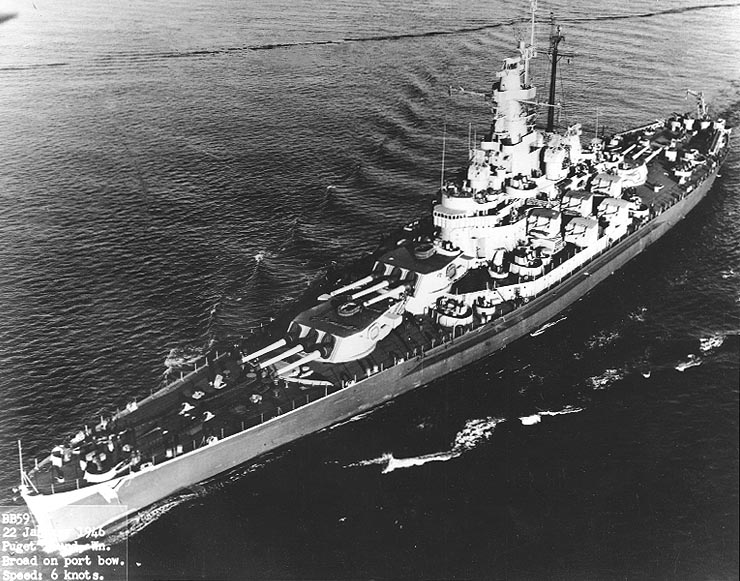
USS Massachusetts BB-59 in January 1946 in the Puget Sound

The third ship of the class the USS Massachusetts BB-59 was laid down on 20 July 1939 at Bethlehem Steel Corporation Fore River Yard in Salem Massachusetts and launched on 23 September 1941 and commissioned on 12 May 1942. After her shakedown cruise she was assigned to the Atlantic Fleet where she took part in Operation Torch, the Allied invasion of French North Africa. During the operation she engaged French shore batteries, damaged the battleship Jean Bart and sank 2 cargo ships and along with the heavy cruiser Tuscaloosa sank the destroyers Fougueux and Boulonnais and the light cruiser Primauguet. Following her assignment in the Atlantic she sailed for the Pacific where she began operations in January 1944. She took part in almost every major operation conducted by the Pacific Fleet escorting the Fast Carrier Task Forces and operating as a unit of TF-34 the Fast Battleship Task force including the Battle of Leyte Gulf.  She ended the war conducting operations against the Japanese home islands.  She was decommissioned in 1947 and stricken from the Naval Register on 1 June 1962. She was saved from the fate of Indiana and South Dakota as the people of Massachusetts with the assistance of schoolchildren who donated $50,000 for her renovation and preservation as a memorial. She became that in 1965 at Battleship Cove in Fall River Massachusetts and she remains there designated as a National Historic Landmark.  During the naval build up of the 1980s much equipment common to all modern battleships was removed for use in the recommissioned battleships of the Iowa class.

USS South Dakota at the Battle of the Santa Cruz Islands


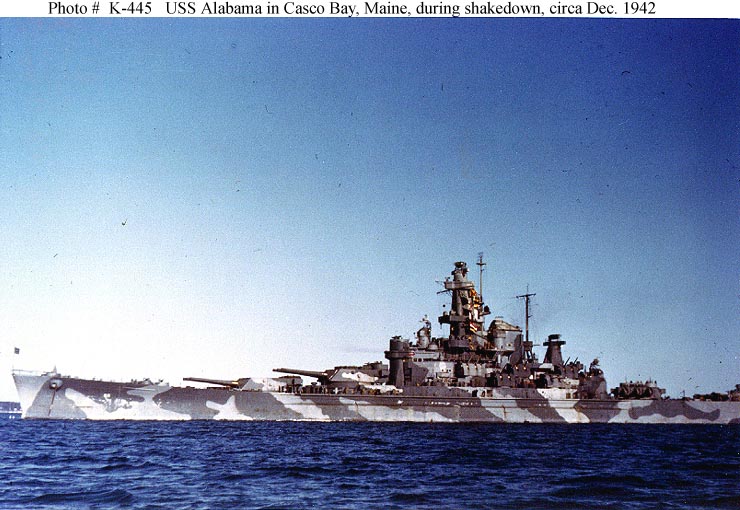
The final ship of the class the USS Alabama BB-60 was on 1 February 1940 at Norfolk Naval Shipyard. She was launched on 21 February 1942 and commissioned 16 August 1942. Following her shakedown cruise and initial training off the Atlantic coast she joined the repaired South Dakota and operated as part of TF 22 attached to the British Home Fleet. She conducted convoy escort operations, participated in the reinforcement of Spitsbergen and in an operation which attempted to coax the German battleship Tirpitz out of her haven in Norway. Tirpitz did not take the bait and Alabama and South Dakota returned to the United States in August 1943.  After training with the fast carriers she took part in the invasion of the Gilberts taking part in Operation Galvanic against Tarawa and the Army landings on Makin Island. As 1944 began Alabama continued her operations with the fast carriers and the fast battleships of TF-34.  She took part in operations against the Marshalls and took part in the invasion of the Marianas Islands and the Marianas Turkey Shoot. From there she supported the invasion of Palau and other islands in the Caroline Islands followed by operations against New Guinea and the invasion of the Philippine and the Battle of Leyte Gulf before returning to the United States for overhaul. She returned to action during the invasion of Okinawa and in shore bombardment operations against the Japanese Mainland. When the war ended the Alabama had suffered no combat deaths and only 5 wounded following the misfire of one of her own 5” guns earning her the nickname of “Lucky A.”  Hall of Fame pitcher Bob Feller served as a Chief Petty Officer and gun mount captain on Alabama during the war. She was decommissioned on 9 January 1947 and stricken from the Naval Register on 1 June 1962. The people of the State of Alabama formed the “Alabama Battleship Commission” and raised $1,000,000 including over $100,000 by schoolchildren to bring her to Alabama as a memorial.  She was turned over to the state in 1964 and opened as a museum on 9 January 1965. She was declared a National Historic Landmark in 1986.  She has been used as a set in several movies and continues to serve as a museum preserving the legacy of the men that served aboard her and all of the battleship sailors of World War II.

In the 1950s a number of proposals were considered to modernize the ships of the class to increase their speed to 31 knots using improved steam turbines or gas turbines. The Navy determined that to do this would require changes to the hull form of the ships making the cost too prohibitive.  The ships were certainly the best of the treaty type battleships produced by any nation in the Second World War. The damage sustained by South Dakota at the Second Naval Battle of Guadalcanal would have not only put most battleships of her era out of action but might have caused enough damage to sink them. Their armament was equal or superior to all that except the Japanese Yamato Class and their protection was superior to most ships of their era.

It is good that both the Massachusetts and the Alabama have been preserved as memorials to the ships of the class, their sailors and the United States Navy in the Second World War. Because of the efforts of the people of Massachusetts and Alabama millions of people have been able to see these magnificent ships and remember their fine crews. Both have hosted reunions of their ships companies since becoming museum ships and with the World War Two generation passing away in greater numbers every day soon these ships as well as the USS Texas, USS North Carolina, USS Missouri, USS New Jersey and USS Wisconsin will be all that is left to remember them unless a home can be found for the USS Iowa which stricken from the Naval Register awaits an uncertain fate as a resident of the “Ghost Fleet” in Suisun Bay California.  No other nation preserved any other dreadnought or treaty battleship thus only these ships remain from the era of the Dreadnought.

10 Comments

Filed under History, Military, Navy Ships, US Navy, world war two in europe, world war two in the pacific

The Next Generation: The North Carolina Class Battleships

This is the fourth in a series of six articles on the battleships built under the provision of the Washington and London Naval Treaty limitations in the 1930s. I am not including the ships which were completed in the immediate aftermath of the Washington Treaty limitations. This series looks at the modern battleships that the World War II combatants would produce in the 1930s which saw service in the war. Part one covered the Italian Vittorio Veneto class entitled The Pride of the Regina Marina: The Vittorio Veneto Class Battleships. Part two French Firepower Forward: The unrealized potential of the Dunkerque and Richelieu Class Battleships covered the French Dunkerque class and Richelieu class Battleships. Part three covered the British Royal Navy King George V Class battleships entitled British Bulwarks: The King George V Class Battleships Part Five which was to be a subsection of this article will be on the South Dakota Class. I have already published the final part which covers the German Scharnhorst Class entitled Power and Beauty the Battle Cruisers Scharnhorst and Gneisenau . The German Bismarck, Japanese Yamato, British Vanguard and American Iowa Classes will be covered in a subsequent series.

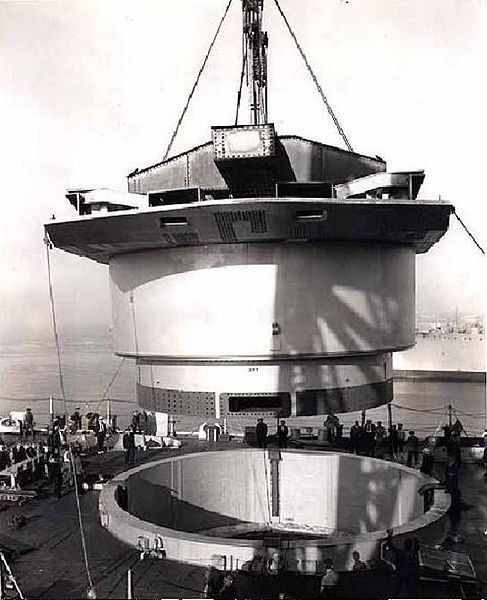
Turret base of USS Washington being lowered into barbet

The United States finished the First World War as the rising economic and potential military power in the world. The British Empire was economically reeling beset by massive debts, heavy loss of life and an empire which was beginning to smell the fresh breezes of independence.  The United States retreated into isolationism and a naïve and unfounded optimism that war could be outlawed while turning its back on the one organization that might have helped bring nations together, the League of Nations. In this environment the United States sponsored the Washington Naval Conference of 1922 which produced the Washington Naval Treaty.  The treaty stipulated limitations on total battleship tonnage, main armament and the maximum tonnage allowed per ship. Ships already in existence could not be replaced until they reached the age of 20 years. A battleship “building holiday” of 10 years was mandated with the major signatories allowed to complete a few ships that were already under construction. Whole classes of new construction were cancelled and many ships under construction were scrapped on the ways or completed only to be scrapped or sunk as targets. The Royal Navy completed two ships of the Nelson Class, the United States completed the 3 ship Maryland Class using a 4th vessel the incomplete USS Washington as a target and the Japanese were allowed to complete two ships of the Nagato Class. The Royal Navy completed the Battleship Eagle and Battle Cruisers Furious, Glorious and Courageous as Aircraft Carriers, the U.S. Navy the incomplete Battle Cruisers Lexington and Saratoga and the Japanese the Battle Cruiser Akagi and Battleship Kaga as carriers. The treaty limits of the Washington Conference were renewed in the London Treaty which also sought to limit the main batteries of new battleships to 14 inch guns.

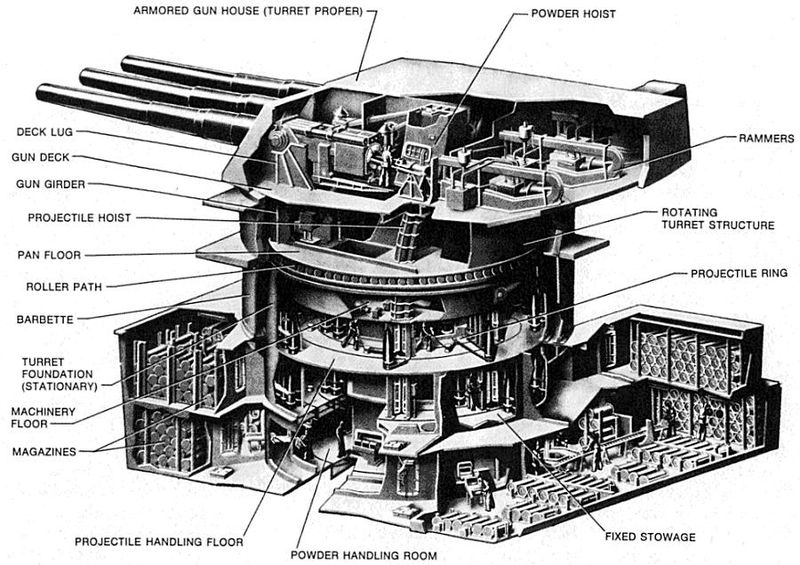
North Carolina Class 16″ Gun Turret

The U.S. Navy began a study of new designs for a fast battleship class to comply with the treaty restrictions in May to July of 1935.  A minimum of 35 different designs were submitted and reviewed by the Navy and also reviewed by the faculty of the Naval War College. After a considerable amount of debate a design called the Type XVI was selected. The design originally called for twelve 14” guns mounted in three quadruple turrets. Other designs considered called for twelve 14″ guns in triple turrets. When the Japanese opted out of the treaty and the Italians began building the Vittorio Veneto Class with 15” guns the U.S. Navy adopted the “escalation clause” and the design was modified to mount nine 16” guns in triple turrets primarily due to the expectation that the Japanese Imperial Navy would mount larger guns in its new ships.

Initial Type XVI design with 14″ guns

The Navy worked to achieve the maximum speed, armament and protection that it could within the 35,000 ton treaty limitations. There was debate among Admirals and designers as to how to solve the problem with some factions leaning toward greater speed and lighter armor and armament and others weighing in on a slightly slower ship with greater firepower and protection. The Type XVI (modified) design original called for twelve 14” guns in quadruple turrets but this was changed to nine 16” guns in triple turrets. The main armor belt was 12” inclined 15 degrees with 16” armor on the turret faceplates and barbets having 16” side armor.  Their conning tower was also protected by 14” armor.  This gave them heavier armor than the Italian Vittorio Veneto Class. They had a lighter belt than the British King George V Class but more protection accorded to their turrets, barbets and conning tower while they had slightly less armor than the French Richelieu class due to those ships all guns forward and all or nothing armor protection.

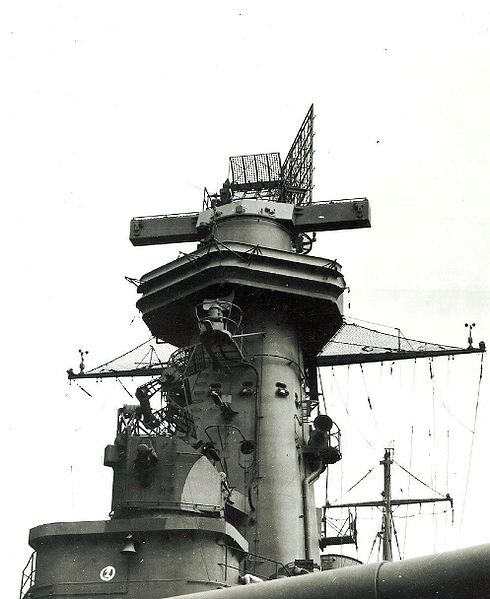
View of USS Washington Conning Tower showing Mk 38 5″ gun directors and SG Surface Search Radar

Their top speed of 27 knots was slower than their European counterparts but their range was far superior to all being able to steam over 20,000 miles at 15 knots and 6,610 miles at 25 knots. Their top speed and ranged decreased slightly during the war with the addition of more anti-aircraft guns and sensors.  Most of the designs considered had speeds from 27-30 knots depending on whether the designers sacrificed speed for armament and protection or protection and firepower for speed. One design, the Type VII resembled earlier classes of battleships with a speed of only 23 knots in favor of much heavier protection on a shorter hull.

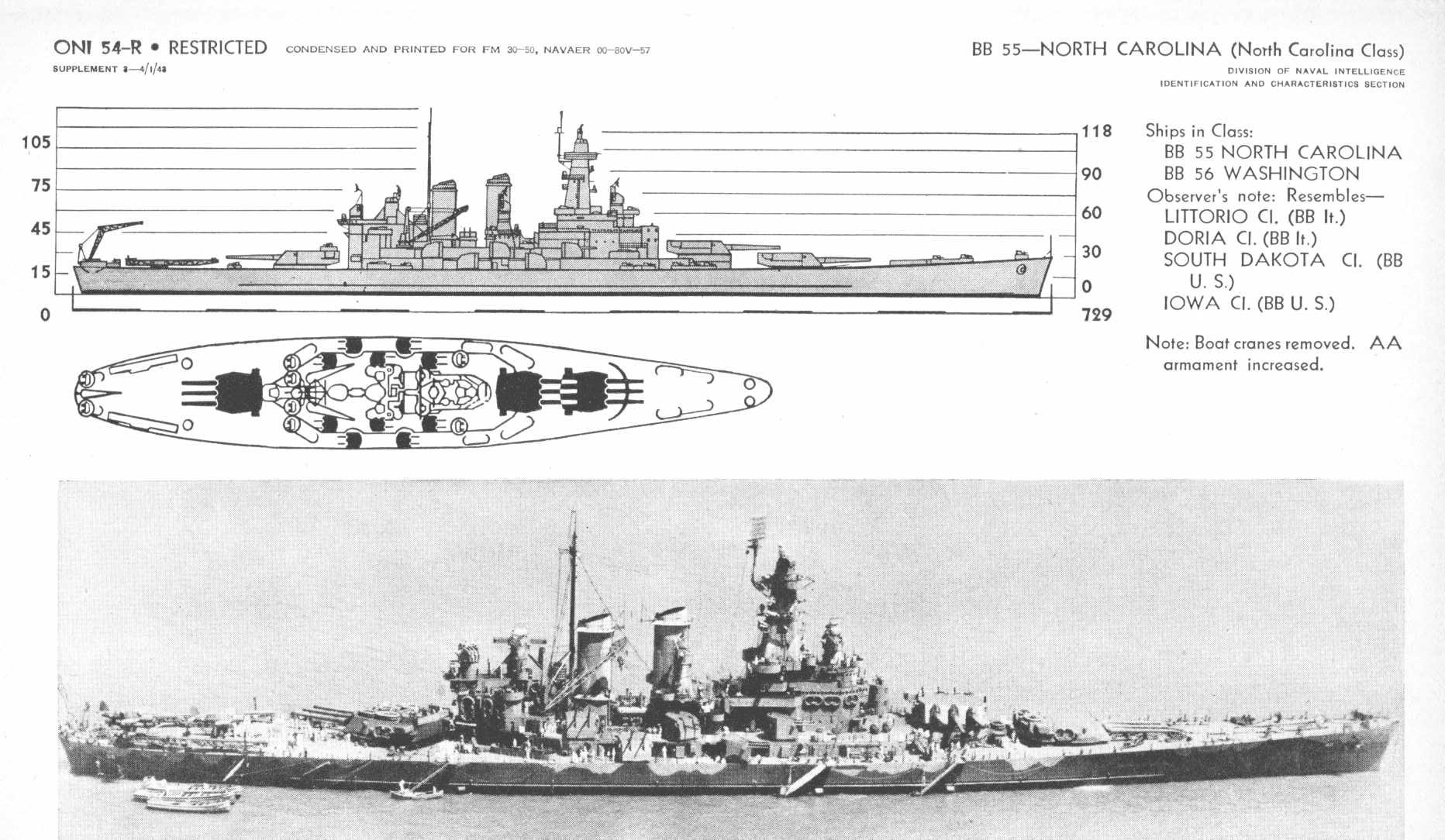
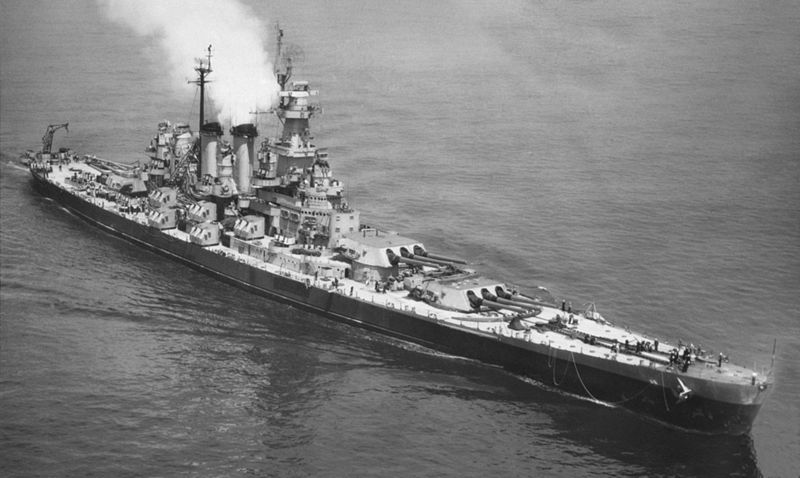
USS North Carolina BB-55

The North Carolina Class was comparable in many ways with the Japanese Nagato Class in speed, protection and armament but with a far greater cruising range.

The North Carolina’s also were superior to their contemporaries in their anti-aircraft armament as well as their electronics, radar and fire direction suites which were all continuously upgraded throughout the war.

The construction of the ships was slow due to material shortages, the design change to 16” guns and labor issues which not only lengthened the length of their construction but raised their cost from $50 million to $60 million dollars each.

North Carolina during underway replenishment in the Pacific

USS North Carolina was laid down on 27 October 1937 launched on 13 June 1940 and commissioned 9 April 1941 though it was months before she was operational due to severe longitudinal vibration of her propeller shafts which was corrected by a modified propeller design.  Despite the efforts to keep to the treaty limitations the ships displaced 36,600 long tons and had a full load displacement of 44,800 long tons. By 1945 the ships full load displacement had increased to 46,700 long tons for North Carolina and 45,370 long tons for Washington.

Torpedo Damage to North Carolina

When she completed her shakedown cruise she was sent to the Pacific where she joined Task Force 16 and the USS Enterprise on 6 August 1942.   She defended Enterprise during the Battle of the Easter Solomons on 24 August and during an 8 minute period she shot down between 7 and 14 Japanese aircraft. On 15 September she was badly damaged by a torpedo from the Japanese submarine I-15 which necessitated her withdraw to Pearl Harbor for repairs. The gravity of the hit sparked great debate in the Navy regarding her protection with some wondering if too much had been sacrificed in her design.  Upon her return to service she operated with TF 38 and TF 58 protecting the carrier task forces in their operations against the Japanese as well as with TF 34 the Fast Battleship Task Force under the command of Vice Admiral Willis Lee.  Serving throughout the Pacific campaign she took part in every major operation in the Central Pacific except Leyte Gulf and against the Japanese mainland.  Her Marines and Sailors took part in the initial occupation of Japan.  She was decommissioned and placed in reserve on 1 June 1960 and survived scrapping to be bought by the State of North Carolina for $250,000 and turned into a memorial at Wilmington North Carolina.  She remains a National Historic Landmark and is maintained by the USS North Carolina Battleship Commission. She is exceptionally well maintained and much of the ship is open for tours.

USS Washington BB-56 on high speed run in 1945

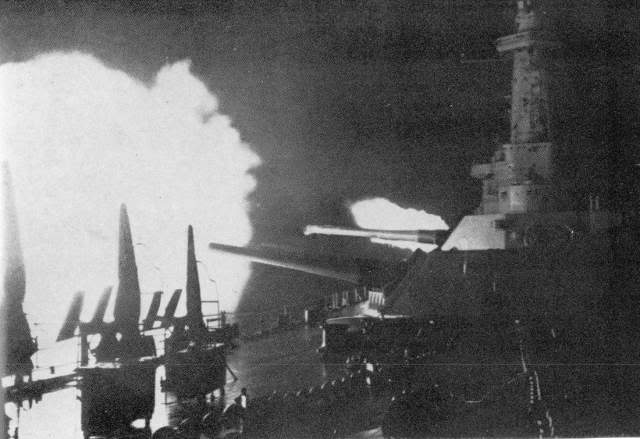
The USS Washington was laid down 14 June 1938 launched on 1 June 1940 and commissioned 15 May 1941 though like North Carolina had propeller shaft vibrations which delayed her operational availability.  She became the first U.S. Navy Battleship to take an active part in the war when she joined the British Home Fleet in March 1942 operating with the Royal Navy escorting Arctic convoys bound for the Soviet Union against possible forays of the Battleship Tirpitz and other heavy German surface units until 14 July when she returned to the United States for a brief overhaul.  She then was deployed to the South Pacific to join U.S. Forces operating against the Japanese at Guadalcanal and became the Flagship of Rear Admiral Willis Lee.  During the Naval Battle of Guadalcanal on the night of 14-15 November she and the USS South Dakota sailed with 4 destroyers to intercept a Japanese task force.  The Japanese force led by the Battleship Kirishima included 2 heavy and 2 light cruisers as well as 9 destroyers.  The Japanese hit the Americans hard early in the battle sinking 3 of the 4 American destroyers and inflicting significant topside damage to South Dakota which caused a power outage and knocked her out of the action.  Washington sailed on undetected by the Japanese and opened a devastating barrage against Kirishima scoring hits with 9 16” shells and 40 5” shell. Kirishima was mortally wounded and was scuttled by her crew the following day.  Washington then drove off the other Japanese ships sparing Henderson Field from certain damage.

Washington blasting Kirishima at the Naval Battle of Guadalcanal 14-15 November 1942

Washington’s victim the IJN Battleship Kirishima

Washington continued operations in the South and Central Pacific until she was damaged in a collision with USS Indiana which resulted in her losing nearly 60 feet from her bow on 1 February 1944. She received temporary repairs before returning to the Puget Sound Naval Shipyard to receive a new bow and other modernizations returning to action in May 1944. She remained in operation against the Japanese the rest of the war. She was decommissioned in 1947 and struck from the Naval Register on 1 June 1960 and sold for scrap.

Various improvements and ideas were suggested while the ships remained in reserve as some in the Navy wished to reactivate them to include lightening them to increase their speed and conversion into Helicopter Carriers all of which were rejected.

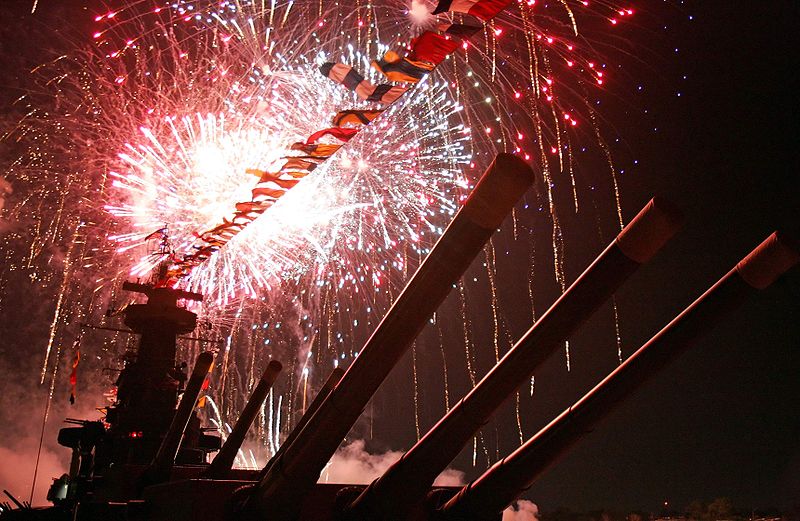
Fireworks over the North Carolina in Wilmington (US Navy Photo)

Though the North Carolina’s were a compromise design they performed admirably throughout the war.  They and their brave crews are remembered in Naval History and the preservation of North Carolina has ensured that they will never be forgotten.

9 Comments

Filed under History, Military, Navy Ships, world war two in europe, world war two in the pacific

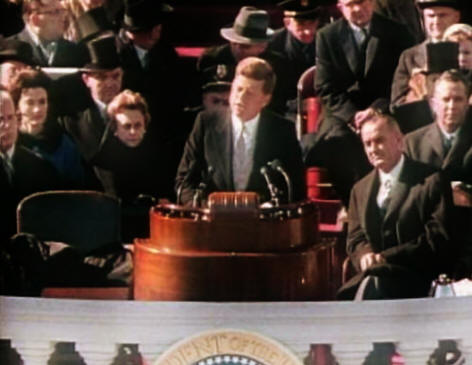
Ask not what your country can do for you – ask what you can do for your country. The Presidential Speech that Still Calls us to Better and Higher Ideals


Fifty years ago today a young, handsome Irish Catholic from Massachusetts took the oath of office of the President of the United States. President John F. Kennedy had won an exceptionally close Presidential Race against Republican Voce President Richard M. Nixon, a race that some believe was decided by votes of the dead in places like Chicago and West Virginia. Despite the contested nature of the election Nixon was gracious and conceded the race to avoid deeper division.

The Kennedy administration had a wonderful vision but was not always successful and sometimes such in the case of the Bay of Pigs Invasion and sometimes mired in controversy. Decisions made by Kennedy such as to send more advisors to Vietnam would be followed by the Johnson Administration sending combat troops. He played a high stakes game of chess with Nikita Khrushchev during the Cuban Missile Crisis where the world came perilously close to nuclear war. His speech at the Berlin Wall where he identified himself with the city saying  “Ich bin Ein Berliner” inspired many in Germany who realized that in Kennedy they had a friend who would not abandon them. He challenged us to put a man on the moon by 1970 and supported NASA as they began to develop the Apollo program which did achieve that lofty goal when Apollo 11 landed on the Moon. He had the Army establish the Special Forces, or the Green Berets, the establishment of the Peace Corps, and his economic policies were fiscally conservative but did not ignore the poor. He pushed for equal rights for African Americans against a much divided nation.  He was not known for his sexual morality and the stories of him with various mistresses abound. He eventually was felled by an assassin’s bullet in Dealey Plaza in Dallas Texas with his wife Jackie at his side. His death stunned the nation and in a sense ended our innocence.  Since that time American politics has been on a slow but steady descent into darkness which both parties have aided and abetted to the point that they view each other as mortal enemies and along with it have devastated our body politic.

In our divided state it seems that the nation has become nothing more than a collection of special interest groups each driven by their own wants and needs above that of others goaded into a frenzy by politicians who cater to those needs whether they be tax breaks, entitlements or “pork barrel” projects which only benefit the political benefactors of the politicians. I know that American politics has always had such elements but I don’t think that my parents or those other young people who heard and responded to this speech ever imagined that we would come to this.

While Kennedy still has critics and was a flawed man I find him still to be a great and compelling President who called us to better as individuals and as a nation. Today we remember the speech that calls us to higher and better, a speech that if we head it can still help point us away from the abyss which we are staring into. I have posted the text of the speech as well as a link to the video of it here.  I have highlighted some of my favorite passages.

Peace

Padre Steve+

http://www.youtube.com/watch?v=VB6hLg3PRbY

Vice President Johnson, Mr. Speaker, Mr. Chief Justice, President Eisenhower, Vice President Nixon, President Truman, Reverend Clergy, fellow citizens:

We observe today not a victory of party but a celebration of freedom, symbolizing an end as well as a beginning, signifying renewal as well as change. For I have sworn before you and Almighty God the same solemn oath our forbears prescribed nearly a century and three-quarters ago.

The world is very different now. For man holds in his mortal hands the power to abolish all forms of human poverty and all forms of human life. And yet the same revolutionary beliefs for which our forebears fought are still at issue around the globe – the belief that the rights of man come not from the generosity of the state but from the hand of God.

We dare not forget today that we are the heirs of that first revolution. Let the word go forth from this time and place, to friend and foe alike, that the torch has been passed to a new generation of Americans, born in this century, tempered by war, disciplined by a hard and bitter peace, proud of our ancient heritage, and unwilling to witness or permit the slow undoing of those human rights to which this nation has always been committed, and to which we are committed today at home and around the world.

Let every nation know, whether it wishes us well or ill, that we shall pay any price, bear any burden, meet any hardship, support any friend, oppose any foe to assure the survival and the success of liberty.

This much we pledge – and more.

To those old allies whose cultural and spiritual origins we share, we pledge the loyalty of faithful friends. United there is little we cannot do in a host of cooperative ventures. Divided there is little we can do; for we dare not meet a powerful challenge at odds and split asunder.

To those new states whom we welcome to the ranks of the free, we pledge our word that one form of colonial control shall not have passed away merely to be replaced by a far more iron tyranny. We shall not always expect to find them supporting our view. But we shall always hope to find them strongly supporting their own freedom; and to remember that, in the past, those who foolishly sought power by riding the back of the tiger ended up inside.

To those people in the huts and villages of half the globe struggling to break the bonds of mass misery, we pledge our best efforts to help them help themselves, for whatever period is required – not because the communists may be doing it, not because we seek their votes, but because it is right. If a free society cannot help the many who are poor, it cannot save the few who are rich.

To our sister republics south of our border, we offer a special pledge: to convert our good words into good deeds in a new alliance for progress; to assist free men and free governments in casting off the chains of poverty. But this peaceful revolution of hope cannot become the prey of hostile powers. Let all our neighbors know that we shall join with them to oppose aggression or subversion anywhere in the Americas. And let every other power know that this Hemisphere intends to remain the master of its own house.

To that world assembly of sovereign states, the United Nations, our last best hope in an age where the instruments of war have far outpaced the instruments of peace, we renew our pledge of support, to prevent it from becoming merely a forum for invective, to strengthen its shield of the new and the weak, and to enlarge the area in which its writ may run.

Finally, to those nations who would make themselves our adversary, we offer not a pledge but a request: that both sides begin anew the quest for peace, before the dark powers of destruction unleashed by science engulf all humanity in planned or accidental self-destruction.

We dare not tempt them with weakness. For only when our arms are sufficient beyond doubt can we be certain beyond doubt that they will never be employed.

But neither can two great and powerful groups of nations take comfort from our present course – both sides overburdened by the cost of modern weapons, both rightly alarmed by the steady spread of the deadly atom, yet both racing to alter that uncertain balance of terror that stays the hand of mankind’s final war.

So let us begin a new remembering on both sides that civility is not a sign of weakness, and sincerity is always subject to proof. Let us never negotiate out of fear. But let us never fear to negotiate.

Let both sides explore what problems unite us instead of belaboring those problems which divide us.

Let both sides, for the first time, formulate serious and precise proposals for the inspection and control of arms – and bring the absolute power to destroy other nations under the absolute control of all nations.

Let both sides seek to invoke the wonders of science instead of its terrors. Together let us explore the stars, conquer the deserts, eradicate disease, tap the ocean depths and encourage the arts and commerce.

Let both sides unite to heed in all corners of the Earth the command of Isaiah to “undo the heavy burdens . . . (and) let the oppressed go free.”

And if a beachhead of cooperation may push back the jungle of suspicion, let both sides join in creating a new endeavor, not a new balance of power, but a new world of law, where the strong are just and the weak secure and the peace preserved.

All this will not be finished in the first one hundred days. Nor will it be finished in the first one thousand days, nor in the life of this Administration, nor even perhaps in our lifetime on this planet. But let us begin.

In your hands, my fellow citizens, more than mine, will rest the final success or failure of our course. Since this country was founded, each generation of Americans has been summoned to give testimony to its national loyalty. The graves of young Americans who answered the call to service surround the globe.

Now the trumpet summons us again; not as a call to bear arms, though arms we need; not as a call to battle, though embattled we are; but a call to bear the burden of a long twilight struggle, year in and year out, “rejoicing in hope, patient in tribulation” – a struggle against the common enemies of man: tyranny, poverty, disease and war itself.

Can we forge against these enemies a grand and global alliance, North and South, East and West, that can assure a more fruitful life for all mankind? Will you join in that historic effort?

In the long history of the world, only a few generations have been granted the role of defending freedom in its hour of maximum danger. I do not shrink from this responsibility; I welcome it. I do not believe that any of us would exchange places with any other people or any other generation. The energy, the faith, the devotion which we bring to this endeavor will light our country and all who serve it – and the glow from that fire can truly light the world.

And so, my fellow Americans: ask not what your country can do for you – ask what you can do for your country.

My fellow citizens of the world: ask not what America will do for you, but what together we can do for the freedom of man.

Finally, whether you are citizens of America or citizens of the world, ask of us here the same high standards of strength and sacrifice which we ask of you. With a good conscience our only sure reward, with history the final judge of our deeds, let us go forth to lead the land we love, asking His blessing and His help, but knowing that here on Earth God’s work must truly be our own.

4 Comments

Filed under History, philosophy, Political Commentary

British Bulwarks: The King George V Class Battleships

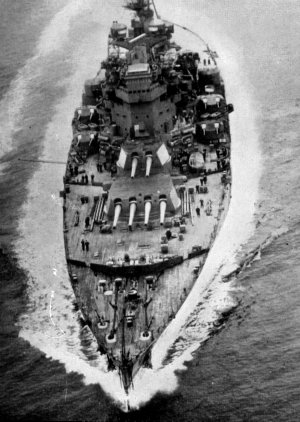
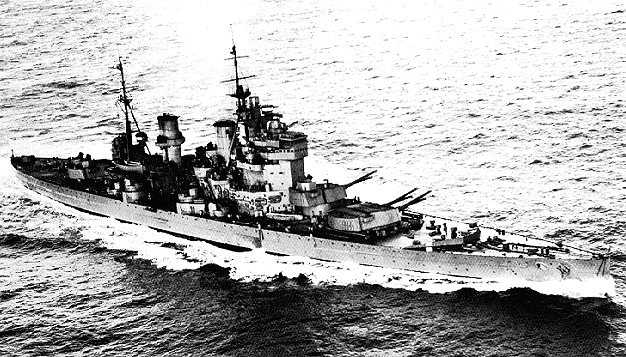
HMS King George V

This is the third in a series of five articles on the battleships built under the provision of the Washington and London Naval Treaty limitations in the 1930s. I am not including the ships which were completed in the immediate aftermath of the Washington Treaty limitations. This series looks at the modern battleships that the World War II combatants would produce in the 1930s which saw service in the war. This article covers the British Royal Navy King George V Class battleships. Part one covered the Italian Vittorio Veneto class entitled The Pride of the Regina Marina: The Vittorio Veneto Class Battleships. Part two French Firepower Forward: The unrealized potential of the Dunkerque and Richelieu Class Battleships covered the French Dunkerque class and Richelieu class Battleships. Part Four the American North Carolina and South Dakota Classes. I have already published the final part which covers the German Scharnhorst Class entitled Power and Beauty the Battle Cruisers Scharnhorst and Gneisenau . The German Bismarck, Japanese Yamato, British Vanguard and American Iowa Classes will be covered in a subsequent series.

HMS King George V in 1941

In the wake of the First World War the major naval powers entered into an agreement restricting the construction of capital ships and limiting the numbers that treaty signatories were allowed to keep. As a result numerous ships were scrapped or disposed of and the majority of planned ships were either cancelled while building or never laid down. In some cases to comply with treaty restrictions ships such as the Royal Navy’s Nelson Class which was a compromise design which sacrificed speed for protection and firepower.  By the late 1920s the Royal Navy’s battle force was comprised of the Nelson’s, the fast Battlecruisers Hood, Renown and Repulse and 10 ships of the Queen Elizabeth and Revenge classes all designed before the First World War.

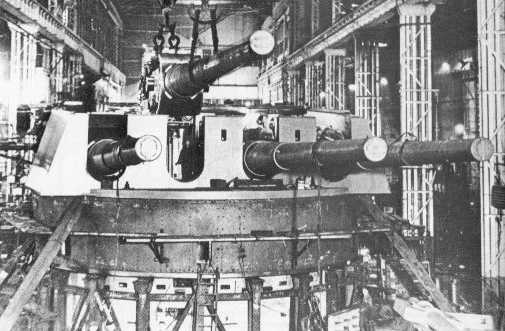
King George V Class Quad Turret being built

The Royal Navy began planning for a new class of battleships in 1928 but the plans were shelved with the signing of the London Naval Treaty which continued the “building holiday” on capital ship construction as well as size and armaments until 1937.  With the realization that its battle force was becoming dated as other nations laid down new classes of battleships the Royal Navy recommenced planning in 1935.  The Navy planned to build to the maximum of the 35,000 displacement limitation and placed a great measure of emphasis on armor and protection. The ships were designed to achieve a 28 knot speed which made them faster than all British battleships although slower than the Battlecruisers. The planners had alternative designs to use 14”, 15” or 16” guns with the Navy favoring the 15” models which had equipped all of their other ships with the exception of the Nelson’s. However the Admiralty to use 14” as the government was endeavoring to negotiate with other powers to impose a 14” limitation on armament for new battleships.  While the Americans and French agreed to the limit neither the Japanese nor Italians followed suit and as a result all new battleships of other powers had larger guns than the King George V Class ships with the French and Italians opting for 15”on the Vittorio Veneto Class, the Americans 16” on the North Carolina, South Dakota and Iowa Classes and the Japanese 18” guns for their Yamato Class. The Germans who were not a signatory built their Scharnhorst Class with 11” although they were planned as 15” ships and would equip the Bismarck Class with 15” guns.  The Royal Navy attempted to rectify this by placing more guns on the ships than those of other navies but the planned armament of twelve 14” guns mounted in quadruple turrets but this was impossible on the 35,000 platform without compromising protection or speed.  Thus the Admiralty compromised on 10 guns mounted in 2 quadruple and 1 twin turret.

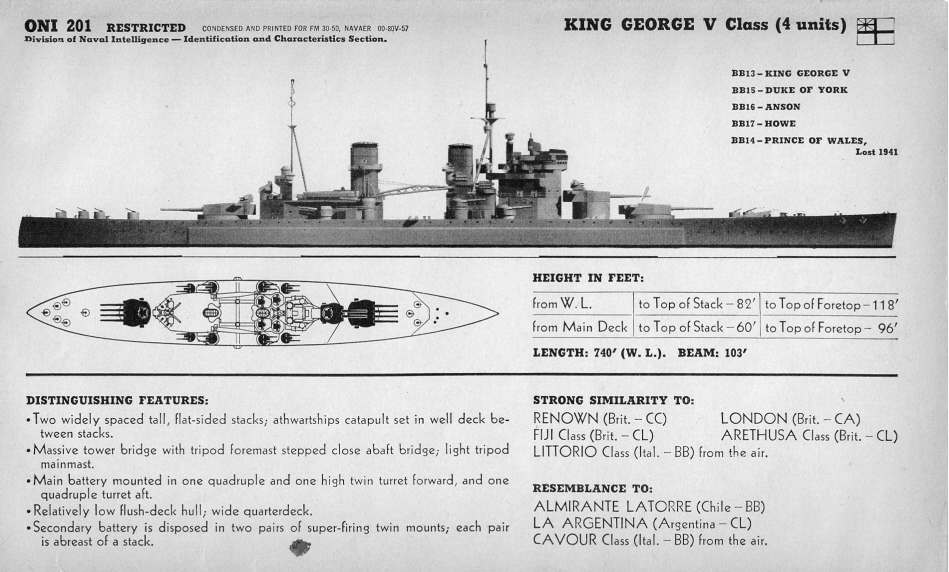
ONI Drawing of King George Class

The ships displaced a full load displacement of 42,237 tons in 1942 which had increased to 44,460 tons in  1944. The were 745 feet long had a beam of 103 feet, a top speed of 28 knots with a cruising range of 5,400 nautical miles at 18 knots. Their relatively poor endurance limited their operations in the Pacific and even nearly caused King George V to have to abandon the chase of the Bismarck in May 1941.

The main batteries of the ships proved problematic in combat with the quadruple turret design causing all the ships problems. This was demonstrated in the engagement of the Prince of Wales against the Bismarck as well as the King George V in its duel with the German behemoth when A turret became disabled and completely out of action for 30 minutes and half of the main battery being out of action for most of the engagement for mechanical reasons.  The Duke of York achieved excellent results against the Scharnhorst but even in that engagement the main battery was only able to be in action 70% of the time.  One of the other drawbacks of the design was that in order to replace a gun due to wear that the turret itself had to be dismantled in order to remove and replace the guns.

The main secondary armament of 5.25” dual purpose guns in twin mounts suffered from poor rate of fire and slow traverse well below their designed standards.

The mounting of the armament was designed to provide protection against turret explosions which could potentially detonate the ship’s magazines.  The main side and underwater protection scheme was sound and protected the ships well in combat.  The vertical protection was also sound as was the protection afforded to the turret barbets and placement of the magazines to shield them from plunging fire.  Only the Prince of Wales was lost due to enemy action had later examination of her wreck revealed that the culprit was a torpedo which detonated in a propeller shaft outside of the armored belt which caused uncontrolled flooding when she was attacked by Japanese aircraft on 8 December 1941.

HMS Anson conducting gunnery exercises

The propulsion systems developed problems after 1942 when fuel oil quality was decreased because of the need for aviation gas.  The new mixtures which were higher viscosity and contained more water than the boilers could effectively burn increased maintenance costs and decreased efficiency. To compensate the Admiralty designed new higher pressure fuel sprayers and burners which returned the boilers to full efficiency.

The lead ship of the class the King George V was laid down on 1 January 1937, launched on 21 February 1939 and commissioned on 11 December 1940.  As the flagship of the Home Fleet she took part in the unsuccessful search for the Scharnhorst and Gneisenau and in the hunt for the Bismarck in which she earned lasting fame in helping to sink that ship.  She took part in the Murmansk convoy protection as well as Operation Husky, the invasion of Sicily before sailing to the Far East for operations against the Japanese. She finished the war with the British Pacific Fleet and was present at the Japanese surrender in Tokyo Bay.  She returned as flagship of Home Fleet until she was decommissioned in 1949. She was subsequently sold for scrap in 1957.
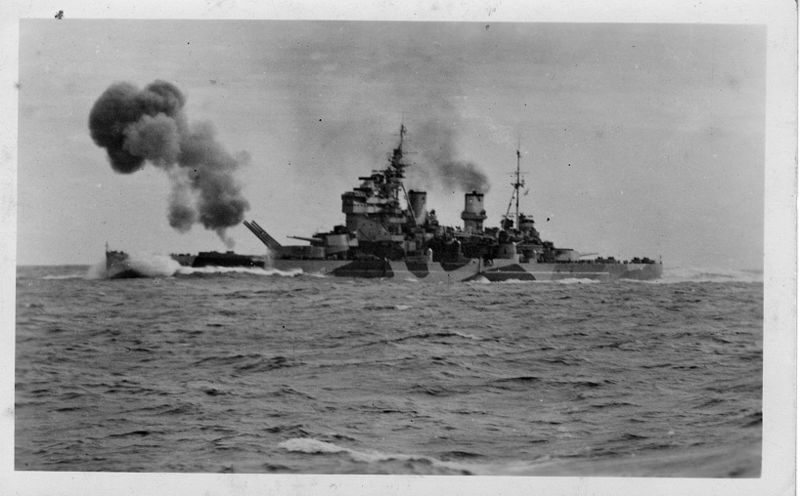
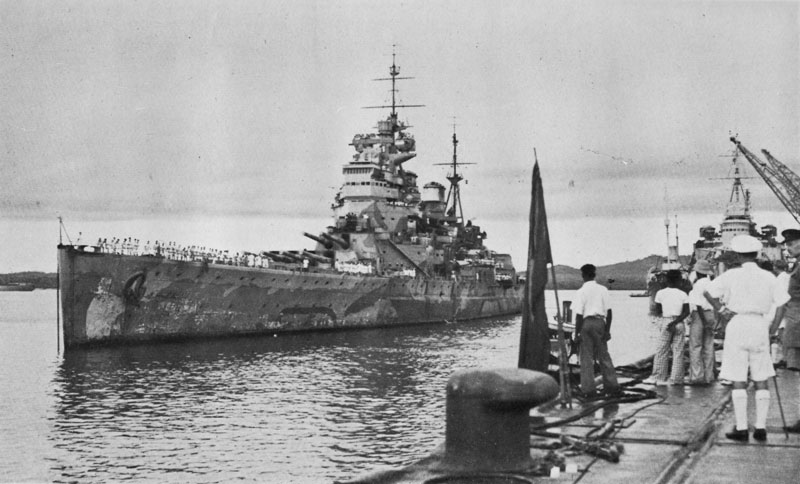
Prince of Wales pulling into Singapore

The second ship the Prince of Wales laid down on 1 January 1937, launched on 3 May 1939 and commissioned 19 January 1941 although she was not officially completed until March 1941. Her initial operation came in May 1941 when she sailed with the HMS Hood to intercept the Bismarck. When she sailed she still had shipyard technicians aboard.  Damaged in the action she did score an important hit on Bismarck which cut a fuel line making her forward tanks inaccessible and causing her to make her run for Brest which she did not complete. Another hit damaged her aircraft catapult and a third an electric dynamo.

Church Service on Prince of Wales at Argentia Bay with Churchill and Roosevelt in attendance

Following repairs she carried Winston Churchill to the Argentia Bay Newfoundland where he met with Franklin D. Roosevelt and together drafted the Atlantic Charter. She accompanied the HMS Repulse to Singapore to bolster the British presence in the Far East but without air cover was sunk by Japanese aircraft which struck her with 4 torpedoes and a bomb, the key hit being a lucky hit on her propeller shaft which caused flooding that caused a loss of power to pumps and anti-aircraft defenses.

Prince of Wales sinking and being abandoned

The third ship the Duke of York was laid down 5 May 1937, launched on 28 February 1940 and commissioned 4 November 1941. She provided convoy escort for the Lend Lease convoys to the Soviet Union as well the sinking of the Scharnhorst on 26 December 1943 during the Battle of North Cape. She was transferred to the Pacific in 1944 and served at Okinawa.  She was decommissioned in 1949 and scrapped in 1957.

Duke of York

The fourth ship of the class the Howe was laid down on 1 June 1937, launched 9 April 1940 and commissioned on 29 August 1942.  She served with the Home Fleet and in the Mediterranean until she was transferred to the Pacific in August 1944. She was stuck by a Kamikaze in May 1945 and Howe was sent for refit at Durban South Africa. She was still in refit when the war ended. She returned home and was placed in reserve in 1950 and scrapped in 1958.

HMS Howe

The last of the class the Anson was laid down 20 July 1937, launched 24 February 1940 and commissioned on 22 June 1942. She operated in the Mediterranean and the North Atlantic and was sent to the Pacific in 1945 where she accepted the surrender of the Japanese Forces at Hong Kong. She returned to Britain and was decommissioned in 1941 and scrapped in 1957.

HMS Anson

The ships had rather unremarkable careers for the most part with the exception of the Prince of Wales and King George V in the hunt for the Bismarck and the Duke of York sinking the Scharnhorst. They had a number of technical problems which limited their operations in the war. However they and their brave crews deserve to be remembered as helping to hold the line against the Axis in the early years of the war and sank two of the four German Battleships lost during the war.  This alone was as remarkable achievement as of their contemporaries only the USS Washington sank an enemy battleship in combat.


12 Comments

Filed under History, Military, Navy Ships, world war two in europe, world war two in the pacific

The Message of Dr. Martin Luther King Jr. for 2011

“Darkness cannot drive out darkness; only light can do that. Hate cannot drive out hate; only love can do that.”  Dr. Martin Luther King Jr.

Today we worshipped at St. James Episcopal Church, Portsmouth Virginia where I attend when I am at home.  It had been a while since we attended with my assignment at Camp LeJeune and battles with weather and illness during the past month.  However today we made it and it was good as we remembered the life and message of Dr. Martin Luther King Jr.

St. James is the historic African American Episcopal Parish in Portsmouth. Many of the families in the parish trace their Episcopal Church roots back to the days before the Civil War and the years following. As such they were pioneers in the advancement of African Americans serving as educators, doctors and in the military when discrimination in the form of Jim Crow Laws, “separate but equal” schools, churches, hospitals, public restrooms, places in restaurants, public transportation and so many other things that we consider absolutely part of daily life today. Blacks were subject to legalized harassment, literacy tests in order to vote as well as lynching by those well intentioned upstanding members of such groups as the Ku Klux Klan.

The most of the members of St. James are more elderly and veterans of the Civil Rights movement and remember the times when they suffered while fighting for the rights that we so freely take for granted. The newer generation is mixed between their descendants as well as immigrants from Nigeria.  I fell in love with this parish when the pastor Fr John invited me back in 2009 when I was still struggling in the midst of PTSD and a crisis in faith and belief. I owe a lot to Fr. John and the dear people of St. James for the way that they welcomed us and helped in my journey to the rediscovery of faith.

Father Green who was called on short notice due to illness of our pastor’s wife had known Dr King and gave a remembrance of Dr. King’s early ministry going back to meeting him while they were seminary students. Father Green had us join together and link arms as a congregation around the sanctuary as we sang “We Shall Overcome.”

The marking of Dr. King’s birthday this year in the shadow of the deep division and hatred that the country is engulfed in caused me to think about the importance of Dr. King’s message, not only for the cause of Civil Rights for minorities and others who are discriminated against, but the larger message of peace and reconciliation.

Dr. King died by an assassin’s bullet, James Earl Ray, a man who had a history of crime as well as a long established prejudice against African Americans who was a volunteer for the campaign of segregationist Governor George Wallace’s presidential campaign.  The climate of the country in large part was one of prejudice and often hatred of what was represented by Dr. King. However the response of Dr. King to multiple death threats as well as incarceration for breaking laws which were rooted in the evil of segregation and discrimination was that of peace and reconciliation, love over hate which is of the essence of the Christian faith.

Dr King said something that is so applicable to our own deeply divided society where hatred is legitimatized by purveyors of hate.  In the wake of the shooting of Congresswoman Gabrielle Giffords last Saturday there was an epidemic of heated and often hateful rhetoric with conservatives and liberals alike seeking to label a madman as belonging to the other side it became readily apparent to me that unless we lay down the hate that we will destroy each other and the country. Dr. King said this in words that I cannot hope to match.

“Have we not come to such an impasse in the modern world that we must love our enemies – or else? The chain reaction of evil – hate begetting hate, wars producing more wars – must be broken, or else we shall be plunged into the dark abyss of annihilation.”

Peace

Padre Steve+


4 Comments

Filed under christian life, faith, History, laws and legislation, philosophy, Political Commentary

The Content of their Character: Brigadier General Benjamin O. Davis Sr. US Army and General Benjamin O. Davis Jr. US Air Force

Brigadier General Benjamin O Davis in France 1944

“I have a dream that my four little children will one day live in a nation where they will not be judged by the color of their skin, but by the content of their character.” Dr. Martin Luther King, Jr.

American History would not be the same without the life, work and prophetic ministry of Dr. Martin Luther King Jr. Dr. King was born in a time when most of the country was segregated when “separate by equal” was simply façade to cover the lie that in no way did African Americans have equal rights or privileges in the United States. Dr King was born less than 60 years after the secession of the Southern states from the Union and the beginning of the American Civil War. Though that blood conflict had freed the slaves it had not freed African Americans from prejudice, violence and discrimination.  When Dr. King began his ministry and was thrust upon the national stage as the strongest voice for equal rights and protections for blacks the discrimination and violence directed towards blacks was a very real and present reality in much of the United States.

However there were cracks beginning to appear in the great wall of segregation in the years preceding Dr. King’s ascent to leadership as the moral voice of the country in the matter of racial equality. In baseball Jackie Robinson became the first African American player in Major League Baseball opening a door for others who would become legends of the game as well as help white America begin its slow acceptance of blacks in sports and the workplace.

Likewise the contributions of a father and son Brigadier General Benjamin O. Davis Sr. and General Benjamin O. Davis Jr. were advancing the cause of blacks in the military which eventually led to the desegregation of the military in 1948.  The impact of these two men cannot be underestimated for they were trailblazers who by their lives, professionalism and character blazed a trail for African Americans in the military as well as society.

Benjamin O. Davis Sr. was a student at Howard University when the USS Maine exploded and sank in Havana Harbor.  He volunteered for service and was commissioned as a temporary 1st Lieutenant in the 8th United States Volunteer Infantry. He was mustered out of service in 1899 but enlisted as a private in the 9th United States Cavalry one of the original Buffalo Soldiers regiments.  He enlisted as the unit clerk of I troop of 3rd Squadron and was promoted to be the squadron Sergeant Major. He was commissioned while the unit was deployed to the Philippines and assigned to the 10th Cavalry.  He was assigned in various positions throughout his career including command, staff and instruction duties including as Professor of Military Science and Tactics in various ROTC programs.  He reached the rank of rank of temporary Lieutenant Colonel and Squadron Commander of 3rd and later 1st Squadron 9th Cavalry from 1917-1920 in the Philippines before reverting to the rank of Captain on his return as part of the post World War I reduction in force.  He continued to serve during the inter-war years and assumed command of the 369th Infantry Regiment New York National Guard in 1938. He was promoted to Brigadier General on 25 October 1940 becoming the first African American elevated to that rank in the United States Army and was assigned as Commander 4th Brigade 2nd Cavalry Division. He later served in various staff positions at the War Department and in France and was instrumental in the integration of the U.S. Military. He retired after 50 years service in 1948 in a public ceremony with President Harry S. Truman presiding. He was a member of the American Battle Monuments Commission from 1953-1961 and died in 1970.

Colonel Davis with his son Cadet Benjamin O Davis Jr.

His son Benjamin O. Davis Jr. was appointed to West Point in 1932.  He graduated and was commissioned in 1936 graduating 35 out of 278, the fourth African American graduate of West Point. During his time at the Academy most of his classmates shunned him and he never had a roommate.  Despite this he maintained a dogged determination to succeed.  The Academy yearbook made this comment about him:

“The courage, tenacity, and intelligence with which he conquered a problem incomparably more difficult than plebe year won for him the sincere admiration of his classmates, and his single-minded determination to continue in his chosen career cannot fail to inspire respect wherever fortune may lead him.”

He was denied entrance to the Army Air Corps because of his race and assigned to the Infantry first to the all lack 24th Infantry Regiment at Ft Benning where he was not allowed in the Officers Club due to his race. Upon his commissioning the Regular Army had just 2 African American Line Officers, 2nd Lieutenant Davis and his father Colonel Davis. After completion of Infantry School he was assigned as an instructor of Military Science and Tactics and the Tuskegee Institute.  In 1941 the Roosevelt Administration moved to create a black flying unit and Captain Davis was assigned to the first black class at the Tuskegee Army Air Field and in March 1942 one his wings as one of the first 5 African Americans to complete flight training.  In July 1942 he was assigned as Commanding Officer of the 99th Pursuit Squadron which served in North Africa and Sicily flying Curtiss P-40 Warhawks. He was recalled to the United States in September 1943 to command the 332nd Fighter Group. However some senior officers attempted to prevent other black squadrons from serving in combat alleging that the 99th had performed poorly in combat. Davis defended his squadron and General George Marshall ordered an inquiry which showed that the 99th was comparable to white squadrons in combat and during a 2 day period over the Anzio beachhead the pilots of the 99th shot down 12 German aircraft.

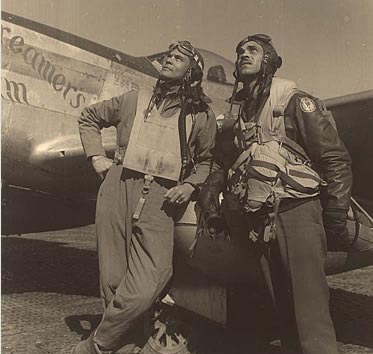
Colonel Benjamin O Davis Jr (left) with one of his Tuskegee Airmen

Davis took the 332nd to Italy where they transitioned to P-47 Thunderbolts and in July 1944 to the P-51 Mustang which were marked with a signature red tail. During the war, the units commanded by Davis flew more than 15,000 sorties, shot down 111 enemy planes, and destroyed or damaged 273 on the ground at a cost of 66 of their own planes. Their record against the Luftwaffe was outstanding and their protection of the bombers that they escorted was superb with very few bombers lost while escorted by them men that the Luftwaffe nicknamed the Schwarze Vogelmenschen and the Allies the Red-Tailed Angels or simply the Redtails. Davis led his Tuskegee Airmen to glory in the war and their performance in combat helped break the color barrier in the U.S. Military which was ended in 1948 when President Truman signed an executive order to end the segregation of the military. Colonel Davis helped draft the Air Force plan and the Air Force was the first of the services to fully desegregate.

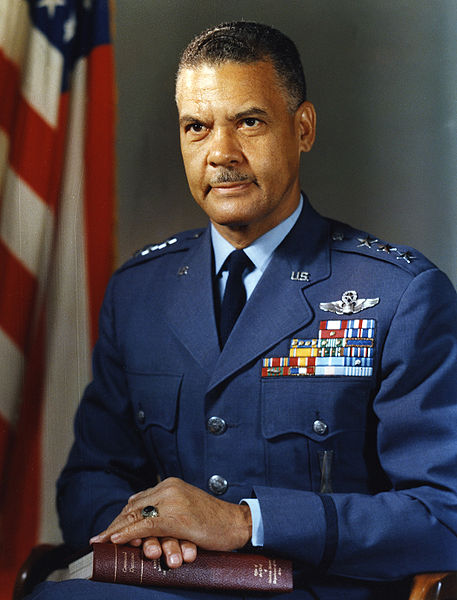
Lieutenant General Benjamin O Davis Jr

Colonel Davis transitioned to jets and let the 51st Fighter Interceptor Wing against Chinese Communist MIGs in the Korean War.  He was promoted to Brigadier General in 1954 and served in numerous command and staff positions. He retired in 1970 with the rank of Lieutenant General and was advanced to General while retired by President Clinton in 1998.  He died in 2002 at the age of 89.

The legacy of Benjamin O. Davis Senior and Benjamin O. Davis Junior is a testament to their character, courage and devotion to the United States of America. They helped pioneer the way for officers such as General Colin Powell and helped change this country for the better.  During times when discrimination was legal they overcame obstacles that would have challenged lesser men.  Benjamin O. Davis Junior remarked “My own opinion was that blacks could best overcome racist attitudes through achievements, even though those achievements had to take place within the hateful environment of segregation.”

Such men epitomize the selfless service of so many other African Americans who served the country faithfully and “by the content of their character” triumphed over the evil of racism and helped make the United States a more perfect union.

Peace

Padre Steve+


4 Comments

Filed under History, leadership, Political Commentary, world war two in europe