Category Archives: History

America First and the Holocaust

Friends of Padre Steve’s World,

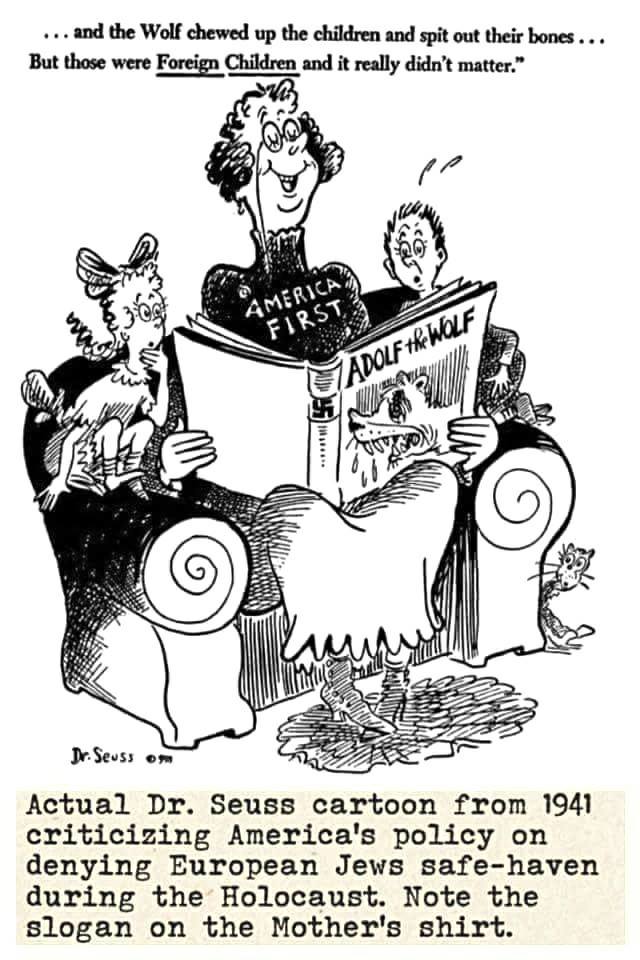
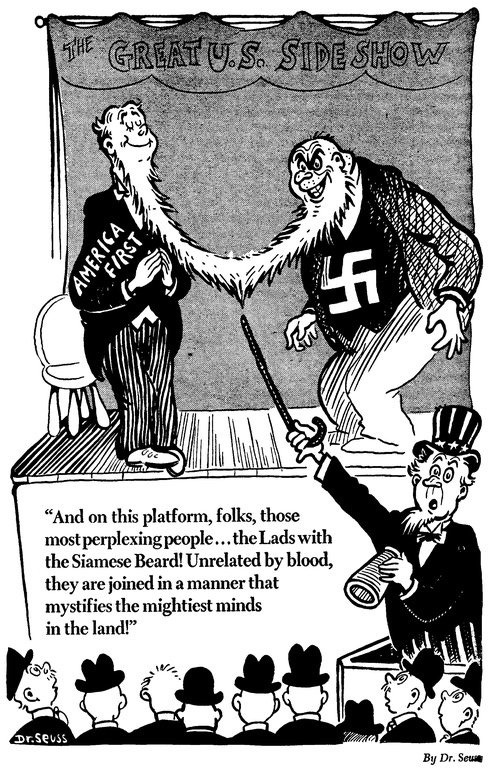
Before Donald Trump’s promise to Make America Great Again and govern by the principle America First there was a movement that proclaimed the message of America First. It was a movement that was led by men like Charles Lindbergh as well as many isolationist politicians, mostly Republicans. It advocated a policy favorable to Nazi Germany and fought against the immigration of any Jews to the United States from Germany or Nazi occupied Europe. Lindbergh blamed the Jews as well as the British, and the Roosevelt administration for the war more than he did Hitler, and this was in his Des Moines speech of September 11th 1941, after two years of war and Hitler’s ruthless war of conquest.

In that speech Lindbergh said:

“Instead of agitating for war the Jewish groups in this country should be opposing it in every possible way, for they will be among the first to feel its consequences. Tolerance is a virtue that depends upon peace and strength. History shows that it cannot survive war and devastation. A few farsighted Jewish people realize this and stand opposed to intervention. But the majority still do not. Their greatest danger to this country lies in their large ownership and influence in our motion pictures, our press, our radio, and our government.”

That my friends is the root of the America First message. It was demonstrated in the Trump Press Secretary, Sean Spicer’s words in the immediate aftermath of the Syrian chemical attack on its own citizens in which Spicer said that Hitler had not even done that, ignoring the fact that Hitler’s henchmen had gassed millions of Jews. When he attempted to correct himself he only dug himself in deeper by talking about “Holocaust Centers.” While they did not use it against enemy soldiers, they used it against their own people first, beginning with the disabled, then the Jews, both German and those in countries that they overran. It was evident in the administration’s statement on Holocaust memorial day which did not mention the Jews. One only hope that the President will someday will be somewhat more clear about who the primary targets of Hitler’s Final Solution were, instead of constantly invoking moral equivalence or simply ignoring violent acts of Neo-Nazis. Yes, many millions were killed or starved to death by the Nazis, but it was the Jews who were the target of Hitler’s race hatred from the very beginning. 

The late Christopher Hitchens wrote:

“We should not at all allow ourselves to forget the millions of non-Jewish citizens of Belarus, Russia, Ukraine, and other Slav territories who were also massacred. But for me the salient fact remains that anti-Semitism was the regnant, essential, organizing principle of all the other National Socialist race theories. It is thus not to be thought of as just one prejudice among many.” 

If this is what it means to make America Great again then we are deep trouble.  Historian Timothy Snyder wrote: “When exactly was the “again” in the president’s slogan “Make America great again”? Hint: It is the same “again” that we find in “Never again.”

I had hoped that the President would rid himself of this terrible America First ideology, for it has nothing to do with true patriotism or the ideals of those who founded our country. Instead he has doubled down on it over the past two years, and continues to do nearly every day. Yehuda Bauer wrote these exceptionally pertinent to our time:

The horror of the Holocaust is not that it deviated from human norms; the horror is that it didn’t. What happened may happen again, to others not necessarily Jews, perpetrated by others, not necessarily Germans. We are all possible victims, possible perpetrators, possible bystanders.

Until tomorrow,

Peace

Padre Steve+

1 Comment

Filed under History, holocaust, nazi germany, Political Commentary

Reading and the Encouragement Of a Friend When Needed

Friends of Padre Steve’s World,

This is going to a weird post. It is mixed with various emotions, feelings of failure, abandonment, physical disability, frustration with a system, and yet another loss of a friend. It is also a reflection on my love of history and wisdom from the life of Franklin Delano Roosevelt. In the midst of a crisis that threatened the fate of the entire country and its citizens. In his first inaugural address he noted: “Only a foolish optimist can deny the dark realities of the moment… the only thing we have to fear is fear itself.”

It has been a hard few days, and for that matter the last decade or so and I am exhausted. I didn’t post anything for two days because I was too tired, so I finished reading Doris Kearns Godwin’s book Leadership In Turbulent Times. I am glad that I did because I have become quite discouraged about all the things wrong with my knees, hips, ankles and other medical problems; weight gain from being unable to do what I like doing (walking and running); and frustration with the delays in care I experience with Navy Medicine. I am physically broken as well as spiritually and emotionally depleted. I feel crippled.

The book deals with the lives, points of crisis, and leadership of Abraham Lincoln, Theodore Roosevelt, Franklin Delano Roosevelt, and Lyndon Johnson. It is worth the read, for all experienced failure and when in office had to deal with issues that threatened the Nation itself.

I am struggling at the end of my military career of almost 38 years. I was beginning to have quite the pity party. Not to say that I am not struggling, I have been feeling like a failure of late, crippled and useless; but Goodwin’s depiction of Franklin Roosevelt’s continual battle with Polio and the way that he kept a positive outlook and encouraged others, in such a manner that what would have kept others from any kind of success. The key to his success was investing in others and making a connection with people no-matter where he served.

Late last night I got a personal message form one of my sailors, at the time a young enlisted man expressing his care for me and Judy. It ended up in a conversation and it made me think about what Roosevelt did with others. I expressed my real gratitude to him, he has a good heart, and cares for for people, probably better than I do, and I told him that. His care for me made caused me to reflect, I have felt like a cast off from the Chaplain Corps for years, yet here was a young man remembering me from service together that began in 2001, and he took the time to encourage me when I was down. That’s the way Franklin Roosevelt dealt with people.

I began to think about my my knees and having to use a cane to keep me stable on my feet. I figure if Roosevelt could find ways to succeed and not let himself slip into self-pity, then maybe I can too, no matter what goes on with my knees. My young friend reminded me of that. He also reminded me that care for people was why I am here.

Likewise, yesterday I was down about the death of my friend Father Jim Parke. Father Jim was the kind of man who never knew a stranger and for the last 16 years of our lives he has been there for us in times of difficulty and joy.

To my friend Marc, thank you. You made my day last night, and Father Jim, my friend thank you for years of friendship, and Rest In Peace.

Until tomorrow,

Peace

Padre Steve+

4 Comments

Filed under faith, History, life, Loose thoughts and musings

A Centurion and His Officers Reflect on “Following Orders” the Roman Soldiers on Holy Saturday

Friends of Padre Steve’s World

Today is what Christians call “Holy Saturday.” It is a day of reflection between the death of Jesus on Good Friday and his Resurrection. So unless something really unusual and earth shattering occurs I am going to take the Easter weekend to do some reflection, including on some spiritual topics. In light of that I am simply going to post three of my older fictional accounts of that weekend, yesterday, today, and Easter Sunday.

As a genre this series falls in the realm of historical fiction, which means that while they may be set in a historical event, that they are fiction. Likewise, I admit that they and the main character are more a reflection of me, and my journey, and my over-active imagination, than my cursory study of Roman and New Testament History.

Likewise, the story itself is timeless and transcends the bounds of the Christian religion, it is about humanity. As I say to so often, human beings are one constant in history. Here are men who are involved in the torture and killing of a man they know to be innocent. It is a study in human behavior and reflection. If you have ever read the accounts of soldiers of occupying armies, propping up unpopular governments against insurgents, there is something to be learned. They were just following orders.

That being said, have a nice weekend, and if you do it, have a nice Easter.

Peace,

Padre Steve+

holy-saturday

The horrible day was passed and a new morning greeted Longinus as he arose. The sun rising over the escarpment in the east that overlooked the Jordan River cast a warm red and yellow glow as its rays infiltrated the window overlooking the courtyard of Fortress Antonia. It seemed an eternity since he watched the sun rise as Pilate debated what to do with that Jesus fellow.

Longinus and his fellow officers Flavius and Decius had spent much of the previous evening in the tavern following the executions. It was not a typical night for them. There was little frivolity, few jokes and none talked much about the events of the day, which had begun for Longinus not long after midnight. Flavius, whose servant had been healed by Jesus in Capernaum had briefly discussed the meaning of Longinus’s comments as the Galilean preacher died upon the cross. Longinus pondered the words again. “Surely this man is the son of God” or something to that effect. He didn’t remember his exact words and he couldn’t even remember why he had said them, but then the day was long and the events struck a nerve. He had seen or taken part in many executions as well as difficult battles. He disliked executions in general but until now he had managed to keep his soul protected from from what he felt on Golgotha by the wall that he had built around his heart.

Longinus looked out the window and then at his desk. He would need to call his officers together soon. He was sure that even though it was the sabbath that those that plotted against Roman rule, as well as the various factions at work in Jerusalem were still plotting, scheming and at work. He wondered how in such a climate anyone could call the day “holy.”

He did not like what had happened the previous day. When Pilate gave in to the Jewish leaders in regard to killing the Galilean he very uneasy. Pilate should have damned the whole politics of the situation and let the man go. The events still bothered him. The man was innocent. Pilate knew it, Longinus knew, hell they all knew and yet all of them had aided and abetted those that wanted the man named Jesus dead. Longinus felt a shame that in all of his years of soldiering he had never before felt. Pilate was able to wash his hands of responsibility. Longinus wished he could do so for himself, but the blood of the innocent man, which still stained the tip of the lance that Longinus had plunged into him, would not let him. Longinus shook his head in disgust.

Just then Decius knocked and entered with the news that Pilate had ordered a guard set at the tomb of Jesus. Supposedly the Jesus fellow had said that he would rise from the dead and the Jews wanted to make sure that no one tried to make off with the body of Jesus.

Longinus was not surprised, somehow as strange as the week had been it made perfect sense. Set a guard over the tomb of a man who was betrayed by one his own, denied by others and abandoned by all but one? It was ridiculous; people don’t rise from the dead. Dead is dead. Longinus thought rather cynically that it was a waste of his troops time and effort. If the Jews were so concerned why didn’t they send their Temple Police to guard the tomb? But then he realized that such duties were beneath the Temple establishment. The dead were unclean, so get the infidel Romans to do the dirty work, that way if something went wrong they could take the blame. It figured.

14_2009_da_02_int

He ordered Decius to set the guard. As he did this he received a report that two of his Samaritan soldiers had been brought in by a patrol dead drunk late in the evening. He would have to discipline them later, that was the lot of a commanding officer. How he wished that he was commanding a unit of Italians in a home province or on a campaign rather than these Samaritan and Syrian cast offs in this God forsaken backwater of the Empire. At least he had a number of good officers under his command, perhaps if he remained in Palestine he could organize a transfer of he and his officers to the Italian Cohort stationed in Caesarea where his friend commanded one of the units. Though he too was based in Caesarea it was much better to be assigned to that Italian unit rather than the locally recruited units.

Flavius joined them as they set down to eat breakfast. Outside Quentin and other sergeants mustered the men, and proceeded to carry out the order of the day. Patrols were dispatched to remind any Zealots or sicarii that even if they had gotten Pilate to do their bidding regarding the Galilean that Rome was still in charge of their capital.

The officers discussed details of the planned movement that would take them back to Caesarea in the next couple of days, whenever Pilate decided that the situation in Jerusalem was calm enough to leave. That would be a day or two at least as the multitudes that had come to observe Passover from the diaspora returned to their homes about the Empire and beyond.

The sun now shown brightly through the window and Pilate looked at the still menacing hill known as Golgotha, now devoid of crosses. He thought about that final scene yesterday amid the gloom as the tree men including the Galilean hung suspended between the heavens and earth. It was a sight that he would not soon forget.

Flavius and Longinus hoped for an uneventful couple of days in order to prepare for the always-dangerous trip through Judea. The Zealots, the Sicarii and other insurgents always hoped to kill Roman soldiers. But tonight, the Gods willing Longinus and his comrades would meet over a cup of ale in the tavern and maybe things would begin to return normal, whatever that meant in this place.

To be continued…

Leave a comment

Filed under christian life, ethics, faith, History, Military, philosophy, Political Commentary

Good Friday and the Men Who Wash their Hands Of Responsible for Failing to uphold the Law.

Friends of Padre Steve’s World

Today is Good Friday and so unless something really unusual and earth shattering occurs I am going to take the Easter weekend to do some reflection, including on some spiritual topics. In light of that I am simply going to post three of my older fictional accounts of that weekend today, tomorrow and Sunday while I spend most of my time preparing for a talk at Temple Israel in Norfolk next week about bearing witness to the Holocaust even as the last survivors and witnesses pass from their journey on this earth.

There are a number of other articles in the series that cover all of Holy Week. If you want to read them those stories are on the site,

As a genre this series falls in the realm of historical fiction, which means that while they may be set in a historical event, that they are fiction. Likewise, I admit that they and the main character are more a reflection of me, and my journey, and my over-active imagination, than my cursory study of Roman and New Testament History. Likewise, I reject any claim that the Jewish people as a whole were at fault in the death of Jesus the Nazarene. Of the people directly involved on that weekend, there was much blame to be passed around, but to ascribe the ultimate blame to the Jews and justify the persecution of Jewish people two millennia after that weekend is despicable. To label them as “Christ Killers” is only something a Nazi or Christian version of the Taliban would do. So as you read this and the next few articles please keep that in mind. Likewise, keep in mind that political and religious leaders like Herod, Pilate, Caiaphas, soldiers like Longinus and his men, and traitors like Judas are no different than people of any age, people like you and me. That is why whether you are a Christian or not, the narrative of Easter is profoundly human, and points to more things about humanity that we would rather ignore, than to the more positive attributes of humanity. That is why, despite the message of Easter, we have to remember the words of the Jewish Holocaust historian Yehuda Bauer:

“The horror of the Holocaust is not that it deviated from human norms; the horror is that it didn’t. What happened may happen again, to others not necessarily Jews, perpetrated by others, not necessarily Germans. We are all possible victims, possible perpetrators, possible bystanders.”

Honestly, that is also the lesson of Good Friday and Easter, regardless of whether you believe or don’t. So if you take the time to read the Passion narrative, remember that we are all possible victims, perpetrators, or bystanders. That being said, have a nice weekend, and if you do it, have a nice Easter. If you don’t do Easter, I wish you well. If you are Jewish have a nice Passover, or if you are something else or an unbeliever, just have a nice weekend.

But please take the time to ponder, whether on Good Friday or in Nazi Germany, would you be a victim, perpetrator, or bystander? Even if the story of Good Friday and Easter is nothing more than a myth there are human lessons to be learned, even for a President, an Attorney General, and their hosts of propagandists and supporters who turn their eyes from injustice and seek vengeance on the innocent.

Until tomorrow,

Peace,

Padre Steve+
 img_0643-726257

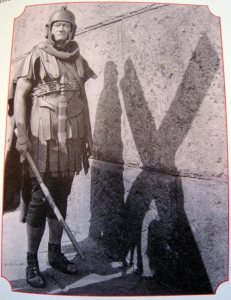
Longinus had finally decided to try to get a bit of rest. After his rather morose meeting with Flavius and Decius he and Decius went back to check on the preparations for the executions scheduled for the next day. Quentin his Tesserarius had been working with the squad chosen to to conduct the actual crucifixions of the prisoners, Bar-Abbas the insurgent as well as the common criminals and murderers Dismas and Gestas who he had met in the hell hole of a jail in the dungeon of Fortress Antonia after Pilate had assigned him the task of conducting the executions.

Longinus was certain of his unit’s ability to carry out the mission, though he would have rather had a unit from Italy than his unit of Syrian and Samaritan troops. There was one positive aspect, his Samaritans and Syrians had no love for the Jews and would have no qualms whatsoever in disposing of the criminals.

He thought for a moment about the prisoners. That Bar-Abbas fellow, he would be glad that he or any other Roman would have to deal with him again once the crucifixion was over. As for the common criminals he felt that everyone would be better off with Gestus dead although he hoped that Pilate might take pity on the repentant thief named Dismas. However, despite his feelings he also knew that the law was the law and repentant or not that Dismas was guilty of the crimes and the sentence was just. As he had realized earlier in the day while talking with Flavius it was important not to become emotionally involved with the locals, especially prisoners. Maintaining an emotional distance ensured that he would not flinch in times when ice rather than blood needed to flow through one’s veins. He was proud that he could do this but envied the humanity that his comrade and friend Flavius still maintained in spite of everything.

He was just about to prepare for bed when a messenger from Pilate knocked on his door. It was late, too late and Longinus wondered just what was going on.

“Come.” He said, the weariness in his voice obvious in the way he answered.

The messenger, a relatively young Italian soldier assigned to Pilate’s bodyguard entered, came to attention and saluted.

Longinus looked at the young man, like him far from home and asked “what am I needed for now?”

“Centurion, the Governor has requested your presence” the soldier replied.

“May I ask what for?” A now increasingly irritated Longinus asked.

“Sir, I do not have the details but it is a pressing matter regarding the Jews and that Galilean preacher.” The young man was obviously uncomfortable in having to request a career officer like Longinus, a veteran of real battles and campaigns appear before Pilate for what was not much more than a religious dispute among an occupied people.

“Pressing matter?” Asked Longinus.

“Yes Centurion. I was told that it was urgent that you come to Governor Pilate now and alert your unit as at least some of your men may be needed if things get out of hand.”

“Can you please tell me just what is going on?” Longinus asked as he pulled his armored breastplate over his shoulders.

“I’m sorry Centurion, I have no more information. You are to report to the Governor within the half hour. The Governor wants your unit ready within the hour.” When he finished he came to attention, saluted and exited the room.

Longinus hated how leaders sent young men to be their messengers and would not give them all of the relevant information.

He then sat back down in his chair where he had been sitting and discussing the situation with Flavius and Decius. He wondered to himself what could be so pressing that Pilate needed him now.

After briefing Decius and Quentin, instructing them to wake the men and be ready for action Longinus took a squad and went to Pilate’s headquarters. When he arrived Pilate greeted him.

“Centurion, I hate to have bothered you at this hour in light of how busy you and your men will be in the morning but a situation has arisen.” Longinus looked around the room and then heard some commotion on the area called “the Pavement.

“What is happening my Lord?”

“Longinus, these Jews have brought that Jesus fellow here and are accusing him of fomenting a rebellion against the Emperor.”

“A rebellion sir?”

“That is what they say Centurion. They claim that one of his closest associates had turned him in and after a trial of their own that they found him guilty of claiming to be a king and God that will overthrow the Emperor.” Pilate could not hide his discomfort.

“Do you actually believe them sir? After all we had heard this morning that this Judas Iscariot fellow had betrayed him for 30 pieces of silver.”

“I know Centurion, I know.” Pilate looked at Longinus then back out at the crowd gathered outside in the dark. He was afraid and Longinus could sense that fear, fear that if he made the wrong move that a real rebellion could break out and that Pilate as the Governor would take the blame and bear the punishment and wrath of Caesar.

“Centurion, I tried to placate these people be questioning this Jesus fellow myself.” Pilate paused. “I must say that he is a rather unusual man and truthfully I could not find anything that under Roman law that I could find him guilty of doing. Not a thing Centurion, nothing but their leaders kept pressing me.” Pilate’s gaze seemed to be almost pleading with Longinus to help him escape this decision. Longinus knew at that moment that his day was about to get worse. Pilate continued “It seems to be a religious squabble of some kind so in order to deal with it and to try to keep us out of it I sent Jesus to Herod since Herod is the ruler of Galilee.”

“So Herod will certainly deal with the situation, will he not Governor?”

“Centurion, I thought that too. I thought that the corpulent bastard Herod would deal with it but I just got word that Herod too could find no crime. The Jewish leaders and of their Temple Police are supposedly bringing him back to me to render judgment. They are leaving it to me.”

“Judgment for what?”

“Sedition, treason, blasphemy, proclaiming himself a king.” Pilate paused, his face flushed. “My God I’m surprised that they haven’t accused the man of fathering the High Priest’s daughter.” The sarcasm and bitterness was evident in his voice.

“So what do you intend to do.”

“I intend to try to get us out of this with as little trouble or guilt as possible. When they return him to me I will ask a few more questions and set him free as is my prerogative, certainly they wouldn’t want to release a real murderer like Bar-Abbas back into society, I do give them more credit than to stoop that low.”

“I do hope that you are right governor, but from what I understand it seems that they are intent on ridding themselves of the fellow once and for all. I think that their leaders see the Galilean as more of a threat than a man like Bar-Abbas.”

Pilate said nothing and during the silence Longinus’s troops under the direction of Decius entered the perimeter of the court adding an additional security cordon as the crowd grew and got more boisterous. As they took up position the Temple Police and members of the High Priest’s entourage approached the court with the Galilean in custody. Quentin with four soldiers met them and took custody of the obviously tired and already abused man. They delivered Jesus to Pilate and stood back. Longinus watched as it happened. As he did so Flavius entered the room with his servant. The servant appeared unsteady and full of emotion when he saw the man who had healed him two years before. Flavius stood by his face not betraying any feelings except deep-seated rage that was boiling as he saw this travesty of justice take place.

Pilate attempted every trick in the book to garner a way to save the life of the man standing before him. He asked him questions and Jesus clothed in a purple robe that Herod had mockingly placed upon him said nothing. Finally in desperation Pilate asked Jesus if he was a king. The answer both fascinated and terrified Pilate and caused him to wish that he had never come to the city. As he deliberated earlier and debated the members of the Sanhedrin his wife again urged him to “have nothing to do with that innocent man.”

But the answer of Jesus to the question of his kingship troubled Pilate. Had he thought the man insane he would have scourged him, declared him mad and been done with the affair.

“My kingdom is not of this world, if it were my followers would be fighting to ensue that you did not hand me over to the Jewish leaders.” Jesus looked into Pilate’s eyes, the look sent a chill through Pilate’s soul and so he restated the question “so you are a king?”

Jesus replied solemnly “You say I am a king. I was born for this and it is why I came to this world, to testify to the truth. Everyone who belongs to the truth listens to me.”

Pilate appeared stunned and both Longinus and Flavius knew that Pilate, the consummate politician and man of intrigue was beaten. They listened as Pilate asked “what is truth?” The question was one of a man who had long ago sold his soul to gain the world, it was the question of a deeply cynical man who had long determined that truth was only in the eye of the beholder and to be used as needed to acquire power. At the same time they could see a touch of genuineness in the question as Pilate, desperate for an answer that would enable him to please everyone and spare the life of the man before him wrestled with the question of truth for the first time in years.

They watched as Pilate attempted to bargain for the life of Jesus only to be shouted down by the increasingly riotous crowd who demanded that Bar-Abbas be released. Again attempting to assuage the mob he had Jesus scourged with a barbed whip. The soldier who did that brutal work was a Syrian, big and burley without a trace of feeling in his eyes or face. The servant of Flavius begged him to intervene but Flavius now knew that the things happening to Jesus could no longer be influenced by sentimentality and stories of the goodness of Jesus. He had seen this type of Justice before, and though he despised it, he earnestly hoped that it would be enough to deliver Jesus.

After the scourging, soldiers assigned to Longinus jammed a crown of thorns down on the blood covered Jesus and placed the purple cloak over him. Jesus’s body trembled. Pilate again approached the mob and tried to decline the odious responsibility thrust into his hands. The mob led by the Chief Priests and joined by man of their rivals, the Pharisees cried out for Jesus to be crucified.

They heard Pilate plead with Jesus, again noting that he had power over the life and death of Jesus to which Jesus replied that Pilate “had no power over him that had not been given by God.” Finally he pleaded with the Jews one more time to take Bar-Abbas for execution and to spare the Galilean. The leaders shouted him down again and cried out that Pilate would be “a traitor to Caesar” if he let a man who claimed to be a king live.

Defeated By the mob and by his own weakness of character Pilate asked for a ceremonial washing basin full of water. When it came in the hands of a court member he placed his hands in it and proclaimed “I am innocent of this man’s blood.” He then ordered the soldiers to take Jesus to be crucified even as the prisoners Dismas and Gestus were led from the dungeon for execution and a profoundly perplexed Bar-Abbas was released by the jailer.

Longinus looked at Flavius and whispered to him “wash my hands of his blood? My God, he knows that he is as guilty as them.” Flavius looked on and simply said, “I know my friend, we all are.”

The small cohort of soldiers assigned to the crucifixion detail were commanded by Quentin, a man who had fought many battles, and like Longinus and Flavius felt that these executions of helpless prisoners were unworthy of soldiers like himself. The soldiers of Flavius’s unit had responsibility for helping to clear a way down the narrow street called by the Romans Via Delarosa, or The street of suffering. It was the street that all the condemned travelled to the hill of execution so fittingly called the place of the Skull. Longinus had seen others walk this path but in the past he had been able to shield his person from their suffering, but today was different.

Longinus’s own execution squad led by Quentin led Jesus and the others along, forcing them to carry their crosses. About halfway down the street Jesus collapsed under the weight if his cross and grabbed a bystander, a man from Cyrene to carry the cross while the soldiers prodded the bloody body of Jesus down the street and out of the city to the place of execution. People jeered at the condemned as they did at very execution as for most this was no different than any other crucifixion and most of those present knew little about any of the condemned men and even those that were familiar with Jesus probably did not recognize the bloody man stumbling down the street. Of course there were others present who did know Jesus and watched in horror as their friend, teacher and for one woman her son struggled to the execution site. Longinus wondered about his own elderly mother and thought of her as he saw the mother of Jesus. He quickly tried to chase her image from his mind, he needed to be strong and hard if he was to keep his objectivity and conduct the mission as distasteful as he found it.

When the macabre parade arrived at the hill, the prisoners were stripped, placed on the crosses and nailed to them. Their screams as Quentin hammered the large iron nails home through their already abused flesh echoed for all to hear. Thankfully Quentin knew what he was doing and this part of the execution process happened quickly. Then the crosses were raised, but just before this a messenger from Pilate arrived with the placards that denoted the charges. He handed them to Longinus who noted what was written on the one for Jesus. It said “The King of the Jews.”

The placards were placed and with a thud the crosses were placed in the holes on the hill. The suffering of the prisoners was great, the crowds jeered and mocked them while those that loved them stood at a distance. Soldiers stood guard to ensure that no one interfered with them in any way. There was a bit of banter between the real criminals one of whom, the unpleasant one named Gestus joined in the mocking of Jesus only to be put in his place by the other one named Dismas.

Longinus, Flavius, Decius and a few other officers watched as their soldiers from the crucifixion detail divided the paltry worldly possession of the men between themselves. The men argued over a one piece tunic worn by Jesus, Not wanting to destroy it they cast lots for it. A trooper from Tyre won the tunic. Longinus and Flavius looked at each other and realized how little most of their men earned and neither begrudged the men the few items that they gathered from the men being executed.

The skies which had began the day with bright sunshine now became dark and foreboding. Lightening appeared in the distance and occasionally Jesus would address his mother or one man, Flavius believed him to be a disciple who stood by the cross. Jesus even promised the Dismas character that “he would be with him in paradise” and told others, Longinus thought the soldiers but he wasn’t sure “forgive them they know not what they do.” As it approached the ninth hour Jesus cried out in Aramaic “my God, my God, why have you forsaken me!”

A cold rain began to fall.

Quentin approached him with a sponge on a pole which was soaked in a sour wine. It touched Jesus’s lips and Jesus said “Father into your hands I commit my spirit” and then “it is finished.”

With that last dying remark the head of Jesus fell to his chest and his body, bloody and mangled hung limp. As the men looked on the ground began to tremble and as the ground shook and the officers looked about amid the gloom and confusion as the onlookers took flight Longinus exclaimed “surely this man was the son of God.” Flavius looked at his fellow Centurion in astonishment. Longinus, the man who had closed his heart in a fortress was echoing what he had believed since Jesus had healed his servant, the young man who was more than a servant to him.

As the crowds dispersed Longinus received the message that the executions had to be concluded before the Jews began their Passover. With that he sent Quentin to break the legs of the prisoners to hasten their deaths. When Quentin reached Jesus he called for Longinus.

“Centurion, I believe that this man is already dead. Do you still want me to break his legs?”

Longinus looked up at the bloody corpse and then at his subordinate and said “no I must do this myself.” He had a soldier bring him his lance, a ceremonial lance that denoted his seniority as the senior Centurion in the Legion. He looked at the lance and plunged it into the side of Jesus into his heart. Jesus did not move but from the wound blood mixed with what looked like water poured out of the wound and down his side.

“Quentin, he is dead, you may take him down.” Other soldiers pulled down the dead bodies of the thieves. As they did this a man approached Longinus and Flavius.

“Gentlemen. I am Joseph, I am a member of the Sanhedrin. I have come to take responsibility for the body of Jesus of Nazareth.”

Longinus replied in a businesslike manner “by whose authority?” He had a hard time believing that a member of the Sanhedrin would claim this body.

With that Joseph produced a letter from Pilate. Longinus looked the letter over and handed it back to Joseph without comment. Joseph then motioned to several men with him to take the body as Longinus, Flavius and the others looked on. Longinus thought to himself that it was good that a man of some means and influence would at least take the time to give this innocent man a decent burial.

As Quentin took charge of the cleanup Longinus instructed Decius to prepare the troops to return to Fortress Antonia. Flavius instructed his optimo to do the same. The last thing that any of them wanted to be was on the streets when the Jews began their Passover, as always they decided that it was unwise to stir up any more animosity than was needed. Today was a near run thing with e demonstration outside Pilate’s headquarters and none of them wanted any more excitement this evening.

When the clean up was completed and the bodies removed Longinus and Flavius ordered their soldiers back to Fortress Antonia. When they arrived the Centurions went to Pilate to inform him that the mission was complete. Pilate was glad the ordeal was over but was obviously still disturbed by the events of the day. Longinus, now exhausted was glad to leave Pilate’s presence. He still loathed politicians and wondered if had Pilate been a soldier if he would have had the courage to tell the leaders of the Sanhedrin to “pound sand” and keep Jesus alive. But then he knew that had Pilate done something that only a diplomat could do, he kept the peace. Had he been in charge the man named Jesus might have lived but hundreds maybe even thousands of others might have died.

After he dismissed his soldiers he went to his room, doffed his gear and went to the tavern in the fortress. Flavius joined him about 15 minutes later. They sat at the table as the barkeeper brought them each an ale. They looked at each other and Flavius asked “What did you mean by surely this man was the son of God?”

Longinus shook his head. “My friend I do not really know.” He paused and took a drink from his cup. “Until today I simply figured that he was a good man, but after today, after what I witnessed I just don’t know.”

“If you ask me my friend I think that he must be a God, if not somehow connected to the greatest of Gods, the God of the Jews.”

“Perhaps Flavius you are right. All I know is that I can no longer see the world, the Empire or my life in the same light as I did just a week ago.”

Flavius nodded his understanding as Decius entered the tavern. The younger officer reported to his seniors. They acknowledged his entrance and Longinus asked the younger officer to sit with them.

“What do you know Decius?”

The younger officer spoke. “Sir, I do not know if you heard the latest about the man that betrayed Jesus.”

Longinus asked sarcastically “did they elect him High Priest?”

The younger man caught the sarcasm and replied “if only that we’re the case. He was found dead, hanging from a tree in the Potter’s Field.”

Flavius answered: “So the traitor couldn’t handle the consequences of his own act of duplicity?”

Longinus replied, “Evidently not, it serves the bastard right.” He took a drink from his cup and motioned for the barkeep to get Decius a cup of ale too. The three men continued to drink silently and wondered what else could happen…

Peace

Padre Steve+

Leave a comment

Filed under christian life, faith, History, Religion

And Then there Were None: The Doolittle Raid 77 Years Later

Lieutenant Colonel Dick Cole

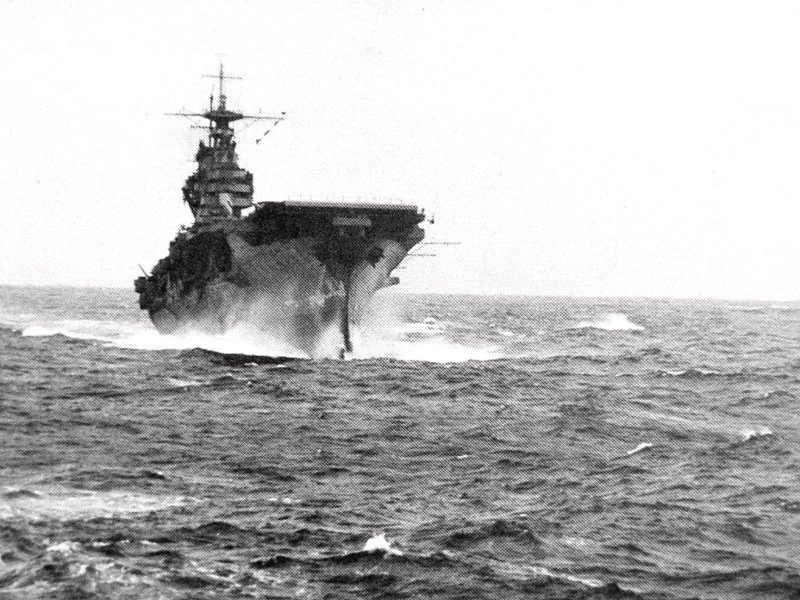
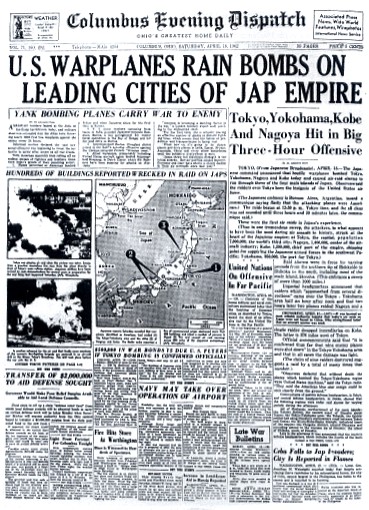
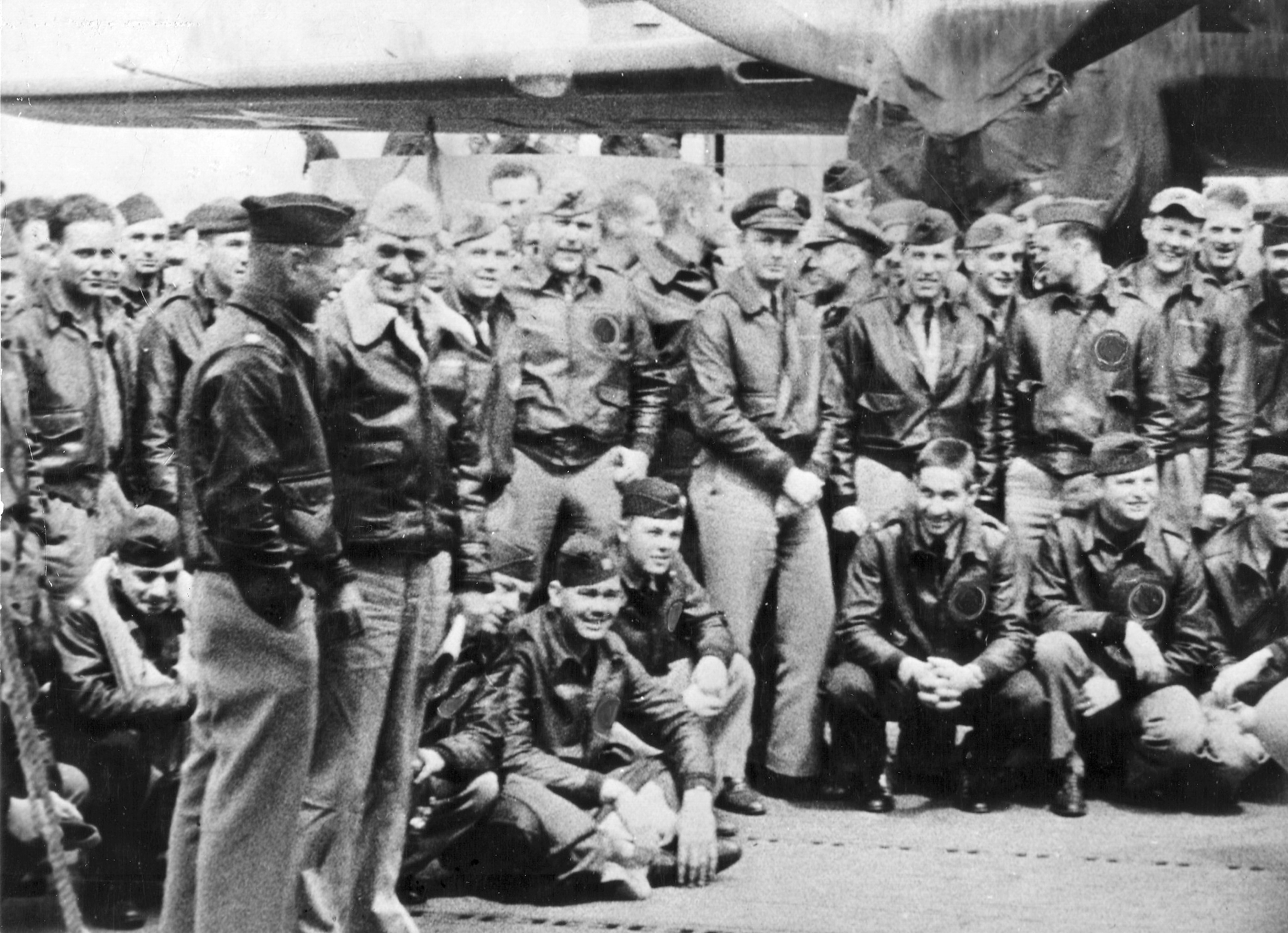
Today marks the 77th anniversary of the Doolittle Raid on Tokyo. 80 US Army Air Corps flyers manning 16 B-25 Mitchell bombers conducted a mission from the deck of the USS Hornet CV-8 which though it caused little damage changed the course of World War Two in the Pacific.

<img src=”https://padresteve.com/wp-content/uploads/2015/04/marc_a-_mitscher_and_james_doolittle.jpg?w=300&h=217″ class=”aligncenter size-medium wp-image-16779″ width=”300″ height=”217″ data-attachment-id=”16779″ data-permalink=”https://padresteve.com/2015/04/21/greetings-from-shangri-la-the-doolittle-raid/marc_a-_mitscher_and_james_doolittle/” data-orig-file=”https://padresteve.com/wp-content/uploads/2015/04/marc_a-_mitscher_and_james_doolittle.jpg” data-orig-size=”2785,2018″ data-comments-opened=”1″ data-image-meta=”{” data-image-title=”Marc_A._Mitscher_and_James_Doolittle” data-image-description=”

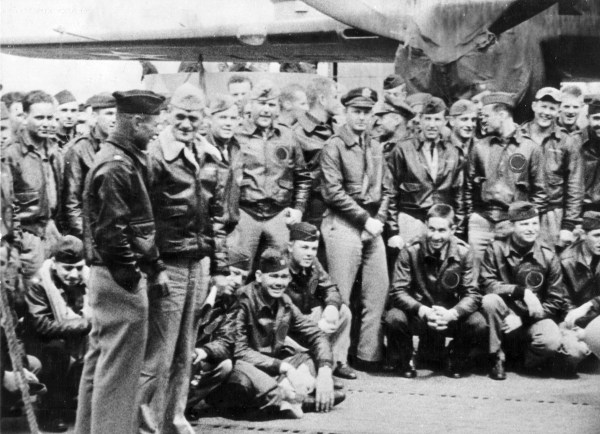
Orders in hand, Capt. Marc A. Mitscher, U.S.N., skipper of the U.S.S. Hornet (CU-8) chats with Maj. Gen. James Doolittle, U.S. Army. Some of the 80 Army fliers who took part in the historic Japanese raid are pictured with the two fliers.

” data-medium-file=”https://padresteve.com/wp-content/uploads/2015/04/marc_a-_mitscher_and_james_doolittle.jpg?w=300&h=217&#8243; data-large-file=”https://padresteve.com/wp-content/uploads/2015/04/marc_a-_mitscher_and_james_doolittle.jpg?w=500&#8243; srcset=”https://padresteve.com/wp-content/uploads/2015/04/marc_a-_mitscher_and_james_doolittle.jpg?w=300&h=217 300w, https://padresteve.com/wp-content/uploads/2015/04/marc_a-_mitscher_and_james_doolittle.jpg?w=600&h=434 600w, https://padresteve.com/wp-content/uploads/2015/04/marc_a-_mitscher_and_james_doolittle.jpg?w=150&h=109 150w” sizes=”(max-width: 300px) 100vw, 300px” style=”height: auto; max-width: 100%; border: 0px; margin-bottom: 2px”>

Doolittle and his Airmen with Hornet’s C.O. Captain Marc Mitscher 

The genus of the strike came from the desire of President Franklin Roosevelt to bomb Japan as soon as possible during a meeting just prior to Christmas 1941. Various aircraft types were considered and in the end the military chose the B-25 because it had the requisite range and had the best characteristics. Aircraft and their crews from the 17th Bomb Group which had the most experience with the aircraft were modified to meet the mission requirements. Lieutenant Colonel Jimmy Doolittle was selected to lead the mission.

Once the aircraft were ready they and their crews reported to Eglin Field for an intensive three week period of training. Supervised by a Navy pilot the crews practiced simulated carrier take offs, low level flying and bombing, night flying and over water navigation. When the training was complete the aircraft and crews and support personnel flew to McClellan Field for final modifications and then to NAS Alameda California where they were embarked on the Hornet Hornet’s air group had to be stowed on the ships hanger deck since the 16 B-25s had to remain of the flight deck. Each bomber was loaded with 4 specially modified 500 lb. bombs, three high explosive and one incendiary.

Departing Alameda on April 2nd the Hornet and her escorts, Hornet’s Task Force 18 rendezvoused with the Admiral William “Bull” Halsey’s Task Force 16 built around the USS Enterprise CV-6. task Force 16 provided escort and air cover during the mission. The carriers, escorted by 4 cruisers, 8 destroyers and accompanied by two oilers hoped to get close enough to the Japanese home islands so that the raiders could reach bases in allied China.

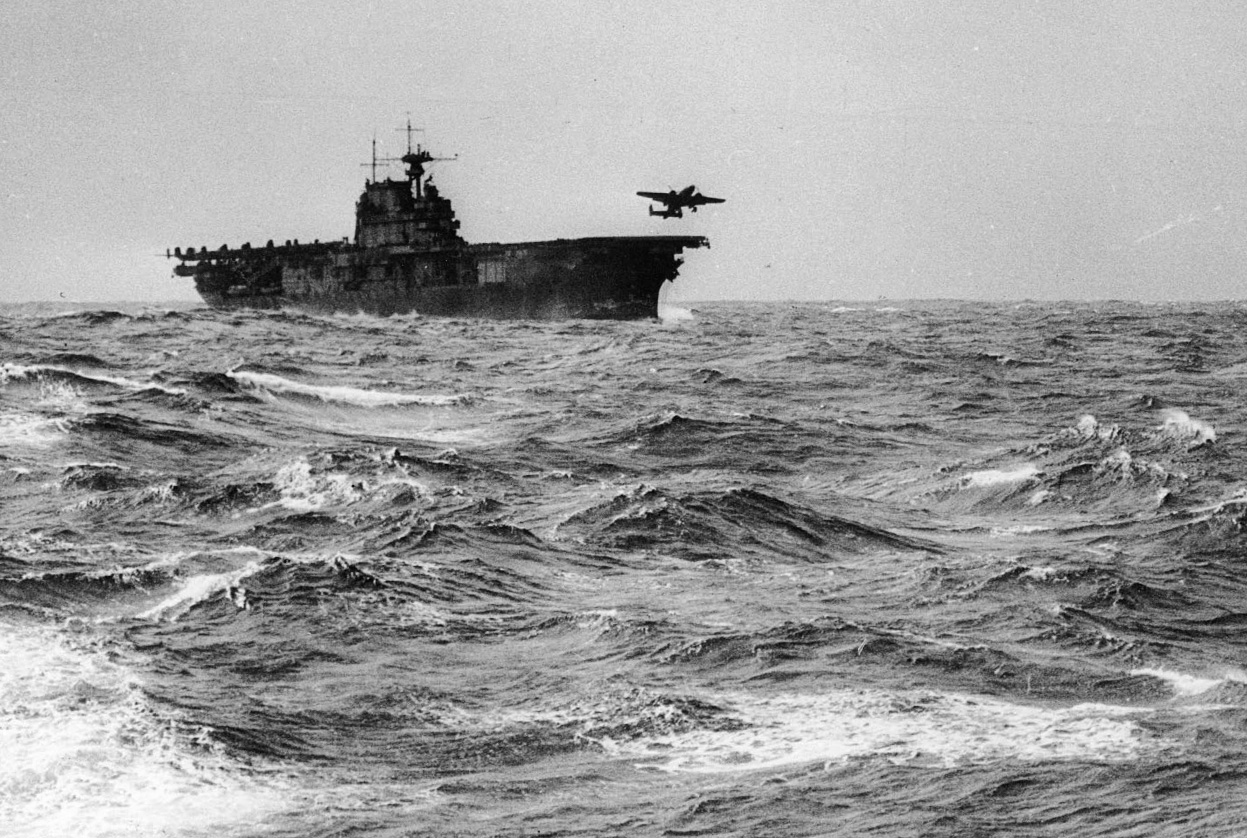
Hornet in Heavy Seas while launching the Raiders

The destroyers and slow oilers broke off on the evening of the 17th after refueling the carriers and cruisers. The two carriers and the cruisers then commenced a high speed run to get into range. However early in the morning of April 18th the ships were sighted by a Japanese patrol boat, the #23 Nitto Maru which was quickly sunk by the USS Nashville but not before it got off a radio message alerting the Japanese command. However the Japanese knowing that carrier aircraft had a relatively short range did not expect an attack. However, realizing the danger that the sighting brought, Mitscher elected to launch immediately, even though it meant that bombers would have to ditch their aircraft or attempt to land well short of the friendly Chinese airfields. The launch was 10 hours earlier and about 170 miles farther out from the Chinese bases than planned.

B-25 Launching from Hornet

Flying in groups of two to four aircraft the raiders struck the Japanese cities of Tokyo, Yokohama, Yokosuka, Nagoya, Kobe and Osaka. Minimal damage was done and only one aircraft was damaged. However they needed to fly nearly 1500 more miles to get to areas of China unoccupied by Japanese forces. Miraculously most of the aircraft and crews managed to find refuge in China. 69 of the 80 pilots and crew members avoided death or capture. Two flyers drowned, one died when parachuting from his aircraft. Eight men were captured. Of those captured by the Japanese three, Lieutenants William Farrow, Dean Hallmark and Corporal Harold Spatz were tried and executed for “war crimes” on October 15th 1942.

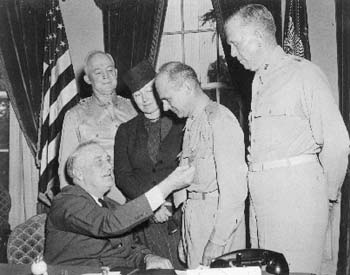
Many of the surviving flyers continued to serve in China while others continued to serve in North Africa and Europe, another 11 died in action following the raid. Doolittle felt that with the loss of all aircraft and no appreciable damage that he would be tried by courts-martial. Instead since the raid had so bolstered American morale he was awarded the Medal of Honor, promoted to Brigadier General and would go on to command the 12th Air Force, the 15th Air Force and finally the 8th Air Force.

The raid shook the Japanese, especially the leadership of the Imperial Navy who had allowed American aircraft to strike the Japanese homeland. The attack helped convince Admiral Isoroku Yamamoto that an attack on Midway was needed in order to destroy the American Carriers and the threat to the home islands.

When asked by a reporter about where the attack was launched from, President Roosevelt quipped “Shangri-La” the fictional location of perpetual youth in the Himalayas’ made famous in the popular book and movie Lost Horizon.

The raid in terms of actual damage and losses to the attacking forces was a failure, but in terms of its impact a major victory of the United States. The attack was psychologically devastating to Japanese leaders, including Prime Minister Hideki Tojo, whose personal aircraft was nearly hit by one of the raiders and Admiral Isoroku Yamamoto, who felt personally humiliated and dishonored by the fact that bombers launched from American carriers.

Likewise the raid gave the people of the United States a huge morale boost at a time when very little was going right. It forced the Japanese Navy to launch the attack on Midway that turned out to be a disaster, decimating the best of the Japanese Naval Air Forces and the loss of four aircraft carriers and enabled the US Navy to take the offensive two months later at Guadalcanal.

Franklin Roosevelt Awards Medal of Honor to Jimmy Doolittle 

In the years after the war the survivors would meet to toast each other and to reminisce about their experiences. Those meetings stopped several years ago and in 2017 LTC Dick Cole was the last of Doolittle’s raiders still alive. He passed away just over a week ago on April 9th in San Antonio. A memorial service will be held for him there on Thursday the 18th Of April. He will be buried in Arlington National Cemetery.

Now that he and the rest of the Doolittle Raiders have passed away it is up to us to never forget the heroism, sacrifice and service in a mission the likes of which had never before been attempted, and which would in its own way help change the course of the Second World War.

Since most of us have never had to make that choice, and our President dodged the draft under the unusual circumstances often given to the children of the wealthy, we should ask what we would do if we were in Dick Cole’s shoes, or for that matter any of the men involved in the Doolittle Raid.

Since I have been serving as a volunteer since 1981 with multiple combat deployments to my name, and I. All of which I put my life on the line unarmed, and I still serve, so I know what I would do. However, that being said I really do have to wonder about most Americans, including those of my own generation who claim to support the troops without ever serving a day in uniform or even volunteering in the Peace Corps, Americorps, or even with the Red Cross.

The devotion of these men is seldom seen today. Our President routinely mocks those killed, wounded, or taken prisoner in war as “losers” and on the Howard Stern Radio program described avoiding sexually transmitted diseases in the 1980s as his “personal Vietnam.”

But I digress… the Greatest Generation is passing away. They fought fascism, the Nazis, and the Japanese Empire, and then many continued to serve during the Cold War, and in Korea, and some up to Vietnam. It is up to us the living to not disgrace their memory by forgetting them, or even worse, pretending that avoiding STDs is the equivalent of serving in harms way.

I think of the words of the character played by Jose Ferrer in the novel and movie written by Herman Wouk, The Caine Mutiny:

So until tomorrow, either put up, or shut up, especially if you wear the Red MAGA hat. Being a true American Patriot is not based on political ideology, Party, race, or religion. It is all about upholding the foundational principle of the Declaration: “We believe that all men are created equal, and are endowed by their creator with certain unalienable rights, among them being life, liberty, and the pursuit of happiness.”

After all, that is the foundational principal of the United States. It is true for all of us, or none of us, for once those rights are denied to anyone, the precedent can be used against any of us. To fall back on a quote from Captain Jean Luc Picard in the Star Trek the Next Generation episode The Drumhead:

“You know, there are some words I’ve known since I was a schoolboy: “With the first link, the chain is forged. The first speech censured, the first thought forbidden, the first freedom denied, chains us all irrevocably.” Those words were uttered by Judge Aaron Satie, as wisdom and warning. The first time any man’s freedom is trodden on, we’re all damaged. I fear that today…”

Until tomorrow,

Peace

Padre Steve+
2 Comments

Filed under aircraft, History, Military, national security, News and current events, Political Commentary, US Army Air Corps, US Navy, World War II at Sea

”He Led America by Example” Jackie Robinson’s Debut, 72 Years Later

Friends of Padre Steve’s World,

Yesterday was the day that Major League Baseball commemorated the day that Jackie Robinson broke the color barrier in Major League Baseball, and along with future Civil Rights leaders, including Dr. Martin Luther King Jr., helped begin a yet unfinished revolution in race relations and civil rights. Some of the things said about him and by him need to be quoted at the beginning of this article.

“He led America by example. He reminded our people of what was right and he reminded them of what was wrong. I think it can be safely said today that Jackie Robinson made the United States a better nation.” – American League President Gene Budig

“He knew he had to do well. He knew that the future of blacks in baseball depended on it. The pressure was enormous, overwhelming, and unbearable at times. I don’t know how he held up. I know I never could have.”  Duke Snider

“Life is not a spectator sport. If you’re going to spend your whole life in the grandstand just watching what goes on, in my opinion you’re wasting your life.”  Jackie Robins

“There’s not an American in this country free until every one of us is free.” Jackie Robinson

Today is a day that we rightfully remembered the life, message, martyrdom and legacy of Dr. Martin Luther King Jr. However as much as Dr. King matters, there were a long line of African American heroes who in their own way helped bring about racial equality in this country.  While many toiled in obscurity one, a baseball player named Jackie Robinson would forever alter the playing field of racial relations and how African Americans were perceived and received in the United States.  April 15th 2019 was the 72nd anniversary of Jackie Robinson’s first game in the Major Leagues with the Brooklyn.  Robinson is not remembered with a National holiday but then again that takes noting away from this giant of American history. When Robinson stepped onto Ebbett’s Field in April 15th 1947 it was a watershed moment and while racial discrimination and prejudice remained they would be fighting a losing battle from that time on. Dr King in life and in death would be the one who drove the stake into the heart of the evil of racism and discrimination it was Jackie Robinson who helped place that stake above the heart of this evil.

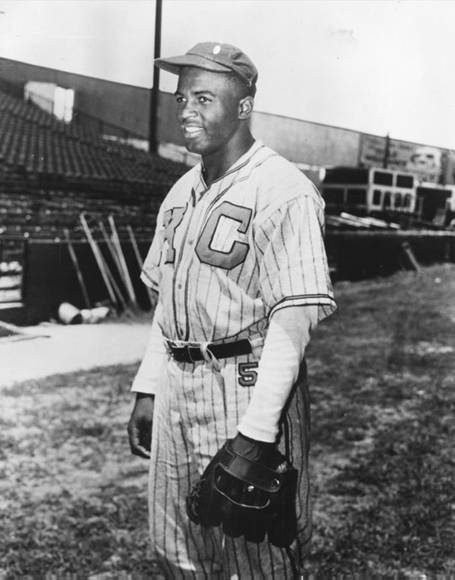
The Negro Leagues: Jackie in his Kansas City Monarch Uniform

We celebrate Dr King’s legacy today. However, without Jackie Robinson and the other African American baseball players who broke into the big leagues in the late 1940s and early 1950s it is conceivable that Dr, King would never have had the opportunity not only to be heard by African Americans, but to have his message heard and taken to heart by white America.

By the time Dr. King arrived on the scene much had already been done, and much due to Robinson and the owner of the Brooklyn Dodgers, Branch Rickey. Robinson’s first game with the Dodgers came a full year before President Truman integrated the military and a full seven years before the Supreme Court ruled school segregation unconstitutional.  It was not until 1964 that the Voters Rights act passed in Congress.  Jackie Robinson paved the way for a change in American society that has continued for 62 years since his debut at Ebbett’s Field on April 15th 1947.

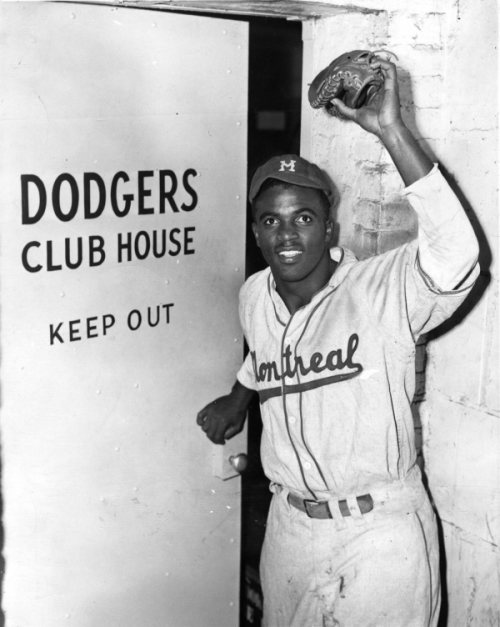
Even before he stepped onto the field Jackie Robinson was a pioneer in equal rights where at UCLA he was the first student to letter in four varsity sports and in the Second World War where in an action that was a precursor to later civil rights battles the young Lieutenant Jackie Robinson was arrested and tried for not moving to the back of a bus at Fort Hood Texas.  He would be acquitted and given an honorable discharge before beginning his professional baseball career with the Kansas City Monarchs of the Negro League prior to Rickey signing him to a minor league contract with the Montreal Royals of the International League. Although he was met with scorn my many white baseball fans and some players and had to endure the ignominy of hostility from white fans and media, having to live in separate hotels and eat at separate restaurants Robinson developed a loyal fan base in Montreal and over a million people saw him play in his year in the International League.

Jackie in his Montreal Royals Uniform outside the Dodger’s Clubhouse

When Branch Rickey talked with Robinson before the season he said: “Jackie (Robinson), we’ve got no army. There’s virtually nobody on our side. No owners, no umpires, very few newspapermen. And I’m afraid that many fans will be hostile. We’ll be in a tough position. We can win only if we can convince the world that I’m doing this because you’re a great ballplayer, a fine gentleman.”

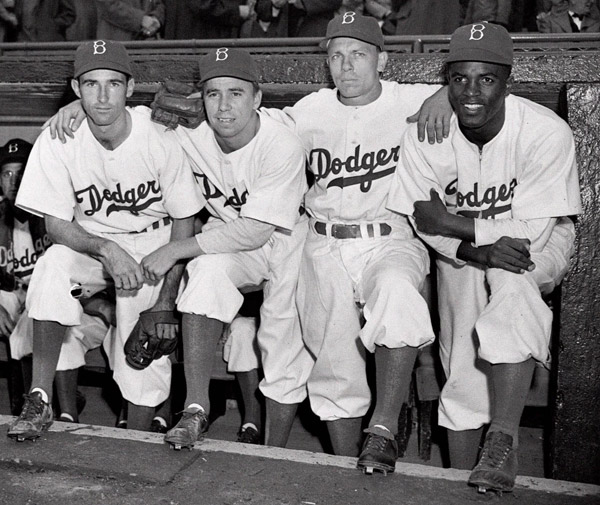
John Jorgensen, Pee Wee Reese, Ed Stanky and Jackie Robinson on opening day 1947

Jackie’s feat was a watershed moment in the history of our country.  Blacks had struggled for years against Jim Crow laws, discrimination in voting rights, and even simple human decencies such as where they could use a rest room, what hotels they could stay in or what part of the bus that they could sit.  In baseball many white fans were upset that blacks would be coming to see Robinson in stadiums that they would not have been allowed in before.  Players from other teams heckled Robinson, he received hate mail, people sent made death threats, and he was spiked and spit on.  But Jackie Robinson kept his pledge to Dodgers owner Branch Rickey not to lash out at his tormentors, as Rickey told him that he needed a man “with enough guts not to strike back.” In doing so his on field performance and poise under pressure won him the National League Rookie of the Year honor in 1947.

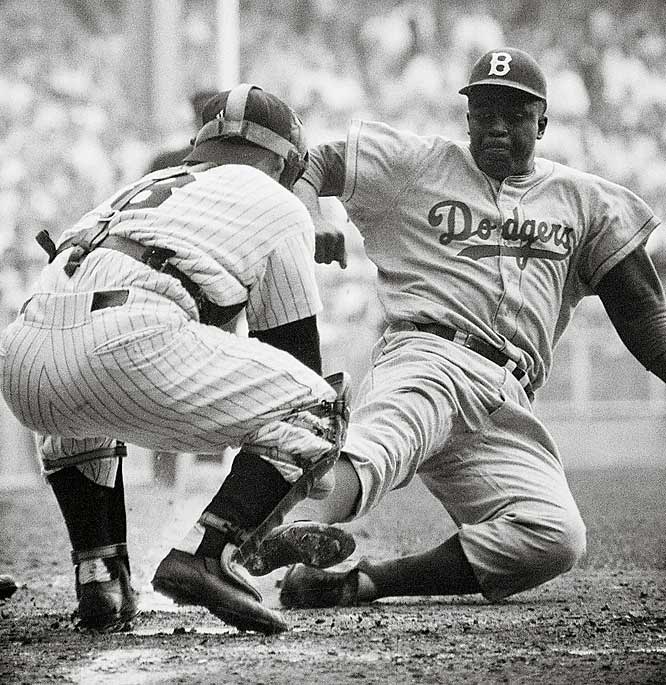
Jackie Stealing Home against the Yankees, the catcher is Yogi Berra

Jackie Robinson played the game with passion and even anger.  He took the advice of Hank Greenberg who as a Jew suffered continual racial epithets throughout his career “the best ways to combat slurs from the opposing dugout is to beat them on the field.” He would be honored as Rookie of the Year, was MVP, played in six World Series and six All Star Games.  He had a career .311 batting average, .409 on base percentage and a .474 Slugging percentage. He was elected to Baseball’s Hall of Fame in 1962. His teammate Pee Wee Reese would say: “Thinking about the things that happened, I don’t know any other ball player who could have done what he did. To be able to hit with everybody yelling at him. He had to block all that out, block out everything but this ball that is coming in at a hundred miles an hour. To do what he did has got to be the most tremendous thing I’ve ever seen in sports.”

Today Jackie Robinson’s feat is history, but it should not be forgotten.  He was a pioneer who made it possible for others to move forward.  He would be followed by players like Roy Campinella, Satchel Paige, Don Larson, Larry Dobie and Willie Mays.  His breakthrough had an effect not just on baseball but on society and helped make possible the later civil rights movement.  Dr. King would say of Jackie that he was “a legend and a symbol in his own time”, and that he “challenged the dark skies of intolerance and frustration.”  Historian Doris Kearns Godwin noted that Jackie’s “efforts were a monumental step in the civil-rights revolution in America” and that his “accomplishments allowed black and white Americans to be more respectful and open to one another and more appreciative of everyone’s abilities.” Time Magazine named him as one of the 100 most influential people of the 20thCentury.

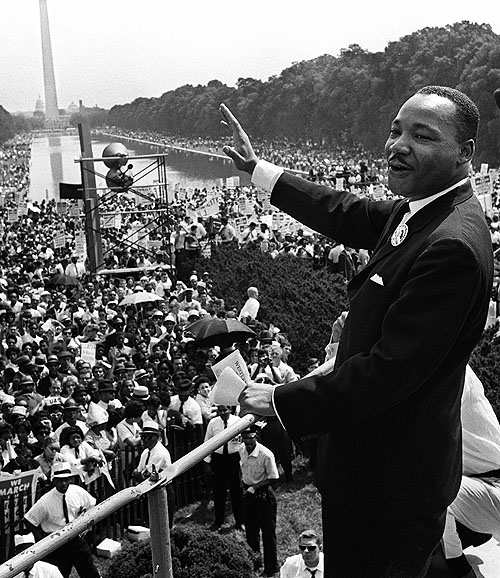
<img src="https://padresteve.com/wp-content/uploads/2010/01/martin-luther-king-jr.jpg?w=500&h=578" class="aligncenter size-full wp-image-2716" data-attachment-id="2716" data-permalink="https://padresteve.com/2010/01/18/jackie-robinson-and-dr-martin-luther-king-they-changed-america/martin-luther-king-jr/" data-orig-file="https://padresteve.com/wp-content/uploads/2010/01/martin-luther-king-jr.jpg?w=500&h=578" data-orig-size="500,578" data-comments-opened="1" data-image-meta="{"aperture":"0","credit":"AFP\/Getty Images","camera":"","caption":"The civil rights leader Martin Luther KIng (C) waves to supporters 28 August 1963 on the Mall in Washington DC (Washington Monument in background) during the \"March on Washington\". King said the march was \"the greatest demonstration of freedom in the history of the United States.\" Martin Luther King was assassinated on 04 April 1968 in Memphis, Tennessee. James Earl Ray confessed to shooting King and was sentenced to 99 years in prison. King's killing sent shock waves through American society at the time, and is still regarded as a landmark event in recent US history. AFP PHOTO (Photo credit should read -\/AFP\/Getty Images)","created_timestamp":"0","copyright":"2008 AFP","focal_length":"0","iso":"0","shutter_speed":"0","title":""}" data-image-title="martin-luther-king-jr" data-image-description="

The civil rights leader Martin Luther KIng (C) waves to supporters 28 August 1963 on the Mall in Washington DC (Washington Monument in background) during the “March on Washington”. King said the march was “the greatest demonstration of freedom in the history of the United States.” Martin Luther King was assassinated on 04 April 1968 in Memphis, Tennessee. James Earl Ray confessed to shooting King and was sentenced to 99 years in prison. King’s killing sent shock waves through American society at the time, and is still regarded as a landmark event in recent US history. AFP PHOTO (Photo credit should read -/AFP/Getty Images)

” data-medium-file=”https://padresteve.com/wp-content/uploads/2010/01/martin-luther-king-jr.jpg?w=500&h=578?w=260″ data-large-file=”https://padresteve.com/wp-content/uploads/2010/01/martin-luther-king-jr.jpg?w=500&h=578?w=500″ title=”martin-luther-king-jr” alt=”” width=”500″ height=”578″ srcset=”https://padresteve.com/wp-content/uploads/2010/01/martin-luther-king-jr.jpg 500w, https://padresteve.com/wp-content/uploads/2010/01/martin-luther-king-jr.jpg?w=130&h=150 130w, https://padresteve.com/wp-content/uploads/2010/01/martin-luther-king-jr.jpg?w=260&h=300 260w” sizes=”(max-width: 500px) 100vw, 500px” style=”height: auto; max-width: 100%; border: 0px; margin-bottom: 2px; clear: both; display: block; margin-left: auto; margin-right: auto”>

Dr Martin Luther King Jr “I have a dream”

We honor Dr King today and rightly so, but one can never forget those who paved the way so that we could all have the blessing of seeing Dr King’s dream come one step closer to fruition the dream that:

“one day this nation will rise up and live out the true meaning of its creed: ‘We hold these truths to be self-evident, that all men are created equal, that “children will one day live in a nation where they will not be judged by the color of their skin, but by the content of their character,” and that “one day on the red hills of Georgia the sons of former slaves and the sons of former slave owners will be able to sit down together at a table of brotherhood.”

Dr King would die by an assassin’s bullet in Memphis on the night of April 4th 1968 the day after finishing his final speech with these immortal remarks:

“And then I got to Memphis. And some began to say the threats, or talk about the threats that were out. What would happen to me from some of our sick white brothers? Well, I don’t know what will happen now. We’ve got some difficult days ahead. But it doesn’t matter with me now. Because I’ve been to the mountaintop. And I don’t mind. Like anybody, I would like to live a long life. Longevity has its place. But I’m not concerned about that now. I just want to do God’s will. And He’s allowed me to go up to the mountain. And I’ve looked over. And I’ve seen the Promised Land. I may not get there with you. But I want you to know tonight, that we, as a people, will get to the Promised Land. And I’m happy, tonight. I’m not worried about anything. I’m not fearing any man. Mine eyes have seen the glory of the coming of the Lord.”

Let us never forget Dr King nor those like Jackie Robinson who helped pave the way for Dr King.

Peace,

Padre Steve+

Leave a comment

Filed under Baseball, civil rights, culture, History, Political Commentary

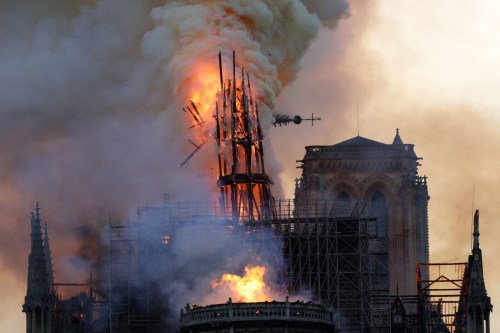
A Loss for France and Humanity: Notre Dame Burns

Friends of Padre Steve’s World,

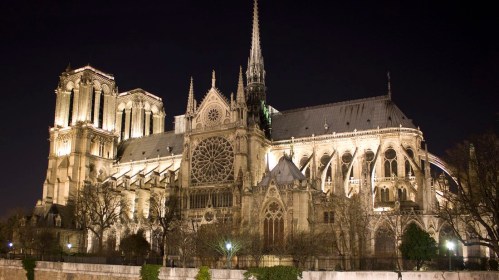
A terrible loss for France and Humanity. I visited Notre Dame in May 2004 . I have been to many English, German, Dutch Cathedrals, but this one was special. Back then I was overwhelmed by the history, architecture, art, and the possibilities yet flaws of humanity and Catholicism.

While some artwork had been removed due to the renovation, so much architecture, and history of 800 plus years was destroyed. One does not have to be a Catholic or French to understand this. In my bad French I say “Mes amis français, mon cœur s’adresse à vous” (My French friends, my heart goes out to you.)

This cathedral is one of the most historic and iconic works of Gothic architecture. The spire, The towers, and the flying buttresses. I am so glad that my undergraduate Western Civilization professor, Delmar McComb at San Joaquin Delta College spent the time to help me appreciate such works of architecture and art. I wish more people in this country would come to a greater appreciation of such wonderful aged, and priceless works. Instead we fill our world with gaudy and banal buildings that will not stand the test of time, buildings like Trump Tower.

Victor Hugo wrote.

The church of Notre-Dame de Paris is still no doubt, a majestic and sublime edifice. But, beautiful as it has been preserved in growing old, it is difficult not to sigh, not to wax indignant, before the numberless degradations and mutilations which time and men have both caused the venerable monument to suffer, without respect for Charlemagne, who laid its first stone, or for Philip Augustus, who laid the last.

On the face of this aged queen of our cathedrals, by the side of a wrinkle, one always finds a scar. Tempus edax, homo edacior; which I should be glad to translate thus: time is blind, man is stupid.

I will close with that.

Peace

Padre Steve+
6 Comments

Filed under History, Loose thoughts and musings, News and current events

“Better to Die Glorious than to Die Infamous” the Assassination Of Abraham Lincoln

Friends of Padre Steve’s World,

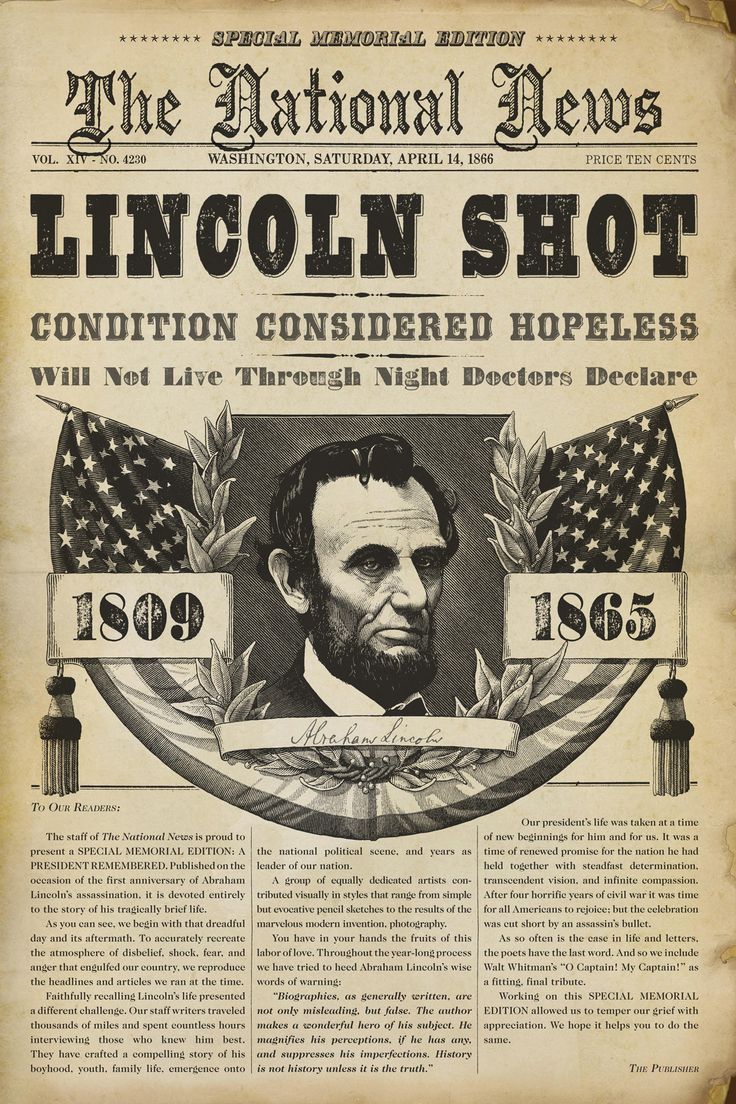
Today may be Palm or Passion Sunday, but due to the nature of the of the Christian Liturgical calendar, 154 years ago April 14th was Good Friday, and the most tragic Good Friday in American history.

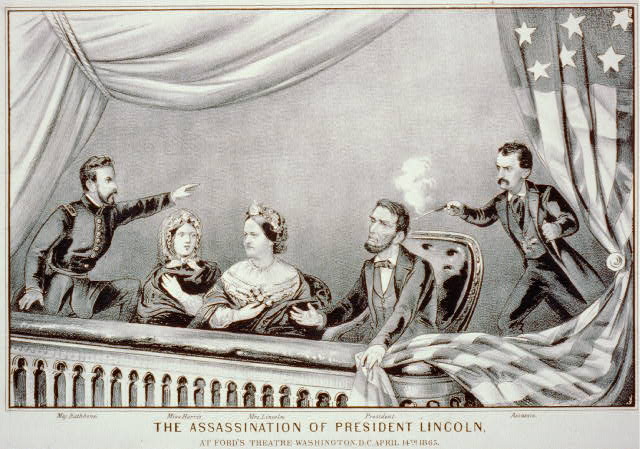
Good Friday is somber day, and I think that there was none more somber than Good Friday 1865. Shortly after 10 P.M. at Ford’s theater a handsome and well known actor walked into the booth occupied by President Lincoln at Washington’s Ford’s Theater. The President was there with his wife Mary Todd Lincoln and another couple after a very full day of business to watch the play Our American Cousin a farcical look at the visit of an American visiting his English relatives when going to settle the family estate.

Lincoln was looking forward to the play. Though the war continued the surrender of Robert E. Lee’s Army of Northern Virginia to Ulysses S. Grant on April 9th for all intents and purposes had placed the final nail in the Confederacy’s malevolent coffin, and it was if a burden have been removed from Lincoln’s shoulders. His task now what the reintegration of the rebellious states back into the Union, a task that he believed needed to be accomplished without malice while still seeking justice. He made this clear in his Second Inaugural Address just over a month before:

“With malice toward none, with charity for all, with firmness in the right as God gives us to see the right, let us strive on to finish the work we are in, to bind up the nation’s wounds, to care for him who shall have borne the battle and for his widow and his orphan, to do all which may achieve and cherish a just and lasting peace among ourselves and with all nations.”

Just three days before Lincoln had given his last public speech at the White House. It was a practical speech dealing with the nuts and bolts reuniting the country including announcing his support for Negro Suffrage. He said:

“By these recent successes the re-inauguration of the national authority — reconstruction — which has had a large share of thought from the first, is pressed much more closely upon our attention. It is fraught with great difficulty. Unlike a case of a war between independent nations, there is no authorized organ for us to treat with. No one man has authority to give up the rebellion for any other man. We simply must begin with, and mould from, disorganized and discordant elements. Nor is it a small additional embarrassment that we, the loyal people, differ among ourselves as to the mode, manner, and means of reconstruction.”

In the speech Lincoln discussed the issues related to the new government of Louisiana and its dealings with African Americans, which did not go far enough for Lincoln, who was intent on extending the franchise to vote for all blacks, even if it took time to make it so. John Wilkes Booth was in attendance that day and as he listened he became ever angrier and he vowed to a fellow conspirator Lewis Powell, “That is the last speech he will make” and Booth was going to ensure this himself.

Lincoln had been troubled for some time by terrible insomnia and dreams, both bizarre and ghoulish. A few days before he had told Mary and others sharing dinner with them of a troubling dream which he described in detail, Mary and those at the table so accustomed to Lincoln’s customary wit and humor were stunned as Lincoln spoke. He closed the description with these words:

“Determined to find the cause of a state of things so mysterious and shocking, I kept on until I entered the East Room, which I entered. There I was met with a sickening surprise. Before me was a catafalque, on which rested a corpse wrapped in funeral vestments. Around it were stationed soldiers who were acting as guards; and a throng of people, some gazing mournfully at the corpse, whose face was covered, others weeping pitifully: ‘Who is dead in the White House?’ I demanded of one of the soldiers. ‘The President’ was the answer; ‘he was killed by an assassin!’ “Then came a loud burst of grief from the crowd…” 

Mary and the others were so upset, particularly with the large number of death threats Lincoln had received throughout the war. However, Lincoln told them all not to worry as “it was only a dream.”

On that Good Friday Lincoln was determined not to mourn, instead of attending Good Friday services or contemplating the war, or reconstruction, he simply wanted to laugh and chose to attend the play, wanting General Grant and his wife to attend. However Grant needed to travel to New Jersey and declined the offer.

Despite this Lincoln was in a cheerful mood, looking forward to the future and discussing all the things that he wanted to see and do after his term in office. Mary was startled by his cheerfulness and Lincoln told her “I have never felt better in my life.” Lincoln and his party arrived late to the cheers of the cast and took their seats in the box about 8:30 to the strains of Hail to the Chief. As the play resumed Lincoln’s bodyguard slipped away to get a drink and about twelve minutes after ten Booth slipped into the box where Lincoln sat watching the play. As the crowd roared its delight at a particularly funny scene a shot rang out and Lincoln’s arm jerked up and he slumped over. Booth then jumped to the stage from the box, injuring his leg and shouting “Sic semper tyrannis” or thus always to tyrants. It was the beginning of a series of attempted assassinations designed to decapitate the Federal government, Secretary of State Seward was badly wounded by Lewis Payne, a third assassin backed out at the last minute and failed to attack Vice President Johnson.

Though physicians sought to save the President the wound was mortal, the bullet having ender the back of his head, and dug deep into his brain, lodging behind his left eye. At 7:22 A.M. Abraham Lincoln was dead. It was a disaster for the nation as the new President, Andrew Johnson was a political enemy of Lincoln and not in line with Lincoln’s understanding of reconstruction and reconciliation. A poor Southerner from Tennessee, Johnson hated the Southern plantation aristocracy and would act as a punisher, while radical reconstructionist members of the cabinet and Congress would act in such a way that reconstruction would never achieve all that Lincoln believed that it could.

While radical Confederates rejoiced in Lincoln’s death others were more circumspect. Jefferson Davis who was fleeing and hoping to continue the war realized that the South would not fare as well under Johnson as Lincoln. In fact Johnson’s lack of understanding of the nuances of northern politics as well as his loathing of blacks, his “beliefs, prejudices, personality traits were a recipe for disaster at a time when an unprecedented national crisis put a premium on the capacity to think in new and creative ways.”

The Army of the Potomac learned of Lincoln’s assassination on Easter Sunday. Joshua Chamberlain told a woman whose mansion was at the center of his division’s camp when she asked what disturbed him “It is bad news for the South.” When the woman asked if it was Lee or Davis Chamberlain told her that it was Lincoln and said “The South has lost its best friend, Madam.” 

Chamberlain ordered chaplain to conduct a field memorial for the fallen President. The division chaplain a Catholic Priest, Father Egan spoke and roused the men, and Egan ended his service “Better so, Better to die glorious, than live infamous. Better to be buried beneath a nation’s tears, than to walk the earth guilty of the nation’s blood.”

During the war Lincoln had endeared himself to his soldiers and they responded with great emotion. One burst into tears and sobbed “He was our best friend. God bless him,” another wrote home “What a hold Old Abe had on the hearts of the soldiers of the army could only be told by the way they showed their mourning for him.” Admiral David Dixon Porter wrote “The United States has lost the greatest man she ever produced.” 

The bullet fired by John Wilkes Booth was a disaster for the country. Sadly, there are some today, in particular the White Supremacist group The League of the South are choosing to celebrate the assassination of the man that they so hate, and honor the assassin as a hero. However, I have to agree with Admiral Porter, there has never been a President before or after who was anything like this man, and I dedicate myself to the quest for equality of all people and for a reconciliation. I will continue to work for that “new birth of freedom” that Lincoln so believed in.

Maybe too, they are words our current President reflect should upon and take to heart, but since he has no heart or interest in history he will not. Lincoln died in glory, Trump, will live and die in infamy.

Until tomorrow,

Peace

Padre Steve+
8 Comments

Filed under civil rights, civil war, History, News and current events, Political Commentary

A Reminder Of How Violently Freedom Can Die: the Colfax Massacre

Friends of Padre Steve’s World,

Judy was released from the hospital today having exceeded all expectations in recovery, mobility, and flexibility. Compared to her first knee replacement surgery in November it is a night and day difference. That is a good thing because I am so “crippled up” as my paternal grandmother “Granny” would say. Trying to get up to one of my hanging lights in the living room I took a shortcut and didn’t use a ladder. Instead, I tried to balance on the arm of a couch and a rather lightweight end table. My right ankle, which I sprained last week when my right knee went out, gave out, I fell and crashed smashing the table and ending up on the floor, with either a bruised or broken rib to show for it. So it is really a good thing that she is doing so much better. So tonight a rerun from a couple of years ago.

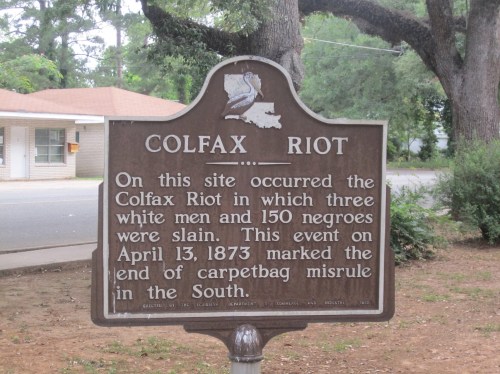
One hundred and forty-six years ago today one of the worst acts of terrorism against Americans by Americans was conducted by members of the White Leagues, a violent white supremacist group in Louisiana. This is from one of my Civil war texts and it is something not to forget in an age where violence against racial and religious minorities is again raising its head, and not just in the United States.

Have a good day,

Peace

Padre Steve+
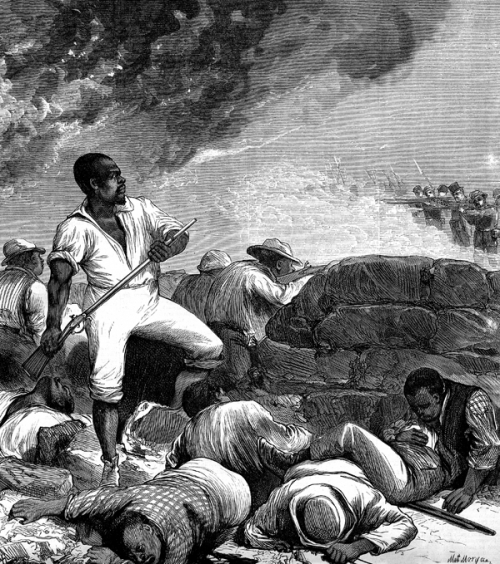
The violence against Southern blacks escalated in the wake of the passage of the Fourteenth and Fifteenth Amendments and with the increasing number of blacks being elected to office in some Southern states during the elections of 1872. In Louisiana a Federal court ruled in favor of Republican Reconstruction candidates following a Democrat campaign to interfere with the vote, which included attacks on polling sites and the theft of ballot boxes. As a result the Louisiana Democrats “established a shadow government and organized paramilitary unit known as the White League to intimidate and attack black and white Republicans.” [1]

The White League in Louisiana was particularly brutal in its use of violence. The worst massacre committed by the White League occurred Easter Sunday 1873 when it massacred blacks in Colfax, Louisiana. Colfax was an isolated nondescript hamlet about three hundred fifty miles northwest of New Orleans. It sat on the grounds of a former plantation whose owner, William Calhoun, who worked with the former slaves who were now freedmen. The town itself was composed of only a few hundred white and black votes”[2] was located in the newly established Grant Parish. The “parish totaled about 4,500, of whom about 2,400 were Negroes living on the lowlands along the east bank of the Red.” [3]Between 1869 and 1873 the town and the parish were the scene of numerous violent incidents and following the 1872 elections, the whites of the parish were out for blood.

White leaders in Grant Parish “retaliated by unleashing a reign of terror in rural districts, forcing blacks to flee to Colfax for protection.” [4] The blacks of parish fled to the courthouse seeking protection from a violent white mob following the brutal murder of a black farmer and his family on the outskirts of town. The people of Colfax, protected by just a few armed black militiamen and citizens deputized by the sheriff took shelter in the courthouse knowing an attack by the White Supremacists was coming.  As the White League force assembled one of its leaders told his men what the day was about. He said, “Boys, this is a struggle for white supremacy….There are one hundred-sixty-five of us to go into Colfax this morning. God only knows who will come out. Those who do will probably be prosecuted for treason, and the punishment for treason is death.” [5] The attack by over 150 heavily armed men of the White League, most of whom were former Confederate soldiers, killed at least seventy-one and possibly as many as three-hundred blacks. Most of the victims were killed as they tried to surrender. The people, protected by just a few armed men were butchered or burned alive by the armed terrorist marauders. It was “the bloodiest peacetime massacre in nineteenth-century America.” [6]

The instigators of the attack claimed that they acted in self-defense. They claimed that “armed Negroes, stirred up by white Radical Republicans, seized the courthouse, throwing out the rightful officeholders: the white judge and sheriff” and they claimed that the blacks had openly proclaimed “their intention to kill all the white men, they boasted they would use white women to breed a new race.” [7] The claims were completely fabricated, after sending veteran former army officers who were serving in the Secret Service to investigate, the U.S. Attorney for Louisiana, J.R. Beckwith sent an urgent telegram to the Attorney General:

“The Democrats (White) of Grant Parish attempted to oust the incumbent parish officers by force and failed, the sheriff protecting the officers with a colored posse. Several days afterward recruits from other parishes, to the number of 300, came to the assistance of the assailants, when they demanded the surrender of the colored people. This was refused. An attack was made and the Negroes were driven into the courthouse. The courthouse was fired and the Negroes slaughtered as they left the burning building, after resistance ceased. Sixty-five Negroes terribly mutilated were found dead near the ruins of the courthouse. Thirty, known to have been taken prisoners, are said to have been shot after the surrender, and thrown into the river. Two of the assailants were wounded. The slaughter is greater than the riot of 1866 in this city. Will send report by mail.” [8]

Federal authorities arrested nine white men in the wake of the massacre and after two trials in which white majority juries were afraid to go against public opinion, three were “convicted of violating the Enforcement Act of 1871.” [9] None were convicted of murder despite the overwhelming evidence against them and even the lesser convictions enraged the White Supremacists in Louisiana who had employed the best lawyers possible and provided them and the defendants with unlimited financial backing. Assisted by the ruling of Supreme Court Associate Justice Joseph Bradley, who had a long history of neglecting Southern racism, white Democrats appealed the convictions to the Supreme Court.

The attack, and the court cases which followed, notably the judgment of the Supreme Court in United States v. Cruickshank which dealt with the appeal of the men responsible for the Colfax Massacre led to a “narrowing of Federal law enforcement authority” and were “milestones on the road to a “solid” Democratic South.” [10] The decision of the court in United States v. Cruikshank was particularly perverse in its interpretation of constitutional rights and protections. The court ruled in favor of the terrorists and declared that “the right of the black victims at Colfax to assemble hand not been guaranteed because they were neither petitioning Congress nor protesting a federal law. Assembling for any other cause was not protected.” [11] The Cruikshank decision amounted to a Supreme Court endorsement of violence against blacks, and made it “impossible for the federal government to prosecute crimes against blacks unless they were perpetrated by a state and unless it could prove a racial motive unequivocally.” [12] Northern politicians and newspapers, reeling under the effects of the stock market crash of 1873, which had denounced the massacre just a year before now ran from the story and from support of African Americans. A Republican office holder wrote, “The truth is, our people are tired out with this worn cry of ‘Southern outrages…. Hard times and heavy taxes make them wish the ‘nigger,’ the ‘everlasting nigger,’ were in hell or Africa.” [13] Racism and race hatred was not exclusively the parlance of the South.

In the wake of Justice Bradley’s reversal of the Colfax convictions whites in Grant Parish engaged in brutal reprisals against blacks, leading to many murders and lynching’s, crimes which law enforcement, even that favorable to the rights of African Americans were afraid to prosecute for fear of their own lives. Louisiana’s Republican Governor, William Pitt Kellogg wrote Attorney General Williams blaming the violence on Bradley’s ruling, which he wrote, “was regarded as establishing the principle that hereafter no white man could be punished for killing a negro, and as virtually wiping the Ku Klux laws of the statute books.” He added that with the Army leaving the state that his government and other Reconstruction governments would fall, “if Louisiana goes,” Kellogg wrote, “Mississippi will inevitably follow and, that end attained, all the results of the war so far as the colored people are concerned will be neutralized, all the reconstruction acts of Congress will be of no more value than so much waste paper and the colored people, though free in name, will be practically remitted back to servitude.” [14] Governor Kellogg could not have been more correct.

In the years that followed many of the men involved in the massacre and other murders before and after were hailed as heroes, some, including the leader of the attackers, Christopher Columbus Nash were again appointed to office in Colfax and Grant Parish and blacks were reminded every day of just what they had lost. On April 13th 1921 the men who committed the massacre were honored with a memorial in the Colfax cemetery honoring them as “Heroes… who fell in the Colfax Riot fighting for White Supremacy.”

In 1951 the State of Louisiana Department of Commerce and Industry dedicated a marker outside the Courthouse which read: “On the site occurred the Colfax Riot in which three White men and 150 Negroes were slain, this event on April 13, 1873 marked the end of Carpetbag misrule in the South.”[15] That marker still stands, there is no marker commemorating the victims.

Other massacres followed across the South, aimed at both blacks and their white Republican allies. In Louisiana the White League had some 14,000 men under arms, in many cases drilling as military units led by former Confederate officers. A White League detachment southwest of Shreveport “forced six white Republicans to resign their office on pain of death – and then brutally murdered them after they had resigned.” This became known as the Coushatta Massacre and it was a watershed because for the first time the White League targeted whites as well as African Americans. The violence, now protected by the courts ensured that neither would last long in the post-Reconstruction South and that the freedom of African Americans in those states would amount to a cruel illusion.

In 1875, President Ulysses S. Grant including comments about the Colfax massacre and the subsequent court decisions in his message to Congress. Grant was angry and wrote: “Fierce denunciations ring through the country about office-holding and election matters in Louisiana…while every one of the Colfax miscreants goes unwhipped of justice, and no way can be found in this boasted land of civilization and Christianity to punish the perpetrators of this bloody and monstrous crime.” [17] President Grant, the man who so wanted to help African Americans attain the full measure of freedom, was unable to do more as the Congress and Courts took sides with the Southern insurgents.

Notes

[1] Ibid. Foner Forever Free p.151

[2] Ibid. Langguth After Lincoln p.312

[3] Ibid. Lane The Day Freedom Died p.42

[4] Ibid. Goldfield America Aflame p.493

[5] Ibid. Lane The Day Freedom Died p.91

[6] Ibid. Goldfield America Aflame p.493

[7] Ibid. Lane The Day Freedom Died p.11

[8] Ibid. Lane The Day Freedom Died p.22

[9] Ibid. Goldfield America Aflame p.494

[10] Ibid. Lane The Day Freedom Died p.251

[11] Ibid. Langguth After Lincoln p.314

[12] Ibid. Goldfield American Aflame p.494

[13] Ibid. Lane The Day Freedom Died p.213

[14] Ibid. Lane The Day Freedom Died p.217

[15] Ibid. Lane The Day Freedom Died pp.261-262

[16] Ibid. McPherson The War that Forged a Nation p. 185

[17] Ibid. Lane The Day Freedom Died p.228

Leave a comment

Filed under civil rights, civil war, crime, History, Loose thoughts and musings, Political Commentary

A Titanic Departure to Disaster and Human Presumption: a Prelude to the Great Trumpian Disaster yet to Come…

Friends of Padre Steve’s World,

In 1912 the Bishop of Winchester said these words in a sermon marking the end of the R.M.S. Titanic: “Titanic, name and thing, will stand as a monument and warning to human presumption,” as well it should. Sadly, it seems that that Trump administration is doing its best to strip away vital safety, health, and environmental regulations that protect people from even worse disasters than that which befell the great ship 109 years ago, making it a a very contemporary story. But only a historian would understand that. I happen to be a historian.

The story of the Titanic has been told many times, and it should be a cautionary tale for those who in the name of profit and glory seek to dismantle safety and environmental standards. I remember reading Walter Lord’s classic treatment of the story, A Night to Remember back in 7th Grade. It made a tremendous impact on me, and every so often I will go back and read it again.

Captain Edward Smith

The Titanic’s Captain, Edward Smith, her was blinded by his faith in shipbuilding technology and had said about the Adriatic which he commanded previously, “I cannot imagine any condition which would cause a ship to founder. I cannot conceive of any vital disaster happening to this vessel. Modern ship building has gone beyond that.” A Senator Said during the hearings about the sinking of her captain, “Overconfidence seems to have dulled the faculties usually so alert.” 

The story of what happened to the great ship is as hard to believe now as it was then, but then incredible tragedies be they the loss of ships, aircraft, buildings or bridges, and even spacecraft always invoke such feelings. When I was told about the Space Shuttle Challenger blowing up in 1986 I remarked to the young soldier who brought me the news “don’t be silly Space Shuttles don’t blow up.”  Walter Lord, who was probably the most prolific historian and author of the Titanic disaster used to talk of the “if onlys” that haunted him about the sinking of Titanic: If only, so many if onlys. If only she had enough lifeboats. If only the watertight compartments had been higher. If only she had paid attention to the ice that night. If only the Californian did come…” 

Bruce Ismay

The word “if” probably the biggest two letter word that plagues human history, looms large in the tragedy of Titanic. The great ship, which was the largest ship and one of the fastest ocean liners of her time was the victim of her owner and operators hubris as much as she was that of the iceberg which sank her. The ship was heralded by Bruce Ismay, the Chairman and Managing Director of the White Star Line as unsinkable, a claim that was echoed in the press.

Her builders had no such illusions and protested the claims. Thomas Andrews the Managing Director of Harland and Wolff Shipyards where she was built commented “The press is calling these ships unsinkable and Ismay’s leadin’ the chorus. It’s just not true.” 

Titanic was designed with the latest shipbuilding innovations, watertight compartments, a double bottom and equipped with wireless. She was billed as “unsinkable” by her owners but those innovations as advanced as they were for her day were insufficient to save her when her Captain and owners chose to charge through a known ice field at full speed.  Her watertight compartments did not extent far enough up the hull to prevent water from going over them.  Likewise it was never imagined that so many watertight compartments could be compromised.

Thomas Andrews

As far as lifeboats, the great ship carried far too few. Thomas Andrews, her builder wanted 64 had his arm twisted to bring the number to 32 and Titanic sailed with only 20 of which 4 were collapsible boats smaller than smaller lifeboats. Justifying himself under antiquated regulations (which were written for ships of 10,000 tons) which allowed just 16 boats J. Bruce Ismay the Director of White Star Line told Andrews:

“Control your Irish passions, Thomas. Your uncle here tells me you proposed 64 lifeboats and he had to pull your arm to get you down to 32. Now, I will remind you just as I reminded him these are my ships. And, according to our contract, I have final say on the design. I’ll not have so many little boats, as you call them, cluttering up my decks and putting fear into my passengers.” 

If only the Californian had come. Californian was the nearest vessel to Titanic and in easy wireless range. However her wireless was unmanned, she did not have enough operators to man it 24 hours a day.  Her lookouts saw Titanic but despite flares being fired from Titanic she never assumed Titanic to be in extremis. The next nearest ship, Carpathia heard the call and made a valiant attempt to reach Titanic but was too late.

If only…so many “if onlys” and so many traceable to one man, the Director of White Star Line J. Bruce Ismay.  Thomas Andrews would go down with the ship but Ismay ensured his own survival. Ismay is symbolic of men who allow their own hubris, vanity and power to destroy the lives of many.  He is so much like those that helped bring about the various economic crises that have wracked the United States and Western Europe and so many other tragedies.

After the disaster the tragedy was investigated by the United States Senate, as well as the British Board of Trade. However, the inquiry of the latter was condemned by the White Star Line’s Archivist, Paul Louden-Brown. He noted: “I think the enquiry is a complete whitewash. You have the [British] Board of Trade in effect enquiring into a disaster that’s largely of its own making.”

Ismay and Titanic are symbols of men guided only by their quest for riches and glory who revel in their power and scorn wise counsel or regulation, government or otherwise. They often believe that rules don’t apply to them. It is a cautionary tale for us today as corporations, lobbyists, and politicians seek to dismantle sensible and reasonable safety and environmental regulations for the sake of their unmitigated profit. Today we are seeing the Trump administration doing all that it can to strip away important safety, workplace, and environmental regulations in order to maximize profits.

But the warning goes far beyond that, it applies to any of us who adopt the mindset, “this cannot happen to us.” After all, there are times when we all end up as victims of our own hubris, such is the human condition. That is especially the case now where an American President defies all precedent, ignores laws, demeans the Constitution, stands against the very proposition of the Declaration, “that all men are created equal…” and who represents the unregulated hubris of men like Bruce Ismay. Had he been a passenger on board the ill-fated ship the President would have likely saved himself like Ismay, absconding into a boat while being the President of the Line to which Titanic belonged. Walter Lord wrote about Ismay:

“This Sunday he was enough a member of the crew to see the ice message that arrived from another ship. In the bright, sunny Palm Court—just as the bugler sounded lunch—Captain Smith gave him a warning from the Baltic. During the afternoon Ismay (who liked to remind people who he was) fished it out of his pocket and waved it at Mrs. Ryerson and Mrs. Thayer. In the smoking room before dinner, while the twilight still glowed through the amber-stained windows, Captain Smith sought and got the message back. Then Ismay walked down to the restaurant, immaculate in his dinner jacket, very much a First Class passenger. After the crash he went back to being in the crew—up with the Captain on the bridge … consulting with Chief Engineer Bell … and now, despite the tongue-lashing from Fifth Officer Lowe, shouting orders about the boats. Then came another switch. At the very last moment, he suddenly climbed into Boat C. Down it dropped, with 42 people including Bruce Ismay—just another passenger.”

That would be President Trump. He loves playing President, and playing the role of the Commander in Chief but he would abandon the ship of state, the citizens of the United States, and even the cult of people who believed every word he said. He does that every day, so it is not unlikely that when the ultimate disaster occurs that he will abandon the country and even his Cult members who he called “the most loyal people” who he will sell out on. Sinking ship to preserve himself.

This is a hard lesson to learn, but believe me when I say it. It is the history of Donald J. Trump, and all he has done as a businessman and as President. Ask all of the loyal men and women who volunteered to serve in his administration whose lives and reputations are in tatters.

Until tomorrow,

Peace

Padre Steve+

Leave a comment

Filed under History, leadership, Loose thoughts and musings, News and current events, Political Commentary