Category Archives: History

“We’re Going to Have to Try to Top It” Trump’s Need for a Parade

645x344-trump-macron-get-lucky-as-bastille-day-band-plays-daft-punk-medley-1500046593589

Friends of Padre Steve’s World,

It was revealed yesterday that President Trump has ordered the military to conduct a military parade in Washington D.C. It was reported in the Washington Post on Tuesday and a military official noted:

“The marching orders were: I want a parade like the one in France,” said a military official who spoke on the condition of anonymity because the planning discussions are supposed to remain confidential. “This is being worked at the highest levels of the military.”

In the same article White House Press Secretary Sarah Huckabee Sanders noted:

“President Trump is incredibly supportive of America’s great service members who risk their lives every day to keep our country safe,” Sanders said. “He has asked the Department of Defense to explore a celebration at which all Americans can show their appreciation.”

The President who conspicuously avoided military service in Vietnam with five deferments, compared avoiding sexually transmitted diseases in 1980s New York to combat in Vietnam, called men like John McCain and others who were wounded or captured in Vietnam “losers”, combat veterans with PTSD “weak”, and that he knew more about ISIS war and strategy than American military leaders has wanted to display the instruments of American military power since he was elected. He requested such a display for his inauguration but the request was turned down and prior to the inauguration he told a reporter Karen Tumult when she asked how Americans would know that he had made America Great Again:

“We’re going to display our military. We’re going to display it. That military may come marching down Pennsylvania Avenue. That military may be flying over New York City and Washington, D.C., for parades. I mean, we’re going to be showing our military.”

But there is no lack of love, respect or appreciation from the military in the United States. The military is one of the most trusted and respected institutions in the country. In an era where trust most public and private institutions is collapsing the military, trust in the military, despite some erosion since the election of President Trump is still very high, some 72% of Americans have a high amount of trust in the military and its leadership. Trump’s politicization of the military is hurting it, but respect and trust for the military still remains high, and even those who do not trust military leadership still tend to appreciate and honor the troops. So I think that the argument by Ms. Sanders that we need an event were Americans can show their appreciation for the military is misplaced. We already have three days; Armed Forces Day, Memorial Day, and Veteran’s Day; two of them which are national holidays where we honor military personnel, veterans, and those who gave their lives in service of the country.

Presidential historian Douglas Brinkley noted:

“I don’t think there’s a lack of love and respect for our armed forces in the United States,” said Douglas Brinkley, a presidential historian at Rice University. “What are they going to do, stand there while Donald Trump waves at them? It smacks of something you see in a totalitarian country — unless there’s a genuine, earnest reason to be doing it.”

But despite the official pronunciations of Ms. Sanders I think the President’s need for a parade and demonstration of America’s military power is more like Penis Envy based on his visit to Europe last year where he viewed the French Bastille Day Parade. After that event the President remarked:

“It was one of the greatest parades I’ve ever seen… It was two hours on the button, and it was military might, and I think a tremendous thing for France and for the spirit of France… We’re going to have to try to top it.”

The President seems to be jealous that the French President gets to preside over a military parade. But there is a difference between such displays in France and the United States.

The French parade coincides with Bastille Day the French equivalent of our Independence Day marking an event that was the tipping point of the French Revolution. Though it had been held since the revolution the annual parade began in 1880 about a decade after France was defeated by Prussia in the Franco Prussian War. It is closely connected to French independence and has become much less nationalistic over the past few decades. For many years the french have invited contingents from old allies, former colonies, and former enemies like Germany to participate. Likewise, French troops have marched under the banner of the European Union on a number of occasions.

The American experience is not at all similar. Military parades down Pennsylvania avenue are quite rare and with the exception of the inaugural parades of Harry Truman and John F. Kennedy which were held at points of high tension during the Cold War, almost every other parade has commemorated a military victory such as the Civil War, World War Two, and Operation Desert Storm, which should better be called the First Iraq War. There really is no precedent for such a parade when the nation is still engaged in war without end and when the real possibility for at least one major new war, possibly a nuclear war exists.

K7HV4NBAABH7ZMVF7AWWBIXJTY

But that being said there are real, pragmatic considerations for opposing such a parade and almost all of them deal with national security and the costs. Unlike France in which most of the units involved in the parade are stationed between 50 and 100 miles of Paris, the units needed to fulfill the President’s parade fantasy have to be moved hundreds of miles to get there and doing so would disrupt badly needed training cycles, deployment preparation, and cost tens of millions of dollars, even before the costs to the District of Columbia are added in, and let me remind you all of those costs come from Federal taxes. The last major victory parade, that after Operation Desert Storm cost over 12 million dollars which is close to 22 million now; but the problem is that the actual costs would probably be far more than that in an time when resources are much more constrained in which costs have gone up. In 1991 many of the troops involved were being demobilized and the armed forces being reduced in strength following the end of the Cold War; today’s military is stretched to the breaking point and if war breaks out on the Korean Peninsula anytime soon such a parade will mark a tragedy even if we win.

Since almost all of my life has some association with military service as a Navy dependent, Navy Junior ROTC Cadet, Army National Guard Enlisted Soldier, active duty, Army National Guard, Army Reserve Officer, and for the last 19 years as a Naval Officer I appreciate the support of the American people. But I would rather see that support shown by increased funding of the V.A., increased support to service members and their families, including health care. If the President wanted to honor veterans he could authorize the military to award the Cold War Service Medal or the Iraq Medal of Commitment through an executive order. The costs of doing one or both would be chump change in comparison to the rest of the military budget and as Napoleon Bonaparte noted: “A soldier will fight long and hard for a bit of colored ribbon.”

While he never served himself and has mocked combat veterans the President is a nationalist and authoritarian. Nationalists and authoritarians tend to wrap themselves around the military as a way of showing the strength that inwardly they don’t have.

Timothy Snyder wrote:

“The president is a nationalist, which is not at all the same thing as a patriot. A nationalist encourages us to be our worst, and then tells us that we are the best. A nationalist, “although endlessly brooding on power, victory, defeat, revenge,” wrote Orwell, tends to be “uninterested in what happens in the real world.” Nationalism is relativist, since the only truth is the resentment we feel when we contemplate others. As the novelist Danilo Kiš put it, nationalism “has no universal values, aesthetic or ethical.” A patriot, by contrast, wants the nation to live up to its ideals, which means asking us to be our best selves. A patriot must be concerned with the real world, which is the only place where his country can be loved and sustained. A patriot has universal values, standards by which he judges his nation, always wishing it well—and wishing that it would do better.” 

So until tomorrow,

Peace,

Padre Steve+


9 Comments

Filed under History, iraq,afghanistan, Military, national security, News and current events, Political Commentary

Finding Tipperary 10 Years After Iraq

Friends of Padre Steve’s World,

Ten years ago today I stepped off a plane with the man who had been my body guard and assistant for the past seven months in Iraq. War had changed me more than I had every imagined that it would. Even though I was physically home I wasn’t and over the next decade the war remained with me, and in some ways it still does.

I have written about my struggles with what I sometimes describe as the “Demons of PTSD” and while I am doing much better now than even two years ago I still suffer from it. But being a historian has allowed me to find connections to other men who have suffered from their experience of war, came home changed, and struggled for their existence in the world that they came home to.

The words of those men have helped me to frame my experience even in the darkest times often in ways that my faith did not. One of the things that I struggled with the most and still do is sleep. When I was conducting my research on the Battle of Gettysburg I got to know through biographies and their own writings a good number of the men who fought that battle who are now remembered as heroes. One of these was Major General Gouveneur Warren who has shattered by his experiences during the war. He wrote to his wife after the war: “I wish I did not dream that much. They make me sometimes dread to go to sleep. Scenes from the war, are so constantly recalled, with bitter feelings I wish to never experience again. Lies, vanity, treachery, and carnage.” 

About every year around this time I feel a sense of melancholy as I reflect on war and my return from it. Today I was reading a number of George Santayana’s Soliloquies in England, in particular one entitled Tipperary which he wrote in the time shortly after the war. I think that the first time that I heard the song was when I saw a Charlie Brown special where Snoopy as the World War One Flying Ace alternates between happiness and tears as Schroeder plays the song on his piano.

In Santayana’s soliloquy he comments on the wounded officers that he sees singing the song in a coffee house and he wonders if they understand how different the world is now. I love the song, the chorus is below.

It’s a long way to Tipperary
it’s a long was to go
It’s a long way to Tipperary
to the sweetest gal I know
farewell to Piccadilly
so long Leister Square
It’s a long way to Tipperary
but my heart lies there

Santayana wrote:

“It had been indeed a long, long way to Tipperary. But they had trudged on and had come round full circle; they were in Tipperary at last.

I wonder what they think Tipperary means for this is a mystical song. Probably they are willing to leave it vague, as they do their notions of honour or happiness or heaven. Their soldiering is over; they remember, with a strange proud grief, their comrades who died to make this day possible, hardly believing that it ever would come ; they are overjoyed, yet half ashamed, to be safe themselves ; they forget their wounds ; they see a green vista before them, a jolly, busy, sporting, loving life in the old familiar places. Everything will go on, they fancy, as if nothing had happened…

So long as the world goes round we shall see Tipperary only, as it were, out of the window of our troop-train. Your heart and mine may remain there, but it s a long, long way that the world has to go.” 

In the same work Santayana mused on the nature of humanity and war, making one of his most famous observation “only the dead have seen the end of war.”

In the United States we live in a world where war is an abstraction and the vast majority of people have no clue about it or its cost. When I hear the American President make wild threats of war and the cavalier attitude of his sycophants toward it I realize that Santayana was right, only the dead have seen the end of war.

When I returned to the United States in 2008 it was incredibly hard to readjust to life in a country that knew not war and I was reminded of the words of Guy Sajer in his book The Forgotten Soldier. Sajer was a French Alsacian of German descent who spent nearly four years fighting as an ordinary infantry soldier on the Eastern Front. When he returned home he struggled and he wrote:

“In the train, rolling through the sunny French countryside, my head knocked against the wooden back of the seat. Other people, who seemed to belong to a different world, were laughing. I couldn’t laugh and couldn’t forget.”

A similar reflection was made by Erich Maria Remarque in All Quite on the Western Front:

“I imagined leave would be different from this. Indeed, it was different a year ago. It is I of course that have changed in the interval. There lies a gulf between that time and today. At that time I still knew nothing about the war, we had been only in quiet sectors. But now I see that I have been crushed without knowing it. I find I do not belong here any more, it is a foreign world.”

I have to admit that for the better part of the past decade when I get out of my safe spaces I often feel the same way. I don’t like crowed places, confined area, and other places that I don’t feel safe in. When I am out I always am on alert, and while I don’t have quite the hyper-arousal and hyper-vigilance that I once lived with, I am much more aware of my surroundings and always plan an escape route from any public venue that I happen to find myself.

As I read and re-read Santayana words I came back to his observation of the officers that he saw in the coffee house and I could see myself in them:

“I suddenly heard a once familiar strain, now long despised and out of favour, the old tune of Tipperary. In a coffee-house frequented at that hour some wounded officers from the hospital at Somerville were singing it, standing near the bar; they were breaking all rules, both of surgeons and of epicures, and were having champagne in the morning. And good reason they had for it. They were reprieved, they should never have to go back to the front, their friends such as were left could all come home alive. Instinctively the old grumbling, good-natured, sentimental song, which they used to sing when they first joined, came again into their minds.

It had been indeed a long, long way to Tipperary. But they had trudged on and had come round full circle; they were in Tipperary at last.” 

I too am now in my own Tipperary on this side of the Atlantic. I have been reprieved, at least temporarily,  but as Santayana noted  “it s a long, long way that the world has to go.” 

Until tomorrow,

Peace

Padre Steve+


1 Comment

Filed under History, iraq, Military, philosophy, PTSD, to iraq and back, Tour in Iraq, travel

“As Men Can Die Heroically as Brothers so Should They Live Together in Mutual Faith and Goodwill” The Four Chaplains in the Age of Trump

four chaplains

The Four Chaplains

Friends of Padre Steve’s World,

Today I am writing a brief remembrance of four men who I never met but whose lives helped guide me into my vocation as a Priest and Chaplain. I think I first read about them in junior high school and at that time I had never thought about becoming a minister, priest, or chaplain. To be sure, ever since I was in early grade school I wanted to be in the military but it would not be until my senior year of high school that I felt a call to become a Navy Chaplain. I’ll come back to that in a moment, but first a brief op-ed on religion in the United states.

In this day and age where fanatical religious extremists of many faiths seek to divide society, launch wars of religion, discriminate against non-believers or even people who believe differently than them, or hold different philosophical or political beliefs, it is important as Americans to find something that holds us together. The fact that our founders were profoundly against establishing or favoring any particular faith or denomination, there are those today who militantly fight to establish an Evangelical Christian theocracy that has no basis for existence based on the testimony of the Founders, and the earliest proponents of religious liberty in the United States including Virginia Baptist John Leland who helped influence James Madison in crafting the First Amendment of the Constitution wrote:

“The notion of a Christian commonwealth should be exploded forever. … Government should protect every man in thinking and speaking freely, and see that one does not abuse another. The liberty I contend for is more than toleration. The very idea of toleration is despicable; it supposes that some have a pre-eminence above the rest to grant indulgence, whereas all should be equally free, Jews, Turks, Pagans and Christians.”

Sadly, men like Franklin Graham, Pat Robertson, Jerry Falwell Jr., Robert Jeffress, and a host of others use their theocratic political judgments to condemn people of good faith in this life and the next. Aided by men like the President they stand in opposition to Leland and the others like him who understood that the American experiment in religious liberty could not be tied to fixed dogma, nor the Apostle Paul who wrote to the Church in Corinth: “in Christ God was reconciling the world to himself,[a] not counting their trespasses against them, and entrusting the message of reconciliation to us.” (2 Cor. 5:19)

But I digress, you can read previous articles on this site in which I quoted Leland and other defenders of real religious freedom. For me it’s a matter of my Christian faith. So back to the story…

The four men that I never met were Army Chaplains.

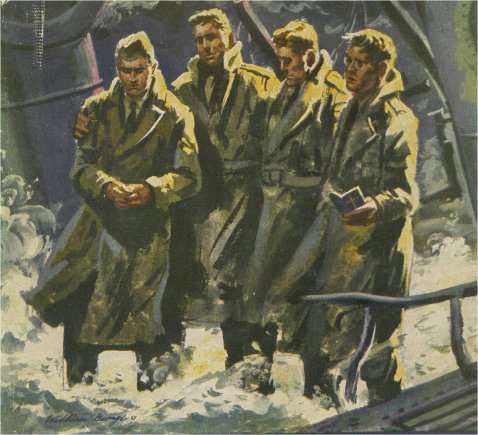
George Lansing Fox was a 42 year old Methodist minister from Lewiston, Pennsylvania who had served as a medic in the First World War in which he was awarded the Silver Star, the Purple Heart, and the French Croix De Guerre. Thirty-one year old Reformed Rabbi Alexander Goode of Brooklyn, New York was the son of a Rabbi who before the war had applied but not been accepted as a Navy Chaplain. After Pearl Harbor he volunteered and was commissioned as an Army Chaplain. Clark V. Poling was a Baptist minister serving as pastor of a Reformed Church when the war broke out. His father had served as a Chaplain in the First World War and Poling, the married father of one child became an Army Chaplain in 1941. Father John Patrick Washington of Newark New Jersey was a Roman Catholic Priest who entered active duty in May 1942. The four men attended the Army Chaplain’s School, then at Harvard and were united for the journey across the Atlantic aboard the transport ship SS Dorchester.

On the night of February 3rd 1943 the Dorchester was torpedoed by the German submarine U-223. She went down in 20 minutes, of the 904 men aboard the ship only 230 survived. Despite the fact that the ship’s captain had ordered a high state of readiness and that all hands wear life jackets at all time, “Many soldiers sleeping deep in the ship’s hold disregarded the order because of the engine’s heat. Others ignored it because the life jackets were uncomfortable.”

When the ship was hit by a torpedo power went out and the four chaplains worked amid the chaos to calm the situation and assisted the soldiers, sailors, and merchant mariners aboard the ship as they tried to abandon ship. The four chaplains handed out life jackets until the supply ran out and then gave their own life jackets to soldiers that had none.

In doing so they signed their own death sentence, the water temperature was just 34 degrees, the air temperature was 36 degrees, many who survived the sinking died of exposure within minutes of the sinking, rescue ships found hundreds of bodies floating in the water. As the ship went down they died together, praying with arms linked after giving away their life jackets as the troop transport that they were on sank beneath the waves into the icy depths of the North Atlantic. A survivor wrote:

“As I swam away from the ship, I looked back. The flares had lighted everything. The bow came up high and she slid under. The last thing I saw, the Four Chaplains were up there praying for the safety of the men. They had done everything they could. I did not see them again. They themselves did not have a chance without their life jackets.”

Other survivors reported hearing the prayers of the chaplains in English, Latin, and Hebrew as the ship went down. Their bodies were never recovered. They have been remembered as heroes. In 1960 Congress named February 3rd as Four Chaplains Day. The U.S. Post Office commissioned a stamp in their honor in 1948. The Chapel of the Four Chaplains was dedicated in the basement of Grace Baptist Church in Philadelphia in 1951. President Harry Truman spoke at its dedication noting:

“This interfaith shrine… will stand through long generations to teach Americans that as men can die heroically as brothers so should they live together in mutual faith and goodwill.”

The chapel was moved to Temple University in 1953 and to the former Philadelphia Naval Shipyard in 2001.


ph-ph-ag-four-chaplains-preview-jpg-20140205

Father John Patrick Washington (Top Left), Reverend Clark V. Poling (Top Right), Rabbi Alexander Goode (Bottom Left), and Reverend George Lansing Fox

Of course my journey in finding that call and answering it had a number of detours in which I first rejecting following the call. Instead, when I was in college I simply enlisted in the Army National Guard, entered ROTC and then was commissioned as an Army officer. After a number of incidents on active duty which renewed that sense of call I left active duty to go to seminary, went back into the National Guard and in September of 1992 became an Army National Guard and civilian hospital chaplain.  On February 9th 1999 I resigned my commission as a Major in the Army Chaplain Corps to become a Navy Chaplain, and in the process accepting a reduction in rank.

In the nearly 37 years that I have served in the military of which almost 26 have been spent as a chaplain I have had the privilege of serving with many fine ministers of many denominations, priests, rabbis, and even an imam.  Of course I have served alongside some chaplains who regardless of their faith or denomination were simply assholes, but that being said I truly do appreciate those men and women from so many faiths and denominations who have cared for me. I do think that any of them could have linked arms with me and prayed after doing the last best things that we could do for the soldiers, sailors, marines, and airmen who entrust themselves to our care.

Despite what some senior chaplains in both the Army and Navy had done to me at different points; when I think of those men and women who regardless of their beliefs or the beliefs of the religious organizations that endorse them for the chaplaincy, I realize just how blessed that I am.

In the day that we live I can still stand with Harry Truman when he praised these chaplains. Now I am sure that there are quite few people who would say that either Goode, Fox, Poling, or Washington are already in Hell; but I don’t believe that. I understand from Scripture and the teachings of Jesus that God looks on the heart, and that the most important commandments are to love God and love our neighbors. I think that Jesus said that in doing those things that people fulfill the entire law.

Thus I thank God for the Chaplains of various denominations, Mainline Protestants, Evangelicals, Catholics, Orthodox Christians, Anglicans, Mormons, Jews, and Muslims who I would be blessed to link arms with to care for those in our care.

So today, I ask my readers to share this message with others.

Until tomorrow,

Peace

Padre Steve+


3 Comments

Filed under christian life, faith, History, Political Commentary, World War II at Sea, world war two in europe

Stalingrad At 75

Friends of Padre Steve’s World

Wednesday the 31st of January marks the 75th anniversary of  the surrender of the remnants of the German 6th Army to the Soviets at Stalingrad. The focus of this article is on how the Germans and Russians fought the Stalingrad campaign. In particular it is an analysis of the way the governments and military’s of both Nazi Germany and the Soviet Union planned and executed strategy during the course of the campaign adjusted to the situation and how the campaign ended. It is also a reminder of the price that ordinary soldiers can pay when a country commits them to war. In all nearly two million Axis and Soviet personnel, including civilians were killed, wounded, or captured during the campaign.

That being said, it is a reminder to all of us of the consequences of how xenophobic and racist politics of self-anointed leaders, and their followers can lead nations into disaster.

Peace 

Padre Steve+

Stalingrad: Primary or Secondary Objective
 keitel-jodl-hitler

The mistakes began early in the planning and conduct of the operation

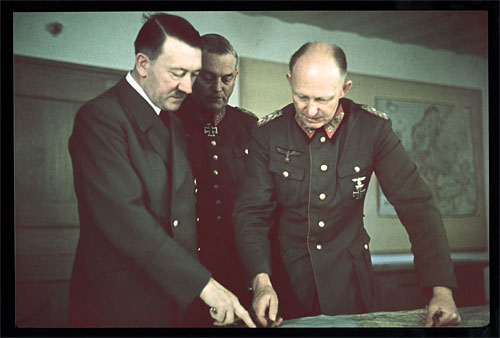
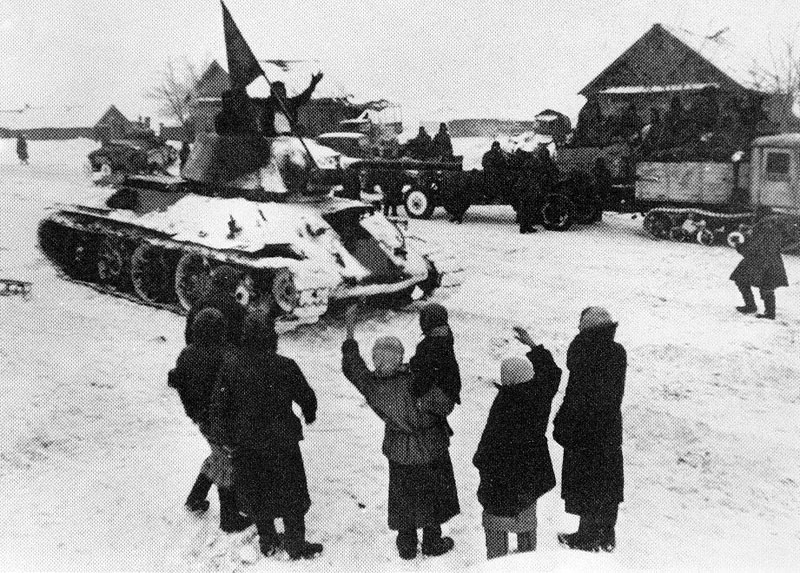
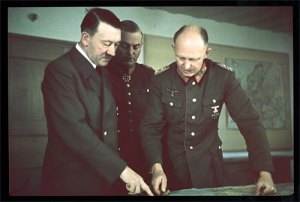
Following the Soviet winter offensive and the near disaster in front of Moscow the German High Command was faced with the strategic decision of what to do in the 1942 campaign.  Several options were considered and it was decided to seize the Caucasus oilfields and capture or neutralize the city of Stalingrad on the Volga.  However, the German High Command was divided on the actual objective of the campaign.

operation blau map

The Oberkommando des Heer or the OKH (Army High Command) under the guidance of General Franz Halder assumed that Stalingrad was the objective and the advance into the Caucasus was a blocking effort.[i] Hitler and Oberkommando des Wehrmacht or the OKW planned to capture the Caucasus oil fields and capture or neutralize Stalingrad to secure the left flank.[ii] Both OKH and OKW considered Stalingrad significant but “German commanders initially regarded it as a weigh station en route to the Caucasus oil fields.” [iii] The conflict echoed in the ambiguity of Directive No. 41, which “included the ‘seizure of the oil region of the Caucasus’ in the preamble concerning the general aim of the campaign, yet made no mention of this in the main plan of operations.” [iv] At the planning conference held at Army Group South in early June “Hitler hardly mentioned Stalingrad. As far as his Generals were concerned it was little more than a name on the map. His obsession was with the oil fields of the Caucasus.” [v] Manstein noted, “Hitler’s strategic objectives were governed chiefly by the needs of his war economy….” [vi] Historian Anthony Beevor noted that at this stage of planning “the only interest in Stalingrad was to eliminate the armaments factories there and secure a position on the Volga. The capture of the city was not considered necessary.” [vii] German planners “expected that the Soviets would again accept decisive battle to defend these regions.” [viii]

In Moscow Stalin and his Generals attempted to guess the direction of the impending German offensive.  “Stalin was convinced that Moscow remained the principle German objective…Most of the Red Army’s strategic reserves…were therefore held in the Moscow region.” [ix]The Soviet High Command, Stavka attempted to disrupt the German offensive and to recover Kharkov by launching three offensives three offensives of their own. The largest of these, an attack on Kharkov was defeated by the Germans between the 12th to the 22nd of May, with the loss of most of the armor in southern Russia. This disaster was accompanied by an equally disastrous defeat of Red Army forces in Crimea by Erich Von Manstein’s 11th Army, and the combination meant that the Red Army would face the Germans in a severely weakened condition. [x]

Operation Blau: Opening Moves and Divergent Objectives
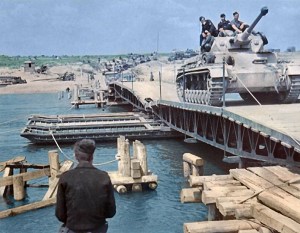
panzers_across_the_don

Panzers cross the Don

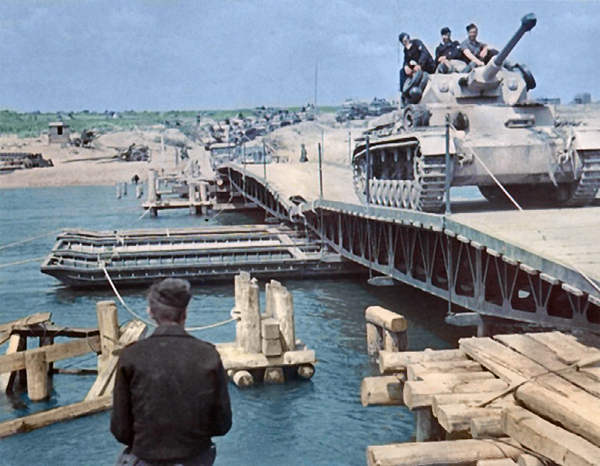
The German offensive began on 28 June under the command of Field Marshal Fedor von Bock. Von Bock’s command included two separate army groups, Army Group B under General Maximilian Von Weichs with 2nd Army, 6th Army and 4th Panzer Army operated in the northern part of the operational area. Army Group A under Field Marshall Wilhelm List was to the south with 17th Army and 1st Panzer Army, with the goal of driving into the Caucasus. [xi] Army Group B provided the main effort for the offensive and its forces quickly smashed through the defending Soviet armies and by the 20th Hitler believed that “the Russian is finished.” [xii] One reason for the German success in the south was that until July 7th Stalin believed that Moscow was still the primary objective for any German summer offensive. [xiii] Despite his success, Hitler prevented Von Bock from destroying the Soviet formations that had been left behind and was relieved of command by Hitler. This enabled many of those units to escape the German onslaught. For his trouble Von Bock was replaced by Von Weichs, which created a difficult command and control problem.  Manstein noted that this created a “grotesque chain of command on the German southern wing” with the result that Army Group A had “no commander of its own whatever”and Army Group B had “no few than seven armies under command including four allied ones.” [xiv]

Bild 169-0894

Destroyed Soviet T-34s

This decisions made next proved fateful.  Hitler’s decided to redirect the advance of the 4th Panzer Army to support an early passage of the lower Don, diverting it from its drive on Stalingrad.  Additionally the army groups became independent of each other when Bock was relieved of command.  They were “assigned independent-and diverging-objectives” under the terms of Directive No.45. [xv] This combination of events had a decisive impact on the campaign.  Hitler’s decision prevented a quick seizure of Stalingrad by 4th Panzer Army followed by a hand over to 6th Army to establish the “block” as described by Directive No.41.  Kleist noted that he didn’t need 4th Panzer Army’s help to accomplish his objectives and that it could have “taken Stalingrad without a fight at the end of July….” [xvi]
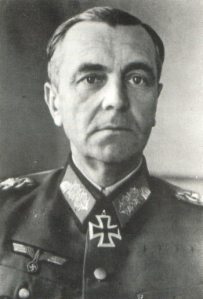
 general-paulus

Field Marshall Von Paulus

The result was damning. The Luftwaffe air support and fuel needed by Army Group A was transferred to 6th Army, denuding Army Group A of the resources that it needed to conclude its conquest of the Caucasus. [xvii] At the same time it denied Army Group B of the Panzer Army that could have seized Stalingrad when it was still possible to do so.  Anthony Beevor called Hitler’s decision a disastrous compromise, [xviii] while Halder believed that Hitler’s decision underestimated the enemy and was “both ludicrous and dangerous.” [xix]

Focus on Stalingrad

battle-stalingrad-ww2-second-world-war-two-russian-eastern-front-unseen-pictures-photos-images

Sturmgeschutz Battalion Advancing toward Stalingrad

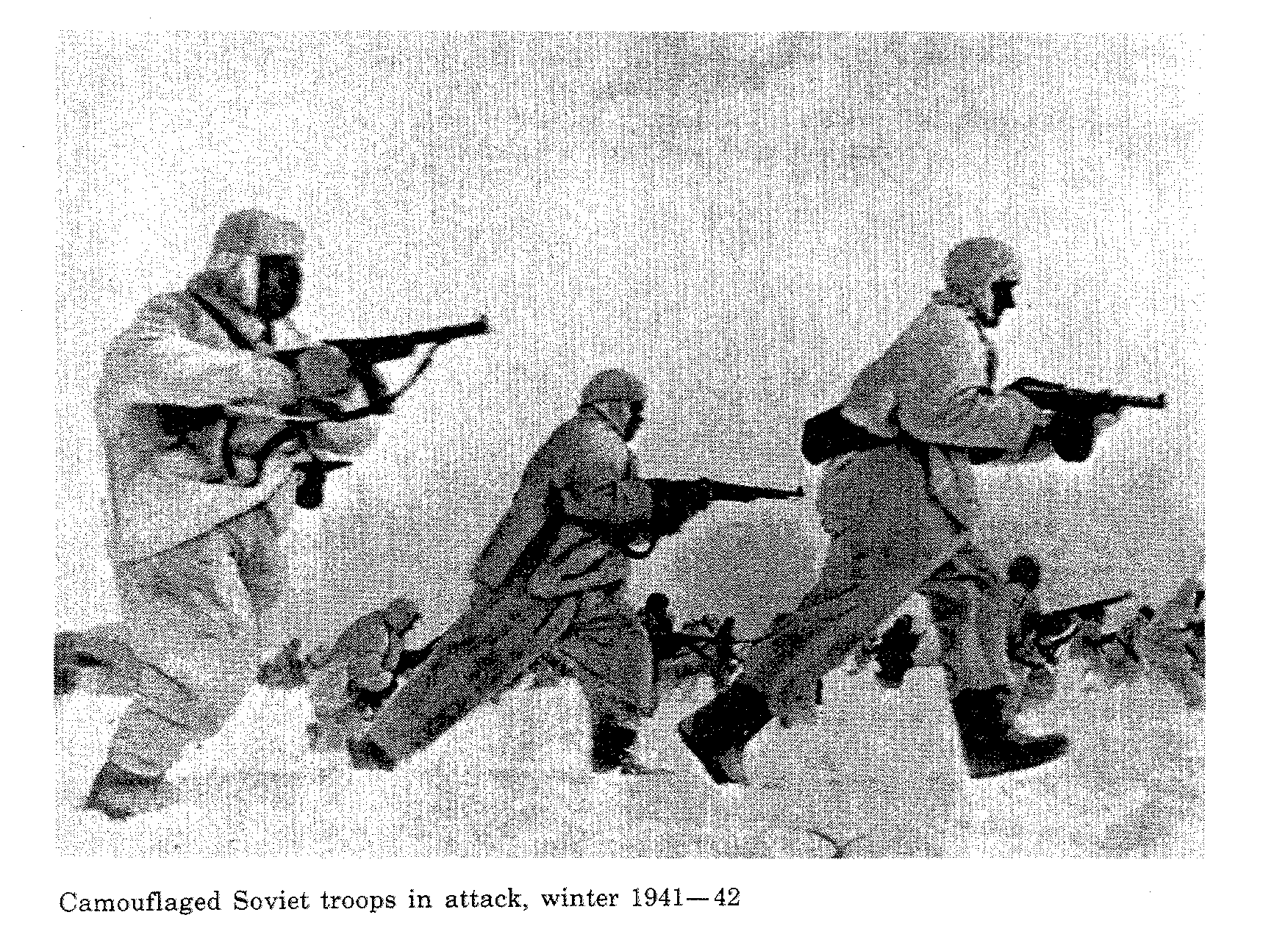
On July 22nd as the Wehrmacht ran short on fuel and divisions to commit to the Caucasus, and 6th Army fought for control of Voronezh the Soviets created the Stalingrad Front. Stavka moved an NKVD Division to the city [xx] and rapidly filled the new front with formations transferred from the Moscow Front. [xxi]Stalin then issued Stavka Order 227, better known as “No Step Back” on July 28th. The order mandated that commanders and political officers who retreated would be assigned to Penal battalions[xxii] and each field army was to form three to five special units of about 200 men each as a second line “to shoot any man who ran away.” [xxiii] Russian resistance west of the Don slowed the German advance. German commanders were astonished “at the profligacy of Russian commanders with their men’s lives.” [xxiv] Von Kleist compared the stubbornness of Russians in his area to those of the previous year and wrote that they were local troops who fought more stubbornly because they were fighting to defend their homes.” [xxv]Additionally, Stalin changed his commanders frequently in the “vain hope that a ruthless new leader could galvanize resistance and transform the situation.” [xxvi] General Chuikov brought the 64th Army into the Stalingrad Front in mid-July to hold the Germans west of the Don.[xxvii]

The OKW further weakened the German offensive by transferring several key SS Panzer Divisions and the Grossdeutschland Panzer Division to France. The Hungarian, Italian and Romanian armies that were part of the army group lacked motorization; modern armored and anti-tank units, and were unable to fulfill the gaps left by the loss of the experienced German divisions that had been transferred and the expectations of Hitler. [xxviii] The German 6th Army was virtually immobilized for 10 days due to lack of supplies allowing the Russians to establish a defense on the Don Bend. [xxix]

To the south the Germans were held up by lack of fuel and increased Soviet resistance including the introduction of a force of 800 bombers, which took away the total domination of the air that the Germans had previously enjoyed.[xxx] David Glantz and House note that after the fall of Rostov on July 23rd “Hitler abruptly focused on the industrial and symbolic value of Stalingrad.” [xxxi] Hitler was undeterred by warnings from Halder that fresh Russian formations were massing east of the Volga and those of Quartermaster General Erich Wagner, who guaranteed that he could supply either the thrust to the Caucasus or Stalingrad but not both operations simultaneously. [xxxii] Again frustrated by the slow progress to take Stalingrad, Hitler reverted to the original plan for the 4th Panzer Army to assist the 6th Army at Stalingrad, but the cost in time and fuel to move that army from the Caucasus to Stalingrad were significant to the operation and the question was whether “they could make up for Hitler’s changes in plan.” [xxxiii]

Strategic Implications

The changes in the German plan had distinct ramifications for both sides.  Friedrich Von Mellenthin wrote, “the diversion of effort between the Caucasus and Stalingrad ruined our whole campaign.” [xxxiv] The Germans could not secure the Caucasus oil fields that Hitler considered vital to the German war effort.  The Germans advanced deep into the region and captured the Maikop oil fields, though the drilling and refining facilities were almost completely destroyed by the retreating Russians when they withdrew.[xxxv] Due to the lack of fuel and increased Soviet resistance Army Group A was halted along the crests of the Caucasus on August 28th[xxxvi] This setback left Hitler deeply “dissatisfied with the situation of Army Group A.” [xxxvii]Kleist and others attributed much of the failure to a lack of fuel [xxxviii] while Gunther Blumentritt observed that Mountain divisions that could have made the breakthrough were employed along the Black Sea coast in secondary operations. [xxxix]

battle_stalingrad65

JU-87 Stuka over Stalingrad

Meanwhile on the Stalingrad front, fuel and supply shortages hampered 6thArmy’s advance while Hermann Hoth’s 4th Panzer Army was needlessly shuttled between Rostov and Stalingrad. By the time the 4th Panzer Army resumed its advance the Russian forces around Stalingrad “had sufficiently recovered to check its advance.” [xl] As the 6th Army advanced into Stalingrad the “protection of Army Group B’s ever-extending northern flank was taken over by the 3rd Rumanian, the 2nd Hungarian and the newly formed 8th Italian Army.” [xli] The allied armies had to occupy overextended fronts, and these formations were neither trained equipped for the Russian campaign, nor well motivated to die for Germany. [xlii] The supply shortage in both German army groups was not helped by a logistics bottleneck. All supplies for both army groups had to transit over a single crossing on the Dnieper River, which Manstein noted, also prevented swift movement of troops from one area to another. [xliii]

 pzdiv-24-motorcycle-stalingrad

Reconnaissance Battalion of 24th Panzer Division near Stalingrad

Von Paulus’ 6th Army attempted to capture Stalingrad with a swift attack between the 25th and 29th of July, even as Hoth’s 4th Panzer Army milled about on the lower Don.  However, Paulus’s piecemeal commitment of his divisions and failure to concentrate in the face of unexpectedly strong Soviet resistance caused the attacks to fail.  Paulus then halted the 6th Army on the Don so it could concentrate its forces and build its logistics base, [xliv] and to allow Hoth’s army to come up from the south. This further delay allowed the Russians to build up even more forces west of Stalingrad, to reinforce the Stalingrad front, and to strengthen the defenses of the city. [xlv] Likewise, due to the distances involved it now was easier for the Russians to reinforce the Stalingrad front than it was for the Germans. [xlvi] As they strengthened their positions, the Soviets filled a number of key leadership positions with competent and tough Generals who would skillfully fight the coming battle for the city.[xlvii]

russian marines stalingrad

Hitler now focused on the capture of Stalingrad despite the fact that “as a city Stalingrad was of no strategic importance.” [xlviii] Strategically, its capture would cut Soviet supply lines to the Caucasus, [xlix] but this could be achieved without its capture. The check of the German advance in the Caucasus “began to give Stalingrad a moral importance-enhanced by its name-which came to outweigh its strategic value.” [l] To Hitler Stalingrad would gain “a mystic significance” [li] and along with Leningrad became “not only military but also psychological objectives.” [lii]

battle_stalingrad79

Red Army Armored troops using Lend-Lease American M3 Stuart and M3 Grant tanks

Despite the risks the Germans now mounted a frontal assault using the 6th Army and elements of 4th Panzer Army despite having intelligence reports supported by airiel reconnaissance that “the Russians are throwing forces from all directions at Stalingrad.” [liii] Friedrich von Paulus as the senior General was in charge of the advance, with Hoth subordinated to him, but the attack had to wait until Hoth’s army could fight its way up from the south. [liv] Von Mellenthin comments rightly, “when Stalingrad was not taken on the first rush, it would have been better to mask it….” [lv] Such a decision would have enabled the Germans to strengthen their lines and prepare for the inevitable Soviet counter-offensive. In retrospect it is clear that the German advance had actually reached its culminating point with the failure of the advance into the Caucasus and Paulus’s initial setback on the Don, but it was not yet apparent to many involved. [lvi] The proper course of action would have been to halt and build up the front and create mobile reserve to parry any Russian offensive along northern flank while reinforcing success in the Caucasus. Manstein wrote, “by failing to take appropriate action after his offensive had petered out without achieving anything definite, he [Hitler] paved the way to the tragedy of Stalingrad!” [lvii]

Transfixed by Stalingrad

Bild 183-B22413

German Stug III at Stalingrad

On August 19th Paulus launched a concentric attack against the Russian 62ndand 64th Armies.  The attack ran into problems, especially in Hoth’s sector. [lviii]Yet, on the 22nd the 14th Panzer Corps of 6th Army “forced a very narrow breach in the Russian perimeter at Vertyachi and fought their way across the northern suburbs of Stalingrad,” [lix] reaching the Volga on the 23rd. That day 4th Air Fleet launched some 1600 sorties against the city dropping over 1,000 tons of bombs. [lx] The breakthrough by the 6th Army imperiled the Soviet position as they had concentrated their strongest forces against Hoth. [lxi] For the moment the Germans held air superiority and continued heavy bombing attacks.  During the last days of August 6th Army “moved steadily forward into the suburbs of the city, setting the stage for battle.” [lxii] As the Soviets reacted to Paulus, Hoth’s army achieved a breakthrough in the south that threatened the Russian position.  However the 6th Army was unable to disengage its mobile forces from inside Stalingrad to link up with the 4th Panzer Army and another opportunity to defeat major Soviet forces in the area and secure the city was missed. [lxiii]
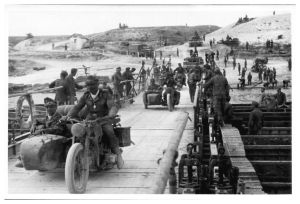
battle-stalingrad-ww2-second-world-war-germans-don-river-rare-pictures-unseen-photos-images

German unit crossing the Don

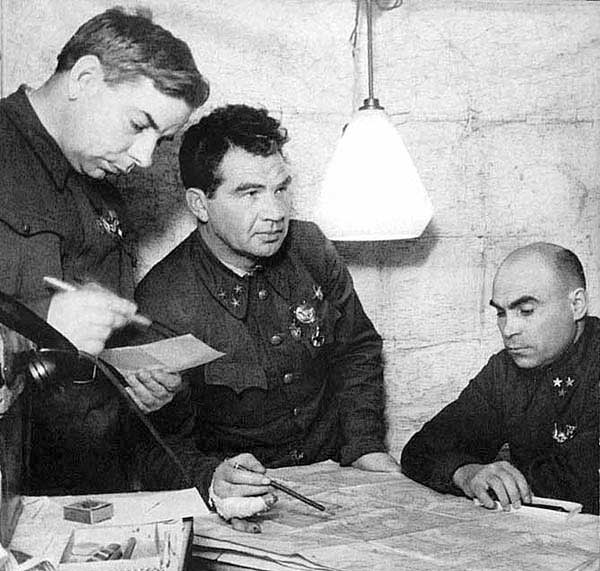
As the 6th Army moved into the city General Yeremenko ordered attacks against General Hube’s 16th Panzer Division. Soviet resistance increased as more formations arrived the Germans suffered one of their heaviest casualty rates. [lxiv] Though unsuccessful the Soviet counterattacks “managed to deflect Paulus’s reserves at the most critical moment.” [lxv] The Germans remained confident the first week of September as 6th Army and the 4th Panzer Army linked up, but Yeremenko saved his forces by withdrawing and avoided encirclement west of the city, retiring to an improvised line closer to the Stalingrad. [lxvi] On September 12th Vasily Chuikov was appointed to command 62nd Army in Stalingrad.  Chuikov understood that for the Soviets in Stalingrad there “was only one way to hold on. They had to pay in lives. ‘Time is blood,’ as Chuikov put it later.” [lxvii] Stalin sent Nikita Khrushchev to the front “with orders to inspire the Armies and civilian population to fight to the end.” [lxviii] In the next few days the 13th Guards Rifle Division arrived and saved the Volga landings, which allowed the Soviets to continue to resupply Stalingrad, but the division last 30% of its troops as casualties in its first 24 hours of combat. [lxix]
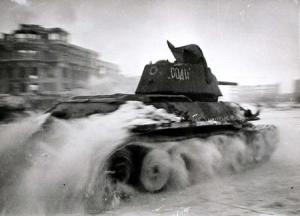
t-34 stalingrad

T-34 in Stalingrad

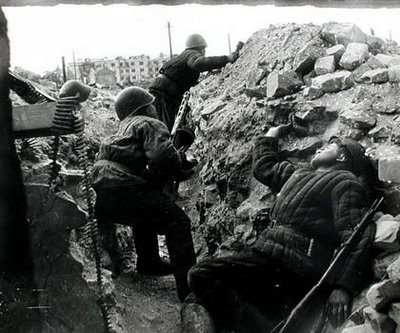
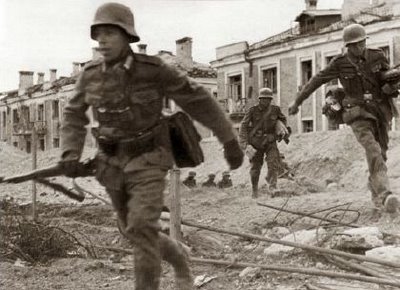
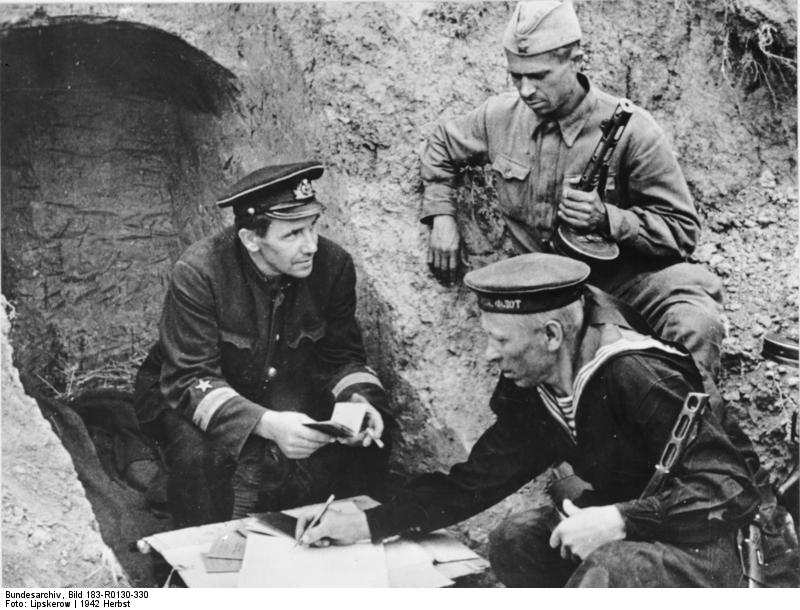
An NKVD regiment and other units held the strategically sited Mamaev Kurgan, keeping German guns from controlling the Volga.[lxx] The defenders contucted a house to house and block by block fight, and the Red Army and NKVD units were reinforced by Naval Infantry.  Chuikov conducted the defense with a brutal ferocity, relieving senior commanders who showed a lack of fight and by sending many officers to penal units.  Chuikov’s defensive plan was masterful; he funneled German attacks into “breakwaters” where the panzers and infantry could be separated from each other causing heavy German casualties. [lxxi]

Bype36yIQAASUVK

resized_battle-stalingrad-6

resized_battle-stalingrad-4

Now for Hitler the “city became a prestige item, its capture ‘urgently necessary for psychological reasons,’ as Hitler declared on October 2. A week later he declared that Communism must be ‘deprived of its shrine.’” [lxxii] The Germans continued to gain ground in the city, but slowly and at great cost, especially among their infantry, so much so that decimated companies had to be combined to form combat effective units.
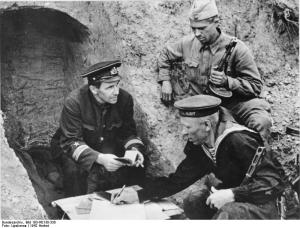
Bild 183-R0130-330

person_chuikov1

Chuikov used his artillery to interdict the Germans from the far side of the Volga while assault squads with incredible ferocity fought the fight in the city.   The close-quarters combat in the city was dubbed, “Rattenkrieg by German soldiers.” [lxxiii] Paulus continued to bring more units into the city, further thinning his flanks, but his troops continued to slowly drive the Russians back against the river, and by early October Chuikov wondered if he would be able to hold. [lxxiv] It appeared that the Germans might finally capture Stalingrad, and by November Chuikov “was altogether holding only one-tenth of Stalingrad – a few factory buildings and a few miles of river bank.”[lxxv] Paulus now expected “to capture the entire city by 10 November,”[lxxvi] despite the fact that many of his units were fought out. The causalities had been massive; an analysis by 6th Army determined that 42% of the battalions of 51st Corps were fought out. [lxxvii] Even so on November 9th, a confident Hitler declared “No power on earth will force us out of Stalingrad again!” [lxxviii] However, that boast was misplaced.

Soviet Counteroffensive: Disaster on the Flanks

stalingrad-map-counterattack

T34_Stalingrad-Offensive-px800

soviet infantry attacking

Soviet Forces Advancing

As 6th Army fought its way into Stalingrad some officers in the German High Command attempted to warn Hitler of the danger. Hitler now tolerated no interference, and on September 24th he relieved Halder for persisting to explain, “what would happen when new Russian reserve armies attacked the over-extended flank that ran out to Stalingrad.” [lxxix] Many on others the German side recognized the danger. Blumentritt said, “The danger to the long-stretched flank of our advance developed gradually, but it became clear early enough for anyone to perceive it who was not willfully blind.” [lxxx] Rumanian Marshall Antonescu, and the staffs of both Army Group B and Paulus’s 6th Army warned Hitler too, [lxxxi] but Hitler was transfixed on Stalingrad.  By their sole focus on Stalingrad the Germans gave up the advantage of uncertainty and once the German “aim became obvious…the Russian Command could commit its reserves with assurance.”[lxxxii]

person_chuikov4

Chuikov and his staff

Despite Stalin’s concern about Stalingrad the Stavka planners never lost sight of their goal to resume large-scale offensive operations and destroy at least one German Army Group. [lxxxiii] Unlike Hitler, the ever suspicious Stalin had begun to trust his Generals and Stavka under the direction of Marshal Vasilevsky produced a concept in September to cut off the “German spearhead at Stalingrad by attacking the weak Rumanian forces on its flanks.” [lxxxiv] At first Stalin “showed little enthusiasm” for the attack, fearing that Stalingrad might be lost, but on 13 September he gave his full backing to the proposal [lxxxv] which Marshals Zhukov, Vasilevsky and Vatutin developed into a plan involving three operations; Operation Uranus, to destroy the German and allied forces at Stalingrad, and Operation Saturn to destroy all the German forces in the south, and a supporting attack to fix German forces in the north, Operation Mars aimed at Army Group Center. [lxxxvi]

Russian-Ground-Mount-Rocket

Soviet Katusha Rockets

To accomplish the destruction of 6th Army and at least a part of 4th Panzer Army around Stalingrad the Stavka planners employed over 60% of the “whole tank strength of the Red Army.” [lxxxvii] Strict secrecy combined with numerous acts of deception was used by the Red Army to disguise the operation. [lxxxviii]The plan involved an attack against 3rd Romanian Army on the northern flank by the Soviet 5th Tank Army and two infantry armies and their supporting units. [lxxxix] In the south another force of over 160,000 men and 430 tanks were deployed against 4th Rumanian Army and weak element of 4th Panzer Army. [xc]Despite warnings from his Intelligence Officer, Paulus did not expect a deep offensive into his flanks and rear and made no plans to prepare to face the threat. [xci] Other senior officers believed that the attack would take place against Army Group Center. [xcii] Walter Warlimont who served at OKW noted that there was a “deceptive confidence in German Supreme Headquarters.” [xciii]

 ju-52 stalingrad

Luftwaffe JU-52s made many resupply runs into the pocket but suffered great losses

The storm broke on 19 November as Soviet forces attacked rapidly crushing Romanian armies to the north and the south of Stalingrad [xciv] linking up to encircle the Germans in the city on the 23rd[xcv] The German 48th Panzer Corps supporting the Romanians was weakened by the exhausting campaign and had few operational tanks. [xcvi] It attempted a counterattack but was “cut to pieces” in an engagement against the 5th Tank Army. [xcvii] A promising attempt by the German 29th Motorized division against the flank of the southern Russian pincer was halted by the Army Group and the division was ordered to defensive positions south of Stalingrad. [xcviii] To compound German problems the Luftwaffe was neutralized by bad weather. [xcix] Inside the city Paulus continued to do nothing as since the attacks were outside of his area of responsibility and rather than taking the initiative to extricate his forces, waited for instructions. [c] As a result the 6th Army’s 16th and 24th Panzer Divisions that could have assisted matters to the west remained “bogged down in street-fighting in Stalingrad.” [ci] Without support of the army’s Panzer formations, the 6th Army units west of Stalingrad were forced back in horrific conditions.  By the 23rd of November the 6th Army was cut off along with one corps of the 4th Panzer Army and assorted Romanian units, over 330,000 men.  Though they had the Germans surrounded, the entrapped force would require the Soviets to use seven rifle armies and much staff attention to eliminate. [cii]

von Paulus surrenders to the Soviets

Paulus Surrenders

Hitler ordered Von Manstein to form a new, composite, Army Group Don, to relieve Stalingrad. Hitler would not countenance a break out by the encircled forces and wanted Manstein to break through and relieve the 6th Army.[ciii]Hitler refused a request by Paulus on 23 November to move troops to prepare for a possible a break out attempt, and assured him that he would be relieved. [civ]Albert Speer noted that General Kurt Zeitzler who replaced Halder at OKW insisted that the Sixth Army “must break out to the west.” [cv] Hitler, completely obsessed with capturing Stalingrad told Zeitzler, “We should under no circumstances give this up. We won’t get it back once it’s lost.” [cvi] The ever boastful Herman Goering promised that his Luftwaffe would be able to meet the re-supply needs of 6th Army by air, even though his own Generals knew that it was impossible with the number of transport aircraft available. [cvii] However, Hitler took his Luftwaffe chief at his word and exclaimed “Stalingrad can be held! It is foolish to go on talking any more about a breakout by Sixth Army…” [cviii] Hitler then issued a Führer decree ordering that the front be held at all costs. [cix] Walter Goerlitz stated, “Hitler was incapable of conceiving that the 6th Army should do anything but fight where it stood.” [cx] Likewise Manstein had precious few troops with which to counterattack, as he also had to protect the flank of Army Group A, which was still deep in the Caucasus.

hungarian withdraw

hungarian dead stalingrad

Hungarian Dead and Wounded

Manstein’s “army group” was only corps strength and was spread across a 200 mile front. [cxi] Any relief attempt had to wait for more troops, especially Panzers.  Manstein believed that the best chance for a breakout had passed and that it was a serious error for Paulus to put the request to withdraw through to Hitler rather than the Army Group or act on his own [cxii] and many soldiers, long conditioned to believe in the promises of their Hitler were optimistic that Hitler would get them out of the caldron. [cxiii] Other German generals like Guderian, Reichenau, Heinrici, Hoeppner, or even the Waffen SS General Sepp Dietrich might have acted to save their army, but Paulus, surrounded in the city, was knew nothing but obedience.[cxiv]
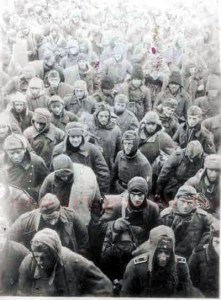
pows stalingrad

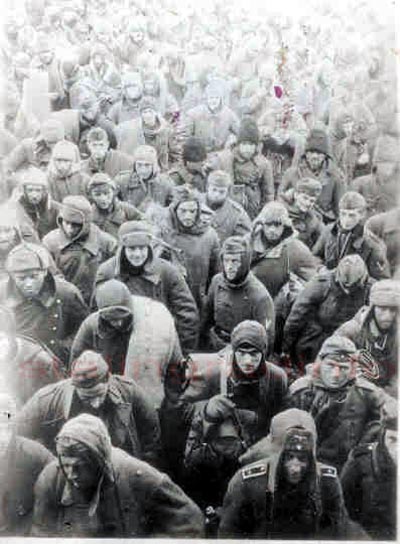
German POWs only 5000 of some 90,000 would see home again

Operation Saturn began on 7 December destroying the Italian 8th Army and forcing the Germans to parry the threat.[cxv] A relief attempt by 57th Panzer Corps under Hoth on 12 December made some headway until a massive Soviet counterattack on 24 December drove it back.[cxvi] This attack was hampered by OKW’s refusal to allocate the 17th Panzer and 16th Motorized divisions to Manstein,[cxvii] and by 6th Army not attacking out to link with the relief force.[cxviii]By 6 January Paulus signaled OKW: Army starving and frozen, have no ammunition and cannot move tanks anymore.”[cxix] On 10 January the Soviets launched Operation Ring to eliminate the pocket and despite all odds German troops fought on. On the 16th Paulus requested that battle worthy units be allowed to break out, but the request was not replied to.[cxx] On the 22nd the last airfield had been overrun and on 31 January Paulus surrendered.[cxxi]

Analysis: What Went Wrong

Stalingrad had drawn the attention Hitler and Stalin and the lives of their soldiers into a giant vortex of death. However, the Soviet Stavka, even when facing disaster never lost sight of their primary objectives during the campaign. The Germans on the other hand committed numerous unforced errors mostly caused by Hitler and or von Paulus. The German mistakes began early in their planning process and continued throughout the campaign. Overconfident, they failed to follow up success, and allowed the Soviets to regroup and then smash their forces at Stalingrad.
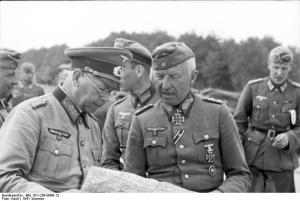
Russland-Nord, Erich von Manstein, Brandenberger

Von Manstein

After the fall of Stalingrad as the Soviets attempted to follow up their success by attempting to cut off Army Group “A.” Manstein, with the meager forces at hand was permitted by Hitler to wage a mobile defense while Von Kleist managed to withdraw his army group with few losses. [cxxii] The superior generalship of Manstein and Von Kleist prevented the wholesale destruction of German forces in southern Russia and Manstein’s counter offensive inflicted a severe defeat on the Soviets, showing them that the German army, though wounded was not without the power to fight back.

But the German Army had suffered a massive defeat.  The seeds of defeat were laid early, the failure to destroy bypassed Soviet formations in July, the diversion of 4th Panzer Army from Stalingrad, and the divergent objectives of trying to capture the Caucasus and Stalingrad at the same time.  This diluted both offensives ensuring that neither succeeded.  Likewise the failure to recognize the culminating point when it was reached and to adjust operations accordingly was disastrous for the Germans. The failure create a mobile reserve to meet possible Russian counter offensives, and the fixation on Stalingrad took the German focus off of the critical yet weakly held flanks.

The hubris of Hitler and OKW to believe that the Russians were incapable of conducting major mobile operations even as Stavka commenced massive offensive operations on the thinly held flanks all contributed to the defeat.  Alan Clark notes these facts but adds that the Germans “were simply attempting too much.” [cxxiii] Likewise, the Soviet advantage in numbers allowed them to wear down the Germans even early in the campaign when they were suffering defeat after defeat. [cxxiv] Stalin, whose decisions had nearly lost the war in 1941 gave his commanders a chance to revive the mobile doctrine of deep operations with mechanized and shock armies that he had discredited in the 1930s. [cxxv]All through the campaign Zhukov and other commanders maintained both their nerve even when it appeared that Stalingrad was all but lost. They never lost sight of their goal of destroying major German formations though they failed to entrap Army Group A with 6th Army.

Notes

[i] Clark, Alan. Barbarossa: The Russian-German Conflict: 1941-45. Perennial Books, An imprint of Harper Collins Publishers, New York, NY 1965. p.191

[ii] Ibid.

[iii] Glantz, David M. and House, Jonathan. When Titan’s Clashed: How the Red Army Stopped Hitler. The University Press of Kansas, Lawrence KS, 1995. p.111

[iv] Ibid. Clark. p.191

[v] Beevor, Anthony. Stalingrad: The Fateful Siege: 1942-1943. Penguin Books, New York NY 1998. p.69

[vi] Manstein, Erich von. Forward by B.H. Liddle Hart, Introduction by Martin Blumenson. Lost victories: The War Memoirs of Hitler’s Most Brilliant General.Zenith Press, St Paul MN 2004. First Published 1955 as Verlorene Siege, English Translation 1958 by Methuen Company. p.291 This opinion is not isolated, Beevor Quotes Paulus “If we don’t take Maikop and Gronzy…then I must put an end to the war.” (Beevor pp. 69-70)  Halder on the other hand believed that Hitler emphasized that the objective was “the River Volga at Stalingrad. (Clark. p.190)

[vii] Ibid. Beevor. p.70.

[viii] Ibid. Glantz and House. p.106

[ix] Ibid. p.105-106

[x] Ibid. Clark. p.203.  The offensive did impose a delay on the German offensive.

[xi] Ibid. Clark. p.191 Each group also contained allied armies.

[xii] Ibid. p.209.

[xiii] Ibid. Glantz and House. p.119

[xiv] Ibid. Manstein. p.292.

[xv] Ibid. Clark. p.209

[xvi] Ibid. Clark.  p.211

[xvii] Ibid. Glantz and House. p.120. There is a good discussion of the impact of this decision here as 6th Army’s advance was given priority for both air support and fuel.

[xviii] Ibid. Beevor. p.74

[xix] Warlimont, Walter. Inside Hitler’s Headquarters 1939-45. Translated by R.H. Berry, Presido Press, Novato CA, 1964. p.249

[xx] Ibid. Beevor. p.75 This was the 10th NKVD Division and it took control of all local militia, NKVD, and river traffic, and established armored trains and armor training schools.

[xxi] Ibid. Clark. p.212

[xxii] Ibid. Glantz and House. p.121

[xxiii] Ibid. Beevor. p.85

[xxiv] Ibid. p.89

[xxv] Liddell-Hart, B.H. The German Generals Talk. Quill Publishers, New York, NY 1979. Originally published by the author in 1948. p.202

[xxvi] Ibid. Beevor. p.88

[xxvii] Ibid. Beevor. p.90

[xxviii] Ibid. Beevor. p.81

[xxix] Ibid. Glantz and House. p.121

[xxx] Ibid. Liddell-Hart. p.202

[xxxi] Ibid. Glantz and House. p.120

[xxxii] Goerlitz, Walter. History of the German General Staff. Westview Press, Frederick A. Praeger Publisher, Boulder, CO. 1985 p.416

[xxxiii] Ibid. Beevor. pp.95-96.

[xxxiv] Von Mellenthin, F.W. Panzer Battles: A Study of the Employment of Armor in the Second World War. Translated H. Betzler, Edited by L.C.F. Turner. Oklahoma University Press 1956, Ballantine Books, New York, NY. 1971. p.193

[xxxv] Shirer, William L. The Rise and Fall of the Third Reich. A Touchstone Book published by Simon and Schuster, 1981, Copyright 1959 and 1960. p.914

[xxxvi] Ibid. Glantz and House. p.122

[xxxvii] Ibid. Warlimont. p.256

[xxxviii] Ibid. Liddell-Hart. p.203

[xxxix] Ibid. p.204

[xl] Ibid. Shirer. p.914

[xli] Ibid. Goerlitz. p.416

[xlii] Ibid. Goerlitz. p.416

[xliii] Ibid. Manstein. p.293

[xliv] Ibid. Clark. p.214

[xlv] Ibid. Beevor. pp.97-99. The mobilization included military, political, civilian and industrial elements.

[xlvi] Liddell-Hart, B.H. Strategy. A Signet Book, the New American Library, New York, NY. 1974, Originally Published by Faber and Faber Ltd., London. 1954 & 1967. p.250

[xlvii] Ibid. Beevor. p.99.  Two key commanders arrived during this time frame, Colonel General Andrei Yeremenko, who would command the Stalingrad Front  and General Chuikov commander of 64th Army who would conduct the defense of the city.

[xlviii] Carell, Paul Hitler Moves East: 1941-1943. Ballantine Books, New York, NY 1971, German Edition published 1963. p.581

[xlix] Ibid. Shirer.  p.909.

[l] Ibid. Liddell-Hart, Strategy. p.250

[li] Wheeler-Bennett, John W. The Nemesis of Power: The German Army in Politics 1918-1945. St. Martin’s Press, New York, NY 1954.  p.531

[lii] Ibid. Wheeler-Bennett. p.531

[liii] Ibid. Beevor. p.96

[liv] Ibid. Clark. p.216.

[lv] Ibid. Von Mellenthin. P.193

[lvi] See Von Mellinthin pp.193-194.  Von Mellinthin quotes Colonel Dinger, the Operations Officer of 3rd Motorized Division at Stalingrad until a few days before its fall. Dingler noted that the Germans on reaching Stalingrad “had reached the end of their power. Their offensive strength was inadequate to complete the victory, nor could they replace the losses they had suffered.” (p.193) He believed that the facts were sufficient “not only to justify a withdrawal, but compel a retreat.” (p.194)

[lvii] Ibid. Manstein. p.294

[lviii] Ibid. Clark. p.216

[lix] Ibid. Clark. p.217

[lx] Ibid. Beevor. p.107

[lxi] Ibid. Beevor. p.107

[lxii] Ibid. Glantz and House. p.122

[lxiii] Ibid. Carell. P.601

[lxiv] Ibid. Beevor. p.118

[lxv] Ibid. Beevor. p.118

[lxvi] Ibid. Carell. p.602

[lxvii] Ibid. Beevor. p.128

[lxviii] Ibid. Carell. p.603

[lxix] Ibid. Beevor. p.134

[lxx] Ibid. Beevor. pp.136-137

[lxxi] Ibid. Beevor. p.149

[lxxii] Fest, Joachim. Hitler. Translated by Richard and Clara Winston, Harcourt, Brace, Jovanovich Publishers, San Diego, New York, London. 1974. p.661

[lxxiii] Ibid. Beevor. pp. 149-150

[lxxiv] Ibid. Beevor. p.164

[lxxv] Ibid. Carell. p.618

[lxxvi] Ibid. Glantz and House. p.123

[lxxvii] Ibid. Beevor. p.218

[lxxviii] Ibid. Carell. p.623

[lxxix] Ibid. Goerlitz. p.418

[lxxx] Ibid. Liddell-Hart. The German Generals Talk. p.207

[lxxxi] Ibid. Manstein. p292

[lxxxii] Ibid. Liddell-Hart. History of the Second World War. p.258

[lxxxiii] Ibid. Glantz and House. p.129

[lxxxiv] Ibid. Glantz and House. p.130

[lxxxv] Ibid. Beevor. pp.221-222 Glantz and House say that Stalin gave his backing in mid-October but this seems less likely due to the amount of planning and movement of troops involved to begin the operation in November.

[lxxxvi] Ibid. Glantz and House. p.130

[lxxxvii] Ibid. Beevor. p.226

[lxxxviii] Ibid. Glantz and House. p.132

[lxxxix] Ibid. Glantz and House. p.130

[xc] Ibid. Beevor. p.227

[xci] Ibid. Beevor. p.228

[xcii] Ibid. Clark. p.235

[xciii] Ibid. Warlimont. p.274

[xciv] Ibid, Carell. p.627 3rd Rumanian Army lost 75,000 men in three days.

[xcv] Ibid. Clark.pp.247-248

[xcvi] The condition of the few German Panzer Divisions in position to support the flanks was very poor, the 22nd had suffered from a lack of fuel and maintenance and this many of its tanks were inoperative. Most of the armor strength of the 48th Panzer Corps was provided by a Rumanian armored division equipped with obsolete Czech 38t tanks provided by the Germans.

[xcvii] Ibid. Clark. pp.251-252. The designation of 2nd Guards Tank Army by Clark has to be wrong and it is the 5th Tank Army as 2nd Guards Tank was not involved in Operation Uranus.  Carell, Beevor and Glantz properly identify the unit.

[xcviii] Ibid. Carell. p.630

[xcix] Ibid. Beevor. p.244

[c] Ibid. Beevor. p.247

[ci] Ibid. Beevor. p.245

[cii] Ibid. Glantz and House. p.134

[ciii] Ibid. Glantz and House. p.134

[civ] Ibid. Clark. p.256

[cv] Speer, Albert. Inside the Third Reich. Collier Books, a Division of MacMillan Publishers, Inc. New York, NY 1970. p.248

[cvi] Heiber, Helmut and Glantz, David M. Editors. Hitler and His Generals: Military Conferences 1942-1945. Enigma Books, New York, NY 2002-2003.  Originally published as Hitlers Lagebsprechungen: Die Protokollfragmente seiner militärischen Konferenzen 1942-1945. Deutsche Verlags-Anstalt GmbH, Stuttgart, 1962. p.27

[cvii] Ibid. Glantz and House. p.135 Glantz and House note that the amount of aircraft estimated to successfully carry out the re-supply operation in the operational conditions was over 1,000.  The amount needed daily was over 600 tons of which the daily reached only 300 tons only one occasion.

[cviii] Ibid. Speer. p.249

[cix] Ibid. Carell. p.636

[cx] Ibid. Goerlitz. p.426

[cxi] Ibid. Clark. p.252

[cxii] Ibid. Manstein. p.303

[cxiii] Ibid. Beevor. p.276

[cxiv] Ibid. Carell. p.640

[cxv] Ibid. Glantz and House. p.140

[cxvi] Ibid. Glantz and House. p.140

[cxvii] Ibid. Clark. p.264

[cxviii] Ibid. Manstein. p.337

[cxix] Ibid. Beevor. p320

[cxx] Ibid. Beevor. p.365

[cxxi] Of the approximately 330,000 in the pocket about 91,000 surrendered, another 45,000 had been evacuated.  22 German divisions were destroyed.

[cxxii] Ibid. Liddell-Hart. The German Generals Talk. p.211

[cxxiii] Ibid. Clark. p.250

[cxxiv] Ibid. Glantz and House. p.124

[cxxv] Ibid. Beevor. p.221


Bibliography

Beevor, Anthony. Stalingrad: The Fateful Siege: 1942-1943. Penguin Books, New York NY 1998

Carell, Paul Hitler Moves East: 1941-1943. Ballantine Books, New York, NY 1971, German Edition published 1963.

Clark, Alan. Barbarossa: The Russian-German Conflict:1941-45. Perennial Books, An imprint of Harper Collins Publishers, New York, NY 1965.

Fest, Joachim. Hitler. Translated by Richard and Clara Winston, Harcourt, Brace, Jovanovich Publishers, San Diego, New York, London. 1974

Glantz, David M. and House, Jonathan. When Titan’s Clashed: How the Red Army Stopped Hitler. The University Press of Kansas, Lawrence KS, 1995.

Goerlitz, Walter. History of the German General Staff. Westview Press, Frederick A. Praeger Publisher, Boulder, CO. 1985

Heiber, Helmut and Glantz, David M. Editors. Hitler and His Generals: Military Conferences 1942-1945. Enigma Books, New York, NY 2002-2003.  Originally published as Hitlers Lagebsprechungen: Die Protokollfragmente seiner militärischen Konferenzen 1942-1945. Deutsche Verlags-Anstalt GmbH, Stuttgart, 1962.

Liddell-Hart, B.H. The German Generals Talk. Quill Publishers, New York, NY 1979. Originally Published by the author in 1948.

Liddell-Hart, B.H. Strategy. A Signet Book, the New American Library, New York, NY. 1974, Originally Published by Faber and Faber Ltd., London. 1954 & 1967

Manstein, Erich von. Forward by B.H. Liddle Hart, Introduction by Martin Blumenson. Lost victories: The War Memoirs of Hitler’s Most Brilliant General.Zenith Press, St Paul MN 2004. First Published 1955 as Verlorene Siege, English Translation 1958 by Methuen Company

Shirer, William L. The Rise and Fall of the Third Reich. A Touchstone Book published by Simon and Schuster, 1981, Copyright 1959 and 1960

Speer, Albert. Inside the Third Reich. Collier Books, a Division of MacMillan Publishers, Inc. New York, NY 1970.

Von Mellenthin, F.W. Panzer Battles: A Study of the Employment of Armor in the Second World War. Translated H. Betzler, Edited by L.C.F. Turner. Oklahoma University Press 1956, Ballantine Books, New York, NY. 1971.

Warlimont, Walter. Inside Hitler’s Headquarters 1939-45. Translated by R.H. Berry, Presido Press, Novato CA, 1964.

Wheeler-Bennett, John W. The Nemesis of Power: The German Army in Politics 1918-1945. St. Martin’s Press, New York, NY 1954

1 Comment

Filed under History, Military, nazi germany, world war two in europe

The State of the Union, the Surrender of Principal, and a Historical Coincidence: Trump, Nunes, Schacht, Hungenberg, and Von Papen

Friends of Padre Steve’s World,

Today is a curious day for a minor historian like me.hopefully someday I will be considered a major historian but that aside I love the study of history and its connections to the present day, but I digress…

Today is the day that President Trump will deliver his State of the Union Address reading from a teleprompter, talking about bipartisanship, and how great he has made America. Until he begins his Twitter Storm tomorrow morning his speech will be hailed by members of the mainstream media as being “Presidential,”  in the same kind of language that Fahreed Zakaria praised the tele-Trumpter speech the President made at Davos. For eight hours tonight the mainstream media will be lost in Presidential  praises even as the Fox News Pundits break into chants of “Seig Heil!,” but I digress, because by noon Wednesday things will be back to normal.

But it is also a day where Congressman Devin Nunes will release a report attacking the veracity and motivations of FBI and Justice Department officials involved in the investigation of the President and his advisors attempts to collude with a hostile foreign power and obstruct justice before and after the 2016 election. This is actually very remarkable because it is something that has never happened in the history of the House of Representatives regarding a case involving national security. Personally, back during my 32 years as a Republican I always thought that House or Senate Democrats might do something like this but they disappointed me by never stooping to release information that might obstruct justice while at the same time kneecapping Federal law enforcement agencies. Honestly I used to think that undermining national security was something that Democrats did, I never, even after I left the GOP in 2008 thought it was something that Republicans would do; but Congressman Nunes and is compatriots are determined to ruin my fantasy that the GOP was really a pro-law and order and national security party. I mean really, even after I left the GOP their arguments about being strong on national security and pro-law enforcement gave me a hard on, but even with the blue pill I don’t think that I could get it up again after Mr. Nunes’s antics.

Coincidently today is the 85th anniversary of Adolf Hitler’s accession to power, something that happened quite to the surprise of Hitler as well as the leaders of the non-Nazi political parties on the German Right and Left. The non-Nazi German conservatives thought that they could control him, just like GOP stalwarts thought that they could control then Candidate Trump in 2016.

You see I don’t think of the GOP as a new version of the Nazi Party. No, they aren’t that clever. I see them as more akin to the German conservative parties who less than six months after they helped Hitler become Chancellor, dissolved themselves in hope of keeping a place at the table in the New Germany. They are the Von Papen’s, the Hindenburg’s; they are Alfred Hugenberg, Hjalmar Schacht, and the other leaders of the DVNP (German People’s Nationalist Party), the Catholic Center Party, and others who sacrificed their honor, integrity, and self-respect to gain a place at the table of Hitler. By and large Nunes and the other members of the GOP who engage in what they are doing doom their party and very likely the country.

So today go out and lift a glass and maybe even light a tiki torch to men like the President, Congressman Nunes, his committee, and their supporters at Fox News. Let Nunes and other be like Hjalmar Schacht who proclaimed his loyalty to and defended Hitler’s Third Reich internationally, but who in the words of Supreme court Justice and Nuremberg prosecutor Robert Jackson was “The most dangerous and reprehensible type of all opportunists, someone who would use a Hitler for his own ends, and then claim, after Hitler was defeated, to have been against him all the time. He was part of a movement that he knew was wrong, but was in it just because he saw it was winning.”

Be assured; tonight I will raise a glass and I will drink, maybe until I will am legally drunk; but it will be to bolster myself for the struggle for the Constitution and country that lay ahead. I can do no less.

So until tomorrow,

Peace

Padre Steve+

Leave a comment

Filed under ethics, History, national security, Political Commentary

The Banner of Critical Independence, Ragged and Torn… is Still the Best We Have: Standing for the Truth in an Age of Nativist Ignorance

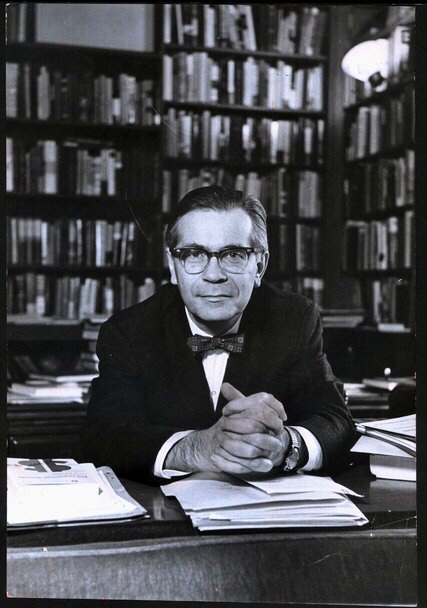
Richard Hofstadter

Friends of Padre Steve’s World,

In July of 2017 the Pew Research Center published a detailed study of the current views of Americans regarding various institutions. One of those was higher education. The results showed that since 2015, Republicans, particularly Conservative Republicans place much less value on higher education and even that higher education has a negative effect on the country.

This should not be too surprising to anyone who studies American History. Our history is filled with anti-intellectual movements which are quite often tied in with conspiratorial world views, isolationism, and anti-immigrant or foreigner movements such as the Know Nothings, the Ku Klux Klan, and the original “America First” crowd. This has been a consistent drumbeat in American History, and yhe late historian Richard Hofstadter wrote:

“As a consequence, the heartland of America, filled with people who are often fundamentalist in religion, nativist in prejudice, isolationist in foreign policy, and conservative in economics, has constantly rumbled with an underground revolt against all these tormenting manifestations of our modern predicament.” 

But simple native prejudice and religious fundamentalism are only part of the problem. Throughout much of our history Americans have as Susan Jacoby has noted “only in terms of its practical results.”  She notes that this phenomenon has “reasserted itself strongly in the “no frills” decisions of many local and state school boards. That the eliminated frills had once provided children with some exposure to a higher culture than pop was a matter of little concern to the public.”

The prevailing opinion, especially among conservatives is that education is only valuable if it produces jobs. In other words it’s training, not education and if you don’t know the difference between the two you are probably not really educated. The fact is that education, especially formal higher education should pursue truth more on their own long after their formal schooling ends. I can thank my teachers and professors at every level for inspiring me to do that. Sadly, more many, if not most Americans education at any level is simply a way to punch a ticket to get a job, but I digress…

In 2015 Pew noted that 54% of Republicans held a positive view of higher education, while 37% viewed universities, colleges and higher education negatively. That shifted in 2016 to a plurality of 45% positive and 45% negative. Their 2017 survey showed a much more pronounced shift, 58% negative and only 39% positive. Of the Republicans those who considered themselves “conservative” views were even more pronounced with 65% saying that higher education had a negative impact.

A change of such magnitude regarding what Americans have almost always universally valued as a societal good does not happen in a vacuum, the ground has to be prepared for it. Since a large portion of the GOP conservatives are Evangelical Christians one has to look at what has been going on in Evangelical Church and its politics for the past 50 years. whole denominations like the Southern Baptist Convention experienced splits as moderates were drive from the denomination and its educational institutions during the Fundamentalist takeover of it and its institutions.

The growth of Evangelical power centers that any type of education that comes from secular institutions have created their own educational centers to propagate their fundamentalist and radically right wing political views. Institutions like the American Family Association, the Eagle Institute, and others mimic traditional think tanks but are nothing more than propaganda outlets covered with an academic veneer in order to fool people into thinking that they are legitimate.  Likewise, the promotion and acceptance of fake history by faux “historians” like David Barton has led to a devastating decline in the willingness of Evangelicals, and hence Republicans to care about the truth and to rail at institutions which they despise out of the fundamentalist worldview.

Non-intellectual virtues such as patriotism, loyalty, faith, prosperity, and power have supplanted the intellectual quest for truth. Expertise of any kind is disregarded but particularly that of academics. Even on college and university campuses academics and the pursuit of academic and intellectual questions is being subsumed by bloated bureaucracies which treat instructors and professors as chattel while seeking profits which usually come at the cost of academics, but again I digress…

The fact is that American society as a whole is hostile towards intellectuals and academics. As Hofstadter wrote:

“All this is the more maddening, as Edward Shils has pointed out, in a populistic culture which has always set a premium on government by the common man and through the common judgement and which believes deeply in the sacred character of publicity. Here the politician expresses what a large part of the public feels. The citizen cannot cease to need or to be at the mercy of experts, but he can achieve a kind of revenge by ridiculing the wild-eyed professor, the irresponsible brain truster, or the mad scientist, and by applauding the politicians as the pursue the subversive teacher, the suspect scientist, or the allegedly treacherous foreign-policy adviser. There has always been in our national experience a type of mind which elevates hatred to a kind of creed; for this mind, group hatreds take a place in politics similar to the class struggle in some other modern societies. Filled with obscure and ill-directed grievances and frustrations, with elaborate hallucinations about secrets and conspiracies, groups of malcontents have found scapegoats at various times in Masons or abolitionists, Catholics, Mormons, or Jews, Negroes, or immigrants, the liquor interests or the international bankers. In the succession of scapegoats chosen by the followers of this tradition of Know-Nothingism, the intelligentsia have at last in our time found a place.” 

The American President has shown that he is exactly that kind of leader, and he is supported by followers who lap up everything that he says. Fed by the lies of pundits and radio talk show hosts who are college dropouts that despise anything that might be considered intellectual the President has added his voice to the cacophony of anti-intellectual thought that characterizes current American conservatism, in which men like William F. Buckley would be hard put to find a home.

There is a cost to such trends. We are not unique and such cultural trends do have consequences that many people do not think could happen here. But the non-intellectualism of our time, especially that of the militant and often fundamentalist Christian Right that predominates American conservatism is dangerous. Milton Mayer wrote of his experience with ordinary Germans in the years after the Second World War in his book They Thought They Were Free: 

“As the Nazi emphasis on nonintellectual virtues (patriotism, loyalty, duty, purity, labor, simplicity, “blood,” “folk-ishness”) seeped through Germany, elevating the self-esteem of the “little man,” the academic profession was pushed from the very center to the very periphery of society. Germany was preparing to cut its own head off. By 1933 at least five of my ten friends (and I think six or seven) looked upon “intellectuals” as unreliable and, among these unreliables, upon the academics as the most insidiously situated.”

The Nazis loved educated men who were able to subordinate themselves to the Party and the State to get the job done. There were quite a few academics, particularly lawyers and doctors who were willing to put their education to use in service of the regime. Real intellectuals, men who thought and fought for truth and freedom were removed from academia or their positions in government. They were replaced with men willing to sacrifice their integrity and honor to further their own interests or to serve Nazi ideology and the Party.

It is my view that regardless of what happens with the Trump Presidency that the assault on intellectuals, knowledge, education, and ultimately truth will continue unabated. Irving Howe wrote in his essay The Age of Conformity: 

“The most glorious vision of the intellectual life is still that which is loosely called humanist: the idea of a mind committed yet dispassionate, ready to stand alone, curious, eager, skeptical. The banner of critical independence, ragged and torn though it may be, is still the best we have.” 

Until tomorrow,

Peace

Padre Steve+

1 Comment

Filed under History, nazi germany, News and current events, philosophy, Political Commentary

“Are We Still of Any Use?” The Horrible Witness of Conservative Christians in the Trump Era

Friends of Padre Steve’s World,

Over his first year in office President Trump has managed to tell over 2,000 lies. That being said we all expect politicians to lie, it’s part of American life and political discourse. Will Rogers once said “If you ever injected truth into politics you have no politics.” I think that the expectation that elected officials will lie is one reason that Mark Twain quipped: “An honest man in politics shines more there than he would elsewhere.”

However the shear numbers of lies and falsehood proclaimed by the President is having a toxic effect on our society, in particular on those in the church, men and women who call themselves by the name of Christ who not only believe them, but repeat them, and defend them.  The fact is that for decades these same Christian leaders and people have proclaimed their allegiance to what they call “moral absolutes” and  “Biblical values”while excoriating Democrats, particularly Bill and Hillary Clinton for their lies. The fact is that by doing this Christians simply become another political interest group hustling politicians for favors that benefit them, even at the expense of the credibility of their witness to Christ.

The constant repetition the President’s well documented lies, and their defense by his preacher’s daughter Press Secretary, his other administration flacks, Congressional supporters, the Fox News media empire, and the big name Evangelical Preachers who have sold their souls in his defense have damaged the soul of the country and yes the Church.

Of course one would expect the President’s opponents to point out his lies but in normal times you wouldn’t expect his conservative religious supporters to go to the mat defending him and his lies, and even calling him a “role model” for young people.  In a recent survey some 70% of his predominantly Christian, Republican supporters say that he is and that my friends is, if you value the long term witness of the Christian Church absolutely devastating, especially since for over a decade young people have been fleeing the church in never before seen numbers while unbelievers, even those that admire Christ and what some would call Christian values want nothing to do with the Church.

The fact is that the repetition of lies and falsehoods, whether you are a Trump supporter or opponent there is a not a good thing either for the Church or for the country. It has a terrible effect, and one only has to look to the countries of Europe to see how Christian support for malevolent leaders has reduced it to irrelevance. Whether it be the support of ethnic and religious persecution, or the participation in and protection of sexual predators masquerading and Bishops, Priests, and Nuns has eviscerated the witness of the Church.

Dietrich Bonhoeffer understood this and asked a question that should be asked by people that call themselves by the name of Christ who at the same time defend the indefensible and not only defend, but take great pleasure in defending the lies of the President. Bonhoeffer observed the same dynamic in his day. He wrote:

“We have been silent witnesses of evil deeds; we have been drenched by many storms; we have learnt the arts of equivocation and pretense; experience has made us suspicious of others and kept us from being truthful and open; intolerable conflicts have worn us down and even made us cynical. Are we still of any use? What we shall need is not geniuses, or cynics, or misanthropes, or clever tacticians, but plain, honest, and straightforward men. Will our inward power of resistance be strong enough, and our honesty with ourselves remorseless enough, for us to find our way back to simplicity and straightforwardness?”

Please believe me when I say that I am not being an alarmist about this situation. I know too much about history, human nature, and yes the Church not to see the danger.

But that’s part of the problem. The lies and actions of the President and his administration have been cumulative; what was shocking on day one became normalized over the course of the past year. The effect is both numbing and corrosive: first on the President’s defenders who surrender all pretext of moral or religious authority, and on his opponents who gradually are worn down by the barrage of lies and the fact that they are also the minority party, or if the are Republicans, the minority in the President’s party.

Since President Trump first announced his candidacy for President in 2015 I have been sounding a warning about the President. I have lost friends and been ostracized or attacked by others for doing so, despite the fact that until my return from Iraq in 2008 I had been both a politically active Conservative Christian and Republican for over thirty years. That being said regardless of the cost I would rather follow my conscience than surrender it to the cacophony of lies and acceptance of evil by people who were once friends.

I do not consider myself to be a victim of my former friends. In fact I understand how they got to this point. In fact what has happened with them did not begin with the lies of President Trump. For decades, they, like I did until 2008, bought the repeated lies of the politicians, pundits, and preachers of the American conservative movement. The leaders of this movement coopted them by constantly repeating that they were under attack and needed to take control of the government in order to both defend the faith and implement a Christian government.  Whole theologies were built around this and gradually many, if not most conservative and Evangelical Christians accepted the idea that Christians had to “take dominion”over the country regardless of the cost. The leaders of the so-called “Christian Right” including Franklin Graham, Tony Perkins, James Dobson, Pat Robertson, Albert Mohler, Robert Jeffress, and far too many others have sacrificed every bit of their integrity in defending the President and excusing his lies to further their own power.

Truthfully, I understand how they got there. If I hadn’t gone to Iraq, seen what I saw there, realized the lies that went into the propagation of the war and the lies of Christians who demonized all Muslims because of some after the attacks of September 11th 2001, I would probably still be one of them. For me it took war to understand the moral and theological bankruptcy the politics and theology of the Christian Right, of which over 80% voted for the President and over 75% still support him.

Bonhoeffer asked the right question in terms of Christians and their support of morally bankrupt regimes. Are we still of any use?

Until tomorrow,

Peace,

Padre Steve+

4 Comments

Filed under christian life, ethics, faith, History, holocaust, nazi germany, News and current events, Political Commentary, Religion

From Ordinary Men to Willing Executioners: Holocaust Remembrance 2018

1483285_10152114931522059_1612934841_n

Friends of Padre Steve’s World,

We live in troubling times and I believe that we are at a point in world history where the not so distant specter of a horrifying past is is rising before our eyes and all too many people cannot see it.

Today is Holocaust Remembrance Day. On that day seventy-three years ago the Soviet Red Army liberated the Auschwitz Concentration Camp, the centerpiece of the Nazi Death Camp machine. To be sure, in his panic to save his neck Heinrich Himmler had started in the Fall of 1944 began to switch from his tactic of extermination to using the Jews as bargaining chips., but by then most of the Jews under Nazi control were dead. Those that remained, emaciated and dying by the thousands to starvation, and unchecked disease, as they were marched in ghastly conditions to camps deeper inside Nazi controlled areas.

About this time last year two things happened in the United States that caused me to shake my head and wonder if we are becoming a place that will turn its eyes away from current atrocities, genocide, ethnic and religious cleansing, and walk away. Likewise they were events the presaged even worse.

Last year President Trump issued a proclamation to observe Holocaust Remembrance Day, a statement that did not mention the Jews. How one remembers the Holocaust without mentioning the Jews is beyond me, but some of the President’s advisers, including the now fired and disgraced Steve Bannon, are closely connected to the self-proclaimed Alt-Right, a movement of white supremacists and neo-Nazis looking for respectability. The second thing the President did was to issue an Executive Order halting the immigration of refugees from certain Muslim majority countries, and to cap the number entering. I’m not going to go into details about that but it is not the first time that the United States stopped refugees from entering the country on national security grounds, as in the 1930s and 1940s one of the reasons used to keep German Jewish refugees out of the country was exactly that, they might be Nazi spies and saboteurs.

But since those early days the President, members of his administration, members of Congress, and his supporters in the Right Wing media have increased the rhetoric of racism and race hatred. In addition to Muslims who has often insinuated are terrorists, or sympathetic to terrorists, the President has defamed and dehumanized whole classes of other immigrants, those from Africa, Central America, and the Caribbean as being from “Shithole countries.” Likewise, after Charlottesville, the President stated that neo-Nazis and White Supremacists are “very good people” and even though his son-in-law and daughter are Orthodox Jews he has frequently disparaged Jews in public and private.  Of course as so often is the case much of what the President is saying being sold under the label of Patriotism. Hannah Arendt wrote:

“The antisemites who called themselves patriots introduced that new species of national feeling which consists primarily in a complete whitewash of one’s own people and a sweeping condemnation of all others.”

The present day reminds us that this is a day that we should never forget. The horrors perpetrated by the Nazi regime, all in the name of “race purity” and the extermination of the Jews and others deemed by the Nazis to be “sub-human” or untermenschen is something that is hard for most to imagine.

A couple of years ago I read Bettina Stangneth’s book, Eichmann Before Jerusalem: The Unexamined Life of a Mass Murderer. While I am very well informed and educated on the lives, writings, actions, and statements of many of the Nazi war criminals, this new book on Eichmann is the most troubling that I have ever read. In particular it is the accounts of his writings and interviews with other pro-Nazi, or former Nazis in Argentina, particularly the Sassen Interviews, which span hundreds of hours of tape and thousands of pages of transcripts.

I am a Christian, a gentile, and a historian, as well as a nearly thirty-seven year military who served alongside our advisors and the Iraqis who fought alongside of us. I have lived in Germany, read, speak and write German and have many friends in that country, including members of the German military, retired and active duty.  My study and association with Holocaust survivors goes back to my college days at California State University Northridge when as an undergraduate history major I spent much of my time studying Germany from the first unification and the Kaiser Reich, the First World War, Versailles, Weimar and the Hitler Regime. My professor, Dr. Helmut Heussler, whose family left Germany in the late 1920s, served in the U.S. Army in World War II and was an interrogator at Nuremberg. I took a number of classes from Dr. Heussler, including Hitler’s Germany and the Holocaust. In the latter I had the chance to meet Holocaust survivor Mel Mermelstein, who was later played by Leonard Nimoy in the TV movie Never Forget. 

Since my college days I have continued to read and study, and to get a second Masters Degree in History in which much of my work dealt with the Nazi regime. I have visited the sites of former concentration camps including Dachau and Bergen-Belsen. I have been to the sites of the Nazi Party rallies in Nuremberg, the courtroom where the Nuremberg Trails were conducted and to the T4 Euthanasia complex at Hadmar. One day, God willing I will get to Auschwitz and some of the other sites.

The Nazis had begun their persecution of the Jews shortly after Hitler took power in 1933. Later in the year the Enabling Act gave Hitler and his henchmen the legal means to begin their persecution of the Jews and others. These were followed by the Nuremberg Laws and other laws that targeted the Jews. Persecution increased throughout the 1930s, and sadly most countries refused to accommodate increased Jewish immigration. Then came Kristallnacht, or the Night of Broken Glass, when on 9-10 November 1938, a series of orchestrated attacks on Jewish businesses, Synagogues, institutions and individuals. On that night close to 200 synagogues, 7000 Jewish businesses and 29 major department stores were destroyed or damaged. Over 30,000 Jews, mostly men, were arrested and sent to concentration camps, 91 people were killed outright, and several thousand died in the aftermath.

mass killing einsatzgruppen

When the Nazis invaded Poland, its Jews were rounded up and placed into ghettos where many died of starvation and abuse even before the ghettos were liquidated and the people who lived in them were deported to the extermination camps. In 1941 as the German military seemed to be assured of victory in the Soviet Union the Nazis decided to exterminate the Jews of Europe. In the Soviet Union four Einsatzgruppen followed each of the German Army Groups and systematically began to massacre the Jews of every city and village which German soldiers captured. Over a million and a half Soviet Jews were killed by the Einsatzgruppen, Ordungspolizei battalions, Army Security Divisions and locally recruited units.

At the Wansee Conference of January 20th 1942 the specifics of the “Final Solution” were mapped out by Himmler’s number two man, SS General Reinhard Heydrich. What followed is beyond the comprehension of most people, but the perpetrators were for the most part men and women who were terrifyingly normal.

The truly terrifying thing about the Nazi perpetrators of the Holocaust to me is that most of the men at Wansee, men that commanded the Concentration camps and the Einsatzgruppen were very ordinary men who simply believed that they were doing their jobs. Very few could be described as psychopathic killers by nature. They were lawyers, doctors, career police officials, businessmen, and bureaucrats who carried out an extermination campaign that killed by their own numbers between 5.5 and 6 million Jews, not to mention others deemed to be subhuman including the handicapped, the mentally ill, homosexuals, and other non-Jewish minorities like the Gypsies not to mention the wide variety of those considered political enemies. But it was the Jews that bore the most tragic fate.

When you read their writings, listen to them when they were interviewed, or watch footage of them during or after the war, you find that they had absolutely no empathy for their victims. When confronted about the evil that they engineered they invariably blamed their victims, just as many like them do today.

Most of the men who coordinated the massive effort to exterminate the Jews of Europe following the Wansee Conference of January 20th 1942 approached their jobs dispassionately. This was a common attitude among the civil service, military and police officials that oversaw the Holocaust. They simply did their jobs and followed the law, and for most of them, their victims meant nothing.

ChildrenBirkenau

Hungarian Jews being sent to Extermination Camps

Adolf Eichmann summed up the attitude of many when he said regarding his work to deport hundreds of thousands of Hungarian Jews to Auschwitz in in just a few weeks during the fall of 1944, “Whether they were bank directors or mental cases, the people who were loaded on those trains meant nothing to me.” Speaking to Willem Sassen in 1957 Eichmann reveled in that accomplishment, “It was an achievement that was never matched before or since.” Eichmann also enjoyed leading his victims on, pretending that he might listen, and they might change his mind. Eichmann was proud of what he did. He told his staff, “I will leap into my grave laughing because the feeling that I have five million human beings on my conscience is for me a source of extraordinary satisfaction.”

Hannah Arendt wrote of Eichmann:

“The trouble with Eichmann was precisely that so many were like him, and that the many were neither perverted nor sadistic, that they were, and still are, terribly and terrifyingly normal. From the viewpoint of our legal institutions and of our moral standards of judgment, this normality was much more terrifying than all the atrocities put together.”

This was what made the Holocaust committed against the Jews of Europe by Nazi Germany a phenomenon different than other genocides. Many of the perpetrators were not driven by centuries old hate as in the Balkans, tribal blood lust as occurred in Rwanda, or the products of Soviet Communism or Communist Chines Maoist regimes, but a profoundly racial ideology.

dachaumorgue1945

It was the racial ideology of the Nazis which deemed the Jews and other non-Aryans to be sub-human. That ideology undergirded the German treatment of the Jews, and the conduct of the war, especially in the East. But the execution of the plan required the bureaucratic, administrative, technical and legal skills brought to the table by ordinary men. These were men who sought promotion, advancement, and economic security for their families. Individually many would have never killed, but they ran the rail networks, the factories, the banking and finance industries and supported the war effort, most not thinking much about the evil that they abetted or if they did finding a way, be it social, scientific, religious, patriotic, legal or simply in the name of efficiency.

Survivors of Auschwitz

That is what makes the evil committed by them so terrifying. It is the product of “normal” people in an advanced Western nation. Make no bones about it, their actions were evil. They aided and abetted the genocide of the Jews, the disabled, other “sub-human” races, particularly Slavs, as well as those that they deemed less than suitable. Sadly, human beings, even Americans have that same capacity to commit genocide.

I think that the most chilling thing about the Holocaust was that the greatest atrocities were committed by ordinary men, sometimes well educated, decent family men. These were men who simply executed orders and often went home at night. Arendt wrote that “The sad truth is that most evil is done by people who never make up their minds to be good or evil.” She was right, there was an ordinariness to the evil perpetrated by the Nazis, at the same time there are those who consciously decide to participate in evil.

It is important that we do not forget the Holocaust. It is also important to recognize that the instruments of that horror were on the whole “ordinary” men who as they saw it were simply doing their job. It is something that everyone needs to remember. Bettina Stangneth wrote “Systematic mass murder is not just the sum of isolated instances of sadism but the result of a political thinking that is perverted from the ground up.”

So many of the perpetrators saw nothing wrong in what they were doing, in fact at his trial in Jerusalem Eichmann said, “To sum it all up, I must say that I regret nothing.”

The men and women who committed these crimes believed that their victims were less than human and like so many people even today, they had no empathy. Gustave Gilbert, an American Army Psychologist at the major War Criminal Trials at Nuremberg said it so well: “Evil is the absence of empathy.”

Today we have to be very careful. Christopher Browning wrote in his book Ordinary Men: Reserve Police Battalion 101 and the Holocaust in Poland:

“I fear that we live in a world in which war and racism are ubiquitous, in which the powers of government mobilization and legitimization are powerful and increasing, in which a sense of personal responsibility is increasingly attenuated by specialization and bureaucratization, and in which the peer group exerts tremendous pressures on behavior and sets moral norms. In such a world, I fear, modern governments that wish to commit mass murder will seldom fail in their efforts for being unable to induce “ordinary men” to become their “willing executioners.” 

In such a world it is all too important that we never forget, especially now when we could be watching it begin all over again.

I’ll write more on this tomorrow.

Peace

Padre Steve+

1 Comment

Filed under civil rights, ethics, History, holocaust, nazi germany, News and current events, Political Commentary

The Eternal Precedent of the Holocaust

conspiracy

Friends of Padre Steve’s World,

Saturday is Holocaust Remembrance Day. It is the anniversary of the day that the Red Army liberated the Nazi extermination and slave labor camp at Auschwitz.

Primo Levi wrote, “Monsters exist, but they are too few in number to be truly dangerous. More dangerous are the common men, the functionaries ready to believe and to act without asking questions.” 

Seventy-six years ago this week group of 15 relatively common bureaucrats of various German government, police, and party agencies sat around a table and discussed the implementation of what is called the Final Solution. The meeting was chaired by SS Lieutenant General Reinhard Heydrich, who had been charged with the task of solving Germany’s “Jewish Problem” shortly after the German invasion of the Soviet Union. Hermann Goering, the number two man in the Nazi Reich sent Heydrich the following message:

Berlin, July 31st 1941

To: Gruppenfuhrer Heydrich

Supplementing the task assigned to you by the decree of January 24th 1939, to solve the Jewish problem by means of evacuation and emigration in the best possible way by according to present conditions, I hereby charge you to carry out preparations as regards organizational, financial, and material matters for a total solution (Gesamtlosung) of the Jewish question in all the territories of Europe under German occupation.

Where the competency of other organizations touches on this matter, the organizations are to collaborate. 

I charge you further to submit to me as soon as possible a general plan of the administrative material and financial measures necessary for the carrying out the desired final solution (Endlosung) of the Jewish question.”

Goering

1200x-1

Heydrich

When Goering wrote Heydrich, the head of the Reichssiecherhiethauptampt (RSHA) or Reich Security Main Office, in July 1941 it seemed that Nazi victory in Europe was all but assured. Goering’s words were businesslike. Early measures taken by Heydrich to rid Germany and annexed Austria had been reasonably successful to rid those areas of their Jews through emigration and evacuation. These were not benign measures, people were forced to leave their homes, businesses, communities, and had most of their belongings taken from them in order to leave the Reich. However with the occupation of most of Europe following the Nazi military success and the looming occupation and subjugation of the Soviet Union the process of giving the Jews a chance to emigrate to lands outside Nazi control had come to an end. In fact the Nazis occupied the countries that may Jews had found refuge.

Less than six months after he received the directive from Goering, on January 20th 1942 Heydrich summoned representatives from various Reich agencies were called for what turned out to be a brief, two hour meeting which decided the fate of the Jews. The meeting was held at an estate located in the suburbs of Berlin, called Wansee. Organized by Heydrich’s deputy Adolph Eichmann, involved Heydrich, Eichmann and 13 mid level representatives from various economic, governmental, justice and police entities.

At the conference Heydrich established his authority through Goering’s directive to overcome the bureaucratic and personal attempts of various attendees to take control of the Final Solution process. Despite objections from some attendees who favored sterilization and the use of Jews in the war armaments industries, Heydrich made it clear that the Final Solution would be a campaign of extermination. He was quite clear:

“Approximately 11 million Jews will be involved…in large single sex labor columns, Jews fit to work will work their way eastward constructing roads. Doubtless the large majority will be eliminated through natural causes. Any final remnant that survives will doubtlessly consist of the most resistant elements. They will have to be dealt with appropriately, because otherwise by natural selection, they would form the germ cell of a new Jewish revival.”

brama_birkenau-2

The Nazi leadership decided that its race war against the Jews needed to forge ahead. Within days of Wansee the orders went out and SS commanders at various concentration camps began devising more efficient means to exterminate Jews and other “sub-humans.” It was a matter of pride and efficiency for them. As Rudolph Hoess the Commandant of Auschwitz said at Nuremberg “the camp commandant at Treblinka told me that he had liquidated 80,000 in the course of one half year. He was principally concerned with liquidating all the Jews from the Warsaw Ghetto. He used monoxide gas, and I did not think that his methods were very efficient. So when I set up the extermination building at Auschwitz, I used Zyclon B….” Hoess estimated that some 2.5 million people were exterminated at Auschwitz at rates as high as 10,000 a day.

einsatzgruppen-nazi-death-squads-ww2-german-brutal-002_thumb

Einsatzgruppen in Action

In the Soviet Union four Einsatzgruppen followed each of the German Army Groups and systematically began to massacre the Jews of every city and village which German soldiers captured. The EinsatzgruppenOrdungspolizeibattalions, Army Security Divisions and locally recruited units in fewer than six months, killed over a million and a half Soviet Jews, and the slaughter would continue unabated until the dying days of the Reich.

Heinrich Himmler, Heydrich’s friend and superior told a gathering of senior SS leaders:

“I also want to mention a very difficult subject before you here, completely openly. It should be discussed among us, and yet, nevertheless, we will never speak about it in public…I am talking about the “Jewish evacuation” the extermination of the Jewish people.” 

It is One of the things that is easily said. “The Jewish people is being exterminated,” every Party member will tell you, “perfectly clear, it’s part of our plans, we’re eliminating the Jews, exterminating them, ha!, a small matter.” 

But then along they all come, all the decent upright Germans and each has his decent Jew. They all say: the others are all swine, but here is a first class Jew. And none of them has seen it, has endured it. Most of you will know what it means when 100 bodies lie together, or when there are 500 or 1000. And to have seen this through, and –with the exception of human weaknesses– to have remained decent, has made us hard and is a page of glory never mentioned and never to be mentioned….”

himmlervisit

Himmler and his entourage 

Whether the words are those of Goering, Heydrich, Hoess or Himmler, there is a certain businesslike banality to them. But these men, and many others like them orchestrated a campaign of genocide and race hatred unmatched in history. Yes, there have been other genocides, the Turks killing the Armenians during the First World War and the Hutu and Tutsi slaughter in Rwanda but neither they or the politically motivated campaigns of mass slaughter conducted by the Soviets, the Chinese Communists and the Khamer Rouge killing fields can match the systematized extermination campaign waged by the Nazis against the Jews.

The truly terrifying thing about the Nazi perpetrators of the Holocaust to me is that most of the men at Wansee, men that commanded the Concentration camps and the Einsatzgruppen were very ordinary men who simply believed that they were doing their jobs. Very few could be described as psychopathic killers by nature. They were lawyers, doctors, career police officials, businessmen, and bureaucrats who carried out an extermination campaign that killed by their own numbers between 5.5 and 6 million Jews, not to mention others deemed to be subhuman including the handicapped, the mentally ill, homosexuals, and other non-Jewish minorities like the Gypsies not to mention the wide variety of those considered political enemies. But it was the Jews that bore the most tragic fate and it was the Jews who were the object of Hitler’s most bloodthirsty actions.

But without the bureaucrats, the mayors, district leaders, party functionaries, police officers, soldiers, railroad officials, businessmen, and others who helped there could have been no Holocaust. As British Historian Laurence Rees wrote:

“human behavior is fragile and unpredictable and often at the mercy of the situation. Every individual still, of course, has a choice as to how to behave, it’s just that for many people the situation is the key determinate in that choice.” 

arbeitmachtfrei

Timothy Snyder correctly observed that “The world is now changing, reviving fears that were familiar in Hitler’s time, and to which Hitler responded. The history of the Holocaust is not over. Its precedent is eternal, and its lessons have not yet been learned.”

That is something that we must never forget lest the would be architects of annihilation of our day; the politicians, preachers, propagandists, and profiteers, who demonize the Jews, Muslims, dark skinned immigrants, LTBTQ people and other inconvenient elements and prepare people to do evil or ignore it: the ordinary men who just obey orders. Primo Levi who I quoted at the beginning was right, the common me, those that don’t think but simply follow orders or turn their heads and ignore the evil who are the most dangerous.

Milton Mayer wrote in his book They Thought They Were Free about a German colleague during the 1950s that had lived through the Hitler years as an academic. The man tried to explain how changes were so gradual that people like him who should have known better did not take action, if they did at all until it was too late. The man asked Mayer:

“How is this to be avoided, among ordinary men, even highly educated ordinary men? Frankly, I do not know. I do not see, even now. Many, many times since it all happened I have pondered that pair of great maxims, Principiis obsta and Finem respice—‘Resist the beginnings’ and ‘Consider the end.’ But one must foresee the end in order to resist, or even see, the beginnings. One must foresee the end clearly and certainly and how is this to be done, by ordinary men or even by extraordinary men? Things might have. And everyone counts on that might.”

We cannot forget and we must always be vigilant or we too could easily succumb, it’s not that hard.

Peace

Padre Steve+

3 Comments

Filed under History, holocaust

I’ve had Enough of the Freedom of Religion Crap from Trump’s Evangelical Supporters

tony perkins

Friends of Padre Steve’s World,

Every time I see men like Jerry Falwell Jr., Tony Perkins, Franklin Graham, James Dobson, James Robison, Pat Robertson, or any of the host of their lesser known minions, including men who are Priests, ministers, or chaplains  defend the indefensible actions and moral depravity of President Donald Trump I want to puke. Sorry, but the first time that I heard the word puke when I was a kid I loved it. I even loved it as an adult because it is an amazingly fun word, especially when you are on a Guided Missile Cruiser steaming down the Arabian Peninsula with a category five cyclone on your beam battering the ship with 18-20 foot swells for three days, and half of your shipmates are seasick and you are not, but I digress…

When I see and hear all of these modern day Pharisees or Inquisitors all that I can think is yuck.  Likewise I totally understand why so many people, especially young people are fleeing the Church in record numbers every single year and why so many others want nothing to do with the Church even if they are okay with Jesus.

In the wake of the latest “Stormy” allegations against the President in which his ecclesiastical defenders have again gone to the mat to defend him I think that it is wise to attack the motivations of the men and women who made morality, particularly their version of it a political wedge issue beginning with Bill Clinton’s sexual immorality, which I do  not defend. But to condemn him, and to demonize Barak Obama who was not a womanizer while giving Trump a free hand and pass on things that are worse than Clinton did or than they ever imagined Obama did is simply sick. They need to be called out and condemned because they are worse than hypocrites because their already tiny moral centers have shriveled up and their hearts have calcified into the hardest stone.

The fact that Tony Perkins who is one of the most extreme proponents of this hypocrisy said that Trump “gets a Mulligan”  for his dalliance with the relatively well know porn star Stormy Daniels. The fact that Trump’s lawyers paid her off with $130,000 as he began his campaign for President seems also to be a Mulligan. Honestly I can’t imagine what he would say if there was an allegation that Barak Obama or Hillary Clinton had been accused of the same thing.

As for the President I never expected anything better from him, and maybe he is deserving of the grace and mercy of God because he is a paranoid, narcissistic, Sociopath who no capacity for self-reflection or anything else related to the care of his own soul. But as to these supposed “men of God” who support the establishment of laws that benefit them and punish people that they believe to be infidels or unbelievers while excusing the  I have nothing but contempt. To see them crowing about how their supposed “religious liberty” trumps anyone else’s civil rights under the Constitution makes me want to vomit.

These are the same people who condoned or supported the heinous “imprecatory prayers” unleashed against President Obama in which they prayed for his death while subjecting him to a Jihad that the Taliban or the Iranian Imams would have been hard pressed to match.

I am a huge proponent of Religious Freedom as the Founders intended it to be, but these modern and supposedly “Conservative” Christians don’t believe in what the Founders believed, because they are Theocrats of the same kind that our Founders fled when they came to the American colonies. These men would have found the Spanish Inquisition leaders as true brothers in Christ. They would have cheered the killings of anyone deemed to be a heretic and the total destruction of the towns or cities that they lived in. The Virginia Baptist John Leland and their other American religious freedom proponents.

Leland noted:

“The notion of a Christian commonwealth should be exploded forever. … Government should protect every man in thinking and speaking freely, and see that one does not abuse another. The liberty I contend for is more than toleration. The very idea of toleration is despicable; it supposes that some have a pre-eminence above the rest to grant indulgence, whereas all should be equally free, Jews, Turks, Pagans and Christians.”

Imagine that. The man who is probably the most responsible for making sure that James Madison crafted the Bill of Rights and in particular the First Amendment would have died before agreeing to what the men and women who claim to be his theological descendent propose today.

I am actually sick of the religious liberty hyperbole of these damned Theocrats, all of them. I find that I agree with the argument of Alan Shore (James Spader) in Boston Legal when he said:

“I don’t know about you but I’m getting a little tired of the religious freedom thing. When did religion get such a good name anyway. Be it the Crusades, the reformation genocides, the troubles in Northern Ireland, the Middle East, mass slaughters in the name of Allah, the obligatory reciprocal retributions. Hundreds of millions have died in religious conflicts. Hitler did his business in the name of his creator. Religious extremism, it’s our greatest threat today, a holy jihad. If we’re not ready to strip religion of its sacred cow status, how about we at least scale back on the Constitutional dogma exalting it as all get out….

Everyone should get to believe in his God, pray to his God, worship his God of course. But to impose him on others, to victimize others in his name?  The founding fathers set out to prevent persecution, not license it…

At a certain point we have to say “enough with this freedom of religion crap. Yuck, yuck, yuck. I know, I’ll get letters….” 

I totally agree with the words of Alan Shore, enough of this politically driven “freedom of religion crap.”

Likewise I agree with Leland, this theocratic crap that Perkins and the rest of these assholes spew should be “exploded forever.”

So until tomorrow,

Peace

Padre Steve+

7 Comments

Filed under christian life, ethics, faith, History, laws and legislation, News and current events, Political Commentary