Category Archives: holocaust

“We will not be silent. We are your bad conscience. The White Rose will not leave you in peace!” A Lesson from the Past for the Present

Friends of Padre Steve’s World,

This evening the House of Representatives voted impeachment articles against President Trump, only the third time that any President has been stained with articles of impeachment. No other President charged with impeachable offenses has not been stained for life with those charges, in which both of the previous Presidents, Andrew Johnson and Bill Clinton were acquitted in the Senate, and Richard Nixon, without a band of followers best described as a cult, resigned when members of his Party’s Senate told him to resign or be impeached and convicted. Sadly, the leaders of the Republican Senate, like Lindsey Graham and Mitch McConnell, have, despite the oath that they will have to swear during an impeachment trial that they are not impartial jurors, which demonstrates their contempt for the Constitution.

I cannot have ever imagined such a situation. Yesterday, the President sent a six page letter that can only generously describe as the thoughts of someone suffering from some kind of dementia. Less than generously the letter can be described as the screed of a madman, but regardless the Republican Party is now Trump’s Party, even more than the Nazi Party was that of Hitler; but then not long after taking power Hitler murdered his party rivals on the Night of the Long Knives. I actually believe that most GOP are willing to support him because they are afraid that his more violent cult members will kill them. Since his nomination they have shown no moral or political courage. The last GOP Senator to do so was the late John McCain. I do not know if the House will send the articles to the Senate unless the Senate agrees to a fair trial. Some Democrats are urging that the articles are not sent until there is the promise of a fair trial, while conducting more investigation and simply hold the charges over Trump’s head like the Sword of Damocles. I think that there is wisdom in that course of action. But I digress, that is just my comment on the big news of the day, and my intent when I started was to proceed with the fourth letter of the anti-Nazi White Rose Resistance.

That letter was written in a time that the lies of the Hitler regime were being exposed, millions of Jews being exterminated, and Nazi Armies being halted in the Soviet Union and North Africa, and the Nazi homeland was beginning to be hit with large aerial attacks by British and American strategic bombers. The war was coming home to roost as well over a million German soldiers had already been sacrificed on the altar of a madman.

Unlike Trump, Hitler’s madness would not be exposed until 1944, and would get worse and worse until with the Red Army on the doorsteps of the Reich Chancellory in Berlin he killed himself. Sophie Scholl and the members of the White Rose movement. This letter was published as the German advance in North Africa was stopped and Army Group South in the Soviet Union was failing in its mission to capture Stalingrad and seize the oil fields of the Caucasus. Had German leaders paid attention to the truths of this letter instead of remaining as members of the Hitler Cult, the war might have ended differently, and permanently changing the the future.

So in light of that I give you the English translation of the fourth letter of the White Rose as done by the Holocaust Education Archival Research Team. So until tomorrow I wish you all the best.

The Fourth Leaflet

There is an ancient maxim that we repeat to our children: “He who won’t listen will have to feel.” But a wise child will not burn his fingers the second time on a hot stove. In the past weeks Hitler has choked up successes in Africa and in Russia. In consequence, optimism on the one hand and distress and pessimism on the other have grown within the German people with a rapidity quite inconsistent with traditional German apathy. On all sides one hears among Hitler’s opponents – the better segments of the population – exclamations of despair, words of disappointment and discouragement, often ending with the question: “Will Hitler now, after all…?”

Meanwhile, the German offensive against Egypt has ground to a halt. Rommel has to bide his time in a dangerously exposed position. But the push into the East proceeds. This apparent success has been purchased at the most horrible expense of human life, and so it can no longer be counted an advantage. Therefore we must warn against all optimism.

Neither Hitler nor Goebbels can have counted the dead. In Russia thousands are lost daily. It is the time of the harvest, and the reaper cuts into the ripe grain with wide strokes. Mourning takes up her abode in the country cottages, and there is no one to dry the tears of the mothers. Yet Hitler feeds with lies those people whose most precious belongings he has stolen and whom he has driven to a meaningless death.
Every word that comes from Hitler’s mouth is a lie. When he says peace, he means war, and when he blasphemously uses the name of the Almighty, he means the power of evil, the fallen angel, Satan. His mouth is the foul-smelling maw of Hell, and his might is at bottom accursed. True, we must conduct a struggle against the National Socialist terrorist state with rational means; but whoever today still doublts the reality, the existence of demonic powers, has failed by a wide margin to understand the metaphysical background of this war. Behind the concrete, the visible events, behind all objective, logical considerations, we find the irrational element: The struggle against the demon, against the servants of the Antichrist.

Everywhere and at all times demons have been lurking in the dark, waiting for the moment when man is weak; when of his own volition he leaves his place in the order of Creation as founded for him by God in freedom; when he yields to the force of evil, separates himself from the powers of a higher order; and after voluntarily taking the first step, he is driven on to the next and the next at a furiously accelerating rate.

Everywhere and at all times of greatest trial men have appeared, prophets and saints who cherished their freedom,who preached the One God and who His help brought the people to a reversal of their downward course. Man is free, to be sure, but without the true God he is defenseless against the principle of evil. He is a like rudderless ship, at the mercy of the storm, an infant without his mother, a cloud dissolving into thin air.

I ask you, you as a Christian wrestling for the preservation of your greatest treasure, whether you hesitate, whether you incline toward intrigue, calculation, or procrastination in the hope that someone else will raise his arm in your defence? Has God not given you the strength, the will to fight? We must attack evil where it is strongest, and it is strongest in the power of Hitler.

So I returned, and considered all the oppressions that are done under the sun: and behold the tears of such as were oppressed, and they had no comforter; and on the side of their oppressors there was power; but they had no comforter. Wherefore I praised the dead which are already dead than the living which are yet alive. Ecclesiastes 4

True anarchy is the generative element of religion. Out of the annihilation of every positive element she lifts her gloriously radiant countenance as the founder of a new world… If Europe were about to awaken again, if a state of states, a teaching of political science were at hand! Should hierarchy then… be the principle of the union of states? Blood will stream over Europe until the nations become aware of the frightful madness which drives them in circles. And then, struck by celestial music and made gentle, the approach their former altars all together, hear about the works of peace, and hold a great celebration of peace with fervent tears before the smoking altars. Only religion can reawaken Europe, establish the rights of the peoples, and install Christianity in new splendour visibly on earth in its office as guarantor of peace. Novalis.

We wish expressly to point out that the White Rose is not in the pay of any foreign power. Though we know that National Socialist power must be broken by military means, we are trying to achieve a renewal from within of the severely wounded German spirit. This rebirth must be preceded, however, by the clear recognition of all the guilt with which the German people have burdened themselves, and by an uncompromising battle against Hitler and his all too many minions, party members, Quislings, and the like. With total brutality the chasm that separates the better portion of the nation from everything that is opened wide. For Hitler and his followers there is no punishment on this Earth commensurate with their crimes.

But out of love for coming generations we must make an example after the conclusion of the war, so that no one will ever again have the slightest urge to try a similar action. And do not forget the petty scoundrels in this regime; note their names, so that none will go free! They should not find it possible, having had their part in these abominable crimes, at the last minute to rally to another flag and then act as if nothing had happened! To set you at rest, we add that the addresses of the readers of the White Rose are not recorded in writing. They were picked at random from directories.

We will not be silent. We are your bad conscience. The White Rose will not leave you in peace!


2 Comments

Filed under christian life, civil rights, ethics, History, holocaust, nazi germany, News and current events, Political Commentary, war crimes, world war two in europe

Patriotism or Treason? Rule of Law of Law of the Tyrny of One.

Friends of Padre Steve’s World,

Well, after a brief divergence into the Battle of the Bulge I am back to the letters of Sophie Scholl and the Anti-Nazi White Rose Resistance movement. The members of White Rose were University students, professors, and medical students, many had served on the Russian Front, some like Sophie and her brother were Lutheran Christians, others were Catholic or Orthodox Christians, and still others whose beliefs are not known. Yet they resisted a totalitarian dictatorship built upon lies, violence, and racism.

They are an interesting group, because they believed in non-violent resistance and speaking the uncomfortable truth. They had no political or military power, but they had the power of the truth, which they spoke openly, knowing that such resistance could lead to their deaths. For many, including Sophie this would mean exactly that. At the same time they were willing to encourage violent acts against the tyrannical rule of their nation.

Their writings are full of references to Ancient Greek, Roman, and Chinese philosophers, as well as the Christian and Jewish scriptures. I have already share the first two letters of the White Rose. This is the third, written at the end of 1942.

The principles and truths of these letters are timeless. They are every bit as important today as when they were written. The problem is that most people want the past to remain in the past, even as its ghosts reveal themselves in the actions of political leaders in the present.

Once again I give credit to the scholars of the Holocaust Education Archive Research Team for their translation of this letter. This is something that cannot be forgotten, and regardless of whom these evils are deployed against ”

So until tomorrow, I leave you with the third letter of Sophie Scholl and the White Rose.

Peace,

Padre Steve+

The Third Leaflet

Salus publica suprema lex ( “The welfare of the people shall be the supreme law”) Cicero 

All ideal forms of government are utopias. A state cannot be constructed on a purely theoretical basis; rather, it must grow and ripen in the way an individual human being matures. But we must not forget that at the starting point of every civilization the state was already there in rudimentary form. The family is as old as man himself, and out of this initial bond man, endowed with reason, created for himself a state founded on justice, whose highest law was the common good. The state should exist as a parallel to the divine order, and the highest of all utopias, the civitas dei, is the model which in the end it should approximate. Here we will not pass judgment on the many possible forms of the state – democracy, constitutional monarchy, and so on. But one matter needs to be brought out clearly and unambiguously. Every individual human being has a claim to a useful and just state, a state which secures freedom of the individual as well as the good of the whole. For, according to God’s will, man is intended to pursue his natural goal, his earthly happiness, in self-reliance and self-chosen activity, freely and independently within the community of life and work of the nation.

But our present “state” is the dictatorship of evil. “Oh, we’ve known that for a long time,” I hear you object, “and it isn’t necessary to bring that to our attention again.” But, I ask you, if you know that, why do you not bestir yourselves, why do you allow these men who are in power to rob you step by step, openly and in secret, of one domain of your rights after another, until one day nothing, nothing at all will be left but a mechanized state system presided over by criminals and drunks? Is your spirit already so crushed by abuse that you forget it is your right – or rather, your moral duty – to eliminate this system? But id a man no longer can summon the strength to demand his right, then it is absolutely certain that he will perish. We would deserve to be dispersed through the earth like dust before the wind if we do not muster our powers at this late hour and finally find the courage which up to now we have lacked. Do not hide your cowardice behind a cloak of expediency, for with every new day that you hesitate, failing to oppose this offspring of Hell, your guilt, as in a parabolic curve, grows higher and higher. Many, perhaps most, of the readers of these leaflets do not see clearly how they can practice an effective opposition. They do not see any avenues open to them. We want to try to show them that everyone is in a position to contribute to the overthrow of this system. It is not possible through solitary withdrawal, in the manner of embittered hermits, to prepare the ground for the overturn of this “government” or bring about the revolution at the earliest possible moment. No, it can be done only by the cooperation of many convinced, energetic people – people who are agreed as to the means they must use to attain their goal. We have no great number of choices as to these means. The only one available is passive resistance.

The meaning and the goal of passive resistance is to topple National Socialism, and in this struggle we must not recoil from any course, any action, whatever its nature. At all points we must oppose National Socialism, wherever it is open to attack. We must soon bring this monster of a state to an end. A victory of fascist Germany in this war would have immeasurable, frightful consequences. The military victory over Bolshevism dare not become the primary concern of the Germans. The defeat of the Nazis must unconditionally be the first order of business, the greater necessity of this latter requirement will be discussed in one of our forthcoming leaflets.

And now every convinced opponent of National Socialism must ask himself how he can fight against the present “state” in the most effective way, how he can strike it the most telling blows. Through passive resistance, without a doubt. We cannot provide each man with the blueprint for his acts, we can only suggest them ingeneral terms, and he will find the way of achieving this end:

Sabotage in armament plants and war industries, sabotage at all gatherings, rallies, public ceremonies, and organizations of the National Socialist Party. Obstruction of the smooth functioning of the war machine (a machine for war that goes on solely to shore up and perpetuate the National Socialist Party and its dictatorship).

Sabotage in all the areas of science and scholarship which further the continuation of the war – whether in universities, technical schools, laboratories, research institutes, or technical bureaus. Sabotage in all cultural institutions which could potentially enhance the “prestige” of the fascists among the people. Sabotage in all branches of the arts which have even the slightest dependence on National Socialism or render it service.

Sabotage in all publications, all newspapers, that are in the pay of the “government” and that defend its ideology and aid in disseminating the brown lie. Do not give a penny to public drives (even when they are conducted under the pretense of charity). For this is only a disguise. In reality the proceeds aid neither the Red Cross nor the needy. The government does not need this money; it is not financially interested in these money drives. After all, the presses run continuously to manufacture any desired amount of paper currency. But the populace must be kept constantly under tension, the pressure of the bit must not be allowed to slacken! Do not contribute to the collections of metal, textiles, and the like. Try to convince all your acquaintances, including those in the lower social classes, of the senselessness of continuing, of the hopelessness of this war; of our spiritual and economic enslavement at the hands of the National Socialists; of the destruction of all moral  and religious values; and urge them to passive resistance!

Aristotle, Politics: “… and further, it is part [of the nature of tyranny] to strive to see to it that nothing is kept hidden of that which any subject says or does, but that everywhere he will be spied upon, … and further, to set man against the privileged and the wealthy. Also it is part of these tyrannical measures, to keep the subjects poor, in order to pay the guards and soldiers, and so that they will be occupied with earning their livelihood and will have neither leisure nor opportunity to engage in conspiratorial acts…. Further, [to levy] such taxes on income as were imposed in Syracuse, for under Dionysius the citizens gladly paid out their whole fortunes in taxes within five years. Also, the tyrant is inclined constantly.

Please duplicate and distribute!

1 Comment

Filed under civil rights, ethics, faith, Foreign Policy, History, holocaust, Loose thoughts and musings, nazi germany, Religion

“It is unbelievable, to what extent one must betray a people in order to rule it.” The Second Letter of the White Rose Resistance

Friends of Padre Steve’s World,

Last night I posted about the first letter of Sophie Scholl and the White Rose Resistance movement. Tonight the second. It is also from the Holocaust Education Archives Research Team.  Their website is  http://www.holocaustresearchproject.org/toc.html 

I highly recommend it.

Let me make one thing clear, we in the United States have not reached the point that the Third Reich that Sophie Scholl and the White Rose wrote about. It is my belief that it would not take much to get us to that point, the fact that the President, his administration, and the GOP Senate are allowing the separation of children from their families, incarcerating refugees and separating them from their families, deporting them to authoritarian regimes; pardoning war criminals, aiding enemies while damning allies; attacking political opponents and the press, and calling the enemies of the state; rolling back civil rights of American citizens, while in supposedly in protecting Jews, he opens the door to them being considered something different than American citizens and opens the Pandora’s Box of who is, and who is not a Jew. The list could go on. Like Hitler and other authoritarian leaders, he has built a cult of personality around himself. There is no logical debate with his cult like followers.

I have found that true with people I know in real life as well as on social media and from some comments on this website. Well before Trump came about I had been threatened so specifically by a White Supremacist that I had to report it to the FBI, after which his threats, and his social media entries disappears. That was almost a decade ago.

The Trump cult was already waiting for him then, though they had no ide then that they would swear their lives to him, only someone like him. Trump just happened to fit the bill, and even his 2016 primary opponents have surrendered to him, lock, stock and barrel; even the ones who said he was not qualified and would be a threat to the United States, like Senators Lindsey Graham and Ted Cruz.

Considering the letter itself, it revealed the ghastliness of the Nazi War Crimes against the Jews, and the Poles, though the numbers of those exterminated by the Nazis were far less than we know now. But such is the case when the media is state controlled and one’s only real information is provided by personal friends and witnesses to the crimes.

So my comments end here for now, and now I ask you to read, consider, and share the letter or people far more acquainted to living in a tyrannical and authoritarian state than me, Sophie Scholl and the White Rose movement.

Peace,

Padre Steve+

The Second Leaflet

It is impossible to engage in intellectual discourse with National Socialist Philosophy, for if there were such an entity, one would have to try by means of analysis and discussion either to prove its validity or to combat it. In actuality, however, we face a totally different situation. At it’s very inception this movement depended on the deception and betrayal of one’s fellow man; even at that time it was inwardly corrupt and could support itself only by constant lies.

After all, Hitler states in an early edition of “his” book (a book written in the worst German I have ever read, in spite of the fact that it has been elevated to the position of the Bible in this nation of poets and thinkers): “It is unbelievable, to what extent one must betray a people in order to rule it.” If at the start this cancerous growth in the nation was not particularly noticeable, it was only because there were still enough forces at work that operated for the good, so that it was kept under control.

As it grew larger, however, and finally in an ultimate spurt of growth attained ruling power, the tumor broke open, as it were, and infected the whole body. The greater part of its former opponents went into hiding. The German intellectuals fled to their cellars, there, like plants struggling in the dark, away from light and sun, gradually to choke to death. Now the end is at hand. Now it is our task to find one another again, to spread information from person to person, to keep a steady purpose, and to allow ourselves no rest until the last man is persuaded of the urgent need of his struggle against this system. When thus a wave of unrest goes through the land, when “it is in the air,” when many join the cause, then in a great final effort this system can be shaken off. After all, an end in terror is preferable to terror without end.

We are not in a position to draw up a final judgment about the meaning of our history. But if this catastrophe can be used to further the public welfare, it will be only by virtue of the fact that we are cleansed by suffering; that we yearn for the light in the midst of deepest night, summon our strength, and finally help in shaking off the yoke which weighs on our world.

We do not want to discuss here the question of the Jews, nor do we want in this leaflet to compose a defense or apology. No, only by way of example do we want to site the fact that since the conquest of Poland three hundred thousand Jews have been murdered in this country in the most bestial way. Here we see the most frightful crime against human dignity, a crime that is unparalleled in the whole of history. For Jews, too, are human beings – no matter what position we take with respect to the Jewish question – and a crime of this dimension has been perpetrated against human beings. Someone may say that the Jews deserve their fate. This assertion would be a monstrous impertinence; but let us assume that someone said this – what position has he then taken toward the fact that the entire Polish aristocratic youth is being annihilated? (May God grant that this program has not yet fully achieved its aim as yet!) All male offspring of the houses of the nobility between the ages of fifteen and twenty were transported to concentration camps in Germany and sentenced to forced labor, and all the girls of this age group were sent to Norway, into the bordellos of the SS!
Why tell you these things, since you are fully aware of them – or if not of these, then of other equally grave crimes committed by this frightful sub-humanity? Because here we touch on a problem which involves us deeply and forces us all to take thought. Why do German people behave so apathetically in the face of all these abominable crimes, crimes so unworthy of the human race? Hardly anyone thinks about that. It is accepted as fact and put out of mind. The German people slumber on in their dull, stupid sleep and encourage these fascist criminals; they give them the opportunity to carry on their depredations; and of course they do so. Is this a sign that the Germans are brutalized in their simplest human feelings, that no chord within them cries out at the sight of such deeds, that they have sunk into a fatal consciencelessness from which they will never, never awake? It seems to be so, and will certainly be so, if the German does not at last start up out of his stupor, if he does not protest wherever and whenever he can against this clique of criminal, if he shows no sympathy for these hundreds of thousands of victims. He must evidence not only sympathy; no, much more: a sense of complicity in guilt.

For through his apathetic behavior he gives these evil men the opportunity to act as they do; he tolerates this “government” which has taken upon itself such an infinitely great burden of guilt; indeed, he himself is to blame for the fact that it came about at all! Each man wants to be exonerated of a guilt of this kind, each one continues on his way with the most placid, the calmest conscience. But he cannot be exonerated; he is guilty, guilty, guilty! It is not too late, however, to do away with this most reprehensible of all miscarriages of government, so as to avoid being burdened with even greater guilt. Now, when in recent years our eyes have been opened, when we know exactly who our adversary is, it is high time to root out this brown horde. Up until the outbreak of the war the larger part of the German people was blinded; the Nazis did not show themselves in their true aspect.

But now, now that we have recognized them for what they are, it must be the sole and first duty, the holiest duty of every German to destroy these beasts. If the people are barely aware that the government exists, they are happy. When the government is felt to be oppressive they are broken. Good fortune, alas! builds itself upon misery. Good fortune, alas! is the mask of misery. What will come of this? We cannot foresee the end. Order is upset and turns to disorder, good becomes evil. The people are confused. Is it not so, day in, day out, from the beginning.

The wise man is therefore angular, though he does not injure others; he has sharp corners, though he does not harm; he is upright but not gruff. He is clearminded, but he does not try to be brilliant.
Lao-Tzu.

Whoever undertakes to rule the kingdom and to shape it according to his whim – I foresee that he will fail to reach his goal. That is all. The kingdom is a living being. It cannot be constructed, in truth! He who tries to manipulate it will spoil it, he who tries to put it under his power will lose it.

Therefore: Some creatures go out in front, others follow, some have warm breath, others cold, some are strong, some weak, some attain abundance, others succumb.

The wise man will accordingly forswear excess, he will avoid arrogance and not overreach. Lao-Tzu.

Please make as many copies as possible of this leaflet and distribute them.


1 Comment

Filed under ethics, faith, germany, History, holocaust, leadership, nazi germany, News and current events, Political Commentary, racism, Religion, war crimes, world war two in europe

Nothing is so unworthy of a civilized nation as allowing itself to be governed without opposition… The First Pamphlet of Sophie Scholl and the White Rose in the Age of Trump


Friends of Padre Steve’s World,

The leader of the German White Rose Movement, Sophie Scholl opened the first of their published pamphlets attacking the evils of the Nazi State and failure of the German people to recognize that evil, and instead ended up being corrupted and following the Nazi State. Their resistance was brave, some would say foolhardy, but in an age of perpetrators, bystanders who looked the other way, and their victims.

In an age where democracy and Constitutional Republics such are under attack from authoritarian leaders and populist, often racist movements in the country and the world, Sophie Scholl and her colleagues in the White Rose stood for truth in the face of lies. It is something that all of us, particularly those who have sold their souls to the Trump Cult need to learn, especially men like Senator Lindsey Graham who has already in direct contravention to the oath that he will have to swear at an Impeachment trial, that he will not be fair judge, in fact when he takes that oath he will be lying, perjuring himself before voting to acquit Trump. Such is the corruption we are dealing with, Barry Goldwater must be spinning in his grave.

Now as far as comparing 2019 America to the Third Reich, there is a way to go. We are not there yet, but it would not take much to get us there. We lock up children in cages at the border, separate them from the families, deport their families to countries that will take them, mostly authoritarian regimes. We have a President who pardons convicted war criminals, and who subordinates American policy to the despots ruling Russia, North Korea, Saudi Arabia, and Turkey, while at the same time undermining our alliances with the most important diplomatic, military, and economic allies that we have. He breaks the Constitution, particularly the emoluments clause on a weekly basis, seeking to gain profits for his business and family at the expense of the taxpayer. All of this is a perversion of the American ideal and in contravention of laws, treaties, and the Constitution that he swore to uphold. Yet his cult defends him at every turn and his opponents are divided. But I digress….

I was going to start with just a paragraph from that first letter of the White Rose, but instead I will post that first letter in its entirety. There is a website where I retrieved this translation of the letter, it is a great place for Holocaust studies, as well as studies of some of the resistance movements the Holocaust Education Archive Research Team  the website is at http://www.holocaustresearchproject.org/

I highly recommend it. While I have a book that contains the English and German translations of these pamphlets, the work in typing each into a blog post was not a good use of time. So I want to thank these scholars for their work and willingness to place it on online.

So here is the first pamphlet of the White Rose.
Peace,

Padre Steve+

The First Leaflet

Nothing is so unworthy of a civilized nation as allowing itself to be governed without opposition by an irresponsible clique that has yielded to base instinct. It is certain that today every honest German is ashamed of his government. Who among us has any conception of the dimensions of shame that will befall us and our children when one day the veil has fallen from our eyes and the most horrible of crimes – crimes that infinitely outdistance every human measure – reach the light of day.

If the German people are already so corrupted and spiritually crushed that they do not raise a hand, frivolously trusting in a questionable faith in lawful order of history; if they surrender man’s highest principle, that which raises him above all other God’s creatures, his free will; if they abandon the will to take decisive action and turn the wheel of history and thus subject it to their own rational decision; if they are so devoid of all individuality, have alrady gone so far along the road toward turning into a spiritless and cowardly mass – then, yes, they deserve their downfall. Goethe speaks of the Germans as a tragic people, like the Jews and the Greeks, but today it would appear rather that they are a spineless, will-less herd of hangers-on, who now – the marrow sucked out of their bones, robbed of their center of stability – are waiting to be hounded to their destruction.

So it seems – but it is not so. Rather, by means of gradual, treacherous, systematic abuse, the system has put every man into a spiritual prison. Only now, finding himself lying in fetters, has he become aware of his fate. Only a few recognized the threat of ruin, and the reward for their heroic warning was death. We will have more to say about the fate of these persons. If everyone waits until the other man makes a start, the messengers of avenging Nemesis will come steadily closer; then even the last victim will have been cast senselessly into the maw of the insatiable demon. Therefore every individual, conscious of his responsibility as a member of Christian and Western civilization, must defend himself as best he can at this late hour, he must work against the scourges of mankind, against fascism and any similar system of totalitarianism.

Offer passive resistance – resistance – wherever you may be, forestall the spread of this atheistic war machine before it is too late, before the last cities, like Cologne, have been reduced to rubble, and before the nation’s last young man has given his blood on some battlefield for the hubris of a sub-human. Do not forget that every people deserves the regime it is willing to endure!

From Freidrich Schiller’s The Lawgiving of Lycurgus and Solon:

Viewed in relation to its purposes, the law code of Lycurgus is a masterpiece of political science and knowledge of human nature. He desired a powerful, unassailable start, firmly established on its own principles. Political effectiveness and permanence were the goal toward which he strove, and he attained this goal to the full extent possible under possible under the circumstances.

But if one compares the purpose Lycurgus had in view with the purposes of mankind, then a deep abhorrence takes the place of the approbation which we felt at first glance. Anything may be sacrificed to the good of the state except that end for which the State serves as a means. The state is never an end in itself; it is important only as a condition under which the purpose of mankind can be attained, and this purpose is none other than the development of all man’s power, his progress and improvement.

If a state prevents the development of the capacities which reside in man, if it interferes with the progress of the human spirit, then it is reprehensible and injurious, no matter how excellently devised, how perfect in its own way. Its very permanence in that case amounts more to a reproach than to a basis for fame; it be comes a prolonged evil, and the longer it endures, the more harmful it is….

At the price of all moral feeling a political system was set up, and the resources of the state were mobilized to that end. In Sparta there was no conjugal love, no mother love, no filial devotion, no friendship; all men were citizens only, and all virtue was civic virtue.
A law of the state made it the duty of Spartans to be inhumane to their slaves; in these unhappy victims of war humanity itself was insulted and mistreated. In the Spartan code of law the dangerous principle was promulgated that men are to be looked upon as means and not as ends – and the foundation of natural law and of morality were destroyed by that law….

What an admirable sight is afforded, by contrast, by the rough soldier Gaius Marcius in his camp before Rome, when he renounced vengeance and victory because he could not endure to see a mother’s tears!…

The state [of Lycurgus] could endure only under the one condition: that the spirit of the people remained quiescent. Hence it could be maintained only if it failed to achieve the highest, the sole purpose of a state.

From Goethe’s The Awakening of Epimenides, Act II, Scene 4
SPIRITS:
Though he who has boldly risen from the abyss
Through an iron will and cunning
May conquer half the world,
Yet to the abyss he must return.
Already a terrible fear has seized him;
In vain he will resist!
And all who still stand with him
Must perish in his fall.
HOPE:
Now I find my good men
Are gathered in the night,
To wait in silence, not to sleep.
And the glorious word of liberty
They whisper and murmur,
Till in unaccustomed strangeness,
On the steps of our temple
Once again in delight they cry:
Freedom! Freedom!

5 Comments

Filed under christian life, crime, ethics, faith, Foreign Policy, germany, History, holocaust, nazi germany, News and current events, Political Commentary, racism, war crimes

“Too late. You Are Compromised Beyond Repair” A Warning to Americans From Milton Mayer’s “They Thought They Were Free: The Germans 1933-1945”

they thought they were free

Friends of Padre Steve’s World,

In light of the direction the Trump Administration, the GOP Senate, and the Trump Cult loyalists are moving as a result of the probability of impeachment and how to protect Trump from removal, either by a quitting him in the Senate, working to re-elect him, and threatening those who oppose him; I am re-posting an article about one of the most important books that was published in the years following the Second World War. That book is Milton Mayer’s They Thought They Were Free. 

One of the most powerful books I have ever read was Milton Mayer’s “They Thought They Were Free: The Germans 1933-1945.” Mayer was a visiting professor at the University of Frankfurt in the 1950s and lived in a small Hessian town near the city. The book is about the relationships that he built with ten ordinary citizens in the town and how they lived under Nazism and how most saw little wrong with it in the end.

The book is well worth the read and very timely when one compares the attitudes of the men who became Mayer’s friends and many people in the United States today. The last few chapters of the book are a reflection of the author’s opinions of the future of Germany at the time of his writing and he was mistaken on how the Germans would eventually become a society that embraced democracy and rejected authoritarianism (at the time he felt that it was very possible that democracy would fail in Germany,) they do not take away anything from the heart of the book and its message about how people adjust to authoritarian rule.

One chapter in particular struck me, it was a conversion that Mayer had with a colleague at the University who also reflected what it was like to live in the Third Reich and how in doing so he compromised himself and lost the opportunity to resist when resistance might have changed the course of events as Germany proceeded down the road to dictatorship and destruction. The chapter is particularly painful to read as the man understood that he should have known better but didn’t recognize the warning signs of the gradual nature of how life was changing with each new law or dictate from the Fuhrer.

In reading the chapter I see parallels in American society today. There are the Trump loyalists, many of who openly call for restrictions of liberty and crushing opposition to the President’s policies using extra-constitutional means including violence. I watched a video of interviews with Trump supporters at his Harrisburg, Pennsylvania rally last night. A number discussed resorting to violence, killing opponents, and civil war if Trump is removed from office or is defeated in the 2020 election. Sadly, it is not a stand alone video, there are others much like it, as well as blog posts, Twitter and Facebook posts, and other social media platforms.

Many are quite extreme while others, persuaded by years of right-wing talk radio, politically charged sermons by their pastors, and the daily dose of Fox News believe everything said by the President even when confronted by facts. Then there are Trump’s opponents, but many of the opponents are divided and cannot get along with each other. Some of these opponents actually helped Trump into office by circulating the Russian anti-Clinton conspiracy theories and falsehoods throughout the campaign. Each of these groups probably composes about 25-30% of the electorate each. The remaining segment are the people who simply go with the flow because life is too busy and crisis laden to get too deeply enmeshed in the political debate, and many have become so cynical that they see no difference in either side and are much more concerned about making it paycheck to paycheck even as the economy booms.

So I invite you to read this and draw your own conclusions. Have a great day.

Peace

Padre Steve+

Chapter 13: But Then It Was Too Late

“What no one seemed to notice,” said a colleague of mine, a philologist, “was the ever widening gap, after 1933, between the government and the people. Just think how very wide this gap was to begin with, here in Germany. And it became always wider. You know, it doesn’t make people close to their government to be told that this is a people’s government, a true democracy, or to be enrolled in civilian defense, or even to vote. All this has little, really nothing, to do with knowing one is governing.

“What happened here was the gradual habituation of the people, little by little, to being governed by surprise; to receiving decisions deliberated in secret; to believing that the situation was so complicated that the government had to act on information which the people could not understand, or so dangerous that, even if the people could not understand it, it could not be released because of national security. And their sense of identification with Hitler, their trust in him, made it easier to widen this gap and reassured those who would otherwise have worried about it.

“This separation of government from people, this widening of the gap, took place so gradually and so insensibly, each step disguised (perhaps not even intentionally) as a temporary emergency measure or associated with true patriotic allegiance or with real social purposes. And all the crises and reforms (real reforms, too) so occupied the people that they did not see the slow motion underneath, of the whole process of government growing remoter and remoter.

“You will understand me when I say that my Middle High German was my life. It was all I cared about. I was a scholar, a specialist. Then, suddenly, I was plunged into all the new activity, as the university was drawn into the new situation; meetings, conferences, interviews, ceremonies, and, above all, papers to be filled out, reports, bibliographies, lists, questionnaires. And on top of that were the demands in the community, the things in which one had to, was ‘expected to’ participate that had not been there or had not been important before. It was all rigmarole, of course, but it consumed all one’s energies, coming on top of the work one really wanted to do. You can see how easy it was, then, not to think about fundamental things. One had no time.”

“Those,” I said, “are the words of my friend the baker. ‘One had no time to think. There was so much going on.’”

“Your friend the baker was right,” said my colleague. “The dictatorship, and the whole process of its coming into being, was above all diverting. It provided an excuse not to think for people who did not want to think anyway. I do not speak of your ‘little men,’ your baker and so on; I speak of my colleagues and myself, learned men, mind you. Most of us did not want to think about fundamental things and never had. There was no need to. Nazism gave us some dreadful, fundamental things to think about—we were decent people—and kept us so busy with continuous changes and ‘crises’ and so fascinated, yes, fascinated, by the machinations of the ‘national enemies,’ without and within, that we had no time to think about these dreadful things that were growing, little by little, all around us. Unconsciously, I suppose, we were grateful. Who wants to think?

“To live in this process is absolutely not to be able to notice it—please try to believe me—unless one has a much greater degree of political awareness, acuity, than most of us had ever had occasion to develop. Each step was so small, so inconsequential, so well explained or, on occasion, ‘regretted,’ that, unless one were detached from the whole process from the beginning, unless one understood what the whole thing was in principle, what all these ‘little measures’ that no ‘patriotic German’ could resent must some day lead to, one no more saw it developing from day to day than a farmer in his field sees the corn growing. One day it is over his head.

“How is this to be avoided, among ordinary men, even highly educated ordinary men? Frankly, I do not know. I do not see, even now. Many, many times since it all happened I have pondered that pair of great maxims, Principiis obsta and Finem respice—‘Resist the beginnings’ and ‘Consider the end.’ But one must foresee the end in order to resist, or even see, the beginnings. One must foresee the end clearly and certainly and how is this to be done, by ordinary men or even by extraordinary men? Things might have. And everyone counts on that might.

“Your ‘little men,’ your Nazi friends, were not against National Socialism in principle. Men like me, who were, are the greater offenders, not because we knew better (that would be too much to say) but because we sensed better. Pastor Niemöller spoke for the thousands and thousands of men like me when he spoke (too modestly of himself) and said that, when the Nazis attacked the Communists, he was a little uneasy, but, after all, he was not a Communist, and so he did nothing; and then they attacked the Socialists, and he was a little uneasier, but, still, he was not a Socialist, and he did nothing; and then the schools, the press, the Jews, and so on, and he was always uneasier, but still he did nothing. And then they attacked the Church, and he was a Churchman, and he did something—but then it was too late.”

“Yes,” I said.

“You see,” my colleague went on, “one doesn’t see exactly where or how to move. Believe me, this is true. Each act, each occasion, is worse than the last, but only a little worse. You wait for the next and the next. You wait for one great shocking occasion, thinking that others, when such a shock comes, will join with you in resisting somehow. You don’t want to act, or even talk, alone; you don’t want to ‘go out of your way to make trouble.’ Why not?—Well, you are not in the habit of doing it. And it is not just fear, fear of standing alone, that restrains you; it is also genuine uncertainty.

“Uncertainty is a very important factor, and, instead of decreasing as time goes on, it grows. Outside, in the streets, in the general community, ‘everyone’ is happy. One hears no protest, and certainly sees none. You know, in France or Italy there would be slogans against the government painted on walls and fences; in Germany, outside the great cities, perhaps, there is not even this. In the university community, in your own community, you speak privately to your colleagues, some of whom certainly feel as you do; but what do they say? They say, ‘It’s not so bad’ or ‘You’re seeing things’ or ‘You’re an alarmist.’

“And you are an alarmist. You are saying that this must lead to this, and you can’t prove it. These are the beginnings, yes; but how do you know for sure when you don’t know the end, and how do you know, or even surmise, the end? On the one hand, your enemies, the law, the regime, the Party, intimidate you. On the other, your colleagues pooh-pooh you as pessimistic or even neurotic. You are left with your close friends, who are, naturally, people who have always thought as you have.

“But your friends are fewer now. Some have drifted off somewhere or submerged themselves in their work. You no longer see as many as you did at meetings or gatherings. Informal groups become smaller; attendance drops off in little organizations, and the organizations themselves wither. Now, in small gatherings of your oldest friends, you feel that you are talking to yourselves, that you are isolated from the reality of things. This weakens your confidence still further and serves as a further deterrent to—to what? It is clearer all the time that, if you are going to do anything, you must make an occasion to do it, and then you are obviously a troublemaker. So you wait, and you wait.

“But the one great shocking occasion, when tens or hundreds or thousands will join with you, never comes. That’s the difficulty. If the last and worst act of the whole regime had come immediately after the first and smallest, thousands, yes, millions would have been sufficiently shocked—if, let us say, the gassing of the Jews in ’43 had come immediately after the ‘German Firm’ stickers on the windows of non-Jewish shops in ’33. But of course this isn’t the way it happens. In between come all the hundreds of little steps, some of them imperceptible, each of them preparing you not to be shocked by the next. Step C is not so much worse than Step B, and, if you did not make a stand at Step B, why should you at Step C? And so on to Step D.

“And one day, too late, your principles, if you were ever sensible of them, all rush in upon you. The burden of self-deception has grown too heavy, and some minor incident, in my case my little boy, hardly more than a baby, saying ‘Jewish swine,’ collapses it all at once, and you see that everything, everything, has changed and changed completely under your nose. The world you live in—your nation, your people—is not the world you were born in at all. The forms are all there, all untouched, all reassuring, the houses, the shops, the jobs, the mealtimes, the visits, the concerts, the cinema, the holidays. But the spirit, which you never noticed because you made the lifelong mistake of identifying it with the forms, is changed. Now you live in a world of hate and fear, and the people who hate and fear do not even know it themselves; when everyone is transformed, no one is transformed. Now you live in a system which rules without responsibility even to God. The system itself could not have intended this in the beginning, but in order to sustain itself it was compelled to go all the way.

“You have gone almost all the way yourself. Life is a continuing process, a flow, not a succession of acts and events at all. It has flowed to a new level, carrying you with it, without any effort on your part. On this new level you live, you have been living more comfortably every day, with new morals, new principles. You have accepted things you would not have accepted five years ago, a year ago, things that your father, even in Germany, could not have imagined.

“Suddenly it all comes down, all at once. You see what you are, what you have done, or, more accurately, what you haven’t done (for that was all that was required of most of us: that we do nothing). You remember those early meetings of your department in the university when, if one had stood, others would have stood, perhaps, but no one stood. A small matter, a matter of hiring this man or that, and you hired this one rather than that. You remember everything now, and your heart breaks. Too late. You are compromised beyond repair.

“What then? You must then shoot yourself. A few did. Or ‘adjust’ your principles. Many tried, and some, I suppose, succeeded; not I, however. Or learn to live the rest of your life with your shame. This last is the nearest there is, under the circumstances, to heroism: shame. Many Germans became this poor kind of hero, many more, I think, than the world knows or cares to know.”

I said nothing. I thought of nothing to say.

“I can tell you,” my colleague went on, “of a man in Leipzig, a judge. He was not a Nazi, except nominally, but he certainly wasn’t an anti-Nazi. He was just—a judge. In ’42 or ’43, early ’43, I think it was, a Jew was tried before him in a case involving, but only incidentally, relations with an ‘Aryan’ woman. This was ‘race injury,’ something the Party was especially anxious to punish. In the case at bar, however, the judge had the power to convict the man of a ‘nonracial’ offense and send him to an ordinary prison for a very long term, thus saving him from Party ‘processing’ which would have meant concentration camp or, more probably, deportation and death. But the man was innocent of the ‘nonracial’ charge, in the judge’s opinion, and so, as an honorable judge, he acquitted him. Of course, the Party seized the Jew as soon as he left the courtroom.”

“And the judge?”

“Yes, the judge. He could not get the case off his conscience—a case, mind you, in which he had acquitted an innocent man. He thought that he should have convicted him and saved him from the Party, but how could he have convicted an innocent man? The thing preyed on him more and more, and he had to talk about it, first to his family, then to his friends, and then to acquaintances. (That’s how I heard about it.) After the ’44 Putsch they arrested him. After that, I don’t know.”

I said nothing.

“Once the war began,” my colleague continued, “resistance, protest, criticism, complaint, all carried with them a multiplied likelihood of the greatest punishment. Mere lack of enthusiasm, or failure to show it in public, was ‘defeatism.’ You assumed that there were lists of those who would be ‘dealt with’ later, after the victory. Goebbels was very clever here, too. He continually promised a ‘victory orgy’ to ‘take care of’ those who thought that their ‘treasonable attitude’ had escaped notice. And he meant it; that was not just propaganda. And that was enough to put an end to all uncertainty.

“Once the war began, the government could do anything ‘necessary’ to win it; so it was with the ‘final solution of the Jewish problem,’ which the Nazis always talked about but never dared undertake, not even the Nazis, until war and its ‘necessities’ gave them the knowledge that they could get away with it. The people abroad who thought that war against Hitler would help the Jews were wrong. And the people in Germany who, once the war had begun, still thought of complaining, protesting, resisting, were betting on Germany’s losing the war. It was a long bet. Not many made it.”

Copyright notice: Excerpt from pages 166-73 of They Thought They Were Free: The Germans, 1933-45 by Milton Mayer, published by the University of Chicago Press. ©1955, 1966 by the University of Chicago. All rights reserved. This text may be used and shared in accordance with the fair-use provisions of U.S. copyright law, and it may be archived and redistributed in electronic form, provided that this entire notice, including copyright information, is carried and provided that the University of Chicago Press is notified and no fee is charged for access. Archiving, redistribution, or republication of this text on other terms, in any medium, requires the consent of the University of Chicago Press. (Footnotes and other references included in the book may have been removed from this online version of the text.)

3 Comments

Filed under books, civil rights, ethics, faith, History, holocaust, nazi germany, News and current events, Political Commentary, world war two in europe

Civilization Is Tissue Thin Because of the Evil Directed and Committed by Sociopaths, People Without Empathy: Genocide, Crimes Against Humanity, and War Crimes, then and Now, How Do You Choose to Burn?


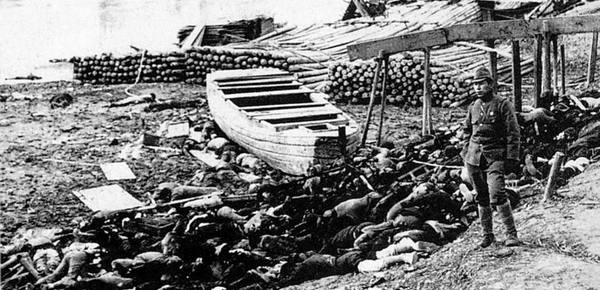
nanking_massacre_1

The Rape of Nanking

Friends of Padre Steve’s World,

Fyodor Dostoyevsky wrote, “Nothing is easier than to denounce the evildoer; nothing is more difficult than to understand him.”

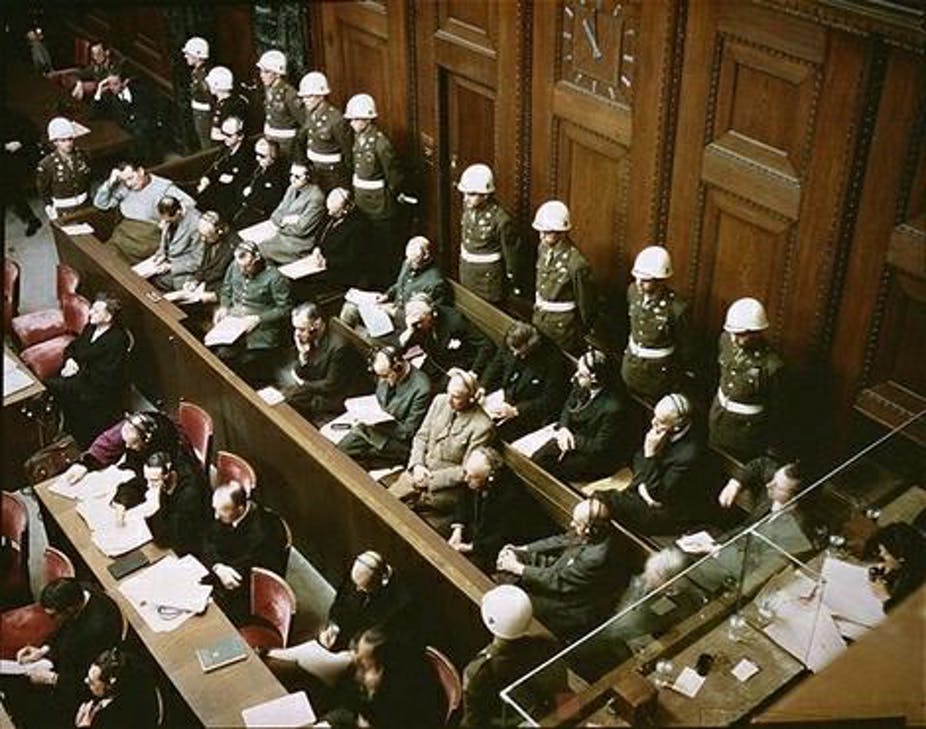
This week I finished a series of articles on American Associate Supreme Court Justice Robert Jackson’s opening and closing arguments at Nuremberg, followed by one last night asking the question “Who Were the Victims? Does Anyone Care? The Holocaust and War Crimes Today.” For me the article was difficult to write because I have served in wars that under the rules of the International War Crimes Tribunal at Nuremberg and the subsequent U.S. trials in the same courtroom could be rule as wars of aggression, and in which American servicemen and women committed crimes that can easily be classified as war crimes, and even crimes against humanity. Likewise I have taught military ethics at Major American military Staff College.

I think one of our problems is that we want to believe that evil is simply done be evil people. That is why when we see a Hitler, Stalin, Pol Pot, or the monsters of the so-called Islamic State, we are often strangely comforted. This is often  because we can point to a single person with a wicked ideology and say “they are evil,” all the while forgetting that they are, or were, like us, also human. Aleksandr Solzhenitsyn reminds us of the folly of that type of thinking, “If only it were all so simple! If only there were evil people somewhere insidiously committing evil deeds, and it were necessary only to separate them from the rest of us and destroy them. But the line dividing good and evil cuts through the heart of every human being. And who is willing to destroy a piece of his own heart?”

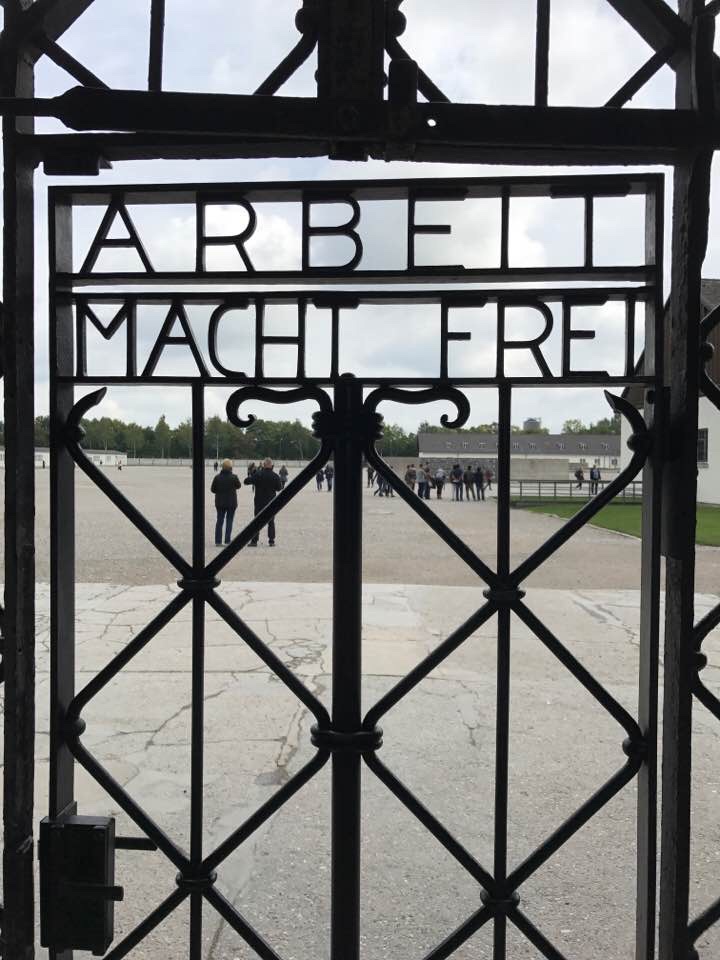
A few years ago I took a break from my Gettysburg text and dusted off an old academic paper dealing with the one of the more uncomfortable aspects of the Nazi Holocaust against the Jews. I did that because I felt that I needed to reexamine the nature of evil in the modern world. Doing that brought me to do much more study of war crimes and the Holocaust. Since then I have visited Nazi Concentration Camps, Euthanasia Centers, the Wannsee House, where the coordination of the Final Solution was conducted, as well as memorials to the German resistance at the Bendlerstraße headquarters from which the attempt to kill Hitler on July 20th 1944 was launched; the Sophie Scholl and White Rose Resistance Memorial and Museum in Munich, and the National Socialist Documentation Center, also in Munich.

As I wrote my articles I have been binge reading books about the Japanese War Crimes from the “China Incident” to the end of the Second World War. I started those at the behest of a reader of this blog. While I knew the wave tops of those crimes and was vaguely familiar with the Tokyo Trial I was not as well informed about the complexity of those crimes and the participation of Japanese officials at every level of government in them.

That leads me to today, not long after the American President pardoned convicted war criminals and the fired his own Secretary of the Navy to keep one of those men from losing his SEAL Trident at a peer review conducted by other SEALS.

When I ponder the evil committed by supposedly civilized men and women of Germany and Japan in the Second World War, as well as other war crimes, crimes against humanity, and acts of genocide committed by other nations and people’s, I realize that they are little different than others who share the culture of the West. These people were the products of a culture of learning, and of science. They were part of a culture formed by the Christian tradition, the Renaissance, the Reformation, and the Enlightenment, the age of Reason. As I pondered this I came to remember something said by the late Iris Chang, “civilization is tissue thin.”

Omaha_courthouse_lynching

Lynching in the American South

My original series of articles several years ago which dealt with the Nazi Eunsatzgruppen dealt with the ordinary men, and the bureaucratic systems that implemented an ideology so twisted and evil that it is unimaginable to most people. While most people in the United States know a little about the Holocaust, most do not fully comprehend how devilish and insidious the crimes of the Nazis were. More frightening is the fact that 46% of people worldwide have never heard of the Holocaust, and of the 54% who are aware some 32% think it is a myth or has been greatly exaggerated. That was about five years ago. I will have to take a look at the current numbers, but I believe that the numbers wills only get worse as younger people are far more likely to believe that the Holocaust is a myth or or exaggerated.

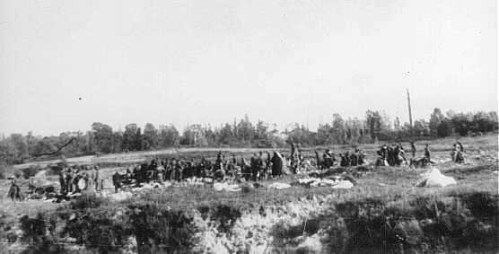
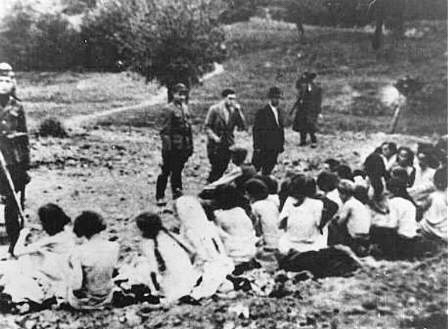
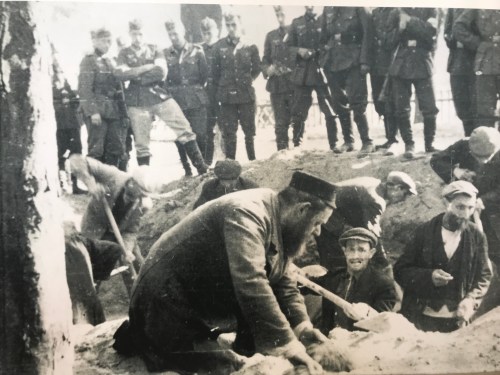
We typically know about the extermination camps like Auschwitz, but the lesser known dark side of the Holocaust, perhaps the scariest part, is the story of the men of the Einsatzgruppen. The Einsatzgruppen and affiliated units, including those of the Wehrmacht, the Waffen SS, the mobilized battalions of the Order Police, and locally recruited units, rounded up massive numbers of people and killed them up close and personal. In all these units murdered over two million people, about 1.3 million of whom were Jews.

My study of the Holocaust began in college as an undergraduate. My primary professor at California State University at Northridge, Dr. Helmut Haeussler had been an interpreter and interrogator at the Nuremberg trials. I was able to take a number of lecture classes from him a large amount of research and independent study courses in a year of graduate work while finishing my Army ROTC program at UCLA. It was an immersion in the history, sociology, and the psychology of evil, during which I was able to meet and talk with Jewish survivors of the Holocaust.

mass killing einsatzgruppen

Einsatzgruppen

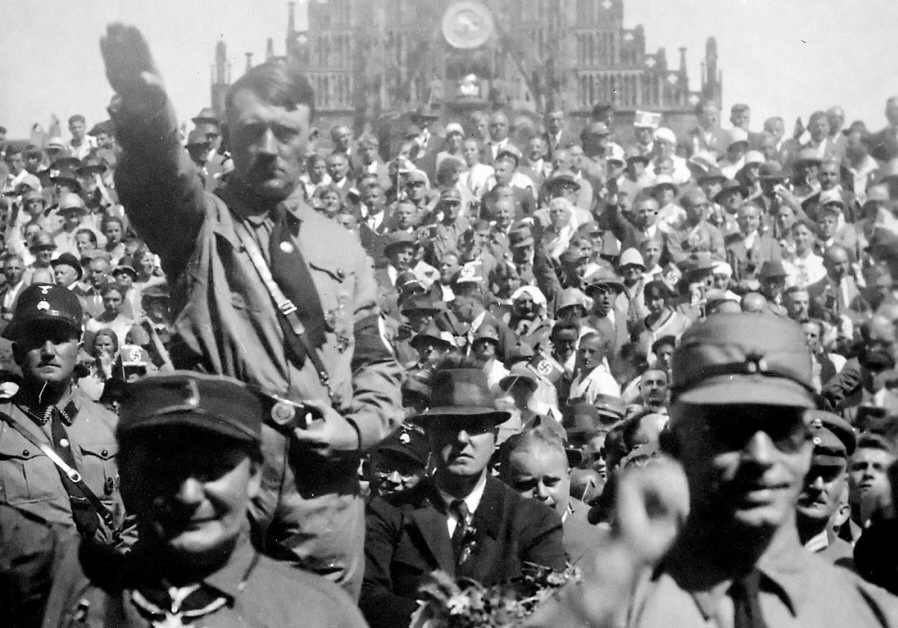
Since then I have continued to read and study. I lived in Germany for over four years, and made many other visits, during which I went to a number of Concentration Camp sites. I visited the rebuilt synagogue in Worms which had been destroyed during the infamous Kristallnacht, and other museums and Holocaust memorial sites in Germany. I visited the Zeppelin field, the site of Hitler’s massive Nazi Party rallies in Nuremburg, as well as the graveyards which contain the victims of other Nazi crimes, including the Nacht und Nebel or night and fog actions, where people simply disappeared and were murdered by the Gestapo. When I think about the men and women who were the perpetrators of those crimes as well as those who were bystanders, who knew about those crimes and did nothing to stop them I am reminded of Captain Gustave Gilbert, an American Psychologist who interviewed and got to know the major German War Criminals at Nuremberg. Gilbert wrote:

“In my work with the defendants (at the Nuremberg Trails 1945-1949) I was searching for the nature of evil and I now think I have come close to defining it. A lack of empathy. It’s the one characteristic that connects all the defendants, a genuine incapacity to feel with their fellow men. Evil, I think, is the absence of empathy.”

For me, those visits were sobering, maybe even more so because I understood exactly what happened in those sites. These are uncomfortable places to visit, and I can understand why many people would not want to visit them, or even study them.

The darkness that they remind us of  is a part of our human condition. Traces of the evil on display in those places is present in every human being. Frankly, most people cannot bear looking into that abyss, for fear that they might be swallowed by it.

nankino-masakra-1

Nanking

I can understand that and I have to admit that it is hard to do so. I am a historian as well as a clinician with much experience dealing with death and trauma. With my training I do a pretty good job of keeping my emotional distance to maintain objectivity when confronted with evil. However, it is hard for me not to have some emotional reaction when visiting these places, or reading about the events and people, and in writing about them.

Likewise, I am very troubled by the growing lack or awareness or denial of the Holocaust. It is very hard for me not to have a virulent reaction when I see books and websites dedicated to Holocaust denial, or that minimize other well documented genocides, and crimes against humanity.

tzd8ftsn-1390907543

Soviet Genocide in Ukraine

My sensitivity to human suffering and the terrible indifference of people in this country to it was greatly increased by my experience of war, and my post-war struggles with PTSD, depression, anxiety, which at points left me very close to committing suicide. A non-chaplain friend, a now retired Navy Command Master Chief Petty Officer that I served with at EOD Group Two remarked that I am a tremendously empathic person, and that I have a large capacity to feel the pain and suffering of others. This capacity for empathy and the ability to feel the suffering of others is part of who I am. It is a good thing, but it makes my work studying and writing about the Holocaust, other genocides, crimes against humanity, and subjects like American slavery, racism, and Jim Crow a sometimes difficult and often very emotionally consuming task. This sometimes leaves me even more sleepless and anxious than normal; especially when I see the indifference of so many people to the suffering of others today.

CambodiaExhibitMassgrave-x1

The Killing Fields

It is that indifference which motivates me to write; because if these events are not recalled and retold, they, like any part of history will be ignored and then forgotten. The statistics bear this out. There are people today, who say that we should stop talking about these events, that they are old news, and they cannot happen again; but history tells us different, and not just the Holocaust, but indeed every genocide. Then there are those who shamelessly use the Holocaust imagery to spread fear among their followers even as they openly demonize minority groups and religions as the Nazis did to the Jews.

I have to agree with Elie Wiesel who said, “Indifference to me, is the epitome of all evil.”

The late Iris Chang, who wrote The Rape of Nanking: The Forgotten Holocaust of World War II wrote something that is pertinent to almost every modern episode of genocide, or other crime against humanity. It is the ability of leaders, be they political, military, or religious to convince people to rationalize actions that they normally would find repulsive.

“After reading several file cabinets’ worth of documents on Japanese war crimes as well as accounts of ancient atrocities from the pantheon of world history, I would have to conclude that Japan’s behavior during World War II was less a product of dangerous people than of a dangerous government, in a vulnerable culture, in dangerous times, able to sell dangerous rationalizations to those whose human instincts told them otherwise.”

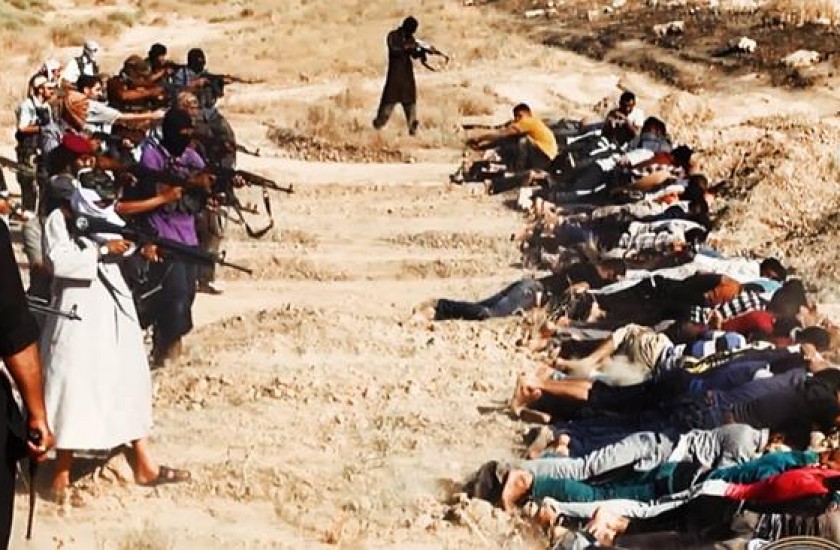
isis3-840x550

The Islamic State

What we call civilization, to use the words of Iris Chang, is tissue thin. That is why we must never forget these terrible events of history, and that part of human nature, and in a sense part of every one of us, that makes them so easy to repeat. That is why we must periodically take the time to remember and reflect on the Holocaust, other genocides and crimes against humanity. Historian Timothy Snyder in his book On Tyranny wrote:

“The European history of the twentieth century shows us that societies can break, democracies can fall, ethics can collapse, and ordinary men can find themselves standing over death pits with guns in their hands. It would serve us well today to understand why.”


Sophie Scholl, the 22 year old leader of the White Rose resistance movement in Nazi Germany I think gives those who still retain a sense of empathy, ethics, and self-decency a plumb-line of what the real issues are.

Sophie wrote:

“The real damage is done by those millions who want to ‘survive.’ The honest men who just want to be left in peace. Those who don’t want their little lives disturbed by anything bigger than themselves. Those with no sides and no causes. Those who won’t take measure of their own strength, for fear of antagonizing their own weakness. Those who don’t like to make waves—or enemies. Those for whom freedom, honour, truth, and principles are only literature. Those who live small, mate small, die small. It’s the reductionist approach to life: if you keep it small, you’ll keep it under control. If you don’t make any noise, the bogeyman won’t find you. But it’s all an illusion, because they die too, those people who roll up their spirits into tiny little balls so as to be safe. Safe?! From what? Life is always on the edge of death; narrow streets lead to the same place as wide avenues, and a little candle burns itself out just like a flaming torch does. I choose my own way to burn.”

Yes, these are terribly uncomfortable subjects, but we cannot allow this generation to allow them to be forgotten, lest they be repeated. That is why that I must continue to write about them.

Peace

Padre Steve+

Leave a comment

Filed under ethics, germany, History, holocaust, imperial japan, middle east, Military, national security, nazi germany, News and current events, Political Commentary, terrorism, Tour in Iraq, us army, war crimes, world war two in europe, world war two in the pacific

Who Were the Victims? Does Anybody Care? The Holocaust and War Crimes Today

Friends of Padre Steve’s World,

Tonight I write about the victims of the Holocaust, and other Nazi Crimes Against Humanity. At the heart of the Nazi crimes was the genocide committed against the Jews, but the Nazi crimes extended far beyond them; the systemic extermination of the handicapped, mentally ill, chronically sick, and others deemed to be Life Unworthy of Life. Likewise there was the killing of possible political political opponents in the Reich and conquered territories; the intentional starvation of Poles and Russians, the use of slave labor, and the indiscriminate killing of civilians.

In the film Judgement at Nuremberg the American Prosecutor at the Judges Trial played by Richard Widmark asked a question when showing a film of the victims of the Nazis when the Concentration Camps were liberated by American and British troops in the spring of 1945. His question in the face of films of massed piles of bodies being bulldozed into mass graves at Bergen-Belsen, of the cremated remains, shrunken skulls, and lampshades made of human skin at Buchenwald, gas chambers, medical experiments, the emaciated bodies of still living victims; little more than skin and bones, elbows, hips, and knees bulging over the shrunken remains of their bodies, eyes sunken in to the skulls.

Who were they?

The Nazis specifically targeted the Jews for extermination. According to Hitler, his hnchemen, and other German nationalists, the Jews were less than human, they worked hand in hand with the Bolsheviks, and thus deserved their fate. Likewise, there were those crippled in body or mind who were euthanized, political opponents, religious and racial minorities, populations of conquered nations, who died at the hands of the German military, or who were gunned down in mass graves by the Einsatzgruppen, intentionally starved to death, or who were worked to death as Slave laborers in the Nazi work camps.

To the average German of the time they were subhuman, and even those not fully in agreement with the Nazis seldom cared, and simply turned their backs. There were the perpetrators and the bystanders, who seldom if ever thought about their victims. In a way very much like most of us don’t even blink when we are confronted with war crimes committed by our own soldiers, and their victims, or innocent women and children killed during air or drone strikes where perhaps one or two at best terrorists or insurgents were reportedly located.

we have a lot to learn from the past.

The victims of the Nazis, like so many others who have committed crimes against humanity, including us, were men and women, wives and husbands, sons and daughters. They spanned the spectrum from infants to the aged. Too many times multiple generations of families went to death together. Examples of the Nazi crimes are so numerous that they must never be forgotten. That is why I write tonight, that we never forget, so we do not repeat them ourselves. Human nature is human nature, and as much as we think we have progressed, the darkness still resides in us, and we must fight to do right.

However, some witnesses to the Nazi crimes were appalled and when the Nazi regime finally was crushed testified to those crimes.

One of them was Hermann Graebe, a civilian employed to help build roads for the Wehrmacht came across one of the many massacres committed up close and personal by SS Men on October 5th 1943 at Dubno, Ukraine. At Nuremberg he testified:

Moennikes and I went direct to the pits. Nobody bothered us. Now I heard rifle shots in quick succession, from behind one of the earth mounds. The people who had got off the trucks—men, women and children of all ages—had to undress upon the orders of an SS-man, who carried a riding or dog whip.

They had to put down their clothes in fixed places, sorted according to shoes, top clothing and underclothing. I saw a heap of shoes of about 800 to 1,000 pairs, great piles of underlinen and clothing. Without screaming or weeping these people undressed, stood around in family groups, kissed each other, said farewells and waited for a sign from another SS-man, who stood near the pit, also with a whip in his hand.

During the 15 minutes that I stood near the pit I heard no complaint or plea for mercy. I watched a family of about 8 persons, a man and woman, both about 50 with their children of about 1, 8 and 10, and two grown up daughters of about 20 to 24. An old woman with snow-white hair was holding the one year old child in her arms and singing to it, and tickling it. The child was cooing with delight. The couple were looking on with tears in their eyes. The father was holding the hand of a boy about 10 years old and speaking to him softly; the boy was fighting his tears. The father pointed toward the sky, stroked his head, and seemed to explain something to him. At that moment the SS-man at the pit shouted something to his comrade.

I looked into the pit and saw that the bodies were twitching or the heads lying already motionless on top of the bodies that lay before them. Blood was running from their necks.

I was surprised that I was not ordered away, but I saw that there were two or three postmen in uniform nearby. The next batch was approaching already.

These victims were not just numbers and statistics. They were living breathing human beings whose lives were snuffed out by the Nazis and their allies. They had been abandoned by most of the world. Anything of value that they possessed was appropriated by the men who exterminated them; their businesses, homes, farms, clothes, shoes, currency, jewelry, wedding rings, artwork, furniture, and even their gold fillings, and yes, their hair, and even their skin.

Whole towns were exterminated, millions of people killed and millions of other people displaced, never to return to their homes. At Babi Yar outside of Kiev 33,771 Jews were exterminated by the members of Sonderkommando 4b of Einsatzgruppen C as well as Police battalions. About 10,000 others, mainly Communist Officials and Gypsies were rounded up and killed in the same operation. The victims were stripped of all of their belongings taken to a ravine and shot. The German Army provided logistic support as well as security for the murder squads.

Fritz Hoefer, a SS man serving as a truck driver with the Sonderkommando said these words at the Einsatzgruppen Trial:

One day I was ordered to drive my truck out of town. I had a Ukrainian with me. It was about 10 a.m. On our way, we passed Jews marching in columns in the same direction, we were going. They were carrying their belongings. There were whole families. The farther we drove away from the town, the more people we saw in the columns. There were piles of clothes in a wide open field. My job was to fetch them.   

I stopped the engine nearby, and the Ukrainians standing around started loading the car with this stuff. From where I was, I saw other Ukrainians meeting the Jews who arrived, men, women and children, and directing them to the place where, one after another, they were supposed to remove their belongings, coats, shoes, outer garments and even their underwear.

They were supposed to put all their belongings together in a pile. Everything happened very quickly, the Ukrainians hurried those who hesitated by kicking and pushing them. I think it took less than a minute from the moment a person took off his coat before he was standing completely naked.

No distinction was made between men, women and children. The Jews who were arriving could have turned back when they saw those who had come earlier taking off their clothes. Even today I cannot understand why they didn’t run.


Columns of Jews march past a corpse in Kiev

Naked Jews were led to a ravine about 150 metres long, 30 metres wide and 15 metres deep. The Jews went down into the ravine through two or three narrow paths. When they got closer to the edge of the ravine, members of the Schutzpolizei (Germans) grabbed them and made them lie down over the corpses of the Jews who had already been shot.

It took no time. The corpses were carefully laid down in rows. As soon as a Jew lay down, a Schutzpolizist came along with a sub-machine gun and shot him in the back of the head.The Jews who descended into the ravine were so frightened by this terrible scene that they completely lost their will. You could even see some of them lying down in the row on their own and waiting for the shot to come.

Only two members of the Schutzpolizei did the shooting. One of them was working at one of the ravine, the other started at the other end. I saw them standing on the bodies and shooting one person after another.

Walking over the corpses toward a new victim who had already laid down, the machine gunner shot him on the spot. It was an extermination machine that made no distinction between men, women and children.Children were kept with their mothers and shot with them. I did not watch for long. When I approached the edge, I was so frightened of what I that I could not look at it for a long time.


German Einsatzgruppen & Police force groups of Jews to hand over their possessions and undress before being shot in the ravine at Babi Yar

I saw dead bodies at the bottom laid across in three rows, each of which was approximately 60 metres long. I could not see how many layers were there. It was beyond my comprehension to see bodies twitching in convulsions and covered with blood, so I could not make sense of the details.Apart from the two machine gunners, there were two other members of the Schutzpolizei standing near each passage into the ravine.

They made each victim lie down on the corpses, so that the machine gunner could shoot while he walked by. When victims descended into the ravine and saw this terrible scene at the last moment, they let out a cry of terror. But they were grabbed by the waiting Schutzpolizei right away and hurled down onto the others.

Those who followed them could not see the terrible scene because it was obstructed by the edge of the ravine. While some people were getting undressed and most of the others were waiting their turn, there was a lot of noise. The Ukrainians paid no attention to the noise and just kept forcing people through the passages into the ravine.

You could not see the ravine from the site where people were taking off their clothes, because it was situated about 150 metres away from the first pile of clothes. Besides, a strong wind was blowing and it was very cold. You couldn’t hear the shooting in the ravine.

Jews at Babi Yar waiting to be murdered

So I concluded that the Jews had no idea what was actually happening. Even today I wonder why the Jews did nothing to challenge what was going on. Masses of people were coming from town and they did not seem to suspect anything.

They thought they were just being relocated.              

The men who were the leaders of the mobile Einsatzgruppen which conducted these up close and personal killings of nearly a million and a half Jews and others were not common thugs. Most were very educated and accomplished men.

General Telford Taylor, an American lawyer who served as a prosecutor at the Einsatzgruppen Trial explained:

“These defendants are not German peasants or artisans drafted into the Wehrmacht. They are not uneducated juveniles. They are lawyers, teachers, artists, and a former clergyman. They are, in short, men of education, who were in full possession of their faculties and who fully understood the grave and sinister significance of the program they embarked upon. They were part of the hard core of the SS. They did not give mere lip service to Himmler’s atrocious racial doctrines; they were chosen for this terrible assignment because they were thought to be men of sufficient ruthlessness to carry them out. They are hand-picked fanatics; every one of them was an officer of the SS … They are not unhappy victims, unwillingly pushed into crime by the tyranny of the Third Reich; these men, above all others, themselves, spread the Nazi doctrine with fire and sword.”

The men who ran the death camps might not have been from the same “elite” stock as the commanders of the Einsatzgruppen but they carried out their duties in calculating and businesslike manner. Rudolf Hoess who commanded Auschwitz gave this statement to the International Military Tribunal:

On 1 December 1943 1 became Chief of Amt 1 in Amt Group D of the WVHA, and in that office was responsible for co-ordinating all matters arising between RSHA and concentration camps under the administration of WVHA. I held this position until the end of the war. Pohl, as Chief of WVHA, and Kaltenbrunner, as Chief of RSHA, often conferred personally and frequently communicated orally and in writing concerning concentration camps. . . .

The ‘final solution’ of the Jewish question meant the complete extermination of all Jews in Europe. I was ordered to establish extermination facilities at Auschwitz in June 1941. At that time, there were already in the General Government three other extermination camps: Belzek, Treblinka, and Wolzek. These camps were under the Einsatzkommando of the Security Police and SD. I visited Treblinka to find out how they carried out their exterminations. The camp commandant at Treblinka told me that he had liquidated 80,000 in the course of one-half year. He was principally concerned with liquidating all the Jews from the Warsaw Ghetto. He used monoxide gas, and I did not think that his methods were very efficient. So when I set up the extermination building at Auschwitz, I used Cyklon B, which was a crystallized prussic acid which we dropped into the death chamber from a small opening. It took from 3 to 15 minutes to kill the people in the death chamber, depending upon climatic conditions. We knew when the people were dead because their screaming stopped. We usually waited about one-half hour before we opened the doors and removed the bodies. After the bodies were removed our special Kommandos took off the rings and extracted the gold from the teeth of the corpses.

When he was asked specifics, Hoess stated: This gold was melted down and brought to the Chief Medical Office of the SS at Berlin.

He continued with some pride during cross examination:

Another improvement we made over Treblinka was that we built our gas chamber to accommodate 2,000 people at one time whereas at Treblinka their 10 gas chambers only accommodated 200 people each. The way we selected our victims was as follows: We had two SS doctors on duty at Auschwitz to examine the incoming transports of prisoners. The prisoners would be marched by one of the doctors who would make spot decisions as they walked by. Those who were fit for work were sent into the camp. Others were sent immediately to the extermination plants. Children of tender years were invariably exterminated since by reason of their youth they were unable to work. Still another improvement we made over Treblinka was that at Treblinka the victims almost always knew that they were to be exterminated and at Auschwitz we endeavored to fool the victims into thinking that they were to go through a delousing process. Of course, frequently they realized our true intentions and we sometimes had riots and difficulties due to that fact. Very frequently women would hide their children under the clothes, but of course when we found them we would send the children in to be exterminated. We were required to carry out these exterminations in secrecy but of course the foul and nauseating stench from the continuous burning of bodies permeated the entire area and all of the people living in the surrounding communities knew that exterminations were going on at Auschwitz.

But the bodies…

Jews and Gentiles from every nation in Europe as well as the Americas, Africa, and Asia ended up dying at the hands of the Nazis, either in their Death Camps, Concentration/ Labor Camps, or up close and personal at the hands of the Einsatzgruppen, the Waffen SS, or the Wehrmacht.

Every one of those bodies, the cold statistics of the Nazi machine were people like you and me. In April of 2018 I visited the United States Holocaust Museum while visiting friends in Washington D. C.

I think that the one that hit me the hardest was the pictorial Tower of Faces from the Polish shtetl of Ejszyszki. That town was home to some 4,000 Jews and the pictures had been taken over the preceding decade by local photographers. They were pictures of everyday family and community life; men, women, children at work, at play, at rest. Worshipping, working, studying, the old and the young, the well off and the poor, the religious and those not as religious at all phase of life captured in photos for eternity. For 3500 of them their lives ended on September 21st 1941 when the Nazis rounded up the Jews at their Synagogues on the eve of Yom Kippur and executed them by firing squad in mass graves at the town’s Christian and Jewish cemeteries. Only 29 of those who survived that day lived through the war. That Jewish community had existed for 900 years and was exterminated in a matter of hours.

          The Tower of Faces at the United States Holocaust Museum 

I looked at those pictures and I could not get over all of those innocent lives cut short. Each face was the picture of an individual or individuals, families, friends, schoolmates. They were not abstract numbers or statistics but real flesh and blood people like you and me. They had hopes and dreams, but because they were Jews they were exterminated, like nearly six million other Jews who also were real people with hopes and dreams that would be destroyed by the Nazi racial war. Of course the Nazis targeted others, but none with the relentless anti-Semitic racial hatred propagated by Nazi ideology. Thus they condoned and executed by people who would have ordinarily have been considered upstanding and moral citizens. The late Christopher Hitchens wrote:

“We should not at all allow ourselves to forget the millions of non-Jewish citizens of Belarus, Russia, Ukraine, and other Slav territories who were also massacred. But for me the salient fact remains that anti-Semitism was the regnant, essential, organizing principle of all the other National Socialist race theories. It is thus not to be thought of as just one prejudice among many.” 

The Jewish-Italian Philosopher and Auschwitz survivor Primo Levi wrote:

Then for the first time we became aware that our language lacks words to express this offence, the demolition of a man. In a moment, with almost prophetic intuition, the reality was revealed to us: we had reached the bottom. It is not possible to sink lower than this; no human condition is more miserable than this, nor could it conceivably be so. Nothing belongs to us any more; they have taken away our clothes, our shoes, even our hair; if we speak, they will not listen to us, and if they listen, they will not understand. They will even take away our name: and if we want to keep it, we ill have to find ourselves the strength to do so, to manage somehow so that behind the name something of us, of us as we were, still remains.

               Wehrmacht Troops Pose With Jews that They Hanged 

I write because the remaining witnesses to the Nazi Crimes are dying off and deniers are becoming ever more numerous. In researching this article I came across a man, an American of all people, who is denying the mass murder at Babi Yar. I have to shake my head, but the fact is that such people have become emboldened by the Presidency of Donald Trump, a man who has pardoned and praised convicted American War Criminals. They see in him a kindred spirit. Such does not bode well for the future, and the lives who will stand behind the faces and names of the future crimes against humanity.

Until tomorrow,

Peace,

Padre Steve+

2 Comments

Filed under crime, ethics, film, Foreign Policy, germany, History, holocaust, imperial japan, laws and legislation, leadership, middle east, Military, national security, nazi germany, News and current events, Political Commentary, racism, war crimes, War on Terrorism, world war two in europe

“If You Are to Say that They ARe Not Guilty” Reflecting on theNuremberg Defendants and the Trump Administration

Friends of Padre Steve’s World,

This is the final installment of my introduction and comments regarding Supreme Court Justice and Chief American Prosecutor Robert Jackson’s closing arguments at Nuremberg.

In this final segment of his closing arguments, Jackson confronted the impossibility of a cabal of the most powerful members of the Nazi Party, the German Government, its Military, and Police organizations, the men closest to Adolf Hitler and the center of power in Germany who by their testimony knew nothing of what was going on in the country.

When one reads the transcripts of the trials as I am continuing to do in between reading other books, including one about the Tokyo War Crimes Trials, the defendants universal defense was that they knew nothing, or had learned of the Nazi crimes for the first time during the trial.

What is remarkable is that for every denial there was documented evidence to the contrary, that each in their own way were willing participants in the Nazi crimes. While they pointed fingers at the dead, like Joseph Goebbels, Heinrich Himmler, Reinhard Heydrich, or unaccounted for like Martin Bormann, and on occasion the other defendants in the dock, each attempted to cover his tracks with lies and deception. Even Albert Speer, who was the only one of the defendants to openly admit his guilt during the trial engaged in deception.

The lies of these men and their brutal exposure before the watching world should serve as a warning to the leaders of nations, especially the nations which prosecuted these men, the foremost being the United States of America. Before the trial in the London agreement, Jackson noted:

“If certain acts of violation of treaties are crimes, they are crimes whether the United States does them or whether Germany does them, and we are not prepared to lay down a rule of criminal conduct against others which we would not be willing to have invoked against us.

I have served and continue to serve the United States, but my oath to the Constitution demands that I be intellectually honest and forthright in stating that the United States has not lived up to its founding principles or the words of Justice Jackson. During the Cold War the United States engaged in overthrowing foreign governments and replacing them with dictators more inclined to do our bidding, engineered the pretext to allow massive U. S. Military intervention in Vietnam, and after the Cold War used the real pretext of the terrorism of the 9-11-2001 attacks to invade Iraq, a country that was not involved. The list could go on and on, but because of the protections of the First Amendment, a free press has been able to expose many of those lies, even as the beast of corporate media egged on war like the Yellow Journalism of William Randolph Hearst during the run up to the Spanish American War.

Every government in every nation has engaged in some amount of lying to increase its power, influence, or to cover its malfeasance. The United States is not blameless, but too often Americans, ignorant or history, and the Constitution revel in the myth of American Exceptionalism to justify actions against other nations that do the same, that we have gone to war to confront or prosecuted as war criminals for doing. In fact, some of the Nazis in the dock at Nuremberg defended their actions by citing American history: Slavery, Jim Crow, the extermination of the Native American tribes, the American practice of eugenics, and medical experiments on racial minorities or the mentally ill, and the incarceration of Japanese Americans following Pearl Harbor to justify and defend their crimes, even as they denied their culpability for their crimes.

The Nazis in the dock at Nuremberg included true believers as well as opportunists. The were willing members of a regime founded upon lies. In defeat and on trial they would all repeat those lies, and add to them. Unfortunately, the current American President and his administration seem to be playing the same game with truth as the Nazis did. Hannah Arendt wrote:

“Before mass leaders seize the power to fit reality to their lies, their propaganda is marked by its extreme contempt for facts as such, for in their opinion fact depends entirely on the power of man who can fabricate it.”

Truth and integrity are not fungible assets that one can abandon without consequences. Germany is still hampered in international relations as well as domestic politics by what the Nazis did. The shadows of the Nazi past still enshroud Germans who are two or three generations removed from the Nazi past. The great ethicist Sissela Bok wrote:

“Trust and integrity are precious resources, easily squandered, hard to regain. They can thrive only on a foundation of respect for veracity.” 

As I watch the American President and his consigliere’s of criminal corruption be exposed for what they are by a still free press, and a relentlessly honest special prosecutor, I am reminded of how Robert Jackson and the team of Allied prosecutors used the words and documents of the Nazis themselves to indict and convict them.

With that I give you Robert Jackson’s masterful dissection of the Nazis in the dock at Nuremberg’s Palace of Justice. Something that we should pay close attention to as we follow the nefarious antics of President Trump and his corrupt administration and cult-like followers. What is interesting about the Nuremberg defendants were that some were true believers, while others were opportunists trying to advance their careers, even knowing the cause was evil and often criminal. The latter were probably more like many people nowadays, they just look the other way while trying to take advantage of any opportunity given to them.

Next month I will begin writing about the Japanese War Criminals and their crimes, but I will write about something else tomorrow.

Until tomorrow,

Peace,

Padre Steve+

Record of Proceedings: July 26, 1946, continued:

Rudolf Hess

The zealot Hess, before succumbing to wanderlust, was the engineer tending the Party machinery, passing orders and propaganda down to the Leadership Corps, supervising every aspect of Party activities, and maintaining the organization as a loyal and ready instrument of power.

Joachim von Ribbentrop

When apprehensions abroad threatened the success of the Nazi regime for conquest, it was the double-dealing Ribbentrop, the salesman of deception, who was detailed to pour wine on the troubled waters of suspicion by preaching the gospel of limited and peaceful intentions.

Wilhelm Keitel

Keitel, the weak and willing tool, delivered the armed forces, the instrument of aggression, over to the Party and directed them in executing its felonious designs.
Ernst Kaltenbrunner

Kaltenbrunner, the grand inquisitor, assumed the bloody mantle of Heydrich to stifle opposition and terrorise into compliance, and buttressed the power of National Socialism on a foundation of guiltless corpses.

Alfred Rosenberg

It was Rosenberg, the intellectual high priest of the “master race”, who provided the doctrine of hatred which gave the impetus for the annihilation of Jewry, and who put his infidel theories into practice against the Eastern occupied territories. His woolly philosophy also added boredom to the long list of Nazi atrocities.
Hans Frank

The fanatical Frank, who solidified Nazi control by establishing the new order of authority without law, so that the will of the Party was the only test of legality, proceeded to export his lawlessness to Poland, which he governed with the lash of Caesar and whose population he reduced to sorrowing remnants.

Wilhelm Frick

Frick, the ruthless organiser, helped the Party to seize power, supervised the police agencies to ensure that it stayed in power, and chained the economy of Bohemia and Moravia to the German war machine.
Julius Streicher

Streicher, the venomous vulgarian, manufactured and distributed obscene racial libels which incited the populace to accept and assist the progressively savage operations of “race purification”.
Walter Funk

As Minister of Economics Funk accelerated the pace of rearmament, and as Reichsbank president banked for the SS the gold teeth-fillings of concentration camp victims -probably the most ghoulish collateral in banking history.
Hjalmar Schacht

It was Schacht, the facade of starched respectability, who in the early days provided the window-dressing, the bait for the hesitant, and whose wizardry later made it possible for Hitler to finance the colossal rearmament programme, and to do it secretly.
Karl Dönitz

Donitz, Hitler’s legatee of defeat, promoted the success of the Nazi aggressions by instructing his pack of submarine killers to conduct warfare at sea with the illegal ferocity of the jungle.
Erich Raeder

Raeder, the political admiral, stealthily built up the German Navy in defiance of the Versailles Treaty, and then put it to use in a series of aggressions which he had taken a leading part in planning.
Baldur von Schirach

Von Schirach, poisoner of a generation, initiated the German youth in Nazi doctrine, trained them in legions for service in the SS and Wehrmacht, and delivered them up to the Party as fanatic, unquestioning executors of its will.

Fritz Sauckel

Sauckel, the greatest and cruellest slaver since the Pharaohs of Egypt, produced desperately needed manpower by driving foreign peoples into the land of bondage on a scale unknown even in the ancient days of tyranny in the kingdom of the Nile.

Alfred Jodl

Jodl, betrayer of the traditions of his profession, led the Wehrmacht in violating its own code of military honour in order to carry out the barbarous aims of Nazi policy.
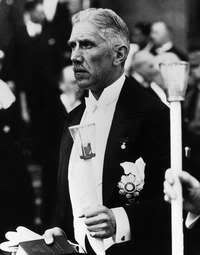
Franz von Papen

Von Papen, pious agent of an infidel regime, held the stirrup while Hitler vaulted into the saddle, lubricated the Austrian annexation, and devoted his diplomatic cunning to the service of Nazi objectives abroad.
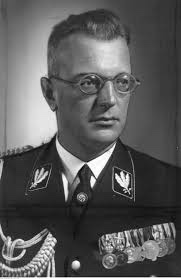
Arthur Seyess-Inquart

Seyss-Inquart, spearhead of the Austrian fifth column, took over the government of his own country only to make a present of it to Hitler, and then, moving north, brought terror and oppression to the Netherlands and pillaged its economy for the benefit of the German juggernaut.
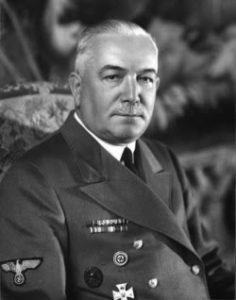
Konstantin von Neurath

Von Neurath, the old-school diplomat, who cast the pearls of his experience before the Nazis, guided Nazi diplomacy in the early years, soothed the fears of prospective victims, and as Reich Protector of Bohemia and Moravia strengthened the German position for the coming attack on Poland.
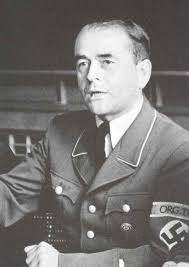
Albert Speer

Speer, as Minister of Armaments and Production, joined in planning and executing the programme to dragoon prisoners of war and foreign workers into German war industries, which waxed in output while the labourers waned in starvation.
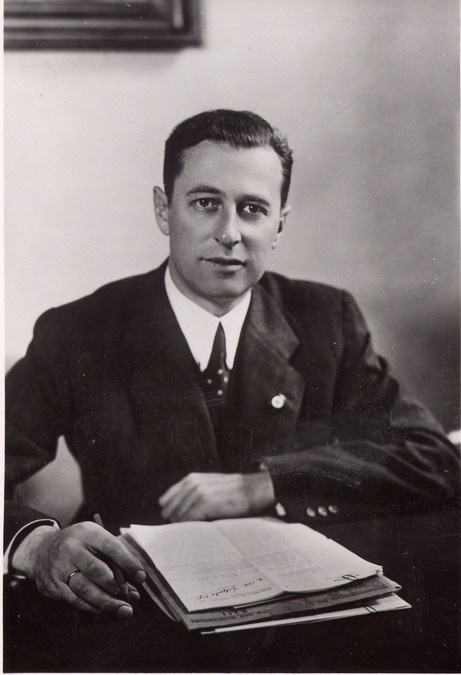
Hans Fritzsche

Fritzsche, radio propaganda chief, by manipulation of the truth goaded German public opinion into frenzied support of the regime, and anaesthetised the independent judgement of the population so that they did their masters’ bidding without question.

Martin Bormann

Bormann, who has not accepted our invitation to this reunion, sat at the throttle of the vast and powerful engine of the Party, guiding it in the ruthless execution of Nazi policies, from the scourging of the Christian Church to the lynching of captive Allied airmen.

The activities of all these defendants, despite their varied backgrounds and talents, were joined with the efforts of other conspirators not now in the. dock, who played still other essential roles: They blend together into one consistent and militant pattern animated by a common objective to reshape the map of Europe by force of arms. Some of these defendants were ardent members of the Nazi movement from its birth. Others, less fanatical, joined the common enterprise later, after success had made participation attractive by the promise of rewards. This group of latter-day converts remedied a crucial defect in the ranks of the original true believers, for as Dr. Siemers has pointed out in his summation:

“… There were no specialists among the National Socialists for the particular tasks. Most of the National Socialist collaborators did not previously follow a trade requiring technical education.”

It was the fatal weakness of the early Nazi band that it lacked technical competence. It could not from among its own ranks make up a government capable of carrying out all the projects necessary to realize its aims. Therein lies the special crime and betrayal of men like Schacht and von Neurath, Speer and von Papen, Raeder and Donitz, Keitel and Jodl. It is doubtful whether the Nazi master plan could have succeeded without their specialized intelligence which they so willingly put at its command. They did so with knowledge of its announced aims and methods, and continued their services after practice had confirmed the direction in which they were tending. Their superiority to the average run of Nazi mediocrity is not their excuse. It is their condemnation.
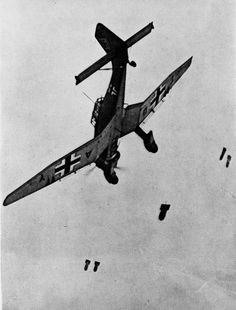
The dominant fact which stands out from all the thousands of pages of the record of this trial is that the central crime of the whole group of Nazi crimes -the attack on the peace of the world -was clearly and deliberately planned. The beginning of these wars of aggression was not an unprepared and spontaneous springing to arms by a population excited by some current indignation. A week before the invasion of Poland Hitler told his military commanders:

“I shall give a propagandist cause for starting war -never mind whether it be plausible or not. The victor shall not be asked later on whether we told the truth or not. In starting and making a war, it is not the right that matters, but victory.”

The propagandist incident was duly provided by dressing concentration camp inmates in Polish uniforms, in order to create the appearance of a Polish attack on a German frontier radio station. The plan to occupy Belgium, Holland, and Luxembourg first appeared as early as August, 1938, in connection with the plan for attack on Czechoslovakia. The intention to attack became a programme in May, 1939, when Hitler told his commanders that:

“The Dutch and Belgian air bases must be occupied by armed forces. Declarations of neutrality must be ignored.”

Thus, the follow-up wars were planned before the first was launched. These were the most carefully plotted wars in all history. Scarcely a step in their terrifying succession and progress failed to move according to the master blueprint or the subsidiary schedules and timetables until long after the crimes of aggression were consummated. Nor were the war crimes and the crimes against humanity unplanned, isolated or spontaneous offences. Apart from our undeniable evidence of their plotting, it is sufficient to ask whether six million people could be separated from the population of several nations on the basis of their blood and birth, could be destroyed and their bodies disposed of, unless the operation had fitted into the general scheme of government. Could the enslavement of five millions of labourers, their impressment into service, their transportation to Germany, their allocation to work where they would be most useful, their maintenance, if slow starvation can be called maintenance, and their guarding have been accomplished if it did not fit into the common plan? Could hundreds of concentration camps located throughout Germany, built to accommodate hundreds of thousands of victims, and each requiring labour and materials for construction, manpower to operate and supervise, and close gearing into the economy -could such efforts have been expended under German autocracy if they had not suited the plan? Has the Teutonic passion for organization suddenly become famous for its toleration of non-conforming activity? Each part of the plan fitted into every other. The slave labour programme meshed with the needs of industry and agriculture, and these in turn synchronised with the military machine. The elaborate propaganda apparatus geared with the programme to dominate the people and incite them to a war which their sons would have to fight. The armament industries were fed by the concentration camps. The concentration camps were fed by the Gestapo. The Gestapo was fed by the spy system of the Nazi Party. Nothing was permitted under the Nazi iron rule that was not in accordance with the programme.

Everything of consequence that took place in this regimented society was but a manifestation of a premeditated and unfolding purpose to secure the Nazi State a place in the sun by casting all others into darkness.

COMMON DEFENCES AGAINST THE CHARGE OF COMMON RESPONSIBILITY

The defendants meet this overwhelming case, some by admitting a limited, responsibility, some by putting the blame on others, and some by taking the position, in effect, that while there have been enormous crimes there are no criminals. Time will not permit me to examine each individual and particular defence, but there are certain lines of defence common to so many cases that they deserve some consideration.

Counsel for many of the defendants seek to dismiss the charge of a common plan or conspiracy on the ground that the pattern of the Nazi plan does not fit into the concept of conspiracy applicable in German law to the plotting of a highway robbery or a burglary. Their concept of conspiracy is in the terms of a stealthy meeting in the dead of night, in a secluded hide-out, in which a group of felons plot every detail of a specific crime. The Charter forestalls resort to such parochial and narrow concepts of conspiracy taken from local law by using the additional and non-technical term, “common plan”. Omitting entirely the alternative term of “conspiracy”, the Charter reads that “leaders, organisers, instigators, and accomplices participating in the formulation or execution of a common plan to commit” any of the described crimes “are responsible for all acts performed by any persons in execution of such plan”.

The Charter concept of a common plan really represents the conspiracy principle in an international context. A common plan or conspiracy to seize the machinery of a State, to commit crimes against the peace of the world, to blot a race out of existence, to enslave millions, and to subjugate and loot whole nations cannot be thought of in the same terms as the plotting of petty crimes, although the same underlying principles are applicable. Little gangsters may plan who will carry a pistol and who a stiletto, who will approach a victim from the front and who from behind, and where they will waylay him. But in planning war, the pistol becomes a Wehrmacht, the stiletto a Luftwaffe. Where to strike is not a choice of dark alleys, but a matter of world geography. The operation involves the manipulation of public opinion, the law of the State, the police power, industry, and finance. The baits and bluffs must be translated into a nation’s foreign policy. Likewise, the degree of stealth which points to a guilty purpose in, a conspiracy will depend upon its object. The clandestine preparations of a State against international society, although camouflaged to those abroad, might be quite open and notorious among its own people. But stealth is not an essential ingredient of such planning. Parts of the common plan may be proclaimed from the housetops, as anti-Semitism was, and parts of it kept under cover, as rearmament for a long time was. It is a matter of strategy how much of the preparation shall be made public, as was Goering’s announcement in 1935 of the creation of an air force, and how much shall be kept covert, as in the case of the Nazis’ use of shovels to teach “labour corps” the manual of arms. The forms of this grand type of conspiracy are amorphous, the means are opportunistic, and neither can divert the law from getting at the substance of things.

The defendants counted, however, that there could be no conspiracy involving aggressive war because (1) none of the Nazis wanted war; (2) rearmament was only intended to provide the strength to make Germany’s voice heard in the family of nations; and (3) the wars were not in fact aggressive wars but were defensive wars against a “Bolshevik menace”.

When we analyse the argument that the Nazis did not want war it comes down, in substance, to this: “The record looks bad indeed -objectively -but when you consider the state of my mind -subjectively I hated war. I knew the horrors of war. I wanted peace.” I am not so sure of this. I am even less willing to accept Goering’s description of the General Staff as pacifist. However, it will not injure our case to admit that as an abstract proposition none of these defendants liked war. But they wanted things which they knew they could not get without war. They wanted their neighbours’ lands and goods. Their philosophy seems to be that if the neighbours would not acquiesce, then they are the aggressors and are to blame for the war. The fact is, however, that war never became terrible to the Nazis until it came home to them, until it exposed their deceptive assurances to the German people that German cities, like the ruined one in which we meet, would be invulnerable. From then on, war was terrible.

But again the defendants claim: “To be sure, we were building guns. But not to shoot. They were only to give us weight in negotiating.” At its best this argument amounts to a contention that the military forces were intended for blackmail, not for battle. The threat of military invasion which forced the Austrian Anschluss, the threats which preceded Munich, and Goering’s threat to bomb the beautiful city of Prague if the President of Czechoslovakia did not consent to the Protectorate, are examples of what the defendants had in mind when they talked of arming to back negotiation.

But from the very nature of German demands, the day was bound to come when some country would refuse to buy its peace, would refuse to pay Dane-geld,

“For the end of that game is oppression and shame, And the nation that plays it is lost.”

Did these defendants then intend to withdraw German demands, or was Germany to enforce them and manipulate propaganda so as to place the blame for the war on the nation so unreasonable as to resist? Events have answered that question, and documents such as Admiral Carl’s memorandum, earlier quoted, leave no doubt that the events occurred as anticipated.

But some of the defendants argue that the wars were not aggressive and were only intended to protect Germany against some eventual danger from the “menace of Communism”, which was something of an obsession with many Nazis.

At the outset this argument of self-defence fails because it completely ignores this damning combination of facts clearly established in the record: first, the enormous and rapid German preparations for war; second, the repeatedly avowed intentions of the German leaders to attack, which I have previously cited; and third, the fact that a series of wars occurred in which German forces struck the first blows, without warning, across the borders of other nations.

Even if it could be shown -which it cannot -that the Russian war was really defensive, such is demonstrably not the case with those wars which preceded it.

It may also be pointed out that even those who would have you believe that Germany was menaced by Communism also compete with each other in describing their opposition to the disastrous Russian venture. Is it reasonable that they would have opposed that war if it were undertaken in good faith in self-defence.

It is sought to balance the frivolous self-defence theory against the facts, as advocates often do, by resort to a theory of law. Dr. Jahrreiss, in his scholarly argument for the defence, rightly points out that no treaty provision and no principle of law denied Germany, as a sovereign nation, the right of self-defence. He follows with the assertion for which there is authority in classic International Law, that:

“… every State is alone judge of whether in a given case it is waging a war of self-defence”.

It is not necessary to examine the validity of an abstract principle which does not apply to the facts of our case. I do not doubt that if a nation arrived at a judgement that it must resort to war in self-defence, because of conditions affording reasonable grounds for such an honest judgement, any Tribunal would accord it great and perhaps conclusive weight, even if later events proved that judgement mistaken.

But the facts in this case call for no such deference to honest judgement because no such judgement was ever pretended, much less honestly made.

In all the documents which disclose the planning and rationalisation of these attacks, not one sentence has been or can be cited to show an honest fear of attack. It may be that statesmen of other nations lacked the courage forthrightly and fully to disarm. Perhaps they suspected the secret rearmament of Germany. But if they hesitated to abandon arms, they did not hesitate to neglect them. Germany well knew that her former enemies had allowed their armaments to fall into decay, so little did they contemplate another war. Germany faced a Europe that not only was unwilling to attack, but was too weak and pacifist even adequately to defend, and went to the very verge of dishonour, if not beyond, to buy its peace. The minutes we have shown you of the Nazis’ secret conclaves identify no potential attacker. They bristle with the spirit of aggression and not of defence. They contemplate always territorial expansion, not the maintenance of territorial integrity.

Minister of War von Blomberg, in his 1937 directive prescribing general principles for the preparation for war of the armed forces, has given the lie to these feeble claims of self-defence. He stated at that time:

“The general political situation justifies the supposition that Germany need not consider an attack on any side. Grounds for this are, in addition to the lack of desire for war in almost all nations, particularly the Western Powers, the deficiencies in the preparedness for war in a number of States and of Russia in particular.”

Nevertheless, he recommended: “a continuous preparation for war in order to (a) counter-attack at any time, and (b) to enable the military exploitation of politically favourable opportunities should they occur”.

If these defendants may now cynically plead self-defence, although no honest need of self-defence was asserted or contemplated by any responsible leader at that time, it reduces non-aggression treaties to a legal absurdity. They become additional instruments of deception in the hands of the aggressor, and traps for well-meaning nations. If there be in non-aggression pacts an implied condition that each nation may make a bona fide judgement as to the necessity for self-defence against imminent threatened attack, it certainly cannot be invoked to shelter those who never made any such judgement at all.

In opening this case I ventured to predict that there would be no serious denial that the crimes charged were committed, and that the issue would concern the responsibility of particular defendants. The defendants have fulfilled that prophecy. Generally, they do not deny that these things happened, but it is contended that they “just happened”, and that they were not the result of a common plan or conspiracy.

One of the chief reasons the defendants say why there was no conspiracy is the argument that conspiracy was impossible with a dictator. The argument runs that they all had to obey Hitler’s orders, which had the force of law m the German State, and hence obedience could not be made the basis of a criminal charge. In this way it is explained that while there have been wholesale killings, there have been no murderers.

This argument is an effort to evade Article 8 of the Charter, which provides that the order of the Government or of a superior shall not free a defendant from responsibility but can only be considered in mitigation. This provision of the Charter corresponds with the justice and with the realities of the situation, as indicated in defendant Speer’s description of what he considered to be the common responsibility of the leaders of the German nation; he said that … with reference to decisive matters, there was a joint responsibility. There must be a joint responsibility among the leaders, because who else could take the responsibility for the development of events, if not the close associates who work with and around the head of the State?

And again he told the Tribunal that … it was impossible after the catastrophe to evade this joint responsibility, and that if the war had been won, the leaders would also have laid claim to joint responsibility.

Like much of defence counsel’s abstract arguments, the contention that the absolute power of Hitler precluded a conspiracy crumbles in the face of the facts of record. The Fuehrerprinzip of absolutism was itself a part of the common plan, as Goering has pointed out. The defendants may have become the slaves of a dictator, but he was their dictator. To make him such was, as Goering has testified, the object of the Nazi movement from the beginning. Every Nazi took this oath:

“I pledge eternal allegiance to Adolf Hitler. I pledge unconditional obedience to him and the Fuehrers appointed by him.”

Moreover, they forced everybody else in their power to take it. This oath was illegal under German law, which made it criminal to become a member of an organization in which obedience to “unknown superiors or unconditional obedience to known superiors is pledged”. These men destroyed free government in Germany and now plead to be excused from responsibility because they became slaves. They are in the position of the boy of fiction who murdered his father and mother and then pleaded for leniency because he was an orphan.

What these men have overlooked is that Adolf Hitler’s acts are their acts. It was these men among millions of others, and it was these men leading millions of others, who built up Adolf Hitler and vested in his psychopathic personality not only innumerable lesser decisions but the supreme issue of war or peace. They intoxicated him with power and adulation. They fed his hates and aroused his fears. They put a loaded gun in his eager hands. It was left to Hitler to pull the trigger, and when he did they all at that time approved. His guilt stands admitted, by some defendants reluctantly, by some vindictively. But his guilt is the guilt of the whole dock, and of every man in it.

But it is urged that these defendants could not be in agreement on a common plan or conspiracy because they were fighting among themselves or belonged to different factions or cliques. Of course, it is not necessary that men should agree on everything in order to agree on enough things to make them liable for a criminal conspiracy. Unquestionably there were conspiracies within the conspiracy, and intrigues and rivalries and battles for power. Schacht and Goering disagreed, but over which of them should control the economy, not over whether the economy should be regimented for war. Goering claims to have departed from the plan because, through Dahlerus, he conducted some negotiations with men of influence in England just before the Polish war. But it is perfectly clear that this was not an effort to prevent aggression against Poland but to make that aggression successful and safe by obtaining English neutrality. Rosenberg and Goering may have had some differences as to how stolen art should be distributed, but they had none about how it should be stolen. Jodl and Goering may have disagreed about whether to denounce the Geneva Convention, but they never disagreed about violating it. And so it goes through the whole long and sordid story. Nowhere do we find a single instance where any one of the defendants stood up against the rest and said: “This thing is wrong and I will not take part in it.” Wherever they differed, their differences were as to method or jurisdiction, but always within the framework of the common plan.

Some of the defendants also contend that in any event there was no conspiracy to commit war crimes or crimes against humanity because Cabinet members never met with the military commanders to plan these acts. But these crimes were only the inevitable and incidental results of the plan to commit the aggression for purposes of Lebensraum. Hitler stated, at a conference with his commanders, that:

“The main objective in Poland is the destruction of the enemy and not the reaching of a certain geographical line.”

Frank picked up the tune and suggested that when their usefulness was exhausted,

“… then, for all I care, mincemeat can be made of the Poles and Ukrainians and all the others who run around here -it does not matter what happens”.

Reichskommissar Koch in the Ukraine echoed the refrain:

“I will draw the very last out of this country. I did not come to spread bliss ….”

This was Lebensraum in its seamy side. Could men of their practical intelligence expect to get neighboring lands free from the claims of their tenants without committing crimes against humanity?

The last stand of each defendant is that even if there was a conspiracy, he was not in it. It is therefore important in examining their attempts at avoidance of responsibility to know, first of all, just what it is that a conspiracy charge comprehends and punishes.
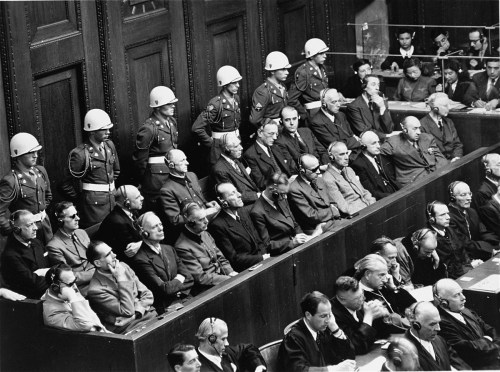
In conspiracy we do not punish one man for another man’s crime. We seek to punish each for his own crime of joining a common criminal plan in which others also participated. The measure of the criminality of the plan and therefore of the guilt of each participant is, of course, the sum total of crimes committed by all in executing the plan. But the gist of the offence is participation in the formulation or execution of the plan. These are rules which every society has found necessary in order to reach men, like these defendants, who never get blood on their own hands but who lay plans that result in the shedding of blood. All over Germany today, in every zone of occupation, little men who carried out these criminal policies under orders are being convicted and punished. It would present a vast and unforgivable caricature of justice if the men who planned these policies and directed these little men should escape all penalty.

These men in this dock, on the face of this record, were not strangers to this programme of crime, nor was their connection with it remote or obscure. We find them in the very heart of it. The positions they held show that we have chosen defendants of self-evident responsibility. They are the very highest surviving authorities in their respective fields and in the Nazi State. No one lives who, at least until the very last moments of the war, outranked Goering in position, power, and influence. No soldier stood above Keitel and Jodl, and no sailor above Raeder and Donitz. Who can be responsible for the double-faced diplomacy if not the Foreign Ministers, von Neurath and Ribbentrop, and the diplomatic handyman, von Papen? Who should be answerable for the oppressive administration of occupied countries if Gauleiter, Protectors, Governors and Commissars such as Frank, Seyss-Inquart, Frick, von Schirach, von Neurath, and Rosenberg are not? Where shall we look for those who mobilised the economy for total war if we overlook Schacht and Speer and Funk? Who was the master of the great slaving enterprise if it was not Sauckel? Where shall we find the hand that ran the concentration camps if it was not the hand of Kaltenbrunner? Who whipped up the hates and fears of the public, and manipulated the Party organizations to incite these crimes, if not Hess, von Schirach, Fritzsche, Bormann and the unspeakable Julius Streicher? The list of defendants is made up of men who played indispensable and reciprocal parts in this tragedy. The photographs and the films show them again and again together on important occasions. The documents show them agreed on policies and on methods, and all working aggressively for the expansion of Germany by force of arms.

Hermann Goering

Each of these men made a real contribution to the Nazi plan. Each man had a key part. Deprive the Nazi regime of the functions performed by a Schacht, a Sauckel, a von Papen, or a Goering, and you have a different regime. Look down the rows of fallen men and picture them as the photographic and documentary evidence shows them to have been in their days of power. Is there one who did not substantially advance the conspiracy along its bloody path towards its bloody goal? Can we assume that the great effort of these men’s lives was directed towards ends they never suspected?

To escape the implications of their positions and the inference of guilt from their activities, the defendants are almost unanimous in one defence. The refrain is heard time and again: these men were without authority, without knowledge, without influence, without importance. Funk summed up the general self-abasement of the dock in his plaintive lament that:

“I always, so to speak, came up to the door. But I was not permitted to enter.”

In the testimony of each defendant, at some point there was reached the familiar blank wall: nobody knew anything about what was going on. Time after time we have heard the chorus from the dock:

“I only heard about these things here for the first time.”

These men saw no evil, spoke none, and none was uttered in their presence. This claim might sound very plausible if made by one defendant. But when we put all their stories together, the impression which emerges of the Third Reich, which was to last a thousand years, is ludicrous. If we combine only the stories of the front bench, this is the ridiculous composite picture of Hitler’s Government that emerges. It was composed of:

A No. 2 man who knew nothing of the excesses of the Gestapo which he created, and never suspected the Jewish extermination programme although he was the signer of over a score of decrees which instituted the persecution of that race;

A No. 3 man who was merely an innocent middleman transmitting Hitler’s orders without even reading them, like a postman or delivery boy;

A Foreign Minister who knew little of foreign affairs and nothing of foreign policy;

A Field-Marshal who issued orders to the armed forces but had no idea of the results they would have in practice;

A Security Chief who was of the impression that the policing functions of his Gestapo and SD were somewhat on the lines of directing traffic;

A Party philosopher who was interested in historical research, and had no idea of the violence which his philosophy was inciting in the twentieth century;

A Governor-General of Poland who reigned but did not rule;

A Gauleiter of Franconia whose occupation was to pour forth filthy writings about the Jews, but who had no idea that anybody would read them;

A Minister of the Interior who knew not even what went on in the interior of his own office, much less the interior of his own department, and nothing at all about the interior of Germany;

A Reichsbank President who was totally ignorant of what went in and out of the vaults of his bank;

A Plenipotentiary for the War Economy who secretly marshalled the entire economy for armament, but had no idea it had anything to do with war.

This may seem like a fantastic exaggeration, but this is what you would actually be obliged to conclude if you were to acquit these defendants.

They do protest too much. They deny knowing what was common knowledge. They deny knowing plans and programmes that were as public as Mein Kampf and the Party programme.

They deny even knowing the contents of documents which they received and acted upon. Nearly all the defendants take two or more conflicting positions. Let us illustrate the inconsistencies of their positions by the record of one defendant -who, if pressed, would himself concede that he is the most intelligent, honourable and innocent man in the dock. That is Schacht. And this is the effect of his own testimony -but let us not forget that I recite it not against him alone, but because most of its self-contradictions are found in the testimony of several defendants.

Schacht did not openly join the Nazi movement until it had won, nor openly desert it until it had lost. He admits that he never gave it public opposition, but asserts that he never gave it private loyalty. When we demand of him why he did not stop the criminal course of the regime in which he was a Minister, he says he had not a bit of influence. When we ask why he remained a member of the criminal regime, he tells us that by sticking on he expected to moderate its programme. Like a Brahmin among Untouchables, he could not bear to mingle with the Nazis socially, but never could he afford to separate from them politically. Of all the Nazi aggressions by which he now claims to have been shocked, there is not one that he did not support before the world with the weight of his name and prestige. Having armed Hitler to blackmail a continent, his answer now is to blame England and France for yielding. Schacht always fought for his position in a regime he now affects to despise. He sometimes disagreed with his Nazi confederates about what was expedient in reaching their goal, but he never dissented from the goal itself. When he did break with them in the twilight of the regime, it was over tactics, not principles. From then on he never ceased to urge others to risk their positions and their necks to forward his plots, but never on any occasion did he hazard either of his own. He now boasts that he personally would have shot Hitler if he had had the opportunity, but the German newsreel shows that even after the fall of France, when he faced the living Hitler, he stepped out of line to grasp the hand he now claims to loathe and hung upon the words of the man he now says he thought unworthy of belief. Schacht says he steadily “sabotaged” the Hitler Government. Yet the most relentless secret service in the world never detected him doing the regime any harm until long after, he knew the war to be lost and the Nazis doomed. Schacht, who dealt in “hedges” all his life, always kept himself in a position to claim that he was in either camp. The plea for him is as specious on analysis as it is persuasive on first sight. Schacht represents the most dangerous and reprehensible type of opportunism -that of the man of influential position who is ready to join a movement that he knows to be wrong because he thinks it is winning.

These defendants, unable to deny that they were the men in the very highest ranks of power, and unable to deny that the crimes I have outlined actually happened, know that their own denials are incredible unless they can suggest someone who is guilty.

The defendants have been unanimous, when pressed, in shifting the blame on other men, sometimes on one and sometimes on another. But the names they have repeatedly picked are Hitler, Himmler, Heydrich, Goebbels and Bormann. All of these are dead or missing. No matter how hard we have pressed the defendants on the stand, they have never pointed the finger at a living man as guilty. It is a temptation to ponder the wondrous workings of a fate which has left only the guilty dead and only the innocent alive. It is almost too remarkable.

The chief villain on whom blame is placed -some of the defendants vie with each other in producing appropriate epithets -is Hitler. He is the man at whom nearly every defendant has pointed an accusing finger.

I shall not dissent from this consensus, nor do I deny that all these dead and missing men shared the guilt. In crimes so reprehensible that degrees of guilt have lost their significance they may have played the most evil parts. But their guilt cannot exculpate the defendants. Hitler did not carry all responsibility to the grave with him. All the guilt is not wrapped in Himmler’s shroud. It was these dead men whom these living chose to be their partners in this great conspiratorial brotherhood, and the crimes that they did together they must pay for one by one.

It may well be said that Hitler’s final crime was against the land he had ruled. He was a mad “messiah” who started the war without cause and prolonged it without reason. If he could not rule he cared not what happened to Germany. As Fritzsche has told us from the stand, Hitler tried to use the defeat of Germany for the self-destruction of the German people. He continued the fight when he knew it could not be won, and continuance meant only ruin.

Speer, in this courtroom, has described it as follows:

“… The sacrifices which were made on both sides after January, 1945, were senseless. The dead of this period will be the accusers of the man responsible for the continuation of that fight, Adolf Hitler, and the ruined cities which in this last phase lost tremendous cultural values and in which a colossal number of dwellings were destroyed …. The German people remained faithful to Adolf Hitler until the end. He betrayed them knowingly. He finally tried to throw them into the abyss ….”

Hitler ordered everyone else to fight to the last and then retreated into death by his own hand. But he left life as he lived it, a deceiver; he left the official report that he had died in battle. This was the man whom these defendants exalted to a Fuehrer. It was they who conspired to get him absolute authority over all of Germany. And in the end he and the system they had created for him brought the ruin of them all. As stated by Speer in cross-examination:

“… the tremendous danger of the totalitarian system, however, only became really clear at the moment when we were approaching the end. It was then that one could see what the principle really meant, namely, that every order should be carried out without criticism. Everything that has become known during this trial, especially with regard to orders which were carried out without any consideration, has proved how evil it .was in the end…. Quite apart from the personality of Hitler, on the collapse of the totalitarian system in Germany it became clear what tremendous dangers there are in a system of that kind. The combination of Hitler and this system has brought about these tremendous catastrophes in the world.”

But let me for a moment turn devil’s advocate. I admit that Hitler was the chief villain. But for the defendants to put all blame on him is neither manly nor true. We know that even the head of the State has the same limits to his senses and to the hours of his days as do lesser men. He must rely on others to be his eyes and ears as to most that goes on in a great empire. Other legs must run his errands; other hands must execute his plans.

On whom did Hitler rely for such things more than upon these men in the dock? Who led him to believe he had an invincible air armada if not Goering? Who kept disagreeable facts from him? Did not Goering forbid Field-Marshal Milch to warn Hitler that in his opinion Germany was not equal to the war upon Russia? Did not Goering, according to Speer, relieve General Galland of his air force command for speaking of the weaknesses and bungling of the air force? Who led Hitler, utterly untravelled himself, to believe in the indecision and timidity of democratic peoples if not Ribbentrop, von Neurath, and von Papen? Who fed his illusion of German invincibility if not Keitel, Jodl, Raeder, and Donitz? Who kept his hatred of the Jews inflamed more than Streicher and Rosenberg? Who would Hitler say deceived him about conditions in concentration camps if not Kaltenbrunner, even as he would deceive us? These men had access to Hitler and often could control the information that reached him and on which he must base his policy and his orders. They were the Praetorian Guard, and while they were under Caesar’s orders, Caesar was always in their hands.

If these dead men could take the witness stand and answer what has been said against them, we might have a less distorted picture of the parts played by these defendants. Imagine the stir that would occur in the dock if it should behold Adolf Hitler advancing to the witness box, or Himmler with an armful of dossiers, or Goebbels, or Bormann with the reports of his Party spies, or the murdered Roehm or Canaris. The ghoulish defence that the world is entitled to retribution only from the cadavers is an argument worthy of the crimes at which it is directed.

We have presented to this Tribunal an affirmative case based on incriminating documents which are sufficient, if unexplained, to require a finding of guilt on Count One against each defendant. In the final analysis, the only question is whether the defendants’ own testimony is to be credited as against the documents and other evidence of their guilt. What, then, is their testimony worth?

The fact is that the Nazi habit of economising in the use of truth pulls the foundations out from under their own defences. Lying has always been a highly approved Nazi technique. Hitler, in Mein Kampf, advocated mendacity as a policy. Von Ribbentrop admits the use of the “diplomatic lie”. Keitel advised that the facts of rearmament be kept secret so that they could be denied at Geneva. Raeder deceived about rebuilding the German Navy in violation of Versailles. Goering urged Ribbentrop to tell a “legal lie” to the British Foreign Office about the Anschluss, and in so doing only marshalled him the way he was going. Goering gave his word of honour to the Czechs and proceeded to break it. Even Speer proposed to deceive the French into revealing the specially trained among their prisoners.
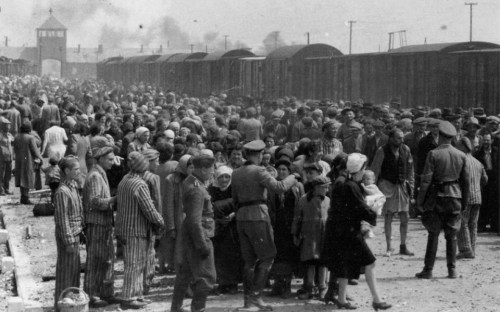
Nor is the lie direct the only means of falsehood. They all speak with a Nazi double meaning with which to deceive the unwary. In the Nazi dictionary of sardonic euphemisms “Final solution” of the Jewish problem was a phrase which meant extermination; “Special treatment” of prisoners of war meant killing; “Protective custody” meant concentration camp; “Duty labour” meant slave labour; and an order to “take a firm attitude” or “take positive measures” meant to act with unrestrained savagery. Before we accept their word at what seems to be its face value, we must always look for hidden meanings. Goering assured us, on his oath, that the Reich Defence Council never met “as such”. When we produced the stenographic minutes of a meeting at which he presided and did most of the talking, he reminded us of the “as such” and explained this was not a meeting of the Council “as such” because other persons were present. Goering denies “threatening” Czechoslovakia. He only told President Hacha that he would “hate to bomb the beautiful city of Prague”.

Besides outright false statements and those with double meanings, there are also other circumventions of truth in the nature of fantastic explanations and absurd professions. Streicher has solemnly maintained that his only thought with respect to the Jews was to resettle them on the island of Madagascar. His reason for destroying synagogues, he blandly said, was only because they were architecturally offensive. Rosenberg was stated by his counsel to have always had in mind a “chivalrous solution” to the Jewish problem. When it was necessary to remove Schuschnigg after the Anschluss, Ribbentrop would have had us believe that the Austrian Chancellor was resting at a “villa”. It was left to cross-examination to reveal that the “villa” was Buchenwald concentration camp. The record is full of other examples of dissimulations and evasions. Even Schacht showed that he, too, had adopted the Nazi attitude that truth is any story which succeeds. Confronted on cross-examination with a long record of broken vows and false words, he declared in justification -and I quote from the record:

“I think you can score many more successes when you want to lead someone if you don’t tell them the truth than if you tell them the truth.”

This was the philosophy of the National Socialists. When for years they have deceived the world, and masked falsehood with plausibilities, can anyone be surprised that they continue that habit of a lifetime in this dock? Credibility is one of the main issues of this trial. Only those who have failed to learn the bitter lessons of the last decade can doubt that men who have always played on the unsuspecting credulity of generous opponents would not hesitate to do the same now.

It is against such a background that these defendants now ask this Tribunal to say that they are not guilty of planning, executing, or conspiring to commit this long list of crimes and wrongs. They stand before the record of this trial as bloodstained Gloucester stood by the body of his slain King. He begged of the widow, as they beg of you: “Say I slew them not.” And the Queen replied, “Then say they were not slain. But dead they are ….” If you were to say of these men that they are not guilty, it would be as true to say that there has been no war, there are no slain, there has been no crime.”


2 Comments

Filed under crime, ethics, Foreign Policy, germany, History, holocaust, laws and legislation, leadership, Military, nazi germany, News and current events, Political Commentary, war crimes, world war two in europe

When Militaries Become Accessories and Instruments of War Crimes: Robert Jackson’s Closing Argument at Nuremberg for Our Time

Friends of Padre Steve’s World,

Tonight I am continuing on with my series on Supreme Court Justice Robert Jackson’s closing arguments while serving as the Chief American Prosecutor at the Major War Crimes Trials at Nuremberg. These crimes are not without relevance today, thus it is important for us to revisit them, for as I noted yesterday, quoting Yehuda Bauer, the Holocaust did not deviate from human norms.

For me it is a difficult subject, for I served in and supported a war that by any standard of legal and moral judgement would have met the criteria that we prosecuted the Nazis for in 1945. I should have known better because I had studied the Nazi crimes and had been the student of a professor who served as an interrogator and interpreter during the Nuremberg War Crimes Trials. But in the moment of hysteria after the attacks of September 11th 2001 and my belief in the integrity of Secretary of State Colin Powell, I allowed my good sense to be persuaded that an act of aggressive war that resulted in war crimes, and might even include crimes against humanity was perfectly legal.

I went to Iraq in 2007 and 2008. I worked with advisors to Iraqi Army, Border Troops, Police, Port of Entry, and Provincial Reconstruction Teams In Al Anbar Province. I came back from Iraq a very different man. I saw the lies. I came to love and appreciate the Iraqis and what they had suffered under both Saddam Hussein and our invasion and occupation. I can still see the maimed bodies, the destroyed cities and hamlets, the crippled children, as well as the wounded Marines in my mind. I pray and hope that the Iraqis that I served alongside did not become victims of ISIS after I left the country.

I am haunted by it to this day, and I no longer trust the supposedly good intentions of the American government, and in the age of Donald Trump fear for our nation and the world. A year ago the American Border Patrol fired CS gas, a riot control agent that is banned for use in combat across the international border into Mexico at unarmed Central American refugees, many of whom were women and children. The reason was that they “felt endangered” because some in the sea of refugees threw rocks across the border at the border control officers, who were dressed in body armor and Kevlar helmets with face masks. Rocks were going to do nothing to them.

While this was not war, there is a principle and law of war that American law enforcement officers frequently violate, the principle of proportionality. I’m sorry, but firing CA gas at unarmed refugees on the opposite side of the border for throwing rocks is not proportional. They had not breached the border and were also facing Mexican Federal Police. I have to wonder what is next. After that President Trump says that he has authorized U. S. Military personnel to use deadly force against rock throwers, and his former Chief of Staff, retired Marine Corps General John Kelly issued a “cabinet order” something never heard of before, allowing U. S. Military personnel to engage refugees believed to be endangering Border Control agents, in what appears to be a direct violation of Posse Comitatus. Add to those issues the use of drone strikes, by the Bush, Obama, and Trump Administrations, both DOD and CIA, against often insignificant targets that that more often than not have many women and children in them, and finally the pardoning of convicted war criminals by President Trump, and firing the only administration who stood in his way, Secretary of the Navy Richard Spencer.

But I digress. When I read these accounts my mind is taken back to the subject of war crimes, and based on my expertise and study of the crimes of the Nazis, not to mention the Japanese in the Second World War, I automatically default to those settings.

So, I will stop with my words and go back to those of Robert Jackson at Nuremberg, because they are so pertinent today.

Until tomorrow,

Peace,

Padre Steve+

Immediately after the seizure of power the Nazis went to work to implement these aggressive intentions by preparing for war. They first enlisted German industrialists in a secret rearmament programme. Twenty days after the seizure of power Schacht was host to Hitler, Goering and some twenty leading industrialists. Among them were Krupp von Bohlen of the great Krupp armament works and representatives of I. G. Farben and other Ruhr heavy industries. Hitler and Goering explained their programme to the industrialists, who became so enthusiastic that they set about to raise three million Reichsmarks to strengthen and confirm the Nazi Party in power. Two months later Krupp was working to bring a reorganised association of German industry into agreement with the political aims of the Nazi Government. Krupp later boasted of the success in keeping the German war industries secretly alive and in readiness despite the disarmament clauses of the Versailles Treaty, and recalled the industrialists’ enthusiastic acceptance of “the great intentions of the Fuehrer in the rearmament period of 1933-1939”.

Some two months after Schacht had sponsored his first meeting to gain the support of the industrialists, the Nazis moved to harness industrial labour to their aggressive plans. In April, 1933, Hitler ordered Dr. Ley “to take over the trade unions”, numbering some 6 million members. By Party directive Ley seized the unions, their property and their funds. Union leaders, taken into “protective custody” by the SS and SA, were put into concentration camps. The free labour unions were then replaced by a Nazi organization known as the German Labour Front, with Dr. Ley at its head. It was expanded until it controlled over 23 million members. Collective bargaining was eliminated, the voice of labour could no longer be heard as to working conditions, and the labour contract was prescribed by “trustees of labour” appointed by Hitler. The war purpose of this labour programme was clearly acknowledged by Robert Ley five days after war broke out, when he declared in a speech that:

“We National Socialists have monopolised all resources and all our energies during the past seven years so as to be able to be equipped for the supreme effort of battle.”

The Nazis also proceeded at once to adapt the Government to the needs of war. In April, 1933, the Cabinet formed a Defence Council, the working committee of which met frequently thereafter. In the meeting of 22nd May, 1933, at which defendant Keitel presided, the members were instructed that:

“No document must be lost since otherwise the enemy propaganda would make use of it. Matters communicated orally cannot be proven; they can be denied by us in Geneva.”

In February, 1934 -and, your Honours, dates in this connection are important -with defendant Jodl present, the Council planned a mobilization calendar and mobilization order for some 240,000 industrial plants. Again it was agreed that nothing should be in writing so that “the military purpose may not be traceable”.

On 21st May, 1935, the top secret Reich Defence Law was enacted. Defendant Schacht was appointed Plenipotentiary General for War Economy with the task of secretly preparing all economic forces for war and, in the event of mobilization, of financing the war.

Schacht’s secret efforts were supplemented

in October, 1936, by the appointment of defendant Goering as Commissioner of the Four-Year Plan, with the duty of putting the entire economy in a state of readiness for war within four years.

A secret programme for the accumulation of the raw materials and foreign credits necessary for extensive rearmament was also set on foot immediately upon seizure of power. In September of 1934, the Minister of Economics was already complaining that:

“The task of stock-piling is being hampered by the lack of foreign currency; the need for secrecy and camouflage also is a retarding influence.”

Foreign currency controls were at once established. Financing was delegated to the wizard Schacht, who conjured up the MEFO bill to serve the dual objectives of tapping the short-term money market for rearmament purposes while concealing the amount of these expenditures.

The spirit of the whole Nazi administration was summed up by Goering at a meeting of the Council of Ministers, which included Schacht, on 27th May, 1936, when he said: “All measures are to be considered from the standpoint of an assured waging of war.” The General Staff, of course, also had to be enlisted in the war plan. Most of the generals, attracted by the prospect of rebuilding their armies, became willing accomplices. The Minister of War von Blomberg and the Chief of Staff General von Fritsch, however, were not cordial to the increasingly belligerent policy of the Hitler regime, and by vicious and obscene plotting they were discredited and removed in January, 1938. Thereupon, Hitler assumed for himself supreme command of the armed forces and the positions of von Blomberg and of von Fritsch were filled by others who became, as Blomberg said of Keitel, “a willing tool in Hitler’s hands for every one of his decisions”. The generals did not confine their participation to merely military matters. They participated in all major diplomatic and political manoeuvres, such as the Obersalzberg meeting where Hitler, flanked by Keitel and other top generals, issued his virtual ultimatum to Schuschnigg.

As early as 5th November, 1937, the plan to attack had begun to take definiteness as to time and victim. In a meeting which included the defendants Raeder, Goering and von Neurath, Hitler stated the cynical objective:

“The question for Germany is where the greatest possible conquest could be made at the lowest possible cost.”

He discussed various plans for the invasion of Austria and Czechoslovakia, indicating clearly that he was thinking of these territories not as ends in themselves, but as means for further conquest. He pointed out that considerable military and political assistance could be afforded by possession of these lands, and discussed the possibility of constituting from them new armies up to a strength of about 12 divisions. The aim he stated boldly and baldly as the acquisition of additional living-space in Europe, and recognized that “The German question can be solved only by way of force.” Six months later, emboldened by the bloodless Austrian conquest, Hitler, in a secret directive to Keitel, stated his “unalterable decision to smash Czechoslovakia by military action in the near future”.

On the same day, Jodl noted in his diary that the Fuehrer had stated his final decision to destroy Czechoslovakia soon and had initiated military preparations all along the line. By April the plan had been perfected to attack Czechoslovakia “with lightning swift action as the result of an ‘incident’”.

All along the line preparations became more definite for a war of expansion, on the assumption that it would result in a world-wide conflict. In September, 1938, Admiral Carls officially commented on a “Draft Study of Naval Warfare against England”:

“There is full agreement with the main theme of the study.

1. If, according to the Fuehrer’s decision, Germany is to acquire a position as a world power, she needs not only sufficient colonial possessions but also secure naval communications and secure access to the ocean.

2. Both requirements can only be fulfilled in opposition to Anglo-French interests and will limit their positions as world powers. It is unlikely that they can be achieved by peaceful means. The decision to make Germany a world power therefore forces upon us the necessity of making the corresponding preparations for war.

3. War against England means at the same time war against the Empire, against France, probably against Russia as well, and a large number of countries overseas; in fact, against one-third to one-half of the whole world.

It can only be justified and have a chance of success if it is prepared economically as well as politically and militarily and waged with the aim of conquering for Germany an outlet to the ocean.”

This Tribunal knows what categorical assurances were given to an alarmed world after the Anschluss, after Munich, after the occupation of Bohemia and Moravia, that German ambitions were realised and that Hitler had “no further territorial demands to make in Europe.” The record of this trial shows that those promises were calculated deceptions and that those high in the bloody brotherhood of Nazidom knew it.

As early as 15th April, 1938, Goering pointed out to Mussolini and Ciano that the possession of those territories would make possible an attack on Poland. Ribbentrop’s Ministry wrote on 26th August, 1938:

“After the liquidation of the Czechoslovakian question, it will be generally assumed that Poland will be next in turn.”

Hitler, after the Polish invasion, boasted that it was the Austrian and Czechoslovakian triumphs by which “the basis for the action against Poland was laid”. Goering suited the act to the purpose and gave immediate instructions to exploit, for the further strengthening of the German war potential, first the Sudetenland, and then the whole Protectorate.

By May of 1939 the Nazi preparations had ripened to the point that Hitler confided to the defendants Goering, Raeder, Keitel, and others, his readiness “to attack Poland at the first suitable opportunity”, even though he recognized that “further successes cannot be attained without the shedding of blood”. The larcenous motives behind this decision he made plain in words that echoed the covetous theme of Mein Kampf:

“Circumstances must be adapted to aims. This is impossible without invasion of foreign States or attacks upon foreign property. Living-space in proportion to the magnitude of the State is the basis of all power -further successes cannot be attained without expanding our living-space in the East ….”

While a credulous world slumbered, snugly blanketed with perfidious assurances of peaceful intentions, the Nazis prepared not as before for a war but now for the war. The defendants Goering, Keitel, Raeder, Frick and Funk, with others, met as the Reich Defence Council in June of 1939. The minutes, authenticated by Goering, are revealing evidence of the way in which each step of Nazi planning dovetailed with every other. These five key defendants, three months before the first panzer unit had knifed into Poland, were laying plans for “employment of the population in wartime”, and had gone so far as to classify industry for priority in labour supply after “five million servicemen had been called up”. They decided upon measures to avoid “confusion when mobilization takes place”, and declared a purpose “to gain and maintain the lead in the decisive initial weeks of war”. They then planned to use in production prisoners of war, criminal prisoners, and concentration camp inmates. They then decided on “compulsory work for women in war time”. They had already passed on applications from 1,172,000 specialist workmen for classification as indispensable, and had approved 727,000 of them. They boasted that orders to workers to report for duty “are ready and tied up in bundles at the labour offices”. And they resolved to increase the industrial manpower supply by bringing into Germany “hundreds of thousands of workers” from the Protectorate to be “housed together in hutments”.

It is the minutes of this significant conclave of many key defendants which disclose how the plan to start the war was coupled with the plan to wage the war through the use of illegal sources of labour to maintain production. Hitler, in announcing his plan to attack Poland, had already foreshadowed the slave labour programme as one of its corollaries when he cryptically pointed out to the defendants Goering, Raeder, Keitel, and others that the Polish population “will be available as a source of labour”. This was part of the plan made good by Frank, who as Governor-General notified Goering, that he would supply “at least one million male and female agricultural and industrial workers to the Reich”, and by Sauckel, whose impressments throughout occupied territory aggregated numbers equal to the total population of some of the smaller nations of Europe.

Here also comes to the surface the link between war labour and concentration camps, a manpower source that was increasingly used and with increasing cruelty. An agreement between Himmler and the Minister of Justice, Thierack, in 1942 provided for “the delivery of anti-social elements from the execution of their sentence to the Reichsfuehrer SS to be worked to death”. An SS directive provided that bedridden prisoners be drafted for work to be performed in bed. The Gestapo ordered 46,000 Jews arrested to increase the “recruitment of manpower into the concentration camps”. One hundred thousand Jews were brought from Hungary to augment the camps’ manpower. On the initiative of the defendant Donitz concentration camp labour was used in the construction of submarines. Concentration camps were thus geared into war production on the one hand, and into the administration of justice and the political aims of the Nazis on the other. The use of prisoner-of-war labour, as then planned in that meeting, also grew with German needs. At a time when every German soldier was needed at the front and forces were not available at home, Russian prisoners of war were forced to man anti-aircraft guns against Allied planes. Field-Marshal Milch reflected the Nazi merriment at this flagrant violation of International Law, saying: “… This is an amusing thing, that the Russians must work the guns.”

The orders for the treatment of Soviet prisoners of war were so ruthless that Admiral Canaris, pointing out that they would “result in arbitrary mistreatments and killing”, protested to the OKW against them as breaches of International Law. The reply of Keitel was unambiguous. He said:

“The objections arise from the military conception of chivalrous warfare! This is the destruction of an ideology! Therefore I approve and back the measures”.

The Geneva Convention would have been thrown overboard openly, except that Jodl objected because he wanted the benefits of Allied observance of it while it was not being allowed to hamper the Germans in any way.

Field Marshal Wilhelm Keitel

Other crimes in the conduct of warfare were planned with equal thoroughness as a means of ensuring victory of German arms: In October, 1938, almost a year before the start of the war, the large-scale violation of the established rules of warfare was contemplated as a policy, and the Supreme Command circulated a most secret list of devious explanations to be given by the Propaganda Minister in such cases. Even before this time commanders of the armed forces were instructed to employ any methods of warfare so long as they facilitated victory. During the progress of the war the orders increased in savagery. A typical Keitel order, demanding the use of the “most brutal means”, provided that .

“… It is the duty of the troops to use all means without restriction, even against women and children, so long as they ensure success.”

The German naval forces were no more immune from the infection than the land forces. Raeder ordered violations of the accepted rules of warfare wherever necessary to gain strategic successes. Donitz urged his submarine crews not to rescue survivors of torpedoed enemy ships, in order to cripple merchant shipping of the Allied Nations by decimating their crews.

Thus, the WAR CRIMES against Allied forces and the CRIMES AGAINST HUMANITY committed in occupied territories are incontestably part of the programme for making the war because, in the German calculations, they were indispensable to its hope of success.

Similarly, the whole group of pre-war crimes, including the persecutions within Germany, fall into place around the plan for aggressive war like stones in a finely wrought mosaic. Nowhere is the whole catalogue of crimes of Nazi oppression and terrorism within Germany so well integrated with the crime of war as in that strange mixture of wind and wisdom which makes up the testimony of Hermann Goering. In describing the aims of the Nazi programme before the seizure of power, Goering stated that the first question was to achieve and establish a different political structure for Germany, which would enable Germany to object against the Dictate (of Versailles), and to make not only a protest, but an objection of such a nature that it would actually be considered.

With these purposes, Goering, admitted that the plan was made to overthrow the Weimar Republic, to seize power, and to carry out the Nazi programme by whatever means were necessary, whether legal or illegal.

From Goering’s cross-examination we learn how necessarily the whole programme of crime followed. Because they considered a strong State necessary to get rid of the Versailles Treaty, they adopted the Fuehrerprinzip. Having seized power, the Nazis thought it necessary to protect it by abolishing parliamentary government, and suppressing all organized opposition from political parties. This was reflected in the philosophy of Goering that the opera was more important than the Reichstag. Even the “opposition of each individual was not tolerated unless it was a matter of unimportance”. To insure the suppression of opposition a secret police force was necessary. In order to eliminate incorrigible opponents, it was necessary to establish concentration camps and to resort to the device of protective custody. Protective custody, Goering, testified, meant that:

“People were arrested arid taken into protective custody who had not yet committed any crime but who could be expected to do so if they remained free.”

The same war purpose was dominant in the persecution of the Jews. In the beginning, fanaticism and political opportunism played a principal part, for anti-Semitism and its allied scapegoat, mythology, were the vehicle on which the Nazis rode to power. It was for this reason that the filthy Streicher and the blasphemous Rosenberg were welcomed at Party rallies and made leaders and officials of the State or Party. But the Nazis soon regarded the Jews as foremost amongst the opposition to the police State with which they schemed to put forward their plans of military aggression. Fear of their pacifism and their opposition to strident nationalism was given as the reason that the Jews had to be driven from the political and economic life of Germany. Accordingly, they were transported like cattle to the concentration camps, where they were utilised as a source of forced labour for war purposes.

At a meeting held on 12th November, 1938, two days after the violent anti-Jewish pogroms instigated by Goebbels and carried out by the Party Leadership Corps and the SA, the programme for the elimination of Jews from the German economy was mapped out by Goering, Funk, Heydrich, Goebbels, and the other top Nazis. The measures adopted included confinement of the Jews in ghettoes, cutting off their food supply, “aryanizing” their shops, and restricting their freedom of movement. Here another purpose behind the Jewish persecutions crept in, for it was the wholesale confiscation of their property which helped to finance German rearmament. Although Schacht’s plan to use foreign money to ransom the entire race within Germany was not adopted, the Jews were stripped to the point where Goering was able to advise the Reich Defence Council that the critical situation of the Reich exchequer, due to rearmament, had been relieved “through the billion Reichsmark fine imposed on Jewry, and through profits accrued to the Reich in the aryanization of Jewish enterprises”.

A glance over the dock will show that, despite quarrels among themselves, each defendant played a part which fitted in with every other, and that all advanced the Common Plan. It contradicts experience that men of such diverse backgrounds and talents should so forward each other’s aims by coincidence. The large and varied role of Goering was half militarist and half gangster. He stuck his pudgy finger in every pie. He used his SA bullies to help bring the gang into power. In order to entrench that power he contrived to have the Reichstag burned, established the Gestapo, and created the concentration camps. He was equally adept at massacring opponents and at framing scandals to get rid of stubborn generals. He built up the Luftwaffe and hurled it at his defenceless neighbours. He was among the foremost in harrying Jews out of the land. By mobilising the total economic resources of Germany he made possible the waging of the war which he had taken a large part in planning. He was, next to Hitler, the man who tied the activities of all the defendants together in a common effort.

The parts played by the other, defendants, although less comprehensive and less spectacular than that of the Reichsmarschall, were nevertheless integral and necessary contributions to the joint undertaking, without any one of which the success of the common enterprise would have been in jeopardy. There are many specific deeds of which these men have been proven guilty. No purpose would be served -nor indeed is time available -to review all the crimes which the evidence has charged against their names. Nevertheless, in viewing the conspiracy as a whole and as an operating mechanism, it may be well to recall briefly the outstanding services which each of the men in the dock rendered to the common cause.

To be continued…

1 Comment

Filed under crime, ethics, Foreign Policy, germany, History, holocaust, laws and legislation, Military, national security, nazi germany, News and current events, Political Commentary, War on Terrorism, world war two in europe

The Holocaust Can Happen Again “Because it Deviated Not from Human Norms”

Friends of Padre Steve’s World,

The crimes of Adolf Hitler’s Nazi regime may seem like the happened a long time ago in a galaxy far, far away, we would all like to believe that. However, they are only as far away as the next time. That is why we must continue to show them in their awful reality. Yehuda Bauer, a historian of the Holocaust whose family escaped from Czechoslovakia the day it was annexed by the Third Reich wrote:

“The horror of the Holocaust is not that it deviated from human norms; the horror is that it didn’t. What happened may happen again, to others not necessarily Jews, perpetrated by others, not necessarily Germans. We are all possible victims, possible perpetrators, possible bystanders.”

This is an eternal truth. The Red Chinese in Tibet, the Cambodian Killing Fields, the Serbians massacring Bosnians under the noses of Dutch Peacekeepers in Srebrenica, the Tutsis of Rwanda butchered by their Hutu neighbors shortly after Easter, as well as the crimes of the Islamic State against Kurds, opposition Sunnis, Shia, Yazidis, and Christians in Iraq and Syria.

Besides genocide we can add the crime of aggressive war against weaker neighbors or nations committed Russia in Georgia and the Ukraine, and the United States against Iraq. Then there is the assault on minority groups within various nations, the rejection of refugees, and rise in anti-Semitism across Russia, Europe, and the United States have all produced myriads of victims, perpetrators, and bystanders.

The crimes committed by the Nazis against their own citizens and the nations that they victimized are not completely unique to them. While the Nazi Genocide committed against the Jews is unique, what motivated them is far more common than we would want to admit. The Holocaust and the Nazi war for Lebensraum is not an aberration from the norms of human nature, it is the norm. That is why continuing to expose those crimes, the men and women behind them, and those who stood by, doing nothing while their neighbors were being marched away, or stood by as other men marched men, women, and children to massive pits and shot them one by one, up close and personal, by the tens of thousands.

I would like with all my heart to consign the crimes of the Nazis to the depths of history, but I cannot. It is beginning to happen again before our very eyes, the American President is pardoning convicted war criminals, rescinding American participation in international treaties, agreements, and organizations, as well as conducting anti-immigration operations, in violation of our own and international law that Jackson would have classed as crimes against humanity. That is why I, a man born thirteen and a half years after the major Nuremberg War Crimes ended with ten of the defendants hanging from the gallows continue to write about it. If we are not careful, it can and will happen again.

Over the past week I have been writing about the Nuremberg Trials and the American Chief Prosecutor, Supreme Court Justice Robert Jackson. Last night I wrote about the introduction of his closing arguments before the Tribunal which followed his opening address by nine months. I now continue with Justice Jackson’s closing arguments against the Nazi war criminals sitting in the dock of Nuremberg’s Palace of Justice.

So until tomorrow, I leave you with Jackson’s words. By the way, have a Happy Thanksgiving.

Peace,

Padre Steve+

THE CRIMES OF THE NAZI REGIME

The strength of the case against these defendants under the conspiracy count, which it is the duty of the United States to argue, lies in its simplicity. It involves but three ultimate inquiries: First, have the acts defined by the Charter as crimes been committed; second, were they committed pursuant to a common plan or conspiracy; third, are these defendants among those who are criminally responsible? The charge requires examination of a criminal policy, not of a multitude of isolated, unplanned, or disputed crimes. The substantive crimes upon which we rely, either as goals of a common plan or as means for its accomplishment, are admitted. The pillars which uphold the conspiracy charge may be found in five groups of overt acts, whose character and magnitude are important considerations in appraising the proof of conspiracy.

1. THE SEIZURE OF POWER AND SUBJUGATION OF GERMANY TO A POLICE STATE The Nazi Party seized control of the German State in 1933. “Seizure of power” is a characterisation used by defendants and defence witnesses, and so apt that it has passed into both history and everyday speech. The Nazi junta in the early days lived in constant fear of overthrow. Goering, in 1934, pointed out that its enemies were legion, and said:

“Therefore, the concentration camps have been created, where we have first confined thousands of Communists and Social Democrat functionaries.”

In 1933 Goering forecast the whole programme of purposeful cruelty and oppression when he publicly announced:

“Whoever in the future raises a hand against a representative of the National Socialist movement or of the State must know that he will lose his life in a very short while.”

New political crimes were created to this end. It was made a treason, punishable with death, to organize or support a political party other than the Nazi Party. Circulating a false or exaggerated statement, or one which would harm the State or even the Party, was made a crime. Laws were enacted of such ambiguity that they could be used to punish almost any innocent act. It was, for example, made a crime to provoke “any act contrary to the public welfare”.

The doctrine of punishment by analogy was introduced to enable conviction for acts which no statute forbade. Minister of Justice Guertner explained that National Socialism considered every violation of the goals of life which the community set up for itself to be a wrong per se, and that the acts could be punished even though it was not contrary to existing “formal law”.

The Gestapo and the SD were instrumentalities of an espionage system which penetrated public and private life. Goering controlled a personal wiretapping unit. All privacy of communication was abolished. Party Blockleiter appointed over every 50 householders spied continuously on all within their ken.

Upon the strength of this spying individuals were dragged off to “protective custody” and to concentration camps without legal proceedings of any kind1and without statement of any reason therefore. The partisan political police were exempted from effective legal responsibility for their acts.

With all administrative offices in Nazi control and with the Reichstag reduced to impotence, the judiciary remained the last obstacle to this reign of terror. But its independence was soon overcome and it was reorganised to dispense a venal justice. Judges were ousted for political or racial reasons and were spied upon and put under pressure to join the Nazi Party. After the Supreme Court had acquitted three of the four men whom the Nazis accused of setting the Reichstag on fire, its jurisdiction over treason cases was transferred to a newly established “People’s Court” consisting of two judges and five Party officials. The German film of this “People’s Court” in operation, which the showed in this chamber, revealed its presiding judge pouring partisan abuse on speechless defendants. Special courts were created to try political crimes, only Party members were appointed judges, and “Judges’ letters” instructed the puppet judges as to the “general lines” they must follow.

The result was the removal of all peaceable means either to resist or to change the Government. Having sneaked through the portals of power, the Nazis slammed the gate in the face of all others who might also aspire to enter. Since the law was what the Nazis said it was, every form of opposition was rooted out and every dissenting voice throttled. Germany was in the clutch of a police State, which used the fear of the concentration camp as a means to enforce non-resistance. The Party was the State, the State was the Party, and terror by day and death by night were the policy of both.

2. THE PREPARATION AND WAGING OF WARS OF AGGRESSION From the moment the Nazis seized power, they set about with feverish but stealthy efforts, in defiance of the Versailles Treaty, to arm for war. In 1933 they found no air force. By 1939 they had 21 squadrons, consisting of 240 echelons or about 2,400 first-line planes, together with trainers and transports.

In 1933 they found an army of 3 infantry [sic] (actually 7) and 3 cavalry divisions. By 1939 they had raised and equipped an army of 51 divisions, 4 of which were fully motorized and 4 of which were panzer divisions. In 1933 they found a navy of one cruiser and six light cruisers. By 1939 they had built a navy of 4 battleships, 1 aircraft carrier, 6 cruisers, 22 destroyers, and 54 submarines. They had also built up in that period an armament industry as efficient as that of any country in the world.

These new weapons were put to use, commencing in September, 1939, in a series of undeclared wars against nations with which Germany had arbitration and non-aggression treaties, and in violation of repeated assurances.

On 1st September, 1939, this rearmed Germany attacked Poland. The following April witnessed the invasion and occupation of Denmark and Norway, and May saw the overrunning of Belgium, the Netherlands, and Luxembourg. Another spring saw Yugoslavia and Greece under attack, and in June, 1941, came the invasion of Soviet Russia. Then Japan, which Germany had embraced as a partner, struck without warning at Pearl Harbour in December, 1941, and four days later Germany declared war on the United States.

We need not trouble ourselves about the many abstract difficulties that can be conjured up about what constitutes aggression in doubtful cases. I shall show you, in discussing the conspiracy, that by any test ever put forward by any responsible authority, by all the canons of plain common sense, these were unlawful wars of aggression in breach of treaties and in violation of assurances.

3. WARFARE IN DISREGARD OF INTERNATIONAL LAW

It is unnecessary to labour this point on the facts. Goering asserts that the Rules of Land Warfare were obsolete, that no nation could fight a total war within their limits. He testified that the Nazis would have denounced the Conventions to which Germany was a party, but that General Jodl wanted captured German soldiers to continue to benefit from their observance by the Allies.

It was, however, against the Soviet people and Soviet prisoners that Teutonic fury knew no bounds, in spite of a warning by Admiral Canaris that the treatment was in violation of International Law. We need not, therefore, for the purposes of the conspiracy count, recite the revolting details of starving, beating, murdering, freezing, and mass extermination admittedly used against the Eastern soldiery. Also, we may take as established or admitted that the lawless conduct such as shooting British and American airmen, mistreatment of Western prisoners of war, forcing French prisoners of war into German war work, and other deliberate violations of the Hague and Geneva Conventions, did occur, and in obedience to highest levels of authority.

4. ENSLAVEMENT AND PLUNDER OF POPULATIONS IN OCCUPIED COUNTRIES

The defendant Sauckel, Plenipotentiary General for the Utilization of Labour, is authority for the statement that “out of five million foreign workers who arrived in Germany, not even 200,000 came voluntarily”. It was officially reported to defendant Rosenberg that in his territory “recruiting methods were used which probably have their origin in the blackest period of the slave trade”. Sauckel himself reported that male and female agents went hunting for men, got them drunk, and “shanghaied” them to Germany. These captives were shipped in trains without heat, food, or sanitary facilities. The dead were thrown out at stations, and the newborn were thrown out the windows of moving trains.

Sauckel ordered that “all the men must be fed, sheltered and treated in such a way as to exploit them to the highest possible extent at the lowest conceivable degree of expenditure”. About two million of these were employed directly in the manufacture of armaments and munitions. The director of the Krupp locomotive factory in Essen complained to the company that Russian forced labourers were so underfed that they were too weakened to do their work, and the Krupp doctor confirmed their pitiable condition. Soviet workers were put in camps under Gestapo guards, who were allowed to punish disobedience by confinement in a concentration camp or by hanging on the spot.

Populations of occupied countries were otherwise exploited and oppressed unmercifully. Terrorism was the order of the day. Civilians were arrested without charges, committed without counsel, executed without hearing. Villages were destroyed, the male inhabitants shot or sent to concentration camps, the women sent to forced labour, and the children scattered abroad. The extent of the slaughter in Poland alone was indicated by Frank, who reported:

” If I wanted to have a poster put up for every seven Poles who were shot, the forests of Poland would not suffice for producing the paper for such posters.”

Those who will enslave men cannot be expected to refrain from plundering them. Boastful reports show how thoroughly and scientifically the resources of occupied lands were sucked into the German war economy, inflicting shortage, hunger, and inflation upon the inhabitants. Besides this grand plan to aid the German war effort there were the sordid activities of the Rosenberg “Einsatzstab”, which pillaged art treasures for Goering and his fellow-bandits. It is hard to say whether the spectacle of Germany’s No. 2 leader urging his people to give up every comfort and strain every sinew on essential war work while he rushed around confiscating art by the trainload should be cast as tragedy or comedy. In either case it was a crime.

International Law at all times before and during this war spoke with precision and authority respecting the protection due to civilians of an occupied country, and the slave trade and plunder of occupied countries was at all times flagrantly unlawful.

5. PERSECUTION AND EXTERMINATION OF JEWS AND CHRISTIANS

The Nazi movement will be of evil memory in history because of its persecution of the Jews, the most far-flung and terrible racial persecution of all time. Although the Nazi Party neither invented nor monopolised anti-Semitism, its leaders from the very beginning embraced it, incited it, and exploited it. They used it as “the psychological spark that ignites the mob”. After seizure of power, it became an official State policy. The persecution began in a series of discriminatory laws eliminating the Jews from the civil service, the professions, and economic life. As it became more intense it included segregation of Jews in ghettoes, and exile. Riots were organized by Party leaders to loot Jewish business places and to burn synagogues. Jewish property was confiscated and a collective fine of a billion marks was imposed upon German Jewry. The programme progressed in fury and irresponsibility to the “final solution”. This consisted of sending all Jews who were fit to work to concentration camps as slave labourers, and all who were not fit, which included children under 12 and people over 50, as well as any others judged unfit by an SS doctor, to concentration camps for extermination.

Adolf Eichmann, the sinister figure who had charge of the extermination programme, has estimated that the anti-Jewish activities resulted in the killing of six million Jews. Of these, four million were killed in extermination institutions, and two million were killed by Einsatzgruppen, mobile units of the Security Police and SD which pursued Jews in the ghettoes and in their homes and slaughtered them in gas wagons, by mass shooting in anti-tank ditches and by every device which Nazi ingenuity could conceive.

So thorough and uncompromising was this programme that the Jews of Europe as a race no longer exist, thus fulfilling the diabolic “prophecy” of Adolf Hitler at the beginning of the war. Of course, any such programme must reckon with the opposition of the Christian Church. This was recognized from the very beginning. Defendant Bormann wrote all Gauleiter in 1941 that “National Socialism and Christian concepts are irreconcilable”, and that the people must be separated from the Churches, and the influence of the Churches totally removed. Defendant Rosenberg even wrote dreary treatises advocating a new and weird. Nazi religion.

The Gestapo appointed “Church specialists” who were instructed that the ultimate aim was “destruction of the confessional Churches”. The record is full of specific instances of the persecution of clergymen, the confiscation of Church property, interference with religious publications, disruption, of religious education, and suppression of religious organizations.

The chief instrument for persecution and extermination was the concentration camp, sired by the defendant Goering and nurtured under the overall authority of defendants Frick and Kaltenbrunner.

The horrors of these iniquitous places have been vividly disclosed by documents and testified to by witnesses. The Tribunal must be satiated with ghastly verbal and pictorial portrayals. From your records it is clear that the concentration camps were the first and worst weapon of Nazi oppression used by the National Socialist State, and that they were the primary means utilised for the persecution of the Christian Church and the extermination of the Jewish race. This has been admitted to you by some of the defendants from the witness stand. In the words of defendant Frank:

“A thousand years will pass and this guilt of Germany will still not be erased.”

These, then, were the five great substantive crimes of the Nazi regime. Their commission, which cannot be denied, stands admitted. The defendant Keitel, who is in a position to know the facts, has given the Tribunal what seems to be a fair summation of the case on the facts:

“The defendant has declared that ‘he admits the contents of the general Indictment to be proved from the objective and factual point of view’ (that is to say, not every individual case) ‘and this in consideration of the law of procedure governing the trial. It would be senseless, despite the possibility of refuting several documents or individual facts, to attempt to shake the Indictment as a whole.’” I pass now to the inquiry as to whether these groups of criminal acts were integrated in a common plan or conspiracy.

THE COMMON PLAN OR CONSPIRACY

The prosecution submits that these five categories of premeditated crimes were not separate and independent phenomena but that all were committed pursuant to a common plan or conspiracy.

The defence admits that these classes of crimes were committed, but denies that they are connected one with another as parts of a single programme. The central crime in this pattern of crimes, the king-pin which holds them all together, is the plot for aggressive wars. The chief reason for international cognizance of these crimes lies in this fact. Have we established the plan or conspiracy to make aggressive war?

Certain admitted or clearly proven facts help to answer that question. First is the fact that such war of aggression did take place. Second, it is admitted that from the moment the Nazis came to power, every one of them and every one of the defendants worked like beavers to prepare for some war. The question therefore comes to this: Were they preparing for the war which did occur, or were they preparing for some war which never happened?

It is probably true that in their early days none of them had in mind what month of what year war would begin, the exact dispute which would precipitate it, or whether its first impact would be Austria, Czechoslovakia, or Poland. But I submit that the defendants either knew or were chargeable with knowledge that the war for which they were making ready would be a war of German aggression. This is partly because there was no real expectation that any power or combination of powers would attack Germany. But it is chiefly because the inherent nature of the German plans was such that they were certain sooner or later to meet resistance and that they could then be accomplished only by aggression.

The plans of Adolf Hitler for aggression were just as secret as Mein Kampf, of which over six million copies were published in Germany. He not only openly advocated overthrowing the Treaty of Versailles, but made demands which went far beyond a mere rectification of its alleged injustices. He avowed an intention to attack neighbouring States and seize their lands, which he said would have to be won with “the power of a triumphant sword”. Here, for every German to hearken to, were the “ancestral voices prophesying war”.

Goering has testified in this courtroom that at his first meeting with Hitler, long before the seizure of power:

“I noted that Hitler had a definite view of the impotency of protest and, as a second point, that he was of the opinion that Germany should be freed of the Peace of Versailles. ‘We did not say we shall have to have a war and defeat our enemies’; this was the aim and the methods had to be adapted to the political situation.”

When asked if this goal were to be accomplished by war if necessary, Goering did not deny that eventuality but evaded a direct answer by saying, “We did not debate about that at all at that time.” He went on to say that the aim to overthrow the Treaty of Versailles was open and notorious and that, I quote again, “Every German in my opinion was for its modification, and there was no doubt that this was a strong inducement for joining the party.”

Thus, there can be no possible excuse for any person who aided Hitler to get absolute power over the German people, or who took a part in his regime, to fail to know the nature of the demands he would make on Germany’s neighbours.

To be continued….

4 Comments

Filed under civil rights, crime, ethics, Foreign Policy, germany, History, holocaust, laws and legislation, Military, national security, nazi germany, News and current events, Political Commentary, racism, war crimes, world war two in europe