Category Archives: laws and legislation

The Fight for Citizenship and Suffrage: The XIV and XV Amendments and Ulyesses Grant’s Fight Against the KKK

14-amendment

Friends of Padre Steve’s World,

This is another of my continued series of articles pulled from my various Civil War texts dealing with Emancipation and the early attempts to gain civil rights for African Americans. This section that I will cover for the next few days deals with the post-war period, a period marked by conflicting political and social desires for equality, justice, revenge, and the re-victimization of Blacks who had so recently been emancipated.

I hope that you find these helpful.

Peace

Padre Steve+

The Passage of the Fourteenth Amendment

The situation for newly emancipated blacks in the South continued to deteriorate as the governors appointed by President Johnson supervised elections, which elected new governors, and all-white legislatures composed chiefly of former Confederate leaders. Freedom may have been achieved, but the question as to what it meant was still to be decided, “What is freedom?” James A. Garfield later asked. “Is it the bare privilege of not being chained?… If this is all, then freedom is a bitter mockery, a cruel delusion.” [1] The attitude of the newly elected legislatures and the new governors toward emancipated blacks was shown by Mississippi’s new governor, Benjamin G. Humphreys, a former Confederate general who was pardoned by Andrew Johnson in order to take office. In his message to the legislature Humphreys declared:

“Under the pressure of federal bayonets, urged on by the misdirected sympathies of the world, the people of Mississippi have abolished the institution of slavery. The Negro is free, whether we like it or not; we must realize that fact now and forever. To be free does not make him a citizen, or entitle him to social or political equality with the white man.”  [2]

Johnson’s continued defiance of Congress alienated him from the Republican majority who passed legislation over Johnson’s veto to give black men the right to vote and hold office, and to overturn the white only elections which had propelled so many ex-Confederates into political power. Over Johnson’s opposition Congress took power over Reconstruction and “Constitutional amendments were passed, the laws for racial equality were passed, and the black man began to vote and to hold office.” [3] Congress passed measures in 1867 that mandated that the new constitutions written in the South provide for “universal suffrage and for the temporary political disqualification of many ex-Confederates.” [4]  As such many of the men elected to office in 1865 were removed from power, including Governor Humphreys who was deposed in 1868.

These measures helped elect bi-racial legislatures in the South, which for the first time enacted a series of progressive reforms including the creation of public schools. “The creation of tax-supported public school systems in every state of the South stood as one of Reconstruction’s most enduring accomplishments.” [5] By 1875 approximately half of all children in the South, white and black were in school. While the public schools were usually segregated and higher education in tradition White colleges was restricted, the thirst for education became a hallmark of free African Americans across the county. In response to discrimination black colleges and universities opened the doors of higher education to many blacks.  Sadly, the White Democrat majorities that came to power in Southern states after Reconstruction rapidly defunded the public primary school systems that were created during Reconstruction.  Within a few years spending for on public education for white as well black children dropped to abysmal levels, especially for African American children, an imbalance made even worse by the Supreme Court’s ruling in Plessy v. Ferguson which codified the separate but equal systems.

They also ratified the Thirteenth and the Fourteenth Amendments, but these governments, composed of Southern Unionists, Northern Republicans and newly freed blacks were “elicited scorn from the former Confederates and from the South’s political class in general.” [6] Seen as an alien presence by most Southerners the Republican governments in the South faced political as well as violent opposition from defiant Southerners.

The Fourteenth Amendment was of particular importance for it overturned the Dred Scott decision, which had denied citizenship to blacks. Johnson opposed the amendment and worked against its passage by campaigning for men who would oppose it in the 1866 elections. His efforts earned him the opposition of former supporters including the influential New York Herald declared that Johnson “forgets that we have passed through a fiery ordeal of a mighty revolution, and the pre-existing order of things is gone and can return no more.” [7]

Johnson signed the Amendment but never recanted his views on the inferiority of non-white races. In his final message to Congress he wrote that even “if a state constitution gave Negroes the right to vote, “it is well-known that a large portion of the electorate in all the States, if not a majority of them, do not believe in or accept the political equality of Indians, Mongolians, or Negroes with the race to which they belong.” [8]

When passed by Congress the amendment was a watershed that would set Constitutional precedent for future laws. These would include giving both women and Native Americans women the right to vote. It would also be used by the Supreme Court in the 1954 Brown v. Board of Education decision that ended the use of “separate but equal” and overturned many other Jim Crow laws. It helped lead to the passage of the Voting Rights Act of 1964 and the Civil Rights Act of 1965, and most recently was the basis of the Supreme Court decision in Obergfell v. Hodges, which give homosexuals the right to marry. Section one of the amendment read:

“All persons born or naturalized in the United States, and subject to the jurisdiction thereof, are citizens of the United States and of the state wherein they reside. No state shall make or enforce any law which shall abridge the privileges or immunities of citizens of the United States; nor shall any state deprive any person of life, liberty, or property, without due process of law; nor deny to any person within its jurisdiction the equal protection of the laws.” [9]

Even so, for most white Southerners “freedom for African Americans was not the same as freedom for whites, as while whites might grant the black man freedom, they had no intention of allowing him the same legal rights as white men.” [10] As soon as planters returned to their lands they “sought to impose on blacks their definition of freedom. In contrast to African Americans’ understanding of freedom as a open ended ideal based on equality and autonomy, white southerners clung to the antebellum view that freedom meant mastery and hierarchy; it was a privilege, not a universal right, a judicial status, not a promise of equality.”  [11] In their systematic efforts to deny true freedom for African Americans these Southerners ensured that blacks would remain a lesser order of citizen, enduring poverty, discrimination, segregation and disenfranchisement for the next century.
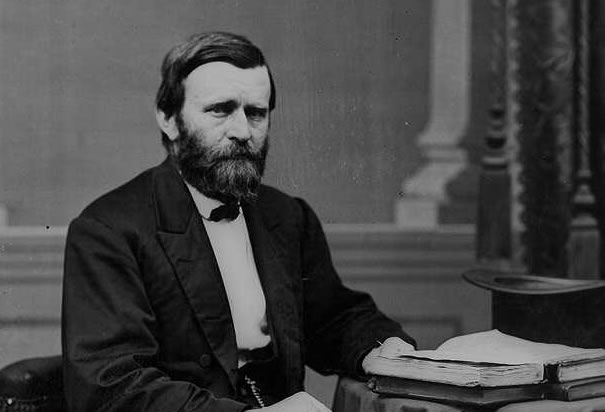
ulysses-s-grant-book

Ulysses S. Grant and the Fight against the Insurrection, Terrorism and Insurgency of the Ku Klux Klan, White Leagues, White Liners and Red Shirts

But these measures provoked even more violence from enraged Southerners who formed a variety of violent racist organizations which turned the violence from sporadic attacks to what amounted to a full-fledged insurgency against the new state governments and African Americans. Organizations like the Ku Klux Klan engaged in terroristic violence to heavily armed “social clubs” which operated under the aegis of the state Democratic Party leadership in most Southern states. Under the leadership of former Confederate general Nathan Bedford Forrest whose troops had conducted the Fort Pillow massacre, the Klan’s membership throughout the South “was estimated at five hundred thousand.” [12] The majority of these men were former Confederate soldiers, although they were also joined by those who had not fought in the war, or later those who had been too young to fight in the war but even belatedly wanted to get in on the fight against the hated Yankee and his African American allies. As the shadowy organization grew it became bolder and more violent in its attacks on African Americans, Republican members of the Reconstruction governments, and even Southern Jews. The Klan spread to every State in the South and when Congress investigated in 1870 and 1871 they submitted a thirteen volume report on Klan activities, volumes that “revealed to the country an almost incredible campaign of criminal violence by whites determined to punish black leaders, disrupt the Republican Party, reestablish control over the black labor force, and restore white supremacy in every phase of southern life.” [13]
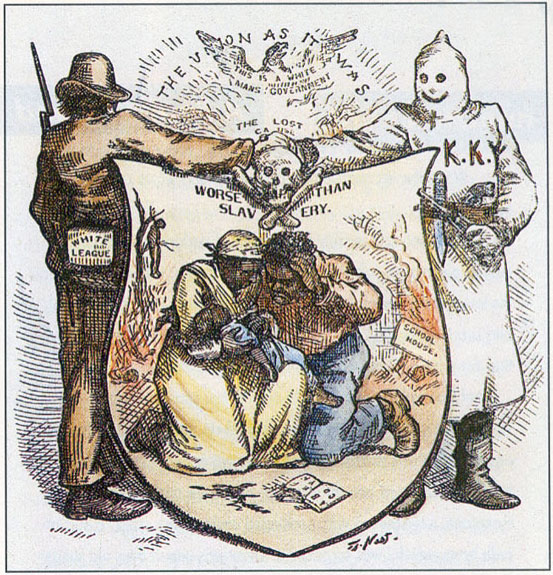
KKK-Nast

Allegedly organized for self-defense against state militia units composed of freed blacks they named themselves “White Leagues (Louisiana), White Liners or Rifle Clubs (Mississippi), or Red Shirts (South Carolina). They were, in fact, paramilitary organizations that functioned as armed auxiliaries of the Democratic Party in southern states in their drive to “redeem” the South from “black and tan Negro-Carpetbag rule.” [14] These men, mostly Confederate veterans “rode roughshod over the South, terrorizing newly freed slaves, their carpetbagger allies, and anyone who dared to imagine a biracial democracy as the war’s change.” [15] The unrequited violence and hatred by these men set the stage for the continued persecution, murder and violence against blacks and those who supported their efforts to achieve equality in the South for the next century. In truth the activities of the Klan and other violent White Supremacist groups offer “the most extensive example of homegrown terrorism in American history.” [16]

Throughout his term in office Johnson appealed to arguments used throughout later American history by “critics of civil rights legislation and affirmative action. He appealed to fiscal conservatism, raised the specter of an immense federal bureaucracy trampling on citizens’ rights, and insisted that self-help, not government handouts, was the path to individual advancement.” [17]

Ulysses S. Grant succeeded Johnson as President in 1869, and unlike his predecessor, he was a man who believed in freedom and equal rights, “For Grant, freedom and equal rights were matters of principle, not symbolism.” [18]Grant ordered his generals in the South to enforce the Reconstruction Act and when the Ku Klux Klan attempted to stop blacks from voting Grant got Congress to pass the “enforcement Act, which made racist terrorism a federal offense.” [19] He created the Justice Department to deal with crimes against Federal law and in 1871 pushed Congress to pass a law known as the Ku Klux Klan Act and sent in the army and federal agents from the Justice Department and the Secret Service to enforce the law.

Grant’s efforts using the military as well as agents of the Justice Department and the Secret Service against the Klan were hugely successful, thousands were arrested, hundreds of Klansmen were convicted and others were either driven underground or disbanded their groups. The 1872 election was the first and last in which blacks were nearly unencumbered as they voted until the passage of the 1964 Civil Rights Act and 1965 Voting Rights Act.

However, Grant’s actions triggered a political backlash that doomed Reconstruction. The seminal moment in this came 1873 when General Philip Sheridan working in Louisiana, asked Grant for “permission to arrest leaders of the White League and try them by courts-martial” [20] for their violent acts against blacks and their seizure of the New Orleans City Hall in a brazen coup attempt. The leak of Sheridan’s request sparked outrage and even northern papers condemned the president’s actions in the harshest of terms.

Apart from the effort to support voting rights for African Americans Grant’s efforts at Reconstruction were met mostly by failure. Part of this was due to weariness on the part of many Northerners to continue to invest any more effort into the effort. Slowly even proponents of Reconstruction began to retreat from it, some like Carl Schurz, were afraid that the use of the military against the Klan in the South could set precedent to use it elsewhere. Others, embraced an understanding of Social Darwinism which stood against all types of government interference what they called the “natural” workings of society, especially misguided efforts to uplift those at the bottom of the social order…and African Americans were consigned by nature to occupy the lowest rungs of the social ladder.” [21]

Southerners knew that they were winning the political battle and continued their pressure in Congress and in the media to demonize supporters of Reconstruction as well as African Americans. Southerners worked to rig the political and judicial process through the use of terror to demoralize and drive from power anyone, black or white, who supported Reconstruction. By 1870 every former Confederate state had been readmitted to the Union, in a sense fulfilling a part Lincoln’s war policy, but at the same time denying what the war was waged for a White led governments aided by the Supreme Court increasingly set about reestablishing the previous social and political order placing blacks in the position of living life under slavery by another name.

The Passage of the Fifteenth Amendment

Slavery had been abolished, and African Americans had become citizens, but in most places they did not have the right to vote. Grant used his political capital to fight for the passage of the Fifteenth Amendment, which gave black men the right to vote. It was one of the things that he remained most proud of in his life, he noted that the amendment was, “A measure which makes at once four million people voter who were heretofore declared by the highest tribunal in the land to be not citizens of the United States, nor eligible to become so…is indeed a measure of grander importance than any other act of the kind from the foundation of our free government to the present day.” [22]

To be continued…

Notes

[1] Ibid. Foner A Short History of Reconstruction p.30

[2] Ibid. Lord The Past that Would Not Die pp.11-12

[3] Ibid. Zinn The Other Civil War p.54

[4] Ibid. McPherson The War that Forged a Nation p. 178

[5] Ibid. Foner Forever Free p.162

[6] Perman, Michael Illegitimacy and Insurgency in the Reconstructed South in The Civil War and Reconstruction Documents and Essays Third Edition edited by Michael Perman and Amy Murrell Taylor Wadsworth Cengage Learning Boston MA 2011 p.451

[7] Ibid. Foner Forever Free p.121

[8] Ibid. Langguth After Lincoln p.232

[9] _____________ The 14th Amendment to the U.S. Constitution retrieved from https://www.law.cornell.edu/constitution/amendmentxiv 29 June 2015

[10] Ibid. Carpenter Sword and Olive Branch p.93

[11] Ibid. Foner Forever Free p.92

[12] Lane, Charles The Day Freedom Died: The Colfax Massacre, the Supreme Court, and the Betrayal of Reconstruction Henry Holt and Company, New York 2008  p.230

[13] Ibid. Foner Forever Free p.171

[14] Ibid. McPherson The War that Forged a Nation p. 178

[15] Ibid. Jordan Marching Home p.118

[16] Ibid. Foner Forever Free p.171

[17] Ibid. Foner Forever Free p.116

[18] Ibid. Lane The Day Freedom Died:  p.2

[19] Ibid. Lane The Day Freedom Died p.4

[20] Ibid. Langguth, A.J. After Lincoln p.314

[21] Ibid. Foner Forever Free pp.192-193

[22] Flood, Charles Bracelen, Grant’s Final Victory: Ulysses S. Grant’s Heroic Last Year DaCapo Press, Boston 2011 pp.78-79
Leave a comment

Filed under civil rights, civil war, ethics, laws and legislation, Military, Political Commentary

Slavery Under Another Name: The Black Codes

7100338_orig

Blacks Sentenced to Work Planatations Under the Black Codes

Friends of Padre Steve’s World,

This is another of my continued series of articles pulled from my various Civil War texts dealing with Emancipation and the early attempts to gain civil rights for African Americans. This section that I will cover for the next few days deals with the post-war period, a period marked by conflicting political and social desires for equality, justice, revenge, and the re-victimization of Blacks who had so recently been emancipated.

I hope that you find these helpful.

Peace

Padre Steve+

Southern Resistance to Reconstruction and the Black Codes

White Southerners including the newly pardoned Confederates enacted black codes that “codified explicit second-class citizenship for freedpeople.” [1] The legislature of Mississippi refused to ratify the Thirteenth Amendment, and did not do so until 1995. One Southerner noted that “Johnson “held up before us the hope of a ‘white man’s government,’ and this led us to set aside negro suffrage…. It was natural that we should yield to our old prejudices.” [2] Former Confederates, including Alexander Stephens the former Vice President of the Confederacy were elected to high office, Stephens to the United States Senate and the aggrieved Republicans in Congress in turn refused to admit the former Confederates. Many Union veterans were incensed by Johnson’s actions, one New York artilleryman noted “I would not pardon the rebels, especially the leaders, until they should kneel in the dust of humiliation and show their deeds that they sincerely repent.” [3] He was not alone, many Northern Veterans who formed the integrated Grand Army of the Republic veterans maintained a patent disregard, if not hatred of what the old South stood for and felt that their efforts in the war had been betrayed by the government.

sherman-full-length

General William Tecumseh Sherman provide for Freed Blacks to have land 

Johnson’s restoration of property to the former white owners drove tens of thousands of blacks off lands that they had been farming, or left them as laborers for their former slave masters. Johnson countermanded General William Tecumseh Sherman and Secretary of War Edwin Stanton’s Field Order 15 to “divide abandoned and confiscated lands on the Sea Islands and in a portion of the Low Country coast south of Charleston into forty-acre plots for each black family.” [4] As such many freed blacks were now at the mercy of their former white owners for any hope of economic sustenance.

Johnson worked stridently, and often successfully to frustrate the efforts of the Freedmen’s Bureau headed by Major General Oliver Howard to help freed blacks to become landowners and to protect their legal rights. In immediate post-war South states organized all white police forces and state militias composed primarily of Confederate veterans, many still wearing their gray or butternut uniforms. In such a climate blacks had few rights, and officers of the Freedmen’s Bureau lamented the situation. In Georgia one officer wrote that no jury would “convict a white man for killing a freedman,” or “fail to hang” a black man who killed a white in self-defense. Blacks commented another agent, “would be just as well off with no law at all or no Government,” as with the legal system established in the South under Andrew Johnson. “If you call this Freedom,” wrote one black veteran, “what do you call slavery?” [5]

The struggle between Johnson and Congress intensified when the President vetoed the Civil Rights Bill. Congress responded by overriding his veto. Eventually the battle between Johnson and Congress climaxed when Johnson was impeached when he tried to remove Secretary of War Stanton from office. Johnson barely survived the impeachment proceedings and was acquitted by one vote in the Senate in 1868.

The various black codes enacted throughout the South were draconian measures to codify and institutionalize racism and White Supremacy:

“passed labor laws that bound blacks to employers almost as tightly as slavery once bound them to their masters. Other codes established patterns of racial segregation that had been impossible under slavery, barred African Americans from serving on juries or offering testimony in court against whites, made “vagrancy,” “insulting gestures,” and “mischief” offenses by blacks punishable by fines or imprisonment, forbade black-white intermarriage, ad banned ownership by blacks of “fire-arms of any kind, or any ammunition, dirk or bowie-knife.” [6]

14-1_Page_43_Image_0001

African Americans leased out to build Railroad 

Mississippi’s Black Codes were the first of these and among the sections dealt with a change in vagrancy laws, specifically aimed at emancipated blacks and those whites who might associate with them:

“That all freedmen, free Negroes, and mulattoes in this state over the age of eighteen years found on the second Monday in January, 1866, or thereafter, with no lawful employment or business, or found unlawfully assembling themselves together in the day or night time, and all white persons so assembling with freedmen, free Negroes, or mulattoes on terms of equality, or living in adultery with a freedwoman, free Negro, or mulatto, shall be deemed vagrants; and on conviction thereof shall be fined…and imprisoned….”  [7]

The black codes were condoned and supported by President Johnson. While the black codes recognized the bare minimal elements of black freedom, their provisions confirmed the observations of one journalist who wrote “the whites seem wholly unable to comprehend that freedom for the negro means the same thing as freedom for them. They readily admit that the Government has made him free, but appear to believe that the have the right to exercise the old control.” [8] As state after state followed the lead of Mississippi, which was the first state to enact black codes Northern anger grew and some newspapers took the lead in condemn the black codes. “We tell the white men of Mississippi,” exploded the Chicago Tribune on December 1, “ that the men of the North will convert the state of Mississippi into a frog pond before they allow any such laws to disgrace one foot of soil in which the bones of our soldiers sleep and over which the flag of freedom waves.”  [9]

black_americans_attacked_in_memphis_riot_of_1866

The Memphis Massacre

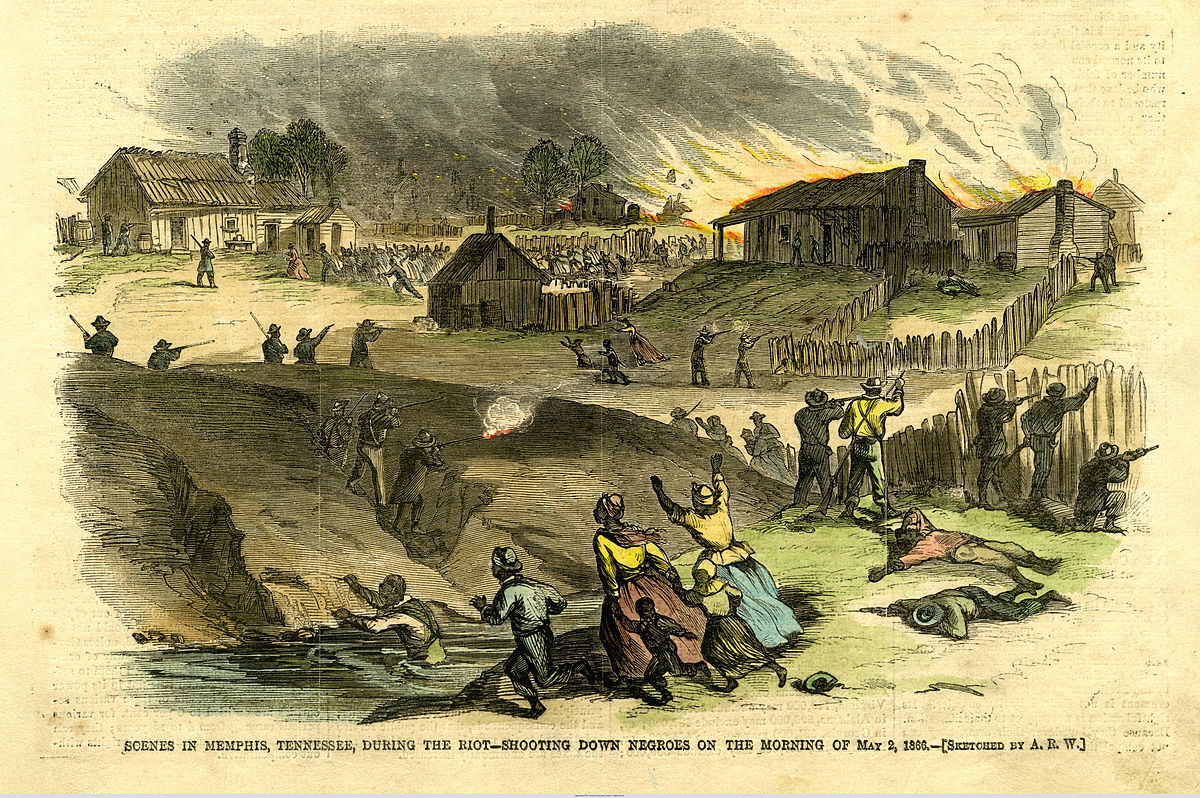
Within weeks of the end of the war, violence against blacks began to break out in different parts of the South and it continued to spread as Johnson and the new Congress battled each other in regard to Reconstruction policy:

“In Memphis, Tennessee, in May of 1866, whites on a rampage of murder killed forty-six Negroes, most of them veterans of the Union army, as well as two white sympathizers. Five Negro women were raped. Ninety homes, twelve schools and four churches were burned. In New Orleans in the summer of 1866, another riot against blacks killed thirty-five Negroes and three whites.” [10]

The hatred of blacks and the violence against them was not limited to adults, children joined in as well. In Natchez Mississippi an incident that showed how deep the antipathy towards blacks was when on a Sunday afternoon, “an elderly freedman protested to a small white boy raiding his turnip patch. The boy shot him dead, and that was that. In Vicksburg the Herald complained that the town’s children were hitting innocent bystanders when using their “nigger shooters.” [11]

Colonel Samuel Thomas, the director of the Freedmen’s Bureau in Mississippi noted the attitudes that he saw in many whites toward the newly emancipated African Americans. He wrote that white public sentiment had not progressed and that whites had not “come to the attitude in which it can conceive of the negro having any rights at all. Men, who are honorable in their dealings with their white neighbors, without feeling a single twinge of honor…. And however much they confess that the President’s proclamation broke up the relation of the individual slave to their owners, they still have the ingrained feeling that the black people at large belong to whites at large.” [12] Sadly, the attitude reported by Colonel Thomas not only remained but also grew more violent with each passing month.

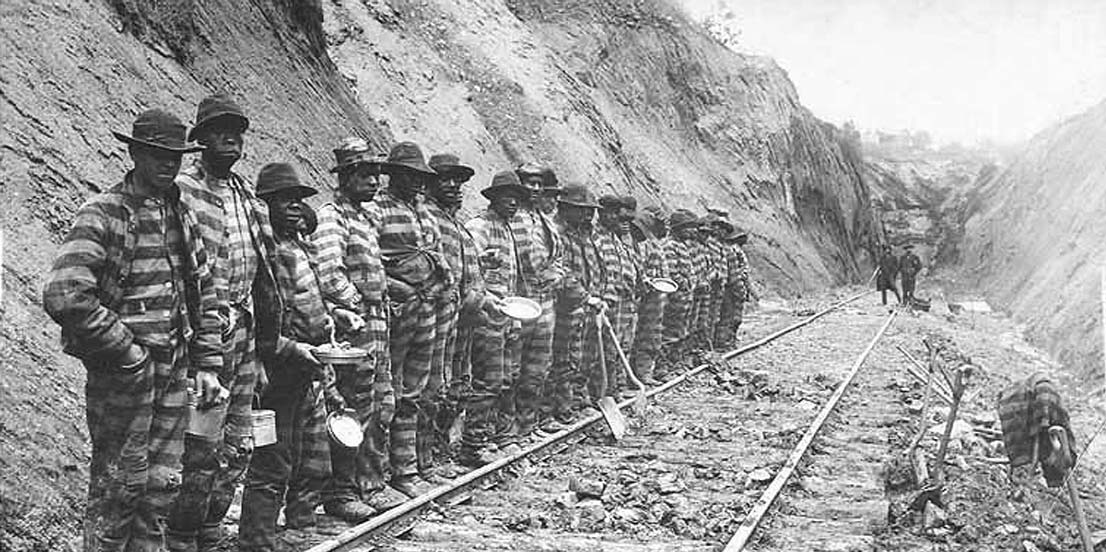
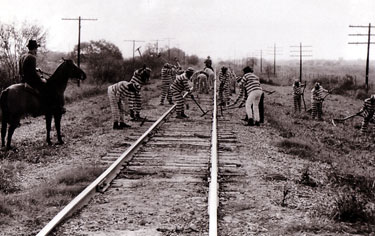
Another lesser-discussed aspect of the Black Codes was their use to return African Americans who had been convicted under the “vagrancy” statutes to a new type of slavery in all but name. The state governments then leased the prisoners to various corporations; railroads, mines and plantations, even former Confederate General and founder of the Ku Klux Klan Nathan Bedford Forrest received his share of prisoners to work his land.

parks_chain_gang

The practice became a lucrative source of revenue, for not only did the states collect the fees from the companies, but did not have to spend tax dollars to incarcerate, feed or otherwise care for the prisoners. Mortality rates were very high among the prisoners in private custody and the regulations, which stipulated that prisoners would be adequately fed, housed and treated, were not enforced.

By 1877 “every former Confederate state except Virginia had adopted the practice of leasing black prisoners into commercial hands. There were variations among the states, but all shared the same basic formula. Nearly all the penal functions of government were turned over to the companies purchasing convicts. In return for what they paid each state, the companies received absolute control of the prisoners… Company guards were empowered to chain prisoners, shoot those attempting to flee, torture any who wouldn’t submit, and whip the disobedient – naked or clothed – almost without limit. Over eight decades, almost never were there penalties to any acquirer of these slaves for their mistreatment or deeds.” [13]

The profitability of these ventures brought Northern investors, including the owners and shareholders of U.S. Steel into the scheme allowing financial houses and Northern corporations to grow their wealth, as they had during the pre-war days off the backs of slaves. However, the practice was also detrimental to poor Southern Whites who could not compete fairly in the labor market. In 1891 miners of the “Tennessee Coal Company were asked to sign an “iron-clad contract”: pledging no strikes, agreeing to get paid in scrip, and giving up the right to check the weight of the coal they mined (they were paid by weight). They refused to sign and were evicted from their houses. Convicts were brought in to replace them.” [14] The company’s response brought about an insurrection by the miners who took control of the mine and the area around it and freed 500 of the convict-slaves. The leaders were primarily Union Army veterans and members of the Grand Army of the Republic veteran’s organization. The company backed down, but others learned the lesson and began to employ heavily armed Pinkerton agents as well as the state militias to deal with the growing labor movement, not only in the South but also in the North.

Non-convict black laborers as well as poor white “sharecroppers” on the large plantations were forced back into servitude of another manner, where legislatures gave “precedence to a landlord’s claim to his share of the crop over that of the laborer for wages or a merchant for supplies, thus shifting the risk of farming from employer to employee.” Likewise, “a series of court decisions defined the sharecropper not as a partner in agriculture or a renter with a property right in the growing crop, but as a wage laborer possessing “only a right to go on the land to plant, work, and gather the crop.” [15]

The practice did not end until Franklin Delano Roosevelt ordered his Attorney General Francis Biddle to order Federal prosecutors who had for decades looked the other way begin prosecuting individuals and companies involved in this form of slavery. Biddle was the first U.S. Attorney General to admit the fact that “African Americans were not free and to assertively enforce the statutes written to protect them.” [16] Biddle, who later sat as a justice at the Nuremberg trials of major Nazi War Criminals commented during the war “One response of this country to the challenge to the ideals of democracy made by the new ideologies of Fascism and Communism has been a deepened realization of the values of a government based on a belief in the dignity and the rights of man.” [17] Biddle charged the newly formed Civil Rights Division of the Justice Department to shift its focus from organized crime to cases of discrimination and racial abuse. Biddle repudiated the rational that allowed for the practice and wrote that the “law is fixed and established to protect the weak-minded the poor, the miserable” and that the contracts of the states that allowed the practices were “null and void.” [18] It was the beginning of another twenty-year process in which African Americans and their allies in the Civil Rights Movement worked to bring about what Lincoln referred to as “a new birth of freedom.”

To be continued….

Notes 

[1] Ibid. McPherson The War that Forged a Nation p. 177

[2] Ibid. Guelzo Fateful Lightning p.491

[3] Jordan, Brian Matthew. Marching Home: Union Veterans and Their Unending Civil War Liveright Publishing Corporation a Division of W.W. Norton and Company Inc. New York and London 2014 p.119

[4] Ibid. Goldfield America Aflame p.411

[5] Ibid. Foner Forever Free p.96

[6] Ibid. Guelzo Fateful Lightening p.491

[7] ____________ Mississippi’s Black Code, November 24-29, 1865 in the Confederate and Neo-Confederate Reader: The “Great Truth” about the “Lost Cause” Loewen, James W. and Sebesta, Edward H. Editors, University Press of Mississippi, Jackson 2010 Amazon Kindle edition location 4505 of 8647

[8] Ibid. Foner Forever Free pp.93-94

[9] Lord, Walter The Past that Would Not Die Harper Collins Publishers, New York 1965 p.12

[10] Ibid. Zinn The Other Civil War p.55

[11] Ibid. Lord The Past that Would Not Die p.8

[12] Ibid. Foner Forever Free p.92

[13] Blackmon, Douglas A. Slavery By another Name: The Re-enslavement of Black Americans from the Civil War to World War II Anchor Books, a Division of Random House, New York 2008 p.56

[14] Ibid. Zinn A People’s History of the United States p.275

[15] Ibid. Foner A Short History of Reconstruction p.250

[16] Ibid. Blackmon Slavery By another Name pp.378-379

[17] Ibid. Blackmon Slavery By another Name p.378

[18] Ibid. Blackmon Slavery By another Name p.379

1 Comment

Filed under civil rights, civil war, laws and legislation, leadership, Political Commentary

“Sound the Loud Timbrel o’er Egypt’s Dark Sea, Jehovah Hath Triumphed, His People are Free.” The Emancipation Proclamation

emancipation

Friends of Padre Steve’s World

Another section  from one of my Civil War texts, this dealing with the Emancipation Proclamation.

Peace

Padre Steve+

From the beginning of the war many Northerners, especially abolitionists and radical Republicans believed that “as the “cornerstone” of the confederacy (the oft-cited description by the South’s vice-president, Alexander H. Stephens) slavery must become a military target.” [1] When some Union generals made their own attempts at issuing emancipation orders, Lincoln countermanded them for exceeding their authority. Lincoln resisted the early calls of the abolitionists to make that a primary war goal for very practical reasons, he had to first ensure that the Border Slave States did not secede, something that would have certainly ensured that the Union would not survived. As a result in the first year of the war, Lincoln “maneuvered to hold Border South neutrals in the Union and to lure Union supporters from the Confederacy’s Middle South white belts. He succeeded on both scores. His double success with southern whites gave the Union greater manpower, a stronger economy, and a larger domain. These slave state resources boosted free labor states’ capacity to should the Union’s heavier Civil War burden.” [2] His success in doing this was instrumental in enabling him to turn to emancipation in 1862.

Finally, some twenty months after Fort Sumter fell and after nearly two years of unrelenting slaughter culminating in the bloody battle of Antietam, Abraham Lincoln published the Emancipation Proclamation. Emancipation was a tricky legal issue for Lincoln as “an executive order of emancipation would be beyond the powers of the president, but not, Lincoln concluded, if such an order were issued as furtherance of the executive’s war powers.” [3] Lincoln had desired to issue the order during the summer and sounded out elected officials and soldiers as to his plan.

Lincoln discussed his views with General George McClellan during a visit to the latter’s headquarters. McClellan stated his strident opposition to them in writing. McClellan did not admire slavery but he despised abolitionists and he wrote one of his political backers “Help me to dodge the nigger – we want nothing to do with him. I am fighting for the Union…. To gain that end we cannot afford to mix up the negro question.”  [4]

Lincoln then called border state Congressmen to sound them out on the subject on July 12th 1862 only to be met with opposition. Such opposition caused Lincoln “to give up trying to conciliate conservatives. From then on the president tilted toward the radical position, though this would not become publicly apparent for more than two months.” [5]

Lincoln’s cabinet met to discuss the proclamation on July 22nd 1862 and after some debate decided that it should be issued, although it was opposed by Postmaster General Montgomery Blair who believed that “the Democrats would capitalize on the unpopularity of such a measure in the border states and parts of the North to gain control of the House in the fall elections.” [6] Wisely, Lincoln heeded the advice of Secretary of State Seward to delay the announcement until military victories ensured that people did not see it as a measure of desperation. Seward noted: “I approve of the proclamation, but I question the expediency of its issue at this juncture. The depression of the public mind, consequent on our repeated reverses, is so great I fear…it may be viewed as the last measure of an exhausted government, a cry for help…our last shriek on the retreat.” Seward suggested that Lincoln wait “until the eagle of victory takes his flight,” and buoyed by military success, “hang your proclamation about his neck.” [7]

After the Battle of Antietam, President Lincoln issued the Preliminary Emancipation Proclamation. This document served as a warning to the leaders of the South, and insisted that there was much more at stake in their rebellion unless they surrendered; their slaves, the very “property” for which the seceded. The document “warned that unless the South laid down its arms by the end of 1862, he would emancipate the slaves.” [8] This was something that they could not and would not do, even as their cities burned and Confederacy collapsed around them in 1864.

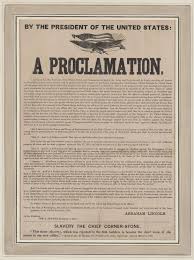
The proclamation was a military order in which Lincoln ordered the emancipation of slaves located in the Rebel states and areas of those states occupied by Union troops. It was not designed to change law, which would have to wait until Lincoln felt he could have Congress amend the Constitution.  Instead of law it was “the doctrine of military necessity justified Lincoln’s action.” [9] The concept emanated from Boston lawyer William Whiting who argued “the laws of war “give the President full belligerent rights” as commander and chief to seize enemy property (in this case slaves) being used to wage war against the United States.” [10] There was a legitimate military necessity in the action as Confederate armies used slaves as teamsters, laborers, cooks, and other non-combatant roles to free up white soldiers for combat duty, and because slaves were an important part of the Southern war economy which could not function without them. The proclamation gave inspiration to many slaves throughout the South to desert to the Union cause or to labor less efficiently for their Confederate masters. A South Carolina planter wrote in 1865:

“the conduct of the Negro in the late crisis of our affairs has convinced me that we were all laboring under a delusion….I believed that these people were content, happy, and attached to their masters, But events and reflection have caused me to change these positions….If they were content, happy and attached to their masters, why did they desert him in the moment of need and flocked to the enemy, whom they did not know….” [11]

The proclamation authorized that freed blacks be recruited into the Federal army and it ensured that freed slaves would not again be surrendered back into slavery. As Montgomery Blair had warned Lincoln and the Republicans suffered sharp electoral reverses as “Democrats made opposition to emancipation the centerpiece of their campaign, warning that the North would be “Africanized” – inundated by freed slaves competing for jobs and seeking to marry white women.”  [12]

Lincoln’s response was to continue on despite the opposition and issue the Proclamation in spite of electoral reverses and political resistance. The vehemence of some Northern Democrats came close to matching that of white Southerners. The “white Southerner’s view of Lincoln as a despot, hell-bent on achieving some unnatural vision of “equality,” was shared by Northern Democrats, some of whom thought the president was now possessed by a “religious fanaticism.” [13] But Lincoln was not deterred and he understood “that he was sending the war and the country down a very different road than people thought they would go.” [14] He noted in December 1862:

“Fellow citizens, we cannot escape history….This fiery trial through which we pass, will light us down, in honor or dishonor, to the latest generation….In giving freedom to the slave, we assure freedom to the free – honorable alike in what we give, and what we preserve.” [15]

For Lincoln the Emancipation Proclamation was something that he believed was something that he had to do, and he believed that it would be the one thing that he did in life that would be remembered. He had long been convicted of the need for it, but timing mattered, even six months before it might have created a political backlash in the North which would have fractured support for the war effort, and in this case timing and how he made the proclamation mattered.

The Emancipation Proclamation had military, domestic political, and diplomatic implications, as well as moral implications for the conduct of the war.

The military implication would take some time to achieve but were twofold. First, Lincoln hoped that the Emancipation Proclamation would encourage former slaves, as well as already free blacks in the North to join the Union cause and enlist to serve in the Federal Army. The act would vest African Americans in the Union’s cause as little else could, and at the same time begin to choke-off the agricultural labor force that provided the backbone of the Confederate economy. Frederick Douglass eloquently made the case for African Americans to serve in July 1863, telling a crowd in Philadelphia, “Do not flatter yourself, my friends, that you are more important to the Government than the Government is to you. You stand but as a plank to the ship. This rebellion can be put down without your help. Slavery can be abolished by white men: but Liberty so won for the black man, while it may leave him an object of pity, can never make him an object of respect…. Young men of Philadelphia, you are without excuse. The hour has arrived, and your place is in the Union army. Remember that the musket – the United States musket with its bayonet of steel – is better than all the parchment guarantees of Liberty. In you hands the musket means Liberty…” [16] By the end of the war over 180,000 African American men would serve as volunteers in the United States Army.

Politically the proclamation would the diplomatic purpose by isolating the Confederacy from European assistance. This it did, after the proclamation public sentiment, especially among Europe’s working classes turned solidly against the Confederacy. Domestically it would break-ground for the Thirteenth Amendment, which Lincoln, the pragmatic lawyer was needed to actually abolish slavery. Morally, it  would serve as the guarantee of The United States Government’s public, irrevocable pledge of freedom to African Americans if the North won the war.

Lincoln signed the order on January 1st 1863. As he got ready to sign the document he paused and put down the pen, speaking to Seward he said “I never, in my life, felt more certain that I was doing right, than I do now in signing this paper….If my name ever goes down in history it will be for signing this act, and my whole soul is in it.” [17] The opening paragraph read:

“That on the first day of January, in the year of our Lord one thousand eight hundred and sixty-three, all persons held as slaves within any State or designated part of a State, the people whereof shall then be in rebellion against the United States, shall be then, thenceforward, and forever free; and the Executive Government of the United States, including the military and naval authority thereof, will recognize and maintain the freedom of such persons, and will do no act or acts to repress such persons, or any of them, in any efforts they may make for their actual freedom.” [18]

At the ends of the proclamation he added the words suggested by his devoutly Christian Secretary of the Treasury Salmon Chase: “And upon this act, sincerely believed to be an act of justice, warranted by the Constitution, upon military necessity, I invoke the considerate judgment of mankind, and the gracious favor of Almighty God.” [19]

The response throughout the North was euphoric as celebrations took place throughout the North. In some cities one hundred gun salutes were fired. At Boston’s Tremont Temple people broke out singing a hymn “Sound the loud timbrel o’er Egypt’s dark sea, Jehovah hath triumphed, his people are free.” [20] The Boston Daily Evening Telegraph predicted, “Slavery from this hour ceases to be a political power in this country…such a righteous revolution as it inaugurates never goes backward.” [21]

Frederick Douglass wrote about his reactions to the Emancipation proclamation as he had nearly despaired wondering if the Lincoln administration would actually take up the fight for emancipation:

“The fourth of July was great, but the first of January, when we consider it in all of its relations and bearings in incomparably greater. The one we respect to the mere political birth to a nation, the last concerns national life and character, and is to determine whether that life and character shall be radiantly and glorious with all high and noble virtues, or infamously blackened, forevermore, with all the hell-darkened crimes and horrors which we attach to Slavery.” [22]

The proclamation was not all some had hoped for and it was certainly provoked a negative response in the South and among many Northern Democrats. Southerners accused Lincoln of inciting racial warfare and Jefferson Davis responded “The day is not so distant when the old Union will be restored with slavery nationally declared to be the proper condition of all of African descent.” [23]

But the proclamation did something that politicians, lawyers did not comprehend, that “the details of the emancipation decree were less significant than the fact that there was an emancipation decree, and while the proclamation read like a dull legal brief, filled with qualifying clauses and exceptions, it was not language made for this, finally, a moral document. It was its existence, its title, its arrival into this world, its challenge to the accepted order, and from that there was no turning back. In this sense it was a revolutionary statement, like the Declaration itself, and nearly as significant.” [24] That the proclamation most certainly was and it was a watershed from which there was no stepping back. “It irrevocably committed the government of the United States to the termination of slavery. It was an act of political courage, take at the right time, in the right way.” [25]

However, it would take another two years, with the Confederacy crumbling under the combined Federal military onslaught before Lincoln was able to secure passage of the Thirteenth Amendment to the Constitution in January 1865.  The amendment abolished slavery and involuntary servitude throughout the country, as well as nullified the fugitive slave clause and the Three-Fifths Compromise. It would be followed after Lincoln’s death by the Fourteenth Amendment which reversed the result of the Dred Scott decision and declared that all people born in the United States were citizens and entitled to the rights of citizenship. During the Grant administration the Fifteenth Amendment was passed, and this finally extended to African American men, the right to vote in every state.

Though limited in scope, the Emancipation Proclamation had more than a domestic military, social and political effect. It also had an effect on foreign policy which ensured that Britain, and thereby France would not intervene in the war on behalf of the Southern Confederacy. It stopped all British support for the Rebels to include seizing warships that had been contracted for by Confederate agents that were building or being fitted out in British Yards. Likewise the British rejected various proposals of Emperor Napoleon III to intervene in the war in late 1862 and during the summer of 1863.

Effects of the Emancipation Proclamation on Military Law

The Emancipation Proclamation and the elimination of slavery also impacted the Union war effort in terms of law, law that eventually had an impact around the world as nations began to adapt to the changing character of war. It was important because for the first time slavery was accounted for in the laws of war. The “Instructions for the Government of Armies of the United States in the Field, General Orders No. 100 by President Lincoln, April 24, 1863; Prepared by Francis Lieber, LLD noted in Article 42 of that Code:

“Slavery, complicating and confounding the ideas of property, (that is of a thing,) and of personality, (that is of humanity,) exists according to municipal or local law only. The law of nature and nations has never acknowledged it. The digest of the Roman law enacts the early dictum of the pagan jurist, that “so far as the law of nature is concerned, all men are equal.” Fugitives escaping from a country in which they were slaves, villains, or serfs, into another country, have, for centuries past, been held free and acknowledged free by judicial decisions of European countries, even though the municipal law of the country in which the slave had taken refuge acknowledged slavery within its own dominions.” [26]

It continued in Article 43:

“Therefore, in a war between the United States and a belligerent which admits of slavery, if a person held in bondage by that belligerent be captured by or come as a fugitive under the protection of the military forces of the United States, such person is immediately entitled to the rights and privileges of a freeman To return such person into slavery would amount to enslaving a free person, and neither the United States nor any officer under their authority can enslave any human being. Moreover, a person so made free by the law of war is under the shield of the law of nations, and the former owner or State can have, by the law of postliminy, no belligerent lien or claim of service.” [27]

The Continued Fight for Emancipation: Dealing with the Copperheads and the Passage of the Thirteenth Amendment

But there were still legitimate concerns that slavery might survive as the war continued. Lincoln knew that in issuing the Emancipation Proclamation raised the stakes of the war far higher than they had been. He noted, “We shall nobly save, or meanly lose, the last best hope on earth.” [28] The threat of the destruction of the Union and the continuance of slavery in either the states of the Confederacy, the new western states, territories, or the maintenance of the Union without emancipation was too great for some; notably, the American Freedmen’s Commission to contemplate. With Grant’s army stalled outside Richmond the Copperheads and the peace party gained influence and threatened to bring about a peace that allowed Confederate independence and the continuance of slavery; members of that caucus they Edwin Stanton in the spring of 1864:

“In such a state of feeling, under such a state of things, can we doubt the inevitable results? Shall we escape border raids after fleeing fugitives? No man will expect it. Are we to suffer these? We are disgraced! Are we to repel them? It is a renewal of hostilities!…In the case of a foreign war…can we suppose that they will refrain from seeking their own advantage by an alliance with the enemy?” [29]

The effort of the Copperheads and the peace party to was soon crushed under the military successes of William Tecumseh Sherman’s armies in Georgia. This was especially true of the capture of Atlanta, which was followed by Sherman’s march to the sea and the Carolinas. Additionally the naval victory of David Farragut’s fleet at the Battle of Mobile Bay served to break the stranglehold that the Copperheads were beginning to wield in Northern politics.  These efforts helped secure Lincoln’s reelection by a large margin in the 1864 presidential election over a divided Democratic opposition, whose presidential nominee McClellan could not even endorse his party’s platform.

In his Second Inaugural Address, Abraham Lincoln discussed the issue of slavery as the chief cause of the war. In it, Lincoln noted that slavery was the chief cause of the war in no uncertain terms and talked in a language of faith that was difficult for many, especially Christians, who “believed weighty political issues could be parsed into good or evil. Lincoln’s words offered a complexity that many found difficult to accept,” for the war had devastated the playground of evangelical politics, and it had “thrashed the certitude of evangelical Protestantism” [30] as much as the First World War shattered Classic European Protestant Liberalism.  Lincoln’s confrontation of the role that people of faith brought to the war in both the North and the South is both illuminating and a devastating critique of the religious attitudes that so stoked the fires of hatred.  His realism in confronting facts was masterful, and badly needed.  He spoke of “American slavery” as a single offense ascribed to the whole nation.” [31]

“One-eighth of the whole population were colored slaves, not distributed generally over the Union, but localized in the southern part of it. These slaves constituted a peculiar and powerful interest. All knew that this interest was somehow the cause of the war. To strengthen, perpetuate, and extend this interest was the object for which the insurgents would rend the Union even by war, while the Government claimed no right to do more than to restrict the territorial enlargement of it. Neither party expected for the war the magnitude or the duration which it has already attained. Neither anticipated that the cause of the conflict might cease with or even before the conflict itself should cease. Each looked for an easier triumph, and a result less fundamental and astounding. Both read the same Bible and pray to the same God, and each invokes His aid against the other. It may seem strange that any men should dare to ask a just God’s assistance in wringing their bread from the sweat of other men’s faces, but let us judge not, that we be not judged. The prayers of both could not be answered. That of neither has been answered fully. The Almighty has His own purposes. “Woe unto the world because of offenses; for it must needs be that offenses come, but woe to that man by whom the offense cometh.” If we shall suppose that American slavery is one of those offenses which, in the providence of God, must needs come, but which, having continued through His appointed time, He now wills to remove, and that He gives to both North and South this terrible war as the woe due to those by whom the offense came, shall we discern therein any departure from those divine attributes which the believers in a living God always ascribe to Him? Fondly do we hope, fervently do we pray, that this mighty scourge of war may speedily pass away. Yet, if God wills that it continue until all the wealth piled by the bondsman’s two hundred and fifty years of unrequited toil shall be sunk, and until every drop of blood drawn with the lash shall be paid by another drawn with the sword, as was said three thousand years ago, so still it must be said “the judgments of the Lord are true and righteous altogether.[32]

Notes 

[1] Ibid. Foner Forever Free: The Story of Emancipation and Reconstruction  p.42

[2] Ibid. Freehling The South vs. The South p.47

[3] Brewster, Todd. Lincoln’s Gamble: The Tumultuous Six Months that Gave America the Emancipation Proclamation and Changed the Course of the Civil War Scribner a Division of Simon and Schuster, New York and London p.59

[4] Ibid. McPherson The Battle Cry of Freedom p.364

[5] Ibid. McPherson The Battle Cry of Freedom p.504

[6] McPherson, James M. Tried by War: Abraham Lincoln as Commander in Chief Penguin Books, New York and London 2008 p.109

[7] Ibid. Goodwin Team of Rivals p. 468

[8] Ibid. Foner Forever Free p.49

[9] McGovern, George Abraham Lincoln Times Books, Henry Holt and Company, New York 2009 p.70

[10] Ibid. McPherson Tried by War: p.108

[11] Ibid. Zinn The Other Civil War p.39

[12] Ibid. Foner Forever Free p.49

[13] Ibid. Brewster Lincoln’s Gamble p.169

[14] Ibid. Guelzo Fateful Lightning p.184

[15] Ibid. Foner Forever Free p.49

[16] Douglass, Frederick. Philadelphia Speech of July 6th 1863 recorded in the Liberator in The Civil War and Reconstruction: A Documentary Collection edited by William E. Gienapp, W.W. Norton and Company, New York and London 2001 p.221

[17] Ibid. Goodwin Team of Rivals p. 499

[18] Lincoln, Abraham The Emancipation Proclamation The National Archives & Records Administration retrieved from http://www.archives.gov/exhibits/featured_documents/emancipation_proclamation/transcript.html 14 June 2014

[19] Ibid. Lincoln The Emancipation Proclamation

[20] Ibid. Brewster Lincoln’s Gamble p.244

[21] Ibid. McPherson The Battle Cry of Freedom p.501

[22] Ibid. Guelzo Fateful Lightning pp. 180-181

[23] Ibid. Goldfield America Aflame p.263

[24] Ibid. Brewster Lincoln’s Gamble p.245

[25] Ibid. McGovern Abraham Lincoln p.78

[26] Reichberg, Gregory M, Syse Henrik, and Begby, Endre The Ethics of War: Classic and Contemporary Readings Blackwell Publishing Ltd, Malden, MA and Oxford UK 2006 p.570

[27] Ibid. Reichberg et al. The Ethics of War p.570

[28] Ibid. Goldfield America Aflame p.263

[29] Ibid. Guelzo Fateful Lightning p.534

[30] Ibid. Goldfield  America Aflame p.358

[31] Ibid. Wills Lincoln at Gettysburg p.186

[32] Lincoln, Abraham Second Inaugural Address March 4th 1865 retrieved from www.bartleby.com/124/pres32.html 24 March 2014


6 Comments

Filed under civil rights, civil war, History, laws and legislation, leadership, Political Commentary

“One after another they have closed the heavy doors upon him…” The Dred Scott Decision

Friends of Padre Steve’s World,

Another article from one of my Civil War texts, this one dealing with the infamous Dred Scott decision. That decision, made by a Southern dominated, Supreme Court, members of whom included number of slave owners, done in collusion with President Elect James Buchanan, declared that African Americans had no right to citizenship, thus no protection under the law, no-matter where they lived. It would not be overturned until after the Civil War when Congress passed the 14th Amendment, an amendment that is vital for all of our liberties.

Again, for those in denial about how we got to this point in our history, this is not a comfortable subject.

Have a great day,

Peace

Padre Steve+

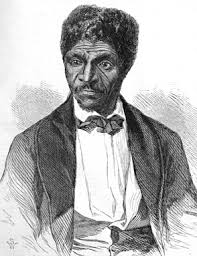
dred scott

Dred Scott

The Deepening Divide

As the 1850s wore on, the divisions over slavery became deeper and voices of moderation retreated. The trigger for the worsening of the division was the political battle regarding the expansion of slavery; even the status of free blacks in the north that were previously slaves, over whom their owners asserted their ownership. Southerners considered the network to help fugitive slaves escape to non-slave states, called the Underground Railroad “an affront to the slaveholders pride” and “anyone who helped a man or woman escape bondage was simply a thief” who had robbed them of their property and livelihood, as an “adult field hand could cost as much as $2000, the equivalent of a substantial house.” [1]

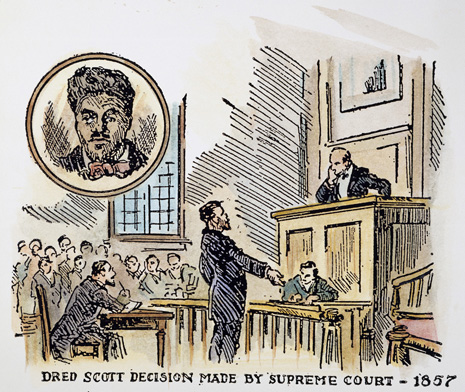
In 1856 the Supreme Court, dominated by southern Democrats ruled in favor of southern views in the Dred Scott decision, one pillar of which gave slavery the right to expand by denying to Congress the power to prohibit slavery in Federal territories. Taney’s ruling in the case insisted “Neither the Declaration of Independence nor the Constitution had been intended to apply to blacks he said. Blacks were “so far inferior that they had no rights which the white man was bound to respect.” Taney did not stop with this but he declared the Missouri Compromise itself unconstitutional for “Congress had exceeded its authority when it forbade slavery in the territories by such legislation as the Missouri Compromise, for slaves were private property protected by the Constitution.” [2]

ROGER B. TANEY (1777-1864).  Roger Taney, Chief Justice of the U.S. Supreme Court, handing down his decision on the Dred Scott case, 1857. American illustration.

Dred Scott Decison

The decision was momentous, but the judicial fiat of Taney and his court majority was a disaster for the American people. It solved nothing and further divided the nation:

“In the South, for instance, it encouraged southern rights advocates to believe that their utmost demands were legitimatized by constitutional sanction and, therefore, to stiffen their insistence upon their “rights.” In the North, on the other hand, it strengthened a conviction that an aggressive slavocracy was conspiring to impose slavery upon the nation, and that any effort to reach an accommodation with such aggressors was futile. While strengthening the extremists, it cut the ground from under the moderates.” [3]

The decision in the case is frightening when one looks upon its tenor and implications. The majority opinion, which was written by Chief Justice Roger Taney, was chilling, not only in its views of race, but the fact that blacks were perpetually property without the rights of citizens. Taney wrote:

“Can a negro, whose ancestors were imported into this country, sold as slaves, become a member of the political community formed and brought into existence by the Constitution of the United States, and as such become entitled to all the rights, and privileges, and immunities, guaranteed by that instrument to the citizen?…It is absolutely certain that the African race were not included under the name of citizens of a state…and that they were not included, and were not intended to be included, under the word “citizens” in the Constitution, and therefore claim none of the rights and privileges which that instrument provides for and secures to citizens of the United States. On the contrary, they were at that time considered as a subordinate and inferior class of beings, who had been subjugated by the dominant race, and, whether emancipated or not, yet remain subject to their authority, and had no rights or privileges but those who held the power and the Government might choose to grant them” [4]

The effect of the ruling on individuals and the states was far reaching. “No territorial government in any federally administered territory had the authority to alter the status of a white citizen’s property, much less to take that property out of a citizen’s hands, without due process of law or as punishment for some crime.” [5] Free slaves were no longer safe, even in Free States, from the possibility of being returned to slavery, because they were considered property. The tens of thousands of free blacks in the South were effectively stripped of citizenship, and became vulnerable to either expulsion or re-enslavement, something that the legislatures in Virginia, North Carolina and Missouri debated in 1858. Likewise the decision cast doubt on the free status of every African American regardless of residence.” [6]

roger-b-taney-1-sized

Chief Justice Roger B. Taney

But the decision had been influenced by President-Elect James Buchanan’s secret intervention in the Supreme Court deliberations two weeks before his inauguration. Buchanan hoped by working with the Justices that he would save the Union from breaking apart by appeasing slave owners and catering to their agenda. “The president-elect wanted to know not only when, but if the Court would save the new administration and the Union from the issue of slavery in the territories. Would the judges thankfully declare the explosive subject out of bounds, for everyone who exerted federal power? The shattering question need never bother President Buchanan.” [7] In his inaugural address he attempted to camouflage his intervention and “declared that the Court’s decision, whatever it turned out to be, would settle the slavery issue forever.” [8]

But Buchanan attempt at appeasement was mistaken. The case made the national political situation even more volatile because it destroyed the political middle in Congress which had previously found compromise.  Taney’s decision impaired “the power of Congress – a power which had remained intact to this time – to occupy the middle ground.” [9] The Dred Scott decision was far reaching in its implications and Taney declared that Congress “never had the right to limit slavery’s expansion, and that the Missouri Compromise had been null and void on the day of its formulation.” [10] Taney’s ruling fulfilled what Thomas Jefferson wrote when he noted that the Missouri Compromise was merely a reprieve from the broader ideological and economic issues involved regarding slavery, and Taney destroyed that reprieve with the stroke of his pen.

The Court’s decision “that a free negro was not a citizen and the decision that Congress could not exclude slavery from the territories were intensely repugnant to many people in the free states” [11] and it ignited a firestorm in the north where Republicans now led by Abraham Lincoln, decried the decision and southerners basked in their judicial victory. Southerners were exultant, the Richmond Enquirer wrote that the Court had destroyed “the foundation of the theory upon which their warfare has been waged against the institutions of the South.” [12] Northerners now quite rightly feared that an activist court would rule to deny their states the right to forbid slavery. As early as 1854 Lincoln posed the idea that the Declaration of Independence was the standard maxim of free society …constantly spreading and deepening its influence,” ultimately applicable “to peoples of all colors everywhere.” [13]

After the Dred Scott decision Lincoln warned that the Declaration was being cheapened and diluted, he remained insistent on this point, he noted:

“Our Declaration of Independence was held sacred by all, and thought to include all” Lincoln declared, “but now, to aid in making the bondage of the Negro universal and eternal, it is assaulted, and sneered at, and construed, and hawked at, and torn, till, its framers could ride from their graves, they could not recognize it at all.” [14]

Lincoln attacked the decision noting that Taney “insists at great length that negroes were no part of the people who made, or for whom made, the declaration of Independence or the Constitution.” But as Doris Kearns Goodwin notes “in at least five states, black voters action on the ratification of the Constitution and were among the “We the People” by whom the Constitution was ordained and established.” Lincoln acknowledged that the founders “did not declare all men equal in all respects. They did not mean to say that all were equal in color, size, intellect, moral developments, or social capacity.” But they dis declare all men “equal in ‘certain inalienable rights, among which are life, liberty, and the pursuit of happiness.’…They meant simply to declare the right, so the enforcement of it might follow as circumstances permit.” [15]

Not only that, Lincoln asked the logical question regarding Taney’s judicial activism. Lincoln and other Republican leaders “noted that all slavery needed was one more Dred Scott decision that a state could not bar slavery and the objective of Slave Power to nationalize slavery would be accomplished.” [16] How long would it be, asked Abraham Lincoln, before the Court took the next logical step and ruled explicitly that the:

“Constitution of the United States does not permit a state to exclude slavery from its limits?” How far off was the day when “we shall lie down pleasantly thinking that the people of Missouri are on the verge of making their State free; and shall awake to the reality, instead, that the Supreme Court has made Illinois a slave State?” [17]

Lincoln discussed the ramification of the ruling for blacks; both slave and free:

“to aid in making the bondage of the Negro universal and eternal….All the powers of the earth seem rapidly combining against him. Mammon is after him; ambition follows, and philosophy follows, and the theology of the day is fast joining the cry. They have him in his prison house;…One after another they have closed the heavy doors upon him…and they stand musing as to what invention, in all the dominions of mind and matter, can be produced the impossibility of his escape more complete than it is.” [18]

Frederick Douglass noted that “Judge Taney can do many things…but he cannot…change the essential nature of things – making evil good, and good, evil.” [19]

Lincoln was not wrong in his assessment of the potential effects of the Dred Scott decision on Free States.  State courts in free-states made decisions on the basis of Dred Scott that bode ill for blacks and cheered slave owners.  In newly admitted California the state supreme court ominously “upheld a slaveowner’s right to retain his property contrary to the state’s constitution.” [20]

A similar decision made by a New York Court was being used by slave-states to bring that issue to the Taney Court following Dred Scott. “In 1852 a New York judge upheld the freedom of eight slaves who had left their Virginia owner while in New York City on their way to Texas.” [21] The Dred Scott decision brought that case, Lemon v. The People back to the fore and “Virginia decided to take the case to the highest New York court (which upheld the law in 1860) and would have undoubtedly appealed it to Taney’s Supreme Court had not secession intervened.” [22] Even non-Republican parties such as the democrats could see the writing on the wall. The national publication of the Democratic Party, the Washington Union “announced that the clear implication of the Dred Scott decision was that all state laws prohibiting a citizen from another state, either permanently or temporarily, were unconstitutional.” [23]

Notes

[1] Goodheart, Adam. Moses’ Last Exodus in The New York Times: Disunion, 106 Articles from the New York Times Opinionator: Modern Historians Revisit and Reconsider the Civil War from Lincoln’s Election to the Emancipation Proclamation Edited by Ted Widmer, Black Dog and Leventhal Publishers, New York 2013 p.15

[2] Ibid. Goodwin Team of Rivals p. 189

[3] Ibid. Potter The Impending Crisis p.291

[4] Ibid. Guelzo Fateful Lightning: A New History of the Civil War Era and Reconstruction p.91

[5] Ibid. Guelzo Fateful Lightning pp.91-92

[6] Ibid. Goldfield America Aflame p.142

[7] Ibid. Freehling The Road to Disunion Volume II: Secessionists Triumphant 1854-1861 p.115

[8] Ibid. Freehling The Road to Disunion Volume II: Secessionists Triumphant 1854-1861 p.109

[9] Ibid. Potter The Impending Crisis p.291

[10] Ibid. Levine Half Slave and Half Free p.210

[11] Ibid. Potter The Impending Crisis p.279

[12] Ibid. Goodwin Team of Rivals p. 190

[13] Ibid. Catton Two Roads to Sumter p.139

[14] Ibid. Guelzo Fateful Lightning p.93

[15] Ibid. Goodwin Team of Rivals p. 190

[16] Gienapp, William E. The Republican Party and Slave Power in The Civil War and Reconstruction Documents and Essays Third Edition edited by Michael Perman and Amy Murrell Taylor Wadsworth Cengage Learning Boston MA 2011 p.81

[17] Ibid. Levine Half Slave and Half Free p.211

[18] Ibid. Catton Two Roads to Sumter p.139

[19] Ibid. Goodwin Team of Rivals p. 190

[20] Ibid. Gienapp The Republican Party and Slave Power p.81

[21]  Ibid. McPherson The Battle Cry of Freedom p.181

[22] Ibid. McPherson The Battle Cry of Freedom p.181

[23] Ibid. Gienapp The Republican Party and Slave Power p.82

1 Comment

Filed under civil rights, civil war, History, laws and legislation, Political Commentary

Holocaust Remembrance 2017: “Most evil is done by People who never make up their minds to be Good or Evil”

1483285_10152114931522059_1612934841_n

Friends of Padre Steve’s World,

I normally don’t post twice in a day but this I thought was important, for I believe that we are at a point in world history where the not so distant specter of a horrifying past is is rising before our eyes and all too many people cannot see it.

Friday, January 27th 2017 was Holocaust Remembrance Day. On that day seventy-two years ago the Soviet Red Army liberated the Auschwitz Concentration Camp, the centerpiece of the Nazi Death Camp machine. To be sure, in his panic to save his neck, in late 1944 Heinrich Himmler had begun to switch from his tactic of extermination to using the Jews as bargaining chips., but by then most of the Jews under Nazi control were dead. Those that remained, emaciated and dying by the thousands to starvation, and unchecked disease, as they were marched in ghastly conditions to camps deeper inside Nazi controlled areas.

On Friday two things happened in the United States that caused me to shake my head and wonder if we are becoming a place that will turn its eyes away from current atrocities, genocide, ethnic and religious cleansing, and walk away. President Trump issued a proclamation to observe Holocaust Remembrance Day, a statement that did not mention the Jews. How one remembers the Holocaust without mentioning the Jews is beyond me, but some of the President’s closest advisers, including Steve Bannon, are closely connected to the self-proclaimed Alt-Right, a movement of white supremacists and neo-Nazis looking for respectability. The second thing the President did was to issue an Executive Order halting the immigration of refugees from certain Muslim majority countries, and to cap the number entering. I’m not going to go into details about that but it is not the first time that the United States stopped refugees from entering the country on national security grounds, as in the 1930s and 1940s one of the reasons used to keep German Jewish refugees out of the country was exactly that, they might be Nazi spies and saboteurs, but I digress…

However, this is a day that we should never forget. The horrors perpetrated by the Nazi regime, all in the name of “race purity” and the extermination of the Jews and others deemed by the Nazis to be “sub-human” or untermenschen is something that is hard for most to imagine. Last year about this time I finished reading Bettina Stangneth’s book, Eichmann Before Jerusalem: The Unexamined Life of a Mass Murderer. While I am very well informed and educated on the lives, writings, actions, and statements of many of the Nazi war criminals, this new book on Eichmann is the most troubling that I have ever read. In particular it is the accounts of his writings and interviews with other pro-Nazi, or former Nazis in Argentina, particularly the Sassen Interviews, which span hundreds of hours of tape and thousands of pages of transcripts.

I am a Christian, a gentile, and a historian, as well as a thirty-five year military who served alongside our advisors and the Iraqis who fought alongside of us. I have lived in Germany, read, speak and write German and have many friends in that country, including members of the German military, retired and active duty.  My study and association with Holocaust survivors goes back to my college days at California State University Northridge when as an undergraduate history major I spent much of my time studying Germany from the first unification and the Kaiser Reich, the First World War, Versailles, Weimar and the Hitler Regime. My professor, Dr. Helmut Heussler, whose family left Germany in the late 1920s, served in the U.S. Army in World War II and was an interrogator at Nuremberg. I took a number of classes from Dr. Heussler, including Hitler’s Germany and the Holocaust. In the latter I had the chance to meet Holocaust survivor Mel Mermelstein, who was later played by Leonard Nimoy in the TV movie Never Forget. 

Since my college days I have continued to read and study, and to get a second Masters Degree in History in which much of my work dealt with the Nazi regime. I have visited the sites of former concentration camps including Dachau and Bergen-Belsen. I have been to the sites of the Nazi Party rallies in Nuremberg, as well as to the courtroom where the Nuremberg Trails were conducted. One day, God willing I will get to Auschwitz.

The Nazis had begun their persecution of the Jews shortly after Hitler took power in 1933. Later in the year the Enabling Act gave Hitler and his henchmen the legal means to begin their persecution of the Jews and others. These were followed by the Nuremberg Laws and other laws that targeted the Jews. Persecution increased throughout the 1930s, and sadly most countries refused to accommodate increased Jewish immigration. Then came Kristallnacht, or the Night of Broken Glass, when on 9-10 November 1938, a series of orchestrated attacks on Jewish businesses, Synagogues, institutions and individuals. On that night close to 200 synagogues, 7000 Jewish businesses and 29 major department stores were destroyed or damaged. Over 30,000 Jews, mostly men, were arrested and sent to concentration camps, 91 people were killed outright, and several thousand died in the aftermath.

mass killing einsatzgruppen

When the Nazis invaded Poland, its Jews were rounded up and placed into ghettos where many died of starvation and abuse even before the ghettos were liquidated and the people who lived in them were deported to the extermination camps. In 1941 as the German military seemed to be assured of victory in the Soviet Union the Nazis decided to exterminate the Jews of Europe. In the Soviet Union four Einsatzgruppen followed each of the German Army Groups and systematically began to massacre the Jews of every city and village which German soldiers captured. Over a million and a half Soviet Jews were killed by the Einsatzgruppen, Ordungspolizei battalions, Army Security Divisions and locally recruited units.

At the Wansee Conference of January 20th 1942 the specifics of the “Final Solution” were mapped out by Himmler’s number two man, SS General Reinhard Heydrich. What followed is beyond the comprehension of most people, but the perpetrators were for the most part men and women who were terrifyingly normal.

The truly terrifying thing about the Nazi perpetrators of the Holocaust to me is that most of the men at Wansee, men that commanded the Concentration camps and the Einsatzgruppen were very ordinary men who simply believed that they were doing their jobs. Very few could be described as psychopathic killers by nature. They were lawyers, doctors, career police officials, businessmen, and bureaucrats who carried out an extermination campaign that killed by their own numbers between 5.5 and 6 million Jews, not to mention others deemed to be subhuman including the handicapped, the mentally ill, homosexuals, and other non-Jewish minorities like the Gypsies not to mention the wide variety of those considered political enemies. But it was the Jews that bore the most tragic fate.

When you read their writings, listen to them when they were interviewed, or watch footage of them during or after the war, you find that they had absolutely no empathy for their victims. When confronted about the evil that they engineered they invariably blamed their victims, just as many like them do today.

Most of the men who coordinated the massive effort to exterminate the Jews of Europe following the Wansee Conference of January 20th 1942 approached their jobs dispassionately. This was a common attitude among the civil service, military and police officials that oversaw the Holocaust. They simply did their jobs and followed the law, and for most of them, their victims meant nothing.

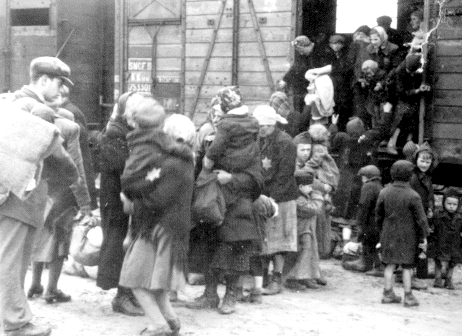
ChildrenBirkenau

Hungarian Jews being sent to Extermination Camps

Adolf Eichmann summed up the attitude of many when he said regarding his work to deport hundreds of thousands of Hungarian Jews to Auschwitz in in just a few weeks during the fall of 1944, “Whether they were bank directors or mental cases, the people who were loaded on those trains meant nothing to me.” Speaking to Willem Sassen in 1957 Eichmann reveled in that accomplishment, “It was an achievement that was never matched before or since.” Eichmann also enjoyed leading his victims on, pretending that he might listen, and they might change his mind. Eichmann was proud of what he did. He told his staff, “I will leap into my grave laughing because the feeling that I have five million human beings on my conscience is for me a source of extraordinary satisfaction.”

Hannah Arendt wrote of Eichmann:

“The trouble with Eichmann was precisely that so many were like him, and that the many were neither perverted nor sadistic, that they were, and still are, terribly and terrifyingly normal. From the viewpoint of our legal institutions and of our moral standards of judgment, this normality was much more terrifying than all the atrocities put together.”

This was what made the Holocaust committed against the Jews of Europe by Nazi Germany a phenomenon different than other genocides. Many of the perpetrators were not driven by centuries old hate as in the Balkans, tribal blood lust as occurred in Rwanda, or the products of Soviet Communism or Communist Chines Maoist regimes.

dachaumorgue1945

It was the racial ideology of the Nazis which deemed the Jews and other non-Aryans to be sub-human. That ideology undergirded the German treatment of the Jews, and the conduct of the war, especially in the East. But the execution of the plan required the bureaucratic, administrative, technical and legal skills brought to the table by ordinary men. Men who sought promotion, advancement and economic security for their families. Individually many would have never killed, but in their positions they ran the rail network, the factories, the banking and finance industries and supported the war effort, most not thinking much about the evil that they abetted or if they did finding a way, be it social, scientific, religious, patriotic, legal or simply in the name of efficiency.

Survivors of Auschwitz

That is what makes the evil committed by them so terrifying. It is the product of “normal” people in an advanced Western nation. Make no bones about it, their actions were evil. They aided and abetted the genocide of the Jews, the disabled, other “sub-human” races, particularly Slavs, as well as those that they deemed less than suitable.

I think that the most chilling thing about the Holocaust was that the greatest atrocities were committed by ordinary men, sometimes well educated, decent family men. These were men who simply executed orders and often went home at night. Arendt wrote that “The sad truth is that most evil is done by people who never make up their minds to be good or evil.” She was right, there was an ordinariness to the evil perpetrated by the Nazis, at the same time there are those who consciously decide to participate in evil.

It is important that we do not forget the Holocaust. It is also important to recognize that the instruments of that horror were on the whole “ordinary” men who as they saw it were simply doing their job. It is something that everyone needs to remember. Bettina Stangneth wrote “Systematic mass murder is not just the sum of isolated instances of sadism but the result of a political thinking that is perverted from the ground up.”

So many of the perpetrators saw nothing wrong in what they were doing, in fact at his trial in Jerusalem Eichmann said, “To sum it all up, I must say that I regret nothing.”

They believed that their victims were less than human and like so many people even today, they had no empathy. Gustave Gilbert, an American Army Psychologist at the major War Criminal Trials at Nuremberg said it so well: “Evil is the absence of empathy.”

It is important that we never forget, especially now when we could be watching it begin all over again.

Peace

Padre Steve+

3 Comments

Filed under civil rights, ethics, Foreign Policy, History, holocaust, iraq,afghanistan, laws and legislation, national security, nazi germany, News and current events, Political Commentary

Truth, Justice, and the Value of a Single Human Life: What Americans Should Stand For

img_0333-1

Friends of Padre Steve’s World,

Yesterday I wrote about a segment of the classic film Judgment at Nuremberg. Today I am following that up with another, albeit, short post regarding one of the most riveting monologues in film from the same film. Since yesterday was also Holocaust Remembrance Day it is appropriate to take the time, and never forget, for while we may not want to admit it, as human beings we are capable of the same inhumanity.

The segment, in which Spencer Tracy plays the role of Chief Judge Dan Heywood gives his verdict is one of the most telling sequences in cinema regarding what it is to be an American. I always show it in the first session of my military ethics class at the Staff College and since the majority of my students have never seen the film, it usually leaves them in silence. So I am just going to leave it with you to watch, read, and contemplate. Who are we, and what do we stand for?

This is especially true when the President, politicians of the majority party in the legislature, pundits, and politically minded preachers make no bones that they have every intent of persecuting those who are of certain races, religions, or political beliefs that they abhor, often using the most scurrilous charges, and outright lies in order to demonize them, dehumanize them, and  open the door for normal, decent, and even brilliant people to justify government sponsored cruelty and injustice that defies the ideals of the Declaration of Independence, the Gettysburg Address, and the Constitution itself.

Please, watch the video and read the text. Ponder it in your heart, because it speaks to something that is not a historical aberration, not just a dramatic film, but something that affects the human condition and is present right here and right now in our own country.

“The trial conducted before this Tribunal began over eight months ago. The record of evidence is more than ten thousand pages long, and final arguments of counsel have been concluded.

Simple murders and atrocities do not constitute the gravamen of the charges in this indictment. Rather, the charge is that of conscious participation in a nationwide, government organized system of cruelty and injustice in violation of every moral and legal principle known to all civilized nations. The Tribunal has carefully studied the record and found therein abundant evidence to support beyond a reasonable doubt the charges against these defendants.

Heir Rolfe, in his very skillful defense, has asserted that there are others who must share the ultimate responsibility for what happened here in Germany. There is truth in this. The real complaining party at the bar in this courtroom is civilization. But the Tribunal does say that the men in the dock are responsible for their actions, men who sat in black robes in judgment on other men, men who took part in the enactment of laws and decrees, the purpose of which was the extermination of humans beings, men who in executive positions actively participated in the enforcement of these laws — illegal even under German law. The principle of criminal law in every civilized society has this in common: Any person who sways another to commit murder, any person who furnishes the lethal weapon for the purpose of the crime, any person who is an accessory to the crime — is guilty.

Heir Rolfe further asserts that the defendant, Janning, was an extraordinary jurist and acted in what he thought was the best interest of this country. There is truth in this also. Janning, to be sure, is a tragic figure. We believe he loathed the evil he did. But compassion for the present torture of his soul must not beget forgetfulness of the torture and the death of millions by the Government of which he was a part. Janning’s record and his fate illuminate the most shattering truth that has emerged from this trial: If he and all of the other defendants had been degraded perverts, if all of the leaders of the Third Reich had been sadistic monsters and maniacs, then these events would have no more moral significance than an earthquake, or any other natural catastrophe. But this trial has shown that under a national crisis, ordinary — even able and extraordinary — men can delude themselves into the commission of crimes so vast and heinous that they beggar the imagination. No one who has sat at through trial can ever forget them: men sterilized because of political belief; a mockery made of friendship and faith; the murder of children. How easily it can happen.

There are those in our own country too who today speak of the “protection of country” — of “survival.” A decision must be made in the life of every nation at the very moment when the grasp of the enemy is at its throat. Then, it seems that the only way to survive is to use the means of the enemy, to rest survival upon what is expedient — to look the other way.

Well, the answer to that is “survival as what?” A country isn’t a rock. It’s not an extension of one’s self. It’s what it stands for. It’s what it stands for when standing for something is the most difficult!

Before the people of the world, let it now be noted that here, in our decision, this is what we stand for: justice, truth, and the value of a single human being.”

Think about it…

Have a great weekend.

Peace

Padre Steve+

Leave a comment

Filed under film, History, laws and legislation, nazi germany, Political Commentary

“Because we Loved our Country!” Why People Believe the Lies

seanspicer_brownsuit

Press Secretary Sean Spicer

Friends of Padre Steve’s World,

I couple of days ago I asked the question “how did we get here?” when I was discussing drumbeat of lies, which are now called alternate truth by the President and members of his administration. As the past few days have unfolded I have asked the question to myself a number of times as the statements continue, along with the admonitions from Steve Bannon, Sean Spicer, and Kellyanne Conway to “always believe” what is being said by the President and for the media and other critics to “shut up.” The media of course now is always lying so it goes, and sadly some journalists have added fuel to the flame by misreporting, that doesn’t mean that journalists or the press as a whole are lying, but it sets up straw men for the President and his advisors to attack. Opposition is considered treason, and opponents must be silenced because it is the patriotic thing to do.

Likewise there is the silencing of Federal workers, and even agencies who simply report the truth, and the quashing of dissent by removing officials who may be troublesome later on. His foreign policy seems like it is going to be a go it alone, aggressive hyper-nationalism, forsaking longstanding and faithful allies to ally himself with the Russian dictator, and to threaten military action, trade wars, and to bring back torture. Yet, those are actions that in the long run are bound to destroy the United States, but there is no push back from the GOP majority in Congress.

Then of course are the executive orders which are being issued daily. President Trump is doing exactly what he promised to do during the campaign when we were told not to take what he said literally. Before his inauguration the President said that he may issue 200 executive orders in his first month in office. Such is to rule by fiat, to bypass Congress, the Courts, and ultimately the people, yet it is entirely legal and at the same time if unchecked by the Congress or the Courts will lead to a totalitarian state.

Yet the President’s supporters and the the vast majority of the Republican Congress say nothing and some are calling him brilliant. So I ask myself why? What is going on when people, people who are basically good, turn a blind eye to emerging tyranny. Why is it that otherwise decent, and even brilliant people will allow such things to happen, and even more, to wholeheartedly support the policies.

Then I began to think of the classic film, Judgment at Nuremberg. The question of how many Germans, who should have known better abandoned all sense and supported Hitler seems to me to be quite similar to what is going on with many Trump supporters. They are afraid of the future, they are frustrated, and their fear of the past, present, and future is such that they are willing to cast aside logic and blindly support a man who can only be called a madman. They are doing it out of “love for country.”

In the movie, Burt Lancaster plays a prominent German legal scholar and jurist named Ernst Janning. As the trial dragged on he was content to allow his defense attorney to use whatever means necessary, even re-victimizing the people who were in fact the victims of his own judgments in support of his government’s policy. When he went to the witness stand his conscience finally got the best of him and he explained his guilt and how he and so many people like him abandoned all sense and morality in supporting Hitler. I could imagine when all of what we are just beginning to see happen before our eyes is done, and our world has crashed in about us, I wonder if some of those who supported the President and asked no questions will have the courage to say like Janning:

“There was a fever over the land. A fever of disgrace, of indignity, of hunger. We had a democracy, yes, but it was torn by elements within. Above all, there was fear. Fear of today, fear of tomorrow, fear of our neighbors, and fear of ourselves. Only when you understand that – can you understand what Hitler meant to us. Because he said to us: ‘Lift your heads! Be proud to be German! There are devils among us. Communists, Liberals, Jews, Gypsies! Once these devils will be destroyed, your misery will be destroyed.’ It was the old, old story of the sacrificial lamb. What about those of us who knew better? We who knew the words were lies and worse than lies? Why did we sit silent? Why did we take part? Because we loved our country! What difference does it make if a few political extremists lose their rights? What difference does it make if a few racial minorities lose their rights? It is only a passing phase. It is only a stage we are going through. It will be discarded sooner or later. Hitler himself will be discarded… sooner or later. The country is in danger. We will march out of the shadows. We will go forward. Forward is the great password. And history tells how well we succeeded, your honor. We succeeded beyond our wildest dreams. The very elements of hate and power about Hitler that mesmerized Germany, mesmerized the world! We found ourselves with sudden powerful allies. Things that had been denied to us as a democracy were open to us now. The world said ‘go ahead, take it, take it! Take Sudetenland, take the Rhineland – remilitarize it – take all of Austria, take it! And then one day we looked around and found that we were in an even more terrible danger. The ritual began in this courtroom swept over the land like a raging, roaring disease. What was going to be a passing phase had become the way of life. Your honor, I was content to sit silent during this trial. I was content to tend my roses. I was even content to let counsel try to save my name, until I realized that in order to save it, he would have to raise the specter again. You have seen him do it – he has done it here in this courtroom. He has suggested that the Third Reich worked for the benefit of people. He has suggested that we sterilized men for the welfare of the country. He has suggested that perhaps the old Jew did sleep with the sixteen year old girl, after all. Once more it is being done for love of country. It is not easy to tell the truth; but if there is to be any salvation for Germany, we who know our guilt must admit it… whatever the pain and humiliation.”

I do not know what is going to happen, I still hope and pray that the President will do good things for the country and the world; but every word, and every action coming from him and his spokespeople serve to dampen any measure of hope that I have for this very young administration. Thankfully, there are people who are using legal means to resist and to speak out, but I wonder if that will be enough.

Peace

Padre Steve+

2 Comments

Filed under ethics, film, History, laws and legislation, nazi germany, News and current events, Political Commentary

The Day After: Reflections

trump-fist-pump

Friends of Padre Steve’s World,

Just a short note this morning. I was pretty busy around the house yesterday and I have been battling a cold for the past week that keeps lingering. I hate being woken up coughing during the night.

Anyway, this morning before I started to do some work around the house I took time to read articles and opinions from around the world and from many points of view on the meaning of President Trump’s assumption of office and inaugural address. They varied with from great concern and near panic to hope. What I am not going to do today is talk about details of those articles. They are all over the web and I encourage my readers to take the time to visit American newspapers and publications of various political and ideological points of view as well as the English language websites of European, Asian, and Middle Eastern news services, newspapers and journals. If you don’t have the time for that the New York Times Opinion section has a great interactive section with many writers of various political views from around the world that you can scroll through at your leisure as it goes on and on. But I really think that no-matter what your political beliefs or ideology are that it does help to read things outside of your bubble or comfort zone. Too many people never leave their bubble and it does us great harm because we don’t understand each other, we don’t know each other, and what we believe about each other is indelibly poisoned because all we see is the caricature, and not real people.

Anyway, the latest book that I finished reading was German historian Heinz Hohne’s tome about Heinrich Himmler and his SS entitled The Order of the Death’s Head: The Story of Hitler’s SS. The book is a fascinating read because it describes the chaotic administration of Nazi Germany which though it was a totalitarian state was a bureaucratic nightmare of competing organizations of the Nazi Party and the German State, bound together, yet each dependent on the graces of Adolf Hitler, who in order to maintain his undisputed power would play them off against each other. But I do highly recommend Hohne’s book. I am not going to go into detail here, I may write something in the near future on the subject as I go through my old texts from my undergraduate and graduate school dealing with the Nazi state, but I digress…

Anyway, my takeaway from President Trump’s inaugural address and subsequent remarks yesterday and today is that he is going to maintain a very small number of trusted advisors, and play off competing factions of the Republican Party and various Federal agencies, maintain his rhetoric to keep his personal base of voters in line all to ensure his personal power. I think that he will be successful in this as he seems to be rather genius at outmaneuvering his opponents. Those in the GOP who think that they can control him or to reign him in to their more traditional conservatism should take note of his words as he ripped the political class of Washington DC; his words were aimed as much at the GOP insiders as they were the Democrats. His administration will be centered on him.

His raised fist served as a visible symbol and reminder to those who think that they can get the best of him. Some of the articles that I read seem to indicate that he will fall afoul of the GOP Congress if he maintains his populist rhetoric and does not tow the GOP think tank policy that has long dominated the GOP caucus. But Congress should beware, Trump does not appear to care about the norms of how things are done in Washington and his followers expect him to act, and he will use them to intimidate Congressional Republicans if they try to use their majority to get in his way. He said as much when he said: “What truly matters is not which party controls our government, but whether our government is controlled by the people.”

I am not going to speculate what the result of this will be, but I do think that it will be chaotic because that seems to be what he thrives on.

After reading all of those reactions, re-watching the speech and his body language, and reading it again, I could not help but think that we are heading toward something we have never seen before in this country: an authoritarian leader at the helm of a populist movement that is not bound by party loyalty or ideology, whose opponents in both parties are disorganized and unable to grasp that the playing field itself has changed, as have the rules.

That is something that gives President Trump with his executive authority a huge advantage. He will invoke this authority through executive orders to move faster than the Republican congressional majority or the divided Democrats can, and to bypass them and the media by communicating directly with his supporters.

Anyway, those are just a few thoughts on the day after.

Peace

Padre Steve+

Leave a comment

Filed under History, laws and legislation, leadership, News and current events, Political Commentary

Dealing With the Reality of the Trump Presidency

us-capitol-west-front-inauguration-2009-barack-obama

Friends of Padre Steve’s World,

There are times in history when eras end and new ones begin. As a historian I think that we are on the verge of one of those moments in history and that is not necessarily a good thing. Barbara Tuchman wrote that as England declared war on Germany in 1914 of British Foreign Secretary Earl Edward Grey:

“Watching with his failing eyes, the lamps being lit in St. James Park, Grey was heard to remark that “the lamps are going out all over Europe; we shall not see them again in our lifetime.”

I believe that could well be the case in our country and the world in the not too distant future, the symbolism of the lamps going out may be all too real.

At 12:01 today Donald Trump will take the Oath of Office and become the President of the United States. That is a fact. We can argue about his legitimacy. Like it or not he is the legal and thus the legitimate President. Of course that is one definition of legitimate. But there is another definition that can be argued to say that he is not, and this one is quite important to our form of government. That definition is “conforming to recognized principles or accepted rules and standards.” This is something that no-one can claim that Mr. Trump has done in his long business life or in his short political life. The latter is incredibly important, but it does not take away the legality of his election. Unless something extraordinary happens in the next five and a half hours he will be the President, and if something were to happen the resulting chaos who likely be worse than the transition of power to a man who appears to have been elected with the help of a hostile foreign power, and who lost the popular vote by one of the widest margins ever for someone who won the electoral vote. The truth be told I wish I had never seen this day come, but it has.

That my friends, like it or lump it is reality, and as the masthead of this site reads, I am a “progressive realist in Wonderland.” 

Now we can say “Never Trump” all we want, but he will still be President. We can put hashtags saying “not my President,” but he will still be President. That is cold hard reality. We can talk about resistance, but if we resist we need to be smart in how we do it and apply reason, logic, and hard work.

Does that mean that his policies should not be opposed on principle of they harm people? Never. There are many of his stated policies which if implemented will be harmful to the country. Likewise, some of the things that he has said regarding foreign policy not only will make us weaker but could end up in an even chaotic world and the real possibility of war with nations that could do us great harm, militarily and economically. Of course we could find out that once in office he becomes more pragmatic, realistic, and flexible. I kind of doubt it but it is a possibility.

A lot depends on what he says tomorrow, if he conducts himself with humility, dignity, and shows respect for all Americans, he could change the tenor of the debate in the country and instead of having to crush those who question his legitimacy, he could earn their respect, even if it is grudging. Again, while this is possible, I am not hopeful that it will happen, but I could be wrong. Even so, no-matter how he conducts himself today, he will still be President.

So what are the realistic options?

Protest is always an option, but those who do so must be very careful and not allow themselves to be provoked into any action that could cause President Trump to enact measures that are written in the Constitution, in established law, and in executive orders that deal with civil unrest. We have to remember that there are “agent provocateurs” who do things to cause individuals to do things that puts them on the wrong side of the law. One stupid or violent action against the President could bring the whole house down. If we protest it must be peaceful and those who do cannot allow themselves to respond to violence and intimidation in kind. That is what we learned from men like Dr. Martin Luther King Jr. and Representative John Lewis. The path has to be non-violent.

What else can we do?

Get involved. Write your state and Federal representatives and senators on all important issues. Don’t just tweet to your friends.

Revitalize the political party system in the country by participating at all levels.

Run for office, especially at the local and state level. That is where real change happens, if your don’t win there it doesn’t matter if you win the Presidency once in a while. Many offices around the country are won by people who run unopposed; don’t let that happen.

Donate money to political groups, parties, and those who represent what you believe.

Speak up for those who have no voice and who are demonized by Trump’s most radical followers as well as those in the Republican Party who have demonized them far longer than Mr. Trump has been a member of that party.

Speak truth to power and do not spread rumors or innuendo. Get away from spreading political memes that even if they are factual are not conducive to reasoned debate.

Read long articles in newspapers, and journals. Things that require thought and reflection. When you share them do what I do. Ask people to read them and then ask them if the want to comment pro or con to do so themselves and not on your social media timeline or to discuss things in personal messages or even better in person. Avoid Twitter wars and Facebook rants, be careful of what you say in e-mails and comment sections of public forums.

Gather together in person and discuss issues, even with people with whom you disagree. Do it over a meal, a drink, but do it respectfully and build bridges that break down the walls of division. It’s hard to hate people that you break bread with.

Remember, there are people who initially support authoritarian leaders who sooner or later realize that they were deceived by false promises and come around. One of those was the German Pastor Martin Niemoller who initially supported Hitler, then when he realized that he had been lied to, spoke up, and resisted. In a concentration camp he wrote these words:

“I hated the growing atheistic movement, which was fostered and promoted by the Social Democrats and the Communists. Their hostility toward the Church made me pin my hopes on Hitler for a while. I am paying for that mistake now; and not me alone, but thousands of other persons like me.” 

Believe me, there will be a lot of people who voted for President Trump and his GOP allies who will be dealing with buyer’s remorse in the not too distant future. When that happens we need to be there for them.

Read. Barbara Tuchman wrote:

“Books are the carriers of civilization. Without books, history is silent, literature dumb, science crippled, thought and speculation at a standstill. Without books, the development of civilization would have been impossible. They are engines of change (as the poet said), windows on the world and lighthouses erected in the sea of time. They are companions, teachers, magicians, bankers of the treasures of the mind. Books are humanity in print.”

Read real books on history, political science, law and the Constitution. Read how we got the Declaration of Independence and the story of how in the face of real rebellion and war, Abraham Lincoln began the quest for “a new birth of freedom.”

Read the biographies of statesmen and women, politicians, Presidents, and Prime Ministers, civil rights leaders, labor leaders, and even religious leaders. Read the classics, and even poetry. Learn about courage to face trying times and uncertain futures from those who went before us. Learn from their successes and also their failures. Most of them had feet of clay, but the good ones made a difference. We can too.

These are things that matter and in the long run can defeat the worst attempts of Trump, his cabinet officials, people he appoints as justices and judges, and GOP dominated legislatures.

Will you get instant gratification? No. This is hard work. It requires patience, humility, the ability to admit when we are wrong, and the courage to face reality. Part of that reality is that Donald Trump will be President at 12:01 today. I will not bury my head in the sand, and as painful and distasteful as it will probably be I will watch the inauguration today, if nothing else to show my respect to our outgoing President and his family, who I will miss as President.

I remember watching Barak Obama’s inauguration in 2009. When he took the Oath of Office, I was standing beside the bed of a critically ill African American woman in the ICU of the Medical center that I then worked. She was nearly 90 years old. Her late husband had been a military man back during Jim Crow and then the Civil Rights era, she remembered the hatred and discrimination that they both faced. I remember watching that moment with her, holding her hand, and listening to her joy in spite of her pain at seeing a moment that she never dreamed that she would live to see. It was a profound honor for me.

Truthfully, all of that being said, I am very afraid of what President Trump and his administration may do in a very short amount of time. It is much easier to destroy systems and crush dissent than to built bridges and renew the country. At the same time I will be a voice of reason and speak the truth the best I can given the limitations of my own office. I do want to be wrong, and I will pray for him and his family because if he screws up we are all screwed. That too is reality.

But that’s what we have to do. we cannot give up, but if we resist, we must do it smartly and effectively. Highly emotional outbursts that lead to less than wise actions will doom resistance. We must be to use the words of Jesus, “wise as serpents and gentle as doves.”

So until tomorrow.

Peace,

Padre Steve+


4 Comments

Filed under civil rights, History, laws and legislation, News and current events, Political Commentary

The One Truly Essential Wall: Separation of Church and State

Friends of Padre Steve’s World,

I don’t know about you but I am sick and tired of people, no matter what their religious belief in this country who use the Constitutionally protections extended to religious freedom in manners that the founders of our country never would have imagined. The fact that those basic religious freedoms are not in danger in any way is irrelevant to true believers.  In their insecurity such people need to create new laws specifically crafted to allow them to discriminate against others based on their religious beliefs.

Sadly, and I say this as a Christian, the vast majority of people doing this are people that claim to be Christians and in a few weeks they will have the chance to use not only state and local governments to do their bidding but the Federal Government and quite possibly the Supreme Court. It is a situation that those who founded our country fought against, and even addressed the matter in the Constitution and in their correspondence.

Thomas Jefferson was first among these men. In his wonderful letter to the Virginia Baptist Association in 1808, in a letter the echoed his letter to the Danbury Baptist Association of of 1802 in which he referred that the legislature in enacting the dual provisions of religious liberty in the Constitution had built up “a wall of separation between Church and State” noted:

“Because religious belief, or non belief, is such an important part of every person’s life, freedom of religion affects every individual. Religious institutions that use government power to support themselves and force their views of other faiths, or no faith, undermine all our civil rights. Morever, state support of an established religion tends to make the clergy unresponsive to their own people, and leads to corruption in religion itself. Erecting the “wall of separation between church and state,” therefore, is absolutely essential in a free society.” 

You see my friends, Jefferson and the other courageous men who so carefully crafted this wall of separation had real experience with the abuses by church-state and the incestuous clergy who used state power to prop up themselves and their churches and to persecution those that refused to submit to their control. Likewise there were religious groups in the recently independent former colonies like the Baptists who in Virginia and other states, as well as the Quakers in Massachusetts who were victims of such persecution, and they were determined not to let it happen here through the marriage of church and state.

In fact Jefferson was absolutely convinced that no specific God or religion be established: not only in the Constitution of the United States, but in his own home state, the Commonwealth of Virginia. There Jefferson authored the Virginia a religious liberty bill which was passed, but which met with considerable opposition from faithful Christians. Reflecting on that legislation Jefferson wrote this in 1821:

“[When] the [Virginia] bill for the establishment of religious freedom…was finally passed,…a singular proposition proved that it’s protection of opinion was meant to be universal. Where the preamble declares that coercion is a departure from the holy author of our religion, an amendment was proposed, by inserting “Jesus Christ,” so that it should read “a departure from the plan of Jesus Christ, the holy author of our religion.” The insertion was rejected by a great majority, in proof that they meant to comprehend within the mantle of its protection the Jew and the Gentile, the Christian and the Mahamoten, the Hindoo and the infidel of every denomination.”

Sadly, Jefferson’s words are twisted, rejected and even despised by the authors of the Religious Liberty Restoration Acts being enacted in state houses around the country.  President-Elect Trump, whose actual understanding of Constitutional liberties is minimal, has promised to sign into law a bill called First Amendment Defense Act. Not only are the state legislatures enacting laws meant only to provide Christians the  protection and the police power of the state to discriminate against any person, or group based on religious belief, something that so so-called First Amendment Defense Act will do at the Federal level. I believe that he will sign it based on the preachers he has speaking or praying at his inaugural, all of who are proponents of enhancing the rights of Christians to discriminate based solely on their religious beliefs, and to limit the civil rights of those they oppose. Call it theocracy, something better suited to Tehran or Riyahd than the United States.

Our founders, especially Jefferson and Madison who have found that incomprehensible, but then they would certainly not be surprised because they had seen it and lived under it during the English Administration of the colonies. They also understood human nature very well.

Thus I think that we should applaud Thomas Jefferson and like Christopher Hitchens exclaim “Mr. Jefferson. BUILD UP THAT WALL!” 

However that wall is being torn down by the descendants of Christians who longed to be free from the coercion and evil wrought by the marriage of church and state, a marriage which Jefferson so wisely noted harmed the church as much as the state.

I have spent the better part of my adult life as a military chaplain defending and protecting the rights of others to their free exercise of religion on whether or not I agreed with them. I held and still hold that to be a sacred duty of my commission and office. I can also state that even most people who did not agree with regarding my beliefs respected me and still consult me because first they knew that I cared about them and secondly that they knew that I would do all within my power to protect their freedom the exercise their religion, or to have no religion and not to be penalized for it.

But that being said I have found that I am increasingly isolated by the fervent religionists who have highjacked the understanding of religious freedom to mean theirs and only theirs and who use the battering ram of the legislature to destroy Mr. Jefferson’s “Wall.” Sadly they are to blind to see that their actions are a two-edged sword which once precedence has been established can be turned on them with a vengeance. I and other chaplains who come from more moderate or liberal traditions that have long embraced both the Social Gospel, the Civil Rights, Women’s Rights, and LGBTQ Rights movements have been long shunned by many of our conservative or fundamentalist colleagues. I have no doubt that in the coming administration that this will become more common and that we may find ourselves punished for speaking our beliefs. Old guys like me will probably be okay and just retire, but but the young progressive chaplains will have a difficult time.

One of my favorite television series of all times is Boston Legal. My favorite character in the show is the lawyer played by James Spader, one Alan Shore. In the episode Whose God is it Anyway  Spader’s character is defending a friend form charges or religious discrimination in the workplace, and his character, Alan Shore delivers this remarkable closing, which because of the unrelenting actions of many of my Christian Brothers and Sisters in putting their rights and privileges as Christians over those of other citizens. That my friends is profoundly dangerous.

By doing so they through their intense hubris not only harm others as they attempt to control them by the police power of the state but damage their own credibility and the religious liberty of Americans yet to be born. It is no wonder that this generation of American Christianity is shedding members at a rate never seen in this country before, and driving those who they might want to bring to faith away. But I digress…

There is a bit of dialogue in that episode of Boston Legal that I wish I had thought of and said years ago. I am certain that if  Jefferson, Madison and so many of our founders would agree with if they had lived to see the depths of dishonesty of Christian individuals, businesses and legislatures have sunk in their abuse of others through their unremitting pursuit of their religious freedom. That is not just at home where they enact laws allowing them to discriminate, but through their apocalyptic machinations to bring the world to war killing billions of people just so Jesus will come back. Though they would deny it, their ultimate goals, albeit in the name of a different  God, are little different than that the Islamic State, Al Qaida, the Iranian Mullahs or Hezbollah. That my friends should scare the living shit out of any rational person.

So here is that closing:

“I don’t know about you but I’m getting a little tired of the religious freedom thing. When did religion get such a good name anyway. Be it the Crusades, the reformation genocides, the troubles in Northern Ireland, the Middle East, mass slaughters in the name of Allah, the obligatory reciprocal retributions. Hundreds of millions have died in religious conflicts. Hitler did his business in the name of his creator. Religious extremism, it’s our greatest threat today, a holy jihad. If we’re not ready to strip religion of its sacred cow status, how about we at least scale back on the Constitutional dogma exalting it as all get out….

Everyone should get to believe in his God, pray to his God, worship his God of course. But to impose him on others, to victimize others in his name?  The founding fathers set out to prevent persecution, not license it…

At a certain point we have to say “enough with this freedom of religion crap. Yuck, yuck, yuck. I know, I’ll get letters….” 

To that I can only say “Amen!”

So with that I bid you a good day.

Peace

Padre Steve+

2 Comments

Filed under civil rights, ethics, faith, History, laws and legislation, Political Commentary, Religion