Category Archives: laws and legislation

“The Only Thing that Doesn’t Abide by Majority Rule is a Person’s Conscience” Standing Up to the Empowered Christian Right

mock

Friends of Padre Steve’s World

One of my favorite films is To Kill a Mockingbird. I am a convinced that many people that call themselves “conservative Christians,” are so busy protecting their place and power in society that they despise anyone not like them. For decades before and now after the election of Donald Trump the same collection of conservative Christian Supremacists have played fast and loose with the truth, scammed billions of dollars from desperate followers, and drove almost every moderate there ever was out of the Republican Party with their ideology of Christian Dominionism.

I have written about this before. In light of my experience with them I imagine that some of these folks will, now that they have help a man that they belief will fully support their agenda, “kill the Mockingbird” in order to ensure that they keep their privileged position in society. Traditionally the Mockingbirds are those people that they have condemned to social inferiority and discrimination and eternal punishment simply because they are different. To today’s theocrats, the most frequent targets of their wrath are gays and the LGBT community, as well as Muslims, other non-white immigrants, women, and the disabled. The fact that just because someone else gets equal rights doesn’t mean that they lose any rights equality before the law, except to persecute them, seems to be beyond their capability to understand.

This is especially the case of the preachers, pundits and politicians that crowd the airwaves and internet with their pronouncements against Gays, immigrants, Arabs, poor blacks, political liberals, progressive Christians, and for that matter anyone who simply wants the same rights enjoyed by these Christians. This makes me fear them more far more than I fear Donald Trump. They represent a majority of the Republican House caucus and there quite a few in the Senate including, Attorney General nominee Senator Jefferson Beauregard Sessions, whose racist sentiments were so reprehensible that kept him from appointment as a Federal Judge during the Reagan administration.

In the book there is a line spoken by Miss Maudie Atkinson, a neighbor of Atticus Finch and his children. She says to Atticus’s daughter Scout:

“Sometimes the Bible in the hand of one man is worse than a whiskey bottle in the hand of another… There are just some kind of men who – who’re so busy worrying about the next world they’ve never learned to live in this one, and you can look down the street and see the results.”

As I survey the world of Christian conservatives I become surer of this every day. I’ve often wrote about my own fears in regard to dealing with such people as well as the troubling trends that I see. Over the years I have written articles on the trends that I see in the church, trends toward greed, political power, social isolation and the active campaign of some to deny basic civil rights to people that they hate on purely religious grounds.

The language of some like Matt Staver of Liberty Counsel, Tony Perkins of the American Family Association and a host of others describe actions of governments and courts to ensure equal treatment of all people under the law as threats to Christians, affronts to them and of course to God. Their words are chilling. Before the Obergfell v. Hodges decision, Matt Staver that if the Supreme Court upheld marriage equity for gays that it would be like the Dred Scott decision. Of course that is one of the most Orwellian statements I have heard in a while, for the Dred Scott decision rolled back the few rights that blacks had anywhere in the country and crushed the rights of non-slave states. These men are now pushing to ensure that President-Elect Trump does there will, and some have pledged to turn against him if he doesn’t fully support their every demand. I hope that they become so onerous that Trump turns on them like he has on so many other past supporters. They would deserve it and this is a distinct possibility. If we look at history, every authoritarian leader of the past century has turned on supporters who think that they are more entitled than other followers, often with a vengeance.

Again, as a reminder to readers, especially those new to the site, I spent a large amount of my adult Christian life in that conservative Evangelical cocoon. I worked for a prominent television evangelist for several years, a man who has become an extreme spokesman for the religious political right. I know what goes on in such ministries, I know what goes on in such churches. I know the intolerance and the cold hearted political nature of the beast. I know and have gone to church with Randall Terry, the former head Operation Rescue who once said: “Let a wave of intolerance wash over you. I want you to let a wave of hatred wash over you. Yes, hate is good…” I have walked in those shoes, and at one time I was as whipped into a frenzy of hate by those preachers, and their colleagues in right wing talk radio. Thus I fully understand them.

As Atticus Finch told his children:

“You never really understand a person until you consider things from his point of view… Until you climb inside of his skin and walk around in it.”

Thus I total reject the message of such people now, not out of ignorance, but because I have walked in their shoes. At times I supported their causes, not to any extreme, but all too often my crime was simply said nothing when I knew that what they preached, taught and lived was not at all Christian, but from the pits of Hell.

As far as them being entitled to hold whatever opinion they want, even if I disagree, yes that is their right. But as Atticus said:

“People are certainly entitled to think that I’m wrong, and they are entitled to full respect for their opinions. But before I can live with other folks I’ve got to live with myself. The only thing that doesn’t abide by majority rule is a person’s conscience.”

My conscience will not allow me to be silent when I see men like Staver, Perkins, Franklin Graham and so many others preach hatred towards those who are different than them. In 2010 that caused me to be thrown out of a church I had served faithfully from over 14 years as a priest and chaplain. These people are viscous and need to be opposed at all costs.

In the movie and the book the Mockingbirds were Tom Robinson, the black man falsely accused of rape and assault and Boo Radley, a shy recluse feared by his neighbors, a man who stories were made up about; stories that turned a simple man into a monster in the eyes of people who did not know him. Today they are others who fit the Mockingbird role, people who just want to get along and live in peace, but who endure discrimination and damnation from those who call themselves Christians.

Jem Finch, the son of Atticus asks his sister a question in the book and the film:

“If there’s just one kind of folks, why can’t they get along with each other? If they’re all alike, why do they go out of their way to despise each other?”

I ask the same question on a daily basis and I wonder how it can happen again and again.

Peace

Padre Steve+

1 Comment

Filed under civil rights, ethics, faith, film, History, laws and legislation, leadership, LGBT issues, movies, News and current events, Political Commentary

Dan Sickles Part Three: Trial of the Century

Friends of Padre Steve’s World,

I am taking a break over this Thanksgiving weekend and am re-posting some articles from my Gettysburg text dealing with a man that I consider one of the most fascinating , salacious, scandalous, heroic, and incredible figures ever to grace and disgrace American history, Congressman, and Civil War General Daniel E. Sickles.

I hope that you enjoy,

Peace

Padre Steve+
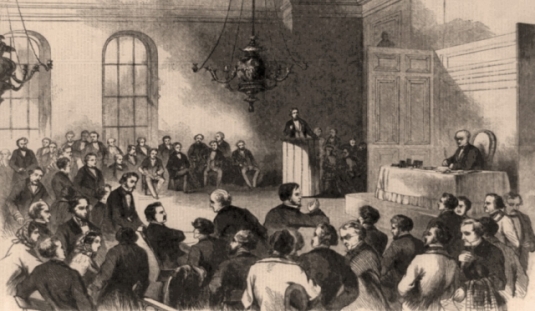
HD_TrialofDanielSickles1859.preview

The Sickles Trial


The stage was now set for the one of the most unbelievable and storied trials in American history, a trial that would have been much more suited to the era of 24/7 cable news coverage and the Internet than the era of the telegraph and newspaper, but even so it was sensational by any standard and it riveted the attention of the public in every part of the nation, from the largest cities to the smallest towns.

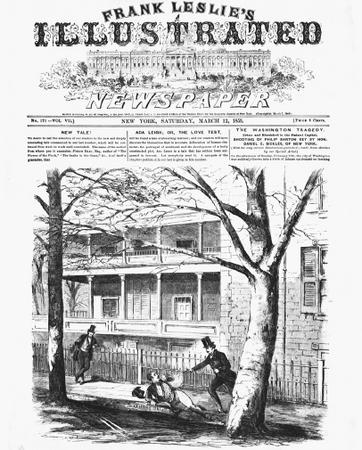
Almost immediately swarms of journalists were camped outside the prison and Sickles’ house where distraught Teresa sought a way to gain Dan’s forgiveness having received his broken wedding band which he sent to her from the jail. Witnesses to her dalliances with Key at the 15th Street house and other venues were brought to the Stockton Mansion to identify her. “She was the meat in the market, the ogre at the carnival. A little way across the square, souvenir hunters were cutting fragments of wood out of the tree by which Key had fallen, and artists from the illustrated papers set up their easels and began sketching every aspect of the area – the railings, the Stockton Mansion, the Clubhouse.” [1] A Presbyterian pastor who knew the couple found her obsessed by the shame that she had brought upon herself and her daughter, and he “found her in such mental agony that he feared for her sanity and even felt that she might try to take her life.” [2]

It was a credit to her own emotional strength that Teresa survived the ordeal that she had helped to bring about, and which she found herself blamed for, even by her father, who felt that she had dishonored the Bagioli family name. Antonio Bagioli wrote to Dan in prison, “You have heaped on my child affection, kindness, devotion, generosity. You have been a good son, a true friend, and a devoted, kind, loving husband and father.” [3] Of all the commentators, it was the eminent historian and diplomat George Bancroft who seemed to have any “sense of Teresa’s pain: “Poor child, what a cruel thing to deprive her of her sole stay and support. Key was the only man she could look to for sympathy and protection.” [4]

After Barton Key’s lifeless body was borne off in a mahogany casket to the Presbyterian cemetery in Baltimore and buried in the grave of his dead wife, and his children placed in the care of his family, his effects, what they amounted to, including his resplendent Montgomery Guards uniform were “sold off to a morbid, bargain-hunting, souvenir-hounding crowd.” [5] It was an ignoble end to the scandalous story of the son of Francis Scott Key, a story that soon with all of its salacious detail would be revealed to the public.

Meanwhile, inside the jail her husband, alternating between fits of rage and calm was visited by Washington’s Mayor James Barret, Sam Butterworth, Attorney General Black, Vice President John C. Breckinridge, and Speaker of the House, James Orr. He was comforted by the many expressions of support and sympathy found in scores of letters from people around the country, one of the first “a kindly note from the President,” [6] and others from total strangers. He was also joined by friends and allies from New York and Washington. “James Topham Brady, John Graham, and Thomas Francis Meagher, able lawyers all, arrived post haste to defend their rash ally” [7] as well as his father who before offering encouragement to his son offered a sharp chastisement, “You hot-headed fool! That’s no way to settle things! No woman’s worth it! No matter how you come out of this, you’ve killed your career – White House and everything else.” [8]Undeterred and calm Dan told his father that he understood and that if he had to he would do it again, after which, his father began to discuss the organization of his son’s defense with this legal team.

rerl_02_img0122

The case was front page news in all the major newspapers, which provided “extensive coverage of the “Sickles Tragedy.” Sickles’ murder of his friend Key in broad daylight in view of the White House had all of the scandalous elements that have thrilled Americans then and even today: “adultery, politics, celebrity, and a handsome corpse,” [9] not to mention a beautiful young woman who even more than her husband who had killed a man, stood accused in the eye of the public.

Despite the notoriety of the case, many people found sympathy with Sickles and believed that no jury would convict him of murder or manslaughter, after all, Teresa was the one who committed adultery with Key. The New York Herald “doubted that a grand jury would indict him. Even if he were indicted, Harper’s Weekly presumed that no jury would convict him of manslaughter if the adultery charge were proven, which it considered a foregone conclusion.” [10] The New York Times noted well before the trial opened, “there appears to be no second opinion as to the certainty of Mr. Sickles acquittal” but “national interest” arose from “the general desire to see the whole case fairly put, and the million scandals of mystery laid to rest by the plain facts.” [11]Newspapers like the New York Evening Post, his political arch-enemy found the murder an excellent opportunity to attack Sickles, “That wretched man, Daniel E. Sickles, has in his career reached the stage of assassination, and dipped his hands in human blood… It is certain that a man… who in his own practice, regards adultery as a joke and the matrimonial bond as no barrier against the utmost caprice of licentiousness – has little right to complain when the mischief which he carriers without scruple into other families enters his own.” [12] But such commentary was the exception, and it came from the organ of a political enemy. It is an interesting comment on the era, that a woman’s adultery, even when committed by the wife of an adulterous male who had killed her lover, was consider more of a social stigma and crime than murder.

Within days Sickles had assembled one of the most formidable defense teams ever to dominate an American court. Brady, who was considered to be the ablest criminal defense lawyer of his day became the lead attorney for the defense team, and was joined by Sickles’ New York friends, Graham and Meagher. Brady was an excellent choice, he “was admired and even loved by society in general, but on top of that, though his legal repertoire was wide, he had been involved successfully in more than fifty murder cases.” And he “had also made a special study of pleas of insanity,” [13] something that would figure greatly in the trial.

Additionally, President Buchanan helped recruit one of the finest attorneys in the country, the future Secretary of War, Edwin Stanton to the team. They were joined by four lesser known, yet high-powered attorneys; Samuel Chilton a Virginian who later represented John Brown, and his partner Allen Magruder, Daniel Ratcliffe, and Philip Phillips, a former Alabama Congressman and member of Washington’s Jewish community. Additionally, Reverdy Johnson, one of the most respected attorneys of the day served as an occasional advisor. “The Washington Evening Star observed that Sickles was collecting a lot of lawyers for a man whose defenders did not expect to leave their box before acquitting him.” [14]

Sickles’ defense team was a nineteenth century legal Dream Team against which the government deployed but one attorney, Key’s former assistant District Attorney Robert Ould. Ould, described by one of Sickles’ biographers as “a dull bull of a man, at one time a Baptist parson,” [15] had been named acting District Attorney by President Buchanan when Key was killed. It was an odd place for Ould, as he was serving to prosecute his former boss’s killer, at the behest of the President, who happened to be one of the defendant’s best friends. Ould, the former parson “was placed by inference in the unhappy position of defending adultery – something that he indignantly denied, insisting that he was merely prosecuting a killer….” [16] but to many people, the murderer of an adulterer by an aggrieved husband was complete justified. Ould was totally outclassed by the defense team, and Key’s family paid to have John Carlisle a respected Washington attorney to aid Ould in the case, but the trial would prove them appear incompetent and not up to the task of convicting Sickles.
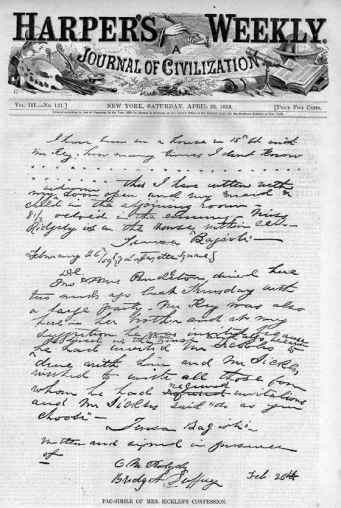
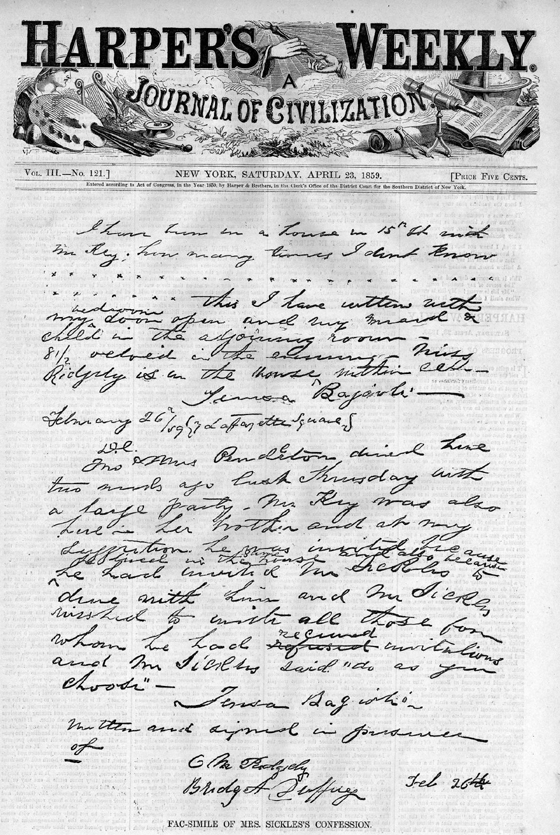
HarpersMagazineTeresaConfession

Teresa Sickles Confession on the Front Page of Harper’s Weekly

The defense pushed for a speedy trial and decided, as many lawyers do today, to try the case in the newspapers, which in light of the lurid nature of the story hung on every word coming out of Washington. The defense team pursued the strategy of “entirely reversing the roles of Sickles and Key by putting the dead man on trial for having made a victim of the defendant, and the New York Press prepared the public for just such an emotional appeal.” [17] The news stories printed by papers that supported Sickles as well as those of his detractors helped inflame the public as the newspapers across the country “wherever wires ran, were front-paging the story under screaming headlines and, in larger cities, rushing out extras every hour or two, as fresh details came to hand.” [18] The private affairs of Dan and Teresa Sickles became known around the nation, and even though the judge in the case refused to admit the confessions Sickles had forced from Teresa into evidence they found their way into the papers, some like Harper’s not only ran the text but reproduced the confession in enlarged facsimile form. The question in many people’s mind “was Dan Sickles justified in slaying the man who had betrayed his confidence and seduced his wife?… As a consequence the whole country turned jury.” [19]

The trial began on April 4th, just over a month after the killing and barely a week after the indictment was handed down. The first three days involved jury selection, a task that the defense turned over to Philip Phillips, who sparred with the prosecutor Ould over the twelve men who would eventually sit in judgment of Dan Sickles. Ould attempted to gain a favorable jury by introducing the property qualifications of jurors, he “ruled out jurors who did not meet the requirement of owning property valued at $800. Since this $800 property limit had not been imposed in similar cases, Ould’s insistence on it would attract much scorn from Dan’s lawyers…”[20] Sickles’ team fought back embarrassing Ould in the process, but not getting the judge to change his narrow application of the law to help the defense. Over two hundred potential jurors were examined before twelve unbiased jurors could be found, and a “great majority of those dismissed confess strong prejudice in favor of the prisoner.” [21] When the jury was seated it was composed of twelve men, two farmers, four grocers, a merchant, a tinner, a coach maker, a men’s clothing salesman, a shoemaker, and a cabinetmaker, “but not a single “gentleman” in the occupational sense.” [22]

Ould opened his case, “ponderously, powerfully, in the blackest of terms,” [23] he drew a picture of the killing. He delivered an “emotionally charged argument that Sickles, “a walking magazine,” had taken deliberate care in arming himself against Key, who only had “a poor and feeble opera-glass.” [24] Ould argued “that homicide with a deadly weapon, perpetrated by a party who has all the advantage on his side and with all the deliberate cruelty and vindictiveness, is murder, no matter what the antecedent provocation in the case.”[25] He then called twenty-eight witnesses, the majority of whom had actually witnessed the shooting, but he did not call upon Butterworth, Teresa, or the young White House page boy who had told President Buchanan and been sent away. Likewise he had not established intent, a key factor in any murder trial, nor had he introduced evidence that he had obtained regarding Sickles’ own affairs with women in Philadelphia, Baltimore, and elsewhere. The presentation of the physical evidence of Barton Key’s clothing and the bullet that supposedly killed Key was botched, the bullet that the prosecution claimed to have killed key did not fit either the Derringer, or the Colt revolver. Thus Ould left open for the defense the chance to explore all the salacious details of the case to put Key on trial, and to establish exculpatory reasons why Sickles had killed Key. Ould’s presentation of his case was brief, and so futile “that it seemed that Key was on trial for seduction, not that Sickles was on trial for murder.” [26]
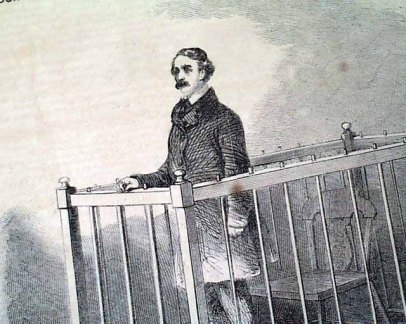
sickles in the box

Sickles in the Prisoner’s Dock

The defense team made mincemeat of the prosecution. John Graham’s opening statement was a work of oratory genius that “would massively outshine Robert Ould’s more cumbersome opening.” [27]Weaving allusions from Shakespeare and other literary greats into his statement, he painted Sickles as the victim of a adulterous rogue who had on a Sunday, a day when he should have “sent his aspirations heavenward,” had instead besieged “that castle where for security and repose the law had placed the wife and children of his neighbor.” [28] Casting Sickles as the aggrieved and temporarily insane victim he also asked if it was a “crime for a husband to defend his family altar.” From there he proceeded to use quotes from Shakespeare’s Othello he inveighs against the adulterer as the supreme criminal, piling up quotation upon quotation from the Old Testament and Roman law to show that in wiser days the punishment invariably was death’” [29] to paint the picture of Sickles’ agony as he saw the man who had defiled his wife prowling outside of his home. Graham then went to provocation and argued that due the circumstance of the crime, a friend and confidant attempting to defile Sickles’ wife on a Sunday that the prosecution “needed to prove Dan’s sanity at the time of the act. And they could not do that, because there was not enough in the case “to melt the heart that is not cut from the unwedgeable gnarled oak.” [30] It was a masterful performance.

Over the next two weeks, Brady, Stanton, and Graham would continue to hammer the prosecution case. The defense proved that Key’s family had tampered with evidence, including testimony from a locksmith who had changed the locks at the 15th Street house at the direction of Key’s family. Witness after witness was introduced to undermine the prosecution and support the defense’s claim that Sickles’ was indeed in a state of uncontrollable madness, and the defense deftly parried the prosecutor’s rebuttal witnesses. When Ould attempted to keep African American witnesses from testifying Stanton, thundered and“accused the prosecution of a “monstrous” attempt to suppress evidence in its zeal of the defendant’s blood,” [31] and argued from North Carolina precedent that the prosecution was not willing to grant Sickles the same right as a slave. As his lawyers argued his case and witnesses gave testimony Sickles maintained his composure except for a number of times when he broke down and had to be excused from the proceedings. “Whether the courtroom histrionics were real or an award-winning performance, the jury witnessed firsthand a husband who was mentally unable to bear his wife with another man.” [32] On the Friday the 22nd of April Judge Crawford declared the testimony closed and the next day began the closing arguments.

Saturday April 23rd dawned with a violent gale, but that did not prevent crowds of people from trying to gain admittance to the courtroom. Edwin Stanton began the defense closing arguments in a manner that was calm and precise. He brought up that justifiable homicide included that which was “committed in defense of family chastity, the sanctity of the marriage bed, the matron’s honor, the virgin’s purity.” [33] Since the prosecution had never brought into evidence Sickles’ own violation of these covenants his attacks on Key and the prosecution case hit home. As he continued his voice rose to a roar, sounding like a prophet of ancient Israel “Who seeing this thin, would not exclaim to the unhappy husband, “Hasten, hasten, to save the mother of your child! And may the Lord who watches over the home and family guide the bullets and direct the stroke!” [34] When Stanton finished the court erupted in a frenzy as spectators as well as supporters of Sickles applauded his closing.

Next up was Brady who went on for three hours, captivating the audience which hung on every word. “When Daniel Sickles realized how he had been betrayed, all the emotions of his nature changed into a single impulse; every throb of his heart brought before him the sense of his great injuries; every drop of his blood was burdened with a sense of shame; he was crushed by inexorable agony in the loss of his wife, in the dishonor that he had come upon his child, in the knowledge that the future – which had opened to him so full of brilliancy – had now been enshrouded in eternal gloom by one who, contrawise, should have invoked form the eternal God his greatest effulgence on the path of his friend….” [35]

The closing had been masterful, emotional, and dramatic. In response Ould attempted to recover, but his arguments were weak, he agreed with the defense about the crime of adultery, and attempted to redirect the jury’s attention that it was Sickles who was on trial for murder and not Key for adultery, but he had already lost that argument. He called the defense of temporary insanity a ploy and “mentioned how easily, and readily a man on trial for his life might pretend to be deranged if he were on trial for his life.” But it was too little, too late. Since there was no psychiatric profession to weigh in on the matter, the argument of temporary insanity fell back on the “tradition of male marital dominance” and “that argument played well among men who rarely wore collars on their shirts…” [36] the very kind of men seated in the jury booth. When the jury recessed to deliberate Sickles’ fate on the 26th it took them less than an hour to return their verdict, and few were surprised when it came back “not guilty.” Stanton “was so excited that he did a jig in the courtroom, the hoarsely called for three cheers.” [37] As he did “Pandemonium and cheers broke out in the courtroom.” [38]People crowded around to congratulate Sickles and the crush was so great that Sickles had to be escorted for the courtroom. President Buchanan on hearing the verdict was delighted, later in the evening, though he sought rest, Sickles was taken by Brady to a gala in his honor attended by nearly 1500 supporters and well-wishers. The trial was over but the trials of Dan Sickles were not.

Notes

[1] Ibid. Keneally American Scoundrel p.142

[2] Ibid. Swanberg Sickles the Incredible p.63

[3] Ibid. Keneally American Scoundrel p.146

[4] Ibid. Keneally American Scoundrel p.147

[5] Ibid. Pinchon Dan Sickles p.117

[6] Ibid. Pinchon Dan Sickles p.117

[7] Ibid. Swanberg Sickles the Incredible pp.62-63

[8] Ibid. Pinchon Dan Sickles p.116

[9] Ibid. Hessler Sickles at Gettysburg p.12

[10] Marvel, William Lincoln’s Autocrat: The Life of Edwin Stanton University of North Carolina Press, Chapel Hill 2015 p.103

[11] Ibid. Hessler Sickles at Gettysburg pp.12-13

[12] Ibid. Swanberg Sickles the Incredible p.63

[13] Ibid. Keneally American Scoundrel p.151

[14] Ibid. Marvel Lincoln’s Autocrat p.103

[15] Ibid. Pinchon Dan Sickles p.121

[16] Ibid. Swanberg Sickles the Incredible p.64

[17] Ibid. Marvel Lincoln’s Autocrat p.104

[18] Ibid. Pinchon Dan Sickles p.118

[19] Ibid. Pinchon Dan Sickles pp.118-119

[20] Ibid. Keneally American Scoundrel p.162

[21] Ibid. Pinchon Dan Sickles p.120

[22] Ibid. Marvel Lincoln’s Autocrat p.105

[23] Ibid. Pinchon Dan Sickles p.122

[24] Ibid. Hessler Sickles at Gettysburg p.14

[25] Ibid. Pinchon Dan Sickles p.122

[26] Ibid. Swanberg Sickles the Incredible p.65

[27] Ibid. Keneally American Scoundrel p.173

[28] Ibid. Keneally American Scoundrel p.173

[29] Ibid. Pinchon Dan Sickles p.124

[30] Ibid. Keneally American Scoundrel p.175

[31] Ibid. Marvel Lincoln’s Autocrat p.107

[32] Ibid. Hessler Sickles at Gettysburg p.15

[33] Ibid. Pinchon Dan Sickles p.127

[34] Ibid. Pinchon Dan Sickles p.128

[35] Ibid. Pinchon Dan Sickles p.129

[36] Ibid. Marvel Lincoln’s Autocrat p.110

[37] Ibid. Swanberg Sickles the Incredible p.66

[38] Ibid. Hessler Sickles at Gettysburg p.17

Leave a comment

Filed under crime, History, laws and legislation

Dan Sickles Part Two: Murder in Lafayette Square

Friends of Padre Steve’s World,

I am taking a break over this Thanksgiving weekend and am re-posting some articles from my Gettysburg text dealing with a man that I consider one of the most fascinating , salacious, scandalous, heroic, and incredible figures ever to grace and disgrace American history, Congressman, and Civil War General Daniel E. Sickles.

I hope that you enjoy,

Peace

Padre Steve+

philip-barton-key-granger


Within a year of his assignment Sickles returned to the United States to help prepare the Democratic nomination for his friend Buchanan who had long desired the office, and return to his lucrative post in New York. In the spring of 1856 Sickles began to work on Buchanan’s nomination for the Presidency and while doing so began his own campaign for New York’s Third District’s Congressional seat. Buchanan won the election of 1856 against an opposition divided between the Know Nothing candidacy of former President Millard Fillmore and the candidate of the new Republican Party, John C. Fremont.

In the election of 1856, Sickles carried the district easily. For Sickles it was a triumph, he was “riding a flood tide of political fortune that might carry him far,” [1] and like any wife Teresa too was delighted with the result. Even so, Teresa must have wondered if her husband would mend his ways now that he was on the national spotlight, or if he would continue his extramarital romps around the nation’s capital. Following the election Dan and Teresa moved to Washington D.C. where they took up a fashionable residence, the Stockton Mansion, on Lafayette Square, not far from the White House and Sickles friend, James Buchanan.

Once he was established in Washington Sickles was in his element, politics at its grandest. It was a different style than of politics than Tammany, where brass knuckled force often ruled, but it suited Sickles, who was “a fixer who knew all the tricks of Tammany at its crookedest but who seems not to have taken graft himself. He had his sights fixed on the presidency, and he was making about as much progress in that direction as a Tammany man can,” [2]   until a strange combination of unrequited love, infidelity, the personal betrayal of a friend, and a murder intervened.

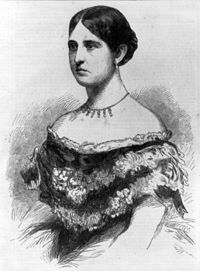
HarpersMagazineMrs.Sickles

Teresa Sickles

While her husband politicked along the Potomac, the new congressman’s wife was adapting to her life in Washington D.C. The wives were expected to entertain and host parties on a regular basis at their residences, but they also knew their share of loneliness and neglect. Since legislators routinely were “busy with night sessions, committee meetings, and plain nocturnal politicking over whiskey punch, that their wives either accepted other escorts or spent lonely evenings at home with fancywork or a book.” thus it was not surprising that Teresa, “should seek the gayety of the capital in her first year there.” [3] In the absence of their husbands it “was not uncommon for available bachelors to act as escorts for married women when their husbands were unavailable.” [4] Since Dan Sickles was frequently unavailable and since Teresa probably still suspected that Dan was still engaged in extramarital affairs, it is not surprising that the young Mediterranean beauty found comfort in another man.

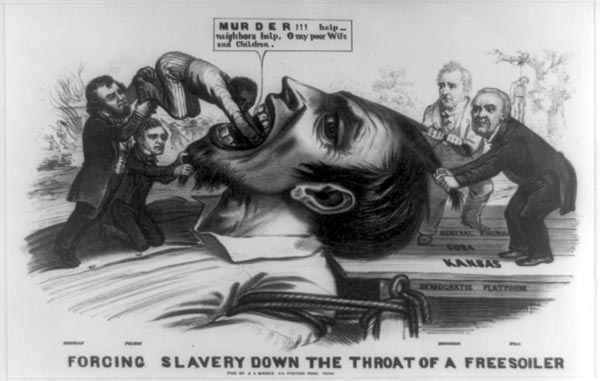
The years of 1857 and 1858 would be a tumultuous time for the nation as well as the Sickles. Buchanan had been elected because of his stability and moderation in an age of pro and anti-slavery radicalism. However, over the next year his presidency, and his would be overwhelmed by events and Buchanan’s decisions supporting the expansion of slavery. While Sickles was neither a slave owner, nor himself fond of the institution, it was part of life, and many of his friends in Washington D.C. and in Congress were slave holders. Buchanan had schemed before his inauguration with Chief Justice of the Supreme Court Roger Taney in the Dred Scott decision, which was handed down in the days following Buchanan’s inauguration, followed by the fiasco over the Lecompton constitution and the attempted admission of Kansas as a Slave State, an event which split the Democratic party in the 1860 election, ensuring Abraham Lincoln’s defeat of Buchanan’s Lecompton foe in the Senate, Senator Stephen A. Douglas who would have been the prohibitive favorite in the election had the split not occurred.

Likewise, Sickles and his beautiful young wife would become part of one of the most sensational trials of American history, rivaling the Lindbergh kidnapping trial, the trial of O.J. Simpson, the Scopes Monkey Trial, and the Impeachment of President Bill Clinton in its captivation of America. As in London, Teresa became popular and she and Dan were much sought after and their home “became the scene of a gradual number of and entertainments,” [5] and even as Sickles continued his robust politicking and philandering Teresa became the object of another’s affection, the District of Attorney for the District of Columbia, Philip Barton Key, the son Francis Scott key, the writer of the Star Spangled Banner. Interestingly enough it was Sickles who had helped Key the troubled man to be reappointed to his office in early 1857 after Key had helped Sickles overcome legal and financial difficulties to secure Sickles in the Stockton Mansion and the two men developed a warm friendship.

Philip Key was extraordinarily handsome, especially when outfitted in his green and gold militia uniform of the Montgomery Guards, and was considered one of the most desirable men in Washington. An accomplished horsemen he rode about town on his “horse Lucifer – a nobly bred, dapple gray hunter.”[6] When he gained Sickles’ friendship many of his well to do political and society friends became frequent visitors to the Sickles household. After Sickles had helped Key to be reappointed to his office, Key was instrumental in helping make the arrangements for Sickles to rent the Stockton Mansion.

During his first term in office Key was not known for being a particularly good District Attorney and spent much time away from the office complaining about his allegedly poor health. But his health did not keep him away from Washington’s party scene and “One hostess called him “the handsomest man in all Washington… he was a prominent figure at all the principle functions; a graceful dancer, her was a favorite of every hostess of the day.” [7] When he met Teresa, the dashing bachelor took an intense interest in the wife of the man who had helped him retain his job. The two were soon attending many functions together that Sickles, due to his work schedule could seldom attend.

Within weeks Key became a frequent guest at the Sickles home and few were surprised at this, as most observers knew that Sickles was responsible for Key’s reappointment. With Sickles now fully engaged in the dramatic political battles of late 1857, Teresa and Key began to spend much more time together. The two were seen together at the “theater, at teas, at hops. But most of all they went riding together.” [8] The frequency of these visits was noted and became the source of much gossip but Sickles was unaware of it and entertained no suspicions that his new friend was becoming deeply involved with his wife, and that Key had rented a room where the two could intimate.

That was until a young man equally smitten by Teresa had a few drinks with a colleague and the colleague shared the information with a loyal Sickles ally who then told Sickles. Sickles was shocked and called for a meeting with Key, however, after a brief conversation, Key convinced Sickles that there was nothing to the rumors, and Sickles was satisfied.

Though Sickles had been satisfied by the explanation, “despite his own well-publicized moral lapses, Daniel Sickles was a man of intense personal pride who would not countenance the breath of scandal attaching to his wife.” [9] He took the time to warn her to make sure that she was not involved in any other indiscretions, and left the subject. However, Key and Teresa continued to see each other, and “she and Barton thought that they were taking more care, and being less observed by people than they were.” [10] Yet as they pursued one another their affair became increasingly public, and seen by too many people not to go unnoticed. The two were seen together in at the Congressional Cemetery, and frequently at a house at “385 15th Street where he would enter the by the front door – and she the back.” [11] When a mutual friend expressed his concerns, Key shrugged off the warning, and “with the bravado of a proud weakling, he still held his course. And Teresa, ductile, enamored, blindly followed his lead.” [12] Another friend of Key suggested to him that he could be in danger, but Key “bridled and patted the breast of his coat. “I am prepared for any emergency,” he snapped. Key was a crack pistol shot and his friend believed that Key was preparing for a possible confrontation. [13]

Like so many people young spouses who find their needs unfulfilled at home, and who suspect their spouse of infidelity, , “Teresa did not see this love affair as tragic and dangerous. She lived within it as a secret fantasy, as in a virtual and time-consuming experience that lacked any power to inflict damage on other areas of her life.” [14] She became less discreet, Key would signal to her from across the street to confirm their dalliances and despite their insipidly inept attempt to hide the affair it became clear to Sickles’ coachman and household maids that the two were engaged in sexual encounters in the Sickles carriage and in the Stockton Mansion itself.

The situation finally came to a head in February 1859 following Sickles reelection and return to Washington. “Made more reckless than ever by their recent separation, Barton and Teresa now again were seen everywhere together.” [15] The couple were now making clandestine liaisons on a nearly daily basis, and eventually, one of the observers decided to tell Sickles. The anonymous source, using the initials of R.P.G. sent Sickles a letter detailing the affair. Sickles received the letter from a butler on the night of Thursday February 24th as he was leaving the usual dinner party at his house for the traditional hop that followed at the Willard Hotel.

Sickles did not read the letter until after the couple returned home and Teresa had gone to bed. Sickles was stunned and at first did not believe the contents as he placed little stock in anonymous messages. So he had George Wooldridge, a longtime friend and congressional clerk investigate, and on Saturday February 26th Wooldridge confirmed Sickles worst fears. That evening at their home Sickles confronted Teresa about the letter and as he stormed about angrily in their bedroom she confessed, after which Sickles had her write out her confession detailing everything. He may have been desolate and angry, but he was a lawyer, and he got his written proof.

But scandal was the last thing that Sickles wanted, as he had higher aspirations in politics, so he immediately called his friends for counsel and by Sunday morning several, including Wooldridge and Samuel Butterworth were at the Stockton Mansion with Sickles. As always, Sickles’ “first thoughts were for himself, and he melodramatically”[16] exclaimed to Butterworth, “I am a dishonored and ruined man…I cannot look you in the face.” [17]

4P8V9475

Murder

His friends “were profoundly touched by the depth of his feeling, and were convinced that he needed to be saved from a severe derangement of his senses; from lunacy, that is.” [18] his friends attempts to calm him, Sickles was beside himself with anger, and his anger now swirled around his marriage and what he believed was the scandal that would cost hi his career. That afternoon, Key again tempted fate, this time, for the last time. He had been tipped off by an anonymous letter that the affair was public, but he was determined to see Teresa. He made several passes by the house, each time signaling with a handkerchief, until Sickles observed him. Sickles called out to Butterworth “That villain has just passed my house! My God, this is horrible!” [19]

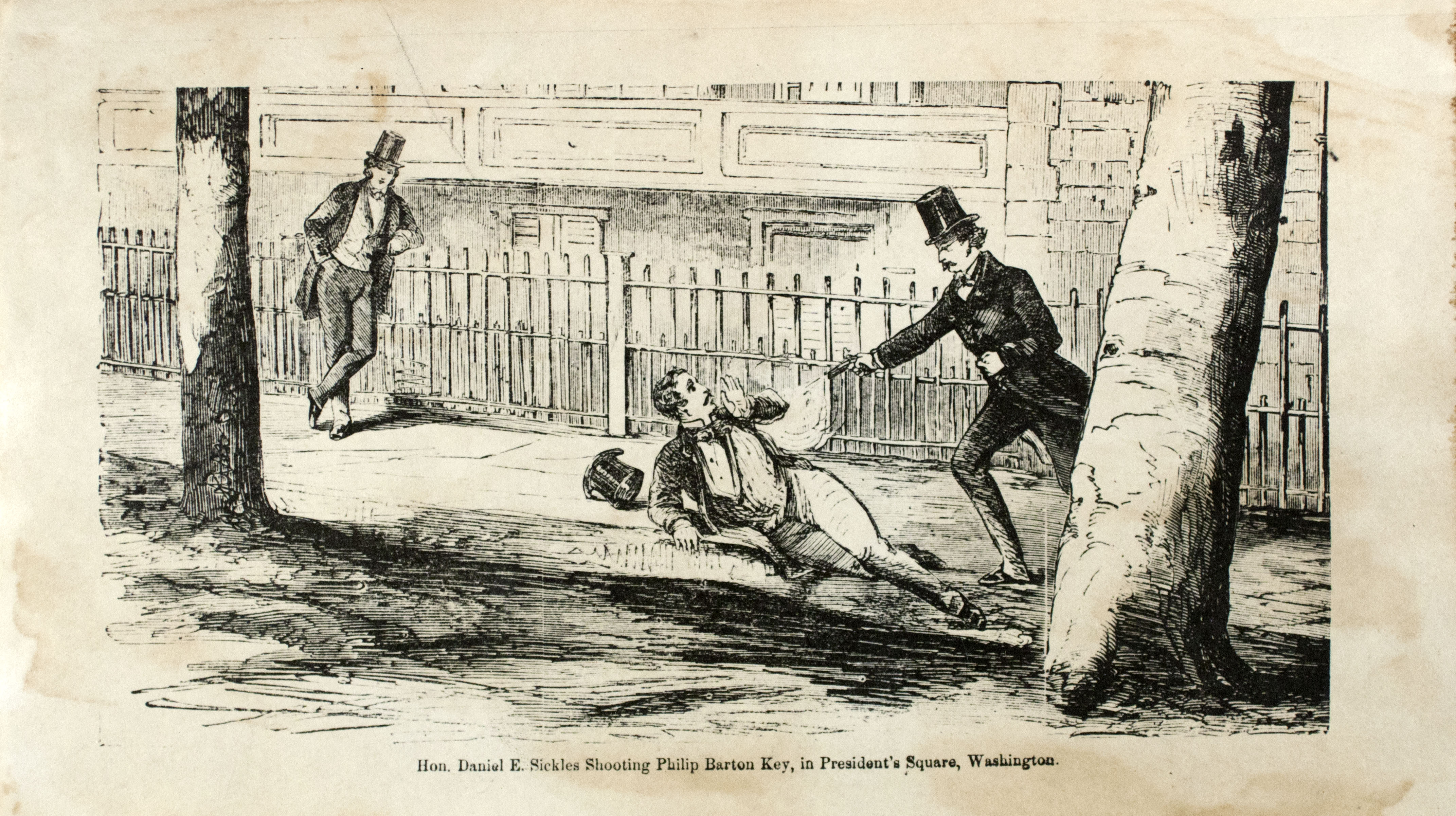
Butterworth left the house first and met Key at the southeast corner of Lafayette Square across from the White House. Allegedly not knowing Sickles intended any harm, Butterworth walked with Key to for a few minutes and then left. The exchange delayed Key and gave Sickles, who had armed himself with a single shot large caliber Derringer, and a muzzle-loading Colt revolver, enough time to catch up with Key near the Club House on Madison on the east side of the square. Sickles was raving but Dan’s fury transcended reality,” [20] as at least a dozen witnesses were nearby as he screamed, “Key, you scoundrel, … you have dishonored my bed – and you must die!” [21] Sickles pulled out the revolver, the first shot from which grazed Key, and the second which misfired. A brief scuffle ensued as Key lunged at his assailant, but Sickles flung him to the ground, and drew the Derringer as Key threw the opera glasses that he viewed Teresa at Dan. A third shot hit Key in the groin and he slumped to the ground screaming “Murder! Murder!… Don’t shoot!” [22]

If there was a chance for Sickles to prove that he acted in self-defense it was now, but he could not control himself. He fired the revolver yet again and it misfired. He placed the weapon in his pocket and drew the Derringer, and fired a shot which hit Key in the Liver. As Key writhed on the ground Sickles tossed the Derringer to the ground and he again drew the Colt. As the stunned witnesses to the attack looked on, Sickles advanced toward the fallen Key and placed the gun at his head and pulled the trigger, but again the weapon misfired. As Sickles attempted to place another cap in the pistol, a number of witnesses began to intervene. One man, “a member of the club, running up, stopped him. Mr. sickles – for God’s sake!” And Butterworth, coming forward, took Dan by the arm. Without a word, they walked away together.” [23] Witnesses took the mortally wounded Key away to the Club, where he expired.

President Buchanan was almost immediately told of the murder by a White House page boy, was aware of the implications of the scandal, Sickles was a friend and political ally with much promise. Buchanan told the boy leave town and gave him a sum of money to facilitate his departure. Soon after Sickles and Butterworth went by carriage “to the home of Attorney General Black, where the Congressman formally surrenders himself to the silver-haired Cabinet member who had regarded him as a protégé.” [24]He declined bail in favor of a speedy trial, was allowed to go home where he told Teresa that he had killed her lover, retrieved some personal items and then went to the District jail, “a foul hole, swarming with vermin, destitute of sewage, bath, water, ventilation, and so inadequate to its purpose that often a dozen or more prisoners were herded into a single narrow cell.” [25] When he arrived he reportedly asked the jailer if they were the best accommodations available, to which the jailer responded “this is the best place you members of Congress have afforded us.” [26] Dejected, but undeterred Sickles sent a message to the public, “In doing what I had to do I have broken the law. Therefore I place myself behind bars. It is for you to set me free.” [27] The stage was now set for the one of the most unbelievable and storied trials in American history.

Notes

[1] Ibid. Swanberg Sickles the Incredible p.4

[2] Ibid. Catton The Army of the Potomac: Glory Road p.151

[3] Ibid. Swanberg Sickles the Incredible p.15

[4] Ibid. Hessler Sickles at Gettysburg p.8

[5] Ibid. Swanberg Sickles the Incredible p.16

[6] Ibid. Pinchon Dan Sickles p.74

[7] Ibid. Hessler Sickles at Gettysburg p.9

[8] ibid. Swanberg Sickles the Incredible p.20

[9] Ibid. Swanberg Sickles the Incredible p.25

[10] Ibid. Keneally American Scoundrel p.92

[11] Ibid. Wilson and Clair They Also Served p.99

[12] Ibid. Pinchon Dan Sickles p.94

[13] Ibid. Swanberg Sickles the Incredible p.44

[14] Ibid. Keneally American Scoundrel p.92

[15] Ibid. Pinchon Dan Sickles p.93

[16] Ibid. Hessler Sickles at Gettysburg p.10

[17] Ibid. Swanberg Sickles the Incredible p.53

[18] Ibid Keneally American Scoundrel p.121

[19] Ibid. Hessler Sickles at Gettysburg p.10

[20] Ibid. Keneally American Scoundrel p.127

[21] Ibid. Swanberg Sickles the Incredible p.54

[22] Ibid. Hessler Sickles at Gettysburg p.11

[23] Ibid. Pinchon Dan Sickles p.112

[24] Ibid. Swanberg Sickles the Incredible p.55

[25] Ibid. Pinchon Dan Sickles p.114

[26] Ibid. Keneally American Scoundrel p.135

[27] Ibid. Swanberg Sickles the Incredible p.114

Leave a comment

Filed under crime, History, laws and legislation

A Grave Responsibility to Remember and Remind: The 71st Anniversary of the Opening of the Nuremberg Trails

Friends of Padre Steve’s World,

Today is the 71st anniversary of the opening of the Nuremberg Trials. I write about this a lot and I know some people, even so-called progressives have told me that they know the Nazis were evil and that they don’t want to hear it, while alleged conservatives vehemently object because they do not believe that such things can happen again.

However that is not the point. The reason I post things like this is because the players in the drama are representative of humanity, and humanity is the one constant in all history. Human beings and their propensity for good as well as evil is what these posts are about, and the fact is that any human being is capable of committing such crimes or turning a blind eye to them, to simply go along with the system and not to make waves. That is part of human nature, we value liberty, but that liberty lies in our hearts, and when it dies there, it dies. As the great American jurist Learned Hand said:

“I often wonder whether we do not rest our hopes too much upon constitutions, upon law and upon courts. These are false hopes, believe me, these are false hopes. Liberty lies in the hearts of men and women; when it dies there, no constitution, no law, no court can save it; no constitution, no law, no court can even do much to help it. The spirit of liberty is the spirit which is not too sure that it is right; the spirit of liberty is the spirit which seeks to understand the minds of other men and women; the spirit of liberty is the spirit which weighs their interests alongside its own without bias.” 

When that spirit of liberty is lost, when that sensitivity to the rights and needs of others trampled, when a desire for revenge and getting even displaces civility and compassion; there is nothing than stop evil, for evil will find ways to justify their evil deeds under the cloak of legality. That is what Germany did in the 1930s and what I believe may happen in the United States and other Western nations as the wave of populism and xenophobic racism sweeps the globe. Robert Jackson said, “The most odious of all oppressions are those which mask as justice.”

That is why it is so important to remember the evil that we as human beings are capable of and not to run roughshod over the rights of those with whom we disagree. Since the election of Donald Trump I have seen many comments of his supporters and the well documented writings and opinions of three of first appointees, Stephen Bannon, Michael Flynn, and Jeff Sessions. All have extensive writings and comments which advocate policies designed to limit freedom and excise whole groups from the United States. His supporters are condemning all forms of protest or opinions that disagree with theirs, and the President Elect jumps to his Twitter account to blast anyone who insults or criticizes him. Nothing in American history is comparable to the thin-skinned inability to tolerate dissent that is happening now.

In our country we have seldom had to fear that the outcome of an election could erase liberty, but it is possible now. Jackson noted, “One’s right to life, liberty, and property depends on the outcome of no election.” But it seems that this election may test that premise, the premise that Jackson so eruditely enunciated:

“The very purpose of a Bill of Rights was to withdraw certain subjects from the vicissitudes of political controversy. One’s right to life, liberty and property, to free speech, a free press, freedom of worship and assembly may not be submitted to vote; they depend on no elections.”

I do fear for what the future holds because of the many statements made by Donald Trump and his supporters during the campaign and even after. While I am willing to give the new President the benefit of the doubt, and hope that he will rise to the occasion, I wonder if that will happen, and for now I wait, and I send up warnings from history.

Until tomorrow,

Peace

Padre Steve+


Leave a comment

Filed under History, laws and legislation, News and current events, Political Commentary

When Political Parties Implode: “Mr. President I Wish to Remind You that General Jackson is Dead”

lecompton-2

Friends of Padre Steve’s World,

I have been writing about the coming collapse of the Republican Party and have decided to republish some of my writings dealing with what happened to the Whig and Democratic Parties between 1854 and 1860. Today an article about the epic battle between President James Buchanan and Senator Stephen A. Douglas from draft text “Mine Eyes have seen the Glory” Race, Religion, Ideology and Politics in the Civil War Era.

Peace

Padre Steve+

Kansas was politically divided between two competing legislatures, each which claimed to be the voice of the people. The population of Kansas was heavily anti-slavery, in fact slaveholders and their supporters were a minuscule minority in the territory, but they were both load, and often used violence and intimidation to achieve power. As such many citizens felt disenfranchised by the official legislature, which was “a pro-slavery body elected by fraud in 1855.” [1] This body met in the city of Lecompton. In 1857 the Lecompton legislature sensed the opportunity to have Kansas admitted to the Union as a Slave State. To ease the way for this to happen over the will of the majority this legislature elected slavery supporters to be members of a constitutional convention, the goal of which was to draft a constitution which would be submitted to Congress for the admission of the Kansas Territory to the Union as a Slave State.

Free State partisans in Kansas feared that that if they participated in the election that they would be “gerrymandered, and simply counted out by stuffed ballots,” and most decided to sit out of the election. As a result it was “a quiet election, with many proslavery candidates unopposed and only 2,200 out of 9,000 registered voters going to the polls, a large majority of extreme proslavery men won election as delegates to the constitutional convention in September.” [2] But the result of the election was untenable, for “Two thousand voters in a territory with 24,000 eligible for the franchise had elected a body of delegates whom no one seriously regarded as representative of the majority opinion in Kansas.” [3]

The Lecompton legislature passed the proslavery constitution, but it was vetoed by the outgoing governor, John W. Geary. Geary accused “the pro-slavery legislature of attempting to stampede a rush to statehood on pro-slavery terms,” but his veto was overridden. The constitution had several provisions that most of the population found unacceptable. It protected owners of “the 200 slaves in Kansas, banned free blacks from the state, and prohibited any amendments to the constitution for seven years.” [4] In response the pro-Free State legislature in Topeka issued a referendum in which people voted “10,226 votes to 162 votes” [5] against the pro-slavery measures contained in the Lecompton Constitution. The newly appointed governor of the territory, Robert J. Walker opposed the measure and denounced it “as a vile fraud, a bare counterfeit.” [6] Walker demanded a new, fair, referendum, which the newly elected president James Buchanan, also backed. In response many Southerners in Congress “threatened to secede unless the administration fired Walker and backed down on the referendum issue.” [7] The threat of secession by Southerners in support of the radical minority in Lecompton led to chaos in the Democratic Party which controlled the House, the Senate and held the Presidency.

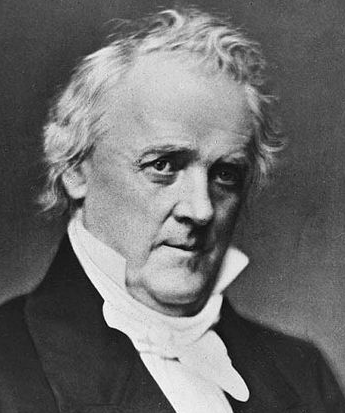
james-buchanan

James Buchanan

James Buchanan was a pro-slavery Pennsylvania Democrat who had rode into office on the votes of the South. He was now pressured by Southern legislators to change his position on the Lecompton Constitution. Buchanan’s cabinet, which was heavily Southern, and pro-slavery expansion also used its influence to pressure the president into supporting the plan to admit Kansas as a Slave State. In response to the pressure, Buchanan reversed his previous stance in regard to Kansas and endorsed the bill, and he “called on Congress admit Kansas as a slave state with a constitution (drafted by the proslavery territorial government at Lecompton) that was never approved by Kansas voters and obviously opposed by a majority of them.” [8] The decision by Buchanan tossed aside the doctrine of popular sovereignty which had been key to engineering earlier compromises and in response some Northern Democrats opposed Buchanan.

Buchanan’s patently obvious move to placate the slave states and overturn the restrictions on the expansion of slavery contained in the Missouri Compromise, the Compromise of 1850, and the Kansas-Nebraska Act, provoked a new outcry, this time from Northern members of the Democratic Party. Many Northern Democrats were outraged by Buchanan’s flip-flop and the threats of secession emanating from the South if the measure was not approved. Most of the Northern Democrats were willing to accept and even defend slavery where it existed, but they were opposed to the expansion of slavery. His announcement to the House of Representatives “touched off a twelve-hour donnybrook in February 1858” and “about 50 congressmen in various states of inebriation tangled with each other on the House floor… The rumble subsided only when Mississippi congressman William Barksdale tackled an unidentified assailant as the latter snatched his toupee and waved it about like a captured flag. Barksdale finally retrieved his scalp and plopped it on his head wrong side out, the absurdity of the scene giving the combatant’s pause.” [9] Many Northern Democrats felt betrayed by their president’s actions and rose in opposition to the bill that would admit Kansas as a Slave State. Even so Buchanan was a “skilled political infighter swung a remarkable percentage of Northern Democratic members of the House of Representatives, fully 60 percent, behind the Lecompton Constitution,” [10] but he did not contend with the charismatic power of Stephen Douglas in the Senate.

These Democrats were led by the formidable Senator Stephen A. Douglas. Known as the Little Giant Douglas had skillfully crafted the Compromise of 1850 using the principle of popular sovereignty, led these Democrats in their fight against Buchanan’s acceptance and endorsement of Lecompton. Douglas’s previous actions to support the rights of Slave States had made him a hero in much of the South and his stature in both the North and the South made him the frontrunner to win the Democratic nomination for the presidency in 1860.

But Douglas, who had worked so hard to build compromises that would hold the Union together could not countenance the actions and tactics of the Southern members of his party. Douglas was a political realist and not an ideologue. He was very sympathetic to slave holders and was certainly no supporter of emancipation, in fact the Little Giant was an avowed racist. He was completely convinced “of the inferiority of the Negro, and he had a habit of stating it with brutal bluntness, “I do not believe that the Negro is any kin of mine at all…. I believe that this government of ours was founded, and wisely founded upon white basis. It was made by white men, for the benefit of white men and their posterity, to be executed and managed by white men.” [11] But despite his own racist beliefs Douglas understood the danger that the pro-slavery extremists supporting Lecompton were to the Democratic Party and the nation. Douglas understood that if the bill to admit Kansas as a slave state was passed that it would destroy the unity of the Democratic Party and quite possibly the Union itself.

Stephen-Douglas-in-1858

Stephen Douglas

The Illinois Senator found out about the President Buchanan’s new support of the measure when he read the newspaper. He was outraged when he saw the news in the Washington Union that Buchanan had decided to support Lecompton. He was infuriated and the fury showed when he wrote with characteristic honesty:

“This left no doubt were the old bastard stood. “Can you believe his Goddamned arrogance?” I told a friend. “I run the Committee on Territories. He should have consulted me before approving the Lecompton fraud. He’ll pay for that. By God, sir, I made Mr. James Buchanan, and by God, sir, I’ll unmake him.” [12]

As such, the Little Giant threw caution to the wind and stormed to the White House “to confront Buchanan on the “trickery and juggling of the Lecompton constitution.” He warned the president of that his actions in support of the Lecompton party would “destroy the Democratic party in the North,” and we warned that “if Buchanan insisted on going through with it, Douglas swore to oppose him in Congress.” [13]

It was an epic confrontation. Douglas recalled, “The Lecompton constitution, I told Buchannan bluntly, was a blatant fraud on the people of Kansas and the process of democracy, I warned him not to recommend acceptance of it. With his head titled forward in that bizarre habit of his, he said that he intended to endorse the constitution and send it to Congress. “If you do,” I thundered, “I’ll denounce it the moment that it is read.” His face turned red with anger. “I’ll make Lecompton a party test,” he said. “I expect every democratic Senator to support it.” I will not, sir![14]

Angry and offended by the confrontation of Douglas, Buchanan cut the senator off and issued his own threat to Douglas and his political career saying, “I desire you to remember that no Democrat ever yet differed from an administration of his own choice without being crushed….Beware of the fate of Tallmadge and Rives,” two senators who had gone into political oblivion after crossing Andrew Jackson.” The redoubtable Senator from Illinois was undeterred by the President’s threat and fought back, “Douglas riposted: “Mr. President, I wish to remind you that General Jackson is dead, sir.” [15] It was an unprecedented action by a sitting Senator, to confront a President of one’s own party and threaten to oppose him in Congress was simply not done, but now Douglas was doing it, but doing so to his President’s face, and the consequences for him, his party, and the country would be immense.

Following his confrontation with Buchanan, Douglas was even more determined to defeat the Lecompton party and their brazen attempt to admit Kansas as a slave state over the will of the non-slave majority. In a display of righteous anger Douglas did what few politicians would consider doing in our day and age and “took his political life into his own hands and assailed the Lecompton Constitution on the floor of the Senate as a mockery of the popular sovereignty principle.” [16] President Buchanan and his allies in Congress fought back viciously, so much so that the two sides sometimes came into physical confrontation with each other in the chambers of Congress.

When Buchanan’s supporters pushed for Lecompton’s approval and the admission of Kansas as a Slave State, Douglas fired back, warning “You do,” I said, “and it will lead directly to civil war!” I warned the anti-Lecompton Democrats of the North that the President intended to put the knife to the throat of every man who dared to think for himself on this question and carry out principles in good faith. “God forbid,” I said “that I ever surrender my right to differ from a President of the United States for my own choice. I am not a tool of any President!” [17]

Under Douglas the Northern Democrats joined with Republicans for the first time to defeat the admission of Kansas as a Slave State. Douglas recalled the battle:

“After the Christmas recess, the Administration unleashed its heavy horsemen: Davis, Slidell, Hunter, Toombs, and Hammond, all southerners. They damned me as a traitor and demanded that I be stripped of my chairmanship of the Committee on Territories and read out of the Democratic party. Let the fucking bastards threaten, proscribe, and do their worst, I told my followers; it would not cause any honest man to falter. If my course divided the Democratic party, it would not be my fault. We were engaged in a great struggle for principle, I said, and we would defy the Administration to the bitter end.” [18]

Southern Democrats in Congress fought back furiously. As the battle continued their acrimony towards Douglas grew into apocalyptic proportions and their rhetoric against the Little Giant became more heated. According to his opponents Douglas was “at the head of the Black column…stained with the dishonor of treachery without parallel…patent double dealing…detestable heresies…filth of his defiant recreancy…a Dead Cock in the Pit…away with him to the tomb which he is digging for his political corpse.” [19]

But Douglas was undeterred by the threats to his career made by Buchanan, his congressional opponents and the press. He believed that he was in the right, and though he was in agreement with the philosophy of his opponents regarding slavery as an institution to be protected in the South, he realized that appeasing the South was not an option in regard to Lecompton, since that measure undermined the entire concept of popular sovereignty. He wrote:

“My forces in the House fought a brilliant delaying action while I worked to win over wavering Democrats. When we introduced a substitute bill, Buchannan called a dozen congressmen to the White House and exhorted them not to forsake the administration. He was cursing and in tears. He had reason to be: on April first, a coalition of ninety-two Republicans, twenty-two anti-Lecompton Democrats, and six Know-Nothings sent Lecompton down to defeat by passing the substitute bill. This bill provided for a popular vote on the Lecompton constitution and for a new convention if the people rejected that document, as they surely would.” [20]

The substitute bill was passed by the Senate as well and sent back to Kansas for a popular vote. When the Lecompton Constitution was resubmitted to the people of Kansas for a vote, the results of the referendum were devastating to the pro-slave faction, and  “to the hideous embarrassment of Buchanan, the voters of Kansas turned on August 30th and rejected Lecompton by a vote of 11,812 to 1,926.” [21] The ever colorful and blunt Little Giant wroteThe agony is over,” cried one of my aides, “and thank God that the right has triumphed. Poor old Buck! Poor old Buck had just had his face rubbed in shit. By our “indomitable courage, “ as another aide put it, we’d whipped this “powerful and proscriptive” Administration and forced the Black Republicans to support a substitute measure which fully embodied the great principles of the Kansas-Nebraska Act.” [22] The victory of Douglas and his faction over the Buchanan faction in the Lecompton fight “ended a political battle which had convulsed the country and virtually destroyed two administrations, but the full consequences of the prolonged struggle had yet to become evident.” [23]

Pro-slavery Southerners were outraged and Buchanan used every measure that he could to crush the anti-Lecompton Democrats, but he had lost “one of the most vicious struggles in the history of Congress, Southern Democrats had seriously damaged the patience of their Northern counterparts, and Buchanan loyalists in the North were unseated wholesale by upstart Republicans in the 1858 congressional elections.” [24] Buchanan’s Presidency was discredited, his party divided, its majority in congress lost, and the South moving closer to secession. Southerners considered Douglas a traitor and accused him of betraying them. “A South Carolinian lamented that “this defection of Douglas has done more than all else to shake my confidence in Northern men on the slavery issue, for I have long regarded him as one of our safest and most reliable friends.” [25]

Notes

[1] Ibid. Guelzo Fateful Lightning p.81

[2] Ibid. Potter The Impending Crisis p.300

[3] Ibid. Potter The Impending Crisis p.314

[4] Ibid. Guelzo Fateful Lightning p.115

[5] Ibid. Freehling, The Road to Disunion Volume II: Secessionists Triumphant 1854-1861 p.138

[6] Ibid. McPherson The Battle Cry of Freedom p.165

[7] Ibid. McPherson The Battle Cry of Freedom p.164

[8] Ibid. Levine Half Slave and Half Free p.211

[9] Ibid. Goldfield  America Aflame p.144

[10] Ibid. Freehling, The Road to Disunion Volume II: Secessionists Triumphant 1854-1861 p.138

[11] Ibid. Potter The Impending Crisis p.340

[12] Ibid, Oates The Approaching Fury p.208

[13] Ibid. McPherson The Battle Cry of Freedom p.166

[14] Ibid, Oates The Approaching Fury p.208

[15] Ibid. McPherson The Battle Cry of Freedom p.166

[16] Ibid. Guelzo Fateful Lightning p.115

[17] Ibid, Oates The Approaching Fury p.210

[18] Ibid, Oates The Approaching Fury pp.212-213

[19] Ibid. McPherson The Battle Cry of Freedom p.168

[20] Ibid, Oates The Approaching Fury pp.215-216

[21] Ibid. Guelzo Fateful Lightening p.116

[22] Ibid, Oates The Approaching Fury p.216

[23] Ibid. Potter The Impending Crisis p.325

[24] Ibid. Guelzo Fateful Lightening p.116

[25] Ibid. McPherson The Battle Cry of Freedom p.167

1 Comment

Filed under civil war, History, laws and legislation, Political Commentary

When Your Vote Will Not Count

provisional-ballot-notice

Friends of Padre Steve’s World,

I wasn’t planning on publishing another article today but this worked me up.

I returned from Germany on Saturday and got my mail today. Among the things I got was my absentee ballot from West Virginia. I opened it and marked it and then found this note. Evidently someone there knowing that I am military and a registered Democrat has challenged my right to vote. Chances are that the person who did this does not know me but rather is a GOP hack who is trying to suppress my vote.

In the last six years West Virginia has made it progressively harder for active duty military personnel to vote. In 2012 i almost was not allowed to vote because I didn’t know that the legislature had changed the law and now require those requesting absentee ballots to request one in every election, if you forget to request one, you don’t vote.

Today I will contact the County Clerk’s office, the Secretary of State office, my State Representative, the Governor, the Democratic Party of West Virginia as well as a number of military and veteran voters organizations. I may even have to get a lawyer. This is voter suppression. An unknown person or entity can challenge your vote and you cannot know who it is or even if your vote counted until after the election.

It’s a foretaste of our totalitarian future of the present bunch of Republicans led by Trump gets power.

I thought that you should know just what power hungry Republicans are willing to do to suppress the vote, even the vote of career active military people who are combat vets simply because they are Democrats. If you are an active duty military person who is a Democrat you had better make sure that your state count’s your vote.

This is war and I won’t go down and let my vote be tossed aside without being heard.

Padre Steve+

7 Comments

Filed under laws and legislation, Military, Political Commentary

Reflecting on “Inherit the Wind”

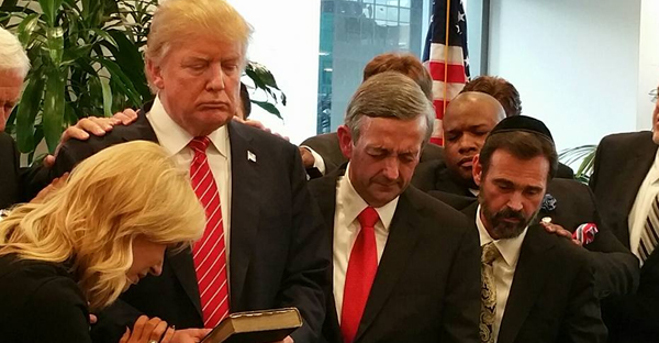
donald-trump-prays-with-religious-leaders

Friends of Padre Steve’s World,

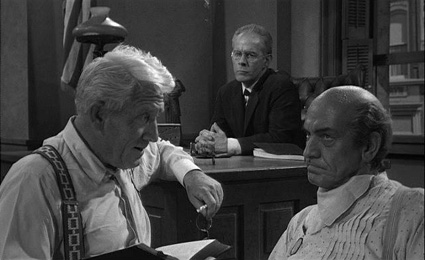
“As long as the prerequisite for that shining paradise is ignorance, bigotry and hate, I say the hell with it.” Henry Drummond (Spencer Tracy) Inherit the Wind

Today has been a very busy day at work but I have been doing some reflection and instead of watching the Olympics tonight I decided to again watch the classic film Inherit the Wind. I really do believe that it is well worth watching, especially when a charlatan with no Christian virtues whatsoever stokes up the hopes of conservative Christians by promising that if he is elected he will make Christianity great again. Of course the Christianity that he refers to is not that of Jesus, but that of Constantine and every other strongman who has used the Christians and the church to achieve earthly power and to crush any opposition. Noted televangelists have come to Trump’s side, many like John Hagee saying that Christians that God will punish Christians, that vote against Trump. That is why this film is still so pertinent.

It is fascinating that a play and film set about an incident that actually occurred in the 1920s remains so timeless. It is hard to believe that 90 years after the trial and over 50 years after the movie that our society would still be debating the issue in the movie and that legislatures and school boards are still attempting to pass religious doctrine off as science.

inherit-the-wind

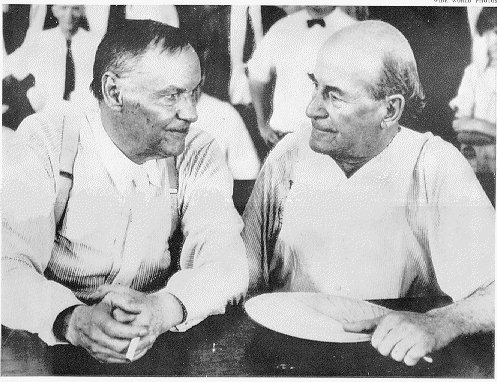
It is a film about what is commonly called the “Scopes Monkey Trial” which was litigated in July of 1925 and featured an epic battle between populist three time Presidential Candidate and former Secretary of State William Jennings Bryan and famed defense attorney Clarence Darrow.

The trial was brought about after the passage of the Butler Act in Tennessee. It was an act that made it a criminal offense to teach evolution in any publicly funded school. The act stipulated:

“That it shall be unlawful for any teacher in any of the Universities, Normals and all other public schools of the State which are supported in whole or in part by the public school funds of the State, to teach any theory that denies the story of the Divine Creation of man as taught in the Bible, and to teach instead that man has descended from a lower order of animals.”

The author of the act was Tennessee State Representative John W. Butler, a farmer and the head of the World Christian Fundamentals Association an interdenominational organization dedicated to a “New Protestantism” based on the Pre-Millennial interpretation of Bible prophecy.

itw2

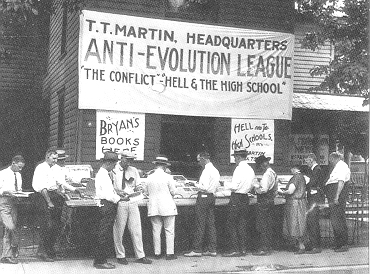
Butler was heavily influenced by William Jennings Bryant who with his followers had gotten legislation banning evolution in 15 states. H.L. Mencken commented that over the years of his public life that Bryan had “transformed himself” into some “sort of Fundamentalist Pope.”

Butler was opposed to the teaching of evolution and the act passed the house by a vote of 75-1. No public hearings had been held on it and no debate proffered.

Butler’s legislation did face some opposition in the State Senate. However it passed there on a vote of 24-6 after the famous Fundamentalist evangelist Billy Sunday preached as series of revival meetings to incite public opinion in favor of the bill. Sunday’s message was clear, he preached that “Education today is chained to the Devil’s throne” and praised Butler and the House for their “action against that God forsaken gang of evolutionary cutthroats.” The bill was signed into law by Governor Austin Peay, but Peay expected little to come of it.

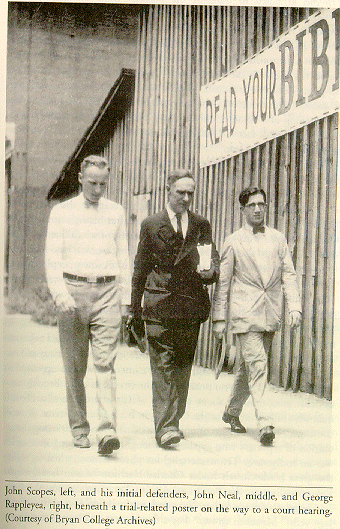
The American Civil Liberties Union put the law to the test using high school biology teacher John Scopes who was charged with breaking the law. The trial ended up becoming less about the guilt or innocence of Scopes or even the constitutionality of the law, but rather as the field where the conflict between religious and social issues and faith versus intellectualism was fought. Butler, the man who legislated the law on religious grounds covered it as a correspondent.

daytonscene

Mencken wrote of the trial:

“The Scopes trial, from the start, has been carried on in a manner exactly fitted to the anti- evolution law and the simian imbecility under it. There hasn’t been the slightest pretense to decorum. The rustic judge, a candidate for re-election, has postured the yokels like a clown in a ten-cent side show, and almost every word he has uttered has been an undisguised appeal to their prejudices and superstitions. The chief prosecuting attorney, beginning like a competent lawyer and a man of self-respect, ended like a convert at a Billy Sunday revival. It fell to him, finally, to make a clear and astounding statement of theory of justice prevailing under fundamentalism. What he said, in brief, was that a man accused of infidelity had no rights whatever under Tennessee law…”


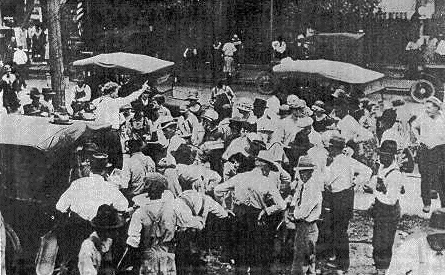
It was an epic event covered by news outlets across the nation and the atmosphere in the town outside the courthouse was circus like, something that the movie depicts very well. The defense was not allowed to produce Scientists as witnesses, even to the chagrin of Butler who despite his opposition to evolutionary theory felt that it was not fair. When all was said and done Scopes had been convicted and a fine of $100 assessed, which was overturned on appeal. Bryan died a week after the trial and of the 15 states with similar legislation to Butler passed them into law.

SCO_EVOL

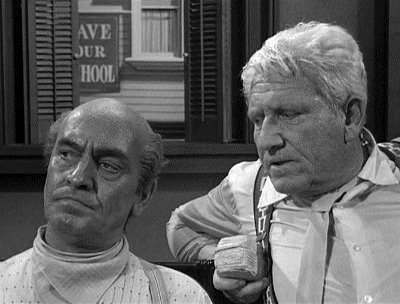
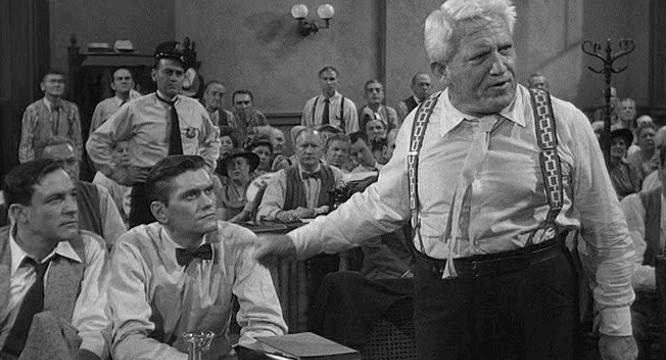
The film is based on the play of the same name written in 1950 by Jerome Lawrence and Robert E. Lee. It was written during the height of the McCarthy Era and opened in 1955. The first film version starring Spencer Tracy as Henry Drummond (Clarence Darrow), Frederic March as Matthew Harrison Brady (William Jennings Bryan), Gene Kelly as E.K. Hornbeck (H.L. Mencken) while Dick York played Bertram Cates (John Scopes). Lawrence and Lee invented some fictional characters including Reverend Brown played by Claude Akins.

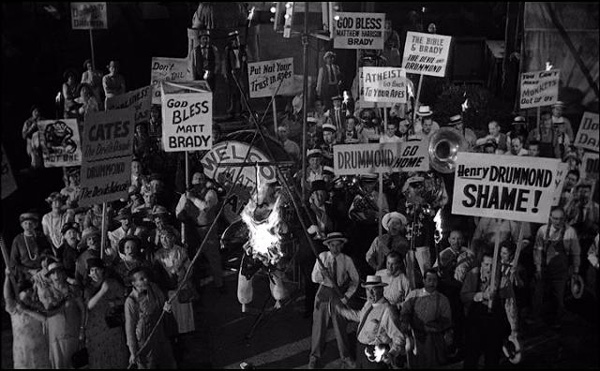
The film directed by Stanley Kramer captures the raw emotions of the trial, the participants and the spectators who came from near and far. The depiction of the angry mob of Christians is terrifying to watch. In the film they sing:

“We’ll hang Bertram Cates to a sour apple tree, we’ll hang Bertram Cates to a sour apple tree, we’ll hang Bertram Cates to a sour apple tree. Our God is marching on! Glory Glory Hallelujah! Glory Glory Hallelujah! Glory Gory Hallelujah! His truth is marching on. We’ll hang Henry Drummond to a sour apple tree, we’ll hang Henry Drummond to a sour apple tree, we’ll hang Henry Drummond to a sour apple tree, our God is marching on.”

inheritwind

March’s depiction of Matthew Harrison Brady is riveting. The Brady of the film does not do justice to other parts of Bryan’s life. Bryan, outside his fight against evolution was ahead of his time in many ways. Earlier in his career he had pressed for Universal Suffrage, fought against war and labored against the social Darwinism of the banks, business and the Robber Barons. However the loss of three Presidential elections left him bitter and it is believed that he saw the trial as an opportunity to regain the limelight and perhaps build a base to again run for President. This speech by Brady is a fair characterization of Bryan’s beliefs:

“I have been to their cities and I have seen the altars upon which they sacrifice the futures of their children to the gods of science. And what are their rewards? Confusion and self-destruction. New ways to kill each other in wars. I tell you gentlemen the way of science is the way of darkness.”

The problem with the Bryan of the Scopes Trial was that he was a caricature of his former self, he played to the crowds. The trial played to the worst parts of his character and that shows in the movie depiction. Some Christians find this an unfair portrayal and even call it a lie, however even though March’s portrayal is fictional it does fit the spirit of the trial which is captured in the writings of many of the contemporary commentators of the trial. Mencken wrote of the real Bryan: It is a tragedy, indeed, to begin life as a hero and to end it as a buffoon.


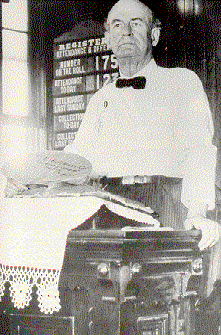
wjb_pulpit

Another of those commentators, Marcet Haldeman-Julius wrote of the real Bryan:

“As he sat there in the court room, day after day, silent, fanning, fanning, his face set I was appalled by the hardness, the malice in it. No one who has watched the fanatical light in those hard, glittering black eyes of Bryan’s can doubt but that he believes both in a heaven and in a hell. At the same time the cruel lines of his thin, tight-pressed mouth proclaim, it seems to me, that he would stop at nothing to attain his own ends. It is anything but a weak face–Bryan’s. But it is a face from which one could expect neither understanding nor pity. My own opinion is that he is sincere enough in his religion. Also that in it is included the doctrine Paul so frankly taught–that a lie told for the glory of God is justified…”

scope2

But I think that the real drama and tension in the film comes from Spencer Tracy in his portrayal of Drummond. This speech is taken almost verbatim from the trial:

“Can’t you understand? That if you take a law like evolution and you make it a crime to teach it in the public schools, tomorrow you can make it a crime to teach it in the private schools? And tomorrow you may make it a crime to read about it. And soon you may ban books and newspapers. And then you may turn Catholic against Protestant, and Protestant against Protestant, and try to foist your own religion upon the mind of man. If you can do one, you can do the other. Because fanaticism and ignorance is forever busy, and needs feeding. And soon, your Honor, with banners flying and with drums beating we’ll be marching backward, BACKWARD, through the glorious ages of that Sixteenth Century when bigots burned the man who dared bring enlightenment and intelligence to the human mind!”

0237318_11378_MC_Tx360

I think that this speech is the real crux of the tension that we face even now. Legislators in a number of States have enacted laws of much the same kind of spirit as Butler and defended them with the same kind of fire as Bryan. Civil libertarians, especially secular ones bring up the same issues as Darrow did. I am a Christian and a Priest and my thinking about this is much like that espoused by Drummond in the movie.

So the film may be a fictional depiction of the Scopes Trial, but it is a film that I think that people would do well to watch. I don’t expect everyone to agree with me or the issues that I agree with brought up by the character of Henry Drummond. However, I think that everyone should watch the film and come to their own conclusions as well as to ask themselves how their particular ethic, whether secular or religious informs them in how they deal with this issue and so many others that divide us today.

I just know when I watched it again this week that it could have been in the news this week, only with a different cast of characters. My concern is that there is a very loud minority that wants to inflict its particular religious view on everyone and use the public treasure to do it. The attitude of many of these people is much like the characters from the actual Scopes Trial including their view that pushes both demonizes those they oppose and their desire to regulate the secular opposition to the sidelines.

SCOPES1

I know that the same accusation is made by religious people of secularists, however I have seen the results of religious wars in Iraq and the Balkans, and from history. Those conflicts and the brutality of religious people in them give me great pause when I see religious and political leaders here suggest curtailing the civil liberties and even using the law against those that they oppose. As Drummond asked in the movie: “Must men go to jail because they find themselves at odds with a self-appointed prophet?”

That is why this film is so important.

Peace

Padre Steve+

3 Comments

Filed under faith, film, History, laws and legislation, Political Commentary, Religion

Why Can’t We All Get Along: Reflections on Violence and Race


Friends of Padre Steve’s World,

Back in the 1990s, a black man by the name of Rodney King who had been brutally beaten by police appealed for calm after his attackers were acquitted. As riots broke out in Los Angeles, King called out “why can’t we all get along?” It is still a valid question. 

I have been thinking a lot about the events that have shaken our country over the past week and my thoughts today will meander between reactions to those events and memories of people and events that shaped my life that impact how I see what is happening today. I think that it important to realize that our past experience and the attitudes that we were brought up with shape how we view current events.

First there were men doing nothing violent, no resisting police requests, being gunned down by police, an event that has become all too common. Then there were the five police officers in Dallas protecting a Black Lives Matter March being ambushed and assassinated by an African American former soldier who stated his contempt for the BLM movement even as he claimed he wanted to kill whites, especially police officers. Then there have been the protests against the killings which have become a fixture in some cities that have been plagued by the brutality of some rogue police officers, as well as the very real and uncomfortable fact that police often handle situations involving white men, even armed white men acting in threatening manners, with far more restraint than they do black men. There is such a thing as White privilege, whether most of us want to admit it or not, and it has existed for the entire history of our country, and even the great victories of the Civil Rights movement never completely riddled us of it. 

I was a kid during the great protests of the Civil Rights movement. I remember watching the evening news and seeing police brutally beat peaceful and unarmed protestors senselessly in living black and white since we didn’t get a color television until about 1972. But those images have remained burned into my memory. I went to a desegregated high school which was that way due to court-ordered desegregation which involved bussing kids across town. A lot of parents objected to it, but interestingly enough, most of the kids who attended junior high school together didn’t try to avoid it, we wanted to continue school with the kids that we knew, and to meet new friends. It was an adventure, but initially there were fear of the unknown for all of us. No one knew how this experiment would work. But for our school, Edison High School in Stockton California, it was a defining moment in time; a magical time, where a mixed race student body made up of about a quarter each of Asians, African Americans,Whites,and Mexicans bonded in a remarkable manner, and today some forty years later, many of us remain close, we are the Soul Vikes to this day. That bonding for me has extended to the men and women who went there before and after me. 

Since then I have lived in many parts of the country, and sadly the experience that I had in high school seems like the exception rather than the rule. Many of the cities and towns that we have lived in have stark racial divides. Thankfully, we have been fortunate during my career in the Navy, we have lived in middle class, mixed race neighborhoods, even today, and we not only feel safe, but we know our neighbors, and we look out for each other. 

In my thirty-five years in the military I have served alongside men and women of every race, ethnicity, religion, and social class that found in our country. These are my brothers and sisters. 

That being said, Judy and I have been the victims of violent crime. In 1979 while out with her parents were were held up at gunpoint by two black men. I had a pistol pointed at my head and Judy had her glasses ripped off her face and ground into the parking lot when the robbers fled. But that one incident has not made us fearful of African Americans, even young African American men, and we find that walls can be broken down by simple kindness and respect. 

When I was in the reserves I worked for a social service agency in the slums and barrios of San Antonio, a homeless shelter in Arlington, Texas, and in the trauma and surgery department of Parkland Memorial Hospital in Dallas, where some of the police officers shot last week were taken. I have seen the effects of poverty and seen the effects of violence, and I have stood by the grieving families and friends of African American men, women, and children who died senseless deaths at the hand of violent people. I have also seen the community activists, teachers, medical personnel, pastors, and dare I say police, who work against huge odds in those neighborhoods  who do all they can to promote a culture of life, respect, and dare I say, hope. So when I see and hear people of great privilege like former New York Mayor Rudi Guilinani did this weekend, I can only shake my head in disgust. Likewise I am disgusted by media coverage, and the often incredibly ignorant and hate-filled posts that I see on social media and blogs, from people who support violence against the protestors, or the police. Frankly, neither is acceptable.

While I can understand anger of people tired of seeing rogue police officers go unpunished for crimes against people of color in their custody, and I fully support protests, I cannot place all of the blame on police. We live in a heavily armed and increasingly violent society, where the gun rules. As such police officers live in a world where they are in fear of their lives, even in routine traffic stops, and the number of people “packing heat”, legally or not, creates an environment where some officers will either overreact or abuse their authority. But there is another thing to add, with the exception of what occured in Dallas and a few other incidents, most police officers are killed by white men, but those stories seldom make the news. 

The thing is that none of this will be solved unless we all start working together as Americans, we cannot allow ourselves to be lulled into the belief that nothing can be done. Our problems will not be solved by picking sides or blaming people as there is plenty of that to go around. 

Anyway, at some point I will return to this subject, but I am tired of seeing people die. I have stood over the bodies of far too many men and women killed by gun violence, grieving with their families, as well as those wounded or maimed by bullets. Sadly, most of those were in this country, not in Iraq where I also witnessed violent death. I am tired of seeing our flag at half-mast due to the mass killings of our fellow citizens: Black people in church killed by a White-Supremacist, police killed by a ruthless former soldier, children in an elementary school killed by a seriously disturbed young man whose mother allowed him access and training to use assault weapons, a man killing people in a movie theater, and so many other incidents that I have about lost count of them. 

These events occur so frequently that they seem to almost blend together, but dare say the word that if these killers did not have access to semi-automatic assault style weapons which are designed for one thing and one thing only, for use in combat, to kill as many people as possible in the most effective manner, that we would have fewer mass killings is tantamount to violating the Constitution. I am not against the right of people to own weapons at all, for self-defense, for hunting and recreation, for sport. But why we don’t curtail the sale of the killing machines designed for war complete with high volume magazines which allow a fusillade of bullets to be fired in any action is beyond me. In fact were it not for the massive numbers of these weapons on the street, legally owned and illegally procured, there would be little need for the militarization of our police forces. I have been trained and qualified on how to use these weapons, and yes, they are fun to shoot, but they have only one purpose, killing lots of people. But I digress, and I’m sure that some people that read this will call me all sorts of names. 

Until tomorrow,

Peace

Padre Steve+

2 Comments

Filed under crime, culture, laws and legislation, News and current events

Who Will Speak? The Aftermath of Orlando


Friends of Padre Steve’s World,

Over the past few days I have written about the massacre at the Pulse nightclub in Orlando which killed 49 people and wounded more than 50 more, mostly male homosexuals. The massacre was committed by an American born man whose father came to the United States from Afghanistan in the 1980s. While the killer swore his allegiance to the leader of the Islamic State in a call to 911 during the attack, it also appears that he was also Gay and a patron  night club. He grew up in a family where his father believed and still believes that God will judge homosexuals, and his father talked of the extreme anger that the killer supposedly exhibited a few weeks before the massacre when he saw men kissing in public. The psychological dynamics, the probability that the killing was as much motivated by self-hatred directed at the people most like him, as it was by religious ideology is rich. 

If this is the case it is an instance where a man killed because his religion condemned him. That is not surprising, it happens all the time, not necessarily the killing, but the outward manifestations of physical and verbal hatred toward homosexuals by people who cannot accept that they too are homosexual. We see it in examples some of the most vehement anti-gay preachers and politicians whose secret lives are revealed.

If this case was not so tragic in scale it would have been easy to ignore, but it cannot be ignored. It cries out to be heard, and the hatred that caused it, motivated by religious self-hate, terrorist ideology, and a culture in which Christian and some Muslim and Jewish preachers routinely call for the persecution, death, and eternal damnation of Gays, while politicians at the local, state and Federal level promote thousands of laws specifically designed to persecute and limit the civil, legal, economic, and social rights of LGBTQ people promotes a perfect climate for such crimes to be committed. One cannot promote discrimination, persecution, and demonize a group of people without expecting violence to result. 

The question is when do good people finally speak up against this toxic climate of hate which produces such avoidable tragedies? Thankfully, some are now doing so, including Lieutenant Governor Spencer Cox of Utah, a conservative Reupblican who delivered some of the most poingent remarks that I have heard in the wake of the massacre. His remarks can be found here:  Cox Speech I found them to be incredibly heartfelt and moving. I do hope that others will make the same kind of stand, not just in word, but in deed. 

We all have to make a stand as Americans to honor, respect, and care for each other; to defend the weak against the hated of those who will stop at nothing to harm them in any way possible, legal and illegal alike. If we do not we too may one day be faced with the words of the German pastor, Martin Niemoller, a war hero and conservative who initially supported Hitler because Hitler promised to “protect Christian values.” However, Niemoller, a man who despised Socialists, atheists, and had little love for the Jews, discovered that Hitler’s rule was tyranny. Niemoller ended up being sent to the concentration camps and imprisoned. After the war Niemoller wrote this penetrating verse:

First they came for the Socialists, and I did not speak out because I was not a Socialist. 

Then they came for the Trade Unionists, and I did not speak out because I was not a Trade Unionist.

Then they came for the Jews, and I did not speak out because I was not a Jew. 

Then they came for me, and there was no one left to speak for me. 

When we hate people for their lifestyle, sexual orientation, gender, religion, race, ethnicity, or political beliefs. When we allow demagogues to preach those hatreds and and even give them our vote and political power, we cannot expect that one day, once they are done with their first enemies that they will not someday come after us. Thus it is imperative that we stand against hate in all its forms. 

Over the next few days I will be meeting a group of Army officers at Gettysburg, so I do not know how much I will post the rest of the week. I do plan on doing another follow up article on my post A Pause to Think  dealing with the hard choices of the war that we will have to fight against the Islamic State and other terrorist groups who revel in the terror and carnage that occurred in Orlando, it is not a fight that we can spurn because there are more Orlandos waiting to happen. 

Have a great day, and I do wish you all the best.

Peace

Padre Steve+ 

Leave a comment

Filed under crime, faith, History, laws and legislation, LGBT issues, News and current events, Political Commentary

Equality: The Early Women’s Rights Movement

senecafalls-womanspeaking

The Seneca Convention

Friends of Padre Steve’s World,

The issue of Women’s Rights is still in the forefront of political debate in the United States. Women’s rights have been slow to progress despite the passage of the 19th Amendment which gave women the right to vote in 1920. The defeat of the Equal Rights Amendment in 1982 gave added ammunition to conservative opponents of Women’s rights to fight them.

Though women have long been in the workplace in many cases there is a large gap in pay for men and women doing the same jobs and having the same qualifications, likewise, the number of women in senior positions in the private sector and in government is still dwarfed by the numbers of men. The are numerous disparities in how men and women are treated in society, and in many cases and in many parts of conservative society, especially churches, women are still considered less than equal to men. In light of the fact that we will likely have a woman running as the Democratic Party nominee for President the issue is even more pronounced, and Hilary Clinton, whether one likes her or not, and regardless of her policies, or previous record as a Senator or Secretary of State, is held to a higher standard of scrutiny than men in those position.

But this is nothing new, and in light of this I have decided to re-post a sightly edited portion of the chapter in my Civil War and Gettysburg text that deals with the early Women’s Rights movement. I hope that you find it insightful.

Peace

Padre Steve+

Another development, which in large part is related to the abolition movement, was the campaign for women’s rights. The Civil War was also revolutionary because it was instrumental in propelling women into positions in American society that they had never before been allowed. The war Some of this was because many women decided to like those who campaigned for the end of slavery and the rights of African Americans to turn the world upside down. The war allowed the women who served, “in uniform or not, war permitted these women to experiment with a series of role reversals in gender,” [1] and in some cases gender and race. These experiments are the beginning of women’s’ equality and to women serving in the military.

In much of the country and in particular the South, women’s rights were the same as granted in English Common Law. Common law held to the more archaic understanding of the Christian Church that women were the property of their husbands, especially in cases of infidelity including during the trial of Dan Sickles for killing Barton Key.

Southern culture and law ensured that women had even few rights than the women in the North who were making some gains in the workplace and in various professions such as teaching and nursing. This was in large part due to the understanding that the “household was a spatial unit, defined by the property to which the owner not only held legal title over, but over which he exercised exclusive rights.” [2] As such Southern men had nearly unlimited rights and power over what occurred on his property, for “in societies in which landed property comprised the chief means of subsistence…legal title to the land had historically incorporated claims over the persons and labor of those who were dependents on it.” [3]

Thus for Southern men the stakes of ensuring slavery’s continuation and expansion were high, the culture of the South ante-bellum South was deeply patriarchal and “The possibility that the black man might be empowered like any other was such a threat to the southern social hierarchy that some white southerners were inclined to fear not only for their position as slaveowners but for the entire basis of their claim to patriarchal power. They feared for their power not only over their slaves but over their women as well.[4]

William Lloyd Garrison and the leaders of the abolitionist movement came into contact with two southern women who had converted to the abolitionist cause; South Carolina cotton heiresses, Sarah and Angelina Grimke. The two women were passionate as well as eloquent and became popular lecturers on the abolitionist speaking circuit. Angelina Grimke was a powerful speaker and linked abolition and women’s rights:

“We cannot push Abolitionism forward with all our might until we take up the stumbling block out of the road…. If we surrender the right to speak in public this year, we must surrender the right to petition next year, and the right to write the year after, and so on. What then can the woman do for the slave, when she herself is under the feet of man and shamed into silence?” [5]

The Grimke sisters and other women like them brought Garrison and others in the abolitionist movement into contact with the early leaders of the new women’s rights movement. The leaders of the movement, Elizabeth Cady Stanton, Abby Kelley, and Lydia Maria Child were outspoken in their belief that “a campaign to emancipate slaves could not avert its eyes from the need to emancipate American women from social conventions and legal restraints that prevented them, like the slave, from owning property and voting, and kept them altogether subservient to the interests of white males.” [6]

The principals involved in the abolitionist and the women’s movements, those of freedom, emancipation and equality eventually forged a bond between them, and have provided inspiration to others in their quest for political and social equality. For William Lloyd Garrison “the woman question clearly demonstrated how the logic of reform united all good causes and carried them to new ground. If in their endeavors to break the chains of slavery women discovered, as Abby Kelley put it, that “we were manacled ourselves,” the abolitionist principle required a defense of equal rights without regard to race or sex.” [7]

However, women found that their rights were not considered as important by the political leadership fighting for the rights of black men. Few in Congress “responded sympathetically to feminists’ demands. Reconstruction they insisted, was the “Negro’s hour.” [8] Though the economic situation of women began to improve, especially through women being admitted to the Civil Service. Likewise women began to have more educational opportunities in the post-war years. Women’s suffrage was not included in the Fifteenth Amendment, which caused a split between women’s groups and their long-time abolitionist allies who told them “If put on the same level and urged in the same connection, neither will soon be accomplished.” [9]  Even so in some territories women were granted the right to vote in territorial elections, “women were given the vote in Wyoming Territory in 1869. However, Wyoming’s admission as a state twenty years later came only after a heated debate on the women’s suffrage article in the state constitution.” [10]

Elizabeth Cady Stanton

In the 1800s women in the United States were bound by English common law. Women had no claim to property, wages, or even their children. Single women had few rights while married women had even fewer as:

“marriage very nearly meant the legal annihilation of a woman…once a woman was married all property and property rights were transferred to her husband, and she was permitted to own nothing in her own name. Married women could not make contracts, could not sue, could not buy or sell, except over their husband’s signatures.” [11]

A married woman’s position was as close to being a slave as could be, and only the plight of black female slaves was worse, for they were simply chattel. The few free black women mainly stayed unmarried “in order to maintain what few property rights they were entitled to.” [12] As they also did over blacks, white men ruled over women in all spheres of life. While the eventual emancipation of blacks provided more rights for black men, those did not help many black women as Sojourner Truth, a pioneering African-American abolitionist who spent forty-years as a slave said toward the end of her long life:

“There is a great stir about colored men getting their rights, but not one word about colored women; and if colored men get their rights, and not colored women theirs, you see colored men will be master over the women, and it will be just as bad as it was before. So I am for keeping the thing going while things are still stirring because if we wait till it is still, it will take a great while to get it going again….I suppose I am the only colored woman that goes on to speak for the rights of the colored women. I want to keep the thing stirring, now that the ice is cracked…” [13]

Elizabeth Cady Stanton was among the most vocal of women’s rights advocates. She believed that a woman’s place in the home was ultimately destructive and “reflected her subordinate position in society and confined her to domestic duties that served to “destroy her confidence in her own powers, lessen her self respect, and to make her willing to lead a dependent and abject life.” [14] Stanton noted how the condition of women of her day was “more fully identified with the slave than man possibly can be… For while the man is born to do whatever he can, for the woman and the negro the is no such privilege.” [15] It was a key observation and something even today, a state that some politicians, pundits and preachers would like to return women.

Since nearly all of the most “outspoken feminists had been schooled in abolitionist movement” they were “suspect in the South, where society was conservative, patriarchal, and insistence that ladies live in a kind of earthly limbo.” [16] Such women posed a threat to the pillars of Southern society. Since the South was now fighting tooth and nail against the abolitionist movement, anything closely connected with that movement, including the women who advocated abolition and women’s rights were shunned and their message rejected and inflammatory and revolutionary. It was not until the crisis caused by the Civil war that Southern women began to seize “the opportunity to lay claim to an increased reciprocity in gender relations.” [17]

But even with the abolition movement there was opposition the women’s rights, the 1839 meeting of the American Anti-Slavery Society witnessed a debate over including women in the membership. Conservative Evangelicals recoiled in disgust, and when the convention voted to allow women into the membership Lewis Tappan “got up a starchy “protest” which condemned the “repugnant” admission of women as an ‘expression of local and sectarian feelings…well suited to the unnecessary reproach and embarrassment to the cause of the enslaved as [it] is at variance with the general usage and sentiments of this and other nations.” [18] In May of 1840 the American Anti-Slavery Society split among religious lines when leading evangelicals led by the Tappan brothers withdrew from it.

But that neither stopped Garrison from working with women, nor kept Frederick Douglass from embracing them as part of the abolitionist movement. From this rather inauspicious beginning, the women’s rights movement began to infiltrate society, especially in the field of education. In 1848 at Seneca New York there was a convention that launched the modern women’s rights movement. Led by Stanton and Elizabeth Mott the delegates published a “Declaration of Sentiments, modeled on the Declaration of Independence, proclaimed “that all men and women are created equal” and deserved their “inalienable rights” include the right to elective franchise.” [19] The declaration was bold and its denunciation of the place of women in society to be considered revolutionary in character. Part read:

“He has never permitted her to exercise her inalienable right to elective franchise. He has compelled her to submit to laws, in the formation of which she had no voice. He has withheld from her rights which are given to the most ignorant and degraded men – both natives and foreigners… He has made her, if married, in the eye of the law, civilly dead. He has taken from her all right to property, even to the wages that she earns…. After depriving her of all her rights as a married woman, if single, and the owner of property, he has taxed her to support a government which recognizes her only when her property can be made profitable to it. He has monopolized nearly all the profitable employments, and from those she is permitted to follow she receives but a scanty remuneration. He closes against her all the avenues to wealth and distinction which he considers honorable to himself. As a teacher of theology, medicine of the law, she is not known… He has created a false public sentiment by giving the world a different code of morals for men and women, by which moral delinquencies which exclude women from society, are not only tolerated, but deemed of little account in man. He has usurped the prerogative of Jehovah alone, claiming his right to assign for her a sphere of action, when that belongs to her conscience and to her God. He has endeavored, in every way that he could, to destroy her confidence in her own powers, lessen her self-respect, and to make her willing to lead an abject and dependent life.” [20]

The declaration also stated, in words which inflamed many men that: “the history of mankind is a history of repeated injuries and usurpations on the part of man toward woman, having in direct object of an absolute tyranny over her.” [21] In the years following this meeting women took up an even more important place in the abolitionist movement, Abby Kelly Foster returned to head the work and recruited many talented women agents including Sallie Holley, Lucy Stone and Susan B. Anthony who “often made five or six appearances a week” in various abolitionist meetings and in 1850-1851 they were joined by the “black evangelist Sojourner Truth, whom Garrison had met and the Northampton colony in 1843 and for whom he had printed an autobiographical narrative.” [22] These women contributed greatly to the abolitionist cause and would in the years to come be among those who continued to fight not only for the rights of blacks, but the rights of women.

The new women’s rights groups continued to work hand in hand with the abolitionist groups but also began a campaign for the rights of women. In the mid-1850s primarily focused on “obtaining state laws guaranteeing women’s right to control their property and wages, to be legal guardians of their children, and to be paid salaries commensurate with their labors, while a few women advocated for more liberal divorce laws so that they could rid themselves of alcoholic, insane, criminal, or brutal husbands.” [23] These efforts secured some modest gains and by 1861 most states had granted women some type of property rights or had changed their laws to follow the community property principle.

While the movement made modest progress regarding property rights for women in some states, they made little progress in terms of elective franchise and better wages and working conditions. During the ante-bellum period, women who lobbied for such rights were met with open opposition and scorn. The press “frequently denounced and ridiculed the “strong-minded women…” [24] Despite such attitudes women did make some significant advancements, particularly in lay aspects of the church, such as Bible societies, moral reform organizations, as well as the abolition and temperance movements, which had gained prominence during the Second Great Awakening.

During the ante-bellum period women made great progress in education. By 1850 the United States was the only country where “girls went to elementary school and achieved literacy in virtually the same proportion as boys.” [25] Likewise a few women entered higher education, particularly at women’s seminaries, which were for all practical purposes boarding schools that produced teachers and writers, as well as the Oberlin College, which was founded by Christian abolitionists and welcomed students of both genders as well as of any racial minority. During the three decades prior to the war women made some specific gains, but more important “was the development to their talents for organization, cooperation, leadership, and self expression. It was a time of beginnings and not fulfillment, a time when most women realized and accepted the fact that they lived in a man’s world, a time when a few dedicated but belligerent visionaries were frustrated in their attempt to remake the social order “overnight.” [26]

However, the war would help bring about many more opportunities for women. In 1850 a follow on conference to the Seneca conference, the National Women’s Rights Convention denied the right of anyone to dictate what women could do with their lives:

“The right of any portion of the species to decide for another portion, of any individual to decide for another Individual what is not their “proper sphere”; that the proper sphere for all human beings is the largest and highest to which they are able to attain; what this is, can not be ascertained without complete Liberty of choice; women therefore, ought to choose for herself what sphere she will fill, what education she will seek, and what employment she will follow, and will not be bound to accept, in submission, the rights, the education, and the place which man thinks proper to allow her.” [27]

Notes

[1] Ibid. Guelzo Fateful Lightening p.395

[2] McCurry, Stephanie The Politics of Yeoman Households in South Carolina in Divided Houses: Gender and the Civil War Oxford University Press, Oxford and New York 1992 p.23

[3] Ibid. McCurry The Politics of Yeoman Households in South Carolina p.23

[4] Whites, Leeann The Civil War as a Crisis in Gender in Major Problems in the Civil War and Reconstruction, 3rd Edition Edited by Michael Perlman and Murrell Taylor Wadsworth Centage Learning, Boston 2011 p.16

[5] Ibid. Zinn The Other Civil War p.121

[6] Ibid. Guelzo Fateful Lightening pp.49-50

[7] Mayer, Henry All on Fire: William Lloyd Garrison and the Abolition of Slavery W.W. Norton and Company, New York and London 1998 p.265

[8] Ibid. Foner Forever Free p.124

[9] Ibid. Foner Forever Free p.125

[10] Massey, Mary Elizabeth, Women in the Civil War University of Nebraska Press, Lincoln NE 1966 p. 358

[11] Ibid. Guelzo Fateful Lightening p.391

[12] Ibid. Guelzo Fateful Lightening p.391

[13] Ibid. Zinn The Other Civil War pp.53-54

[14] Ibid. Goldfield America Aflame p.74

[15] Ibid. Guelzo Fateful Lightening p.50

[16] Ibid. Massey Women in the Civil War p. 19

[17] Ibid. Whites The Civil War as a Crisis in Gender p.21

[18] Ibid. Mayer All on Fire p.267

[19] Ibid. McPherson Battle Cry of Freedom p.36

[20] Blanton, DeAnne and Cook, Lauren M. They Fought Like Demons: Women Soldiers in the Civil War Vintage a books, a Division of Random House New York 2002 pp.3-4

[21] Ibid. Guelzo Fateful Lightening p.392

[22] Ibid. Mayer All on Fire p.424

[23] Ibid. Massey Women in the Civil War p.21

[24] Ibid. Massey Women in the Civil War pp.21-22

[25] Ibid. McPherson The Battle Cry of Freedom p.36

[26] Ibid. Massey Women in the Civil War p.23

[27] Ibid. Guelzo Fateful Lightening p.392.

1 Comment

Filed under civil rights, History, laws and legislation, leadership, News and current events, Political Commentary