Category Archives: Loose thoughts and musings

“The Future Ain’t What It Used to Be” Thoughts on the Eve Of New Year’s Eve

Friends of Padre Steve’s World,

T. S. Elliott wrote:

“For last year’s words belong to last year’s language and next year’s words await another voice.”

It is the eve of New Year’s Eve and I have been reflecting on the year past and thinking about the future, and trying to put the past year into words. The good thing is that I write a decent amount about my experiences as they occur on this site, so in addition to it being a wealth of historical, biographical, religious, and political thinking, it also serves as kind of a public diary.

I have to admit, 2018 was an difficult year for me personally as well as for Judy, even little Pierre had a brush with death. The difficulties have been many but we have survived and are preparing for a new chapter in our lives as I finally after over 37 years in the military am preparing to retire.

The year began fairly well but in April we had a water leak from our air conditioning drain pan while we were out of town. It was the first heat wave of the year and our AC unit is really good, it sucked out the humidity from the air like a beast. Unfortunately, the drain pipes had been clogged with blown in insulation which had solidified during the winter when the AC was not in use. The result was a flood on our second floor which damaged walls, floors, ceilings, and furnishings. It was a bitch to get fixed, in fact we still have some work to do, mostly painting, but a few other things, but those were delayed by other events.

I am grateful that we had insurance and some other resources otherwise it would have been much worse, even so it did cost us money and time, and I had to spend a couple weeks of leave that I could have used for other things. But it was stressful, and physically exhausting. The work, including having a professional water damage company drying out the place, getting a contractor, having contractors doing repairs and renovations, getting materials, and doing much work ourselves took us into September when we took a break for our pilgrimage to Germany.

That would be enough, but in the midst of it I had a threat to my career and freedom when military retiree member of my Protestant Chapel Congregation complained to my command about a sermon and attempted to have me tried by Court Martial. His complaint was political, my sermon which was solidly based on scripture and history conflicted with his Fox News and Donald Trump version of Christianity.

That took place at the end of June and I first part of July preparing for and being investigated by the command. The investigation exonerated me, but I did have to hire a lawyer who represents many high profile military and government personnel in religious liberty cases. That cost a decent amount of money but it was far better than trusting my freedom and career to a brand new Navy defense attorney. Even some emotional and spiritual toll that it took convinced me to retire. I came to realize that there is no place for who tries to stand for truth in front of politicized right wing chapel congregations.

That coupled with an insufferable amount of other chapel bullshit and bullying by military retirees in my chapel congregations at me and my staff made up my mind. My junior Chaplains have asked if I would be willing to preach again in the chapel, but I had to be honest, I don’t feel safe with and don’t trust and good number of people in the Protestant congregation.

The fact that I am neither Protestant or Roman Catholic has kind of made me a man without a country in the Navy Chaplain Corps. Members of Religious minorities who don’t tow the line to the powerful are not tolerated. After 26 years of championing religious liberties for people of all faiths regardless of their beliefs or social-political stances as an Army and now Navy Chaplain, I found out that some people don’t give a damn and would use their religious rights to attempt to destroy me.

I say, fuck that, I don’t need it. So I am retiring before I am required to do and before the end of this tour of duty. That being said, I appreciate my staff who stood by me, and I am proud to have been able to serve this country in peace and war in so many different ways, in so many places, and with so many great people; the people who did this can’t take that away from me. But I cannot be silent and I will still speak the truth. As Dietrich Bonhoeffer wrote:

 “Silence in the face of evil is itself evil: God will not hold us guiltless. Not to speak is to speak. Not to act is to act.”

Then there were the medical challenges. During August after work, and more work at home I was called by a former shipmate going through a very difficult time. I was on the phone with him until about 2:30 AM. When I went upstairs I realized that I had Judy’s car keys in my pocket, so I trudged back down the stairs but took my eyes off the stairs and didn’t keep my hand on the railing. I slipped and fell, spraining my left ankle, the ACLs of both knees, and my right hip. After a long period of getting examined, x-rays, physical therapy, and MRIs I will be getting arthroscopic surgery to repair a torn meniscus in my left knee and PRP (Platelet Rich Plasma) treatment on my right knee. In the next month or so. I can only echo the words of Mickey Mantle who said “I always loved the game, but when my legs weren’t hurting it was a lot easier to love.” I haven’t been able to run and even walking is not without pain, and considering that even earlier this year I was running thee to five miles or walking and running six to ten miles a day, this really sucks.

Then Judy had her right knee, which she thought was her good knee go out. She thought, and the ER docs thought it was a sprain, but it turned out that the knee, like her left knee needed replacement. She went through that on November 9th and has been recovering and rehabbing ever since. She will have to have the left knee replaced next year.

The scariest thing was when our little Papillon, Pierre ingested something toxic, probably from a mushroom, that caused him to have severe bleeding ulcers in his stomach which turned into a life threatening situation. He had to have emergency surgery, but came through it well. He had completely recovered but it was scary because he is my little shadow, daddy’s boy, and still so young.

But there were good things. We celebrated our 35th marriage anniversary, we have good friends, we made it through, or are making it through the difficult times. We also made a trip to Germany where we saw German friends, visited Munich, Berlin, Karlsruhe, Wittenberg, and other locations, and I was able to visit a good number of historical locations dealing with the Holocaust and the resistance to the Hitler regime.

Despite everything that we went through I am grateful for family, friends, and my staff at work who helped us get through everything. We are alive, we are making it through our medical and physical issues, the house is getting fixed and I am getting ready to retire from the Navy and transition to hopefully teaching history, writing, and working with veterans.

In the movie Star Trek: Generations, Captain Jean Luc Picard tells Commander William Riker:

“Someone once told me that time was a predator that stalked us all our lives. But I rather believe than time is a companion who goes with us on the journey, and reminds us to cherish every moment because they’ll never come again. What we leave behind is not as important how we lived. After all, Number One, we’re only mortal.” 

So as I close out the old year I wish you my readers all the best. May the coming year be good for all of us.

Until tomorrow,

Peace,

Padre Steve+

10 Comments

Filed under christian life, faith, life, Loose thoughts and musings

Study the Past, Don’t Live in It

Matt-Frewer-as-Berlingoff-Rasmussen-TNG-A-Matter-of-Time-7

Friends at Padre Steve’s World

I tend to become somewhat reflective as the New Year approaches. I am reminded of Peter Benchley, who wrote, “The past always seems better when you look back on it than it did at the time. And the present never looks as good as it will in the future.” Likewise, St Augustine of Hippo once asked “How can the past and future be, when the past no longer is, and the future is not yet?”

Augustine’s question is interesting, but I think that his question is flawed. I think that the past lives in the present much more than we would like to think and that our future, though unwritten can unfold in a multitude of ways and possibilities.

Many of us live in the past as if it were today. We, individually and collectively, as individuals and nations live in the past and look to it much more fondly than when it was our present. I think that historian Will Durant possibly said it the best: “The past is not dead. Indeed, it is often not even past.”

As a historian myself I value the past and seek answers and wisdom from it to use in the present because what we do in the present does, for better or worse defines our future. Confucius said “study the past if you would define the future.” He was quite wise, he said to study the past, did he did not say to live in it.

That is something that I have been learning for over 20 years now when my Clinical Pastoral Education Supervisor, used a Star Trek Next Generation metaphor from the episode A Matter Of Time in order to teach me how my past was influencing the way I was living my life.In the episode a shadowy visitor who claimed to be from the future refuses to help the crew of the Enterprise save an endangered world, claiming that if he were to help them, that his “history – would unfold in a way other than it already has.”

Finally, after other all other possibilities were exhausted, Captain Picard was forced to make a decision and confronted the visitor, who as it turned out to be a thief from the past, using time travel to collect technology to enrich himself by bringing it back in time. Picard makes a comment which I think is pertinent in a time like ours.

“A person’s life, their future, hinges on each of a thousand choices. Living is making choices! Now, you ask me to believe that if I make a choice other than the one that appears in your history books, then your past will be irrevocably altered. Well… you know, Professor, perhaps I don’t give a damn about your past, because your past is my future, and as far as I’m concerned, it hasn’t been written yet!”

When my supervisor told me that my past did not have to be my future, it opened a door of life and faith that I had never experienced before and which showed me that life was to be boldly lived in the present. While it meant a lot then, it means more now for the past according to William Shakespeare “is prologue.”

We cannot help being influenced by the past. We should indeed learn from it, but we cannot remain in it or try to return to it. Kierkegaard said that “Life can only be understood backwards; but it must be lived forwards.”

Since I am a Christian, at least by profession, my faith in that future is in the God who is eternal, the God of love. Victor Hugo in Les Miserables said “Love is the only future God offers.” That is the future that I want to envision.

Unfortunently there are many people who claim the same Christian faith that I claim who attempt to return to an imaginary past and to try to legislate that past onto others who do not share their beliefs, if necessarily using the police powers of the state to do so. Such is neither honest because it attempts to enforce a mythologized past on others, nor Christian, because ultimately the Christian hope is focused on the yet to be realized future and not the past, it has nothing to do with establishing some kind of theocratic Christian state that denies rights and a future to all but like minded Christians.

Living is making choices and the future hinges on thousands of them. Many of these choices we make automatically without thought simply because we have always done them that way, or because that is how it was done in the past. However, if we want to break the cycle, if we want to live in and envision that future of the God of love then we have to live in the present though the past lives in us.

T.S. Elliot penned this verse:

“For last year’s words belong to last year’s language
And next year’s words await another voice.
And to make an end is to make a beginning.”

The coming year promises to be challenging, and the tensions between those who want to return to the past, especially the predominantly Christian cult  devoted to President Trump and making America great again and those who believe in an inclusive hope and future for all will be on full display.

As for me, I choose the path of Picard; because my future, and our future, hasn’t been written yet, and cannot be surrendered to those who want to return us to a mythologized past that never existed in history, but which they want to legislate today.

My choice in our time is to resist, and to fight for a future that includes everyone.

Until tomorrow,

Peace

Padre Steve+

7 Comments

Filed under Loose thoughts and musings

Please Christmas Don’t be Late: Funny and Feel Good Christmas Songs

Friends of Padre Steve’s World,

I get sentimental when I hear Christmas songs of almost any genre. That sentimentality ranges from the hymns of the season such as Silent Night, The First Noel, or Joy to the World. Likewise I find the hymns of Advent like O Come, O Come Immanuel and Es ist Ein Ros Ensprungen (Lo, how a Rose e’re Blooming) to be songs of hope in dark times.

I have shared many of my Christmas favorites each year. This year I did my favorite Rock, R&B, and Classic Country and Western favorites. But tonight I am going to share some of my favorite non-religious and sometimes funny Christmas songs. I suppose this goes back to my earliest days when as a three to four year old living in the Philippines and my parents bought me David Seville and the Chipmunks Christmas Album, which included the song Christmas Don’t Be Late. 

That came to me tonight when Judy and I were talking about our Papillon dog Minnie, who I compared to Alvin. Judy knew about the Chipmunks but her parents had never let her watch them, so the whole concept of David Seville trying to get Alvin’s attention being like us an Minnie was lost on her.

So anyway, here are my favorite non-religious Christmas songs. Some are sentimental, some irreverent, but I love them all.

Until tomorrow,

Peace,

Padre Steve+


3 Comments

Filed under Loose thoughts and musings, music

A Lesson to be Learned: I Will Tell the Truth

Friends of Padre Steve’s World,

Yesterday I wrote about a Code that I live by and how a military officer, and contemporary of me violated that code. Of course I was writing about Michael Flynn in regard to the code of the Military Academy that “a Cadet will Not lie, cheat, or steal, or tolerate those who do.” This is important because it is foundational to how one views the law, ethics, morality, and human rights.

Thus, during my military service I have always tried to tell the truth, even when it was disadvantageous to me, even when remaining silent would have been to my advantage. But I have always tried to tell the truth even when to deny it would have helped my career. That has been my experience, even through this year when I flat out asked a senior officer “do you want me to lie?”, when it came to putting my name on the evaluation of an important contractor at my base.

“Do you want me to lie?”

I don’t know many people who would ask that question to a superior, but I did, and it wasn’t the first time that I did it or I acted in ways that superiors would not do.

That superior officer told me that he did not, so I wrote the evaluation of the contractor and his services, in such a way that the truth was told, but in a manner in which the recipients of the service provided by the contractor were not harmed. I told the truth, fully and completely, even though the contend his supporters, including very high ranking officers have continued to attack me and try to cause me personal harm. Thankfully, my Commander and the commanders over him have seen through the lies and bullshit and have defended me and my staff against the lies and attacks of high ranking Admirals and supporters of my rogue contractor who has yet to admit his complicity in personal and legal attacks on me on my staff.

Frankly, I will go to my grave telling the truth rather than to lie. Call me whatever you want but it all goes back to the simple Cadet Code that I embraced as an ROTC Cadet : “I will Not lie, cheat, or steal, or tolerate those who do.”

The truth matters. Personal integrity matters. Speaking the truth to power even if it is harmful to career ambitions matters.

Tonight I rewatched the films Denial about the libel trial raised by Holocaust denier David Irving against American historian Deborah Lipstadt, and Judgement at Nuremberg, a fictional account of the Judges Trials at Nuremberg.

Lipstadt wrote:

“And therein is a lesson that can be learned by all who fight the purveyors of hatred and lies. Though the battle against our opponents is exceptionally important, the opponents themselves are not. Their arguments make as much sense as flat-earth theory. However, in dramatic contrast to flat-earthers, they can cause tremendous pain and damage. Some of them use violence. Others, as Hajo Funke said in Berlin as we sat in the shadow of the Reichstag, use words that, in turn, encourage others to do harm. It was words that motivated those who blew up the Murrah Building in Oklahoma City, dragged an African-American down a logging road to his death, tortured a young homosexual in Wyoming, stabbed a Jewish student to death on the streets of Crown Heights, blew up Israeli families about to celebrate the Passover Seder, and flew planes into the World Trade Center. We must conduct an unrelenting fight against those who encourage—directly or indirectly—others to do these things. But, even as we fight, we must not imbue our opponents with a primordial significance. We certainly must never attribute our existence to their attacks on us or let our battle against them become our raison d’etre. And as we fight them, we must dress them—or force them to dress themselves—in the jester’s costume. Ultimately, our victory comes when, even as we defeat them, we demonstrate not only how irrational, but how absolutely pathetic, they are.”

Speaking the truth to those in power and when it costs us something actually matters. Personal responsibility during war doesn’t begin or end at pulling the trigger at places like Babi Yar, Fort Number Nine, Lidice, or Oradour Sur Glane. It doesn’t begin or end at Nanking, My Lai, or Abu Ghraib. It is something that must be done regardless of whoever is in power or it is not about truth at all.

Truth and integrity matter, and if one is willing to subvert them in order to gain or maintain power, then they are merely a ruse.

So until tomorrow,

Peace,

Padre Steve+

2 Comments

Filed under ethics, faith, History, Loose thoughts and musings

A Hard Candy Christmas, A Country and Western Christmas Anthology


Friends of Padre Steve’s World,

As we work our way towards Christmas I am putting out anthologies of Christmas songs. Yesterday it was R&B, the day before Rock. Today it is country and western, or as the wife of Bob, the owner of Bob’s Country Bunker in the film the Blues Brothers noted “We got both kinds, Country and Western.” 

I grew up in a house with a lot of music. My parents both liked Country Western music, though my dad was more of the fan of it, while mom had much more eclectic musical taste, from rock, to R & B and top 40 Pop music. As a result I was exposed to a lot of different musical genres and the Christmas music played around our house reflected that diversity. I have written a number of articles about Christmas music, the latest more focused on Rock and R & B.

Since I have done those I figured I would add to the mix with the Country and Western Christmas music that I grew up with, which I consider to be classic. What you won’t find in this particular list is anything new, and by that I mean anything done in the last 20 years. This is a conscious choice on my part and not because I dislike the new Country music sound or artists. I actually want to reintroduce people to some of the classics, the artists who made the overwhelming success of the modern artists possible.

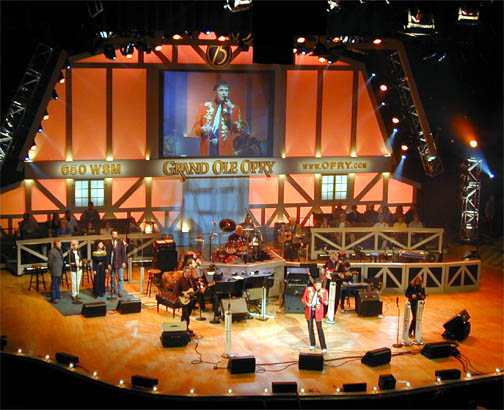
grand ole opry tickets

Like R & B Country and Western music comes out of the unique experiences of Americans. The unique styles of the the artists even when they perform traditional Christmas music comes through to make a distinctive sound. Like the R & B artists the Country and Western artists also wrote and performed Christmas music the spoke to both the joys and heartaches of life, especially of lost loves and loneliness.

So, tonight I present these Country and Western Christmas and holiday songs.

Until tomorrow,

Peace,

Padre Steve+


So wherever you are in whatever circumstance this Christmas season finds you I hope that you find hope and comfort in these songs.

Until tomorrow,

Peace

Padre Steve+

1 Comment

Filed under faith, life, Loose thoughts and musings, movies, music

Blues For Christmas, a R & B Christmas Anthology

MI0003255649

Friends of Padre Steve’s World,

As I wrote yesterday, I love Christmas and holiday music. Yesterday I did a piece that had a lot of my Rock and Roll era favorites, and today one about my R&B favorites.

American Christmas music has been enriched by the influence of Jazz, Blues, Gospel and what came to be known as Rhythm and Blues in the 1940.  I have always loved R & B and some of the most memorable songs about Christmas come from the African American experience and the R & B genre.

R&B as it became known was what record labels marketed music by African American artists. It became popular with White Americans as well with audiences in Europe and the musical influence was felt in the early days of Rock and Roll as Elvis Presley’s musical style incorporated many facets of this rich tradition. R&B Christmas music incorporated a good amount of the faith found in African American churches of the time as well as the reality of life including discrimination, segregation, Jim Crow, violence, poverty, brokenness and loneliness.

A couple of years ago I decided to look up some of those great songs by the great R&B artists. Now while I was familiar with many of these artists, for me their Christmas songs were new and refreshing, despite in many cases being recorded before I was born. Some of course were new versions of songs already made popular by people like Bing Crosby or other crooners. But here are some of those great songs, as well as some of the lyrics. I hope that you enjoy them as much as I do. The songs are in no particular order, and I do hope you enjoy them all.


Marvin Gaye’s “I Want to Come Home for Christmas”  is a song that those who can’t be home for Christmas, in this case that of a Vietnam Prisoner of War set in 1972. It is a song that anyone who has served in a combat zone at Christmas can understand.


But for a song that I think speaks of the human meaning of the season; something that anyone, of any faith or simply anyone who just want’s to be a good human being can understand it is The Jackson 5’s Give Love on Christmas Day”   I like it because love is something that any of us can give to someone else if we want.

People making lists

Hiding special gifts

Taking time to be kind to one and all

It’s that time of year

When good friends are dear

And you wish you could give more

Than just presents from a store

Why don’t you give love on Christmas day

Oh, even the man who has everything

Would be so happy if you would bring

Him love on Christmas day

No greater gift is there than love

People you don’t know

Smile and nod hello

Everywhere there’s an air of Christmas joy

It’s that once a year

When the world’s sincere

And you’d like to find a way

To show the things that words can’t say.

Why don’t you give love on Christmas day

Oh, the man on the street and the couple upstairs

Who need to know there’s someone who cares

Give love on Christmas day.

No greater gift is there than love

What the world needs is love

Yes, the world needs your love.

Why don’t you give love on Christmas day

Every little child on Santa’s knee

Has room for your love underneath his tree

Give love on Christmas day

No greater gift is there than love

What the world needs is love

Yes, the world needs your love.

Give love, oh give love on Christmas day

Every Tom, Dick, and Harry, every Susie too

Needs love every bit as much as you

Give love on Christmas day

So with that message I wish you the best in these days leading up to Christmas. Until tomorrow my friends…

Peace,

Padre Steve

1 Comment

Filed under faith, Loose thoughts and musings, music

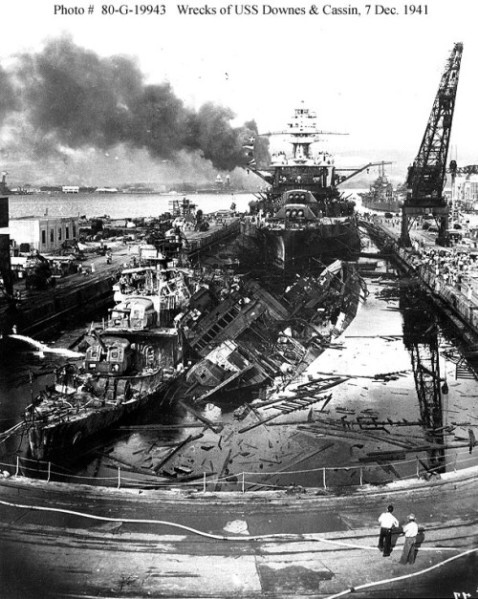
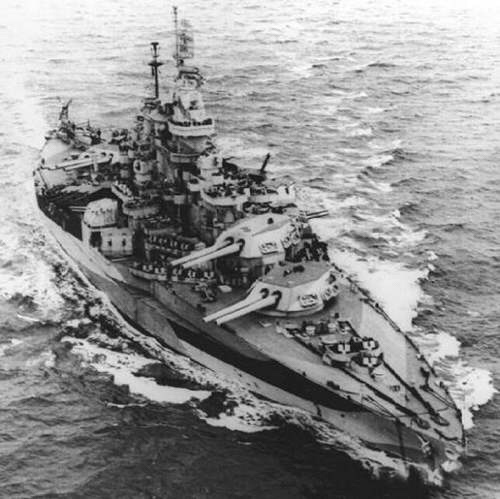
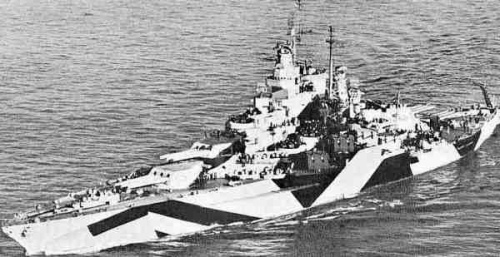
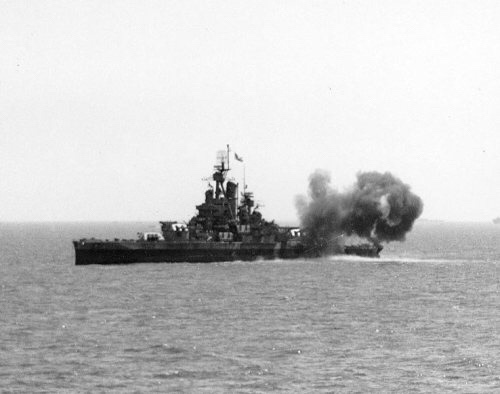
American Dreadnoughts: The Remarkable Battleships of Pearl Harbor

Friends of Padre Steve’s World,

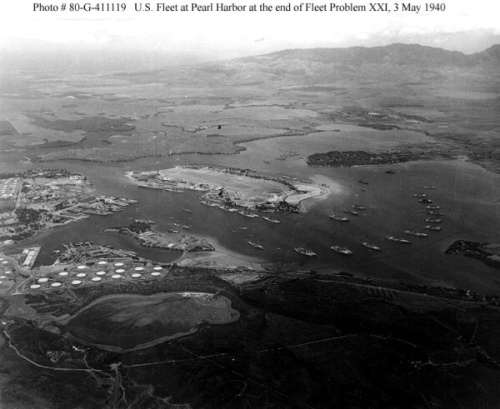
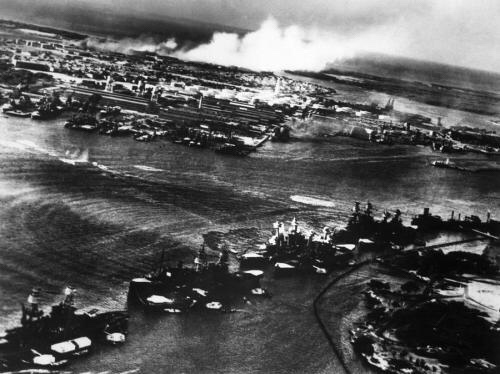
We are coming up on the 77th anniversary of the Japanese attack on Pearl Harbor. It is hard to believe that the attack occurred so long ago. The survivors are aging, and even the youngest are close to ninety years old, the oldest survivor of the USS Arizona, Joe Langdell died in February of 2015. At the time of the attack he was a nearly commissioned Ensign. He and many like him served as the officers and men aboard the eight great battleships moored at Pearl Harbor on that terrible Sunday morning.

The next day President Franklin Roosevelt spoke these immortal words, “Yesterday, Dec. 7, 1941 – a date which will live in infamy – the United States of America was suddenly and deliberately attacked by naval and air forces of the Empire of Japan….

One of the young men who responded to the call to arms after the attack was a future President, 18 year old George H. W. Bush. He was advised to go to college instead of enlisting but he would hear nothing of it. He enlisted as soon as he graduated from high school on his 18th Birthday. He went to flight school and was commissioned just days before his 19th birthday, becoming the youngest Naval aviator. I guess that it is fitting that Bush, who passed away Saturday will be buried on December 6th, the day before the anniversary of the attack.

I remember reading Walter Lord’s classic and very readable book about Pearl Harbor “Day of Infamy” when I was a 7th grade student at Stockton Junior High School back in 1972.  At the time my dad was on his first deployment to Vietnam on the USS Hancock CVA-19.  As a Navy brat I was totally enthralled with all things Navy and there was little that could pull me out of the library.  In fact in my sophomore year of high school I cut over one half of the class meetings of the 4th quarter my geometry class to sit in the library and read history, especially naval and military history.

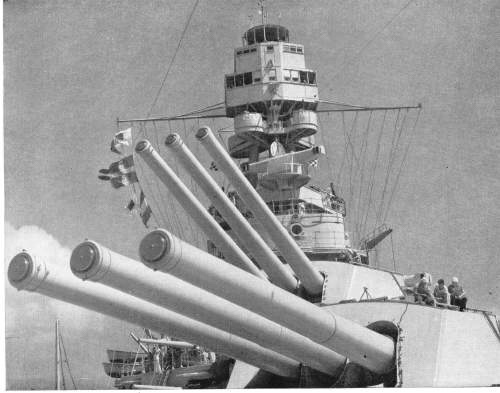
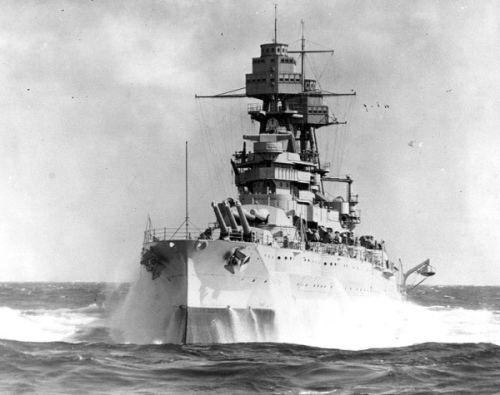
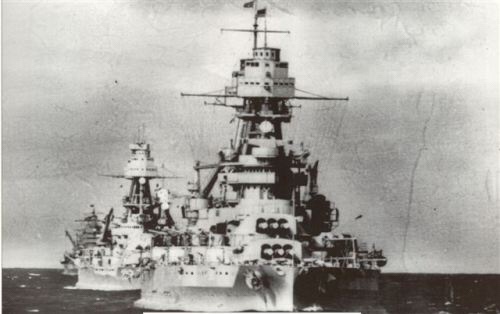
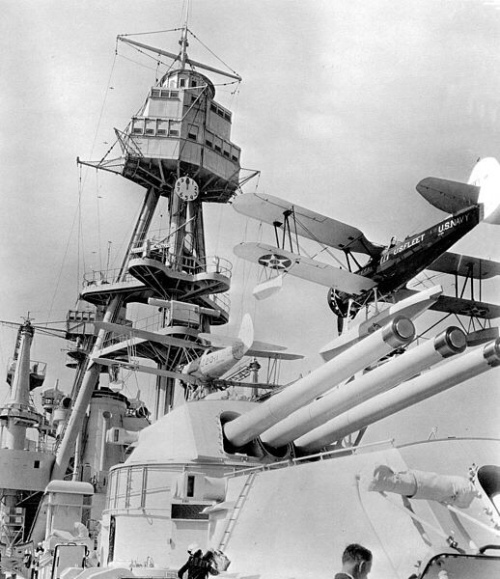
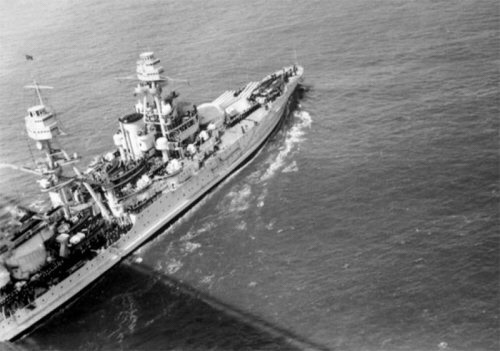
Over the years I have always found the pre-World War Two battleships to be among the most interesting ships in US Navy history.  No they are not the sleek behemoths like the USS Wisconsin which graces the Norfolk waterfront. They were not long and sleek, but rather squat yet exuded power. They were the backbone of the Navy from the First World War until Pearl Harbor. They were the US Navy answer to the great Dreadnaught race engaged in by the major navies of the world in the years prior to, during and after World War One.

Built over a period of 10 years each class incorporated the rapid advances in technology between the launching of the Dreadnaught and the end of the Great War.  While the United States Navy did not engage in battleship to battleship combat the ships built by the US Navy were equal to or superior to many of the British and German ships of the era.

Through the 1920s and 1930s they were the ambassadors of the nation, training and showing the flag. During those years the older ships underwent significant overhaul and modernization.

The Battle Force of the Pacific Fleet in 1941 included 9 battleships of which 8 were at Pearl Harbor on the morning of December 7th.  In the event of war the US War Plan, “Orange” called for the Pacific Fleet led by the Battle Force to cross the Pacific, fight a climactic Mahanian battle against the battleships of the Imperial Japanese Navy and after vanquishing the Japanese foe to relieve American Forces in the Philippines.  However this was not to be as by the end of December 7th all eight were out of action, with two, the Arizona and Oklahoma permanently lost to the Navy.

The ships at Pearl Harbor comprised four of the seven classes of battleships in the US inventory at the outbreak of hostilities.  Each class was an improvement on the preceding class in speed, protection and firepower.  The last class of ships, the Maryland class comprised of the Maryland, Colorado and West Virginia, was the pinnacle of US Battleship design until the North Carolina class was commissioned in 1941.  Since the Washington Naval Treaty limited navies to specific tonnage limits as well as the displacement of new classes of ships the United States like Britain and Japan was limited to the ships in the current inventory at the time of the treaty’s ratification.

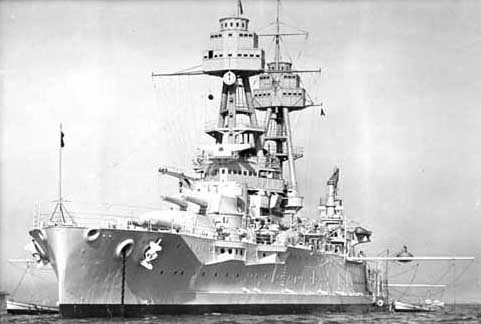
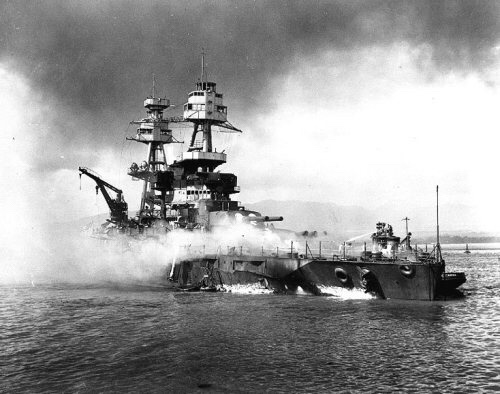
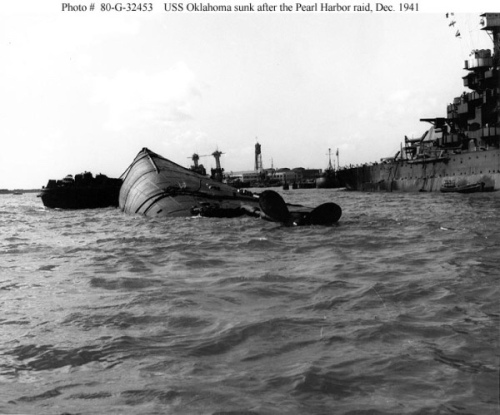
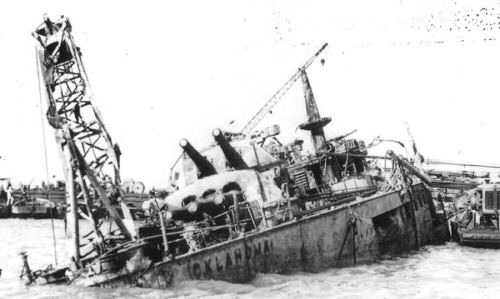
USS Oklahoma (above) and USS Nevada

Those present at Pearl Harbor included the two ships of the Nevada class, the Nevada and Oklahoma they were the oldest battleships at Pearl Harbor and the first of what were referred to as the “standard design” battleships. The two ships of the Pennsylvania class, the Pennsylvania and her sister the Arizona served as the flagships of the Pacific Fleet and First Battleship Division respectively and were improved Nevada’s. The California class ships, California and Tennessee and two of the three Maryland’s the Maryland and West Virginia made up the rest of the Battle Force.

The Colorado was undergoing a yard period at Bremerton and the three ships of the New Mexico class, New Mexico, Mississippi and Idaho had been transferred to the Atlantic before Pearl Harbor due to the German threat.  The three oldest battleships in the fleet, those of the New York and Wyoming Classes, the New York, Arkansas and Texas also were in the Atlantic. Two former battleships, the Utah and Wyoming had been stripped of their main armaments and armor belts and served as gunnery training ships for the fleet. The Utah was at Pearl Harbor moored on the far side of Ford Island. The newest battleships in the Navy, the modern USS North Carolina and USS Washington were also serving in the Atlantic as a deterrent to the German battleships and battlecruisers which occasionally sortied into the Atlantic to attack convoys bound for Britain.

The great ships that lay at anchor at 0755 that peaceful Sunday morning on Battleship Row and in the dry dock represented the naval power of a bygone era, something that most did not realize until two hours later. The age of the battleship was passing away, but even the Japanese did not realize that the era had passed building the massive super-battleships Yamato and Musashi mounting nine 18” guns and displacing 72,000 tons, near twice that of the largest battleships in the U.S. inventory.

The Oklahoma and Nevada were the oldest ships in the Battle Force.  Launched in 1914 and commissioned in 1916 the Nevada and Oklahoma mounted ten 14” guns and displaced 27,500 tons and were capable of 20.5 knots. They served in World War One alongside the British Home Fleet and were modernized in the late 1920s. They were part of the US presence in both the Atlantic and Pacific in the inter-war years. Oklahoma took part in the evacuation of American citizens from Spain in 1936 during the Spanish Civil War.

During the Pearl Harbor attack Oklahoma was struck by 5 aerial torpedoes capsized and sank at her mooring with the loss of 415 officers and crew. Recent analysis indicates that she may have been hit by at least on torpedo from a Japanese midget submarine. Her hulk would be raised but she would never again see service and sank on the way to the breakers in 1946.

Nevada was the only battleship to get underway during the attack.  Moored alone at the north end of Battleship Row her Officer of the Deck had lit off a second boiler an hour before the attack.  She was hit by an aerial torpedo in the first minutes of the attack but was not seriously damaged. She got underway between the attack waves and as she attempted to escape the harbor she was heavily damaged. To prevent her from sinking in the main channel she was beached off Hospital Point.

Nevada was raised and received a significant modernization before returning to service for the May 1943 assault on Attu.  Nevada returned to the Atlantic where she took part in the Normandy landings off Utah Beach and the invasion of southern France.  She returned to the Pacific and took part in the operations against Iwo Jima and Okinawa where she again provided naval gunfire support.

Following the war the great ship was assigned as a target at the Bikini atoll atomic bomb tests. The tough ship survived these tests and was sunk as a target on 31July 1948.

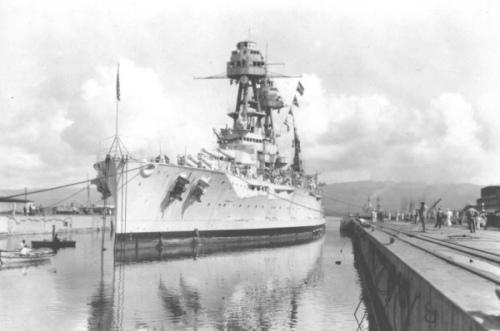
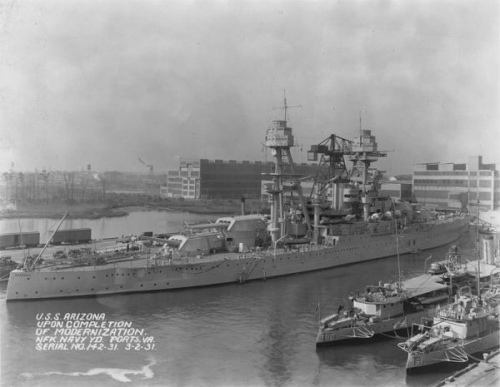
Two views of USS Arizona

Pennsylvania

USS Pennsylvania sailing under the Golden Gate Bridge

The two ships of the Pennsylvania Class were improved Oklahoma’s.  The Arizona and Pennsylvania mounted twelve 14” guns and displacing 31,400 tons and capable of 21 knots they were both commissioned in 1916. They participated in operations in the Atlantic in the First World War with the British Home Fleet. Both ships were rebuilt and modernized between 1929 and 1931. Though damaged in the attack, Pennsylvania was back in action by early 1942. She underwent minor refits and took part in many amphibious landings in the Pacific and was present at the Battle of Surigao Strait.  She was heavily damaged by an aerial torpedo at Okinawa Pennsylvania and was repaired. Following the war the elderly warrior was used as a target for the atomic bomb tests. She was sunk as a gunnery target in 1948.

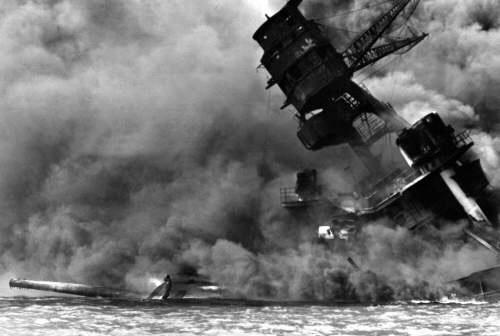
Arizona was destroyed during the attack. As the flagship of Battleship Division One, she was moored next to the repair ship USS Vestal.  She was hit by 8 armor piercing bombs one of which penetrated her forward black powder magazine. The ship was consumed by a cataclysmic explosion which killed 1103 of her 1400 member crew including her Captain and Rear Admiral Isaac Kidd, commander of Battleship Division One.  She was never officially decommissioned and the colors are raised and lowered every day over the Memorial which sits astride her broken hull.

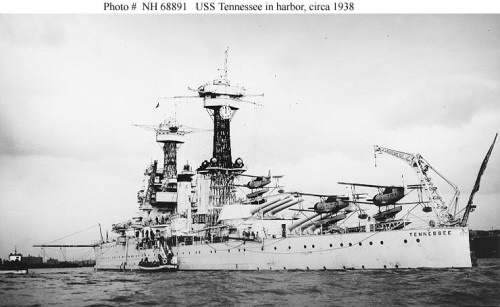
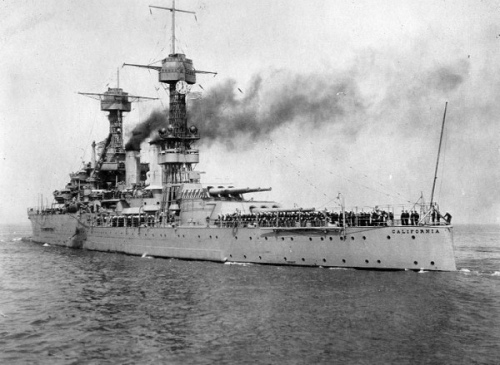
USS Tennessee & USS California

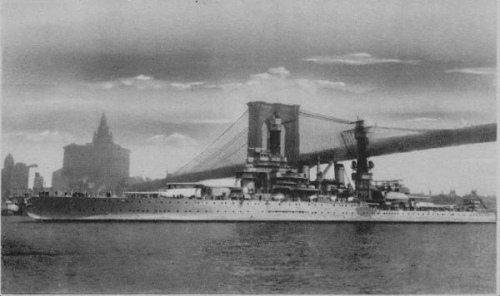
California sailing under the Brooklyn Bridge

The Tennessee class ships the Tennessee and California were the class following the New Mexico class ships which were not present at Pearl Harbor. These ships were laid down in 1917 and commissioned in 1920. Their design incorporated lessons learned at the Battle Jutland. They mounted twelve 14” guns, displaced 32,300 tons and were capable of 21 knots. At Pearl Harbor Tennessee was moored inboard of West Virginia and protected from the aerial torpedoes which did so much damage to other battleships. She was damaged by two bombs.

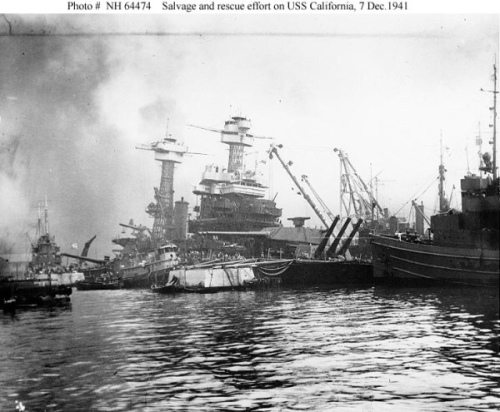
California was the Flagship of Battleship Division Two. She was moored at the southern end of Battleship Row. She was hit by two torpedoes in the initial attack, but she had the bad luck to have all of her major watertight hatches unhinged in preparation for an inspection. Despite the valiant efforts of her damage control teams she sank at her moorings. She was raised and rebuilt along with Tennessee were completely modernized with the latest in radar, fire control equipment and anti-aircraft armaments. They were widened with the addition of massive anti-torpedo bulges and their superstructure was razed and rebuilt along the lines of the South Dakota class. When the repairs and modernization work was completed the ships looked nothing like they did on December 7th. Both ships were active in the Pacific campaign and be engaged at Surigao Strait where they inflicted heavy damage on the attacking Japanese squadron. Both survived the war and were placed in reserve until 1959 when they were stricken from the Navy list and sold for scrap.

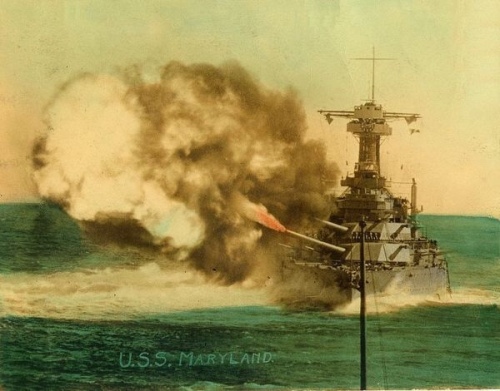
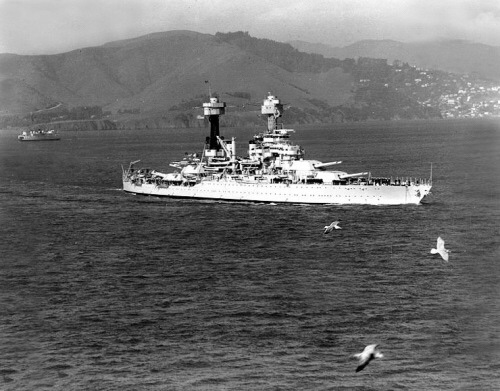
USS Maryland & USS West Virgina

The Maryland and West Virginia were near sisters of the Tennessee class.  They were the last battleships built by the United States before the Washington Naval Treaty. and the first to mount 16” guns. With eight 16” guns they had the largest main battery of any US battleships until the North Carolina class. They displaced 32,600 tons and could steam at 21 knots. Laid down in 1917 and commissioned in 1921 they were modernized in the late 1920s. They were the most modern of the Super-Dreadnoughts built by the United States and included advances in protection and watertight integrity learned from both the British and German experience at Jutland.

At Pearl Harbor Maryland was moored inboard of Oklahoma and was hit by 2 bombs and her crew helped rescue survivors of that unfortunate ship.  She was quickly repaired and returned to action.  She received minimal modernization during the war. She participated in operations throughout the entirety of the Pacific Campaign mainly conducting Naval Gunfire Support to numerous amphibious operations. She was present at Surigao Strait where despite not having the most modern fire control radars she unleashed six salvos at the Japanese Southern Force.

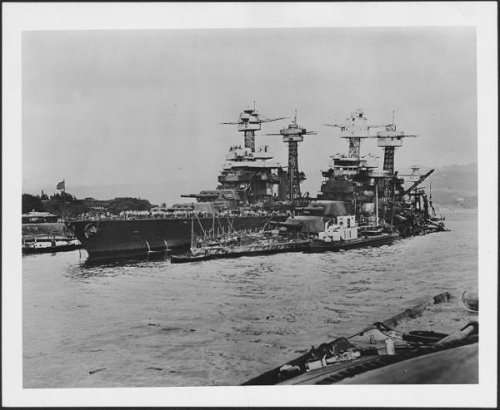
Tennessee & West Virginia after the attack (above) Arizona (below)

Pennsylvania in Drydock Number One, Nevada beached at Hospital Point

Oklahoma Capsized and after being righted

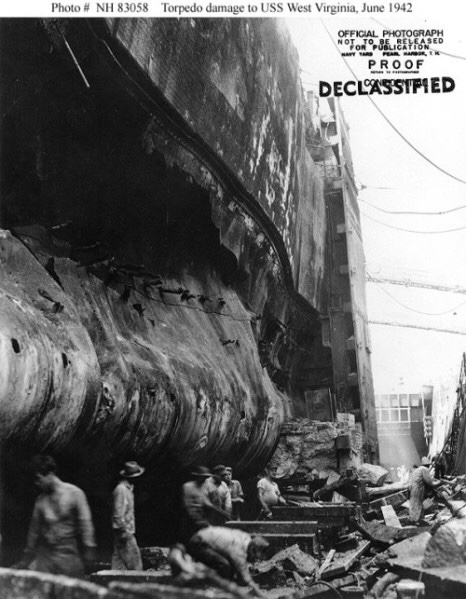
West Virginia suffered some of the worst damage in the attack. She was hit by at least 5 torpedoes and two bombs. One of the torpedoes may have come from one of the Japanese midget submarines that penetrated the harbor. She took a serious list and was threatening to capsize. However she was saved from Oklahoma’s fate by the quick action of her damage control officer who quickly ordered counter-flooding so she would sink on an even keel.  She was raised from the mud of Pearl Harbor and after temporary repairs and sailed to the West Coast for an extensive modernization on the order of the Tennessee and California.

West Virginia was the last Pearl Harbor to re-enter service. However when she returned she made up for lost time.  She led the battle line at Surigao Strait and fired 16 full salvos at the Japanese squadron. Her highly accurate gunfire was instrumental in sinking the Japanese Battleship Yamashiro in the last battleship versus battleship action in history.  West Virginia, Maryland and their sister Colorado survived the war and were placed in reserve until they were stricken from the Naval List and sold for scrap in 1959.

The battleships of Pearl Harbor are gone, save for the wreck of the Arizona and various relics such as masts, and ships bells located at various state capitals and Naval Stations.  Unfortunately no one had the forethought to preserve one of the surviving ships to serve as a living memorial at Pearl Harbor with the Arizona. As I noted at the beginning of this article, the brave Sailors and Marines who manned these fine ships are also passing away.

Thus as we approach the anniversary of the Pearl Harbor attack it is fitting to remember these men and the great ships that they manned.

Peace,

Padre Steve

1 Comment

Filed under History, Loose thoughts and musings, Military, Navy Ships, US Navy, world war two in the pacific

Who Were the Bodies? The Nazi Crimes Against Humanity in Retrospect

Friends of Padre Steve’s World,

In the film Judgement at Nuremberg the American Prosecutor at the Judges Trial played by Richard Widmark asked a question when showing a film of the victims of the Nazis when the Concentration Camps were liberated by American and British troops in the spring of 1945. His question in the face of films of massed piles of bodies being bulldozed into mass graves at Bergen-Belsen, of the cremated remains, shrunken skulls, and lampshades made of human skin at Buchenwald, gas chambers, medical experiments, the emaciated bodies of still living victims; little more than skin and bones, elbows, hips, and knees bulging over the shrunken remains of their bodies, eyes sunken in to the skulls.

Who Were they?

The Nazis specifically targeted the Jews for extermination. According to Hitler, his hnchemen, and other German nationalists, the Jews were less than human, they worked hand in hand with the Bolsheviks, and thus deserved their fate. Likewise, there were those crippled in body or mind who were euthanized, political opponents, religious and racial minorities, populations of conquered nations, who died at the hands of the German military, or who were gunned down in mass graves by the Einsatzgruppen, intentionally starved to death, or who were worked to death as Slave laborers in the Nazi work camps.

They were men and women, wives and husbands, sons and daughters. They spanned the spectrum from infants to the aged. Too many times multiple generations of families went to death together. Hermann Graebe, a civilian employed to help build roads for the Wehrmacht came across one of the many massacres committed up close and personal by SS Men on October 5th 1943 at Dubno, Ukraine. He testified:

Moennikes and I went direct to the pits. Nobody bothered us. Now I heard rifle shots in quick succession, from behind one of the earth mounds. The people who had got off the trucks—men, women and children of all ages—had to undress upon the orders of an SS-man, who carried a riding or dog whip.

They had to put down their clothes in fixed places, sorted according to shoes, top clothing and underclothing. I saw a heap of shoes of about 800 to 1,000 pairs, great piles of underlinen and clothing. Without screaming or weeping these people undressed, stood around in family groups, kissed each other, said farewells and waited for a sign from another SS-man, who stood near the pit, also with a whip in his hand.

During the 15 minutes that I stood near the pit I heard no complaint or plea for mercy. I watched a family of about 8 persons, a man and woman, both about 50 with their children of about 1, 8 and 10, and two grown up daughters of about 20 to 24. An old woman with snow-white hair was holding the one year old child in her arms and singing to it, and tickling it. The child was cooing with delight. The couple were looking on with tears in their eyes. The father was holding the hand of a boy about 10 years old and speaking to him softly; the boy was fighting his tears. The father pointed toward the sky, stroked his head, and seemed to explain something to him. At that moment the SS-man at the pit shouted something to his comrade.

I looked into the pit and saw that the bodies were twitching or the heads lying already motionless on top of the bodies that lay before them. Blood was running from their necks.

I was surprised that I was not ordered away, but I saw that there were two or three postmen in uniform nearby. The next batch was approaching already.

These victims were not just numbers and statistics. They were living breathing human beings whose lives were snuffed out by the Nazis and their allies. They had been abandoned by most of the world. Anything of value that they possessed was appropriated by the men who exterminated them; their businesses, homes, farms, clothes, shoes, currency, jewelry, wedding rings, artwork, furniture, and even their gold fillings, and yes, their hair, and even their skin.

Whole towns were exterminated, millions of people killed and millions of other people displaced, never to return to their homes. At Babi Yar outside of Kiev 33,771 Jews were exterminated by the members of Sonderkommando 4b of Einsatzgruppen C as well as Police battalions. About 10,000 others, mainly Communist Officials and Gypsies were rounded up and killed in the same operation. The victims were stripped of all of their belongings taken to a ravine and shot. The German Army provided logistic support as well as security for the murder squads.

Fritz Hoefer, a SS man serving as a truck driver with the Sonderkommando said these words at the Einsatzgruppen Trial:

One day I was ordered to drive my truck out of town. I had a Ukrainian with me. It was about 10 a.m. On our way, we passed Jews marching in columns in the same direction, we were going. They were carrying their belongings. There were whole families. The farther we drove away from the town, the more people we saw in the columns. There were piles of clothes in a wide open field. My job was to fetch them.   

I stopped the engine nearby, and the Ukrainians standing around started loading the car with this stuff. From where I was, I saw other Ukrainians meeting the Jews who arrived, men, women and children, and directing them to the place where, one after another, they were supposed to remove their belongings, coats, shoes, outer garments and even their underwear.

They were supposed to put all their belongings together in a pile. Everything happened very quickly, the Ukrainians hurried those who hesitated by kicking and pushing them. I think it took less than a minute from the moment a person took off his coat before he was standing completely naked.

No distinction was made between men, women and children. The Jews who were arriving could have turned back when they saw those who had come earlier taking off their clothes. Even today I cannot understand why they didn’t run.


Columns of Jews march past a corpse in Kiev

Naked Jews were led to a ravine about 150 metres long, 30 metres wide and 15 metres deep. The Jews went down into the ravine through two or three narrow paths. When they got closer to the edge of the ravine, members of the Schutzpolizei (Germans) grabbed them and made them lie down over the corpses of the Jews who had already been shot.

It took no time. The corpses were carefully laid down in rows. As soon as a Jew lay down, a Schutzpolizist came along with a sub-machine gun and shot him in the back of the head.The Jews who descended into the ravine were so frightened by this terrible scene that they completely lost their will. You could even see some of them lying down in the row on their own and waiting for the shot to come.

Only two members of the Schutzpolizei did the shooting. One of them was working at one of the ravine, the other started at the other end. I saw them standing on the bodies and shooting one person after another.

Walking over the corpses toward a new victim who had already laid down, the machine gunner shot him on the spot. It was an extermination machine that made no distinction between men, women and children.Children were kept with their mothers and shot with them. I did not watch for long. When I approached the edge, I was so frightened of what I that I could not look at it for a long time.


German Einsatzgruppen & Police force groups of Jews to hand over their possessions and undress before being shot in the ravine at Babi Yar

I saw dead bodies at the bottom laid across in three rows, each of which was approximately 60 metres long. I could not see how many layers were there. It was beyond my comprehension to see bodies twitching in convulsions and covered with blood, so I could not make sense of the details.Apart from the two machine gunners, there were two other members of the Schutzpolizei standing near each passage into the ravine.

They made each victim lie down on the corpses, so that the machine gunner could shoot while he walked by. When victims descended into the ravine and saw this terrible scene at the last moment, they let out a cry of terror. But they were grabbed by the waiting Schutzpolizei right away and hurled down onto the others.

Those who followed them could not see the terrible scene because it was obstructed by the edge of the ravine. While some people were getting undressed and most of the others were waiting their turn, there was a lot of noise. The Ukrainians paid no attention to the noise and just kept forcing people through the passages into the ravine.

You could not see the ravine from the site where people were taking off their clothes, because it was situated about 150 metres away from the first pile of clothes. Besides, a strong wind was blowing and it was very cold. You couldn’t hear the shooting in the ravine.
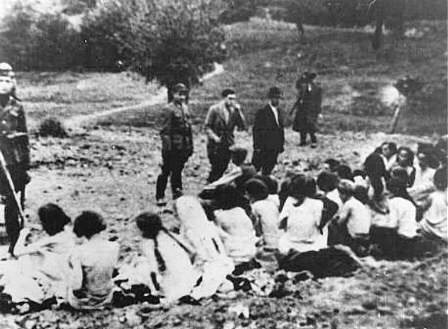
Jews at Babi Yar waiting to be murdered

So I concluded that the Jews had no idea what was actually happening. Even today I wonder why the Jews did nothing to challenge what was going on. Masses of people were coming from town and they did not seem to suspect anything.

They thought they were just being relocated.              

The men who were the leaders of the mobile Einsatzgruppen which conducted these up close and personal killings of nearly a million and a half Jews and others were not common thugs. Most were very educated and accomplished men.

General Telford Taylor, an American lawyer who served as a prosecutor at the Einsatzgruppen Trial explained:

“These defendants are not German peasants or artisans drafted into the Wehrmacht. They are not uneducated juveniles. They are lawyers, teachers, artists, and a former clergyman. They are, in short, men of education, who were in full possession of their faculties and who fully understood the grave and sinister significance of the program they embarked upon. They were part of the hard core of the SS. They did not give mere lip service to Himmler’s atrocious racial doctrines; they were chosen for this terrible assignment because they were thought to be men of sufficient ruthlessness to carry them out. They are hand-picked fanatics; every one of them was an officer of the SS … They are not unhappy victims, unwillingly pushed into crime by the tyranny of the Third Reich; these men, above all others, themselves, spread the Nazi doctrine with fire and sword.”

The men who ran the death camps might not have been from the same “elite” stock as the commanders of the Einsatzgruppen but they carried out their duties in calculating and businesslike manner. Rudolf Hoess who commanded Auschwitz gave this statement to the International Military Tribunal:

On 1 December 1943 1 became Chief of Amt 1 in Amt Group D of the WVHA, and in that office was responsible for co-ordinating all matters arising between RSHA and concentration camps under the administration of WVHA. I held this position until the end of the war. Pohl, as Chief of WVHA, and Kaltenbrunner, as Chief of RSHA, often conferred personally and frequently communicated orally and in writing concerning concentration camps. . . .

The ‘final solution’ of the Jewish question meant the complete extermination of all Jews in Europe. I was ordered to establish extermination facilities at Auschwitz in June 1941. At that time, there were already in the General Government three other extermination camps: Belzek, Treblinka, and Wolzek. These camps were under the Einsatzkommando of the Security Police and SD. I visited Treblinka to find out how they carried out their exterminations. The camp commandant at Treblinka told me that he had liquidated 80,000 in the course of one-half year. He was principally concerned with liquidating all the Jews from the Warsaw Ghetto. He used monoxide gas, and I did not think that his methods were very efficient. So when I set up the extermination building at Auschwitz, I used Cyklon B, which was a crystallized prussic acid which we dropped into the death chamber from a small opening. It took from 3 to 15 minutes to kill the people in the death chamber, depending upon climatic conditions. We knew when the people were dead because their screaming stopped. We usually waited about one-half hour before we opened the doors and removed the bodies. After the bodies were removed our special Kommandos took off the rings and extracted the gold from the teeth of the corpses.

When he was asked specifics, Hoess stated: This gold was melted down and brought to the Chief Medical Office of the SS at Berlin.

He continued with some pride during cross examination:

Another improvement we made over Treblinka was that we built our gas chamber to accommodate 2,000 people at one time whereas at Treblinka their 10 gas chambers only accommodated 200 people each. The way we selected our victims was as follows: We had two SS doctors on duty at Auschwitz to examine the incoming transports of prisoners. The prisoners would be marched by one of the doctors who would make spot decisions as they walked by. Those who were fit for work were sent into the camp. Others were sent immediately to the extermination plants. Children of tender years were invariably exterminated since by reason of their youth they were unable to work. Still another improvement we made over Treblinka was that at Treblinka the victims almost always knew that they were to be exterminated and at Auschwitz we endeavored to fool the victims into thinking that they were to go through a delousing process. Of course, frequently they realized our true intentions and we sometimes had riots and difficulties due to that fact. Very frequently women would hide their children under the clothes, but of course when we found them we would send the children in to be exterminated. We were required to carry out these exterminations in secrecy but of course the foul and nauseating stench from the continuous burning of bodies permeated the entire area and all of the people living in the surrounding communities knew that exterminations were going on at Auschwitz.

But the bodies…

Jews and Gentiles from every nation in Europe as well as the Americas, Africa, and Asia ended up dying at the hands of the Nazis, either in their Death Camps, Concentration/ Labor Camps, or up close and personal at the hands of the Einsatzgruppen, the Waffen SS, or the Wehrmacht.

Every one of those bodies, the cold statistics of the Nazi machine were people like you and me. In April I visited the United States Holocaust Museum while visiting friends in Washington D. C.

I think that the one that hit me the hardest was the pictorial Tower of Faces from the Polish shtetl of Ejszyszki. That town was home to some 4,000 Jews and the pictures had been taken over the preceding decade by local photographers. They were pictures of everyday family and community life; men, women, children at work, at play, at rest. Worshipping, working, studying, the old and the young, the well off and the poor, the religious and those not as religious at all phase of life captured in photos for eternity. For 3500 of them their lives ended on September 21st 1941 when the Nazis rounded up the Jews at their Synagogues on the eve of Yom Kippur and executed them by firing squad in mass graves at the town’s Christian and Jewish cemeteries. Only 29 of those who survived that day lived through the war. That Jewish community had existed for 900 years and was exterminated in a matter of hours.

I looked at those pictures and I could not get over all of those innocent lives cut short. Each face was the picture of an individual or individuals, families, friends, schoolmates. They were not abstract numbers or statistics but real flesh and blood people like you and me. They had hopes and dreams, but because they were Jews they were exterminated, like nearly six million other Jews who also were real people with hopes and dreams that would be destroyed by the Nazi racial war. Of course the Nazis targeted others, but none with the relentless anti-Semitic racial hatred propagated by Nazi ideology. Thus they condoned and executed by people who would have ordinarily have been considered upstanding and moral citizens. The late Christopher Hitchens wrote:

“We should not at all allow ourselves to forget the millions of non-Jewish citizens of Belarus, Russia, Ukraine, and other Slav territories who were also massacred. But for me the salient fact remains that anti-Semitism was the regnant, essential, organizing principle of all the other National Socialist race theories. It is thus not to be thought of as just one prejudice among many.” 

The Jewish-Italian Philosopher and Auschwitz survivor Primo Levi wrote:

Then for the first time we became aware that our language lacks words to express this offence, the demolition of a man. In a moment, with almost prophetic intuition, the reality was revealed to us: we had reached the bottom. It is not possible to sink lower than this; no human condition is more miserable than this, nor could it conceivably be so. Nothing belongs to us any more; they have taken away our clothes, our shoes, even our hair; if we speak, they will not listen to us, and if they listen, they will not understand. They will even take away our name: and if we want to keep it, we ill have to find ourselves the strength to do so, to manage somehow so that behind the name something of us, of us as we were, still remains.
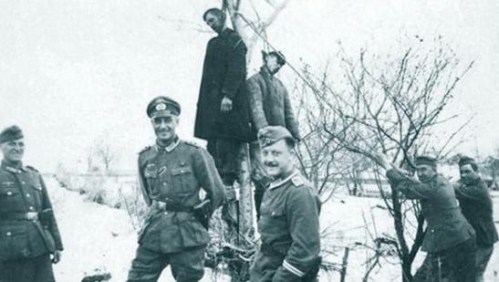
I write because the remaining witnesses to the Nazi Crimes are dying off and deniers are becoming ever more numerous. In researching this article I came across a man, an American of all people, who is denying the mass murder at Babi Yar. I have to shake my head, but the fact is that such people have become emboldened by the Presidency of Donald Trump. They see in him a kindred spirit. Such does not bode well for the future, and the lives who will stand behind the faces and names of the future crimes against humanity.

Until tomorrow,

Peace,

Padre Steve+

4 Comments

Filed under ethics, History, holocaust, Loose thoughts and musings, nazi germany, News and current events

The Nazi Battle Against the Churches: Robert Jackson’s Opening Statement at Nuremberg, Part Three

Friends of Padre Steve’s World,

Earlier in the week I began to write about the Nuremberg Trials and the opening statement of the American Chief Prosecutor, Supreme Court Justice Robert Jackson. The first section was comprised his general remarks. The second dealt with the Nazi war against free organized labor. The third section presented here was the shortest part of his opening statement. It deals with the Nazi battle against the Churches.

Jackson lays out his argument to show how this was directed with the aim of suppressing or corrupting all competing institutions of power in the state that could potentially become centers of resistance. Likewise, he builds up this to show the attempt to remove any moderating influence that could stand against its plans for aggressive warfare and genocide.

The division of the German State Church into the Evangelical Church (Lutheran and Reformed) and Roman Catholicism was a Problem for the Nazis. They desired a coordination of religion under their rule. The Protestant and Catholic state churches of Germany were potential rivals for the soul of the citizenry of the Third Reich. They ran schools, universities, hospitals, benevolent organizations, published influential newspapers, and had their own political parties and labor organizations.

German Protestantism since the day of Martin Luther was linked to German nationalism and seen by the Nazis as the ideal vehicle to build upon. The Catholic Church which was predominant in Bavaria and was strong in the other states of southern and western Germany. It was not very strong in the north, especially Prussia where in the 1800s Otto Von Bismarck persecuted the Catholic Church through the Külturkampf. Like Bismarck, Hitler, though Catholic himself viewed the Church as less than fully committed to the Reich because of its allegiance to Rome, which Hitler and many other Nazis considered to be a foreign power.

Likewise, other Nazi leaders of Catholic background realized the power of the Church and its institutions, and even stood in awe of them. Heinrich Himmler would pattern his SS indoctrination upon the Jesuits. The former Catholics included Joseph Goebbels, Heinrich Himmler, and Himmler’s number two man, Reinhard Heydrich. Richard Evans wrote in his book The Third Reich in Power:

Himmler’s deputy, Reinhard Heydrich, reacted against a strict Catholic upbringing with a hatred of the Church that can only be called fanatical. In 1936, Heydrich classified the Jews and the Catholic Church, acting above all through political institutions such the Centre Party, as the two principal enemies of Nazism. As an international body, he argued, the Catholic Church was necessarily subversive of the racial and spiritual integrity of the German people. Moreover, the Catholics, unlike the Protestants, had been largely represented by a single political party, the Centre, whose voters, again unlike those of most other parties, had mostly remained loyal and resisted the appeal of Nazism during the elections of the early 1930s. Much of the blame for this could be laid in the Nazis’ view at the feet of the clergy, who had preached vehemently against the Nazi Party, in many cases ruled that Catholics could not join it, and strongly urged their congregations to continue voting for the Centre or its Bavarian equivalent, the Bavarian People’s Party. For many if not most leading Nazis, therefore, it was vitally important to reduce the Catholic Church in Germany as quickly as possible to total subservience to the regime. (Third Reich In Power pp. 234-235)

The average church member was not the physical target of their attacks, instead the Nazis worked at, and quite often were very successful at weaning away many of the faithful from anything more that perfunctory and traditional displays of religion. Even there the Nazis did their best to supplant holidays such as Christmas and Easter with Nazi themes and ideology.

The battle for the Party was to deprive the Churches of their social and political power, and for the most part they were successful in their campaign. They suppressed church political parties and newspapers, labor unions, youth organizations. The latter were dissolved and replaced by the Reich Labor Front, and the Hitler Youth. Church schools were eventually closed by 1939 and religious education in public vocational schools was reduced to very small amounts of time with the teaching becoming more in line with Nazi racial ideology and anti-semitism.

The Protestant Church mostly fell in line with a minority in opposition known as the Confessing Church. Even so the Protestant opposition for the most part limited its opposition to the Nazis to the infringements against the church, not the nationalism or Nazi war aims. Richard Evans wrote:

The co-ordination of the Protestant Church was driven forward, among other factors, by the appointment of the lawyer August Jäger as State Commissioner for the Evangelical Churches in Prussia. Jäger declared that Hitler was completing what Luther had begun. They were ‘working together for the salvation of the German race’. Jesus represented ‘a flaring-up of the Nordic species in the midst of a world tortured by symptoms of degeneracy’. In conformity with the ‘leadership principle’, Jäger dissolved all elected bodies in the Prussian Church and replaced many existing officials with German Christians. Meanwhile, Reich Bishop Ludwig Müller had taken over the administrative headquarters of the Evangelical Church with the aid of a band of stormtroopers. By September, pressure was growing within the Reich Church to dismiss all Jews from Church employment. Much of the pressure came from ordinary pastors. Prominent here were young pastors from lower-middle-class backgrounds or non-academic families, men for whom war service had often been a life-defining experience, and racially conscious pastors from areas near Germany’s eastern borders for whom Protestantism represented German culture against the Catholicism of the Poles or the Orthodox faith of the Russians. Such men desired a Church militant based on the aggressive propagation of the Gospel, a crusading Church whose members were soldiers for Jesus and the Fatherland, tough, hard and uncompromising. Muscular Christianity of this kind appealed particularly to young men who despised the feminization of religion through its involvement in charity, welfare and acts of compassion. The traditional Pietist emphasis on sin and repentance, which dwelt on images of Christ’s suffering and transfiguration, was anathema to such men. They demanded instead an image of Christ that would set a heroic example for German men in the world of the here and now. For them, Hitler took on the mantle of a national redeemer who would bring about the rechristianization of society along with its national reawakening. (Third Reich in Power pp. 224-225)

The Nazified and nationalistic German Protestants, led by these clergy paint a striking image very similar to conservative American Evangelical Christians who echo many of the same theological themes, and who have in many cases elevated President Donald Trump into a redeemer and nearly messianic figure.

Jackson continued his opening statement at Nuremberg dealing with this toward the middle of the day on November 21st 1945. These are his words:

The Nazi Party was always predominantly anti-Christian by ideology. But we who believe in freedom of conscience and of religion base no charge of criminality on anybody’s ideology. It is not because the Nazis themselves were irreligious or pagan, but because they persecuted others of the Christian faith that they became guilty of crime, and it is because the persecution was a step in the preparation for aggressive warfare that the offence becomes one of international consequence. To remove every moderating influence among the German people and to put its population on a total war footing, the conspirators devised and carried out a systematic and relentless repression of all Christian sects and churches.

We will ask you to convict the Nazis on their own evidence, Martin Bormann in June 1941 issued a secret decree on the relation of Christianity and National Socialism. The decree provided:

“For the first time in German history the Fuehrer consciously and completely has the leadership of the people in his own hand. With the Party, its components, and attached units, the Fuehrer has created for himself, and thereby for the German Reich leadership, an instrument which makes him independent of the church. All influences which might impair or damage the leadership of the people exercised by the Fuehrer with the help of the N.S.D.A.P. must be eliminated. More and more the people must be separated from the churches and their organs, the pastors. Of course, the churches must and will, seen from their viewpoint, defend themselves against this loss of power. But never again must an influence on leadership of the people be yielded to the churches. This influence must be broken completely and finally. Only the Reich government, and by its direction the Party, its components, and attached units, have a right to leadership of the people. Just as the deleterious influence of astrologers, seers, and other fakers are eliminated and suppressed by the State, so must the possibility of church influence also be totally removed. Not until this has happened does the State leadership have influence on the individual citizens. Not until then are the people and Reich secure in their existence for all the future” (D-75).

And how the Party had been securing the Reich from Christian influence will be proved by such items as this teletype from the Gestapo, Berlin, to the Gestapo Nuremburg, on 24th July, 1938. Let us hear from their own account of events in Rottenburg:

“The Party, on 23rd July, 1939, from 2100 carried out the third demonstration against Bishop Sproll. Participants, about 2,500-3,000, were brought in from outside by bus, etc. The Rottenburg populace again did not participate in the demonstration. This town took rather a hostile attitude to the demonstrations. The action got completely out of hand of the Party Member responsible for it. The demonstrators stormed the palace, beat in the gates and doors. About 150 to 200 people forced their way into the palace, searched the rooms, threw files out of the windows, and rummaged through the beds in the rooms of the palace. One bed was ignited. Before the fire got to the other objects or equipment in the rooms and the palace, the flaming bed was throw from the window and the fire extinguished. The Bishop was with Archbishop Groeber of Freiburg, and the ladies and gentlemen of his menage in the chapel at prayer. About 25 to 30 pressed into this chapel and molested those present. Bishop Groeber was taken for Bishop Sproll. He was grabbed by the robe and dragged back and forth, Finally the intruders realised that Bishop Groeber was not the one they were seeking. They could then be persuaded to leave the building. After the evacuation of the palace by the demonstrators I had an interview with Archbishop Groeber, who left Rottenburg in the night. Groeber wants to turn to the Fuehrer and Reich Minister of the Interior Dr. Frick anew. On the course of the action, the damage done, as well as the homage of the Rottenburg populace beginning today for the Bishop, I shall immediately hand in a full report, after I begin suppressing counter mass meetings. In case the Fuehrer has instructions to give in this matter, I request that these be transmitted most quickly.” (848-PS).

Alfred Rosenberg Nazi Ideologist and Reich Minister for Occupied Territories

Later, defendant Rosenberg wrote to Bormann reviewing the proposal of Herrl as Church minister to place the Protestant Church under State tutelage and proclaim Hitler its supreme head. Rosenberg was opposed, hinting that Naziism was to suppress the Christian Church completely after the war.

The persecution of all pacifist and dissenting sects, such as Jehovah’s Witnesses and the Pentecostal Association, was peculiarly relentless and cruel. The policy toward the Evangelical Churches, however, was to use their influence for the Nazi’s own purposes. In September, 1933, Muller was appointed the Fuehrer’s representative with power to deal with the “affairs of the Evangelical Church” in its relations to the State. Eventually, steps were taken to create a Reich Bishop vested with power to control this Church. A long conflict followed, Pastor Niemoller was sent to a concentration camp, and extended interference with the internal discipline and administration of the Churches occurred.

A most intense drive was directed against the Roman Catholic Church. After a strategic Concordat with the Holy See, signed in July, 1933, in Rome, which never was observed by the Nazi Party, a long and persistent persecution of the Catholic Church, its priesthood and its members, was carried out. Church Schools and educational institutions were suppressed or subjected to requirements of Nazi teaching inconsistent with the Christian faith. The property of the Church was confiscated and inspired vandalism directed against the Church property was left unpunished. Religious instruction was impeded and the exercise of religion made difficult. Priests and bishops were laid upon, riots were stimulated to harass them, and many were sent to concentration camps.

After occupation of foreign soil, these persecutions went on with greater vigour than ever. We will present to you from the files of the Vatican the earnest protests made by the Vatican to Ribbentrop summarising the persecutions to which the priesthood and the Church had been subjected in this Twentieth Century under the Nazi regime. Ribbentrop never answered them. He could not deny. He dared not justify.

I now come to “Crimes against the Jews.”

THE PRESIDENT: We shall now take our noon recess. (A recess was taken until 1400 hours.)

THE PRESIDENT: The Tribunal will adjourn for fifteen minutes at half past three and then continue until half past four.

MR. JUSTICE JACKSON: I was about to take up the “Crimes Committed Against the Jews.”

Until tomorrow,

Peace,

Padre Steve+

Leave a comment

Filed under History, holocaust, Loose thoughts and musings, nazi germany, News and current events, Political Commentary, Religion

I Will Live a Thousand Times Before I Die: Reading as a Way of Life

Friends of Padre Steve’s World,

George R.R. Martin wrote in his book A Dance With Dragons:  “A reader lives a thousand lives before he dies, said Jojen. The man who never reads lives only one.”

I constantly read and because I try to imagine what I am reading so that in a way I live it. I have been to places that have never traveled to before and on entering them I know exactly where everything is and what happened there. I remember leading a group from my Army chapel in Wurzburg Germany to Wittenberg, where Martin Luther began the Protestant Reformation. As I led the group through the town a couple of people asked me how many times I had been there. I told them, “physically, never until today, but I have been here a thousand times before because of books. I saw Wittenberg in my minds eye before I ever saw the city.” They were surprised and both said that it seemed like I had been there many times.

I have had the same thing happen other places that I have visited, and again, it is because I read, and as I read, I imagine and occasionally dream.

I have a huge number of my books in my office most dealing with the history, especially the American Civil War and Reconstruction, the World Wars, and the insurgencies and counter-insurgency wars of the past seventy or so years. I have a lot of biographies, books on American history, military theory, sociology, philosophy, psychology related to war and PTSD, and a few theological works, though most of my theology books are at home because I don’t have room for them in the office.

Coupled with mementos of my military career, other militaria, artwork, and baseball memorabilia the sight and smell can be both overwhelming and comforting at the same time. I hear that a lot from my visitors, including those who come in for counseling, consolation, or just to know someone cares. They tell my visitors volumes about me without them ever asking a question or me telling them, and occasionally someone will ask to borrow a book, and most of the time I will lend them the book, or if I have multiple copies even give it to them.

In a sense my books are kind of a window to my soul, the topics, and even how I have them organized, and they are not for decoration. Many times while I am reflecting on a topic, a conversation, or something that I read in the news I peruse my books and pull one or more out to help me better understand it, or relate it to history. sometimes when in conversation something will come up and I can pull out a book. One of my Chaplains said that he should “apply for graduate credit” for what he learns in our often off the cuff talks. But, for me that is because I read so much and absorb it.

Likewise my memorabilia is there to remind me of all the people in my past who I have served with. I don’t have all my medals, honors, and diplomas up for everyone to see, instead I have pictures and collages, many signed by people who made a difference in my life. When I see the signatures and often all too kind words on them I am humbled, and in some cases a tear will come to my eye, but I digress…

I always try to read a decent amount everyday. I in the past couple of weeks I have finished reading a number of very good books dealing with different historical dramas. Since my trip to Germany at the end of September I have read, or re-read a number of books. One that I read for the first time was Where Ghosts Walked: Munich’s Road to the Third Reich by David Clay Large. I read it while during the week that we spent in Munich and it was very a very enlightening look at a complex and often contradictory city that has seen a number of cultural and political shifts since the Eighteenth Century, including its place as the spiritual home of the Nazi movement.

I re-read British military historian, Max Hastings book Das Reich: The March of the 2nd SS Panzer Division Through France, June 1944. It focuses on the leadership, and culture of the Waffen SS Division, and on the war crimes committed by its units and personnel it moved from Southern France to Normandy during the week following the Allied invasion of France. The book deals with especially the extermination of the population of the town of Oradour Sur Glane. For those who mythologize the Waffen-SS as an elite military formation, it should be required reading.

Also on my reading list in Germany and after were Anthony Beevor’s The Fall,of Berlin 1945. I read it in order to refresh my memorial on the Battle of Berlin, and the locations that we would visit while in the city. I finally decided to read Robert Massie’s Castle’s of Steel: Britain, Germany, and the Winning of the Great War at Sea, which I have had on my bookshelf for years, and re-read Cornelius Ryan’s The Last Battle, also about the Battle for Berlin. I first read that book as a teenager.

One of the most troubling books that I read while in Germany was Believe and Destroy: Intellectuals in the SS War Machine, by Christian Ingrao. Believe and Destroy is particularly troubling because it shows that racism, anti-Semitism, and the planning and execution of genocide is not just the work of poorly educated thugs.

I read Barbara Tuchman’s The First Salute: A View of the American Revolution; and The Butcher of Poland: Hitler’s Lawyer Hans Frank, by Garry O’Connor. To change things up I read Bob Woodward’s Fear: Trump in the White House, Rick Wilson’s Everything Trump Touches Dies, and the late Tony Judt’s I’ll Fares the Land.

I love complex characters, people who may be heroes and at the same time scoundrels. I like the contradictions and the feet of clay of people, because I am filled with my own, and truthfully saints are pretty boring. Unfortunately I haven’t read any biographies of late, although most of my reading deals a lot with biography as the characters weave their way through history.

Since we just observed the Centenary of the end of World Aar One, I have started re-reading Edmond Taylor’s The Fall of the Dynasties: The Collapse of the Old Order, 1905-1922 and Richard Watt’s The Kings Depart: The Tragedy of Germany: Versailles and the German Revolution. Both of these are very important reads which should help us to reflect reflect on what is happening in our world today. There are many similarities and reading them causes me to wonder if world leaders will allow hubris, arrogance, greed, and pride to drag the world into another catastrophic war. Sadly President Trump, doesn’t read, and doesn’t learn from history. Unfortunately, his ignorance is very much a reflection of our twenty-first century media culture.

But to me, books are important, far more important than anything that is shouted at me on television. Historian Timothy Snyder wrote in his little but profound book, On Tyranny:

“Staring at screens is perhaps unavoidable, but the two-dimensional world makes little sense unless we can draw upon a mental armory that we have developed somewhere else. When we repeat the same words and phrases that appear in the daily media, we accept the absence of a larger framework. To have such a framework requires more concepts, and having more concepts requires reading. So get the screens out of your room and surround yourself with books. The characters in Orwell’s and Bradbury’s books could not do this—but we still can.”

Barbara Tuchman wrote:

“Books are the carriers of civilization. Without books, history is silent, literature dumb, science crippled, thought and speculation at a standstill. Without books, the development of civilization would have been impossible. They are engines of change (as the poet said), windows on the world and lighthouses erected in the sea of time. They are companions, teachers, magicians, bankers of the treasures of the mind. Books are humanity in print.”

But anyway, I am late getting this out. So have a great day and a better tomorrow.

Peace

Padre Steve+
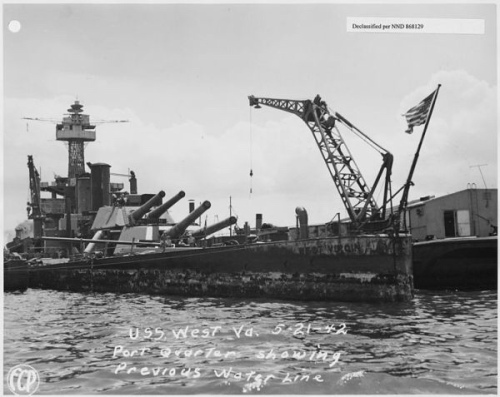
3 Comments

Filed under books, books and literature, History, Loose thoughts and musings, philosophy, Political Commentary, Teaching and education