Category Archives: Loose thoughts and musings

A Busy Hump Day Musings…


Friends of Padre Steve’s World,

Today I am going to be teaching in my Ethics class at the Staff College and getting ready to take another group of students to Gettysburg this weekend. 

Over the past few days I have been working hard on the draft text that will become my second book, Mine Eyes have seen the Glory: Race, Religion, Ideology, and Politics in the Civil War Era. Likewise, I have been trying to take a rest from the barrage of political vitriol on the Internet and other media, except to take a few minutes to listen to my favorite living former President, a man who I never voted for, Bill Clinton as he shared about his relationship with Hillary. I enjoyed the speech. 

But part of why I have been trying to take a break from social media politics, is because over the past week I have managed to piss off friends and followers who are supporters of both Donald Trump and Bernie Sanders by making my opinions known. Truthfully, I value friendships more than having to have people agree with my political beliefs. The fact is that my views are almost certain to be in opposition to people on the extreme Right, or Left of the political spectrum. 

But that being said, while I respect my friends opinions and I try never to do things to drive wedges that would destroy relationships and never go to their social media sites to attack their candidates or positions, my opinions also matter. I also have the right to freedom of speech, the same right that I have defended for all citizens for over thirty years, but I digress… 

But anyway. I will be busy today, and because of that I am going to take it easy. I expect to write something about the Democratic National convention in the next couple of days, and I certainly post an article or two about Gettysburg and my coming trip there. 

So have a great day.

Peace

Padre Steve+

Leave a comment

Filed under Loose thoughts and musings

The Paths not Chosen


Friends of Padre Steve’s World,

After about a week of writing about politics, history, and the very disturbing candidacy of Donald Trump, I need to take a break, not that there isn’t a lot of politics, foreign policy, and other serious subjects I could write about. But honestly I need to take a break from that, at least for a few days, for my own sanity and to get ready for another trip to Gettysburg this weekend.

So today something a bit more introspective which I think is a good question for all of us who seek the truth and take the time to examine our lives in light of all that happens to us. 

In the series the X-Files, Agent Dana Scully played by Gillian Anderson made this observation: 

“Time passes in moments… moments which, rushing past, define the path of a life, just as surely as they lead towards its end. How rarely do we stop to examine that path, to see the reasons why all things happen, to consider whether the path we take in life is our own making, or simply one into which we drift with eyes closed. But what if we could stop, pause to take stock of each precious moment before it passes? Might we then see the endless forks in the road that have shaped a life? And, seeing those choices, choose another path?”

I actually think that it is a very good question and truthfully I wonder. I wonder what my life might have been had I, or others made different decisions. How would my life be different? Or would it? I don’t know, and frankly, I don’t really care.

One thing I do know is that whatever my alternate paths might have taken that I am happy. I have been able to fulfill many dreams and I do take the time to ponder all the forks in the road that have shaped my life. When I do I realize that the alternative possibilities are almost endless. Then when I think of the possibilities of alternate universes I wonder, not that there is anything wrong with that. But even so, I don’t think I would want to be on any other path, for since I was a child all that I could imagine ever being happy doing in life was serving my country in the military.  In early 1861, Ellen Boyle Ewing Sherman, the wife of William Tecumseh Sherman told Sherman “You will never be happy in this world unless you go in the army again.”  Ellen had never approved of Sherman’s previous service and in fact hated ever moment of it, but after six years of seeing her husband in civilian life, she knew that he had to return to the army. 

Twenty years ago I made a decision to volunteer to serve as a mobilized Army reservist during the Bosnia crisis. It was a decision that changed my life. I had left active duty in 1988 to attend seminary while remaining in the National Guard and the Reserves, and when I was mobilized I lost my civilian employment, and two and a half years later when I was offered the chance to go on active duty in the Navy, even though it meant a reduction in rank, I did it. 

When I think of all the things that transpired to get me when I am today I really am astounded, and for the life of me I don’t see how I could have chosen another path. It has been twenty years since I volunteered to support the Bosnia operation, and almost thirty-five years since I first enlisted in the army, and like Sherman, I cannot have imagined doing anything different. As for my wife Judy, she, like Ellen Sherman was with her husband has been long suffering in staying with me all these years, and I wouldn’t trade her for anyone. 

When I look at my life in total, there are many things that I might have wanted to change or do differently, but if I had, or for that matter,mad someone else made a different decision concerning my life, the tapestry that has been my life would be very different and I might not even recognize me if any of those paths had been chosen, by me, or by others. 

Agent Scully’s words got me thinking and pondering and that my friends is a good thing. 

So until the next fork in the road….

Peace

Padre Steve+

Leave a comment

Filed under Loose thoughts and musings, philosophy

What’s On Deck this Week

 Friends of Padre Steve’s World,


I have been working on a number of articles that will be published here this week. I have one coming up on some of the very troubling episodes of xenophobia that have occured in England and Wales in the wake of the Brexit vote, incidents that are similar to some that have occured in the United States and other nations over the past several months. Of course I have a number that are continued work on my Civil War and Gettysburg texts. As I mentioned I am going to have to split the first two chapters, which alone account for over 350 pages of the nearly 1100 page text into their own book or books. The trouble when you go back through work on history or political and military theory to clarify and amplify what you are saying is that it often results in more text. At least as I do this the bumpy places in the text are coming together in a much more smooth and readable form. Of course the subjects that I write about in it are just as pertinent today as they were in the ante-bellum era, The Civil War, Reconstruction, as well as the post-Reconstruction and White supremacist Jim Crow era.

Over the weekend I will be writing about the Declaration of Independence, and the most important proposition in it, the proposition that all men are created equal.

So anyway, with that said, have a great Tuesday.

Peace

Padre Steve+

Leave a comment

Filed under Loose thoughts and musings

Reading, Writing, and Brexit 


Friends of Padre Steve’s World,

Today I am posting a short thought since I have been very busy at work this week with a new class on deck at the Staff College, and continuing to do more research and writing on my Civil War and Gettysburg text. Within the context of my research and writing I am going to be posting some new material this weekend, but I have not decided if it will be in portions of the updated text or in short articles dealing with selected ideas and topics. 

Before those are posted I probably will be posting something on the results of the British referendum to remain in or leave the European Union. Since what happens in the United Kingdom and Europe matters a great deal to the United States and the world, in both economic and security matters it is important. Likewise, since I have a good number of friends in the U.K., as well as the fact that my ancestry is predominantly Irish, Scottish, and English I have a personal interest. 

While I can understand the reasons that many people, especially in England as opposed to Scotland and Northern Ireland are voting to leave the E.U., I do fear that a vote to leave the European Union could lead to the breakup of the United Kingdom, something that I think would be bad for all concerned, for as history shows, the breakup of nations, states, and political unions seldom brings about more liberty or stability. There are a few exceptions to this, but again, they are exceptions. But whatever the result of the referendum, it will be historic and it will not end the debate. 

So, I will finish my beer and get ready to go to bed. Until tomorrow, have a good night and a better day. 

Peace,

Padre Steve+

1 Comment

Filed under Foreign Policy, Gettysburg, Loose thoughts and musings, News and current events, Political Commentary

Nothing Serious Tonight


Friends of Padre Steve’s World,

For once nothing serious, not that I have not been doing some very serious writing and research on my Civil War and Gettysburg texts. But tonight we had a tapping party at the place that is my version of the Cheers  bar. Our great brewer, Adam Gurtshaw put a Session IPA and a really nice Belgian Wit on tap. It was a nice eating, drinking, and music experience.

The theme of the tapping party was super heroes, so I wore my Madison Bumgarner 2012 World Series jersey. That man is more of a super-hero than anyone wearing tights, three World Seria titles, a WS MVP, and a no-hitter, and in addition to pitching he can hit with power. Top that Clayton Kershaw. 

But then as Benjamin Franklin allegedly said, “Beer is proof that God loves us and wants us to be happy.”

Have a great night,

Peace

Padre Steve+

Leave a comment

Filed under beer, Just for fun, Loose thoughts and musings

Passages: Learning to Live 


Friends of Padre Steve’s World,

Over the past couple of days I have lost two friends, both former Marines, who lived their lives to the fullest. They loved life, and touched many people. One died on his 78th birthday, the other a young man in his 40s, who died after a long struggle with a heart condition. He had finally received a heart transplant, but died from complications of the surgery having suffered a number of strokes. Likewise I have a high school classmate who is dying of Colon cancer, he contacted me on Facebook’s messenger application to let me know that he didn’t have long to live and wanted to thank me for my friendship over the years. 

I will mourn my friends and try my best to be available to their families, because it is the only thing that I can do. But that being said, I know that cannot take away their grief, nor the loss they have suffered; nor can I be like the biblical character Job’s friends who entirely missed his grief, doubts, and questions, seeking instead to prove the unprovable question of why Job experienced such great loss. I am far too inadequate for that, and I do know my limitations. Maybe what I have gone through the past number of years following my time in Iraq has shown me the folly of trying to do more than to be with people in their grief, the best that I can, while at the same time not intruding on them by assuming that I have the answers, or the “magic wand” that will make everything better, as so many well-meaning people did with me in my darkest days. Good intentions do not always bring comfort or healing to the grieving or the wounded soul. 

One thing that the loss of these friends, as well as a number of other friends over the past few months has done for me is to remind me of an attitude about life that I have had since I was a child; to live life to the fullest, to see it as an adventure, to imagine, dream, plan, and immerse myself in it, to cherish my wife Judy, my family, and my friends, especially those like my friend Nelson who served as my assistant and bodyguard in Iraq. There are so many things to live for, so many things to discover, places to see, knowledge to be learned, and wisdom to be gained to last a hundred lifetimes or more. Thus I cannot live in fear of death, yes it will come someday, but to quote Abraham Lincoln, “If I am killed I can die but once; but to live in constant dread of it, is to die over and over again.” 

Life is too precious not to live it to the fullest, and likewise not to live it thinking I have been cheated, or have it destroyed by bitterness, or jealousy, or hate. As the late Negro League legend Buck O’Neil said, “Where does bitterness take you? To a broken heart? To an early grave? When I die I want to die from natural causes, not from hate, eating me up from the inside.” Buck O’Neil could have gone to that, living through Jim Crow, being to old to come across and play in the major leagues, not being inducted into the Baseball Hall of Fame. But he didn’t he lived and loved life and people to his dying day. That’s the way I want to go. 

I know this kind of meandered, but it is what it is. 

Have a great day, and live big. 

Peace

Padre Steve+

2 Comments

Filed under Loose thoughts and musings

Coffee, Eminent Domain & Remembering Molly


Friends of Padre Steve’s World,

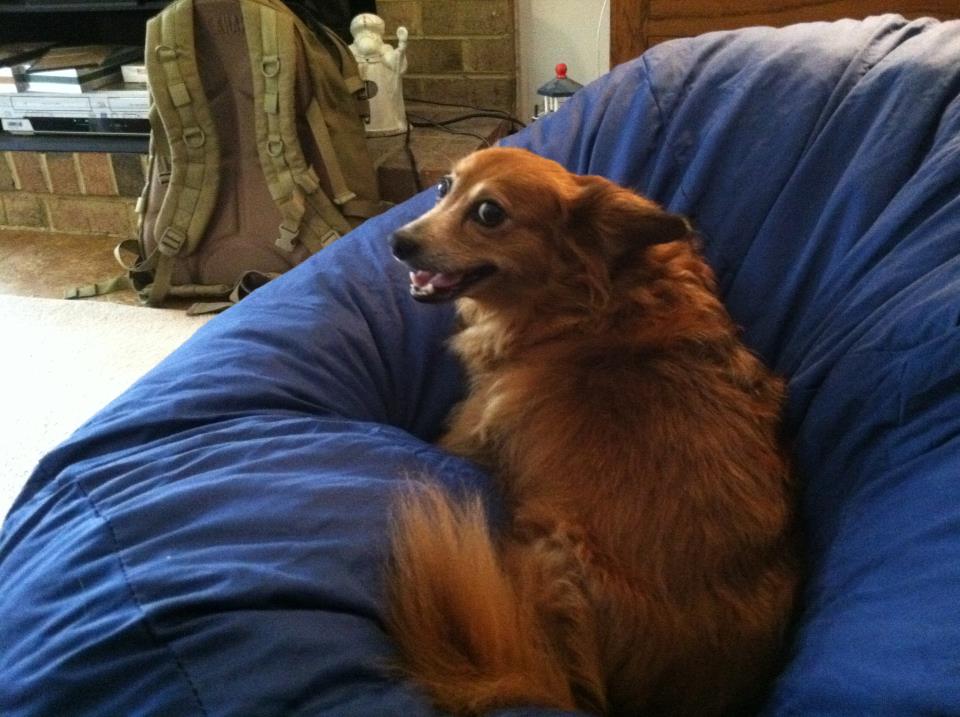
Today was kind of a sad day as I got my last cup of coffee at the 7-11 store that I visit most mornings on my way to work, and it is the anniversary of us losing our wonderful Papillon-Dachshund mix Molly a year ago. Molly was a great dog, a dog who helped me through the some of my worst times after Iraq, and whenever Judy was sick became “Nurse Molly.” We both miss that girl. Thankfully we have Minnie and Izzy, and Izzy especially is beginning to fill in the role of comforter that Molly filled so well.

I am kind of a “blue collar” guy when it comes to morning coffee, not a real big fan of the fancy coffee shops. I like the mixture of working class people who are the clientele more than I do fancy places. Likewise I just like a nice up of coffee with a little French Vanilla creamer and a packet of brown sugar, and a stick of string cheese as my breakfast, instead of some fancy beverage.

This store happens to be on my way to work, just before I get on the freeway. But, sadly, today was the last day for that. The store was a victim of a badly needed expansion of the road and freeway on and off ramps, but it is kind of sad as I have gotten to know the folks that work there as well as the regulars who like me make it their morning coffee stop, and as a creature of habit I hate change. The manager and his wife will go to another store, but not close to me. They are good people, and I will miss them.

mollybag

Molly

Since the construction may make a mess of that route, I may have to find an alternate anyway, but as for now I have to figure it out, but in the meantime I will take some time with Judy this afternoon, and remember Molly while enjoying Minnie and Izzy.

Have a great day,

Peace

Padre Steve+

1 Comment

Filed under Loose thoughts and musings

Cemetery & Culp’s Hill Pt 5

Friends of Padre Steve’s World

I am catching up from  from another trip with my students to Gettysburg, and happen to be posting my newest additions to my text, these dealing with the battles for Culp’s Hill and Cemetery Hill which occurred on the night of July 2nd and early morning of July 3rd 1863. I hope you enjoy.

Peace,

Padre Steve+

greene monument

When the divisions Alpheus Williams and John Geary marched away to meet the threat to Cemetery Ridge, only George Greene’s brigade remained to defend Culp’s Hill. In addition to his own position, Greene found his brigade “guarding nearly half a mile of Twelfth Corps works.” [1] Much like Joshua Chamberlain on the extreme left of the Union line, “Greene ended up with a much-thinned single-rank battle line without reserves.” [2] Greene only had between 1,300 and 1,400 men and one battery of artillery, but he made the most of them taking advantage of the natural terrain features as well as the entrenchments which his men and the other Twelfth Corps units had prepared. He “formed his brigade in a single line, with spaces between the men, regiments moving to the right as the line lengthened.” [3] In addition he sent out his smallest regiment, the 78th New York “The Cameron Highlanders” down the hillside to act as skirmishers where they joined with men of the 60th New York.

culp's hill

Allegheny Johnson and his division drew the toughest assignment on this warm summer evening. Since it arrived on the battlefield the previous night it was sheltered to the rear of Brenner’s Hill about a mile east of Gettysburg north of the Hannover Road, where with the exception of sending some skirmishers to Rock Creek, “Johnson kept his infantry concealed and quiet throughout the day.” [4] His four brigades, one of Louisianans under the Colonel Jesse Williams, and the brigades of Brigadier Generals John M. Jones, George “Maryland” Steuart, and James Walker, were primarily Virginians. His four brigades had sat inactive the entire day and impatiently awaited orders to attack, with one staff officer “prudently “conducting religious services…the men gladly joining the solemn exercises.” [5]

When Latimer’s battered artillery battalion withdrew from Brenner’s Hill, Ewell gave orders for the attack to begin. At about seven o’clock Johnson ordered his troops forward, but unlike Early’s troops who were well deployed in a position where they could immediately attack Cemetery Hill, John’s brigades had to make a march over bad, obstacle strewn ground in order to get to their attack positions, and the advance did not go according to plan. James Walker’s “Stonewall” Brigade had to be left behind “to settle accounts with aggressive skirmishers from General Gregg’s cavalry division who had persisted in harassing his left flank and rear.” [6] This stubborn fight of the Union Cavalry troopers prevented “the entire Stonewall Brigade from taking its place in Ewell’s assault column” as Walker “was so flustered by the resistance that he encountered that he deferred his movement to Culp’s Hill, fearing to uncover Ewell’s left to Union observers.” [7] This deprived the Confederates of a quarter of their strength before the attack even began.

ewells-attack-on-culps-hill

As the remaining brigades of the division, “Jones, Williams, and Steuart, in that order, reached Rock Creek, they discovered waist-deep water that would take time to negotiate.” [8] In addition to the high water the far back was very steep and “infested with Yankee soldiers ready to contest any passage.” The officer commanding the skirmishers wrote, “We held this point with the briskest fire we could concentrate…. I decided to…sweep them as the crossed the brook.” [9] The delay cost the Confederates another half hour and the Union troops slowly withdrew up the slope continuing to maintain fire as they withdrew “using “the heavy timber” to make “every tree and rock a veritable battlefield.” [10] As the New Yorkers withdrew, the brigades of Jones and Williams had to make the assault up the steep and rugged slope of Culp’s Hill, and by now it was dark. The main part of Culp’s Hill, where these brigades attack “with its steep, rock strew slopes broken here and there by cliffs fifteen to twenty feet high, afforded great protection to its defenders,” [11] who as previously noted had worked hard to fortify the already imposing ground. Johnson himself was concerned about the effect of the terrain on the advance as “the Confederate infantry halted from time to time, waiting for its advance to clear the way.” [12]

Johnson sent some 4,700 men up Culp’s Hill to attack Greene’s 1,300 dug in veterans. “That kind of manpower edge would have likely been decisive elsewhere on the field that day, but against Pop Greene’s providential and well-constructed breastworks the odds leveled out.” [13] The Confederate troops continued to move up the slope battling the persistent skirmishers the entire way when they discovered another unpleasant surprise. Greene had concealed his men, even hiding the colors below the barricades to disguise his positions and he waited until the Confederates were almost upon his positions and had stopped to dress the line, before opening “a general open fire “like chain lightening” from his brigade.” [14] The fire had a devastating effect on the Confederate’s, whose line wavered. A captain of the 44th Virginia remembered that “all was confusion and disorder.” Private Benjamin Jones of the 44th remembered the enemy’s works as “a ditch filled with men firing down on their heads.” [15] The volleys of Greene’s men from “in front and the abattis behind trapped John Marshall Jones’ Virginia brigade “scarcely thirty yards from the enemy’s breastworks,” [16] forcing them to take cover for nearly fifteen minutes while their officers figured out what to do. Finally they rose up and stormed the works. They charged four times, and General Jones was wounded in the leg, forcing him to turn over command of his brigade. The attacks of Jones and William’s brigades “were bloody disasters. The steep pitch of the hill and the darkness of the hour, compounded by the rocks and brush that everywhere hindered movement, rendered any sort of coherent assault an impossibility.” [17] Finally, the Confederates withdrew to the base of the hill where they established a foothold and tried to regroup.

Greene’s men fought hard but Greene was not ready to rest on his laurels. He requested reinforcements from First and Eleventh Corps on his left. Despite being under attack himself, James Wadsworth, who had fought his division so well at McPherson’s and seminary Ridge the previous day, “promptly sent two regiments, the 6th Wisconsin and the 84th New York. Howard, in response to Greene’s call had Schurz hurry over the 82nd Illinois, the 45th New York, the 157th New York, and the 61st Ohio.” [18] However, the six regiments that arrived had been reduced to fractions of their former strength by the first day’s battle “increased Greene’s force only by about 755 men.” [19]Additionally, Hancock who heard the battle raging “sent two regiments to the relief of Slocum as well.”[20] Greene’s after action report noted:

“we were attacked on the whole of our front by a large force few minutes before 7 p.m. The enemy made four distinct charges between 7 and 9.30 p.m., which were effectually resisted. No more than 1,300 were in our lines at any one time. The loss of the enemy greatly exceeds ours.”[21]

Further south, “Maryland” Steuart’s brigade entered the area of the Federal line which had been vacated by Geary and Williams’s divisions where it posed a brief threat. However, Steuart’s brigade fared no better as it hit the Federal line. Two of his regiments “got ahead of the rest of their command and hooked onto the right flank of the Louisiana troops. This had the unpleasant effect of funneling them into a deadly cul de sac, with unfriendly fire in their front and on both flanks” [22] His left regiments faced little resistance and began to look for a way around Green’s flank in the darkness.

As the night wore on Confederate attacks continued and in the darkness other Federal units arrived, including those from XII Corps which had gone earlier in the day. By mid-morning Johnson’s assault was done. His units had suffered severe casualties and his division had been drained of all attacking power by the time Lee needed it on the morning of July 3rd to support Pickett’s attack. “This division, formed by Stonewall Jackson was never the same again. Its glories were in the past.”[23] In the end the Army of the Potomac still held both Cemetery and Culp’s Hill, in large part due to the actions of the old soldier, George Greene who’s foresight to fortify the hill and superb handling of his troops and those who reinforced him kept Johnson’s division from rolling up the Federal right. However, Greene had refused his right and had occupied the traverse trench line that he had constructed earlier as a fallback position. From here, Colonel David Ireland’s 137th New York conducted a private war with them. Ireland’s men were joined by three companies of the 149th New York, and the 14th Brooklyn, recently arrived from First Corps as well as Rufus Dawes 6th Wisconsin of the Iron Brigade. Steuart wrote “The left of the brigade was the most exposed at first, and did not maintain its position in line of battle. The right, thus in advance, suffered very severely, and, being unsupported, waved, and the whole line fell back in good order. The enemy’s position was impregnable, attacked by our small force, and any further effort to storm it would have been futile, and attended with great disaster, if not total annihilation.” [24] Late in the night the leading elements of the Twelfth Corps units which had went to Cemetery Ridge fought a brisk fight the rest of the night and into the morning with Steuart’s men to regain their trench lines. The fight of the 137th New York until it could be reinforced was instrumental to Union success, but “the cost was high; that night Colonel Ireland lost a third of his men.” [25] As the night wore on across the hill scattered musketry attended the night and the Confederate attacks ceased.

Eventually, Johnson had to settle for the lodgment that he made at the base of the hill and with Steuart’s occupation of the Union trenches. He hoped that the following day, reinforced he might take the hill. Reinforced by troops from Rodes’s division, Allegheny Johnson made a maximum effort in the morning despite the objections of various brigade and regimental commanders, including George Doles and Maryland Steuart. The commanding officer of the 1st Maryland Battalion exclaimed “it was nothing less than murder to send men into that slaughter pen.” [26] The attack was a disaster, Johnson’s division suffered over 2,000 casualties, the supporting units suffered over 1,000 more.

Ewell’s troops would play no further role in the battle. In the end his presence around Cemetery and Culp’s Hill diminished the resources that Lee needed to support his other assaults on the second and third day of battle. In effect it left Lee without one third of his forces. The result was the sacrifice of many troops with nothing to show for it. Ultimately Lee is to blame for not bringing Ewell’s forces back to Seminary Ridge where they and their artillery may have had a greater effect on the battle.

Ewell’s attack was a costly mistake marked by the constant inability of the Confederate commanders to coordinate their attacks. Of the Confederate commanders, only Johnson led his troops into the fight, Ewell remained well behind the lines, Early gave tactical command of the cemetery Hill assault to Hays, and Rodes demurred to the caution of Ramseur and Doles. On the Union side, the splendid work by George Greene helped undo what could have been a disaster when Williams and Geary’s divisions were sent to Cemetery Ridge. Hancock and Howard responded quickly to all danger sending in reinforcement when and where they were needed the most. The stand of the artillery on Cemetery Hill and the counter-attack of Carroll’s Gibraltar Brigade to drive off Hays’s men also were decisive.

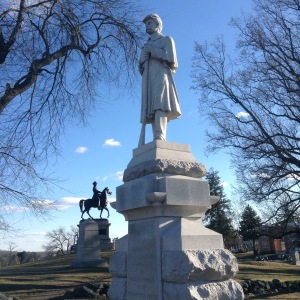
The real hero of Culp’s Hill was Greene. But Greene in many ways is a forgotten hero, he was not given much credit in Meade’s after action report though Slocum attempted to rectify this and Meade made some minor changes to his report. But it was in later years that Greene was began to receive recognition for his actions. James Longstreet gave Greene credit for saving the Union line on the night of July 2nd and said that “there was no better officer in either army” at the dedication of the 3rd Brigade monument on Culp’s Hill in 1888. Greene died in 1899 having been officially retired from the Army in 1893 as a First Lieutenant, his highest rank in the Regular Army. A monument to Greene stands on Culp’s Hill looking east in the direction of Johnson’s assault.

Notes

[1] Ibid. Pfanz Gettysburg: Cemetery Hill and Culp’s Hill p. 204

[2] Ibid. Sears Gettysburg  p.326

[3] Ibid. Guelzo Gettysburg: The Last Invasion p.347

[4] Ibid. Greene “A Step All-Important and Essential Element of Victory” p.121

[5] Ibid. Guelzo Gettysburg: The Last Invasion p.347

[6] Ibid. Coddington The Gettysburg Campaign: A Study in Command  p.430

[7] Longacre, Edward G. The Cavalry at Gettysburg: A Tactical Study of Mounted Operations during the Civil War’s Pivotal Campaign, 9 June-14 July 1863 University of Nebraska Press, Lincoln and London 1986 p.212

[8] Ibid. Greene “A Step All-Important and Essential Element of Victory” p.123

[9] Ibid. Trudeau Gettysburg: A Testing of Courage p.400

[10] Ibid. Guelzo Gettysburg: The Last Invasion p.348

[11] Ibid. Coddington The Gettysburg Campaign: A Study in Command  p.431

[12] Ibid. Guelzo Gettysburg: The Last Invasion p.348

[13] Ibid. Sears  Gettysburg p.326

[14] Ibid. Guelzo Gettysburg: The Last Invasion p.348

[15] Ibid. Pfanz Gettysburg: Cemetery Hill and Culp’s Hill p. 216

[16] Ibid. Guelzo Gettysburg: The Last Invasion p.348

[17] Ibid. Trudeau Gettysburg: A Testing of Courage p.400

[18] Ibid. Coddington The Gettysburg Campaign: A Study in Command  p.431

[19] Ibid. Coddington The Gettysburg Campaign: A Study in Command  p.431

[20] Jordan, David M. Winfield Scott Hancock: A Soldier’s Life Indian University Press, Bloomington and Indianapolis 1988 p.94

[21] Ibid. Luvaas and Nelson The U.S. Army War College Guide to the Battle of Gettysburg pp. 159-160

[22] Ibid. Trudeau Gettysburg: A Testing of Courage p.400

[23] Ibid. Dowdy Lee and His Men at Gettysburg: The Death of a Nation p.262

[24] Ibid. Luvaas and Nelson The U.S. Army War College Guide to the Battle of Gettysburg p.155

[25] Ibid. Sears  Gettysburg p.328

[26] Ibid. Trudeau Gettysburg: A Testing of Courage p.447

Leave a comment

Filed under Loose thoughts and musings

Cemetery & Culp’s Hill Pt 4

Friends of Padre Steve’s World

I have just gotten back from another trip with my students to Gettysburg, and happen to be posting my newest additions to my text, these dealing with the battles for Culp’s Hill and Cemetery Hill which occurred on the night of July 2nd and early morning of July 3rd 1863. I hope you enjoy.

Peace,

Padre Steve+

robert-rodes

Major General Robert Rodes, C.S.A.

It would not be until the evening of the 2nd that Ewell’s troops went into action against the now very well entrenched, but depleted, Federal Forces on Cemetery and Culp’s Hill. The assaults began on Cemetery Hill where Jubal Early’s division attacked forces along the north and east section of the hill. This attack was to have been supported by Robert Rodes’ division on the west.

However as with most of the Confederate offensive actions of the battle this too fell apart as Rodes division provided no support to Early’s attack. Edwin Coddington explained that Rodes “did not give himself enough time to get his big division into formation for the attack. By the time he had completed the complicated maneuver of wheeling his brigades forty-five degrees to the left and advancing them half a mile to a good place from which to charge up Cemetery Hill the battle was over.” [1] However, this explanation gives Rodes too much of a pass, although he indeed failed to properly prepare for the attack, he decided not to attack based on the discretion given to him in Ewell’s orders.

Rodes’s division had lost about forty percent of its strength in the disastrous attack on Oak Ridge on July 1st. “Perhaps still shaken from the near disaster the day before, Rodes displayed a lack of diligence and energy which was untypical of his career, civilian or as a soldier.” [2] Robert Rodes was under general instructions from Ewell to support the attacks, which gave him some latitude in decided when and where to do so. As a result he “had been very careful and cautious in marching his men out of Gettysburg and into line across from the northwest corner of Cemetery Hill.” [3] Likewise, he “seems to have greatly underestimated how long it would take to move his five brigades out of Gettysburg and deploy them to the west of the town for an assault.” [4] His two leading brigades, those of Stephen Ramseur and George Doles which had distinguished themselves the previous day, “had covered about half an mile toward the enemy’s line when, in dusk, the two young brigadiers got a good and very sobering look at the Federal position.” [5] Rodes had given tactical command of the advance, and the final say in deciding on the attack, to Ramseur, an aggressive officer “who nonetheless paled when he saw the strength of the enemy defenses.” [6] When his brigade “came within six hundred feet of the Union line, the moonlight was apparently strong enough for Ramseur to observe the great strength of the position: batteries ready to pour “direct, cross, and enfilade fires” upon his lines, and two supporting rows of infantry well protected by stone walls and breastworks.” [7] Alfred Iverson, who had contributed to the disaster the day before claimed “we were advancing to our destruction.” [8]

This was enough for Ramseur who consulted with George Doles and Iverson, and told Rodes of their findings. “When Doles concurred with Ramseur in this report, Rodes cancelled the attack,” [9] and “deferring the attack until daylight.” [10] As the time was past when he could support Early, whose brigades had now ceased their attack, Rodes decided “it would be useless sacrifice of life to go on.” [11]

Despite the failure of Latimer’s barrage, and Rodes’s decision not to attack, “Johnson and Early rushed their men into action as if relieved that the tension of the long wait was over,” [12] and both would meet with bloody failure.

Storm on Cemetery Hill: Early’s Attack

Like the rest of Second Corps, Jubal Early’s division had waited throughout the day for the word to advance. Early had placed the brigades of Colonel Isaac Avery, who was commanding Hoke’s brigade, and Brigadier General Harry Hay’s Louisiana brigade, “in a protected position north of the town, from which they could easily storm cemetery Hill.” [13] He also moved John Gordon’s brigade into a supporting position while leaving “Extra Billy” Smith’s brigade to cover the Confederate rear along the York Road.
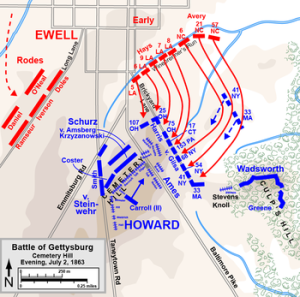
350px-Gettysburg_Cemetery_Hill

Assault on Cemetery Hill

It was Early’s division which came the closest to breaking the Union line and seizing the all-important position on Cemetery Hill. His line, with Avery left and Hays on the right, “some 3,500 men in all, stretched east from the town across the fields to within a short distance from Rock Creek. As Johnson closed in on Culp’s Hill around eight o’clock. Early began to whip his men into motion.” [14] Early put Hays in tactical command of the two brigades Hays exhorted his men, including the famed Louisiana Tigers, with the challenge that Early had ordered “the Louisianans and …North Carolinians to take the guns on the hill.” [15] But some of his officers, including Lieutenant Warren Jackson, “who had been on the skirmish line most of the day was not assured; he felt as though his fate had been sealed.” [16]

But some Union troops along the line had become complacent, assuming that the defeat of Latimer’s artillery at Brenner’s Hill meant that the threat had passed. One Union soldier wrote, “We did not expect any assault,” and “could not have been more surprised if the moving column had raised up out of the ground amid the waving timothy grass of the meadow.” [17]

From their starting positions outside Gettysburg, Early’s forces had to make a giant wheel to their right to strike the Federal line on East Cemetery Hill. Hays’s Louisiana regiments “extended out from the pivot of the wheel. Isaac Avery’s three North Carolina regiments, on the outer edge of the wheel had longer to march.” [18] The two brigades began their advance and were immediately assailed by the massed Federal artillery batteries on Cemetery Hill. Charles Wainwright wrote that the Hays’s Confederates “marched straight out of the town, and then facing to their right rushed for the hill.” [19] A Federal artilleryman described the advance, “When they came into full view in Culp’s meadow our artillery…opened on them with all the guns that could be brought to bear. But on, still on, they came, moving steadily to the assault, soon the infantry opened fire, but they never faltered.” [20]

The Confederates faced a fusillade of artillery fire from the guns of First and Eleventh Corps. Captain Michael Wiedrich’s Battery I, 1st New York, “closest to the Louisianans, went to canister almost immediately. Before long all the batteries were firing canister, then double canister. When they ran out of canister they fired case shot without fuzes, the missiles exploding as they left the muzzles.” [21]  However, much of the fire had little effect as the guns could not be depressed enough and many rounds went over the heads of the Confederates, protecting them from an even greater slaughter. Avery’s North Carolina troops suffered worse as they had more open ground to cover and Avery himself was killed early in the advance.

The hill “was ascended through the wide ravine between Cemetery and Culp’s hills,” and “a line of infantry on the slopes was broken,” [22] and “Hays’s men moved straight up the hill, taking three successive positions.” [23] The Union troops in this section of the line were the survivors of Barlow’s division now commanded by Adelbert Ames who manned a thin line along a stone wall near the base of the hill. Numbering just over 1,000 men the division held a line along the base of the hill along the Brickyard lane. The thin line was quickly overwhelmed in many places after a brief fight, while many accused the Germans of fleeing at the first sight of the enemy, some units gave a good account, the 17th Connecticut and 75th Ohio on the right of Harris’s Brigade occupied a spot of high ground from which they were not moved by the Confederates. However, the 107th and 25th Ohio occupying a salient at the extreme north of the Union line were overwhelmed after a brief but fierce fight. Soon “Ames’s brigades were dissolving into an uncontrollable spray of fugitives or inconsequential knots of resistance in the lane, as the rebel tide flowed beyond them.” [24]
cemetery hill

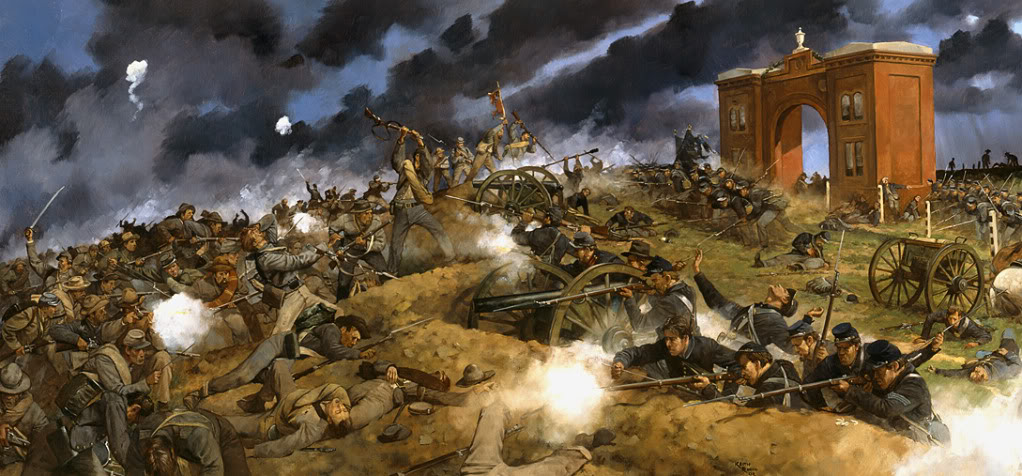
Soon the Louisiana Tigers were among the Federal artillery batteries and fierce hand to fighting raged among the guns and the Union gunners refused to withdraw. The Germans of Wiedrich’s and Rickett’s batteries went toe to toe with the Louisianans and North Carolinians who had gain the summit, and “Wiedrich’s men defended their guns with courage.” [25] As one of “Hay’s Louisiana Tigers confidently threw himself onto the muzzle of a Napoleon, he shouted, I take command of this gun! A German gunner with the piece’s lanyard in his hand replied, Du sollst sie haben (it was a line from a German birthday song – you can have it) and blew the rebel to smoking bits.”  [26] The German gunners fought with such tenacity that Charles Wainwright, a frequent critic of the German units wrote, “the men of “I” Battery, also Germans, fought splendidly, sticking to their guns and finally driving the rebs out with their hand spikes and fence rails.” [27] So it went along the gun line as the Union gunners fought the Confederate infantry matching pikes, rammers, pistols and sabers against the Confederate riflemen, but soon the guns were silent and it appeared “for one incredible moment, as Hays reported, “every piece of artillery which had been firing on us was silenced,” and two Confederate brigades possessed the enemy stronghold.” [28] But the apparent triumph would not last long.

“In the crisis the performance of Howard and Schurz showed up well.” [29] Seeing the chaos on Cemetery Hill, Oliver Howard and Carl Schurz reacted to this with alacrity and ordered Colonel Wladimir Krzyzanowski to take the 119th and 58th New York regiments “at double quick the short distance across the Baltimore Pike to Wiedrich’s battery…. The 119th New York, less than 200 strong…made a “vigorous rush” against the Louisiana interlopers and swept them down the hill. When they reached the base, Krzyzanowski’s men flopped down and Wiedrich’s guns belched canister at the fleeing Confederates.” [30] Howard also had the foresight to ask “for supporting troops from the Second Corps,” a request “Hancock had anticipated by sending out Carroll with most of his brigade, but with “no precise orders” about where he was to go.” [31] Hancock had heard the sound of heavy firing Hancock reacted, he recalled “I heard the crack of musketry on Howard’s front…. Recognizing the importance to the whole army of holding the threatened positions, I directed General Gibbon to send a brigade instantly to Gen’l Howard’s assistance.” [32] The sense of both Generals to order this movement as a precaution proved to be a decision that ensured that Cemetery Hill would remain in Union hands.

220px-Samuel_S_Carroll

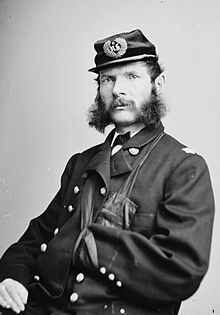
Colonel Samuel Carroll

The brigade was commanded by Colonel Samuel Carroll, it was a crack unit, known as the Gibraltar Brigade, aside from the Iron Brigade, the only “Western” brigade in the Army of the Potomac. Carroll was one of the best brigade commanders in the Army of the Potomac. Carroll graduated near the bottom of the West Point class of 1856 and spent four years on the frontier before being assigned as a quartermaster at West Point and took command of the 8th Ohio in the fall of 1861. He soon was a brigade commander but at Gettysburg was still a Colonel, despite this he was a man of action and rapidly moved the brigade exactly where with was needed the most. Carrol had a full head of brick-red hair, which garnered him the name Old Brick Top. His personality and leadership style was such that it “often reminded people of his manic-aggressive division commander, Alex Hays, and this occasion was no exception.” [33]

Coming over from the west side of Cemetery Ridge the brigade appeared in the moonlight to Hays as a shadowy indistinguishable mass. Since Hays expect that Rodes’s troops might be moving in from the west, or Longstreet’s from the south. He was unsure of who the advancing troops were, and how many were advancing towards him. He wrote in his after action report, “I reserved my fire, from the uncertainty of this being a force of the enemy or of our own men, as I had been cautioned to expect friends both in front, to the right and to the left.” [34]

With little direction form either Hancock or Howard, “Carroll trotted him men in column…. He skillfully positioned his men in the dark for the attack, facing obliquely to the left and uphill. The debris of early fighting made it difficult to advance on a wide front, so Carroll placed the 14th Indiana in the advance and stacked up the other two regiments (the 7th West Virginia and 4th Ohio) behind it.” [35] Carroll had a booming voice and he called out to his troops “in a voice that was heard all over East Cemetery Hill: “Halt! Front Face! Charge bayonets! Forward, double-quick! March! Give them Hell!” [36]

The brigade charged the Confederates and “struck Hoke’s brigade and pushed it back. At the same moment some men from Hays’s brigade opened a brisk fire on his left flank from behind a stone wall. Carroll quickly had the 7th West Virginia change from and drive the Louisianans away.” [37] Even so the fight was fierce, “there was a confused sound of pounding feet and colliding human bodies, grunts, yells and curses and a crackling of rifle fire – and the last of the Confederates were driven out.” [38]

Though Early achieved some success his division was repulsed and the threat to the Union gun-line on Cemetery Hill was ending. “Hays, already staggered by three unanswered volleys – the third was especially destructive, delivered at such close range – gave the order at last for his men to return the fire.” [39] His troops fought back but he realized that no help was coming either from Rodes, or Gordon, whose brigade was withheld by Early when he realized that Rodes was not attacking, believing that it “would been a useless sacrifice.” [40] Without support and threatened by more Federal troops, Hays gave the order to withdraw. As one author noted, “Courage and determination could not offset superior numbers and fresh troops. With no help coming and enemy units swarming around them, all those Rebels who were still under some command and control began to fall back.” [41]
img_0578

Early’s attack which had been so promising ended in failure and would be the subject of controversy after the battle and after the war. Rodes’s failure to support his attack on Cemetery Hill, “angered Jubal Early, and he did not mince words about it. In his report, Early complained: “No attack was made on the immediate right, and not meeting with support from that quarter, these brigades could not hold the position that they had attained.” [42]

Whether the Confederates could have taken the position had Rodes delivered his attack is another matter which can only be speculative in nature. Had Rodes and Gordon supported the attack, had Ewell better coordinated with A.P. Hill in order to have Pender’s division support the attack, it might have succeeded Like the earlier Confederate failures of the past two days the issue came down to command and control, coordination, and vague orders. “Ewell had no control over his corps. Three division commanders were coordinating without a central control – and one failed.” [43] Likewise, there is no question that “if Rodes had been able to mount an attack in conjunction with Early, which under the circumstances would have been a miracle of generalship, the defenders of Cemetery Hill would have had a hard time of it.” [44] But the failure of Ewell and his division commanders to coordinate the attack speaks volumes about “the uncoordinated command style that had become Robert E. Lee’s habit, and for the paralyzing evaporation of initiative that crept over the senior generals of the Army of Northern Virginia the longer and deeper they remained in the unfamiliar environment of Pennsylvania.” [45]

Notes

[1] Ibid. Coddington The Gettysburg Campaign: A Study in Command pp.429-430

[2] Ibid. Dowdy Lee and His Men at Gettysburg: The Death of a Nation p.237

[3] Ibid. Trudeau Gettysburg: A Testing of Courage p.407

[4] Ibid. Sears Gettysburg  p.341

[5] Ibid. Dowdy Lee and His Men at Gettysburg: The Death of a Nation p.238

[6] Ibid. Trudeau Gettysburg: A Testing of Courage p.407

[7] Ibid. Coddington The Gettysburg Campaign: A Study in Command p.439

[8] Ibid. Guelzo Gettysburg: The Last Invasion p.344

[9] Ibid. Sears Gettysburg  p.341

[10] Ibid. Coddington The Gettysburg Campaign: A Study in Command p.439

[11] Ibid. Dowdy Lee and His Men at Gettysburg: The Death of a Nation p.238

[12] Ibid. Dowdy Lee and His Men at Gettysburg: The Death of a Nation p.233

[13] Ibid. Coddington The Gettysburg Campaign: A Study in Command p.430

[14] Ibid. Coddington The Gettysburg Campaign: A Study in Command p.435

[15] Ibid. Guelzo Gettysburg: The Last Invasion p.339

[16] Ibid. Pfanz Gettysburg: Cemetery Hill and Culp’s Hill p.236

[17] Ibid. Guelzo Gettysburg: The Last Invasion p.339

[18] Ibid. Sears Gettysburg  p.334

[19] Ibid. Wainwright A Diary of Battle p.245

[20] Ibid. Gottfried  The Artillery of Gettysburg p.169

[21] Ibid. Sears Gettysburg  p.334

[22] Hunt, Henry. The Second Day at Gettysburg in Battles and Leaders of the Civil War Volume III, The Tide Shifts. Edited by Robert Underwood Johnson and Clarence Clough Buel Castle, Secaucus NJ p.312

[23] Ibid. Dowdy Lee and His Men at Gettysburg: The Death of a Nation p.235

[24] Ibid. Guelzo Gettysburg: The Last Invasion p.340

[25] Ibid. Pfanz Gettysburg: Cemetery Hill and Culp’s Hill p.269

[26] Ibid. Guelzo Gettysburg: The Last Invasion p.342

[27] Ibid. Wainwright A Diary of Battle pp.246-246

[28] Ibid. Dowdy Lee and His Men at Gettysburg: The Death of a Nation p.236

[29] Ibid. Coddington The Gettysburg Campaign: A Study in Command p.437

[30] Ibid. Pfanz Gettysburg: Cemetery Hill and Culp’s Hill p.272

[31] Ibid. Coddington The Gettysburg Campaign: A Study in Command p.437

[32] Ibid. Sears Gettysburg  p.339

[33] Ibid. Guelzo Gettysburg: The Last Invasion p.343

[34] Luvaas, Jay and Nelson Harold W. editors. The U.S. Army War College Guide to the Battle of Gettysburg South Mountain Press, Carlisle PA 1986 p.163

[35] Ibid. Tagg The Generals of Gettysburg p.56

[36] Ibid. Sears Gettysburg  p.339

[37] Ibid. Coddington The Gettysburg Campaign: A Study in Command p.437

[38] Catton, Bruce The Army of the Potomac: Glory Road Doubleday and Company, Garden City New York, 1952 p.303

[39] Ibid. Foote The Civil War, A Narrative. Volume Two Fredericksburg to Meridian p.519

[40] Ibid. Sears Gettysburg  p.340

[41] Ibid. Trudeau Gettysburg: A Testing of Courage p.409

[42] Ibid. Pfanz Gettysburg: Cemetery Hill and Culp’s Hill p.281

[43] Ibid. Dowdy Lee and His Men at Gettysburg: The Death of a Nation p.239

[44] Ibid. Coddington The Gettysburg Campaign: A Study in Command p.440

[45] Ibid. Guelzo Gettysburg: The Last Invasion p.344

Leave a comment

Filed under Loose thoughts and musings

Friday Thoughts

img_2503

Friends of Padre Steve’s World,

I have a few loose thoughts today and am kind of taking a break to again read and ponder different subjects, but first I want to thank those folks who took the time to send warm wishes, thoughts and prayers our way following my wife’s procedure to get some Kidney Stones blasted to smithereens. She is recovering well.

I was really happy to hear that Harriet Tubman, the great former slave and heroine of the Underground Railroad will replace Andrew Jackson on the $20 bill. I think it is long overdue, Tubman was a hero who put her life on the line time after time to help slaves escape before and during the war. She helped lead the Combanhee River Riad in June of 1863 which freed over 750 raids. Of course the announcement was cricized by the retired neurosurgeon and failed presidential candidate Ben Carson. 

I was absolutely shocked and saddened to hear about the passing of the iconic and brilliant musician Prince yesterday. He was an amazing musician, incredible performer, and so versatile. While his music will remain a part of our lives and culture, he died far too young at the age of 57.

I was sad to see that Chicago Cubs outfielder Jason Heyward had to deal with racist taunts on his first trip back to St. Louis on Monday. I hoped that we had gotten past that kind of idiocy and hatred, but maybe not. Some things seem to never change, Jackie Robison got the same treatment in St. Louis when he broke the color barrier.

Speaking of the Cubs, Jake Arrieta pitched the second no-hitter of his career last night, defeating the Cincinnati Reds. Having watched and gotten to know Jake at the Orioles Triple A affiliate, the Norfolk Tides, I am always happy to hear of his success. 

Since I have been doing a lot of reading lately, I want to remind folks of the great Barbara Tuchman’s comment about the importance of books. She said, “Books are … companions, teachers, magicians, bankers of the treasures of mind. Books are humanity in print.”

With that I shall wish you a wonderful weekend because I do plan on having one.

Peace

Padre Steve+

Leave a comment

Filed under Loose thoughts and musings, News and current events