Category Archives: Loose thoughts and musings

The Doomed Fleet: The Kido Butai & Pearl Harbor

Akagi_29

Friends of Padre Steve’s World

Early December is such an interesting time of year for a historian. There are a lot of events that occurred which still linger in our memories. One of those is the Japanese attack on Pearl Harbor on December 7th 1941. I find it interesting and not just from an American point of view. I can also as a career military officer also understand the thoughts of the Japanese officers who were ordered to undertake the attack.

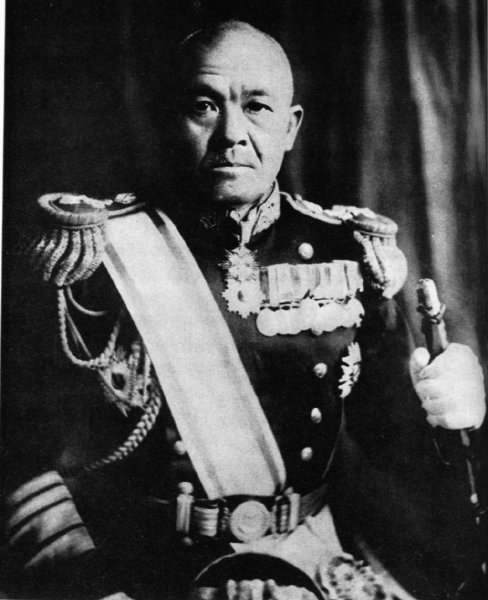
Early in the morning on November 26th 1941 the ships of the Japanese Carrier Strike Force, the Kido Butai under the command of Vice Admiral Chuichi Nagumo weighed anchor from Tankan Bay in the northern Kurile Islands of Japan. The plan was top secret and very few Japanese officers knew of the target. Many officers presumed that war was immanent but most assumed the target would be the Philippines or other targets in Southeast Asia.

PERSON JAP Nagumo1

Nagumo

The next day Nagumo expressed his personal misgivings about the attack to his Chief of Staff Rear Admiral Ryunosuke Kusaka as the task force plunged through heavy seas. He blurted out, “Mr. Chief of Staff, what do you think? I feel that I’ve undertaken a heavy responsibility. If I had only been more firm and refused. Now we’ve left home waters and I’m beginning to wonder if this operation will work.” 

Admiral Kusaka came up with the right answer:  “Sir, there’s no need to worry. We’ll make out all right.” 

Nagumo smiled. “I envy you, Mr. Kusaka. You’re such an optimist.” 

The attack on Pearl Harbor was designed to be pre-emptive in nature. It was supposed to deliver such a crushing blow to the United States Navy that the Japanese could complete their Asian conquests before it could recover. It was a plan of great risk that doomed Japan to horror never before imagined when the United States dropped Atomic bombs on Hiroshima and Nagasaki less than four years later. By then the bulk of the Imperial Navy would be at the bottom of the Pacific and millions of people killed.

yamamoto-isoroku1

Yamamoto 

The Japanese, even Admiral Yamamoto, the man behind the plan understood that it entailed great risks. A simulation of the plan conducted in early September by the senior officers of the Combined Fleet and the Kido Butai calculated that two of Japan’s precious aircraft carriers could be lost in the operation. But despite the opposition and reservations of key officers, including the Kido Butai commander, Admiral Nagumo Yamamoto pressed forward.

kagaph

The Kido Butai was the most powerful carrier strike group assembled up to that time. In fact the United States Navy would not equal the power of the force until late 1943. Comprised of six aircraft carriers, the massive flagship Akagi, and the Kaga, the fast 18,000-ton Soryu and Hiryu and the most modern Shokaku and Zuikaku. The carrier embarked over 400 aircraft, of which over 350 were to be used in the two aerial assault waves. Most of the pilots and aircrew were experienced, many with combat experience in China. The carriers were escorted by the old but fast and modernized battleships Kirishima and Hiei, the new heavy cruisers Tone and Chikuma, the light cruiser Abukuma, the new Kagero Class destroyers, Urakaze, Isokaze, Tanikaze, Hamakaze, Kagero and Shiranuhi, the Asashio class destroyers Arare and Kasumi. Two additional destroyers the Fubuki class Sazanami and Ushio were assigned to neutralize the American base on Midway Island. The submarines I-19, I-21 and I-23 and 8 oilers were assigned to the force. Five additional submarines the I-16, I-18, I-20, I-22 and I-24 each embarked a Type-A midget submarine.

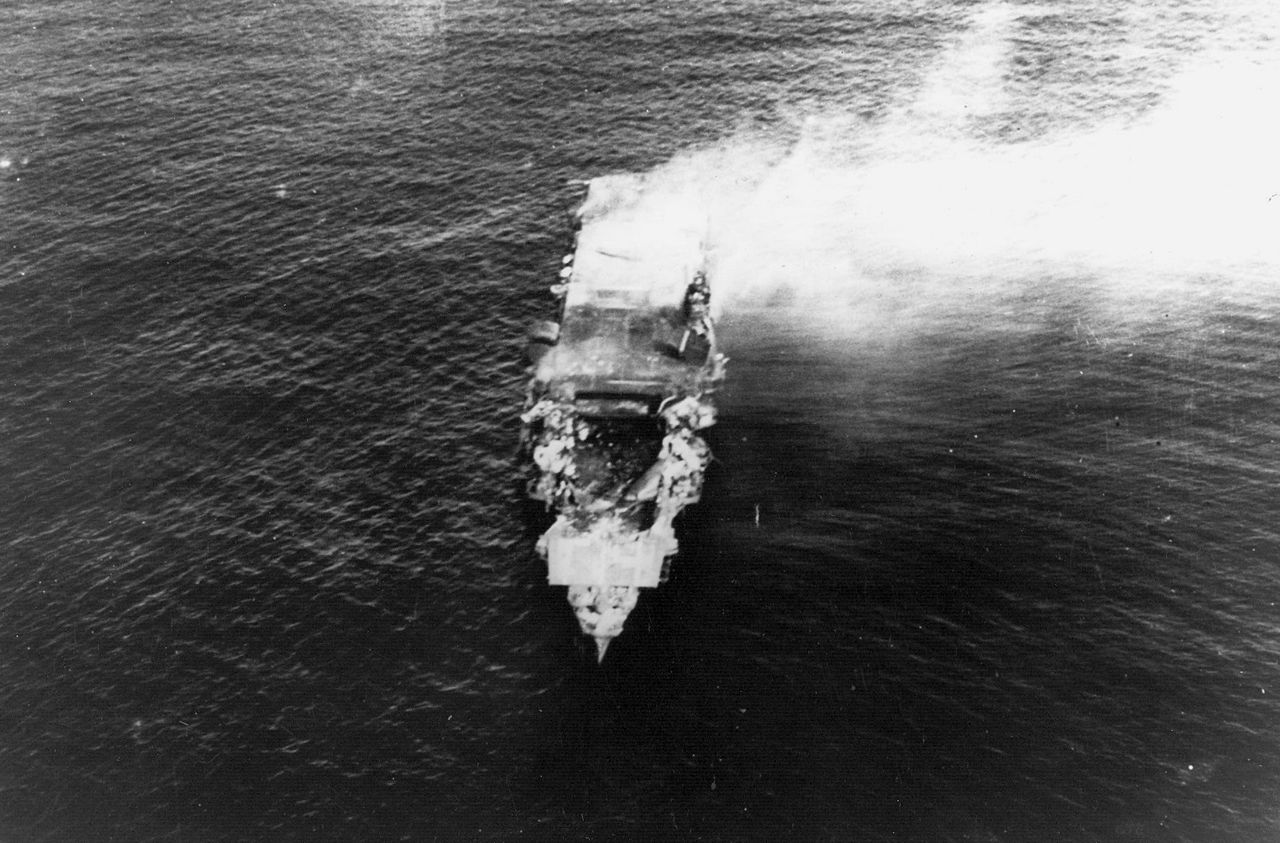
1280px-Hiryu_burning

Hiryu prior to sinking at Midway

On December 7th the force delivered a devastating blow to the American Pacific Fleet at Pearl Harbor, however no American aircraft carriers were present. It would go on for the next several months on a rampage across the Pacific and Indian Oceans. However their success would be short lived. Within a year, the carriers that were not present at Pearl Harbor sank the Akagi, Kaga, Soryu and Hiryu at Midway. Hiei and Kirishima were lost at the Naval Battle of Guadalcanal in November 1942. Over the course of the war every ship of the attack force but one was lost.

zuikaku12_usn_h73070

The Last Banzai aboard Zuikaku as she sinks at the Battle of Cape Engano (Leyte Gulf) October 25th 1944

Shokaku was torpedoed and sunk at the Battle of the Philippine Sea and Zuikaku, Chikuma and Abukuma were lost at Leyte Gulf, most of the destroyers and submarines were lost in various engagements. However three destroyers, Isokaze, Hamakaze and Kasumi accompanied the great Battleship Yamato on her suicide mission at Okinawa and were sunk on April 7th 1945. The heavy cruiser Tone was sunk at her moorings at Kure during air strikes by the US 3rd Fleet on July 24th 1945.

9d006f3b373f8e5ed86a61bad7406d6f

Heavy Cruiser Tone sunk in Kure Japan 1945

All of the submarines were lost during the war, however I-19 sank the USS Wasp CV-7 and USS O’Brien DD-415 while damaging the USS North Carolina BB-55 on September 15th 1942 off Guadalcanal. Only the destroyer Ushio survived the war and was broken up for scrap in 1948.

MitsuoFuchida

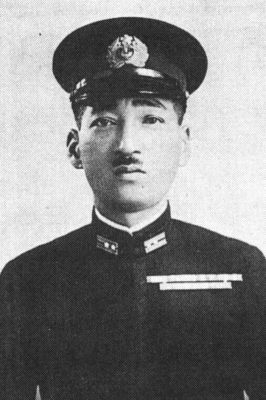
Fuchida (above) and Genda 

f624277ee1

Among the leaders of the Japanese strike force, Admiral Yamamoto was killed on April 18th 1943 when his aircraft was shot down at Buin.  Most of the sailors who took part in the attack would be dead by the end of the war. Nagumo who resisted the strike and was ordered to lead it realized his worst fears at Midway and during the battles around Guadalcanal and the Solomon Islands, died in the American invasion of Saipan in 1944. The two aviators who planned and executed the tactical details of the raid, Mitsuo Fuchida, and Minoru Genda, both survived the war. Genda became a general in the Japanese Air Self Defense Force and died at the age of 84 in 1989. Fuchida converted to Christianity after reading the story of Doolittle Raid survivor Jacob DeShazor. Fuchida became a Methodist pastor and evangelist and died in 1976 at the age of 73.

Few present at Tankan Bay on that fateful November morning could have expected the triumph and tragedy ahead. However Yamamoto was probably more of a realist than many in the Japanese government and military leadership when he told Prime Minister Fumimaro Konoe “In the first six to twelve months of a war with the United States and Great Britain I will run wild and win victory upon victory. But then, if the war continues after that, I have no expectation of success.” Yamamoto was eerily prophetic and those that counsel pre-emptive war need to never forget his words or the results of his decisions.

Peace

Padre Steve+

1 Comment

Filed under Loose thoughts and musings

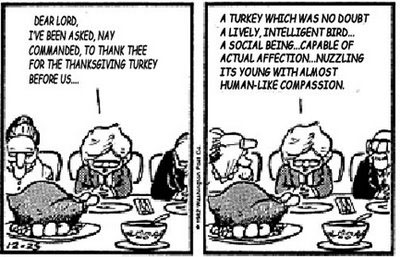
Happy Thanksgiving!

toss1

bloomcountythanksgivingpanels34

Friends of Padre Steve’s World,

Just a note to thank you for your continued readership and to wish you a Happy Thanksgiving. Today we will be busy cooking and having friends over.

Back tomorrow,

Peace,

Padre Steve+

1 Comment

Filed under Loose thoughts and musings

Lebensraum & the Foundation of Genocide

hitler

Introduction

Friends of Padre Steve’s World,

This is the second part of an article that deals with war crimes, genocide and how seemingly normal human beings can become complicit in such crimes. To understands this we must look at some of the intellectual and ideological foundations.

Peace

Padre Steve+

The German war against the Soviet Union was the first truly race-based ideological war in history with the campaign against Poland its precursor. Adolf Hitler’s racial theories and beliefs played a dominant role in Germany’s conduct of the war in the East in both the military campaign and occupation. This has become clearer in recent years as historians have had the opportunity to examine Hitler’s writings, those of senior Nazi officials and military officers and documents which had been unavailable until the end of the Cold War. Understanding the Nazi ideological basis and the underlying cultural prejudice against the Jews and eastern Europeans in general is foundational to understanding Hitler’s conduct of the war and why the destruction of the Jews figured so highly in his calculations. One must also understand the military and police cultures and doctrines that enabled them to cooperate so closely in the conduct of the war.

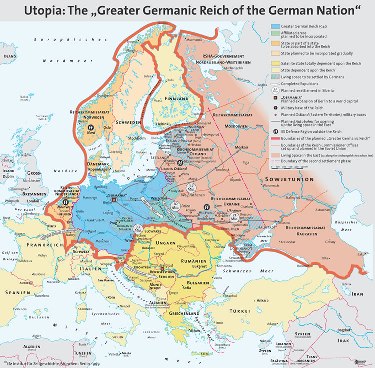
The German war in the east would differ from any previous war. Its underlying basis was ideological. Economic and geopolitical considerations were given importance in relationship to the understanding of the German “Master Race.” Race and Lebensraum was the goal of the State that “concentrates all of its strength on marking out a way of life for our people through the allocation of Lebensraum for the next one hundred years…the goal corresponds equally to the highest national and ethnic requirements.” 1

Hitler believed that Germany was “entitled to more land…because it was the “mother of life” not just some “little nigger nation or another.”” 2 The Germans planned to “clear” the vast majority of the Slavic population and the “settlement of millions of hectares of eastern Lebensraum with German colonists” complimented by a short term exploitation of the land to “secure the food balance of the German Grossraum.” 3 Joachim Fest notes that Hitler called it a “crime” to wage war only for the acquisition of raw materials. Only the issue of living space permitted resort to arms. 4

Following the Peace of Westphalia wars in Europe typically emphasized conquest of territory and natural resources either to expand empires or promote some kind of self-sufficiency. The Thirty Years War, which was ended by the Treaty of Westphalia had a heavy religious component which added to its brutality. However the root of much of this conflict was about increasing the power of emerging nation states led by men not necessarily loyal to their religious brethren. 5

The American and Russian Civil wars had some ideological basis and helped usher in the brutality of total war. Both had major effect in these nations’ development and both were bitterly contested with the winners imposing to various degrees political changes on their vanquished brothers they were civil wars. 6

Adam Tooze sees the Holocaust as the first step of the “last great land grab in the long and bloody history of European colonialism…” 7 This does have merit, Hitler’s desire for Lebensraum or living space was a type of colonialism. However, Tooze’s argument does not take away from the basic premise that Germany’s war in the east was at its heart motivated by ideological factors.

Lebensraum

Lebensraum

German Anti-Semitism and Adolf Hitler

The root of this war was in the mind of Adolf Hitler himself. Hitler was born in Linz Austria during a time when various Pan-German and Ant-Semitic groups, publications and propaganda were widespread. As a young man Hitler moved to Vienna hoping to become an artist, something that he found little commercial success. While struggling to make a living in Vienna he was exposed to a culture far different from the provincial city of his youth, a city that had much culture but was also a meeting ground for the various peoples that populated the Austro- Hungarian Empire, including Slavs and many Jews. While many of the Germanic or Austrian Jews were outwardly little different from their Christian neighbors the Jews from Eastern Europe repulsed Hitler.

This attitude was not unique to German but found its roots in the various anthropologies written by other Europeans as well as Germans regarding the lack of rights of “inferior cultures” as related to their colonial expansion as well as the westward expansion of Americans. Friedrich Ratzel a German anthropologist and a founder of the Pan-German League paired the Jews with “the stunted hunting people of the African interior” into “the class of scattered people with no

land.” 8 Ratzel’s work where he also studied the conquest of the Native American tribes by whites helped form the basis of Hitler’s Understanding of Lebensraum, a concept that he borrowed from Ratzel. Ratzel was originally a zoologist. In his concept of Lebensraum Ratzel “linked the biological theory of life with the geographical theory of space.” Ratzel believed that to “conquer and hold sufficient Lebensraum, others have to be displaced.” Ratzel noted how European settles had taken over land from the Native Americans to take it for themselves. He noted that “the result was an annihilating struggle, the prize for which was the land, the space.” 9

Another German academic and lecturer at the University of Glasgow Alexander Tille, wrote in 1893 that it is “the right of the stronger race to annihilate the lower…when that race does not maintain its ability to resist then it has no right to exist, for anyone who cannot maintain himself must be content to go under.” Tille’s “laws” were easily applied to both primitive peoples as well as to “the economically less successful peoples of Europe.” 10

Hitler’s lack of success, struggle with poverty and resentment of others led him to the writings of the Pan-Germanic and Anti-Semitic movements. His years in Vienna were foundational as he as he absorbed the ideas of these Pan-German, anti-Semitic groups through newspapers like the Deutsches Volksblatt. 11 In Vienna Hitler began to connect the Jews with Marxism.12 Joachim Fest notes that in Vienna Hitler became obsessed by the fear of the Slavs and Jews, hated the House of Hapsburg, the Social Democratic Party, and “envisioned the end of Germanism.” 13

Hitler’s racial views were amplified after the war in turbulent Weimar Germany where he became a member of the NDSAP, rising rapidly within it, eventually taking over party leadership, reorganizing it so that it “became the instrument of Hitler’s policies.” 14 Following the unsuccessful Beer Hall Putsch of 1923 Hitler wrote Mein Kampf while imprisoned in the Landsberg prison in which he enunciated his views about the Jews, Slavs and Lebensraum. Hitler believed that Imperial Germany had been “hopelessly negligent” in regard to the Jews 15 and that the Jews in conjunction with the Catholic Center Party and Socialists worked together for “maximum damage to Germany.” 16

Likewise he saw the Jews as heading the “main ideological scourges of the nineteenth and twentieth century’s.” 17 It was the ideology of Hitler’s “obsessive anti-Semitism” 18 that drove Nazi Germany’s policy in regard to the Jews and against Jewish-Bolshevism. By the 1920s Hitler had “combined his hatred of the Jews and of the supposedly Jewish dominated Soviet state with existing calls to conquer additional Lebensraum, or living space, in the east.” 19 Hitler wrote: “The fight against Jewish world Bolshevism requires a clear attitude toward Soviet Russia. You cannot drive out the Devil with Beelzebub.” 20 Richard Evans notes that Mein Kampf clearly enunciated that “Hitler considered racial conflict…the essence of history, and the Jews to be the sworn enemy of the German race ….” And that the “Jews were now linked indissolubly in Hitler’s mind with “Bolshevism” and “Marxism.” 21

When Hitler became the dictator of Germany “his ideology and strategy became the ends and means of German foreign policy.” 22 His aims were clear, Hitler remarked to Czech Foreign Minister Chvalkovsky on 21 January 1939: “We are going to destroy the Jews.” 23It was clear that Hitler understood his own role in this effort noting to General Heinrici that “he was the first man since Charlemagne to hold unlimited power in his own hand. He did not hold this power in vain, he said, but would know how to use it in the struggle for Germany…” 24

To be continued…

Notes

1 Weinberg, Gerhard L. Ed. Hitler’s Second Book: The Unpublished Sequel to Mein Kampf by Adolph Hitler.  Translated by Krista Smith, Enigma Books, New York, NY 2006. Originally published as Hitlers zweites Buch, Gerhard Weinberg editor, 1961 p. 159

2 Davidowicz, Lucy S. The War Against the Jews 1933-1945 Bantam Books, New York, NY 1986. p.91

3 Tooze, Adam. The Wages of Destruction Penguin Books, New York, NY, 2008. First Published by Allen Lane Books, Penguin Group, London UK, 2006. p.463

4 Fest, Joachim, Hitler. Translated by Richard and Clara Winston. Harcourt Brace Jovanovich Publishers, San Diego,

New York, London, 1974. German Edition by Verlag Ullstein 1973 pp. 607-608

5 Note the actions of Cardinal Richelieu in France who worked to expand French power at the expense of other Catholic nations and the Vatican itself.

6 In the United States the Reconstruction policies produced great resentment in the south with decidedly negative

results for the newly freed slaves which lasted another 100 years, while in the Soviet Union great numbers of “opponents of Socialism” were killed, imprisoned or driven out of the county

7 Ibid. Tooze. The Wages of Destruction p.462

8 Lindqvist, Sven Exterminate All the Brutes: One Man’s Oddessy into the Heart of Darkness and the Origins of European Genocide Translated from the Swedish by Joan Tate, The New Press , New York and London 1992 p.145

9 Ibid. Lindqvist p.154 It is interesting to note that the current American “historian” of the American Religious right

David Barton made the same arguments recently about the American Indians. Barton said: “You have to deal, a lot of it, with how the enemy responds. It’s got to be based on what the enemy responds [to,] you cannot reason with certain types of terrorists; and see that’s why we could not get the Indians to the table to negotiate with us on treaties until after we had thoroughly whipped so many tribes …” “People complain about the fact that the American military and buffalo hunters went out and wiped out all the buffalo in the western plains. Doing that was what brought the Indians to their knees because the Indians lived on those wide western plains where there were very few towns; Indians didn’t go into town to buy supplies, they went to the buffalo herds, that’s where they got their meat, that’s where they got their coats, the hides provided coats, they provided covering for their teepees.

If you don’t have the buffalos, those Indians cannot live on the open western plains without those buffalo and so what happened was the military wiped out the supply line by wiping out the buffalo. That’s what brought those wars to an end, that’s what brought the Indians to their knees and ended all the western conflict.” Retrieved from Barton’s Wallbuilders Live broadcast http://www.wallbuilderslive.com/Historic.asp?cdate=77515 9 May 2014 and text   from   http://www.rightwingwatch.org/content/david-barton-explains-just-war-theory-we-had-destroy-indian-  tribes-until-they-became-civiliz

10 Ibid. Lindqvist p.148

11 Ibid. Davidowicz, The War Against the Jews pp.8-9 12 Ibid. Davidowicz. The War Against the Jews p.12 13 Ibid. Fest Hitler. p.47

14 Bracher, Karl Dietrich. The German Dictatorship: The Origins, Structure, and Effects of National Socialism.

Translated by Jean Steinberg, Holt Rinehart and Winston, New York, NY 1979. Originally Published under the title Die Deutsche Diktatur: Entstehung, Struktur,Folgen des Nationalsocialismus. Verlag Kiepenheuer & Witsch. Koln and Berlin, 1969 p.93

15 Weinberg, Gerhard L. Germany Hitler and World War II . Cambridge University Press, New York, NY 1995 p.61

16 Ibid. Weinberg, Hitler’s Second Book p.60

17 Friedlander, Saul Nazi Germany and the Jews 1939-1945: The Years of Extermination. Harper Perennial, New York, NY 2007 p.xviii

18 Ibid. Friedlander, The Years of Extermination p.xvii Friedlander called this anti-Semitism “Redemptive anti- Semitism” in which “Hitler perceived his mission as a kind of crusade to redeem the world by eliminating the Jews.

19 Megargee, Geoffrey P. War of Annihilation: Combat and Genocide on the Eastern Front 1941.Bowman and

Littlefield Publishers Inc. Lanham, Boulder, New York. 2007 p.4

20 Hitler, Adolf Mein Kampf translated by Ralph Manheim. Mariner Books, Houghton Mifflin Company, New York, NY 1999. Houghton Mifflin Company 1943, copyright renewed 1971. Originally published in Germany by Verlag Frz.

Eher Nachf. GmbH 1925. p.662.

21 Evans, Richard J. The Coming of the Third Reich Penguin Books, New York 2004. First published by Allen Lane 2003 p.197

22 Ibid. Davidowicz The War Against the Jews pp. 88-89

23 Rhodes, Richard. Masters of Death: The SS Einsatzgruppen and the Invention of the Holocaust. Vintage Books a division of Random House, New York, NY 2002 p.37

24 Speer, Albert. Inside the Third Reich. Collier Books, a Division of MacMillan Publishers, Inc. New York, NY 1970 p.166


2 Comments

Filed under Loose thoughts and musings

Explore, Dream, Discover: Thoughts on Living My Dream

uss gray 1978

April 1978, Navy Junior ROTC Cruise: I’m on the Right

Friends of Padre Steve’s World,

Yesterday I wrote about the Navy Birthday and I have been reflecting on life as so much of my life is connected to the Navy. It’s funny, for all the difficulties that I have experienced in life, the difficult times and even coming back a changed man from war, I am a very fortunate man, for I have been able to pursue my entire adult life my childhood dream of serving in the military, but even more specifically serving in the Navy.

I grew up in a Navy family, my brother and I were both born in Navy hospitals, and the first fourteen years of my life were spent following my dad around from duty station to duty station, up and down the West Coast and in the Philippines. I still recall the magical feeling of going to sea for the first time when I was about four years old on the USS John C. Breckenridge, a transport ship converted to carry military personnel and their families to and from the Far East. It was exhilarating and I never forgot it.

boston 2002

Boston 2002

As a kid I spent countless hours reading history and military history, but my favorite books were about all things navy. Biographies of the great naval leaders, not just Americans caused me to dream, as did books about naval battles, and the courage of the men who fought them. Then there were the books about ships, ship design and development that inspired me to build more models ships than I can count, and which cause me to still read up on the great ships of history, but also new developments in ship design and construction.

295_27076892058_2637_n-1

In high school I was in Navy Junior ROTC and was able to spend over 70 days at sea on six different ships, even sailing to Hawaii and back. I wanted to enlist but my parents suggested that I try college for a semester to see what I thought of it and it was a good thing that I did.

I went to college and I met Judy and toward the end of college ended up in the Army because I didn’t want to change my major in my senior year to enter Navy ROTC. Of course I need to mention that Judy said that she wouldn’t marry me if I joined the navy, but even in the Army my heart was all Navy. In fact when it was time for the Army-Navy Game I would wear by “Go Navy” button on the inside of my uniform shirt and flash it to get people going.

943043_10151694525692059_632653331_n

Iraq 2007

After 17 ½ years in the Army I was serving as a Major in the Army Reserve and because of my rank was unable to go back on active duty, unless I was mobilized to serve in war. I wanted to go back on active duty, I was still under forty years old, and without consulting Judy, in retrospect I should have done that as she would have supported my decision, but I’m a guy, and sometimes not very smart or sensitive.

meandjudyLCDR

Judy getting to help promote me to Lieutenant Commander 2006

Even so it was the right decision. One day I was an Army Reserve Major and the next day I was a Navy Lieutenant. My parents were proud, as was Judy but she was going to pay a price for my decision, years of separation due to deployments and the hardships that went along with them. Since entering the Navy I have served over six years with the Marines, five years in Navy Medicine, two years aboard ship, two years with Navy EOD and another couple of years in Joint assignments working with other military services. My current assignment is amazing, I get to teach, both military history and ethics to senior officers, some of whom will become Admirals and Generals. I can understand what Randy Pausch said in “The Last Lecture” “It’s a thrill to fulfill your own childhood dreams, but as you get older, you may find that enabling the dreams of others is even more fun.”

hue city boarding team

USS Hue City 2002

Mark Twain once wrote, “Twenty years from now you will be more disappointed by the things you didn’t do than by the ones you did. So throw off the bowlines. Sail away from the safe harbor. Catch the trade winds in your sails. Explore. Dream. Discover.” I am so fortunate. I got the second chance to fulfill my dream of serving in the Navy, and I still dream, I still want to discover, and as Denny Crane (William Shatner – Boston Legal) said to “live big.”

The past couple of years have been very trying, many challenges and much discouragement. Judy had a cancer scare and in the summer of 2014 I dropped into an emotional abyss that I wondered if I would ever emerge. But recently I have felt that spark again, and the spark that wants to ignite an inferno of creativity. T. E. Lawrence once wrote, “All men dream: but not equally. Those who dream by night in the dusty recesses of their minds wake up in the day to find it was vanity, but the dreamers of the day are dangerous men, for they may act their dreams with open eyes, to make it possible.”

boardingteam

To explore the unknown possibilities of existence…

I still have dreams, I still want to explore and I want to explore deeper things, the unknown possibilities of existence. To quote the character Q (John de Lancie) in the final episode of Star Trek the Next Generation, where he tells Captain Picard “That is the exploration that awaits you; not mapping stars and studying nebulae, but charting the unknown possibilities of existence.”

Have a great day and never let your dreams die.

Peace

Padre Steve+

2 Comments

Filed under Loose thoughts and musings, Military

Disaster at Blocher’s Knoll

Friends of Padre Steve’s World

Today another section from my Gettysburg text, this on the disaster the befell the Union Eleventh Corps north of the town on the afternoon of July 1st 1863.

Have a great day,

Peace

Padre Steve+

barlow_gordon

Schurz placed his own Second division under the acting command of Brigadier General Alexander Schimmelpfennig his senior brigade commander. Schimmelpfennig was a former Prussian Captain, an engineering officer, who had left the Prussian army to fight in the 1848 Revolution where he met Schurz and the two men became fast friends. When the revolution was crushed Schimmelpfennig, like Schurz fled Germany and was sentenced to death in absentia by the government of the Palatine region. He immigrated to the United States in 1853 “where he wrote military history and secured a position as an engineer in the War Department.” [1] He volunteered to serve at the outbreak of the war, and was appointed as colonel of the German 74th Pennsylvania Volunteers. Schimmelpfennig took command of the brigade when his brigade commander was killed at Second Bull Run, and he was promoted to Brigadier General by Lincoln in November 1862. According to an often told fable Lincoln supposedly promoted the German “because he found the immigrant’s name irresistible,” [2] but unlike so many other volunteer generals Schimmelpfennig was no novice to soldiering. It “took him aback to discover that American-born generals “have no maps, no knowledge of the country, no eyes to see where help is needed.” [3] He also criticized the method by which many American staff officers were selected, from their “relations, some of old friends, or men recommended by Congressmen,” [4] as compared to Molkte’s Prussian General Staff which prided itself on producing competent staff officers who could also direct troops in the heat of battle.

He too was a Chancellorsville and warned of the danger of the hanging flank and his troops were routed by Jackson’s, but as one writer noted “The brigade’s list of casualties indicates that it deserves more credit than it has been generally given.” [5] Schimmelpfennig too wanted to redeem himself and the Germans of his command as they marched to meet Lee again.

The First Division of Eleventh Corps was under the command of Brigadier General Francis Barlow. Barlow was a twenty-nine year old Harvard law graduate and Boston Brahmin was well connected politically with the more radical abolitionists of the Republican Party and had an intense dislike of Democrats. He volunteered for service and became the regimental commander and of the 61st New York Infantry. Though he did not have prior military training he “was a self-taught officer of resolute battlefield courage.” [6] His courage and competence were recognized and was promoted to Brigadier General after Antietam where he had been wounded in the groin by canister in the vicious battle for the sunken Road.

Due to his abilities the “Boy general” was convinced by his fellow abolitionist, Howard to command an Eleventh Corps division after Chancellorsville, but Barlow soon regretted his decision. Barlow, was to use modern terminology somewhat of an elitist and snob. He disliked army life and developed a reputation as a martinet with a boorish personality, who life in the army “very tedious living so many months with men who are so little companions for me as our officers are.” [7]

“Billy” Barlow was not happy with commanding the Germans, and he “disliked the beery and impenetrable Germans in his division as much as he disliked Democrats.” He admitted that he had “always been down on the ‘Dutch’ & I do not abate my contempt now.” [8] The feeling was reciprocal, his men considered him a “petty tyrant” and one wrote “As a taskmaster he had no equal. The prospect of a speedy deliverance from the yoke of Billy Barlow filled every heart with joy.” [9] As Barlow marched with his men into Gettysburg he had in his pocket a letter requesting to be given command of one of the new brigades of U.S. Colored Troops which were then being raised, something he felt was more attuned to his abolitionist beliefs and temperament.

Brigadier General Adolf von Steinwehr was another of the German’s and he enjoyed a solid reputation as a soldier. Steinwehr was a German nobleman, actually “Baron Adolf Wilhelm Augustus Friedrich von Steinwehr, a onetime officer in the army of the Duke of Brunswick-Wolfenbutel.” [10] Steinwehr was a graduate of the Brunswick Military Academy came to the United States seeking to serve in the United States Army and served in the Coastal Survey as an engineer, but was not able to get a commission. He settled in Connecticut and volunteered to serve at the beginning of the war. He raised the heavily German 29th New York Infantry. He was made a brigadier general in October 1861 and took command of the Eleventh Corp’s Second division in in the summer of 1862 when the Corps was still under the command of Franz Sigel. A Pennsylvania soldier noted that Steinwehr was “accomplished and competent, and deserv[ing] of more credit than he ever received.” [11] At Chancellorsville his troops performed well and did some hard fighting before being driven back, Howard considered Steinwehr’s conduct and bearing at Chancellorsville as “cool, collected and judicious.” [12]

As Howard and Schurz consulted on Cemetery Hill, it was decided that Schurz would advance Schimmelpfennig and Barlow’s divisions to the north of the town in order to anchor the right flank of Doubleday’s embattled First Corps. “As Schurz remembered it, he was to take the “First and Third Divisions of the Eleventh Corps through the town and … place them on the right of First Corps, while he {Howard} would hold back the Second Division… and the reserve artillery on Cemetery Hill and the eminence east of it as a reserve.” [13] Schimmelpfennig’s division led the way through the town and deployed to the north, Barlow’s division followed moving to its right.

Schurz had two missions, to protect First Corps right flank and also to “guard against the anticipated arrival of Confederates from the northeast.” [14] Schurz intended to bring his two divisions into line each with one brigade forward and one in reserve. Schimmelpfennig’s brigade was placed at a right angle to the flank of Robinson’s division. It was Schurz’s intention that Barlow’s division “extend Schimmelpfennig’s front facing north” by keeping Ames’ brigade as a reserve in the right rear “in order to use it against a possible flanking movement by the enemy.” [15]

Both divisions were very small, especially compared to their Confederate opponents, consisting of just two brigades apiece. Schurz estimated that the two divisions numbered “hardly over 6,000 effective men when going into battle…” [16] and the ground that they had to occupy, being flat and open without and without any geographic advantage was hardly conducive for the defense, but it was necessary in order to attempt to secure the flank of First Corps and to prevent Doubleday’s command from being rolled up by Ewell’s Corps.

With the heavy pressure being put on First Corps by the Confederate divisions of Heth, Pender and Rodes; and the arrival of Jubal Early’s division of Ewell’s Second Corps Howard had few choices, and realistically Howard’s “only course was to delay the enemy.” [17] Howard has been faulted by historians Stephen Sears and Edwin Coddington for allowing Doubleday and First Corps to continue to fight on McPherson’s Ridge instead of withdrawing back to Seminary Ridge or even Cemetery Ridge during the lull in fighting early in the afternoon. [18] However, in defense of Howard, the only Confederate troops on the field when he met with Doubleday between Seminary and McPherson’s Ridge during the lull were those of Heth and Pender, as Rodes’ division had not yet arrived. As such, Howard promised to protect Doubleday’s flank without full knowledge of the situation, a promise that “would soon prove rash.” [19]

In making his decision to advance it was Howard’s intention was to get Schimmelpfennig and Barlow’s divisions up to Oak Hill to secure the right flank, but by the time his troops were moving into the open country north of the town, Rodes’s division was already there and the guns of Carter’s artillery battalion soon found the range on the Union troops. Because of this Schimmelpfennig “had to post his troops on the plain facing northwest off the right and rear of First Corps” [20] and his troops were never able to “make their link up with Robinson and the dangling flank of First Corps.” [21]

Schurz’s small divisions now found themselves facing elements of two veteran Confederate divisions; those of Robert Rodes and Jubal Early. Unlike the battle on McPherson’s and Seminary Ridge the Eleventh Corps troops did not have the advantage of good defensible ground. Likewise they had to cover a front that was much too wide for their numbers without fast reinforcements from Third or Twelfth Corps, which would not come.

Oliver Howard was counting on the timely arrival of either Slocum’s Twelfth or Sickles’ Third Corps which were in reasonable marching distance of Gettysburg, however Sickles was attempting to sort out conflicting orders from Meade and Howard, while Slocum who had just gotten the now hopelessly out of date Pipe Creek Circular waited for hours after receiving Howard’s message before putting his troops on the road to Gettysburg. Coddington argues that Howard’s hope for reinforcement at this point “was both unrealistic and unfair to the commanders of the other corps,” [22] but others have questioned that point of view, especially in regard to Slocum. Slocum’s most recent biographer Brian Melton notes that Slocum seemed to believe that “Reynolds and Howard were actively disobeying orders” [23] and wanted Slocum to do the same, and “because he deemed it contrary to Meade’s wishes, he did not want to come forward himself to take responsibility for the fight, or “of becoming a scapegoat for a lost, politically important fight someone else started against standing orders.” [24]

Melton attributes Slocum’s reluctance to take command and send his troops forward was that he had been McClellanized as a result of learned behavior in the politically charged Army of the Potomac. As such he was hesitant to jump into a situation that he had no control and then be blamed for the defeat.

“What historians see in Slocum at Gettysburg is not so much a failure of nerve (though it can be described as such) but, rather, the triumphant moment of his McClellanism. Slocum, with his tendency to absorb the philosophies of his powerful superiors, displayed conduct on day one and day two of Gettysburg that looks like McClellan in microcosm. He was absorbed with maneuver, over-cautious, focused on retreat, and scrupulously concerned with the chain of command (sometimes conveniently so). Like McClellan on the Peninsula he found excuses that kept him away from the fight, and therefore the responsibility.” [25]

What the Union command situation does show is that in a rapidly changing tactical environment that orders, no matter how well thought out, can become obsolete as soon as soon as contact is made. There it is imperative that commanders and staff officers adapt to changing situations. However, in the Army of the Potomac, which had been formed and taught by McClellan, and had endured command shake ups and the political machinations of many of its senior commanders, Slocum found that he could not take that risk. Melton wrote, “no matter what his reasons, Slocum missed an important opportunity to play an important role in the most famous battle fought on this continent, Acoustic shadows and conflicting orders kept him away from the fighting when other corps desperately needed him. Instead of covering himself with glory that day, the best he can hope for is to be quietly excused.” [26]
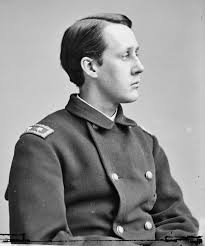
barlow

Major General Francis Barlow

“A Portrait of Hell”

Without reinforcements Schurz’s divisions moved north out of the town. Schurz had two missions as he moved north, “to protect Doubleday’s right and to guard against the anticipated arrival of Confederates from the northeast.” [27] to do this he had to keep his line compact enough on bad defensive ground with little natural advantage and maintain a reserve to parry any emerging Confederate threats from the northeast. The first issue was that to meet these missions Schurz only had about 6,000 troops, and these had to be spread along a line beginning at the Mummasburg Road to the York Pike. Even so there was a gap of about a quarter of a mile between Schurz’s left and Doubleday’s troops on Oak Ridge. It was the best he could do and for practical purposes the two Eleventh Corps divisions were only able to form “the equivalent of a strong skirmish line along their broad front.” [28] Had Barlow remained in place his troops would have been in a better position to receive the Confederate attack and protect Doubleday’s right flank.

However, this did not happen. Barlow did not comply with Schurz’s orders to simply extend Schimmelpfennig’s line and keep Ames’s brigade as a reserve to parry any attack on his right flank. Instead, as he moved his division through the town, Barlow secured the permission of Howard to take a small portion of high ground about a mile further north, called Blocher’s Knoll. There was a certain logic to the move, “to prevent the Rebel troops then visible to the north – George Doles’s brigade, of Rodes’s division – from occupying it and using it as an artillery platform.” [29] But the advance was to be a disastrous mistake as it left Barlow’s division exposed to Doles’s advancing troops, as well as Jubal Early’s division which then deploying for battle along the Harrisburg Road in perfect position to turn the flank of Schurz’s divisions. When Howard saw that deployment he countermanded his order that had allowed Barlow to seize Blocher’s Knoll. Howard wrote, “as soon as I heard of the approach of Ewell and saw that nothing the turning of my right flank if Barlow advanced… I countermanded the order.” [30] But the aggressive Billy Barlow continued to advance and left his own flank exposed to the attack of Early’s division which was “deployed in a three-brigade-wide battle front that was almost a mile across – and overlapped the Union line by almost half a mile.” [31]

Barlow was the only non-German division commander in XI Corps and he had little regard for Schurz. “Without consulting or even notifying his superiors, Barlow issued orders that got his division moving toward that point.” [32] Barlow advanced Colonel Ludwig Von Gilsa’s small brigade with two sections of artillery to Blocher’s Knoll placing it on the extreme right of the Union line. Instead of maintaining Ames’ brigade in reserve and slightly to the right of von Gilsa to guard against any potential flanking attack, Barlow deployed Ames’s brigade on the left of von Gilsa’s brigade facing slightly to the northwest. Barlow’s decision to do this left von Gilsa’s right flank hopelessly exposed and gave him no reserve to meet any danger on the right.

The orders that Barlow had previously had from Howard to move forward to Blocher’s Knoll were predicated on Oak Hill being unoccupied and Schimmelpfennig’s division being able to occupy it before the Confederates could do so. Barlow, on his own volition, knowing that the Confederates had taken Oak Hill and were assaulting Robinson’s division on Oak Ridge decided to advance movement placed Barlow’s division “where Barlow wished it to be” [33] and not where Schurz or Howard expected it, with disastrous results. Schurz noted:

“But I now noticed that Barlow, be it that he had misunderstood my order, or that he was carried away by the ardor of the conflict, had advanced his whole line and lost connection with my third division on the left, and…he had instead of refusing, had pushed forward his right brigade, so that it formed a projecting angle with the rest of the line.” [34]

There are still debates as to why Barlow advanced but one of the most likely explanations is that he saw the unprotected left of Brigadier General George Doles’s brigade of Georgians from Rodes division and wanted to strike them in the flank. [35]

To be sure, the position on Blocher’s Knoll “offered a cleared crown suitable for artillery and a good line of sight up the Heidlersburg Road,” [36] provided that it could be supported but it had a weakness in that “thick woods began about one hundred feet below the crest toward Rock Creek, severely limiting the field of fire in the direction of the anticipated Confederate advance.” [37] Barlow’s deployment provided Jubal Early with the perfect opportunity to execute one the hard hitting flanking attacks that had been the specialty of his old superior Stonewall Jackson.

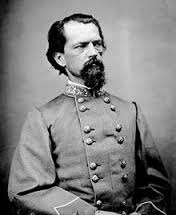
The instrument of Barlow’s division’s destruction was Brigadier General John Gordon’s brigade of Early’s division. Gordon was a self-taught soldier whose army service began when he was “elected Captain of a mountaineer company” [38] called “the Raccoon Roughs” in the opening weeks of the war.” [39] As Georgia had no room in its new military for the company Gordon offered it to Alabama where is was mustered into the 6th Alabama regiment. Even though Gordon had no prior military experience, he learned his trade well and possessed “an oratorical skill which inspires his troops to undertake anything. His men adore him….he makes them feel as if they can charge hell itself.” [40] After Manassas, Gordon was elected colonel of the 6th Alabama. He commanded the regiment until he was wounded five times in the defense of the Bloody Lane at Antietam. His final wound that day was to the face, which rendered him unconscious. He fell “with his face in his cap, and only the fact that another Yankee bullet had ripped through the cap saved him from smothering in his own blood.” [41] Before Chancellorsville the gallant colonel was promoted to brigadier general and given command of Lawton’s brigade.

Gordon’s troops hit the exposed right flank of Colonel Ludwig Von Gilsa’s tiny brigade and that force was overwhelmed by the fierceness of the Confederate assault. Von Gilsa was a professional soldier by trade who had served as a “major in the Prussian army during the Schleswig-Holstein War before immigrating to the United States” [42] from 1848 through 1850. After coming to the United States Von Gilsa supported as a singer, piano player and lecturer in New York, and on the outbreak of the war he raised and was commissioned as the Colonel of the 41st New York Infantry. He was badly wounded at the Battle of Cross Keys in the spring of 1862 and was made a brigade commander when Julius Stahel was elevated to division command. His first battle as a brigade commander was Chancellorsville where on the extreme Union right he warned of Stonewall Jackson’s flanking move, but his reports were discounted. Von Gilsa was a colorful man who won the respect of his men and “was notorious for his genius for profanity in his native German.” During the difficult retreat from Chancellorsville, Oliver Howard reminded the German Colonel “to depend upon God, and von Gilsa poured out a stream of oaths in German with such vehemence and profusion that Howard thought he had gone insane.” [43] Admired by his troops, one officer noted that von Gilsa was “one of the bravest of me4n and an uncommonly good soldier.” [44] This did not keep his new division commander Barlow from taking a dislike to him and arresting the German on the march to Gettysburg for allowing more than one soldier at a time to break ranks to refill canteens. Barlow reinstated Von Gilsa to his command at 1 p.m. just as his brigade was entering Gettysburg and beginning its march to engage the Confederates north of the town.

The position occupied by von Gilsa’s brigade “was at once a strong and dangerous position, powerful in front…but exposed on both flanks.” [45] Thus the exposed position of Barlow’s troops on Blocher’s Knoll provided the advancing Confederates the opportunity to roll up his division and defeat it in detail before moving down the Federal line to deal with Schimmelpfennig’s division. The Confederate attack engineered by Jubal Early was a masterpiece of shock tactics combining a fearsome artillery barrage with a well-coordinated infantry assault.

Colonel H.P Jones who commanded Jubal Early’s artillery battalion opened up a crossfire on von Gilsa’s brigade from its positions east of the Heidlersburg Road as Gordon’s brigade struck assisted by pressure being put forth by Junius Daniel’s brigade of Rodes division which was attacking Ames’s brigade from the northwest. The concentrated fire of the artillery added to the din and furthered the destruction among the Union men as Jones’s battalion’s fire “enfiladed its whole line and took it in reverse.” [46] The artillery fire from Jones’s battalion supported Gordon’s brigade as well as Early’s other two brigades, those of Hays and Avery as they advanced. “A prominent member of Ewell’s staff later said he had never seen guns “better served than Jones’ were on this occasion.” [47]

Von Gilsa’s outnumbered and badly exposed Union troops attempted to make a stand but were slaughtered by the Confederates; soon the brigade began to unravel, and then disintegrated. But it was not the complete rout posited by the brigade’s critics. It took “fifteen to twenty minutes of hard fighting for John Gordon’s men, assisted by some of George Doles regiments, to overrun Blocher’s Knoll” [48]One Confederate soldier later recalled, “it was a fearful slaughter, the golden wheat fields, a few minutes before in beauty, now gone, and the ground covered with the dead and wounded in blue.” [49] Another of Gordon’s soldiers noted “The Yankees…fought more stubborn than I ever saw them or ever want to see them again.” [50] Von Gilsa himself displayed tremendous courage in trying to stem the tide of the Confederate advance. He had “one horse shot from under him, but jumped onto another and desperately tried to stem the retreat. On soldier saw him ride “up and down that line through a regular storm of lead, meantime using German epithets so common to him.” [51] Despite his best efforts, just as a Chancellorsville von Gilsa was unable to hold his position and his troops fled through crowded and chaotic streets of Gettysburg to Cemetery Hill where their retreat was halted and they joined the troops of Steinwehr’s division and the other survivors of the First and Eleventh Corps troops who managed to escape the Confederate onslaught.

gordon

Brigadier General John Gordon

As Von Gilsa’s brigade collapsed Gordon “focused on the exposed right flank of Ames’s brigade” and Doles’s troops, now supported by Ramseur fell upon its left and “Ames’s outnumbered troops also collapsed” [52] even as that young and gallant commander attempted to advance his brigade to support Von Gilsa’s now fleeing troops. Barlow was in the thick of the fighting attempting to rally von Gilsa’s troops when he was wounded. Ames, the senior brigade commander took command of the shattered remnants of the two brigades when Barlow, went down. The wounded Barlow would be assisted by Gordon and “carried to the shade” of a nearby farmhouse by a member of Early’s staff. [53] Barlow recovered and after the war “he and Gordon established a friendship that lasted for the remainder of their lives.” [54]

Adelbert Ames was a native of Maine and had a stellar reputation when he entered Gettysburg. The young officer “graduated 5th out of 45 students in the Class of 1861, which completed its studies just after the fall of Fort Sumter.” [55] He was commissioned into the artillery and was wounded at First Bull Run where he was awarded the Medal of Honor. After he recovered he was commended for his service during the Peninsular Campaign. Ames then returned to Maine where he organized and commanded the illustrious 20th Maine Volunteer Infantry, and after Fredericksburg was promoted to brigadier general. “Like von Gilsa’s brigade, Ames’s came under fire from both infantry and artillery.” [56] After Chancellorsville he was promoted to brigadier general and took command of his brigade in Barlow’s division. Ames was a brave and capable leader who would continue to serve with distinction throughout the war ending up as a Major General of Volunteers and serving as one of Mississippi’s Reconstruction governors after the war. He lived a long and eventful life and was the last Civil War general to die in 1933.

Amidst the chaos of the retreat Ames worked with von Gilsa to “try to gather enough men together around a cluster of buildings along the Heidlersburg Road which served as the Adams County almshouse,” [57] and upon assuming command he succeeded in “slowing the retreat and establishing a second line when Avery’s and Hays’s brigades came crashing in on the right.” [58] However, this line too was driven back in great confusion as the brigades of Gordon and Hays, supported by Jones’s artillery hammered the thin blue line.

Schurz attempted to recover the situation by extending Schimmelpfennig’s division to the right, and advanced his reserve brigade under Polish born Colonel Wladimir Krzyzanowski to support Barlow counterattacking against Doles’s brigade. Krzyzanowski too was a refugee from Europe, coming from a region of Poland occupied by Prussia. “Kriz” as he was known to many Americans had fled to New York following the failed revolution of 1848 and made his living as a civil engineer. When war came Krzyzanowski volunteered for service, and was allowed to recruit “a multinational regiment that became known as the 58th New York Infantry, the “Polish Legion.” [59] Following service in a number of campaigns he was given command of a brigade in June of 1862.

Krzyzanowski’s brigade achieved some initial success against one of Doles’s regiments and for a time engaged in a furious short range shoot out with two more of Doles’s regiments. The opponents stood scarcely seventy-five yards apart aiming deadly volleys at one another without regard for themselves, an Ohio solider recalled “Bullets hummed about our ears like infuriated bees, and in a few minutes the meadow was strewn with…the wounded and the dead.” [60] Despite their gallantry Krzyzanowski’s troops were also rolled up in the Confederate assault when Doles and Gordon turned his flanks. Both of “Krzyzanowski’s flanks received enfilading fire and the brigade fell back across the Carlisle Road toward an orchard on the north side of Gettysburg.” [61]

As the situation deteriorated Schimmelpfennig ordered the 157th New York Infantry to support Krzyzanowski. The regiment advanced and engaged in a furious twenty minute fight, continuing the battle “in Indian fashion” until Schurz ordered them to retreat. The gallant 157th sacrificed itself buying time for others to withdraw and left over 75 percent of its men on the battlefield, when the order came, “less than fifty of the 157th were able to rise out of the wheat and follow.” [62] “So the horrible screaming, hurtling messengers of death flew over us from both sides,” recollected a New York soldier. “In such a storm it seemed a miracle that any were left alive.” [63] Krzyzanowski described the scene as “a portrait of hell.” [64]

Harry Hays brigade of Louisianans joined the assault on the collapsing Federal right while on the left Schimmelpfennig’s line collapsed under the weight of Doles’s attack, which had now been joined by the brigade of Stephen Ramseur. The proud Schimmelpfennig joined his troops in retreat. Inside the town he was unhorsed by enemy fire. In the town Schimmelpfennig was knocked unconscious “with the butt of a musket – “by the blow of a gun” – as he tried to scale a fence.” [65] By the time he regained himself Confederate troops were swarming all around, and to avoid capture he prudently “took refuge in a woodshed, where he remained in hiding the next three days.” [66] The attack of Early’s division supported by Doles and Ramseur “completely unhinged the end of the long Union line and destroyed any opportunities for resistance on that part of the field.” [67]

Howard was still looking for relief from Major General Slocum’s Twelfth Corps and seeing the disaster unfolding north of the town sent the First Brigade of Brigadier General Adolph Steinwehr’s division from Cemetery Hill to support the fleeing men of Barlow and Schimmelpfennig’s divisions. The small brigade of about 800 soldiers under the command of Colonel Charles Coster advanced through the town to a brickyard on the outskirts of the town. Before this small force could get into position they were hit hard by Hays and Avery’s brigades of Early’s division. The Confederates again had a massive numerical advantage at the point of attack with “eight big regiments to face Coster’s three small ones” [68] and they too were able to find an open flank and envelop both flanks of the tiny Union brigade. Avery’s brigade took them in the right flank and with both flanks turned by the advancing Confederates [69] Coster’s little brigade broke under the pressure and began to retreat leaving many prisoners to be collected by the Confederates. The commander of the 134th New York exclaimed “I never imagined such a rain of bullets.” [70] In its fight with Avery’s brigade which had the New Yorkers in a crossfire, the 134th lost some forty men killed and 150 wounded. Coster had entered the fight with about 800 soldiers but by the end of the afternoon over 550 were casualties, with “313 of them left it as prisoners.” [71] Coster survived the assault but resigned from the army a few months later never having filed and official report. [72] As the Union right collapsed and the Confederate pressure on Robinson’s division on Oak Ridge mounted, von Amsberg’s brigade, without the 157th New York found itself without support and was forced to withdraw. However, the sacrifice of Coster’s brigade “succeeded in checking the enemy long enough to permit Barlow’s division to “enter the town without being seriously molested on its retreat.” [73]

In his after action report as well as in other correspondence Barlow was acrimonious toward the German troops who he had so carelessly exposed to the Confederate onslaught on Blocher’s Knoll. He wrote “We ought to have held the place easily, for I had my entire force at the very point where the attack was made….But the enemies [sic] skirmishers had hardly attacked us before my men began to run. No fight at all was made.” [74] However, more circumspect Union officers do not back the gallant, but arrogant Boston Brahmin’s statement nor do his Confederate opponents. The Union artillery commander Henry Hunt wrote that it was “an obstinate and bloody contest” [75] while Gordon, whose brigade had inflicted so much of the damage on Barlow’s divisions wrote:

“The enemy made a most obstinate resistance until the colors of the two lines were separated by a space of less than 50 paces, when his line was broken and driven back, leaving the flank which this line had protected exposed to the fire from my brigade. An effort was made by the enemy to change his front and check our advance, but the effort failed and this line too, was driven back in the greatest confusion with immense loss in killed, wounded and prisoners.” [76]

A private of the 61st Georgia Infantry of Gordon’s brigade wrote that the Eleventh Corps troops “stood firm until we got near them. Then they began to retreat in good order. They were harder to drive than we had known them before….Their officers were cheering their men and behaving like heroes and commanders of ‘the first water’” [77]

During the retreat the redoubtable Hubert Dilger whose battery had wrought such death and destruction on O’Neal and Iverson’s brigades and Carter’s artillery while supporting Robinson’s division on Oak Ridge continued its stellar contribution to the battle. Instead of withdrawing his battery completely he halted four guns north of the town to support the infantry. “The four cannon immediately banged away at the approaching Confederate infantry and helped hundreds of Federal troops successfully escape the clutches of the enemy.” [78] When he could do no more Dilger withdrew to Cemetery Hill where his guns joined the mass of Union artillery gathering on that edifice.

Collapse and the Retreat of First & Eleventh Corps

The retreat of Eleventh Corps “southward through the streets of Gettysburg exposed the rear of the First Corps at a time when Doubleday’s troops were already having to give ground before the superior numbers represented by” [79] the divisions of Harry Heth and Dorsey Pender of A.P. Hill’s Third Corps. The First Corps had been battling Hill’s troops for the better part of the morning and for the most part had gotten the better of their Confederate opponents, inflicting very heavy casualties on the divisions of Heth, Pender and Robert Rodes. The fierceness of the Union defense of the ridges west of the town wreaked havoc on the Confederate attackers. The remnants of the Iron Brigade supported by the brigades of Biddle and Stone, Gamble’s dismounted cavalry, and Wainwright’s expertly directed artillery inflicted massive casualties on their Confederate opponents.

Notes

[1] Ibid. Pfanz The First Day at Gettysburg p.218

[2] Ibid. Greene From Chancellorsville to Gettysburg: O. O. Howard and Eleventh Corps Leadership p.63

[3] Ibid. Guelzo Gettysburg: The Last Invasion p.166

[4] Ibid. Guelzo Gettysburg: The Last Invasion p.166

[5] Ibid. Tagg The Generals of Gettysburg p.139

[6] Ibid. Sears Gettysburg p.38

[7] Ibid. Guelzo Gettysburg: The Last Invasion p.181

[8] Ibid. Guelzo Gettysburg: The Last Invasion p.181

[9] Ibid. Tagg The Generals of Gettysburg p.126

[10] Ibid. Guelzo Gettysburg: The Last Invasion p.162

[11] Ibid. Greene From Chancellorsville to Gettysburg: O. O. Howard and Eleventh Corps Leadership p.63

[12] Ibid. Tagg The Generals of Gettysburg p.132

[13] Trudeau, Noah Andre. Gettysburg: A Testing of Courage, Harper Collins Publishers, New York 2002 p.198

[14] Ibid. Greene From Chancellorsville to Gettysburg: O. O. Howard and Eleventh Corps Leadership p.74

[15] Ibid. Guelzo . Gettysburg: The Last Invasion p.181

[16] Ibid. Coddington The Gettysburg Campaign: A Study in Command, p.288

[17] Ibid. Greene From Chancellorsville to Gettysburg: O. O. Howard and Eleventh Corps Leadership p.74

[18] Ibid. Sears, Gettysburg pp.193-194 and Coddington p.303

[19] Ibid. Trudeau Gettysburg: A Testing of Courage p.142

[20] Ibid. Pfanz The First Day at Gettysburg p.140

[21] Ibid. Guelzo Gettysburg: The Last Invasion p.166

[22] Ibid. Coddington The Gettysburg Campaign p.303

[23] Melton, Brian C. Sherman’s Forgotten General: Henry W. Slocum University of Missouri Press, Columbia and London 2007 p.125

[24] Ibid. Pfanz The First Day at Gettysburg p.143

[25] Ibid. Melton Sherman’s Forgotten General p.124

[26] Ibid. Melton Sherman’s Forgotten General p.128

[27] Ibid. Greene From Chancellorsville to Gettysburg: O. O. Howard and Eleventh Corps Leadership p.74

[28] Ibid. Greene From Chancellorsville to Gettysburg: O. O. Howard and Eleventh Corps Leadership p.76

[29] Ibid. Sears, Gettysburg pp.193-194 and Coddington p.212

[30] Ibid. Greene From Chancellorsville to Gettysburg: O. O. Howard and Eleventh Corps Leadership p.77

[31] Ibid. Sears, Gettysburg pp.193-194 and Coddington p.212

[32] Ibid. Trudeau Gettysburg: A Testing of Courage p.217

[33] Ibid. Trudeau Gettysburg: A Testing of Courage p.216

[34] Ibid. Greene From Chancellorsville to Gettysburg: O. O. Howard and Eleventh Corps Leadership p.77

[35] Ibid. From Chancellorsville to Gettysburg: O. O. Howard and Eleventh Corps Leadership Greene p.78

[36] Ibid. Trudeau Gettysburg: A Testing of Courage p.216

[37] Ibid. Greene From Chancellorsville to Gettysburg: O. O. Howard and Eleventh Corps Leadership p.78

[38] Warner, Ezra J. Generals in Gray: Lives of Confederate Commanders Louisiana State University Press, Baton Rouge 1959, 1987 p.111

[39] Ibid. Tagg The Generals of Gettysburg p.262

[40] Freeman, Douglas Southall, Lee’s Lieutenant’s a Study in Command, One volume abridgement by Stephen W Sears, Scribner, New York 1998 p.41

[41] Sears, Stephen W. Landscape Turned Red: The Battle of Antietam Houghton-Mifflin Company, Boston and New York 1983 p.242

[42] Ibid. Pfanz The First Day at Gettysburg p.224

[43] Ibid. Tagg The Generals of Gettysburg p.127

[44] Ibid. Greene From Chancellorsville to Gettysburg: O. O. Howard and Eleventh Corps Leadership p.61

[45] Ibid. Tagg The Generals of Gettysburg p.128

[46] Hunt, Henry The First Day at Gettysburg in Battles and Leaders of the Civil War edited by Bradford, Neil Meridian Press, New York 1989 p.363

[47] Ibid. Coddington The Gettysburg Campaign: A Study in Command, p.291

[48] Ibid. Trudeau Gettysburg: A Testing of Courage p.225

[49] Ibid. Greene From Chancellorsville to Gettysburg: O. O. Howard and Eleventh Corps Leadership p.79

[50] Ibid. Trudeau Gettysburg: A Testing of Courage p.225

[51] Ibid. Tagg The Generals of Gettysburg p.128

[52] Ibid. Greene From Chancellorsville to Gettysburg: O. O. Howard and Eleventh Corps Leadership p.79

[53] Ibid. Guelzo Gettysburg: The Last Invasion p.188

[54] Dowdy, Clifford. Lee and His Men at Gettysburg: The Death of a Nation Skyhorse Publishing, New York 1986, originally published as Death of a Nation Knopf, New York 1958 p.141

[55] Ibid. Tagg The Generals of Gettysburg p.129

[56] Ibid. Pfanz The First Day at Gettysburg p.234

[57] Ibid. Guelzo Gettysburg: The Last Invasion p.187

[58] Ibid. Coddington The Gettysburg Campaign: A Study in Command, p.292

[59] Ibid. Pfanz The First Day at Gettysburg p.236

[60] Ibid. Greene From Chancellorsville to Gettysburg: O. O. Howard and Eleventh Corps Leadership p.80

[61] Ibid. Greene From Chancellorsville to Gettysburg: O. O. Howard and Eleventh Corps Leadership p.80

[62] Ibid. Guelzo Gettysburg: The Last Invasion p.186

[63] Ibid. Trudeau Gettysburg: A Testing of Courage p.225

[64] Ibid. Guelzo Gettysburg: The Last Invasion p.186

[65] Ibid. Tagg The Generals of Gettysburg p.139

[66] Foote, Shelby, The Civil War, A Narrative. Volume Two Fredericksburg to Meridian Random House, New York 1963 p.477

[67] Ibid. Coddington The Gettysburg Campaign: A Study in Command, p.292

[68] Ibid. Guelzo Gettysburg: The Last Invasion p.190

[69] Ibid. Trudeau Gettysburg: A Testing of Courage, p.241

[70] Ibid. Trudeau Gettysburg: A Testing of Courage p.241

[71] Ibid. Sears, Gettysburg pp.193-194 and Coddington p.217

[72] Ibid. Guelzo Gettysburg: The Last Invasion p.190

[73] Ibid. Pfanz The First Day at Gettysburg pp. 267-268

[74] Ibid Greene From Chancellorsville to Gettysburg: O. O. Howard and Eleventh Corps Leadership p.79

[75] Ibid. Hunt The First Day at Gettysburg p.365

[76] Report of Brigadier General J. B. Gordon, CSA, commanding brigade, Early’s Division, in Luvaas, Jay and Nelson Harold W editors. The U.S. Army War College Guide to the Battle of Gettysburg South Mountain Press, Carlisle PA 1986 p.45

[77] Ibid. Greene From Chancellorsville to Gettysburg: O. O. Howard and Eleventh Corps Leadership p.79

[78] Gottfried, Bradley The Artillery of Gettysburg Cumberland House Publishing, Nashville TN 2008 p.71

[79] Weigley, Russell F. A Great Civil War: A Military and Political History 1861-1865 Indiana University Press, Bloomington and Indianapolis 2000 p.244

Leave a comment

Filed under Loose thoughts and musings

The Last Stand of the Iron Brigade

Friends of Padre Steve’s World

Tonight a section from one of my Gettysburg text chapters. This one is about the stand of the Iron Brigade on the ridges west of Gettysburg on the afternoon of July 1st 1863.

Have a great night,

Peace

Padre Steve+

IronBrigade12021001

Harry Heth launched his two uncommitted brigades, those of Pettigrew and Brockenbrough to wrest control of the Herbst Woods from the Iron Brigade. The battle around the seminary and in Herbst wood ahead of it was fierce and the casualties enormous. The Iron Brigade still held on to Herbst Woods and was attacked by Pettigrew’s brigade of Heth’s division and it’s commander Solomon Meredith ensured that his veterans would hold the woods as Doubleday had instructed, “at all costs.” “At the apex of the curved line of the Iron Brigade in the woods stood the 24th Michigan. Straight ahead, ascending the slope was the 26th North Carolina, a huge regiment of 850 officers and men. For the next twenty minutes, hell enveloped both regiments.” [1] In the maelstrom of musketry the Confederates suffered heavily, a North Carolina sergeant recalled “could not even begin to estimate the number of “deadly missiles [that] were sent into our ranks, which mowed us down like wheat before the sickle.” [2]

Despite their immense losses the Confederates finally drove the Iron Brigade back to the seminary but it was at great cost to both sides. The battle for the woods was a wholesale slaughter, the 26th North Carolina lost “549 out of the 843 men it had lined up that afternoon; its regimental flag went through thirteen sets of hands” [3] in a fight where “seven out of every ten men on both sides fell killed or wounded.” [4] The 26th North Carolina lost its commanding officer, the young Colonel Henry Burgwyn Jr., who had picked up the regimental colors when the color guard was shot down. “He called out to the regiment to “dress on the colors.” He turned to hand the colors to a private, only to be hit in the left side, puncturing both lungs; the impact twisted him around and entangled Burgwyn in the flag.” [5]

But by now the outnumbered soldiers of the Iron Brigade were being flanked by part of the 11th North Carolina, which had worked its way around the left. These North Carolina troops began raking the Union line with their musket fire, and a soldier of the 19th Indiana noted, “The slaughter in our flanks became frightful beyond description,” [6] Even so the 11th North Carolina lost heavily in the attack, its losses included its colonel and senior major, the Iron Brigade “inflicted such heavy losses on the Confederates that there were not enough men left even for a successful bayonet charge.” [7]

Harry Heth’s division had finally wrested the McPherson’s Ridge from the determined Yankees but it was now a spent force. Archer and Davis’s brigades had been shattered in the morning fighting and now Pettigrew and Brockenbrough’s were shattered and his men were out of ammunition. Heth claimed “his division had lost 2,300 men in thirty minutes. Pettigrew’s brigade, which had borne the brunt of the afternoon’s fight had lost over 1,000 men killed and wounded.” [8]

Solomon Meredith was among the wounded and the Iron Brigade, now under the command of Colonel Henry Morrow of the 24th Michigan were forced to withdraw back to the seminary. The westerners fought stubbornly and withdrew “step by step, contesting every foot of ground.” [9] They withdrew “by echelon of alternate battalions, turning and stopping six times to beat back the Confederate pressure.” [10] On Seminary Ridge the survivors joined with the remnants of Biddle’s and Stone’s brigades and Wainwright’s artillery. The gallant First Corps was now but a shadow of its former self formed near the seminary for a last stand against the advancing Confederates. “Ordered to hold onto the ridge as long as possible, “the shattered remnants of the Iron Brigade” – Doubleday’s description – moved in behind the barricade to face the onslaught to come.” [11]

Abner Doubleday had ordered his troops to hold their positions “at all hazards” and when the assaulting waves of the Confederates “neared Willoughby Run, the Union ranks exploded in a gale of musketry.” [12] These Confederates from Dorsey Pender’s division were fresh and ready to fight, having taken the lead as Heth’s battered formations were given time to reform. Pender chose the North Carolina brigade of Alfred Scales and the South Carolina brigade of Abner Perrin for the assault, but the Carolinians encountered the same stubborn resistance from the depleted Federals as Heth’s men had earlier in the day. Doubleday remained at the Seminary directing the action and contributed his own headquarters guard company to the defense and “lent a hand sighting the artillery.” [13]

The Iron Brigade and Stone’s brigade were in a good position and covered by a “stone wall and some rough fence-rail breastworks and opened a blistering fire on the advancing Carolinians.” [14] Wainwright had eighteen guns concentrated in this sector on a front of less than 200 yards, and they added to the carnage in the Confederate ranks, one battery was enfilading the Confederate left and Wainwright wrote, “round shot, together with the canister poured in from all the other guns, was cutting great gaps in the front line of the enemy. But still they came on, the gaps being closed by regiments from the second line, and this again filled up by a third column which was coming over the hill. Never have I seen such a charge. Not a man seemed to falter….” [15]

The recipients of this blast were the men of Scales brigade and to one of the Confederates the Federal redoubt seemed “a sheet of fire and smoke, sending its leaden missiles…in the faces of men who had often, but never so terribly, met it before.” [16] Colonel William Robinson of the 7th Wisconsin wrote that “the Confederate ranks went down like grass before the scythe” [17] The casualties suffered by Scales’ brigade in their assault on Seminary Ridge were devastating, “Scales was wounded by a shell fragment, and in his five regiments every field officer but one was killed or wounded. Scales had launched his attack that afternoon with 1,350 men. That evening barely 500 answered roll call.” [18]

With Scales and his brigade out of action it was left to Perrin and his South Carolinians to press the fight. These troops were also met with a terrible reception, but Perrin detected a slight gap between Biddle’s brigade and Gamble’s cavalrymen “and drove straight for it. Perrin himself led the charge. Filled with admiration for such courage as defied the whole fire of the enemy,” wrote J.F.J. Caldwell of the 1st South Carolina “…the brigade followed, with a shout that itself half a victory.” [19] Perrin’s troops broke through the Union line just south of the seminary, and once he penetrated the Union line Perrin exploited his advantage and “neatly fanned out his regiments to the left and to the right so as to attack his opponent on the flanks.” [20] By now the 1st and 14th South Carolina had pushed around the flank of the Seminary redoubt, “while the 12th and 13th South Carolina struck Biddle’s brigade through “a furious storm of musketry and shells,” forcing Biddle’s thinned-out regiments to fall back behind the seminary.” [21]

Retreat to Cemetery Hill

By now there was little that could be done by the battered remnants of First Corps to hold on to Seminary Ridge or Oak Ridge. Doubleday and Wadsworth gave the order to withdraw to Cemetery Hill, Wadsworth noted “Outflanked on both right and left, heavily pressed in front, and my ammunition nearly exhausted,… I ordered the command to retire.” [22] The survivors of the corps withdrew under heavy Confederate pressure as the 6th Wisconsin and Battery “B” 4th U.S. Artillery covered the retreat. Doubleday noted “from behind the feeble barricade of rails these brave men stemmed the fierce tide which pressed upon them incessantly, and held the rebel lines…at bay until the greater portion of the corps had retired.” [23] Gamble’s cavalrymen also contributed by so effectively resisted Lane’s brigade that it could not support Perrin in the assault, causing Perrin to complain that it “never came up until the Yankees were clear out of reach.” [24]

“The Iron Brigade and Stone’s Bucktails generally fell back toward Gettysburg under some semblance of control, but this was not as easily done in units with the enemy closing in right at their heels.” [25] These units took more causalities during and lost some men as prisoners while withdrawing, but they were able to work their way through the chaotic streets of Gettysburg, to Cemetery Hill where “the men were re-formed and were ready for service.” [26] The remnants of the Iron Brigade were then directed by Abner Doubleday to Culp’s Hill to support an artillery battery on that vital ground.

Some units did not get the word directly and only found out when supporting units withdrew, such was the case with Wainwright’s artillery. Wainwright was still under the impression that the ridge was to be held at all costs and only withdrew when he found that his infantry supports and already withdrawn, leaving his gunners alone against the advancing Confederates. However, they had already done such damage to the Confederates that the Southerners to their front advanced with caution. One federal artilleryman noted “I was astonished at the caution of the enemy at this time. He seemed utterly paralyzed at the punishment he had received from First Corps, and was literally ‘feeling every inch of the way’ in his advance on our front.” [27]

Wainwright and his gunners executed their guns withdraw from Seminary Ridge under heavy Confederate fire, though the Confederate infantry failed to follow up its success by rushing his guns. He directed his batteries to “move at a walk towards town” [28] as he believed that sending them through at a trot or gallop could panic the infantry. He lost one gun in the retreat, something that as an artilleryman he found upsetting, but he realized that “our getting out of that place as quite a feat, and I wish it could have been without the loss of a gun. The more I think of it, the more I wonder how we got off at all. Our front fire must have shaken the rebel lines badly or they would have been upon us.” [29]

To the north on Oak Ridge the survivors of John Robinson’s division were threatened with complete disaster. Hard pressed on three sides by Rodes’s division and threatened from the east by the collapse of Eleventh Corps and by of the rest of First Corps withdraw from Seminary Ridge. These troops had successfully repelled every Confederate attack and had suffered terribly as they did so. Brigadier General Gabriel Paul’s First Brigade had relieved Baxter’s brigade, which had been withdrawn to replenish ammunition after mauling Iverson and O’Neal’s brigades at the northern apex of Oak Ridge. After its arrival Paul’s excellent brigade beat back an attack by Ramseur’s brigade but in the process lost their commander. General Paul was “shot in the head and blinded” and his place was taken by Colonel Adrian R. Root. [30]

However now, under pressure from the brigades of Daniel, Ramseur and Doles Robinson had to act to save First Brigade. He ordered Colonel Charles Tilden and the 16th Maine to act as a rearguard. Forced to withdraw by overwhelming Confederate numbers “an effort was made to retire in good order, but the pressure was too great.” [31] Tilden’s Maine men were cornered in the Railroad cut they were caught in the crossfire of several Confederate regiments, and for most the only option was surrender or death. Of “the 275 men who entered the battle with the 16th Maine, only 39 reached the hill.” [32] The regiment’s adjutant recalled “They swarmed down upon us….they engulfed us, and swept away the last semblance of organization that marked us a separate command.” [33] To ensure that the regiment’s colors did not become a trophy for the Confederates Tilden ordered his color bears to tear the flags from their staffs and rip them into pieces too small to become souvenirs. Many of the Maine men kept these shreds of their precious colors for the rest of their lives. The gallant 6th Wisconsin which had been at the Railroad cut to turn back the initial assault of Davis’s brigade in the morning which covered the retreat fought its way through town and finally “its men saw “the colors of the Union, floating over well ordered line of men in blue, who were arrayed along the slope of Cemetery Hill.” [34]

Notes

[1] Ibid. Wert The Sword of Lincoln p.278

[2] Ibid. Trudeau Gettysburg: A Testing of Courage p.225

[3] Ibid. Guelzo Gettysburg: The Last Invasion p.196

[4] Ibid. Wert The Sword of Lincoln p.278

[5] Ibid. Guelzo Gettysburg: The Last Invasion p.196

[6] Ibid. Trudeau Gettysburg: A Testing of Courage p.228

[7] Ibid. Coddington The Gettysburg Campaign: A Study in Command, p.293

[8] Ibid. Pfanz The First Day at Gettysburg p.292

[9] Nolan, Alan T. The Iron Brigade: A Military History Indiana University Press, Bloomington IN, 1961 and 1994 p.245

[10] Ibid. Guelzo Gettysburg: The Last Invasion p.196

[11] Ibid. Nolan, The Iron Brigade p.247

[12] Ibid. Wert The Sword of Lincoln p.278

[13] Ibid. Guelzo Gettysburg: The Last Invasion p.200

[14] Ibid. Sears, Gettysburg pp.193-194 and Coddington p.218

[15] Ibid. Wainwright A Diary of Battle p.236

[16] Ibid. Nolan, The Iron Brigade p.247

[17] Ibid. Nolan, The Iron Brigade p.247 and Sears p.218

[18] Ibid. Sears, Gettysburg p.218

[19] Ibid. Sears, Gettysburg p.218

[20] Ibid. Coddington The Gettysburg Campaign: A Study in Command, p.294

[21] Ibid. Guelzo Gettysburg: The Last Invasion p.201

[22] Ibid. Nolan, The Iron Brigade p.248

[23] Ibid. Nolan, The Iron Brigade p.248

[24] Ibid. Pfanz The First Day at Gettysburg p.318

[25] Ibid. Sears, Gettysburg p.220

[26] Ibid. Nolan, The Iron Brigade p.252

[27] Ibid. Gottfried, The Artillery of Gettysburg p.53

[28] Ibid. Sears, Gettysburg p.220

[29] Ibid. Wainwright A Diary of Battle p.237

[30] Ibid. Trudeau Gettysburg: A Testing of Courage p.233

[31] Ibid. Trudeau Gettysburg: A Testing of Courage p.235

[32] Ibid. Pfanz The First Day at Gettysburg p.193

[33] Ibid. Trudeau Gettysburg: A Testing of Courage p.235

[34] Ibid. Pfanz The First Day at Gettysburg p.330

Leave a comment

Filed under Loose thoughts and musings

Oktoberfest, Community & Gemütlichkeit

11951375_10153694943607059_8374348457395516932_n

Friends of Padre Steve’s World,

This is the first of a series of short posts reflecting about our trip to Munich, Salzburg and the Oktoberfest.

We are back from Oktoberfest and starting to catch up on life back at home. The trip was wonderful Judy and I had a great visiting meeting and talking with a wide variety of people, from Munich locals, to Swiss, French, English, and other visitors to the Oktoberfest including American expats, and many others.

What we liked was that it was hard not to get a chance to talk and spend time with people, sitting in one of the Bier Gardens of the Hofbrauhaus tent at the Theriesienwiese grounds, the Hofbrauhaus itself, other restaurants, sidewalk cafes or the hotel bar. I have to say that the ease with which you can mix with and get to know people; the ability to talk about life, culture, and even current events without someone looking for an angle to exploit is in start contrast to so much of what we see in the States.

One of the interesting things is how the Germans, even those who live in big cities understand the concept of community. The Germans take life and work seriously, but unlike many, if not most of us, they know when business stops and fun, family and community begin. When people leave work they leave work, and even the business culture, in which stores are not open 24 hours or on Sundays provide Germans the opportunity to spend good amounts of time with family, their neighbors and friends as they meet for dinner or drinks at the local Gasthaus or inn on a regular basis. Likewise communities sponsor sports teams, and a wide array of other clubs that draw them together, everything from Rotary, to veterans associations, bands and choirs, hunting and shooting clubs and many more. Many of these groups sponsor events in which the entire community can partake.

The concept in all of this is that of Gemütlichkeit, a German word that basically describes a situation of where a cheerful mood, peace of mind and social acceptance are joined with the connotation of being unhurried in a cozy atmosphere. It also is understood in relationship to holidays where public festivities in the form of music, food, and drink help promote a sense of community. In this there is a sense that someone is part of something bigger than himself or herself where they are connected with being accepted by others while enriching the community.

Unfortunately for many Americans this is not the case. Unless one belongs to an organization such a various types of lodges, local sports fan clubs, or a local pub or bar where “everyone knows you name” there are precious few places one can experience this type of community. Churches like to claim that they are places of fellowship, but in my adult experience I have to say that most churches neither foster community nor are they places where one can go to be accepted. They are often the most cliquish, unfriendly, uninviting, and judgmental places around, and this is across the board. This cliquish and uninviting spirit covered in a veneer of spirituality and forced friendliness knows no denominational or theological boundaries, but I digress….

Judy and are lucky, we have a sense of community with friends who span the breadth of society; most of those who we know from the place where everyone knows our name, the Gordon Biersch Brewery Restaurant bar in Virginia Beach.

The Germans for all of their serious nature and sometimes-brusque manner of getting around do know how to draw the line between work, and play and in the process build community. Their cities and towns are designed to keep a community connection, including many parks; excellent public transportation systems, sidewalk cafes, local corner grocery stores and bakeries, as well as family run businesses that have not been destroyed by the huge box-stores like Wal-Mart. They are places that you get to know people, where life is lived, and community experienced.

Part of this is the difference in culture and how over the years our American culture has become detached from this sort of community. In many ways we have become increasing individualistic through the proliferation of suburbia, massive box-stores, and all that goes with it, including the abandonment of cities, and small poor rural communities. Even our churches, across the denominational spectrum have embraced the community destroying box-store religion of the mega-churches. The fact is we don’t know our neighbors and that leads to a culture that devalues people, destroys community and actually being on more social problems including crime.

Without community we fall back into our basest survival instincts; we see people in regard to what they can do for us. People simply become nothing more than commodities that we discard when they are no longer useful. We adopt the modern American business model as our model for relationships; and when we do this, we devalue friendship; we become paranoid, distrustful, isolated and ultimately come to despise our neighbors.

Anyway, speaking of this Judy and I will need to see some of our friends this afternoon and just enjoy that gift of friendship.

Wishing you all today that sense of Gemütlichkeit,

Peace

Padre Steve+

1 Comment

Filed under faith, Loose thoughts and musings, philosophy, Travel

There Will be Nightmares: PTSD & Memories of War

Friends of Padre Steve’s World

I’m really very tired today so another short post. I haven’t slept well in several weeks, part of this of course was the worry I had regarding my wife Judy and her cancer diagnosis, surgery and recovery. As she has gotten better I have been dealing with stuff from my own closet of anxieties. Those who have been reading my articles here know that I deal with PTSD, Traumatic Brain Injury and moral injury from my time in Iraq, and my return home.

ramadi

Last year I went through a very difficult time dealing with the military mental health system that I never want to repeat again. I hope I don’t have to, but I may. My therapist who I have had since last summer took a new job thousands of miles away and now I am going to have to find another therapist. I am hoping the man I see for my medication management can get me referred to someone good, because I do not want to be thrust back into the system and take the luck of the draw. That scares me to death, and since I found out my therapist was leaving and that I will not see her again I have been trying to keep my anxiety under control and not to panic. Awake I do pretty well with this, but when I try to sleep, all my Iraq stuff, plus all the very real and bad experiences that I had with the military mental health system last year flood my psyche. The night terrors are back, the terrible dreams and fears. It is not fun waking up in the middle of the night in a state of terror. Last year, after dealing with a number of providers and administrators I was nearly suicidal. It took the intervention of a former commanding officer who had been recently selected for promotion to Admiral in the Medical Corps to get me listened to and to get me the help that I sought.

295_26912092058_3949_n

But I know that I am not alone, I will get the professional help that I still need and I do have some friends I can talk to about these issues. Likewise I know many combat who veterans deal with similar issues related to their service, as well what happened to them when they returned home from Iraq or Afghanistan. The return from war is often worse than actually being over there, few people really understand, unless they too have been there.

Guy Sajer wrote in his book The Forgotten Soldier, “Only happy people have nightmares, from overeating. For those who live a nightmare reality, sleep is a black hole, lost in time, like death.” General Gouverneur Warren, a hero of many Civil War battles including Gettysburg wrote to his wife after the war “I wish I did not dream so much. They make me sometimes to dread to go to sleep. Scenes from the war, are so constantly recalled, with bitter feelings I wish never to experience again. Lies, vanity, treachery, and carnage.”

n671902058_1153794_4301

I am a realist about this. I know that there is no magic wand which will make it all go away and I don’t expect any therapist, or even God to cure me. I can understand why Alexander Dumas in the Count of Monte Cristo wrote, “Moral wounds have this peculiarity – they may be hidden, but they never close; always painful, always ready to bleed when touched, they remain fresh and open in the heart.”

That is true and I know to some people that may sound like I have given up, especially because it runs counter to the snake oil salesmen who write self-help books which promise to heal you in whatever number of steps or exercises; especially the ones written by preachers. But that is not the case, despite everything I still have a love of life and lust for learning. Except that now I just have moved to a new level of understanding concerning my own dark places, and that pain that manifests at night as I try to sleep. Since nothing will take it away I need to live with it and realize that it won’t always be the first thing that I think about when I wake up in the morning. That my friends is the essence of hope. 

n671902058_1219154_8844

One of my favorite actors, James Spader, plays a character named Raymond Reddington on the television show The Blacklist. During one episode he told another character something quite profound, something that if we actually embrace it can be somewhat comforting. “There is nothing that can take the pain away. But eventually, you will find a way to live with it. There will be nightmares. And every day when you wake up, it will be the first thing you think about. Until one day, it’s the second.”

I think that is why I can continue and at the same time seek to be available to those who suffer similar afflictions, and thankfully, I do still have those opportunities and as the late Henri Nouwen wrote, “Ministry means the ongoing attempt to put one’s own search for God, with all the moments of pain and joy, despair and hope, at the disposal of those who want to join this search but do not know how.”

Anyway, have a nice night.

Peace

Padre Steve+

4 Comments

Filed under Loose thoughts and musings

A Wrong Turn, a Holy Cause and Two Bullets: The Assassination of Archduke Franz Ferdinand

Friends of Padre Steve’s World

Well it has been a busy day combining my nursing duties at home with a couple of trips in to work, the last where I did my last lecture before the Gettysburg Staff Ride which I lead on Friday.

That being said, though I have some things I am working on, including a little piece about the part of health care that no-one wants to pay for, that what happens when someone is discharged from the hospital still needing a pretty significant amount of care. I can tell you about that first hand. But I digress…

Tonight since I am too tired to put anything new out I will re-post an article from about 13 months ago about the assassination of Archduke Franz Ferdinand and his wife Sophie, an act which triggered the First World War. The assassination, an act by radical Serbian nationalists killed the only man in the Austro-Hungarian Empire who might have prevented the war, and even been favorable to the Serbs. But then such is the mindset of fanatics, and don’t we have a lot of them in our world today, including non-Moslem Americans.

So anyway, I hope you like this. Have a great night.

Peace

Padre Steve+

padresteve's avatarThe Inglorius Padre Steve's World

clive-uptton-the-assassination-of-archduke-franz-ferdinand

“The muffled tongue of Big Ben tolled nine by the clock as the cortege left the palace, but on history’s clock it was sunset, and the sun of the old world was setting in a dying blaze of splendor never to be seen again.” Barbara Tuchman

Archduke Franz Ferdinand, the heir to the throne of the Austro-Hungarian Empire was eager to leave Sarajevo. He had opposed the empire’s annexation of Bosnia-Herzegovina when it occurred in 1908 as a “needless provocation of the South Slavs” and their Russian supporters, he knew that the action was “a diplomatic time bomb that could go off at any time.”He had come to Bosnia to help win over the loyalty of the resentful populace and in a sense to consecrate Austrian rule over Bosnia-Herzegovina.

archduke_ferdinand

Franz Ferdinand 

The visit included military maneuvers in the western part of the province away from Serbia to be less…

View original post 922 more words

Leave a comment

Filed under Loose thoughts and musings

The Night the Lights Went Out in Europe: August 3rd 1914

Friends of Padre Steve’s World

Another day at home taking care of my wife following her surgery. She is doing better which is good. We also had a dear friend, her daughter and grand-daughters visit last night on their way to Georgia. It was so wonderful to see her and talk about the good times we had when I was serving as Chaplain at Fort Indiantown Gap Pennsylvania back in 1997 and 1998.

Anyway, I am preparing some new material but thought in the interest of history to continue and re-post a third article that I wrote a year ago about the outbreak of World War One.

I think this is important, first because that war still shapes so much of the world that we live in. Likewise there are the diplomatic lessons decisions of leaders who brought about a war that was in none of their nation’s long term interests.

Then there are the lessons of the military planners on all sides who envisioned a short and glorious war in which they would vanquish their enemies and be home before the leaves fall. The same leaders seemed to ignore the history of the real first modern war, the American Civil War, discounted the technological advances that made war much more lethal, and did not adjust their tactics to those facts. The result was that on the Western front the Germans, British, French and Belgians lost about 670,000 in a period of about five weeks. In the east the Russians lost 320,000 troops and the Germans about 67,000 between August 17th and September 14th, while in Galicia the Russians eliminated a third of the Austrian forces facing them, some 320,000 troops for the loss of 225,000 soldiers, while in Serbia the Austrians, who brought about the war by their harsh demands on Serbia suffered about 225,000 casualties inflicting 170,000 on the Serbs, with no gain in territory. All told nearly 1.9 million men, killed, wounded, missing or captured in just over a month of combat.

On August 3rd 1914, the leaders of Europe went to war, and the lamps went out over Europe, and much of the world.

Have a great day and never forget.

Peace

Padre Steve+

padresteve's avatarThe Inglorius Padre Steve's World

grey-bastard

Sir Edward Grey addressing the House of Commons 

The mobilization of millions of soldiers across Europe was moving rapidly as the sun set on the night of August 2nd 1914 when the German Ambassador to Belgium Klaus Bulow-Selaske delivered an ultimatum to the Belgian government. The ultimatum gave the Belgians 12 hours to decide if they would allow the German armies free passage through the country. The Belgians, treasuring their independence and led by a truly heroic leader, the young and humble King Albert refused the German ultimatum and vowed to fight.

The next morning the British House of Commons met and for the first time since 1893 every member was present, with many spectators in attendance, Britain’s participation in a war on the European Continent in nearly 100 years was being contemplated. Britain was divided between interventionists and non-interventionists, and the pressure was on the government.

The British Foreign…

View original post 762 more words

Leave a comment

Filed under Loose thoughts and musings