Category Archives: Military

Going to War: Flying in Al Anbar on C-130s

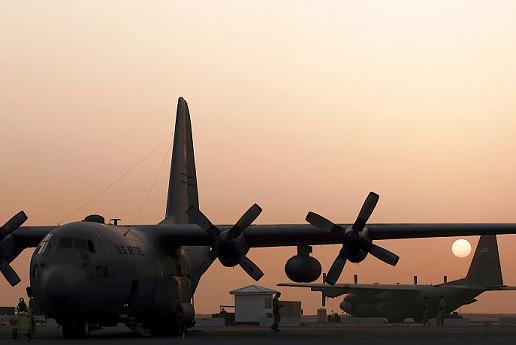
C-130’s in Iraq

This is another installment of my “Going to War” Series that I began last year.  In the Fall I had to take a break from posting anything more on the story of my deployment to Iraq in 2007 and 2008 due to issues that I was having dealing with the effects of PTSD. I have reached the point that I can again write about this so on occasion I will post these articles which now deal with our actual operations and experiences supporting our Marine Corps, Army and Joint Service advisor teams in the province. The previous posts as well as others dealing with Iraq are filed in the “Tour in Iraq” link on the home page. The direct link to these articles is here: https://padresteve.wordpress.com/category/tour-in-iraq/

Nelson and I continued to prepare in the days leading up to our first mission to the Border Port of Entry at Waleed on the Syrian border with a planned follow on to the teams of the 3rd Brigade, 7th Iraqi Division at Al Qaim about a hundred miles to the north .  Waleed is about 350 miles west of TQ and 70 miles from the nearest FOB with any substantial American presence. We were in constant communication with the team that we to visit via VOIP and SVOIP telephone and secure and non-secure e-mail. The commander of the Border teams, which included Border and Port of Entry adviser teams was Lieutenant Colonel Bien.  Our mission in getting out to the furthest point west was to meet up with an incoming and an outgoing Port of Entry team and see what we could do to get out to other posts along the border.

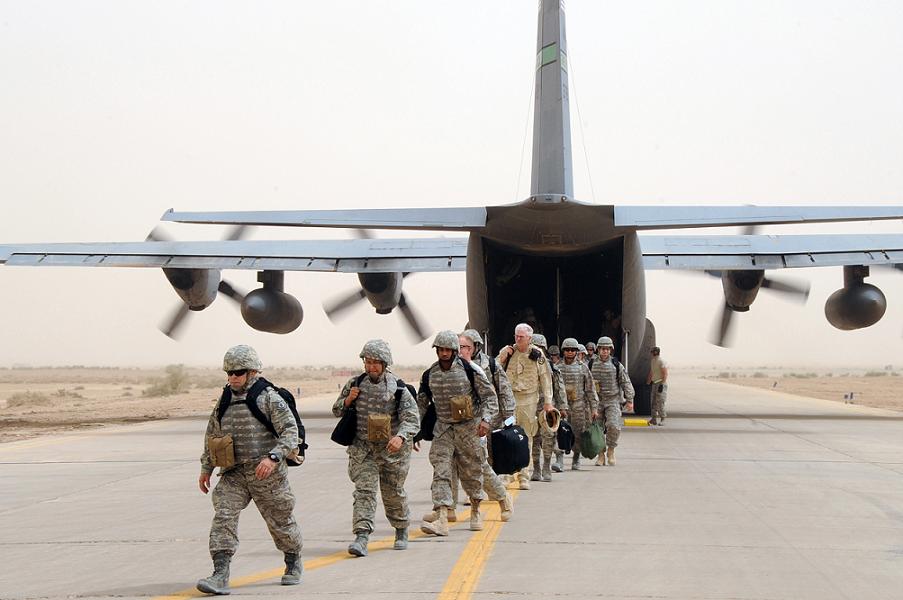
C-130 unloading its passengers

Nothing in Iraq is easy.  The get out to Waleed we had to make a two day trip from TQ, through Al Asad out to Waleed.  Our flight out was a day flight on an Air Force C-130 to Al Asad.  Our contacts in the G3-Air at 2nd MLG were good in helping me figure out the Air Force flight request which was different than the normal Marine Air Support Request.  For this mission I had to submit 2 Air Force and 3 Marine Air Support requests.    Simply submitting a request does not guarantee a flight. Flights are based on precedence dictated by the overall mission.  Religious support was pretty high on the list but there was no telling that your flight would go until you had your approval message and even then things could change.  The actual missions were not known until about midnight the night prior to the flight. So if you were a frequent flyer it meant no sleep the night before a mission as you waited to see if you were approved.  This was my first time actually having to do this for real so I sat at my secure laptop in my office in the back of the TQ plywood Cathedral waiting for the flight list to be posted on the MLG G3 Air Secure Website.  Finally about 0100 the list popped and our first flight was on in.  It was a mid day flight which meant that we needed to be at the passenger terminal about 0930.  This entailed getting our ride from the Chapel to the terminal by 0900.

I told Nelson who was checking his e-mail on a computer in the RP office that it was a go and then headed off to my can to prepare.  Since most of my gear for the 10 day trip was already packed I tried to actually get ready to sleep.  I quickly found that simply being tired because I was up late was not enough to help me go to sleep.  I was really tired but the adrenaline was coursing through my body making it impossible to sleep.  I prayed the office of Compline and then played computer Ma-Jong until at least 0300 before I could finally pass out.  I was up early to shower and get breakfast before lugging my gear over to the chapel.  The weather as usual was about 100 degrees by the time I got back from the chow hall; I gathered my gear and went to the chapel.  I took my back pack, my laptop and a flight bag. I would learn on this mission that I would need to pack lighter the next time around, but live and learn.

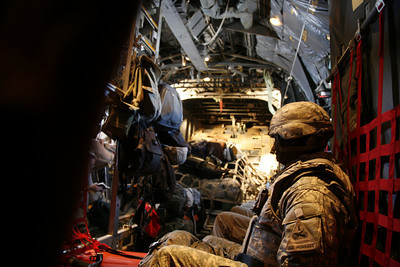
The first leg of our trip was on an Air Force C-130 from TQ to Al Asad which we shared with a large number of previously unknown friends from every branch of service in the US military as well as various civilians and contractors.  All of us had our personal protective equipment as well as our bags. The bags that we did not want to lug were placed on pallets and transported with a large fork lift to the aircraft.  When you make one of these trips you are accounted for a good number of times before ever getting on the aircraft.  This first mission was still in the heat of the Iraqi summer and thus the temperature inside and outside of the aircraft was stifling.  We staged off the tarmac in the sun for a final role call and then in two lines who guided out to our aircraft which had just landed.  As we were trudging out to the aircraft two lines of assorted passengers primarily Soldiers and Marines passed us mid way to the aircraft.  As we neared the aircraft the propeller blast blew the hot air into our faces and I thanked God for the high speed ballistic sunglasses that I had been issued by EOD.  Entering into the aircraft we had to step up onto the cargo ramp and then took our seat in the narrow canvas mesh jump seats that lined both the side of the aircraft and the center.  The rear of the aircraft including the cargo ramp was used for several pallets of cargo including the bags that we elected not to carry.  Sitting in the aircraft and waiting for the pallets to be loaded I thought back to my early career as an Army Officer where I became an air-load planner and embarked my soldiers on six C-130s during Winter REFORGER 1985.  Back then instead of the 130 degree heat of Iraq we faced the coldest winter in 40 years in Europe in which the Rhine froze over.  Although the use of computers has become routine in load plans the principles are the same as they were 25 years ago and everything on the aircraft needs to be properly balanced to ensure the stability and safety of the aircraft and that weight limits are not exceeded.  As the sweat poured off of me I took off my helmet and downed part of the one liter bottle of water that I carried onto the aircraft and threw some on my face, though warm it was refreshing and I reattached my helmet as the aircrew came through the cabin giving a final safety brief.

Interior shot of a C-130

As the last of the cargo pallets were loaded about the aircraft the cargo ramp was raised, the entire time that the aircraft was on the ground was under 15 minutes, it is amazing what the Marine and Air Force ground crews and cargo handlers can accomplish.  With the ramp raised the aircraft’s air conditioning began to take effect and though not the coolest air conditioning it was better than what we had up to that point. The aircraft began to roll and move down the taxiway and when it reached the end of the taxiway it made a fast turn and began its take off.  Since there was a real and present danger of possible missile or gun attacks on low flying aircraft the C-130 made a steep lift off and banked right over Lake Habbinyah and continued its ascent until it reached its cruise altitude.  The C-130, like any cargo aircraft is extremely loud and because of this hearing protection is worn by passengers and crew and conversation is nearly impossible.

The flight from TQ to Al Asad is only about 30 to 45 minutes depending on the route taken so most of the passengers took the opportunity to grab a bit of sleep or read.  Nelson and I sat together on the starboard side of the aircraft not far from the palletized cargo.  Nelson who can sleep almost anywhere on a moment’s notice was out quickly; and although I was tired I could do little more than close my eyes and try to clear my mind.  When we neared Al Asad the aircraft banking nearly perpendicular to the ground made a steep and fast approach.  As we landed I could see other aircraft on the ground including F-18’s, various transports and rotor wing aircraft.  The C-130 taxied to a spot on the tarmac where the ramp was dropped and we were instructed to exit the aircraft and led to the rear of the aircraft about 50 yards and then led between it and another aircraft to a group of tiny Japanese made Nissan and Mitsubishi buses in which we were loaded until every seat was full including the in aisle jump seats.  Packed into the bus like sardines and smelling almost as bad we sucked in the stench, which was somewhat like a European elevator in the 1980s.

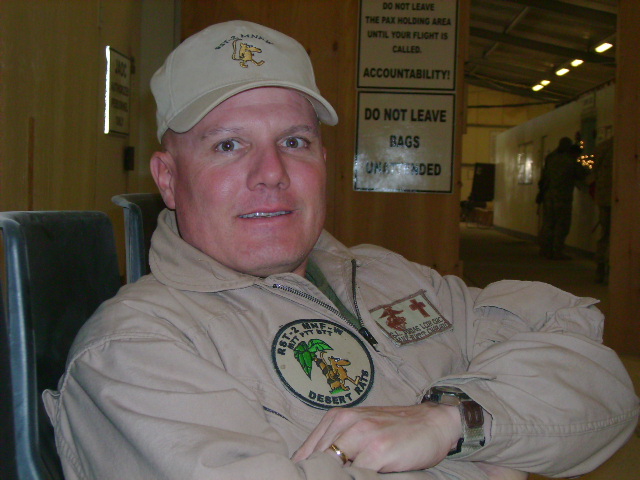
Padre Steve Chillin’ at Al Asad Terminal

After a short ride to the terminal we picked up our gear which had been delivered on the pallets by forklifts.  Another muster was taken and after all personnel were accounted for those of us waiting on follow on flights checked in at the terminal and got our temporary billeting in large tents about a hundred yards from the terminal where we each found a bunk grounded our gear and settled in for a bit to clean up before trying to go get some chow.

Next: Air Travel In Al Anbar the California Line.

Leave a comment

Filed under History, iraq,afghanistan, Military, Tour in Iraq

Background on the Pacific Part Two: Guadalcanal the Marines take the Offensive

This is the second “backgrounder” that I am posting to help my readers not acquainted with the War in the Pacific who desire to whet their whistle so to speak get an introduction to this war. While the series appears to be very well done it cannot provide the broad overview and references needed if a person really wants to know more. I believe that those who appreciate the story of the Marines portrayed in the series can help pass this on to others by learning more themselves about the subject.  I hope that this will encourage you  my readers never to forget the Marines depicted in “The Pacific.”
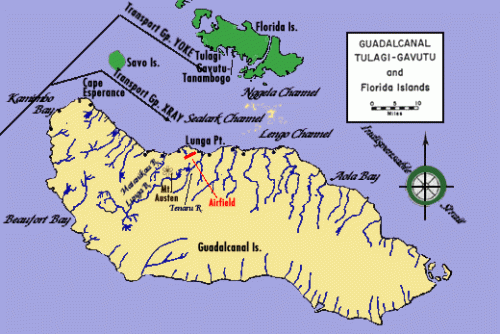

Decision

Guadalcanal came to American attention in early 1942 as a result of the Japanese South Pacific advance, which “threatened the Allied line of communications with Australia.”[1] Admiral King believed that “the Japanese must not be permitted to consolidate the formidable prizes” that they were then in the course of gathering.”[2] General MacArthur and Admiral Nimitz both wanted to “exploit the Midway victory by a speedy change-over from the defensive to the counter offensive.”[3] MacArthur wanted to strike Rabaul directly using Navy carriers. The Navy, not wanting to give up control of its carriers proposed a strategy of working up through the Solomon Islands, under Navy control.[4] The debate was at times acrimonious.  Eventually King and General Marshall worked out a compromise that divided the campaign between the Navy and MacArthur,[5] the Navy in charge of taking Guadalcanal and Tulagi.[6] OPERATION WATCHTOWER was approved in a Joint Chief’s of Staff directive on July 2nd 1942.[7]

Partners Rear Admiral Richmond K. Turner and Major General Alexander Vandegrift

The Japanese had not initially placed a high priority on the Solomons, “as they did not expect a counteroffensive in the Pacific for months.”[8] However, after Coral Sea and Midway, they authorized operation “SN” to “strengthen the outer perimeter of Japan’s advance by constructing airfields at key strategic points….”[9] The Japanese sent a contingent of troops, which arrived on June 8th[10] to build an airfield on Guadalcanal, in addition to the seaplane base on Tulagi, as part of a strategy to take the offensive in the South Pacific with an attack on Port Moresby in mid-August.[11]

Coastwatchers

Japanese commanders were impatient for the airstrip to be completed, yet work began at a leisurely pace, with the Japanese unaware that every move was being “watched and reported to Allied headquarters in Australia,” by coast-watchers.[12] As the Japanese on Guadalcanal dithered the Americans rushed their preparations for the invasion[13] nicknamed “SHOESTRING” by American officers.

The Landings and Initial Actions through the Ilu (Tenaru) River

Marines coming ashore at Guadalcanal

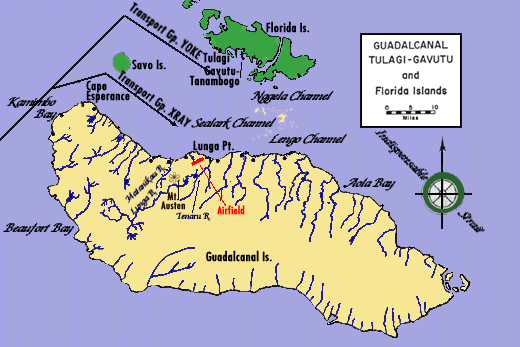
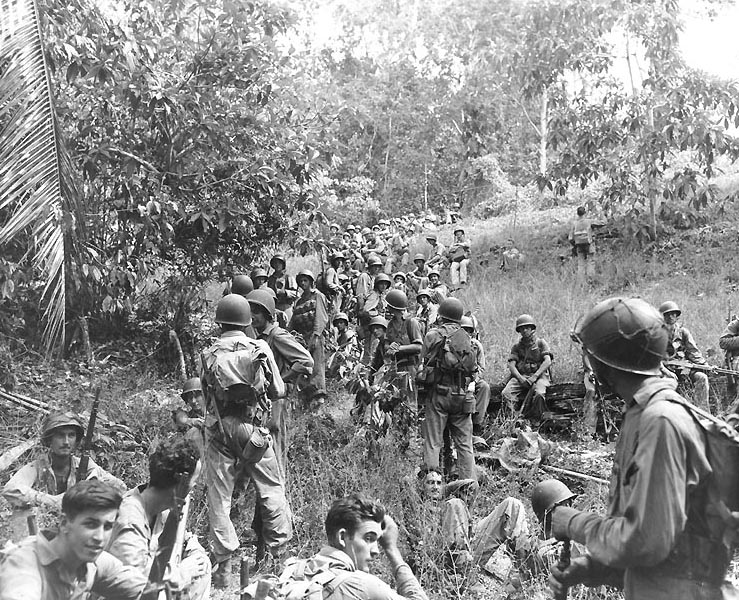
Preparations, though rushed enabled the 1st Marine Division under General Vandegrift to embark on transports for Guadalcanal, despite not being combat loaded and having been assured that they “need not expect a combat mission before 1943.”[14] The invasion force under the overall command of Admiral Fletcher and Admiral Richmond “Kelly” Turner set sail on July 25th and cloaked by heavy rain and clouds[15] remained undetected by the Japanese until they arrived in the waters off Guadalcanal, achieving complete surprise.[16] The invasion force landed on both Tulagi and Guadalcanal.  On Tulagi, 1st Raider Battalion under Colonel Edson and 2nd Battalion 5th Marines quickly drove off the 350 Japanese defenders of the 3rd Kure Special Naval Landing Force,[17] and in three days eliminated the Japanese garrison which resisted to the death, with only 23 prisoners.[18] On nearby Gavutu-Tanambogo 1st Parachute Battalion subdued the Japanese personnel operating the seaplane base, though not without difficulty, the naval bombardment was ineffective[19] and the Parachutists suffered heavy casualties[20] and forcing the commitment of the 1st and 3rd Battalions, 2nd Marines.[21] Across the sound the main force of 1st Marine Division went ashore near Lunga Point with 5 infantry battalions.  The Marines rapidly ran into difficulty, not due to the Japanese garrison, which melted into the jungle,[22] but to a lack of maps, the thick jungle and kuni grass, their own “deplorable physical condition” from being shut up in the holds of the transports for two weeks and overburdened with full packs and extra ammunition.[23]

Japanese “Betty” Bombers attacking US Transports

While the Marines advanced inland, supplies built up on the landing beaches due to the limited number of cargo handlers.  Additionally, the Japanese launched a number of heavy air raids which caused minimal damage to the destroyer Mugford on the 7th but were more successful on the 8th damaging a transport badly enough that it had to be abandoned.

Marine M3 Stuart Light Tank and Crew at Guadalcanal

The Marines on Guadalcanal, comprised of the 1st and 5th Marine Regiments consolidated a bridgehead around the captured airfield on the 8th, but the next day found that their situation had changed dramatically.  The Japanese Navy had attacked and mauled the covering force, sinking four cruisers and damaging one at the Battle of Savo Island.[24] The destruction of the covering force and Admiral Fletcher’s withdraw of the carriers forced the transports to depart on the 9th, still bearing much equipment, supplies and nearly 1800 men of the 2nd Marines.[25] Vandegrift was left with only 5 infantry and 3 artillery battalions, and the 3rd Defense battalion on the island as well as some tanks, engineers and Navy “Seabees.”[26] When the Navy left Vandegrift went over to the defensive and organized a line from the Ilu river on the east to Lunga point and the airfield to a point about 1000 yards past Kukum.[27] Defenses were prepared to defend against potential Japanese amphibious attacks.  1st Marines held the eastern perimeter and 5th Marines (-) the west. One battalion with tanks and half-tracks was reserve.  The line was thin and not continuous, thus Vandegrift could only watch and wait for the Japanese strike and move “part of his mobile reserve to meet it when it came.”[28] On the 12th a prisoner reported that Japanese near Matanikau were willing to surrender and LtCol Goettge the G-2 led a 25 man patrol to investigate.  The patrol was ambushed and decimated with only three survivors.[29] The Japanese landed the advance party of the 5th Special Naval Landing Force in broad daylight on the 16th, and Vandegrift decided to bring 2/5, and the Raider and Parachute battalions from Tulagi as soon as he had ships to do it.[30] On the 20th the airfield was opened and a squadron each of Marine Fighters and Dive Bombers landed on Guadalcanal.[31]

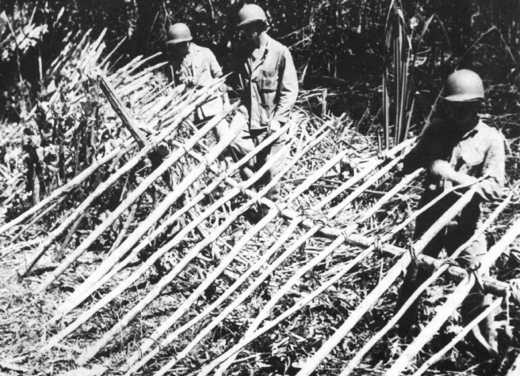
Makeshift Obstacles: With no barbed wire the Marines used the ingenuity

General Hyakutake of the 17th Army was allotted 6,000 men of the Special Naval Landing Force, and the Kawaguchi and Ichiki detachments to re-take Guadalcanal.   17th Army also had the Sendai 2nd and the 38th Divisions, tank and artillery units, but they were scattered from Manchuria, to Borneo and Guam.[32] Hyakutake was ordered to use only the Ichiki detachment, a move which some at Imperial GHQ vigorously opposed.[33] Kawaguchi, recognized Guadalcanal’s importance and told a reporter that “the island would be a focal point in the struggle for the Pacific.”[34] On the 18th Colonel Ichiki landed with half of his unit, 915 men, 25 miles east of the Marines.  Overconfident, he disobeyed orders to wait for the rest of his troops, left 125 men behind to guard his bridgehead and set off to attack.[35]
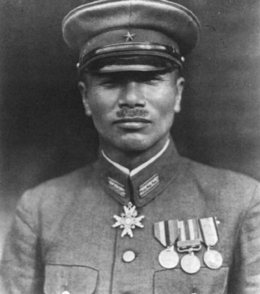
Colonel Ichiki whose elite 5th Special Naval Landing Force was annihilated at the Tenaru River

Ichiki’s force attacked shortly after 0100 on the 21st.  He thought that he had achieved surprise[36], but, opposing him was 2nd Battalion 1st Marines under LtCol. Al Pollock.  Warned by patrols that encountered the oncoming Japanese, and by Sergeant Major Vouza,[37] the Marines were on alert, well dug in, though lacking barbed wire, of which a single strand was emplaced across their front.  The Japanese ran into the barbed wire and were mowed down as they attempted to cross the sandspit against G/2/1 and a weapons platoon. About 0300 artillery joined the action, catching the Japanese bunched together near the sandspit inflicting heavy casualties.[38] Around 0500 Ichiki made another attempt, sending a company through the surf, which was engulfed in machine gun and artillery fire.[39] At daylight the Marines counter attacked. Colonel Cates ordered Lt.Col. Cresswell’s 1st Battalion 1st Marines, to envelop the Japanese along the beach.  Pollock’s Marines ranged mortars and small arms fire on Japanese survivors to their front, picking them off “like a record day at Quantico”

Dead Japanese of the Ichiki Detachment at the Tenaru

[40] Marine aircraft made their first appearance, strafing the Japanese survivors.  A light tank platoon crossed the Ilu and began to mop up the Japanese with 1/1 at 1530.  At 1630 Ichiki burned his regimental colors and committed suicide.  The Battle of the Ilu was over, the Japanese suffering at least 777 dead,[41] 15, 13 of whom were wounded were captured, only a Lt. Sakakibara and one soldier escaped to join those at the landing site.[42] The Marines suffered 35 dead and 74 wounded.[43] Ichiki made critical mistakes; he failed to reconnoiter, made a frontal attack against a dug in enemy and repeated it, with disastrous results.[44] Hyakutake informed Tokyo: “The attack of the Ichiki detachment was not entirely successful.”[45] The Americans were shocked at the Japanese fight to the death, and Griffith would note: “from this morning until the last days on Okinawa, the fought a ‘no quarter’ war. They asked none for themselves. They gave none to the Japanese.”[46]

Bloody Ridge

Artists depiction of Sgt Mitchell Paige assaulting attacking Japanese units at Bloody Ridge

A round of minor engagements was fought in late August and early September as each side sent reinforcements.  Kawaguchi’s brigade landed between August 29th and September 4th, but many troops were lost due to air attacks on the destroyers, transports and barges.  Kawaguchi received the remainder of Ichiki’s force, bringing his force to 6200 men. He refused Hyakutake’s offer of an additional infantry battalion, believing intelligence that only 2000 Marines remained on Guadalcanal.[47] In fact Vandegrift had already moved the Raiders, Parachutists from Tulagi to Guadalcanal.  Most of Kawaguchi’s force was east of the Marines; elements of 4th Regiment under Colonel Oka were on the Matanikau.[48] Vandegrift used the Raiders to attack Kawaguchi’s rear areas, capturing Tasimboko and killing 27 Japanese, destroying many of his troop’s supplies and foodstuffs.[49] Kawaguchi was infuriated by the attack and 17th Army prepared to send troops from the Sendai 2nd Division to the island.

Vandegrift and Key Marine Leaders

The Raiders and Parachutists took positions on a ridge south of Henderson field on their return from the raid against Kawaguchi’s rear.  Vandegrift placed his “Amtrackers” to the west of the ridge with 1st Pioneer Battalion.[50] Colonel deValle’s artillery was emplaced to give close support and observers attached to Edson’s battalion.  The artillery was registered on pre-plotted points.[51] Edson’s force had little time to prepared defenses and due to the ridge and jungle prevented him from having “anything like a continuous line.”[52] First Marines held the line from Edson’s left to the sea along the Ilu.  Unlike Ichiki, Kawaguchi avoided an attack on the strong 1st Marines position, and headed across the jungle to attack the airfield from the south with the 124th Infantry Regiment.  Due to the difficult approach his battalions had a hard time reaching their start positions, two of the three reached the assembly areas two and three hours after the start time.  When they did attack they lost their way, became scattered and intermingled; and Kawaguchi his battalion commanders lost all control.[53] The attack on the 12th was frustrating to Kawaguchi who later wrote “In all my life I have never felt so helpless.”[54] The attack was so ineffective that Edson thought the Japanese were “testing” him.[55]
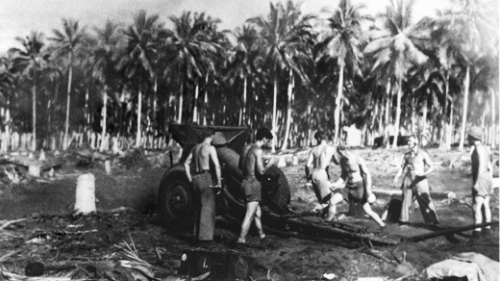
Marine Artillery on Guadalcanal

Kawaguchi regrouped as did Edson, who pulled back his line 200 yards to a stronger point on the ridge, reorganizing the line and command and control.[56] This improved fields of fire for his automatic weapons.[57] 2nd Battalion 5th Marines, the only reserve was moved south of the airfield so it could relieve Edson on the 14th.[58] As darkness fell, the Japanese attacked. I/124 attacked the ridge and the area to the west.  Marines withdrew up the ridge under heavy pressure supported by artillery, which dropped fires almost on top of the Raider positions.[59] During the withdraw the Parachutists became confused and continued to withdraw, and only stopped when Edson’s operations officer, Major Bailey stepped in and halted it.

Artists depiction of the Battle of Bloody Ridge

Artillery pounded I/124 and halted its attack even as companies of the reserve, 2nd battalion 4th Regiment attacked forcing the Raiders back to a knoll, the last defensive position before Henderson Field.[60] Edson exhorted the Marines who threw the Japanese back, and parachutists under Captain Torgerson counterattacked. Two more attacks were repulsed with assistance from 2/5 which had moved up in support.[61] The third Japanese battalion did not get into action[62] and Colonel Oka in the west made a weak attack that was handily defeated. The Japanese lost over 1200 men in their attack on the ridge.[63] The demoralized Japanese retreated west to join Oka’s men, taking a week and costing even more casualties.[64] Short on food, Oka pushed the survivors west and so he could defend the river line.[65]On the 18th Vandegrift was reinforced with 4700 men of the 7th Marines along with trucks, heavy equipment and supplies.[66] Edson was promoted to command 5th Marines.[67]

Matanikau Battles and the Fight for Henderson Field

Marine F4F Wildcat on Henderson Field

The Japanese now decided to send the Sendai and 38th divisions and heavy artillery to the island. Hyakutake went to the island to direct the campaign. The decision resulted in the suspension of 17th Army’s offensive against Port Moresby.[68] Admiral Yamamoto committed the fleet to cover the operations[69] setting up a major air, land and sea confrontation with the Americans.  However before these forces could reach the island Vandegrift launched a series of attacks against Oka’s force on the Matanikau using the Raiders, and elements of 5th and 7th Marines.[70] The first attacks took place 24-27 September.  The Matanikau position was important to future Japanese operations as their artillerymen stressed that they could not effectively shell the airfield unless guns were emplaced across the river.[71] The Raiders attacked at the log bridge[72] supported by C/1/7 and were repulsed by Oka’s 12th Company with heavy casualties.[73] Puller’s attack by 2/5 and parts of 1/7 at the mouth of the river was rebuffed by 9th Company.  An amphibious assault by three companies of 1/7 was ordered by Edson who mistakenly believed that his Marines had crossed the river.[74] The force isolated by Oka’s II/124 and 12th Company, its commander killed and the Marines had to be rescued by Navy units.[75]
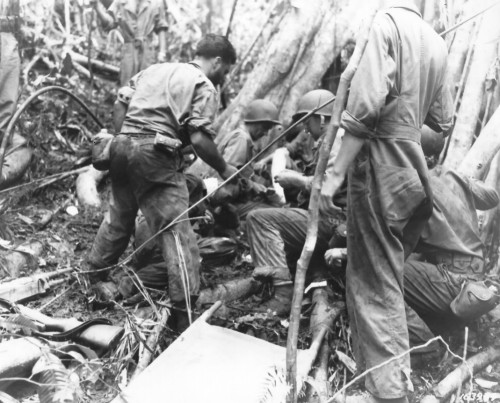
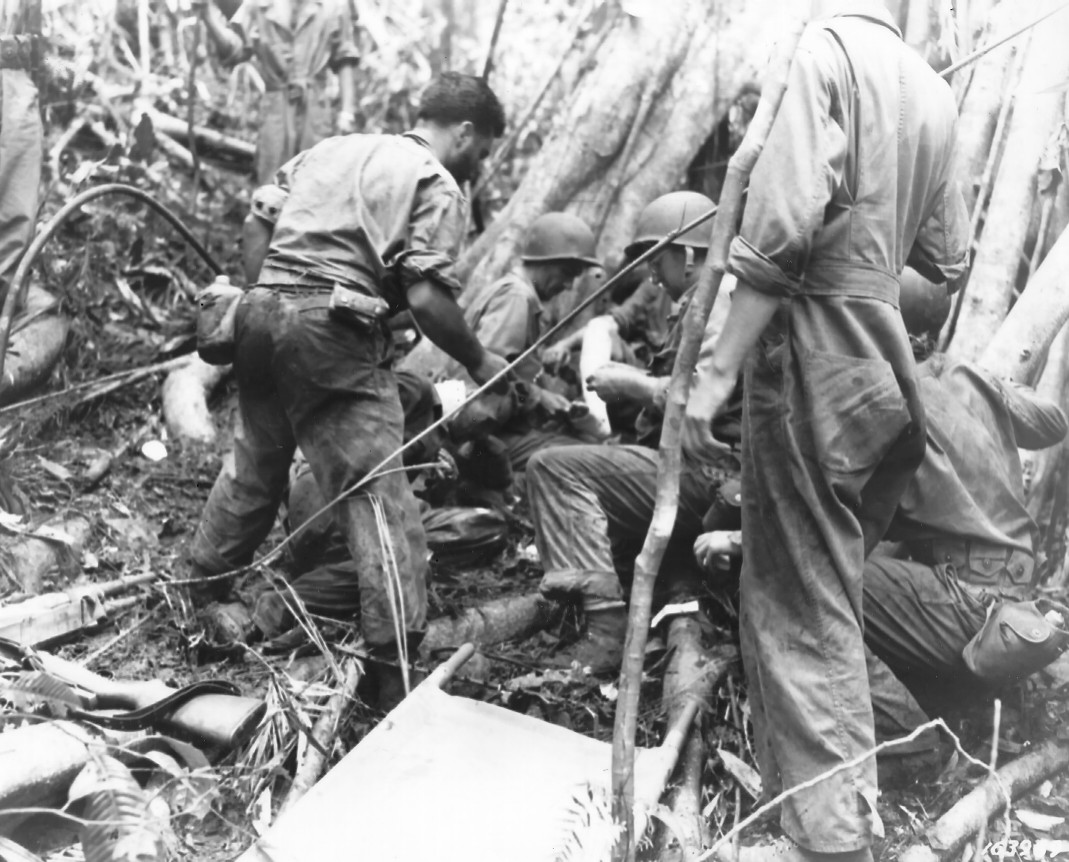
Navy Corpsmen preparing to evacuate a wounded Marines (above) and the 1st Marine Divsion Field  Hospital

A second attack by the Marines on the Japanese, now reinforced by 4th Infantry Regiment on 6-9 October dealt them a crushing blow.  An attack by 2/5 and 3/5 along the coast met heavy Japanese resistance and General Nasu decided to push across the river. While this was taking place, 7th Marines and the Whaling Group[76] outflanked the Japanese on the river and pushed to the coast.  The Marines mauled the 4th Infantry, a Japanese report noting at least 690 casualties.[77] The action had decisive impacts on the next phase of Japanese operations.

General Hyakutake Commander of the Japanese 17th Army defending Guadalcanal

7th Marines and the 164th Regiment of the Americal Division arrived allowing Vandegrift to mount a full perimeter defense while Admiral Halsey replaced Ghormley as COMSOPAC.[78] Arriving on 10 October with the Sendai Division and 17th Army Artillery, Hyakutake, was notified that “American artillery had ‘massacred” the Fourth Infantry Regiment”[79] and found Ichiki and Kawaguchi’s units in an emaciated condition, the total effectives of the 6 battalions numbering less than a full strength battalion.[80] He radioed Rabaul “SITUATION ON GUADALCANAL IS MUCH MORE SERIOUS THAN ESTIMATED, and asked for more reinforcements and supplies at once.”[81] The Navy turned back a Japanese bombardment group on the 12th, but battleships and cruisers blasted Henderson Field on the 13th, 14th and 15th, destroying many aircraft.[82]

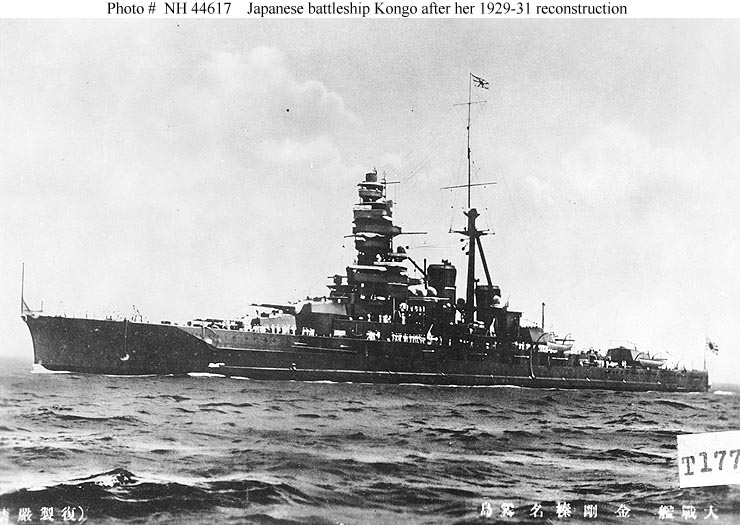
The 14″ guns of the Japanese Battleship Kongo and her sister Haruna pounded Henderson Field

Hyakutake received reinforcements including tanks and an infantry-artillery group and prepared to attack.  General Sumiyoshi[83] was to make a diversionary attack along the coast with Army artillery and 5 infantry battalions.  The Sendai Division under General Maruyama[84] with 9 infantry battalions moved inland along a route “the Maruyama road,”[85] to make the main effort to attack the airfield from the south.  Sumiyoshi divided his artillery to support the bombardment of Henderson Field and support his infantry attacks, but was short ammunition.[86] The Marines had fortified the eastern side of the Matanikau and Sumiyoshi probed the Marines with infantry and tanks and artillery fire on the 20th and 21st, giving the Marines their first taste of concentrated artillery.[87] Sumiyoshi’s demonstration on the coast was effective, and Maruyama’s division remained undetected throughout its advance avoiding Marine and native patrols.[88]

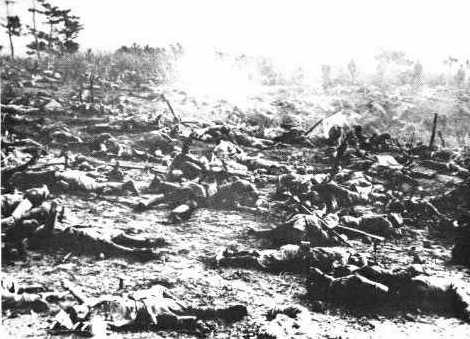
Japanese dead after the failed attack on Henderson Field

The attack began on the 23rd with Sumiyoshi attacking on the Matanikau; but he did not get the word that the attack for that night had been postponed until the 24th since Kawaguchi’s units had not gotten to assembly areas on the right of Sendai division.[89] His tanks advanced at 1800 and all but one were destroyed by deValle’s artillery as soon as they moved across the sandspit. The supporting infantry withdrew, and most never went forward as they were hit hard in assembly areas by Marine artillery losing over 600 men.[90] The action succeeded in the Marines shifting 2/7 and 3/7 north leaving Puller’s 1/7 alone on “Bloody Ridge.”[91] Fortunately for the Marines these Japanese forces were detected by Scout-Sniper’s[92] and Puller dug in his battalion deeper and set out a platoon in an outpost 1500 meters south of his position.[93]

Chesty Puller

On the 24th Maruyama’s Sendai troops attacked the ridge.  He divided his force into two wings each of three infantry battalions commanded by General Nasu on the left and Colonel Shoji[94] on the right, three battalions served as a reserve. He advanced at 1900 but a storm turned the jungle into a vast mud bog exhausting the Japanese.  Shoji’s wing advanced tangential to the Marine line and only one battalion made contact with Puller’s battalion.[95] Nasu’s troops hit Puller’s who realized that he was facing a major attack; he fed platoons from 3rd Battalion 164th Infantry, a National Guard unit into his lines and requested reinforcements.[96] The Marines and Guardsmen beat back all but one attack, that of LtCol. Furimiya of III/29 who got into the Marine perimeter and held out 48 hours, colors flying, leading Hyakutake to believe that they had captured the airfield.[97] The Japanese were driven off 9th Company of the 29th Regiment was wiped out primarily by the efforts of Sgt. John Basilone’s machine gun section.[98]

Wrecked Aircraft on Henderson Field

The next day was known as “Dugout Sunday”[99] and that night the Japanese renewed the attack.   This was better coordinated, but the Marines, reinforced by 3/164 and 3/2, and backed by artillery, devastated the Sendai division.  Nasu and the commander of 16th Infantry were killed with at least 2000 of their soldiers.[100] Colonel Oka attacked 2/7 and was driven off with heavy casualties. Marine Sgt. Mitchell Paige won the Medal of Honor for single handedly manning his platoon’s machine guns after his troops became casualties, going gun to gun.[101] The attacks were crushed leaving more than 3000 dead or dying Japanese on the battlefield.[102]

On the Offensive

Marines pause during advance

As the Japanese struggled out of jungle to the coast the Marines began preparations to attack as each side brought in reinforcements, the Americans receiving the 8th Marine Regiment and 2nd Raider Battalion of 2nd Marine Division, as well as the 2nd Marines who had been on Tulagi and more of the Americal Division.[103] On November 1st and  5th Marines attacked across the Matanikau and by the 4th had eliminated a Japanese pocket on Point Cruz.[104] To the east 1/7 and 2/7 along with 2/164 and 3/164 attacked Col. Shoji’s force and fresh troops sent to relieve him near Koli Point. The battle lasted until the 9th when Shoji broke through the American cordon with 3000 men pursued by 2nd Raider Battalion. Shoji eventually made it back to 17th Army with 700-800 soldiers, most unfit for combat after battling the Raiders and the jungle.[105] The Japanese attempted to reinforce the island during the Naval Battle of Guadalcanal from 13-15 November.  Out of 11,000 troops of 38th Division on 11 transports only 2000 got ashore after 7 of the 11 were sunk enroute by Henderson Field aircraft and the surviving ships beached.[106]

The Americans received the rest of 2nd Marine and Americal Divisions and parts of 25th Division and Vandegrift decided to attack, his command now being a de-facto Corps.[107] Though they still numbered 30,000 the Japanese were incapable of offensive operations but still full of fight.[108]On 18 November the 8th Marines and the Army and elements of the 164th and 182nd regiments attacked on the Matanikau. They met heavy resistance from Col. Sakai’s 16th Infantry and in a 6 day battle and lost 134 dead with minimal gains.[109] The new arrivals allowed 1st Marine Division to be withdrawn[110] as it was no longer combat effective.[111] On 9 December Vandegrift[112] turned over command to General Alexander Patch of the Americal Division.

Advancing across a improvised pontoon bridge

Patch used early December to conduct aggressive patrolling[113] and decided to clear the Japanese from Mt Austen, which they had nicknamed “Gifu” and in a 22 day battle the 132nd Infantry eliminated the 38th Infantry Group.[114] With the 25th, Americal and 2nd Marine Division Patch now headed XIV Army Corps.[115] Although the Americans were unaware the Japanese had decided to withdraw from Guadalcanal on 31 December, after a heated debate.[116]

Major General Vandegrift, Colonel Edson, 2nd Lt Mitchell Paige and Sgt John Basilone all awardees of the Medal of Honor

The final offensive began on 10 January.  Patch hoped to clear out the Japanese by April.[117] The 2nd Marine Division attacked along the coast while General Lawton Collins led his 25th Division in a flanking movement heavily supported by artillery and air. 6th Marine Regiment relieved 2nd Marines flanking the Japanese enveloped the majority of the 4th and 16th Regiments.[118] The Japanese began withdrawing on the 17th moving west shielded by the Yano battalion.[119] Collins troops finally reduced and eliminated the Japanese on the Gifu by the 23rd.[120] “The annihilation of Japanese detachments from regimental size down” characterized operations over the final phase of the command.[121] A characteristic of American operations now included the use of heavy massed artillery including time on target or “TOT” missions.[122] On the 22nd the Japanese began to extricate their troops via the Tokyo Express at Cape Esperance.[123] On 1 February Patch landed 2/132 at Verahue on the southwest tip of the island and the 25th and Americal Divisions continued their push to the west against the rearguards of 17th Army.  On the 8th of February the last survivors were withdrawn[124] in a move described by the Chief of Staff 17th Army as a “minor miracle.”[125] The Japanese were shocked that the Americans “press them hard” and turn the withdraw “into a bloody rout.”[126] Still expecting a fight Patch’s troops found nothing on Cape Esperance but abandoned boats and supplies.[127]

Japanese Prisoners

The Guadalcanal campaign had ended with the loss of nearly 30,000 Japanese. Japan lost the psychological advantage it had possessed from the beginning of the war.[128] It was an action that was an offensive won with defensive actions. The Americans seized a strategic point that the Japanese could not afford to lose and then fought a defensive battle of attrition to grind the Japanese down.  The American Marines and Soldiers showed themselves to be the equals of the Japanese in one of the most demanding campaigns of the war. Kawaguchi would comment to a reporter in Manila; “We lost the battle. And Japan lost the war.”[129]

Appendix: Leaders On Guadalcanal

Major General Alexander A. Vandegrift: (1887-1973) Commander of 1st Marine Division on Guadalcanal.  He served in the Corps 40 years and retired in 1949 as Commandant of the Marine Corps.  After Guadalcanal he commanded 1st Marine Amphibious Corps at Empress Augusta Bay.  He was a key player in the congressional debates regarding the Marine Corps in 1946 when President Truman supported by the Army pushed to eliminate the Marine Corps as a ground combat force.  He was awarded the Medal of Honor for his service at Guadalcanal.  USS Vandegrift FFG-48 was named after him.  That ship made the first visit of a US warship to Vietnam since the Vietnam War in 2003.

Major General Alexander Patch: (1889-1945) Commander of XIV Army Corps at Guadalcanal.  He assumed command of forces on island from Vandegrift on 9 December 1942.  General Marshall ordered him to Europe in 1943 to take command of 7th Army from General Patton.  He commanded 7th Army in the south France and the Rhone campaign of 1944, leading that army across the Rhine in 1945.  He was to take command of 4th Army in the United States but died of Pneumonia.  He was considered a very good commander in both the Pacific and Europe.  Patch Barracks in Stuttgart Germany is named after him.

Major General Lawton Collins: (1896-1987) “Lightning Joe” Collins commanded 25th Infantry Division (Tropical Lightening) at Guadalcanal.  He commanded VII Corps and distinguished himself in France and was instrumental in Operation COBRA and the breakout from Normandy.  He was considered by many to be one of the outstanding Corps commanders in the Second World War. During Korea he was Army Chief of Staff and later served with NATO and as a special representative to Vietnam.

Lieutenant Colonel Lewis B. “Chesty” Puller: (1898-1971) “Chesty Puller commanded 1st Battalion 7th Marines at Guadalcanal and was instrumental in the fight for Henderson Field against the Sendai Division.   His early career was marked by much time in Haiti and Nicaragua where he was awarded his first and second Navy Crosses. He served with the “China Marines” (the 4th Marines) He was wounded on Guadalcanal and later served as Executive Officer 1st Marine Regiment and commanded that Regiment at Peleliu.  In Korea he again commanded 1st Marines at the epic Battle of the Chosin Reservoir. He was promoted to Brigadier General and served as Assistant Division Commander for that Division.  He was promoted to Major General and Lieutenant General prior to his retirement in 1955.  He is considered one of the most iconic and beloved Marines who have ever lived earning 5 Navy Crosses and numerous other awards for valor in combat include the Bronze and Silver Stars and Distinguished Service Medal and the Purple Heart.  The USS Puller (FFG-23) a Perry Class Frigate was named after him.  His uniforms and many of his medals and citations were displayed at the former Marine Corps Barracks, Naval Weapons Station Yorktown until 2006 when they were transferred to the custody of the Marine Corps Museum following the death of his wife Virginia who insisted that they be displayed in Yorktown.

General Harukichi Hyakutake: (1888-1947) Commanded 17th Army on New Guinea and Guadalcanal.  He was an infantry officer who studied crypto analysis and served with the Kwantung Army in Manchuria before the war and following Guadalcanal he remained in command of Japanese Troops in the Solomons.  He returned to Japan at the end of the war and died in 1947.

Major General Kiyotake Kawaguchi: (1892-1961) Commanded 35th Infantry Brigade on Guadalcanal and was senior officer until the arrival of General Hyakutake and the Sendai Division.  Led the unsuccessful battle at “Bloody Ridge” and was relieved of his command just prior to the October attack on Henderson Field.  Was one of the few Japanese officers who expressed an early understanding of the importance of Guadalcanal to the overall war effort.  Following his evacuation from Guadalcanal and return to Japan he was transferred to the reserve. Convicted of war crimes in 1946 for actions committed in the Philippines in 1941-42  he was released in 1953 and died in 1961.

Notes


[1] Spector, Ronald H. Eagle Against the Sun: The American War With Japan, The Free Press, New York, NY p.185

[2] Morison, Samuel Elliott, The Two Ocean War: A Short History of the United States Navy in the Second World War, Little, Brown and Company, Boston and Toronto, 1963. p.164

[3] Liddle-Hart, B.H. History of the Second World War G.P. Putnam’s Son’s. New York, NY 1970. 356

[4] Ibid. Spector. p.185

[5] Ibid. Spector comments that “MacArthur declared that the navy’s obstinacy was part of a long time plot to bring about ‘the complete absorption of the national defense function to the Navy, the Army being regulated to merely base, training, garrisoning, and supply purposes.’” (p.185)

[6] Toland, John. The Rising Sun: The Decline and Fall of the Japanese Empire 1936-1945, Random House Publishers, New York, 1970. p.346

[7] Ibid. Morison. p.165

[8] Ibid. p.350

[9] Frank, Richard B. Guadalcanal: The Definitive Account of the Landmark Battle, Penguin Books, New York, NY 1990. p.30

[10] Ibid. p.31

[11] Ibid. Morison. p.166

[12] Griffith, Samuel B II. The Battle for Guadalcanal originally published by Lippincott, New York, 1963, University of Illinois Press, Champaign IL, 2000. p.19

[13] Costello, John. The Pacific War 1941-1945, Quill Publishers, New York, NY. 1981. p.320.

[14] Ibid. Spector. p.186

[15] Ibid. Frank. p.60

[16] Ibid. Spector. p.191

[17] Ibid. Frank. p.72

[18] Ibid. Costello. p.323

[19] Ibid. Griffith. p.49

[20] Ibid. Frank. p.72. 1st Raider Battalion took 22% casualties and 1st Parachute Battalion 50-60%.

[21] Ibid. Frank. p.74.  Frank notes that of the 536 Japanese defenders that only about 50, a platoon from the 3rd Kure Naval Landing force were trained for ground combat.

[22] Ibid.

[23] Ibid. Griffith. p.45

[24] Savo Island was the worst defeat suffered by the US Navy.  In a short engagement the heavy cruisers Astoria, Quincy and Vincennes and the RAN Canberra were sunk and the Chicago badly damaged, leaving the covering force but one heavy cruiser and some AA Cruisers and Destroyers to cover the transports. Over 1000 sailors lost their lives.

[25] Ibid. Frank. p.125

[26] Costello notes the presence of the Seabees, but neither Franks nor Griffith mentions them by name.  The discrepancy appears to be the date of their arrival on the island. Morrison notes that 387 men of the 6th Seabee Battalion landed on September 1st with 2 bulldozers and other equipment and that they then took over the improvement of Henderson Field. Morison, Samuel Elliott. The Struggle for Guadalcanal: August 1942-February 1943, Volume V of History of United States Naval Operations in World War II, Copyright 1949, Samuel Elliott Morison, Castel, Books New York, NY 2001, published in arrangement with Little Brown and Company. p.76

[27] Ibid. Griffith.  p.68

[28] McMillan, George. The Old Breed: A History of the First Marine Division in WWII, The Infantry Journal Incorporated, Washington DC. 1949. p.50

[29] Ibid. Frank. p130, Griffith. p.70. McMillan pp.52-56.  This incident is still shrouded in mystery as no Japanese records survive to record the outcome of the incident. According to McMillan, when Goettge went out he believed he was also on a humanitarian mission and took the assistant division surgeon and a language officer.  The Goettge Field House at Camp LeJeune NC is named in his honor.

[30] Ibid. Griffith. p.74

[31] Ibid. McMillan. pp.56-57

[32] Ibid.. p.59

[33] Ibid. Griffith. pp.79-80 some believed the commitment of small numbers inadequate to the task would repeat the defeats suffered at the hands of the Russians and in China.  Ichiki himself was given poor intelligence stating that there were only about 2000 Americans on the Island and that they suffered from low morale and were trying to flee Guadalcanal to Tulagi. (p.81)

[34] Ibid. Toland. p.364

[35] Ibid. p.365

[36] Ibid. p.366

[37] Ibid. McMillan. p.61. Vouza, a native constable had actually been captured and interrogated by the Japanese, who bayoneted him and left him for dead.

[38] Ibid. pp.61-62

[39] Ibid. Griffith. p.84

[40] Ibid. p.86

[41] Ibid. Frank. p.156. Richard Tregaskis in Guadalcanal Diary reports that he heard there were 871 Japanese dead in the battle area.   Tregaskis, Richard, Guadalcanal Diary, Originally published by Random House, 1943. Modern Library Paperback edition, Random House Publishers, NY 2000, with an introduction by Mark Bowden.  p.130

[42] Ibid. Toland. p.367  Griffith reports that a Captain Tamioka survived. (p.87)

[43] Various accounts give slightly different figures for the Marine casualties. This number is taken from McMillan.

[44] Ibid. Griffith. pp.87-88.  Griffith comments: “there was something more fundamental involved here than action taken on the basis of poor information, a reckless and stupid colonel, dedicated soldiers, and a disparity in weapons. This was ‘face.’ Once committed to the sword, Ichiki must conquer or die. This was the code of the Samurai, ‘The Way of the Warrior’: Bushido. (p.88)

[45] Ibid. McMillan. p.64

[46] Ibid. Griffith. p.88

[47] Ibid. Frank. p.218. Toland reports that he received intelligence that 5000 Marines were on the island but he believed that he could be victorious. (p.378)

[48] Ibid. Toland. p.376. Oka’s force was particularly hard hit by the air attacks during transit, losing 650 out of 1000 men, and his survivors had little food and ammunition and were not in good condition to attack.

[49] Ibid. Frank. pp.221-222. They also brought back documents, Kawaguchi’s dress uniforms and beer.

[50] Vandegrift rusted in the understanding that every Marine is a rifleman.

[51] Ibid. Griffith. p.115

[52] Ibid. Frank. p.229

[53] Ibid. p.231

[54] Ibid. p.232

[55] Ibid. Griffith. p.117

[56] Ibid. Frank. p.235 He still lacked the manpower to form a continuous line.

[57] Ibid. Griffith. p.117

[58] Ibid. Frank. p.235

[59] Ibid. Griffith. p.119

[60] Ibid. Frank. p.239

[61] Ibid. p.240

[62] This was III/124 under Colonel Wanatabe, suffering from old war wounds he failed to get his unit into the fight and Kawaguchi told him to commit Hari-Kari. (Griffith .121)

[63] Ibid. Griffith. p.121. The Marines lost 263 men of which 49 were killed and 10 missing. The Parachute battalion which began the campaign with 397 men had only 86 ambulatory after “Bloody Ridge” and were withdrawn. (Frank. p.241)

[64] Ibid. Costello. p.346  Frank also notes that another of Kawaguchi’s battalions, the Kuma battalion and his artillery fared even worse while trying to move to the west, becoming lost in the jungle for three weeks, losing all their weapons and becoming severely malnourished. (Frank. p.246)

[65] Ibid. Griffith. p.125

[66] Ibid. Toland. p.385 The Japanese began to call the island Starvation Island.

[67] Edson and Bailey both were awarded the Congressional Medal of Honor for their actions on the ridge. (McMillan p.81)

[68] Ibid. Griffith. pp.126-127

[69] Ibid. Spector. p.199 and Costello. p.348

[70] Ibid. Frank. p.269.

[71] Ibid.

[72] Ibid. Griffith. p.135. Griffith refers to this as the “Jap bridge.” I use Frank’s the name given by Frank.

[73] Ibid. Frank. p.272

[74] Ibid. Toland.p.390

[75] Ibid. Frank p.273-274.  Frank analyzes: “In a retrospective assessment, the Marines found that the operation had an improvised purposeless flavor. It had been initiated without meaningful intelligence on the enemy situation or the terrain, and the attack was characterized by the commitment of battalions along unreconnoitered axes, beyond mutual support range, and without coordination of movements or of air and artillery support.” (p.274)Griffith comments: “Here Edson, as always supremely confident, had dispersed his force haphazardly to assault an enemy well armed, well concealed, and at each pointing superior strength. Second Matanikau hammered home to Vandegrift that a commander who allows himself or a subordinate, to drift aimlessly into any action will pay the price. (Griffith p.137)

[76] Ibid. Griffith. p.283. The Whaling Group consisted of 3rd Bn 6th Marines and the Scout Sniper detachment.

[77] Ibid. 289.  The Division history of 1st Marine Division reported over 900 Japanese killed. (McMillan p.96)

[78] Ibid. McMillan. p.99

[79] Ibid. Griffith. p.148

[80] Ibid. p.338

[81] Ibid. Toland. p.392

[82] Ibid. Griffith. p.157. By the 15th the Marines only had 27 aircraft left, but by the evening a Navy fighter squadron had reinforced them.

[83] Artillery commander 17th Army.

[84] Ibid. Toland. p.393. Maruyama noted before the division departed from Japan that Guadalcanal was the “Decisive battle between Japan and the United States, a battle in which the fate of the Japanese Empire will be decided.”

[85] Ibid.p.340 Toland notes how this “road” had been hacked out of the jungle in the proceeding month. (Toland. p.393)

[86] Ibid. p.342.  The 15 150mm guns targeted the airfield and the remaining 17, 75mm and 100mm guns and howitzers targeted the infantry.

[87] Ibid. Griffith. p.165-166

[88] Ibid. Frank. p.348

[89] Ibid. Griffith. pp.166-167. Sumiyoshi was not at fault as he had fallen into a coma brought on by Malaria.  Kawaguchi was relieved by Hyatutake for this failure.

[90] Ibid. p.167

[91] Ibid. McMillan. p.105

[92] Ibid. Toland. p.401. Frank notes that even this discovery did not alert the Marine command to the Japanese presence south of the ridge and he credit’s Puller’s lack of complacency.

[93] Ibid. Frank. p.352

[94] Ibid. Frank. Shoji had relieved Kawaguchi.

[95] Ibid. Frank. pp.352-353

[96] Ibid.. p.355-356

[97] Ibid. p.356.  Furimiya would eventually commit suicide when he had lost the rest of his troops.  His diary, found by the Americans made a note that “we must not overlook firepower.” (p.366)  Griffith notes the officer as Ishimiya and notes that only 9 men were with him. (p.169)

[98] Ibid. p.356. Basilone won the Congressional Medal of Honor.

[99] The day was marked by a fierce air-sea battle between American aircraft and a Japanese naval task force sent to shell Henderson Field and supporting fighters.  A number of Japanese ships were damaged and the light cruiser Yura sunk. See Morison. History of Naval Operations in WWII vol V. pp.197-198

[100] Ibid. Frank. pp.364-365

[101] Ibid. pp.363-364.  I met Paige in 2000 at Camp LeJeune.  This icon of the Corps remained an outspoken Marine until the day that he died.

[102] Ibid. Toland. p.404

[103] Ibid. Liddle-Hart. p.361

[104] Ibid. Griffith. p.184

[105] Ibid. Frank. pp.421-424.

[106] Ibid. Morison. History of Naval Operations. p.182. Frank backs this number and Liddle-Hart gives 4000.

[107] Ibid. McMillan. p.135

[108] Ibid. Griffith. p.212-213

[109] Ibid. Frank. pp.495-497.

[110] The 1st Marine Division lost 621 KIA, 1,517 WIA and 5601 Malaria cases. Its Marines earned 5 Congressional Medals of Honor, 113 Navy Crosses and 4 Distinguished Service Medals. (McMillan pp.138-139)

[111] Ibid. Griffith. p.216

[112] Vandegrift would become Commandant of the Marine Corps in 1944.

[113] Johnston, Richard W. Follow Me! The Story of the Second Marine Division in World War II, Copyright 1948 by the 2nd Marine Division Historical Board and published by Random House, New York, NY. 1948.  p.69

[114] Ibid. Frank. pp.528-534.

[115] Ibid. Johnston. p.72

[116] Ibid. Toland. pp. 421-426.  Generals Sato and Tanaka engaged in a fist-fight ended by Tojo and the Emperor himself probed the High Command about the defeat and personal approved the Japanese withdraw.

[117] Ibid. Spector. p.213

[118] Ibid. Frank. p.557

[119] Ibid. p.560

[120] Ibid. p.566

[121] Ibid. p.567

[122] Bergerud, Eric. Touched With Fire: The Land War in the South Pacific,  Penguin Books, New York, NY 1996. p.192

[123] Ibid. p.570

[124] Ibid. p.595 Depending on the source the Japanese withdrew anywhere from 10,000 to 13,000 troops from the island.

[125] Ibid. Griffith. p.244

[126] Ibid.

[127] Ibid. Morison. History of Naval Operations, p.371.

[128] Murray, Williamson and Millett, Allan R. For the Common Defense: Fighting the Second World War, The Belknap Press or Harvard University Press, Cambridge, MA 2000. p.215

[129] Ibid. Toland. p.431

Bibliography

Bergerud, Eric. Touched With Fire: The Land War in the South Pacific,  Penguin Books, New York, NY 1996

Costello, John. The Pacific War 1941-1945, Quill Publishers, New York, NY. 1981

Frank, Richard B. Guadalcanal: The Definitive Account of the Landmark Battle, Penguin Books, New York, NY 1990

Griffith, Samuel B II. The Battle for Guadalcanal originally published by Lippincott, New York, 1963, University of Illinois Press, Champaign IL, 2000

Johnston, Richard W. Follow Me! The Story of the Second Marine Division in World War II, Copyright 1948 by the 2nd Marine Division Historical Board and published by Random House, New York, NY. 1948

Liddle-Hart, B.H. History of the Second World War G.P. Putnam’s Son’s. New York, NY 1970

McMillan, George. The Old Breed: A History of the First Marine Division in WWII, The Infantry Journal Incorporated, Washington DC. 1949

Morison, Samuel Elliott, The Two Ocean War: A Short History of the United States Navy in the Second World War, Little, Brown and Company, Boston and Toronto, 1963

Murray, Williamson and Millett, Allan R. For the Common Defense: Fighting the Second World War, The Belknap Press or Harvard University Press, Cambridge, MA 2000

Spector, Ronald H. Eagle Against the Sun: The American War With Japan, The Free Press, New York, NY

Toland, John. The Rising Sun: The Decline and Fall of the Japanese Empire 1936-1945, Random House Publishers, New York, 1970

Tregaskis, Richard, Guadalcanal Diary, Originally published by Random House, 1943. Modern Library Paperback edition, Random House Publishers, NY 2000, with an introduction by Mark Bowden

1 Comment

Filed under History, Military, world war two in the pacific

The Beginning of the Nuclear Surface Navy: USS Enterprise CVAN-65, USS Long Beach CG-9, USS Bainbridge DLGN/CGN-25 and USS Truxton DLGN/CG-35

Iconic Photo of USS Enterprise CVAN-65,USS Long Beach CG-9 and USS Bainbridge DLGN-25 during Operation Sea Orbit 1964

Note: This is the first of four articles on the US Navy’s Nuclear Surface Force. Future articles will deal with Task Force One and Operation Sea Orbit, the Nuclear Cruisers and the Nuclear Carriers.

In the 1950s the US Navy recognized the Nuclear power could play a key role in the future Navy.  The operational flexibility of Nuclear powered ships which would not be dependent on underway replenishment provided by tankers or port calls to conduct high speed operations over vast expansions of the world’s oceans.  Orders were placed in the mid-1950s for an attack aircraft carrier, the USS Enterprise CVAN-65, cruiser the USS Long Beach CLGN-160 and later CGN-9 and the USS Bainbridge DLGN, later CLG-25.  These ships would become the prototypes of a Navy which early advocates of nuclear propulsion hoped would become the future of the surface Navy.  This would become the case in regard to Aircraft Carriers but not in regard to cruisers pr smaller surface ships.  While seven more Nuclear Cruisers would be built none would be retained after the post Cold War reduction in force with all of the ships decommissioned, their nuclear plants recycled and hulks scrapped.  However they represented the pinnacle of surface ship design in their time and had the budgetary constraints of the post Cold War world taken place the likelihood is that at least six nuclear cruisers would still be in commission possibly upgraded with the Aegis Air Defense system making them the most versatile of surface ships.

Enterprise in 1978

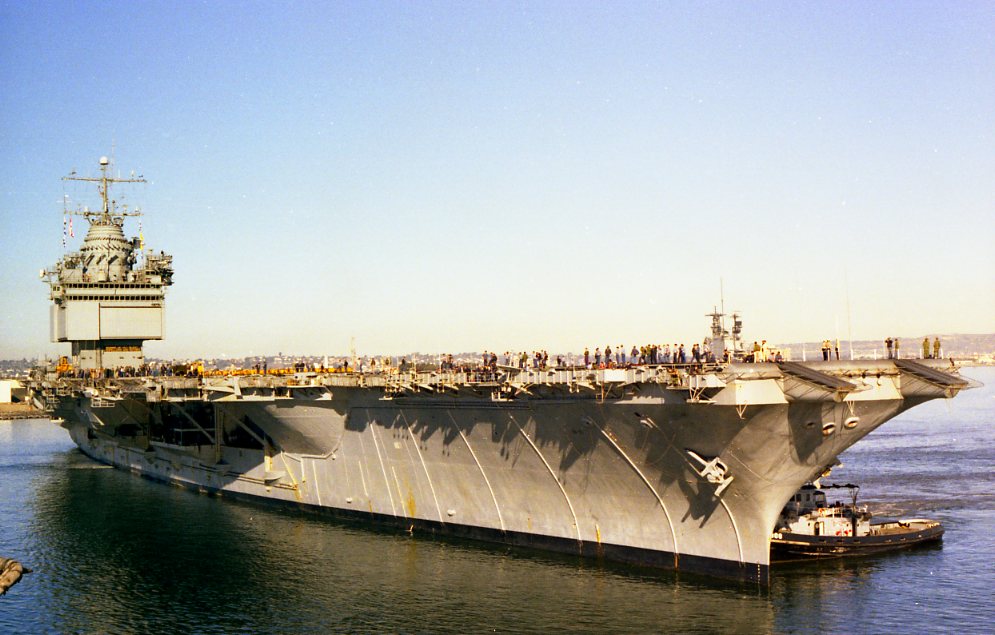
The first Aircraft Carrier designed and built as a nuclear ship was the USS Enterprise.  Named after the heroic USS Enterprise CV-6, she dwarfed even the Super-carriers of the Forrestal class which preceded her and the Kittyhawk class which followed her.  Laid down February 4th 1958 and launched September 24th 1960 the “Big “E”” was commissioned on November 25th 1961.  At 1,101 feet overall and displacing over 85,000 tons full load she was the largest carrier built until the Nimitz class.  Her power plan was both experimental and revolutionary.  Equipped with 8 Westinghouse A2W nuclear reactors generating 2800,000 SHP powering geared turbines the Enterprise was capable of 35+ knots.  With a air group of over 70 aircraft Enterprise would serve in the Cold War, Vietnam, Desert Storm, the Balkans and Middle East culminating in Operation Enduring Freedom and Operation Iraqi Freedom.  Coming into her 50th year Enterprise still serves on active duty as the oldest warship in the US Navy.  She is scheduled to be replaced in the next few years by CVN-78, the USS Gerald R Ford.

Long Beach firing Missiles 1961

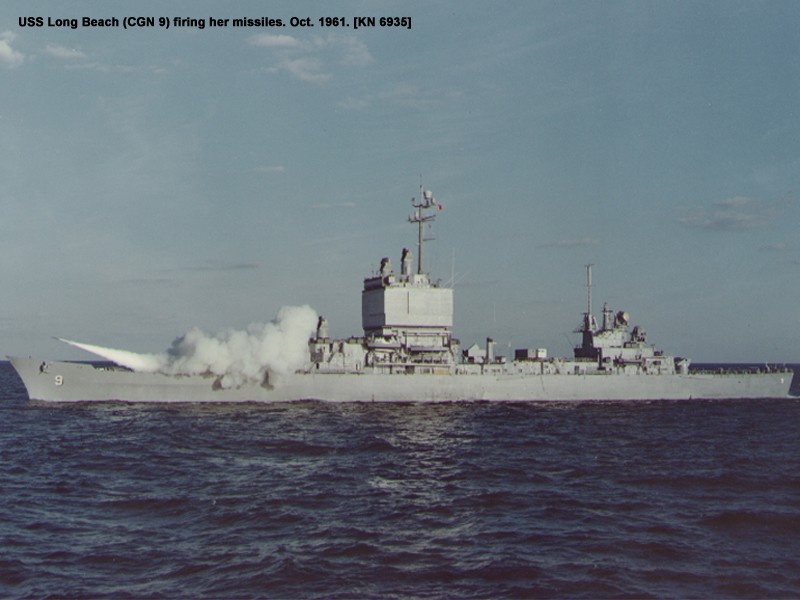
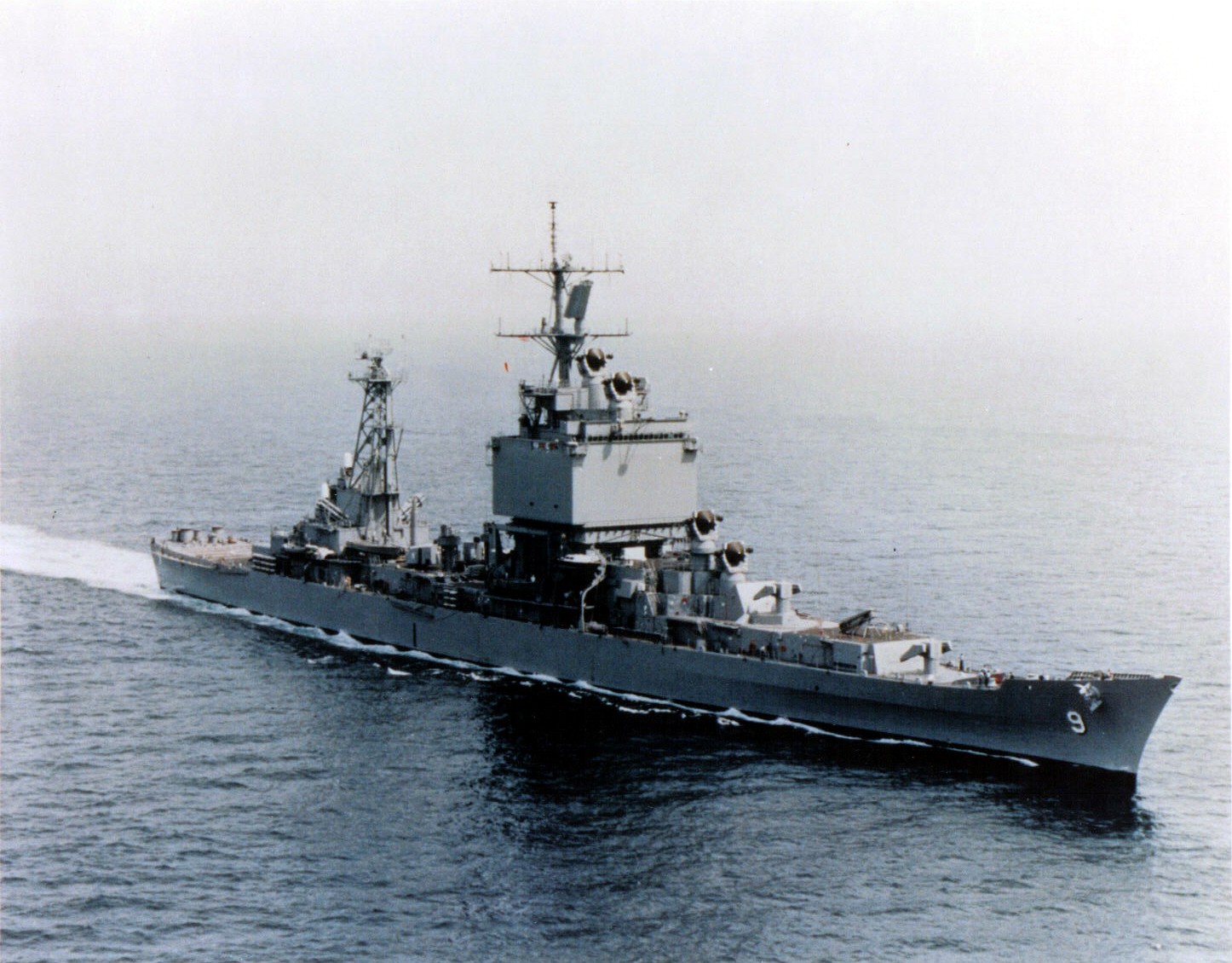
The USS Long Beach was the first nuclear guided missile cruiser and the only cruiser built following ships designed during World War II built as a large cruiser, all others would be on large destroyer platforms.  Previous guided missile cruisers had been converted from World War Two Light Cruisers and Heavy Cruisers, some of which retained their forward gun turrets while mounting missiles aft.  The Albany class also converted World War II ships had their entire main battery exchanged for missiles.  The long beach represented an entirely new type of cruiser.  Laid down December 2nd 1957, launched July 14th 1959 and commissioned September 9th 1961 she displaced over 15,000 tons full load. Large and fast equipped with 2 Westinghouse C1W reactors powering GE turbines producing 80,000 SHP she was capable of 30+ knots.

Long Beach after modernization in 1980s

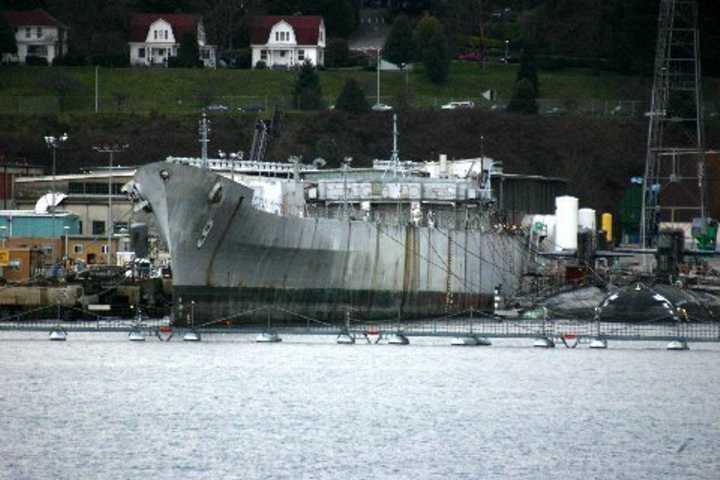
She was equipped with a twin Talos missile launcher, 2 twin Terrier launchers two 5”/51 dual purpose guns in single mounts, the ASROC anti-submarine rocket system and six 12.75” ASW torpedo tubes.  Long Beach would serve until 1995, taking place in every major operation except the Balkans when she was decommissioned.  Her unique superstructure was razed, her nuclear plant recycled and her hulk remains, the trim cruiser lines still in evidence awaiting the scrappers torch at Bremerton Washington.

The hulk of teh ex-Long Beach at Bremerton Naval Shipyard

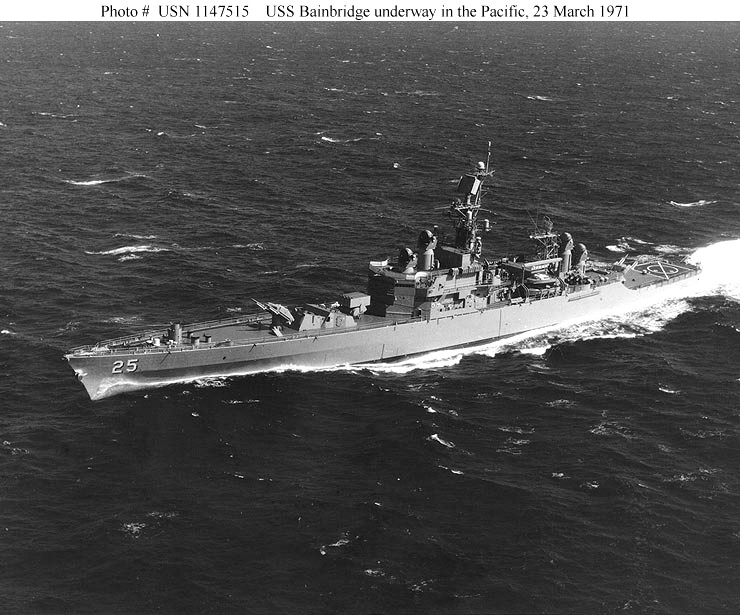
Bainbridge 1971

The USS Bainbridge originally classified as a Guided Missile Destroyer Leader and a nuclear powered ship of the Leahy class. Bainbridge displaced 8,500 tons and 565 feet long she mounted two twin launcher Terrier missile systems, ASROC, six 15.5 inch ASW torpedo tubes and four 3” dual purpose guns and crewed by 475 men she like Long Beach had the capability of managing the air defense of the battle group.  She was equipped with 2 GE 2DG nuclear reactors powering geared turbines capable of 60,000 SHP which drove her at 30+ knots.  She was laid down May 5th 1959 and launched April 15th 1961 and commissioned on October 6th 1962.

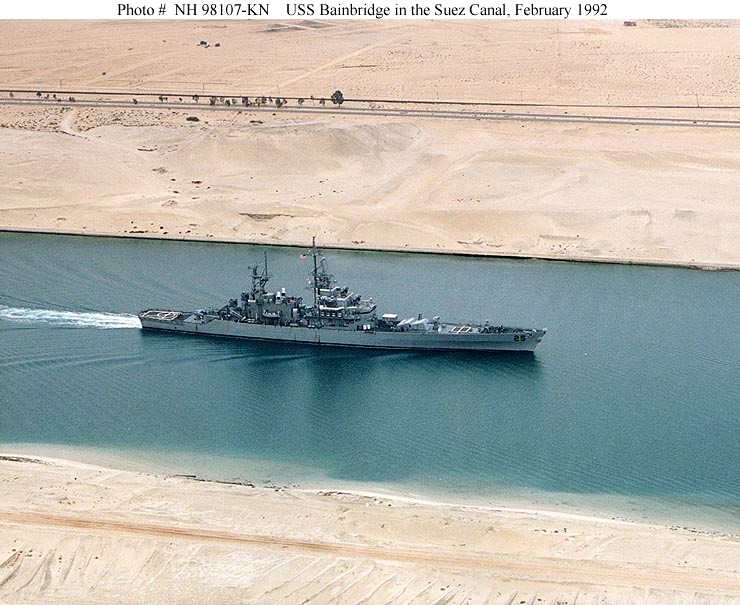
Bainbridge transiting the Suez Canal 1992

She like Long Beach and Enterprise would serve in most every major operation undertaken by the US Navy and during the post Cold War draw down would be decommissioned on September 13th 1996, her nuclear plant recycled and her hulk scrapped at Bremerton Washington.   She would be modernized throughout her career with upgraded radars, missiles and having her 3” guns replaced by Harpoon Surface to Surface Anti-Ship Missiles and given the facilities to operate LAMPS helicopters.

Truxton 1979

The USS Truxton DLGN/CG-35 was a nuclear powered variant of the Belknap class DLG/CGs and equipped with the same power plant but mounted a 5”/51 single mount gun forward and one twin dual purpose launcher for Terrier and ASROC aft. She would also be designed with helicopter facilities to operate a LAMPS helicopter and like Bainbridge be modernized throughout her career.  Laid down June 17th 1963 and launched December 13th 1964 she would not be commissioned until May 27th 1967.  She also would serve in most of the major operations conducted by the Navy until she was decommissioned on September 11th 1995, her nuclear reactor recycled and her hulk scrapped.

Truxton being “recycled”

Enterprise alone remains of these pioneering ships but each would contribute to the future of US Navy shipbuilding.  Next: Task Group 1 and Operation Sea Orbit.

17 Comments

Filed under Military, Navy Ships

Forerunners of the Next Generation: The New Mexico Class, USS New Mexico, USS Idaho and USS Mississippi

New Mexico BB-40 in 1930 before moderization

The Battleships of the Nevada and Pennsylvania classes had established American ship design as second to none in 1916.  At the same time the US Navy was planning advances in engineering systems that would change naval engineering forever.

Idaho  BB-42 in 1931 after modernization

The ships of the New Mexico class were improvements on the preceding Nevada and Pennsylvania class half sisters.  Their hull was lengthened and beam increased. Additionally the new class was given a clipper bow to improve sea keeping capabilities.  While they maintained the same main battery layout of four turrets mounting three 14” guns each, however the guns were a higher caliber 14”/50 models that would also be mounted on the California class.  The New Mexico was also the test bed for a new power plant which featured General Electric geared turbines with electric drive which would be standard on succeeding classes of battleships as well as carriers, cruisers and destroyers.  The Mississippi and Idaho retained the older geared turbine design. The practical effect was that the New Mexico required less horsepower to attain the same speeds as the earlier design turbines.

USS Mississippi BB-41 in the North Atlantic September 1941

Displacing 32,000 tons the ships were slightly larger than their predecessors.  New Mexico was launched on 23 April 1917 and commissioned on May 18th 1918.  Her sisters Mississippi and Idaho were actually launched and commissioned sooner being launched on January 25th 1917 and commissioned on December 18th 1917.  None of the ships saw action in the First World War and in 1919 the three would become the nucleus of the newly formed Pacific Fleet. They would serve in the Pacific but conduct exercises with the Atlantic Fleet in the Pacific as well as the Atlantic and Caribbean.  All three were modernized in the early 1930s receiving improvements in armor protection, anti-torpedo blisters, a modernized bridge structure to replace their cage masts, improvements to machinery and their secondary armament.

The Three Sister Moored Together, Late 1943

They would return to the Pacific but with the outbreak of war in Europe the three ships were transferred to the Atlantic Fleet where they took part in the Neutrality Patrol. When Pearl Harbor was attacked the three sisters went back to the Pacific where they spent much of 1942 escorting convoys and being prepared to repel any Japanese assault on the US Mainland.  In April 1943 they took part in the Aleutian campaign and the assaults on Attu and Kiska.  They would then sail to the Central Pacific where the provided support to the invasions of the Gilberts, Marshalls and Marianas islands by protecting the transports and providing naval gunfire support to Marines ashore.

Idaho in her final 1945 configuration. Note the 5″/38 DP Guns in single enclosed mounts used by US Fletcher Class DDs. The Idaho was the only Battleship to have this type of 5″ mount

The three would again operate together during the invasion of the Philippines where the Mississippi served with other battleships of the 7th Fleet’s battle line under Rear Admiral Jesse Oldenforf at the Battle of Surigo Strait where they annihilated a Japanese force including the battleships Fuso and Yamisharo.   Both Mississippi and New Mexico were damaged by Kamikaze hits in Philippine waters, the New Mexico taking a hit on her bridge which killed her Captain and 27 crewmembers.  Both would require repairs and both would miss the invasion of Iwo Jima which Idaho took part in.  The three joined forces again at Okinawa where they provided fire support to Marines and Soldiers ashore.  They would serve until the end of the war in the Pacific and take part in Operation Magic Carpet to return military personnel from the Pacific to the United States.

Idaho at Okinawa

Following the war the New Mexico and Idaho were decommissioned and sold for scrap in 1948.  Mississippi however was converted into a gunnery training ship and reclassified as AG-128.

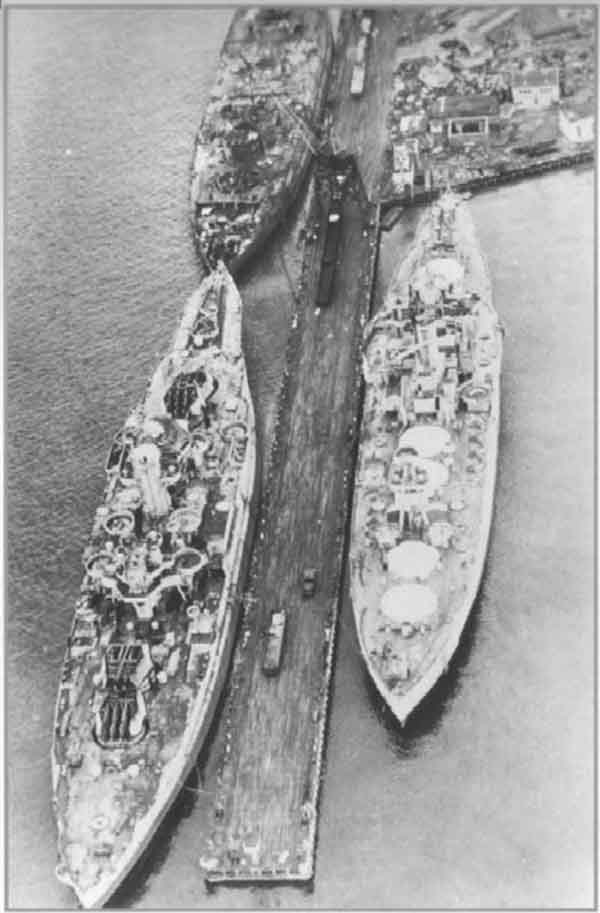
Idaho (lower left) New Mexico (top left) and Wyoming being scrapped at Newark NJ 1948

In this capacity she served as a test bed for new weapons including the Terrier guided missile systems which would be mounted on the first generation of US Navy Guided Missile Cruisers.   She was decommissioned in 1956 and sold for scrap after an abortive attempt by the state of Mississippi to acquire her as a memorial ship.

USS Mississippi AG-128 firing Terrier Missiles

The ships provided valuable service during the Second World War and the technical innovations in propulsion and protection would become standard in subsequent classes of US Navy battleships.  Additionally the post war service of the Mississippi helped propel the Navy into the missile era helping to build a foundation that is in evidence today in the Ticonderoga Class Guided Missile Cruisers and Arleigh Burke class Guided Missile Destroyers and their Aegis air defense and ballistic missile defense systems.  The ships of the New Mexico class and their stalwart crews should not be forgotten.

7 Comments

Filed under History, Military, Navy Ships, world war two in the pacific

The Battle Fleet that Never Was: The USS Washington, the South Dakota Class and the Lexington Class Battle Cruisers

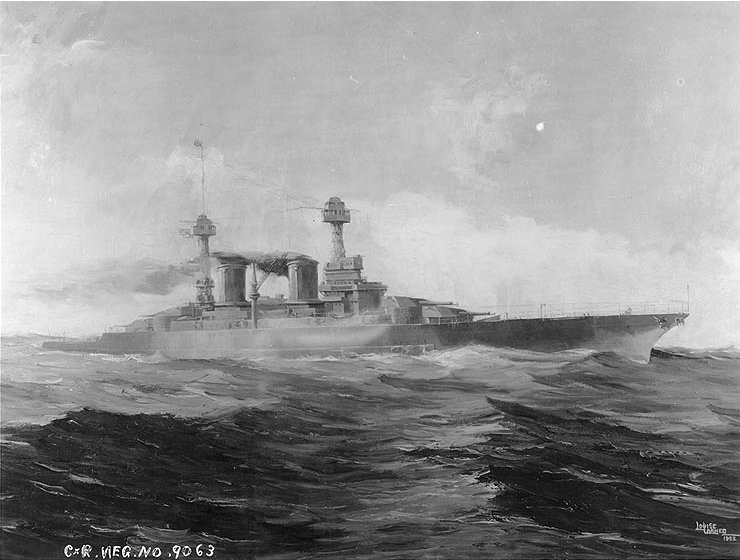
Artist depiction of the Lexington as Battle Cruiser

Note: This is the first of a series of articles on what might have happened if the Washington Naval Treaty had not been signed. This article is a look at the American fleet that never was, the following articles will be in the alternative history genre looking at a war breaking out in the Pacific in 1937.

Historians almost always muse on what might have been.  One of the most significant events of the years following the First World War was the Washington Naval Conference and Treaty. The treaty called by the President Harding and conducted under the auspices of the League of Nations was the first international disarmament conference and attended by none nations having interests in the Pacific. The major players in the conference from the naval power perspective were the British, Americans, Japanese, French and Italians.  Each nation had an agenda for the conference, for the United States it was to break the Anglo-Japanese naval accord and to limit the Japanese naval build up.  The British, exhausted and financially reeling from the effects of the First World War had a number of goals.  Though they had the largest navy and the most Dreadnaught type battleships and battle cruisers of any Navy many of its ships were obsolete or worn out from wartime service.  They had little capital to put into new ship construction, especially considering the vast resources of the United States which was already well into a vast naval buildup including ships that would be among the largest and most heavily armed in the world.  It was in the interest of Britain to limit the both the number, tonnage and armament of these ships.

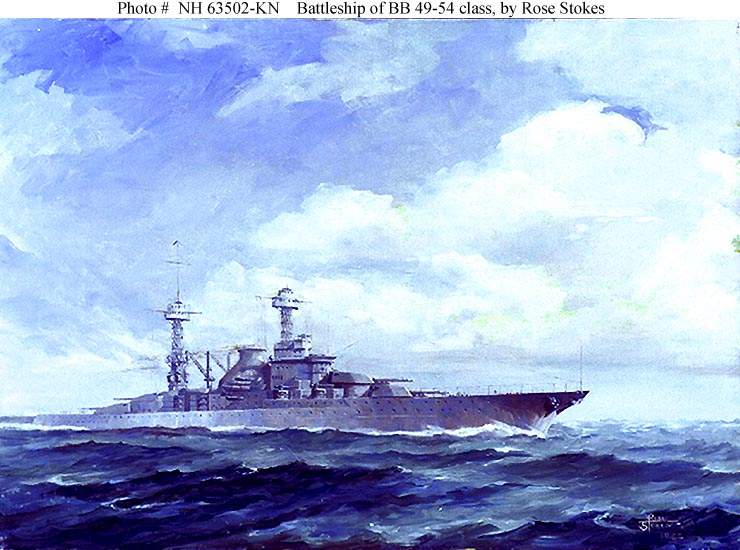
Artist impression of South Dakota Class

The treaty which was ratified in 1922 limited the United States and Great Britain to a maximum of 525,000 tons in their battle ship fleets and 125,000 tons in aircraft carriers.  The Japanese agreed to a limit of 315,000 tons and the French and Italians 175,000 tons each.  Tonnage for battleships was limited to a maximum of 35,000 tons with a limitation on guns size to 16 inches.  Since the bulk of the ships planned or being built by the US and Japan exceeded those limits they would be effected more than the British whose post war shipbuilding program had not begun in earnest. For the US this had a dramatic effect on its planned fleet, which if built would have become the dominant Navy of the 1920s and 1930s.  It is fascinating to think what might have happened if the treaty had not been signed and what the battle fleets of the various nations would have looked like in 1941 had war not come sooner.

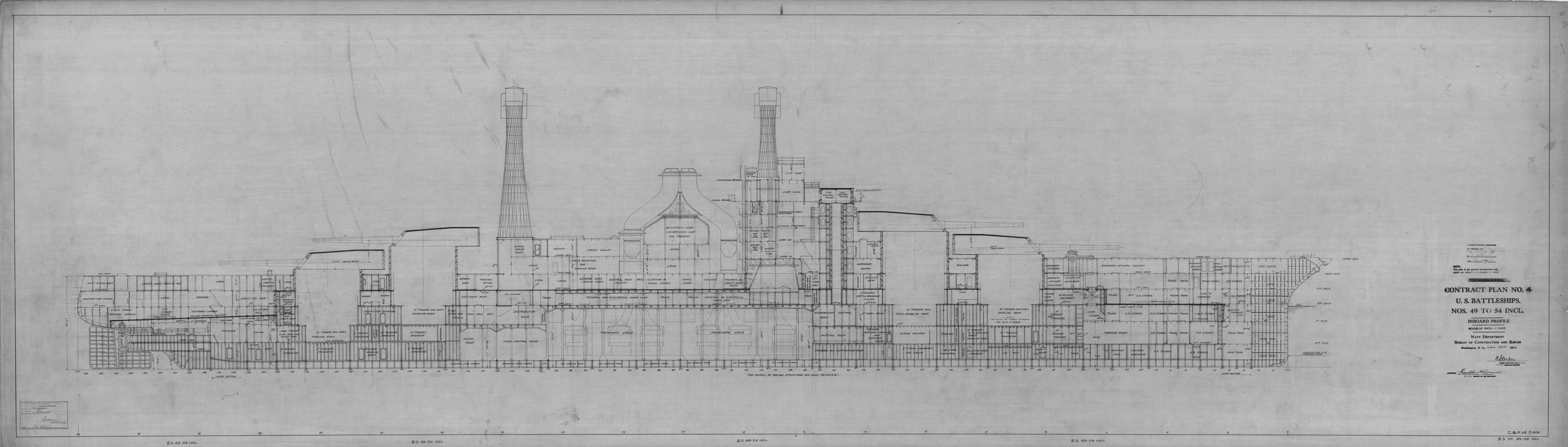
Plans for South Dakota Class

The American Navy went to war in 1941 with 18 battleships, the most modern of which were the new North Carolina and Washington and the rest averaging over 20 years old in 1941. The most modern of these ships were the Colorado class composed of the Colorado, Maryland and West Virginia each mounting eight 16”/50 guns.  The fourth ship of the class the Washington was sunk as a gunnery target when 75% complete under the terms of the Washington Naval Treaty.

The incomplete USS Washington sinking

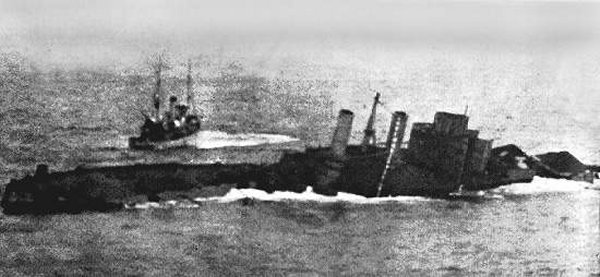
However it was a battle force that could have been much larger and far more capable, a force that may not been regulated to convoy escort duties and shore bombardment but instead may have taken on the Imperial Navy on the high seas in battleship combat not seen since Jutland.  Yet this was not to be, the great fleet of super-battleships was never built and only two hulls completed the Lexington and Saratoga which instead of being completed as battle cruisers were completed as aircraft carriers.

Artist impression of South Dakota Class

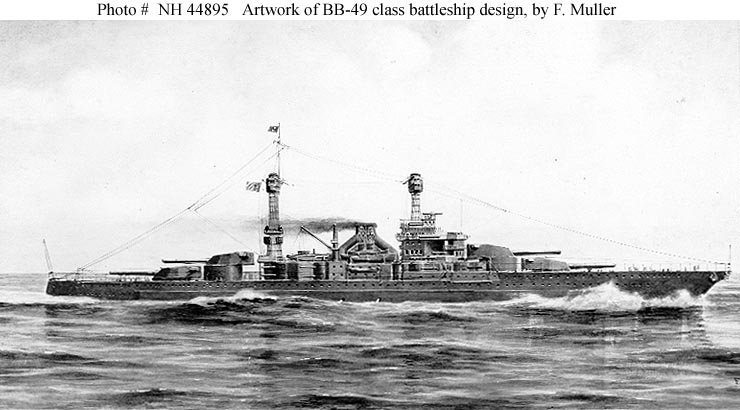
The Americans had set out to build the largest, most modern and powerful battleships and battle cruisers afloat.  The Navy had already produced the Colorado class super-dreadnaughts which were equal to or superior to any battleships of their era.  The Navy planned for a class of six battle cruisers which would be superior to any similar ship afloat, the Lexington class and a class of six battleships, the South Dakota class mounting twelve 16”/50 guns in triple turrets.

Artist impression of South Dakota Class as they might have appeared in 1938

The two classes were leviathans and to counter them the British made plans for a four ship 48,000 ton class of battleships, the N3 project mounting nine 18” guns and a class of battle cruisers mounting nine 16” guns.  The ships of both classes were designed with their main battery mounted forward in order to save weight on armor.  Both classes were canceled with the signing of the treaty and none were laid down.  It is suggested by some that the G3 battle cruiser design was a ploy to get the United States to agree to the cancellation of its capital ship projects. The guns planned for the G3 class were mounted on the Nelson class battleships which complied with treaty limits.  Although powerful ships they suffered from engineering problems which often reduced their speed from what was designed.  Along with the HMS Hood, the sole ship completed of the four ship Admiral class the Nelson and Rodney were the most modern battleships in the Royal Navy until the King George V class entered service in 1941.  The Japanese planned for eight battleships and eight battle cruisers centered on the two existing Nagato class battleships and 4 Kongo class battle cruisers to be joined by the two ship 40,000 ton Tosa class battleships, the Tosa and the Kaga, of which Kaga was completed as an aircraft carrier. They were to be joined by the 4 improved Tosa class or Kii class fast battleships of 42,000 which were ordered but never laid down.  These were to be joined by the four ship Amagi class battle cruiser class.  Amagi was destroyed during the Tokyo earthquake of 1922 and scrapped and Akagi completed as an aircraft carrier.  All of the planned Japanese ships were to mount ten 16” guns in five twin turrets.

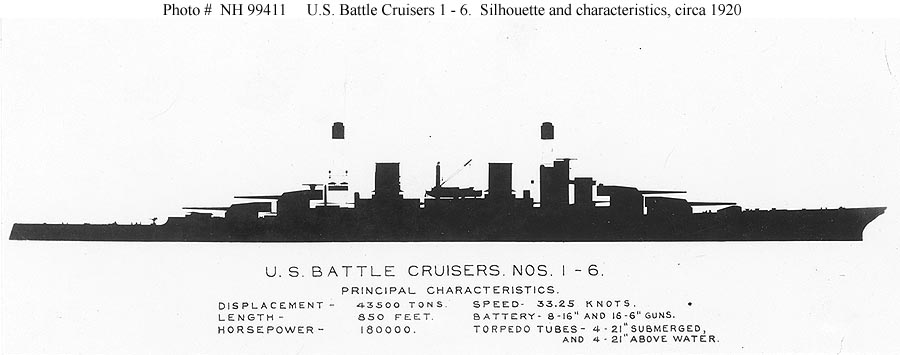
Lexington Class final design drawing

The American ships were to be powerful and based on main battery, protection and speed they would have acquitted themselves well had they been built.  The Japanese ships would have had a speed advantage over the South Dakota’s but this would have been offset by the gun power and protection of the latter.  The American Lexington class would have been faster than any of their competitors.

South Dakota Class Design Specifications
Displacement: 43,200 tons normal
Dimensions: 684 x 106 x 33 feet/208.5 x 32.3 x 10.1 meters
Propulsion: Turbo-electric, 12 285 boilers, 4 shafts, 50,000 shp, 23 knots
Crew: 1191
Armor: 8-13.5 inch belt, 3.5 inch deck, 4.5-13.5 inch barbettes, 5-18 inch turrets, 8-16 inch CT
Aviation: none
Armament: 4 triple 16″/50cal, 16 6″/53cal, 8 3″/50cal AA, 2 21 inch torpedo tubes (submerged)

The six ships in the Class, South Dakota, Indiana, Montana, North Carolina, Iowa and Massachusetts were all scrapped in accordance with the treaty when partially complete, the North Carolina being in the most advanced stage of construction, 37.8% when construction was halted.

Lexington class Battle Cruiser Design Specifications

Displacement 43,500 Tons, Dimensions, 874′ (oa) x 105′ 5″ x 31′ (max).
Armament 8 x 16″/50 16 x 6″/53 4 x 3″8 x 21″ torpedo tubes
Machinery, 180,000 SHP; G.E. Geared Turbines with Electric Drive, 4 screws
Speed, 35 Knots, Crew 1500

The ships with the exception of the Lexington and Saratoga were scrapped incomplete.  All were to be named after famous warships or battles, and the Constellation, Constitution, Ranger and the United States were to be named after some of the most illustrious ships ever to serve in the US Navy.

If all of the ships, including the Washington of the Colorado class been completed the US Navy would have had eight battleships and six battle cruisers mounting 16 inch guns to compliment the nine battleships of the Nevada, Pennsylvania, New Mexico and California classes which all mounted 14 inch batteries.  The fleet would have been superior to either the Royal Navy or the Imperial Japanese Navy even with the ships planned by those navies.  Economically the United States was the only nation in the world capable of sustaining a naval arms race of this magnitude, the British economy and political will would have been unable to sustain it and the limited industrial capacity and dependence on the United States for raw materials and machine tools needed to construct their ships would have limited their ability to produce such a fleet. Without the conversion of the Lexington, Saratoga and their Japanese counterparts the Akagi and Kaga into aircraft carriers the development of the carrier would likely have gone slower and that type of ship may not have risen to the prominence that they gained during the Second World War.

8 Comments

Filed under History, Military, Navy Ships

The Oldest Ladies…Battleships USS Arkansas, New York and Texas

USS Arkansas 1919

Note: This is the second of my series on US Battleships of World War Two. The First was the essay The Battleships of Pearl Harbor and I will follow this with essays on the New Mexico class, the North Carolina class, the South Dakota class and the Iowa Class. I have published other series on US Aircraft Carriers, the Treaty Cruisers, the Alaska Class Battle Cruisers and the German Battle Bruisers Scharnhorst and Gneisenau.

Arkansas Passing through the Kiel Canal on Midshipman Training Cruise June 6th 1937

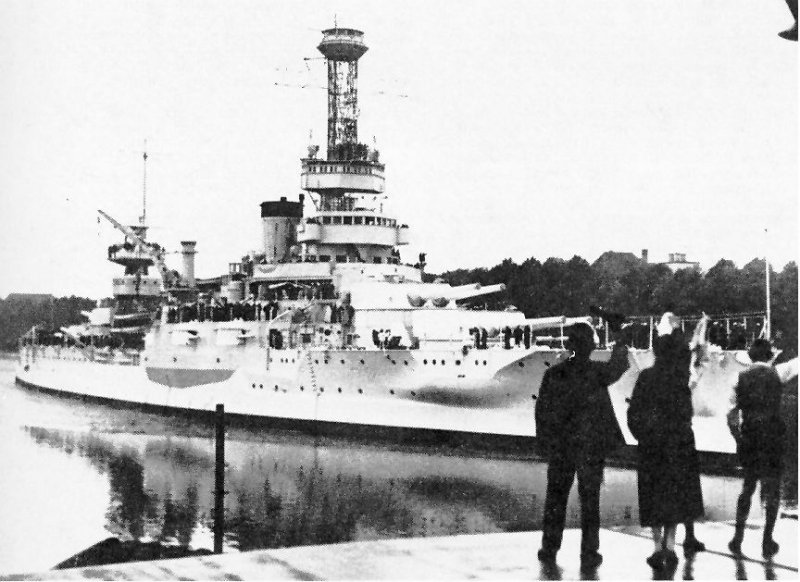
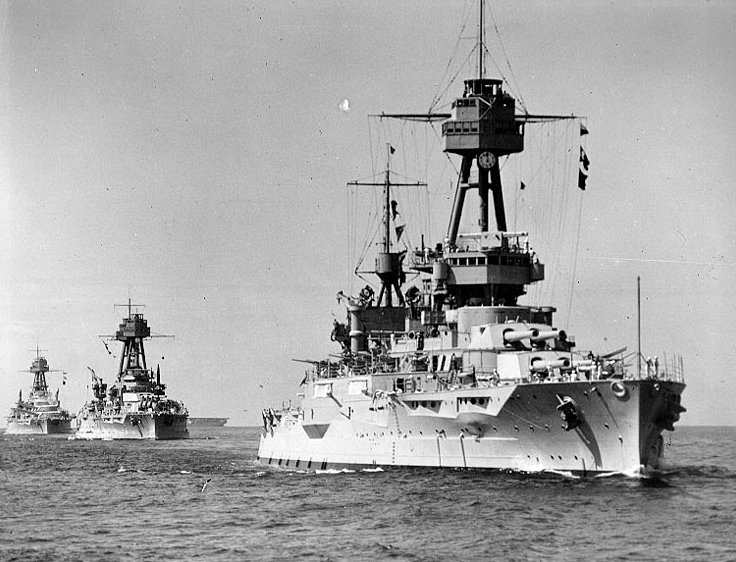
When the United States entered the Second World War the average age of its battleship fleet was over years, an age that if the new North Carolina and Washington were omitted would have been well over 23 years old.  Two former battleships, the Utah and Wyoming had been demilitarized and were serving as gunnery training ships. The oldest of these ships, the Arkansas, the second ship of the Wyoming class was commissioned well before the First World War and was typical of ships built in that era comparable to the Italian battleships Conti de Cavour, Giulio Caesar.  The Two ships of the New York Class were improved Wyoming’s with a heavier main battery and better protection and were comparable to the Japanese Fuso class and British Royal Sovereign class ships.

Arkansas 1944

The oldest and also the smallest battleship in service in 1941 was the USS Arkansas. Displacing 26,000 tons and sporting a main battery of twelve 12”/50 guns in twin turrets she was launched on 14 January 1911 and commissioned on 17 September 1912 she first saw service in the Mexican crisis of 1914 and served with the British Home Fleet following the entry of the United States into the war. Between the wars Arkansas severed in both the Atlantic and Pacific and was modernized in 1925 receiving oil fired boilers to replace her coal fired plant. During the inter-war years she was engaged as were most battleships of the era in training exercises, midshipman and Naval Reserve cruises, goodwill visits and in the case of Arkansas work with the Fleet Marine force as it began to develop its amphibious doctrine.

Operation Crossroad, Baker Test note Arkansas standing on end on right side of blast

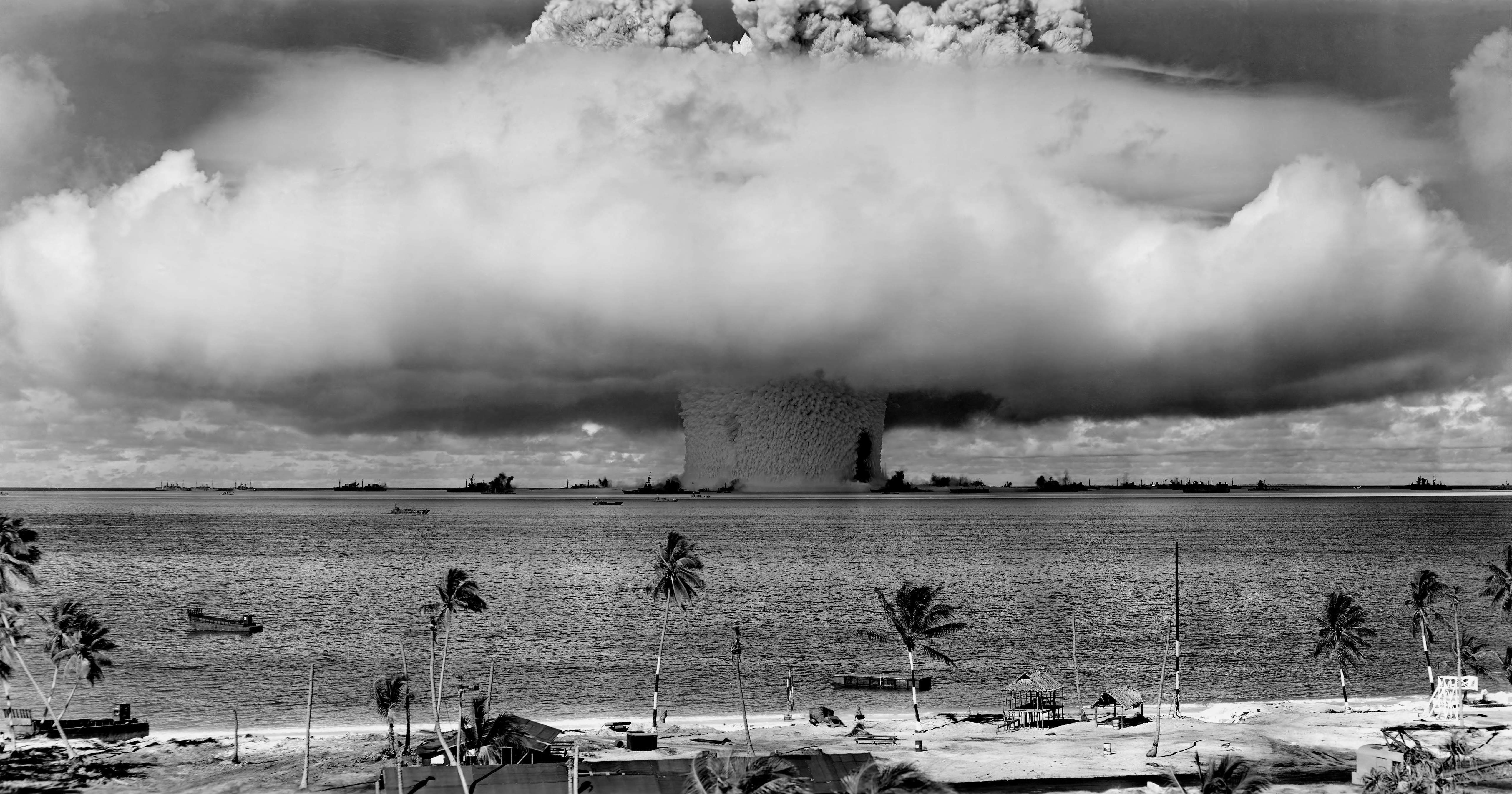
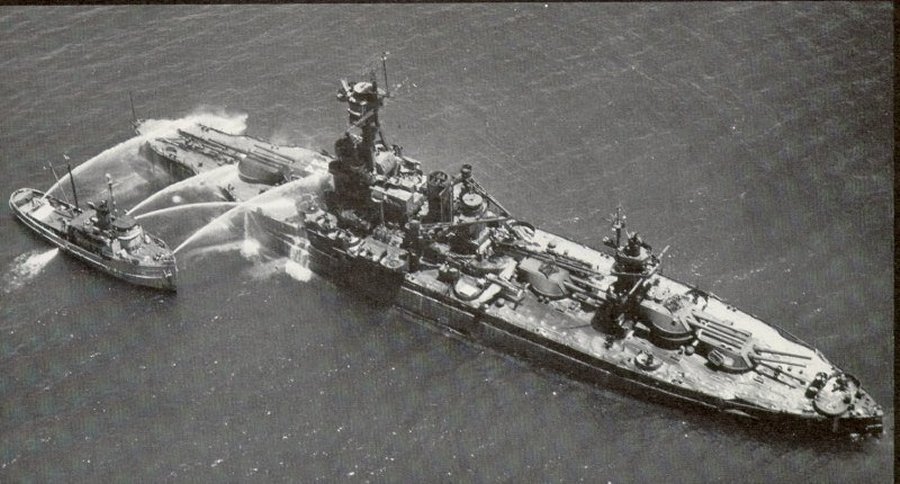
When war came to Europe in 1939 Arkansas was serving with the Atlantic Fleet and conducted training operations and neutrality patrols.  In April 1941 she escorted the first convoy of Marines to Iceland and following that sailed to Argentia Newfoundland where President Franklin D. Roosevelt was meeting with British Prime Minister Winston Churchill concluding the Atlantic Charter.  Following Pearl Harbor she would primarily serve as a convoy escort and midshipman training vessel until June 6th 1944 where she provided naval gunfire support at Omaha Beach and subsequent support to land operations in Normandy. In August she took part in the invasion of southern France, Operation Anvil before returning the US for repairs and modifications before sailing to the Pacific.  The elderly ship then took part in the battles for Iwo Jima and Okinawa again providing naval gunfire support to Marines and soldiers ashore. She also was introduced to the Kamikaze at Okinawa.   When the war ended she carried returning troops home in “Operation Magic Carpet” and in 1946 she was earmarked for her last mission, Operation Crossroads, the first of the Bikini atomic bomb tests where she was sunk during test Baker on July 25th 1946.   She was anchored very close to the underwater blast and was violently sucked up into the blast where she can be seen standing on end it the picture below.

New York 1932 leading the Battle Line

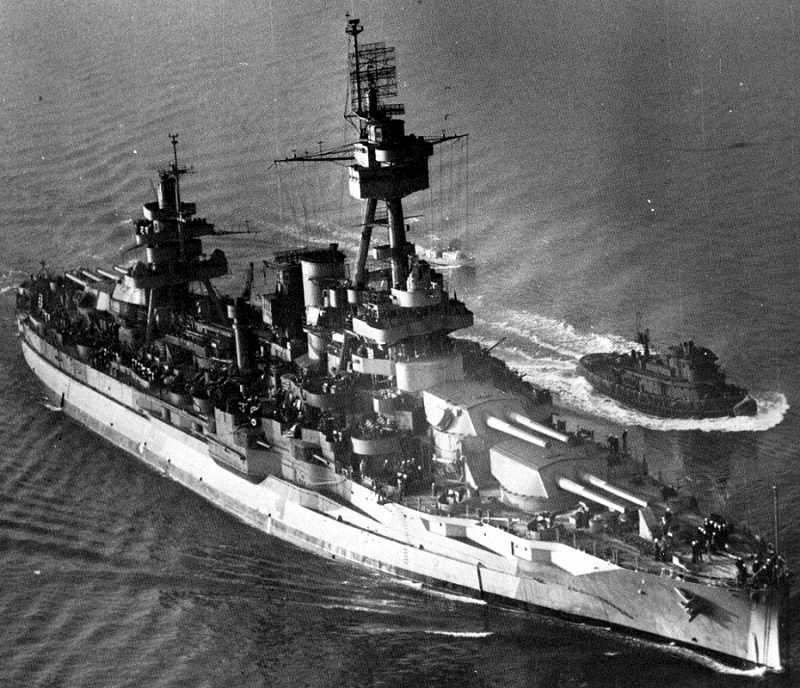
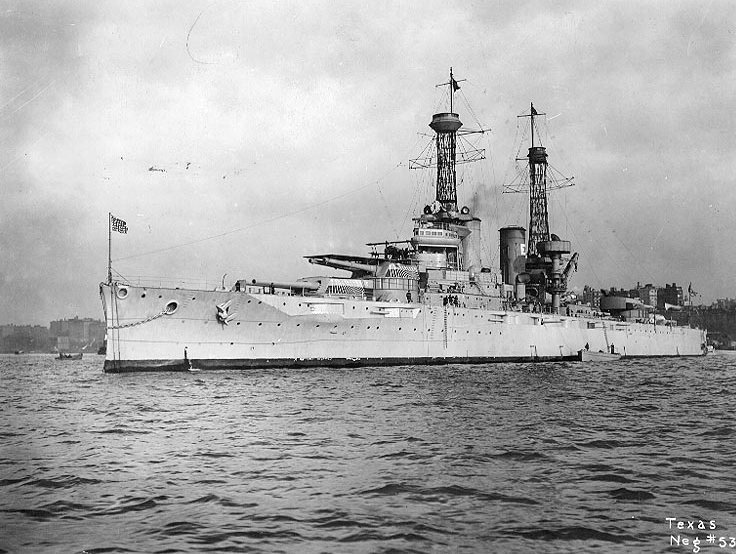
The New York and her sister Texas were the first US Navy battleships armed with 14” guns.  The ships displaced 27,000 tons and mounted ten 14”/45 guns in twin turrets. Launched 30 October 1912 and commissioned April 15th 1914 the New York deployed with the Atlantic battle ship squadrons to Mexico during the crisis at Vera Cruz.  Like Arkansas she joined the American battleship squadron serving with the British Home Fleet in 1917 and served in convoy escort and deterrence missions until the end of the war.  Between the wars New York undertook various training missions and modernizations and was the sole US ship at the 1937 Grand Naval Review for the coronation of King George VI of England.

New York in 1944 departing for the Pacific

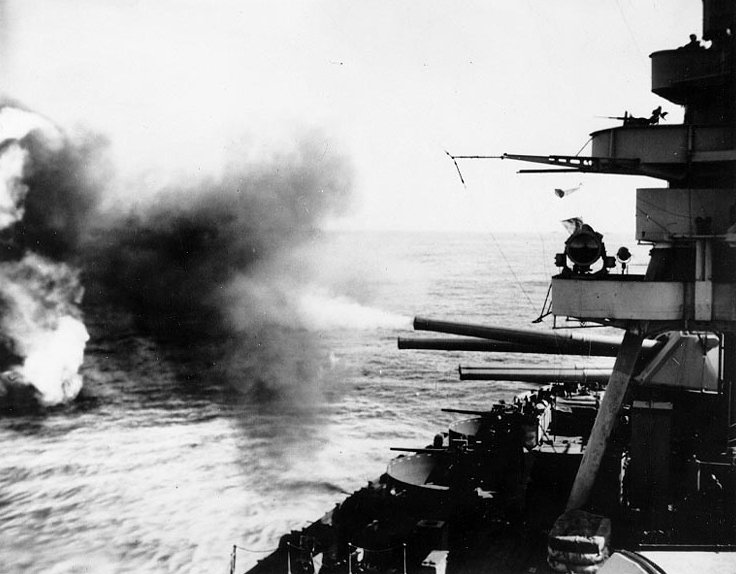
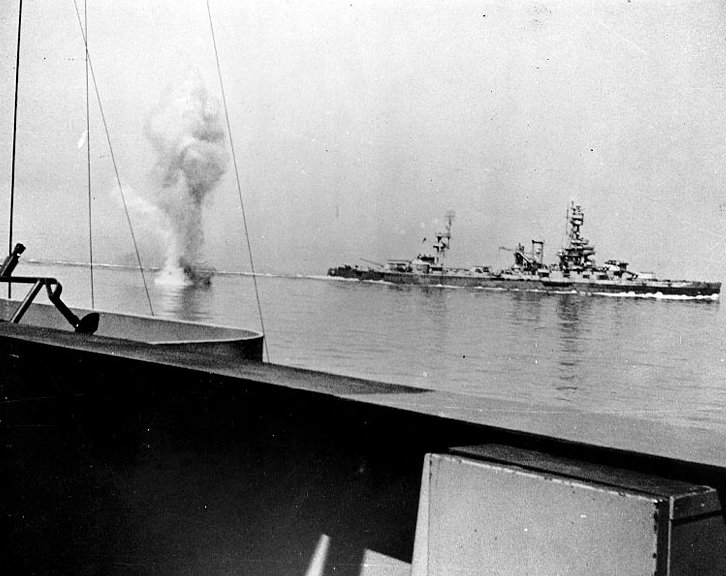
As war drew near New York remained engaged in training missions and took part in neutrality patrols and convoy escort missions in the Atlantic.  Following the outbreak of hostilities she would continue these missions and take part in Operation Torch, the invasion of North Africa in November 1942. She continued the vital convoy escort mission until she was withdrawn for service as a gunnery training ship for sailors being assigned to battleships and destroyer escorts.  In November 1944 she was sent to the Pacific where in February 1945 she provided naval gunfire support to the Marines at Iwo Jima. During pre-invasion bombardment she fired more rounds that any of the ships present.

New York at Iwo Jima

Her next action came at Okinawa where she provided 76 straight days of support to Marines and soldiers ashore while fending off kamikaze attacks and taking one minor hit.  She had her guns replaced at Pearl Harbor in preparation for the planned invasion of Japan.  After the cessation of hostilities New York took part in Operation Magic Carpet and took part in Fleet Week in New York.

New York receiving anti-radiation wash down after Baker. She has survived the blast in good condition

New York was then assigned to be a target ship in Operation Crossroads where she survived both Test Able and Test Baker.  Towed back to Pearl Harbor for extensive study she was finally expended as a target on July 8th 1948 by the Navy 40 miles off Oahu taking the punishment of a number of ships before sinking after 8 hours under fire.

Texas in 1919 note the Battle “E” on her funnel

The Texas was launched on May 18th 1912 and commissioned on March 12th 1914 and within two months was in action with the Atlantic Fleet off Mexico without the benefit of the normal shakedown cruise.

During World War One Texas joined Battleship Division 9 serving alongside the British Home Fleet at Scapa Flow.  In this capacity she took part in convoy escort missions and operations in the North Sea including one where the Home Fleet nearly met the German High Seas Fleet in action.

Texas firing her main battery 1927 after her modernization

Between the wars Texas served on both the Atlantic and Pacific Fleets and received a major overhaul in 1925.  Like other ships she engaged in training exercises, midshipman and Naval Reserve training cruises and operations with the Fleet Marine Force.  With the outbreak of hostilities in Europe Texas joined the neutrality patrol.  When the US entered the war Texas served as a convoy escort and participated in Operation Torch.  Her convoy escort duties remained unchanged until she took part in Operation Overlord, the invasion of France and provided gunfire support to Rangers at Point du Hoc and soldiers on Omaha Beach. Closing to within 3000 yards of the beach Texas guns provided direct support to troops on the beach and interdiction fire on German troop concentrations further inland. She continued this following D-Day and while engaged in a duel with heavy German guns near Cherbourg was struck by two 280mm (11.2 inch) shells, one of which struck her on the navigation bridge killing the helmsman and wounding nearly everyone else.   She then sailed into the Mediterranean where she again supported troops ashore lending her weight to the invasion of south France. With that mission completed Texas returned to New York for repairs and to have her main battery guns replaced.

Texas under German Fire off Cherbourg

Reassigned to the Pacific Texas would support the invasion of Iwo Jima and Okinawa where she would remain in action for almost two months.  She finished the war in the Philippines and like so many other ships took part in Operation Magic Carpet. She arrived at Norfolk on February 13th 1946 to prepare for inactivation, but unlike so many other ships was spared the ignominious fate of the scrap yard or that of the New York and Arkansas. She was towed to Texas to serve as a permanent memorial at the San Jacinto battlefield and decommissioned there on April 21st 1948.  She was dry-docked and received a major overhaul in from 1988-90 which restored her to her 1945 appearance and in which major structural repairs were made. Continual restoration is conducted on the ship and there are plans for another major overhaul.  She is the last surviving “Dreadnaught” battleship in the world, a singular example of the great ships that once dominated the seas.

Texas at San Jacinto, the last of the Dreadnaughts

Though obsolete the Arkansas, New York and Texas rendered commendable service throughout the war and took part in some of the key invasions of the war. Their guns inflicted considerable damage on Vichy French, German and Japanese forces in Europe, North Africa and the Pacific.  New York and Arkansas trained thousands of sailors for service aboard other ships.  They performed admirably and their availability to do the less glamorous missions of naval gunfire support, convoy escort and training sailors for the fleet enabled other ships to be available for other missions.  They and the proud Sailors and Marines who served aboard them should never be forgotten.

19 Comments

Filed under History, Military, Navy Ships, US Navy, world war two in europe, world war two in the pacific

Thoughts on Ending Don’t Ask Don’t Tell…a Moderate View

No, we’re not homosexual, but we are willing to learn…Yeah, would they send us someplace special?

Note:  I’m not feeling well tonight with my Kidney stone keeping up a steady mid grade pain in my Kidney.  Thus I am modifying something that I wrote nearly a year ago concerning the subject of gays serving in the military. This is not a political or social screed, I have tried to remain dispassionate in this essay realizing that people of goodwill but with differing moral, ethical or religious values can have differing opinions.  Since ultimately the decision to repeal “Don’t Ask Don’t “ will be recommended by the military and will have to be passed into law by Congress. As an officer it will be my duty whatever decision is reached to support that decision.

I have written an essay agreeing with Admiral Mullen and Secretary Gates when they announced the decision to begin the process of repealing the Don’t Ask Don’t Tell law on homosexuals serving in the military. I followed that with piece which attacked the lies and distortions being marketed by former Chaplain, defrocked priest and convicted criminal Gordon “Chaps” Klingenschmitt in an unsolicited bulk e-mail sent through the Washington Times Media Group. In neither article did I advocate an immediate change in the law and stated that I believed that the Military should make the recommendations on how the change should be made, and not politicians or special interest groups of any variety.

This post is simply how I have seen military culture evolving over the 27 plus years of my career. These patently are simply my observations and have both a bit of seriousness as well as humor.  I am most definitely a dyed in the wool heterosexual, not that there’s anything wrong with that, but I think that someone without a political axe to grind on either the gay rights or anti-gay rights movement who is in the military have to have a say.  I know that I could be wading into Vietnam here but here I go….

When I enlisted in August of 1981, gays were not allowed to serve in the military.  It was even on the recruiting form. Applicants were asked under the penalty of making a false official statement “Are you a homosexual?”  Who can forget the scene in Stripes where Bill Murray and Harold Ramis are asked by the Army recruiter “Are either of you homosexual?” Their reply was a hoot.  They looked at each other and Bill Murray replied “you mean like flaming or…” The recruiter then said “It’s a standard question we have to ask.” Harold Ramis then quipped “We’re not homosexual, but we’re willing to learn” and Bill Murray adding “Would they send us to someplace special?”  The recruiter then ends the exchange “I guess that’s a no on both.”  It was a hilarious scene as we all had to answer the question back in those days.

Plain and simple if a person lied about being homosexual and was later discovered he was in deep dung, even an accusation of being gay could result in being charged under the UCMJ or at the very least investigated.  Soldiers could be taken to Article 15 proceedings (Captain’s Mast in the Navy, Office Hours in the Marines) or possibly even a court-martial. Depending on the charges one could receive a punitive discharge, such a Bad Conduct Discharge, or administrative discharge under a General, General under Other than Honorable, or Other than Honorable conditions.

Back in my days as a company XO and company commander in the 1980s I had a number of soldiers; male and female who I knew that were gay.  I had grown up in California, had gay friends and even when someone was hiding it I pretty much knew.  If I was homophobic I could have made accusations, began investigations and made these soldiers lives hell.  At that point in time there were a good amount of people in the military who would have done just that.  These soldiers were exemplary in the way that they conducted themselves at work.  They were professional, knowledgeable and I never once had to take any of them to article 15 proceedings for any reason. They never refused missions, they were exceptionally responsible, and good leaders.  As far as their personal lives they were discreet. I am sure that if they stayed in the military that they probably maintained that balance.  I don’t know what happened to them later on, but they were great.   I took over company command as a very junior 1st Lieutenant. The unit had the highest drug abuse rate in Europe with more disciplinary problems than you could shake a stick at. I wasn’t about to go after soldiers who were not giving me problems, I had far more pressing matters on my plate.  I guess you could say that I was exercising the “Don’t ask, don’t tell” policy 7-8 years before it became policy.  My philosophy then as is is now, is that if someone is willing to serve honorably and endure the hardships and dangers of the lives of military professionals then they should be able to regardless of the way that they are wired.  My issue then and now applies to both homosexuals and heterosexuals who are predatory or push themselves sexually on other soldiers causing problems with good order and discipline and unit cohesion. I have to say had far more problems with my heterosexual soldiers in this regard than my homosexual soldiers. My homosexual soldiers were discreet in their personal lives and very professional, some of my heterosexuals were neither discreet nor professional in thier sexual lives and relationships.
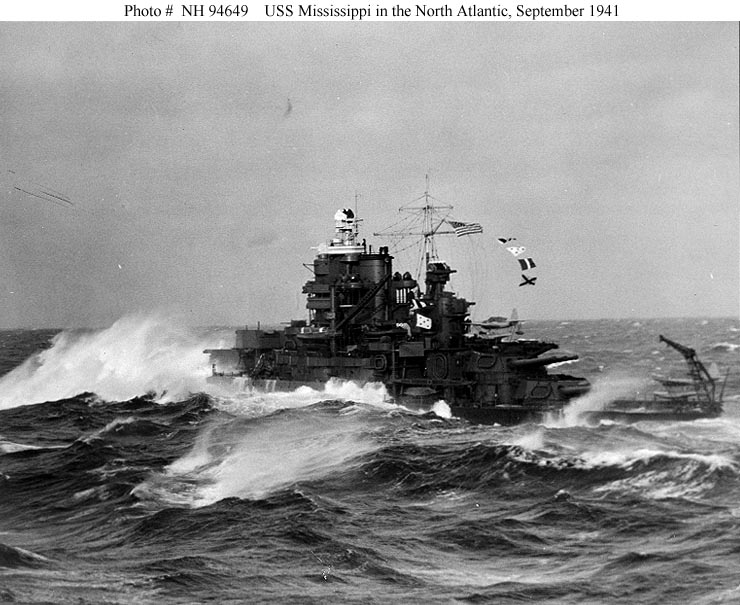
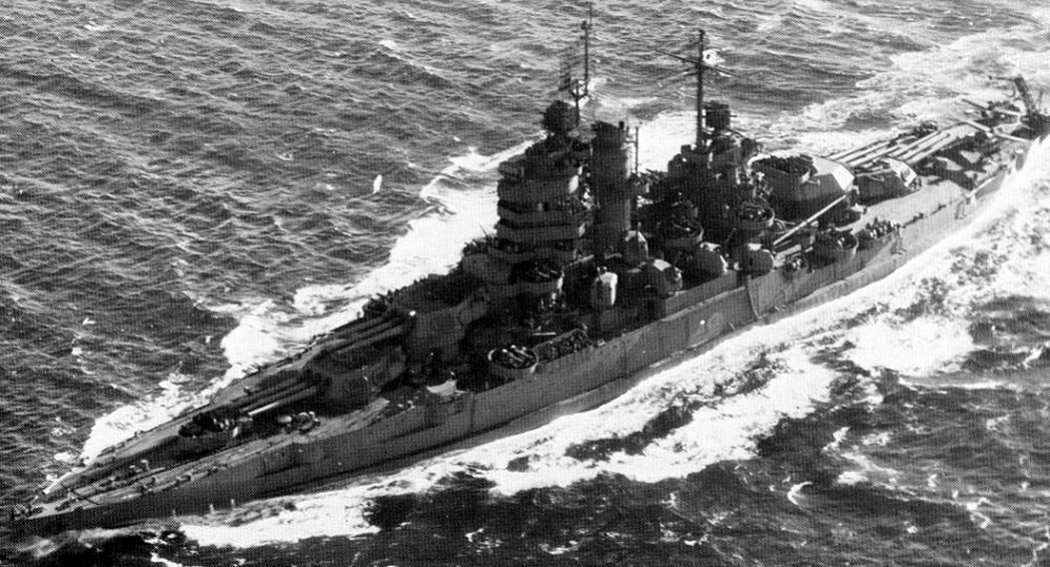
When I served as a personnel officer at the Academy of Health Sciences I became “CINC AIDS.”  I was the most junior of the Medical Personnel Officers, serving as the Training Brigade Adjutant.  It was at this time that we began having soldiers test positive for HIV and develop AIDS.  I worked with representatives of the Army Surgeon General’s Office to develop personnel procedures for HIV positive soldiers.  These policies gave them the opportunity to serve honorably and at the same time ensured that they did  not endanger others through their sexual conduct.  Since I was the junior guy I got to deal with all the cases of officers who had been diagnosed with HIV.  No one else wanted anything to do with them. While the world around me raged with apocalyptic screeds of those convinced that this was God’s judgment on homosexual; those who prophesied how this virus would become a pandemic infecting people willy-nilly through casual contact, I dealt with real people.  These officers wore the same uniform as me and had been pronounced with a death sentence.  Some I knew were gay, but some were straight.  When an officer came to my office that was not on our brigade staff and the door closed, there was a good chance that the visitor had just received the news that they had an infection that would cause a process that would kill them.  They had received a death sentence.  I was a Christian and knew that I was going to be going to seminary after this assignment.  I could not see how Jesus could reject these folks.  While assigned there we had the first trial of a soldier who was intentionally attempting to spread the HIV virus among his coworkers.  He was a heterosexual and was a sexual predator.  He was taken to courts-martial and convicted.  As he was now in the latter stages of the disease process and battling the opportunistic infections which actually kill you he was sentenced to 6 months in Leavenworth.  I doubt that he lived that long. The experience of dealing with these officers taught me the torment that many homosexuals go through.  Following my time in the Army while in seminary and after it I worked in a variety of social service organizations and hospitals and I knew worked alongside many gays without a problem.

When President Clinton enacted the “Don’t ask, don’t tell” policy I was in the Army National Guard.  When the policy was announced there was public outcry from Veteran’s organizations but even more so from conservative religious groups.  I had no problem with the policy as I think that everyone should be somewhat discreet in their sexual habits, especially in the military. Regardless of sexual orientation it is always important for military members to conduct themselves in professional manner, and not only in sexual matters.  It is always a matter of good order and discipline.   While the policy made no one happy, gay activists did not think it went far enough and anti-gay forces hated it, I think it was a wise policy.  The President may have erred in the way that he announced it, but I think it was still the right thing to do at the time.

Since then our society as a whole has changed in its view and treatment of homosexuals.  There is a lot more acceptance of them now and many more people are openly gay.  I think that those who hid that aspect of their lives in earlier times now feel safe enough to come out.  Yes there are those who vehemently oppose any form of equal treatment for homosexuals, but there is a lot more acceptance than in the past. Various polls show that a sizable majority of Americans support changing the policy while polls of military personnel have seen the opposition to ending the policy drop significantly since 2002 even though most of these polls indicate a fair amount of opposition to the policy but even those who oppose a change by and large have determined that they would make their peace with the decision. I believe that this is due to the change in societal views of homosexuals as well as the fact that military professionals, especially officers and career NCOs tend to tend to be more dispassionate and pragmatic than they are given credit.

There have been famous military leaders who were gay including Frederick the Great who was forced to marry but kind of liked other guys better.  Lord Kitchner and Sir Hector Archibald MacDonald, both distinguished officers were homosexual, MacDonald committed suicide when notified that he would be courts-martialed for his homosexuality.   There were constant rumors when I was in the Army about senior leaders who were suspected of being gay.   While a majority of military members polled opposed the Clinton administration change of policy, it seems to have worked.  There still are objections by gay rights activists that the policy is too restrictive and opponents who desire for it to be repealed, but in large part there is no problem.  Other countries the British, Canadians and Israelis and a number of other European nations all allow homosexuals to serve in the military. Contrary to claims that the policy would destroy the military there is nothing to support that.  In fact the US Military has been more heavily engaged on multiple fronts since the policy went into place and done well despite being undermanned and often over-committed.

The Rand Corporation had a study of how allowing gays to serve would impact the military suggested the following was of ensuring that such a change would not endanger good order and discipline or unit cohesion, the two most critical aspects of any change.  They suggested:

  • A requirement that all members of the military services conduct themselves in ways that enhance good order and discipline. Such conduct includes showing respect and tolerance for others. While heterosexuals would be asked to tolerate the presence of known homosexuals, all personnel, including acknowledged homosexuals, must understand that the military environment is no place to advertise one’s sexual orientation.
  • A clear statement that inappropriate conduct could destroy order and discipline, and that individuals should not engage in such conduct.
  • A list of categories of inappropriate conduct, including personal harassment (physical or verbal conduct toward others, based on race, gender, sexual orientation, or physical features), abuse of authority, displays of affection, and explicit discussions of sexual practices, experience, or desires.
  • Application of these standards by leaders at every level of the chain of command, in a way that ensures that unit performance is maintained.

It has been over 15 years since the “don’t ask, don’t tell” policy went into effect.  I have noted that while some military members still vehemently oppose gays serving in the military, that quite a few, officer and enlisted, especially those under the age of 30 are much more tolerant than were those of my era.  A while back I was talking with a couple of military doctors and a hospital corpsman, all of us committed heterosexuals, not that there’s anything wrong with that the other day and the subject came up in a humorous way when discussing ways to get out of the military.  The corpsman noted that saying you were gay was one way, and I said, at least for now it was.

As we talked we all agreed that anyone willing to serve in the military at this point of time should be able to so long as they meet the professional standards of the services.  This is no gravy train.  Soldiers, Sailors, Marines and Airmen are constantly deployed and putting themselves in harm’s way.  If a gay wants to commit his or her life to the service of this country, who am I to object?

From a practical and somewhat humorous standpoint we have to acknowledge a number of things about gays, especially gay men.  Many are very well educated successful professionals.  Most seem to have a far better sense of taste and style than most of us on the heterosexual team and quite a few are very physically fit and health conscious. Anyone who has ever served in the military knows that we are not known for the greatest living conditions, food or ascetics.  Military housing, both barracks and family quarters tend to be rather boring, and often substandard.  There is not a lot of imagination in most military dining facilities and the ascetics and design of many of our buildings and bases leaves a lot to be desired. Can you imagine if we let these guys serve?  Our bases would probably look a lot better and well kept.  Our living quarters would be nicer and more ascetically pleasing. The food would definitely go up in quality and we would get some highly qualified folks in the service, especially in some of the more scientific and medical specialties.  As a married heterosexual and “a uniter not a divider” I see all of this as a win-win situation.  Who could be against that? I would have loved to drive onto bases where buildings and landscaping were done well, where you didn’t feel like you were driving onto a prison.  I’d love to work in buildings where there was some sense of style and artistry, where when you walked in you didn’t think you had walked onto the set of a WWII movie.  I would love a nice selection of food that was both healthy and tasty.

Will this happen anytime soon? I don’t know.  At the present time DOD is studying how the change might be implemented including the possible ramifications of the decision on the force.  That study will take time and I suspect that at some point the President and Congress will address the issue and if it is changed I expect little practical change in the military.  We will keep deploying and doing our job, some people will be upset and some won’t, but I think there has been enough societal change over the last 27 years to allow this to happen relatively smoothly.  Will some people be unhappy? Most certainly. Will crusades be mounted against it by some?  Most definitely and one is already being waged by Gordon Klingenschmitt who went on record calling Admiral Mullen a liar and others will also oppose any change.  However I think that this opposition will come more from the outside and less so from the military which is busy fighting wars and protecting the country.  If “Don’t Ask, Don’t Tell” is repealed I expect that the military will survive and continue to do well.  I think that most will make their peace with any change and those who desire to serve their country, even those who oppose repealing the law will still elect to serve I the military.

Those are my thoughts and as I said at the beginning I remained as dispassionate as I can while still stating what I believe. After all, in the end this is all well above my pay grade.

Peace,

Padre Steve+

Leave a comment

Filed under History, laws and legislation, Military, philosophy

Too Young…Naval Medical Center Portsmouth loses another one of Its Own


Lieutenant Eric W Inge, Medical Corps, United States Navy 20 August 1979-13 February 2010

Creator, Father who first breathed

In us the life that we received

By thy power of thy breath restore

The ill, and men with wounds of war

Bless those who give their healing care,

That life and laughter all may share

 From the Navy Hymn, Eternal Father Strong to Save

Today the Staff of Naval Medical Center remembered the life and work of a shipmate, colleague and friend.  LT Eric Inge passed away last week from apparently natural causes. Eric was a junior resident our Psychiatry residency program and I had the pleasure of working with him and spending time in class as well as doing some PT with him. Back in December we took a PT test together.  Though he was quiet we often talked to each other and he had a good heart, sharp wit and obviously cared for people and wanted to do his best to serve our Sailors, Marines, Soldiers, Airmen and their family members that he saw in clinic or on the floor. 

 He was quiet, unassuming and did not draw attention to himself. He was remembered today as a friend, a committed physician who could always be found working with his patients and who was a very good psychiatrist even though he was still early in his residency. 

 He was born at Fitzsimmons Army Medical Center in Denver on August 20th 1979. He graduated with distinction from Duke University earning a degree in Biomedical Engineering. He worked in that field and then attended medical school at the University of South Florida where he graduated with his MD in 2005.  He completed an internship in Internal Medicine at The Ohio State University in 2006 and entered a Neurology program that he withdrew from realizing that his passion in medicine lay in Psychiatry.  Passing up numerous civilian residency programs he entered the Navy and was accepted into the Psychiatry internship program from which he matriculated in June of 2009 and then began his residency at Naval Medical Center Portsmouth.  He served his patients, his shipmates and his country well.  He is typical of so many of our young Naval Physicians and other professionals in Navy Medicine.  Eric will be missed by his friends, colleagues and the patients that he served so well.  Please remember his mother and father, Elsa and Kenneth Inge and sister Tina in your prayers. 

 His death came as another blow to a department that has lost two other staff members in the past 7 months and to a medical center that has said goodbye to far too many shipmates in the past year.  Additionally we have hundreds of our staff deployed in harms way in Afghanistan where they are actively treating US and NATO soldiers and Afghan civilians in places like Khadahar, Camp Bastion and Bagram as well as many places too small to register in this country. Others serve in Iraq, the broader Middle East and the Horn of Africa.  Many were shipped out with only hours notice to deploy on the USNS Comfort to care for victims of the cataclysmic destruction in Haiti, which many veteran and even senior staff who have served in Iraq and Afghanistan find more horrifying than anything that they experienced in combat.  While all of these professionals deploy the staff here picks up the load.  Unlike units that rotate in and out of combat to be rested and refreshed these proud and selfless men and women of Navy Medicine go into the fight or into places of cataclysmic devastation and then return to carry on with the mission of caring for our Navy and broader military family at home. 

 Please keep all of these professionals, caregivers all in your prayers as they serve with dedication and distinction all over the world and even now mourn the death of one of their own.  I do not pretent to understand why young people like Eric die, I trust God yes, but I wonder sometimes and ask the question which has no answer “why?” I will miss Eric and trust that his soul and the souls of all the departed will rest in peace.

 Peace,

Padre Steve+

4 Comments

Filed under Military, Pastoral Care, shipmates and veterans

God in the Empty Places…Padre Steve Remembers the Beginnings of Padre Steve’s World

The 16th will be the first anniversary of Padre Steve’s World…Musings of a Passionate Moderate. When I began the site it was about a year after I returned from Iraq.  When I began the site I was running pretty ragged from my PTSD, the deteriorating condition of my father who has end-stage Alzheimer’s disease and from throwing myself so intensely into work in the ICU and PICU at the Medical Center that I was operating on fumes.  This is one of my earliest posts and reflects to a large degree where I was in my life at the time.  It is a reflection on life, ministry and military history and identity.  For me the return from Iraq and the continued wars that we are engaged in bring to mind the experience of the French military in Indo-China and Algeria and as I note here it is my view that the current generation of American Soldiers, Marines, Sailors and Airmen have more in common with the career soldiers of the Foreign Legion, Paratroops and Colonials (Marines) who served in Indo-China and Algeria than we do with the men and women of the “Greatest Generation.”  Unlike those veterans who by and large were draftees and were able to fight a conventional war against nation state actors which they vanquished, the current generation serves against shadowy forces in counterinsurgency campaigns in wars that show no sign of ending soon. I came back feeling isolated and alienated from people who had not served in Iraq, Afghanistan or our predecessors in Vietnam. This is my reflection on that at the beginning of this website a year ago I have added pictures as well as some video links about the Battle of Dien Bien Phu but have not altered the post.

Peace,

Padre Steve+

Foreign Legion Troops in Indochina

I have been doing a lot of reflecting on ministry and history over the past few months. While both have been part of my life for many years, they have taken on a new dimension after serving in Iraq. I can’t really explain it; I guess I am trying to integrate my theological and academic disciplines with my military, life and faith experience since my return.

The Chaplain ministry is unlike civilian ministry in many ways. As Chaplains we never lose the calling of being priests, and as priests in uniform, we are also professional officers and go where our nations send us to serve our Soldiers, Sailors, Marines and Airmen. There is always a tension, especially when the wars that we are sent to are unpopular at home and seem to drag on without the benefit of a nice clear victory such as VE or VJ Day in World War II or the homecoming after Desert Shield and Desert Storm.

VJ Day…It will never happen again

It is my belief that when things go well and we have easy victories that it is easy for us to give the credit to the Lord and equally easy for others to give the credit to superior strategy, weaponry or tactics to the point of denying the possibility that God might have been involved. Such is the case in almost every war and Americans since World War Two have loved the technology of war seeing it as a way to easy and “bloodless” victory. In such an environment ministry can take on an almost “cheer-leading” dimension. It is hard to get around it, because it is a heady experience to be on a winning Army in a popular cause. The challenge here is to keep our ministry of reconciliation in focus, by caring for the least, the lost and the lonely, and in our case, to never forget the victims of war, especially the innocent among the vanquished, as well as our own wounded, killed and their families.

But there are other wars, many like the current conflict less popular and not easily finished. The task of chaplains in the current war, and similar wars fought by other nations is different. In these wars, sometimes called counter-insurgency operations, guerilla wars or peace keeping operations, there is no easily discernable victory. These types of wars can drag on and on, sometimes with no end in sight. Since they are fought by volunteers and professionals, much of the population acts as if there is no war since it does often not affect them, while others oppose the war.

Marines at Hue City

Likewise, there are supporters of war who seem more interested in political points of victory for their particular political party than for the welfare of those that are sent to fight the wars. This has been the case in about every war fought by the US since World War II. It is not a new phenomenon. Only the cast members have changed.

Foreign Legion in Algeria, the ancestral home of the Legion

www.youtube.com/watch?v=8YSsetJU-tU&feature=related

This is not only the case with the United States. I think that we can find parallels in other military organizations. I think particularly of the French professional soldiers, the paratroops and Foreign Legion who bore the brunt of the fighting in Indo-China, placed in a difficult situation by their government and alienated from their own people. In particular I think of the Chaplains, all Catholic priests save one Protestant, at the Battle of Dien Bien Phu, the epic defeat of the French forces that sealed the end of their rule in Vietnam. The Chaplains there went in with the Legion and Paras. They endured all that their soldiers went through while ministering the Sacraments and helping to alleviate the suffering of the wounded and dying. Their service is mentioned in nearly every account of the battle. During the campaign which lasted 6 months from November 1953 to May 1954 these men observed most of the major feasts from Advent through the first few weeks of Easter with their soldiers in what one author called “Hell in a Very Small Place.”

www.youtube.com/watch?v=th7tImvzutc

Another author describes Easter 1954: “In all Christendom, in Hanoi Cathedral as in the churches of Europe the first hallelujahs were being sung. At Dienbeinphu, where the men went to confession and communion in little groups, Chaplain Trinquant, who was celebrating Mass in a shelter near the hospital, uttered that cry of liturgical joy with a heart steeped in sadness; it was not victory that was approaching but death.” A battalion commander went to another priest and told him “we are heading toward disaster.” (The Battle of Dienbeinphu, Jules Roy, Carroll and Graf Publishers, New York, 1984 p.239)

Of course one can find examples in American military history such as Bataan, Corregidor, and certain battles of the Korean War to understand that our ministry can bear fruit even in tragic defeat. At Khe Sahn in our Vietnam War we almost experienced a defeat on the order of Dien Bien Phu. It was the tenacity of the Marines and tremendous air-support that kept our forces from being overrun.

Terrorism and the Battle of Algiers

You probably wonder where I am going with this. I wonder a little bit too. But here is where I think I am going. It is the most difficult of times; especially when units we are with take casualties and our troops’ sacrifice is not fully appreciated by a nation absorbed with its own issues.

French Chaplain and Soldiers Indochina 1950

For the French the events and sacrifices of their soldiers during Easter 1954 was page five news in a nation that was more focused on the coming summer. This is very similar to our circumstances today because it often seems that own people are more concerned about economic considerations and the latest in entertainment news than what is going on in Iraq or Afghanistan. The French soldiers in Indo-china were professionals and volunteers, much like our own troops today. Their institutional culture and experience of war was not truly appreciated by their own people, or by their government which sent them into a war against an opponent that would sacrifice anything and take as many years as needed to secure their aim, while their own countrymen were unwilling to make the sacrifice and in fact had already given up their cause as lost. Their sacrifice would be lost on their own people and their experience ignored by the United States when we sent major combat formations to Vietnam in the 1960s. In a way the French professional soldiers of that era have as well as British colonial troops before them have more in common with our force than the citizen soldier heroes of the “Greatest Generation.” Most of them were citizen soldiers who did their service in an epic war and then went home to build a better country as civilians. We are now a professional military and that makes our service a bit different than those who went before us.

Yet it is in this very world that we minister, a world of volunteers who serve with the highest ideals. We go where we are sent, even when it is unpopular. It is here that we make our mark; it is here that we serve our Soldiers, Sailors, Marines and Airmen. Our duty is to bring God’s grace, mercy and reconciliation to men and women, and their families who may not see it anywhere else. Likewise we are always to be a prophetic voice within the ranks.

Marine Advisers and Afghan Soldiers

When my dad was serving in Vietnam in 1972 I had a Sunday school teacher tell me that he was a “Baby Killer.” It was a Catholic Priest and Navy Chaplain who showed me and my family the love of God when others didn’t. In the current election year anticipate that people from all parts of the political spectrum will offer criticism or support to our troops. Our duty is to be there as priests, not be discouraged in caring for our men and women and their families because most churches, even those supportive of our people really don’t understand the nature of our service or the culture that we represent. We live in a culture where the military professional is in a distinct minority group upholding values of honor, courage, sacrifice and duty which are foreign to most Americans. We are called to that ministry in victory and if it happens someday, defeat. In such circumstances we must always remain faithful.

French Commanders at Dien Bien Phu

For those interested in the French campaign in Indo-China it has much to teach us. Good books on the subject include The Last Valley by Martin Windrow, Hell in a Very Small Place by Bernard Fall; The Battle of Dienbeinphu by Jules Roy; and The Battle of Dien Bien Phu- The Battle America Forgot by Howard Simpson. For a history of the whole campaign, read Street Without Joy by Bernard Fall. I always find Fall’s work poignant, he served as a member of the French Resistance in the Second World War and soldier later and then became a journalist covering the Nurnberg Trials and both the French and American wars in Vietnam and was killed by what was then known as a “booby-trap” while covering a platoon of U.S. Marines.

There is a picture that has become quite meaningful to me called the Madonna of Stalingrad. It was drawn by a German chaplain-physician named Kurt Reuber at Stalingrad at Christmas 1942 during that siege. He drew it for the wounded in his field aid station, for most of whom it would be their last Christmas. The priest would die in Soviet captivity and the picture was given to one of the last officers to be evacuated from the doomed garrison. It was drawn on the back of a Soviet map and now hangs in the Kaiser Wilhelm Memorial Church in Berlin where it is displayed with the Cross of Nails from Coventry Cathedral as a symbol of reconciliation. I have had it with me since before I went to Iraq. The words around it say: “Christmas in the Cauldron 1942, Fortress Stalingrad, Light, Life, Love.” I am always touched by it, and it is symbolic of God’s care even in the midst of the worst of war’s suffering and tragedy.

Peace

Padre Steve+

2 Comments

Filed under History, iraq,afghanistan, Military, PTSD, Religion, vietnam

PTSD in the Danger Zone and Blue Lights in the Rear View Mirror…Caught in the HOV damn!

Today I was able to have a pleasant chat with one of Virginia’s finest State Troopers.  The man was doing his duty and found me in violation of using the HOV-2 lane on I-264 West as I headed into work this morning. I didn’t get upset and was polite to this officer and did not make excuses to him to try to weasel out of the ticket even though I could have.  However I know that such excuse hold no weight with the officer writing the ticket, unless you are a good looking girl which I am not and I can say from past experiences that lady cops don’t take BS stories from guys they just glare at us and write the ticket, but I digress….

Any long term reader of this site knows that I am an Iraq veteran and have dealt with a pretty serious case of PTSD since my return from deployment in February of 2008, a condition that got a lot worse before it started getting better.  If you are curious my journey since that time please click the “PTSD” button on the subject list.  It has affected a considerable amount of my life, emotional, physical and spiritual and I am only really beginning to emerge from the nightmare.  However it still has an effect on me in crowded or unfamiliar places, airports and in bad traffic where I feel boxed in and vulnerable. My problems with nightmares, flashbacks and sleep problems are not as bad as they were and my life is on the uptick again, however bad traffic is a trigger.

I got started a bit late to work this morning, not real late to be late for work late, but late in the sense that the traffic was heavier than I normally deal with on my commute.  As I got on the highway the first thing that happened was that I got cut off and almost runoff the road by some idiot and once I got out into traffic things did not get better as people cut me off and boxed me in.  Anyone who has been on a lot of convoys in Iraq or Afghanistan can understand, congested areas are dangerous and for me and a good number of other veterans that I know when we get in a congested area it triggers the same hyper vigilance and need to get to a safe place or defend ourselves as similar situations in the combat zone. There are times on the road here if I had a turret gunner I would have him put a couple of rounds from the .50 cal or M240 series machine through the offending vehicle’s engine.  My hyper vigilance is keen on the road, it is among the places that I never relax and I can almost sense when someone is going to do something dangerous.

This morning was one of those kings of mornings, I had barely gone a mile down the road and I was looking for safety in an open space where I can get out of danger.  I found this today in the HOV lane and just as I thought I had gotten out of the danger zone I noticed a blue unmarked police car to my right. I immediate slowed down and moved back into the regular traffic lanes and moved toward the right anticipating that he would come and get me.  Once again I was right, he slowed down and worked his way behind me and just before the I-264 and I-64 interchange the pretty blue lights mounted in the pretty blue unmarked Chevy Impala came on and I pulled over.  The trooper asked if I knew why he had pulled me over and I acknowledged that I was in the HOV lane.  He took my license, registration and insurance paperwork as well as my military ID and about 7-8 minutes later came back with a ticket which is more like a sheet of paper and gave me the pink carbon copy.  He explained that signing was not an admission of guilt and informed me of a court date as well as how I could pay the fine early.

Was I guilty of driving in the HOV-2 without another passenger in the car?  Yes.  So by the letter of the law I am guilty.  However I do believe that I had mitigating circumstances so I will go to court not to claim that I was not where I was but to explain the danger that I felt that I was in and how I needed to get out of the danger zone.  I thought that the “Danger Stay Back” convoy sign sticker, the Multi-National Corps Iraq and “IRQ-I Served” bumper stickers would adequately identify me as someone who might be vulnerable but alas this was not the case.  The trooper was professional, polite and businesslike.  I could not find fault in anything that he did. I felt stupid that I had let myself get into the situation but at the same time knew that I was basically acting on instinct from my time in Iraq.

I will go to court to explain the mitigating circumstances and if I need to either bring a letter from or drag along Elmer the Shrink to explain this.  Who knows maybe the judge will have mercy on me, if not I pay the fine and until the state legislature passes an exemption for military personnel to use the HOV, which they are debating I will have to get blow up doll to inflate if I feel like I am in a danger zone and have to jump into the HOV.  On the way home I was able to hold it together.

So there it is, guilty as charged but with mitigating circumstances.  I know that I am not alone. I have heard countless stories of Iraq and Afghanistan vets doing the same thing in traffic.  It is no fun to feel danger.  I am an excellent driver, have driven thousands of miles on the German Autobahnen and in crazy traffic in a lot of countries as well as some of the worst traffic areas in this country, but that was before Iraq and PTSD.  I’m glad that I’m getting better but days like today show me that I still show the wear and tear from my time in Iraq and PTSD.  At least I did not have an emotional crash or anger rage that well could have happened just a few months ago.  The grace of God is good.

If you know any veterans from Iraq, Afghanistan or even those from Vietnam who suffer from stuff like this feel free to share this with them.

Pray for me a sinner,

Peace,

Padre Steve+

4 Comments

Filed under iraq,afghanistan, Military, PTSD