Category Archives: Military

Civilization Is Tissue Thin Because of the Evil Directed and Committed by Sociopaths, People Without Empathy: Genocide, Crimes Against Humanity, and War Crimes, then and Now, How Do You Choose to Burn?


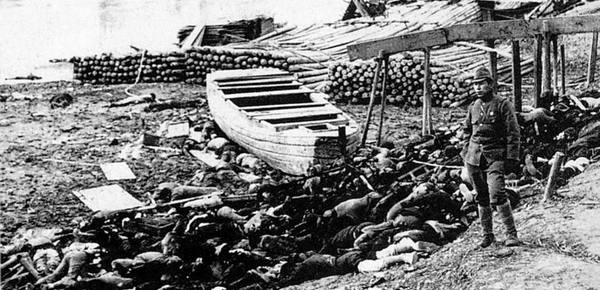
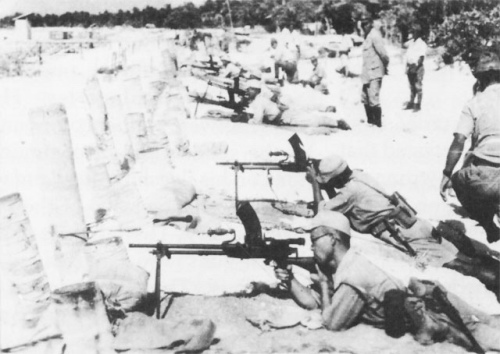
nanking_massacre_1

The Rape of Nanking

Friends of Padre Steve’s World,

Fyodor Dostoyevsky wrote, “Nothing is easier than to denounce the evildoer; nothing is more difficult than to understand him.”

This week I finished a series of articles on American Associate Supreme Court Justice Robert Jackson’s opening and closing arguments at Nuremberg, followed by one last night asking the question “Who Were the Victims? Does Anyone Care? The Holocaust and War Crimes Today.” For me the article was difficult to write because I have served in wars that under the rules of the International War Crimes Tribunal at Nuremberg and the subsequent U.S. trials in the same courtroom could be rule as wars of aggression, and in which American servicemen and women committed crimes that can easily be classified as war crimes, and even crimes against humanity. Likewise I have taught military ethics at Major American military Staff College.

I think one of our problems is that we want to believe that evil is simply done be evil people. That is why when we see a Hitler, Stalin, Pol Pot, or the monsters of the so-called Islamic State, we are often strangely comforted. This is often  because we can point to a single person with a wicked ideology and say “they are evil,” all the while forgetting that they are, or were, like us, also human. Aleksandr Solzhenitsyn reminds us of the folly of that type of thinking, “If only it were all so simple! If only there were evil people somewhere insidiously committing evil deeds, and it were necessary only to separate them from the rest of us and destroy them. But the line dividing good and evil cuts through the heart of every human being. And who is willing to destroy a piece of his own heart?”

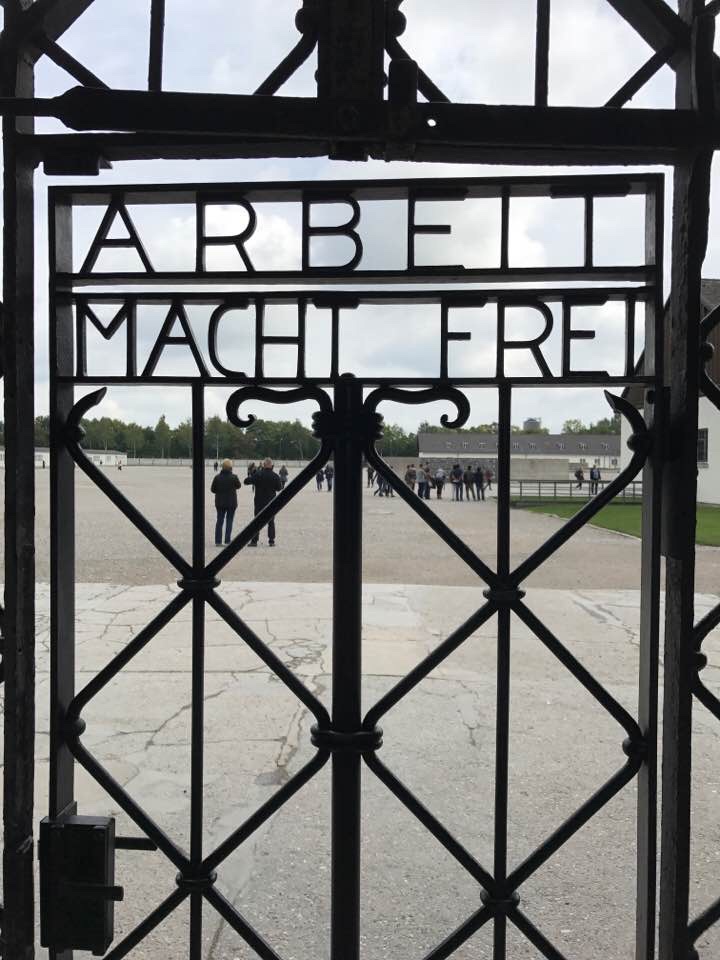
A few years ago I took a break from my Gettysburg text and dusted off an old academic paper dealing with the one of the more uncomfortable aspects of the Nazi Holocaust against the Jews. I did that because I felt that I needed to reexamine the nature of evil in the modern world. Doing that brought me to do much more study of war crimes and the Holocaust. Since then I have visited Nazi Concentration Camps, Euthanasia Centers, the Wannsee House, where the coordination of the Final Solution was conducted, as well as memorials to the German resistance at the Bendlerstraße headquarters from which the attempt to kill Hitler on July 20th 1944 was launched; the Sophie Scholl and White Rose Resistance Memorial and Museum in Munich, and the National Socialist Documentation Center, also in Munich.

As I wrote my articles I have been binge reading books about the Japanese War Crimes from the “China Incident” to the end of the Second World War. I started those at the behest of a reader of this blog. While I knew the wave tops of those crimes and was vaguely familiar with the Tokyo Trial I was not as well informed about the complexity of those crimes and the participation of Japanese officials at every level of government in them.

That leads me to today, not long after the American President pardoned convicted war criminals and the fired his own Secretary of the Navy to keep one of those men from losing his SEAL Trident at a peer review conducted by other SEALS.

When I ponder the evil committed by supposedly civilized men and women of Germany and Japan in the Second World War, as well as other war crimes, crimes against humanity, and acts of genocide committed by other nations and people’s, I realize that they are little different than others who share the culture of the West. These people were the products of a culture of learning, and of science. They were part of a culture formed by the Christian tradition, the Renaissance, the Reformation, and the Enlightenment, the age of Reason. As I pondered this I came to remember something said by the late Iris Chang, “civilization is tissue thin.”

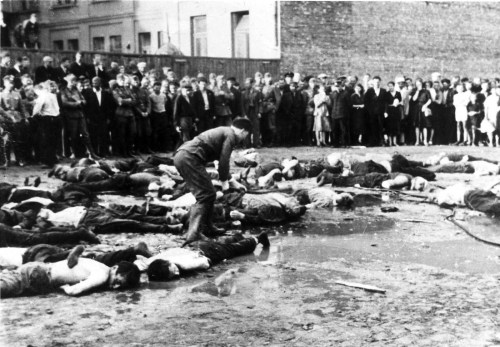
Omaha_courthouse_lynching

Lynching in the American South

My original series of articles several years ago which dealt with the Nazi Eunsatzgruppen dealt with the ordinary men, and the bureaucratic systems that implemented an ideology so twisted and evil that it is unimaginable to most people. While most people in the United States know a little about the Holocaust, most do not fully comprehend how devilish and insidious the crimes of the Nazis were. More frightening is the fact that 46% of people worldwide have never heard of the Holocaust, and of the 54% who are aware some 32% think it is a myth or has been greatly exaggerated. That was about five years ago. I will have to take a look at the current numbers, but I believe that the numbers wills only get worse as younger people are far more likely to believe that the Holocaust is a myth or or exaggerated.

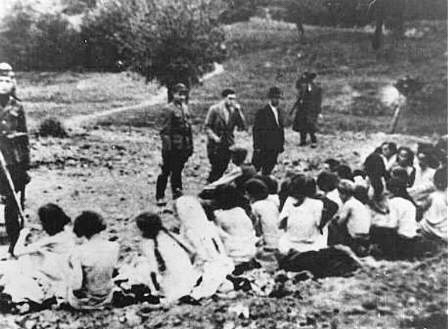
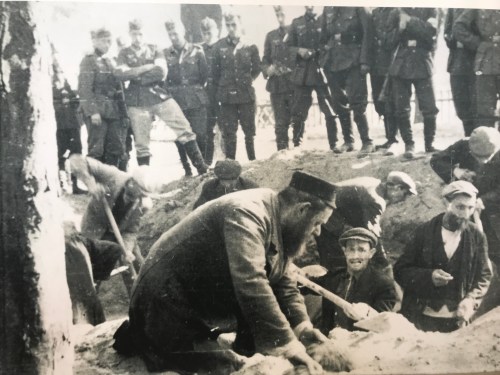
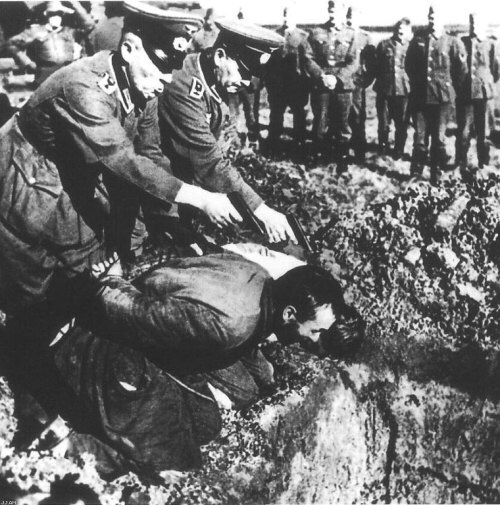
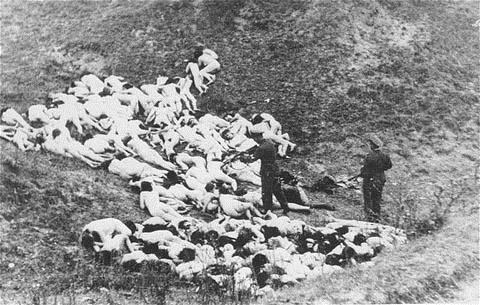
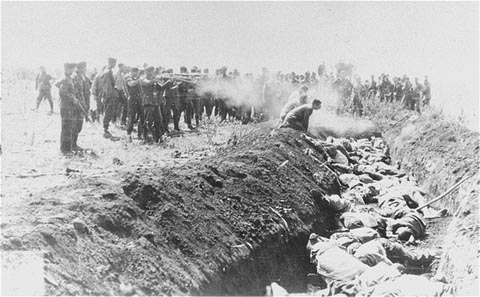
We typically know about the extermination camps like Auschwitz, but the lesser known dark side of the Holocaust, perhaps the scariest part, is the story of the men of the Einsatzgruppen. The Einsatzgruppen and affiliated units, including those of the Wehrmacht, the Waffen SS, the mobilized battalions of the Order Police, and locally recruited units, rounded up massive numbers of people and killed them up close and personal. In all these units murdered over two million people, about 1.3 million of whom were Jews.

My study of the Holocaust began in college as an undergraduate. My primary professor at California State University at Northridge, Dr. Helmut Haeussler had been an interpreter and interrogator at the Nuremberg trials. I was able to take a number of lecture classes from him a large amount of research and independent study courses in a year of graduate work while finishing my Army ROTC program at UCLA. It was an immersion in the history, sociology, and the psychology of evil, during which I was able to meet and talk with Jewish survivors of the Holocaust.

mass killing einsatzgruppen

Einsatzgruppen

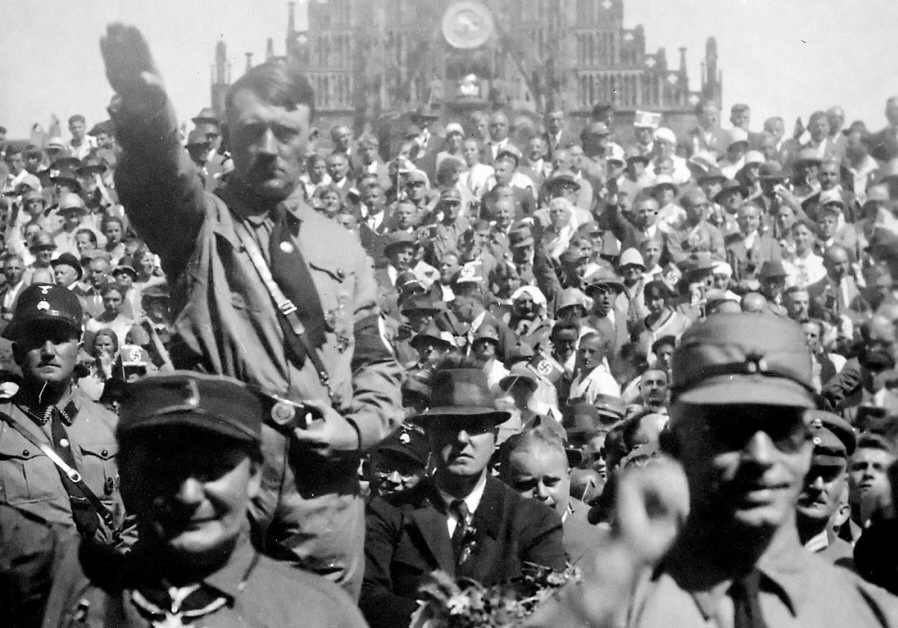
Since then I have continued to read and study. I lived in Germany for over four years, and made many other visits, during which I went to a number of Concentration Camp sites. I visited the rebuilt synagogue in Worms which had been destroyed during the infamous Kristallnacht, and other museums and Holocaust memorial sites in Germany. I visited the Zeppelin field, the site of Hitler’s massive Nazi Party rallies in Nuremburg, as well as the graveyards which contain the victims of other Nazi crimes, including the Nacht und Nebel or night and fog actions, where people simply disappeared and were murdered by the Gestapo. When I think about the men and women who were the perpetrators of those crimes as well as those who were bystanders, who knew about those crimes and did nothing to stop them I am reminded of Captain Gustave Gilbert, an American Psychologist who interviewed and got to know the major German War Criminals at Nuremberg. Gilbert wrote:

“In my work with the defendants (at the Nuremberg Trails 1945-1949) I was searching for the nature of evil and I now think I have come close to defining it. A lack of empathy. It’s the one characteristic that connects all the defendants, a genuine incapacity to feel with their fellow men. Evil, I think, is the absence of empathy.”

For me, those visits were sobering, maybe even more so because I understood exactly what happened in those sites. These are uncomfortable places to visit, and I can understand why many people would not want to visit them, or even study them.

The darkness that they remind us of  is a part of our human condition. Traces of the evil on display in those places is present in every human being. Frankly, most people cannot bear looking into that abyss, for fear that they might be swallowed by it.

nankino-masakra-1

Nanking

I can understand that and I have to admit that it is hard to do so. I am a historian as well as a clinician with much experience dealing with death and trauma. With my training I do a pretty good job of keeping my emotional distance to maintain objectivity when confronted with evil. However, it is hard for me not to have some emotional reaction when visiting these places, or reading about the events and people, and in writing about them.

Likewise, I am very troubled by the growing lack or awareness or denial of the Holocaust. It is very hard for me not to have a virulent reaction when I see books and websites dedicated to Holocaust denial, or that minimize other well documented genocides, and crimes against humanity.

tzd8ftsn-1390907543

Soviet Genocide in Ukraine

My sensitivity to human suffering and the terrible indifference of people in this country to it was greatly increased by my experience of war, and my post-war struggles with PTSD, depression, anxiety, which at points left me very close to committing suicide. A non-chaplain friend, a now retired Navy Command Master Chief Petty Officer that I served with at EOD Group Two remarked that I am a tremendously empathic person, and that I have a large capacity to feel the pain and suffering of others. This capacity for empathy and the ability to feel the suffering of others is part of who I am. It is a good thing, but it makes my work studying and writing about the Holocaust, other genocides, crimes against humanity, and subjects like American slavery, racism, and Jim Crow a sometimes difficult and often very emotionally consuming task. This sometimes leaves me even more sleepless and anxious than normal; especially when I see the indifference of so many people to the suffering of others today.

CambodiaExhibitMassgrave-x1

The Killing Fields

It is that indifference which motivates me to write; because if these events are not recalled and retold, they, like any part of history will be ignored and then forgotten. The statistics bear this out. There are people today, who say that we should stop talking about these events, that they are old news, and they cannot happen again; but history tells us different, and not just the Holocaust, but indeed every genocide. Then there are those who shamelessly use the Holocaust imagery to spread fear among their followers even as they openly demonize minority groups and religions as the Nazis did to the Jews.

I have to agree with Elie Wiesel who said, “Indifference to me, is the epitome of all evil.”

The late Iris Chang, who wrote The Rape of Nanking: The Forgotten Holocaust of World War II wrote something that is pertinent to almost every modern episode of genocide, or other crime against humanity. It is the ability of leaders, be they political, military, or religious to convince people to rationalize actions that they normally would find repulsive.

“After reading several file cabinets’ worth of documents on Japanese war crimes as well as accounts of ancient atrocities from the pantheon of world history, I would have to conclude that Japan’s behavior during World War II was less a product of dangerous people than of a dangerous government, in a vulnerable culture, in dangerous times, able to sell dangerous rationalizations to those whose human instincts told them otherwise.”

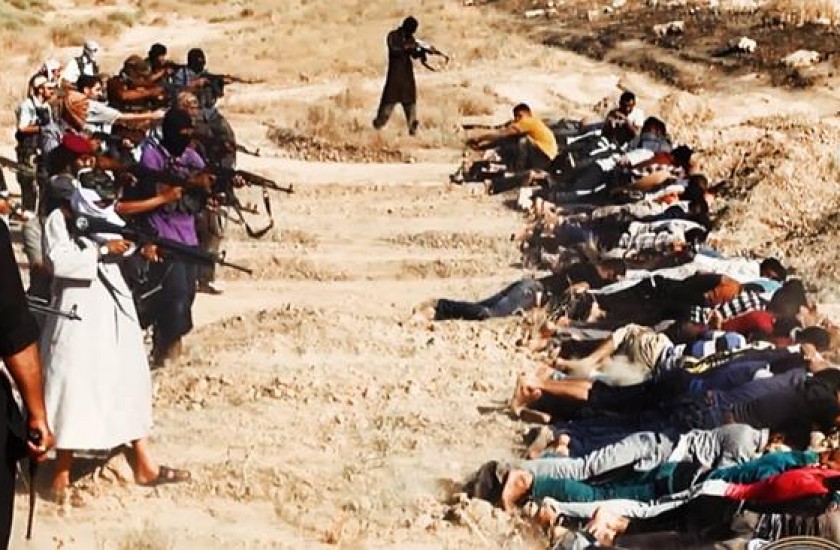
isis3-840x550

The Islamic State

What we call civilization, to use the words of Iris Chang, is tissue thin. That is why we must never forget these terrible events of history, and that part of human nature, and in a sense part of every one of us, that makes them so easy to repeat. That is why we must periodically take the time to remember and reflect on the Holocaust, other genocides and crimes against humanity. Historian Timothy Snyder in his book On Tyranny wrote:

“The European history of the twentieth century shows us that societies can break, democracies can fall, ethics can collapse, and ordinary men can find themselves standing over death pits with guns in their hands. It would serve us well today to understand why.”


Sophie Scholl, the 22 year old leader of the White Rose resistance movement in Nazi Germany I think gives those who still retain a sense of empathy, ethics, and self-decency a plumb-line of what the real issues are.

Sophie wrote:

“The real damage is done by those millions who want to ‘survive.’ The honest men who just want to be left in peace. Those who don’t want their little lives disturbed by anything bigger than themselves. Those with no sides and no causes. Those who won’t take measure of their own strength, for fear of antagonizing their own weakness. Those who don’t like to make waves—or enemies. Those for whom freedom, honour, truth, and principles are only literature. Those who live small, mate small, die small. It’s the reductionist approach to life: if you keep it small, you’ll keep it under control. If you don’t make any noise, the bogeyman won’t find you. But it’s all an illusion, because they die too, those people who roll up their spirits into tiny little balls so as to be safe. Safe?! From what? Life is always on the edge of death; narrow streets lead to the same place as wide avenues, and a little candle burns itself out just like a flaming torch does. I choose my own way to burn.”

Yes, these are terribly uncomfortable subjects, but we cannot allow this generation to allow them to be forgotten, lest they be repeated. That is why that I must continue to write about them.

Peace

Padre Steve+

Leave a comment

Filed under ethics, germany, History, holocaust, imperial japan, middle east, Military, national security, nazi germany, News and current events, Political Commentary, terrorism, Tour in Iraq, us army, war crimes, world war two in europe, world war two in the pacific

Who Were the Victims? Does Anybody Care? The Holocaust and War Crimes Today

Friends of Padre Steve’s World,

Tonight I write about the victims of the Holocaust, and other Nazi Crimes Against Humanity. At the heart of the Nazi crimes was the genocide committed against the Jews, but the Nazi crimes extended far beyond them; the systemic extermination of the handicapped, mentally ill, chronically sick, and others deemed to be Life Unworthy of Life. Likewise there was the killing of possible political political opponents in the Reich and conquered territories; the intentional starvation of Poles and Russians, the use of slave labor, and the indiscriminate killing of civilians.

In the film Judgement at Nuremberg the American Prosecutor at the Judges Trial played by Richard Widmark asked a question when showing a film of the victims of the Nazis when the Concentration Camps were liberated by American and British troops in the spring of 1945. His question in the face of films of massed piles of bodies being bulldozed into mass graves at Bergen-Belsen, of the cremated remains, shrunken skulls, and lampshades made of human skin at Buchenwald, gas chambers, medical experiments, the emaciated bodies of still living victims; little more than skin and bones, elbows, hips, and knees bulging over the shrunken remains of their bodies, eyes sunken in to the skulls.

Who were they?

The Nazis specifically targeted the Jews for extermination. According to Hitler, his hnchemen, and other German nationalists, the Jews were less than human, they worked hand in hand with the Bolsheviks, and thus deserved their fate. Likewise, there were those crippled in body or mind who were euthanized, political opponents, religious and racial minorities, populations of conquered nations, who died at the hands of the German military, or who were gunned down in mass graves by the Einsatzgruppen, intentionally starved to death, or who were worked to death as Slave laborers in the Nazi work camps.

To the average German of the time they were subhuman, and even those not fully in agreement with the Nazis seldom cared, and simply turned their backs. There were the perpetrators and the bystanders, who seldom if ever thought about their victims. In a way very much like most of us don’t even blink when we are confronted with war crimes committed by our own soldiers, and their victims, or innocent women and children killed during air or drone strikes where perhaps one or two at best terrorists or insurgents were reportedly located.

we have a lot to learn from the past.

The victims of the Nazis, like so many others who have committed crimes against humanity, including us, were men and women, wives and husbands, sons and daughters. They spanned the spectrum from infants to the aged. Too many times multiple generations of families went to death together. Examples of the Nazi crimes are so numerous that they must never be forgotten. That is why I write tonight, that we never forget, so we do not repeat them ourselves. Human nature is human nature, and as much as we think we have progressed, the darkness still resides in us, and we must fight to do right.

However, some witnesses to the Nazi crimes were appalled and when the Nazi regime finally was crushed testified to those crimes.

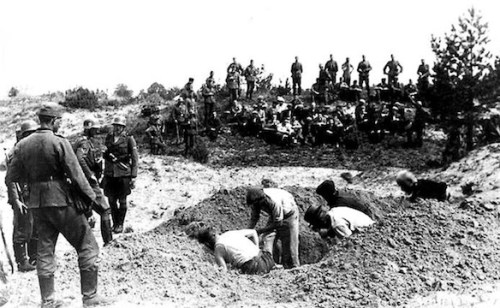
One of them was Hermann Graebe, a civilian employed to help build roads for the Wehrmacht came across one of the many massacres committed up close and personal by SS Men on October 5th 1943 at Dubno, Ukraine. At Nuremberg he testified:

Moennikes and I went direct to the pits. Nobody bothered us. Now I heard rifle shots in quick succession, from behind one of the earth mounds. The people who had got off the trucks—men, women and children of all ages—had to undress upon the orders of an SS-man, who carried a riding or dog whip.

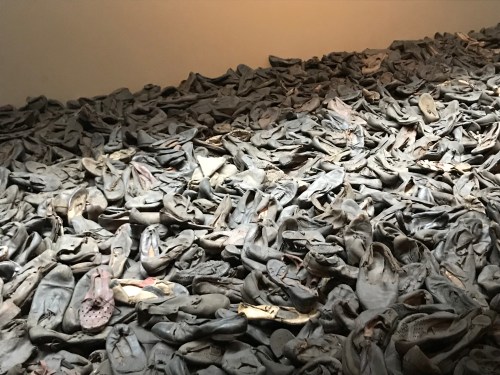
They had to put down their clothes in fixed places, sorted according to shoes, top clothing and underclothing. I saw a heap of shoes of about 800 to 1,000 pairs, great piles of underlinen and clothing. Without screaming or weeping these people undressed, stood around in family groups, kissed each other, said farewells and waited for a sign from another SS-man, who stood near the pit, also with a whip in his hand.

During the 15 minutes that I stood near the pit I heard no complaint or plea for mercy. I watched a family of about 8 persons, a man and woman, both about 50 with their children of about 1, 8 and 10, and two grown up daughters of about 20 to 24. An old woman with snow-white hair was holding the one year old child in her arms and singing to it, and tickling it. The child was cooing with delight. The couple were looking on with tears in their eyes. The father was holding the hand of a boy about 10 years old and speaking to him softly; the boy was fighting his tears. The father pointed toward the sky, stroked his head, and seemed to explain something to him. At that moment the SS-man at the pit shouted something to his comrade.

I looked into the pit and saw that the bodies were twitching or the heads lying already motionless on top of the bodies that lay before them. Blood was running from their necks.

I was surprised that I was not ordered away, but I saw that there were two or three postmen in uniform nearby. The next batch was approaching already.

These victims were not just numbers and statistics. They were living breathing human beings whose lives were snuffed out by the Nazis and their allies. They had been abandoned by most of the world. Anything of value that they possessed was appropriated by the men who exterminated them; their businesses, homes, farms, clothes, shoes, currency, jewelry, wedding rings, artwork, furniture, and even their gold fillings, and yes, their hair, and even their skin.

Whole towns were exterminated, millions of people killed and millions of other people displaced, never to return to their homes. At Babi Yar outside of Kiev 33,771 Jews were exterminated by the members of Sonderkommando 4b of Einsatzgruppen C as well as Police battalions. About 10,000 others, mainly Communist Officials and Gypsies were rounded up and killed in the same operation. The victims were stripped of all of their belongings taken to a ravine and shot. The German Army provided logistic support as well as security for the murder squads.

Fritz Hoefer, a SS man serving as a truck driver with the Sonderkommando said these words at the Einsatzgruppen Trial:

One day I was ordered to drive my truck out of town. I had a Ukrainian with me. It was about 10 a.m. On our way, we passed Jews marching in columns in the same direction, we were going. They were carrying their belongings. There were whole families. The farther we drove away from the town, the more people we saw in the columns. There were piles of clothes in a wide open field. My job was to fetch them.   

I stopped the engine nearby, and the Ukrainians standing around started loading the car with this stuff. From where I was, I saw other Ukrainians meeting the Jews who arrived, men, women and children, and directing them to the place where, one after another, they were supposed to remove their belongings, coats, shoes, outer garments and even their underwear.

They were supposed to put all their belongings together in a pile. Everything happened very quickly, the Ukrainians hurried those who hesitated by kicking and pushing them. I think it took less than a minute from the moment a person took off his coat before he was standing completely naked.

No distinction was made between men, women and children. The Jews who were arriving could have turned back when they saw those who had come earlier taking off their clothes. Even today I cannot understand why they didn’t run.


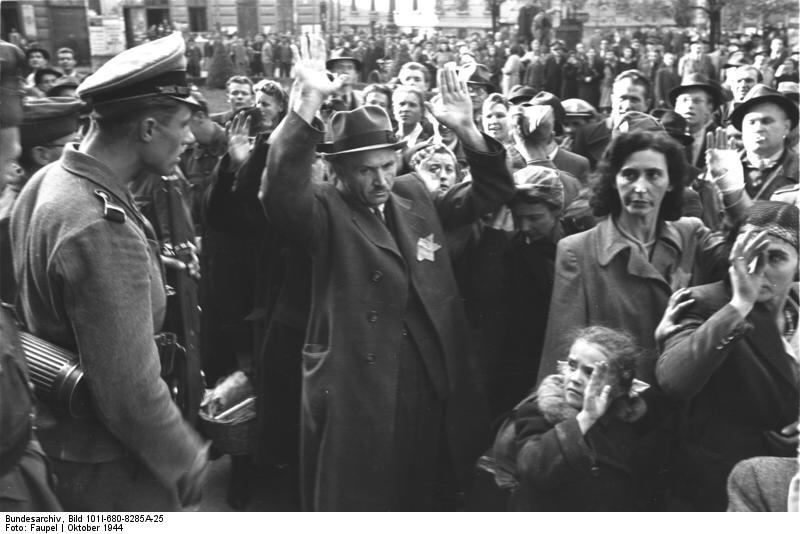
Columns of Jews march past a corpse in Kiev

Naked Jews were led to a ravine about 150 metres long, 30 metres wide and 15 metres deep. The Jews went down into the ravine through two or three narrow paths. When they got closer to the edge of the ravine, members of the Schutzpolizei (Germans) grabbed them and made them lie down over the corpses of the Jews who had already been shot.

It took no time. The corpses were carefully laid down in rows. As soon as a Jew lay down, a Schutzpolizist came along with a sub-machine gun and shot him in the back of the head.The Jews who descended into the ravine were so frightened by this terrible scene that they completely lost their will. You could even see some of them lying down in the row on their own and waiting for the shot to come.

Only two members of the Schutzpolizei did the shooting. One of them was working at one of the ravine, the other started at the other end. I saw them standing on the bodies and shooting one person after another.

Walking over the corpses toward a new victim who had already laid down, the machine gunner shot him on the spot. It was an extermination machine that made no distinction between men, women and children.Children were kept with their mothers and shot with them. I did not watch for long. When I approached the edge, I was so frightened of what I that I could not look at it for a long time.


German Einsatzgruppen & Police force groups of Jews to hand over their possessions and undress before being shot in the ravine at Babi Yar

I saw dead bodies at the bottom laid across in three rows, each of which was approximately 60 metres long. I could not see how many layers were there. It was beyond my comprehension to see bodies twitching in convulsions and covered with blood, so I could not make sense of the details.Apart from the two machine gunners, there were two other members of the Schutzpolizei standing near each passage into the ravine.

They made each victim lie down on the corpses, so that the machine gunner could shoot while he walked by. When victims descended into the ravine and saw this terrible scene at the last moment, they let out a cry of terror. But they were grabbed by the waiting Schutzpolizei right away and hurled down onto the others.

Those who followed them could not see the terrible scene because it was obstructed by the edge of the ravine. While some people were getting undressed and most of the others were waiting their turn, there was a lot of noise. The Ukrainians paid no attention to the noise and just kept forcing people through the passages into the ravine.

You could not see the ravine from the site where people were taking off their clothes, because it was situated about 150 metres away from the first pile of clothes. Besides, a strong wind was blowing and it was very cold. You couldn’t hear the shooting in the ravine.

Jews at Babi Yar waiting to be murdered

So I concluded that the Jews had no idea what was actually happening. Even today I wonder why the Jews did nothing to challenge what was going on. Masses of people were coming from town and they did not seem to suspect anything.

They thought they were just being relocated.              

The men who were the leaders of the mobile Einsatzgruppen which conducted these up close and personal killings of nearly a million and a half Jews and others were not common thugs. Most were very educated and accomplished men.

General Telford Taylor, an American lawyer who served as a prosecutor at the Einsatzgruppen Trial explained:

“These defendants are not German peasants or artisans drafted into the Wehrmacht. They are not uneducated juveniles. They are lawyers, teachers, artists, and a former clergyman. They are, in short, men of education, who were in full possession of their faculties and who fully understood the grave and sinister significance of the program they embarked upon. They were part of the hard core of the SS. They did not give mere lip service to Himmler’s atrocious racial doctrines; they were chosen for this terrible assignment because they were thought to be men of sufficient ruthlessness to carry them out. They are hand-picked fanatics; every one of them was an officer of the SS … They are not unhappy victims, unwillingly pushed into crime by the tyranny of the Third Reich; these men, above all others, themselves, spread the Nazi doctrine with fire and sword.”

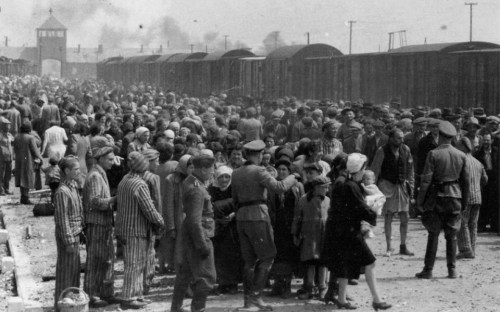
The men who ran the death camps might not have been from the same “elite” stock as the commanders of the Einsatzgruppen but they carried out their duties in calculating and businesslike manner. Rudolf Hoess who commanded Auschwitz gave this statement to the International Military Tribunal:

On 1 December 1943 1 became Chief of Amt 1 in Amt Group D of the WVHA, and in that office was responsible for co-ordinating all matters arising between RSHA and concentration camps under the administration of WVHA. I held this position until the end of the war. Pohl, as Chief of WVHA, and Kaltenbrunner, as Chief of RSHA, often conferred personally and frequently communicated orally and in writing concerning concentration camps. . . .

The ‘final solution’ of the Jewish question meant the complete extermination of all Jews in Europe. I was ordered to establish extermination facilities at Auschwitz in June 1941. At that time, there were already in the General Government three other extermination camps: Belzek, Treblinka, and Wolzek. These camps were under the Einsatzkommando of the Security Police and SD. I visited Treblinka to find out how they carried out their exterminations. The camp commandant at Treblinka told me that he had liquidated 80,000 in the course of one-half year. He was principally concerned with liquidating all the Jews from the Warsaw Ghetto. He used monoxide gas, and I did not think that his methods were very efficient. So when I set up the extermination building at Auschwitz, I used Cyklon B, which was a crystallized prussic acid which we dropped into the death chamber from a small opening. It took from 3 to 15 minutes to kill the people in the death chamber, depending upon climatic conditions. We knew when the people were dead because their screaming stopped. We usually waited about one-half hour before we opened the doors and removed the bodies. After the bodies were removed our special Kommandos took off the rings and extracted the gold from the teeth of the corpses.

When he was asked specifics, Hoess stated: This gold was melted down and brought to the Chief Medical Office of the SS at Berlin.

He continued with some pride during cross examination:

Another improvement we made over Treblinka was that we built our gas chamber to accommodate 2,000 people at one time whereas at Treblinka their 10 gas chambers only accommodated 200 people each. The way we selected our victims was as follows: We had two SS doctors on duty at Auschwitz to examine the incoming transports of prisoners. The prisoners would be marched by one of the doctors who would make spot decisions as they walked by. Those who were fit for work were sent into the camp. Others were sent immediately to the extermination plants. Children of tender years were invariably exterminated since by reason of their youth they were unable to work. Still another improvement we made over Treblinka was that at Treblinka the victims almost always knew that they were to be exterminated and at Auschwitz we endeavored to fool the victims into thinking that they were to go through a delousing process. Of course, frequently they realized our true intentions and we sometimes had riots and difficulties due to that fact. Very frequently women would hide their children under the clothes, but of course when we found them we would send the children in to be exterminated. We were required to carry out these exterminations in secrecy but of course the foul and nauseating stench from the continuous burning of bodies permeated the entire area and all of the people living in the surrounding communities knew that exterminations were going on at Auschwitz.

But the bodies…

Jews and Gentiles from every nation in Europe as well as the Americas, Africa, and Asia ended up dying at the hands of the Nazis, either in their Death Camps, Concentration/ Labor Camps, or up close and personal at the hands of the Einsatzgruppen, the Waffen SS, or the Wehrmacht.

Every one of those bodies, the cold statistics of the Nazi machine were people like you and me. In April of 2018 I visited the United States Holocaust Museum while visiting friends in Washington D. C.

I think that the one that hit me the hardest was the pictorial Tower of Faces from the Polish shtetl of Ejszyszki. That town was home to some 4,000 Jews and the pictures had been taken over the preceding decade by local photographers. They were pictures of everyday family and community life; men, women, children at work, at play, at rest. Worshipping, working, studying, the old and the young, the well off and the poor, the religious and those not as religious at all phase of life captured in photos for eternity. For 3500 of them their lives ended on September 21st 1941 when the Nazis rounded up the Jews at their Synagogues on the eve of Yom Kippur and executed them by firing squad in mass graves at the town’s Christian and Jewish cemeteries. Only 29 of those who survived that day lived through the war. That Jewish community had existed for 900 years and was exterminated in a matter of hours.

          The Tower of Faces at the United States Holocaust Museum 

I looked at those pictures and I could not get over all of those innocent lives cut short. Each face was the picture of an individual or individuals, families, friends, schoolmates. They were not abstract numbers or statistics but real flesh and blood people like you and me. They had hopes and dreams, but because they were Jews they were exterminated, like nearly six million other Jews who also were real people with hopes and dreams that would be destroyed by the Nazi racial war. Of course the Nazis targeted others, but none with the relentless anti-Semitic racial hatred propagated by Nazi ideology. Thus they condoned and executed by people who would have ordinarily have been considered upstanding and moral citizens. The late Christopher Hitchens wrote:

“We should not at all allow ourselves to forget the millions of non-Jewish citizens of Belarus, Russia, Ukraine, and other Slav territories who were also massacred. But for me the salient fact remains that anti-Semitism was the regnant, essential, organizing principle of all the other National Socialist race theories. It is thus not to be thought of as just one prejudice among many.” 

The Jewish-Italian Philosopher and Auschwitz survivor Primo Levi wrote:

Then for the first time we became aware that our language lacks words to express this offence, the demolition of a man. In a moment, with almost prophetic intuition, the reality was revealed to us: we had reached the bottom. It is not possible to sink lower than this; no human condition is more miserable than this, nor could it conceivably be so. Nothing belongs to us any more; they have taken away our clothes, our shoes, even our hair; if we speak, they will not listen to us, and if they listen, they will not understand. They will even take away our name: and if we want to keep it, we ill have to find ourselves the strength to do so, to manage somehow so that behind the name something of us, of us as we were, still remains.

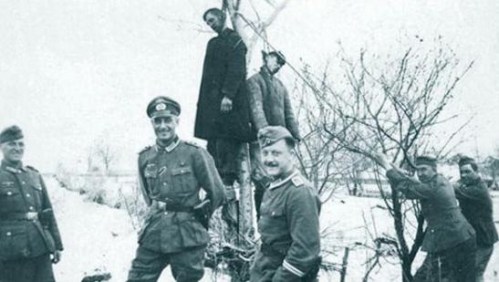
               Wehrmacht Troops Pose With Jews that They Hanged 

I write because the remaining witnesses to the Nazi Crimes are dying off and deniers are becoming ever more numerous. In researching this article I came across a man, an American of all people, who is denying the mass murder at Babi Yar. I have to shake my head, but the fact is that such people have become emboldened by the Presidency of Donald Trump, a man who has pardoned and praised convicted American War Criminals. They see in him a kindred spirit. Such does not bode well for the future, and the lives who will stand behind the faces and names of the future crimes against humanity.

Until tomorrow,

Peace,

Padre Steve+

2 Comments

Filed under crime, ethics, film, Foreign Policy, germany, History, holocaust, imperial japan, laws and legislation, leadership, middle east, Military, national security, nazi germany, News and current events, Political Commentary, racism, war crimes, War on Terrorism, world war two in europe

“If You Are to Say that They ARe Not Guilty” Reflecting on theNuremberg Defendants and the Trump Administration

Friends of Padre Steve’s World,

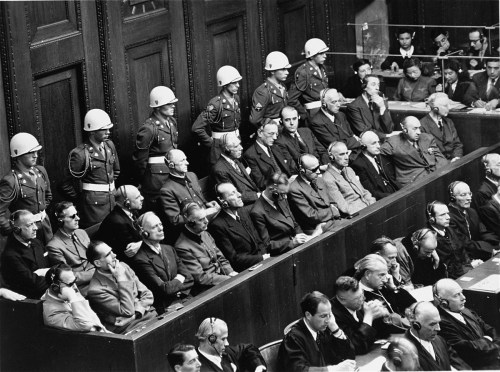
This is the final installment of my introduction and comments regarding Supreme Court Justice and Chief American Prosecutor Robert Jackson’s closing arguments at Nuremberg.

In this final segment of his closing arguments, Jackson confronted the impossibility of a cabal of the most powerful members of the Nazi Party, the German Government, its Military, and Police organizations, the men closest to Adolf Hitler and the center of power in Germany who by their testimony knew nothing of what was going on in the country.

When one reads the transcripts of the trials as I am continuing to do in between reading other books, including one about the Tokyo War Crimes Trials, the defendants universal defense was that they knew nothing, or had learned of the Nazi crimes for the first time during the trial.

What is remarkable is that for every denial there was documented evidence to the contrary, that each in their own way were willing participants in the Nazi crimes. While they pointed fingers at the dead, like Joseph Goebbels, Heinrich Himmler, Reinhard Heydrich, or unaccounted for like Martin Bormann, and on occasion the other defendants in the dock, each attempted to cover his tracks with lies and deception. Even Albert Speer, who was the only one of the defendants to openly admit his guilt during the trial engaged in deception.

The lies of these men and their brutal exposure before the watching world should serve as a warning to the leaders of nations, especially the nations which prosecuted these men, the foremost being the United States of America. Before the trial in the London agreement, Jackson noted:

“If certain acts of violation of treaties are crimes, they are crimes whether the United States does them or whether Germany does them, and we are not prepared to lay down a rule of criminal conduct against others which we would not be willing to have invoked against us.

I have served and continue to serve the United States, but my oath to the Constitution demands that I be intellectually honest and forthright in stating that the United States has not lived up to its founding principles or the words of Justice Jackson. During the Cold War the United States engaged in overthrowing foreign governments and replacing them with dictators more inclined to do our bidding, engineered the pretext to allow massive U. S. Military intervention in Vietnam, and after the Cold War used the real pretext of the terrorism of the 9-11-2001 attacks to invade Iraq, a country that was not involved. The list could go on and on, but because of the protections of the First Amendment, a free press has been able to expose many of those lies, even as the beast of corporate media egged on war like the Yellow Journalism of William Randolph Hearst during the run up to the Spanish American War.

Every government in every nation has engaged in some amount of lying to increase its power, influence, or to cover its malfeasance. The United States is not blameless, but too often Americans, ignorant or history, and the Constitution revel in the myth of American Exceptionalism to justify actions against other nations that do the same, that we have gone to war to confront or prosecuted as war criminals for doing. In fact, some of the Nazis in the dock at Nuremberg defended their actions by citing American history: Slavery, Jim Crow, the extermination of the Native American tribes, the American practice of eugenics, and medical experiments on racial minorities or the mentally ill, and the incarceration of Japanese Americans following Pearl Harbor to justify and defend their crimes, even as they denied their culpability for their crimes.

The Nazis in the dock at Nuremberg included true believers as well as opportunists. The were willing members of a regime founded upon lies. In defeat and on trial they would all repeat those lies, and add to them. Unfortunately, the current American President and his administration seem to be playing the same game with truth as the Nazis did. Hannah Arendt wrote:

“Before mass leaders seize the power to fit reality to their lies, their propaganda is marked by its extreme contempt for facts as such, for in their opinion fact depends entirely on the power of man who can fabricate it.”

Truth and integrity are not fungible assets that one can abandon without consequences. Germany is still hampered in international relations as well as domestic politics by what the Nazis did. The shadows of the Nazi past still enshroud Germans who are two or three generations removed from the Nazi past. The great ethicist Sissela Bok wrote:

“Trust and integrity are precious resources, easily squandered, hard to regain. They can thrive only on a foundation of respect for veracity.” 

As I watch the American President and his consigliere’s of criminal corruption be exposed for what they are by a still free press, and a relentlessly honest special prosecutor, I am reminded of how Robert Jackson and the team of Allied prosecutors used the words and documents of the Nazis themselves to indict and convict them.

With that I give you Robert Jackson’s masterful dissection of the Nazis in the dock at Nuremberg’s Palace of Justice. Something that we should pay close attention to as we follow the nefarious antics of President Trump and his corrupt administration and cult-like followers. What is interesting about the Nuremberg defendants were that some were true believers, while others were opportunists trying to advance their careers, even knowing the cause was evil and often criminal. The latter were probably more like many people nowadays, they just look the other way while trying to take advantage of any opportunity given to them.

Next month I will begin writing about the Japanese War Criminals and their crimes, but I will write about something else tomorrow.

Until tomorrow,

Peace,

Padre Steve+

Record of Proceedings: July 26, 1946, continued:

Rudolf Hess

The zealot Hess, before succumbing to wanderlust, was the engineer tending the Party machinery, passing orders and propaganda down to the Leadership Corps, supervising every aspect of Party activities, and maintaining the organization as a loyal and ready instrument of power.

Joachim von Ribbentrop

When apprehensions abroad threatened the success of the Nazi regime for conquest, it was the double-dealing Ribbentrop, the salesman of deception, who was detailed to pour wine on the troubled waters of suspicion by preaching the gospel of limited and peaceful intentions.

Wilhelm Keitel

Keitel, the weak and willing tool, delivered the armed forces, the instrument of aggression, over to the Party and directed them in executing its felonious designs.

Ernst Kaltenbrunner

Kaltenbrunner, the grand inquisitor, assumed the bloody mantle of Heydrich to stifle opposition and terrorise into compliance, and buttressed the power of National Socialism on a foundation of guiltless corpses.

Alfred Rosenberg

It was Rosenberg, the intellectual high priest of the “master race”, who provided the doctrine of hatred which gave the impetus for the annihilation of Jewry, and who put his infidel theories into practice against the Eastern occupied territories. His woolly philosophy also added boredom to the long list of Nazi atrocities.

Hans Frank

The fanatical Frank, who solidified Nazi control by establishing the new order of authority without law, so that the will of the Party was the only test of legality, proceeded to export his lawlessness to Poland, which he governed with the lash of Caesar and whose population he reduced to sorrowing remnants.

Wilhelm Frick

Frick, the ruthless organiser, helped the Party to seize power, supervised the police agencies to ensure that it stayed in power, and chained the economy of Bohemia and Moravia to the German war machine.

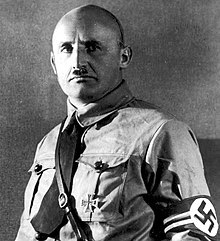
Julius Streicher

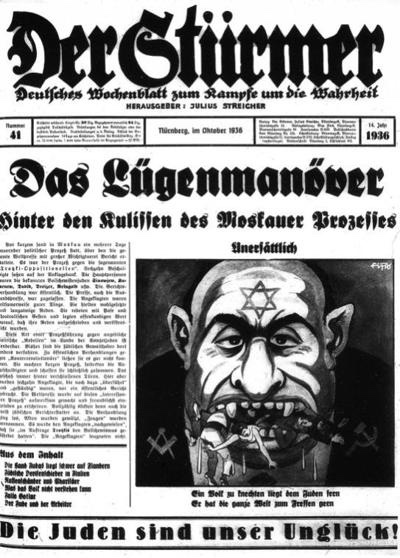
Streicher, the venomous vulgarian, manufactured and distributed obscene racial libels which incited the populace to accept and assist the progressively savage operations of “race purification”.

Walter Funk

As Minister of Economics Funk accelerated the pace of rearmament, and as Reichsbank president banked for the SS the gold teeth-fillings of concentration camp victims -probably the most ghoulish collateral in banking history.

Hjalmar Schacht

It was Schacht, the facade of starched respectability, who in the early days provided the window-dressing, the bait for the hesitant, and whose wizardry later made it possible for Hitler to finance the colossal rearmament programme, and to do it secretly.

Karl Dönitz

Donitz, Hitler’s legatee of defeat, promoted the success of the Nazi aggressions by instructing his pack of submarine killers to conduct warfare at sea with the illegal ferocity of the jungle.

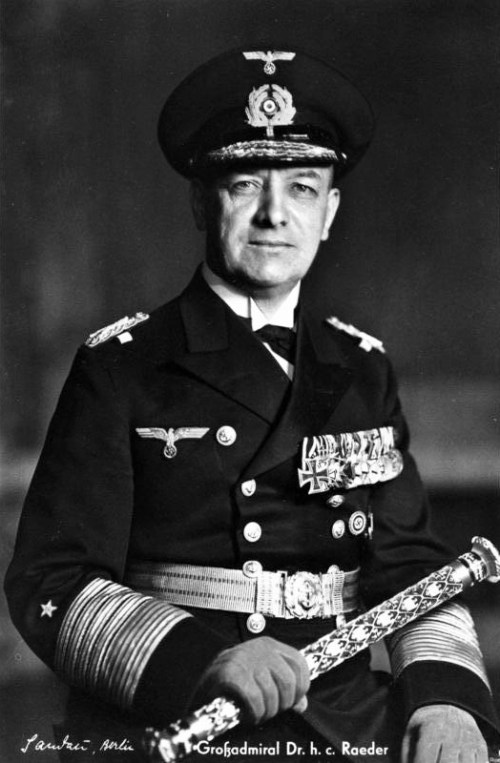
Erich Raeder

Raeder, the political admiral, stealthily built up the German Navy in defiance of the Versailles Treaty, and then put it to use in a series of aggressions which he had taken a leading part in planning.

Baldur von Schirach

Von Schirach, poisoner of a generation, initiated the German youth in Nazi doctrine, trained them in legions for service in the SS and Wehrmacht, and delivered them up to the Party as fanatic, unquestioning executors of its will.

Fritz Sauckel

Sauckel, the greatest and cruellest slaver since the Pharaohs of Egypt, produced desperately needed manpower by driving foreign peoples into the land of bondage on a scale unknown even in the ancient days of tyranny in the kingdom of the Nile.

Alfred Jodl

Jodl, betrayer of the traditions of his profession, led the Wehrmacht in violating its own code of military honour in order to carry out the barbarous aims of Nazi policy.

Franz von Papen

Von Papen, pious agent of an infidel regime, held the stirrup while Hitler vaulted into the saddle, lubricated the Austrian annexation, and devoted his diplomatic cunning to the service of Nazi objectives abroad.

Arthur Seyess-Inquart

Seyss-Inquart, spearhead of the Austrian fifth column, took over the government of his own country only to make a present of it to Hitler, and then, moving north, brought terror and oppression to the Netherlands and pillaged its economy for the benefit of the German juggernaut.

Konstantin von Neurath

Von Neurath, the old-school diplomat, who cast the pearls of his experience before the Nazis, guided Nazi diplomacy in the early years, soothed the fears of prospective victims, and as Reich Protector of Bohemia and Moravia strengthened the German position for the coming attack on Poland.

Albert Speer

Speer, as Minister of Armaments and Production, joined in planning and executing the programme to dragoon prisoners of war and foreign workers into German war industries, which waxed in output while the labourers waned in starvation.

Hans Fritzsche

Fritzsche, radio propaganda chief, by manipulation of the truth goaded German public opinion into frenzied support of the regime, and anaesthetised the independent judgement of the population so that they did their masters’ bidding without question.

Martin Bormann

Bormann, who has not accepted our invitation to this reunion, sat at the throttle of the vast and powerful engine of the Party, guiding it in the ruthless execution of Nazi policies, from the scourging of the Christian Church to the lynching of captive Allied airmen.

The activities of all these defendants, despite their varied backgrounds and talents, were joined with the efforts of other conspirators not now in the. dock, who played still other essential roles: They blend together into one consistent and militant pattern animated by a common objective to reshape the map of Europe by force of arms. Some of these defendants were ardent members of the Nazi movement from its birth. Others, less fanatical, joined the common enterprise later, after success had made participation attractive by the promise of rewards. This group of latter-day converts remedied a crucial defect in the ranks of the original true believers, for as Dr. Siemers has pointed out in his summation:

“… There were no specialists among the National Socialists for the particular tasks. Most of the National Socialist collaborators did not previously follow a trade requiring technical education.”

It was the fatal weakness of the early Nazi band that it lacked technical competence. It could not from among its own ranks make up a government capable of carrying out all the projects necessary to realize its aims. Therein lies the special crime and betrayal of men like Schacht and von Neurath, Speer and von Papen, Raeder and Donitz, Keitel and Jodl. It is doubtful whether the Nazi master plan could have succeeded without their specialized intelligence which they so willingly put at its command. They did so with knowledge of its announced aims and methods, and continued their services after practice had confirmed the direction in which they were tending. Their superiority to the average run of Nazi mediocrity is not their excuse. It is their condemnation.

The dominant fact which stands out from all the thousands of pages of the record of this trial is that the central crime of the whole group of Nazi crimes -the attack on the peace of the world -was clearly and deliberately planned. The beginning of these wars of aggression was not an unprepared and spontaneous springing to arms by a population excited by some current indignation. A week before the invasion of Poland Hitler told his military commanders:

“I shall give a propagandist cause for starting war -never mind whether it be plausible or not. The victor shall not be asked later on whether we told the truth or not. In starting and making a war, it is not the right that matters, but victory.”

The propagandist incident was duly provided by dressing concentration camp inmates in Polish uniforms, in order to create the appearance of a Polish attack on a German frontier radio station. The plan to occupy Belgium, Holland, and Luxembourg first appeared as early as August, 1938, in connection with the plan for attack on Czechoslovakia. The intention to attack became a programme in May, 1939, when Hitler told his commanders that:

“The Dutch and Belgian air bases must be occupied by armed forces. Declarations of neutrality must be ignored.”

Thus, the follow-up wars were planned before the first was launched. These were the most carefully plotted wars in all history. Scarcely a step in their terrifying succession and progress failed to move according to the master blueprint or the subsidiary schedules and timetables until long after the crimes of aggression were consummated. Nor were the war crimes and the crimes against humanity unplanned, isolated or spontaneous offences. Apart from our undeniable evidence of their plotting, it is sufficient to ask whether six million people could be separated from the population of several nations on the basis of their blood and birth, could be destroyed and their bodies disposed of, unless the operation had fitted into the general scheme of government. Could the enslavement of five millions of labourers, their impressment into service, their transportation to Germany, their allocation to work where they would be most useful, their maintenance, if slow starvation can be called maintenance, and their guarding have been accomplished if it did not fit into the common plan? Could hundreds of concentration camps located throughout Germany, built to accommodate hundreds of thousands of victims, and each requiring labour and materials for construction, manpower to operate and supervise, and close gearing into the economy -could such efforts have been expended under German autocracy if they had not suited the plan? Has the Teutonic passion for organization suddenly become famous for its toleration of non-conforming activity? Each part of the plan fitted into every other. The slave labour programme meshed with the needs of industry and agriculture, and these in turn synchronised with the military machine. The elaborate propaganda apparatus geared with the programme to dominate the people and incite them to a war which their sons would have to fight. The armament industries were fed by the concentration camps. The concentration camps were fed by the Gestapo. The Gestapo was fed by the spy system of the Nazi Party. Nothing was permitted under the Nazi iron rule that was not in accordance with the programme.

Everything of consequence that took place in this regimented society was but a manifestation of a premeditated and unfolding purpose to secure the Nazi State a place in the sun by casting all others into darkness.

COMMON DEFENCES AGAINST THE CHARGE OF COMMON RESPONSIBILITY

The defendants meet this overwhelming case, some by admitting a limited, responsibility, some by putting the blame on others, and some by taking the position, in effect, that while there have been enormous crimes there are no criminals. Time will not permit me to examine each individual and particular defence, but there are certain lines of defence common to so many cases that they deserve some consideration.

Counsel for many of the defendants seek to dismiss the charge of a common plan or conspiracy on the ground that the pattern of the Nazi plan does not fit into the concept of conspiracy applicable in German law to the plotting of a highway robbery or a burglary. Their concept of conspiracy is in the terms of a stealthy meeting in the dead of night, in a secluded hide-out, in which a group of felons plot every detail of a specific crime. The Charter forestalls resort to such parochial and narrow concepts of conspiracy taken from local law by using the additional and non-technical term, “common plan”. Omitting entirely the alternative term of “conspiracy”, the Charter reads that “leaders, organisers, instigators, and accomplices participating in the formulation or execution of a common plan to commit” any of the described crimes “are responsible for all acts performed by any persons in execution of such plan”.

The Charter concept of a common plan really represents the conspiracy principle in an international context. A common plan or conspiracy to seize the machinery of a State, to commit crimes against the peace of the world, to blot a race out of existence, to enslave millions, and to subjugate and loot whole nations cannot be thought of in the same terms as the plotting of petty crimes, although the same underlying principles are applicable. Little gangsters may plan who will carry a pistol and who a stiletto, who will approach a victim from the front and who from behind, and where they will waylay him. But in planning war, the pistol becomes a Wehrmacht, the stiletto a Luftwaffe. Where to strike is not a choice of dark alleys, but a matter of world geography. The operation involves the manipulation of public opinion, the law of the State, the police power, industry, and finance. The baits and bluffs must be translated into a nation’s foreign policy. Likewise, the degree of stealth which points to a guilty purpose in, a conspiracy will depend upon its object. The clandestine preparations of a State against international society, although camouflaged to those abroad, might be quite open and notorious among its own people. But stealth is not an essential ingredient of such planning. Parts of the common plan may be proclaimed from the housetops, as anti-Semitism was, and parts of it kept under cover, as rearmament for a long time was. It is a matter of strategy how much of the preparation shall be made public, as was Goering’s announcement in 1935 of the creation of an air force, and how much shall be kept covert, as in the case of the Nazis’ use of shovels to teach “labour corps” the manual of arms. The forms of this grand type of conspiracy are amorphous, the means are opportunistic, and neither can divert the law from getting at the substance of things.

The defendants counted, however, that there could be no conspiracy involving aggressive war because (1) none of the Nazis wanted war; (2) rearmament was only intended to provide the strength to make Germany’s voice heard in the family of nations; and (3) the wars were not in fact aggressive wars but were defensive wars against a “Bolshevik menace”.

When we analyse the argument that the Nazis did not want war it comes down, in substance, to this: “The record looks bad indeed -objectively -but when you consider the state of my mind -subjectively I hated war. I knew the horrors of war. I wanted peace.” I am not so sure of this. I am even less willing to accept Goering’s description of the General Staff as pacifist. However, it will not injure our case to admit that as an abstract proposition none of these defendants liked war. But they wanted things which they knew they could not get without war. They wanted their neighbours’ lands and goods. Their philosophy seems to be that if the neighbours would not acquiesce, then they are the aggressors and are to blame for the war. The fact is, however, that war never became terrible to the Nazis until it came home to them, until it exposed their deceptive assurances to the German people that German cities, like the ruined one in which we meet, would be invulnerable. From then on, war was terrible.

But again the defendants claim: “To be sure, we were building guns. But not to shoot. They were only to give us weight in negotiating.” At its best this argument amounts to a contention that the military forces were intended for blackmail, not for battle. The threat of military invasion which forced the Austrian Anschluss, the threats which preceded Munich, and Goering’s threat to bomb the beautiful city of Prague if the President of Czechoslovakia did not consent to the Protectorate, are examples of what the defendants had in mind when they talked of arming to back negotiation.

But from the very nature of German demands, the day was bound to come when some country would refuse to buy its peace, would refuse to pay Dane-geld,

“For the end of that game is oppression and shame, And the nation that plays it is lost.”

Did these defendants then intend to withdraw German demands, or was Germany to enforce them and manipulate propaganda so as to place the blame for the war on the nation so unreasonable as to resist? Events have answered that question, and documents such as Admiral Carl’s memorandum, earlier quoted, leave no doubt that the events occurred as anticipated.

But some of the defendants argue that the wars were not aggressive and were only intended to protect Germany against some eventual danger from the “menace of Communism”, which was something of an obsession with many Nazis.

At the outset this argument of self-defence fails because it completely ignores this damning combination of facts clearly established in the record: first, the enormous and rapid German preparations for war; second, the repeatedly avowed intentions of the German leaders to attack, which I have previously cited; and third, the fact that a series of wars occurred in which German forces struck the first blows, without warning, across the borders of other nations.

Even if it could be shown -which it cannot -that the Russian war was really defensive, such is demonstrably not the case with those wars which preceded it.

It may also be pointed out that even those who would have you believe that Germany was menaced by Communism also compete with each other in describing their opposition to the disastrous Russian venture. Is it reasonable that they would have opposed that war if it were undertaken in good faith in self-defence.

It is sought to balance the frivolous self-defence theory against the facts, as advocates often do, by resort to a theory of law. Dr. Jahrreiss, in his scholarly argument for the defence, rightly points out that no treaty provision and no principle of law denied Germany, as a sovereign nation, the right of self-defence. He follows with the assertion for which there is authority in classic International Law, that:

“… every State is alone judge of whether in a given case it is waging a war of self-defence”.

It is not necessary to examine the validity of an abstract principle which does not apply to the facts of our case. I do not doubt that if a nation arrived at a judgement that it must resort to war in self-defence, because of conditions affording reasonable grounds for such an honest judgement, any Tribunal would accord it great and perhaps conclusive weight, even if later events proved that judgement mistaken.

But the facts in this case call for no such deference to honest judgement because no such judgement was ever pretended, much less honestly made.

In all the documents which disclose the planning and rationalisation of these attacks, not one sentence has been or can be cited to show an honest fear of attack. It may be that statesmen of other nations lacked the courage forthrightly and fully to disarm. Perhaps they suspected the secret rearmament of Germany. But if they hesitated to abandon arms, they did not hesitate to neglect them. Germany well knew that her former enemies had allowed their armaments to fall into decay, so little did they contemplate another war. Germany faced a Europe that not only was unwilling to attack, but was too weak and pacifist even adequately to defend, and went to the very verge of dishonour, if not beyond, to buy its peace. The minutes we have shown you of the Nazis’ secret conclaves identify no potential attacker. They bristle with the spirit of aggression and not of defence. They contemplate always territorial expansion, not the maintenance of territorial integrity.

Minister of War von Blomberg, in his 1937 directive prescribing general principles for the preparation for war of the armed forces, has given the lie to these feeble claims of self-defence. He stated at that time:

“The general political situation justifies the supposition that Germany need not consider an attack on any side. Grounds for this are, in addition to the lack of desire for war in almost all nations, particularly the Western Powers, the deficiencies in the preparedness for war in a number of States and of Russia in particular.”

Nevertheless, he recommended: “a continuous preparation for war in order to (a) counter-attack at any time, and (b) to enable the military exploitation of politically favourable opportunities should they occur”.

If these defendants may now cynically plead self-defence, although no honest need of self-defence was asserted or contemplated by any responsible leader at that time, it reduces non-aggression treaties to a legal absurdity. They become additional instruments of deception in the hands of the aggressor, and traps for well-meaning nations. If there be in non-aggression pacts an implied condition that each nation may make a bona fide judgement as to the necessity for self-defence against imminent threatened attack, it certainly cannot be invoked to shelter those who never made any such judgement at all.

In opening this case I ventured to predict that there would be no serious denial that the crimes charged were committed, and that the issue would concern the responsibility of particular defendants. The defendants have fulfilled that prophecy. Generally, they do not deny that these things happened, but it is contended that they “just happened”, and that they were not the result of a common plan or conspiracy.

One of the chief reasons the defendants say why there was no conspiracy is the argument that conspiracy was impossible with a dictator. The argument runs that they all had to obey Hitler’s orders, which had the force of law m the German State, and hence obedience could not be made the basis of a criminal charge. In this way it is explained that while there have been wholesale killings, there have been no murderers.

This argument is an effort to evade Article 8 of the Charter, which provides that the order of the Government or of a superior shall not free a defendant from responsibility but can only be considered in mitigation. This provision of the Charter corresponds with the justice and with the realities of the situation, as indicated in defendant Speer’s description of what he considered to be the common responsibility of the leaders of the German nation; he said that … with reference to decisive matters, there was a joint responsibility. There must be a joint responsibility among the leaders, because who else could take the responsibility for the development of events, if not the close associates who work with and around the head of the State?

And again he told the Tribunal that … it was impossible after the catastrophe to evade this joint responsibility, and that if the war had been won, the leaders would also have laid claim to joint responsibility.

Like much of defence counsel’s abstract arguments, the contention that the absolute power of Hitler precluded a conspiracy crumbles in the face of the facts of record. The Fuehrerprinzip of absolutism was itself a part of the common plan, as Goering has pointed out. The defendants may have become the slaves of a dictator, but he was their dictator. To make him such was, as Goering has testified, the object of the Nazi movement from the beginning. Every Nazi took this oath:

“I pledge eternal allegiance to Adolf Hitler. I pledge unconditional obedience to him and the Fuehrers appointed by him.”

Moreover, they forced everybody else in their power to take it. This oath was illegal under German law, which made it criminal to become a member of an organization in which obedience to “unknown superiors or unconditional obedience to known superiors is pledged”. These men destroyed free government in Germany and now plead to be excused from responsibility because they became slaves. They are in the position of the boy of fiction who murdered his father and mother and then pleaded for leniency because he was an orphan.

What these men have overlooked is that Adolf Hitler’s acts are their acts. It was these men among millions of others, and it was these men leading millions of others, who built up Adolf Hitler and vested in his psychopathic personality not only innumerable lesser decisions but the supreme issue of war or peace. They intoxicated him with power and adulation. They fed his hates and aroused his fears. They put a loaded gun in his eager hands. It was left to Hitler to pull the trigger, and when he did they all at that time approved. His guilt stands admitted, by some defendants reluctantly, by some vindictively. But his guilt is the guilt of the whole dock, and of every man in it.

But it is urged that these defendants could not be in agreement on a common plan or conspiracy because they were fighting among themselves or belonged to different factions or cliques. Of course, it is not necessary that men should agree on everything in order to agree on enough things to make them liable for a criminal conspiracy. Unquestionably there were conspiracies within the conspiracy, and intrigues and rivalries and battles for power. Schacht and Goering disagreed, but over which of them should control the economy, not over whether the economy should be regimented for war. Goering claims to have departed from the plan because, through Dahlerus, he conducted some negotiations with men of influence in England just before the Polish war. But it is perfectly clear that this was not an effort to prevent aggression against Poland but to make that aggression successful and safe by obtaining English neutrality. Rosenberg and Goering may have had some differences as to how stolen art should be distributed, but they had none about how it should be stolen. Jodl and Goering may have disagreed about whether to denounce the Geneva Convention, but they never disagreed about violating it. And so it goes through the whole long and sordid story. Nowhere do we find a single instance where any one of the defendants stood up against the rest and said: “This thing is wrong and I will not take part in it.” Wherever they differed, their differences were as to method or jurisdiction, but always within the framework of the common plan.

Some of the defendants also contend that in any event there was no conspiracy to commit war crimes or crimes against humanity because Cabinet members never met with the military commanders to plan these acts. But these crimes were only the inevitable and incidental results of the plan to commit the aggression for purposes of Lebensraum. Hitler stated, at a conference with his commanders, that:

“The main objective in Poland is the destruction of the enemy and not the reaching of a certain geographical line.”

Frank picked up the tune and suggested that when their usefulness was exhausted,

“… then, for all I care, mincemeat can be made of the Poles and Ukrainians and all the others who run around here -it does not matter what happens”.

Reichskommissar Koch in the Ukraine echoed the refrain:

“I will draw the very last out of this country. I did not come to spread bliss ….”

This was Lebensraum in its seamy side. Could men of their practical intelligence expect to get neighboring lands free from the claims of their tenants without committing crimes against humanity?

The last stand of each defendant is that even if there was a conspiracy, he was not in it. It is therefore important in examining their attempts at avoidance of responsibility to know, first of all, just what it is that a conspiracy charge comprehends and punishes.

In conspiracy we do not punish one man for another man’s crime. We seek to punish each for his own crime of joining a common criminal plan in which others also participated. The measure of the criminality of the plan and therefore of the guilt of each participant is, of course, the sum total of crimes committed by all in executing the plan. But the gist of the offence is participation in the formulation or execution of the plan. These are rules which every society has found necessary in order to reach men, like these defendants, who never get blood on their own hands but who lay plans that result in the shedding of blood. All over Germany today, in every zone of occupation, little men who carried out these criminal policies under orders are being convicted and punished. It would present a vast and unforgivable caricature of justice if the men who planned these policies and directed these little men should escape all penalty.

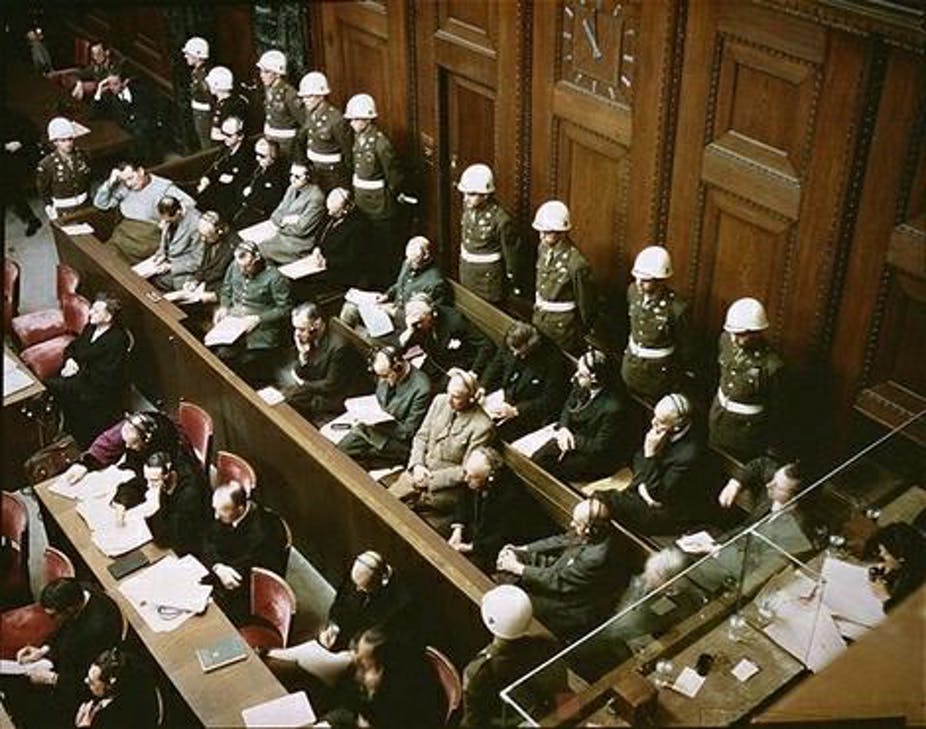
These men in this dock, on the face of this record, were not strangers to this programme of crime, nor was their connection with it remote or obscure. We find them in the very heart of it. The positions they held show that we have chosen defendants of self-evident responsibility. They are the very highest surviving authorities in their respective fields and in the Nazi State. No one lives who, at least until the very last moments of the war, outranked Goering in position, power, and influence. No soldier stood above Keitel and Jodl, and no sailor above Raeder and Donitz. Who can be responsible for the double-faced diplomacy if not the Foreign Ministers, von Neurath and Ribbentrop, and the diplomatic handyman, von Papen? Who should be answerable for the oppressive administration of occupied countries if Gauleiter, Protectors, Governors and Commissars such as Frank, Seyss-Inquart, Frick, von Schirach, von Neurath, and Rosenberg are not? Where shall we look for those who mobilised the economy for total war if we overlook Schacht and Speer and Funk? Who was the master of the great slaving enterprise if it was not Sauckel? Where shall we find the hand that ran the concentration camps if it was not the hand of Kaltenbrunner? Who whipped up the hates and fears of the public, and manipulated the Party organizations to incite these crimes, if not Hess, von Schirach, Fritzsche, Bormann and the unspeakable Julius Streicher? The list of defendants is made up of men who played indispensable and reciprocal parts in this tragedy. The photographs and the films show them again and again together on important occasions. The documents show them agreed on policies and on methods, and all working aggressively for the expansion of Germany by force of arms.

Hermann Goering

Each of these men made a real contribution to the Nazi plan. Each man had a key part. Deprive the Nazi regime of the functions performed by a Schacht, a Sauckel, a von Papen, or a Goering, and you have a different regime. Look down the rows of fallen men and picture them as the photographic and documentary evidence shows them to have been in their days of power. Is there one who did not substantially advance the conspiracy along its bloody path towards its bloody goal? Can we assume that the great effort of these men’s lives was directed towards ends they never suspected?

To escape the implications of their positions and the inference of guilt from their activities, the defendants are almost unanimous in one defence. The refrain is heard time and again: these men were without authority, without knowledge, without influence, without importance. Funk summed up the general self-abasement of the dock in his plaintive lament that:

“I always, so to speak, came up to the door. But I was not permitted to enter.”

In the testimony of each defendant, at some point there was reached the familiar blank wall: nobody knew anything about what was going on. Time after time we have heard the chorus from the dock:

“I only heard about these things here for the first time.”

These men saw no evil, spoke none, and none was uttered in their presence. This claim might sound very plausible if made by one defendant. But when we put all their stories together, the impression which emerges of the Third Reich, which was to last a thousand years, is ludicrous. If we combine only the stories of the front bench, this is the ridiculous composite picture of Hitler’s Government that emerges. It was composed of:

A No. 2 man who knew nothing of the excesses of the Gestapo which he created, and never suspected the Jewish extermination programme although he was the signer of over a score of decrees which instituted the persecution of that race;

A No. 3 man who was merely an innocent middleman transmitting Hitler’s orders without even reading them, like a postman or delivery boy;

A Foreign Minister who knew little of foreign affairs and nothing of foreign policy;

A Field-Marshal who issued orders to the armed forces but had no idea of the results they would have in practice;

A Security Chief who was of the impression that the policing functions of his Gestapo and SD were somewhat on the lines of directing traffic;

A Party philosopher who was interested in historical research, and had no idea of the violence which his philosophy was inciting in the twentieth century;

A Governor-General of Poland who reigned but did not rule;

A Gauleiter of Franconia whose occupation was to pour forth filthy writings about the Jews, but who had no idea that anybody would read them;

A Minister of the Interior who knew not even what went on in the interior of his own office, much less the interior of his own department, and nothing at all about the interior of Germany;

A Reichsbank President who was totally ignorant of what went in and out of the vaults of his bank;

A Plenipotentiary for the War Economy who secretly marshalled the entire economy for armament, but had no idea it had anything to do with war.

This may seem like a fantastic exaggeration, but this is what you would actually be obliged to conclude if you were to acquit these defendants.

They do protest too much. They deny knowing what was common knowledge. They deny knowing plans and programmes that were as public as Mein Kampf and the Party programme.

They deny even knowing the contents of documents which they received and acted upon. Nearly all the defendants take two or more conflicting positions. Let us illustrate the inconsistencies of their positions by the record of one defendant -who, if pressed, would himself concede that he is the most intelligent, honourable and innocent man in the dock. That is Schacht. And this is the effect of his own testimony -but let us not forget that I recite it not against him alone, but because most of its self-contradictions are found in the testimony of several defendants.

Schacht did not openly join the Nazi movement until it had won, nor openly desert it until it had lost. He admits that he never gave it public opposition, but asserts that he never gave it private loyalty. When we demand of him why he did not stop the criminal course of the regime in which he was a Minister, he says he had not a bit of influence. When we ask why he remained a member of the criminal regime, he tells us that by sticking on he expected to moderate its programme. Like a Brahmin among Untouchables, he could not bear to mingle with the Nazis socially, but never could he afford to separate from them politically. Of all the Nazi aggressions by which he now claims to have been shocked, there is not one that he did not support before the world with the weight of his name and prestige. Having armed Hitler to blackmail a continent, his answer now is to blame England and France for yielding. Schacht always fought for his position in a regime he now affects to despise. He sometimes disagreed with his Nazi confederates about what was expedient in reaching their goal, but he never dissented from the goal itself. When he did break with them in the twilight of the regime, it was over tactics, not principles. From then on he never ceased to urge others to risk their positions and their necks to forward his plots, but never on any occasion did he hazard either of his own. He now boasts that he personally would have shot Hitler if he had had the opportunity, but the German newsreel shows that even after the fall of France, when he faced the living Hitler, he stepped out of line to grasp the hand he now claims to loathe and hung upon the words of the man he now says he thought unworthy of belief. Schacht says he steadily “sabotaged” the Hitler Government. Yet the most relentless secret service in the world never detected him doing the regime any harm until long after, he knew the war to be lost and the Nazis doomed. Schacht, who dealt in “hedges” all his life, always kept himself in a position to claim that he was in either camp. The plea for him is as specious on analysis as it is persuasive on first sight. Schacht represents the most dangerous and reprehensible type of opportunism -that of the man of influential position who is ready to join a movement that he knows to be wrong because he thinks it is winning.

These defendants, unable to deny that they were the men in the very highest ranks of power, and unable to deny that the crimes I have outlined actually happened, know that their own denials are incredible unless they can suggest someone who is guilty.

The defendants have been unanimous, when pressed, in shifting the blame on other men, sometimes on one and sometimes on another. But the names they have repeatedly picked are Hitler, Himmler, Heydrich, Goebbels and Bormann. All of these are dead or missing. No matter how hard we have pressed the defendants on the stand, they have never pointed the finger at a living man as guilty. It is a temptation to ponder the wondrous workings of a fate which has left only the guilty dead and only the innocent alive. It is almost too remarkable.

The chief villain on whom blame is placed -some of the defendants vie with each other in producing appropriate epithets -is Hitler. He is the man at whom nearly every defendant has pointed an accusing finger.

I shall not dissent from this consensus, nor do I deny that all these dead and missing men shared the guilt. In crimes so reprehensible that degrees of guilt have lost their significance they may have played the most evil parts. But their guilt cannot exculpate the defendants. Hitler did not carry all responsibility to the grave with him. All the guilt is not wrapped in Himmler’s shroud. It was these dead men whom these living chose to be their partners in this great conspiratorial brotherhood, and the crimes that they did together they must pay for one by one.

It may well be said that Hitler’s final crime was against the land he had ruled. He was a mad “messiah” who started the war without cause and prolonged it without reason. If he could not rule he cared not what happened to Germany. As Fritzsche has told us from the stand, Hitler tried to use the defeat of Germany for the self-destruction of the German people. He continued the fight when he knew it could not be won, and continuance meant only ruin.

Speer, in this courtroom, has described it as follows:

“… The sacrifices which were made on both sides after January, 1945, were senseless. The dead of this period will be the accusers of the man responsible for the continuation of that fight, Adolf Hitler, and the ruined cities which in this last phase lost tremendous cultural values and in which a colossal number of dwellings were destroyed …. The German people remained faithful to Adolf Hitler until the end. He betrayed them knowingly. He finally tried to throw them into the abyss ….”

Hitler ordered everyone else to fight to the last and then retreated into death by his own hand. But he left life as he lived it, a deceiver; he left the official report that he had died in battle. This was the man whom these defendants exalted to a Fuehrer. It was they who conspired to get him absolute authority over all of Germany. And in the end he and the system they had created for him brought the ruin of them all. As stated by Speer in cross-examination:

“… the tremendous danger of the totalitarian system, however, only became really clear at the moment when we were approaching the end. It was then that one could see what the principle really meant, namely, that every order should be carried out without criticism. Everything that has become known during this trial, especially with regard to orders which were carried out without any consideration, has proved how evil it .was in the end…. Quite apart from the personality of Hitler, on the collapse of the totalitarian system in Germany it became clear what tremendous dangers there are in a system of that kind. The combination of Hitler and this system has brought about these tremendous catastrophes in the world.”

But let me for a moment turn devil’s advocate. I admit that Hitler was the chief villain. But for the defendants to put all blame on him is neither manly nor true. We know that even the head of the State has the same limits to his senses and to the hours of his days as do lesser men. He must rely on others to be his eyes and ears as to most that goes on in a great empire. Other legs must run his errands; other hands must execute his plans.

On whom did Hitler rely for such things more than upon these men in the dock? Who led him to believe he had an invincible air armada if not Goering? Who kept disagreeable facts from him? Did not Goering forbid Field-Marshal Milch to warn Hitler that in his opinion Germany was not equal to the war upon Russia? Did not Goering, according to Speer, relieve General Galland of his air force command for speaking of the weaknesses and bungling of the air force? Who led Hitler, utterly untravelled himself, to believe in the indecision and timidity of democratic peoples if not Ribbentrop, von Neurath, and von Papen? Who fed his illusion of German invincibility if not Keitel, Jodl, Raeder, and Donitz? Who kept his hatred of the Jews inflamed more than Streicher and Rosenberg? Who would Hitler say deceived him about conditions in concentration camps if not Kaltenbrunner, even as he would deceive us? These men had access to Hitler and often could control the information that reached him and on which he must base his policy and his orders. They were the Praetorian Guard, and while they were under Caesar’s orders, Caesar was always in their hands.

If these dead men could take the witness stand and answer what has been said against them, we might have a less distorted picture of the parts played by these defendants. Imagine the stir that would occur in the dock if it should behold Adolf Hitler advancing to the witness box, or Himmler with an armful of dossiers, or Goebbels, or Bormann with the reports of his Party spies, or the murdered Roehm or Canaris. The ghoulish defence that the world is entitled to retribution only from the cadavers is an argument worthy of the crimes at which it is directed.

We have presented to this Tribunal an affirmative case based on incriminating documents which are sufficient, if unexplained, to require a finding of guilt on Count One against each defendant. In the final analysis, the only question is whether the defendants’ own testimony is to be credited as against the documents and other evidence of their guilt. What, then, is their testimony worth?

The fact is that the Nazi habit of economising in the use of truth pulls the foundations out from under their own defences. Lying has always been a highly approved Nazi technique. Hitler, in Mein Kampf, advocated mendacity as a policy. Von Ribbentrop admits the use of the “diplomatic lie”. Keitel advised that the facts of rearmament be kept secret so that they could be denied at Geneva. Raeder deceived about rebuilding the German Navy in violation of Versailles. Goering urged Ribbentrop to tell a “legal lie” to the British Foreign Office about the Anschluss, and in so doing only marshalled him the way he was going. Goering gave his word of honour to the Czechs and proceeded to break it. Even Speer proposed to deceive the French into revealing the specially trained among their prisoners.

Nor is the lie direct the only means of falsehood. They all speak with a Nazi double meaning with which to deceive the unwary. In the Nazi dictionary of sardonic euphemisms “Final solution” of the Jewish problem was a phrase which meant extermination; “Special treatment” of prisoners of war meant killing; “Protective custody” meant concentration camp; “Duty labour” meant slave labour; and an order to “take a firm attitude” or “take positive measures” meant to act with unrestrained savagery. Before we accept their word at what seems to be its face value, we must always look for hidden meanings. Goering assured us, on his oath, that the Reich Defence Council never met “as such”. When we produced the stenographic minutes of a meeting at which he presided and did most of the talking, he reminded us of the “as such” and explained this was not a meeting of the Council “as such” because other persons were present. Goering denies “threatening” Czechoslovakia. He only told President Hacha that he would “hate to bomb the beautiful city of Prague”.

Besides outright false statements and those with double meanings, there are also other circumventions of truth in the nature of fantastic explanations and absurd professions. Streicher has solemnly maintained that his only thought with respect to the Jews was to resettle them on the island of Madagascar. His reason for destroying synagogues, he blandly said, was only because they were architecturally offensive. Rosenberg was stated by his counsel to have always had in mind a “chivalrous solution” to the Jewish problem. When it was necessary to remove Schuschnigg after the Anschluss, Ribbentrop would have had us believe that the Austrian Chancellor was resting at a “villa”. It was left to cross-examination to reveal that the “villa” was Buchenwald concentration camp. The record is full of other examples of dissimulations and evasions. Even Schacht showed that he, too, had adopted the Nazi attitude that truth is any story which succeeds. Confronted on cross-examination with a long record of broken vows and false words, he declared in justification -and I quote from the record:

“I think you can score many more successes when you want to lead someone if you don’t tell them the truth than if you tell them the truth.”

This was the philosophy of the National Socialists. When for years they have deceived the world, and masked falsehood with plausibilities, can anyone be surprised that they continue that habit of a lifetime in this dock? Credibility is one of the main issues of this trial. Only those who have failed to learn the bitter lessons of the last decade can doubt that men who have always played on the unsuspecting credulity of generous opponents would not hesitate to do the same now.

It is against such a background that these defendants now ask this Tribunal to say that they are not guilty of planning, executing, or conspiring to commit this long list of crimes and wrongs. They stand before the record of this trial as bloodstained Gloucester stood by the body of his slain King. He begged of the widow, as they beg of you: “Say I slew them not.” And the Queen replied, “Then say they were not slain. But dead they are ….” If you were to say of these men that they are not guilty, it would be as true to say that there has been no war, there are no slain, there has been no crime.”


2 Comments

Filed under crime, ethics, Foreign Policy, germany, History, holocaust, laws and legislation, leadership, Military, nazi germany, News and current events, Political Commentary, war crimes, world war two in europe

When Militaries Become Accessories and Instruments of War Crimes: Robert Jackson’s Closing Argument at Nuremberg for Our Time

Friends of Padre Steve’s World,

Tonight I am continuing on with my series on Supreme Court Justice Robert Jackson’s closing arguments while serving as the Chief American Prosecutor at the Major War Crimes Trials at Nuremberg. These crimes are not without relevance today, thus it is important for us to revisit them, for as I noted yesterday, quoting Yehuda Bauer, the Holocaust did not deviate from human norms.

For me it is a difficult subject, for I served in and supported a war that by any standard of legal and moral judgement would have met the criteria that we prosecuted the Nazis for in 1945. I should have known better because I had studied the Nazi crimes and had been the student of a professor who served as an interrogator and interpreter during the Nuremberg War Crimes Trials. But in the moment of hysteria after the attacks of September 11th 2001 and my belief in the integrity of Secretary of State Colin Powell, I allowed my good sense to be persuaded that an act of aggressive war that resulted in war crimes, and might even include crimes against humanity was perfectly legal.

I went to Iraq in 2007 and 2008. I worked with advisors to Iraqi Army, Border Troops, Police, Port of Entry, and Provincial Reconstruction Teams In Al Anbar Province. I came back from Iraq a very different man. I saw the lies. I came to love and appreciate the Iraqis and what they had suffered under both Saddam Hussein and our invasion and occupation. I can still see the maimed bodies, the destroyed cities and hamlets, the crippled children, as well as the wounded Marines in my mind. I pray and hope that the Iraqis that I served alongside did not become victims of ISIS after I left the country.

I am haunted by it to this day, and I no longer trust the supposedly good intentions of the American government, and in the age of Donald Trump fear for our nation and the world. A year ago the American Border Patrol fired CS gas, a riot control agent that is banned for use in combat across the international border into Mexico at unarmed Central American refugees, many of whom were women and children. The reason was that they “felt endangered” because some in the sea of refugees threw rocks across the border at the border control officers, who were dressed in body armor and Kevlar helmets with face masks. Rocks were going to do nothing to them.

While this was not war, there is a principle and law of war that American law enforcement officers frequently violate, the principle of proportionality. I’m sorry, but firing CA gas at unarmed refugees on the opposite side of the border for throwing rocks is not proportional. They had not breached the border and were also facing Mexican Federal Police. I have to wonder what is next. After that President Trump says that he has authorized U. S. Military personnel to use deadly force against rock throwers, and his former Chief of Staff, retired Marine Corps General John Kelly issued a “cabinet order” something never heard of before, allowing U. S. Military personnel to engage refugees believed to be endangering Border Control agents, in what appears to be a direct violation of Posse Comitatus. Add to those issues the use of drone strikes, by the Bush, Obama, and Trump Administrations, both DOD and CIA, against often insignificant targets that that more often than not have many women and children in them, and finally the pardoning of convicted war criminals by President Trump, and firing the only administration who stood in his way, Secretary of the Navy Richard Spencer.

But I digress. When I read these accounts my mind is taken back to the subject of war crimes, and based on my expertise and study of the crimes of the Nazis, not to mention the Japanese in the Second World War, I automatically default to those settings.

So, I will stop with my words and go back to those of Robert Jackson at Nuremberg, because they are so pertinent today.

Until tomorrow,

Peace,

Padre Steve+

Immediately after the seizure of power the Nazis went to work to implement these aggressive intentions by preparing for war. They first enlisted German industrialists in a secret rearmament programme. Twenty days after the seizure of power Schacht was host to Hitler, Goering and some twenty leading industrialists. Among them were Krupp von Bohlen of the great Krupp armament works and representatives of I. G. Farben and other Ruhr heavy industries. Hitler and Goering explained their programme to the industrialists, who became so enthusiastic that they set about to raise three million Reichsmarks to strengthen and confirm the Nazi Party in power. Two months later Krupp was working to bring a reorganised association of German industry into agreement with the political aims of the Nazi Government. Krupp later boasted of the success in keeping the German war industries secretly alive and in readiness despite the disarmament clauses of the Versailles Treaty, and recalled the industrialists’ enthusiastic acceptance of “the great intentions of the Fuehrer in the rearmament period of 1933-1939”.

Some two months after Schacht had sponsored his first meeting to gain the support of the industrialists, the Nazis moved to harness industrial labour to their aggressive plans. In April, 1933, Hitler ordered Dr. Ley “to take over the trade unions”, numbering some 6 million members. By Party directive Ley seized the unions, their property and their funds. Union leaders, taken into “protective custody” by the SS and SA, were put into concentration camps. The free labour unions were then replaced by a Nazi organization known as the German Labour Front, with Dr. Ley at its head. It was expanded until it controlled over 23 million members. Collective bargaining was eliminated, the voice of labour could no longer be heard as to working conditions, and the labour contract was prescribed by “trustees of labour” appointed by Hitler. The war purpose of this labour programme was clearly acknowledged by Robert Ley five days after war broke out, when he declared in a speech that:

“We National Socialists have monopolised all resources and all our energies during the past seven years so as to be able to be equipped for the supreme effort of battle.”

The Nazis also proceeded at once to adapt the Government to the needs of war. In April, 1933, the Cabinet formed a Defence Council, the working committee of which met frequently thereafter. In the meeting of 22nd May, 1933, at which defendant Keitel presided, the members were instructed that:

“No document must be lost since otherwise the enemy propaganda would make use of it. Matters communicated orally cannot be proven; they can be denied by us in Geneva.”

In February, 1934 -and, your Honours, dates in this connection are important -with defendant Jodl present, the Council planned a mobilization calendar and mobilization order for some 240,000 industrial plants. Again it was agreed that nothing should be in writing so that “the military purpose may not be traceable”.

On 21st May, 1935, the top secret Reich Defence Law was enacted. Defendant Schacht was appointed Plenipotentiary General for War Economy with the task of secretly preparing all economic forces for war and, in the event of mobilization, of financing the war.

Schacht’s secret efforts were supplemented

in October, 1936, by the appointment of defendant Goering as Commissioner of the Four-Year Plan, with the duty of putting the entire economy in a state of readiness for war within four years.

A secret programme for the accumulation of the raw materials and foreign credits necessary for extensive rearmament was also set on foot immediately upon seizure of power. In September of 1934, the Minister of Economics was already complaining that:

“The task of stock-piling is being hampered by the lack of foreign currency; the need for secrecy and camouflage also is a retarding influence.”

Foreign currency controls were at once established. Financing was delegated to the wizard Schacht, who conjured up the MEFO bill to serve the dual objectives of tapping the short-term money market for rearmament purposes while concealing the amount of these expenditures.

The spirit of the whole Nazi administration was summed up by Goering at a meeting of the Council of Ministers, which included Schacht, on 27th May, 1936, when he said: “All measures are to be considered from the standpoint of an assured waging of war.” The General Staff, of course, also had to be enlisted in the war plan. Most of the generals, attracted by the prospect of rebuilding their armies, became willing accomplices. The Minister of War von Blomberg and the Chief of Staff General von Fritsch, however, were not cordial to the increasingly belligerent policy of the Hitler regime, and by vicious and obscene plotting they were discredited and removed in January, 1938. Thereupon, Hitler assumed for himself supreme command of the armed forces and the positions of von Blomberg and of von Fritsch were filled by others who became, as Blomberg said of Keitel, “a willing tool in Hitler’s hands for every one of his decisions”. The generals did not confine their participation to merely military matters. They participated in all major diplomatic and political manoeuvres, such as the Obersalzberg meeting where Hitler, flanked by Keitel and other top generals, issued his virtual ultimatum to Schuschnigg.

As early as 5th November, 1937, the plan to attack had begun to take definiteness as to time and victim. In a meeting which included the defendants Raeder, Goering and von Neurath, Hitler stated the cynical objective:

“The question for Germany is where the greatest possible conquest could be made at the lowest possible cost.”

He discussed various plans for the invasion of Austria and Czechoslovakia, indicating clearly that he was thinking of these territories not as ends in themselves, but as means for further conquest. He pointed out that considerable military and political assistance could be afforded by possession of these lands, and discussed the possibility of constituting from them new armies up to a strength of about 12 divisions. The aim he stated boldly and baldly as the acquisition of additional living-space in Europe, and recognized that “The German question can be solved only by way of force.” Six months later, emboldened by the bloodless Austrian conquest, Hitler, in a secret directive to Keitel, stated his “unalterable decision to smash Czechoslovakia by military action in the near future”.

On the same day, Jodl noted in his diary that the Fuehrer had stated his final decision to destroy Czechoslovakia soon and had initiated military preparations all along the line. By April the plan had been perfected to attack Czechoslovakia “with lightning swift action as the result of an ‘incident’”.

All along the line preparations became more definite for a war of expansion, on the assumption that it would result in a world-wide conflict. In September, 1938, Admiral Carls officially commented on a “Draft Study of Naval Warfare against England”:

“There is full agreement with the main theme of the study.

1. If, according to the Fuehrer’s decision, Germany is to acquire a position as a world power, she needs not only sufficient colonial possessions but also secure naval communications and secure access to the ocean.

2. Both requirements can only be fulfilled in opposition to Anglo-French interests and will limit their positions as world powers. It is unlikely that they can be achieved by peaceful means. The decision to make Germany a world power therefore forces upon us the necessity of making the corresponding preparations for war.

3. War against England means at the same time war against the Empire, against France, probably against Russia as well, and a large number of countries overseas; in fact, against one-third to one-half of the whole world.

It can only be justified and have a chance of success if it is prepared economically as well as politically and militarily and waged with the aim of conquering for Germany an outlet to the ocean.”

This Tribunal knows what categorical assurances were given to an alarmed world after the Anschluss, after Munich, after the occupation of Bohemia and Moravia, that German ambitions were realised and that Hitler had “no further territorial demands to make in Europe.” The record of this trial shows that those promises were calculated deceptions and that those high in the bloody brotherhood of Nazidom knew it.

As early as 15th April, 1938, Goering pointed out to Mussolini and Ciano that the possession of those territories would make possible an attack on Poland. Ribbentrop’s Ministry wrote on 26th August, 1938:

“After the liquidation of the Czechoslovakian question, it will be generally assumed that Poland will be next in turn.”

Hitler, after the Polish invasion, boasted that it was the Austrian and Czechoslovakian triumphs by which “the basis for the action against Poland was laid”. Goering suited the act to the purpose and gave immediate instructions to exploit, for the further strengthening of the German war potential, first the Sudetenland, and then the whole Protectorate.

By May of 1939 the Nazi preparations had ripened to the point that Hitler confided to the defendants Goering, Raeder, Keitel, and others, his readiness “to attack Poland at the first suitable opportunity”, even though he recognized that “further successes cannot be attained without the shedding of blood”. The larcenous motives behind this decision he made plain in words that echoed the covetous theme of Mein Kampf:

“Circumstances must be adapted to aims. This is impossible without invasion of foreign States or attacks upon foreign property. Living-space in proportion to the magnitude of the State is the basis of all power -further successes cannot be attained without expanding our living-space in the East ….”

While a credulous world slumbered, snugly blanketed with perfidious assurances of peaceful intentions, the Nazis prepared not as before for a war but now for the war. The defendants Goering, Keitel, Raeder, Frick and Funk, with others, met as the Reich Defence Council in June of 1939. The minutes, authenticated by Goering, are revealing evidence of the way in which each step of Nazi planning dovetailed with every other. These five key defendants, three months before the first panzer unit had knifed into Poland, were laying plans for “employment of the population in wartime”, and had gone so far as to classify industry for priority in labour supply after “five million servicemen had been called up”. They decided upon measures to avoid “confusion when mobilization takes place”, and declared a purpose “to gain and maintain the lead in the decisive initial weeks of war”. They then planned to use in production prisoners of war, criminal prisoners, and concentration camp inmates. They then decided on “compulsory work for women in war time”. They had already passed on applications from 1,172,000 specialist workmen for classification as indispensable, and had approved 727,000 of them. They boasted that orders to workers to report for duty “are ready and tied up in bundles at the labour offices”. And they resolved to increase the industrial manpower supply by bringing into Germany “hundreds of thousands of workers” from the Protectorate to be “housed together in hutments”.

It is the minutes of this significant conclave of many key defendants which disclose how the plan to start the war was coupled with the plan to wage the war through the use of illegal sources of labour to maintain production. Hitler, in announcing his plan to attack Poland, had already foreshadowed the slave labour programme as one of its corollaries when he cryptically pointed out to the defendants Goering, Raeder, Keitel, and others that the Polish population “will be available as a source of labour”. This was part of the plan made good by Frank, who as Governor-General notified Goering, that he would supply “at least one million male and female agricultural and industrial workers to the Reich”, and by Sauckel, whose impressments throughout occupied territory aggregated numbers equal to the total population of some of the smaller nations of Europe.

Here also comes to the surface the link between war labour and concentration camps, a manpower source that was increasingly used and with increasing cruelty. An agreement between Himmler and the Minister of Justice, Thierack, in 1942 provided for “the delivery of anti-social elements from the execution of their sentence to the Reichsfuehrer SS to be worked to death”. An SS directive provided that bedridden prisoners be drafted for work to be performed in bed. The Gestapo ordered 46,000 Jews arrested to increase the “recruitment of manpower into the concentration camps”. One hundred thousand Jews were brought from Hungary to augment the camps’ manpower. On the initiative of the defendant Donitz concentration camp labour was used in the construction of submarines. Concentration camps were thus geared into war production on the one hand, and into the administration of justice and the political aims of the Nazis on the other. The use of prisoner-of-war labour, as then planned in that meeting, also grew with German needs. At a time when every German soldier was needed at the front and forces were not available at home, Russian prisoners of war were forced to man anti-aircraft guns against Allied planes. Field-Marshal Milch reflected the Nazi merriment at this flagrant violation of International Law, saying: “… This is an amusing thing, that the Russians must work the guns.”

The orders for the treatment of Soviet prisoners of war were so ruthless that Admiral Canaris, pointing out that they would “result in arbitrary mistreatments and killing”, protested to the OKW against them as breaches of International Law. The reply of Keitel was unambiguous. He said:

“The objections arise from the military conception of chivalrous warfare! This is the destruction of an ideology! Therefore I approve and back the measures”.

The Geneva Convention would have been thrown overboard openly, except that Jodl objected because he wanted the benefits of Allied observance of it while it was not being allowed to hamper the Germans in any way.

Field Marshal Wilhelm Keitel

Other crimes in the conduct of warfare were planned with equal thoroughness as a means of ensuring victory of German arms: In October, 1938, almost a year before the start of the war, the large-scale violation of the established rules of warfare was contemplated as a policy, and the Supreme Command circulated a most secret list of devious explanations to be given by the Propaganda Minister in such cases. Even before this time commanders of the armed forces were instructed to employ any methods of warfare so long as they facilitated victory. During the progress of the war the orders increased in savagery. A typical Keitel order, demanding the use of the “most brutal means”, provided that .

“… It is the duty of the troops to use all means without restriction, even against women and children, so long as they ensure success.”

The German naval forces were no more immune from the infection than the land forces. Raeder ordered violations of the accepted rules of warfare wherever necessary to gain strategic successes. Donitz urged his submarine crews not to rescue survivors of torpedoed enemy ships, in order to cripple merchant shipping of the Allied Nations by decimating their crews.

Thus, the WAR CRIMES against Allied forces and the CRIMES AGAINST HUMANITY committed in occupied territories are incontestably part of the programme for making the war because, in the German calculations, they were indispensable to its hope of success.

Similarly, the whole group of pre-war crimes, including the persecutions within Germany, fall into place around the plan for aggressive war like stones in a finely wrought mosaic. Nowhere is the whole catalogue of crimes of Nazi oppression and terrorism within Germany so well integrated with the crime of war as in that strange mixture of wind and wisdom which makes up the testimony of Hermann Goering. In describing the aims of the Nazi programme before the seizure of power, Goering stated that the first question was to achieve and establish a different political structure for Germany, which would enable Germany to object against the Dictate (of Versailles), and to make not only a protest, but an objection of such a nature that it would actually be considered.

With these purposes, Goering, admitted that the plan was made to overthrow the Weimar Republic, to seize power, and to carry out the Nazi programme by whatever means were necessary, whether legal or illegal.

From Goering’s cross-examination we learn how necessarily the whole programme of crime followed. Because they considered a strong State necessary to get rid of the Versailles Treaty, they adopted the Fuehrerprinzip. Having seized power, the Nazis thought it necessary to protect it by abolishing parliamentary government, and suppressing all organized opposition from political parties. This was reflected in the philosophy of Goering that the opera was more important than the Reichstag. Even the “opposition of each individual was not tolerated unless it was a matter of unimportance”. To insure the suppression of opposition a secret police force was necessary. In order to eliminate incorrigible opponents, it was necessary to establish concentration camps and to resort to the device of protective custody. Protective custody, Goering, testified, meant that:

“People were arrested arid taken into protective custody who had not yet committed any crime but who could be expected to do so if they remained free.”

The same war purpose was dominant in the persecution of the Jews. In the beginning, fanaticism and political opportunism played a principal part, for anti-Semitism and its allied scapegoat, mythology, were the vehicle on which the Nazis rode to power. It was for this reason that the filthy Streicher and the blasphemous Rosenberg were welcomed at Party rallies and made leaders and officials of the State or Party. But the Nazis soon regarded the Jews as foremost amongst the opposition to the police State with which they schemed to put forward their plans of military aggression. Fear of their pacifism and their opposition to strident nationalism was given as the reason that the Jews had to be driven from the political and economic life of Germany. Accordingly, they were transported like cattle to the concentration camps, where they were utilised as a source of forced labour for war purposes.

At a meeting held on 12th November, 1938, two days after the violent anti-Jewish pogroms instigated by Goebbels and carried out by the Party Leadership Corps and the SA, the programme for the elimination of Jews from the German economy was mapped out by Goering, Funk, Heydrich, Goebbels, and the other top Nazis. The measures adopted included confinement of the Jews in ghettoes, cutting off their food supply, “aryanizing” their shops, and restricting their freedom of movement. Here another purpose behind the Jewish persecutions crept in, for it was the wholesale confiscation of their property which helped to finance German rearmament. Although Schacht’s plan to use foreign money to ransom the entire race within Germany was not adopted, the Jews were stripped to the point where Goering was able to advise the Reich Defence Council that the critical situation of the Reich exchequer, due to rearmament, had been relieved “through the billion Reichsmark fine imposed on Jewry, and through profits accrued to the Reich in the aryanization of Jewish enterprises”.

A glance over the dock will show that, despite quarrels among themselves, each defendant played a part which fitted in with every other, and that all advanced the Common Plan. It contradicts experience that men of such diverse backgrounds and talents should so forward each other’s aims by coincidence. The large and varied role of Goering was half militarist and half gangster. He stuck his pudgy finger in every pie. He used his SA bullies to help bring the gang into power. In order to entrench that power he contrived to have the Reichstag burned, established the Gestapo, and created the concentration camps. He was equally adept at massacring opponents and at framing scandals to get rid of stubborn generals. He built up the Luftwaffe and hurled it at his defenceless neighbours. He was among the foremost in harrying Jews out of the land. By mobilising the total economic resources of Germany he made possible the waging of the war which he had taken a large part in planning. He was, next to Hitler, the man who tied the activities of all the defendants together in a common effort.

The parts played by the other, defendants, although less comprehensive and less spectacular than that of the Reichsmarschall, were nevertheless integral and necessary contributions to the joint undertaking, without any one of which the success of the common enterprise would have been in jeopardy. There are many specific deeds of which these men have been proven guilty. No purpose would be served -nor indeed is time available -to review all the crimes which the evidence has charged against their names. Nevertheless, in viewing the conspiracy as a whole and as an operating mechanism, it may be well to recall briefly the outstanding services which each of the men in the dock rendered to the common cause.

To be continued…

1 Comment

Filed under crime, ethics, Foreign Policy, germany, History, holocaust, laws and legislation, Military, national security, nazi germany, News and current events, Political Commentary, War on Terrorism, world war two in europe

The Holocaust Can Happen Again “Because it Deviated Not from Human Norms”

Friends of Padre Steve’s World,

The crimes of Adolf Hitler’s Nazi regime may seem like the happened a long time ago in a galaxy far, far away, we would all like to believe that. However, they are only as far away as the next time. That is why we must continue to show them in their awful reality. Yehuda Bauer, a historian of the Holocaust whose family escaped from Czechoslovakia the day it was annexed by the Third Reich wrote:

“The horror of the Holocaust is not that it deviated from human norms; the horror is that it didn’t. What happened may happen again, to others not necessarily Jews, perpetrated by others, not necessarily Germans. We are all possible victims, possible perpetrators, possible bystanders.”

This is an eternal truth. The Red Chinese in Tibet, the Cambodian Killing Fields, the Serbians massacring Bosnians under the noses of Dutch Peacekeepers in Srebrenica, the Tutsis of Rwanda butchered by their Hutu neighbors shortly after Easter, as well as the crimes of the Islamic State against Kurds, opposition Sunnis, Shia, Yazidis, and Christians in Iraq and Syria.

Besides genocide we can add the crime of aggressive war against weaker neighbors or nations committed Russia in Georgia and the Ukraine, and the United States against Iraq. Then there is the assault on minority groups within various nations, the rejection of refugees, and rise in anti-Semitism across Russia, Europe, and the United States have all produced myriads of victims, perpetrators, and bystanders.

The crimes committed by the Nazis against their own citizens and the nations that they victimized are not completely unique to them. While the Nazi Genocide committed against the Jews is unique, what motivated them is far more common than we would want to admit. The Holocaust and the Nazi war for Lebensraum is not an aberration from the norms of human nature, it is the norm. That is why continuing to expose those crimes, the men and women behind them, and those who stood by, doing nothing while their neighbors were being marched away, or stood by as other men marched men, women, and children to massive pits and shot them one by one, up close and personal, by the tens of thousands.

I would like with all my heart to consign the crimes of the Nazis to the depths of history, but I cannot. It is beginning to happen again before our very eyes, the American President is pardoning convicted war criminals, rescinding American participation in international treaties, agreements, and organizations, as well as conducting anti-immigration operations, in violation of our own and international law that Jackson would have classed as crimes against humanity. That is why I, a man born thirteen and a half years after the major Nuremberg War Crimes ended with ten of the defendants hanging from the gallows continue to write about it. If we are not careful, it can and will happen again.

Over the past week I have been writing about the Nuremberg Trials and the American Chief Prosecutor, Supreme Court Justice Robert Jackson. Last night I wrote about the introduction of his closing arguments before the Tribunal which followed his opening address by nine months. I now continue with Justice Jackson’s closing arguments against the Nazi war criminals sitting in the dock of Nuremberg’s Palace of Justice.

So until tomorrow, I leave you with Jackson’s words. By the way, have a Happy Thanksgiving.

Peace,

Padre Steve+

THE CRIMES OF THE NAZI REGIME

The strength of the case against these defendants under the conspiracy count, which it is the duty of the United States to argue, lies in its simplicity. It involves but three ultimate inquiries: First, have the acts defined by the Charter as crimes been committed; second, were they committed pursuant to a common plan or conspiracy; third, are these defendants among those who are criminally responsible? The charge requires examination of a criminal policy, not of a multitude of isolated, unplanned, or disputed crimes. The substantive crimes upon which we rely, either as goals of a common plan or as means for its accomplishment, are admitted. The pillars which uphold the conspiracy charge may be found in five groups of overt acts, whose character and magnitude are important considerations in appraising the proof of conspiracy.

1. THE SEIZURE OF POWER AND SUBJUGATION OF GERMANY TO A POLICE STATE The Nazi Party seized control of the German State in 1933. “Seizure of power” is a characterisation used by defendants and defence witnesses, and so apt that it has passed into both history and everyday speech. The Nazi junta in the early days lived in constant fear of overthrow. Goering, in 1934, pointed out that its enemies were legion, and said:

“Therefore, the concentration camps have been created, where we have first confined thousands of Communists and Social Democrat functionaries.”

In 1933 Goering forecast the whole programme of purposeful cruelty and oppression when he publicly announced:

“Whoever in the future raises a hand against a representative of the National Socialist movement or of the State must know that he will lose his life in a very short while.”

New political crimes were created to this end. It was made a treason, punishable with death, to organize or support a political party other than the Nazi Party. Circulating a false or exaggerated statement, or one which would harm the State or even the Party, was made a crime. Laws were enacted of such ambiguity that they could be used to punish almost any innocent act. It was, for example, made a crime to provoke “any act contrary to the public welfare”.

The doctrine of punishment by analogy was introduced to enable conviction for acts which no statute forbade. Minister of Justice Guertner explained that National Socialism considered every violation of the goals of life which the community set up for itself to be a wrong per se, and that the acts could be punished even though it was not contrary to existing “formal law”.

The Gestapo and the SD were instrumentalities of an espionage system which penetrated public and private life. Goering controlled a personal wiretapping unit. All privacy of communication was abolished. Party Blockleiter appointed over every 50 householders spied continuously on all within their ken.

Upon the strength of this spying individuals were dragged off to “protective custody” and to concentration camps without legal proceedings of any kind1and without statement of any reason therefore. The partisan political police were exempted from effective legal responsibility for their acts.

With all administrative offices in Nazi control and with the Reichstag reduced to impotence, the judiciary remained the last obstacle to this reign of terror. But its independence was soon overcome and it was reorganised to dispense a venal justice. Judges were ousted for political or racial reasons and were spied upon and put under pressure to join the Nazi Party. After the Supreme Court had acquitted three of the four men whom the Nazis accused of setting the Reichstag on fire, its jurisdiction over treason cases was transferred to a newly established “People’s Court” consisting of two judges and five Party officials. The German film of this “People’s Court” in operation, which the showed in this chamber, revealed its presiding judge pouring partisan abuse on speechless defendants. Special courts were created to try political crimes, only Party members were appointed judges, and “Judges’ letters” instructed the puppet judges as to the “general lines” they must follow.

The result was the removal of all peaceable means either to resist or to change the Government. Having sneaked through the portals of power, the Nazis slammed the gate in the face of all others who might also aspire to enter. Since the law was what the Nazis said it was, every form of opposition was rooted out and every dissenting voice throttled. Germany was in the clutch of a police State, which used the fear of the concentration camp as a means to enforce non-resistance. The Party was the State, the State was the Party, and terror by day and death by night were the policy of both.

2. THE PREPARATION AND WAGING OF WARS OF AGGRESSION From the moment the Nazis seized power, they set about with feverish but stealthy efforts, in defiance of the Versailles Treaty, to arm for war. In 1933 they found no air force. By 1939 they had 21 squadrons, consisting of 240 echelons or about 2,400 first-line planes, together with trainers and transports.

In 1933 they found an army of 3 infantry [sic] (actually 7) and 3 cavalry divisions. By 1939 they had raised and equipped an army of 51 divisions, 4 of which were fully motorized and 4 of which were panzer divisions. In 1933 they found a navy of one cruiser and six light cruisers. By 1939 they had built a navy of 4 battleships, 1 aircraft carrier, 6 cruisers, 22 destroyers, and 54 submarines. They had also built up in that period an armament industry as efficient as that of any country in the world.

These new weapons were put to use, commencing in September, 1939, in a series of undeclared wars against nations with which Germany had arbitration and non-aggression treaties, and in violation of repeated assurances.

On 1st September, 1939, this rearmed Germany attacked Poland. The following April witnessed the invasion and occupation of Denmark and Norway, and May saw the overrunning of Belgium, the Netherlands, and Luxembourg. Another spring saw Yugoslavia and Greece under attack, and in June, 1941, came the invasion of Soviet Russia. Then Japan, which Germany had embraced as a partner, struck without warning at Pearl Harbour in December, 1941, and four days later Germany declared war on the United States.

We need not trouble ourselves about the many abstract difficulties that can be conjured up about what constitutes aggression in doubtful cases. I shall show you, in discussing the conspiracy, that by any test ever put forward by any responsible authority, by all the canons of plain common sense, these were unlawful wars of aggression in breach of treaties and in violation of assurances.

3. WARFARE IN DISREGARD OF INTERNATIONAL LAW

It is unnecessary to labour this point on the facts. Goering asserts that the Rules of Land Warfare were obsolete, that no nation could fight a total war within their limits. He testified that the Nazis would have denounced the Conventions to which Germany was a party, but that General Jodl wanted captured German soldiers to continue to benefit from their observance by the Allies.

It was, however, against the Soviet people and Soviet prisoners that Teutonic fury knew no bounds, in spite of a warning by Admiral Canaris that the treatment was in violation of International Law. We need not, therefore, for the purposes of the conspiracy count, recite the revolting details of starving, beating, murdering, freezing, and mass extermination admittedly used against the Eastern soldiery. Also, we may take as established or admitted that the lawless conduct such as shooting British and American airmen, mistreatment of Western prisoners of war, forcing French prisoners of war into German war work, and other deliberate violations of the Hague and Geneva Conventions, did occur, and in obedience to highest levels of authority.

4. ENSLAVEMENT AND PLUNDER OF POPULATIONS IN OCCUPIED COUNTRIES

The defendant Sauckel, Plenipotentiary General for the Utilization of Labour, is authority for the statement that “out of five million foreign workers who arrived in Germany, not even 200,000 came voluntarily”. It was officially reported to defendant Rosenberg that in his territory “recruiting methods were used which probably have their origin in the blackest period of the slave trade”. Sauckel himself reported that male and female agents went hunting for men, got them drunk, and “shanghaied” them to Germany. These captives were shipped in trains without heat, food, or sanitary facilities. The dead were thrown out at stations, and the newborn were thrown out the windows of moving trains.

Sauckel ordered that “all the men must be fed, sheltered and treated in such a way as to exploit them to the highest possible extent at the lowest conceivable degree of expenditure”. About two million of these were employed directly in the manufacture of armaments and munitions. The director of the Krupp locomotive factory in Essen complained to the company that Russian forced labourers were so underfed that they were too weakened to do their work, and the Krupp doctor confirmed their pitiable condition. Soviet workers were put in camps under Gestapo guards, who were allowed to punish disobedience by confinement in a concentration camp or by hanging on the spot.

Populations of occupied countries were otherwise exploited and oppressed unmercifully. Terrorism was the order of the day. Civilians were arrested without charges, committed without counsel, executed without hearing. Villages were destroyed, the male inhabitants shot or sent to concentration camps, the women sent to forced labour, and the children scattered abroad. The extent of the slaughter in Poland alone was indicated by Frank, who reported:

” If I wanted to have a poster put up for every seven Poles who were shot, the forests of Poland would not suffice for producing the paper for such posters.”

Those who will enslave men cannot be expected to refrain from plundering them. Boastful reports show how thoroughly and scientifically the resources of occupied lands were sucked into the German war economy, inflicting shortage, hunger, and inflation upon the inhabitants. Besides this grand plan to aid the German war effort there were the sordid activities of the Rosenberg “Einsatzstab”, which pillaged art treasures for Goering and his fellow-bandits. It is hard to say whether the spectacle of Germany’s No. 2 leader urging his people to give up every comfort and strain every sinew on essential war work while he rushed around confiscating art by the trainload should be cast as tragedy or comedy. In either case it was a crime.

International Law at all times before and during this war spoke with precision and authority respecting the protection due to civilians of an occupied country, and the slave trade and plunder of occupied countries was at all times flagrantly unlawful.

5. PERSECUTION AND EXTERMINATION OF JEWS AND CHRISTIANS

The Nazi movement will be of evil memory in history because of its persecution of the Jews, the most far-flung and terrible racial persecution of all time. Although the Nazi Party neither invented nor monopolised anti-Semitism, its leaders from the very beginning embraced it, incited it, and exploited it. They used it as “the psychological spark that ignites the mob”. After seizure of power, it became an official State policy. The persecution began in a series of discriminatory laws eliminating the Jews from the civil service, the professions, and economic life. As it became more intense it included segregation of Jews in ghettoes, and exile. Riots were organized by Party leaders to loot Jewish business places and to burn synagogues. Jewish property was confiscated and a collective fine of a billion marks was imposed upon German Jewry. The programme progressed in fury and irresponsibility to the “final solution”. This consisted of sending all Jews who were fit to work to concentration camps as slave labourers, and all who were not fit, which included children under 12 and people over 50, as well as any others judged unfit by an SS doctor, to concentration camps for extermination.

Adolf Eichmann, the sinister figure who had charge of the extermination programme, has estimated that the anti-Jewish activities resulted in the killing of six million Jews. Of these, four million were killed in extermination institutions, and two million were killed by Einsatzgruppen, mobile units of the Security Police and SD which pursued Jews in the ghettoes and in their homes and slaughtered them in gas wagons, by mass shooting in anti-tank ditches and by every device which Nazi ingenuity could conceive.

So thorough and uncompromising was this programme that the Jews of Europe as a race no longer exist, thus fulfilling the diabolic “prophecy” of Adolf Hitler at the beginning of the war. Of course, any such programme must reckon with the opposition of the Christian Church. This was recognized from the very beginning. Defendant Bormann wrote all Gauleiter in 1941 that “National Socialism and Christian concepts are irreconcilable”, and that the people must be separated from the Churches, and the influence of the Churches totally removed. Defendant Rosenberg even wrote dreary treatises advocating a new and weird. Nazi religion.

The Gestapo appointed “Church specialists” who were instructed that the ultimate aim was “destruction of the confessional Churches”. The record is full of specific instances of the persecution of clergymen, the confiscation of Church property, interference with religious publications, disruption, of religious education, and suppression of religious organizations.

The chief instrument for persecution and extermination was the concentration camp, sired by the defendant Goering and nurtured under the overall authority of defendants Frick and Kaltenbrunner.

The horrors of these iniquitous places have been vividly disclosed by documents and testified to by witnesses. The Tribunal must be satiated with ghastly verbal and pictorial portrayals. From your records it is clear that the concentration camps were the first and worst weapon of Nazi oppression used by the National Socialist State, and that they were the primary means utilised for the persecution of the Christian Church and the extermination of the Jewish race. This has been admitted to you by some of the defendants from the witness stand. In the words of defendant Frank:

“A thousand years will pass and this guilt of Germany will still not be erased.”

These, then, were the five great substantive crimes of the Nazi regime. Their commission, which cannot be denied, stands admitted. The defendant Keitel, who is in a position to know the facts, has given the Tribunal what seems to be a fair summation of the case on the facts:

“The defendant has declared that ‘he admits the contents of the general Indictment to be proved from the objective and factual point of view’ (that is to say, not every individual case) ‘and this in consideration of the law of procedure governing the trial. It would be senseless, despite the possibility of refuting several documents or individual facts, to attempt to shake the Indictment as a whole.’” I pass now to the inquiry as to whether these groups of criminal acts were integrated in a common plan or conspiracy.

THE COMMON PLAN OR CONSPIRACY

The prosecution submits that these five categories of premeditated crimes were not separate and independent phenomena but that all were committed pursuant to a common plan or conspiracy.

The defence admits that these classes of crimes were committed, but denies that they are connected one with another as parts of a single programme. The central crime in this pattern of crimes, the king-pin which holds them all together, is the plot for aggressive wars. The chief reason for international cognizance of these crimes lies in this fact. Have we established the plan or conspiracy to make aggressive war?

Certain admitted or clearly proven facts help to answer that question. First is the fact that such war of aggression did take place. Second, it is admitted that from the moment the Nazis came to power, every one of them and every one of the defendants worked like beavers to prepare for some war. The question therefore comes to this: Were they preparing for the war which did occur, or were they preparing for some war which never happened?

It is probably true that in their early days none of them had in mind what month of what year war would begin, the exact dispute which would precipitate it, or whether its first impact would be Austria, Czechoslovakia, or Poland. But I submit that the defendants either knew or were chargeable with knowledge that the war for which they were making ready would be a war of German aggression. This is partly because there was no real expectation that any power or combination of powers would attack Germany. But it is chiefly because the inherent nature of the German plans was such that they were certain sooner or later to meet resistance and that they could then be accomplished only by aggression.

The plans of Adolf Hitler for aggression were just as secret as Mein Kampf, of which over six million copies were published in Germany. He not only openly advocated overthrowing the Treaty of Versailles, but made demands which went far beyond a mere rectification of its alleged injustices. He avowed an intention to attack neighbouring States and seize their lands, which he said would have to be won with “the power of a triumphant sword”. Here, for every German to hearken to, were the “ancestral voices prophesying war”.

Goering has testified in this courtroom that at his first meeting with Hitler, long before the seizure of power:

“I noted that Hitler had a definite view of the impotency of protest and, as a second point, that he was of the opinion that Germany should be freed of the Peace of Versailles. ‘We did not say we shall have to have a war and defeat our enemies’; this was the aim and the methods had to be adapted to the political situation.”

When asked if this goal were to be accomplished by war if necessary, Goering did not deny that eventuality but evaded a direct answer by saying, “We did not debate about that at all at that time.” He went on to say that the aim to overthrow the Treaty of Versailles was open and notorious and that, I quote again, “Every German in my opinion was for its modification, and there was no doubt that this was a strong inducement for joining the party.”

Thus, there can be no possible excuse for any person who aided Hitler to get absolute power over the German people, or who took a part in his regime, to fail to know the nature of the demands he would make on Germany’s neighbours.

To be continued….

4 Comments

Filed under civil rights, crime, ethics, Foreign Policy, germany, History, holocaust, laws and legislation, Military, national security, nazi germany, News and current events, Political Commentary, racism, war crimes, world war two in europe

Will the Crimes of the Twentieth Century Become Those of the Twenty-first Century? The Opening of Justice Robert Jackson’s Closing Statement at Nuremberg

Friends of Padre Steve’s World,

I spent much of the past week discussing the importance of the Nuremberg Trials to today’s world. To do so I went through the five parts of Supreme Court Justice and Chief American Prosecutor, Robert Jackson’s opening address to the Tribunal. Tonight I will begin to work through his closing arguments, which like his opening are considered to be among the most powerful and definitive legal addresses in history.

Jackson’s closing occurred 178 days after his opening address, after nearly nine months of testimony and evidence was presented by the prosecutors and the defense. It was The Nazis own records provided massive amounts of damning evidence which the prosecution and to present in such a manner that it couldn’t be denied by defendants or history.

Jackson was masterful as he made his synopsis of the evidence and testimony presented over those nine months. To do so he had to come back after a poor performance against the former Nazi Reichs Marshal Hermann Goering. It was a day that shook his confidence, but after Jackson’s performance, British prosecutor Maxwell Fyfe destroyed Goering on cross. Many in the media believed that Jackson could not come back, in fact he wanted to resign as Chief Prosecutor. But he remained and delivered his second masterpiece of the trial.

His words should give us all pause when we think that we view the events of the past in a patronizing manner, thinking that we are too advanced to be capable of such such behaviors. We trust in technological advances and affluence but human nature remains unchanged and the crimes of the Twentieth Century which Jackson detailed in his summation could be eclipsed by worse today. There are plenty of monsters in the United States and the world all too willing to reprise the crimes of the Nazis. Let the reader understand.

So we begin where Jackson began on the Friday, July 27th 1946.

Mr. President and members of the Tribunal:

An advocate can be confronted with few more formidable tasks than to select his closing arguments where there is great disparity between his appropriate time and his available material. In eight months -a short time as State trials go -we have introduced evidence which embraces as vast and varied a panorama of events as has ever been compressed within the framework of a litigation. It is impossible in summation to do more than outline with bold strokes the vitals of this trial’s sad and melancholy record, which will live as the historical text of the twentieth century’s shame and depravity.

It is common to think of our own time as standing at the apex of civilisation, from which the deficiencies of preceding ages may patronisingly be viewed in the light of what is assumed to be “progress”. The reality is that in the long perspective of history the present century will not hold an admirable position, unless its second half is to redeem its first. These two-score years in this twentieth century will be recorded in the book of years as some of the most bloody in all annals. Two world wars have left a legacy of dead which number more than all the armies engaged in any war that made ancient or medieval history. No half-century ever witnessed slaughter on such a scale, such cruelties and inhumanities, such wholesale deportations of peoples into slavery, such annihilations of minorities. The terror of Torquemada pales before the Nazi Inquisition. These deeds are the overshadowing historical facts by which generations to come will remember this decade. If we cannot eliminate the causes and prevent the repetition of these barbaric events, it is not an irresponsible prophecy to say that this twentieth century may yet succeed in bringing the doom of civilisation.

Goaded by these facts, we were moved to redress the blight on the record of our era. The defendants complain that our pace is too fast. In drawing the Charter of this Tribunal, we thought we were recording an accomplished advance in International Law. But they say that we have outrun our times, that we have anticipated an advance that should be, but has not yet been made. The Agreement of London, whether it originates or merely records, at all events marks a transition in International Law which roughly corresponds to that in the evolution of local law when men ceased to punish crime by “hue and cry” and began to let reason and inquiry govern punishment. The society of nations has emerged from the primitive “hue and cry”, the law of “catch and kill”. It seeks to apply sanctions to enforce International Law, but to guide their application by evidence, law, and reason instead of outcry. The defendants denounce the law under which their accounting is asked. Their dislike for the law which condemns them is not original. It has been remarked before that:

“No thief e’er felt the halter draw with good opinion of the law.”

I shall not labour the law of this case. The position of the United States was explained in my opening statement. My distinguished colleague, the Attorney-General of Great Britain, will reply on behalf of all the Chief Prosecutors to the defendants’ legal attack. At this stage of the proceedings, I shall rest upon the law of these crimes as laid down in the Charter. The defendants, who except for the Charter would have no right to be heard at all, now ask that the legal basis of this trial be nullified. This Tribunal, of course, is given no power to set aside or modify the Agreement between the Four Powers, to which eighteen other nations have adhered. The terms of the Charter are conclusive upon every party to these proceedings.

In interpreting the Charter, however, we should not overlook the unique and emergent character of this body as an International Military Tribunal. It is no part of the constitutional mechanism of internal justice of any of the signatory nations. Germany has unconditionally surrendered, but no peace treaty has been signed or agreed upon. The Allies are still technically in a state of war with Germany, although the enemy’s political and military institutions have collapsed. As a Military Tribunal, this Tribunal is a continuation of the war effort of the Allied nations. As an International Tribunal, it is not bound by the procedural and substantive refinements of our respective judicial or constitutional systems, nor will its rulings introduce precedents into any country’s internal system of civil justice. As an International Military Tribunal, it rises above the provincial and transient, and seeks guidance not only from International Law but also from the basic principles of jurisprudence, which are assumptions of civilisation and which long have found embodiment in the codes of all nations.

Of one thing we may be sure. The future will never have to ask, with misgiving, what could the Nazis have said in their favour. History will know that whatever could be said, they were allowed to say. They have been given the kind of a trial which they, in the days of their pomp and power, never gave to any man.

But fairness is not weakness. The extraordinary fairness of these hearings is an attribute of our strength. The prosecution’s case, at its close, seemed inherently unassailable because it rested so heavily on German documents of unquestioned authenticity. But it was the weeks upon weeks of pecking at this case, by one after another of the defendants, that has demonstrated its true strength. The fact is that the testimony of the defendants has removed any doubt of guilt which, because of the extraordinary nature and magnitude of these crimes, may have existed before they spoke. They have helped to write their own judgement of condemnation.

But justice in this case has nothing to do with some of the arguments put forth by the defendants or their counsel. We have not previously and we need not now discuss the merits of all their obscure and tortuous philosophy. We are not trying them for the possession of obnoxious ideas. It is their right, if they choose, to renounce the Hebraic heritage in the civilisation of which Germany was once a part. Nor is it our affair that they repudiated the Hellenic influence as well. The intellectual bankruptcy and moral perversion of the Nazi regime might have been no concern of International Law had it not been utilised to goose-step the Herrenvolk across international frontiers. It is not their thoughts, it is their overt acts which we charge to be crimes. Their creed and teachings are important only as evidence of motive, purpose, knowledge and intent.

We charge unlawful aggression but we are not trying the motives, hopes, or frustrations which may have led Germany to resort to aggressive war as an instrument of policy. The law, unlike politics, does not concern itself with the good or evil in the status quo, nor with the merits of the grievances against it. It merely requires that the status quo be not attacked by violent means and that policies be not advanced by war. We may admit that overlapping ethnological and cultural groups, economic barriers, and conflicting national ambitions created in the 1930′ s, as they will continue to create, grave problems for Germany as well as for the other peoples of Europe. We may admit too that the world had failed to provide political or legal remedies which would be honourable and acceptable alternatives to war. We do not underwrite either the ethics or the wisdom of any country, including my own, in the face of these problems. But we do say that it is now, as it was for some time prior to 1939, illegal and criminal for Germany or any other nation to redress grievances or seek expansion by resort to aggressive war.

Let me emphasize one cardinal point. The United States has no interest which would be advanced by the conviction of any defendant if we have not proved him guilty on at least one of the counts charged against him in the Indictment. Any result that the calm and critical judgement of posterity would pronounce unjust would not be a victory for any of the countries associated in this prosecution. But in summation we now have before us the tested evidences of criminality and have heard the flimsy excuses and paltry evasions, of the defendants. The suspended judgement with which we opened this case is no longer appropriate. The time has come for final judgement, and if the case I present seems hard and uncompromising, it is because the evidence makes it so.

I perhaps can do no better service than to try to lift this case out of the morass of detail with which the record is full, and put before you only the bold outlines of a case that is impressive in its simplicity. True, its thousands of documents and more thousands of pages of testimony deal with an epoch and cover a continent, and touch almost every branch of human endeavour.

They illuminate specialities, such as diplomacy, naval development and warfare, land warfare, the genesis of air warfare, the politics of the Nazi rise to power, the finance and economics of totalitarian war, sociology, penology, mass psychology, and mass pathology. I must leave it to experts to comb the evidence and write volumes on their specialities, while I picture in broad strokes the offences whose acceptance as lawful would threaten the continuity of civilisation. I must, as Kipling put it, “splash at a ten-league canvas with brushes of camel’s hair”.

Until tomorrow,

Peace,

Padre Steve+

1 Comment

Filed under crime, germany, History, laws and legislation, Military, war crimes

Robert Jackson’s Indictment of the Nazis, Trump, and Us: Jackson’s Opening Statement at Nuremberg in Light of Trump’s Pardon of Convicted War Criminals

Friends of Padre Steve’s World,

This is the the last section of my five part post dealing with the opening statement of American Chief Prosecutor, and Supreme Court Justice Robert Jackson at the major Nuremberg War Crimes Trial. The first four segments of this series dealt with Jackson’s introduction, his dissection of the Nazi wars against free Labor Unions and the Churches; Hitler and his henchmen’s most heinous crimes, the genocide against the Jews, and finally the Nazi’s criminal conduct of war.

During the meetings to set the boundaries and rules of the international tribunal Jackson noted something that many American leaders have ignored for decades:

“If certain acts of violation of treaties are crimes, they are crimes whether the United States does them or whether Germany does them, and we are not prepared to lay down a rule of criminal conduct against others which we would not be willing to have invoked against us.”

Jackson believed that the International Tribunal would serve as a model for future tribunals, unfortunately the Cold War shelved those plans. They were revived after the war crimes and crimes against humanity in the former Yugoslavia and Rwanda. In 2002 the International Criminal Court was established under the authority of the Rome Statute. One hundred twenty three nations are signatories to the pact. Unfortunately, neither the United States, or Russia have refused to ratify the treaty.

Among the men most responsible or the refusal of the United States to ratify the statute and is current National Security Advisor, John Bolton. He was also deeply involved in the propaganda and false intelligence that lead to the Iraq War. In his first address after becoming National Security Advisor he launched a fierce criticism of the Court. Unfortunately, the Court, lacking the cooperation of the United States, Russia, Israel, and a number of influential middle eastern and African nations refuse to recognize the treaty or the Court.

Robert Jackson would have considered Bolton no better than Nazi Foreign Minister Joachim von Ribbentrop. If Bolton and others had been in the dock at Nuremberg for crimes committed during the invasion of Iraq, they would have gone to the gallows.

The refusal of the United States to ratify the Rome Statute and recognize the authority of the ICC is a stain upon our honor and an affront to the civilization and an international community built on law that Jackson and his team of prosecutors hoped to build.

However, in the years since the United States refused to ratify the Rome Statute, things have gone downhill. Bolton of all people resisted the the insane action of a President bent on authoritarian rule and dictatorship. He was fired for his actions and now that President is undermining the good order and discipline of the military by pardoning convicted war criminals despite the opposition of the services and the firing the Secretary of the Navy for refusing one of his demands concerning a SEAL who was one of those war criminals.

The United States under President Trump has not not only followed past Republican administrations and Congresses in failing to ratify the Rome Statute, and the previously mentioned invasion of Iraq as well as countless military operations where innocent civilians died in attempts to kill alleged terrorists, often at weddings. Now the President is pardoning men convicted as war criminals by the U.S. Military, and then ordered the Secretary of Defense too to fire the Secretary of the Navy. In his letter of resignation the Secretary of the Navy Richard Spencer wrote:

As Secretary of the Navy. one the most important responsibilities 1 have to our people is to maintain good order and discipline throughout the ranks. I regard this as deadly serious business. The lives of our Sailors, Marines and civilian teammates quite literally depend on the professional execution of our many missions, and they also depend on the ongoing faith and support of the people we serve and the allies we serve alongside.

The rule of law is what sets us apart from our adversaries. Good order and discipline is what has enabled our victory against foreign tyranny time and again, from Captain Lawrence’s famous order ‘Don’t Give up the Ship,’ to the discipline and determination that propelled our flag to the highest point on Iwo Jima. The Constitution, and the Uniform Code of Military Justice, are the shields that set us apart and the beacons that protect us all. Through my Title Ten Authority, I have strived to ensure our proceedings are fair, transparent and consistent, from the newest recruit to the Flag and General Officer level.

Unfortunately it has become apparent that in this respect. I no longer share the same understanding with the Commander in Chief who appointed me in regards to the key principle of good order and discipline. I cannot in good conscience obey an order that I believe violates the sacred oath I took in the presence of my family, my flag and my faith to support and defend the Constitution of the United States.

The now former Secretary of the Navy sacrificed his office to tell the truth about the nature of President Trump and his administration. It is malignant and the malignancy is spreading to every institution of government designed to protect the Constitution and the principles of the Declaration of Independence.

I am not a person who thinks that institutions alone can prevent war or war crimes, human nature being what it is. Nor do I blindly put my faith in treaties. I agree with British military historian B. H. Liddell-Hart who wrote: We must face the fact that international relations are governed by interests and not by moral principles.

Like Liddell-Hart, I understand that nations are often incredibly bent on their presumed interests. I recognize that the leaders of nations will attempt to evade responsibility for criminal acts committed by their military, polices forces, and intelligence services. I also know that nations often mythologize to the point of lying about their history, and enshrining war criminals and others who abetted genocide as national heroes. Name a country where this is not true, okay, maybe Andorra or Lichtenstein, but almost every nation with any real regional or world political, military, or economic power has done this at some point in their history, but I digress, for now we are doing it ourselves. This is an indictment not just of Donald Trump, but of our nation, whether we be perpetrators, victims, or bystanders.

Jackson’s words in this final part of his address should gave every American with a scintilla of ethics and conscience pause, especially after last weekend. If they don’t then we are truly lost.

Here again are Jackson’s words.

Even the most warlike of peoples have recognised in the name of humanity some limitations on the savagery of warfare. Rules to that end have been embodied in international conventions to which Germany became a party. This code had prescribed certain restraints as to the treatment of belligerents. The enemy was entitled to surrender and to receive quarter and good treatment as a prisoner of war. We will show by German documents that these rights were denied, that prisoners of war were given brutal treatment and often murdered. This was particularly true in the case of captured airmen, often my countrymen.

It was ordered that captured English and American airmen should no longer be granted the status of prisoners of war. They were to be treated as criminals and the Army was ordered to refrain from protecting them against lynching by the populace (R-118). The Nazi Government, through its police and propaganda agencies, took pains to incite the civilian population to attack and kill airmen who crash-landed. The order, given by the Reichsfuehrer S.S., Himmler, on 10th August, 1943, directed that:

“It is not the task of the police to interfere in clashes between German and English and American fliers who have bailed out.”

This order was transmitted on the same day by S.S. Obersturmbannfuehrer Brandof, Himmler’s Personal Staff to all Senior Executive S.S. and Police Officers, with these directions:

“I am sending you the enclosed order with the request that the Chief of the Regular Police and of the Security Police be informed. They are to make this instruction known to their subordinate officers verbally.” (R-110)

Similarly, we will show Hitler’s top secret order, dated 18th October, 1942, that Commandos, regardless of condition, were “to be slaughtered to the last man” after capture. (498-PS) We will show the circulation of secret orders, one of which was signed by Hess, to be passed orally to civilians, that enemy fliers or parachutists were to be arrested or liquidated. (062-PS). By such means were murders incited and directed.

This Nazi campaign of ruthless treatment of enemy forces assumed its greatest proportions in the fight against Russia. Eventually all prisoners of war were taken out of control of the Army and put in the hands of Himmler and the S.S. (058-PS.) In the East, the German fury spent itself. Russian prisoners of war were ordered to be branded. They were starved. I shall quote passages from a letter written 28th February, 1942, by defendant Rosenberg to defendant Keitel:

“The fate of the Soviet prisoners of war in Germany is, on the contrary, a tragedy of the greatest extent. Of 3,600,000 prisoners of war, only several hundred thousand are still able to work fully. A large part of them has starved, or died, because of the hazards of the weather. Thousands also died from spotted fever.

The camp commanders have forbidden the civilian population to put food at the disposal of the prisoners, and they have rather let them starve to death.

In many cases, when prisoners of war could no longer keep up on the march because of hunger and exhaustion, they were shot before the eyes of the horrified population, and the corpses were left.

In numerous camps, no shelter for the prisoners of war was provided at all. They lay under the open sky during rain or snow. Even tools were not made available to dig holes or caves.

Finally, the shooting of prisoners of war must be mentioned; for instance, in various camps, all the ‘Asiatics’ were shot.” (081-PS.)

Civilised usage and conventions, to which Germany was a party, had prescribed certain immunities for civilian populations unfortunate enough to dwell in lands overrun by hostile armies. The German occupation forces, controlled or commanded by men on trial before you, committed a long series of outrages against the inhabitants of occupied territory that would be incredible except for captured orders and captured reports which show the fidelity with which those orders were executed.

We deal here with a phase of common criminality designed by the conspirators as part of the Common Plan. We can appreciate why these crimes against their European enemies were not of a casual character but were planned and disciplined crimes when we get at the reason for them. Hitler told his officers on 22nd August, 1939, that “The main objective in Poland is the destruction of the enemy and not the reaching of a certain geographical line.” (1014-PS.) Those words were quoted. The project of deporting promising youth from occupied territories was approved by Rosenberg on the theory that “a desired weakening of the biological force of the conquered people is being achieved.” (03I-PS) To Germanise or to destroy was the programme. Himmler announced, “Either we win over any good blood that we can use for ourselves and give it a place in our people, or, gentlemen -you may call this cruel, but nature is cruel -we destroy this blood.” As to “racially good types” Himmler further advised, “Therefore, I think that it is our duty to take their children with us, to remove them from their environment, if necessary, by robbing or stealing them.” (L-90.) He urged deportation of Slavic children to deprive potential enemies of future soldiers.

The Nazi purpose was to leave Germany’s neighbours so weakened that even if she should eventually lose the war, she would still be the most powerful nation in Europe. Against this background, we must view the plan for ruthless warfare, which means a plan for the commission of War Crimes and Crimes against Humanity.

Hostages in large numbers were demanded and killed. Mass punishments were inflicted, so savage that whole communities were extinguished. Rosenberg was advised of the annihilation of three unidentified villages in Slovakia. In May of 1943, another village of about 40 farms and 220 inhabitants was ordered to be wiped out. The entire population was ordered to be shot, the cattle and property impounded, and the order required that “the village will be destroyed totally by fire.” A secret report from Rosenberg’s Reich Ministry of Eastern territory, where he was responsible reveals that:

“Food rations allowed to the Russian population are so low that they fail to secure their existence and provide only for minimum subsistence of limited duration. The population does not know if they will still live. They are faced with death by starvation.

The roads are clogged by hundreds of thousands of people, sometimes as many as one million according to the estimate of experts, who wander around in search of nourishment.

Sauckel’s action has caused great unrest among the civilians. Russian girls were deloused by men, nude photos in forced positions were taken, women doctors were locked into freight cars for the pleasure of the transport commanders, women in night shirts were fettered and forced through the Russian towns to the railroad station, etc. All this material has been sent to the OKH.”

Perhaps the deportation to slave-labour was the most horrible and extensive slaving operation in history. On few other subjects is our evidence so abundant and so damaging. In a speech made on 25th January, 1944, the defendant Frank, Governor-General of Poland, boasted: “I have sent 1,200,000 Polish workers into the Reich.” The defendant Sauckel reported that “out of the five million foreign workers who arrived in Germany, not even 200,000 came voluntarily.” This fact was reported to the Fuehrer and to the defendants Speer, Goering, and Keitel. (R-124) Children of 10 to 14 years were impressed into service by telegraphic order of Rosenberg’s Ministry for the Occupied Eastern Territories:

“The Command is further charged with the transferring of worthwhile Russian youth between 10-14 years of age, to the Reich. The authority is not affected by the changes connected with the evacuation and transportation to the reception camps of Bialystok, Krajewo, and Olitei, The Fuehrer wishes that this activity be increased even more. (200-PS.)

When enough labour was not forthcoming, prisoners of war were forced into war work in flagrant violation of international conventions. (016-PS.) Slave labour came from France, Belgium, Holland, Italy, and the East. Methods of recruitment were violent. (R-124, 018-PS, 204-PS,) The treatment of these slave labourers was stated in general terms, not difficult to translate into concrete deprivations, in a letter to the defendant Rosenberg from the defendant Sauckel, which stated:

“All prisoners of war, from the territories of the West as well as of the East, actually in Germany, must be completely incorporated into the German armament and munition industries. Their production must be brought to the highest possible level.”

The complete employment of prisoners of war as well as the use of a gigantic number of new civilian workers, men and women, has become an undisputable necessity for the solution of the mobilisation of labour programme in this war.

All the men must be fed, sheltered and treated in such a way as to exploit them to the highest possible extent at the lowest conceivable degrees of expenditure..”( 016-PS.)

In pursuance of the Nazi plan permanently to reduce the living standards of their neighbours and to weaken them physically and economically, a long series of crimes were committed. There was extensive destruction, serving no military purpose, of the property of civilians. Dikes were thrown open in Holland almost at the close of the war, not to achieve military ends but to destroy the resources, and retard the economy, of the thrifty Netherlanders.

There was carefully planned economic siphoning off of the assets of occupied countries. An example of the planning is shown by a report on France dated 7th December, 1942, made by the Economic Research Department of the Reichsbank. The question arose whether French occupation costs should be increased from 15 million Reichsmarks per day to 25 million Reichsmarks per day. The Reichsbank analysed French economy to determine whether it could bear the burden. It pointed out that the armistice had burdened France to that date to the extent of 18 1/ 4 billion Reichsmarks, equalling 370 billion Francs. It pointed out that the burden of these payments within two and a half years equalled the aggregate French national income in the year 1940, and that the amount of payments handed over to Germany in the first six months of 1942 corresponded to the estimate for the total French revenue for that whole year. The report concluded, “In any case, the conclusion is inescapable that relatively heavier tributes have been imposed on France since the armistice in June, 1940, than upon Germany after the First World War. In this connection, it must be noted that the economic powers of France never equalled those of the German Reich, and that the vanquished France could not draw on foreign economic and financial resources in the same degree as Germany after the First World War.”

The defendant Funk was the Reich Minister of Economics and President of the Reichsbank; the defendant Ribbentrop was Foreign Minister; the defendant Goering was Plenipotentiary of the Four-Year Plan; all of them participated in the exchange of views of which this captured document is a part (2149-PS) Notwithstanding this analysis by the Reichsbank, they proceeded to increase the imposition on France from 15 million Reichsmarks to daily to 25 million per day.

It is small wonder that the bottom had been knocked out of French economy. The plan and purpose of the thing appears in a letter from General Stupnagel, head of the German Armistice Commission, to the defendant Jodl as early as 14th September, 1940, when he wrote: “The slogan ‘Systematic weakening of France’ has already been surpassed by far in reality.”

Not only was there a purpose to debilitate and demoralise the economy of Germany’s neighbours for the purpose of destroying their competitive position, but there was looting and pilfering on an unprecedented scale. We need not be hypocritical about this business Of looting. I recognise that no army moves through occupied territory without some pilfering as it goes. Usually the amount of pilfering increases as discipline wanes. If the evidence in this case showed no looting except of that sort, I certainly would ask no conviction of these defendants for it.

But we will show you that looting was not due to the lack of discipline or to the ordinary weaknesses of human nature. The German organised plundering, planned it, disciplined it, and made it official just as he organised everything else, and then he compiled the most meticulous records to show that he had done the best job of looting that was possible under the circumstances. And we have those records.

The defendant Rosenberg was put in charge of a systematic plundering of the objet d’art of Europe by direct order of Hitler dated 29th January 1940. (136-PS) On the 16th April, 1943, Rosenberg reported that up to the 7th April, ninety-two railway cars with 2,775 cases containing objets d’art had been sent to Germany; and that fifty-three pieces of art had been shipped to Hitler direct and 594 to the defendant Goering. (015-PS) The report mentioned something like 20,000 pieces of seized art and the main locations where they were stored.

Moreover, this looting was glorified by Rosenberg. Here we have thirty-nine leather-bound tabulated volumes of his inventory, which in due time we will offer in evidence. One cannot but admire the artistry of this Rosenberg report. The Nazi taste was cosmopolitan. Of the 9,455 articles inventories, there were included 5,255 paintings, 297 sculptures, 1,372 pieces of antique furniture, 307 textiles, and 2,224 small objects of art. Rosenberg observed that there were approximately 10,000 more objects still to be inventoried. (015-PS.) Rosenberg himself estimated that the values involved would come close to a billion dollars. (090-PS.)

I shall not go into further details of the War Crimes and Crimes against Humanity committed by the Nazi gangster ring whose leaders are before you. It is not the purpose in my part of this case to deal with the individual crimes. I am dealing with the Common Plan or design for crime and will not dwell on individual offences. My task is to show the scale on which those crimes occurred, and to show that these are the men who were in the responsible positions and who conceived the plan and design which renders them answerable, regardless of the fact that the plan was actually executed by others.

At length, this reckless and lawless course outraged the world. It recovered from the demoralisation of surprise attack, assembled its forces and stopped these men in their tracks. Once success deserted their banners, one by one the Nazi satellites fell away. Sawdust Caesar collapsed. Resistance forces in every occupied country arose to harry the invader. Even at home, Germans saw that Germany was being led to ruin by those mad men, and the attempt on 20th July, 1944, to assassinate Hitler, an attempt fostered by men of highest station, was a desperate effort by internal forces in Germany to stop short of ruin. Quarrels broke out among the failing conspirators, and the decline of the Nazi power was more swift than its ascendancy. German armed forces surrendered, its government disintegrated, its leaders committed suicide by the dozen, and by the fortunes of war these defendants fell into our hands. Although they are not, by any means, all the guilty ones, they are survivors among the most responsible. Their names appear over and over again in the documents and their faces grace the photographic evidence. We have here the surviving top politicians, militarists, financiers, diplomats, administrators, and propagandists, of the Nazi movement. Who was responsible for these crimes if they were not?

The end of the war and capture of these prisoners presented the victorious Allies with the question whether there is any legal responsibility on high-ranking men for acts which I have described. Must such wrongs either be ignored or redressed in hot blood? Is there no standard in the law for a deliberate and reasoned judgement on such conduct?

The Charter of this Tribunal evidences a faith that the law is not only to govern the conduct of little men, but that even rulers are, as Lord Chief Justice Coke it to King James, “under God and the law.” The United States believed that the law has long afforded standards by which a juridical hearing could be conducted to make sure that we punish only the right men and for the right reasons. Following the instructions of the late President Roosevelt and the decision of the Yalta Conference, President Truman directed representatives of the United States to formulate a proposed International Agreement, which was submitted during the San Francisco Conference to the Foreign Ministers of the United Kingdom, the Soviet Union, and the Provisional Government of France. With many modifications, that proposal has become the Charter of this tribunal.

But the Agreement which sets up the standards by which these prisoners are to be judged does not express the views of the signatory nations alone. Other nations with diverse but highly respected systems of jurisprudence also have signified adherence to it. These are Belgium, The Netherlands, Denmark, Norway, Czechoslovakia, Luxembourg, Poland, Greece, Yugoslavia, Ethiopia, Australia, Haiti, Honduras, Panama, New Zealand, Venezuela and India. You judge, therefore, under an organic act which represents the wisdom, the sense of justice, and the will of twenty-one governments, representing an overwhelming majority of all civilised people.

The Charter by which this Tribunal has its being, embodies certain legal concepts which are inseparable from its jurisdiction and which must govern its decision. These, as I have said, also are conditions attached to the grant of any hearing to defendants. The validity of the provisions of the Charter is conclusive upon us all, whether we have accepted the duty of judging or of prosecuting under it, as well as upon the defendants, who can point to no other law which gives them a right to be heard at all. My able and experienced colleagues believe, as do I, that it will contribute to the expedition and clarity of this trial if I expound briefly the application of the legal philosophy of the Charter to the facts I have recited.

While this declaration of the law by the Charter is final, it may be contended that the prisoners on trial are entitled to have it applied to their conduct only most charitably if at all. It may be said that this is new law, not authoritatively declared at the time they did the acts it condemns, and that this declaration of the law has taken them by surprise.

I cannot, of course, deny that these men are surprised that this is the law; they really are surprised that there is any such thing as law. These defendants did not rely on any law at all. Their programme ignored and defied all law. That this is so will appear from many acts and statements, of which I cite but a few. In the Fuehrer’s speech to all military commanders on 23rd November, 1939, he reminded them that at the moment Germany had a pact with Russia, but declared “Agreements are to be kept only as long as they serve a certain purpose.” Later in the same speech he announced “A violation of the neutrality of Holland and Belgium will be of no importance.” (789-PS.) A Top Secret document, entitled ” Warfare as a Problem of Organisation,” dispatched by the Chief of the High Command to all Commanders on 19th April, 1938, declared that “the normal rules of war toward neutrals must be considered to apply on the basis whether operation of these rules will create greater advantages or disadvantages for the belligerents. (L-211.) And from the files of the German Navy Staff, we have a “Memorandum on Intensified Naval War,” dated 15th October, 1939, which begins by stating a desire to comply with International Law. “However,” it continues, “if decisive successes are expected from any measure considered as a war necessity, it must be carried through even if it is not in agreement with International Law.” (L-184) International Law, Natural Law, German Law, any law at all was to these men simply a propaganda device to be invoked when it helped and to be ignored when it would condemn what they wanted to do. That men may be protected in relying upon the law at the time they act is the reason we find laws of retrospective operation unjust. But these men cannot bring themselves within the reason of the rule which in some systems of jurisprudence prohibits ex post facto laws. They cannot show that they ever relied upon International Law in any state or paid it the slightest regard.

The Third Count of the Indictment is based on the definition of War Crimes contained in the Charter. I have outlined to you the systematic course of conduct toward civilian populations and combat forces which violates international conventions to which Germany was a party. Of the criminal nature of these acts at least, the defendants had, as we shall show, knowledge. Accordingly, they took pains to conceal their violations. It will appear that the defendants Keitel and Jodl were informed by official legal advisers that the orders to brand Russian prisoners of war, to shackle British prisoners of war, and to execute Commando prisoners were clear violations of International Law. Nevertheless, these orders were put into effect. The same is true of orders issued for the assassination of General Giraud and General Weygand, which failed to be executed only because of a ruse on the part of Admiral Canaris, who was himself later executed for his part in the plot to take Hitler’s life on 20th July, 1944.

The Fourth Count of the Indictment is based on Crimes against Humanity. Chief among these are mass killings of countless human beings in cold blood. Does it take these men by surprise that murder is treated as a crime?

The First and Second Counts of the Indictment add to these crimes the crime of plotting and waging wars of aggression and wars in violation of nine treaties to which Germany was a party. There was a time, in fact, I think, the time of the first World War, when it could not have been said that war inciting or war making was a crime in law, however reprehensible in morals.

Of course, it was, under the law of all civilised peoples, a crime for one man with his bare knuckles to assault another. How did it come about that multiplying this crime by a million, and adding fire-arms to bare knuckles, made it a legally innocent act? The doctrine was that one could not be regarded as criminal for committing the usual violent acts in the conduct of legitimate warfare. The age of imperialistic expansion during the eighteenth and nineteenth centuries added the foul doctrine, contrary to the teachings of early Christian and International Law scholars such as Grotius, that all wars are to be regarded as legitimate wars. The sum of these two doctrines was to give war-making a complete immunity from accountability to law.

This was intolerable for an age that called itself civilised. Plain people, with their earthy common sense, revolted at such fictions and legalisms so contrary to ethical principles and demanded checks on war immunities. Statesmen and international lawyers at first cautiously responded by adopting rules of warfare designed to make the conduct of war more civilised. The effort was to set legal limits to the violence that could be done to civilian populations and to combatants as well.

The common sense of men after the First World War demanded, however, that the law’s condemnation of war reach deeper, and that the law condemn not merely uncivilised ways of waging war, but also the waging in any way of uncivilised wars -wars of aggression. The world’s statesmen again, went only as far as they were forced to go. Their efforts were timid and cautious and often less explicit than we might have hoped. But the 1920′ s did outlaw aggressive war.

The re-establishment of the principle that there are unjust wars and that unjust wars are illegal is traceable in many steps. One of the most significant is the Briand-Kellogg Pact of 1928, by which Germany, Italy and Japan, in common with practically all nations of the world, renounced war as an instrument national policy, bound themselves to seek the settlement of disputes only by pacific means, and condemned recourse to war for the solution of international controversies. This pact altered the legal status of a war of aggression. As Mr. Stimson, the United States Secretary of State put it in 1932, such a war “is no longer to be the source and subject of rights. It is no longer to be the principle around which the duties, the conduct, and the rights of nations revolve. It is an illegal thing… By that very act, we have made obsolete many legal precedents and have given the legal profession the task of re-examining many of its codes and treaties.”

The Geneva Protocol of 1924 for the Pacific Settlement of International Disputes, signed by the representatives of forty-eight governments, declared that “a war of aggression constitutes an international crime.” The Eighth Assembly of the League of Nations in 1927, on unanimous resolution of the representatives forty-eight member nations, including Germany, declared that a war of aggression constitutes an international crime. At the Sixth Pan-American Conference of 1928, the twenty-one American Republics unanimously adopted a resolution stating that “war of aggression constitutes an international crime against the human species.”

A failure of these Nazis to heed, or to understand the force and meaning of this evolution in the legal thought of the world, is not a defence or a mitigation. If anything, it aggravates their offence and makes it the more mandatory that the law they have flouted be vindicated by juridical application to their lawless conduct. Indeed, by their own law -had they heeded any law -these principle were binding on these defendants. Article 4 of the Weimar Constitution provided that ” The generally accepted rules of International Law are to be considered as binding integral parts of the law of the German Reich.” (2050-PS.) Can there be any that the outlawry of aggressive war was one of the “generally accepted rules of International Law” in 1939?

Any resort to war -to any kind of a war -is a resort to means that are inherently criminal. War inevitably is a course of killings, assaults, deprivations of liberty, and destruction of property. An honestly defensive war is, of course, legal and saves those lawfully conducting it from criminality. But inherently criminal acts cannot be defended by showing that those who committed them were engaged of in a war, when war itself is illegal. The very minimum legal consequence of the treaties making aggressive wars illegal is to strip those who incite or wage them of every defence the law ever gave, and to leave war-makers subject to judgement by the usually accepted principles of the law of crimes.

But if it be thought that the Charter, whose declarations concededly bind us all, does contain new Law I still do not shrink from demanding its strict application by this Tribunal. The rule of law in the world, flouted by the lawlessness incited by these defendants, had to be restored at the cost to my country of over a million casualties, not to mention those of other nations. I cannot subscribe to the perverted reasoning that society may advance and strengthen the rule of law by the expenditure of morally innocent lives, but that progress in the law may never be made at the price of morally guilty lives.

It is true, of course, that we have no judicial precedent for the Charter. But International Law is more than a scholarly collection of abstract and immutable principles. It is an outgrowth of treaties and agreements between nations and of accepted customs. Yet every custom has its origin in some single act, and every agreement has to be initiated by the action of some State. Unless we are prepared to abandon every principle of growth for International Law, we cannot deny that our own day has the right to institute customs and to conclude agreements that will themselves become sources of a newer and strengthened International Law. International Law is not capable of development by the normal processes of legislation, for there is no continuing international legislative authority. Innovations and revisions in International Law are brought about by the action of governments such as those I have cited, designed to meet a change in circumstances, It grows, as did the Common Law, through decisions reached from time to time in adapting settled principles new situations. The fact is that when the law evolves by the case method, as did the Common Law and as International Law must do if they are to advance at all, it advances at the expense of those who wrongly guessed the law and learned too late their error. The law, as far as International Law can be decreed, had been clearly pronounced when these acts took place. Hence we are not disturbed by the lack of judicial precedent for the inquiry it is proposed to conduct.

The events I have earlier recited clearly fall within the standards of crimes, set out in the Charter, whose perpetrators this Tribunal is convened to judge and to punish fittingly. The standards for War Crimes and Crimes against Humanity are too familiar to need comment. There are, however, certain novel problems in applying other precepts of the Charter which I should call to your attention.

A basic provision of the Charter is that to plan, prepare, initiate, or wage a war of aggression, or a war in violation of international treaties, agreements, and assurances, or to conspire or participate in a common plan to do so, is a crime.

It is perhaps a weakness in this Charter that it fails itself to define a war of aggression. Abstractly, the subject is full of difficult and all kinds of troublesome hypothetical cases can be conjured up. It is a subject which, if the defence should be permitted to go afield beyond the very narrow charge ion the Indictment, would prolong the trial and involve the Tribunal in insoluble political issues. But so far as the question can property be involved in this case, the issue is one of no novelty and is one on which legal opinion has well crystallised.

One of the most authoritative sources of International Law on this subject is the Convention for the Definition of Aggression signed at London on 3rd July, 1933, by Roumania, Estonia, Latvia, Poland, Turkey, the Soviet Union, Persia and Afghanistan. The subject has also been considered by international committees and by commentators whose views are entitled to the greatest respect. It had been little discussed prior to the First World War but has received much attention as International Law has evolved its outlawry of aggressive war. In the light of these materials of International Law, and so far as relevant to the evidence in this case, I suggest that an “aggressor ” is generally held to be that state which is the first to commit any of the following actions:

(1) Declaration of war upon another State;

(2) Invasion by its armed forces, with or without a declaration of war, of the territory of another State;

(3) Attack by its land, naval, or air forces, with or without a declaration of war, on the territory, vessels or aircraft of another State; and

(4) Provision of support to armed bands formed in the territory of another State, or refusal, notwithstanding the request of the invaded State, to take in its own territory, all the measures in its power to deprive those bands of all assistance or protection.

And I further suggest that it is the general view that no political, military, economic or other considerations shall serve as an excuse or justification for such actions but exercise of the right of legitimate self-defence -that is to say, resistance to an act of aggression, or action to assist a State which has been subjected to aggression, shall not constitute a war of aggression.

It is upon such an understanding of the law that our evidence of a conspiracy to provoke and wage an aggressive war is prepared and presented. By this test each of the series of wars begun by these Nazi leaders was unambiguously aggressive.

It is important to the duration and scope of this trial that we bear in mind the difference between our charge that this war was one of aggression and a position that Germany had no grievances. We are not inquiring into the conditions which contributed to causing this war. They are for history to unravel. It is no part of our task to vindicate the European status quo as of 1933, or as of any other date. The United States does not desire to enter into discussion of the complicated pre-war currents of European politics, and it hopes this trial will not be protracted by their consideration. The remote causations avowed are too insincere and inconsistent, too complicated and doctrinaire to be the subject of profitable inquiry in this trial. A familiar example is to be found in the “Lebensraum” slogan, which summarised the contention that Germany needed more living space as a justification for expansion. At the same time that the Nazis were demanding more space for the German people, they were demanding more German people to occupy space. Every known means to increase the birth rate, legitimate and illegitimate, was utilised. “Lebensraum” represented a vicious circle of demand-from neighbours more space, and from Germans more progeny. We need not investigate the verity of doctrines which led to constantly expanding circles of aggression. It is the plot and the act of aggression which we charge to be crimes.

Our position is that whatever grievances a nation may have, however objectionable it finds the status quo, aggressive warfare is not a legal means for settling those grievances or for altering those conditions. It may be that the Germany of the 1920′ s and 1930′ s faced desperate problems, problems that would have warranted the boldest measures short of war. All other methods -persuasion, propaganda, economic competition, diplomacy-were open to an aggrieved country, but aggressive warfare was outlawed. These defendants did make aggressive war, a war in violation of treaties. They did attack and invade their neighbours in order to effectuate a foreign policy which they knew could not be accomplished by measures short of war. And that is as far as we accuse or propose to inquire.

The Charter also recognises individual responsibility on the part of those who commit acts defined as crimes, or who incite others to do so, or who join a common plan with other persons, groups or organisations to bring about their commission.

The principle of individual responsibility for piracy and brigandage, which have long been recognised as crimes punishable under International Law, is old and well established. That is what illegal warfare is. This principle of personal liability is a necessary as well as a logical one if International Law is to render real help to the maintenance of peace. An International Law which operates only on States can be enforced only by war because the most practicable method of coercing a State is warfare. Those familiar with American history know that one of the compelling reasons for adoption of our Constitution was that the laws of the Confederation, which operated only on constituent States, were found in-effective to maintain order among them. The only answer to recalcitrance was impotence or war. Only sanctions which reach individuals can peacefully and effectively be enforced. Hence, the principle of the criminality of aggressive is implemented by the Charter with the principle of personal responsibility.

Of course, the idea that a State, any more than a corporation, commits crimes, is a fiction. Crimes always are committed only by persons. While it is quite proper to employ the fiction of responsibility of a State or corporation for the purpose of imposing a collective liability, it is quite intolerable to let such a legalism become the basis of personal immunity.

The Charter recognises that one who has committed criminal acts may not take refuge in superior orders nor in the doctrine that his crimes were acts of States. These twin principles, working together, have heretofore resulted in immunity for practically everyone concerned in the really great crimes against peace and mankind. Those in lower ranks were protected against liability by the orders of their superiors. The superiors were protected because their orders were called acts of State. Under the Charter, no defence based on either of these doctrines can be entertained. Modern civilisation puts unlimited weapons of destruction in the hands of men. It cannot tolerate so vast an area of legal irresponsibility.

Even the German Military Code provides that:

“If the execution of a military order in the course of duty violates the criminal law, then the superior officer giving the order will bear the sole responsibility therefor. However, the obeying subordinate will share the punishment of the participant: (1) if he has exceeded the order given to him, or (2) if it was within his knowledge that the order of his superior officer concerned an act by which it was intended to commit a civil or military crime or transgression.” (Reichsgesetzblatt, 1926, No. 37, P. 278, Art. 47)

Of course, we do not argue that the circumstances under which one commits an act should be disregarded in judging its legal effect. A conscripted private on a firing squad cannot expect to hold an inquest on the validity of the execution. The Charter implies common sense limits to liability, just as it places common sense limits upon immunity. But none of these men before you acted in minor parts. Each of them was entrusted with broad discretion and exercised great power. Their responsibility is correspondingly great and may not be shifted to that fictional being, “the State,” which cannot be produced for trial, cannot testify, and cannot be sentenced.

The Charter also recognises a vicarious liability, which responsibility is recognised by most modern systems of law, for acts committed by others in carrying out a common plan or conspiracy to which the defendant has become a party. I need not discuss the familiar principles of such liability. Every day in the courts of countries associated in this prosecution, men are convicted for acts that they did not personally commit, but for which they were held responsible of membership in illegal combinations or plans or conspiracies.

Accused before this Tribunal as criminal organisations, are certain political police organisations which the evidence will show to have been instruments of cohesion in planning and executing the crimes I have detailed. Perhaps the worst of the movement were the Leadership Corps of the N.S.D.A.P., the Schutz-stappeln or “S.S.,” and the Sturmabteilung or “S.A.,” and the subsidiary formations which these include. These were the Nazi Party leadership, espionage, and policing groups. They were the real government, above and outside of any law. Also accused as organisations are the Reich Cabinet and the Secret Police, or Gestapo, which were fixtures of the Government but animated solely by the Party.

Except for a late period when some compulsory recruiting was done in the S.S. membership in all these militarised organisations was voluntary. The police organisations were recruited from ardent partisans who enlisted blindly to do the dirty work the leaders planned. The Reich Cabinet was the governmental facade for Nazi Party Government and in its members legal as well as actual responsibility was vested for the programme. Collectively they were responsiblefor the programme in general, individually they were especially reponsible for segments of it. The finding which we will ask you to make, that these are criminal organisations, will subject members to punishment to be hereafter determined by appropriate tribunals, unless some personal defence -such as becoming a member under threat to person or to family, or inducement by false respresentation, or the like be established. Every member will have a chance to be heard in the subsequent forum on his personal relation to the organisation, but your finding in this trial will conclusively establuish the criminal character of the organisation as a whole.

We have also accused as criminal organisations the High Command and the General Staff of the German Armed Forces. We recognise that to plan warfare is the business of professional soldiers in all countries. But it is one thing to plan strategic moves in the event of war coming, and it is another thing to plot and intrigue to bring on that war. We will prove the leaders of the German General Staff and of the High Command to have been guilty of just that. Military men are not before you because they served their country. They are here because they mastered it, and along with others, drove it to war. They are not here because they lost the war, but because they started it. Politicians may have thought of them as soldiers, but soldiers know they were politicians. We ask that the General Staff and the High Command, as defined in the Indictment, be condemned as a criminal group whose existence and tradition constitute a standing menace to the peace of the world.

These individual defendants did not stand alone in crime and will not stand alone in punishment. Your verdict of “guilty” against these organisations will render prima facie, as nearly as we can learn, thousands upon thousands of members now in custody of the United States and of other Armies. To apply the sanctions of the law for the programme in general, individually they were especially reponsible for segments of it. The finding which we will ask you to make, that these are criminal organizations, will subject members to punishment to be hereafter determined by appropriate tribunals, unless some personal defence -such as becoming a member under threat to person or to family, or inducement by false respresentation, or the like be established. Every member will have a chance to be heard in the subsequent forum on his personal relation to the organisation, but your finding in this trial will conclusively establuish the criminal character of the organisation as a whole.

We have also accused as criminal organisations the High Command and the General Staff of the German Armed Forces. We recognise that to plan warfare is the business of professional soldiers in all countries. But it is one thing to plan strategic moves in the event of war coming, and it is another thing to plot and intrigue to bring on that war. We will prove the leaders of the German General Staff and of the High Command to have been guilty of just that. Military men are not before you because they served their country. They are here because they mastered it, and along with others, drove it to war. They are not here because they lost the war, but because they started it. Politicians may have thought of them as soldiers, but soldiers know they were politicians. We ask that the General Staff and the High Command, as defined in the Indictment, be condemned as a criminal group whose existence and tradition constitute a standing menace to the peace of the world.

These individual defendants did not stand alone in crime and will not stand alone in punishment. Your verdict of “guilty” against these organisations will render prima facie, as nearly as we can learn, thousands upon thousands of members now in custody of the United States and of other Armies.

To apply the sanctions of the law to those whose conduct is found criminal by the standards I have outlined, is the responsibility committed to this Tribunal. It is the first court ever to undertake the difficult task of overcoming the confusion of many tongues the conflicting concepts of just procedure among divers systems of law, so as to reach a common judgement. The tasks of all of us are such as to make heavy demands on patience and good will. Although the need for prompt action has admittedly resulted in imperfect work on the part of the prosecution, our great nations bring you their hurriedly assembled contributions of evidence. What remains undiscovered we can only guess. We could, with testimony, prolong the recitals of crime for years -but to what avail? We shall rest the case when we have offered what seems convincing and adequate proof of the crimes charged without unnecessary cumulation of evidence. We doubt very much whether it will be seriously denied that the crimes I have outlined took place. The effort will undoubtedly be to mitigate or escape personal responsibility.

Among the nations which unite in accusing these defendants, the United States is perhaps in a position to be the most dispassionate, for having sustained the least injury, it is perhaps the least animated by vengeance. Our American cities have not been bombed by day and by night, by humans, and by robots. It is not our temples that have been laid in ruins. Our countrymen have not had their homes destroyed over their heads. The menace of Nazi aggression, except to those in actual service, has seemed less personal and immediate to us than to European peoples. But while the United States is not first in rancour, it is not second in determination that the forces of law and order be made equal to the task of dealing with such international lawlessness as I have recited here.

Twice in my lifetime, the United States has sent its Young manhood across the Atlantic, drained its resources, and burdened itself with debt to help defeat Germany. But the real hope and faith that has sustained the American people in these great efforts was that victory for ourselves and our Allies would lay the basis for an ordered international relationship in Europe and would end the centuries of strife on this embattled continent.

Twice we have held back in the early stages of European conflict in the belief that it might be confined to a purely European affair. In the United States, we have tried to build an economy without armament, a system of government without militarism, and a society where men are not regimented for war. This purpose, we know, now, can never be realised if the world periodically is to be embroiled in war. The United States cannot, generation after generation, throw its youth or its resources on to the battlefields of Europe to redress the lack of balance between Germany’s strength and that of her enemies, and to keep the battles from our shores.

The American dream of a peace and plenty economy, as well as the hopes of other nations, can never be fulfilled if these nations are involved in a war every generation, so vast and devastating as to crush the generation that fights and but burden the generation that follows. Experience has shown that wars are no longer local. All modem wars become world wars eventually. And none of the big nations at least can stay out. If we cannot stay out of wars, our only hope is to prevent wars.

I am too well aware of the weaknesses of juridical action alone to contend that in itself your decision under this Charter can prevent future wars. Judicial action always comes after the event. Wars are started only on the theory and in the confidence that they can be won. Personal punishment, to be suffered only in the event the war is lost, will probably not be a sufficient deterrent to prevent a war where the warmers feel the chances of defeat to be negligible.

But the ultimate step in avoiding periodic wars, which are inevitable in systems of international lawlessness, is to make statesmen responsible to law. And let me make clear that while this law is first applied against German aggressors, the law includes, and if it is to serve a useful purpose it must condemn, aggression by any other nations, including those who sit here in judgement. We are able to do away with domestic tyranny and violence and aggression by those in power against the rights of their own people when we make all men answerable to the law. This trial represents mankind’s desperate effort to apply the discipline of law who have used, their powers of state to attack the foundations of the world’s peace, and to commit aggression against The rights of their neighbors.

The usefulness of this effort to do justice is not to be measured by considering the law or your judgment in isolation. This trial is a part of the great effort to make peace more secure. One step in this is direction is the United Nations organization, which may take joint political action to prevent war if possible, and joint military action to insure that any nation which starts a war will lose it. This Charter and this trial, implementing the Kellogg-Briand Pact, constitute another step in the same direction – juridical action of a kind to ensure that those who start a war will pay for it personally.

While the defendants and the prosecutors stand before you as individuals, it is not the triumph of either group alone that is committed to your judgement. Above all personalities there are anonymous and impersonal forces whose conflict makes up much of human history. It is yours to throw the strength of the law behind either the one or the other of these forces for at least another generation. What are the forces that are contending before you?

No charity can disguise the fact that the forces which these defendants represent, the forces that would advantage and delight in their acquittal, are the darkest and most sinister forces in society-dictatorship and oppression, malevolence and passion, militarism and lawlessness. By their fruits we best know them. Their acts have bathed the world in blood and set civilisation back a century. They have subjected their European neighbours to every outrage and torture, every spoliation and deprivation that insolence, cruelty, and greed could inflict. They have brought the German people to the lowest pitch of wretchedness, from which they can entertain no hope of early deliverance. They have stirred hatreds and incited domestic violence on every continent. There are the things that stand in the dock shoulder to shoulder with these prisoners.

The real complaining party at your bar is Civilisation. In all our countries it is still a struggling and imperfect thing. It does not plead that the United States, or any other country, has been blameless of the conditions which made the German people easy victims to the blandishments and intimidations of the Nazi conspirators.

But it points to the dreadful sequence of aggression and crimes I have recited, it points to the weariness of flesh, the exhaustion of resources, and the destruction of all that was beautiful or useful in so much of the world, and to greater potentialities for destruction in the days to come. It is not necessary among the ruins of this ancient and beautiful city with untold members of its civilian inhabitants still buried in its rubble, to argue the proposition that to start or wage an aggressive war has the moral qualities of the worst of crimes. The refuge of the defendants can be only their hope that International Law will lag so far behind the moral sense of mankind that conduct which is crime in the moral sense must be regarded as innocent in law.

Civilisation asks whether law is so laggard as to be utterly helpless to deal with crimes of this magnitude by criminals of this order of importance. It does not expect that you can make war impossible. It does expect that your juridical action will put the forces of International Law, its prospects, its prohibitions and, most of all, its sanctions, on the side of peace, so that men and women of good will, in all countries, may have “leave to live by no man’s leave, underneath the law.

Until tomorrow,

Peace,

Padre Steve+

Leave a comment

Filed under crime, ethics, History, holocaust, laws and legislation, Military, nazi germany, racism, war crimes

“The Spearhead of Terror” Nazi Anti-Semitism and Robert Jackson’s Opening Statement at Nuremberg

Friends of Padre Steve’s World,

I return again to the Nuremberg Trials and the opening statement of the American Chief Prosecutor, Supreme Court Justice Robert Jackson. Today I do it with a heavier heart than usual in the wake of Trump’s firing of Secretary of the Navy Richard Spencer for resisting Trump’s order to allow a convicted war criminal from retaining his SEAL Trident following ordering the Navy to restore his rank so he could retire. These are the kinds of incidents that led to Hitler succeeding in turning the Wehrmacht, the German Armed Forces into a compromised organ of state that for the most part did his bidding with few complaints as long as victory looked certain. With today’s action Trump took his first real movement to compromise the military and turn it into his instrument of terror.

The nine volumes of the trial proceedings are something that anyone that studies the Nazi period, or international law must read. In reading them one gets a feel for the process itself and the overall fairness of it.

Jackson’s opening and closing statements in the trial are considered to be among the most important and compelling addresses in legal history, as well as masterful rhetoric which connected with the audience and still do today. One legal analyst wrote:

The form components connected with all who participated as an audience at the time and kept the attentiveness of the audience, to change international criminal law forever. The settings broke, and notably continue to break, down the barriers for even those who still read the discourse today. Finally, the narrative’s connectivity is an absolute active function, as the memory and legacy of the tragedy that the Nazis inflicted upon humanity will forever evoke emotion for anyone exposed to this opening statement… With its emotional charge, legal rationale, and human viewpoint, it cannot be denied that this narrative not only held a strong rhetorical effectiveness for the judicial panel hearing the case, but also the world at the time it was given. Patrick Iyampillai, “A Grave Responsibility: A Rhetorical Critique of the Opening Statement at Nuremberg Using the Narrative Perspective”

I have posted with commentary Jackson’s introduction, and his discussion of the Nazi battles against Free Labor Unions, and the Churches. Today I move on to his discussion of the criminal racial Nazi War Against the Jews in Germany and across occupied Europe. This is one of the most important aspects of his opening statement because of its relevance today as anti-Semitism and violence against Jews grows more open and more common in Europe and the United States.

When you read them you get a sense of the moral authority that Jackson championed and the manner in which he tied these crimes in to the the crimes that he previously had dealt with in his speech before the tribunal.

I have read many authoritative histories of the Holocaust and the Nazi genocide committed against the Jews. I have also read the accounts of the Nazi perpetrators. These are vitality important, but what is often missing from them is Jackson’s skill as a prosecutor to hammer away at the guilt of those who committed these heinous actions. Sometimes a detached historian attempting to convey the facts, fails provide the moral rhetoric of a prosecutor to fully convey the extent of the evil that was committed by the Nazis Against the Jews. Thus, Jackson’s speech should be a jumping off point before one begins to study the Holocaust. It may not sound fair, but one has to understand the moral outrage of the Nazi crimes before one can appreciate the truth about the Nazi crimes.

https://encyclopedia.ushmm.org/content/en/film/screening-of-concentration-camp-film-footage

Sadly, the crimes of the Nazis evoke little outrage today. When neo-Nazis demonstrated in Charlottesville in the summer of 2017, killing a counter-protestor and beating others, President Trump equivocated and said that there “were very good people on both sides.” Time after time we witness the spectacle of political leaders in the United States, Hungary, Poland, Germany, France, and Russia using blatant anti-Semitism, and racism to remind others that they are the superior race; and most of their supporters make no protest. The examples of their political words, and the crimes directly linked to racism and anti-Semitism are now far too numerous to even bother to list, and they are added to on what seems like a daily basis.

Do not get me wrong, history is important, facts matter, and anti-Semitism and racism are a poison that seems to infect the human race. Historian Christopher Browning wrote:

“I fear that we live in a world in which war and racism are ubiquitous, in which the powers of government mobilization and legitimization are powerful and increasing, in which a sense of personal responsibility is increasingly attenuated by specialization and bureaucratization, and in which the peer group exerts tremendous pressures on behavior and sets moral norms. In such a world, I fear, modern governments that wish to commit mass murder will seldom fail in their efforts for being unable to induce “ordinary men” to become their “willing executioners.”


The Nazis were guilty. Their crimes were horrific, and one cannot as a human being simply relegate them to the depths of history when before our eyes their apologists seek to again use race hatred to gain power; in some countries they are The stakes are far too high. As historian Timothy Snyder has so poignantly written:

“The European history of the twentieth century shows us that societies can break, democracies can fall, ethics can collapse, and ordinary men can find themselves standing over death pits with guns in their hands. It would serve us well today to understand why.”

The fact is what happened in the Holocaust was not an aberration of human nature. Genocide is not confined to the Nazis. Rwanda, Cambodia, Armenia, the Balkans, Nanking, Stalin’s genocide of Ukrainians, Kazakhs, Belorussians, and other non-Russian citizens of the Soviet Union, and the American extermination of the indigenous Native American tribes are not ancient history. Historian Gerhard Weinberg wrote:

“It’s very, very important for people to get a sense of what the potentialities of people really are, what the dangers of ignorance can be. It is in this context, that a supposedly advanced society risks descending into the sewer, that the Holocaust is a warning to people who think of themselves as an advanced, modern society

With that, I give you Jackson’s dissection of the Nazi Crimes Against the Jews which he delivered on the afternoon of November 21st, 1945.

The most savage and numerous crimes committed by the Nazis were those against the Jews. Those in Germany, in 1933, numbered about 500,000. In the aggregate, they had made for themselves positions which excited envy, and had accumulated properties which excited the avarice of the Nazis. They were few enough to be helpless and numerous enough to be held up as a menace.

Let there be no misunderstanding about the charge of persecuting Jews. What we charge against these defendants is not those arrogances and pretensions which frequently accompany the intermingling of different peoples and which are likely, despite the honest efforts of Government, to produce regrettable crimes and convulsions. It is my purpose to show a plan and design to which all Nazis were fanatically committed to annihilate all Jewish people. These crimes were organised and promoted by the Party Leadership, executed and protected by the Nazi officials, as we shall convince you by written orders of the Secret State Police itself.

The persecution of the Jews was a continuous and deliberate policy. It was a policy directed against other nations as well as against the Jews themselves. Anti-Semitism was promoted to divide and embitter the democratic peoples and to soften their resistance to the Nazi aggression. As Robert Ley declared in Der Angriff on 14 May, 1944, “the second German secret weapon is Anti-Semitism because, if it is constantly pursued by Germany, it will become a universal problem which all nations will be forced to consider.”

Anti-Semitism also has been aptly credited with being a “spearhead of terror.” The ghetto was the laboratory for testing repressive measures. Jewish property was the first to be expropriated, but the custom grew and included similar measures against Anti-Nazi Germans, Poles, Czechs, Frenchmen, and Belgians. Extermination of the Jews enabled the Nazis to bring a practised hand to similar measures against Poles, Serbs, and Greeks. The plight of the Jew was a constant threat to opposition or discontent among other elements of Europe’s population -Pacifists, Conservatives, Communists, Catholics, Protestants, Socialists. It was in fact, a threat to every dissenting opinion and to every non-Nazi’s life.

The persecution policy against the Jews commenced with non-violent measures, such as disfranchisement and discriminations against their religion, and the placing of impediments in the way of success in economic life. It moved rapidly to organised mass violence against them, physical isolation in ghettos, deportation, forced labour, mass starvation, and extermination. The Government, the Party formations indicted before you as criminal organisations, the Secret State Police, the Army, private and semi-public associations, and “spontaneous” mobs that were carefully inspired from official sources, were all agencies that were concerned in this persecution. Nor was it directed against individual Jews for personal bad citizenship or unpopularity. The avowed purpose was the destruction of the Jewish people as a whole, as an end in itself, as a measure of preparation for war, and as a discipline for conquered peoples.

The conspiracy or common plan to exterminate the Jew was so methodically and thoroughly pursued, that despite the German defeat and Nazi prostration this Nazi aim largely has succeeded. Only remnants of the European Jewish population remain in Germany, in the countries which Germany occupied, and in those which were her satellites or collaborators. Of the 9,600,000Jews who lived in Nazi-dominated Europe, 6o per cent. are authoritatively estimated to have perished-5,700,000 Jews are missing from the countries in which they formerly lived, and over 4,500,000 cannot be accounted for by the normal death rate nor by immigration; nor are they included among displaced persons. History does not record a crime ever perpetrated against so many victims or one ever carried out with such calculated cruelty.

You will have difficulty, as I have, to look into the faces of these defendants and believe that in this Twentieth Century human beings could inflict such sufferings as will be proved here, on their own countrymen as well as upon their so-called “inferior” enemies. Particular crimes, and the responsibility defendants for them, are to be dealt with by the Soviet Government’s Counsel, when committed in the East, and by Counsel for the Republic of France committed in the West. I advert to them only to show their magnitude as evidence of a purpose and a knowledge common to all defendants, of an official plan rather than of a capricious policy of some individual commander, and to show such a continuity of Jewish persecution, from the rise of the Nazi conspiracy to its collapse, as forbids us to believe that any person could be identified with any part of Nazi action without approving this most conspicuous item in their programme.

The Indictment itself recites many evidences of the anti-Semitic persecutions. The defendant Streicher led the Nazis in anti-Semitic bitterness and extremism. In an article appearing in Der Sturmer on 19th March, he complained that Christian teachings have stood in the way of “racial solution of the Jewish question in Europe,” and quoted enthusiastically as the Twentieth Century solution the Fuehrer’s proclamation Of 24th February, 1943, that “the Jew will be exterminated.” And on 4th November, 1943, Streicher declared in Der Sturmer that the Jews “have disappeared from Europe and that the Jewish ‘Reservoir of the East’ from which the Jewish plague has for centuries beset the people of Europe, has ceased to exist.” Streicher now has the effrontery to tell us he is “only a Zionist”; he says he only wants to return the Jews to Palestine.

But on 7th May, 1942, his newspaper Der Sturmer had this to say: “It is also not only a European problem! The Jewish question is a world question! Not only is Germany not safe in the face of the Jews as long as one Jew lives in Europe, but also the Jewish question is hardly solved in Europe so long as Jews live in the rest of the world.”

Hans Frank Hitler’s Lawyer and Governor General of Occupied Poland

And the defendant Hans Frank, a lawyer by profession I say with shame, summarised in his diary in 1944 the Nazi policy thus:

“The Jews are a race which has to be eliminated; whenever we catch one, it is his end.” (Document No. 2233-PS, Vol. 1944, p. 26.)

And earlier, speaking of his function as Governor-General of Poland, he confided to his diary this sentiment:

“Of course I cannot eliminate all lice and Jews in only a year’s time.” (2233-PS, Vol. IV, 1940, p. 1159)

I could multiply endlessly this kind of Nazi ranting, but I will leave it to the evidence and turn to the fruit of this perverted thinking.

The most serious of the actions against Jews were outside of any law, but the law itself was employed to some extent. There were the infamous Nuremberg decrees of 15th September, 1935. (” Reichsgesetzblatt,” 1935, Part 1, p. 1146.) The Jews were segregated into ghettos and put into forced labour; they were expelled from their professions; their property was expropriated; all culturallife, the Press, the theatre, and schools were prohibited them; and the S.D. was made responsible for them. (212-PS, 069-PS.) This was an ominous guardianship as the following order for “The Handling of the Jewish Question” shows:

“The competency of the Chief of the Security Police and Security Service, who is charged with the mission of solving the European Jewish question, extends even to the occupied eastern provinces. . . .

An eventual act by the civilian population against the Jews is not to be prevented as long as this is compatible with the maintenance of order and security in the rear of the fighting troops. . . .

The first main goal of the German measures must be the strict segregation of Jewry from the rest of the population. In the execution of this, first of all, is the seizing of the Jewish populace by the introduction of a registration order and similar appropriate measures…

Then immediately, the wearing of the recognition sign, consisting of a yellow Jewish star, is to be brought about and all rights of freedom for Jews are to be withdrawn. They are to be placed in ghettos, and at the same time, are to be separated according to sex. The presence of many more or less closed Jewish settlements in White Ruthenia and in the Ukraine makes this mission easier. Moreover, places are to be chosen which make possible the full use of the Jewish manpower in case labour needs are present. The entire Jewish property is to be seized and confiscated, with the exception of that which is necessary for a bare existence. As far as the economical situation permits, the power of disposal of their property is to be taken from the Jews as soon as possible through orders and other measures given by the commissariat, so that the moving of property will quickly cease.”

“Any cultural activity will be completely forbidden to the Jew. This includes the outlawing of the Jewish Press, the Jewish theatres and schools.

“The slaughtering of animals according to Jewish rites is also to be prohibited.” (212-PS).

Obergrüppenfuhrer Reinhard Heydrich Architect of the Final Solution

The anti-Jewish campaign became furious following the assassination in Paris of the German Legation Councillor von Rath. Heydrich, Gestapo head, sent a telegram to all Gestapo and S.D. offices with directions for handling “spontaneous” uprisings anticipated for the nights of 9th and 10th November, 1938, so as to aid in destruction of Jewish-owned property and protect that of Germans. No more cynical document ever came into evidence. Then there is a report by an S.S. Brigade Leader, Dr. Stahlecher to Himmler, which recites that:

“Similarly, native anti-Semitic forces were induced to start pogroms against Jews after capture, though this inducement proved to be very difficult.

Following out orders, the Security Police was determined to solve the Jewish question with all possible means and most decisively. But it was desirable that the Security Police should not put in an immediate appearance, at least at the beginning, since the extraordinarily harsh measures were apt to stir even German circles. It had to be shown to the world that the native population itself took the first action by way of natural reaction against the suppression by Jews during several decades and against the terror exercised by the Communists during the preceding period.”

In view of the extension of the area of operations and the great number of duties which had to be performed by the Security Police, it was intended from the very beginning to obtain the co-operation of the reliable population for the fight against vermin – that is mainly the Jews and Communists. Beyond our directing of the first spontaneous actions of self-cleansing, which will be reported elsewhere, care had to be taken that reliable people should be put to the cleansing job, and that they were appointed auxiliary members of the Security Police.”

Kowno. To our surprise it was not easy at first to set in motion an extensive pogrom against Jews. Klimatis, the leader of the partisan unit, mentioned above, who was used for this purpose primarily, succeeded in starting a pogrom on the basis of advice given to him by a small advanced detachment acting in Kowno, and in such a way that no German order or German instigation was noticed from the outside. During the first pogrom in the night from 25 to 26.6 the Lithuanian partisans did away with more than 1,500 Jews, set fire to several Synagogues or destroyed them by other means and burned down a Jewish dwelling district consisting of about 60 houses. During the following nights about 2,300 Jews were made harmless in a similar way. In other parts of Lithuania similar actions followed the example of Kowno, though smaller and extending to the Communists who had been left behind.

These self-cleansing actions went smoothly because the Army authorities who had been informed showed understanding for this procedure. From the beginning it was obvious that only the first days after the occupation would offer the opportunity for carrying out pogroms. After the disarmament of the partisans the self-cleansing actions ceased necessarily.

It proved much more difficult to set in motion similar cleaning actions in Latvia.”

From the beginning it was to be expected that the Jewish problem in the East could not be solved by pogroms alone. In accordance with basic orders received, however, the cleansing activities of the Security Police had to aim at the complete annihilation of the Jews…

“The sum total of Jews liquidated in Lithuania amounts to 71,105. . . .” (L-180)

Of course, it is self-evident that these “uprisings” were managed by the government and the Nazi Party. If we were in doubt, we could resort to Streicher’s memorandum of 14th April, 1939, which says, “The anti-Jewish action of November, 1938, did not arise spontaneously from the people.. Part of the party formation has been charged with the execution of the anti-Jewish action.” (406-PS) Jews as a whole were fined a billion Reichsmarks. They were excluded from all businesses, and claims against insurance companies for their burned properties were confiscated, all by the decree of the defendant Goering. (Reichsgesetzblatt, 1938, Part 1, pp. 1579-1582.)

Synagogues were the objects of a special vengeance. On 10th November, 1938, the following order was given: “

“By order of the Group Commander, all Jewish Synagogues in the area of Brigade 50 have to be blown up or set afire. The operation will be carried out in civilian clothing…. Execution of the order will be reported….( 1721-PS.) Some 40 teletype messages, from police headquarters, which will be introduced to you, will tell the fury with which all Jews were pursued in Germany on those awful November nights. The S.S. troops were turned loose and the Gestapo supervised. Jewish-owned property was destroyed. The Gestapo ordered twenty to thirty thousand “well-to-do Jews” to be arrested. Concentration camps were to receive them and the order provided healthy Jews, fit for labour, were to be taken (3051-PS).

As the German frontiers were expanded by war, so the campaign against the Jews expanded. The Nazi plan never was limited to Germany; always it contemplated extinguishing the Jew in Europe and often in the world. In the West, the Jews were killed and their property, taken over. But the campaign achieved its zenith of savagery in the East. The Eastern Jew has suffered as no people ever suffered. Their sufferings were carefully reported to the Nazi authorities to show faithful adherence to the Nazi design. I shall refer only to enough of the evidence of these to show the extent of the Nazi design for killing Jews.

If I should recite these horrors in words of my own, you would think me intemperate and unreliable. Fortunately, we need not take the word of any witness but the Germans themselves. I invite you now to look at a few of the vast number of captured German orders and reports that will be offered in evidence, to see what a Nazi invasion meant. We will present such evidence as the report of “Einsatzgruppe (Action Group) A” of 15th October, 1941, which boasts that in overrunning the Baltic States, “Native Anti-Semitic forces were induced to start pogroms against the Jews during the first hours after occupation.” The report continues:

“From the beginning it was to be expected that the Jewish problem in the East could not be solved by pogroms alone. In accordance with the basic orders received, however, the cleansing activities of the Security Police had to aim at a complete annihilation of the Jews. Special detachments reinforced by selected units -in Lithuania partisan detachments, in Latvia units of the Latvian auxiliary police -therefore performed extensive executions both in the towns and in rural areas. The actions of the execution detachments were performed smoothly.”

“The sum total of the Jews liquidated in Lithuania, according to the report, amounts to 71,105. During the pogroms in Kowno 3,800 Jews were eliminated, in the smaller towns about 1,200 Jews.”

“In Latvia, up to now a total of 30,000 Jews was executed. Five hundred were eliminated by pogroms in Riga.” (L-180.)

This is a captured report from the Commissioner of Sluzk on 20th October, 1941, which describes the scene in more detail.

It says:-“… The first lieutenant explained that the police battalion had received the assignment to effect the liquidation of all Jews here in the town of Sluzk, within two days … Then I requested him to postpone the action one day. However, he rejected this with the remark that he had to carry out this action everywhere and in all towns and that only two days were allotted for Sluzk. Within these two days the town of Sluzk had to be cleared of Jews by all means … All Jews without exception were taken out of the factories and shops and deported in spite of our agreement. It is true that part of the Jews was moved by way of the ghetto, where many of them were processed and still segregated by me, but a large part was loaded directly on trucks and liquidated without further delay outside of the town.. For the rest, as regards the execution of the action, I must point out to my deepest regret that the latter bordered already on sadism. The town itself offered a picture of horror during the action. With indescribable brutality on the part of the German police officers and particularly the Lithuanian partisans, the Jewish people, but also among them White Ruthenians, were taken out of their dwellings and herded together. Everywhere in the town shots were to be heard and in different streets the corpses of shot Jews accumulated. The White Ruthenians were in greatest distress to free themselves from the encirclement. Regardless of the fact that the Jewish people, among whom were also tradesmen, were mistreated in a terribly barbarous way in the face of the White Ruthenian people, the White Ruthenians themselves were also worked over with rubber clubs and rifle butts. There was no question of an action against the Jews anymore. It rather looked like a revolution…”( 1104-PS.)

There are reports which merely tabulate the numbers slaughtered. Another example is an account of the work of Einsatzgruppen of Sipo and S.D. in the East which relates that “in Estonia, all Jews were arrested immediately upon the arrival of the Wehrmacht.”

Jewish men and women above the age of sixteen and capable of work were drafted for forced labour. Jews were subjected to all sorts of restrictions and all Jewish property was confiscated.

All Jewish males above the age of sixteen were executed, with the exception of doctors and elders. Only 500 of an original 4,500 Jews remained.

37,180 persons have been liquidated by the Sipo and S.D. in White Ruthenia during October.

In one town, 337 Jewish women were executed for demonstrating a “provocative attitude.” In another, 380 Jews were shot for spreading vicious propaganda.

And so the report continues, listing town after town, where hundreds upon hundreds of Jews were murdered.

In Vitebsk 3,000 Jews were liquidated because of the danger of epidemics.

In Kiev, 33,771 Jews were executed On 29th/ 30th September in retaliation for some fires which were set off there.

In Zhitomir, 3,145 Jews “had to be shot” because, judging from experience they had to be considered as the carriers of Bolshevik propaganda.

In Kherson, 410 Jews were executed in reprisal against acts of sabotage. In the territory east of the Djnepr, the Jewish problem was “solved” by the liquidation Of 4,891 Jews and by putting the remainder into labour battalions of up to 1,000 persons. (R-102.)

Other accounts tell not of the slaughterso much as of the depths of degradation to which the tormentors stooped. For example, we will show the report made to defendant Rosenberg about the Army and the S.S. in the area under Rosenberg’s jurisdiction, which recited the following:

“Details in the presence of S.S. man, a Jewish dentist has to break all gold teeth and fillings out of mouth of German and Russian Jews before they are executed.”

Men, women and children are locked into barns and burned alive.

Peasants, women and children, are shot on the pretext that they are suspected of belonging to bands. (R-135.)

We of the Western world heard of gas wagons in which Jews and political opponents were asphyxiated. We could not believe it. But here we have the report of 16th May, I942, from the German S.S. Officer Becker, to his supervisor in Berlin, which tells this story;

“Gas vans in C group can be driven to execution spot, which is generally stationed ten to fifteen kilometres from main road, only in dry weather. Since those to be executed become frantic if conducted to this place, such vans become immobilised in wet weather.

Gas vans in D group were camouflaged as cabin trailers, but vehicles well known to authorities and civilian population which calls them ‘Death Vans.’

The writer of the letter, Becker, ordered all men to keep as far away as possible during gassing. Unloading van after the gassing has ‘atrocious spiritual and physical effect’ on men and they should be ordered not to participate in such work.” (501-PS.)

I shall not dwell on this subject longer than to quote one more sickening document which evidences the planned and systematic character of these Jewish persecutions. I hold a report written with Teutonic thoroughness as to detail, illustrated with photographs to authenticate its almost incredible text, and beautifully bound in leather with the loving care bestowed to a proud work. It is the original report of the S.S. Brigade General Stroop in charge of the destruction of the Warsaw Ghetto, and its title page carries the inscription, “The Jewish Ghetto in Warsaw no longer exists.” It is characteristic that one of the captions explains that the photograph concerned shows the driving out of Jewish “bandits”; those whom the photograph shows being driven out are almost entirely women and little children. It contains a day-by-day account of the killings mainly carried out by the S.S. Organisation, too long to relate, but let me quote General Stroop’s summary: “

“The resistance put up by the Jews and bandits could only be suppressed by energetic actions of our troops day and night. The Reichsfuehrer S.S. ordered therefore on 23rd April, 1943, the cleaning out of the ghetto with utter ruthlessness and merciless tenacity. I, therefore, decided to destroy and burn down the entire ghetto without regard to the armament factories. These factories were systematically dismantled and then burned. Jews usually left their hideouts, but frequently remained in the burning buildings and jumped out of the windows only when the heat became unbearable. They then tried to crawl with broken bones across the street into buildings which were not afire. Sometimes they changed their hideouts during the night into the ruins of burned buildings. Life in the sewers was not pleasant after the first week. Many times we could hear loud voices in them. S.S. men or policemen climbed bravely through the manholes to capture these Jews. Sometimes they stumbled over Jewish corpses; sometimes they were shot at. Tear gas bombs were thrown into the manholes and the Jews driven out of the sewers and captured. Countless numbers of Jews were liquidated in sewers and bunkers through blasting. The longer the resistance continued the tougher became the members of the Waffen S.S., Police and Wehrmacht, who always discharged their duties in an exemplary manner. Frequently Jews who tried to replenish. their food supplies during the night or to communicate with neighbouring groups were exterminated.” (1061-PS) “

“This action eliminated,” says the S.S. commander, “a proved total of 56,065. To that we have to add the number killed through blasting, fire, etc., which cannot be counted.”

We charge that all atrocities against Jews were the manifestation and culmination of the Nazi plan to which every defendant here was a party. I know very well that some of these men did take steps to spare some particular Jew for some personal reason from the horrors that awaited the unrescued Jew. Some protested that particular atrocities were excessive, and discredited the general policy. While a few defendants may show efforts to make specific exceptions to the policy of Jewish extermination, I have found no instance in which any defendant opposed the policy itself or sought to revoke or even modify it.

Determination to destroy the Jews was a binding force which at all times cemented the elements of this conspiracy. On many internal policies there were differences among the defendants. But there is not one of them who has not echoed the rallying cry of Naziism: DEUTSCIILAND ERWACHE-JUDA VERRECKE (Germany Awake-Jewry Perish!)

I come to the discussion of terrorism and to preparation for the war.

How a Government treats its own inhabitants generally is thought to be no concern of other Governments or of international society. Certainly few oppressions or cruelties would warrant the intervention of foreign powers. But the German mistreatment of Germans is now known to pass in magnitude and savagery any limits of what is tolerated by modern civilisation. Other nations, by silence, would take a consenting part in such crimes. These Nazi persecutions, moreover, take character as international crimes because of the purpose for which they were undertaken.

The purpose, as we have seen, of getting rid of the influence of free labour, the churches and the Jews was to clear their obstruction to the precipitation of aggressive war. If aggressive warfare in violation of treaty obligation is a matter of international cognisance, the preparations for it must also be of concern to the international community. Terrorism was the chief instrument for securing the cohesion of the German people in war purposes. Moreover, these cruelties in Germany served as atrocity practice to discipline the membership of the criminal organisation to follow the pattern later in occupied countries.

Through the police formations that are before you accused as criminal organisations, the Nazi Party leaders, aided at some point in their basic and notorious purpose by each of the individual defendants, instituted a reign of terror. These espionage and police organisations were utilised to hunt down every form of opposition and to penalise every nonconformity. These organisations early founded and administered concentration camps -Buchenwald in 1933, Dachau in 1934. But these notorious names were not alone. Concentration camps came to dot the German map and to number scores. At first they met with resistance from some Germans. We have a captured letter from Minister of Justice Gurtner to Hitler which is revealing. A Gestapo official had been prosecuted for crimes committed in a camp at Hohenstein, and the Nazi Governor of Saxony had promptly asked that the proceeding be quashed. The Minister of Justice in June of 1935 protested because, as he said, “In this camp unusually grave mistreatments of prisoners has occurred at least since Summer 1939. The prisoners not only were beaten with whips, without cause, similarly as in the Concentration Camp Bredow near Stettin until they lost consciousness, but they were also tortured in other manners, e.g., with the help of a dripping apparatus constructed exclusively for this purpose, under which prisoners had to stand until they were suffering from serious purulent wounds of the scalp.” (787-PS)

I shall not take time to detail the ghastly proceedings in these concentration camps. Beatings, starvings, tortures, and killings were routine -so routine that the tormentors became blase and careless. We have a report of discovery that in Plotzensee one night, 186 persons were executed while there were orders for only 150. Another report describes how the family of one victim received two urns of ashes by mistake. Inmates were compelled to execute each other. In 1942, they were paid five Reichsmarks per execution, but on 27th June, 1942, S.S. General Glucke ordered commandants of all concentration camps to reduce this honorarium to three cigarettes. In 1943, the Reichs leader of the S.S. and Chief of German Police ordered the corporal punishment on Russian women to be applied by Polish women and vice versa, but the price was not frozen. “As a reward, a few cigarettes” was authorised. Under the Nazis, human life had been progressively devalued, until it finally became worth less than a handful of tobacco -Ersatz tobacco. There were, however, some traces of the milk of human kindness. On 11th August, 1942, an order went from Himmler to the commandants of fourteen concentration camps that “only German prisoners are allowed to beat other German prisoners.” (2189-PS).

Mystery and suspense was added to cruelty in order to spread torture from the inmate to his family and friends. Men and women disappeared from their homes or business or from the streets, and no word came of them. The omission of notice was not due to overworked staff; it was due to policy. The Chief of the S.D. and Sipo reported that, in accordance with orders from the Fuehrer, anxiety should be created in the minds of the family of the arrested person. (668-PS.) Deportations and secret arrests were labelled, with a Nazi wit which seems a little ghoulish, “Nacht und Nebel” (Night and Fog). (L, 90, 833-PS.)

One of the many orders for these actions, gave this explanation:

“The decree carries a basic innovation. The Fuehrer and Commander-in-Chief of the Armed Forces commands that crimes of the specified sort by civilians of the occupied territories are to be punished by the pertinent courts martial in the occupied territories only when (a) the sentence calls for the death penalty; and (b) the sentence is pronounced within eight days of arrest. Only when both conditions are met does the Fuehrer and Commander-in Chief of the Armed Forces hope for the desired deterrent effect from the conduct of punitive proceedings in the occupied territories. In other cases in the future, the accused are to be secretly brought to Germany, and the further conduct of the trial carried on here. The deterrent effect of these measures lies (a) in allowing the disappearance of the accused without a trace; (b) therein that no information whatsoever may be given about their whereabouts and their fate.” (833-PS.)

To clumsy cruelty, scientific skill was added. “Undesirables” were exterminated by injection of drugs into the bloodstream, by asphyxiation in gas chambers. They were shot with poison bullets, to study the effects (L-103); Then, to cruel experiments the Nazi added obscene ones. These were not the work of underling-degenerates, but of master-minds high in the Nazi conspiracy. On 20th May, 1942, General Field Marshal Milch authorised S.S. General Wolff to go ahead at Dachau Camp with so-called “cold experiments”; and four female gypsies were selected for the purpose. Himmler gave permission to carry on these “experiments” also in other camps (1617-PS). At Dachau, the reports of the “doctor” in charge show that victims were immersed in cold water until their body temperature was reduced to 26 degrees centigrade (8.24 degrees Fahrenheit) when they all died immediately. (1618-PS.) This was in August, 1942. But the “doctor’s” technique improved. By February, 1943, he was able to report that thirty persons were chilled to 27 to 29 degrees, their hands and feet frozen white, and their bodies “rewarmed” by a hot bath. But the Nazi scientific triumph was “rewarming with animal heat.” The victim, all but frozen to death, was surrounded with the bodies of living women until he revived and responded to his environment by having sexual intercourse. (1616-PS.) Here Nazi degeneracy reached its nadir.

I dislike to encumber the record with such morbid tales, but we are in the grim business of trying men as criminals, and these are the things that their own agents say happened. We will show you these concentration camps in motion pictures. just as the Allied armies found them when they arrived, and the measures General Eisenhower had to take to clean them up. Our proof will be disgusting and you will say I have robbed you of your sleep. But these are the things which have turned the stomach of the world and set every civilised hand against Nazi Germany.

Germany became one vast torture chamber. Cries of its victims were heard round the world and brought shudders to civilised people everywhere. I am one who received during this war most atrocity tales with suspicion and skepticism. But the proof here will be so overwhelming that I venture to predict not one word I have spoken will be denied. These defendants will only deny personal responsibility or knowledge.

Under the clutch of the most intricate web of espionage and intrigue that any modern State has endured, and persecution and torture of a kind that has not been visited upon the world in many centuries, the elements of the German population which were both decent and courageous were annihilated. Those which were decent but weak were intimidated. Open resistance, which had never been more than feeble and irresolute, disappeared. But resistance, I am happy to say, always remained, although it was manifest in only such events as the abortive effort to assassinate Hitler on 20th July, 1944. With resistance driven underground, the Nazi had the German State in his own hands.

But the Nazis not only silenced discordant voices. They created positive controls as effective as their negative case. Propaganda organs, on a scale never before known, stimulated the party and party formations with a permanent enthusiasm and abandon such as we, democratic people, can work up only for a few days before a general election. They inculcated and practised the Fuehrer-prinzip which centralised control of the Party and of the Party-controlled State over the lives and thought of the German people, who are accustomed to look upon the German State, by whomever controlled, with a mysticism that is incomprehensible to my people.

All these controls, from their inception were exerted with unparalleled energy and single-mindedness to put Germany on a war footing. We will show from the Nazis’ own documents their secret training of military personnel, their secret creation of a military air force. Finally, a conscript army was brought into being. Financiers, economists, industrialists, joined in the plan and promoted elaborate alterations in industry and finance to support an unprecedented concentration of resources and energies upon preparations for war. Germany’s rearmament so outstripped the strength of her neighbours that in about a year she was able to crush the whole military force of Continental Europe, exclusive of that of Soviet Russia, and then to push the Russian armies back to the Volga. These preparations were of a magnitude which surpassed all need of defence, and every defendant, and every intelligent German, well understood them to be for aggressive purposes.

Before resorting to open aggressive warfare, the Nazis undertook some rather cautious experiments to test the spirit of resistance of those who lay across their path. They advanced, but only as others yielded, and kept in a position to draw back if they found a temperament that made persistence dangerous.

On 7th March, 1936, the Nazis reoccupied the Rhineland and then proceeded to fortify it in violation of the Treaty of Versailles and the Pact of Locarno. They encountered no substantial resistance and were emboldened to take the next step, which was the acquisition of Austria. Despite repeated assurances that Germany had no designs on Austria, invasion was perfected. Threat of attack forced Schuschnigg to resign as Chancellor of Austria and put the Nazi defendant Seyss-Inquart in his place. The latter immediately opened the frontier and invited Hitler to invade Austria “to preserve order”. On 12th March the invasion began. The next day, Hitler proclaimed himself Chief of the Austrian State, took command of its armed forces, and a law was enacted annexing Austria to Germany.

Threats of aggression had succeeded without arousing resistance. Fears nevertheless had been stirred. They were lulled by an assurance to the Czechoslovak Government that there would be no attack on that country. We will show that the Nazi Government already had detailed plans for the attack. We will lay before you the documents in which those conspirators planned to create an incident to justify their attack. They even gave consideration to assassinating their own Ambassador at Prague in order to create a sufficiently dramatic incident. They did precipitate a diplomatic crisis which endured throughout the summer. Hitler set 30th September as the day when troops should be ready for action. Under the threat of immediate war, the United Kingdom and France concluded a pact with Germany and Italy at Munich on 29th September, 1938, which required Czechoslovakia to acquiesce in the cession of the Sudetenland to Germany. It was consummated by German occupation on 1st October, 1938.

The Munich Pact pledged no further aggression against Czechoslovakia, but the Nazi pledge was lightly given and quickly broken. On 15th March, 1939, in defiance of the Treaty of Munich itself, the Nazis seized and occupied Bohemia and Moravia, which constituted the major part of Czechoslovakia not already ceded to Germany. Once again the West stood aghast, but it dreaded war, it saw no remedy except war, and it hoped against hope that the Nazi fever for expansion had run its course. But the Nazi world was intoxicated by these unresisted successes in open alliance with Mussolini and in covert alliance with Franco. Then, having made a deceitful, delaying peace with Russia, the conspirators entered upon the final phase of the plan to renew war.

I will not prolong this address by detailing the steps leading to the war of aggression which began with the invasion of Poland on 1st September, 1939. The further story will be unfolded to you by the British Delegation from documents including those of the German High Command itself. The plans had been laid long in advance. As early as 1935 Hitler appointed the defendant Schacht to the position of “General Deputy for the War Economy.” (2261-PS) We have the diary of General Jodl (1780-PS); the “Plan Otto,” Hitler’s own order for attack on Austria in case trickery failed (C-102); the “Plan Green” which was the blueprint for attack on Czechoslovakia (338-PS); the plan for the War in the West (376-PS, 375-PS); Funk’s letter to Hitler dated 25th August, 1939, detailing the long course of economic preparation for war (699-PS); Keitel’s top-secret mobilisation order for 1939-40 prescribing steps to be taken during a “period of tension,” as it was described, during which no “‘ state of war’ will be publicly declared even if open war measures against the enemy will be taken.” This latter order (1699-PS) is in our possession despite a secret order issued on 16th March, 1945, when Allied troops were advancing into the heart of Germany, to burn these plans. We have also Hitler’s directive, dated 18th December, 1940, for the “Barbarossa Contingency,” which was a code name, outlining the strategy of the attack on Russia. That plan, in the original, bears the initials of the defendants Keitel and Jodl. They were planning the attack and planning it long in advance of the declaration of war. We have detailed information concerning the “Case White,” the plan for attack on Poland (2327-PS). That attack began the war. The plan was issued by Keitel on 3rd April, 1939. The attack did not come until September. Steps in preparation for the attack were taken by subordinate commanders, one of whom issued an order on 14th June providing that:

“The Commander-in-Chief of the Armies has ordered the working out of a plan of deployment against Poland which takes in account the demands of political leadership for the opening of the war by surprise and for quick successes.. I declare it the duty of the Commanding Generals, the Divisional Commanders, and the Commandants to limit as much as possible the number of persons who will be informed, and to limit the extent of the information, and ask that all suitable measures be taken to prevent persons not concerned from getting information.

The operation, in order to forestall an orderly Polish mobilisation and concentration, is to be opened by surprise with forces which are for the most part armoured and motorised, placed on alert in the neighbourhood of the border. The initial superiority over the Polish frontier-guards and surprise that can be expected with certainty are to be maintained by quickly bringing up other parts of the army as well to counteract the marching up of the Polish Army.

If the development of the political situation should show that a surprise at the beginning of the war is out of question, because of well-advanced defence preparations on the part of the Polish Army, the Commander-in-Chief of the Army will order the opening of the hostilities only after the assembling of sufficient additional forces The basis of all preparations will be to surprise the enemy..”( 2327-PS)

We also have the order for the attack on England, initialled again by Keitel and Jodl. It is interesting that it commences with a recognition that although the British military position is “hopeless,” they show not the slightest sign of giving in. (442-PS)

Not the least incriminating are the minutes of Hitler’s meeting with his high advisers.

As early as 5th November, 1937, Hitler told defendants Goering, Raeder, and Neurath, among others, that German rearmament was practically accomplished and that he had decided to secure by force, starting with a lightening attack on Czechoslovakia and Austria, greater living space for Germans in Europe no later that 1943-5 and perhaps as early as 1938. (368-PS) On the 23rd May, 1939, the Fuehrer advised his staff that:

“It is a question of expanding our living space in the East and of securing our food supplies over and above the natural fertility, thoroughgoing German exploitation will enormously increase the surplus.

There is therefore no question of sparing Poland, and we are left with the decision:

To attack Poland at the first suitable opportunity.

We cannot expect a repetition of the Czech affair. There will be war.” (L-79)

On 22nd August, 1939, Hitler again addressed members of the High Command, telling them when the start of military operations would be ordered. He disclosed that for propaganda purposes, he would provocate a good reason. “It will make no difference,” he announced, “whether this reason will sound convincing or not. After all, the victor will not be asked whether he talked the truth or not. We have to proceed brutally. The stronger is always right.” (1014-PS) On 23rd November, 1939, after the Germans had invaded Poland, Hitler made this explanation: “For the first time in history we have to fight on only one front. The other front is at present free, but no one can know how long that will remain so. I have doubted for a long time whether I would strike in the East and then in the West. Basically, I did not organise the armed forces in order not to strike. The decision to strike was always in me. Earlier or later I wanted to solve the problem. Under pressure it was decided that the East was to be attacked first.” (789-PS)

We know the bloody sequel. Frontier incidents were staged. Demands were made for cession of territory. When Poland refused, the German forces invaded on 1st September, 1939. Warsaw was destroyed; Poland fell. The Nazis, in accordance with plans, moved swiftly to extend their aggression throughout Europe and to gain the advantage of surprise over their unprepared neighbours, Despite repeated and solemn assurances of peaceful intentions, they invaded Denmark and Norway on 9th April, 1940; Belgium, the Netherlands and Luxembourg on 10th May, 1940, Yugoslavia and Greece on 6th April 1941.

As part of the Nazi preparation for aggression against Poland and her allies, Germany, on 23rd April, 1939 had entered into a non-aggression pact with Soviet Russia. It uses only a delaying treaty intended to be kept no longer than necessary to prepare for its violation. On 22nd June, 1941, pursuant to long matured plans, the Nazis hurled troops into Soviet territory without any declaration of war. The entire European world was aflame.

The Nazi plans of aggression called for use of Asiatic allies, and they found among the Japanese men of kindred mind and purpose. They were brothers, under the skin.

Himmler records a conversation that he had on 31st January, 1939, with General Oshima, Japanese Ambassador at Berlin. He wrote:

“Furthermore, he (Oshima) had succeeded up to now in sending 10 Russians with bombs across the Caucasian frontier. These Russians had the mission to kill Stalin. A number of additional Russians, whom he had also sent across, had been shot at the frontier.” (2195-PS.)

On 27th September, 1940, the Nazis concluded a German-Italian-Japanese ten-year military and economic alliance by which those powers agreed “to stand by and co-operate with one another in regard to their efforts in Greater East Asia and regions of Europe respectively, wherein it is their prime purpose to establish and maintain a new order of things.”

On 5th March, 1941, a top secret directive was issued by defendant Keitel. It stated that “The Fuehrer had ordered instigation of Japan’s active participation in the war” an directed that “Japan’s military power has to be strengthened by the disclosure of German war experiences and support of a military, economic and technical nature has to be given.” The aim was stated to be to crush England quickly, thereby keeping the United States out of the war. (C-75)

On 29th March, 1941, Ribbentrop told Matsuoka, the Japanese Foreign Minister, that the German Army was ready to strike against Russia. Matsuoka in turn reassured Ribbentrop about the Far East. Japan, he reported, was acting at the moment as though she had no interest whatever in Singapore, but “intends to strike when the right moment comes.” (1877-PS) On April, 1941, Ribbentrop urged Matsuoka that entry of Japan into the war would “hasten the victory” and would be more in the interest of Japan than of Germany, since it would Japan a unique chance to fulfil her national aims and to play a leading part in Eastern Asia. (1882-PS.)

The proofs in this case will also show that the leaders of Germany were planning war against the United States from its Atlantic as well as instigating it from its Pacific approaches. A captured memorandum from the Fuehrer’s headquarters, dated 29th October, 1940, asks certain information as to air bases and reports further that:

“The Fuehrer is at present occupied with the question of the occupation of the Atlantic islands with a view to the prosecution of war against America at a later date. Deliberations on this subject are being embarked upon here.” (376-PS.)

On 7th December, 1941, a day which the late President Roosevelt declared “will live in infamy,” victory for German aggression seemed certain. The Wehrmacht was at the gates of Moscow. Taking advantage of the situation, and while her plenipotentiaries were creating a diplomatic diversion in Washington, Japan without declaration o war treacherously attacked the United States at Pearl Harbour and the Philippines. Attacks followed swiftly on the British Commonwealth and The Netherlands in the South-west Pacific. These aggressions met in the only way that they could be met, with instant declarations of war and with armed resistance which mounted slowly through many long months of reverse until finally the Axis was crushed to earth and deliverance for its victims was won.

Your Honour, I am about to take up “Crimes in the Conduct of War,” which is quite a separate subject. We are within five minutes of the recessing time. It will be very convenient for me it if will be agreeable to you.

THE PRESIDENT: We will sit again in 15 minutes’ time, (A recess was taken.)

THE PRESIDENT: The Tribunal must request that if it adjourns for I5 minutes, that members of the bar and others are back in their seats after an interval of 15 minutes. Mr. Justice Jackson, I understand that you wish to continue to 5.15, when you may be able to conclude your speech?

MR. JUSTICE JACKSON: I think that would be the most orderly way.

THE PRESIDENT: Yes, the Tribunal will be glad to do so.

MR. JUSTICE JACKSON: May it please your Honour, I will now take up the subject of “Crimes in the Conduct of War.”

Until tomorrow,

Peace,

Padre Steve+

Leave a comment

Filed under crime, ethics, germany, History, holocaust, Military, nazi germany, News and current events, Political Commentary, world war two in europe

“To Pay any Price, to Bear Any Burden” Remembering John F. Kennedy on the 56th Anniversary of His Assassination


Friends of Padre Steve’s World,

Fifty-six years ago President John F. Kennedy was assassinated by Lee Harvey Oswald in Dallas Texas. Despite his many flaws he was an inspiring American hero. Today I am taking the time to remember something that he said that is so lacking in our political discourse today.

Kennedy said:“So let us begin a new remembering on both sides that civility is not a sign of weakness, and sincerity is always subject to proof. Let us never negotiate out of fear. But let us never fear to negotiate.”


Some fifty-six years ago a young, handsome Irish Catholic from Massachusetts took the oath of office of the President of the United States. President John F. Kennedy had won an exceptionally close Presidential Race against Republican Voce President Richard M. Nixon, a race that some believe was decided by votes of the dead in places like Chicago and West Virginia. Despite the contested nature of the election Nixon was gracious and conceded the race to avoid deeper division.

Fifty years ago today that young President was gunned down in Dealey Plaza in Dallas Texas by Lee Harvey Oswald. It was an event that shattered our nation which helped in many ways to foment the deep and abiding cynicism that is the hallmark of our recent political landscape.

The Kennedy administration had a wonderful vision but was not always successful. In fact there were time its policies and actions in the case of the Bay of Pigs Invasion, and the Assassination of South Vietnamese President Diem, were mired in controversy. Decisions made by Kennedy to send more advisors to Vietnam would be followed by the Johnson Administration sending combat troops. Kennedy played a high stakes game of chess with Nikita Khrushchev during the Cuban Missile Crisis where the world came perilously close to nuclear war.

That being said he also inspired and energized Americans and our Allies to greatness. Kennedy’s speech at the Berlin Wall where he identified himself with the city saying “Ich bin Ein Berliner”inspired many in Germany who realized that in Kennedy they had a friend who would not abandon them.

Kennedy challenged us as Americans to put a man on the moon by 1970. He  supported NASA as they began to develop the Apollo program which did achieve that lofty goal when Apollo 11 landed on the Moon on July 11th 1969.

Kennedy was a visionary. He supported the establishment the Army Special Forces, or the Green Berets.  He helped to found and promote the Peace Corps.  His economic policies were fiscally conservative but did not ignore the poor. He pushed for equal rights for African Americans against a much divided nation.

jfkptfloat

As I said, Kennedy was a flawed man. A deeply flawed man. I have written about that before. He was not known for his sexual morality and the stories of him with various mistresses including Marilyn Monroe abound. At the same time he was a hero. He volunteered to serve on PT Boats in the Second World War when his political connections would have ensured him a billet in a non-combat area and his physical condition would have exempted him from any military service.

Kennedy died 56 years ago today. I was three and a half years old. He was the victim of an assassin’s bullet in Dealey Plaza in Dallas Texas with his wife Jackie at his side. His death stunned the nation and in a sense ended our innocence.  Since that time American politics has been on a slow but steady descent into darkness which both parties have aided and abetted to the point that they view each other as mortal enemies and along with it have devastated our body politic.

JOHN F KENNEDY FUNERAL

In our divided state it seems that the nation has become nothing more than a collection of special interest groups. Each group is driven by their own wants and needs above that of others goaded into a frenzy by politicians who cater to those needs whether they be tax breaks, entitlements or “pork barrel” projects which only benefit the political benefactors of the politicians. I know that American politics has always had such elements but I don’t think that my parents or those other young people who heard and responded to this speech ever imagined that we would come to this.

While Kennedy still has critics, and was a flawed man, I find him still to be a great and compelling President, especially compared to Donald Trump. His greatness was not in his achievements, his Vice President and successor Lyndon Johnson has the courage to defy Southern Democrats and work with Republicans to pass the Voting Rights Act of 1964, the Civil Rights Act of 1965, as well Medicare, and equal housing laws. These were things that Kennedy paid lip service to, but did little to change by aggressively pushing legislation that would help average as well as disadvantaged Americans. This was a point of frustration for more progressive Democrats. He was too civil to rock the boat with the old Southern Democrats and the Dixiecrats. That didn’t mean that he lacked courage or commitment, he was, and that was proven in war, but Lyndon Johnson was a better master of the legislative process than Kennedy.

Despite his flaws, John F. Kennedy is one of my favorite Presidents in large part because he understood that “civility is not a sign of weakness.” In our current poisonous political environment this is something that all of us need to take to heart, especially people of faith are the least civil and most hateful in our society.

Kennedy was one of those rare leaders who called us to better as individuals and as a nation. Today we remember his life and the tragedy of his death.

But today I think about Kennedy’s inaugural address. It is a speech that in my opinion calls us as Americans to higher and better ideals. It is a speech that if we actually listen to it can still help point us away from the abyss which we are staring into. I have posted the text of the speech as well as a link to the video of it here.

In the hope that we can learn at home and abroad from John F Kennedy I print his inaugural address.

Vice President Johnson, Mr. Speaker, Mr. Chief Justice, President Eisenhower, Vice President Nixon, President Truman, Reverend Clergy, fellow citizens:

We observe today not a victory of party but a celebration of freedom, symbolizing an end as well as a beginning, signifying renewal as well as change. For I have sworn before you and Almighty God the same solemn oath our forbears prescribed nearly a century and three-quarters ago.

The world is very different now. For man holds in his mortal hands the power to abolish all forms of human poverty and all forms of human life. And yet the same revolutionary beliefs for which our forebears fought are still at issue around the globe – the belief that the rights of man come not from the generosity of the state but from the hand of God.

We dare not forget today that we are the heirs of that first revolution. Let the word go forth from this time and place, to friend and foe alike, that the torch has been passed to a new generation of Americans, born in this century, tempered by war, disciplined by a hard and bitter peace, proud of our ancient heritage, and unwilling to witness or permit the slow undoing of those human rights to which this nation has always been committed, and to which we are committed today at home and around the world.

Let every nation know, whether it wishes us well or ill, that we shall pay any price, bear any burden, meet any hardship, support any friend, oppose any foe to assure the survival and the success of liberty.

This much we pledge – and more.

To those old allies whose cultural and spiritual origins we share, we pledge the loyalty of faithful friends. United there is little we cannot do in a host of cooperative ventures. Divided there is little we can do; for we dare not meet a powerful challenge at odds and split asunder.

To those new states whom we welcome to the ranks of the free, we pledge our word that one form of colonial control shall not have passed away merely to be replaced by a far more iron tyranny. We shall not always expect to find them supporting our view. But we shall always hope to find them strongly supporting their own freedom; and to remember that, in the past, those who foolishly sought power by riding the back of the tiger ended up inside.

To those people in the huts and villages of half the globe struggling to break the bonds of mass misery, we pledge our best efforts to help them help themselves, for whatever period is required – not because the communists may be doing it, not because we seek their votes, but because it is right. If a free society cannot help the many who are poor, it cannot save the few who are rich.

To our sister republics south of our border, we offer a special pledge: to convert our good words into good deeds in a new alliance for progress; to assist free men and free governments in casting off the chains of poverty. But this peaceful revolution of hope cannot become the prey of hostile powers. Let all our neighbors know that we shall join with them to oppose aggression or subversion anywhere in the Americas. And let every other power know that this Hemisphere intends to remain the master of its own house.

To that world assembly of sovereign states, the United Nations, our last best hope in an age where the instruments of war have far outpaced the instruments of peace, we renew our pledge of support, to prevent it from becoming merely a forum for invective, to strengthen its shield of the new and the weak, and to enlarge the area in which its writ may run.

Finally, to those nations who would make themselves our adversary, we offer not a pledge but a request: that both sides begin anew the quest for peace, before the dark powers of destruction unleashed by science engulf all humanity in planned or accidental self-destruction.

We dare not tempt them with weakness. For only when our arms are sufficient beyond doubt can we be certain beyond doubt that they will never be employed.

But neither can two great and powerful groups of nations take comfort from our present course – both sides overburdened by the cost of modern weapons, both rightly alarmed by the steady spread of the deadly atom, yet both racing to alter that uncertain balance of terror that stays the hand of mankind’s final war.

So let us begin a new remembering on both sides that civility is not a sign of weakness, and sincerity is always subject to proof. Let us never negotiate out of fear. But let us never fear to negotiate.

Let both sides explore what problems unite us instead of belaboring those problems which divide us.

Let both sides, for the first time, formulate serious and precise proposals for the inspection and control of arms – and bring the absolute power to destroy other nations under the absolute control of all nations.

Let both sides seek to invoke the wonders of science instead of its terrors. Together let us explore the stars, conquer the deserts, eradicate disease, tap the ocean depths and encourage the arts and commerce.

Let both sides unite to heed in all corners of the Earth the command of Isaiah to “undo the heavy burdens . . . (and) let the oppressed go free.”

And if a beachhead of cooperation may push back the jungle of suspicion, let both sides join in creating a new endeavor, not a new balance of power, but a new world of law, where the strong are just and the weak secure and the peace preserved.

All this will not be finished in the first one hundred days. Nor will it be finished in the first one thousand days, nor in the life of this Administration, nor even perhaps in our lifetime on this planet. But let us begin.

In your hands, my fellow citizens, more than mine, will rest the final success or failure of our course. Since this country was founded, each generation of Americans has been summoned to give testimony to its national loyalty. The graves of young Americans who answered the call to service surround the globe.

Now the trumpet summons us again; not as a call to bear arms, though arms we need; not as a call to battle, though embattled we are; but a call to bear the burden of a long twilight struggle, year in and year out, “rejoicing in hope, patient in tribulation” – a struggle against the common enemies of man: tyranny, poverty, disease and war itself.

Can we forge against these enemies a grand and global alliance, North and South, East and West, that can assure a more fruitful life for all mankind? Will you join in that historic effort?

In the long history of the world, only a few generations have been granted the role of defending freedom in its hour of maximum danger. I do not shrink from this responsibility; I welcome it. I do not believe that any of us would exchange places with any other people or any other generation. The energy, the faith, the devotion which we bring to this endeavor will light our country and all who serve it – and the glow from that fire can truly light the world.

And so, my fellow Americans: ask not what your country can do for you – ask what you can do for your country.

My fellow citizens of the world: ask not what America will do for you, but what together we can do for the freedom of man.

Finally, whether you are citizens of America or citizens of the world, ask of us here the same high standards of strength and sacrifice which we ask of you. With a good conscience our only sure reward, with history the final judge of our deeds, let us go forth to lead the land we love, asking His blessing and His help, but knowing that here on Earth God’s work must truly be our own.

Kennedy03290905

I do hope that we can after a half a century finally learn something from John F Kennedy.

Peace,

Padre Steve+
Leave a comment

Filed under civil rights, Foreign Policy, germany, History, Military, national security, News and current events, Political Commentary, us army, US Navy, vietnam

Bloody Betio, The God of Death Has Come: The Battle of Tarawa

Friends of Padre Steve’s World,

Tonight an interlude before I resume my narrative on the Nuremberg Trials. This article is about the Battle of Tarawa, one of the sharpest, bloodiest battles of the Pacific War, all for one square mile of barren land which within the next half century will probably be under water due to sea rise and climate change.

That leads me to tonight’s article. There are some things that should not be forgotten, unfortunately many of them are lost to history. One of these events was the American assault against the Japanese fortress on Tarawa Atoll in November 1943. The battle was one of the deadliest encounters of the Second World War, and was waged for the control of a tiny coral atoll that only occupied one square mile of the earth’s s surface. Dug in on that atoll were about 4,000 Japanese defenders.

The only Japanese officer to survive, Warrant Officer Kiyoshi Ota recalled, “We could see the American landing craft coming towards us like dozens of spiders over the surface of the water.  One of my men exclaimed, ‘The God of Death has come!’”

I hope that this small attempt to detail that battle helps you understand the sacrifice of the men who fought there.

Peace

Padre Steve+

The American Decision: Operation Galvanic

The Target: Betio Island, Tarawa Atoll

Following the Guadalcanal campaign and the shift of significant naval forces away from the Solomons, the focus of the U. S. Navy and Marine Corps shifted to operations in the Central Pacific. Unlike the Solomons campaign, which was initially a Navy and Marine Corps Operation, but shifted to Army control under General Douglas MacArthur as the campaign shifted to Borneo; the operations in the Central Pacific would be an almost total Navy and Marine Corps operation.

Operation Galvanic was the first offensive operation in the Central Pacific. It came about as a result of the Joint U.S. Strategic Committee decision in April 1943 to favor an advance in the Central Pacific while continuing to maintain McArthur’s offensive in the South Pacific.[i]

Betio Island after the Battle

The driving force behind this strategy was Admiral Ernest King. King fought for the plan and “insisted that any campaign should focus on the destruction of Japan’s overseas resources, which meant an offensive directed only toward the Western Pacific sea lanes.”[ii] The Joint Chiefs believed that a simultaneous attack by the forces of Admiral Chester Nimitz in the Central Pacific, and MacArthur in the South Pacific would “keep the Japanese guessing” in regard to which direction the Americans would strike. [iii] The decision of The Joint Chiefs was presented to the British at the TRIDENT meetings in May 1943 and while the British resisted the American plans, a compromise was reached which allowed the Americans to “simultaneously…maintain and extend unremitting pressure against Japan….”[iv]

Japanese Troops Emplacing 8″ Vickers Gun

The decision to begin operations in the Central Pacific meant that the priority that MacArthur’s had been given in logistics and personnel would be reduced in order to launch the Central Pacific operation.  MacArthur protested to no avail, and the Joint Chief’s stood firm in their decision that the Central Pacific operation “would make it easier to isolate Japan from her domain in the south.”[v]

MacArthur was allowed to continue OPERATION CARTWHEEL in order to neutralize the key Japanese base at Rabaul while Nimitz’s forces attacked the Marshall and Caroline islands.[vi] Nimitz’s staff began their preparations and decided on a conservative course to capture the Gilberts first before taking the more heavily defended Marshalls.[vii] This was in part due to the “need to minimize the risks to his untried amphibious forces against such heavily fortified enemy bases out of reach of air cover.”[viii]

Japanese Naval Infantry conducting Live Fire with Type 99 Machine Guns

Several factors were considered by Nimitz and his planners considerations in this choice.  Nimitz did not have enough troops to capture all of the vital heavily defended locations in the Marshalls without dividing his forces.[ix] Additionally the Gilbert operation could be supported by land based bombers.[x] A final consideration was the Joint Chief’s decision to allow MacArthur to retain control of 1st Marine Division, which Nimitz had hoped to employ in his operations in the Central Pacific.[xi] The Staff of CINCPAC did a thorough photo reconnaissance of the Gilbert’s, and convinced the Joint Chiefs that Tarawa and Makin needed to be taken to provide air bases for the assault on the Marshalls.  Finally, the order for Galvanic was issued on 20 July 1943 with its execution planned for November 1943.[xii]

Japanese Preparations

Rear Admiral Keiji Shibasaki

“It will take a million men a thousand years to take Betio”

The Japanese had done little to prepare against potential American offensive operations against the Gilbert’s until Makin Island was raided by elements of the 2nd Raider Battalion in August 1942.  The Makin raid shook the Japanese and they reinforced Makin and occupied Betio.[xiii]

The Japanese deployed the Yokosuka 6th Special Landing Force, essentially Naval Infantry or Marines[xiv] and the 111th Construction Battalion to Betio on 15 September 1942, over nine months after they attacked Pearl Harbor.[xv] What many people do not know is that these Special Naval Landing Forces were some of the most murderous and criminal elements of the Japanese military during the Second World War. They fully embraced the twisted version of Bushido and Emperor worship to justify their brutal conduct of war. While the Japanese on Betio were not accused of war crimes, it was only because they had no prisoners, military or civilian to torture and kill as other Special Naval Landing Forces had in the Pacific.

The forces on Betio were commanded by Admiral Tomanari Sachiro, who at once began to fortify Betio. Tomanari was a skilled officer who appreciated the value of strong fortifications on exposed islands like Betio. Likewise, recognizing that his forces were inadequate to the mission, Tomanari asked Tokyo for reinforcements. The reinforcements came in the form of Commander Sugai’s 7th Sasebo Special Naval Landing Force, which landed on 14 March.[xvi]Commander Sugai’s troops were the famed Rikusentai, the best of the Japanese Navy’s land forces and considered to be better disciplined, trained, and effective than Imperial Army Units of the same size.

Japanese Gunnery Exercises before the Invasion

The fortification of Betio proceeded slowly until Rear Admiral Shibasaki relieved Tomanari, who returned to Japan. [xvii] Shibasaki was a tough veteran of service at sea and ashore including 19 months as a Rikusentai[xviii] officer in China. Shibasaki was chosen by Admiral Mineichi Koga, Admiral Isoruku Yamamoto’s to instill a better fighting spirit on the island.

The Imperial General Headquarters, issued a “New Operations Plan,” which ordered the outer defensive islands, such as Tarawa, to “hold up any American advance while an inner line of fortresses was constructed….”[xix]

Shibasaki drove the garrison hard, inspiring them to “extraordinary heights of labor that resulted in Betio’s superb defenses.”[xx]Betio mounted four 8” Naval guns[xxi], four 14 cm guns, four dual mount 5.5” dual purpose guns[xxii] six 80 mm anti-boat guns, eight 75 mm dual purpose guns, ten 75 mm mountain guns, six 70 mm guns and nine 37 mm anti-tank guns, numerous machine guns. The defenders were also equipped with light AA guns and 14 Type 95 Ha-Gō light tanks.[xxiii]

These weapons were mounted in well camouflaged, armored, or reinforced pillboxes, connected by trenches. [xxiv] In accordance with the directives of the high command, Shibasaki ordered his troops “to defend to the last man all vital areas and destroy the enemy at the waters’ edge.”[xxv]

The Japanese records note that Shibasaki “immediately began to strengthen morale and carried out advanced training, and as a result…the garrison remarkably enhanced its fighting capability and they were full of confidence.”[xxvi] Even the service troops were thoroughly trained to fight from their superb defensive positions.[xxvii] Shibasaki reportedly told his men that it would take a million men a thousand years to take Betio.

American Preparations for Galvanic

LVT Amphibious Tractor

Nimitz organized his forces into three major commands, the 5th Fleet, commanded by Admiral Raymond Spruance, the 5th Amphibious Force under Admiral Richmond “Kelly” Turner, and the V Amphibious Corps under Major General Holland “Howlin’ Mad” Smith, USMC.[xxviii] The 2nd Marine Division, which was assigned to assault Tarawa, was commanded by Major General Julian Smith.

The force that sustained this operation, and the subsequent amphibious operations was the Service Force Pacific Fleet.[xxix] This was a collection of ships whose mission it was to sustain the fleet in mobile operations. [xxx] This force, greatly “increased the range and power of the Navy in amphibious operations.”[xxxi] The plans for Galvanic called for the Army’s 27th Division take Makin Island, and the 2nd Marine Division which had been blooded at Guadalcanal, to take Tarawa, supported by the carriers and battleships of Admiral Raymond Spruance’s 5th Fleet.

Galvanic was the first application of new amphibious tactics developed for the Pacific war.[xxxii] Air and sea bombardment would precede the actual assault. The Marines would be transported ashore in a new vehicle called an LVT (Landing Vehicle Tracked) and other amphibious ships and craft including the LSD (Landing Ship Dock), LCM (Landing Craft Mechanized) and LCVP (Landing Craft Vehicle Personnel).

The LVTs were absolutely vital at Tarawa because of the distance that the reef extended from the beaches. The LVT’s, nicknamed “Amtracks” or “Amphtracks” were essentially a tracked amphibious personnel carrier. They were developed from a commercial vehicle used by U.S. Forrest Service Rangers in the Florida Everglades and were capable of crossing coral reefs that other craft could not cross.

The early LVTs had retrofitted armor and mounted a .50 cal. machine gun.  At Tarawa the Marines deployed 75 LVT-1s[xxxiii] and 50 LVT-2s. A total of 93 LVTs were part of the first wave of the Marine assault.[xxxiv] The LVTs were transported to Tarawa aboard LSTs (Landing Ship Tanks.)

Other innovations in this new form of amphibious warfare included the assignment of Naval Gunfire Support teams to the Marine Regiments, and down to some battalions. [xxxv] The attack at Tarawa was the first time that the Marines used the M4 Sherman tank in combat. [xxxvi]

Tarawa, ended up being a real combat proving ground for the tactics and equipment which would be improved on and used in every subsequent amphibious operation in the Pacific.  Tarawa also marked the last major use of rubber landing craft by the Marine Corps in an opposed landing.[xxxvii]

There were limitations to American preparations. First the size of the force meant that it could not be assembled in one place for rehearsals or to train as a team.[xxxviii] A second problem for the Americans was the assumption that high and low tides would be sufficient to get their landing craft across the reef in spite of warnings to the contrary.[xxxix] Likewise, the Americans failed to completely anticipate the scope to which the Japanese had fortified the island.

The latter was a failure of commanders to appreciate good intelligence that had been provided to them. In particular, aerial photos taken by the Air Force, and ULTRA intercepts provided good information on the strength and composition of the Japanese units on the island, as well as the layout of the defenses.[xl]

Likewise, some important equipment shortages were not remedied. The Marine Bazooka’s did not arrive, and neither the 6th or 8th Marines had ever made an actual amphibious assault.  At Guadalcanal the these regiments made an administrative landing, and few field-grade officers remained from the 2nd Marine Regiment who had landed at Tulagi.[xli] Despite their combat experience, they were far from the “amphibious experts” that they would become.[xlii]

However, they made up for their lack of practical amphibious experience by their cohesiveness, high morale and esprit. Likewise, they were well armed and equipped, in top physical condition and knew the basic tools of their trade: “weapons proficiency and field firing, close combat techniques, fire and maneuver, tactical leadership, fire discipline.”[xliii]

Japanese Vickers 8″ Gun Emplacement

The most critical aspect of the operation was to get across the reef onto the island.  There were few good landing sites and it was decided to make the landings from inside the atoll’s lagoon onto the Betio’s north shore.  This decision meant that transports embarking the Marines would have to unload outside of the lagoon and that the landing craft would have to make a 10 mile trip to get to the beaches.[xliv]

Another problem was that there was only one entrance into the lagoon, and it was not deep enough for heavy ships to enter.[xlv] This meant that ships such as battleships and cruisers would not be able provide direct, close range fire on the Japanese positions which were best situated to disrupt the Marines.

The execution of the plan involved land based bomber strikes beginning on D minus 7. Carrier aircraft would begin their operations on D minus 2.  Cruisers and destroyers joined the cacophony of destruction on D minus 1 and the battleships on D-Day itself.[xlvi]

On D-Day the Navy planned to bombard the island with 3,000 tons of shells in 2 ½ hours.[xlvii] The Navy was confident in its bombardment plans. Rear Admiral H. F. Kingman, who commanded the fire support group declared “We will not neutralize; we will not destroy; we will obliterate the defenses on Betio!”[xlviii]

Four battalions of Marines would land in the first wave, the three battalions of the 2nd Marines Regiment, and 2nd Battalion 8th Marines, all commanded by Colonel David Shoup.

Colonel Shoup would win the Medal of Honor on Betio and later became the Commandant of the Marine Corps. However, he assumed command of the 2nd Marines when the Regimental commander fell ill on the journey to Efate.[xlix] The division reserve were the remaining two battalions of the 8th Marine Regiment. The Division’s 6th Marine Regiment served as the corps reserve.[l]The assault units would be reinforced by tanks, and the 1st and 2nd Battalions 18th Marine Regiment, the division’s combat engineers.

The Invasion: Day One

Marines Going Ashore on Day One

The final naval gunfire bombardment commenced at 0542 hours on 20 November, and the assault waves began their trek to the beaches.  The transports were out of range of Japanese guns, but since they were so far out, the small amphibious craft boats have to make a 10 mile trip to get to the beaches. [li]At this point things began to go seriously wrong for the Marines.

LCT (Landing Craft Tank) Sinking after Being Hit

Unfortunately, Admiral Kingman and the Navy had “badly miscalculated the amount of softening-up that could be done in two and a half daylight hours bombardment.” Although the bi Vickers guns were silenced, not enough damage was done to the Japanese defenses.[lii] The Japanese unwittingly helped the Marines by firing their larger guns at the warships instead of holding fire, thus identifying their positions to Navy gunners.[liii]

The bombardment was lifted to allow an attack by carrier based aircraft. However, the aircraft were late to arrive and the ships did not resume fire, allowing the Japanese to emerge and re-train their weapons on the approaching landing craft.[liv] Likewise the destroyers USS Ringgold and USS Dashiell, the only ships operating inside the lagoon and providing close Naval Gunfire Support, were ordered to cease fire, knowing the Japanese gunners along the shore were still active.[lv] Some believe that an extra half hour of direct fire from the destroyers would have saved many lives.[lvi]

The LVTs in the first three waves were delayed by a heavy chop outside the lagoon and did not make landfall until 0913, which threw off the landing schedule.[lvii] The expected and planned for rise in tides did not materialize, and tides remained unpredictably low for the first 48 hours. As a result, no landing craft other than the LVTs could cross the reef, and the Marines were forced to wade ashore from distances of 600 to 1000 yards.[lviii]

Marines Wading Across the Lagoon

Shoup’s Marines landed on three beaches.  Red One and Red Two lay to the west of a 500 yard long pier, while Red Three lay to the east.  Third Battalion Second Marines (3/2) landed on Red-1, while 2/2 on Red-2. Second Battalion Eighth Marines (2/8) landed on Red-3, while elements of 1/18 and the scout snipers landed at the pier, with First Battalion Second Marines (1/2) remained at sea in reserve to land behind the battalion making the best progress.[lix]

As soon as the Amtracks hit the reef the Japanese began firing.  Every “working weapon along the north and west shorelines….blazed forth in fierce, interlocking fields of fire.”[lx] As they watched the Amtracks craw over the reef that Japanese knew they were in for a tough fight, one of Warrant Officer Ota’s men exclaimed “Heavens! The God of Death has come!”[lxi]

The Marines of 3/2 on Red-1 received enfilade fire from Japanese guns emplaced in a U around the beach. Even before the Marines landed they began to take causalities, Amtracks were hit in the lagoon and most that were not sunk or destroyed were unfit for further use.[lxii] The 2000 Marines who landed on the beaches in the first hour of the assault were badly disorganized, and the commanding officer’s of 2/2 and the Amtracks were killed. 3/2’s commander was isolated on the reef and only 2/8’s commander was with his troops. 2/8 was the only battalion being to reach the shore relatively intact.[lxiii] 3/2 was down to 65% of its strength and Kilo Company, 3/2 had taken over 50% casualties.[lxiv]

The Marines in the fourth to sixth waves were struggling to wade ashore from the reef. Landing craft “ran aground or milled about helplessly outside the reef, which was swept by crossfire from behind the beaches and from a grounded hulk northwest of the pier.”[lxv] Most of the tanks were put out of action either through accurate fire by Japanese guns or by sinking in deep areas of the lagoon, the Tank battalion commander was blown out of his Amtrack, wounded and survived 24 hours by clinging to a pile of dead bodies to keep from drowning.[lxvi]

Colonel Shoup Directing Operations

Colonel Shoup landed at Red-2 and began directing operations on the beach.  He knew that he had to get more troops ashore to exploit the minimal gains his Marines had made.  The news from Red One and Two was bad; he decided to bring 1/2 in at Red-2 thought that 3/8 should go in at Red-3.[lxvii] At 1018 General Julian Smith ordered the 8th Marines to dispatch 3/8 to Red-3.[lxviii] The Marines of 3/8 had to make their way across 700 yards through the water to get to the beach. They were slaughtered, and only 30 percent of the first wave got ashore, while the second and the third “were practically wiped out.”[lxix]

Close Combat

As Shoup’s Marines struggled to reach the beaches, those who had gotten ashore engaged the Japanese at point blank range. First Lieutenant William Hawkins of the 2nd Marine Scout and Sniper platoon and five of his men engaged the Japanese on the pier in vicious hand to hand fighting. [lxx] Staff Sergeant Bordelon of the Engineers on Red-2 though grievously wounded knocked out four gun positions, some by lobbing dynamite charges into them and galvanizing survivors into action, finally being killed while taking on a Japanese position alone.  Both Marines would be awarded the Medal of Honor.[lxxi]

Wounded Being Evacuated by Rubber Raft

By afternoon Julian Smith realized that he needed more troops, his last battalion, 1/8 waited to go ashore.[lxxii] Smith asked for the 6th Marines. He had Rear Admiral Wilbur Hill, Commander of Amphibious Group Two, send a message to Admiral Richmond K. Turner stating “Issue in doubt. I concur.” This message sent a chill through the listening Naval Staff.[lxxiii]

Ashore, Colonel Shoup brought in howitzers from 1st Battalion 10th Marines on his surviving Amtracks to the eastern edge of Red Two near the pier. [lxxiv] The howitzers landed in the early evening.[lxxv] Shoup sent Lieutenant Colonel Carlson to make a personal report to General Smith that he would hold onto his beachhead no matter what happened.

Shoup ordered his Catholic Chaplain to lay out a cemetery and begin burying the dead who were already decomposing in the tropical heat.[lxxvi] As this transpired, 2/8 got two of its 37mm anti-tank guns into position to drive off Japanese tanks approaching the beachhead.[lxxvii]

Members of the Second Marine Division Band assisted Navy Hospital Corpsman in bringing back wounded Marines.[lxxviii] For the rest of the day the Marines continued to eke out a beachhead. Shoup’s Marines on Red-2 and Red-3 managed to advance about halfway across the island, while 3/2 and elements 1/2 and 2/2 were isolated. Major Ryan of Lima Company 3/2 pulled them back to meet an expected Japanese counter-attack.[lxxix]

By nightfall the Marines had taken over 1500 casualties of 5000 men landed the first day.[lxxx] There is no evidence that Shoup considered withdraw that night.[lxxxi] No counterattack occurred due to Japanese command and control problems. The primary cause was that Admiral Shibasaki and his staff were killed while shifting the position of their headquarters during the afternoon,[lxxxii] and the Japanese communications were in shambles. A well organized counterattack would have been disastrous for the Marines,[lxxxiii] but it did not happen, even though the Japanese assembled over 1000 men to oppose the Marines on day two.[lxxxiv] Had Shibasaki lived and the Japanese communications survived, a counterattack might have had ramifications far beyond Tarawa.[lxxxv]

Day Two

Advancing Under Fire

The second day began with the First Battalion EighthMarines landing on Red Two, while the 6th Marines began to land on Green Beach at the far western tip of Betio.  Like the Marines who landed on the first day, 1/8’s landing turned into a bloodbath, the tide fell even lower than the previous day. As they hit the reef and waded ashore they drifted into some of the heaviest Japanese defenses. Japanese guns, including the dual 5.5” guns took direct aim at the boats, while Marines ashore watched helplessly. War correspondent Robert Sherrod noted: “This is worse, far worse than it was yesterday.”[lxxxvi] Only half of 1/8 reached the beach with none of their heavy weapons or equipment.  Shoup ordered the remnants of the battalion into line on his western flank in preparation for an advance inland.[lxxxvii] During five hours of landings on day two, the “Marine casualties reached a higher rate than that sustained on the first morning.”[lxxxviii]

Meanwhile, Shoup ordered Ryan’s “orphans” to make an attack down the right flank of the Japanese positions on Green Beach. Shoup’s decision and Ryan’s leadership made the attack a success. The “American victory at Betio evolved from the attack during one intense hour the second morning.”[lxxxix]

Taking every available Marine, two surviving Sherman tanks, and some mortars, Ryan gathered his force and coordinated Naval Gunfire support. The area contained a number of heavy guns including two of the remaining 8” mounts.  A destroyer blanketed the Japanese positions with 5” shells and fire from her light AA guns.[xc] Attacking behind the beach, Ryan’s Marines isolated and destroyed everyone and everything that looked hostile.[xci] Against minimal opposition Ryan’s Marines quickly seized the gun positions and the western end of the airfield.  Within an hour his Marines occupied the entire western side of Betio up to a 200 yard depth. At 1200 he radioed Shoup to let him know the good news, and that he now intended to advance east against the airfield.[xcii] The attack allowed the Marines to land intact battalions with supporting arms for the first time battle.[xciii]

To the east behind Red Two and Red- Three, the 8th Marines and survivors of 1/2 and 2/2 attacked against fierce Japanese opposition near Shibasaki’s former command bunker and two other large bunkers which were mutually supporting.  The attack by the 2nd Marine survivors eventually succeeded in getting completely across the south side of the island.[xciv] During the attack Lt. Hawkins of the Scout Snipers, who had distinguished himself at the pier the previous day was mortally wounded.

The attack cut the island in two, but the Japanese launched a viscous counterattack on the Marine positions which was beaten back.[xcv] The 8th Marines faced a more difficult task going against what was now the heart of the Japanese defense as the defenders had been reinforced by Lt. Minami and his third company of the 7th Special Naval Landing Force.

Vicious fighting ensued and by nightfall “the Marines had little to show for their heavy losses,[xcvi] but they did make significant inroads against the Japanese to warrant optimism for D+2.[xcvii] By evening the Marines on Red-1 and Red-2 had consolidated their beachhead so that reinforcements were finally able to land, including jeeps, artillery and heavy equipment.

By mid-day the Marines noted that Japanese defenders were beginning to commit suicide, and they began to feel that Japanese morale had broken.  By late afternoon Shoup transmitted the message: “Casualties many. Percentage of dead unknown. Combat efficiency-We are winning.”[xcviii] By late afternoon Major Jones’s First Battalion Sixth Marines landed on Green beach in their rubber boats, reinforcing Ryan’s orphans. It was the first of the 7 battalions on the island to get ashore intact.

Ryan and Jones coordinated their units for a night defense and an early attack the next morning.[xcix] Meanwhile, Second Battalion Sixth Marines cleared the nearby island of Bairiki, allowing the artillery of Second Battalion Tenth Marines to land its howitzers on the island.  This in cut off any line of retreat for the defenders of Betio.[c] Colonel Merritt Edson came ashore during the evening to relieve Shoup[ci], who remained to help coordinate the next day’s attack. Once again there were no coordinated Japanese counterattacks. The senior officer, Commander Takes Sugai, was isolated in the pocket between the Red and Green beaches, and no senior officer could coordinate any attacks.[cii]

Mopping Up: Day Three and Four

Wrecked LVT’s and Dead Marines Litter the Beach

Day three began with attacks against Japanese strong points and the arrival of more reinforcements, including 3/6 which landed on Green Beach, and three light tank platoons which landed on Red-2.[ciii] The Marines attacked from Green Beach, sweeping east to join the 2nd Marines who had cut the island in two the day before.  The 8th Marines continued to attack the heavily fortified bunker complex, and eventually captured the heavily fortified and defended positions.

During the assault First Lieutenant Sandy Bonnyman of 1/18 won the Medal of Honor for leading the assault on these positions, including destroying a major bunker defended by 150 Japanese, he was killed during the fight.[civ] Fighting remained fierce throughout the day and General Smith arrived to take command on shore.  The Marines continued to attack supported by tanks, artillery and naval gunfire.  By the evening they were established at the east end of the airfield.

The now desperate Japanese defenders launched a series of Banzai charges which beginning about 1930 hours and ending about 0400 when the Marines annihilated the last attack with the assistance of artillery.[cv] The attack, which could have succeeded the first or early the second day, now aided the Marines by killing troops that might have been used to exact a higher price in Marine lives for the tail of the island.[cvi]

The next morning the Marines pushed forward and eliminated the last Japanese defenders, and by 1200 Betio was secured.  Of about 5000 defenders only 17 Japanese and some Korean laborers were taken prisoner.[cvii] The Marines lost over 1000 killed and 2300 wounded.[cviii]

One of the Japanese Survivors being Interrogated

Epilogue

The Marines paid a heavy price for Betio, but it was not to be a useless sacrifice. However, it was a source of great controversy especially among politicians.[cix] Historian Ronald Spector wonders if waiting for better tides or a full moon would have saved lives.[cx] Holland Smith later argued that Tarawa should have been bypassed, but Nimitz’s biographer, E. B. Potter notes “if the lessons of the amphibious assault had not been learned at Tarawa, they would have to be learned elsewhere, probably at greater cost.”[cxi]

The lessons learned aided all future amphibious operations in the Central Pacific and elsewhere.  Timing and coordination of naval gunfire support, air strikes and combat loading of transports were all refined in future operations. Large numbers of armored and up-gunned Amtracks would be part of every future operation.[cxii] Intelligence was emphasized and replicas of the Japanese fortifications were built and tested to determine the best way of destroying them.[cxiii] Likewis, the Marines shocked the public by releasing photos and films of the carnage on Tarawa to awaken them to the challenges ahead.[cxiv]

Today the battle is remembered annually by the 2nd Marine Division at Camp LeJeune, North Carolina. Each year, an ever shrinking number of veterans of the battle attend the ceremonies.  Samuel Eliot Morison put it best: “All honor, then, to the fighting heart of the United States Marine. Let the battle for that small stretch of coral sand called Betio of Tarawa be remembered as terrible indeed, but glorious, and the seedbed for victory in 1945.”[cxv]

Appendix: The Commanders

Lieutenant General Holland Smith and Major General Julian Smith

General Holland M. “Howling Mad” Smith USMC: (1882-1967) Lieutenant General Holland M. Smith commanded V Amphibious Corps during the Gilberts operation.  Prior to the war he had worked extensively on amphibious warfare doctrine for both the Marine Corps and Navy. Unlike many senior officers Smith was not a Naval Academy graduate having matriculated from the Alabama Polytechnic Institute (now Auburn University) in 1903 and law school in 1903.  Smith served as Adjutant of the 4th Marine Brigade in the First World War and served in Panama and the Dominican Republic in addition to other Marine tours afloat and ashore.  He served well and had many key assignments between the wars culminating in as the Assistant Commandant of the Marine Corps.  Subsequent to the Gilbert campaign he served as Commanding General of the Fleet Marine Force, Pacific and later commanded the Marines at Iwo Jima.  He retired in 1946.

Major General Julian Smith USMC: (1885-1975) Major General Julian Smith served as Commanding General 2nd Marine Division at Tarawa.  He graduated from the University of Delaware and was commissioned as a Second Lieutenant in 1909.  He served in Haiti, Santo Domingo and the Vera Cruz expedition. During the First World War he served as an instructor in the Marine Officer training camps at Quantico. After the war he served in Cuba, Nicaragua and various command and staff posts including the Army Command and General Staff College.  He commanded 5th Marines in 1938 and in 1942 was promoted the Major General serving as director of Fleet Marine Force Schools, New River, NC.  He took command of 2nd Marine Division in May 1943 and served there until April 1944 when he became Commanding General, Expeditionary Troops, Third Fleet and in December 1944 took command of the Military Department of the Pacific.  He retired in 1946.

Colonel David Shoup

Colonel David Shoup USMC: (1904-1983) Colonel David Shoup commanded the 2nd Marines at Tarawa, being appointed as commander when its commander fell ill.  Shoup won the Congressional Medal of Honor for his actions on Tarawa.  A 1926 graduate of DePauw University, Shoup was commissioned a Second Lieutenant through the ROTC program that year.  He served in various assignments to include service in China, at sea on the battleship Maryland and Marine Barracks Puget Sound Navy Yard. He joined the staff of 6th Marines in October 1940 and assumed command of 2/6 in February 1942.  He was assigned as the Assistant Operations Officer for 2nd Marine Division in July 1942 and promoted the Lieutenant Colonel.   He went with the Division to New Zealand where he became the G-3 and from which he was fleeted up to command 2ndMarines at Tarawa.  After Tarawa he served as the Division Chief of Staff at Saipan and Tinian.  After the war Shoup continued to be assigned in key billets at the Pentagon and as commanding General, 1st Marine Division and then the Third Marine Division.  He became Chief of Staff, Headquarters Marine Corps in 1958 and was appointed as the 22nd Commandant of the Marine Corps by President Eisenhower, a post that he retained until his retirement in 1963.

Rear Admiral Tomanari Sachiro

Admiral Tomanari Sachiro IJN: (1887-?) Commander of Tarawa garrison until relieved by Rear Admiral Shibasaki.   Graduate Naval Academy 1910, initially a communications officer he held various commands including three destroyers, an Oiler, the Light Cruiser Yuma, Heavy Cruisers, Furutake and, Haguro and the Battleship Kirishima. Assigned to Tarawa in February 1943, he helped design and supervised the initial construction of the defenses until he was relieved by Admiral Shibasaki on 20 July1943.  He returned to Japan and served the remainder of the war on Navy Division of Imperial General Headquarters.  Tomonari survived the war though nothing is mentioned as to his postwar fate.

Rear Admiral Shibasaki Keiji

Rear Admiral Shibasaki Keiji IJN: (1894-1943) Commanded Tarawa Garrison until his death during the battle.  He graduated from the Naval Academy in 1915 and he was a skilled navigator and instructor.  Prior to the war he had served afloat and ashore and ashore and had commanded a ship and naval station and served as a naval attaché to Prince Kuni Asaakira, a member of the Imperial Family.  Among his assignments was 19 month combat tour with the special Naval Landing Forces in China, where he served as Chief of Staff of Shanghai Special Naval Landing Force.  Shibasaki’s leadership helped the garrison improve their defensive capabilities and combat skills as he inspired them to great heights and executed an intense training program. He was killed in the battle.

A Personal Note

I have not been to Tarawa but feel that I know it well.  I served in Second Marine Division from April 1999 through December 2001.  Due to my prior service experience I was used to fill gaps where chaplains were needed and ended up serving in four different battalions.  I served in 2nd Combat Engineer Battalion, the descendant of 1/18, the combat engineers.  We had a WWII Bulldozer outside our command post named after Sergeant Bordelon, the Medal of Honor Citations for Bordelon and Boonyman were prominently displayed.  I also served in 1/8 and 3/8.  I knew the accounts of the slaughter of these Marines as they attempted to land but as I re-read the accounts I was moved by their courage under fire.  The CPs of these battalions are also adorned with citations of their heroes lost at Tarawa.  Veterans would visit our units during Tarawa Days at Camp LeJeune, worn by the battle and the years they always made a great impression on me.

There is almost a mystical connection between the Second Marine Division and the Marines of Tarawa; it was a crucible that defined the division, whose motto is the same as the Army Infantry School. “Follow Me!”

Semper Fidelis,

Padre Steve+
Notes

[i] Spector, Ronald H. Eagle Against the Sun: The American War with Japan.  The Free Press, New York, NY 1985. p.253

[ii] Murray, Williamson and Millett, Allan R. A War to Be Won: Fighting the Second World War, The Belknap Press of Harvard University Press, Cambridge, MA 2000. p.338

[iii] Ibid. Spector. p.253

[iv] Ibid. p.255 The conference also set a date for the invasion of France.

[v] Toland, John. The Rising Sun: The Decline and Fall of the Japanese Empire, 1936-1945. Random House, Inc. New York, NY 1970. p.468
[vi] Ibid. Spector. p.255

[vii] Costello, John. The Pacific War 1941-1945. Quill Publishing, New York, NY 1982. p.430

[viii] Ibid.

[ix] Potter, E.B. Nimitz. Naval Institute Press, Annapolis, MD, 1976, Third Printing with Revisions 1979. p.243. Nimitz’s forces would have had to seize 5 major Japanese bases and his staff was not sure that the Pacific carrier force would be strong or experienced enough to provide the necessary air cover for the operation.

[x] Ibid.

[xi] Ibid. pp.243-245

[xii] Morison, Samuel Elliott. The Two Ocean War: A Short History of the United States Navy in the Second World War. Little Brown and Company, Boston and Toronto, 1963. p.296.

[xiii] Hammell, Eric and Lane, John E. Bloody Tarawa: The 2nd Marine Division, November 20-23, 1943. The Zenith Press, St. Paul MN 2006.  Text copyright 1998 Eric Hammell and John E. Lane. p.4

[xiv] See Alexander, Joseph H. Utmost Savagery: The Three Days of Tarawa.Ivy Books, published by Ballantine Books, New York, NY. 1995. pp. 39-40.  This unit became the Third Special Base Unit on its deployment and was joined by the 111th Construction Battalion.

[xv] Ibid. Hammell. p.4

[xvi] See Alexander pp.39-40. This unit was basically a reinforced infantry battalion with 3 rifle companies, a weapons battery, anti-aircraft battery, a light tank company and support units numbering about1600 men.

[xvii] Ibid. Alexander. p.43

[xviii] Alexander p.27 The Rikusentai was the Japanese equivalent of Marines, who numbered about 50,000 men.  The officers attended Army schools and qualified enlisted men attended additional Army specialist training.

[xix] Ibid. Costello. p.431

[xx] Ibid. Hammell. p.22

[xxi] See Alexander p.77. While most writers say that these guns were brought from Singapore, Alexander notes that British writer William H Bartsch submitted proof (serial numbers) that the guns were sold by Vickers to Japan in 1905 as a legitimate business transaction.

[xxii] These are the same guns (127mm) mounted as the secondary armament of Nachi and Takao Class Heavy Cruisers and later mounted on light cruisers to replace the main battery with a more effective anti-aircraft armament.

[xxiii] Ibid. Hammell. p.22

[xxiv] Hammell notes that many of these bunkers and pillboxes were so well concealed that they could not be seen.

[xxv] Ibid. Toland. p.469.

[xxvi] Ibid. Alexander. p.43.

[xxvii] Ibid. Hammell. p.28

[xxviii] Ibid. Morison. p.297

[xxix] Ibid. Costello. p.429

[xxx] At this point the force could provide everything except major permanent repairs to warships.

[xxxi] Liddell-Hart, B.H.  History of the Second World War. G.P. Putnam’s Sons, New York, NY 1970. p.511

[xxxii] Ibid. Costello. p.431

[xxxiii] The older LVT-1s had boiler plate armor added as a field modification and were given a heavy machine gun. Prior to this they were unarmored and had two light machine guns.

[xxxiv] Ibid. Morison. p.303

[xxxv] Hammell includes a by name list of these officers in Appendix B.  Of note for today, each MEUSOC (Marine Expeditionary Unit, Special Operations Capable) has an assigned Naval Gunfire Support Team.

[xxxvi] Ibid. Alexander. pp. 61-62.  The Shermans had to be transported aboard pre-loaded LCM-3s carried in the well decks of the LSDs.

[xxxvii] Ibid. Alexander. pp.58-59

[xxxviii] Ibid. Morison. p.297.  As a sidebar discussion it should be noted that Galvanic helped provide the model for the organization of all further Marine Corps amphibious doctrine now known by the acronym PERMA; Planning, Embarkation, Rehearsal, Movement and Assault, which describes the 5 phases of a amphibious assault.

[xxxix] Ibid. Hammell details the intricacies of the particular tides seen at Tarawa and the knowledge that the Marines had from the former Resident Commissioner of the Island, Major Frank Holland who warned the division staff that he knew that there would not be enough water over the reef to get landing craft across it. (pp.18-20)

[xl] Ibid. Alexander. pp.75-77

[xli] Ibid. Alexander. pp.67-68.

[xlii] Ibid. p.70

[xliii] Ibid. p.71

[xliv] Ibid. Morison. p.302

[xlv] Ibid. Hammell. p.16

[xlvi] Johnston, Richard W. Follow Me! The Story of the Second Marine Division in world War II.  Copyright 1948 by the Second Marine Division History Board and published by Random House Publishers, New York, NY 1948. p.106

[xlvii] Ibid. Liddell-Hart. p.511  Johnson says 2,700 tons. (p.106)

[xlviii] Ibid. Johnston. p.106

[xlix] Ibid. Hammell. p.17

[l] Ibid.

[li] Ibid.. Hammell. 46-47

[lii] Ibid. Morison. p.303

[liii] Ibid. Alexander. p.113.  Alexander notes that the Japanese would have been better served by using these guns on the stalled out landing craft.

[liv] Ibid. Hammell. p.47.

[lv] Ibid. Hammell. p.58

[lvi] Ibid.

[lvii] Ibid. Morison. p.303

[lviii] Ibid. Alexander. p.79

[lix] Ibid. Hammell. p.17

[lx] Ibid. Alexander. p.121

[lxi] Wukovits, John. One Square Mile of Hell: The Battle for Tarawa. NAL Caliber, published by New American Library, a division of Penguin Group USA, New York NY, 2006. p.112

[lxii] Ibid. Johnston. p.116

[lxiii] Ibid.

[lxiv] Ibid. Wukovits. P.119  Other companies suffered as grievously, K/3/2 was not alone in its suffering.

[lxv] Ibid. Spector. pp.263-264

[lxvi] Ibid. Alexander. pp.136-138

[lxvii] Ibid. Hammell. p.90

[lxviii] Ibid. p.95

[lxix] Ibid. Spector. p.264

[lxx] Ibid. Wukovits. p.114

[lxxi] Ibid. Alexander. pp.139-140

[lxxii] 1/8 did not arrive on the beach due to botched communications until D plus 1.

[lxxiii] Ibid. p.150  The last time this signal had been sent it was by Major Devereaux at Wake Isalnd

[lxxiv] Ibid. p.151

[lxxv] Ibid. Johnston. p.132

[lxxvi] Ibid. Hammell. p.112

[lxxvii] Ibid. p.130

[lxxviii] Ibid. Johnston. p.122

[lxxix] Ibid. Johnston. p.122

[lxxx] Ibid. Costello. p.436

[lxxxi] Ibid. Alexander. p.163

[lxxxii] Ibid. Alexander. pp.157-158  Hammell notes that Shibasaski was most likely killed by fire from Ringgold or Dashiell.

[lxxxiii] Ibid. Hammell.pp.139-140

[lxxxiv] Ibid. Alexander. p.162

[lxxxv] Ibid.  Wukovits. p.176. Wukovits notes how this could have affected the planning for the Normandy invasion.

[lxxxvi] Ibid. Alexander. p.173

[lxxxvii] Ibid. Hammell. p.160

[lxxxviii] Ibid. Costello. p.437

[lxxxix] Ibid. Alexander. p.170

[xc] Ibid. Hammell. p.163

[xci] Ibid. Hammell. p.166

[xcii] Ibid. Wukovits. p.178

[xciii] Ibid. Alexander. p.170 Ryan would be awarded the Navy Cross for his efforts.

[xciv] Ibid. Hammell. p.172

[xcv] Ibid. Alexander. p.179

[xcvi] Ibid. Alexander. p.181

[xcvii] Ibid. Hammell. p.178

[xcviii] Ibid.. Wukovits. p.194

[xcix] Ibid. Hammell. p.202

[c] Ibid. Hammell. p.212

[ci] Shoup would be awarded the Medal of Honor and eventually go on to be the Commandant of the Marine Corps.

[cii] Ibid. Alexander. pp.191-192

[ciii] Ibid. Johnston. p.134  2 platoons landed on Red-2 and one on Green Beach.

[civ] Ibid. Alexander. pp.202-205

[cv] Ibid. Johnston. pp.145-146

[cvi] Ibid. Johnston. p.147

[cvii] Ibid. Toland. p.470

[cviii] Ibid. Murray and Millett. p.345

[cix] Ibid. Liddell-Hart. p.511

[cx] Ibid. Spector. p.266

[cxi] Ibid. Potter. P.264

[cxii] Ibid. Murray and Millett. p.347  The Amtrack in improved forms has been part of the Marines ever since. The current model serves in a traditional amphibious role as well as a Armored Personnel Carrier for Marines involved in ground combat operations ashore.

[cxiii] Ibid. Costello. p.439. The method found to work best was long range plunging fire by heavy guns found on battleships and heavy cruisers.

[cxiv] Ibid. Murray and Millett. p.346

[cxv] Ibid. Morison. p.306

Bibliography

Alexander, Joseph H. Utmost Savagery: The Three Days of Tarawa. Ivy Books, published by Ballantine Books, New York, NY. 1995.

Costello, John. The Pacific War 1941-1945. Quill Publishing, New York, NY 1982

Morison, Samuel Elliott. The Two Ocean War: A Short History of the United States Navy in the Second World War. Little Brown and Company, Boston and Toronto, 1963

Hammell, Eric and Lane, John E. Bloody Tarawa: The 2nd Marine Division, November 20-23, 1943. The Zenith Press, St. Paul MN 2006.

Johnston, Richard W. Follow Me! The Story of the Second Marine Division in world War II.  Copyright 1948 by the Second Marine Division History Board and published by Random House Publishers, New York, NY 1948

Murray, Williamson and Millett, Allan R. A War to Be Won: Fighting the Second World War, The Belknap Press of Harvard University Press, Cambridge, MA 2000

Potter, E.B. Nimitz. Naval Institute Press, Annapolis, MD, 1976, Third Printing with Revisions 1979

Spector, Ronald H. Eagle Against the Sun: The American War with Japan.  The Free Press, New York, NY 1985 Toland, John. The Rising Sun: The Decline and Fall of the Japanese Empire, 1936-1945. Random House, Inc. New York, NY 1970

Leave a comment

Filed under History, imperial japan, Military, US Marine Corps, US Navy, World War II at Sea, world war two in the pacific