Category Archives: Military

“All Stop” Pausing to Remember the End of An Age

Friends of Padre Steve’s World,

In the midst of a very busy “day off” due to the National Day of Mourning in honor of the late President George H. W. Bush, I stopped everything to watch his funeral. On a ship the command “All Stop” involves taking all engines off line by disengaging the engines from the propeller shafts, where they are neither driving the ship forward or in reverse. For landlubbers it is like one puts a car with a manual transmission in neutral or park. The engines may continue to run, but the ship is not being driven forward or reverse.

For a bit over two hours I did that today. I stopped. I didn’t look at email, didn’t answer telephone calls or texts, and didn’t check Facebook or Twitter, instead I stopped to watch, listen, and reflect during the funeral for President Bush. I had other things that I could have done, but as a historian I knew that it was the end of an age.

State funerals are something special in the United States, unlike our mother country we are a republic, and democracy. While Great Britain is a Constitutional Monarchy, it is still a monarchy. State funerals in the United States serve to remind us of our heritage even in times when many people either pay lip service to it, or actually despise it, longing for some form of autocracy. The funeral of President Bush served as a reminder of that better and more noble heritage, what Abraham Lincoln referred to as the better angels of our nature.

Earlier in the morning I had taken Judy to her first physical therapy appointment in two weeks since she tore a Quadricep muscle while doing at home physical therapy after her first knee replacement surgery. She is making great progress but the pain is still pretty bad and she has a hard time getting comfortable in bed, something that makes sleep difficult. After that we went out to breakfast before coming home.

As a Priest, Chaplain, military officer, and historian I thought that it was important. President Bush had been out of office for around 26 years and only had served one term as President, however, those four years were among the most critical in the history of the modern world. The collapse of the Soviet Union and the Warsaw Pact, the reunification of Germany as a Westen oriented member of NATO and the European Union, and the liberation of Kuwait and defeat of Iraq by a disparate coalition of 29 very different nations under the authority of the United Nations all within a period of barely two years time were remarkable, and something that we will probably never see again in our lifetimes.

Whether one agreed or disagreed with individual policies enacted by him or his administration; and I did have my share of disagreements one had to admit the basic decency, humility, and respect for political opponents that enabled him to build relationships and keep friendships.

Today’s funeral dealt with history and what it is to be an American: friendship, family, faith, a dedication to the ideals written in the Declaration of Independence, spoken of by Abraham Lincoln at Gettysburg, which referred to that ideal and pledged to build a more perfect Union, as well as a belief in an ideal of service to something greater than ourselves.

Historian John Meecham, former Canadian Prime Minister Brian Mulroney, former Senator Alan Simpson, and his son, former President George W. Bush, speaking as a son and not a President, were a portrait and a biography of a man who loved life, loved his family, loved his country and who had the courage to defy Party hardliners if it benefited the county, and who could take the time to care about children afflicted with the Leukemia that killed his daughter Robin at the tender age of three.

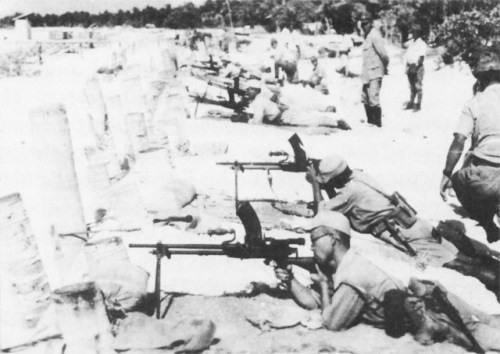
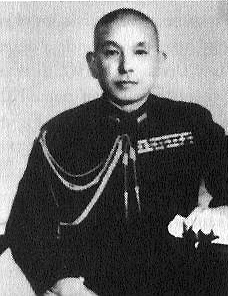
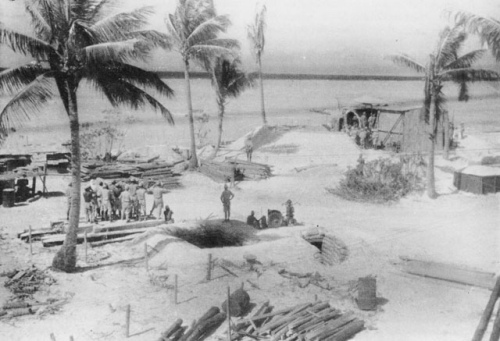
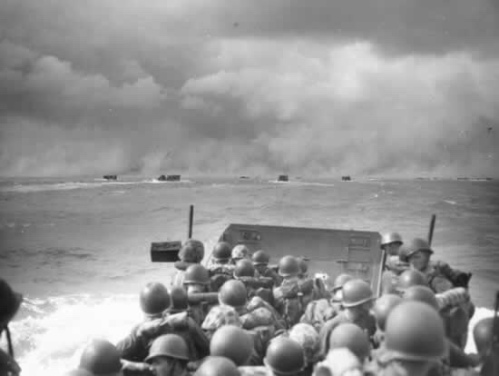
His was the story of a man who defied affluence and privilege to serve his country by volunteering to serve as soon as he could after the nation went to war, and who at the tender age of 18 became the youngest Naval Aviator in our history. Shot down over Chuchi Jima, he mourned the loss of his flight crew and was always aware of the human cost of war. He did not commit the lives of young Americans, allies, or coalition partners without reflecting on the loss of his flight crew. When he committed the nation to war in 1991 he did so only under the mandate of the United Nations and with a coalition that would be unimaginable today. I could never see our current President doing what George H. W. Bush did to keep the world from plunging into an abyss of disorder and irresponsibility.

This isn’t to say that he didn’t make mistakes, couldn’t go for the jugular as a politician, or who didn’t change his positions on various issues out of political expediency; but he always remained a fundamentally decent man who had great empathy for others.

His funeral was attended by more heads of state, former heads of state, or royalty since that of John F. Kennedy. As I watched the hearse which bore his body from the funeral in which the current President and four other Presidents gathered along with so many heads of state or former leaders gathered I was reminded of the words of historian Barbara Tuchman speaking about then funeral of British King Edward VII:

“So gorgeous was the spectacle on the May morning of 1910 when nine kings rode in the funeral of Edward VII of England that the crowd, waiting in hushed and black-clad awe, could not keep back gasps of admiration. In scarlet and blue and green and purple, three by three the sovereigns rode through the palace gates, with plumed helmets, gold braid, crimson sashes, and jeweled orders flashing in the sun. After them came five heirs apparent, forty more imperial or royal highnesses, seven queens – four dowager and three regnant – and a scattering of special ambassadors from uncrowned countries. Together they represented seventy nations in the greatest assemblage of royalty and rank ever gathered in one place and, of its kind, the last. The muffled tongue of Big Ben tolled nine by the clock as the cortege left the palace, but on history’s clock it was sunset, and the sun of the old world was setting in a dying blaze of splendor never to be seen again.”

Until tomorrow,

Peace,

Padre Steve+

2 Comments

Filed under faith, History, iraq, leadership, Military, News and current events, Political Commentary

“You’re Worse… You Went Along With it All, Even Though You Knew…” Loyal Servants of Evil Regimes

Friends of Padre Steve’s World,

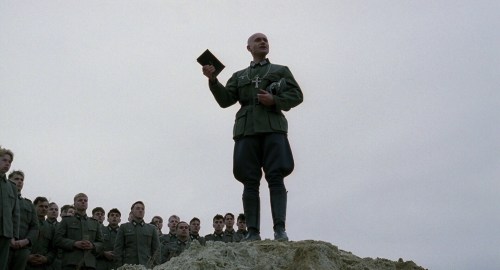
One of the more sobering war movies that I have ever watched is the film Stalingrad. Released in 1993 it is the story of four soldiers of a platoon of soldiers of the 336th Pioneer Battalion. The Pioneers were the equivalent of American Combat Engineers. It is a sobering film to watch. In a way it is much like the film Platoon. Director Joseph Vilsmaier made the battle and the human suffering come alive with realism. There is no happy ending and there are few if any heroes. The men see, protest, are punished, and then are ordered to participate in war crimes.

The battle of Stalingrad was one of the turning points of the Second World War, over a million Russian, German, Romanian, and Italian Soldiers died in the battle. Of the 260,000 soldiers of the German Sixth Army which led the attack in Stalingrad and then were surrounded by the Soviet counter-offensive, very few survived. Some escaped because they were evacuated by transport planes, but most perished. Of the approximately 91,000 German soldiers that surrendered only about 6,000 returned home.

I’ll write about that battle again around Christmas and on the anniversary of its surrender at the end of January, but there are two sequences of dialogue that stood out to me. The first is at the beginning of the battle where a German Chaplain exhorts the soldier to fight against the “Godless Bolsheviks” because the Germans believed in God and the officially Atheistic Soviet Union and its people did not. In his exhortation the Chaplain calls attentional the belt buckles worn by every soldier in the Wehrmacht, which were embossed with the words Gott mit Uns, or God is with us.

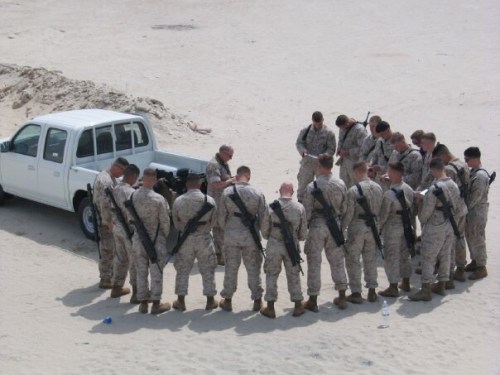
I am a a military Chaplain. I have been one since 1992, and the older I get the more distrustful I am of men who place a veneer of region over the most ungodly and unjust wars. For me that was frightening because I do know from experience that the temptation to do such things when in uniform is all too great, but how can anyone exhort people to acts of criminality in the name of God? I know that it is done far too often and I hate to admit I personally know, or know of American military chaplains who would say the same thing as the German Chaplain depicted in the film. Back in the Cold War while serving as an officer before I became a Chaplain I used to talk about the Godless Communists.

The second question is also difficult. I have been in the military for about thirty-seven plus years. Truthfully I am a dinosaur. I am the second most senior and the oldest sailor on my base. I have served during the Cold War as a company commander, was mobilized as a chaplain to support the Bosnia operation in 1996, I have served in the Korean DMZ, at sea during Operation Enduring Freedom and Southern Watch, and with American advisors to the Iraqi Army, Police, and Border troops in Al Anbar Province. I have seen too much of war but even though I could retire from the military today I still believe that I am called to serve and care for the men and women who will go into harm’s way.

That being said those who have read my writings on this site for years know just how anti-war I have become and why this dialogue hits so hard. Some of the members of the platoon are accused of cowardice and sent to a penal company in order to redeem themselves. The commander of the unit, a Captain who hold the Knight’s Cross of the Iron Cross is confronted by one of the men.

Otto: You know we don’t stand a chance. Why not surrender?

Captain Hermann Musk: You know what would happen if we do.

Otto: Do we deserve any better?

Captain Hermann Musk: Otto, I’m not a Nazi.

Otto: No, you’re worse. Lousy officers. You went along with it all, even though you knew who was in charge.

That is something that bothers me even today. I wonder about the men who go along with wars which cannot be classified as anything other than war crimes based on the precedents set by Americans at Nuremberg, and I am not without my own guilt. In 2003 I had my own misgivings about the invasion of Iraq, but I wholeheartedly supported it and volunteered to go there.

I was all too much like the German Captain. I went along with it despite my doubts. As a voter I could have cast my vote for John Kerry in 2004, but I didn’t. Instead I supported a President who launched a war of aggression that by every definition fits the charges leveled against the leaders of the Nazi state at Nuremberg. When I was in Iraq I saw things that changed me and I have written in much detail about them on this site, but I supported that invasion.

Now as a nation we are in a place where a man who openly advocates breaking the Geneva and Hague Conventions, supports the use of torture, and who both beats the drums of war, to the extent of appointing one of the most strident proponents of the invasion of Iraq as his National Security Advisor. Likewise, he holds the professional military in contempt appears to be angling for war in the Middle East against Iran even as he excuses the criminal actions of Saudi Arabia in Yemen and against American residents.

I have no doubt that unless something changes that a terrible war is coming and that our President will be a catalyst for it. But for the next nine months before I retire, I will remain in the military to care for the sailors, soldiers, marines, and airmen who will have to go to war and perhaps fight and die.

The thought haunts me and makes it hard for me to sleep at night and I do my best to speak up and be truthful in fulfillment of my priestly vows and my oath of office. Today, unlike my younger years; one thing for me is true: I will never tell any military member that God is with us in the sense that all too many Christian nationalists have done in the past.

I don’t actually think that I ever said the words “God is with us” in regards to advocating war in my career as a Chaplain, but I am sure that my words, and public prayers could have been interpreted in that way when I was younger, especially in the traumatic days after September 11th, 2001.

Likewise, I did go along with the war in Iraq even though I understood what it meant! and what the men and women who engineered it wanted when they took us to war. Sadly, I trusted my leaders too much, especially when Secretary of State Colin Powell spoke before the United Nations to prove the case against Iraq just before the invasion.

Supreme Justice Robert Jackson, who served as the Chief American Prosecutor at Nuremberg stated in the London Agreement:

“If certain acts of violation of treaties are crimes, they are crimes whether the United States does them or whether Germany does them, and we are not prepared to lay down a rule of criminal conduct against others which we would not be willing to have invoked against us.”

Now we live in a world where nationalism, ethnic, racial, and religious hatred are rising, and our own President seems to be abandoning the democratic and pluralistic ideas of or founders, while praising and tacitly supporting authoritarian and Fascist rulers around the world. Honestly, I dread what may befall us if he remains in power.

So until tomorrow,

Peace

Padre Steve+

Leave a comment

Filed under crime, ethics, faith, film, History, holocaust, iraq,afghanistan, Military, movies, nazi germany, News and current events, Political Commentary, world war two in europe

American Dreadnoughts: The Remarkable Battleships of Pearl Harbor

Friends of Padre Steve’s World,

We are coming up on the 77th anniversary of the Japanese attack on Pearl Harbor. It is hard to believe that the attack occurred so long ago. The survivors are aging, and even the youngest are close to ninety years old, the oldest survivor of the USS Arizona, Joe Langdell died in February of 2015. At the time of the attack he was a nearly commissioned Ensign. He and many like him served as the officers and men aboard the eight great battleships moored at Pearl Harbor on that terrible Sunday morning.

The next day President Franklin Roosevelt spoke these immortal words, “Yesterday, Dec. 7, 1941 – a date which will live in infamy – the United States of America was suddenly and deliberately attacked by naval and air forces of the Empire of Japan….

One of the young men who responded to the call to arms after the attack was a future President, 18 year old George H. W. Bush. He was advised to go to college instead of enlisting but he would hear nothing of it. He enlisted as soon as he graduated from high school on his 18th Birthday. He went to flight school and was commissioned just days before his 19th birthday, becoming the youngest Naval aviator. I guess that it is fitting that Bush, who passed away Saturday will be buried on December 6th, the day before the anniversary of the attack.

I remember reading Walter Lord’s classic and very readable book about Pearl Harbor “Day of Infamy” when I was a 7th grade student at Stockton Junior High School back in 1972.  At the time my dad was on his first deployment to Vietnam on the USS Hancock CVA-19.  As a Navy brat I was totally enthralled with all things Navy and there was little that could pull me out of the library.  In fact in my sophomore year of high school I cut over one half of the class meetings of the 4th quarter my geometry class to sit in the library and read history, especially naval and military history.

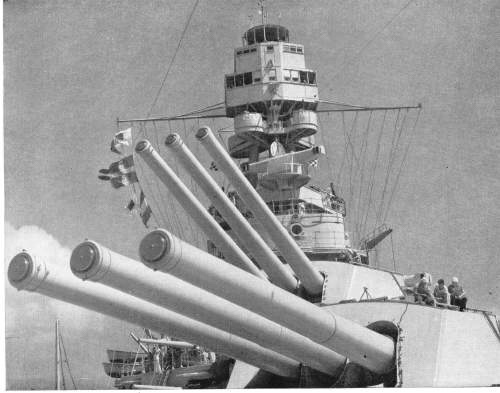
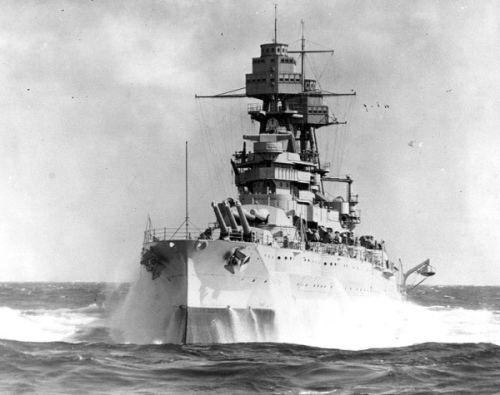
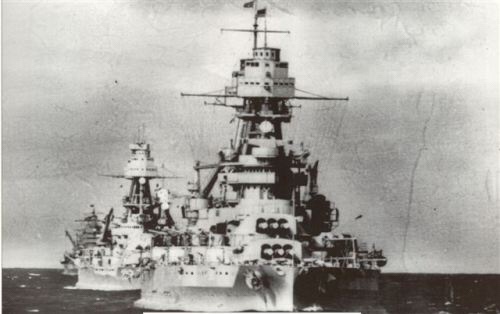
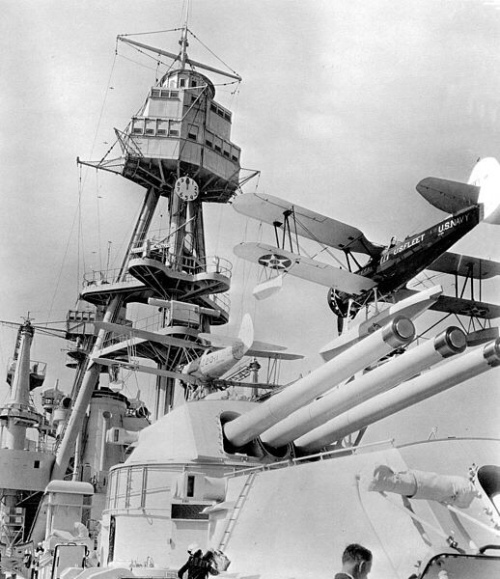
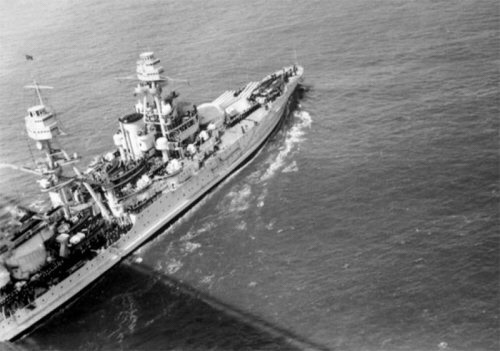
Over the years I have always found the pre-World War Two battleships to be among the most interesting ships in US Navy history.  No they are not the sleek behemoths like the USS Wisconsin which graces the Norfolk waterfront. They were not long and sleek, but rather squat yet exuded power. They were the backbone of the Navy from the First World War until Pearl Harbor. They were the US Navy answer to the great Dreadnaught race engaged in by the major navies of the world in the years prior to, during and after World War One.

Built over a period of 10 years each class incorporated the rapid advances in technology between the launching of the Dreadnaught and the end of the Great War.  While the United States Navy did not engage in battleship to battleship combat the ships built by the US Navy were equal to or superior to many of the British and German ships of the era.

Through the 1920s and 1930s they were the ambassadors of the nation, training and showing the flag. During those years the older ships underwent significant overhaul and modernization.

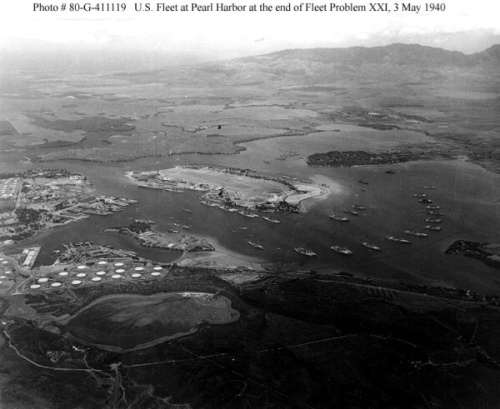
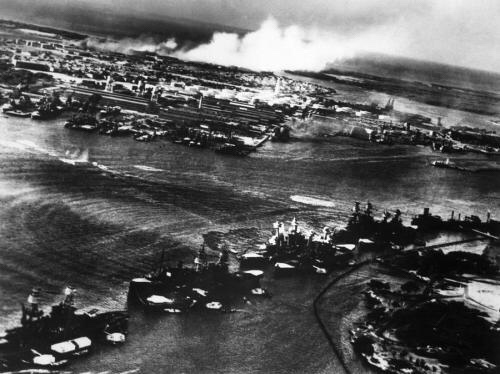
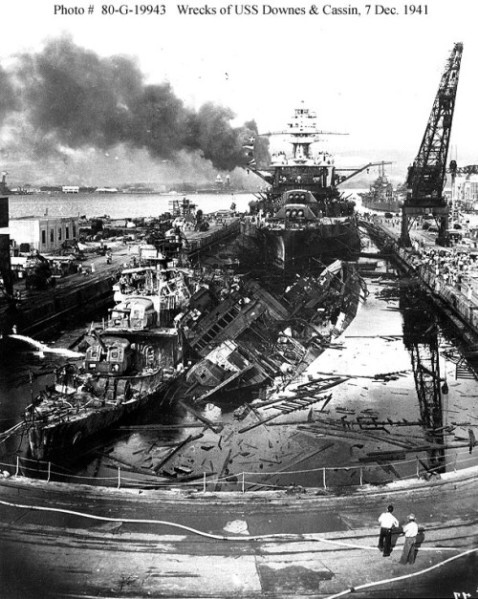
The Battle Force of the Pacific Fleet in 1941 included 9 battleships of which 8 were at Pearl Harbor on the morning of December 7th.  In the event of war the US War Plan, “Orange” called for the Pacific Fleet led by the Battle Force to cross the Pacific, fight a climactic Mahanian battle against the battleships of the Imperial Japanese Navy and after vanquishing the Japanese foe to relieve American Forces in the Philippines.  However this was not to be as by the end of December 7th all eight were out of action, with two, the Arizona and Oklahoma permanently lost to the Navy.

The ships at Pearl Harbor comprised four of the seven classes of battleships in the US inventory at the outbreak of hostilities.  Each class was an improvement on the preceding class in speed, protection and firepower.  The last class of ships, the Maryland class comprised of the Maryland, Colorado and West Virginia, was the pinnacle of US Battleship design until the North Carolina class was commissioned in 1941.  Since the Washington Naval Treaty limited navies to specific tonnage limits as well as the displacement of new classes of ships the United States like Britain and Japan was limited to the ships in the current inventory at the time of the treaty’s ratification.

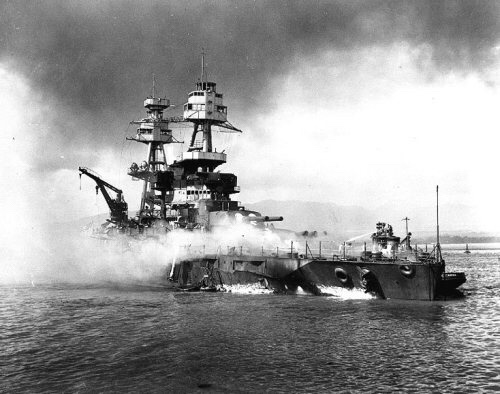
USS Oklahoma (above) and USS Nevada

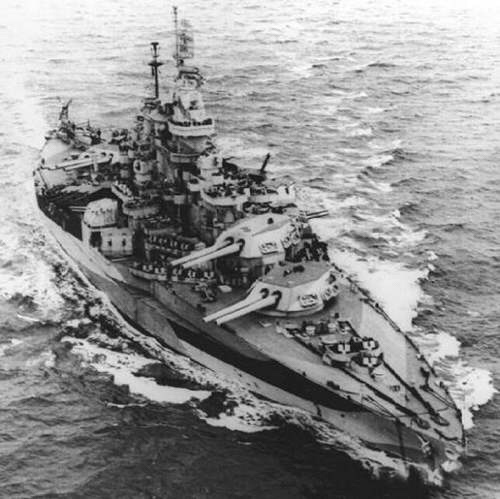
Those present at Pearl Harbor included the two ships of the Nevada class, the Nevada and Oklahoma they were the oldest battleships at Pearl Harbor and the first of what were referred to as the “standard design” battleships. The two ships of the Pennsylvania class, the Pennsylvania and her sister the Arizona served as the flagships of the Pacific Fleet and First Battleship Division respectively and were improved Nevada’s. The California class ships, California and Tennessee and two of the three Maryland’s the Maryland and West Virginia made up the rest of the Battle Force.

The Colorado was undergoing a yard period at Bremerton and the three ships of the New Mexico class, New Mexico, Mississippi and Idaho had been transferred to the Atlantic before Pearl Harbor due to the German threat.  The three oldest battleships in the fleet, those of the New York and Wyoming Classes, the New York, Arkansas and Texas also were in the Atlantic. Two former battleships, the Utah and Wyoming had been stripped of their main armaments and armor belts and served as gunnery training ships for the fleet. The Utah was at Pearl Harbor moored on the far side of Ford Island. The newest battleships in the Navy, the modern USS North Carolina and USS Washington were also serving in the Atlantic as a deterrent to the German battleships and battlecruisers which occasionally sortied into the Atlantic to attack convoys bound for Britain.

The great ships that lay at anchor at 0755 that peaceful Sunday morning on Battleship Row and in the dry dock represented the naval power of a bygone era, something that most did not realize until two hours later. The age of the battleship was passing away, but even the Japanese did not realize that the era had passed building the massive super-battleships Yamato and Musashi mounting nine 18” guns and displacing 72,000 tons, near twice that of the largest battleships in the U.S. inventory.

The Oklahoma and Nevada were the oldest ships in the Battle Force.  Launched in 1914 and commissioned in 1916 the Nevada and Oklahoma mounted ten 14” guns and displaced 27,500 tons and were capable of 20.5 knots. They served in World War One alongside the British Home Fleet and were modernized in the late 1920s. They were part of the US presence in both the Atlantic and Pacific in the inter-war years. Oklahoma took part in the evacuation of American citizens from Spain in 1936 during the Spanish Civil War.

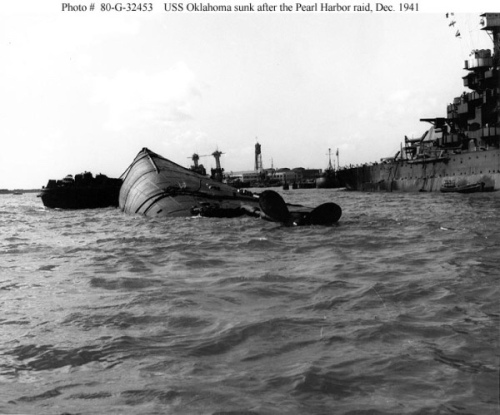
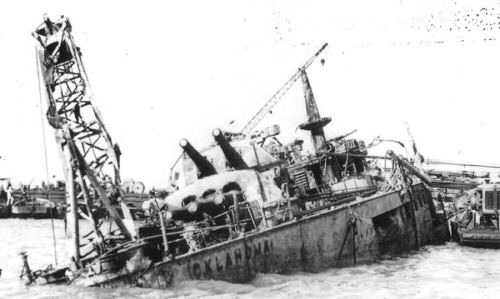
During the Pearl Harbor attack Oklahoma was struck by 5 aerial torpedoes capsized and sank at her mooring with the loss of 415 officers and crew. Recent analysis indicates that she may have been hit by at least on torpedo from a Japanese midget submarine. Her hulk would be raised but she would never again see service and sank on the way to the breakers in 1946.

Nevada was the only battleship to get underway during the attack.  Moored alone at the north end of Battleship Row her Officer of the Deck had lit off a second boiler an hour before the attack.  She was hit by an aerial torpedo in the first minutes of the attack but was not seriously damaged. She got underway between the attack waves and as she attempted to escape the harbor she was heavily damaged. To prevent her from sinking in the main channel she was beached off Hospital Point.

Nevada was raised and received a significant modernization before returning to service for the May 1943 assault on Attu.  Nevada returned to the Atlantic where she took part in the Normandy landings off Utah Beach and the invasion of southern France.  She returned to the Pacific and took part in the operations against Iwo Jima and Okinawa where she again provided naval gunfire support.

Following the war the great ship was assigned as a target at the Bikini atoll atomic bomb tests. The tough ship survived these tests and was sunk as a target on 31July 1948.

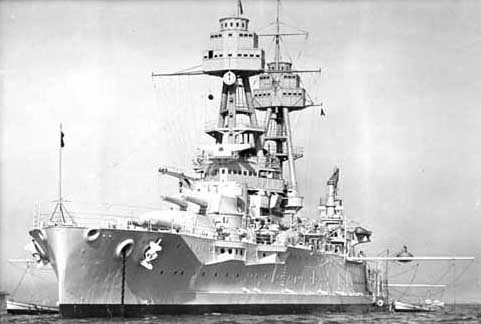
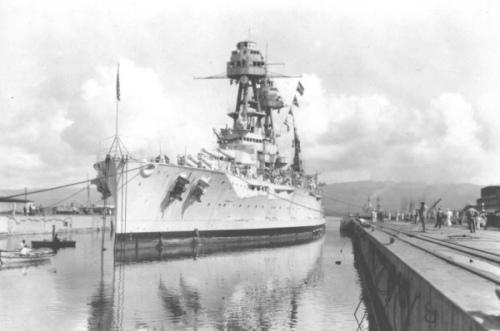
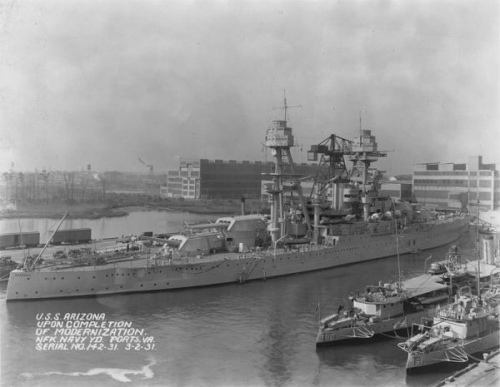
Two views of USS Arizona

Pennsylvania

USS Pennsylvania sailing under the Golden Gate Bridge

The two ships of the Pennsylvania Class were improved Oklahoma’s.  The Arizona and Pennsylvania mounted twelve 14” guns and displacing 31,400 tons and capable of 21 knots they were both commissioned in 1916. They participated in operations in the Atlantic in the First World War with the British Home Fleet. Both ships were rebuilt and modernized between 1929 and 1931. Though damaged in the attack, Pennsylvania was back in action by early 1942. She underwent minor refits and took part in many amphibious landings in the Pacific and was present at the Battle of Surigao Strait.  She was heavily damaged by an aerial torpedo at Okinawa Pennsylvania and was repaired. Following the war the elderly warrior was used as a target for the atomic bomb tests. She was sunk as a gunnery target in 1948.

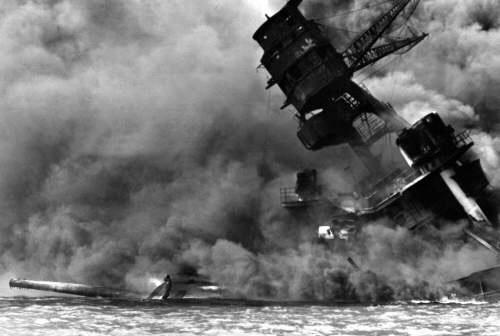
Arizona was destroyed during the attack. As the flagship of Battleship Division One, she was moored next to the repair ship USS Vestal.  She was hit by 8 armor piercing bombs one of which penetrated her forward black powder magazine. The ship was consumed by a cataclysmic explosion which killed 1103 of her 1400 member crew including her Captain and Rear Admiral Isaac Kidd, commander of Battleship Division One.  She was never officially decommissioned and the colors are raised and lowered every day over the Memorial which sits astride her broken hull.

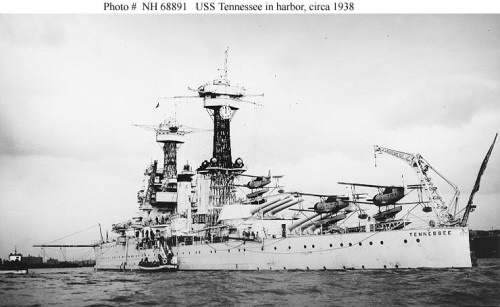
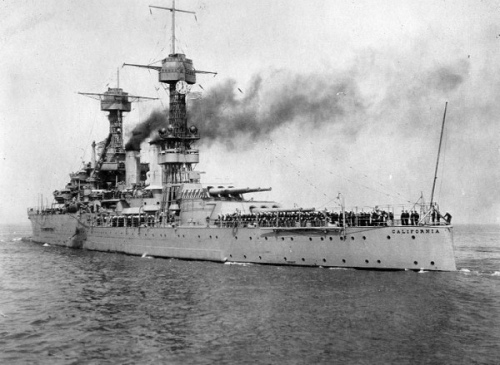
USS Tennessee & USS California

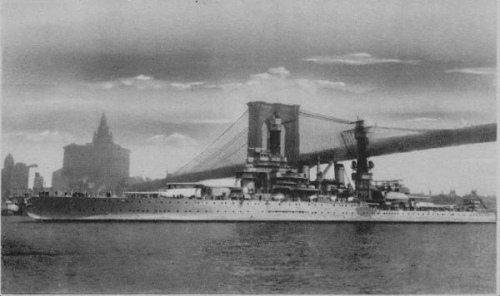
California sailing under the Brooklyn Bridge

The Tennessee class ships the Tennessee and California were the class following the New Mexico class ships which were not present at Pearl Harbor. These ships were laid down in 1917 and commissioned in 1920. Their design incorporated lessons learned at the Battle Jutland. They mounted twelve 14” guns, displaced 32,300 tons and were capable of 21 knots. At Pearl Harbor Tennessee was moored inboard of West Virginia and protected from the aerial torpedoes which did so much damage to other battleships. She was damaged by two bombs.

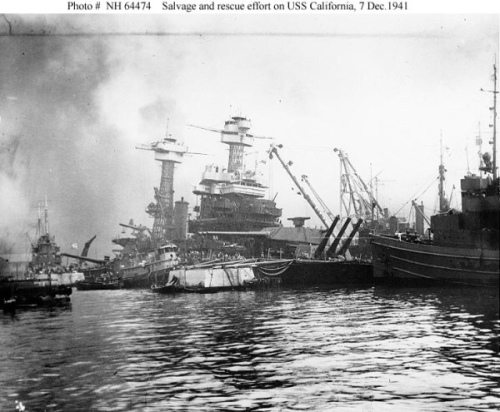
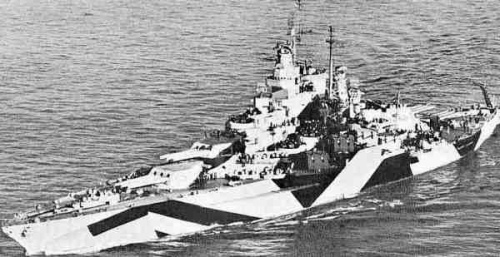
California was the Flagship of Battleship Division Two. She was moored at the southern end of Battleship Row. She was hit by two torpedoes in the initial attack, but she had the bad luck to have all of her major watertight hatches unhinged in preparation for an inspection. Despite the valiant efforts of her damage control teams she sank at her moorings. She was raised and rebuilt along with Tennessee were completely modernized with the latest in radar, fire control equipment and anti-aircraft armaments. They were widened with the addition of massive anti-torpedo bulges and their superstructure was razed and rebuilt along the lines of the South Dakota class. When the repairs and modernization work was completed the ships looked nothing like they did on December 7th. Both ships were active in the Pacific campaign and be engaged at Surigao Strait where they inflicted heavy damage on the attacking Japanese squadron. Both survived the war and were placed in reserve until 1959 when they were stricken from the Navy list and sold for scrap.

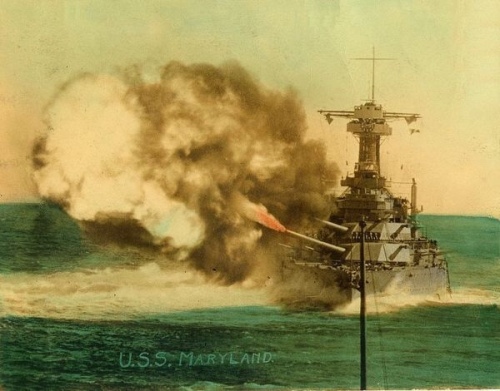
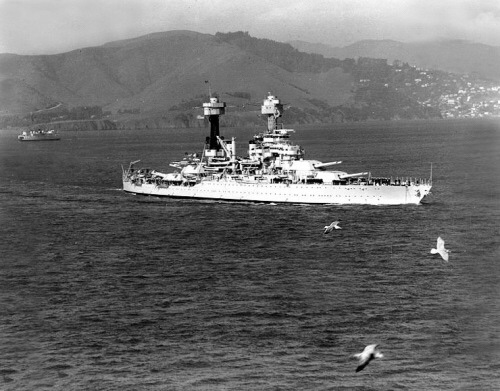
USS Maryland & USS West Virgina

The Maryland and West Virginia were near sisters of the Tennessee class.  They were the last battleships built by the United States before the Washington Naval Treaty. and the first to mount 16” guns. With eight 16” guns they had the largest main battery of any US battleships until the North Carolina class. They displaced 32,600 tons and could steam at 21 knots. Laid down in 1917 and commissioned in 1921 they were modernized in the late 1920s. They were the most modern of the Super-Dreadnoughts built by the United States and included advances in protection and watertight integrity learned from both the British and German experience at Jutland.

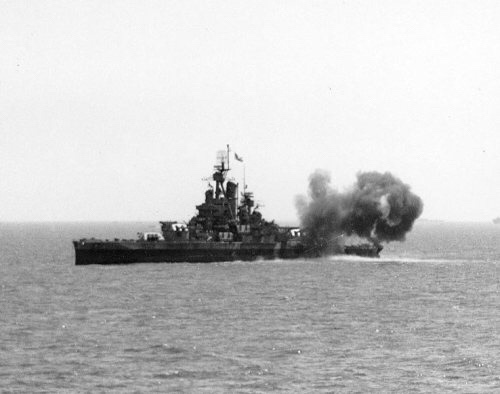
At Pearl Harbor Maryland was moored inboard of Oklahoma and was hit by 2 bombs and her crew helped rescue survivors of that unfortunate ship.  She was quickly repaired and returned to action.  She received minimal modernization during the war. She participated in operations throughout the entirety of the Pacific Campaign mainly conducting Naval Gunfire Support to numerous amphibious operations. She was present at Surigao Strait where despite not having the most modern fire control radars she unleashed six salvos at the Japanese Southern Force.

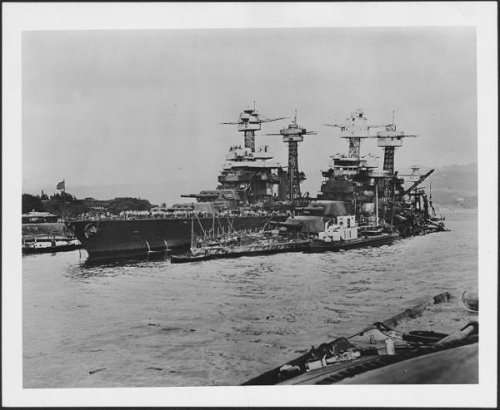
Tennessee & West Virginia after the attack (above) Arizona (below)

Pennsylvania in Drydock Number One, Nevada beached at Hospital Point

Oklahoma Capsized and after being righted

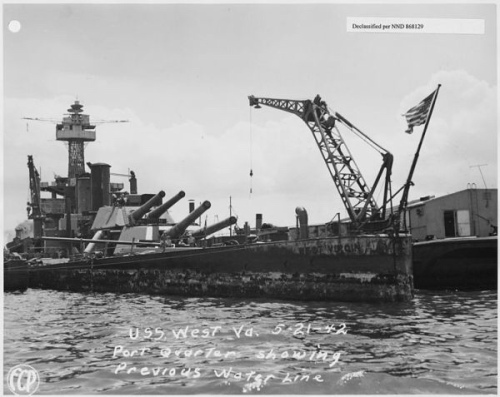
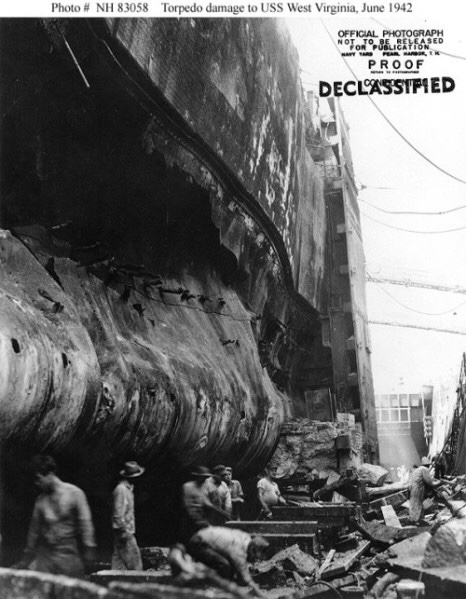
West Virginia suffered some of the worst damage in the attack. She was hit by at least 5 torpedoes and two bombs. One of the torpedoes may have come from one of the Japanese midget submarines that penetrated the harbor. She took a serious list and was threatening to capsize. However she was saved from Oklahoma’s fate by the quick action of her damage control officer who quickly ordered counter-flooding so she would sink on an even keel.  She was raised from the mud of Pearl Harbor and after temporary repairs and sailed to the West Coast for an extensive modernization on the order of the Tennessee and California.

West Virginia was the last Pearl Harbor to re-enter service. However when she returned she made up for lost time.  She led the battle line at Surigao Strait and fired 16 full salvos at the Japanese squadron. Her highly accurate gunfire was instrumental in sinking the Japanese Battleship Yamashiro in the last battleship versus battleship action in history.  West Virginia, Maryland and their sister Colorado survived the war and were placed in reserve until they were stricken from the Naval List and sold for scrap in 1959.

The battleships of Pearl Harbor are gone, save for the wreck of the Arizona and various relics such as masts, and ships bells located at various state capitals and Naval Stations.  Unfortunately no one had the forethought to preserve one of the surviving ships to serve as a living memorial at Pearl Harbor with the Arizona. As I noted at the beginning of this article, the brave Sailors and Marines who manned these fine ships are also passing away.

Thus as we approach the anniversary of the Pearl Harbor attack it is fitting to remember these men and the great ships that they manned.

Peace,

Padre Steve

1 Comment

Filed under History, Loose thoughts and musings, Military, Navy Ships, US Navy, world war two in the pacific

Nazi Crimes in the Conduct of War: Robert Jackson’s Opening Speech at Nuremberg, Part Five: Jackson’s Indictment of Us

Friends of Padre Steve’s World,

This is the the last section of my five part post dealing with the opening statement of American Chief Prosecutor, and Supreme Court Justice Robert Jackson at the major Nuremberg War Crimes Trial. The first four segments of this series dealt with Jackson’s introduction, his dissection of the Nazi wars against free Labor Unions and the Churches; Hitler and his henchmen’s most heinous crimes, the genocide against the Jews, and finally the Nazi’s criminal conduct of war.

During the meetings to set the boundaries and rules of the international tribunal Jackson noted something that many American leaders have ignored for decades:

“If certain acts of violation of treaties are crimes, they are crimes whether the United States does them or whether Germany does them, and we are not prepared to lay down a rule of criminal conduct against others which we would not be willing to have invoked against us.”

Jackson believed that the International Tribunal would serve as a model for future tribunals, unfortunately the Cold War shelved those plans. They were revived after the war crimes and crimes against humanity in the former Yugoslavia and Rwanda. In 2002 the International Criminal Court was established under the authority of the Rome Statute. One hundred twenty three nations are signatories to the pact. Unfortunately, neither the United States, or Russia have refused to ratify the treaty.

Among the men most responsible or the refusal of the United States to ratify the statute and is current National Security Advisor, John Bolton. He was also deeply involved in the propaganda and false intelligence that lead to the Iraq War. In his first address after becoming National Security Advisor he launched a fierce criticism of the Court. Unfortunately, the Court, lacking the cooperation of the United States, Russia, Israel, and a number of influential middle eastern and African nations refuse to recognize the treaty or the Court.

Robert Jackson would have considered Bolton no better than Nazi Foreign Minister Joachim von Ribbentrop. If Bolton and others had been in the dock at Nuremberg for crimes committed during the invasion of Iraq, they would have gone to the gallows.

The refusal of the United States to ratify the Rome Statute and recognize the authority of the ICC is a stain upon our honor and an affront to the civilization and an international community built on law that Jackson and his team of prosecutors hoped to build.

I am not a person who thinks that institutions alone can prevent war or war crimes, human nature being what it is. Nor do I blindly put my faith in treaties. I agree with British military historian B. H. Liddell-Hart who wrote: We must face the fact that international relations are governed by interests and not by moral principles.

Like Liddell-Hart, I understand that nations are often incredibly bent on their presumed interests. I recognize that the leaders of nations will attempt to evade responsibility for criminal acts committed by their military, polices forces, and intelligence services. I also know that nations often mythologize to the point of lying about their history, and enshrining war criminals and others who abetted genocide as national heroes. Name a country where this is not true, okay, maybe Andorra or Lichtenstein, but almost every nation with any real regional or world political, military, or economic power has done this at some point in their history, but I digress…

Jackson’s words in this final part of his address should gave every American with a scintilla of ethics and conscience pause. If they don’t then we are truly lost.

Here again are Jackson’s words.

Peace,

Padre Steve+

Even the most warlike of peoples have recognised in the name of humanity some limitations on the savagery of warfare. Rules to that end have been embodied in international conventions to which Germany became a party. This code had prescribed certain restraints as to the treatment of belligerents. The enemy was entitled to surrender and to receive quarter and good treatment as a prisoner of war. We will show by German documents that these rights were denied, that prisoners of war were given brutal treatment and often murdered. This was particularly true in the case of captured airmen, often my countrymen.

It was ordered that captured English and American airmen should no longer be granted the status of prisoners of war. They were to be treated as criminals and the Army was ordered to refrain from protecting them against lynching by the populace (R-118). The Nazi Government, through its police and propaganda agencies, took pains to incite the civilian population to attack and kill airmen who crash-landed. The order, given by the Reichsfuehrer S.S., Himmler, on 10th August, 1943, directed that:

“It is not the task of the police to interfere in clashes between German and English and American fliers who have bailed out.”

This order was transmitted on the same day by S.S. Obersturmbannfuehrer Brandof, Himmler’s Personal Staff to all Senior Executive S.S. and Police Officers, with these directions:

“I am sending you the enclosed order with the request that the Chief of the Regular Police and of the Security Police be informed. They are to make this instruction known to their subordinate officers verbally.” (R-110)

Similarly, we will show Hitler’s top secret order, dated 18th October, 1942, that Commandos, regardless of condition, were “to be slaughtered to the last man” after capture. (498-PS) We will show the circulation of secret orders, one of which was signed by Hess, to be passed orally to civilians, that enemy fliers or parachutists were to be arrested or liquidated. (062-PS). By such means were murders incited and directed.

This Nazi campaign of ruthless treatment of enemy forces assumed its greatest proportions in the fight against Russia. Eventually all prisoners of war were taken out of control of the Army and put in the hands of Himmler and the S.S. (058-PS.) In the East, the German fury spent itself. Russian prisoners of war were ordered to be branded. They were starved. I shall quote passages from a letter written 28th February, 1942, by defendant Rosenberg to defendant Keitel:

“The fate of the Soviet prisoners of war in Germany is, on the contrary, a tragedy of the greatest extent. Of 3,600,000 prisoners of war, only several hundred thousand are still able to work fully. A large part of them has starved, or died, because of the hazards of the weather. Thousands also died from spotted fever.

The camp commanders have forbidden the civilian population to put food at the disposal of the prisoners, and they have rather let them starve to death.

In many cases, when prisoners of war could no longer keep up on the march because of hunger and exhaustion, they were shot before the eyes of the horrified population, and the corpses were left.

In numerous camps, no shelter for the prisoners of war was provided at all. They lay under the open sky during rain or snow. Even tools were not made available to dig holes or caves.

Finally, the shooting of prisoners of war must be mentioned; for instance, in various camps, all the ‘Asiatics’ were shot.” (081-PS.)

Civilised usage and conventions, to which Germany was a party, had prescribed certain immunities for civilian populations unfortunate enough to dwell in lands overrun by hostile armies. The German occupation forces, controlled or commanded by men on trial before you, committed a long series of outrages against the inhabitants of occupied territory that would be incredible except for captured orders and captured reports which show the fidelity with which those orders were executed.

We deal here with a phase of common criminality designed by the conspirators as part of the Common Plan. We can appreciate why these crimes against their European enemies were not of a casual character but were planned and disciplined crimes when we get at the reason for them. Hitler told his officers on 22nd August, 1939, that “The main objective in Poland is the destruction of the enemy and not the reaching of a certain geographical line.” (1014-PS.) Those words were quoted. The project of deporting promising youth from occupied territories was approved by Rosenberg on the theory that “a desired weakening of the biological force of the conquered people is being achieved.” (03I-PS) To Germanise or to destroy was the programme. Himmler announced, “Either we win over any good blood that we can use for ourselves and give it a place in our people, or, gentlemen -you may call this cruel, but nature is cruel -we destroy this blood.” As to “racially good types” Himmler further advised, “Therefore, I think that it is our duty to take their children with us, to remove them from their environment, if necessary, by robbing or stealing them.” (L-90.) He urged deportation of Slavic children to deprive potential enemies of future soldiers.

The Nazi purpose was to leave Germany’s neighbours so weakened that even if she should eventually lose the war, she would still be the most powerful nation in Europe. Against this background, we must view the plan for ruthless warfare, which means a plan for the commission of War Crimes and Crimes against Humanity.

Hostages in large numbers were demanded and killed. Mass punishments were inflicted, so savage that whole communities were extinguished. Rosenberg was advised of the annihilation of three unidentified villages in Slovakia. In May of 1943, another village of about 40 farms and 220 inhabitants was ordered to be wiped out. The entire population was ordered to be shot, the cattle and property impounded, and the order required that “the village will be destroyed totally by fire.” A secret report from Rosenberg’s Reich Ministry of Eastern territory, where he was responsible reveals that:

“Food rations allowed to the Russian population are so low that they fail to secure their existence and provide only for minimum subsistence of limited duration. The population does not know if they will still live. They are faced with death by starvation.

The roads are clogged by hundreds of thousands of people, sometimes as many as one million according to the estimate of experts, who wander around in search of nourishment.

Sauckel’s action has caused great unrest among the civilians. Russian girls were deloused by men, nude photos in forced positions were taken, women doctors were locked into freight cars for the pleasure of the transport commanders, women in night shirts were fettered and forced through the Russian towns to the railroad station, etc. All this material has been sent to the OKH.”

Perhaps the deportation to slave-labour was the most horrible and extensive slaving operation in history. On few other subjects is our evidence so abundant and so damaging. In a speech made on 25th January, 1944, the defendant Frank, Governor-General of Poland, boasted: “I have sent 1,200,000 Polish workers into the Reich.” The defendant Sauckel reported that “out of the five million foreign workers who arrived in Germany, not even 200,000 came voluntarily.” This fact was reported to the Fuehrer and to the defendants Speer, Goering, and Keitel. (R-124) Children of 10 to 14 years were impressed into service by telegraphic order of Rosenberg’s Ministry for the Occupied Eastern Territories:

“The Command is further charged with the transferring of worthwhile Russian youth between 10-14 years of age, to the Reich. The authority is not affected by the changes connected with the evacuation and transportation to the reception camps of Bialystok, Krajewo, and Olitei, The Fuehrer wishes that this activity be increased even more. (200-PS.)

When enough labour was not forthcoming, prisoners of war were forced into war work in flagrant violation of international conventions. (016-PS.) Slave labour came from France, Belgium, Holland, Italy, and the East. Methods of recruitment were violent. (R-124, 018-PS, 204-PS,) The treatment of these slave labourers was stated in general terms, not difficult to translate into concrete deprivations, in a letter to the defendant Rosenberg from the defendant Sauckel, which stated:

“All prisoners of war, from the territories of the West as well as of the East, actually in Germany, must be completely incorporated into the German armament and munition industries. Their production must be brought to the highest possible level.”

The complete employment of prisoners of war as well as the use of a gigantic number of new civilian workers, men and women, has become an undisputable necessity for the solution of the mobilisation of labour programme in this war.

All the men must be fed, sheltered and treated in such a way as to exploit them to the highest possible extent at the lowest conceivable degrees of expenditure..”( 016-PS.)

In pursuance of the Nazi plan permanently to reduce the living standards of their neighbours and to weaken them physically and economically, a long series of crimes were committed. There was extensive destruction, serving no military purpose, of the property of civilians. Dikes were thrown open in Holland almost at the close of the war, not to achieve military ends but to destroy the resources, and retard the economy, of the thrifty Netherlanders.

There was carefully planned economic siphoning off of the assets of occupied countries. An example of the planning is shown by a report on France dated 7th December, 1942, made by the Economic Research Department of the Reichsbank. The question arose whether French occupation costs should be increased from 15 million Reichsmarks per day to 25 million Reichsmarks per day. The Reichsbank analysed French economy to determine whether it could bear the burden. It pointed out that the armistice had burdened France to that date to the extent of 18 1/ 4 billion Reichsmarks, equalling 370 billion Francs. It pointed out that the burden of these payments within two and a half years equalled the aggregate French national income in the year 1940, and that the amount of payments handed over to Germany in the first six months of 1942 corresponded to the estimate for the total French revenue for that whole year. The report concluded, “In any case, the conclusion is inescapable that relatively heavier tributes have been imposed on France since the armistice in June, 1940, than upon Germany after the First World War. In this connection, it must be noted that the economic powers of France never equalled those of the German Reich, and that the vanquished France could not draw on foreign economic and financial resources in the same degree as Germany after the First World War.”

The defendant Funk was the Reich Minister of Economics and President of the Reichsbank; the defendant Ribbentrop was Foreign Minister; the defendant Goering was Plenipotentiary of the Four-Year Plan; all of them participated in the exchange of views of which this captured document is a part (2149-PS) Notwithstanding this analysis by the Reichsbank, they proceeded to increase the imposition on France from 15 million Reichsmarks to daily to 25 million per day.

It is small wonder that the bottom had been knocked out of French economy. The plan and purpose of the thing appears in a letter from General Stupnagel, head of the German Armistice Commission, to the defendant Jodl as early as 14th September, 1940, when he wrote: “The slogan ‘Systematic weakening of France’ has already been surpassed by far in reality.”

Not only was there a purpose to debilitate and demoralise the economy of Germany’s neighbours for the purpose of destroying their competitive position, but there was looting and pilfering on an unprecedented scale. We need not be hypocritical about this business Of looting. I recognise that no army moves through occupied territory without some pilfering as it goes. Usually the amount of pilfering increases as discipline wanes. If the evidence in this case showed no looting except of that sort, I certainly would ask no conviction of these defendants for it.

But we will show you that looting was not due to the lack of discipline or to the ordinary weaknesses of human nature. The German organised plundering, planned it, disciplined it, and made it official just as he organised everything else, and then he compiled the most meticulous records to show that he had done the best job of looting that was possible under the circumstances. And we have those records.

The defendant Rosenberg was put in charge of a systematic plundering of the objet d’art of Europe by direct order of Hitler dated 29th January 1940. (136-PS) On the 16th April, 1943, Rosenberg reported that up to the 7th April, ninety-two railway cars with 2,775 cases containing objets d’art had been sent to Germany; and that fifty-three pieces of art had been shipped to Hitler direct and 594 to the defendant Goering. (015-PS) The report mentioned something like 20,000 pieces of seized art and the main locations where they were stored.

Moreover, this looting was glorified by Rosenberg. Here we have thirty-nine leather-bound tabulated volumes of his inventory, which in due time we will offer in evidence. One cannot but admire the artistry of this Rosenberg report. The Nazi taste was cosmopolitan. Of the 9,455 articles inventories, there were included 5,255 paintings, 297 sculptures, 1,372 pieces of antique furniture, 307 textiles, and 2,224 small objects of art. Rosenberg observed that there were approximately 10,000 more objects still to be inventoried. (015-PS.) Rosenberg himself estimated that the values involved would come close to a billion dollars. (090-PS.)

I shall not go into further details of the War Crimes and Crimes against Humanity committed by the Nazi gangster ring whose leaders are before you. It is not the purpose in my part of this case to deal with the individual crimes. I am dealing with the Common Plan or design for crime and will not dwell on individual offences. My task is to show the scale on which those crimes occurred, and to show that these are the men who were in the responsible positions and who conceived the plan and design which renders them answerable, regardless of the fact that the plan was actually executed by others.

At length, this reckless and lawless course outraged the world. It recovered from the demoralisation of surprise attack, assembled its forces and stopped these men in their tracks. Once success deserted their banners, one by one the Nazi satellites fell away. Sawdust Caesar collapsed. Resistance forces in every occupied country arose to harry the invader. Even at home, Germans saw that Germany was being led to ruin by those mad men, and the attempt on 20th July, 1944, to assassinate Hitler, an attempt fostered by men of highest station, was a desperate effort by internal forces in Germany to stop short of ruin. Quarrels broke out among the failing conspirators, and the decline of the Nazi power was more swift than its ascendancy. German armed forces surrendered, its government disintegrated, its leaders committed suicide by the dozen, and by the fortunes of war these defendants fell into our hands. Although they are not, by any means, all the guilty ones, they are survivors among the most responsible. Their names appear over and over again in the documents and their faces grace the photographic evidence. We have here the surviving top politicians, militarists, financiers, diplomats, administrators, and propagandists, of the Nazi movement. Who was responsible for these crimes if they were not?

The end of the war and capture of these prisoners presented the victorious Allies with the question whether there is any legal responsibility on high-ranking men for acts which I have described. Must such wrongs either be ignored or redressed in hot blood? Is there no standard in the law for a deliberate and reasoned judgement on such conduct?

The Charter of this Tribunal evidences a faith that the law is not only to govern the conduct of little men, but that even rulers are, as Lord Chief Justice Coke it to King James, “under God and the law.” The United States believed that the law has long afforded standards by which a juridical hearing could be conducted to make sure that we punish only the right men and for the right reasons. Following the instructions of the late President Roosevelt and the decision of the Yalta Conference, President Truman directed representatives of the United States to formulate a proposed International Agreement, which was submitted during the San Francisco Conference to the Foreign Ministers of the United Kingdom, the Soviet Union, and the Provisional Government of France. With many modifications, that proposal has become the Charter of this tribunal.

But the Agreement which sets up the standards by which these prisoners are to be judged does not express the views of the signatory nations alone. Other nations with diverse but highly respected systems of jurisprudence also have signified adherence to it. These are Belgium, The Netherlands, Denmark, Norway, Czechoslovakia, Luxembourg, Poland, Greece, Yugoslavia, Ethiopia, Australia, Haiti, Honduras, Panama, New Zealand, Venezuela and India. You judge, therefore, under an organic act which represents the wisdom, the sense of justice, and the will of twenty-one governments, representing an overwhelming majority of all civilised people.

The Charter by which this Tribunal has its being, embodies certain legal concepts which are inseparable from its jurisdiction and which must govern its decision. These, as I have said, also are conditions attached to the grant of any hearing to defendants. The validity of the provisions of the Charter is conclusive upon us all, whether we have accepted the duty of judging or of prosecuting under it, as well as upon the defendants, who can point to no other law which gives them a right to be heard at all. My able and experienced colleagues believe, as do I, that it will contribute to the expedition and clarity of this trial if I expound briefly the application of the legal philosophy of the Charter to the facts I have recited.

While this declaration of the law by the Charter is final, it may be contended that the prisoners on trial are entitled to have it applied to their conduct only most charitably if at all. It may be said that this is new law, not authoritatively declared at the time they did the acts it condemns, and that this declaration of the law has taken them by surprise.

I cannot, of course, deny that these men are surprised that this is the law; they really are surprised that there is any such thing as law. These defendants did not rely on any law at all. Their programme ignored and defied all law. That this is so will appear from many acts and statements, of which I cite but a few. In the Fuehrer’s speech to all military commanders on 23rd November, 1939, he reminded them that at the moment Germany had a pact with Russia, but declared “Agreements are to be kept only as long as they serve a certain purpose.” Later in the same speech he announced “A violation of the neutrality of Holland and Belgium will be of no importance.” (789-PS.) A Top Secret document, entitled ” Warfare as a Problem of Organisation,” dispatched by the Chief of the High Command to all Commanders on 19th April, 1938, declared that “the normal rules of war toward neutrals must be considered to apply on the basis whether operation of these rules will create greater advantages or disadvantages for the belligerents. (L-211.) And from the files of the German Navy Staff, we have a “Memorandum on Intensified Naval War,” dated 15th October, 1939, which begins by stating a desire to comply with International Law. “However,” it continues, “if decisive successes are expected from any measure considered as a war necessity, it must be carried through even if it is not in agreement with International Law.” (L-184) International Law, Natural Law, German Law, any law at all was to these men simply a propaganda device to be invoked when it helped and to be ignored when it would condemn what they wanted to do. That men may be protected in relying upon the law at the time they act is the reason we find laws of retrospective operation unjust. But these men cannot bring themselves within the reason of the rule which in some systems of jurisprudence prohibits ex post facto laws. They cannot show that they ever relied upon International Law in any state or paid it the slightest regard.

The Third Count of the Indictment is based on the definition of War Crimes contained in the Charter. I have outlined to you the systematic course of conduct toward civilian populations and combat forces which violates international conventions to which Germany was a party. Of the criminal nature of these acts at least, the defendants had, as we shall show, knowledge. Accordingly, they took pains to conceal their violations. It will appear that the defendants Keitel and Jodl were informed by official legal advisers that the orders to brand Russian prisoners of war, to shackle British prisoners of war, and to execute Commando prisoners were clear violations of International Law. Nevertheless, these orders were put into effect. The same is true of orders issued for the assassination of General Giraud and General Weygand, which failed to be executed only because of a ruse on the part of Admiral Canaris, who was himself later executed for his part in the plot to take Hitler’s life on 20th July, 1944.

The Fourth Count of the Indictment is based on Crimes against Humanity. Chief among these are mass killings of countless human beings in cold blood. Does it take these men by surprise that murder is treated as a crime?

The First and Second Counts of the Indictment add to these crimes the crime of plotting and waging wars of aggression and wars in violation of nine treaties to which Germany was a party. There was a time, in fact, I think, the time of the first World War, when it could not have been said that war inciting or war making was a crime in law, however reprehensible in morals.

Of course, it was, under the law of all civilised peoples, a crime for one man with his bare knuckles to assault another. How did it come about that multiplying this crime by a million, and adding fire-arms to bare knuckles, made it a legally innocent act? The doctrine was that one could not be regarded as criminal for committing the usual violent acts in the conduct of legitimate warfare. The age of imperialistic expansion during the eighteenth and nineteenth centuries added the foul doctrine, contrary to the teachings of early Christian and International Law scholars such as Grotius, that all wars are to be regarded as legitimate wars. The sum of these two doctrines was to give war-making a complete immunity from accountability to law.

This was intolerable for an age that called itself civilised. Plain people, with their earthy common sense, revolted at such fictions and legalisms so contrary to ethical principles and demanded checks on war immunities. Statesmen and international lawyers at first cautiously responded by adopting rules of warfare designed to make the conduct of war more civilised. The effort was to set legal limits to the violence that could be done to civilian populations and to combatants as well.

The common sense of men after the First World War demanded, however, that the law’s condemnation of war reach deeper, and that the law condemn not merely uncivilised ways of waging war, but also the waging in any way of uncivilised wars -wars of aggression. The world’s statesmen again, went only as far as they were forced to go. Their efforts were timid and cautious and often less explicit than we might have hoped. But the 1920′ s did outlaw aggressive war.

The re-establishment of the principle that there are unjust wars and that unjust wars are illegal is traceable in many steps. One of the most significant is the Briand-Kellogg Pact of 1928, by which Germany, Italy and Japan, in common with practically all nations of the world, renounced war as an instrument national policy, bound themselves to seek the settlement of disputes only by pacific means, and condemned recourse to war for the solution of international controversies. This pact altered the legal status of a war of aggression. As Mr. Stimson, the United States Secretary of State put it in 1932, such a war “is no longer to be the source and subject of rights. It is no longer to be the principle around which the duties, the conduct, and the rights of nations revolve. It is an illegal thing… By that very act, we have made obsolete many legal precedents and have given the legal profession the task of re-examining many of its codes and treaties.”

The Geneva Protocol of 1924 for the Pacific Settlement of International Disputes, signed by the representatives of forty-eight governments, declared that “a war of aggression constitutes an international crime.” The Eighth Assembly of the League of Nations in 1927, on unanimous resolution of the representatives forty-eight member nations, including Germany, declared that a war of aggression constitutes an international crime. At the Sixth Pan-American Conference of 1928, the twenty-one American Republics unanimously adopted a resolution stating that “war of aggression constitutes an international crime against the human species.”

A failure of these Nazis to heed, or to understand the force and meaning of this evolution in the legal thought of the world, is not a defence or a mitigation. If anything, it aggravates their offence and makes it the more mandatory that the law they have flouted be vindicated by juridical application to their lawless conduct. Indeed, by their own law -had they heeded any law -these principle were binding on these defendants. Article 4 of the Weimar Constitution provided that ” The generally accepted rules of International Law are to be considered as binding integral parts of the law of the German Reich.” (2050-PS.) Can there be any that the outlawry of aggressive war was one of the “generally accepted rules of International Law” in 1939?

Any resort to war -to any kind of a war -is a resort to means that are inherently criminal. War inevitably is a course of killings, assaults, deprivations of liberty, and destruction of property. An honestly defensive war is, of course, legal and saves those lawfully conducting it from criminality. But inherently criminal acts cannot be defended by showing that those who committed them were engaged of in a war, when war itself is illegal. The very minimum legal consequence of the treaties making aggressive wars illegal is to strip those who incite or wage them of every defence the law ever gave, and to leave war-makers subject to judgement by the usually accepted principles of the law of crimes.

But if it be thought that the Charter, whose declarations concededly bind us all, does contain new Law I still do not shrink from demanding its strict application by this Tribunal. The rule of law in the world, flouted by the lawlessness incited by these defendants, had to be restored at the cost to my country of over a million casualties, not to mention those of other nations. I cannot subscribe to the perverted reasoning that society may advance and strengthen the rule of law by the expenditure of morally innocent lives, but that progress in the law may never be made at the price of morally guilty lives.

It is true, of course, that we have no judicial precedent for the Charter. But International Law is more than a scholarly collection of abstract and immutable principles. It is an outgrowth of treaties and agreements between nations and of accepted customs. Yet every custom has its origin in some single act, and every agreement has to be initiated by the action of some State. Unless we are prepared to abandon every principle of growth for International Law, we cannot deny that our own day has the right to institute customs and to conclude agreements that will themselves become sources of a newer and strengthened International Law. International Law is not capable of development by the normal processes of legislation, for there is no continuing international legislative authority. Innovations and revisions in International Law are brought about by the action of governments such as those I have cited, designed to meet a change in circumstances, It grows, as did the Common Law, through decisions reached from time to time in adapting settled principles new situations. The fact is that when the law evolves by the case method, as did the Common Law and as International Law must do if they are to advance at all, it advances at the expense of those who wrongly guessed the law and learned too late their error. The law, as far as International Law can be decreed, had been clearly pronounced when these acts took place. Hence we are not disturbed by the lack of judicial precedent for the inquiry it is proposed to conduct.

The events I have earlier recited clearly fall within the standards of crimes, set out in the Charter, whose perpetrators this Tribunal is convened to judge and to punish fittingly. The standards for War Crimes and Crimes against Humanity are too familiar to need comment. There are, however, certain novel problems in applying other precepts of the Charter which I should call to your attention.

A basic provision of the Charter is that to plan, prepare, initiate, or wage a war of aggression, or a war in violation of international treaties, agreements, and assurances, or to conspire or participate in a common plan to do so, is a crime.

It is perhaps a weakness in this Charter that it fails itself to define a war of aggression. Abstractly, the subject is full of difficult and all kinds of troublesome hypothetical cases can be conjured up. It is a subject which, if the defence should be permitted to go afield beyond the very narrow charge ion the Indictment, would prolong the trial and involve the Tribunal in insoluble political issues. But so far as the question can property be involved in this case, the issue is one of no novelty and is one on which legal opinion has well crystallised.

One of the most authoritative sources of International Law on this subject is the Convention for the Definition of Aggression signed at London on 3rd July, 1933, by Roumania, Estonia, Latvia, Poland, Turkey, the Soviet Union, Persia and Afghanistan. The subject has also been considered by international committees and by commentators whose views are entitled to the greatest respect. It had been little discussed prior to the First World War but has received much attention as International Law has evolved its outlawry of aggressive war. In the light of these materials of International Law, and so far as relevant to the evidence in this case, I suggest that an “aggressor ” is generally held to be that state which is the first to commit any of the following actions:

(1) Declaration of war upon another State;

(2) Invasion by its armed forces, with or without a declaration of war, of the territory of another State;

(3) Attack by its land, naval, or air forces, with or without a declaration of war, on the territory, vessels or aircraft of another State; and

(4) Provision of support to armed bands formed in the territory of another State, or refusal, notwithstanding the request of the invaded State, to take in its own territory, all the measures in its power to deprive those bands of all assistance or protection.

And I further suggest that it is the general view that no political, military, economic or other considerations shall serve as an excuse or justification for such actions but exercise of the right of legitimate self-defence -that is to say, resistance to an act of aggression, or action to assist a State which has been subjected to aggression, shall not constitute a war of aggression.

It is upon such an understanding of the law that our evidence of a conspiracy to provoke and wage an aggressive war is prepared and presented. By this test each of the series of wars begun by these Nazi leaders was unambiguously aggressive.

It is important to the duration and scope of this trial that we bear in mind the difference between our charge that this war was one of aggression and a position that Germany had no grievances. We are not inquiring into the conditions which contributed to causing this war. They are for history to unravel. It is no part of our task to vindicate the European status quo as of 1933, or as of any other date. The United States does not desire to enter into discussion of the complicated pre-war currents of European politics, and it hopes this trial will not be protracted by their consideration. The remote causations avowed are too insincere and inconsistent, too complicated and doctrinaire to be the subject of profitable inquiry in this trial. A familiar example is to be found in the “Lebensraum” slogan, which summarised the contention that Germany needed more living space as a justification for expansion. At the same time that the Nazis were demanding more space for the German people, they were demanding more German people to occupy space. Every known means to increase the birth rate, legitimate and illegitimate, was utilised. “Lebensraum” represented a vicious circle of demand-from neighbours more space, and from Germans more progeny. We need not investigate the verity of doctrines which led to constantly expanding circles of aggression. It is the plot and the act of aggression which we charge to be crimes.

Our position is that whatever grievances a nation may have, however objectionable it finds the status quo, aggressive warfare is not a legal means for settling those grievances or for altering those conditions. It may be that the Germany of the 1920′ s and 1930′ s faced desperate problems, problems that would have warranted the boldest measures short of war. All other methods -persuasion, propaganda, economic competition, diplomacy-were open to an aggrieved country, but aggressive warfare was outlawed. These defendants did make aggressive war, a war in violation of treaties. They did attack and invade their neighbours in order to effectuate a foreign policy which they knew could not be accomplished by measures short of war. And that is as far as we accuse or propose to inquire.

The Charter also recognises individual responsibility on the part of those who commit acts defined as crimes, or who incite others to do so, or who join a common plan with other persons, groups or organisations to bring about their commission.

The principle of individual responsibility for piracy and brigandage, which have long been recognised as crimes punishable under International Law, is old and well established. That is what illegal warfare is. This principle of personal liability is a necessary as well as a logical one if International Law is to render real help to the maintenance of peace. An International Law which operates only on States can be enforced only by war because the most practicable method of coercing a State is warfare. Those familiar with American history know that one of the compelling reasons for adoption of our Constitution was that the laws of the Confederation, which operated only on constituent States, were found in-effective to maintain order among them. The only answer to recalcitrance was impotence or war. Only sanctions which reach individuals can peacefully and effectively be enforced. Hence, the principle of the criminality of aggressive is implemented by the Charter with the principle of personal responsibility.

Of course, the idea that a State, any more than a corporation, commits crimes, is a fiction. Crimes always are committed only by persons. While it is quite proper to employ the fiction of responsibility of a State or corporation for the purpose of imposing a collective liability, it is quite intolerable to let such a legalism become the basis of personal immunity.

The Charter recognises that one who has committed criminal acts may not take refuge in superior orders nor in the doctrine that his crimes were acts of States. These twin principles, working together, have heretofore resulted in immunity for practically everyone concerned in the really great crimes against peace and mankind. Those in lower ranks were protected against liability by the orders of their superiors. The superiors were protected because their orders were called acts of State. Under the Charter, no defence based on either of these doctrines can be entertained. Modern civilisation puts unlimited weapons of destruction in the hands of men. It cannot tolerate so vast an area of legal irresponsibility.

Even the German Military Code provides that:

“If the execution of a military order in the course of duty violates the criminal law, then the superior officer giving the order will bear the sole responsibility therefor. However, the obeying subordinate will share the punishment of the participant: (1) if he has exceeded the order given to him, or (2) if it was within his knowledge that the order of his superior officer concerned an act by which it was intended to commit a civil or military crime or transgression.” (Reichsgesetzblatt, 1926, No. 37, P. 278, Art. 47)

Of course, we do not argue that the circumstances under which one commits an act should be disregarded in judging its legal effect. A conscripted private on a firing squad cannot expect to hold an inquest on the validity of the execution. The Charter implies common sense limits to liability, just as it places common sense limits upon immunity. But none of these men before you acted in minor parts. Each of them was entrusted with broad discretion and exercised great power. Their responsibility is correspondingly great and may not be shifted to that fictional being, “the State,” which cannot be produced for trial, cannot testify, and cannot be sentenced.

The Charter also recognises a vicarious liability, which responsibility is recognised by most modern systems of law, for acts committed by others in carrying out a common plan or conspiracy to which the defendant has become a party. I need not discuss the familiar principles of such liability. Every day in the courts of countries associated in this prosecution, men are convicted for acts that they did not personally commit, but for which they were held responsible of membership in illegal combinations or plans or conspiracies.

Accused before this Tribunal as criminal organisations, are certain political police organisations which the evidence will show to have been instruments of cohesion in planning and executing the crimes I have detailed. Perhaps the worst of the movement were the Leadership Corps of the N.S.D.A.P., the Schutz-stappeln or “S.S.,” and the Sturmabteilung or “S.A.,” and the subsidiary formations which these include. These were the Nazi Party leadership, espionage, and policing groups. They were the real government, above and outside of any law. Also accused as organisations are the Reich Cabinet and the Secret Police, or Gestapo, which were fixtures of the Government but animated solely by the Party.

Except for a late period when some compulsory recruiting was done in the S.S. membership in all these militarised organisations was voluntary. The police organisations were recruited from ardent partisans who enlisted blindly to do the dirty work the leaders planned. The Reich Cabinet was the governmental facade for Nazi Party Government and in its members legal as well as actual responsibility was vested for the programme. Collectively they were responsiblefor the programme in general, individually they were especially reponsible for segments of it. The finding which we will ask you to make, that these are criminal organisations, will subject members to punishment to be hereafter determined by appropriate tribunals, unless some personal defence -such as becoming a member under threat to person or to family, or inducement by false respresentation, or the like be established. Every member will have a chance to be heard in the subsequent forum on his personal relation to the organisation, but your finding in this trial will conclusively establuish the criminal character of the organisation as a whole.

We have also accused as criminal organisations the High Command and the General Staff of the German Armed Forces. We recognise that to plan warfare is the business of professional soldiers in all countries. But it is one thing to plan strategic moves in the event of war coming, and it is another thing to plot and intrigue to bring on that war. We will prove the leaders of the German General Staff and of the High Command to have been guilty of just that. Military men are not before you because they served their country. They are here because they mastered it, and along with others, drove it to war. They are not here because they lost the war, but because they started it. Politicians may have thought of them as soldiers, but soldiers know they were politicians. We ask that the General Staff and the High Command, as defined in the Indictment, be condemned as a criminal group whose existence and tradition constitute a standing menace to the peace of the world.

These individual defendants did not stand alone in crime and will not stand alone in punishment. Your verdict of “guilty” against these organisations will render prima facie, as nearly as we can learn, thousands upon thousands of members now in custody of the United States and of other Armies. To apply the sanctions of the law for the programme in general, individually they were especially reponsible for segments of it. The finding which we will ask you to make, that these are criminal organizations, will subject members to punishment to be hereafter determined by appropriate tribunals, unless some personal defence -such as becoming a member under threat to person or to family, or inducement by false respresentation, or the like be established. Every member will have a chance to be heard in the subsequent forum on his personal relation to the organisation, but your finding in this trial will conclusively establuish the criminal character of the organisation as a whole.

We have also accused as criminal organisations the High Command and the General Staff of the German Armed Forces. We recognise that to plan warfare is the business of professional soldiers in all countries. But it is one thing to plan strategic moves in the event of war coming, and it is another thing to plot and intrigue to bring on that war. We will prove the leaders of the German General Staff and of the High Command to have been guilty of just that. Military men are not before you because they served their country. They are here because they mastered it, and along with others, drove it to war. They are not here because they lost the war, but because they started it. Politicians may have thought of them as soldiers, but soldiers know they were politicians. We ask that the General Staff and the High Command, as defined in the Indictment, be condemned as a criminal group whose existence and tradition constitute a standing menace to the peace of the world.

These individual defendants did not stand alone in crime and will not stand alone in punishment. Your verdict of “guilty” against these organisations will render prima facie, as nearly as we can learn, thousands upon thousands of members now in custody of the United States and of other Armies.

To apply the sanctions of the law to those whose conduct is found criminal by the standards I have outlined, is the responsibility committed to this Tribunal. It is the first court ever to undertake the difficult task of overcoming the confusion of many tongues the conflicting concepts of just procedure among divers systems of law, so as to reach a common judgement. The tasks of all of us are such as to make heavy demands on patience and good will. Although the need for prompt action has admittedly resulted in imperfect work on the part of the prosecution, our great nations bring you their hurriedly assembled contributions of evidence. What remains undiscovered we can only guess. We could, with testimony, prolong the recitals of crime for years -but to what avail? We shall rest the case when we have offered what seems convincing and adequate proof of the crimes charged without unnecessary cumulation of evidence. We doubt very much whether it will be seriously denied that the crimes I have outlined took place. The effort will undoubtedly be to mitigate or escape personal responsibility.

Among the nations which unite in accusing these defendants, the United States is perhaps in a position to be the most dispassionate, for having sustained the least injury, it is perhaps the least animated by vengeance. Our American cities have not been bombed by day and by night, by humans, and by robots. It is not our temples that have been laid in ruins. Our countrymen have not had their homes destroyed over their heads. The menace of Nazi aggression, except to those in actual service, has seemed less personal and immediate to us than to European peoples. But while the United States is not first in rancour, it is not second in determination that the forces of law and order be made equal to the task of dealing with such international lawlessness as I have recited here.

Twice in my lifetime, the United States has sent its Young manhood across the Atlantic, drained its resources, and burdened itself with debt to help defeat Germany. But the real hope and faith that has sustained the American people in these great efforts was that victory for ourselves and our Allies would lay the basis for an ordered international relationship in Europe and would end the centuries of strife on this embattled continent.

Twice we have held back in the early stages of European conflict in the belief that it might be confined to a purely European affair. In the United States, we have tried to build an economy without armament, a system of government without militarism, and a society where men are not regimented for war. This purpose, we know, now, can never be realised if the world periodically is to be embroiled in war. The United States cannot, generation after generation, throw its youth or its resources on to the battlefields of Europe to redress the lack of balance between Germany’s strength and that of her enemies, and to keep the battles from our shores.

The American dream of a peace and plenty economy, as well as the hopes of other nations, can never be fulfilled if these nations are involved in a war every generation, so vast and devastating as to crush the generation that fights and but burden the generation that follows. Experience has shown that wars are no longer local. All modem wars become world wars eventually. And none of the big nations at least can stay out. If we cannot stay out of wars, our only hope is to prevent wars.

I am too well aware of the weaknesses of juridical action alone to contend that in itself your decision under this Charter can prevent future wars. Judicial action always comes after the event. Wars are started only on the theory and in the confidence that they can be won. Personal punishment, to be suffered only in the event the war is lost, will probably not be a sufficient deterrent to prevent a war where the warmers feel the chances of defeat to be negligible.

But the ultimate step in avoiding periodic wars, which are inevitable in systems of international lawlessness, is to make statesmen responsible to law. And let me make clear that while this law is first applied against German aggressors, the law includes, and if it is to serve a useful purpose it must condemn, aggression by any other nations, including those who sit here in judgement. We are able to do away with domestic tyranny and violence and aggression by those in power against the rights of their own people when we make all men answerable to the law. This trial represents mankind’s desperate effort to apply the discipline of law who have used, their powers of state to attack the foundations of the world’s peace, and to commit aggression against The rights of their neighbors.

The usefulness of this effort to do justice is not to be measured by considering the law or your judgment in isolation. This trial is a part of the great effort to make peace more secure. One step in this is direction is the United Nations organization, which may take joint political action to prevent war if possible, and joint military action to insure that any nation which starts a war will lose it. This Charter and this trial, implementing the Kellogg-Briand Pact, constitute another step in the same direction – juridical action of a kind to ensure that those who start a war will pay for it personally.

While the defendants and the prosecutors stand before you as individuals, it is not the triumph of either group alone that is committed to your judgement. Above all personalities there are anonymous and impersonal forces whose conflict makes up much of human history. It is yours to throw the strength of the law behind either the one or the other of these forces for at least another generation. What are the forces that are contending before you?

No charity can disguise the fact that the forces which these defendants represent, the forces that would advantage and delight in their acquittal, are the darkest and most sinister forces in society-dictatorship and oppression, malevolence and passion, militarism and lawlessness. By their fruits we best know them. Their acts have bathed the world in blood and set civilisation back a century. They have subjected their European neighbours to every outrage and torture, every spoliation and deprivation that insolence, cruelty, and greed could inflict. They have brought the German people to the lowest pitch of wretchedness, from which they can entertain no hope of early deliverance. They have stirred hatreds and incited domestic violence on every continent. There are the things that stand in the dock shoulder to shoulder with these prisoners.

The real complaining party at your bar is Civilisation. In all our countries it is still a struggling and imperfect thing. It does not plead that the United States, or any other country, has been blameless of the conditions which made the German people easy victims to the blandishments and intimidations of the Nazi conspirators.

But it points to the dreadful sequence of aggression and crimes I have recited, it points to the weariness of flesh, the exhaustion of resources, and the destruction of all that was beautiful or useful in so much of the world, and to greater potentialities for destruction in the days to come. It is not necessary among the ruins of this ancient and beautiful city with untold members of its civilian inhabitants still buried in its rubble, to argue the proposition that to start or wage an aggressive war has the moral qualities of the worst of crimes. The refuge of the defendants can be only their hope that International Law will lag so far behind the moral sense of mankind that conduct which is crime in the moral sense must be regarded as innocent in law.

Civilisation asks whether law is so laggard as to be utterly helpless to deal with crimes of this magnitude by criminals of this order of importance. It does not expect that you can make war impossible. It does expect that your juridical action will put the forces of International Law, its prospects, its prohibitions and, most of all, its sanctions, on the side of peace, so that men and women of good will, in all countries, may have “leave to live by no man’s leave, underneath the law.”

Leave a comment

Filed under ethics, History, holocaust, laws and legislation, Military, national security, nazi germany, News and current events, Political Commentary, world war two in europe

“The God of Death has Come” The Battle of Tarawa

Friends of Padre Steve’s World,

There are some things that should not be forgotten, unfortunately many of them are lost to history. One of these events was the American assault against the Japanese fortress on Tarawa Atoll in November 1943. The battle was one of the deadliest encounters of the Second World War, and was waged for the control of a tiny coral atoll that only occupied one square mile of the earth’s s surface. Dug in on that atoll were about 4,000 Japanese defenders.

The only Japanese officer to survive, Warrant Officer Kiyoshi Ota recalled, “We could see the American landing craft coming towards us like dozens of spiders over the surface of the water.  One of my men exclaimed, ‘The God of Death has come!’”

I hope that this small attempt to detail that battle helps you understand the sacrifice of the men who fought there.

Peace

Padre Steve+

The American Decision: Operation Galvanic

The Target: Betio Island, Tarawa Atoll

Following the Guadalcanal campaign and the shift of significant naval forces away from the Solomons, the focus of the U. S. Navy and Marine Corps shifted to operations in the Central Pacific. Unlike the Solomons campaign, which was initially a Navy and Marine Corps Operation, but shifted to Army control under General Douglas MacArthur as the campaign shifted to Borneo; the operations in the Central Pacific would be an almost total Navy and Marine Corps operation.

Operation Galvanic was the first offensive operation in the Central Pacific. It came about as a result of the Joint U.S. Strategic Committee decision in April 1943 to favor an advance in the Central Pacific while continuing to maintain McArthur’s offensive in the South Pacific.[i]

Betio Island after the Battle

The driving force behind this strategy was Admiral Ernest King. King fought for the plan and “insisted that any campaign should focus on the destruction of Japan’s overseas resources, which meant an offensive directed only toward the Western Pacific sea lanes.”[ii] The Joint Chiefs believed that a simultaneous attack by the forces of Admiral Chester Nimitz in the Central Pacific, and MacArthur in the South Pacific would “keep the Japanese guessing” in regard to which direction the Americans would strike. [iii] The decision of The Joint Chiefs was presented to the British at the TRIDENT meetings in May 1943 and while the British resisted the American plans, a compromise was reached which allowed the Americans to “simultaneously…maintain and extend unremitting pressure against Japan….”[iv]

Japanese Troops Emplacing 8″ Vickers Gun

The decision to begin operations in the Central Pacific meant that the priority that MacArthur’s had been given in logistics and personnel would be reduced in order to launch the Central Pacific operation.  MacArthur protested to no avail, and the Joint Chief’s stood firm in their decision that the Central Pacific operation “would make it easier to isolate Japan from her domain in the south.”[v]

MacArthur was allowed to continue OPERATION CARTWHEEL in order to neutralize the key Japanese base at Rabaul while Nimitz’s forces attacked the Marshall and Caroline islands.[vi] Nimitz’s staff began their preparations and decided on a conservative course to capture the Gilberts first before taking the more heavily defended Marshalls.[vii] This was in part due to the “need to minimize the risks to his untried amphibious forces against such heavily fortified enemy bases out of reach of air cover.”[viii]

Japanese Naval Infantry conducting Live Fire with Type 99 Machine Guns

Several factors were considered by Nimitz and his planners considerations in this choice.  Nimitz did not have enough troops to capture all of the vital heavily defended locations in the Marshalls without dividing his forces.[ix] Additionally the Gilbert operation could be supported by land based bombers.[x] A final consideration was the Joint Chief’s decision to allow MacArthur to retain control of 1st Marine Division, which Nimitz had hoped to employ in his operations in the Central Pacific.[xi] The Staff of CINCPAC did a thorough photo reconnaissance of the Gilbert’s, and convinced the Joint Chiefs that Tarawa and Makin needed to be taken to provide air bases for the assault on the Marshalls.  Finally, the order for Galvanic was issued on 20 July 1943 with its execution planned for November 1943.[xii]

Japanese Preparations

Rear Admiral Keiji Shibasaki

“It will take a million men a thousand years to take Betio”

The Japanese had done little to prepare against potential American offensive operations against the Gilbert’s until Makin Island was raided by elements of the 2nd Raider Battalion in August 1942.  The Makin raid shook the Japanese and they reinforced Makin and occupied Betio.[xiii]

The Japanese deployed the Yokosuka 6th Special Landing Force, essentially Naval Infantry or Marines[xiv] and the 111th Construction Battalion to Betio on 15 September 1942, over nine months after they attacked Pearl Harbor.[xv]

These forces were commanded by Admiral Tomanari Sachiro, who at once began to fortify Betio. Tomanari was a skilled officer who appreciated the value of strong fortifications on exposed islands like Betio. Likewise, recognizing that his forces were inadequate to the mission, Tomanari asked Tokyo for reinforcements. The reinforcements came in the form of Commander Sugai’s 7th Sasebo Special Naval Landing Force, which landed on 14 March.[xvi]Commander Sugai’s troops were the famed Rikusentai, the best of the Japanese Navy’s land forces and considered to be better disciplined, trained, and effective than Imperial Army Units of the same size.

Japanese Gunnery Exercises before the Invasion

The fortification of Betio proceeded slowly until Rear Admiral Shibasaki relieved Tomanari, who returned to Japan. [xvii] Shibasaki was a tough veteran of service at sea and ashore including 19 months as a Rikusentai[xviii] officer in China. Shibasaki was chosen by Admiral Mineichi Koga, Admiral Isoruku Yamamoto’s to instill a better fighting spirit on the island.

The Imperial General Headquarters, issued a “New Operations Plan,” which ordered the outer defensive islands, such as Tarawa, to “hold up any American advance while an inner line of fortresses was constructed….”[xix]

Shibasaki drove the garrison hard, inspiring them to “extraordinary heights of labor that resulted in Betio’s superb defenses.”[xx]Betio mounted four 8” Naval guns[xxi], four 14 cm guns, four dual mount 5.5” dual purpose guns[xxii] six 80 mm anti-boat guns, eight 75 mm dual purpose guns, ten 75 mm mountain guns, six 70 mm guns and nine 37 mm anti-tank guns, numerous machine guns. The defenders were also equipped with light AA guns and 14 Type 95 Ha-Gō light tanks.[xxiii]

These weapons were mounted in well camouflaged, armored, or reinforced pillboxes, connected by trenches. [xxiv] In accordance with the directives of the high command, Shibasaki ordered his troops “to defend to the last man all vital areas and destroy the enemy at the waters’ edge.”[xxv]

The Japanese records note that Shibasaki “immediately began to strengthen morale and carried out advanced training, and as a result…the garrison remarkably enhanced its fighting capability and they were full of confidence.”[xxvi] Even the service troops were thoroughly trained to fight from their superb defensive positions.[xxvii] Shibasaki reportedly told his men that it would take a million men a thousand years to take Betio.

American Preparations for Galvanic

LVT Amphibious Tractor

Nimitz organized his forces into three major commands, the 5th Fleet, commanded by Admiral Raymond Spruance, the 5th Amphibious Force under Admiral Richmond “Kelly” Turner, and the V Amphibious Corps under Major General Holland “Howlin’ Mad” Smith, USMC.[xxviii] The 2nd Marine Division, which was assigned to assault Tarawa, was commanded by Major General Julian Smith.

The force that sustained this operation, and the subsequent amphibious operations was the Service Force Pacific Fleet.[xxix] This was a collection of ships whose mission it was to sustain the fleet in mobile operations. [xxx] This force, greatly “increased the range and power of the Navy in amphibious operations.”[xxxi] The plans for Galvanic called for the Army’s 27th Division take Makin Island, and the 2nd Marine Division which had been blooded at Guadalcanal, to take Tarawa, supported by the carriers and battleships of Admiral Raymond Spruance’s 5th Fleet.

Galvanic was the first application of new amphibious tactics developed for the Pacific war.[xxxii] Air and sea bombardment would precede the actual assault. The Marines would be transported ashore in a new vehicle called an LVT (Landing Vehicle Tracked) and other amphibious ships and craft including the LSD (Landing Ship Dock), LCM (Landing Craft Mechanized) and LCVP (Landing Craft Vehicle Personnel).

The LVTs were absolutely vital at Tarawa because of the distance that the reef extended from the beaches. The LVT’s, nicknamed “Amtracks” or “Amphtracks” were essentially a tracked amphibious personnel carrier. They were developed from a commercial vehicle used by U.S. Forrest Service Rangers in the Florida Everglades and were capable of crossing coral reefs that other craft could not cross.

The early LVTs had retrofitted armor and mounted a .50 cal. machine gun.  At Tarawa the Marines deployed 75 LVT-1s[xxxiii] and 50 LVT-2s. A total of 93 LVTs were part of the first wave of the Marine assault.[xxxiv] The LVTs were transported to Tarawa aboard LSTs (Landing Ship Tanks.)

Other innovations in this new form of amphibious warfare included the assignment of Naval Gunfire Support teams to the Marine Regiments, and down to some battalions. [xxxv] The attack at Tarawa was the first time that the Marines used the M4 Sherman tank in combat. [xxxvi]

Tarawa, ended up being a real combat proving ground for the tactics and equipment which would be improved on and used in every subsequent amphibious operation in the Pacific.  Tarawa also marked the last major use of rubber landing craft by the Marine Corps in an opposed landing.[xxxvii]

There were limitations to American preparations. First the size of the force meant that it could not be assembled in one place for rehearsals or to train as a team.[xxxviii] A second problem for the Americans was the assumption that high and low tides would be sufficient to get their landing craft across the reef in spite of warnings to the contrary.[xxxix] Likewise, the Americans failed to completely anticipate the scope to which the Japanese had fortified the island.

The latter was a failure of commanders to appreciate good intelligence that had been provided to them. In particular, aerial photos taken by the Air Force, and ULTRA intercepts provided good information on the strength and composition of the Japanese units on the island, as well as the layout of the defenses.[xl]

Likewise, some important equipment shortages were not remedied. The Marine Bazooka’s did not arrive, and neither the 6th or 8th Marines had ever made an actual amphibious assault.  At Guadalcanal the these regiments made an administrative landing, and few field-grade officers remained from the 2nd Marine Regiment who had landed at Tulagi.[xli] Despite their combat experience, they were far from the “amphibious experts” that they would become.[xlii]

However, they made up for their lack of practical amphibious experience by their cohesiveness, high morale and esprit. Likewise, they were well armed and equipped, in top physical condition and knew the basic tools of their trade: “weapons proficiency and field firing, close combat techniques, fire and maneuver, tactical leadership, fire discipline.”[xliii]

Japanese Vickers 8″ Gun Emplacement

The most critical aspect of the operation was to get across the reef onto the island.  There were few good landing sites and it was decided to make the landings from inside the atoll’s lagoon onto the Betio’s north shore.  This decision meant that transports embarking the Marines would have to unload outside of the lagoon and that the landing craft would have to make a 10 mile trip to get to the beaches.[xliv]

Another problem was that there was only one entrance into the lagoon, and it was not deep enough for heavy ships to enter.[xlv] This meant that ships such as battleships and cruisers would not be able provide direct, close range fire on the Japanese positions which were best situated to disrupt the Marines.

The execution of the plan involved land based bomber strikes beginning on D minus 7. Carrier aircraft would begin their operations on D minus 2.  Cruisers and destroyers joined the cacophony of destruction on D minus 1 and the battleships on D-Day itself.[xlvi]

On D-Day the Navy planned to bombard the island with 3,000 tons of shells in 2 ½ hours.[xlvii] The Navy was confident in its bombardment plans. Rear Admiral H. F. Kingman, who commanded the fire support group declared “We will not neutralize; we will not destroy; we will obliterate the defenses on Betio!”[xlviii]

Four battalions of Marines would land in the first wave, the three battalions of the 2nd Marines Regiment, and 2nd Battalion 8th Marines, all commanded by Colonel David Shoup.

Colonel Shoup would win the Medal of Honor on Betio and later became the Commandant of the Marine Corps. However, he assumed command of the 2nd Marines when the Regimental commander fell ill on the journey to Efate.[xlix] The division reserve were the remaining two battalions of the 8th Marine Regiment. The Division’s 6th Marine Regiment served as the corps reserve.[l]The assault units would be reinforced by tanks, and the 1st and 2nd Battalions 18th Marine Regiment, the division’s combat engineers.

The Invasion: Day One

Marines Going Ashore on Day One

The final naval gunfire bombardment commenced at 0542 hours on 20 November, and the assault waves began their trek to the beaches.  The transports were out of range of Japanese guns, but since they were so far out, the small amphibious craft boats have to make a 10 mile trip to get to the beaches. [li]At this point things began to go seriously wrong for the Marines.

LCT (Landing Craft Tank) Sinking after Being Hit

Unfortunately, Admiral Kingman and the Navy had “badly miscalculated the amount of softening-up that could be done in two and a half daylight hours bombardment.” Although the bi Vickers guns were silenced, not enough damage was done to the Japanese defenses.[lii] The Japanese unwittingly helped the Marines by firing their larger guns at the warships instead of holding fire, thus identifying their positions to Navy gunners.[liii]
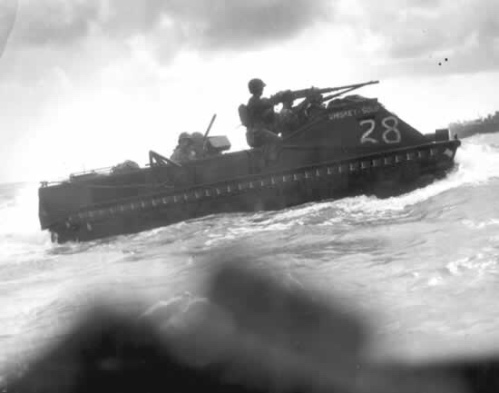
The bombardment was lifted to allow an attack by carrier based aircraft. However, the aircraft were late to arrive and the ships did not resume fire, allowing the Japanese to emerge and re-train their weapons on the approaching landing craft.[liv] Likewise the destroyers USS Ringgold and USS Dashiell, the only ships operating inside the lagoon and providing close Naval Gunfire Support, were ordered to cease fire, knowing the Japanese gunners along the shore were still active.[lv] Some believe that an extra half hour of direct fire from the destroyers would have saved many lives.[lvi]

The LVTs in the first three waves were delayed by a heavy chop outside the lagoon and did not make landfall until 0913, which threw off the landing schedule.[lvii] The expected and planned for rise in tides did not materialize, and tides remained unpredictably low for the first 48 hours. As a result, no landing craft other than the LVTs could cross the reef, and the Marines were forced to wade ashore from distances of 600 to 1000 yards.[lviii]

Marines Wading Across the Lagoon

Shoup’s Marines landed on three beaches.  Red One and Red Two lay to the west of a 500 yard long pier, while Red Three lay to the east.  Third Battalion Second Marines (3/2) landed on Red-1, while 2/2 on Red-2. Second Battalion Eighth Marines (2/8) landed on Red-3, while elements of 1/18 and the scout snipers landed at the pier, with First Battalion Second Marines (1/2) remained at sea in reserve to land behind the battalion making the best progress.[lix]

As soon as the Amtracks hit the reef the Japanese began firing.  Every “working weapon along the north and west shorelines….blazed forth in fierce, interlocking fields of fire.”[lx] As they watched the Amtracks craw over the reef that Japanese knew they were in for a tough fight, one of Warrant Officer Ota’s men exclaimed “Heavens! The God of Death has come!”[lxi]

The Marines of 3/2 on Red-1 received enfilade fire from Japanese guns emplaced in a U around the beach. Even before the Marines landed they began to take causalities, Amtracks were hit in the lagoon and most that were not sunk or destroyed were unfit for further use.[lxii] The 2000 Marines who landed on the beaches in the first hour of the assault were badly disorganized, and the commanding officer’s of 2/2 and the Amtracks were killed. 3/2’s commander was isolated on the reef and only 2/8’s commander was with his troops. 2/8 was the only battalion being to reach the shore relatively intact.[lxiii] 3/2 was down to 65% of its strength and Kilo Company, 3/2 had taken over 50% casualties.[lxiv]

The Marines in the fourth to sixth waves were struggling to wade ashore from the reef. Landing craft “ran aground or milled about helplessly outside the reef, which was swept by crossfire from behind the beaches and from a grounded hulk northwest of the pier.”[lxv] Most of the tanks were put out of action either through accurate fire by Japanese guns or by sinking in deep areas of the lagoon, the Tank battalion commander was blown out of his Amtrack, wounded and survived 24 hours by clinging to a pile of dead bodies to keep from drowning.[lxvi]

Colonel Shoup Directing Operations

Colonel Shoup landed at Red-2 and began directing operations on the beach.  He knew that he had to get more troops ashore to exploit the minimal gains his Marines had made.  The news from Red One and Two was bad; he decided to bring 1/2 in at Red-2 thought that 3/8 should go in at Red-3.[lxvii] At 1018 General Julian Smith ordered the 8th Marines to dispatch 3/8 to Red-3.[lxviii] The Marines of 3/8 had to make their way across 700 yards through the water to get to the beach. They were slaughtered, and only 30 percent of the first wave got ashore, while the second and the third “were practically wiped out.”[lxix]

Close Combat

As Shoup’s Marines struggled to reach the beaches, those who had gotten ashore engaged the Japanese at point blank range. First Lieutenant William Hawkins of the 2nd Marine Scout and Sniper platoon and five of his men engaged the Japanese on the pier in vicious hand to hand fighting. [lxx] Staff Sergeant Bordelon of the Engineers on Red-2 though grievously wounded knocked out four gun positions, some by lobbing dynamite charges into them and galvanizing survivors into action, finally being killed while taking on a Japanese position alone.  Both Marines would be awarded the Medal of Honor.[lxxi]

Wounded Being Evacuated by Rubber Raft

By afternoon Julian Smith realized that he needed more troops, his last battalion, 1/8 waited to go ashore.[lxxii] Smith asked for the 6th Marines. He had Rear Admiral Wilbur Hill, Commander of Amphibious Group Two, send a message to Admiral Richmond K. Turner stating “Issue in doubt. I concur.” This message sent a chill through the listening Naval Staff.[lxxiii]
Ashore, Colonel Shoup brought in howitzers from 1st Battalion 10th Marines on his surviving Amtracks to the eastern edge of Red Two near the pier. [lxxiv] The howitzers landed in the early evening.[lxxv] Shoup sent Lieutenant Colonel Carlson to make a personal report to General Smith that he would hold onto his beachhead no matter what happened.

Shoup ordered his Catholic Chaplain to lay out a cemetery and begin burying the dead who were already decomposing in the tropical heat.[lxxvi] As this transpired, 2/8 got two of its 37mm anti-tank guns into position to drive off Japanese tanks approaching the beachhead.[lxxvii]

Members of the Second Marine Division Band assisted Navy Hospital Corpsman in bringing back wounded Marines.[lxxviii] For the rest of the day the Marines continued to eke out a beachhead. Shoup’s Marines on Red-2 and Red-3 managed to advance about halfway across the island, while 3/2 and elements 1/2 and 2/2 were isolated. Major Ryan of Lima Company 3/2 pulled them back to meet an expected Japanese counter-attack.[lxxix]

By nightfall the Marines had taken over 1500 casualties of 5000 men landed the first day.[lxxx] There is no evidence that Shoup considered withdraw that night.[lxxxi] No counterattack occurred due to Japanese command and control problems. The primary cause was that Admiral Shibasaki and his staff were killed while shifting the position of their headquarters during the afternoon,[lxxxii] and the Japanese communications were in shambles. A well organized counterattack would have been disastrous for the Marines,[lxxxiii] but it did not happen, even though the Japanese assembled over 1000 men to oppose the Marines on day two.[lxxxiv] Had Shibasaki lived and the Japanese communications survived, a counterattack might have had ramifications far beyond Tarawa.[lxxxv]

Day Two

Advancing Under Fire

The second day began with the First Battalion EighthMarines landing on Red Two, while the 6th Marines began to land on Green Beach at the far western tip of Betio.  Like the Marines who landed on the first day, 1/8’s landing turned into a bloodbath, the tide fell even lower than the previous day. As they hit the reef and waded ashore they drifted into some of the heaviest Japanese defenses. Japanese guns, including the dual 5.5” guns took direct aim at the boats, while Marines ashore watched helplessly. War correspondent Robert Sherrod noted: “This is worse, far worse than it was yesterday.”[lxxxvi] Only half of 1/8 reached the beach with none of their heavy weapons or equipment.  Shoup ordered the remnants of the battalion into line on his western flank in preparation for an advance inland.[lxxxvii] During five hours of landings on day two, the “Marine casualties reached a higher rate than that sustained on the first morning.”[lxxxviii]

Meanwhile, Shoup ordered Ryan’s “orphans” to make an attack down the right flank of the Japanese positions on Green Beach. Shoup’s decision and Ryan’s leadership made the attack a success. The “American victory at Betio evolved from the attack during one intense hour the second morning.”[lxxxix]

Taking every available Marine, two surviving Sherman tanks, and some mortars, Ryan gathered his force and coordinated Naval Gunfire support. The area contained a number of heavy guns including two of the remaining 8” mounts.  A destroyer blanketed the Japanese positions with 5” shells and fire from her light AA guns.[xc] Attacking behind the beach, Ryan’s Marines isolated and destroyed everyone and everything that looked hostile.[xci] Against minimal opposition Ryan’s Marines quickly seized the gun positions and the western end of the airfield.  Within an hour his Marines occupied the entire western side of Betio up to a 200 yard depth. At 1200 he radioed Shoup to let him know the good news, and that he now intended to advance east against the airfield.[xcii] The attack allowed the Marines to land intact battalions with supporting arms for the first time battle.[xciii]

To the east behind Red Two and Red- Three, the 8th Marines and survivors of 1/2 and 2/2 attacked against fierce Japanese opposition near Shibasaki’s former command bunker and two other large bunkers which were mutually supporting.  The attack by the 2nd Marine survivors eventually succeeded in getting completely across the south side of the island.[xciv] During the attack Lt. Hawkins of the Scout Snipers, who had distinguished himself at the pier the previous day was mortally wounded.

The attack cut the island in two, but the Japanese launched a viscous counterattack on the Marine positions which was beaten back.[xcv] The 8th Marines faced a more difficult task going against what was now the heart of the Japanese defense as the defenders had been reinforced by Lt. Minami and his third company of the 7th Special Naval Landing Force.

Vicious fighting ensued and by nightfall “the Marines had little to show for their heavy losses,[xcvi] but they did make significant inroads against the Japanese to warrant optimism for D+2.[xcvii] By evening the Marines on Red-1 and Red-2 had consolidated their beachhead so that reinforcements were finally able to land, including jeeps, artillery and heavy equipment.

By mid-day the Marines noted that Japanese defenders were beginning to commit suicide, and they began to feel that Japanese morale had broken.  By late afternoon Shoup transmitted the message: “Casualties many. Percentage of dead unknown. Combat efficiency-We are winning.”[xcviii] By late afternoon Major Jones’s First Battalion Sixth Marines landed on Green beach in their rubber boats, reinforcing Ryan’s orphans. It was the first of the 7 battalions on the island to get ashore intact.

Ryan and Jones coordinated their units for a night defense and an early attack the next morning.[xcix] Meanwhile, Second Battalion Sixth Marines cleared the nearby island of Bairiki, allowing the artillery of Second Battalion Tenth Marines to land its howitzers on the island.  This in cut off any line of retreat for the defenders of Betio.[c] Colonel Merritt Edson came ashore during the evening to relieve Shoup[ci], who remained to help coordinate the next day’s attack. Once again there were no coordinated Japanese counterattacks. The senior officer, Commander Takes Sugai, was isolated in the pocket between the Red and Green beaches, and no senior officer could coordinate any attacks.[cii]

Mopping Up: Day Three and Four

Wrecked LVT’s and Dead Marines Litter the Beach

Day three began with attacks against Japanese strong points and the arrival of more reinforcements, including 3/6 which landed on Green Beach, and three light tank platoons which landed on Red-2.[ciii] The Marines attacked from Green Beach, sweeping east to join the 2nd Marines who had cut the island in two the day before.  The 8th Marines continued to attack the heavily fortified bunker complex, and eventually captured the heavily fortified and defended positions.

During the assault First Lieutenant Sandy Bonnyman of 1/18 won the Medal of Honor for leading the assault on these positions, including destroying a major bunker defended by 150 Japanese, he was killed during the fight.[civ] Fighting remained fierce throughout the day and General Smith arrived to take command on shore.  The Marines continued to attack supported by tanks, artillery and naval gunfire.  By the evening they were established at the east end of the airfield.

The now desperate Japanese defenders launched a series of Banzai charges which beginning about 1930 hours and ending about 0400 when the Marines annihilated the last attack with the assistance of artillery.[cv] The attack, which could have succeeded the first or early the second day, now aided the Marines by killing troops that might have been used to exact a higher price in Marine lives for the tail of the island.[cvi]

The next morning the Marines pushed forward and eliminated the last Japanese defenders, and by 1200 Betio was secured.  Of about 5000 defenders only 17 Japanese and some Korean laborers were taken prisoner.[cvii] The Marines lost over 1000 killed and 2300 wounded.[cviii]

One of the Japanese Survivors being Interrogated

Epilogue

The Marines paid a heavy price for Betio, but it was not to be a useless sacrifice. However, it was a source of great controversy especially among politicians.[cix] Historian Ronald Spector wonders if waiting for better tides or a full moon would have saved lives.[cx] Holland Smith later argued that Tarawa should have been bypassed, but Nimitz’s biographer, E. B. Potter notes “if the lessons of the amphibious assault had not been learned at Tarawa, they would have to be learned elsewhere, probably at greater cost.”[cxi]

The lessons learned aided all future amphibious operations in the Central Pacific and elsewhere.  Timing and coordination of naval gunfire support, air strikes and combat loading of transports were all refined in future operations. Large numbers of armored and up-gunned Amtracks would be part of every future operation.[cxii] Intelligence was emphasized and replicas of the Japanese fortifications were built and tested to determine the best way of destroying them.[cxiii] Likewis, the Marines shocked the public by releasing photos and films of the carnage on Tarawa to awaken them to the challenges ahead.[cxiv]

Today the battle is remembered annually by the 2nd Marine Division at Camp LeJeune, North Carolina. Each year, an ever shrinking number of veterans of the battle attend the ceremonies.  Samuel Eliot Morison put it best: “All honor, then, to the fighting heart of the United States Marine. Let the battle for that small stretch of coral sand called Betio of Tarawa be remembered as terrible indeed, but glorious, and the seedbed for victory in 1945.”[cxv]

Appendix: The Commanders

Lieutenant General Holland Smith and Major General Julian Smith

General Holland M. “Howling Mad” Smith USMC: (1882-1967) Lieutenant General Holland M. Smith commanded V Amphibious Corps during the Gilberts operation.  Prior to the war he had worked extensively on amphibious warfare doctrine for both the Marine Corps and Navy. Unlike many senior officers Smith was not a Naval Academy graduate having matriculated from the Alabama Polytechnic Institute (now Auburn University) in 1903 and law school in 1903.  Smith served as Adjutant of the 4th Marine Brigade in the First World War and served in Panama and the Dominican Republic in addition to other Marine tours afloat and ashore.  He served well and had many key assignments between the wars culminating in as the Assistant Commandant of the Marine Corps.  Subsequent to the Gilbert campaign he served as Commanding General of the Fleet Marine Force, Pacific and later commanded the Marines at Iwo Jima.  He retired in 1946.

Major General Julian Smith USMC: (1885-1975) Major General Julian Smith served as Commanding General 2nd Marine Division at Tarawa.  He graduated from the University of Delaware and was commissioned as a Second Lieutenant in 1909.  He served in Haiti, Santo Domingo and the Vera Cruz expedition. During the First World War he served as an instructor in the Marine Officer training camps at Quantico. After the war he served in Cuba, Nicaragua and various command and staff posts including the Army Command and General Staff College.  He commanded 5th Marines in 1938 and in 1942 was promoted the Major General serving as director of Fleet Marine Force Schools, New River, NC.  He took command of 2nd Marine Division in May 1943 and served there until April 1944 when he became Commanding General, Expeditionary Troops, Third Fleet and in December 1944 took command of the Military Department of the Pacific.  He retired in 1946.

Colonel David Shoup

Colonel David Shoup USMC: (1904-1983) Colonel David Shoup commanded the 2nd Marines at Tarawa, being appointed as commander when its commander fell ill.  Shoup won the Congressional Medal of Honor for his actions on Tarawa.  A 1926 graduate of DePauw University, Shoup was commissioned a Second Lieutenant through the ROTC program that year.  He served in various assignments to include service in China, at sea on the battleship Maryland and Marine Barracks Puget Sound Navy Yard. He joined the staff of 6th Marines in October 1940 and assumed command of 2/6 in February 1942.  He was assigned as the Assistant Operations Officer for 2nd Marine Division in July 1942 and promoted the Lieutenant Colonel.   He went with the Division to New Zealand where he became the G-3 and from which he was fleeted up to command 2ndMarines at Tarawa.  After Tarawa he served as the Division Chief of Staff at Saipan and Tinian.  After the war Shoup continued to be assigned in key billets at the Pentagon and as commanding General, 1st Marine Division and then the Third Marine Division.  He became Chief of Staff, Headquarters Marine Corps in 1958 and was appointed as the 22nd Commandant of the Marine Corps by President Eisenhower, a post that he retained until his retirement in 1963.

Rear Admiral Tomanari Sachiro

Admiral Tomanari Sachiro IJN: (1887-?) Commander of Tarawa garrison until relieved by Rear Admiral Shibasaki.   Graduate Naval Academy 1910, initially a communications officer he held various commands including three destroyers, an Oiler, the Light Cruiser Yuma, Heavy Cruisers, Furutake and, Haguro and the Battleship Kirishima. Assigned to Tarawa in February 1943, he helped design and supervised the initial construction of the defenses until he was relieved by Admiral Shibasaki on 20 July1943.  He returned to Japan and served the remainder of the war on Navy Division of Imperial General Headquarters.  Tomonari survived the war though nothing is mentioned as to his postwar fate.

Rear Admiral Shibasaki Keiji

Rear Admiral Shibasaki Keiji IJN: (1894-1943) Commanded Tarawa Garrison until his death during the battle.  He graduated from the Naval Academy in 1915 and he was a skilled navigator and instructor.  Prior to the war he had served afloat and ashore and ashore and had commanded a ship and naval station and served as a naval attaché to Prince Kuni Asaakira, a member of the Imperial Family.  Among his assignments was 19 month combat tour with the special Naval Landing Forces in China, where he served as Chief of Staff of Shanghai Special Naval Landing Force.  Shibasaki’s leadership helped the garrison improve their defensive capabilities and combat skills as he inspired them to great heights and executed an intense training program. He was killed in the battle.

A Personal Note

I have not been to Tarawa but feel that I know it well.  I served in Second Marine Division from April 1999 through December 2001.  Due to my prior service experience I was used to fill gaps where chaplains were needed and ended up serving in four different battalions.  I served in 2nd Combat Engineer Battalion, the descendant of 1/18, the combat engineers.  We had a WWII Bulldozer outside our command post named after Sergeant Bordelon, the Medal of Honor Citations for Bordelon and Boonyman were prominently displayed.  I also served in 1/8 and 3/8.  I knew the accounts of the slaughter of these Marines as they attempted to land but as I re-read the accounts I was moved by their courage under fire.  The CPs of these battalions are also adorned with citations of their heroes lost at Tarawa.  Veterans would visit our units during Tarawa Days at Camp LeJeune, worn by the battle and the years they always made a great impression on me.

There is almost a mystical connection between the Second Marine Division and the Marines of Tarawa; it was a crucible that defined the division, whose motto is the same as the Army Infantry School. “Follow Me!”

Semper Fidelis,

Padre Steve+

Notes

[i] Spector, Ronald H. Eagle Against the Sun: The American War with Japan.  The Free Press, New York, NY 1985. p.253

[ii] Murray, Williamson and Millett, Allan R. A War to Be Won: Fighting the Second World War, The Belknap Press of Harvard University Press, Cambridge, MA 2000. p.338

[iii] Ibid. Spector. p.253

[iv] Ibid. p.255 The conference also set a date for the invasion of France.

[v] Toland, John. The Rising Sun: The Decline and Fall of the Japanese Empire, 1936-1945. Random House, Inc. New York, NY 1970. p.468

[vi] Ibid. Spector. p.255

[vii] Costello, John. The Pacific War 1941-1945. Quill Publishing, New York, NY 1982. p.430

[viii] Ibid.

[ix] Potter, E.B. Nimitz. Naval Institute Press, Annapolis, MD, 1976, Third Printing with Revisions 1979. p.243. Nimitz’s forces would have had to seize 5 major Japanese bases and his staff was not sure that the Pacific carrier force would be strong or experienced enough to provide the necessary air cover for the operation.

[x] Ibid.

[xi] Ibid. pp.243-245

[xii] Morison, Samuel Elliott. The Two Ocean War: A Short History of the United States Navy in the Second World War. Little Brown and Company, Boston and Toronto, 1963. p.296.

[xiii] Hammell, Eric and Lane, John E. Bloody Tarawa: The 2nd Marine Division, November 20-23, 1943. The Zenith Press, St. Paul MN 2006.  Text copyright 1998 Eric Hammell and John E. Lane. p.4

[xiv] See Alexander, Joseph H. Utmost Savagery: The Three Days of Tarawa.Ivy Books, published by Ballantine Books, New York, NY. 1995. pp. 39-40.  This unit became the Third Special Base Unit on its deployment and was joined by the 111th Construction Battalion.

[xv] Ibid. Hammell. p.4

[xvi] See Alexander pp.39-40. This unit was basically a reinforced infantry battalion with 3 rifle companies, a weapons battery, anti-aircraft battery, a light tank company and support units numbering about1600 men.

[xvii] Ibid. Alexander. p.43

[xviii] Alexander p.27 The Rikusentai was the Japanese equivalent of Marines, who numbered about 50,000 men.  The officers attended Army schools and qualified enlisted men attended additional Army specialist training.

[xix] Ibid. Costello. p.431

[xx] Ibid. Hammell. p.22

[xxi] See Alexander p.77. While most writers say that these guns were brought from Singapore, Alexander notes that British writer William H Bartsch submitted proof (serial numbers) that the guns were sold by Vickers to Japan in 1905 as a legitimate business transaction.

[xxii] These are the same guns (127mm) mounted as the secondary armament of Nachi and Takao Class Heavy Cruisers and later mounted on light cruisers to replace the main battery with a more effective anti-aircraft armament.

[xxiii] Ibid. Hammell. p.22

[xxiv] Hammell notes that many of these bunkers and pillboxes were so well concealed that they could not be seen.

[xxv] Ibid. Toland. p.469.

[xxvi] Ibid. Alexander. p.43.

[xxvii] Ibid. Hammell. p.28

[xxviii] Ibid. Morison. p.297

[xxix] Ibid. Costello. p.429

[xxx] At this point the force could provide everything except major permanent repairs to warships.

[xxxi] Liddell-Hart, B.H.  History of the Second World War. G.P. Putnam’s Sons, New York, NY 1970. p.511

[xxxii] Ibid. Costello. p.431

[xxxiii] The older LVT-1s had boiler plate armor added as a field modification and were given a heavy machine gun. Prior to this they were unarmored and had two light machine guns.

[xxxiv] Ibid. Morison. p.303

[xxxv] Hammell includes a by name list of these officers in Appendix B.  Of note for today, each MEUSOC (Marine Expeditionary Unit, Special Operations Capable) has an assigned Naval Gunfire Support Team.

[xxxvi] Ibid. Alexander. pp. 61-62.  The Shermans had to be transported aboard pre-loaded LCM-3s carried in the well decks of the LSDs.

[xxxvii] Ibid. Alexander. pp.58-59

[xxxviii] Ibid. Morison. p.297.  As a sidebar discussion it should be noted that Galvanic helped provide the model for the organization of all further Marine Corps amphibious doctrine now known by the acronym PERMA; Planning, Embarkation, Rehearsal, Movement and Assault, which describes the 5 phases of a amphibious assault.

[xxxix] Ibid. Hammell details the intricacies of the particular tides seen at Tarawa and the knowledge that the Marines had from the former Resident Commissioner of the Island, Major Frank Holland who warned the division staff that he knew that there would not be enough water over the reef to get landing craft across it. (pp.18-20)

[xl] Ibid. Alexander. pp.75-77

[xli] Ibid. Alexander. pp.67-68.

[xlii] Ibid. p.70

[xliii] Ibid. p.71

[xliv] Ibid. Morison. p.302

[xlv] Ibid. Hammell. p.16

[xlvi] Johnston, Richard W. Follow Me! The Story of the Second Marine Division in world War II.  Copyright 1948 by the Second Marine Division History Board and published by Random House Publishers, New York, NY 1948. p.106

[xlvii] Ibid. Liddell-Hart. p.511  Johnson says 2,700 tons. (p.106)

[xlviii] Ibid. Johnston. p.106

[xlix] Ibid. Hammell. p.17

[l] Ibid.

[li] Ibid.. Hammell. 46-47

[lii] Ibid. Morison. p.303

[liii] Ibid. Alexander. p.113.  Alexander notes that the Japanese would have been better served by using these guns on the stalled out landing craft.

[liv] Ibid. Hammell. p.47.

[lv] Ibid. Hammell. p.58

[lvi] Ibid.

[lvii] Ibid. Morison. p.303

[lviii] Ibid. Alexander. p.79

[lix] Ibid. Hammell. p.17

[lx] Ibid. Alexander. p.121

[lxi] Wukovits, John. One Square Mile of Hell: The Battle for Tarawa. NAL Caliber, published by New American Library, a division of Penguin Group USA, New York NY, 2006. p.112

[lxii] Ibid. Johnston. p.116

[lxiii] Ibid.

[lxiv] Ibid. Wukovits. P.119  Other companies suffered as grievously, K/3/2 was not alone in its suffering.

[lxv] Ibid. Spector. pp.263-264

[lxvi] Ibid. Alexander. pp.136-138

[lxvii] Ibid. Hammell. p.90

[lxviii] Ibid. p.95

[lxix] Ibid. Spector. p.264

[lxx] Ibid. Wukovits. p.114

[lxxi] Ibid. Alexander. pp.139-140

[lxxii] 1/8 did not arrive on the beach due to botched communications until D plus 1.

[lxxiii] Ibid. p.150  The last time this signal had been sent it was by Major Devereaux at Wake Isalnd

[lxxiv] Ibid. p.151

[lxxv] Ibid. Johnston. p.132

[lxxvi] Ibid. Hammell. p.112

[lxxvii] Ibid. p.130

[lxxviii] Ibid. Johnston. p.122

[lxxix] Ibid. Johnston. p.122

[lxxx] Ibid. Costello. p.436

[lxxxi] Ibid. Alexander. p.163

[lxxxii] Ibid. Alexander. pp.157-158  Hammell notes that Shibasaski was most likely killed by fire from Ringgold or Dashiell.

[lxxxiii] Ibid. Hammell.pp.139-140

[lxxxiv] Ibid. Alexander. p.162

[lxxxv] Ibid.  Wukovits. p.176. Wukovits notes how this could have affected the planning for the Normandy invasion.

[lxxxvi] Ibid. Alexander. p.173

[lxxxvii] Ibid. Hammell. p.160

[lxxxviii] Ibid. Costello. p.437

[lxxxix] Ibid. Alexander. p.170

[xc] Ibid. Hammell. p.163

[xci] Ibid. Hammell. p.166

[xcii] Ibid. Wukovits. p.178

[xciii] Ibid. Alexander. p.170 Ryan would be awarded the Navy Cross for his efforts.

[xciv] Ibid. Hammell. p.172

[xcv] Ibid. Alexander. p.179

[xcvi] Ibid. Alexander. p.181

[xcvii] Ibid. Hammell. p.178

[xcviii] Ibid.. Wukovits. p.194

[xcix] Ibid. Hammell. p.202

[c] Ibid. Hammell. p.212

[ci] Shoup would be awarded the Medal of Honor and eventually go on to be the Commandant of the Marine Corps.

[cii] Ibid. Alexander. pp.191-192

[ciii] Ibid. Johnston. p.134  2 platoons landed on Red-2 and one on Green Beach.

[civ] Ibid. Alexander. pp.202-205

[cv] Ibid. Johnston. pp.145-146

[cvi] Ibid. Johnston. p.147

[cvii] Ibid. Toland. p.470

[cviii] Ibid. Murray and Millett. p.345

[cix] Ibid. Liddell-Hart. p.511

[cx] Ibid. Spector. p.266

[cxi] Ibid. Potter. P.264

[cxii] Ibid. Murray and Millett. p.347  The Amtrack in improved forms has been part of the Marines ever since. The current model serves in a traditional amphibious role as well as a Armored Personnel Carrier for Marines involved in ground combat operations ashore.

[cxiii] Ibid. Costello. p.439. The method found to work best was long range plunging fire by heavy guns found on battleships and heavy cruisers.

[cxiv] Ibid. Murray and Millett. p.346

[cxv] Ibid. Morison. p.306

Bibliography

Alexander, Joseph H. Utmost Savagery: The Three Days of Tarawa. Ivy Books, published by Ballantine Books, New York, NY. 1995.

Costello, John. The Pacific War 1941-1945. Quill Publishing, New York, NY 1982

Morison, Samuel Elliott. The Two Ocean War: A Short History of the United States Navy in the Second World War. Little Brown and Company, Boston and Toronto, 1963

Hammell, Eric and Lane, John E. Bloody Tarawa: The 2nd Marine Division, November 20-23, 1943. The Zenith Press, St. Paul MN 2006.

Johnston, Richard W. Follow Me! The Story of the Second Marine Division in world War II.  Copyright 1948 by the Second Marine Division History Board and published by Random House Publishers, New York, NY 1948

Murray, Williamson and Millett, Allan R. A War to Be Won: Fighting the Second World War, The Belknap Press of Harvard University Press, Cambridge, MA 2000

Potter, E.B. Nimitz. Naval Institute Press, Annapolis, MD, 1976, Third Printing with Revisions 1979

Spector, Ronald H. Eagle Against the Sun: The American War with Japan.  The Free Press, New York, NY 1985 Toland, John. The Rising Sun: The Decline and Fall of the Japanese Empire, 1936-1945. Random House, Inc. New York, NY 1970

Leave a comment

Filed under History, Military, US Marine Corps, US Navy, world war two in the pacific

Disaster at Stalingrad

Friends of Padre Steve’s World,

On November 22nd 1942 the Commander of the German 6th Army radioed Berlin that the Red Army had surrounded his army, as well as portions of the 4th Panzer Army. Tonight I am posting what was a paper for one of my Masters degree classes dealing with the German 1942 summer offensive, Operation Blau, which ended when the Red Army began its counter-offensive on November 18th 1942. The German offensive ended in a disastrous defeat at Stalingrad which could have been even worse had it not been for the superb improvisation of Field Marshal Erich Von Manstein who extricated the rest of Army Group South from the Caucasus and stuck a counterblow that halted the Soviet advance.

German and Soviet Plans

Following the Soviet winter offensive and the near disaster in front of Moscow the German High Command was faced with the strategic decision of what to do in the 1942 campaign.  Several options were considered and it was decided to seize the Caucasus oilfields and in the process capture or neutralize the city of Stalingrad on the Volga.  River.

However, the German High Command was divided on the actual objectives of the campaign. The OKH (Oberkommando Des Heeres) under the guidance of Army Chief of Staff General Franz Halder, which was in charge of the Eastern Front, assumed that Stalingrad was the objective of the campaign. They believed that the advance into the Caucasus was to be a blocking effort.[i] On the other hand, Hitler and his OKW (Oberkommando Der Wehrmacht) envisioned that Army Group South would capture the Caucasus oil fields and capture or neutralize Stalingrad to secure the left flank.[ii]

Both the OKH and OKW considered Stalingrad significant but OKW “initially regarded it as a weigh station en route to the Caucasus oil fields.”[iii] The conflict between OKH and OKW apparent in the ambiguity of Directive No. 41. The directive “included the ‘seizure of the oil region of the Caucasus’ in the preamble concerning the general aim of the campaign, yet made no mention of this in the main plan of operations.”[iv]

At the planning conference held at Army Group South in early June “Hitler hardly mentioned Stalingrad. As far as his Generals were concerned it was little more than a name on the map. Hitler’s obsession was with the oil fields of the Caucasus.”[v] Manstein noted that “Hitler’s strategic objectives were governed chiefly by the needs of his war economy….”[vi] Anthony Beevor notes that at this stage of planning “the only interest in Stalingrad was to eliminate the armaments factories there and secure a position on the Volga. The capture of the city was not considered necessary.”[vii] German planners “expected that the Soviets would again accept decisive battle to defend these regions.”[viii]

Knocked out T-34 Tanks

In Moscow Stalin and his Generals attempted to guess the direction of the impending German offensive.  “Stalin was convinced that Moscow remained the principle German objective…Most of the Red Army’s strategic reserves…were therefore held in the Moscow region.”[ix]

With this in mind the Red Army attempted to disrupt the German offensive and to attempt to recover the key city of Kharkov. The Red Army launched three offensives against the Germans under the direction of Stavka. The largest of these, an attempt to take Kharkov was defeated between 12-22 May with the loss of most of the armor in southern Russia. This compounded by an equally disastrous defeat of Red Army forces in Crimea by Von Manstein’s 11th Army. The heavy losses meant that the Red Army would face the German offensive in a severely weakened condition.[x]

Operation Blau

The German offensive began on 28 June under the command of Field Marshal Fedor von Bock. Von Bock’s command included two separate army groups, Army Group B under Field Marshal Maximillian Von Weichs. Army Group B was comprised of 2nd Army, 6th Army, and the 4th Panzer Army. It also had three allied armies, the Italian 8th Army, the 2nd Hungarian, and 4th Romanian. These forces operated in the northern part of the operational area. Army Group A, under command of Field Marshal Wilhelm List was comprised of The 17th Army, 11th Army, and 1st Panzer Army.[xi] One allied Army, the Romanian 3rd Army was attached to it.

The allied armies which had few armored or motorized forces and little heavy artillery were being depended on to filled the gaps that the Germans could no longer fill with their own troops. The reliance on these units would prove to be a key factor in the German defeat.

Army Group B provided the main effort and its offensive quickly smashed through the defending Soviet armies. By July 20th Hitler believed that “the Russian is finished.”[xii] One reason for the German success in the south was that until July 7th Stalin believed that Moscow was still the primary objective.[xiii] Despite his success, Von Bock was prevented by Hitler from destroying Soviet formations left behind his advance. He protested and was relieved of command by Hitler. Von Bock was replaced by Von Weichs which created a difficult command and control problem.  Manstein noted that this created a “grotesque chain of command on the German southern wing” with the result that Army Group A had “no commander of its own whatever” and Army Group B had “no few than seven armies under command including four allied ones.”[xiv]

Panzer IV Ausf F Medium Tank

This decision proved fateful.  Hitler decided to redirect the advance of the 4th Panzer Army to support an early passage of the lower Don, diverting it from its drive on Stalingrad.  Additionally, the army groups became independent of each other when Bock was relieved of command.  They were “assigned independent-and diverging-objectives” under the terms of Directive No.45.[xv] This combination of events would have a decisive impact on the campaign.  The decision prevented a quick seizure of Stalingrad by 4th Panzer Army followed by a hand over to 6th Army to establish the “block” as described by Directive No.41.  Field Marshal Ewald Von Kleist, now commanding Army Group A noted that he didn’t need 4th Panzer Army’s help to accomplish his objectives and that it could have “taken Stalingrad without a fight at the end of July….”[xvi]

The result of Hitler’s decision doomed the campaign. Air support and fuel needed by Army Group A was transferred to 6th Army, denuding Army Group A of the resources that it needed to conclude its conquest of the Caucasus.[xvii] At the same time it denied Army Group B of the Panzer Army that could have quickly seized Stalingrad when it was still possible to do so.  Beevor calls Hitler’s decision a disastrous compromise.[xviii] Halder believed the decision underestimated the capabilities of the Red Army and was “both ludicrous and dangerous.”[xix]

All Eyes on Stalingrad

On July 22 as the Wehrmacht ran short on fuel and divisions to commit to the Caucasus, and the 6th Army fought for control of Voronezh, the Soviets created the Stalingrad Front to control operations in that city. Stavka moved an NKVD Division to the city,[xx] and rapidly filled the new front with formations transferred from the Moscow Front.[xxi]

Stalin issued Stavka Order 227, better known as “No Step Back” on 28 July. The order mandated that commanders and political officers who retreated would be assigned to Penal battalions[xxii]. It directed that each field Army was to form three to five special units of about 200 men each as a second line “to shoot any man who ran away.”[xxiii] Russian resistance west of the Don stiffened and slowed the German advance.

German commanders were astonished “at the profligacy of Russian commanders with their men’s lives.”[xxiv] Von Kleist compared the stubbornness of Russians in his area to those of the previous year and wrote that they were local troops “who fought more stubbornly because they were fighting to defend their homes.”[xxv] Additionally, Stalin changed commanders frequently in the “vain hope that a ruthless new leader could galvanize resistance and transform the situation.”[xxvi] General Vasily Chuikov brought the 64th Army into the Stalingrad Front in mid-July to hold the Germans west of the Don.[xxvii]

German Soldier in Stalingrad

The attacking German armies were weakened when the OKW transferred several key SS Panzer Divisions and the Grossdeutschland Division to France. The supporting Hungarian, Italian and Romanian allied armies lacked motorization, modern armor or anti-tank units and were unable to fulfill the gaps left by the loss of experienced German divisions and the unrealistic expectations of Hitler.[xxviii]

General Friedrich von Paulus

6th Army was virtually immobilized for 10 days due to lack of supplies. This allowed the Russians to establish a defense on the Don Bend.[xxix] To the south the Germans were held up by lack of fuel and increased Soviet resistance which included the introduction of a force of 800 bombers.[xxx]

Glantz and House noted that following the capture of Rostov on July 23rd, “Hitler abruptly focused on the industrial and symbolic value of Stalingrad.”[xxxi] Undeterred by warnings from Halder that fresh Russian formations were massing east of the Volga and the those of Quartermaster General Eduard Wagner, who guaranteed that he could supply either the thrust to the Caucasus or Stalingrad, but not both.[xxxii]

Again frustrated by slow the slow progress of the offensive, Hitler reverted to the original plan for 4th Panzer Army to assist 6th Army at Stalingrad. However, the cost in time and fuel necessitated by his changing of the plan in the first place were significant to the operation. Now the question for the Germans was whether “they could make up for Hitler’s changes in plan.”[xxxiii]

Strategic Implications

The changes in the German plan had distinct ramifications for both sides.  General F. W. Von Mellenthin wrote of Hitler’s meddling, that “the diversion of effort between the Caucasus and Stalingrad ruined our whole campaign.”[xxxiv] The Germans were able not secure the Caucasus oil fields which Hitler considered vital to the German war effort. While they advanced deep into the region and captured the Maikop oil fields, the vital wells and refineries were almost completely destroyed by the retreating Red Army.[xxxv]

Army Group A was halted by the Russians along the crests of the Caucasus on August 28th.[xxxvi] This left Hitler deeply “dissatisfied with the situation of Army Group A.”[xxxvii] Kleist and others attributed much of the failure to a lack of fuel[xxxviii] and General Günther Blumentritt noted that Mountain divisions that could have made the breakthrough were employed along the Black Sea coast in secondary operations.[xxxix]

Fuel and supply shortages delayed 6th Army’s advance while General Herman Hoth’s 4th Panzer Army was needlessly shuttled between Rostov and Stalingrad. By the time it resumed its attack, the Russians “had sufficiently recovered to check its advance.”[xl] As 6th Army advanced to the East, the “protection of Army Group B’s ever-extending northern flank was taken over by the 3rd Rumanian, the 2nd Hungarian and the newly formed 8th Italian Army.”[xli] The allied armies were neither equipped for the Russian campaign nor were they well motivated for a campaign that offered them or their countries much benefit.[xlii]

The supply shortage in both army groups was not helped by a significant logistics bottleneck. All supplies for Army Group A and Army Group B had pass over a single crossing over the Dnieper River. Manstein noted that this prevented the swift movement of troops from one area to another.[xliii]

General Friedrich Von Paulus’ 6th Army now attempted to rush Stalingrad between the 25th and 29th of July, while Hoth milled about on the lower Don.  However, Paulus’s piecemeal commitment of his divisions and failure to concentrate his army in the face of unexpectedly strong Soviet resistance caused the attacks to fail.  Paulus was forced to halt 6th Army on the Don so it could concentrate its forces and build its logistics base [xliv] as well as to allow Hoth’s 4th Panzer Army to come up from the south.

The delay permitted the Russians to build up their forces west of Stalingrad, to reinforce the Stalingrad front, and to strengthen the defenses of the city. [xlv] Ince the Germans were now operating far from their logistics center, and. The Red Army was closer to its supply centers and due to the distances involved it was now far easier for the Russians to reinforce the Stalingrad front than it was for the Germans to supply their armies.[xlvi] The delay also allowed the Russians to fill a number of key leadership positions with the Generals who would skillfully fight the battle.[xlvii]

German Mountain Troops planting Swastika Flag on Mount Elbrus

Hitler now focused on the capture of Stalingrad despite the fact that “as a city Stalingrad was of no strategic importance.”[xlviii] Strategically, its capture would cut Soviet supply lines to the Caucasus,[xlix] but this objective could be have been achieved without its capture. The success of the Soviets in checking Army Group A’s advance in the Caucasus began to give Stalingrad a moral importance to Hitler , which was enhanced by its name. This came to outweigh its strategic value.”[l] To Hitler Stalingrad would gain “a mystic significance”[li] and along with Leningrad, still besieged by the Wehrmacht, became “not only military but also psychological objectives.”[lii]

The Germans mounted a frontal assault on Stalingrad with the 6th Army, supported by elements of the 4th Panzer Army, despite air reconnaissance that indicated “the Russians are throwing forces from all directions at Stalingrad.[liii] Paulus as the senior General was in charge of the advance, with Hoth subordinated to him, but the attack had to wait until Hoth’s army could fight its way up from the south.[liv] Von Mellenthin comments rightly that “when Stalingrad was not taken on the first rush, it would have been better to mask it….”[lv]

It is clear that the German advance had actually reached its culminating point with the failure of the advance into the Caucasus and Paulus’s initial setback on the Don, but it was not yet apparent to many involved.[lvi] The proper course of action would have been to halt and build up the front and create mobile reserve to parry any Russian offensive along northern flank while reinforcing success in the Caucasus. Manstein wrote that “by failing to take appropriate action after his offensive had petered out without achieving anything definite, he [Hitler] paved the way to the tragedy of Stalingrad!”[lvii]

Transfixed by Stalingrad

Luftwaffe Ju-52 Transport

On August 19th Paulus launched a concentric attack against the Russian 62nd and 64th Armies on the Don.  The attack ran into problems, especially in Hoth’s sector.[lviii] Yet, on the 22nd the 14th Panzer Corps “forced a very narrow breach in the Russian perimeter at Vertyachi and fought its way across the northern suburbs of Stalingrad,”[lix] and reached the Volga on the 23rd. That day 4th Air Fleet launched 1600 sorties against the city dropping over 1,000 tons of bombs On the city. [lx]

The German breakthrough imperiled the Soviet position as they had concentrated their strongest forces against Hoth’s 4th Panzer Army.[lxi] The Germans maintained air superiority in the sector and the Luftwaffe continued its heavy bombing attacks.

During the last days of August the 6th Army “moved steadily forward into the suburbs of the city, setting the stage for battle.”[lxii] As the Soviets reacted to Paulus, Hoth finally achieved a breakthrough in the south which threatened the Russian position.  However, the 6th Army was unable to disengage its mobile forces from the fight in the city to link up with the 4th Panzer Army and thus another opportunity had been missed.[lxiii]

As 6th Army moved into the city, General Andrey Yeromenko ordered attacks against General Hans Hube’s 16th Panzer Division. Soviet resistance increased, and as more Red Army formations arrived the Germans suffered “one of their heaviest casualty rates.”[lxiv] Though unsuccessful, the counterattacks “managed to deflect Paulus’s reserves at the most critical moment.”[lxv]

Despite this, the Germans remained confident the first week of September as 6th Army and 4th Panzer Army linked up, but Yeremenko saved his forces by withdrawing and avoided encirclement, and retired to an improvised line close to the city.[lxvi]

“Time is Blood”

General Vasily Chuikov at Stalingrad

On September 12th Chuikov was appointed to command 62nd Army in Stalingrad.  Chuikov understood that there “was only one way to hold on. They had to pay in lives. ‘Time is blood,’ as Chuikov put it later.”[lxvii] Stalin sent Nikita Khrushchev to the front “with orders to inspire the Armies and civilian population to fight to the end.”[lxviii] The 13th Guards Rifle Division arrived on the 14th saved the Volga landings but it lost 30% casualties in its first 24 hours of combat.[lxix] An NKVD regiment and other units held the strategically sited high ground of Mamaev Kurgan, keeping German guns from controlling the Volga.[lxx]

The defenders fought house to house and block by block. Red Army and NKVD divisions were reinforced by Naval Infantry.  Chuikov conducted the defense with a brutal ferocity, relieving senior commanders who showed a lack of fight and sending many officers to penal units.  Chuikov funneled the massed German attacks into “breakwaters” where the panzers and infantry could be separated from each other causing heavy German casualties.[lxxi]

Communism Must be Deprived of Its Shrine

Now the “city became a prestige item, its capture ‘urgently necessary for psychological reasons,’ Hitler declared on October 2nd. A week later he declared that Communism must be ‘deprived of its shrine.’”[lxxii] Paulus’s troops continued to gain ground, however slowly and at great cost, especially among their infantry. Casualties were so heavy that companies had to be combined.

Chuikov used his artillery to interdict the Germans from the far side of the Volga where it was immune from ground attack. The fight in the city was fought by assault squads with incredible ferocity, and the close-quarter combat was dubbed “’Rattenkrieg’ by German soldiers.”[lxxiii]

Von Paulus brought more units into the city and continued to slowly drive the Russians back against the river, and by early October Chuikov wondered if he would be able to hold.[lxxiv] By early November Chuikov “was altogether holding only one-tenth of Stalingrad-a few factory buildings and a few miles of river bank.”[lxxv] Paulus now expected “to capture the entire city by 10 November,”[lxxvi] despite the fact that many of his units were fought out. The 6th Army Staff judged that 42% of the battalions of 51st Corps were fought out and no longer combat effective.[lxxvii] Even so, on November 9th, the 19th anniversary of the Beer Hall Putsch, Hitler declared “No power on earth will force us out of Stalingrad again!”[lxxvi.]

Operation Uranus, the Soviet Counter Offensive

On September 24th Hitler relieved Halder as Chief of Staff of the Army for persisting in explaining “what would happen when new Russian reserve armies attacked the over-extended flank that ran out to Stalingrad.”[lxxix] Many Officers on the German side now recognized the danger. Blumentritt said “The danger to the long-stretched flank of our advance developed gradually, but it became clear early enough for anyone to perceive it who was not willfully blind.”[lxxx] Warnings of the danger were also given by Rumanian Marshall Antonescu and the staff sections of Army Group B and the 6th Army[lxxxi]. Despite this Hitler remained transfixed on Stalingrad and failed to allow his commanders to conduct operations that might be more successful elsewhere. In doing so the Germans gave up the advantage of uncertainty and once the German “aim became obvious…the Russian Command could commit its reserves with assurance.”[lxxxii]

In the midst of Stalin’s concern about Stalingrad Stavka planners never lost sight of their goal to resume large scale offensive operations as soon as possible in order to destroy at least one German Army Group.[lxxxiii] Unlike Hitler, Stalin had finally begun to trust his Generals. In September, Stavka under the direction of Marshal Aleksandr Vasilevsky produced a plan to cut off the “German spearhead at Stalingrad by attacking the weak Rumanian forces on its flanks.”[lxxxiv]

At first Stalin “showed little enthusiasm” for the attack, fearing that Stalingrad might be lost, but on 13 September he gave his full backing to the proposal. [lxxxv] Zhukov, Vasilevsky, and Vatutin developed into a plan involving two operations, Operation Uranus to destroy the German and allied forces at Stalingrad, and Operation Saturn to destroy all the German forces in the south, along with a supporting attack to fix German forces in the north, Operation Mars which was aimed at Army Group Center.[lxxxvi]

Soviet Armor Advancing to the Cheers of Civilians

To accomplish the destruction of 6th Army and part of 4th Panzer Army, Stavka employed over 60% of the “whole tank strength of the Red Army.”[lxxxvii] Strict secrecy combined with numerous acts of deception were used by the Red Army to disguise the operation.[lxxxviii] The plan involved an attack against 3rd Rumanian Army on the northern flank by 5th Tank Army and two infantry armies with supporting units.[lxxxix]

In the south against the 4th Rumanian Army and weak elements of the 4th Panzer Army, another force of over 160,000 men including 430 tanks were deployed.[xc] Despite warnings from his Intelligence Officer, Von Paulus did not expect a deep offensive into his flanks and rear and made no plans to prepare to face the threat.[xci] Other senior officers at OKW believed that the attack would take place against Army Group Center.[xcii] Warlimont notes that there was a “deceptive confidence in German Supreme Headquarters.”[xciii]

The storm broke on 19 November as Soviet forces attacked, rapidly crushing Romanian armies in both sectors[xciv] and linking up on November 23rd.[xcv] The 48th Panzer Corps which was deployed to support the Romanians was weak and had few operational tanks.[xcvi] It attempted a counterattack, but was “cut to pieces” in an encounter with 5th Tank Army.[xcvii]

A promising attempt by 29th Motorized division against the flank of the southern Russian pincer was halted by the Army Group and the division was ordered to take up defensive positions south of Stalingrad.[xcviii] Meanwhile, the Luftwaffe was neutralized by bad weather.[xcix] Von Paulus, in Stalingrad continued to do nothing since the attacks were outside of his area of responsibility, and waited for instructions from the Army Group. [c]

As a result the 16th and 24th Panzer Divisions which could have assisted matters to the west remained “bogged down in street-fighting in Stalingrad.”[ci] Without support 6th Army units west of Stalingrad were forced to,retreat in horrific conditions.  By the 23rd, the 6th Army was cut off along with one corps of 4th Panzer Army and assorted Romanian units, a total over 330,000 men.  The entrapped force would require the Soviets to use seven rifle armies and devote much staff attention to eliminate.[cii]

The Death of 6th Army

Hitler ordered Von Manstein to form Army Group Don to relieve Stalingrad. Hitler would not countenance any attempt by 6th Army to break out of the pocket and wanted Manstein to break through and relieve 6th Army.[ciii] Hitler refused a request by Paulus on 23 November to move troops to prepare for a possible a break out attempt, assuring him that he would be relieved.[civ]

Albert Speer notes that General Kurt Zeitzler, who replaced Halder insisted that the Sixth Army must break out to the west.”[cv] Hitler told Zeitzler that “We should under no circumstances give this up. We won’t get it back once it’s lost.”[cvi] Hermann Goering promised that the Luftwaffe would be able to meet the re-supply needs of 6th Army by air, even though his Generals knew that it was impossible with the number of transport aircraft available.[cvii]

Hitler took Goering at his word and exclaimed “Stalingrad can be held! It is foolish to go on talking any more about a breakout by Sixth Army…”[cviii] A Führer decree was issued ordering that the front be held at all costs.[cix] Walter Goerlitz wrote that “Hitler was incapable of conceiving that the 6th Army should do anything but fight where it stood.”[cx] Likewise Manstein had precious few troops with which to counterattack and he also had to protect the flank of Army Group A, which was still deep in the Caucasus and in danger of being cut off.

Field Marshal Erich von Manstein

His army group was only at corps strength and was spread across a 200 mile front.[cxi] Any relief attempt had to wait for more troops, especially Panzers divisions. Manstein too believed that the best chance for a breakout had passed and that it was a serious error for Paulus to put the request to withdraw through to Hitler rather than the Army Group or act on his own.[cxii] Many soldiers were optimistic that Hitler would get them out.[cxiii] Other generals like Guderian, Reichenau or Hoeppner might have acted, but Paulus was no rebel.[cxi]

Operation Saturn began on 7 December. The Red Army destroyed the Italian 8th Army and forced the Germans to parry the threat.[cxv] A relief attempt by 57th Panzer Corps under Hoth on 12 December made some headway until a massive Soviet counterattack on 24 December drove it back.[cxvi] This attack was hampered by OKW’s refusal to allocate the 17th Panzer and 16th Motorized divisions to Manstein,[cxvii] and by 6th Army not attacking out to link with the relief force.[cxviii]

By January 6th, Von Paulus signaled OKW “Army starving and frozen, have no ammunition and cannot move tanks anymore.”[cxix] On 10 January the Soviets launched Operation Ring to eliminate the pocket and despite all odds German troops fought on. On the 16th Paulus requested that battle worthy units be allowed to break out, but the request was not replied to by OKW. cxx] On January 22nd the last airfield was overrun, and on January 31st Paulus surrendered.[cxxi]

Analysis

Stalingrad had strangely drawn the attention of both sides, but the Russians never lost sight of their primary objectives during the campaign. The Germans on the other hand committed numerous unforced errors mostly caused by Hitler or Paulus. After the fall of Stalingrad as the Soviets attempted to follow up their success by attempted to cut off Army Group “A” Manstein was permitted to wage a mobile defense while Von Kleist managed to withdraw with few losses.[cxxii]

The superior generalship of Manstein and Von Kleist prevented the wholesale destruction of German forces in southern Russia, and Manstein’s counter offensive inflicted a severe defeat on the Soviets. However, the German Army had been badly defeated.  The seeds of defeat were laid early, the failure to destroy bypassed Soviet formations in July, the diversion of 4th Panzer Army from Stalingrad, and the divergent objectives of trying to capture the Caucasus and Stalingrad at the same time.  This diluted both offensives ensuring that neither succeeded.  Likewise the failure to recognize the culminating point when it was reached and to adjust operations accordingly was disastrous for the Germans.

The failure create a mobile reserve to meet possible Russian counter offensives and the fixation on Stalingrad took the German focus off of the critical, yet weakly held flanks. The hubris of Hitler and OKW to believe that the Russians were incapable of conducting major mobile operations even as Stavka commenced offensive operations on those flanks all contributed to the defeat.  Clark notes these facts, but adds that the Germans “were simply attempting too much.”[cxxiii]

Soviet numbers allowed them to wear down the Germans even in defeat.[cxxiv] At the same time Stalin gave his commanders a chance to revive the mobile doctrine of deep operations with mechanized and shock armies that he had discredited in the 1930s.[cxxv] Throughout the campaign Zhukov, Chuikov and other commanders maintained both their nerve even when it appeared that Stalingrad was all but lost. They never lost sight of their goal of destroying major German formations though they failed to entrap Army Group A in the Caucasus.

Notes

[i] Clark, Alan. Barbarossa: The Russian-German Conflict:1941-45. Perennial Books, An imprint of Harper Collins Publishers, New York, NY 1965. p.191

[ii] Ibid.

[iii] Glantz, David M. and House, Jonathan. When Titan’s Clashed: How the Red Army Stopped Hitler. The University Press of Kansas, Lawrence KS, 1995. p.111

[iv] Ibid. Clark. p.191

[v] Beevor, Anthony. Stalingrad: The Fateful Siege: 1942-1943. Penguin Books, New York NY 1998. p.69

[vi] Manstein, Erich von. Forward by B.H. Liddle Hart, Introduction by Martin Blumenson. Lost victories: The War Memoirs of Hitler’s Most Brilliant General. Zenith Press, St Paul MN 2004. First Published 1955 as Verlorene Siege, English Translation 1958 by Methuen Company. p.291 This opinion is not isolated, Beevor Quotes Paulus “If we don’t take Maikop and Gronzy…then I must put an end to the war.” (Beevor pp. 69-70)  Halder on the other hand believed that Hitler emphasized that the objective was “the River Volga at Stalingrad. (Clark. p.190)
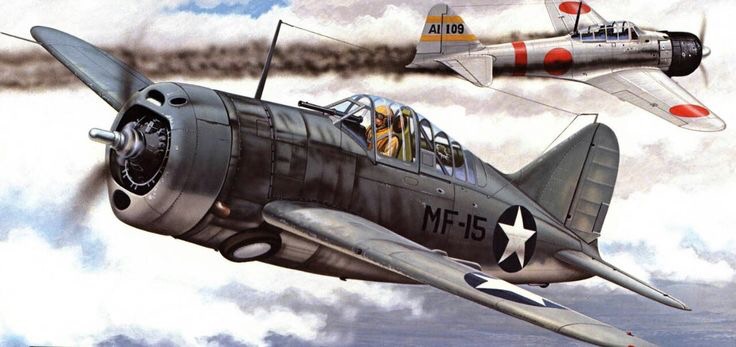
[vii] Ibid. Beevor. p.70.

[viii] Ibid. Glantz and House. p.106

[ix] Ibid. p.105-106

[x] Ibid. Clark. p.203.  The offensive did impose a delay on the German offensive.

[xi] Ibid. Clark. p.191 Each group also contained allied armies.

[xii] Ibid. p.209.

[xiii] Ibid. Glantz and House. p.119

[xiv] Ibid. Manstein. p.292.

[xv] Ibid. Clark. p.209

[xvi] Ibid. Clark.  p.211

[xvii] Ibid. Glantz and House. p.120. There is a good discussion of the impact of this decision here as 6th Army’s advance was given priority for both air support and fuel.

[xviii] Ibid. Beevor. p.74

[xix] Warlimont, Walter. Inside Hitler’s Headquarters 1939-45. Translated by R.H. Berry, Presido Press, Novato CA, 1964. p.249

[xx] Ibid. Beevor. p.75 This was the 10th NKVD Division and it took control of all local militia, NKVD, and river traffic, and established armored trains and armor training schools.

[xxi] Ibid. Clark. p.212

[xxii] Ibid. Glantz and House. p.121

[xxiii] Ibid. Beevor. p.85

[xxiv] Ibid. p.89

[xxv] Liddell-Hart, B.H. The German Generals Talk. Quill Publishers, New York, NY 1979. Originally published by the author in 1948. p.202

[xxvi] Ibid. Beevor. p.88

[xxvii] Ibid. Beevor. p.90

[xxviii] Ibid. Beevor. p.81

[xxix] Ibid. Glantz and House. p.121

[xxx] Ibid. Liddell-Hart. p.202

[xxxi] Ibid. Glantz and House. p.120

[xxxii] Goerlitz, Walter. History of the German General Staff. Westview Press, Frederick A. Praeger Publisher, Boulder, CO. 1985 p.416

[xxxiii] Ibid. Beevor. pp.95-96.

[xxxiv] Von Mellenthin, F.W. Panzer Battles: A Study of the Employment of Armor in the Second World War. Translated H. Betzler, Edited by L.C.F. Turner. Oklahoma University Press 1956, Ballantine Books, New York, NY. 1971. p.193

[xxxv] Shirer, William L. The Rise and Fall of the Third Reich. A Touchstone Book published by Simon and Schuster, 1981, Copyright 1959 and 1960. p.914

[xxxvi] Ibid. Glantz and House. p.122

[xxxvii] Ibid. Warlimont. p.256

[xxxviii] Ibid. Liddell-Hart. p.203

[xxxix] Ibid. p.204

[xl] Ibid. Shirer. p.914

[xli] Ibid. Goerlitz. p.416

[xlii] Ibid. Goerlitz. p.416

[xliii] Ibid. Manstein. p.293

[xliv] Ibid. Clark. p.214

[xlv] Ibid. Beevor. pp.97-99. The mobilization included military, political, civilian and industrial elements.

[xlvi] Liddell-Hart, B.H. Strategy. A Signet Book, the New American Library, New York, NY. 1974, Originally Published by Faber and Faber Ltd., London. 1954 & 1967. p.250

[xlvii] Ibid. Beevor. p.99.  Two key commanders arrived during this time frame, Colonel General Andrei Yeremenko, who would command the Stalingrad Front  and General Chuikov commander of 64th Army who would conduct the defense of the city.

[xlviii] Carell, Paul Hitler Moves East: 1941-1943. Ballantine Books, New York, NY 1971, German Edition published 1963. p.581

[xlix] Ibid. Shirer.  p.909.

[l] Ibid. Liddell-Hart, Strategy. p.250

[li] Wheeler-Bennett, John W. The Nemesis of Power: The German Army in Politics 1918-1945. St. Martin’s Press, New York, NY 1954.  p.531

[lii] Ibid. Wheeler-Bennett. p.531

[liii] Ibid. Beevor. p.96

[liv] Ibid. Clark. p.216.

[lv] Ibid. Von Mellenthin. P.193

[lvi] See Von Mellinthin pp.193-194.  Von Mellinthin quotes Colonel Dinger, the Operations Officer of 3rd Motorized Division at Stalingrad until a few days before its fall. Dingler noted that the Germans on reaching Stalingrad “had reached the end of their power. Their offensive strength was inadequate to complete the victory, nor could they replace the losses they had suffered.” (p.193) He believed that the facts were sufficient “not only to justify a withdrawal, but compel a retreat.” (p.194)
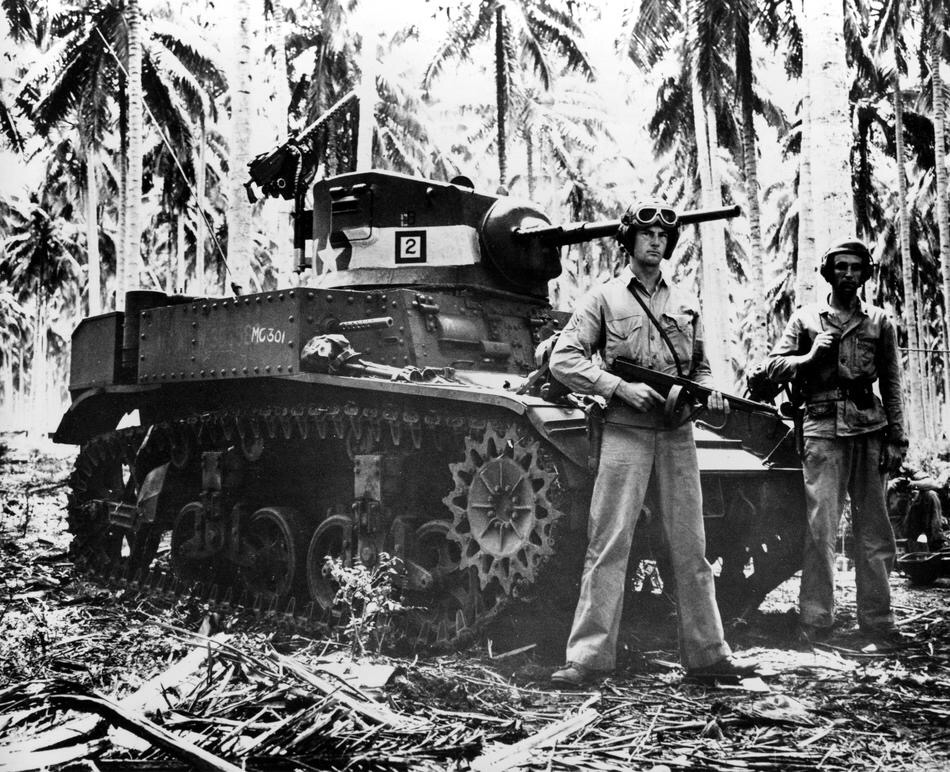
[lvii] Ibid. Manstein. p.294

[lviii] Ibid. Clark. p.216

[lix] Ibid. Clark. p.217

[lx] Ibid. Beevor. p.107

[lxi] Ibid. Beevor. p.107

[lxii] Ibid. Glantz and House. p.122

[lxiii] Ibid. Carell. P.601

[lxiv] Ibid. Beevor. p.118

[lxv] Ibid. Beevor. p.118

[lxvi] Ibid. Carell. p.602

[lxvii] Ibid. Beevor. p.128

[lxviii] Ibid. Carell. p.603

[lxix] Ibid. Beevor. p.134

[lxx] Ibid. Beevor. pp.136-137

[lxxi] Ibid. Beevor. p.149

[lxxii] Fest, Joachim. Hitler. Translated by Richard and Clara Winston, Harcourt, Brace, Jovanovich Publishers, San Diego, New York, London. 1974. p.661

[lxxiii] Ibid. Beevor. pp. 149-150

[lxxiv] Ibid. Beevor. p.164

[lxxv] Ibid. Carell. p.618

[lxxvi] Ibid. Glantz and House. p.123

[lxxvii] Ibid. Beevor. p.218

[lxxviii] Ibid. Carell. p.623

[lxxix] Ibid. Goerlitz. p.418

[lxxx] Ibid. Liddell-Hart. The German Generals Talk. p.207

[lxxxi] Ibid. Manstein. p292

[lxxxii] Ibid. Liddell-Hart. History of the Second World War. p.258

[lxxxiii] Ibid. Glantz and House. p.129

[lxxxiv] Ibid. Glantz and House. p.130

[lxxxv] Ibid. Beevor. pp.221-222 Glantz and House say that Stalin gave his backing in mid-October but this seems less likely due to the amount of planning and movement of troops involved to begin the operation in November.

[lxxxvi] Ibid. Glantz and House. p.130

[lxxxvii] Ibid. Beevor. p.226

[lxxxviii] Ibid. Glantz and House. p.132

[lxxxix] Ibid. Glantz and House. p.130

[xc] Ibid. Beevor. p.227

[xci] Ibid. Beevor. p.228

[xcii] Ibid. Clark. p.235

[xciii] Ibid. Warlimont. p.274

[xciv] Ibid, Carell. p.627 3rd Rumanian Army lost 75,000 men in three days.

[xcv] Ibid. Clark.pp.247-248

[xcvi] The condition of the few German Panzer Divisions in position to support the flanks was very poor, the 22nd had suffered from a lack of fuel and maintenance and this many of its tanks were inoperative. Most of the armor strength of the 48th Panzer Corps was provided by a Rumanian armored division equipped with obsolete Czech 38t tanks provided by the Germans.

[xcvii] Ibid. Clark. pp.251-252. The designation of 2nd Guards Tank Army by Clark has to be wrong and it is the 5th Tank Army as 2nd Guards Tank was not involved in Operation Uranus.  Carell, Beevor and Glantz properly identify the unit.

[xcviii] Ibid. Carell. p.630

[xcix] Ibid. Beevor. p.244

[c] Ibid. Beevor. p.247

[ci] Ibid. Beevor. p.245

[cii] Ibid. Glantz and House. p.134

[ciii] Ibid. Glantz and House. p.134

[civ] Ibid. Clark. p.256

[cv] Speer, Albert. Inside the Third Reich. Collier Books, a Division of MacMillan Publishers, Inc. New York, NY 1970. p.248

[cvi] Heiber, Helmut and Glantz, David M. Editors. Hitler and His Generals: Military Conferences 1942-1945. Enigma Books, New York, NY 2002-2003.  Originally published as Hitlers Lagebsprechungen: Die Protokollfragmente seiner militärischen Konferenzen 1942-1945. Deutsche Verlags-Anstalt GmbH, Stuttgart, 1962. p.27

[cvii] Ibid. Glantz and House. p.135 Glantz and House note that the amount of aircraft estimated to successfully carry out the re-supply operation in the operational conditions was over 1,000.  The amount needed daily was over 600 tons of which the daily reached only 300 tons only one occasion.

[cviii] Ibid. Speer. p.249

[cix] Ibid. Carell. p.636

[cx] Ibid. Goerlitz. p.426

[cxi] Ibid. Clark. p.252

[cxii] Ibid. Manstein. p.303

[cxiii] Ibid. Beevor. p.276

[cxiv] Ibid. Carell. p.640

[cxv] Ibid. Glantz and House. p.140

[cxvi] Ibid. Glantz and House. p.140

[cxvii] Ibid. Clark. p.264

[cxviii] Ibid. Manstein. p.337

[cxix] Ibid. Beevor. p320

[cxx] Ibid. Beevor. p.365

[cxxi] Of the approximately 330,000 in the pocket about 91,000 surrendered, another 45,000 had been evacuated.  22 German divisions were destroyed.

[cxxii] Ibid. Liddell-Hart. The German Generals Talk. p.211

[cxxiii] Ibid. Clark. p.250

[cxxiv] Ibid. Glantz and House. p.124

[cxxiv] Ibid. Beevor. p.221

Bibliography

Beevor, Anthony. Stalingrad: The Fateful Siege: 1942-1943. Penguin Books, New York NY 1998

Carell, Paul Hitler Moves East: 1941-1943. Ballantine Books, New York, NY 1971, German Edition published 1963.

Clark, Alan. Barbarossa: The Russian-German Conflict:1941-45. Perennial Books, An imprint of Harper Collins Publishers, New York, NY 1965.

Fest, Joachim. Hitler. Translated by Richard and Clara Winston, Harcourt, Brace, Jovanovich Publishers, San Diego, New York, London. 1974

Glantz, David M. and House, Jonathan. When Titan’s Clashed: How the Red Army Stopped Hitler. The University Press of Kansas, Lawrence KS, 1995.

Goerlitz, Walter. History of the German General Staff. Westview Press, Frederick A. Praeger Publisher, Boulder, CO. 1985

Heiber, Helmut and Glantz, David M. Editors. Hitler and His Generals: Military Conferences 1942-1945. Enigma Books, New York, NY 2002-2003.  Originally published as Hitlers Lagebsprechungen: Die Protokollfragmente seiner militärischen Konferenzen 1942-1945. Deutsche Verlags-Anstalt GmbH, Stuttgart, 1962.

Liddell-Hart, B.H. The German Generals Talk. Quill Publishers, New York, NY 1979. Originally Published by the author in 1948.

Liddell-Hart, B.H. Strategy. A Signet Book, the New American Library, New York, NY. 1974, Originally Published by Faber and Faber Ltd., London. 1954 & 1967

Manstein, Erich von. Forward by B.H. Liddle Hart, Introduction by Martin Blumenson. Lost victories: The War Memoirs of Hitler’s Most Brilliant General. Zenith Press, St Paul MN 2004. First Published 1955 as Verlorene Siege, English Translation 1958 by Methuen Company

Shirer, William L. The Rise and Fall of the Third Reich. A Touchstone Book published by Simon and Schuster, 1981, Copyright 1959 and 1960

Speer, Albert. Inside the Third Reich. Collier Books, a Division of MacMillan Publishers, Inc. New York, NY 1970.

Von Mellenthin, F.W. Panzer Battles: A Study of the Employment of Armor in the Second World War. Translated H. Betzler, Edited by L.C.F. Turner. Oklahoma University Press 1956, Ballantine Books, New York, NY. 1971.

Warlimont, Walter. Inside Hitler’s Headquarters 1939-45. Translated by R.H. Berry, Presido Press, Novato CA, 1964.

Wheeler-Bennett, John W. The Nemesis of Power: The German Army in Politics 1918-1945. St. Martin’s Press, New York, NY 1954

5 Comments

Filed under History, Military, nazi germany, world war two in europe

The War that did not End All War: Recommended Reading in Light of the Centennial of the End of the Great War

Fort Vaux, Verdun France, 1984

Friends of Padre Steve’s World,

Many Americans are infatuated with the Second World War. I think this is because it is closer to us and how it has been recorded in history and film. I think much of this is due to the resurgence of popular works such as Tom Brokaw’s The Greatest Generation, Stephen Ambrose’s Band of Brothers and the associated classic mini-series, and Steven Spielberg’s cinema classic Saving Private Ryan. Of course there were many other books and films one World War Two that came out even during the war that made it an iconic event in the lives of Americans born in the 1940s, 1950s, and 1960s. In fact I have many of the books and videos in my library.

But as pervasive as is the literary and filmography of the Second War War remains, the fact is that the First World War is much more important in a continuing historical sense than the Second World War. Edmond Taylor, the author of the classic account The Fall of the Dynasties: 1905-1922 wrote:

“The First World War killed fewer victims than the Second World War, destroyed fewer buildings, and uprooted millions instead of tens of millions – but in many ways it left even deeper scars both on the mind and on the map of Europe. The old world never recovered from the shock.”

First World War is far too often overlooked in our time, yet it was the most important war in the effects that still resonate today. One cannot look at the Middle East, Africa, the Balkans, or Eastern Europe without recognizing that fact. A similar case can be made in Asia where Japan became a regional power capable of challenging the great powers in the Pacific by its participation on the side of the Allies in that war. The same is true of the United States, although in the aftermath of the war it retreated into a narcissistic isolationism that took Japan’s attack on Pearl Harbor to break.

But I digress. The purpose I have tonight it to recommend some books and films that I think are helpful in understanding just how important the First World War remains to us today.

I made my first visit to a World War One battlefield when I went to Verdun in 1984. I was a young Army Second Lieutenant, preparing myself for time time that the Red Army would attack across the Fulda Gap. The walk around the battlefield was one of the most sobering events of my life. It was hard to imagine that a minimum of 700,000 German and French soldiers were killed or wounded on this relatively small parcel of ground over a period of nine months in 1916. The fact that many parts of the battlefield are off limits to visitors due to the vast amount of unexploded ordnance and persistent chemical agents, in this gas Mustard Gas also made an impression on me. But what affected me most was unearthing a bone fragment as I shuffled my feet near Fort Vaux and turning it over to a docent. I am sure that it was added to the Ossuary which contains the skeletal remains of over 130,000 French and German soldiers. It is hard to forget.

Barbara Tuchman wrote:

“Books are the carriers of civilization. Without books, history is silent, literature dumb, science crippled, thought and speculation at a standstill. Without books, the development of civilization would have been impossible. They are engines of change (as the poet said), windows on the world and lighthouses erected in the sea of time. They are companions, teachers, magicians, bankers of the treasures of the mind. Books are humanity in print.”

The literature that came out of the First World War by participants or observers, either as memoirs, works of fiction, or poems is impressive. Likewise the volumes chronicled by soldiers which influenced later military strategic, operational, and tactical developments between the World Wars remains with us today. In fact the military works still remain the basis for much of the current understanding of combined arms, counterinsurgency, and mission command doctrine.

More importantly, and perhaps less appreciated by policy makers and strategists are the personal works of soldiers that fought the in the great battles along the western front during the war. For the most part, the soldiers who served on the Western Front, the Balkans, Italy, and the Eastern Front are part of an amorphous and anonymous mass of people who simply became numbers during the Great War, thus the individual works of men like John McRea, Sigfried Sassoon, Erich Maria Remarque, Winfried Owen, Ernst Junger, Erwin Rommel, and even Adolf Hitler, are incredibly important in understanding the war, the ideology, and the disappointment of the men who served in the trenches. This applies regardless of the particular writer’s experience or political ideology.

The fact is that very few men who served on the ground in Europe reached the distinction of individual recognition is remarkable. More often those who achieved fame as relatively low ranking individuals were the Knights of the Air, the aviators who in individual combat above the trenches were immortalized by friend and foe alike. These men were represented as an almost mythological portrait of chivalry in a war where millions of men died anonymously, riddled by machine gun fire, artillery, and poison gas in mud saturated ground, trenches, and no man’s land. There are war cemeteries in France and Belgium where the majority of those interred are unknowns. On the Eastern Front, even those cemeteries and memorials are sparse, swallowed by war, shifting borders, and massive forced population migrations between 1918 and 1948.

For different reasons the books and poems written by the otherwise anonymous soldiers in Europe are important if we are to understand the world that we have inherited and must live in today. The same is true of men like T. E. Lawrence who served in the Middle East, or his East African counterpart, the German Paul von Lettow-Vorbeck. Both of them made their names by conducting inventive campaigns using indigenous irregular soldiers to tie down and defeat far stronger opponents.

Histories and biographies written about the period by later historians using the documents and words of the adversaries, as well as solid hermeneutics and historiography are also quite important. So are the analysis of economists, sociologists, psychologists, philosophers, and even theologians as to the effects of the war on us today, but I digress.

Tonight I will list a number of books, poems, and films that I think are important in interpreting the Great War, especially, in trying to understand just how the men who directed and fought that war set the stage for today.

Lawrence’s “Seven Pillars of Wisdom” as well as many of his post-war letters, articles, and opinion pieces help us understand the current Middle East through the lens of a brilliant but deeply troubled man. Remarque, Sassoon, McRea, Junger, Owen, and Hitler help us to understand the ideology, motivations, fears, and hopes of men on different sides and even very different ideological and political points of view. Now I would not recommend Hitler’s poorly written, turgid, almost unreadable, and hate filled book to anyone but a scholar of the period or biographer the the Nazi dictator.

Later historians Barbara Tuchman, Holger Herweg, Edmond Taylor, Richard Watt, and Robert Massie help us understand that bigger picture of international politics, intrigue, and strategy. Lest to be trusted, are the memoirs of high ranking men of any side who helped to write, and re-write the history of the war and its aftermath in order to bolster their own historical credibility. The same is true of the men who urged on war in 1914 and retreated from that in 1918 as if they had never heard of the war.

As for the books that came out of the war I would have to recommend Lawrence’s classic Seven Pillars of Wisdom, as well as articles, and letters, written by him available online at T. E. Lawrence Studies . Likewise, Remarque’s All Quiet on the Western Front is a classic account of a combat soldier with a distinct anti-war message. Junger’s Storm of Steel is also an account of a combat soldier who came out of the war but with a message completely different than Remarque’s. The poetry of the British Soldiers McRea, Sasson, and Owen is moving and goes to the heart of the war experience in a way that prose, no matter how well written cannot do.

Of the later histories I think that Taylor’s The Fall of the Dynasties, The Collapse of the Old Order, 1905-1922, Tuchman’s The Proud Tower: A Portrait of the World Before the War, 1890-1914 and The Guns of August, Christopher Clark’s The Sleepwalkers: How Europe Went to War In 1914, and Margaret McMillen’s The War that Ended Peace: The Road to 1914, are essential to understanding the events and conditions leading up to the war.

Herweg’s World War One and Massie’s Castles of Steel: Britain, Germany, and the Winning of the Great War at Sea are both good accounts of the war. Catastrophe 1914: Europe Goes to War by Max Hastings, and Home Before the Leaves Fall: A New History of the German Invasion of 1914, by Ian Senior, and Tannenberg: Clash of Empires by Dennis Showalter are excellent recent histories of the opening months of the war which are a good compliment to Tuchman’s The Guns of August.

Books about battles and campaign outside of the opening months and general histories of the war I have to admit that I have not read many. Most of the ones I have read deal with the ordeal and crisis of the French Army in 1916 and 1917. Alistair Horne’s The Price of Glory: Verdun 1916, Richard Watt’s Dare Call it Treason, and David Murphy’s The Breaking Point of the French Army: The Neville Offensive of 1917 document the valor, sacrifice, and near collapse of the French Army.

A book that is focuses on the American military in the war and how it helped change American society is Jennifer Keene’s Doughboys: The Great War and the Making of American Society.

A book that I found interesting was Correlli Barnett’s The Sword-bearers: Supreme Command in the First World War. The book provides short biographies of the lives and influences of German Field Marshal Von Moltke, British Admiral Jellicoe, French General Petain, and German General Ludendorff. It is a good study in command. Another biography that I recommend is

As for the war at sea, I recommend Edwin Hoyt’s The Last Cruise of the Emden, R. K. Lochner’s The Last Gentleman of War: The Raider Exploits of the Cruiser Emden, Geoffrey Bennett’s Coronel and the Falklands, Holger Herweg’s Luxury Fleet: The Imperial German Navy, 1888 – 1918 in addition to Massie’s Castle’s of Steel, of which the latter is probably the best resource for the naval aspects of the war.

A couple of books that deal with the often overlooked campaign in East Africa are Lettow Von Vorbeck’s My Reminiscences of East Africa, and Königsberg: A German East Africa Raider by Kevin Patience shed light on this obscure but important campaign.

Erwin Rommel’s Infanterie Greift An (Infantry Attacks) is quite possibly the best book on tactics and operational methods published by a participant. Likewise, the the British historians and theoreticians B. H. Liddell-Hart and J. F. C. Fuller, and German Panzer theorist and Commander Heinz Guderian, who also served on the front produced a number of volumes which influenced later strategic and operational advancements which are still in evidence today.

Watt’s The Kings Depart: The Tragedy of Germany: Versailles and the German Revolution is a necessity if one is to understand the rise of the Nazi State. Likewise, a good resource of the deliberations leading to the Treat of Versailles is Margaret McMillen’s 1919: Six Months that Changed the World. Related to this is the very interesting account of the scuttling of the interred German High Seas Fleet at Scapa Flow in the aftermath of Versailles, The Grand Scuttle: The Sinking of the German Fleet at Scapa Flow In 1919 by Dan Van der Vat.

One work of fiction that I can recommend is The General by C. S. Forester.

I am sure that there are many other volumes that others could recommend, but these are mine.

In an age where there are many parallels to the years leading up to the Great War, it is important not to forget just how catastrophic such a war can be.

So until tomorrow,

Peace,

Padre Steve+

1 Comment

Filed under books, books and literature, History, leadership, middle east, Military, News and current events, world war one

Veterans Day 2018: I Couldn’t Forget

With Advisors and Bedouin Family, Iraq Syria Border, Christmas Eve 2007

Friends of Padre Steve’s World,

Today is the official observance of Veterans Day. Despite the fact that I have been spending most of the last three days at the hospital as my wife Judy recovers from knee replacement surgery, I have been reflecting on the many friends, comrades, and shipmates, not all of whom are American, that I have served alongside, or have known in the course of my 37 plus year military career. I also am remembering my dad who served in Vietnam as a Navy Chief Petty Officer and the men who help to guide me in my military career going back to my high school NJROTC instructors, LCDR J. E. Breedlove, and Senior Chief Petty Officer John Ness.

My Dad, Aviation Storekeeper Chief Carl Dundas

LCDR Breedlove and Senior Chief Ness

2nd Platoon, 557th Medical Company (Ambulance), Germany 1985

As I think of all of these men and women, I am reminded of the words spoke by King Henry V in Shakespeare’s play Henry V:

This story shall the good man teach his son;

And Crispin Crispian shall ne’er go by,

From this day to the ending of the world,

But we in it shall be remembered-

We few, we happy few, we band of brothers;

For he to-day that sheds his blood with me

Shall be my brother; be he ne’er so vile,

This day shall gentle his condition;

And gentlemen in England now-a-bed

Shall think themselves accurs’d they were not here,

And hold their manhoods cheap whiles any speaks

That fought with us upon Saint Crispin’s day.

From the Speech of King Henry V at Agincourt in Shakespeare’s “Henry V” 1599

It is a peculiar bond that veterans share. On Veterans Day the United States choses to honor all of its veterans on a day that was originally dedicatedly Armistice Day, a day to remember the World War One, or the War to end all war; we saw how well that worked out, but I digress.

With Advisors of 3rd Battalion, 3rd Brigade, 7th Iraqi Division, COP South 2007

I wrote about Armistice Day yesterday, but Veterans Day is for all veterans, even those who fought in unpopular and sometimes even unjust wars. This makes it an honorable, but sometimes an ethical problematic observance. So, in a broader and more universal sense, those of us who have served, especially in the wars that do not fit with our nation’s ideals, share the heartache of the war; the loss of friends, comrades, and parts of ourselves, with the veterans of other nations whose leaders sent their soldiers to fight and die in unjust wars.

With Advisors at Al Waleed Border Crossing

It is now over ten years since I served in Iraq and nine years since my PTSD crash.  However, I still would do it again in a heartbeat.  There is something about doing the job that you were both trained to do and called to do that makes it so.  Likewise the bonds of friendship and brotherhood with those who you serve are greater than almost any known in the human experience.  Shared danger, suffering and trauma bind soldiers together, even soldiers of different countries and sometimes with enemies. I am by no means a warmonger, in fact I am much more of a pacifist now; but there is something about having served in combat, especially with very small and isolated groups of men and women in places where if something went wrong there was no possibility of help.

With my boarding team from the USS Hue City, Persian Gulf 2002

I remember the conversation that I had with an Iraqi Merchant Marine Captain on a ship that we had apprehended for smuggling oil violating the United Nations sanctions.  The man was a bit older than me, in his early 60s.  He had been educated in Britain and traveled to the US in the 1960s and 1970s. He had the same concerns as any husband and father for his family and had lost his livelihood after Saddam invaded Kuwait in 1990.   He was a gentleman who provided for his crew and went out of his way to cooperate with us.  In our last meeting he said to me: “Someday I hope that like the American, British, and German soldiers at the end of the Second World War, that we can meet after the war is over, share a meal and a drink in a bar and be friends.”

That is still my hope.

Me with RP1 Nelson LeBron, Baghdad 2008

In the final episode of the series Band of Brothers there is a scene where one of the American soldiers, Joseph Liebgott who came from a German Jewish family interprets the words of a German General to his men in the prisoner compound.  The words sum up what the Americans had felt about themselves and likewise the bond that all soldiers who serve together in war have in common, if you have seen the episode you know how powerful it is, I ended up crying when I heard it the first time and cannot help but do so now that I have been to the badlands of Al Anbar Province.

“Men, it’s been a long war, it’s been a tough war. You’ve fought bravely, proudly for your country. You’re a special group. You’ve found in one another a bond that exists only in combat, among brothers. You’ve shared foxholes, held each other in dire moments. You’ve seen death and suffered together. I’m proud to have served with each and every one of you. You all deserve long and happy lives in peace.”

We live in a time where it is quite possible or even likely that the world will be shaken by wars that will dwarf all of those that have occurred since the Second World War. Since I am still serving, I prepare myself every day, and speak frankly with those who I serve alongside of this reality.

Over the weekend I have had more people than I can count thank me for my service. For this I am grateful, for when my dad returned from Vietnam that didn’t happen. At the same time it is a bit embarrassing. I don’t really know what to say most of the time. I have always been a volunteer, I wasn’t drafted, and I even volunteered for my deployment to Iraq. But there are so many other men and women who have done much more than I ever did to deserve such expressions of thanks.

More than a decade after I left Iraq, I quite often feel out of place in the United States, even among some veterans. That isolation has gotten worse for me in the Trump era, especially after a Navy retiree in my chapel congregation attempted to have me tried by Court Martial for a sermon. I can’t understand that when the President that he worships dodged the draft, mocks veterans and real heroes, and has never even once in his first two years in office has refused to visit any deployed troops. The President , and those like him should think himself accursed that he has not only not served, but worked his entire life to avoid that service. I pray the the spirits of the honored dead haunt him until the day that he dies. That may sound harsh but he deserves a fate worse than a fate worse than death.

I understand men like the Alsatian German Guy Sajer who wrote after spending World War Two on the Russian Front:

“In the train, rolling through the sunny French countryside, my head knocked against the wooden back of the seat. Other people, who seemed to belong to a different world, were laughing. I couldn’t forget.”

So until tomorrow,

I wish you peace,

Padre Steve+

1 Comment

Filed under iraq,afghanistan, Loose thoughts and musings, Military, News and current events, Political Commentary, Tour in Iraq

The Armistice Day Centenary: A Day of Conscience

Friends of Padre Steve’s World,

Forty years after the guns went silent in on November 11th 1918, General Omar Bradley, spoke these words on the eve of Armistice Day, 1948:

Tomorrow is our day of conscience. For although it is a monument to victory, it is also a symbol of failure. Just as it honors the dead, so must it humble the living. Armistice Day is a constant reminder that we won a war and lost a peace…”

It was supposed to be the “War to end all war,” or so thought President Woodrow Wilson and other American idealists. However, the war to end all war birthed a series of wars which far exceeded the losses of the First World War as ideological wars, exponentially more powerful weapons, and systematized mass murder and genocide birthed new horrors.

Winston Churchill wrote:

“The Great War differed from all ancient wars in the immense power of the combatants and their fearful agencies of destruction, and from all modern wars in the utter ruthlessness with which it was fought. … Europe and large parts of Asia and Africa became one vast battlefield on which after years of struggle not armies but nations broke and ran. When all was over, Torture and Cannibalism were the only two expedients that the civilized, scientific, Christian States had been able to deny themselves: and they were of doubtful utility.”

In the First World War there were over 22 million military casualties including over 8 million dead of which over 126,000 were Americans. Close to 20 million civilians also were casualties of the war.

President Woodrow Wilson established what we know now as Veteran’s Day as Armistice Day in November 1919, a year after the guns went silent.

Wilson wrote:

To us in America, the reflections of Armistice Day will be filled with solemn pride in the heroism of those who died in the country’s service and with gratitude for the victory, both because of the thing from which it has freed us and because of the opportunity it has given America to show her sympathy with peace and justice in the councils of the nations…

That initial proclamation was followed 45 years later by one of President Dwight D. Eisenhower. Eisenhower signed into law what we now know as Veteran’s Day in 1954.

In a sense I wish we had two holidays, one for Veterans from all wars in general and this one which we should never forget. It seems that in combining them we have lost some of the sacredness of the original. As Kurt Vonnegut wrote: “I don’t want to throw away any sacred things.” 

Because of that, I will remember all who served tomorrow as we observe Veterans Day, but I will not forget Armistice Day.

It is important not to forget the horrors and results of the First World War because both it and the Second World War, have faded from memory. Most people today cannot fathom killing on such a large scale, the overthrow of powerful nations and dynasties, the creation of new nations built from diverse, and often rival ethnic and religious groups such as Czechoslovakia and Yugoslavia, or the re-establishment of ancient nations such as Poland.

Yet to those of us who have gone to war and studied past wars the end result is not so distant. It is a part of our lives even today. Edmond Taylor accurately noted in his book, The Fall of the Dynasties: The Collapse of the Old Order, 1905-1922:

“The First World War killed fewer victims than the Second World War, destroyed fewer buildings, and uprooted millions instead of tens of millions – but in many ways it left even deeper scars both on the mind and on the map of Europe. The old world never recovered from the shock.”

The cost in human lives alone is incomprehensible. In the short time that United States forces went into action in late 1917 on the western front and the armistice, 126,000 Americans were killed, 234,000 wounded, and 4,500 missing; 8.2% of the force of 4,355,000 the nation mobilized for war. More Americans were killed in the First World War than Korea, Vietnam, the Gulf War, Iraq, and Afghanistan combined.

But American losses were small in comparison with the European nations who had for over four years bled themselves dry.  If one wonders why Europeans seem to have so little desire for involvement in war, one only needs to see how the concentrated killing of the First World War decimated the best and brightest of that generation. Out of the nearly 8.5 million Frenchmen mobilized lost 1,357,000 killed, 4,266,000 wounded and 537,000 missing, 6,160,000 casualties or 73.3% of its forces. The Russians also lost over 73% of 12 million, Romania 71% of 750,000, Germany 65% of 11 million, Serbia 47% of 707,000, tiny Montenegro 40% of 50,000, Italy 39.9% of 5.6 million, Great Britain 36% of almost 9 million, the Ottoman Empire 34% of 8.5 million. But the dual monarchy of Austria-Hungary which began the war in response to the assassination of Archduke Franz Ferdinand lost 90% of the 7.8 million men that it sent to war.

The human costs were horrifying. In all over over 65 million men served under arms in the war. Over 8.5 million were killed, over 21 million wounded, 7.75 million missing or prisoners or almost 37.5 million military casualties alone. That total would be roughly equivalent to every citizen of the 30 largest American cities being killed, wounded or missing.

Much of Europe was devastated and in the following months and years, mass numbers of refugees the dissolution of previously stable empires were displaced. A Civil War in Russia killed many more people and led to the establishment of the Soviet Union. Germany too was torn apart by civil war that left it bitterly divided and planted the seeds of Hitler’s Nazi regime. Border conflicts between new states with deep seated ethnic hatreds broke out. A flu pandemic spread around the world killing millions more. Economic disasters culminating in the Great Depression and social instability led to the rise of totalitarian regimes which spawned another, even more costly World War and a 40 year Cold War. The bitter results of the First World War are still felt today as conflicts in the Middle East in part fueled by the decisions of Britain and France at the end of the war rage on.

T. E. Lawrence, Lawrence of Arabia, who gained fame during the Arab revolt looked at the results of the war with a great deal of melancholy. He wrote:

“We were fond together because of the sweep of open places, the taste of wide winds, the sunlight, and the hopes in which we worked. The morning freshness of the world-to-be intoxicated us. We were wrought up with ideas inexpressible and vaporous, but to be fought for. We lived many lives in those whirling campaigns, never sparing ourselves: yet when we achieved and the new world dawned, the old men came out again and took our victory to remake in the likeness of the former world they knew. Youth could win, but had not learned to keep, and was pitiably weak against age. We stammered that we had worked for a new heaven and a new earth, and they thanked us kindly and made their peace.”

The his epic war poem, In Flanders Fields, Canadian Lieutenant Colonel John McCrea symbolized the cost of that war and the feelings of the warriors who endured its hell.

In Flanders fields the poppies blow
Between the crosses, row on row,
That mark our place; and in the sky
The larks, still bravely singing, fly
Scarce heard amid the guns below.

We are the Dead. Short days ago
We lived, felt dawn, saw sunset glow,
Loved and were loved, and now we lie
In Flanders fields.

Take up our quarrel with the foe:
To you from failing hands we throw
The torch; be yours to hold it high.
If ye break faith with us who die
We shall not sleep, though poppies grow
In Flanders fields.

Yes there are always consequences to actions. This weekend as we remember what we Americans now call Veteran’s Day, and the British refer to as Remembrance Day let us blood shed by so on the battlefields of Verdun, Gallipoli, Caporetto, Passchendaele, the Marne, the Argonne, Tannenberg, the Somme, Galicia, the Balkans, Flanders Fields, at sea and in the air.

President John F. Kennedy said: “As we express our gratitude, we must never forget that the highest appreciation is not to utter words, but to live by them.”

Kennedy was right, that our appreciation is not just to utter words, but to live by them. Sadly, the current American President has no understanding of such nuances. He continued thump his chest and spit in the face of allies while, courting nations hostile to the very ideals of the United States. Likewise, the President, a man who never served in the military, and spent the Vietnam War avoiding service and dodging the draft while later comparing avoiding sexuality transmitted diseases to combat again dishonored the men who spilt their blood in the First World War. Donald Trump does not understand anything about history, war, courage, or honor. Sadly, he is all too representative of a generation that neither knows or cares about those things. He and others like him will be the ones that lead the world into another disaster.

“Strong prejudices in an ill-formed mind are hazardous to government, and when combined with a position of power even more so.”

I write in the hope of peace and an end to war.

Peace,

Padre Steve

4 Comments

Filed under History, Military, national security, Political Commentary, world war one

Happy 243rd Birthday to the United States Marines

Friends of Padre Steve’s World,

i will take a momentary break from politics and everything else to wish all United States Marines a Happy 243rd Birthday.

Honestly, after all that we have been through as a country this year, today is one of these days where I just want to wish people well. Those men and women are those of the United States Marine Corps, with whom I have have spent almost ten years of my thirty-five year military career assigned to or in support of as a chaplain. Today is the 243rd anniversary of the establishment of the Marine Corps and its founding at Tun Tavern, in Philadelphia. Tonight I wish all those who have served past, present and future, especially those who I have served alongside a happy birthday.

On November 10th 1775 the Continental Congress passed a resolution that stated:

Resolved, that two Battalions of Marines be raised consisting of one Colonel, two Lieutenant Colonels, two Majors & Officers as usual in other regiments, that they consist of an equal number of privates with other battalions; that particular care be taken that no persons be appointed to office or enlisted into said Battalions, but such as are good seamen, or so acquainted with maritime affairs as to be able to serve to advantage by sea, when required. That they be enlisted and commissioned for and during the present war with Great Britain and the colonies, unless dismissed by Congress. That they be distinguished by the names of the first & second battalions of American Marines, and that they be considered a part of the number, which the continental Army before Boston is ordered to consist of.

The history of the Marine Corps is one of the most fascinating of any armed service in the world. Starting out as a tiny force attached to Navy ships and shipyards the Corps has gained prominence as one of the premier fighting forces ever assembled. Flexible and deployable anywhere in the world on short notice the Marine Corps has seen action in “every place and clime” and continues to serve around the world.

In 1775 a committee of the Continental Congress met at Philadelphia’s Tun Tavern to draft a resolution calling for two battalions of Marines able to fight for independence at sea and on shore.  The resolution was approved on November 10, 1775, officially forming the Continental Marines. The first order of business was to appoint Samuel Nicholas as the Commandant of the newly formed Marines.

Robert Mullan the owner and proprietor of the said Tun Tavern became Nicholson’s first captain and recruiter. They began gathering support and were ready for action by early 1776.  They served throughout the War for Independence and like the Navy they were disbanded in April 1783 and reconstituted as the Marine Corps in 1798.

The Marines served on the ships of the Navy in the Quasi-war with France, against the Barbary Pirates where a small group of 8 Marines and 500 Arabs under Lieutenant Presley O’Bannon made a march of 500 miles across the Libyan Desert to lay siege Tripoli but only reached Derna. The action is immortalized in the Marine Hymn as well as the design of the Marine Officer’s “Mameluke” Sword. They served in the War of 1812, the Seminole Wars and in the Mexican-American War where in the storming of the on Chapultepec Palace they continued to build and enduring legacy. In the months leading up to the Civil War they played a key role at home and abroad.  In October 1859 Colonel Robert E. Lee led Marines from the Marine Barracks Washington DC to capture John Brown and his followers who had captured the Federal Armory at Harper’s Ferry.

The Corps would serve through the Civil War and on into the age of American Expansion serving in the Spanish American War in the Philippines, Puerto Rico and Cuba where they seized Guantanamo Bay at the battle of Cuzco Wells.  The would serve in China and be a key component of the international force that defended foreign diplomats during the Boxer Revolt as well as the international force that would relieve the diplomatic compound in Peking (Beijing).  In World War One the Marines stopped the German advance at Chateau Thierry and cemented their reputation as an elite fighting force at Belleau Wood where legend has it that the Germans nicknamed them Teufelhunden or Devil Dogs, a name that they Marines have appropriated with great aplomb.

During the inter-war years the Marines were quite active in the Caribbean and Asia and also developed amphibious tactics and doctrine that would be put to use in the Pacific Campaign.  During the war the Marines served in all theaters but won enduring fame at Wake Island, Guadalcanal, Tarawa, Iwo Jima, Okinawa and numerous other battles in the Pacific war. Marine Aviators flew in some the most desperate actions in the war to support the Navy and amphibious operations ashore.

After the war the Truman Administration sought to eliminate the Marine Corps but the Corps was saved by the efforts of Americans across the country and Marine supporters in Congress.  That was a good thing because the Marines were instrumental in keeping the North Koreans from overrunning the South during the Korean War on the Pusan Perimeter, turned the tide at Inchon and helped decimate Communist Chinese forces at the Chosin Reservoir.  After Korea the Marines would serve around the World in the Caribbean and Lebanon and in Vietnam where at Da Nang Keh Sanh, Hue City, Con Thien fighting the North Vietnamese and their Viet Cong allies.  The Marines took the initiative to implement innovative counter insurgency measures such as the Combined Action Platoons which enjoyed tremendous success until they were shut down by the Army high command.  These lessons would serve the Marines well in the new millennium during the Anbar Awakening in Iraq which changed the course of that insurgency and war.

The Marines would again be involved around the World after Vietnam serving in the Cold War, in Lebanon and the First Gulf War which was followed by actions in Somalia, the Balkans and Haiti. After the attacks of September 11th 2001 the Marines were among the first into Afghanistan helping to drive the Taliban from power. In the Iraq Campaign the Marines had a leading role both in the invasion and in the campaign in Al Anbar Province.  After their withdraw from Iraq the Marines became a central player in Afghanistan where they were engaged around Khandahar and in Helmand Province. In the wake of the ISIS gains in Syria and Iraq the Marines returned to Iraq serving to help train and advise Iraqi Army units in areas of Al Anbar Province and other areas of that country, while others have been involved in relief efforts in Puerto Rico following Hurricane Maria. If by some chance war breaks out on the Korean Peninsula, Marines will be among the first to respond.

The Marines are elite among world military organizations and continue to “fight our nations battles on the air and land and sea.” The Corps under General John LeJeune institutionalized the celebration of the Marine Corps Birthday and their establishment at Tun Tavern. General LeJeune issued this order which is still read at every Marine Corps Birthday Ball or observance:

MARINE CORPS ORDER No. 47 (Series 1921)
HEADQUARTERS
U.S. MARINE CORPS Washington, November 1, 1921

The following will be read to the command on the 10th of November, 1921, and hereafter on the 10th of November of every year. Should the order not be received by the 10th of November, 1921, it will be read upon receipt.

On November 10, 1775, a Corps of Marines was created by a resolution of Continental Congress. Since that date many thousand men have borne the name “Marine”. In memory of them it is fitting that we who are Marines should commemorate the birthday of our corps by calling to mind the glories of its long and illustrious history.

The record of our corps is one which will bear comparison with that of the most famous military organizations in the world’s history. During 90 of the 146 years of its existence the Marine Corps has been in action against the Nation’s foes. From the Battle of Trenton to the Argonne, Marines have won foremost honors in war, and in the long eras of tranquility at home, generation after generation of Marines have grown gray in war in both hemispheres and in every corner of the seven seas, that our country and its citizens might enjoy peace and security.

In every battle and skirmish since the birth of our corps, Marines have acquitted themselves with the greatest distinction, winning new honors on each occasion until the term “Marine” has come to signify all that is highest in military efficiency and soldierly virtue.

This high name of distinction and soldierly repute we who are Marines today have received from those who preceded us in the corps. With it we have also received from them the eternal spirit which has animated our corps from generation to generation and has been the distinguishing mark of the Marines in every age. So long as that spirit continues to flourish Marines will be found equal to every emergency in the future as they have been in the past, and the men of our Nation will regard us as worthy successors to the long line of illustrious men who have served as “Soldiers of the Sea” since the founding of the Corps.

JOHN A. LEJEUNE,
Major General
Commandant

I have had the privilege to have served with the Marines directly or indirectly for nearly ten of the thirty-seven years that I have served in the military. In addition to that I wear the Fleet Marine Force Officer Warfare Qualification device and I am a graduate of the Marine Corps Command and Staff College. I have been able to celebrate the Marine Corps Birthday with Marines in places like Ramadi and Guantanamo Bay. For me it is an honor to have served with so many great Americans.

So to all my Marine Corps friends, and any other Marines who read this piece, have a great night and Semper Fidelis.

Peace

Padre Steve+

Leave a comment

Filed under History, Military, US Marine Corps