Category Archives: Military

Finding Tipperary 10 Years After Iraq

Friends of Padre Steve’s World,

Ten years ago today I stepped off a plane with the man who had been my body guard and assistant for the past seven months in Iraq. War had changed me more than I had every imagined that it would. Even though I was physically home I wasn’t and over the next decade the war remained with me, and in some ways it still does.

I have written about my struggles with what I sometimes describe as the “Demons of PTSD” and while I am doing much better now than even two years ago I still suffer from it. But being a historian has allowed me to find connections to other men who have suffered from their experience of war, came home changed, and struggled for their existence in the world that they came home to.

The words of those men have helped me to frame my experience even in the darkest times often in ways that my faith did not. One of the things that I struggled with the most and still do is sleep. When I was conducting my research on the Battle of Gettysburg I got to know through biographies and their own writings a good number of the men who fought that battle who are now remembered as heroes. One of these was Major General Gouveneur Warren who has shattered by his experiences during the war. He wrote to his wife after the war: “I wish I did not dream that much. They make me sometimes dread to go to sleep. Scenes from the war, are so constantly recalled, with bitter feelings I wish to never experience again. Lies, vanity, treachery, and carnage.” 

About every year around this time I feel a sense of melancholy as I reflect on war and my return from it. Today I was reading a number of George Santayana’s Soliloquies in England, in particular one entitled Tipperary which he wrote in the time shortly after the war. I think that the first time that I heard the song was when I saw a Charlie Brown special where Snoopy as the World War One Flying Ace alternates between happiness and tears as Schroeder plays the song on his piano.

In Santayana’s soliloquy he comments on the wounded officers that he sees singing the song in a coffee house and he wonders if they understand how different the world is now. I love the song, the chorus is below.

It’s a long way to Tipperary
it’s a long was to go
It’s a long way to Tipperary
to the sweetest gal I know
farewell to Piccadilly
so long Leister Square
It’s a long way to Tipperary
but my heart lies there

Santayana wrote:

“It had been indeed a long, long way to Tipperary. But they had trudged on and had come round full circle; they were in Tipperary at last.

I wonder what they think Tipperary means for this is a mystical song. Probably they are willing to leave it vague, as they do their notions of honour or happiness or heaven. Their soldiering is over; they remember, with a strange proud grief, their comrades who died to make this day possible, hardly believing that it ever would come ; they are overjoyed, yet half ashamed, to be safe themselves ; they forget their wounds ; they see a green vista before them, a jolly, busy, sporting, loving life in the old familiar places. Everything will go on, they fancy, as if nothing had happened…

So long as the world goes round we shall see Tipperary only, as it were, out of the window of our troop-train. Your heart and mine may remain there, but it s a long, long way that the world has to go.” 

In the same work Santayana mused on the nature of humanity and war, making one of his most famous observation “only the dead have seen the end of war.”

In the United States we live in a world where war is an abstraction and the vast majority of people have no clue about it or its cost. When I hear the American President make wild threats of war and the cavalier attitude of his sycophants toward it I realize that Santayana was right, only the dead have seen the end of war.

When I returned to the United States in 2008 it was incredibly hard to readjust to life in a country that knew not war and I was reminded of the words of Guy Sajer in his book The Forgotten Soldier. Sajer was a French Alsacian of German descent who spent nearly four years fighting as an ordinary infantry soldier on the Eastern Front. When he returned home he struggled and he wrote:

“In the train, rolling through the sunny French countryside, my head knocked against the wooden back of the seat. Other people, who seemed to belong to a different world, were laughing. I couldn’t laugh and couldn’t forget.”

A similar reflection was made by Erich Maria Remarque in All Quite on the Western Front:

“I imagined leave would be different from this. Indeed, it was different a year ago. It is I of course that have changed in the interval. There lies a gulf between that time and today. At that time I still knew nothing about the war, we had been only in quiet sectors. But now I see that I have been crushed without knowing it. I find I do not belong here any more, it is a foreign world.”

I have to admit that for the better part of the past decade when I get out of my safe spaces I often feel the same way. I don’t like crowed places, confined area, and other places that I don’t feel safe in. When I am out I always am on alert, and while I don’t have quite the hyper-arousal and hyper-vigilance that I once lived with, I am much more aware of my surroundings and always plan an escape route from any public venue that I happen to find myself.

As I read and re-read Santayana words I came back to his observation of the officers that he saw in the coffee house and I could see myself in them:

“I suddenly heard a once familiar strain, now long despised and out of favour, the old tune of Tipperary. In a coffee-house frequented at that hour some wounded officers from the hospital at Somerville were singing it, standing near the bar; they were breaking all rules, both of surgeons and of epicures, and were having champagne in the morning. And good reason they had for it. They were reprieved, they should never have to go back to the front, their friends such as were left could all come home alive. Instinctively the old grumbling, good-natured, sentimental song, which they used to sing when they first joined, came again into their minds.

It had been indeed a long, long way to Tipperary. But they had trudged on and had come round full circle; they were in Tipperary at last.” 

I too am now in my own Tipperary on this side of the Atlantic. I have been reprieved, at least temporarily,  but as Santayana noted  “it s a long, long way that the world has to go.” 

Until tomorrow,

Peace

Padre Steve+


1 Comment

Filed under History, iraq, Military, philosophy, PTSD, to iraq and back, Tour in Iraq, travel

An Insult to Combat Veterans: Army Chaplains Invite PTSD Denier Kenneth Copeland to National Prayer Breakfast

copeland

Kenneth Copeland in front of His Private Jet which he Flies Because “Demons fly Commercial” 

Friends of Padre Steve’s World,

I have been mulling over writing about this since I first learned that the heretical Prosperity Gospel preacher Kenneth Copeland had been invited to speak at the National Prayer Breakfast at Fort Jackson South Carolina. In 2013 Copeland along with the faux Christian “historian” David Barton claimed on Copeland’s television show that PTSD is not real because PTSD is not Biblical

Copeland, who is a member of President Trump’s Evangelical Advisory Council has had his ministry issue a clarification of his remarks, but that being said the “clarification” smacked of more of a defense of his theology than a compassionate attempt to understand the ravages of PTSD.

I wish I was kidding, but neither Copeland or Barton have ever served in the military or been in combat and now Copeland is speaking this morning at the Fort Jackson NCO Club. Copeland is a self-described Christian Extremist  claimed on his show with Barton nodding in agreement that PTSD doesn’t effect true believers.

The Garrison Chaplain’s Office was a key part of that decision. I know a number of Chaplains stationed at the Post who protested in vain about the decision to invite Copeland. The breakfast is voluntary, but I can testify from years of military service in both the Army and the Navy that attendance is highly encouraged and chaplains are routinely pressured by senior conservative Evangelical Christian chaplains and commanding officers regardless of their own beliefs. The pressure is most effective on younger junior chaplains or other junior officers, typically company commanders or battalion or brigade staff officers.

Really, I first experienced this when I was a company commander in Wiesbaden Germany in 1986, as a brigade staff officer at Fort Sam Houston Texas in 1987, a mobilized Army Reserve Chaplain in Germany in 1996, and a number of other times. The last one of these was when I was at Camp Lejeune North Carolina in 2000. I guess that I was lucky that deployments and operational commitments kept me from attending such events until I came back from Iraq in February of 2008. After that deployment suffering from severe PTSD and a crisis in faith I only attended one more at Naval Medical Center Portsmouth in 2009, and once I became a senior and supervisory Chaplain I refused to serve as the host to such events because they are all too often platforms for politicians to ingratiate themselves with the military and as photo ops for high flying preachers who then use the video or pictures to show to their followers how they support the military and in the process use those for fundraising purposes. If chaplains want to bow the knee to that kind of idolatry and to use that rather old-fashioned and judgmental word “sin” than they can, but I won’t.

But Copeland has no shame. His comments about PTSD and the trauma experienced in combat are not limited to his 2013 show but are found throughout his remarks which are reckless and full of incredibly poor biblical exegesis and hackneyed heretical theology. My God, I’m actually sounding like I am orthodox in my Christian beliefs despite being liberal, but that’s because I am.

But I do struggle with faith every day. From 2008 to just before Christmas of 2009 I was struggling so badly that I was for all purposes an agnostic praying that God still existed even as I dealt with people in life and death situations on a daily basis as a critical care ICU chaplain at the Naval Medical Center. I figure that I believe now about 60% of the time, and when I do I really believe, when I don’t it is to be gently described as difficult.

I have lived with PTSD for a decade. I know what it is to be clinically depressed, suicidal, and to be labeled and ostracized by Christians, other clergy, chaplains, and long time friends all because what I was going through did not match their theology. I have been honest in  documenting my struggle with PTSD and moral injury on this blog which I began in February 2009 in past as a way to process what was happening to me, as well as my struggle with faith and belief. Because of that was contacted by reporters and with the help of caring Pubic Affairs Officers and commanders I was able to share my story in the Jacksonville NC Daily News, the Washington TimesHuffington Post the Department of DOD Real Warriors Campaign project. All were terrifying experiences because even though I wrote about my story here, the fact that they went out in local, national, and DOD sites exposed me to more publicity than I could sometimes deal with but I did them to encourage other veterans, especially those in helping and caring professions,; physicians, nurses, chaplains, corpsmen, and medics to see help and not suffer alone and in silence.

I am sure that has affected my career and I while some people were quite compassionate a lot, especially Christians were not. As far as my career went I was effectively sidelined after Iraq and placed in billets that very few were ever promoted out of, and ultimately that is okay because it made me realize what is really important in caring for and leading men and women in the military. I probably will retire as a Navy Commander in two years, maybe three, and move on with life after what will then be 39 to 40 years of military service. Since I spent 17 1/2 years in the Army and resigned my commission as a Major in the Army Reserve to go on active duty as a Navy Lieutenant in 1999 I have nothing to be ashamed of; I don’t know too many people who have risen to be a Field Grade Officer in the Army and a Senior Officer in the Navy. I am profoundly grateful that I still am able to serve and to care for young sailors, marines, soldiers, and chaplains.

In the mean time I still suffer the effects. I am doing a lot better now in large part because of my wife Judy and my three Papillon dogs, Minnie, Izzy, and Pierre. Izzy especially is very sensitive to my moods and we often describe her as “Nurse Izzy.” That being said in 2015 I crashed so badly that my colleagues at the Joint forces Staff College feared for me and ensured that I got help. I have suffered concussions, sprained my neck, bruised my jaw, and broken my nose during various combat related night terrors.

I have had friends, including chaplains, commanders, and others who I have served with lose their careers, families, and even take their lives while struggling with PTSD. Some were much better Christians than I could ever hope to be, and the presence of Kenneth Copeland speaking on one of the Army’s largest training bases where there are many young, vulnerable, and impressionable recruits who have never been to war, but who probably end up at war is offensive to me.

I am not against faith, spiritual fitness, or finding inspiration and help for life’s struggles in the Bible; but I am against charlatans of any kind that spout all kinds of base doctrines while profiting off of their victims, or should I say followers?

So anyway, to Mr. Copeland and those who invited him,  have a nice breakfast. I hope that the bacon gives you indigestion and the undercooked scrambled eggs give you the shits.

I’ll get hate mail for this as there is nothing more unforgiving and vengeful than fundamentalists scorned.

Until tomorrow,

Peace

Padre Steve+


5 Comments

Filed under christian life, faith, iraq, mental health, Military, PTSD, Tour in Iraq

Stalingrad At 75

Friends of Padre Steve’s World

Wednesday the 31st of January marks the 75th anniversary of  the surrender of the remnants of the German 6th Army to the Soviets at Stalingrad. The focus of this article is on how the Germans and Russians fought the Stalingrad campaign. In particular it is an analysis of the way the governments and military’s of both Nazi Germany and the Soviet Union planned and executed strategy during the course of the campaign adjusted to the situation and how the campaign ended. It is also a reminder of the price that ordinary soldiers can pay when a country commits them to war. In all nearly two million Axis and Soviet personnel, including civilians were killed, wounded, or captured during the campaign.

That being said, it is a reminder to all of us of the consequences of how xenophobic and racist politics of self-anointed leaders, and their followers can lead nations into disaster.

Peace 

Padre Steve+

Stalingrad: Primary or Secondary Objective
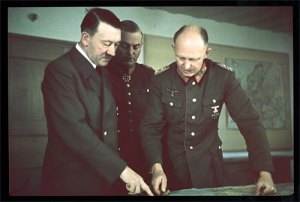
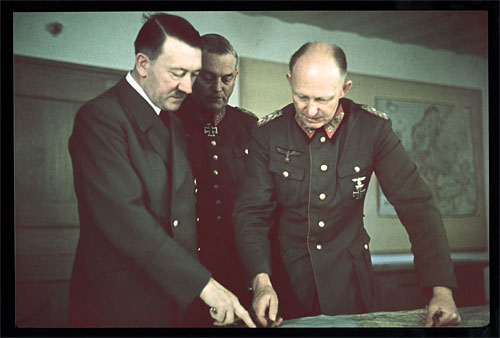
 keitel-jodl-hitler

The mistakes began early in the planning and conduct of the operation

Following the Soviet winter offensive and the near disaster in front of Moscow the German High Command was faced with the strategic decision of what to do in the 1942 campaign.  Several options were considered and it was decided to seize the Caucasus oilfields and capture or neutralize the city of Stalingrad on the Volga.  However, the German High Command was divided on the actual objective of the campaign.

operation blau map

The Oberkommando des Heer or the OKH (Army High Command) under the guidance of General Franz Halder assumed that Stalingrad was the objective and the advance into the Caucasus was a blocking effort.[i] Hitler and Oberkommando des Wehrmacht or the OKW planned to capture the Caucasus oil fields and capture or neutralize Stalingrad to secure the left flank.[ii] Both OKH and OKW considered Stalingrad significant but “German commanders initially regarded it as a weigh station en route to the Caucasus oil fields.” [iii] The conflict echoed in the ambiguity of Directive No. 41, which “included the ‘seizure of the oil region of the Caucasus’ in the preamble concerning the general aim of the campaign, yet made no mention of this in the main plan of operations.” [iv] At the planning conference held at Army Group South in early June “Hitler hardly mentioned Stalingrad. As far as his Generals were concerned it was little more than a name on the map. His obsession was with the oil fields of the Caucasus.” [v] Manstein noted, “Hitler’s strategic objectives were governed chiefly by the needs of his war economy….” [vi] Historian Anthony Beevor noted that at this stage of planning “the only interest in Stalingrad was to eliminate the armaments factories there and secure a position on the Volga. The capture of the city was not considered necessary.” [vii] German planners “expected that the Soviets would again accept decisive battle to defend these regions.” [viii]

In Moscow Stalin and his Generals attempted to guess the direction of the impending German offensive.  “Stalin was convinced that Moscow remained the principle German objective…Most of the Red Army’s strategic reserves…were therefore held in the Moscow region.” [ix]The Soviet High Command, Stavka attempted to disrupt the German offensive and to recover Kharkov by launching three offensives three offensives of their own. The largest of these, an attack on Kharkov was defeated by the Germans between the 12th to the 22nd of May, with the loss of most of the armor in southern Russia. This disaster was accompanied by an equally disastrous defeat of Red Army forces in Crimea by Erich Von Manstein’s 11th Army, and the combination meant that the Red Army would face the Germans in a severely weakened condition. [x]

Operation Blau: Opening Moves and Divergent Objectives
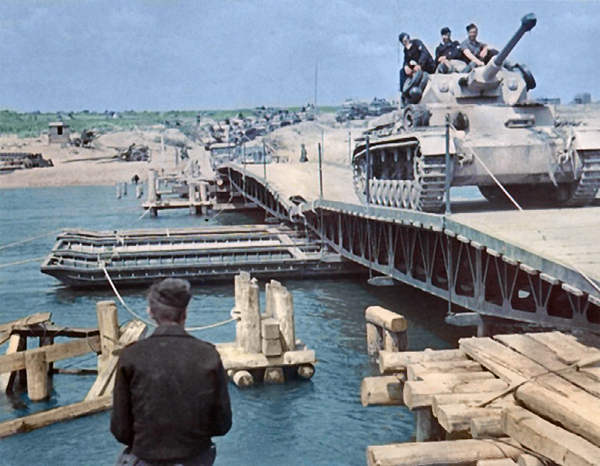
panzers_across_the_don

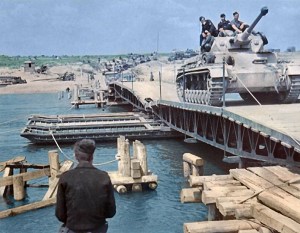
Panzers cross the Don

The German offensive began on 28 June under the command of Field Marshal Fedor von Bock. Von Bock’s command included two separate army groups, Army Group B under General Maximilian Von Weichs with 2nd Army, 6th Army and 4th Panzer Army operated in the northern part of the operational area. Army Group A under Field Marshall Wilhelm List was to the south with 17th Army and 1st Panzer Army, with the goal of driving into the Caucasus. [xi] Army Group B provided the main effort for the offensive and its forces quickly smashed through the defending Soviet armies and by the 20th Hitler believed that “the Russian is finished.” [xii] One reason for the German success in the south was that until July 7th Stalin believed that Moscow was still the primary objective for any German summer offensive. [xiii] Despite his success, Hitler prevented Von Bock from destroying the Soviet formations that had been left behind and was relieved of command by Hitler. This enabled many of those units to escape the German onslaught. For his trouble Von Bock was replaced by Von Weichs, which created a difficult command and control problem.  Manstein noted that this created a “grotesque chain of command on the German southern wing” with the result that Army Group A had “no commander of its own whatever”and Army Group B had “no few than seven armies under command including four allied ones.” [xiv]

Bild 169-0894

Destroyed Soviet T-34s

This decisions made next proved fateful.  Hitler’s decided to redirect the advance of the 4th Panzer Army to support an early passage of the lower Don, diverting it from its drive on Stalingrad.  Additionally the army groups became independent of each other when Bock was relieved of command.  They were “assigned independent-and diverging-objectives” under the terms of Directive No.45. [xv] This combination of events had a decisive impact on the campaign.  Hitler’s decision prevented a quick seizure of Stalingrad by 4th Panzer Army followed by a hand over to 6th Army to establish the “block” as described by Directive No.41.  Kleist noted that he didn’t need 4th Panzer Army’s help to accomplish his objectives and that it could have “taken Stalingrad without a fight at the end of July….” [xvi]
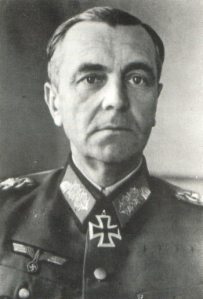
 general-paulus

Field Marshall Von Paulus

The result was damning. The Luftwaffe air support and fuel needed by Army Group A was transferred to 6th Army, denuding Army Group A of the resources that it needed to conclude its conquest of the Caucasus. [xvii] At the same time it denied Army Group B of the Panzer Army that could have seized Stalingrad when it was still possible to do so.  Anthony Beevor called Hitler’s decision a disastrous compromise, [xviii] while Halder believed that Hitler’s decision underestimated the enemy and was “both ludicrous and dangerous.” [xix]

Focus on Stalingrad

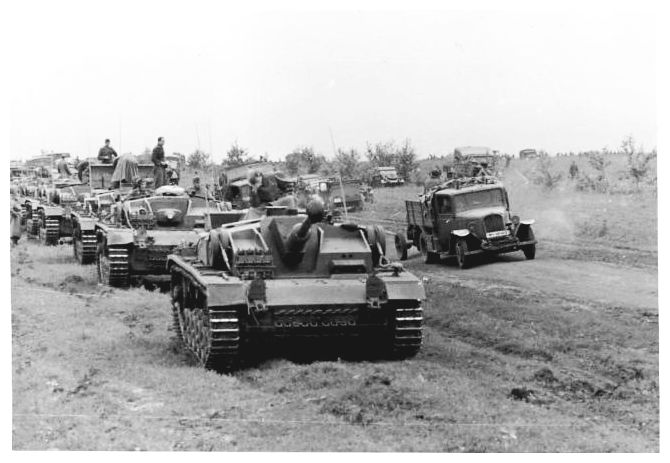
battle-stalingrad-ww2-second-world-war-two-russian-eastern-front-unseen-pictures-photos-images

Sturmgeschutz Battalion Advancing toward Stalingrad

On July 22nd as the Wehrmacht ran short on fuel and divisions to commit to the Caucasus, and 6th Army fought for control of Voronezh the Soviets created the Stalingrad Front. Stavka moved an NKVD Division to the city [xx] and rapidly filled the new front with formations transferred from the Moscow Front. [xxi]Stalin then issued Stavka Order 227, better known as “No Step Back” on July 28th. The order mandated that commanders and political officers who retreated would be assigned to Penal battalions[xxii] and each field army was to form three to five special units of about 200 men each as a second line “to shoot any man who ran away.” [xxiii] Russian resistance west of the Don slowed the German advance. German commanders were astonished “at the profligacy of Russian commanders with their men’s lives.” [xxiv] Von Kleist compared the stubbornness of Russians in his area to those of the previous year and wrote that they were local troops who fought more stubbornly because they were fighting to defend their homes.” [xxv]Additionally, Stalin changed his commanders frequently in the “vain hope that a ruthless new leader could galvanize resistance and transform the situation.” [xxvi] General Chuikov brought the 64th Army into the Stalingrad Front in mid-July to hold the Germans west of the Don.[xxvii]

The OKW further weakened the German offensive by transferring several key SS Panzer Divisions and the Grossdeutschland Panzer Division to France. The Hungarian, Italian and Romanian armies that were part of the army group lacked motorization; modern armored and anti-tank units, and were unable to fulfill the gaps left by the loss of the experienced German divisions that had been transferred and the expectations of Hitler. [xxviii] The German 6th Army was virtually immobilized for 10 days due to lack of supplies allowing the Russians to establish a defense on the Don Bend. [xxix]

To the south the Germans were held up by lack of fuel and increased Soviet resistance including the introduction of a force of 800 bombers, which took away the total domination of the air that the Germans had previously enjoyed.[xxx] David Glantz and House note that after the fall of Rostov on July 23rd “Hitler abruptly focused on the industrial and symbolic value of Stalingrad.” [xxxi] Hitler was undeterred by warnings from Halder that fresh Russian formations were massing east of the Volga and those of Quartermaster General Erich Wagner, who guaranteed that he could supply either the thrust to the Caucasus or Stalingrad but not both operations simultaneously. [xxxii] Again frustrated by the slow progress to take Stalingrad, Hitler reverted to the original plan for the 4th Panzer Army to assist the 6th Army at Stalingrad, but the cost in time and fuel to move that army from the Caucasus to Stalingrad were significant to the operation and the question was whether “they could make up for Hitler’s changes in plan.” [xxxiii]

Strategic Implications

The changes in the German plan had distinct ramifications for both sides.  Friedrich Von Mellenthin wrote, “the diversion of effort between the Caucasus and Stalingrad ruined our whole campaign.” [xxxiv] The Germans could not secure the Caucasus oil fields that Hitler considered vital to the German war effort.  The Germans advanced deep into the region and captured the Maikop oil fields, though the drilling and refining facilities were almost completely destroyed by the retreating Russians when they withdrew.[xxxv] Due to the lack of fuel and increased Soviet resistance Army Group A was halted along the crests of the Caucasus on August 28th[xxxvi] This setback left Hitler deeply “dissatisfied with the situation of Army Group A.” [xxxvii]Kleist and others attributed much of the failure to a lack of fuel [xxxviii] while Gunther Blumentritt observed that Mountain divisions that could have made the breakthrough were employed along the Black Sea coast in secondary operations. [xxxix]

battle_stalingrad65

JU-87 Stuka over Stalingrad

Meanwhile on the Stalingrad front, fuel and supply shortages hampered 6thArmy’s advance while Hermann Hoth’s 4th Panzer Army was needlessly shuttled between Rostov and Stalingrad. By the time the 4th Panzer Army resumed its advance the Russian forces around Stalingrad “had sufficiently recovered to check its advance.” [xl] As the 6th Army advanced into Stalingrad the “protection of Army Group B’s ever-extending northern flank was taken over by the 3rd Rumanian, the 2nd Hungarian and the newly formed 8th Italian Army.” [xli] The allied armies had to occupy overextended fronts, and these formations were neither trained equipped for the Russian campaign, nor well motivated to die for Germany. [xlii] The supply shortage in both German army groups was not helped by a logistics bottleneck. All supplies for both army groups had to transit over a single crossing on the Dnieper River, which Manstein noted, also prevented swift movement of troops from one area to another. [xliii]

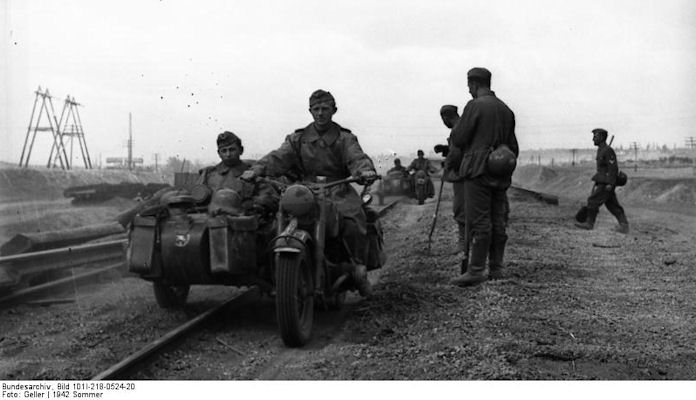
 pzdiv-24-motorcycle-stalingrad

Reconnaissance Battalion of 24th Panzer Division near Stalingrad

Von Paulus’ 6th Army attempted to capture Stalingrad with a swift attack between the 25th and 29th of July, even as Hoth’s 4th Panzer Army milled about on the lower Don.  However, Paulus’s piecemeal commitment of his divisions and failure to concentrate in the face of unexpectedly strong Soviet resistance caused the attacks to fail.  Paulus then halted the 6th Army on the Don so it could concentrate its forces and build its logistics base, [xliv] and to allow Hoth’s army to come up from the south. This further delay allowed the Russians to build up even more forces west of Stalingrad, to reinforce the Stalingrad front, and to strengthen the defenses of the city. [xlv] Likewise, due to the distances involved it now was easier for the Russians to reinforce the Stalingrad front than it was for the Germans. [xlvi] As they strengthened their positions, the Soviets filled a number of key leadership positions with competent and tough Generals who would skillfully fight the coming battle for the city.[xlvii]

russian marines stalingrad

Hitler now focused on the capture of Stalingrad despite the fact that “as a city Stalingrad was of no strategic importance.” [xlviii] Strategically, its capture would cut Soviet supply lines to the Caucasus, [xlix] but this could be achieved without its capture. The check of the German advance in the Caucasus “began to give Stalingrad a moral importance-enhanced by its name-which came to outweigh its strategic value.” [l] To Hitler Stalingrad would gain “a mystic significance” [li] and along with Leningrad became “not only military but also psychological objectives.” [lii]

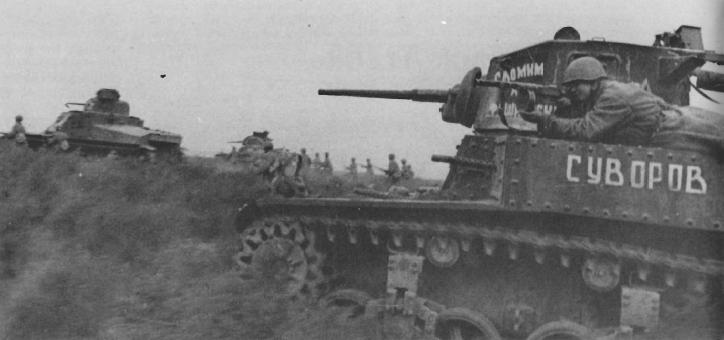
battle_stalingrad79

Red Army Armored troops using Lend-Lease American M3 Stuart and M3 Grant tanks

Despite the risks the Germans now mounted a frontal assault using the 6th Army and elements of 4th Panzer Army despite having intelligence reports supported by airiel reconnaissance that “the Russians are throwing forces from all directions at Stalingrad.” [liii] Friedrich von Paulus as the senior General was in charge of the advance, with Hoth subordinated to him, but the attack had to wait until Hoth’s army could fight its way up from the south. [liv] Von Mellenthin comments rightly, “when Stalingrad was not taken on the first rush, it would have been better to mask it….” [lv] Such a decision would have enabled the Germans to strengthen their lines and prepare for the inevitable Soviet counter-offensive. In retrospect it is clear that the German advance had actually reached its culminating point with the failure of the advance into the Caucasus and Paulus’s initial setback on the Don, but it was not yet apparent to many involved. [lvi] The proper course of action would have been to halt and build up the front and create mobile reserve to parry any Russian offensive along northern flank while reinforcing success in the Caucasus. Manstein wrote, “by failing to take appropriate action after his offensive had petered out without achieving anything definite, he [Hitler] paved the way to the tragedy of Stalingrad!” [lvii]

Transfixed by Stalingrad

Bild 183-B22413

German Stug III at Stalingrad

On August 19th Paulus launched a concentric attack against the Russian 62ndand 64th Armies.  The attack ran into problems, especially in Hoth’s sector. [lviii]Yet, on the 22nd the 14th Panzer Corps of 6th Army “forced a very narrow breach in the Russian perimeter at Vertyachi and fought their way across the northern suburbs of Stalingrad,” [lix] reaching the Volga on the 23rd. That day 4th Air Fleet launched some 1600 sorties against the city dropping over 1,000 tons of bombs. [lx] The breakthrough by the 6th Army imperiled the Soviet position as they had concentrated their strongest forces against Hoth. [lxi] For the moment the Germans held air superiority and continued heavy bombing attacks.  During the last days of August 6th Army “moved steadily forward into the suburbs of the city, setting the stage for battle.” [lxii] As the Soviets reacted to Paulus, Hoth’s army achieved a breakthrough in the south that threatened the Russian position.  However the 6th Army was unable to disengage its mobile forces from inside Stalingrad to link up with the 4th Panzer Army and another opportunity to defeat major Soviet forces in the area and secure the city was missed. [lxiii]
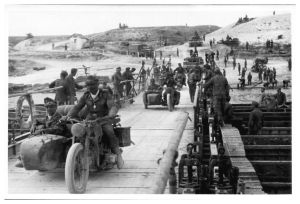
battle-stalingrad-ww2-second-world-war-germans-don-river-rare-pictures-unseen-photos-images

German unit crossing the Don

As the 6th Army moved into the city General Yeremenko ordered attacks against General Hube’s 16th Panzer Division. Soviet resistance increased as more formations arrived the Germans suffered one of their heaviest casualty rates. [lxiv] Though unsuccessful the Soviet counterattacks “managed to deflect Paulus’s reserves at the most critical moment.” [lxv] The Germans remained confident the first week of September as 6th Army and the 4th Panzer Army linked up, but Yeremenko saved his forces by withdrawing and avoided encirclement west of the city, retiring to an improvised line closer to the Stalingrad. [lxvi] On September 12th Vasily Chuikov was appointed to command 62nd Army in Stalingrad.  Chuikov understood that for the Soviets in Stalingrad there “was only one way to hold on. They had to pay in lives. ‘Time is blood,’ as Chuikov put it later.” [lxvii] Stalin sent Nikita Khrushchev to the front “with orders to inspire the Armies and civilian population to fight to the end.” [lxviii] In the next few days the 13th Guards Rifle Division arrived and saved the Volga landings, which allowed the Soviets to continue to resupply Stalingrad, but the division last 30% of its troops as casualties in its first 24 hours of combat. [lxix]
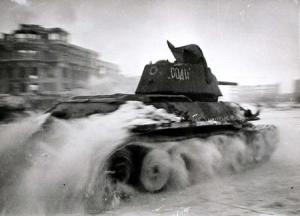
t-34 stalingrad

T-34 in Stalingrad

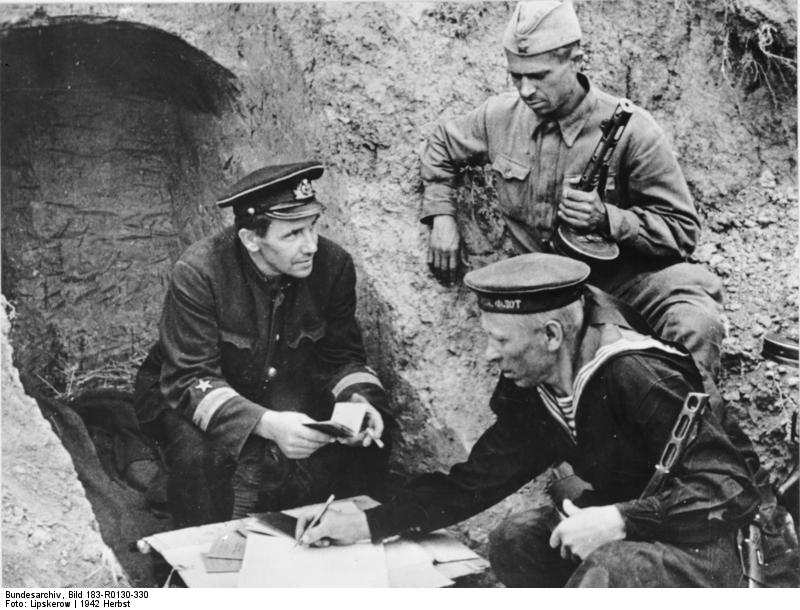
An NKVD regiment and other units held the strategically sited Mamaev Kurgan, keeping German guns from controlling the Volga.[lxx] The defenders contucted a house to house and block by block fight, and the Red Army and NKVD units were reinforced by Naval Infantry.  Chuikov conducted the defense with a brutal ferocity, relieving senior commanders who showed a lack of fight and by sending many officers to penal units.  Chuikov’s defensive plan was masterful; he funneled German attacks into “breakwaters” where the panzers and infantry could be separated from each other causing heavy German casualties. [lxxi]

Bype36yIQAASUVK

resized_battle-stalingrad-6

resized_battle-stalingrad-4

Now for Hitler the “city became a prestige item, its capture ‘urgently necessary for psychological reasons,’ as Hitler declared on October 2. A week later he declared that Communism must be ‘deprived of its shrine.’” [lxxii] The Germans continued to gain ground in the city, but slowly and at great cost, especially among their infantry, so much so that decimated companies had to be combined to form combat effective units.
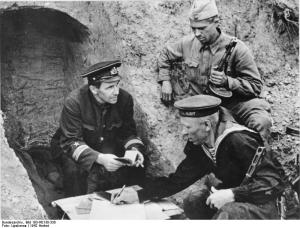
Bild 183-R0130-330

person_chuikov1

Chuikov used his artillery to interdict the Germans from the far side of the Volga while assault squads with incredible ferocity fought the fight in the city.   The close-quarters combat in the city was dubbed, “Rattenkrieg by German soldiers.” [lxxiii] Paulus continued to bring more units into the city, further thinning his flanks, but his troops continued to slowly drive the Russians back against the river, and by early October Chuikov wondered if he would be able to hold. [lxxiv] It appeared that the Germans might finally capture Stalingrad, and by November Chuikov “was altogether holding only one-tenth of Stalingrad – a few factory buildings and a few miles of river bank.”[lxxv] Paulus now expected “to capture the entire city by 10 November,”[lxxvi] despite the fact that many of his units were fought out. The causalities had been massive; an analysis by 6th Army determined that 42% of the battalions of 51st Corps were fought out. [lxxvii] Even so on November 9th, a confident Hitler declared “No power on earth will force us out of Stalingrad again!” [lxxviii] However, that boast was misplaced.

Soviet Counteroffensive: Disaster on the Flanks

stalingrad-map-counterattack

T34_Stalingrad-Offensive-px800

soviet infantry attacking

Soviet Forces Advancing

As 6th Army fought its way into Stalingrad some officers in the German High Command attempted to warn Hitler of the danger. Hitler now tolerated no interference, and on September 24th he relieved Halder for persisting to explain, “what would happen when new Russian reserve armies attacked the over-extended flank that ran out to Stalingrad.” [lxxix] Many on others the German side recognized the danger. Blumentritt said, “The danger to the long-stretched flank of our advance developed gradually, but it became clear early enough for anyone to perceive it who was not willfully blind.” [lxxx] Rumanian Marshall Antonescu, and the staffs of both Army Group B and Paulus’s 6th Army warned Hitler too, [lxxxi] but Hitler was transfixed on Stalingrad.  By their sole focus on Stalingrad the Germans gave up the advantage of uncertainty and once the German “aim became obvious…the Russian Command could commit its reserves with assurance.”[lxxxii]

person_chuikov4

Chuikov and his staff

Despite Stalin’s concern about Stalingrad the Stavka planners never lost sight of their goal to resume large-scale offensive operations and destroy at least one German Army Group. [lxxxiii] Unlike Hitler, the ever suspicious Stalin had begun to trust his Generals and Stavka under the direction of Marshal Vasilevsky produced a concept in September to cut off the “German spearhead at Stalingrad by attacking the weak Rumanian forces on its flanks.” [lxxxiv] At first Stalin “showed little enthusiasm” for the attack, fearing that Stalingrad might be lost, but on 13 September he gave his full backing to the proposal [lxxxv] which Marshals Zhukov, Vasilevsky and Vatutin developed into a plan involving three operations; Operation Uranus, to destroy the German and allied forces at Stalingrad, and Operation Saturn to destroy all the German forces in the south, and a supporting attack to fix German forces in the north, Operation Mars aimed at Army Group Center. [lxxxvi]

Russian-Ground-Mount-Rocket

Soviet Katusha Rockets

To accomplish the destruction of 6th Army and at least a part of 4th Panzer Army around Stalingrad the Stavka planners employed over 60% of the “whole tank strength of the Red Army.” [lxxxvii] Strict secrecy combined with numerous acts of deception was used by the Red Army to disguise the operation. [lxxxviii]The plan involved an attack against 3rd Romanian Army on the northern flank by the Soviet 5th Tank Army and two infantry armies and their supporting units. [lxxxix] In the south another force of over 160,000 men and 430 tanks were deployed against 4th Rumanian Army and weak element of 4th Panzer Army. [xc]Despite warnings from his Intelligence Officer, Paulus did not expect a deep offensive into his flanks and rear and made no plans to prepare to face the threat. [xci] Other senior officers believed that the attack would take place against Army Group Center. [xcii] Walter Warlimont who served at OKW noted that there was a “deceptive confidence in German Supreme Headquarters.” [xciii]

 ju-52 stalingrad

Luftwaffe JU-52s made many resupply runs into the pocket but suffered great losses

The storm broke on 19 November as Soviet forces attacked rapidly crushing Romanian armies to the north and the south of Stalingrad [xciv] linking up to encircle the Germans in the city on the 23rd[xcv] The German 48th Panzer Corps supporting the Romanians was weakened by the exhausting campaign and had few operational tanks. [xcvi] It attempted a counterattack but was “cut to pieces” in an engagement against the 5th Tank Army. [xcvii] A promising attempt by the German 29th Motorized division against the flank of the southern Russian pincer was halted by the Army Group and the division was ordered to defensive positions south of Stalingrad. [xcviii] To compound German problems the Luftwaffe was neutralized by bad weather. [xcix] Inside the city Paulus continued to do nothing as since the attacks were outside of his area of responsibility and rather than taking the initiative to extricate his forces, waited for instructions. [c] As a result the 6th Army’s 16th and 24th Panzer Divisions that could have assisted matters to the west remained “bogged down in street-fighting in Stalingrad.” [ci] Without support of the army’s Panzer formations, the 6th Army units west of Stalingrad were forced back in horrific conditions.  By the 23rd of November the 6th Army was cut off along with one corps of the 4th Panzer Army and assorted Romanian units, over 330,000 men.  Though they had the Germans surrounded, the entrapped force would require the Soviets to use seven rifle armies and much staff attention to eliminate. [cii]

von Paulus surrenders to the Soviets

Paulus Surrenders

Hitler ordered Von Manstein to form a new, composite, Army Group Don, to relieve Stalingrad. Hitler would not countenance a break out by the encircled forces and wanted Manstein to break through and relieve the 6th Army.[ciii]Hitler refused a request by Paulus on 23 November to move troops to prepare for a possible a break out attempt, and assured him that he would be relieved. [civ]Albert Speer noted that General Kurt Zeitzler who replaced Halder at OKW insisted that the Sixth Army “must break out to the west.” [cv] Hitler, completely obsessed with capturing Stalingrad told Zeitzler, “We should under no circumstances give this up. We won’t get it back once it’s lost.” [cvi] The ever boastful Herman Goering promised that his Luftwaffe would be able to meet the re-supply needs of 6th Army by air, even though his own Generals knew that it was impossible with the number of transport aircraft available. [cvii] However, Hitler took his Luftwaffe chief at his word and exclaimed “Stalingrad can be held! It is foolish to go on talking any more about a breakout by Sixth Army…” [cviii] Hitler then issued a Führer decree ordering that the front be held at all costs. [cix] Walter Goerlitz stated, “Hitler was incapable of conceiving that the 6th Army should do anything but fight where it stood.” [cx] Likewise Manstein had precious few troops with which to counterattack, as he also had to protect the flank of Army Group A, which was still deep in the Caucasus.

hungarian withdraw

hungarian dead stalingrad

Hungarian Dead and Wounded

Manstein’s “army group” was only corps strength and was spread across a 200 mile front. [cxi] Any relief attempt had to wait for more troops, especially Panzers.  Manstein believed that the best chance for a breakout had passed and that it was a serious error for Paulus to put the request to withdraw through to Hitler rather than the Army Group or act on his own [cxii] and many soldiers, long conditioned to believe in the promises of their Hitler were optimistic that Hitler would get them out of the caldron. [cxiii] Other German generals like Guderian, Reichenau, Heinrici, Hoeppner, or even the Waffen SS General Sepp Dietrich might have acted to save their army, but Paulus, surrounded in the city, was knew nothing but obedience.[cxiv]
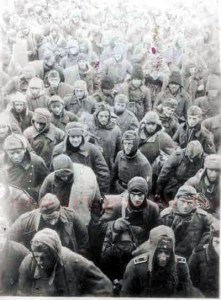
pows stalingrad

German POWs only 5000 of some 90,000 would see home again

Operation Saturn began on 7 December destroying the Italian 8th Army and forcing the Germans to parry the threat.[cxv] A relief attempt by 57th Panzer Corps under Hoth on 12 December made some headway until a massive Soviet counterattack on 24 December drove it back.[cxvi] This attack was hampered by OKW’s refusal to allocate the 17th Panzer and 16th Motorized divisions to Manstein,[cxvii] and by 6th Army not attacking out to link with the relief force.[cxviii]By 6 January Paulus signaled OKW: Army starving and frozen, have no ammunition and cannot move tanks anymore.”[cxix] On 10 January the Soviets launched Operation Ring to eliminate the pocket and despite all odds German troops fought on. On the 16th Paulus requested that battle worthy units be allowed to break out, but the request was not replied to.[cxx] On the 22nd the last airfield had been overrun and on 31 January Paulus surrendered.[cxxi]

Analysis: What Went Wrong

Stalingrad had drawn the attention Hitler and Stalin and the lives of their soldiers into a giant vortex of death. However, the Soviet Stavka, even when facing disaster never lost sight of their primary objectives during the campaign. The Germans on the other hand committed numerous unforced errors mostly caused by Hitler and or von Paulus. The German mistakes began early in their planning process and continued throughout the campaign. Overconfident, they failed to follow up success, and allowed the Soviets to regroup and then smash their forces at Stalingrad.
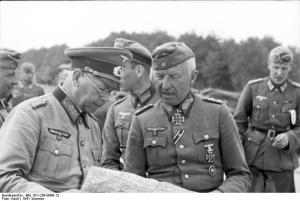
Russland-Nord, Erich von Manstein, Brandenberger

Von Manstein

After the fall of Stalingrad as the Soviets attempted to follow up their success by attempting to cut off Army Group “A.” Manstein, with the meager forces at hand was permitted by Hitler to wage a mobile defense while Von Kleist managed to withdraw his army group with few losses. [cxxii] The superior generalship of Manstein and Von Kleist prevented the wholesale destruction of German forces in southern Russia and Manstein’s counter offensive inflicted a severe defeat on the Soviets, showing them that the German army, though wounded was not without the power to fight back.

But the German Army had suffered a massive defeat.  The seeds of defeat were laid early, the failure to destroy bypassed Soviet formations in July, the diversion of 4th Panzer Army from Stalingrad, and the divergent objectives of trying to capture the Caucasus and Stalingrad at the same time.  This diluted both offensives ensuring that neither succeeded.  Likewise the failure to recognize the culminating point when it was reached and to adjust operations accordingly was disastrous for the Germans. The failure create a mobile reserve to meet possible Russian counter offensives, and the fixation on Stalingrad took the German focus off of the critical yet weakly held flanks.

The hubris of Hitler and OKW to believe that the Russians were incapable of conducting major mobile operations even as Stavka commenced massive offensive operations on the thinly held flanks all contributed to the defeat.  Alan Clark notes these facts but adds that the Germans “were simply attempting too much.” [cxxiii] Likewise, the Soviet advantage in numbers allowed them to wear down the Germans even early in the campaign when they were suffering defeat after defeat. [cxxiv] Stalin, whose decisions had nearly lost the war in 1941 gave his commanders a chance to revive the mobile doctrine of deep operations with mechanized and shock armies that he had discredited in the 1930s. [cxxv]All through the campaign Zhukov and other commanders maintained both their nerve even when it appeared that Stalingrad was all but lost. They never lost sight of their goal of destroying major German formations though they failed to entrap Army Group A with 6th Army.

Notes

[i] Clark, Alan. Barbarossa: The Russian-German Conflict: 1941-45. Perennial Books, An imprint of Harper Collins Publishers, New York, NY 1965. p.191

[ii] Ibid.

[iii] Glantz, David M. and House, Jonathan. When Titan’s Clashed: How the Red Army Stopped Hitler. The University Press of Kansas, Lawrence KS, 1995. p.111

[iv] Ibid. Clark. p.191

[v] Beevor, Anthony. Stalingrad: The Fateful Siege: 1942-1943. Penguin Books, New York NY 1998. p.69

[vi] Manstein, Erich von. Forward by B.H. Liddle Hart, Introduction by Martin Blumenson. Lost victories: The War Memoirs of Hitler’s Most Brilliant General.Zenith Press, St Paul MN 2004. First Published 1955 as Verlorene Siege, English Translation 1958 by Methuen Company. p.291 This opinion is not isolated, Beevor Quotes Paulus “If we don’t take Maikop and Gronzy…then I must put an end to the war.” (Beevor pp. 69-70)  Halder on the other hand believed that Hitler emphasized that the objective was “the River Volga at Stalingrad. (Clark. p.190)

[vii] Ibid. Beevor. p.70.

[viii] Ibid. Glantz and House. p.106

[ix] Ibid. p.105-106

[x] Ibid. Clark. p.203.  The offensive did impose a delay on the German offensive.

[xi] Ibid. Clark. p.191 Each group also contained allied armies.

[xii] Ibid. p.209.

[xiii] Ibid. Glantz and House. p.119

[xiv] Ibid. Manstein. p.292.

[xv] Ibid. Clark. p.209

[xvi] Ibid. Clark.  p.211

[xvii] Ibid. Glantz and House. p.120. There is a good discussion of the impact of this decision here as 6th Army’s advance was given priority for both air support and fuel.

[xviii] Ibid. Beevor. p.74

[xix] Warlimont, Walter. Inside Hitler’s Headquarters 1939-45. Translated by R.H. Berry, Presido Press, Novato CA, 1964. p.249

[xx] Ibid. Beevor. p.75 This was the 10th NKVD Division and it took control of all local militia, NKVD, and river traffic, and established armored trains and armor training schools.

[xxi] Ibid. Clark. p.212

[xxii] Ibid. Glantz and House. p.121

[xxiii] Ibid. Beevor. p.85

[xxiv] Ibid. p.89

[xxv] Liddell-Hart, B.H. The German Generals Talk. Quill Publishers, New York, NY 1979. Originally published by the author in 1948. p.202

[xxvi] Ibid. Beevor. p.88

[xxvii] Ibid. Beevor. p.90

[xxviii] Ibid. Beevor. p.81

[xxix] Ibid. Glantz and House. p.121

[xxx] Ibid. Liddell-Hart. p.202

[xxxi] Ibid. Glantz and House. p.120

[xxxii] Goerlitz, Walter. History of the German General Staff. Westview Press, Frederick A. Praeger Publisher, Boulder, CO. 1985 p.416

[xxxiii] Ibid. Beevor. pp.95-96.

[xxxiv] Von Mellenthin, F.W. Panzer Battles: A Study of the Employment of Armor in the Second World War. Translated H. Betzler, Edited by L.C.F. Turner. Oklahoma University Press 1956, Ballantine Books, New York, NY. 1971. p.193

[xxxv] Shirer, William L. The Rise and Fall of the Third Reich. A Touchstone Book published by Simon and Schuster, 1981, Copyright 1959 and 1960. p.914

[xxxvi] Ibid. Glantz and House. p.122

[xxxvii] Ibid. Warlimont. p.256

[xxxviii] Ibid. Liddell-Hart. p.203

[xxxix] Ibid. p.204

[xl] Ibid. Shirer. p.914

[xli] Ibid. Goerlitz. p.416

[xlii] Ibid. Goerlitz. p.416

[xliii] Ibid. Manstein. p.293

[xliv] Ibid. Clark. p.214

[xlv] Ibid. Beevor. pp.97-99. The mobilization included military, political, civilian and industrial elements.

[xlvi] Liddell-Hart, B.H. Strategy. A Signet Book, the New American Library, New York, NY. 1974, Originally Published by Faber and Faber Ltd., London. 1954 & 1967. p.250

[xlvii] Ibid. Beevor. p.99.  Two key commanders arrived during this time frame, Colonel General Andrei Yeremenko, who would command the Stalingrad Front  and General Chuikov commander of 64th Army who would conduct the defense of the city.

[xlviii] Carell, Paul Hitler Moves East: 1941-1943. Ballantine Books, New York, NY 1971, German Edition published 1963. p.581

[xlix] Ibid. Shirer.  p.909.

[l] Ibid. Liddell-Hart, Strategy. p.250

[li] Wheeler-Bennett, John W. The Nemesis of Power: The German Army in Politics 1918-1945. St. Martin’s Press, New York, NY 1954.  p.531

[lii] Ibid. Wheeler-Bennett. p.531

[liii] Ibid. Beevor. p.96

[liv] Ibid. Clark. p.216.

[lv] Ibid. Von Mellenthin. P.193

[lvi] See Von Mellinthin pp.193-194.  Von Mellinthin quotes Colonel Dinger, the Operations Officer of 3rd Motorized Division at Stalingrad until a few days before its fall. Dingler noted that the Germans on reaching Stalingrad “had reached the end of their power. Their offensive strength was inadequate to complete the victory, nor could they replace the losses they had suffered.” (p.193) He believed that the facts were sufficient “not only to justify a withdrawal, but compel a retreat.” (p.194)

[lvii] Ibid. Manstein. p.294

[lviii] Ibid. Clark. p.216

[lix] Ibid. Clark. p.217

[lx] Ibid. Beevor. p.107

[lxi] Ibid. Beevor. p.107

[lxii] Ibid. Glantz and House. p.122

[lxiii] Ibid. Carell. P.601

[lxiv] Ibid. Beevor. p.118

[lxv] Ibid. Beevor. p.118

[lxvi] Ibid. Carell. p.602

[lxvii] Ibid. Beevor. p.128

[lxviii] Ibid. Carell. p.603

[lxix] Ibid. Beevor. p.134

[lxx] Ibid. Beevor. pp.136-137

[lxxi] Ibid. Beevor. p.149

[lxxii] Fest, Joachim. Hitler. Translated by Richard and Clara Winston, Harcourt, Brace, Jovanovich Publishers, San Diego, New York, London. 1974. p.661

[lxxiii] Ibid. Beevor. pp. 149-150

[lxxiv] Ibid. Beevor. p.164

[lxxv] Ibid. Carell. p.618

[lxxvi] Ibid. Glantz and House. p.123

[lxxvii] Ibid. Beevor. p.218

[lxxviii] Ibid. Carell. p.623

[lxxix] Ibid. Goerlitz. p.418

[lxxx] Ibid. Liddell-Hart. The German Generals Talk. p.207

[lxxxi] Ibid. Manstein. p292

[lxxxii] Ibid. Liddell-Hart. History of the Second World War. p.258

[lxxxiii] Ibid. Glantz and House. p.129

[lxxxiv] Ibid. Glantz and House. p.130

[lxxxv] Ibid. Beevor. pp.221-222 Glantz and House say that Stalin gave his backing in mid-October but this seems less likely due to the amount of planning and movement of troops involved to begin the operation in November.

[lxxxvi] Ibid. Glantz and House. p.130

[lxxxvii] Ibid. Beevor. p.226

[lxxxviii] Ibid. Glantz and House. p.132

[lxxxix] Ibid. Glantz and House. p.130

[xc] Ibid. Beevor. p.227

[xci] Ibid. Beevor. p.228

[xcii] Ibid. Clark. p.235

[xciii] Ibid. Warlimont. p.274

[xciv] Ibid, Carell. p.627 3rd Rumanian Army lost 75,000 men in three days.

[xcv] Ibid. Clark.pp.247-248

[xcvi] The condition of the few German Panzer Divisions in position to support the flanks was very poor, the 22nd had suffered from a lack of fuel and maintenance and this many of its tanks were inoperative. Most of the armor strength of the 48th Panzer Corps was provided by a Rumanian armored division equipped with obsolete Czech 38t tanks provided by the Germans.

[xcvii] Ibid. Clark. pp.251-252. The designation of 2nd Guards Tank Army by Clark has to be wrong and it is the 5th Tank Army as 2nd Guards Tank was not involved in Operation Uranus.  Carell, Beevor and Glantz properly identify the unit.

[xcviii] Ibid. Carell. p.630

[xcix] Ibid. Beevor. p.244

[c] Ibid. Beevor. p.247

[ci] Ibid. Beevor. p.245

[cii] Ibid. Glantz and House. p.134

[ciii] Ibid. Glantz and House. p.134

[civ] Ibid. Clark. p.256

[cv] Speer, Albert. Inside the Third Reich. Collier Books, a Division of MacMillan Publishers, Inc. New York, NY 1970. p.248

[cvi] Heiber, Helmut and Glantz, David M. Editors. Hitler and His Generals: Military Conferences 1942-1945. Enigma Books, New York, NY 2002-2003.  Originally published as Hitlers Lagebsprechungen: Die Protokollfragmente seiner militärischen Konferenzen 1942-1945. Deutsche Verlags-Anstalt GmbH, Stuttgart, 1962. p.27

[cvii] Ibid. Glantz and House. p.135 Glantz and House note that the amount of aircraft estimated to successfully carry out the re-supply operation in the operational conditions was over 1,000.  The amount needed daily was over 600 tons of which the daily reached only 300 tons only one occasion.

[cviii] Ibid. Speer. p.249

[cix] Ibid. Carell. p.636

[cx] Ibid. Goerlitz. p.426

[cxi] Ibid. Clark. p.252

[cxii] Ibid. Manstein. p.303

[cxiii] Ibid. Beevor. p.276

[cxiv] Ibid. Carell. p.640

[cxv] Ibid. Glantz and House. p.140

[cxvi] Ibid. Glantz and House. p.140

[cxvii] Ibid. Clark. p.264

[cxviii] Ibid. Manstein. p.337

[cxix] Ibid. Beevor. p320

[cxx] Ibid. Beevor. p.365

[cxxi] Of the approximately 330,000 in the pocket about 91,000 surrendered, another 45,000 had been evacuated.  22 German divisions were destroyed.

[cxxii] Ibid. Liddell-Hart. The German Generals Talk. p.211

[cxxiii] Ibid. Clark. p.250

[cxxiv] Ibid. Glantz and House. p.124

[cxxv] Ibid. Beevor. p.221


Bibliography

Beevor, Anthony. Stalingrad: The Fateful Siege: 1942-1943. Penguin Books, New York NY 1998

Carell, Paul Hitler Moves East: 1941-1943. Ballantine Books, New York, NY 1971, German Edition published 1963.

Clark, Alan. Barbarossa: The Russian-German Conflict:1941-45. Perennial Books, An imprint of Harper Collins Publishers, New York, NY 1965.

Fest, Joachim. Hitler. Translated by Richard and Clara Winston, Harcourt, Brace, Jovanovich Publishers, San Diego, New York, London. 1974

Glantz, David M. and House, Jonathan. When Titan’s Clashed: How the Red Army Stopped Hitler. The University Press of Kansas, Lawrence KS, 1995.

Goerlitz, Walter. History of the German General Staff. Westview Press, Frederick A. Praeger Publisher, Boulder, CO. 1985

Heiber, Helmut and Glantz, David M. Editors. Hitler and His Generals: Military Conferences 1942-1945. Enigma Books, New York, NY 2002-2003.  Originally published as Hitlers Lagebsprechungen: Die Protokollfragmente seiner militärischen Konferenzen 1942-1945. Deutsche Verlags-Anstalt GmbH, Stuttgart, 1962.

Liddell-Hart, B.H. The German Generals Talk. Quill Publishers, New York, NY 1979. Originally Published by the author in 1948.

Liddell-Hart, B.H. Strategy. A Signet Book, the New American Library, New York, NY. 1974, Originally Published by Faber and Faber Ltd., London. 1954 & 1967

Manstein, Erich von. Forward by B.H. Liddle Hart, Introduction by Martin Blumenson. Lost victories: The War Memoirs of Hitler’s Most Brilliant General.Zenith Press, St Paul MN 2004. First Published 1955 as Verlorene Siege, English Translation 1958 by Methuen Company

Shirer, William L. The Rise and Fall of the Third Reich. A Touchstone Book published by Simon and Schuster, 1981, Copyright 1959 and 1960

Speer, Albert. Inside the Third Reich. Collier Books, a Division of MacMillan Publishers, Inc. New York, NY 1970.

Von Mellenthin, F.W. Panzer Battles: A Study of the Employment of Armor in the Second World War. Translated H. Betzler, Edited by L.C.F. Turner. Oklahoma University Press 1956, Ballantine Books, New York, NY. 1971.

Warlimont, Walter. Inside Hitler’s Headquarters 1939-45. Translated by R.H. Berry, Presido Press, Novato CA, 1964.

Wheeler-Bennett, John W. The Nemesis of Power: The German Army in Politics 1918-1945. St. Martin’s Press, New York, NY 1954

1 Comment

Filed under History, Military, nazi germany, world war two in europe

Epiphanies

Friends of Padre Steve’s World,

Yesterday I preached at my chapel. The message was one that had it not been for a snow event that closed our base would have been delivered last week. Now if it was up to me I would have simply moved along to this week’s lectionary readings, but my soon to be deputy command chaplain who I had the opportunity to promote to the rank of Lieutenant Commander and administer the oath of office to is not nearly the liturgical fanatic that I am so we stayed with the readings for the Epiphany. Truthfully I would have done this weeks readings because I am such a slut for liturgical correctness but since the bulletins were already done and it meant a lot to my young Padawan. Actually he’s not that young but he is a good deal younger than me but I digress.

In the Christian tradition the Epiphany commemorates the revelation of Jesus the Christ to the gentiles, usually represented by three Magi, or wise men, actually astrologers from somewhere in Persia. Now I personally would like to think of them being three Wise Guys from East Jersey and name them Guido, Fredo, and Giuseppe bringing who were bringing gifts of gold, non-sequentially numbered $100s, and untraceable bonds, but I digress…

Following a star they came to Jerusalem where they went to see the corrupt, corpulent, and paranoid King Herod to ask him about the whereabouts of the Messiah.

Now Herod, there’s a character for you. He was a gentile appointed by the Roman Senate to run Judea. By some accounts converted to Judaism without really embracing the moral tenets or beliefs of the religion, but he did his best to placate his religious base by building a splendid temple while building massive palaces, stables, and a state of the art seaport at Caesarea to enrich himself and his Roman overlords and because he wasn’t afraid to tax his people unmercifully he never went bankrupt.

To make a long story short, Herod wanted the Magi to tell him where Jesus might be. After Herod secured their promise to do so the Magi went on their way and made their visit to Mary, Joseph, and the now nearly two year old Jesus.

Now I know that a two year old Jesus plays hell with our beautiful nativity displays. My goodness a two year old Jesus would be in the terrible twos and we all have seen how that works out when important guests come over, but again I digress…

So after delivering their gifts to Jesus the Magi got word, supposedly in a dream, but maybe from an informer of some kind that Herod wanted to kill Jesus, so they hauled ass out of Judea. Herod got pissed off and according to the Christian tradition had his goons kill all the male toddlers in Bethlehem since he didn’t have a Twitter account. Meanwhile Joseph and Mary took Jesus off to Egypt to sojourn as refugees for a couple of years, but again I digress, there are far better Bible scholars and theologians who can do much better with the material than me so I am going to leave the Biblical account and Christian tradition for them to explain.

So, today I am writing less about the Epiphany, than the epiphanies that many of us experience in our spiritual or life journeys. Epiphanies surprise us, they come when we are neither looking for them or expecting them.

I have had my own epiphanies at various times in my life, some spiritual and well, some less than spiritual; but they were all important. One of the most important was what I discovered when I was serving in Iraq; that in war truth is one of the first casualties. Since then my eyes have been opened to many other things and my life has changed, in the long run for the better, but not without much difficulty and turmoil dealing with chronic PTSD, TBI, moral injury and all of their excruciating consequences, but I am doing better now for the most part and what I have learned has become invaluable in my spiritual journey.

The German Lutheran theologian Juergen Moltmann discussed his personal epiphany in his book The Source of Life: The Holy Spirit and the Theology of Life:

“The friend standing next to me at the firing predictor was torn to pieces by the bomb that left me unscathed. That night I cried out to God for the first time: `My God, where are you?’ And the question `Why am I not dead too?’ has haunted me ever since. Why are you alive? What gives your life meaning? Life is good, but to be a survivor is hard. One has to bear the weight of grief. It was probably in that night that my theology began, for I came from a secular family and knew nothing of faith. The people who escaped probably all saw their survival not just as a gift but as a charge too.”

Moltmann was a teenager and not yet eligible for military service and like thousands of others of his generation was enlisted as a Flakhilfer a conscript that manned anti-aircraft batteries in order to free up soldiers for duties at the front. In that capacity he experienced war, death, and eventually was taken prisoner when the allies overran Germany. He spent a number of years in a British POW Camp in Scotland where he came to faith.

There are times that I wonder why I am alive and others, including friends and men that I served with are not. I wonder what happened if the rocket that passed over my head in Baghdad had just Jharel a slightly lower trajectory, if allies of the crooked Iraqi Lieutenant Colonel who we confronted at Al Waleed had opened fire in the new Iraqi commander’s office, or if the fire that our helicopter took over Ramadi had been more accurate. I wonder about all of those things and more. Like Moltmann I now find my experiences to be both a gift and a charge to keep.

T. E. Lawrence wrote:

“The rare man who attains wisdom is, by the very clearness of his sight, a better guide in solving practical problems than those, more commonly the leaders of men, whose eyes are misted and minds warped by ambition for success…”

That is what getting one’s eyes opened by war will do to you.

So until tomorrow,

Peace,

Padre Steve+

1 Comment

Filed under faith, Military, ministry

The Problem of Scruples

Friends of Padre Steve’s World,

I have written a lot about the dehumanization of people and genocide, and some of the things that create a climate where such events take place, and how political and religious leaders stir the primal passions of otherwise good, decent and law abiding citizens. I have written much over the course of the past year my fears of what is going on in our country, especially in regard to the unabashed lies, falsehoods, and violence being sanctioned and even promoted by President Donald Trump.

Back in 2015 I read a book by World War II German Luftwaffe ace Johannes Steinhoff. Steinhoff was unlike many of the German officers who wrote memoirs following the war, memoirs that historian Williamson Murray wrote “fell generally into two categories; generals writing in the genre of “if the fuhrer had only listened to me!” and fighter pilots or tank busters writing about their heroics against the productive flood from America or the primitively masses of the Soviet Union.” His book, The Final Hours: The Luftwaffe Plot Against Goering should be essential reading for any currently serving officer.

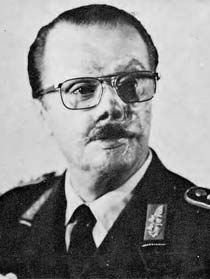
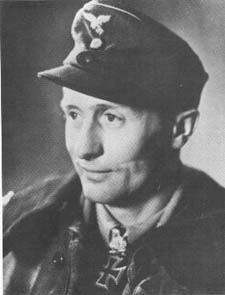
steinhoff6General Johannes Steinhof (above) as a Bundeswehr and NATO officer, showing his burns and before his crash (below)

steinhoff WW IIIn his books, Steinhoff does something that you do not see authors do in most military or political memoirs, he actually does serious self reflection on his role in supporting an evil regime. In his introduction to his book The Final Hours the legendary fighter ace who was horribly disfigured when his Me-262 jet fighter crashed and burned two weeks prior to the end of the war wrote:

“In recalling these events, which had been long buried in my memory, it has not been my intention to make excuses. Our unconditional self-sacrifice in the service of the Third Reich is too well documented for that….

So it is because of what is happening today—with freedom threatened in virtually every respect by its own abuse—that I offer this contribution, in the form of an episode in which I was myself involved, to the history of the soldier in the twentieth century. Soldiers have always, in every century of their existence, been victims of the ruthless misuse of power; indeed, given the opportunity, they have joined in the power game themselves. But it fell to our own century to accomplish, with the aid of a whole technology of mass extermination, the most atrocious massacres in the history of mankind. This fact alone makes pacifism a philosophy worthy of respect, and I have a great deal of sympathy with those who profess it. 

The figure of the soldier in all his manifestations is thus symptomatic of the century now nearing its close, and it is to the history of that figure that I wish to contribute by describing what happened to me. I have tried to show what it is possible to do to men, how insidiously they can be manipulated by education, how they can be hoisted onto a pedestal as “heroes,” how they can be so corrupted as even to enjoy the experience—and how they can be dropped and denounced as mutineers when they discover that they have scruples. The complete lack of scruples that such treatment implies is peculiar to rulers who believe that the problems of their own and other peoples can be solved by imposing, through the use of military force, peace on their, the rulers’, terms—in our case a pax germanica, but the second Latin word is readily interchangeable.” from “The Final Hours: The Luftwaffe Plot Against Goring (Aviation Classics)” by Johannes Steinhoff

Since I am a historian and and a career military officer with service in the Iraq War, a war that was illegal and unjust by all measure I can understand Steinhof’s words. Because much of my undergraduate and graduate work focused on German history, particularly that of Imperial Germany after the unification, the Weimar Republic, and the Nazi Reich, I draw a lot of lessons from the period. I also understand how people in this country can fall for the same kind of vitriolic propaganda that the Germans of that era did. I can understand because for years I fell for the lies and propaganda being put out by the politicians, pundits and preachers of the American political right.

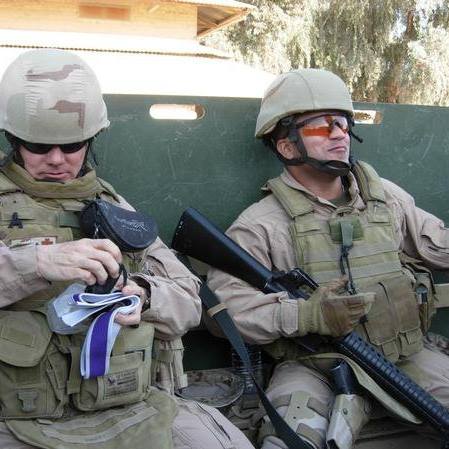
10665323_10154041610267059_5277331492232210946_nA picture of me (on left) in Iraq 2007 with my assistant and bodyguard RP1 Nelson Lebron

One of those lessons is that in times of crisis, that people, no matter what their race, culture, religious belief system, educational, or economic background are still human. Humanity is the one constant in all of history, our prejudices are often ingrained in us during childhood and reinforced by the words of politicians, pundits, and preachers. In times of stress, crisis, and societal change or upheaval even good people, moral people, people of great intellectual, scientific abilities can fall prey to demagogues who preach hate and blame others, usually racial, ethnic, or religious minorities, as well as civil libertarians who champion the rights of those minorities for the problems of the nation.

Shrewd politicians, preachers, and pundits do this well. They demonize the target group or population and then let the hatred of their disaffected followers flow. The leaders need that disaffected and angry base in order to rise to power; such was how Hitler, Stalin, and so many other despots gained power. They took advantage of a climate of fear, and found others to blame. For Hitler it was the Jews, Slavs, Socialists and Communists; while for Stalin it was various groups like the Ukrainians, or the Poles who were the devil to be feared and destroyed. Timothy Snyder in his book Bloodlands: Europe Between Hitler and Stalin wrote:

“Dead human beings provided retrospective arguments for the rectitude of policy. Hitler and Stalin thus shared a certain politics of tyranny: they brought about catastrophes, blamed the enemy of their choice, and then used the death of millions to make the case that their policies were necessary or desirable. Each of them had a transformative utopia, a group to be blamed when its realization proved impossible, and then a policy of mass murder that could be proclaimed as a kind of ersatz victory.”

But that being said, there are a lot of people who from childhood believe the lies about others without question. In good times such people continue on with life as normal, but in crisis those hatreds and prejudices come to the fore. Rudolf Höss, the notorious sociopath who commanded Auschwitz told American Army psychologist Gustave Gilbert about his reaction when ordered to turn the camp into an extermination center. He said that the order “fitted in with all that had been preached to me for years,” and “at the same time I didn’t think of it as propaganda, but as something one just had to believe.” 

Eugene Davidson in his book on the Nuremberg Trials wrote:

“Every society has in it at all times negative, criminal, sadistic, asocial forces. What holds them in check more than law and police is the consensus of the society – a general belief that despite everything wrong and stupid and muddleheaded in politics, the state is a going concern that will somehow make its way into the future.” (Davidson, The Trial of the Germans p.581)

But when things do not go well, when people do not feel that things will be okay, that the future will be better, and that they have a purpose they look for answers. However, they tend to find their answers in the rantings of demagogues, race baiters, conspiracy theorists, and others who they would tend to dismiss out of hand in good times. In Germany it was the loss of the First World War, the humiliation of Versailles and the economic chaos and social change of the Weimar period which allowed Hitler to gain an audience, then a following, then political power. The demagogues played to what was already in the hearts and minds of the disaffected masses, without that fertile soil, the rantings of Hitler and his propagandists would have never succeeded. Albert Speer wrote:

“As I see it today, Hitler and Goebbels were in fact molded by the mob itself, guided by its yearnings and its daydreams. Of course, Goebbels and Hitler knew how to penetrate through to the instincts of their audiences; but in the deeper sense they derived their whole existence from these audiences. Certainly the masses roared to the beat set by Hitler’s and Goebbels’ baton; yet they were not the true conductors. The mob determined the theme. To compensate for misery, insecurity, unemployment, and hopelessness, this anonymous assemblage wallowed for hours at a time in obsessions, savagery and license. The personal unhappiness caused by the breakdown of the economy was replaced by a frenzy that demanded victims. By lashing out at their opponents and vilifying the Jews, they gave expression and direction to fierce primal passions.”

In a sense a similar thing has happened in the United States which has experienced a series of wars beginning with Vietnam, the shock of the 9-11-2001 attacks, the economic crash of 2007 and 2008 which devastated the savings, home ownership, and investments of many Americans while at the same time benefiting the banking and brokerage houses whose government assisted policies brought about the crash. Of course there are other issues, many religious conservatives hate the progress made by the Women’s and Gay Rights movements, and their leaders play to their fears in apocalyptic terms. I could go on, but I am sure that my readers can identify other issues which demagogues and others use to spread fear and hate to further their goals. The fact is that without the the fertile soil that lays in the hearts of their most fervent followers they would never have a following.

In Weimar Germany hate mongers like Julius Streicher and propagandist Josef Goebbels stuck a chord with disenchanted people who felt that they had lost their country. They were fearful, angry, and desired a leader who would “make Germany great again.” Hitler and his Nazi media sycophants played to that fear, and took advantage of their anger at the existing order. Davidson wrote such people “exist everywhere and in a sick society they can flourish.” 

For decades the way has been prepared for true extremists to take advantage of the fears and doubts of people as modern American versions of Streicher and Goebbels have been at work for years. Rush Limbaugh was a modern pioneer of this in the United States, and he has been joined by so many who are even more extreme in their rantings that it is hard to name them all. Likewise, whole media corporations, websites, and political networks spread such fear every minute of the day, claiming that they, and they alone are real Americans. They actively support politicians who condemn, and sometimes even threaten people who oppose them, and all the while claim that “make America great again.”

When I was younger I devoured that propaganda, despite all of my learning I followed the rantings of men who I realize today are propagandists who promote the basest of lies, and hatred, often in the name of God. I was changed when I was at war, and when I returned home from Iraq in 2008 I realized through hard experience that I had been lied to, and that as a result that thousands of my brothers and sisters were dead, and tens of thousands shattered in body, mind, and spirit. Likewise I saw the massive destruction levied on Iraq and realized how terrible war really is. That was my epiphany, that is what it took to see how much I had been lied to, and it called me to question everything else that I had so willingly believed, things which had been fed to me by years of indoctrination in church, through the media, and by politicians who I believed were truly Christian. I can understand now how Martin Niemoller felt after the Nazi seizure of power when he said, “I hated the growing atheistic movement, which was fostered and promoted by the Social Democrats and the Communists. Their hostility toward the Church made me pin my hopes on Hitler for a while. I am paying for that mistake now; and not me alone, but thousands of other persons like me.”

There was a time that I hated people who espouse the views that I hold today, the views that I write about so often here on this site. I can remember how angry I would get as I listened to the propaganda being put out by Limbaugh, Hannity, the Fox News Channel and all of the others that I listened to every time that I had the chance. But when I changed after Iraq, I felt the sting of that hatred in very real ways. I remember the day I was called by my bishop in my former church, who told me that I had to leave because my views on women, gays, and Moslems were to use his words were now “too liberal.” After that, many men who I considered to be the best of friends turned their backs on me, some in the most bitter and vindictive of ways.

But I realize now that what they did was because I had in a sense left the cult, and had to be ostracized. I can understand that now, because when I was under the spell I too turned my back on people who had fallen out of favor, or people who had rejected the tenants of the church or the political movement, and those are things that I can never undo. But at the time it made sense, it fitted in with all I had been taught for decades, as Albert Speer wrote of Hitler, “One seldom recognizes the devil when he is putting his hand on your shoulder.”

What happened to Steinhoff’s generation is threatening to happen again, in our country, an authoritarian movement is threatening to destroy our democracy and republic. In it soldiers are esteemed, until they realize what is going on and speak out, but by then it is usually too late. I am understanding that fact more and more every day, and having had people troll this blog and call me a traitor and worse, I understand just a bit of what happened to Steinhoff and his fellow officers when they protested to the highest levels what was happening to Germany in early 1945.

I don’t know when it will happen, but sometime I expect that know we will how military professionals react to being labeled as traitors. President Trump and his followers have been demonizing the personnel of the nation’s intelligence, law enforcement, and diplomatic communities since before the election and have increased that since his inauguration, especially against the FBI and Justice Department. In fact those attacks by the President and his sycophants have become much more shrill as the Mueller probe turns more and more Trump associates into witnesses against him.

The President has lambasted his critics on his Twitter feed which occasionally results in them receiving death threats from his followers.  Like a religious cult they have no capacity to tolerate dissent, loyalty to the man will supersede loyalty to the country or the Constitution. When that happens to a senior military officer, or perhaps even Secretary of Defense Mattis, it will be interesting to see the legion of people in the military and outside of it who support the President make the choice to impugn and punish men and women who have spent their lives in defense of their country.

Their’s will be a conscious decision. My opinion is that the Constitution and the country will always come first. When he was elected and inaugurated I gave the President Elect the benefit of the doubt and honestly prayed that he would do the right thing for the country, but since then I have become much more concerned for the country and the world because of his behavior before and since his inauguration has demonstrated that his only loyalty is to himself. General Ludwig Beck, who resigned rather than obey Hitler’s order to invade Czechoslovakia in 1938 and died in the anti-Hitler coup attempt in 1944 said:

“It is a lack of character and insight, when a soldier in high command sees his duty and mission only in the context of his military orders without realizing that the highest responsibility is to the people of his country.” 

I have no doubt that many military officers and Secretary of Defense Mattis understand that and will courageously speak his mind, even if he is condemned for doing so. Sadly I have many doubts about other leaders: military, political, business, or religious. There are many people who will sell their souls for their personal advancement, the advancement of their agenda, or an increase in their bottom line. It is after all human nature.

But the question is: will we see true men and women of courage who will stand when it appears there is no chance of success? As Atticus Finch said in To Kill a Mockingbird: “Real courage is when you know you’re licked before you begin, but you begin anyway and see it through no matter what.” 

That will be what is demanded in the coming months as tensions in Asia, the Middle East, and Europe continue to escalate.

Peace

Padre Steve+

4 Comments

Filed under ethics, History, Military, national security, News and current events, Political Commentary

Nothing Remains Static: The Never Built G3, Amagi, and Lexington Class Battle Cruisers

artist

Artists Depiction of G3 Battlecruiser 

Friends of Padre Steve’s World,

This weekend I will be reflecting on the old year and the coming new year, but tonight I decided to tweak and republish an article from about four years ago dealing with the battle cruisers being built by Great Britain, Japan, and the United States after the First World War. They represented the pinnacle of naval design for their era and would have been far superior to their adversaries had technology and war remained static. As Admiral Ernest King noted:

“Nothing remains static in war or military weapons, and it is consequently often dangerous to rely on courses suggested by apparent similarities in the past.”

As the First World War ended a new Naval Race was heating up. The United States had announced its intention during the war to build a navy second to none while Imperial Japan was making plans for a fleet that would give it superiority in the Western Pacific. The British, though still be far the largest naval power in the world were burdened by the massive costs of war and empire, but also seeking to maintain their naval dominance and to that end they were in the process of building a class of massive super-Dreadnought battleships, and Battle Cruisers.

The ships known as battle cruisers were first built by the British Royal Navy as a compliment to the all big gun Dreadnought battleships. The Battle Cruiser concept was for a ship of roughly the same size and firepower as a Battleship but sacrificing protection for greater speed, endurance and range.  and Japan joined in the Battle Cruiser race before and during the war. Unlike Britain the United States had concentrated on building battleships but following the war began to design and build its own class of massive battle cruisers.

800px-InvincibleBlowingUpJutland1916

HMS Invincible Blowing Up at Jutland 

During the war the weaknesses of the type were exposed during the Battle of Jutland where three British Battle Cruisers, the HMS InvincibleHMS Indefatigable and HMS Queen Mary blew up with the loss of most of their crews; of the 3311 officers and sailors on the ships only 26 survived. The HMS Lion was almost lost in a similar manner but the heroic actions of her crew saved her from her sisters fate. The British ships had glaring deficiencies in armor protection and the arrangement of their ammunition magazines and hoists which certainly contributed to their loss. Their German counterparts on the other hand proved much tougher and though all sustained heavy damage while engaging British Battleships and Battle Cruisers, only one the Lützow was lost. She absorbed over 30 hits from large caliber shells and only lost 128 crew members.

h60404

HMS Hood

As the war progressed other Battle Cruisers were built, the British launched the HMS Repulse and HMS Renown and completed the HMS Hood shortly after the war was over. The Japanese built the four ship Kongo class from a British design, the first of which, the Kongo was completed in a British yard. As the powers embarked on the next Naval Race planners and naval architects designed ships of massive firepower, better protection and higher range and speed. All would have been better classed as Fast Battleships.

The British designed and began construction on the G3 class in 1921, while the Japanese began work on the Amagi Class, and the United States the Lexington Class. However the construction and completion of these ships as Battle Cruisers was prevented by the Washington Naval Treaty.

invincible 490

The treaty, which was ratified in 1922 limited the United States and Great Britain to a maximum of 525,000 tons in their battle ship fleets and 125,000 tons in aircraft carriers.  The Japanese agreed to a limit of 315,000 tons and the French and Italians 175,000 tons each. Tonnage for battleships was limited to a maximum of 35,000 tons with a limitation on guns size to 16 inches.  Since the bulk of the ships planned or being built by the US and Japan exceeded those limits they would be effected more than the British whose post war shipbuilding program had not begun in earnest, in fact the G3 Class had just been approved for construction.

The G3 class would have comprised four ships and been similar to the N3 Class Battleships. They were very well balanced ships and would have mounted nine 16” guns in three turrets on a displacement of 49,200 tons and deep load of 54,774 tons. They had an all or nothing protection plan meaning that the armored belt was concentrated in vital areas around the armored citadel, conning tower, turrets and magazines and engineering spaces. Their armor belt would have ranged from 12-14 inches, deck armor from 3-8 inches, conning tower 8 inches, barbettes 11-14 inches, turrets 13-17 inches and bulkheads 10-12 inches. Their propulsion system of 20 small tube boilers powering 4 geared steam turbines connected to 4 propeller shafts would have produced 160,000 shp with a designed speed of 32 knots.

The four ships, none of which were named were ordered between October and November of 1921. Their construction was suspended on November 18th 1921 and they and the N3 Battleships were cancelled in February 1922 due to the limitations of the Washington Naval Treaty. Many concepts of their design were incorporated in the Nelson Class battleships which were a compromise design built to stay within the limits of the treaty.

rys-amagi

Amagi Class as Designed, Akagi as Completed (below) 

JapaneseAircraftCarrierAkagi3Deck_cropped

The four planned Japanese Amagi Class ships would have mounted ten 16” guns on a displacement of 47,000 tons at full load. Their propulsion system 19 Kampon boilers powering four Gihon turbines would have given them a maximum speed of 30 knots, They would have had less protection than the G3 ships being more of a traditional Battle Cruiser design. As a result of the Washington Naval Treaty the Japanese elected to convert two of the ships, the Amagi and Akagi to aircraft carriers. Amagi was destroyed on the ways during the great Tokyo earthquake and Akagi was completed as a carrier. The other two vessels were scrapped on the ways.

Lexington_battlecruiser_conversion_models

lexington-class-battle-cruisern11978

Lex4259BrassDraw

The United States Navy planned the six ship Lexington Class. These ships would have mounted eight 16” guns on a ship measuring 874 feet long and 105 feet in beam, displacing 43,254 tons at full load, or nearly the size of the Iowa Class battleships. They would have had a maximum speed of 33 knots being powered by 16 boilers which drove 4 GE electric turbines producing 180,000 shaft horse power. Theirs was a massive engineering plant and while the class did not have as heavy armor protection as either the G3 or Amagi classes, they were superior to them in speed as well as endurance. Upon ratification of the Washington Naval Treaty four of the six ships were cancelled and the remaining two, the Lexington and Saratoga competed as aircraft carriers.  Had any of the ships been completed as Battle Cruisers it is likely due to their speed that they would have operated primarily with the the carriers that the US Navy built during the 1930s.
g416531

One can only speculate what the navies of World War II would have looked like had the Washington and the subsequent London Naval Treaties not been ratified. One can also only imagine how the war at sea would have been different had the ships completed as carriers been completed as Battle Cruisers.

However that was not to be, of the planned 14 ships of these three classes only three were completed, all as aircraft carriers, ships that helped to forge the future of naval operations and warfare for nearly a century. Thus the uncompleted ships are an interesting footnote in naval history yet have their own mystique. and one might wonder if the new aircraft carriers currently being built by the United States, Britain, China, India and other nations will also be displaced by advancing technology as were these ships.

Until tomorrow,

Peace

Padre Steve+

5 Comments

Filed under History, Military, Navy Ships, US Navy

Death in the Arctic: The Sinking of the Scharnhorst at North Cape

Schlachtschiff Friends of Padre Steve’s World,

Today was the Second Day of Christmas or as it is also known, the Feast of St. Stephen.

Christmastide is a joyous time for many, but in the course of history there have been times that military men have fought and died in hopeless battles far from their families. Thus it is often a time of sorrow, especially for those that die alone. Among those who died alone in the Arctic darkness of December 26th 1943 were the officers and crew of the German battlecruiser Scharnhorst.

Schlachtschiff

The Scharnhorst along with her sister ship Gneisenau were the product of the naval architects of Germany who in the early 1930s designed some of the most beautiful as well as deadly warships of the Second World War.  Following Germany’s rejection of the provisions of the Treaty of Versailles the Kreigsmarine enacted a building program to enlarge and modernize the German Navy which then was composed of obsolete pre-Dreadnaught battleships and a few modern light cruisers and destroyers.   The first major units constructed were actually begun by the predecessor to the Kreigsmarine, the Reichsmarineof the Weimar Republic.  These were the Deutschland class Armored Ships, sometimes called “Pocket Battleships” and later reclassified as Heavy Cruisers. These ships were designed to replace the old pre-Dreadnaught battleships and incorporated electric welds to reduce displacement, diesel engines for extended cruise range to enable them to serve as commerce raiders and a battery of six 11” guns.  While an advance over anything in the German inventory they were outclassed by the British battle cruisers Hood, Renown and Repulse.

However, the first truly capital ships built by the Kriegsmarine were the Scharnhorst and Gneisenau Rated as battleships, in reality they were battle cruisers because of their light main battery of 11” guns as opposed to the 14”, 15” or 16” batteries of other nations battleships.  Despite this in displacement and armor protection of the ships was comparable to other battleships of the era and their designed speed of 31.5 knots was superior to almost all other battleships of the era including the British King George V Class and the US Navy’s  North Carolina class.  Only the massive battlecruiser HMS Hood was their superior in speed and firepower.

As built Scharnhorst and Gneisenau displaced 31,000 toms, however at full combat load they both weighed in at nearly 38,000 tons and were 772 feet long.  They had an armor belt that was nearly 14 inches thick.  Armed with a main battery of nine 11” guns and a secondary armament of twelve 5.9 inch guns they also mounted a powerful for the time anti- aircraft battery of fourteen 4.1 inch guns, 16 37mm and 16 20mm anti-aircraft cannons.  Additionally they mounted six 21” torpedo tubes and carried three Arado 196 A3 scout planes.  The main battery was eventually to be replaced by six 15” guns but this never occurred; Gneisenau was taken in hand to mount the new weapons but the conversion was never completed due to Hitler’s anger after the failure of a German task force during the Battle of the Barents Sea in December 1942.

scharnhorst2Scharnhorst firing at HMS Glorious 

Laid down on 15 June 1935 and launched 3 October 1936 Scharnhorst was commissioned 7 January 1939.  Her sister Gneisenau was laid down 6 May 1935, launched 8 December 1936 and commissioned 21 May 1938.  Upon the commencement of the Second World War the two sisters began a reign of destruction on British shipping. In November they sank the Armed Merchant Cruiser HMS Rawalpindi During Operation Weserübung the pair surprised sank the aircraft carrier HMS Glorious and her two escorting destroyers, the only time a Fleet carrier was caught and sunk by battleships during the war.   From January to March 1941 they conducted Operation Berlin against British merchant shipping in the North Atlantic sinking 22 ships before returning to base.

eeb893a0b92de4ae595de56fe0fd90caScharnhorst and Gneisenau during Operation Cerebus

While in the port of Brest Gneisenau was bombed and torpedoed requiring extensive repairs.  Due to the exposed location of the port the German high command decided to return the ships to Germany along with the Heavy Cruiser Prinz Eugen.  The operation was called Operation Cerberus and it took place from 11-13 February 1942. The ships made a dash up the English Channel which was unsuccessfully contested by the British Royal Air Force and Royal Navy. However, both Scharnhorst and Gneisenau were damaged by mines and needed subsequent repairs.  While undergoing repairs in Kiel Gneisenauwas further damaged by the Royal Air Force requiring repairs in or to steam to the port of Gotenhafen for repair and conversion.  Although some work was completed she was decommissioned and sunk as a blockship on 23 March 1945.  Following the war she was raised by the Poles and scrapped.

Scharnhorst was repaired following Operation Cerberes and in March 1943 was transferred to Norway where along with Tirpitz, Admiral Scheer, Lutzow (the former Deutschland), Admiral Hipper and Prinz Eugen she became part of a “fleet in being” poised to strike the Allied convoys bound for Russia.

Admiral_Bruce_Fraser_1943_IWM_A_16489Admiral Bruce Fraser

The German surface ships were a potent force that if the circumstances allowed could devastate the Russia bound convoys and the Commander of the British Home Fleet, Admiral Bruce Fraser was determined to entrap and destroy any of these ships that threatened any convoy. As such in December 1943 Fraser formed a task group built around the HMS Duke of York to be ready to pounce on any German raider that threatened the convoys. His intent was to catch any of these ships, especially Scharnhorst and trap them between the convoys and their base, in conduction with a second task group centered around the cruisers HMS Belfast, HMS Norfolk, and HMS Sheffield, Known as Force One, and destroy the German battleship.

The key to British the British operation was Enigma the German code machine and cipher system which they had acquired from captured U-Boats, and which British code-breakers had mastered. The Germans decided to send Scharnhorst and five destroyers to locate and destroy convoy JW-55B which had been spotted by Luftwaffe reconnaissance aircraft. Because of EnigmaFraser knew that Scharnhorst would attempt to intercept the convoy and put his plan in motion.

Battle_of_North_Cape_26_December_1943_mapScharnhorst and her escorts set sail on Christmas Day 1943 under the command of Rear Admiral Erich Bey to conduct Operation Ostfront. Since Fraser knew that the Germans were coming he had the convoy to temporarily reverse course which caused the Germans to miss the convoy. When he did not find the convoy in the expected location Bey detached his destroyers to expand the search area, leaving Scharnhorst alone to face the enemy.

scharnhort_operation_ostfront_5Rear Admiral Erich Bey

At about 0900 on December 26th 1943 the cruisers of Force One discovered Scharnhorst and the  Battle of North Cape was on. Though little damage was suffered in the first engagement, the radar of Scharnhorst was knocked out, leaving her not only without air support or escort, but blind.

6050465664_e1f42ac7f8_oHMS Duke of York firing her main battery

Scharnhorst attempted to flee but Fraser’s Duke of York  and her four escorting destroyers destroyers intercepted her. Without radar in the blinding snow squalls Scharnhorst was surprised. Duke of York’s first radar direct salvos knocked out her forward main battery but the German ship appeared to be making a getaway when a shell from Duke of York hit her number one boiler room and reduced her speed to barely ten knots. Although the German engineers and damage control teams made some repairs and were able to bring her speed back up to 22 knots, the British ships rapidly made up the distance enabling the British destroyers to launch torpedo attacks.

Knowing the ship was doomed Admiral Bey dispatched a message to the high command of the Kriegsmarine: “We will fight on until the last shell is fired.”

While she still attempted to fight off her attackers and escape she was struck by torpedoes from several destroyers as well as was pummeled by the at at distance of under 10,000 yards by Duke of York’s 14″ shells, as well as the 6″ shells of HMS Belfast and HMS Jamaica. Savaged by hits and incapable of further resistance the German ship capsized and sank at 1945 hours with the loss of all but 36 of her 1968 man crew.  Her wreck was discovered on October 3rd 2000 some 70 miles north of North Cape Norway.

Scharnhorst_survivors_A_021202Survivors of Scharnhorst 

Admiral Fraser praised the gallantry of the German ship to his officers later that night saying: “Gentlemen, the battle against Scharnhorst has ended in victory for us. I hope that if any of you are ever called upon to lead a ship into action against an opponent many times superior, you will command your ship as gallantly as Scharnhorst was commanded today”

After the battle Grand Admiral Erich Raeder who had authorized the sortie was relieved as commander in chief of the navy and was replaced by Grand Admiral Karl Donitz who commanded the U-Boat forces. Hitler was furious and ended most surface naval operations.

800px-Scharnhorst-WHV-April-2011Memorial to Scharnhorst and her crew at Kiel

I have written many times about the tragedy of war, on land and at sea. Having served in combat zones on land and having been shot at by the enemy, as well as having served at sea on a cruiser I have a sense of what these men must have gone through on that final day of their lives. Though I am a realist and know that such tragedies will likely occur again, I do pray for the day that war will be no more and that those who serve in harm’s way will never have to again.

Peace

Padre Steve+

1 Comment

Filed under History, Military, Navy Ships, nazi germany, World War II at Sea

Merry Christmas from a Wounded Healer

Friends of Padre Steve’s World,

We had a special Christmas this year with friends who can be best described as a relatively eclectic group. We hosted dinner as is our custom and it really turned out well, and I do have to say that emotionally and spiritually I am in in a better place than was not too long ago.

So today, especially for my new readers I want to recount a bit of that journey.

The German theologian Jürgen Moltmann wrote, “God weeps with us so that we may one day laugh with him.”  Since coming home from Iraq in 2008 my faith has undergone a profound change. This is a part of my story that I share with you.

Christmas is a special time for me, it always has been but in spite of that there were times that I took the faith element for granted. I believed and my faith in God, for me the Christian God, Father, Son and Holy Spirit was unquestioned. I knew the Scriptures, the Creeds and the Councils and I felt that my faith in a sense was untouchable. I was sure of it, in fact almost cocksure or arrogant about it. That came out in published writings in a very conservative Catholic monthly, the New Oxford Review back in 2000-2001.

For me the elements of my faith were very much intellectual. I could see other points of view but if I disagreed with them enough I would engage them with the purpose of defeating them. Of course this usually went to theological methods, history and hermeneutics. As far as those that lost their faith it was something that I had difficulty comprehending. Not that I was unsympathetic or uncaring of them or their plight, but I didn’t see how it could happen to me.

But that was before Iraq. That was before PTSD, moral injury and my own crisis of faith when I returned from the Iraq War in 2008.  That war changed me as war has changed so many others before. Guy Sager wrote of his return from war in his classic The Forgotten Soldier:

“In the train, rolling through the sunny French countryside, my head knocked against the wooden back of the seat. Other people, who seemed to belong to a different world, were laughing. I couldn’t laugh and couldn’t forget.” 

My return instigated a crisis of faith, I felt like I still belonged in Iraq and home seemed like a foreign land.  In the crisis I was for all practical purposes I was an agnostic trying to believe and feeling abandoned by God and many of his people, especially clergy.  Commodore Tom Sitsch at EOD Group Two, a veteran of much combat asked me “where does a Chaplain go for help?” I told him “not to other Chaplains or clergy.” Sadly Captain Sitsch, struggling with his own PTSD and other life crises took his life in 2014, but I think that he understood me better than most Chaplains or clergy.

That the crisis etched a permanent scar in my soul which led to some fairly major changes in my life.  It forced me to enter what Saint John of the Cross called the “Dark Night of the Soul.” For those not familiar with that book it is the sense that God has withdrawn his presence from you which you must go through to experience true union with God.

I will not tell of how my great spiritual disciplines and intellect helped me get through the crisis, for they did not. I found it hard to pray or believe in anything for nearly two years as I struggled with abandonment. I felt that God, the Church and the Navy had abandoned me.  The only thing that kept me going was my profound sense of vocation as a Priest and Chaplain and commitment to others who were suffering.  When I watch the classic film about the 1914 Christmas Truce, Joyeaux Noel I very much understand the priest who is being relieved of his duties by his bishop who he tells “I belong here, with those in pain who have lost their faith.” 

In the fall of 2008 was losing my battle with PTSD during that time I was clinically  depressed, terribly anxious, angry, and in despair I threw myself into my work among the critically ill ICU patients and those that cared for them.  Christmas Eve of 2008 was spent in despair as I wandered through the darkness on a cold night after leaving the Christmas Eve Vigil Mass because I could not get through it. If a bar had been open anywhere within walking distance I would have poured myself into it.

Though I found a community and camaraderie among those that I worked with and tried to provide spiritual care, my own condition grew worse.  I was so bad enough that my clinical duties had to be curtailed over my objections in September of 2009.

I still stood the overnight duty and filled in for others as needed, but for a number of months I had no clinical assignments.  That meant that others in our minimally staffed department had to fill in for me. I am sure that they resented that, especially because before this I often worked 70-90 hours a week mostly in our ICUs and the staff of the ICUs now expected that kind of intensive ministry and support. Likewise I was largely absent from home which was not a good thing for my marriage.

But in my desperation I was greeted with a surprise. On one of the on call nights not long before Christmas of 2009 I received a call to the ER to provide the last rites to an elderly retired Navy Medical Doctor.  The man was a saint, faithful to God, his Church and the community. For years he dedicated much of his practice to the poorest members of the community, delivering babies for women with no insurance and caring for prisoners in the Portsmouth City Jail.  He breathed his last as I prayed this prayed the prayer of commendation following the anointing and something strange happened. I felt the presence of God for the first time since Christmas of 2007 in Iraq. It is too this day hard to explain. It was as if his faith

Something miraculous happened that night and by Christmas Eve I realized that something was happening to me. As I wrote in Padre Steve’s Christmas Miracle on Christmas Eve of 2009:

“Mid afternoon I was walking down the hall and I experienced a wave of emotion flood over me, and unlike the majority of emotions that I have felt in the past couple of years this was different.  It was a feeling of grace and I guess the presence of God.  I went up and talked with Elmer the shrink about what I was feeling and the experience was awesome, I was in tears as I shared, not the tears of sadness, but of grace.  I am beginning to re-experience the grace of God, something that has been so long absent that I did not expect it, at least right now.  I didn’t do anything differently; I certainly was not working extra hard to pray more, get more spiritual or pack my brain full of Bible verses.  I was too far gone to do those things.  It was all I could do many mornings just to get out of bed and come to work.”

Since that time I have continued to recover faith and belief. I cannot say that it is the same kind of faith that I had before Iraq. This was a different kind of faith.  It was faith born of the terrible emptiness and pain of abandonment and despair, a faith that is not content with easy answers and not afraid to ask questions.  It is a faith in Jesus Christ, the crucified one who’s image we see hanging from the crucifix and adorning icons of the Crucifixion. It is as Moltmann wrote in The Crucified God:

“The Symbol of the Crucifix in church points to the God who was crucified not between two candles on an altar, but between two thieves in the place of the skull, where the outcasts belong, outside the gates of the city. It is a symbol which therefore leads out of the church and out of religious longing in to the fellowship of the oppressed and abandoned. On the other hand, it is a symbol which calls the oppressed and godless into the church and through the church into the fellowship of the crucified God”

My Philosophy of Religion Professor, Dr. Yandall Woodfin at Southwestern Baptist Theological Seminary told us in class that until we had “dealt with the reality of suffering and death we were not doing Christian theology.” At the time the words were offensive to me, but by the time I had graduated and also done a year of Clinical Pastoral Education they became a part of my experience. However that did not prepare me for the darkness that I lived in from February of 2008 until that Christmas Eve of 2009.  I would say that in addition to Dr Woodfin’s understanding of grappling with suffering and death that one has to add the abandonment of the outcast to the equation.

The “I Believe in God” of the Creed is no longer for me simply a theological proposition to defend, but rather an experience of God born out of pain, despair, anxiety, doubt, unbelief and abandonment. During my crisis I found almost no Christians willing to walk through the darkness with me, including clergy. The only clergy willing to were those who were walking the same path of the outcast with me, suffering from PTSD, TBI and other unseen wounds of war. It was if I was radioactive. Many people had “answers” for me, but none sought to understood my questions until my first  therapist Dr. Elmer Maggard asked me “how I was with the big guy?”

When I finally collapsed in the summer of 2008 and met with Dr. Maggard I made a conscious decision that I would not hide what I was going through.  I felt that if someone didn’t speak out that others like me wouldn’t seek help. In the nearly six years since I returned from Iraq I have encountered many people, men and women, current and former military personnel and families of veterans who came to me either in person or through this website. It led to me being interviewed in a newspaper and being featured on the Real Warriors website http://www.realwarriors.net , a program run by the Department of Defense to help reduce the stigma of getting help for PTSD which features the stories of military personnel suffering from it. My story can be found here: 

https://www.realwarriors.net/multimedia/profiles/dundas.php

I have had a number of military chaplains come to me also experiencing a faith crisis. Most said that I was the first Chaplain or minister that they had met or who admitted that he struggled with faith and the existence of God.  For a minister to be open about such struggles is dangerous. When my faith returned and was different I was asked to leave my former denomination because I was now “too liberal.”

In each of those encounters with those suffering there was a glimmer of hope for me and I think for them.  It was as if for the first time we had people that we could be open with.  Co-workers and others said that I was “real.” I certainly do not boast of that because it was painful to be transparent with people while in the depths of doubt and despair while hoping that somehow God would touch them with some measure of grace when I found it hard to believe.  I guess it was the fact that I was willing to walk with them in their crisis and let them be honest even if it meant facing my own pain and doubt. I learned something about being what Henri Nouwen called a wounded healer.  Nouwen wrote:

“Nobody escapes being wounded. We all are wounded people, whether physically, emotionally, mentally, or spiritually. The main question is not “How can we hide our wounds?” so we don’t have to be embarrassed, but “How can we put our woundedness in the service of others?” When our wounds cease to be a source of shame, and become a source of healing, we have become wounded healers.”

I do still struggle with the continued effects of War and PTSD, but I am in a much better place. That being said over past couple of weeks or so my crazy nightmares and night terrors have come back with a vengeance, last night I threw myself out of bed in the midst of a particularly violent nightmare but it hasn’t soured my mood, my hip still hurts a bit but like unlike the last couple of times I neither broke my nose, sustained a concussion, nor bruised by jaw and sprained my neck.; that my friends is an improvement.

I also struggle with faith at times when I look at the actions of those who profess to believe but treat others with contempt, especially the men and women that call themselves Conservative Evangelical Christians who seem to me to have sacrificed any pretense of faith in Christ in the pursuit of raw political power by supporting a man who is as much of a Christian as the Medici Popes. So I can understand the quote from the Gospel “I believe, help my unbelief.”

So today this wounded healer celebrated Christmas at home, hosting friends after having preached at Christmas services for American and German military communities. It was a healing experience for me and helped to increase my faith. I know: faith versus reason. I get that, but as reasonable and logical as I try to be I do find the mystery of faith to be something that attracts me to Jesus the Christ.

So this evening, this Christmas night, I want to thank all of my readers, especially those who like or comment on my posts.

You are appreciated as some are lengthy and you choose to take your time to read them and often share them. Likewise there are times that my own biases show through in what I write, and I know that a decent number of people who subscribe to this site and comment don’t always agree with me. I appreciate that and thank you for continuing to follow what I write.

Likewise, if you are walking the path of the outcast feel free to drop me a line here or on my Facebook page. My wish for you and for all is a Christmas of peace, reconciliation and love.

Peace and blessings,

Padre Steve+

5 Comments

Filed under faith, Military, ministry, Political Commentary, Tour in Iraq

Christmas Eve 2017: Light, Life, and Love in Hell, Kurt Reuber and the Madonna of Stalingrad

Bundeswehr zeigt "Stalingrad"-Ausstellung

Friends of Padre Steve’s World,

It is late on Christmas Eve and I am reflecting about the true meaning of Christmas in a world where hope seems to be dying before our eyes. This morning I preached in my Chapel from the Christmas story in the Gospel of St. Luke, the same passage I preached on a week or so ago with the German NATO contingent. The story of the incarnation, of God coming in the weakness of a tiny baby who would grow up and be crucified not far from where he was born is of profound importance for my faith, because it is not a pie in the sky promise of prosperity and power, but God who can be present in midst of the human made hell of war.

In such an environment I reflect on men who lived in a human made hell, a hell made by hate filled ideologues who launched the world into its bloodiest war, and I wonder, could it happen again? A decade ago I would have said it never could again happen. In December of 2016 after the election of Donald Trump I began to hedge my bets, but a year later I do believe that it can, and very well may happen again. So in such a world I must try to find hope wherever I can find it, especially as I seen the pattern of a descent into authoritarianism which has been so much a part of 20th Century European history developing in the United States. I worry about that because I can see nothing good coming of it, and notice friends, including Christian clergy openly advocating against the safeguards, the checks and balances put forth in our Constitution and laws to ensure that the President has unchecked power; and that means the power to plunge the nation into war.

I think most of my readers know that I am a career military officer and have served in peace and war as a chaplain. That service includes a tour in Iraq, a war, which by almost any standard would have been considered unjust and illegal, yet I served there, and came back a changed man. As such the stories of those who served in war, especially those who serve in hopeless battles, and even in evil causes during Christmas have a special place in my heart. One of those men was a German pastor and medical doctor named Kurt Reuber.

k_reuberl

As I said, Reuber was a theologian, pastor and medical doctor, likewise he was an accomplished artist and used that medium to convey his own faith, and doubts. He was a friend of Albert Schweitzer and in 1939 he was conscripted to serve as a physician in the Germany Army. By November 1942 he was a seasoned military physician serving with the 16th Panzer Division, part of the German 6th Army, which had been fighting in the hell of Stalingrad. When his division along with most of 6th Army was surrounded by the Soviets, cut off from most supply and without real hope of relief, he like other physicians continued to serve the soldiers committed to his care.

pg-34-stalingrad-2-getty

However, unlike most physicians, the care Reuber offered care included spiritual matters, as he sought to help his soldiers deal with the hopelessness of their situation. As Reuber reflected on the desperation of the German soldiers in the Stalingrad pocket. He wrote to his family.

“I wondered for a long while what I should paint, and in the end I decided on a Madonna, or mother and child. I have turned my hole in the frozen mud into a studio. The space is too small for me to be able to see the picture properly, so I climb on to a stool and look down at it from above, to get the perspective right. Everything is repeatedly knocked over, and my pencils vanish into the mud. There is nothing to lean my big picture of the Madonna against, except a sloping, home-made table past which I can just manage to squeeze. There are no proper materials and I have used a Russian map for paper. But I wish I could tell you how absorbed I have been painting my Madonna, and how much it means to me.”

“The picture looks like this: the mother’s head and the child’s lean toward each other, and a large cloak enfolds them both. It is intended to symbolize ‘security’ and ‘mother love.’ I remembered the words of St. John: light, life, and love. What more can I add? I wanted to suggest these three things in the homely and common vision of a mother with her child and the security that they represent.”

The picture was drawn on the back of a captured Soviet map and when he finished it he displayed it in his bunker, which became something of a shrine. Reuber wrote:

“When according to ancient custom I opened the Christmas door, the slatted door of our bunker, and the comrades went in, they stood as if entranced, devout and too moved to speak in front of the picture on the clay wall…The entire celebration took place under the influence of the picture, and they thoughtfully read the words: light, life, love…Whether commander or simple soldier, the Madonna was always an object of outward and inward contemplation.”

drkrop

As the brutal siege continued men came to the bunker for both medical care and spiritual solace.  On Christmas Eve Reuber found himself treating a number of men wounded by bombs outside the bunker. Another soldier lay dying, just minutes before the soldier had been in the bunker singing the Christmas hymn O Du Froehliche.  Reuber wrote:

“I spent Christmas evening with the other doctors and the sick. The Commanding Officer had presented the letter with his last bottle of Champagne. We raised our mugs and drank to those we love, but before we had had a chance to taste the wine we had to throw ourselves flat on the ground as a stick of bombs fell outside. I seized my doctor’s bag and ran to the scene of the explosions, where there were dead and wounded. My shelter with its lovely Christmas decorations became a dressing station. One of the dying men had been hit in the head and there was nothing more I could do for him. He had been with us at our celebration, and had only that moment left to go on duty, but before he went he had said: ‘I’ll finish the carol with first. O du Frohliche!” A few moments later he was dead. There was plenty of hard and sad work to do in our Christmas shelter. It is late now, but it is Christmas night still. And so much sadness everywhere.”

On January 9th 1943 with all hope of escape or reinforcement gone Reuber gave the picture to the battalion commander as the officer was too ill to carry on and was one of the last soldiers to be evacuated from the pocket. Reuber’s commander carried the Madonna out of the pocket and returned it delivered it to Reuber’s family, preserving it for all.

Reuber was taken prisoner and survived the harrowing winter march to the Yelabuga prison camp. In late 1943 Reuber wrote his Christmas Letter to a German Wife and Mother – Advent 1943. It was a spiritual reflection but also a reflection on the hope for life after the war, when the Nazi regime would be defeated, and Germany given a new birth.

Reuber wrote:

“The concatenation of guilt and fate has opened our eyes wide to the guilt. You know, perhaps we will be grateful at the end of our present difficult path yet once again that we will be granted true salvation and liberation of the individual and the nation by apparent disappointment of our “anticipation of Advent”, by all of the suffering of last year’s as well as this year’s Christmas. According to ancient tradition, the Advent season is simultaneously the season of self-reflection. So at the very end, facing ruin, in death’s grip – what a revaluation of values has taken place in us! We thus want to use this period of waiting as inner preparation for a meaningful new existence and enterprise in our family, in our vocation, in the nation. The Christmas light of joy is already shining in the midst of our Advent path of death as a celebration of the birth of a new age in which – as hard as it may also be – we want to prove ourselves worthy of the newly given life.”  (Erich Wiegand in Kurt Reuber, Pastor, Physician, Painter, Evangelischer Medienverb. Kassel 2004. )

prisoner's madonna

Reuber did not live to see that day. He died of Typhus on January 20th 1944, not long after writing this and just a few weeks after painting another portrait of the Madonna, this one entitled The Prisoner’s Madonna. He was not alone, of the approximately 95,000 German POWs taken at Stalingrad only about 6,000 returned home.

His paintings survived the war and his family gave The Madonna of Stalingrad to the Kaiser Wilhelm Memorial Church in Berlin after it was restored as a symbol of hope and reconciliation. Copies are also displayed in Coventry Cathedral and the Russian Orthodox Cathedral in Volgograd, the former Stalingrad. A copy of The Prisoner’s Madonna is now displayed at the Church of the Resurrection in Kassel.

I have a print of the Madonna of Stalingrad in my office. It has become one of the most meaningful pictures I have since I returned from Iraq in 2008. To me they are symbols of God’s presence when God seems entirely absent.

I praying for an end to war and likewise that the United States will not fall victim to a lawless authoritarian leader who seems intent on stoking the fires of more wars.

Peace

Padre Steve+

1 Comment

Filed under faith, History, Military, ministry, nazi germany, Pastoral Care, Political Commentary, world war two in europe

“Is that Truly the Path of the Lord” A Reflection on Faith, Calling, and the Christmas Truce in the Age of Trump

palmerFriends of Padre Steve’s World

As a veteran who served in the badlands of Al Anbar Province during Christmas of 2007 I can relate to Father Palmer, the British priest and chaplain in the film Joyeux Noel (Merry Christmas) when he makes the comment “I belong with those who are in pain, and who have lost their faith, I belong here.”

I again watched that film tonight. The film is the story of the amazing and exceptional Christmas Truce of 1914. It is a film that each time I see it that I discover something new, more powerful than the last time I viewed it. It reminds me of serving in Iraq, at Christmas from my perspective as a Chaplain, and thereby giving voice to those who serve now, as well as those who served God’s people in hellish places before me. It reminds me of how much I hate war, and how much I often hate the clergy who are all too often, bloodthirsty cheerleaders for war.

As a Chaplain I am drawn to the actions of the British Padre in the film, who during the truce conducts a Mass for all the soldiers, British, French and German in no-man’s land, who goes about caring for the soldiers both the living and the dead. His actions are contrasted with his Bishop who comes to relieve him of his duties and to urge on the replacement soldiers to better kill the Germans.

As the Chaplain begins to provide the last Rites to a dying soldier the Bishop walks in, in full purple cassock frock coat and hat and the chaplain looks up and kisses his ring.

As the chaplain looks at his clerical superior there is a silence and the Bishop looks sternly at the priest and addresses him:

“You’re being sent back to your parish in Scotland. I’ve brought you your marching orders.”

Stunned the Priest replies: “I belong with those who are in pain, and who have lost their faith, I belong here.”

The Bishop then sternly lectures the Priest: “I am very disappointed you know. When you requested permission to accompany the recruits from your parish I personally vouched for you. But then when I heard what happened I prayed for you.”

The Priest humbly and respectfully yet with conviction responds to his superior: “I sincerely believe that our Lord Jesus Christ guided me in what was the most important Mass of my life. I tried to be true to his trust and carry his message to all, whoever they may be.”

The Bishop seems a bit taken aback but then blames the Chaplain for what will next happen to the Soldiers that he has served with in the trenches: “Those men who listened to you on Christmas Eve will very soon bitterly regret it; because in a few days time their regiment is to be disbanded by the order of His Majesty the King. Where will those poor boys end up on the front line now? And what will their families think?”

They are interrupted when a soldier walks in to let the Bishop know that the new soldiers are ready for his sermon. After acknowledging the messenger the Bishop continues: “They’re waiting for me to preach a sermon to those who are replacing those who went astray with you.” He gets ready to depart and continues: “May our Lord Jesus Christ guide your steps back to the straight and narrow path.”

The Priest looks at him and asks: “Is that truly the path of our Lord?”

The Bishop looks at the Priest and asks what I think is the most troubling question: “You’re not asking the right question. Think on this: are you really suitable to remain with us in the house of Our Lord?”

With that the Bishop leaves and goes on to preach. The words of the sermon are from a 1915 sermon preached by an Anglican Bishop in Westminster Abbey. They reflect the poisonous aspects of many religious leaders on all sides of the Great War, but also many religious leaders of various faiths even today, sadly I have to say Christian leaders are among the worst when it comes to inciting violence against those that they perceive as enemies of the Church, their nation or in some cases their political faction within this country.

I was reminded of that last night and today as the President received the worship of his most vocally Christian cabinet members and the Vice President as they celebrated the passage of a tax cut bill that end up harming many more people than it will help, even as he edges closer to a devastating war with North Korea, a war that besides being more deadly than in since the World Wars will bring many unexpected and unintended consequences, none good, but I digress…

The Bishop who relieved Father Palmer went on to preach a sermon to newly arrived troops.

“Christ our Lord said, “Think not that I come to bring peace on earth. I come not to bring peace, but a sword.” The Gospel according to St. Matthew. Well, my brethren, the sword of the Lord is in your hands. You are the very defenders of civilization itself. The forces of good against the forces of evil. For this war is indeed a crusade! A holy war to save the freedom of the world. In truth I tell you: the Germans do not act like us, neither do they think like us, for they are not, like us, children of God. Are those who shell cities populated only by civilians the children of God? Are those who advanced armed hiding behind women and children the children of God? With God’s help, you must kill the Germans, good or bad, young or old. Kill every one of them so that it won’t have to be done again.”

The sermon is chilling and had it not been edited by the director would have contained the remark actually said by the real Bishop that the Germans “crucified babies on Christmas.” Of course that was typical of the propaganda of the time and similar to things that religious leaders of all faiths use to demonize their opponents and stir up violence in the name of their God.

When the Bishop leaves the Priest finishes his ministration to the wounded while listening to the words of the Bishop who is preaching not far away in the trenches. He meditates upon his simple cross, takes it off, kisses it hand hangs it upon a tripod where a container of water hangs.

The scene is chilling for a number of reasons. First is the obvious, the actions of a religious leader to denigrate the efforts of some to bring the Gospel of Peace into the abyss of Hell of earth and then to incite others to violence dehumanizing the enemy forces. The second and possibly even more troubling is to suggest that those who do not support dehumanizing and exterminating the enemy are not suitable to remain in the house of the Lord. Since I have had people, some in person and others on social media say similar things to what the Bishop asks Palmer the scene hits close to home.

When I left Iraq in February 2008 I felt that I was abandoning those committed to my spiritual care, but my time was up. Because of it I missed going with some of my advisors to Basra with the 1st Iraqi Division to retake that city from insurgents. It was only a bit over a month after I had celebrated what I consider to be my most important Masses of my life at COP South and COP North on December 23rd as well as Christmas Eve and Christmas Day. In fact until very recently they were really the last masses that I felt the mystery and awe of the love of God that I used to so much feel.

When I left Iraq the new incoming senior Chaplain refused to take my replacement leaving our advisers without dedicated support. He then slandered me behind my back because what I was doing was not how he would do things and because I and my relief were under someone else’s operational control. It is funny how word gets back to you when people talk behind your back. Thankfully he is now retired from the Navy and I feel for any ministers of his denomination under his “spiritual” care. So I cannot forget those days and every time I think about them, especially around Christmas I am somewhat melancholy and why I can relate so much to Father Palmer in the movie. While I cannot prove it I do believe, and have heard from others who used to work at the Chief of Chaplains office that I have been shunned and punished by past and present leaders of the Chaplain Corps because of my witness in being open about my struggles with faith and PTSD. A can recount a number of incidents that would be of circumstantial evidence, but I digress. That being said I am much better off for that experience than I would be had it not occurred.

It has been ten years since those Christmas Masses and they still feel like yesterday. In the intervening years my life has been different. Just a year later I was walking home from church where my wife was to sing in the choir during the Christmas vigil mass. I couldn’t handle the crowds, the noise, and I felt so far away from God. That night I walked home in the dark looking up into the sky asking God if he still was there. If there had been a bar on the way home I would have stopped by and poured myself in.

Since Iraq I have dealt with severe and chronic PTSD, depression, anxiety and insomnia were coupled with a two year period where due to my struggles I lost faith, was for all practical purposes an agnostic. I felt abandoned by God, but even more so and maybe more importantly by my former church and most other Chaplains. It was like being radioactive, there was and is a stigma for Chaplains that admits to PTSD and go through a faith crisis, especially from other Chaplains and Clergy. It was just before Christmas in late 2009 that faith began to return in what I call my Christmas Miracle. But be sure, let no one tell you differently, no Soldier, Sailor, Marine or Airman who has suffered the trauma of war and admitted to PTSD does not feel the stigma that goes with it, and sadly, despite the best efforts of many there is a stigma.

Now that faith is different and I have become much more skeptical of the motivations of religious leaders, especially those that demonize and dehumanize those that do not believe like them or fully support their cause or agenda. Unfortunately there are far too many men and women who will use religion to do that, far too many. Unlike a few years ago they now occupy the seat of political power as sycophants of the President, offering no prophetic voice but speaking the words of death covered in the veneer of the Christian faith.

As for me as opposed to . I had the floor kicked from out from under me in the summer of 2014 and it has been a hard fight and while I am beginning to get back to some sense of normal it is a day to day thing. I still suffer the effects of the PTSD, especially the insomnia, nightmares and the nightmares which came back with a vengeance that summer. I also still have the anxiety in crowded places and bad traffic, but working with my new therapist I am coming up with some effective coping mechanisms. As for faith, I do believe again, more often than not, though at the same time I doubt. Though I believe I think I still consider myself to be a Christian Agnostic who echoes the cry of the man who cried out to Jesus, “Lord I believe, help my unbelief!” I believe and yet, I don’t and I don’t think that is a bad thing, I think it helps me understand those who no longer believe, those that struggle, and those who raised as Christians have left the faith.

Like the Priest in Joyeux Noel I know that my place is with those who are “in pain, and who have lost their faith.” For me this may no longer be on the battlefield as I will retire from the Navy in a few years, unless as I expect a major war breaks out with North Korea, and maybe Iran too.

However, that being said I will strive to be there for those that struggle with faith and believe, especially those who struggle because of what they saw and experienced during war and when they returned home. This Sunday, Christmas Eve I will preach at my chapel’s Protestant service. Likewise as I wrote last week I had the honor of conducting the Christmas service for the German contingent of the NATO headquarters here.

533506_10151366982457059_868388211_nI expect that in the coming year I will do my best to speak truth to those in power and those whose faithfulness is more a product of their comfort with the God that they create in their own mind rather than the Crucified God wise death on the Cross s a scandal. For many Christians the scandal of the cross is too easy to avoid by surrounding ourselves with pet theologies that appeal to our pride, prejudice and power. The kind of malevolent power represented by the bishop in Joyeux Noel as well as the leaders of the so called “Conservative Evangelicals” who support a President who says “Merry Christmas” even as he defecates on all who believe in the God who became incarnate as a helpless babe in a manger and who died on a cross.  In fact I saw a mocking meme of Trump saying “Merry Christmas” as he holds a bigger than life Bible to his chest from a very conservative evangelical friend on Facebook, it was blasphemous.

The French mystic Simone Weil said “He who has not God in himself cannot feel His absence.” I think that sums up the President and his ardent Evangelical supporters. I don’t think they would recognize Christ if he walked among them and would have been among those shouting “Crucify him!” but of course I could be wrong in some individual cases.

So, this Christmas, like the theologian Paul Tillich I have come to believe  that “Sometimes I think it is my mission to bring faith to the faithless, and doubt to the faithful.”  In other words I am going to be faithful to the Crucified Christ and remain a complete pain in the ass to them until the day that I die.

Praying for Peace this Christmas,

Padre Steve+

Leave a comment

Filed under christian life, faith, History, iraq,afghanistan, Military, News and current events, Pastoral Care, Political Commentary, Tour in Iraq, world war one