Category Archives: Military

Obedience to the Powers that Be: John Reynolds

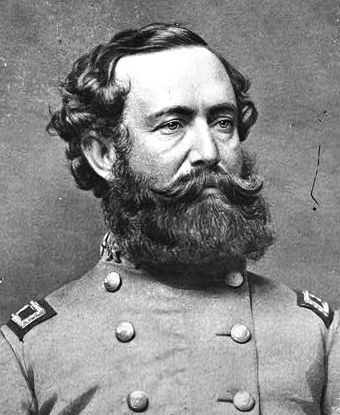
220px-GenJFRenyolds

Friends of Padre Steve’s World

I am continuing to periodically intersperse and publish short articles about various commanders at Gettysburg on the site. These all are drawn from my student text and may become a book in their own right.  The reason is I am going to do this is because I have found that readers are often more drawn to the lives of people than they are events. As I have noted before that people matter, even deeply flawed people, and we can learn from them.

This article deals with Major General John Fulton Reynolds who in large part is responsible for bringing about the Battle of Gettysburg and whose actions on that field in the opening hours of the engagement helped decide the course of the Civil War. This segment does not include the details of that battle, those are reserved for the rest of this chapter which I am currently revising for the student text.

I have come to admire Reynold’s more and more and I hope that in this brief treatment of his life and career leading to Gettysburg that you will be inspired by his single dovotion to the Union and the humanity compassion that he treated the victims of war.

Peace

Padre Steve+

There is much written about the supposed superiority of Robert E. Lee and the generals of the Army of Northern Virginia over those of the Army of the Potomac. Their eventual defeat is often blamed on the Union’s superior manpower and attrition with scant recognition of times where the Union commanders, particularly at Gettysburg out-generaled them. Not only did Harry Heth have the misfortune of battling John Buford and John Reynolds, but division, brigade and regimental leaders who performed their duties magnificently. Despite being greatly outnumbered by the Confederates these men and their soldiers turned back the initial Confederate assaults and shattering Confederate infantry formations.

Likewise if chance plays a role in war, the Army of the Potomac had good fortune smiling upon it that fateful morning of July 1st 1863. Part of that good fortune was having Major General John Fulton Reynolds, one of the finest commanders on either side during the Civil War directing its operations. During the engagement Reynolds, his subordinates and his successor in command Abner Doubleday dealt with the unforeseen elements of this engagement far better than any Confederate General on the battlefield that morning. Reynolds exemplified the indispensable qualities described by Clausewitz regarding commanders who must deal with the role of chance and the unforeseen elements that so often cloud the battlefield:

“first, an intellect that, even in the darkest hour, retains the glimmerings of the inner light which leads to truth; and second, the courage to follow this faint inner light wherever it may lead.” [1]

John Reynolds was a native Pennsylvanian, born in Lancaster to descendants of Irish Protestants. His maternal grandfather, Samuel Moore fought as a Captain in the Continental Line during the American Revolution. Reynold’s father, was a lawyer and moved to Lancaster where he “owned and published the Journal.” The elder Reynolds had served two terms in the Pennsylvania legislature and in the early 1830s was a political ally and friend of Senator and later President James Buchannan for whom “he was attending to local business affairs” in Lancaster. [2] Buchannan helped one of Reynold’s brother William gain an appointment to the Naval Academy and in 1837 obtained the appointment to West Point.

The young Pennsylvanian graduated from West Point in 1841, twenty-sixth in a class of fifty-two and was commissioned as a Brevet Second Lieutenant in the artillery. Among his classmates were the future Union generals Israel Richardson, Don Carlos Buell and Horatio Wright and Confederate generals Richard Garnett and J.M. Jones. Graduating in the class ahead of him was a man who would become a lifelong friend, William Tecumseh Sherman. He graduated at a time of military cutbacks, the Army was about to be reduced from 12,000 to 9,000 the following year. Chances for promotion were so bad, especially from First Lieutenant to Captain, “so unlikely that in a single year 117 officers resigned.” [3] Many of these officers would find their way back to the army but even so, army life did not promise much.

Despite this Reynolds found army life to his liking. He served in Florida during the Seminole War, as well as in Mexico “where he was cited for bravery at Monterey and Buena Vista.” [4] During the campaign in Mexico he served with the army commanded by General Zachary Taylor and in the artillery battery commanded by the future Confederate general, Captain Braxton Bragg. He acquitted himself well and also had compassion for the Mexican soldiers that he fought against. Visiting Mexican wounded who had been left with “little medical care and less food” he gave them money to help with their needs. At Buena Vista a number of senior officers wrote official citations praising the artillery and Reynolds by name. General John Wool wrote

“Without our artillery,” he said, “we could not have maintained our position a single hour,” and also: “…a section of artillery, admirably served by Lieutenant Reynolds, 3rd Arty, played an important part in checking and dispersing the enemy in the rear of our left. They retired before him whenever he approached them.” [5]

Those actions brought him fame and two brevet promotions for bravery, [6] to Captain at Monterrey and Major at Buena Vista. However, Reynolds saw little value in them if the army’s promotion system was not fixed. He wrote his brother Jim “The system is a complete humbug and until it changes I believe it is to be rather more of a distinction to be passed over than to be breveted…that is, amongst us who know facts.” [7]

Reynold’s skill as an artilleryman would be used to great effect on the morning of July 1st 1863 on McPherson’s Ridge at Gettysburg. Following the war he remained in the army predominantly with the artillery. He served in field and coastal batteries and like John Buford had “participated in the Utah Expedition.” [8] The Utah expedition is little known and nearly forgotten incidents in United States history which involved the territory of Utah, and it left a bitter taste in the mouths of many of the officers and soldiers who served in it, including John Reynolds.

The Territory of Utah had been created after the Compromise of 1850 and President Millard Fillmore named Mormon leader Brigham Young as Governor. The Mormons settled Utah after having been driven out of Illinois and Missouri as a result of their religious beliefs which included polygamy and well as the political concept Theodemocracy, which had been formulated by Mormon founder Joseph Smith Jr. Theodemocracy was a concept which is a blend of theocracy and republican principles. Though it largely died out after the replacement of Young as Governor it has many similarities with theology, political ideology and goals of the leaders of the current Christian Dominion concepts of the leaders of what is called The New Apostolic Reformation which has gained much power among the leadership of the current Republican Party.

In Illinois Smith had “founded an autonomous community, with its own militia, where Smith was eventually called “King of the Kingdom of God.” [9] Smith believed that it was a necessary step until a true theocracy could be established. Smith had taught his ruling Council of Fifty, which included a few non-Mormons “that in the initial stages of the millennium the council would participate in concert with men of differing religious and political persuasions” and the earth would still have a pluralism of governments and religions in the early part of those thousand years…” [10] Tensions between Smith, the Mormon community and surrounding communities grew and “eventually, an unruly mob lynched the prophet and one of his followers.” [11]

Two years after the territory was formed Young “declared that Smith had a vision, until then kept secret, reinstituting polygamy.” [12] To be fair, Young did not require this of his followers, but the introduction produced a furor among many Americans. The situation with Utah was complicated further by the actions of Congress which in throwing out the Missouri Compromise that Utah and New Mexico “when admitted as a State or States…shall be received into the Union, with or without slavery, as their constitution may prescribe at the time of their admission.” [13]

The combination of a growing theocracy, the introduction of polygamy and the possibility of slavery brought many tensions. The 1856 convention of the new Republican Party condemned “the twin relics of barbarism” – slavery and polygamy.” Midwesterners who joined that part remembered their clashes with the Mormons and “few voters were sympathetic to the Mormons” [14] or their growing power in the Utah Territory. In 1857 this tension led to President James Buchannan to appoint a non-Mormon Governor for the territory which led to conflict between Young’s government and its militias and the United States. Young considered U.S. Troops to be those of a “foreign power” and prepared for war “insisting as strongly on the independence of his people from Washington as the capital insisted on its jurisdiction over the territory.” [15]

Like many officers and Americans in general, Reynolds had negative views of the Latter Day Saints. Some were gained in his introduction to the territory, where he found that as a “gentile” he was treated as an outsider by the Mormon community. His initial bad disposition was only deepened through his interactions with Governor Brigham Young. The most important of these to Reynolds was an attempt to bring to justice the Indians who had massacred a party of army engineers under the command of Captain Gunnison the previous summer. Reynolds for that the Mormon led government, particularly Governor Young had convicted the Indians of manslaughter and sentenced them to prison for manslaughter. This act angered Reynolds. He wrote his sisters:

“They have been since tried by the Mormons and found guilty of manslaughter, tho’ the proof was positive and clear. But their jury was counseled by Brigham Young as to their verdict and perjured themselves. May God have mercy upon them, they would hang two Indians for killing two Mormon boys last summer when there was scarcely any proof at all, but when a Gentile is murdered it is only manslaughter!! I cannot write the truth about these people here – but will sometime later.” [16]

After Utah Reynolds served in Kansas and briefly in the Pacific Northwest. During that time he developed a dislike for radical abolitionists who he believed were responsible for much of the division of the country.

But with tensions growing in 1860 Reynolds was appointed as Commandant of the Corps of Cadets at West Point. During the interregnum of the election of Abraham Lincoln and his inauguration he “hoped for a moderate course that might avoid war.” [17] However, the Confederate seizure of U.S. facilities and siege of Fort Sumter and the tensions building between Southerners and Northerners at the Academy weighed on Reynolds and soon brought about a break with his family’s longtime political ally and benefactor President James Buchannan. Though normally not outspoken about his political beliefs on thing was sure, he valued the Union and as with the Mormons opposed those who sought to undermine it. He wrote his sister Ellie about his feelings for the President at his administration:

“What will history say of us, our Government, and Mr. B’s Administration makes one wish to disown him….”I have said but little, except among ourselves here, on the present difficulties that surround the Government but a more disgraceful plot, on the part of our friend B’s cabinet and the leading politicians of the South, to break up our Government, without cause, has never blackened the pages of history in any nation’s record.” [18]

However, Reynolds’s harshest and most bitter words were reserved for Jefferson Davis who he had served with in Mexico:

“…Who would have believed that when I came here last September and found Mr. Jeff Davis laboring with a Committee of Congress and civilians to re-organize the Academy; our national school! Whose sons, never until the seeds sown by his parricidal hand had filled it with the poisonous weed of secession, had known any other allegiance than the one to the whole country, or worshipped any other flag, than that which has moved our own youthful hopes and aspirations and under which we marched so proudly in our boyish days – who! I dare say, would have believed, that he was brooding over his systematic plans for disorganizing the whole country. The depth of his treachery has not been plumbed yet, but it will be.” [19]

Reynolds served at the Academy until June of 1861 when it graduated its final class before the war began. Departing West Point he was initially appointed as Lieutenant Colonel of the 14th U.S. Infantry regiment. [20] He would have preferred the artillery but wrote that he “could not refuse this promotion offered me under any circumstances, much less at this time, when the Government has a right to my services in any capacity.” [21] How much different was Reynolds than another politically moderate and illustrious soldier, Robert E. Lee, who barely a month after accepting a promotion to full Colonel in the Regular Army resigned his commission to serve his state of Virginia and the Confederacy rather than lead an army “in an invasion of the Southern States” whatever Virginia decided.” [22]

Before Reynolds could take command of the 14th United States, he was promoted to Brigadier General. He commanded a brigade of Pennsylvania volunteers during the Peninsula Campaign and was captured on June 28th after leading his troops successful at Gaines Mill, as McClellan began his withdraw from the gates of Richmond. He spent six weeks in Confederate captivity but was released in a general prisoner exchange on August 15th 1862. [23] Despite being captured Reynolds’s performance during the Seven Days was praised by friend and foe alike and even his Confederate enemies in the city of Fredericksburg petitioned Richmond to release Reynolds who they said:

“when inasmuch as we were prisoners in the hands of General Reynolds we received from him a treatment distinguished by a marked and considerable respect for our opinions and feelings, it becomes us to use our feeble influence in invoking for him, now a prisoner of our Government as kind and as considerate as was extended by him to us. We would therefore hope that he might be placed on parole…” [24]

In doing so they returned to the Army of the Potomac the man who would help decide the fate of the Confederacy barely ten months later.

Reynolds returned to command a division at Second Bull Run where his division held firm as much of the army retreated. Reynolds missed the battle of Antietam as he was called to “the fruitless and frustrating task of trying to organize Pennsylvania’s militia” [25] by Governor Curtin. He returned to the Army of the Potomac and again commanded First Corps at Fredericksburg and again at Chancellorsville.

Reynolds was reportedly offered command of the Army of the Potomac by Lincoln in early June of 1863 but declined it. He went to the White House when he heard that he was under consideration for the post and ensured that he would not get the job by stating the his conditions for taking it. However, he did “urge the president to appoint Meade in Hooker’s place.” [26] He told his artillery chief Colonel Wainwright that he “refused it because he would have been under the same constraints as Burnside and Hooker.” [27] Colonel Wainwright believed that it was in large part due to “Reynolds’s recommendation that General Meade received his appointment.” [28]

The Army of the Potomac’s senior leadership had been the source of much political consternation during 1862 and 1863 for Abraham Lincoln. It was split among Lincoln’s supporters and detractors, Radical Republican abolitionists and moderate Democrats. To complicate matters some of senior leaders of the Army of the Potomac including McClellan, Hooker and Sickles had their own, scarcely hidden aspirations for the presidency.

However, Reynolds was of a different character than the politically connected and conniving commanders who used their position in the army to advance their career. Reynolds was a moderate Pennsylvania Democrat and prior to the war had been no supporter of Lincoln, once comparing him to a “baboon.” That opinion being noted, Reynolds did not allow his political beliefs and opinions to influence the manner in which he upheld his oath to the nation in time of civil war. Lincoln was President and was attempting to hold the Union together against forces that Reynolds found decidedly treacherous. It was a tribute to Reynold’s personal manner of keeping politics out of his command, which allowed him, a moderate Democrat to successfully command a corps whose divisions “were commanded by some of the Army’s most fervent abolitionists – Abner Doubleday, James S. Wadsworth, and John Cleveland Robinson.” [29]

Reynolds was “a serious unbending professional, who unlike McClellan, actually lived by the principle of “obedience to the powers that be.” [30] The Pennsylvanian was “universally respected” in the army “for his high character and sterling generalship” [31] it was noted that unlike others who so quickly interjected themselves into the political turmoil which had embroiled the nation that Reynolds had a policy of holding back. He stood “stoutly aloof from all personal or partisan quarrels, and keeping guardedly free from any of the heart-burnings and jealousies that did so much to cripple the usefulness and endanger the reputation of many gallant officers.” [32]

Oliver Howard noted that unlike many commanders that Reynolds was a commander “who had a steady hand in governing, were generous to a fault, quick to recognize merit, trusted you and sought to gain your confidence, and, as one would anticipate, were the foremost in battle.” [33] George McClellan noted that Reynolds was “remarkably brave and intelligent, an honest, true gentleman.” [34] In his autobiography Howard wrote about Reynolds:

“From soldiers, cadets, and officers, junior and senior, he always secured reverence for his serious character, respect for his ability, care for his uniform discipline, admiration for his fearlessness, and love for his unfailing generosity.” [35]

On the night of June 30th Reynolds was awash in reports, some of them conflicting and even though he was without Meade’s course of action for the next day “concluded that Lee’s army was close by and in force.” [36] He spent the night at his headquarters “studying the military situation with Howard and keeping in touch with army headquarters.” [37] Howard noted Reynolds anxiety and “received the impression that Reynolds was depressed.” [38] After Howard’s departure Reynolds took the opportunity to get a few hours of fitful sleep before arising again at 4 a.m. on July 1st.

When morning came, Reynolds was awakened by his aide Major William Riddle with Meade’s order to “advance the First and Eleventh Corps to Gettysburg.” [39] Reynolds studied the order and though he expected no battle that morning, expecting “only moving up to be in supporting distance to Buford” [40] took the prudent and reasonable precautions that his Confederate opponents A.P. Hill and Harry Heth refused to take as they prepared to move on Gettysburg.

His troops were in fine spirits that morning even though it had been busy. After a breakfast of hardtack, pork and coffee the troops moved out. An officer of the Iron Brigade noted that the soldiers of that brigade were “all in the highest spirits” while Lieutenant Colonel Rufus Dawes of the “placed the fifes and drums at the head of the Sixth Wisconsin and ordered the colors unfurled” as the proud veterans marched forward into the sound of the raging battle to the tune of “The Campbell’s are Coming.” [41]

Though Reynolds was not expecting a fight he organized his march in a manner that ensured if one did happen that he was fully prepared. The precautionary measures that he took were those that any prudent commander having knowledge that strong enemy forces were nearby would take. Reynolds certainly took to heart the words of Napoleon who said “A General should say to himself many times a day: If the hostile army were to make its appearance in front, on my right, or on my left, what should I do?” [42]

This was a question that A.P. Hill and Harry Heth seemed not to consider on that warm and muggy July morning when Heth was committing Lee’s army to battle on his own authority. Reynolds was also about to commit the Army of the Potomac to battle, but unlike Heth who had no authority to do so, Reynolds “had at least been delegated the authority for making such a decision.” [43] While Meade was unaware of what was transpiring in the hills beyond Gettysburg he implicitly trusted the judgement of Reynolds, and he been with the advanced elements of Reynold’s wing Meade too “probably would have endorsed any decision he made.” [44]

Reynolds placed himself with the lead division, that of Wadsworth, and “had directed Doubleday to bring up the other divisions and guns of the First Corps and had ordered Howard’s Eleventh Corps up from Emmitsburg.” [45] Reynold’s also understood the urgency of the situation and “wanted all the fighting troops to be up front, so he instructed Howard not to intermingle his supply wagons with his infantry. Similar instructions had been given to Abner Doubleday; to ensure that the First Corps wagons would wait until the Eleventh Corps foot soldiers had passed.” [46]

Instead operating in the normal fashion of rotating units on the march, Reynolds opted to save time. Since the First Division under the command of James Wadsworth was further advanced than other I Corps divisions, Reynolds instructed it to move first with Cutler’s brigade in the lead followed by the Iron Brigade under Colonel Solomon Meredith. In doing so he countermanded the order of the acting corps commander Doubleday who had ordered that division to allow the other divisions of First Corps to pass his before advancing. Reynolds told Wadsworth that Doubleday’s order “was a mistake and that I should move on directly.” [47]

He went forward with Wadsworth’s division and gave Doubleday his orders for the coming engagement. Doubleday later recalled that when Reynolds arrived to discuss the situation that Reynolds:

“read to me the various dispatches he had received from Meade and Buford, and told me that he should go at once forward with the leading division – that of Wadsworth – to aid the cavalry. He then instructed me to draw in my pickets, assemble the artillery and the remainder of the corps and join him as soon as possible. Having given me these orders, he rode off at the head of the column, and I never saw him again.” [48]

Reynolds ordered Howard’s XI Corps to follow and according to Doubleday directed an aid of Howard to have Howard “bring his corps forward at once and form them on Cemetery Hill as a reserve.” [49] While some writers that he directed Oliver Howard to prepare Cemetery Hill as a fallback position [50] there is more evidence that points to Howard selecting the that commanding hill himself. [51]

Likewise Reynolds ordered Sickles’ III Corps to come up from Emmitsburg where that corps had bivouacked the previous night. [52] Sickles had heard the guns in the distance that morning and sent his senior aide, Major Henry Tremain to find Reynolds. Reynolds told Tremain “Tell General Sickles I think he had better come up” but the order left Sickles in a quandary. He recalled “he spend an anxious hour deciding what to do” [53] for he had “been ordered by Meade to hold his position at Emmitsburg” [54] and Sickles sent another rider to Reynolds and awaited the response of his wing commander instead of immediately advancing to battle on 1 July and it would not be until after 3 P.M. that he would send his lead division to Gettysburg.

Reynolds’ intention according to Doubleday was “to fight the enemy as soon as I could meet him.” [55] Reynolds rode forward with some of his staff into the town as the infantry of I Corps and XI Corps moved advanced. In the town they were met by “a fleeing, badly frightened civilian, who gasped out the news that the cavalry was in a fight.” [56] When he came to the Lutheran Seminary he came across Buford. It was a defining moment of the Civil War, a moment that shaped the battle to come. It has been recounted many times and immortalized on screen in the movie Gettysburg, a time “when the entire battle would come down to a matter of minutes getting one place to another.” [57]

As the rough and tumble Kentuckian, Buford, and Reynolds, the dashing Pennsylvanian, discussed the situation they had to know that odd that they were facing. With close to 32,000 rebels from the four divisions of Hill’s and Ewell’s corps closing in from the west and the north with only about 18,000 men of First Corps, Eleventh Corps and Buford’s cavalry division the odds did not favor them, but unlike other battles that the army of the Potomac faced, this time the army and its commanders were determined not to lose and not to retreat.

Reynolds and Buford committed their eighteen thousand men against Lee’s thirty-two thousand in a meeting engagement that develop into a battle that would decide the outcome of Lee’s invasion. Likewise it was a battle for the very existence of the Union. Abner Doubleday noted the incontestable and eternal significance of the encounter to which Buford and Reynolds were committing the Army of the Potomac:

“The two armies about to contest on the perilous ridges of Gettysburg the possession of the Northern States, and the ultimate triumph of freedom or slavery….” [58]

Notes

[1] Ibid. Clausewitz On War p.102

[2] Nichols, Edward J. Toward Gettysburg: A Biography of John Fulton Reynolds Pennsylvania State University Press, Philadelphia 1958. Reprinted by Old Soldier Books, Gaithersburg MD 1987 p.4

[3] Ibid. Nichols Toward Gettysburg p.13

[4] Tagg, Larry The Generals of Gettysburg: The Leaders of America’s Greatest Battle Da Capo Press Cambridge MA 1998 Amazon Kindle Edition p.10

[5] Ibid. Nichols Toward Gettysburg pp.43-44

[6] Pfanz Harry W. Gettysburg: The First Day University of North Carolina Press, Chapel Hill and London 2001pp.47-48

[7] Ibid. Nichols Toward Gettysburg p.46

[8] Ibid. Pfanz Gettysburg: The First Day p.48

[9] Gonzalez, Justo L. The History of Christianity Volume 2: The Reformation to the Present Day Harper and Row Publishers San Francisco 1985 p.259

[10] Ehat, Andrew” It Seems Like Heaven Began on Earth”: Joseph Smith and the Constitution of the Kingdom of God in BYU Studies Vol 20. No 3 1980) retrieved from https://ojs.lib.byu.edu/spc/index.php/BYUStudies/article/view/5144/4794 20 May 2015 p.258

[11] Ibid. Gonzales p.259

[12] Ibid. Gonzales p.259

[13] Potter, David M. The Impending Crisis: America before the Civil War 1848-1861 completed and edited by Don E. Fehrenbacher Harper Collins Publishers, New York 1976 p.158

[14] Goldfield, David. America Aflame: How the Civil War Created a Nation Bloomsbury Press, New York 2011 p.122

[15] Ibid. Nichols Toward Gettysburg p.58

[16] Ibid. Nichols Toward Gettysburg p.58

[17] Ibid. Nichols Toward Gettysburg p.73

[18] Ibid. Nichols Toward Gettysburg p.73

[19] Ibid. Nichols Toward Gettysburg p.73

[20] Ibid. Pfanz Gettysburg: The First Day p.48

[21] Ibid. Nichols Toward Gettysburg p.75

[22] Korda, Michael. Clouds of Glory: The Life and Legend of Robert E. Lee Harper Collins Publishers, New York 2014 p.228


[23] Foote, Shelby, The Civil War, A Narrative. Volume One Fort Sumter to Perryville Random House, New York 1958 p.493

[24] Ibid. Nichols Toward Gettysburg p.100

[25] Ibid. Pfanz Gettysburg: The First Day p.48

[26] Sears, Stephen W. Controversies and Commanders Mariner Books, Houghton-Mifflin Company, Boston and New York 1999 p.162

[27] Sears, Stephen W. Gettysburg. Houghton Mifflin Co. Boston and New York 2003 pp. 40-42

[28] Nevins. Allan editor. A Diary of Battle: The Personal Journals of Colonel Charles Wainwright 1861-1865 with an introduction by Stephen W. Sears Da Capo Press, New York 1998 p.229

[29] Guelzo, Allen C. Gettysburg: The Last Invasion Vintage Books a Division of Random House, New York 2013 p.30

[30] Ibid. Guelzo Gettysburg: The Last Invasion pp.29-30

[31] Ibid. Sears, Gettysburg. p. 34

[32] Ibid. Guelzo, Gettysburg: The Last Invasion p.30

[33] Howard, Oliver O. Autobiography of Oliver Otis Howard, Major General, U.S. Army Volume 1 The Baker and Taylor Company, New York 1907 Made available by the Internet Achieve through Amazon Kindle location 5908 of 9221

[34] Wert, Jeffry D. The Sword of Lincoln: The Army of the Potomac Simon and Schuster, New York and London 2005 p.101

[35] Ibid. Howard Autobiography of Oliver Otis Howard location 5908 of 9221

[36] Ibid. Pfanz Gettysburg: The First Day p.48

[37] Ibid. Coddington The Gettysburg Campaign: A Study in Command p.261

[38] Ibid. Pfanz Gettysburg: The First Day p.48

[39] Ibid. Coddington The Gettysburg Campaign: A Study in Command, p.261

[40] Ibid. Sears, Gettysburg. p. 158

[41] Nolan, Alan T. The Iron Brigade: A Military History Indiana University Press, Bloomington IN, 1961 and 1994 pp.233-234

[42] Napoleon Bonaparte, Military Maxims of Napoleon in Roots of Strategy: The Five Greatest Military Classics of All Time edited by Phillips, Thomas R Stackpole Books Mechanicsburg PA 1985 p.410

[43] Ibid. Sears, Gettysburg. p. 165

[44] Ibid. Pfanz Gettysburg: The First Day p.49

[45] Ibid. Nolan The Iron Brigade p.233

[46] Trudeau, Noah Andre. Gettysburg: A Testing of Courage, Harper Collins Publishers, New York 2002 p.159

[47] Ibid. Trudeau, Gettysburg: A Testing of Courage p.156

[48] Doubleday, Abner Chancellorsville and Gettysburg: Campaigns of the Civil War VI Charles Scribner’s Sons, Bew York 1882 pp.70-71

[49] Ibid. Doubleday Chancellorsville and Gettysburg p.71

[50] Ibid. Pfanz Gettysburg: The First Day p.76

[51] Green, A. Wilson. From Chancellorsville to Gettysburg: O. O. Howard and Eleventh Corps Leadership in The First Day at Gettysburg edited by Gallagher, Gary W. Kent State University Press, Kent Ohio 1992 p. 70

[52] Ibid. Sears, Gettysburg. p. 158

[53] Keneally, Thomas American Scoundrel: The Life of the Notorious Civil war General Dan Sickles Anchor Books, a Division of Random House, New York 2003 p.275

[54] Swanberg, W.A. Sickles the Incredible Copyright by the author 1958 and 1984 Stan Clark Military Books, Gettysburg PA 1991 p.202

[55] Ibid. Trudeau, Gettysburg: A Testing of Courage p.156

[56] Ibid. Sears, Gettysburg. p. 165

[57] Ibid. Guelzo, Gettysburg: The Last Invasion p.142

[58] Ibid. Doubleday Chancellorsville and Gettysburg p.68


Leave a comment

Filed under civil war, History, leadership, Military

Armed Forces Day 2015: The Breach of Trust

2015AFDPoster

“What is the cost of war? what is the bill?…“This bill renders a horrible accounting. Newly placed gravestones. Mangled bodies. Shattered minds. Broken hearts and homes. Economic instability. Depression and all of its attendant miseries. Back -breaking taxation for generations and generations. For a great many years as a soldier I had a suspicion that war was a racket; not only until I retired to civilian life did I fully realize it….” Major General Smedley Butler USMC

Today is Armed Forces Day and unfortunately most of the country will not notice unless they are attending a Baseball game where it is being observed or some special event on a base, national cemetery, monument or VFW hall. Armed Forces Day was established in 1948 by President Harry Truman after the founding of the Department of Defense.  It was established to honor and remember those currently serving, not the discharged or the retired veteran, they are remembered on Veterans Day, the former Armistice Day, nor the fallen who are commemorated on Memorial Day which we will do next weekend. 

Unlike Veterans Day or Memorial Day there is no national holiday for Armed Forces Day. I find this ironic for a nation which claims to support the troops that the men and women who we honor are honored on a day that unless they are deployed in harm’s way or have duty, is regular day off like any Saturday. Personally I think the day should be celebrated by giving the active duty force a real day off and if they are deployed given some kind of down time as operational needs allow, and maybe even given them a ration of beer. We did this for the Marine Corps birthday in Iraq, so why not on Armed Forces Day? But I digress…

Back when Armed Forces Day was established there was still a draft which meant that in theory everyone had skin in the game and that our leaders were far more hesitant to commit the nation to war. 

Back in 1952 the New York Times editors wrote:

“It is our most earnest hope that those who are in positions of peril, that those who have made exceptional sacrifices, yes, and those who are afflicted with plain drudgery and boredom, may somehow know that we hold them in exceptional esteem. Perhaps if we are a little more conscious of our debt of honored affection they may be a little more aware of how much we think of them.”

But sadly today in all honesty were think very little of them. Today of course there will be a fair number of local celebrations to honor members of the Armed Forces across the country, but for the most part they will be small and not well publicized. Most of the people I attendance will not even be there for the troops. They will be there for the event and their hearts will be warmed by the tributes paid to the troops. As a career officer and son of a Vietnam veteran Navy Chief I appreciate those events and at least some of the good hearted the people that put them together. Being a veteran of Operation Iraqi Freedom and Operation Enduring Freedom, especially those that have taken the time to honor Iraq and Afghanistan veterans like me who have returned from war totally fucked up. But again I digress, badda bing, badda boom, badda bomb…

Bu here is what really s upsetting to me, good number of these patriot, flag waving, war porn satiating, yet somehow inspiring ceremonies to honor the troops are not even coming for the heart of the people putting them on. I steady they are coming out of the Pentegon budget and being paid for by the taxpayers. These events are nothing more than faux patriotism and little more than propaganda that exploits the troops. They are being done as a recruiting tool with the Department of Defense which is paying hundreds of millions of dollars to the tax exempt National Football League and its teams to put on shows that give all the appearances of honoring the troops but are really nothing more than propaganda and recruiting commercials. Likewise for all which for all the money we the taxpayers spend on them actually net few recruits if any as a huge number of our current troops are the sons and daughters of men and women who have also served this country. They, like I do, do this for something greater than partisan politics  greater than money, greater than anything that can easily be repaid, the love of this country and the principles found in the Declaration of Independence, that all men are created equal. However, that is fodder for another article. 

But honestly I am so offended by this faux  patriotism shown by the NFL and God knows who else that it causes me a great deal of anger. I say this because throughout our nation’s history our political leaders, business leaders and the populace as a whole have despised the military, and those who in the absence of a draft chose to serve. That despicable attitude was well recounted in Herman Wouk’s monumental novel, which became a classic film The Caine Mutiny. In the film a defense attorney for those accused of mutiny, Barney Greenwald played to perfection by Jose Ferrer told the acquitted mutineers of the Caine’s wardroom:

“You know something…when I was studying law, and Mr Keefer here was writing his stories, and you, Willie, were tearing up the playing fields of dear old Princeton,method was standing guard over this fat dumb happy country of ours, eh? Not us. Oh no, we knew you couldn’t make any money in the service. So who did the dirty work for us? Queeg did! And a lot of other guys. Tough, sharp guys who didn’t crack up like Queeg.” 

For those who are now getting pissed off at me, let us look at facts. At any given time less than 1% of Americans are serving in all components of the military. For over 13 years we have been at war in Afghanistan and Iraq as well as other locations that we don’t like to talk about too much. However this has not been the effort of a nation at war, it is the war of a tiny percentage of the population, a segment that everyone is far too willing to exploit. 

As a nation we are disconnected from the military and the wars that the military fights. The fact is that most Americans do not have a personal or vested interest in these wars, they have been insulated by political leaders of both parties from them. There is no draft, and no taxes were raised to fund the wars and the military is now worn out.

We have been at war for nearly 14 years and truthfully there is no end in sight. In that time every single Soldier, Sailor, Marine and Airman volunteered for duty or reenlisted during this time period. Motives may have varied from individual to individual, but unlike the World Wars, Korea and Vietnam every single one volunteered to serve in time of war. I think that this makes the current generation of veterans quite unique in our modern history, but not so different than the professionals who served before and after the Civil War,and  those who served before and after the First World War. The situation after the Second Wolrd War and the Cold War required a large standing military and large reserve force. This required the draft, which though hated by many  leavened the professional force with civilians who got a taste of military and when they left did not forget they meaning of their service and the sacrifices made by the professionals. We do not have that anymore. We are no longer are no longer a military composed of citizen soldiers. We who serve,  even in our reserve components are  a Warrior caste, set apart from the society that we serve.

There is a tragic disconnection between the military and civilian society in the United States. This is the result of deliberate public policy since the end of the Vietnam War supported by both political parties. For almost 40 years we have relied on an all volunteer force. It is that relatively small and socially isolated military which is sent to fight wars while the bulk of the population is uninvolved and corporations, lobbyists and think tanks get rich.

Andrew Bacevich wrote in his new book Breach of Trust: How Americans failed their Soldiers and their Country:

“Rather than offering an antidote to problems, the military system centered on the all-volunteer force bred and exacerbated them. It underwrote recklessness in the formulation of policy and thereby resulted in needless, costly, and ill-managed wars. At home, the perpetuation of this system violated simple standards of fairness and undermined authentic democratic practice. The way a nation wages war—the role allotted to the people in defending the country and the purposes for which it fights—testifies to the actual character of its political system. Designed to serve as an instrument of global interventionism (or imperial policing), America’s professional army has proven to be astonishingly durable, if also astonishingly expensive. Yet when dispatched to Iraq and Afghanistan, it has proven incapable of winning. With victory beyond reach, the ostensible imperatives of U.S. security have consigned the nation’s warrior elite to something akin to perpetual war.”

Bacevich, a retired Army Colonel and Vietnam veteran who lost a son in Iraq is dead on, as is Rachel Maddow who wrote in her outstanding book Drift: The Unmooring of American Military Power:

“The reason the founders chafed at the idea of an American standing army and vested the power of war making in the cumbersome legislature was not to disadvantage us against future enemies, but to disincline us toward war as a general matter… With citizen-soldiers, with the certainty of a vigorous political debate over the use of a military subject to politicians’ control, the idea was for us to feel it- uncomfortably- every second we were at war. But after a generation or two of shedding the deliberate political encumbrances to war that they left us… war making has become almost an autonomous function of the American state. It never stops.” 

The lobbyists, pundits, politicians, preachers and war profiteers that promote war don’t care about the troops. When they say they do they are lying out their asses. This is because no matter who is in office or who controls congress these people and corporations will promote policies that keep them employed and their businesses enriched. Marine Major General and Medal of Honor winner Smedley Butler was quite right when he said:

“War is a racket. It always has been. It is possibly the oldest, easily the most, surely the most vicious. It is the only one international in scope. It is the only one in which the profits are reckoned in dollars and the losses in lives. A racket is best described, I believe, as something that is not what it seems to the majority of the people. Only a small ‘inside’ group knows what it is about. It is conducted for the benefit of the very few, at the expense of the very many. Out of war a few people make huge fortunes.”

I think that the reason that our current wars have gone on so long is the that misguided policies have brought about a chronic disconnection in our society between those that serve in the military. But how can there not be when in the weeks after 9-11 people like President Bush and others either directly or in a manner of speaking told people to “go shopping” * as we went to war in Afghanistan? When I returned from Iraq I returned to a nation that was not at war whose leaders used the war to buttress their respective political bases.

The results are terrible. Suicide rates are continuing to rise among veterans who have returned to find that neither the VA nor the civilian mental health care sector is prepared to care for them. Even worse the members of the GOP controlled Congress are working their asses off to screw the troops. Ohio GOP Congressman, Tea Party favorite,  supposedly deeply committed Christian and even worse a Colonel in the Ohio Army National Guard has attempted and is attempting again to attach an Ammendment to the 2016 Nation Defense Authorization Act which would keep the Defense Department from enformice rules which would protect young troops from the predatory payday lenders who line the avenues leading to every major military base in the country. My opinion, this man is a traitor to the country even though he wears the uniform and has deployed and led soldiers in in Iraq and other locations during this war. He is selling out the the young troops to protect the payday lending industry with which has had a nearly incestuous relationship since he day that was elected to Congress. 

But Congressman Stivers is not alone, Congressmen and women of both parties sell out the troops to prop up banks, insurance companies and Wall Street. Those military health benefits not directly provided in military medical centers are run through an organization called Tricare. Tricare, which is managed by the insurance companies who bid on competitive contracts is a for profit industry. These insurance companies routinely deny services to the families of military members, pay so little or are so mind numbingly  incompetent that many medical providers refuse to deal with them, leaving the troops their families stuck in the middle. That my friends is fact. Now the GOP led by the Koch brothers is attempting to privatize Veterans Admisistration Heath care. Now in all honesty, the chronically underfunded and bureaucratically bound VA. That being said my friends privatization will only make things worse for veterans who will now have to deal with private for profit insurance companies and Heath care systems that see them and their wounds and infirmaries as a way to make a buck off of taxpayer and to screw the veteran. 

But let’s not stop there. Politicians and their backers from the financial sectors have been working overtime since the Adminstration of George W. Bush to roll back retirement benefits which they call  “entitlements” which are supposedly destroying the financial health and well being of the nation. Never mind the fact that these same  politicians have spent trillions of dollars bailing out the corporations which have almost single handed lay destroyed this nation’s economy time after time since the 1970s, and who support corporations who are based in this country but have sold the nation out and work against the interests of Americans. 

But never mind, I digress, for as we all know it is the troops who are the leches who are bankrupting the country. 

But this isn’t new my friends it began during the Reagan Administration which changed the retirement system from the flat 50% of one’s final active duty pay that one would retire with at 20 years of service or high multiples up to 75% at 30 years to an average of the last three, or the highest three years of pay that one earned while on active duty.  In effect the Reagan Adminstration robbed military retest of hundreds of thousand of dollars of hard earned benefits. But again the beloved Saint Ronald loved the troops, after all he said so. 

Likewise, did you know that some GOP legislators want to cut the disability payments to military members who have been wounded or injured during their service?  You probably didn’t and you won’t find that fact out on Fox News or CNN. This is not to be confused with the retirement benefits that they are looking to cut.  This my friends is the debt of honor  that this nation owes to the men and women who have given everything and now are broken in body, mind and spirit. But then those who promote such policies, even those who have worn the uniform like Congressman Stivers have no honor. Like those that sold out the Union veterans after the Civil War and the Doughboys after World War One they are much more indebted to their political benefactors than they are to te troops no matter what they say. 

Now I do believe 

Armed Forces Day should be better celebrated and I am grateful to the people that do things every day to thank and support military personnel. These wonderful people that do this come from across the political spectrum. Some are veterans and others non-veterans. But they care for and appreciate the men and women that serve in and fight the wars that no-one else can be bothered to fight.

481801_10151367001287059_1003164983_n

Of course the politicians, pundits, preachers and the defense contractors, banks and lobbyists will find a way to profit. They will do so no matter how many more troops are killed, wounded or injured and how badly it affects military personnel or their families and will push to abandon those who fought as they do after every war. After all, to quote Smedley Butler, “war is a racket.”  So fuck them all, and if there is a just God and there is a Hell, I hope that they end up there, especially the preachers who tomorrow will invite the troops to their churches to supposedly honor them even as they support the politicians whose policies damn the very troops that they honor tomorrow. 

Peace

Padre Steve+

President Bush’s actually words were “Now, the American people have got to go about their business. We cannot let the terrorists achieve the objective of frightening our nation to the point where we don’t — where we don’t conduct business, where people don’t shop…” http://georgewbush-whitehouse.archives.gov/news/releases/2001/10/20011011-7.html

Leave a comment

Filed under History, iraq,afghanistan, Military

Friday Interuptions 

 
Friends of Padre Steve’s World

Interruptions are the spice of life. Carl Von Clausewitz talked about war being “the province of chance” and of course that can be a metaphor for life.  Shit happens and even the best laid plans of mice and men get way layer and mangled. Old dead Carl wrote that “chance makes everything more uncertain and interferes with the whole course of events” and that my friends has been my week so far. 

Of course as you know we lost our oldest and best furry child Molly on Monday which hit us hard. There is something else which I cannot say much about right now that is a source of concern for us, and then this morning as I wow working away we lost power at the staff college when a transformer blew. That interrupted work on my latest Gettysburg chapter revision and has forced a retirement ceremony for my friend Commander Lisa Rose to be moved outside. 

Lisa’s retirement ceremony will be special. Lisa is a great nurse who I worked with at Naval Medical Center Portsmouth back in 2008-2010. Back then while I was struggling with faith and life while working 80 to 100 hours a week, mostly in the ICU, Lisa who was Nurse Manager for our Inpatient Oncology Unit would put her arm around me and tell me to go home. Lisa is a tremendous Christian who lives her faith in a real and powerful way. She had to live most of her military life wondering if someone was going to try to get her kicked out of the Navy during the days of Don’t Ask Don’t Tell edict, something that gave a modicum of protection for Gay and Lesbian service members but did not protect them from the witch hunts of those who hate them. As such Lisa was not able to have her wife Karen attend functions that most of us consider routine for families to attend. Today was special because not only is Lisa a friend, but like the rest of us her wife was finally able to be honored like other military spouses who devote so much of their lives to their spouse’s careers. That meant a lot to me and it is an honor to be a part of her ceremony. I’m sure I will shed some tears today. 

After the ceremony I will likely be heading home for the day, unless power comes back. We have already dismissed our students and because to much of what we do is dependent on technology there is almost nothing I can do. 

Since I was bored I got on Facebook and tweaked some preachy preacher’s post on a friend’s page, sending him into a theological rage which has given me much ammo for a future blog post. The guy got so spun up so I tweaked him more and he just didn’t get the irony, or the humor of what I was doing. But sadly that is the base line for religious extremists of any persuasion. They cannot deal with history, humanity, or life, so they spend their lives building theological fortresses that make in impossible for the undesirables to enter and from which the cast aspersions and condemnation on all that disagree with them. But I digress…

So, that said it is time to get suited up and get ready for the ceremony and probably an early beer. As we know, beer is good, and as Oscar Wilde said “work is the curse of the drinking classes.” 

Let the games begin.

Peace

Padre Steve+

3 Comments

Filed under faith, History, Just for fun, Military, Religion

The Most Scientific and Resourceful of All: General Edward Porter Alexander

alexander

Friends of Padre Steve’s World

I am getting ready to conclude my latest Gettysburg Staff Ride with my students from the Staff College. It has been a fantastic experience again. Right now I am getting ready to turn in for the night after having dinner and drinks with my students. In the morning we will be walking the ground of Pickett’s Charge before heading to General Meade’s headquarters and the Soldier’s Cemetary where President Abraham Lincoln delivered the Gettysburg Address.

As part of what I have been doing on the site I have been periodically interspersing and publishing short articles about various commanders at Gettysburg. I did one on The Union cavalry commander, John Buford yesterday. 

These articles are all are drawn from my student text and will likely become a book in their own right when I finish the chapter on the Union commanders.  The reason is I am going to do this is because I have found that readers are often more drawn to the lives of people than they are events. As I have noted before that people matter, even deeply flawed people, and we can learn from them. Sometimes good and even honorable people serve malignant causes, while bad or even wicked people support good causes, usually for selfish reasons, but that is the constant quandary that human beings find themselves.

Today’s article is about Confederate General Edward Porter Alexander. Alexander directed the Confederate artillery during Pickett’s Charge and because he was not a terribly high ranking officer is comparatively little known.

However, Alexander is another interesting character. He was one of the most gifted and brilliant artillery commanders of the war and after the war went on to serve the country with distinction after following his re-integration back into the ranks of American citizens.

Alexander wrote a narrative of the war that is considered by historians to be one of the best and most objective accounts written by any Confederate. However, he was very much a military man and never fully grasped the political and ideological nature of the war, not the profound social effects of the Union victory. I hope you enjoy. Until tomorrow. 

Peace

Padre Steve+ 

Though he was only a Colonel commanding an artillery battalion in Longstreet’s First Corps at Gettysburg, Edward Porter Alexander needs to be mentioned in this text because during the battle he assumed tactical command of the largest concentration of Confederate artillery during the entire war. Likewise his contributions to the writing history of the war are incredibly important and provide some of the most balanced views of the war written by any participant on the Confederate side.

Alexander was born in Washington Georgia in 1835. He attended West Point and graduated third in his class in 1857. One of his classmates was Marcus Reno who was second in command of the ill-fated fight of Custer’s 7th Cavalry at Little Big Horn.

Alexander was commissioned in the Corps of Engineers and served as an instructor at West Point. He realized after the John Brown raid that if war came he would fight for the Confederacy. He was married to Bettie Mason in April 1860 and was thereafter assigned to duty at Fort Steilacoom, Washington. He wrestled with his the decision to leave the army, his father was one of the Georgia legislators who voted for secession and like many Southern officers he decided to resign. He wrote about Lincoln, “If he is elected I believe that in the interests of humanity, civilization, and self-preservation call on the South to secede, I’ll go my arm, leg, or death on it.” [1]

His commander Major James McPherson who later had a prominent part in Sherman’s campaigns attempted to talk Alexander into remaining in the army on the west coast, but Alexander refused. McPherson graciously allowed Alexander and his bride to return to the East in a leave status. Bettie too was “upset by this decision and seriously questioned whether other alternatives were possible.” [2] But Alexander saw no other option. McPherson graciously allowed Alexander and his bride to return to the East in a leave status. When he got back to the South he resigned his commission after the election of Lincoln and on July 2nd 1861 Captain Alexander reported for duty at Manassas as an artillery officer. The professional artillerymen believed that Alexander “was the most scientific and resourceful of all.” [3]

Promotion came at regular intervals for Alexander. Initially he served as Beauregard’s Signals officer, and was appointed as the Chief of Ordnance for the Army of Northern Virginia, with the rank of Lieutenant Colonel. He was made an artillery battalion commander after Antietam, and at Fredericksburg his battalion was in the thick of the fighting along Marye’s Heights. With each new battle Lee and Longstreet “had come to rely increasingly on Alexander’s eager intelligence, regularly assigning him duties more properly those of Col. James Walton, Longstreet’s nominal chief of artillery, or even Brig. Gen, William N. Pendleton, the artillery chief of the Army of Northern Virginia.” [4] So trusted was he that he “had nearly a free hand in organizing the Fredericksburg defenses” [5] and his work was instrumental in turning back the Army of the Potomac in its bloody repulse.

During the winter of 1862-63 Alexander worked with Pendleton and Colonel Stapleton Crutchfield to reorganize the artillery in February 1863. He and his battalion were in the thick of the fighting at Chancellorsville where he also assumed command of Second Corps artillery when Crutchfield was wounded. [6] He was promoted to Colonel prior to Gettysburg and then Brigadier General of Artillery in February 1864. He was in the action in the Wilderness campaign and at Petersburg where he was badly wounded.

After recovering he rejoined the army and was present at the surrender at Appomattox where in the hours before the surrender he advocated beginning a guerrilla campaign in order to continue the war. This Lee was unwilling to do and Lee reminded Alexander and the other officers present that such was not an honorable course of action. Lee told Alexander:

“We have simply now to face the fact that the Confederacy has failed. And as Christian men, Gen. Alexander, you & I have no right to think for one moment of our personal feelings or affairs. We must consider only the effect which our action will have upon the country at large.” [7]

After Lee’s monologue Alexander later wrote “I was so ashamed of having proposed such a foolish and wild cat scheme that I felt like begging him to forget he had ever heard it.” [8] When Alexander saw the gracious terms of the surrender he was particularly impressed with how non-vindictive the terms were, especially in terms of parole and amnesty for the surrendered soldiers.

Sadly, Alexander really did not have any political vision or understanding of the meaning of the war. When asked about his “Confederate allegiance, Alexander had a straightforward explanation. “We didn’t go into our cause,” he said; “we were born into it.” [9] This is something that men like Virginian George Thomas who remained loyal to the Union would have certainly contested. Thomas’s loyalty resulted in him being rejected and disowned by his family during and after the war.

Alexander adjusted to peace and went into railroads, becoming highly successful railroad president as well as one of the more circumspect of the Confederate officers who wrote histories of the Civil War. His book Military Memoirs of a Confederate published in 1907 infuriated many associated with the myth of the lost cause for he dared to criticize the generalship of both Lee and Jackson. However, the book gained the praise of many reviewers for Alexander’s objectivity. The Nation wrote of it “No preceding book by a Southern officer surpasses this in good temper wise discrimination and graphic portrayal.” But the review also noted that Alexander “all but ignored social issues and barely touched on the merits and questions in dispute.” [10] A reviewer in the American Historical Review wrote: “He criticizes alike Confederate friend and Federal foe, the justice for which, in some cases, may be disputed, but the good temper showed must be conceded.” [11]

Alexander became a close friend of President Grover Cleveland and the President, recognizing Alexander’s talent sent him to “be the U.S. boundary arbitrator between Nicaragua and Costa Rica; a job that needed to be done prior to going ahead with plans for building the Panama Canal.” [12] As in nearly everything he did he was successful, but the cost was great. Bettie was experiencing severe health problems and died a month after he returned in 1899. He remarried in 1901 but his health continued to decline. He suffered a series of strokes, and he died in 1910 in Savannah.

Notes

[1] Golay, Michael To Gettysburg and Beyond: The Parallel Lives of Joshua Lawrence Chamberlain and Edward Porter Alexander Crown Publishers, New York 1994 p.74

[2] Ibid. Wilson and Clair They Also Served p.116

[3] Ibid. Freeman Lee p.44

[4] Ibid. Golay To Gettysburg and Beyond p.109

[5] Ibid. Golay To Gettysburg and Beyond p.109

[6] Ibid. Freeman Lee p.486

[7] Alexander, Edward Porter. Fighting for the Confederacy: The Personal Recollections of General Edward Porter Alexander edited by Gary Gallagher University of North Carolina Press, Chapel Hill 1989 p.532

[8] Ibid. Golay To Gettysburg and Beyond p.262

[9] Ibid. Golay To Gettysburg and Beyond p.vii

[10] Ibid. Golay To Gettysburg and Beyond p.329

[11] Ibid. Golay To Gettysburg and Beyond p.329

[12] Ibid. Wilson and Clair They Also Served p.117

Leave a comment

Filed under civil war, Gettysburg, History, leadership, Military

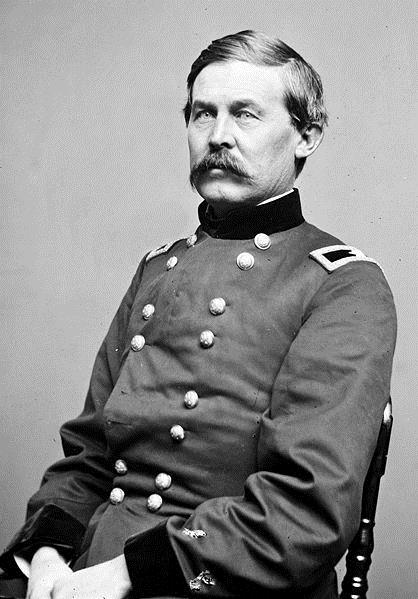
The Best Cavalry General We Had: John Buford


Friends of Padre Steve’s World

I am at Gettysburg this weekend leading my students on our spring “staff ride.” Since the morning begins with the delaying action fought by General John Buford’s Union cavalry I have included one of my short biographic articles about the leaders who fought at Gettysburg, this one about an amazing patriot and military leader who when push came to shove remained loyal to the Union, and whose military abilities as a modern leader were unmatched in his day. 

I hope you enjoy this little piece about a most amazing man. 

Peace

Padre Steve+

buford

“He was decidedly the best cavalry general we had, and was acknowledged as such in the army, though being no friend to newspaper reporters…In many respects he resembled Reynolds, being rough in the exterior, never looking after his own comfort, untiring on the march and in the supervision of all the militia in his command, quiet and unassuming in his manners.” Colonel Charles Wainwright on Buford (Diary of Battle, p.309)

John Buford was born in Kentucky and came from a family with a long military history of military service, including family members who had fought in the Revolutionary War and War of 1812. In fact according to some the family military pedigree reaches back to England’s War of the Roses.

Buford’s family was well off with a spacious plantation near Versailles on which labored forty-five slaves, and his father also established a stage line which carried “passengers and freight between Frankfort and Lexington.” His father divested himself of his property, selling his home, business and slaves and moved to Stephenson Illinois in 1838. [1] The young Buford developed an interest in military life which was enlivened by his half-brother Napoleon Bonaparte Buford who graduated from West Point in 1827, and his brother would be influential in helping John into West Point, which he entered in 1844.

Buford graduated with the class of 1848 which included the distinguished Union artilleryman John Tidball, and the future Confederate brigadier generals “Grumble Jones and “Maryland” Steuart. Among his best friends was Ambrose Burnside of the class of 1847. He did well academically but his conduct marks kept him from graduating in the top quarter of his class.

Upon graduation he was commissioned as a Brevet Second Lieutenant of Dragoons, however too late to serve in Mexico. Instead he was initially assigned to the First United States Dragoons but less than six months after joining was transferred to the Second Dragoons when he was promoted to full Second Lieutenant.

Instead of going to Mexico Buford “spent most of the 1850s tracking and fighting Indians on the Plains.” [2] During this period, the young dragoon served on the Great Plains against the Sioux, where he distinguished himself at the Battle of Ash Creek and on peacekeeping duty in the bitterly divided State of Kansas and in the Utah War of 1858.

His assignments alternated between field and staff assignments and he gained a great deal of tactical and administrative expertise that would serve him well. This was especially true in the realm of the tactics that he would employ so well at Gettysburg and on other battlefields against Confederate infantry and cavalry during the Civil War. Buford took note of the prevailing tactics of the day which still stressed a rigid adherence to outdated Napoleonic tactics which stressed mounted charges and “little cooperation with units of other arms or in the taking and holding of disputed ground.” [3] While he appreciated the shock value of mounted charges against disorganized troops he had no prejudice against “fighting dismounted when the circumstances of the case called for or seemed to justify it.” [4] Buford’s pre-war experience turned him into a modern soldier who appreciated and employed the rapid advances in weaponry, including the repeating rifle with tremendous effect.

Despite moving to Illinois Buford’s family still held Southern sympathies; his father was a Democrat who had opposed Abraham Lincoln. Buford himself was a political moderate and though he had some sympathy for slave owners:

“he despised lawlessness in any form – especially that directed against federal institutions, which he saw as the bulwark of democracy…..He especially abhorred the outspoken belief of some pro-slavery men that the federal government was their sworn enemy.” [5]

After the election of Abraham Lincoln, the officers of Buford’s regiment split on slavery. His regimental commander, Colonel Philip St. George Cooke, a Virginian and the father-in-law of J.E.B. Stewart announced that he would remain loyal to the Union, others like Beverly Robertson who would command a brigade of cavalry during the Gettysburg campaign resigned their commissions.

For many officers, both those who remained loyal to the Union and those who joined the Confederate cause the decision was often difficult, and many anguished over their decisions as they weighed their allegiance to the Union against their loyalty to home and family. Buford was not one of them.

Since Buford’s family had longstanding ties to Kentucky, the pro-secession governor of Kentucky, Beriah Magoffin offered Buford a commission in that states’ militia. At the time Kentucky was still an “undeclared border slave state” and Buford loyal to his oath refused the governor’s offer. He wrote a brief letter to Magoffin and told his comrades that “I sent him word that I was a Captain in the United States Army and I intend to remain one.” [6] Around the same time the new provisional government of the Confederacy “offered Buford a general officer’s commission, which reached him by mail at Fort Crittenden.” [7] According to Buford’s biographer Edward Longacre “a well-known anecdote has him wadding up the letter while angrily announcing that whatever future had in store he would “live and die under the flag of the Union.” [8]

However Buford’s family’s southern ties, and lack of political support from the few remaining loyal Kentucky legislators initially kept him from field command. Instead he received a promotion to Colonel and an assignment to the Inspector General’s Office, although it was not the field assignment that he desired it was of critical importance to the army in those early days of the war as the Union gathered its strength for the war. Buford was assigned to mustering in, and training the new regiments being organized for war. Traveling about the country he evaluated each unit in regard to “unit dress, deportment and discipline, the quality and quantity of weapons, ammunition, equipment, quarters, animals and transportation; the general health of the unit and medical facilities available to it; and the training progress of officers and men.” [9] Buford was a hard and devastatingly honest trainer and evaluator of the new regiments. He was especially so in dealing with commanding officers as well as field and company officers. Additionally he was a stickler regarding supply officers, those he found to be incompetent or less than honest were cashiered.

Buford performed these duties well but desired command. Eventually he got the chance when the politically well-connected but ill-fated Major General John Pope who “could unreservedly vouch for his loyalty wrangled for him command of a brigade of cavalry.” [10] After Pope’s disastrous defeat at Second Bull Run in August 1862 Buford was wounded in the desperate fighting at Second Manassas and returned to staff duties until January 1863 when he was again given a brigade. However, unlike many of the officers who served under Pope, Buford’s reputation as a leader of cavalry and field commander was increased during that campaign.

Buford was given the titular title of “Chief of Cavalry of the Army of the Potomac” by George McClellan, a title which sounded impressive but involved no command during the Antietam campaign. Following that frustrating task he continued in the same position under his old West Point friend Ambrose Burnside during the Fredericksburg campaign. Buford lost confidence in his old friend and was likely “shocked by his friend’s deadly ineptitude, his dogged insistence on turning defeat into nightmare.” [11]

When Burnside was relieved and Fighting Joe Hooker appointed to command the army, Buford’s star began to rise. While he was passed over by Hooker for command of the newly organized First Cavalry division in favor of Alfred Pleasanton who was eleven days his senior, he received command of the elite Reserve Brigade composed of mostly Regular Army cavalry regiments. When Major General George Stoneman was relieved of command following the Chancellorsville campaign, Pleasanton was again promoted over Buford.

In later years Hooker recognized that Buford “would have been a better man for the position of chief” [12] but in retrospect Buford’s pass over was good fortune for the Army of the Potomac on June 30th and July 1st 1863. Despite being passed over for the Cavalry Corps command, Buford, a consummate professional never faltered or became bitter. Despite the Pleasanton’s interference and “lax intelligence-gathering” [13]   During the Gettysburg campaign he led his brigade well at Brandy Station as it battled J.E.B. Stuart’s troopers, after which he was recommended for promotion and given command of the First Cavalry division of the Cavalry Corps. [14]

Following Brandy Station Buford led his troopers aggressively as they battled Stuart’s troopers along the Blue Ridge at the battles of Aldie, Philmont, Middleburg and Upperville. It was at Upperville while fighting a hard action Confederate Brigadier general “Grumble Jones’s brigade that Buford’s troopers provided Hooker with the first visual evidence that Lee’s infantry was moving north into Maryland and Pennsylvania.

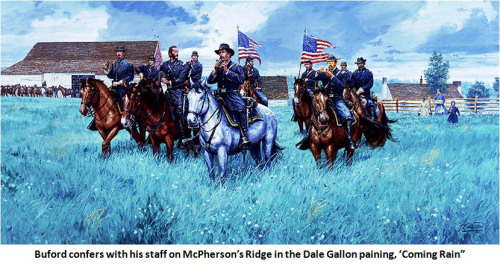
burford reynolds monuments

When Hooker was relieved on the night of June 27th and 28th George Meade gave Buford the chance at semi-independent command without Pleasanton looking over his shoulder. Meade appreciated Pleasanton’s administrative and organizational expertise and took him out of direct field command. Meade had his Cavalry Corps commander “pitch his tent next to his own on almost every leg of the trip to Pennsylvania and rarely let him out of sight or earshot.” [15]

One of Meade’s staff officers, Theodore Lyman gave this description of Buford:

“He is one of the best of the officers…and is a singular looking party. Figurez-vous a compactly built man of middle height, with a tawny mustache and a little, triangular gray eye, whose expression is determined, not to say sinister. His ancient corduroys are tucked into a pair of ordinary cowhide boots, his blue blouse is ornamented with holes; from which one pocket thereof peeps a huge pipe, while the other is fat with a tobacco pouch. Notwithstanding this get-up he is a very soldierly looking man. Hype is of a good natured disposition, but is not to be trifled with.” [16]

When he was ordered to screen the army as it moved into Pennsylvania, Buford was confident about his troopers and their ability and he and his men performed their duties admirably. On June 29th Buford’s men skirmished with two of Harry Heth’s regiments near the town of Fairfield, which Buford promptly reported to Meade and John Reynolds after ascertaining their size and composition.

The Battle of Gettysburg would be the zenith of Buford’s career. His masterful delaying action against Harry Heth’s division on July 1st 1863 enabled John Reynold’s wing of the army to arrive in time to keep the Confederates from taking the town and all of the high ground which would have doomed any union assault against them. Following Gettysburg Buford continued to command his cavalry leading his division in a number of engagements. In early November the worn out cavalryman who had been in so many actions over the past year came down with Typhoid. In hopes that he would recover he was told that he would be appointed to command all the cavalry in the West, however his health continued to decline. He was officially promoted to Major General of Volunteers by President Lincoln, over the objection of Secretary of War Stanton who disliked deathbed promotions. “Upon learning of the honor. Buford is supposed to have whispered, “I wish I could have lived now.” [17] He died later that evening, the last words warning his officers “patrol the roads and halt fugitives at the front.” [18]

John Pope wrote of Buford:

“Buford’s coolness, his fine judgment, and his splendid courage were well known of all men who had to do with him… His quiet dignity, covering a fiery spirit and a military sagacity as far reaching as it was accurate made him…one of the best and most trusted officers in the service.” [19]

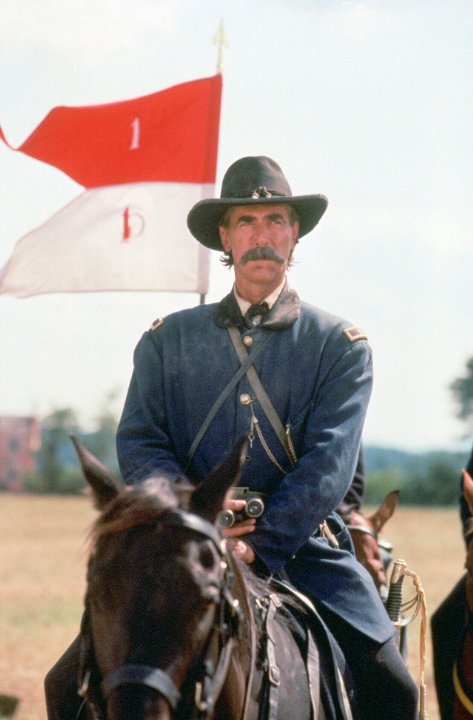
Sam Elliot as Buford

Buford was buried at West Point and he is immortalized in the monument dedicated to him on McPherson’s Ridge at Gettysburg where he with binoculars in hand looks defiantly west in the direction of the advancing Confederates. The monument is surrounded by the gun tubes of four Union 3” Rifles, three of which were part of Lieutenant John Calef’s Battery which he directed on the fateful morning of July 1st 1863. He was portrayed masterfully portrayed by Sam Elliott in the movie Gettysburg.

Notes

[1] Longacre, Edward G. John Buford: A Military Biography Da Capo Press, Perseus Book Group, Cambridge MA p.17

[2] Ibid. Guelzo. Gettysburg: The Last Invasion p.121

[3] Ibid. Longacre John Buford p.36

[4] Ibid. Longacre John Buford p.36

[5] Ibid. Longacre John Buford p.54

[6] Ibid. Guelzo. Gettysburg: The Last Invasion p.121

[7] Ibid. Longacre John Buford p.70

[8] Ibid. Longacre John Buford p.70

[9] Ibid. Longacre John Buford p.78

[10] Ibid. Guelzo. Gettysburg: The Last Invasion p.121

[11] Ibid. Longacre John Buford p.122

[12] Ibid. Coddington The Gettysburg Campaign, A Study in Command p.44

[13] Ibid. Longacre John Buford p.173

[14] Ibid. Coddington The Gettysburg Campaign, A Study in Command p.64

[15] Longacre, Edward G. The Cavalry at Gettysburg: A Tactical Study of Mounted Operations during the Civil War’s Pivotal Campaign, 9 June-14 July 1863 University of Nebraska Press, Lincoln and London 1986 p.168

[16] Girardi, Robert I. The Civil War Generals: Comrades, Peers, Rivals in Their Own Words Zenith Press, MBI Publishing, Minneapolis MN 2013 p.38

[17] Ibid. Longacre John Buford p.245

[18] Ibid. Longacre John Buford p.246

[19] Ibid. Girardi The Civil War General p.38


1 Comment

Filed under civil war, Gettysburg, History, leadership, Military

Gettysburg: The Opening Engagement

Friends of Padre Steve’s World

The latest major chapter revision to my Gettysburg text, this one about the opening of the battle and two men, Confederate Major General Harry Heth and Union Major General John Buford whose actions that morning set in motion the greatest battle ever fought on the American Continent.

Peace

Padre Steve+

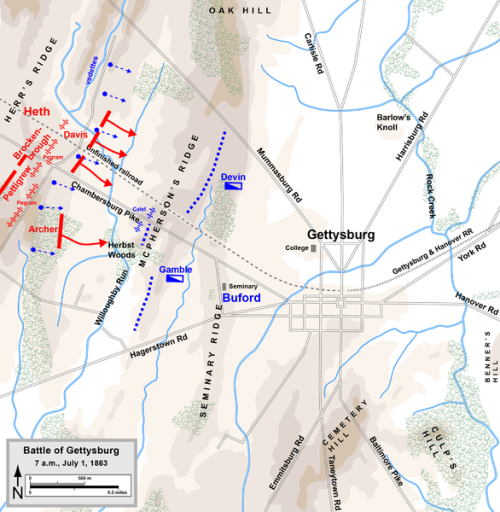
burford june 30th

The principles found in Chairman of the Joint Chief of Staff’s “Desired Leader Attributes” are something that we can learn about from both practical experience and history. The study of commanders and leaders throughout the Gettysburg campaign provide historical examples of commanders and other leaders that the best and the worst examples of some of those concepts. One of these is the ability to “anticipate and adapt to surprise and uncertainty.” The meeting engagement on the morning of July 1st 1863 between Harry Heth’s division of A.P. Hill’s corps and John Buford’s First Cavalry Division shows a very clear example of a commander, Heth, not anticipating or adapting to surprise and uncertainty. Heth was surprised by the presence of experienced Federal cavalry on his front and the uncertainty of not knowing what lay just beyond McPherson and Seminary Ridge.

Despite the warnings of Brigadier General Johnston Pettigrew, Major General Harry Heth and his corps commander Lieutenant General A.P. Hill decided that they would advance into Gettysburg. Hill and Heth dismissed Pettigrew’s warnings out of hand. Pettigrew should have been listened to, he was “was one of those natural leaders of a privileged background who, without military ambitions, had been advanced on the application of native intelligence and contagious courage.” [1] To help state his case Pettigrew brought Captain Louis G. Young of his staff, who had served under Hill and was a professional soldier “with the hope that his testimony as to Union numbers might be more convincing.” [2] Young “insisted that the troops he saw were veterans rather than Home Guards,” [3] but Hill refused to believe telling Young and Pettigrew “I still cannot believe that any portion of the Army of the Potomac is up,” he declared. Then he added: “I hope that it is, for this is the place I want it to be.” [4] Hill told Heth and Pettigrew that “I am just from General Lee, and the information he has from his scouts corroborates what I have received from mine – that is, the enemy is still at Middleburg and have not yet struck their tents.” [5]

How Hill could make such a statement neither knowing the ground nor the location and strength of the Federal troops to his front is stunning. How Hill’s “scouts” could miss the massive force heading their way is beyond belief and indicates that Hill wanted to believe what he wanted to believe and disregarded any evidence to the contrary, especially that which came from a subordinate that he did not know who was not a professional soldier. Hill’s attitude also demonstrates the profound lack of respect given to the Army of the Potomac by Hill and many other Confederate commanders.

Hill sent a message to Lee, as well as Ewell of Second Corps telling them that “I intended to advance the next morning and discover what was in my front.” [6] He also sent word of the discovery of cavalry to Lee’s headquarters, but his warning apparently gave Lee little cause for concern as Lee believed that “Meade’s army was still some distance to the south.” [7] Likewise, Hill sent a courier to Richard Anderson instructing him to bring up his division on July 1st and instructed Heth that “Pender’s division also would be ordered through Cashtown as a reserve to be available if Heth ran into serious trouble.” [8]

During the night the actions of A.P. Hill show a commander who confused and uncertain. The confidence that he and Heth showed in rejecting Pettigrew and Young’s reports of Federal troops in Gettysburg had left “most, if not all the commanding officers in Hill’s corps…unprepared for what happened.” [9] Lieutenant Lewis Young wrote “I doubt if any of the commanders of brigades, except General Pettigrew, believed that we were marching to battle, a weakness on their part which rendered them unprepared for what was about to happen.” [10]

A major part of Hill’s uncertainly can be laid on his and his subordinate commander’s lack of experience at their current level of command. “Pettigrew new to the army, Heth to division command, and Hill to corps command.” [11] One could not ask for such an untested chain-of-command as the army advanced blindly forward not knowing what lay before it. James Longstreet said “The army…moved forward, as a man might walk over strange ground with his eyes shut.” [12]

Lieutenant Colonel Porter Alexander noted that on the night of June 30th that he visited Lee’s headquarters and found conversation to be “unusually careless & jolly. Certainly there was no premonition that the next morning was to open a great battle of the campaign.” [13] The attitude that all exhibited according to Alexander was “when all our corps were together what could successfully attack us? So naturally we were all in good spirits.” [14] The Confederates believed that they were invincible. Walter Taylor of Lee’s staff admitted “An overweening confidence possessed us all.” [15] Clifford Dowdey wrote:

“Considering their unprecedented assignment to act, in the absence of cavalry, as reconnaissance troops in a country they had never seen, the men were unrealistically relaxed – from the privates of the 1st South Carolina, the oldest unit in point of organization, to the corps commander.” [16]

The British observer, Lieutenant Colonel Arthur Fremantle wrote in his diary: “The universal feeling in the army was one of profound contempt for an enemy whom they had beaten so consistently, and under so many disadvantages.” [17] That contempt would cost Lee’s army dearly in the coming battle.

Harry Heth arose on the morning of July 1st 1863 and formed his division for its march to Gettysburg. He had been ordered by Hill to “be ready to march at 5:00 A.M; and by an unusual directive from the corps commander, each man who wanted an issue of whisky at that early hour was to receive one.” [18] Heth should have spent the night making detailed plans for his advance but since neither he, nor any other senior officer in Hill’s corps “anticipated real action in the immediate area, Harry Heth kept uppermost in his mind the quartermaster aspects of the invasion,” [19] thus his overriding concern to get the shoes that supposedly were there in abundance, rather than “all the little details involved in an operation as tricky as a reconnaissance in force.” [20] The lack of attention to detail became evident the first thing that morning and that brought about an inauspicious start to a very bad day for Heth and his division. His troops were up early with the sunrise but somehow orders had not gotten to them to begin the advance at 5 a.m. and as a result “there was haste to the early morning’s preparations that caught some off guard” even regimental commanders. [21]

Several critics have made this point, among them Major John Mosby, the Confederate cavalry leader and guerrilla fighter who wrote: “Hill and Heth in their reports, to save themselves from censure, call the first day’s action a reconnaissance; this is all an afterthought….They wanted to conceal their responsibility for the defeat.” [22] A more contemporary writer, Jennings Wise, noted that Hill’s orders “were specific not to bring on an action, but his thirst for battle was unquenchable, and…he rushed on, and…took the control of the situation out of the hands of his commander-in-chief.” [23]

Years later Heth made an unsubstantiated claim that “A courier came from Gen. Lee, with a dispatch ordering me to get those shoes even if I encountered some resistance.” [24] That appears unlikely as Mosby noted that no one ordered Hill to advance and Lee “would never have sanctioned it.” [25] The ever judicious Porter Alexander who had been in Lee’s headquarters the night of June 30th wrote that: “Hill’s movement to Gettysburg was made on his own accord, and with knowledge that he would find the enemy’s cavalry in possession.” [26]

The advance to contact was marred by Heth’s inexperience compounded by the illness of A.P. Hill which caused Hill to be absent at the critical point where contact was made with the Federal forces. Hill “awakened feeling very ill, too sick to mount his horse…although no diagnosis was made, he was probably suffering from overstrained nerves.” [27] While it is possible that Hill’s “malady could have been upset stomach, diarrhea, simple exhaustion or a flair up of the old prostate problem” [28] his history of illness at critical times throughout the war lends credence to the possibility that whatever he was suffering could have been brought about by his emotional state. The result was that Hill’s “disability made it impossible for him to assume personal responsibility on July 1, 1863.” [29]

Hill gave Heth the responsibility to lead the advance, not based on experience or command ability, but because his division was closest to Gettysburg. However, during the night Hill decided to augment Heth’s division by ordering Dorsey Pender’s division to support Heth, and thus committed two thirds of his corps to what was supposedly a reconnaissance mission to find shoes. Since a reconnaissance is normally conducted by small elements of one’s force, the fact that Hill committed his two divisions present to such a mission demonstrated his “own confusion and uncertainty” [30] regarding the nature of what he might face and to his own understanding of the mission that he was assigning Heth. Whatever Hill’s intentions “he ordered Pender to support Heth while he awaited Anderson in Cashtown.” [31]

Disregarding the only solid intelligence he had, Hill put the majority of his corps into a “reconnaissance” which he would not be able to lead, instead turning over command to Heth. Hill gave Heth strict instructions not to bring on an engagement. The admonition was clear: “Do not bring on an engagement.” [32]

Likewise it is distinctly possible that Heth, despite orders to the contrary “may have had more on his mind than shoes and information when he made his advance towards Gettysburg.” [33] This is the allegation of Confederate cavalryman John Singleton Mosby who: “charged Hill with planning a “foray” and calling it a “reconnaissance.” Both Hill and Heth, Mosby asserted “evidently expected to bag a few thousand Yankees, return to Cashtown, and present them to General Lee that evening. But…”they bit off more than they could chew.” [34] Mosby’s claim does lend some explanation as to why Hill committed such a large force to his “reconnaissance” however, since Hill was killed in the closing days of the war and because Mosby was a partisan of J.E.B. Stuart. Mosby’s claim, even if true cannot be verified. But the fact remains that Hill’s force “was too large for a reconnaissance mission…and too large of force to back away from any Yankee challenge.” [35]The result was that Hill’s large force “if opposed, might well commit Lee’s army to battle on a field that Lee had not seen and before his army was assembled.” [36]

Hill’s absence left Heth, an inexperienced division commander “without any sage counsel” [37] and Heth began to commit a series of costly errors. Hill’s instructions to Heth to aggressively execute the mission but at the same time to avoid a major action put his subordinate in a hard place that even more experienced commanders might have struggled to find the appropriate balance. However, Heth was not at the level of experience or battlefield savvy.

Heth stated after the war that he understood from Hill that his mission was a job that normally would be assigned to cavalry and the restraints that he was employ: “to ascertain what force was at Gettysburg, and if he found infantry opposed to him, to report the fact immediately, without forcing an engagement.” [38] However, when the action began Heth did not heed those instructions.

Heth advanced without the caution of a commander who had been told that enemy forces were likely opposing him. Even though Heth disbelieved the reports made by Pettigrew the previous day, some amount of judicious caution on his part should have been indicated. Instead, for reasons unknown Heth had his men advance as if it was a routine movement. “Rather than placing his strongest brigades in the lead, Heth simply determined order of march based on where the troops had bivouacked along the road the previous night.” [39]

Heth “pushed out his four brigades in routine deployment for contact. In taking elementary precautions, Heth gave no indication of sensing an impending clash of any consequence.” [40] He placed Archer’s veteran but depleted brigade and Davis’s newly organized and inexperienced brigade in the lead of the advance. They were accompanied by the division’s artillery battalion commanded by Major William Pegram. Behind the lead units came the brigades of Pettigrew and Brockenbrough.

It was a curious order of march, for it left Johnston’s Pettigrew’s brigade behind both Archer and Davis’s brigades despite the fact that it was closer to Gettysburg than any other brigade. Likewise it was the only unit in the division that had recent eyes on contact with the enemy and knew the ground and what was ahead of them. It is hard to understand why Heth did this but one can speculate that it might have been because of Pettigrew’s insistence of the type of Federal forces in their front the previous day which caused Heth to do this.

The attitude of the soldiers was good, but most of the soldiers and their leaders “assumed that this morning’s movement was simply one more part in the army’s overall concentration of forces” [41] and the troops many expected to meet were those of Ewell or Stuart, Colonel John Brockenbrough told the commander of the 55th Virginia that “we might meet some of Ewell’s command or Stuart’s. [42] No one, with the possible exception of Johnston Pettigrew seemed to believe that experienced Federal troops lay before them, and Pettigrew had been ignored. This “spirit of unbelief” seemed to cloud the thinking of most, if not all of the commanding officers in Hill’s corps and left them unprepared for what happened.” [43]

Heth’s infantry brigades were deployed alongside the road and were led by several lines of skirmishers while the artillery battalion rumbled down the road between the infantry brigades, few expected any battle. Gunners from Pegram’s four-gun Fredericksburg battery leading his battalion’s advance recalled “We moved forward leisurely smoking and chatting as we rode along, not dreaming of the proximity of the enemy.” [44] Heth should have better anticipated the situation based on Pettigrew’s reports of the previous day and should have prepared his troops to expect combat. He demonstrated why one author called him “an intellectual lightweight.” [45] After the war when Heth told an officer from the Army of the Potomac “I did not know any of your people were north of the Potomac.” [46]

While Archer was highly experienced and had the advantage of commanding experienced veteran troops during this advance he was not well. Though he led his troops into combat “on that morning he was suffering from some debilitating ailment.” [47] The other commander leading the Confederate advance was the inexperienced Joseph Davis. Davis’s inexperience caused him to put the new and untested 42nd Mississippi and 55th North Carolina in the van of his advance and left his veteran regiments the 2nd and 11th Mississippi in the rear guarding army stores. [48] It was an unfortunate choice, the 11th Mississippi was seasoned and had “fought with distinction” [49] as part of the Army of Northern Virginia over the previous year.

The advance of the brigades of Archer and Davis was uneventful until they reached Marsh Creek they encountered the cavalry vedettes or pickets of the 8th Illinois Cavalry of John Buford’s First Cavalry Division posted on the high ground just east of the creek. [50] Despite the fact that Pettigrew had repeatedly warned Heth and Hill about the presence of Union cavalry, the discovery of these forces was unanticipated by the Confederates leading the column. Early in the morning Pettigrew attempted to warn Archer of the topography of the area and the presence of Union troops. Lieutenant Young recorded that Pettigrew “told General Archer of a ridge some distance west of Gettysburg on which he would probably find the enemy, as this position was favorable for defense.” [51] Pettigrew also warned Archer of “a certain road which the Yankees might use to hit his flank, and the dangers of McPherson’s Ridge. Archer listened, believed not, marched on unprepared…” [52]

Enter John Buford

If Heth was inexperienced and knew little of the Federal forces arrayed before him and what forces were moving towards Gettysburg, his opponent Brigadier General John Buford was his opposite in nearly every respect. Buford was born in Kentucky and like Heth, came from a family with a long military history of military service, including family members who had fought in the Revolutionary War and War of 1812. His family was well off with a spacious plantation near Versailles on which labored forty-five slaves, and his father also established a stage line which carried “passengers and freight between Frankfort and Lexington.” His father divested himself of his property, selling his home, business and presumably his slaves and moved to Stephenson Illinois in 1838. [53] The young Buford developed an interest in military life which was enlivened by his half-brother Napoleon Bonaparte Buford who graduated from West Point in 1827, and his brother would be influential in helping John into West Point, which he entered in 1844.

Buford graduated with the class of 1848 which included the distinguished Union artilleryman John Tidball, and the future Confederate brigadier generals William “Grumble” Jones, with whose troops he would do battle during the Gettysburg campaign and George “Maryland” Steuart. Among Buford’s best friends was Ambrose Burnside of the class of 1847. He did well academically but his conduct marks kept him from graduating in the top quarter of his class.

Upon graduation he was commissioned as a Brevet Second Lieutenant of Dragoons, however this came too late to serve in Mexico. Instead he was initially assigned to the First United States Dragoons but less than six months after joining was transferred to the Second Dragoons when he was promoted to full Second Lieutenant.

Instead of going to Mexico Buford “spent most of the 1850s tracking and fighting Indians on the Plains.” [54] During this period, the young dragoon served on the Great Plains against the Sioux, where he distinguished himself at the Battle of Ash Creek and on peacekeeping duty in the bitterly divided State of Kansas and in the Utah War of 1858.

His assignments alternated between field and staff assignments and he gained a great deal of tactical and administrative expertise that would serve him well. This was especially true in the realm of the tactics that he would employ so well at Gettysburg and on other battlefields against Confederate infantry and cavalry during the Civil War. Buford took note of the prevailing tactics of the day which still stressed a rigid adherence to outdated Napoleonic tactics which stressed mounted charges and “little cooperation with units of other arms or in the taking and holding of disputed ground.” [55] While he appreciated the shock value of mounted charges against disorganized troops he had no prejudice against “fighting dismounted when the circumstances of the case called for or seemed to justify it.” [56] Buford’s pre-war experience turned him into a modern soldier who appreciated and employed the rapid advances in weaponry, including the breech loading carbine and repeating rifle with tremendous effect.

Despite moving to Illinois Buford’s family still held Southern sympathies; his father was a Democrat who had opposed Abraham Lincoln. Buford himself was a political moderate and though he had some sympathy for slave owners:

“he despised lawlessness in any form – especially that directed against federal institutions, which he saw as the bulwark of democracy…..He especially abhorred the outspoken belief of some pro-slavery men that the federal government was their sworn enemy.” [57]

After the election of Abraham Lincoln, the officers of Buford’s regiment split on slavery. His regimental commander, Colonel Philip St. George Cooke, a Virginian and the father-in-law of J.E.B. Stuart announced that he would remain loyal to the Union, others like Beverly Robertson who would command a brigade of cavalry during the Gettysburg campaign resigned their commissions.

For many officers, both those who remained loyal to the Union and those who joined the Confederate cause the decision was often difficult, and many anguished over their decisions as they weighed their allegiance to the Union against their loyalty to home and family. Buford was not one of them.

Since Buford’s family had longstanding ties to Kentucky, the pro-secession governor of Kentucky, Beriah Magoffin offered Buford a commission in that states’ militia. At the time Kentucky was still an “undeclared border slave state” and Buford loyal to his oath refused the governor’s offer. He wrote a brief letter to Magoffin and told his comrades that “I sent him word that I was a Captain in the United States Army and I intend to remain one.” [58] Around the same time the new provisional government of the Confederacy “offered Buford a general officer’s commission, which reached him by mail at Fort Crittenden.” [59] According to Buford’s biographer Edward Longacre “a well-known anecdote has him wadding up the letter while angrily announcing that whatever future had in store he would “live and die under the flag of the Union.” [60]

However Buford’s family’s southern ties, and lack of political support from the few remaining loyal Kentucky legislators initially kept him from field command. Instead he received a promotion to Colonel and an assignment to the Inspector General’s Office, although it was not the field assignment that he desired it was of critical importance to the army in those early days of the war as the Union gathered its strength for the war. Buford was assigned to mustering in, and training the new regiments being organized for war. Traveling about the country he evaluated each unit in regard to “unit dress, deportment and discipline, the quality and quantity of weapons, ammunition, equipment, quarters, animals and transportation; the general health of the unit and medical facilities available to it; and the training progress of officers and men.” [61] Buford was a hard and devastatingly honest trainer and evaluator of the new regiments. He was especially so in dealing with commanding officers as well as field and company officers. Additionally he was a stickler regarding supply officers, those he found to be incompetent or less than honest were cashiered.

Buford performed these duties well but desired command. Eventually he got the chance when the politically well-connected but ill-fated Major General John Pope who “could unreservedly vouch for his loyalty wrangled for him command of a brigade of cavalry.” [62] After Pope’s disastrous defeat at Second Bull Run in August 1862 Buford was wounded in the desperate fighting at Second Manassas and returned to staff duties until January 1863 when he was again given a brigade. However, unlike many of the officers who served under Pope, Buford’s reputation as a leader of cavalry and field commander was increased during that campaign.

Buford was given the titular title of “Chief of Cavalry of the Army of the Potomac” by George McClellan, a title which sounded impressive but involved no command during the Antietam campaign. Following that frustrating task he continued in the same position under his old West Point friend Ambrose Burnside during the Fredericksburg campaign. Buford lost confidence in his old friend and was likely “shocked by his friend’s deadly ineptitude, his dogged insistence on turning defeat into nightmare.” [63]

When Burnside was relieved and Fighting Joe Hooker appointed to command the army, Buford’s star began to rise. While he was passed over by Hooker for command of the newly organized First Cavalry division in favor of Alfred Pleasanton who was eleven days his senior, he received command of the elite Reserve Brigade composed of mostly Regular Army cavalry regiments. When Major General George Stoneman was relieved of command following the Chancellorsville campaign, Pleasanton was again promoted over Buford.

In later years Hooker recognized that Buford “would have been a better man for the position of chief” [64] but in retrospect Buford’s pass over was good fortune for the Army of the Potomac on June 30th and July 1st 1863. Despite being passed over for the Cavalry Corps command, Buford, a consummate professional never faltered or became bitter. Despite the Pleasanton’s interference and “lax intelligence-gathering” [65]   During the Gettysburg campaign he led his brigade well at Brandy Station as it battled J.E.B. Stuart’s troopers, after which he was recommended for promotion and given command of the First Cavalry division of the Cavalry Corps. [66]

Following Brandy Station Buford led his troopers aggressively as they battled Stuart’s troopers along the Blue Ridge at the battles of Aldie, Philmont, Middleburg and Upperville. It was at Upperville while fighting a hard action Confederate Brigadier general “Grumble” Jones’s brigade that Buford’s troopers provided Hooker with the first visual evidence that Lee’s infantry was moving north into Maryland and Pennsylvania.

When Hooker was relieved on the night of June 27th and 28th George Meade gave Buford the chance at semi-independent command without Pleasanton looking over his shoulder. Meade appreciated Pleasanton’s administrative and organizational expertise and took him out of direct field command. Meade had his Cavalry Corps commander “pitch his tent next to his own on almost every leg of the trip to Pennsylvania and rarely let him out of sight or earshot.” [67]

The result was that when ordered to screen the army as it moved into Pennsylvania Buford was confident of his troopers and their ability and he and his men performed their duties admirably. On June 29th Buford’s men skirmished with two of Harry Heth’s regiments near the town of Fairfield, which Buford promptly reported to Meade and John Reynolds after ascertaining their size and composition. The following morning Buford and his troopers arrived in Gettysburg and were greeted by the townspeople who “thronged the streets, waving, shouting, and singing patriotic songs as Buford’s advance pushed through.” [68] Marching through the town they took up positions on the ridges west of the town. As they moved west the advance elements of Buford’s brigade discovered the presence of Johnston Pettigrew’s North Carolina brigade which promptly withdrew when it discovered that it was facing regular Federal cavalry.

Despite the welcome of the townsfolk, Buford’s troopers were tired from the weeks of incessant marching and combat. Their horses needed fodder, which was barely adequate, and most needed to be reshod, but because Early’s division had “seized nearly every shoe and nail”…”he had neither materials nor facilities for reshoeing them.” [69] Despite their fatigue Buford’s men had one distinctive advantage over the Confederates that they would face, this was in their weaponry. With few exceptions the Union cavalry at Gettysburg went into battle with “the finest equipment and arms obtainable. The troopers in almost every regiment carried breech-loading carbines (usually Sharp’s singe shot) hitched to their belts; they also carried revolvers (usually Colt army) and cavalry sabers.” [70] Though outnumbered their weapons gave them an edge in maintaining a heavy fire against the Confederate infantry which was armed with a variety of muzzle-loaded rifled muskets.

Based on all the intelligence available to him, that of George Sharpe’s Bureau of Military Information and that of his own scouts Buford “gathered that the whole of Hill’s Corps was “massed back of Cashtown” to the west, but there was also clear indication that Ewell’s Corps was “coming over the mountains from Carlisle,” to the north.” [71] Buford sent that news to Reynolds and to Meade by way of Pleasanton by mounted courier the evening of June 30th. The report caused Reynolds to realize the importance of Gettysburg and he immediately sent orders for Buford “to hold onto it to the last.” If Buford could buy enough time, he might get his infantry into line “before the enemy could seize the point.” [72]

Since Buford suspected that Ewell’s troops might also arrive he posted forces a few miles to the north of Gettysburg to provide warning and to delay them if needed, however since Buford determined that “Hill represented the more immediate threat, Buford resolved to concentrate most of his strength west of the town along MacPherson’s Ridge.” [73]

 buford

Brigadier General John Buford U.S.A.

On the night of June 30th Buford prepared for battle. Unlike Hill and Heth he understood exactly what he was facing. He met with “reliable men” most likely from the Bureau of Military Intelligence operated by David McConaughy as to the composition of Lee’s forces. [74] Buford knew his business; he took the time to reconnoiter the ridges west of Gettysburg and posted videttes as far was as Marsh Creek. He deployed one brigade under Colonel Thomas Devin to the north and west of the town, Colonel William Gamble’s brigade was deployed to the west, its main line being on McPherson’s Ridge.

As he deployed his forces Buford formulated his plan. Riding with his brigade commanders and staff “Buford, puffing away on his pipe, peering through field glass, studied the road network and lay of the land. He calculated distance to physical landmarks and tried to determine how long it would take those Confederates massing behind South Mountain to come within carbine range.” [75] Buford’s composure and confidence inspired his troopers as well as local civilians who observed him as he surveyed the ground on which the greatest battle ever waged on American soil would be fought.

Considering that he had fewer than three-thousand troopers available at Gettysburg because the Reserve Brigade was still further south guarding the army’s trains, and that he was facing a foe many times larger, it was a bold plan. Buford seems to have convinced himself that “he could pull off something never achieved in this war: a defense in depth by dismounted cavalry against a force of foot soldiers with full artillery support.” [76] As such the crafty Buford planned “a defense in depth, fighting his men dismounted, using the series of ridgelines west of Gettysburg to hamper and delay the Rebel infantry he was certain would come “booming along” the Chambersburg Pike in the morning.” [77]

Noting that the ground was favorable to defense and giving battle Buford sent messages to Reynolds as to the situation. He warned Reynolds that “A.P. Hill’s corps is massed just back of Cashtown, about 9 miles from this place.” He also noted the location of Confederate pickets “only four miles west of Gettysburg.” [78] Devin’s troops also identified elements of Ewell’s corps north of the town. Buford had accurately informed his superiors of what was before him, information that they needed for the day of battle.

Buford set up his headquarters at the Eagle Hotel in Gettysburg where he spent the night and according to his signals officer was “anxious, more so than I ever saw him” [79] Buford discussed the tactical situation with Colonel Devin, commanding the brigade on Herr’s and McPherson’s Ridge. Devin did not yet believe that the Confederates would move on Gettysburg in the morning. Devin thought if there were any threats that “he could handle anything that could come up in the next 24 hours.” [80] Buford rejected Devin’s argument and told him bluntly “No you won’t…. They will attack you in the morning and they will come booming – skirmishers three deep. You will have to fight like the devil to hold your own.” [81]

In preparation for the Confederate advance Buford deployed about seven hundred of his men in videttes, or pickets several miles in advance of the main force of his division. These videttes stretched from the Blackhorse Tavern south and west of Gettysburg, across the Mummasburg and Carlisle Roads, ending east of town on the York Pike. The center of this line was along the Chambersburg or Cashtown Pike along Marsh Creek about five miles west of Gettysburg. These videttes were critical in ascertaining the direction and composition of any advancing Confederate forces.

Reynolds immediately saw the importance of the position elected to fight. He “ordered Buford to hold onto it to the last” believing that if Buford could “buy enough time, he might get his infantry into line “before the enemy should seize the point.” [82] Buford knew that against the odds he would face that he would only be able to hold for a few hours at best and since by “refusing to flee from Lee’s path, by committing himself to fight in an advanced position however favorable, he risked not only his division’s annihilation but the disarranging of Meade’s plans” [83] to fight a defensive battle along the Pipe Creek line. Buford and Reynold’s bold decisions on that last night of June 1863 committed the Army of the Potomac to battle Lee’s hearty veterans at Gettysburg.

gburg delaying action

Buford’s Delaying Action July 1st

For Buford’s troopers the night and morning of June 30th and July 1st 1863 was spent in grim anticipation that they would meet a good portion of Lee’s army in battle. “It was a jumpy night, and the lowering clouds “poured down a drenching rain” [84] even as Buford’s advanced videttes observed the camp fires of the advanced Confederate outposts left by Pettigrew on the 30th   of June.

As the over-confident and lackadaisical Confederates advanced in the pre-dawn early morning mist they had a hard time determining what lay ahead of them and they “halted as they got to the swampy land fringing Marsh Creek, beyond which the ground angled up into a single swell to a ridge line.” [85] Pegram’s artillerists surveyed the ground to their front and noted mounted troops, but the limited visibility made it impossible to identify them, some even thought that they might belong to Longstreet’s corps, however Pegram knowing Longstreet’s corps was well the west, stopped his advance and unlimbered is guns. This caused the commander of Archer’s lead brigade, Colonel Birkett D. Fry of the 13th Alabama to ask Pegram what was going on and why he had stopped his advance. Upon seeing the artillery readying for action Fry “rode back to the color bearer and ordered him to uncase the colors.” [86] This was the first indication that the enemy was near and Fry quickly ordered his regiment to establish a skirmish line.

With the sun coming up the Union troops saw the now uncased colors of the Confederate battle flags to their front. Lieutenant Marcellus Jones of the 8th Illinois, commanding one of the detachments along Marsh Creek, expecting such rode to one of his advanced posts. He took a carbine from one of his sergeants and said “Hold on George, give me the honor of opening this ball” and at about 7:30 a.m. Jones fired the first shot of the battle of Gettysburg. [87]

Heth had wanted to advance in column as long as possible “but the Yankee cavalry’s stiff resistance had ended that hope.” [88] Heth rode forward and ordered Archer and Davis’s troops to advance skirmishers with the support of Pegram’s artillery. This slowed the Confederate advance considerable and Heth wrote in his after action report that “it became evident that there were infantry, cavalry and artillery in and around the town.” [89] At this point, Heth should have stopped and sought guidance on what to do next, however, instead of “feeling out the enemy” as directed by Hill, Heth “ordered Archer and Davis “to move forward and occupy the town.” [90] A chaplain in Brockenbrough’s brigade reported that one of Heth’s aide’s came up and reported “General Heth is ordered to move on Gettysburg, and fight or not as he wishes.” The chaplain heard one of the officers near him say “We must fight them; no division general will turn back with such orders.” [91]

Heth obviously expected small detachments of cavalry to give way at the sight of massed infantry, but Buford and his men had other plans. Instead of withdrawing the small cavalry detachments dismounted and used trees, bushes and fence lines for cover and poured forth a rapid fire with their Sharps carbines. This forced Heth’s skirmishers to advance slowly and deliberately, and forced the main body of his advanced brigades to deploy into battle formation supported by Pegram’s artillery.

About 8:00 A.M. Colonel Gamble who commanded the Buford’s First Brigade to which the videttes belonged “received a report that a strong enemy force was driving in his pickets.” [92] Gamble promptly reported this to Buford who in turn directed Gamble to deploy his “1,600 troopers to form a battle line on Herr’s Ridge a mile west of the seminary” [93] from which Buford was now directing his division. Likewise Buford ordered Devin’s Second Brigade to take up positions north of the Pike. He likewise order Lieutenant John Calef who commanded Battery “A” Second United States Horse Artillery to deploy his six three inch rifles along the ridge. However, instead of deploying them in an orthodox manner Buford ordered Calef to “spread his pieces wide apart to deceive the enemy into thinking his battery was actually two artillery units.” [94]

Everything that Buford did served to further confuse Heth, who now because of the heavy volume of fire his troops were receiving and his inability to see the horses of the dismounted cavalry believed that he was facing Federal infantry and artillery for Buford’s troopers “surely acted like infantry.” [95] Captain Amasa Dana of Company E. of the 8th Illinois “ordered his men to “throw up their carbine sights and [we] gave the enemy the benefit of long range practice [;] the firing was rapids from our carbines, and at the distance induced the enemy to the belief of four times our number actually present….” [96]

Instead of driving the cavalry out by force of numbers the Confederates had to advance deliberately to drive out the Union troopers, forcing Archer’s men to “undertake the time-consuming task of fixing the enemy in place, and then working parties around its flanks or any other chinks they could find.” [97] As they did this the veteran Union troopers withdrew and formed again, each time forcing the Confederates to slow their advance on Gettysburg.

Buford’s defense in depth was unlike anything that the Confederates had experienced at the hands of the Army of the Potomac. At each position Gable’s troopers continued to hold and his “carbineers continued to blast away as fast as they could reload, Calef’s shells thundering over their heads to burst in the fields beyond.” [98] That defense gave Buford an extra two hours and at 9:00 he directed his brigades to fall back to the next line of defense that of McPherson’s Ridge, where Buford’s troopers established another line.

Seeing the enemy before him Harry Heth committed yet another error. He was not going to let the Federal force stop him from reaching Gettysburg. On Herr’s Ridge he made a fateful decision. He spend over half an hour, from 9:00 until just past 9:30 deploying Archer’s Brigade in line of battle “and extending its left flank with the next brigade in line, that of Brigadier General Joseph R. Davis.” [99] Once that was accomplished Heth ordered Archer and Davis’s brigades forward toward Buford’s troops. It was a deadly mistake for Heth had no idea that the advance elements of John Reynold’s First Corps were rapidly moving to support Buford and that his troops were about to experience a fight like which they had never seen or expected. Despite this the Confederates pushed on and were threatening to force Buford’s troops from McPherson’s Ridge and “victory seemed to be at hand, but as the 13th Alabama climbed from the Willoughby Run ravine into a field south of McPherson Wood’s its men saw a Union line of battle a hundred yards to the front.” [100] John Reynold’s First Corps led by the famous Iron Brigade of Abner Doubleday’s First Division had arrived on the field.

The fight that Harry Heth and A.P. Hill had been directed not to precipitate was now on. Heth’s inexperience was more than matched by the cunning and brilliant Buford, whose troopers had fought a masterful delaying action, one which prefigured the later use of cavalry and eventually armored cavalry and motorized reconnaissance in later wars. Buford’s masterful defense along Marsh Creek, and Herr’s and McPherson’s Ridge enabled Reynolds’s infantry to come up before the Confederates could seize the key high ground to the west of Gettysburg.

Notes

[1] Dowdy, Clifford. Lee and His Men at Gettysburg: The Death of a Nation Skyhorse Publishing, New York 1986, originally published as Death of a Nation Knopf, New York 1958 p.78

[2] Robertson, James I. Jr. General A.P. Hill: The Story of a Confederate Warrior Random House, New York 1987 p.206

[3] Gallagher, Gary. Confederate Corps Leadership on the First Day at Gettysburg: A.P. Hill and Richard S. Ewell in a Difficult Debut in The First Day at Gettysburg edited by Gallagher, Gary W. Kent State University Press, Kent Ohio 1992 p.44

[4] Ibid Robertson General A.P. Hill p.206

[5] Sears, Stephen W. Gettysburg. Houghton Mifflin Co. Boston and New York 2003 p. 137

[6] Ibid. Gallagher Confederate Corps Leadership on the First Day at Gettysburg p.44

[7] Ibid Robertson General A.P. Hill p.206

[8] Ibid. Dowdy. Lee and His Men at Gettysburg p.92

[9] Coddington, Edwin B. The Gettysburg Campaign, A Study in Command A Touchstone Book, Simon and Shuster New York 1968 p.264

[10] Pfanz Harry W. Gettysburg: The First Day University of North Carolina Press, Chapel Hill and London 2001 p.51

[11] Ibid. Dowdy. Lee and His Men at Gettysburg p.79

[12] Pryor, Elizabeth Brown. Reading the Man: A Portrait of Robert E. Lee Through His Private Letters Penguin Books, New York and London 2007 p.352

[13] Ibid. Coddington The Gettysburg Campaign, A Study in Command p.264

[14] Alexander, Edward Porter. Fighting for the Confederacy: The Personal Recollections of General Edward Porter Alexander edited by Gary Gallagher University of North Carolina Press, Chapel Hill 1989 p.230

[15] Wert, Jeffry D. A Glorious Army: Robert E. Lee’s Triumph 1862-1863 Simon and Schuster, New York and London 2011 p.234

[16] Ibid. Dowdy. Lee and His Men at Gettysburg p.90

[17] Ibid. Wert A Glorious Army p.234

[18] Ibid Robertson General A.P. Hill pp.206-207

[19] Ibid. Dowdy. Lee and His Men at Gettysburg p.91

[20] Trudeau, Noah Andre. Gettysburg: A Testing of Courage, Harper Collins Publishers, New York 2002 p.147

[21] Ibid. Trudeau Gettysburg: A Testing of Courage p.153

[22] Ibid. Gallagher Confederate Corps Leadership on the First Day at Gettysburg p.32

[23] Ibid. Gallagher Confederate Corps Leadership on the First Day at Gettysburg p.32

[24] Ibid. Trudeau Gettysburg: A Testing of Courage, p.153

[25] Ibid. Gallagher Confederate Corps Leadership on the First Day at Gettysburg p.32

[26] Alexander, Edward Porter Military Memoirs of a Confederate: A Critical Narrative 1907 republished 2013 by Pickle Partners Publishing, Amazon Kindle Edition location 7342 of 12968

[27] Dowdy. Lee and His Men at Gettysburg: The Death of a Nation pp.91-92

[28] Ibid Robertson General A.P. Hill p.206

[29] Ibid. Dowdy. Lee and His Men at Gettysburg p.92

[30] Ibid. Trudeau Gettysburg: A Testing of Courage, p.153

[31] Ibid. Gallagher Confederate Corps Leadership on the First Day at Gettysburg p.44

[32] Ibid. Trudeau Gettysburg: A Testing of Courage, p.153

[33] Ibid. Coddington The Gettysburg Campaign, A Study in Command p.274

[34] Ibid. Coddington The Gettysburg Campaign, A Study in Command p.274

[35] Ibid. Sears Gettysburg p. 161

[36] Ibid. Pfanz Gettysburg: The First Day p.52

[37] Ibid. Trudeau Gettysburg: A Testing of Courage, p.153

[38] Guelzo, Allen C. Gettysburg: The Last Invasion Vintage Books a Division of Random House, New York 2013 p.131

[39] Ibid Robertson General A.P. Hill p.207

[40] Ibid. Dowdy. Lee and His Men at Gettysburg p.93

[41] Ibid. Guelzo. Gettysburg: The Last Invasion p.135

[42] Ibid. Guelzo. Gettysburg: The Last Invasion p.134

[43] Ibid. Coddington The Gettysburg Campaign, A Study in Command p.264

[44] Ibid. Sears Gettysburg p. 162

[45] Ibid. Guelzo. Gettysburg: The Last Invasion p.134

[46] Ibid. Sears Gettysburg p. 162

[47] Ibid. Dowdy. Lee and His Men at Gettysburg p.93

[48] Ibid. Trudeau Gettysburg: A Testing of Courage, p.156

[49] Ibid. Dowdy. Lee and His Men at Gettysburg p.93

[50] Pfanz. Gettysburg: The First Day p.53

[51] Ibid. Trudeau Gettysburg: A Testing of Courage, p.158

[52] Ibid. Coddington The Gettysburg Campaign, A Study in Command p.264

[53] Longacre, Edward G. John Buford: A Military Biography Da Capo Press, Perseus Book Group, Cambridge MA p.17

[54] Ibid. Guelzo. Gettysburg: The Last Invasion p.121

[55] Ibid. Longacre John Buford p.36

[56] Ibid. Longacre John Buford p.36

[57] Ibid. Longacre John Buford p.54

[58] Ibid. Guelzo. Gettysburg: The Last Invasion p.121

[59] Ibid. Longacre John Buford p.70

[60] Ibid. Longacre John Buford p.70

[61] Ibid. Longacre John Buford p.78

[62] Ibid. Guelzo. Gettysburg: The Last Invasion p.121

[63] Ibid. Longacre John Buford p.122

[64] Ibid. Coddington The Gettysburg Campaign, A Study in Command p.44

[65] Ibid. Longacre John Buford p.173

[66] Ibid. Coddington The Gettysburg Campaign, A Study in Command p.64

[67] Longacre, Edward G. The Cavalry at Gettysburg: A Tactical Study of Mounted Operations during the Civil War’s Pivotal Campaign, 9 June-14 July 1863 University of Nebraska Press, Lincoln and London 1986 p.168

[68] Ibid. Longacre John Buford p.181

[69] Ibid. Guelzo. Gettysburg: The Last Invasion p.133

[70] Ibid. Coddington The Gettysburg Campaign, A Study in Command p.258

[71] Ibid. Trudeau Gettysburg: A Testing of Courage, p.142

[72] Ibid. Guelzo. Gettysburg: The Last Invasion pp.122-123

[73] Ibid. Trudeau Gettysburg: A Testing of Courage, pp.142-143

[74] Ibid. Trudeau Gettysburg: A Testing of Courage, p.141

[75] Ibid. Longacre John Buford p.184

[76] Ibid. Longacre The Cavalry at Gettysburg p.185

[77] Ibid. Sears Gettysburg p. 157

[78] Ibid. Guelzo. Gettysburg: The Last Invasion p.122

[79] Ibid. Sears Gettysburg p. 157

[80] Catton, Bruce The Army of the Potomac: Glory Road Doubleday and Company, Garden City New York, 1952 p.266

[81] Ibid. Guelzo. Gettysburg: The Last Invasion p.123

[82] Ibid. Guelzo. Gettysburg: The Last Invasion pp.122-123

[83] Ibid. Longacre The Cavalry at Gettysburg p.185

[84] Ibid. Guelzo. Gettysburg: The Last Invasion p.132

[85] Ibid. Trudeau Gettysburg: A Testing of Courage, p.158

[86] Ibid. Trudeau Gettysburg: A Testing of Courage, pp.158-159

[87] Pfanz. Gettysburg: The First Day p.53

[88] Ibid. Sears Gettysburg p. 163

[89] Luvaas, Jay and Nelson Harold W editors. The U.S. Army War College Guide to the Battle of Gettysburg South Mountain Press, Carlisle PA 1986 p.7

[90] Ibid. Sears Gettysburg p. 165

[91] Ibid. Trudeau Gettysburg: A Testing of Courage, p.163

[92] Ibid. Coddington The Gettysburg Campaign, A Study in Command p.266

[93] Ibid. Coddington The Gettysburg Campaign, A Study in Command p.266

[94] Ibid. Longacre John Buford p.191

[95] Ibid. Sears Gettysburg p. 164

[96] Ibid. Trudeau Gettysburg: A Testing of Courage, p.162

[97] Ibid. Trudeau Gettysburg: A Testing of Courage, p.162

[98] Ibid. Longacre The Cavalry at Gettysburg p.187

[99] Ibid. Longacre John Buford p.191

[100] Ibid. Pfanz. Gettysburg: The First Day p.68

2 Comments

Filed under civil war, Gettysburg, History, leadership, Military

God Bless My People, Black and White: The Complex Life of General Wade Hampton

Hampton_inline

Lieutenant General Wade Hampton, C.S.A.

Friends of Padre Steve’s World 

I will be taking my students to Gettysburg this weekend and likewise I am continuing to periodically intersperse and publish short articles about various commanders at Gettysburg on the site. These all are drawn from my student text and may become a book in their own right.  The reason is I am going to do this is because I have found that readers are often more drawn to the lives of people than they are events. As I have noted before that people matter, even deeply flawed people, and we can learn from them.

Today’s article is about Lieutenant General Hade Hampton who commanded one of J.E.B. Stuart’s cavalry brigades at Gettysburg. Hampton is one of the most fascinating men I think of the entire Civil War period. Before the war he was one of the richest planters and largest owners of slaves in the South and after the war was a stalwart supporter of the rights of African Americans in South Carolina where he served as the first post-Reconstruction governor of that state. He was not a professional soldier but became one of the finest commanders of cavalry on either side during the war. Tomorrow I will be posting a completely revised, expanded and updated chapter of my text on the opening of the Battle of Gettysburg when Major General John Buford’s Cavalry conducted a heroic delaying action against the vastly superior numbers of Confederate Major General Heth’s division as it attempted to advance into Gettysburg on the morning of July 1st 1863. 

I do hope that you enjoy this.

Peace

Padre Steve+

Brigadier General Wade Hampton is one of the fascinating and complex characters in either army who served at Gettysburg. He defies a one dimensional treatment or stereotype. His complexities, contradictions and character make him one of the most interesting men that I have written about during my study of this battle.

Wade Hampton III was born in Charleston, South Carolina in 1828. He one of the richest, if not the richest man in the Confederacy when the war broke out. Hampton inherited his family’s expansive plantation and many slaves and studied law at the College of South Carolina.

As a slave owner, he expressed an aversion for the institution and ensured that his slaves were well cared for by the standards of his day, including medical care. He never condemned slavery or worked for the abolition of a system that had made him and his family quite prosperous. He served in the South Carolina legislature and Senate, where he took an “active and prominent role in the public debate on many issues. He was vocal not only on the perils of reopening the African slave trade but also on whether and how his state should seek redress of wrongs, real and imagined, by the federal government.” [1]

As a state senator, Hampton was pragmatic, and while he defended the South’s economic interests in slavery, Hampton cautioned against the rhetoric of secessionist fire-breathers. His argument was about “the preservation of the South’s political power and her social and economic institutions, now threatened by the short sighted policies of otherwise good and decent men.” [2] He did not wish to do anything that would lead to the destruction of the South, and he felt that the “only viable course was moderation, conciliation, compromise….” [3]

Hampton was a classic rich “Southern moderate He had opposed secession, and the fire eaters repulsed him.” [4] However, when Lincoln called for volunteers Hampton volunteered to serve in a war that he did not want, which would cost him dearly, and change him from a moderate to a vociferous opponent of most Reconstructionist policies.

Volunteering at the age of forty-three, Hampton had no prior military training. However, he had great organizational skill, leadership ability and a tremendous care and compassion for those who served under his command. Using his own money Hampton organized what would now be called a combined arms unit, the Hampton Legion, which comprised eight companies of infantry, four of cavalry and a battery of light artillery. He was careful in the appointment of the Legion’s officers choosing the best he could find.

Hampton rapidly rose to prominence as a respected officer and commander despite his lack of military training or experience. His soldiers fought well and took over command of an infantry brigade on the Peninsula, and was promoted to Brigadier General in May of 1862 and given command of a cavalry brigade serving under J.E.B. Stuart in July. Hampton “became Stuart’s finest subordinate.” [5] The contrast between the two men was remarkable. “Hampton and Stuart forged a professional relationship but not a friendship. They shared an adherence to duty and to the cause. But the contrasts between them in style and personality were undeniable.” [6] Stuart’s flamboyance, love of pageantry, and ambition clashed with Hampton’s simplicity and calm self-assurance. Serving as a brigade, and later division commander, Hampton had “little fondness or respect for Stuart. He regularly criticized Stuart for pampering the Virginia regiments and assigning his South Carolinians to the more arduous tasks.” [7]

During the war he was wounded several times, including at             Gettysburg where he took two saber cuts to the head. Eventually, he took command of the Cavalry Corps after Stuart was killed in action. This was something that Stuart in life would not have abided. When Stuart was scheming to get a promotion to Lieutenant General in another military department, he wrote that if he was to serve elsewhere he did not want Hampton to Command. In a curious post-script to a letter to Custis Lee Stuart wrote:

“Hampton is not the man for such a command, and I know he will not suit Gen’l Lee, nor the particular requirements of such a station. Hampton is a gallant officer, a nice Gentleman, and has done meritorious service, but there you must stop.” [8]

He fought in nearly every cavalry engagement under Stuart and led his own raids deep into Union territory. He fought well, but “hated the war.” In October 1862 he wrote home: “My heart has grown sick of the war, & I long for peace.” [9] Hampton’s Confederate service was unusual, especially for an officer of Lee’s Army of Northern Virginia which favored those who had prior service, especially West Point graduates. As such Hampton was “one of only three civilians to attain the rank of Lieutenant General in Confederate service.” [10] At Petersburg, his son Preston was mortally wounded and died in his arms even as his other son Wade IV was wounded while coming to Preston’s aid. Douglass Southall Freeman wrote of Hampton:

“Untrained in arms and abhorring war, the South Carolina planter had proved himself the peer of any professional soldier commanding within the same bounds and opportunities. He may not have possessed military genius, but he had the nearest approach to it.” [11]

The war that he opposed cost him the life of his brother, one of his sons and his livelihood. “His property destroyed, many of his slaves gone, and deep in debt from which he would never recover, Hampton faced the future with $1.75 in his pocket.” [12] The war changed the former moderate into a man who sought vindication in some ways, but reconciliation with the black population.

Hampton again entered politics and became the first post-Reconstruction Governor of South Carolina when President Rutherford Hayes withdrew the Federal troops which had supported the Reconstructionist governor. Initially he was “hailed as a redeemer by white constituents desperate to throw off the yoke of Reconstruction” [13] yet Hampton stood stalwartly against White Supremacy and White Supremacists. He acted on the belief that whites and African Americans could live, work and prosper together.

During his campaign and during his terms as Governor, Hampton “opposed the South’s imposition of so-called “black codes” which so restricted the freedom of former slaves as virtually to return them to civility.” [14] Unlike many in the post-reconstruction South, Hampton won the thanks of African Americans for condemning whites that would vote for him if they thought that he would “stand between him and the law, or grant him any privileges or immunities that shall not be granted to the colored man.” [15] Over his term, the former slave owner “extended more political benefits to African Americans than any other Democratic governor in the post-war South.” [16]

Hampton came to dominate South Carolina politics for fifteen years. After two terms as Governor, he served as a U.S. Senator until 1891 when a political enemy won the governorship and forced him from the Senate. When he died on April 11th 1902 his final words were “God bless my people, black and white.” [17]

Like so many leaders of so many tumultuous eras, Hampton was complex, contradictory and cannot be easily classified. He was certainly not perfect, but in war and in peace gave of himself to his state and community.

Notes

[1] Ibid. Longacre, Gentleman and Soldier pp.26-27

[2] Ibid. Longacre, Gentleman and Soldier p.28

[3] Ibid. Longacre, Gentleman and Soldier p.28

[4] Goldfield, David. America Aflame: How the Civil War Created a Nation Bloomsbury Press, New York 2011 p.399

[5] Ibid. Wert A Glorious Army p.64

[6] Ibid. Wert Cavalryman of the Lost Cause p.116

[7] Ibid. Glatthaar, General Lee’s Army p.352

[8] Ibid. Wert Cavalryman of the Lost Cause p.333

[9] Ibid. Goldfield, America Aflame p.399

[10] Ibid. Warner Generals in Gray p.123

[11] Ibid. Freeman Lee’s Lieutenants p.770

[12] Ibid. Goldfield, America Aflame p.399

[13] Ibid. Longacre, Gentleman and Soldier p.xv

[14] Ibid. Longacre, Gentleman and Soldier p.265

[15] Ibid. Longacre, Gentleman and Soldier p.265

[16] Ibid. Longacre, Gentleman and Soldier p.xv

[17] Ibid. Longacre, Gentleman and Soldier p.276


Leave a comment

Filed under civil rights, civil war, History, laws and legislation, leadership, Military

Bitter Feelings I wish Never to Experience Again: Tuesday Musings

IMG_0535

Friends of Padre Steve’s World

It is funny how a single event, or a number of seemingly unrelated events can change all the plans for a week of writing. Tonight I am struggling with my own feelings as I try to make sense out of my own experiences as well as the events of the day. I am still awake and writing because of how upset I am about a number of things that really  on the surface shouldn’t be so upsetting but wound me deeply. 

This weekend I will be leading a group of my students to Gettysburg and I have been working on my Gettysburg text as well as revisions to that text. My plan is to place a number of the short biographic articles on a number of leaders in that battle who I find particularly interesting and not just for what they did in the battle. I find complex and contradictory people fascinating. Likewise I will be posting an article about the classic action of the first day of the battle between the Union cavalry under Brigadier General John Buford, a fascinating man in his own right and Confederate general Harry Heth who led the Confederate army into the a battle that would help turn the tide of the war.

Of course I am cognizant of the the fact that events can change my plans as far as what I intend to write and tend to plan accordingly. But sometimes such events actually give me a chance to reflect and actually cause me to think about the significance of those events. Since I do a lot of that the attack in Garland that I wrote about yesterday has triggered some more of those thoughts.

When I wrote yesterday’s article I began thinking about some of the things that I wrote in the wake of the Charlie Hebdo massacre in Paris as well as other terrorist attacks, those of Moslems as well as those who attack and hate Moslems. Some critics might think I am being “politically correct” but truth is truth and terrorism no matter what the ideology or religion of those who kill innocents is evil. So I think I will probably re-package one or more of those articles because of the attack in Garland because when I went back and re-read the series I saw that so much of what I wrote then was still pertinent today, and because of the seriousness of what is going on probably need more attention.

I will also be writing something about the Battle of Dien Bien Phu which sealed the fate of French colonialism in Indochina. That battle was concluded sixty-one years ago this week. Having been a participant in the Iraq war, a war which like Indochina was a disaster for the colonial power and a war in which the soldiers who sacrificed so much were so rapidly forgotten by the nation even as they were thrown into other hopeless wars.

I have been reading a book on the experiences of the Union soldiers when they returned home from the Civil War and that book has stirred up a lot of my emotions concerning my return from Iraq and what I have experienced over the past six years.

Sadly I have a hard time containing my bitterness about my sacrifices and the insults I have endured even from the incredibly irrational and insensitive military bureaucracy and even my own Chaplain Corps. Some of that I was reminded of today in dealing with a bureaucracy that ensures that you are caught in a permanent state of “catch-twenty-two” when simply trying to get the appropriate credit for what you have done. I ran into that today in regard to an administrative catch-twenty-two regarding my Joint Qualification credit and I am so angry that I can scarcely contain myself. Sadly, that is just one more reason that I will be glad to retire in 2017. 

The past week I have had terrible nightmares, some dealing with those issues and I can fully understand the words of Union General Gouverneur Warren who wrote his wife after the war:

“I wish I did not dream so much. They make me sometimes to dread to go to sleep. Scenes from the war, are so constantly recalled, with bitter feelings I wish never to experience again. Lies, vanity, treachery, and carnage.”

I fully understand how Warren felt, because he was not only a victim of the war but of Army bureaucracy. In Warren I have found someone that I can completely understand and relate to in what he had to deal with during and after the war.

People ask me sometimes why I will remove my name from consideration for promotion to Captain in the Navy Chaplain Corps and retire instead of remaining on active duty and possibly make Captain. This my friends something that many men and women would consider the pinnacle of accomplishment, and which a number of senior chaplains tell me I would be very competitive. In fact even two years ago I would have almost sold my soul to be promoted to that rank. But I know that don’t need to sacrifice any more of my life for a promotion that I no longer want. 

Maybe I’m a bit bitter, not terribly, but enough to make me realize that I don’t want to deal with the bullshit that I would have to deal with at a higher rank as I now realize that I am rank enough in my own right. Frankly, somehow I need to let go of the bitterness and disappointment that I have, but I realize that I may never fully let it go. Not because I do not want to, but because whenever I turn around there is yet another reminder which twists the knife in my belly that the bureaucrats in the service do not give a damn about me, or for that matter anyone else. 

But I am now rambling and I should stop writing for the night before I get myself in trouble by being too honest by naming names. 

Until the next time, pray for me a sinner.

Peace

Padre Steve+


3 Comments

Filed under History, iraq, leadership, Military

Camarón: We May Die, but Never Will Surrender

Friends of Padre Steve’s World

As a career military officer who has served in a thankless war I have a special affinity for soldiers who have served in similar wars, and especially for those who fight epic battles against overwhelming opposition. Some of these men fought in wars that were certainly not just, but they served nonetheless, earning the admiration and respect of friend and foe alike. But seldom are such fighters, even while earning the respect of their enemy, honored by them over a century later.

This is a fascinating story which I do believe that civilians need to read to understand the world of volunteer soldiers, fighting unpopular wars. I think that it helps bring a bit of humanity to history to remember such men.  

images-6

Almost every Army or nation has a story of a heroic group of soldiers that fight valiantly and often die against enemies of far greater strength.  The United States has the Texan defenders of the Alamo and in World War II the Marine defenders of Wake Island. The British the Battle of Rourke’s Drift in the Zulu War. In 1989 the 9th Company of the Red Army’s 345th Independent Guards Airborne Regiment conducted a heroic defense against Afghan Mujahideen at Hill 3234 during Operation Magistral.

This is the story of the 65 officers and men of the 3rd Company of the 1st Battalion Légion Étrangère (Foreign Legion) 152 years ago at the Battle of Camarón. On April 30th, 1863 which the United States was involved in a great civil war, these  few would battle nearly 3000 Mexican Soldiers at a small Hacienda called Camarón.

The unit had arrived in Mexico as part of a French invasion designed to usurp the Mexican government and place a puppet government loyal to Emperor Louis Napoleon, or Napoleon III while the United States was too busy to intervene.

The men of the company had been in country just a few weeks when they were ordered to escort to a supply convoy to relieve French forces besieging Puebla.

The 3rd Company was severely undermanned due to dysentery and 50 Legionnaires and all of the company officers were incapacitated.  The battalion Quartermaster, Captain Danjou took command of the remaining Legionnaires and was joined by two other officers, Lieutenant Clement Maudet and Lieutenant Jean Villian.

These men began their march to immortality at 0100 and had marched 15 miles before stopping for breakfast at 0700. While brewing their coffee with the convoy several hours behind scouts saw a force of several hundred Mexican cavalry approaching.  Abandoning breakfast that their still brewing coffee they fought a battle with the cavalry for several hours before getting into the Hacienda around the middle of the morning.

The Mexican forces under the command of Colonel Francisco Milan were joined by additional forces bringing their total to 800 cavalry and 2200 infantry soldiers.  Colonel Milan realized that the Legionnaires situation was hopeless and offered Captain Danjou the chance to surrender. He warned the Legionnaire commander “you will be needlessly slaughtered.”  Despite the fact that his force had been reduced to under 50 men following the skirmishes with the Mexican cavalry, Danjou refused the offer and replied “We have munitions. We will not surrender.”

The Legionnaires defense held against several assaults but casualties were mounting and ammunition dwindling. Without food or water in the scorching heat Danjou rallied his men. The gallant Danjou had lost his left hand in Algeria 10 years before and had a wooden hand. He went to each Legionnaire offering words of support, a sip of wine and had each man swear on his wooden hand that they would not surrender as he did this the Mexican forces launched another assault. Danjou was shot in the chest and died about noon.

Lieutenant Villian took command.  As the battalion’s Paymaster he had been universally hated by the men. However he volunteered for the mission and somehow, the formerly hated officer inspired the Legionnaires to continue the fight. Villian called out to his soldier’s “Mes enfants! I command you now. We may die, but never will surrender.” The Mexican commander offered the survivors another chance to surrender and Legionnaire Sergeant Vincent Morzycki responded with one word: Merde.” On the Legionnaires fought and Villian, true to his word was shot dead about 1600 hours. During those desperate hours Villian and the Legionnaires fought on suffering immensely under the fierce and accurate fire of the Mexican troops.

legion012

Lieutenant Maudet then took command of the few remaining Legionnaires.  Around 1700 Colonel Milan approached the now burning Hacienda to offer the surviving Legionnaires a third chance to surrender.  He looked inside the charnel house and saw Maudet rallying about a dozen Legionnaires amid piles of dead and wounded. Maudet refused the offer and Milan went back to his troops and ordered another assault. By the time that assault was finished only Maudet and five soldiers remained. 

It was now about 1800 and the unequal battle had been raging for eleven hours. Maudet surveyed the situation. The Mexican troops were massing for yet another attack and his troops were down to one round of ammunition each. He ordered his men load their weapons and he ordered a charge into the massed Mexican infantry.  They engaged the Mexicans in furious hand to hand combat in which Maudet and one Legionnaire were killed and four captured.

The senior surviving NCO Corporal Maine requested that the survivors be treated for their wounds and be allowed to maintain their weapons and escort the remains of Captain Danjou to France. Acceding to the bloodied Corporal’s request Colonel Milan, a valiant and honorable officer was overwhelmed with emotion and said “What can I refuse to such men? No, these are not men, they are devils.” 

When the battle was over the French had lost 43 men killed and 19 wounded with only three men left unwounded. The survivors were captured and exchanged. During the course of the day they had killed 190 Mexican soldiers and wounded about 300 more.

Main_Danjou1

The sacrifice of the Legionnaires enabled the relief convoy to reach the French at Puebla. Emperor Napoleon III ordered the name Camarón embroidered on the Legion’s flag and the battle became legendary in the history of warfare. The Legion came into its own after Camarón.  Danjou’s wooden hand and forearm were recovered from the battlefield and returned to France 2 years following the battle.

Ninety-one years later in another epic and hopeless battle the Legionnaires of the 13th Demi-Brigade of the French Foreign Legion, surrounded in the “Hell” of Dien Bien Phu remembered the sacrifice of their predecessors at Camarón as their commander, Lieutenant Colonel Lemeunier read the story over the radio to the embattled and doomed Legionnaires.

hqdefault

Today Camarón is still marked by the Legion wherever its troops are stationed much as the United States Marine Corps marks their founding.  The wooden hand of Captain Danjou is removed from its case in the museum and paraded with the assembled troops. The officers serve their troops coffee symbolizing the coffee the defenders never drank and the commander of Legion at the headquarters as well as units deployed read the account of the battle. 

The Mexican Army too marks the courage of the Legionnaires with a parade, speeches made and French dignitaries including the French Ambassador and Legion veterans honored by all.  It is a fitting tribute to the men that fought that day.

Peace

Padre Steve+

Leave a comment

Filed under History, leadership, Military

As Brave & Dashing as Any Officer: John Bell Hood and the Limitation of Ability

Friends of Padre Steve’s World

I am continuing to periodically intersperse and publish short articles about various commanders at Gettysburg on the site. These all are drawn from my student text and may become a book in their own right.  The reason is I am going to do this is because I have found that readers are often more drawn to the lives of people than they are events. As I have noted before that people matter, even deeply flawed people, and we can learn from them.

Today’s article is about Major General John Bell Hood who commanded a division in Longstreet’s First Corps at the Battle of Gettysburg. As a brigade and division commander he was as good as any in either army. However, after Gettysburg he was promoted, eventually to army command in Georgia and Tennessee in which position he failed miserably. His story is interesting because it shows that all of us probably have some limitations, that while we may excel in one arena or level, that we may very well not be suited for other things, especially high command or senior management. As Harry Callahan so wisely noted “A man’s got to know his limitations.” I do hope that you enjoy this.

Peace

Padre Steve+

HD_hoodJB1

Lieutenant General John Bell Hood. C.S.A.

John Bell Hood was born in Owingsville Kentucky in 1831. He attended West Point where he was a classmate of the future Union Generals James McPherson and Phillip Sheridan, and graduated fortieth of the fifty-one in the class of 1853. Hood desired a commission in the newly formed cavalry but “his low class standing resulted him entering service as a second lieutenant in the 4th U.S. Infantry Regiment.” [1] However, Hood was persistent and continued to lobby for an appointment to the cavalry service, even directly corresponding with then Secretary of War Jefferson Davis. The young officer’s perseverance paid off and in 1855 he received orders to serve with the 2nd U.S. Cavalry.

Hood served as a cavalry officer under Lee’s command with the 2nd Cavalry in Texas. There he gained a stellar reputation as a leader and Indian fighter, though he only fought in one minor engagement. He was physically imposing and “stood six feet, two inches and had a powerful chest and a giant’s shoulders.” [2]

In 1860 “he received orders to report to West Point to serve as an instructor of cavalry.” [3] His secessionist sympathies were displayed when upon receipt of the orders and went5 directly to the War Department where he told the Adjutant General that “he did not want the position, since he “feared that was would soon be declared between the States, in which event I preferred to be in a position to act with complete freedom.” [4]

When his home state of Kentucky did not secede he attached himself to his adopted state of Texas. He resigned his commission and began the war as a lieutenant of cavalry in the Confederate army. In his resignation the officer was something of a realist concerning the coming war, noting, “seeing no hope of reconciliation or adjustment, but every indication of a fierce and bloody war.” [5] Lee assigned him to Magruder on the Peninsula where he quickly developed as a reputation as a fighter and was given the task of tasking independent cavalry companies into a regiment. He was soon was given the task of forming Texans then in Virginia into a fighting regiment, the 4th Texas, which was assigned to “join a Texas brigade under ex-Senator Louis T. Wigfall.” [6] After Manassas Hood was promoted to Brigadier General and given command of Wigfall’s brigade, the only Texas brigade in the east. He took temporary command of a division during the reorganization of the army that followed the Seven Days.

Over the course of the next year he had built a “combat record unequalled by any in the army at his level.” [7] And the “reputation gained as commander of the Texas Brigade and as a division commander made him both a valuable general officer and a celebrity who transcended his peers.” [8] After his performance at Antietam Lee worked the personnel system to get Hood promoted to Major General and assigned to command of an enlarged division which he would command at Gettysburg. Lee wrote of him “Hood is a good fighter, very industrious on the battle field, careless off, & I have had no opportunity of judging his action, when the whole responsibility rested on him. I have a high opinion of his gallantry, earnestness & zeal.” [9]

After Gettysburg Hood went on to succeed Joseph E. Johnston in Georgia as an army commander, but in this capacity he was out of his league. Johnston had fought a defensive campaign and was deemed by Jefferson Davis to be not aggressive enough in battling the combined armies of William Tecumseh Sherman.

However, Hood’s new responsibilities were beyond his capacity, at heart he “was an executive officer, not a strategist.” [10] Hood was overly aggressive and his offensive campaigns were all marked by failure. Hood saw his army shattered at the Battles of Franklin and Nashville. Afterward he asked to be relieved of command and “reverted to his permanent rank of Lieutenant General” in January 1865. [11]

He returned to Richmond to draft his reports on his campaigns and foreseeing the collapse and defeat of the army around Richmond “advocated that the three Confederate filed armies concentrate in central Tennessee and Kentucky.” [12] Though it was a reasonable suggestion from a strategic point of view, it was impossible for a number of reasons and rejected by Jefferson Davis. He requested another field command but instead was ordered to return to Texas. While on the way he learned of the surrenders of the various Confederate armies and “surrendered himself at Natchez, Mississippi.” [13]

After the war Hood married Anna Maria Henson and their marriage produced eleven children, who some jokingly referred to as “Hood’s brigade.” He remained in contact with James Longstreet and when Longstreet spoke to him about supporting Reconstruction and Negro suffrage Hood warned his former commander “that if he supported the congressional program that “the Southern press and people will vilify you and abuse you.” [14] While nothing is known about his own views on the subject Longstreet believed that the mirrored his own, though Hood would not publicly utter them.

He began working in the insurance business and writing his memoirs and campaign narratives, but in 1879 he business interests failed and in August of that year he, his wife and one of his children died in a Yellow Fever outbreak, he was just forty-eight years old.

As good of Brigade and division commander as he was under the direction of Longstreet, Hood was out of his league as an Army commander. John B. Gordon, as judicious of judge of command ability of any on the Confederate side noted:

“To say he was as brave and dashing as any officer of any age would be the merest commonplace tribute to such a man; but courage and dash are not the only or even the prime requisites of the commander of a great army.” [15]

Hood is highly regarded in Texas to this day. Units of the Texas Army National Guard including some that I served in during the 1980s and 1990s trace their lineage to the regiments of Hood’s Brigade. Likewise, Fort Hood, the largest post in the United States Army is named after him.

Notes

[1] Bohannon, Keith S. “A Bold Fighter” Promoted Beyond His Abilities: John Bell Hood in Leaders of the Lost Cause: New Perspectives on the Confederate High Command edited by Gallagher, Gary W. and Glatthaar, Joseph T. Stackpole Books, Mechanicsburg PA 2004 p.250

[2] Ibid. Freeman Lee’s Lieutenants p.121

[3] Ibid. Bohannon “A Bold Fighter” p.251

[4] Ibid. Bohannon “A Bold Fighter” p.251

[5] Ibid. Bohannon “A Bold Fighter” p.252

[6] Ibid. Freeman Lee’s Lieutenants p.121

[7] Ibid. Tagg The Generals of Gettysburg p.224

[8] Pfanz, Harry F. Gettysburg: The Second Day. University of North Carolina Press, Chapel Hill 1987 p.161

[9] Girardi, Robert I. The Civil War Generals: Comrades, Peers, Rivals in Their Own Words Zenith Press, MBI Publishing, Minneapolis MN 2013 p.219

[10] Ibid. Freeman Lee’s Lieutenants p.38

[11] Ibid. Warner Generals in Gray: Lives of Confederate Commanders p.143

[12] Ibid. Bohannon “A Bold Fighter” p.276

[13] Ibid. Warner Generals in Gray: Lives of Confederate Commanders p.143

[14] Ibid. Bohannon “A Bold Fighter” p.278

[15] Ibid. Girardi The Civil War Generals p.219

Leave a comment

Filed under civil war, Gettysburg, History, leadership, Military