Category Archives: News and current events

“I Imagined it Would Be Different” Passing the Baton on my Last 9-11 on Active Duty and Reflecting on All We Have Lost

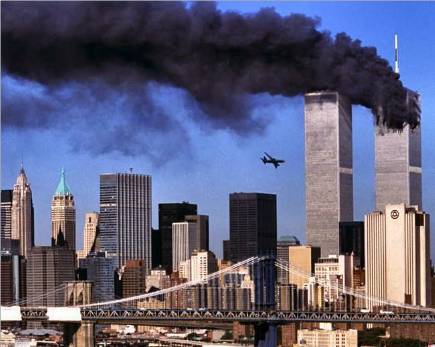
flight_175_photo

Friends of Padre Steve’s World,

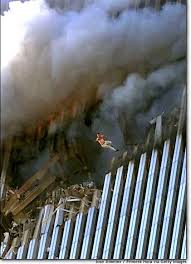
September 11th is a day that always makes me more introspective. It brings back so many memories, some that I wish I could forget; but I cannot get the images of that day out of my mind. The burning towers, the people jumping to their deaths to escape the flames, and the scenes of devastation. I knew one of the victims in the attack on the Pentagon, an Army Lieutenant Colonel, Karen Wagner who commanded a Medical training company at Fort Sam Houston where I was serving as the Brigade Adjutant in 1987 and 1988. She was a very nice person, very gracious and decent, admired by everyone who knew her; I was shocked to see her name on the casualty list after the attack.

The emotions that I feel on the anniversary of these terrorist attacks which claimed the lives of so many innocent people, and which devastated so many families, still haunts me, and my subsequent service, especially in Iraq has changed me. Years after he returned from his time in the Middle East, T.E. Lawrence; the immortal Lawrence of Arabia wrote to a friend, “You wonder what I am doing? Well, so do I, in truth. Days seem to dawn, suns to shine, evenings to follow, and then I sleep. What I have done, what I am doing, what I am going to do, puzzle and bewilder me. Have you ever been a leaf and fallen from your tree in autumn and been really puzzled about it? That’s the feeling.” I often feel that way.

Eighteen years ago I was getting ready to go to the French Creek Gym at Camp Le Jeune North Carolina where I was serving as the Chaplain of Headquarters Battalion 2nd Marine Division. I had returned from a deployment to Okinawa, Mainland Japan and Korea just two months before and was preparing to transfer to the USS Hue City, a guided missile cruiser stationed in Mayport, Florida.

At the time of the attack I had already been in the military for over 20 years and I had actually taken a reduction in rank to transfer from the Army, where I was a Major in the reserves, to the Navy to serve on active duty. In those previous 20 years I had served overseas during the Cold War along the Fulda Gap. I had been mobilized to support the Bosnia mission in 1996, and I had just missed being mobilized for Operation Desert Storm as my unit was awaiting its mobilization orders when the war ended. I had done other missions as well as the deployment to the Far East that returned from in July 2001; but nothing prepared me for that day. Like other career military officers I expected that we would be at war again and thought it might be back in the Middle East, and probably a result of some fool’s miscalculations; but like the American officers who were serving at the time of the Pearl Harbor attack, I never expected what happened that morning.

Tuesday, September 11th 2001 had started like so many days in my career. Routine office work, a couple of counseling cases and what I thought would be a good PT session. I was about to close out my computer browser when I saw a little headline on Yahoo News that a plane had crashed into the World Trade Center. I paid little attention and figured that a private plane, something like a Cessna piloted by an incompetent had inadvertently flown into the building.

9-11 jumpers

That delusion lasted about two minutes. I got in my car and the radio, tuned to an AM talk station had a host calling the play by play. He started screaming “oh my God another airliner flew into the other tower.” Seeking to see what was happening I went to the gym where there were many televisions. I got there and saw the towers burning, with stunned Marines and Sailors watching silently, some in tears. I went back out, drove to my office and got into uniform. After checking in with my colonel a made a quick trip to my house for my sea bags and some extra underwear, and personal hygiene items. When I got back the headquarters we went into a meeting, and the base went on lock down mode. The gates were closed and additional checkpoints, and roadblocks established on base. Marines in full battle-rattle patrolled the perimeter and along the waterfront. I did not leave the base until the night of the 15th when things began to settle down and we all went into contingency planning mode for any military response to the attacks.

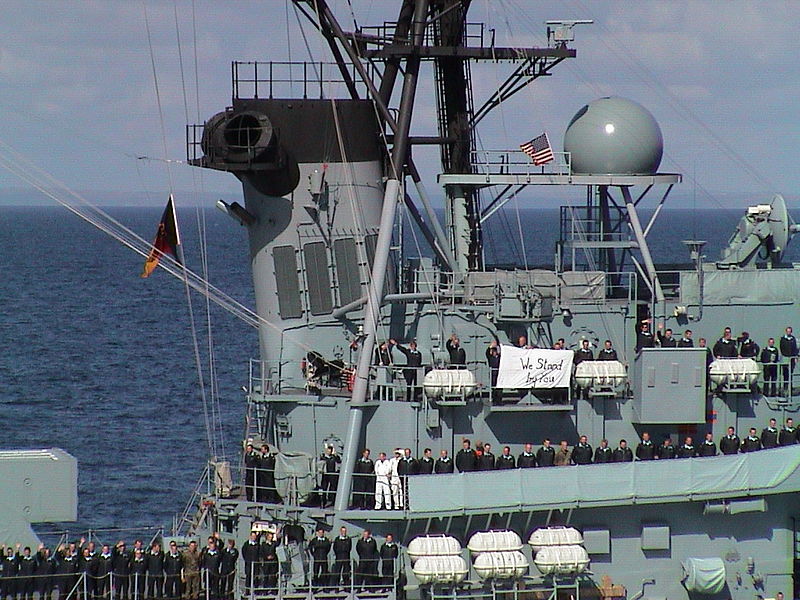
My wife, who as waiting for a doctor’s appointment with a friend saw the attacks on live television and knew when the first plane struck she told her friend that it was terrorism. Her friend responded “that damned Saddam Hussein.” Like so many of us who initially thought this, my wife’s friend was wrong. my friend Fregattenkapitäne Micheal Hufnagel, then the  First Officer Of the German Guided Missile Destroyer Lutjens was among the first to express support for the United States. Steaming next to the USS Winston Churchill helped put up a banner that said We Stand By You. It was an iconic moment. Eight months later I met Michael and we became fast friends, to this day.

LutjensHonors

Those were tumultuous days, so much fear; so much paranoia; and so much bad information as to who committed the attacks and what was going to happen next.

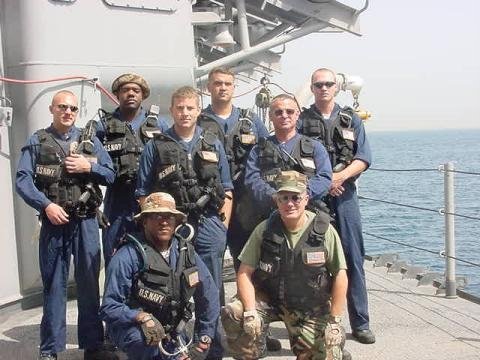
hue city boarding party


Honestly, I didn’t expect the war to go on for more than a few months, but months became years, and years became decades. I guess I was a lot like the German military officers who in the wake of the dramatic success of the Wehrmacht in the west and the initial phases of Operation Barbarossa  the German victory was so certain that resistance was futile and the best course was to follow orders, believing that victory over the subhuman Taliban and Al Qaeda was just around the corner. In the beginning I was little different than your average Wehrmacht officer, but by the time I left Iraq I realized just how wrong I was in supporting that misbegotten invasion.

I was so spellbound by Operation Desert Storm and operations in the Balkans that I ignored history. I knew the results of the Soviet invasion of Afghanistan, the British, Indian, and Macedonian adventures there, but we were the United States. We would win. Then the Bush Administration forgot Afghanistan and went into a war with Iraq, which was doomed from the start, and which met every standard of the war crimes that we tried the Nazis for at Nuremberg. As the American Chief Prosecutor at Nuremberg, Justice Robert Jackson noted before those trials:

“If certain acts of violation of treaties are crimes, they are crimes whether the United States does them or whether Germany does them, and we are not prepared to lay down a rule of criminal conduct against others which we would not be willing to have invoked against us.” Justice Robert Jackson International Conference on Military Trials, London, 1945, Dept. of State Pub.No. 3080 (1949), p.330.

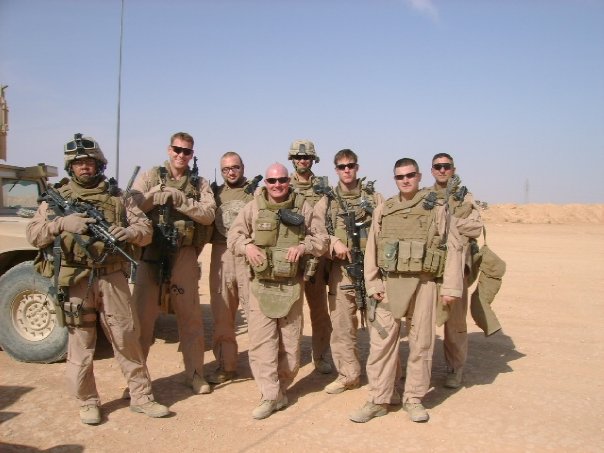
A few months later I deployed aboard Hue City to the Middle East where we supported the air operations in Afghanistan, anti-terrorist operations off the Horn of Africa and in Operation Southern Watch and the U.N. Oil Embargo against Iraq. I then did three years with Marine Security Forces, traveling around the world to support Marine Fleet Anti-Terrorism Security Team companies. For three years I was on the road one to three weeks a month traveling to the Middle East, Europe, the Pacific and many parts of the United States. Then I was promoted and transferred to Explosive Ordnance Disposal Group Two, from which I was deployed with my assistant to Iraq, where we served as members of the Iraq Assistance Group in all Al Anbar Province supporting small teams of Marine Corps, Army and Joint Force adviser teams to the Iraqi Army, Border troops, Port of Entry police, police and highway patrol.

with-mtt-3-7-ronin


When I returned from Iraq I was a changed man and while I am proud of my service I am haunted by my experiences. One cannot go to war, see its devastation, see the wounded and dead, as well as the innocents traumatized by it. One cannot get shot at, or be in enclosed rooms, meeting with people that might be friends, or might be enemies, and while everyone else is armed, you are not.

War changed me, and my homecoming was more difficult than I could have imagined. I never felt so cut off from my country, my society, my church, or even other chaplains. My experience is not uncommon among those who have served in Iraq or Afghanistan, or for that matter those who have served in almost any modern war. Erich Maria Remarque in his classic All Quite on the Western Front wrote:

“I imagined leave would be different from this. Indeed, it was different a year ago. It is I of course that have changed in the interval. There lies a gulf between that time and today. At that time I still knew nothing about the war, we had been only in quiet sectors. But now I see that I have been crushed without knowing it. I find I do not belong here any more, it is a foreign world.”

That being said I would not trade my experience for anything. The experience of PTSD and other war related afflictions has been a blessing as well as a curse. They have changed my world view and made me much more emphatic to the suffering and afflictions of others, as well when they are abused, mistreated, terrorized and discriminated against. These experiences along with my training as a historian, theologian, and hospital chaplain clinician before and after my tour have given me a lot bigger perspective than I had before.

But I have to live with all of the memories. Guy Sajer wrote in his book The Forgotten Soldier“Only happy people have nightmares, from overeating. For those who live a nightmare reality, sleep is a black hole, lost in time, like death.” General Gouverneur Warren, a hero of many Civil War battles including Gettysburg wrote to his wife after the war “I wish I did not dream so much. They make me sometimes to dread to go to sleep. Scenes from the war, are so constantly recalled, with bitter feelings I wish never to experience again. Lies, vanity, treachery, and carnage.”

As hard as this has been these are good things, and as I go on I wonder what will happen next. I do not think that the wars and conflicts which have followed in the wake of the 9-11 attacks will be over for years, maybe even decades. I pray for peace, but too many people, some even in this country seem to live for the bloodlust of war. One can only hope and as my Iraqi friends say, Inshallah, (إن شاء الله) God willing…

I wonder too, if the words of T.E. Lawrence reflecting on his service in the Arab Revolt are not as applicable to me and others who came back from Iraq, “We had been hopelessly labouring to plough waste lands; to make nationality grow in a place full of the certainty of God… Among the tribes our creed could be only like the desert grass – a beautiful swift seeming of spring; which, after a day’s heat, fell dusty.” I have lost too many friends in these wars, including men who could not readjust to home, many like me. I have seen the men and women, broken in body, mind and spirit and I wonder if any of it was worth it, and if in some of our response, especially the invasion of Iraq has not made a bad situation even worse, and turned the war into a generational conflict.

As for me, I am now an old guy by military standards. I recently celebrated 38 years of service and will, God willing, retire next year. Sadly, I know all too well that those who I have worked with, and those who are yet to enlist will be continuing to fight a war which seems to be without end long after I retire, despite the efforts of President Trump to make a deal with the Taliban.

Tomorrow there were and will be many ceremonies and services to remember the victims of the attacks. I think that is fitting, Lest We forget. However, I don’t think any should be used as platform to promote war without end. We will be conducting a 9-11 Remembrance Ceremony in the morning. I am having my brand new junior chaplain do invocation and benediction. I have helped him and given him guidance, but he has produced a good result that didn’t need much of my guidance to be something that honored the victims of 9-11, the U.S. military, and our allies since, as well as the innocent victims in Iraq, Afghanistan, Syria, and so many other places this unending war has touched. It is time for me to step aside and let the young men and women who were children when this began to be up front. My goal now is to help the young folks get recognized for good work and train them to represent the best in the Chaplaincy and to be guardians of the First Amendment, not religious theocrats.

So please, have a good day and whatever you do do not forget those whose lives were forever changed by those dastardly attacks and all that has transpired in the years since. Honestly I did not think that we would still be at war today. It is hard for me to believe that we still are at war and that there is no end in sight.

As Erich Maria Remarque wrote “I imagined that it would be different…”

At the same time I do hope that things will get better and that some semblance of peace will return to the world.

Inshallah, (إن شاء الله) God willing…

Peace

Padre Steve+

3 Comments

Filed under afghanistan, counterinsurency in afghanistan, crime, ethics, Foreign Policy, History, iraq,afghanistan, middle east, Military, national security, News and current events, Political Commentary, terrorism

“So it Goes” Remembering the Day Before 9-11-2001 and the Beginning Of War Without End

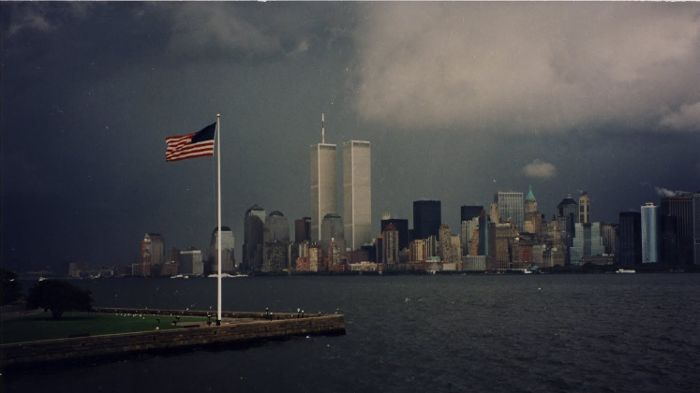
The twin Towers, September 10th 2001 

Friends of Padre Steve’s World,

After 18 years of unending war, terrorism, and the paranoia that come with it, I almost find it hard to remember what things were like on September 10th 2001.

I had been in the military over 20 years by then, but having resigned my commission as a Major in the Army Reserve in order to return to active duty as a Navy Chaplain serving with the 2nd Marine Division at a lower rank, I try to think about Monday, September 10th once in a while.

Despite coming close to a ground war in Kosovo in 1999, we had settled into the norms of peacetime training and preparation for whatever the next crisis might be. I had participated in the preparations for the Kosovo campaign, which thankfully we were prevented from going into a ground war over due to Serbian President Slobodan Miloševićat blinking at the last minute and agreeing to a ceasefire and withdraw from Kosovo, which could have led to a wider war in the Balkans and with Russia.

On the night of September 10th 2001 my mind was as far from war and terror as it could be. I was much more interested in the MLB Pennant Race than I was anything going on in the world, after all the only issues we faced were occasional, if deadly terrorist attacks on foreign installations and deployed ships like the USS Cole.  But as to the security of the Continental United States, or as it has been referred to by some since 9-11 as “the Homeland” I wasn’t concerned. Somehow, despite my knowledge, understanding and study of terrorist groups I just never thought anyone could pull off an attack of this magnitude.  The next morning I discovered just how wrong I was as the first reports came in while I was on my way to a late PT session at Camp LeJeune North Carolina where I was serving with the Second Marine Division, but that is a story for tomorrow night.

September 10th was a normal and pretty much a typical September day in America. The Denver Broncos beat the New York Giants in Denver that night. The Seattle Mariners won their 104th game of the season, defeating the Anaheim Angels 5-1.

But the next morning changed all of our lives and ushered in what is now 18 years of war which has cost the United States military almost 80,000 casualties including over 7,000 dead or died of wounds. Of course that does not count non-DOD agency casualties, or those of the contractors who have been a big part of the war effort, nor does it count the number of friendly Afghans, Iraqis, and others who have to use the antiseptic and dehumanizing term collateral damage, who have been killed, maimed, or displaced by nearly two decades of war.

Eighteen years after 9-11-2001 we are not only still at war, but it is becoming a war without end. President Trump tried and failed using ham handed tactics to make a deal with the Taliban, including a meeting that was to occur yesterday at Camp David to allegedly secure a peace deal that would net him the Nobel Peace Prize. That didn’t happen after Taliban fighters killed yet another American soldier in combat last week. Of course the deaths of over a dozen other Americans since January, not to mention hundreds of Afghan soldiers, police and civilians who have died at the hands of the Taliban and the descendants of the original Al Qaida. Those lives didn’t matter as long as the President thought he could get a deal to end the war, then with Taliban representatives at his doorstep he called the talks off. Personally I don’t think the President really cared about any of those lives, he hasn’t mentioned any of them over the past year, nor gone to their funerals, or met their remains at Andrews Air Force Base, so what happened had to be about him, otherwise why invite Taliban leaders to meet with him of the week of the anniversary of the 9-11-2001? If not to get a deal.

Eighteen years ago, I figured that after a few months Al Qaeda would be no more, and the war that they had unleashed upon us would be over. however I was wrong. Now now, many of the sailors, soldiers, marines, and airmen I deal with were just children or not even born when the attacks happened.

In just over six months I will be retired from the military, and as Kurt Vonnegut wrote in Slaughterhouse Five: “So it goes…” 

Have a good night, until tomorrow,

Peace

2 Comments

Filed under crime, History, iraq,afghanistan, middle east, national security, News and current events, Political Commentary, terrorism, War on Terrorism

Fear, Paranoia, Trump, Evil, and the Absence Of Empathy

Friends of Padre Steve’s World,

Every day that I see a tweet or hear President Donald Trump go into incoherent

streams of banal blathering I am reminded that the man has no ability to empathize with any other human being, even his family. It does not matter whether it is people suffering in a hurricane, people who have seen mass numbers of family and friends murdered by domestic terrorists, labeling racial and religious minorities as terrorists, criminals, animals, or vermin; or encouraging violence against political opponents and the press at his rallies, he always makes things about him, and plays to the fears of his base.

His lies are often whoppers and those he has been proven by many organizations to have lied or distorted the truth well over 10,000 times during his presidency, often to the detriment of his policies and programs, and which subvert the alliances and treaties that help to keep America great.

I cannot imagine any other American President with such an absence of empathy. He displays all the traits of a narcissistic sociopath, devoid of empathy or the capacity to love anyone other than himself. Everything else is fungible to him. He has no real friends, only temporary partners, and that includes his multiple wives and paramours.

Yet for some reason the bulk of the Republican establishment and its conservative Christian base not only supports him but make up theological jibber-jabber to justify their support on the thinnest Biblical support, usually biblical verses or stories taken completely out of context. But he appeals to their fears, and I doubt that they will abandon him unless the economy completely collapses leaving them destitute, in which case they will likely blame whoever he blames and still support him, just like so many religious people who in other nations have tied their religion to despots.

Believe me, religious people of any faith can live to the highest and most commendable humanitarian deeds as a result of their faith, while others can sink to depravity which only true believers can sink.

The distinguished British Mathematician and Philosopher Alfred North Whitehead wrote:

“Religion carries two sorts of people in two entirely opposite directions: the mild and gentle people it carries towards mercy and justice; the persecuting people it carries into fiendish sadistic cruelty…” 

Whitehead was right, and the latter will follow the President into the abyss. The American philosopher Eric Hoffer wrote:

“A doctrine insulates the devout not only against the realities around them but also against their own selves. The fanatical believer is not conscious of his envy, malice, pettiness and dishonesty. There is a wall of words between his consciousness and his real self.”

Sadly, such people are capable of anything. Historian Timothy Snyder reminded us shortly after President Trump’s Election reminded us in his book On Tyranny: 

“The European history of the twentieth century shows us that societies can break, democracies can fall, ethics can collapse, and ordinary men can find themselves standing over death pits with guns in their hands. It would serve us well today to understand why.”

Last night I wrote about the uncomfortable necessity of trying to understand evil, its causes and those who perpetuate and encourage it, including the current American President, a man incapable of feeling for others, or taking responsibility for his words and actions. The same is true of many of his supporters. Gustave Gilbert who served as a psychologist to the major war crimes defendants at Nuremberg noted:

“In my work with the defendants (at the Nuremberg Trails 1945-1949) I was searching for the nature of evil and I now think I have come close to defining it. A lack of empathy. It’s the one characteristic that connects all the defendants, a genuine incapacity to feel with their fellow men. Evil, I think, is the absence of empathy.”

The President has a dark Charisma which his devout followers find irresistible, and since he is not a fringe character, but the leader of one of the most powerful countries on the planet, this is not something that we can easily dismiss. Nor can we dismiss the ever increasing power of the Executive branch of the government,  the specialization and distancing of bureaucrats from the policies they implement, and the pressure of pastors, employers, family, church members, and party officials on people who would normally not harm a fly. However, as Conservative columnist and former Bush Administration staffer Michael Gerson wrote in July of 2017: “The president and his men are incapable of feeling shame about shameful things.”

While President Trump is a catalyst for many of the things happening in the country and the world, he is not the cause. The seeds have been planted for decades by preachers, pundits, and politicians that specialize in promoting fear and paranoia in their followers.

The late American historian, Richard Hofstadter wrote:

“The idea of the paranoid style as a force in politics would have little contemporary relevance or historical value if it were applied only to men with profoundly disturbed minds. It is the use of paranoid modes of expression by more or less normal people that makes the phenomenon significant.”

This is important at a time of increasing economic uncertainly, a world where the old stable democratic orders are under attack, the paranoia increases, along with it fear, racism, and war across the spectrum. A leader who encourages violence and turns every issue into a personal animus only emboldens his followers.

Historian Christopher Browning wrote of this in his book Ordinary Men:

“I fear that we live in a world in which war and racism are ubiquitous, in which the powers of government mobilization and legitimization are powerful and increasing, in which a sense of personal responsibility is increasingly attenuated by specialization and bureaucratization, and in which the peer group exerts tremendous pressures on behavior and sets moral norms. In such a world, I fear, modern governments that wish to commit mass murder will seldom fail in their efforts for being unable to induce “ordinary men” to become their “willing executioners.”

Holocaust survivor and philosopher Primo Levi warned us of them, “Monsters exist, but they are too few in number to be truly dangerous. More dangerous are the common men, the functionaries ready to believe and to act without asking questions.” 

Whether President Trump wins re-election or doesn’t the danger will not decrease. Many of his followers, and many Trump himself may refuse to stand aside if he loses. some threatening civil war if he loses. But, if he wins he has the power to further dismantle the Constitutional guardrails that have been the protectors of our political system, as well as turn all the instruments of power into his personal weapons. He is already doing so. This is the practice of tyrants throughout history.

Anyway, I’m done for the night as we wait for Hurricane Dorian to reach us sometime overnight. Having been through quite a number of hurricanes in North Carolina and Virginia I know how dangerous they are. My heart is with all of Dorian’s victims in Bermuda and in the Southeastern United States. I have many friends in harm’s way. I cannot ignore their suffering, unlike the President, and many of his minion.

So until tomorrow, as long as we weather the storm without major power outages, flooding, or storm damage, I will write again.

Peace,

Padre Steve+

5 Comments

Filed under ethics, faith, History, holocaust, leadership, nazi germany, News and current events, Political Commentary, weather

“If not us, then who? If not now, then when?” Remembering Dr. Martin Luther King’s “I Have a Dream” Speech

Friends of Padre Steve’s World,

August 28th is the anniversary of Dr. Martin Luther King Jr’s I Have a Dream Speech. It is a speech and message that we cannot forget or continue to fight for if we want to see the promise of our founders fulfilled in spite of the power of those who prefer the rule of political and financial oligarchs, or simple dictatorship to our Republic and the democratic ideals of those imperfect, yet inspired men.

Dr. Martin Luther King Jr. has always been one of my heroes. This time of year I always ponder the importance of his life and work for civil rights, and I wonder what might have been had this man of peace not been cut down in cold blood at the young age of 39 by James Earl Ray on April 4th 1968. He was an amazing and courageous man whose memory should not be let to one day a year.

Tonight I am happy to report that I had a number of good visits with doctors and that the exchange of the face mask for my BIPAP machine allowed me to sleep for the first time in a week. I saw my new sleep doctor and neurologist today and in that visit, which lasted more than an hour I learned a lot and felt better about my condition. I won’t go into details now, but will in the future because it deals with a host of issues that those suffering from PTSD, TBI, and other neurological, psychological, physical, and spiritual conditions contend with on a daily basis. But, I digress, that was an update and not really a part of this article.

We live in a world where a minority of voters elected a man as President who through his words and actions demonstrates daily that he cares not for anything that Dr.King stood for. Thus, we have to ensure, though our words and actions that it is not allowed to die. Doing that may involve a high cost as the President-Elect is not known for playing nice with his opponents and now that he will have the police power of the state and a compliant Congress at his back you can expect that opponents will be harassed, intimidated, and maybe worse.

Dr. King was a man of courage, a man of honor, a man of conviction. But he came of age in a time when many people were willing to maintain the status quo and play things safe, like many clergy, even African-American clergy. Many pastors of the era, remained quiet about the conditions of segregation, and the racism of the day. Their lack of action did not mean they were bad people, they just understood that if they spoke up, their lives, and the lives of their families and congregations could be in danger. As such many pastors just hoped to see things slowly improve, without rocking the boat, and without endangering themselves or their families. They had seen what happened to blacks who spoke up or confronted the evil, lynching’s, cross burnings, threats and murder. They had contented themselves with just trying to get along. At the beginning of the movement, many pastors did not support or gave only lukewarm support to Dr. King, Andrew Young, Fred Shuttlesworth, and Ralph Abernathy going into that critical year of 1963.

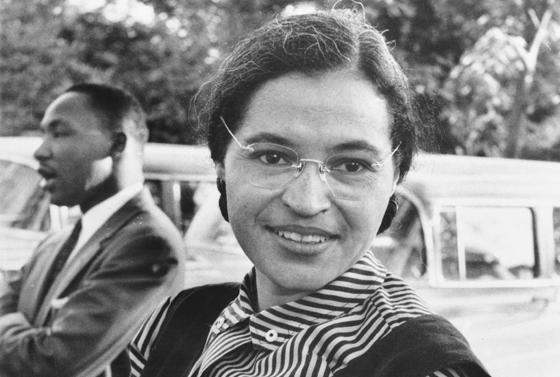
lossless-page1-560px-Rosa_Parks_(detail).tiff

King did not start out to become a Civil Rights leader. However, he was inspired to actively join the movement through the example of Rosa Parks, who defiance of the law for blacks to sit “in the back of the bus” in 1955. He led the Montgomery Bus Boycott which lasted for 385 days. The reaction among segregationists to King and his protest was against violent. King’s house was bombed, and his life threatened. But he refused to stand down.

King’s leadership of the boycott brought the young pastor to national prominence. However, by 1963 much of the Civil Rights movement and the African American community was despairing of the lack of progress. Many people had become disenchanted with King, not considering him bold enough despite his rhetorical abilities.

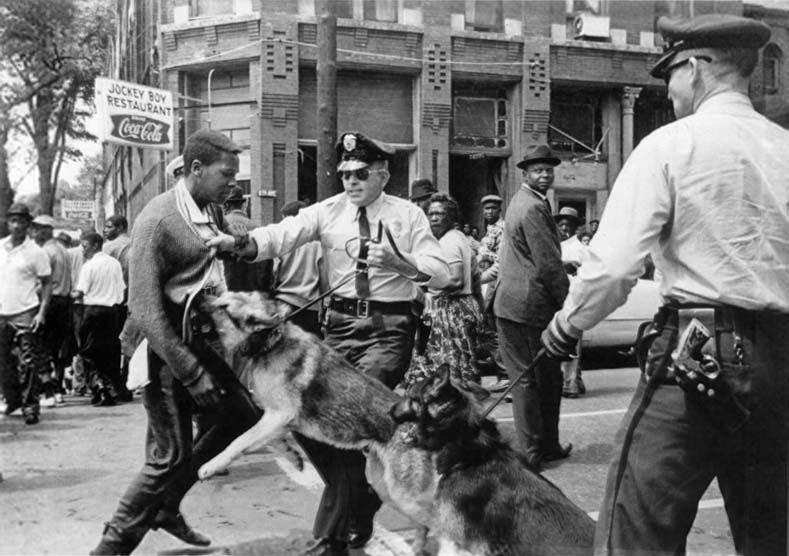
But in April 1963, working with other Civil Rights leaders in Birmingham Alabama King relit the fires of the movement. Montgomery Police Chief “Bull” Conner used his police force to violently attack the demonstrators. Conner ordered his men to unleash their police dogs on the protestors, and used high pressure water cannon against them, including women, children and the elderly. The violent reaction to the protests shocked much of America and the world.

King was arrested and in the Birmingham jail composed one of his most famous works, the Letter from the Birmingham Jail. The letter was a social, political and theological masterpiece. It was some of his harshest criticism was of white liberals, as well as black moderates:

“I have almost reached the regrettable conclusion that the Negro’s great stumbling block in his stride toward freedom is not the White Citizen’s Councilor or the Ku Klux Klanner, but the white moderate, who is more devoted to “order” than to justice; who prefers a negative peace which is the absence of tension to a positive peace which is the presence of justice; who constantly says: “I agree with you in the goal you seek, but I cannot agree with your methods of direct action”; who paternalistically believes he can set the timetable for another man’s freedom; who lives by a mythical concept of time and who constantly advises the Negro to wait for a “more convenient season”

King continued his activism until his assassination. In August 1963 he led the March on Washington for Jobs and Freedom, where before a crowd of an estimated 200,000-300,000 he gave his I Have a Dream Speech.

http://www.americanrhetoric.com/speeches/mlkihaveadream.htm

The crescendo of the speech was remarkable and is perhaps one of the most remembered speeches in American history.

Let us not wallow in the valley of despair, I say to you today, my friends.

And so even though we face the difficulties of today and tomorrow, I still have a dream. It is a dream deeply rooted in the American dream.

I have a dream that one day this nation will rise up and live out the true meaning of its creed: “We hold these truths to be self-evident, that all men are created equal.”

I have a dream that one day on the red hills of Georgia, the sons of former slaves and the sons of former slave owners will be able to sit down together at the table of brotherhood.

I have a dream that one day even the state of Mississippi, a state sweltering with the heat of injustice, sweltering with the heat of oppression, will be transformed into an oasis of freedom and justice.

I have a dream that my four little children will one day live in a nation where they will not be judged by the color of their skin but by the content of their character.

I have a dream today!

I have a dream that one day, down in Alabama, with its vicious racists, with its governor having his lips dripping with the words of “interposition” and “nullification” — one day right there in Alabama little black boys and black girls will be able to join hands with little white boys and white girls as sisters and brothers.

I have a dream today!

I have a dream that one day every valley shall be exalted, and every hill and mountain shall be made low, the rough places will be made plain, and the crooked places will be made straight; “and the glory of the Lord shall be revealed and all flesh shall see it together.”2

This is our hope, and this is the faith that I go back to the South with.

With this faith, we will be able to hew out of the mountain of despair a stone of hope. With this faith, we will be able to transform the jangling discords of our nation into a beautiful symphony of brotherhood. With this faith, we will be able to work together, to pray together, to struggle together, to go to jail together, to stand up for freedom together, knowing that we will be free one day.

And this will be the day — this will be the day when all of God’s children will be able to sing with new meaning:

My country ’tis of thee, sweet land of liberty, of thee I sing.

Land where my fathers died, land of the Pilgrim’s pride,

From every mountainside, let freedom ring!

And if America is to be a great nation, this must become true.

And so let freedom ring from the prodigious hilltops of New Hampshire.

Let freedom ring from the mighty mountains of New York.

Let freedom ring from the heightening Alleghenies of Pennsylvania.

Let freedom ring from the snow-capped Rockies of Colorado.

Let freedom ring from the curvaceous slopes of California.

But not only that:

Let freedom ring from Stone Mountain of Georgia.

Let freedom ring from Lookout Mountain of Tennessee.

Let freedom ring from every hill and molehill of Mississippi.

From every mountainside, let freedom ring.

And when this happens, and when we allow freedom ring, when we let it ring from every village and every hamlet, from every state and every city, we will be able to speed up that day when all of God’s children, black men and white men, Jews and Gentiles, Protestants and Catholics, will be able to join hands and sing in the words of the old Negro spiritual:

                Free at last! Free at last!

                Thank God Almighty, we are free at last!

King knew the dangers and the risks of appealing to a strategy of non-violence based on love of his enemies. King spoke to the world when he accepted the Nobel Peace Prize in 1964:

“Here and there an individual or group dares to love, and rises to the majestic heights of moral maturity. So in a real sense this is a great time to be alive. Therefore, I am not yet discouraged about the future. Granted that the easygoing optimism of yesterday is impossible. Granted that those who pioneer in the struggle for peace and freedom will still face uncomfortable jail terms, painful threats of death; they will still be battered by the storms of persecution, leading them to the nagging feeling that they can no longer bear such a heavy burden, and the temptation of wanting to retreat to a more quiet and serene life. Granted that we face a world crisis which leaves us standing so often amid the surging murmur of life’s restless sea. But every crisis has both its dangers and its opportunities. It can spell either salvation or doom. In a dark confused world the kingdom of God may yet reign in the hearts of men.”  http://www.nobelprize.org/nobel_prizes/peace/laureates/1964/king-lecture.html 

Dr. King understood how easy hatred could consume people and movements and urged  people not to follow the course of hate, he wrote:

“Returning hate for hate multiplies hate, adding deeper darkness to a night already devoid of stars. Darkness cannot drive out darkness; only light can do that. Hate cannot drive out hate; only love can do that. Hate multiplies hate, violence multiplies violence, and toughness multiplies toughness in a descending spiral of destruction.”

The day before his assassination in Memphis, Dr. King still recognized what he might face. His “I have been to the Mountaintop” speech http://www.americanrhetoric.com/speeches/mlkivebeentothemountaintop.htm recounted many of the things that he had encountered, including an assassination attempt in 1958 which had come close to killing him. It was an amazing speech and one wonders if having lived under threat so long that he almost had a premonition of his death the next day.

And then I got into Memphis. And some began to say the threats, or talk about the threats that were out. What would happen to me from some of our sick white brothers?

Well, I don’t know what will happen now. We’ve got some difficult days ahead. But it really doesn’t matter with me now, because I’ve been to the mountaintop.

And I don’t mind.

Like anybody, I would like to live a long life. Longevity has its place. But I’m not concerned about that now. I just want to do God’s will. And He’s allowed me to go up to the mountain. And I’ve looked over. And I’ve seen the Promised Land. I may not get there with you. But I want you to know tonight, that we, as a people, will get to the promised land!

Dr. King’s dream is not dead and we who live today cannot allow it to die. There is still much work to see justice done for all Americans as well as those suffering from violence, persecution, discrimination and poverty around the world.

It is 2019. It has been 57 years since Dr. King sat in the Birmingham jail. Sadly, there are some who long for a return to the day of Jim Crow. In some states there have been and there are ongoing attempts to return it by stealth, especially through restrictions on voting that predominantly impact African Americans and the poor. Racism is not dead, nor are so many other “isms.” As Dr. King told us, “Now is the time to make real the promises of democracy,” and “It would be fatal for the nation to overlook the urgency of the moment.”

Dr. King and many of the leaders of the Civil Rights Movement have passed on. Likewise, many people today are complacent about the injustices present in our society, injustices experienced by many people. We need a generation of new men and women with hearts like Dr. King’s, who will be the conscience of the nation and confront these injustices.

Birmingham_campaign_dogs

Likewise we cannot ghettoize Dr. King’s accomplishments as being something that only helped African Americans. They have helped all of us. Dr. King’s courage in standing for Constitutional Amendments that many of his opponents despised, the 13th, 14th, 15th and 19th Amendments, as well as the Civil Rights Act and Voting Rights Acts is of fundamental importance to all Americans, even those that think they don’t matter.

President Ulysses Grant was absolutely correct when he pointed out the plight of white Southerners in the ante-bellum South. They were people so bound to the slavery system and their place in it that they could not see how badly it hurt them so long as they had a group, in this case African American slaves who were below them. Grant wrote:

“The great bulk of the legal voters of the South were men who owned no slaves; their homes were generally in the hills and poor country; their facilities for educating their children, even up to the point of reading and writing, were very limited; their interest in the contest was very meagre–what there was, if they had been capable of seeing it, was with the North; they too needed emancipation. Under the old regime they were looked down upon by those who controlled all the affairs in the interest of slave-owners, as poor white trash who were allowed the ballot so long as they cast it according to direction.”

That my friends is descriptive of how President Trump and the Republican Congress view those who put them in office. Trump supporters do not seem to realize that they will be hurt the most by the incoming administration and congresses policies. They too need emancipation and deliverance, thus we have to remain strong, for they too are our brothers and sisters.

Representative John Lewis, one of the original Freedom Riders was beaten numerous times during those protests. When leading the march across the Pettus Bridge in Selma, Lewis had his skull fractured by a State Trooper when he stopped to pray.  Lewis’s words call us to action today:

“If not us, then who? If not now, then when?” 

Representative Lewis is still speaking out, and enduring the attacks of President Trump, and we must join him. We cannot let Dr. King’s dream die. It would be fatal to our country and the promise of the Declaration of Independence if we did, and we would only have ourselves to blame.

Peace

Padre Steve+

4 Comments

Filed under civil rights, ethics, faith, History, laws and legislation, leadership, News and current events, Political Commentary, racism, White nationalism

The “The Second Coming of God” The President’s Legitimization Of Race Hatred

Friends of Padre Steve’s World,

President Trump has done something that no President has managed to tap into the hidden shadow that permeates American history. Over the past few weeks it seems if the man is devolving into a completely unhinged, paranoid, and unstable man whose worst character traits are coming to the fore in ways that if they were not happening before our eyes, we would consider them unimaginable.

That dark shadow side includes significant racism, and distrust of immigrants, persecution, violence, discrimination, and laws specifically targeting non-western European Protestant Christians. The first people to experience this were African Slaves, the first of who arrived Four Hundred Years ago this month at the Jamestown settlement. Of course the attempts to exterminate and relocate the Native American tribes that were in the way of White westward expansion.

Then Catholic immigrants from Ireland and Germany began to arrive. The were met with persecution, violence, and accusations of divided loyalties, because the Vatican and its small states were, and still are an actual country with full diplomatic status. The groups that rose up against them were known by their self -proclaimed title The Know Nothings. By the late 1840s they had formed a political party. Abraham Lincoln noted of them:

“I am not a Know-Nothing. That is certain. How could I be? How can any one who abhors the oppression of negroes, be in favor or degrading classes of white people? Our progress in degeneracy appears to me to be pretty rapid. As a nation, we began by declaring that “all men are created equal.” We now practically read it “all men are created equal, except negroes” When the Know-Nothings get control, it will read “all men are created equal, except negroes, and foreigners, and Catholics.” When it comes to this I should prefer emigrating to some country where they make no pretence of loving liberty — to Russia, for instance, where despotism can be taken pure, and without the base alloy of hypocracy [sic].”

The President has consistently referred to Mexican and other Latin American immigrants as invaders, criminals, and murderers, and he is now imprisoning thousands of them, breaking up families for indefinite lengths of time, quite often , facilities that look like they would be found in a third world dictatorship. He frequently disparages African Americans, and the cities where they live. He dissolves offices of the Justice Department charged with enforcing laws that deal with equal rights, civil rights, and voting rights. Most recently he has used oft-repeated anti-Semitic racial tropes to attack American Jews, mainly Democrats in order to rile up the support of Evangelical Christian supporters of the State Of Israel. He even retweeted the comments of a Right Wing radio host that he is The King Of Israel and like a second coming of God. Whether one is Jewish or Christian, such comparisons are outright blasphemy, but there is not a bit of criticism from his Christian Cult supporters. He is not smart enough to realize the depth of his blasphemy and his followers do not care.

In the past several weeks a number of mass murders, including by those who claim Trump’s inspiration for their heinous acts, as well as the breaking up of several more who had written or posted manifestos of their anti-immigrant and anti-Jewish agendas and their praise for the President.

And the President shows no empathy and little remorse. He will make an official statement one day and within hours at a rally will incite his followers to oppose the opponents that he demonizes, political, journalists, immigrants, minorities, and others.

Meanwhile the economy teeters on the brink of recession, he attacks long time loyal allies, and supports despotic rulers from Russia, to the Philippines.

I could keep going but honestly I am tired. This week has been hard. I got a bacterial infection on my face, we got hit by a microburst storm which tore up our large backyard tree, which will cost a significant amount of money to fix, even as we try to get our home ready to sell or rent so we can move into a ranch house without all the steps and levels. At work I stay busy doing counseling and fighting for our programs in the face of budget cuts even as the military budget continues to rise to levels never seen before.

On the  positive side I have lost over 18 pounds since the beginning of June and over 4% body fat. I can walk again, swim and work out. But I’m tired, physically, emotionally, and spiritually. We are facing a major transition, at the age of 60 going from a thirty-eight year military career to civilian life, moving, and getting ready to start a new phase of life.

So anyway, until tomorrow,

Peace,

Padre Steve+


5 Comments

Filed under ethics, History, laws and legislation, News and current events, Political Commentary, racism, Religion

The Continuing Struggle, Part Three: Harriett Tubman “The General” and Women’s Rights Today


Friends of Padre Steve’s World,

Over the past few days I have been going back to the theme of Women’s rights following the 99th anniversary of the ratification of the Nineteenth Amendment.

So today I am posting a section of the portion of my text dealing with a most amazing woman, Harriet Tubman. The more I read about her the more I stand I awe. This section was a lot less detailed that in is now. I have spent a lot of time working on this section recently, and will probably do some more in the coming weeks, but I think that you will find it interesting, and still relevant in our society.

Her image was to be featured on the $20 bill beginning next year, replacing that of Andrew Jackson, but the Trump administration has put this off until at least 2028. Her story should not be forgotten. Maybe after I retire I can write an in depth biography of this remarkable woman and American Patriot.

So until tomorrow, I with you peace, health, and safety,

Peace

Padre Steve+

The innate prejudices of many military and political leaders about the abilities and limitations of women in military service, often caused them to overlook how women could use that prejudice to their advantage, especially as spies. “African American women were generally dismissed as militarily harmless, a miscalculation that Harriet Tubman…used to immense advantage. Tubman, who had escaped from slavery in Maryland twenty years before the war and who had amassed considerable experience venturing into the south to guide runaways to the North undertook spying expeditions for the Federal troops on the South Carolina Sea Islands.” [1] The incredibly brave woman served throughout the war accompanying Union forces and securing vital information even as she worked to set other slaves free. Tubman’s “spying activities included convincing slaves to trust the Union invaders,” [2] many of whom would join the ranks of the newly raised regiments of U.S. Colored Troops.


Tubman had been fighting her personal civil war for over twenty years before the war began. As an escaped slave she returned to the South time and time again as a “conductor” on the Underground Railroad, smuggling escaped slaves out of the South and to freedom. She “successfully returned nineteen more times, bringing out an estimated 300 to 400 people…. She worked with a determination bordering on ruthlessness: if an escaped slave tarried, she pushed him in; if a baby cried she muffled the sound.as she herself said later…. “I was the conductor on the Underground Railroad for eight years, and I can say what most conductors can’t say – I never ran my train off the track and I never lost one passenger.” [3]

In early 1863, Union commanders in South Carolina decided that Tubman would be valuable as a covert operative to lead reconnaissance missions behind Confederate lines and along contested waterways where Confederate personnel had laid torpedoes, what we now know as sea mines, and she organized a small unit of nine men who used small boats to find the torpedoes and warn the captains of Union vessels operating in those streams and rivers.

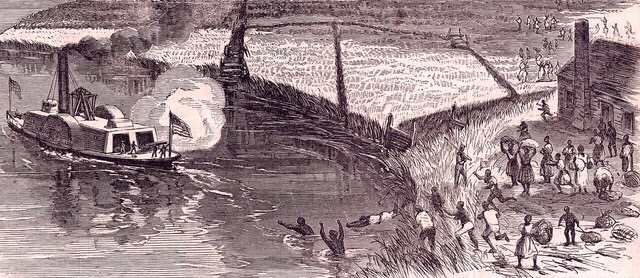
Eventually, Tubman’s actives “evolved into a kind of special forces operation under Colonel James Montgomery. A fervent believer in guerrilla warfare, Montgomery was a veteran of antislavery border fighting in Kansas.” The pair developed some of the most effective operations mounted by irregular and regular forces conducted by the Union in the war. In July 1863, Tubman came up with a plan for a raid, and in it acted as “Montgomery’s second-in-command during a night raid up the Combahee River, near Beaufort, South Carolina. The Union gunboats, carrying some 300 black troops, slipped up the river, eluding torpedoes that Tubman’s men had spotted. Undetected, the raiders swarmed ashore, destroyed a Confederate supply depot, torched homes and warehouses, and rounded up more than 750 rice plantation slaves.” [4]

The Confederate report on the raid unwittingly ended up praising the work of Tubman and the freed slaves of her unit. It noted that the enemy “seems to have been well posted as to the character and capacity of our troops… and seems to have been well guided with persons thoroughly acquainted with the river and country.” Union Brigadier General Rufus Saxton wrote to Secretary of War Stanton praised Tubman’s work, noting, “This is the only military command in American history wherein a woman, black or white, led to raid, and under whose inspiration, it was originated and conducted.” [5]

Tubman continued her work for the duration of the war and after it continued to assist freed slaves and black veterans and continued her work with campaign for women’s suffrage. In 1890 she was awarded a pension for her work as a spy, nurse, and combat leader. The valiant pioneer of abolition, women’s suffrage, and combat in war who was nicknamed “the General” by Frederick Douglass, died in 1913, and was buried with full military honors.

Other women served in various roles caring for the wounded. In the North, “Dorothea Dix organized the Union’s army nurses for four years without pay; Mary Livermore headed the Union’s Sanitary Commission, inspecting army camps and hospitals….Scores of others like Clara Barton, volunteered to be nurses.” [6] All of these women did remarkable service, mostly as volunteers, and many witnessed the carnage of battle close up as the cared for the wounded and the dying which often created ethic concerns for the women nurses:

“Clara Barton described her crisis of conscience when a young man on the verge of death mistook her for his sister May. Unable to bring herself actually to address him as “brother,” she nonetheless kissed his forehead so that, as she explained, “the act had done the falsehood the lips refused to speak.” [7]

The very existence of so many women who served in the ranks during the Civil War, and their “demonstrated competence as combatants, challenge long-held assumptions about gender roles…. From a historical perspective, the women warriors of the Civil War were not just ahead of their time. They were ahead of our time.” [8]

Of the women that served in the ranks during the war, some were discovered, and many of them remained protected by their fellow soldiers. Quite a few of these closeted women soldiers received promotions and even served as NCOs or junior officers. With women now serving in combat or combat support roles in the U.S. Military since Operation Desert Storm in 1991, the stigma and scandal that these cross-dressing women soldiers of the Civil War has faded and as scholars and the public both “continue probing cultural notions of gender and identity, the reemerging evidence that women historically and successfully engaged in combat has met with less intellectual resistance and has taken on new cultural significance.” [9] As the United States military services examine the issues surrounding further moves to integrate the combat arms we also should attempt to more closely examine the service of the brave and often forgotten women who served on both sides of the Civil War.

In addition to these tasked many other women were engaged in the war as “supply organizers, relief workers, pamphleteers all aided the cause, and female journalists covered it. Dorothea Dix and Clara Barton became powerful forces helping soldiers; Anna Carroll provided the propaganda. And the Civil War boasted its own version of Rosie the Riveter, women who did the dangerous work of making munitions at arsenals, many losing their lives in awful accidents.” [10]

Likewise, the war caused many educated women to take much more interest in “political and military issues and led many women to articulate a sharper consciousness of national affairs…. The feminist paper The Mayflower commented that “nearly every letter we receive breathes a spirit of deep feeling on the war question.” The editorial added that among women, “There seems to be little disposition to think, speak, read or write of anything else.” [11] In particular one women, Anna Ella Carroll, the daughter of Thomas King Carroll, a former governor of Maryland, “was interested in political theory and practice and was a profound logical thinker as well as an effective propagandist for the Union.” [12]  During the war she was in part responsible for persuading the governor of Maryland to keep the pro-secession legislature from meeting in 1861, defended Lincoln’s suspension of habeas corpus in that state, and is believed to have originated the military strategy in the Tennessee River Campaign, for which she was never given full credit even though there is documentary evidence that many leaders knew of her involvement. A recent biographer concluded that she “was a “tragic victim of reconstruction,” for if a military strategist, she was not given due credit.” [13] In the South it was often the same, the diaries of many educated Southern women show a tremendous interest and discernment of what was happening during the war, and in domestic politics, and frequently expressed their criticism of government and military strategy as the war continued.

                                                      Notes

[1] Ibid. Guelzo Fateful Lightning p.394

[2] Sizer, Lyde Cullen Acting Her Part: Narratives of Union Women Spies in Divided Houses: Gender and the Civil War Oxford University Press, New York and Oxford 1992 p.130

[3] Ibid. Sizer Acting Her Part: Narratives of Union Women Spies  p. 127

[4] Ibid. Central Intelligence Agency, Intelligence in the Civil War location 481 of 991

[5] Ibid. Central Intelligence Agency, Intelligence in the Civil War location 481-482 of 9911

[6] Ibid. Silvey I’ll Pass for Your Comrade p.10

[7] Faust, Drew Gilpin, This Republic of Suffering: Death and the American Civil War Vintage Books, a division of Random House, New York 2008 p.12

[8] Ibid. Blanton and Cook They Fought Like Demons p.208

[9] Ibid. Blanton and Cook They Fought Like Demons p.204

[10] Ibid. Roberts Capital Dames: The Civil War and the Women of Washington 1848-1868 p.3

[11] Attie, Jeanie Warwork and the Crisis of Domesticity in the North in Divided Houses: Gender and the Civil War edited by Catherine Clinton and Nina Silber, Oxford University Press, Oxford and New York 1992 p.253

[12] Ibid. Massey Women in the Civil War p. 168

[13] Ibid. Massey Women in the Civil War p.169

2 Comments

Filed under civil rights, civil war, History, News and current events, Political Commentary, racism, women's rights

The Continuing Struggle: The Nineteenth Amendment at 99 Years

Friends of Padre Steve’s World,

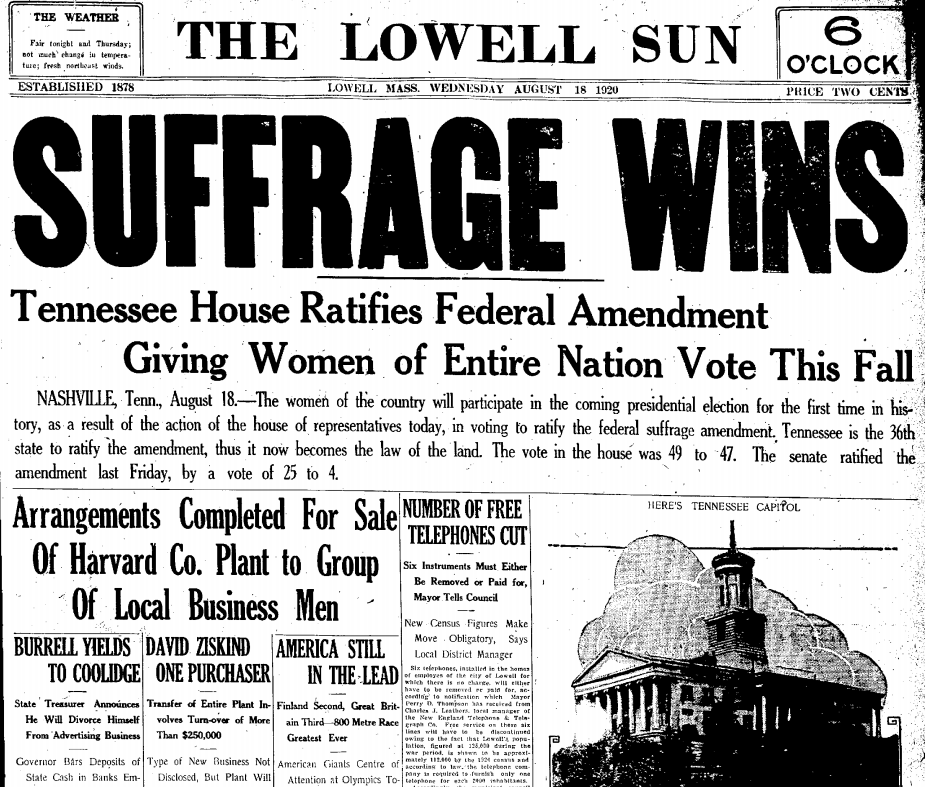
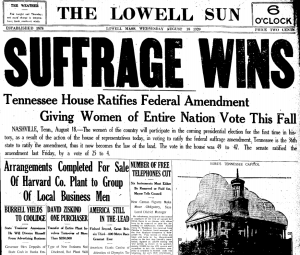
Today is the 99th Anniversary of the ratification of Nineteenth Amendment to the Constitution which gave women the right to vote. It was a watershed moment brought about through close to 8 decades of women fighting for the right to vote and for equality in general.

However, that decision was just a point of a long struggle for equality that  continues today. Despite the gains made since the past century women continue to have few rights than men, and when successful in business, sports, politics, the media, academia, or for that matter almost anything outside the traditional household remain second class citizens in most countries, even the United States, and all too sadly that is due to misogyny and religious prejudices which favor men and no matter how talented, intelligent, and brilliant many women are are consigned to a second place in the workplace, in the church, and almost everywhere else. 

So, tonight and for the next few nights I am going to repost a series of articles from one of my yet unpublished books which deal with the American Civil War, the Abolition Movement, and the post-War movement for women’s rights. 

So until tomorrow, 

Peace

Padre Steve+

Another development, which in large part is related to the abolition movement, was the campaign for women’s rights. The Civil War was also revolutionary because it was instrumental in propelling women into positions in American society that they had never before been allowed. The war Some of this was because many women decided to like those who campaigned for the end of slavery and the rights of African Americans to turn the world upside down. The war allowed the women who served, “in uniform or not, war permitted these women to experiment with a series of role reversals in gender,” [1] and in some cases gender and race. These experiments were the beginning of the struggle for women’s equality and to women serving in the military.

In much of the country and in particular the South women’s rights were the same as granted in English Common Law. Common law held to the more archaic understanding of the Christian Church that women were the property of their husbands, especially in cases of infidelity including during the trial of Dan Sickles for killing Barton Key. But the war “imposed on American society as such social disruption as it did physical destruction. Within that disruption, for one brief and bloody historical moment, an entirely new way of ordering of race and gender within a republican society became possible,” [2]however, in the end it would take another century or more for much of this change to be realized.

Southern culture and law ensured that women had even few rights than the women in the North.  In the North women were making some gains in the workplace and in various professions such as teaching and nursing, and as the industrial revolution modernized the workplace and required more skilled workers, particularly in the textile industries, the availability of work for women who wanted to work outside the home increased. Even uneducated Northern women sought work in the growing number of factories and by 1860 “there were more than 270,000 female operatives, the vast majority being employed in Northern textile, shoe, clothing, printing, and publishing establishments. Over 135,000 worked in New England factories and composed 65 percent of the region’s industrial labor.” [3]  Educated Northern women, while excluded from most professions, found their way into teaching, nursing, non-ordained religious work, and writing. Some found work in Federal government agencies in Washington DC, including “Clara Barton, a successful teacher who had trouble landing a position because she was a women, found work in the Patent Office, where she briefly made the same salary as her male colleagues.” [4]

But in the South women were continued to be held back. This was in large part due to the understanding that the “household was a spatial unit, defined by the property to which the owner not only held legal title over, but over which he exercised exclusive rights.” [5] As such Southern men had nearly unlimited rights and power over what occurred on his property, for “in societies in which landed property comprised the chief means of subsistence…legal title to the land had historically incorporated claims over the persons and labor of those who were dependents on it.” [6] In the South, as opposed to the North comparatively few women entered the Southern labor market, in large part because of the region’s emphasis on agriculture, dependence on slave labor, and a culture that frowned on women working outside the home.  1860 when Northern women were becoming a force to be reckoned with in the labor market, “only 12,000 women worked in factories, 10 percent of the regions wage earners.” [7] The lack of trained and experienced women workers would be a crippling impediment to the Confederate War effort.

For Southern men the stakes of ensuring slavery’s continuation and expansion were high, the culture of the South ante-bellum South was deeply patriarchal and “The possibility that the black man might be empowered like any other was such a threat to the southern social hierarchy that some white southerners were inclined to fear not only for their position as slaveowners but for the entire basis of their claim to patriarchal power. They feared for their power not only over their slaves but over their women as well.[8]

The Gimke Sisters, Abolitionists and Suffragettes 

William Lloyd Garrison and the leaders of the abolitionist movement came into contact with two southern women who had converted to the abolitionist cause; South Carolina cotton heiresses, Sarah and Angelina Grimke. The two women were passionate as well as eloquent and became popular lecturers on the abolitionist speaking circuit. Angelina Grimke was a powerful speaker linked to abolition and women’s rights, she made herself unwelcome in her native Charleston South Carolina “with the publication of An Appeal to the Christian Women of the South. She urged Southern women, many of whom opposed slavery, to speak out, and despite her failure to reach the audience to which she spoke, hers is one of the most significant abolitionist writings.” [9] She proclaimed:

“We cannot push Abolitionism forward with all our might until we take up the stumbling block out of the road…. If we surrender the right to speak in public this year, we must surrender the right to petition next year, and the right to write the year after, and so on. What then can the woman do for the slave, when she herself is under the feet of man and shamed into silence?” [10]

Her sister Sarah was also active in writing, but she focused her attention not just on abolition, but “on the inferior status of both woman and the Negro in The Equality of the Sexes and the Condition of Women.” [11] The Grimke sisters and other women like them brought Garrison and others in the abolitionist movement into contact with the early leaders of the new women’s rights movement. The leaders of the movement, Elizabeth Cady Stanton, Abby Kelley, and Lydia Maria Child were outspoken in their belief that “a campaign to emancipate slaves could not avert its eyes from the need to emancipate American women from social conventions and legal restraints that prevented them, like the slave, from owning property and voting, and kept them altogether subservient to the interests of white males.” [12]

The principals involved in the abolitionist and the women’s movements, those of freedom, emancipation and equality eventually forged a bond between them, and have provided inspiration to others in their quest for political and social equality. For William Lloyd Garrison “the woman question clearly demonstrated how the logic of reform united all good causes and carried them to new ground. If in their endeavors to break the chains of slavery women discovered, as Abby Kelley put it, that “we were manacled ourselves,” the abolitionist principle required a defense of equal rights without regard to race or sex.” [13]

While women and blacks were “being brought together in a dual crusade, often behind the same leaders,” [14] that did not mean that both parties were given equal consideration, even among the supporters of abolition and women’s rights. All to often, women found that their rights were not considered as important by the political leadership fighting for the rights of black men. Few in Congress “responded sympathetically to feminists’ demands. Reconstruction they insisted, was the “Negro’s hour,”  [15] a view shared by Frederick Douglass. Though the economic situation of women began to improve, especially through women being admitted to the Civil Service, much else remained unchanged, women were still second class citizens without the right to vote, with few legal rights, and few opportunities to move up in society apart from her husband.

But change was beginning to occur as women began to have more educational opportunities in the post-war years, and began to find employment opportunities with the expansion of industry. Women’s suffrage was not included in the Fifteenth Amendment, which caused a split between women’s groups and their long-time abolitionist allies who told them “If put on the same level and urged in the same connection, neither will soon be accomplished.” [16]   Even so in some territories women were granted the right to vote in territorial elections, “women were given the vote in Wyoming Territory in 1869. However, Wyoming’s admission as a state twenty years later came only after a heated debate on the women’s suffrage article in the state constitution.” [17]

In the 1800s women in the United States found themselves bound by two major factors, law and culture. English common law and early in the life of the Republic it was determined by John Adams that women should be exclude from political life as they were “unsuited by nature for the businesses of life or the hardy enterprises of war, they had nothing of value to offer the state.” [18] Women had no claim to property, wages, or even their children. Thomas Jefferson had “defined the essence of liberty as independence, which required ownership of productive property. A man dependent on others for a living could never truly be free, nor could a dependent class constitute the basis of republican government. Women, children, and slaves were dependent; that defined them out of the polity of republican freedmen.” [19] This understanding of the rights and citizenship of women persisted as the official law of the nation throughout the ante-bellum era, through and after the Civil War, and up until the passage and ratification of the Nineteenth Amendment.

As such, single women had few rights while married women had even fewer as, married women could not “own property in her own right, make contracts or otherwise conduct business of her own. She was supposed to be modest and submissive. The married woman, in fact, was for all intents and purposes the chattel of her husband.” [20] The reality was stark for women, but especially married women for as one historian noted: “marriage very nearly meant the legal annihilation of a woman…once a woman was married all property and property rights were transferred to her husband, and she was permitted to own nothing in her own name. Married women could not make contracts, could not sue, could not buy or sell, except over their husband’s signatures.” [21] Adult white women were citizens in a constitutional sense, but in the North and South alike their terms “of their citizenship had always been set by the perceived necessities of marriage and its gender asymmetries between man and woman, husband and wife.” [22]

The role of culture and religion was another major constraint on women’s rights during the ante-bellum period and much of this centered on Victorian social and cultural ideals which brought about what can be safely called a “a cult of true womanhood” which “dictated that women always appear demure, submissive, pious, and concerned with the home and family.” [23] In the Victorian ideal, it was the man whose sphere of life was in worldly pursuits, while women were limited to the task of bearing and raising children and maintaining the traditional private domain of hearth and home. This understanding of separate spheres was supported was often supported by the churches, especially those the conservative and evangelical variety.

While this was true in the North it was especially prevalent in the South and promoted by southern evangelical churches. The “explicit goal of southern evangelicalism was to keep the religious role of white women within narrow and carefully policed bounds. Evangelical Southerners clearly designated men as society’s (and women’s) rightful rulers and ultimate authorities. They were, in the 1830 words of Southern writer Virginia Carey, “the anointed lords of creation”; St. Paul’s injunction that wives “submit yourself to your own husbands as to the Lord” provided the text for many a Sunday sermon.” [24]

In matters of sexual behavior there was a pronounced double standard between men and women. If a man was an adulterer it was frowned upon, but not necessarily a condition that would invoke the scorn of the community unless an aggrieved husband took the law into his own hands and killed the adulterer, in which case the murderer could easily be forgiven. However, for the married adulteress, the social damnation was all too real, even from other women, who often believed that there was no excuse for such behavior and that the adulteress “deserved the most stringent fate for her violation of the dictates of virtue.” [25]

A married woman’s position was as close to being a slave as could be, and only the plight of black female slaves was worse, for they were simply chattel. The few free black women mainly stayed unmarried “in order to maintain what few property rights they were entitled to.”  [26] As they also did over blacks, white men ruled over women in all spheres of life. While the eventual emancipation of blacks provided more rights for black men, those did not help many black women as Sojourner Truth, a pioneering African-American abolitionist who spent forty-years as a slave said toward the end of her long life:

“There is a great stir about colored men getting their rights, but not one word about colored women; and if colored men get their rights, and not colored women theirs, you see colored men will be master over the women, and it will be just as bad as it was before. So I am for keeping the thing going while things are still stirring because if we wait till it is still, it will take a great while to get it going again….I suppose I am the only colored woman that goes on to speak for the rights of the colored women. I want to keep the thing stirring, now that the ice is cracked…” [27]

Elizabeth Cady Stanton was among the most vocal of women’s rights advocates. She was the daughter of a leading Federalist lawyer, who served a term in the House of Representatives and on the New York Supreme Court. Her father planted in her the desire to learn, a love for law, and a passion for civil rights which she was able to pursue. Unlike many women of her day, Stanton was able to graduate from the Johnstown Academy and the Troy Female Academy in Troy, New York, before she was married to Henry Brewster Stanton, a journalist, anti-slavery orator and attorney, with who she had seven children.

Stanton believed that a woman’s place in the home was ultimately destructive and “reflected her subordinate position in society and confined her to domestic duties that served to “destroy her confidence in her own powers, lessen her self respect, and to make her willing to lead a dependent and abject life.” [28] Stanton noted how the condition of women of her day was “more fully identified with the slave than man possibly can be… For while the man is born to do whatever he can, for the woman and the negro the is no such privilege.”  [29] It was a key observation and something even today, a state that some politicians, pundits and preachers would like to return women.

Since nearly all of the most “outspoken feminists had been schooled in abolitionist movement” they were “suspect in the South, where society was conservative, patriarchal, and insistence that ladies live in a kind of earthly limbo.”  [30]  Such women posed a threat to the pillars of Southern society. Since the South was now fighting tooth and nail against the abolitionist movement, anything closely connected with that movement, including the women who advocated abolition and women’s rights were shunned and their message rejected and inflammatory and revolutionary. It was not until the crisis caused by the Civil war that Southern women began to seize “the opportunity to lay claim to an increased reciprocity in gender relations.” [31]

But even with the abolition movement there was opposition the women’s rights, the 1839 meeting of the American Anti-Slavery Society witnessed a debate over including women in the membership. Conservative Evangelicals recoiled in disgust, and when the convention voted to allow women into the membership Lewis Tappan “got up a starchy “protest” which condemned the “repugnant” admission of women as an ‘expression of local and sectarian feelings…well suited to the unnecessary reproach and embarrassment to the cause of the enslaved as [it] is at variance with the general usage and sentiments of this and other nations.” [32] In May of 1840 the American Anti-Slavery Society split among religious lines when leading evangelicals led by the Tappan brothers withdrew from it.
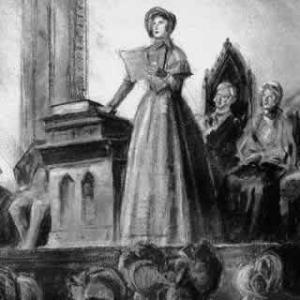
senecafalls-womanspeaking

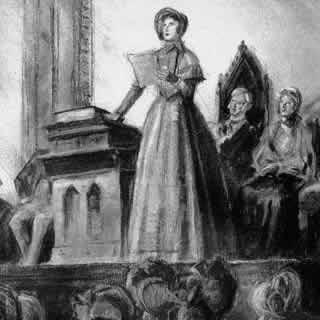
Elizabeth Candy Stanton at the Seneca Conference, 1848

But that neither stopped Garrison from working with women, nor kept Frederick Douglass from embracing them as part of the abolitionist movement. From this rather inauspicious beginning, the women’s rights movement began to infiltrate society, especially in the field of education. In 1848 at Seneca New York there was a convention that launched the modern women’s rights movement. Led by Stanton and Elizabeth Mott the delegates published a “Declaration of Sentiments, modeled on the Declaration of Independence, proclaimed “that all men and women are created equal” and deserved their “inalienable rights” include the right to elective franchise.” [33] The declaration was bold and its denunciation of the place of women in society to be considered revolutionary in character. Part read:

“He has never permitted her to exercise her inalienable right to elective franchise. He has compelled her to submit to laws, in the formation of which she had no voice. He has withheld from her rights which are given to the most ignorant and degraded men – both natives and foreigners… He has made her, if married, in the eye of the law, civilly dead. He has taken from her all right to property, even to the wages that she earns…. After depriving her of all her rights as a married woman, if single, and the owner of property, he has taxed her to support a government which recognizes her only when her property can be made profitable to it. He has monopolized nearly all the profitable employments, and from those she is permitted to follow she receives but a scanty remuneration. He closes against her all the avenues to wealth and distinction which he considers honorable to himself. As a teacher of theology, medicine of the law, she is not known… He has created a false public sentiment by giving the world a different code of morals for men and women, by which moral delinquencies which exclude women from society, are not only tolerated, but deemed of little account in man. He has usurped the prerogative of Jehovah alone, claiming his right to assign for her a sphere of action, when that belongs to her conscience and to her God. He has endeavored, in every way that he could, to destroy her confidence in her own powers, lessen her self-respect, and to make her willing to lead an abject and dependent life.” [34]

The declaration also stated, in words which inflamed many men that: “the history of mankind is a history of repeated injuries and usurpations on the part of man toward woman, having in direct object of an absolute tyranny over her.” [35] In the years following this meeting women took up an even more important place in the abolitionist movement, Abby Kelly Foster returned to head the work and recruited many talented women agents including Sallie Holley, Lucy Stone and Susan B. Anthony who “often made five or six appearances a week”in various abolitionist meetings and in 1850-1851 they were joined by the “black evangelist Sojourner Truth, whom Garrison had met and the Northampton colony in 1843 and for whom he had printed an autobiographical narrative.”[36] These women contributed greatly to the abolitionist cause and would in the years to come be among those who continued to fight not only for the rights of blacks, but the rights of women.

The new women’s rights groups continued to work hand in hand with the abolitionist groups but also began a campaign for the rights of women. In the mid-1850s primarily focused on “obtaining state laws guaranteeing women’s right to control their property and wages, to be legal guardians of their children, and to be paid salaries commensurate with their labors, while a few women advocated for more liberal divorce laws so that they could rid themselves of alcoholic, insane, criminal, or brutal husbands.” [37]These efforts secured some modest gains and by 1861 most states had granted women some type of property rights or had changed their laws to follow the community property principle.

While the movement made modest progress regarding property rights for women in some states, they made little progress in terms of elective franchise and better wages and working conditions. During the ante-bellum period, women who lobbied for such rights were met with open opposition and scorn. The press “frequently denounced and ridiculed the “strong-minded women…” [38] Despite such attitudes women did make some significant advancements, particularly in lay aspects of the church, such as Bible societies, moral reform organizations, as well as the abolition and temperance movements, which had gained prominence during the Second Great Awakening.

During the ante-bellum period women made great progress in education. By 1850 the United States was the only country where “girls went to elementary school and achieved literacy in virtually the same proportion as boys.” [39] Likewise a few women entered higher education, particularly at women’s seminaries, which were for all practical purposes boarding schools that produced teachers and writers, as well as the Oberlin College, which was founded by Christian abolitionists and welcomed students of both genders as well as of any racial minority. During the three decades prior to the war women made some specific gains, but more important “was the development to their talents for organization, cooperation, leadership, and self expression. It was a time of beginnings and not fulfillment, a time when most women realized and accepted the fact that they lived in a man’s world, a time when a few dedicated but belligerent visionaries were frustrated in their attempt to remake the social order “overnight.” [40]

However, the war would help bring about many more opportunities for women. In 1850 a follow on conference to the Seneca conference, the National Women’s Rights Convention denied the right of anyone to dictate what women could do with their lives:

“The right of any portion of the species to decide for another portion, of any individual to decide for another Individual what is not their “proper sphere”; that the proper sphere for all human beings is the largest and highest to which they are able to attain; what this is, can not be ascertained without complete Liberty of choice; women therefore, ought to choose for herself what sphere she will fill, what education she will seek, and what employment she will follow, and will not be bound to accept, in submission, the rights, the education, and the place which man thinks proper to allow her.”  [41]

To be continued…

Notes

[1] Ibid. Guelzo Fateful Lightning  p.395

[2] Ibid. Guelzo Fateful Lightning p.374

[3] Massey, Mary Elizabeth, Women in the Civil War University of Nebraska Press, Lincoln NE 1966 p.5

[4] Roberts, Cokie Capital Dames: The Civil War and the Women of Washington, 1848-1868 Harper Collins Publishers, New York 2015 p.18

[5] McCurry, Stephanie The Politics of Yeoman Households in South Carolina  in  Divided Houses: Gender and the Civil War Oxford University Press, Oxford and New York 1992 p.23

[6] Ibid. McCurry The Politics of Yeoman Households in South Carolina p.23

[7] Ibid. Massey Women in the Civil War p.5

[8] Whites, Leeann The Civil War as a Crisis in Gender in Major Problems in the Civil War and Reconstruction, 3rd Edition Edited by Michael Perlman and Murrell Taylor Wadsworth Centage Learning, Boston 2011 p.16

[9] Ibid. Massy Women in the Civil War p.15

[10] Ibid. Zinn The Other Civil War p.121

[11] Ibid. Massey Women in the Civil War p. 16

[12] Ibid. Guelzo Fateful Lightening pp.49-50

[13] Mayer, Henry All on Fire: William Lloyd Garrison and the Abolition of Slavery  W.W. Norton and Company, New York and London 1998 p.265

REPORT THIS AD

[14] Ibid. Massey Women in the Civil War p.16

[15] Ibid. Foner Forever Free p.124

[16] Ibid. Foner Forever Free p.125

[17] Ibid. Massey Women in the Civil War p. 358

[18] Ibid. McCurry Confederate Reckoning p.24

[19] Ibid. McPherson Battle Cry of Freedom p.23

[20] Brant, Nat The Congressman Who Got Away with Murder Syracuse University Press, Syracuse New York 1991 p.67

[21] Ibid. Guelzo Fateful Lightening p.391

[22] Ibid. McCurry Confederate Reckoning p.23

[23] Blanton, DeAnne and Cook, Lauren M. They Fought Like Demons: Women Soldiers in the Civil War Vintage a books, a Division of Random House New York 2002 p.3

[24] Ibid. Levine, Bruce Half Slave and Half Free: The Roots of the Civil War Revised Edition p.114

[25] Ibid. Brant The Congressman Who Got Away with Murder p.141

[26] Ibid. Guelzo Fateful Lightening p.391

[27] Ibid. Zinn The Other Civil War pp.53-54

[28] Ibid. Goldfield America Aflame p.74

[29] Ibid. Guelzo Fateful Lightening p.50

[30] Ibid. Massey Women in the Civil War p. 19

[31] Ibid. Whites The Civil War as a Crisis in Gender p.21

[32] Ibid. Mayer All on Fire p.267

[33] Ibid. McPherson Battle Cry of Freedom p.36

[34] Ibid. Blanton and Cook They Fought Like Demons: Women Soldiers in the Civil War pp.3-4

[35] Ibid. Guelzo Fateful Lightening p.392

[36] Ibid. Mayer All on Fire p.424

[37] Ibid. Massey Women in the Civil War p.21

[38] Ibid. Massey Women in the Civil War pp.21-22

[39] Ibid. McPherson The Battle Cry of Freedom p.36

[40] Ibid. Massey Women in the Civil War p.23

[41] Ibid. Guelzo Fateful Lightning p.392

2 Comments
Filed under civil rights, civil war, faith, History, labor, laws and legislation, leadership, News and current events, Political Commentary, women's rights

“A Country that Will Tolerate Evil Means – Evil Manners, and Standards Of Ethics… Will be So Poisoned that it Never Have Any Good End”

1_PdtRL0EWQD_TJZdqE8BzQg

Friends of Padre Steve’s World,

Tonight I am re-posting an older article that I think is even more pertinent than it was when I first wrote it. I am doing this because I haven’t slept well for the past few weeks. My sleep doctor ordered me a BIPAP machine, replacing my CPAP. Hopefully it will help me sleep better. It may not stop all the crazy PTSD dreams and nightmares, but maybe I will sleep better, but I digress.

Thew fact is that many of Trump’s followers were prepared for his advent by years of highly politicized propaganda nationalistic covered with a very thin veneer of Christian jibber-jabber, most of which is at odds with 2000 years of the teachings of the Church going back to Jesus. But this propaganda has brought about a wave of hatred that consumes many toward those that they identify as enemies, and indifference to the victims of the policies that their political and clerical leaders espouse.

Historian Ian Kershaw wrote: “The road to Auschwitz was built by hate, but paved with indifference.” I find that comment all too real today when I look at the President, his propagandists, and those who follow him without question even when they know that he is lying to them.

The longer that I live the more that I understand how this happens. Today, as there were in 1930s and 1940s Nazi Germany, there are all too many hate-filled ideologues who desire to destroy or subjugate entire races and ethnic groups, or members of different religions or political ideologies. In the United States they have free reign to do speak and write freely about their goals and for many years we have regarded most of them as fringe characters who had no chance of ever enacting anything that they proposed.

Barry Goldwater, the true conservative scion of the GOP was frightened by the Christians who now form the core of the Trump personality cult. Goldwater said:

“Mark my word, if and when these preachers get control of the [Republican] party, and they’re sure trying to do so, it’s going to be a terrible damn problem. Frankly, these people frighten me. Politics and governing demand compromise. But these Christians believe they are acting in the name of God, so they can’t and won’t compromise. I know, I’ve tried to deal with them.” 

Many of these were and continue to be the most vocal supporters of President Trump, and see in him a man who will help them accomplish their desires as no President has done before. One of them, Steve Bannon who served as his chief policy adviser and strategist. Likewise, there are no shortage of civil rights opponents and proponents of a police state in his cabinet, including his first, Attorney General, Jeff Sessions, and his current AG, William Barr. While serving. As AG before he was fired, Sessions, the top law enforcement official in the country joined a chorus of Republican youth chanting “lock her up” meaning former First Lady, Senator, and Secretary of State Hillary Clinton. More recently Mr. Barr has moved to ensure that the Executive Branch achieves the primacy over the legislative and judicial branches that it is denied in the Constitution. Ken Cuccinelli said that the words on the Statue Of Liberty only applied to those of European descent.

e5b0006d86d35ad18a117e40a2e528af

Despite the myriad of actions taken by the Trump administration, its abuses of power, its probable connections to a hostile power, its attempts to shut down law enforcement probes of the Russia connections, its unabashed attempts to silence the press and all other opponents, and its nearly uncountable number of lies and distortions that it makes on a daily basis is that the vast majority of Congressional Republicans nor his supposedly Christian followers seem to care.

Don’t get me wrong, there is plenty of opposition, but among his followers and the great number of people in the middle who prefer not to get involved there is little real opposition; moral, religious, ethical, or political to anything that he says or does, mostly because they do not understand how it effects them or their liberties, nor how toxic it is to the nation. It seems to me that they are not only apathetic to the abuses of power, but have no empathy towards the people that they are directed against.

But as I said at the opening of this article, the were prepared by decades of political propaganda covered with a veneer of Christian jibber-jabber. I know this because for a bit over two decades I was exposed to it and and believed it. Years ago I knew and went to church with Randall Terry, the former head Operation Rescue. He once said: “Let a wave of intolerance wash over you. I want you to let a wave of hatred wash over you. Yes, hate is good…” I have walked in the shoes of Trump’s “Christian” personality cult, and at one time I was as whipped into a frenzy of hate by those preachers, and their colleagues in right wing talk radio. That was before I went to and returned from Iraq. Thus I fully understand them and now I reject them and their intolerant creeds.

img_0476

For the Trump supporters this is not a problem. He represents a chance for them to recover their greatness, just as Hitler did for many of his followers in the 1930s, including those who joined the Party late. One of the greatest film monologues that illustrated this phenomenon is that of Burt Lancaster in his portrayal of a Nazi judge who is on trial in the movie Judgment at Nuremberg. His comments remind me so much of what I see among many Trump supporters today:

“There was a fever over the land. A fever of disgrace, of indignity, of hunger. We had a democracy, yes, but it was torn by elements within. Above all, there was fear. Fear of today, fear of tomorrow, fear of our neighbors, and fear of ourselves. Only when you understand that – can you understand what Hitler meant to us. Because he said to us: ‘Lift your heads! Be proud to be German! There are devils among us. Communists, Liberals, Jews, Gypsies! Once these devils will be destroyed, your misery will be destroyed.’ It was the old, old story of the sacrificial lamb. What about those of us who knew better? We who knew the words were lies and worse than lies? Why did we sit silent? Why did we take part? Because we loved our country! What difference does it make if a few political extremists lose their rights? What difference does it make if a few racial minorities lose their rights? It is only a passing phase. It is only a stage we are going through. It will be discarded sooner or later. Hitler himself will be discarded… sooner or later. The country is in danger. We will march out of the shadows. We will go forward. Forward is the great password. And history tells how well we succeeded, your honor. We succeeded beyond our wildest dreams. The very elements of hate and power about Hitler that mesmerized Germany, mesmerized the world! We found ourselves with sudden powerful allies. Things that had been denied to us as a democracy were open to us now. The world said ‘go ahead, take it, take it! Take Sudetenland, take the Rhineland – remilitarize it – take all of Austria, take it! And then one day we looked around and found that we were in an even more terrible danger. The ritual began in this courtoom swept over the land like a raging, roaring disease. What was going to be a passing phase had become the way of life. Your honor, I was content to sit silent during this trial. I was content to tend my roses. I was even content to let counsel try to save my name, until I realized that in order to save it, he would have to raise the specter again. You have seen him do it – he has done it here in this courtroom. He has suggested that the Third Reich worked for the benefit of people. He has suggested that we sterilized men for the welfare of the country. He has suggested that perhaps the old Jew did sleep with the sixteen year old girl, after all. Once more it is being done for love of country. It is not easy to tell the truth; but if there is to be any salvation for Germany, we who know our guilt must admit it… whatever the pain and humiliation.”

img_0178

While we have not reached the point that the Third Reich did between 1933 and 1938, it will not take much for us to get there. Trump is certainly not Hitler, but he is escalating his words and actions toward the establishment of an authoritarian state. We misjudge ourselves if we belief that such things cannot happen here.

Sinclair Lewis, who wrote the book It Can’t Happen Here as a response to authoritarian and Fascist movements in the 1930s wrote in it:

“A country that tolerates evil means—evil manners, standards of ethics—for a generation, will be so poisoned that it never will have any good end.”

Timothy Snyder wrote:

“The European history of the twentieth century shows us that societies can break, democracies can fall, ethics can collapse, and ordinary men can find themselves standing over death pits with guns in their hands. It would serve us well today to understand why.”

Reinhold Niebuhr, the great American theologian noted: “Ultimately evil is done not so much by evil people, but by good people who do not know themselves and who do not probe deeply.”

We should heed their warnings before we cross that precipice and head into the abyss.

Until tomorrow,

Peace

Padre Steve+

3 Comments

Filed under books and literature, civil rights, ethics, History, holocaust, laws and legislation, leadership, nazi germany, News and current events, Political Commentary

The Rising Of an Authoritarian State: Remembering “Why Don’t We Learn from History.”

Image result for liddell hart

                                                 B. H. Liddell-Hart

Friends of Padre Steve’s World,

A number of years ago I read the short but poignant little but by the British military historian B.H. Liddell-Hart entitled Why Don’t We Learn from History. The book was written in not long before his death in 1970 and it is good quite good. It deals with a number of issues, including the conflict between history and propaganda, or when faith, especially religious faith as treated as historic or scientific fact; especially when propaganda or faith is preached as if it were history, if it were truth. But he also contrasted democracy and totalitarianism.

Liddell-Hart was a realist, especially about democracy and totalitarianism. While he admitted the inefficiencies of democracy, he realized that it was far less dangerous than the “stupidity” of totalitarianism. In fact it was important for him to note just how this inefficient system was for freedom. He wrote:

“What is of value in “England” and “America” and worth defending is its tradition of freedom, the guarantee of its vitality. Our civilization, like the Greek, has, for all its blundering way, taught the value of freedom, of criticism of authority, and of harmonising this with order. Anyone who urges a different system, for efficiency’s sake, is betraying the vital tradition.”

There is much to ponder in his book and I will probably write some more of my thoughts on it, but when I read it I was struck by just how much Liddell-Hart in his description of a despot described President Donald Trump through the his campaign and after his election and inauguration.

“We learn from history that self-made despotic rulers follow a standard pattern. In gaining power: They exploit, consciously or unconsciously, a state of popular dissatisfaction with the existing regime or of hostility between different sections of the people. They attack the existing regime violently and combine their appeal to discontent with unlimited promises (which, if successful, they fulfil only to a limited extent). They claim that they want absolute power for only a short time (but “find” subsequently that the time to relinquish it never comes). They excite popular sympathy by presenting the picture of a conspiracy against them and use this as a lever to gain a firmer hold at some crucial stage.” 

Once authoritarian, despotic, or dictatorial leaders gain power through the democratic process they seldom deviate from how they behave when seeking power. Liddell-Hart wrote:

“We learn from history that time does little to alter the psychology of dictatorship. The effect of power on the mind of the man who possesses it, especially when he has gained it by successful aggression, tends to be remarkably similar in every age and in every country.”

So please, take a breathe for a second and think about this in terms of President Trump and his actions during his first two plus years in office. Liddell-Hart noted that once a despot achieves power that their reign is marked by the following types of events:

“On gaining power:  They soon begin to rid themselves of their chief helpers, “discovering” that those who brought about the new order have suddenly become traitors to it. 

They suppress criticism on one pretext or another and punish anyone who mentions facts which, however true, are unfavourable to their policy. They enlist religion on their side, if possible, or, if its leaders are not compliant, foster a new kind of religion subservient to their ends. 

They spend public money lavishly on material works of a striking kind, in compensation for the freedom of spirit and thought of which they have robbed the public. 

They manipulate the currency to make the economic position of the state appear better than it is in reality. 

They ultimately make war on some other state as a means of diverting attention from internal conditions and allowing discontent to explode outward. 

They use the rallying cry of patriotism as a means of riveting the chains of their personal authority more firmly on the people. 

They expand the superstructure of the state while undermining its foundations by breeding sycophants at the expense of self-respecting collaborators, by appealing to the popular taste for the grandiose and sensational instead of true values, and by fostering a romantic instead of a realistic view, thus ensuring the ultimate collapse, under their successors if not themselves, of what they have created. 

This political confidence trick, itself a familiar string of tricks, has been repeated all down the ages. Yet it rarely fails to take in a fresh generation.”

Now pause for a moment. Donald Trump has been in office about two and a half years.  Look at how he is behaving. Look at how he has ruled as an authoritarian, destroyed many of the guardrails which our founders intended on restraining such a leader, and how he has mustered a cult-like following of supporters. Interestingly enough his most loyal followers are Conservative Evangelical and Charismatic Christians and White Supremacists. Even yesterday he hinted at canceling elections at a rally, to the great applause of his followers. He is following the authoritarian script to the tee.

For the most part the rules by decree. He uses executive powers to change governmental rules and regulations to fit his design, especially regarding immigration, immigrants, and minorities. Sometimes the Courts or Congress delay or reverse his decisions, but he and his sycophants push forward. His lies are so common, banal, and absolutely incredibly bad that people, even his supporters dismiss them as a part of who he is, and there are thousands of them, and their count grows daily. Even much of the mainstream press minimizes them.

Read his words, examine his actions, and not just during the past two and a half years, as well as his business career and his campaign for the presidency. His targets have included the press in general, specific members of it, specific political opponents and members of the House, Senate, Courts, and even members of his administration.

Anthony Scaramucci, a long time Trump friend and ally, and for a week and a half a member of his administration, noted last week that Trump eventually turns on everyone, and that it will long before he turns against the country.

With that in mind, take the time to let Liddell-Hart’s words sink in, hours, days, weeks, or even months. Contemplation and reflection are far better than visceral and emotional reactions.

This is something to think about. It is something that should trouble any American regardless of political party or ideology.

Until tomorrow,

Peace

Padre Steve+

6 Comments

Filed under ethics, History, Loose thoughts and musings, News and current events, Political Commentary

The Battle of Savo Island and Threats to the U.S. Navy Today

USS_Quincy_CA-39_savo

                         USS Quincy under Attack off Savo Island 

Friends of Padre Steve’s World,

Tonight I am going back to my World War II vault and reposting an older article about the Battle Of Savo Island off Guadalcanal. It was the most lopsided defeat in modern American Naval history. It happened a long time ago and in an age where the United States Navy has not lost a ship in combat, other to mines since August 6th 1945, we forget to remember that should a war break out with a near-peer competitor, like the Chinese Communists or the Russians in waterers where they can gain local superiority, or even regional powers such as Iran which could use asymmetric means of large numbers of small missile equipped ships and attack boats, costal submarines, and land based anti-ship missiles in “swarm attacks” to overwhelm technologically superior American ships in confined waters. We have come close to losing major ships, the cruiser USS Princeton and Helicopter Carrier USS Tripoli, to very primitive moored mines during the First Gulf War, the USS Ruben James to a mine during the tanker wars, and the USS Stark which was hit by Iraqi Exocet anti-ship missiles in 1987. Likewise we have come close to losing the Guided Missile destroyers USS Cole (Terrorist attack), USS John S. McCain and USS Fitzgerald (avoidable collisions with merchant ships). 

We have been lucky. We won’t be as lucky in a real live shootout today. Ships will be lost, damaged, and sailors will die. Compounding the problem for the United States is that years of focus on Iraq and Afghanistan, failed experiments with reducing crew size (smart-ship), reductions in numbers of ships and sailors to satisfy the budgets needs to the unnecessary invasion of Iraq, and the stress put on remaining ships and aircraft have worn us down. Readiness rates remain down, and we no longer have the shipbuilding and repair facilities to replace losses and repair damaged ships, especially in a war with China. 

That is why instead of commenting on today’s news I write about the worst defeat suffered by the U.S. Navy in the modern era, which I label from World War II to the present. 

Until tomorrow,

Peace,

Padre Steve+ 

On August 8th 1942 the U.S. Task Force supporting the invasion of Guadalcanal was tired. The crews of the ships had been in continuous combat operations conducting naval gunfire support missions, fending off numerous Japanese air attacks and guarding against submarine attacks for two days. The force commanded by Admiral Richmond K. Turner was still unloading materials, equipment and supplies needed by the men of the 1st Marine Division who they had put ashore on the morning of the seventh.

On the afternoon of the eighth Turner was informed by Admiral Frank “Jack” Fletcher that he was pulling his carrier task force out of action. Fletcher alleged that he did not have enough fighter aircraft (79 remaining of an original 98) and as low on fuel. The carriers had only been in action 36 hours and Fletcher’s reasons for withdraw were flimsy. Fletcher pulled out and left Turner and his subordinate commanders the responsibility of remaining in the area without air support with the transports still unloaded, and full of badly needed supplies and equipment.

Gunichi_Mikawa

                                          Admiral Gunichi Mikawa

As the American drama played out, the Japanese moved forces into position to strike the Americans. Admiral Gunichi Mikawa commander of the 8th Fleet and Outer South Seas Force based at Rabaul New Britain quickly assembled a force of 6 heavy cruisers, the 14,000 ton Atago Class Chokai, and the four smaller ships of the Kako Class, the Aoba, Kako, Kinugasa and Furutaka, the light cruisers Yubari and Tenryu and the destroyer Yunagi. Mikawa raised his flag aboard Chokai and the force sped down “the slot” which ran the length of the of the Solomon’s chain mid day on the seventh.

The Americans had warning of their coming. The first sighting was by B-17s before the Japanese forces had reached Rabaul. The second was the elderly U.S. Navy submarine S-38 at 2000 on the 7th when they were 550 miles away not far from Rabaul. This report was discounted because it would not be unusual to find a number of fleet units steaming near a major naval base and fleet headquarters. The last which should have alerted the allies was a sighting by a Royal Australian Air Force patrol aircraft on the morning of the 8th. However the pilot did not report the sighting until he returned from his mission returned to his base and had his tea. The eight hour delay in reporting the information as well as errors in it which reported 2 submarine tenders as part of the force lulled the Allied forces into believing that the Japanese were setting up a seaplane base and posed no threat to the invasion forces. It was a fatal error of reporting and judgment by the pilot.

USS_Astoria_(CA-34)_off_Guadalcanal_1942

USS Astoria on August 8th off Guadalcanal and USS Chicago (below)

CA-29_Chicago

In the absence of good information Turner deployed his support ships to cover the three entrances into what soon would be known as Iron Bottom Sound. He placed the Anti Aircraft Cruiser USS San Juan and Australian Light Cruiser HMAS Hobart to the east with two destroyers under the command of Rear Admiral Norman Scott. To protect the south west entrance into the sound south of Savo Island Turner placed the Heavy Cruisers USS Chicago, HMAS Australia and HMAS Canberra and two destroyers under the command of Rear Admiral R.A.C. Crutchley RN who in theory commanded the screening force. To the north of Savo he deployed the Heavy Cruisers USS Vincennes, USS Astoria and USS Quincy and two destroyers under the tactical direction of Captain Frederick Riefkohl aboard Vincennes. To the west of Savo he placed two destroyers to act as picket ships. Unfortunately these ships radar sets were insufficient and would fail to pick up the approaching enemy.

800px-SavoIslandMap

                                                   Allied Dispositions

During the early evening Turner recalled Crutchley to his flagship for consultations of what to do regarding Fletcher’s retreat. Crutchley came over in his flagship the Australia denuding the southern force of its commander as well as one of its three heavy cruisers. He left the commanding officer of Chicago Captain Howard D. Bode in tactical command but Bode did not have his ship take the lead position in the patrol assuming Crutchley would return bymidnight.

USS_Vincennes_(CA-44)_in_the_Solomons_1942

USS Vincennes (above) and USS Quincy (below)

ca__39_uss_quincy___1942.08.03___1a

HMAS Canberra Sydney Harbour

                                                    HMAS Canberra 

Mikawa launched float planes to scout the locations of the American ships and to provide illumination once the battle began. Some of these aircraft were spotted but no alert measures were taken as many assumed the Japanese to be friendly aircraft. Many commanding officers were asleep or resting away from the bridge of their ships, lookouts were tired and not expecting the Japanese and Condition Two was set in order to provide some of the tired crews a chance to rest.

800px-SavoIslandYubariSearchlight

Light Cruiser Yubari illuminating American cruisers at Savo Island

Admiral Mikawa now new the Allied disposition and ordered his ships to battle stations at 0045. At 004 he sighted and passed astern of USS Blue the southern picket which also failed to detect the Japanese force. Mikawa assumed that the destroyer might have reported his presence, briefly turned north but turned back to his original course when a lookout allegedly spotted a destroyer to his northeast. He gave the order to attack at 0132 and promptly spotted the American destroyer USS Jarvis which had been heavily damaged and without radio communications was making her way toAustralia for repair and passed her after some ships fired torpedoes and raced toward the southern force at 26 knots. With the southern force just a few miles away Mikawa ordered his ships to commence firing at 0136 and at 0138 torpedoes had been launched.

Mikawa’s lookouts spotted the northern group at 0144 and changed course. The maneuver was badly executed and left the Japanese in two columns as they swiftly closed on the Americans. Mikawa’s flagship Chokai launched torpedoes at 0148 and Astoria the cruiser closest to the Japanese set general quarters at 0145 and at 0150 the Japanese illuminated her with searchlights and opened fire. Astoria under the direction of her gunnery officer returned fire at 0152 ½ just before her Captain came to the bridge unaware of the situation. He ordered a cease fire until he could ascertain who he was firing at assuming the Japanese to be friendly ships. He delayed 2 minutes and ordered fires commenced at 0154 but the delay was fatal. Astoria had opened fire on the Chokai which then had time to get the range on the American cruiser and hit her with an 8” salvo which caused fires which provided the other Japanese ships an aiming point.

SavoJapaneseWarArt

Japanese artist depiction of attack on US Navy Cruisers at Savo Island

Astoria was left burning and heavily damaged barely maintaining headway but attempted to fight on scoring a hit on Chokai’s forward turret even as the Japanese opened up on the next cruiser in line the USS Quincy. Quincy caught between the two Japanese columns. Aoba illuminated her with her searchlight and Japanese forces opened fire. The gunnery officer order Quincy to return fire getting two salvos off before her skipper Captain Samuel Moore came to the bridge, briefly ordered a cease fire assuming that he was firing on Americans and turned on his running lights. Quincy was ripped by salvo after salvo which killed Captain Moore and nearly everyone in the pilothouse just as a torpedo ripped into her engineering spaces turning them into a sealed death trap forcing the engineer to shut down the engines. Burning like a Roman candle Quincy was doomed she was ordered abandoned and capsized and sank at 0235. However Quincy did not die in vain, at 0205 two of her 8” shells hit Chokai causing enough damage the Admiral’s chart room that Mikawa would order a withdraw at 0220 which spared the now defenseless American transports.

633px-SavoIslandMap2A

Vincennes, the lead ship and flagship was next in the line of death. Captain Reifkohl order General Quarters sounded not long after the Japanese illuminated the southern group. At 0150 Vincennes was lit up by the searchlights of three Japanese ships which opened fire on her. Vincennes returned fire at 0153 hitting Kinugasa before she was hit starting fires on her scout planes mounted on their catapults. The Japanese mauled Vincennes, three possibly four torpedoes ripped into her as shells put ever gun out of action. At 0215 she was left burning and sinking by the Japanese who soon withdrew from the action. Ordered abandoned she sank at 0250.

Savo_Island canberra

         HMAS Canberra being evacuated by the Patterson and Blue

Canberra struggled against the odds but was abandoned and was sent to the bottom by an American torpedo at 0800. Astoria also struggled for life but the damage was too great and she was abandoned sinking at 1215. Mikawa withdrew up the sound but on his return the Heavy Cruiser Kako 70 miles from home was sunk by torpedoes from the American submarine S-44 sinking in 5 minutes.

hqdefault (1)

The Americans and Australians lost 4 Heavy Cruisers sunk and one heavily damaged. Two destroyers were also damaged. Casualties were heavy; Quincy lost 389 men killed, Vincennes, 342, Astoria, 235, Canberra, 85, Ralph Talbot, 14, Patterson, 10, and Chicago, 2.

It was an unmitigated disaster, an allied force destroyed in less than 30 minutes time. Boards of inquiry were held and Captain Bode hearing that he shouldered much blame killed himself in 1943.

USSQuincy7

     Wrecks of the USS Quincy, Astoria, Vincennes, and HMAS Canberra

It was a rude awakening to a Navy which had believed that technical advances would give it victory and which  in the words of Admiral Ernest King  was not yet “sufficiently battle minded.” It was the first of many equally bloody battles in the waters around Guadalcanal which in the coming campaign became known as Ironbottom Sound.

Leave a comment

Filed under History, leadership, Military, national security, Navy Ships, News and current events, US Marine Corps, US Navy, World War II at Sea, world war two in the pacific