Category Archives: philosophy

An Exercise in Exceptions: “Absolute” Truth, Faith and Justice

dyer-hanging1

“Religion carries two sorts of people in two entirely opposite directions: the mild and gentle people it carries towards mercy and justice; the persecuting people it carries into fiendish sadistic cruelty…” Alfred North Whitehead 

Those who follow my writings know how much I struggle with faith and doubt on a daily basis. I believe, but as the man told Jesus when he asked Jesus to heal his child “I believe, help my unbelief.” I no longer believe in the “absolute truths” that I once believed. Of course to some this makes me a heretic or worse. That being said, I have faith in a God I cannot see. I have faith in a God who clothes himself in human weakness and allows himself to be killed as a state criminal.

That being said I see many of my fellow Christians, not to mention those of other faiths who attempt to use their interpretation of what they believe are absolute truths and attempt to impose them on others. Using their houses of worship they indoctrinate believers into believing the “truth” including the judgment on non-believers.

I remember going through classes in my previous denomination which were entitled “The Government of God” and utilized Robert Bork’s book Slouching Towards Gomorrah: Modern Liberalism and American Decline as its primary text. Obviously the class had little to do with faith, but was a tool by which we were indoctrinated to believe the political-religious ideology of our church leaders. There were several more texts, which basically echoed Bork’s thought, but they were taught in a manner is if they were as important as the often contradictory Biblical tests or the writings of the church Fathers, the great saints, scholastics or Protestant Reformers. It was an exercise in political indoctrination based on religious ideology. At the time I had no idea that what the church leaders were appealing to was nothing more than a variation on Christian Dominionism. 

Such ideology is incredibly dangerous because when people in power take it to heart and act upon it, all pretense of fairness, justice and integrity is lost. Those who are simply different are persecuted, those who do not tow a particular party or religious line are suspect, and the innocent are presumed guilty. It has happened throughout human history in every corner of the world, and it still goes on today.

I ended up rejecting that view of faith and life after coming home from Iraq, and for voicing my disagreement on a number of issues was asked to leave that denomination in 2010.

I believe again, but my doubts are real. But even more I have a belief in justice, and I believe that that justice itself cannot be built on absolutes. As Captain Jean Luc Picard (Patrick Stewart) noted in the Star Trek the Next Generation episode Justice: 

“I don’t know how to communicate this, or even if it is possible. But the question of justice has concerned me greatly of late. And I say to any creature who may be listening, there can be no justice so long as laws are absolute. Even life itself is an exercise in exceptions.”

I have found that as Picard said, “that life itself is an exercise in exceptions.”  We all make them, and the Bible and the history of the church is full of them. So I have a hard time with those who claim an absolute certitude in beliefs that are built on faith and treat them as fact, despite the fact that they are not provable. Dietrich Bonhoeffer noted the problem well when he talked of this problem and described the dilemma of so many believers:

“Man no longer lives in the beginning–he has lost the beginning. Now he finds he is in the middle, knowing neither the end nor the beginning, and yet knowing that he is in the middle, coming from the beginning and going towards the end. He sees that his life is determined by these two facets, of which he knows only that he does not know them”

Even so believers of all faiths wrap themselves in the certitude of their faith. They espouse doctrines that at best are humanity’s best attempts to describe a God that is infinitely bigger and more complex than they believe. The contest then becomes not about God himself, but the manner that the human being who interprets God espouses as incontrovertible doctrine. Eric Hoffer wrote:

“A doctrine insulates the devout not only against the realities around them but also against their own selves. The fanatical believer is not conscious of his envy, malice, pettiness and dishonesty. There is a wall of words between his consciousness and his real self.”

That certitude and the belief that we absolutely know the mind of a God who claims that we cannot know is the height of arrogance and it ensures that when we speak in terms of absolutes that we do not understand God, nor do we believe in justice, because as Captain Picard so wisely noted “life itself is an exercise in exceptions.” Even the most devout of believers make exceptions, simply because they are human and can’t avoid it, unless they are sociopaths.

Henri Nouwen wrote something very profound that all who claim to know God’s absolute will or truth need to consider. Nouwen wrote: “Theological formation is the gradual and often painful discovery of God’s incomprehensibility. You can be competent in many things, but you cannot be competent in God.”

The fact is that no one can be competent in God, and that those who claim to are either hopelessly deluded b their ignorance, or worse, are evil men masquerading as good. Those who pro port to know absolutes and want to use the Bible or any other religious text as some sort of rule book that they alone can interpret need to ask themselves this question, posed by Commander Riker to Captain Picard when he talked about absolutes and life: “When has justice ever been as simple as a rulebook?” 

Sadly too many people, Christians, Moslems, Jews, Hindus, and others apply their own misconceptions and prejudices to their scriptures and use them as a weapon of temporal and divine judgement on all who they oppose. However, as history, life and even our scriptures testify, that none of us can absolutely claim to know the absolutes of God. As Captain Picard noted “life itself is an exercise in exceptions.” 

Thus our human justice, as feeble as it often is must take this into account: It takes true wisdom to know when and how to make these exceptions, wisdom based on reason, grace and mercy. Justice, is to apply the law in fairness and equity, knowing that even our best attempts can be misguided and if based on emotion, hatred, racism or vengeance all clothed in the language of righteousness can be more evil than any evil it is supposed to correct.

Does it matter if we are doing it the sake of law and order, or for love of country, or to defend the faith; if at the heart of it what we call justice, or moral absolutes is nothing more than the implementation of an agenda to crush the powerless under our heel and promote even more injustice? If we lean toward the view that we are implementing the absolute law and will of God then we had better be sure, as Nouwen so well noted we can be competent in many things, but we cannot, as much as we deceive ourselves, be competent in God.

But we see it all too often, religious people and others misusing faith to condemn those they do not understand or with whom they disagree. As Patrick Stewart playing Captain Jean Luc Picard noted in the Start Trek Next Generation episode The Drumhead:

“We think we’ve come so far. Torture of heretics, burning of witches it’s all ancient history. Then – before you can blink an eye – suddenly it threatens to start all over again.”

Peace

Padre Steve+
2 Comments

Filed under civil rights, ethics, faith, laws and legislation, philosophy, Religion

Happy Thanksgiving!

toss1

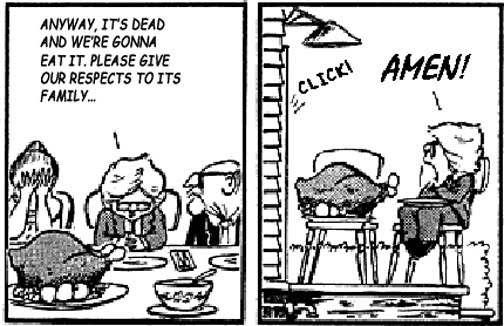
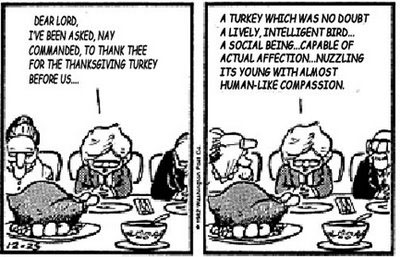
bloomcountythanksgivingpanels34

I want to wish everyone a very Happy Thanksgiving. I do hope that we all can find something to be thankful for this year. Surprisingly despite how shitty much of the year has been I am surprisingly thankful and I actually believe that this is a good thing.

Now please don’t get me wrong. There have been a lot of good things that have occurred this year that I both am thankful for and rejoice in. That being said there is a lot of this year that I would not want to experience again and if I never do again I will even be more thankful, to to God, to my fellow human beings or even to Darwin but I digress.

I want to say that I am thankful for family and friends, my wonderful and often long-suffering wife Judy, and my two four legged babies, Molly and Minnie.

But when I think about the origins of holiday that we in the United States call “Thanksgiving” I am often troubled because it celebrates the beginnings of a campaign by our proud forefathers to exterminate the people that lived here before us, often in the “name of Jesus” beginning with the members of the same tribes who welcomed them, helped them and did not send them back because they were undocumented Pilgrims. Men who not many years later went on  to accuse innocent women of being witches and and persecuting other white guys and gals like the Quakers and the Baptists because they didn’t follow the Puritan way in an pure enough way.

2e211be3edbfca651d6838dac3d50e87656471fa

A Good “Old Fashioned Thanksgiving”

Now personally I like the idea of a yearly celebration of Thanksgiving, whether we give thanks to God, our families, friends, neighbors, our broker, our bookie, or whoever is playing the Dallas Cowboys is this year. I just think that giving thanks is good.

Mark Twain described the holiday in wonderful terms even before it became a complete orgy of gluttony and watching big grown men crush other big grown men in football games. Not that there is anything wrong with that, but the ever pithy and observant Twain said of Thanksgiving Day:

“Thanksgiving Day, a function which originated in New England two or three centuries ago when those people recognized that they really had something to be thankful for — annually, not oftener — if they had succeeded in exterminating their neighbors, the Indians, during the previous twelve months instead of getting exterminated by their neighbors, the Indians. Thanksgiving Day became a habit, for the reason that in the course of time, as the years drifted on, it was perceived that the exterminating had ceased to be mutual and was all on the white man’s side, consequently on the Lord’s side; hence it was proper to thank the Lord for it and extend the usual annual compliments.”

But really. I am so thankful to you, all of my readers. Those that subscribe to this site, those who follow me on Twitter or Facebook and the many others who like our Pilgrim ancestors got lost on the way somewhere else and found this site. You cannot believe just how thankful I am for all of you, especially those who sent words of support and encouragement when I was really doing bad. So thank all of you. Your time is valuable and I appreciate your taking to read what I post here.

So anyway, sometime tomorrow, or rather later today after I go to bed and get back up, and then  after I awake from my turkey, pie and beer induced coma I hope to post another note.

Have a great Thanksgiving!

Peace and Blessings

Padre Steve+


Leave a comment

Filed under christian life, Loose thoughts and musings, philosophy

UPDATE: It Depends on What Your Definition of “Christian” Is…

10570298_10152872503382059_5058681841617456899_n

This article was updated Sunday 23 November to clear up some grammar issues, and in doing so I have provided some updates to let you know what is currently happening, and to better enhance my arguments.

My friends, last week I had something occur that was so troublesome that I had to report it to certain Federal law enforcement authorities as well as a nationally known advocate for religious liberty issues.

Since the Feds are still doing their investigation I have to wait to post the article. I spoke with and I am in contact with the head of that group. Like me he is waiting to see what the investigators report. As things stand right now I expect that it may be sometime in December before I can publish in any detail what happened.

Conceivably this could end up getting some media attention because it involves a military member, civilian or contractor working for a military command that deals with IT issues. It is an organization which has been accused of hacking people and organizations across the political spectrum. Stupidly the individual did not think that I could look up his IP address and in this case track it down to the exact base, command and building where it originated.

The individual used the government network to post demeaning and harassing posts about my religious beliefs on this site under a pseudonym. What they said,their pseudonym and e-mail moniker left no doubt that they are some kind of politically minded and motivated right wing Christian intent on shouting down their opposition.

I cannot go into any more detail but it is troubling. If the comments had come from a civilian network I would blow it off as the work of a crackpot. The person may be a crackpot, but I figure that based on where this message originated it was someone working for the military who has a Top Secret security clearance. Why such a person would be attacking me, a senior Navy Chaplain and combat vet about my religious beliefs from a military network is beyond me.

But then maybe It all depends on what your definition of being a “Christian” is, and based on the religious-political hyperbole of the Christian Right, I don’t think I am a Christian anymore. But then being a “Christian” really does depend on what your definition of being a Christian “is” to use the words of former President Bill Clinton.

I am not a Christian if it means…

Elevating your interpretation of the Bible over Jesus…

Using your interpretation of scripture to damn other people to Hell or anywhere else, including Mississippi, even if there are equally valid interpretations from other Christian sources…

Elevating partisan political issues above the commands of Jesus…

Being more concerned with maintaining your political power than caring about people…

Demonizing anyone that disagrees with whatever pet doctrine that you hold dear, even if that doctrine was condemned by other Christians throughout history to be heretical…

Accuse others of the most horrible, unbelievable and false conspiracies and then claim that God told you to do it…

Claim a right or privilege for yourself based on your Christian Faith, and the use the police power of the state to enforce it, all the while denying the same rights to others…

When you are criticized by the very people that you condemn to Hell, or use economic boycotts against, or use the power of the state to condemn claim that you are now the victim of persecution…

The funny thing this is not new.

Such behavior by Christians goes back over a millennium.

In 1054 the Roman Catholics and Eastern Orthodox split over one word in the Nicene Creed that described the precedence of the Holy Spirit.

The Protestant Reformers elevated their interpretation of scripture over the Roman Catholic instance on scripture being interpreted through Church Tradition and the theology of Thomas Aquinas.

The Radical Reformers insisted on believer’s  or adult baptism over infant baptism…

Early Pentecostals, as well as some today, insisted that unless one had been baptized in the Holy Spirit with the evidence of “speaking in tongues” that you were not a Christian…

Sadly, the trend continues as every new Christian sect insists on its own version of “the truth” being absolute truth. History shows that nearly every time such religious absolutists gain control of a civil government that they either by legislation or fiat make their religious law the law of the land.

Among these various denominations and sects these doctrinal issues are still officially in place, even if many church members don’t understand. The only difference is now that many of these people, who I would say are sincere in their beliefs have come together under a political banner, condemning secularists, atheists, and other non-believers to ensure that the Christian franchise remains on top.

This was the whole intention of the Manhattan Declaration of a few years back. Throw aside centuries or actual theological and doctrinal differences in order to keep political power, yes that is the Christian way.

After the Emperor Constantine made Christianity the state religion of the empire a theological dispute between Trinitarian and Arian Christians became political. Whenever an Arian Emperor was in charge Trinitarians were persecuted, and when Trinitarian emperors were in power the payback was hell.

The Cathars in France were exterminated in military crusades by the Roman Catholics.

The early reformation led by John Huss in Czecheslovkia was not only condemned theologically but led to a series of wars as the Catholic Church and the Holy Roman Empire sought to suppress it.

Martin Luther united with the “anti-Christ” Roman Catholic Church to exterminate the “enthusiasts” and Anabaptists during the Peasant’s Revolt.

Ulrich Zwingli executed his former students who had become Anabaptist and been re-baptized to demonstrate their new faith by “re-baptizing” them until they drowned in the Rhine River.

John Calvin ran a religious theocracy in Geneva where any dissent was punishable as heresy. and his government routinely executed “heretics” who did not hold his truth.

The Roman Catholic Church ran the Inquisition in conjunction with with the Spanish crown, as well as other Catholic monarchies, condemning anyone who strayed from the Catholic faith to persecution, imprisonment and often death.

Of course there was the Thirty Years War in which nations with state religions, Protest or Catholic launched wars of brutal extermination against each other, wars which devastated Germany and which the ruins of castles along the Rhine testify to even today.

The Anglican Church in conjunction with the British crown made Catholicism an act punishable by death, and persecuted other dissenters from the state church including early English Baptists, and the Calvinist dissenters who eventually came to the new colonies as the Pilgrims and Puritans….

The Puritans in the Massachusetts Bay Colony had the exclusive rights to the franchise, and persecuted early Baptists and Quakers often executing them, and in the case of female dissenters accusing them of witchcraft…

Sadly many in the Christian Right under the sway of a Neo-Calvinist political theology called “Seven Mountains” or Christian Dominionism are working at the local, state and federal level in this country to institute a theocracy in this country, with them, like their Puritan and Genevan ancestors having the franchise….

I could go on as there are plenty of other examples that I will not cite here. However, forgetting doctrine and even forgetting Jesus to keep power is nothing new for Christians.

Be assured that if all the groups that the now supposedly politically unified Christians now oppose were wiped out and no longer existed, that these same people would start fighting each other again to gain the exclusive franchise of a state religion. That is the unalterable nature of humanity. That is the unalterable nature of religion, that is the unalterable nature of life.

If you are a “true believer” in any of these Christian traditions you may disagree with me. But in your heart you know that I am right because you know that you are right, and if you are right then no one else is. Thus your power and status must be maintained regardless of the cost. That my friends is the nature of the political Christianity which is more grounded in politics and power than it is in Jesus. Eric Hoffer wrote about people that he called the “True Believers”:

“A doctrine insulates the devout not only against the realities around them but also against their own selves. The fanatical believer is not conscious of his envy, malice, pettiness and dishonesty. There is a wall of words between his consciousness and his real self.”

Disagree with with me if you want, but since I paid a lot more attention to church history, systematic theology and philosophy in seminary than most people do I can whip this stuff out without even looking at my notes.

The fact is that once an external enemy is defeated, those within the politically motivated Christian churches turn on themselves. Christians of different denominations or are different must also be defeated, humiliated and destroyed.

That my friends is the truth of history. That is the ever present witness of supposed Christians who value their political power, their economic position, and their place and status above all others. Alliances between various Christian sects are almost always temporary, never once have Christian sects who have united to face down what they think is an existential threat to themselves  have maintained their unity after the threat is eliminated.

And so it is… For such people it is not about a truth, nor is it about really about faith, nor is it about love. Those are ruses used to justify the naked brutal power and domination that they strive to achieve. Power and domination that is only satisfied when the ones seeking it have eliminated all opposition, even that of former allies.

That is why I say that it is all about “what your definition of Christian is.” 

So if my belief and trust in Jesus is not enough for the true believers… I am okay with that.

If the fact that I am baptized, confirmed and even ordained is not enough for the true believers… I am okay with that.

If the fact that I have had a “born again” experience where faith in Christ became real is not enough… I am okay with that.

If my belief which is grounded in scripture, tradition and reason is not enough for the true believers is not enough… I am okay with that.

If I do not use the name of Jesus to bludgeon non-believers and  if I do not ally myself to the Christian true believers who seek their political power and are willing to make temporary alliances with  those that they despise in the process…. I am okay with that.

If all of that means that I am not a Christian…

Then I am not… and I am okay with that.

I guess that if valuing the rights of Christians above all others and forcing others to follow whatever version of the Christianity is allowed by the state means to some to be a Christian then I am not a Christian… and I am okay with that.

If being a hateful, self righteous person who despise all that do not believe like them,mor do not meet their slitmus test of what it is to be a Christian then I am not a Christian… and I am okay with that too.

If those are the things that are now what are the marks of being a Christian, then I do not want to be one… I am okay with that.  I would rather follow Jesus than be labeled that kind of Christian.

After all, in the end it is about what God thinks, and not what your definition , or my definition of what being a Christian is.

I guess that Bill Clinton was really on target when he said that it all “depends on what your definition of is is” especially for politically minded Christians. People who have sold their souls to maintain political power but who don’t give a wit Jesus. Who don’t care about what their churches actually teach until they eliminate external opposition; and who then can concentrate on eliminating  the “heretical” Christians who were at one time their allies.

That is the ugly truth of “Christian” history.

Condemn me if you want. But before you do please take a look at history, especially the history of other Christians who once they eliminated external threats persecuted other Christians that did not believe just like them.

As far as me, I am now no longer on the defensive. I am taking the offensive against people who value their privilege, power and place in society more than they do the simple command of Jesus. That command of Jesus, to love God with all your heart and love your neighbor as yourself matters more than political power.

As far as me, I will fight and protect the rights of the same people that condemn me to Hell. I do this  because as an American who believes deeply in the ethos of our Declaration of Independence says that “all men are created equal” and because of my office and oath to the Constitution that am demands that I defend them.

I am obligated to give them the protections and freedom that they refuse to give others. That being said, when they decide to mock me, attack me or threaten me using government equipment on taxpayer time, I will not play the victim. I will use every legal and moral option available to me to expose those that do for what they are.

So I cannot say anymore about what is happening regarding what I mentioned up front, but I will update you when I can.

You cannot believe how much that I want to expose those that attack me using the freedom that I by my service and oath strive to protect. But at some point I will.

Peace

Padre Steve+


6 Comments

Filed under christian life, faith, History, philosophy, Political Commentary, Religion

The First Duty is to Truth: Midweek Musings

IMG_1915
“The truth is rarely pure and never simple.” Oscar Wilde 

Friends of Padre Steve’s World, I have been busily working this past week oThe n a major revision to a chapter of my Gettysburg text about Colonel Strong Vincent and Joshua Lawrence Chamberlain. Part of that appeared here last week. However, as I continued to do more research I realized that what I wrote was not nearly enough, not in terms of words, but in terms of truth. There is much more to the story, especially concerning the relationship of Joshua Chamberlain and his wife Fannie.

There are times when one seeks truth that the timeless truths of the subject matter have to be taken to heart. Truth does matter to me, even when it is uncomfortable, not just for others but for me as well. As I have written before, that in this I am reminded of a quote from Star Trek the Next Generation. It is from an episode called “The First Duty.” In it the seasoned Captain Jean Luc Picard confronts his young protege Wesley Crusher after a disastrous accident that leaves a Star Fleet Academy cadet dead. Picard tells the young Crusher that “the first duty of every Starfleet officer is to the truth, whether it’s scientific truth, historical truth or personnel truth…

Truth is difficult, especially when one builds their belief on myths, be they of their own or others making. For me the study of the Battle of Gettysburg for my work has become a quest for truth. Not so much about the truth of specific incidents on the battlefield but of the great truths that go beyond the battlefield, the enduring truths about human nature, about relationships and about war and peace. In a sense the story of the battle of Gettysburg and those men who fought on it, has become a palette from which I am drawing truths about the human condition as well as my own terribly flawed condition, and in the process busting myths, my own included.

Barbara Tuchman once wrote: “The reality of a question is inevitably more complicated than we would like to suppose.” That is truth, it is truth with battles, politics, and in fact all of life, but many would rather rest content in myth. Thus as Rene Descartes wrote: “If you would be a real seeker after truth, it is necessary that at least once in your life you doubt, as far as possible, all things.”

I doubt a lot. I question a lot more and sometimes that leads to facing things that are uncomfortable. Thus, I will be putting up the redone version of that last article in the next day or two, as well as others where my study is leading me to deeper truths.

My big task now is editing and reorganizing the nearly 450 pages of text that I have written into the past year into a form that I can market to a publisher. I do have a couple of final chapters to write from scratch but hopefully by early spring I will ready to have it complete enough to submit for publication.

In the mean time I will continue to write about other subjects, including some military, some political, some social and some about current events, music, and life in general. There are couple of articles I want to write about some naval battles that have fascinated me for decades as well as more on the inhumanity of the Holocaust, the past and current struggles for civil rights in America and many other subjects.

That being said, you as my readers will get my new insights on Gettysburg, both new and revised articles which reflect that search for truth. I do hope that you find them as something more than simply accounts of the battle, but on the deeper truths of the nature and character of humanity, the nature and character of the conflict that we call war, with all its attendant maladies, but more importantly as a mirror for ourselves. My study of Joshua Chamberlain has resulted in having to face uncomfortable but strangely liberating truths about me and the way I live my life.

This is part of my journey, a journey into truth that goes beyond the mere reporting of facts, facts which often are as subject to interpretation, disputation and change as more “facts” are discovered. The truth is that we have to be able to accept new discoveries once they are determined to be true, or at least at the point that they can be posited as reasonable and worthy of acceptance, no matter how badly they challenge our deep held beliefs, even those about ourselves.  Sadly the lies we believe and persist in telling, and the myths that we believe without question, are much more dangerous than  any new truth that offends us.

I have to agree with Marcus Aurelius who wrote:

“If someone is able to show me that what I think or do is not right, I will happily change, for I seek the truth, by which no one was ever truly harmed. It is the person who continues in his self-deception and ignorance who is harmed.”

Those truths can be scientific, they can be historical or literary, and quite often the truth can also be quite personal.

As John F Kennedy said at Yale in 1962: “The great enemy of truth is very often not the lie–deliberate, contrived and dishonest–but the myth–persistent, persuasive and unrealistic. Too often we hold fast to the cliches of our forebears. We subject all facts to a prefabricated set of interpretations. We enjoy the comfort of opinion without the discomfort of thought.” 

So until tomorrow,

Peace

Padre Steve+


Leave a comment

Filed under faith, History, Loose thoughts and musings, philosophy

They Thanked us Kindly and Made Their Peace: Veteran’s Day 2014

481801_10151367001287059_1003164983_n

“We were fond together because of the sweep of open places, the taste of wide winds, the sunlight, and the hopes in which we worked. The morning freshness of the world-to-be intoxicated us. We were wrought up with ideas inexpressible and vaporous, but to be fought for. We lived many lives in those whirling campaigns, never sparing ourselves: yet when we achieved and the new world dawned, the old men came out again and took our victory to remake in the likeness of the former world they knew. Youth could win, but had not learned to keep, and was pitiably weak against age. We stammered that we had worked for a new heaven and a new earth, and they thanked us kindly and made their peace.”

T.E. Lawrence

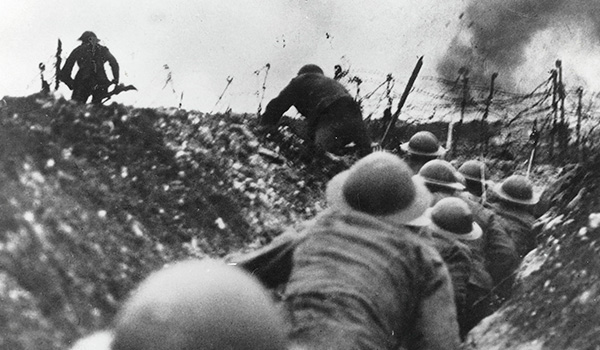
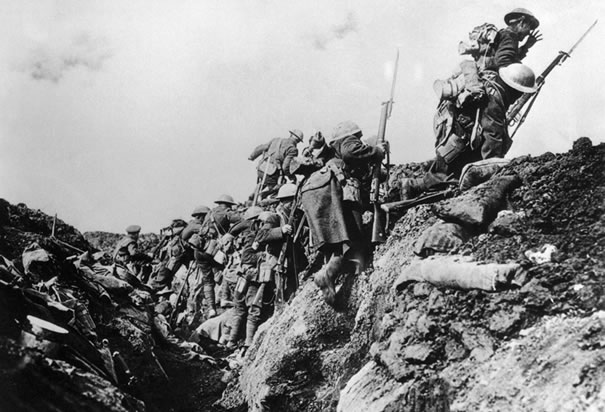
In November 1914 millions of soldiers were fighting in horrible conditions throughout Europe. From the English Channel to Serbia, Poland and Galicia; French, British, German, Austro-Hungarian, Serbian and Russian troops engaged each other in bloody and often pointless battles. Often commanded by old men who did not understand how the character of war had changed, millions were killed, wounded, maimed or died of disease.

After four years, with the Empires that were at the heart of the war’s outbreak collapsing one after the other there was an armistice. On the eleventh  hour, of the eleventh day, of the eleventh month the shooting stopped and the front lines quieted. By then over 20 million people, soldiers and civilians alike had died. Millions more had been wounded, captured, seen their homes and lands devastated or been driven from there ancestral homelands, never to return.

The human cost of that war was horrific. Over 65 million soldiers were called up on all sides of the conflict, of which nearly 37.5 million became casualties, some 57.5% of all soldiers involved. Some countries saw the flower of their manhood, a generation decimated. Russia sustained over 9 million casualties of the 12 million men they committed to the war, a casualty rate of over 76%. The other Allied powers suffered as well.  France lost 6.4 million of 8.5 million, or 73%, Great Britain 3.1 million of nearly 9 million, 35%; Italy 2.2 million of 5.6 million, 39%. Their opponents, Germany, Austria-Hungary and the Ottoman Empire suffered greatly. Germany sustained 7.1 million casualties of 11 million men called up, or nearly 65%, Austria 7 million of 7.8 million, 90% and the Ottoman Empire 975,000 of 2.8 million or 34% of the soldiers that they sent to war.

It was supposed to be the War to end all War…but it wasn’t, it was the mother of countless wars.

pic_giant_021814_SM_Lessons-of-World-War-1

It has been a century since that bleak November of 1914, and ninety-six years since the time where for a brief moment, people around the world, but especially in Europe dared to hope for a lasting and just peace. But that would not be the case…

The victors imposed humiliating peace terms on the vanquished, be it the Germans on the Russians, or the Allies on Germany and her partners. The victors divided up nations, drew up borders without regard to historic, ethnic, tribal or religious sensibilities. But then, it was about the victors imposing themselves and their quest for domination, expanding colonial empires and controlling natural resources rather than seeking a just and lasting peace. The current war against the Islamic State is one of the wars spawned by the Sykes-Picot agreement which divided the Middle East between the French and the British at the end of the war. It was a war that keeps on giving.

Of course we have known the disastrous results of their hubris, a hubris still carried on by those who love and profit by war…war without end which continues seemingly with no end in sight.

I am a veteran of Iraq and Operation Enduring Freedom, as well as the Bosnia mission and the Cold War. My dad was a Vietnam veteran who enlisted during the Korean War. I serve because it is the right thing to do, not because I find war romantic or desirable. It is as General William Tecumseh Sherman said “Hell.” If called to go back to Iraq, where I left so much of my soul, I would in a heartbeat.

canadian-soldiers-going-over-trench

Today we pay our day of homage to our honor veterans, especially in the United States, Great Britain, Canada and France. But sometimes it seems so hollow, for in all of our countries those that serve are a tiny minority of those eligible to serve, who are much of the time ignored or even scorned by those that feel that providing for them after they have served is too much of a burden on the wealthy who make their profits on the backs of these soldiers, sailors, marines and airmen.

I have walked about since returning from Iraq often in a fog, trying to comprehend how a country can be at war for so long, and there is such a gap between the few who serve and the vast majority for whom war is an abstract concept happening to someone else, in places far away, and whose experience of war is its glorification in video games. Personally I find that obscene, and feel that I live in a foreign world. Erich Maria Remarque wrote in All Quiet on the Western Front: 

“I imagined leave would be different from this. Indeed, it was different a year ago. It is I of course that have changed in the interval. There lies a gulf between that time and today. At that time I still knew nothing about the war, we had been only in quiet sectors. But now I see that I have been crushed without knowing it. I find I do not belong here any more, it is a foreign world.”

Similarly Guy Sager wrote in his classic The Forgotten Soldier: 

“In the train, rolling through the sunny French countryside, my head knocked against the wooden back of the seat. Other people, who seemed to belong to a different world, were laughing. I couldn’t laugh and couldn’t forget.”

Major General Gouverneur Warren wrote to his wife two years after the American Civil War:

“I wish I did not dream that much. They make me sometimes dread to go to sleep. Scenes from the war, are so constantly recalled, with bitter feelings I wish to never experience again. Lies, vanity, treachery, and carnage.”

Sometimes I find it obscene that retailers and other corporations have turned this solemnity into another opportunity to profit. But then why should I expect different? Such profiteers have been around from the beginning of time, but then maybe I still am foolish enough to hope for something different. Please don’t get me wrong, I do appreciate the fact that some businesses attempt in at least some small way to thank veterans. I also know there are many businesses and business owners who do more than offer up tokens once a year, by putting their money where their mouth is to support returning veterans with decent jobs and career opportunities; but for too many others the day is just another day to increase profits while appearing to “support the troops.”

As Marine Corps legend and two time Medal of Honor winner Major General Smedley Butler Wrote:

“What is the cost of war? what is the bill? “This bill renders a horrible accounting. Newly placed gravestones. Mangled bodies. Shattered minds. Broken hearts and homes. Economic instability. Depression and all of its attendant miseries. Back -breaking taxation for generations and generations. For a great many years as a soldier I had a suspicion that war was a racket; not only until I retired to civilian life did I fully realize it….”

But the marketers of war do not mind, almost Orwellian language is used to lessen its barbarity. Dave Grossman wrote in his book On Killing:

“Even the language of men at war is the full denial of the enormity of what they have done. Most solders do not “kill,” instead the enemy was knocked over, wasted, greased, taken out, and mopped up. The enemy is hosed, zapped, probed, and fired on. The enemy’s humanity is denied, and he becomes a strange beast called a Jap, Reb, Yank, dink, slant, or slope. Even the weapons of war receive benign names- Puff the Magic Dragon, Walleye, TOW, Fat Boy, Thin Man- and the killing weapon of the individual soldier becomes a piece or a hog, and a bullet becomes a round.”

There is even a cottage industry of war buffs, some of who are veterans seeking some kind of camaraderie after their service, but most of whom have little or know skin in the real game, and at no inconvenience to themselves. As far as the veterans I understand, but as for the others I can fully understand the words of Guy Sager, who wrote:

“Too many people learn about war with no inconvenience to themselves. They read about Verdun or Stalingrad without comprehension, sitting in a comfortable armchair, with their feet beside the fire, preparing to go about their business the next day, as usual…One should read about war standing up, late at night, when one is tired, as I am writing about it now, at dawn, while my asthma attack wears off. And even now, in my sleepless exhaustion, how gentle and easy peace seems!”

dscn0064

It was to be the War to end all war” but I would venture that it was the war that birthed countless wars, worse tyrannies and genocides; That war, which we mark the end of today, is in a very real and tragic sense, the mother of the wars that have followed. War without end…Amen.

As so to my friends, my comrades and all that served I honor you, especially those that I served alongside. We are a band of brothers, no matter what the war profiteers do, no matter how minuscule our number as compared to those who do not know what we do, and those who never will.  We share a timeless bond and no-one can take that away.

n671902058_1153829_4642-2

I close with the words of a German General from the television mini-series Band of Brothers which kind of sums up how I feel today. The American troops who have fought so long and hard are watching the general address his troops after their surrender. An American soldier of German-Jewish descent translates for his comrades the words spoken by the German commander, and it as if the German is speaking for each of them as well.

Men, it’s been a long war, it’s been a tough war. You’ve fought bravely, proudly for your country. You’re a special group. You’ve found in one another a bond that exists only in combat, among brothers. You’ve shared foxholes, held each other in dire moments. You’ve seen death and suffered together. I’m proud to have served with each and every one of you. You all deserve long and happy lives in peace.

In hopes of peace,

Padre Steve+

Leave a comment

Filed under History, Military, News and current events, philosophy, Political Commentary, shipmates and veterans, world war one

All Hallows and All Saints at Gettysburg

 10570298_10152872503382059_5058681841617456899_n

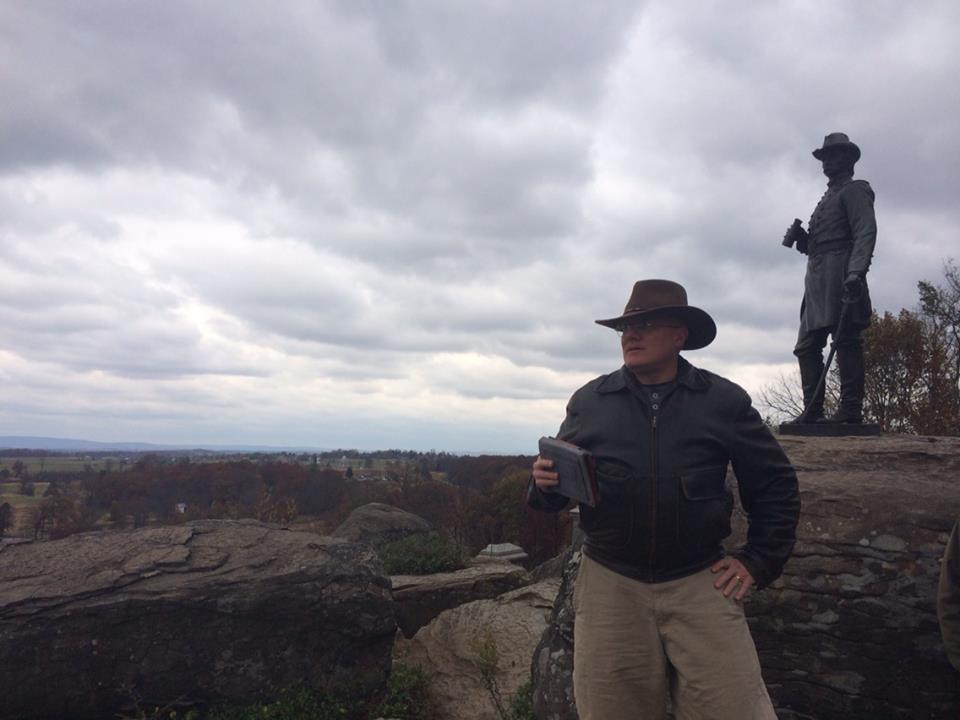
Me on Little Round Top teaching near Gouverneur Warren Monument

Well my friends I have been up in Gettysburg the past two days, actually I drove up with my class for the Staff Ride on Friday. Last night which was Halloween I toured the Jenny Wade House which is according to those that pursue the paranormal is consistently rated one of the haunted spots in the United States, since the house sits not twenty feet from the hotel that I stay each time I come up here, that is fascinating because ever since I was a kid and saw a misty figure in my grandfather’s bedroom where I was sleeping since he was in hospital back in early 1970 I have been fascinated with such things. But I digress…

Anyway, today was a good day out with my students and their families as del walked the battlefield in some very cold and raw weather, yes winter is coming sooner than any one of us want to admit….

Anyway, I always feel a special, almost spiritual connection to those who fought and died at Gettysburg. Walt Whitman wrote in his poem “Ashes of Dead Soldiers”:

Ashes of soldiers South or North, As I muse retrospective murmuring a chant in thought, The war resumes, again to my sense your shapes, And again the advance of the armies. Noiseless as mists and vapors, From their graves in the trenches ascending, From cemeteries all through Virginia and Tennessee, From every point of the compass out of the countless graves, In wafted clouds, in myriads large, or squads of twos or threes or single ones they come, And silently gather round me…”

After dinner with my student’s at the Farnsworth House I took a few minutes and wandered East Cemetery Hill where the Union forces helped hold back the army of Robert E. Lee. I have been to the hill many times, but never after dark. It was surreal.

10408807_10152872503372059_1781792705317577605_n

Monument of Oliver Howard at Night

Anyway, I will as always write more about Gettysburg, the battle, campaign and the people but tonight just a thought that sometimes things remain that we cannot explain, As Joshua Chamberlain wrote:

In great deeds, something abides. On great fields, something stays. Forms change and pass; bodies disappear; but spirits linger, to consecrate ground for the vision-place of souls… generations that know us not and that we know not of, heart-drawn to see where and by whom great things were suffered and done for them, shall come to this deathless field, to ponder and dream; and lo! the shadow of a mighty presence shall wrap them in its bosom, and the power of the vision pass into their souls.”

I am one of those people, a member of a generation who knew them not but one who is heart-drawn to see where and by whom great things were suffered and done for them.  And yes, for me, ever since my first visit to this hallowed ground in the spring of 1997, the shadow of a mighty presence wraps me in its bosom, and the power of their vision passes into my soul.

Today as always I took my class around the battlefield and traced the events of July 1st and 2nd 1863, days when tens of thousands of men were killed, wounded, or captured. This evening I went to dinner with about half of the group, and met for a couple of beers as well as interesting talk with some others after my stroll on the dark Cemetery Hill. Tomorrow I will lead my class to Culp’s Hill, and then back across the battlefield where we will trace the route of Pickett’s division during Pickett’s Charge, before we discuss the High Water Mark of the Confederacy, take a group photo at General George Meade’s headquarters behind Cemetery Ridge and going on to the Soldier’s Cemetery where Abraham Lincoln gave his Gettysburg Address.

I am going to try to get some rest since we “fall back” in a couple of hours. It would be nice to sleep. However, since my sleep so resembles what Gouverneur Warren described in 1867. Warren recounted in a letter to his wife:

“I wish I did not dream so much. They make me sometimes to dread to go to sleep. Scenes from the war, are so constantly recalled, with bitter feelings I wish never to experience again. Lies, vanity, treachery, and carnage.”

Have a nice night and a better tomorrow.

Peace

Padre Steve+

Leave a comment

Filed under civil war, History, Military, philosophy, Religion

The Enduring Mystery of an Encounter with an AIDS Patient

lent

Last night I wrote about my early experience dealing with AIDS while serving as an Army Medical Service Corps personnel officer in 1987. In the 1990s that experience changed as I began to deal with men and women who were dying of the effects of full blown AIDS while serving as a hospital chaplain. The experiences of being with those men and women, and in some cases with their families, or loved ones was another chapter in my acceptance of Gays as well as other people marginalized and abandoned by my fellow Christians.

This is an account of one of those encounters at Parkland Hospital in Dallas where I was doing my Clinical Pastoral Education residency, it is not about the politics of AIDS, instead it is about humanity, connection, faith, mystery and things that I cannot explain. Those who know me or have followed my writings on this site know my struggles with faith and God, belief and unbelief.

Even today thinking about this encounter brings tears to my eyes and makes me wonder about faith, life, reason and mystery. Frankly, it is something that I cannot explain, nor do I care to. I am content to live with the mystery of something that I cannot explain, but then at the same time, I am not.

As Anais Nin wrote: “The possession of knowledge does not kill the sense of wonder and mystery. There is always more mystery.”

Peace

Padre Steve+

Sometimes death comes unannounced but other times it sounds a warning.  Most of the time we think of such warnings as what our body is saying to us, maybe someone is having chest pains or that we know of a terminal condition which is getting worse and the doctors say that there is nothing else that they can do.  Other times it appears that some people almost have a sixth sense about their impending death and leave notes or say “goodbye” to loved ones in a different way than they would normally do.

When I see or hear about the sixth sense kind of incident I find that I am intrigued.  As a student of history I have read countless accounts where soldiers know that they will not survive a particular battle and leave things or messages for their friends to give to loved ones.

There have been times when I have had a sixth sense about what was going to happen to someone and the feeling is like you are watching something unfold in slow motion but can do nothing to stop it.

This story is a bit different and took place during an overnight as the “on call” chaplain at Parkland Memorial Hospital in Dallas during my Clinical Pastoral Education Residency. Parkland is a rather large, at the time of my residency a 940 bed county hospital and Level One Trauma center.  The “on call” chaplain after normal hours was the only chaplain in the hospital to cover all emergencies in the house.  Usually I stationed myself in the ER area as that was the “hottest” place for ministry at any given time.  I would always take a spin around our 9 ICUs sometime in the evening to make sure that nothing was brewing; but unless something was going bad on one of them would always end up back in the ER.

One night I had just finished with a situation involving a violent death in the ER when about Nine PM I got a page from “9 South” our General Medicine Step-Down ward. This was a ward that not much usually happened on, in fact as a critical care and trauma type I considered it and other wards like it as a bit boring as nothing much usually happened there.

The nurse that I talked to when I returned the page told me that I needed to come up right away. She said that she had a patient who was convinced that she was going to die that night.  Intrigued, I told the nurse, that I would be right up and made my way up to the ward.

I got to the ward about 9:15 PM and met the nurse who further explained the situation to me while I reviewed the chart.  The nurse was an RN who had come to the United States from India and she was obviously unnerved by what was going on. She told me about the patient, I reviewed the chart as is my normal procedure and then went in to visit the lady. There was nothing in the chart to indicate any problems, in fact she was listed as improving enough to go home the next day, discharge orders were already in the chart.

The lady was in her mid-30s and she was HIV positive. She was married, and her husband who was also HIV positive and in a more advanced stage of the disease had been discharged from the hospital the day before. She had come in for a few day stay as she had been spiking a fever but that was under control, and she had no other medical issues. She was not at the point of having any of the major opportunistic infections or diseases associated with full blown AIDS, her T-Cell count was good.  Clinically she was stable and expected to do well for a number of years to come.

But despite all the good numbers, stable condition and good prognosis the woman was convinced that she was going to die, this very evening.

Just after the evening shift change the patient had told the nurse that “the Lord was going to take her home tonight.”  This troubled the nurse as it would any normal rational person, so she called the duty Internal Medicine resident physician to come and speak with the lady. The resident could not convince here that she was going to be okay and that she told both of them that she was going to die that evening and “go home and be with Jesus.”

Now for those who have never lived in the south “going home” is not like leaving the office at the end of the day.  Elvis “went home” wherever that was (see “Men in Black”) and if you are talking with someone raised in the South and they start talking about “going home” you better stop and clarify to make sure that they are going home to watch the Braves on television and drink a beer, or if they are planning on dying.

I had a grandmother who told me from the time that I was 5 years old that she was either “going home” or “wasn’t going to be around much longer.” Of course she was convinced that she was going to die, and once I stirred up a hornet’s nest when after she told me that “she wast going to be around much longer  So I asked her “where are you moving to?” Granny was not impressed and gave me an earful. Granny lived to be almost 90 years old when she finally “went home”  when I was 40 after giving me 35 years worth of warning, but I digress…

Now patently I am of the mind that if the numbers say that you will live I believe the numbers.  I’m a baseball guy, God speaks to me through baseball and I play the percentages. It is the rational thing to do, which means that while I believe that God can intervene in situations I don’t bet on that happening. I read the chart. I talk to the nursing staff, and I talk with the physicians.

After talking with the resident and nurse I was convinced that this lady would walk out of the hospital in the morning and probably outlive her husband. Then I met the lady.

I walked into her room. She was sitting up in bed with her Bible open beside her on her mattress. She appeared to be very calm and there was a peaceful sense about her.  She was from Jamaica and very polite and when I introduced myself to her she greeted me warmly with the accent characteristic of that island nation.

“So you are the pastor?” she asked.

I replied that I was the Chaplain and that the nurse and doctor had asked me to spend some time with her.

She then said “Ah yes, they do not believe me because I told them that Jesus told me that he will take me home tonight.”

So I asked her what she believed was going on with her. She then described to me what had occurred that evening to make her think that she was going to die. “You see pastor, the doctors say that I will go to my house tomorrow but I will not.”

She paused and even more curious I nodded for her to go on and said “really? Tell me more.”

She continued “Pastor you see this evening Jesus came to me, he visit me and tell me that I will go and be with him tonight.”

Now I have to admit that I was skeptical. However, she was not acting emotional or even bothered about what she just said. Normally I might ask for a psychiatric consult, but she seemed to be completely rational, and her chart made no mention of any mental illness or psychological issues.

I was fascinated and asked her to tell me more. She then went on a fairly long recitation of her faith journey from the time that she was a young girl. She told me how she frequently would sense God’s presence and hear his voice at different points in her life. She told me how she had gotten HIV from her husband, who had been a drug abuser and how much it meant for her to be right with others and God.

So I asked her about the specifics of “why she thought that she would die tonight?”

Calmly she explained. “The doctors tell me that I will be well and go home tomorrow. They tell me that I am in good condition and that I will live a long time, but that does not matter to me because Jesus told me today that he will take me home to be with him….tonight.” 

The word tonight was said with a confidence that stunned me. She talked as if this was a regular every day occurrence and her face was radiant.  She continued “I love Jesus and know that he will not lie to me so I know that I will be with him tonight.”

Her faith was touching and powerful in its simplicity and the amount of trust that she showed even to a message that she believed to be from Jesus that was completely different than the news of the doctors. After our conversation, which lasted about 30 minutes involved me probing her faith, asking what she understood about her condition and talking about her family. It seemed to me that our visit was a time for her to tie up the loose ends of her life and that I was the person that she was taking the time to share them with.

As we closed she asked me if I would pray with her and give her a blessing which I did.  She thanked me, reached out and asked for a hug. She embraced me weakly and then let go, and she thanked me again.  I was moved by this, still not convinced that Jesus would take her home. I didn’t she was going to die but there was a certain finality in her words and actions that gave me a bit of doubt about the facts and numbers that I trusted in.

When I left her room, I charted my visit, wrapped things up with the resident and the nurse and went back down to ER where more carnage was waiting, shootings, motor vehicle accidents and drug overdoses.

About 2:30 AM my pager went off. It was the nurse’s station on Nine South. I returned the call and the nurse that I had talked with earlier was on the line.

She was nearly frantic and said: “Chaplain, please come quick, I went in to check her vitals and she is dead!”  I put on my best calm voice and said “Who is dead?” 

The nurse nearly in a panic said “The lady that said that God was going to take her home, she died!”  I looked up from the Trauma ER nurses’ station and realized that there was nothing immediate and told the nurse  “Okay I’ll be right up” and went up to the ward as quickly as I could.

When I got to the ward to find the nurse pacing anxiously outside the door of the patient’s room.  I asked if the nurse if she was okay, meaning her and not the now deceased patient. The poor nurse replied that she was upset by the death because the lady should not be dead. She was frightened and that she didn’t understand how the patient could calmly know that she was going to die.  Now the nurse was not a southerner unless it was the south part of the Indian subcontinent.  She was relatively new to Texas and the American South she was not as attuned to some of the religious and cultural aspects of either the South or some of the Caribbean islands, where the lady had come.

After helping the nurse calm down I met the resident who was in the room looking perplexed, when I walked in he said “This women shouldn’t be dead.” 

I couldn’t think of much else to say so I just said to him “sometimes it’s just someone’s time even if the numbers don’t say so.” 

He said: “Yeah, I know, but this was really freaky because she told me that she was going to die tonight and she did.”

I did concur with this young doctor that what had happened was a bit on the unusual side but that we couldn’t discount what she believed especially since she had been correct. As the resident went to finish up paperwork I looked at the woman. It looked like she had simply fallen asleep. Her Bible was on her lap and opened to the book of Revelation, the 21st chapter. Although I cannot be sure exactly what she was reading can only imagine that it was this verse “See, the home of God is among mortals. He will dwell with them as their God; they will be his peoples, and God himself will be with them; he will wipe every tear from their eyes. Death will be no more; mourning and crying and pain will be no more, for the first things have passed away.” (Revelation 21:3b-5 NRSV)

This dear woman had passed away, gone home looking forward to a place where whatever tears or sorrows she had experienced would be wiped away. I closed her Bible, gently placed her hands together over it and prayed a prayer of commendation before pulling the bed sheet over her face and body.

On leaving the room I spent a bit more time with the nurse who was beginning to gather herself after this unusual death.  A couple of hours later I would escort the body of this woman to our morgue accompanied by the nurse and a LVN.

If you have never made the walk to a morgue it is always the longest walk you will ever make. At Parkland it seemed that no matter where you were coming from the walk took forever as it is a massive facility, and in the wee hours of the morning while most of the world sleeps, that walk is an eternity.

As we rode the elevator down to the basement where the morgue was located we continued to talk a bit more. When we got to the basement and commenced the walk down the long and empty corridor to the morgue we did so in silence. I unlocked the door and then the door to the walk in refrigerator, which could hold up to eight adult bodies on cold stainless steel gurneys at any given time. Dimly lit and damp the morgue has a truly macabre ambiance which is magnified by the sight of bodies of the deceased wrapped in body bags and covered by white sheets.

Once I had admitted the body and locked the door to the morgue the two nurses left to head back to the 9th floor. I took the chart and other paperwork up to our office where our decedent affairs clerk would complete the death certificate. The daytime duty chaplain would have the responsibility of discharging the woman’s body after an autopsy was conducted and a funeral home came to take her body to her final resting place.

I thought how unusual this case was as I sat for a while in the office. I had heard of similar things but had never seen something like this before where the person in question made such a claim and was right defying the numbers that said she would walk out of the hospital. After a the rest of the evening, or rather the early morning was relatively uneventful and my shift came to an end as the rest of the staff came in for the day. I briefed the chaplain who was taking the pager, did my debriefing with my fellow Pastoral Care residents and went home, wondering what had happened.

Physicist Max Planck who originated Quantum Theory said: “Science cannot solve the ultimate mystery of nature. And that is because, in the last analysis, we ourselves are a part of the mystery that we are trying to solve.”

It is a mystery, so I guess I should leave it there…

Peace

Padre Steve+

Leave a comment

Filed under christian life, faith, healthcare, ministry, Pastoral Care, philosophy, Religion

The Confederate Religious War and How it Helps Us Understand other Religious Wars

Too often we in the United States and Western Europe puzzle at the religious fanaticism of groups such as the Islamic State, Al Qaeda, Boko Haram or the Taliban. We in the west do not understand just how powerful the motivation religion and fanatical fundamentalist religious faith can be to a people, nation or culture. But if we only take a look at our own “Christian” history we can find example after example. As long term readers know I am both a theologian, chaplain and historian and that I have served for 33 years in the Army and Navy. My current duties have me teaching ethics and leading the Gettysburg Staff Ride at a senior military staff college. As such I am immersed in the academic world that I love, and because of that I am always researching and writing, as well as making historic connections between past and present events, not trying at all to superimpose current thought or knowledge on those who lived before, but rather drawing on them to help understand the basic, common, eternal, human nature and character; the beliefs, passions and prejudices that motivate people to not just go to war, but to justify war in the name of God. If we hope to understand our current enemies, we also have to understand ourselves, our history, and in doing so not shy away from uncomfortable subjects that cast a bad light on our own culture, religion or people.

This is an excerpt of a chapter of my Gettysburg text which I continue to revise seemingly without end. But then, the search and quest for truth cannot end.

Peace

Padre Steve+

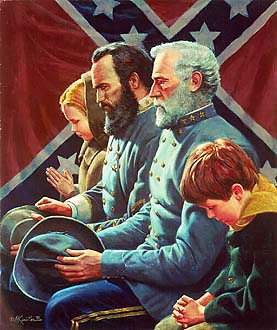
 lee-jackson-in-prayer

Perhaps more than anything the denominational splits of the 1840s and in 1860-61 helped prepare the Southern people as well as clergy for secession and war. They set precedent by which educated Southerners left established national organizations. When secession came, “the majority of young Protestant preachers were already primed by their respective church traditions to regard the possibilities of political separation from the United States without undue anxiety.” [1]

Religion and the churches “supplied the overarching framework for southern nationalism. As Confederates cast themselves as God’s chosen people” [2] and the defense of slavery was a major part of this mission of the chosen people. A group of 154 clergymen “The Clergy of the South” “warned the world’s Christians that the North was perpetuating a plot of “interference with the plans of Divine Providence.” [3] A Tennessee pastor bluntly stated in 1861 that “In all contests between nations God espouses the cause of the Righteous and makes it his own….The institution of slavery according to the Bible is right. Therefore in the contest between the North and the South, He will espouse the cause of the South and make it his own.” [4]

The effect of such discourse on leaders as well as individuals was to unify the struggle as something that linked the nation to God, and God’s purposes to the nation identifying both as being the instruments of God’s will and Divine Providence. It also motivated men like Stonewall Jackson of the battlefield, who’s brutal, Old Testament understanding of the war caused him to murmur: “No quarter to the violators of our homes and firesides,” and when someone deplored the necessity of destroying so many brave men, he exclaimed: “No, shoot them all, I do not wish them to be brave.” [5]

In effect: “Slavery became in secular and religious discourse, the central component of the mission God had designed for the South….The Confederates were fighting a just war not only because they were, in the traditional framework of just war theory, defending themselves against invasion, they were struggling to carry out God’s designs for a heathen race.” [6]

From “the beginning of the war southern churches of all sorts with few exceptions promoted the cause militant” [7] and supported war efforts, the early military victories of Robert E. Lee’s Army of Northern Virginia and the victories of Stonewall Jackson in the Shenandoah Valley were celebrated as “providential validations of the cause that could not fail…” Texas Mehtodist minister William Seat wrote: “Never surely since the Wars of God’s ancient people has there been such a remarkable and uniform success against tremendous odds. The explanation is found in the fact that the Lord goes forth to fight against the coercion by foes of his particular people. Thus it has been and thus it will be to the end of the War.” [8]

This brought about a intertwining of church and state authority, a veritable understanding of theocracy as “The need for the southern people to acknowledge God’s authority was bound up with a legitimation of the authority of clerical and civil rulers. Christian humility became identified with social and political deference to both God and Jefferson Davis.” [9]

Jefferson Davis and other leaders helped bolster this belief:

“In his repeated calls for God’s aid and in his declaration of national days of fasting, humiliation, and prayer on nine occasions throughout the war, Jefferson Davis similarly acknowledged the need for a larger scope of legitimization. Nationhood had to be tied to higher ends. The South, it seemed, could not just be politically independent; it wanted to believe it was divinely chosen.” [10]

Davis’s actions likewise bolster his support and the support for the war among the clergy. A clergyman urged his congregation that the people of the South needed to relearn “the virtue of reverence- and the lesson of respecting, obeying, and honoring authority, for authority’s sake.” [11]

Confederate clergymen not only were spokesmen and supporters of slavery, secession and independence, but many also shed their clerical robes and put on Confederate Gray as soldiers, officers and even generals fighting for the Confederacy. Bishop Leonidas Polk, the Episcopal Bishop of Louisiana, who had been a classmate of Jefferson Davis at West Point was commissioned as a Major General and appointed to command the troops in the Mississippi Valley. Polk did not resign his ecclesiastical office, and “Northerners expressed horror at such sacrilege, but Southerners were delighted with this transfer from the Army of the Lord.” [12] Lee’s chief of Artillery Brigadier General Nelson Pendleton was also an academy graduate and an Episcopal Priest. By its donations of “everything from pew cushions to brass bells, Southern churches gave direct material aid to the cause. Among all the institutions in Southern life, perhaps the church most faithfully served the Confederate Army and nation.” [13] Southern ministers “not only proclaimed the glory of their role in creating the war but also but also went off to battle with the military in an attempt to add to their glory.” [14]

Sadly, the denominational rifts persisted until well into the twentieth century. The Presbyterians and Methodists both eventually reunited but the Baptists did not, and eventually “regional isolation, war bitterness, and differing emphasis in theology created chasms by the end of the century which leaders of an earlier generation could not have contemplated.” [15] The Southern Baptist Convention is now the largest Protestant denomination in the United States and many of its preachers are active in often divisive conservative social and political causes. The denomination that it split from, the American Baptist Convention, though much smaller remains a diverse collection of conservative and progressive local churches. Some of these are still in the forefront of the modern civil rights movement, including voting rights, women’s rights and LGBT issues, all of which find some degree of opposition in the Southern Baptist Convention.

Confederate_Seal

But the religious dimensions were far bigger than denominational disagreements about slavery; religion became one of the bedrocks of Confederate nationalism. The Great Seal of the Confederacy had as its motto the Latin words Deo Vindice which can be translated “With God as our Champion” or “Under God [Our] Vindicator.” The issue was bigger than independence itself, it was intensely theological and secession “became an act of purification, a separation from the pollutions of decaying northern society, that “monstrous mass of moral disease,” as the Mobile Evening News so vividly described it.” [16]

The arguments found their way into the textbooks used in schools throughout the Confederacy. “The First Reader, For Southern Schools assured its young pupils that “God wills that some men should be slaves, and some masters.” For older children, Mrs. Miranda Moore’s best-selling Geographic Reader included a detailed proslavery history of the United States that explained how northerners had gone “mad” on the subject of abolitionism.” [17] The seeds of future ideological battles were being planted in the hearts of white southern children by radically religious ideologues, just as they are today in the Madrassas of the Middle East.

Notes

[1] Brinsfield, John W. et. al. Editor, Faith in the Fight: Civil War Chaplains Stackpole Books, Mechanicsburg PA 2003 p.67

[2] Gallagher, Gary W. The Confederate War: How Popular Will, Nationalism and Military Strategy Could not Stave Off Defeat Harvard University Press, Cambridge MA and London 1999

[3] Daly, John Patrick When Slavery Was Called Freedom: Evangelicalism, Proslavery, and the Causes of the Civil War The University Press of Kentucky, Lexington 2002 p.145

[4] Ibid. Daly When Slavery Was Called Freedom p.138

[5] Fuller, J.F.C. Grant and Lee: A Study in Personality and Generalship, Indiana University Press, Bloomington IN 1957

[6] Faust, Drew Gilpin The Creation of Confederate Nationalism: Ideology and Identity in the Civil War South Louisiana State University Press, Baton Rouge and London p.60

[7] Thomas, Emory The Confederate Nation 1861-1865 Harper Perennial, New York and London 1979 pp.245-246

[8] Ibid. Daly When Slavery Was Called Freedom pp.145 and 147

[9] Ibid. Faust The Creation of Confederate Nationalism p.26

[10] Ibid. Faust The Creation of Confederate Nationalism p.33

[11] Ibid. Faust The Creation of Confederate Nationalism p.32

[12] Foote, Shelby, The Civil War, A Narrative. Volume One: Fort Sumter to Perryville Random House, New York 1963 1958 p.87

[13] Ibid. Thomas The Confederate Nation p.246

[14] Ibid. Daly When Slavery Was Called Freedom p.142

[15] Ibid. McBeth The Baptist Heritage pp.392-393

[16] Ibid. Faust The Creation of Confederate Nationalism p.30

[17] Ibid. Faust The Creation of Confederate Nationalism p.62

Leave a comment

Filed under civil rights, civil war, faith, History, philosophy, Political Commentary, Religion

The Fever and the Fear: Conservative American Christians and Judgment at Nuremberg

IMG_0493.JPG

http://movieclips.com/FkTn-judgment-at-nuremberg-movie-dr-janning-explains-his-actions/

Yesterday I wrote about the lack of empathy among conservative American Christians and I drew some comparisons to the German Christians of the 1920s and 1930s who despite their reservations supported ultra-right wing parties and later the Nazi Party. As I mentioned yesterday this was brought about by the fear and hate propagated by those who had lost their favored status after the collapse of the Kaiser Reich, and especially the fear of what many Christians believed was the threat of atheistic Socialists and Communists. Their brief experiment with democracy which was devastated by political battles amid the 1919-1920 Weimar Inflation which destroyed the financial security of most Germans as well as the Stock Market Crash of 1929 which brought about the Great Depression made many receptive to the “Nazi Gospel.”

I think that conservative American Christians are going the same direction as they get swept up in the climate of fear, hate, distrust and perceived persecution at the hands of liberals, atheists, socialists and their own government. As I noted yesterday much of this stems not from actual persecution but from the loss of their privileged position as the dominant force in society.

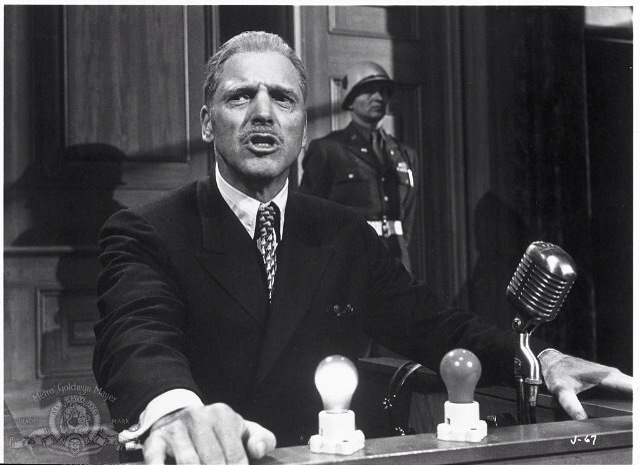
I love the film Judgment at Nuremberg, because I think that it really does reflect how many prominent Germans who should have known better followed Hitler, and reflects how many conservative Christians see the political right as their standard bearers.. In the film Burt Lancaster plays a prominent German legal scholar and jurist named Ernst Janning.

“There was a fever over the land. A fever of disgrace, of indignity, of hunger. We had a democracy, yes, but it was torn by elements within. Above all, there was fear. Fear of today, fear of tomorrow, fear of our neighbors, and fear of ourselves. Only when you understand that – can you understand what Hitler meant to us. Because he said to us: ‘Lift your heads! Be proud to be German! There are devils among us. Communists, Liberals, Jews, Gypsies! Once these devils will be destroyed, your misery will be destroyed.’ It was the old, old story of the sacrificial lamb. What about those of us who knew better? We who knew the words were lies and worse than lies? Why did we sit silent? Why did we take part? Because we loved our country! What difference does it make if a few political extremists lose their rights? What difference does it make if a few racial minorities lose their rights? It is only a passing phase. It is only a stage we are going through. It will be discarded sooner or later. Hitler himself will be discarded… sooner or later. The country is in danger. We will march out of the shadows. We will go forward. Forward is the great password. And history tells how well we succeeded, your honor. We succeeded beyond our wildest dreams. The very elements of hate and power about Hitler that mesmerized Germany, mesmerized the world! We found ourselves with sudden powerful allies. Things that had been denied to us as a democracy were open to us now. The world said ‘go ahead, take it, take it! Take Sudetenland, take the Rhineland – remilitarize it – take all of Austria, take it! And then one day we looked around and found that we were in an even more terrible danger. The ritual began in this courtoom swept over the land like a raging, roaring disease. What was going to be a passing phase had become the way of life. Your honor, I was content to sit silent during this trial. I was content to tend my roses. I was even content to let counsel try to save my name, until I realized that in order to save it, he would have to raise the specter again. You have seen him do it – he has done it here in this courtroom. He has suggested that the Third Reich worked for the benefit of people. He has suggested that we sterilized men for the welfare of the country. He has suggested that perhaps the old Jew did sleep with the sixteen year old girl, after all. Once more it is being done for love of country. It is not easy to tell the truth; but if there is to be any salvation for Germany, we who know our guilt must admit it… whatever the pain and humiliation.”

Hannah Arendt talked about this in her book Eichmann in Jerusalem: A Report on the Banality of Evil,  her treatment of the trial of Adolf Eichmann, one of the mid-level Nazi officers who sent millions of people to their deaths. In describing Eichmann and other ordinary people Arendt said:

“The trouble with Eichmann was precisely that so many were like him, and that the many were neither perverted nor sadistic, that they were, and still are, terribly and terrifyingly normal. From the viewpoint of our legal institutions and of our moral standards of judgment, this normality was much more terrifying than all the atrocities put together.”

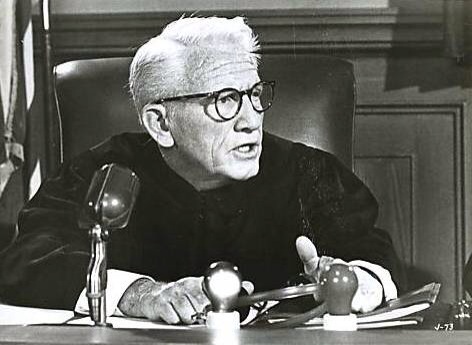
At the end of the movie Judgment at Nuremberg Spencer Tracy as Presiding Judge Dan Haywood concluded his sentencing remarks with this statement. It is perhaps one of the most powerful statement and something to remember as the Unholy Trinity of Politicians, Pundits and Preachers urge us to hate one another and those different than us. It is something that is especially needed in times of great societal stress as well as real and perceived dangers from without and within.

IMG_2182.JPG

http://www.youtube.com/watch?v=N3BwK51YFgQ

“Janning, to be sure, is a tragic figure. We believe he loathed the evil he did. But compassion for the present torture of his soul must not beget forgetfulness of the torture and the death of millions by the Government of which he was a part. Janning’s record and his fate illuminate the most shattering truth that has emerged from this trial: If he and all of the other defendants had been degraded perverts, if all of the leaders of the Third Reich had been sadistic monsters and maniacs, then these events would have no more moral significance than an earthquake, or any other natural catastrophe.

But this trial has shown that under a national crisis, ordinary – even able and extraordinary – men can delude themselves into the commission of crimes so vast and heinous that they beggar the imagination. No one who has sat through the trial can ever forget them: men sterilized because of political belief; a mockery made of friendship and faith; the murder of children. How easily it can happen. There are those in our own country too who today speak of the “protection of country” – of ‘survival’. A decision must be made in the life of every nation at the very moment when the grasp of the enemy is at its throat. Then, it seems that the only way to survive is to use the means of the enemy, to rest survival upon what is expedient – to look the other way. Well, the answer to that is ‘survival as what’? A country isn’t a rock. It’s not an extension of one’s self. It’s what it stands for. It’s what it stands for when standing for something is the most difficult! Before the people of the world, let it now be noted that here, in our decision, this is what we stand for: justice, truth, and the value of a single human being.”

This is an unsettling subject and people on the political right and left in this country are apt to compare their opponents to those that were tried at Nuremberg and those that led them. This has been an increasingly disturbing trend in the case of hyper-partisan Right Wing and so called Conservative Christians who blatantly demonize those who they hate and urge the use of the police powers of the state to enforce their political-religious agenda. For all intents and purposes they no longer care about “Justice, truth, or the value of a single human being” especially if those human beings are not Christians. That may seem harsh, but sadly it is all too often the truth.

The terrible truth is that it is possible that any parties in any society, including ours, when divided by fear, hate and the desire for power can behave exactly as the industrialists, financiers, doctors, soldiers, jurists, civil servants, pastors and educators who oversaw the heinous crimes committed by the Third Reich.

Again, I am not calling anyone, even the people that I am criticizing today Nazis. I am only trying to show the logical end of the thinking that permeates much of the political right, particularly conservative Christians who are following a path that is destructive to the church and for the world. As Dietrich Bonhoeffer said: “if you board the wrong train, it is no use running along the corridor in the other direction.” By selling their birthright to right wing radical politicians and special interest groups who only seek to exploit them for their own power, conservative Christians, like those in the Weimar Republic have boarded the wrong train, and unless they get off that train they will find that they have no redemptive value in society.

Sadly, I doubt that Sarah Palin, Ted Cruz, Mike Huckabee, Michelle Bachmann, Tony Perkins or any of the myriad of pundits, politicians and preachers driving conservative Christians off the rails will ever understand this. Thinking themselves wise, they became fools. Fools who in their quest for temporal power destroyed more lives and souls than they ever could have imagined.

Unlike Janning, I doubt if any of them have the capacity to reflect upon their words and actions and realize what they did and are doing are morally, ethically and by every measure of humanity are wrong, and are evil masquerading as righteousness, and thus doubly worthy of condemnation, for if they are Christians they should know better. I only hope that the vast number of conservative Christians who have not completely fallen for their hateful propaganda; men and women who have doubts about the message of such leaders are able to discern the truth will pause for just a moment, and like Bonhoeffer and others like him stand for justice, truth, or the value of a single human being.

Those who stood trial at Nuremberg were all people that should have known better, as should we, especially those who claim the name of Christ and presume to be bearing his good news. I think I will be continuing this line of thought through much of the coming week, although there may be a detour into baseball or Gettysburg; so I will stop for now.

Peace

Padre Steve+

4 Comments

Filed under christian life, civil rights, ethics, faith, film, History, movies, News and current events, philosophy, Political Commentary

Oktoberfest Retrospective: Gemütlichkeit, The Importance of Community

IMG_0491.JPG

Well my friends we have returned from Oktoberfest in Munich and despite a couple of bumps, the trip went well. That couple of days have been too full and I have been unable to post these thoughts until now, that being said I have given them a great deal of reflection.

Of course for most most foreign visitors to Oktoberfest is a chance to drink and enjoy the festive atmosphere, and that is not a bad thing. However, most miss the understanding of Fests such as Oktoberfest in the life of the communities hosting them. Oktoberfest is just one of many that Munich and other German towns observe, which draw their communities together in ways that most Americans do not really comprehend. German festivals draw the local community together in many ways, community groups, clubs, associations, churches and businesses contributed to making the Fest, be it a major event like Oktoberfest or Fests conducted in small communities. Admittedly some American towns and cities have similar events, but with the exception of some major metropolitan centers with diverse and proud ethnic communities, they usually are a singular annual observance.

German cities and towns usually have a good number of these events, which draw their people together throughout the year. In fact they are somewhat linked to seasons, the church calendar, and important crops or products that their town is known for producing. While all are festive each have a different emphasis and different feel. Oktoberfest in Munich is the largess of its type, not just in Germany but the world, but it is not alone, many towns also celebrate their own Oktoberfest which are not clones of the Munich event, instead they reflect the differences in culture and tradition throughout Germany.

The Germans take life and work seriously, but unlike many, if not most of us, they know when business stops and fun, family and community begin. When people leave work they leave work, and even the business culture, in which stores are not open 24 hours or on Sundays provide Germans the opportunity to spend good amounts of time with family, their neighbors and friends as they meet for dinner or drinks at the local Gasthaus or inn on a regular basis. Likewise communities sponsor sports teams, and a wide array of other clubs which draw them together, everything from Rotary, to veterans associations, bands and choirs, hunting and shooting clubs and many more. Many of these groups sponsor events in which the entire community partake.

oktoberfesttent

The concept in all of this is that of Gemütlichkeit, a German word that basically describes a situation of where a cheerful mood, peace of mind and social acceptance are joined with the connotation of being unhurried in a cozy atmosphere. It also is understood in relationship to holidays where public festivities in the form of music, food, and drink help promote a sense of community. In this there is a sense that someone is part of something bigger than themselves where they are connected with being accepted by others while enriching the community.

Unfortunately for many Americans this is not the case. Unless one belongs to an organization such a various types of lodges, local sports fan clubs, or a local pub or bar where “everyone knows you name” there are precious few places one can experience this type of community. Churches like to claim that they are places of fellowship, but in my adult experience I have to say that most churches neither foster community nor are they places where one can go to be accepted. They are often the most cliquish, unfriendly, uninviting, and judgmental places around, and this is across the board. This cliquish and uninviting spirit covered in a veneer of spirituality and forced friendliness knows no denominational or theological boundaries, but I digress….

As I mentioned the Germans have festivals for almost everything. There are Spring, Fall, Summer and Winter festivals, harvest festivals, wine festivals throughout the Rhine, Main and Mosel and Nahe River valleys where wine is produced. I already mentioned Oktoberfest but there are Advent and Christmas markets in almost every city, town or village, Passion plays, celebrations of music, art and culture some of which are tied to the church calendar.

weihnachtsfest

In Bamburg, which is in the north of the state of Bayern (Bavaria) there is a celebration of its large number of very elaborate nativity scenes. In fact it is known as the city of nativity scenes. Some of the displays, of which there are over 30 major ones are changed every week to correspond with the nativity story, from the annunciation until the birth of Jesus, but are extended out to the scene of the first miracle of Jesus where he changed water into wine at the Wedding at Cana, just before Lent.

Speaking of Lent, there are a large number of places where Carnivals, similar to Mardi Gras in New Orleans, known as Fasching are celebrated, which all end on Fat Tuesday. In some cities there are Easter festivals, festivals involving the Patron Saint of the city, or state, and all of these are part of a holiday atmosphere.

The Germans for all of their serious nature and sometimes brusque manner of getting around do know how to draw the line between work and play and in the process build community. Their cities and towns are designed to keep a community connection including the use of excellent public transportation which means that most people don’t have to use up their cars sitting in traffic jams on the way too and from work or to a major event. I like to drive, but if our city had good public transportation I would definitely use it.

Part of this is the difference in culture and how over the years our American culture has become detached from this sort of community. In many ways we have become increasing individualistic through the proliferation of suburbia and all that goes with it, including the abandonment of cities, and small poor rural communities. The fact is we don’t know our neighbors and that leads to a culture that devalues people, destroys community and actually being on more social problems including crime. But again I digress…

This was my first trip to Oktoberfest, and though it was crowded the crowds were relatively well behaved, those who are obviously drunk or out of control are taken out, often to the first aid tent. Likewise, crime is not much a problem, despite the crowds. What is amazing is how many people lose valuables but get them back, either from someone who sees them leave them behind or drop them, but those who turn them in to security.

We experienced that on Wednesday night when the small pouch Judy had containing all of her identification and a debit card was lost. Of course we did everything we were supposed to do, retrace steps, talk with security and go to the lost and found. When I was at the lost and found I was amazed and how much was there, including very expensive looking purses, handbags and backpacks. The people there did not have it. They told me to come back the next day at 1PM Thursday when they opened and assured me that this happens all the time and that most items lost are returned.

On the way back to the hotel Judy was quite upset and my best efforts, as well as those of our friends at comforting her were of little solace. But on the U-Bahn train going back to the hotel, an older German man across from us was most kind, offered to help and did what he could to comfort Judy. That was really neat, and we both appreciated his concern and his offer of help.

With our departure less that 36 hours away, we could take no chances. Immediately on returning to the hotel I cancelled the debit card, which had not been used and contacted the U.S. Consulate in Munich. They too were reassuring, but since we could take no chances we reported her passport as lost and received a new temporary passport to ensure she could return home.

We went back to Oktoberfest after concluding that mission, when to the lost and found and they did have the pouch and nothing was missing. It had been a long 16 hours for both of us, but on finding it the mood lifted considerably. Our friends, who were doing last minute shopping met us at the Munchen Hofbrauhaus tent where we had saved seats. After dinner and a few beers we did a little bit of shopping, a quick bite at a local Gasthaus near the hotel we met our friends at the hotel to drink some of the beer that we had bought out in town.

Oktoberfestmunich

One of the cool things about this was how we have grown closer to our friends. It will be hard not seeing them everyday, but we are planning other get togethers outside of meeting at Gordon Biersch where we all congregate anyway, but cook outs, dinners and other things where we all contribute. I think what we experience with our friends is much closer to the way that Germans do life in community, and for us that is a good thing.

einprosit

There is a song that is sung at Oktoberfest as well as at other Fests throughout Germany called Ein Prosit

The band leader will get everyone’s attention and begins to sing as the band plays and everyone joins in standing, swaying to the music holding their beer steins high:

Ein prosit, Ein prosit, gemütlichkeit;
Ein prosit, Ein prosit, gemütlichkeit!
Eins, Zwei, Drei, G’Suffe!

A to at, a toast
To cheer and good times;
A toast, a toast, to cheer and good times!
One, two three! Drink up!

With that in mind I wish you the best weekend, and my wish that we all discover what it is to be in community and experience gemütlichkeit.

Peace,

Padre Steve+

2 Comments

Filed under beer, Loose thoughts and musings, philosophy